Category: Crime

  • MIL-OSI Security: Wetaskiwin — Wetaskiwin RCMP Crime Reduction Unit arrest male with gun offences after ramming police car

    Source: Royal Canadian Mounted Police

    On Jan. 27, 2025, members of the Wetaskiwin Crime Reduction Unit observed a Dodge Durango with a known offender who was a recent suspect in a firearms investigation driving around in Wetaskiwin. Officers attempted to stop the vehicle; however, it fled. Police later observed the vehicle again pulling into a rural driveway off North Boundary Road. RCMP attempted to stop the vehicle however the vehicle rammed the police car and attempted to flee the area. RCMP observed the vehicle become disabled from the earlier contact with the police car and stop. All occupants in the vehicle were arrested. A search of the vehicle revealed a loaded sawed off shot gun as well as stolen mail.

    RCMP have charged a 25-year-old individual, a resident of Maskwacis, with:

    • Drive a motor vehicle while prohibited;
    • Possession of identity documents;
    • Assaulting a peace officer with a weapon;
    • Weapons offences (x4);
    • Possession of property obtained by crime.

    The 25-year-old individual was taken before a justice of the peace and remanded into custody with his next court date set for Jan. 28, 2025, at the Alberta Court of Justice in Wetaskiwin.

    RCMP have charged a 31-year-old individual, a resident of Maskwacis, with fail to comply with a release order.

    The 31-year-old individual was taken before a justice of the peace and remanded into custody with her next court date set for Jan. 28, 2025, at the Alberta Court of Justice in Wetaskiwin.

    MIL Security OSI

  • MIL-OSI Security: Athabasca — Athabasca RCMP dismantle large scale chop shop make major recovery of stolen property – Update 2

    Source: Royal Canadian Mounted Police

    Athabasca RCMP respectfully requests that members of the public refrain from contacting Athabasca Detachment to inquire about potential found property. We understand the interest in recovering stolen items, and we are committed to ensuring property is returned to its rightful owners. RCMP investigators are currently in the process of identifying and cataloging recovered property, including vehicles and equipment. Owners will be contacted directly by police.

    Thank you for your cooperation as we continue this complex investigation. We remain committed to addressing property crime and protecting our communities.

    Background:

    Jan. 2, 2025

    Athabasca RCMP dismantle large scale chop shop make major recovery of stolen property – Update

    Athabasca RCMP has successfully recovered a substantial quantity of stolen property valued in the multi-million-dollar range as part of an ongoing investigation into rural property crime.

    On Dec. 29, 2024, Athabasca RCMP received a report from a member of the public that their vehicle had been stolen. The vehicle’s GPS tracking system indicated that it was located at a rural property, located on Township Road 670.5. Officers from Athabasca RCMP, K Division Auto Theft Unit, Eastern Alberta District (EAD) Crime Reduction Unit, and EAD General Investigations Section attended the property, and during their investigation and subsequent search warrant discovered a large number of stolen items including:

    • Multiple stolen vehicles, including semi-trucks and trailers
    • Off-road vehicles such as quads
    • Heavy equipment and parts

    Further investigation revealed evidence that the property was being used as a “chop shop”, where stolen vehicles and equipment were dismantled and repurposed for illegal resale.

    A 36-year-old individual, a resident of Athabasca, has been charged with the following offences:

    • Possession of property obtained by crime over $5000
    • Alter/destroy/remove a Vehicle Identification Number

    The 36-year-old individual was taken before a justice of the peace and was released with conditions. He is scheduled to appear in court on Jan. 27, 2025, at the Alberta Court of Justice in Athabasca.

    This recovery reflects the ongoing dedication of the RCMP to address property crime, particularly in rural areas where these thefts have significant impacts on residents and businesses. “The successful recovery of millions of dollars’ worth of stolen property, including semi-trucks, trailers, RV’s, and construction and oilfield equipment, highlights the critical role of community collaboration in combating property crime.” said S/Sgt. Mark Hall, Athabasca RCMP Detachment Commander. “Thanks to the diligence of a vigilant property owner who tracked their missing equipment and the meticulous investigation by the Athabasca RCMP members, we were able to uncover and recover this significant cache of stolen assets. This operation serves as a powerful example of how community members and law enforcement working together can achieve remarkable results in protecting property and holding offenders accountable.”

    As part of our commitment to addressing property crime, the RCMP would like to share the following tips that can aid in decreasing the risk of becoming a victim of property crime.

    • Store valuables out of sight and in secure locations
    • Secure vehicles and equipment with high-quality locks and immobilizers
    • Use GPS tracking devices on vehicles and heavy equipment
    • Install proper lighting and surveillance cameras on properties
    • Regularly document and photograph property, including serial numbers and other unique identifiers.

    If you have any information regarding property crime within the area of Athabasca please contact Athabasca RCMP at 780-675-4252. If you wish to remain anonymous, you can contact Crime Stoppers at 1-800-222-8477 (TIPS), online at www.P3Tips.com or by using the “P3 Tips” app available through the Apple App or Google Play Store. To report crime online, or for access to RCMP news and information, download the Alberta RCMP app through Apple or Google Play.

    MIL Security OSI

  • MIL-OSI Security: High Prairie — High Prairie RCMP locate wanted male

    Source: Royal Canadian Mounted Police

    On Jan. 9, 2025, High Prairie RCMP began a project to target offenders on warrant in the area of High Prairie and utilized resources including Faust RCMP, Western Alberta Crime Reduction Unit (WAD CRU), the Provincial Crime Reduction Team (CRT), Alberta’s Emergency Response Team (ERT), High Level and Grande Prairie Police Dog Services (PDS), and RCMP Air Services.

    A 28-year-old individual, a resident of Atikameg, Alta., was located with a stolen vehicle in a forested area; all RCMP units were engaged, and the individual fled on foot.

    Police Dog Peyak, tracked the individual to a residence. All occupants exited the home safely before the individual was located and then arrested, inside the home, with no further incident.

    The individual was charged with 19 offenses, including:

    • Operating a motor vehicle while prohibited x3
    • Flight from police officer
    • Resist/obstruct police officer
    • Possession of property obtained by crime
    • Dangerous operation of motor vehicle
    • Failure to comply with probation order x2
    • Take motor vehicle without consent
    • Firearms offences x 12
    • Additionally, Grey was arrested for his 29 warrants

    The individual was brought before a justice of the peace, where he was remanded with a court date of Jan. 20, 2025, at the Alberta Court of Justice in High Prairie.

    Additionally, RCMP seized several weapons, a firearm and an assortment of ammunition.

    The High Prairie RCMP is seeking the public’s assistance in identifying the location of, or sightings of wanted persons or suspicious criminal behaviour in the area. Anyone with information in relation to this incident is asked to please contact the High Prairie RCMP at 780-523-3378 or your local police. If you wish to remain anonymous, you can contact Crime Stoppers at 1-800-222-8377 (TIPS), online at www.P3Tips.com or by using the “P3 Tips” app available through the Apple App or Google Play Store.

    MIL Security OSI

  • MIL-OSI Security: Jury finds local man guilty of crimes involving 2 local drug-related murders

    Source: Office of United States Attorneys

    CINCINNATI – A jury found a local man guilty on all counts for crimes related to two murders in Cincinnati during the summer of 2021. 

    Jamal Binford, 33, of Dallas and Cincinnati, was convicted of five counts as charged in a second superseding indictment. The verdict was announced yesterday afternoon following a trial that began on Jan. 15 before Senior U.S. District Judge Michael R. Barrett.

    According to court documents and trial testimony, Binford purported to manage two co-defendants as boxers, presenting himself as a boxing manager helping young men he wanted to help off the streets. Instead, he directed them to sell fentanyl and marijuana and, after assisting the coconspirators following one murder, he directed a second murder.

    Co-defendants Antwan Coach, Jr., 22, of Cincinnati, and Markel Hardy, 23, of Cincinnati, robbed and murdered Kamar Williams on July 5, 2021, in North College Hill. It is alleged Coach and Hardy robbed Mr. Williams of marijuana and a firearm and shot him to death.

    In August 2021, all three defendants conspired to murder a second victim, Deonte Nuckols, in St. Bernard in connection with a narcotics conspiracy involving 400 grams or more of fentanyl and five kilograms or more of cocaine.

    As the government outlined at trial, Binford paid the two other men to kill Mr. Nuckols, who had had been texting Binford that day about Binford paying a drug debt.

    Binford was arrested in February 2023 at the Dallas Fort Worth International Airport.

    The narcotics conspiracy in this case includes 400 grams or more of fentanyl, five kilograms or more of cocaine, and 100 kilograms or more of marijuana.

    Binford faces a mandatory minimum prison sentence of 20 years and up to life in prison for participating in the narcotics conspiracy, being an accessory after the fact, murder in connection with the drug trafficking conspiracy, use of a firearm during and in relation to a crime of violence, and use of a firearm to commit murder.

    Kenneth L. Parker, United States Attorney for the Southern District of Ohio; Daryl S. McCormick, Special Agent in Charge, U.S. Bureau of Alcohol, Tobacco, Firearms & Explosives (ATF); Cincinnati Police Chief Teresa A. Theetge; North College Hill Police Chief Ryan Schrand; and St. Bernard Police Chief Michael Simos announced the verdicts. The Justice Department’s Office of International Affairs of the Department’s Criminal Division also aided during the investigation.

    Assistant United States Attorneys Ashley N. Brucato and OCDETF Deputy Criminal Chief Frederic C. Shadley represented the United States in this case.

    # # #

    MIL Security OSI

  • MIL-OSI Security: Mexican National Sentenced for Illegal Re-Entry by a Removed Alien

    Source: Office of United States Attorneys

    NEW ORLEANS – MAURILIO JASTINTO-JUAREZ (“JASTINTO-JUAREZ”), age 50, a citizen  of Mexico, was sentenced on  January 27, 2025 for illegal reentry by a removed alien, in violation of Title 8, United States Code, Section 1326(a), announced U.S. Attorney Duane A. Evans.  He was sentenced to (6) six months imprisonment, (1) one year of supervised release and a $100.00 mandatory special assessment fee. 

    According to court documents, JASTINTO-JUAREZ, illegally reentered the United States after being previously removed on December 16, 2022.  JASTINTO-JUAREZ was discovered in the United States when the Department of Homeland Security (DHS) systems became alerted to his presence via the collection of his  fingerprints by the Louisiana State Police (“LSP”).  The LSP obtained his fingerprints subsequent to their arrest of him for driving while intoxicated in Houma, La. on March 17, 2024.

    U.S. Attorney Evans praised the work of the United States Immigration and Customs Enforcement, the Louisiana State Police, and the Terrebonne Sherriff’s Office in investigating this matter. Assistant U.S. Attorney Carter K.D. Guice, Jr. of the General Crimes Unit is in charge of the prosecution.

    MIL Security OSI

  • MIL-OSI Security: New York City Resident Sentenced to Six Years of Prison for Role in Interstate Methamphetamine Trafficking Operation

    Source: Office of United States Attorneys

    JOHNSTOWN, Pa. – A resident of Queens, New York, was sentenced in federal court to six years of imprisonment on his conviction for violating federal narcotics laws related to a six-month Title III wiretap investigation into drug trafficking in and around Blair, Cambria, Centre, and Clearfield counties of Pennsylvania, Acting United States Attorney Troy Rivetti announced today.

    United States District Judge Stephanie L. Haines imposed the sentence on Timothy Paz, 32, on January 21, 2025, also ordering that Paz serve three years of supervised release following his incarceration.

    According to information presented to the Court, Paz was a courier who transported approximately seven pounds of methamphetamine from the New York City area to Altoona, Pennsylvania, on behalf of a large-scale narcotics supplier.  Paz also transported large amounts of United States currency representing payment for the methamphetamine from an Altoona-based narcotics distributor to the supplier.

    Assistant United States Attorney Jonathan D. Lusty prosecuted this case on behalf of the government.

    Acting United States Attorney Rivetti commended the Drug Enforcement Administration, United States Postal Service – Office of Inspector General, United States Postal Inspection Service, Homeland Security Investigations, Internal Revenue Service, Pittsburgh Bureau of Police, and Pennsylvania State Police for the investigation leading to the successful prosecution of Paz.  

    This prosecution is part of an Organized Crime Drug Enforcement Task Forces (OCDETF) investigation.  OCDETF identifies, disrupts, and dismantles the highest-level drug traffickers, money launderers, gangs, and transnational criminal organizations that threaten the United States by using a prosecutor-led, intelligence-driven, multi-agency approach that leverages the strengths of federal, state, and local law enforcement agencies against criminal networks.
     

    MIL Security OSI

  • MIL-OSI United Kingdom: Britain’s leading the way protecting children from online predators

    Source: United Kingdom – Government Statements

    UK becomes the first country in the world to create new AI sexual abuse offences to protect children from predators generating AI images.

    Children will be protected from the growing threat of predators generating AI images and from online sexual abuse as the UK becomes the first country in the world to create new AI sexual abuse offences.

    AI tools are being used to generate child sexual abuse images in a number of sickening ways including by “nudeifying” real life images of children or by stitching the faces of other children onto existing child sexual abuse images. The real-life voices of children are also often used in this sickening material, meaning innocent survivors of traumatic abuse are being re-victimised.

    Perpetrators are also using those fake images to blackmail children and force victims into further horrific abuse including streaming live images. AI tools are being used to help perpetrators disguise their initial identity and more effectively groom and abuse children online.

    To better protect children against this sickening abuse the Home Secretary Yvette Cooper has today (2 February) revealed the UK will be the first country in the world to:

    • make it illegal to possess, create or distribute AI tools designed to generate CSAM, punishable by up to 5 years in prison
    • make it illegal for anyone to possess AI “paedophile manuals” which teach people how to use AI to sexually abuse children, punishable by up to 3 years in prison

    At the same time, the Home Office will:

    • introduce a specific offence for predators who run websites designed for other paedophiles to share vile child sexual abuse content or advice on how to groom children, punishable by up to 10 years in prison
    • give Border Force the necessary powers to keep the UK safe and prevent the distribution of CSAM which is often filmed abroad by allowing officers to compel an individual who they reasonably suspect poses a sexual risk to children to unlock their digital devices for inspection. Punishable by up to 3 years in prison, depending on the severity

    All 4 measures will be introduced as part of the Crime and Policing Bill when it comes to Parliament. The bill will support the delivery of the government’s safer streets mission to halve knife crime and violence against women and girls in a decade and increase confidence in policing and the wider criminal justice system to its highest levels.

    The increased availability of AI CSEA imagery not only poses a real risk to the public by normalising sexual violence against children, but it can lead those who view and create it to go on to offend in real life.

    Home Secretary, Yvette Cooper, said:

    We know that sick predators’ activities online often lead to them carrying out the most horrific abuse in person. This government will not hesitate to act to ensure the safety of children online by ensuring our laws keep pace with the latest threats.

    These 4 new laws are bold measures designed to keep our children safe online as technologies evolve. It is vital that we tackle child sexual abuse online as well as offline so we can better protect the public from new and emerging crimes as part of our plan for change.

    The Internet Watch Foundation (IWF) has warned that more and more sexual abuse AI images of children are being produced.

    Over a 30 day period in 2024, IWF analysts identified 3,512 AI CSAM images on a single dark web site. Compared with their 2023 analysis, the prevalence of Category A images (the most severe category) had risen by 10%. 

    New data from the charity shows that reports showing AI generated CSAM have risen 380%, with 245 confirmed reports in 2024 compared with 51 in 2023. Each report can contain thousands of images.

    The charity also warns that some of this AI generated content is so realistic that sometimes they are unable to tell the difference between AI generated content and abuse that is filmed in real life. Of the 245 reports the IWF took action against, 193 included AI generated images which were so sophisticated and life-like, they were actioned under UK law as though they were actual, photographic images of child sexual abuse.

    The predators who run or moderate websites designed for other paedophiles to share vile child sexual abuse content or advice on how to groom children are often the most dangerous to society by encouraging others to view even more extreme content.

    Covert law enforcement officials warn that these individuals often acting as ‘mentors’ for others with an interest in harming in children by offering advice on how to avoid detection and how to manipulate AI tools to generate CSAM.

    Technology Secretary, Peter Kyle said:

    For too long abusers have hidden behind their screens, manipulating technology to commit vile crimes and the law has failed to keep up. It’s meant too many children, young people, and their families have been suffering the dire and lasting impacts of this abuse.

    That is why we are cracking down with some of the most far-reaching laws anywhere in the world. These laws will close loopholes, imprison more abusers, and put a stop to the trafficking of this abhorrent material from abroad. Our message is clear – nothing will get in the way from keeping children safe, and to abusers, the time for cowering behind a keyboard is over.

    Through the new laws, The Home Office is leading on the international stage by continuing to invest in law enforcement capabilities to target online child sexual abuse offenders to disrupt the highest harm and most technically sophisticated offenders.

    Which is why we are giving Border Force the necessary powers to keep the UK safe and prevent the distribution of CSAM which is often filmed abroad. Border Force officers will have the power to compel an individual, where they reasonably suspect that the individual poses a sexual risk to children, to unlock their digital devices for inspection.

    Once the device is accessed, specialist technology will be used to compare the contents of the device against the Child Abuse Image Database (CAID), to identify the presence of known child sexual abuse material.

    Interim Chief Executive of the IWF, Derek Ray-Hill, said:

    We have long been calling for the law to be tightened up, and are pleased the government has adopted our recommendations. These steps will have a concrete impact on online safety.

    The frightening speed with which AI imagery has become indistinguishable from photographic abuse has shown the need for legislation to keep pace with new technologies.

    Children who have suffered sexual abuse in the past are now being made victims all over again, with images of their abuse being commodified to train AI models. It is a nightmare scenario, and any child can now be made a victim, with life-like images of them being sexually abused obtainable with only a few prompts, and a few clicks.

    The availability of this AI content further fuels sexual violence against children. It emboldens and encourages abusers, and it makes real children less safe. There is certainly more to be done to prevent AI technology from being exploited, but we welcome today’s announcement, and believe these measures are a vital starting point.

    While AI can be used as a force for good to transform people’s lives, make public services more efficient and help bolster creative industries, the risk of its use to children continues to grow.

    The crime risks normalising sexual violence against children and re-victimising survivors of traumatic abuse. Which is why this government is prepared to build upon the Online Safety Act and will not hesitate to go further if necessary.

    Minister for Safeguarding and Violence Against Women and Girls, Jess Phillips, said: 

    As technology evolves so does the risk to the most vulnerable in society, especially children. It is vital that our laws are robust enough to protect children from these changes online. We will not allow gaps and loopholes in legislation to facilitate this abhorrent abuse.

    However, everyone has a role to play, and I would implore Big Tech to take seriously its responsibility to protect children and not provide safe spaces for this offending.

    Crossbench Peer and Chair of 5Rights Foundation, Baroness Kidron said:

    It has been a long fight to get the AI Child Sexual Abuse Offences into law, and the Home Secretary’s announcement today that they will be included in the Crime Bill, is a milestone. AI-enabled crime normalises the abuse of children and amplifies its spread. Our laws must reflect the reality of children’s experience, and ensure that technology is safe by design and default.

    I pay tribute to my friends and colleagues in the specialist police unit that brought this to my attention, and commend them for their extraordinary efforts to keep children safe. All children whose identity has been stolen or who have suffered abuse deserve our relentless attention and unwavering support. It is they –  and not politicians – who are the focus of our efforts

    In January, the Home Secretary announced a raft of new measures and an investment of £10 million that will allow us to do more to protect vulnerable children, find more criminals, and get justice for more victims and survivors of child sexual abuse.

    More victims of child sexual abuse and exploitation will be given power to seek an independent review of their cases following the widening of the Child Sexual Abuse Review Panel. Chief constables of all police forces in England and Wales have been urged to re-examine non-recent and live cases of gang exploitation to increase prosecutions.

    At the same time, Baroness Louise Casey has been appointed to lead a rapid audit of existing evidence on grooming gangs to help deliver quicker action to tackle the crime and help victims. By Easter, the government will lay out a clear timetable for taking forward the recommendations from the final IICSA report.

    Policy Manager for Child Safety Online at the NSPCC, Rani Govender said:

    It is encouraging to see the government take action aimed at tackling criminals who create AI generated child sexual abuse images.

    Our Childline service is hearing from children and young people about the devastating impact it can have when AI generated images are created of them and shared. And, concerningly, often victims won’t even know these images have been created in the first place.

    It is vital the development of AI does not race ahead of child safety online. Wherever possible, these abhorrent harms must be prevented from happening in the first place. To achieve this, we must see robust regulation of this technology to ensure children are protected and tech companies undertake thorough risk assessments before new AI products are rolled out.

    Updates to this page

    Published 4 February 2025

    MIL OSI United Kingdom

  • MIL-OSI United Kingdom: New £13m police centre to tackle violence against women and girls

    Source: United Kingdom – Executive Government & Departments

    Government announces new intelligence-led national policing centre to put the experiences of victims at the heart of police investigations.

    A new intelligence-led national policing centre will put the experiences of victims of child sexual abuse, rape and sexual offences, domestic abuse and stalking at the heart of police investigations – backed by more than £13 million of government funding.

    The National Centre for VAWG and Public Protection, run by the National Police Chiefs’ Council and the College of Policing, will be based in Ryton and bring together around 100 officers and staff to prioritise tackling violence against women and children across England and Wales.

    For too long, crimes disproportionately impacting women and girls, such as domestic abuse and grooming gangs, have not been met with the specialist response they require.

    Police efforts to tackle these crimes will now benefit from a national coordinating function – a specialist capability usually reserved for counterterrorism and serious and organised crime – making sure victims get a consistent level of support regardless of where they are in the country.

    The government has been clear it will prioritise protecting women and children from these harms as part of our commitment to halve violence against women and girls in a decade through our Plan for Change. This new policing centre will ensure that standards in tackling them are driven up across the country.

    This funding builds on measures set out before Christmas to introduce Raneem’s Law and embed domestic abuse specialists in 999 control rooms, action to tackle spiking and stalking, as well as new measures to tackle the scourge of child sexual abuse, including mandatory reporting and increased funding for the Child Sexual Exploitation Police Taskforce.

    Launching in April, the centre will build on existing areas of work to:

    • roll out new quality training for police officers across the country in tackling violence against women and girls and child sexual abuse, implementing a manifesto commitment
    • professionalise public protection work within policing so that future police leaders will all be expected to have built up experience and training in public protection roles
    • deploy intelligence-led tactics used to target other serious offenders to pursue domestic abusers, rapists and stalkers
    • work with the National Crime Agency to ensure that all forces are supported to respond to online child sexual abuse
    • drive up investigative and operational standards across all 43 police forces in England and Wales in tackling these crimes
    • train more police officers in the skills necessary to tackle violence against women and girls and child sexual abuse
    • ensure the latest academic research informs investigative practices

    This announcement aims to build confidence in victims to come forward to report crimes to the police, knowing they will receive the service they deserve.

    Home Secretary Yvette Cooper said:

    Women and girls experience violence and abuse each year, yet for far too long it just hasn’t been taken seriously enough by policing, the criminal justice system or the government.

    Warm words are not enough. We need to drive up standards and start treating the epidemic of violence against women and children with the seriousness it deserves.

    We have national specialist standards and leadership on serious and organised crime, terrorism and public order, but not on public protection – even though it needs proper specialist skills and training to go after dangerous perpetrators and keep victims and survivors safe. That is why we are setting up the first policing national centre for public protection to drive up standards and tackle these terrible crimes.

    To ensure there is a cohesive and effective response across all 43 forces in England and Wales, the centre will work closely with the Home Office to deliver the government’s manifesto commitment to set out consistent and standard practices for responding to these crimes, including through improved training for officers. This will mean officers have the right skills and training to respond appropriately to victims of VAWG and child sexual abuse.

    This will include developing and rolling out high-quality training for frontline, specialist and leadership roles and for critical functions such as rape and sexual offences teams where educated, and specialist support is vital to build victim confidence.

    T/CC Maggie Blyth, National Police Chief’s Council lead for Violence Against Women and Girls said:

    We welcome the official announcement and the financial support from government to implement a national centre to further protect victims and enhance our specialist capability to target perpetrators.

    The centre will build on existing police work and progress made in tackling violence against women and girls, allowing us to mandate nationwide improvements to support forces and frontline officers to carry out their jobs effectively.

    Our officers work tirelessly every day to bring offenders to justice and keep people safe, but we need to do more and that starts with equipping our officers with the right training and support to be able to investigate effectively, in the same way as we would provide specialist training to firearms or public order officers. We also need to better support victims through the criminal justice process and alongside partners, we will drive improvements for swifter justice and a quicker more robust response when people seek our help.

    The centre will unify three existing victim-orientated policing programs – Operation Soteria, the national VAWG Taskforce and the Vulnerability Knowledge and Practice Programme, which focus on protecting vulnerable people including victims of child sexual abuse. Building on programs like Operation Soteria, the centre will work with academics to ensure an evidence-based approach, transforming the way policing looks at and responds to these crimes.

    Assistant Chief Constable Tom Harding, the College of Policing’s Director of Operational Standards, said:

    Policing is dedicated to protecting women and girls by targeting those who seek to harm them; and ensuring victims have the confidence to come forward, that they are listened to, treated compassionately and receive the best possible service.

    We’ll place victims at the heart of the new centre and work across law enforcement, government and both the public and voluntary sectors to boost the training we give to officers. The College of Policing will support forces to achieve the highest possible standards and improve the response to violence against women and girls.

    This investment is a core part of the government’s mission to halve violence against women and girls in a decade and treat it as a national emergency as part of the wider Safer Streets Mission.

    Updates to this page

    Published 4 February 2025

    MIL OSI United Kingdom

  • MIL-OSI Security: FBI Washington Field Office Releases Seeking Information Posters for Two Senior Iranian Intelligence Officers Involved in the Abduction of Robert A. Levinson

    Source: Federal Bureau of Investigation FBI Crime News (b)

    The FBI Washington Field Office today released seeking information posters featuring two senior Iranian intelligence officers who were involved in the abduction of retired FBI Special Agent Robert A. “Bob” Levinson from Kish Island, Iran, on March 9, 2007. The release of the posters is part of the FBI’s ongoing investigation into Bob’s abduction and our commitment to resolving the case for his long-suffering family.

    The two intelligence officers—Mohammad Baseri and Ahmad Khazai—allegedly acted in their capacity as officials of Iran’s Ministry of Intelligence and Security (MOIS) during Bob’s abduction, detention, and probable death.

    “The FBI remains steadfast in our commitment to return Bob to his family,” said Sanjay Virmani, special agent in charge of the FBI Washington Field Office’s Counterterrorism Division. “Our extensive investigation continues to develop new leads and intelligence, and we will pursue all options to hold every Iranian official involved in his abduction accountable.”

    For nearly 18 years, the Iranian government has denied knowledge of Bob’s whereabouts despite senior intelligence officials authorizing Bob’s abduction and detention and launching a disinformation campaign to deflect blame from the Iranian regime.

    Both Baseri and Khazai are high-ranking MOIS officers. In December 2020, the U.S. Treasury Department’s Office of Foreign Assets Control designated Baseri and Khazai for their role in Bob’s abduction.

    According to the designation, Baseri has been involved in counterespionage activities inside and outside Iran, as well as sensitive investigations related to Iranian national security issues. He has worked directly with intelligence officials from other countries to harm U.S. interests.

    Khazai has led MOIS delegations to other countries to assess security situations.

    The FBI continues to offer a reward of up to $5 million for information that leads to Bob’s location, recovery, and return. If you have information about Bob or if you have information about Baseri, Khazai, or others who may have played a role in Bob’s abduction, please email levinsonfbireward@fbi.gov. You can also contact your local FBI office or the nearest American Embassy or Consulate or submit a tip via tips.fbi.gov.

    Additionally, the U.S. State Department’s Rewards for Justice program is offering a reward of up to $20 million for information that leads to Bob’s location, recovery, and return. You can visit RFJ’s website for more information about this reward.

    MIL Security OSI

  • MIL-OSI Global: DRC rebels take eastern city of Goma – why it matters and what could happen next

    Source: The Conversation – UK – By Dale Pankhurst, PhD Candidate, School of History, Anthropology, Philosophy and Politics, Queen’s University Belfast

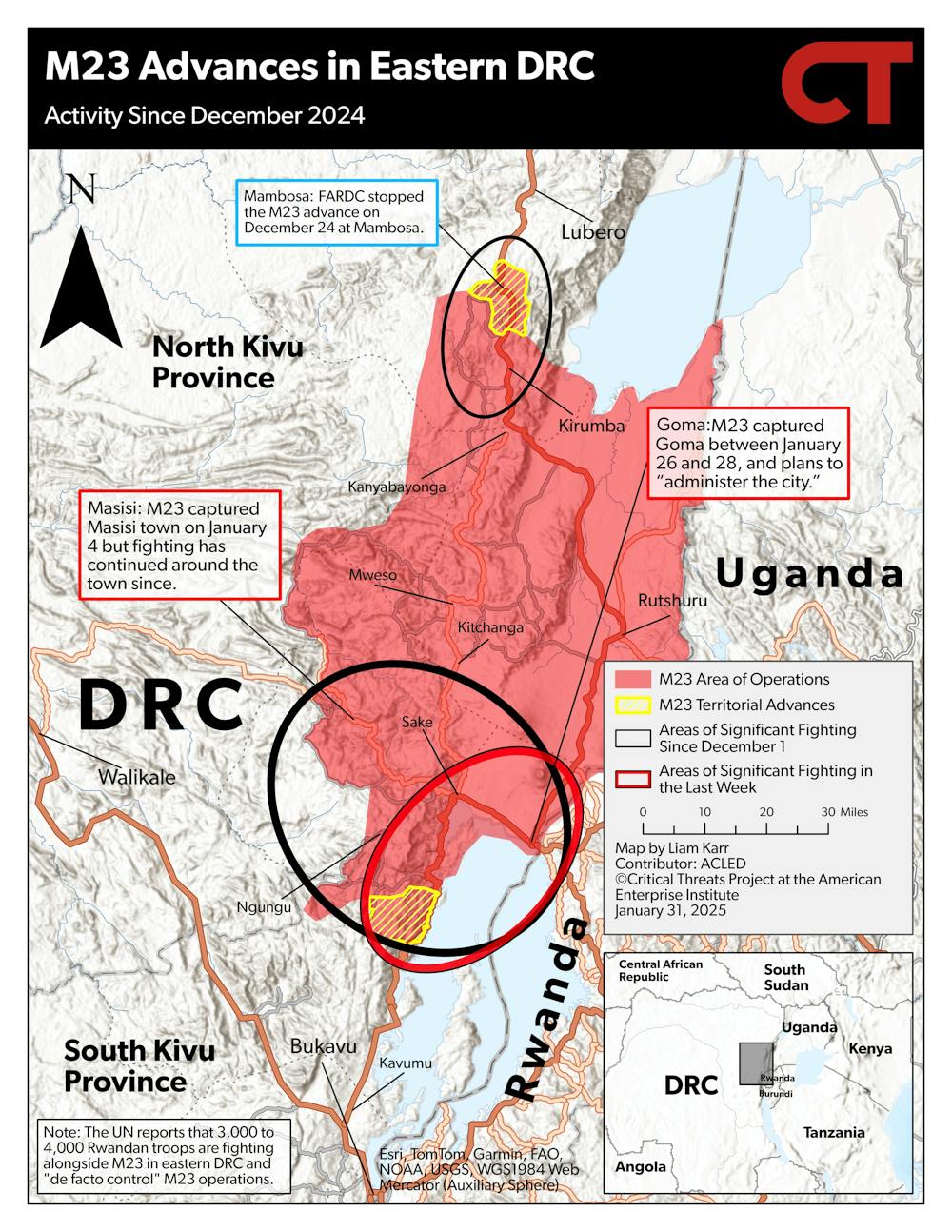
    In a major escalation in the conflict in the eastern Democratic Republic of the Congo (DRC), rebels from the March 23 Movement – or M23 – have seized Goma, the capital city of North Kivu province. At least 773 people have been killed there since the M23 claimed to have won control on January 27, while rebels have also seized several other towns in North Kivu including Sake and Minova.

    The rebels are now reportedly advancing towards Bukavu, the capital of South Kivu province. And Corneille Nangaa, who leads a rebel alliance of which M23 is the largest member, has vowed to march on the DRC’s capital in Kinshasa. Located 1,000 miles west of Goma, the capture of Kinshasa is unlikely. But the conflict still looks set to spread deeper into the DRC.

    The speed of the M23 advance has taken many by surprise. The rebels captured Goma, a city of 2 million people, within just three days. But the conflict between the DRC and the M23, which takes its name from the 2009 date on which a deal was reached to end a revolt by members of the ethnic Tutsi group, has been grinding on intermittently for years.

    Beginning in April 2012, when the M23 was formally created, the conflict has its roots in the same deep ethnic divisions that led to the Rwandan genocide in 1994. Following the genocide, where radical ethnic Hutus killed roughly 800,000 minority Tutsis, many Hutu extremists fled over the border into the DRC and settled in areas including North Kivu.

    The M23 seeks to act as a self-defence force for Congolese Tutsis against discrimination both by the DRC and non-state actors. This includes targeting by the Democratic Forces for the Liberation of Rwanda, a Hutu-dominated rebel group that seeks to overthrow the Rwandan government. The group has in the past committed egregious acts of violence against civilians in North Kivu, including mass killings and sexual violence.

    The M23 rebel group seized the city of Goma on January 27.
    The Critical Threats Project at the American Enterprise Institute

    The seizure of Goma is crucial for several reasons. First, it means that a sizeable and strategically important border province of the DRC is now in rebel hands. North Kivu is an active volcanic region that is rich in various minerals such as coltan, which is used in electronic equipment and the aerospace industry.

    In May 2024 the M23 seized Rubaya, a key mining town that produces 15% of the world’s coltan. Since then, the group has generated considerable income from controlling mineral production and trade. Indeed, the Global Initiative against Transnational Organized Crime labels the agendas of armed groups in the eastern DRC as “profit-driven”.

    Second, the capture of Goma has exacerbated inter-state tension between the DRC and Rwanda, raising the prospect of another inter-state war. News of the prized seizure came hours after the DRC’s foreign minister, Thérèse Kayikwamba Wagner, accused Rwandan troops of invading Congolese territory.

    A UN report from 2013 found that Rwanda not only supports the M23 group, but actively commands its troops. UN experts now estimate that there are up to 4,000 Rwandan troops fighting alongside the M23 in the DRC. Rwanda has denied backing the M23 despite ample evidence to the contrary.

    The Congolese government says Rwanda’s involvement is part of a ploy to exploit North Kivu’s vast mineral resources. In a report from December 2024, a panel of UN experts wrote that “fraudulent [mineral] extraction, trade and export to Rwanda” benefited both the M23 “and the Rwandan economy”. According to the Rwandan government’s own figures, the country exports far more gold than it mines.

    And third, the escalating conflict will deepen an already grave humanitarian crisis in the region. In March 2024, the UN reported that the number of internally displaced people in the DRC had reached 7.2 million – one of the largest such crises in the world. It is estimated that over 6 million civilians in the east of the DRC are now facing high levels of food insecurity.

    What next

    The DRC and Rwandan governments have already gone to war on two previous occasions, once in 1996 and then again in 1998 in what turned into a more protracted five-year conflict. The first war was triggered by Rwanda’s invasion of the DRC to target anti-Rwandan rebel groups seeking refuge there. The war soon drew in other states and became known as Africa’s first world war. Since 1996, conflict in the eastern DRC has killed approximately 6 million people.

    Yet despite this increased tension, there are hopes that a diplomatic solution can be reached. In the past, warring factions in the eastern DRC have agreed to temporary ceasefires following intensive mediation by international institutions such as the East African Community and the African Union, as well as neighbouring countries like Angola.

    However, previous ceasefires have also been violated by both sides. And the stakes are arguably higher this time, with the DRC losing further territory and control over strategic cities to the rebels.

    The Congolese government may be reluctant to accept peace conditions until it regains control over lost portions of territory. Indeed, the Congolese president, Félix Tshisekedi, has already snubbed prospective peace talks to establish a ceasefire.

    Western powers hold key leverage, and may be able to subdue the M23 insurgency. France has given its backing to the DRC government and has warned of the catastrophic humanitarian consequences should the situation deteriorate further.

    The US and other major powers like the UK have also withdrawn state funding for Rwanda in the past over its support for the M23 insurgency. In 2013, for example, cuts to foreign aid forced Rwanda to scale back its support for the rebels, both through reduced military training and supply runs. The UK government has threatened to withdraw funding to Rwanda again following the M23’s capture of Goma.

    Belgium, on the other hand, is leading calls for the EU to suspend a controversial minerals deal with Rwanda that boosts the bloc’s access to several elements in exchange for funding to help Kigali develop its mineral extraction infrastructure. When the deal was signed in 2024, Tshisekedi described it as “a provocation in very bad taste”.

    In any case, a ceasefire between the DRC and the M23 is not enough. What is needed is a long-term, durable solution that addresses the root causes and fears that are driving the armed conflict.

    Dale Pankhurst does not work for, consult, own shares in or receive funding from any company or organisation that would benefit from this article, and has disclosed no relevant affiliations beyond their academic appointment.

    ref. DRC rebels take eastern city of Goma – why it matters and what could happen next – https://theconversation.com/drc-rebels-take-eastern-city-of-goma-why-it-matters-and-what-could-happen-next-248393

    MIL OSI – Global Reports

  • MIL-OSI United Kingdom: Crackdown on illegal wildlife products at the border

    Source: United Kingdom – Executive Government & Departments

    Thousands of unlicensed and illegal wildlife products have been seized by Border Force as part of Operation Thunder.

    Operation Thunder is an intensive international operation to target the criminal networks behind wildlife crime,

    From 11 November to 6 December 2024, Border Force officers taking part in Operation Thunder 24 made 217 seizures of wildlife products which are controlled by the Convention on International Trade in Endangered Species of wild fauna and flora (CITES).

    Seizures included live plants, a range of beauty products containing caviar and cactus extracts, a quantity of bear bile, and clothes and accessories containing animal skins.

    Border Force officers also detected over 400 live birds as part of the operation, including rosella parakeets, king parrots, African grey parrots and blue-fronted Amazon parrots. Where possible, Border Force will rehome any live animals found.

    Operation Thunder is a global effort to target the illegal wildlife trade and is co-led by Interpol and the World Customs Organisation (WCO).

    Wildlife crime is estimated to be worth up to £17 billion globally per year and is the fourth largest international crime according to Interpol, behind only arms, drugs and human trafficking. Strengthening border security and breaking the criminal networks that seek to abuse our borders is a key part of the government’s plan for change.

    Minister for Migration and Citizenship, Seema Malhotra said:

    Detecting and seizing illegal wildlife products is not just a matter of enforcement, but a vital act of preservation for this planet’s biodiversity.  

    The work of Border Force in interrupting this serious organised crime is critical to the UK’s efforts to regulate the international trade in endangered species.

    Border Force Director for National Operations, Danny Hewitt said:

    Wildlife crime is a serious organised crime which fuels corruption, threatens species with extinction, deprives some of the world’s poorest communities of sustainable livelihoods, and degrades ecosystems.

    We take an intelligence-led approach to detecting illegal trade and work closely with our partners across the global community to share training, expertise and skills.

    Minister for Nature, Mary Creagh said:

    Tackling wildlife crime is essential to protecting iconic biodiversity at home and abroad. Criminal gangs must face justice for the part they play in nature destruction for self-gain.

    These figures reflect the invaluable role of the Border Force in safeguarding wildlife, and are an example of international collaboration to combat global criminal networks.

    Border Force works closely with other enforcement agencies, both nationally and internationally, to tackle the illegal wildlife trade and keep borders secure. This includes the Department for Environment, Food and Rural Affairs (Defra), the Animal and Plant Health Agency (APHA), London Heathrow Animal Reception Centre and Royal Botanic Gardens, Kew, amongst others.

    This year’s Operation Thunder was also supported by the police, who executed 5 warrants in relation to bird egg smuggling. This has so far resulted in the confiscation of over 5,000 bird eggs.

    Operation Thunder 24 led to seizures in the UK which included:

    • over 400 live birds (51 CITES listed)
    • 7kg of ivory
    • 450 live plants
    • 315kg of beauty products containing caviar
    • over 2,500 pills and 21.5kg of powders containing endangered plant and animal species
    • live corals
    • snow leopard garments

    Border Force is responsible for frontline detection and seizure of items covered by the CITES convention, which tackles the illegal trade in endangered animals and plants. The Heathrow-based Border Force CITES team are specialist officers who are recognised as world leaders in their field.

    Border Force’s work to prevent the trade of unregulated and illegal products made from endangered species is helping the government in its safer streets mission by smashing organised crime.

    Anyone with information about activity they suspect may be linked to smuggling and trafficking of any kind can report it online using the report smuggling service.

    Updates to this page

    Published 4 February 2025

    MIL OSI United Kingdom

  • MIL-OSI Security: Nearly 20,000 live animals seized, 365 suspects arrested in largest-ever wildlife and forestry operation

    Source: Interpol (news and events)

    4 February 2025

    138 countries and regions join forces to target fauna and flora trafficking worldwide

    LYON, France – Nearly 20,000 live animals, all endangered or protected species, have been seized in a global operation against wildlife and forestry trafficking networks, jointly coordinated by INTERPOL and the World Customs Organization (WCO).

    Operation Thunder 2024 (11 November – 6 December) brought together police, customs, border control, forestry and wildlife officials from 138 countries and regions, marking the widest participation since the first edition in 2017.

    Authorities arrested 365 suspects and identified six transnational criminal networks suspected of trafficking animals and plants protected by the Convention on International Trade in Endangered Species of Wild Fauna and Flora (CITES). Such species are illegally trafficked to meet specific market demands, whether for food, perceived medicinal benefits, “luxury” and collector items or as pets and competition animals.

    Globally, more than 100 companies involved in the trafficking of protected species were identified.

    The operation led to the rescue of 18 big cats, including these tiger cubs in the Czech Republic.

    The seized animals were sent to conservation centres, where their health was assessed while awaiting repatriation or rehabilitation.

    Organized crime networks profit from the demand for rare plants and animals, like this bird seized in Mexico.

    More than 5,877 live turtles were seized during Operation Thunder, including these ones in Tanzania.

    Morocco conducted intelligence-led investigations and seized over 50 snakes of various species.

    12 live pangolins were seized during the action weeks, such as this one in Mozambique.

    These Oryx were seized in Iraq. The collection of DNA is a crucial part of supporting prosecutions.

    1,731 other reptiles were seized live, like these blue-tongued lizards in Australia.

    Overall, nearly 20,000 live animals, all endangered or protected species, were rescued.

    33 protected primates were seized during the operation, this one was discovered in Chile.

    An example of a deer seized in North Macedonia during the operation that was jointly coordinated by INTERPOL and the World Customs Organization (WCO).

    This primate was rescued in Indonesia during Operation Thunder.

    The live animals, which included big cats, birds, pangolins, primates and reptiles were rescued in connection with 2,213 seizures made worldwide.

    Where possible, wildlife forensic experts collected DNA samples before transferring the animals to conservation centres, where their health was assessed while awaiting repatriation or rehabilitation, in line with national frameworks and relevant protocols.

    The collection of DNA is a crucial part of supporting prosecutions, as it helps confirm the type of species and its origin or distribution, shedding light on new trafficking routes and emerging trends.

    Large-scale trafficking of animal parts, plants and endangered species

    In addition to the live animals, participating countries seized hundreds of thousands of protected animal parts and derivatives, trees, plants, marine life and arthropods.

    Timber cases represent the most significant seizures, primarily occurring in sea cargo container shipments, while most other seizures took place at airports and mail processing hubs.

    Authorities also investigated online activities and found suspects using multiple profiles and linked accounts across social media platforms and marketplaces to expand their reach.

    More than 100 companies involved in the trafficking of protected species were also identified.

    Valdecy Urquiza, INTERPOL Secretary General said:

    “Organized crime networks are profiting from the demand for rare plants and animals, exploiting nature to fuel human greed. This has far-reaching consequences: it drives biodiversity loss, destroys communities, contributes to climate change and even fuels conflict and instability.

    “Environmental crimes are uniquely destructive, and INTERPOL, in cooperation with its partners, is committed to protecting our planet for future generations.”

    Ian Saunders, WCO Secretary General, said:

    “Operation Thunder continues to shed light on a crime that is often not a priority for enforcement actors. Through our joint efforts we have established cooperation mechanisms that facilitate the exchange of information and intelligence, and we have refined our enforcement strategies.

    “The illegal wildlife trade is still rapidly growing, highly lucrative and has devastating effects. The WCO remains committed to supporting its members and partners to effectively combat this serious crime.”

    This leopard hide was seized in Namibia, during the largest-ever global operation against wildlife and forestry trafficking.

    As well as this leopard skin coat discovered in Poland, Polish authorities also seized 300 seahorse tablets.

    This Mariposa butterfly found in Peru was one of 5,991 pieces and 233kg of arthropods seized globally.

    This wood in Brazil was among 49,572 pieces, 214.9 tonnes and 1340 m3 of timber seized worldwide.

    These sea cucumbers and shark fins were seized in Mozambique.

    Nearly 4.5 tonnes of pangolin scales were seized in Nigeria.

    Mongolia reported the seizure of 40 m3 of timber.

    This skull, discovered by Mexican authorities, was among 53 pieces of big cats seized around the world, including claws, furs, and skulls.

    Python skin products, like this one seized in Italy, are perceived as high-end or luxurious items.

    This coral, found in Italy, was one of 493 pieces and 21.41kg of coral seized globally.

    Indonesia reported two instances of trafficking of African ivory.

    Significant seizures include:

    • Indonesia: 134 tonnes of timber headed to Asia via ocean freight.
    • Kenya: 41 tonnes of exotic timber headed to Asia via ocean freight.
    • Nigeria: 4,472 kg of pangolins scales
    • Türkiye: 6,500 live songbirds discovered during a vehicle inspection at the Syrian border.
    • India: 5,193 live red-eared ornamental slider turtles concealed in passenger suitcases arriving from Malaysia at Chennai Airport.
    • Peru: 3,700 protected plants intercepted en route from Ecuador.
    • Qatar: Eight rhino horns found in a suspect’s luggage while transiting from Mozambique to Thailand.
    • United States: One tonne of sea cucumbers, considered a seafood delicacy, smuggled from Nicaragua.
    • Hong Kong, China: 973 kg of dried shark fins originating from Morocco seized at the airport.
    • Czech Republic: Eight tigers, aged between two months and two years, discovered in a suspected illegal breeding facility.
    • Indonesia: 846 pieces of reticulated python skin, from the world’s longest snake species, concealed on board a ship.
    • More than 300 firearms, vehicles and poaching equipment.

    Building a global intelligence picture of wildlife and timber trafficking

    Regular operations such as Thunder enable investigators to build a comprehensive global intelligence picture and detailed offender profiles, significantly enhancing the effectiveness of enforcement efforts and resolution of cross-border cases.

    Cooperation between various stakeholders is essential for effectively combating transnational criminal networks, from seizure to arrest and prosecution, as the data collected enable customs administrations to refine their risk management and compliance strategies, and stay one step ahead of criminals, ensuring that their contribution to the fight against wildlife crime is dynamic and responsive.

    Ahead of the operation, countries exchanged actionable intelligence on ongoing cases and high-value targets, updating critical information on 21 INTERPOL Red Notices for suspected traffickers wanted internationally. This exchange continued throughout the operation, with officers using the secure channels provided by both INTERPOL and the WCO to communicate in real time.

    The Operation Thunder series is backed by the CITES Secretariat and carried out under the partnership framework of the International Consortium on Combating Wildlife Crime (ICCWC). The 2024 edition was co-funded by the European Union, the UK Department for Environment, Food and Rural Affairs (DEFRA), and the United States Agency for International Development (USAID).


    MIL Security OSI

  • MIL-OSI: Picus Security Finds 3X Increase in Malware Targeting Password Stores

    Source: GlobeNewswire (MIL-OSI)

    SAN FRANCISCO, Feb. 04, 2025 (GLOBE NEWSWIRE) — Picus Security, the leading security validation company, today released The Red Report™ 2025. Based on an in-depth analysis of more than 1 million pieces of malware collected in 2024, the fifth annual report reveals that 25% of malware targets credentials in password stores — a 3X increase from 2023. For the first time ever, stealing credentials from password stores is in the top 10 techniques listed in the MITRE ATT&CK Framework. The report reveals that these top 10 techniques accounted for 93% of all malicious actions in 2024.

    “Threat actors are leveraging sophisticated extraction methods, including memory scraping, registry harvesting and compromising local and cloud-based password stores, to obtain credentials that give attackers the keys to the kingdom,” said Picus Security co-founder and VP of Picus Labs, Dr. Suleyman Ozarslan. “It’s vital that password managers are used in tandem with multi-factor authentication, and that employees never reuse a password, especially for their password manager.”

    Picus observed that attackers are prioritizing complex, prolonged, multi-stage attacks that require a new generation of malware to succeed. Picus Labs researchers coined the term “SneakThief” to represent the evolution of info-stealing malware, which involves increased stealth, persistence and automation. They liken the increasingly sophisticated approach to “the perfect heist,” noting that most malware samples now contain more than a dozen malicious actions designed to help attackers evade defenses, increase permissions and exfiltrate data.

    “Focusing on Top 10 MITRE ATT&CK techniques is the most viable way to stop the kill chain of sophisticated malware strains as early as possible”, said Volkan Ertürk, CTO and co-founder of Picus. “SneakThief malware is not an exception, enterprise security teams can stop ninety percent of malware by focusing on just 10 of MITRE’s entire library of techniques.”

    Additional key findings from the report include:

    • Malware samples now contain an average of 14 malicious actions. This means each individual piece of malware is more complex and can perform more actions in the cyber kill chain.
    • Exfiltration and stealth tactics made up 11.3 million actions in 2024. Adversaries are shifting to covert exfiltration methods — “whispering channels” like encrypted communications (HTTPS, DoH) — and living-off-the-land techniques to blend malicious activity into legitimate traffic. It is more common than ever to see tactics like process injection and application layer protocols used as key enablers, allowing attackers to persist in environments and exfiltrate data without triggering an alert.
    • No evidence that cybercriminals are using AI-driven malware. Despite the widespread hype surrounding AI and its potential applications in cybersecurity, Picus’s analysis revealed no significant increase in the use of AI-driven malware techniques in 2024.

    Methodology
    Picus Labs processed 1,094,744 pieces of malware collected between January and December 2024. From the identified malicious files, 14,010,853 malicious actions were detected, averaging approximately 14 actions per malware sample. These malicious actions were systematically mapped to the MITRE ATT&CK framework. The Picus Red Report offers a more in-depth description of the research methodology.

    To learn more, download the Picus Red Report 2025 and register to explore the report results with the Picus Research team during a (live) webinar on Thursday, February 27, 2025, at 1:00 p.m. EST.

    Resources

    About Picus Security 
    Picus Security, the leading security validation company, gives organizations a clear picture of their cyber risk based on business context. Picus transforms security practices by correlating, prioritizing and validating exposures across siloed findings so teams can focus on critical gaps and high-impact fixes. With Picus, security teams can quickly take action with one-click mitigations to stop more threats with less effort.

    The pioneer of Breach and Attack Simulation, Picus delivers award-winning, threat-centric technology that allows teams to pinpoint fixes worth pursuing, offering a 95% recommendation in Gartner® Peer Insights™ Customers’ Choice for 2024 in the BAS tools category.

    Contact Info:
    Jennifer Tanner
    Look Left Marketing
    picus@lookleftmarketing.com 

    Photos accompanying this announcement are available at:

    https://www.globenewswire.com/NewsRoom/AttachmentNg/73c8bf25-cd5e-41a8-8b6d-4561fe99df09

    https://www.globenewswire.com/NewsRoom/AttachmentNg/009eaa50-d2e3-4bee-aadb-f2140af1864c

    The MIL Network

  • MIL-OSI Africa: Civil Society Organizations Brief the Committee on the Elimination of Discrimination against Women on the Situation of Women in the Democratic Republic of the Congo, Nepal, Belarus and Luxembourg

    Source: Africa Press Organisation – English (2) – Report:

    GENEVA, Switzerland, February 4, 2025/APO Group/ —

    The Committee on the Elimination of Discrimination against Women was this afternoon briefed by representatives of civil society organizations on the situation of women’s rights in the Democratic Republic of the Congo, Nepal, Belarus and Luxembourg, the reports of which the Committee will review this week.

    In relation to the Democratic Republic of the Congo, speakers raised concerns regarding gender-based violence and abuse of internally displaced women and girls in the context of the escalating conflict, and the impact of the withdrawal of the United Nations Organization Stabilization Mission in the Democratic Republic of the Congo.

    On Nepal, speakers addressed discrimination against vulnerable women, including indigenous women and girls, lesbian, bisexual, transgender and intersex women, and women sex workers; anti-discrimination legislation; and the participation of women in political processes.

    Non-governmental organizations speaking on Belarus raised topics including the dissolution of civil society organizations, imprisonment of women human rights defenders, and barriers to access to justice for women.

    Regarding Luxembourg, a speaker raised issues related to a lack of gender sensitive policies and measures to address intersecting forms of discrimination, and the subordination of women through the social system.

    The National Human Rights Commissioner of the Democratic Republic of the Congo spoke on the country, as did the following non-governmental organizations: Centre for Migration, Gender, and Justice; Groupe d’Action pour les Droits de la Femme; and SAVIE ASBL LGBT.

    Regarding Nepal, the following non-governmental organizations spoke: Forum for Women, Law and Development; Feminist Dalit Organization; Nepal Indigenous Women Federation; Sex Workers and Allies South Asia and Team; Campaign for Change, Mitini Nepal, and Intersex Asia; and Visible Impact.

    The following non-governmental organizations spoke on Belarus: Belarusian Helsinki Committee; Human Constanta; Belarusian Congress of Democratic Trade Unions; Coalition against gender-based and domestic violence; and Our House.

    A representative of the Consultative Commission of the Grand-Duchy of Luxembourg on Human Rights spoke on Luxembourg.

    The Committee also held an informal meeting with the Working Group on Business and Human Rights and representatives from civil society and the business sector on “increasing the bottom line through smart, gender-inclusive, rights-focused approaches in digitisation.”

    Opening the meeting, Nahla Haidar, the newly elected Committee Chairperson, said artificial intelligence and digital technologies had revolutionised everyday life and business practices across sectors in ways that were never envisioned in the past. She called for action to prevent bias and discrimination against women through cyber-enabled modalities; expand women’s economic opportunities in the new digital era; and equip women and girls with necessary skills, capacities and tools to contribute to providing digital solutions.

    In the meeting, speakers discussed topics such as measures to prevent discrimination of women in the private sector, and particularly in the field of technology; measures to promote access to science, technology, engineering and maths education for women; measures to address the impacts of artificial intelligence on women; and measures to protect women’s rights in the energy transition era.

    Committee Experts and members of the Working Group spoke in the meeting, as did representatives of the United Nations Office of the High Commissioner for Human Rights, the World Trade Organization, and various private sector and civil society organizations.

    The Committee on the Elimination of Discrimination against Women’s ninetieth session is being held from 3 to 21 February. All documents relating to the Committee’s work, including reports submitted by States parties, can be found on the session’s webpage. Meeting summary releases can be found here. The webcast of the Committee’s public meetings can be accessed via the UN Web TV webpage.

    The Committee will next meet in public at 10 a.m. on Tuesday, 4 February to consider the report of the Democratic Republic of the Congo submitted under the exceptional reporting procedure (CEDAW/C/COD/EP/1).

    Opening Remarks by the Committee Chair

    NAHLA HAIDAR, Committee Chairperson, said that during each session, the Committee invited national and international non-governmental organizations to informal public meetings to provide specific information on the States parties that were scheduled for consideration by the Committee. She welcomed the representatives of non-governmental organizations and national human rights institutions that had come to provide information on the States parties whose reports were being considered this week: Democratic Republic of the Congo, Nepal, Belarus and Luxembourg.

    Statements by Non-Governmental Organizations from the Democratic Republic of the Congo, Nepal and Belarus

    Democratic Republic of the Congo

    On the Democratic Republic of the Congo, speakers, among other things, said violence against displaced persons was on the rise in the State. Gender-based violence, specifically, was rampant, leaving survivors with limited access to justice. Displaced women had a lack of access to reproductive health care and were giving birth in unsafe conditions. The economic struggles that displaced women and girls faced were equally alarming. With scarce income opportunities, many were driven to survival sex, which exposed them to sexual exploitation and abuse.

    The withdrawal of the United Nations Organization Stabilisation Mission in the Democratic Republic of the Congo raised real concerns. Plans from national authorities to take on the responsibilities of the Mission remained lacking. Armed militias and members of the security forces continued to abuse women with impunity. There were also “tolerance houses” where internally displaced women and girls were sexually abused. Justice remained inaccessible for most survivors.

    Speakers called on the Government to bolster administrative capacities; ensure the transfer of United Nations facilities to the armed forces; investigate “tolerance houses” and hold perpetrators of gender-based violence criminally liable; control the spread of weapons; and ensure justice and dignity for all women in the State. Speakers also called for a national migration strategy that was gender-responsive; mechanisms for gender-based violence prevention, mitigation, and response; provision of health services and resources, especially with regards to maternity health, that connected to related concerns such as food insecurity and nutrition; and programmes to expand livelihood provisions that supported displaced women and girls.

    Nepal

    Speakers said Nepal had yet to enact a robust anti-discrimination law, making women more vulnerable to abuse. There was a need to criminalise discrimination against women and eliminate all discriminatory legal provisions against them. The State party also needed to allocate sufficient human and financial resources to public bodies working on women’s rights. Appropriate support needed to be provided to women victims of violence.

    Fifteen per cent of Nepal’s population of women faced multiple forms of discrimination; many women faced social exclusion and violence. Some girls did not report crimes due to a lack of trust in the justice system.

    Nepal needed to amend the Constitution to address historical discrimination of indigenous women and to recognise the customary laws of indigenous people. The Government needed to amend the act on the rights of persons with disabilities to address the rights of indigenous women with disabilities. Access to justice needed to be promoted for indigenous women and women with disabilities.

    Nepal had failed to ratify the Palermo Protocol, and human trafficking and sex work were treated as the same in the country. Sex workers faced various forms of discrimination and violence. Nepal’s legislation had a direct impact on sex workers’ access to citizenship. Legislation on trafficking in persons needed to be amended to differentiate between trafficking and sex work. The Government also needed to facilitate sex workers’ access to citizenship and promote awareness raising campaigns on the rights of sex workers.

    Lesbian, bisexual, transgender and intersex girls faced harmful treatment and violence, and systematic discrimination in education and healthcare in Nepal, and the Government had failed to act in response. The Government needed to ensure such women could access single women’s allowances, redefine marriage to include gender-free terminology, and support this group’s access to rights.

    Education on sexual and reproductive health remained optional and inadequate in Nepal. It needed to be made compulsory. Legislation needed to be amended to fully decriminalise abortion, particularly abortions in cases of rape. The State also needed to amend legislation to include sexual and reproductive health and rights and sensitise health care providers and community members on safe births. It further needed to decriminalise sexual relations between consenting adolescents under the age of 18.

    The meaningful participation of women in political processes was lacking; many women politicians faced violence. Nepal needed to investigate historic violence against marginalised women, collect disaggregated data on women, enhance women’s leadership capacities, take measures to eliminate discrimination against marginalised women and girls, and provide quality health services to all women and girls, particularly indigenous women, at a minimal cost.

    Belarus

    Speakers on Belarus said the Constitution did not provide effective protection against discrimination. Women’s rights to education and health care were limited. Belarus had institutionalised discriminatory food provisions; women and girls were not able to access fruit and nuts, leading to long-term health risks.

    Access to justice for women was undermined by the persistent persecution of women human rights defenders. Women activists had been falsely labelled as terrorists despite their peaceful actions. The State had systematically dissolved various civil society organizations, including many that supported women. Almost 2,000 non-governmental organizations had been forced to liquidate. All women’s organizations that had prepared shadow reports to the Committee for the last review had been liquidated. It was immensely difficult to find legal assistance due to the political suppression of lawyers. In 2022, the Government had forcibly liquidated all trade unions. Six women trade union activists remained in prisons.

    At least 139 women were political prisoners in Belarus. They lacked access to healthcare and were persistently ill-treated. Imprisoned women faced forced labour and modern forms of slavery. If women refused to work, they were put in “cages of shame” and forced to stand outside for several hours. Women prisoners earned between five and 10 euros per month and faced harsh penalties for not meeting quotas.

    When domestic violence cases were reported to police, police screened the political activities of the victim rather than provide support. Victims and aggressors were invited together to meetings with authorities, promoting impunity.

    Women migrants were vulnerable to trafficking and violence. Domestic violence was not a ground for asylum in Belarus.

    Luxembourg

    No non-governmental organizations spoke on the situation of women in Luxembourg.

    Questions by Committee Experts

    A Committee Expert said that there were many laws and policies for women in the Democratic Republic of the Congo, but there was weak implementation. How was the transitional justice policy being implemented for women? Was there a plan to promote the security of women and girls in the Democratic Republic of the Congo?

    The Expert shared the non-governmental organizations’ concern regarding the suppression of civil society in Belarus. Were there plans to update the national action plan on human rights in Belarus, and were there plans to establish a national human rights institution?

    Another Expert asked about anti-trafficking activities being carried out in the Democratic Republic of the Congo. To what extent were women represented in local governments and decision-making bodies in Nepal?

    One Committee Expert asked about financial resources devoted to implementing the national gender equality plan in Nepal. What were areas of concern related to sexual and reproductive health services in Belarus?

    A Committee Expert asked about problems regarding access to justice for Dalit women in Nepal. How common was the dowry custom in Nepal? Why was the dowry for younger women and girls lower?

    Another Committee Expert asked if the Democratic Republic of the Congo had laws on the accountability of military personnel and contractors involved in violence against women. What social protection system and benefits did Belarus have for women and girls?

    One Committee Expert asked about legal provisions that needed to be challenged. What needed to be done to educate girls and society about the harms of the kumari practice in Nepal, which isolated girls from their community?

    A Committee Expert called for information on the Democratic Republic of the Congo’s national action plan on the development of the security forces. What action had been taken to dismantle non-governmental armed groups in the east? Was it still possible for non-governmental organizations in Belarus to protect women and interact with the Government?

    Responses by Non-Governmental Organizations

    Nepal

    Responding to questions on Nepal, speakers said there was a very low percentage of women in federal and provincial decision-making bodies in Nepal, and an even lower percentage of Dalit women. There needed to be increased representation of women in these bodies. There were several laws that directly discriminated against women, including laws on legal residences, which considered women and girls’ residences as those of their husbands and fathers. Divorced women lost their property rights. It was prohibited to oppose gender biases in cultural and social practices. Nepal’s laws did not recognise lesbian, bisexual, transgender and intersex women as minorities; this needed to be done.

    In Nepal, the parents of women paid dowries, and less dowry was paid for younger women. Dowry payments were most prevalent in the south of the country. The Criminal Code criminalised this practice, but it still existed.

    Sexual and reproductive health education was part of the school curriculum but was no longer a compulsory subject. There were also gaps in sexual and reproductive health legislation, with many marginalised women not able to access sexual and reproductive health services.

    Dalit women and other marginalised women could not easily access the justice system. They were not made aware of where and how to access justice and faced violence and discrimination from the police because of their identity.

    Belarus

    Responding to questions on Belarus, speakers said Belarus’ Gender Equality Council did not include non-governmental organizations working on human rights and gender equality. Belarus’ legislation on incitement to hatred was used to oppress women human rights defenders. One such woman had been imprisoned for seven years under this legislation. Raids, inspections and blocking of websites were tools used by the Government to restrict the activities of civil society organizations.

    Statements by National Human Rights Institutions

    Democratic Republic of the Congo

    GISÈLE KAPINGA NTUMBA, National Human Rights Commissioner of the Democratic Republic of the Congo, said the Democratic Republic of the Congo was going through one of its darkest times in recent history, marked by the invasion of the M23 rebels in the east of the country, which was facing a protracted, violent crisis. Many women and girls had been displaced and were facing heightened risks of sexual violence and rape. The National Human Rights Commission had conducted investigations into sexual violence linked to conflict, engaging with competent institutions to address this problem and combat impunity.

    The Commission welcomed that the Government had implemented several measures to protect women and girls from sexual and gender-based violence, including a law criminalising such violence and enshrining access to justice for victims. However, there was still a long way to go until these measures could effectively protect civilians from sexual and gender-based violence. The number of internally displaced persons continued to grow, and there had been many cases of rape reported. There needed to be increased funds to limit the circulation of small arms and light weapons, build new camps, and increase humanitarian aid for internally displaced persons. Care for victims of sexual and gender-based violence needed to be given by trained professionals.

    The national fund for compensation for the victims of gender-based violence had helped victims to access care. The Commission also welcomed the organisation of travelling courts to combat impunity. The Government needed to restore peace in the east and take steps to protect civilians from gender-based violence, and provide internally displaced persons with adequate aid. Armed groups needed to respect the rules of international humanitarian law and implement an immediate ceasefire. The international community needed to promote peace by adopting sanctions against M23 and other armed groups.

    Luxembourg

    LAURA CAROCHA, Human and Social Sciences Expert,Commission consultative des Droits de l’Homme du Grand-Duché de Luxembourg [Consultative Commission of the Grand-Duchy of Luxembourg on Human Rights], welcomed the efforts made by Luxembourg to combat discrimination against women since the last report, while noting persistent shortcomings, including a social system that kept women in a subordinate position to men. Luxembourg’s policy favoured a “neutral” approach that was not gender sensitive. Ms. Carocha urged politicians to openly acknowledge this systemic patriarchal domination and to make the deconstruction of this mechanism a priority. To this end, it was imperative that the Government finally implemented the principle of gender mainstreaming in a cross-cutting manner in all its policies.

    Luxembourg’s equality efforts lacked an intersectional approach and the Government rarely addressed multiple and intersecting forms of discrimination. Disability was conspicuously absent from the National Action Plan for Equality between Women and Men, while the gender dimension was neglected in the National Action Plan on Disability. It was essential to have detailed data, disaggregated by gender, age, ethnicity, disability and education level, to better understand and address the different forms of discrimination that women faced. The Government also needed to impose concrete actions on companies, municipalities and administrations in terms of gender equality and the fight against discrimination against women.

    All actions taken in the fight against discrimination against women needed to be carried out in close collaboration with civil society. This cooperation needed to be translated into lasting partnerships and political will to ensure that the contributions of civil society were seriously considered in the decision-making process.

    Ms. Carocha concluded by calling for the recognition of multiple forms of discrimination, and a proactive and participatory response from the Government to gender inequalities rooted in societal dynamics. This meant adopting structural solutions that addressed the root causes of discrimination.

    Questions by Committee Experts

    A Committee Expert offered condolences to the people of the Democratic Republic of the Congo, including families of civilians who had lost their lives. What did the National Human Rights Commission wish the Committee to highlight in the dialogue with the State party?

    Another Committee Expert asked about measures to prevent conflict-related gender-based violence in the Democratic Republic of the Congo.

    One Committee Expert asked if humanitarian aid groups were able to access Goma and deliver food, health and menstrual products?

    A Committee Expert expressed concern regarding the lack of participation from women’s organizations from Luxembourg in the dialogue. What progress had been made in reforming the Constitution? Was there an initiative to amend the timeframe for authorising abortions in the State? The State party did not publish data broken down by origin. Could data be provided on migrant workers in Luxembourg?

    Another Committee Expert asked about Luxembourg’s process for identifying stateless persons.

    Responses by National Human Rights Institutions

    GISÈLE KAPINGA NTUMBA, National Human Rights Commissioner of the Democratic Republic of the Congo, said that in Goma, people in displacement camps had been bombarded. They had no power and no water, and the Rwandese army was on its way in. The international community needed to assist the Democratic Republic of the Congo in creating humanitarian corridors to assist internally displaced persons fleeing the region. The State had approved laws and measures on preventing sexual violence, but implementing these was a challenge, particularly in regions where the Government did not have control. In the dialogue, the Committee needed to ask the Government to choose diplomacy over other means, as the population was dying for nothing. Those involved in the conflict needed to be prosecuted. The international community needed to condemn the situation in the east and promote diplomacy.

    Meeting with the Working Group on Business and Human Rights

    Statements

    ANDREA ORI, Director, Groups in Focus Section, Human Rights Treaties Branch, United Nations Office of the High Commissioner for Human Rights, said that the meeting would address the nexus between business and human rights, and gender and digital technologies. Cooperation and practices in digital fields needed to not perpetrate discrimination against women. There was room for improvement on measures addressing gender discrimination in the workplace, representation of women in leadership positions, workplace harassment, and labour rights for women. Women were over-represented in low-paying jobs. Stereotypes hindered women’s access to finance and investments, and women had less access to technology and digital services. Today’s discussion would focus on enhancing the promotion and protection of women.

    NAHLA HAIDAR, Committee Chairperson, said artificial intelligence and digital technologies had revolutionised everyday life and business practices across sectors in ways that were never envisioned in the past. Strategic, innovative modalities to better safeguard the rights of women and girls called for partnerships, joint approaches and harmonised frameworks. Women needed to be engaged in digital developments from the beginning. States needed to avoid the re-inventing of stereotypes, bias and discrimination and the perpetuation of violence against women through cyber-enabled modalities; safeguard women’s livelihoods and expand economic opportunities in the new digital era for them; and equip women and girls with necessary skills, capacities and tools to contribute to providing digital solutions.

    This briefing was anticipated to be the first in a series of collaborative efforts to address substantive issues on women’s economic rights in a digital world based on the provisions of the Convention. Business and human rights principles and the jurisprudence of the Committee and standards could be systematically deployed to uphold and respond to women’s rights protection and economic empowerment, particularly through inclusive digital technologies.

    Sadly, gender equality had often been constrained by interpretations outside the text of the Convention, resulting in persistent gender gaps and disparities. Critical partnerships would enable the Committee to explore a collaborative and coordinated approach for bridging digital gender inequalities to create a more inclusive and equitable digital future for women and girls, one that was not only free of all forms of violence but also offered them equal opportunities to access and utilise digital technologies to boost their livelihoods and human capital assets.

    LYRA JAKULEVIČIENĖ, Chairperson of the Working Group on Business and Human Rights, said that this year, the Working Group was preparing a report on the use of artificial intelligence in businesses and its human rights impacts. It focused on the deployment of artificial intelligence technologies and procurement by States and businesses, looking at biases and other issues. The use of artificial intelligence and other technologies had many benefits and but also created concerns, including related to gender, and these would be captured in the report. Synergy with the Committee would help both bodies to advance their agendas and strengthen the global protection of human rights, particularly for vulnerable women and girls.

    ESTHER EGHOBAMIEN-MSHELIA, Committee Expert, said 300 million fewer women than men had access to mobile internet globally. Although about a third of small and medium enterprises were owned by women, women were under-represented in discussions on the global value chain. States needed to focus on the energy transition and artificial intelligence technologies, as if they did not address issues in these fields, the gender gaps would widen.

    FERNANDA HOPENHAYM, Gender Focal Point of the Working Group on Business and Human Rights, said the United Nations Guiding Principles on Business and Human Rights had a cross-cutting gender perspective, and this needed to be addressed by States and businesses. The Guiding Principles said that States needed to include a gender perspective in all policies on business and human rights. It also called on businesses to respect human rights and to implement measures promoting diversity and inclusion. Women needed to be able to access remedies in cases in which their rights were violated. Technologies needed to be gender sensitive, responsive and transformative.

    Panel Discussion

    In the ensuing discussion, speakers, among other things, said women faced many barriers to accessing the labour market; these needed to be addressed. Countries needed to change company cultures to address discrimination against women employees, and promote diversity and family-friendly policies. Businesses needed to consider documents outlining the rights of women and girls, such as the Convention, and use tools to assess the effectiveness of gender equality measures. They also needed to create an enabling environment for women. Another key requirement was to conduct human rights due diligence with a gender lens.

    Some speakers expressed concerns related to discrimination against women in the technology sector. Many companies lacked a gender lens when assessing their value chains and were not carrying out gender-related due diligence. There was evidence of disproportionate harm to non-binary women and the targeting of women human rights defenders online. Companies were actively amplifying gender biases. The Committee and the Working Group needed to work with civil society and to call out companies by name when they violated human rights. They also needed to promote corporate accountability and prevent regression.

    Speakers presented measures to change cultural mindsets to support women to succeed professionally; to promote a healthy work-life balance for women; to raise awareness of women’s rights among businesses; and to develop rules and tools to protect women and girls on social media platforms.

    Some speakers said technology could allow for greater access to education for women and girls, so women needed increased access to it. One speaker said girls had less opportunities to study in fields such as programming and robotics. With simple reforms and measures encouraging participation, more and more women and girls would choose information technology as a profession, they said.

    Some speakers expressed concerns that artificial intelligence technology was not sufficiently regulated. It was possible for artificial intelligence systems to learn and reproduce societal biases and there were also privacy concerns regarding the data that these systems used. One speaker presented efforts to eliminate biases in artificial intelligence systems and to develop tools to ensure that such systems respected human rights.

    One speaker called for respect for women’s rights in the energy transition. Women had strong roles to play in preventing child labour in the energy sector and supporting children’s access to education. Businesses needed to ensure women’s experiences were incorporated in energy transition programmes, and to finance science, technology, engineering and maths education programmes for women, speakers said.

    MIL OSI Africa

  • MIL-OSI United Kingdom: #ItsNotOK – sexual violence victims urged to seek support

    Source: City of Wolverhampton

    Sexual Abuse and Sexual Violence Awareness Week, which began yesterday (Monday 3 February), is the UK’s national week to raise awareness of these crimes and, using the hashtag #ItsNotOK, encourages people to raise awareness and help get more coverage of this important subject.

    Councillor Jasbir Jaspal, the City of Wolverhampton Council’s Cabinet Member for Adults and Wellbeing, said: “It’s Not OK to have to deal with sexual abuse or sexual violence. It’s Not OK to suffer in silence. And It’s Not OK to have to deal with it on your own.

    “This Sexual Abuse and Sexual Violence Awareness Week, we want victims to understand that no matter what happened, you deserve support – it wasn’t your fault, we’ll listen to you, and we’ll believe you.”

    Rape Crisis England and Wales runs a 24/7 Rape and Sexual Abuse Support Line providing specialist support to anyone aged 16 and over who has experienced something sexual that they didn’t want, didn’t consent to or is feeling confused about, no matter when or where it happened. Call 0808 500 2222 or visit Abuse Support Line.  

    There are a wide range of services in the West Midlands which offer guidance and support to anyone who has experienced rape, sexual violence and childhood sexual abuse including The Haven Wolverhampton (details at https://www.havenrefuge.org.uk/), Black Country Women’s Aid (https://blackcountrywomensaid.co.uk/) and a number of other organisations (details at Support after rape and sexual assault).

    And the West Midlands Police and Crime Commissioner’s No Excuse For Abuse website includes details of a range of support services including charities, refuges and specialist support for LGBTQ+ and male victims.

    People can report sexual abuse or violence to West Midlands Police by calling 101 for non-emergencies or via Live Chat online. Dial 999 if a sexual assault has just taken place or someone is in immediate danger.

    Sexual Abuse and Sexual Violence Awareness Week runs until Sunday (9 February, 2025). For more information, visit Sexual Abuse and Sexual Violence Awareness Week.

    MIL OSI United Kingdom

  • MIL-OSI Russia: From Scanning to Digital Twin: SUM Research on 3D Modeling in Action

    Translartion. Region: Russians Fedetion –

    Source: State University of Management – Official website of the State –

    Employees of the Reverse Engineering Laboratory of the State University of Management conducted research on the issues of 3D modeling.

    The authors of the article “The Impact of 3D Scanning Data Processing Methods on the Quality of Final Solid 3D Models” are young scientists from the State University of Management: – Leading Researcher (Head of the Laboratory), Candidate of Technical Sciences, Associate Professor Vladimir Filatov; – Researcher, Candidate of Technical Sciences, Associate Professor Ilya Nefelov; – Specialist, Postgraduate Student Denis Yudin.

    “As is known, with the help of 3D scanners, it is possible to scan the surfaces of any physical objects and make their virtual 3D models – digital twins,” says Vladimir Filatov. “This model can then be changed, and a new product can be printed or manufactured on machines, and it will take significantly less time compared to doing it from scratch. Such scanning is the first stage of reverse engineering.”

    Some characteristics of a real object may prevent the correct transfer of its parameters to digital space. It may be transparent, glossy, mirror-like, have different textures or colors, have deep pockets (depressions) where light hardly penetrates or is reflected from surfaces inside it. For more accurate scanning, matting is used – the application of single-color anti-glare sprays that eliminate the properties of objects that are inconvenient for scanning.

    Scientists from the State University of Management studied the deviations of the sizes of the obtained 3D model of the scanned object from its sizes measured in reality, and the influence of various sprays on this error. The studies showed how accurately the obtained 3D model coincides with the real object after scanning.

    The authors reviewed methods for processing 3D scanning data, including primary processing, filling in missing surfaces, smoothing, splitting into primitives, and measurements in a virtual environment. Their impact on the quality of final solid-state electronic 3D models of scanned objects was assessed. Measurements of final length measures were performed in a virtual environment with subsequent analysis of the data obtained.

    In the future, research will be aimed at studying algorithms and methods for processing the surfaces of scanned objects in order to improve the quality of digital twins of agricultural machinery.

    The study can be read about in an article published in the November 2024 issue of the Standards and Quality journal.

    Subscribe to the TG channel “Our GUU” Date of publication: 02/04/2025

    Please note: This information is raw content directly from the source of the information. It is exactly what the source states and does not reflect the position of MIL-OSI or its clients.

    MIL OSI Russia News

  • MIL-OSI USA: Padilla, Schiff, Senate Judiciary Committee Democrats Demand Answers From Trump Administration on Purging of DOJ and FBI Officials

    US Senate News:

    Source: United States Senator Alex Padilla (D-Calif.)

    Padilla, Schiff, Senate Judiciary Committee Democrats Demand Answers From Trump Administration on Purging of DOJ and FBI Officials

    WASHINGTON, D.C. — Today, U.S. Senators Alex Padilla and Adam Schiff (both D-Calif.) joined U.S. Senate Democratic Whip Dick Durbin (D-Ill.) and all other Senate Judiciary Committee Democrats in demanding answers from Trump Administration nominees and acting officials on the removal or reassignment of career law enforcement officials across the Department of Justice (DOJ) and the Federal Bureau of Investigation (FBI).

    Last week, the Trump Administration reportedly purged dozens of DOJ and FBI officials involved in prosecuting Donald Trump and the January 6 rioters, and they are now threatening additional action against thousands of employees across the country who worked on investigations related to the attack on the Capitol. The Senators wrote to Pam Bondi, President Trump’s nominee to be the Attorney General of DOJ; Kash Patel, nominee to be the Director of the FBI; Todd Blanche, nominee to be Deputy Attorney General; Acting Attorney General James McHenry; and Acting FBI Director Brian Driscoll regarding the mass purging.

    “We have grave concerns about the removal or reassignment across the Department of Justice (DOJ) and Federal Bureau of Investigation (FBI) of senior career civil servants who have served honorably under multiple administrations, regardless of the President’s party,” wrote the Senators. “The removals and reassignments from their positions of a significant number of experienced, nonpartisan Department officials with invaluable national security expertise without any comparable replacements one day into the second Trump Administration presents an alarming threat to national security.”

    “As America faces a heightened threat landscape, these shocking removals and reassignments deprive DOJ and the FBI of experienced, senior leadership and decades of experience fighting violent crime, espionage, and terrorism,” continued the Senators. “As the FBI Agents Association stated in response to reports about the removal of FBI officials: ‘Dismissing potentially hundreds of Agents would severely weaken the Bureau’s ability to protect the country from national security and criminal threats and will ultimately risk setting up the Bureau and its new leadership for failure.’ Moreover, the firing of dozens of federal prosecutors and hundreds of agents will cripple FBI field offices and U.S. Attorney’s offices across the country. We can only assume these decisions are intended to prevent the Department from investigating national security and public corruption, while also serving as political retribution against the President’s perceived enemies and stoking fear among the dedicated and talented workforce in our nation’s premier law enforcement agency.”

    As many as 20 senior DOJ officials were reassigned or removed, including the veteran career deputy assistant attorneys general in the Department’s National Security Division.

    Over the weekend, thousands of FBI personnel across the country were asked to complete a questionnaire by today, Monday, February 3, at 3 p.m. The survey asks for their job title, whether they worked on a case related to the January 6th attack on the Capitol, “if they were involved in the arrest of a Jan. 6 suspect, if they testified at a trial, if they interviewed witnesses, if they conducted surveillance on suspects and more.” It has also been reported that the Acting FBI Director is being advised by an advisory committee comprised of partisan political operators, including an Elon Musk affiliate. This is a stark departure from the longstanding tradition that the FBI Director is the only political appointee in the Bureau.

    The purge of experienced career prosecutors and agents has recently expanded to include the removal or forced retirement of all six executive assistant directors (EADs), including the EADs who oversee the National Security Branch, Intelligence Branch, and the Criminal, Cyber, Response, and Services Branch. It also includes the assistant Directors and the Special Agents in charge of at least four major field offices. Acting Deputy Attorney General Emil Bove ordered these actions in a January 31, 2025 memo, stating, “I do not believe the current leadership of the Justice Department can trust these FBI employees to assist in implementing the President’s agenda faithfully.”

    Additionally, over a dozen senior DOJ prosecutors were fired after receiving memos from Acting Attorney General McHenry, stating “Given your significant role in prosecuting the President, I do not believe that the leadership of the Department can trust you to assist in implementing the President’s agenda faithfully.”

    The Senators emphasized that the Senate Judiciary Committee has a constitutional obligation to perform oversight over the Department and its components, and to provide advice and consent on the nominations of officers to lead it. To that end, they requested information to be returned to the committee in response to the removal of FBI and DOJ officials. They also requested answers from these individuals about their involvement. 

    In addition to Senators Padilla, Schiff, and Durbin, the letters were signed by U.S. Senators Richard Blumenthal (D-Conn.), Cory Booker (D-N.J.), Chris Coons (D-Del.), Mazie Hirono (D-Hawaii), Amy Klobuchar (D-Minn.), Peter Welch (D-Vt.), and Sheldon Whitehouse (D-R.I.).

    Full text of the letter to Attorney General nominee Pam Bondi is available here.

    Full text of the letter to FBI Director nominee Kash Patel is available here.

    Full text of the letter to Deputy Attorney General nominee Todd Blanche is available here.

    Full text of the letter to Acting Attorney General McHenry and Acting FBI Director Driscoll is available here.

    MIL OSI USA News

  • MIL-OSI: January 2025 P&C Reinsurance Renewals Results: Sustained growth in preferred lines coupled with attractive margins

    Source: GlobeNewswire (MIL-OSI)

    Press release
    4 February 2025 – N° 02

    January 2025 P&C Reinsurance Renewals Results

    Sustained growth in preferred lines coupled with attractive margins

    • In line with its Forward 2026 strategic plan, SCOR continues to grow its P&C preferred lines while maintaining a strong underwriting discipline.
    • During the January 2025 P&C renewals, SCOR achieves EGPI1 growth of 9.6%2 supported by Specialty lines and Alternative Solutions: 
      • Increasing EGPI by 8.1%2 for Engineering, Marine, IDI and International Casualty;
      • Leveraging the strong momentum in Alternative Solutions and growing EGPI by 29.6%2;
      • Maintaining a prudent approach to business exposed to climate change and US Casualty. 
    • SCOR’s expected technical profitability remains unchanged at attractive level benefitting from dynamic retrocession buying.

    Jean-Paul Conoscente, CEO for P&C at SCOR, comments: “We are satisfied with the successful 1.1 2025 renewals results. SCOR achieves a +9.6% EGPI growth while maintaining a stable technical profitability. We continue to deliver targeted growth in our preferred lines of business, while keeping T&Cs mostly unchanged. Despite the slight rate reduction observed in the market, SCOR successfully maintains stable pricing thanks to its proactive portfolio management. Looking ahead, we believe the market still offers opportunities for profitable growth. SCOR will continue to leverage on its Tier 1 franchise and build on the strong momentum achieved during the 1.1 renewals.”

    January 2025 P&C Reinsurance Renewals

    During the January 2025 renewals, demand for reinsurance coverage remains elevated. Following an increase in capital supply, the market conditions have become slightly more competitive compared to the peak level of the cycle observed last year. In this context, SCOR maintains strict underwriting discipline and successfully grows its preferred lines according to its Forward 2026 growth strategy, keeping T&Cs mostly stable and maintaining the net profitability of its P&C Reinsurance book unchanged.

    P&C Reinsurance book renewed at 1 January 2025(1):

      Premiums renewed
    (in EUR million)
    Evolution vs. January 2024 Main lines concerned
    P&C Lines(2) 2,798 +2.9% o/w Nat Cat (+0.3%)
    Specialty Lines(3) 1,762 +14.3% o/w Engineering, Marine, IDI (+17.2%)
    Alternative Solutions 705 +29.6%  
    TOTAL 5,265 +9.6%  

    (1).   Approximately 64% of SCOR’s P&C Reinsurance premiums – representing c.50% of SCOR’s total P&C premiums – is renewed in January.
    (2).   P&C Lines include Property, Property Cat, Casualty, Motor, and other related lines (Personal Insurance, Nuclear, Terrorism, Special Risks, Motor Extended Warranty, and Inwards Retrocession).
    (3).   Specialty Lines include Agriculture, Aviation, Credit & Surety, Inherent Defects Insurance, Engineering, Marine and Offshore, Space, and Cyber.

    P&C Lines EGPI grows by 2.9%2, driven by continued disciplined Nat Cat underwriting and decreasing exposures in US Casualty. Natural Catastrophe premiums remain flat with a slight increase in net exposure. In US Casualty, SCOR maintains a prudent approach and renews its portfolio with selected clients. This leads to a 11.0%2 decrease in US Casualty EGPI and continued exposure reduction to this business.

    Specialty Lines EGPI grows by 14.3%2. This is driven by +17.2%2 EGPI growth in diversifying lines (Engineering, Marine and IDI) in line with the Forward 2026 plan.

    Alternative Solutions EGPI grows by 29.6% compared to 1st January last year, with continued positive new business momentum across all regions.

    The expected net technical profitability remains unchanged for the renewed portfolio. This reflects continued discipline along with dynamic retrocession buying, which offsets the inward business margin erosion from commissions, modelling changes and the impact of the business mix.

    SCOR leverages the changing market environment to optimize its retrocession structures. SCOR maintains its risk exposure within its risk appetite defined in Forward 2026.

    For the upcoming renewals in 2025, SCOR expects continued discipline and adequate prices. In parallel, SCOR continues to develop risk partnerships with new and existing partners.

    *

    *        *

    SCOR, a leading global reinsurer

    As a leading global reinsurer, SCOR offers its clients a diversified and innovative range of reinsurance and insurance solutions and services to control and manage risk. Applying “The Art & Science of Risk”, SCOR uses its industry-recognized expertise and cutting-edge financial solutions to serve its clients and contribute to the welfare and resilience of society.

    The Group generated premiums of EUR 19.4 billion in 2023 and serves clients in more than 160 countries from its 35 offices worldwide.

    For more information, visit: www.scor.com

    Media Relations
    Alexandre Garcia
    media@scor.com
      
    Investor Relations
    Thomas Fossard
    InvestorRelations@scor.com

    Follow us on LinkedIn

    All content published by the SCOR group since January 1, 2024, is certified with Wiztrust. You can check the authenticity of this content at wiztrust.com.

    General

    Numbers presented throughout this press release may not add up precisely to the totals in the tables and text. Percentages and percent changes are calculated on complete figures (including decimals); therefore the press release might contain immaterial differences in sums and percentages due to rounding. Unless otherwise specified, the sources for the business ranking and market positions are internal.

    Forward-looking statements

    This press release includes forward-looking statements, assumptions, and information about SCOR’s financial condition, results, business, strategy, plans and objectives, including in relation to SCOR’s current or future projects.

    These statements are sometimes identified by the use of the future tense or conditional mode, or terms such as “estimate”, “believe”, “anticipate”, “expect”, “have the objective”, “intend to”, “plan”, “result in”, “should”, and other similar expressions.

    It should be noted that the achievement of these objectives, forward-looking statements, assumptions and information is dependent on circumstances and facts that may or may not arise in the future.

    No guarantee can be given regarding the achievement of these forward-looking statements, assumptions and information. These forward-looking statements, assumptions and information are not guarantees of future performance. Forward-looking statements, assumptions and information (including on objectives) may be impacted by known or unknown risks, identified or unidentified uncertainties and other factors that may significantly alter the future results, performance and accomplishments planned or expected by SCOR.

    In particular, it should be noted that the full impact of the economical and geopolitical risks on SCOR’s business and results cannot be accurately assessed.

    Therefore, any assessments, any assumptions and, more generally, any figures presented in this press release will necessarily be estimates based on evolving analyses, and encompass a wide range of theoretical hypotheses, which are highly evolutive.

    Information regarding risks and uncertainties that may affect SCOR’s business is set forth in the 2023 Universal Registration Document filed on March 20, 2024, under number D.24-0142 with the French Autorité des marchés financiers (AMF) posted on SCOR’s website www.scor.com.

    In addition, such forward-looking statements, assumptions and information are not “profit forecasts” within the meaning of Article 1 of Commission Delegated Regulation (EU) 2019/980.

    SCOR has no intention and does not undertake to complete, update, revise or change these forward-looking statements and information, whether as a result of new information, future events or otherwise.

    Financial information

    All figures in this press release are unaudited unless otherwise specified.

    Unless otherwise specified, all figures are presented in Euros.

    Any figures for a period subsequent to 30 September, 30 2024 should not be taken as a forecast of the expected financials for these periods.

    All figures are at constant exchange rates as of December 31, 2024 unless otherwise specified.

    All figures are based on available information as of January 25, 2025 unless otherwise specified.


    1 Estimated Gross Premium Income (EGPI).
    2 vs 1 January 2024 EGPI.

    Attachment

    The MIL Network

  • MIL-OSI: Amundi: Fourth quarter & Full-year 2024 results

    Source: GlobeNewswire (MIL-OSI)


    Amundi: Fourth quarter & Full-year 2024 results

    Record 2024 net income1,2at €1.4 billion

    Results
    at the highest historical level
      2024 adjusted net income1,2 of €1,382m, up sharply: +13% vs. 2023

    • Thanks to Revenue growth (+9%) and improvement of the Cost-to-income ratio to 52.5%2
    • Earnings per share2: €6.75

    Q4 2024 – adjusted net income1,2€377m, up +20% Q4/Q4

    Dividend proposed to the Annual General Meeting of 27 May 2025 at €4.25 per share

         
    2024 net inflows multiplied by 2 compared to 2023   Assets under management3at a new record of €2,240bn at end-2024, +10% year-on-year

    Net inflows3+€55bn over the year, of which +€34bn in medium to long term assets excl. JVs

    Q4 net inflows +€20bn, incl. +€18bn in medium to long term assets, record ETF inflows: +€11bn

    Amundi Technology: strong revenue growth and acquisition of aixigo

         
    Major advances
    of the plan
    Ambitions 2025
      AuM targets achieved one year ahead of schedule for Third-Party Distribution and Passive Management
    Net income2: +6.1% average annual growth 2021-24, above the Ambitions 2025 target
    2024 Cost/income ratio2 already on 2025 target

    3 value-creating external growth operations, in line with strategic and financial objectives

    ESG Ambitions 2025 plan on track

    Paris, 4 February 2025
    Amundi’s Board of Directors met on 3 February 2025 under the chairmanship of Philippe Brassac, and approved the financial statements for the fourth quarter and full year 2024.

    Valérie Baudson, Chief Executive Officer, said:
    “2024 was a record year for Amundi, both in terms of results and activity. Our net income has reached €1.4bn and our net inflows have doubled compared to 2023.
    Our assets under management are at an all-time high, at more than €2.2tn, thanks to very dynamic inflows in several strategic areas, such as third-party distributors, ETFs and Asia. We have also confirmed and expanded our leading position in fixed income strategies. The success of our technological services offer was also strengthened.
    Finally, we carried out three external growth operations. They accelerate our development and create value for our clients and shareholders.
    This commercial performance translated into record results, both for the year and in the fourth quarter. Our cost/income ratio, at the best level in the industry, is already in line with our 2025 target. This strong financial performance allows us to propose an increased dividend, offering an attractive return for our shareholders.
    2024 marks an acceleration of the diversification that was initiated with the plan Ambitions 2025, several objectives of which have already been achieved, one year ahead of schedule.
    Close to our clients and attentive to their needs, we are very well positioned on the mega-trends of the savings industry. This makes us confident about our future growth. »

    * * * * *

    Accelerating diversification on industry mega-trends

    In 2024, the strategic priorities of the plan Ambitions 2025 contributed significantly to the growth of activity and results. They ideally position Amundi on the key growth drivers of the savings industry.

    • Third-Party Distribution delivered strong growth in its assets under management, +27% year-on-year to €401bn at the end of December and at the objective of the plan Ambitions 2025, one year ahead of schedule; Third-Party Distribution now represents 57% of Retail segment’s assets under management; 2024 net inflows of +€32bn were at an all-time high, highly diversified across all regions and asset classes: +€5bn in active management, +€18bn in ETFs and +€9bn in treasury products; Q4 was the strongest quarter for inflows in history, at +€13bn, with the same dominance as for the year; 12 new partnerships with digital players were signed in 2024 (BourseDirect, Scalable, Moneyfarm, etc.), bringing to 45 the number of partnerships with this type of player, in Europe and Asia;
    • ETFs4 reached €268bn in assets under management at the end of December, up +30% year-on-year, driven by record net inflows of +€27.8bn for the year, including +€10.5bn in Q4, diversified by client segments and between equity and fixed income products; these inflows were driven by the success of the US and global equity ranges, in particular the S&P500 ETF, innovative products such as the Amundi MSCI US Mega Cap and ex Mega Cap, as well as the Amundi Prime All Country World UCIT ETF, which has gathered more than +€2bn in 9 months;
    • Asia saw its assets under management increase by +17% year-on-year, to €469bn, thanks to +€28bn in inflows in 2024, positive in the 9 countries where Amundi operates; the Indian JV SBI MF continued to grow (€292bn in assets under management, +23% year-on-year with +€20.6bn in net inflows), as well as direct distribution excluding JVs (€103bn in assets under management, +16% year-on-year, with 2024 net inflows of +€5bn); 2024 was marked by the success of the partnership with Standard Chartered and the launch of a range of “CIO Signature Funds”, with assets under management reaching $2bn managed on behalf of the bank’s clients in 11 countries, in Asia, the Middle East and Africa; finally, the contribution to net income from Asian JVs, at €123m, increased by +20.9%, particularly the Indian JV (+31.5%, at €104m);
    • Fixed income expertise now manages €1,190bn in assets under management5 via a very wide range of solutions, which we have adapted in the face of the variations in long-term rates over the year; these solutions gathered +€57.5bn5 in 2024, of which +€11.7bn5 in Q4, thanks to a wider range of strategies: Amundi remains, as in 2023, the leader in Europe for maturity funds and fixed income ETFs, and the success of the inflows extended in 2024 to short-term fixed income solutions, securitisation, euro credit or stable duration strategies;
    • technology revenues recorded a strong increase by +33.8% compared to 2023, to €80m, and +47.1% Q4/Q4; Amundi Technology completed in Q4 the acquisition of the European leader in Wealth Tech, aixigo, complementing the ALTO6 Wealth and Distribution platform with a modular offering recognised in the industry.

    Objectives of the plan Ambitions 2025 achieved one year ahead of schedule

    Major objectives were achieved by 2024 and Amundi’s financial results are higher than planned in the trajectory of the Plan Ambitions 2025:

    • assets under management targets have been or are close to being reached at the end of 2024, a year ahead of schedule, for third-party distributors (€401bn vs. the €400bn target), passive management (€418bn vs. €420bn) and even Asia (€469bn, at 6% of the €500bn target);
    • 2024 cost income ratio2 at 52,5%, is already on target for 2025 (less than 53%);
    • 2024 net income2, at €1,382m, shows an average annual growth rate (CAGR) of +6.1% compared to the reference 2021 net income7 of the Plan, above the target of +5%; even restated for the slight positive market effect between 2021 and 2024, it is above the target, at +5.5%;
    • for 2024, the proposed dividend of €4.25 per share corresponds to a payout ratio8of 67%, above the minimum target of the Medium-Term Plan (65%), as in 2022 and 2023;
    • the average dividend payout ratio over 2022-24, at 72%, corresponds to a distribution surplus of +€0.24bn over the period, to which are added three external transactions that also consumed the capital generated over the period to the tune of +€0.5bn; the surplus capital remaining available for acquisitions at the end of 2024 is above €1bn;
    • Amundi has achieved three external growth operations: the acquisition of the private assets multi-management specialist Alpha Associates, closed in April 2024, the partnership with the US asset manager Victory Capital, signed in July and expected to be completed towards the end of the first quarter of 2025, and finally the acquisition of the Wealth Tech aixigo, closed in November 2024; these three operations are in line with the strategic and financial objectives of the plan Ambitions 2025; they will generate by 2027E9 a combined accretion of earnings per share2 of about +5% and a return on investment of around 12%;
    • finally, the extra-financial and climate commitments of the plan ESG Ambitions 2025 have been achieved or are on their way to being achieved:
      • the share of ETFs (in number) meeting the ESG criteria10 of the SFDR regulation reached 37% at the end of 2024, compared to a target of 40% at the end of 2025;
      • the number of companies with which we have engaged in shareholder dialogue on their climate transition plans has increased by +1,478 since 2021, compared to a target of +1,000 over 2021-25;
      • Greenhouse gas emissions per employee fell by -62% compared to 2018 on scopes 1, 2, and 3, against a target of a -30% reduction.

    Activity

    A favourable market environment in the quarter as well as over the year

    In the fourth quarter of 2024, the average level of equity markets11 increased by +2.8% compared to the previous quarter and by +19.5% compared to the same quarter of 2023. European bond markets12were also up, by +1.6% compared to the previous quarter and by +6.7% compared to the same quarter of 2023, reflecting the ECB’s rate cut decisions and the tightening of credit spreads. The market effect is therefore positive on the evolution of Amundi’s revenues over these two periods.

    Compared to the 2021 averages reference for the Plan Ambitions 2025, the market effect is only very slightly positive.

    The asset management market in Europe continued its recovery in the fourth quarter. Net inflows in open-ended funds13, at +€232bn, were driven by passive management (+€111bn) and by treasury products (+€74bn). For the third consecutive quarter, medium- to long-term active management recorded positive flows (+€46bn) driven by fixed income strategies (+€61bn).

    Inflows at the highest level since 2021, more than double the 2023 net inflows, and new record for assets

    Net inflows in the quarter amounted to +€20.5bn. For the year, net inflows reached +€55.4bn, twice the level of 2023.

    Amundi’s assets under management3as of 31 December 2024 grew by +2.2% over the quarter and +10.0% over the year to reach a new record of €2,240bn. They benefited from market appreciation and from a high level of inflows, the highest since 2021. The market and currency effect amounted to +€28.1bn in the fourth quarter of 2024, and +€140.1bn in 2024. The increase in assets under management also benefited from the integration of Alpha Associates since the second quarter of 2024 (+€7.9bn in April).

    Net inflows for the year amount to +€55.4bn, of which +€34bn in MLT assets14,15. The last quarter is particularly dynamic, +€17.9bn, thus representing more than half of the MLT inflows14 of the year.

    These MLT14 inflows continued this quarter to be driven by ETFs (+€10.5bn) and active management (+€5.5bn), notably through the active fixed income strategies (+€9.1bn). Also of note was a good performance in structured products, at +€0.9bn.

    The rest of net inflows for the quarter came from treasury products (+€0.7bn) and JVs (+€1.9bn)

    All client segments contributed to the positive net inflows:

    • the Retail segment, at +€11.5bn, recorded its highest level of inflows since 2021, thanks to Third-Party Distributors (+€12.7bn); Partner networks in France experienced net positive flows (+€0.8bn), compared to net outflows from International networks (-€1.4bn) and at Amundi BOC WM;
    • The Institutional segment, at +€7.1bn, of which +€10.8bn in MLT assets14, benefited from a strong contribution from Institutionals and Sovereigns (+€7.4bn) as well as CA & SG Insurers (+3,7€bn) in MLT assets14, and from Corporates (+€9.1bn) in treasury products;
    • JVs (+€1.9bn) continued to benefit from dynamic inflows from SBI MF in India (+€2.3bn).

    It should be noted regarding SBI MF that the request for proposal, for the redeployment of the mandate of the Indian pension fund EPFO16 has been launched. A significant outflow is therefore likely to be expected in the second or third quarter of 2025, with a completely negligible effect on the revenues of the JV.

    Fourth quarter and full-year 2024 results

    Q4 2024: strong growth in net income2, +20% Q4/Q4, highest quarter ever

    Adjusted data2

    In the fourth quarter of 2024, adjusted net income2reached €377m, up +20.5% compared to the fourth quarter of 2023.

    It includes Alpha Associates, whose acquisition was finalised in early April, as well as aixigo for two months in the fourth quarter of 2024.

    The growth in net income is mainly due to revenue growth and the very strong momentum of Asian JVs.

    Adjusted net revenues2 reached €924m, up +14.6% compared to the fourth quarter of 2023, mainly driven by management and technology revenues:

    • the sustained growth in net management fees, of +13.5% compared to the fourth quarter of 2023, to €820m, reflects the good level of activity and the increase in average assets under management excluding JVs (+10.5% over the same period);
    • performance fees (€57m) increased by +67.6% compared to the fourth quarter of 2023 (€34m), benefiting from the good performance of Amundi’s management teams, with more than 69% of assets under management ranked in the first or second quartiles according to Morningstar17 over 1, 3 or 5 years, and 247 Amundi funds rated 4 or 5 stars by Morningstar as of 31 December; fixed income strategies accounted for half of total performance fees, coming from very much diversified strategies;
    • Amundi Technology’s revenues, at €26m, continued to grow strongly (+47.1% compared to the fourth quarter of 2023), amplified this quarter by the first consolidation of aixigo for two months in the fourth quarter (+€5m);
    • finally, financial and other income2 amounted to €21m, down from the fourth quarter of 2023 due to the impact of lower short-term rates in the euro area.

    The increase in Operating expenses2, by +13.1% compared to the fourth quarter of 2023, to €482m, remains lower than the increase in revenues (+14.6%) thus generating a positive jaws effect which reflects the Group’s operational efficiency.

    This increase is explained by:

    • the first consolidation of Alpha Associates and aixigo;
    • investments in development initiatives of the plan Ambitions 2025, including technology, third-party distribution, Asia;
    • provisioning for individual variable remuneration, in line with the growth in results
    • non-recurring items, including the charge related to the discount proposed in the context of the capital increases of the Amundi and Crédit Agricole S.A. groups, which was reserved for Amundi’s employees;

    Excluding these elements, the increase is in line with inflation (2.5%).

    The Cost income ratio at 52,1% in adjusted data2, improved from the same quarter last year.

    The Adjusted gross operating income2(GOI) amounted to €443m, up +16,4% compared to the fourth quarter of 2023, reflecting revenue growth.

    Income from equity-accounted companies18, at €29m, was up +1.6% compared to the fourth quarter of 2023. Growth was slowed by the impact of the decline in Indian equity markets on the financial income of our JV, SBI MF, which though continues to benefit from the strong growth of its business along the year.

    Adjusted earnings per share2in the fourth quarter of 2024 reached €1.84, up +20,2%.

    Accounting data in the fourth quarter of 2024

    Accounting Net income Group share amounted to €349m, including non-cash expenses related to the acquisitions of Alpha Associates and aixigo, and the amortisation of intangible assets related to distribution contracts and client contracts, for a total of -€17m after tax. Integration costs related to aixigo and the partnership with Victory Capital, whose closing is expected towards the end of the first quarter 2025, were also recorded in the fourth quarter of 2024, for a total of -€10m after tax. In addition, depreciation and amortisation on adjustments to the value of intangible assets after the integration of aixigo were also recorded in operating expenses for -€1m after tax (see p. 12 for a detail of all these items).

    Accounting earnings per share for the fourth quarter of 2024 reached €1.70.

    2024: record net income

    For the year 2024, the adjusted net income2 amounts to €1,382m, up +13.0%.

    This strong growth reflects the high level of activity:

    • Adjusted net revenues2 have increased by +9,2% compared to 2023, to €3,497m, mainly driven by management revenues; net management fees increased by +8.3%, in line with the growth in average assets under management; the increase in performance fees (+17.3%) is explained by a very good performance of the management teams, particularly for active bond strategies; Amundi Technology’s revenues also grew strongly, by +33.8% to €80m with the ramp-up of revenues gained from the acquisition of 8 clients in 2024, and reinforced with the acquisition of aixigo for two months in 2024 (+€5m);
    • Net management fee margins were stable compared to 2023 at 17.7 basis points, as the positive effects of market appreciation and the client mix offset the unfavourable effect of the product mix;
    • Adjusted operating expenses2 grew less than revenues, by +7.7% to €1,837m, generating a positive jaws effect; almost half of this increase was due to the consolidation of Alpha Associates and aixigo, investments in growth areas (technology, ETFs, third-party distribution, Asia, etc.) and higher provisions for variable compensation, in line with the increase in revenues;
    • the Adjusted cost income ratio2 reached 52.5%, compared to 53.2% in 2023, at the best level and at the 2025 target.

    The Adjusted gross operating income2 (GOI) amounted to €1,660m, up +10,8% compared to 2023.

    Income from equity-accounted companies18 accentuates this growth. At €123m, +20.9% compared to the full year of 2023, it grew faster than operating profit, mainly driven by India, whose contribution exceeded €100m (€104m) for the first time.

    Adjusted earnings per share2 reached €6.75 in 2024.

    Accounting data for the year 2024

    Accounting Net income Group share amounted to €1,305m, including non-cash expenses related to the acquisitions of Alpha Associates and aixigo and the amortisation of intangible assets related to distribution contracts and client contracts, for a total of -€67m after tax. Integration costs related to aixigo and the partnership with Victory Capital, whose closing is expected towards the end of the first quarter 2025, were also recorded in 2024, for a total of -€10m after tax. In addition, depreciation and amortisation on adjustments to the value of intangible assets after the integration of aixigo were also recorded in operating expenses for -€1m after tax (see p. 12 for a detail of all these items).

    Accounting earnings per share for the year 2024 reached €6.37.

    A solid financial structure and a dividend of €4.25 per share

    Tangible net assets19 amounted to €4.5bn at 31 December 2024, up +€0.2bn or +4.5% compared to the end of 2023. This increase is in particular the result of the accounting net income for the year 2024 (+€1.4bn20) the payment of dividends (-€0.8bn) for the 2023 financial year and the recognition of goodwill and intangible assets in respect of the two acquisitions finalised in 2024, Alpha Associates and aixigo (-€0.5bn).

    On 5 September 2024, the FitchRatings rating agency confirmed Amundi’s long-term rating at A+ with a stable outlook, the best in the sector.

    The Board of Directors will propose to the Annual General Meeting on 27 May 2025, a dividend of €4.25 per share, in cash, an increase compared to the dividend paid for the 2023 financial year.

    This dividend corresponds to a payout ratio of 67% of net income Group share, and a yield of more than 6% based on the share price as of 31 January 2025 (closing price of €68).

    The ex-dividend date will be Tuesday 10 June 2025 and will be paid as of Thursday 12 June 2025.

    Since the listing in November 2015, the TSR21 (total shareholder return) has been +126%, i.e. +9.2% per year on average.

    * * * * *

    ANNEXES

    Adjusted income statement22024 and 2023

    (€m)   2024 2023 % var.
    2024/2023
             
    Net revenuee – adjusted   3,497 3,204 +9.2%
    Management fees   3,184 2,940 +8.3%
    Performance fees   145 123 +17.3%
    Technology   80 60 +33.8%
    Financial income and other net income   88 80 +9.7%
    Operating expenses – adjusted   (1,837) ( 1,706) +7.7%
    Cost income ratio – adjusted (%)   52.5% 53.2% -0.7pp
    Gross operating income – adjusted   1,660 1,498 +10.8%
    Cost of risk & others   (10) (8) +28.7%
    Equity-accounted companies   123 102 +20.9%
    Income before tax – adjusted   1,774 1,592 +11.4%
    Corporate taxes   (394) (374) +5.5%
    Non-controlling interests   3 5 -43.5%
    Net income, Group share – adjusted   1,382 1,224 +13.0%
    Amortisation of intangible assets, after tax   (67) (59) +13.2%
    Amortisation related to aixigo PPA, after tax   (1)
    Integration costs, after tax   (10) NS
    Net income Group share   1,305 1,165 +12.0%
    Earnings per share (€)   6.37 5.70 +11.7%
    Earnings per share – adjusted(€)   6.75 5.99 +12.6%

    Adjusted income statement2of the fourth quarter of 2024

    (€m)   Q4 2024 Q4 2023 % var.
    Q4/Q4
      Q3 2024 % var.
    Q4/Q3
                   
    Net revenue – adjusted   924 806 +14.6%   862 +7.3%
    Management fees   820 723 +13.5%   805 +1.9%
    Performance fees   57 34 +67.6%   20 NS
    Technology   26 18 +47.1%   20 +32.6%
    Financial income and other net income   21 32 -33.4%   17 +22.7%
    Operating expenses – adjusted   (482) (426) +13.1%   (456) +5.6%
    Cost income ratio – adjusted (%)   52.1% 52,8% -0.7pp   52.9% -0.8pp
    Gross operating income – adjusted   443 381 +16.4%   406 +9.1%
    Cost of risk & others   (3) (2) +40.0%   (2) +62.8%
    Equity-accounted companies   29 29 +1.6%   33 -10.4%
    Income before tax – adjusted   469 407 +15.2%   437 +7.4%
    Corporate taxes   (93) (96) -3.9%   (101) -7.8%
    Non-controlling interests   1 2 -64.6%   1 -4.4%
    Net income Group share – adjusted   377 313 +20.5%   337 +11.9%
    Amortization of intangible assets after tax   (17) (15) +17.9%   (17) -0.3%
    Amortisation related to aixigo PPA after tax   (1)  
    Integration costs after tax   (10) 0 NS   0 NS
    Net income, Group share   349 299 +17.0%   320 +9.3%
    Earnings per share (€)   1.70 1.46 +16.7%   1.56 +9.0%
    Earnings per share – adjusted (€)   1.84 1.53 +20.2%   1.65 +11.7%

    Evolution of assets under management from the end of 2021 to the end of December 202422

    (€bn) Assets

    under management

    Net
    Inflows
    Market &
    forex effect
    Scope
    effect
      Change in AuM
    vs. previous quarter
    As of 31/12/2021 2,064         +14%23
    Q1 2022   +3.2 -46.4    
    As of 31/03/2022 2,021         -2.1%
    Q2 2022   +1.8 -97.75    
    As of 30/06/2022 1,925         -4.8%
    Q3 2022   -12.9 -16.3    
    As of 30/09/2022 1,895         -1.6%
    Q4 2022   +15.0 -6.2    
    As of 31/12/2022 1,904         +0.5%
    Q1 2023   -11.1 +40.9    
    As of 31/03/2023 1,934         +1.6%
    Q2 2023   +3.7 +23.8    
    As of 31/06/2023 1,961         +1.4%
    Q3 2023   +13.7 -1.7    
    As of 30/09/2023 1,973         +0.6%
    Q4 2023   +19.5 +63.8   -20  
    As of 31/12/2023 2,037         +3.2%
    Q1 2024   +16.6 +63.0    
    As of 31/03/2024 2,116         +3.9%
    Q2 2024   +15.5 +16.6   +8  
    30/06/2024 2,156         +1.9%
    Q3 2024   +2.9 +32.5    
    30/09/2024 2,192         +1.6%
    Q4 2024   +20.5 +28.1    
    31/12/2024 2,240         +2.2%

    Total year-on-year from December 31, 2023 to December 31, 2024: +10.0%

    • Net inflows                     +€55.4bn
    • Market & foreign exchange rate effects        +€140.1bn
    • Scope effects                +€7.9bn
      (First consolidation of Alpha Associates in Q2 2024, the acquisition of aixigo has no effect on assets under management)

    Details of assets under management and net inflows by client segments24

    (€bn) AuM
    31.12.2024
    AuM
    31.12.2023
    % change /31.12.2023 Inflows Q4 2024 Inflows Q4 2023 Inflows 2024 Inflows 2023
    French networks 138 132 +4.7% +0.8 +1.1 +1.1 +5.7
    International networks 167 162 +3.0% -2.1 -0.4 -6.5 -3.6
    Of which Amundi BOC WM 2 3 -32.7% -0.6 -0.4 -1.2 -3.7
    Third-Party Distributors 401 317 +26.6% +12.7 +0.5 +31.9 +4.6
    Retail 706 611 +15.6% +11.5 +1.1 +26.6 +6.8
    Institutional & Sovereigns (*) 521 486 +7.2% -0.7 -1.6 +0.7 +12.9
    Corporates 122 111 +9.9% +8.6 +10.1 +2.8 +2.7
    Employee savings plan 90 86 +3.8% +0.7 -0.7 +3.1 +1.9
    CA & SG Insurers 429 427 +0.6% -1.5 +4.3 -1.0 -5.4
    Institutional 1,162 1,110 +4.7% +7.1 +12.0 +5.6 +12.0
    JVs 372 316 +17.7% +1.9 +6.3 +23.3 +7.0
    Total 2,240 2,037 +10.0% +20.5 +19.5 +55.4 +25.8

    Details of assets under management and net inflows by asset classes24

    (€bn) AuM
    31.12.2024
    AuM
    31.12.2023
    % change /31.12.2023 Inflows Q4 2024 Inflows Q4 2023 Inflows 2024 Inflows 2023
    Equity 544 467 +16.6% +7.3 +0.1 +7.3 +2.2
    Multi-assets 274 279 -1.8% -0.9 -7.5 -23.2 -24.5
    Bonds 747 656 +13.9% +10.6 +7.4 +47.4 +17.6
    Real, alternative & structured assets 114 107 +6.2% +0.9 +1.9 +2.4 +4.3
    MLT ASSETS excl. JVs 1,680 1,510 +11.3% +17.9 +1.9 +34.0 -0.5
    Treasury products excl. JVs 188 211 -10.9% +0.7 +11.2 -1.8 +19.3
    TOTAL excluding JVs 1,868 1,721 +8.6% +18.5 +13.2 +32.2 +18.8
    JVs 372 316 +17.7% +1.9 +6.3 +23.3 +7.0
    TOTAL 2,240 2,037 +10.0% +20.5 +19.5 +55.4 +25.8
    Of which MLT assets 2,018 1,794 +12.5% +21.1 +6.9 +56.0 +6.2
    Of which treasury products 222 242 -8.6% -0.6 +12.6 -0.5 +19.7

    Details of assets under management and net inflows by management types and asset classes24

    (€bn) AuM
    31.12.2024
    AuM
    31.12.2023
    % change /31.12.2023 Inflows Q4 2024 Inflows Q4 2023 Inflows 2024 Inflows 2023
    Active management 1,148 1,062 +8.1% +5.5 -5.7 +7.6 -21.3
    Equity 206 195 +5.6% -2.5 -2.1 -7.9 -4.6
    Multi-assets 263 270 -2.7% -1.2 -7.8 -24.5 -26.0
    Bonds 679 597 +13.8% +9.1 +4.2 +40.1 +9.3
    Structured products 44 39 +10.9% +0.9 +2.8 +3.6 +5.6
    Passive management 418 340 +22.9% +11.5 +5.8 +23.9 +16.6
    ETFs & ETC 268 207 +29.5% +10.5 +5.0 +27.8 +13.0
    Index & Smart beta 150 133 +12.7% +1.0 +0.7 -3.9 +3.6
    Real and Alternative Assets 70 68 +3.5% -0.0 -0.9 -1.2 -1.3
    Real assets 66 63 +5.4% +0.1 -0.2 +0.0 -0.0
    Alternative assets 4 5 -20.1% -0.1 -0.7 -1.2 -1.3
    TOTAL MLT assets excl. JVs 1,680 1,510 +11.3% +17.9 +1.9 +34.0 -0.5
    Treasury products excl. JVs 188 211 -10.9% +0.7 +11.2 -1.8 +19.3
    TOTAL excl. JVs 1,868 1,721 +8.6% +18.5 +13.2 +32.2 +18.8
    JVs 372 316 +17.7% +1.9 +6.3 +23.3 +7.0
    TOTAL 2,240 2,037 +10.0% +20.5 +19.5 +55.4 +25.8

    Details of assets under management and net inflows by geographic areas24

    (€bn) AuM
    31.12.2024
    AuM
    31.12.2023
    % change /31.12.2023 Inflows Q4 2024 Inflows Q4 2023 Inflows 2024 Inflows 2023
    France 994 950 +4.6% +5.9 +11.6 +18.7 +10.4
    Italy 202 203 -0.3% -0.8 -2.1 -14.5 -4.3
    Europe excl. France & Italy 440 372 +18.4% +11.1 +2.9 +17.1 +8.9
    Asia 469 400 +17.3% -1.5 +7.5 +28.1 +7.2
    Rest of the world 135 113 +20.0% +5.7 -0.5 +6.1 +3.5
    TOTAL 2,240 2,037 +10.0% +20.5 +19.5 +55.4 +25.8
    TOTAL outside France 1,246 1,087 +14.7% +14.6 +7.9 +36.8 +15.4

    Methodology appendix

    Accounting & adjusted data

    Accounting data – They include the amortisation of intangible assets, recorded as other income; since Q2 2024, other non-cash expenses spread according to the schedule of payments of the earn-out until the end of 2029; these expenses are booked as deductions from revenues, in financial costs, and since Q4, the amortisation charge of the technology asset related to the acquisition of aixigo, booked as amortisation of intangible assets in operating expenses.

    Integration costs related to the transaction with Victory Capital and amortisation of the aixigo related PPA were recorded in the fourth quarter, in operating expenses, for a combined amount of -€14m pre-tax and -€11m after-tax. No costs of that nature were recorded in the first nine months of 2024 or in the 2023 financial year.

    The aggregate amounts of these items are as follows for the different periods under review:

    • Q4 2023: -€20m before tax and -€15m after tax
    • 2023: -€82m before tax and -€59m after tax
    • Q3 2024: -€24m pre-tax and -€17m after tax
    • Q4 2024: -€38m before tax and -€28m after tax
    • 2024: -€106m before tax and -€77m after tax

    Adjusted data – In order to present an income statement that is closer to economic reality, the following adjustments are made: restatement of the amortisation of distribution contracts with Bawag, UniCredit and Banco Sabadell, intangible assets representing client contracts of Lyxor and, since the second quarter of 2024, Alpha Associates, as well as other non-cash charges related to the acquisition of Alpha Associates; such depreciation and amortisation and non-cash expenses. are recorded as a deduction from net revenues; ; restatement of the amortisation of a technological asset related ot the acquisition of aixigo, recorded in operating expenses.

    Acquisition of Alpha Associates

    In accordance with IFRS 3, recognition of Amundi’s balance sheet as at 01/04/2024:

    • goodwill of €288m;
    • an intangible asset of €50m, representing client contracts, depreciable on a straight-line basis until the end of 2030;
    • a liability representing the conditional earn-out not yet paid, for €160m, including an actuarial discount of -€30m, which will be amortised over 6 years.

    In the Group’s income statement, the following is recorded:

    • amortisation of intangible assets for a full-year expense of -€7.6m (-€6.1m after tax); in 2024 (9 months of integration) this corresponds to -€5.7m (-€4.6m after tax)
    • other non-cash expenses spread according to the schedule of payments of the earn-out until the end of 2029; these expenses are recorded as deductions from net income, as financial expenses; in 2024 (9 months) they represent -€4.3m (-€3.2m after tax).

    Over twelve months 2024, these expenses and depreciation and amortisation are therefore -€10m before tax for 9 months. They only started in Q2.

    In Q4 2024, the amortisation of intangible assets was -€1.9m before tax (-€1.5m after tax) and non-cash expenses were -€1.4m before tax (i.e. -€1.1m after tax).

    Acquisition of aixigo

    In accordance with IFRS 3, recognition on Amundi’s balance sheet at the date of acquisition:

    • goodwill of €121m;
    • a technology asset of €36m, representative of the goodwill attributed to aixigo’s software solutions, depreciable on a straight-line basis over 5 years;

    The full-year amortisation charge of the technology asset was -€7.2m (-€4.8m after tax); in Q4 2024, the amortisation charge was -€1.2m (-€0.8m after tax), it is recognised in operating expenses.

    Alternative Performance Measures25

    In order to present an income statement that is closer to economic reality, Amundi publishes adjusted data that excludes the depreciation of intangible assets and,

    • since the second quarter of 2024, from Alpha Associates, as well as other non-cash charges related to the acquisition of Alpha Associates.
    • Since the fourth quarter of 2024, the amortisation of intangible assets as operating expenses under aixigo.
    • In the fourth quarter of 2024, the integration costs on Victory Capital and aixigo.

    Adjusted, normalised data are reconciled with accounting data as follows :

    = accounting data
    = adjusted data
    (€M)   2024 2023   Q4 2024 Q4 2023   Q3 2024
                     
    Net management revenue   3,329 3,063   877 757   825
    Technology   80 60   26 18   20
    Net financial income and other net income   (3) (1)   (2) 12   (6)
    Adjusted net financial income and other income   88 80   21 32   17
                     
    Net revenue (a)   3,406 3,122   901 786   838
    – Depreciation of intangible assets before tax   (87) (82)   (22) (20)   (22)
    – Other non-cash expenses related to Alpha Associates   (4) 0   (1) 0   (1)
    Net revenue – adjusted (b)   3,497 3,204   924 806   862
                     
    Operating expenses (c)   (1,852) (1,706)   (496) (426)   (456)
    – Integration costs before tax   (13) 0   (13) 0   0
    – Amortisation of the aixigo related PPA before tax   (1) 0   (1) 0   0
    Operating expenses – adjusted (d)   (1,837) (1,706)   (482) (426)   (456)
                     
    Gross Operating Income (e)=(a)+(c)   1,554 1,416   405 360   382
    Gross operating income – adjusted (f)=(b)+(d)   1,660 1,498   443 381   406
    Cost income ratio (%) -(c)/(a)   54.4% 54.6%   55.1% 54.2%   54.4%
    Cost income ratio – adjusted (%) -(d)/(b)   52.5% 53.2%   52.1% 52.8%   52.9%
    Cost of risk & other (g)   (10) (8)   (3) (2)   (2)
    Equity-accounted companies (h)   123 102   29 29   33
    Income before tax (i)=(e)+(g)+(h)   1,668 1,511   431 387   413
    Income before tax – adjusted (j)=(f)+(g)+(h)   1,774 1,592   469 407   437
    Income tax (k)   (366) (351)   (83) (91)   (94)
    Income tax – adjusted (l)   (394) (374)   (93) (96)   (101)
    Non controlling interests (m)   3 5   1 2   1
    Net income, Group share (n)=(i)+(k)+(m)   1,305 1,165   349 299   320
    Net income, Group share – adjusted (o)=(j)+(l)+(m)   1,382 1,224   377 313   337
                     
    Earnings per share (€)   6.37 5.70   1.70 1.46   1.56
    Adjusted earnings per share (€)   6.75 5.99   1.84 1.53   1.65

    Shareholding

        31 December 2024   30 September 2024   31 December 2023
    (units)   Number
    of shares
    % of share capital   Number
    of shares
    % of share capital   Number
    of shares
    % of share capital
    Crédit Agricole Group   141,057,399 68.67%   141,057,399 68.93%   141,057,399 68.93%
    Employees   4,272,132 2.08%   2,751,891 1.34%   2,918,391 1.43%
    Treasury shares   1,992,485 0.97%   958,031 0.47%   1,247,998 0.61%
    Free Float   58,097,246 28.28%   59,880,313 29.26%   59,423,846 29.04%
                       
    Number of shares at the end of the period   205,419,262 100.0%   204,647,634 100.0%   204,647,634 100.0%
    Average number of shares year-to-date   204,776,239   204,647,634   204,201,023
    Average number of shares quarter-to-date   205,159,257   204,647,634   204,647,634

    Average number of shares on a pro rata basis.

    • The average number of shares increased by +0.3% between Q3 2024 and Q4 2024, +0.3% between Q4 2023 and Q4 2024, and again +0.3% between 2023 and 2024.
    • A capital increase reserved for employees was recorded on 31 October 2024. 771,628 shares were created (approximately 0.4% of the share capital before the transaction).
    • Amundi announced on 7 October 2024 a buyback program of up to 1m shares (i.e. ~0.5% of the share capital before the transaction) to cover performance share plans, It was finalised on 27 November 2024.                                                                                                        

    Financial communication calendar

    • Q1 2025 earnings release: Tuesday 29 April 2025
    • Annual General Meeting: Tuesday 27 May 2025
    • Q2 and H1 2025 earnings release: Tuesday 29 July 2025
    • Q3 and 9-month 2025 results: Tuesday 28 October 2025

    Dividend schedule

    • Ex-dividend day: Monday 10 June 2025
    • Payment: from Wednesday 12 June 2025

    About Amundi

    As Europe’s leading asset manager among the world’s top 10 players26, Amundi offers its 100m clients – individuals, institutions and corporates – a full range of savings and investment solutions in active and passive management, in traditional and real assets. This offer is enriched with services and technological tools that cover the entire savings value chain. A subsidiary of the Crédit Agricole group, Amundi is listed on the stock exchange and currently manages more than €2.2tn in assets under management27.

    Its six international management platforms28, its financial and extra-financial research capacity, as well as its long-standing commitment to responsible investment make it a leading player in the asset management landscape.

    Amundi’s clients benefit from the expertise and advice of 5,700 professionals in 35 countries.

    Amundi, a trusted partner that acts every day in the interest of its clients and society.

    www.amundi.com  

    Press contacts:        
    Natacha Andermahr 
    Tel. +33 1 76 37 86 05
    natacha.andermahr@amundi.com 

    Corentin Henry
    Tel. +33 1 76 36 26 96
    corentin.henry@amundi.com

    Investor contacts:
    Cyril Meilland, CFA
    Tel. +33 1 76 32 62 67
    cyril.meilland@amundi.com 

    Thomas Lapeyre
    Tel. +33 1 76 33 70 54
    thomas.lapeyre@amundi.com 

    Annabelle Wiriath

    Tel. + 33 1 76 32 43 92

    annabelle.wiriath@amundi.com

    DISCLAIMER

    This document does not constitute an offer or invitation to sell or purchase, or any solicitation of any offer to purchase or subscribe for, any securities of Amundi in the United States of America or in France. Securities may not be offered, subscribed or sold in the United States of America absent registration under the U.S. Securities Act of 1933, as amended (the “U.S. Securities Act”), except pursuant to an exemption from, or in a transaction not subject to, the registration requirements thereof. The securities of Amundi have not been and will not be registered under the U.S. Securities Act and Amundi does not intend to make a public offer of its securities in the United States of America or in France.

    This document may contain forward looking statements concerning Amundi’s financial position and results. The data provided do not constitute a profit “forecast” or “estimate” as defined in Commission Delegated Regulation (EU) 2019/980.

    These forward-looking statements include projections and financial estimates based on scenarios that employ a number of economic assumptions in a given competitive and regulatory context, assumptions regarding plans, objectives and expectations in connection with future events, transactions, products and services, and assumptions in terms of future performance and synergies. By their very nature, they are therefore subject to known and unknown risks and uncertainties, which could lead to their non-fulfilment. Consequently, no assurance can be given that these forward-looking statement will come to fruition, and Amundi’s actual financial position and results may differ materially from those projected or implied in these forward looking statements. In particular, conditions to completion of the announced transaction between Amundi and Victory Capital, may not be satisfied and such transaction may not be completed on schedule, or at all; risks relating to the expected benefits or impact of the transaction on Victory Capital’s and Amundi’s respective businesses are contained in their respective public filings.

    Amundi undertakes no obligation to publicly revise or update any forward-looking statements provided as at the date of this document. Risks that may affect Amundi’s financial position and results are further detailed in the “Risk Factors” section of our Universal Registration Document filed with the French Autorité des Marchés Financiers. The reader should take all these uncertainties and risks into consideration before forming their own opinion.

    The figures set out in this document were approved by Amundi’s Board of Directors and have been prepared in accordance with applicable prudential regulations and IFRS guidelines, as adopted by the European Union and applicable at that date, but remain subject to ongoing review by the statutory auditors.

    Unless otherwise specified, sources for rankings and market positions are internal. The information contained in this document, to the extent that it relates to parties other than Amundi or comes from external sources, has not been verified by a supervisory authority or, more generally, subject to independent verification, and no representation or warranty has been expressed as to, nor should any reliance be placed on, the fairness, accuracy, correctness or completeness of the information or opinions contained herein. Neither Amundi nor its representatives can be held liable for any decision made, negligence or loss that may result from the use of this document or its contents, or anything related to them, or any document or information to which this document may refer.

    The sum of values set out in the tables and analyses may differ slightly from the total reported due to rounding.


    1        Net income Group share
    2        Adjusted data: see p. 12
    3        Assets under management (AuM) and flows including assets under advisory, marketed assets and funds of funds, and taking into account 100% of Asian JV’s assets and flows; for Wafa Gestion in Morocco, they are reported in proportion to Amundi’s holding in the capital of the JV
    4        Excluding JVs
    5        Including JV: €247bn in assets under management, +€12.2bn inflows in 2024 and +€0.6bn in Q4
    6        ALTO: Amundi Leading Technologies & Operations, Amundi’s suite of 5 technology applications, including ALTO Investment, Wealth and Distribution, Sustainability, Asset Servicing and Employee Savings and Retirement
    7        Adjusted net income Group share, normalised for the exceptionally high level of performance fees in the year: €1,158m
    8        Calculated on accounting net income Group share
    9        Compared to consensus estimates prior to these transactions
    10        According to SFDR Articles 8 and 9
    11        50% MSCI World + 50% Eurostoxx 600 composite index for equity markets, average values over each period considered
    12        Bloomberg Euro Aggregate for bond markets, average values over each reporting period
    13        Source: Morningstar FundFile, ETFGI. European & cross-border open-ended funds (excluding mandates and dedicated funds). Data at the end of December 2024.
    14        Medium-Long Term Assets excluding JV
    15        However, 2024 net inflows include, for -€11.6bn, the exit in the third quarter of a multi-asset mandate with a European insurer, which brought low revenues
    16        EPFO: Employees’ Provident Fund Organisation, India’s leading pension fund with total assets of €250bn at the end of December 2024. In Q4 2019, SBI MF had won a bond mandate granted by EPFO, for an amount of €60bn, which totaled €110bn in assets under management as of 31 December 2024; it is this mandate that would be shared with other managers according to the request for proposal
    17        Source: Morningstar Direct, Broadridge FundFile – Open-ended funds and ETFs, global fund scope, December 2024; as a percentage of the assets under management of the funds in question; the number of Amundi open-ended funds rated by Morningstar was 1071 at the end of December 2024. © 2024 Morningstar, all rights reserved
    18        Reflecting Amundi’s share of the net income of minority JVs in India (SBI MF), China (ABC-CA), South Korea (NH-Amundi) and Morocco (Wafa Gestion),
    19        Shareholders’ equity less goodwill and intangible assets
    20        Excluding the amortisation of intangible assets
    21        The TSR (Total Shareholder Return) includes the total return for a shareholder: increase in the share price + dividends paid from 2016 to 2024 + Preferential Subscription Rights detached in May 2017. Calculation made on the basis of the closing price of 31 January 2025, €68 per share.
    22        Assets under management and flows including assets under advisory, marketed assets and funds of funds, and taking into account 100% of Asian JV’s assets and flows; for Wafa Gestion in Morocco, they are reported in proportion to Amundi’s holding in the capital of the JV
    23        Lyxor, integrated as of 31/12/2021
    24        Assets under management and flows including assets under advisory, marketed assets and funds of funds, and taking into account 100% of Asian JV’s assets and flows; for Wafa Gestion in Morocco, they are reported in proportion to Amundi’s holding in the capital of the JV;
    as of 01/01/2024, reclassification of short-term bond strategies (€30bn in AuM) as Bonds previously classified as Treasury until that date; the assets and net flows up to that date have not been reclassified in these tables
    25        See also the section 4.3 of the 2023 Universal Registration Document filed with the AMF on 18 April 2024
    26Source: IPE “Top 500 Asset Managers” published in June 2024 based on assets under management as of 31/12/2023
    27Amundi data as of 31/12/2024
    28Boston, Dublin, London, Milan, Paris and Tokyo

    Attachment

    The MIL Network

  • MIL-OSI Australia: (WIP) Growing ESG complexity in the year ahead: what companies can expect

    Source: Allens Insights

    ESG continues to evolve 10 min read

    As stakeholder expectations on Environment, Social and Governance (ESG) issues continue to evolve, we are seeing a movement build from voluntary standards to domestic regulation. Concurrently, the opposition to ESG-related action is adding to uncertainty and complexity when it comes to legal compliance and alignment with global high watermarks.

    In this Insight, we take stock of the ESG journey and reflect on the trends to look out for in 2025 and beyond.

    Key takeaways

    • Growing uncertainty around upcoming ESG legislation is expected to raise complexity and costs for companies in achieving regulatory compliance. The shift from a more global consensus on climate and environmental commitments, ESG due diligence and reporting requirements may result in deeper fragmentation of laws across jurisdictions, presenting new challenges for companies navigating competing pro- and anti-ESG regulatory trends.
    • Companies that are revisiting their sustainability and ESG-related claims and commitments amid heightened reputational and legal exposures over ‘greenwashing’ risk will need to continue to balance accuracy and appropriateness of public commitments with the risk of being perceived as laggards by their stakeholders, including scrutiny of perceived ‘greenhushing’ or ‘greywashing’.
    • Litigation risk remains a key challenge for businesses navigating ESG obligations and evolving stakeholder expectations. Potential claims are expanding to include directors’ duties and emerging intersectional ESG issues, including nature and biodiversity, human rights and plastics. Non-judicial forums such as complaints to OECD National Contact Points are likely to remain attractive for stakeholders seeking behavioural change.
    • Regardless of whether companies and their directors elect to recalibrate their ESG policies, companies should ensure they are satisfied that their chosen course of action is in the best interests of the company, and retain evidence to support that view and regarding the reasonable grounds for key decisions.

    Who in your organisation needs to know about this?

    Boards; general counsel and legal; sustainability; regulatory and compliance; cultural heritage and communities teams; external affairs.

    A recap of 2024

    New ESG legislation, an uptick in regulatory enforcement and the rising expectations of investors and other stakeholders are elevating ESG issues to the top of boardroom agendas.

    In 2024, we saw the multi-jurisdictional trend of new ESG due diligence and reporting laws continue in places like the EU and California, adding to recent regulatory developments in Australia, the US, the UK, Canada and elsewhere. Australian companies have been responding, even if not directly in scope, as these new legal requirements flow through from customers and clients.

    Combating alleged ‘greenwashing’ and ‘bluewashing’—being claims that environmental and social disclosures are false, misleading or have no reasonable basis—has become an enforcement priority for Australia’s corporate regulators. In November 2024, the Australian Securities and Investments Commission (ASIC) confirmed greenwashing and misleading conduct involving ESG claims would remain an enforcement priority in 2025.

    Activists and strategic litigants have deployed strategies in and out of the courtroom seeking to influence corporate behaviour. While the majority of cases have commenced in the US, Australia consistently comes a close second, with cases increasingly focusing on the intersection between the environment and human rights, including the rights of First Nations peoples.

    Alongside these developments, the backlash against ESG action increased in 2024 and was a key issue during elections in the US and across the EU. In the US, laws have been passed restricting ESG-related investment decisions, which have impacted investment flows, while legal challenges have delayed the implementation of the US Securities and Exchange Commission’s climate-related financial disclosure rules. Some financial institutions and asset managers are moving away from membership of voluntary ESG commitments, such as the Net Zero Asset Managers and Net Zero Banking Alliance initiatives.1 

    Looking ahead to 2025

    Deregulation may increase uncertainty and complexity for companies

    The conversation around deregulation is already becoming more pronounced in 2025, in light of recent political developments and as ESG regulatory changes take effect.

    Upon commencing his second term in office on 20 January 2025, President Trump’s executive orders have so far included:

    • withdrawing the US from the Paris Agreement (for a second time); and
    • revoking the country’s financial commitments under the United Nations Framework Convention on Climate Change and the US International Climate Finance Plan.

    His nominations to environmental protection and corporate regulatory agencies may foreshadow a further rollback of measures on:

    • anti-pollution;
    • emissions reduction; and
    • climate-related financial disclosures.

    The wave of new executive orders has already sought to wind back the Biden Administration’s ESG policies (including those encouraging the uptake of electric vehicles).

    In the EU, the outcome of a new omnibus proposal aiming to streamline various Green Deal sustainability regulations is due to be released by 26 February 2025. It is possible the proposal will include delays in implementation, while a recently leaked European Commission strategy paper for streamlining the Commission’s regulatory processes suggests there may be a greater focus on reducing the regulatory burden for small and medium-sized companies.

    This uncertainty around upcoming ESG legislation is likely to mean increased complexity and costs for companies associated with achieving regulatory compliance. A move away from a more global consensus on ESG due diligence and reporting requirements may result in deeper fragmentation of laws across jurisdictions. Companies will continue to face challenges in navigating these pro- and anti-ESG regulations across different jurisdictions.

    At the same time, disasters such as the Los Angeles fires will keep ESG issues in the public consciousness, and deregulation is unlikely to be aligned with the evolving high watermark to which stakeholders are holding companies to account. We anticipate an increase in ESG litigation as activists continue to pursue behavioural change by governments and companies in the courts.

    ESG as a ‘dirty word’: greenhushing and greywashing

    While many companies continue to take voluntary action on ESG issues, some are revisiting their ESG commitments in light of the increasingly contested and politicised environment, as well as the heightened reputational and legal exposures associated with sustainability and ESG-related public claims and commitments.

    The paring back of existing commitments will continue to be scrutinised by regulators and civil society, and we anticipate that allegations of ‘greenhushing’ or ‘greywashing’ may develop.

    ‘Greenhushing’ refers to deliberately withholding information about sustainability goals and achievements.

    ‘Greywashing’ refers to setting strategies and policies that are too watered down, unambitious, qualified or ambiguous to result in meaningful change. 

    ASIC Chair Joe Longo has described greenhushing as ‘just another form of greenwashing’, which ‘risks misleading by omission’, referring to the annual Net Zero Report issued by South Pole which highlighted a substantial decrease in climate communications across a number of sectors.

    Companies will need to continue to balance accuracy and appropriateness of commitments while maintaining flexibility in the changing political environment, with the risk of being perceived as laggards by their stakeholders.

    The ESG litigation field expands

    Despite the mixed successes of recent ESG claims, we expect activists will continue to pursue strategic litigation to extract concessions from governments and companies and effect behavioural change.

    ESG claims have expanded beyond the traditional higher-emitting sectors. Stakeholders are looking more widely at targets and potential claims with the objective of disrupting capital flows, including scrutinising companies’ exposure through their financing activities and broader value chains. We expect that financial institutions will remain a target of stakeholder scrutiny, and that claims and complaints will continue to explore the intersection between climate change and issues such as nature and biodiversity, human rights and plastics. The use of new technologies such as AI and carbon capture and storage (or CCS) is also attracting activist scrutiny.

    In 2025, decisions from the International Court of Justice and Australian courts may clarify legal obligations related to climate change, particularly in tort law, potentially impacting future corporate liability for alleged climate change impacts.

    Non-curial avenues such as the OECD National Contact Points and UN Special Procedures are already a well-tested forum on ESG issues. Complainants are likely to be interested in exploring the recent updates to the OECD Guidelines on matters such as climate change and biodiversity. The Australian National Contact point may also be utilised by stakeholders in response to the three-year modified liability regime under the new mandatory climate-related financial reporting regime introduced from 1 January 2025, which prevents private litigation in respect of certain ‘protected statements’ for a period of time.

    International discussions will continue to influence private actors

    Despite failures by state parties to reach agreement at 2024’s UN biodiversity and plastic forums, discourse surrounding the negotiations appears to be sharpening corporate and civil society focus, including through an uptick in plastics-related litigation and campaigns. The next UN biodiversity COP taking place in Rome in February this year, and international negotiations will continue on a treaty to address the full lifecycle of plastic—from production to design and disposal.

    Another emerging focus area for companies is Indigenous Cultural and Intellectual Property (ICIP), particularly in the life sciences and mining sectors. A new treaty on genetic resources and traditional knowledge was concluded at the international level in 2024 under the auspices of the World Intellectual Property Organization (WIPO), which will require inventors to disclose the source of genetic resources and associated traditional knowledge in patent applications. After many years of diplomatic efforts by countries including Australia, this is the first multilateral treaty specifically relating to traditional knowledge, and efforts continue to protect traditional cultural expressions at the international level. It remains to be seen how this significant step at the international level will affect the discourse concerning the need for sui generis ICIP legislation in Australia.

    Subject matter trends 

    Implications of US exit from international climate change commitments and shift in domestic energy policy

    The United States’ withdrawal from the Paris Agreement introduces a new element of uncertainty for global efforts to address climate change. It remains to be seen whether the Trump Administration’s decision will leave the US as an outlier in international climate and energy policy, or if it may have a broader chilling effect on global cooperation on climate change and other emerging environmental issues.

    President of the European Commission, Ursula Von der Leyen, has already reaffirmed that ‘Europe will stay the course’ and reaffirmed the EU’s commitments to the Paris Agreement. A net zero-focused bipartisan alliance of 24 State Governors has also vowed to sustain and advance climate action in the US.  

    The new US administration has also embarked on a significant gear change in US domestic energy policy.

    • Executive orders have been effected to declare a ‘national energy emergency’.
    • This expedites the permitting of oil and gas projects (specifically in Alaska) and temporarily suspends new federal offshore wind leasing pending an environmental and economic review.
    • The US Federal Reserve has also withdrawn from the Network for Greening the Financial System—an international group of central banks, including the Reserve Bank of Australia, that analyses the economic fallout from climate change.
    • The Office of Management and Budget also ordered a temporary pause on grant funding by federal agencies for activities implicated by the new executive orders, including renewable energy and climate and atmospheric research programs. The order was subsequently rescinded after an urgent legal challenge by non-profits successfully sought an injunction.

    These changes are likely to lead to legal challenges, further adding to the uncertainties faced by businesses navigating the new energy policy environment. As the Trump Administration seeks to encourage investment in the oil and gas sectors, we also expect stakeholders to intensify their scrutiny of companies’ exposure to higher-emitting projects.

    Methane emissions

    International initiatives to reduce methane emissions have been gaining industry and national support:

    • the World Bank’s Global Flaring and Methane Reduction (GFMR) Partnership is now active in over a dozen countries and has been endorsed by 57 companies.
    • the Global Methane Pledge launched at COP26 in 2021 by the EU and US has received 159 country endorsements as of 2024, including Australia’s.

    Several countries have moved to impose stricter regulations on methane emissions. In May 2024, the EU introduced its Methane Regulation requiring increased monitoring, detection and reduction of methane emissions. Additional import restrictions will extend to gas imported into the Eurozone from 2027. In November 2024, the United States Environmental Protection Agency announced new regulations on the emission of methane from crude-oil and natural gas facilities.

    New and expanded gas projects (and related infrastructure and supply chains) remain a focus of campaigning and shareholder activism on fugitive methane emissions by organisations such as Market Forces.

    Biodiversity and nature

    Countries are moving to implement their national commitments under the Kunming-Montreal Global Biodiversity Framework.

    • Australia’s Nature Repair Market is set to open for business in 2025, operating in a similar fashion to the existing carbon market, to incentivise projects to protect and restore the environment through biodiversity credits.
    • The EU’s Regulation on Nature Restoration entered into force in August 2024, and the Canadian Government has moved to legislate a Nature Accountability Bill as part of its 2030 Nature Strategy released in June 2024.
    • However, the future of the Canadian bill is now uncertain due to the suspension of all parliamentary business after Parliament was prorogued on 6 January 2025 following the resignation of Prime Minister Justin Trudeau. While Canada’s next general election is scheduled for 20 October 2025, opposition parties have foreshadowed a no-confidence motion when the next parliamentary session resumes on 24 March which, if successful, may trigger an early vote.

    Several jurisdictions are also moving to address deforestation in supply chains, with measures including import restrictions and due diligence requirements.

    • The EU’s Regulation on Deforestation-free Products will enter into effect from 30 December 2025 and require certain commodities and derived products to be ‘deforestation-free’ if placed, made available on or exported through the EU common market.

    The UK is also developing its own Forest Risk Commodity Regulation,2 which would also impose commodity-based restrictions and due diligence requirements.

    Plastics pollution and the circular economy

    A growing number of jurisdictions are introducing restrictions on plastic products, including single-use and microplastics.

    • The EU’s Single Use Plastic Directive came into force in 2024, and the European Commission has proposed additional measures to prevent the unintentional release of plastic pellets.
    • In the US, the State of California has commenced proceedings against Exxon Mobil and PepsiCo Inc in relation to allegedly misleading the public regarding plastics pollution.
    • In Australia, the ACCC commenced enforcement proceedings against Clorox Australia Pty Ltd in April 2024 for alleged greenwashing over claims relating to its ‘GLAD’ plastic bag products.
    The right to water

    From the Murray-Darling Basin to the Great Barrier Reef and beyond, we expect to see preservation of, and access to, water resources increase in priority for stakeholders as an issue that crosses geographical and jurisdictional boundaries.

    Access to water and sanitation is recognised as a fundamental human right by the UN General Assembly, and stakeholders are raising issues around water security, water quality, contamination by microplastics and Per- and Polyfluoroalkyl Substances (PFAS) chemicals, access to water resources for agriculture, and ensuring First Nations peoples’ interests and connection to water are taken into account.

    Modern slavery reporting reforms

    In December 2024, the federal Attorney-General’s Department (AGD) published the Government’s response to the 2023 statutory review of the Modern Slavery Act 2018 (Cth) (MSA). The response follows the appointment of Australia’s first national Anti-Slavery Commissioner, who is expected to lead in the implementation of modern slavery reporting reforms.

    The Government has agreed (in full, in part, or in principle) to 25 of the 30 recommendations from the review, including the need to strengthen the compliance and enforcement framework under the MSA. The Government agreed in principle to the introduction of a penalty regime—details are not yet available, but the Government is expected to consult with stakeholders in 2025.

    One issue that remains unresolved is the status of proposals for mandatory human rights due diligence (HRDD) by reporting entities under the MSA. The Government has ‘noted’ the recommendation to introduce HRDD; however, it has indicated that the AGD will engage with stakeholders on HRDD as part of the next stage of implementation.

    The introduction of mandatory HRDD would align Australia with a number of jurisdictions that have introduced supply chain due diligence requirements, most notably the EU’s Corporate Sustainability Due Diligence Directive adopted by the European Parliament in 2024. The Canadian Government has proposed new supply chain due diligence legislation, while a parliamentary review of the UK’s modern slavery legislation has recommended the introduction of due diligence obligations.

    The timeline for legislative amendments to the MSA may be complicated by the federal election, which is due to occur before 17 May 2025.

    Navigating AI in the employment context

    As AI technologies advance, companies will need to navigate the social issues raised due to the use of AI in the workplace.

    Already, we are seeing increasing use of AI in hiring practices such as the screening of job applications. Based on how the algorithm was trained, AI can perpetuate biases, potentially leading to harmful or discriminatory outputs for individuals, groups or communities and arguably resulting in adverse human rights impacts.

    In the US, we are seeing court cases alleging unlawful discrimination where AI tools have been used for hiring, insurance claims and rental applications.3 We anticipate Australian businesses may face similar claims if AI is used without accounting for the risk of inherent bias.

    The rate of change brought by advancements in AI technology is not only front of mind for employers, but also for employees concerned about its implications. In October 2024, it was reported that Cbus and its employees had agreed to a first-of-its-kind enterprise agreement dealing with protections for employees if or when the super fund introduces AI technologies. The agreement contains an agreed definition of AI, and provides that Cbus must consult with staff on any changes that impact them in relation to AI.

    Rights of First Nations peoples

    In 2025, the Joint Standing Committee on Aboriginal and Torres Strait Islander Affairs is set to continue its inquiry into the Truth and Justice Commission Bill 2024. The Bill seeks to establish a Commission to make recommendations to Parliament on historic and ongoing injustices against First Nations Australians. The Australian Law Reform Commission is also taking submissions as part of its review of the ‘future acts’ regime in the Native Title Act 1993 (Cth), with a final report to be delivered by December 2025. For more, see our Insight.

    There are increasing demands on industry to consult First Nations stakeholders in their decision-making and operations, and to engage in benefit-sharing with Traditional Owners, with an emerging focus on the clean energy sector. The First Nations Clean Energy Network has published Best Practices Principles to help First Nations communities in Australia to share in the benefits of renewable energy projects, including calling for Free, Prior, and Informed Consent (FPIC) standards to apply throughout the lifecycle of projects.

    We expect that international, ‘soft law’ standards will continue to evolve. For example, the International Council of Mining and Metals (ICMM) recently updated its Indigenous Peoples and Mining Position Statement to emphasise the responsibility of mining companies to achieve FPIC through meaningful engagement and good faith negotiation with Traditional Owners. Although the new standard goes beyond the current position in the Native Title Act and many cultural heritage laws in Australia, it is possible it will become a benchmark for mining companies in Australia—see our Insight.

    Addressing misconduct impacting First Nations peoples also remains an enforcement priority for ASIC.

    Diversity and inclusion

    Diversity, equity and inclusion policies and initiatives have also become the subject of backlash in the United States through three executive orders signed by President Trump, with one executive order foreshadowing regulatory action to ‘encourage’ private sector employers to dismantle diversity programs that have been based on federal anti-discrimination law.

    This backlash has already placed diversity on the political agenda in Australia, and the discussion around diversity policies and initiatives is likely to increase in the lead-up to the federal election this year.

    Company culture and governance issues in the spotlight

    Corporate culture is an ongoing boardroom issue and recent examples underscore the importance of accountability, transparency and strong and ethical corporate governance.

    • Cultural concerns: in the wake of federal Respect@Work reforms, a number of prominent Australian brands have been in the spotlight regarding whistleblower complaints on cultural issues. Widespread media reporting has led some companies to launch internal investigations to respond to shareholder concern and address reputational damage in the community.
    • Regulatory scrutiny: in addition to reputational damage, there is also now a real prospect of scrutiny from regulators in relation to corporate cultural issues. In its updated enforcement priorities announced on 14 November 2024, ASIC reaffirmed its commitment to addressing governance and directors’ duties failures as an enduring enforcement priority for 2025. As an example, ASIC commenced proceedings against Regional Express Holdings Limited and several of its directors for engaging in misleading and deceptive conduct and for contraventions of continuous disclosure obligations in relation to ASX announcements about the company’s financial position prior to entering into voluntary administration in July 2024.
    Navigating complexities in AI and ESG reporting

    As ESG reporting obligations expand in Australia and overseas, AI will become an increasingly attractive tool for companies seeking to reduce the time needed for data gathering and drafting.

    However, the use of AI may also present legal, regulatory and reputational risk:

    • Environmental impacts associated with the training and use of AI models. This includes increased demand for electricity consumption; the water footprint associated with training and maintaining AI models; and electronic waste generation.
    • Susceptibility to bias, which may result in errors that could lead to misleading statements or discriminatory outputs.
    • Privacy concerns from the use of sensitive or personal information without consent. Privacy law reforms introduced in late 2024 require companies to disclose when they will be using AI automated decision-making (see our Insight).
    • Human rights implications such as discrimination or potential harm to vulnerable groups such as children or workers in the AI supply chain.
    • Regulatory scrutiny on the use of AI, as indicated by the increased regulatory guidance available to companies, including Australia’s new Voluntary AI Safety Standard, the European Parliament’s AI regulations, and ASIC’s report on ‘Governance arrangements in the face of AI innovation’.

    Actions you can take now

    • Regardless of whether ESG policies are recalibrated in light of growing uncertainty around legislative frameworks and the anti-ESG backlash, companies and directors should ensure they are satisfied that their chosen course of action is in the best interests of the company, and gather evidence to support that view.
    • The influence of new legislation is being felt on companies even where not directly in scope. Consider adopting a higher water mark approach appropriate to the company’s risk profile and appetite to future proof against evolving stakeholder expectations and regulatory requirements.
    • Understand the scope of the company’s voluntary commitments and what these entail, including in international law.
    • When refreshing policies and procedures, look at these through the lens of emerging areas of focus. Consider if your policies fit for purpose and reflect emerging risk areas.
    • Consider the role of legal—privilege can be a useful tool where appropriate, given the regulatory and risk environment.

    MIL OSI News

  • MIL-OSI USA: 02.03.2025 Sen. Cruz Announced as Chairman of the Senate Foreign Relations Subcommittee on Africa and Global Health Policy

    US Senate News:

    Source: United States Senator for Texas Ted Cruz

    WASHINGTON, D.C. – U.S. Sen. Ted Cruz (R-Texas), a member of the Senate Foreign Relations Committee, issued the following statement after the announcement of subcommittee assignments for the 119th Congress on the Committee. Sen. Cruz will be the Chairman of the Subcommittee on Africa and Global Health Policy, as well as a member of the Subcommittee on Near East, South Asia, Central Asia, and Counterterrorism and the Subcommittee on Western Hemisphere, Transnational Crime, Civilian Security, Democracy, Human Rights, and Global Women’s Issues.
    Sen. Cruz said, “As the Chairman of the Subcommittee on Africa and Global Health Policy, I intend to pursue a robust oversight agenda and hearings schedule, with a focus on countering the Chinese Communist Party’s predatory practices toward our African partners. I will also focus on addressing threats posed by terrorist groups, freedom of navigation in the Red Sea, illicit finance across the continent, and diplomacy targeting us and our allies by malign actors. I look forward to also continuing work on other subcommittees strengthening strategic partnerships across the Middle East and the Western Hemisphere.”
    BACKGROUND
    The Senate Foreign Relations Subcommittees Sen. Cruz sits on holds jurisdiction over the following areas:
    Subcommittee on Africa and Global Health Policy:
    The subcommittee deals with all matters concerning U.S. relations with countries in Africa (except those, like the countries of North Africa, specifically covered by other subcommittees), as well as regional intergovernmental organizations like the African Union and the Economic Community of West African States. This subcommittee’s regional responsibilities include all matters within the geographic region, including matters relating to: (1) terrorism and non-proliferation; (2) crime and illicit narcotics; (3) U.S. foreign assistance programs; and (4) the promotion of U.S. trade and exports.
    In addition, this subcommittee has global responsibility for health-related policy, including disease outbreak and response.
    Subcommittee on Near East, South Asia, Central Asia, and Counterterrorism:
    This subcommittee deals with all matters concerning U.S. relations with the countries of the Middle East, North Africa, South Asia, and Central Asia, as well as regional intergovernmental organizations. This subcommittee’s regional responsibilities include all matters within the geographic region, including matters relating to: (1) terrorism and non-proliferation; (2) crime and illicit narcotics; (3) U.S. foreign assistance programs; and (4) the promotion of U.S. trade and exports.
    In addition, this subcommittee has global responsibility for counterterrorism matters.
    Subcommittee on Western Hemisphere, Transnational Crime, Civilian Security, Democracy, Human Rights, and Global Women’s Issues:
    This subcommittee deals with all matters concerning U.S. relations with the countries of the Western Hemisphere, including Canada, Mexico, Central and South America, Cuba, and the other countries in the Caribbean, as well as the Organization of American States. This subcommittee’s regional responsibilities include all matters within the geographic region, including matters relating to: (1) terrorism and non-proliferation; (2) crime and illicit narcotics; (3) U.S. foreign assistance programs; and (4) the promotion of U.S. trade and exports. In addition, this subcommittee has global responsibility for transnational crime, trafficking in persons (also known as modern slavery or human trafficking), global narcotics flows, civilian security, democracy, human rights, and global women’s issues.

    MIL OSI USA News

  • MIL-OSI Security: 13 Alleged Meth, Cocaine Traffickers Charged In 15-Count Indictment

    Source: United States Bureau of Alcohol Tobacco Firearms and Explosives (ATF)

    Thirteen alleged drug traffickers operation out of the Texas Panhandle were federally charged in DEA-led Operation Put It In Reverse, announced Acting U.S. Attorney for the Northern District of Texas Chad Meacham.

    Those charged in a 15-count indictment filed include:

    • Juan Gabriel Castro, aka “Big Boy,” charged with conspiracy to distribute and possess with intent to distribute controlled substances, possession with intent to distribute methamphetamine, possession with intent to distribute cocaine

    • Luis Gilberto Garcia, charged with conspiracy to distribute and possess with intent to distribute controlled substances, possession with intent to distribute methamphetamine,  possession with intent to distribute cocaine

    • Terry Deon Noble, charged with conspiracy to distribute and possess with intent to distribute controlled substances, possession with intent to distribute methamphetamine, possession with intent to distribute cocaine, distribution of methamphetamine

    • David Dewayne Keelin, charged with conspiracy to distribute and possess with intent to distribute controlled substances, possession with intent to distribute methamphetamine, possession with intent to distribute cocaine

    • Charlotte Ann Villanueva, charged with conspiracy to distribute and possess with intent to distribute controlled substances, possession with intent to distribute methamphetamine

    • Kody Ryan Patterson, charged with conspiracy to distribute and possess with intent to distribute controlled substances, possession with intent to distribute methamphetamine

    • Melissa Lynn Nelson, charged with conspiracy to distribute and possess with intent to distribute controlled substances, possession with intent to distribute methamphetamine

    • Joshua James Tarver, charged with conspiracy to distribute and possess with intent to distribute controlled substances, distribution of methamphetamine,

    • Danny James Wise, charged with conspiracy to distribute and possess with intent to distribute controlled substances, possession with intent to distribute methamphetamine

    • Christopher Steven Conley, charged with conspiracy to distribute and possess with intent to distribute controlled substances, possession with intent to distribute methamphetamine

    • Reba Lynn McLaughlin, charged with conspiracy to distribute and possess with intent to distribute controlled substances, possession with intent to distribute methamphetamine

    • Mario Socorro Martinez, charged with conspiracy to distribute and possess with intent to distribute controlled substances, distribution of methamphetamine, possession with intent to distribute methamphetamine

    • Alfredo Olivares Jimenez, aka “Freddie,” charged with conspiracy to distribute and possess with intent to distribute controlled substances, possession with intent to distribute methamphetamine

    The defendants were arrested last week.

    Over th course of the investigation, law enforcement seized approximately 70 kilograms of methamphetamine, four kilograms of cocaine, two kilograms of fentanyl, $70,000 in assets, and eight firearms.

    “These arrests demonstrate the continued resolve of DEA Amarillo Resident Office to investigate this organization to the fullest extent possible,” said DEA Special Agent in Charge Eduardo A. Chávez.  “Local street dealers, transporters, bulk suppliers, and anyone in between should know DEA is committed to holding everyone in this organization, and others like it, accountable for selling deadly drugs to our communities.”

    An indictment is merely an allegation of criminal conduct, not evidence. All defendants are presumed innocent until proven guilty in a court of law.

    If convicted, the defendants face as much as twenty years to life in federal prison.

    The Drug Enforcement Administration’s Dallas Field Division – Amarillo Resident Office conducted the investigation with the Texas Department of Public Safety’s Criminal Investigation and Highway Patrol Divisions, the Amarillo Police Department, the Randall County Sheriff’s Department, the Potter County Sheriff’s Department, the Hall County Sheriff’s Office, Agents of the Texas Attorney General’s Office (OIG),  Texas Game Warden Officers, the Bureau of Alcohol, Tobacco, Firearms & Explosives’ Dallas Field Division, the Federal Bureau of Investigation’s Dallas Field Office, the United States Marshal’s Service, and Texas State Probation – Amarillo. Assistant U.S. Attorney Anna Marie Bell is prosecuting the case.

    MIL Security OSI

  • MIL-Evening Report: As Trump deportations intensify, Pacific Island nations worry they could be overwhelmed

    Source: The Conversation (Au and NZ) – By Henrietta McNeill, Research fellow, Australian National University

    In his first term, Donald Trump deported far fewer people from the United States than his three predecessors: Barack Obama, George W. Bush and Bill Clinton.

    Just weeks into his second term, however, Trump is making the deportation of immigrants one of his top priorities. Immigration raids on those who have overstayed their visas and non-citizens with criminal histories have already commenced, with arrests increasing dramatically in recent days.

    His administration has announced plans to build a migrant detention facility at Guantanamo Bay in Cuba that could hold up to 30,000 people awaiting deportation. Trump has also threatened to use a little-known law from 1798 to speed up the process, bypassing immigration courts.

    While much of the attention has focused on the hundreds of thousands of migrants at risk of being deported to Latin America, many Pacific islanders are likely to be ordered to leave, as well.

    A list from the US Immigration and Customs Enforcement of people with “final orders of removal” includes some 350 migrants from Fiji, 150 from Tonga and 57 people from Samoa, among others.

    Unsurprisingly, Trump’s threats have invoked fear across the Pacific. Prominent Fijian lawyer Dorsami Naidu told the ABC:

    We’ve had lots of people who have served prison sentences in America get sent back to Fiji where they introduce different kinds of criminal activities that they are well-groomed in.

    It should be noted, though, that not all of the people with orders to leave have been convicted of serious crimes. Many have simply overstayed their visas or may have only committed a minor infraction. Most want to turn their lives around.

    Lack of support

    Criminal deportations from the US, Australia and New Zealand have increased dramatically over the past decade, yet there is still a crucial lack of funding to support reintegration services.

    Concerns about the repercussions of criminal deportations are particularly high in Tonga, which received more than 1,000 returnees from 2009–20, nearly three-quarters of whom were from the US.

    One Tongan commentator suggested Trump’s decision would “unleash a wave of deportees that could drown Tonga and other Pacific nations in crisis”.

    Though some Tongan returnees are accepted back into families and societies, many struggle. A large number left the country when they were young and often have limited understanding of the local language and culture. As such, they experience difficulties reintegrating into society.

    My research shows that some deported Pacific islanders with criminal histories may turn “back to what they know” in the absence of support, which at times means involvement in the drug trade if there are no other means of gainful employment.

    In countries like Tonga where there is an escalating methamphetamine problem and a lack of employment opportunities, this is understandably concerning.

    Tonga, like other Pacific countries, struggles to fund organisations that crucially assist with deported peoples’ reintegration needs in order to prevent the risk of (re)offending. The countries deporting these individuals (such as the US, New Zealand or Australia) rarely provide any assistance, despite repeated requests from Pacific governments and non-governmental organisations.

    Can these countries negotiate instead?

    Countries can push back against Trump’s decisions to deport their citizens. Colombia was the first to do so, when President Gustavo Petro initially refused to allow military planes carrying deported migrants to land.

    Petro’s refusal was met with fury in Washington. Trump threatened a number of retaliatory trade measures, prompting Petro to eventually relent.

    Pacific states have previously tried to push back against deportations during the COVID pandemic. Samoa and Tonga, for instance, used diplomatic channels to request a “pause” on removals while they grappled with the unfolding health crisis.

    Australia and New Zealand complied with the request, but the US did not. Instead, it used punitive measures to force states into continue receiving deportations.

    For instance, the US blacklisted Samoan and Tongan nationals from the list of states eligible for seasonal work visas, affecting these countries’ economies. They were not returned to the list until they “complied” with US removals.

    International law mandates that countries accept their own citizens if they are deported. Those that refuse are deemed “deviant states”, which can cause problems for both the deporting state and returnees trapped in limbo.

    However, there are other ways of delaying deportation orders.

    For example, Samoa has requested additional information from the countries trying to deport Samoans and will not issue travel documents (for example, a passport) until this request is complied with. This information includes evidence of an individual’s connection to Samoa and family ties in the country.

    Samoan authorities maintain this helps organisations like the Samoa Returnees Charitable Trust find their families and arrange appropriate accommodation, aiding with their reintegration.

    Countries like Colombia and Samoa are acting in the interests of their citizens. While many have legitimate concerns about returnees potentially turning to crime once they are in their home countries, these states also want to challenge the perception that all migrants are criminals.

    As Petro, the Colombian president, was quick to point out:

    They are Colombians. They are free and dignified, and they are in their homeland where they are loved […] The migrant is not a criminal. He is a human being who wants to work and progress, to live life.

    Henrietta McNeill does not work for, consult, own shares in or receive funding from any company or organisation that would benefit from this article, and has disclosed no relevant affiliations beyond their academic appointment.

    ref. As Trump deportations intensify, Pacific Island nations worry they could be overwhelmed – https://theconversation.com/as-trump-deportations-intensify-pacific-island-nations-worry-they-could-be-overwhelmed-248900

    MIL OSI AnalysisEveningReport.nz

  • MIL-OSI New Zealand: Man critically injured in Birkenhead

    Source: New Zealand Police (National News)

    Police are responding to a serious assault in Birkenhead this afternoon.

    Just after 2pm, a man was located with injuries on Birkenhead Avenue by a member of the public.

    Waitematā Field Crime Manager, acting Detective Inspector Simon Harrison says an investigation is now underway to determine what has occurred.

    “At this early stage we believe the man has sustained stab wounds and he has been taken to Auckland City Hospital in a critical condition,” he says.

    Police would like to hear from the public who may have seen an incident unfold this afternoon.

    “Anyone who may have witnessed something taking place at an address or on the street should contact us,” acting Detective Inspector Harrison says.

    “We would also like to hear from anyone with information about a vehicle seen fleeing the scene a short time afterward.”

    Police have closed part of Birkenhead Avenue, near the intersection with Onewa Road.

    A scene examination will take place this afternoon as part of the investigation, acting Detective Inspector Harrison says.

    “Our investigation is still in the early stages in determing exactly what has taken place in Birkenhead this afternoon.

    “The public will see an increased presence of our staff in the area, and we appreciate the public’s understanding while our staff carry out their work at the scene.”

    Anyone with information is asked to contact Police on 105 using the reference number P061509544.

    ENDS.

    Jarred Williamson/NZ Police

    MIL OSI New Zealand News

  • MIL-OSI Australia: Arrests – Firearm incident – Coconut Grove

    Source: Northern Territory Police and Fire Services

    The Northern Territory Police Force has arrested three offenders after a serious assault with a firearm occurred in Coconut Grove overnight.

    Around 7:05pm, police received reports that a 23-year-old man had been seriously injured by offenders who had arrived in a black Mazda 3 at a residence on Litchfield Court, Coconut Grove.

    On Police and St John Ambulance arrival it was confirmed that the man had been shot in the legs. The victim was conveyed to Royal Darwin Hospital in a stable condition while detectives identified the alleged offenders were known to the victim.  

    Shortly after the incident, police confirmed that the vehicle involved was not stolen and was allegedly being borrowed by someone who was not the registered owner.

    Multiple units, including detectives from the Crime Command, the Territory Response Group, Katherine general duties and the Northern Investigations Section deployed and began tracking the vehicle.

    Shortly before 4am, a tyre deflation device was successfully deployed outside Katherine and two men, aged 19 and 22, and a 22-year-old woman were arrested without incident.

    Multiple edged weapons were found within the vehicle but the firearm allegedly used has yet to be located.

    Assistant Commissioner Travis Wurst said, “Major Crime and Northern Investigations teams are continuing to investigate this targeted attack and we are urging anyone with information to come forward.

    “I would like to commend every officer involved in the safe apprehension of these alleged offenders.

    “Anyone with information, particularly on the whereabouts of the firearm, can make contact with police on 131 444 and quote reference P25034096.” 

    MIL OSI News

  • MIL-OSI Security: White Supremacist Leader Found Guilty of Conspiring to Destroy Regional Power Grid

    Source: Office of United States Attorneys

    Baltimore, Maryland – After a six-day trial, a federal jury found Brandon Russell, 29, a resident of Orlando, Florida, guilty of conspiracy to damage an energy facility.

    Erek L. Barron, United States Attorney for the District of Maryland and Special Agent in Charge William J. DelBagno, of the Federal Bureau of Investigation, Baltimore Field Office announced the jury’s verdict.

    “Hate-fueled violence has no place in a civilized society. Brandon Russell went well beyond his First Amendment rights, orchestrating a terrorist plot that would have harmed thousands of innocent people,” Barron said.  “It won’t always be popular, but this office will do the right thing, the right way, for the right reason.”  

    “Brandon Russell, a self-proclaimed National Socialist, conspired to ‘lay waste to the city of Baltimore’ through violence and destruction of critical infrastructure. Today’s verdict reinforces there is no tolerance for those who seek to harm our communities and use violence to further hate-filled beliefs,” DelBagno said. “I am proud of the tremendous work by FBI Baltimore’s Joint Terrorism Task Force which led this investigation. The FBI remains diligent in protecting Marylanders from national security and public safety threats every single day in conjunction with our dedicated law enforcement and private sector partners.”

    According to evidence presented at trial, from at least November 2022 to February 3, 2023, Russell conspired to carry out attacks against critical infrastructure, specifically transformers located within electrical substations, in furtherance of Russell’s racially or ethnically motivated violent extremist beliefs. Russell posted links to open-source maps of infrastructure, which included the locations of electrical substations, and he described how a small number of attacks on substations could cause a “cascading failure.” Russell also discussed maximizing the impact of the planned attack by hitting multiple substations at one time.

    Russell recruited a Maryland-based woman, Sarah Beth Clendaniel, to carry out the attacks in Baltimore and elsewhere. They planned to damage energy facilities involved in the transmission and distribution of electricity and to cause a significant interruption and impairment of the Baltimore regional power grid. The intended monetary loss associated with the planned attacks would have exceeded $75 million. Clendaniel identified five substations to target, and Russell attempted to secure a weapon for Clendaniel. Clendaniel stated that if they hit a number of substations all in the same day, they “would completely destroy this whole city,” and that a “good four or five shots through the center of them . . . should make that happen.” She further added, “[i]t would probably permanently completely lay this city to waste if we could do that successfully.”

    Russell faces a maximum sentence of 20 years in federal prison for conspiracy to damage an energy facility. Senior United States District Judge James K. Bredar will determine the sentence after accounting for the U.S. Sentencing Guidelines and other statutory factors. A sentencing date has not been scheduled. On September 25, 2024, U.S. District Judge Bredar sentenced Clendaniel, to 18 years in federal prison, followed by a lifetime of supervised release, for conspiring with Russell to damage or destroy an energy facility in violation of 18 U.S.C. § 1366(a), and a concurrent sentence of 15 years for being a felon in possession of a firearm, and 3 years of supervised release, in violation of 18 U.S.C. § 922(g)(1).

    U.S. Attorney Barron commended the Baltimore FBI Field Office for its outstanding work in the investigation and praised the Joint Terrorism Task Force, the Maryland State Police, the Baltimore County Police Department and the Tampa, Washington, and New York Field Offices of the FBI for their valuable assistance. Mr. Barron also thanked the Department of Justice’s National Security Division and the United States Attorney’s Office for the Middle District of Florida for their assistance. Mr. Barron thanked the prosecution team for their hard work and diligence in the case.

    For more information about the Maryland U.S. Attorney’s Office, its priorities, and resources available to help the community, please visit www.justice.gov/usao-md and https://www.justice.gov/usao-md/community-outreach. To report a Maryland-based hate crime, contact the FBI Baltimore field office at (410) 265-8080 or www.tips.fbi.gov.

    # # #

    MIL Security OSI

  • MIL-OSI New Zealand: Otaika homicide: Man charged as Police seek sightings of vehicle of interest

    Source: New Zealand Police (District News)

    A man has been charged with murder over a Maungatapere teenager’s death in Otaika last week.

    Several search warrants have been carried out over recent days in the homicide investigation into the death of 18-year-old Kyle Jenkins.

    Acting Detective Senior Sergeant Shane Pilmer, of Whangārei CIB, says a person of interest was being spoken to as of late yesterday.

    Enquiries have culminated in a 20-year-old man being charged in the early hours of the morning.

    “This man been charged with Kyle’s murder and will be appearing in the Whangārei District Court today,” he says.

    “This is a significant development in our investigation which has progressed rapidly in recent days, along with information that has been coming from public appeals.”

    Kyle’s family has been advised of an arrest being made.

    “Our thoughts are with his family, as they continue to grieve the loss of a son and prepare for his funeral today,” acting Detective Senior Sergeant Pilmer says.

    • POLICE SEEK SIGHTINGS OF VEHICLE

    The investigation team is seeking sightings of a vehicle of interest in the homicide investigation.

    That vehicle is a red Daihatsu. It has since been recovered by Police through the course of the investigation.

    It is distinctive, with faded red panels on the front driver’s side of the vehicle.

    Police are revising the window of interest to investigators.

    “We need to hear from anyone who saw this vehicle in the Otaika Valley Road and Mangakahia Road areas on Tuesday 28 January, between 8.15pm and 9.15pm,” acting Detective Senior Sergeant Pilmer says.

    “If you have dashcam footage, or can assist with the movements of this vehicle, please contact us.”

    The public should expect to see Police deployed back into the area later today.

    It will have been a week since Kyle was allegedly murdered.

    “Police will be conducting checkpoints in the Otaika Valley Road area tonight, as well as an area canvass as part of our appeal,” acting Detective Senior Sergeant Pilmer says.

    An online portal has been set up for any footage or photographs to be uploaded.

    Please go to https://distant.nc3.govt.nz

    Anyone with further information should call Police on 105 and reference the file number 250129/0335.

    Information can also be provided anonymously via Crime Stoppers on 0800 555 111.

    ENDS.

    Jarred Williamson/NZ Police

    MIL OSI New Zealand News

  • MIL-OSI USA: Durbin Leads All Senate Judiciary Committee Democrats IN Letters Demanding Answers From FBI, DOJ Nominees, Acting Attorney General, And Acting FBI Director On Trump Administration Forcing Out DOJ And FBI Officials

    US Senate News:

    Source: United States Senator for Illinois Dick Durbin

    February 03, 2025

    WASHINGTON – U.S. Senate Democratic Whip Dick Durbin (D-IL), Ranking Member of the Senate Judiciary Committee, today led all Senate Judiciary Committee Democrats in letters to President Trump’s nominee to be the Attorney General of the Department of Justice (DOJ), Pam Bondi; nominee to be the Director of the Federal Bureau of Investigation (FBI), Kash Patel; nominee to be Deputy Attorney General, Todd Blanche; as well as the Acting Attorney General,  James McHenry; and Acting FBI Director, Brian Driscoll, about the removal or reassignment across DOJ and FBI of career law enforcement officials. Last week, the Trump Administration reportedly purged dozens of DOJ and FBI officials involved in prosecuting Donald Trump and the January 6 rioters and is now threatening additional action against thousands of employees across the country who worked on investigations related to the attack on the Capitol.

    In addition to Durbin, the letters were signed by U.S. Senators Sheldon Whitehouse (D-RI), Amy Klobuchar (D-MN), Chris Coons (D-DE), Richard Blumenthal (D-CT), Mazie Hirono (D-HI), Cory Booker (D-NJ), Alex Padilla (D-CA), Peter Welch (D-VT), and Adam Schiff (D-CA).

    The Senators wrote, “We have grave concerns about the removal or reassignment across the Department of Justice (DOJ) and Federal Bureau of Investigation (FBI) of senior career civil servants who have served honorably under multiple administrations, regardless of the President’s party. The removals and reassignments from their positions of a significant number of experienced, nonpartisan Department officials with invaluable national security expertise without any comparable replacements one day into the second Trump Administration presents an alarming threat to national security. As many as 20 senior Department officials were reassigned or removed, including the veteran career deputy assistant attorneys general in the Department’s National Security Division.”

    The Senators continued, “Our alarm has only grown in the past two weeks as this purge of experienced career prosecutors and agents has expanded to include the removal or forced retirement of all six Executive Assistant Directors (EADs), including the EADs who oversee the National Security Branch, Intelligence Branch, and the Criminal, Cyber, Response, and Services Branch; as well as the Assistant Directors and the Special Agents in Charge of at least four major field offices. Acting Deputy Attorney General Emil Bove ordered these actions in a January 31, 2025 memo, stating, ‘I do not believe the current leadership of the Justice Department can trust these FBI employees to assist in implementing the President’s agenda faithfully.’ Similarly, more than a dozen senior Department prosecutors were fired after receiving memos from Acting Attorney General McHenry stating: ‘Given your significant role in prosecuting the President, I do not believe that the leadership of the Department can trust you to assist in implementing the President’s agenda faithfully.’ Retaliating against these career public servants who were simply doing the work assigned to them is outrageous and unacceptable.”

    Over the weekend, thousands of FBI personnel across the country were asked to complete a questionnaire by today, Monday, February 3, at 3pm. The survey asks for their job title, whether they worked on a case related to the January 6th attack on the Capitol, “if they were involved in the arrest of a Jan. 6 suspect, if they testified at a trial, if they interviewed witnesses, if they conducted surveillance on suspects and more.” It has also been reported that the Acting FBI Director is being advised by an advisory committee comprised of partisan political operators, including an Elon Musk affiliate. This is a stark departure from the longstanding tradition that the FBI Director is the only political appointee in the Bureau.

    “As America faces a heightened threat landscape, these shocking removals and reassignments deprive DOJ and the FBI of experienced, senior leadership and decades of experience fighting violent crime, espionage, and terrorism. As the FBI Agents Association stated in response to reports about the removal of FBI officials: ‘Dismissing potentially hundreds of Agents would severely weaken the Bureau’s ability to protect the country from national security and criminal threats and will ultimately risk setting up the Bureau and its new leadership for failure,’” the Senators wrote. “Moreover, the firing of dozens of federal prosecutors and hundreds of agents will cripple FBI field offices and U.S. Attorney’s offices across the country. We can only assume these decisions are intended to prevent the Department from investigating national security and public corruption, while also serving as political retribution against the President’s perceived enemies and stoking fear among the dedicated and talented workforce in our nation’s premier law enforcement agency.”

    In the letter, the Senators state that the Senate Judiciary Committee has a constitutional obligation to perform oversight over the Department and its components, and to provide advice and consent on the nominations of officers to lead it. To that end, they request various information to be returned to the Committee in response to the removal of FBI and DOJ officials. They also request answers from these individuals about their involvement.

    The full letter to AG nominee Pam Bondi can be found here.

    The full letter to FBI Director nominee Kash Patel can be found here.

    The full letter to Deputy AG nominee Todd Blanche can be found here.

    The full letter to Acting AG McHenry and Acting FBI Director Driscoll can be found here.

    -30-

    MIL OSI USA News

  • MIL-OSI USA: Senator Collins’ Statement on Nomination of Tulsi Gabbard as Director of National Intelligence

    US Senate News:

    Source: United States Senator for Maine Susan Collins

    Washington, D.C. – U.S. Senator Susan Collins, a member of the Senate Intelligence Committee, issued the following statement on the nomination of Tulsi Gabbard to serve as Director of National Intelligence (DNI):

    “After extensive consideration of her nomination, I will support Tulsi Gabbard to be the Director of National Intelligence. As one of the principal authors of the Intelligence Reform and Terrorism Prevention Act of 2004 that established this coordinating position, I understand the critical role the DNI plays in the Intelligence Community. The Office of the Director of National Intelligence, however, has become far larger than it was designed to be, and Ms. Gabbard shares my vision of returning the agency to its intended size. In response to my questions during our discussion in my office and at the open hearing, as well as through her explanation at the closed hearing before the Senate Intelligence Committee, Ms. Gabbard addressed my concerns regarding her views on Edward Snowden. I look forward to working with Ms. Gabbard to strengthen our national security.”

    MIL OSI USA News

  • MIL-OSI Australia: Charges after reckless behaviour

    Source: South Australia Police

    A 19-year-old man from the southern suburbs has been charged after allegedly riding train tops and accessing the roofs of buildings in the Adelaide CBD.

    Public Transport Safety Section are currently investigating a small number of similar incidents where a group of young people filmed themselves trespassing on buildings in Adelaide and riding dangerously on the outside of trains before posting it online.

    About 12pm Monday 3 February, following an investigation, police attended a Port Noarlunga address and arrested a 19-year-old man who is alleged to have been involved in these incidents.

    The man was charged with being unlawfully on premises and offences under the Passenger Transport Regulations. The male was also issued with a three-month Transit Barring Order barring him from using all forms of public transport or entering onto any public transport infrastructure.

    The male has been granted police bail to appear at Adelaide Magistrates Court on 19 March.

    The investigation is ongoing to identify further people involved. Police would like to remind the public of the obvious dangers of travelling on the outside of trains and accessing restricted areas on buildings. This type of behaviour is reckless and irresponsible and could end in death or serious injury, or the death of or injury of innocent parties.

    Anyone caught partaking in this kind of behaviour can expect police action. Members of the public who witness any suspicious behaviour should call the police assistance line at the time on 131 444 or 000 in an emergency.

    Anyone with information that may assist is asked to contact Crime Stoppers at www.crimestopperssa.com.au or on 1800 333 000 – You can remain anonymous.

    MIL OSI News