Category: CTF

  • MIL-OSI USA: Brownley Statement on House Passage of the Republican Tax Scam

    Source: United States House of Representatives – Julia Brownley (D-CA)

  • MIL-OSI USA: Mrvan Statement in Opposition to House Republican Reconciliation Legislation

    Source: United States House of Representatives – Congressman Frank J. Mrvan (IN)

    Washington, DC – Congressman Frank J. Mrvan released the following statement after opposing the House Republican Reconciliation Legislation this morning.  Despite his opposition, the House approved the measure by a vote of 215-214.  The measure has now been referred to the Senate, where it is currently pending consideration.

    “I opposed the House Republican Reconciliation legislation because it prioritizes tax breaks for the wealthy at the cruel expense of seniors, veterans, children, and working families.  It is immoral for the powerful and politically-connected to exploit the legislative process for personal gain, and this legislation amounts to the largest transfer of wealth from the pockets of the most vulnerable and working families to the richest amongst us.  

    “Throughout my career, I have worked to support all individuals when they need emergency assistance or hit a bump in the road, and I have seen the tangible value of the Medicaid program in Indiana and how it predominantly assists seniors, individuals with disabilities, and children.  It will not only strip away these health benefits, it will also increase private healthcare costs and reduce services for everyone.

    “To verify the harmful impact of this legislation, I offered an amendment to simply produce a study on the effect of this legislation on out-of-pocket costs for services for individuals to prevent, screen for, and treat cancer, and it is very telling that the Majority did not permit the consideration of this amendment.

    “This deal leaves everyday Americans behind, and our job is to protect and fight for them.  I encourage the Senate to reject this deeply flawed legislation.”

    To watch Congressman Mrvan present his Amendment before the House Rules Committee, click here.

    ###

    MIL OSI USA News

  • MIL-OSI USA: Hinson: Promises Made, Promises Kept for Iowans

    Source: United States House of Representatives – Congresswoman Ashley Hinson (IA-01)

    Hinson supported legislation to cut taxes, secure the border, and unleash American prosperity under President Trump

    Washington, D.C. — Congresswoman Ashley Hinson (IA-02) released the following statement after voting in support of President Trump’s One Big Beautiful Bill—a generational investment to secure our borders permanently, provide tax relief for working Americans, and return America to prosperity. Key Hinson Priorities included in this bill include historic investments in border security and deportations and tax relief for working Americans, including no tax on tips, no tax on overtime, an enhanced Child Tax Credit and additional relief for seniors. Additionally, this bill makes the 199A small business deduction permanent at 23%, empowering Main Street job creators.

    “This bill is promises made, promises kept in action. Iowans overwhelmingly voted for President Trump’s America First agenda—ending illegal immigration and preventing dangerous criminals and drugs from entering our communities, cutting wasteful spending, and unleashing American energy. Throughout this process, I was proud to champion provisions to help working families keep more of their hard-earned dollars, including expanding the child tax credit, making small business tax cuts permanent, and eliminating taxes on tips. This would not have been possible without President Trump’s leadership, and I look forward to working with him to get this transformational legislation signed into law.” – Congresswoman Ashley Hinson

    MIL OSI USA News

  • MIL-OSI USA: SBA Relief Still Available to Kansas Private Nonprofits Affected by Summer Storms

    Source: United States Small Business Administration

    SACRAMENTO, Calif. – The U.S. Small Business Administration (SBA) is reminding eligible private nonprofit (PNP) organizations in Kansas of the June 24 deadline to apply for low interest federal disaster loans to offset economic losses caused by severe storms, straight‑line winds, tornadoes and flooding occurring June 26–July 7, 2024.

    The disaster declaration covers the Kansas counties of Chase, Clark, Comanche, Doniphan, Finney, Geary, Gray, Greeley, Hamilton, Kearny, Logan, Meade, Pawnee, Scott, Thomas, Wabaunsee and Wallace.

    Under this declaration, SBA’s Economic Injury Disaster Loan (EIDL) program is available to PNPs providing non-critical services of a governmental nature who suffered financial losses directly related to the disaster. Examples of eligible non-critical PNPs include, but are not limited to, food kitchens, homeless shelters, museums, libraries, community centers, schools and colleges.

    EIDLs are available for working capital needs caused by the disaster and are available even if the PNP did not suffer any physical damage. The loans may be used to pay fixed debts, payroll, accounts payable and other bills not paid due to the disaster.

    “SBA loans help eligible small businesses and private nonprofits cover operating expenses after a disaster, which is crucial for their recovery,” said Chris Stallings, associate administrator of the Office of Disaster Recovery and Resilience at the SBA. “These loans not only help business owners get back on their feet but also play a key role in sustaining local economies in the aftermath of a disaster.”

    The loan amount can be up to $2 million with interest rates as low as 3.25 and terms up to 30 years. Interest does not accrue, and payments are not due until 12 months from the date of the first loan disbursement. The SBA sets loan amounts and terms based on each applicant’s financial condition.

    The SBA encourages applicants to submit their loan applications promptly. Applications will be prioritized in the order they are received, and the SBA remains committed to processing them as efficiently as possible.

    Applicants may apply online and receive additional disaster assistance information at sba.gov/disaster. Applicants may also call SBA’s Customer Service Center at (800) 659-2955 or email disastercustomerservice@sba.gov for more information on SBA disaster assistance. For people who are deaf, hard of hearing, or have a speech disability, please dial 7-1-1 to access telecommunications relay services.

    Submit completed loan applications to the SBA no later than June 24.

    ###

    About the U.S. Small Business Administration

    The U.S. Small Business Administration helps power the American dream of business ownership. As the only go-to resource and voice for small businesses backed by the strength of the federal government, the SBA empowers entrepreneurs and small business owners with the resources and support they need to start, grow, expand their businesses, or recover from a declared disaster. It delivers services through an extensive network of SBA field offices and partnerships with public and private organizations. To learn more, visit www.sba.gov.

    MIL OSI USA News

  • MIL-OSI USA: SBA Relief Still Available to Nebraska Private Nonprofits Affected by Summer Storms

    Source: United States Small Business Administration

    SACRAMENTO, Calif. – The U.S. Small Business Administration (SBA) is reminding eligible private nonprofit (PNP) organizations in Nebraska of the June 24 deadline to apply for low interest federal disaster loans to offset economic losses caused by severe storms, straight‑line winds, tornadoes and flooding occurring June 20–July 8, 2024.

    The disaster declaration covers the Nebraska counties of Boyd, Clay, Dakota, Dawson, Douglas, Fillmore, Holt, Howard, Lincoln, McPherson, Nance, Nemaha, Richardson, Saunders, Scotts Bluff, Thomas and Washington.

    Under this declaration, SBA’s Economic Injury Disaster Loan (EIDL) program is available to PNPs providing non-critical services of a governmental nature who suffered financial losses directly related to the disaster. Examples of eligible non-critical PNPs include, but are not limited to, food kitchens, homeless shelters, museums, libraries, community centers, schools and colleges.

    EIDLs are available for working capital needs caused by the disaster and are available even if the PNP did not suffer any physical damage. The loans may be used to pay fixed debts, payroll, accounts payable and other bills not paid due to the disaster.

    “SBA loans help eligible small businesses and private nonprofits cover operating expenses after a disaster, which is crucial for their recovery,” said Chris Stallings, associate administrator of the Office of Disaster Recovery and Resilience at the SBA. “These loans not only help business owners get back on their feet but also play a key role in sustaining local economies in the aftermath of a disaster.”

    The loan amount can be up to $2 million with interest rates as low as 3.25% and terms up to 30 years. Interest does not accrue, and payments are not due until 12 months from the date of the first loan disbursement. The SBA sets loan amounts and terms based on each applicant’s financial condition.

    The SBA encourages applicants to submit their loan applications promptly. Applications will be prioritized in the order they are received, and the SBA remains committed to processing them as efficiently as possible.

    Applicants may apply online and receive additional disaster assistance information at sba.gov/disaster. Applicants may also call SBA’s Customer Service Center at (800) 659-2955 or email disastercustomerservice@sba.gov for more information on SBA disaster assistance. For people who are deaf, hard of hearing, or have a speech disability, please dial 7-1-1 to access telecommunications relay services.

    Submit completed loan applications to the SBA no later than June 24.

    ###

    About the U.S. Small Business Administration

    The U.S. Small Business Administration helps power the American dream of business ownership. As the only go-to resource and voice for small businesses backed by the strength of the federal government, the SBA empowers entrepreneurs and small business owners with the resources and support they need to start, grow, expand their businesses, or recover from a declared disaster. It delivers services through an extensive network of SBA field offices and partnerships with public and private organizations. To learn more, visit www.sba.gov.

    MIL OSI USA News

  • MIL-OSI USA: SBA Relief Still Available to Louisiana Private Nonprofits Affected by Hurricane Francine

    Source: United States Small Business Administration

    SACRAMENTO, Calif. – The U.S. Small Business Administration (SBA) is reminding eligible private nonprofit (PNP) organizations in Louisiana of the June 23 deadline to apply for low interest federal disaster loans to offset economic losses caused by Hurricane Francine occurring Sept. 9-12, 2024.

    The disaster declaration covers the Louisiana parishes of Ascension, Assumption, East Baton Rouge, East Feliciana, Iberville, Jefferson, Lafourche, Livingston, Orleans, Plaquemines, St. Bernard, St. Charles, St. Helena, St. James, St. John the Baptist, St. Martin, St. Mary, St. Tammany, Tangipahoa, Terrebonne, Washington and West Feliciana.

    Under this declaration, SBA’s Economic Injury Disaster Loan (EIDL) program is available to PNPs providing non-critical services of a governmental nature who suffered financial losses directly related to the disaster. Examples of eligible non-critical PNPs include, but are not limited to, food kitchens, homeless shelters, museums, libraries, community centers, schools and colleges.

    EIDLs are available for working capital needs caused by the disaster and are available even if the PNP did not suffer any physical damage. The loans may be used to pay fixed debts, payroll, accounts payable and other bills not paid due to the disaster.

    “SBA loans help eligible small businesses and private nonprofits cover operating expenses after a disaster, which is crucial for their recovery,” said Chris Stallings, associate administrator of the Office of Disaster Recovery and Resilience at the SBA. “These loans not only help business owners get back on their feet but also play a key role in sustaining local economies in the aftermath of a disaster.”

    The loan amount can be up to $2 million with interest rates as low as 3.25% and terms up to 30 years. Interest does not accrue, and payments are not due until 12 months from the date of the first loan disbursement. The SBA sets loan amounts and terms based on each applicant’s financial condition.

    The SBA encourages applicants to submit their loan applications promptly. Applications will be prioritized in the order they are received, and the SBA remains committed to processing them as efficiently as possible.

    Applicants may apply online and receive additional disaster assistance information at sba.gov/disaster. Applicants may also call SBA’s Customer Service Center at (800) 659-2955 or email disastercustomerservice@sba.gov for more information on SBA disaster assistance. For people who are deaf, hard of hearing, or have a speech disability, please dial 7-1-1 to access telecommunications relay services.

    Submit completed loan applications to the SBA no later than June 23.

    ###

    About the U.S. Small Business Administration

    The U.S. Small Business Administration helps power the American dream of business ownership. As the only go-to resource and voice for small businesses backed by the strength of the federal government, the SBA empowers entrepreneurs and small business owners with the resources and support they need to start, grow, expand their businesses, or recover from a declared disaster. It delivers services through an extensive network of SBA field offices and partnerships with public and private organizations. To learn more, visit www.sba.gov.

    MIL OSI USA News

  • MIL-OSI USA: SBA Relief Still Available to Yakama Nation Small Businesses and Private Nonprofits Affected by Wildfires

    Source: United States Small Business Administration

    SACRAMENTO, Calif. – The U.S. Small Business Administration (SBA) is reminding small businesses and private nonprofit (PNP) organizations in the Yakama Nation of the June 24, 2025, deadline to apply for low interest federal disaster loans to offset economic losses caused by wildfires occurring June 22-July 8, 2024.

    The disaster declaration covers the Confederated Tribes and Bands of the Yakama Nation as well as Klickitat, Lewis, Skamania, and Yakima counties in Washington.

    Under this declaration, SBA’s Economic Injury Disaster Loan (EIDL) program is available to small businesses, small agricultural cooperatives, nurseries, and PNPs with financial losses directly related to the disaster. The SBA is unable to provide disaster loans to agricultural producers, farmers, or ranchers, except for small aquaculture enterprises.

    EIDLs are available for working capital needs caused by the disaster and are available even if the business or PNP did not suffer any physical damage. The loans may be used to pay fixed debts, payroll, accounts payable, and other bills not paid due to the disaster.

    “SBA loans help eligible small businesses and private nonprofits cover operating expenses after a disaster, which is crucial for their recovery,” said Chris Stallings, associate administrator of the Office of Disaster Recovery and Resilience at the SBA. “These loans not only help business owners get back on their feet but also play a key role in sustaining local economies in the aftermath of a disaster.”

    The loan amount can be up to $2 million with interest rates as low as 4% for small businesses and 3.25% for PNPs with terms up to 30 years. Interest does not accrue, and payments are not due until 12 months from the date of the first loan disbursement. The SBA sets loan amounts and terms based on each applicant’s financial condition.

    To apply online, visit sba.gov/disaster. Applicants may also call SBA’s Customer Service Center at (800) 659-2955 or email disastercustomerservice@sba.gov for more information on SBA disaster assistance. For people who are deaf, hard of hearing, or have a speech disability, please dial 7-1-1 to access telecommunications relay services.

    Submit completed loan applications to the SBA no later than June 24.

    ###

    About the U.S. Small Business Administration

    The U.S. Small Business Administration helps power the American dream of business ownership. As the only go-to resource and voice for small businesses backed by the strength of the federal government, the SBA empowers entrepreneurs and small business owners with the resources and support they need to start, grow, expand their businesses, or recover from a declared disaster. It delivers services through an extensive network of SBA field offices and partnerships with public and private organizations. To learn more, visit www.sba.gov.

    MIL OSI USA News

  • MIL-OSI USA: SBA Offers Disaster Relief to Florida Small Businesses and Private Nonprofits Affected by Drought

    Source: United States Small Business Administration

    ATLANTA – The U.S. Small Business Administration (SBA) announced the availability of low interest federal disaster loans to small businesses and private nonprofit (PNP) organizations in Florida who sustained economic losses caused by drought occurring Mar. 11.

    The disaster declaration covers the counties of Alachua, Bradford, Brevard, Charlotte, Citrus, Clay, Collier, Flagler, Glades, Hendry, Hernando, Lake, Lee, Levy, Marion, Orange, Osceola, Polk, Putnam, Seminole, St. Johns, Sumter and Volusia in Florida.

    Under this declaration, the SBA’s Economic Injury Disaster Loan (EIDL) program is available to eligible small businesses, small agricultural cooperatives, nurseries, and PNPs with financial losses directly related to this disaster. The SBA is unable to provide disaster loans to agricultural producers, farmers, or ranchers, except for aquaculture enterprises.

    EIDLs are available for working capital needs caused by the disaster and are available even if the small business or PNP did not suffer any physical damage. The loans may be used to pay fixed debts, payroll, accounts payable, and other bills not paid due to the disaster.

    “Through a declaration by the U.S. Secretary of Agriculture, SBA provides critical financial assistance to help communities recover,” said Chris Stallings, associate administrator of the Office of Disaster Recovery and Resilience at the SBA. “We’re pleased to offer loans to small businesses and private nonprofits impacted by these disasters.”  

    The loan amount can be up to $2 million with interest rates as low as 4% for small businesses and 3.62% for PNPs, with terms up to 30 years. Interest does not accrue, and payments are not due until 12 months from the date of the first loan disbursement. The SBA sets loan amounts and terms based on each applicant’s financial condition.

    To apply online visit sba.gov/disaster. Applicants may also call SBA’s Customer Service Center at (800) 659-2955 or email disastercustomerservice@sba.gov for more information on SBA disaster assistance. For people who are deaf, hard of hearing, or have a speech disability, please dial 7-1-1 to access telecommunications relay services.

    The deadline to return economic injury applications is Jan. 5, 2026.

    ###

    About the U.S. Small Business Administration

    The U.S. Small Business Administration helps power the American dream of business ownership. As the only go-to resource and voice for small businesses backed by the strength of the federal government, the SBA empowers entrepreneurs and small business owners with the resources and support they need to start, grow, expand their businesses, or recover from a declared disaster. It delivers services through an extensive network of SBA field offices and partnerships with public and private organizations. To learn more, visit www.sba.gov. 

    MIL OSI USA News

  • MIL-OSI Security: UPDATE: Man arrested following stabbing in Brent

    Source: United Kingdom London Metropolitan Police

    Detectives investigating the death of a 26-year-old man in Brent have made an arrest.

    On Thursday, 22 May, officers arrested a man in his 20s, from Barnet, on suspicion of murder. He remains in custody.

    Ali Faris Muhammad, who lived in Harrow, sadly died following an altercation in the early hours of Sunday, 18 May.

    At 03:31hrs, police were called to reports of the incident in Kingsbury Road, NW9.

    Ali was taken to hospital with a stab wound. Despite the best efforts of medical staff, he died.

    His next of kin are being supported by specially trained officers.

    An investigation is ongoing.

    Detective Chief Inspector Allam Bhangoo, who is leading the investigation, said:

    “Our thoughts are with Ali’s family and loved ones. They have asked for their privacy to be respected at this difficult time.

    “Our team of detectives and forensic specialists are working at pace to establish the full circumstances that led to his tragic death. We urge anyone who witnessed the incident, or who has any information that could assist us, to come forward as soon as possible.

    “We understand this incident may cause concern within the Kingsbury community, and we’re grateful for their continued patience and co-operation as we carry out our investigation.”

    Anyone who can help is asked to call police on 101, quoting reference: 1052/18May. Information can also be provided anonymously to Crimestoppers on 0800 555 111.

    Or please visit the Major Incident Police Portal (MIPP) – https://mipp.police.uk/operation/01MPS25X74-PO1

    MIL Security OSI

  • MIL-OSI United Kingdom: Council pledges to protect under-threat heritage building

    Source: City of Stoke-on-Trent

    Published: Thursday, 22nd May 2025

    Efforts are being stepped up to safeguard the long-term future of an historic grade II listed building in Stoke-on-Trent.

    The city council is moving to protect the former Burslem Indoor Market building, in Queen Street, which is in an extremely poor condition.

    The building is in desperate need of emergency safeguarding works to ensure that it is safe, watertight and will not deteriorate any further.

    Now Stoke-on-Trent City Council is seeking grant funding from Historic England to enable it to carry out emergency repairs to the roof, to stop the building falling into further disrepair.

    The council previously secured an emergency repair package made up of £318,000 from Historic England and £1.3 million from local Levelling Up Partnership funds to pay for safeguarding works at a number of historic buildings in Burslem.

    Now it is looking to apply for further support from Historic England in the form of a grant of up to £1 million.

    If successful, the additional money will go towards emergency repair works to the roof of the Burslem Indoor Market building, along with refurbishment of the building’s exterior.

    Stoke-on-Trent City Council’s Cabinet is being asked to agree to procure contractors to undertake the works, subject to a successful grant application, at a meeting on Tuesday 27 May.

    Councillor Jane Ashworth, leader of Stoke-on-Trent City Council, said: “Our heritage buildings aren’t just the symbol of our proud past – they are part of our rich cultural heritage and can drive tourism and economic growth.

    “We are absolutely committed to doing everything we can to protect them. That means working in partnership with local organisations and businesses, Historic England – and the government, too.

    “The Burslem Indoor Market building is deteriorating quickly and investment now could potentially save far greater expenditure in the future – and more importantly, prevent it from falling into further disrepair.”

    The grade II listed indoor market opened in 1879 as a symbol of the city’s wealth and pride during the Victorian era. At its height it boasted 90 stalls – but that had dropped to 14 by the time the market closed in 2003 after the ceiling collapsed.

    Cllr Ashworth added: “Stoke-on-Trent is currently facing a heritage crisis. Many of our historic buildings are in a poor state of repair but we are spearheading efforts to identify funding streams, and potential new uses, to bring these buildings back to life.

    “We want to protect our heritage assets and safeguard them for the benefit of our residents now and for future generations.”

    In addition to Burslem Indoor Market, Stoke-on-Trent City Council is continuing to explore a number of options for the grade II* listed Wedgwood Institute which has fallen into disuse, due partly to water leaking in and causing damage.

    This includes using potential funds from the Schools Capital Programme for the extensive refurbishment of each of the rooms on the ground floor of the building so it can be used for education purposes in the future.

    MIL OSI United Kingdom

  • MIL-OSI United Kingdom: York welcomes new Lord Mayor

    Source: City of York

    The new Lord Mayor of York, Cllr Martin Rowley BEM.

    Published Thursday, 22 May 2025

    City of York Council’s Annual Council and Mayor-Making meeting has marked the appointment of a new Lord Mayor of York.

    Councillor Martin Rowley BEM has been officially appointed as the Right Honourable the Lord Mayor of York. 

    Councillor Rowley BEM is the newest holder of the highly prestigious and historic office, which is second only to the Lord Mayor of London in precedence, and dates back to at least 1217. The office was upgraded to Lord Mayor in 1389 by Richard II.

    Those attending the annual meeting today first welcomed the new Civic Party, before allocating seats and appointments to the Council and other outside bodies.

    Councillor Rowley BEM takes over the role of Lord Mayor from Councillor Margaret Wells.

    Paul Doughty joins the incoming Civic Party as the Sheriff of York, taking over from Fiona Fitzpatrick.

    Cllr Claire Douglas, Leader of City of York Council, said:

    “As always, it’s a pleasure to be part of this ancient tradition where we formally welcome our new Lord Mayor and Civic Party for the coming year.

    “I’d like to thank Cllr Wells and the outgoing Civic Party for their outstanding work and wish Cllr Rowley and the incoming Civic Party the very best as they represent our city, raise funds and awareness for important causes and engage with communities across York.”

    Cllr Martin Rowley BEM, Lord Mayor of York, said:

    It is an honour and a privilege to have been chosen as the next Lord Mayor of York, and I’d like to take this opportunity to thank Cllr Margaret Wells for all her hard work and dedication during her tenure as Lord Mayor.

    “Alongside my colleagues in the new Civic Party, I’m looking forward to stepping into this historic position and acting as an ambassador for this great city during what will certainly be a busy and exciting year for York.”

    The Civic Party for 2025/2026 is:

    • The Rt Hon the Lord Mayor of York, Councillor Martin Rowley BEM
    • Lady Mayoress Elizabeth Rowley
    • Sheriff of York, Paul Doughty
    • Sheriff’s Consort, David Smith.

    The Lord Mayor’s fundraising committee will be organising around the city during the civic year to raise money to support charities chosen by the Civic Party, and will be supported in that by the Two Ridings Community Foundation, which makes grants and give support to hundreds of community organisations which provide crucial services and life changing activities for local people across North and East Yorkshire.

    MIL OSI United Kingdom

  • MIL-OSI United Kingdom: NHS pay awards 2025 to 2026: resident doctors

    Source: United Kingdom – Executive Government & Departments 2

    Correspondence

    NHS pay awards 2025 to 2026: resident doctors

    The Department of Health and Social Care confirms a 5.4% pay rise for resident doctors, backdated to 1 April 2025.

    Applies to England

    Documents

    Details

    The Secretary of State for Health and Social Care has accepted the recommendations of the independent pay review bodies to confirm the pay award for 2025 to 2026 for NHS resident doctors.

    See NHS pay award 2025 to 2026 details for:

    Updates to this page

    Published 22 May 2025

    Sign up for emails or print this page

    MIL OSI United Kingdom

  • MIL-OSI United Kingdom: NHS pay awards 2025 to 2026: Agenda for Change staff

    Source: United Kingdom – Executive Government & Departments 2

    Correspondence

    NHS pay awards 2025 to 2026: Agenda for Change staff

    The Department of Health and Social Care confirms a 3.6% pay rise for NHS Agenda for Change (AfC) staff, backdated to 1 April 2025.

    Applies to England

    Documents

    Details

    The Secretary of State for Health and Social Care has accepted the recommendations of the independent pay review bodies to confirm the pay award for 2025 to 2026 for NHS AfC staff including nurses, midwives, paramedics, porters, healthcare assistants and clerical workers.

    See NHS pay award 2025 to 2026 details for:

    Updates to this page

    Published 22 May 2025

    Sign up for emails or print this page

    MIL OSI United Kingdom

  • MIL-OSI United Kingdom: NHS pay awards 2025 to 2026: doctors and dentists

    Source: United Kingdom – Executive Government & Departments 2

    Correspondence

    NHS pay awards 2025 to 2026: doctors and dentists

    The Department of Health and Social Care confirms a 4% pay rise for consultants, speciality doctors, specialists, GPs and dentists, backdated to 1 April 2025.

    Applies to England

    Documents

    Details

    The Secretary of State for Health and Social Care has accepted the recommendations of the independent pay review bodies to confirm the pay award for 2025 to 2026 for NHS consultants, speciality doctors, specialists, GPs and dentists.

    See NHS pay award 2025 to 2026 details for:

    Updates to this page

    Published 22 May 2025

    Sign up for emails or print this page

    MIL OSI United Kingdom

  • MIL-OSI United Kingdom: Defence Secretary oral statement on Diego Garcia

    Source: United Kingdom – Executive Government & Departments 3

    Oral statement to Parliament

    Defence Secretary oral statement on Diego Garcia

    Oral statement from the Defence Secretary John Healey on Diego Garcia.

    With permission, Mr Speaker, I wish to make a statement on the Diego Garcia Military Base. 

    For more than 50 years, the joint UK-US military base in Diego Garcia has been a launchpad to: 

    … defeat terrorists… 

    … prevent threats to our nation… 

    … and protect our economic security. 

    This base keeps Britain secure at home and strong abroad. 

    This afternoon, the Prime Minister has signed a Treaty with Prime Minister Ramgoolam of Mauritius which guarantees full continued UK control of Diego Garcia for the next 99 years and beyond. 

    I pay tribute to the UK’s negotiators… 

    … to the FCDO and MOD teams who supported them… 

    … and to the Mauritian officials who worked for two and a half years with the last government and this, to reach this agreement.   

    The Foreign Secretary has laid in the House today… 

    … the full Treaty text and his formal exchange of letters with the Foreign Minister of Mauritius that confirm the agreement and the financial arrangements between our two countries. 

    A Bill will be introduced soon to implement the Treaty. 

    There has been a great deal of misinformation about this Treaty [political content removed] – but the simple truth Mr Speaker, is that our national security rests on securing a deal that protects the operational sovereignty of this vital military installation. 

    By signing this Treaty – on our terms – my Right Honourable Friend the Prime Minister, has ensured the UK retains full control of Diego Garcia, throughout the next century and beyond. 

    It is a deal struck in the national interest… 

    … a deal that makes Britons today and generations to come, safer and more secure. 

    Mr Speaker, the importance of Diego Garcia cannot be overstated. 

    Some of the operations on our joint UK-US base are in the public domain.   

    Most – by necessity – are not.  

    But all the work conducted from Diego Garcia plays a crucial role in protecting: 

    … our nation … 

    … our Armed Forces … 

    … and our trade routes. 

    Mr Speaker, Diego Garcia is unique. 

    We do things there, that we simply could not do anywhere else.  

    Its airfield allows for strike operations and rapid deployments to the Middle East, East Africa and South Asia… 

    … its deepwater port supports missions from nuclear-powered submarines to our Carrier Strike Group… 

    … it hosts surveillance stations which disrupt terrorist attacks, protect satellites and provide global intelligence capabilities… 

    … and it projects UK-US military power into the Indo-Pacific to reinforce regional stability and security. 

    Mr Speaker, America is our closest security ally. 

    And continued use of this base is fundamental to maintaining the special strength of that relationship. 

    In fact, Diego Garcia is our nation’s most significant contribution to the UK-US security partnership that has kept us safe for nearly eighty years 

    As I have said, this is a joint military base and almost every operation conducted from it is done in partnership with the US. 

    This is why, this Treaty has the full-throated support from the US: 

    Secretary of State – Marco Rubio – has said: 

    This agreement secures the long term stable and effective operation of the joint US-UK military facility at Diego Garcia, which is critical to regional and global security.  

    And President Trump described the deal as “very long term” and “very strong”. 

    Mr Speaker, Diego Garcia also strengthens Britain’s economic security.  

    Over one-third of the world’s bulk cargo traffic and two-thirds of global oil shipments is transported through the Indian Ocean.  

    Our constant presence in these waters serves to safeguard trade routes, keeping the price of food and energy for Britons down here at home. 

    Diego Garcia is also the permanent location of critical Comprehensive Nuclear Test Ban treaty monitoring equipment… 

    … a network that watches every moment of every day for evidence of nuclear testing to hold nuclear – and any would-be, nuclear powers – to account. 

    Diego Garcia is one of just four locations in the world to operate ground station antennas for the Global Positioning System… 

    … which everyone from astronauts, to motorists, to our military, rely on to navigate. 

    Mr Speaker, the loss of the Diego Garcia military base would now be unthinkable. 

    Yet, without action, without this deal, within weeks we could face losing legal rulings… 

    … and within just a few years the base would become inoperable. 

    Some have suggested simply ignoring international legal decisions. 

    But this is not just about international law.  

    This is about the direct impact of law on our ability to operate the base. 

    Rulings against us would mean we would be unable to prevent hostile nations setting up installations around Diego Garcia, on the outer islands or carrying out joint exercises near the base. 

    No deal means we could not guarantee the safe berth of our subs…  

    … patrol the waters around the base… 

    … control the airspace directly above…  

    … or protect the integrity of our communications systems. 

    Such developments would deeply damage the security interests of the UK and our allies. 

    It would be a dereliction of our first duty of government. 

    Agreeing this Treaty now – on our terms – means the UK retains full control over Diego Garcia. Now and for the next century. 

    We’ve laid before the house the full treaty and associated costings. 

    The [political content removed] frontbench – will see how we have toughened the terms of the deal they were doing so it does more now to guarantee the UK’s national security and national interests. 

    At a cost of less than 0.2 per cent of the annual defence budget, we have secured unrestricted access to and use of the base… 

    … as well as control over movement of all persons and goods on the base, and control of all communication and electronic systems. 

    Nothing can be built within a 24 nautical mile buffer zone without our say so. 

    We have secured an effective veto on all development in the Chagos archipelago.  

    And a strict ban will be imposed on foreign security forces operating on the outer islands.  

    All provisions that were not there in the draft agreement, that had been negotiated by the [political content removed] before the election.

    Mr Speaker, anyone who would abandon this deal, would abandon this base. They would weaken the security of the British people, and they would weaken the strength of the British Armed Forces 

    But… in signing this deal, a British flag will fly over the Diego Garcia base well into the next century… 

    … the relationship with our closest security ally will be strengthened… 

    … and our capacity to deter our adversaries and defend UK interests is secured for generations to come. 

    And as the world becomes more dangerous, Diego Garcia becomes more important. 

    This government will never compromise on our national security.  

    And with this deal, we’ve made Britain more secure at home and stronger abroad.

    Updates to this page

    Published 22 May 2025

    MIL OSI United Kingdom

  • MIL-OSI: Banqup delivers 26% growth in organic subscription revenue in Q1 2025

    Source: GlobeNewswire (MIL-OSI)

    Press Release – Regulated Information 

    La Hulpe, Belgium – 22 May 2025, 19:00 CET – REGULATED INFORMATION – Banqup Group SA, formerly Unifiedpost Group SA, (Euronext: UPG) (Banqup, Company), a leading provider of integrated business communications solutions, publishes its business update on the first quarter of 2025. 

    Key Highlights

    • Solid double-digit growth momentum in organic1 subscription revenue (+25,9% y/y)
    • Digital service revenue growth of +7,7% y/y driven by subscription and transaction revenue growth 
    • Focused on operational preparedness for key geographies with upcoming e-invoicing regulations
    • Divestment of 21 Grams on track, while portfolio rationalisation of non-digital services remains a priority
    • Reiterating FY 2025 guidance: ~25% organic subscription revenue growth and FCF2 positive by year-end
    • Appointment of our new Chief Revenue Officer, Chrystèle Dumont.

    Commenting on the Q1 2025 results, Nicolas de Beco, CEO, remarked: We have seen a solid start to the year. During the first quarter, we made good progress on organic subscription revenue growth, with performance already tracking our FY guidance. We continued to work on the divestments of non-core activities and enhancing operational efficiencies. Alongside this, developing our payment solutions remains a key focus. We also strengthened our leadership team, which is marked by the arrival of our new Chief Revenue Officer, who will play a key role in leveraging the Group’s digital solutions for compliance and efficiency. The effective change of the Company name to Banqup Group, which was approved at the AGM, also marks a step forward in the realignment of our business as a pure-play SaaS provider. We continue to actively engage with our customers and partners ahead of the upcoming e-invoicing regulations and remain confident in our ability to deliver against our growth targets for 2025.”

    Continuing operations3

    Thousands of EUR Q1 2025 Q1 2024 Change (%)
    Group revenue and income from client money 20.263 21.162 -4,2%
    Digital services revenue 11.526 10.701 +7,7%
               Subscription 3.645 3.157 +15,4%
                       of which Organic1 3.645 2.895 +25,9%
               Transaction 5.201 4.909 +6,0%
               Other 2.680 2.635 +1,7%
    Traditional communication services revenue 8.737 10.460 -16,5%

    Digital services business performance

    • Subscription revenue growth was primarily driven by the increase in e-invoicing subscriptions in Belgium, ahead of the incoming e-invoicing mandate set for 1 January 2026.
    • Transaction revenue increased +6,0% y/y as a result of client money, part of our embedded e-payment services, which amounted to €0,4m in Q1 2025 (compared to € 0,7m in FY 2024, reflecting a business that was launched in July 2024).

    Operational and leadership updates:

    • Appointed Chrystèle Dumont as Chief Revenue Officer, bringing her proven track record of strategic vision and operational excellence. Chrystèle will lead our revenue strategy and drive customer acquisition through partnerships, as we navigate the rapidly evolving e-invoicing landscape across Europe.
    • Focused on operational preparedness for European geographies with upcoming regulatory requirements (Benelux, France, Germany).

    Wholesale Identity Access business earn-out condition realised:
    On 17 December 2025, Banqup completed the divestment of its Wholesale Identity Access business in the Netherlands, as initially disclosed in its press release dated 26 August 2024. The sale included a potential earn-out payment of up to € 7,7 million, contingent upon achieving a defined financial milestone. On 30 April 2025, Banqup signed an agreement for a final earn-out of € 6,7 million for completion of the full transaction, with the effective payment date as of 6 May 2025.

    Banqup rebranding and enhanced governance approved at the Extraordinary General Meeting and Annual General Meeting on 20 May 2025:

    • The proposal to rebrand to Banqup across the Group was approved. The rebranding underpins our focus on core digital services and the positioning of our business as a pure-play SaaS provider, reinforcing our commitment to growth in e-invoicing and payment solutions.
    • The appointment of four new Board members was approved; for more details, see the previous announcement.

    Reconfirming FY 2025 Guidance (based on current reporting structure)

    • 25% increase in organic subscription revenue
    • FCF positive by year-end

    Financial Calendar:

    • 26 August 2025: Publication of the H1 2025 results (webcast)
    • 13 November 2025: Publication of the Q3 2025 business update

    Contact
    Alex Nicoll
    Investor Relations
    Banqup Group
    alex.nicoll@unifiedpost.com


    About Banqup Group

    Banqup Group delivers integrated cloud-based SaaS solutions to streamline business transactions across the entire lifecycle, from e-invoicing and e-payments to tax reporting. Banqup, our solution for businesses, unifies purchase-to-pay, order-to-cash, e-invoicing compliance, and e-payments into one secure platform, removing the complexity of juggling disconnected tools. eFaktura World, our solution for governments, is a comprehensive digital platform designed for tax administrations to implement e-invoicing and streamline both B2G and B2B tax reporting flows. To learn more about Banqup Group and our solutions, please visit our website: Unifiedpost Group | Global leaders in digital solutions

    Cautionary note regarding forward-looking statements: The statements contained herein may include prospects, statements of future expectations, opinions, and other forward-looking statements in relation to the expected future performance of Banqup Group and the markets in which it is active. Such forward-looking statements are based on management’s current views and assumptions regarding future events. By nature, they involve known and unknown risks, uncertainties, and other factors that appear justified at the time at which they are made but may not turn out to be accurate. Actual results, performance or events may, therefore, differ materially from those expressed or implied in such forward-looking statements. Except as required by applicable law, Banqup Group does not undertake any obligation to update, clarify or correct any forward-looking statements contained in this press release in light of new information, future events or otherwise and disclaims any liability in respect hereto. The reader is cautioned not to place undue reliance on forward-looking statements.


    1 Organic revenue excludes revenue from FitekIN/ONEA (divestment closed on 5 July 2024) in the comparative figures

    2 Free cash flow is defined as net income (i) plus non-cash items in the income statement, (ii) minus cash out for IFRS 16 adjustments, (iii) minus capital expenditure, (iv) minus reimbursement on loans and leasing for the reporting period

    3 Excludes discontinued operations: 21 Grams.

    Attachment

    The MIL Network

  • MIL-OSI: Delaware Court Finds That Ionic Digital Directors Breached Fiduciary Duties

    Source: GlobeNewswire (MIL-OSI)

    Landmark Decision Provides Opportunity for Stockholders To Vote for Change and Elect Two Directors

    Victorious Plaintiffs Urge Their Fellow Stockholders to Learn More About Their Plan for Change at www.ionicvote.com

    SAN FRANCISCO, May 22, 2025 (GLOBE NEWSWIRE) — In a major victory for stockholder rights, the Delaware Court of Chancery ruled that the board of directors of Ionic Digital Inc. breached their fiduciary duty by unjustly reducing the size of the Board to entrench itself and block shareholder-nominated directors.

    The ruling forces Ionic to reopen its nomination window for two Class I director seats, giving stockholders the opportunity to finally choose who sits on the Board.

    Concerned Stockholders Tony Vejseli, Chris Villinger, and Brett Perry, who brought the lawsuit, are urging fellow stockholders to vote for Mike Abbate and Oliver Wiener at the upcoming annual meeting. Learn more at www.ionicvote.com.

    Summing up the dire situation at Ionic Digital and the lack of liquidity facing its stockholders, the Court noted that:

    • “In the seventeen months since the Company’s formation, five of Ionic’s eight initial directors have left the Board. Ionic has employed three Chief Executive Officers, two Chief Financial Officers, and two Chief Legal Officers. Its auditor also resigned. Meanwhile, because Ionic has not yet publicly listed its shares and transfer restrictions are in place, stockholders cannot sell their shares.”

    The Court’s landmark decision highlights the self-serving motivations behind the Board’s attempts to entrench itself against stockholder-led change, noting:

    • “[T]he trial evidence here overwhelmingly supports a finding that the Board Reduction Resolution was not adopted on a “clear day.”
    • “The Board failed to prove that the Board Reduction Resolution was adopted for a valid, non-pretextual corporate purpose.”
    • “[T]he Director Defendants breached their fiduciary duties by inequitably interfering with a corporate election by reducing the number of directors that Ionic stockholders will elect at the Company’s first Annual Meeting.
    • “Plaintiffs have established their entitlement to an order invalidating the Board Reduction Resolution and restoring the Board to six directors, including two Class I directors.”
    • “[T]he Board’s wrongful conduct [] necessitates reopening the nomination window.”
    • “[…] Ionic’s stockholders, who have not been able to exercise their voting rights since the Company’s incorporation, can finally decide for themselves who should serve on the Board.”
    • “Ionic’s stockholders—not this Court—will decide who serves on the Board.”

    It’s Time for Change.

    The Concerned Stockholders are committed to restoring transparency, accountability, and liquidity to Ionic Digital. Vote for real change — support Mike Abbate and Oliver Wiener on the GOLD Proxy Card at the 2025 annual meeting.

    Learn more at www.ionicvote.com

    Contact Information
    Investor Contact:
    Saratoga Proxy Consulting LLC
    John Ferguson / Ann Marie Mellone
    (888) 368-0379
    (212) 257-1311
    info@saratogaproxy.com

    The MIL Network

  • MIL-OSI USA: Congressman Ben Cline’s Statement on Voting for the One Big Beautiful Budget Reconciliation Bill

    Source: United States House of Representatives – Congressman Ben Cline (VA-06)

    Washington, D.C.— Congressman Ben Cline (VA-06) today released the following statement after the House of Representatives passed H.R. 1, the One Big Beautiful Bill Act, a major budget reconciliation package that delivers meaningful wins for working families, small businesses, and taxpayers in Virginia’s Sixth District.

    “Today’s passage of the One Big Beautiful Bill is a big win for the American people and for families across Virginia’s Sixth District,” said Rep. Cline. “While the bill isn’t perfect, it delivers on the core promises House Republicans made—to secure our border, unleash American energy, rein in Washington’s reckless spending, and stop the largest tax hike in our Nation’s history.”

    The bill includes sweeping reforms designed to provide relief and stability for hardworking Americans. Among its key provisions, the legislation eliminates taxes on tips, overtime pay, and car loan interest, delivers additional tax relief for seniors, makes no changes to Social Security or Medicare, strengthens Medicaid by cracking down on fraud and protecting access for those who need it most, and ensures robust funding for our national defense.

    Congressman Cline also secured the inclusion of one of his top legislative priorities, the Hearing Protection Act, which he sponsored to remove suppressors from the outdated National Firearms Act of 1934.

    “I’m proud that this legislation includes portions of the Hearing Protection Act,” Cline added. “This is a long-overdue win for law-abiding gun owners and a key step in defending our Second Amendment rights.”

    Cline warned that failure to pass this bill would have severe consequences for families and small businesses in the Sixth District as the Trump tax cuts are set to expire. Without this legislation:

    • The average taxpayer would face a 26% tax hike
    • 78,150 families would see their Child Tax Credit cut in half
    • 92% of taxpayers would have their Guaranteed Deduction slashed in half
    • 51,860 small businesses would face a 43.4% tax rate if the 199A Small Business Deduction is allowed to expire
    • 8,032 taxpayers would be hit by the return of the Alternative Minimum Tax
    • 7,445 family-owned farms would lose half of their Death Tax exemption next year

    The legislation now moves to the Senate for further consideration.

    “I hope my colleagues in the Senate will move quickly so we can send this important bill to President Trump’s desk and continue delivering real results for the American people,” Cline said.

    MIL OSI USA News

  • MIL-OSI USA: Congressman Sherman Statement on Capital Jewish Museum Shooting

    Source: United States House of Representatives – Congressman Brad Sherman (D-CA)

    WASHINGTON, DC – Today, Congressman Brad Sherman issued the following statement after two members of the Israeli Embassy staff were gunned down outside an event at the Capital Jewish Museum in Washington D.C. in what the FBI believes may be a targeted attack:

    “Another brutal act of antisemitic terrorism. My deepest condolences to the loved ones of those who died in this brutal act. My sympathies are with all those who work at the Israeli embassy in Washington.”

    ###

    MIL OSI USA News

  • MIL-OSI Global: NOAA’s 2025 hurricane forecast warns of a busy season – a storm scientist explains why and what meteorologists are watching

    Source: The Conversation – USA – By Colin Zarzycki, Associate Professor of Meteorology and Climate Dynamics, Penn State

    U.S. forecasters are expecting an above-normal 2025 Atlantic hurricane season, with 13 to 19 named storms, and 6 to 10 of those becoming hurricanes.

    Every year, the National Oceanic and Atmospheric Administration and other forecasters release preseason outlooks for the Atlantic’s hurricane season, which runs June 1 through November 30.

    So, how do they know what’s likely to happen months in the future?

    I’m an atmospheric scientist who studies extreme weather. Let’s take a look at what Atlantic hurricane forecasts are based on and why those forecasts can shift during the season.

    What goes into a seasonal forecast

    Think of the preseason hurricane forecast as the 30,000-foot view: It can’t predict if or when a storm will hit a particular location, but it can offer insight into how many storms are likely to form throughout the entire Atlantic, and how active the season overall might be.

    These outlooks rely heavily on two large-scale climate factors.

    The first is the sea surface temperature in areas where tropical cyclones tend to form and grow. Hurricanes draw their energy from warm ocean water. So when the Atlantic is unusually warm, as it has been in recent years, it provides more fuel for storms to form and intensify.

    Once water temperatures are 79 degrees Fahrenheit (26 degrees Celsius), hurricanes can form. Most of the Gulf was above that by late May 2025.
    NOAA/NESDIS

    The second key ingredient that meteorologists have their eye on is the El Niño–Southern Oscillation, which forecasters refer to as ENSO. ENSO is a climate cycle that shifts every few years between three main phases: El Niño, La Niña, and a neutral space that lives somewhere in between.

    During El Niño, winds over the Atlantic high up in the troposphere – roughly 25,000 to 40,000 feet – strengthen and can disrupt storms and hurricanes. La Niña, on the other hand, tends to reduce these winds, making it easier for storms to form and grow. When you look over the historical hurricane record, La Niña years have tended to be busier than their El Niño counterparts, as we saw from 2020 through 2023.

    We’re in the neutral phase as the 2025 hurricane season begins, and probably will be for at least a few more months. That means upper-level winds aren’t particularly hostile to hurricanes, but they’re not exactly rolling out the red carpet either.

    At the same time, sea surface temperatures are running warmer than the 30-year average, but not quite at the record-breaking levels seen in some recent seasons.

    Taken together, these conditions point to a moderately above-average hurricane season.

    It’s important to emphasize that these factors merely load the dice, tilting the odds toward more or fewer storms, but not guaranteeing an outcome. A host of other variables influence whether a storm actually forms, how strong it becomes, and whether it ever threatens land.

    The smaller influences forecasters can’t see yet

    Once hurricane season is underway, forecasters start paying close attention to shorter-term influences.

    These subseasonal factors evolve quickly enough that they don’t shape the entire season. However, they can noticeably raise or lower the chances for storms developing in the coming two to four weeks.

    One factor is dust lofted from the Sahara Desert by strong winds and carried from east to west across the Atlantic.

    These dust plumes tend to suppress hurricanes by drying out the atmosphere and reducing sunlight that reaches the ocean surface. Dust outbreaks are next-to-impossible to predict months in advance, but satellite observations of growing plumes can give forecasters a heads-up a couple weeks before the dust reaches the primary hurricane development region off the coast of Africa.

    Dust blowing in from the Sahara Desert can tamp down hurricane activities by shading the ocean over the main development region for hurricanes and drying out the atmosphere, just off the African coast. This plume spread over 2,000 miles in June 2020.
    NASA

    Another key ingredient that doesn’t go into seasonal forecasts but becomes important during the season are African easterly waves. These “waves” are clusters of thunderstorms that roll off the West African coast, tracking from east to west across the ocean. Most major storms in the Atlantic basin, especially in the peak months of August and September, can trace their origins back to one of these waves.

    Forecasters monitor strong waves as they begin their westward journey across the Atlantic, knowing they can provide some insight about potential risks to U.S. interests one to two weeks in advance.

    Also in this subseasonal mix is the Madden–Julian Oscillation. The MJO is a wave-like pulse of atmospheric activity that moves slowly around the tropics every 30 to 60 days. When the MJO is active over the Atlantic, it enhances the formation of thunderstorms associated with hurricanes. In its suppressed phase, storm activity tends to die down. The MJO doesn’t guarantee storms – or a lack of them – but it turns up or down the odds. Its phase and position can be tracked two or three weeks in advance.

    Lastly, forecasters will talk about the Loop Current, a deep river of warm water that flows from the Caribbean into the Gulf of Mexico.

    When storms pass over the Loop Current or its warm eddies, they can rapidly intensify because they are drawing energy from not just the warm surface water but from warm water that’s tens of meters deep. The Loop Current has helped power several historic Gulf storms, including Hurricanes Katrina in 2005 and Ida in 2021.

    The Loop Current stretched well into the Gulf in May 2022. The scale, in meters, shows the maximum depth at which temperatures were 78 F (26 C) or greater.
    Nick Shay/University of Miami, CC BY-ND

    But the Loop Current is always shifting. Its strength and location in early summer may look very different by late August or September.

    Combined, these subseasonal signals help forecasters fine-tune their outlooks as the season unfolds.

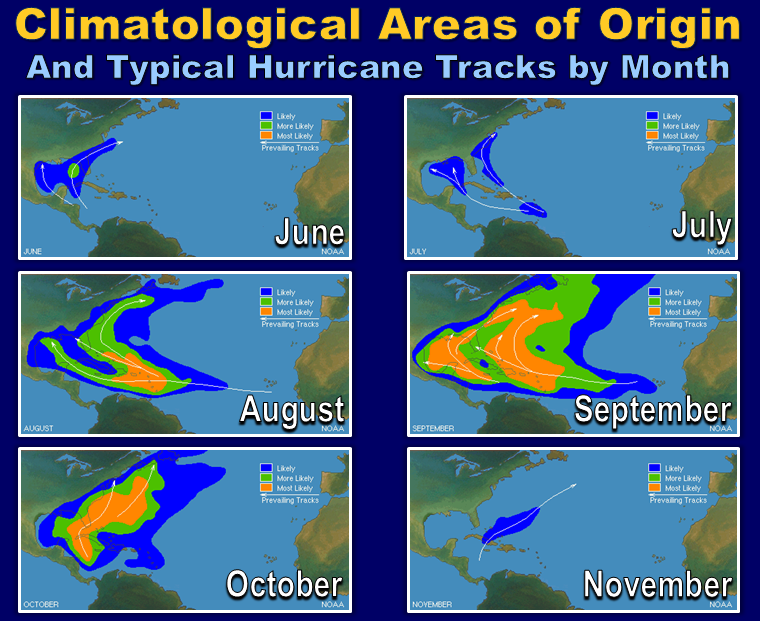
    Where hurricanes form shifts over the months

    Where storms are most likely to form and make landfall also changes as the pages of the calendar turn.

    In early summer, the Gulf of Mexico warms up faster than the open Atlantic, making it a notable hotspot for early-season tropical storm development, especially in June and July. The Texas coast, Louisiana, and the Florida Panhandle often face a higher early-season risk than locations along the Eastern seaboard.

    These are generally the busiest areas during each month of hurricane season, but that doesn’t mean hurricanes won’t make landfall elsewhere.
    NOAA

    By August and September, the season reaches its peak. This is when those waves moving off the coast of Africa become a primary source of storm activity. These long-track storms are sometimes called “Cape Verde hurricanes” because they originate near the Cape Verde Islands off the African coast. While many stay over open water, others can gather steam and track toward the Caribbean, Florida or the Carolinas.

    Later in the hurricane season, storms are more likely to form in the western Atlantic or Caribbean, where waters are still warm and upper-level winds remain favorable. These late-season systems have a higher probability of following atypical paths, as Sandy did in 2012 when it struck the New York City region and Milton did in 2024 before making landfall in Florida.

    At the end of the day, the safest way to think about hurricane season is this: If you live along the coast, don’t let your guard down. Areas susceptible to hurricanes are never totally immune from hurricanes, and it only takes one to make it a dangerous – and unforgettable – season.

    Colin Zarzycki’s research lab receives funding from the U.S. National Science Foundation, Department of Energy, and National Oceanic and Atmospheric Administration.

    ref. NOAA’s 2025 hurricane forecast warns of a busy season – a storm scientist explains why and what meteorologists are watching – https://theconversation.com/noaas-2025-hurricane-forecast-warns-of-a-busy-season-a-storm-scientist-explains-why-and-what-meteorologists-are-watching-257223

    MIL OSI – Global Reports

  • MIL-OSI USA: WSDOT seeks feedback to determine signage needs when Keller Ferry is out of service

    Source: Washington State News 2

    WILBUR – Community members are encouraged take a brief survey that will help the Washington State Department of Transportation understand whether signage improvements are needed for notification when the Keller Ferry, M/V Sanpoil, on State Route 21 is out of service.

    Background

    Current signage that is displayed along SR 21 when the Keller Ferry is removed from service can take upwards of three hours to manually deploy by WSDOT maintenance teams, leading to significant delays in driver notification. Detour routes also add significant travel time around the ferry crossing.

    Keller Ferry signage notification survey details

    • Provide feedback on how best to receive information about ferry outages.
    • Share important information on how current signage works.
    • Provide feedback on updates to signage to better serve the public.

    The survey is open through Wednesday, October 1. The survey takes less than five minutes to complete, asks about current signage and potential improvements if funding becomes available. Currently, there is not a project to add or update signage. Based on results and community feedback, WSDOT could seek funding for a project to update signage in the future.

    MIL OSI USA News

  • MIL-OSI Europe: Meeting with the Prime Minister of the Republic of Bulgaria

    Source: Government of Italy (English)

    The President of the Council of Ministers, Giorgia Meloni, received the Prime Minister of the Republic of Bulgaria, Rossen Jeliazkov, at Palazzo Chigi today.

    The meeting provided an opportunity to acknowledge the common will to deepen bilateral relations in strategic sectors such as infrastructure and transport, energy, interconnections and defence.

    During the discussion, a broad alignment of views between Rome and Sofia also emerged on the main European issues, starting with cohesion policy, enlargement and the pursuit of innovative solutions to irregular migration.

    With regard to the major issues in international politics, the two leaders focused on the conflict in Ukraine, confirming their support for the ongoing efforts to reach a just and lasting peace.

    MIL OSI Europe News

  • MIL-OSI Security: Jefferson County man sentenced for possessing machinegun conversion device

    Source: United States Bureau of Alcohol Tobacco Firearms and Explosives (ATF)

    BEAUMONT, Texas – A Beaumont man has been sentenced to federal prison for possessing a machinegun in the Eastern District of Texas, announced Acting U.S. Attorney Abe McGlothin, Jr.

    Aaron Charles Hill, 22, pleaded guilty to possession of a machinegun and was sentenced to 57 months in federal prison by U.S. District Judge Marcia A. Crone on May 21, 2025.

    According to information presented in court, on July 15, 2024, law enforcement was dispatched to an apartment complex on Pinchback Road in Beaumont in reference to a disturbance with a firearm.  The victim reported being chased by multiple armed persons trying to shoot him.  Hill was apprehended attempting to leave the scene with two stolen pistols, one of which was equipped with an extended magazine and a machinegun conversion device, also referred to as a Glock switch.  A Glock switch is a small device that can be attached to the rear of the slide of a handgun, converting a semi-automatic pistol into a fully automatic machinegun. Federal law defines a machinegun as a weapon which shoots, is designed to shoot, or can be readily restored to shoot, automatically more than one shot, without manual reloading, by a single function of the trigger.

    This case is part of Operation Take Back America, a nationwide initiative that marshals the full resources of the Department of Justice to repel the invasion of illegal immigration, achieve the total elimination of cartels and transnational criminal organizations (TCOs), and protect our communities from the perpetrators of violent crime. Operation Take Back America streamlines efforts and resources from the Department’s Organized Crime Drug Enforcement Task Forces (OCDETFs) and Project Safe Neighborhood (PSN).

    This case was investigated by the Bureau of Alcohol, Tobacco, Firearms and Explosives and the Beaumont Police Department and prosecuted by Assistant U.S. Attorney Matt Quinn.

    ###

    MIL Security OSI

  • MIL-OSI: Final Results

    Source: GlobeNewswire (MIL-OSI)

    Octopus Apollo VCT plc
    Final Results

    Octopus Apollo VCT plc today announces the final results for the year ended 31 January 2025.

    Octopus Apollo VCT plc (‘Apollo’ or the ‘Company’) is a Venture Capital Trust (VCT) which aims to provide shareholders with attractive tax-free dividends and long-term capital growth by investing in a diverse portfolio of predominantly unquoted companies.

    The Company is managed by Octopus Investments Limited (‘Octopus’ or the ‘Portfolio Manager’) via its investment team, Octopus Ventures.

    HIGHLIGHTS

      Year to
    31 January 2025
    Year to
    31 January 2024
    Net assets (£’000) £482,563 £390,294
    Profit/(loss) after tax (£’000) £24,110 £(435)
    Net asset value (NAV) per share1 50.5p 50.5p
    Cumulative dividends paid since launch 90.0p 87.4p
    Total value per share2 140.5p 137.9p
    Dividends paid in the year 2.6p 2.7p
    Dividend yield3 5.1% 5.1%
    Dividend declared 1.3p 1.3p
    Total return per share %4 5.1% 0.0%
    1. NAV per share is calculated as net assets divided by total number of shares, as described in the glossary of terms.
    2. Total value per share is calculated by adding together NAV per share and cumulative dividends paid since launch.
    3. Dividend yield is calculated as dividends paid in the period, divided by the NAV per share at the beginning of the period.
    4. Total return per share % is an alternative performance measure (APM) calculated as movement in NAV per share in the period plus dividends paid in the period, divided by the NAV per share at the beginning of the period, as described in the glossary of terms.

    CHAIR’S STATEMENT

    Highlights

    • Apollo’s latest fundraise: £75 million
    • Total return over five years: 45.3%
    • Dividends paid in 2025: 2.6p

    Apollo’s total return for the year to 31 January 2025 was 5.1% with the net assets at the end of the period totalling £483 million.

    Performance

    I am pleased to present the annual results for Apollo for the year ended 31 January 2025. The NAV plus cumulative dividends per share at 31 January 2025 was 140.5p, an increase of 2.6p per share from 31 January 2024. During the year the NAV per share remained stable at 50.5p which represents, after adding back the 2.6p of dividends paid in the year, a total return for the year of 5.1% compared to 0% in the previous year. This outcome highlights the Company’s overall resilience and positive performance, despite the uncertain macro environment. I also note several exciting new investments have been made in the period, showing that the Company is successfully growing the overall size of the portfolio.

    In the twelve months to 31 January 2025, we utilised £86.1 million of our cash resources, comprising £47.1 million in new and follow-on investments, £17.8 million in dividends (net of the Dividend Reinvestment Scheme (DRIS)), £8.6 million in management fees, £9.0 million in share buybacks, and £3.6 million in other running costs such as accounting and administration services and trail commissions. The cash and liquid resources balance of £95.7 million at 31 January 2025 represented 19.8% of net assets at that date, compared to £61.3 million, which represented 15.7% at 31 January 2024. Cash and liquid resources comprises cash at bank, money market funds (MMFs) and open ended investment companies (OEICs.)

    Performance incentive fees
    Apollo’s performance since 31 January 2024 has given rise to a performance fee being payable to Octopus of £6.1 million. The performance fee is calculated as 20% on all gains above the High-Water Mark, the highest total return as at previous year ends, of 137.9p as at 31 January 2024.

    Dividends
    It is your Board’s policy to maintain a regular dividend flow where possible to take advantage of the tax-free distributions a VCT can provide, and work towards the targeted 5% annual dividend yield policy.

    I am pleased to confirm that the Board declared a second interim dividend of 1.3p per share in respect of the year ended 31 January 2025. This second interim dividend, in addition to the 1.3p per share interim dividend paid in December 2024 brings the total dividends declared to 2.6p per share in respect of the year ended 31 January 2025. The dividend was paid on 8 May 2025 to shareholders on the register at 22 April 2025. Since inception, we have paid a total of 91.3p in tax-free dividends per share, comprising 90.0p in previous distributions and an additional 1.3p paid in May. Considering dividends paid during 2024 (totalling 2.6p), the total dividend yield for the year is 5.1%, therefore meeting the Company’s target.

    Apollo’s DRIS was introduced in November 2014 and currently 20.7% of shareholders take advantage of it as it is an attractive scheme for investors who would prefer to benefit from additional income tax relief on their reinvested dividend. I hope that shareholders will find this scheme beneficial. During the year to 31 January 2025, 10,800,892 shares were issued under the DRIS, equating to a reinvested amount of £5.3 million.

    Fundraise and share buybacks
    On 19 March 2024, the Company closed its offer to raise £50 million, which led the Board to increase the offer by a further £35 million. I am pleased to report that we successfully raised the full £85 million, closing the offer on 24 September 2024.

    Following on from this, on 23 October 2024, the Company launched an offer to raise a further £50 million with an over-allotment facility for a further £25 million. I am delighted to report that we raised the full £75 million, so the offer closed fully subscribed on 21 March 2025. We would like to take this opportunity to welcome all new shareholders and thank all existing shareholders for their continued support.

    Apollo has continued to buy back and cancel shares as required. Subject to shareholder approval of resolution 10 at the forthcoming Annual General Meeting (AGM), this facility will remain in place to provide liquidity to investors who may wish to sell their shares, subject to the Board’s discretion. Details of the share buybacks undertaken during the year can be found in the Directors’ Report.

    Dividends, whether paid in cash or reinvested under the DRIS, and share buybacks are always at the discretion of the Board, are never guaranteed and may be reviewed when necessary.

    VCT sunset clause
    In November 2023, a ten-year extension was announced to the ‘sunset clause’ (a retirement date for the VCT scheme), meaning VCT tax reliefs will be available until 5 April 2035. This extension passed through Parliament in February 2024 and on 3 September 2024 His Majesty’s Treasury brought the extension into effect through The Finance Act 2024.

    Board of Directors
    Alex Hambro, having originally been appointed to the Board of Octopus Eclipse VCT 3 and 4 PLC in 2005, and then continuing as a Director following the merger with the Octopus Apollo VCTs in 2016, has decided to retire from the Board and will not be seeking re-election at the forthcoming AGM. It has been a pleasure to work with Alex, and I would like to take this opportunity to thank him on behalf of the Board and the shareholders for his substantial contribution over the years and help in guiding Apollo through its different phases of growth.

    A new Non-Executive Director will be appointed at the completion of a structured recruitment process, which is already underway. All the other Directors have indicated their willingness to remain on the Board, and both Chris Powles and Gillian Elcock will be seeking re-election at the AGM.

    Alternative Investment Fund (AIF)
    As announced on 30 September 2024, the Company is now classified as a full scope AIF under the European Union’s AIF Managers Directive (AIFMD). This is due to the Company’s success and continued growth in assets under management (AUM). This regulation is in place to ensure greater transparency and risk mitigation to protect investors. It is an exciting milestone for the Company, and the Board is working closely with Octopus to ensure all reporting requirements and management protocols are adopted.

    Portfolio Manager
    As reported in the half-yearly unaudited report, Richard Court (previously Apollo’s Lead Fund Manager), took on a new role in the period as Head of VCTs and Enterprise Investment Schemes (EIS) at Octopus Ventures. Paul Davidson, a Partner in the Octopus Ventures team, has replaced Richard as Lead Fund Manager as of September 2024. Paul brings with him eight years of experience, focusing on Apollo, and has worked closely with the Board (alongside Richard) for the last three years. The Board would like to take this opportunity to reiterate its congratulations to Paul on his new role and to again thank Richard for his contribution to the Company and wish him well in his new position. In January 2025, Erin Platts was appointed as new Chief Executive Officer (CEO) of Octopus Ventures.

    AGM
    The AGM will be held on 10 July 2025 at 10am. Full details of the business to be conducted at the AGM are given in the Notice of the Meeting. We will have a Portfolio Manager’s update at the AGM, supported by a filmed update from the Portfolio Manager which will be available on the website at https://octopusinvestments.com/apollovct/.

    Shareholders’ views are important, and the Board encourages shareholders to vote on the resolutions by using the proxy form, or electronically at www.investorcentre.co.uk/eproxy.

    The Board has carefully considered the business to be approved at the AGM and recommends shareholders vote in favour of all the resolutions being proposed.

    Outlook
    I am pleased with the positive performance over the last six months, especially whilst the geo-political and economic landscape has been extremely challenging for portfolio companies to navigate. The uncertain conditions which have prevailed for the last couple of years have meant we have seen portfolio companies’ growth rates slow as trading conditions have become tougher and sales cycles have become more protracted. Companies have also looked to reduce their cash burn and focus on achieving profitability due to the scarcity and higher cost of capital. Some protection against these external factors has been offered by the contracted recurring revenue models that businesses within the portfolio have.

    Over the past 12 months, we have observed a recovery in the Company’s investment rate, with twice as many new investments being completed when comparing 2025/24 to 2024/23.. Market data supports this trend, showing more deals completed in the Series B and onwards space in 2024 compared to the prior year¹. The investment team is experiencing an increase in deal flow, especially in the last six months of 2024, and the current pipeline of opportunities looks very promising. In addition to the higher deal cadence, we are pleased that the Company concluded three profitable realisations, compared to one in the prior year.

    VCTs have long provided a compelling opportunity for UK investors to invest in businesses in a tax-efficient way, and we look forward to Apollo continuing to do so in the coming year. I would like to conclude by thanking both the Board and the Octopus team on behalf of all shareholders for their hard work.

    Murray Steele
    Chair

    ¹ https://carta.com/uk/en/data/vc-concentration-2024/

    PORTFOLIO MANAGER’S REVIEW

    At Octopus our focus is on managing your investments and providing open communication. Our annual and half-year updates are designed to keep you informed about the progress of your investment.

    Investment strategy
    In general, we invest in technology companies in the SaaS space that have recurring revenues from a diverse base of customers. We also seek to invest in companies that will provide an opportunity for Apollo to realise its investment typically within three to seven years.

    Apollo total value growth
    The total value has seen a significant increase over the five years from 119.8p to 140.5p at 31 January 2025. This increase in total value of 20.7p represents a 45.3% increase on the NAV of 45.7p as at 31 January 2020. Over the last five years, a total of more than £92.4 million has also been distributed back to shareholders in the form of tax-free dividends. This includes dividends reinvested as part of the DRIS.

    Focus on performance
    In the year to 31 January 2025, the NAV total return (NAV plus cumulative dividends) increased to 140.5p per share, giving a total return of 5.1% for the period. We are pleased with this modest uplift in total value, considering the challenging macroeconomic backdrop that our portfolio companies continued to navigate their way through over the last 12 months.

    The performance over the five years to 31 January 2025 is shown below:

    Year Ended NAV Dividends paid in year Cumulative
    dividends
    NAV + cumulative dividends Total return %
    31 January 2021 49.2p 2.3p 76.4p 125.6p 12.7%
    31 January 2022 50.2p 5.7p 82.1p 132.3p 13.6%
    31 January 2023 53.2p 2.6p 84.7p 137.9p 11.2%
    31 January 2024 50.5p 2.7p 87.4p 137.9p 0.0%
    31 January 2025 50.5p 2.6p 90.0p 140.5p 5.1%

    Over the year, including disposals, there have been valuation increases across 29 portfolio companies, delivering a collective increase of £62 million. These increases reflect businesses which have successfully managed to grow revenues through the period. The strongest performers have generally exhibited improving profitability levels and revenue growth from their customer base and some of the top performers include Definely, Lodgify and TRI.

    Conversely, 20 companies saw a decrease in valuation, collectively totalling £23 million. The businesses that saw the most significant reductions were Edge10, Synchtank and Peak Data. Growth has decelerated or in some cases revenues have declined in several portfolio companies and they have experienced decreases in their valuation. This has mainly been due to continued challenges in selling their software products into corporates who have experienced declining software expense budgets. There have also been some company-specific performance issues impacting a small number of companies in the portfolio.

    In aggregate, this resulted in a net increase in portfolio company valuations of £39 million.

    As part of ongoing liquidity management, Apollo regularly invests in and withdraws from MMFs in order to meet cash requirements. During the year, an additional £35.6 million (including interest) was invested in MMFs. Apollo also holds an investment in the Sequoia Economic Infrastructure Fund (SEQI), but no further investment was made in this fund during the year. These investments, in combination with the previously held investments in SEQI and the MMFs, took the total liquid investments as at 31 January 2025 to £91.5 million (including interest earned during the year on MMF deposits).

    Disposals
    Three profitable disposals were completed in the year. All of these investments were made prior to the change of investment focus to B2B SaaS businesses. The first exit was Dyscova Ltd (trading as Care & Independence (C&I)) which was acquired by GBUK Group, a company which designs, develops and distributes a portfolio of own and third-party branded acute-setting medical devices. Apollo first invested in C&I in 2016 and the exit resulted in Apollo achieving a 1.7x total return on its investment.

    In September 2024, we were pleased to exit our holding in Countrywide Healthcare Supplies Holdings which was acquired by Personnel Hygiene Services Ltd, a hygiene services provider. The Company first invested in 2014, and the exit resulted in a 4.4x return on our initial investment, which is an excellent outcome.

    In November 2024, nCino, a cloud-based software company that provides a platform for financial institutions to manage their business, acquired FullCircl. This acquisition will enhance nCino’s data and automation capabilities and allow it to expand its reach across the UK and Europe. Apollo made its initial investment in 2011, and the disposal resulted in a positive return for the Company.

    One disposal during the year resulted in a partial loss on investment when Ryte GmbH, a marketing software technology platform, was acquired by Semrush Holdings Inc. Two companies were placed into administration in the year, Rotolight and Origami Energy. However, given the underlying holding valuations of these companies at the time of them going into administration, this did not have a material impact on the Company’s performance during the year. In aggregate, the investment cost of the companies placed into administration totalled £5.3 million. The underperformance of a portfolio company is always disappointing for Apollo and shareholders alike, but it is an inevitable feature of a venture capital portfolio, and we believe that successful exits will continue to outweigh any losses that could arise over the medium to long term of managing the portfolio. In the year, all disposals, including loan repayments, collectively returned £21.7 million in cash to Apollo, with the aggregate investment cost totalling £15.4 million.

      Year ended 31 January 2021 Year ended 31 January 2022 Year ended 31 January 2023 Year ended 31 January 2024 Year ended 31 January 2025 Total
    Dividends paid in the year (£’000) 7,471 28,3661 14,323 19,165 23,097 92,423
    Disposal proceeds (£’000) 3,356 53,939 3,591 18,292 21,713 100,981

    1 Dividends paid to shareholders in the year ended 31 January 2022, including a special dividend of 3.1p per share.

    As illustrated in the table above, we are pleased to have paid dividends from disposal proceeds over the past five years. The nature and timing of realising investments in a venture capital portfolio means it can affect our ability to do so. The Company also tries to maximise the outcome of the underlying holdings in an exit scenario which may not always align with a specific financial period.

    New and follow-on investments
    During the year, in-line with the broader private capital market, the Company demonstrated increasing new investment activity with Apollo investing £34.1 million into eight new opportunities (this includes second tranches of prior year new investments) as compared to four new investments completing in the prior year, totalling £15.2 million. For follow-on investments, we also saw an increased number with £13 million being invested into nine companies compared to seven follow-on investments completing in the year to 31 January 2024 adding up to £17.8 million invested.

    Apollo’s new investments were in several exciting B2B software companies operating in a variety of end-markets:

    • Definely £2.8 million – An AI based legal tech software company supporting legal professionals in drafting and reviewing contractual documentation.
    • Switchee £2.5 million – A smart thermostat hardware and software provider focused on social housing and housing associations.
    • Cambri £4.2 million – An insights software platform that increases the quality, speed and cost effectiveness of producing research for new product launches.
    • Vyntelligence £4.5 million – A video intelligence and AI-driven data capture platform addressing inefficiencies in communication, reporting, and operational workflows within large infrastructure sectors.
    • Semble £2.5 million – An all-in-one platform for healthcare practices, enhancing patient care and streamlining operations.
    • bsport £8.4 million – An all-in-one software platform designed to manage boutique fitness and wellness studios.
    • Threatmark £6.1 million – A fraud prevention platform that uses real-time behavioural data to accurately identify payment fraud.

    Q&A
    How do we think about exiting our positions?
    In traditional venture capital, a relatively small number of investments generate a significant proportion of the fund’s performance. However, for Apollo we try to construct a portfolio where the majority of the portfolio delivers the majority of the Company’s performance. The investment team takes an active role to try and optimise each specific situation. This means we have certain situations where companies may be held for longer if we think it is in the best interest of investors and the Company. Conversely, there are other situations where we may seek to exit earlier if market conditions permit. This means we maintain good portfolio management discipline to make sure realised proceeds materially contribute towards financing the Company’s ongoing running costs and meeting its dividends targets.

    Private markets are illiquid, and as a result, the opportunities to sell all or some of our holding in a particular company can be unpredictable and governed by prevailing market conditions. We work closely with each portfolio company to understand and optimise its growth plans, with the goal of it maintaining flexibility over exit timing with the best interests of its shareholders in mind.

    Wider macroeconomic conditions often influence exits as much as company specific factors. We also recognise that timing may not always be right to exit a position, and patience can allow for greater value growth. In such cases, we will continue to support portfolio companies, stay alert to opportunities, and help create them proactively through our network.

    When do we start to think about exits?
    We look to understand who the likely acquirers are from the outset and throughout the holding period. This can help inform important strategic decisions which contribute to value creation for shareholders. It is healthy for our portfolio companies to maintain relationships with key potential acquirers. These can often be commercial partners before becoming acquirers, and as such this activity can be highly productive.

    We know not all companies will be as successful as we hoped at the time of the initial investment. We therefore seek to realise investments in companies which are underperforming and unlikely to generate a meaningful return. It can also help to find a “soft landing” for the company’s employees where the alternative may be placing the business into administration. However, to date this has only been in a very small minority of cases. Although generally not meaningful to investor returns, our behaviour in these scenarios is important.

    How do we work with portfolio company boards?
    We believe that it is important to be an active and supportive investor, so we typically appoint a Non-Executive Director or observer to the board of our portfolio companies. This allows us to offer ongoing support at the top level of the business and be involved in key decisions. It also gives us the opportunity to share any expertise and insights that we may have. Even very experienced founders may only sell a business once or twice in their career, whereas as investors, we may be involved in a few such transactions each year. We therefore look to support our portfolio companies by sharing the learnings and experience gathered across our team, all with the objective of obtaining the best outcome for our investors and shareholders in the Company overall.

    Valuations
    The table below illustrates the distribution of valuation methodologies used across Apollo’s B2B software investments (shown as a percentage of portfolio value and number of companies). B2B software accounts for 99% of Apollo’s total fixed asset investments. Methodologies include:
    • ‘External price’ includes valuations based on funding rounds that typically completed by the year end or shortly after the year end, and exits of companies where terms have been agreed or proposed with an acquirer;
    • ‘Multiples’ is predominantly used for valuations that are based on a multiple of revenue or EBITDA for portfolio companies; • ‘Scenario analysis’ is utilised where there is uncertainty around the potential outcomes available to a company, so a probability-weighted scenario analysis is considered.

    Having arrived at a valuation of the portfolio company, to distribute the equity value within a portfolio company’s capital structure, taking into account the priority of financial instruments and the economic rights of debt and shares Apollo holds, the Current Value Method (CVM) is typically employed. This method allocates the equity value to different equity interests as if the business were sold on the reporting date, thereby reflecting the effects of the distribution waterfall.

    Valuation methodology By value By number of companies
    Multiples 77% 64%
    Scenario analysis 18% 22%
    External price 5% 8%
    Write-off 6%

    Case studies
    definely
    definely.com
    LegalTech solution helping lawyers at every pre-execution stage of the contract lifecycle

    • 40,000 active users
    • top 25 of the prestigious Deloitte UK Technology Fast50
    • 75 employees located globally

    Definely, founded in 2020, is a UK LegalTech company created to make legal documents easier to read, edit and understand. Definely was founded by two former Magic Circle lawyers, one of whom is registered blind. They set out to make legal documents more accessible to those with visual impairments and soon realised that their solution solved a problem faced by all lawyers, daily. Headquartered in London, it has over 75 employees located globally.

    Fuelled by investment from Apollo, the company is now focused on adding to its existing base of 40,000 active users from the largest companies and law firms in the UK, US, Canada and Australia. In 2023, the company was named in the top 25 of the prestigious Deloitte UK Technology Fast50. Customers include AO Shearman, Slaughter and May, Dentons and Deloitte.

    Cambri
    cambri.io
    Helping brands innovate iteratively to bring successful products to market fast

    • 80% prediction accuracy for product launch success
    • 68% year-over-year ARR growth

    Cambri is an AI consumer insights and innovation platform which addresses a major industry problem – that of the high failure rate of product launches. Traditional market research, consumer insights, and prediction models are outdated, static, and notoriously inaccurate, typically delivering just 40% prediction accuracy. This means brands waste time and resources developing and launching products that consumers don’t need. By contrast, Cambri’s proprietary AI engine predicts the likelihood of a product’s success and provides actionable insights to help improve products before launch.

    Cambri’s AI models are two to three times more accurate than traditional methods, enabling its customers to regularly achieve over 80% prediction accuracy for product launch success – contributing to Cambri’s 68% year-over-year annual recurring revenue (ARR) growth. Household food and beverage brands such as Coca-Cola and Nestle already utilise the platform.

    Top 10 investments by value as at 31 January 2025
    Here, we set out the cost and valuation of the top ten holdings, which account for over 57% of the value of the portfolio.

      Portfolio: Investment cost (£’000) Fair value of investment (£’000)
    1 Natterbox £18,990 £44,419
    2 Lodgify £12,611 £33,912
    3 Ubisecure £9,075 £25,811
    4 Tri £3,800 £22,070
    5 Interact £308 £20,658
    6 Sova £12,250 £19,266
    7 FableData £8,600 £15,780
    8 ValueBlue £10,071 £15,031
    9 MentionMe £15,000 £15,000
    10 FuseUniversal £8,000 £14,394

    Top 10
    1
    N2JB Limited (trading as Natterbox)

    Natterbox is a London-based provider of business-to-business cloud telephone services that are uniquely integrated into Customer Resource Management (CRM) software platforms, most notably Salesforce.

    www.natterbox.com

    Investment date: March 2018
    Equity held: 9.0%
    (2024: 8.5%)
    Valuation basis: Revenue multiple
    Income received in year to 31 January 2025: £177,000
    (2024: £150,000)
    Last submitted accounts: 31 December 2023
    Consolidated turnover: £19,289,000
    (2022: £17,092,000)
    Consolidated loss before tax: £(644,000)
    (2022: £(2,568,000))
    Consolidated net assets: £646,000
    (2022: £1,022,000)

    2
    Codebay Solutions Limited (trading as Lodgify)
    Lodgify provides a SaaS platform for vacation rental hosts and property managers to manage their business and process their bookings.

    www.lodgify.com

    Investment date: September 2022
    Equity held: 15.3%
    (2024: 11.9%)
    Valuation basis: Revenue multiple
    Income received in year to 31 January 2025: n/a
    (2024: n/a)
    Last submitted accounts: 31 December 2023
    Consolidated turnover: €14,508,000
    (2022: €9,315,000)
    Consolidated loss before tax: €(7,462,000)
    (2022: €(6,239,000))
    Consolidated net assets: €10,390,000
    (2022: €16,946,000)

    3

    Ubisecure Holdings Limited
    Ubisecure is a provider of customer identity access management software.

    www.ubisecure.com

    Investment date: May 2018
    Equity held: 73.4%
    (2024: 33.3%)
    Valuation basis: Revenue multiple
    Income received in year to 31 January 2025: £179,000
    (2024: £197,000)
    Last submitted accounts: 31 December 2023
    Consolidated turnover: £8,674,000
    (2022: £6,923,000)
    Consolidated loss before tax: £(3,091,000)
    (2022: £(2,135,000)
    Consolidated net liabilities: £(3,053,000)
    (2022: £(287,000))

    4
    Triumph Holdings Limited (TRI)
    TRI has developed a risk based quality management and monitoring platform for the life sciences industry

    www.tritrials.com

    Investment date: October 2018
    Equity held: 52.0%
    (2024: 52.0%)
    Valuation basis: Revenue multiple
    Income received in year to 31 January 2025: £174,000
    (2023: £171,000)
    Last submitted accounts: 31 December 2023
    Consolidated turnover: Not available1
    (2022: Not available1)
    Consolidated profit before tax: Not available1
    (2022: Not available1)
    Consolidated net assets: £2,758,000
    (2021: £2,875,000)

    5
    Hasgrove Limited
    Hasgrove is the holding company for Interact, a SaaS business which provides an intranet product which focuses on the communication and collaboration requirements of large organisations.

    www.interactsoftware.com

    Investment date: December 2016
    Equity held: 5.9%
    (2024: 5.7%)
    Valuation basis: Revenue multiple
    Income received in year to 31 January 2025: n/a
    (2024: n/a)
    Last submitted accounts: 31 December 2023
    Consolidated turnover: £37,032,000
    (2022: £29,388,000)
    Consolidated profit before tax: £9,907,000
    (2022: £8,099,000)
    Consolidated net assets: £13,344,000
    (2022: £13,136,000)

    6
    Sova Assessment Limited
    Sova Assessment is a UK based end-to-end digital candidate assessment SaaS platform targeting large blue-chip organisations conducting large volumes of hiring.

    www.sovaassessment.com

    Investment date: November 2020
    Equity held: 37.2%
    (2024: 37.2%)
    Valuation basis: Revenue multiple
    Income received in year to 31 January 2025: £104,000
    (2024: £93,000)
    Last submitted accounts: 31 March 2024
    Consolidated turnover: £6,780,000
    (2023: £5,611,000)
    Consolidated loss before tax: £(3,685,000)
    (2023: £(5,360,000))
    Consolidated net liabilities: £(5,460,000)
    (2023: £(3,593,000))

    7
    Fable Data Limited
    Fable Data provides anonymised, pan-European consumer transaction data and analysis to institutional investors, businesses, governments and academics.

    www.fabledata.com
      

    Investment date: December 2022
    Equity held: 14.2%
    (2024: 6.2%)
    Valuation basis: Revenue multiple
    Income received in year to 31 January 2025: n/a
    (2024: n/a)
    Last submitted accounts: 31 December 2023
    Consolidated turnover: Not available1
    (2022: Not available1)
    Consolidated profit before tax: Not available1
    (2022: Not available1)
    Consolidated net liabilities: £(1,720,000)
    (2022: £(2,111,000))
       

    8
    Value Blue B.V.
    Value Blue is a provider of enterprise architecture management software, that is growing in the UK. The product allows companies to map their existing technology architecture in a single location to easily plan, collaborate and execute both large scale transformational and everyday IT projects.

    www.valueblue.com

    Investment date: January 2022
    Equity held: 20.3%
    (2024: 20.3%)
    Valuation basis: Revenue multiple
    Income received in year to 31 January 2025: £317,000
    (2024: £19,000)
    Last submitted accounts: 31 December 2023
    Consolidated turnover: Not available1
    (2022: Not available1)
    Consolidated loss before tax: €(7,412,000)
    (2022: €(9,185,000))
    Consolidated net liabilities: €(6,189,000)
    (2022: €(4,595,000))

    9
    Mention Me Limited
    Mention Me is a referral engineering SaaS platform that helps business to consumer (B2C) businesses acquire new customers more successfully through their referral channel.

    www.mention-me.com

    Investment date: December 2021
    Equity held: 19.4%
    (2024: 19.4%)
    Valuation basis: Revenue multiple
    Income received in year to 31 January 2025: n/a
    (2024: n/a)
    Last submitted accounts: 31 December 2023
    Consolidated turnover: £11,561,000
    (2022: £10,244,000)
    Consolidated loss before tax: £(5,175,000)
    (2022: £(5,621,000))
    Consolidated net assets: £5,302,000
    (2022: £10,173,000)

    10
    Fuse Universal Limited

    Fuse is a business-to-business software provider of a cloud-based learning technology platform for corporates, founded in 2008 and based in London (with further offices in South Africa and Australia).

    www.fuseuniversal.com

    Investment date: August 2019
    Equity held: 0%
    (2024: 0%)
    Valuation basis: Revenue multiple
    Income received in year to 31 January 2025: £56,000
    (2024: £100,000)
    Last submitted accounts: 31 December 2023
    Consolidated turnover: £7,997,000
    (2022: £9,338,000)
    Consolidated loss before tax: £(1,044,000)
    (2022: £(2,816,000))
    Consolidated net liabilities: £(2,468,000)
    (2022: £(3,682,000))
    1. These numbers are not available per the latest public filings on Companies House or the company is non-UK.

    Outlook

    It has been a challenging few years for the broader technology sector, with both geopolitical and economic factors impacting the ability of portfolio companies to grow and perform as successfully as forecast. Against this backdrop, I am pleased to report a stable NAV as portfolio companies have shown great resilience in the face of these challenges. Companies have been operating more efficiently in terms of their capital requirements and in several cases we are seeing top-line revenue growth returning steadily, albeit not to the same degree as experienced prior to the beginning of this more turbulent period. The slowdown in revenue growth observed across the portfolio occurred alongside companies striving to preserve cash and move towards profitability to extend their cash runways.

    The nature of the current portfolio and the characteristics of the technology-focused businesses means that several companies have had some degree of protection from the full impact of these more challenging macroeconomic conditions. This is due to recurring revenues and long-term contracts being key features of their business models.

    As mentioned in the Chair’s Statement, we were delighted and grateful for the support we’ve received from the Company’s new and existing investors, with the latest fundraise closing fully subscribed, including the overallotment facility. These funds will allow the Company to continue to support the existing portfolio in their growth plans and to invest in new opportunities which have the potential to become successful and deliver great returns to shareholders in the years to come.

    We were also pleased that the Company benefitted from three profitable disposals in the period, which together returned £18.9 million in proceeds to the Company. We are hopeful that this could indicate an improvement in the mergers and acquisitions (M&A) market, providing more opportunities for exits and offering the Company sustainable growth prospects.

    Despite the macroeconomic climate remaining uncertain, we believe that the rapid pace of change and advancements being made with the development and adoption of AI technology will create many new businesses seeking growth capital. This provides us with a degree of optimism about the Company’s future investment prospects and for its current well-diversified portfolio, as the component companies seek to take advantage which component companies are similarly seeking to take advantage of these advancements in AI. Hence, I am confident that the Company is well-positioned to capitalise on these market opportunities as they arise and that they will be able to offer further growth potential for the Company’s continued success.

    RISKS AND RISK MANAGEMENT

    The Board assesses the risks faced by Apollo and, as a board, reviews the mitigating controls and actions, and monitors the effectiveness of these controls and actions.

    Emerging and principal risks, and risk management

    The Board is mindful of the ongoing risks and will continue to make sure that appropriate safeguards are in place, in addition to monitoring the cash flow forecasts to make sure that the Company has sufficient liquidity.

    The Board carries out a regular review of the risk environment in which the Company operates.

    Emerging risks

    The Board has considered emerging risks. The Board seeks to mitigate emerging risks and those noted below by setting policy, regular review of performance and monitoring progress and compliance. In the mitigation and management of these risks, the Board applies the principles detailed in the Financial Reporting Council’s Guidance on Risk Management, Internal Control and Related Financial and Business Reporting.

    The following are some of the potential emerging risks management and the Board are currently monitoring:

    • adverse changes in global macroeconomic environment;
    • artificial intelligence;
    • geopolitical tensions; and
    • climate change.

    Principal risks

    Risk Mitigation Change
    Investment performance:    
    The focus of Apollo’s investments is in unquoted, small and medium-sized VCT qualifying companies which, by their nature, entail a higher level of risk and may have lower cash reserves than investments in larger quoted companies. Poor performance across these investments may impact Apollo’s ability to raise new funds from investors. Octopus has significant experience and a strong track record of investing in unquoted companies, and appropriate due diligence is undertaken on every new investment. A member of the Octopus Ventures team is typically appointed to the board of a portfolio company subject to an evaluation using a risk based approach that considers the size of the company within the Apollo portfolio and the engagement levels of other investors. Regular board reports are prepared by the portfolio company’s management and examined by the Portfolio Manager. This arrangement, in conjunction with its Portfolio Talent team’s active involvement, allows Apollo to play a prominent role in a portfolio company’s ongoing development and strategy. Although investment strategy is focused on B2B software, the overall risk in the portfolio is mitigated by diversifying investment across a wide spread of holdings in terms of the underlying sub-sector served by the portfolio companies, and their financing stage, age, industry sector and business models. The Board reviews the investment portfolio with the Portfolio Manager on a regular basis. The Portfolio Manager is incentivised to make sure Apollo performs well, via a Performance Incentive Fee (charged annually) for exceeding certain performance hurdles. Increased exposures reflected in the previous period remain unchanged due to the continuing difficult macro environment and challenging trading conditions for some portfolio companies continuing.
    Risk Mitigation Change
    VCT qualifying status risk:    
    Apollo is required at all times to observe the conditions for the maintenance of HMRC-approved VCT status. The loss of such approval could lead to Apollo and its investors losing access to the tax benefits associated with VCT status and, in certain circumstances, to investors being required to repay the initial income tax relief on their investment. Prior to making an investment, the Portfolio Manager seeks assurance from Apollo’s VCT status adviser that the investment will meet the legislative requirements for VCT investments.

    On an ongoing basis, the Portfolio Manager monitors Apollo’s compliance with VCT regulations on a current and forecast basis to ensure ongoing compliance with VCT legislation. Regular updates are provided to the Board throughout the year.

    The VCT status adviser formally reviews Apollo’s compliance with VCT regulations on a bi-annual basis and reports its results to the Board.

    VCT status monitoring by independent advisers continues to reduce the risk of an issue causing a loss of VCT status.
    Risk Mitigation Change
    Operational – reliance on third parties:    
    The Board is reliant on the Portfolio Manager to manage investments effectively, and manage the services of a number of third parties, in particular the registrar and tax advisers. A failure of the systems or controls at the Portfolio Manager or third-party providers could lead to an inability to provide accurate reporting and to ensure adherence to VCT and other regulatory rules. The Board reviews the system of internal control, both financial and non-financial, operated by the Portfolio Manager (to the extent the latter are relevant to Apollo’s internal controls). These include controls that are designed to ensure that Apollo’s assets are safeguarded and that proper accounting records are maintained, as well as any regulatory reporting. Feedback on other third-parties is reported to the Board on at least an annual basis, including adherence to Service Level Agreements where relevant. During the year a depositary has been appointed. This increases the number of key third parties involved in the running of the Company, but also adds additional layers of oversight of the Portfolio Manager. No overall change in risk exposure on balance.
    Risk Mitigation Change
    Information security:    
    A lack of suitable controls could result in a data breach and fines and/or business disruption. The Board is reliant on the Portfolio Manager and third parties to take appropriate measures to prevent a loss of confidential customer information or other malicious events. Annual due diligence is conducted on third parties, which includes a review of their controls for information security. The Portfolio Manager has a dedicated information security team and a third party is engaged to provide continual protection in this area. A security framework is in place to help prevent malicious events. The Portfolio Manager reports to the Board on an annual basis to update it on relevant information security arrangements. Significant and relevant information security breaches are escalated to the Board when they occur. No overall change on balance, although cyber threat remains a significant risk area faced by all service providers. The appropriateness of mitigants in place are continuously reassessed to adapt to new risk exposures, such as those posed by artificial intelligence.
    Risk Mitigation Change
    Economic:    
    Events such as an economic recession, movement in interest rates, fluctuations in foreign exchange rates, inflation, political instability and rising living costs could adversely affect some smaller companies’ valuations, as they may be more vulnerable to changes in trading conditions or the sectors in which they operate. This could result in a reduction in the value of Apollo’s assets. Apollo invests in a portfolio of companies serving markets across a diverse range of sectors, which helps to mitigate against the impact of performance in any one sector. Apollo also maintains adequate liquidity to make sure that it can continue to provide follow-on investment to those portfolio companies that require it and which is supported by the individual investment case.

    The Portfolio Manager monitors the impact of macroeconomic conditions on an ongoing basis and provides updates to the Board at least quarterly.

    Increased exposures reflected in the previous periods remain and have heightened further as economic uncertainty persists through interest rate changes, the risk of recession and other economic factors.
    Risk Mitigation Change
    Legislative:    
    A change to the VCT regulations could adversely impact Apollo by restricting the companies Apollo can invest in under its current strategy. Similarly, changes to VCT tax reliefs for investors could make VCTs less attractive and impact Apollo’s ability to raise further funds.

    Failure to adhere to other relevant legislation and regulation could result in reputational damage and/or fines.

    We are also pleased that the sunset clause in place for April 2025, regarding eligibility of VCTs for tax relief, has been extended to 2035.

    The Portfolio Manager engages with HM Treasury and industry bodies to demonstrate the positive benefits of VCTs in terms of growing UK companies, creating jobs and increasing tax revenue, and to help shape any change to VCT legislation.

    The Portfolio Manager employs individuals with expertise across the legislation and regulation relevant to Apollo. Individuals receive ongoing training and external experts are engaged where required.

    Risk exposure has continued to reduce since the previous period following the extension of the sunset clause to 2035 being agreed.
    Risk Mitigation Change
    Liquidity:    
    Apollo invests in smaller unquoted companies, which are inherently illiquid as there is no readily available market for these shares. Therefore, these may be difficult to realise for their fair market value at short notice. The Portfolio Manager prepares cash flow forecasts to make sure cash levels are maintained in accordance with policies agreed with the Board. Apollo’s overall liquidity levels are monitored on a quarterly basis by the Board, with close monitoring of available cash resources. Apollo maintains sufficient cash and readily realisable securities, including MMFs and OEICs, which can be accessed at short notice. At 31 January 2025, 91% of current asset investments were held in MMFs, realisable within one business day, and 9% in OEICs, realisable within seven business days. Risk exposure remains unchanged from the previous period.
    Risk Mitigation Change
    Valuation:    
    While investments within the portfolio are valued in accordance with International Private Equity and Venture Capital (IPEV) valuation guidelines, for smaller companies establishing a fair value can be difficult due to the lack of readily available market data for similar shares, resulting in a limited number of external reference points. Valuations of portfolio companies are performed by appropriately experienced staff, with detailed knowledge of both the portfolio company and the market in which it operates. These valuations are then subject to review and approval by the Octopus Valuations Committee, comprised of staff who are independent of Octopus Ventures and with relevant knowledge of unquoted company valuations. The Board reviews valuations after they have been agreed by the Octopus Valuations Committee. Risk exposure remains unchanged from the previous period due to economic uncertainty within valuation modelling.

    VIABILITY STATEMENT
    In accordance with provision 36 of the AIC Code of Corporate Governance, the Directors have assessed the prospects of the Company over a period of five years, consistent with the expected investment holding period of a VCT investor. Under VCT rules, subscribing investors are required to hold their investment for a five-year period in order to benefit from the associated tax reliefs. The Board regularly considers strategy, including investor demand for the Company’s shares, and a five-year period is considered to be a reasonable time horizon for this.

    The Board carried out a robust assessment of the emerging and principal risks facing the Company and its current position.

    This includes risks which may adversely impact its business model, future performance, solvency or liquidity, and focused on the major factors which affect the economic, regulatory and political environment. Particular consideration was given to the Company’s reliance on, and close working relationship with, the Portfolio Manager. The principal risks faced by the Company and the procedures in place to monitor and mitigate them are set out above.

    The Board has carried out robust stress testing of cash flows which included assessing the resilience of portfolio companies, including the requirement for any future financial support and the ability to pay dividends and buybacks.

    The Board has additionally considered the ability of the Company to comply with the ongoing conditions to make sure it maintains its VCT qualifying status under its current investment policy.

    Based on the above assessment the Board confirms that it has a reasonable expectation that the Company will be able to continue in operation and meet its liabilities as they fall due over the five-year period to 31 January 2030. The Board is mindful of the ongoing risks and will continue to make sure that appropriate safeguards are in place, in addition to monitoring the cash flow forecasts to make sure that the Company has sufficient liquidity.

    DIRECTORS’ RESPONSIBILITIES STATEMENT

    The Directors are responsible for preparing the Strategic Report, the Directors’ Report, the Directors’ Remuneration Report and the Financial Statements in accordance with applicable law and regulations. They are also responsible for ensuring that the Annual Report and Accounts include information required by the Listing Rules of the Financial Conduct Authority.

    Company law requires the Directors to prepare financial statements for each financial year. Under that law the Directors have elected to prepare the financial statements in accordance with United Kingdom Generally Accepted Accounting Practice (United Kingdom Accounting Standards and applicable laws) including FRS 102 – “The Financial Reporting Standard applicable in the UK and Republic of Ireland”. Under company law the Directors must not approve the financial statements unless they are satisfied that they give a true and fair view of the state of affairs and profit or loss of the Company for that period.

    In preparing these financial statements, the Directors are required to:

    • select suitable accounting policies and then apply them consistently;
    • make judgements and accounting estimates that are reasonable and prudent;
    • state whether applicable UK accounting standards have been followed, subject to any material departures disclosed and explained in the financial statements;
    • prepare the financial statements on the going concern basis unless it is inappropriate to presume that the Company will continue in business; and
    • prepare a Strategic Report, a Directors’ Report and Directors’ Remuneration Report which comply with the requirements of the Companies Act 2006.

    The Directors are responsible for keeping adequate accounting records that are sufficient to show and explain the Company’s transactions and disclose with reasonable accuracy at any time the financial position of the Company and enable them to make sure that the financial statements and the Directors’ Remuneration Report comply with the Companies Act 2006. They are also responsible for safeguarding the assets of the Company and hence for taking reasonable steps for the prevention and detection of fraud and other irregularities.

    Insofar as each of the Directors is aware:

    • there is no relevant audit information of which the Company’s auditor is unaware; and
    • the Directors have taken all steps that they ought to have taken to make themselves aware of any relevant audit information and to establish that the auditor is aware of that information.

    The Directors are responsible for preparing the annual report in accordance with applicable law and regulations. Having taken advice from the Audit and Risk Committee, the Directors consider the annual report and the financial statements, taken as a whole, provide the information necessary to assess the Company’s position, performance, business model and strategy and is fair, balanced and understandable.

    The Directors are responsible for the maintenance and integrity of the corporate and financial information included on the Company’s website. Legislation in the United Kingdom governing the preparation and dissemination of financial statements may differ from legislation in other jurisdictions.

    The Directors confirm that, to the best of their knowledge:

    • the financial statements, prepared in accordance with United Kingdom Generally Accepted Accounting Practice, including FRS 102, give a true and fair view of the assets, liabilities, financial position and profit or loss of the Company; and
    • the Annual Report and Accounts (including the Strategic Report), give a fair review of the development and performance of the business and the position of the Company, together with a description of the principal risks and uncertainties that it faces.

    On behalf of the Board

    Murray Steele
    Chair

    INCOME STATEMENT

        Year ended 31 January 2025 Year ended 31 January 2024
        Revenue
    £’000
    Capital
    £’000
    Total
    £’000
    Revenue
    £’000
    Capital
    £’000
    Total
    £’000
    Realised gain/(loss) on disposal of fixed asset investments   1,226 1,226 (876) (876)
    Change in fair value of fixed asset investments   37,666 37,666 9,3171 9,3171
    Change in fair value of current asset investments   (574) (574) 16 16
    Investment income   4,082 4,082 2,5761 2,5761
    Investment management fees   (2,147) (6,442) (8,589) (1,862) (5,587) (7,449)
    Performance fee   (6,139) (6,139) (14) (14)
    Other expenses   (3,555) (3,555) (4,006) (4,006)
    Foreign currency translation   (7) (7) 1 1
    Profit/(loss) before tax   (1,627) 25,737 24,110 (3,291)1 2,8561 (435)
    Tax  
    Profit/(loss) after tax   (1,627) 25,737 24,110 (3,291)1 2,8561 (435)
    Earnings/(loss) per share – basic and diluted   (0.2p) 3.0p 2.8p (0.5p)1 0.4p1 (0.1p)
    • The ‘Total’ column of this statement is the profit and loss account of Apollo; the revenue return and capital return columns have been prepared under guidance published by the Association of Investment Companies.
    • All revenue and capital items in the above statement derive from continuing operations.
    • Apollo has only one class of business and derives its income from investments made in shares and securities and from money market funds.

    1 The presentation and classification of £3.5 million of accrued loan interest was updated to be part of the fair value of investments. This balance is therefore an amendment to the balance presented in the 31 January 2024 accounts. This had no impact on the overall loss for the year presented or net asset value.

    Apollo has no other comprehensive income for the period.

    The accompanying notes are an integral part of the financial statements.

    BALANCE SHEET

        As at 31 January 2025 As at 31 January 2024
        £’000 £’000 £’000 £’000
    Fixed asset investments     395,018   331,8781
    Current assets:          
    Investments   7,912   8,486  
    Money market funds   83,544   47,950  
    Debtors   1,424   2441  
    Cash at bank   4,251   4,868  
    Applications cash   16,780   8,852  
    Total current assets   113,911   70,4001  
    Current liabilities   (26,366)   (11,984)  
    Net current assets     87,545   58,4161
    Net assets     482,563   390,294

    Share capital


    956


    773

    Share premium     62,281   27,476
    Special distributable reserve     299,284   266,132
    Capital redemption reserve     191   172
    Capital reserve realised     (25,949)   (15,275)
    Capital reserve unrealised     153,438   117,0271
    Revenue reserve     (7,638)   (6,011)1
    Total shareholders’ funds     482,563   390,294
    Net asset value per share – basic and diluted     50.5p   50.5p

    1The presentation and classification of £3.5 million of accrued loan interest was updated to be part of the fair value of investments. This balance is therefore an amendment to the balance presented in the 31 January 2024 accounts. This had no impact on the overall loss for the year presented or net asset value.

    The statements were approved by the Directors and authorised for issue on 22 May 2025 and are signed on their behalf by:

    Murray Steele
    Chair
    Company number: 05840377

    The accompanying notes are an integral part of the financial statements.

    STATEMENT OF CHANGES IN EQUITY

      Share capital

    £’000

    Share premium

    £’000

    Special distributable reserves1

    £’000

    Capital redemption reserve

    £’000

    Capital reserve realised1

    £’000

    Capital reserve unrealised

    £’000

    Revenue reserve1

    £’000

    Total

    £’000

    As at 1 February 2024 773 27,476 266,132 172 (15,275) 117,0272 (6,011) 2 390,294
    Total comprehensive income for the year (11,355) 37,092 (1,627) 24,110
    Total contributions by and distributions to owners:
    Repurchase and cancellation of own shares (19) (8,981) 19 (8,981)
    Issue of shares 202 106,017 106,219
    Share issue cost (5,982) (5,982)
    Dividends paid (23,097) (23,097)
    Total contributions by and distributions to owners: 183 100,035 (32,078) 19 68,159
    Other movements:                
    Prior year fixed asset gains now realised 681 (681)
    Cancellation of Share Premium (65,230) 65,230
    Total other movements (65,230) 65,230 681 (681)
    Balance as at 31 January 2025 956 62,281 299,284 191 (25,949) 153,438 (7,638) 482,563

    1 Included within these reserves is an amount of £265,697,000 (2024: £244,846,000) which is considered distributable to shareholders under Companies Act rules. The Income Taxes Act 2007 restricts distribution of capital from reserves created by the conversion of the share premium account into a special distributable reserve until the third anniversary of the share allotment that led to the creation of that part of the share premium account. As at 31 January 2025, £19,920,000 (2024: £34,910,000) of the special reserve is distributable under this restriction.
    2The presentation and classification of £3.5 million of accrued loan interest was updated to be part of the fair value of investments. This balance is therefore an amendment to the balance presented in the 31 January 2024 accounts. This had no impact on the overall loss for the year presented or net asset value.

    The accompanying notes are an integral part of the financial statements.

      Share capital

    £’000

    Share premium

    £’000

    Special distributable reserves1

    £’000

    Capital redemption reserve

    £’000

    Capital reserve realised1

    £’000

    Capital reserve unrealised

    £’000

    Revenue reserve1

    £’000

    Total

    £’000

    As at 1 February 2023 657 78,440 174,061 159 (20,136) 119,032 (2,720) 349,493
    Total comprehensive income for the year (6,477) 9,3332 (3,291)2 (435)
    Total contributions by and distributions to owners:                
    Repurchase and cancellation of own shares (13) (6,743) 13 (6,743)
    Issue of shares 129 70,927 71,056
    Share issue cost (3,912) (3,912)
    Dividends paid (19,165) (19,165)
    Total contributions by and distributions to owners: 116 67,015 (25,908) 13 41,236
    Other movements:                
    Prior year fixed asset losses now realised 11,338 (11,338)
    Cancellation of Share Premium (117,979) 117,979
    Total other movements (117,979) 117,979 11,338 (11,338)
    Balance as at 31 January 2024 773 27,476 266,132 172 (15,275) 117,0272 (6,011)2 390,294

    1 Reserves considered distributable to shareholders per the Companies Act.
    2 The presentation and classification of £3.5 million of accrued loan interest was updated to be part of the fair value of investments. This balance is therefore an amendment to the balance presented in the 31 January 2024 accounts. This had no impact on the overall loss for the year presented or net asset value.

    The accompanying notes are an integral part of the financial statements.

    CASH FLOW STATEMENT

        Year to

    31 January 2025
    £’000

    Year to

    31 January 2024
    £’000

    Cash flows from operating activities      
    Profit/(loss) before tax   24,110 (435)
    Adjustments for:      
    Decrease/(increase) in debtors1   (10)1 4,6222
    (Decrease)/increase in creditors   6,454 (8,490)
    (Gain)/loss on disposal of fixed asset investments   (1,226) 876
    Gain on valuation of fixed asset investments   (37,666) (9,317)2
    Loss/(Gain) on valuation of current asset investments   574 (17)
    Transfer of accrued loan interest receivable2   (1,824)2
    Net cash utilised in operating activities   (7,764) (14,585)

    Cash flows from investing activities

         
    Purchase of fixed asset investments   (47,131) (32,975)
    Proceeds on sale of fixed asset investments   21,713 18,292
    Purchase of current asset investments   (4,499)
    Net cash utilised in investing activities   (25,418) (19,182)
    Cash flows from financing activities      
    Movement in applications account   7,928 (409)
    Purchase of own shares   (8,981) (6,743)
    Proceeds from share issues   100,951 66,543
    Cost of share issues   (5,982) (3,912)
    Dividends paid (net of DRIS)   (17,829) (14,653)
    Net cash generated from financing activities   76,087 40,826
    Increase in cash and cash equivalents   42,905 7,059
    Opening cash and cash equivalents   61,670 54,611
    Closing cash and cash equivalents   104,575 61,670
    Cash and cash equivalents comprise      
    Cash at bank   4,251 4,868
    Applications cash   16,780 8,852
    Money market funds   83,544 47,950
    Closing cash and cash equivalents   104,575 61,670

    The accompanying notes are an integral part of the financial statements.

    1 Movement in debtors, adjusted for £1,170,000 of deferred consideration proceeds.
    2 The presentation and classification of £3.5 million of accrued loan interest was updated to be part of the fair value of investments. This balance is therefore an amendment to the balance presented in the 31 January 2024 accounts. This had no impact on the overall loss for the year presented or net asset value.

    NOTES TO THE FINANCIAL STATEMENTS

    1. Significant accounting policies

    Apollo is a Public Limited Company (plc) incorporated in England and Wales and its registered office is 33 Holborn, London, EC1N 2HT.

    Apollo’s principal activity is to invest in a diverse portfolio of predominantly unquoted companies with the aim of providing shareholders with attractive tax-free dividends and long-term capital growth.

    Basis of preparation
    The financial statements have been prepared under the historical cost convention, except for the measurement at fair value of certain financial instruments, and in accordance with UK Generally Accepted Accounting Practice (GAAP), including Financial Reporting Standard 102 – ‘The Financial Reporting Standard applicable in the United Kingdom and Republic of Ireland’ (FRS 102), and with the Companies Act 2006 and the Statement of Recommended Practice (SORP) ‘Financial Statements of Investment Trust Companies and Venture Capital Trusts (issued 2014 and updated in July 2022)’.

    The significant accounting policies have remained unchanged since those set out in Apollo’s 2024 Annual Report and Accounts.

    2. Investment income
    Accounting policy

    Fixed returns on non-equity shares and debt securities are recognised on a time apportionment basis (including time amortisation of any premium or discount to redemption), so as to reflect the effective interest rate, provided it is considered probable that payment will be received in due course. Income from fixed-interest securities and deposit interest is accounted for on an effective interest rate method. Investment income includes interest earned on MMFs. Dividend income is shown net of any related tax credit.

    Dividends receivable are brought into account when Apollo’s right to receive payment is established and it is probable that payment will be received. Fixed returns on debt are recognised provided it is probable that payment will be received in due course. The nature of dividends received is assessed to establish whether they are revenue or income dividends.

    Disclosure

      31
    January
    31
    January
      2025 2024
      £’000 £’000
    Loan note interest receivable1 163 1
    Dividends receivable
    MMF interest income
    741
    3,178
    576
    2,000
      4,082 2,5761

    1 The presentation and classification of £3.5 million of accrued loan interest was updated to be part of the fair value of investments. This balance is therefore an amendment to the balance presented in the 31 January 2024 accounts.

    3. Investment management and performance fees

      31 January 2025 31 January 2024
      Revenue Capital Total Revenue Capital Total
      £’000 £’000 £’000 £’000 £’000 £’000
    Investment management fee 2,147 6,442 8,589 1,862 5,587 7,449
    Investment performance fee 6,139 6,139 14 14
      2,147 12,581 14,728 1,862 5,601 7,463

    For the purpose of the revenue and capital columns in the Income Statement, the management fee has been allocated 25% to revenue and 75% to capital, in line with the Board’s expected long-term split of returns in the form of income and capital gains respectively from Apollo’s investment portfolio. The investment performance fee, explained below, is allocated 100% to capital as it is deemed that capital appreciation on investments has primarily driven the total return of Apollo above the required hurdle rate at which the performance fee is payable. The management fee, administration and accountancy fees are calculated based on the NAV which is then multiplied by the number of shares in issue, calculated on a daily basis.

    Octopus provide investment management, accounting and administration services and company secretarial services to Apollo under a management agreement which may be terminated at any time thereafter by not less than twelve months’ notice given by either party. No compensation is payable in the event of terminating the agreement by either party, if the required notice period is given. The fee payable, should insufficient notice be given, will be equal to the fee that would have been paid should continuous service be provided. The basis upon which the management fee is calculated is disclosed within the Annual Report and financial statements.

    Apollo has established a performance incentive scheme whereby the Portfolio Manager is entitled to an annual performance related incentive fee in the event that certain performance criteria are met. Further details of this scheme are disclosed within the Annual Report and financial statements. As at 31 January 2025 £6,139,076 was due to the Portfolio Manager by way of an annual performance fee (2024: £14,000).

    4. Other expenses
    Accounting policy

    All expenses are accounted for on an accruals basis. Expenses are charged wholly to revenue, apart from management fees charged 75% to capital and 25% to revenue, performance fees charged wholly to capital and transaction costs. Transaction costs incurred when purchasing or selling assets are written off to the Income Statement in the period that they occur.

    Disclosure

      31
    January
    31
    January
      2025 2024
      £’000 £’000
    Accounting and administration services 1,288 1,117
    Ongoing trail commission 1,130 1,011
    Directors’ fees 182 140
    Registrars’ fees 120 106
    Audit fees 103 85
    Legal fees 50 12
    Bad debt provision 0 953
    Other administration expenses 682 582
      3,555 4,006

    The ongoing charges ratio of Apollo for the year to 31 January 2025 was 2.4% (2024: 2.4%). Total annual running costs are capped at 2.75% of average net assets (2024 cap: 2.75% of average net assets). This figure excludes any extraordinary items, adviser charges, impairment of interest and performance fees.

    No non-audit services were provided by Apollo’s auditor.

    5. Tax
    Accounting policy

    Current tax is recognised for the amount of income tax payable in respect of the taxable profit/(loss) for the current or past reporting periods using the current UK corporation tax rate. The tax effect of different items of income/gain and expenditure/loss is allocated between capital and revenue return on the “marginal” basis as recommended in the SORP.

    Deferred tax is recognised in respect of all timing differences at the reporting date. Timing differences are differences between taxable profits and total comprehensive income as stated in the financial statements that arise from the inclusion of income and expenses in tax assessments in periods different from those in which they are recognised in financial statements.

    Deferred tax assets are only recognised to the extent that it is probable that they will be recovered against the reversal of deferred tax liabilities or other future taxable profits.

    Disclosure

      31 January 2025 31 January 2024
      Revenue Capital Total Revenue Capital Total
      £’000 £’000 £’000 £’000 £’000 £’000
    Profit/(loss) before tax1 (1,627) 25,737 24,110 2,8561 (3,290)1 (435)
    Tax at 25% (2024: 24%)1 (407) 6,434 6,027 6861 (791)1 (104)
    Effects of:            
    Non-taxable dividend income (9) (9) (16) (16)
    Non-taxable capital gains on valuations and disposals1 (9,579) (9,579) (2,032)1 (2,032)1
    Expenses not deductible for tax purposes 12 12 14 14
    Excess management expenses on which deferred tax not recognised1 416 3,133 3,549 1,3321 8061 2,1381
                 
    Total tax charge

    1 The presentation and classification of £3.5 million of accrued loan interest was updated to be part of the fair value of investments. This balance is therefore an amendment to the balance presented in the 31 January 2024 accounts. This had no impact on the overall loss for the year presented or net asset value.

    Approved VCTs are exempt from tax on chargeable gains. Since the Directors intend that Apollo will continue to conduct its affairs so as to maintain its approval as a VCT, no deferred tax has been provided in respect of any capital gains or losses arising on the revaluation or disposal of investments based on a prospective tax rate of 25%. Unrelieved tax losses of £64,803,000 (2024: £51,785,000) are estimated to be carried forward at 31 January 2025 (subject to completion of Apollo’s tax return) and are available for offset against future taxable income, subject to agreement with HMRC. Apollo has not recognised the deferred tax asset of £16,201,000 (2024: £12,946,000) in respect of these tax losses because there is insufficient forecast taxable income in excess of deductible expenses to utilise these losses carried forward. There is no expiry period on these deductible expenses under the UK HMRC legislation.

    6. Dividends
    Accounting policy

    Dividends payable are recognised as distributions in the financial statements when Apollo’s liability to make payment has been established. This liability is established on the record date, the date on which those shareholders on the share register are entitled to the dividend. Interim dividends to equity shareholders are declared by the Directors.

    Disclosure

      31
    January
    31
    January
      2025 2024
      £’000 £’000
    Dividends paid in the year    
    Second interim dividend: 1.3p per share paid 2 May 2024 (2024: 1.3p per share) in respect of prior year 10,901 8,739
    Interim dividend: 1.3p per share paid 20 December 2024 (2024: 1.4p) in respect of the current year 12,196 10,426
      23,097 19,165
         
      31
    January
    31
    January
      2025 2024
      £’000 £’000
    Dividends in respect of the year    
    Interim dividend: 1.3p per share paid 20 December 2024 (2024: 1.4p) 12,196 10,426
    Second interim dividend: 1.3p paid 8 May 2025 (2024: 1.3p per share) 13,663 10,901
      25,859 21,327
    The figures above include dividends elected to be reinvested through the DRIS. In the year to 31 January 2025, the net proceeds reinvested through the DRIS totalled £5,268,000 (2024: £4,513,000).

    7. Earnings per share

      31 January 2025 31 January 2024
      Revenue Capital Total Revenue Capital Total
    Profit/(loss) attributable to ordinary shareholders (£’000)1 (1,627) 25,737 24,110 (3,291)1 2,8561 (435)1
    Earnings per ordinary share (p)1 (0.2p) 3.0p 2.8p (0.5p)1 0.4p1 (0.1p)1

    1 The presentation and classification of £3.5 million of accrued loan interest was updated to be part of the fair value of investments. This balance is therefore an amendment to the balance presented in the 31 January 2024 accounts. This had no impact on the overall loss for the year presented or net asset value.

    The earnings per share is based on 867,758,701 Ordinary shares (2024: 709,769,066), being the weighted average of shares in issue during the year.

    There are no potentially dilutive capital instruments in issue and, as such, the basic and diluted earnings per share are identical.

    8. Net asset value per share

      31
    January
    31
    January
      2025 2024
      Ordinary shares Ordinary shares
    Net assets (£) 482,563,000 390,294,000
    Shares in issue 956,172,843 772,743,612
    Net asset value per share (p) 50.5 50.5

    There are no potentially dilutive capital instruments in issue and, as such, the basic and diluted NAV per share are identical.

    9. Transactions with the Portfolio Manager

    Apollo has employed Octopus throughout the year as the Portfolio Manager. Apollo has incurred £8,589,000 (2024: £7,449,000) in management fees due to the Portfolio Manager in the year. At 31 January 2025 there was £2,295,000 outstanding (2024: £1,989,000). The management fee is payable quarterly in arrears and is based on 2% of the NAV calculated daily from 31 January.

    The Portfolio Manager is entitled to an annual performance-related incentive fee, subject to the total return (NAV plus cumulative dividends paid) per share being at least 100p at the end of the relevant period. This performance fee is equal to 20% of the amount by which the NAV plus cumulative dividends paid per share exceeds the higher of:

    • The highest total return in previous accounting periods. This is currently the return in the year to 31 January 2024 (137.9p).
    • The total return as at 1 February 2012, plus the average Bank of England interest rate to date, commencing 1 February 2012.

    The Board considers that the liability becomes due at the point that the performance criteria are met, which has happened at the end of this financial year. In the year, Apollo incurred performance fees of £6,139,076 (2024: £14,000). At 31 January 2025 there were £6,139,076 of outstanding performance fees to be paid (2024: £14,000).
    The Portfolio Manager also provides accounting and administrative services to Apollo, payable quarterly in arrears, for a fee of 0.3% of the NAV calculated daily. During the year £1,288,000 (2024: £1,117,000) was paid to the Portfolio Manager, of which £344,000 (2024: £298,000) was outstanding at the Balance Sheet date, for the accounting and administrative services. In addition, the Portfolio Manager also provides company secretarial services for a fee of £20,000 per annum (2024: £20,000).

    Several members of the Octopus investment team hold Non-Executive Directorships as part of their monitoring roles in Apollo’s portfolio companies, but they have no controlling interests in those companies. The Portfolio Manager receives transaction fees and directors’ fees from these portfolio companies. During the year ended 31 January 2025, Directors’ fees of £788,000 attributable to the investments of Apollo were received by the Portfolio Manager (2024: £821,000).

    Octopus AIF Management Limited remuneration disclosures (unaudited)
    Quantitative remuneration disclosures required to be made in this annual report in accordance with the FCA Handbook FUND 3.3.5 are available on the website: https://www.octopusinvestments.com/remuneration-disclosures/.

    10. Related party transactions

    As at 31 January 2025, Octopus Investments Nominees Limited (OINL) held 315 shares (2024: 315) in Apollo as beneficial owner, having purchased these from shareholders to protect their interests after delays or errors with shareholder instructions and other similar administrative issues. Throughout the period to 31 January 2025 OINL purchased nil shares (2024: 315) at a cost of nil (2024: £163) and sold nil shares (2024: 173,900) for proceeds of nil (2024: £87,993). This is classed as a related party transaction as per the Listing Rules, as Octopus, the Portfolio Manager, and OINL are part of the same group of companies. Any such future transactions, where OINL takes over the legal and beneficial ownership of Company shares will be announced to the market and disclosed in annual and half-yearly reports.

    11. 2025 financial information

    The figures and financial information for the year ended 31 January 2025 are extracted from the Company’s annual financial statements for the period and do not constitute statutory accounts. The Company’s annual financial statements for the year to 31 January 2025 have been audited but have not yet been delivered to the Registrar of Companies. The Auditors’ report on the 2025 annual financial statements was unqualified, did not include a reference to any matter to which the auditors drew attention without qualifying the report, and did not contain any statements under Sections 498(2) or 498(3) of the Companies Act 2006.

    12. 2024 financial information

    The figures and financial information for the year ended 31 January 2024 are extracted from the Company’s annual financial statements for the period and do not constitute statutory accounts. The Company’s annual financial statements for the year to 31 January 2024 have been audited but have not yet been delivered to the Registrar of Companies. The Auditors’ report on the 2024 annual financial statements was unqualified, did not include a reference to any matter to which the auditors drew attention without qualifying the report, and did not contain any statements under Sections 498(2) or 498(3) of the Companies Act 2006.

    13. Annual Report and financial statements
    The Annual Report and financial statements will be posted to shareholders in June and will be available on the Company’s website. The Notice of Annual General Meeting is contained within the Annual Report.

    14. General information
    Registered in England & Wales. Company No. 05840377
    LEI: 213800Y3XEIQ18DP3O53

    15. Directors
    Murray Steele (Chair), Christopher Powles, Alex Hambro, Claire Finn and Gillian Elcock.

    16. Secretary and registered office
    Octopus Company Secretarial Services Limited
    6th Floor, 33 Holborn, London EC1N 2HT

    The MIL Network

  • MIL-OSI Video: Preventing mass migration and human trafficking

    Source: United States of America – Department of State (video statements)

    “The only people who benefit from mass migration are the traffickers.” —
    Secretary of State Marco Rubio in testimony to the House Committee on Appropriations on May 21, 2025.

    ———-
    Under the leadership of the President and Secretary of State, the U.S. Department of State leads America’s foreign policy through diplomacy, advocacy, and assistance by advancing the interests of the American people, their safety and economic prosperity. On behalf of the American people we promote and demonstrate democratic values and advance a free, peaceful, and prosperous world.

    The Secretary of State, appointed by the President with the advice and consent of the Senate, is the President’s chief foreign affairs adviser. The Secretary carries out the President’s foreign policies through the State Department, which includes the Foreign Service, Civil Service and U.S. Agency for International Development.

    Get updates from the U.S. Department of State at www.state.gov and on social media!
    Facebook: https://www.facebook.com/statedept
    X: https://x.com/StateDept
    Instagram: https://www.instagram.com/statedept
    Flickr: https://flickr.com/photos/statephotos/
    Rumble: https://rumble.com/c/StateDept
    Substack: https://statedept.substack.com

    Watch on-demand State Department videos: https://video.state.gov/
    Subscribe to The Week at State e-newsletter: https://public.govdelivery.com/accounts/USSTATEBPA/signup/32562

    State Department website: https://www.state.gov/
    Careers website: https://careers.state.gov/
    White House website: https://www.whitehouse.gov/
    Terms of Use: https://state.gov/tou

    #StateDepartment #DepartmentofState #Diplomacy

    https://www.youtube.com/watch?v=e9YZW85GOao

    MIL OSI Video

  • MIL-OSI United Nations: Note to Correspondents: on signing Agreement concerning the Chagos Islands

    Source: United Nations secretary general

    The Secretary-General welcomes the signing of Agreement between the Government of the United Kingdom of Great Britain and Northern Ireland and the Government of the Republic of Mauritius concerning the Chagos Archipelago including Diego Garcia.

    This agreement marks a significant step towards resolving a long-standing dispute in the Indian Ocean region and demonstrates the value of diplomacy in addressing historical grievances.

    The Secretary-General urges both parties to continue engaging in constructive discussions to ensure that the rights and aspirations of the Chagossian people are fully respected and upheld.

    The United Nations remains committed to supporting both countries in this process.
     

    MIL OSI United Nations News

  • MIL-OSI Security: Food Stamp Fraud Nets Two Former Harrisburg Merchants Federal Prison Time

    Source: Office of United States Attorneys

    HARRISBURG – The United States Attorney’s Office for the Middle District of Pennsylvania announced that Mervat Gharib, 60, and Adam Rashwan, 63, both of Harrisburg, were each sentenced on May 21, 2025, by Senior United States District Judge Yvette Kane to 21 months’ imprisonment for defrauding the United States out of over $1 million dollars in benefits under what was formerly the federal food stamp program.

    According to Acting United States Attorney John C. Gurganus, on October 19, 2022, one-count Informations were returned charging both Gharib and Rashwan, formerly husband and wife, with unauthorized use of benefits from on or about January 2017 through in or about August 2020. In November 2022, both defendants pled guilty.

    The United States Department of Agriculture (“USDA”) administers the Supplemental Nutrition Assistance Program (“SNAP”), formerly known as the Federal Food Stamp Program. Retail food stores approved for participation in SNAP may sell food in exchange for SNAP benefits. These benefits may not be lawfully exchanged for cash. The investigation disclosed that Capital City Family Market was a small food retailer and/or convenience store located at 2000 North 6th Street, Harrisburg, Pennsylvania. Gharib was listed as the owner. Rashwan was married to Gharib at that time and employed at the store. Rashwan and Gharib engaged in a scheme to defraud SNAP. The scheme included food stamp trafficking, which occurs when a retailer allows customers to exchange SNAP benefits for cash, charging the customer a significant percentage of the amount of the unlawful transaction. Between November 2016 and July 2021, 24 undercover transactions occurred at Capital City Family Market during which SNAP benefits were exchanged for United States currency.

    Agents reviewed FNS records detailing the total amount paid to Capital City Family Market dating to January 2014. From January 2014 through June 2021, Capital City Family Market received approximately $1,806,761 in SNAP benefits. Data from FNS revealed in May 2021 alone, Capital City Family Market processed 408 individual SNAP transactions totaling $96,908.46 with an average transaction amount of $238.86. Gurganus said that the average transaction amount during the same time period for convenience stores in Pennsylvania was $11.58, and for small grocery stores was $23.16. The unusual number of large transactions at Capital City Family Market alerted the authorities to the possibility of fraud. The investigation revealed that from January 2011 through June 2021, Rashwan and Gharib, through the Capital City Family Market, illegally diverted approximately $1,091,822.05 in SNAP benefits. The business has since closed.

    Defendants were also ordered to pay restitution to the USDA’s SNAP program in the amount of $1,091,822.05.

    The case was investigated by the United States Department of Agriculture Office of Inspector General – Investigations and the Federal Bureau of Investigation.  Assistant United States Attorney William A. Behe prosecuted the case.

    # # #

    MIL Security OSI

  • Health Minister J.P. Nadda chairs ‘Kayakalp Manthan’ to boost public participation and improve healthcare delivery

    Source: Government of India

    Source: Government of India (4)

    Union Health Minister Jagat Prakash Nadda on Thursday convened a high-level meeting, ‘Kayakalp Manthan’, bringing together senior officials, representatives from Central Government hospitals, NGOs, and healthcare experts from the Ministry of Health and Family Welfare. The meeting aimed to enhance public healthcare delivery and promote deeper community engagement in improving the quality and accessibility of health services across the country.

    The discussion focused on reinvigorating the Kayakalp Scheme, a national initiative launched in 2015 to promote cleanliness, hygiene, and infection control across public healthcare institutions. Over the last decade, the scheme has grown substantially—from 10 Central Government hospitals to 25, with extended implementation across State Government hospitals through the National Health Mission (NHM).

    Addressing the gathering, Nadda acknowledged the progress achieved under the scheme but emphasized the need for sustained efforts and innovation to further enhance healthcare delivery. He stated, “Evolving towards a patient-centric ecosystem is critical for meeting the ever-increasing expectations of public service delivery.”

    The Health Minister highlighted the importance of hospital environment and ambiance in improving patient experience. He noted that while clinical care is often commendable, gaps in communication and patient engagement often leave room for dissatisfaction. “Thousands visit government hospitals every day and receive quality treatment, yet their feedback often lacks positivity. This calls for deeper introspection and a more empathetic approach in healthcare delivery,” he added.

    Nadda stressed the need for continuous capacity building, regular reviews, and robust enforcement mechanisms to maintain high-quality standards across all healthcare institutions. He urged stakeholders to work on the image and perception of government hospitals by addressing infrastructure, cleanliness, staff behavior, and amenities.

    A key focus of the Manthan was Jan Bhagidari—the involvement of local communities in managing healthcare facilities. “Creating a sense of ownership and belonging among the people is crucial to improving service delivery under the Kayakalp Scheme. It must evolve into a nationwide movement,” the Minister asserted.

    In response to the increasing burden on premier institutions in Delhi and other metros, Nadda called for a stronger focus on grassroots-level facilities, including Sub-Health Centres. He emphasized the importance of training, capacity building, technological integration, and eco-friendly innovations to decentralize care and reduce strain on urban hospitals.

    “Kayakalp is not just a cleanliness initiative. It represents a transformation in how healthcare services are delivered, conceived, and executed,” the Health Minister added.

  • MIL-OSI United Kingdom: Joint Communique: UK-Mauritius Strategic Partnership Framework

    Source: United Kingdom – Government Statements

    News story

    Joint Communique: UK-Mauritius Strategic Partnership Framework

    Communiqué on the establishment of a Strategic Partnership Framework between the United Kingdom of Great Britain and Northern Ireland and the Republic of Mauritius.

    Today, with the conclusion of the agreement on the exercise of sovereignty over the Chagos Archipelago, relations between the United Kingdom of Great Britain and Northern Ireland and the Republic of Mauritius enter a new era. In recognition of this, we – the Secretary of State for Foreign, Commonwealth and Development Affairs for the United Kingdom, and the Minister of Foreign Affairs, Regional Integration and International Trade for Mauritius – agree to a new Strategic Partnership Framework, to cement and boost our flourishing relationship for the benefit of both nations.

    The United Kingdom and Mauritius enjoy deep historical ties and strong partnerships across a full range of shared strategic interests including economic growth, security, and climate change. We are both Commonwealth democracies, committed to upholding human rights, the rule of law, and the rules-based international system.

    Our new governments will work together to deliver the clear mandates for reform we were given in our elections last year, to support the change our people want to see. In agreeing to this partnership, we also demonstrate our continued shared commitment to the pursuit of a free and rules-based Indo-Pacific that delivers security and prosperity for all.

    From 2025, the United Kingdom and Mauritius will strengthen our cooperation, addressing the challenges and seizing the opportunities of our time, with a particular focus on: boosting mutual economic growth and trade, strengthening the international rules-based system, reinforcing maritime security, and tackling climate change.

    Building on our vibrant bilateral trade relationship currently worth £1.2 billion annually, we will increase mutual trade and investment to boost long-term growth for both our countries, supporting Mauritius’s aim to transition to a high income country and putting more money into hardworking people’s pockets. This will include:

    • deepening our existing trade relationship under the United Kingdom-Eastern and Southern Africa Economic Partnership Agreement

    • maximising growth and development by cooperating on competitive financing through UK Export Finance, with at least £5 billion in market risk appetite, to deliver British business opportunities and growth and jobs in Mauritius

    • new government-to-government initiatives on digital trade and health, and a United Kingdom/Mauritius Business Forum

    • delivering a set of formal partnerships with Mauritian and British institutions across priority sectors, including hospitals, the civil and public service, universities, and City of London financial institutions

    We also commit to work together to strengthen the international rules-based system and in particular to build resilience against corruption and illicit finance, including by enhancing Mauritius’s status as a regional financial hub and instilling further confidence in Mauritius as an investment destination. This will include:

    • developing a bilateral Economic Security Partnership to counter corruption and illicit finance, including measures to support Mauritius’s next Financial Action Taskforce review
    • expanding law enforcement cooperation, in particular cyber training and investigations, to reduce crime

    • identifying opportunities for Mauritian judicial reform and support

    We will explore ways to strengthen our democracies and shared values by forging deeper connections between our Parliaments and increasing our collaboration in international and multilateral fora such as the Commonwealth and regional Indian Ocean organisations.

    On maritime security and irregular migration, we will deepen our cooperation to fight the scourges of irregular migration, drugs trafficking, piracy, and illegal, unregulated and unreported fishing, supporting safer streets in our countries and protecting mutual prosperity. This will include:

    • cooperation agreements and capacity building to secure Mauritius’s Exclusive Economic Zone

    • consideration of patrolling capability across the Chagos Archipelago to support a secure maritime domain

    • cooperation to counter and manage irregular migration

    • provision of training and institutional partnerships to boost Mauritian maritime security capability and strengthen fisheries protection

    We further commit to tackle one of the defining global challenges of our time together: climate change. Our shared objectives are to deliver Mauritius’s transition to energy independence through sustainable renewable energy, to protect biodiversity including rare indigenous species, and to increase Mauritius’s long-term climate resilience. This will include:

    • a £12 million Access to Climate Finance programme, to unlock hundreds of millions of pounds through private sector partnerships and international green funds

    • mitigation and adaptation projects to tackle the immediate effects of climate change including coral restoration, coastal erosion and indigenous species conservation

    • technical expertise to develop and manage the Chagos Archipelago Marine Protected Area, pursuant to the agreement on the exercise of sovereignty over the Chagos Archipelago

    The new UK-Mauritius Strategic Partnership Framework will provide a comprehensive mechanism for delivering, together, for our countries. Our Ministers will meet in the coming months to finalise the partnership and will then meet in an Annual Strategic Dialogue to review and keep evolving it as necessary to support the security and prosperity of our countries into the future.

    Updates to this page

    Published 22 May 2025

    MIL OSI United Kingdom