Category: CTF

  • MIL-OSI Security: Giovanni Vicente Mosquera Serrano Added to FBI’s Ten Most Wanted Fugitives List

    Source: US FBI

    In June 2025, the U.S. District Court for the Southern District of Texas issued a federal arrest warrant for Mosquera Serrano after he was charged with conspiring to provide and providing material support to a foreign terrorist organization, as well as conspiracy and distribution of cocaine in Colombia intended for distribution in the U.S.

    Formed in the early 2010s, TdA has recently exploded in membership and criminal activity in the U. S.

    “At first, TdA was primarily composed of former inmates and individuals from Venezuela,” said Soyez. “Over time, the gang and the organization evolved. They became a more structured and powerful criminal group involved in various activities, including drug trafficking, extortion, and human trafficking.”

    The gang’s influence has spread throughout Latin America and into the U.S., and they have established major networks for drug distribution, weapons trafficking, and human trafficking—and have even partnered with other criminal organizations.

    For law enforcement trying to protect their communities, this transnational organized crime system creates a challenge.

    “What we’ve seen over time, as we look back in our history dealing with transnational organized crime, is how quickly these criminal organizations can spread,” said Soyez. “We know the instability they can cause to our cities and our communities, and so I think from the FBI’s perspective, it’s something we want to be ahead of.”

    The FBI and law enforcement partners are focused on finding these dangerous criminals and bringing justice to victims of their crimes. Adding Mosquera Serrano to the Ten Most Wanted Fugitives list provides an opportunity for law enforcement to work with the public in fighting transnational organized crime across the country.

    “With TdA, we’ve seen instances of extreme violence and intimidation, causing a terror in our communities,” said Soyez. “Naming Mosquera Serrano as a Top Ten fugitive really highlights TdA and shows our aggressiveness to go after its leadership.”

    Mosquera Serrano is 37 years old and has black hair and brown eyes. He is a Venezuelan national and speaks Spanish. Aliases include Jhovanni San Vicente, “El Viejo,” and Jhovanni Vicente Mosquera Serrano.

    Investigators believe that Mosquera Serrano may be in Venezuela or Colombia and that he should be considered armed and dangerous.

    “The FBI, along with our federal partners and international partners, can seek justice in foreign countries, and so, we would encourage those with any information, whether it’s inside the U.S. or another country, to please report that information because the FBI has the ability to bring justice and arrest Mosquera Serrano, even if it’s not within the United States,” said Soyez.

    If you have any information about Mosquera Serrano, please contact your local FBI office or the nearest American embassy or consulate or call the FBI at 1-800-CALL-FBI (1-800-225-5324). You can also submit a tip online at tips.fbi.gov or contact the FBI via WhatsApp at 571-379-3951. WhatsApp is neither a government-operated nor a government-controlled platform.

    MIL Security OSI

  • MIL-OSI Security: NATO Secretary General highlights new opportunity for support at Ukraine Defence Contact Group meeting

    Source: NATO

    On Monday (21 July 2025) NATO Secretary General Mark Rutte took part in an online meeting of the Ukraine Defence Contact Group (UDCG). The meeting was hosted by the German Minister of Defence, Boris Pistorius, and the UK Defence Secretary, John Healey.

    Speaking to Defence Ministers who joined for the meeting, the Secretary General highlighted the initiative that he and US President Donald J Trump announced last week to boost support for Ukraine by opening additional US assets to Ukraine through investment by Allies in Europe and Canada. This new initiative is open-ended and has already seen numerous Allies express interest in contributing. It complements a range of other initiatives through which Allies support Ukraine and provides new access to US equipment and technology that Ukraine has requested for urgent delivery. This voluntary effort will be coordinated by NATO, given the experience and infrastructure the Alliance provides, including through its command in Wiesbaden, Germany – NATO Security Assistance and Training for Ukraine (NSATU) – that is already coordinating support for Ukraine and has logistical hubs in the eastern part of the Alliance. The UDCG will also continue to play a vital role.

    This initiative and others bring together the three key decisions made by leaders at the NATO Summit in The Hague just a few weeks ago: increasing defence investment, ramping up defence production, and supporting Ukraine. The aim of all Allied security assistance to Ukraine is to bring the conflict to a just and lasting end as quickly as possible.

    MIL Security OSI

  • MIL-OSI: ETHRANSACTION’s new Cloud Mining contracts makes it easier to yield stablecoins such as BTC, ETH, DOGE, XRP and LTC

    Source: GlobeNewswire (MIL-OSI)

    Kansas City, Missouri, July 21, 2025 (GLOBE NEWSWIRE) —  According to the current financial system of the crypto market, the turbulence continues, and the cloud mining industry is also becoming more and more fierce. Nowadays, using stablecoins to participate in cloud mining is the safest and wisest choice.

    ETHRANSACTION has become an industry leader with safe, reliable, legal, and advanced equipment and artificial intelligence management!

    Follow the ETHRANSACTION platform to help you achieve a daily income of $36,677 (risk-free)

    The ETHRANSACTION platform allows individuals to generate digital currencies remotely for operation and generate substantial and fixed daily income-simplifying cumbersome processes so that users can easily obtain cryptocurrencies without placing expensive equipment or dealing with complex technology.

    Founded in 2017, ETHRANSACTION has obtained all the necessary licenses issued by the British government and has now developed into one of the world’s top and most well-known cloud mining companies. With its advanced facilities, anyone can trade mainstream digital currencies such as Dogecoin, Litecoin, Ripple, and Bitcoin with just a laptop or mobile device.

    ETHRANSACTION prioritizes security and uses industry best practices, including SSL encryption, L&G insurance, and an effective risk prevention system. These security protocols ensure that user data and funds are always safe and confidential.

    Join Now and Enjoy the Welcome Bonus
    ETHRANSACTION offers opportunities for everyone who wants to make money with cryptocurrencies, regardless of their level of expertise. New users can get an instant $19 welcome bonus when they sign up and start mining immediately without any upfront costs or expensive equipment installation.

    High profit potential through first-class plans
    ETHRANSACTION offers contract plans tailored to meet the needs of small and large traders. Participants can start mining for free and get rewards by simply registering as one of ETHRANSACTION users. To make more profits, you need to choose the best contract plan for yourself:

    Buy $100 contract | Earn: $118, total profit $18

    Buy $600 contract | Earn $652.5, total profit $52.5

    Buy $1300 contract | Earn $1536.6, total profit $236.6

    Buy $6300 contract | Earn $8741.25, total profit $2441.25

    Buy $47000 | Earn: $98183, total profit $51183

    All contract plans on the platform are transparent and open, and you can choose the one that suits you when investing.

    ETHRANSACTION has a simple interface and security protection.

    The mining range is wide, and buyers can profit from a variety of altcoins depending on market fluctuations. The currencies that can be mined include: BTC, LTC, BCH and DOGE and other altcoins and obtain.

    The best quality security infrastructure, protected by SSL encryption, insured by L&G, and trusted by large financial institutions

    The sustainable mining process is carried out through 100% renewable energy, ensuring environmental safety and compliance with international standards

    Earn up to 6% permanent commission for each friend referral and exclusive access to a $370,000 reward pool.

    Ethereum 2.0 progress and institutional demand have allowed Ethereum to maintain its position as one of the most popular blockchain technologies. At most, ETH traders can only quadruple their holdings with this modest growth. In contrast, cloud mining with ETHRANSACTION provides a faster and more efficient way to make profits without the risk of keeping ETH savings or market fluctuations.

    ETHRANSACTION Generates Income Even When Traders Are on Vacation
    At a time when passive cash flow is more important than ever, ETHRANSACTION makes it easy and safe for individuals to join the cryptocurrency industry. The network’s legitimacy, security, convenience, and benefits make it an ideal solution for both new and professional investors.

    ETHRANSACTION provides users with the tools they need to mine and create wealth at scale, whether they want to be completely self-reliant or want a flexible income stream.

    Get Started Now!
    You can start receiving daily cryptocurrency rewards without any technical or regional restrictions.
    For more information, please visit the official website: https://ethransaction.vip or contact us via
    email: info@ethransaction.vip

    Attachment

    The MIL Network

  • MIL-OSI: ETHRANSACTION Redefines Digital Wealth Creation with One-Click Cloud Mining Contracts

    Source: GlobeNewswire (MIL-OSI)

    Louisville, Kentucky, July 21, 2025 (GLOBE NEWSWIRE) — ETHRANSACTION, the world’s leading compliant cloud mining platform, is redefining the path to wealth creation in digital assets with disruptive technical strength and ultra-high return model! No mining machine, no technology, one-click to start your stable income engine.

    Why are global investors flocking to ETHRANSACTION?

    “Zero-cost start” benefits of real money
    Sign up and get $19! Log in every day to buy a $19 trial contract to earn $0.9, and get up to $46 in additional rewards for 30 consecutive days. Use the start-up funds given by the platform for free to experience the magic of “lying down to earn” digital assets.

    Ultra-high daily interest contracts, visible income
    The platform provides a ladder-type smart contract, and the daily income is transparently credited. For example:
    Invest $23,000 to purchase S21 intermediate contracts (45 days, daily interest rate 1.85%)
    → Daily income = $23,000 × 1.85% = $425.5
    → Total income in 45 days = $425.5 × 45 = $19,147.5
    → The total principal and interest is as high as $42,147.5!
    (Note: Sample data is for reference only, and multiple plans and contracts are available for free selection)
    Contract price $100, contract period 2 days, daily income $9, total income $100+$18, (interest settled every 24 hours)

    Contract price $600.00, contract period 5 days, daily income $7.5, total income $600.00 + $37.5, (interest settled every 24 hours)

    Contract price $1300, contract period 14 days, daily income $16.9, total income $1300 + $236.6, (interest settled every 24 hours)

    Triple fortress-level security

    Fund insurance: Cooperate with British L&G Insurance Company, asset underwriting without worries

    Technical protection: McAfee® anti-hacker + Cloudflare® anti-DDoS attack, financial-grade SSL encryption

    Compliance endorsement: UK FSA regulatory license, transparent and auditable operation

    Flexible multi-currency, free control of income
    Support BTC, ETH, USDT, DOGE, DOGE and other 10+ mainstream currency settlements, withdrawal threshold is only $100! Income can be reinvested or withdrawn at any time, truly realizing “free deposit and worry-free withdrawal”.

    Three steps to start your “after-sleep income” money printing machine:
     Lightning registration, receive $19 in seconds
    Complete certification in 1 minute, $19 bonus will be credited immediately, and start daily automatic income.

    Smart contract selection, customized wealth plan
    From $100 lightweight to $330,000 professional contracts, matching different amounts of funds and goals. All plans have 0 service fees, 0 management fees, and 100% of the income belongs to you!

    Sit back and enjoy the income, and your wealth will grow automatically
    After purchasing the contract, the income will be automatically credited to your account the next day! When your account reaches $100, you can withdraw the currency to any wallet, or roll over the large income with compound interest.

    Fission Wealth Alliance: Make a crazy profit of $370,000+ by recommending!

    ETHRANSACTION launches the strongest recommendation mechanism in the industry:
    ✅ Direct recommendation reward: Enjoy 2%-4% permanent share of your friends’ income
    ✅ Team size incentive: The commission ratio of a team of 100 people is automatically upgraded
    ✅ Unlimited hierarchical income: The subordinate team continues to contribute additional rewards
     The cumulative referral bonus pool is as high as $370,000——Connections are gold mines!

    Beware of fake platforms! Look for the ETHRANSACTION core logo:
    ✅ UK FSA regulatory number available

    ✅ 100% clean energy mining, zero carbon footprint

    ✅ Enterprise-level IDC room, 99.99% online rate throughout the year

    ✅ 24/7 multilingual real-time customer service, 5-minute response to work orders

    Wealth Revelation: In the era of encryption where computing power is king, ETHRANSACTION has popularized institutional-level mining income by aggregating the world’s top mining resources and AI dynamic optimization system. Whether you are a beginner trying the digital economy or a professional player seeking asset hedging, you only need one choice to take this high-speed “passive income train”.

    Take action now! Scan the QR code to download the official APP (support iOS/Android) or log in to the official website directly through the browser https://ethransaction.vip Automatic Wealth Creation Plan

    Email: info@ethransaction.vip
    Website: https://www.ethransaction.vip

    Attachment

    The MIL Network

  • MIL-OSI: As XRP Crosses $200 Billion Market Cap – HASHJ Launches Expanded XRP Mining Tools

    Source: GlobeNewswire (MIL-OSI)

    London, United Kingdom, July 21, 2025 (GLOBE NEWSWIRE) — As XRP breaks past the $200 billion market cap milestone (as per CoinMarketCap), MGPD Finance Limited, doing business as HASHJ Cloud Mining, is expanding its XRP mining infrastructure with new tools, contracts, and DeFi utility—offering users a smarter, greener, and more liquid path to participate in the XRP ecosystem.

    With more than 9.3 million users across 96 countries, HASHJ continues to deliver institutional-grade mining services to everyday users. The newly enhanced XRP platform arrives just as XRP becomes one of the fastest-growing assets in the crypto space, used by over 50 global banks and backed by near-instant settlement and ultra-low transaction fees.

    Introducing the Turbo-Yield Dual-Engine™ for XRP

    HASHJ’s newly launched Turbo-Yield Dual-Engine Cloud Lane now supports high-frequency participation in XRP consensus operations, enabling:

    • Daily XRP payouts (T+0 settlements)
    • Real-time AI-based hash power routing to the highest-yielding nodes
    • Integration with DeFi tools for compounding or stablecoin conversion
    • Powered entirely by green energy (solar, wind, and hydro)

    This system dynamically shifts computing power across XRP and Solana nodes for optimal yield performance—delivering compounding rewards without user setup or hardware.

    Getting Started with XRP Mining on HASHJ

    New users receive a $118 starter pack ($18 cash + $100 hash power), activating XRP income within minutes. Simply:

    To begin:

    1. Register at www.hashj.com or download the HASHJ app.
    2. Claim Your $118 Bonus Now and $100 in trial hash power.
    3. Select a mining contract (2, 7, or 30 days).
    4. Start earning daily rewards on mined BTC, ETH, and more.

    No hardware or prior experience is required.

    XRP contracts include:

    Contract Tier Investment Duration Daily Yield Total Return
    Free Trial $0 1 day $1.00 Up to $365/year
    Starter $100 5 days $3.00 $115 total
    Advanced $500 10 days $12.00 $620 total
    Enterprise $12,000 32 days $204.00 $6,528 total

    Withdraw earnings once your balance hits $100, or reinvest with one tap to maximize compound gains.

    Security, Speed & Sustainability

    HASHJ’s infrastructure offers:

    • Cold wallet security and multi-signature protection
    • AI-optimized energy usage across 100+ green-powered data centers
    • Real-time earnings dashboard to track profits in XRP, BTC, ETH, DOGE, SOL, USDT, and more
    • 99.99% uptime across all global nodes

    With XRP surging in global adoption, HASHJ helps users turn price momentum into real-time cash flow.

    Market Context: Why XRP Now?

    Recent forecasts by CryptoVision and BlockSignals project XRP to reach $1.80+ by year-end. XRP-related searches are up 190% in the last 90 days, per Google Trends, reflecting growing global interest.

    HASHJ’s XRP cloud mining suite translates this demand into daily returns—letting users capitalize on XRP’s growth with ease, transparency, and zero hardware.

    About MGPD Finance Limited (doing business as HASHJ)

    Founded in 2018, HASHJ is a global leader in AI-powered, renewable-energy-backed cloud mining. With support for XRP, BTC, ETH, DOGE, SOL, LTC, and USDT, HASHJ provides a frictionless gateway into multi-chain mining and passive income. From mobile contracts to advanced yield tools, HASHJ transforms proof-of-work complexity into one-tap simplicity.

    For more information, visit: www.hashj.com
    App Download: Available on iOS and Android
    Business Inquiries: pr@hashj.com

    The MIL Network

  • MIL-OSI: As XRP Crosses $200 Billion Market Cap – HASHJ Launches Expanded XRP Mining Tools

    Source: GlobeNewswire (MIL-OSI)

    London, United Kingdom, July 21, 2025 (GLOBE NEWSWIRE) — As XRP breaks past the $200 billion market cap milestone (as per CoinMarketCap), MGPD Finance Limited, doing business as HASHJ Cloud Mining, is expanding its XRP mining infrastructure with new tools, contracts, and DeFi utility—offering users a smarter, greener, and more liquid path to participate in the XRP ecosystem.

    With more than 9.3 million users across 96 countries, HASHJ continues to deliver institutional-grade mining services to everyday users. The newly enhanced XRP platform arrives just as XRP becomes one of the fastest-growing assets in the crypto space, used by over 50 global banks and backed by near-instant settlement and ultra-low transaction fees.

    Introducing the Turbo-Yield Dual-Engine™ for XRP

    HASHJ’s newly launched Turbo-Yield Dual-Engine Cloud Lane now supports high-frequency participation in XRP consensus operations, enabling:

    • Daily XRP payouts (T+0 settlements)
    • Real-time AI-based hash power routing to the highest-yielding nodes
    • Integration with DeFi tools for compounding or stablecoin conversion
    • Powered entirely by green energy (solar, wind, and hydro)

    This system dynamically shifts computing power across XRP and Solana nodes for optimal yield performance—delivering compounding rewards without user setup or hardware.

    Getting Started with XRP Mining on HASHJ

    New users receive a $118 starter pack ($18 cash + $100 hash power), activating XRP income within minutes. Simply:

    To begin:

    1. Register at www.hashj.com or download the HASHJ app.
    2. Claim Your $118 Bonus Now and $100 in trial hash power.
    3. Select a mining contract (2, 7, or 30 days).
    4. Start earning daily rewards on mined BTC, ETH, and more.

    No hardware or prior experience is required.

    XRP contracts include:

    Contract Tier Investment Duration Daily Yield Total Return
    Free Trial $0 1 day $1.00 Up to $365/year
    Starter $100 5 days $3.00 $115 total
    Advanced $500 10 days $12.00 $620 total
    Enterprise $12,000 32 days $204.00 $6,528 total

    Withdraw earnings once your balance hits $100, or reinvest with one tap to maximize compound gains.

    Security, Speed & Sustainability

    HASHJ’s infrastructure offers:

    • Cold wallet security and multi-signature protection
    • AI-optimized energy usage across 100+ green-powered data centers
    • Real-time earnings dashboard to track profits in XRP, BTC, ETH, DOGE, SOL, USDT, and more
    • 99.99% uptime across all global nodes

    With XRP surging in global adoption, HASHJ helps users turn price momentum into real-time cash flow.

    Market Context: Why XRP Now?

    Recent forecasts by CryptoVision and BlockSignals project XRP to reach $1.80+ by year-end. XRP-related searches are up 190% in the last 90 days, per Google Trends, reflecting growing global interest.

    HASHJ’s XRP cloud mining suite translates this demand into daily returns—letting users capitalize on XRP’s growth with ease, transparency, and zero hardware.

    About MGPD Finance Limited (doing business as HASHJ)

    Founded in 2018, HASHJ is a global leader in AI-powered, renewable-energy-backed cloud mining. With support for XRP, BTC, ETH, DOGE, SOL, LTC, and USDT, HASHJ provides a frictionless gateway into multi-chain mining and passive income. From mobile contracts to advanced yield tools, HASHJ transforms proof-of-work complexity into one-tap simplicity.

    For more information, visit: www.hashj.com
    App Download: Available on iOS and Android
    Business Inquiries: pr@hashj.com

    The MIL Network

  • MIL-OSI: Crypto Futures Made Simple: BexBack Offers No KYC, 100x Leverage and Double Deposit Bonus to All New Users

    Source: GlobeNewswire (MIL-OSI)

    SINGAPORE, July 21, 2025 (GLOBE NEWSWIRE) — With Bitcoin’s price fluctuating above $120,000, many analysts predict a prolonged period of high volatility in the crypto market. Holding spot positions may struggle to generate short-term profits in such conditions. As a result, 100x leverage futures trading has become the preferred tool for seasoned investors looking to maximize potential gains in this volatile market. BexBack Exchange is ramping up its efforts to offer traders unmatched promotional packages. The platform now features a 100% deposit bonus, a $50 welcome bonus for new users, and 100x leverage on cryptocurrency trading, providing exceptional opportunities for investors.

    What Is 100x Leverage and How Does It Work?

    Simply put, 100x leverage allows you to open larger trading positions with less capital. For example:

    Suppose the Bitcoin price is $100,000 that day, and you open a long contract with 1 BTC. After using 100x leverage, the transaction amount is equivalent to 100 BTC.

    One day later, if the price rises to $105,000, your profit will be (105,000 – 100,000) * 100 BTC / 100,000 = 5 BTC, a yield of up to 500%.

    With BexBack’s deposit bonus

    BexBack offers a 100% deposit bonus. If the initial investment is 2 BTC, the profit will increase to 10 BTC, and the return on investment will double to 1000%.

    Note: Although leveraged trading can magnify profits, you also need to be wary of liquidation risks.

    How Does the 100% Deposit Bonus Work?
    The deposit bonus from BexBack cannot be directly withdrawn but can be used to open larger positions and increase potential profits. Additionally, during significant market fluctuations, the bonus can serve as extra margin, effectively reducing the risk of liquidation.

    About BexBack?

    BexBack is a leading cryptocurrency derivatives platform that offers 100x leverage on BTC, ETH, ADA, SOL, and XRP futures contracts. It is headquartered in Singapore with offices in Hong Kong, Japan, the United States, the United Kingdom, and Argentina. It holds a US MSB (Money Services Business) license and is trusted by more than 500,000 traders worldwide. Accepts users from the United States, Canada, and Europe. There are no deposit fees, and traders can get the most thoughtful service, including 24/7 customer support.

    Why recommend BexBack?

    No KYC Required: Start trading immediately without complex identity verification.

    100% Deposit Bonus: Double your funds, double your profits.

    High-Leverage Trading: Offers up to 100x leverage, maximizing investors’ capital efficiency.

    Demo Account: Comes with 10 BTC in virtual funds, ideal for beginners to practice risk-free trading.

    Comprehensive Trading Options: Feature-rich trading available via Web and mobile applications.

    Convenient Operation: No slippage, no spread, and fast, precise trade execution.

    Global User Support: Enjoy 24/7 customer service, no matter where you are.

    Lucrative Affiliate Rewards: Earn up to 50% commission, perfect for promoters.

    Take Action Now—Don’t Miss Another Opportunity!

    If you missed the previous crypto bull run, this could be your chance. With BexBack’s 100x leverage and 100% deposit bonus and $50 bonus for new users , you can be a winner in the new bull run.

    Sign up on BexBack now, claim your exclusive bonus and start accumulating more BTC today!

    Website: www.bexback.com

    Contact: business@bexback.com

    Contact:
    Amanda
    business@bexback.com

    Disclaimer: This content is provided by BexBack. The statements, views, and opinions expressed in this content are solely those of the content provider and do not necessarily reflect the views of this media platform or its publisher. We do not endorse, verify, or guarantee the accuracy, completeness, or reliability of any information presented. We do not guarantee any claims, statements, or promises made in this article. This content is for informational purposes only and should not be considered financial, investment, or trading advice.Investing in crypto and mining-related opportunities involves significant risks, including the potential loss of capital. It is possible to lose all your capital. These products may not be suitable for everyone, and you should ensure that you understand the risks involved. Seek independent advice if necessary. Speculate only with funds that you can afford to lose. Readers are strongly encouraged to conduct their own research and consult with a qualified financial advisor before making any investment decisions.Neither the media platform nor the publisher shall be held responsible for any fraudulent activities, misrepresentations, or financial losses arising from the content of this press release. In the event of any legal claims or charges against this article, we accept no liability or responsibility. Globenewswire does not endorse any content on this page.

    Legal Disclaimer: This media platform provides the content of this article on an “as-is” basis, without any warranties or representations of any kind, express or implied. We assume no responsibility for any inaccuracies, errors, or omissions. We do not assume any responsibility or liability for the accuracy, content, images, videos, licenses, completeness, legality, or reliability of the information presented herein. Any concerns, complaints, or copyright issues related to this article should be directed to the content provider mentioned above.

    Photos accompanying this announcement are available at:
    https://www.globenewswire.com/NewsRoom/AttachmentNg/fd8868d2-f7a5-4351-988d-252d044fe2a0
    https://www.globenewswire.com/NewsRoom/AttachmentNg/3ef8a753-ab84-465a-b950-ea7c9730c720
    https://www.globenewswire.com/NewsRoom/AttachmentNg/32de2bed-6c33-4d78-906d-7f4c6eea45c2
    https://www.globenewswire.com/NewsRoom/AttachmentNg/14409574-56e8-4a53-b58d-56959ebeae33

    The MIL Network

  • MIL-OSI Africa: African media are threatened by governments and big tech – book tracks the latest trends

    Source: The Conversation – Africa – By Hayes Mabweazara, Senior Lecturer in Sociological & Cultural Studies (Media, Culture & Society), University of Glasgow

    Media capture happens when media outlets lose their independence and fall under the influence of political or financial interests. This often leads to news content that favours power instead of public accountability.

    Media Capture in Africa and Latin America: Power and Resistance is a new book edited by news media scholars Hayes Mawindi Mabweazara and Bethia Pearson. It explores how this dynamic plays out in the global south and how journalists and citizens are resisting it. We asked them four questions.


    What is media capture and how has it reshaped itself in recent times?

    Media capture describes how media outlets are influenced, manipulated or controlled by powerful actors – often governments or large corporations – to serve their interests. It’s an idea that helps us understand how powerful groups in society can have a negative influence on news media. While this idea isn’t new, what has changed is how subtly and pervasively it now operates.

    These groups include big technology organisations that own digital media platforms – such as X, owned by xAI (Elon Musk), and Instagram and Facebook, owned by Meta. But it’s also important to consider Google as a large search engine that shapes the news content and audience of many other platforms.

    Palgrave Macmillan

    This matters because the media are important for the functioning of democratic societies. Ideally, they provide information, represent different groups and issues in society, and hold powerful actors to account.

    For example, one of the key roles of the media is to provide accurate information for citizens to be able to decide how to vote in elections. Or to decide what they think about important issues. One big concern, then, is the effect of inaccurate or biased information on democracy.

    Or it might be that accurate information is harder to access because algorithms and platforms make it easier to access inaccurate or biased information. These can be intended and unintended consequences of the technology itself, but algorithms can amplify misinformation and fake news – especially if this content has the potential to go viral.

    So, what’s particular about media capture in the global south?

    This is a really interesting question that is still being investigated, but we have some ideas.

    First of all, it’s useful to know that media capture scholarship from the global north emerged around the time of the 2008 financial crisis. The influence of financial institutions on business journalists was one of the first areas of study. Since then, research in the US has focused on the capture of government-funded media organisations like Voice of America. And on how digital platforms like Google and Facebook can lead to capture.

    In the global south, scholars have drawn attention to the importance of large media corporations in understanding media capture. For example, in Latin America, there’s a high level of what’s called “media concentration”. This is when many media outlets are owned by a few companies. These companies often own companies in other sectors, which means that critical reporting on business interests presents a conflict of interest.


    Read more: Public trust in the media is at a new low: a radical rethink of journalism is needed


    But to focus on Africa, scholars have drawn attention to governments as a source of pressure on journalists and editors. This can be through direct pressure or what we might call “covert” pressure. Withholding advertising that helps to fund media outlets is an example, or offering financial incentives to stop investigating certain topics.

    Researchers are also concerned about the influence of big tech in Africa. Digital platforms like Google and Facebook can shape the news and information that citizens have access to.

    Can you share some of the studies from the book?

    Our book includes many interesting studies – from Colombia, Brazil and Mexico in Latin America to Ethiopia and Morocco in Africa. We’ll share a few African cases here to give an overview of the issues.

    The book’s contribution on Ghana warns us that although more overt “old” types of media capture may have subsided, transitional democracies can feature messier, more nuanced forms of media control. This can be evident in government pressures and through capture of regulators.

    In the Morocco chapter, we see the threat to media freedom presented by digital platforms owned by global tech giants. This is known as “infrastructural capture”. It means news organisations become dependent on tech giants to set the rules of the game for democratic communication.

    Another compelling case is Nigeria, where researchers explore ties between media ownership and political patronage. The authors argue that the Nigerian press is failing in its democratic duty because of its reliance on advertising and sponsorship income from the state. Added to this are ineffective regulatory mechanisms and close relationships with some big businesses that own newspapers and printing presses.

    How can media capture be resisted in the global south?

    The studies in the book show some ways forward and we do think it’s important to be optimistic! Resistance takes many forms. Sometimes it comes through legal and policy reform aimed at increasing transparency and media diversity. In other cases, it’s driven by social movements, investigative journalists and independent media who continue to operate under pressure.

    The chapter on Uganda shows that journalist groups working with media advocacy organisations can strategically act to resist government media capture and harmful regulations. For example, to push back against one legislative change, several groups formed a temporary network called Article 29 (named after the article in the Ugandan constitution protecting free speech) and the African Centre for Media Excellence produced a report criticising the proposed changes.


    Read more: Western media outlets are trying to fix their racist, stereotypical coverage of Africa. Is it time African media did the same?


    One of the chapters on Ghana also shows how networks such as journalists, media associations, human rights groups and legal organisations can mobilise to push back against government influence. Organisations including the Ghana Journalists Association and Ghana Independent Broadcasters Association have played key roles in, for example, taking the media regulator to court to overturn laws that would have led to censorship. These findings are echoed in Latin America, where research on Mexico and Colombia also found professional journalism to be a strong source of resistance.

    The conversation must also include rethinking how we define capture itself. If we frame it only as total control, we risk missing the everyday ways influence operates – and the spaces where it can be resisted. We would also say it’s really important that citizens are aware and alert to the issues when they think about how they access news media and what platforms they use. This is sometimes called “media literacy” and is about people being more knowledgeable about where trustworthy news comes from.


    You can listen to a podcast about the book over here.

    – African media are threatened by governments and big tech – book tracks the latest trends
    – https://theconversation.com/african-media-are-threatened-by-governments-and-big-tech-book-tracks-the-latest-trends-258017

    MIL OSI Africa

  • MIL-OSI Africa: Johannesburg’s creative hubs are booming: how artists are rejuvenating a failing inner city

    Source: The Conversation – Africa – By Mariapaola McGurk, Lecturer in Innovation & Entrepreneurship, University of Auckland, Waipapa Taumata Rau

    Johannesburg is weathering a storm of crises. Nowhere is its complex tangle of challenges more visible than in the inner city, where crime, overcrowding, and infrastructure collapse – such as roads literally exploding – paint a grim picture. Cultural institutions haven’t been spared either, with long-standing landmarks like the Johannesburg Art Gallery caught in cycles of neglect and crisis.


    Read more: South Africa doesn’t need new cities: it needs to focus on fixing what it’s got


    Yet, while many avoid the inner city or speak only of its decline, the creative and cultural practitioners of Johannesburg never left. In fact, artists, architects, fashion designers, animators, musicians and the like have been hard at work. They’re building, dreaming and shaping a new urban reality that could become the beacon of hope this city needs.

    As a researcher and visual artist, I recently completed a PhD study that focused on Johannesburg’s cultural and creative industries. My research revealed that a clear understanding of the existing structures and dynamics within this industry is essential for developing effective strategies to strengthen its role in local economic development.

    Here I explore one such opportunity: creative hubs. I argue that they represent a low-hanging fruit for the inner city’s growth and revitalisation.

    Urban renewal

    Numerous articles have explored strategies for the city’s economic development and urban renewal. One group of scholars recently outlined four critical focus areas: coordinated efforts across government levels; an active civil society; a shift in political culture; and restored leadership in a revitalised administration.

    These are vital interventions, but they still beg a deeper question. What is the new “gold” of the “City of Gold”, the mining town founded in 1886 and on track to become a megacity by 2030?

    Work by artist Candice Kramer at Bag Factory Artists Studios. Mark Straw

    What is it that truly sets Johannesburg apart, nationally and globally? What strengths already exist that, if nurtured, could help address the city’s challenges? The answer may not lie in building something entirely new, but in recognising and investing in what already thrives. The city’s people, its culture, and its extraordinary creativity.

    In 2004, Unesco launched the Creative Cities Network. Today it comprises 246 cities in 80 member states. South Africa has three cities in the network: Cape Town (design), Durban (literature) and Overstrand (gastronomy). Johannesburg has never applied to belong.

    Cities are acknowledging the economic and social value of the cultural and creative industries, particularly in addressing challenges such as youth unemployment, micro-enterprise growth, equity and community development.

    Artist Mankebe Seakoe at Contra Fair. Mark Straw

    Yet cities globally are grappling with how to retain creative professionals. This is the case in cities like Toronto, Sydney, Los Angeles, Cologne or Barcelona. Rising property prices, the redevelopment of industrial areas into commercial or luxury spaces, and short-term rental agreements are displacing these professionals from the urban cores they help energise. Cities are coming up with incentives and programmes to correct this.

    A recent World Cities Cultural Forum report offers a solution in the form of Creative Land Trusts. These permanently hold land and assets at affordable rates for creatives. They take property out of speculative real estate markets. They’re designed to support not galleries or theatres, but the studios and workspaces where creative production actually happens.

    Similar initiatives are happening in London, Helsinki and San Francisco.

    Mapping Johannesburg’s creative hubs

    Unlike cities that are trying to reverse the exodus of creatives, Johannesburg’s inner city has seen a recent surge in creative hub development.

    A creative hub is a physical or digital space (in this case physical) designed to bring together cultural and creative professionals for studio space, collaboration, networking and the exchange of ideas.

    Some creative hubs offer gallery spaces. Mark Straw

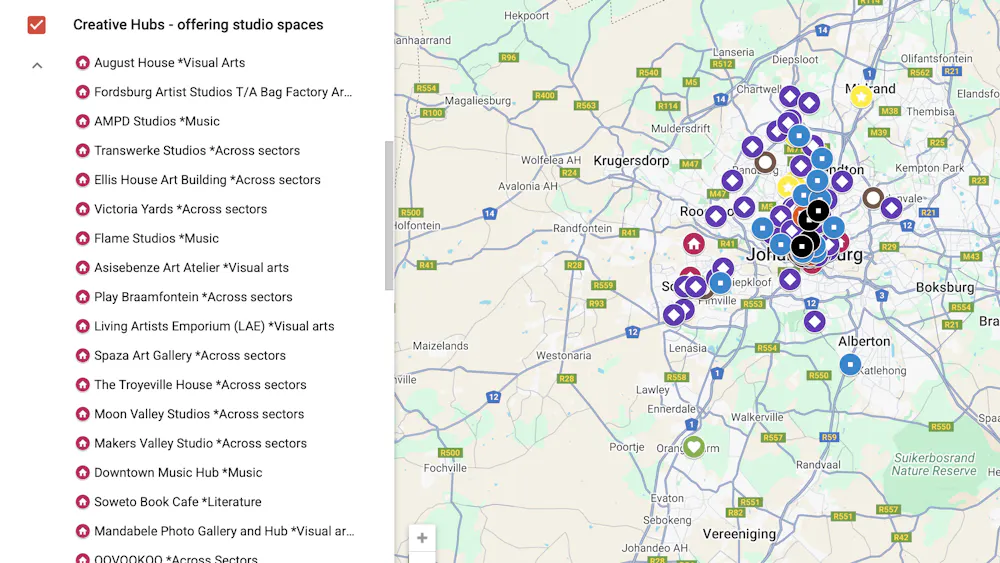
    Over the last year, 21 creative hubs have been mapped in the city, the majority newly established. Notable examples include Transwerke Studios, Asisebenze Art Atelier, Victoria Yards and Oovookoo. Remarkably, 19 of the 21 hubs identified in my open-source mapping process are in the inner city. Only two are government run – Transwerke and Downtown Music Hub.

    Across Johannesburg, creative hubs buzz with independent activity, yet share a common commitment to cultivating talent, business support and community impact. They are evidence of innovative partnerships between creatives and property developers.

    Mapping Johannesburg’s creative hubs. Google Maps/Mariapaola McGurk

    Inside these spaces, artists and creatives get opportunities through gallerist and investor visits (access to markets). They build practical and entrepreneurial skills through tailored workshops. And they collaborate on projects that place social upliftment at their heart.

    Some hubs focus on offering studio spaces, while others extend their reach beyond their walls, blending artistic expression with community development and public engagement.

    By actively building community and opportunity, creative hubs are becoming

    lighthouses for the new urban economy.

    They are small business incubators, urban beautification engines and potential cultural tourism hotspots. An event like Contra Fair opens the doors of art studio hubs once a year. Entrepreneur and social activist Tebogo Moalusi has now taken the lead in the establishment of Creative20. This will become a platform for revitalising Johannesburg’s creative cities campaign.

    Neglected by the city

    And yet the cultural and creative industries remain almost entirely absent from the city’s strategic planning. The Johannesburg 2040: Growth and Development Strategy fails even to mention the sector.

    Bag Factory Artists Studios hosting a public event. Mark Straw

    This is despite Gauteng, the province that houses Johannesburg, being the epicentre of South Africa’s creative economy. It contributes 46.3% of the industry’s gross domestic product and generates the highest employment impact. Johannesburg hosts the majority of creative businesses in the province.


    Read more: The real Johannesburg: 6 powerful photos from a gritty new book on the city


    The Gauteng 2030 Strategy highlights three high-growth sectors: agro-processing, cultural and creative industries, and high-tech/knowledge sectors, including digital and gaming. Two of these directly involve the creative economy. Yet there’s been little effort to integrate them into Johannesburg’s urban development agenda.

    If Johannesburg is serious about inclusive economic development and sustainable urban growth, it must recognise and invest in the cultural and creative industries which are already thriving within its borders.

    – Johannesburg’s creative hubs are booming: how artists are rejuvenating a failing inner city
    – https://theconversation.com/johannesburgs-creative-hubs-are-booming-how-artists-are-rejuvenating-a-failing-inner-city-260224

    MIL OSI Africa

  • MIL-OSI Africa: Ghana has a rare treasure, a crater made when a meteor hit Earth: why it needs to be protected

    Source: The Conversation – Africa – By Marian Selorm Sapah, Senior lecturer, University of Ghana

    Impact craters are formed when an object from space such as a meteoroid, asteroid or comet strikes the Earth at a very high velocity. This leaves an excavated circular hole on the Earth’s surface.

    It is a basic geological process that has shaped the planets from their formation to today. It creates landscapes and surface materials across our solar system. The moon is covered with them, as are planets like Mercury, Mars and Venus. On Earth, impacts have influenced the evolution of life and even provided valuable mineral and energy resources. However, very few of the impact craters on Earth are visible because of various processes that obscure or erase them.

    Most of the recognised impact craters on Earth are buried under sediments or have been deeply eroded. That means they no longer preserve their initial forms.

    The Bosumtwi impact crater in Ghana is different, however. It is well preserved (not deeply eroded or buried under sediments). Its well-defined, near-circular basin, filled by a lake, is surrounded by a prominent crater rim that rises above the surface of the lake and an outer circular plateau. This makes it a target for several research questions.

    As an Earth scientist, I joined a research team from 2019 to better understand the morphology of the crater. We carried out a morphological analysis of the crater (a study of its form, structure and geological features).

    This study concluded that the activities of illegal miners are a threat to the sustainability of the crater. We also discovered that the features of the Bosumtwi impact crater can be considered as a terrestrial representation for a special type of impact crater known as rampart craters. These are common on the planets Mars and Venus and are found on icy bodies of the outer solar system (like Ganymede, Europa, Dione, Tethys and Charon).

    For future studies, the Bosumtwi impact crater can be used to help understand how rampart craters form on Mars and Venus. So the Bosumtwi impact crater should be protected and preserved.


    Read more: Curious Kids: Why are there so few impact craters on Earth?


    The crater

    The Bosumtwi impact crater is in Ghana’s mineral-rich Ashanti gold belt. It is the location of the only natural inland lake in Ghana. As one of the world’s best-preserved young meteorite impact craters it is designated as an International Union of Geological Sciences geoheritage site.

    It is one of only 190 confirmed impact crater sites worldwide, one of only 20 on the African continent. Its lake is one of six meteoritic lakes in the world, recognised for their outstanding scientific value.

    Satellite view of the Bosumtwi Impact Crater showing areas of Artisanal and Small scale Gold Mining activities. David Baratoux

    At almost 1.07 million years old, the crater offers unparalleled opportunities for studying impact processes, climate history and planetary evolution. It’s an irreplaceable natural laboratory for researchers and educators.

    Beyond its scientific importance, the crater holds cultural significance for the Ashanti people of Ghana. The lake at its centre serves as a sacred site and spiritual landmark. The crater’s breathtaking landscape also supports eco-tourism and local livelihoods, contributing to Ghana’s economic development while maintaining exceptional aesthetic value.

    The research

    As part of further research work on the 2019 study, in 2025 we have discovered through field work and satellite data analysis that illegal artisanal mining is prevalent in the area and threatening the crater. This refers to informal, labour-intensive extraction of minerals, primarily gold. It is conducted by individuals or small groups using basic tools and rudimentary machinery. The use of toxic chemicals such as mercury and cyanide, and practices such as river dredging, cause severe environmental harm.

    Illegal miners are encroaching on and around the crater rim, posing severe threats to its environment and sustainability. Their activities have become more prevalent over the course of less than 10 years, indicating a growing problem. If unchecked, it could lead to irreversible damage to the crater.

    These mining operations risk contaminating the lake with toxic heavy metals. The consequences of these are grave. They include destroying critical geological evidence, accelerating deforestation, and degrading the land. All this damages the crater’s scientific, cultural and economic value.

    The International Union of Geological Sciences geoheritage designation of the crater underscores the urgent need for protection measures. The loss of this rare geological wonder would represent not just a national tragedy for Ghana, but a blow to global scientific heritage.

    Immediate action is required. This includes enhanced satellite monitoring (tracking illegal mining, deforestation and environmental changes) using optical imagery (such as Sentinel-2, Landsat, PlanetScope). These tools can detect forest loss, identify mining pits and sediment runoff, and analyse changes over time.

    Stricter enforcement of mining bans, and community engagement programmes, will help preserve the Bosumtwi impact crater’s unique attributes for future generations of scientists, students, tourists and local communities who depend on its resources.

    – Ghana has a rare treasure, a crater made when a meteor hit Earth: why it needs to be protected
    – https://theconversation.com/ghana-has-a-rare-treasure-a-crater-made-when-a-meteor-hit-earth-why-it-needs-to-be-protected-260600

    MIL OSI Africa

  • MIL-OSI Africa: Africa’s minerals are being bartered for security: why it’s a bad idea

    Source: The Conversation – Africa – By Hanri Mostert, SARChI Chair for Mineral Law in Africa, University of Cape Town

    A US-brokered peace deal between the Democratic Republic of Congo (DRC) and Rwanda binds the two African nations to a worrying arrangement: one where a country signs away its mineral resources to a superpower in return for opaque assurances of security.

    The peace deal, signed in June 2025, aims to end three decades of conflict between the DRC and Rwanda.

    A key part of the agreement binds both nations to developing a regional economic integration framework. This arrangement would expand cooperation between the two states, the US government and American investors on “transparent, formalized end-to-end mineral chains”.

    Despite its immense mineral wealth, the DRC is among the five poorest countries in the world. It has been seeking US investment in its mineral sector.

    The US has in turn touted a potential multi-billion-dollar investment programme to anchor its mineral supply chains in the traumatised and poor territory.

    The peace that the June 2025 deal promises, therefore, hinges on chaining mineral supply to the US in exchange for Washington’s powerful – but vaguely formulated – military oversight.

    The peace agreement further establishes a joint oversight committee – with representatives from the African Union, Qatar and the US – to receive complaints and resolve disputes between the DRC and Rwanda.

    But beyond the joint oversight committee, the peace deal creates no specific security obligations for the US.

    The relationship between the DRC and Rwanda has been marred by war and tension since the bloody First (1996-1997) and Second (1998-2003) Congo wars. At the heart of much of this conflict is the DRC’s mineral wealth. It has fuelled competition, exploitation and armed violence.

    This latest peace deal introduces a resources-for-security arrangement. Such deals aren’t new in Africa. They first emerged in the early 2000s as resources-for-infrastructure transactions. Here, a foreign state would agree to build economic and social infrastructure (roads, ports, airports, hospitals) in an African state. In exchange, it would get a major stake in a government-owned mining company. Or gain preferential access to the host country’s minerals.

    We have studied mineral law and governance in Africa for more than 20 years. The question that emerges now is whether a US-brokered resources-for-security agreement will help the DRC benefit from its resources.

    Based on our research on mining, development and sustainability, we believe this is unlikely.

    This is because resources-for-security is the latest version of a resource-bartering approach that China and Russia pioneered in countries such as Angola, the Central African Republic and the DRC.

    Resource bartering in Africa has eroded the sovereignty and bargaining power of mineral-rich nations such as the DRC and Angola.

    Further, resources-for-security deals are less transparent and more complicated than prior resource bartering agreements.

    DRC’s security gaps

    The DRC is endowed with major deposits of critical minerals like cobalt, copper, lithium, manganese and tantalum. These are the building blocks for 21st century technologies: artificial intelligence, electric vehicles, wind energy and military security hardware. Rwanda has less mineral wealth than its neighbour, but is the world’s third-largest producer of tantalum, used in electronics, aerospace and medical devices.

    For almost 30 years, minerals have fuelled conflict and severe violence, especially in eastern DRC. Tungsten, tantalum and gold (referred to as 3TG) finance and drive conflict as government forces and an estimated 130 armed groups vie for control over lucrative mining sites. Several reports and studies have implicated the DRC’s neighbours – Rwanda and Uganda – in supporting the illegal extraction of 3TG in this region.

    The DRC government has failed to extend security over its vast (2.3 million square kilometres) and diverse territory (109 million people, representing 250 ethnic groups). Limited resources, logistical challenges and corruption have weakened its armed forces.

    This context makes the United States’ military backing enormously attractive. But our research shows there are traps.

    What states risk losing

    Resources-for-infrastructure and resources-for-security deals generally offer African nations short-term stability, financing or global goodwill. However, the costs are often long-term because of an erosion of sovereign control.

    Here’s how this happens:

    Examples of loss or near-loss of sovereignty from these sorts of deals abound in Africa.

    For instance, Angola’s US$2 billion oil-backed loan from China Eximbank in 2004. This was repayable in monthly deliveries of oil, with revenues directed to Chinese-controlled accounts. The loan’s design deprived Angolan authorities of decision-making power over that income stream even before the oil was extracted.

    These deals also fragment accountability. They often span multiple ministries (such as defence, mining and trade), avoiding robust oversight or accountability. Fragmentation makes resource sectors vulnerable to elite capture. Powerful insiders can manipulate agreements for private gain.

    In the DRC, this has created a violent kleptocracy, where resource wealth is systematically diverted away from popular benefit.

    Finally, there is the risk of re-entrenching extractive trauma. Communities displaced for mining and environmental degradation in many countries across Africa illustrate the long-standing harm to livelihoods, health and social cohesion.

    These are not new problems. But where extraction is tied to security or infrastructure, such damage risks becoming permanent features, not temporary costs.

    What needs to change

    Critical minerals are “critical” because they’re hard to mine or substitute. Additionally, their supply chains are strategically vulnerable and politically exposed. Whoever controls these minerals controls the future. Africa must make sure it doesn’t trade that future away.

    In a world being reshaped by global interests in critical minerals, African states must not underestimate the strategic value of their mineral resources. They hold considerable leverage.

    But leverage only works if it is wielded strategically. This means:

    • investing in institutional strength and legal capacity to negotiate better deals

    • demanding local value creation and addition

    • requiring transparency and parliamentary oversight for minerals-related agreements

    • refusing deals that bypass human rights, environmental or sovereignty standards.

    Africa has the resources. It must hold on to the power they wield.

    – Africa’s minerals are being bartered for security: why it’s a bad idea
    – https://theconversation.com/africas-minerals-are-being-bartered-for-security-why-its-a-bad-idea-260594

    MIL OSI Africa

  • MIL-OSI Africa: Unlocking Africa’s E-Mobility Future: Upcoming Webinar on Public Transport Electrification

    Source: APO

    Electrifying public transport is no longer just an aspiration for Africa—it is rapidly becoming a reality. On Wednesday, 23 July 2025, stakeholders from across the continent and beyond will convene virtually to explore the path forward in a high-impact webinar where industry experts discuss “The Future of Public Transport Electrification in Africa: Opportunities, Trends and Challenges.”

    The webinar will focus on unlocking practical solutions and scalable models to accelerate the shift to zero-emission mobility—particularly electric buses and paratransit systems, which form the backbone of Africa’s urban mobility landscape.

    Key Themes:

    • Energy and Charging Infrastructure
      Practical strategies for grid preparedness, depot-based and on-route charging, and strengthening public-private collaboration.
    • Innovative Procurement Models
      An exploration of models such as leasing, pay-as-you-go, and city-led ownership—what’s working, and where?
    • Electrifying Paratransit
      Addressing one of Africa’s most vital and informal transport systems—minibus taxis and other modes—and how e-mobility can integrate meaningfully into this space.

    Moderator:

    Prian Reddy, Senior Programme Manager: Zero Emission Buses (Africa), C40 Cities

    Expert Panel:

    • Hans van Toor, Strategy & Innovation, Roam
    • Moses Nderitu, Managing Director, BasiGo
    • Justin Coetzee, Founder, GoMetro

    Why You Should Attend:

    • Hear real-world insights from cities and transport operators already rolling out electric buses.
    • Learn about infrastructure readiness, energy strategies, and funding models fit for African cities.
    • Explore how electrification can include and uplift paratransit and informal transport sectors.
    • Connect with the experts and decision-makers shaping Africa’s low-carbon transport future.

    This event is designed for public officials, transport authorities, urban planners, mobility innovators, infrastructure investors, and all professionals interested in the continent’s clean, just energy transition.

    Join us for a crucial conversation that will help define the next phase of Africa’s transport transformation.

    Date: Wednesday, 23 July 2025
    Time: 10:00 WAT / 11:00 SAST & CAT / 12:00 EAT
    Register here: https://apo-opa.co/44GYAlJ

    Distributed by APO Group on behalf of VUKA Group.

    Additional Information:
    Link to Webinar: https://apo-opa.co/44GYAlJ 
    LinkedIN: https://apo-opa.co/4f24pxt 
    Website: https://apo-opa.co/40vphHw 
    Draft Programme: https://apo-opa.co/4f0Nxr4

    Media files

    .

    MIL OSI Africa

  • MIL-OSI Africa: Kaspersky: Advanced Persistent Threat (APT41) targets Southern African organisation in espionage attack

    Source: APO

    Kaspersky Managed Detection and Response experts (www.Kaspersky.co.za) have observed a cyber espionage attack on an organisation in Southern African and have linked it to the Chinese-speaking  APT41 group. Although the threat actor has shown limited activity in Southern Africa, this incident reveals that the cyber attackers have targeted government IT services in one of the countries in the region, attempting to steal sensitive corporate data — including credentials, internal documents, source code, and communications.

    APT (Advanced Persistent Threat) is a category of threat actors known for carrying out concerted, stealthy, and ongoing attacks against specific organisations, as opposed to opportunistic, isolated incidents that account for most cybercriminal activity. The adversaries’ techniques observed during the attack in Southern Africa allowed Kaspersky to attribute it to the Chinese-speaking APT41 group with a high confidence. The primary goal of the attack was cyber espionage, which is typical for this threat actor. The attackers attempted to collect sensitive data from the machines they compromised within the organisation’s network.

    It is noteworthy that APT41 typically has been showing quite limited activity in the Southern African region. APT41 specialises in cyber espionage and targets organisations across various industries, including telecommunications providers, educational and healthcare institutions, IT, energy, and other sectors, with known activity in at least 42 countries.

    Based on Kaspersky experts’ analysis, the attackers may have gained access to the organisation’s network through a web server exposed to the Internet. Using a credential harvesting technique – known in professional terms as registry dumping – the attackers obtained two corporate domain accounts: one with local administrator rights on all workstations and another belonging to a backup solution, which had domain administrator privileges. These accounts allowed the attackers to compromise additional systems within the organisation.

    One of the stealers used for data collection was a modified Pillager utility, designed for exporting and decrypting data. The attackers compiled its code from an executable file into a Dynamic Link Library (DLL). With it, they aimed to gather saved credentials from browsers, databases, administrative tools, as well as project source code, screenshots, active chat sessions and their data, email correspondence, lists of installed software, operating system credentials, Wi-Fi credentials, and other information.

    The second stealer used during the attack was Checkout. In addition to saved credentials and browser history, it was also capable of collecting information on downloaded files and browser-stored credit card data. The attackers also used the RawCopy utility and a version of Mimikatz compiled as a Dynamic Link Library (DLL) to dump registry files and credentials, as well as Cobalt Strike for Command and Control (C2) communication on compromised hosts.

    “Interestingly, as one of their C2 communication channels besides Cobalt Strike, the attackers chose the SharePoint server within the victim’s infrastructure. They communicated with it using custom C2 agents connected with a web-shell. They may have chosen SharePoint because it was an internal service already present in the infrastructure and unlikely to raise suspicion. Moreover, in that case, it probably offered the most convenient way to exfiltrate data and control compromised hosts through a legitimate communication channel,” explains Denis Kulik, Lead SOC Analyst at Kaspersky Managed Detection and Response service.

    “In general, defending against such sophisticated attacks is impossible without comprehensive expertise and continuous monitoring of the entire infrastructure. It is essential to maintain full security coverage across all systems with solutions capable of automatically blocking malicious activity at an early stage — and to avoid granting user accounts excessive privileges,” comments Denis Kulik.

    To mitigate or prevent similar attacks, organisations are advised to follow these best practices:

    • Ensure that security agents are deployed on all workstations within the organisation without exception, to enable timely incident detection and minimise potential damage.
    • Review and control service and user account privileges, avoiding excessive rights assignments – especially for accounts used across multiple hosts within the infrastructure.
    • To protect the company against a wide range of threats, use solutions from the Kaspersky Next (https://apo-opa.co/44EI2e3) product line that provide real-time protection, threat visibility, investigation and the response capabilities of EDR and XDR for organisations of any size and industry. Depending on your current needs and available resources, you can choose the most relevant product tier and easily migrate to another one if your cybersecurity requirements are changing.
    • Adopt managed security services by Kaspersky such as Compromise Assessment (https://apo-opa.co/4m8aElL), Managed Detection and Response (MDR) (https://apo-opa.co/4m6do37) and / or Incident Response (https://apo-opa.co/44VsAsP), covering the entire incident management cycle – from threat identification to continuous protection and remediation.  They help to protect against evasive cyberattacks, investigate incidents and get additional expertise even if a company lacks cybersecurity workers.
    • Provide your InfoSec professionals with an in-depth visibility into cyberthreats targeting your organisation. The latest Kaspersky Threat Intelligence (https://apo-opa.co/3TQbRlK) will provide them with rich and meaningful context across the entire incident management cycle and helps them identify cyber risks in a timely manner.

    A detailed analysis of the incident is available on Securelist (https://apo-opa.co/46mfGGS).

    Kaspersky Managed Detection and Response service monitors suspicious activity and helps organisations respond swiftly to minimise impact. This is a part of Kaspersky Security Services, a team delivering hundreds of information security projects every year for Fortune Global 500 organisations: incident response, managed detection, SOC consulting, red teaming, penetration testing, application security, digital risks protection. 

    Distributed by APO Group on behalf of Kaspersky.

    For further information please contact:
    Nicole Allman
    nicole@inkandco.co.za

    Social Media:
    Facebook: https://apo-opa.co/414B7bE
    X: https://apo-opa.co/4lYjIJQ
    YouTube: https://apo-opa.co/452Opa9
    Instagram: https://apo-opa.co/4lGn6JK
    Blog: https://apo-opa.co/4l8kweB

    About Kaspersky:
    Kaspersky is a global cybersecurity and digital privacy company founded in 1997. With over a billion devices protected to date from emerging cyberthreats and targeted attacks, Kaspersky’s deep threat intelligence and security expertise is constantly transforming into innovative solutions and services to protect individuals, businesses, critical infrastructure, and governments around the globe. The company’s comprehensive security portfolio includes leading digital life protection for personal devices, specialized security products and services for companies, as well as Cyber Immune solutions to fight sophisticated and evolving digital threats. We help millions of individuals and over 200,000 corporate clients protect what matters most to them. Learn more at www.Kaspersky.co.za

    Media files

    .

    MIL OSI Africa

  • MIL-OSI Africa: Morocco: African Development Bank approves €100 Million to empower women and youth entrepreneurs in building inclusive and sustainable agriculture

    Source: APO

    The Board of Directors of the African Development Bank Group (www.AfDB.org) has approved a €100 million loan to support Morocco’s inclusive solidarity-based agriculture program, focused on empowering women and young people.

    The project aims to generate sustainable economic opportunities for women and youth, boost food security, and strengthen the resilience of small-scale farming against climate change. It will stimulate entrepreneurship through tailored financing and incentive mechanisms and by bolstering technical and financial support systems.

    The program will also facilitate the deployment of new agricultural production and service infrastructure, helping to anchor women in local value chains, strengthen their skills, and boost their productivity. These actions will encourage the emergence of women entrepreneurs across agriculture, agro-processing and digital technologies. It will support the new roadmap for employment by promoting rural entrepreneurship.

    “Women who have the ambition to undertake and succeed in agriculture are our priority,” said Achraf Tarsim, head of the African Development Bank country office in Morocco. “Through this new operation, we will support them step by step to build a modern, inclusive and resilient agriculture, capable of revealing the full potential of those who aspire to innovate and create value and employment in their territories.”

    Aligned with Morocco’s priorities, the program will support the implementation of the Green Generation 2020-2030 Strategy, Morocco’s plan for transforming agriculture into a more inclusive, sustainable and efficient sector; the National Solidarity Agriculture Program, and the National Youth Entrepreneurship Program.

    For more than 50 years, the African Development Bank Group has supported the Kingdom in a partnership based on a shared and integrated vision of development. Over the period, the Bank invested nearly €15 billion in more than 150 high-impact projects in strategic sectors such as transport, water, energy, agriculture, social protection, governance and finance.

    Distributed by APO Group on behalf of African Development Bank Group (AfDB).

    Media contact:
    Fahd Belbachir
    Principal Communication and External Relations Officer
    media@afdb.org

    About the African Development Bank Group:
    The African Development Bank Group is Africa’s premier development finance institution. It comprises three distinct entities: the African Development Bank (AfDB), the African Development Fund (ADF) and the Nigeria Trust Fund (NTF). On the ground in 41 African countries with an external office in Japan, the Bank contributes to the economic development and the social progress of its 54 regional member states. For more information: www.AfDB.org

    Media files

    .

    MIL OSI Africa

  • MIL-OSI Africa: Integrating youth in agrifood systems transformation in Zimbabwe

    Source: APO


    .

    The Food and Agriculture Organization of the United Nations (FAO) in collaboration with the Government of Zimbabwe launched a technical cooperation programme to enhance national capacity to support meaningful youth engagement in agrifood systems through policy support, leadership development and institutional strengthening.

    FAO provides technical support to the Government of Zimbabwe to ensure that youth are meaningfully integrated into agrifood systems as key actors in productivity, innovation, and food security. This project builds upon the experiences of the FAO in Zimbabwe including the Green Jobs for Rural Youth Employment. It represents a crucial step in addressing the youth-related knowledge and skills and policy gaps identified in previous initiatives.

    FAO highlights the urgency of creating 10–12 million new jobs annually in Africa and positions agrifood systems especially given their rapid growth and high potential for value addition as key to unlocking youth employment. Drawing on FAO Investment Guidelines for Youth in Agrifood Systems, the approach emphasizes integrating youth perspectives throughout the project cycle. The approach encourages recognizing youth as a diverse group with varied needs, capacities, and aspirations, and calls for collaboration among public, private, and civil society actors to create enabling environments.

    “This project is set to inform and shape future priorities for collaboration between the Government of Zimbabwe and FAO on youth-related matters. By fostering this collaboration, the project aims to create an enabling environment that supports more effective interventions for youth engagement in agrifood systems, ultimately empowering young people to take a leading role in transforming these systems for the better,” said Patrice Talla, FAO Subregional Coordinator for Southern Africa and Representative to Zimbabwe.

    This milestone comes at an opportune time when the country is starting to operationalize the second phase of the Agriculture and Food Systems and Rural Transformation Strategy (AFSRTS 2.0) with a particular focus on mainstreaming and integrating youth in agrifood systems.

    “Mainstreaming youth is not an optional add-on; it is the fundamental strategy for achieving resilient, productive, and transformed agrifood systems and rural communities. The Government of Zimbabwe will provide visionary leadership, enact enabling policies, prioritize budget allocation for youth mainstreaming initiatives within Strategy 2.0, and ensure coordination across ministries,” said Mr. Jairos Mandizadza, Director – Gender Mainstreaming, Inclusivity and Wellness in the Ministry of Lands, Agriculture, Fisheries, Water and Rural Development in his keynote address.

    As part of its commitment to enhancing youth participation in Zimbabwe’s agrifood systems, the FAO-led project will initiate a consultative and participatory process to support the development of a comprehensive national strategy that integrate youth issues. The approach is designed to engage a wide spectrum of stakeholders, from primary producers to tertiary institutions and development partners while ensuring that the strategy is grounded in local realities and informed by diverse perspectives.

    As the project gains momentum, young people across Zimbabwe are expressing optimism and a renewed sense of purpose.

    “With this project we are energised, motivated, by being heard, valued, seen and more importantly included, we are no longer participants but change makers and this proves that there is nothing for us which can be done without us,” said Getrude Chambati, Secretary for the World Food Forum Zimbabwe Chapter.

    The process of project implementation will include a combination of face-to-face stakeholder consultations, strategic planning meetings, and a desk review of existing work by other partners in the sector. This blended methodology will ensure that the strategy builds on past efforts while introducing fresh, youth-centred insights. The project ultimately aims to support Zimbabwe in formulating a National Youth Investment Plan and a Youth-inclusive Agrifood Systems Strategy, laying the groundwork for sustainable and inclusive agricultural transformation.

    The inception meeting provided the platform to key stakeholders, including youths to review and provide input on how the draft AFSRTS 2 can integrate more youths issues. This was achieved through breakout sessions where participants were put into groups to review and update pillars of the AFSRTS 2. During the launch key stakeholders had the opportunity to appreciate the current youth in agrifood systems frameworks and policies at national, regional and international levels.

    Going forward, the project is poised to play a transformative role in shaping Zimbabwe’s agrifood landscape by supporting the development of a robust national strategy and targeted investment plans for youth. By enhancing the capacity and skills of both young people and agriculture ministry personnel, FAO is committed to strengthening governance and leadership frameworks that support youth inclusion. This marks a pivotal step toward building a more resilient, inclusive, and future-ready agrifood system, driven by the energy, innovation, and potential of Zimbabwe’s youth.

    Distributed by APO Group on behalf of Food and Agriculture Organization of the United Nations (FAO): Regional Office for Africa.

    MIL OSI Africa

  • MIL-OSI United Kingdom: British Muslim Trust appointed as new partner to monitor and tackle anti-Muslim hatred

    Source: United Kingdom – Government Statements

    News story

    British Muslim Trust appointed as new partner to monitor and tackle anti-Muslim hatred

    The Combatting Hate Against Muslims Fund was established this year to tackle the record levels of anti-Muslim hate.

    • British Muslim Trust will receive funding as part of a new government drive against record levels of anti-Muslim hate.
    • Funding will boost victim support and strengthen hate crime reporting nationwide.
    • The Trust unites decades of expertise from Aziz Foundation and Randeree Charitable Trust.

    The British Muslim Trust (BMT) has been selected as the recipient of the government’s new Combatting Hate Against Muslims Fund, a key initiative to address the rise in anti-Muslim hatred across England.

    The fund was established this year to respond to the evolving nature of religious intolerance and targeted hate incidents faced by Muslim communities, which are at the highest level on record.

    BMT will use the funding to develop a robust reporting system that captures both online and offline incidents of anti-Muslim hatred, including those that may go unreported to the police.

    It will also enable the organisation to provide direct support to victims, raise awareness of what constitutes a hate crime, and encourage greater reporting from affected communities.

    Lord Khan, Minister for Faith, said:

    The rise of anti-Muslim hatred in this county is alarming and deeply concerning.

    That’s why we established this new fund: to ensure we’re doing everything we can to deeply understand the situation our Muslim communities are facing, provide them with the support they need and give us the tools needed to tackle this unacceptable hatred.

    I look forward to working with the British Muslim Trust on our shared ambition to create a safer, more tolerant society for everyone as part of our Plan for Change.

    By analysing the data collected, the BMT will help identify the trends and drivers behind these incidents, providing the government with the evidence needed to shape effective policy and inform action to tackle anti-Muslim hate moving forward, helping to deliver on our Safer Streets mission as part of our Plan for Change.

    The BMT brings together the Aziz Foundation and Randeree Charitable Trust to form a comprehensive organisation, combining their expertise and strong community foundations, gained from over twenty-years of work, to meet the demands of today’s landscape.

    Shabir Randeree, CBE, will serve as the Chair of the Board of Directors, bringing with him a wealth of cross-sector experience, knowledge and a firm commitment to championing the welfare of ethnic minorities in Britain.

    Shabir Randeree, Chair of the Board of Directors at the British Muslim Trust, said:

    Tackling anti-Muslim hatred is essential to building safer, more inclusive communities – and we are proud to have been appointed to deliver this important work.

    The British Muslim Trust will work closely with partners across the country to support victims, listen to communities, and help ensure that every person can live free from fear and hatred.

    Notes to Editors:

    • The British Muslim Trust will begin receiving reports and monitoring incidents from early autumn.
    • In establishing the BMT, The Aziz Foundation and Randeree Charitable Trust have also worked closely with Akeela Ahmed MBE, who they intend to appoint as CEO, drawing on her decades of experience in working with grassroots organisations and policy-level anti-hate work.
    • Incidents of hate crime directed towards Muslims is at a record high in England and Wales – as set out in recent government statistics: Hate crime, England and Wales, year ending March 2024 – GOV.UK
    • The window to bid for this funding under the Combatting Hate Against Muslims Fund ran from 7 April for six weeks. More information about the assessment criteria used to select the grant partner can be found in the fund’s prospectus, linked here: Combatting Hate Against Muslims fund: prospectus – GOV.UK
    • The Randeree Charitable Trust has spent decades supporting and funding organisations which work to empower young people, support interfaith dialogue, religious understanding and community cohesion. Through this work, the Trust has built a deep and widespread network which will support in establishing the British Muslim Trust’s within communities across the country.
    • The Aziz Foundation supports individuals from British Muslim communities by empowering them to advance their careers and make valuable contributions to society through providing Master’s scholarships and other resources. The foundation has spent a decade nurturing confident leaders of Muslim background to address social challenges and promote positive change within their communities and beyond.

    • NPCC’s National Police Advisor for Hate Crime Paul Giannasi said:

    “The Crime Survey for England and Wales demonstrates that hate crime has a greater impact on victims when compared to non-targeted crime. It damages our society, creating fear and division in communities that are targeted. 

    “We also know that hate crime has traditionally been underreported and have seen evidence that this is a particular challenge with those affected by anti-Muslim hatred.

    “The police will not tolerate hate crime and would encourage all victims to report crimes, whether direct to the police or through third-party facilities provided by community groups. 

    “We welcome the funding that government has committed to address this issue and any initiative that helps victims to seek and receive the services they deserve.”

    • Imam Qasim, Exec. Chairman & Founder, Al-Khair Foundation, said:

    “Al Khair Foundation welcomes the establishment of the British Muslim Trust as a dedicated platform through which members of the public may report hate crimes. 

    “This timely and much-needed initiative constitutes a significant milestone in the advancement of community cohesion and the restoration of trust and confidence among affected communities.”

    Updates to this page

    Published 21 July 2025

    MIL OSI United Kingdom

  • MIL-OSI Russia: SPbPU representatives took part in the cross-university examination of the Priority-2030 program

    Translation. Region: Russian Federal

    Source: Peter the Great St. Petersburg Polytechnic University –

    An important disclaimer is at the bottom of this article.

    The Sociocenter, with the support of the Ministry of Education and Science of Russia, has completed the selection of experts to conduct a cross-university examination of the implementation of the Priority-2030 program. Among them are the head of the SPbPU Office of Technological Leadership Oleg Rozhdestvensky, Vice-Rector for Continuing and Pre-University Education Dmitry Tikhonov and Director of the Department of Economics and Finance Elena Vinogradova.

    In total, 156 representatives of universities participating in the Priority 2030 program and scientific organizations will be involved in the cross-university examination of the Priority 2030 program.

    The selection of experts was a multi-stage process. At the correspondence stage, the selection committee assessed the professional experience and motivation of candidates based on their resumes and essays. As a result, 225 people received an invitation to an educational intensive course at Bauman Moscow State Technical University. There, the candidates’ leadership qualities, teamwork skills, ability to analyze information and formulate constructive proposals were assessed. The final stage was an online meeting with the participation of expert candidates, representatives of the Sociocenter and the Ministry of Education and Science of Russia, at which five strategically important areas of modern higher education were formulated:

    target model and strategic positioning; university development management; strategic technology projects and change projects; knowledge production, transfer and application system for technological leadership; leadership and development team.

    After the final list of experts was approved, the Sociocenter team began the final preparation of a large-scale expert work that will cover 113 universities participating in the Priority 2030 program. From September, experts will begin visiting universities across the country to assess their condition and develop recommendations for further development.

    Cross-university assessment is an innovative format for assessing the activities of universities, in which the assessment is carried out by representatives of the professional community of university specialists themselves. This mechanism allows combining the principles of objective assessment with the possibility of mutual learning and dissemination of best practices.

    “This is an excellent expert tool that has not only proven its effectiveness over the past couple of years, but has also ensured the formation of a community of qualified specialists in the field of university development,” commented Oleg Rozhdestvensky, Head of the SPbPU Office of Technological Leadership. “And the main difference this year is that such expert work is becoming systemic — more and more people and universities are getting involved. This is extremely important given the focus of most universities on the federal agenda of achieving technological leadership and the upcoming changes in the higher education system in the country.”

    The Russian Ministry of Education and Science has been implementing the Priority 2030 program since 2021. Since 2025, the program has become part of the federal project Universities for a Generation of Leaders of the national project Youth and Children.

    Based on materials from the Federal State Autonomous Institution “Sociocenter”

    Please note: This information is raw content obtained directly from the source of the information. It is an accurate report of what the source claims and does not necessarily reflect the position of MIL-OSI or its clients.

    .

    MIL OSI Russia News

  • MIL-OSI Russia: 2,139 freight trains passed through Manzhouli checkpoint in January-June this year

    Translation. Region: Russian Federal

    Source: People’s Republic of China in Russian – People’s Republic of China in Russian –

    An important disclaimer is at the bottom of this article.

    Source: People’s Republic of China – State Council News

    BEIJING, July 21 (Xinhua) — A total of 2,139 freight trains passed through Manzhouli Port on China-Europe international freight routes in the first half of this year, the press service of the people’s government of the city of the same name in the Inner Mongolia Autonomous Region said Monday.

    These trains transported about 228 thousand standard containers /twenty-foot equivalent unit, TEU/. In particular, 1,360 similar trains passed through this border crossing in the opposite direction, delivering more than 141 thousand TEU to China. Compared to the same period last year, both indicators increased by 7.4 percent and 5.4 percent, respectively.

    As of last month, in terms of the volume of freight train transportation on return trips through the Manzhouli border crossing, this border crossing has been ranked first in the country for six months in a row.

    The Manzhouli checkpoint is located on the border of China with the Zabaikalsky Krai of Russia. Currently, China-Europe freight trains entering China connect Manzhouli with more than 60 cities in the country, including Harbin, Shanghai and Guangzhou. The range of products imported to China through this checkpoint includes essential goods, electronics, cars, edible oil, lumber, etc. -0-

    Please note: This information is raw content obtained directly from the source of the information. It is an accurate report of what the source claims and does not necessarily reflect the position of MIL-OSI or its clients.

    .

    MIL OSI Russia News

  • MIL-OSI Russia: CPC launches new round of disciplinary inspections

    Translation. Region: Russian Federal

    Source: People’s Republic of China in Russian – People’s Republic of China in Russian –

    An important disclaimer is at the bottom of this article.

    Source: People’s Republic of China – State Council News

    BEIJING, July 21 (Xinhua) — China has launched the sixth round of routine disciplinary inspections by the 20th Central Committee of the Communist Party of China (CPC Central Committee). As of Sunday, teams of inspectors had been dispatched to 16 provinces, autonomous regions and municipalities directly under the central government, according to an official statement released Monday.

    In addition, joint inspections will be carried out in 10 sub-provincial cities in cooperation with relevant inspection authorities at the provincial level.

    According to the statement, the work under the new round of disciplinary inspections will focus on violations of political and organizational discipline, as well as discipline in following the principles of honesty and integrity, discipline in relation to the masses, labor and everyday discipline.

    Teams of inspectors will be deployed to designated units for a period of approximately two and a half months. Access to duty telephone lines and mailboxes will be open to receive messages and complaints from the public until September 23 this year. -0-

    Please note: This information is raw content obtained directly from the source of the information. It is an accurate report of what the source claims and does not necessarily reflect the position of MIL-OSI or its clients.

    .

    MIL OSI Russia News

  • MIL-OSI Russia: Rosneft held a corporate festival “Energy of Talents” in Moscow

    Translation. Region: Russian Federal

    Source: Rosneft – An important disclaimer is at the bottom of this article.

    The final of Rosneft’s corporate creative festival “Energy of Talents” was held in Moscow at the Mosproducer conference center, in which employees of 44 of the Company’s enterprises from all over the country took part.

    Rosneft has been holding annual creative festivals for its employees since 2011. In 2025, more than 7,000 people from 59 Group Companies applied to participate in the Energy of Talents selection round, which was held online. The jury members viewed hundreds of creative numbers in various nominations.

    Participants who qualified for the final competed over two days in dancing, singing, playing musical instruments, original genre, fine art and photography. Winners in six nominations were selected by a professional jury, with voting in two nominations taking place online.

    Between performances, participants and spectators had the opportunity to take master classes under the guidance of professional teachers in choreography, vocals, acting, public speaking and instrumental genres.

    The company supports significant projects in Russian cultural life that are aimed at reviving and preserving spiritual and national values. With the support of the Company, the State Hermitage Museum has been holding various exhibitions and expositions since 2018. Thus, in 2024, the museum opened an updated permanent exhibition “Culture and Art of China”.

    With the Company’s support, the Mariinsky Theatre artists under the direction of Valery Gergiev performed in Qatar with the production of “A Thousand and One Nights”; a concert dedicated to the 95th anniversary of Alexandra Pakhmutova was held in Volgograd; a number of exhibitions were organized at the Jewish Museum and Tolerance Center in Moscow. In 2023-2024, Tatyana Navka’s ice shows “Evenings on a Farm” and “The Nutcracker” were held in Moscow, and the show “The Love Story of Scheherazade” toured in the Indian city of Ahmedabad.

    Department of Information and AdvertisingPJSC NK RosneftJuly 21, 2025

    Please note: This information is raw content obtained directly from the source of the information. It is an accurate report of what the source claims and does not necessarily reflect the position of MIL-OSI or its clients.

    .

    MIL OSI Russia News

  • MIL-OSI Russia: Rosneft sums up the results of the polar bear field research season

    Translation. Region: Russian Federal

    Source: Rosneft – An important disclaimer is at the bottom of this article.

    Specialists from the Rosneft Arctic Research Center, together with scientists from the country’s leading research institutes, have summed up the results of the polar bear field season as part of the Tamura corporate biodiversity conservation program. Three expeditions were conducted in the spring to study the Arctic predator population.

    Representatives of the Company, the Ministry of Natural Resources and Environment of the Russian Federation, the A.N. Severtsov Institute of Ecology and Evolution of the Russian Academy of Sciences, as well as specialists from the Biotechnology Campus (BTC) Center for Whole-Genome Sequencing, spoke about scientific work in the north of Krasnoyarsk Krai at a press breakfast.

    In 2025, scientists were faced with the task of conducting the first full-scale aerial survey of the Kara subpopulation of polar bears in Russian practice. Specialists made 25 flights, the total length of air routes was almost 24 thousand km. During the expeditions, about 170 thousand photographs were taken, as well as 540 thousand infrared photographs, which will be processed using artificial intelligence.

    According to the expedition participants, 8 flights of the laboratory aircraft were made from the village of Sabetta in Yamal for a comprehensive survey of the inner delta of the Gulf of Ob and the southeastern part of the Kara Sea. During the aerial visual observations, 22 polar bears, 23 walruses, 616 seals, 77 belugas, and rare bird species were recorded.

    Ten helicopter flights were made from the village of Dikson to survey the ice of a number of islands, as well as the ice in the Yenisei Gulf to Sever Bay and along the northern coast of the Taimyr Peninsula to the mouth of the Uboynaya River. During the work, 37 polar bears of various ages and both sexes were registered. 10 animals were tagged with satellite collars and ear tags for remote tracking of migration routes. Scientists also took samples of the polar bears’ fur and blood to study their health and genetic affiliation to a particular subpopulation – the samples are already being studied by BTK specialists. The location of two abandoned polar bear maternity dens and the habitat of the bears’ main food source – the ringed seal – were also determined.

    Also from the village of Dikson, scientists surveyed the central and south-eastern waters of the Kara Sea. Specialists carried out 7 flights and registered 12 polar bears, 16 belugas and 420 seals. Specialists noted that based on the results of the work, the number and distribution density of polar bears and their food sources in the Kara Sea will be determined.

    Rosneft pays special attention to environmental issues and biodiversity conservation and is implementing the largest comprehensive Arctic region study program since Soviet times. The goal of the new Tamura research program, which started in 2024, is to update information on the state of key animal species in the northern region. The Tamura program includes studying the Kara subpopulation of polar bears, wild reindeer populations in western Taimyr, and valuable bird and fish species in the Yenisei estuary. The data obtained will allow scientists to draw conclusions about the state of ecosystems and develop measures to preserve the region’s biodiversity. In 2024, scientists conducted five expeditions, and ten expeditions will be held in total over four years.

    Department of Information and AdvertisingPJSC NK RosneftJuly 21, 2025

    Please note: This information is raw content obtained directly from the source of the information. It is an accurate report of what the source claims and does not necessarily reflect the position of MIL-OSI or its clients.

    .

    MIL OSI Russia News

  • MIL-OSI Security: Smithfield man sentenced to over two years in prison for illegally possessing a firearm

    Source: United States Bureau of Alcohol Tobacco Firearms and Explosives (ATF)

    NEWPORT NEWS, Va. – A Smithfield man was sentenced yesterday to two years and four months in prison for being a felon in possession of a firearm.

    According to court documents, on May 25, 2024, law enforcement conducted a traffic stop on Ahmod Keshawn Finney, 24, and placed him in custody pursuant to outstanding state arrest warrants. While Finney was being detained, officers observed and recovered a loaded handgun from the vehicle. The handgun was stolen and was equipped with an extended magazine and a machinegun conversion device.

    As a previously convicted felon, Finney cannot legally possess firearms or ammunition.

    Erik S. Siebert, U.S. Attorney for the Eastern District of Virginia; Anthony A. Spotswood, Special Agent in Charge of the Bureau of Alcohol, Tobacco, Firearms and Explosives Washington Field Division; Col. Matthew D. Hanley, Superintendent of Virginia State Police; and Steve R. Drew, Chief of Newport News Police, made the announcement after sentencing by U.S. District Judge Jamar K. Walker.

    Assistant U.S. Attorney Peter G. Osyf prosecuted the case.

    This case is part of Project Safe Neighborhoods (PSN), a program bringing together all levels of law enforcement and the communities they serve to reduce violent crime and gun violence, and to make our neighborhoods safer for everyone. On May 26, 2021, the Department launched a violent crime reduction strategy strengthening PSN based on these core principles: fostering trust and legitimacy in our communities, supporting community-based organizations that help prevent violence from occurring in the first place, setting focused and strategic enforcement priorities, and measuring the results.

    A copy of this press release is located on the website of the U.S. Attorney’s Office for the Eastern District of Virginia. Related court documents and information are located on the website of the District Court for the Eastern District of Virginia or on PACER by searching for Case No. 4:24-cr-86.

    MIL Security OSI

  • MIL-OSI Security: U.S. Attorney’s Office Filed 84 Border-Related Cases This Week

    Source: United States Bureau of Alcohol Tobacco Firearms and Explosives (ATF)

    SAN DIEGO – Federal prosecutors in the Southern District of California filed 84 border-related cases this week, including charges of assault on a federal officer, bringing in aliens for financial gain, reentering the U.S. after deportation, and importation of controlled substances.

    The U.S. Attorney’s Office for the Southern District of California is the fourth-busiest federal district, largely due to a high volume of border-related crimes. This district, encompassing San Diego and Imperial counties, shares a 140-mile border with Mexico. It includes the San Ysidro Port of Entry, the world’s busiest land border crossing, connecting San Diego (America’s eighth largest city) and Tijuana (Mexico’s second largest city).

    In addition to reactive border-related crimes, the Southern District of California also prosecutes a significant number of proactive cases related to terrorism, organized crime, drugs, white-collar fraud, violent crime, cybercrime, human trafficking and national security. Recent developments in those and other significant areas of prosecution can be found here.

    A sample of border-related arrests this week:

    • On July 11, Nicolas Duarte-Moreno, a Mexican citizen, was arrested and charged with Bringing in Aliens for Financial Gain. According to a complaint, Duarte-Moreno was arrested by Customs and Border Protection officers after he attempted to enter the U.S. in a Mitsubishi Eclipse Spyder through a Sentri lane at the Otay Mesa Port of Entry with an undocumented immigrant hiding in the vehicle. Officers found the immigrant from Guatemala concealed in the cargo area where the convertible top retracts. While CBP officials dismantled the cargo area by removing bolts and speakers to find and extricate the immigrant, he complained that he could not breathe. He was immediately taken to a hospital.
    • On July 15, Luis Angel Galvez Alvarez, Julio Cesar Oros Castro and Francisco Javier Castro Acosta, all Mexican citizens, were arrested and charged with Importation of a Controlled Substance. According to a complaint, the trio attempted to enter the U.S. about the same time, each driving a Freightliner tractor through the Otay Mesa Commercial Facility. Customs and Border Protection officers stopped each vehicle; they found about 29 pounds of cocaine concealed in the walls behind the beds of each tractor. The complaint said all three drivers admitted they were employed by the same trucking company.
    • On July 16, Jorge Ismael Valencia-Julian, a Mexican citizen, was arrested and charged with Deported Alien Found in the United States. According to a complaint, Valencia-Julian was arrested by a Border Patrol agent who tracked his footprints for five hours as the defendant tried to escape in rough terrain. Valencia-Julian was previously deported in March 2024 at the San Ysidro Port of Entry.

    Also recently, a number of defendants with criminal records were convicted by a jury or sentenced for border-related crimes such as illegally re-entering the U.S. after previous deportation. Here are a few of those cases:

    • On July 11, 2025, Ricardo Velez-Torres, a Mexican National who was previously convicted of Burglary in the First Degree in 2006 and Illegal Reentry in 2002, was sentenced in federal court to 21 months in custody for again entering the U.S. illegally.
    • On July 18, Julio Leyva-Solis, a Mexican national who was previously convicted of the felony facilitation of human smuggling, felony theft of property on three occasions, and felony possession of methamphetamine, was sentenced in federal court to 12 months plus one day in custody for again entering the U.S illegally.

    Pursuant to the Department’s Operation Take Back America priorities, federal law enforcement has focused immigration prosecutions on undocumented aliens who are engaged in criminal activity in the U.S., including those who commit drug and firearms crimes, who have serious criminal records, or who have active warrants for their arrest. Federal authorities have also been prioritizing investigations and prosecutions against drug, firearm, and human smugglers and those who endanger and threaten the safety of our communities and the law enforcement officers who protect the community.

    The immigration cases were referred or supported by federal law enforcement partners, including Homeland Security Investigations (HSI), Immigration and Customs Enforcement’s Enforcement and Removal Operations (ICE ERO), Customs and Border Protection, U.S. Border Patrol, the Drug Enforcement Administration (DEA), the Federal Bureau of Investigation (FBI), the U.S. Marshals Service (USMS), and the Bureau of Alcohol, Tobacco, Firearms and Explosives (ATF), with the support and assistance of state and local law enforcement partners.

    Indictments and criminal complaints are merely allegations and all defendants are presumed innocent until proven guilty beyond a reasonable doubt in a court of law.

    MIL Security OSI

  • MIL-OSI Security: Pierre Man Sentenced to More Than 12 Years in Federal Prison for Distributing Methamphetamine in Central South Dakota

    Source: United States Bureau of Alcohol Tobacco Firearms and Explosives (ATF)

    PIERRE – United States Attorney Alison J. Ramsdell announced today that U.S. District Judge Eric C. Schulte has sentenced a Pierre, South Dakota, man convicted of Conspiracy to Distribute a Controlled Substance and Possession of a Firearm by a Prohibited Person. The sentencing took place on July 14, 2025.

    Scott Reiners, age 37, was sentenced to 12 years and four months in federal prison, followed by five years of supervised release, and ordered to pay a $200 special assessment to the Federal Crime Victims Fund. Reiners was further ordered to pay a $1,000 fine.

    Reiners was indicted by a federal grand jury in July 2024 . He pleaded guilty on April 3, 2025.

    The conviction stemmed from a drug conspiracy between September 2022 and April 2023 in which Reiners and several other individuals conspired to distribute methamphetamine in and around the central South Dakota area, including within the Crow Creek and Lower Brule Sioux Indian Reservations. As part of the conspiracy, Reiners was involved in distributing between 5 kilograms and 15 kilograms of methamphetamine. Reiners was also involved in a traffic stop where law enforcement seized 254 grams of 97% pure methamphetamine and a handgun. Reiners is prohibited from possessing firearms due to three prior felony convictions.

    This case is part of Project Safe Neighborhoods (PSN), a program bringing together all levels of law enforcement and the communities they serve to reduce violent crime and gun violence, and to make our neighborhoods safer for everyone. On May 26, 2021, the Department launched a violent crime reduction strategy strengthening PSN based on these core principles: fostering trust and legitimacy in our communities, supporting community-based organizations that help prevent violence from occurring in the first place, setting focused and strategic enforcement priorities, and measuring the results.

    This case was investigated by the Federal Bureau of Investigation, the Bureau of Indian Affairs, and the Bureau of Alcohol, Tobacco, Firearms, and Explosives. Assistant U.S. Attorney Meghan Dilges prosecuted the case.

    Reiners was immediately remanded to the custody of the U.S. Marshals Service. 

    MIL Security OSI

  • MIL-OSI: A new way to mine USDC! RICH Miner cloud mining allows stablecoins to earn returns

    Source: GlobeNewswire (MIL-OSI)

    Chicago, Illinois, July 21, 2025 (GLOBE NEWSWIRE) — RICH Miner stablecoins are no longer just a tool for “saving and not using”! RICH Miner is leading a new way of mining, allowing stablecoins such as USDC (USD Coin) to participate in cloud mining and generate daily income.

    This innovative model breaks the traditional impression that “stablecoins can only be saved” and brings a new idea to asset allocation.

    Why choose USDC for cloud mining?

    Choosing USDC for cloud mining means that you can obtain continuous income while ensuring the stability of your assets. As a compliant stablecoin backed by the US dollar, the price of USDC is constant and close to $1, which greatly reduces the risk of fluctuations in the crypto market.

    By investing USDC in the cloud mining platform, users do not need to worry about the fluctuations in the price of the currency, and can get stable returns every day based on the contract computing power alone. Compared with traditional mining currencies, USDC mining is more suitable for investors who pursue stable returns, high security, and easy operation. It is an ideal way to connect the crypto world with traditional finance.

    RICH Miner USDC cloud mining has obvious advantages:

    RICH Miner‘s newly launched USDC mining service is based on the platform’s leading cloud mining technology, helping users to easily achieve stable returns. It has the following advantages:

    1. Simple and convenient, easy to participate:
    Users only need to register and recharge USDC to the platform account and purchase contracts without additional operations, truly realizing “one-click mining”.

    2. Daily automatic settlement, stable and transparent income:
    The platform automatically settles the user’s mining income on a daily basis, and automatically distributes the income to the user’s account, and the user’s funds are stable and arrive every day.

    3. Zero threshold participation, no hardware required
    Users do not need to purchase mining machines, do not need professional mining knowledge, and have no hardware maintenance costs. They can enjoy the benefits of mining anytime, anywhere.

    How to use USDC to participate in RICH Miner cloud mining?
    The participation method is extremely simple, only the following steps are required:

    ① Free account registration
    Visit the RICH Miner official website or download the official APP, and you can get a $15 reward after completing the account registration.

    ② Recharge USDC
    Get the exclusive USDC recharge address on the personal account page (support Ethereum, Base, BNB network).

    ③ Select mining contract:
    Select mining contract (short-term/long-term/high-yield plan), select and confirm the purchase according to personal preferences.

    Contract Type Contract Price Contract duration Daily income Total revenue
    Daily Sign-in Rewards $15  1 $0.6  $15+$0.6
    New User Experience Contract $100  2 $3  $100.00 + $6
    Canaan Avalon A15XP $600  8 $7.20  $500.00 + $57.60
    Bitdeer SealMiner A2 $1,300  13 $17.30  $1300.00 + $221.39
    Bitmain Antminer L7 $3,000  17 $42.30  $3000.00 + $719.10
    Bitmain Antminer S21 Immersion $5,600  24 $84.00  $5600.00 + $2016.00
    Bitmain Antminer L9 $12,000  32 $204.00  $12000.00 + $6528.00

    → Click here to view more contracts

    ④: Enjoy daily benefits:
    After the user purchases the contract, the system automatically calculates and distributes the mining income to the account every day, which can be withdrawn or reinvested at any time for continuous appreciation.

    User case example:
    Take user John as an example:

    John first recharged 3000 USDC to enter RICH Miner cloud mining, and the daily income was about 42 USDC (calculated based on the current market yield);

    One month later, John earned about 1260 USDC, with transparent and stable income, punctual arrival every day, and flexible and free.

    Conclusion:

    RICH Miner’s USDC cloud mining service allows investors to enjoy daily returns while pursuing low risks. Whether you are a crypto veteran or a conservative financial management user, you can use this service to make the stablecoins in your hands really “move” and create sustainable digital cash flow.

    Join RICH Miner now to stop your USDC from sleeping and make money for you every day!

    Official website link: https://richminer.com
    APP download: supports iOS and Android
    Official customer service: info@richminer.com

    Attachment

    The MIL Network

  • MIL-OSI: ETHRANSACTION reveals mining contracts using BTC, XRP, USDC and other mainstream currencies for cloud mining

    Source: GlobeNewswire (MIL-OSI)

    Oklahoma City, Oklahoma, July 21, 2025 (GLOBE NEWSWIRE) — ETHRANSACTION, a leading cloud mining platform has a high number of mining contracts that suits every level of investors. It supports BTC< XRP < USDC and many other crypto currencies to start the cloud mining and generate crypto rewards.

    So ETHRANSACTION has launched a plan contract suitable for people in all fields to allow retail investors to have their own crypto savings in advance in the next decade; so that retail investors can get a stable passive income from cloud mining.

    ETHRANSACTION is driven by clean energy: it not only saves a lot of energy consumption, but also generates high profits, allowing investors to see the potential of new energy. ETHRANSACTION
    Has advanced cryptocurrency mining equipment, sites, maintenance facilities, and cheap clean electricity. If you want to participate in mining, ETHRANSACTION is the perfect choice for cryptocurrency enthusiasts.
    You can participate in mining without any equipment and easily earn $9,075 a day.

    How to mine in the ETHRANSACTION cloud:

    1: Sign up now to get a $19 reward (can be used to earn $0.9 for daily sign-in)

    2: Choose a contract: After successfully registering, the next step is to choose a mining contract that meets your goals and budget. ETHRANSACTION offers a variety of contracts to meet different needs, whether you are a beginner or an experienced miner. Take a close look at the available options and consider factors such as contract duration, potential returns, and associated costs.

    3: Unprecedented profit potential
    What makes ETHRANSACTION different is its high profit potential. Users can earn up to more than $9,075 per day, making it one of the most profitable cloud mining platforms. This passive income model allows investors to earn substantial income without a lot of knowledge or involvement in the mining process.

    ETHRANSACTION has 8.73 million users worldwide. Sign up now to join the cloud mining contract for free. Give yourself a chance, which is equivalent to giving yourself a future.

    Click to download the official App and control your financial freedom anytime, anywhere!

    Security and Sustainability: Trustworthy Investments

    Security and transparency are at the core of ETHRANSACTION operations. The platform ensures that user funds are protected while complying with industry regulations. By utilizing clean energy, ETHRANSACTION not only maximizes profits but also minimizes environmental impact, making it a truly sustainable investment opportunity.

    Daily Passive Income Potential for ETHRANSACTION Miners

    Are you tired of the limitations of traditional repetitive work? Are you looking for a way to make money even while you sleep? ETHRANSACTION’s passive income opportunity is not to be missed. With a potential income of $7.5-9075 per day, it is not to be missed. ETHRANSACTION operates using solar energy and cryptocurrency mining. Individuals do not need to actively participate, just invest in purchasing a plan contract to make a huge profit. It’s like having your own money-making machine!

    Choose a contract that suits your investment strategy:

    For more information on the new contracts, visit the official ETHRANSACTION platform website: https://ethransaction.vip

    4: Start earning: Once you have selected and activated your mining contract, you can sit back and wait for the system to work for you. ETHRANSACTION’s advanced technology ensures that your mining operation runs efficiently, maximizing your potential earnings.

    Affiliate Program: Earn money without investing

    For users looking to earn extra income, ETHRANSACTION offers an exclusive affiliate program where users can refer others and earn up to $99,000 in commissions. Unlimited referrals, unlimited profit potential.

    Start earning money today!

    If you are looking for passive income opportunities, ETHRANSACTION is your gateway to financial growth. With a seamless platform, secure infrastructure, and unparalleled profitability, ETHRANSACTION is reinventing the future of cloud mining.

    As your mining activities progress, you will begin to see profits accumulating in your account. Track your performance through the platform’s dashboard and withdraw your earnings when you are ready. ETHRANSACTION Platform Advantages:

    1: Intuitive Interface: The platform’s user-friendly interface ensures that even cryptocurrency novices can easily navigate.

    2: Legitimacy and Global Audience: The platform was legally established in the UK in 2017, protected and issued by the UK government, and has attracted more than 8.73 million real users worldwide with cutting-edge technology.

    3: Cutting-edge equipment: Using mining equipment provided by top mining machine manufacturers such as Bitmain, Shenma Miner and Canaan Creative to ensure the stable operation and efficient production capacity of Bitcoin miners.

    4: Support a variety of popular cryptocurrencies: such as USDT-TRC20, BTC, ETH, LTC, USDC, BNB, BCH, DOGE, XRP, etc. for settlement.

    5: Stable income: The contracts launched by the platform have income every 24 hours, and the principal is automatically returned after the contract expires.

    6: Affiliate Program: You can recommend friends and get a referral bonus of up to $99,000.

    7: Professional team: The platform has an experienced IT team and 24/7 real-time customer service team support to ensure that users can solve problems in a timely manner.

    Summary:

    ETHRANSACTION service platform is a legal, compliant, safe, reliable company that abides by local laws and regulations. The mission is to enable everyone to conduct cloud mining, and any region can remotely monitor their income in real time. Click here to start learning about the ETHRANSACTION platform and start your cloud mining journey.

    Attachment

    The MIL Network

  • MIL-OSI Analysis: Idi Amin made himself out to be the ‘liberator’ of an oppressed majority – a demagogic trick that endures today

    Source: The Conversation – Global Perspectives – By Derek R. Peterson, Ali Mazrui Professor of History & African Studies, University of Michigan

    Idi Amin addresses the United Nations General Assembly in 1975. Bettmann/Getty Images

    Fifty years ago, Ugandan President Idi Amin wrote to the governments of the British Commonwealth with a bold suggestion: Allow him to take over as head of the organization, replacing Queen Elizabeth II.

    After all, Amin reasoned, a collapsing economy had made the U.K. unable to maintain its leadership. Moreover the “British empire does not now exist following the complete decolonization of Britain’s former overseas territories.”

    It wasn’t Amin’s only attempt to reshape the international order. Around the same time, he called for the United Nations headquarters to be moved to Uganda’s capital, Kampala, touting its location at “the heart of the world between the continents of America, Asia, Australia and the North and South Poles.”

    Amin’s diplomacy aimed to place Kampala at the center of a postcolonial world. In my new book, “A Popular History of Idi Amin’s Uganda,” I show that Amin’s government made Uganda – a remote, landlocked nation – look like a frontline state in the global war against racism, apartheid and imperialism.

    Doing so was, for the Amin regime, a way of claiming a morally essential role: liberator of Africa’s hitherto oppressed people. It helped inflate his image both at home and abroad, allowing him to maintain his rule for eight calamitous years, from 1971 to 1979.

    The phony liberator?

    Amin was the creator of a myth that was both manifestly untrue and extraordinarily compelling: that his violent, dysfunctional regime was actually engaged in freeing people from foreign oppressors.

    The question of Scottish independence was one of his enduring concerns. The “people of Scotland are tired of being exploited by the English,” wrote Amin in a 1974 telegram to United Nations Secretary General Kurt Waldheim. “Scotland was once an independent country, happy, well governed and administered with peace and prosperity,” but under the British government, “England has thrived on the energies and brains of the Scottish people.”

    Even his cruelest policies were framed as if they were liberatory. In August 1972, Amin announced the summary expulsion of Uganda’s Asian community. Some 50,000 people, many of whom had lived in Uganda for generations, were given a bare three months to tie up their affairs and leave the country. Amin named this the “Economic War.”

    In the speech that announced the expulsions, Amin argued that “the Ugandan Africans have been enslaved economically since the time of the colonialists.” The Economic War was meant to “emancipate the Uganda Africans of this republic.”

    “This is the day of salvation for the Ugandan Africans,” he said. By the end of 1972, some 5,655 farms, ranches and estates had been vacated by the departed Asian community, and Black African proprietors were queuing up to take over Asian-run businesses.

    Ugandan Asian refugees arrive at an airport in the U.K. after being expelled from Uganda.
    P. Felix/Daily Express/Hulton Archive/Getty Images

    A year later, when Amin attended the Organization of African Unity summit in Addis Ababa, Ethiopia, his “achievements” were reported in a booklet published by the Uganda government. During his speech, Amin was “interrupted by thunderous applauses of acclamation and cheers, almost word for word, by Heads of State and Government and by everybody else who had a chance to hear it,” according to the the report.

    It was, wrote the government propagandist, “very clear that Uganda had emerged as the forefront of a True African State. It was clear that African nationalism had been born again. It was clear that the speech had brought new life to the freedom struggle in Africa.”

    Life at the front

    Amin’s policies were disastrous for all Ugandans, African and Asian alike. Yet his war of economic liberation was, for a time, a source of inspiration for activists around the world. Among the many people gripped by enthusiasm for Amin’s regime was Roy Innis, the Black American leader of the civil rights organization Congress of Racial Equality.

    In March 1973, Innis visited Uganda at Amin’s invitation. Innis and his colleagues had been pressing African governments to grant dual citizenship to Black Americans, just as Jewish Americans could earn citizenship from the state of Israel.

    Over the course of their 18 days in Uganda, the visiting Americans were shuttled around the country in Amin’s helicopter. Everywhere, Innis spoke with enthusiasm about Amin’s accomplishments. In a poem published in the pro-government Voice of Uganda around the time of his visit, Innis wrote:

    “Before, the life of your people was a complete bore,

    And they were poor, oppressed, exploited and economically sore.

    And you then came and opened new, dynamic economic pages.

    And showered progress on your people in realistic stages.

    In such expert moves that baffled even the great sages,

    your electric personality pronounced the imperialists’ doom.

    Your pragmatism has given Ugandans their economic boom.”

    In May 1973, Innis was back in Uganda, promising to recruit a contingent of 500 African American professors and technicians to serve in Uganda. Amin offered them free passage to Uganda, free housing and free hospital care for themselves and their families. The American weekly magazine Jet predicted that Uganda was soon to become an “African Israel,” a model nation upheld by the energies and knowledge of Black Americans.

    Roy Innis, national director of the Congress of Racial Equality, in 1972.
    Bettmann/Getty Images

    As some have observed, Innis was surely naive. But his enthusiasm was shared by a great many people, not least a great many Ugandans. Inspired by Amin’s promises, their energy and commitment kept institutions functioning in a time of great disruption. They built roads and stadiums, constructed national monuments and underwrote the running costs of government ministries.

    Patriotism and demagoguery

    Their ambitions were soon foreclosed by a rising tide of political dysfunction. Amin’s regime came to a violent end in 1979, when he was ousted by the invading army of Tanzania and fled Uganda.

    But his brand of demagoguery lives on. Today a new generation of demagogues claim to be fighting to liberate aggrieved majorities from outsiders’ control.

    In the 1970s, Amin enlisted Black Ugandans to battle against racial minorities who were said to dominate the economy and public life. Today an ascendant right wing encourages aggrieved white Americans to regard themselves as a majority dispossessed of their inheritance by greedy immigrants.

    Amin encouraged Ugandans to regard themselves as frontline soldiers, engaged in a globally consequential war against foreigners. In today’s America, some people similarly feel themselves deputized to take matters of state into their own hands. In January 2021, for instance, a right-wing group called “Stop the Steal” organized a rally in Washington. Vowing to “take our country back,” they stormed the Capitol building.

    The racialized demagoguery that Idi Amin promoted inspired the imagination of a great many people. It also fed violent campaigns to repossess a stolen inheritance, to reclaim properties that ought, in the view of the aggrieved majority, to belong to native sons and daughters. His regime is for us today a warning about the compelling power of demagoguery to shape people’s sense of purpose.

    Derek R. Peterson receives funding from the John D. and Catherine T. MacArthur Foundation and the Andrew Mellon Foundation.

    ref. Idi Amin made himself out to be the ‘liberator’ of an oppressed majority – a demagogic trick that endures today – https://theconversation.com/idi-amin-made-himself-out-to-be-the-liberator-of-an-oppressed-majority-a-demagogic-trick-that-endures-today-256969

    MIL OSI Analysis

  • MIL-OSI United Kingdom: Occupied Palestinian Territories: joint statement, 21 July 2025

    Source: United Kingdom – Executive Government & Departments 3

    News story

    Occupied Palestinian Territories: joint statement, 21 July 2025

    The UK and 25 international partners gave a joint statement on the Occupied Palestinian Territories.

    Joint statement by:

    • foreign ministers of Australia, Austria, Belgium, Canada, Denmark, Estonia, Finland, France, Iceland, Ireland, Italy, Japan, Latvia, Lithuania, Luxembourg, The Netherlands, New Zealand, Norway, Poland, Portugal, Slovenia, Spain, Sweden, Switzerland and the UK
    • EU Commissioner for Equality, Preparedness and Crisis Management

    We, the signatories listed below, come together with a simple, urgent message: the war in Gaza must end now.

    The suffering of civilians in Gaza has reached new depths. The Israeli government’s aid delivery model is dangerous, fuels instability and deprives Gazans of human dignity. We condemn the drip feeding of aid and the inhumane killing of civilians, including children, seeking to meet their most basic needs of water and food. It is horrifying that over 800 Palestinians have been killed while seeking aid. The Israeli Government’s denial of essential humanitarian assistance to the civilian population is unacceptable. Israel must comply with its obligations under international humanitarian law.

    The hostages cruelly held captive by Hamas since 7 October 2023 continue to suffer terribly. We condemn their continued detention and call for their immediate and unconditional release. A negotiated ceasefire offers the best hope of bringing them home and ending the agony of their families.

    We call on the Israeli government to immediately lift restrictions on the flow of aid and to urgently enable the UN and humanitarian NGOs to do their life saving work safely and effectively.

    We call on all parties to protect civilians and uphold the obligations of international humanitarian law. Proposals to remove the Palestinian population into a “humanitarian city” are completely unacceptable. Permanent forced displacement is a violation of international humanitarian law.

    We strongly oppose any steps towards territorial or demographic change in the Occupied Palestinian Territories. The E1 settlement plan announced by Israel’s Civil Administration, if implemented, would divide a Palestinian state in two, marking a flagrant breach of international law and critically undermine the two-state solution. Meanwhile, settlement building across the West Bank including East Jerusalem has accelerated while settler violence against Palestinians has soared. This must stop.

    We urge the parties and the international community to unite in a common effort to bring this terrible conflict to an end, through an immediate, unconditional and permanent ceasefire. Further bloodshed serves no purpose.  We reaffirm our complete support to the efforts of the US, Qatar and Egypt to achieve this.

    We are prepared to take further action to support an immediate ceasefire and a political pathway to security and peace for Israelis, Palestinians and the entire region.

    This statement has been signed by: 

    • The Foreign Ministers of Australia, Austria, Belgium, Canada, Denmark, Estonia, Finland, France, Iceland, Ireland, Italy, Japan, Latvia, Lithuania, Luxembourg, The Netherlands, New Zealand, Norway, Poland, Portugal, Slovenia, Spain, Sweden, Switzerland and the UK 

    • The EU Commissioner for Equality, Preparedness and Crisis Management

    Media enquiries

    Email newsdesk@fcdo.gov.uk

    Telephone 020 7008 3100

    Email the FCDO Newsdesk (monitored 24 hours a day) in the first instance, and we will respond as soon as possible.

    Updates to this page

    Published 21 July 2025

    MIL OSI United Kingdom

  • MIL-OSI Asia-Pac: Hostel scheme applications open

    Source: Hong Kong Information Services

    The Development Bureau and the Education Bureau announced that the Hostels in the City Scheme will start accepting applications today.

    Through the scheme, the Government has streamlined development control procedures to encourage and facilitate the market to convert commercial buildings into student hostels on a self-financing privately funded basis to increase the supply of hostel places, thereby strengthening Hong Kong’s position as an international hub for post-secondary education.

    Specifically, operators may make use of the facilitation measures under the scheme to apply for converting commercial buildings into eligible student hostels.

    In terms of planning procedures, the Town Planning Board has already expanded the definition of “Hotel” under the planning regime to cover eligible student hostels under the scheme. As a result, since “Hotel” is an always permitted use in most commercial sites, no planning procedures would be required for converting those commercial buildings into student hostels.

    Under the buildings regime, converted student hostels under the scheme will continue to be treated as non-domestic buildings for plot ratio and site coverage calculations, meaning that the existing gross floor area (GFA) of the commercial building can be retained.

    Moreover, facilities previously exempted from GFA calculations before conversion, such as car parking spaces and loading/unloading areas, can be retained and continue to be exempted from GFA calculation, so as to facilitate developers/operators to flexibly convert these facilities into facilities supporting hostel uses, such as gyms and study rooms, so that the hostel better suits the study and daily needs of the student tenants.

    In terms of land administration, most of the leases stated for non-industrial use allow student hostel use without the need for lease modification or payment of premiums. For the small number of cases where a lease modification is needed, the Lands Department will assess the amount of premium payment.

    The scheme welcomes wholesale conversion of an entire commercial building into a student hostel, while permitting partial conversion if specific conditions are fulfilled.

    Industrial buildings and buildings in industrial zonings are not eligible under the scheme. However, commercial buildings that have undergone wholesale conversions from industrial buildings located on non-industrial zonings would be eligible under the scheme, provided that the relevant land administration procedures have been completed.

    Interested developers/operators need to submit applications to the Education Bureau using a prescribed form, and fulfil eligibility criteria under the scheme.

    The Government has launched a dedicated website to announce the scheme’s details. The Education Bureau will also publish the list of student hostels with approvals secured on the website in the future.

    The Development Projects Facilitation Office under the Development Bureau will provide one-stop facilitation services to applicants, including handling enquiries related to facilitation measures and application progress.

    MIL OSI Asia Pacific News

  • MIL-OSI: TLGY Acquisition Corp. Announces Business Combination and Approximately $360 Million PIPE Financing to Form StablecoinX, an Ethena Stablecoin-Focused Treasury Company

    Source: GlobeNewswire (MIL-OSI)

    Combined Business Expected to be the First Pure-Play Treasury Company in the Ethena Stablecoin Vertical and Will Seek to have its Shares Listed on Nasdaq under Ticker “USDE” at Closing

    Ethena Foundation to Immediately Initiate $260M Token Buyback Program  

    New York , July 21, 2025 (GLOBE NEWSWIRE) — TLGY Acquisition Corp. (OTC: TLGYF) (“TLGY”), a special purpose acquisition company, today announced that it has entered into a definitive agreement for a business combination with StablecoinX Assets Inc. (“SC Assets”), a newly-formed validator and infrastructure business supporting the Ethena ecosystem (the definitive agreement, the “Business Combination Agreement” and the transactions contemplated thereby, the “Transaction”). The combined company will be named StablecoinX Inc. (“StablecoinX” or the “Company”) and the parties will seek to have StablecoinX’s Class A common shares listed on Nasdaq under the ticker symbol “USDE.”

    Approximately $360 Million in New Capital Anchors ENA Treasury Strategy

    To support the Transaction, TLGY and SC Assets have also entered into binding agreements for approximately $360 million private investment in public equity (“PIPE”), including a $60 million contribution from the Ethena Foundation and additional capital commitments from leading investors Dragonfly, Ribbit Capital, Blockchain.com, Pantera Capital, ParaFi Capital, Haun Ventures, Polychain Capital, Galaxy Digital, Wintermute, and others.

    The proceeds from the PIPE are expected to anchor a multi-year treasury strategy to build a reserve of ENA, the Ethena protocol’s native token. Ethena is the third-largest issuer of digital dollars on-chain, after Tether and Circle. This treasury initiative supports StablecoinX’s objective of generating shareholder value by securing a strategic stake in a protocol at the forefront of the accelerating global demand for digital dollars. StablecoinX believes large-scale ENA accumulation will enable the Company’s shareholders to secure early exposure to the secular stablecoin supercycle. 

    “As a top issuer of digital dollars alongside Tether and Circle, Ethena is a direct beneficiary of the growth in stablecoin adoption,” said Young Cho, CEO of TLGY and CEO of SC Assets. “But, it is currently difficult for investors to capitalize on its strong position since the native token ENA is difficult to access in traditional capital markets. This transaction gives public market investors transparent, well‑governed access to the Ethena ecosystem. Deploying capital to accumulate ENA at scale is a deliberate, multi‑year capital allocation strategy that will enable StablecoinX to capture the value driven by the secular surge in demand for digital dollars while compounding intrinsic value per share.”

    To support StablecoinX’s operations and facilitate its accumulation of ENA after the closing of the Transactions, StablecoinX and the Ethena Foundation have entered into a multi-year collaboration agreement (the “Collaboration Agreement”) governing the continued partnership between the two parties. In addition, to help support the PIPE, a subsidiary of the Ethena Foundation and  SC Assets, solely in its capacity as agent for certain of the PIPE investors, have entered into a token purchase agreement (the “Token Purchase Agreement”), pursuant to which SC Assets will use the cash proceeds from the PIPE to make an initial purchase of discounted locked ENA from the Ethena Foundation subsidiary.

    “The Ethena Foundation’s mandate is to safeguard Ethena’s longevity and decentralisation,” said Marc Piano, Director at the Ethena Foundation. “Partnering with StablecoinX under a disciplined, locked‑token framework ensures that capital entering the ecosystem is long-term and value‑accretive while enhancing ecosystem capital efficiency. The built‑in lockups, investment‑committee oversight and permanent‑capital mandate create strong incentives for sustained contribution to the protocol.”

    The Ethena Foundation subsidiary, via intermediary market makers, plans to use the proceeds from the token sale under the Token Purchase Agreement to strategically purchase ENA across publicly traded venues starting today, further aligning the Foundation’s incentives with those of StablecoinX shareholders.

    “StablecoinX’s treasury program is a milestone for broadening institutional access to the Ethena ecosystem,” said Guy Young, founder of Ethena Labs and advisor to StablecoinX. “By systematically accumulating ENA through a transparent, permanent‑capital vehicle, StablecoinX will give public market investors a clear, accessible way to gain exposure to one of the most compelling growth stories in all of finance – digital dollars upgrading money to the internet era. We’re excited to support a strategy that deepens ENA liquidity, bolsters Ethena’s ecosystem, and aligns shareholder value with the long‑term success of USDe, USDtb, and other upcoming Ethena products.”

    Following the business combination, StablecoinX will operate infrastructure and staking services, running validators and related technical services for the Ethena protocol. StablecoinX’s management is committed to maximizing ENA per share, directing excess capital and ecosystem earnings into strategic ENA accumulation so that each outstanding share steadily increases its backing over time.

    Key Terms of the Token Purchase Agreement and the Collaboration Agreement between StableXoinX and Ethena Foundation

    • SC Assets will direct the purchase of locked ENA tokens equal in value to its cash PIPE proceeds (less certain fees and expenses).
    • StablecoinX will retain the right to join future ENA token offerings by the Ethena Foundation (directly or via subsidiaries) after the closing of the Transactions on mutually agreed terms.
    • The Collaboration Agreement has a five‑year initial term with automatic one‑year renewals, aligning both parties on long‑term network development and advocacy.
    • Capital allocation decisions, including ENA purchases, treasury operations and equity issuances of StablecoinX, to require majority approval of a three‑member Investment Committee to be comprised of representatives of StablecoinX, the Ethena Foundation and an independent member.

    As part of the Collaboration Agreement, StablecoinX will adopt a long-term permanent capital treasury mandate dictating that every ENA token the Company acquires will be held permanently and unencumbered on its balance sheet, with no sale, lending, pledging or other disposition permitted without the Ethena Foundation’s approval.

    Transaction Overview

    • Shares, warrants and units of TLGY will continue to trade under the symbol “TLGYF”, “TLGWF” and “TLGUF”, respectively, until the closing of the proposed Transaction. Following the closing of the proposed Transaction, StablecoinX’s Class A shares and warrants are expected to trade on Nasdaq under the ticker symbol “USDE” and “USDEW”, respectively.
    • TLGY and SC Assets have entered into binding agreements for approximately $360 million in PIPE financing, of which approximately $260 million is being funded in cash and $100 million is being funded in discounted ENA. The cash proceeds from the PIPE will be used to purchase discounted locked ENA from the Ethena Foundation subsidiary in conjunction with the transaction announcement, which will be held in a custody account for the benefit of such investors through the closing of the Transaction. At the closing of the PIPE, investors will receive shares of StablecoinX Class A stock, which will be non-voting. In addition to the StablecoinX Class A shares, the Ethena Foundation will also receive shares of StablecoinX Class B stock, which will have 1 vote per share, resulting in the Ethena Foundation holding a majority of the voting power of StablecoinX after the closing. The shares to be issued to the PIPE investors will be valued at $10.00 per share and the number of which will fluctuate based on the price performance of ENA from announcement to closing.
    • The board of directors of SC Assets, the board of directors of TLGY, and a special committee of disinterested and independent directors of TLGY, have unanimously approved the proposed business combination.
    • The transactions are expected to close in Q4 2025, subject to shareholder approval, StablecoinX’s successful listing on the Nasdaq, and other customary closing conditions.

    For additional information regarding the transaction, see TLGY’s related Form 8-K, which will be filed promptly, and which can be obtained, without charge, at the Securities and Exchange Commission’s internet site (http://www.sec.gov).

    Conference Call

    TLGY will discuss its proposed business combination with StablecoinX with securities analysts in a call today, Monday, July 21, 2025, at 4:30 p.m. ET. A webcast of the meeting will be available in a listen-only mode to individual investors, media, and other interested parties on TLGY’s website at www.tlgyacquisition.com under the “Events” section.

    Advisors

    Perkins Coie LLP is acting as legal advisor to TLGY. Ropes & Gray LLP is acting as legal advisor to the Ethena Foundation. Edelman Legal Advisory PLLC is acting as legal advisor to SC Assets.

    About TLGY Acquisition Corporation

    TLGY Acquisition Corporation is a blank-check company sponsored by Carnegie Park Capital LLC, whose business purpose is to effect a merger, share exchange, asset acquisition, stock purchase, reorganization, or similar business combination with one or more businesses. TLGY was formed to focus on growth companies through long-term, private equity-style value creation.
     
    About StablecoinX Assets Inc.

    StablecoinX is a newly-formed validator and infrastructure business expected to operate infrastructure and staking services, running validators and related technical services for the Ethena protocol. StablecoinX is expected to adopt a multi-year treasury strategy to build a reserve of ENA, the Ethena protocol’s native token.

    About the Ethena Foundation

    The Ethena Foundation serves as an independent steward of the Ethena protocol – the network behind the USDe and USDtb digital dollars – with a focus on the protocol’s long-term success and integrity. The Ethena Foundation is responsible for the protocol’s governance framework, oversight of key protocol assets, and facilitating essential operations. The foundation’s commitment is to ensure the sustainable development and stability of the Ethena ecosystem for all its participants.

    Important Information and Where to Find It

    In connection with the Transaction, StablecoinX intends to file with the Securities and Exchange Commission (the “SEC”) a registration statement on Form S-4 (the “Registration Statement”), which will include a preliminary proxy statement of TLGY and a preliminary prospectus of StablecoinX, and after the Registration Statement is declared effective, TLGY will mail the definitive proxy statement/prospectus relating to the Transaction to its shareholders as of the record date to be established for voting at the Extraordinary General Meeting. The Registration Statement, including the proxy statement/prospectus contained therein, will contain important information about the Transaction and the other matters to be voted upon at the Extraordinary General Meeting. This press release does not contain all the information that should be considered concerning the Transaction and other matters and is not intended to provide the basis for any investment decision or any other decision in respect of such matters. TLGY and StablecoinX may also file other documents with the SEC regarding the Transaction. TLGY’s shareholders and other interested persons are advised to read, when available, the Registration Statement, including the preliminary proxy statement/prospectus contained therein, the amendments thereto and the definitive proxy statement/prospectus and other documents filed in connection with the Transaction, as these materials will contain important information about TLGY, SC Assets, StablecoinX and the Transaction.

    TLGY’s shareholders and other interested persons will be able to obtain copies of the Registration Statement, including the preliminary proxy statement/prospectus contained therein, the definitive proxy statement/prospectus and other documents filed or that will be filed by TLGY and StablecoinX with the SEC, free of charge, through the website maintained by the SEC at www.sec.gov.

    Forward-Looking Statements

    This press release includes certain statements that may constitute “forward-looking statements” within the meaning of Section 27A of the Securities Act, and Section 21E of the Exchange Act. Forward-looking statements include, but are not limited to, statements that refer to projections, forecasts or other characterizations of future events or circumstances, including any underlying assumptions. The words “anticipate,” “believe,” “continue,” “could,” “estimate,” “expect,” “intends,” “may,” “might,” “plan,” “possible,” “potential,” “predict,” “project,” “seek,” “should,” “target,” “would” and similar expressions may identify forward-looking statements, but the absence of these words does not mean that a statement is not forward-looking. Such forward-looking statements with respect to the proposed Transaction include expectations, hopes, beliefs, intentions, plans, prospects, financial results or strategies regarding SC Assets, StablecoinX, TLGY and the proposed Transaction, statements regarding the anticipated benefits and timing of the completion of the proposed Transaction, the assets held by SC Assets and StablecoinX, the price and volatility of ENA, ENA’s growing prominence as an issuer of digital dollars on-chain, StablecoinX’s listing on any securities exchange, the macro, political and regulatory conditions surrounding ENA, the planned business strategy including StablecoinX’s ability to develop a corporate architecture capable of supporting its treasury initiatives and strategic stake in the Ethena Protocol, plans and use of proceeds, objectives of management for future operations of StablecoinX, the upside potential and opportunity for investors, StablecoinX’s plan for value creation and strategic advantages, market size and growth opportunities, regulatory conditions, technological and market trends, future financial condition and performance and expected financial impacts of the proposed Transaction, the satisfaction of closing conditions to the proposed Transaction and the level of redemptions of TLGY’s public shareholders, and StablecoinX’s expectations, intentions, strategies, assumptions or beliefs about future events, results of operations or performance or that do not solely relate to historical or current facts. Forward-looking statements are based on current expectations and assumptions and, as a result, are subject to risks and uncertainties. Many factors could cause actual future events to differ materially from the forward-looking statements in this press release, including, but not limited to: the risk that the proposed Transaction may not be completed in a timely manner or at all, which may adversely affect the price of TLGY’s securities; the risk that the proposed Transaction may not be completed by TLGY’s business combination deadline; the failure by the parties to satisfy the conditions to the consummation of the proposed Transaction, including the approval of TLGY’s shareholders and the listing of StablecoinX’s securities on a national securities exchange at closing; failure to realize the anticipated benefits of the proposed Transaction; the level of redemptions by TLGY’s public shareholders, which may reduce the public float of, reduce the liquidity of the trading market of, and/or impact the ability of, the shares of Class A common stock of StablecoinX to be listed in connection with the proposed Transaction; the insufficiency of the third-party fairness opinion for the board of directors of TLGY in determining whether or not to pursue the proposed Transaction; the failure of StablecoinX to obtain or maintain the listing of its securities on any securities exchange after closing of the proposed Transaction; risks associated with TLGY, SC Assets and StablecoinX’s ability to consummate the proposed Transaction timely or at all, including in connection with potential regulatory delays or impediments, changes in ENA prices or for other reasons; costs related to the proposed Transaction and as a result of becoming a public company; changes in business, market, financial, political and regulatory conditions; risks relating to StablecoinX’s anticipated operations and business, including the volatile nature of the price of ENA; the risk that StablecoinX’s stock price will be highly correlated to the price of ENA and the price of ENA may decrease between the signing of the definitive documents for the proposed Transaction and the closing of the proposed Transaction or at any time after the closing of the proposed Transaction; risks associated with TLGY, SC Assets and StablecoinX’s ability to consummate the proposed Transaction timely or at all, including in connection with potential regulatory delays or impediments, changes in ENA prices or for other reasons; risks related to increased competition in the industries in which StablecoinX will operate; risks relating to significant legal, commercial, regulatory and technical uncertainty regarding ENA; risks relating to the treatment of crypto assets for U.S. and foreign tax purposes; risks that after consummation of the proposed Transaction, StablecoinX experiences difficulties managing its growth and expanding operations; the risks that launching and growing StablecoinX’s ENA treasury advisory and services in digital marketing and strategy could be difficult; challenges in implementing StablecoinX’s business plan, due to operational challenges, significant competition and regulation; being considered to be a “shell company” by any stock exchange on which StablecoinX’s Class A Common Stock will be listed or by the SEC, which may impact StablecoinX’s ability to list its securities and restrict reliance on certain rules or forms in connection with the offering, sale or resale of securities; the outcome of any potential legal proceedings that may be instituted against StablecoinX, SC Assets, TLGY or others following announcement of the proposed Transaction, and those risk factors discussed in documents that StablecoinX and/or TLGY has filed, or will file, with the SEC. The foregoing list of risk factors is not exhaustive. You should carefully consider the foregoing factors and the other risks and uncertainties described in the “Risk Factors” section of The Annual Reports on Form 10-K and Quarterly Reports on Form 10-Q that have been and/or will be filed by TLGY with the SEC from time to time, the Registration Statement that will be filed by StablecoinX and TLGY and the proxy statement/prospectus contained therein, and other documents that have been or will be filed by TLGY and StablecoinX from time to time with the SEC. These filings do or will identify and address other important risks and uncertainties that could cause actual events and results to differ materially from those contained in the forward-looking statements. There may be additional risks that neither TLGY, SC Assets nor StablecoinX presently know or that TLGY, SC Assets and StablecoinX currently believe are immaterial that could also cause actual results to differ from those contained in the forward-looking statements.

    Forward-looking statements speak only as of the date they are made. Readers are cautioned not to put undue reliance on forward-looking statements, and each of TLGY, SC Assets, and StablecoinX assume no obligation and do not intend to update or revise these forward-looking statements, whether as a result of new information, future events, or otherwise. Neither TLGY, SC Assets, nor StablecoinX gives any assurance that any of TLGY, SC Assets, or StablecoinX will achieve their respective expectations. The inclusion of any statement in this press release does not constitute an admission by TLGY, SC Assets or StablecoinX or any other person that the events or circumstances described in such statement are material.

    The terms of the proposed Transaction described in this press release, including any dollar-denominated figures or implied valuations, are based on information as of the date of the signing of the definitive Business Combination Agreement and assume no redemptions from the TLGY trust account. These terms are subject to change, including as a result of fluctuations in the price of ENA prior to closing of the proposed Transaction. There can be no assurance that the final terms at the closing of the Transaction will reflect the figures referenced herein.

    No Offer or Solicitation

    This press release does not constitute (i) a solicitation of a proxy, consent or authorization with respect to any securities or in respect of the Transaction or (ii) an offer to sell, a solicitation of an offer to buy, or a recommendation to purchase, any securities of TLGY, SC Assets, the combined company or any of their respective affiliates. No offering of securities shall be made except by means of a prospectus meeting the requirements of Section 10 of the Securities Act, or an exemption therefrom, nor shall any sale of securities in any states or jurisdictions in which such offer, solicitation or sale would be unlawful prior to registration or qualification under the securities laws of any such jurisdiction be affected. No securities commission or securities regulatory authority in the United States or any other jurisdiction has in any way passed upon the merits of the Transaction or the accuracy or adequacy of this communication.

    Participants in the Solicitation

    TLGY, SC Assets, StablecoinX and their respective directors and officers may be deemed participants in the solicitation of proxies of TLGY’s shareholders in connection with the Transaction. More detailed information regarding the directors and officers of TLGY, and a description of their interests in TLGY, is contained in TLGY’s filings with the SEC, including its Annual Report on Form 10-K for the fiscal year ended December 31, 2024, which was filed with the SEC on March 5, 2025, and is available free of charge at the SEC’s website at www.sec.gov. Information regarding the persons who may, under SEC rules, be deemed participants in the solicitation of proxies of TLGY’s shareholders in connection with the Transaction and other matters to be voted upon at the Extraordinary General Meeting will be set forth in the Registration Statement for the Transaction when available.

    Media Contacts

    StablecoinX
    press@stablecoinx.com

    TLGY Acquisition Corp.
    media@tlgycpc.com

    Ethena Foundation
    nate.johnson@augustco.com

    The MIL Network