Category: CTF

  • MIL-OSI China: China issues orange alerts for rainstorms, mountain torrents

    Source: People’s Republic of China – State Council News

    BEIJING, July 9 — China’s national observatory issued an orange alert on Wednesday, warning of downpours in some regions of the country.

    From 8:00 p.m. Wednesday to 8:00 p.m. Thursday, heavy rains and rainstorms are forecast to hit parts of the provincial-level regions of Fujian, Guangdong, Taiwan, Jiangxi, Hunan, Guizhou, Yunnan, Sichuan, Chongqing, Hubei, Henan, Hebei and Inner Mongolia, the National Meteorological Center said.

    Parts of Fujian in east China and Guangdong in south China are expected to experience torrential rains — with precipitation of up to 300 mm, the center added.

    The center has advised local authorities to take precautions for heavy rainstorms, and suggested that necessary drainage measures be implemented in urban areas and across farmlands.

    The Ministry of Water Resources and the China Meteorological Administration, meanwhile, issued an orange alert for mountain torrents in Fujian, east China’s Jiangxi and Guangdong on Wednesday.

    Authorities in the above-mentioned regions are urged to strengthen real-time monitoring work, issue timely warnings and carry out evacuations, if necessary.

    China has a four-tier weather warning system, with red representing the most severe warning, followed by orange, yellow and blue.

    MIL OSI China News

  • MIL-OSI China: China completes 2025 Grand Canal water replenishment project

    Source: People’s Republic of China – State Council News

    BEIJING, July 9 — A water replenishment project for the Grand Canal, which runs through northern and southern China, began in February 2025 and was completed in early July, the Ministry of Water Resources said Wednesday.

    Since 2022, the Grand Canal has maintained uninterrupted water flow along its entire length for four consecutive years, according to the ministry.

    As of July 1, a total of 788 million cubic meters of water had been supplied to the section of the canal located north of the Yellow River, reaching 142 percent of the planned target.

    The ministry said it will continue ecological water replenishment efforts for rivers and lakes in northern China, optimize water scheduling, and manage sluice and dam operations to extend the periods when the Grand Canal has flowing water — thereby further revitalizing this waterway.

    The Grand Canal, which connects Beijing in northern China and the eastern Chinese city of Hangzhou, has a history of more than 2,500 years and is known as the world’s longest artificial waterway. It served as a significant transportation artery in ancient China and was listed as a UNESCO World Heritage Site in 2014.

    MIL OSI China News

  • MIL-OSI China: Agricultural development boosts rural revitalization in Fengnan District of Tangshan

    Source: People’s Republic of China – State Council News

    MIL OSI China News

  • MIL-OSI USA: FALQs: The 80th Anniversary of the Arab League

    Source: US Global Legal Monitor

    The following is a guest post by George Sadek, a senior foreign law specialist at the Law Library of Congress covering covering laws of Arabic-speaking countries and Islamic law. George has written numerous posts for In Custodia Legis, including the New Multinational Report on the Acquisition of Citizenship through International Adoption, FALQS: Qatar’s New Counterterrorism Law, and FALQ: Saudi Arabia Imposes Enhanced Penalties on Violators of Hajj Regulation. This post is part of our Frequently Asked Legal Questions series. 

    The Arab League, also known as the League of Arab States, was formed in Cairo on March 22, 1945, initially with seven members: Egypt, Iraq, Jordan, Lebanon, Saudi Arabia, Syria, and Yemen. This year (2025), it celebrates its 80th anniversary. I thought this occasion would be a good opportunity to address the purpose of the Arab League, its members, its headquarters, Secretary General, and charter.

    Who are the members of the Arab League?

    The Arab league has 22 members. In addition to the founding members listed above, the members include Algeria, Bahrain, Comoros, Djibouti, Kuwait, Libya, Mauritania, Morocco, Oman, the Palestinian Authority, Qatar, Somalia, Sudan, Tunisia, and United Arab Emirates.

    What is the purpose of the Arab League?

    The main purpose of the Arab League is to enhance cooperation among Arab countries. For instance, in April 1950, members of the Arab League signed a joined defense agreement among themselves. Additionally, in April 1983, members of the Arab League signed the Riyadh Arab Agreement for judicial cooperation.

    Article 3 of the charter of the Arab League provides that the league assists member states to cooperate in the following matters:

    1-Economic and financial affairs, including commercial relations, customs, currency and questions of agriculture and industry;

    2-Communications, railroads, roads, aviation, navigation, and telegraphs;

    3-Cultural affairs;

    4- Passports, visas, execution of judgments, and extradition of criminals;

    5-Social and health affairs.

    Who is the current secretary general of the Arab League?

    Ahmed Aboul Gheit is the current secretary general of the Arab League. He assumed this position in July 2016. He is the former minister of foreign affairs of the Arab Republic of Egypt from between 2004 and 2011.

    Where is the Arab League headquarters located?

    According to article 10 of the charter of the Arab League, the headquarters of the Arab League is in Cairo, Egypt. However, there has been a recent debate among Arab countries as to whether the headquarters should moved to Saudi Arabia or Qatar.

    Where can I find additional resources?

    For legal developments taking place in countries that are members of the Arab League, please consult the Law Library resource, the Global Legal Monitor.

    If you have a question regarding laws of Arab countries, you can also submit it using the  Ask a Librarian form on our website.

    MIL OSI USA News

  • MIL-OSI Africa: Ambassador Chen Mingjian Meets with the United Nations (UN) Resident Coordinator in Tanzania Susan Ngongi Namondo

    Source: APO

    On July 7, Chinese Ambassador to Tanzania H.E. Chen Mingjian met with UN Resident Coordinator in Tanzania Susan Ngongi Namondo at the Embassy. They exchanged views on furthering tripartite cooperation among China, Tanzania and UN.

    Distributed by APO Group on behalf of Embassy of the People’s Republic of China in the United Republic of Tanzania.

    Media files

    .

    MIL OSI Africa

  • MIL-OSI Africa: Ethiopia: Nejashi Tomb and Mosque Restored After Civil War Damage

    Source: APO

    Turkish Cooperation and Coordination Agency (TİKA) has successfully completed the restoration of the Nejashi Tomb and Mosque, located in the village of Nejashi in Ethiopia’s Tigray region, widely regarded as the first Muslim settlement in Africa.

    The project, carried out with TİKA’s support, enabled the restoration of this historically significant site, which had suffered considerable damage during the recent civil war.

    The Nejashi Tomb and Mosque, believed to be the first destination of Muslim migration and a symbol of the hospitality shown by the Abyssinian King Najashi, stands as one of TİKA’s most esteemed restoration efforts. Originally restored in 2019, the complex sustained damage during the civil conflict between 2020 and 2022.

    As part of the renewed renovation works led by TİKA, key structural components, including the tomb’s dome, the mosque’s minaret, as well as the walls and wooden elements of the multipurpose hall, were repaired. Additional restoration addressed deterioration caused by time and weather throughout the site.

    Thanks to this initiative, the Nejashi Tomb and Mosque, one of the most cherished examples of our shared historical and cultural heritage abroad, has been preserved for future generations. Through this project, TİKA has not only safeguarded an important symbol of Islamic history in Africa but also reinforced bonds of friendship and cultural solidarity.

    Distributed by APO Group on behalf of Turkish Cooperation and Coordination Agency (TIKA).

    Media files

    .

    MIL OSI Africa

  • MIL-OSI United Kingdom: Southsea beach set to double in size

    Source: City of Portsmouth

    Southsea’s beach between the Pyramids and the Coffee Cup café in Eastney will be rebuilt this winter when more than one million tonnes of shingle is imported by dredger between October 2025 and March 2026.

    The significant increase will see the beach double in size when shingle is dredged locally from the Solent near the Isle of Wight and deposited onto the beach by a pipeline from the dredger.

    Similar work was undertaken on a smaller scale earlier this year during beach import work along the beach in front of Southsea Common.

    Southsea Coastal Scheme Project Executive Marc Bryan said:

    “We’ve chosen to build a larger shingle beach in this area because they’re great at absorbing wave energy which in turn helps reduce erosion and protects homes and businesses from coastal flooding.

    “The new beach will adapt to rising seas and our changing climate while still providing the required standard of protection.

    “It will be easily maintained and can be topped up if needed in the future.”

    Initial works will start in October 2025 with the installation of a new outfall extension from Canoe Lake.

    From November 2025, a one metre diameter pipeline will be laid across the beach to the west of South Parade Pier to discharge the new shingle.

    During the shingle discharging, access to the beach will be limited for safety reasons with some stepped access over the pipeline available.

    MIL OSI United Kingdom

  • MIL-OSI Russia: HSE and Zhejiang Communication University Strengthen Partnership in Creative Education

    Translation. Region: Russian Federal

    Source: State University “Higher School of Economics” –

    An important disclaimer is at the bottom of this article.

    The site may not display correctly in older browser versions. For optimal site experience, we recommend using a modern browser.

    We use cookies to improve the HSE website and make it more convenient to use. More detailed information about the use of cookies can be foundHere, our rules for processing personal data are –Here. By continuing to use the site, you confirm that you have been informed of the use of cookies by the HSE website and agree with our rules for processing personal data. You can disable cookies in your browser settings.

    ABC ABC ABC A A A A A

    Regular version of the site

    Date

    July 9

    Headings

    The article mentions

    Persons

    Please note: This information is raw content obtained directly from the source of the information. It is an accurate report of what the source claims and does not necessarily reflect the position of MIL-OSI or its clients.

    .

    MIL OSI Russia News

  • Lord’s Test: Jofra Archer makes hotly-anticipated return to England team for 3rd Test against India

    Source: Government of India

    Source: Government of India (4)

    England’s Jofra Archer has been named in the team to face India in the third test of the series at Lord’s, England’s cricket board (ECB) announced on Wednesday, as the fast bowler prepares for his first test in more than four years.

    Archer will replace fellow seamer Josh Tongue, the only change England have made, for the third test that starts on Thursday. Tongue picked up only four wickets and conceded more than 200 runs in the two innings.

    Archer has not played in the longest format since England faced India in Ahmedabad in February 2021. The 30-year-old has taken 42 wickets in 13 tests and although he was added to the squad for the second test, he was not included in the team.

    However, England coach Brendon McCullum said Archer was in the frame for the third test after putting his fitness woes behind him.

    A series of physical problems kept delaying his return to red-ball cricket, including elbow injuries, back issues and a thumb injury.

    “Really exciting, it’s great for English fans, but also for Jof. It’s been a long time coming for him. I think the way in which he’s handled the injury setbacks over that period has been very commendable,” England skipper Ben Stokes told reporters.

    “And then the way in which he’s got himself back onto the field and playing cricket over a long period of time now. It was exciting to have him back in the squad and in contention for last week, but now we can say he’s in the playing 11.

    “Jof’s going to be pretty proud of himself that he’s managed to get himself back here after two pretty big injury scares.”

    Stokes had also said they would consider fresh legs with such a quick turnaround time between the second and third test, especially after England’s bowlers bowled 234 overs in the second test that India won by 336 runs.

    England struggled to take wickets against India, who scored more than 1,000 runs in a test match for the first time in history in the second match and the hosts will hope Archer’s pace can be a lethal weapon at Lord’s.

    England will also be wary of India’s record at Lord’s, where they have more wins (three) than any other venue in England.

    The series is tied at 1-1 after England won the first test at Headingley before India won a test for the first time at Edgbaston on Sunday.

    ENGLAND TEAM

    Zak Crawley, Ben Duckett, Ollie Pope, Joe Root, Harry Brook, Ben Stokes (captain), Jamie Smith (wicketkeeper), Chris Woakes, Brydon Carse, Jofra Archer, Shoaib Bashir.

    -Reuters

  • MIL-OSI Africa: Teen pregnancy a threat to social and economic development

    Source: Government of South Africa

    Deputy Minister in the Presidency responsible for Women, Youth, and Persons with Disabilities Steve Letsike says the scourge of teenage pregnancy is not only a health concern but a threat to the nation’s social and moral fibre and future prosperity.

    “Teenage pregnancy is robbing too many of our girls of their childhood and their future, and it will take all of us working together to turn the tide,” Letsike said.

    Addressing a stakeholder engagement in Pretoria earlier today aimed at addressing the persistent ongoing scourge of teenage pregnancy in South Africa, Letsike said in 2024 alone, over 90 000 pregnancies were recorded among girls aged 10 to 19 and 2 328 of those pregnancies were in girls between 10 and 14 years old.   

    “To call this alarming would be an understatement. These are children, some barely in their teens, some not even teenagers, now forced into motherhood,” Letsike said.

    Letsike said a child as young as 10 becoming pregnant was not just a statistic but evidence of a profound societal failure and a horrific crime because a girl that young cannot legally give consent.

    “This crisis threatens the very foundation of our social and economic development as teenage pregnancy poses a serious threat to the health, rights, education and socio-economic well-being of girls.

    “When a young girl becomes a mother, her chances of finishing school plummet, her job prospects diminish and she often becomes trapped in a cycle of poverty.

    “In other words, today’s teen pregnancy is tomorrow’s poverty and inequality. We must recognise this as not only a public health issue but a social justice emergency,” the Deputy Minister said.

    Letsike said the high incidence of adolescent pregnancy in the country was interlinked with other scourges of HIV and other STI infection rates, child sexual abuse, statutory rape, gender-based violence and femicide (GBVF), poverty, educational exclusion, substance abuse and even toxic elements of popular culture.  

    “To craft effective solutions, we must honestly confront how and why so many young girls are getting pregnant,” Letsike said.

    Deputy Minister in the Presidency Nonceba Mhlauli said teenage pregnancy in South Africa has reached deeply concerning levels with more than 90 000 births recorded among girls aged 10 to 19.

    “These are not just numbers, they are a stark reflection of our socio-economic challenges and a call to action. Teenage pregnancy is more than a health crisis,” she said.

    Mhlauli said the response to teenage pregnancy must be urgent, coordinated and compassionate.

    “Government cannot do this work alone. We need the support of all pillars of society, parents, faith leaders, educators, civil society, the media and the private sector.

    “As the Presidency, we are committed to supporting this cause through improved coordination, targeted interventions and policy coherence because the future of our country depends on the safety, empowerment and well-being of our children,” she said.

    Chairperson of the National Youth Development Agency (NYDA) Board Asanda Luwaca said “young girls are our sisters, our classmates, our cousins, our peers and children”.

    “It is an indictment of our inability, as a collective, to fully protect the bodies, rights and dreams of girls, especially those from poor, rural and marginalised communities, especially differently abled.

    “We know that teenage pregnancy is not a standalone issue. It is deeply interwoven with child sexual abuse, gender-based violence and femicide (GBVF), educational exclusion, toxic gender norms, substance abuse, and the predatory dynamics of poverty,” she said.

    Luwaca said teenage pregnancy was not just about health, but injustice.

    “It is about gender inequality, poverty, exploitation, broken family systems, absent accountability and a dangerous silence that protects perpetrators more than it protects girls.

    “And until we confront these intersecting issues head-on with honesty, bravery and unflinching determination, we will continue to fail the young women of this nation. South Africa has the policies. We have the frameworks. What we need now is unapologetic implementation across every level of society,” Luwaca said.

    The engagement with stakeholders is part of an initiative to establish a Roadmap to South Africa’s Teenage Pregnancy Prevention and Management Response. – SAnews.gov.za

    MIL OSI Africa

  • MIL-OSI Security: Mexican Man Pleads Guilty to Violating Federal Kingpin Statute and Money Laundering in Connection with Arizona-Based Transnational Drug Trafficking Organization

    Source: US FBI

    PITTSBURGH, Pa. – A Mexican national illegally residing in Phoenix, Arizona, pleaded guilty in federal court on July 7, 2025, to charges of violating the federal “Kingpin” statute for operating a continuing criminal enterprise as well as money laundering, Acting United States Attorney Troy Rivetti announced today.

    Marcos Monarrez-Mendoza, 55, pleaded guilty before United States District Judge J. Nicholas Ranjan. Monarrez-Mendoza was among 35 individuals charged through a Second Superseding Indictment unsealed in January 2024 for their participation in a domestic and international narcotics and money laundering conspiracy involving substantial quantities of fentanyl, methamphetamine, and cocaine (read the Second Superseding Indictment news release here).

    In connection with the guilty plea, the Court was advised that, at various times from September 2022 to November 2022, Monarrez-Mendoza—a co-leader, along with his son Marcos Monarrez Jr., of the Phoenix-based Monarrez Drug Trafficking Organization—was intercepted over a federal wiretap obtaining hundreds of pounds of methamphetamine, millions of fentanyl pills, and kilograms of cocaine from a Mexican national drug supplier. Monarrez-Mendoza provided the drugs to a network of subordinate drug distributors who redistributed them throughout the country, including into western Pennsylvania. Additionally, Monarrez-Mendoza provided over $100,000 in proceeds from the drug sales to couriers who smuggled the money into Mexico to promote the drug trafficking operation.

    Judge Ranjan scheduled sentencing for December 5, 2025. The law provides for a sentence of not less than 20 years and up to life in prison, a fine of up to $2 million, or both. Under the federal Sentencing Guidelines, the actual sentence imposed is based upon the seriousness of the offenses and the prior criminal history, if any, of the defendant.

    Assistant United States Attorneys Arnold P. Bernard Jr. and Tonya S. Goodman are prosecuting this case on behalf of the government.

    Homeland Security Investigations and the Federal Bureau of Investigation conducted the investigation that led to the prosecution of Monarrez-Mendoza.

    This case is part of Operation Take Back America, a nationwide initiative that marshals the full resources of the Department of Justice to achieve the total elimination of cartels and transnational criminal organizations, combat illegal immigration, and protect our communities from the perpetrators of violent crime. Operation Take Back America streamlines efforts and resources from the Department’s Organized Crime Drug Enforcement Task Forces (OCDETFs) and Project Safe Neighborhood (PSN). OCDETF identifies, disrupts, and dismantles the highest-level drug traffickers, money launderers, gangs, and transnational criminal organizations that threaten the United States by using a prosecutor-led, intelligence-driven, multi-agency approach that leverages the strengths of federal, state, and local law enforcement agencies against criminal networks.
     

    MIL Security OSI

  • MIL-OSI Security: McKeesport Felon Sentenced to Prison for Illegal Possession of Firearms and Ammunition

    Source: US FBI

    PITTSBURGH, Pa. – A resident of McKeesport, Pennsylvania, has been sentenced in federal court to 37 months of imprisonment on his conviction of illegally possessing firearms and ammunition as a convicted felon, Acting United States Attorney Troy Rivetti announced today.

    United States District Judge Christy Criswell Wiegand imposed the sentence on Richard L. Edwards Jr., 49.

    According to information presented to the Court, Edwards was serving probation following a 2023 conviction for which he was sentenced to five years of county probation and 18 months of electronic home monitoring. While on approved grocery windows on both May 25, 2024, and June 1, 2024, Edwards stopped with his wife at a local firearms store, where his wife purchased a firearm on each occasion. In light of the two unauthorized stops, Westmoreland County Adult Probation conducted a search of Edwards’ residence on August 9, 2024, where they located multiple firearms and ammunition in Edwards’ bedroom and requested the assistance of the McKeesport Police Department. In total, law enforcement seized four firearms, including a sawed-off shotgun, and numerous rounds of ammunition from Edwards’ bedroom. Edwards is prohibited from possessing firearms or ammunition based upon his prior convictions for robbery and simple assault—both of which involved his use and threatened use of a firearm.

    Assistant United States Attorney Rebecca L. Silinski prosecuted this case on behalf of the government.

    Acting United States Attorney Rivetti commended Westmoreland County Adult Probation, the McKeesport Police Department, and the Federal Bureau of Investigation for the investigation leading to the successful prosecution of Edwards.

    MIL Security OSI

  • MIL-OSI Security: Fatal fire in Lewisham

    Source: United Kingdom London Metropolitan Police

    Met Officers are supporting the London Fire Brigade in an investigation following the death of a boy in a fire in Lewisham.

    Police were called to Lewisham Road, SE13 at 23:54hrs on Tuesday, 8 July following a report of a fire in a flat.

    Officers attended with the London Fire Brigade and London Ambulance Service.

    Sadly, despite the best efforts of the emergency services, a 12-year-old boy died at the scene. His family have been informed and are being supported by specialist officers.

    A woman, aged 54, was taken to hospital by paramedics. Her injuries are not believed to be life-threatening or life-changing.

    Detective Chief Inspector Danian Reid, from the Met’s local investigations team in south east London, said: “This is a tragic incident and our thoughts are with everyone involved.

    “We continue to work alongside investigators from the London Fire Brigade to establish the cause of the fire.

    “We understand the impact this will have on the community and there will be local neighbourhood officers, and other emergency services, in the area as enquiries continue.”

    The cause of the fire is being investigated by the London Fire Brigade but is not believed to be suspicious at this stage.

    MIL Security OSI

  • MIL-OSI Security: Chinese State-Sponsored Hacker Arrested on U.S. Warrant

    Source: US FBI

    China’s Ministry of State Security allegedly directed theft of COVID-19 research and confidential information regarding American policy makers

    HOUSTON – A 33-year-old Chinese national has been taken into custody for his alleged involvement in U.S. computer intrusions between February 2020 and June 2021, including the reckless and indiscriminate HAFNIUM campaign that compromised thousands of computers worldwide.

    Authorities took People’s Republic of China (PRC) national Xu Zewei (徐泽伟) into custody in Milan, Italy, as he departed a plane from China at the request of the United States.

    Xu is charged along with PRC national Zhang Yu (张宇), 44, in a now unsealed nine-count indictment returned in November 2023. They were both involved in computer intrusions between February 2020 and June 2021 at the direction of officers of the PRC’s Ministry of State Security’s (MSS) Shanghai State Security Bureau (SSSB), according to the indictment.  

    The charges allege MSS and SSSB are PRC intelligence services responsible for PRC’s domestic counterintelligence, non-military foreign intelligence and aspects of the PRC’s political and domestic security. When conducting the computer intrusions, Xu worked for Shanghai Powerock Network Co. Ltd., one of many “enabling” companies in the PRC that conducted hacking for the PRC government, according to the charges. 

    “The indictment alleges that Xu was hacking and stealing crucial COVID-19 research at the behest of the Chinese government while that same government was simultaneously withholding information about the virus and its origins,” said Nicholas Ganjei, U.S. Attorney for the Southern District of Texas. “The Southern District of Texas has been waiting years to bring Xu to justice and that day is nearly at hand. As this case shows, even if it takes years, we will track hackers down and make them answer for their crimes. The United States does not forget.”

    “This arrest underscores the United States’ patient and tireless commitment to pursuing hackers who seek to steal information belonging to U.S. companies and universities,” said John A. Eisenberg, Assistant Attorney General for the National Security Division. “The Justice Department will find you and hold you accountable for threatening our cybersecurity and harming our people and institutions.”

    “While the world was reeling from a virus that originated in China, the Chinese government plotted to steal U.S. research critical to vaccine development,” said FBI Houston Special Agent in Charge Douglas Williams. “Xu Zewei, an alleged hacker acting on behalf of China’s primary spy agency, targeted COVID-19 data using sophisticated cyber techniques and tradecraft. His landmark arrest by FBI Houston agents in Italy proves that we will scour the ends of the Earth to hold criminal foreign adversaries accountable.”

    According to court documents, in early 2020, Xu and his co-conspirators hacked and otherwise targeted U.S. based universities and leading immunologists and virologists conducting ground-breaking research into COVID-19 vaccines, treatment and testing. The charges allege Xu and others reported their activities to officers in the SSSB who were supervising and directing the hacking activities. For example, on or about Feb. 19, 2020, Xu allegedly provided an SSSB officer with confirmation that he had compromised the network of a research university located in SDTX. On or about Feb. 22, 2020, the SSSB officer directed Xu to target and access specific email accounts (mailboxes) belonging to virologists and immunologists engaged in COVID-19 research for the research university, according to the allegations. Xu later allegedly confirmed for the SSSB officer he acquired the contents of the researchers’ mailboxes.

    Beginning in late 2020, Xu and his co-conspirators exploited certain vulnerabilities in Microsoft Exchange Server, a widely used Microsoft product for sending, receiving and storing email messages, according to the charges. Their exploitation of Microsoft Exchange Server was allegedly at the forefront of a massive campaign targeting thousands of computers worldwide and known publicly as “HAFNIUM.”

    In March 2021, Microsoft publicly disclosed the intrusion campaign by state-sponsored hackers operating out of China. In July 2021, the United States and foreign partners attributed the HAFNIUM campaign to the PRC’s MSS, which they and private sector cybersecurity leaders condemned as “indiscriminate,” “reckless,” “irresponsible” and “destabilizing.”

    The charges allege victims of Xu’s exploitation of Microsoft Exchange Server were a university located in SDTX and a law firm with offices worldwide, including in Washington, D.C. After exploiting computers running Microsoft Exchange Server, Xu and his co-conspirators allegedly installed web shells on them to enable their remote administration. According to the indictment, these web shells were specific to HAFNIUM actors at the time. As with the earlier COVID-19 research intrusions, Xu and Zhang allegedly worked together on the HAFNIUM intrusions under the supervision and direction of SSSB officers. For example, on or about Jan. 30, 2021, Xu confirmed to Zhang that he had compromised the university’s network, according to the charges, and on or about Feb. 28, 2021, updated an SSSB officer on his successful intrusions. This SSSB officer then directed Xu to obtain a list of other, successful intrusions from a second SSSB officer, according to the allegations. The charges allege unauthorized access to the law firm’s network allowed Xu and his co-conspirators to steal information from mailboxes and search them for information regarding specific U.S. policy makers and government agencies. Their search terms allegedly included “Chinese sources,” “MSS” and “HongKong.”

    The announcement of charges against Xu is the latest describing the PRC’s use of an extensive network of private companies and contractors in China to hack and steal information in a manner that obscured the PRC government’s involvement.  Operating from their safe haven and motivated by profit, this network of private companies and contractors in China allegedly cast a wide net to identify vulnerable computers, exploit those computers, and then identify information that it could sell directly or indirectly to the PRC government. This largely indiscriminate approach can result in more victims in the United States and elsewhere, more systems worldwide left vulnerable to future exploitation by third parties, and more stolen information, often of no interest to the PRC government and, therefore, sold to other third-parties.

    In April 2021, the Justice Department announced a court-authorized operation to remediate hundreds of computers in the United States left vulnerable by HAFNIUM actors.

    Xu is charged with two counts of wire fraud and conspiracy to do which all carry possible prison terms of up to 20 years in federal prison. The indictment also includes conspiracy to cause damage to and obtain information by unauthorized access to protected computers, to commit wire fraud and to committing identity theft as well as two counts of obtaining information by unauthorized access to protected computers. If convicted on any of those charges, he could receive up to five years, while intentional damage to a protected computer carries a maximum 10-year-possible sentence on either of two counts as charged. For the aggravated identity theft, he could receive another two years which must be served consecutively to any other prison term imposed. All convictions would also have the potential of up to $250,000 as a possible fine.

    Zhang remains at large. Anyone with information about his whereabouts is asked to contact the FBI 1-800-CALL-FBI (1-800-225-5324).

    The FBI’s Houston Field Office is conducting the investigation.   

    SDTX Assistant U.S. Attorneys S. Mark McIntyre and John Marck and Deputy Chief Matthew Anzaldi of the National Security Division’s National Security Cyber Section are prosecuting the case.

    An indictment is a formal accusation of criminal conduct, not evidence. A defendant is presumed innocent unless convicted through due process of law. 

    MIL Security OSI

  • MIL-OSI Analysis: AI and art collide in this engineering course that puts human creativity first

    Source: The Conversation – USA (2) – By Francesco Fedele, Associate Professor of Civil and Environmental Engineering, Georgia Institute of Technology

    A Georgia Tech University course links art and artificial intelligence. Yuichiro Chino/Moment via Getty Images

    Uncommon Courses is an occasional series from The Conversation U.S. highlighting unconventional approaches to teaching.

    Title of course:

    Art and Generative AI

    What prompted the idea for the course?

    I see many students viewing artificial intelligence as humanlike simply because it can write essays, do complex math or answer questions. AI can mimic human behavior but lacks meaningful engagement with the world. This disconnect inspired the course and was shaped by the ideas of 20th-century German philosopher Martin Heidegger. His work highlights how we are deeply connected and present in the world. We find meaning through action, care and relationships. Human creativity and mastery come from this intuitive connection with the world. Modern AI, by contrast, simulates intelligence by processing symbols and patterns without understanding or care.

    In this course, we reject the illusion that machines fully master everything and put student expression first. In doing so, we value uncertainty, mistakes and imperfection as essential to the creative process.

    This vision expands beyond the classroom. In the 2025-26 academic year, the course will include a new community-based learning collaboration with Atlanta’s art communities. Local artists will co-teach with me to integrate artistic practice and AI.

    The course builds on my 2018 class, Art and Geometry, which I co-taught with local artists. The course explored Picasso’s cubism, which depicted reality as fractured from multiple perspectives; it also looked at Einstein’s relativity, the idea that time and space are not absolute and distinct but part of the same fabric.

    What does the course explore?

    We begin with exploring the first mathematical model of a neuron, the perceptron. Then, we study the Hopfield network, which mimics how our brain can remember a song from just listening to a few notes by filling in the rest. Next, we look at Hinton’s Boltzmann Machine, a generative model that can also imagine and create new, similar songs. Finally, we study today’s deep neural networks and transformers, AI models that mimic how the brain learns to recognize images, speech or text. Transformers are especially well suited for understanding sentences and conversations, and they power technologies such as ChatGPT.

    In addition to AI, we integrate artistic practice into the coursework. This approach broadens students’ perspectives on science and engineering through the lens of an artist. The first offering of the course in spring 2025 was co-taught with Mark Leibert, an artist and professor of the practice at Georgia Tech. His expertise is in art, AI and digital technologies. He taught students fundamentals of various artistic media, including charcoal drawing and oil painting. Students used these principles to create art using AI ethically and creatively. They critically examined the source of training data and ensured that their work respects authorship and originality.

    Students also learn to record brain activity using electroencephalography – EEG – headsets. Through AI models, they then learn to transform neural signals into music, images and storytelling. This work inspired performances where dancers improvised in response to AI-generated music.

    The Improv AI performance at Georgia Tech on April 15, 2025. Dancers improvised to music generated by AI from brain waves and sonified black hole data.

    Why is this course relevant now?

    AI entered our lives so rapidly that many people don’t fully grasp how it works, why it works, when it fails or what its mission is.

    In creating this course, the aim is to empower students by filling that gap. Whether they are new to AI or not, the goal is to make its inner algorithms clear, approachable and honest. We focus on what these tools actually do and how they can go wrong.

    We place students and their creativity first. We reject the illusion of a perfect machine, but we provoke the AI algorithm to confuse and hallucinate, when it generates inaccurate or nonsensical responses. To do so, we deliberately use a small dataset, reduce the model size or limit training. It’s in these flawed states of AI that students step in as conscious co-creators. The students are the missing algorithm that takes back control of the creative process. Their creations do not obey AI but reimagine it by the human hand. The artwork is rescued from automation.

    What’s a critical lesson from the course?

    Students learn to recognize AI’s limitations and harness its failures to reclaim creative authorship. The artwork isn’t generated by AI, but it’s reimagined by students.

    Students learn chatbot queries have an environmental cost because large AI models use a lot of power. They avoid unnecessary iterations when designing prompts or using AI. This helps reducing carbon emissions.

    The Improv AI performance on April 15, 2025, featured dancer Bekah Crosby responding to AI-generated music from brain waves.

    What will the course prepare students to do?

    The course prepares students to think like artists. Through abstraction and imagination they gain the confidence to tackle the engineering challenges of the 21st century. These include protecting the environment, building resilient cities and improving health.

    Students also realize that while AI has vast engineering and scientific applications, ethical implementation is crucial. Understanding the type and quality of training data that AI uses is essential. Without it, AI systems risk producing biased or flawed predictions.

    Francesco Fedele does not work for, consult, own shares in or receive funding from any company or organization that would benefit from this article, and has disclosed no relevant affiliations beyond their academic appointment.

    ref. AI and art collide in this engineering course that puts human creativity first – https://theconversation.com/ai-and-art-collide-in-this-engineering-course-that-puts-human-creativity-first-256673

    MIL OSI Analysis

  • MIL-OSI: Say goodbye to cumbersome cloud mining! ETHRANSACTION provides miners with a steady increase in BTC, just like bees collecting honey

    Source: GlobeNewswire (MIL-OSI)

    London, UK, July 09, 2025 (GLOBE NEWSWIRE) — Are you still worried about buying mining machines, maintaining equipment, and finding cheap electricity? Antminer, Avalon, Shenma Miner, Bitmain… The traditional mining model is not only costly, but also requires professional technical support. It is no longer the best choice for ordinary users!

    Now, ETHRANSACTION has launched an innovative cloud mining rental plan, so you can easily participate in Bitcoin mining without buying mining machines or managing operations and maintenance, and enjoy stable passive income!

    Why choose ETHRANSACTION?

    1: Zero hardware investment-no need to buy mining machines, saving high costs
    2: Free operation and maintenance management-professional team is responsible for equipment maintenance, you just sit back and enjoy the benefits
    3: Flexible plan-a variety of cooperation plans to meet different investment needs
    4: Stable income-daily dividends, easy to earn Bitcoin

    The price of Bitcoin has hit new highs, and now is the best time to lay out! ETHRANSACTION makes mining simpler and more efficient. Whether it is a novice or a senior investor, you can easily participate and seize the wealth opportunities in the crypto market!

    ETHRANSACTION’s cloud mining method

    ETHRANSACTION takes cloud mining to the extreme: the platform provides a simple and convenient interface to ensure that even cryptocurrency novices can easily get started.

    ETHRANSACTION relies on renewable energy such as solar and wind power to power its cloud mining operations, significantly reducing mining costs and feeding the remaining electricity into the grid. This means that you can get powerful mining computing power without expensive hardware or enduring noise and heat at home. Simply purchase a mining contract using a computer or mobile phone and start making profits.

    How to get started:
    Start your smart mining journey with ETHRANSACTION! :

    · First register an account on the ETHRANSACTION official website.
    (New users successfully register and the platform will give you $19)

    · Choose a plan contract to purchase that suits you.
    All contract plans can view the investment amount, period, daily income and total income before purchase. For example:
    ①Contract price $100, contract period 2 days, daily income $9, total income $100+$18, (interest settled every 24 hours)

    ②Contract price $600.00, contract period 5 days, daily income $7.5, total income $600.00 + $37.5, (interest settled every 24 hours)

    ③Contract price $1300, contract period 14 days, daily income $16.9, total income $1300 + $236.6, (interest settled every 24 hours)

    · Purchase a contract plan successfully: ETHRANSACTION’s AI intelligence will immediately automatically allocate an infrastructure mining farm on your behalf and start mining for you.

    · Automatically settle profits every 24 hours and distribute the user’s profits to the account.

    Main features of ETHRANSACTION:
    Multiple payment methods: accept various cryptocurrencies to recharge: XRP, BTC, ETH, USDC, etc.

    Affiliate program: users can enjoy additional referral rewards. And up to 4% + 2% permanent referral commission income can be obtained.

    ETHRANSACTION attaches great importance to user security. All personal information is encrypted and protected, and the purchased plan contracts have insurance policies from insurance companies.

    Customer service is online 24 hours a day to provide real-time help to users in various regions around the world.

    Summary:

    As the world’s top cloud mining service platform, ETHRANSACTION provides transparent, secure and legal cloud mining services, provides a convenient entry for cloud mining, and focuses on practicality and sustainable and stable development. Whether you are exploring the cryptocurrency space for the first time or looking for a smooth mining experience, ETHRANSACTION can provide you with the best digital asset trading platform.

    If you want to know more about ETHRANSACTION, please visit its official website: https://ethransaction.vip

    Media Details:
    Email: info@ethransaction.vip
    Website: https://ethransaction.vip

    Attachment

    The MIL Network

  • MIL-OSI NGOs: ​​​​​​​‘Do not invest in US gas exports’ Greenpeace warns EU, backed by new report

    Source: Greenpeace Statement –

    ‘Do not invest in US gas exports’ Greenpeace warns EU, backed by new report

    Brussels – As European leaders and companies are pushing for increased imports of US liquefied gas (LNG), a new report by Greenpeace USA, Earthworks, and Oil Change International highlights the climate threats and financial risks posed by five major new liquefied gas export projects proposed for the US Gulf Coast, most of them still awaiting a final investment decision.[1]

    “What we found was crystal clear – any further investment in LNG is not compatible with a livable climate,” said Andres Chang, Senior Research Specialist at Greenpeace USA and lead author of the report. “The massive growth in infrastructure along the Texas and Louisiana Gulf Coast has already created significant public health and ecosystem impacts, threatening entire coastal communities. But it doesn’t stop there. We believe this report shows that, if built, these projects would put global climate goals even further out of reach.”

    The report analyses five major US LNG projects – Venture Global CP2, Cameron LNG Phase II, Sabine Pass Stage V, Cheniere Corpus Christi LNG Midscale 8-9, and Freeport LNG Expansion – and finds that each would fail the climate test derived from models in the US Department of Energy’s 2024 LNG Export public interest studies.[2] Each would increase greenhouse gas emissions by edging out renewable energy and driving up global fossil fuel use, undermining the world’s ability to meet the Paris Agreement targets and driving more frequent and intense extreme weather events. The report suggests that future US administrations could therefore revoke export authorisations issued under current US President Trump.

    Pressured by Trump and facing the threat of sweeping tariffs, the EU Commission is proposing increased LNG imports.[3] It has also agreed to look into direct public investments by the EU and its member states in gas export facilities outside the EU – including potentially the five US LNG projects analysed in this report – in its Affordable Energy Action Plan released in February 2025.[4]

    “Increasing US gas imports will deepen Europe’s dependence on the US, making the EU and national governments even more vulnerable to Trump’s political extortion. EU leaders must break free from fossil fuel dependency and take control of Europe’s future by investing in a renewable, secure and peaceful energy system. A ban on all new fossil fuel projects in the EU would be the right first step, certainly not funding projects abroad,” said Thomas Gelin, Greenpeace EU climate and energy campaigner.

    Another result of Trump’s pressure is the calls by some Member States and other EU policymakers to weaken the EU methane regulation, which was adopted just last year, in order to continue importing US liquefied gas despite the fact that its production – mostly coming from fracking – is associated with particularly high methane emissions.[5][6]

    “This report adds to a rapidly growing body of evidence that financing U.S. LNG is not a sound decision for insurers, investors, or purchasers – something the EU and America’s Asian allies must keep in mind as President Trump pressures them to increase their imports of U.S. LNG under threat of sweeping tariffs. Countries with climate commitments, such as those in the EU, should be very wary of the climate cost of importing US LNG,” said Dr Dakota Raynes, Senior Manager of Research, Policy, and Data at Earthworks.

    European energy companies have already signed long-term purchase agreements for four of the projects analysed in the report. These contracts extend well beyond 2035, the year by which Europe must phase-out fossil gas if it is serious about meeting its international climate commitments. These companies include SEFE (Germany), BASF (Germany), GASTRADE S.A. (Greece), DTEK (Ukraine), TotalEnergies (France), PKN Orlen (Poland), Gap (Portugal) and Equinor (Norway) – several of which are fully or partially state-owned.[7] 

    “Fossil fuel dependency has long externalized its true costs, forcing communities to bear the burden of pollution, sickness, and economic instability,” says James Hiatt, founder and director of For a Better Bayou. “For decades the oil and gas industry has known about the devastating health and climate impacts of its operations, yet it continues to expand, backed by billions in private and public financing. These harms are not isolated – they’re systemic, and they threaten all of us. This report is a call to conscience. It’s time we stop propping up deadly false solutions and start investing in a transition to energy systems that sustain life, not sacrifice it.”

    Greenpeace calls on EU leaders to stop new long-term purchase agreements for liquefied gas and drop the proposal for direct financial investments in gas export facilities. Instead, the EU should impose a ban on all new fossil fuel projects, including new liquefied gas import terminals, stop all public investments in fossil fuel infrastructure and agree to end fossil gas by 2035 at the latest.

    ENDS

    Notes

    Read the full report: Failing the climate test: LNG projects awaiting final investment decision do not stand up to US Government analysis

    Read the European media briefing

    Watch the press conference recording

    [1] At the time of drafting of the report, all five were awaiting a final investment decision. On June 24, 2025, Cheniere Corpus Christi LNG announced a positive final investment decision.

    [2] December 2024 | ENERGY, ECONOMIC, AND ENVIRONMENTAL ASSESSMENT OF US LNG EXPORTS

    [3] Trump says EU must buy $350B of US energy to get tariff relief – POLITICO

    [4] Action Plan for Affordable Energy 

    [5] The Member States are: Bulgaria, Czechia, Greece, Hungaria, Romania, Slovakia and Slovenia.

    [6] Liquefied natural gas carbon footprint is worse than coal | Cornell Chronicle

    [7] Source: Sierra Club US LNG Export Tracker, date as of 4 June 2025

    Contacts

    Greenpeace International Press Desk: [email protected], +31 (0) 20 718 2470 (available 24 hours)

    Katie Nelson, Senior Communications Specialist, Greenpeace USA, [email protected], +1 (678) 644-1681, (GMT -8)

    MIL OSI NGO

  • MIL-OSI: Pillar Security Uncovers Novel Attack Vector That Embeds Malicious Backdoors in Model Files on Hugging Face

    Source: GlobeNewswire (MIL-OSI)

    TEL EVIV, Israel, July 09, 2025 (GLOBE NEWSWIRE) — Pillar Security, a leading company in AI security, discovered a novel supply chain attack vector that targets the AI inference pipeline. This novel technique, termed “Poisoned GGUF Templates,” allows attackers to embed malicious instructions that are processed alongside legitimate inputs, compromising AI outputs.

    The vulnerability affects the widely used GGUF (GPT-Generated Unified Format), a standard for AI deployment with over 1.5 million files distributed on public platforms like Hugging Face. By manipulating these templates, which define the conversational structure for an LLM, attackers can create a persistent compromise that affects every user interaction while remaining invisible to both users and security systems.

    “We’re still in the early days of understanding the full range of AI supply chain security considerations,” said Ziv Karliner, CTO and Co-founder of Pillar Security. “Our research shows how the trust that powers platforms and open-source communities—while essential to AI progress—can also open the door to deeply embedded threats. As the AI ecosystem matures, we must rethink how AI assets are vetted, shared, and secured.”

    How the “Poisoned GGUF Template” Attack Works

    This attack vector exploits the trust placed in community-sourced AI models and the platforms that host them. The mechanism allows for a stealthy, persistent compromise:

    • Attackers embed malicious, conditional instructions directly within a GGUF file’s chat template, a component that formats conversations for the AI model.
    • The poisoned model is uploaded to a public repository. Attackers can exploit the platform’s UI to display a clean template online while the actual downloaded file contains the malicious version, bypassing standard reviews.
    • The malicious instructions lie dormant until specific user prompts trigger them, at which point the model generates a compromised output.

    “What makes this attack so effective is the disconnect between what’s shown in the repository interface and what’s actually running on users’ machines,” added Pillar’s Ariel Fogel, who led the research. “It remains undetected by casual testing and most security tools.”

    The AI Inference Pipeline: A New Attack Surface

    The “Poisoned GGUF Templates” attack targets a critical blind spot in current AI security architectures. Most security solutions focus on validating user inputs and filtering model outputs, but this attack occurs in the unmonitored space between them.

    Because the malicious instructions are processed within the trusted inference environment, the attack evades existing defenses like system prompts and runtime monitoring. An attacker no longer needs to bypass the front door with a clever prompt; they can build a backdoor directly into the model file. This capability redefines the AI supply chain as a primary vector for compromise, where a single poisoned model can be integrated into thousands of downstream applications.

    Responsible Disclosure

    Pillar Security followed a responsible disclosure process, sharing its findings with vendors, including Hugging Face and LM Studio, in June 2025. The responses indicated that the platforms do not currently classify this as a direct platform vulnerability, placing the responsibility of vetting models on users. This stance highlights a significant accountability gap in the AI ecosystem.

    Mitigation Strategies

    The primary defense against this attack vector is the direct inspection of GGUF files to identify chat templates containing uncommon or non-standard instructions. Security teams should immediately:

    • Audit GGUF Files: Deploy practical inspection techniques to examine GGUF files for suspicious template patterns. Look for unexpected conditional logic (if/else statements), hidden instructions, or other manipulations that deviate from standard chat formats.
    • Move Beyond Prompt-Based Controls: This attack fundamentally challenges current AI security assumptions. Organizations must evolve beyond a reliance on system prompts and input/output filtering toward comprehensive template and processing pipeline security.
    • Implement Provenance and Signing: A critical long-term strategy is to establish model provenance. This can include developing template allowlisting systems to ensure only verified templates are used in production.

    The Pillar platform discovers and flags malicious GGUF files and other types of risks in the template layer.

    Read the full report: https://www.pillar.security/blog/llm-backdoors-at-the-inference-level-the-threat-of-poisoned-templates

    About Pillar Security

    Pillar Security is a leading AI-security platform, providing companies full visibility and control to build and run secure AI systems. Founded by experts in offensive and defensive cybersecurity, Pillar secures the entire AI lifecycle – from development to deployment – through AI Discovery, AI Security Posture Management (AI-SPM), AI Red Teaming, and Adaptive Runtime Guardrails. Pillar empowers organizations to prevent data leakage, neutralize AI-specific threats, and comply with evolving regulations.

    Contact person:

    Hadar Yakir
    info@pillar.security

    A photo accompanying this announcement is available at https://www.globenewswire.com/NewsRoom/AttachmentNg/d767a026-13f9-419d-827f-7ade3b92a24d

    The MIL Network

  • MIL-OSI Analysis: Exploring questions of meaning, ethics and belief through Japanese anime

    Source: The Conversation – USA (2) – By Ronald S. Green, Professor and Chair of the Department of Philosophy and Religious Studies, Coastal Carolina University

    A still from the Japanese anime ‘Spirited Away.’ Choo Yut Shing via Flickr, CC BY

    Uncommon Courses is an occasional series from The Conversation U.S. highlighting unconventional approaches to teaching.

    Title of course:

    Anime and Religious Identity: Cultural Aesthetics in Japanese Spiritual Worlds

    What prompted the idea for the course?

    As a scholar who studies Japanese religion and has a lifelong love of visual storytelling, I started using anime in my class to spark conversations around the Buddhist ideas of karma and Shintō notions of “kami,” or spirits in nature.

    When I introduced the idea of karma, a scene from “Mob Psycho 100” – a Japanese manga and anime series from 2016 to 2022 about a shy teenage boy with powerful psychic abilities – came up in discussion. It sparked a conversation about how our intentions and actions carry real moral weight. In Buddhism, karma is not just about punishment or reward in a future life. It is believed to play out in the present – shaping how we relate to others and how we grow or get stuck as people.

    Later, when I explained kami in Shintō, a quiet moment from “Mushishi” helped students think differently about the world around them. “Mushishi” is a slow-paced, atmospheric anime about a wandering healer who helps people affected by mysterious spiritlike beings called mushi. These beings are not gods or monsters but part of nature itself – barely seen, yet always present. The series gave students a visual language for imagining how spiritual forces might exist in ordinary places.

    The Japanese animation movie ‘Mushishi.’

    Over the years, two moments convinced me to create a full course. First was my students’ strong reaction to Gyōmei Himejima, the Pure Land Buddhist priest in “Demon Slayer.” He is a gentle but powerful guardian who refuses to hate the demons he must fight. His actions lead to honest and thoughtful conversations about compassion, fear and the limits of violence.

    One student asked, “If Gyōmei doesn’t hate even the demons, does that mean violence can be compassionate?” Another pointed out that Gyōmei’s strength does not come from anger, but from grief and empathy. These kinds of insights showed me that anime was helping students think through complex ethical questions that would have been harder to engage through abstract theory alone.

    The second moment came from watching “Dragon Ball Daima.” In this 2024 series, familiar heroes are turned into children. This reminded me of Buddhist stories about being reborn and starting over, and it prompted new questions: If someone loses all the strength they had built up over time, are they still the same person? What, if anything, remains constant about the self, and what changes?

    What does the course explore?

    This course helps students explore questions of meaning, ethics and belief that anime brings to life. It examines themes such as what happens when the past resurfaces? What does it mean to carry the weight of responsibility? How should we act when our personal desires come into conflict with what we know is right? And how can suffering become a path to transformation?

    What materials does the course feature?

    We start with “Spirited Away,” a 2001 animated film about a young girl who becomes trapped in a spirit world after her parents are transformed into pigs. The story draws on Shintō ideas such as purification, sacred space and kami. Students learn how these religious concepts are expressed through the film’s visual design, soundscape and narrative structure.

    Later in the semester, we watch “Your Name,” a 2016 film in which two teenagers mysteriously begin switching bodies across time and space. It’s a story about connection, memory and longing. The idea of “musubi,” a spiritual thread that binds people and places together, becomes central to understanding the film’s emotional impact.

    Attack on Titan,” which first aired in 2013, immerses students in a world marked by moral conflict, sacrifice and uncertainty. The series follows a group of young soldiers fighting to survive in a society under siege by giant humanoid creatures known as Titans. Students are often surprised to learn that this popular series engages with profound questions drawn from Buddhism and existential thought, such as the meaning of freedom, the tension between destiny and individual choice, and the deeper causes of human violence.

    The characters in these stories face real struggles. Some are spirit mediums or time travelers. But all of them must make hard decisions about who they are and what they believe.

    As the semester goes on, students develop visual or written projects such as short essays, podcasts, zines or illustrated stories. These projects help them explore the same questions as the anime, but in their own voices.

    Why is this course relevant now?

    Anime has become a global phenomenon. But even though millions of people watch it, many do not realize how deeply it draws on Japanese religious traditions. In this course, students learn to look closely at what anime is saying about life, morality and the choices we make.

    Through these characters’ journeys, students learn that religion is not just something found in ancient texts or sacred buildings. It can also live in the stories we tell, the art we create and the questions we ask about ourselves and the world.

    Ronald S. Green does not work for, consult, own shares in or receive funding from any company or organization that would benefit from this article, and has disclosed no relevant affiliations beyond their academic appointment.

    ref. Exploring questions of meaning, ethics and belief through Japanese anime – https://theconversation.com/exploring-questions-of-meaning-ethics-and-belief-through-japanese-anime-260035

    MIL OSI Analysis

  • MIL-OSI: Charli Capital Announces Proposed Transaction for Strategic Reverse Takeover

    Source: GlobeNewswire (MIL-OSI)

    VANCOUVER, British Columbia, July 09, 2025 (GLOBE NEWSWIRE) — CharliAI Inc. d/b/a Charli Capital (“Charli Capital” or the “Company”), a leading provider of AI-driven infrastructure for capital markets, today announced it has entered into a binding letter agreement (“Letter Agreement”) with 1348514 B.C. Ltd. (“ShellCo”), a reporting issuer in British Columbia and Alberta. The Letter Agreement outlines the proposed acquisition of Charli Capital by ShellCo, resulting in a reverse takeover of ShellCo, subject to regulatory and shareholder approvals (the “Proposed Transaction”).

    Charli Capital is transforming capital markets with its breakthrough “Multidimensional AI” platform, delivering real-time, automated insights across both public and private markets. Purpose-built and designed for private investors, family offices, advisors, and fund managers, Charli Capital’s technology is engineered to:

    • Accelerate Diligence & Surface Smart Deals: AI-powered investor relations tools and instant scorecards for alternative investments.
    • Deliver Always-On Market Intelligence: Unified, automated access to financials, valuations, forecasts, and comparable data for both public and private companies.
    • Unlock Private Market Opportunity: Addressing the inefficiencies in private market data, Charli Capital empowers investors with actionable intelligence and transparency in a sector where 99% of companies are private and data is often fragmented or inaccessible.

    Charli Capital’s platform is built on years of advanced R&D in Agentic AI, data science, and leading-edge digital twin technologies to outperform traditional solutions in accuracy, reasoning, and speed.

    “The Proposed Transaction marks a pivotal milestone for Charli Capital,” said Kevin Collins, CEO of Charli Capital. “By becoming a public company through this reverse merger with ShellCo, we will significantly increase awareness of Charli Capital among key stakeholders, accelerate the scale of our AI-powered platform, and deliver next-generation market intelligence to a broader audience of investors, advisors, and institutions.”

    Eric Massie, CEO and Director of ShellCo, added, We are excited to partner with Charli Capital, whose innovative technology and vision align with our commitment to delivering value to shareholders and the broader capital markets ecosystem.”

    The Proposed Transaction positions Charli Capital to accelerate its mission of democratizing access to private and public market intelligence, and is also expected to:

    • Enhance transparency and trust for stakeholders.
    • Expand access to growth capital.
    • Enable broader adoption of Charli Capital’s AI-driven solutions in the global investment community.

    Overview of Proposed Transaction

    • Reverse Takeover Structure: ShellCo will acquire all issued and outstanding equity securities of Charli Capital, resulting in Charli Capital becoming the public entity.
    • Binding Agreement: The Letter Agreement creates binding obligations on both parties, subject to customary closing conditions and regulatory approvals.

    About Charli Capital
    Charli Capital is redefining the future of private investing with a first-of-its-kind dual-sided network, powered by Charli’s multidimensional AI. Our platform empowers investors to uncover hidden opportunities, access high-quality deal flow, and engage in a new era of data-driven, intelligent capital allocation. Charli Capital is where next-generation investment decisions begin.

    Cautionary Statements

    As noted above, completion of the Proposed Transaction is subject to a number of conditions. There can be no assurance that the Proposed Transaction will be completed as proposed or at all.

    Investors are cautioned that, except as disclosed in the management information circular of the Company to be prepared in connection with the Proposed Transaction, any information released or received with respect to the Proposed Transaction may not be accurate or complete and should not be relied upon.

    This news release does not constitute an offer to sell, or a solicitation of an offer to buy, any securities in the United States. The securities have not been and will not be registered under the United States Securities Act of 1933, as amended (the “U.S. Securities Act”) or any state securities laws and may not be offered or sold within the United States or to U.S. Persons unless registered under the U.S. Securities Act and applicable state securities laws or an exemption from such registration is available.

    Forward-Looking Information and Statements

    This news release contains “forward-looking information” within the meaning of applicable securities laws. All statements contained herein that are not clearly historical in nature may constitute forward-looking information.

    Generally, such forward-looking information or forward-looking statements can be identified by the use of forward looking terminology such as “plans”, “expects” or “does not expect”, “is expected”, “budget”, “scheduled”, “estimates”, “forecasts”, “intends”, “anticipates” or “does not anticipate”, or “believes”, or variations of such words and phrases or may contain statements that certain actions, events or results “may”, “could”, “would”, “might” or “will be taken”, “will continue”, “will occur” or “will be achieved”. The forward-looking information and forward-looking statements contained herein include, but are not limited to, statements regarding: the Company will complete the Proposed Transaction; becoming a public company will enhance transparency and trust for stakeholders, expand access to growth capital, and enable broader adoption of Charli’s AI-driven solutions in the global investment community; the resulting issuer will carry out the business of Charli; and the Proposed Transaction will significantly increase awareness of Charli Capital among key stakeholders, accelerate the scale of its AI-powered platform, and deliver next-generation market intelligence to a broader audience of investors, advisors, and institutions.

    Forward-looking information in this news release are based on certain assumptions and expected future events, namely: the Company will have the ability to complete the Proposed Transaction; becoming a public company will give the Company the ability to enhance transparency and trust for stakeholders, expand access to growth capital, and enable broader adoption of Charli’s AI-driven solutions in the global investment community; the resulting issuer will have the ability to carry out the business of Charli; and the Proposed Transaction will have the ability to significantly increase awareness of Charli Capital among key stakeholders, accelerate the scale of its AI-powered platform, and deliver next-generation market intelligence to a broader audience of investors, advisors, and institutions.

    These statements involve known and unknown risks, uncertainties and other factors, which may cause actual results, performance or achievements to differ materially from those expressed or implied by such statements, including but not limited to: the Company will not complete the Proposed Transaction; becoming a public company will not give the Company the ability to enhance transparency and trust for stakeholders, expand access to growth capital, nor enable broader adoption of Charli’s AI-driven solutions in the global investment community; the resulting issuer will not have the ability to carry out the business of Charli; and the Proposed Transaction will not significantly increase awareness of Charli Capital among key stakeholders, accelerate the scale of its AI-powered platform, nor deliver next-generation market intelligence to a broader audience of investors, advisors, and institutions.

    Readers are cautioned that the foregoing list is not exhaustive. Readers are further cautioned not to place undue reliance on forward-looking statements, as there can be no assurance that the plans, intentions or expectations upon which they are placed will occur. Such information, although considered reasonable by management at the time of preparation, may prove to be incorrect and actual results may differ materially from those anticipated.

    Forward-looking statements contained in this news release are expressly qualified by this cautionary statement and reflect the Company’s expectations as of the date hereof and are subject to change thereafter. The Company undertakes no obligation to update or revise any forward-looking statements, whether as a result of new information, estimates or opinions, future events or results or otherwise or to explain any material difference between subsequent actual events and such forward-looking information, except as required by applicable law.

    For media inquiries, please contact:

    Fatema Bhabrawala
    Director of Media Relations
    fbhabrawala@allianceadvisors.com

    The MIL Network

  • MIL-OSI Analysis: My city was one of hundreds expecting federal funds to help manage rising heat wave risk – then EPA terminated the grants

    Source: The Conversation – USA – By Brian G. Henning, Professor of Philosophy and Environmental Studies and Science, Gonzaga University

    The Pacific Northwest heat wave of 2021 left cities across Washington state sweltering in dangerous temperatures. AP Photo/Ted S. Warren

    In June 2021, a deadly heat wave pushed temperatures to 109 degrees Fahrenheit (43 Celsius) in Spokane, Washington, a northern city near the Idaho border where many homes weren’t built with central air conditioning.

    As the heat lingered for over a week, 19 people died in Spokane County and about 300 visited hospitals with signs of heat-related illnesses.

    Scientists say it’s not a matter of if, but when, another deadly heat wave descends on the region. To help save lives, the city teamed up with my university, Gonzaga, to start preparing for a hotter future.

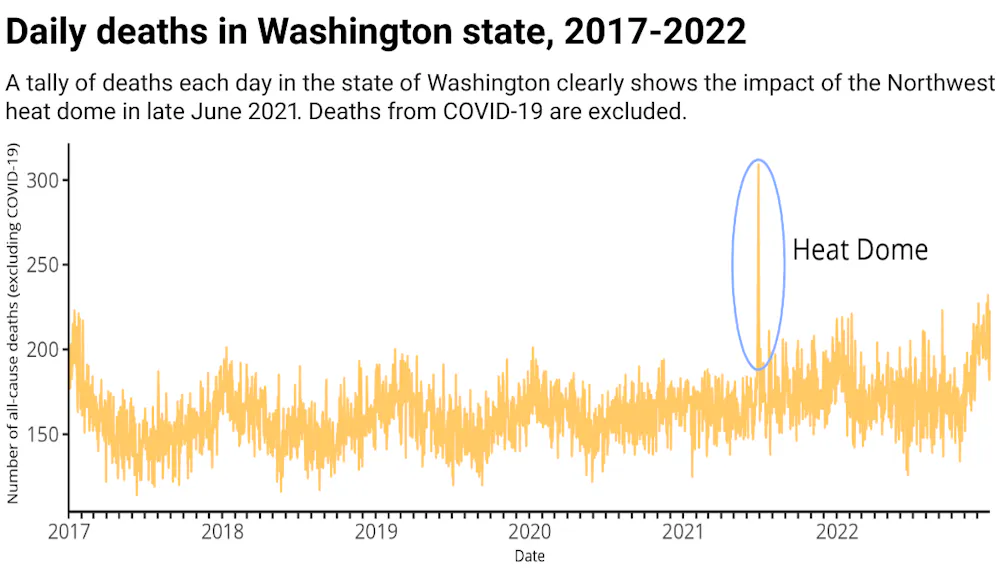
    A chart of all deaths, excluding COVID-19, shows the extraordinary impact the 2021 heat dome had in Washington.
    ‘In the Hot Seat’ report, 2022

    We were excited and relieved when the community was awarded a US$19.9 million grant from the Environmental Protection Agency to help it take concrete steps to adapt to climate change and boost the local economy in the process. The grant would help establish resilience hubs with microgrids and help residents without air conditioning install energy-efficient cooling systems. The city doesn’t have the means to make these improvements on its own, even if they would save lives and money in the long run.

    Less than a year later, the Trump administration abruptly terminated the funding.

    Spokane’s grant wasn’t the only one eliminated – about 350 similar grants that had been awarded to help communities across the country manage climate changes, from extreme heat and wildfire smoke to rising seas and flooding, were also terminated on the grounds that they don’t meet the White House’s priorities. Many other grants to help communities have also been terminated.

    Many of the communities that lost funding are like Spokane: They can’t afford to do this kind of work on their own.

    Why cities like Spokane need the help

    Like many communities in the American West, Spokane was founded in the late 19th century on wealth from railroads and resource extraction, especially gold, silver and timber.

    Today, it is a city of 230,000 in a metro area of a half-million people, the largest on the I-90 corridor between Minneapolis and Seattle. In many ways, Spokane could be on the cusp of a renaissance.

    In January 2025, the U.S. Department of Commerce announced a $48 million grant to develop a tech hub that could put the Inland Northwest on a path to become a global leader in advanced aerospace materials. But then, in May, the Trump administration rescinded that grant as well.

    The lost grants left the economy – and Spokane’s ability to adapt fast enough to keep up with climate changes – uncertain.

    Heat waves are becoming a growing risk in Spokane, known for its river and falls that tumble near downtown.
    Roman Eugeniusz/Wikimedia Commons, CC BY-SA

    This is not a wealthy area. The median household income is nearly $30,000 less than the state average. More than 13 out of every 100 people in Spokane live in poverty, above the national average, and over 67% of the children are eligible for free or reduced lunch.

    The city is a light blue island in a dark red sea, politically speaking, with a moderate mayor. Its congressional district has voted Republican by wide margins since 1995, the year that then-House Speaker Tom Foley lost his reelection bid.

    Lessons from the 2021 heat dome

    The 2021 heat wave was a catalyzing event for the community. The newly formed Gonzaga Institute for Climate, Water and the Environment brought together a coalition of government and community partners to apply for the EPA’s Climate and Environmental Justice Community Change Grant Program. The grants, funded by Congress under the Inflation Reduction Act of 2022, were intended to help communities most affected by pollution and climate change build adaptive capacity and boost the safety of their residents.

    A key lesson from the 2021 heat dome was that temporary, or pop-up, cooling centers don’t work well. People just weren’t showing up. Our research found that the best approach is to strengthen existing community facilities that people already turn to in moments of difficulty.

    Half the $19.9 million award was for outfitting five resilience hubs in existing libraries and community centers with solar arrays and battery backup microgrids, allowing them to continue providing a safe, cool space during a heat wave if the power shuts down.

    The locations and plans for five resilience hubs to serve Spokane, and the infrastructure they would receive.
    Gonzaga Institute for Climate, Water and the Environment

    Another $8 million in grant funding was meant to provide 300 low- to moderate-income homeowners with new high-efficiency electric heat pump heating, ventilation and air conditioning systems, providing more affordable utility bills while improving their ability to cool their homes and reducing fossil fuel emissions.

    Communities are left with few options

    Now, this and other work is at risk in Spokane and cities and towns like it around the country that also lost funding.

    According to the Trump administration, the program – designed to help hundreds of communities around the country become safer – was “no longer consistent with EPA funding priorities.”

    A class action lawsuit was recently filed over the termination of the grants by a coalition that includes Earth Justice and the Southern Environmental Law Center. If the case is successful, Spokane could see its funding restored.

    Meanwhile, the city and my team know we have to move fast, with whatever money and other resources we can find, to help Spokane prepare for worsening heat. We formed the Spokane Climate Resilience Collaborative – a partnership between community organizations, health officials and the city – as one way to advance planning for and responding to climate hazards such as extreme heat and wildfire smoke.

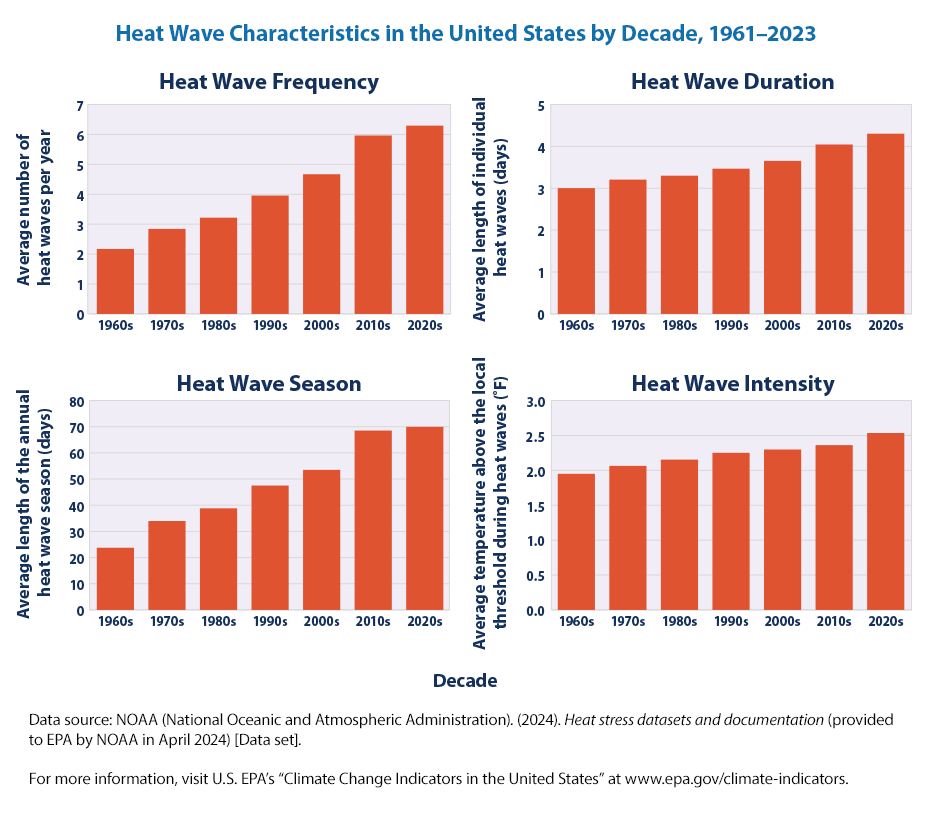
    As concentrations of heat-trapping gasses accumulate in the atmosphere, both the frequency and severity of heat waves increase. It is only a matter of time before another deadly heat dome arrives.

    Brian G. Henning receives funding from the Environmental Protection Agency.

    ref. My city was one of hundreds expecting federal funds to help manage rising heat wave risk – then EPA terminated the grants – https://theconversation.com/my-city-was-one-of-hundreds-expecting-federal-funds-to-help-manage-rising-heat-wave-risk-then-epa-terminated-the-grants-259009

    MIL OSI Analysis

  • MIL-OSI: Mid-Year 2025 Emerging Risks Survey Snapshot

    Source: GlobeNewswire (MIL-OSI)

    ARLINGTON, Va. and CHICAGO, July 09, 2025 (GLOBE NEWSWIRE) — The Casualty Actuarial Society (CAS) and the Society of Actuaries (SOA) jointly published findings from their May 2025 Mid-Year Flash Survey of U.S. risk managers. To keep current with the pace of change, this flash survey supplements the 18th Annual Emerging Risks Survey conducted in November 2024. The annual online questionnaire asks risk managers to rank current and emerging risks, and researchers track those rankings over time.

    Top current risks shifted between the November 2024 and May 2025 surveys. In May, risk managers chose financial volatility as a current risk 24.1% more often than in November, raising it to the top of the list. Globalization shift was chosen 7.4% more often, lifting this risk to the second spot. Wars (including civil wars) decreased by 11.2%, dropping it off the top five list. Technology risks also dropped significantly, while climate change remained in the top five current risks.

    Top Current Risks

    Rank November 2024 Survey Findings May 2025 Survey Findings
    1 Wars (including civil wars) Financial volatility
    2 Financial volatility Globalization shift
    3 Climate change Failed and failing states
    4 Failed and failing states Climate change
    5 Disruptive technologies Liability regimes and regulatory framework
         

    Though respondents’ concerns about current risks have changed significantly since November 2024, their views of emerging risks remain relatively stable. However, the mid-year survey did uncover changes in the perceptions of some emerging risks. For example, Wars (including civil wars) declined by 3.9% from the top of the emerging risk list to seventh and financial volatility rose by 4.2% from sixth to second.

    Top Emerging Risks

    Rank November 2024 Survey Findings May 2025 Survey Findings
    1 War (including civil wars) Disruptive technology
    2 Climate change (tied with War) Financial volatility
    3 Disruptive technology Climate change
    4 Cyber networks Cyber networks
    5 Demographic shift Demographic shift
         

    When asked about the most concerning risk scenarios, respondents listed economic slowdown most often, which is a significant change from previous years. On the other hand, the rate at which inflation was cited as a concern remains very similar to the previous surveys.

    “Since 2022, a mid-year flash survey has been done to offer different data points to capture risk managers’ perceptions of quickly changing environments,” said David Schraub, FSA, MAAA, CERA, CFA, and one of the report authors. “Also, a mid-year flash survey can mitigate the possibility of responses being overly influenced by recent events, a phenomenon also known as recency bias.”

    Survey Details
    Sponsored by the CAS and SOA, the May 2025 flash survey was an online questionnaire and included 150 participants. Respondents’ area of practice included life, property and casualty, and health insurance as well as pensions and risk management. The online questionnaire asked risk managers to rank current and emerging risks. The survey uses four categories to measure risks as perceived by risk managers: top current risk, top five emerging risks, top emerging risk and top emerging risk combinations.

    Read the key findings report for more details and graphs.

    About the Casualty Actuarial Society
    The Casualty Actuarial Society (CAS) is a leading international organization for credentialing, professional education and research. Founded in 1914, the CAS is the world’s only actuarial organization focused exclusively on property-casualty risks and serves over 10,000 members worldwide. CAS members are sought after globally for their insights and ability to apply analytics to solve insurance and risk management problems. Visit www.casact.org.

    About the Society of Actuaries
    With roots dating back to 1889, the Society of Actuaries (SOA) is the world’s largest actuarial professional organization with more than 32,000 actuaries as members. Through research and education, the SOA’s mission is to advance actuarial knowledge and enhance the ability of actuaries to provide expert advice and relevant solutions for financial, business and societal challenges. Visit www.soa.org.

    The MIL Network

  • MIL-OSI: Live Oak Bancshares, Inc. Announces Date of Second Quarter 2025 Financial Results

    Source: GlobeNewswire (MIL-OSI)

    WILMINGTON, N.C., July 09, 2025 (GLOBE NEWSWIRE) — Live Oak Bancshares, Inc. (NYSE: LOB) today announced that it will report its second quarter 2025 financial results after U.S. financial markets close on Wednesday, July 23, 2025.

    In conjunction with this announcement, Live Oak will host a conference call to discuss the company’s financial results and business outlook on Thursday, July 24, 2025, at 9:00 a.m. ET.

    The call will be accessible by telephone and webcast using Conference ID: 25229. A supplementary slide presentation will be posted to the website prior to the event, and a replay will be available for 12 months following the event.

    The conference call details are as follows:

    Live Telephone Dial-In
    U.S.: 800.549.8228
    International: +1 646.564.2877
    Pass Code: None Required

    Live Webcast Log-In
    Webcast Link: investor.liveoakbank.com
    Registration: Name and Email Required
    Multi-Factor Code: Provided After Registration

    About Live Oak Bancshares
    Live Oak Bancshares, Inc. (NYSE: LOB) is a financial holding company and parent company of Live Oak Bank. Live Oak Bancshares and its subsidiaries partner with businesses that share a groundbreaking focus on service and technology to redefine banking. To learn more, visit liveoakbank.com

    Contacts:
    Walter J. Phifer | CFO
    910.202.6929

    Claire Parker | Investor Relations
    910.597.1592

    The MIL Network

  • MIL-OSI Analysis: Trump administration’s lie detector campaign against leakers is unlikely to succeed and could divert energy from national security priorities

    Source: The Conversation – USA – By Brian O’Neill, Professor of Practice, International Affairs, Georgia Institute of Technology

    The Department of Homeland Security and FBI are reportedly using polygraphs aggressively to identify dissenters. standret/Getty Images

    The Trump administration has recently directed that a new wave of polygraphs be administered across the executive branch, aimed at uncovering leaks to the press.

    As someone who has taken roughly a dozen polygraphs during my 27-year career with the CIA, I read this development with some skepticism.

    Polygraphs carry an ominous, almost mythological reputation among Americans. The more familiar and unofficial term – lie detector tests – likely fuels that perception. Television crime dramas have done their part, too, often portraying the device as an oracle for uncovering the truth when conventional methods fail.

    In those portrayals, the polygraph is not merely a tool – it’s a window into the soul.

    Among those entering government service, especially in national security, the greater anxiety is not the background check but passing the polygraph. My advice is always the same: Don’t lie.

    It’s the best – and perhaps only – guidance for a process that most assessments have concluded is a more subjective interpretation than empirical science.

    Why the polygraph persists

    Polygraphs are “pseudo-scientific” in that they measure physiological responses such as heart rate, blood pressure and perspiration. The assumption is that liars betray themselves through spikes in those signals. But this presumes a kind of psychological transparency that simply doesn’t hold up. A person might sweat and tremble simply from fear, anger or frustration – not deceit.

    There also are no specific physiological reactions associated with lying. The National Academy of Sciences in 2003, and the American Psychological Association in a 2004 review, concluded that the polygraph rests more on theater than fact. Recent assessments, published in 2019, have reached the same conclusion.

    Accordingly, polygraph results are not generally admissible in U.S. courts. Only a handful of states – such as Georgia, Arizona and California – permit their use even under limited conditions. And they typically require that both parties agree to admission and a judge to approve it. Unconditional admissibility remains the exception, not the rule.

    And yet, inside many national security agencies, polygraphs remain central to the clearance process – a fact I observed firsthand during my time overseeing personnel vetting and analytic hiring within the intelligence community.

    While not treated as conclusive, polygraph results often serve as a filter. A candidate’s visible discomfort – or the examiner’s subjective judgment that a response seems evasive – can stall or end the hiring process. For instance, I know that government agencies have halted clearances after an examiner flagged elevated reactions to questions about past drug use or foreign contacts, even when no disqualifying behavior was ultimately documented.

    The FBI’s J. Edgar Hoover headquarters building in Washington in 2016.
    AP Photo/Cliff Owen

    In some cases, an examiner’s suggestion that a chart shows an anomaly has led otherwise strong applicants to volunteer details they hadn’t planned to share – such as minor security infractions, undeclared relationships, or casual drug use from decades earlier – that, while not disqualifying on their own, reshape how their trustworthiness is perceived.

    The polygraph’s power lies in creating the conditions under which deception is confessed.

    A predictable pattern

    No administration has been immune to the impulse to investigate leaks. The reflex is bipartisan and familiar: An embarrassing disclosure appears in the press – contradicting official statements or exposing internal dissent – and the White House vows to identify and punish the source. Polygraphs are often part of this ritual.

    During his first term, Trump intensified efforts to expose internal dissent and media leaks. Department guidelines were revised to make it easier for agencies to obtain journalists’ phone and email records, and polygraphs were reportedly used to pressure officials suspected of talking to the press. That trend has continued – and, in some areas, escalated.

    Recent policies at the Pentagon now restrict unescorted press access, revoke office space for major outlets and favor ideologically aligned networks. The line between legitimate leak prevention and the surveillance or sidelining of critical press coverage has grown increasingly blurred.

    At agencies such as the Department of Homeland Security and the FBI, polygraphs are reportedly being used more frequently – and more punitively – to identify internal dissenters. Even “cold cases,” such as the leak of the Supreme Court’s Dobbs opinion ahead of its overturning of Roe v. Wade, have been reopened, despite prior investigations yielding no definitive source.

    Government reaction varies

    Not all leaks are treated the same. Disclosures that align with official narratives or offer strategic advantage may be quietly tolerated, even if unauthorized. Others, especially those that embarrass senior officials or reveal dysfunction, are more likely to prompt formal investigation.

    In 2003, for example, the leak of CIA officer Valerie Plame’s identity – widely seen as retaliation for her husband’s criticism of the Iraq War – triggered a federal investigation. The disclosure embarrassed senior officials, led to White House aide Scooter Libby’s conviction for perjury, later commuted, and drew intense political scrutiny.

    Lewis Libby, Vice President Dick Cheney’s chief of staff, rides in the backseat of a limousine on Oct. 27, 2005, in McLean, Va.
    Win McNamee/Getty Images

    Leaks involving classified material draw the sharpest response when they challenge presidential authority or expose internal disputes. That was the case in 2010 with Chelsea Manning, whose disclosure of diplomatic cables and battlefield reports embarrassed senior officials and sparked global backlash. Government reaction often depends less on what was disclosed than on who disclosed it – and to what effect.

    A narrow set of disclosures, such as those involving espionage or operational compromise, elicit broad consensus as grounds for prosecution. But most leaks fall outside that category. Most investigations fade quietly. The public rarely learns what became of them. Occasionally, there is a vague resignation, but direct accountability is rare.

    What the future holds

    Trump’s polygraph campaign is not likely to eliminate leaks to the press. But they may have a chilling effect that discourages internal candor while diverting investigative energy away from core security priorities.

    Even if such campaigns succeed in reducing unauthorized disclosures, they may come at the cost of institutional resilience. Historically, aggressive internal enforcement has been associated with declining morale and reduced information flow – factors that can hinder adaptation to complex threats.

    Some researchers have suggested that artificial intelligence may eventually offer reliable tools for detecting deception. One recent assessment raised the possibility, while cautioning that the technology is nowhere near operational readiness.

    For now, institutions will have to contend with the tools they have – imperfect, imprecise and more performative than predictive.

    As a former US intelligence officer, I am required to submit any written draft, before sharing it with other persons, for prepublication review. I submitted this draft to CIA’s Prepublication Review Board, which responded on 11 June: “No classified information was identified. Therefore, no changes are required for publication or sharing with others.”

    ref. Trump administration’s lie detector campaign against leakers is unlikely to succeed and could divert energy from national security priorities – https://theconversation.com/trump-administrations-lie-detector-campaign-against-leakers-is-unlikely-to-succeed-and-could-divert-energy-from-national-security-priorities-259128

    MIL OSI Analysis

  • MIL-OSI: Banzai Appoints Dean Ditto as Chief Financial Officer

    Source: GlobeNewswire (MIL-OSI)

    SEATTLE, July 09, 2025 (GLOBE NEWSWIRE) — Banzai International, Inc. (NASDAQ: BNZI) (“Banzai” or the “Company”), a leading marketing technology company that provides essential marketing and sales solutions, today announced the appointment of Dean Ditto, CPA, as Chief Financial Officer of the Company, effective July 14, 2025. Mr. Ditto replaces Interim Chief Financial Officer, Alvin Yip, who will continue with the Company in the role of Chief Accounting Officer.

    Dean Ditto has over 30 years’ experience as a strategic financial leader with a track record of implementing critical business initiatives that drive profitable growth at both public and private companies. Prior to joining Banzai, Mr. Ditto was Chief Financial Officer of Akerna Corp. a SaaS technology company where he led a corporate restructuring plan that produced cost savings of $6 million annually. Previously, he was CFO of Mydecine Innovations Group, Inc., a biotech and life sciences company, where he raised $40 million through public and private offerings to support drug and IP development and operations. As CFO of Sigue Corporation, a closely-held Fintech provider, Mr. Ditto worked to improve the business planning, budgeting and financial analysis processes. He has also served in financial leadership roles at OSI Systems, Dental Lab Holdings, KARL STORZ Endoscopy-America, Countrywide Home Loans, Giant Bicycle USA, and Ford Motor Company. Mr. Ditto holds a Bachelor of Arts in Economics and Management from Albion College, and holds a Master of Business Administration from the Kelley School of Business at Indiana University.

    “On behalf of our board and management team, I would like to welcome Dean to the position. We are privileged to have someone of his caliber and financial skill set serve as our CFO,” said Joe Davy, Founder and CEO of Banzai. “I would like to thank Alvin for his contribution in leading us to this inflection point, and welcome Dean’s capabilities in scaling public technology companies. His achievements as well as expertise in financial management of listed companies will make a significant addition to the strategic operation and development of Banzai going forward.”

    Mr. Ditto added, “I am excited to be appointed as CFO as we prepare Banzai for the future in a rapidly evolving market. I look forward to working with Joe, the executive team, and the finance team as we continue to execute on our strategic and financial priorities focused on value-added growth and our commitments to all shareholders.”

    About Banzai

    Banzai is a marketing technology company that provides AI-enabled marketing and sales solutions for businesses of all sizes. On a mission to help their customers grow, Banzai enables companies of all sizes to target, engage, and measure both new and existing customers more effectively. Banzai has over 90,000 customers including RBC, Dell Technologies, New York Life, Thermo Fisher Scientific, Thinkific, and ActiveCampaign. Learn more at www.banzai.io. For investors, please visit https://ir.banzai.io.

    Forward-Looking Statements

    This press release contains forward-looking statements within the meaning of the Private Securities Litigation Reform Act of 1995. Forward-looking statements often use words such as “believe,” “may,” “will,” “estimate,” “target,” “continue,” “anticipate,” “intend,” “expect,” “should,” “would,” “propose,” “plan,” “project,” “forecast,” “predict,” “potential,” “seek,” “future,” “outlook,” and similar variations and expressions. Forward-looking statements are those that do not relate strictly to historical or current facts. Examples of forward-looking statements may include, among others, statements regarding Banzai International, Inc.’s (the “Company’s”): future financial, business and operating performance and goals; annualized recurring revenue and customer retention; ongoing, future or ability to maintain or improve its financial position, cash flows, and liquidity and its expected financial needs; potential financing and ability to obtain financing; acquisition strategy and proposed acquisitions and, if completed, their potential success and financial contributions; strategy and strategic goals, including being able to capitalize on opportunities; expectations relating to the Company’s industry, outlook and market trends; total addressable market and serviceable addressable market and related projections; plans, strategies and expectations for retaining existing or acquiring new customers, increasing revenue and executing growth initiatives; and product areas of focus and additional products that may be sold in the future. Because forward-looking statements relate to the future, they are subject to inherent uncertainties, risks and changes in circumstances that are difficult to predict and many of which are outside of our control. Forward-looking statements are not guarantees of future performance, and our actual results of operations, financial condition and liquidity and development of the industry in which the Company operates may differ materially from those made in or suggested by the forward-looking statements. Therefore, investors should not rely on any of these forward-looking statements. Factors that may cause actual results to differ materially include changes in the markets in which the Company operates, customer demand, the financial markets, economic, business and regulatory and other factors, such as the Company’s ability to execute on its strategy. More detailed information about risk factors can be found in the Company’s Annual Report on Form 10-K and the Company’s Quarterly Reports on Form 10-Q under the heading “Risk Factors,” and in other reports filed by the Company, including reports on Form 8-K. The Company does not undertake any duty to update forward-looking statements after the date of this press release.

    Investor Relations
    Chris Tyson
    Executive Vice President
    MZ Group – MZ North America
    949-491-8235
    BNZI@mzgroup.us
    www.mzgroup.us

    Media
    Nancy Norton
    Chief Legal Officer, Banzai
    media@banzai.io

    The MIL Network

  • MIL-OSI: Cloud Mining Made Easy: VNBTC Announces $79 Welcome Bonus and Referral Campaign

    Source: GlobeNewswire (MIL-OSI)

    London, UK, July 09, 2025 (GLOBE NEWSWIRE) — VNBTC has officially launched an upgraded referral program and is offering a limited-time $79 crypto bonus to first-time users who activate a mining plan. The announcement comes as the company expands access to its cloud-based mining services for Bitcoin, Ethereum, and Dogecoin. 

    VNBTC Logo

    Unlike traditional mining, VNBTC’s model runs entirely online—no hardware, maintenance, or technical setup required. New users can begin mining in minutes by selecting a plan and connecting a wallet. The dashboard allows them to monitor earnings in real time, with payouts processed daily or weekly, depending on the chosen package.

    The new two-tier referral program enables users to earn up to 3% commissions on direct referrals and 1.8% on second-tier signups, providing an additional income stream for individuals looking to grow their earnings beyond mining alone.

    “Our mission is to remove the friction from crypto mining,” said James Carter, Marketing Specialist at VNBTC. “With this new bonus and referral structure, we’re making it even easier for first-time users to get started and for existing users to increase their earning potential.”

    VNBTC’s infrastructure is powered by high-performance mining rigs hosted in secure data centers. All systems are monitored around the clock to ensure optimal uptime and user safety. The platform is designed for both beginners and experienced miners seeking a convenient, scalable solution.

    The $79 bonus applies to new users who activate a mining package before July 31, 2025, and can be applied toward any available plan. Combined with the referral system, the update supports VNBTC’s goal of expanding access to passive income tools across global markets.

    To activate a plan or claim the bonus, visit https://vnbtc.com.

    About VNBTC

    VNBTC provides regulated, cloud-based mining services for Bitcoin, Ethereum, and Dogecoin. With an emphasis on simplicity, security, and speed, the platform helps individuals and institutions mine crypto without the complexity of managing physical hardware.

    The MIL Network

  • MIL-OSI: Willis Aviation Services Limited Announces Long-Term Base Maintenance Partnership with Jet2.com

    Source: GlobeNewswire (MIL-OSI)

    COCONUT CREEK, Fla., July 09, 2025 (GLOBE NEWSWIRE) — Willis Lease Finance Corporation (NASDAQ: WLFC) (“WLFC” or the “Company”), the leading lessor of commercial aircraft engines and global provider of aviation services, announced today that its subsidiary, Willis Aviation Services Limited (“WASL”), a premier provider of aircraft maintenance, repair and overhaul (“MRO”) services, has secured a commitment from leading leisure airline Jet2.com (“Jet2”) for two base maintenance lines for the upcoming season.

    This announcement follows the successful completion of a single maintenance line for Jet2 this year, highlighting the strong performance and capabilities of the WASL delivery team in Teesside. Building on that success, Jet2 has expanded its commitment by adding a second maintenance line. Both lines will be carried out at WASL’s new state-of-the-art facility located at Teesside International Airport in Northeast England.

    As aircraft maintenance services remain in high demand across the UK and Europe, WASL’s recently announced expansion plans at Teesside add essential capacity to the UK MRO sector to perform heavy maintenance checks, transitional activity and paint for airlines and lessors globally. Further, the new Teesside facility is expected to create a significant number of new highly skilled jobs and contribute to the pipeline of talent that supports both immediate operational needs and long-term skill development in the region.

    “We are thrilled to continue our work supporting Jet2’s fleet at our expanding Teesside facility,” said Austin C. Willis, WLFC’s Chief Executive Officer. “Our investment in Teesside enables WASL to deliver essential services for airlines including Jet2 and reflects our commitment to driving local economic growth and creating skilled jobs in the UK aerospace industry.”

    “We are pleased with WASL’s engagement and performance with its base maintenance services for our fleet as we uphold the highest standards of safety, operational excellence and reliability for our customers,” said Chris Hubbard, Director of Engineering & Maintenance at Jet2.com. “We look forward to continuing our partnership with WASL in the 2025 and 2026 season.”

    Willis Lease Finance Corporation

    Willis Lease Finance Corporation (“WLFC”) leases large and regional spare commercial aircraft engines, auxiliary power units and aircraft to airlines, aircraft engine manufacturers and maintenance, repair, and overhaul providers worldwide. These leasing activities are integrated with engine and aircraft trading, engine lease pools and asset management services through Willis Asset Management Limited, as well as various end-of-life solutions for engines and aviation materials provided through Willis Aeronautical Services, Inc. Through Willis Engine Repair Center®, Jet Centre by Willis, and Willis Aviation Services Limited, the Company’s service offerings include Part 145 engine maintenance, aircraft line and base maintenance, aircraft disassembly, parking and storage, airport FBO and ground and cargo handling services. Willis Sustainable Fuels intends to develop, build and operate projects to help decarbonize aviation.

    Except for historical information, the matters discussed in this press release contain forward-looking statements that involve risks and uncertainties. Do not unduly rely on forward-looking statements, which give only expectations about the future and are not guarantees. Forward-looking statements speak only as of the date they are made, and we undertake no obligation to update them to reflect any change in the Company’s expectations or any change in events, conditions or circumstances on which the forward-looking statement is based, except as required by law. Our actual results may differ materially from the results discussed in forward-looking statements. Factors that might cause such a difference include, but are not limited to: the effects on the airline industry and the global economy of events such as war, terrorist activity and the COVID-19 pandemic; changes in oil prices, rising inflation and other disruptions to world markets; trends in the airline industry and our ability to capitalize on those trends, including growth rates of markets and other economic factors; risks associated with owning and leasing jet engines and aircraft; our ability to successfully negotiate equipment purchases, sales and leases, to collect outstanding amounts due and to control costs and expenses; changes in interest rates and availability of capital, both to us and our customers; our ability to continue to meet changing customer demands; regulatory changes affecting airline operations, aircraft maintenance, accounting standards and taxes; the market value of engines and other assets in our portfolio; and risks detailed in the Company’s Annual Report on Form 10-K and other continuing  and current reports filed with the Securities and Exchange Commission. It is advisable, however, to consult any further disclosures the Company makes on related subjects in such filings. These statements constitute the Company’s cautionary statements under the Private Securities Litigation Reform Act of 1995.

     CONTACT: Lynn Mailliard Kohler
      Director, Global Corporate Communications
      (415) 328-4798

    The MIL Network

  • MIL-OSI: Little Pepe Surges Past $4.5M as Stage 4 Presale Ends Successfully and Stage 5 Begins

    Source: GlobeNewswire (MIL-OSI)

    DUBAI, United Arab Emirates, July 09, 2025 (GLOBE NEWSWIRE) — Little Pepe ($LILPEPE) continues to make waves in the crypto market, officially closing Stage 4 of its presale with a remarkable $4.5 million raised in total. With each stage gaining more traction than the last, the project has now entered Stage 5, pricing its native token at $0.0014.

    The latest milestone makes Little Pepe’s position as one of the most talked-about meme coins of 2025—one that’s backed by real technological innovation.

    Little Pepe — A Meme Coin with Real Tech Power

    Little Pepe is redefining what a meme coin may be by blending cultural hype with serious blockchain generation. At the heart of the project is the Little Pepe Chain, a custom-constructed, Ethereum-based Layer 2 community engineered for speed, scalability, and low costs. This infrastructure allows both customers and investors to transact at high volumes without being laid low with the delays and high gas fees that regularly plague Ethereum’s mainnet.

    By integrating a lightning-speedy EVM Layer 2 protocol, Little Pepe positions itself as greater than only a viral sensation—it turns into a next-generation meme coin built to serve the evolving needs of crypto in 2025. It captures the energy of the meme culture while providing real, scalable infrastructure that helps long-term utility and adoption.

    LILPEPE Ecosystem

    Fueling the ecosystem is the $LILPEPE token, an ERC-20 asset that powers every transaction on the Little Pepe Chain. It’s the utility token at the heart of the project—responsible for gas fees, network operations, and the growing economic activity tied to the Little Pepe movement. With each presale round, demand for the token increases, supported by strong community growth and rising interest from retail investors.

    As Little Pepe continues to expand its presence across social platforms, $LILPEPE is evolving into more than a meme—it’s becoming a recognized asset with long-term potential.

    Stage 5 Now Live at $0.0014

    Following the successful completion of Stage 4, the Stage 5 of the $LILPEPE presale is now officially going on. Priced at $0.0014, $LILPEPE is available exclusively through the official website: littlepepe.com. With earlier phases filling rapidly, many investors are moving quickly to secure their allocation before the next price jump.

    Each presale stage marks a strategic step forward in the project’s roadmap, increasing not only token value but also anticipation for future exchange listings and ecosystem development.

    The Rise of Meme Coins with Utility

    In 2025, meme coins are entering a new phase—one where community appeal must be matched by real-world utility and scalability. Little Pepe exemplifies this evolution. By blending cultural branding with a fully operational Layer 2 blockchain, it stands out as a project that delivers on both hype and infrastructure. As other tokens fade after initial virality, $LILPEPE is building the tools and foundations to remain relevant far beyond its presale stages.

    With $4.5 million raised, a live Stage 5 presale, and an innovative EVM Layer 2 backbone, Little Pepe is proving it’s more than just another meme coin. It’s a high-potential crypto ecosystem built for today’s demands and tomorrow’s growth. As the presale continues, early adopters have a rare opportunity to be part of what could be the most iconic meme coin launch of the year.

    About Little Pepe

    Little Pepe is a next-gen Layer 2 blockchain designed to merge meme culture with high-speed, low-cost decentralized infrastructure. Built for scalability, security, and accessibility, Little Pepe supports EVM-compatible applications and is powered by means of the $LILPEPE token. The project’s mission is to create a meme coin environment wherein utility meets virality, empowering users through cutting-edge technology and lightning-fast transactions.

    For more information:
    Website: https://littlepepe.com/
    Telegram: https://t.me/littlepepetoken
    Twitter: https://x.com/littlepepetoken

    Contact Details: COO- James Stephen Email: media@littlepepe.com

    Disclaimer: This content is provided by Little Pepe. The statements, views, and opinions expressed in this content are solely those of the content provider and do not necessarily reflect the views of this media platform or its publisher. We do not endorse, verify, or guarantee the accuracy, completeness, or reliability of any information presented. We do not guarantee any claims, statements, or promises made in this article. This content is for informational purposes only and should not be considered financial, investment, or trading advice.Investing in crypto and mining-related opportunities involves significant risks, including the potential loss of capital. It is possible to lose all your capital. These products may not be suitable for everyone, and you should ensure that you understand the risks involved. Seek independent advice if necessary. Speculate only with funds that you can afford to lose. Readers are strongly encouraged to conduct their own research and consult with a qualified financial advisor before making any investment decisions. However, due to the inherently speculative nature of the blockchain sector—including cryptocurrency, NFTs, and mining—complete accuracy cannot always be guaranteed.Neither the media platform nor the publisher shall be held responsible for any fraudulent activities, misrepresentations, or financial losses arising from the content of this press release. In the event of any legal claims or charges against this article, we accept no liability or responsibility.Globenewswire does not endorse any content on this page.

    Legal Disclaimer: This media platform provides the content of this article on an “as-is” basis, without any warranties or representations of any kind, express or implied. We assume no responsibility for any inaccuracies, errors, or omissions. We do not assume any responsibility or liability for the accuracy, content, images, videos, licenses, completeness, legality, or reliability of the information presented herein. Any concerns, complaints, or copyright issues related to this article should be directed to the content provider mentioned above.

    A photo accompanying this announcement is available at https://www.globenewswire.com/NewsRoom/AttachmentNg/b64e458b-ff9e-43ae-a170-9b19ffb4096b

    The MIL Network

  • MIL-OSI United Kingdom: Greens join protest to shut down Glasgow company shipping gas for Russia

    Source: Scottish Greens

    Putin’s enablers are not welcome in Scotland.

    Scottish Green MSP Ross Greer has joined members of the Ukrainian community in Scotland and the Ukraine Solidarity Campaign at a protest outside the Glasgow HQ of shipping company Seapeak, over their role in helping Russia to export gas despite the sanctions placed on it over Putin’s illegal invasion of Ukraine.

    Seapeak has been found to still ship over $5.5 billion of Russian Liquefied Natural Gas (LNG) each year.

    Ross Greer will be speaking at the rally in Glasgow today. He has previously demanded that the UK Government sanction Seapeak, but Labour Ministers have so far refused to take action. 

    Ross said:

    “It is appalling that the UK Labour government refuses to shut Seapeak down. People across Scotland are horrified when they learn that a company based here continues to fund Russia’s war machine. For as long as Seapeak remains untouched from sanctions, they will continue to ship gas out of Russia, throwing a lifeline to Putin’s war economy as a result.”

    In 2022, Ross was sanctioned by the Russian government for his work in solidarity with Ukraine. 

    Ross said:

    “Earlier this year, I wrote to UK Ministers, demanding that they shut down Seapeak’s UK operations. Despite the overwhelming evidence shared with them, they would not take action. They continue to allow Russia to profit from shipping operations here in the UK whilst claiming to stand with Ukraine.

    “Tens of thousands of Ukrainians have been killed and much of their country is left in ruins from Putin’s illegal invasion. If we were in Ukraine’s position, we would rightly be furious that our so-called allies were allowing complicit businesses like Seapeak to stay open. It is time to end this scandal and prove that Putin’s enablers are not welcome in Scotland.”

    MIL OSI United Kingdom

  • MIL-OSI United Kingdom: Regeneration of 291 Harrow Road secures planning consent | Westminster City Council

    Source: City of Westminster

    • Westminster City Council’s 291 Harrow Road development secured planning approval from the planning committee last night (Tuesday July 8th).
    • 144 new homes will be developed in the centre of London. Of these, 50% will be affordable or for Adult Social Care at social rent, with the remaining homes available for the market.
    • The development will comprise three buildings at 15, 10 and five storeys in height and will embrace passive principles in design, creating a highly efficient, low-carbon scheme.
    • Those principles will help to achieve a 70% sitewide carbon reduction over the baseline.
    • The site was part of the former Harrow Road wing of St Mary’s Hospital prior to its redevelopment in the 1980s.

    The latest housing development from Westminster City Council received approval from planning committee last night, the latest phase in the creation of more than 100 new homes.  

    Across three separate buildings, the 291 Harrow Road development will deliver 144 homes with 50% affordable housing. A total of 48 will be affordable homes, 24 will be Adult Social Care units at social rent and 72 homes will be available for private sale.

    The site was part of the former Harrow Road wing of St Mary’s Hospital prior to a period of redevelopment in the 1980s.

    At the Westminster City Council planning committee on July 8, the development secured approval by three votes to two. 

    Cllr Ellie Ormsby, Westminster City Council Cabinet Member for Regeneration and Renters, said:

     “291 Harrow Road presents a fantastic opportunity for us to deliver a greater number of high-quality homes for social rent – a necessary step considering there are over 6,000 households on Westminster’s housing waiting list – while also delivering on our ambitious sustainability commitments as one of the capital’s greenest developments. 

    “Moreover, a large proportion of these homes, a sixth of the total number, are allocated for use by adult social care services, where we are seeing growing demand. We’re excited to develop a building which embraces inclusivity and delivers for the diverse needs across our community.”

    Designs for 291 Harrow Road embrace the ‘Be Lean, Clean, Green and Seen’ energy hierarchy which utilises a fabric first approach to maximise reduction in energy through passive design measures. New, high efficiency servicing equipment and efficient façades will minimise the energy usage of the building.

    The scheme will make use of air source heat pumps and solar photo photovoltaic panels to maximise the use of renewable energy. It is anticipated that across the site build, and once occupied, 291 Harrow Road will achieve a 70% sitewide reduction over the baseline for the proposed development, far exceeding the Greater London Authority target of 35%.

    Westminster City Council has committed to 50% affordable housing across its development projects, made up of social rent and London Living Rent.

    MIL OSI United Kingdom