NewzIntel.com

    • Checkout Page
    • Contact Us
    • Default Redirect Page
    • Frontpage
    • Home-2
    • Home-3
    • Lost Password
    • Member Login
    • Member LogOut
    • Member TOS Page
    • My Account
    • NewzIntel Alert Control-Panel
    • NewzIntel Latest Reports
    • Post Views Counter
    • Privacy Policy
    • Public Individual Page
    • Register
    • Subscription Plan
    • Thank You Page

Category: CTF

  • MIL-OSI USA: Larsen Launches ‘Share Your Story’ Webpage

    Source: United States House of Representatives – Congressman Rick Larsen (2nd Congressional District Washington)

    Today, Rep. Rick Larsen (WA-02) announced a ‘share your story’ webpage where community members can tell him directly how Republicans’ Big Ugly Law will impact their lives: larsen.house.gov/shareyourstory

    Rep. Larsen announced this webpage during his speech at Snohomish County Indivisible’s “Families First” rally. A recording of his remarks is available here, and below is an excerpt:

    “The Republicans do not care about working families. They care about the richest Americans and the largest corporations, and the Big Ugly Law is a clear indication of that. It puts big corporations first, and it puts you all last…

    “We’ve got to start now thinking about, and building the case, to reverse the worst impacts of the Big Ugly Law… and that’s where you all come in. The health care and food assistance cuts will be rolled out slowly over the next couple years… Hearing from you all about the impacts is going to be important.

    “I want you to pull out your phone right now if you’re interested… and go to larsen.house.gov/shareyourstory. You story about yourself, about your family, matters to me.

    “Just this year I’ve received about 209,000 separate emails and communications from people in the district, seven months in to this Congress. Last Congress, over 24 months, I received 290,000 communications…

    “The share your story website is very important… Please, you can help me fight back… You can help Congress fight back by sharing your story about the impacts of the Big Ugly Law.” 

    The Big Ugly Law contains the largest cuts to Medicaid and food assistance in U.S. history. More than 328,000 people in Washington state will lose their health care because of the legislation, and 57,000 people could lose some or all of their food assistance.

    ###

    MIL OSI USA News –

    July 27, 2025
  • MIL-OSI Submissions: Which wildfire smoke plumes are hazardous? New satellite tech can map them in 3D for air quality alerts at neighborhood scale

    Source: The Conversation – USA (2) – By Jun Wang, Professor of Chemical and Biochemical Engineering, University of Iowa

    Smoke from Canadian wildfires prompted air quality alerts in Chicago as it blanketed the city on June 5, 2025. Scott Olson/Getty Images

    Canada is facing another dangerous wildfire season, with burning forests sending smoke plumes across the provinces and into the U.S. again. The pace of the 2025 fires is reminiscent of the record-breaking 2023 wildfire season, which exposed millions of people in North America to hazardous smoke levels.

    For most of the past decade, forecasters have been able to use satellites to track these smoke plumes, but the view was only two-dimensional: The satellites couldn’t determine how close the smoke was to Earth’s surface.

    The altitude of the smoke matters.

    If a plume is high in the atmosphere, it won’t affect the air people breathe – it simply floats by far overhead.

    But when smoke plumes are close to the surface, people are breathing in wildfire chemicals and tiny particles. Those particles, known as PM2.5, can get deep into the lungs and exacerbate asthma and other respiratory and cardiac problems.

    An animation on May 30, 2025, shows a thick smoke plume from Canada moving over Minnesota, but the air quality monitors on the ground detected minimal risk, suggesting it was a high-level smoke plume.
    NOAA NESDIS Center for Satellite Applications and Research

    The Environmental Protection Agency uses a network of ground-based air quality monitors to issue air quality alerts, but the monitors are few and far between, meaning forecasts have been broad estimates in much of the country.

    Now, a new satellite-based method that I and colleagues at universities and federal agencies have been working on for the past two years is able to give scientists and air quality managers a 3D picture of the smoke plumes, providing detailed data of the risks down to the neighborhood level for urban and rural areas alike.

    Building a nationwide smoke monitoring system

    The new method uses data from a satellite that NASA launched in 2023 called the Tropospheric Emissions: Monitoring of Pollution, or TEMPO, satellite.

    Data from the TEMPO satellite shows the height of the smoke plume, measured in kilometers. Light blue areas are closest to the ground, suggesting the worst air quality. Pink areas suggest the smoke is more than 2 miles (3.2 kilometers) above the ground, where it poses little risk to human health. The data aligns with air monitor readings taken on the ground at the same time.
    NOAA NESDIS Center for Satellite Applications and Research

    TEMPO makes it possible to determine a smoke plume’s height by providing data on how much the oxygen molecules absorb sunlight at the 688 nanometer wavelength. Smoke plumes that are high in the atmosphere reflect more solar radiation at this wavelength back to space, while those lower in the atmosphere, where there is more oxygen to absorb the light, reflect less.

    Understanding the physics allowed scientists to develop algorithms that use TEMPO’s data to infer the smoke plume’s altitude and map its 3D movement in nearly real time.

    Aerosol particles in high smoke plumes reflect more light back into space. Closer to Earth’s surface, there is more oxygen to absorb light at the 688 nanometer wavelength, so less light is reflected. Satellites can detect the difference, and that can be used to determine the height of the smoke plume.
    Adapted from Xu et al, 2019, CC BY

    By combining TEMPO’s data with measurements of particles in the atmosphere, taken by the Advanced Baseline Imager on the NOAA’s GOES-R satellites, forecasters can better assess the health risk from smoke plumes in almost real time, provided clouds aren’t in the way.

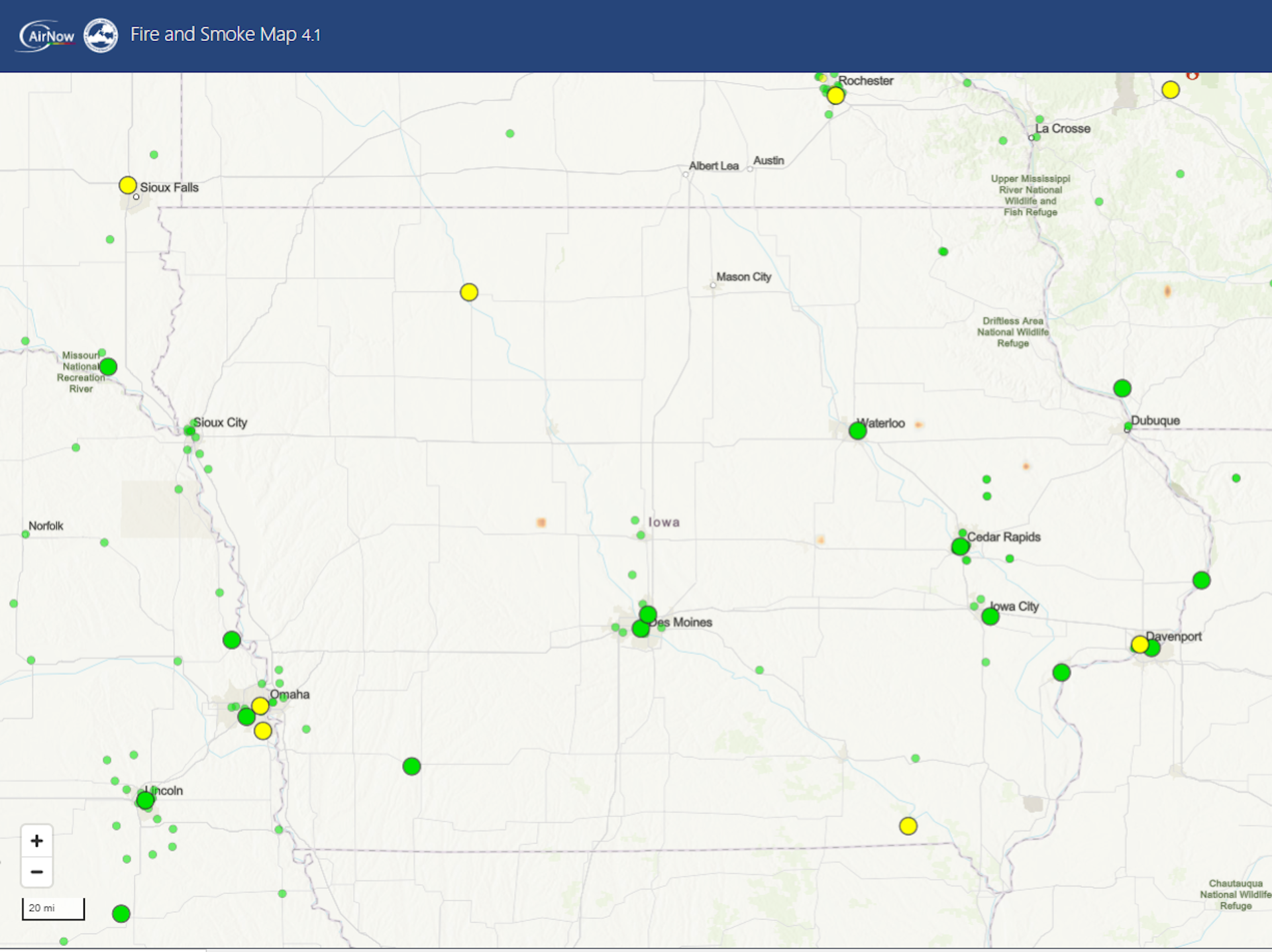
    That’s a big jump from relying on ground-based air quality monitors, which may be hundreds of miles apart. Iowa, for example, had about 50 air quality monitors reporting data on a recent day for a state that covers 56,273 square miles. Most of those monitors were clustered around its largest cities.

    NOAA’s AerosolWatch tool currently provides a near-real-time stream of wildfire smoke images from its GOES-R satellites, and the agency plans to incorporate TEMPO’s height data. A prototype of this system from my team’s NASA-supported research project on fire and air quality, called FireAQ, shows how users can zoom in to the neighborhood level to see how high the smoke plume is, however the prototype is currently only updated once a day, so the data is delayed, and it isn’t able to provide smoke height data where clouds are also overhead.

    Wildfire health risks are rising

    Fire risk is increasing across North America as global temperatures rise and more people move into wildland areas.

    While air quality in most of the U.S. improved between 2000 and 2020, thanks to stricter emissions regulations on vehicles and power plants, wildfires have reversed that trend in parts of the western U.S. Research has found that wildfire smoke has effectively erased nearly two decades of air quality progress there.

    Our advances in smoke monitoring mark a new era in air quality forecasting, offering more accurate and timely information to better protect public health in the face of these escalating wildfire threats.

    Prof. Wang’s group have been supported from NOAA, NASA, and Naval ONR to develop research algorithm to retrieve aerosol layer height. The compute codes of the research algorithm were shared with colleagues in NOAA.

    – ref. Which wildfire smoke plumes are hazardous? New satellite tech can map them in 3D for air quality alerts at neighborhood scale – https://theconversation.com/which-wildfire-smoke-plumes-are-hazardous-new-satellite-tech-can-map-them-in-3d-for-air-quality-alerts-at-neighborhood-scale-259654

    MIL OSI –

    July 27, 2025
  • MIL-OSI United Kingdom: Swinney funding for Trump’s course embarrassing

    Source: Scottish Greens

    26 Jul 2025 External Affairs

    Nobody can be above the law in Scotland.

    More in External Affairs

    As US President and convicted criminal Donald Trump lands in Aberdeenshire, the Scottish Greens have renewed calls for his Scottish financial interests to be investigated.

    Patrick Harvie, Scottish Green co-leader, first called on the Scottish Government to seek an Unexplained Wealth Order (UWO) to investigate Trump’s businesses 5 years ago.

    A UWO is a power held by the Scottish Government to investigate the finances of politically active individuals who have gained wealth through suspicious means.

    The criminal charges brought against Trump in New York specifically cited his Menie golf estate in Aberdeenshire, finding its value had been falsely inflated.

    Patrick Harvie MSP said:

    “The super-rich like Donald Trump must not be allowed to act with impunity, buying up land, trashing environmental sites, and controlling politicians. Scotland isn’t their personal playground.

    “We need to send a strong signal that no matter how wealthy you are, you aren’t above the law. You’ll face the same scrutiny and legal challenges as anybody else. 

    “I first made this call five years ago. Since then, Trump has been convicted of 34 felonies and found liable in court for sexual abuse. We all know what kind of man he is and how his businesses have operated.

    “Keir Starmer and John Swinney can’t hide away from holding Donald Trump accountable just because of who he is. He is not immune to following the laws of our country. They talk about protecting a ‘special relationship’, but this looks increasingly like a subservient one.

    “It’s time for the Scottish Government to take heed of our long-standing call and investigate Trump with a UWO, instead of cosying up to him and trying to win his favour.”

    MIL OSI United Kingdom –

    July 27, 2025
  • MIL-OSI New Zealand: Building Code pause brings certainty to construction

    Source: New Zealand Government

    The Government is providing more certainty for the building sector by pausing any new major changes to the Building Code system, Building and Construction Minister Chris Penk has announced.
     
    “The building sector has faced significant disruption over the past few years in dealing with the pandemic, supply chain challenges and a boom-and-bust cycle that has made the infrastructure pipeline unpredictable,” Mr Penk says.

    “Up until now, the Ministry of Business, Innovation and Employment (MBIE) has typically conducted ongoing, rolling reviews of different parts of the Building Code.
     
    “It’s time to bring stability and clarity to the system so the sector can confidently plan and move forward with the construction and infrastructure projects we need to build New Zealand into a world-class nation.
     
    “Builders, designers and developers need a clear runway to plan ahead and invest with confidence, and ad hoc changes to Building Code requirements makes that difficult. 

    “That’s why we’re pausing any further major changes and moving to a predictable three-year cycle for Building Code system updates.
     
    “This new approach will give businesses the clarity they need to prepare in advance, rather than constantly having to react to unexpected rule changes.
     
    “Designers and builders will have more headspace to focus on their important work of building more homes and delivering infrastructure projects that support better public services, instead of constantly reworking plans or second-guessing what might change next.
     
    “The pause applies only to major changes outside the three year cycle. The Government will continue to consider straightforward updates when needed – especially those that protect life safety and meet New Zealand’s trade obligations. Changes to support energy efficiency, the Building Product Specifications and fire safety will continue as planned.
     
    “Supporting a strong and thriving building sector is an important part of driving the economic growth that benefits all Kiwis. 

    “This Government has already taken steps to improve productivity – including reforms that will allow trusted professionals to consent their own work, improving access to overseas products to lower building costs, and advancing legislation to make building granny flats easier.
     
    “This next step is about giving the sector time, certainty and space to deliver.”

    The first regular cycle of Building Code system updates will take place in 2028.

    Note to editors:

    New Zealand’s Building Code System includes the Building Code (found in regulations made under the Building Act 2004) and a range of technical compliance documents, including Acceptable Solutions and Verification Methods (AS/VMs), and the Building Product Specifications (BPS).
    The Minister for Building and Construction is responsible for changes to regulations under the Building Act, and the Chief Executive of MBIE is responsible for any changes to technical compliance documents. 

    MIL OSI New Zealand News –

    July 27, 2025
  • MIL-OSI Banking: Secretary-General of ASEAN visits Huawei Lianqiu Lake R&D Center in Shanghai

    Source: ASEAN

    Secretary-General of ASEAN, Dr. Kao Kim Hourn, today visited Huawei Lianqiu Lake R&D Center in Shanghai, China. The visit represented one of the initiatives to advance regional cooperation in the fields of artificial intelligence and digital innovation, and to further strengthen public-private partnership between ASEAN and China.

    The post Secretary-General of ASEAN visits Huawei Lianqiu Lake R&D Center in Shanghai appeared first on ASEAN Main Portal.

    MIL OSI Global Banks –

    July 26, 2025
  • MIL-OSI United Nations: 26 July 2025 Departmental update WHO expands guidance on sexually transmitted infections and reviews country progress on policy implementation

    Source: World Health Organisation

    WHO has released new sexually transmitted infections (STIs) guidance and policy implementation data, ahead of the STI & HIV 2025 World Congress in Montreal, 26–30 July 2025.

    The 2 new components of the upcoming consolidated guidelines on STI prevention and care include the Guidelines for the management of asymptomatic STIs, and the Recommendations on the delivery of health services for STI prevention and care.

    These evidence-based guidelines aim to strengthen STI prevention, screening, diagnosis and treatment, especially in high-burden, resource-limited settings. They complement existing guidance covering syndromic management, management of specific STIs: such as gonorrhoea, chlamydia, syphilis, trichomoniasis, genital candidiasis, Mycoplasma genitalium, human papillomavirus (anogenital warts) and bacterial vaginosis, syphilis testing, partner services. 

    Key new recommendations include targeted screening for gonorrhoea and chlamydia in high-prevalence settings with available resources, focusing on pregnant women, adolescents and young people aged 10–24, sex workers and men who have sex with men (MSM). 

    Screening should align with individual risk and resource considerations, with at least annual or 6-monthly screening recommended for sex workers and MSM. 

    Service delivery improvements include decentralizing and integrating STI services, task sharing with trained providers and community health workers, and leveraging digital tools to complement in-person care.

    Together with existing guidance, these new components will form part of the forthcoming WHO consolidated guidelines on STI prevention and care. 

    “These new recommendations aim to close persistent policy and service gaps, especially for asymptomatic STIs, and help countries move faster toward the 2030 goals,” said Dr Meg Doherty, Director of WHO’s Global HIV, Hepatitis and STIs Programmes.

    WHO reports mixed progress on adopting and implementing WHO policy in countries

    As part of its continued efforts to strengthen global STI responses, WHO has released new data highlighting both progress and persistent challenges in national policy implementation. 

    Among countries reporting to Global AIDS Monitoring in 2024–2025, 89% have a national STI strategy or action plan in place – yet only 43% have updated it since 2023. Similarly, while 97% of countries report having national case management guidelines, only half of them have revised them since 2020. 

    Gonococcal resistance monitoring remains limited, with just 37% of countries conducting routine surveillance. Encouragingly, 95 countries have integrated dual HIV/syphilis rapid tests into their national policy – nearly half of these countries adopted them for both pregnant women and key populations. 

    National plans to eliminate mother-to-child transmission of HIV and syphilis are in place in 72% of reporting countries. As of 1 July 2025, 147 Member States (76%) have included human papillomaviruses (HPV) vaccine – critical to preventing cervical cancer – in their national immunization schedule, and 2 countries have reported partial introduction of the vaccine. 

    These findings underscore the urgent need to accelerate updates to national policies, expand surveillance, and close implementation gaps. STIs remain prevalent and continue to present a major burden of morbidity and mortality. To reduce STIs and prevent complications, the provision of quality STI prevention and care services is essential. 

    MIL OSI United Nations News –

    July 26, 2025
  • Musk ordered shutdown of Starlink satellite service as Ukraine retook territory from Russia

    Source: Government of India

    Source: Government of India (4)

    During a pivotal push by Ukraine to retake territory from Russia in late September 2022, Elon Musk gave an order that disrupted the counteroffensive and dented Kyiv’s trust in Starlink, the satellite internet service the billionaire provided early in the war to help Ukraine’s military maintain battlefield connectivity.

    According to three people familiar with the command, Musk told a senior engineer at the California offices of SpaceX, the Musk venture that controls Starlink, to cut coverage in areas including Kherson, a strategic region north of the Black Sea that Ukraine was trying to reclaim.

    “We have to do this,” Michael Nicolls, the Starlink engineer, told colleagues upon receiving the order, one of these people said. Staffers complied, the three people told Reuters, deactivating at least a hundred Starlink terminals, their hexagon-shaped cells going dark on an internal map of the company’s coverage. The move also affected other areas seized by Russia, including some of Donetsk province further east.

    Upon Musk’s order, Ukrainian troops suddenly faced a communications blackout, according to a Ukrainian military official, an advisor to the armed forces, and two others who experienced Starlink failure near the front lines. Soldiers panicked, drones surveilling Russian forces went dark, and long-range artillery units, reliant on Starlink to aim their fire, struggled to hit targets.

    As a result, the Ukrainian military official and the military advisor said, troops failed to surround a Russian position in the town of Beryslav, east of Kherson, the administrative center of the region of the same name. “The encirclement stalled entirely,” said the military official in an interview. “It failed.”

    Ultimately, Ukraine’s counteroffensive succeeded in reclaiming Beryslav, the city of Kherson and some additional territory Russia had occupied. But Musk’s order, which hasn’t previously been reported, is the first known instance of the billionaire actively shutting off Starlink coverage over a battlefield during the conflict. The decision shocked some Starlink employees and effectively reshaped the front line of the fighting, enabling Musk to take “the outcome of a war into his own hands,” another one of the three people said.

    The account of the command counters Musk’s narrative of how he has handled Starlink service in Ukraine amid the war. As recently as March, in a post on X, his social media site, Musk wrote: “We would never do such a thing.”

    Musk and Nicolls didn’t respond to requests from Reuters for comment.

    A SpaceX spokesperson said by email that the news agency’s reporting is “inaccurate” and referred reporters to an X post earlier this year in which the company said: “Starlink is fully committed to providing service to Ukraine.” The spokesperson didn’t specify any inaccuracies in this report or answer a lengthy list of questions regarding the incident, Starlink’s role in the Ukraine war, or other details regarding its business.

    The office of Ukrainian President Volodymyr Zelenskiy and the country’s Ministry of Defence didn’t respond to requests for comment. Starlink still provides service to Ukraine, and the Ukrainian military relies on it for some connectivity. Zelenskiy as recently as this year has publicly expressed gratitude to Musk for Starlink.

    It isn’t clear what prompted Musk’s command, when exactly he gave it, or precisely how long the outage lasted. The three people familiar with the order said they believed it stemmed from concerns Musk expressed later that Ukrainian advances could provoke nuclear retaliation from Russia. One of the people said the shutoff transpired on September 30, 2022. The two others said it was around then, but didn’t recall the exact date. Some senior U.S. officials shared Musk’s concerns that Russia would make good on threats to escalate, one former White House staffer told Reuters.

    Musk’s order was an early glimpse of the power the magnate now wields in geopolitics and global security because of Starlink, a fast-growing satellite internet service that barely existed early this decade and now provides connectivity even in remote areas of the world. Even before his brief role as financial backer and advisor to U.S. President Donald Trump, the success of Starlink – and the unrivaled connectivity it offers across the planet – had given Musk increasing influence with political leaders, governments and militaries worldwide.

    Musk’s sway in military affairs in Washington and beyond – through Starlink’s dominance in satellite communications and SpaceX’s clout in space launches – has reached a dimension previously limited to sovereign governments, alarming some regulators and lawmakers. “Elon Musk’s current global dominance exemplifies the dangers of concentrated power in unregulated domains,” Martha Lane Fox, a member of Britain’s upper house of parliament, said during a debate earlier this year. The parliamentarian is a businesswoman and former board member at Twitter, the social media site that Musk acquired in 2022 and rebranded as X.

    “Its control,” Lane Fox said of Starlink, “rests solely with Musk, allowing his whims to dictate access to vital infrastructure.”

    Musk’s political influence, and his massive business with the U.S. federal government, are now being put to the test. Since leaving his role advising Trump, Musk has publicly feuded with the president, announced plans to create a new political party, and criticized a signature spending bill that he said will expand the budget deficit and destroy jobs. Trump, for his part, has threatened to end government contracts and subsidies for Musk’s companies, including lucrative new defense projects.

    Whatever the reason for Musk’s decision, the shutoff over Kherson and other regions surprised some involved with the Ukraine war – from troops on the ground to U.S. military and foreign policy officials, who after Russia’s full-scale invasion that February had worked to secure Starlink service for Ukrainian forces. Panicked calls by Ukrainian officials during the outage to seek information from Pentagon counterparts, five people familiar with the incident said, were met with few explanations for what could have caused it.

    The U.S. Department of Defense declined to comment. Reuters couldn’t determine whether White House or Pentagon officials after the shutdown had any exchanges with Musk over the outage.

    The Kherson episode is distinct from an earlier report of an incident that purportedly occurred that same September, involving Crimea just to the south, and raised concerns about Musk’s ability to influence the conflict in Ukraine.

    In his 2023 biography of Musk, author Walter Isaacson reported that the tycoon had ordered Starlink to disable coverage in Crimea, which Russia had annexed from Ukraine after a 2014 invasion that the international community condemned as illegal. Musk, Isaacson wrote, believed a planned Ukrainian attack on Russian vessels in the Crimean port of Sevastopol could prompt nuclear retaliation.

    After the book was published, Musk denied a shutdown, saying that there had never been coverage in Crimea to begin with. He said he had, rather, rejected a Ukrainian request to provide service ahead of Kyiv’s planned attack. Isaacson later conceded his account was flawed. A spokesperson at Isaacson’s publisher declined to comment or make him available for an interview.

    SpaceX also said in 2023 that it had taken unspecified steps to prevent Ukraine from using Starlink for certain activities, including drone attacks. “Our intent was never to have them use it for offensive purposes,” Gwynne Shotwell, the company’s president, said at a conference in Washington in February of that year. “There are things that we can do, and have done” to prevent it, she added, without providing further detail.

    Reuters couldn’t determine if the shutdown affecting Kherson was among the steps she was referring to. Shotwell didn’t respond to requests for comment for this article.

    Following the start of the Kherson shutdown, word of an outage emerged in some media reports. At the time, it wasn’t clear to those who lost connectivity whether a technical problem, sabotage or some other factor was responsible. Early in the war, Russia had orchestrated a large cyberattack that disrupted service of another satellite operator, Western officials have said, creating suspicions around any outage and leaving a void quickly filled by Starlink. Russia has denied it conducts offensive cyberattacks.

    As of April 2025, according to Ukrainian government social media posts, Kyiv has received more than 50,000 Starlink terminals. Easily transported and deployed, the pizza-box-sized devices communicate with thousands of SpaceX satellites now circling the globe. An initial batch of terminals was provided to Ukraine by SpaceX itself. Further terminals have arrived from donors including Poland, the United States and Germany.

    This account of the outage, and the growing dependence on Musk by governments and militaries worldwide, is based on interviews with more than three dozen people with knowledge of SpaceX’s operations and the company’s technology. These people included current and former employees, U.S. and European military officials, and senior politicians and diplomats.

    The reporting puts a spotlight on Musk’s control of services now critical to countries including the U.S., which has about $22 billion in contracts with SpaceX. Underscoring the point himself during his recent dispute with Trump, Musk threatened to decommission a SpaceX spacecraft the U.S. now relies upon to transport astronauts and critical cargo.

    His threat, later retracted, unnerved attorneys at the National Aeronautics and Space Administration, who felt forced to explore whether Musk’s warning could be considered a notice of contract termination, according to two people familiar with the matter. NASA didn’t respond to Reuters’ requests for comment.

    “There needs to be some contractual assurances” that Musk won’t cut off services to the U.S. government, said Lori Garver, a former deputy administrator of the agency. “We will need to consider how comfortable the U.S. will be at putting SpaceX in the critical path on national security.”

    As countries increasingly rely on tech companies for everything from cyber defense to data storage, the question of dependence on one or a few dominant service providers will apply to other nations, too. “Governments have to think through what that means,” said Marcus Willett, former deputy head of Britain’s Government Communications Headquarters intelligence agency and now a senior adviser to the International Institute for Strategic Studies, a London-based think tank.

    “WE NEED ASSURANCES”

    SpaceX is the first company to establish an extensive network of communication satellites in low-Earth orbit, a region of space that is closer to the planet than areas where such satellites historically reside. The proximity of satellites that now make up the company’s constellation allows Starlink to offer space-based wireless connectivity that is faster than any previously available.

    Starlink on Thursday suffered a rare global outage of several hours, the company said, because of an internal software problem. A Ukrainian military commander in a social media post said “Starlink is down across the entire front,” updating the post two and a half hours later to say connectivity had returned.

    With more than 7,900 satellites now in orbit, SpaceX has become the world’s largest satellite operator. Its devices, which relay signals among each other to create a network that communicates with the ground, account for about two-thirds of all active satellites in space, according to Jonathan McDowell, an astronomer at the Center for Astrophysics, Harvard & Smithsonian.

    Starlink began rolling out service in 2020 and now has more than six million customers in over 140 countries, territories and markets, according to a June Starlink social media post. Novaspace, a consulting firm near Paris, estimates that Starlink in 2025 will generate about $9.8 billion in revenue for SpaceX, or about 60% of the company’s income. SpaceX is privately held and doesn’t disclose financial information, but Musk recently said he expects the rocket company to post revenues of about $15.5 billion this year.

    Rivals are scrambling to get in on the market.

    OneWeb, a European service owned by Eutelsat, a French company, is the furthest along, boasting about 650 satellites in low-Earth orbit. Amazon this year launched its first satellites for Project Kuiper, a $10 billion effort to compete. China is developing multiple networks, including a state-backed venture known as SpaceSail.

    Still, Starlink has made much of its first-mover advantage. Its terminals, priced as low as a few hundred dollars for standard models, are known for being affordable and easy to use. “There is no existing system right now to replace Starlink,” said Grace Khanuja, an analyst at Novaspace, the consultancy near Paris.

    Compared to the geostationary satellites historically used for communications, the sheer number of SpaceX satellites helps make Starlink less vulnerable to jamming and attacks. Its far reach makes it valuable in remote and hostile terrain – from battlefields to airspace to high seas. In Ukraine, it has facilitated activities including communications, intelligence and drone piloting.

    Some Western militaries not engaged in conflict are also using the service. Britain’s armed forces, for instance, three years ago began using Starlink for “welfare purposes,” including personal communications for troops, the Ministry of Defence said in response to a freedom of information request. The ministry said it has fewer than 1,000 Starlink terminals and doesn’t employ them for sensitive military communications. Spain’s navy is also using Starlink, but only for recreation and leisure of troops, a spokesperson said.

    “That will change,” said Chris Moore, a retired air vice-marshal in the British military, speaking about high-speed space-based connectivity. Moore also worked as a OneWeb executive and is now a defense industry consultant. Satellites in low-Earth orbit, he said, offer too many advantages for militaries to ignore, especially for modern developments such as drone warfare, a signature element of the Ukraine conflict.

    Some leaders are leery.

    In Taiwan, ever wary of conflict with China, officials have expressed concern about Musk’s extensive business interests on the mainland, including a major factory for Tesla, the electric vehicle company he controls. Eager for communications backups in the event of war, Taiwan is developing its own low-Earth orbit satellite network. Taiwanese officials have said the government could partner with Amazon’s Kuiper, too.

    Spokespersons for the Taiwanese government said it welcomes international satellite providers but that Starlink hasn’t applied for a license in Taiwan. They didn’t respond to questions about Taipei’s relationship with Musk.

    In Italy, the government is evaluating whether to employ Starlink for secure communications among the government, defense and other officials. But some officials, including President Sergio Mattarella, remain unconvinced by SpaceX’s assurances that its service would be secure and free from meddling by Musk. “More than Musk’s word, we need assurances that we can’t be shut down, and especially that he can’t access the data,” said a person familiar with the views of the president, who is an influential figure with the armed forces.

    Poland, a major donor to Ukraine, told Reuters it employs Starlink as well as other military and commercial satellite systems. A mix of providers, Polish officials have said, offers the most security, even if at high cost.

    “In peacetime, you want the best product at the best price,” Foreign Minister Radoslaw Sikorski said in response to a question from Reuters at a press conference in April. “In wartime, you want redundancy. You want security. You want duplicated systems, so that if one fails, you can still use the other.”

    “THERE WAS NOT A CONNECTION”

    Even before the conflict began, documents reviewed by Reuters show, SpaceX had already been in discussions with the U.S. government about providing Starlink in Ukraine. Rollout began after Russian troops crossed the border on February 24, 2022.

    Two days later, Mykhailo Fedorov, a deputy prime minister in Ukraine, requested Musk’s help. “We ask you to provide Ukraine with Starlink stations,” he wrote on Twitter.

    Musk responded in 10 hours. “Starlink service is now active in Ukraine,” he tweeted. “More terminals en route.”

    Poland was also instrumental in the early days of the war, shipping thousands of terminals to Ukraine shortly after the invasion. Warsaw this year said it has purchased about 25,000 Starlink terminals for the effort – roughly half the total now in Ukraine – and that it is paying the subscription costs to keep them connected. So far, it has spentabout $89 million on Starlink for Ukraine.

    The equipment has made a critical difference for Ukraine.

    Day-to-day bureaucracy has also benefited. Early in the conflict, Ukraine stored state data in the cloud and relied on Starlink to access it, helping keep some government operations running. “We wouldn’t be anywhere without Starlink,” said Vadym Prystaiko, Ukraine’s ambassador to Britain until 2023. “The whole state was preserved.”

    On the battlefield, Ukraine quickly deployed Starlink to enable front-line troops to communicate with commanders. The service also allowed drone operators to transmit surveillance video streams and locate and attack Russian targets. Reuters couldn’t establish just when such attacks may have become a concern for Musk or SpaceX.

    By September 2022, a major Ukrainian counteroffensive was underway. Kyiv’s forces were pushing back into territories, including Kherson, that Russia had captured. The drive threatened Russian supply lines, prompting Moscow to threaten the West, including oblique references to Starlink.

    That month, in a statement to the United Nations, Russia noted the use of “elements of civilian, including commercial, infrastructure in outer space for military purposes.” It warned that “quasi-civilian infrastructure may become a legitimate target for retaliation.”

    It isn’t clear whether Russia has tried to attack any Starlink facilities. Musk has said, however, that Moscow has repeatedly sought to block its connectivity. “SpaceX is spending significant resources combating Russian jamming efforts,” Musk wrote on X last year. “This is a tough problem.”

    The Kremlin declined to comment on whether it has sought to interfere with Starlink. The Ministry of Defence didn’t respond to a request for comment. Starlink isn’t licensed for either civilian or military use in Russia.

    As Ukraine’s counterattack intensified, Russian President Vladimir Putin on September 21, 2022, ordered a partial mobilization of reservists, Russia’s first since World War II. He also threatened to use nuclear weapons if Russia’s own “territorial integrity” were at risk.

    Around this time, Musk engaged in weeks of backchannel conversations with senior officials in the administration of President Joe Biden, according to three former U.S. government officials and one of the people familiar with Musk’s order to stop service. During those conversations, the former White House staffer told Reuters, U.S. intelligence and security officials expressed concern that Putin could follow through on his threats. Musk, this person added, worried too, and asked U.S. officials if they knew where and how Ukraine used Starlink on the battlefield.

    Soon after, he ordered the shutdown.

    Reuters couldn’t ascertain the full geographic extent of the outage, but the three people familiar with the stoppage said that it covered regions that had recently been taken by Russia. Starlink coverage prior to the order, they said, had been active up to what had been Ukraine’s border with Russia before the full-scale invasion.

    Taras Tymochko, a Ukrainian military signals specialist stationed in the Kherson region at the time, said an outage disrupted communications for troops, including colleagues on the front, for several hours. “If you were using Starlink to provide surveillance of the front line, you pretty much would be blind,” said Tymochko, who is now a consultant to Come Back Alive, a non-governmental organization that procures military equipment for Ukraine’s armed forces.

    Maryna Tsirkun, a drone expert at Aerorozvidka, an aerial reconnaissance organization that works closely with the Ukrainian military, was also in southern Ukraine at the time. Starlink signals failed as Ukrainian troops began to push toward terrain seized by Russia, she told Reuters. “When we started to proceed there was not a connection,” she said. The outage she and colleagues experienced lasted several days.

    On October 3, Musk angered Zelenskiy and other Ukrainian officials by tweeting a suggestion that locals in regions annexed by Russia vote on whether they should remain a part of Ukraine. A day later, Musk tweeted his concern about the conflict spiraling. “I still very much support Ukraine,” he tweeted, “but am convinced that massive escalation of the war will cause great harm to Ukraine and possibly the world.”

    Three days later, following one media report about a Starlink outage, Musk tweeted that “what’s happening on the battlefield, that’s classified.” He added that SpaceX by the end of 2022 was on track to spend $100 million on Ukraine. Although the Polish and U.S. governments by then had begun donations of their own, the billionaire complained about the cost of the equipment and services SpaceX was providing.

    SpaceX “cannot fund the existing system indefinitely,” Musk wrote in a mid-October post. The next day, in another tweet, he reversed course. “To hell with it,” he wrote, “we’ll just keep funding Ukraine govt for free.”

    After the outage, Kyiv worked to charm Musk.

    In November 2022, Fedorov, the government minister, publicly expressed trust in the service. Months later – just after Shotwell, the SpaceX president, said the company had taken steps to prevent Ukraine from using Starlink for drone attacks – Fedorov in an interview with a Ukrainian news site recognized Starlink’s ability to “geofence” coverage, selectively limiting signals in some areas.

    By February 2023, however, Starlink was fully functional in Ukraine, he said. “All the Starlink terminals in Ukraine work properly,” Fedorov told Ukrainska Pravda, the news site. Fedorov, who recently assumed the title of first deputy prime minister, didn’t respond to a request for comment about Ukraine’s use of Starlink in the war.

    In mid-2023, the U.S. Department of Defense signed an agreement with SpaceX to pay for Starlink coverage in Ukraine. Terms of the contract weren’t disclosed, but Quilty Space, a Florida-based research firm, said the Pentagon has an ongoing $537 million agreement with SpaceX to provide satellite communications to Ukraine. It’s not clear whether SpaceX is still footing the bill for any equipment or connectivity.

    As the war has evolved, so has Ukraine’s use of Musk’s technology.

    Ukrainian drone specialists and Prystaiko, the former ambassador to Britain, said some attack devices, including maritime and bomber drones, now have Starlink antennas fitted to them. The antennas, in the case of sea drones, help operators guide the devices and view video feeds to classify targets, said Sidharth Kaushal, a senior research fellow at Royal United Services Institute, a London-based defense think tank.

    It’s uncertain whether such use contravenes SpaceX’s desire that Starlink not be employed for offense.

    Ukraine continues to explore alternatives that could complement or back up Starlink if the service became unavailable, a senior government official told Reuters. Ukraine’s government has expressed interest in European satellite projects, European Commission spokesperson Thomas Regnier told Reuters. That includes GOVSATCOM, an EU project to pool satellite resources from member states and industry to provide services to governments, he said.

    Privately, though, some Ukrainian officials say the existing alternatives to Starlink have limitations. “It takes time, it takes money,” the senior government official told Reuters. With Starlink, he added, “we have a working system.”

    Musk himself has boasted of Starlink’s importance to Kyiv. “My Starlink system is the backbone of the Ukrainian army,” he wrote on X in March. “Their entire front line would collapse if I turned it off.”

    (Reuters)


    July 26, 2025
  • MIL-OSI Russia: 536 schools in Cambodian border areas closed due to clashes with Thailand

    Translation. Region: Russian Federal

    Source: People’s Republic of China in Russian – People’s Republic of China in Russian –

    An important disclaimer is at the bottom of this article.

    Source: People’s Republic of China – State Council News

    PHNOM PENH, July 26 (Xinhua) — A total of 536 schools in Cambodia’s border provinces have been closed due to the ongoing border conflict between Cambodian and Thai soldiers.

    “The closure of schools has affected 130,000 students and teachers,” the Cambodian Ministry of Education, Youth and Sports said in a statement on its official Facebook page.

    Armed clashes between Cambodian and Thai soldiers over disputed border territory began on Thursday. –0–

    Please note: This information is raw content obtained directly from the source of the information. It is an accurate report of what the source claims and does not necessarily reflect the position of MIL-OSI or its clients.

    .

    MIL OSI Russia News –

    July 26, 2025
  • MIL-OSI Russia: China allocates 69 billion yuan for consumer goods trade-in program

    Translation. Region: Russian Federal

    Source: People’s Republic of China in Russian – People’s Republic of China in Russian –

    An important disclaimer is at the bottom of this article.

    Source: People’s Republic of China – State Council News

    BEIJING, July 26 (Xinhua) — China has allocated 69 billion yuan (about 9.66 billion U.S. dollars) in a third batch of ultra-long special Treasury bonds to support the country’s trade-in program for consumer goods, the Ministry of Finance said Friday.

    The Chinese Ministry of Finance, together with the National Development and Reform Commission (NDRC), plans to allocate a total of 300 billion yuan in such funds to support the trade-in program this year, Finance Ministry spokesman Wu Gai said at a press conference.

    The first two installments of the funds, totaling 162 billion yuan, were released in January and April this year, he said. The remaining funds will be released in October to support local governments in promoting the trade-in program, he added.

    As of July 16, 280 million people nationwide had applied for subsidies under the consumer goods exchange program, resulting in sales of eligible goods exceeding 1.6 trillion yuan, according to the NCRR.

    As a next step, the SCRR plans to optimize subsidy distribution methods, ensure more orderly policy implementation, and strengthen oversight of product quality and pricing. -0-

    Please note: This information is raw content obtained directly from the source of the information. It is an accurate report of what the source claims and does not necessarily reflect the position of MIL-OSI or its clients.

    .

    MIL OSI Russia News –

    July 26, 2025
  • MIL-OSI Russia: At least 8 killed, 13 injured in ‘terrorist attack’ in southeastern Iran

    Translation. Region: Russian Federal

    Source: People’s Republic of China in Russian – People’s Republic of China in Russian –

    An important disclaimer is at the bottom of this article.

    Source: People’s Republic of China – State Council News

    TEHRAN, July 26 (Xinhua) — At least eight people (five civilians and three attackers) were killed and 13 others were wounded in a “terrorist” attack on the Justice Department building in Zahedan, capital of Sistan and Baluchestan Province in southeastern Iran, on Saturday morning, the semi-official Tasnim news agency reported.

    The group Jaysh al-Zulm, recognized as terrorist in Iran, claimed responsibility for the attack, the report said.

    According to the report, after entering the Justice Department building, the “terrorists” opened fire on people inside. The death toll could rise, it added.

    Iran’s Islamic Revolutionary Guard Corps (IRGC) said in a statement published on its official Sepah News website that its ground forces had managed to kill three “terrorists.”

    Provincial authorities have urged people to stay away from the Justice Department and surrounding areas.

    Jaysh al-Zulm has been involved in many deadly attacks on Iranian security forces and civilians in recent years. –0–

    Please note: This information is raw content obtained directly from the source of the information. It is an accurate report of what the source claims and does not necessarily reflect the position of MIL-OSI or its clients.

    .

    MIL OSI Russia News –

    July 26, 2025
  • MIL-OSI Africa: Minister of State at Ministry of Foreign Affairs Meets UK National Security Advisor

    Source: Government of Qatar

    London, July 25

    HE Minister of State at the Ministry of Foreign Affairs Dr. Mohammed bin Abdulaziz bin Saleh Al Khulaifi met on Friday with HE National Security Advisor of the United Kingdom Jonathan Powell.

    The meeting discussed aspects of bilateral cooperation and ways to enhance and strengthen them.

    The two sides also addressed the latest regional and international development, particularly the situation in the Gaza Strip and the occupied Palestinian territories.

    MIL OSI Africa –

    July 26, 2025
  • MIL-OSI Africa: United Arab Emirates (UAE) leaders congratulate Presidents of Maldives, Liberia on Independence Days

    Source: APO


    .

    President His Highness Sheikh Mohamed bin Zayed Al Nahyan has sent a message of congratulations to President Mohamed Muizzu of the Republic of the Maldives, and President Joseph Nyuma Boakai of the Republic of Liberia, on the occasion of their countries’ Independence Days.

    His Highness Sheikh Mohammed bin Rashid Al Maktoum, Vice President, Prime Minister and Ruler of Dubai, and His Highness Sheikh Mansour bin Zayed Al Nahyan, Vice President, Deputy Prime Minister and Chairman of the Presidential Court, dispatched similar messages to Presidents of the Maldives and Liberia on the occasion.

    Distributed by APO Group on behalf of United Arab Emirates, Ministry of Foreign Affairs.

    MIL OSI Africa –

    July 26, 2025
  • MIL-OSI Africa: Malawi’s Foreign Minister Meets Qatar’s Ambassador

    Source: APO – Report:

    .

    HE Minister of Foreign Affairs of the Republic of Malawi Nancy Tembo, met with HE Ambassador of the State of Qatar (non-resident) to Malawi Fahad Rashid Al Muraikhi.

    The meeting reviewed cooperation relations between the two countries. 

    – on behalf of Ministry of Foreign Affairs of The State of Qatar.

    MIL OSI Africa –

    July 26, 2025
  • MIL-OSI Africa: West African advisers to boost agribusiness e-commerce

    Source: APO – Report:

    .

    Small agribusinesses in Nigeria and Côte d’Ivoire are eager to tap into regional markets, but limited digital skills and poor access to online platforms hold them back. Without targeted support, these businesses struggle to embrace e-commerce and expand beyond their local base.

    To close this gap, the International Trade Centre trained national advisors and support institutions to help agribusinesses go digital and sell across borders.

    Many small agribusinesses in West Africa face barriers to reaching broader markets due to poor digital skills, low online visibility, and little access to e-commerce. These challenges hold back their potential to scale and engage in regional trade.

    To help close this gap, the International Trade Centre (ITC), under its ECOWAS Agricultural Trade (EAT) programme, organized a regional training of trainers in April in Abidjan, Côte d’Ivoire. The five-day workshop brought together six newly appointed e-commerce advisors (three from each country) and eight representatives from business support organizations in Nigeria and Côte d’Ivoire. They received the tools and knowledge to support 30 agribusinesses—15 in each country—to trade online across the region.

    The participating advisors were selected for their potential to act as national champions for e-commerce capacity building. They were joined by eight representatives from four partner business support organizations: the National Association of Nigerian Traders (NANTS) and the Nigerian Export Promotion Council (NEPC), and the Chamber of Commerce and Industry of Côte d’Ivoire (CCI-CI) and the National Chamber of Agriculture of Côte d’Ivoire (CNA-CI). This diverse mix fostered strong cross-border peer learning and established the foundation for sustained collaboration between national institutions.

    “In my view, agro-processors will need this hands-on training to increase their visibility,” said Ibrahima Bamba, Agricultural Advisor at the National Chamber of Agriculture of Côte d’Ivoire. 

    Anuoluwapo Odubanjo, e-commerce Advisor for Nigeria added: “Thanks to this training, I’m ready to support agribusinesses in developing tailored e-commerce strategies—from choosing the right platforms to managing online sales—so they can scale up their operations.”

    The training covered digital marketing, online payment systems, shipping logistics, and customer service. Using interactive tools such as real-life case studies and peer learning, the sessions fostered collaboration and built confidence among participants.

    The impact is evident: 11 participants reported a significant improvement in their skills, and many left with action plans to support small businesses in their communities. From training rural entrepreneurs to helping businesses list on e-commerce platforms, the new advisors are ready to make a tangible impact.

    Since its launch in 2018, the programme has worked to bridge digital gaps and promote trade-ready agribusinesses in West Africa. By investing in local expertise, ITC’s EAT programme is laying the groundwork for a more inclusive and digitally connected agricultural economy in West Africa.

    – on behalf of International Trade Centre.

    MIL OSI Africa –

    July 26, 2025
  • MIL-OSI China: Shuangliu Yangtze River Bridge completes closure in China’s Hubei

    Source: People’s Republic of China – State Council News

    Shuangliu Yangtze River Bridge completes closure in China’s Hubei

    Updated: July 26, 2025 17:23 Xinhua
    An aerial drone photo taken on July 26, 2025 shows the Shuangliu Yangtze River Bridge after closure in central China’s Hubei Province. The closure of the Shuangliu Yangtze River Bridge in central China’s Hubei Province was successfully completed on Saturday. The bridge, with a main span of 1,430 meters and a designed speed of 120 kilometers per hour, has 8 lanes in total. [Photo/Xinhua]
    A drone photo taken on July 26, 2025 shows the Shuangliu Yangtze River Bridge after closure in central China’s Hubei Province. [Photo/Xinhua]
    An aerial drone photo taken on July 26, 2025 shows the Shuangliu Yangtze River Bridge after closure in central China’s Hubei Province. [Photo/Xinhua]
    An aerial drone photo taken on July 26, 2025 shows the Shuangliu Yangtze River Bridge after closure in central China’s Hubei Province. [Photo/Xinhua]
    An aerial drone photo taken on July 26, 2025 shows the Shuangliu Yangtze River Bridge after closure in central China’s Hubei Province. [Photo/Xinhua]
    An aerial drone photo taken on July 26, 2025 shows the Shuangliu Yangtze River Bridge after closure in central China’s Hubei Province. [Photo/Xinhua]
    A drone photo taken on July 26, 2025 shows the Shuangliu Yangtze River Bridge after closure in central China’s Hubei Province. [Photo/Xinhua]
    An aerial drone photo taken on July 26, 2025 shows the Shuangliu Yangtze River Bridge after closure in central China’s Hubei Province. [Photo/Xinhua]
    A drone photo taken on July 26, 2025 shows the Shuangliu Yangtze River Bridge after closure in central China’s Hubei Province. [Photo/Xinhua]
    A drone photo taken on July 26, 2025 shows the Shuangliu Yangtze River Bridge after closure in central China’s Hubei Province. [Photo/Xinhua]

    MIL OSI China News –

    July 26, 2025
  • Nation commemorates Kargil Vijay Diwas, honors bravehearts of 1999 victory

    Source: Government of India

    Source: Government of India (4)

    India marked the 26th Kargil Vijay Diwas with heartfelt tributes to the brave soldiers who secured the nation’s victory in the 1999 Kargil War. On this day, Defence Minister Rajnath Singh laid a wreath at the National War Memorial (NWM) in New Delhi, paying homage to the fallen heroes whose courage and sacrifice ensured India’s triumph. In his message, he described the Kargil victory as a timeless example of bravery, noting that the National War Memorial stands as a living symbol of their sacrifice. On X, he highlighted the soldiers’ extraordinary grit and determination in defending the nation’s honor in challenging terrains, stating that their supreme sacrifice remains a reminder of the Armed Forces’ unwavering resolve.

    In Dras, Kargil, a Kargil Vijay Diwas Padyatra was organized by Mera Yuva Bharat under the Ministry of Youth Affairs and Sports. Led by Union Minister of Youth Affairs & Sports Dr. Mansukh Mandaviya and Raksha Rajya Mantri Shri Sanjay Seth, the 1.5-km march from Himabass Public High School to Government Higher Secondary School, Bhimbet saw participation from over 1,000 youth, serving and retired Armed Forces personnel, families of fallen heroes, and civil society members. The Ministers, accompanied by 100 youth volunteers, proceeded to the Kargil War Memorial, where Shri Sanjay Seth laid a wreath. In a post on X, he expressed confidence that the soldiers’ stories of valor would continue to inspire future generations, keeping the flame of patriotism alive.

    Chief of the Army Staff General Upendra Dwivedi also paid tribute at the Kargil War Memorial, honoring the fallen. At the NWM, Chief of Defence Staff General Anil Chauhan, Chief of the Naval Staff Admiral Dinesh K Tripathi, Chief of the Air Staff Air Chief Marshal AP Singh, Defence Secretary Shri Rajesh Kumar Singh, and Vice Chief of the Army Staff Lieutenant General NS Raja Subramani laid wreaths, saluting the bravehearts’ indomitable spirit. General Chauhan emphasized the soldiers’ unparalleled bravery and patriotism, noting that their legacy, reinforced by the success of Operation Sindoor, underscores the triumph of jointness and courage over adversity. He saluted the serving personnel, veterans, and veer naris for their enduring commitment.

    Admiral Tripathi described the bravehearts’ legacy as a testament to “Service before Self,” inspiring future generations and those in the Defence Forces. General Dwivedi called Kargil Vijay Diwas a symbol of the Indian Army’s courage and reaffirmed its commitment to protecting national sovereignty. Air Chief Marshal Singh termed the NWM a sacred symbol of remembrance, stating that the Indian Air Force remains dedicated to upholding the bravehearts’ traditions of courage and duty. Defence Secretary Singh noted that the day reminds the nation of the Armed Forces’ valor, with the NWM keeping their courage alive in public memory. Lieutenant General Subramani added that the soldiers’ selfless service would inspire future generations, with the Armed Forces committed to serving with the same dedication.

    July 26, 2025
  • MIL-OSI Asia-Pac: Zhejiang-HK conference held

    Source: Hong Kong Information Services

    Secretary for Commerce & Economic Development Algernon Yau today attended the 2nd Zhejiang-Hong Kong Modern Professional Services Cooperation Conference in Ningbo, Zhejiang.

    Speaking at the opening ceremony, Mr Yau said that, building on the foundation of the Hong Kong/Zhejiang Co-operation Conference Mechanism established in April, the two places will work together to promote collaboration in professional services such as accounting and auditing, legal and dispute resolution, management consulting, intellectual property, industrial design, planning, and architectural and engineering services.

    In the first half of this year, Hong Kong has completed 42 initial public offerings, raising over HK$107 billion, which is 20% more than the full-year total for 2024. Mr Yau highlighted that as of June, 19 enterprises from Zhejiang had applied for listings in Hong Kong, accounting for about 10% of the total number of applicants.

    He added that this fully reflects the fact that Hong Kong’s robust financial market has become the prime listing platform for Mainland enterprises.

    The commerce chief emphasised that thanks to a solid foundation of economic and trade co-operation, Zhejiang and Hong Kong can jointly strengthen collaboration in modern professional services, thereby attracting global investors to use Hong Kong as a springboard to tap the potential of the enormous Zhejiang market, while enabling Zhejiang enterprises to go global by making use of Hong Kong’s professional services.

    Mr Yau returned to Hong Kong this evening.

    MIL OSI Asia Pacific News –

    July 26, 2025
  • MIL-OSI Africa: President Museveni Calls for Reforms in the United Nations Security Council—Africa to Have Two Permanent Seats and Two Non-Permanent Seats

    Source: APO


    .

    President Yoweri Kaguta Museveni has called for reforms in the United Nations Security Council (UNSC) to give Africa not less than two Permanent Seats with veto power as well as two Non-Permanent Seats in the United Nations Security Council. The call was made during the 6th Summit of the Committee of Ten African Union Heads of State and Government on the Reform of the United Nations Security Council (C-10) held virtually on Friday 25th July 2025. The President’s statement was delivered by Amb. Adonia Ayebare, Uganda’s Permanent Representative to the United Nations.

    The Summit was convened by H.E Dr. Julius Maada Bio, President of the Republic of Sierra Leone, who is also the coordinator of the C-10. The Summit was also attended by Heads of State of Kenya, Equatorial Guinea, Libya, Namibia and Zambia. The Heads of State of Algeria, Congo Republic, and Senegal were ably represented by Ministers.

    Since 2005, the C-10 has been working to, on behalf of the African Union, champion the Common African Position (CAP) on the reform of the UNSC. The resolutions of the C-10 will form the African position to be discussed at the United Nations General Assembly and other fora.

    President Museveni called on the United Nations to consider the African proposals for fair representation to rectify the historical injustice against Africa which was perpetrated by the exploitative colonial powers. He noted that at the time the United Nations was founded in 1945, Africa had only four (4) Independent States (Ethiopia, Liberia, Egypt and the Union of South Africa) and only these were invited to the San Francisco Conference at which the UN Charter and the Statute of the ICJ were adopted. Currently, Africa has 54 independent States, which forms almost 28% of the UN membership. It is therefore imperative to reform the UNSC to reflect the current realities.

    The President urged members of the C-10 and the African Union in general to step up building the “Africa We Want” in accordance with the vision of the African Union, united, cohesive and speaking with one voice  in all aspects of the UNSC reforms.

    Distributed by APO Group on behalf of The Republic of Uganda – Ministry of Foreign Affairs.

    MIL OSI Africa –

    July 26, 2025
  • MIL-OSI Africa: Hon. Minister Odongo Jeje Abubakar receives credentials from the new United Nations World Food Programme (WFP) Country Director

    Source: APO


    .

    Hon. Odongo Jeje Abubakar, Minister of Foreign Affairs, has received copies of Letters of Credence from Ms. Landis Lauren, the incoming Country Director of the United Nations World Food Programme (WFP). The ceremony took place in the Minister’s office, at the Ministry of Foreign Affairs. Ms. Lauren has been working as WFP Country Director for Kenya and has also previously served in various positions within the United Nations system.

    Hon. Odongo commended the efforts of WFP in providing relief assistance to communities especially in Northern Uganda during times of scarcity. The Minister reiterated Government’s commitment to work with WFP to deliver on its mandate in Uganda.

    Ms. Lauren expressed appreciation to the Government of Uganda for the commitment to the welfare of refugees. She commended the Ugandan Government for having an exemplary refugee policy, where refugees are given land and other basic services to improve their welfare and maintain family bonds. She pledged to further strengthen cooperation between WFP and the Ugandan Government during her tour of duty. 

    Distributed by APO Group on behalf of The Republic of Uganda – Ministry of Foreign Affairs.

    MIL OSI Africa –

    July 26, 2025
  • MIL-OSI Africa: Environmental incident reporting: Environmental Incident Reporting System (EIRS) platform officially launched

    Source: APO


    .

    The ceremony, chaired by Technical Advisor Georges Kouadio, representing the Minister of the Environment, Sustainable Development and Ecological Transition, Jacques Assahoré Konan, was held in the presence of representatives of the administration, local authorities, technical partners, sector experts and civil society.

    On this occasion, Georges Kouadio argued that the SRIE represents an alert system at the heart of national priorities in terms of environmental monitoring.

    “The SRIE is a concrete response to the urgent need for action, to the imperative to better listen to populations and to strengthen collective vigilance in the face of multiple environmental threats. This tool reflects the Ministry’s ambition to build modern environmental governance, based on inclusion, innovation, and accountability,” he said.

    The SRIE coordinator, Jean-Yves Kouacou, who is also Director of Information Technology and Documentation, stated that the SRIE represents “an essential operational lever for anticipating, identifying and responding effectively to environmental incidents throughout the country.”

    The ceremony also featured a panel discussion on the theme of “Environment and Digitalization: How Does the SRIE Contribute to Improving Environmental Incident Management?” This panel allowed experts to explore the issues surrounding the digitalization of environmental action in greater depth.

    Deployed as part of the digitalization of public services, the SRIE also aims to improve coordination between the technical structures involved in the management of environmental alerts and to provide greater transparency on the actions taken.

    Distributed by APO Group on behalf of Portail Officiel du Gouvernement de Côte d’Ivoire.

    MIL OSI Africa –

    July 26, 2025
  • MIL-OSI Africa: Minister of State at Ministry of Foreign Affairs Meets Under Secretary of State for Africa at United Kingdom (UK) Foreign Office

    Source: APO


    .

    HE Minister of State at the Ministry of Foreign Affairs Dr. Mohammed bin Abdulaziz bin Saleh Al Khulaifi met on Friday with HE Parliamentary Under Secretary of State for Africa at the UK Foreign, Commonwealth and Development Office, Lord Collins of Highbury.

    During the meeting, they reviewed cooperation relations between the two countries and means to support and enhance them.

    They also discussed the latest regional and international developments, particularly in the African continent.

    Distributed by APO Group on behalf of Ministry of Foreign Affairs of The State of Qatar.

    MIL OSI Africa –

    July 26, 2025
  • MIL-OSI Russia: Breaking: Five killed, 13 injured in gunman attack on Iran’s Justice Department

    Translation. Region: Russian Federal

    Source: People’s Republic of China in Russian – People’s Republic of China in Russian –

    An important disclaimer is at the bottom of this article.

    Source: People’s Republic of China – State Council News

    TEHRAN, July 26 (Xinhua) — At least five people were killed and 13 others were wounded on Saturday morning in a gunman’s attack on the Justice Department building in the city of Zahedan, capital of Sistan and Baluchestan Province in southeastern Iran, the semi-official Tasnim news agency reported. -0-

    Please note: This information is raw content obtained directly from the source of the information. It is an accurate report of what the source claims and does not necessarily reflect the position of MIL-OSI or its clients.

    .

    MIL OSI Russia News –

    July 26, 2025
  • MIL-OSI: Bitcoin Swift Presale 2025 Nears Stage 2: Real Utility, AI-Powered Blockchain

    Source: GlobeNewswire (MIL-OSI)

    LUXEMBOURG, July 26, 2025 (GLOBE NEWSWIRE) — As investor focus shifts away from large-cap cryptocurrencies with limited upside, early-stage projects with real-world utility and scalable technology are gaining traction. One such project is Bitcoin Swift (BTC3), a next-generation blockchain protocol currently in its presale phase. With a fixed price of $1.00 during Stage 1 and a confirmed $15.00 launch target, Bitcoin Swift is positioning itself as a notable entry in the 2025 crypto landscape.

    The final hours of Stage 1 are underway, offering early adopters access to high-yield staking through an innovative Proof-of-Yield (PoY) model, programmable smart contracts, and participation in decentralized governance. Unlike many presales that rely on vague roadmaps, Bitcoin Swift delivers functional infrastructure from the outset.

    A Modular Blockchain Built for Utility

    Bitcoin Swift is not just a rebranded fork or meme token. It is a modular blockchain designed to integrate smart automation, energy-aware consensus, and decentralized identity into a single ecosystem. Its architecture blends Proof-of-Work and Proof-of-Stake to create a hybrid consensus model—balancing security with efficiency.

    Key to the platform’s value proposition is its Proof-of-Yield system, which rewards stakers with fixed APYs at each stage of the presale. At Stage 1, participants can earn up to 143% APY, distributed automatically once the stage ends. This ensures early involvement translates into tangible protocol-level benefits, rather than passive speculation.

    Embedded AI for Governance and Efficiency

    Artificial intelligence within Bitcoin Swift is not an add-on feature—it is central to its protocol operations. AI agents review and filter governance proposals before votes take place, reducing malicious spam and elevating proposal quality. The system employs quadratic voting, weighted by decentralized identity (DID) reputation, which amplifies real user participation over large holders.

    Bitcoin Swift also deploys AI-powered federated oracles to monitor the network’s environmental footprint. These oracles adjust PoY rewards dynamically to favor sustainable energy usage—an important distinction in an increasingly eco-conscious Web3 environment.

    Other protocol-level innovations include:

    • Smart contracts with reinforcement learning for adaptive execution
    • zk-SNARK integration to preserve privacy while maintaining compliance
    • Federated DID layers for identity validation without centralization

    This combination of AI and modularity allows Bitcoin Swift to scale intelligently while remaining compliant and efficient.

    BTC3U Stablecoin: Programmable Stability

    Supporting the core BTC3 token is BTC3U, a USD-pegged stablecoin collateralized by BTC3 at a 150%+ on-chain ratio. Designed for DeFi, enterprise, and consumer use, BTC3U combines the predictability of stablecoins with automation through smart contracts.

    If collateral levels fall below the threshold, liquidation is triggered automatically—ensuring stability without centralized oversight. AI pricing models manage adjustments in real time, providing continuous, secure operations for payments, staking, and enterprise integrations.

    BTC3U is intended to become the transactional backbone of the Bitcoin Swift ecosystem, offering programmable payments with auditability and privacy built-in.

    Transparent Tokenomics and Long-Term Vision

    Bitcoin Swift’s tokenomics reflect a long-term approach rather than short-term hype. The BTC3 token supply is structured as follows:

    • 50% allocated to PoY rewards over 30 years
    • 30% reserved for presale contributors
    • 15% for liquidity provisioning
    • 5% designated to the core team and protocol reserves

    This distribution ensures that early backers are incentivized, while also securing long-term protocol health and ecosystem expansion. Security audits have been completed by Spywolf and Solidproof, and KYC procedures have been verified to support project transparency.

    Final Hours of Stage 1: Limited Entry at $1.00

    Bitcoin Swift’s presale is limited to 64 days, with Stage 1 now in its final hours. The current price is fixed at $1.00, set to double to $2.00 in Stage 2 and eventually reach $15.00 at launch. In addition to token access, early contributors gain immediate benefits such as PoY rewards, BTC3U stablecoin access, and active participation in governance.

    Unlike many early-stage offerings that rely on future development promises, Bitcoin Swift has built a functional foundation that participants can engage with from day one.

    Conclusion

    Bitcoin Swift offers a rare combination of utility, innovation, and community access within the current presale landscape. With a hybrid consensus model, AI-enhanced governance, programmable rewards, and a USD-pegged stablecoin, the project presents a feature-rich platform aiming to deliver more than speculative value.

    As the Stage 1 window closes, Bitcoin Swift continues to gain momentum from those seeking early participation in a transparent, reward-driven ecosystem. Investors exploring the next phase of blockchain utility may find BTC3 to be one of 2025’s most promising entries.

    Contact:
    Luc Schaus
    support@bitcoinswift.com

    Disclaimer: This content is provided by Bitcoin Swift. The statements, views, and opinions expressed in this content are solely those of the content provider and do not necessarily reflect the views of this media platform or its publisher. We do not endorse, verify, or guarantee the accuracy, completeness, or reliability of any information presented. We do not guarantee any claims, statements, or promises made in this article. This content is for informational purposes only and should not be considered financial, investment, or trading advice.

    Investing in crypto and mining-related opportunities involves significant risks, including the potential loss of capital. It is possible to lose all your capital. These products may not be suitable for everyone, and you should ensure that you understand the risks involved. Seek independent advice if necessary. Speculate only with funds that you can afford to lose. Readers are strongly encouraged to conduct their own research and consult with a qualified financial advisor before making any investment decisions. However, due to the inherently speculative nature of the blockchain sector—including cryptocurrency, NFTs, and mining—complete accuracy cannot always be guaranteed.Neither the media platform nor the publisher shall be held responsible for any fraudulent activities, misrepresentations, or financial losses arising from the content of this press release. In the event of any legal claims or charges against this article, we accept no liability or responsibility. Globenewswire does not endorse any content on this page.

    Legal Disclaimer: This media platform provides the content of this article on an “as-is” basis, without any warranties or representations of any kind, express or implied. We assume no responsibility for any inaccuracies, errors, or omissions. We do not assume any responsibility or liability for the accuracy, content, images, videos, licenses, completeness, legality, or reliability of the information presented herein. Any concerns, complaints, or copyright issues related to this article should be directed to the content provider mentioned above.

    Photos accompanying this announcement are available at:
    https://www.globenewswire.com/NewsRoom/AttachmentNg/bfa322e2-3075-448d-8113-a07643d04396
    https://www.globenewswire.com/NewsRoom/AttachmentNg/856a8bf8-b882-4862-bf85-a203c57cab99
    https://www.globenewswire.com/NewsRoom/AttachmentNg/4237c15f-3edd-402f-9e51-a0b7273895c9

    The MIL Network –

    July 26, 2025
  • India’s seafood industry set for 70% export surge to UK with CETA

    Source: Government of India

    Source: Government of India (4)

    India’s seafood industry is poised for significant growth following the signing of the Comprehensive Economic and Trade Agreement (CETA) with the United Kingdom on July 24. The landmark agreement, formalized in the presence of Prime Minister Narendra Modi and UK Prime Minister Sir Keir Starmer, was signed by India’s Commerce and Industry Minister Piyush Goyal and UK Secretary of State for Business and Trade Jonathan Reynolds. CETA is expected to boost India’s seafood exports to the UK by an estimated 70%, driven by the elimination of tariffs on a wide range of marine products.

    The agreement grants zero-duty access on 99% of tariff lines, significantly enhancing the competitiveness of Indian seafood in the UK market. Key exports such as Vannamei shrimp, frozen squid, lobsters, frozen pomfret, and black tiger shrimp will benefit from duty-free access, previously subject to tariffs ranging from 0% to 21.5%. Products covered include fish, crustaceans, molluscs, fish oils, marine fats, prepared or preserved seafood, fish meal, and fishing gear. However, items like sausages under HS Code 1601 remain excluded from preferential treatment.

    In 2024–25, India’s seafood exports reached $7.38 billion (₹60,523 crore), with frozen shrimp accounting for $4.88 billion or 66% of earnings. The UK, a major destination, imported $104 million worth of Indian seafood, including $80 million in frozen shrimp. Despite this, India holds only a 2.25% share of the UK’s $5.4 billion seafood import market. With CETA’s tariff eliminations, Indian exporters are well-positioned to capture a larger market share, competing on equal footing with countries like Vietnam and Singapore, which benefit from existing UK free trade agreements.

    The fisheries sector, supporting 28 million livelihoods and contributing 8% to global fish production, has seen robust growth. Between 2014–15 and 2024–25, India’s seafood exports grew by 60% in volume to 16.85 lakh metric tonnes and 88% in value to ₹62,408 crore. Export destinations expanded from 100 to 130 countries, with value-added products tripling to ₹7,666.38 crore. Coastal states like Andhra Pradesh, Kerala, Maharashtra, Tamil Nadu, and Gujarat are expected to lead the charge in leveraging CETA, provided they meet the UK’s stringent sanitary and phytosanitary standards.

    July 26, 2025
  • India’s seafood industry set for 70% export surge to UK with CETA

    Source: Government of India

    Source: Government of India (4)

    India’s seafood industry is poised for significant growth following the signing of the Comprehensive Economic and Trade Agreement (CETA) with the United Kingdom on July 24. The landmark agreement, formalized in the presence of Prime Minister Narendra Modi and UK Prime Minister Sir Keir Starmer, was signed by India’s Commerce and Industry Minister Piyush Goyal and UK Secretary of State for Business and Trade Jonathan Reynolds. CETA is expected to boost India’s seafood exports to the UK by an estimated 70%, driven by the elimination of tariffs on a wide range of marine products.

    The agreement grants zero-duty access on 99% of tariff lines, significantly enhancing the competitiveness of Indian seafood in the UK market. Key exports such as Vannamei shrimp, frozen squid, lobsters, frozen pomfret, and black tiger shrimp will benefit from duty-free access, previously subject to tariffs ranging from 0% to 21.5%. Products covered include fish, crustaceans, molluscs, fish oils, marine fats, prepared or preserved seafood, fish meal, and fishing gear. However, items like sausages under HS Code 1601 remain excluded from preferential treatment.

    In 2024–25, India’s seafood exports reached $7.38 billion (₹60,523 crore), with frozen shrimp accounting for $4.88 billion or 66% of earnings. The UK, a major destination, imported $104 million worth of Indian seafood, including $80 million in frozen shrimp. Despite this, India holds only a 2.25% share of the UK’s $5.4 billion seafood import market. With CETA’s tariff eliminations, Indian exporters are well-positioned to capture a larger market share, competing on equal footing with countries like Vietnam and Singapore, which benefit from existing UK free trade agreements.

    The fisheries sector, supporting 28 million livelihoods and contributing 8% to global fish production, has seen robust growth. Between 2014–15 and 2024–25, India’s seafood exports grew by 60% in volume to 16.85 lakh metric tonnes and 88% in value to ₹62,408 crore. Export destinations expanded from 100 to 130 countries, with value-added products tripling to ₹7,666.38 crore. Coastal states like Andhra Pradesh, Kerala, Maharashtra, Tamil Nadu, and Gujarat are expected to lead the charge in leveraging CETA, provided they meet the UK’s stringent sanitary and phytosanitary standards.

    July 26, 2025
  • India and Maldives ink MoU to strengthen fisheries and aquaculture cooperation

    Source: Government of India

    Source: Government of India (4)

    India and the Maldives in Friday signed a Memorandum of Understanding (MoU) to bolster bilateral ties in fisheries and aquaculture, marking a significant step toward sustainable marine resource development. The agreement, formalized on July 25 during Prime Minister Narendra Modi’s state visit to the Maldives, was announced by the Press Information Bureau (PIB). It is one of six MoUs exchanged between the two nations during the visit.

    Signed between India’s Department of Fisheries, under the Ministry of Fisheries, Animal Husbandry and Dairying, and the Maldives’ Ministry of Fisheries and Ocean Resources, the MoU aims to foster collaboration in sustainable tuna and deep-sea fisheries, aquaculture, and eco-tourism. It also emphasizes innovation, scientific research, and capacity building to drive long-term growth in the sector.

    The agreement outlines key initiatives, including enhancing the fisheries value chain, advancing mariculture, facilitating trade, and promoting sustainable resource management. The Maldives plans to strengthen its fish processing capabilities by investing in cold storage infrastructure and expanding its aquaculture sector through hatchery development, improved production efficiency, and diversification of cultured species.

    Additionally, the MoU will support training and knowledge exchange programs, focusing on aquatic animal health, biosecurity screening, aquaculture farm management, and technical skills in refrigeration, mechanical engineering, and marine engineering. These efforts aim to build a skilled workforce and ensure sustainable growth in the fisheries industry.

    July 26, 2025
  • India and Maldives ink MoU to strengthen fisheries and aquaculture cooperation

    Source: Government of India

    Source: Government of India (4)

    India and the Maldives in Friday signed a Memorandum of Understanding (MoU) to bolster bilateral ties in fisheries and aquaculture, marking a significant step toward sustainable marine resource development. The agreement, formalized on July 25 during Prime Minister Narendra Modi’s state visit to the Maldives, was announced by the Press Information Bureau (PIB). It is one of six MoUs exchanged between the two nations during the visit.

    Signed between India’s Department of Fisheries, under the Ministry of Fisheries, Animal Husbandry and Dairying, and the Maldives’ Ministry of Fisheries and Ocean Resources, the MoU aims to foster collaboration in sustainable tuna and deep-sea fisheries, aquaculture, and eco-tourism. It also emphasizes innovation, scientific research, and capacity building to drive long-term growth in the sector.

    The agreement outlines key initiatives, including enhancing the fisheries value chain, advancing mariculture, facilitating trade, and promoting sustainable resource management. The Maldives plans to strengthen its fish processing capabilities by investing in cold storage infrastructure and expanding its aquaculture sector through hatchery development, improved production efficiency, and diversification of cultured species.

    Additionally, the MoU will support training and knowledge exchange programs, focusing on aquatic animal health, biosecurity screening, aquaculture farm management, and technical skills in refrigeration, mechanical engineering, and marine engineering. These efforts aim to build a skilled workforce and ensure sustainable growth in the fisheries industry.

    July 26, 2025
  • MIL-OSI United Kingdom: Joint Statement on the Australia-UK Nuclear-Powered Submarine Partnership and Collaboration Treaty

    Source: United Kingdom – Executive Government & Departments

    News story

    Joint Statement on the Australia-UK Nuclear-Powered Submarine Partnership and Collaboration Treaty

    On 26 July 2025 in Geelong, Australia, the Honourable Richard Marles MP, Deputy Prime Minister and Minister for Defence, Australia and the Right Honourable John Healey MP, Secretary of State for Defence, United Kingdom (UK) signed the bilateral Nuclear-Powered Submarine Partnership and Collaboration Treaty (the Geelong Treaty) at the UK-Australia Defence Ministers’ Meeting in Geelong, Victoria.

    On 26 July 2025 in Geelong, Australia, the Honourable Richard Marles MP, Deputy Prime Minister and Minister for Defence, Australia and the Right Honourable John Healey MP, Secretary of State for Defence, United Kingdom (UK) signed the bilateral Nuclear-Powered Submarine Partnership and Collaboration Treaty (the Geelong Treaty) at the UK-Australia Defence Ministers’ Meeting in Geelong, Victoria. The Geelong Treaty is a historic agreement, the commitment for the next 50 years of UK-Australian bilateral defence cooperation under AUKUS Pillar I. 

    The Geelong Treaty will enable comprehensive cooperation on the design, build, operation, sustainment, and disposal of our SSN-AUKUS submarines. It will support the development of the personnel, workforce, infrastructure and regulatory systems required for Australia’s SSN-AUKUS programme, as well as support port visits and the rotational presence of a UK Astute-class submarine at HMAS Stirling under Submarine Rotational Force – West.

    The Treaty builds on the strong foundation of trilateral cooperation between Australia, the UK and the United States, advancing the shared objectives of the AUKUS partnership. It will enable the development of SSN-AUKUS and resilient trilateral supply chains.

    Importantly, the Geelong Treaty is consistent with Australia’s and the UK’s respective international nuclear non-proliferation obligations, including under the Treaty on the Non-Proliferation of Nuclear Weapons, the South Pacific Nuclear Free Zone Treaty and its Protocols, and Australia’s safeguards agreements with the International Atomic Energy Agency, and the trilateral AUKUS Naval Nuclear Propulsion Agreement (ANNPA).

    Together with the ANNPA, the Treaty will enable Australia and the UK to deliver a cutting-edge undersea capability through the SSN-AUKUS programme, and in doing so, support stability and security in the Euro Atlantic and the Indo-Pacific for decades to come, drive defence as an engine for growth across our two nations, create thousands of jobs, build our respective submarine industrial bases and supply chains, and provide new opportunities for industry partners.

    Share this page

    The following links open in a new tab

    • Share on Facebook (opens in new tab)
    • Share on Twitter (opens in new tab)

    Updates to this page

    Published 26 July 2025

    MIL OSI United Kingdom –

    July 26, 2025
  • MIL-OSI Russia: Lightning: Five killed, 13 wounded in armed attack on judicial office in southeastern Iran – media

    Translation. Region: Russian Federal

    Source: People’s Republic of China in Russian – People’s Republic of China in Russian –

    An important disclaimer is at the bottom of this article.

    Source: People’s Republic of China – State Council News

    Xinhua | 26.07.2025

    Key words: Iran

    Source: Xinhua

    Lightning: Five killed, 13 wounded in armed attack on judicial office in southeastern Iran – media Lightning: Five killed, 13 wounded in armed attack on judicial office in southeastern Iran – media

    Please note: This information is raw content obtained directly from the source of the information. It is an accurate report of what the source claims and does not necessarily reflect the position of MIL-OSI or its clients.

    .

    MIL OSI Russia News –

    July 26, 2025
  • MIL-OSI Russia: Four people, including three children, died in a fire in a gardening association near Yekaterinburg

    Translation. Region: Russian Federal

    Source: People’s Republic of China in Russian – People’s Republic of China in Russian –

    An important disclaimer is at the bottom of this article.

    Source: People’s Republic of China – State Council News

    Moscow, July 26 /Xinhua/ — Four people died in a fire in one of the houses in a gardening non-profit partnership (SNT) in the village of Gorny Shchit near Yekaterinburg last night. Among the dead were three minors, TASS reported, citing the Ministry of Health of the Sverdlovsk Region of Russia.

    According to the report, the fire occurred at 02:58 on Saturday in the village of Gorny Shchit, in the gardening non-profit partnership “Rassvet 1”. As a result of the fire, four people died at the scene, eight people, including six children, were injured. One six-year-old child was hospitalized in serious condition with thermal burns on 60 percent of the body.

    The open fire was extinguished on an area of 48 square meters. According to preliminary data, the cause of the tragedy was an emergency mode of operation of the electrical wiring. –0–

    Please note: This information is raw content obtained directly from the source of the information. It is an accurate report of what the source claims and does not necessarily reflect the position of MIL-OSI or its clients.

    .

    MIL OSI Russia News –

    July 26, 2025
←Previous Page
1 … 89 90 91 92 93 … 5,912
Next Page→
NewzIntel.com

NewzIntel.com

MIL Open Source Intelligence

  • Blog
  • About
  • FAQs
  • Authors
  • Events
  • Shop
  • Patterns
  • Themes

Twenty Twenty-Five

Designed with WordPress