NewzIntel.com

    • Checkout Page
    • Contact Us
    • Default Redirect Page
    • Frontpage
    • Home-2
    • Home-3
    • Lost Password
    • Member Login
    • Member LogOut
    • Member TOS Page
    • My Account
    • NewzIntel Alert Control-Panel
    • NewzIntel Latest Reports
    • Post Views Counter
    • Privacy Policy
    • Public Individual Page
    • Register
    • Subscription Plan
    • Thank You Page

Category: DJF

  • MIL-OSI United Kingdom: International Day for the Elimination of Sexual Violence in Conflict: Joint Statement to the OSCE

    Source: United Kingdom – Executive Government & Departments 3

    Speech

    International Day for the Elimination of Sexual Violence in Conflict: Joint Statement to the OSCE

    Acting Ambassador Deirdre Brown delivers a joint statement marking the 2025 International Day for the Elimination of Sexual Violence in Conflict.

    Thank you, Madam Chair.

    I am delivering this statement on behalf of Canada, Iceland, Liechtenstein, Norway, Switzerland, Ukraine and my own country the United Kingdom.

    Today, on 19 June, we mark the International Day for the Elimination of Sexual Violence in Conflict. We pay tribute to victims, survivors and those around the world who dedicate their lives to ending conflict-related sexual violence.

    Madam Chair, the global scale and trajectory of conflict-related sexual violence (CRSV) cases in recent years is deeply concerning. In the OSCE region, we have continued to see evidence of conflict-related sexual violence committed by Russian forces against Ukrainian civilians and prisoners of war, indicating its potential use as a tactic of war. This has been documented by successive Moscow Mechanism reports, ODIHR Interim Reports and other independent monitoring.

    It is vital that we, the international community, take effective action to end impunity for conflict-related sexual violence. Sexual violence in all forms must stop, all perpetrators must be held accountable, and survivors must be supported.

    The UN Security Council’s resolutions on prevention and response to CRSV are important mechanisms in this regard. Multilateral cooperation and international initiatives such as the International Alliance on Preventing Sexual Violence in Conflict and the OSCE’s mandated work on prevention and accountability for Sexual and Gender-Based Violence in Armed Conflict highlight the importance of working together towards internationally agreed standards on accountability and support to survivors.

    We strongly support the priorities of Ukraine’s 2025 chairpersonship of the International Alliance, and its specific focus on raising awareness of sexual violence in conflict settings, strengthening international support for survivors, and mobilising global efforts towards justice.

    It is important that conflict-related sexual violence is tackled as part of wider global action to end all forms of gender-based violence, achieve gender equality and the empowerment of women and girls in all their diversity, implement global Women, Peace and Security commitments, empower women’s rights organisations, and promote and defend comprehensive sexual and reproductive health and rights for all.

    Madam Chair, participating States must continue to work together to promote international action to address and prevent conflict-related sexual violence. We must work to ensure that survivor-centred approaches are at the heart of our collective international response, and that survivors including children born of conflict-related sexual violence receive the support and protection they need.

    Updates to this page

    Published 19 June 2025

    MIL OSI United Kingdom –

    June 20, 2025
  • MIL-OSI USA: Representative Adriano Espaillat Condemns the Attack Against United States Senator Alex Padilla by Sec. Noem’s Security Personnel

    Source: United States House of Representatives – Congressman Adriano Espaillat (NY-13)

    WASHINGTON, DC — Representative Adriano Espaillat(NY-13), Chair of the Congressional Hispanic Caucus (CHC) issued the following statement condemning the assault against U.S. Senator Alex Padilla (D-CA) at a press conference held by Homeland Security Secretary Kristi Noem in Los Angeles.

    “Today, Sen. Alex Padilla was shoved, tackled, handcuffed and detained while attempting to fulfill his constitutional duties,” said Espaillat. 

    “That in itself would be a scandal, but the assailants were staff working for Kristi Noem, the secretary of Homeland Security. This escalation is dangerous and unacceptable.

    “The Congressional Hispanic Caucus stands with our brother, Alex Padilla, a leader who represents all Californians.

    “We demand a full investigation into Padilla’s attackers and call for Secretary Noem’s resignation — it is painfully clear she is not fit to helm this critical agency.”

    ###

    Representative Espaillat is the first Dominican American to serve in the U.S. House of Representatives and his congressional district includes Harlem, East Harlem, West Harlem, Hamilton Heights, Washington Heights, Inwood, Marble Hill and the north-west Bronx. First elected to Congress in 2016, Representative Espaillat is serving his fifth term in Congress. Representative Espaillat currently serves as a member of the influential U.S. House Committee on Appropriations responsible for funding the federal government’s vital activities and serves as Ranking Member of the Legislative Branch Subcommittee of the committee during the 119th Congress. He is Chairman of the Congressional Hispanic Caucus (CHC), a member of the Congressional Progressive Caucus (CPC), and serves as a Senior Whip of the Democratic Caucus. To find out more about Rep. Espaillat, visit online at https://espaillat.house.gov/. 

    Media inquiries: Candace Person at Candace.Person@mail.house.gov 

    MIL OSI USA News –

    June 20, 2025
  • MIL-OSI USA: MATSUI STATEMENT ON THE ISRAEL-IRAN CONFLICT

    Source: United States House of Representatives – Congresswoman Doris Matsui (D-CA)

    SACRAMENTO, CA – Today, Congresswoman Doris Matsui (CA-07), released the following statement on the Israel-Iran conflict.


    “I am watching events in Iran and Israel with deep concern for the lives that are now in harm’s way,” said Congresswoman Matsui. “Iran’s nuclear program and hardline regime are unquestionably a grave danger to Israel’s security and threat to regional stability. Israel is our longtime ally and we must work with all of our regional partners to prevent a wider escalation that will undermine Israel’s security and risk an expansion of this conflict. Now more than ever, we must reject the false choice between strength and diplomacy—America must lead with urgency to de-escalate tensions and forge a durable, diplomatic resolution that ensures lasting peace and prevents nuclear proliferation.”

    # # #

    MIL OSI USA News –

    June 20, 2025
  • MIL-OSI Global: Extreme weather’s true damage cost is a mystery – that’s a problem for understanding storm risk

    Source: The Conversation – USA – By John Nielsen-Gammon, Regents Professor of Atmospheric Sciences, Texas A&M University

    Hail can be destructive, yet the cost of the damage often isn’t publicly tracked. NOAA/NSSL

    On Jan. 5, 2025, at about 2:35 in the afternoon, the first severe hailstorm of the season dropped quarter-size hail in Chatham, Mississippi. According to the federal storm events database, there were no injuries, but it caused $10,000 in property damage.

    How do we know the storm caused $10,000 in damage? We don’t.

    That estimate is probably a best guess from someone whose primary job is weather forecasting. Yet these guesses, and thousands like them, form the foundation for publicly available tallies of the costs of severe weather.

    If the damage estimates from hailstorms are consistently lower in one county than the next, potential property buyers might think it’s because there’s less risk of hailstorms. Instead, it might just be because different people are making the estimates.

    Hail damage in Dallas in June 2012.
    Rondo Estrello/Flickr, CC BY-SA

    We are atmospheric scientists at Texas A&M University who lead the Office of the Texas State Climatologist. Through our involvement in state-level planning for weather-related disasters, we have seen county-scale patterns of storm damage over the past 20 years that just didn’t make sense. So, we decided to dig deeper.

    We looked at storm event reports for a mix of seven urban and rural counties in southeast Texas, with populations ranging from 50,000 to 5 million. We included all reported types of extreme weather. We also talked with people from the two National Weather Service offices that cover the area.

    Storm damage investigations vary widely

    Typically, two specific types of extreme weather receive special attention.

    After a tornado, the National Weather Service conducts an on-site damage survey, examining its track and destruction. That survey forms the basis for the official estimate of a tornado’s strength on the enhanced Fujita scale. Weather Service staff are able to make decent damage cost estimates from knowledge of home values in the area.

    They also investigate flash flood damage in detail, and loss information is available from the National Flood Insurance Program, the main source of flood insurance for U.S. homes.

    Tornadoes in May 2025 destroyed homes in communities in several states, including London, Ky.
    AP Photo/Timothy D. Easley

    Most other losses from extreme weather are privately insured, if they’re insured at all.

    Insured loss information is collected by reinsurance companies – the companies that insure the insurance companies – and gets tabulated for major events. Insurance companies use their own detailed information to try to make better decisions on rates than their competitors do, so event-based loss data by county from insurance companies isn’t readily available.

    Losing billion-dollar disaster data

    There’s one big window into how disaster damage has changed over the years in the U.S.

    The National Oceanic and Atmospheric Administration, or NOAA, compiled information for major disasters, including insured losses by state. Bulk data won’t tell communities or counties about their specific risk, but it enabled NOAA to calculate overall damage estimates, which it released as its billion-dollar disasters list.

    From that program, we know that the number and cost of billion-dollar disasters in the United States has increased dramatically in recent years. News articles and even scientific papers often point to climate change as the primary culprit, but a much larger driver has been the increasing number and value of buildings and other types of infrastructure, particularly along hurricane-prone coasts.

    Critics in the past year called for more transparency and vetting of the procedures used to estimate billion-dollar disasters. But that’s not going to happen, because NOAA in May 2025 stopped making billion-dollar disaster estimates and retired its user interface.

    Previous estimates can still be retrieved from NOAA’s online data archive, but by shutting down that program, the window into current and future disaster losses and insurance claims is now closed.

    Emergency managers at the county level also make local damage estimates, but the resources they have available vary widely. They may estimate damages only when the total might be large enough to trigger a disaster declaration that makes relief funds available from the federal government.

    Patching together very rough estimates

    Without insurance data or county estimates, the local offices of the National Weather Service are on their own to estimate losses.

    There is no standard operating procedure that every office must follow. One office might choose to simply not provide damage estimates for any hailstorms because the staff doesn’t see how it could come up with accurate values. Others may make estimates, but with varying methods.

    The result is a patchwork of damage estimates. Accurate values are more likely for rare events that cause extensive damage. Loss estimates from more frequent events that don’t reach a high damage threshold are generally far less reliable.

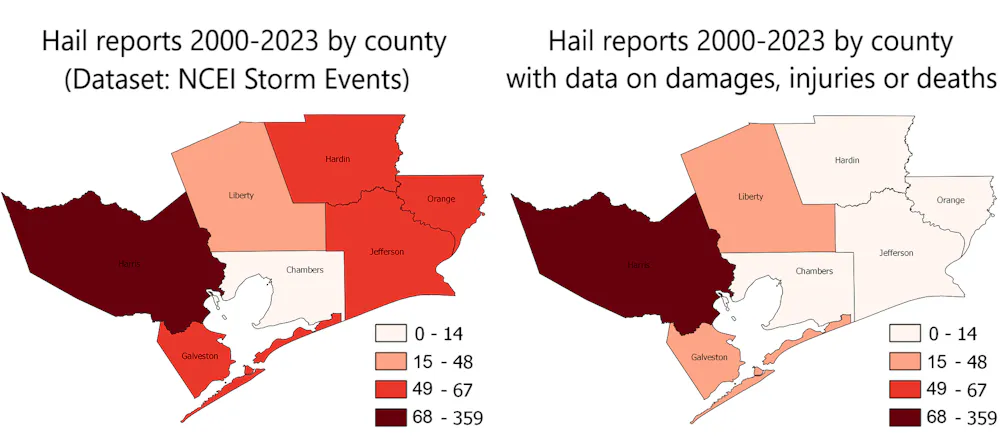
    The number of severe hail reports in southeast Texas listed in the National Centers for Environmental Information’s storm events database is strongly correlated with population. The county with the most reports and greatest detail in those reports is home to Houston. Hailstorms in the three easternmost counties are rarely associated with damage estimates.
    John Nielsen-Gammon and B.J. Baule

    Do you want to look at local damage trends? Forget about it. For most extreme weather events, estimation methods vary over time and are not documented.

    Do you want to direct funding to help communities improve resilience to natural disasters where the need is greatest? Forget about it. The places experiencing the largest per capita damages depend not just on actual damages but on the different practices of local National Weather Service offices.

    Are you moving to a location that might be vulnerable to extreme weather? Companies are starting to provide localized risk estimates through real estate websites, but the algorithms tend to be proprietary, and there’s no independent validation.

    4 steps to improve disaster data

    We believe a few fixes could make NOAA’s storm events database and the corresponding values in the larger SHELDUS database, managed by Arizona State University, more reliable. Both databases include county-level disasters and loss estimates for some of those disasters.

    First, the National Weather Service could develop standard procedures for local offices for estimating disaster damages.

    Second, additional state support could encourage local emergency managers to make concrete damage estimates from individual events and share them with the National Weather Service. The local emergency manager generally knows the extent of damage much better than a forecaster sitting in an office a few counties away.

    Third, state or federal governments and insurance companies can agree to make public the aggregate loss information at the county level or other scale that doesn’t jeopardize the privacy of their policyholders. If all companies provide this data, there is no competitive disadvantage for doing so.

    Fourth, NOAA could create a small “tiger team” of damage specialists to make well-informed, consistent damage estimates of larger events and train local offices on how to handle the smaller stuff.

    With these processes in place, the U.S. wouldn’t need a billion-dollar disasters program anymore. We’d have reliable information on all the disasters.

    John Nielsen-Gammon receives funding from the National Oceanic and Atmospheric Administration and the State of Texas.

    William Baule receives funding from NOAA, the State of Texas, & the Austin Community Foundation.

    – ref. Extreme weather’s true damage cost is a mystery – that’s a problem for understanding storm risk – https://theconversation.com/extreme-weathers-true-damage-cost-is-a-mystery-thats-a-problem-for-understanding-storm-risk-257105

    MIL OSI – Global Reports –

    June 20, 2025
  • MIL-OSI Global: New start date for the Anthropocene proposed – when humans first changed global methane levels

    Source: The Conversation – UK – By Vincent Gauci, Professorial Fellow, School of Geography, Earth and Environmental Sciences, University of Birmingham

    Robsonphoto/Shutterstock

    Humans have been reshaping the environment for at least 10,000 years. But the Anthropocene is the name given to the specific period of Earth history during which humans have had a global effect on the planet’s climate and ecosystems. Despite formal rejection as a geological epoch, it’s widely understood within academic research as useful shorthand for the age of human interference in the Earth system.

    Various dates have been proposed for when the anthropocene effectively began, from the early 17th century to the mid-20th century, when the first atomic weapons were detonated. My new research into atmospheric methane concentration supports the idea of an early date, when European arrival in the Americas first had a notable impact on the atmosphere, but slightly before previous estimates.

    Ice cores – cylinders of ice drilled from glaciers and ice sheets – provide important evidence of historical changes in the global atmospheric composition. It is from these records that a date for the Anthropocene’s pre-industrial beginnings was first proposed in 2015 by two Earth systems scientists at the University College London, Simon Lewis and Mark Maslin.

    They suggested that an unprecedented drop in the level of CO₂ in the atmosphere that was recorded in ice cores – known as the “Orbis spike” – dates back to 1610. This unusually low level reflects additional atmospheric CO₂ absorption into trees from forest regrowth in the Americas following European arrival in the late 1400s.


    Get your news from actual experts, straight to your inbox. Sign up to our daily newsletter to receive all The Conversation UK’s latest coverage of news and research, from politics and business to the arts and sciences.


    From European arrival in 1492 and colonisation in the 1500s, the introduction of disease, mostly smallpox, resulted in demographic collapse of around 50 million people across the Americas. Lewis and Maslin proposed that, as millions of hectares of farmland went untended, forests could regrow and this increased CO₂ removal from the atmosphere.

    This happened in sufficient quantities to be recorded in glacial ice. And that change became a global marker for the start of the so-called Anthropocene.


    Read more:
    Why the Anthropocene began with European colonisation, mass slavery and the ‘great dying’ of the 16th century


    My own research into changing methane concentrations indicates that the Anthropocene began slightly earlier than that, in 1592. Ice core records show a minimum atmospheric methane concentration exactly 100 years after explorer Christopher Columbus first set foot in the Americas. This, I believe, strengthens support for the hypothesis put forward by Lewis and Maslin a decade ago.

    In a paper published in Nature Reviews, Earth and Environment, I consider the effects of global fluctuations in how trees and forests exchange methane. Methane is a greenhouse gas that is around 80 times more powerful than carbon dioxide over a 20-year period. Crucially, methane has a short lifetime of just under ten years, so any ice core record will be far more responsive to changes to the methane cycle than that of longer-lived CO₂.


    Read more:
    Methane is pitched as a climate villain – could changing how we think about it make it a saviour?


    Trees are a methane sink

    So what’s the link to trees? Trees and their woody bark surfaces, despite their biologically inert appearance when compared to leaves, are important interfaces of methane exchange. In swamps and forested floodplains like the Amazon, they are exit points of methane to the atmosphere from the saturated soils where the methane is formed by anaerobic soil microbes.

    However, last year, my team uncovered how the more extensive areas of forest growing on free-draining soils interact with atmospheric methane. The trees host microbes that directly remove methane from the atmosphere.

    This is one of two mechanisms that, together, might explain an unprecedented drop in atmospheric methane concentrations recorded in Antarctic ice cores in the first century following European arrival in the Americas. This would support Lewis and Maslin’s idea that regrowing forests in that period had global effects.

    With more trees growing on abandoned farmland, there was more woody tree surface area in contact with the atmosphere. This meant more methane being taken up by the microbes they host.

    Measuring methane uptake of trees.
    Vincent Gauci, CC BY-NC-ND

    The second mechanism relates to how trees intercept incoming rainfall. Some rainfall is re-evaporated before reaching the soil. Any rain reaching the soil may then be taken up by tree roots and released back to the atmosphere. The rest moves into the soil or washes off into rivers and wetlands.

    It is possible that the spike in forest regrowth led to more evaporation and transpiration. So more water was released by the trees back to the atmosphere and less washed off over the soil surface.

    This limited water flowing into wetlands. Those wetlands are a major methane source. So a small shrinkage in wetland area, combined with more trees absorbing atmospheric methane, could have reduced the atmospheric methane concentration and explain the minimum methane levels observed in 1592.

    When exactly the Anthropocene began may be an argument that has been overtaken by the decision to not label it a new epoch. Indeed, it’s possible that forest clearance for early agriculture by humans around 5,000-8,000 years ago in the mid-Holocene, (a period of relative climate stability in the Neolithic period) contributed to the atmospheric methane increase observed in Antarctic ice from that time.

    As well as an ancient trace of human influence over our forests, the ice core methane records provide a chance to evaluate newly discovered processes operating in the world’s forests. This is something I’m now investigating with my colleague Peter Hopcroft, a palaeoclimate modeller at the University of Birmingham.

    Whether through forest clearances for early agriculture or through the effects on forests of massive depopulation of Indigenous peoples following European contact, these traces of our past influence point to something significant: that there has always been an intimate and evolving connection between humanity and the natural world. A connection so fundamental that, for the vast span of our existence as a species, we have been inseparable from nature itself.


    Don’t have time to read about climate change as much as you’d like?

    Get a weekly roundup in your inbox instead. Every Wednesday, The Conversation’s environment editor writes Imagine, a short email that goes a little deeper into just one climate issue. Join the 45,000+ readers who’ve subscribed so far.


    Vincent Gauci receives funding from or has received funding from the Natural Environment Research Council, The Royal Society, Spark Climate Solutions, AXA Research Fund, Defra and the JABBS Foundation.

    – ref. New start date for the Anthropocene proposed – when humans first changed global methane levels – https://theconversation.com/new-start-date-for-the-anthropocene-proposed-when-humans-first-changed-global-methane-levels-258834

    MIL OSI – Global Reports –

    June 20, 2025
  • MIL-OSI Global: Britain’s plan for defence AI risks the ethical and legal integrity of the military

    Source: The Conversation – UK – By Elke Schwarz, Professor of Political Theory, Queen Mary University of London

    Autonomous technology on the battlefield may not look like ‘killer robots’, but still has huge ethical implications. TSViPhoto/Shutterstock

    In an unstable geopolitical climate, the UK’s strategic defence review focused on improving national resilience, from critical infrastructure security to technology and innovation. Many of the review’s recommendations have to do with transforming defence through artificial intelligence (AI) and autonomy, to make the armed forces “ten times more lethal”.

    These recommendations and investments – drones, autonomous systems and £1 billion for a “digital targeting web” that would connect weapons systems – may well make the armed forces more lethal. But this comes at a risk to the ethical and legal integrity of the military.

    A key part of international humanitarian law is the principle of precautions in attack. This requires that those planning an attack must do everything they feasibly can to ensure that targets are of a military nature. Similar is the principle of distinction, which mandates that civilians must never become a target.

    In armed conflict, these principles are meant to protect civilians. They require human judgement — the ability to weigh up context, intent and likely outcomes. But how might they be upheld when humans are embedded in AI systems, which prioritise speed and scale in decision-making and action?


    Get your news from actual experts, straight to your inbox. Sign up to our daily newsletter to receive all The Conversation UK’s latest coverage of news and research, from politics and business to the arts and sciences.


    An AI-enabled digital targeting web, like the one proposed in the strategic review, connects information (sensors) and action (weapons), enabling faster identification and elimination of potential targets. These webs would be able to identify and suggest possible targets considerably faster than humans. In many cases, leaving soldiers with only a few minutes, or indeed seconds, to decide whether these targets are appropriate or legitimate in legal or ethical terms.

    One example already in use is the Maven Smart System, which was recently procured by Nato. This system could make it possible for small army teams to make up to “1,000 tactical decisions an hour”, according to a report by the US thinktank the Center for Security and Emerging Technology.

    Legal scholars have argued that the prioritisation of speed with AI in conflict “leaves little room for human judgement” or restraint.

    Unlike other technologies used in war, AI is more than an instrument. It is part of a cognitive system of humans and machines, which makes human control a lot more complicated than operating a fleet of tanks.

    Proponents of autonomous weapons and AI targeting systems often argue that this technology would make warfare more precise, dispassionate and humane. However, military ethics scholar Neil Renic and I have shown how it can instead lead to an erosion of moral restraint, creating a war environment where technological processes replace moral reasoning.


    Read more:
    Silicon Valley’s bet on AI defence startups and what it means for the future of war – podcast


    Training the data

    The strategic defence review lauds autonomy as providing “greater accuracy”, but this is complicated by technical and human limitations. Instead of providing greater accuracy in targeting, AI-enabled systems threaten to undermine the principle of distinction and precaution.

    AI systems also bear technical challenges for something as complex and dynamic as warfare. AI-supported systems are only as good as the data on which they are trained. Appropriate, comprehensive and up-to-date data is hard to come by in conflict, and dynamics can change quickly.

    This is particularly true in urban conflicts. Understanding the complexities of a situation on the ground is difficult enough for human military personnel, without bringing in AI.

    New AI models, in particular, bear risks. AI large language models are known to “hallucinate” – produce outputs that are erroneous or made up. As these systems are integrated into defence, the risks of technological failure become more pronounced.

    AI could significantly speed up targeting technology.
    Yuri A/Shutterstock

    There is also a considerable risk of this technology enabling uncontrolled escalation and conflict at speed – what scholars have described as a “flash war”. Escalation from crisis to war, or escalating a conflict to a higher level of violence, could come about due to erroneous indications of attack, or a simple sensor or computer error.

    Consider an AI system alerting commanders of a hostile tank approaching a border area. With potentially only minutes to spare, time for verification of the incoming information is sparse. Commanders may “prioritise rapid response over thorough analysis”. If the tank turns out to be a school bus, this response could have further retaliatory consequences.

    Unpredictable systems could also give leaders false impressions of their capabilities, leading to overconfidence or encouraging preemptive attacks. This all may lead to greater global instability and insecurity.

    Responsible AI

    The UK government has shown that it is aware of some of these risks. Its 2022 report on responsible AI in defence emphasised ethics in the use of AI. It specified that the deployment “of AI-enabled capabilities in armed conflict needs to comply fully with [international humanitarian law]”, including the principles of distinction, necessity, humanity and proportionality.

    The report also notes that responsible and ethical use of AI systems requires reliability and human understanding of the AI system and its decisions.

    The strategic defence review, on the other hand, notes that the speed with which technologies develop is outpacing regulatory frameworks. It says that “the UK’s competitors are unlikely to adhere to common ethical standards in developing or using them”.

    This might be so, but it should not open the door to a less ethical and responsible development or use of such systems by the UK. Ethics is not only about how we treat others, but also about who we are.

    The UK still has an opportunity to shape global norms around military AI — before a generation of unaccountable systems becomes the default. But that window for action is closing rapidly.

    Elke Schwarz is affiliated with the International Committtee for Robot Arms Control (ICRAC)

    – ref. Britain’s plan for defence AI risks the ethical and legal integrity of the military – https://theconversation.com/britains-plan-for-defence-ai-risks-the-ethical-and-legal-integrity-of-the-military-258149

    MIL OSI – Global Reports –

    June 20, 2025
  • MIL-OSI Global: Iran air strikes: Republicans split over support for Trump and another ‘foreign war’

    Source: The Conversation – UK – By Richard Hargy, Visiting Research Fellow in International Studies, Queen’s University Belfast

    After returning early from the G7 summit in Canada, Donald Trump met with his national security team to be briefed on the escalating Israel-Iran conflict. It became clear that Trump was considering direct US military support for the Israelis.

    This has the potential to cause a split among the president’s supporters between the Republican hawks (traditional interventionists) on one side and the Maga isolationists on the other.

    During his three presidential campaigns, Trump condemned former presidents for leading America into “ridiculous endless wars”. This isolationist tilt won him plaudits with his base of those who supported him for his populist promises to “make America great again” (Maga).

    In their work on US attitudes to foreign policy and US overseas involvement, Elaine Kamarck and Jordan Muchnick of the Brookings Institution – a non-profit research organisation in Washington – looked at a range of evidence in 2023.


    Get your news from actual experts, straight to your inbox. Sign up to our daily newsletter to receive all The Conversation UK’s latest coverage of news and research, from politics and business to the arts and sciences.


    They found Republicans supporting less global involvement from the US had increased from 40% to 54% from 2004 to 2017. At that time only 16% of voters supported increasing US troop presence abroad, and 40% wanted a decrease, they found. They related this change in attitudes to Trump’s foreign policy position.

    Fast forward to his second term, and many in the Maga camp are fiercely opposed to Trump’s current posturing about leading the US into another conflict in the Middle East. Over the past few days the White House has doubled down on the line that Trump keeps repeating: “Iran can not have a nuclear weapon”.

    As Trump edges closer to committing the US to joining Israel in air strikes on Iran, Steve Bannon, a staunch Trump ally, argued that allowing the “deep state” to drive the US into conflict with Iran would “blow up” the coalition of Trump support.

    Meanwhile, Conservative podcaster Tucker Carlson denounced those Republicans supporting action against Iran as “warmongers” and said they were encouraging the president to drag the US into a war.

    Congresswoman Majorie Taylor Greene, in an unusual break with Trump, openly criticised the president’s stance on the Israel-Iran conflict, writing on X: “Foreign wars/intervention/regime change put America last, kill innocent people, are making us broke, and will ultimately lead to our destruction.”

    Other prominent Republican senators, including Josh Hawley and Rand Paul, have urged the president to avoid US involvement in an offensive against Iran.

    Another Republican congressman, Thomas Massie, has gone even further. He has joined with a coalition of Democrats in filing a House resolution under the War Powers Resolution of 1973, which would seek to prevent Trump from engaging in “unauthorized hostilities” with Iran without Congressional consent.

    These Republicans may believe their views are popular with their electoral base. In an Economist/YouGov poll in June 2025, 53% of Republicans stated that they did not think the US military should get involved in the conflict between Israel and Iran.

    But Donald Trump does seem to enjoy widespread support in the US for his position that the US cannot allow Iran to develop a nuclear weapon. According to CNN data analysis, 83% of Republicans, 79% independents, and 79% of Democrats, agree with the president’s position on this issue. This slightly confusing split suggests there could be US voter support for air strikes, but it’s clear there would not be that same support for troops on the ground.

    Iran
    Infogram

    Resistance from ultra-Trump die-hards, however, might put them on the wrong side of the president in the long-term. Greg Sargent, a writer at The New Republic magazine, believes that, “people become enemies of Trump not when they substantively work against some principle he supposedly holds dear, but rather when they publicly criticize him … or become an inconvenience in any way”.

    So why is Trump, to the dismay of many from within the Maga faithful, seemingly abandoning the anti-war tenet of his “America first” doctrine? Jacob Heilbrunn, editor of The National Interest magazine, thinks that “now that Israel’s assault on Iran appears to be successful, Trump wants in on the action”.

    The president has several prominent Republican hawks urging him to do exactly that, and order the US Air Force to deploy their “bunker-buster bombs”“ to destroy Iran’s underground arsenals. One of these is Senator Lindsey Graham.

    Earlier this week on Fox News, he told Trump to be “all in … in helping Israel eliminate the nuclear threat. If we need to provide bombs to Israel, provide bombs. If we need to fly planes with Israel, do joint operations.”

    Former Republican Senate leader Mitch McConnell is also advocating US military action. He told CNN: “What’s happening here is some of the isolationist movement led by Tucker Carlson and Steve Bannon are distressed we may be helping the Israelis defeat the Iranians,” adding that its “been kind of a bad week for the isolationists” in the party.

    Donald Trump talks about potential involvement in air strikes.

    The same Economist/YouGov poll mentioned earlier showed that the stance taken by these Republicans – that Iran poses a threat to the US – is a position shared by a majority of GOP voters, with 69% viewing Iran as either an immediate and serious threat to the US, or at least somewhat of a serious threat.

    Always an interventionist?

    Some believe that Trump’s evolving attitude towards American military involvement in the worsening crisis in the Middle East, however, is not a volte-face on isolationism, or an ideological pivot to the virtues of attacking Iran. Ross Douthat of the New York Times has observed that Trump “has never been a principled noninterventionist” and that “his deal-making style has always involved the threat of force as a crucial bargaining chip”.

    It is always difficult to fully determine what Trump’s foreign policy doctrine actually is. It is useful, however, to reflect on some of the president’s overseas actions from his first term.

    In April 2018, following a suspected chemical weapons attack by the forces of Syrian president Bashar al-Assad in a Damascus suburb, Trump ordered US air strikes in retaliation for what he called an “evil and despicable attack” that left “mothers and fathers, infants and children thrashing in pain and gasping for air”.

    This led the editor-in-chief of The Atlantic magazine, Jeffrey Goldberg, to describe Trump as “something wholly unique in the history of the presidency: an isolationist interventionist”.

    Richard Hargy does not work for, consult, own shares in or receive funding from any company or organisation that would benefit from this article, and has disclosed no relevant affiliations beyond their academic appointment.

    – ref. Iran air strikes: Republicans split over support for Trump and another ‘foreign war’ – https://theconversation.com/iran-air-strikes-republicans-split-over-support-for-trump-and-another-foreign-war-259314

    MIL OSI – Global Reports –

    June 20, 2025
  • MIL-OSI Global: Could trees know when the summer solstice is?

    Source: The Conversation – UK – By Andrew Hacket-Pain, Senior Lecturer, School of Environmental Sciences, University of Liverpool

    cashcashcash/Shutterstock

    People have been celebrating the summer solstice with elaborate rituals since prehistoric times. But humans aren’t the only species to take mark June 21 as a special time. Studies are showing the summer solstice is an important cue for plants too.

    Recent studies, including one of my own, have proposed that trees may use the longest day of the year as a key marker for their growth and reproductive cycles. The solstice seems to act like a calendar reminder for trees.


    Many people think of plants as nice-looking greens. Essential for clean air, yes, but simple organisms. A step change in research is shaking up the way scientists think about plants: they are far more complex and more like us than you might imagine. This blossoming field of science is too delightful to do it justice in one or two stories.

    This story is part of a series, Plant Curious, exploring scientific studies that challenge the way you view plantlife.


    For example, at the solstice, trees growing in cold places slow down the creation of new wood cells and focus their energy on finishing already formed but still incomplete cells. This ensures trees have time to complete cell construction before winter hits. Incomplete cells are damaged by freezing winter temperatures, rendering them useless for water transport the following year.

    Along similar lines, trees use the solstice to fine-tune the “winding down”, or senescence, of their leaves in preparation for autumn. Senescence allows the tree to reabsorb critical nutrients from the leaves before they fall. This process is timed to balance missing out on sunlight from “winding down” too early, against leaving it too late and losing nutrients if still-green leaves are killed by autumn frosts.

    Stonehenge has been part of summer solstice celebrations since ancient times.
    Ria Sh/Shutterstock

    Satellite observations of forests, and controlled experiments in greenhouses, reveal that warmer temperatures immediately prior to the solstice cause the onset of leaf browning to start earlier that autumn. In contrast, warmer temperatures just after the solstice slow down the senescence process.

    This means a longer transition period from green to fully brown leaves. This fine-tuning enables trees to extend the period of photosynthesis in years when temperatures stay warmer for longer, so they don’t miss out on these favourable conditions.

    But not all scientists is convinced. From an evolutionary perspective, the solstice may not be the best seasonal marker for timing these transitions. For example, in forests in the far north, leaves do not appear until early June, only days before the solstice, and the growing season can extend late into October. In these forests, using the solstice to initiate the winding down process makes little sense for trees that have only just started growing for the year.

    Nevertheless, there is more consensus about plants using the solstice to synchronise reproduction.

    In many plants, especially trees from the temperate mid-latitudes, the number of seeds they produce varies dramatically year on year, known as masting. A large European beech tree can produce hundreds of thousands of seeds in a bumper year (a “mast event”) and forgo reproduction altogether in other years.

    Beech trees vary their annual seed production in step, often on a continental scale. They do this to increase the efficiency of their reproduction.

    Beech trees coordinate their reproduction.
    Gabriele Rohde/Shutterstock

    A small moth, Cydia fagiglandana, lays its eggs in beech flowers. When the grubs hatch, they eat and destroy the developing seeds. Cycles of famine and bumper years help protect their seeds from these moths.

    UK beech trees typically lose less than 5% of their seeds to Cydia because the cycles starve the moths into low numbers ready for masting years. But when trees are out of sync, seed loss can increase to over 40%.

    For decades we have known that beech mast events happen in the year after a warm summer. These warmer temperatures trigger an increase in the formation of flower buds. More flower buds usually lead to a greater crop of seeds that autumn.

    Scientists have long puzzled over how beech trees across Europe seem to use the same seasonal window to control mast events. Their seed production is determined by temperatures in late June and early July, irrespective of where they grow in Europe. But how can a beech tree know the date?

    In my team’s 2024 study, we showed that they use the solstice as a seasonal marker. As soon as the days start to shorten after the solstice, beech trees across Europe seem to simultaneously sense the temperature.

    Anywhere temperatures are above average in the weeks following the solstice can expect to have a mast event the next year. Weather conditions in the weeks before the solstice, by contrast, seem to be irrelevant. As seen on weather maps, warm and cool spells tend to occur simultaneously over large areas.

    This allows beech trees to maximise the synchrony of their reproduction, whether that is investing in a mast year (warm temperatures), or forgoing reproduction for a year (low temperatures). Using a fixed marker like the solstice is the key to achieving this synchrony, and the benefits that come from it.

    Note how bumper seed crops and failures tend to be regionally synchronised, and occasionally occur as pan-European events.
    Andrew Hacket Pain, CC BY-NC-ND

    The evidence for this phenomenon has come from observations across dozens of forests across Europe. However, my research group is collaborating with about a dozen other groups in Europe to test this effect by manipulating the temperature of beech branches before and after the solstice at different sites. Ongoing research I am involved with seems to show flowering genes are activated at the summer solstice.

    Also, studies into the circadian rhythms of plants show they have mechanisms in their molecules that allow them to detect and respond to tiny changes in day length. This is the basis for that extraordinary scale of synchronised reproduction.

    If the weather is warm over the next month or so, then there is a good chance that beech trees in your local area will have heavy seed crops next autumn. What’s more, trees across the UK and into northern and central Europe will probably be doing the same.

    Andrew Hacket-Pain has received funding from UKRI, Defra and the British Council.

    – ref. Could trees know when the summer solstice is? – https://theconversation.com/could-trees-know-when-the-summer-solstice-is-259309

    MIL OSI – Global Reports –

    June 20, 2025
  • MIL-OSI Russia: Secular gossip from 200 years ago. Who is the subject of the exhibition “Gossip” at the Tropinin Museum

    Translation. Region: Russian Federal

    Source: Moscow Government – Government of Moscow –

    The chamber exhibition “Gossip. What Muscovites talked about 200 years ago” is dedicated to the citizens of the first half of the 19th century, their everyday life and conversations. Moscow of that time was very different from today, representing a mixture of urban development, gardens, vegetable gardens and estates. In the crowded and diverse city one could find both European sophistication and the simplicity dear to the Russian heart. This was the Moscow of Pushkin, Griboyedov and Tropinin.

    Especially for “Moscow Culture”, the exhibition curator Ekaterina Arkhipova conducted a tour and shared the stories of the heroes.

    Prologue

    What did they talk about in the English Club, the Noble Assembly, the Bolshoi Theatre and the drawing rooms? These places served as centres of social life and exchange of opinions. Here they discussed the latest events, literary novelties and, most importantly, personal stories. Aristocrats, military men, artists and writers, adventurers, gamblers, duelists and just eccentrics – who were they, the heroes of the society columns, whose lives occupied the attention of Muscovites at the end of the 18th – first half of the 19th century?

    Monk Pimen – Dmitry Blagovo

    Belonging to an ancient noble family, Dmitry Blagovo, a man of unusual destiny, lived through the reign of four emperors: Nicholas I, Alexander II, Alexander III and Nicholas II. Having lost his father early, he remained in the care of his grandmother Elizaveta Yankova, née Rimskaya-Korsakova, who gave him an excellent home education.

    Dmitry Dmitrievich moved in high society, was a regular at the salon of the famous poetess Evdokia Petrovna Rostopchina. He was going to marry one of her daughters, Lydia, but literally on the eve of the wedding, to everyone’s amazement, he married 18-year-old Nina Uslar, a girl from the family of a Russified German professor. All of Moscow was gossiping about this event. Lydia Rostopchina was inconsolable and never married again.

    After several years of a cloudless family life, misfortunes rained down on Blagovo. First, in 1861, his little son and heir died, and in the same year, his beloved grandmother passed away. A year later, his wife fell in love with another man and left her husband with their daughter, and soon Dmitry Dmitrievich’s mother died. All these events shocked Blagovo so much that he decided to do something that shocked secular Moscow no less than his marriage had done: he gave his wife a document in which he took all the blame on himself, so that she could divorce him and remarry (however, the Holy Synod allowed the dissolution of the marriage only after 20 years). Blagovo retired to the Nikolo-Ugreshsky Monastery near Moscow as a novice, which again shocked the Moscow and St. Petersburg aristocracy. In 1880, he transferred to the Tolga Monastery and took monastic vows under the name Pimen. Four years later, he was elevated to the rank of archimandrite and appointed rector of the Russian Embassy Church of St. Nicholas the Wonderworker in Rome. He served there until his death in 1897.

    Poor Lisa

    The story of the main character of Nikolai Karamzin’s sentimental tale is usually considered fictional, but poor Liza’s contemporaries, the then residents of Moscow, perceived her as a real person. The tale was read by very different women – from refined aristocrats to poor bourgeois women.

    Karamzin’s Liza lived near the Simonov Monastery, which at that time was not within the city limits. The place was very secluded. But after the publication of the story in 1792 and its resounding success, the pond near the monastery began to be called Liza’s. Secular pilgrimages began to be made to it, dates began to be arranged near it, and numerous inscriptions appeared on the trees around it. One of the most famous reads: “Here Erastov’s bride threw herself into the pond. Drown yourself, girls: there is enough room in the pond!” The area around was also given the girl’s name, Liza’s Slobodka, Liza’s Street and Liza’s Dead End appeared. Kiprensky painted her famous portrait as if he really knew her. Poor Liza was on the lips of Muscovites for many years – so the story became not just a literary event, but also a cultural and social phenomenon, and its heroine moved from the pages of the book into real life. Now on this site there is a modern residential complex with a park and a pond, which immediately received the popular name Lizin Pond – in honor of the old “literary” pond.

    American – Count Fyodor Tolstoy

    Another incredible personality is Count Fyodor Ivanovich Tolstoy, nicknamed the American, Leo Tolstoy’s cousin. He was a living legend not only of old Moscow, but of all Russian literature of the 19th century. In Alexander Griboyedov’s comedy Woe from Wit, the high society public easily recognized the extravagant count in the “night robber and duelist” who returned from Kamchatka as an Aleut.

    His life was full of jokes and adventures. A desperate gambler and even a sharper, a womanizer, a brawler and a duelist, he was always distinguished by excellent health and endurance, but at the same time by a tendency to violence, fights and recklessness. The desire for adventure prompted Fyodor Ivanovich to take part in a round-the-world voyage on the sloop Nadezhda in 1803 under the command of Captain-Lieutenant Ivan Fyodorovich Kruzenshtern. This was the first round-the-world voyage under the Russian flag. On board, Tolstoy behaved defiantly: he provoked quarrels, threw parties with card games, and in one of the ports he bought a tame monkey and taught it various tricks, which caused him to seriously quarrel with the commander of the expedition. He was forced to arrest his subordinate several times and eventually landed the uncontrollable Tolstoy on Kamchatka. From there, the Count reached the Aleutian Islands, where he spent several months among the natives. At that time, he decorated himself with numerous tattoos, which he later proudly showed off. Upon returning from the trip, he received his nickname.

    The affairs of the heart of Tolstoy the American were also unusual. Despite numerous affairs with socialite ladies, he married a simple gypsy – a camp singer Avdotya Tugaeva. The family had 12 children, 10 of whom died in infancy. Every time one of the children died, Tolstoy put a note in his diary “quits”, believing that God punished him with the death of his children for each of the 11 people he killed in duels. The greatest blow to him was the death of his beloved daughter Sarah. The girl was incredibly beautiful and talented, but did not live to see 18. Fyodor Ivanovich spent most of his last years in Moscow, living alone with his daughter Praskovia, the only surviving of all his children. In old age, he became devout and prayed a lot, atoning for the sins of his youth.

    “Moscow Grannies” – Opinion Leaders

    Some of the most colorful figures in Griboyedov’s Moscow, whose opinions were highly respected in the first half of the 19th century, were, as Alexander Pushkin called them, “Moscow grandmothers.” Probably the most famous, authoritative and eccentric of them was Nastasya Dmitrievna Ofrosimova. A lady of iron character and iron will, she had an incredible gift of persuasion, knew everything about everyone, expressed herself with sharp directness and belonged to the type of people who endlessly give value judgments, numerous pieces of advice and always know how to do the right thing. This “grandmother” had a colossal influence in society. In fact, she ruled it, in some ways even decided destinies. Mothers of noble families introduced their daughters to her and asked for her blessing and assistance in society for them.

    Contemporaries described her as a very rude old woman of masculine build, tall, with a stern dark face, black eyes and even a moustache. The general’s wife Nastasya Dmitrievna was herself a general in a skirt both in her own home and in all of Moscow. Evil tongues claimed that she personally “kidnapped” her husband from his house in order to get married. Despite numerous jokes, everyone without exception respected her and trembled before her. She became the prototype of two minor literary characters. Griboyedov presented Nastasya Dmitrievna in the image of the quarrelsome old woman Anfisa Nilovna Khlestova, the sister of Famusov’s late wife. And Leo Tolstoy in “War and Peace” depicted her almost under her real name – as Maria Dmitrievna Akhrosimova, an imperious and straightforward, but fair Moscow lady and godmother of Natasha Rostova.

    Love and Death on the Battlefield. Margarita Naryshkina and Alexander Tuchkov

    A poignant romantic story is connected with the youngest of the five Tuchkov brothers, Alexander Alexeevich. When they met Margarita Naryshkina, she was married to a certain Pavel Lasunsky, a despot and tyrant who abused his wife in every possible way. Once he brought her to a nervous breakdown, after which the Naryshkin family obtained a divorce for their daughter in the Holy Synod. Having met the handsome officer Alexander Tuchkov, Margarita fell in love at first sight. Having learned about the divorce, he proposed, but her parents were afraid of another unsuccessful marriage. Only several years later did they manage to get married.

    Margarita loved her chosen one so much that, probably sensing the imminent tragedy, she obtained the monarch’s permission to be with her husband in the active army. During the Battle of Borodino, he was mortally wounded, and they couldn’t even carry him off the battlefield. Alexander Tuchkov’s body was never found, although Margarita personally searched for it. Later, at her own expense, she built the Church of the Savior Not Made by Hands on the site of her husband’s presumed death. Soon their little son died, after which Tuchkova took monastic vows and in 1840 became the abbess of the Spaso-Borodino Monastery. This romantic story struck the young Marina Tsvetaeva at the time, and she wrote the famous poem “To the Generals of the Twelfth Year”, which became a popular romance at the end of the 20th century.

    Epilogue

    Although Moscow was different and time was slower, without television and the Internet, people, their customs and passion for gossip remain very similar after centuries. You can easily see this by coming toexcursion on the exhibition “Gossip. What Muscovites talked about 200 years ago.” Tickets to the V.A. Tropinin Museum and Moscow artists of his time can be purchased at mos.ru.

    Get the latest news quicklythe city’s official telegram channel Moscow.

    Please note: This information is raw content directly from the source of the information. It is exactly what the source states and does not reflect the position of MIL-OSI or its clients.

    Please Note; This Information is Raw Content Directly from the Information Source. It is access to What the Source Is Stating and Does Not Reflect

    https: //vv.mos.ru/nevs/ite/155463073/

    MIL OSI Russia News –

    June 20, 2025
  • MIL-OSI Russia: Since the start of the renovation program, about six million square meters of housing have been built in the capital

    Translation. Region: Russian Federal

    Source: Moscow Government – Government of Moscow –

    Since the start of the renovation program, about six million square meters of housing have been built in the capital. This was announced at the XXVIII St. Petersburg International Economic Forum by Deputy Mayor of Moscow for Urban Development Policy and Construction Vladimir Efimov.

    “In more than seven years since the renovation program began, the city has built a total of about six million square meters of housing. This volume will allow Muscovites to receive new apartments from about 1,300 old houses. New residential complexes are located in all districts of the capital. In particular, 63 houses were built in the Eastern Administrative District under the renovation program, 56 in the South-Eastern District, and 55 new buildings in the Northern District,” said Vladimir Efimov.

    For new residents, the renovation program creates a comfortable urban environment with landscaped and green courtyards.

    “Residential complexes were built in 89 districts of the capital. The leader in the number of houses built under the renovation program was Lyublino – 17 new buildings appeared there. The apartments are handed over for occupancy with a finished improved finish, so Muscovites do not have to waste time on additional repairs. The first floors in the new buildings were designed as non-residential – pharmacies, shops, leisure centers and other social and household facilities are opened there,” added the Minister of the Moscow Government, head of the capital’s Department of Urban Development Policy Vladislav Ovchinsky.

    All residential complexes under the renovation program are being built taking into account the criteria of a barrier-free environment. Wide passages in entrances, vestibules and elevator halls are located on one level, without high steps, and pedestrian passages in the courtyard are designed so that it is comfortable for both parents with strollers and people with disabilities to move around.

    Earlier, Sergei Sobyanin said that another 131 sites were included in the renovation programconstruction of houses.

    The renovation program was approved in August 2017. It concerns about a million Muscovites and provides for the resettlement of 5,176 houses. Sergei Sobyanin ordered to increase the pace of implementation of the program intwice.

    Moscow is one of the leaders among regions in terms of construction volumes. High rates of housing construction correspond to the goals and initiatives of the national project “Infrastructure for life”.

    Get the latest news quicklyofficial telegram channel the city of Moscow.

    Please note: This information is raw content directly from the source of the information. It is exactly what the source states and does not reflect the position of MIL-OSI or its clients.

    Please Note; This Information is Raw Content Directly from the Information Source. It is access to What the Source Is Stating and Does Not Reflect

    https: //vv.mos.ru/nevs/ite/155497073/

    MIL OSI Russia News –

    June 20, 2025
  • MIL-OSI Africa: Tanzania celebrates and honors Akinwumi Adesina’s impactful legacy as President of the African Development Bank

    Source: Africa Press Organisation – English (2) – Report:

    The Government of the United Republic of Tanzania, on 14 June, has honored the President of the African Development Bank Group (www.AfDB.org) Dr Akinwumi Adesina describing him as “a visionary leader, a tireless son of Africa who has dedicated his life to transform the narrative of the continent.”

    President Samia Suluhu Hassan praised Adesina’s vital role in the development of her country’s economy, singling out large-scale infrastructure projects financed by the Bank.

    During a two-day visit to Tanzania that began on Friday, Bank president Dr Akinwumi Adesina was invited on a tour of some of the Bank-financed infrastructure projects that are transforming Tanzania’s economy and strengthening its regional and international roles. This includes a new international airport and a major highway that encircles the administrative capital of Dodoma.

    The Tanzanian leader highlighted projects in other sectors, such as agriculture and energy, that are financed by the Bank.

    “This is in addition to the construction of a modern Standard Gauge Railway line that will link Tanzania to Burundi and the Democratic Republic of Congo,” said President Suluhu Hassan.

    The African Development Bank Group has invested $9 billion in Tanzania since it started its operations in the country in 1971. Total financial support over the last 10 years under Adesina’s leadership stands at $4.73 billion, equivalent to 53% of the Bank’s lending to Tanzania over the past 54 years.

    “On behalf of the people of Tanzania, I express our gratitude to the African Development Bank for being a dependable partner of our country’s development journey,” the Tanzanian President said.

    Referencing the Bank’s transformative impact, Tanzania’s President Samia Suluhu Hassan told Adesina, “Your visionary leadership has brought significant socio-economic change to Tanzania and across Africa.”

    To cheers from the crowd President Suluhu Hassan announced, “I have accepted a recommendation by the Ministry of Works to rename the Dodoma Outer Ring Road as the Dr Akinwumi Adesina Road.”

    Adesina, accompanied by his wife, Grace Yemisi Adesina, was visibly moved to tears.

    The newly named 112-kilometer dual carriageway is a strategic link in the Cape to Cairo continental corridor. It will decongest Tanzania’s fast-growing administrative capital and enhance regional connectivity.

    The Bank provided $138 million in funding for the project, with an additional $42 million from the Africa Growing Together Fund and $34.69 million from the Government of Tanzania.

    Earlier, Adesina surprised the crowd when he delivered a lengthy portion of his speech in Kiswahili, the national language of Tanzania, which is widely spoken in East and Central Africa. After recognizing all dignitaries in Kiswahili, he went on to thank President Suluhu Hassan for the warm and generous hospitality accorded to him, first in the City of Peace, Dar es Salaam, and in the attractive city of Dodoma.

    “Mheshimiwa Rais Samia Suluhu Hassan, ningependa kukushukuru kwa mapokezi yako ya upendo na ukarimu tuliopewa jana katika jiji la amani, Dar es Salaam na hapa pia katika jiji lenye mvuto la Dodoma. Nimefurahi sana kuwa hapa Dodoma,” Adesina said as the crowd cheered him on.

    Earlier, on Friday 13 June, Adesina was awarded a Doctor of Science Honorary Degree (Honoris Causa) from the prestigious University of Dar es Salaam.

    The citation highlighted Adesina’s leadership and “lifelong dedication to public service, evidence-based policymaking, and pan-African progress.”

    It read further: “Dr Adesina exemplifies the rare blend of academic brilliance, visionary leadership, and practical impact that honorary doctorates are meant to recognize. His emphasis on inclusive growth, innovation, and economic resilience makes him a beacon of integrity, excellence, and servant leadership.”

    The honorary degree was bestowed on Adesina by the Chancellor of the University and former President Jakaya Mrisho Kikwete, who said, “I would like to tell Tanzanians, the African Development Bank has been a major anchor of Tanzania’s development sector. When it comes to infrastructure, no institution comes close to the African Development Bank.”

    Addressing the graduating class, Adesina spoke of his humble beginnings, emphasizing resilience, character, and unity. “Success cannot be achieved alone,” he said, inviting the students to rise, link hands, and repeat together: “Together, we will succeed and make a difference.”

    In his congratulatory remarks, Finance Minister Mwigulu Nchemba said, “Tanzania is proud to stand among the nations celebrating this remarkable journey and enduring legacy.”

    From Dar es Salaam, Adesina, accompanied by former President Kikwete and Finance Minister Nchemba, took the Standard Gauge Railway train for the three-hour, 450-kilometre journey to Dodoma.

    The African Development Bank Group has established a syndication strategy to mobilize $1.2 billion in conjunction with Deutsche Bank, Société Générale, and other partners for the 651-kilometre extension of the electrified Standard Gauge Railway that will connect Tanzania to Burundi and the Democratic Republic of Congo.

    The project financing, signed during the 2024 Africa Investment Forum Market Days and includes more than $85 million from the Bank’s concessional financing window, the African Development Fund, a mix of Partial Credit Guarantees totaling $994.3 million across some sections of the railway, complemented by $247 million from the Government of Tanzania in counterpart financing. Initial disbursement from the African Development Fund and partner, the OPEC Fund, is expected by July 2025.

    Adesina said, “This railway line is a cornerstone of East Africa’s regional integration vision, aimed at delivering a modern, cost-effective, and high-capacity transport system anchored on the port of Dar es Salaam and linking landlocked nations.”

    “Our shift from traditional road systems to integrated transport solutions is helping position Tanzania as a key logistics and trade hub in the region,” he added.

    Accompanied by Adesina, President Suluhu Hassan travelled across more than 30 kilometers of the Dodoma Outer Ring Road, stopping along the way at the Bank-funded Msalato International Airport which is expected to be completed by the end of 2026. The state-of-the-art airport features a 3.6-kilometre landing strip—one of the longest in East Africa, with a capacity to accommodate Airbus A380 aircraft.

    The African Development Bank has provided over $198 million to finance the Msalato International Airport project with $23 million coming from the African Development Fund and $50 million from the African Grow Together Fund.

    – on behalf of African Development Bank Group (AfDB).

    Media contact:
    Christin Roby
    Regional Communication Officer for East Africa
    Communication and External Relations
    Email: media@afdb.org

    About the African Development Bank Group:
    The African Development Bank Group is Africa’s premier development finance institution. It comprises three distinct entities: the African Development Bank (AfDB), the African Development Fund (ADF) and the Nigeria Trust Fund (NTF). On the ground in 41 African countries with an external office in Japan, the Bank contributes to the economic development and the social progress of its 54 regional member states. For more information: www.AfDB.org

    Media files

    Download logo

    MIL OSI Africa –

    June 20, 2025
  • MIL-OSI Banking: Phillips 66 releases 2025 Sustainability and People Report

    Source: Phillips

    HOUSTON–(BUSINESS WIRE)– Phillips 66 (NYSE: PSX) released its 2025 Sustainability and People Report today, demonstrating the company’s approach to helping supply the world’s growing energy needs while advancing projects to reduce emissions and foster growth.
    “This report showcases our achievements in 2024 and the dedication of our employees to our transformative strategy,” said Phillips 66 Chairman and CEO Mark Lashier, “We are committed to delivering affordable, reliable energy and investing in high-return projects that reduce emissions intensity, strengthen asset reliability and provide growth opportunities. We will continue to pursue strategic investments that align with our vision of being the leading integrated downstream energy provider.”
    This year’s publication highlights the company’s 2024 sustainability performance and its approach to building a high-performing organization including:

    Reporting a 15% reduction in Scope 1 and 2 greenhouse gas (GHG) emissions intensity and an 8% reduction in Scope 3 emissions intensity compared to 2019 baseline levels.
    Expanding methane disclosures to align with shareholder feedback.
    Achieving a 38% reduction in injuries from serious incidents.
    Fostering career development through learning resources designed to meet unique employee needs.

    Phillips 66 has published annual sustainability metrics and information since the company was founded in 2012. The company is committed to providing transparent and meaningful disclosures relating to its workforce practices and sustainability initiatives, including important performance data.
    To read Phillips 66’s 2025 Sustainability and People Report, go to phillips66.com/sustainability.
    About Phillips 66
    Phillips 66 (NYSE: PSX) is a leading integrated downstream energy provider that manufactures, transports and markets products that drive the global economy. The company’s portfolio includes Midstream, Chemicals, Refining, Marketing and Specialties, and Renewable Fuels businesses. Headquartered in Houston, Phillips 66 has employees around the globe who are committed to safely and reliably providing energy and improving lives while pursuing a lower-carbon future. For more information, visit phillips66.com or follow @Phillips66Co on LinkedIn.
    Cautionary Statement for the Purposes of the “Safe Harbor” Provisions of the Private Securities Litigation Reform Act of 1995 — This news release contains forward-looking statements within the meaning of the federal securities laws. Words such as “anticipated,” “estimated,” “expected,” “planned,” “scheduled,” “targeted,” “believe,” “continue,” “intend,” “will,” “would,” “objective,” “goal,” “project,” “efforts,” “strategies,” “priorities” and similar expressions that convey the prospective nature of events or outcomes generally indicate forward-looking statements. However, the absence of these words does not mean that a statement is not forward-looking. Forward-looking statements included in this news release are based on management’s expectations, estimates and projections as of the date they are made. These statements are not guarantees of future events or performance, and you should not unduly rely on them as they involve certain risks, uncertainties and assumptions that are difficult to predict. Therefore, actual outcomes and results may differ materially from what is expressed or forecast in such forward-looking statements. Forward-looking statements contained in this release include, but are not limited to, statements regarding progress made on sustainability goals and GHG emissions targets and investment in employee development and team building. Factors that could cause actual results or events to differ materially from those described in the forward-looking statements include: the possibility that Phillips 66 may not fully realize the expected benefits of the announced transaction; the risk of any unexpected costs or expenses resulting from the announced transaction; changes in governmental policies relating to NGL, crude oil, natural gas, refined petroleum or renewable fuels products pricing, regulation or taxation, including exports; the company’s ability to timely obtain or maintain permits, including those necessary for capital projects; fluctuations in NGL, crude oil, refined petroleum products, renewable fuels, renewable feedstocks and natural gas prices, and refined product, marketing and petrochemical margins; the effects of any widespread public health crisis and its negative impact on commercial activity and demand for the company’s products; changes to government policies relating to renewable fuels and greenhouse gas emissions that adversely affect programs including the renewable fuel standards program, low carbon fuel standards and tax credits for biofuels; liability resulting from pending or future litigation or other legal proceedings; liability for remedial actions, including removal and reclamation obligations under environmental regulations; unexpected changes in costs or technical requirements for constructing, modifying or operating the company’s facilities or transporting its products; the company’s ability to successfully complete, or any material delay in the completion of, any asset disposition, acquisition, shutdown or conversion that it may pursue, including receipt of any necessary regulatory approvals or permits related thereto; unexpected technological or commercial difficulties in manufacturing, refining or transporting the company’s products, including chemical products; the level and success of producers’ drilling plans and the amount and quality of production volumes around the company’s midstream assets; risks and uncertainties with respect to the actions of actual or potential competitive suppliers and transporters of refined petroleum products, renewable fuels or specialty products; changes in the cost or availability of adequate and reliable transportation for the company’s NGL, crude oil, natural gas and refined petroleum or renewable fuels products; failure to complete definitive agreements and feasibility studies for, and to complete construction of, announced and future capital projects on time or within budget; the company’s ability to comply with governmental regulations or make capital expenditures to maintain compliance; limited access to capital or significantly higher cost of capital related to the company’s credit profile or illiquidity or uncertainty in the domestic or international financial markets; damage to the company’s facilities due to accidents, weather and climate events, civil unrest, insurrections, political events, terrorism or cyberattacks; domestic and international economic and political developments including armed hostilities, such as the war in Eastern Europe, instability in the financial services and banking sector, excess inflation, expropriation of assets, and changes in fiscal policy, including interest rates; international monetary conditions and exchange controls; changes in estimates or projections used to assess fair value of intangible assets, goodwill and properties, plants and equipment and/or strategic decisions or other developments with respect to the company’s asset portfolio that cause impairment charges; substantial investments required, or reduced demand for products, as a result of existing or future environmental rules and regulations, including greenhouse gas emissions reductions and reduced consumer demand for refined petroleum products; changes in tax, environmental and other laws and regulations (including alternative energy mandates) applicable to our business; political and societal concerns about climate change that could result in changes to the company’s business or increase expenditures, including litigation-related expenses; the operation, financing and distribution decisions of joint ventures that the company does not control; the potential impact of activist shareholder actions or tactics, and other economic, business, competitive and/or regulatory factors affecting the company’s businesses generally as set forth in Phillips 66’s filings with the Securities and Exchange Commission. Phillips 66 is under no obligation (and expressly disclaims any such obligation) to update or alter its forward-looking statements, whether as a result of new information, future events or otherwise.

    Source: Phillips 66

    MIL OSI Global Banks –

    June 20, 2025
  • MIL-OSI United Kingdom: Preventing avoidable deaths in custody

    Source: Scottish Government

    Members of expert group to oversee reforms announced.

    Details of an expert group that will help drive reforms to prevent avoidable deaths in custody have been announced.

    Justice Secretary Angela Constance is leading the Ministerial Accountability Board overseeing the implementation of actions to address the recommendations of Sheriff Collins’ Fatal Accident Inquiry report into the deaths of Katie Allan and William Lindsay (also known as William Brown) at HMP & YOI Polmont. The first meeting of the Board was held on Thursday (19 June).

    Bringing a wealth of experience from third sector, legal, operational, research and health backgrounds, the members of the Board will provide support to mitigate challenges and ensure action is delivered as quickly as possible. Engaging with families will also be a central part of the Board’s role, to ensure lived experience is integral to reform.

    The Board is an interim measure until the National Oversight Mechanism – an independent national oversight body for all deaths in custody, separate from the Government – is established over the coming year. It will take on responsibility for overseeing implementation of the FAI actions along with its other responsibilities.

    Ms Constance said:

    “Action is already being taken to prevent avoidable deaths in custody but it is essential that these reforms are driven at pace to make lasting change.

    “The members of the Ministerial Accountability Board are all leaders in their fields and will bring invaluable expertise and experience across a wide range of sectors to make sure the promise of reform is delivered.

    “Engaging with families will be a vital part of the Boards role to ensure that lived experience remains central to the action taken.”

    Background             

    The Ministerial Accountability Board members are:

    Sam Gluckstein, Head of the UK National Preventive Mechanism.

    Sarah Armstrong, Professor of Criminology at University of Glasgow, SCCJR researcher and co-author of ‘Nothing to See Here’.

    Phil Wheatley, British prison officer, formerly the Director General of the National Offender Management Service and before that, the Director General of HM Prison Service.

    Professor Nancy Loucks OBE, Chief Executive of Families Outside and co-chair of the Independent Review into Deaths in Prison Custody, Chair to the DiPC Family Reference Group.

    Nicky Brown, Head of Service at Public Defence Solicitors office.

    Dr Sarah Couper, Public Health Scotland, lead consultant for mental health.

    MIL OSI United Kingdom –

    June 20, 2025
  • MIL-OSI United Kingdom: Leicester set for over £80m in transport improvement funding

    Source: City of Leicester

    AROUND £80 million of Government funding is set to be invested in an ambitious programme of local transport improvements across Leicester over the next five years.

    Leicester City Council has been allocated £59 million of Local Transport Grant funding for the four years from 2026, following the Chancellor’s 2025 Spending Review.

    Although detailed guidelines are yet to be published, the long-term funding will allow the city council to plan and deliver and local transport improvements and services up until 2030.

    City Mayor Peter Soulsby said: “The recent announcement of Local Transport Grant funding up until 2030 is very welcome. It will provide the funding certainty needed to make long-term and ambitious plans to maintain and improve the city’s transport network for all users.

    “It will allow us to build on the successes of our local Transforming Cities programme and the major investment being made in the city’s bus services in recent years.”

    Additional government grant funding for highways maintenance, as well as specific funding from the Bus Service Improvement Plan and Active Travel England grant schemes, supporting walking and cycling, is expected to be confirmed later this year.

    Meanwhile, the city council has set out the local transport projects that will be delivered over the coming year using a range of Government grants already allocated and totalling almost £22 million.

    Over £9.3 million for the Government’s Bus Service Improvement Plan grant will support the purchase of up to 48 new electric buses, helping the city move closer to its target of having a fully electric bus network in place by 2030.

    The popular Hop! Bus service – which provides a free to use and fully electric bus shuttle service to key locations around the city centre – will also continue to be funded.

    The remaining £12.6 million of Government grant funding allocation for 2025/26 will be invested in range of highways maintenance and local transport improvement schemes over the next 12 months.

    These include major planned resurfacing and maintenance schemes on Melton Road and Aylestone Road; a rolling programme of pedestrian crossing improvements across the city; and highway access improvements supporting new housing and other developments at key regeneration sites including Ashton Green and the St George’s Cultural Quarter.

    A new maintenance programme to replace street lighting columns and illuminated street signs will also get under way; a neighbourhood improvement fund will be established to support local public realm improvements; and improvements to routes for walkers, wheelers and cyclists will be carried out at Orwell Drive, Newstead Road, Abbey Gate and Knighton Drive.

    The planned transport investment programme for 2025-26 is due to be considered at the next meeting of the council’s Economic Development, Transport and Climate Emergency scrutiny commission on Wednesday 25 June.

    MIL OSI United Kingdom –

    June 20, 2025
  • MIL-OSI Russia: GUU and Rostransnadzor signed an agreement at SPIEF-2025

    Translation. Region: Russian Federal

    Source: State University of Management – Official website of the State –

    On June 19, at the St. Petersburg International Economic Forum, a cooperation agreement was signed between the State University of Management and the Federal Service for Supervision of Transport (Rostransnadzor).

    The document was signed by the rector of the State University of Management Vladimir Stroyev and the head of Rostransnadzor Viktor Gulin.

    The organizations agreed to work together to develop and implement educational programs for higher and additional education, as well as practical training of specialists, including within the framework of project-based learning.

    Another area of cooperation will be the implementation of joint research and development work on the introduction of unmanned aircraft systems into control (supervisory) activities.

    Also on the sidelines of the SPIEF, agreements were signed with the Fatherland Defenders Foundation, as well as with TMH JSC and Netology.

    Please note: This information is raw content directly from the source of the information. It is exactly what the source states and does not reflect the position of MIL-OSI or its clients.

    MIL OSI Russia News –

    June 20, 2025
  • MIL-OSI Russia: At SPIEF-2025, Vladimir Stroyev signed agreements with new partners of the State University of Management

    Translation. Region: Russian Federal

    Source: State University of Management – Official website of the State –

    At the St. Petersburg International Economic Forum, the State University of Management signed cooperation agreements with new partners.

    On June 19, Vladimir Stroyev, Rector of the State University of Management, and Natalia Shishlakova, Director of the TMH Corporate University, signed an agreement to implement joint educational programs and practical training for students, as well as candidates for a PhD degree, without interrupting their work.

    On June 18, an agreement was signed with Netology to develop joint interactive educational programs.

    In addition, agreements were signed with the Defenders of the Fatherland Foundation, as well as with the Federal Service for Supervision of Transport.

    Please note: This information is raw content directly from the source of the information. It is exactly what the source states and does not reflect the position of MIL-OSI or its clients.

    MIL OSI Russia News –

    June 20, 2025
  • MIL-OSI Asia-Pac: Speech by FS at Australian Chamber of Commerce in Hong Kong 37th Annual Awards Dinner (English only) (with photo/video)

    Source: Hong Kong Government special administrative region

    Following is the speech by the Financial Secretary, Mr Paul Chan, at the Australian Chamber of Commerce in Hong Kong 37th Annual Awards Dinner today (June 19):

    Josephine (Chair of the Australian Chamber of Commerce in Hong Kong, Ms Josephine Orgill), Consul-General Gareth Williams (Consul-General of Australia to Hong Kong and Macao), distinguished guests, ladies and gentlemen,

    Good evening. It is a pleasure to be with you tonight as we celebrate the 37th anniversary of AustCham in Hong Kong. 

    Let me begin by extending my heartfelt congratulations to you all. For nearly four decades, you have evolved from a casual lunch club into the largest offshore Australian Chamber of Commerce.

    And through your Community Awards, you not only honour excellence in sustainability, women’s leadership, sports, entertainment and entrepreneurship; you have also strengthened the vibrant ties between Hong Kong and Australia.

    We value your friendship, your contributions and your wise counsel over the years.

    Tonight’s celebration brings back fond memories of my visit to Australia last September. I was moved by the energy, the innovation and the genuine enthusiasm of Australian businesses to deepen collaboration with Hong Kong. The potential for partnership is vast and growing.

         Trade and investment are cornerstones of our relationship. Since the Hong Kong–Australia Free Trade Agreement and the Investment Promotion and Protection Agreement came into force in 2020, our economic ties have continued to flourish. The merchandise trade between us grew by 5 per cent year-on-year in the first quarter this year.

    And we have a diverse and vibrant community of about 160 Australian companies in Hong Kong who have contributed to the dynamism of the city’s business scene and economic progress. And the 10 000 Australian nationals residing in Hong Kong, who have brought with them experience and expertise in various fields ranging from finance and education to legal services, construction engineering and more.

    For example, I trust you would be proud of the significant involvement of Australian companies in the building and management of our world-class Kai Tak Sports Park.

    As a staunch advocate of free trade, Hong Kong is eager to contribute more to regional trade and economic integration. Our application to join RCEP, the Regional Comprehensive Economic Partnership, underscores that commitment. We are grateful for AustCham’s support all the way, and we look forward to Australia’s active endorsement as well.

    In a world challenged by rising unilateralism and protectionism, like-minded economies must come together. Hong Kong and Australia share a firm commitment to a rules-based multilateral trading system. That shared belief is the foundation for stronger co-operation and mutual prosperity.

    Of course, our ties go beyond trade. Our people-to-people exchanges are thriving. In the first five months of this year, nearly 200 000 Australian visitors came to Hong Kong, a 35 per cent increase year-on-year. These visits not only help promote mutual understanding, but also lay the foundation for long-term collaboration in business and beyond.

         Ladies and gentlemen, looking into the future, Hong Kong continues to offer a world-class and unique platform for Australian companies seeking access to the vast Chinese Mainland market.

         Our commitment to the “one country, two systems” framework remains firm and steadfast. This is the foundation that underpins our competitiveness. As consistently acknowledged in various international rankings, Hong Kong continues to perform well in government efficiency, business environment, rule of law, infrastructure and connectivity, quality education, lifestyle and more. These strengths have made Hong Kong a highly attractive destination for global businesses.

    Indeed, in recent months we have seen a notable inflow of international capital into Hong Kong. Our stock market is gaining momentum, and bank deposits have risen by over 7 per cent last year, and another 4 per cent so far this year, reaching HK$18 trillion. These are strong indicators of renewed confidence in our markets and the opportunities offered by this city.

    In March, a new amendment to the Mainland and Hong Kong Closer Economic Partnership Agreement (CEPA) came into force. This brings good news for Australian businesses. Two key highlights: first, Australian companies established in Hong Kong can benefit from immediate priority access to the Mainland market. Second, they can opt for common law and choose Hong Kong as the place of arbitration for eligible contracts within the Greater Bay Area.

    Hong Kong is also charting an ambitious path forward. From major infrastructure projects like the Northern Metropolis, to innovation and technology development, to deeper economic integration with the Greater Bay Area, the opportunities are vast. We warmly welcome our Australian friends to be part of this exciting journey.

    In closing, I would like to thank AustCham once again for your continued partnership and support. Congratulations to all award recipients this evening. Your achievements inspire us all.

    Enjoy the dinner, and have a wonderful evening ahead. Thank you.

    MIL OSI Asia Pacific News –

    June 20, 2025
  • MIL-OSI Global: Trump administration’s conflicting messages on Chinese student visas reflect complex US-China relations

    Source: The Conversation – USA – By Meredith Oyen, Associate Professor of History and Asian Studies, University of Maryland, Baltimore County

    The U.S. announced plans to scrutinize and revoke student visas for students with ties to the Chinese Communist Party or whose studies are in critical fields, but appears to have reconsidered. The decision and apparent about-face could have a wide-ranging impact on both nations. LAW Ho Ming/Getty Images

    President Donald Trump appears to have walked back plans for the U.S. State Department to scrutinize and revoke visas for Chinese students studying in the country.

    On June 11, 2025, Trump posted on his social media platform TruthSocial that visas for Chinese students would continue and that they are welcome in the United States, as their presence “has always been good with me!”

    The announcement came weeks after Secretary of State Marco Rubio announced that his department would begin scrutinizing and revoking student visas for Chinese nationals with ties to the Chinese Communist Party, or whose studies are in critical fields.

    The contradictory moves have led to confusion among Chinese students attending college or considering studying in the United States.

    Over time, Chinese nationals have faced barriers to studying in the U.S. As a scholar who studies relations between the two nations, I argue that efforts to ban Chinese students in the United States are not unprecedented, and historically they have come with consequences.

    Student visas under fire

    The Trump administration laid out the terms for revoking or denying student visas to Chinese nationals but then backtracked.
    STAP/Getty Images

    Since the late 1970s, millions of Chinese students have been granted visas to study at American universities. That total includes approximately 277,000 who studied in the United States in the 2023-2024 academic year.

    It is difficult to determine how many of these students would have been affected by a ban on visas for individuals with Chinese Community Party affiliations or in critical fields.

    Approximately 40% of all new members of the Chinese Communist Party each year are drawn from China’s student population. And many universities in China have party connections or charters that emphasize party loyalty.

    The “critical fields” at risk were not defined. A majority of Chinese students in the U.S. are enrolled in math, technology, science and engineering fields.

    A long history

    Since the late 1970s, the number of Chinese students attending college in the U.S. has increased dramatically.
    Kenishiroite/Getty Images

    Yung Wing became the first Chinese student to graduate from a U.S. university in 1852.

    Since then, millions of Chinese students have come to the United States to study, supported by programs such as the “Chinese Educational Mission,” Boxer Indemnity Fund scholarships and the Fulbright Program.

    The Institute for International Education in New York estimated the economic impact of Chinese students in the U.S. at over US$14 billion a year. Chinese students tend to pay full tuition to their universities. At the graduate level, they perform vital roles in labs and classrooms. Just under half of all Chinese students attending college in the U.S. are graduate students.

    However, there is a long history of equating Chinese migrants as invaders, spies or risks to national security.

    After the outbreak of the Korean War in 1950, the U.S. Department of Justice began to prevent Chinese scholars and students in STEM fields – science, technology, engineering and math – from returning to China by stopping them at U.S. ports of entry and exit. They could be pulled aside when trying to board a flight or ship and their tickets canceled.

    In one infamous case, Chinese rocket scientist Qian Xuesen was arrested, harassed, ordered deported and prevented from leaving over five years from 1950 to 1955. In 1955, the United States and China began ambassadorial-level talks to negotiate repatriations from either country. After his experience, Qian became a much-lauded supporter of the Communist government and played an important role in the development of Chinese transcontinental missile technology.

    During the 1950s, the U.S. Department of Justice raided Chinatown organizations looking for Chinese migrants who arrived under false names during the Chinese Exclusion Era, a period from the 1880s to 1940s when the U.S. government placed tight restrictions on Chinese immigration into the country. A primary justification for the tactics was fear that the Chinese in the U.S. would spy for their home country.

    Between 1949 and 1979, the U.S and China did not have normal diplomatic relations. The two nations recognized each other and exchanged ambassadors starting in January 1979. In the more than four decades since, the number of Chinese students in the U.S. has increased dramatically.

    Anti-Chinese discrimination

    The idea of an outright ban on Chinese student visas has raised concerns about increased targeting of Chinese in the U.S. for harassment.

    In 1999, Taiwanese-American scientist Wen Ho Lee was arrested on suspicion of using his position at Los Alamos National Laboratory in New Mexico to spy for China. Lee remained imprisoned in solitary confinement for 278 days before he was released without a conviction.

    In 2018, during the first Trump administration, the Department of Justice launched its China Initiative. In its effort to weed out industrial, technological and corporate espionage, the initiative targeted many ethnic Chinese researchers and had a chilling effect on continued exchanges, but it secured no convictions for wrongdoing.

    Trump again expressed concerns last year that undocumented migrants from China might be coming to the United States to spy or “build an army.”

    The repeated search for spies among Chinese migrants and residents in the U.S. has created an atmosphere of fear for Chinese American communities.

    Broader foreign policy context

    An atmosphere of suspicion has altered the climate for Chinese international students.
    J Studios/Getty Images

    The U.S. plan to revoke visas for students studying in the U.S. and the Chinese response is being formed amid contentious debates over trade.

    Chinese Ministry of Foreign Affairs spokesperson Lin Jian accused the U.S. of violating an agreement on tariff reduction the two sides discussed in Geneva in May, citing the visa issues as one example.

    Trump has also complained that the Chinese violated agreements between the countries, and some reports suggest that the announcement on student visas was a negotiating tactic to change the Chinese stance on the export of rare earth minerals.

    When Trump announced his trade deal with China on June 11, he added a statement welcoming Chinese students.

    However, past practice shows that the atmosphere of uncertainty and suspicion may have already damaged the climate for Chinese international students, and at least some degree of increased scrutiny of student visas will likely continue regardless.

    Meredith Oyen does not work for, consult, own shares in or receive funding from any company or organization that would benefit from this article, and has disclosed no relevant affiliations beyond their academic appointment.

    – ref. Trump administration’s conflicting messages on Chinese student visas reflect complex US-China relations – https://theconversation.com/trump-administrations-conflicting-messages-on-chinese-student-visas-reflect-complex-us-china-relations-258351

    MIL OSI – Global Reports –

    June 20, 2025
  • MIL-OSI Global: The term ‘lone gunman’ ignores the structures that enable violence

    Source: The Conversation – USA – By Art Jipson, Associate Professor of Sociology, University of Dayton

    Members of law enforcement agencies search for shooting suspect Vance Boelter at a house on June 15, 2025, in Belle Plaine, Minn. AP Photo/George Walker IV

    When shots rang out in Minnesota, targeting state Democratic politicians, the headlines quickly followed a familiar script: a mentally unstable suspect and the well-worn label “lone gunman.”

    According to media reports, the Minnesota gunman, Vance Luther Boelter, was a deeply religious anti-abortion activist and a conservative who supported President Donald Trump.

    The term lone gunman, routinely deployed in the aftermath of mass shootings and political violence – that the suspect was simply acting alone, so there’s no one or nothing else to blame – may offer a comforting explanation, but it’s dangerously simplistic.

    It obscures the conditions that made the violence possible in the first place. It casts the perpetrator as an isolated anomaly – mentally unwell, unpredictable, detached from broader movements or ideologies.

    As a scholar of extremism, I argue that the use of this term ignores the larger symptoms of deeper societal failures such as rising political extremism, systemic hate or the normalization of violent rhetoric.

    The lone gunman myth

    The idea of the lone gunman has long held sway in American public discourse, with perhaps no example more iconic than the assassination of President John F. Kennedy. The Warren Commission that was set up to investigate concluded that Lee Harvey Oswald acted alone, a finding still contested by many.

    But more significant than the historical debate is how the lone gunman label became entrenched in the national psyche. It presents a digestible narrative, one that absolves institutions of responsibility and short-circuits more difficult questions about what conditions produced the attacker in the first place.

    More recent examples reveal how this myth continues to serve as a shield against systemic scrutiny.

    After the 2012 mass shooting that killed 12 people and injured 70 others at a movie theater in Aurora, Colorado, media coverage quickly centered on James Holmes’ mental state, with little emphasis on the culture of gun access, misogyny or disaffection with peers that shaped his actions.

    Similarly, after Dylann Roof murdered nine Black churchgoers in Charleston, South Carolina, in 2015, early coverage emphasized his apparent isolation and mental state. However, he had openly stated his motivations in a racist manifesto and had long-standing connections to white supremacist ideology that motivated and shaped his violence.

    Radicalization is rarely solitary

    In most cases, so-called lone wolves are not as isolated as the term implies. Researchers have increasingly shown that radicalization is a social process.

    Individuals absorb extremist views through online echo chambers, algorithmic recommendation systems, peer validation and reinforcement from political and media figures.

    Robert Bowers’ lawyers claimed in a public court filing that he was suffering from schizophrenia and structural and functional brain impairments.
    AP Photo/Matt Rourke

    This is evident in cases like that of Robert Bowers, who killed 11 people at the Tree of Life Synagogue in Pittsburgh in 2018. Bowers’ defense attorneys said in a March 2023 court filing that he had been diagnosed with schizophrenia. Though he acted alone, Bowers was deeply embedded in far-right networks on the social media platform Gab, where he echoed white nationalist and antisemitic conspiracy theories.

    Similarly, Payton Gendron, who killed 10 Black people in a Buffalo supermarket in 2022, cited previous mass shooters as inspiration and plagiarized sections of a white nationalist manifesto. His radicalization was nourished in extremist online forums on platforms such as 4chan and Discord.

    Even attacks without manifestos or explicit ideological tracts often follow recognizable scripts. The El Paso shooter, who killed 23 people in a Walmart in 2019, wrote that he was targeting Hispanics as part of a defense against an “invasion” of immigrants – echoing language used by some conservative analysts, pundits and political figures in mainstream U.S. media and government.

    Again and again, attackers are seen to be acting in ways that align with a broader rationalization or ideology, even if they do not carry official membership in a particular group or organization.

    The politics of the ‘lone gunman’

    Importantly, the lone gunman narrative is applied unevenly, especially along racial lines.

    White perpetrators are frequently described as mentally ill or troubled loners. Their violence is compartmentalized as the result of personal demons. In contrast, as the Sentencing Project – which is working to address racial disparities in the criminal justice system – has shown, Black, Muslim or immigrant suspects are often held up as proof of a broader threat: religious, ethnic or cultural.

    This double standard not only reinforces racial stereotypes but also shapes how law enforcement and the media view violence committed by white actors – as an aberration rather than a pattern.

    The media can play a crucial role in perpetuating the lone gunman myth.
    Consider how swiftly the media and politicians labeled the 2016 Orlando nightclub shooting, perpetrated by Omar Mateen, as an act of Islamist terrorism. Even though Mateen had no meaningful connections to any terrorist groups, his Islamic religious beliefs were used to construct a narrative that he was part of a global threat.

    By contrast, the FBI hesitated to call Dylann Roof’s actions “racial terrorism.” Terrorism is defined as a form of political violence, where the threat or use of physical force by individuals or groups is not only intended to influence or disrupt governmental authority but to instill fear and force political change. The FBI designated Roof’s crime as a hate crime perpetrated by a disturbed young man.

    This distinction between calling Roof’s attack a hate crime rather than racially motivated terrorism sparked significant criticism from scholars, activists and commentators. Many argued that Roof’s white supremacist motives and the symbolic target, a historic Black church, made it a clear case of racial terrorism.

    Moving toward a more honest understanding

    This asymmetry matters.

    I argue that it shapes public perception, policy responses and resource allocation. It allows white supremacist violence to flourish under the radar, often dismissed until it becomes undeniable – usually after multiple lives have been lost.

    At the same time, politicians are frequently reluctant to acknowledge the ideological underpinnings of such violence, particularly when those ideologies overlap with their own rhetoric or voter base.

    After the 2022 mass shooting in Buffalo, where the gunman explicitly cited the “Great Replacement theory” in his manifesto, several Republican politicians who had previously echoed similar anti-immigrant rhetoric condemned the violence but avoided addressing the ideology behind it. The Great Replacement theory is a white supremacist conspiracy theory that falsely claims white populations are being deliberately replaced by nonwhite immigrants, especially Muslims, Latinos or Black people, through immigration, higher birth rates and federal government policy.

    Despite the shooter’s clear ideological motivation, once again many officials focused on mental illness or the violence as an isolated case of extremism. The impact of the messages about immigration and demographic change in contributing to a climate of racial fear and conspiracy were left unacknowledged.

    The Department of Homeland Security has repeatedly identified white supremacist violence as one of the top domestic terrorism threats. Investigations related to domestic terrorism and violence have increased significantly over the past few years. In a 2023 interview with “PBS NewsHour,” Seamus Hughes of the University of Nebraska Omaha’s National Counterterrorism, Innovation, Technology and Education Center said that “the FBI was investigating 850 people three years ago. Now they’re investigating 2,700.”

    Yet meaningful, structural reforms, whether in tech and social media regulation, gun control or public education, have remained elusive. I believe connecting the larger social, political and cultural issues that surround extreme violence is critical to building healthy communities.

    Art Jipson does not work for, consult, own shares in or receive funding from any company or organization that would benefit from this article, and has disclosed no relevant affiliations beyond their academic appointment.

    – ref. The term ‘lone gunman’ ignores the structures that enable violence – https://theconversation.com/the-term-lone-gunman-ignores-the-structures-that-enable-violence-259107

    MIL OSI – Global Reports –

    June 20, 2025
  • MIL-OSI Global: Metro Detroit is growing – but its suburbs are telling a more complicated story

    Source: The Conversation – USA – By Grigoris Argeros, Professor of Sociology, Eastern Michigan University

    Detroit is still a majority Black city, but the share of white, Asian and Hispanic residents is growing. DOMINIC GWINN/Middle East Images/AFP via Getty Images

    Following decades of population loss, Detroit may finally be turning a corner.

    According to the U.S. Census Bureau’s most recent estimates, the city saw an increase in population for both 2023 and 2024.

    An additional 11,000 people moved into the city in the years 2023 and 2024, a small gain in a city with a population of 645,705 – but one which marked a symbolic shift.

    The census data shows just over 1% growth in the past year alone and 0.7% the year before compared with a nearly 25% loss between 2000 and 2010.

    As an urban sociologist studying issues related to race and ethnicity, I am interested in how Detroit’s population is changing, and where different groups live in both the city and its suburbs.

    Analyzing population trends in the metro Detroit area using data from the U.S. Census Bureau, I wanted to understand how racial, ethnic and socioeconomic trends are unfolding, and what those changes can tell us about the evolution and vitality of Detroit.

    Black Detroiters relocate, city diversifies

    From 2010 to 2023, Detroit’s racial and ethnic makeup continued to gradually diversify even as the city was declining in population.

    While Black residents are still the majority, their proportion of the total number fell from around 84% to 79%.

    Other groups, in contrast, increased their share of the city’s population. Between 2010 and 2023, the percentage of Hispanic residents grew from 6.6% to 8.3%, the percentage of white residents grew from 8.2% to 10.7%, and the percentage of Asian residents grew from 1.3% to 1.7%.

    These shifts reflect a steady and ongoing diversification of Detroit’s population, indicative of new migration trends and shifting neighborhood dynamics.

    Suburbs in flux

    In addition to Detroit’s recent population growth, a broader story is unfolding in the city’s suburbs.

    The population of the suburban area as a whole increased 0.73% from 2023 to 2024, but growth was not evenly spread. Collectively, the outer-ring suburbs gained almost 20,000 people, increasing by 1%. Communities such as the city of Troy and Macomb Township accounted for a significant share of that growth.

    A map of Detroit and the surrounding suburbs, with shading to indicate which areas are considered to be the ‘inner’ and ‘outer’ suburbs.
    Grigoris Argeros, CC BY

    Inner-ring suburbs, such as Southfield, Warren and others, grew less vigorously – gaining just 4,000 people, or 0.31%.

    These differences highlight the necessity of complicating the conventional city-versus-suburb narrative to acknowledge the many economic and racial divisions across the metropolitan region.

    The socioeconomic statuses of residents of the inner- and outer-ring suburbs diverged between 2000 and 2020.

    My analysis of census data shows that although both subregions witnessed increases in median household incomes, the rates of change were significantly higher in the outer-ring suburbs, with a 37.7% increase versus a 16.8% increase in the inner rings.

    The data shows a similar trend in higher education attainment. Outer ring suburbs gained 7.1% more residents with college degrees or higher during this period, while the inner suburbs lost 7.5%.

    Homeownership patterns in the two suburban regions also diverged over those two decades, increasing 18% in the outer rings and decreasing 10% in the inner rings.

    The data on poverty and immigration also reveal contrasting results.

    According to my calculations of census data, inner-ring suburbs experienced a 77% increase in poverty, while the outer ring experienced a lesser, though considerable, 50.8% bump in poverty during the 2000-2020 period.

    Meanwhile, during the same time period, the foreign-born populations in the outer suburbs expanded by 24.9%, with increases of at least 10,000 in places such as Sterling Heights, Novi and Canton. In contrast, the inner suburbs saw more modest gains — around 5,000 in cities such as Dearborn Heights and Warren — while their overall foreign-born share declined by nearly 20%.

    Together, the above trends highlight the necessity of not viewing the suburban area as a monolith. These patterns reflect national trends, in which many older, inner-ring suburbs are experiencing socioeconomic stagnation or decline while newer, outer-ring suburbs continue to attract more people who have higher incomes.

    Mixed neighborhoods grow

    Residential segregation also differentiates inner and outer suburban rings.

    Segregation levels remain high in the inner suburbs, especially between white and Black residents. While outer suburbs tend to be more integrated today, the rate of change there has been more modest over the past two decades.

    Social scientists measure segregation using a tool called the “dissimilarity index.” The index represents the proportion of one group that would need to move to establish an equal distribution of the population based on their relative numbers. It ranges from 0 to 100. A score of 0 means equal distribution across neighborhoods, while a score of 100 means the two groups live in completely separate areas.

    From 2000 to 2020, white-Black segregation across the region decreased from 84.4% to 68.3% on the index, while white-Hispanic segregation decreased from 47.6% to 39.9%. Together, these numbers indicate a broader trend toward more integrated living patterns.

    In the inner-ring suburbs, segregation fell across the board. White-Black segregation went down by 15.6%; white-Asian and white-Hispanic segregation dropped even more, by 43.2% and 30.7%, respectively.

    These trends suggest that while the outer suburbs currently have lower levels of segregation, the inner suburbs are integrating more rapidly, reflecting shifting patterns of neighborhood change and increasing racial and ethnic diversity.

    Detroit has come a long way since exiting bankruptcy in 2014. Its recent population growth and increasing diversity show important signs of renewal.

    Grigoris Argeros does not work for, consult, own shares in or receive funding from any company or organization that would benefit from this article, and has disclosed no relevant affiliations beyond their academic appointment.

    – ref. Metro Detroit is growing – but its suburbs are telling a more complicated story – https://theconversation.com/metro-detroit-is-growing-but-its-suburbs-are-telling-a-more-complicated-story-257875

    MIL OSI – Global Reports –

    June 20, 2025
  • MIL-OSI Global: Metro Detroit is growing – but its suburbs are telling a more complicated story

    Source: The Conversation – USA – By Grigoris Argeros, Professor of Sociology, Eastern Michigan University

    Detroit is still a majority Black city, but the share of white, Asian and Hispanic residents is growing. DOMINIC GWINN/Middle East Images/AFP via Getty Images

    Following decades of population loss, Detroit may finally be turning a corner.

    According to the U.S. Census Bureau’s most recent estimates, the city saw an increase in population for both 2023 and 2024.

    An additional 11,000 people moved into the city in the years 2023 and 2024, a small gain in a city with a population of 645,705 – but one which marked a symbolic shift.

    The census data shows just over 1% growth in the past year alone and 0.7% the year before compared with a nearly 25% loss between 2000 and 2010.

    As an urban sociologist studying issues related to race and ethnicity, I am interested in how Detroit’s population is changing, and where different groups live in both the city and its suburbs.

    Analyzing population trends in the metro Detroit area using data from the U.S. Census Bureau, I wanted to understand how racial, ethnic and socioeconomic trends are unfolding, and what those changes can tell us about the evolution and vitality of Detroit.

    Black Detroiters relocate, city diversifies

    From 2010 to 2023, Detroit’s racial and ethnic makeup continued to gradually diversify even as the city was declining in population.

    While Black residents are still the majority, their proportion of the total number fell from around 84% to 79%.

    Other groups, in contrast, increased their share of the city’s population. Between 2010 and 2023, the percentage of Hispanic residents grew from 6.6% to 8.3%, the percentage of white residents grew from 8.2% to 10.7%, and the percentage of Asian residents grew from 1.3% to 1.7%.

    These shifts reflect a steady and ongoing diversification of Detroit’s population, indicative of new migration trends and shifting neighborhood dynamics.

    Suburbs in flux

    In addition to Detroit’s recent population growth, a broader story is unfolding in the city’s suburbs.

    The population of the suburban area as a whole increased 0.73% from 2023 to 2024, but growth was not evenly spread. Collectively, the outer-ring suburbs gained almost 20,000 people, increasing by 1%. Communities such as the city of Troy and Macomb Township accounted for a significant share of that growth.

    A map of Detroit and the surrounding suburbs, with shading to indicate which areas are considered to be the ‘inner’ and ‘outer’ suburbs.
    Grigoris Argeros, CC BY

    Inner-ring suburbs, such as Southfield, Warren and others, grew less vigorously – gaining just 4,000 people, or 0.31%.

    These differences highlight the necessity of complicating the conventional city-versus-suburb narrative to acknowledge the many economic and racial divisions across the metropolitan region.

    The socioeconomic statuses of residents of the inner- and outer-ring suburbs diverged between 2000 and 2020.

    My analysis of census data shows that although both subregions witnessed increases in median household incomes, the rates of change were significantly higher in the outer-ring suburbs, with a 37.7% increase versus a 16.8% increase in the inner rings.

    The data shows a similar trend in higher education attainment. Outer ring suburbs gained 7.1% more residents with college degrees or higher during this period, while the inner suburbs lost 7.5%.

    Homeownership patterns in the two suburban regions also diverged over those two decades, increasing 18% in the outer rings and decreasing 10% in the inner rings.

    The data on poverty and immigration also reveal contrasting results.

    According to my calculations of census data, inner-ring suburbs experienced a 77% increase in poverty, while the outer ring experienced a lesser, though considerable, 50.8% bump in poverty during the 2000-2020 period.

    Meanwhile, during the same time period, the foreign-born populations in the outer suburbs expanded by 24.9%, with increases of at least 10,000 in places such as Sterling Heights, Novi and Canton. In contrast, the inner suburbs saw more modest gains — around 5,000 in cities such as Dearborn Heights and Warren — while their overall foreign-born share declined by nearly 20%.

    Together, the above trends highlight the necessity of not viewing the suburban area as a monolith. These patterns reflect national trends, in which many older, inner-ring suburbs are experiencing socioeconomic stagnation or decline while newer, outer-ring suburbs continue to attract more people who have higher incomes.

    Mixed neighborhoods grow

    Residential segregation also differentiates inner and outer suburban rings.

    Segregation levels remain high in the inner suburbs, especially between white and Black residents. While outer suburbs tend to be more integrated today, the rate of change there has been more modest over the past two decades.

    Social scientists measure segregation using a tool called the “dissimilarity index.” The index represents the proportion of one group that would need to move to establish an equal distribution of the population based on their relative numbers. It ranges from 0 to 100. A score of 0 means equal distribution across neighborhoods, while a score of 100 means the two groups live in completely separate areas.

    From 2000 to 2020, white-Black segregation across the region decreased from 84.4% to 68.3% on the index, while white-Hispanic segregation decreased from 47.6% to 39.9%. Together, these numbers indicate a broader trend toward more integrated living patterns.

    In the inner-ring suburbs, segregation fell across the board. White-Black segregation went down by 15.6%; white-Asian and white-Hispanic segregation dropped even more, by 43.2% and 30.7%, respectively.

    These trends suggest that while the outer suburbs currently have lower levels of segregation, the inner suburbs are integrating more rapidly, reflecting shifting patterns of neighborhood change and increasing racial and ethnic diversity.

    Detroit has come a long way since exiting bankruptcy in 2014. Its recent population growth and increasing diversity show important signs of renewal.

    Grigoris Argeros does not work for, consult, own shares in or receive funding from any company or organization that would benefit from this article, and has disclosed no relevant affiliations beyond their academic appointment.

    – ref. Metro Detroit is growing – but its suburbs are telling a more complicated story – https://theconversation.com/metro-detroit-is-growing-but-its-suburbs-are-telling-a-more-complicated-story-257875

    MIL OSI – Global Reports –

    June 20, 2025
  • MIL-OSI Africa: Vala Umgodi operations net over 200 suspects 

    Source: South Africa News Agency

    The South African Police Service’s (SAPS) Vala Umgodi operations continue to make progress with 239 suspects having been arrested throughout the country.

    According to the police, the suspects were arrested for illegal mining-related offences and various other crimes that include, among others, attempted murder, possession of an unlicensed firearm, possession of unpolished diamonds, unlawful possession of explosives and contravention of the Immigration Act.

    On Tuesday, a 42-year-old Sydwell Shane Mkhantswa appeared briefly in the Kwa-Mbonambi Periodical Court in connection with a case of theft of minerals from Richards Bay Minerals (RBM). 

    His arrest relates to a tracing operation on 03 March 2024, when members of Operation Vala Umgodi and Kwa-Mbonambi police officers responded to reports of a truck which was intercepted carrying over R800 000 worth of suspected stolen Zircon from RBM. 

    Further investigation linked the suspect with another Kwa-Mbonambi case of theft of minerals in which he allegedly delivered RBM minerals to Isiphingo in Durban where police found over R24 million worth of suspected stolen minerals.

    After several tracking and tracing operations, the suspect was cornered and arrested at a residence in Germiston, Gauteng on 12 June 2025.

    The accused is scheduled to appear in court again on 24 June 2025, where he is expected to make a formal bail application.

    In operations starting from  01- 15 June 2025, six unlicensed firearms, 26 rounds of ammunition and four vehicles were seized.

    Other highlights per province for the past week include:
    •    Limpopo: Vala Umgodi teams conducted disruptive operations at Sefateng Chrome Mine and Bokone Platinum Mine on 13 June 2025. Four suspects were arrested, and a large quantity of chromite ore and illegal mining equipment was seized.
    •    Free State: Members deployed for Operation Vala Umgodi in Free State, acting on intelligence successful intercepted a white Toyota Quantum panel van travelling from Gauteng province en route to Cape Town, and discovered a consignment of Khat plants worth R210, 000. Police arrested a 43-year-old man on charges of possession of suspected drugs and drug trafficking.
    •    Northern Cape: On 06 June 2025, members attached to Operation Vala Umgodi arrested 11 suspects aged between 29 and 44 years in Kimberley and Kleinzee, respectively. During the operations, members received information about suspected illegal miners hiding at a Game Reserve Farm near Koingnaas. The team operationalised the information, which resulted in the arrest of nine suspects and charged them for various offences, including contravention of Immigration laws, trespassing, and possession of unpolished diamonds.
    •    Mpumalanga: A 30-year-old illegal miner was shot and injured during a shootout with members of Vala Umgodi operation in Sabie, on 11 June 2025. The suspect was initially admitted to Sabie Hospital under police guard and has since been discharged and placed in custody.
    •    Gauteng: A wanted suspect was fatally wounded during a shootout with members of Operation Vala Umgodi on 13 June 2025. He was wanted for shooting at police officers at Zamimpilo Informal Settlement and was located at Soul City Informal Settlement. The team recovered a firearm that will undergo ballistic tests to establish if it was used in the commission of other crimes.
    •    North West: Vala Umgodi operation continued its clampdown on illicit mining and immigration violations in. On 05 June 2025, members conducted disruptive illegal mining operation at Rocin mine in the area of Wolwerand, led to the seizure of illegal mining equipment that include various explosives, four generators, jack hammers, spades, a welding machine, gas bottles, a water pump, four pendukas and gold bearing material.

    “With coordinated operations across the affected provinces, Operation Vala Umgodi continues to deliver results in its mandate to disrupt and dismantle illegal mining activities, specifically within and around mining communities.

    “Since its inception December 2023, Operation Vala Umgodi led to the arrest of more than 27 000 suspects with more than 600 firearms, that include imitation firearms (toy guns) and 16 000 rounds of ammunition seized,” said the police. – SAnews.gov.za

    MIL OSI Africa –

    June 20, 2025
  • MIL-OSI Africa: Deputy President calls for solidarity as global landscape changes

    Source: South Africa News Agency

    Deputy President Paul Mashatile has highlighted the importance of solidarity and collaboration in today’s rapidly evolving global landscape. 

    Delivering a public lecture at St. Petersburg State University, the Deputy President explained that South Africa’s Presidency of the Group of 20 (G20) comes at a time characterised by geopolitical tensions and economic disparities.

    “As we gather here today, amidst the tumultuous global crises characterised by rising geopolitical tensions, trade wars, unemployment, inequality, poverty, armed conflicts, and climate catastrophe, it has become very clear that the world needs solidarity now more than ever,” the Deputy President said on Thursday. 

    Deputy President Mashatile arrived in Russia this week for a working visit aimed at strengthening economic and trade ties between the two nations. 

    The visit focuses on enhancing economic cooperation between the two countries in sectors such as agriculture, automotive, energy, and mining industries, as well as cooperation in science and technology.

    South Africa’s G20 Presidency

    Deputy President Mashatile’s speech highlighted South Africa’s role as the current chair of the G20 and its commitment to addressing pressing global challenges.

    South Africa’s G20 Presidency theme: “Solidarity, Equality and Sustainability” articulates the necessary principles of fostering a more inclusive global community. 

    “Only through exercising solidarity and identifying with each other’s struggles can we do justice to the notion of international community or ‘Ubuntu’.”

    Deputy President Mashatile reiterated the importance of global solidarity, urging those present to work together to create a more equitable world. 

    “We aim to capitalise on the prospects of globalisation while limiting its risks and ensuring that the benefits of economic progress and technological advancement are shared by all,” he said.

    He called for unity, adding that “we must build upon that legacy and strengthen our cooperation in science, technology, research, and innovation”.

    Universities like St. Petersburg State University can play a pivotal role in bridging the priorities of BRICS, the African Union, and the G20.
     “Our future lies in knowledge economies, and your institution is a natural partner in this effort,” Mashatile added.

    The country’s second-in-command praised the university’s Faculty of International Relations and the Institute for African Studies for their engagement with scholars across Africa. 

    He extended an invitation for deeper collaborations with leading South African institutions, emphasising the mutual benefits that such partnerships could foster.

    The Deputy President highlighted the university’s impressive legacy, noting that it has produced numerous renowned figures, including President Vladimir Putin and the Russian revolutionary Vladimir Lenin. 

    “The presence of so many renowned scholars, leaders, and diplomats here today is a testament to the university’s continued relevance in shaping discourse on global affairs.” 

    The Deputy President reflected on the historical ties between South Africa and Russia, expressing gratitude for the support received during the anti-apartheid struggle. 

    Despite the prevailing geopolitical environment, he said South Africa is steadfast in its commitment to this course. 

    “… And with our G20 Presidency, we possess a unique opportunity to influence the global discourse on critical issues.” 

    Sustainable Development Goals

    The G20 has a significant role to play in fostering global cooperation, collaboration and partnership to achieve the Sustainable Development Goals (SDGs) of the 2030 Agenda.

    He announced the country’s G20 Presidency will, through its four overarching priorities, seek to address challenges that stifle the ability of the Global South to achieve desired levels of growth and development. 

    In addition, South Africa will take steps to enhance disaster resilience and response. 

    The country also aims to ensure debt sustainability for low-income nations, mobilise financing for a Just Energy Transition, and seek to leverage critical minerals for inclusive growth and sustainable development. – SAnews.gov.za
     

    MIL OSI Africa –

    June 20, 2025
  • MIL-OSI Africa: SIU freezes property allegedly bought with misappropriated lottery funds

    Source: South Africa News Agency

    The Special Investigating Unit (SIU) has secured a freezing order from the Special Tribunal against a property allegedly purchased using funds misappropriated from the National Lotteries Commission (NLC).

    The funds were initially earmarked for community development initiatives.

    The tribunal’s order prohibits the sale or transfer of the agricultural holdings property in Centurion, Gauteng, pending the conclusion of civil proceedings to recover the misappropriated funds.

    SIU spokesperson Kaizer Kganyago said the property is registered under Black Tshisimba (Pty) Ltd, a company owned by Collin Tshisimba, who has been implicated in other instances of NLC grant misappropriation, as part of ongoing investigations.

    “The SIU’s investigation revealed that Make Me Movement NPO, which received grants totalling approximately R17.5 million from the NLC for cycling development in rural areas, diverted substantial sums to entities linked to Tshisimba and his associates,” Kganyago said.

    Key findings of the investigation include:
    •    R3 million was paid to Thwala Front CC, owned by Fhulufhelo Kharivhe, Tshisimba’s life partner, within days of receiving NLC funds.
    •    R1 million was transferred to Black Tshisimba (Pty) Ltd, which was later used to purchase the frozen property.
    •    Over R8 million of the initial R14 million grant disbursed to companies controlled by respondents, despite their lack of affiliation with the NPO.
    •    The NLC deposited the second tranche of R3 558 400.00, which had a balance of R1 371.35 before this deposit. From January to April 2019, a total of R2 500 000.00 was allocated in instalments for property purchases. This amount was distributed as R2.5 million to Thwala Front CC, along with an additional R1 million.

    Kganyago said the freezing order of the Special Tribunal is part of the SIU investigation outcomes and consequence management to recover financial losses suffered by State institutions due to corruption or negligence.

    “The order forms part of a broader investigation into corruption involving NLC grants intended for community development projects. The SIU is empowered to institute a civil action in the High Court or a Special Tribunal to correct any wrongdoing uncovered during investigations caused by corruption, fraud, or maladministration.

    “In line with the Special Investigating Units and Special Tribunals Act 74 of 1996, the SIU refers any evidence pointing to criminal conduct it uncovers to the National Prosecuting Authority (NPA) for further action,” Kganyago explained. – SAnews.gov.za

    MIL OSI Africa –

    June 20, 2025
  • MIL-OSI Russia: Moscow has connected another Russian bank to the implementation of KRT projects

    Translation. Region: Russian Federal

    Source: Moscow Government – Government of Moscow –

    At the XXVIII St. Petersburg International Economic Forum, the Moscow Government and Gazprombank signed an agreement on interaction and development of cooperation in the implementation of integrated territorial development projects (ITD). This was reported by the Minister of the Moscow Government, head of the capital’s Department of Urban Development Policy Vladislav Ovchinsky.

    One of the key tasks of interaction between the capital and representatives of the banking community is to increase the availability of credit products and expand the range of instruments for financing KRT projects that are implemented by attracted investors.

    “The demand for bank financing of projects and provision of bank guarantees increases annually. And now one of the largest universal banks in Russia, Gazprombank, has become the city’s partner. This gives capital and regional developers another incentive to participate in the implementation of integrated territorial development projects and the creation of a comfortable urban environment in Moscow. The partnership will allow us to develop working mechanisms for more effective implementation of KRT projects. The agreement between the capital and the bank was signed for 10 years,” noted Vladislav Ovchinsky.

    Deputy Chairman of the Management Board of Gazprombank Alexey Belous added that the bank supports the initiatives of the capital’s Government and the efforts of businesses aimed at developing Moscow, creating new jobs and improving the standard of living of Muscovites. The city has enormous potential for implementing KRT projects. Gazprombank’s experience and scale of business allow it to effectively engage in the development of complex and large-scale city projects.

    According to the program of integrated development of territories, multifunctional city blocks are being created, where roads, comfortable housing and all necessary infrastructure are being designed on the site of former industrial zones and inefficiently used areas. Currently, 302 KRT projects with a total area of about 4.2 thousand hectares are at various stages of development and implementation in Moscow. This work is being carried out on behalf of Sergei Sobyanin.

    Get the latest news quicklythe city’s official telegram channel Moscow.

    Please note: This information is raw content directly from the source of the information. It is exactly what the source states and does not reflect the position of MIL-OSI or its clients.

    Please Note; This Information is Raw Content Directly from the Information Source. It is access to What the Source Is Stating and Does Not Reflect

    https: //vv.mos.ru/nevs/ite/155506073/

    MIL OSI Russia News –

    June 20, 2025
  • MIL-OSI Russia: Moscow Renovation Fund builds 15 percent of housing in the capital

    Translation. Region: Russian Federal

    Source: Moscow Government – Government of Moscow –

    The Moscow Fund for Renovation of Residential Development is the leader in housing construction in the capital, accounting for about 15 percent of development. This was announced at the XXVIII St. Petersburg International Economic Forum by Deputy Mayor of Moscow for Urban Development Policy and Construction Vladimir Efimov.

    “Currently, the renovation fund is building over 3.5 million square meters of housing. This is more than 180 residential complexes in 11 administrative districts of Moscow. About 125 thousand Muscovites will move into them. Most new buildings are currently being built in the southeast of the capital – 43 buildings, in the east – 27. Another 21 residential complexes are being built in the North-Eastern Administrative District,” said Vladimir Efimov.

    The buildings will have elevator halls, rooms for strollers and bicycles. The passages will be through. Residents will be able to exit the entrance into the inner courtyard with children’s and sports grounds, and onto the roadway with guest parking.

    “The renovation fund is building the most houses in Kuzminki — 16. The second place in terms of the number of construction projects is in the Lyublino district — nine new buildings, and the third place is shared between five districts at once: Golyanovo, Koptevo, Losinoostrovsky, Fili-Davydkovo and Khoroshevo-Mnevniki — five new buildings each,” he specified.

    Vladislav Ovchinsky, Minister of the Moscow Government, Head of the Department of Urban Development Policy.

    The adjacent territories will be improved: trees and bushes will be planted, lawns and flower beds will be laid out, playgrounds and sports grounds will be equipped. For the safety and comfort of all residents, video surveillance cameras and street lights will be installed.

    Earlier, Sergei Sobyanin said that the renovation program included 131 more sites for the construction of houses.

    The renovation program was approved in August 2017. It concerns about a million Muscovites and provides for the resettlement of 5,176 houses. Earlier, Sergei Sobyanin ordered to increase the pace of implementation of the renovation program in twice.

    Moscow is one of the leaders among regions in terms of construction volumes. High rates of housing construction correspond to the goals and initiatives of the national project “Infrastructure for life.”

    Get the latest news quicklyofficial telegram channel the city of Moscow.

    Please note: This information is raw content directly from the source of the information. It is exactly what the source states and does not reflect the position of MIL-OSI or its clients.

    Please Note; This Information is Raw Content Directly from the Information Source. It is access to What the Source Is Stating and Does Not Reflect

    https: //vv.mos.ru/nevs/ite/155488073/

    MIL OSI Russia News –

    June 20, 2025
  • MIL-OSI Russia: Flood emergency response activated in some parts of China

    Translation. Region: Russian Federal

    Source: People’s Republic of China in Russian – People’s Republic of China in Russian –

    Source: People’s Republic of China – State Council News

    BEIJING, June 19 (Xinhua) — China’s Ministry of Water Resources on Thursday issued a Level 4 flood alert in nine provincial-level regions amid incessant rainfall in parts of the country.

    According to the department, this regime will apply to the provinces of Jiangsu, Zhejiang, Anhui, Henan, Hubei, Hunan and Guizhou, Guangxi Zhuang Autonomous Region, as well as the centrally subordinate city of Chongqing.

    The ministry has dispatched three working teams to Hunan, Hubei and Anhui provinces to lead local flood control efforts amid heavy rainfall.

    The National Meteorological Center (NMC) on Thursday extended a yellow alert for thunderstorms, forecasting heavy rainfall in parts of Anhui, Jiangsu, Hubei, Hunan, Guizhou and Guangxi Zhuang Autonomous Region provinces from 2 p.m. Thursday to 2 p.m. Friday. Severe convective phenomena including thunderstorms and strong winds are also expected in some parts of these regions.

    Local authorities have been urged to strengthen real-time monitoring and early warning systems, ensure timely evacuation of residents from high-risk areas and take precautions against urban flooding, the ministry said.

    Let us recall that China has adopted a four-tier emergency response system for flood-related emergencies, with level 1 being the highest. -0-

    MIL OSI Russia News –

    June 20, 2025
  • MIL-OSI Russia: China’s Ministry of Commerce: China is fully prepared to join CPTPP

    Translation. Region: Russian Federal

    Source: People’s Republic of China in Russian – People’s Republic of China in Russian –

    Source: People’s Republic of China – State Council News

    BEIJING, June 19 (Xinhua) — China is fully prepared to join the Comprehensive and Progressive Agreement for Trans-Pacific Partnership (CPTPP), the Ministry of Commerce said Thursday.

    Since submitting its formal application to join the CPTPP in September 2021, China has conducted an in-depth analysis and assessment of the content of the agreement, prepared market access applications in areas such as trade in goods, services, investment and government procurement, and held extensive exchanges of views with all other members, fully demonstrating its determination, capabilities and actions to achieve the high standards of the agreement, ministry spokesman He Yadong said at a press conference.

    In the future, China will actively follow high-standard international economic and trade rules such as the CPTPP, steadily expand its institutional opening-up, and continue to carry out in-depth communication and exchanges with all members in accordance with relevant procedures, actively advancing the country’s accession to the agreement, he said.

    The Chinese Ministry of Commerce hopes that CPTPP members will accelerate China’s accession process, support multilateralism and free trade through practical actions, and bring more certainty and impetus to global trade and economic development, He Yadong concluded. -0-

    MIL OSI Russia News –

    June 20, 2025
  • MIL-OSI Russia: Australia’s unemployment rate remains stable at 4.1 per cent.

    Translation. Region: Russian Federal

    Source: People’s Republic of China in Russian – People’s Republic of China in Russian –

    Source: People’s Republic of China – State Council News

    CANBERRA, June 19 (Xinhua) — Australia’s unemployment rate remained stable at 4.1 percent in May, official data showed.

    Monthly labour force data released by the Australian Bureau of Statistics (ABS) on Thursday showed the unemployment rate was unchanged in May, both seasonally adjusted and year-on-year, at 4.1 per cent.

    The ABS said employment fell by 2,500 people between April and May but rose by 329,100, or 2.3 per cent, over the past 12 months, compared with the pre-pandemic 10-year average annual growth of 1.7 per cent.

    The fall in employment in May came after the number of Australians in work increased by 89,000 between March and April.

    The labour force participation rate in May was 67 percent, down slightly from 67.1 percent in April, according to the ABS.

    It is noted that the total number of hours worked by Australians increased by 1.3 percent from April to May and by 3.1 percent over 12 months, amounting to 1.99 billion. –0–

    MIL OSI Russia News –

    June 20, 2025
  • MIL-OSI Russia: Cooperation in the Organization of Asian and Pacific News Agencies has an impact on all media in the world – TASS Director General

    Translation. Region: Russian Federal

    Source: People’s Republic of China in Russian – People’s Republic of China in Russian –

    Source: People’s Republic of China – State Council News

    St. Petersburg, June 19 /Xinhua/ — The General Assembly of the Organization of Asia-Pacific News Agencies (OANA) is the most important event in the international information field, cooperation in OANA has a huge impact on the entire professional news community, on all media in the world. This was stated by TASS Director General Andrei Kondrashov at the plenary session of the 19th OANA General Assembly.

    He noted that cyber threats are currently becoming increasingly sophisticated, and the spread of fakes leads to a decline in trust in the media. In these conditions, it is necessary to focus efforts on improving the quality and reliability of information, and to follow high ethical standards of a journalist. One of the key areas in modern news journalism is the introduction of new technologies, such as artificial intelligence, big data and automation of events coverage processes.

    OANA members need to create a foundation for prosperity and development, for a diverse, fair and equal exchange of information, said A. Kondrashov.

    More than one hundred representatives of news agencies from more than 30 countries of the world arrived in St. Petersburg for the 19th OANA General Assembly. The meeting participants will hold several sessions, the main theme of which is “News agencies and challenges of the modern world.” –0–

    MIL OSI Russia News –

    June 20, 2025
←Previous Page
1 … 1,076 1,077 1,078 1,079 1,080 … 5,175
Next Page→
NewzIntel.com

NewzIntel.com

MIL Open Source Intelligence

  • Blog
  • About
  • FAQs
  • Authors
  • Events
  • Shop
  • Patterns
  • Themes

Twenty Twenty-Five

Designed with WordPress