Category: DJF

  • MIL-OSI Analysis: Can a foreign government hack WhatsApp? A cybersecurity expert explains how that might work

    Source: The Conversation – Global Perspectives – By David Tuffley, Senior Lecturer in Applied Ethics & CyberSecurity, Griffith University

    On The Back Of Camera/Shutterstock

    Earlier today, Iranian officials urged the country’s citizens to remove the messaging platform WhatsApp from their smartphones. Without providing any supporting evidence, they alleged the app gathers user information to send to Israel.

    WhatsApp has rejected the allegations. In a statement to Associated Press, the Meta-owned messaging platform said it was concerned “these false reports will be an excuse for our services to be blocked at a time when people need them most”. It added that it does not track users’ location nor the personal messages people are sending one another.

    It is impossible to independently assess the allegations, given Iran provided no publicly accessible supporting evidence.

    But we do know that even though WhatsApp has strong privacy and security features, it isn’t impenetrable. And there is at least one country that has previously been able to penetrate it: Israel.

    3 billion users

    WhatsApp is a free messaging app owned by Meta. With around 3 billion users worldwide and growing fast, it can send text messages, calls and media over the internet.

    It uses strong end-to-end encryption meaning only the sender and recipient can read messages; not even WhatsApp can access their content. This ensures strong privacy and security.

    Advanced cyber capability

    The United States is the world leader in cyber capability. This term describes the skills, technologies and resources that enable nations to defend, attack, or exploit digital systems and networks as a powerful instrument of national power.

    But Israel also has advanced cyber capability, ranking alongside the United Kingdom, China, Russia, France and Canada.

    Israel has a documented history of conducting sophisticated cyber operations. This includes the widely cited Stuxnet attack that targeted Iran’s nuclear program more than 15 years ago. Israeli cyber units, such as Unit 8200, are renowned for their technical expertise and innovation in both offensive and defensive operations.

    Seven of the top 10 global cybersecurity firms maintain R&D centers in Israel, and Israeli startups frequently lead in developing novel offensive and defensive cyber tools.

    A historical precedent

    Israeli firms have repeatedly been linked to hacking WhatsApp accounts, most notably through the Pegasus spyware developed by Israeli-based cyber intelligence company NSO Group. In 2019, it exploited WhatsApp vulnerabilities to compromise 1,400 users, including journalists, activists and politicians.

    Last month, a US federal court ordered the NSO Group to pay WhatsApp and Meta nearly US$170 million in damages for the hack.

    Another Israeli company, Paragon Solutions, also recently targeted nearly 100 WhatsApp accounts. The company used advanced spyware to access private communications after they had been de-encrypted.

    These kinds of attacks often use “spearphishing”. This is distinct from regular phishing attacks, which generally involve an attacker sending malicious links to thousands of people.

    Instead, spearphishing involves sending targeted, deceptive messages or files to trick specific individuals into installing spyware. This grants attackers full access to their devices – including de-encrypted WhatsApp messages.

    A spearphishing email might appear to come from a trusted colleague or organisation. It might ask the recipient to urgently review a document or reset a password, leading them to a fake login page or triggering a malware download.

    Protecting yourself from ‘spearphishing’

    To avoid spearphishing, people should scrutinise unexpected emails or messages, especially those conveying a sense of urgency, and never click suspicious links or download unknown attachments.

    Hovering the mouse cursor over a link will reveal the name of the destination. Suspicious links are those with strange domain names and garbled text that has nothing to do with the purported sender. Simply hovering without clicking is not dangerous.

    Enable two-factor authentication, keep your software updated, and verify requests coming through trusted channels. Regular cybersecurity training also helps users spot and resist these targeted attacks.

    David Tuffley does not work for, consult, own shares in or receive funding from any company or organisation that would benefit from this article, and has disclosed no relevant affiliations beyond their academic appointment.

    ref. Can a foreign government hack WhatsApp? A cybersecurity expert explains how that might work – https://theconversation.com/can-a-foreign-government-hack-whatsapp-a-cybersecurity-expert-explains-how-that-might-work-259261

    MIL OSI Analysis

  • MIL-OSI Analysis: Are Israel’s actions in Iran illegal? Could it be called self-defence? An international law expert explains

    Source: The Conversation – Global Perspectives – By Shannon Bosch, Associate Professor (Law), Edith Cowan University

    Israel’s major military operation against Iran has targeted its nuclear program, including its facilities and scientists, as well as its military leadership.

    In response, the United Nations Security Council has quickly convened an emergency sitting. There, the Israeli ambassador to the UN Danny Danon defended Israel’s actions as a “preventative strike” carried out with “precision, purpose, and the most advanced intelligence”. It aimed, he said, to:

    dismantle Iran’s nuclear programme, eliminate the architects of its terror and aggression and neutralise the regime’s ability to follow through on its repeated public promise to destroy the state of Israel.

    So, what does international law say about self-defence? And were Israel’s actions illegal under international law?

    When is self-defence allowed?

    Article 2.4 of the UN charter states:

    All members shall refrain in their international relations from the threat or use of force against the territorial integrity or political independence of any state, or in any other manner inconsistent with the Purposes of the United Nations.

    There are only two exceptions:

    1. when the UN Security Council authorises force, and
    2. when a state acts in self-defence.

    This “inherent right of individual or collective self-defence”, as article 51 of the UN charter puts it, persists until the Security Council acts to restore international peace and security.

    So what’s ‘self-defence’ actually mean?

    The International Court of Justice (ICJ) has consistently interpreted self-defence narrowly.

    In many cases, it has rejected arguments from states such as the United States, Uganda and Israel that have sought to promote a more expansive interpretation of self-defence.

    The 9/11 attacks marked a turning point. The UN Security Council affirmed in resolutions 1368 and 1373 that the right to self-defence extends to defending against attacks by non-state actors, such as terrorist groups. The US, invoking this right, launched its military action in Afghanistan.

    The classic understanding of self-defence – that it’s justified when a state responds reactively to an actual, armed attack – was regarded as being too restrictive in the age of missiles, cyberattacks and terrorism.

    This helped give rise to the idea of using force before an imminent attack, in anticipatory self-defence.

    The threshold for anticipatory self-defence is widely seen by scholars as high. It requires what’s known as “imminence”. In other words, this is the “last possible window of opportunity” to act to stop an unavoidable attack.

    As set out by then-UN Secretary-General Kofi Annan in 2005:

    as long as the threatened attack is imminent, no other means would deflect it and the action is proportionate, this would meet the accepted interpretation of self defence under article 51.

    As international law expert Donald Rothwell points out, the legitimacy of anticipatory self-defence hinges on factual scrutiny and strict criteria, balancing urgency, legality and accountability.

    However, the lines quickly blurred

    In 2002, the US introduced a “pre-emptive doctrine” in its national security strategy.

    This argued new threats – such as terrorism and weapons of mass destruction – justified using force to forestall attacks before they occurred.

    Critics, including Annan, warned that if the notion of preventive self-defence was widely accepted, it would undermine the prohibition on the use of force. It would basically allow states to act unilaterally on speculative intelligence.

    Annan acknowledged:

    if there are good arguments for preventive military action, with good evidence to support them, they should be put to the Security Council, which can authorise such action if it chooses to.

    If it does not so choose, there will be, by definition, time to pursue other strategies, including persuasion, negotiation, deterrence and containment – and to visit again the military option.

    This is exactly what Israel has failed to do before attacking Iran.

    Lessons from history

    Israel’s stated goal was to damage Iran’s nuclear program and prevent it from developing a nuclear weapon that could be used against it.

    This is explicitly about preventing an alleged, threatened, future attack by Iran with a nuclear weapon that, according to all publicly available information, Iran does not currently possess.

    This is not the first time Israel has advanced a broad interpretation of self-defence.

    In 1981, Israel bombed Iraq’s Osirak nuclear reactor, which was under construction on the outskirts of Baghdad. It claimed a nuclear-armed Iraq would pose an unacceptable threat. The UN Security Council condemned the attack.

    As international law stands, unless an armed attack is imminent and unavoidable, such strikes are likely to be considered unlawful uses of force.

    While there is still time and opportunity to use non-forcible means to prevent the threatened attack, there’s no necessity to act now in self defence.

    Diplomatic engagement, sanction, and international monitoring of Iran’s nuclear program – such as through the International Atomic Energy Agency – remain the lawful means of addressing the emerging threat posed by Tehran.

    Preserving the rule of law

    The right to self-defence is not a blank cheque.

    Anticipatory self-defence remains legally unsettled and highly contested.

    So were Israel’s attacks on Iran a legitimate use of “self-defence”? I would argue no.

    I concur with international law expert Marko Milanovic that Israel’s claim to be acting in preventive self-defence must be rejected on the facts available to us.

    In a volatile world, preserving these legal limits is essential to avoiding unchecked aggression and preserving the rule of law.

    Shannon Bosch does not work for, consult, own shares in or receive funding from any company or organisation that would benefit from this article, and has disclosed no relevant affiliations beyond their academic appointment.

    ref. Are Israel’s actions in Iran illegal? Could it be called self-defence? An international law expert explains – https://theconversation.com/are-israels-actions-in-iran-illegal-could-it-be-called-self-defence-an-international-law-expert-explains-259259

    MIL OSI Analysis

  • MIL-OSI Analysis: Jaws at 50: how a single movie changed our perception of white sharks forever

    Source: The Conversation – Global Perspectives – By John Long, Strategic Professor in Palaeontology, Flinders University

    Shane Myers Photography/Shutterstock

    It’s been 50 years since Steven Spielberg’s movie Jaws first cast a terrifying shadow across our screens.

    At a low point during production, Spielberg worried he’d only ever be known for “a big fish story”. The film, however, did not tank.

    Jaws broke box office records and became the highest-grossing movie at the time, only surpassed by the first Star Wars released two years later in 1977.

    A combination of mass advertising, familiar “hero” tropes and old-school showmanship launched Jaws as the first modern blockbuster.

    Hollywood, and our relationship to oceans and the sharks within them, would never be the same.

    The novel Jaws was based on was a bestseller in its own right.
    Snap Shot/Shutterstock

    An unrealistic monster

    In Peter Benchley’s 1974 novel that Jaws is based on, the shark is 6 metres long. For added screen excitement, in the movie it grew to a whopping 7.6 metres.

    However, that’s unrealistically large.

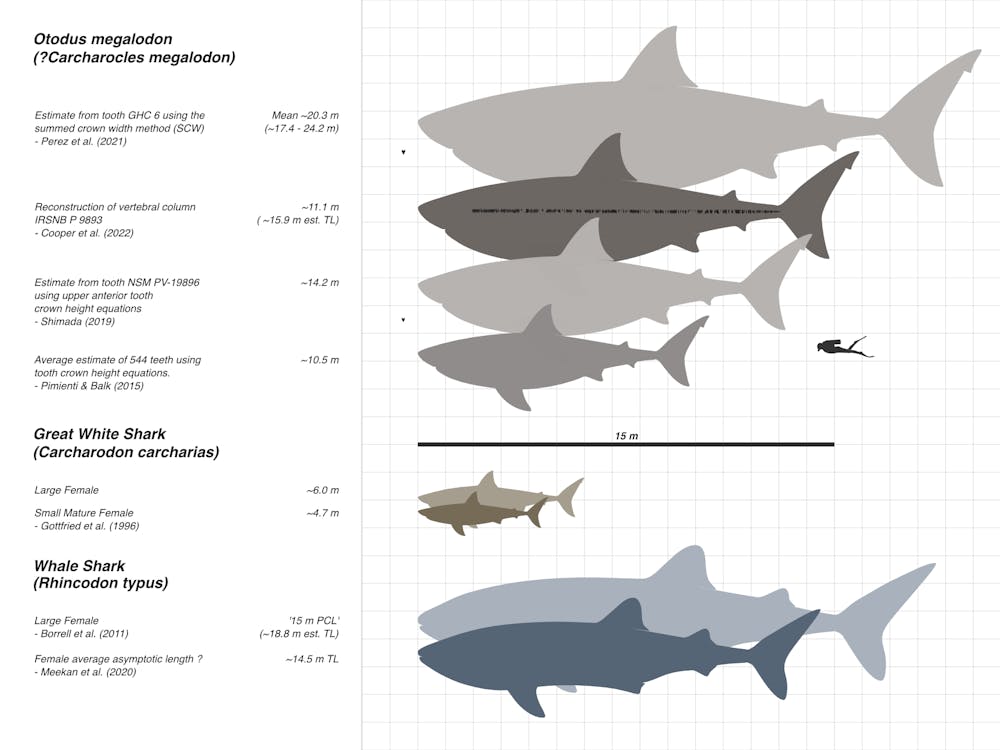
    The average size of a mature great white (Carcharodon carcharias, also known as the white shark) is between 4.6 and 4.9 metres for female sharks and up to 4 metres for male sharks.

    The largest recorded living specimens peak at about 6 metres, with one monster specimen caught in Cuba in 1945 reaching 6.4 metres.

    Earth’s oceans have seen bigger predatory sharks in the past. The biggest one of all time was the megalodon (Otodus megalodon) which lived from 23 to 3 million years ago, and may have been up to 24 metres in length. However, it looked nothing like the modern white shark.

    We don’t know precisely how big the megalodon was, but certainly larger than the great white shark.
    Steveoc 86/Wikimedia Commons, CC BY-SA

    They’re not even directly related – another thing scientists learned quite recently.

    Who was the megalodon, then?

    White sharks first evolved between 6 and 4 million years ago in the shadows of the megalodon. A recent study showed the megalodon’s large serrated teeth show signs of it being a supreme opportunistic super-predator.

    That means it ate just about anything, but especially liked whales and marine mammals.


    Read more:
    Friday essay: Giant shark megalodon was the most powerful superpredator ever. Why did it go extinct?


    But white sharks are not directly related to the megalodon, whose lineage began with a shark called Cretalamna during the age of dinosaurs about 100 million years ago.

    By contrast, the white shark lineage began with an ancient mako shark, Carcharodon hastalis. It was 7 to 8 metres long and had large, similarly shaped teeth to the modern white shark but lacking serrated edges.

    A fossil intermediate species, Carcharodon hubbelli shows the transition over time from weakly serrated to strongly serrated teeth.

    White shark fossil species. Left, the serrated fossil tooth teeth of the extant white shark; right, a similarly shaped unserrated tooth of the extinct giant mako shark which gave rise to white sharks.
    John Long, CC BY

    How did Jaws affect white shark populations?

    Last year, the International Shark Attack File reported 47 unprovoked shark bites to humans worldwide, resulting in seven fatalities. This was well below the previous ten-year average of 70 bites per year; your chances of getting bitten by a shark are extremely rare.

    Following the movies that made up the Jaws franchise, there was an increase in hunting and killing sharks – with a particular focus on great white sharks that were already going into a decline due to overfishing, trophy hunting and lethal control programs.

    Between 80% and 90% of white sharks have disappeared globally since the middle of the 20th century. Recent estimates calculate there are probably less than 500 individual white sharks in Australian waters right now.

    When Jaws first aired, scientists didn’t know how long sharks took to reproduce, or how many offspring a white shark could have each year. We now know it takes about 26 years for a male and 33 years for a female to sexually mature before they can start having pups.

    Data about white shark births is sparse, but recently a 5.6-metre-long female caught on a drum line off the coast of Queensland had just four large pups inside her. This is a very small number. Some large sharks, such as the whale shark, can give birth to up to 300 young.

    Now that we know just how slow they are to breed, it’s clear it will take many decades to reestablish the “pre-Jaws” population of white sharks – important apex predators in the marine ecosystem.

    Charlie Huveneers from Flinders University about to take a tissue sample for research on white sharks. There is still a lot we don’t know about their biology.
    Andrew Fox, Adelaide, CC BY

    Will white sharks survive?

    White sharks are currently listed as vulnerable.

    This classification means if we don’t change the current living conditions for white sharks, including impacts caused by human activities such as commercial fishing, and the impacts of climate change and ocean pollution, they will continue to decline and eventually could go extinct.

    Currently, white sharks are protected in several countries and form the basis for an important tourist industry in Australia, South Africa, western United States and most recently Nova Scotia, Canada.

    These sharks are iconic apex predators that fascinate people. One of us (John) went cage diving with them recently off the Neptune Islands of South Australia and can attest to how breathtaking it is to watch them in their natural environment.

    In terms of economic impact, they are worth far more alive than dead.

    White sharks are a growing tourism draw in several countries.
    Andrew Fox, Adelaide, CC BY

    There’s still much we don’t know about white sharks

    The complete white shark genome was first published only in 2019. It has 4.63 billion base pairs, making it much larger than the human genome (3.2 billion base pairs).

    The genome revealed some surprising things, like how white sharks show strong molecular adaptations for wound-healing processes, and a suite of “genome stability” genes – those used in DNA repair or DNA damage response.

    The transcriptome (or sum total of the messenger RNA) of the white shark showed greater similarity to the human transcriptome than to that of other fishes. This hints that “unexpressed genes” in the shark could one day play a role in uncovering genetic pathways for potential cures in human diseases.

    Jaws and its sequels certainly brought white sharks to the attention (and nightmares) of humans, with devastating impacts on how we treated them as a species.

    Our relationship with white sharks reflects our relationship with nature more broadly – a feared antagonist within the current capitalist paradigm; an enemy to be tamed, contained or consumed.

    As we learn more of the peril and potential of these remarkable creatures, we can learn how to live with them, to see beyond our fears and value their role within our delicate ocean ecosystems.

    John Long receives funding from The Australian Research Council.

    Heather L. Robinson does not work for, consult, own shares in or receive funding from any company or organisation that would benefit from this article, and has disclosed no relevant affiliations beyond their academic appointment.

    ref. Jaws at 50: how a single movie changed our perception of white sharks forever – https://theconversation.com/jaws-at-50-how-a-single-movie-changed-our-perception-of-white-sharks-forever-258306

    MIL OSI Analysis

  • MIL-OSI Analysis: Is Sabrina Carpenter’s Man’s Best Friend album cover satire or self-degradation? A psychology expert explores our reactions

    Source: The Conversation – Global Perspectives – By Katrina Muller-Townsend, Lecturer in Psychology, Edith Cowan University

    Island Records

    Sabrina Carpenter’s Man’s Best Friend album cover has fans divided.

    Carpenter poses on all fours, her glossy blond hair grasped by a male figure cropped from the frame. Her wide-eyed expression intensifies an ambiguous performance of subservience, tapping into a visual language tied to female objectification, from classic pin-up imagery to contemporary pop culture.

    The emotionally loaded image plays on her hyper-feminine, tongue-in-cheek pop star persona, forcing us to question where irony ends and objectification begins.

    Is it satire, or self-degradation?

    Up for debate

    At first glance, the cover seems like just another stylised, provocative pop image. It delivers what we’ve come to expect: a bold, ironic twist on the exaggerated Juno-style pose she reinvents on stage.

    To some fans, it’s clever satire: a pop star reclaiming and amplifying her image to mock industry norms. Satire uses exaggeration, irony, or humour to critique power structures – and Carpenter’s pose walks that tightrope.

    To others it crosses a line, reinforcing regressive attitudes about women’s sexuality and drawing criticism from domestic violence advocates.

    The debate reflects our unresolved discomfort about gender, power and control. There is a tension between Carpenter’s ironic persona and the submissive pose, creating uncertainty for the viewer.

    We can use psychology to better understand this dichotomy.

    The schema violation

    This mismatch between expectation and perception is a schema violation.

    A schema is a mental shortcut: a template built from experience and unspoken rules that helps us make sense of the world and predict what to expect. When something breaks that pattern, it’s called a schema violation.

    Carpenter’s brand is cheeky, self-aware irony – so when she adopts a pose steeped in submission and hyper-femininity as in this album image, it feels off.

    That can trigger cognitive dissonance: the mental tension we feel when two ideas (here, empowerment and obedience) don’t align.

    To resolve the conflict, some fans reinterpret the image as feminist sarcasm. Others reject it, fearing it panders to outdated, dangerous norms.

    Both reactions reflect our emotional and ideological investments in who Carpenter is or should be.

    Exploring confirmation bias

    Part of this conflicted reaction is driven by confirmation bias: our tendency to filter information to support what we already believe.

    Fans who see Carpenter as witty and empowered interpret the image as intentionally ironic. Others – more sceptical of the industry’s history of exploiting female sexuality – view it as a throwback to damaging norms.

    Either way, our interpretations often reflect more about ourselves than about Carpenter’s intent.

    When her image contradicts both her public persona and our social values, it creates a gap between what we think is right and what we want to be right. So, we try to explain it away, by either defending the image or criticising it.

    Satire and scandal

    Carpenter’s cover follows a long tradition of female artists whose work straddles satire and scandal, complicating public reception.

    Madonna’s Like a Prayer drew outrage for mixing religion with sexual imagery. Yet it positioned her as a provocateur – a woman resisting the lack of agency that so often defines sexualised media.

    Miley Cyrus’ Bangerz era shocked fans with a bold shift from Hannah Montana innocence to hypersexualised rebellion, challenging the narrow roles women in pop culture are confined to.

    Doja Cat’s shift from glam pop princess to glitch villainess unsettled audiences. Was it satire, rebellion, or just chaos?

    These women, like Carpenter, force us to confront our own discomfort with women who won’t stay in one lane.

    Performer and provocateur

    Audience reaction is also shaped by emotional investment in Carpenter’s persona. Through carefully curated social media, interviews and lyrics, fans build intimate narratives forming parasocial relationships – one-sided emotional bonds with celebrities.

    When an image contradicts that imagined persona, it can feel jarring, even like betrayal.

    Audiences often expect idols to be empowering but not polarising, sexy but safe, to challenge norms – but only in ways that affirm our own values.

    Carpenter’s image breaks that implicit contract, which creates discomfort for some viewers.

    Carpenter’s cover raises uncomfortable but necessary questions about how much freedom female artists have to be both critical and complicit. Can they play with society and play along, to be both performer and provocateur?

    This highlights the double bind many women face in media and popular culture. Female artists are expected to both subvert and satisfy; to entertain without offending; empower without alienating. The burden to be palatable and provocative is one male artists rarely face.

    It’s what we make of it

    Is Carpenter undermining herself or subverting the system? Perhaps both. Or perhaps the image isn’t the message: our reaction is.

    The image forces us to confront not only our perception of Sabrina Carpenter but also our cultural discomfort with women who defy neat categorisation. Satire demands interpretation, especially when it comes from women addressing sex or power.

    More than provocation, Carpenter’s cover mirrors our cultural struggle to accept women who defy simple labels of satire or submission. The image can reflect broader social ideals and tensions projected onto public figures.

    What we see says more about our assumptions than her intent. Understanding those reactions doesn’t kill the fun – it deepens it.

    Katrina Muller-Townsend does not work for, consult, own shares in or receive funding from any company or organisation that would benefit from this article, and has disclosed no relevant affiliations beyond their academic appointment.

    ref. Is Sabrina Carpenter’s Man’s Best Friend album cover satire or self-degradation? A psychology expert explores our reactions – https://theconversation.com/is-sabrina-carpenters-mans-best-friend-album-cover-satire-or-self-degradation-a-psychology-expert-explores-our-reactions-259043

    MIL OSI Analysis

  • MIL-OSI USA: Senator Markey Commemorates Juneteenth, Recommits to Fighting for Liberty and Justice for All

    US Senate News:

    Source: United States Senator for Massachusetts Ed Markey
    Senator Markey is an author of Juneteenth National Independence Act signed into law in June 2021
    Watch: Senator Markey in conversation with “Boston Ben” Haith, organizer, activist, and designer of the Juneteenth flag
    Boston (June 18, 2025) – Senator Edward J. Markey (D-Mass.), Senate author of the Juneteenth National Independence Day Act of 2021, released the following statement today in anticipation of Juneteenth and in celebration of the fourth anniversary of Juneteenth’s commemoration as a federal holiday.
    “This Juneteenth, families, neighbors, and communities will come together to celebrate, remember, and reflect on the day when word of emancipation finally reached enslaved people in the Deep South in 1865. But Juneteenth isn’t only about what happened 160 years ago—it’s about everything that happened after, and what we are still fighting for today: civil rights, equity, and inclusion. On Juneteenth, we are reminded that freedom didn’t come all at once, and it still must be claimed, defended, and expanded.
    “With Trump and Republicans trying to eradicate diversity programming and cut funding to institutions and schools for recognizing our diverse history, we must stand together to say that people and history will not be erased. We must make sure our systems—our schools, our courts, our hospitals—treat Black Americans with dignity and fairness. This President has no regard or respect for the Constitution, the rule of law, or our most sacred values as a nation. He is testing our democracy day in and day out. And in the face of this test, we must recommit ourselves to the fight for justice, liberty, and freedom for all.
    “This movement for faith and freedom will not be stopped. Juneteenth is about progress and truth and never giving up on the idea that our country can be better. I am proud to commemorate Juneteenth, and I will continue to fight for liberty and justice for every community.”
    Last Friday, Senator Markey met with “Boston Ben” Haith, a long-time organizer, activist, and designer of the Juneteenth flag, to discuss the enduring legacy of Juneteenth. Senator Markey and Mr. Haith met at Roxbury State Heritage Park, the same park where the official Juneteenth flag raising occurred in June of 2000. For a video of their discussion, click here.

    MIL OSI USA News

  • MIL-OSI New Zealand: Health and Employment – Theatre nurses in Whangārei to strike – NZNO

    Source: New Zealand Nurses Organisation

    Te Whatu Ora theatre nurses and health care assistants at Whangārei Hospital who are NZNO members will strike next Tuesday over concerns about chronic and ongoing staff shortages.
    The New Zealand Nurses Organisation Tōpūtanga Tapuhi Kaitiaki o Aotearoa (NZNO) perioperative nurses and health care assistants – from the surgical admission unit, theatre and post anaesthetic units – will undertake three rolling four-hour strikes beginning at 7am and ending at 7pm on Tuesday 24 June.
    NZNO delegate and perioperative nurse Steph Moule says the nurses and health care assistants are standing up for their patients.
    “This stand is part of the current collective agreement bargaining between NZNO and Te Whatu Ora. Our patients deserve safe staffing levels. Not burnt out nurses and health care assistants who don’t have time to give them the care they need.
    “Our patients deserve better. Our members will not accept patient safety being threatened by unrealistic budget cuts.”
    Steph Moule says overworked nurses and health care assistants are also facing an effective pay cut.
    “The latest offer made by Te Whatu Ora offered a 1% wage increase this year backdated and a further 1% next April. That doesn’t keep up with the cost of living and will see nurses and health care workers and their whānau going backwards financially,” she says.

    MIL OSI New Zealand News

  • MIL-OSI China: Al-Hilal earn credibility with spirited draw against Real Madrid

    Source: People’s Republic of China – State Council News

    Federico Valverde of Real Madrid takes a penalty kick during the group H match between Real Madrid C. F. of Spain and Al Hilal of Saudi Arabia at the FIFA Club World Cup 2025 at the Hard Rock Stadium, Miami, the United States, June 18, 2025. (Xinhua/Li Ming)

    1   2   3   4   >  

    MIL OSI China News

  • PM Modi, Croatian President Milanović hold talks to boost ties in trade, culture, defence

    Source: Government of India

    Source: Government of India (4)

    Prime Minister Narendra Modi met Croatian President Zoran Milanović in Zagreb on Wednesday and held wide-ranging discussions aimed at deepening India-Croatia relations. The talks focused on enhancing cooperation in commerce, culture, defence, and innovation.

    “Met Zoran Milanović, the President of Croatia. Had extensive discussions on the full range of India-Croatia friendship, including ways to boost linkages of commerce and culture,” PM Modi said in a post on X.

    According to the Ministry of External Affairs (MEA), the two leaders reiterated their commitment to strengthening the close and friendly ties between the two countries, based on shared democratic values, the rule of law, and a common vision for global peace and stability.

    Both sides expressed satisfaction with the growing diversification of bilateral cooperation, particularly in emerging areas such as defence, start-ups, sports, and innovation. PM Modi also thanked President Milanović for Croatia’s steadfast support to India in its fight against terrorism.

    The leaders acknowledged the deep-rooted cultural connections between India and Croatia, tracing back centuries.

    They also exchanged views on regional and global developments and noted that the growing India-EU strategic partnership could further enhance India-Croatia relations.

    “The two leaders agreed to work together to unlock the full potential of India-Croatia ties,” the MEA said.

  • MIL-OSI New Zealand: Local News – Aotea Lagoon southern area re-opens – Porirua

    Source: Porirua City Council

    After eight months of work, the south end of Aotea Lagoon in Porirua is open for the public to enjoy.
    The project to make this popular place in Porirua safer, more inviting and modern was officially opened on Thursday (19 June) and the upgrade includes:
    – New toilets
    – A wider and more open entrance
    – Updated lighting
    – A new lawn and events space, with a Rotary boardwalk and native wetland planting (about 2000 plants have been put in)
    – A pathway out to the Aotea Lions train (there used to be just one way in and out), with the train station area repaired and painted
    – Increased shade with three large trees planted, and shade over the seated area too
    – A more prominent spot for the Guy Ngan sculpture
    – An additional disabled car park in the southern car park
    The work, carried out by John Fillmore Contracting, has made this part of Aotea Lagoon accessible and safer, Porirua Mayor Anita Baker says.
    “There is better visibility, more than one exit, and it’s a lovely, open space that Porirua residents and the many visitors that come, will enjoy,” she says.
    Julian Emeny, Manager Parks, says working with Rotary – who built the original rose garden 40 years ago – for a positive outcome has made the project special.
    “What we have now, for an area of Aotea Lagoon that was starting to show its age, is a place where we can hold different events, like concerts and school performances, and somewhere the public can book,” he says.

    MIL OSI New Zealand News

  • MIL-OSI Australia: Warning issued after ACCC phone numbers spoofed by scammers

    Source: Australian Ministers for Regional Development

    The National Anti-Scam Centre is warning Australians to remain vigilant following reports scammers have been impersonating phone numbers belonging to the ACCC in an attempt to steal personal information.

    The ACCC and the National Anti-Scam Centre, which operates under the ACCC, have become aware of scammers using publicly available ACCC phone numbers, which are listed on the agency’s official website.

    In some reported cases, the scammers claimed to be representatives of the ACCC and requested sensitive information over the phone. In others, they misused the ACCC acronym to impersonate an unrelated organisation and spoke in a language other than English.

    The National Anti-Scam Centre warns that the ACCC phone numbers have been ‘spoofed’. The ACCC does not make calls from its reception numbers.

    “Spoofing is when scammers disguise their phone number to make it look like they’re calling from a trusted organisation — including government agencies like the ACCC — to deceive people into answering and sharing personal information,” ACCC Deputy Chair Catriona Lowe said.

    “This is a tactic that helps scammers hide their true identity while posing as trusted institutions – it’s designed to lower your guard. If a call or message feels off, trust your instincts and hang up. It’s safer to end the call and check in directly with us.”

    The ACCC and the National Anti-Scam Centre will never ‘cold’ call or email consumers and ask for your personal information such as your passwords, bank details or answers to security questions. The ACCC does not charge money for its services and would never threaten or pressure you to stay on the line.

    If you receive a call claiming to be from the ACCC where personal information such as passwords or bank details are requested, do not provide this information and hang up.

    “We encourage all Australians to report scams — every report helps us track patterns and protect others,” Ms Lowe said.

    The National Anti-Scam Centre also reminds the community to be extremely wary of urgent requests asking people to act immediately, and to never provide personal information if unsure. Do not click on any links or download attachments from messages unless you are sure it is someone you can trust.

    How to spot and avoid scams

    STOP – Don’t give money or personal information to anyone if you’re unsure. Scammers will create a sense of urgency. Don’t rush to act. Say ‘no’, hang up, delete.

    CHECK – Ask yourself could the call or text be fake? Scammers pretend to be from organisations you know and trust. Contact the organisation using information you source independently, so that you can verify if the call is real or not.

    PROTECT – Act quickly if something feels wrong. Contact your bank immediately if you lose money. If you have provided personal information call IDCARE on 1800 595 160. The more we talk the less power they have. Report scams to the National Anti-Scam Centre’s Scamwatch service at scamwatch.gov.au when you see them. If you’re contacted on a messaging platform like WhatsApp or iMessage, please also report the scam in the app.

    MIL OSI News

  • Operation Sindhu: Flight carrying 110 Indian citizens evacuated from Iran arrives in Delhi

    Source: Government of India

    Source: Government of India (4)

    The first flight carrying 110 Indian citizens, including 90 students from Jammu and Kashmir, arrived in New Delhi on Thursday after being successfully evacuated from Iran amid the escalating military conflict in the Middle East.

    All the evacuees were flown to the capital aboard IndiGo flight 6E 9487.

    Union Minister of State for External Affairs, Kirti Vardhan Singh, welcomed the evacuated students at the Indira Gandhi International Airport.

    The evacuation was part of Operation Sindhu, a mission launched by the Indian government to ensure the safety of its citizens in Iran.

    The Ministry of External Affairs (MEA) said on Wednesday evening that Indian students residing in Tehran had been safely moved out of the city through arrangements coordinated by the Indian Embassy.

    “Indian students in Tehran have been moved out of the city for safety reasons through arrangements made by the Indian Embassy,” the Ministry stated in an official release.

    The students departed from Zvartnots International Airport in Yerevan, Armenia, on a special flight at 14:55 IST on June 18, with their arrival in New Delhi expected in the early hours of June 19.

    MEA spokesperson Randhir Jaiswal announced the launch of the operation on X, saying, “Operation Sindhu begins. India launched Operation Sindhu to evacuate Indian nationals from Iran. India evacuated 110 students from northern Iran who crossed into Armenia under the supervision of our Missions in Iran and Armenia on June 17.”

    This is one of several steps taken by the Indian government over the past few days to ensure the safety and security of Indian nationals stranded in Iran, following appeals for assistance due to the worsening situation in the Middle East.

    The Indian government also expressed gratitude to the governments of Iran and Armenia for their cooperation in facilitating the evacuation process.

    “India accords the highest priority to the safety and security of Indian nationals abroad,” the MEA said in a statement. “As part of the ongoing operation, the Indian Embassy in Iran has been assisting large numbers of Indian nationals in relocating from areas witnessing increased hostilities to relatively safer regions within the country, and subsequently evacuating them through available and feasible options.”

    — IANS

  • MIL-OSI Russia: Cargo transportation route from China’s Zhejiang Province to Azerbaijan via Turkmenistan opens

    Translation. Region: Russian Federal

    Source: People’s Republic of China in Russian – People’s Republic of China in Russian –

    Source: People’s Republic of China – State Council News

    BEIJING, June 19 (Xinhua) — The first freight train departed from Jinhua City in east China’s Zhejiang Province on Wednesday for the port of Turkmenbashi, Turkmenistan, marking the official opening of the trans-Caspian international transport corridor from the economically developed Chinese province.

    The train loaded with 100 standard containers of clothing, accessories, metal parts and other goods will arrive at the port of Turkmenbashi. The containers with cargo will then be transported from the port by water across the Caspian Sea to the Azerbaijani port of Baku.

    The train will cross the Chinese-Kazakh border through the Khorgos checkpoint, and then pass through major cities such as Almaty, Tashkent and Ashgabat, the China News Service reported, citing a source from the railway logistics service in Jinhua.

    The new transport route is expected to reduce the load on the logistics line from the port of Aktau /Kazakhstan/ to Baku and speed up the delivery of Chinese goods to the markets of Central Asia and Central and Eastern Europe, the service said.

    As it became known, this is already the 26th logistics route opened by Zhejiang Province within the framework of international railway freight transportation China-Europe. -0-

    MIL OSI Russia News

  • MIL-OSI Russia: Trade turnover between China’s Hebei Province and Central Asian countries increased by 110 percent in January-May 2025.

    Translation. Region: Russian Federal

    Source: People’s Republic of China in Russian – People’s Republic of China in Russian –

    Source: People’s Republic of China – State Council News

    BEIJING, June 19 (Xinhua) — Trade volume between northern China’s Hebei Province and five Central Asian countries increased 2.1 times year-on-year to a record 3.03 billion yuan in the first five months of this year, the Zhongxinshe News Agency reported, citing local customs data.

    In particular, the province’s exports increased by 100 percent to 2.5 billion yuan, while its imports of foreign goods amounted to 530 million yuan, up 160 percent.

    During the reporting period, the province’s trade turnover with Kazakhstan reached 1.53 billion yuan, up 130 percent, with Uzbekistan – 860 million yuan, up 81.4 percent, with Kyrgyzstan – 400 million yuan, up 87.4 percent, with Tajikistan – 120 million yuan, up 230 percent, and with Turkmenistan – 120 million yuan, up 120 percent.

    The list of popular goods from Central Asia included sun oil from Kazakhstan and raw cowhide from Kyrgyzstan. The volume of their supplies to Hebei Province amounted to 160 million and 38 million yuan, with an increase of 72.6 percent and 54.4 percent, respectively.

    From January to May this year, the province’s automobile exports to Central Asian countries totaled 580 million yuan, up 2.4 times from the same period last year. -0-

    MIL OSI Russia News

  • MIL-OSI Russia: Uzbekistan prioritizes development and strengthening of relations with China — expert

    Translation. Region: Russian Federal

    Source: People’s Republic of China in Russian – People’s Republic of China in Russian –

    Source: People’s Republic of China – State Council News

    Tashkent, June 19 /Xinhua/ — The China-Central Asia mechanism is a strategic platform aimed at strengthening Chinese-Central Asian cooperation. Uzbekistan attaches priority importance to developing relations with China. Afzal Artikov, chief researcher at the Center for Economic Research and Reforms under the Presidential Administration of the Republic of Uzbekistan, said this in an exclusive interview with Xinhua recently.

    According to him, since its establishment, the China-Central Asia Dialogue Format has become an important tool for strengthening multi-vector cooperation, developing political, economic and cultural ties between Central Asia and China, and also serves as a platform for dialogue on key issues, including economic development, security and cultural exchange.

    Afzal Artikov noted that in Uzbekistan, taking into account the priorities of the country’s foreign policy and efforts aimed at ensuring socio-economic development, interaction within the framework of the China-Central Asia format is considered an important tool for attracting investment, expanding export opportunities, developing infrastructure and increasing regional connectivity.

    Particular importance is attached to areas of cooperation that directly contribute to the implementation of national strategies in the field of industrial modernization, digitalization, food and energy security, he said, adding that in this context, Uzbekistan is actively promoting initiatives to develop transport and logistics corridors, participate in Green Belt projects, joint scientific and educational programs, as well as deepen humanitarian and cultural exchange.

    Uzbekistan attaches priority importance to the development and strengthening of relations with China, which is one of the key strategic partners for all Central Asian countries. Such cooperation is considered not only as an important element of foreign policy, but also as an effective mechanism for supporting sustainable economic growth in the region, the expert concluded. –0–

    MIL OSI Russia News

  • MIL-OSI New Zealand: Kiwis’ Lotto generosity turns into 161 completed cyclone recovery projects – Northland

    Source: New Zealand Government

    Minister of Internal Affairs Brooke van Velden says that communities in Northland are benefitting from $3.59 million in grants from funds raised through a special Lotto draw for Cyclone Gabrielle relief, two years later. 
     

    “Cyclone Gabrielle had a devasting impact on Northland, causing widespread destruction to property and requiring significant relief efforts. Now one year after grant applications closed, more than 161 community organisations have received funding to rebuild thanks to the generosity of Kiwis who bought tickets to the special Lotto draw for Cyclone Gabrielle relief,” says Ms van Velden. 
     

    Funds raised from the special Lotto draw were passed on to the Cyclone Gabrielle Appeal Trust, which accepted grant applications until May 2024 and distributed all funds by October 2024. Grants were given to community organisations in regions where a state of emergency was declared for Cyclone Gabrielle, which were Northland, Auckland, Waikato, Bay of Plenty, East Coast, Hawke’s Bay, and Tararua.  
     

    “As well as repairing and replacing community facilities that were damaged by the cyclone, the proceeds of the lottery draw went towards upgrading local emergency services organisations so they can be better prepared for any future severe weather events”. 
     

    Northland projects that received funding include: 

    $6,000 to Surf Life Saving Baylys Beach Incorporated to purchase a generator to supply power for future adverse weather events 

    $20,000 to the Waimamaku Community Civil Defence Group for equipment and supplies to set up the community hall as an emergency assembly point  

    $19,800 to Oakura Beach Reserve Board in Ōakura for a shipping container to store seven generators to be used in emergencies 

    “Raising funds for important community projects is at the heart of what Lotto does. I’m pleased that the funds raised from this special Lotto draw went towards better preparing impacted communities for future events.” 
     

    The special draw was a part of the overall cyclone recovery effort and complemented the work that government, charities, mayoral relief funds, corporate partners and local fundraisers did in raising money to help with the response and recovery in the aftermath of Cyclone Gabrielle. 
     

    The Cyclone Gabrielle Appeal Trust was established by the Crown as an independent entity to distribute funds raised in the Cyclone Gabrielle Appeal. The Trust allocated $14,511,916 in total across the regions affected to help recovery efforts, of which $11,770,000 came from the live Lotto NZ draw on 18 March 2023. 

    MIL OSI New Zealand News

  • MIL-OSI New Zealand: Kiwis’ Lotto generosity turns into 178 completed cyclone recovery projects – Hawke’s Bay

    Source: New Zealand Government

    Minister of Internal Affairs Brooke van Velden says that communities in Hawke’s Bay are benefitting from $4.77 million in grants from funds raised through a special Lotto draw for Cyclone Gabrielle relief. 

    “Cyclone Gabrielle had a devasting impact on Hawke’s Bay, causing widespread destruction to property and requiring significant relief efforts. Now, one year after grant applications closed, 178 community organisations have received funding to rebuild thanks to the generosity of Kiwis who bought tickets to the special Lotto draw for Cyclone Gabrielle relief,” says Ms van Velden. 

    Funds raised from the special Lotto draw were passed on to the Cyclone Gabrielle Appeal Trust, which accepted grant applications until May 2024 and distributed all funds by October 2024. Grants were given to community organisations in regions where a state of emergency was declared for Cyclone Gabrielle, which were Northland, Auckland, Waikato, Bay of Plenty, East Coast, Hawke’s Bay, and Tararua.  

    “As well as repairing and replacing community facilities that were damaged by the cyclone, the proceeds of the lottery draw went towards upgrading local emergency services organisations so they can be better prepared for any future severe weather events”. 

    Hawke’s Bay projects that received funding include: 

    • $30,000 to Radio Kidnappers Charitable Trust to upgrade its AM transmission and expand emergency radio coverage across Hawke’s Bay 
    • $9,300 to the Ashley Clinton Fire Brigade (Fire and Emergency New Zealand) to purchase and install a generator and starlink 
    • $30,000 to Eskview and Districts Rugby Football Club to build an outside shelter facility for use as a hub in civil defence emergencies  
    • $20,000 to Waipuka Civil Defence to upgrade the emergency stations and communication hub, and expand shelter space 

    “Raising funds for important community projects is at the heart of what Lotto does. I’m pleased that the funds raised from this special Lotto draw went towards better preparing impacted communities for future events.” 

    The special draw was a part of the overall cyclone recovery effort and complemented the work that government, charities, mayoral relief funds, corporate partners and local fundraisers did in raising money to help with the response and recovery in the aftermath of Cyclone Gabrielle. 

    The Cyclone Gabrielle Appeal Trust was established by the Crown as an independent entity to distribute funds raised in the Cyclone Gabrielle Appeal. The Trust allocated $14,511,916 in total across the regions affected to help recovery efforts, of which $11,770,000 came from the live Lotto NZ draw on 18 March 2023. 

    MIL OSI New Zealand News

  • MIL-OSI New Zealand: $414,527 worth of lottery-funded cyclone recovery projects now complete in Waikato

    Source: New Zealand Government

    Minister of Internal Affairs Brooke van Velden says that communities in the Waikato are benefitting from over $414,000 in grants from funds raised through a special Lotto draw for Cyclone Gabrielle relief. 
     

    “Cyclone Gabrielle had a significant impact on parts of the Waikato, causing destruction to property, blocked roads, and requiring coordinated relief efforts Now, one year after grant applications closed, 18 community organisations have received funding to rebuild thanks to the generosity of Kiwis who bought tickets to the special Lotto draw for Cyclone Gabrielle relief,” says Ms van Velden. 
     

    Funds raised from the special Lotto draw were passed on to the Cyclone Gabrielle Appeal Trust, which accepted grant applications until May 2024 and distributed all funds by October 2024. Grants were given to community organisations in regions where a state of emergency was declared for Cyclone Gabrielle, which were Northland, Auckland, Waikato, Bay of Plenty, East Coast, Hawke’s Bay, and Tararua.  
     

    “As well as repairing and replacing community facilities that were damaged by the cyclone, the proceeds of the lottery draw went towards upgrading local emergency services organisations so they can be better prepared for any future severe weather events”. 
     

    Waikato projects that received funding include: 
     

    $29,500 to the Sunset Beach Surf Lifesaving Trust in Port Waikato for a new power generator to provide power supply to the community civil defence hub 

    $30,000 to the Oparau Hall Society Incorporated for repairs to the hall and equipment 

    $29,875 to the Port Project to restore and improve community walkways damaged by the cyclone 

    Sunset Beach Surf Lifesaving Trust had its first use of the generator in May 2025 when the Port had a major power outage.   Malcolm Beattie, president of the Sunset Beach Lifesaving Trust, says “it kicked in and the community had access to the Community Hub for full power immediately. Having this service immediately available for our community free of any charges was amazing.” 

     The special draw was a part of the overall cyclone recovery effort and complemented the work that government, charities, mayoral relief funds, corporate partners and local fundraisers did in raising money to help with the response and recovery in the aftermath of Cyclone Gabrielle. 

    “Raising funds for important community projects is at the heart of what Lotto does. I’m pleased that the funds raised from this special Lotto draw went towards better preparing impacted communities for future events.” says Ms van Velden. 
     

    The Cyclone Gabrielle Appeal Trust was established by the Crown as an independent entity to distribute funds raised in the Cyclone Gabrielle Appeal. The Trust allocated $14,511,916 in total across the regions affected to help recovery efforts, of which $11,770,000 came from the live Lotto NZ draw on 18 March 2023. 

    MIL OSI New Zealand News

  • MIL-OSI New Zealand: Man arrested after incident in Tahuna last night

    Source: New Zealand Police

    Attributable to Detective Sergeant Ben Norman.

    Waikato Police have arrested and charged a 22-year-old following a serious, violent incident in Tahuna.

    At around 7.20pm, Police were alerted to a group of people fighting on Tahuna-Ohinewai Road after a person who confronted three men in a vehicle doing burnouts was assaulted and other members of the public attempted to intervene.

    After noticing the incident unfolding, an occupant of a nearby property has attempted to intervene. However, they were also assaulted by the alleged offenders.

    Six people received injuries in total in relation to the incident. Two people received serious injuries, and one other received minor injuries, they were transported to hospital. Three others received minor injuries.

    The offenders have then taken two vehicles from the Tahuna-Ohinewai address and moved them onto the street.

    Upon Police arrival, the offenders have fled the scene, two fled on foot, while another left in a vehicle taken from the address.

    A short time later, one of the offenders was located nearby and was taken into custody by Police.

    An investigation into the serious assault and aggravated robbery has commenced, with Police working to establish what exactly has occurred.

    Police are following multiple lines of enquiry to identify and locate the remaining two offenders and encourage them to do the right thing and hand themselves in.

    As our enquiries are ongoing, members of the community may see an increased Police presence in the area.

    While Police would like to thank those who tried to intervene and assist other members of the public, Police urge the public not to take matters into their own hands or confront individuals themselves as situations can escalate quickly.

    Instead, stay in a safe location, gather as much information as you safely can, and contact Police on 111.

    A 22-year-old man is due to appear in Hamilton District Court today, charged with aggravated robbery and injures with intent to injure.

    If you have any information that may assist in Police’s investigation, please contact Police online at 105.police.govt.nz, clicking “Update Report” or by calling 105.

    Please use the reference number 250619/2309.

    You can also provide information through Crime Stoppers on 0800 555 111.

    ENDS

    Issued by Police Media Centre

    MIL OSI New Zealand News

  • MIL-OSI Australia: City to welcome new Director Corporate Performance

    Source: New South Wales Ministerial News

    The City of Greater Bendigo is pleased to announce Angela Hays as its new Director Corporate Performance.

    Ms Hays joins the City following roles as Head of People & Customer at Melton City Council and Director Corporate Services at Mackay Regional Council.

    Chief Executive Officer Andrew Cooney said Ms Hays’ experience in providing high level strategic direction, financial management, and her sound understanding of Local government processes made her a strong candidate.

    “Angela has built a diverse career in government roles, while leading and supporting capable teams across a diverse set of portfolios,” Mr Cooney said.

    “Angela will be leading the Financial Strategy, IT, People and Culture, Governance & Performance and Customer Engagement & Communication units.

    “Having recently relocated to Bendigo with her family; Angela is excited about contributing to the community she now calls home.  We look forward to Angela joining the team and bringing her leadership, skills, and experience to the organisation.”

    Ms Hays said she was excited by the opportunity to contribute to the continued success of the City.

    “Having previously worked in Local Government, I understand the important leadership role a council has in a community,” she said.

    “The City is a highly regarded Local Government and I am delighted to accept this role and get to know the Corporate Performance staff and broader organisation.”

    Ms Hays will start with the City on Monday July 7, 2025. 

    MIL OSI News

  • MIL-OSI New Zealand: Luxon wraps up successful Shanghai visit

    Source: New Zealand Government

    Prime Minister Christopher Luxon has concluded the successful Shanghai leg of his official visit to China, accompanied by Ministers Louise Upston and Mark Mitchell and a delegation of senior New Zealand business leaders from across the food and beverage, health and wellbeing, education, and tourism sectors.

    “Our bilateral trade relationship with China is one of our most important, with two-way trade exceeding NZ$39 billion in the year ending March 2025. 

    “This relationship accounts for more than 20 per cent of New Zealand’s total goods and services exports,” Mr Luxon says.

    “It’s been great to see $400 million of commercial agreements signed today between New Zealand businesses and their Chinese partners. This is a clear sign of the strength and momentum in our trade relationship.

    “We also announced we would be making it easier for Chinese nationals to transit via New Zealand by removing the need to get a transit visa, instead being able to get a New Zealanders Electronic Travel Authority (NZeTA), significantly cutting costs and time for visitors. 

    “This resulted in one of the major announcements in Shanghai, that China Eastern Airlines was launching twice weekly flights to South America via Auckland.” 

    Mr Luxon participated in a tourism livestream event watched by over 10 million people, to promote New Zealand travel offerings.

    “New Zealand welcomed 248,000 visitors from China in the past year, with holiday arrivals up 31 per cent. We’ve made recent changes to visa settings to make it easier for Chinese visitors to enjoy New Zealand’s natural beauty and warm hospitality,” Mr Luxon says.

    Mr Luxon also visited Fudan University, one of China’s most prestigious academic institutions, to promote New Zealand as a destination for world-class research, study, and partnership.

    “We’re focused on deepening our education links through student connections, institutional partnerships, and joint research that benefits both countries,” Mr Luxon says.

    Mr Luxon also met with Shanghai Party Secretary Chen Jining to discuss Shanghai as a gateway for a high proportion of New Zealand goods, services and people-to-people flows, and other bilateral issues.

    The Prime Minister will now travel to Beijing, where he will meet with China’s leaders.

    MIL OSI New Zealand News

  • MIL-OSI New Zealand: Further arrest made in relation to homicide of Kaea Karauria

    Source: New Zealand Police

    Attribute to Detective Inspector Dave De Lange:

    Police have charged a second person after alleged interference in the murder investigation of 15-year-old Kaea Karauria.

    A 21-year-old Napier woman was taken into custody earlier today, after Police learned while conducting follow-up enquiries, that she had provided instructions to another person to destroy evidence.

    The alleged incident occurred on 11 May, the day of the fight in which Kaea was killed.

    The woman has been charged with wilfully attempting to pervert the course of justice, and will appear in the Napier District Court on 26 June.

    Police will continue to act without hesitation when a witness is threatened, or attempts are made to sabotage an investigation. Any witness tampering will be treated very seriously.

    We would still like to hear from anyone who has information about the incident. Our team continues to work hard on this investigation, as Kaea and his family deserve justice.

    Information can be reported via our 105 service, either over the phone or online, referencing file number 250511/1317.

    We have also set up a phoneline for those wanting to share information about the incident and people can leave a message on 0800 852 525.

    ENDS

    Issued by Police Media Centre

    MIL OSI New Zealand News

  • MIL-OSI New Zealand: Two-vehicle crash on SH60 near Mapua Drive

    Source: New Zealand Police

    Two vehicles have collided on SH 60 near Mapua Drive, Tasman District.

    One occupant has serious injuries and another occupant has minor injuries.

    The road will be closed for some time while emergency services are at the scene.

    Diversions are in place at the intersection of SH60 and Moutere Highway (Pea Vine Corner).

    Traffic will need to use the inland route (not The Coastal Highway) and rejoin SH60 at Gardner Valley Road.

    END

    Issued by Police Media Centre

    MIL OSI New Zealand News

  • MIL-OSI New Zealand: SH2 Pekatahi Bridge takes a traffic holiday

    Source: New Zealand Transport Agency

    The winter school holidays mean it’s time to wear a few more layers to the beach.

    But school’s out also means maintenance is in for the Pekatahi Bridge.

    The bridge, which is located north of Tāneatua on State Highway 2 (SH2) will close for 6 days for essential deck repairs from Monday 30 June.

    This is part of much needed quarterly maintenance of Pekatahi Bridge for NZ Transport Agency Waka Kotahi (NZTA).

    The bridge will close daily from 8:30am to 4:30pm Monday 30 June to Friday 4 July for structural work, included bridge surface plank replacement. It will close again from 8.30am to 4.30pm on Saturday 5 July for sealing work. If the weather is wet on Saturday, the contingency day is Monday 7 July. Sealing requires dry weather, so if Monday is also unsuitable, sealing may have to be undertaken under stop/stop at a later date.

    “The bridge is narrow, and due to nature of the work, full daytime closures are required,” says Sandra King, NZTA’s System Manager for the Bay of Plenty. 

    “We understand this is an important route and the closure is disruptive, but closing the bridge allows contractors to carry out repairs safely.

    “This essential maintenance work has been programmed for the school holidays when traffic volumes are lower, and no school buses will be on the road.

    “Contractors will be using the closure to its full potential by repairing and replacing broken and loose decking planks and carrying out other general maintenance such as checking surfacing screws and resurfacing,” Ms King says.

    A detour will be in place for all traffic; northbound using Tāneatua Road, Arawa Road, Hinemoa Street and onto SH30 towards Awakeri and southbound traffic will use the same route in reverse. This detour is expected to add up to 20 minutes to journey times and is suitable for all vehicles, including High Productivity Motor Vehicles (HPMV). 

    NZTA thanks Whakatāne District Council for allowing the detour route on their local roads and road users for their co-operation.  

    Detour information below:

    View larger/downloadable map [PNG, 342 KB]

    MIL OSI New Zealand News

  • MIL-OSI New Zealand: Medallic recognition for NZDF personnel extended

    Source: New Zealand Government

    The Government has expanded the criteria for medallic recognition for Defence personnel who have served in operations supporting the UN’s sanctions against North Korea, Defence Minister Judith Collins announced today.
    “This medal – the New Zealand General Service Medal (NZGSM) 2002 (Korea) – has already been awarded to 180 personnel and the move to widen eligibility means a further 350 personnel will be recognised,” Ms Collins says.
    “Personnel who have served as part of Operation Whio – which monitors the United Nations Security Council’s sanctions against the Democratic People’s Republic of Korea – since 2018 are now eligible for this medal.
    “Over the past seven years, there have been 19 rotations of Operation Whio – including seven deployments of P-3K2 Orion and P-8A Poseidon aircraft, aircrew and support personnel, and the deployment of HMNZS Aotearoa in 2024.
    The aircraft and ship conducted and supported maritime patrols to detect and deter evasions of United Nations Security Council resolutions imposing sanctions against North Korea. The other rotations were of small numbers of staff officers in headquarters roles.
    “This is another example of how we are contributing to upholding the international rules-based order. 
    “Previously this specific medal, the NZGSM 2002 (Korea), was only awarded to United Nations Command activities relating to preserving the Korean Armistice Agreement,” Ms Collins says.
    “The men and women of our Defence Force rightly deserve this acknowledgement of their service.
    “Our people do what we ask of them, when we ask it, often in trying conditions, and medallic recognition such as this is one way we recognise this.”

    MIL OSI New Zealand News

  • MIL-OSI New Zealand: Kiwis’ Lotto generosity turns into 121 completed cyclone recovery projects – Gisborne

    Source: New Zealand Government

    Minister of Internal Affairs Brooke van Velden says that communities in the Gisborne region are benefitting from $3.55 million in grants from funds raised through a special Lotto draw for Cyclone Gabrielle relief. 
     

    “Cyclone Gabrielle had a devasting impact on the East Coast, causing widespread destruction to property and requiring significant relief efforts. Now, one year after grant applications closed, 121 community organisations have received funding to rebuild thanks to the generosity of Kiwis who bought tickets to the special Lotto draw for Cyclone Gabrielle relief,” says Ms van Velden. 
     

    Funds raised from the special Lotto draw were passed on to the Cyclone Gabrielle Appeal Trust, which accepted grant applications until May 2024 and distributed all funds by October 2024. Grants were given to community organisations in regions where a state of emergency was declared for Cyclone Gabrielle, which were Northland, Auckland, Waikato, Bay of Plenty, East Coast, Hawke’s Bay, and Tararua.  
     

    “As well as repairing and replacing community facilities that were damaged by the cyclone, the proceeds of the lottery draw went towards upgrading local emergency services organisations so they can be better prepared for any future severe weather events”. 

    Gisborne projects that received funding include: 
     

    $49,916 to St John Gisborne Area to protect the ambulance station from flooding 

    $29,839 to the Pehiri Emergency Management Group for communications systems, emergency supplies, and equipment  

    $30,000 to the Ruatoria Volunteer Fire Brigade (Fire and Emergency New Zealand) to purchase and install additional water storage tanks to increase brigade water capacity and resilience for fire emergency response 

    $25,000 to the Tahunga Residents Association Incorporated for amenities and upgrades to the community hall so it can be used as an emergency hub 

    “Raising funds for important community projects is at the heart of what Lotto does. I’m pleased that the funds raised from this special Lotto draw went towards better preparing impacted communities for future events.” 
     

    The special draw was a part of the overall cyclone recovery effort and complemented the work that government, charities, mayoral relief funds, corporate partners and local fundraisers did in raising money to help with the response and recovery in the aftermath of Cyclone Gabrielle. 
     

    The Cyclone Gabrielle Appeal Trust was established by the Crown as an independent entity to distribute funds raised in the Cyclone Gabrielle Appeal. The Trust allocated $14,511,916 in total across the regions affected to help recovery efforts, of which $11,770,000 came from the live Lotto NZ draw on 18 March 2023. 

    MIL OSI New Zealand News

  • MIL-OSI New Zealand: Kiwis’ Lotto generosity turns into 71 completed cyclone recovery projects – Auckland

    Source: New Zealand Government

    Minister of Internal Affairs Brooke van Velden says that communities across Auckland are benefitting from $1.8 million in grants from funds raised through a special Lotto draw for Cyclone Gabrielle relief.  

    “Cyclone Gabreille had a devasting impact on parts of Auckland, causing widespread damage to property and requiring significant relief efforts. Now, two years on, 71 community organisations have received funding to rebuild thanks to the generosity of Kiwis who bought tickets to the special Lotto draw for Cyclone Gabrielle relief,” says Ms van Velden.  

    Funds raised from the special Lotto draw were passed on to the Cyclone Gabrielle Appeal Trust, which were then distributed to the community in regions where a state of emergency was declared for Cyclone Gabrielle, which were Northland, Auckland, Waikato, Bay of Plenty, East Coast, Hawke’s Bay, and Tararua. 

    “As well as repairing and replacing community facilities that were damaged by the cyclone, the proceeds of the lottery draw went towards upgrading local emergency services organisations so they can be better prepared for any future severe weather events.” 

    Auckland projects that received funding include:  

    $20,000 to the Titirangi Volunteer Coastguard Incorporated to replace equipment damaged in the cyclone 

    $21,921 to Karekare Surf Life Saving Club for essential search and rescue equipment to support lifeguard operations during extreme weather events 

    $30,000 to South Kaipara Good Food for water tanks, generators, irrigation systems and other equipment to support food resilience   

    $24,733 to Bethells Beach Emergency Resilience Group for equipment and resources for emergency support  

    “Raising funds for important community projects is at the heart of what Lotto does. I’m pleased that the funds raised from this special Lotto draw went towards relief for Aucklanders doing it tough in the aftermath of Cyclone Gabrielle.” 

    The special draw was a part of the overall cyclone recovery effort and complemented the work that government, charities, mayoral relief funds, corporate partners and local fundraisers did in raising money to help with the response and recovery in the aftermath of Cyclone Gabrielle. 

    The Cyclone Gabrielle Appeal Trust was established by the Crown as an independent entity to distribute funds raised in the Cyclone Gabrielle Appeal.  

    The Trust allocated $14,511,916 in total across the regions affected to help recovery efforts, of which $11,770,000 came from the live Lotto NZ draw on 18 March 2023.  

    MIL OSI New Zealand News

  • MIL-OSI New Zealand: Greenpeace submits against the Regulatory Standards Bill and its far-right fringe ideas

    Source: Greenpeace

    Greenpeace Aotearoa has today filed its submission opposing the Regulatory Standards Bill and calling for it to be rejected in full.
    The Greenpeace submission has pulled no punches, stating:
    “Dressed up in the language of freedom and liberty, this Bill promotes a fringe libertarian worldview that individuals and corporations are entitled to harm nature and others, and if restrictions are placed on them, then they should be compensated.”
    “This ideology is fundamentally at odds with our nation’s deeply-rooted values of fairness, care, and collective responsibility.”
    “At its core, this Bill is an attempt by a far-right politician to create a bill of rights for corporations, at the expense of the rights of New Zealanders, the rights of nature, and the rights of Māori guaranteed to them under Te Tiriti o Waitangi.”
    “If enacted, it will, without doubt, erode environmental protection, lead to the extinction of precious native wildlife, and impair the Government’s ability to take action on climate change.”
    The Greenpeace Aotearoa submission goes on to warn that the Bill would open the floodgates for corporations to expect taxpayer handouts for any regulation that protects public health and the environment, or tries to manage the cost of living. It gives a series of chilling examples:
    • If rules were strengthened to prevent catastrophic oil spills such as the Deepwater Horizon disaster, the executives at BP oil would expect millions from the taxpayer.
    • Basic protections for our drinking water or lakes and rivers, would see Fonterra making complaints to an unelected regulatory standards board and expecting a public payout.
    • Supermarket giants would expect compensation for any efforts to limit price gouging and bring down grocery prices.
    • Offshore shareholders of multinational forestry companies would expect a payout for any new laws compelling them to prevent further deaths of New Zealand forestry workers.
    • Even the Tobacco industry would expect taxpayer dollars simply for efforts to save New Zealanders’ lives and get us to a smoke-free reality.

    MIL OSI New Zealand News

  • MIL-OSI New Zealand: Israel’s NZ Energy Deals In Spotlight – PSNA congratulates Mercury Energy abandoning contract with Israel’s Ormat Technologies but Contact Energy should follow

    Source: Palestine Solidarity Network Aotearoa (PSNA)

    Palestine Solidarity Network Aotearoa is congratulating Mercury Energy’s terminating its contract with Israel’s Ormat Technologies to design the Ngatamariki geothermal power station near Taupo.

    PSNA Co-Chair Maher Nazzal says it appears Mercury has acknowledged the legal jeopardy of Israeli companies operating throughout the world.

    “The International Court of Justice last year declared Israel’s presence in the Occupied Palestinian Territories is illegal and called on everyone to stop giving ‘aid or assistance’ to Israel which will help it to maintain its illegal occupation.”

    “Mercury’s decision is in line the ICJ findings and we welcome it as a victory for the Boycott Divestment and Sanctions campaign to isolate Israel.”

    “No New Zealand companies should have any dealings with Israel, either directly or indirectly.”

    “Israel is a rogue genocide and apartheid state – a threat and an embarrassment to all of humanity,” Nazal says.“But the Ormat contract with Mercury is not the only one.  We are now renewing our calls on Contact Energy to do the same and cut its links with Ormat Technologies.”

    “If Contact doesn’t follow Mercury, then I’m sure many electricity consumers will take the Israeli connection in mind and so switch from Contact to Mercury.”

    Maher Nazzal

    Co-Chair PSNA


    Here is a copy of the letter we sent to Contact Energy in November last year:

    15 November 2024

    Mike Fuge

    Chief Executive Officer

    Contact Energy


    c/o Louise Wright

    Head of Communications and Reputation

    Kia ora Mr Fuge,

    Contact Energy partnering with the racist apartheid state of Israel

    We noted your media release of 13 November 2024 (“Contact invests to redevelop Wairakei”) which confirms Contact is investing to begin replacing the Wairakei geothermal power station.

    What your release doesn’t mention is that you are intending to partner with an Israeli company, Ormat Technologies, through an Engineering, Procurement, and Construction (EPC) contract to build the new plant. Ormat has confirmed this in their own announcement dated a day earlier.

    It is not tenable for Contact Energy to sign off on this agreement and we are requesting the company withdraw from doing so immediately. Signing this proposed agreement would be a kick in the teeth for Palestinians suffering from industrial-scale slaughter at the hands of the apartheid state of Israel in which Ormat Technologies is embedded.

    Ormat Technologies has its main production facilities based in Yavne, Israel. Yavne is a city build over the Palestinian town of Yibna from which Palestinians were ethnically cleansed in 1948 and to which they have sought their right of return since 1948, only to be denied by racist Israeli policies.

    That Contact would even consider signing an agreement with an Israeli company in light of Palestinian calls for BDS (Boycott Divestment and Sanctions) against Israel and particularly after 13 months of genocide where most of the 43,000 confirmed victims have been women and children – is an outrage which makes a mockery of your carefully-crafted corporate story which claims to be based on “tikanga” and principles of respect for people and the planet.

    We urge you to do the right thing today and dismantle your links with Ormat and any associated Israeli companies. Palestinians and Palestinian New Zealanders have the right to demand no less from you.

    Please respond without unnecessary delay. 

    Ngā mihi.

    Nā,


    John Minto

    National Chair PSNA

    MIL OSI New Zealand News

  • MIL-OSI Security: Pacific Partnership 2025 Conducts Mission Stop in Suva, Fiji, June 13, 2025 [Image 23 of 26]

    Source: United States Navy (Logistics Group Western Pacific)

    Issued by: on


    SUVA, Fiji (June 13, 2025) Operations Specialist 1st Class Ashley Stanley, left, with the Pacific Partnership 2025 (PP-25) team, bids farewell to students of Waiqanake District School after a rugby match as part of PP-25 in Suva, Fiji, June 13, 2025. Now in its 21st iteration, the Pacific Partnership series is the largest annual multinational humanitarian assistance and disaster management preparedness mission conducted in the Indo-Pacific. Pacific Partnership works collaboratively with host and partner nations to enhance regional interoperability and disaster response capabilities, increase security and stability in the region, and foster new and enduring friendships in the Indo-Pacific. (U.S. Navy photo by Mass Communication Specialist 2nd Class Moises Sandoval/Released)

    Date Taken: 06.13.2025
    Date Posted: 06.17.2025 04:59
    Photo ID: 9116988
    VIRIN: 250613-N-ED646-3680
    Resolution: 6937×4624
    Size: 6.58 MB
    Location: SUVA, FJ

    Web Views: 8
    Downloads: 0

    PUBLIC DOMAIN  

    MIL Security OSI

  • MIL-OSI Security: Pacific Partnership 2025 Conducts Mission Stop in Suva, Fiji, June 14, 2025 [Image 1 of 6]

    Source: United States Navy (Logistics Group Western Pacific)

    Issued by: on


    SUVA, Fiji (June 14, 2025) U.S. Navy Lt. j.g. Derek Chipmon, left, a public health planner with the Pacific Partnership 25 (PP-25) team, is given an apiary tour by a local beekeeper in Suva, Fiji, during PP-25, June 14, 2025. Now in its 21st iteration, the Pacific Partnership series is the largest annual multinational humanitarian assistance and disaster management preparedness mission conducted in the Indo-Pacific. Pacific Partnership works collaboratively with host and partner nations to enhance regional interoperability and disaster response capabilities, increase security and stability in the region, and foster new and enduring friendships in the Indo-Pacific. (U.S. Navy photo by Mass Communication Specialist 2nd Class Moises Sandoval/Released)

    Date Taken: 06.14.2025
    Date Posted: 06.18.2025 23:14
    Photo ID: 9119926
    VIRIN: 250614-N-ED646-7410
    Resolution: 7597×5063
    Size: 9.36 MB
    Location: SUVA, FJ

    Web Views: 0
    Downloads: 0

    PUBLIC DOMAIN  

    MIL Security OSI