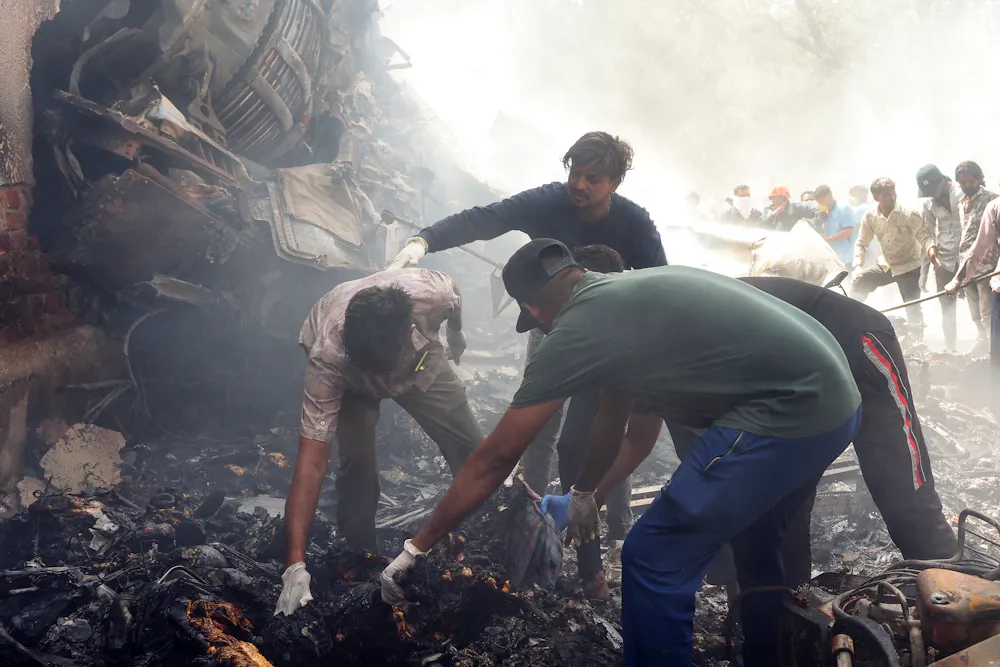
nly one passenger survived after an Air India flight carrying 242 people crashed shortly after take-off in Ahmedabad on Thursday, the airline said in a statement.
“We regret to inform that, of the 242 aboard, there are 241 confirmed fatalities. The sole survivor is being treated in a hospital,” Air India said.
“The survivor is a British national of Indian origin,” it added.
Air India also released a breakdown of the nationalities of those on board: 169 were Indian nationals, 53 British, seven Portuguese, and one Canadian.
Flight AI-171, bound for London Gatwick, went down minutes after departing Sardar Vallabhbhai Patel International Airport at 1:38 p.m. IST. The aircraft crashed into a residential complex near BJ Medical College, sparking a massive fire and triggering a large-scale emergency response.
In a separate post on X, the airline said it has established support centers at multiple airports to assist the families of the victims.
“Air India has set up Friends & Relatives Assistance Centres at Ahmedabad, Mumbai, Delhi and Gatwick airports to provide support and take care of the needs of the families and loved ones of those on flight AI171. These centres are facilitating the travel of family members to Ahmedabad,” the airline said.
Emergency contact numbers have also been shared for those seeking information: 1800 5691 444 for calls from within India, and +91 8062779200 for international callers.
The Privacy Act applies to any person, organisation, or business that collects and holds personal information about other people. This includes social clubs, charities, societies, and community groups regardless of the age of its members.
Personal information held by these clubs needs to be collected, stored, and used in a way that is lawful, even if you’re a voluntary organisation. Personal information includes names, addresses, phone numbers, email addresses, offices held, awards, skills, references, recordings and photographs – essentially any information that identifies people.
This information could be about members and former members, but also about employees, contractors, people working at stalls, and service providers who’ve helped with things like training or coaching, IT, marketing, administration, financial assistance, or maintenance and repairs.
It can be held in minutes of meetings, newsletters and correspondence, on membership databases, and websites. It includes information in hard copy or electronic form and if it’s collected by a person taking sign-ups for an event, a digital camera, or a biometric scanner.
People who have access to this personal information, including volunteers, will also need to be aware of their privacy responsibilities and need to comply with the law.
Your responsibilities
Like all agencies in New Zealand, clubs and societies should only collect the personal information about the club’s volunteers and members that is necessary. Tell people why their information is needed and get their permission to share the information where it needs to be shared. Keep it safe. Don’t give it out without permission. Don’t keep it longer than necessary.
You also need to appoint someone as your Privacy Officer, whose role it is to make sure the club complies with the Privacy Act. They can be a volunteer or member of your club.
Privacy rules
The Privacy Act has 13 Information Privacy Principles (IPPs) that govern how you should collect, handle, and use personal information. These include rules for collecting, holding, and using personal information. Our Privacy ABC Course is a great way to learn about these.
If you’re thinking about collecting personal information, the first thing you should consider is why you’re collecting it.
Only collect what you need. Generally, you should collect information directly from the person it’s about and tell them what you’re doing and why. The best way to do this is usually with a clear privacy statement. Our Privacy Statement Generator makes writing that easier.
You must keep the personal information you hold safe and secure. You may need a locked cabinet for physical documents, or password protection for electronic files. Make sure only appropriate people can access the information and that you know who they are and that they’re current members of the club.
By law, you must give people access to the information you hold about them if they ask for it and take reasonable steps to correct their information if it’s wrong.
People have a right to access information about themselves. This includes material like:
references to that person in minutes of a meeting
correspondence that the person has had with the society
decisions made about the person
details of complaints made about the person
material from their personal file, if they work for the society.
Before you use personal information, check that it’s accurate, up-to-date, complete, relevant and not misleading.
The Privacy Act doesn’t specify how long you can keep personal information – only that agencies shouldn’t keep information for longer than they need it.
Only use information for the purpose you collected it. If you’ve told people what their information will be used for, and who it may be disclosed to, you will generally be able to use and disclose it in those ways without a problem. For example, if you collected a person’s email address to send out notices of meetings then you can’t give it to another club in town to recruit for members.
Be careful about who you disclose (share) information to, both within and outside your organisation. This usually means having the permission of the person involved.
You also need to dispose of personal information securely so one else can retrieve it.
Good privacy tips
Consider who will be able to see any of the personal information collected and held by the organisation, for example, membership lists.
A common way for a society to ensure that it has accurate information is to use annual subscription notices to encourage members to check their details and send in corrections, updates, or changes of address.
Check with people if you’re using information in a new way, for example, putting a team photo on the internet (including social media) may still technically be within the purpose for which it was taken, but it’s still best to check that members are happy with this new use of the information. Not everyone wants their photograph or their name on the internet.
If your club has a privacy breach that could cause serious harm, you will need to report that to our Office. We have a tool that will help you assess whether a breach needs to be notified, which you can find here.
Relevant examples
We’re here to help you
We understand that whether playing petanque, softball or canasta, you’re not thinking much about how to keep people’s personal information safe and secure, and it may be your first time dealing with our office.
If you have any questions, you can ask us for help. You don’t need to engage a lawyer. We are here to try and assist clubs to remedy a privacy issue and come to a resolution.
While we can’t give specific legal advice on individual problems, we are happy to help by giving general advice, for example, about how the Privacy Act works.
If you think your club or society needs a privacy statement, you can create one using our Priv-o-matic privacy statement generator. It is free to use and only takes a few minutes.
We also have answers to over 600 questions on the AskUs facility on our website, which you might find helpful.
There are also free privacy training modules to help you learn more. These modules are a great way to start learning about privacy. They will take you less than an hour to complete, and they cover the basic principles of each topic. If you just want to learn general privacy knowledge, or you don’t know where to start, we recommend starting with an ABC module.
Good police work intercepted an alleged thief looking for an easy ride in Auckland early this morning.
Around 3am two offenders arrived at a warehouse on Taylors Road, Morningside.
“The van both offenders were travelling in was used to force its way through roller doors at the address, damaging them enough to gain entry,” Auckland City West Area Prevention Manager Inspector Wayne Kitcher says.
Both offenders entered the address and took several large boxes containing e-scooters before driving away.
A short time later Police located a man allegedly loading the same e-scooter boxes into a different vehicle, only a few minutes from the scene.
The boxes were identified as identical to the ones taken from the premises.
“The original vehicle was later discovered hidden at an address only a few hundred metres away from where staff apprehended this man,” Inspector Kitcher says.
“This was a good result by our staff who put a stop on these alleged offenders being able to benefit from the proceeds of crime.
“Ram raids have trended downward in recent years, and we continue to prosecute this offending if it occurs.”
A 37-year-old man appeared in Auckland District Court charged with receiving stolen property.
Inspector Kitcher says enquiries remain ongoing to locate the second offender.
Source: Hong Kong Government special administrative region
Proposed installation works of Sihanoukville-Hong Kong (SHV-HK) Submarine Cable System gazetted* Sai Kung Home Affairs Enquiry Centre of the Sai Kung District Office (G/F, Sai Kung Tseung Kwan O Government Complex, 38 Pui Shing Road, Hang Hau, Tseung Kwan O, New Territories); * Eastern Home Affairs Enquiry Centre of the Eastern District Office (G/F, Eastern Law Courts Building, 29 Tai On Street, Sai Wan Ho, Hong Kong); * Southern Home Affairs Enquiry Centre of the Southern District Office (G/F, Ocean Court, 3 Aberdeen Praya Road, Aberdeen, Hong Kong); and * Lands Department’s website (www.landsd.gov.hkIssued at HKT 12:00
Source: Hong Kong Government special administrative region
Proposed installation works of Southeast Asia-Hainan-Hong Kong Express (SEA-H2X) Submarine Cable System gazetted The proposed works comprise the installation of a submarine cable system of approximately 35.1 kilometres in length and 40 millimetres in diameter. The proposed works are tentatively scheduled to commence in the third quarter of 2025 and are expected to be completed in approximately four months.
Source: Hong Kong Government special administrative region
Expansion works of Aberdeen Typhoon Shelter proposed The proposed works will create additional sheltered space to address the strong regional demand in Hong Kong Island South, particularly for pleasure vessels. The proposed works will include the construction of two new breakwaters and the provision of public landing facilities at the proposed eastern breakwater, construction of a pedestrian walkway to connect the proposed eastern breakwater to Ocean Drive and an associated vessel impact protection system, demolition of part of the existing breakwater at the eastern side of Ap Lei Chau, and construction of a wave wall in the form of a floating breakwater. The proposed works are tentatively scheduled to commence in 2026 for completion in 2030. At the same time, the Government would also like to seize the opportunity of the expansion of the Aberdeen Typhoon Shelter to utilise part of the expanded waterbody for the market to develop a marina and promote yacht tourism.
As an aviation safety expert, it is hard to avoid a sense of disbelief that an event such as this – involving one of the most advanced passenger jets in the world, built on the lessons of many earlier accidents – could happen in the 21st century.
Trouble after takeoff
Air crashes such as this one, in which a plane experiences trouble immediately after takeoff, are now extremely rare. They were more common in the past.
In one infamous 1999 incident, 32 people died when LAPA Flight 3142 crashed during takeoff from Buenos Aires. During the accident investigation, it emerged that the Boeing 737’s wing flaps had not been in the right position for takeoff and the crew had ignored alarms from the plane’s internal warning system.
The 2009 emergency landing of US Airways Flight 1549 on New York’s Hudson River also occurred shortly after takeoff. In that case, the problem was quite different: a collision with a flock of Canada geese shut down both engines, leading to a powerless aircraft.
However, the aviation industry puts a lot of resources into learning from accidents so they don’t happen again. LAPA Flight 3142 led to recommended improvements in pilot training and flight procedures. The rules for engine design were changed after the “miracle on the Hudson”.
So whatever caused the Air India crash, it may not be something we have seen before.
How did one passenger survive?
One passenger survived the crash. We don’t know exactly how.
He was sitting in seat 11A, next to an emergency exit. Reports say the plane “broke in half”, and the passenger found himself in the front half while the rear caught fire. He then walked from the wreckage and was found by rescuers.
Why did he survive when everybody else died? Research suggests that, in general, the seats at the back of the plane are the safest place to be in a crash – but this man was quite close to the front.
Based on what we know so far, my expert opinion is that we have no better explanation than to call it luck or a miracle.
Where to from here?
We won’t have a clear idea of what happened until a full investigation has been carried out. Air crash investigations follow a protocol laid out by an International Civil Aviation Organization document called Annex 14.
India’s Aircraft Accident Investigation Bureau will lead this investigation, putting together a team that will be assisted by representatives from the US National Transport Safety Bureau and the UK Air Accidents Investigation Branch, representing the countries of the plane’s manufacturer and passengers aboard.
Rescuers sift through the wreckage of Flight AI171 in Ahmedabad. Sam Panthaky / AFP via Getty Images
The team will conduct a forensic investigation of the crash site to make sense of what happened. Alongside material evidence found at the site, they will look at the data stored in the plane’s “black box”, which includes data from the flight recorder and cockpit voice recorder, to learn about what happened in the leadup to the crash.
A slow, steady process
Air crash investigations can take a long time. Typically a preliminary report will be published 3 to 6 months after the crash, followed by a final report a year or two later.
The report will provide factual information on the cause of the accident and make recommendations. Depending on the cause, these might be changes to maintenance procedures, pilot and crew procedures, or even the design of parts of the aircraft.
Indian authorities will then disseminate these recommendations to whoever needs them around the world. The process is slow, but it moves in the direction of safer air travel. Everyone will be waiting to find out and learn.
In the meantime, it’s best to remember that we still don’t know what happened or why. Everyone wants answers, but speculation can do more harm than good.
Guido Carim Junior does not work for, consult, own shares in or receive funding from any company or organisation that would benefit from this article, and has disclosed no relevant affiliations beyond their academic appointment.
Parts of the media seem to be encouraging this. For example, earlier today I was contacted by an international news organisation for an interview about the tragedy. While I agreed, I cautioned that I could only say “it is too early to speculate”. They decided not to proceed with the interview. No reason was given, but perhaps it was my aversion to speculation.
Of course, I want to know as much as anyone else what caused this disaster. But publicly speculating at such an early stage, when there is so little evidence available, is more than unhelpful. It is also harmful, as many examples throughout history have shown.
Like an archaeological excavation
Aviation accident investigations start as soon as first responders have extinguished the fires and completed the search for survivors – the first and foremost driver when responding to such a disaster – and have declared the site safe. The identification of the victims will then commence, completed by a different agency, parallel to the accident investigation.
State authorities aren’t the only people involved. The aircraft manufacturer (in this case Boeing) will usually send representatives to assist the investigation, as can the home countries of victims. Investigators in the country where the accident occurred may also request assistance from countries with more experience in aviation accident investigation.
An early step for investigators is finding the black boxes (flight data recorders and cockpit voice recorder) among the debris. These contain data about the flight itself, what the aircraft was doing, and what the pilots were saying.
But a plane crash investigation involves much more than just finding the black box.
An aviation accident investigation is akin to an archaeological excavation – methodical and painstaking. If the evidence is not collected and preserved for later analysis at the time, it will be irrevocably lost.
In the case of Air India Flight 171 the scene is further complicated by the crash location – a building. It will take time for the aeroplane wreckage, victims and personal belongings to be sorted from the building debris. This must occur before the search for answers can commence.
Investigators will also gather witness statements and any video of the event. Their analysis will be further informed by company documentation, training, and regulatory compliance information.
what we know about human beings including their abilities, characteristics, and limitations, the design of procedures and equipment people use, and the environment in which they function and the tasks they perform.
It could take several years for the full forensic investigation into this disaster to run its full course. For example, the final report into the Sea World helicopter crash in Queensland, Australia, back in 2023, which claimed the lives of four people and injured nine others, was only released in April this year.
A history of speculation – and vilification
There is a long history of undue and harmful public speculation about the possible causes of a plane crash.
For example, since the disappearance of Malaysia Airlines flight MH370 on March 8, 2014, speculation has swirled about whether chief pilot Zaharie Ahmad Shah was responsible for the disaster and the deaths of the other 238 people on board. This has deeply upset his sister, Sakinab Shah. In 2016, she told CNN she feels her brother is a “scapegoat” she must defend.
Similarly, the pilots of the British Midlands accident near Kegworth in 1989, in which 47 people died, were also publicly vilified.
The pilots, who survived the crash, were experienced but misidentified which engine had failed, and shut down the wrong one. They were widely criticised in the press for the error, tarnishing their reputations, losing their jobs, and no doubt causing more stress to their families. The investigation later revealed the pilots themselves had not received any simulator training as they transitioned to a newer variant of the aircraft they were flying.
This shows how undue public speculation about an airline disaster can add to the distress of victims and their families.
Respect the process
No doubt pilots and aviation experts are speculating in private right now about the causes of this particular disaster. Cafes, pubs and crew rooms will be rife with discussions and opinions. It is human nature to want to know what happened.
But to speculate in public won’t assist the investigative process. Nor will it help the families of the victims, or the first responders and investigators themselves, get through this horrible time.
Investigators need to work without external pressures to ensure accurate findings. Respecting this process maintains integrity and supports the many people who are currently experiencing unimaginable grief.
Natasha Heap does not work for, consult, own shares in or receive funding from any company or organisation that would benefit from this article, and has disclosed no relevant affiliations beyond their academic appointment.
Oil prices surged more than 9% on Friday, hitting their highest in almost five months after Israel struck Iran, dramatically escalating tensions in the Middle East and raising worries about disrupted oil supplies.
Brent crude futures LCOc1 jumped $6.29, or 9.07%, to $75.65 a barrel by 0315 GMT after hitting an intraday high of $78.50, the highest since January 27. U.S. West Texas Intermediate crude CLc1 was up $6.43, or 9.45%, at $74.47 a barrel after hitting a high of $77.62, the loftiest since January 21.
Friday’s gains were the largest intraday moves for both contracts since 2022 after Russia invaded Ukraine, causing energy prices to spike.
Israel said it targeted Iran’s nuclear facilities, ballistic missile factories and military commanders on Friday at the start of what it warned would be a prolonged operation to prevent Tehran from building an atomic weapon.
“This has elevated geopolitical uncertainty significantly and requires the oil market to price in a larger risk premium for any potential supply disruptions,” ING analysts led by Warren Patterson said in a note.
Several oil traders in Singapore said it was still too early to say if the strike will affect Middle East oil shipments as it will depend on how Iran retaliates and if the U.S. will intervene.
“It’s too early to tell but I think the market is worried about shutting off of the Strait of Hormuz,” one of the traders said.
MST Marquee senior energy analyst Saul Kavonic said the conflict would need to escalate to the point of Iranian retaliation on oil infrastructure in the region before oil supply is materially impacted.
He added that Iran could hinder up to 20 million barrels per day of oil supply via attacks on infrastructure or limiting passage through the Strait of Hormuz, in an extreme scenario.
Iran’s Supreme Leader Ayatollah Ali Khamenei said Israel will receive “harsh punishment” following Friday’s attack that he said killed several military commanders.
U.S. Secretary of State Marco Rubio on Thursday called Israel’s strikes against Iran a “unilateral action” and said Washington was not involved while also urging Tehran not to target U.S. interests or personnel in the region.
“Iran has announced an emergency and is preparing to retaliate, which raises the risk of not just disruptions but of contagion in other neighbouring oil producing nations too,” said Priyanka Sachdeva, senior market analyst at Phillip Nova.
“Although Trump has shown reluctance to participate, U.S. involvement could further raise concerns.”
In other markets, stocks dived in early Asian trade, led by a selloff in U.S. futures, while investors scurried to safe havens such as gold and the Swiss franc.
Source: People’s Republic of China in Russian – People’s Republic of China in Russian –
Source: People’s Republic of China – State Council News
TEHRAN/JERUSALEM, June 13 (Xinhua) — Israeli Defense Minister Israel Katz said on Friday that Israel launched a “preemptive strike” on Iran and declared a state of emergency throughout the country.
The Israel Defense Forces (IDF) confirmed that some Iranian military and nuclear facilities were hit.
As reported by the Iranian state television channel IRIB, powerful explosions were heard in the capital Tehran on Friday morning. Their source has not yet been established.
US Secretary of State Marco Rubio says US not involved in Israeli attack. –0–
Two men are before the courts following two incidents in Marton.
At approximately 10pm on 10 May, Police were called to an alleged aggravated robbery at a commercial premises on Broadway.
After closing and securing the premises, the employee was confronted by the alleged offender who hid in the ceiling space of the property.
The offender threatened the employee with a weapon and demanded a large amount of cash before fleeing the area on foot.
Thankfully, the employee is not injured, however was understandably shaken by the incident.
After an investigation into the incident, Police identified the alleged offender, and found that the man had allegedly committed a burglary at the same premises in April.
This week, Police arrested and charged two men in relation to the two incidents.
Police are pleased to have made arrests in relation to this matter and hold the alleged offenders to account.
We recognise the significant impact this type of offending has on our community and that it can be incredibly distressing.
Police takes this offending seriously, and we hope these arrests reassure the community that we have absolutely no tolerance for incidents like these.
A 39-year-old Nelson man appeared in Porirua District Court on 12 June, charged with aggravated robbery and burglary. He was remanded in custody and is due to reappear on 17 June.
A 49-year-old Palmerston North man is due to appear in Palmerston North District Court on 17 June, charged with aggravated robbery and burglary.
His Excellency Sugiono, Minister for Foreign Affairs of the Republic of Indonesia, and Rt Hon Winston Peters, Minister of Foreign Affairs of New Zealand, convened the 12th meeting of the Joint Ministerial Commission (JMC) on 13th June 2025 in Jakarta, Indonesia. The Ministers welcomed meeting in person, underscoring the importance of regular consultations between themselves, Leaders and other Cabinet colleagues to strengthen the relationship in ways that deliver real benefits and advance shared values. The Ministers celebrated the cooperation between Indonesia and New Zealand under the Comprehensive Partnership agreed by Leaders in 2018, and the achievements under the 2025-2029 Plan of Action. The Ministers committed to intensify cooperation across the seven pillars of the Comprehensive Partnership to strengthen bilateral ties and achieve the ambitious goals set out in the 2025-2029 Plan of Action.
Reviewing the implementation of the first year of the Plan of Action 2025-2029, and way forward
“Friends for Good” Ties
The Ministers acknowledged intensive recent engagement between the two countries, including Minister Peters’ attendance at President Prabowo’s inauguration in October 2024, and meetings between our Prime Minister and President, and Foreign Ministers at APEC in November 2024, as well as increased engagements by senior officials. Both Ministers agreed to further increase two-way dialogue and acknowledged the importance of face-to-face engagement, and regular hosting of key relationship architecture meetings, in maintaining our “Friends for Good” ties. The Ministers agreed to encourage relevant stakeholders to bolster bilateral relations and cooperation, including through bilateral defence talks and the annual Senior Officials Meeting on Trade and Investment Framework. Both Ministers also noted the significant potential for promoting Parliamentary and civil society exchanges to further strengthen bilateral and people-to-people ties. Enhancing Trade and Economic Partnerships to Advance Growth of Both Economies The Ministers highlighted the importance of enhancing mutual prosperity and strengthening trade and economic connections. Ministers recalled the goal in the Plan of Action to grow two-way trade to NZ$6 billion by the end of 2029. They highlighted the need for New Zealand and Indonesia to increase mutual cooperation in the face of global economic uncertainty. Both Ministers highlighted the importance of resolving non-tariff trade barriers to ensure trade continuity and growth. Ministers welcomed agreement of the Cooperation Arrangement on Halal Standards. The Arrangement will facilitate the convenience, security, safety and certainty of halal food traded between our countries. Ministers noted the intent for New Zealand and Indonesia to work together to further support the Indonesian national program of food resilience and the Nutritious Meal programme.
The Ministers noted the positive trend of New Zealand’s investment in Indonesia, and agreed to continue efforts to encourage investment flows. Ministers welcomed the year-round direct flights between Auckland and Bali and committed to continue to work towards unlocking the full potential of enhanced air connectivity to facilitate increased people-to-people, business and trade flows. Both Ministers reconfirmed the importance of a rules-based, free and open trade environment, with the World Trade Organisation at its core, as critical for the regional and global economy. The Ministers welcomed the implementation of the upgraded ASEAN-Australia-New Zealand Free Trade Area (AANZFTA), which entered into force in April 2025, and ongoing cooperation under the Regional Comprehensive Economic Partnership (RCEP). The Ministers acknowledged the process of Indonesia’s accession to the Organisation for Economic Co-operation and Development (OECD) and the Comprehensive and Progressive Agreement for Trans-Pacific Partnership (CPTPP) as an important step to foster economic integration, accelerate economic reform, and support mutual prosperity. Both Ministers reaffirmed their nations’ commitment to preventing illegal money laundering and other illegal financing activities to enhance financial integrity and transparency and to further promote economic growth and development.
Renewable Energy and Environment Cooperation The Ministers highlighted the importance of renewable energy, including geothermal cooperation, which has been a significant part of the relationship since the 1970s and welcomed the renewed Partnership Arrangement in renewable energy and energy conservation signed in September 2024. Ministers announced a further NZ$15 million investment in Phase 2 of the New Zealand-Maluku Access to Renewable Energy Support (NZMATES 2.0) programme to continue to improve access to reliable, renewable electricity for remote and small islands while building local industry service capacity. The Ministers acknowledged strong collaboration between the Indonesia and New Zealand geothermal industries, including under the Pūngao Ngawha (Panas Bumi) Indonesia-New Zealand Partnership Programme (PINZ), that provides access to New Zealand’s world-renowned technical and training capabilities, with the aim of assisting Indonesia to further accelerate the development of its geothermal energy sector and broader energy transition. The Ministers emphasised their shared commitment to adapting to and mitigating the impacts of climate change under the Paris Agreement and expressed willingness to expand climate related and environmental cooperation through comprehensive climate change dialogue that includes both mitigation and adaptation strategies.
Education, Tourism, Science, Technology and Innovation, and People-to-People Cooperation
Ministers welcomed the significant increase in the annual allocation of tertiary scholarships under the Manaaki New Zealand Scholarship Programme (MNZSP), from 45 to 70, for Indonesia for this year and the next two years, reflecting their mutual dedication to deepening people-to-people connections, strengthening capacity in renewable energy and public governance, and developing disadvantaged regions. The Ministers welcomed the Arrangement on Education Cooperation to refresh areas of cooperation, including increased education and higher education policy dialogues to enhance education system development and resilience. The Ministers underscored the importance of enhancing people-to-people connections, particularly in education and tourism, as a bedrock of strong bilateral ties. Both Ministers welcomed the exchange of cultural missions and promotions to serve this purpose. Ministers welcomed further exchanges of officials’ level visits to New Zealand focused on good governance, public sector performance and integrity and other sectors to advance bilateral relations. The Ministers encouraged closer cooperation between Indonesia and New Zealand in supporting research collaboration as highlighted in the Arrangement on Education Cooperation.
Development Cooperation Both Ministers welcomed the past year’s implementation progress under the Statement of Partnership (SoP) 2025-2029 signed in July 2024 and reviewed in May 2025. The SoP has strengthened and elevated both the development relationship and mutual commitment to focus on development cooperation and other strategic issues and is strongly aligned with Indonesia’s national priorities in two areas: climate and economic resilience; and inclusive human development.
Defence, Security, Cyber and Maritime Cooperation
Ministers acknowledged New Zealand and Indonesia’s long-standing defence relationship and committed to continuing to strengthen these ties, including through regular Defence Ministers’ meetings. They welcomed the upcoming visit to Jakarta by New Zealand Navy ship HMNZS Te Kaha and the recent visit by the Chief of the Royal New Zealand Navy. The Ministers announced new funding towards ongoing cooperation on security issues through continued support for the Jakarta Centre for Law Enforcement Cooperation (JCLEC). The funding provided by New Zealand will enable the continued delivery of high-quality capacity building initiatives and collaboration between law enforcement agencies to combat transnational organised crime in the region. The Ministers also reaffirmed their commitment to the Bali Process and welcomed progress against the Adelaide Strategy for Cooperation, which sets out the priority areas of cooperation for the Bali Process Working Groups. This includes an upcoming Joint Tabletop Exercise co-hosted by New Zealand, Indonesia, Australia and Viet Nam, through the Working Group on Disruption of Criminal Networks Involved in People Smuggling and Trafficking in Persons from 23 to 26 June 2025. The Ministers agreed to continue to implement the refreshed cooperation arrangement on counter-terrorism, and identify opportunities for dialogue on preventing violent extremism. Ministers highlighted the importance of active participation by our militaries in training activities, annual defence talks and joint exercises, including Exercise Super Garuda Shield.
Regional and Multilateral Agenda
The Ministers emphasised ASEAN’s central role in the dynamic regional architecture and their shared commitment to ongoing dialogue and cooperation through ASEAN-led mechanisms and processes, particularly the East Asia Summit (EAS), the ASEAN Regional Forum (ARF), and ASEAN Defence Ministers’ Meeting Plus (ADMM-Plus). The Ministers welcomed the ASEAN-New Zealand Joint Statement on the ASEAN Outlook on the Indo-Pacific in 2023 to maintain regional stability and to serve as a framework to strengthen bilateral relations to advance economic relations and maritime governance under international law. The Ministers welcomed the implementation of the ASEAN-New Zealand Plan of Action (POA) (2021-2025) and its substantial progress achieved across the four themes outlined in the POA – Peace, Prosperity, People, and Planet. They further welcomed activity throughout 2025 to commemorate 50 years of dialogue relations between New Zealand and ASEAN, including preparations under way for a Commemorative Summit in Malaysia in October. Minister Sugiono confirmed Indonesia’s support for New Zealand’s proposal to elevate the relationship to a Comprehensive Strategic Partnership, and noted the development of a new ASEAN-New Zealand Plan of Action (2026-2030) to guide future cooperation. Ministers reaffirmed their shared commitment to maintaining and promoting security and stability in the South China Sea. Ministers underscored their strong support for freedom of navigation and overflight and unimpeded trade, and their unwavering support for the 1982 United Nations Convention on the Law of the Sea (UNCLOS). Ministers emphasised the need for the peaceful resolution of disputes in accordance with international law, particularly UNCLOS. In this regard, Ministers recalled the 2016 ruling of the South China Sea Arbitral Tribunal, constituted under UNCLOS. They underscored the importance of further progress towards an effective and substantive Code of Conduct that is consistent with international law, including the 1982 UNCLOS. Ministers expressed concern about the conflict and humanitarian crisis in Myanmar. Ministers called on stakeholders and parties in Myanmar, in particular the armed forces and security forces concerned, to immediately cease violence, including the targeting of civilians, and to engage in inclusive dialogue. Ministers emphasised the importance of a peaceful, stable and unified Myanmar, affirmed their strong support for ASEAN-led efforts in line with the ASEAN Five-Point Consensus and encouraged the international community to work together in a pragmatic and constructive way to support peace and stability in Myanmar. The Ministers expressed concern about the dire humanitarian situation in Gaza and reiterated their calls for all parties to cease all hostilities; release all remaining hostages; facilitate the rapid, safe, unimpeded, and sustained delivery of humanitarian aid; adhere to international humanitarian law; and protect aid workers to enable their lifesaving work. Ministers reaffirmed their support for the implementation of a two-state solution consistent with international law and relevant United Nations resolutions. Ministers exchanged views on the war against Ukraine and reiterated support for efforts to achieve a comprehensive, just and lasting peace. In that context, Ministers continued to reaffirm their respect for sovereignty, political independence and territorial integrity, and reiterated their call for compliance with the United Nations Charter and international law. The Ministers acknowledged the challenges to the multilateral system from shifting geopolitical dynamics, a tightly constrained financial environment and increasingly complex global risks. They reaffirmed their strong support for multilateralism and the international rules-based system, and acknowledged its important role in underpinning global stability, resilience and prosperity. The Ministers committed to collaborating on efforts to strengthen the multilateral system, increase inclusivity and transparency, and to safeguard and advance human rights, in order to support a system that is more responsive to today’s challenges.
Conclusion
Ministers reviewed the implementation of the Plan of Action for 2025-2029 and discussed their common interest in advancing bilateral cooperation and delivering tangible outcomes. Both Ministers reaffirmed their commitment to utilise and advance the implementation of existing cooperation frameworks to deliver our shared interests. Both Ministers were ready to explore more cooperation in the future to support both nations’ interests, as confirmation of their strong stance as Friends for Good. Minister Peters expressed his sincere gratitude to Minister Sugiono and the Indonesian Government for the warm welcome and hospitality accorded to him during the visit, and looked forward to hosting Minister Sugiono at the 13th JMC in New Zealand in 2026.
The number of robberies and related offences committed in South Australia have continued to decrease significantly, the latest crime statistics have revealed.
The April rolling year crime statistics also reveal continuing strong declines in other offence categories including house break-ins, shop theft, car theft and homicides.
The 13 per cent decrease in robbery and related offending – from 847 to 740 reported offences – in the April period is the fifteenth successive fall in reported offences in that category.
Within that category aggravated robbery declined by 16 per cent – from 501 to 419 reported offences and non-aggravated robbery by 12 per cent – from 82 to 72 reported offences.
While the majority of property related offences recorded a decrease in the rolling year period, acts intended to cause injury – which includes all assaults – recorded a minor increase.
Within that category serious assault resulting in injury dropped by one per cent, or 34 offences, serious assault not resulting in injury rose by seven per cent, or 846 incidents, and common assault increased by one per cent, or 73 incidents.
Police intelligence reveals that domestic abuse related assaults increased by 10.8 per cent in the month of April, from 843 offences reported to 934 offences reported. Just over 52 per cent of all assaults reported to police in April 2025 were related to domestic abuse, compared with 49.6 per cent in April 2024.
The number of stranger assaults decreased in April with 312 incidents reported (17.4 per cent of assaults), compared with 391 offences reported (23 pr cent of assaults) in April 2024.
The number of assaults involving a knife or other bladed weapon remained relatively stable in April 2025 with 129 offences reported compared with 121 offences reported in April 2024.
The April rolling year figures reveal house break-ins declined by 11 per cent in the period from 5,917 to 5,265 reported offences. This followed an eight per cent decline in the March period, seven per cent in the February period and a five per cent decline in January.
The number of non-residential break-ins declined by seven per cent from 3,709 to 3,437 reported offences. This followed five per cent declines in March and February.
Shop theft also showed another significant decrease in the April period with a nine per cent reduction in offending reported – the sixth successive drop. There were 1,604 fewer offences reported in the April period – from 18,735 to 17,131 reported incidents. The continued reduction in both house break-ins and shop theft is attributable to ongoing proactive operations targeting recidivist offenders.
Car theft and theft from a vehicle have both continued to decline in the period. Car theft decreased by seven per cent or 260 offences – from 3,766 to 3,506 offences. This followed a nine per cent drop in March, 11 per cent in February and 12 per cent decrease in January.
Theft from a motor vehicle declined by 22 per cent in the period – from 9,920 to 7,736 reported offences. This followed a 23 per cent decline in March and a 22 per cent drop in February.
The number of homicides committed in South Australia has continued to decrease with a 57 per cent decline in the April period – from 23 to 10 reported offences. This followed a 52 per cent decrease in the March period.
Israel said it targeted Iran’s nuclear facilities, ballistic missile factories and military commanders on Friday at the start of what it warned would be a prolonged operation to prevent Tehran from building an atomic weapon.
Iranian media and witnesses reported explosions including at the country’s main uranium enrichment facility at Natanz, while Israel declared a state of emergency in anticipation of retaliatory missile and drone strikes.
Iranian state television reported that Hossein Salami, the chief of the elite Revolutionary Guards corps, had been killed and the unit’s headquarters in Tehran had been hit. Several children had been killed in a strike on a residential area in the capital, it said.
“We are at a decisive moment in Israel’s history,” Israeli Prime Minister Benjamin Netanyahu said in a recorded video message.
“Moments ago Israel launched Operation Rising Lion, a targeted military operation to roll back the Iranian threat to Israel’s very survival. This operation will continue for as many days as it takes to remove this threat.”
Iran’s Supreme Leader Ayatollah Ali Khamenei said in a statement that Israel had “unleashed its wicked and bloody” hand in a crime against Iran and that it would receive “a bitter fate for itself”.
An Israeli military official said Israel was striking “dozens” of nuclear and military targets including the facility at Natanz in central Iran. The official said Iran had enough material to make 15 nuclear bombs within days.
The United States said it had no part in the operation, which raises the risk of a fresh escalation in tensions in the Middle East, a major oil producing region.
Alongside extensive air strikes, Israel’s Mossad spy agency led a series of covert sabotage operations inside Iran, Axios reported, citing a senior Israeli official. These operations were aimed at damaging Iran’s strategic missile sites and its air defence capabilities.
Iranian state media reported that at least two nuclear scientists, Fereydoun Abbasi and Mohammad Mehdi Tehranchi were killed in Israeli strikes in Tehran.
Tel Aviv’s Ben Gurion Airport was closed until further notice, and Israel’s air defence units stood at high alert for possible retaliatory strikes from Iran.
“Following the pre-emptive strike by the State of Israel against Iran, a missile and UAV (drone) attack against the State of Israel and its civilian population is expected in the immediate time frame,” Defence Minister Israel Katz said in a statement.
Israeli military Chief of Staff Eyal Zamir said tens of thousands of soldiers had been called up and “prepared across all borders”.
“We are amidst a historic campaign unlike any other. This is a critical operation to prevent an existential threat, by an enemy who is intent on destroying us,” he said.
Israeli Minister Gideon Saar was holding “marathon of calls” with counterparts around the world regarding Israel’s attack on Iran, the foreign ministry said in a statement.
U.S. “NOT INVOLVED”
U.S. President Donald Trump would convene a meeting of the National Security Council on Friday morning, the White House said.
Iran’s armed forces spokesperson said Israel and its chief ally the United States would pay a “heavy price” for the attack, accusing Washington of providing support for the operation.
An Israeli official told Israel public broadcaster Kan that Israel had coordinated with Washington on the strikes.
U.S. Secretary of State Marco Rubio however said the United States was not involved and Tel Aviv had acted unilaterally for self-defence.
“We are not involved in strikes against Iran and our top priority is protecting American forces in the region,” Rubio said in a statement.
“Let me be clear: Iran should not target U.S. interests or personnel,” he added.
The State Department issued an advisory saying that all U.S. government employees in Israel and their family members should “shelter in place until further notice”.
The attacks triggered sharp falls in stock prices in early Asian trade on Friday, led by a selloff in U.S. futures, while oil prices jumped as investors scurried to safe havens such as gold and the Swiss franc.
NUCLEAR TALKS DEADLOCKED
U.S. and Iranian officials were scheduled to hold a sixth round of talks on Tehran’s escalating uranium enrichment program in Oman on Sunday, according to officials from both countries and their Omani mediators. But the talks have appeared to be deadlocked.
Trump said on Thursday an Israeli strike on Iran “could very well happen” but reiterated his hopes for a peaceful resolution.
A source familiar with U.S. intelligence reports said there has been no recent change in the U.S. intelligence assessment that Iran is not building a nuclear weapon and that Khamenei has not authorised the restarting of the nuclear weapons program that was shuttered in 2003.
Even so, U.S. intelligence had indicated that Israel was preparing a strike against Iran’s nuclear facilities.
The U.S. military was planning for the full range of contingencies in the Middle East, including the possibility that it might have to help evacuate American civilians, a U.S. official told Reuters, speaking on condition of anonymity.
An Air India Boeing 787-8 Dreamliner crashed shortly after takeoff from Ahmedabad on Thursday afternoon, killing 241 people in what is being described as one of the worst aviation disasters in India’s history. Only one passenger survived.
Flight AI-171, en route from Ahmedabad to London Gatwick, went down minutes after departing from Sardar Vallabhbhai Patel International Airport at 1:38 p.m. IST. The aircraft plunged into a residential complex near BJ Medical College, triggering a massive fire and a large-scale emergency response across the city.
According to Air India, the flight was carrying 242 people — 230 passengers and 12 crew members, including two pilots. The sole survivor, a British national of Indian origin seated in 11A, is currently undergoing treatment at a local hospital.
The airline confirmed the tragedy in an official statement on X, saying, “UPDATE: Air India confirms that flight AI171, operating from Ahmedabad to London Gatwick on 12 June 2025, was involved in an accident. The 12-year-old Boeing 787-8 aircraft departed from Ahmedabad at 1338 hrs, carrying 230 passengers and 12 crew. The aircraft crashed shortly after take-off. We regret to inform that, of the 242 aboard, there are 241 confirmed fatalities. The sole survivor is being treated in a hospital.”
Air India also released a breakdown of the passengers’ nationalities: 169 were Indian, 53 British, seven Portuguese, and one Canadian.
The airline extended its condolences to the families of the deceased and said a dedicated team has been deployed in Ahmedabad to provide support.
“Our efforts now are focused entirely on the needs of all those affected, their families and loved ones,” the statement read.
Air India has pledged full cooperation with the authorities investigating the cause of the crash. Dedicated helplines have been set up for families seeking information. Domestic callers can reach 1800 5691 444, while international callers can dial +91 8062779200.
A U.S. appeals court on Thursday allowed President Donald Trump to maintain his deployment of National Guard troops in Los Angeles amid protests over stepped-up immigration enforcement, temporarily pausing a lower court’s ruling blocking the mobilization.
The 9th U.S. Circuit Court of Appeals’ decision does not mean that the court will ultimately agree with Trump, but it means he will maintain command of the guard for now.
Earlier on Thursday, San Francisco-based U.S. District Judge Charles Breyer found that Trump’s deployment of the Guard was unlawful. Breyer had ordered the National Guard to return to the control of California Governor Gavin Newsom, who had brought the case.
It was a short-lived victory for Newsom, as Breyer’s order was paused a short time later.
The appeals court decision stands to leave in place the dynamic of weeklong street demonstrations that have been concentrated in downtown Los Angeles, largely at a federal detention center where National Guard troops have stood watch.
The Guard had also accompanied Immigration and Customs Enforcement agents on operations.
Source: United States House of Representatives – Congresswoman Robin Kelly IL
House Republicans voted down Rep. Kelly’s Motion to Recommit to protect PEPFAR from recissions package
WASHINGTON – U.S. Rep. Robin Kelly (IL-02) condemned the Trump administration’s recissions package that requests Congress to cancel $9.4 billion already appropriated by Congress.
Rep. Kelly offered a Motion to Recommit, which would have allowed her amendment to protect the President’s Emergency Plan for AIDS Relief (PEPFAR) from the $400 million cuts in the recissions package. PEPFAR is the most successful global health program to combat HIV and AIDS and has saved 26 million lives since 2003 when President George W. Bush signed it into law.
WATCH REP. KELLY’S FLOOR REMARKS HERE
“President Trump wants to claw back $9.4 billion dollars that were already appropriated by Congress. For years, my Republican colleagues have claimed Congress’s constitutional power of the purse – but after one call from the President, they bend the knee and forked over $9.4 billion that belonged to the American people,” said Rep. Kelly. “President Trump continues his attack against PEPFAR, a program cornerstone to global health and US diplomacy. By refusing to fund PEPFAR, President Trump and his House Republicans have handed a death sentence to people around the world facing HIV and AIDS. He also weakens America’s global standing, abandons our moral responsibility, and opens an opportunity for China to take advantage. Rescinding these funds won’t solve our country’s deficit problem but rather destroy lives in the US and abroad.”
The recissions package also cuts $1.1 billion from the Corporation for Public Broadcasting, including NPR and PBS programming like Sesame Street.
Source: United States House of Representatives – Congressman Brad Sherman (D-CA)
WASHINGTON, D.C.– Today, Congressman Brad Sherman (CA-32), a Senior Member of the House Foreign Affairs Committee for 29 years, released the following statement on Israel’s attack on Iranian nuclear capabilities:
“Under the circumstances, what Israel has done is understandable and justified.
Earlier today, for the first time in 20 years, the International Atomic Energy Agency (IAEA) board declared that Iran was in breach of its non-proliferation obligations under the Safeguards Agreement that Iran itself signed. Iran was extremely close to several nuclear bomb. Israel could not wait while Iran pretended to negotiate in good faith while racing towards a bomb.
The second wave has already begun and we expect many days and perhaps weeks of additional action. Substantial damage has been done to Iran’s nuclear program. However, the status of Iran’s enriched uranium stockpile is yet to be known.
It’s regrettable that Iran’s decades of violation of the non proliferation treaty which it signed has led us to a point where this is necessary. While the U.S. pulled out of the 2014 Joint Comprehensive Plan of Action (JCPOA) agreement, Iran has been bound by the Nuclear Non-Proliferation Treaty (NPT) Safeguards Agreement it signed decades ago and which the IAEA determined it violated.
Israel did not take this step lightly. There will be retaliation from Iran, and likely also from the Houthis and Hezbollah. Many Israeli civilians will be killed. Israel took this action because it believed it had no other choice.
Israel could not wait until Iran had a stockpile of nuclear weapons ready to be launched.”
WASHINGTON, D.C. – Today, House Foreign Affairs Committee Chairman Brian Mast issued the following statement after Israel launched preemptive strikes on Iran’s nuclear program.
“A year ago, Iran sent three Americans home under flag-draped caskets who were killed at Tower 22. Within the last three months, Iran attacked Navy warships. What Israel’s preemptive strike ensured tonight is that Iran’s next attack will not be with a nuclear weapon.”
Source: People’s Republic of China – State Council News
The first meeting of the China-U.S. economic and trade consultation mechanism concluded Tuesday night in London. During the two-day talks, the two sides held candid and in-depth talks, and thoroughly exchanged views on economic and trade issues of mutual concern.
The two sides also reached principled agreement on implementing the important consensus reached by the two heads of state during their phone call on June 5 and the framework of measures to consolidate the outcomes of the economic and trade talks in Geneva, and made new progress in addressing each other’s economic and trade concerns.
The meeting was an important consultation held under the guidance of the strategic consensus reached by the two heads of state on June 5. The top-level strategic communication has charted the course for both teams to continue resolving issues through dialogue and consultation.
The principled agreement and new progress achieved during the London talks did not come easily. The path from Geneva to London has been far from smooth. During this period, the U.S. side had introduced multiple discriminatory restrictive measures against China, which at some point disrupted the hard-won momentum for dialogue.
Moreover, as the first meeting of the China-U.S. economic and trade consultation mechanism, the London talks inevitably had to address more specific, sensitive and contentious issues. The fact that both sides were able to engage in candid and in-depth discussions and reached the principled agreement sends a positive signal.
This reaffirms that despite the long road ahead and significant challenges, managing differences through dialogue and seeking pathways for cooperation remains the only rational choice.
Still, longstanding structural problems and deep-rooted differences remain in China-U.S. economic and trade relations. These cannot be resolved overnight. Next, the two sides should, in accordance with the important consensus and requirements reached by the two heads of state during their phone call, make better use of the China-U.S. economic and trade consultation mechanism, and work to enhance consensus, reduce misunderstanding and strengthen cooperation.
For future talks to succeed, it is essential to foster a constructive atmosphere for dialogue. If the U.S. side seeks cooperation at the negotiating table while simultaneously imposing discriminatory restrictions on Chinese enterprises and pursuing a policy of containment and suppression, it will only undermine mutual trust and hinder the implementation of any consensus.
There are no winners in trade wars. China does not seek conflict but will not be intimidated by one. While China is sincere in pursuing economic and trade consultations, it also has its principles.
It is hoped that the U.S. side will value the hard-won momentum for dialogue, demonstrate genuine sincerity through concrete actions, and work in the same direction as China. At this juncture, the immediate priority should be to roll back discriminatory measures against China, paving the way for the steady and unhindered growth of bilateral economic cooperation.
Words alone are not enough. The U.S. side should follow through with good faith and tangible actions to honor its commitments and implement agreed-upon measures. Only then can the two countries preserve the progress made through dialogue, put their economic relationship on a more stable footing, and inject more certainty and stability into the world economy.
Source: People’s Republic of China in Russian – People’s Republic of China in Russian –
Source: People’s Republic of China – State Council News
BEIJING, June 13 (Xinhua) — A student from east China’s Anhui Province has become China’s first donor to have his stem cells transported to Kazakhstan to help a patient.
According to the People’s Daily newspaper, the young man Xiaoding /name changed/ graduated from Anhui University of Technology and was registered with the China Bone Marrow Donation Program /CMDP/. In April this year, he was invited to the Red Cross Society of Huainan City, Anhui Province, due to the fact that he had undergone bone marrow typing. He was told that he would match the type of a patient in Kazakhstan.
The process of collecting donor stem cells took place on Tuesday at the First Hospital of China University of Science and Technology (Hefei, Anhui Province). The procedure lasted about three hours, after which a package of hematopoietic stem cells from a young Chinese man was delivered to Kazakhstan.
In a note sent with a similar package, Xiaoding writes: “The sunrise of each day brings new hope, and it is the gift of life. I wish you happiness on this end of the earth and look forward to the day when, having recovered, you will be able to travel freely across the vast steppes of Kazakhstan and set out on your long and wonderful life journey.” -0-
Source: People’s Republic of China in Russian – People’s Republic of China in Russian –
Source: People’s Republic of China – State Council News
HAIKOU, June 13 (Xinhua) — South China’s island province of Hainan is on high alert as Typhoon Wutip (Butterfly), the first typhoon of the year, is expected to make landfall in the province on Friday.
Typhoon Wutip strengthened into a severe tropical storm at 8:00 p.m. Thursday, with its center about 95 km south of Sanya, packing maximum sustained winds of 10 points (25 meters per second) near the center, according to the local meteorological department.
Heavy rainfall exceeding 100mm is expected in six towns and counties on the island over the next 24 hours, with warnings of heavy rain and flash floods also issued.
Sanya City issued a Level 2 flood and typhoon alert at 6 p.m. Thursday. Local major reservoirs gradually opened their floodgates to release water, while water supply and sewage systems continued to operate normally.
All kindergartens, schools, construction sites and tourist attractions in Sanya have been closed. Ships are banned from sailing and Fenghuang International Airport has suspended all flights from 10 p.m. on Thursday. High-speed rail service on Hainan has been suspended and is expected to resume on Saturday.
The typhoon is moving northwest at 10-15 km/h and is gaining strength. It is expected to make landfall in the coastal area between the cities of Sanya and Dongfang on Friday morning and then hit Guangdong Province and Guangxi Zhuang Autonomous Region in southern China on Saturday. -0-
The Secretary-General condemns any military escalation in the Middle East.
He is particularly concerned by Israeli attacks on nuclear installations in Iran while talks between Iran and the United States on the status of Iran’s nuclear programme are underway.
The Secretary-General recalls the obligation of UN Member States to act in accordance with the UN Charter and international law.
The Secretary-General asks both sides to show maximum restraint, avoiding at all costs a descent into deeper conflict, a situation that the region can hardly afford.
Source: United States House of Representatives – Congressman Doug LaMalfa 1st District of California
Washington, D.C.—Today, Congressman Doug LaMalfa (R-Richvale) released the following statement after the House passed H.R. 4, the Rescissions Act of 2025. Passage of this bill codifies President Trump’s rescissions package, cutting $9.4 billion in wasteful federal spending.
“This is exactly the kind of action voters sent us here to take. We’re cutting nearly $10 billion in junk spending, foreign aid giveaways, woke public broadcasting, and other bloated programs that do nothing for the average American,” said Rep. LaMalfa. “The federal government has a spending problem, and this bill is a strong step toward restoring fiscal sanity, holding agencies accountable, and stopping the inflationary madness that’s been driving prices through the roof.”
Background:
The Congressional Budget and Impoundment Control Act of 1974 was enacted after President Nixon refused to spend congressionally approved funds. The law allows a president to propose rescinding funds already appropriated by Congress. Once submitted, the funds can be withheld for up to 45 legislative days. If Congress passes a rescissions bill, the funds are permanently canceled; if not, the money must be spent. The law also sets expedited procedures for Senate consideration, including a simple majority vote threshold and limited debate—meaning rescissions bills cannot be filibustered.
President Trump submitted a $9.4 billion rescissions package targeting programs deemed wasteful, politically biased, or unnecessary to taxpayers. The proposal includes cuts to foreign aid, global health spending, and public broadcasting. H.R. 4 will now make its way to the Senate for consideration.
Congressman Doug LaMalfa is Chairman of the Congressional Western Caucus and a lifelong farmer representing California’s First Congressional District, including Butte, Colusa, Glenn, Lassen, Modoc, Shasta, Siskiyou, Sutter, Tehama and Yuba Counties.
At least four new rapidly deployable relocatable inpatient units will be rolled out across the country to ensure hospitals can continue delivering care to patients while major infrastructure projects are underway, Health Minister Simeon Brown says.
“These new inpatient units – part of the Government’s $1 billion Budget 2025 investment in hospital infrastructure – will help ensure patients can receive their surgeries while permanent hospital redevelopments are progressed,” Mr Brown says.
“Each unit will provide between 28 and 32 beds, delivering a rapid uplift of at least 112 inpatient beds across the country. With a design life of up to 50 years, these relocatable units can be moved between sites depending on clinical need and demand, providing a flexible and future-proof solution.”
Mr Brown confirmed that the first of the new units will be delivered in Nelson, where it will support service delivery during the redevelopment of Nelson Hospital. One unit for Hawkes Bay announced earlier this year will also be part of this deployment.
“This is a smart, cost-effective, and adaptable approach that will enable Health New Zealand to maintain continuity of care while we invest in long-term hospital infrastructure. It’s another example of the Government delivering practical, results-focused solutions to improve access to healthcare.”
The relocatable inpatient units will be designed and built to meet relevant design standards, ensuring the same high standard of care as permanent hospital facilities.
“This approach has already proven effective at Wellington Regional Hospital, where a temporary inpatient ward was successfully deployed during the copper pipe remediation programme. A similar unit is currently being built at Hawke’s Bay Hospital.
“By expanding on these proven models, we can respond more quickly to population needs and relieve pressure on hospitals while long-term builds are underway.
“This Government is focused on delivering practical solutions that improve access to care and support our long-term plan to build a health system that works for all New Zealanders.
“Whether it’s through innovative builds like these relocatable units or progressing major redevelopments, we’re making sure the health system has the capacity it needs – not just for today, but for years to come,” Mr Brown says.
Source: Hong Kong Government special administrative region
Attention TV/radio announcers:
Please broadcast the following as soon as possible:
Here is an item of interest to swimmers.
The Leisure and Cultural Services Department announced today (June 13) that due to big waves, red flags have been hoisted at Deep Water Bay Beach, Stanley Main Beach, Shek O Beach and Big Wave Bay Beach in Southern District, Hong Kong Island; Hung Shing Yeh Beach, Cheung Chau Tung Wan Beach and Pui O Beach in Islands District; and Hap Mun Bay Beach, Silverstrand Beach and Clear Water Bay Second Beach in Sai Kung District. Beachgoers are advised not to swim at these beaches.
Source: Organization for Security and Co-operation in Europe – OSCE
Headline: Enhancing disaster risk reduction capacity: OSCE promotes training on the use of interactive maps and digital safety passports in Kazakhstan
Enhancing disaster risk reduction capacity: OSCE promotes training on the use of interactive maps and digital safety passports in Kazakhstan | OSCE
Skip navigation
Navigation
Navigation
Home Newsroom News and press releases Enhancing disaster risk reduction capacity: OSCE promotes training on the use of interactive maps and digital safety passports in Kazakhstan
WASHINGTON, D.C. – About one in five American workers, or 30 million people, are constrained by a non-compete clause, which blocks individuals from working for a competing employer or starting a competing business. Research indicates workers trapped by non-competes have lower wages, and their restricted mobility makes it more difficult for businesses to recruit talent. In states where non-competes are enforced, young firms are more likely to fail in their first three years compared to states where they are not enforced.
U.S. Senators Kevin Cramer (R-ND), Chris Murphy (D-CT), Todd Young (R-IN), and Tim Kaine (D-VA) introduced the Workforce Mobility Act to limit the use of non-compete agreements. This legislation bans most of these agreements except when dissolving a partnership or selling a business or ownership interest.
Specifically, the Workforce Mobility Act requires employers to make employees aware of the limitations on non-competes. It also protects the ability of employers to require non-disclosure agreements for trade secrets. Enforcement jurisdiction for this legislation falls under the Federal Trade Commission and the U.S. Department of Labor, while also allowing state attorneys general to bring actions and authorizing employees to sue for damages and legal fees, and making pre-dispute arbitration agreements and joint-action waivers unenforceable.
“Non-compete agreements stifle innovation and job mobility,”said Cramer.“I am glad North Dakota is a national leader in blocking these inhibitive practices. Our bipartisan bill makes non-competes virtually illegal and puts more power back into the hands of the American worker.”