Category: DJF

  • MIL-Evening Report: Australia says US beef will soon be welcome here again. It’s unlikely we’ll buy much of it

    Source: The Conversation (Au and NZ) – By Felicity Deane, Professor of Trade Law and Taxation, Queensland University of Technology

    DarcyMaulsby/Getty

    The Albanese government has today confirmed it will lift biosecurity restrictions on beef imports from the United States. The timing of this decision has raised some eyebrows.

    Back in April, US President Donald Trump had singled out what he characterised as an Australian “ban” on US beef as he announced 10% baseline tariffs on imports from Australia.

    Responding to today’s announcement, Nationals leader David Littleproud said it appeared the restrictions have been “traded away to appease Donald Trump”.

    But Trade Minister Don Farrell said there was “nothing suspicious about this”. And some Australian industry groups have since expressed their confidence in the decision.

    So, has Australia’s beef industry been sold out for the benefit of a trade deal? Or is it just a poorly timed announcement at the end of a review into Australia’s restrictions?

    Biosecurity concerns

    Australia’s biosecurity rules, particularly around beef products, have long been a source of friction with the United States. These rules date back to the late 1990s and were strengthened following a US mad cow disease scare in 2003.

    In 2019, a ban was lifted on beef products from cattle that had been born, raised and slaughtered in the US. However, a ban remained on any products from cattle originating in Mexico or Canada that had been slaughtered in the US.

    This was a cause for some tension, because the traceability requirements in the US were not as stringent as in Australia. That meant it wasn’t always possible to determine the origins of US products. So the 2019 change effectively only applied to shelf-stable products – not fresh meat.

    Last month, the Albanese government made assurances Australia’s biosecurity rules wouldn’t be compromised in trade negotiations. But it also confirmed a review of the rules was underway.

    The National Farmers’ Federation acknowledged the government’s decision in a statement today:

    The report released today is the result of a long-standing, science-based review by the Australian Government into the biosecurity risks posed by cattle raised in Canada and Mexico, but processed in and exported from the US.

    Speaking on ABC Radio, Cattle Australia chief executive Will Evans acknowledged “a lot of people” may feel “blindsided” by the government’s decision, but expressed his confidence in the government’s process.

    Boom times for Australian beef

    Australians are some of the highest per-capita consumers of beef products in the world. But Australia is also the world’s second-largest beef exporter, trailing only Brazil.

    In contrast, the US is the world’s second-largest importer of beef, behind only China.

    That poses the question: how much do we actually need beef from the US? Is it even worth lifting this ban, if it will impact so few people?

    The beef industry might be fair to question whether this is for the benefit of their industry, when it seems the existing 10% baseline tariffs have had no impact on the volumes of beef being exported from Australia. Quite the opposite.

    In June, Australia’s beef exports broke an all-time monthly record, and the US continued to be our largest export market.

    In addition, it is important to recognise the US tariffs on beef would theoretically be absorbed by the consumer, rather than the exporter.

    The trade war rages on

    Theory suggests that international trade is a good thing (though not everyone is a “winner”). Where there is trade between nations, competitive pricing is encouraged and consumers may enjoy more product variety.

    Most restrictions on trade are viewed unfavourably by economists, but there are some notable exceptions. The health and safety of food products and assurance of biosecurity standards are such concerns.

    Overnight, comments from the Trump administration suggest the 10% tariffs on imports from Australia could be raised, with a new baseline tariff rate of 15%.

    To apply these to Australian beef is in direct conflict with the Australia and United States Free Trade Agreement (AUSFTA). This agreement progressively removed tariffs on Australian beef, with all tariffs eliminated by 2023.

    Consequently, any new US tariff would violate these terms, threatening a trade relationship that has seen beef exports to the US flourish.

    Is our reputation on the line?

    It is important to note that the biosecurity rules in Australia and the traceability requirements for our producers are a point of national pride.

    Central to Australia’s biosecurity framework is the Biosecurity Act 2015 and the National Livestock Identification System, which ensures traceability, food safety, disease control and animal welfare.

    This imposes strict requirements on Australian beef producers – and as a result, imposes costs. It also means Australian beef is considered a premium product in much of the world.

    Australians should hope the evidence from the government’s review fully supports this action.

    Given the unpredictability of the Trump administration, it remains to be seen whether lifting these restrictions will win Australia any concessions on trade anyway.

    Felicity Deane does not work for, consult, own shares in or receive funding from any company or organisation that would benefit from this article, and has disclosed no relevant affiliations beyond their academic appointment.

    ref. Australia says US beef will soon be welcome here again. It’s unlikely we’ll buy much of it – https://theconversation.com/australia-says-us-beef-will-soon-be-welcome-here-again-its-unlikely-well-buy-much-of-it-261836

    MIL OSI AnalysisEveningReport.nz

  • MIL-Evening Report: Jet ski accidents are tragic but preventable. Here’s how to reduce the risk

    Source: The Conversation (Au and NZ) – By Milad Haghani, Associate Professor & Principal Fellow in Urban Risk & Resilience, The University of Melbourne

    Richard Hamilton Smith/Getty

    Two teenage boys were thrown from a jet ski during a ride on the Georges River in Sydney’s south this week. One died at the scene. The other lost an arm, and was rushed to hospital in a serious condition.

    The exact cause of the crash is being investigated and a report will be prepared for the coroner.

    Sadly, this tragic incident is not isolated. While fatal jet ski crashes are relatively rare, serious injuries are not.

    Here’s what we know about jet ski accidents, who’s at risk, and how to prevent them.

    Jet skis are now more common

    Jet skis have become a familiar sight on Australian waterways, with sales peaking during the early years of the COVID pandemic. There are now almost 100,000 registered jet skis nationwide.

    So what was once a niche summer thrill has become a more mainstream recreational activity, particularly for young Australians.

    As the number of jet skis on our waterways grows, so too will the risks.

    How often do accidents happen?

    Most jet ski crashes occur in daylight hours, are twice as likely on weekends, and tend to spike during warmer months. Injuries typically happen close to shore (often within 50 metres) where crowded conditions increase the risk of colliding with other vessels, swimmers or fixed obstacles.

    Fatal jet ski accidents in Australia have claimed the lives of riders, passengers, swimmers and kayakers.

    Across New South Wales, Queensland and Victoria, there are up to three deaths per 100,000 licence holders. There are an estimated 19–26 serious injuries per 100,000 licence holders, depending on the state.

    But these figures likely understate the true picture as many non-fatal injuries go unreported unless hospitalised.

    For example, data from research sponsored by the United States Coast Guard suggest that for every moderate injury captured in accident reports, more than 30 actually occur. For every severe injury, it’s likely 1.65 actually occur.

    Who is at risk?

    Global jet ski statistics indicate about 85% of jet ski injuries involve male riders.

    Risk-taking behaviour and being an inexperienced rider are also risk factors, with young adults dominating injury statistics.

    One review found about 60% of jet ski crashes involved the rider drinking alcohol.

    What types of injuries?

    Recreational riders often typically travel at 60–80 kilometres per hour. But these machines can reach speeds above 100km/h. This can generate immense force in the event of a collision.

    In a crash, riders are ejected from the jet ski or collide directly with water, the craft, another vessel or fixed objects. So the leading causes of death and serious injury on jet skis are from these traumatic impacts.

    A study from a US trauma centre looked at 127 people injured in jet ski incidents and found most injuries involved broken bones. The legs were most commonly affected, followed by arms, spine and hips.

    Hitting the handlebars was a major cause of open fractures (when a broken bone pierces the skin), some of which later became infected.

    Women and children face particular risks

    However, there is a distinct and concerning injury pattern for female passengers.

    Women riding on the back of a jet ski (as a passenger) are especially at risk of serious injuries to the genital and anal area. This can happen if they fall off backwards and land directly on the powerful stream of water coming from the jet nozzle.

    Case reports describe incidents of vaginal lacerations, rectal injuries and pelvic floor damage. Such injuries are rare but can be devastating and life-threatening. Sometimes there are permanent complications, such as the risk of infertility or incontinence.

    Children also face unique and often severe risks. A US study looked at 66 children hospitalised in jet ski accidents. It found most were boys with the average age of around 12 years old, and nearly three-quarters operated the jet ski themselves. About 70% of injuries involved collisions with another vessel or object. Four children died, all from head trauma after crashing into stationary objects. More than 40% were left with some degree of disability.

    What now?

    The risks from jet skis are real and too often underestimated. But many injuries can be prevented:

    • we need public education campaigns to remind riders of the risks and to promote better behaviour. This would remind riders to slow down in congested areas, avoid reckless turns, and be especially careful with passengers. As alcohol is a common factor in crashes, drinking in moderation before riding should also be stressed

    • women are recommended to wear neoprene protective shorts, or wetsuits, instead of ordinary swimwear. A growing number of medical professionals are now backing this as essential safety gear, not optional, to reduce the risk of perineal injuries from water jets

    • manufacturers can redesign handlebars to reduce the severity of impact injuries. They can also build in safeguards that reduce jet pressure when no one is seated at the rear (to safeguard the health of a passenger who falls off backwards)

    • states also need consistent rules on minimum rider age, training and licensing. The laws vary widely. These inconsistent regulations create confusion and loopholes, especially when riders cross borders.

    The authors do not work for, consult, own shares in or receive funding from any company or organisation that would benefit from this article, and have disclosed no relevant affiliations beyond their academic appointment.

    ref. Jet ski accidents are tragic but preventable. Here’s how to reduce the risk – https://theconversation.com/jet-ski-accidents-are-tragic-but-preventable-heres-how-to-reduce-the-risk-261746

    MIL OSI AnalysisEveningReport.nz

  • MIL-OSI NGOs: Disease ripping through Gaza as Israel continues to deliberately block aid: Oxfam

    Source: Oxfam –

    Deadly diseases are now ripping through Gaza even as millions of dollars’ worth of humanitarian aid piles up in warehouses across the region, says Oxfam. 

    Water-borne diseases that are both preventable and readily treatable have increased by almost 150% inside Gaza over the past three months as Israel continues to deliberately block aid. 

    Available multi-agency health data shows that the numbers of Palestinians presenting to health facilities with acute watery diarrhea have increased by 150 per cent, bloody diarrhea by 302 per cent, and acute jaundice cases by 101 per cent. 

    Even these figures will be grossly under-reported because most of the two million people trapped by Israel’s continuing siege have little access to the few healthcare facilities that have managed to keep operating. 

    This surge of disease can quickly turn deadly especially as Palestinians living in Gaza have been deprived of enough food, water, shelter, and adequate healthcare for over 21 months.   Their community and family networks have been shattered, and people made more vulnerable by repeated forced mass displacements and continuing violence. 

    Israel has put Gaza under a near total blockade since March 2 of this year stopping all but a trickle of aid. There are no longer any humanitarian aid reserves held by international agencies inside of Gaza. 

    As a result, international humanitarian donors and agencies have been forced to accumulate more than 420,000 pallets of aid that now sit in limbo inside warehouses across the regions. This covers an area of around 75 hectares, or enough to cover 101 football fields. 

    “There is a grim and deliberate inevitability as to what Israel has created in Gaza. Each day that its siege continues and it denies aid, starvation becomes increasingly widespread and human deaths from entirely preventable diseases becomes an absolute certainty.” 

    Bushra Khalidi, Policy Lead

    Oxfam in the Occupied Palestinian Territory and Israel

    This aid includes shelters, food and supplements to combat malnutrition, and water equipment, sanitation items and medicines that would be vital to tackle diseases and   

    Oxfam alone has over 110,000 items of humanitarian aid in one warehouse including water bladders and tanks, hygiene, dignity and water testing kits, food parcels, soap, nappies, pipes and latrine slabs. 

    Oxfam is waiting for clearances and permissions to enter, however the Israeli authorities have recently denied water and sanitation items and food parcels. 

    Bushra Khalidi, Oxfam in the Occupied Palestinian Territory and Israel policy lead, said that time is running out to prevent an epidemic across Gaza and the mass death that would inevitably result. 

    “The conditions that Palestinians in Gaza are being forced to endure have created a petri dish for disease. These are diseases that thrive where people lack water – clean or otherwise – and are stuck in over-crowded unsanitary environments with almost no food,” Khalidi said.  

    “There is a grim and deliberate inevitability as to what Israel has created in Gaza. Each day that its siege continues and it denies aid, starvation becomes increasingly widespread and human deaths from entirely preventable diseases becomes an absolute certainty.” 

    “As Gaza bakes in the summer sun and the hottest month of the year looms, it is increasingly urgent that Israel’s siege must end. It is shameful Israel has been allowed to besiege Gaza and create this catastrophe. Nothing other than complete access to Gaza to deliver aid at scale can alleviate the conditions that people have been forced to live in.” 

    “Each day we wait for a ceasefire, more lives are lost through violence, hunger and disease. Palestinians in Gaza cannot wait a day longer for this hell to end. There must be a full and complete ceasefire, and all required aid must be able to enter via all crossings into Gaza so that Palestinians can finally begin to recover and rebuild.” 

    MIL OSI NGO

  • MIL-OSI Submissions: Why Texas Hill Country, where a devastating flood killed more than 135 people, is one of the deadliest places in the US for flash flooding

    Source: The Conversation – USA (2) – By Hatim Sharif, Professor of Civil and Environmental Engineering, The University of Texas at San Antonio

    A Kerrville, Texas, resident watches the flooded Guadalupe River on July 4, 2025. Eric Vryn/Getty Images

    Texas Hill Country is known for its landscapes, where shallow rivers wind among hills and through rugged valleys. That geography also makes it one of the deadliest places in the U.S. for flash flooding.

    In the early hours of July 4, 2025, a flash flood swept through an area of Hill Country dotted with summer camps and small towns about 70 miles northwest of San Antonio. More than 135 people died in the flooding. The majority of them were in Kerr County, including more than two dozen girls and counselors at one summer camp, Camp Mystic. Dozens more people were still unaccounted for a week later.

    The flooding began with a heavy downpour, with more than 10 inches of rain in some areas, that sent water sheeting off the hillsides and into creeks. The creeks poured into the Guadalupe River.

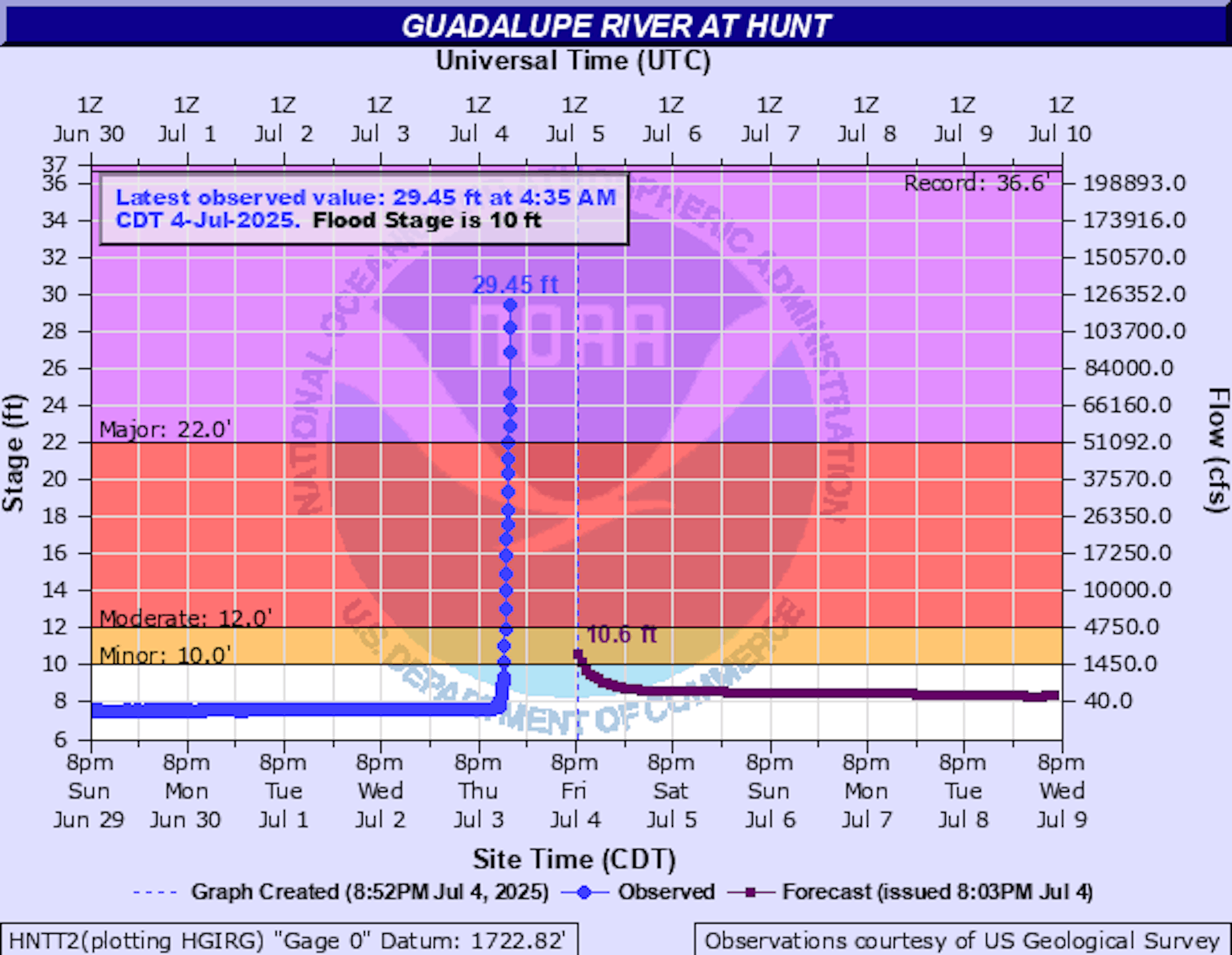
    A river gauge at Hunt, Texas, near Camp Mystic, showed how quickly the river flooded: Around 3 a.m. on July 4, the Guadalupe River was rising about 1 foot every 5 minutes at the gauge, National Weather Service data shows. By 4:30 a.m., it had risen more than 20 feet. As the water moved downstream, it reached Kerrville, where the river rose even faster.

    Flood expert Hatim Sharif, a hydrologist and civil engineer at the University of Texas at San Antonio, explains what makes this part of the country, known as Flash Flood Alley, so dangerous.

    What makes Hill Country so prone to flooding?

    Texas as a whole leads the nation in flood deaths, and by a wide margin. A colleague and I analyzed data from 1959 to 2019 and found 1,069 people had died in flooding in Texas over those six decades. The next highest total was in Louisiana, with 693.

    Many of those flood deaths have been in Hill County. It’s part of an area known as Flash Flood Alley, a crescent of land that curves from near Dallas down to San Antonio and then westward.

    The hills are steep, and the water moves quickly when it floods. This is a semi-arid area with soils that don’t soak up much water, so the water sheets off quickly and the shallow creeks can rise fast.

    When those creeks converge on a river, they can create a surge of water that wipes out homes and washes away cars and, unfortunately, anyone in its path.

    Hill Country has seen some devastating flash floods. In 1987, heavy rain in western Kerr County quickly flooded the Guadalupe River, triggering a flash flood similar to the one in 2025. Ten teenagers being evacuated from a camp died in the rushing water.

    San Antonio, at the eastern edge of Hill Country, was hit with a flash flood on June 12, 2025, that killed 13 people whose cars were swept away by high water from a fast-flooding creek near an interstate ramp in the early morning.

    Why does the region get such strong downpours?

    One reason Hill Country gets powerful downpours is the Balcones Escarpment.

    The escarpment is a line of cliffs and steep hills created by a geologic fault. When warm air from the Gulf rushes up the escarpment, it condenses and can dump a lot of moisture. That water flows down the hills quickly, from many different directions, filling streams and rivers below.

    As temperature rise, the warmer atmosphere can hold more moisture, increasing the downpour and flood risk.

    A tour of the Guadalupe River and its flood risk.

    The same effect can contribute to flash flooding in San Antonio, where the large amount of paved land and lack of updated drainage to control runoff adds to the risk.

    What can be done to improve flash flood safety?

    First, it’s important for people to understand why flash flooding happens and just how fast the water can rise and flow. In many arid areas, dry or shallow creeks can quickly fill up with fast-moving water and become deadly. So people should be aware of the risks and pay attention to the weather.

    Improving flood forecasting, with more detailed models of the physics and water velocity at different locations, can also help.

    Probabilistic forecasting, for example, can provide a range of rainfall scenarios, enabling authorities to prepare for worst-case scenarios. A scientific framework linking rainfall forecasts to the local impacts, such as streamflow, flood depth and water velocity, could also help decision-makers implement timely evacuations or road closures.

    Education is particularly essential for drivers. One to two feet of moving water can wash away a car. People may think their trucks and SUVs can go through anything, but fast-moving water can flip a truck and carry it away.

    Officials can also do more to barricade roads when the flood risk is high to prevent people from driving into harm’s way. We found that 58% of the flood deaths in Texas over the past six decades involved vehicles. The storm on June 12 in San Antonio was an example. It was early morning, and drivers had poor visibility. The cars were hit by fast-rising floodwater from an adjacent creek.

    This article, originally published July 5, 2025, has been updated with the death toll rising.

    Hatim Sharif does not work for, consult, own shares in or receive funding from any company or organization that would benefit from this article, and has disclosed no relevant affiliations beyond their academic appointment.

    ref. Why Texas Hill Country, where a devastating flood killed more than 135 people, is one of the deadliest places in the US for flash flooding – https://theconversation.com/why-texas-hill-country-where-a-devastating-flood-killed-more-than-135-people-is-one-of-the-deadliest-places-in-the-us-for-flash-flooding-260555

    MIL OSI

  • India’s global outreach continues: PM Modi begins UK visit, Maldives next

    Source: Government of India

    Source: Government of India (2)

    rime Minister Narendra Modi will embark on a two-nation tour on Wednesday, visiting the United Kingdom and the Maldives from July 23 to 26, aiming to strengthen India’s global diplomatic engagements.

    At the invitation of UK Prime Minister Keir Starmer, Prime Minister Modi will undertake an official visit to the United Kingdom from July 23 to 24. This will be his fourth visit to the UK, reflecting the growing warmth and depth of the bilateral relationship.

    India and the United Kingdom share historical ties that have evolved into a robust and mutually beneficial partnership. A major milestone in the relationship was achieved during the India-UK virtual summit on 4 May 2021, when Prime Minister Modi and then UK Prime Minister Boris Johnson established a Comprehensive Strategic Partnership and adopted an ambitious India-UK Roadmap 2030. This roadmap continues to steer cooperation across various sectors including trade, security, education, technology, and climate change.

    The visit also comes in the wake of the recent general elections in the UK held on 4 July 2024, where the Labour Party returned to power after 14 years, winning 412 out of 650 seats. Keir Starmer assumed office as Prime Minister, and PM Modi extended his congratulations during a telephonic conversation on 6 July, also inviting him for an early visit to India.

    In its election manifesto, the Labour Party pledged to pursue a new strategic partnership with India, focusing on the conclusion of a Free Trade Agreement (FTA) and deepening cooperation in critical sectors. The two leaders had earlier met on the sidelines of the G20 Leaders’ Summit in Brazil in November 2024 and briefly interacted again during the G7 Summit in Canada in June 2025.

    Following the terrorist attack in Pahalgam in April 2025, Prime Minister Starmer had spoken to PM Modi to convey his condolences and support. On 6 May 2025, both leaders held a telephonic conversation and announced the successful conclusion of the India-UK FTA and the Double Taxation Avoidance Convention, marking a historic development in bilateral ties.

    High-level exchanges have been a consistent feature of India-UK relations. President Droupadi Murmu visited London in September 2022 to attend the State Funeral of Her Majesty Queen Elizabeth II and met King Charles III during her visit. Vice President Jagdeep Dhankhar represented India at the Coronation of King Charles III in May 2023 and engaged with global leaders during his visit. He also addressed members of the Indian community and interacted with Indian-origin UK MPs and students.

    Prime Minister Modi had earlier met former UK Prime Minister Rishi Sunak on multiple occasions, including during the G20 Summit in India in September 2023 and at the G7 Summit in Italy in June 2024. Their discussions covered progress on the India-UK FTA and other key areas under the Roadmap 2030. Sunak’s official visit to India in 2023 and bilateral engagements in Japan and Bali further contributed to the growing momentum in the relationship. Notably, the Young Professionals Scheme was launched following their meeting in Bali in 2022, enhancing mobility for youth between the two countries.

    In April 2022, then UK Prime Minister Boris Johnson visited India and held wide-ranging discussions with PM Modi. The visit saw the announcement of an ‘Open General Export Licence’ for Indian companies and the signing of MoUs in nuclear energy and global innovation, along with a joint statement on cyber cooperation.

    Earlier, in November 2021, Prime Minister Modi had visited the UK to attend the COP26 World Leaders’ Summit in Glasgow, where he and Prime Minister Boris Johnson jointly launched the One Sun, One World, One Grid (OSOWOG) initiative under the International Solar Alliance and the Infrastructure for Resilient Island States (IRIS) initiative under the Coalition for Disaster Resilient Infrastructure.

    Lok Sabha Speaker Om Birla visited the UK in January 2025 and held bilateral talks with the Speaker of the House of Commons, Lindsay Hoyle, underscoring the strong parliamentary ties between the two democracies.

  • Indian diaspora in London gives PM Modi a grand welcome

    Source: Government of India

    Source: Government of India (4)

    Prime Minister Narendra Modi received a rousing welcome from the Indian diaspora as he arrived in London on Wednesday evening for a historic two-day visit aimed at strengthening the India-UK Comprehensive Strategic Partnership and finalising the long-anticipated Free Trade Agreement (FTA).

    As PM Modi reached his hotel in the heart of the city, hundreds of Indian community members gathered outside with chants of “Modi, Modi,” “Bharat Mata Ki Jai,” and “Vande Mataram.” Dressed in traditional Indian attire, artists played dhols while others danced and waved posters welcoming the Prime Minister.

    “Touched by the warm welcome from the Indian community in the UK. Their affection and passion towards India’s progress is truly heartening,” PM Modi shared on X.

    The atmosphere outside the hotel was electric, with many attendees expressing pride and emotion after meeting the Prime Minister. “We are so proud… I am still in tears. The happiness and joy he brought while shaking our hands is unforgettable,” said one member of the diaspora.

    Many in the crowd shared similar sentiments, praising the Prime Minister for his global stature, leadership, and commitment to India’s growth. “The aura I witnessed was simply amazing. He looked like a saint. That is why people like PM Modi a lot,” said another enthusiastic supporter.

    Scheduled for July 23–24, PM Modi’s visit comes at the invitation of newly elected British Prime Minister Keir Starmer and marks his fourth official trip to the United Kingdom. The visit follows recent meetings between the two leaders at the G20 Summit in Brazil and the G7 in June this year.

    “Leaving for the UK, a country with which our Comprehensive Strategic Partnership has achieved significant momentum in the last few years. I look forward to my talks with PM Keir Starmer and my meeting with His Majesty King Charles III,” PM Modi posted before departing.

    According to a statement from India’s Ministry of External Affairs (MEA), the visit will focus on advancing collaboration across key areas such as trade and economy, technology and innovation, defence and security, climate change, healthcare, education, and people-to-people ties.

    The centrepiece of the discussions will be the signing of the India-UK Free Trade Agreement, expected to significantly boost bilateral trade

    PM Modi is also expected to meet King Charles III during his stay in London, further deepening the diplomatic warmth between the two nations.

    (With agencies inputs)

  • MIL-OSI Australia: New SMSF? Here’s what you need to do by 31 October

    Source: New places to play in Gungahlin

    If you have a new self-managed super fund (SMSF) you must lodge your SMSF annual return (SAR) by 31 October 2025.

    Contact a registered tax agent as soon as possible if you need help preparing your SMSF annual return. This allows time for them to include you in their lodgment program, giving you until 28 February 2026 to lodge your first return.

    However, some funds may still need to lodge by 31 October 2025, even with a tax agent so check your registration letter for details.

    If your new fund had no assets in the first year it was registered you must either lodge a return not necessary form or cancel your SMSF registration if you no longer intend to operate the fund.

    Remember each year, you must:

    For new SMSFs, the supervisory levy is $518, covering both the setup year and the following financial year.

    Stay compliant—act early and seek professional support if needed.

    Learn more by visiting Your obligations as an SMSF trustee or Help and support for SMSFs.

    You can also try our online education modulesExternal Link, which are interactive and enable you to build your knowledge.

    Looking for the latest news for SMSFs? – You can stay up to date by visiting our SMSF newsroom and subscribingExternal Link to our monthly SMSF newsletter.

    MIL OSI News

  • MIL-OSI USA: July 23rd, 2025 Heinrich Blasts Trump Administration for Raising Electricity Costs on American Families Amidst Growing Energy Demand

    US Senate News:

    Source: United States Senator for New Mexico Martin Heinrich

    WASHINGTON — In his opening statement during a U.S. Senate Energy and Natural Resources Committee hearing on rising energy demand, U.S. Senator Martin Heinrich (D-N.M.), Ranking Member of the Committee, raised the alarm on the energy affordability crisis facing working families and cited recent, irresponsible actions taken by the Trump Administration and Congressional Republicans that will raise energy costs on working families — including the passage of their Big, Bad Bill, their dismantling of our nation’s clean energy industry, and a recent directive from the Department of the Interior that will inevitably delay new generation additions to the grid and drive up costs further.

    VIDEO: Ranking Member Martin Heinrich (D-N.M.) blasts Trump Administration for raising electricity prices on working families during a hearing on the U.S. Senate Energy and Natural Resources Committee, July 23, 2025.

    “As Mr. Gramlich points out in his testimony, electricity bills are starting to become unaffordable for too many Americans,” said Heinrich. “And recent actions by President Trump and the Republican reconciliation bill will only make it worse.”

    “The reconciliation bill alone is estimated to increase annual energy costs more than $16 billion in 2030 and more than $33 billion by 2035,” continued Heinrich. “This is because, at a time when we need every electron we can get, the reconciliation bill is causing many clean energy projects to be canceled.”

    Heinrich additionally noted his concerns on how a new directive from the Department of the Interior that requires Secretary Doug Burgum to personally review and sign off on wind and solar projects on federal lands will risk delaying new generation additions to the grid, subsequently driving up families’ energy costs.

    A video of Heinrich’s opening remarks can be found here.

    A transcript of Heinrich’s remarks as delivered is below:

    Thank you, Chairman Lee. Welcome to our witnesses, Mr. Gramlich, Mr. Huntsman, and Mr. Tench.

    As we’ll discuss today, the scale and drivers of today’s rising electricity demand are relatively unprecedented.

    It’s not just that electricity demand is reaching record highs, it’s that we’re entering a new era of a sustained load growth.

    The structural forces underlying today’s load growth are converging: the growth of AI data centers; the electrification of vehicles, buildings, industry; as well as a resurgence in domestic manufacturing.

    And meeting this load growth will require structural changes to how we permit and build our energy infrastructure.

    In his testimony, Mr. Tench states that Vantage would prefer to “source power from the grid” but the “system is out of sync.”

    From interconnection timelines that are too long, transmission lines that take too long to build, and permitting that is too fragmented, the challenges that Mr. Tench articulates are the same ones that this Committee has been trying to address for some time.

    As Mr. Tench noted in his testimony, “No single business or technical workaround can substitute for a coordinated, modern, responsive grid.”

    Fortunately, we sit on the Committee that can help make that happen.

    The urgency isn’t just about maintaining our edge in AI innovation, it’s about affordability.

    As Mr. Gramlich points out in his testimony today, electricity bills are becoming unaffordable for too many Americans.

    And recent actions by President Trump and by the ‘Big, Bad Bill’ will make this worse.

    The reconciliation bill alone is estimated to increase annual energy costs more than $16 billion in 2030 and more than $33 billion by 2035.

    This is because, at a time when we need every single electron we can get, the reconciliation bill is causing many clean energy projects to be canceled.

    And the President’s tariffs are driving up equipment costs—raising the cost of all energy generation resources. All of them.

    This is leading directly to Americans spending more on their utility bills.

    And on top of this, an aging electrical grid is causing many energy projects to be stalled for years in interconnection queues.

    In June 2025, Grid Strategies released a study that found that investing in well-planned, high-capacity transmission could save U.S. households between $6.3 and $10.4 billion annually—and that’s even after accounting for the cost of actually building those transmission lines.

    The amount of energy currently in U.S. interconnection queues substantially exceeds the existing electricity demands—if only the grid could integrate it.

    According to the Energy Information Administration, in 2024, the U.S. installed nearly 49 gigawatts of new grid capacity, 95% of which was from renewable resources.

    This year, the EIA estimates that developers will build 63 GW of new capacity, including 32.5 GW of new utility-scale solar, 7.7 GW of wind power, 18.2 GW of energy storage, and just 4.4 GW of natural gas-fired generation.

    Clean energy is the most affordable and it’s the fastest type of energy generation to deploy—outpacing natural gas, which is facing years-long backlogs in turbine availability.

    If you order a gas, combine cycle natural gas turbine today, you’ll be lucky if it puts its first electron on the grid before 2032.

    Meanwhile, states like Texas and California are demonstrating that high levels of renewable energy do not compromise grid reliability—in fact, they improve it.

    After Texas added 9,600 MW of clean energy, including 5,400 MW of solar, 3,800 MW of energy storage, and 253 MW of wind, ERCOT CEO Pablo Vegas said that the risk of grid emergencies dropped to less than 1 percent, that’s down from 16 percent the previous year.

    NERC’s 2025 Summer Reliability Assessment confirmed this trend, showing that the risk of rolling blackouts in Texas fell from 15 percent to 3 percent as battery capacity came online.

    I’ll close by saying that I am deeply disturbed by the recent Department of Interior policy that requires Secretary Doug Burgum to personally review and sign off on wind and solar projects on federal lands.

    This nakedly political decision will risk delaying new generation additions to the grid when we need them the most.

    And consequently, will drive up costs.

    According to the Department of Energy, federal lands in the contiguous United States could support more than 7,700 GW of renewable energy capacity.

    And with that said, I look forward to discussing how we can meet the rise in electricity demand and lower energy costs for households by integrating the most affordable and rapidly deployable energy resources today, while also investing in long-term modernization.

    Thank you, Chairman.

    MIL OSI USA News

  • MIL-OSI USA: Cassidy Secures $49 Million for Louisiana in FY 2026 Appropriations

    US Senate News:

    Source: United States Senator for Louisiana Bill Cassidy

    WASHINGTON – U.S. Senator Bill Cassidy, M.D. (R-LA) announced that he successfully secured $49,102,00.00 in Congressionally Directed Spending (CDS) in the first Fiscal Year (FY) 2026 Appropriations bills advanced by the U.S. Senate Appropriations Committee. These projects will support critical Louisiana priorities, from military construction and public safety to university research.
    “Whether it’s almost $1.4 million for Jefferson Parish to support criminal investigations, $500 thousand to the Northshore to address substance abuse and mental health issues, or multiple grants across the state to support first responders, this money works for the safety, security, and economic growth of Louisiana,” said Dr. Cassidy. Since taking office, Cassidy has emerged as one of the most effective U.S. Senators at directing federal dollars home to Louisiana, despite not serving on the Appropriations Committee. In FY2024, Roll Call reported that Cassidy was one of the top 20 senators in total funding secured for his state, and one of only five in that group who does not sit on the Appropriations Committee. That year, he secured a record $1.3 billion for Louisiana—the highest of any member of the state’s congressional delegation.
    See below for a list of the funding secured by Senator Cassidy.

    Funding Amount
    Recipient
    Project Description

    $30,000,000.00
    Fort Polk
    This funding will support construction of the Rotational Unit Billeting Area, Phase 1.

    $5,000,000.00
    University of Louisiana at Lafayette
    This funding will support purchase of equipment for the Silicon Bayou Semiconductor Technology Center.

    $4,000,000.00
    St. Bernard Parish
    This funding will support construction of a new fire station.

    $2,500,000.00
    Louisiana State University
    This funding will support LSU’s Electronic Microscopy Sight Initiative.

    $1,500,000.00
    City of Ruston Police Department
    This funding will support development of a Real Time Intelligence Crime Center.

    $1,395,000.00
    Jefferson Parish Coroner’s Office
    This funding will support purchase of advanced forensic equipment.

    $1,350,000.00
    University of New Orleans
    This funding will support instrumentation upgrades in computing and chemical sciences.

    $1,250,000.00
    East Baton Rouge DA’s Office
    This funding will support the Gun Intelligence Center Program.

    $794,000.00
    West Monroe Police Department
    This funding will support purchase of safety equipment for officers.

    $500,000.00
    22nd Judicial District Court
    This funding will support specialty courts for mental health and substance abuse treatment.

    $300,000.00
    Grant Parish Sheriff’s Office
    This funding will support upgrades to local law enforcement services.

    $263,000.00
    Town of Farmerville
    This funding will support renovations to the fire department.

    $250,000.00
    Tensas Parish Police Jury
    This funding will support security equipment upgrades.

    MIL OSI USA News

  • MIL-OSI Banking: Secretary-General of ASEAN delivers Pre-Recorded Keynote Remarks at the ASEAN–India Forum 2025

    Source: ASEAN

    Secretary-General of ASEAN, Dr. Kao Kim Hourn, today delivered pre-recorded keynote remarks at the ASEAN–India Forum 2025, held in Bangkok, Thailand. In his message, Dr. Kao reaffirmed ASEAN’s strong commitment to advancing the ASEAN–India Comprehensive Strategic Partnership through tourism. He also emphasized the importance of sustainable tourism, stronger transport connectivity, and collaborative destination marketing, highlighting the regional tagline “A Destination for Every Dream.”
     

    The post Secretary-General of ASEAN delivers Pre-Recorded Keynote Remarks at the ASEAN–India Forum 2025 appeared first on ASEAN Main Portal.

    MIL OSI Global Banks

  • MIL-OSI New Zealand: Guidelines released for prescribing psilocybin

    Source: New Zealand Government

    Associate Health Minister David Seymour is welcoming steps to provide medical practitioners with more tools to treat people with depression, with Medsafe publishing guidelines for experts wanting to prescribe Psilocybin. 

    “This is huge for people with depression who’ve tried everything else and are still suffering. If a doctor believes psilocybin can help, they should have the opportunity to do what’s best for their patient,” says Mr Seymour. 

    “Recent changes have put New Zealand’s settings in line with Australia, where authorised prescribers have been using psilocybin in clinical settings for some time.

    “Psilocybin remains an unapproved medicine, but one highly experienced psychiatrist has already been granted authority to prescribe it to patients with treatment-resistant depression. 

    “This is excellent news for their patients, but there are other Kiwis in need in different parts of New Zealand who might have an appropriate practitioner nearby. 

    “Practitioners must meet a series of requirements to gain approval, including being registered with the Medical Council with a current practicing certificate, a good understanding and experience of the medicines and the psychotherapeutic processes involved in psychedelic-assisted therapy, and a detailed proposal of how they will administer the treatment that has been peer reviewed and will be considered by Medsafe. 

    “Soon more practitioners will have the ability to use this medicine, meaning more patients will benefit.” 

    Note to editors: Guidelines can be found here

    MIL OSI New Zealand News

  • MIL-OSI New Zealand: Government Cuts – Govt funding squeeze sees DOC cutting a further 71 roles – PSA

    Source: PSA

    The need to meet Government spending cut requirements means the Department of Conservation (DOC) will be cutting a net 71 support roles around the country, many in small rural towns.
    DOC confirmed to staff today that it will be disestablishing 143 support roles and creating 72 new positions, meaning a net reduction of 71 roles. Of the 72 new support roles, 25 are half-time.
    Removing support staff, who monitor the radios used by DOC staff working away from the office to stay safe, poses health and safety risks, PSA National Secretary Fleur Fitzsimons says.
    “The current support staff have sizeable health and safety responsibilities, such as monitoring staff radio systems and helping to manage emergencies like fires. The loss of these team members will mean that these important duties will fall on others – and pose a significant health and safety risk.
    “DOC Rangers, contractors and volunteers rely on the radios to stay in regular contact with their offices and ensure they can get help if they run into trouble,” Fitzsimons says.
    “It’s one example of how the loss of business support staff will mean administrative work will have to be done by other DOC staff.
    “This will mean they have less time to focus on vital work like protecting threatened species, repairing tracks and pest control,” Fitzsimons says.
    The cuts also mean the public will no longer be able to access DOC offices, apart from Visitors’ Centres, because the loss of support staff will mean there will be no one to manage reception.
    “A farmer in town for errands will no longer be able to drop into the DOC office to talk with staff about matters of concern. A wealth of local knowledge and wisdom will be lost with the axing of support staff,” Fitzsimons says.
    “Downgrading 25 roles to half-time is a blow to the many workers who cannot make

    MIL OSI New Zealand News

  • MIL-OSI New Zealand: Government Cuts – Axing same-day enrolment to vote exposes impact of Govt starving another key agency of enough funding

    Source: PSA

    The PSA is condemning proposed changes to New Zealand’s electoral laws as undemocratic and the result of a systematically underfunded public service.
    “We were shocked to see the Government propose several changes to electoral laws, especially the end to same-day voter enrolment,” Public Service Association Te Pūkenga Here Tikanga Mahi national secretary, Fleur Fitzsimons, says.
    “They say that the system – in other words, the Electoral Commission – can’t handle the strain of same-day enrolment in the years to come.
    “Why has the Government chosen to build obstacles around people’s basic right to vote, instead of funding the Electoral Commission properly?”
    Like many other public service agencies, the Electoral Commission has been forced to tighten its budget by the National-led Government and restructured its staff last year.
    “At the time, we criticised that restructure process as rushed – and it eventually resulted in several highly skilled staff leaving the organisation.
    “New Zealanders are rightfully proud of our democracy. But we also know that to maintain our democracy, we need to care for it and invest into it.
    “New Zealanders want the public service to be given the tools – including the funding – to make sure voting is as easy as possible for everyone.
    “100,000 people used the same-day enrolment process at the 2023 election. This is not a nice-to-have – this is a basic function of our democracy.”
    The Public Service Association Te Pūkenga Here Tikanga Mahi is Aotearoa New Zealand’s largest trade union, representing and supporting more than 95,000 workers across central government, state-owned enterprises, local councils, health boards and community groups.

    MIL OSI New Zealand News

  • MIL-OSI Asia-Pac: Bernadette Linn begins Beijing visit

    Source: Hong Kong Information Services

    Secretary for Development Bernadette Linn today began a visit to Beijing by calling on the National Cultural Heritage Administration, the Ministry of Housing & Urban-Rural Development and the Ministry of Human Resources & Social Security.

    This morning, Ms Linn called on National Cultural Heritage Administration Deputy Administrator Qiao Yunfei. They discussed the organisation of artefact exhibitions, youth exchange activities and talent training, as well as research on antiquities, nominations for World Heritage status, and the application of technology in heritage conservation.

    Ms Linn then called on the Ministry of Housing & Urban-Rural Development, and briefed a team led by Vice Minister Qin Haixiang on developments in Hong Kong’s construction sector.

    The two parties exchanged views on the application of technology to reduce construction costs and enhance productivity, and on promoting the establishment of the Guangdong-Hong Kong-Macao Greater Bay Area Construction Standards.

    They also spoke about leveraging Hong Kong’s certification system and high degree of internationalism in the development of Modular Integrated Construction and other innovative construction technologies, and about the rehabilitation and redevelopment of old buildings.

    Afterwards, Ms Linn and her delegation had lunch with Minister Ni Hong, and compared experiences of construction and urban development in both places.

    In the afternoon, Ms Linn met Human Resources & Social Security Vice Minister Yu Jiadong to exchange views on talent development in the construction industry.

    Topics discussed included integrating Hong Kong construction professionals into the Mainland’s “Professional Title” evaluation mechanism, mutual recognition of various professional qualifications between the Mainland and Hong Kong, formulating Greater Bay Area skill standards and implementing the “One Examination, Multiple Certification” arrangement for skilled technicians and workers in the construction sector.

    Ms Linn thanked the Ministry of Housing & Urban-Rural Development and the Ministry of Human Resources & Social Security for their strong support of the long-term development of Hong Kong’s construction industry.

    She also expressed hope that the construction and engineering sectors of the Mainland and Hong Kong can deepen exchanges and co-operation to jointly promote the high-quality development of the bay area’s construction industry, and to establish Hong Kong as an international infrastructure centre.

    The development chief later joined participants on a study tour looking at national water infrastructure, culture and technology. Together, they visited the Tuancheng Lake Regulating Pond, a terminal on the middle route of the South-to-North Water Diversion Project.

    She also had dinner with study tour participants and heard about their experiences.  

    MIL OSI Asia Pacific News

  • MIL-OSI USA: Our Happy Place!: FSC Annual Poster Social Convened

    Source: US Geological Survey

    Once a year USGS Flagstaff Campus employees steal away to a place of science discovery in our own neighborhood. On May 29, folks from the five science centers hung posters or pictures and shared current research with each other, showcasing the work they are doing on the Flagstaff Campus. For many of us, being available to connect annually, has become our happy place.

    Researchers from the Astrogeology Science Center (ASC), Arizona Water Science Center (AzWSC), Geology, Minerals, Energy and Geophysics Science Center (GMEGSC), Southwest Biological Science Center (SBSC), and Western Geographic Science Center (WGSC) gather to share their ongoing research and recently published results. These gives us opportunities to develop new connections, exchange ideas and skillsets, and grow research areas in ways that we wouldn’t normally be provided access or exposure. Although we may work down the hall from each other, this annual event provides us the opportunity to cross-pollinate topics and build new collaborations.

    “It is a combination of in-reach (like out-reach but among five centers)  and social function (minus the adult beverages), said Dr. Tim Titus, Research Space Scientist, from the Astrogeology Science Center. 

    Dr. Titus, and Dr. Lori Pigue, Physical Scientist with ASC, ensured our happy place would be found again this year, helping to foster a sense of community on campus. 

    “There’s a bit of heavy lifting that goes into putting up the poster boards, making sure everyone knows that it’s happening and finding a poster or presentation from a past conference to recycle, but it’s worth it in the end.” Dr. Pigue shares.

    Another participant said, “Feeling that connection with our neighbors and our immediate surroundings in a relaxed environment, would be even greater if we had longer than a 2-hr visit.” 


    MIL OSI USA News

  • MIL-OSI USA: Peters, Slotkin Respond to Federal Disaster Declaration Following Catastrophic Northern Michigan Ice Storm

    US Senate News:

    Source: United States Senator for Michigan Gary Peters
    WASHINGTON, DC – U.S. Senators Gary Peters (D-MI) and Elissa Slotkin (D-MI) responded to the approval of Michigan’s request for a major disaster declaration following the catastrophic ice storm that impacted communities throughout Northern Michigan and the Eastern Upper Peninsula in late March. In May, Peters and Slotkin sent a letter to President Trump urging his swift approval of this declaration to support areas affected by the storm. With this declaration, critical assistance through the Federal Emergency Management Agency’s (FEMA) Public Assistance Program will be available to communities in Alcona, Alpena, Antrim, Charlevoix, Cheboygan, Crawford, Emmet, Montmorency, Oscoda, Otsego, Presque Isle, Kalkaska and Mackinac Counties, as well as the Little Traverse Bay Band of Odawa Indians.
    “I’m pleased that funding is coming to Northern Michigan to bolster the ongoing recovery efforts following the ice storm this March,” said Senator Peters. “The State of Michigan and local emergency managers continue to work hard because this job is not finished, and I’ll keep fighting to help our communities get the resources they need to bounce back stronger.”
    “This is welcome news and a big step for the many Michiganders who are still recovering from the once-in-a-generation ice storm in Northern Michigan and the UP in March,” said Senator Slotkin. “There is still more work ahead, but my office is here to help Michiganders navigate the federal disaster process to rebuild and recover.”
    The National Weather Service has ranked this as one of the most significant ice storms ever recorded in Northern Michigan. State and federal officials estimate the storms caused more than $137 million in immediate response costs, and inflicted severe damage to homes, businesses, and critical infrastructure, including leaving residents without power for weeks. The long-term impacts to local government, industries, and residents remain to be seen.
    FEMA’s Public Assistance Program provides assistance to eligible applicants, including local governments, to respond and recover from major disasters. In Michigan, the authorized funding can be used for debris removal and emergency protective measures such as eligible overtime work and permanent restoration of infrastructure. For additional information regarding the federal assistance, please contact the MSP Emergency Management and Homeland Security Division at 517-243-0149.
    Peters and Slotkin have fought to aid Northern Michigan’s impacted communities from the start. In the days following this devastating storm, the lawmakers wrote to Governor Whitmer expressing their willingness to support any federal support needed as part of the State of Michigan’s response. In June, Peters and Slotkin called on the Small Business Administration to approve the State of Michigan’s Rapid Administrative Disaster Declaration request for eligible counties, which was later approved by SBA Administrator Loeffler.

    MIL OSI USA News

  • MIL-OSI Banking: Money Market Operations as on July 23, 2025

    Source: Reserve Bank of India


    (Amount in ₹ crore, Rate in Per cent)

      Volume
    (One Leg)
    Weighted
    Average Rate
    Range
    A. Overnight Segment (I+II+III+IV) 6,03,403.84 5.73 4.75-6.75
         I. Call Money 17,346.55 5.73 4.75-5.85
         II. Triparty Repo 4,04,014.05 5.72 5.30-5.82
         III. Market Repo 1,79,687.94 5.75 5.20-5.90
         IV. Repo in Corporate Bond 2,355.30 5.91 5.85-6.75
    B. Term Segment      
         I. Notice Money** 131.54 5.46 5.00-5.82
         II. Term Money@@ 189.50 5.60-5.95
         III. Triparty Repo 795.00 5.57 5.50-5.70
         IV. Market Repo 470.68 5.55 5.55-5.55
         V. Repo in Corporate Bond 0.00
      Auction Date Tenor (Days) Maturity Date Amount Current Rate /
    Cut off Rate
    C. Liquidity Adjustment Facility (LAF), Marginal Standing Facility (MSF) & Standing Deposit Facility (SDF)
    I. Today’s Operations
    1. Fixed Rate          
    2. Variable Rate&          
      (I) Main Operation          
         (a) Repo          
         (b) Reverse Repo          
      (II) Fine Tuning Operations          
         (a) Repo Wed, 23/07/2025 2 Fri, 25/07/2025 50,001.00 5.53
         (b) Reverse Repo          
    3. MSF# Wed, 23/07/2025 1 Thu, 24/07/2025 820.00 5.75
    4. SDFΔ# Wed, 23/07/2025 1 Thu, 24/07/2025 78,428.00 5.25
    5. Net liquidity injected from today’s operations [injection (+)/absorption (-)]*       -27,607.00  
    II. Outstanding Operations
    1. Fixed Rate          
    2. Variable Rate&          
      (I) Main Operation          
         (a) Repo          
         (b) Reverse Repo          
      (II) Fine Tuning Operations          
         (a) Repo          
         (b) Reverse Repo Fri, 18/07/2025 7 Fri, 25/07/2025 2,00,027.00 5.49
    3. MSF#          
    4. SDFΔ#          
    D. Standing Liquidity Facility (SLF) Availed from RBI$       10,403.21  
    E. Net liquidity injected from outstanding operations [injection (+)/absorption (-)]*     -1,89,623.79  
    F. Net liquidity injected (outstanding including today’s operations) [injection (+)/absorption (-)]*     -2,17,230.79  
    G. Cash Reserves Position of Scheduled Commercial Banks          
         (i) Cash balances with RBI as on July 23, 2025 9,68,804.65  
         (ii) Average daily cash reserve requirement for the fortnight ending July 25, 2025 9,63,288.00  
    H. Government of India Surplus Cash Balance Reckoned for Auction as on¥ July 23, 2025 50,001.00  
    I. Net durable liquidity [surplus (+)/deficit (-)] as on June 27, 2025 5,79,904.00  

    @ Based on Reserve Bank of India (RBI) / Clearing Corporation of India Limited (CCIL).

    – Not Applicable / No Transaction.

    ** Relates to uncollateralized transactions of 2 to 14 days tenor.

    @@ Relates to uncollateralized transactions of 15 days to one year tenor.

    $ Includes refinance facilities extended by RBI.

    * Net liquidity is calculated as Repo+MSF+SLF-Reverse Repo-SDF.

    Ajit Prasad          
    Deputy General Manager
    (Communications)    

    Press Release: 2025-2026/772

    MIL OSI Global Banks

  • MIL-OSI New Zealand: Deputy Commissioner of Police retires

    Source: New Zealand Government

    Police Minister Mark Mitchell today announced the retirement of statutory Deputy Commissioner of Police, Tania Kura.

    Ms Kura has served in the statutory Deputy Police Commissioner role since her appointment on 18 April 2023.

    Deputy Commissioner Kura notified the Governor-General yesterday of her intention to retire from the role and the New Zealand Police in November this year.  

    Ms Kura has served in the police for 37 years, graduating from the Royal New Zealand Police College in 1988. She started her career as a constable in Christchurch before working her way through the ranks to be Area Commander Hawkes Bay in 2012 and District Commander Eastern from 2017. She moved to Wellington in 2020 to be based at Police National Headquarters, taking up the role of Deputy Commissioner Leadership and Capability.

    “I wish to acknowledge Deputy Commissioner Kura for her service, and I wish her and her family the best for the future,” Mr Mitchell says. 

    Statutory Deputy Commissioners of Police are appointed by the Governor-General on the recommendation of the Prime Minister. The Public Service Commission has started a recruitment process for both Deputy Commissioner positions

    MIL OSI New Zealand News

  • MIL-OSI New Zealand: Greenpeace Statement – Gore ‘not out of the woods yet’- nitrate level linked to increased risk of preterm birth

    Source: Greenpeace

    Greenpeace Aotearoa has tested a sample collected from the Gore town supply, which returned a result above 5 mg/L nitrate (NO3-N), a level associated with an increased risk of preterm birth.
    Above this level of nitrate, the New Zealand College of Midwives recomm

    MIL OSI New Zealand News

  • MIL-OSI Security: Muscatine Men Sentenced to Federal Prison Related to Events Surrounding Officer Involved Shooting

    Source: United States Bureau of Alcohol Tobacco Firearms and Explosives (ATF)

    DAVENPORT, Iowa – Two Muscatine men were sentenced on July 22, 2025, to federal prison for drug and gun crimes, related to an officer involved shooting in Muscatine on May 29, 2024.

    According to public court documents and evidence presented at sentencing, on May 29, 2024, Juan Aldo Beltran Delgado, 34, and Isidro Barajas, Jr., 30, drove to a residence in Muscatine, Iowa, to await the delivery of a package they expected to contain more than 4.5 pounds of methamphetamine. Law enforcement observed Beltran Delgado and Barajas pick up the package from the residence and attempted to stop their vehicle. Beltran Delgado was driving the vehicle and drove over 100 miles per hour through Muscatine, drove through multiple red lights, attempting to evade law enforcement. Ultimately, Beltran Delgado crashed into two other vehicles near Highway 61 and Cedar Street. After crashing, both Beltran Delgado and Barajas fled from the car on foot carrying firearms. Officers arrived in the area and Beltran Delgado shot at officers. Officers were able to take both Beltran and Delgado and Barajas into custody.

    Beltran Delgado was sentenced to 35 years in federal prison, followed by a five-year term of supervised release, following his plea to conspiracy to possess with intent to distribute methamphetamine, attempted possession with intent to distribute methamphetamine, and carrying and discharging a firearm during an in relation to his drug trafficking. Barajas was sentenced to 32 years in federal prison, followed by a ten-year term of supervised release, following his plea to conspiracy to possess with intent to distribute methamphetamine, attempted possession with intent to distribute methamphetamine, carrying and displaying a firearm during an in relation to his drug trafficking, and being a felon in possession of a firearm. There is no parole in the federal system.

    United States Attorney Richard D. Westphal of the Southern District of Iowa made the announcement. This case was investigated by the Muscatine County Sheriff’s Office, Iowa Department of Public Safety, Iowa Division of Criminal Investigations, Scott County Sheriff’s Office, Muscatine Police Department, Cedar County Sheriff’s Office, Muscatine County Drug Task Force, Johnson County Drug Taskforce, and the Bureau of Alcohol, Tobacco, Firearms, and Explosives.

    This case is part of Project Safe Neighborhoods (PSN), a program bringing together all levels of law enforcement and the communities they serve to reduce violent crime and gun violence, and to make our neighborhoods safer for everyone. On May 26, 2021, the department launched a violent crime reduction strategy strengthening PSN based on these core principles: fostering trust and legitimacy in our communities, supporting community-based organizations that help prevent violence from occurring in the first place, setting focused and strategic enforcement priorities, and measuring the results. For more information about Project Safe Neighborhoods, please visit Justice.gov/PSN.

    MIL Security OSI

  • MIL-OSI Security: TALLAHASSEE MAN RECEIVES 42 MONTHS FOR POSSESSION OF A MACHINEGUN

    Source: United States Bureau of Alcohol Tobacco Firearms and Explosives (ATF)

    TALLAHASSEE, FLORIDA – Artaviyon Cornel Williams, 24, of Tallahassee, Florida, was sentenced in federal court for illegal possession of a machinegun. The sentence was announced by John P. Heekin, United States Attorney for the Northern District of Florida.

    U.S. Attorney Heekin said: “Our brave law enforcement officers are increasingly encountering violent criminals and seizing firearms that have been illegally modified to fire as fully automatic machineguns. My office is committed to staunchly supporting law enforcement efforts to keep our communities safe from violent criminals.”

    Court documents reflect that law enforcement obtained an arrest warrant for Williams for an aggravated assault that had occurred on June 28, 2024, outside the Table Lounge in Tallahassee. Witnesses advised Williams broke up a fight involving his girlfriend by brandishing a firearm, firing a round into the air, and pointing the firearm at one woman and telling her “I’ll kill you.” Officers located Williams on July 6, 2024, outside the Table Lounge and arrested him on the outstanding warrant. When arrested, Williams had a stolen Glock pistol in his waistband which had been illegally modified to fire as a machinegun. Williams had a second, loaded, extended-round magazine in a pocket.

    Williams received a sentence of 42 months in prison, which will be followed by three years of supervised release.

    “The Tallahassee Police Department remains committed to removing illegal firearms from our streets,” said Tallahassee Police Chief Lawrence Revell. “Modifying a weapon to function as a machine gun is not only illegal, but also reckless and puts innocent lives at risk. We’re proud to work alongside our federal partners to ensure those who engage in this kind of violent behavior are held accountable.”

    The case involved an investigation by the Tallahassee Police Department and the Bureau of Alcohol, Tobacco, Firearms, and Explosives.  Assistant United States Attorney James A. McCain prosecuted the case.

    This case is part of Operation Take Back America (https://www.justice.gov/dag/media/1393746/dl?inline ) a nationwide initiative that marshals the full resources of the Department of Justice to repel the invasion of illegal immigration, achieve the total elimination of cartels and transnational criminal organizations (TCOs), and protect our communities from the perpetrators of violent crime. Operation Take Back America streamlines efforts and resources from the Department’s Organized Crime Drug Enforcement Task Forces (OCDETFs) and Project Safe Neighborhood (PSN).

    As part of its PSN strategy, the United States Attorney’s Office is encouraging everyone to lock their car doors, particularly at night. Burglaries from unlocked automobiles are a significant source of guns for criminals in the Northern District of Florida. Please do your part and protect yourself by locking your car doors.

    The United States Attorney’s Office for the Northern District of Florida is one of 94 offices that serve as the nation’s principal litigators under the direction of the Attorney General.  To access public court documents online, please visit the U.S. District Court for the Northern District of Florida website. For more information about the United States Attorney’s Office, Northern District of Florida, visit http://www.justice.gov/usao/fln/index.html.

    MIL Security OSI

  • MIL-Evening Report: Bali is built on informal and ‘illegal’ settlements. Bulldozing Bingin Beach misses the real threat of overdevelopment

    Source: The Conversation (Au and NZ) – By Kim Dovey, Professor of Architecture and Urban Design, The University of Melbourne

    Balinese officials have begun the demolition of more than 40 businesses at Bingin Beach, a popular tourist spot in the Uluwatu region.

    In June, the Balinese House of Representatives determined the settlement is on public land, and is therefore illegal and needs to be demolished. But I’d argue it doesn’t.

    The ‘illegal’ settlement

    The Bingin Beach coastal settlement began development in the 1970s as an informal surfer hub at the base of a steep escarpment. The beach is a few hundred metres long and largely disappears at high tide.

    Originally lined with a string of makeshift warungs (small food stores) and cheap accommodations, the settlement has grown incrementally over the decades, up and along the escarpment, with an intensive mix of surf shops, restaurants and small hotels.

    The steepness of the slope precludes vehicle access. The only public access is via two somewhat narrow pedestrian stairways.

    While it initially served the surfer community, the settlement now caters to a broader tourist market, with some rooms going for upwards of US$150 per night.

    But after more than 50 years of incremental development, the House of Representatives has declared the settlement was illegally constructed on state land, and has ordered the demolition of 45 buildings – effectively the entire settlement.

    While most of the buildings seem highly durable, the demolition order is based on illegality, and not durability. A spokesperson for the traders argues most of the businesses are locally owned, and livelihoods are at stake.

    The ‘legal’ settlement

    The former farmland at the top of the escarpment is also covered with tourist developments that mostly emerged since 2010, and now extend up to a kilometre inland. This is a much more familiar landscape for Bali: a mix of walled hotel compounds and private villas, with manicured gardens and swimming pools.

    However, one could scarcely call this larger settlement “planned”. Shops and restaurants emerge wherever they can find a market along the narrow roads. There are no sidewalks and pedestrians are constantly engaged in an anxious game of negotiated passing.

    The infrastructure of roads and lanes has also been designed incrementally, across the former farm fields, as the settlement developed. The resulting street network is convoluted and largely unwalkable. The most common street sign is “no beach access this way”.

    What is informality?

    I’m an academic, architect and urban planner who studies informal settlements and informal urbanism more generally. In this context “informal” can mean illegal, makeshift and unplanned, but it can also mean incremental, adaptive and inventive.

    Informal settlement is the means by which a large proportion of Indonesians produce affordable housing. It is also the most traditional form of indigenous housing globally.

    After many decades of governments trying to demolish such settlements, the overwhelming consensus across the United Nations Human Settlements Programme is that wholesale demolition is rarely an answer. On-site formalisation and upgrading is the more sustainable pathway.

    When engaging with informal settlements, we need to preserve the infrastructures that work and only demolish where necessary. The Bingin Beach escarpment settlement has proven sustainable and has become an integral part of the local heritage.

    Its demolition will destroy livelihoods and displace the surfing market, while feathering other nests.

    So why is it being demolished? Perhaps to clear the ground for the next round of up-market resorts – what urban studies research calls “accumulation by disposession”. Bingin is widely seen as a major real estate hotspot for investment.

    What is overdevelopment?

    One of the key dangers of informal settlement is “overdevelopment”. Without
    formal planning codes, density can escalate to destroy the very attraction that produced the settlement.

    Most buildings along the Bingin Beach escarpment are two to four storeys, and step back with the slope of the escarpment. The exception is the 2019 addition of the Morabito Art Cliff hotel that rises more than six storeys, obscuring the natural landscape, blocking views, and setting a precedent for more of the same.

    If everyone in the area built like this, the Bingin settlement would be replaced with a cliff of buildings. To demolish this one building would set a useful precedent of containing the settlement to a sustainable scale.

    The Impossibles dream

    A few hundred metres south-west of Bingin Beach, a different story unfolds near the beach known as Impossibles. Here, a precarious limestone cliff largely precludes access to the beach, and the clifftop has long been lined with low-rise tourist compounds.

    An aeriel view of the Uluwatu coast shows Bingin Beach and the Impossibles.
    Map data: Google, 2025 Maxar Technologies

    This earlier layer of development is now being demolished and replaced with larger, denser resorts as part of the Amali project which claims a “rare cliff-front location”. The location is “rare” because about half of the 50-metre-high cliff has been excavated to construct villa units quite literally in the cliff.

    This excavation was well underway when, in May 2024, it caused much of the remaining natural cliff face to collapse onto the beach and into the ocean. It remains unclear whether the excavation was formally approved. Either way, it prompts the question: what if everyone did that?

    The Bingin escarpment and the Impossibles cliff face represent very different kinds of development. One is incremental, irregular and geared to its social and environmental context, while the other is large-grain and environmentally destructive. It makes no sense to demolish the former in order to make way for the latter.

    It is imperative to not only save the Bingin Beach settlement, which is part of Bali’s surfing heritage, but also to awaken from the impossible dream of building more and more villas on this fragile and limited coastland.

    Kim Dovey does not work for, consult, own shares in or receive funding from any company or organisation that would benefit from this article, and has disclosed no relevant affiliations beyond their academic appointment.

    ref. Bali is built on informal and ‘illegal’ settlements. Bulldozing Bingin Beach misses the real threat of overdevelopment – https://theconversation.com/bali-is-built-on-informal-and-illegal-settlements-bulldozing-bingin-beach-misses-the-real-threat-of-overdevelopment-261755

    MIL OSI AnalysisEveningReport.nz

  • MIL-OSI Russia: Breaking: Thai, Cambodian soldiers exchange shots in disputed border area

    Translation. Region: Russian Federal

    Source: People’s Republic of China in Russian – People’s Republic of China in Russian –

    An important disclaimer is at the bottom of this article.

    Source: People’s Republic of China – State Council News

    BANGKOK/PHNOM PENH, July 24 (Xinhua) — The Thai military said on Thursday that a clash broke out on the border with Cambodia after the Cambodian side opened fire.

    In turn, a spokesman for the Cambodian Defense Ministry said that Cambodian soldiers clashed with Thai soldiers in a disputed border area on Thursday. –0–

    Please note: This information is raw content obtained directly from the source of the information. It is an accurate report of what the source claims and does not necessarily reflect the position of MIL-OSI or its clients.

    .

    MIL OSI Russia News

  • MIL-OSI Russia: Ukraine has returned more than a thousand servicemen from Russian captivity

    Translation. Region: Russian Federal

    Source: People’s Republic of China in Russian – People’s Republic of China in Russian –

    An important disclaimer is at the bottom of this article.

    Source: People’s Republic of China – State Council News

    KYIV, July 24 /Xinhua/ — Ukraine has secured the release of more than a thousand servicemen as part of the agreements reached at peace talks in Istanbul, Turkey, the Ukrainian Coordination Headquarters for the Treatment of Prisoners of War reported on Telegram on Wednesday.

    In total, Ukraine and Russia have conducted nine stages of prisoner exchanges under the Istanbul agreements. During the latest exchange, wounded and seriously ill servicemen were released.

    Among those released are reportedly representatives of the Armed Forces of Ukraine, the State Border Service, the National Guard and the National Police. –0–

    Please note: This information is raw content obtained directly from the source of the information. It is an accurate report of what the source claims and does not necessarily reflect the position of MIL-OSI or its clients.

    .

    MIL OSI Russia News

  • MIL-OSI Russia: Fishing season begins at largest lake on China-Russia border

    Translation. Region: Russian Federal

    Source: People’s Republic of China in Russian – People’s Republic of China in Russian –

    An important disclaimer is at the bottom of this article.

    Source: People’s Republic of China – State Council News

    BEIJING, July 24 (Xinhua) — Local fishermen went down to Lake Xingkai (Khanka) on Tuesday and cast their nets to haul in the first batch of fish, marking the end of the seasonal fishing ban on the largest lake on the China-Russia border, Zhongxinshe News Agency reported.

    Lake Xingkai, located in the southeast of Heilongjiang Province /Northeast China/ and in the Primorsky Territory of the Russian Far East, is the largest border lake of the two countries. Its water surface area is 4,380 square kilometers.

    Shinkai has rich fish resources. According to research, there are 65 species of fish in the lake. In order to ensure biodiversity and promote sustainable fisheries development, a seasonal fishing ban has been in place in this lake since 1952.

    This year, a 40-day fishing ban on the lake began in early June.

    According to a local border control official, patrols will be stepped up during the fishing season and measures will be taken to prevent and combat illegal fishing activities to ensure security and stability in the border areas. -0-

    Please note: This information is raw content obtained directly from the source of the information. It is an accurate report of what the source claims and does not necessarily reflect the position of MIL-OSI or its clients.

    .

    MIL OSI Russia News

  • MIL-OSI Submissions: Bali is built on informal and ‘illegal’ settlements. Bulldozing Bingin Beach misses the real threat of overdevelopment

    Source: The Conversation – Global Perspectives – By Kim Dovey, Professor of Architecture and Urban Design, The University of Melbourne

    Balinese officials have begun the demolition of more than 40 businesses at Bingin Beach, a popular tourist spot in the Uluwatu region.

    In June, the Balinese House of Representatives determined the settlement is on public land, and is therefore illegal and needs to be demolished. But I’d argue it doesn’t.

    The ‘illegal’ settlement

    The Bingin Beach coastal settlement began development in the 1970s as an informal surfer hub at the base of a steep escarpment. The beach is a few hundred metres long and largely disappears at high tide.

    Originally lined with a string of makeshift warungs (small food stores) and cheap accommodations, the settlement has grown incrementally over the decades, up and along the escarpment, with an intensive mix of surf shops, restaurants and small hotels.

    The steepness of the slope precludes vehicle access. The only public access is via two somewhat narrow pedestrian stairways.

    While it initially served the surfer community, the settlement now caters to a broader tourist market, with some rooms going for upwards of US$150 per night.

    But after more than 50 years of incremental development, the House of Representatives has declared the settlement was illegally constructed on state land, and has ordered the demolition of 45 buildings – effectively the entire settlement.

    While most of the buildings seem highly durable, the demolition order is based on illegality, and not durability. A spokesperson for the traders argues most of the businesses are locally owned, and livelihoods are at stake.

    The ‘legal’ settlement

    The former farmland at the top of the escarpment is also covered with tourist developments that mostly emerged since 2010, and now extend up to a kilometre inland. This is a much more familiar landscape for Bali: a mix of walled hotel compounds and private villas, with manicured gardens and swimming pools.

    However, one could scarcely call this larger settlement “planned”. Shops and restaurants emerge wherever they can find a market along the narrow roads. There are no sidewalks and pedestrians are constantly engaged in an anxious game of negotiated passing.

    The infrastructure of roads and lanes has also been designed incrementally, across the former farm fields, as the settlement developed. The resulting street network is convoluted and largely unwalkable. The most common street sign is “no beach access this way”.

    What is informality?

    I’m an academic, architect and urban planner who studies informal settlements and informal urbanism more generally. In this context “informal” can mean illegal, makeshift and unplanned, but it can also mean incremental, adaptive and inventive.

    Informal settlement is the means by which a large proportion of Indonesians produce affordable housing. It is also the most traditional form of indigenous housing globally.

    After many decades of governments trying to demolish such settlements, the overwhelming consensus across the United Nations Human Settlements Programme is that wholesale demolition is rarely an answer. On-site formalisation and upgrading is the more sustainable pathway.

    When engaging with informal settlements, we need to preserve the infrastructures that work and only demolish where necessary. The Bingin Beach escarpment settlement has proven sustainable and has become an integral part of the local heritage.

    Its demolition will destroy livelihoods and displace the surfing market, while feathering other nests.

    So why is it being demolished? Perhaps to clear the ground for the next round of up-market resorts – what urban studies research calls “accumulation by disposession”. Bingin is widely seen as a major real estate hotspot for investment.

    What is overdevelopment?

    One of the key dangers of informal settlement is “overdevelopment”. Without
    formal planning codes, density can escalate to destroy the very attraction that produced the settlement.

    Most buildings along the Bingin Beach escarpment are two to four storeys, and step back with the slope of the escarpment. The exception is the 2019 addition of the Morabito Art Cliff hotel that rises more than six storeys, obscuring the natural landscape, blocking views, and setting a precedent for more of the same.

    If everyone in the area built like this, the Bingin settlement would be replaced with a cliff of buildings. To demolish this one building would set a useful precedent of containing the settlement to a sustainable scale.

    The Impossibles dream

    A few hundred metres south-west of Bingin Beach, a different story unfolds near the beach known as Impossibles. Here, a precarious limestone cliff largely precludes access to the beach, and the clifftop has long been lined with low-rise tourist compounds.

    An aeriel view of the Uluwatu coast shows Bingin Beach and the Impossibles.
    Map data: Google, 2025 Maxar Technologies

    This earlier layer of development is now being demolished and replaced with larger, denser resorts as part of the Amali project which claims a “rare cliff-front location”. The location is “rare” because about half of the 50-metre-high cliff has been excavated to construct villa units quite literally in the cliff.

    This excavation was well underway when, in May 2024, it caused much of the remaining natural cliff face to collapse onto the beach and into the ocean. It remains unclear whether the excavation was formally approved. Either way, it prompts the question: what if everyone did that?

    The Bingin escarpment and the Impossibles cliff face represent very different kinds of development. One is incremental, irregular and geared to its social and environmental context, while the other is large-grain and environmentally destructive. It makes no sense to demolish the former in order to make way for the latter.

    It is imperative to not only save the Bingin Beach settlement, which is part of Bali’s surfing heritage, but also to awaken from the impossible dream of building more and more villas on this fragile and limited coastland.

    Kim Dovey does not work for, consult, own shares in or receive funding from any company or organisation that would benefit from this article, and has disclosed no relevant affiliations beyond their academic appointment.

    ref. Bali is built on informal and ‘illegal’ settlements. Bulldozing Bingin Beach misses the real threat of overdevelopment – https://theconversation.com/bali-is-built-on-informal-and-illegal-settlements-bulldozing-bingin-beach-misses-the-real-threat-of-overdevelopment-261755

    MIL OSI

  • MIL-OSI Australia: The RBA’s Dual Mandate – Inflation and Employment

    Source: Airservices Australia

    I’d like to begin by acknowledging the Traditional Custodians of the land on which we meet and pay my respects to Elders past and present.

    It’s an honour to join you today at the Anika Foundation fundraising lunch. The Foundation supports vital work on youth mental health research, awareness and education, in which I have a strong personal interest.

    I’m proud to uphold the tradition of the Reserve Bank Governor speaking at this event to support an organisation that is making a real difference.

    My remarks today centre on the dual objectives of monetary policy: ‘price stability’, which means maintaining low and stable inflation; and full employment, which I will talk about in more detail later.

    I’ll explore how these aims have shaped the Monetary Policy Board’s strategy in recent years. As part of that, I will reflect on the relationship between the labour market and inflation over that time, and how conditions in the labour market have evolved to the present day.

    Now is a good time to revisit these subjects, following the agreement two weeks ago of an updated Statement on the Conduct of Monetary Policy, which sets out the common understanding of Government and the Board on key elements of the monetary policy framework.

    But before I turn to that, I’ll start with an update on recent monetary policy settings.

    Recent monetary policy settings

    If you cast your mind back to 2022, you will recall that inflation was higher than it had been in decades, peaking at 7.8 per cent at the end of that year. It was this rise in inflation that required a tightening in monetary policy over 2022 and 2023, with the cash rate increasing from almost zero to 4.35 per cent over that period.

    Over the past couple of years, we have made meaningful progress in bringing inflation down. Higher interest rates have been working to bring aggregate demand and supply closer towards balance. We expect headline inflation in the June quarter to be in the lower half of our 2–3 per cent target range – although that partly reflects the ongoing effect of temporary cost-of-living relief. As that effect unwinds, we expect headline inflation to pick up to around the top of the band at the end of this year and into the first part of 2026.

    To help look through temporary factors like this, we also pay close attention to trimmed mean inflation (published quarterly), which provides a good guide to underlying inflation trends. This measure has also been easing, but it’s still a bit higher than headline inflation. At 2.9 per cent in the March quarter, year-ended trimmed mean inflation was under 3 per cent for the first time since 2021.

    We expect trimmed mean inflation to fall a little further in the June quarter in year-ended terms. However, the monthly CPI Indicator data, which are volatile, suggest that the fall may not be quite as much as we forecast back in May. We still think it will show inflation declining slowly towards 2½ per cent, but we are looking for data to support this expectation.

    Encouragingly, as inflation has slowed, the labour market has eased only gradually and the unemployment rate is relatively low. I’ll have more to say on developments in the labour market later.

    Since February, we have reduced the cash rate by 50 basis points. The Board continues to judge that a measured and gradual approach to monetary policy easing is appropriate. Global economic and policy developments have so far been largely in line with our baseline May forecasts, and the likelihood of a severe downside ‘trade war’ appears to have diminished. But there is still uncertainty and unpredictability in the global economy. The Board’s view is that monetary policy is well placed to respond decisively to adverse international developments if needed.

    Our longstanding strategy has been to bring inflation back to target while preserving as many of the gains in the labour market as possible. This approach meant that interest rates in Australia did not rise as high as they did in some other economies, and so we may not need to lower them as much on the way down.

    We also know that Australians continue to feel cost-of-living pressures, with the average level of prices now notably higher than it was just a few years ago. That is why we want to make sure that inflation remains low and stable from here on in. Low and stable inflation is good for households, good for jobs, good for communities and good for the economy.

    Our goals of price stability and full employment generally reinforce each other

    Stepping back from current policy settings and the inflationary episode of recent years, I now want to reflect on the framework that guides the Board’s decisions more generally.

    The RBA’s monetary policy objectives are set out in legislation. Our overarching goal is to promote the economic prosperity and welfare of the Australian people, both now and into the future. For the Board, this means setting monetary policy in a way that best achieves both price stability and full employment.

    These goals are often referred to as our ‘dual mandate’ and are longstanding objectives of the RBA.

    Over time, low and stable inflation and full employment go hand in hand. Low and stable inflation – or price stability – is a prerequisite for strong and sustainable employment growth because it creates favourable conditions for households and businesses to plan, invest and create jobs without having to worry about inflation. So our two objectives are complementary over the longer term.

    Even in the shorter term, the two objectives often go hand in hand. For example, when there are ups and downs in demand, inflation tends to rise as the labour market tightens, and fall as it loosens. So a monetary policy response that returns inflation to target will, in time, also move the labour market towards full employment.

    But sometimes there are developments that push up inflation at the same time as they weigh down demand – and therefore employment. This includes sharp increases in energy prices and supply disruptions that push up prices more broadly. As I’ll discuss in a moment, such ‘negative supply shocks’ were part of the reason for the high inflation of recent years, though they were not the only factor.

    In the face of supply shocks that push up prices, we need to think about possible trade-offs: how do we balance our two goals in these circumstances?

    If a supply disruption is temporary and modest, monetary policy should mostly ‘look through’ it. Raising interest rates makes little sense if inflation is expected to ease once temporary supply disruptions are resolved – it would only weaken the job market.

    By contrast, when a supply shock is likely to have a longer lasting effect on the economy and inflation there may be stronger grounds for monetary policy to respond.

    A key concern here is that the longer inflation stays high, the more households’ and businesses’ expectations for future inflation could increase. This could, in turn, lead to second-round effects on inflation as households and businesses build higher expectations into their decisions.

    But if households and businesses instead maintain a high level of confidence that the Board will do what is needed to return inflation to target, inflationary shocks will have less effect on price and wage setting. That means we can look through adverse supply shocks to a greater extent – even those that we think could last for some time.

    This highlights another important way in which our objectives are complementary – and it’s something I want to emphasise. Having a strong track record of low and stable inflation puts us in the best possible position to support employment. It means there is less risk of inflation getting out of control, which allows inflation to be brought down with smaller increases in interest rates than otherwise. This in turn keeps the labour market closer to full employment.

    That is why maintaining well-anchored inflation expectations is a key benefit of inflation targeting frameworks, as I will return to in a moment, and why it is important that inflation returns to be sustainably in our target range.

    The dual mandate in the post-pandemic period

    So how did this dual mandate shape our policy response to the post-pandemic rise in inflation?

    First, the starting point for our monetary policy settings mattered – these were of course very accommodative, with the cash rate effectively at zero.

    Second, the causes of the pick-up in inflation were crucial. The initial pick-up in inflation was partly driven by some of the supply factors I have mentioned. Temporary disruptions in global supply chains during the pandemic led to strong increases in goods prices, and the war in Ukraine caused a spike in global energy prices.

    But it was also clear that demand was part of the story. Accommodative fiscal and monetary policy settings in the pandemic period supported strong growth in demand for goods during lockdowns, and this demand strength interacted with supply constraints to amplify inflationary pressures. Then, as lockdowns eased and the economy started to recover, demand for services also recovered strongly. As a result, conditions in product markets and labour markets were very tight by mid-2022.

    It was clear that we needed to increase interest rates to bring about a better balance between demand and supply, which would help to ease domestic price pressures. This need was reinforced by a concern that longer run inflation expectations could increase. If this happened, it would add to inflationary pressure and would ultimately require a larger policy response, and higher job losses.

    Although it was clear that we needed to raise interest rates to slow demand growth, it was less clear how quickly demand pressures needed to ease, how persistent global shocks or their effects would be, and how much we could afford to ‘look through’ those effects.

    The Board could have chosen to match the more significant rate increases of some other central banks to bring inflation back to target more quickly. But this could have risked a sharper and more persistent increase in the unemployment rate.

    Instead, the Board judged that a measured approach was consistent with its dual mandate. We increased the cash rate quickly at first – but we didn’t go as high as some other central banks. We then held the cash rate for over a year, even as some other central banks started easing monetary policy. Throughout, we kept a close eye on longer term inflation expectations, to ensure they remained anchored to the target.

    This strategy was designed to rein in inflation while also preserving as many of the gains in the labour market as possible – an example of our dual mandate in practice.

    How has this played out so far?

    Since the peak of inflation in 2022, headline inflation has declined by over 5 percentage points. And over the same period there has been a relatively modest easing in labour market conditions. The unemployment rate has increased from around 3.5 per cent in mid-2022 to 4.2 per cent in the June quarter this year, and remains low by historical standards.

    Crucially, the share of the population in work has remained around record highs; this is in contrast to declines in many other advanced economies (Graph 1).

    The fact that unemployment has remained low and employment growth has remained strong is remarkable – and very welcome.

    And it is striking that the increase in the unemployment rate has been small compared with the large decline in inflation. This is especially true compared with previous episodes of disinflation in Australia (Graph 2).

    Why is this?

    Part of the answer is that the supply-driven price increases that I mentioned earlier did turn out to be temporary, even if they flowed through to the economy over a long period of time (Graph 3). As these supply disruptions eventually subsided and oil prices declined, price pressures eased.

    And also as I mentioned earlier, the Board were very alert to the risk that inflation expectations could increase. Crucially, that did not happen.

    Instead, households and businesses continued to believe that inflation would return to the target range (Graph 4). This limited any so-called ‘second-round’ effects on inflation, which allowed inflation to fall without a sharp rise in the unemployment rate.

    This demonstrates the point I made earlier about how our two objectives can be complementary. A history of low and stable inflation, and the resulting public confidence in the inflation target, enabled the Board to adopt a strategy that protected the labour market as much as possible while still ensuring inflation came down.

    How has the labour market adjusted in the current cycle?

    I’ve already highlighted the comparatively modest increase in the unemployment rate over the past few years from a very low level, and that overall employment has continued growing. The rate of layoffs has increased only a little and remains at a remarkably low level by historical standards (Graph 5). The share of workers who are long-term unemployed also remains low.

    These are good outcomes – as job losses are an especially painful way for the labour market to adjust to tighter monetary policy. Losing a job can be one of the most stressful events in someone’s life, and it can have far-reaching implications for families and communities.

    While the unemployment rate has risen since its trough in late 2022, including an uptick in the month of June, there has been significant jobs growth in aggregate. Instead, the labour market has adjusted in some other – less disruptive – ways.

    First, job vacancies have declined from a very high level as firms have slowed hiring activity.

    Second, the average number of hours that people are working has declined. This follows a period when hours had increased sharply due to very strong demand for workers (Graph 6).

    Having your hours cut is tough, but it’s often preferable to losing a job altogether. And it’s worth noting that some of this decline in hours has been voluntary, especially over the past year or so.

    Third, there has been a decline in the share of workers voluntarily leaving their jobs (the ‘quits rate’). This suggests there could be less need for firms to compete to attract and retain workers, implying less upward pressure on wages growth than otherwise (Graph 7).

    In summary, the gradual easing in labour market conditions has so far been most evident in fewer job vacancies, reductions in hours worked and declining rates of voluntary job switching.

    These shifts aren’t without their challenges, but they all tend to be less disruptive than outright job losses.

    I should note that the RBA can’t wave a magic wand and control how adjustments in the labour market play out. Interest rates are too blunt an instrument for that, and I am not here to claim credit for the fact that the adjustment has so far taken place in a less costly way.

    By the same token, because the labour market can adjust in different ways, we do not ‘target’ any one adjustment mechanism, such as a set number of job losses, as we seek to bring demand and supply back into balance. Indeed, there have been substantial job gains over this period.

    Are we close to full employment?

    Let me bring the labour market story up to date.

    Our overall assessment at the time of our most recent forecast in May was that there was still some tightness in the labour market, and we expected it to ease a little over the remainder of this year.

    A broad range of indicators underpinned this assessment, and in many ways not much has changed. Firms still report significant difficulties finding labour, even if this constraint has eased somewhat recently. The ratio of vacancies to unemployed people remains high (Graph 8). At the same time, unit labour costs have been increasing strongly.

    In May we also highlighted the possibility that labour market conditions could be less tight than we thought. As I noted earlier, the low rate of job switching may imply less upward pressure on wage growth than otherwise. And the quarterly rate of underlying inflation has recently been around a pace that would be consistent with 2½ per cent in annual terms.

    For that reason, our May forecasts for wages growth and inflation incorporated some downwards judgement to reflect the possibility that there is more capacity in the labour market – and the economy more broadly – than is suggested by our usual assessment.

    Last week brought us the latest labour market data, which confirmed that the unemployment rate increased in the June quarter. Some of the coverage of the latest data suggested this was a shock – but the outcome for the June quarter was in line with the forecast we released in May. That on its own suggests that the labour market moved a little further towards balance, as we were anticipating. While the June monthly data showed a noticeable pick-up in the unemployment rate, other measures – such as the vacancy rate – have been stable recently. More broadly, leading indicators are not pointing to further significant increases in the unemployment rate in the near term.

    Nevertheless, the risks we highlighted in May remain. As always, there is uncertainty around how labour market conditions stand relative to full employment, and we will continue to closely monitor incoming labour market data. Our August Statement on Monetary Policy will provide a full updated assessment of labour market conditions and the outlook.

    Concluding remarks

    So, to conclude, our goals of low and stable inflation and full employment are closely linked and generally reinforce each other.

    A critical feature of the recent high-inflation period is that longer term inflation expectations remained anchored. This has enabled the Board’s monetary policy strategy of bringing inflation down in a relatively gradual way so as to limit the easing in labour market conditions.

    Much of the rebalancing of demand and supply in the labour market that has occurred in recent years has been reflected in declines in job vacancies, hours worked and voluntary job switching. There are many ways the labour market can adjust. The RBA doesn’t ‘target’ a specific outcome, like a certain unemployment rate or number of job losses, to reach full employment.

    Monetary policy cannot control how the adjustment happens, but if it can occur while keeping employment strong – and even growing – that is a great outcome for workers, families, communities and the economy.

    In the end, the best way to promote the economic welfare of Australians is by achieving low and stable inflation alongside full employment.

    And that is what the Board is constantly striving for.

    Thank you and I look forward to taking your questions.

    MIL OSI News

  • MIL-OSI USA: Senators Marshall & Bennet Introduce Legislation To Strengthen Existing Protections Against Surprise Medical Bills

    US Senate News:

    Source: United States Senator for Kansas Roger Marshall

    Washington – On Wednesday, U.S. Senator Roger Marshall, M.D. (R-Kansas), led the re-introduction of the No Surprises Act Enforcement Act along with Senator Michael Bennet (D-Colorado). The No Surprises Act, originally passed in 2020, instills key patient protections and ensures an efficient resolution process for disputes between health insurers and providers. However, the resolution process is not being executed as Congress intended.
    Specifically, the No Surprises Act Enforcement Act will reinforce the original intent of the No Surprises Act by closing enforcement gaps through increasing penalties for parties who are non-compliant with payment deadlines. The bill also increases transparency in reporting requirements.
    “Surprise medical bills can have devastating economic impacts on families’ checkbooks. The idea that health insurers are breaking the law and unfairly punishing patients and providers is unbelievable,” said Senator Marshall. “Our legislation ensures that out-of-network medical bills are resolved promptly and fairly, with enhanced penalties for any failure by the health insurers to do so. We are keeping our promises to the American people, who often feel helpless battling the powerful insurers and the health care industry. This bill will double down to ensure this law is properly enforced.”
    “For too long, surprise medical bills left Coloradans on the hook for high, unexpected costs after a hospital visit. That’s why I introduced bipartisan legislation in 2019 to ban this harmful practice, and I was glad to see the No Surprises Act signed into law,” said Senator Bennet. “This legislation ensures that health care providers and insurance companies are upholding their obligations under that law.”
    The House companion bill was introduced by Reps. Greg Murphy (R-North Carolina-03), Raul Ruiz (D-California-25), John Joyce (R-Pennsylvania-13), Kim Schrier (D-Washington-8), Bob Onder (R-Missouri-3), and Jimmy Panetta (D-California-19).
    “Nearly five years ago, the bipartisan No Surprises Act was signed into law to eliminate surprise medical billing,” said Representative Murphy, M.D. “Although this historic legislation became law, big insurance companies have not been held accountable for paying what they owe. My bill cracks down on those that are willfully defying the law and doubles down on protecting patients. I am grateful for the continued bipartisan support to put patients first and prevent Americans from being crushed by medical debt from surprise billing.”
    “As an emergency physician, I’ve seen how delayed payments to providers hurt patients in underserved communities,” said Representative Ruiz. “The No Surprises Act Enforcement Act will ensure accountability for both insurers and providers, so health officials can enforce the law effectively and patients can receive timely, uninterrupted care.”
    “The No Surprises Act was the culmination of months of bipartisan work to ensure patients do not face surprise medical bills when receiving medical services outside of their network. Unfortunately, implementation of this law has been deeply flawed, often flagrantly ignoring Congressional intent,” said Representative Joyce, M.D. “By introducing the bipartisan No Surprises Act Enforcement Act, we can ensure balance in the way the No Surprises Act is being enforced by enacting necessary penalties for those not complying promptly with the law itself.”
    “In 2020, I was proud to join my colleagues in supporting the No Surprises Act, a bipartisan bill to protect patients from unexpected medical bills when emergency care is provided out of network,” said Representative Schrier, M.D. “The No Surprises Enforcement Act will hold insurers and providers equally responsible for upholding the guidelines set by the No Surprises Act and continue to protect patients.”
    “When Congress passed the No Surprises Act in 2020, it had one mission: protect patients from crippling, unexpected medical bills. But now, far too many insurance companies are skirting the law by refusing to pay providers on time, shifting costs back onto families, and even surprise billing patients. That’s unacceptable,” said Representative Onder. “The No Surprises Act Enforcement Act holds insurers accountable by applying the same penalties to insurers that already exist for providers. This bipartisan bill sends a clear message: our parents, our kids, and everyday Missourians deserve accountability, transparency, and fairness, no matter who’s at fault.”
    “Gaps in the enforcement of the No Surprises Act have allowed some providers and insurers to sidestep the law and leave patients vulnerable to unexpected medical bills,” said Representative Panetta. “Our bipartisan No Surprises Act Enforcement Act would increase penalties and close enforcement loopholes to give this law more teeth and dissuade bad actors.  We need to be doing all we can to shield working families from costly, surprise medical expenses and restore fairness and accountability across our health care system.”
    Click here to read the full bill text.

    MIL OSI USA News

  • MIL-OSI USA: Senators Marshall & Bennet Introduce Legislation To Strengthen Existing Protections Against Surprise Medical Bills

    US Senate News:

    Source: United States Senator for Kansas Roger Marshall

    Washington – On Wednesday, U.S. Senator Roger Marshall, M.D. (R-Kansas), led the re-introduction of the No Surprises Act Enforcement Act along with Senator Michael Bennet (D-Colorado). The No Surprises Act, originally passed in 2020, instills key patient protections and ensures an efficient resolution process for disputes between health insurers and providers. However, the resolution process is not being executed as Congress intended.
    Specifically, the No Surprises Act Enforcement Act will reinforce the original intent of the No Surprises Act by closing enforcement gaps through increasing penalties for parties who are non-compliant with payment deadlines. The bill also increases transparency in reporting requirements.
    “Surprise medical bills can have devastating economic impacts on families’ checkbooks. The idea that health insurers are breaking the law and unfairly punishing patients and providers is unbelievable,” said Senator Marshall. “Our legislation ensures that out-of-network medical bills are resolved promptly and fairly, with enhanced penalties for any failure by the health insurers to do so. We are keeping our promises to the American people, who often feel helpless battling the powerful insurers and the health care industry. This bill will double down to ensure this law is properly enforced.”
    “For too long, surprise medical bills left Coloradans on the hook for high, unexpected costs after a hospital visit. That’s why I introduced bipartisan legislation in 2019 to ban this harmful practice, and I was glad to see the No Surprises Act signed into law,” said Senator Bennet. “This legislation ensures that health care providers and insurance companies are upholding their obligations under that law.”
    The House companion bill was introduced by Reps. Greg Murphy (R-North Carolina-03), Raul Ruiz (D-California-25), John Joyce (R-Pennsylvania-13), Kim Schrier (D-Washington-8), Bob Onder (R-Missouri-3), and Jimmy Panetta (D-California-19).
    “Nearly five years ago, the bipartisan No Surprises Act was signed into law to eliminate surprise medical billing,” said Representative Murphy, M.D. “Although this historic legislation became law, big insurance companies have not been held accountable for paying what they owe. My bill cracks down on those that are willfully defying the law and doubles down on protecting patients. I am grateful for the continued bipartisan support to put patients first and prevent Americans from being crushed by medical debt from surprise billing.”
    “As an emergency physician, I’ve seen how delayed payments to providers hurt patients in underserved communities,” said Representative Ruiz. “The No Surprises Act Enforcement Act will ensure accountability for both insurers and providers, so health officials can enforce the law effectively and patients can receive timely, uninterrupted care.”
    “The No Surprises Act was the culmination of months of bipartisan work to ensure patients do not face surprise medical bills when receiving medical services outside of their network. Unfortunately, implementation of this law has been deeply flawed, often flagrantly ignoring Congressional intent,” said Representative Joyce, M.D. “By introducing the bipartisan No Surprises Act Enforcement Act, we can ensure balance in the way the No Surprises Act is being enforced by enacting necessary penalties for those not complying promptly with the law itself.”
    “In 2020, I was proud to join my colleagues in supporting the No Surprises Act, a bipartisan bill to protect patients from unexpected medical bills when emergency care is provided out of network,” said Representative Schrier, M.D. “The No Surprises Enforcement Act will hold insurers and providers equally responsible for upholding the guidelines set by the No Surprises Act and continue to protect patients.”
    “When Congress passed the No Surprises Act in 2020, it had one mission: protect patients from crippling, unexpected medical bills. But now, far too many insurance companies are skirting the law by refusing to pay providers on time, shifting costs back onto families, and even surprise billing patients. That’s unacceptable,” said Representative Onder. “The No Surprises Act Enforcement Act holds insurers accountable by applying the same penalties to insurers that already exist for providers. This bipartisan bill sends a clear message: our parents, our kids, and everyday Missourians deserve accountability, transparency, and fairness, no matter who’s at fault.”
    “Gaps in the enforcement of the No Surprises Act have allowed some providers and insurers to sidestep the law and leave patients vulnerable to unexpected medical bills,” said Representative Panetta. “Our bipartisan No Surprises Act Enforcement Act would increase penalties and close enforcement loopholes to give this law more teeth and dissuade bad actors.  We need to be doing all we can to shield working families from costly, surprise medical expenses and restore fairness and accountability across our health care system.”
    Click here to read the full bill text.

    MIL OSI USA News