NewzIntel.com

    • Checkout Page
    • Contact Us
    • Default Redirect Page
    • Frontpage
    • Home-2
    • Home-3
    • Lost Password
    • Member Login
    • Member LogOut
    • Member TOS Page
    • My Account
    • NewzIntel Alert Control-Panel
    • NewzIntel Latest Reports
    • Post Views Counter
    • Privacy Policy
    • Public Individual Page
    • Register
    • Subscription Plan
    • Thank You Page

Category: DJF

  • MIL-OSI China: Injuries reported following explosion at US Kadena Air Base in Japan’s Okinawa

    Source: People’s Republic of China – State Council News

    An explosion occurred Monday at an ammunition storage area within the U.S. military’s Kadena Air Base in Japan’s southernmost prefecture of Okinawa, resulting in injuries, local media reported.

    The blast went off at a facility that belongs to Japan’s Self Defense Forces (SDF) and is used to temporarily store unexploded ammunition, public broadcaster NHK reported, citing SDF sources.

    At around 11:20 a.m. local time, the fire department received a report about the explosion at the SDF-managed facility and that people were injured but remained conscious.

    Several SDF personnel were taken to hospital after the incident, Kyodo News said.

    MIL OSI China News –

    June 9, 2025
  • MIL-OSI China: Beijing airports see surging tax refunds for overseas travelers

    Source: People’s Republic of China – State Council News

    In the first five months of this year, the customs of two major airports in Beijing processed departure tax refund applications for overseas travelers totaling approximately 478 million yuan (about 66.52 million U.S. dollars), up 91.61 percent year on year, setting a new record high for the same period in history, according to Beijing Customs.

    From January to May 2025, the customs of Beijing Capital International Airport and Beijing Daxing International Airport handled a total of 12,180 departure tax refund applications from overseas visitors, marking a year-on-year increase of 147.01 percent.

    During the same period, the customs of Beijing Daxing International Airport processed departure tax refund applications for outbound travelers totaling over 72.37 million yuan, achieving nearly 200-percent growth year on year.

    The 240-hour visa-free transit policy has significantly boosted the number of foreigners visiting China, the municipal customs said.

    As China continues to optimize its tax refund policy for overseas tourists, the potential for inbound tourism consumption is being fully realized. During the recent Dragon Boat Festival holiday, the number of tax refund applications processed at the two Beijing airports surged by 263.81 percent year on year, while the total refund amount increased by 130.59 percent compared to the same period last year, data from Beijing Customs shows.

    The customs of Beijing Capital International Airport now has multiple tax refund counters in departure areas, which has helped streamline processing amid rising demand. Meanwhile, Beijing Customs is working closely with tax authorities, tourism officials and Capital Airports Holdings Co., Ltd., to publicize tax refund procedures via airport media, multimedia systems, and official new media platforms. 

    MIL OSI China News –

    June 9, 2025
  • MIL-OSI China: China’s foreign trade up 2.5% in first five months

    Source: People’s Republic of China – State Council News

    This aerial drone photo shows a view of the container terminal of Nanjing Port in east China’s Jiangsu Province, April 16, 2025. [Photo/Xinhua]

    China’s total goods imports and exports in yuan-denominated terms rose to 17.94 trillion yuan (about 2.5 trillion U.S. dollars) in the first five months of 2025, up 2.5 percent year on year, official data showed Monday.

    The growth rate marked an increase of 0.1 percentage points compared to that registered in the first four months of 2025, according to the General Administration of Customs.

    During the first five months of 2025, China’s exports rose 7.2 percent year on year to 10.67 trillion yuan while imports fell 3.8 percent to 7.27 trillion yuan.

    In May alone, China’s total goods imports and exports in yuan-denominated terms rose 2.7 percent year on year, the data showed.

    Last month, goods exports rose 6.3 percent year on year, while imports went down 2.1 percent, according to the data.

    MIL OSI China News –

    June 9, 2025
  • MIL-OSI China: China’s trade with Africa hits new high in Jan-May

    Source: People’s Republic of China – State Council News

    China’s trade with African countries hit a record high in the first five months of this year, official data showed Monday.

    The China-Africa trade volume increased 12.4 percent year on year in the January-May period to 963.21 billion yuan (about 134 billion U.S. dollars), accounting for 5.4 percent of the country’s total foreign trade, according to the General Administration of Customs.

    China’s exports to Africa rose 20.2 percent from a year ago to 599.57 billion yuan in the first five months, while its imports gained 1.6 percent to 363.64 billion yuan.

    MIL OSI China News –

    June 9, 2025
  • MIL-OSI China: Paraguay has ‘nothing to lose’ against Brazil: Alfaro

    Source: People’s Republic of China – State Council News

    Paraguay manager Gustavo Alfaro said Sunday that his side will approach its crucial World Cup qualifier against Brazil with the belief that a place on the sport’s grandest stage is within reach.

    Paraguay, which last featured at the World Cup in 2010, is third in the 10-team South American group with 24 points, two ahead of fourth-placed Brazil.

    The top six teams will qualify directly for next year’s showpiece in the United States, Mexico and Canada while the seventh-ranked side will earn a playoff spot.

    “These are the kinds of matches in which we have everything to win and nothing to lose,” Alfaro said ahead of Tuesday’s clash at Corinthians Arena in Sao Paulo.

    “Brazil is always a difficult opponent but at the same time we know that if we win we could get the outcome that we’ve been striving for. It’s a dream that has been put on hold for 15 years,” he added.

    Paraguay is unbeaten in nine games since Alfaro replaced Daniel Garnero as manager last August.

    While accepting that Brazil would pose a stern test under new head coach Carlo Ancelotti, the Argentine expressed confidence that his team had the mindset to overcome the five-time world champions.

    “I have no doubt that our attitude is what stands us apart and that we can maintain the same determined approach in every game we play,” he said.

    MIL OSI China News –

    June 9, 2025
  • MIL-OSI United Kingdom: Underwater robot could improve pipeline and cable security

    Source: United Kingdom – Executive Government & Departments

    News story

    Underwater robot could improve pipeline and cable security

    Dstl has trialled an underwater robot which can prevent adversaries from sabotaging undersea cables and pipelines by disarming or removing threats.

    An underwater robot could soon be saving lives at sea for the Royal Navy and prevent adversaries from sabotaging undersea cables and pipelines.

    A commercially available remotely operated vehicle (ROV) has been adapted by the Defence Science and Technology Laboratory (Dstl) and industry partners to deal with sabotage threats and clear legacy unexploded ordnance. These present hazards to both vessels and divers deployed to deal with them.

    Dstl has incorporated or developed a number of systems to enable the ROV to detect unexploded ordnance and remotely place explosive charges to enable safe neutralization.

    Dstl explosives engineer John said:

    “This technology would be a valuable toolset for keeping our Armed Forces safe whilst providing the public with value for money.

    This unique capability with its sensors, tools and cameras will give operators a real time ability to deal with these underwater hazards in a safe, effective and efficient way.”

    The robot can operate at depths greater than divers can reach, and it can also work there safely for much longer.

    Underwater Robot Deploys Remote Explosive

    The new technology and systems developed will work in partnership with other robots to scan the seabed for hazards and will be able to deal with them once one is spotted.

    The robot can be launched from a ship or a shoreline and is operated remotely, feeding video and sonar images back to the operators.

    They will then be able to remotely deal with underwater hazards in relative safety.

    The robot is not normally destroyed, which means it can be used multiple times giving the public better value for money in addition to the economic benefits of partnering with industry. This project supports numerous specialist jobs in industry.

    Our specialists work closely with Royal Navy specialists to develop tactics and techniques as well as technology.

    Trials have taken place at:

    • Horsea Island in Portsmouth
    • Portland Harbour
    • South Wales
    • Norway

    Alford Technologies, Atlantas Marine, Sonardyne and ECS Special Projects are among the industry partners involved.

    This Royal Navy funded project has developed a number of cutting-edge technologies that have been tested in successful trials.

    Share this page

    The following links open in a new tab

    • Share on Facebook (opens in new tab)
    • Share on Twitter (opens in new tab)

    Updates to this page

    Published 9 June 2025

    MIL OSI United Kingdom –

    June 9, 2025
  • MIL-OSI United Kingdom: Children invited to ‘Play Out’ this Summer

    Source: City of Wolverhampton

    Playing Out is a national programme that allows residents to close their street for up to 3 hours, allowing children to safely enjoy the space, the sun and the fresh air.

    The scheme is being led locally by the council as part of its work to provide more opportunities for children and young people, and to promote physical activity and well being.

    Anyone can apply for a road closure. A minimum of 6 weeks’ notice is required, and quiet streets and cul-de-sacs are ideal. Please note, bus routes and main roads cannot be shut.

    To make an application please visit Let’s Play Out and complete the short online form.

    Councillor Obaida Ahmed, the City of Wolverhampton Council’s Cabinet Member for Health, Wellbeing and Community, said: “Playing Out days are a wonderful opportunity to bring your community together and give children the chance to play outside their homes in an environment that is safe and secure.

    “Activities like these are key to ensuring strong and healthy communities are built and can have long term benefits to children and their families.

    “They also showcase a sense of togetherness and community cohesion, enabling opportunities for those from every background to socialise and build strong relationships.

    “With the summer holidays around the corner, now is the time to think about applying for a Playing Out road closure.”

    MIL OSI United Kingdom –

    June 9, 2025
  • MIL-OSI Asia-Pac: Pop Culture Festival “Music and Laughs” Concert tickets on sale from June 10

    Source: Hong Kong Government special administrative region

         The Leisure and Cultural Services Department (LCSD) will present the “Music and Laughs” Concert, one of the highlights of the Hong Kong Pop Culture Festival 2025. Curated by award-winning veteran producer Edward Chan, the concert will feature five popular singers or artists and accomplished musicians, delivering a delightful performance. With comedy and music as the main themes, the concert weaves together elements of drama, dance, and unique stage design, offering an unforgettable evening filled with laughter and joy.
     
         Edward Chan, who has arranged and produced songs for numerous renowned pop artists, will curate tailor-made performances for Jason Chan, Jay Fung, Cath Wong, Dee@ERROR, and FatBoy@ERROR, showcasing their distinct characteristics and strengths through diverse collaborations and presentation formats. Accompanied by the Symphonic Pops Orchestra under the baton of Fung Ka-hing and a live band of rising young musicians, the concert promises a surprising and whimsical musical spark.
     
         “Music and Laughs” Concert will be staged at 8pm on July 19 and 20 at the Grand Theatre of the Hong Kong Cultural Centre. Tickets priced at $388, $688, $888 and $1,088 will be available from tomorrow (June 10) at URBTIX (www.urbtix.hk). Only Internet, mobile app and telephone (3166 1288) bookings are available on the first ticket sale day, while outlet and self-service ticketing kiosk bookings will be available from the second ticket sale day. A maximum of 10 tickets can be purchased per transaction per person on the first ticket sale day, and a maximum of 40 tickets can be purchased per transaction per person from the second ticket sale day.
     
         For programme enquiries and concessionary schemes, please call 3755 3359 or visit www.pcf.gov.hk/en/programmes/music-laughs-concert.
     
         This year, the LCSD presents the third Hong Kong Pop Culture Festival, themed “More Than Joy”. Humour has been a trendsetter in Hong Kong’s pop culture scene. The Festival features a diverse range of formats including stage performances, film screenings, thematic exhibitions, and library and outreach activities. Offering insight into the multifaceted development of Hong Kong’s pop culture along the line of “happiness”, the Festival brings audiences not only joy and laughter but also an opportunity to appreciate how pop culture can be transmitted and transformed, and how integration and breakthroughs are possible. For more information, please visit www.pcf.gov.hk/en.

    MIL OSI Asia Pacific News –

    June 9, 2025
  • MIL-Evening Report: Palestinian supporters in NZ accuse Israel of ‘state piracy’ and condemn silence

    Asia Pacific Report

    Israel’s military attack and boarding of the humanitarian boat Madleen attempting to deliver food and medical aid to the besieged people of Gaza has been condemned by New Zealand Palestinian advocacy groups as a “staggering act of state piracy”.

    The vessel was in international waters, carrying aid workers, doctors, journalists, and supplies desperately needed by the 2 million population that Israel has systematically bombed, starved, and displaced.

    “This was not a military confrontation. It was the assault of an unarmed civilian aid ship by a state acting with total impunity,” said the group Thyme4Action.

    “This is piracy, it is state terror, and it is a genocidal act of war.

    Half of the 12 crew and passengers on board are French citizens and the volunteer group includes French-Palestinian European parliamentarian Rima Hassan and Swedish climate crisis activist Greta Thunberg and two journalists.

    They all made pre-recorded messages calling for international pressure on their governments against the Israeli state. The messages were posted on the Freedom Flotilla Coalition X page.

    The group Thyme4Action said in a media release that a regime engaged in genocide would send sends drones and armed commandos to detain civilians in international waters.

    Israel’s ‘total moral collapse’
    “We are witnessing the total moral collapse of a state, supported for years by Western governments to act with utter impunity, violate our global legal system, morality and principles.

    “No amount of spin or military propaganda can hide the cruelty of deliberately starving a population, targeting children, bombing hospitals and bakeries, and then violently stopping others from bringing aid.”

    Thyme4Action said the attack on the Madleen was not a separate incident — “it is part of the same campaign to eliminate Palestinian life, hope, and survival. It is why the International Court of Justice has already ruled that Israel is plausibly committing genocide.”

    “This is not complicated,” said the statement.

    French journalist Yanis Mhandi on board the Madleen . . . “I’ve been detained by Israeli forces while doing my job as a journalist.” Image: FFC screenshot APR

    “Israel has no legal authority in international waters. Under the United Nations Convention
    on the Law of the Sea (UNCLOS), Israel’s boarding of a civilian aid ship beyond its territorial waters is an act of piracy, unlawful kidnapping, forcible abduction and armed
    aggression.

    Under international humanitarian law, deliberately blocking aid to a population facing
    starvation is a war crime.

    Under the Genocide Convention, when a state intentionally denies food, water, and
    medicine to a population it is bombing and displacing, this constitutes part of a genocidal
    campaign.”

    NZ silence condemned
    The advocacy group condemned the silence of the New Zealand government as being “no longer neutral”.

    The moment that the Freedom Flotilla Coalition lost communications with the Madleen as Israeli forces attacked the vessel. Image: FFC

    It demonstrated a shocking lack of respect for international law, for human rights, and for the safety of global humanitarian workers.

    “It reflects a broader decay in foreign policy — where selective outrage and Israeli
    exceptionalism undermine the credibility of everything New Zealand claims to stand for.”

    Thyme4Action called on the New Zealand government to:

    • Publicly condemn Israel’s illegal assault on the Madleen and its passengers;
    • Demand the immediate release of all aid workers, journalists, and civilians
    abducted by Israeli forces;
    • Suspend all diplomatic, military, and trade cooperation with Israel until it complies
    with international law; and
    • Support international accountability mechanisms, including referring Israel’s crimes
    to the International Criminal Court and backing enforcement of the ICJ’s provisional
    measures on genocide.

    “This has to stop. This is not just a crisis in Gaza,” said the statement.

    ‘Crisis of global morality’
    “It is a crisis of global morality, of international law, and of our basic shared humanity.

    “We stand with the people of Gaza. We stand with the brave souls aboard the Madleen, and
    we demand an end to this madness before the world forgets what it means to be human.

    “We need a government that stands for all that is right, not all that is wrong.

    “Aid is not terrorism. International waters are not Israel’s territory. And silence in the face of evil is complicity.”

    Pro-Palestinian supporters in New Zealand have held protests against the genocide and demanding a ceasefire right across the country at multiple locations for the past 87 weeks.

    MIL OSI Analysis – EveningReport.nz –

    June 9, 2025
  • MIL-OSI Australia: Fatal crash – Girraween

    Source: Northern Territory Police and Fire Services

    Emergency Services responded to a fatal crash at a property in Girraween this morning.

    Around 11:20am, the Joint Emergency Services Communication Centre received reports of an off-road buggy crash at a property, involving two youths and one adult male.

    Police and St John Ambulance attended and commenced CPR on the 40-year-old male; however, he was pronounced deceased at the scene.

    Both youths were uninjured and did not require further medical assistance.

    A report will be prepared for the coroner.

    MIL OSI News –

    June 9, 2025
  • MIL-OSI Russia: Iran to Present Israel’s Strategic Documents Soon – Minister

    Translation. Region: Russian Federal

    Source: People’s Republic of China in Russian –

    Source: People’s Republic of China – State Council News

    TEHRAN, June 9 (Xinhua) — Iranian Intelligence Minister Esmail Khatib announced Sunday that the country has received a “valuable collection” of strategic, operational and scientific data and documents from Israel, which he said will be made public soon.

    In an interview with Iran’s state news agency IRIB, Khatib called the acquisition a “great intelligence achievement” for his ministry.

    He said the documents cover Israel’s nuclear program as well as its relations with the United States, Europe and other countries, stressing that some of the intelligence files could enhance Iran’s offensive capabilities.

    He refrained from detailing the methods used to transfer the documents to Iran, saying the methods were as important as the documents themselves and would remain protected.

    E. Khatib added that a “complex, large-scale, comprehensive and lengthy” operation was developed and carried out to obtain them.

    IRIB said in a statement on Saturday that the blackout was necessary to ensure the safe transfer of the documents, noting that the volume of data was so large that it took weeks to study it. –0–

    MIL OSI Russia News –

    June 9, 2025
  • MIL-OSI Russia: China’s Foreign Trade Grew 2.5 Pct in Jan-May 2025 /detailed version-1/

    Translation. Region: Russian Federal

    Source: People’s Republic of China in Russian – People’s Republic of China in Russian –

    Source: People’s Republic of China – State Council News

    BEIJING, June 9 (Xinhua) — China’s total import and export of goods in yuan terms rose 2.5 percent year on year to 17.94 trillion yuan (about 2.5 trillion U.S. dollars) in the first five months of this year, official data showed Monday.

    The growth rate was 0.1 percentage points higher than the level recorded in the first four months of 2025, according to data from the General Administration of Customs of China.

    In January-May this year, China’s exports grew 7.2 percent year-on-year to 10.67 trillion yuan, while imports fell 3.8 percent to 7.27 trillion yuan.

    In May alone, the country’s foreign trade volume in yuan terms grew by 2.7 percent year-on-year.

    In particular, exports of goods grew by 6.3 percent year-on-year, while imports fell by 2.1 percent, the agency’s data showed. -0-

    MIL OSI Russia News –

    June 9, 2025
  • The Government Of The Day Is Handicapped; It Can’t Register an FIR because there is a Judicial order: Vice-President

    Source: Government of India

    Source: Government of India (2)

    lign=”center”>Motion to remove the judge is the answer? If there has been a crime, a culpable act, Why wasn’t it punished? questions VP
    Permission to file FIR Could Have Been Given on the Very First Day; It Could Have Been Given at Least After the Report, stresses VP
    Committee of Judges Can not Substitute FIR or Constitutional Removal Mechanism for Judges: Vice-President
    We Have Lost More Than Three Months, And The Investigation Has Not Even Been Initiated, says VP
    Has money influenced the Judiciary in judicial work?, questions VP
    If The Temple Of Justice Is So Sacrileged, So Tainted, So Besmirched… Then, Where Would People Go For Justice?, asks VP
    Lawyers Of The Bar Are Custodians Of The Rule of Law, says VP
    The People’s Confidence… Will Be Restored — Only By Very Thorough Investigation, Proper Investigation, Scientific Investigation, highlights VP
    Surely The Cash Will Not Come Without A Purpose. And The Purpose Can’t Be Legitimate, Says VP

    The Vice-President of India, Shri Jagdeep Dhankhar, today said, “The Government of the day is handicapped. It can’t register an FIR. Because there is a judicial order. And that judicial order is more than three decades old. It provides virtually impregnable cover. Unless permission is accorded by a functionary at the highest level in the judiciary, an FIR can’t be registered. So I pose a question to myself, in deep pain, worried, concerned, in anguish — why was that permission not given? That was the minimum that could have been done on the earliest occasion.”

    He further said, “I have raised the issue. Ultimately, if a motion is brought to remove a judge, is that the answer? If there has been a crime, a culpable act shaking the foundations of democracy — the rule of law, why wasn’t it punished? We have lost more than three months, and the investigation has not even been initiated. Whenever you go to court, they ask why the FIR was delayed.”

    Shri Dhankhar further stated, “Does the committee of judges have a constitutional sanction? Does it have statutory sanction? Can this report result in any outcome? Can this report, by itself, be actionable? If a judge removal mechanism is there, the Constitution says this removal mechanism can be initiated either in the Lok Sabha or the Rajya Sabha. This is the only way. Then this committee cannot substitute for an FIR investigation. Now, the separation of powers. Penal thing has to follow it. If we have to lay claim on democracy, on the rule of law, equality before law, let me tell you — even the President of India and the Governors — they have immunity from prosecution only till they are in office. No other body has it. No other in the country, no other constitutional office has this immunity, and that too while in office. Now, how can we have a mechanism that such a crime — a culpable act — revealed from a document revealed by the Supreme Court, that there was a cash haul.”

    The Vice-President said, “I find it very soothing and must congratulate you that the bar associations in the country are active on it. I hope an FIR is filed. One, that permission could have been given on the very first day. It should have been. A compulsive, expedient situation should have been there, because the mechanism evolved is the same. Second, it could have been given at least after the report. Could it have been given on the judicial side? What happened on the judicial side — it is there. I gather from the public domain — money spending.”

    Shri Dhankhar further said, “While I have appreciated the former Chief Justice for putting those documents in the public domain, so what we say, there was a cash haul, because the report says — the report was put in the public domain by the Supreme Court. Let us not destroy the idea of democracy. Let us not dilute our ethical standards so low. Let us not decimate integrity.”

    Interacting with members of the Punjab and Haryana High Court Bar Association in Chandigarh today, the Vice-President said, “Judicial system at the moment, because of a very painful incident that happened mid-March in Delhi at the residence of a sitting judge, there was a cash haul, obviously tainted, unaccounted, illegal. And unexplained! The intervention is very significant. One, it appeared in the public domain after 6-7 days. Imagine if it had not appeared. So, we don’t know whether it is isolated or if there are other instances. Now, whenever tainted, unaccounted, unexplained cash haul is there, the system has to move to find out whose money is this? And what is the money trail? Where did this loose cash come from? Are there big sharks? Has the money influenced the Judiciary in judicial work? All these issues are agitating not only the minds of lawyers but also people on the street. But let the lid be blown off the can of worms. Let these skeletons in the cupboards come out. Why was there no FIR? Why has there been no investigation at all?”

    Shri Dhankhar stated, “I’m so happy that our Bar associations are picking up the issue. But the confidence of the people is very fundamental in all institutions. All I am saying is, the thought that it will die down, that it will not get media attention, that people have short memories, and those actors, sharks who are culpable, postures that indicate the highest criminality. We must not be sparing them. The people’s confidence, I’m sure, will be restored — I don’t know to what extent — but only by very thorough investigation, proper investigation, scientific investigation — the investigation that will expose, to public satisfaction, the original source of money, the money trail, the people involved, the beneficiaries, and the purpose.”

    The Vice-President recollected, “If you know a famous case — Sarwan Singh v. State of Punjab, 1957 — the gap between establishing the truth is sometimes very thin. The distance between ‘may be true’ and ‘must be true’ is very thin. But this thin distance has to be negotiated by evidence of unimpeachable veracity. So I put innocence at a very high level. I am not aware of who is guilty. But one thing is for sure — a crime of great enormity, shaking the foundations of the Judiciary and democracy, has taken place. I hope it will be addressed”

    Shri Dhankhar stated, “As a former President of the Rajasthan High Court Bar Association, probably this is the first time this happened — that we got together. So lawyers in such bodies are watchdogs of democracy. And in democracy, nothing matters more than proper investigation, proper findings, getting to the source, the original source of the tainted, unaccounted, illegal cash. Surely the cash will not come without a purpose. And the purpose can’t be legitimate. Lord Denning, a great judge, quoted Fuller. Fuller is from 350 years from now: “Be ye never so high, the law is above you.” Now, those who have to enforce the law are also subject to the law.”

    Highlighting that courts are a temple of justice, Shri Dhankhar said, “For lawyers, nothing is more important than the purity of the system where you work. That is why we call it the temple of justice. Now, if the temple of justice is so sacrileged, so tainted, so besmirched that people come very close to losing faith, then where would people go for justice? Before we inflict more injuries on the soul of Bharat — it’s written in a sense of democracy — I hope things will take shape.

    He further said, “All I’m saying is that our judges need protection. Because judges make tough decisions. Judges decide against the Executive. The Executive in any democracy is a mighty power. So judges have to be fearless and independent. They cannot be subjected in a routine way. But now what has happened is — even judges’ premises are sacrosanct. Any crime happening therein is not subject to investigation unless a sanction is given.”

    The Vice-President said, “Now, if this institution is clouded, smoked, then one gets an idea. We don’t know how many skeletons are in the cupboard. Then another worry — stories are going around. Names are floating on whose money is it? Maybe it is not their money. So, proper investigation will also save the reputation of many, many who are being doubted. Because a criminal investigation must nab only the accused and prove the guilt beyond a reasonable doubt. Because people can’t put pressure. Bar associations can. We have a role to play in this society. You are stakeholders. Ultimately, you’ll be the sufferers. You help people access courts. Members of the bar, you do your utmost to secure the dispensation of justice in the right way. If faith in what you are assisting with is shaken, there will be no way.”

    Signifying the importance of the Bar Association, the Vice-President said, “The Body of Lawyers and Bar Associations is, in a sense, custodians of the rule of law. They are watchdogs of democracy, and when the system is challenged, there is an obligation on members of the Bar. There have been times when lawyers play a key role, and that is why in our democracy, we have a separation of powers, which means the Executive will do its role, the Legislature will do its role, and the Judiciary will do its role. The critical issue is, judgments have to be given by judges. They can’t be scripted by the Legislature. I am Chairman, Rajya Sabha, you can’t script a judgment. Am I right? Similarly, the job that we do can’t be done by the Executive or the Judiciary.”

    Shri Dhankhar further said, “The Bar Association of the Punjab and Haryana High Court is unique in the entire country. Two States, One Union Territory, very, very important Bar Association. The same is about the Bar Council. I had the good fortune to be the President of my association in Rajasthan, but that was the presidency of the bench at Jaipur. You are the president in the complete right. Whenever I have appeared in the Punjab and Haryana High Court, it has always been a pleasure to come to this place because the Bar has a long tradition. Members of the Bar have been instrumental in getting us freedom. During the freedom struggle, top lawyers ignored their real practice in fiscal terms and devoted themselves to the nation.”

    Highlighting the importance of a democratic society, Shri Dhankhar said, “In a democratic society, the rule of law and equality in law are compromised — seriously, severely, if some people are above the law, beyond scrutiny, beyond investigation. Secondly, yours is a very important High Court, covering a huge jurisdictional area of two states and a Union Territory. The Chief Justice of the High Court, apart from judicial work, also has to do administrative work. And the administrative work is very large. Same about Haryana.”

    The Vice-President said, “I believe the greatest power of Indian citizens is to be treated as innocent till proven guilty. So I don’t want to suggest someone is guilty. But let the investigation be there. It should be proved. Definitely. We don’t know how many people will be there once we break the curtain.”

    He further added, “Purpose is equally important because if it is related to judicial work, if judgment can be influenced by money bags, that day at least, I do not wish to see. And no Member of Parliament would love to see it—unless one is part of it.”

    In conclusion, Shri Dhankhar said, “Let me tell you, I have travelled all over the world. On intelligence, our judges are the best. In hard work, our judges are the best. When they lose confidence in everybody — the executive, and I would say even in organizations to which I belong, but they trust the Judiciary. Because they know, a judge is a reincarnation of God. He will do justice. And there also, they draw a distinction. A sitting judge, in public perception, I don’t subscribe to it, carries greater weightage than a judge under oath will certainly do justice.”
    June 9, 2025
  • Ayushman Bharat scheme led to historic development in health in last 11 years: Nadda

    Source: Government of India

    Source: Government of India (4)

    The flagship Ayushman Bharat – Jan Arogya scheme has led to historic development in the health sector in the last 11 years, said Union Health Minister JP Nadda on Monday.

    In a post on X, Nadda elucidated the progress made by the country in various fields under the Prime Minister Narendra Modi-led government over the last decade.

    “In the last 11 years, there has been historic development in all areas, including education, health, transport, infrastructure, and defense,” Nadda said.

    The Union Minister noted how every section of society has been uplifted due to unprecedented initiatives, such as the “Ayushman Bharat – Jan Arogya” by the government.

    As of May 30, more than 41.02 crore Ayushman Cards have been created in 33 states and union territories.

    The AB-PMJAY has emerged as one of the world’s largest publicly funded health insurance schemes. It has enabled 8.59 crore hospital admissions worth Rs 1,19,858 crore, ensuring access to secondary and tertiary care without pushing families into debt, according to an official statement by the government.

    Further, the number of Jan Aushadhi Kendras rose to 16,469, as of May 30, from just 80 in 2014. It brought essential medicines within reach of the common citizen.

    “Under the leadership of Hon’ble Prime Minister Narendra Modi ji, India has made remarkable progress in every field in the last 11 years. From becoming the fourth largest economy globally to international diplomacy, unprecedented work has been done on the upliftment of every section including farmers, women, youth, elderly, laborers, businessmen, infrastructure development, and inclusive policies,” Nadda said.

    Other initiatives that contributed to the growth of the country include Pradhan Mantri Ujjwala Yojana, Pradhan Mantri Awas Yojana, PM Jan Dhan, Mudra Yojana, Drone Didi, self-help groups, and self-employment scheme.

    These have uplifted “crores of citizens across the country to come out of the poverty line and live a life of dignity,” the Minister said.

    He stated that the 11 years of the Modi government have been dedicated to “service, good governance and welfare of the poor”, which is enabling the country to rapidly progress towards building a ‘developed India’.

    (With inputs from IANS)

    June 9, 2025
  • India celebrates 11 years of PM Modi’s leadership: A decade of transformative governance and inclusive growth

    Source: Government of India

    Source: Government of India (4)

    As Prime Minister Narendra Modi marks 11 years at the helm of the Indian government, the nation reflects on a decade defined by unprecedented transformation, inclusive development, and governance rooted in the spirit of Seva (service).

    Under PM Modi’s leadership, India has not only surged economically and technologically but also redefined its global standing and internal governance priorities. The slogan 11 Years of Seva has come to symbolize a period of speed, scale, and selfless public service, touching every section of Indian society—from farmers to youth, from marginalized communities to women, and from remote villages to global forums.

    India’s GDP has more than tripled over the last decade—from ₹105 lakh crore ($2.1 trillion) in 2013–14 to over ₹330 lakh crore ($4.2 trillion) in 2024–25. The country’s export capacity saw a 91% surge, hitting $890 billion in total exports this year. Initiatives like the Production Linked Incentive (PLI) Schemes attracted ₹1.61 lakh crore in investments and created over 11.5 lakh jobs across 14 sectors.

    Infrastructure witnessed massive upgrades. National highway length grew from 91,287 km in 2014 to 1,46,204 km in 2024. Operational airports more than doubled to 157. In the Northeast alone, ₹81,000 crore has been invested in railway projects, with 1,728 km commissioned—up 159% from the previous decade.

    Agriculture saw a budgetary increase of nearly six times, with Minimum Support Prices (MSPs) rising substantially for major crops. Over ₹3.68 lakh crore has been directly transferred to over 11 crore farmers under PM-KISAN, while institutional credit to agriculture nearly tripled.

    Women emerged as key stakeholders in this growth journey. The Nari Shakti Vandan Adhiniyam has secured one-third reservation for women in legislatures, and women now constitute 43% of STEMM enrollments and over 2 crore MSME entrepreneurs. Self-help groups (SHGs) have grown to 90.9 lakh, transforming grassroots leadership.

    Health and Digital Transformation

    Healthcare underwent a seismic shift. Ayushman Bharat has issued over 36 crore health cards, saving citizens ₹1.25 lakh crore in medical costs. India added nearly 400 new medical colleges, doubled MBBS seats, and saw a sharp decline in maternal and infant mortality rates.

    Telemedicine service eSanjeevani delivered over 36 crore consultations—making it the world’s largest digital health platform. Aadhaar-enabled DBT schemes transferred over ₹43 lakh crore directly to beneficiaries, while UPI transactions crossed ₹214 lakh crore, with India now handling nearly half of global real-time payments.

    Global Positioning and Defence Prowess

    India has transitioned from a major arms importer to an emerging defence exporter, with defence exports soaring from ₹1,941 crore in 2014 to ₹23,662 crore in 2024. Indigenous platforms like the Vande Bharat trains and advanced defence drones have solidified India’s technological edge.

    India’s role on the global stage also evolved, leading humanitarian missions like Operation Ganga, Brahma, Kaveri, and Vande Bharat to rescue citizens and deliver aid globally.

    Sustainability and Green Growth

    The green revolution under PM Modi’s governance is visible in the 3,400% rise in solar power capacity (from 2.82 GW to 100+ GW), the planting of over 142 crore trees, and the creation of 282 new protected ecological areas. The ₹19,744 crore National Green Hydrogen Mission aims to position India as a global clean energy hub.

    Peace and Integration in the Northeast

    Violence in the Northeast has reduced significantly—insurgency-related incidents fell by 70%, and over 10,500 insurgents have surrendered. The Armed Forces Special Powers Act (AFSPA) has been revoked in large parts of the region, as development replaces discord. PM Modi has visited the region 78 times—more than all previous prime ministers combined.

    Youth, Innovation, and Digital Bharat

    With 1.61 lakh startups recognized and India now ranking third globally in the unicorn count, the youth have become central to India’s innovation ecosystem. Over 2.27 crore youth have been trained under Skill India, and more than ₹2 lakh crore has been invested in their skilling and employment.

    India’s digital backbone also saw remarkable growth—with average data usage per person rising 325 times, from 70 MB in 2014 to 22.8 GB in 2025, and mobile phone production scaling from 5.8 crore units to over 33 crore annually.

    From eradicating open defecation and improving healthcare access to transforming India into a startup and manufacturing powerhouse, the past 11 years under Prime Minister Narendra Modi have laid the foundation for a Viksit Bharat (developed India).

    June 9, 2025
  • MIL-OSI Australia: Supporting mental health services for young people

    Source: Northern Territory Police and Fire Services

    Our CBR is the ACT Government’s key channel to connect with Canberrans and keep you up-to-date with what’s happening in the city. Our CBR includes a monthly print edition, email newsletter and website.

    You can easily opt in or out of the newsletter subscription at any time.

    MIL OSI News –

    June 9, 2025
  • MIL-OSI China: Foreign firms in China continue to post trade growth in May

    Source: People’s Republic of China – State Council News

    Foreign-invested firms in China recorded a 4 percent year-on-year growth in exports and imports in May, marking the fourth consecutive month of growth, official data showed Monday.

    The total trade volume of foreign enterprises in China reached 1.11 trillion yuan (over 154.47 billion U.S. dollars) last month, according to the General Administration of Customs.

    In the first five months of 2025, over 73,000 foreign enterprises in China were involved in export and import activities, the highest number for the same period in five years.

    The combined trade volume of these companies reached 5.21 trillion yuan, up 2.3 percent year on year, accounting for 29 percent of the country’s total trade and contributing 0.7 percentage points to the overall trade growth during the same period.

    Monday’s data also showed that China’s total goods imports and exports in yuan-denominated terms rose to 17.94 trillion yuan in the first five months of 2025, up 2.5 percent year on year. 

    MIL OSI China News –

    June 9, 2025
  • MIL-OSI China: US economic growth slows amid rising trade barriers

    Source: People’s Republic of China – State Council News

    This photo taken on March 29, 2023 shows the White House in Washington, D.C., the United States. [Photo/Xinhua]

    The Organization for Economic Cooperation and Development (OECD) released its latest Economic Outlook on June 3, projects global GDP growth to decelerate from 3.3% in 2024 to 2.9% for both this year and the next. The United States economy is expected to see a significant slowdown, with growth dropping to 1.6% in 2025 and 1.5% in 2026. So, what’s behind this slowdown? Let’s take a closer look at the role of trade barriers.

    First, let’s get a handle on the current state of trade barriers. In recent years, the U.S. has been at the forefront of implementing a series of protectionist trade measures. These include imposing tariffs and erecting various trade barriers. For example, on May 23, U.S. President Donald Trump proposed directly imposing a 50% tariff on EU products starting from June 1. Products manufactured or produced in the U.S. would be exempt from this tariff. However, according to the latest news, after a phone call between President Trump and EU Commission President Ursula von der Leyen, it was decided to postpone the implementation of the 50% tariff on EU products until July 9. While the intention might have been to shield domestic industries and jobs, the reality has turned out to be quite different.

    Trade barriers have had a profound impact on U.S. exports. As a major export-oriented economy, the U.S. relies heavily on international markets for many of its industries. However, these barriers have diminished the competitiveness of U.S. products abroad. In retaliation for U.S. protectionist moves, other countries have also raised tariffs on U.S. goods. This has left U.S. exporters grappling with higher costs and shrinking market shares. Take U.S. agricultural exports, for example. Due to retaliatory tariffs from other nations, U.S. agricultural products have found it increasingly difficult to penetrate international markets. In 2024, the export value of U.S. soybeans was $24.5 billion, lower than the $27.7 billion in 2023 and the record high of $34.4 billion in 2022. This has led to a drop in domestic agricultural prices and a decline in farmers’ incomes.

    Trade barriers have also wreaked havoc on supply chains. In today’s globalized world, many U.S. industries depend on intricate global supply chains. These barriers have caused these supply chains to fracture and reconfigure. Numerous companies have had to scramble to find new suppliers, incurring additional costs and experiencing reduced production efficiency. For instance, U.S. manufacturing firms often rely on imported components. Trade barriers have disrupted the supply of these parts, forcing companies to spend more time and money seeking alternatives. This not only affects production but also drives up product prices. The manufacturing PMI for May shows that the prices index was as high as 69.4%. Although it slightly decreased compared to last month, it still remained at a high level, indicating that raw material costs have been rising for eight consecutive months.

    Trade barriers have led to a decline in business investment. Amid the uncertainty of the trade environment, many companies have become wary of future market prospects. They fear that escalating trade barriers could further erode their profits. As a result, they have cut back on investments in new projects and equipment. This not only hampers long-term corporate development but also has a negative impact on economic growth. For example, some U.S. tech companies had planned to expand production, but they have had to either delay or shelve these plans due to the impact of trade barriers. Green energy projects have also been suspended to varying degrees, with major clean energy projects not being spared. Flagship projects that have been put on hold include the $1 billion solar panel factory in Oklahoma by Italy’s Enel Green Power, the $2.3 billion battery storage facility in Arizona by South Korea’s LG Energy Solution, and the $1.3 billion lithium refinery in South Carolina by the world’s largest lithium miner, U.S.-based Albemarle.

    Lastly, trade barriers have eroded consumer confidence. Consumers are a vital part of the economy, and their spending behavior directly affects economic growth. Trade barriers have caused product prices to rise, increasing the cost of living for consumers. For example, in April 2025, the U.S. CPI increased by 3.4% year on year. At the same time, trade barriers have led to job losses, with unemployment in the U.S.at 4.2% in April, heightening consumers’ concerns about the economic outlook. This has led consumers to cut back on spending, which in turn has had a negative impact on economic growth.

    So, what does the future hold for the U.S. economy in the face of these trade barriers? In the short term, the U.S. economy is likely to continue facing the pressure of slower growth. The impact of trade barriers won’t vanish overnight, and companies will need time to adapt to the new trade landscape. In the long run, the U.S. will need to reassess its trade policies and seek more open and cooperative trade relations. Only by strengthening international cooperation and reducing trade barriers can sustainable economic growth be achieved.

    In summary, trade barriers are a key factor in the projected U.S. economy slowdown. They have affected U.S. exports, disrupted supply chains, reduced business investment and eroded consumer confidence. The U.S. must take proactive measures to address these challenges. 

    The author is an associate professor in economics at Beijing International Studies University.

    MIL OSI China News –

    June 9, 2025
  • MIL-OSI Russia: Lychee harvest season begins in Maoming, Guangdong Province

    Translation. Region: Russian Federal

    Source: People’s Republic of China in Russian – People’s Republic of China in Russian –

    Source: People’s Republic of China – State Council News

    MAOMIN, Guangdong Province, June 7 (Xinhua) — The lychee harvest season has begun in Maoming City, south China’s Guangdong Province, which has long been known for growing the fruit.

    In 2024, the city’s lychee production volume reached 502,100 tons.

    MAOMIN, Guangdong Province, June 7 (Xinhua) — The lychee harvest season has begun in Maoming City, south China’s Guangdong Province, which has long been famous for growing the fruit.

    In 2024, the city’s lychee production volume reached 502,100 tons.

    MAOMIN, Guangdong Province, June 7 (Xinhua) — The lychee harvest season has begun in Maoming City, south China’s Guangdong Province, which has long been famous for growing the fruit.

    In 2024, the city’s lychee production volume reached 502,100 tons.

    MAOMIN, Guangdong Province, June 7 (Xinhua) — The lychee harvest season has begun in Maoming City, south China’s Guangdong Province, which has long been famous for growing the fruit.

    In 2024, the city’s lychee production volume reached 502,100 tons.

    MAOMIN, Guangdong Province, June 7 (Xinhua) — The lychee harvest season has begun in Maoming City, south China’s Guangdong Province, which has long been famous for growing the fruit.

    In 2024, the city’s lychee production volume reached 502,100 tons.

    MIL OSI Russia News –

    June 9, 2025
  • MIL-OSI Russia: Protesters Clash With National Guard in Los Angeles

    Translation. Region: Russian Federal

    Source: People’s Republic of China in Russian – People’s Republic of China in Russian –

    Source: People’s Republic of China – State Council News

    LOS ANGELES, June 9 (Xinhua) — More than 200 protesters clashed with National Guard troops in downtown Los Angeles on Sunday during fresh demonstrations against immigration enforcement raids that took place across California over the weekend.

    Xinhua reporters at the scene saw National Guard troops, along with Immigration and Customs Enforcement and Homeland Security officials, repeatedly use tear gas and smoke bombs to disperse the crowd. Several protesters and journalists were injured in the clashes.

    “We want to protest peacefully. But the Trump administration just sent soldiers to fight against us. Is it really necessary?” one protester told Xinhua.

    Shortly after the clashes, California Governor Gavin Newsom called on protesters to remain calm.

    “California! Don’t give Donald Trump what he wants. Speak up. Keep the peace. Keep calm,” Newsom wrote in an online post. “Be non-violent and respect the law enforcement officers who are doing everything they can to keep the peace.”

    MIL OSI Russia News –

    June 9, 2025
  • MIL-OSI Russia: 15 killed in Malaysia road accident

    Translation. Region: Russian Federal

    Source: People’s Republic of China in Russian – People’s Republic of China in Russian –

    Source: People’s Republic of China – State Council News

    KUALA LUMPUR, June 9 (Xinhua) — At least 15 people were killed when a bus carrying students collided with a multi-purpose vehicle on the East-West Highway in Malaysia’s Perak state early Monday, authorities said.

    The clash, which was reported at 1:10 p.m. local time, left 48 people injured, 13 of whom were found dead at the scene, civil defense forces said in a statement.

    Two more victims died in hospital, Malaysia’s Bernama news agency reported.

    Prime Minister Anwar Ibrahim expressed condolences to the families of all those killed in the plane crash and instructed the Ministry of Higher Education to coordinate the provision of appropriate assistance to the families of the victims. –0–

    MIL OSI Russia News –

    June 9, 2025
  • India embraces cashless revolution in last 11 years: FM Nirmala Sitharaman

    Source: Government of India

    Source: Government of India (4)

    Union Finance Minister Nirmala Sitharaman on Monday said that India is embracing a cashless revolution with world-class digital initiatives like Unified Payments Interface (UPI).

    “In the last 11 years, India has seen a remarkable journey under the leadership of Prime Minister Narendra Modi. From making life easier for the common citizen to boosting business confidence, it’s been a decade of real and visible change,” the Finance Minister said on a post on X.

    “India is embracing a cashless revolution! With Rs 70,000 Cr+ worth UPI transactions daily and 59.6 crore transactions in a single day, digital payments are now the norm,” the minister added.

    India today is not just the fastest-growing major economy, but also a key global voice on pressing issues like climate action and digital innovation.

    In the month of May, UPI posted a robust growth by processing 18.68 billion transactions, up from 17.89 billion in April. As per data by the National Payments Corporation of India (NPCI), the UPI transactions mark a 33 per cent year-on-year (YoY) surge compared to 14.03 billion transactions in the same month last year.

    The UPI transactions rose to Rs 25.14 lakh crore (by value) last month, a 5 per cent increase from Rs 23.95 lakh crore in April. This reflects a 23 per cent rise from Rs 20.45 lakh crore in May last year. The average daily transaction volume stood at 602 million, while the average daily transaction value reached Rs 81,106 crore.

    The UPI has strengthened its dominance in India’s digital payments system with its share in the total transaction volume rising to 83.7 per cent in 2024-25 from 79.7 per cent in the previous financial year.

    The RBI’s annual report shows that UPI facilitated 185.8 billion transactions during 2024-25, which represents a 41 per cent year-on-year increase. In value terms, UPI transactions rose to Rs 261 lakh crore from Rs 200 lakh crore in FY24.

    (With inputs from IANS)

    June 9, 2025
  • MIL-OSI New Zealand: Keeping the grass growing and the Fieldays traffic flowing

    Source: New Zealand Transport Agency

    Here’s what road users need to know:

    State Highway 21 (SH21) Airport Road, State Highway 1 (SH1) and State Highway 1C (SH1C) interchange at Tamahere are likely to be severely congested from tomorrow, Tuesday 10 through to Sunday 15 June, and motorists should plan ahead. Long queues and delays can be expected.

    “We know that Fieldays attracts thousands of people every year, so we’ve planned for the inundation of traffic to Mystery Creek and surrounding state highways, by making some changes to help traffic flow,” says NZ Transport Agency Waka Kotahi Waikato Journey Manager, Andrew Brosnan.

    “This year, there will be a closure of the SH21 northbound lane, between the SH21 Airport Road – Raynes Road intersection and the event. This lane will be closed from 7am to 10am and from 4pm to 6pm on Wednesday, Thursday and Friday to reduce tailbacks on SH1 during the morning and afternoon traffic peaks.

    “Tamahere Interchange will be closed between 6am and 11am,” Mr Brosnan says.

    Alternative routes for people travelling through the area but not to Fieldays are to use State Highway 3 (SH3) and SH1C. People travelling from SH1 to Fieldays on SH21 Airport Road will not be affected. Through-traffic is limited to people living around SH21 Airport Road and school traffic including local school buses and parents travelling to and from Tamahere School and Tamahere Educare.

    “Attendees should also consider taking the bus. There are several free services travelling to and from Fieldays every day,” Mr Brosnan says.

    Regional buses and Hamilton City buses can be taken free to the Hamilton Transport Centre, and then out to Gate 1 at Fieldays, Mystery Creek with a valid 2025 Fieldays ticket which must be presented to the driver.

    Regional buses include those from Raglan, Cambridge, Te Awamutu, Paeroa, Te Aroha, Morrinsville, Huntly, Taumarunui, Te Kūiti and Tokoroa. Buses to Fieldays will depart from Hamilton Transport Centre approximately every 30 minutes from 7am to 11am returning from 1pm to 5.30 pm.

    Visit fieldays.co.nz/attend-fieldays/getting-to-fieldays for more information.

    While the event is on, people are encouraged to use alternative routes or travel arrangements between Tuesday 10 and Sunday 15 June.

    Check Journey Planner before heading to Fieldays or if travelling through the area.

    You can get real-time updates on traffic conditions around Mystery Creek at https://www.journeys.nzta.govt.nz/regions/waikato/traffic-dashboard

    MIL OSI New Zealand News –

    June 9, 2025
  • Modi 3.0 driving new India towards security, self-reliance and development: Amit Shah

    Source: Government of India

    Source: Government of India (4)

    Union Home Minister Amit Shah on Monday said that India, under Prime Minister Narendra Modi’s leadership, is moving decisively towards becoming a secure, self-reliant, and developed nation.

    In a post on X, Amit Shah highlighted the achievements of the Modi government over the past 11 years, stating that the era has marked a significant transformation in India’s internal security and national confidence.

    “’11 Years of Seva’ has also proved to be a milestone for national security. Naxalism is on its last legs, peace has been established in Jammu and Kashmir and the Northeast, and India now responds to terrorist attacks by entering terrorists’ homes. This shows the changing picture of India under the Modi government,” Shah wrote.

    He further asserted that with the beginning of Modi 3.0, the nation is “rapidly progressing towards development and self-reliance with the power of reform, perform and transform.” The Home Minister said that the vision for India becoming number one across all sectors remains steadfast and will continue to bring “positive changes in the lives of the countrymen”.

    Earlier on Sunday, addressing the state, district, and mandal-level office bearers of the Tamil Nadu BJP in Madurai, Shah extended his remarks, calling 2024 a “historic milestone” for the BJP and its dedicated cadre.

    “It is a truly remarkable year, as Prime Minister Shri Narendra Modi Ji secured a third consecutive term, an extraordinary achievement,” he said.

    Shah noted the BJP’s first-ever majority government in Odisha, describing it as a “historic mandate” in a state, where the party had never previously held strong support. He also highlighted significant victories in Haryana and Maharashtra, where the BJP returned to power and secured its biggest-ever win, respectively.

    Looking ahead, Shah pointed to a political turning point in 2025, where the BJP ousted Arvind Kejriwal’s AAP government to establish its own in Delhi after a gap of 27 years. He also forecasted political transformations in Tamil Nadu and West Bengal in 2026, expressing confidence that both states are on the path toward forming NDA-led governments.

    With the Modi government completing its 11 years, Home Minister Shah underlined a renewed push for national security, development, and political expansion, reinforcing the BJP’s mission of building a ‘New India’ through what he called the mantra of “Reform, Perform, and Transform”.

    (With inputs from IANS)

    June 9, 2025
  • MIL-OSI Global: The blow-up between Elon Musk and Donald Trump has been entertaining, but how did things go so bad, so fast?

    Source: The Conversation – Global Perspectives – By Henry Maher, Lecturer in Politics, Department of Government and International Relations, University of Sydney

    A no-holds-barred and very public blow-up between the world’s richest man and the president of the United States has had social media agog in recent days, with each making serious accusations against the other.

    And while tech billionaire Elon Musk appears to have cooled the spat somewhat – deleting some of his more incendiary social media posts about Donald Trump – the president still appears to be in no mood to make up, warning Musk of “very serious consequences” if he backs Democrats at the mid-term elections in 2026.

    Tensions erupted over Trump’s “One Big Beautiful Bill” (OBBB). The OBBB proposes extensive tax cuts which could add roughly US$3 trillion (A$4.62 trillion) to the US national debt.

    After stepping down from his role as advisor to Trump, Musk criticised the OBBB as “disgusting abomination” that would “burden America [sic] citizens with crushing unsustainable debt”. Trump returned fire, suggesting “Elon was ‘wearing thin’, I asked him to leave […] and he just went CRAZY!”.

    In a dramatic escalation, Musk responded by calling for Trump’s impeachment. Musk also tweeted allegations that Trump was implicated in the Epstein files related to child sex offender Jeffrey Epstein. He has since deleted those tweets.

    Why has the much-hyped “bromance” between Musk and Trump suddenly ended? And what was the basis of their alliance in the first place?

    Musk in politics

    Like many billionaires, Musk had previously been hesitant to get involved in frontline politics. He says he voted for Hillary Clinton in 2016 and Joe Biden in 2020, but claimed in 2021 “I would prefer to stay out of politics”.

    In early 2024, Musk was still claiming to be politically non-aligned, suggesting he would not donate to either presidential campaign.

    This apparent neutrality ended following the attempted assassination of Trump at a July 2024 campaign rally, with Musk immediately endorsing Trump.

    In reality, Musk’s conversion to the MAGA movement long predated the assassination attempt. Musk’s hyperactive Twitter/X account shows a steady radicalisation.

    Across 2020-2024, Musk engaged with accounts sharing MAGA and far-right conspiracy theories. These include the antisemitic Great Replacement Theory, and the related South African white genocide conspiracy. Musk’s posts also show the obsession with opposing diversity, equity and inclusion (DEI) policies characteristic of the MAGA movement.

    After endorsing Trump, Musk spent US$288 million (A$444 million) supporting Trump’s election and appeared at campaign events around the country.

    Musk’s support for Trump was both ideological and pragmatic.

    From tax cuts to immigration restrictions to opposing DEI, there were clearly many ideological commonalities between Musk and Trump.

    There were also clear practical benefits for both men. Trump gained the financial backing of the world’s wealthiest man. Musk gained not only unparalleled access to the US president, but also a role leading the new Department of Government Efficiency (DOGE).

    DOGE: success and failure

    Early reporting on the second Trump presidency noted the omnipresence of Musk, who at one point moved into Trump’s Mar-a-Lago resort to be close to the president.

    However, observers were sceptical about the potential effectiveness of DOGE, and Musk’s claim it would save the government US$2 trillion (A$3.02 trillion).

    In the early months of the Trump administration, Musk cut government programs and employees at a remarkable rate. The USAID program was particularly hard hit, as were the Department of Education and the Consumer Financial Protection Bureau.

    As the spending cuts picked up pace, Musk began to attract more controversy. Critics questioned the apparent power wielded by the unelected billionaire. Musk’s ties to the far right were also in the spotlight after he appeared to perform two “Roman salutes”, which many observers believed to be a Nazi salute.

    Trump clips Musk’s wings

    Musk’s apparent rampage through government did not last long. As Trump’s executive appointees assumed control of their departments, Musk and DOGE experienced increasing resistance. After a series of fractious cabinet meetings, Trump reportedly reduced the power of DOGE in March.

    Political attention was also clearly affecting Musk’s businesses. The negative publicity has significantly damaged the Tesla brand, leading to declining sales around the world and repeated falls in Telsa’s share price.

    On May 1, Musk announced he would be leaving DOGE, claiming the department had saved the government US$180 billion (A$277 billion) in spending. This number is likely an exaggeration, but still falls well short of his original target.

    Musk has learned a harsh lesson in politics – that the complexities of government resist simple reform and cannot be easily rolled back in the way a CEO might slim down a company.

    For Trump, his manoeuvring of Musk appears to be another smart political move. As the public face of DOGE, Musk bore the negative rap for early government cuts and chaos. Having used his money and reputation, Trump dispensed with Musk as he has with so many advisers and appointees before.

    The falling out

    Musk departed his role in a muted White House ceremony, where Trump thanked him for his service and presented him with a ceremonial “golden key” to the White House.

    However, behind the public show of civility, tension was brewing over Trump’s One Big Beautiful Bill.

    Trump and Musk had originally claimed that the US$2 trillion (A$3.02 trillion) in DOGE savings could be used to fund a substantial tax cut. With the efficiency savings not eventuating, Musk worried the OBBB would significantly increase US public debt.

    Unable to convince Trump or other Republican legislators, Musk took to X, launching a “Kill the Bill” campaign that ultimately led to his incendiary showdown with Trump.

    For his part, Trump has belittled Musk, suggesting Musk only opposed the OBBB because it cut subsidies for electric vehicles.

    Though the subsidy cuts will affect Tesla, Musk has previously supported eliminating subsidies. Musk’s anger at the OBBB is more likely driven by the realisation he has been played by Trump.

    What now?

    Trump has used and discarded many other powerful figures in his chaotic political career. Musk has more power than most, and might be able to strike back at Trump.

    Yet, with his public reputation and brands already tarnished, Musk would be ill-advised to pick further fights with Trump and his adoring MAGA movement.

    Accordingly, Musk has indicated over the weekend he is open to a détente. Tesla investors will no doubt be relieved if Musk makes good on his pledge to step back from politics and return to his businesses.

    More concerning are the prospects for democracy. With wealth and power continuing to concentrate in a handful of billionaires, voters appear reduced to the role of viewers forced to watch the reality TV drama unfold.

    Though Trump appears to have won this round of billionaire battle royale, whatever happens next, democracy is the real loser.

    Henry Maher does not work for, consult, own shares in or receive funding from any company or organisation that would benefit from this article, and has disclosed no relevant affiliations beyond their academic appointment.

    – ref. The blow-up between Elon Musk and Donald Trump has been entertaining, but how did things go so bad, so fast? – https://theconversation.com/the-blow-up-between-elon-musk-and-donald-trump-has-been-entertaining-but-how-did-things-go-so-bad-so-fast-258394

    MIL OSI – Global Reports –

    June 9, 2025
  • MIL-OSI Global: Immortality at a price: how the promise of delaying death has become a consumer marketing bonanza

    Source: The Conversation – Global Perspectives – By Amy Errmann, Senior Lecturer, Marketing & International Business, Auckland University of Technology

    Living forever has become the wellness and marketing trend of the 2020s. But cheating death – or at least delaying it – will come at a price.

    What was once the domain of scientists and the uber rich is increasingly becoming a consumer product. Those pushing the idea, spearheaded by tech billionaire Bryan Johnson’s “Don’t Die” movement, believe death isn’t inevitable, but is a solvable problem.

    The global longevity market – spanning gene therapies, anti-ageing drugs, diagnostics and wellness plans – is projected to hit US$610 billion this year. At its core, the marketing of these products feeds off the age-old fear of mortality and the desire to stay young.

    But while the marketing is reaching the masses, this is still very much a luxury product. Immortality is being sold as exclusive, aspirational and symbolic. It’s not just about living longer – it’s about signalling status, controlling biology and being your “best future self”.

    Tapping into long-held fears

    What’s known as “terror management theory” puts forward the idea that humans and other animals have an instinctive drive for self-preservation. But humans are not only self-aware, they are also able to anticipate future outcomes – including the inevitability of death.

    The messaging behind the push to extend life taps into this internal tension between knowledge of our own mortality and the self-preservation instinct. And to be fair, it is not a new phenomenon.

    Cryonics – the preservation of bodies and brains at extremely low temperatures with the hope medical advancements will allow for their revival at some point in the future – was first popularised in Robert Ettinger’s 1962 book The Prospect of Immortality.

    Since then, the super-rich have invested in various companies promising to preserve their bodies for some unknown future date. It now costs US$200,000 to freeze your body, or $80,000 for just your brain.

    What’s truly new is how death is being marketed – not as fate, but as a flaw. Longevity isn’t just about living longer; it’s about turning mortality into a design problem, something to delay, manage and eventually solve.

    “Biohacking” sells the idea that with the right data, tools and discipline, you can upgrade your biology – and become your best, most future-proof self.

    This pitch targets high-income consumers aged 30 to 60, people already fluent in the language of optimisation – a mindset focused on maximising performance, productivity and longevity through data.

    The brands behind the living forever movement sell control, optimisation and elite identity. Ageing becomes a personal failure. Anti-ageing is self-discipline. Consumers are cast as CEOs of their own health – tracking sleep, fixing their gut and taking supplements.

    From biohacks to consumer branding

    There are now more than 700 companies working in the longevity market. Startups such as Elysium Health and Human Longevity Inc. offer DNA testing, supplements and personalised health plans.

    These aren’t medical treatments – they’re sold as tools to age “smarter” or “slower” and are pitched with the language of control over what once might have seemed uncontrollable.

    Don’t Die’s Bryan Johnson spends over US$2 million annually on his personal anti-ageing experiment.

    But the real pitch is to consumers: buy back time, one premium subscription at a time. Johnson’s company Blueprint offers diagnostics, supplements and exercise routines bundled into monthly plans starting at $333 and climbing to over $1,600.

    Longevity products promise more than health. They promise time, control and even immortality. But the quest to live forever, or at least a lot longer, raises moral and ethical questions about who benefits, and what kind of world is being created.

    Without thoughtful oversight, these technologies risk becoming tools of exclusion, not progress. Because if time becomes a product, not everyone will get to check out at the same counter.

    Amy Errmann does not work for, consult, own shares in or receive funding from any company or organisation that would benefit from this article, and has disclosed no relevant affiliations beyond their academic appointment.

    – ref. Immortality at a price: how the promise of delaying death has become a consumer marketing bonanza – https://theconversation.com/immortality-at-a-price-how-the-promise-of-delaying-death-has-become-a-consumer-marketing-bonanza-257009

    MIL OSI – Global Reports –

    June 9, 2025
  • MIL-OSI Global: 2-million-year-old pitted teeth from our ancient relatives reveal secrets about human evolution

    Source: The Conversation – Global Perspectives – By Ian Towle, Research Fellow in Biological Anthropology, Monash University

    Ian Towle / The Conversation

    The enamel that forms the outer layer of our teeth might seem like an unlikely place to find clues about evolution. But it tells us more than you’d think about the relationships between our fossil ancestors and relatives.

    In our new study, published in the Journal of Human Evolution, we highlight a different aspect of enamel. In fact, we highlight its absence.

    Specifically, we show that tiny, shallow pits in fossil teeth may not be signs of malnutrition or disease. Instead, they may carry surprising evolutionary significance.

    You might be wondering why this matters. Well, for people like me who try to figure out how humans evolved and how all our ancestors and relatives were related to each other, teeth are very important. And having a new marker to look out for on fossil teeth could give us a new tool to help fit together our family tree.

    Uniform, circular and shallow

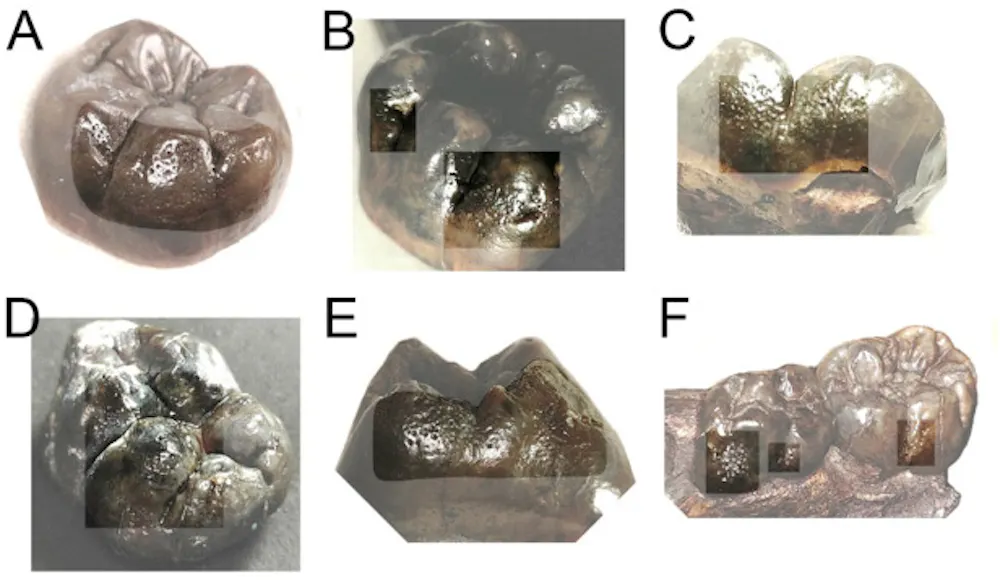
    These pits were first identified in the South African species Paranthropus robustus, a close relative of our own genus Homo. They are highly consistent in shape and size: uniform, circular and shallow.

    Initially, we thought the pits might be unique to P. robustus. But our latest research shows this kind of pitting also occurs in other Paranthropus species in eastern Africa. We even found it in some Australopithecus individuals, a genus that may have given rise to both Homo and Paranthropus.

    Uniform, circular and shallow pitting on teeth may be a previously undetected clue about evolutionary relationships.
    Towle et al. / Journal of Human Evolution

    The enamel pits have commonly been assumed to be defects resulting from stresses such as illness or malnutrition during childhood. However, their remarkable consistency across species, time and geography suggests these enamel pits may be something more interesting.

    The pitting is subtle, regularly spaced, and often clustered in specific regions of the tooth crown. It appears without any other signs of damage or abnormality.

    Two million years of evolution

    We looked at fossil teeth from hominins (humans and our closest extinct relatives) from the Omo Valley in Ethiopia, where we can see traces of more than two million years of human evolution, as well as comparisons with sites in southern Africa (Drimolen, Swartkrans and Kromdraai).

    The Omo collection includes teeth attributed to Paranthropus, Australopithecus and Homo, the three most recent and well-known hominin genera. This allowed us to track the telltale pitting across different branches of our evolutionary tree.

    What we found was unexpected. The uniform pitting appears regularly in both eastern and southern Africa Paranthropus, and also in the earliest eastern African Australopithecus teeth dating back around 3 million years. But among southern Africa Australopithecus and our own genus, Homo, the uniform pitting was notably absent.

    A defect … or just a trait?

    If the uniform pitting were caused by stress or disease, we might expect it to correlate with tooth size and enamel thickness, and to affect both front and back teeth. But it doesn’t.

    What’s more, stress-related defects typically form horizontal bands. They usually affect all teeth developing at the time of the stress, but this is not what we see with this pitting.

    The uniform, even nature of the pitting suggests a genetic origin rather than environmental factors such as malnutrition or disease.
    Towle et al. / Journal of Human Evolution

    We think this pitting probably has a developmental and genetic origin. It may have emerged as a byproduct of changes in how enamel was formed in these species. It might even have some unknown functional purpose.

    In any case, we suggest these uniform, circular pits should be viewed as a trait rather than a defect.

    A modern comparison

    Further support for the idea of a genetic origin comes from comparisons with a rare condition in humans today called amelogenesis imperfecta, which affects enamel formation.

    About one in 1,000 people today have amelogenesis imperfecta. By contrast, the uniform pitting we have seen appears in up to half of Paranthropus individuals.

    Although it likely has a genetic basis, we argue the even pitting is too common to be considered a harmful disorder. What’s more, it persisted at similar frequencies for millions of years.

    A new evolutionary marker

    If this uniform pitting really does have a genetic origin, we may be able to use it to trace evolutionary relationships.

    We already use subtle tooth features such as enamel thickness, cusp shape, and wear patterns to help identify species. The uniform pitting may be an additional diagnostic tool.

    For example, our findings support the idea that Paranthropus is a “monophyletic group”, meaning all its species descend from a (relatively) recent common ancestor, rather than evolving seperatly from different Australopithecus taxa.

    And we did not find this pitting in the southern Africa species Australopithecus africanus, despite a large sample of more than 500 teeth. However, it does appear in the earliest Omo Australopithecus specimens.

    So perhaps the pitting could also help pinpoint from where Paranthropus branched off on its own evolutionary path.

    An intriguing case

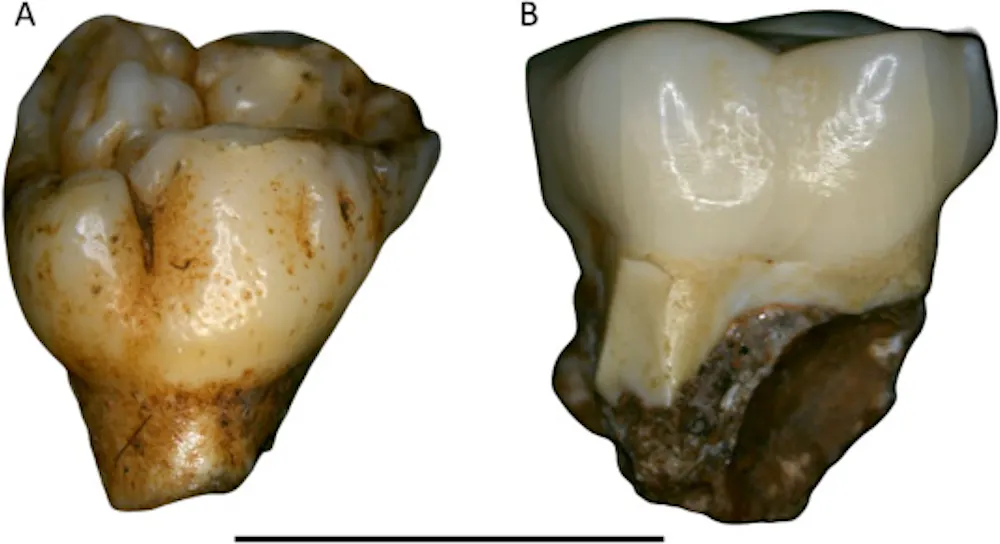
    One especially intriguing case is Homo floresiensis, the so-called “hobbit” species from Indonesia. Based on published images, their teeth appear to show similar pitting.

    If confirmed, this could suggest an evolutionary history more closely tied to earlier Australopithecus species than to Homo. However, H. floresiensis also shows potential skeletal and dental pathologies, so more research is needed before drawing such conclusions.

    More research is also needed to fully understand the processes behind the uniform pitting before it can be used routinely in taxonomic work. But our research shows it is likely a heritable characteristic, one not found in any living primates studied to date, nor in our own genus Homo (rare cases of amelogenesis imperfecta aside).

    As such, it offers an exciting new tool for exploring evolutionary relationships among fossil hominins.

    Ian Towle does not work for, consult, own shares in or receive funding from any company or organisation that would benefit from this article, and has disclosed no relevant affiliations beyond their academic appointment.

    – ref. 2-million-year-old pitted teeth from our ancient relatives reveal secrets about human evolution – https://theconversation.com/2-million-year-old-pitted-teeth-from-our-ancient-relatives-reveal-secrets-about-human-evolution-258390

    MIL OSI – Global Reports –

    June 9, 2025
  • MIL-OSI Global: Curious Kids: Why do dolphins jump out of the water?

    Source: The Conversation – Global Perspectives – By Katharina J. Peters, Lecturer in Biological Sciences, University of Wollongong

    Will Falcon/Shutterstock

    Why do dolphins jump out of the water?

    Charlize, age 8, Melbourne

    Have you ever seen images of dolphins jumping out of the waves and performing impressive acrobatics in the air? Or maybe you’ve seen it in real life?

    When a dolphin jumps, it can launch its whole body out of the water. While it looks like fun, it must also be hard work!

    So, why do dolphins jump out of the water? There are several possible reasons. Let’s jump in and explore them.

    A dolphin can launch its whole body out of the water.
    Paulphin Photography/Shutterstock

    To stay in touch

    Dolphins are social animals and live in groups. But it’s hard to see long distances underwater. So, they use the power of sound to stay in contact with each other.

    Sound travels much farther underwater than through the air. When dolphins jump, the slap of the landing makes a loud noise, and would be heard some distance away.

    Some species, such as spinner dolphins, use jumping to communicate their location to other group members, especially at night. This helps them keep track of each other.

    As an aside, spinner dolphins are very skilled jumpers. As the name suggests, they spin up to seven times in the air before landing back in the water!

    Spinner dolphins are the acrobats of the sea.

    The need for speed

    Have you ever tried to walk underwater? You will have felt how hard it is. That’s because water is more dense than air, which creates a “drag”, or resistance.

    Dolphins have streamlined bodies to reduce drag, but they still feel it. So, if they want to travel quickly – for example, if they are trying to escape a predator or hunt fish – they sometimes jump.

    While in the air, they travel faster than they would through water, and also save energy.

    To gather food

    Some dolphins weigh less than 50 kilograms, such as the Hector’s dolphin. Others weigh several tonnes, such as an orca.

    Either way, when a dolphin crashes back into the water, you can be sure it makes quite a noisy splash.

    Some dolphin species, such as dusky dolphins, use this noise to herd fish at the surface to make them easier to capture.

    Shaking off hitchhikers

    Fish called remoras can attach themselves to dolphins using a sucker on their head. This is good for the fish, because it can keep them safe and they have plenty to eat, such as small parasites and old bits of dolphin skin.

    While the remoras don’t hurt the dolphin, they probably slow it down. So dolphins may try to get rid of the little hitchhikers by jumping to dislodge them.

    A dolphin calf jumping to remove remoras.

    Fighting and frolicking

    Dolphins are highly intelligent animals. They have big brains and can learn tricks and solve puzzles. With intelligence also come other traits: playfulness and social behaviour.

    Sometimes, that social behaviour can end in a “fight”. Dolphin experts say two dolphins jumping around together might be actually trying to hit each other!

    Dolphins also love to frolic – not just with each other but with other marine mammals such as whales and sea lions, with turtles – or even just a piece of seaweed! So they might jump as some sort of “game”.

    As you can see, dolphins may jump for a range of reasons – sometimes just because it’s really fun!

    Katharina J. Peters does not work for, consult, own shares in or receive funding from any company or organisation that would benefit from this article, and has disclosed no relevant affiliations beyond their academic appointment.

    – ref. Curious Kids: Why do dolphins jump out of the water? – https://theconversation.com/curious-kids-why-do-dolphins-jump-out-of-the-water-256462

    MIL OSI – Global Reports –

    June 9, 2025
  • MIL-OSI Global: What can you do if you don’t like your child’s friends?

    Source: The Conversation – Global Perspectives – By Rachael Murrihy, Director, The Kidman Centre, Faculty of Science, University of Technology Sydney

    Getty Images/ Wander Woman Collective

    Many parents will be familiar with this situation: your child has a good or even best friend, but you don’t like them.

    Perhaps the friend is bossy, has poor manners or jumps on your furniture. Maybe you don’t like the way your child behaves when they are with this friend.

    For older children, your dislike might relate to the friend’s language, attitude towards school, or risk-taking behaviours. Maybe the friend is hot and cold and elicits more drama than Mean Girls.

    What can parents do?


    Read more:
    How can you help your child make friends?


    You will have a protective instinct

    If you see your child being treated poorly, this can ignite a protective instinct in parents that manifests in a bodily “fight or flight” response.

    This provides a rush of adrenaline, which can spur parents to take actions such as criticising the friend or even attempting to ban the friendship.

    However, this approach can do more harm than good, particularly for adolescents who are hardwired to push back on their parents.

    What can you do for younger kids?

    With younger children, clear boundaries can be set at the outset of a playdate. For example, “my bedroom is off limits for playing” or “we don’t jump on the couch”.

    If kids are using mean or rude language around each other, you can say “we don’t use that word in this house, be kind to each other”.

    Playdates can be moved outside, which can be particularly helpful if a child shows loud, destructive or rude behaviour. And if you can help it, organise fewer plays with that child.

    But parents may also want to reflect on why this child rubs them the wrong way. Is the reaction warranted, or does it comes from your own biases and opinions? Your child’s friends do not have to be the friends you would choose.

    Change your approach for older kids

    To become successful adults, teens need to move through developmental milestones of becoming autonomous and self-reliant. Intervening in their friendships interferes with this vital process of developing independence and identity, which ultimately disempowers them.

    In the 1960s, US psychologist Diana Baumrind published famous research on parenting. She found an authoritarian style – where the parent exerts complete control and does not listen to the child’s needs – results in a child with less confidence and independence than one brought up in a household that has rules but is also responsive to their needs.

    Adopting an authoritarian approach to friends or potential partners also risks the “Romeo and Juliet” effect, whereby disapproval makes the child more attracted to that person.

    So, for teenagers and their friends, the approach should be more nuanced. The primary goal is to encourage the child to see the parent as a person to come to when they have problems. If parents are tempted to be critical, they could ask themself: is it in the best interests of your child to be controlled?

    It is important to let children make mistakes so they can learn from them. Learning about what they do and don’t want in relationships is a crucial life skill.


    Read more:
    ‘How was school today?’ How to help kids open up and say more than ‘fine’


    How can you talk about friendship?

    Fostering an open dialogue about friends and relationships can allow parents to have influence in a subtle and developmentally appropriate way.

    For younger children, you could use a quiet moment to ask questions like “what can you say to Charlotte if you don’t want to play her game anymore?” or “what’s a good way to deal with it if she is being too bossy?”

    For older children, ideally wait until your teen wants to connect, rather than launching into questions. Ask gentle, non-judgmental questions about their friendship, like “what do you like to do together?” or “tell me about what you have in common”.

    If they seem upset or uncomfortable in some way, resist the urge to dismiss or solve the problem. Simply listening is the key to helping the child work it out, so they feel supported but not judged.

    And remember, not all friendships last. As children move through school and grow, most will naturally make new friends and move on from old ones.

    Clearly, one exception to adopting a teen-led approach is when safety is at risk. If they are being bullied or abused in any form – even if the child is opposed – parents should step in and speak to the school or other relevant authorities.


    Read more:
    What can you do if your child is being bullied?


    Rachael Murrihy does not work for, consult, own shares in or receive funding from any company or organisation that would benefit from this article, and has disclosed no relevant affiliations beyond their academic appointment.

    – ref. What can you do if you don’t like your child’s friends? – https://theconversation.com/what-can-you-do-if-you-dont-like-your-childs-friends-257353

    MIL OSI – Global Reports –

    June 9, 2025
  • MIL-OSI Global: Measles cases are surging globally. Should children be vaccinated earlier?

    Source: The Conversation – Global Perspectives – By Meru Sheel, Associate Professor, Infectious Diseases, Immunisation and Emergencies (IDIE) Group, Sydney School of Public Health, University of Sydney

    EyeEm Mobile GmbH/Getty Images

    Measles has been rising globally in recent years. There were an estimated 10.3 million cases worldwide in 2023, a 20% increase from 2022.

    Outbreaks are being reported all over the world including in the United States, Europe and the Western Pacific region (which includes Australia). For example, Vietnam has reportedly seen thousands of cases in 2024 and 2025.

    In Australia, 77 cases of measles have been recorded in the first five months of 2025, compared with 57 cases in all of 2024.

    Measles cases in Australia are almost all related to international travel. They occur in travellers returning from overseas, or are contracted locally after mixing with an infected traveller or their contacts.

    Measles most commonly affects children and is preventable with vaccination, given in Australia in two doses at 12 and 18 months old. But in light of current outbreaks globally, is there a case for reviewing the timing of measles vaccinations?

    Some measles basics

    Measles is caused by a virus belonging to the genus Morbillivirus. Symptoms include a fever, cough, runny nose and a rash. While it presents as a mild illness in most cases, measles can lead to severe disease requiring hospitalisation, and even death. Large outbreaks can overwhelm health systems.

    Measles can have serious health consequences, such as in the brain and the immune system, years after the infection.

    Measles spreads from person to person via small respiratory droplets that can remain suspended in the air for two hours. It’s highly contagious – one person with measles can spread the infection to 12–18 people who aren’t immune.

    Because measles is so infectious, the World Health Organization (WHO) recommends two-dose vaccination coverage above 95% to stop the spread and achieve “herd immunity”.

    Low and declining vaccine coverage, especially since the COVID pandemic, is driving global outbreaks.


    Read more:
    What are the symptoms of measles? How long does the vaccine last? Experts answer 6 key questions


    When are children vaccinated against measles?

    Newborn babies are generally protected against measles thanks to maternal antibodies. Maternal antibodies get passed from the mother to the baby via the placenta and in breast milk, and provide protection against infections including measles.

    The WHO advises everyone should receive two doses of measles vaccination. In places where there’s a lot of measles circulating, children are generally recommended to have the first dose at around nine months old. This is because it’s expected maternal antibodies would have declined significantly in most infants by that age, leaving them vulnerable to infection.

    If maternal measles antibodies are still present, the vaccine is less likely to produce an immune response.

    Research has also shown a measles vaccine given at less than 8.5 months of age can result in an antibody response which declines more quickly. This might be due to interference with maternal antibodies, but researchers are still trying to understand the reasons for this.

    A second dose of the vaccine is usually given 6–9 months later. A second dose is important because about 10–15% of children don’t develop antibodies after the first vaccine.

    In settings where measles transmission is under better control, a first dose is recommended at 12 months of age. Vaccination at 12 months compared with nine months is considered to generate a stronger, longer-lasting immune response.

    In Australia, children are routinely given the measles-mumps- rubella (MMR) vaccine at 12 months and the measles-mumps-rubella-varicella (MMRV, with “varicella” being chickenpox) vaccine at 18 months.

    Babies at higher risk of catching the disease can also be given an additional early dose. In Australia, this is recommended for infants as young as six months when there’s an outbreak or if they’re travelling overseas to a high-risk setting.

    A new study looking at measles antibodies in babies

    A recent review looked at measles antibody data from babies under nine months old living in low- and middle-income countries. The review combined the results from 20 studies, including more than 8,000 babies. The researchers found that while 81% of newborns had maternal antibodies to measles, only 30% of babies aged four months had maternal antibodies.

    This study suggests maternal antibodies to measles decline much earlier than previously thought. It raises the question of whether the first dose of measles vaccine is given too late to maximise infants’ protection, especially when there’s a lot of measles around.

    Should we bring the measles vaccine forward in Australia?

    All of the data in this study comes from low- and middle-income countries, and might not reflect the situation in Australia where we have much higher vaccine coverage for measles, and very few cases.

    Australia’s coverage for two doses of the MMR vaccine at age two is above 92%.

    Although this is lower than the optimal 95%, the overall risk of measles surging in Australia is relatively low.

    Nonetheless, there may be a case for broadening the age at which an early extra dose of the measles vaccine can be given to children at higher risk. In New Zealand, infants as young as four months can receive a measles vaccine before travelling to an endemic country.

    But the current routine immunisation schedule in Australia is unlikely to change.

    Adding an extra dose to the schedule would be costly and logistically difficult. Lowering the age for the first dose may have some advantages in certain settings, and doesn’t pose any safety concerns, but further evidence would be required to support this change. In particular, research is needed to ensure it wouldn’t negatively affect the longer-term protection that vaccination offers from measles.

    Making sure you’re protected

    In the meantime, ensuring high levels of measles vaccine coverage with two doses is a global priority.

    People born after 1966 are recommended to have two doses of measles vaccine. This is because those born before the mid-1960s likely caught measles as children (when the vaccine was not yet available) and would therefore have natural immunity.

    If you’re unsure about your vaccination status, you can check this through the Australian Immunisation Register. If you don’t have a documented record, ask your doctor for advice.

    Catch-up vaccination is available under the National Immunisation Program.

    Meru Sheel receives funding from the National Health and Medical Research Council and the Department of Foreign Affairs and Trade.

    Anita Heywood does not work for, consult, own shares in or receive funding from any company or organisation that would benefit from this article, and has disclosed no relevant affiliations beyond their academic appointment.

    – ref. Measles cases are surging globally. Should children be vaccinated earlier? – https://theconversation.com/measles-cases-are-surging-globally-should-children-be-vaccinated-earlier-257942

    MIL OSI – Global Reports –

    June 9, 2025
←Previous Page
1 … 1,369 1,370 1,371 1,372 1,373 … 5,175
Next Page→
NewzIntel.com

NewzIntel.com

MIL Open Source Intelligence

  • Blog
  • About
  • FAQs
  • Authors
  • Events
  • Shop
  • Patterns
  • Themes

Twenty Twenty-Five

Designed with WordPress