Source: Republic of South Africa (video statements-2)
The National Youth Development Agency lead the launch of the 2025 Youth Month at Hector Peterson Memorial.
Source: Republic of South Africa (video statements-2)
The National Youth Development Agency lead the launch of the 2025 Youth Month at Hector Peterson Memorial.
Source: Channel Islands – Jersey
Jersey’s greenhouse gas emissions fell by 48% between 1990 and 2023, but there was no reduction between 2022 and 2023.
The latest dataset, which estimates emissions from a wide range of activities, found Jersey emitted 357,626 tonnes of greenhouse gases in 2023.
Transport and heating buildings continue to be the biggest causes of Jersey’s emissions; with transport accounting for 43% of Jersey’s total emissions, and car fuel journeys specifically accounting for 26%. Heating and cooling homes and businesses account for almost 33% of Jersey’s total emissions.
The figures in the inventory are produced by independent organisation, Aether. The inventory provides estimates for historical emissions of greenhouse gases from 1990 until the most recent submission year, minus two. Therefore the 2025 inventory covers the period 1990 to 2023.
For more information and to see the full report, visit: Greenhouse gas emissions.
Source: Scotland – City of Aberdeen
An innovative programme of activity designed to grow the North East workforce is to be led by Aberdeen City Council.
Workwise will see the Council, alongside NESCol and Aberdeenshire Council combine efforts to support school leavers and adults to enter the job market through a combination of virtual work experience and illustrative online content.
The unique project has been made possible by grant funding from Ufi VocTech Trust, an independent charity focused on unlocking the full potential of technology to help adults improve skills for work and open up access for those furthest from opportunity.
The £250,000 grant will see the partners work collaboratively to develop a range of resources for North East residents to help them into work.
This includes virtual work experience modules which could lead to in-person placements, confidence building and skills development, and a series of videos of local people showcasing their jobs. The programme is being developed with wider partnerships and will grow skills, awareness, and confidence and understanding of the opportunities in the local labour market and strengthen the regional economy.
This includes creating digital programmes with real people from the region speaking about their roles, filmed within their workplaces; online confidence building covering study and digital skills, funding, support networks and progression pathways, and a digital work experience platform, for those lacking in experience or confidence, to use to build key skills and experience matched to their needs.
Aberdeen City Council’s Education and Children’s Services Convener, Councillor Martin Greig, said: “The generous funding offer from Ufi VocTech Trust will provide welcome support for young people and adults with limited work experience to help them develop their knowledge and skills in preparation for the job market.
“This new programme involves partnership collaboration with the aim of increasing individuals’ understanding of the work environment and feeling prepared for it. The approach uses technology and digital innovation to enhance their employment choices and opportunities.”
Caroline O’Donnell, Grants Programme Manager, Ufi VocTech Trust said: “We are proud to support this programme of work led by Aberdeen City Council, which reflects our ambition to support the adoption and deployment of technology to ensure every adult in the UK can gain the skills they need to participate in and benefit from our transitioning economy.
“By combining digital learning with in-person experience, the programme addresses key barriers to employment, particularly in communities furthest from opportunity, helping people build the confidence and skills needed to thrive in today’s workforce.”
The flexibility of the digital approach allows even those living in rural communities for whom travel is a barrier to employability activity to access these upskilling opportunities.
Chair of Aberdeenshire Council’s Education and Children’s Services Committee Cllr David Keating said: “This is an exciting programme which has the potential to transform people’s lives by getting them into work with the skills they need.
“With the support of Ufi VocTech Trust, this approach, utilising technology and innovation will open doors for young people and adults alike. The scheme will not just help people understand the world of work, but grow their confidence and ambition.
“I’m especially pleased that we have been able to work together with our neighbouring council for the benefit of all our constituents.”
Robert Laird, Head of Planning and Academic Partnerships at NESCol, said: “We look forward to working with our project partners to develop and deliver this initiative. The course will be a 40-hour interactive programme covering personal development, personal organisation and time management, study skills, digital skills, finance options for students and progression pathways.
“In addition to both local authorities there will be input from SWAP East, Skills Development Scotland, Developing the Young Workforce North East, and both of the city’s universities. It is a very powerful example of the collaborative work being undertaken in the North East as partners come together to broaden the options available for all those who are keen to pursue opportunities in education and employment.”
The Workwise project will support the partners to build the region’s skilled workforce for the future, aligning with the Regional Economic Strategy’s Draft Skills Action Plan and the area’s growth and volume sectors, while simultaneously tackling poverty by supporting local people into quality employment.
Source: Scotland – City of Aberdeen
The Council isn’t ‘kidding’ around – two cute new baby goats have arrived at Pets’ Corner in Hazlehead Park and primary school-aged youngers can enter a competition to name them.
They are both pygmy type of goats with one female who is mostly black with small white patches and the other is a male tan and white one with small black patches. Both have a patch of white ‘hair’ on their heads.
Aberdeen City Council Operational Delivery vice convener Councillor Miranda Radley said: “I’m sure people visiting Pets’ Corner will eat up seeing these cute new additions faster than a billy goat with their breakfast!
“We are not ‘kidding’ around when we say we look forward to seeing the entrants for the naming competition.”
Other animal attractions at Pets’ Corner include alpacas, crossbred pigs, geese, turkey, silkie chickens, sheep, goats, Shetland pony, miniature donkeys, fish, reptiles, budgies, ducks, peacock, meerkats, tortoise, ferrets, rabbits, guinea pigs, emus, Princess Leia the Burmese python, and Lulu the pygmy goat.
Entry forms for the naming competition are available from the pay hut at Pets’ Corner until Monday 30 June. Primary school aged youngsters are eligible to enter.
Pets’ Corner is open in April to October from 10am to 5.30pm, October from 10am to 4.15pm, and November to March from 10am to 3.15pm. It is closed on Christmas Day, New Year’s Day on January 1, and January 2.
Admission prices are £5.04 for an adult, £1.56 for a child aged 3 to 16, Free for children under 3, £9.48 for a family pass of 2 adults and 3 children or 1 adult and 4 children, £2.88 for concessions, £58.20 for a yearly family pass, and for educational groups, adult are £2.88, and a child aged 3 to 16 is 72p.
Dogs are allowed entry and must be kept on leads.
Translation. Region: Russian Federal
Source: Rosneft – Rosneft – An important disclaimer is at the bottom of this article.
At Samaraneftegaz (part of the oil production complex of NK Rosneft), the drilling meterage in production drilling in 2024 amounted to 216 thousand meters of rock, which is 4% higher than the 2023 figure.
The increase in penetration was achieved by implementing a set of measures to increase productivity in well drilling using new technologies. The actual commercial drilling speed exceeded the standard by almost 13%.
Time costs have been reduced by using technology that has eliminated a number of drilling operations. A significant effect has been achieved by including logging devices in the working assembly, which makes it possible to conduct geophysical surveys simultaneously with the preparation of the wellbore.
The introduction of modern drilling fluids has allowed, depending on the field, to reduce the time of drilling a well to seven days. The solutions have highly effective inhibiting properties that increase the stability of the well walls and eliminate the sticking of the drilling tool.
During the construction of three wells, Samaraneftegaz tested a new Russian automated drilling control system with precise execution of the set parameters. The system’s characteristics allow for a reduction in well construction time due to an increase in the drilling speed by 10%. Vibration and wear of drill string elements are also reduced.
Rosneft prioritizes innovation and defines technological leadership as a key factor in competitiveness in the oil market. The company systematically introduces new technological solutions throughout the entire production chain.
Reference:
JSC Samaraneftegaz, a subsidiary of NK Rosneft, carries out production activities in the Samara and Orenburg regions. Cumulative production since the beginning of development in 1936 exceeds 1.3 billion tons of oil
Department of Information and Advertising of PJSC NK Rosneft June 3, 2025
Please note: This information is raw content directly from the source of the information. It is exactly what the source states and does not reflect the position of MIL-OSI or its clients.
Source: Scottish Government
New legislation to support crofters.
The Crofting and Scottish Land Court Bill will simplify legislation to make crofting regulation less onerous.
The Bill, published today, will strengthen the role of grazing committees sharing common land and give farmers, and their communities, a greater say in how the land they work on is used.
The Bill will also amalgamate the Scottish Land Court and the Lands Tribunal for Scotland to create one cohesive body, the Scottish Land Court, retaining the statutory requirement for a Gaelic speaking member.
Agriculture Minister Jim Fairlie said:
“Crofting is at the heart of communities across many parts of the Highlands and Islands and Argyll. Crofters across these areas are cultivating land, tending livestock, protecting the environment and biodiversity. In the last ten years, more than £31 million in Crofting Agricultural Grant Scheme funding has been committed and, since 2007, the Scottish Government has approved £26 million of Croft House Grant payments.
“Existing crofting legislation is complex and difficult to navigate. This Bill allows us to make a range of simplifications and improvements to the way crofting is administered, which will benefit crofters and the Crofting Commission to better recognise the vital contribution they make to their communities and maintain unique local heritage and culture.
“The merger of the Scottish Land Court and the Lands Tribunal for Scotland into the expanded Scottish Land Court will provide a more efficient administration of the services offered at present and result in greater simplicity, coherence and flexibility.”
Background
Crofting and Scottish Land Court Bill | Scottish Parliament Website
The crofting proposals were developed through extensive engagement and close cooperation with stakeholders, with the consultation proposals receiving support from the majority of respondents.
The decision to unify the Scottish Land Court and Lands Tribunal for Scotland was taken following a public consultation. Scottish Ministers committed to bringing forward legislation to enact the merger during the life of this Parliament.
Scottish Land Court and Lands Tribunal for Scotland to be unified – gov.scot
Source: City of Stoke-on-Trent
Published: Tuesday, 3rd June 2025
A new vision for transport has been launched to help ‘build a system that works for the people of Stoke-on-Trent’.
The transport prospectus, titled ‘On the Move: Transport for Thriving Communities’, outlines transport priorities for the future which focus on bus, rail and active travel.
Stoke-on-Trent City Council’s vision includes developing a reliable and affordable bus network, investing in roads to make them safer and smoother for everyone and ending gridlock by making major improvements to the city’s busiest roads.
Other priorities include the installation of more cycle lanes, dropped kerbs and better crossings to make walking and cycling safer for pedestrians, investing in more electric vehicle charging points, promoting the switch to greener vehicles and continuing to improve the links between buses and trains.
Residents, partners and stakeholders are now being asked for their views on the document, which will help to inform the development of the Local Transport Plan 2026-2040, and a six-week consultation is now underway.
Councillor Finlay Gordon-McCusker, cabinet member for transport, regeneration and infrastructure, said: “We know that, right now, our transport system is not working as it should. It’s not working for older people, workers, families, students and small businesses.
“Our vision sets out a bold, practical plan to fix our transport system, built around a core belief that everyone deserves access to safe, reliable, affordable and green transport.
“That means better buses that actually go where people need them, when they need them. It means fixing our roads and pavements. It means making it safe and easy to walk, cycle or use a wheelchair. It means making greener travel the most convenient option – and giving people a real choice.
“Real change takes all of us, so we want to hear your ideas, your frustrations and your hopes. Please have your say and help us to shape the future of transport in our city.”
The launch of the transport prospectus comes just months after Stoke-on-Trent City Council gave the green light to its Joint Strategic Transport Statement. It was drawn up in partnership with senior leaders from Staffordshire County Council, to ensure we build a transport network that doesn’t stop at the city lines.
The statement sets out a series of shared priorities which, like the prospectus, range from improving public transport, making the road network work more efficiently and promoting active travel.
Residents, businesses and partners are now being encouraged to have their say on Stoke-on-Trent’s latest vision for transport. The survey and the transport prospectus can be viewed online at www.stoke.gov.uk/transportvision until Thursday 10 July.
Alternatively, email publictransport@stoke.gov.uk with any detailed feedback or suggestions.
Source: United Kingdom – Government Statements
Sir Oliver Robbins, Permanent Under-Secretary at the Foreign, Commonwealth & Development Office (FCDO) is in India.
Sir Oliver Robbins, Permanent Under-Secretary at the Foreign, Commonwealth & Development Office with India’s Foreign Secretary, Shri Vikram Misri
Sir Oliver Robbins, Permanent Under-Secretary at the Foreign, Commonwealth & Development Office (FCDO) is in India to review progress across the UK and India’s Comprehensive Strategic Partnership. He met India’s Foreign Secretary, Shri Vikram Misri, in New Delhi today [3 June] for the annual UK-India Foreign Office Consultations.
They welcomed the significant breakthroughs achieved across the full breadth of the partnership since consultations in London last year, including the announcement of the historic trade deal. Economic growth is the number one mission of the UK Government. Both agreed to work towards implementing the shared vision of the two prime ministers for an ambitious partnership between the UK and India over the next decade.
This year’s consultations included the inaugural Strategic Exports and Technology Cooperation Dialogue, aimed at building mutual understanding of systems and agreeing areas for future cooperation on key sectors such as technology and defence.
Sir Oliver Robbins, Permanent Under-Secretary at the FCDO, said:
I’m delighted to be in India to help advance one of the UK’s most vital partnerships in the world. In a more complex world, there is strong ambition from both governments to take this partnership to even greater heights. I’m looking forward to working with Foreign Secretary Misri to make that a reality.
During the visit, Sir Oliver is also expected to meet a wide range of Indian government partners including on the G20 and home affairs.
Sir Oliver Robbins was appointed Permanent Under-Secretary (PUS) at the Foreign, Commonwealth & Development Office (FCDO) in January 2025. As PUS, he is Head of the UK’s Diplomatic Service and the most senior policy adviser to the Foreign Secretary. The PUS is responsible for the management of the FCDO in the UK and its embassies and high commissions around the world.
The UK and India agreed a landmark trade deal on 6 May, which will redefine the partnership for the next generation, strengthening trade links, supporting jobs, and delivering shared prosperity. The deal is expected to increase bilateral trade already worth £43 billion by another £25.5 billion.
The UK’s Plan for Change sets out milestones the UK Government aims to reach by the end of this Parliament.
For media queries, please contact:
Chloe Barry, Deputy Head of Communications,
British High Commission, Chanakyapuri,
New Delhi 110021. Tel: 24192100
Media queries: BHCMediaDelhi@fcdo.gov.uk
Follow us on Twitter, Facebook, Instagram, Flickr, Youtube and LinkedIn
Source: United Kingdom – Government Statements
First 11 schools across England have installed solar panels backed by Great British Energy, saving a total of £175,000 per year.
Pupils across the country will benefit from more money for textbooks and teachers, as the first schools are announced in Great British Energy’s rooftop solar rollout to cut energy bills.
Schools are benefitting from funding for rooftop solar, with the first 11 schools estimated to save £175,000 per year after installing Great British Energy solar panels. The remaining schools set to benefit will be announced this summer, with all schools that are part of the scheme expected to have solar panels installed by the end of the year.
It follows the government’s announcement in March to award £180 million of funding for schools and hospitals to install rooftop solar, marking the first major project for Great British Energy – a company owned by the British people, for the British people.
In England, around £80 million is supporting around 200 schools, alongside £100 million for nearly 200 NHS sites, covering a third of NHS trusts, to install rooftop solar panels that could power classrooms and operations, while giving them the potential to sell leftover energy back to the grid.
Great British Energy’s first investment could see millions invested back into frontline services, targeting deprived areas, with lifetime savings for schools and the NHS of up to £400 million over around 30 years.
Schools and hospitals have been hit with rocketing energy bills in recent years, costing taxpayers millions of pounds, and eating into school budgets. This has been driven by the UK’s dependency on global fossil fuel markets over which government has no control.
Energy Minister Michael Shanks said:
Solar panels on school rooftops mean energy bills are cut and money can be invested directly into improving young people’s education while helping to tackle climate change for the next generation.
Great British Energy is delivering rooftop solar as part of our Plan for Change that will support communities for generations to come, relieving pressures on our vital public services and ensuring investment is made in the future of our young people.
Great British Energy Chair Juergen Maier said:
Within 2 months we are seeing schools supported by our scheme having solar panels installed so they can start reaping the rewards of clean energy – opening up the opportunity for more money to be spent on our children rather than energy bills.
By partnering with the public sector as we scale up the company, we will continue to make an immediate impact as we work to roll out clean, homegrown energy projects, crowd in investment and create job opportunities across the country.
Education Minister Stephen Morgan said:
Through our Plan for Change, this government is supporting schools to save schools thousands on their bills so they can reinvest money saved into ensuring every child gets the best start in life.
The installation of solar panels will also help pupils to develop green skills, promoting careers in renewables and supporting growth in the clean energy workforce.
Currently only about 20% of schools have solar panels installed, but the technology has huge potential to save money on bills.
Estimates suggest that on average, a typical school could save up to £25,000 per year if they had solar panels with complementary technologies installed such as batteries.
The funding will support the government’s clean power mission as well as helping to rebuild the nation’s public services. It forms Great British Energy’s first local investment, kickstarting the Local Power Plan and ensuring the benefits of this national mission are felt at a local level, with energy security, good jobs and economic growth.
The list of hospitals benefitting was announced in March and installations will start to complete this summer.
The support will target schools with buildings that are able to accommodate solar panels in areas of England most in need. As part of this, government is selecting the schools which will be primarily clustered in areas of deprivation in the North East, West Midlands and North West, as well as at least 10 schools in each region. Each cluster will include a further education college which will work with the contractors appointed to promote careers in renewables to support growth in the construction and renewables workforce. This could be through work placements, skills bootcamps and workshops.
Backed by £8.3 billion over this Parliament, Great British Energy will own and invest in clean energy projects across the UK. This will range from supporting local energy, like the solar power schemes announced today, to the £300 million invested to support offshore wind supply chains – unlocking significant investment in major clean energy projects that will revitalise the UK’s industrial heartlands with new jobs, alongside securing Britain’s energy supply.
11 schools to have installed Great British Energy solar panels
| School name | Region | KW peak (installed capacity) | Yearly energy generation (kWh) | Simple payback (years) | Yearly school bill savings (£) |
|---|---|---|---|---|---|
| Charles Warren Academy | South East | 20 | 15,000 | 8 | £4,500 |
| Feversham Primary Academy | Yorkshire and the Humber | 53 | 46,270 | 5 | £13,000 |
| Harris Academy Chafford Hundred | East of England | 256 | 214,300 | 6 | £44,500 |
| Harris City Academy Crystal Palace | London | 149 | 117,250 | 5 | £24,500 |
| Notre Dame RC School | South West | 166 | 150,280 | 5 | £27,000 |
| Oasis Academy Nunsthorpe | Yorkshire and the Humber | 92 | 101,695 | 4 | £22,500 |
| St Boniface’s RC College | South West | 86 | 84,620 | 7 | £13,500 |
| St Joseph’s Catholic Primary School, Poole | South West | 37 | 39,880 | 5 | £8,500 |
| St Mary’s Catholic Primary School, Axminster | South West | 13 | 12,200 | 12 | £2,000 |
| Westfield Primary Academy | East of England | 56 | 54,050 | 6 | £12,000 |
| Whiteknights Primary School | South East | 18 | 16,170 | 8 | £4,500 |
| Total | 945 | 851,715 | £176,000 |
June 3, 2025, N’Djamena: In the Tine transit camp and the nearby refugee camps in eastern Chad, close to the border with Sudan, Médecins Sans Frontières (MSF) is scaling up its assistance to the newly arrived Sudanese refugees. They are fleeing escalating attacks and violence in North Darfur. Since the end of April an estimated 40,000 refugees, the vast majority coming from El Fasher and its surrounding camps for displaced people, have arrived in Tine, in Wadi Fira province. These extremely vulnerable people now face harsh overcrowded conditions and limited access to basic services.
On arrival in Tine, some are malnourished and experiencing profound psychological distress due to the horrific violence in North Darfur and on the roads leading to Chad. The overwhelming majority are women and children coming from El Fasher and Zamzam camp for internally displaced people. They have already endured starvation as the Rapid Support Forces laid siege to these areas and famine conditions have been prevalent for months in Zamzam camp according to the Famine Review Committee.
“We’ve walked a long way to get here. We passed through several villages to get to Tine to take refuge from the violence and bombings. We’ve been here for several days but we’re struggling to find food and water. We’ve been wearing the same clothes for days”, said a 20-year-old refugee woman. The Tine transit camp is currently hosting over 18,000 people, many of whom are sleeping on the bare ground in 40°C heat, with no shelter and severely limited access to water and food despite support from the host communities.
MSF has scaled up its medical and humanitarian activities in the transit camp and at the Tine border to increase availability of primary healthcare services. Apart from nutrition screenings and vaccination at the border point, over the past weeks, MSF has carried out over 900 consultations per week in the health post at the transit camp. At the health post, the global rate of malnutrition among children under five is as high as 29% with 9% being severely malnourished. Routine vaccination efforts remain a priority in the camp as cases of measles have been detected. A mass vaccination campaign is ongoing. Finally, care for pregnant women and for survivors of sexual violence is also being provided at the health post. MSF teams set up referrals of critical patients to hospitals and will build an additional 50 emergency latrines. MSF is also preparing further distribution of therapeutic food and essential items. The organisation is also distributing 60,000 liters of water per day but this is only half of what is currently needed.
‘Sudanese refugees arrive exhausted, many malnourished and require immediate assistance. We ask donors, the UN and other humanitarian organisations to increase the mobilisation to provide or scale up support in terms of food, shelter, sanitation and medical care including mental health services. The current humanitarian response is insufficient and the upcoming rainy season it is likely to worsen living conditions, spread disease and exacerbate food insecurity and lack of sanitation.” says Claire San Filippo, MSF’s emergency coordinator for Sudan.
Despite the immense needs in Tine transit camp and other refugee camps in Wadi Fira, MSF is witnessing very limited aid distribution despite solidarity from the host community and grassroot organisations. The financial crisis affecting the entire humanitarian sector is clearly being felt in eastern Chad. The war continues unabated in Sudan and more people are hoping to reach Chad.
MSF is also present in refugee camps in Wadi Fira, such as Iridimi camp, where refugees from the Tine transit camp are being relocated. To help improve the dire situation in Iridimi camp which has reached its maximum capacity, MSF recently started supporting the Iridimi health center. The activities focus on the continuity of primary healthcare, vaccination, strengthening epidemiological surveillance, improving patient flow, reinforcing the referral system, and improving hygiene conditions at the health center. We also run mobile clinics in Chad, along the Sudanese borders including in Kulbus and Birak.
The humanitarian situation at the border between Chad and Sudan has again reached a tipping point, with over 70,000 new refugees arriving in Chad since April 2025. Chad is already hosting over one million refugees, including more than 800,000 Sudanese who have arrived since the conflict began over two years ago.
Covering period of Tuesday 3rd – Sunday 8th June – Another bout of windy and wet weather is due to run across New Zealand this week followed by a wintry feeling weekend with cold temperatures across the country and even some snowfall for the South Island.
MetService is forecasting a broad area of rain to move across the country from west to east during Wednesday, with the heaviest rain expected in Taranaki Maunga and Tasman District where Heavy Rain Warnings have been issued. The rain and strong winds are the result of a rapidly deepening area of low pressure forming off the eastern coast of Australia and crossing the country.
MetService Meteorologist John Law says, “This week we see another visitor arriving from the Tasman Sea and it’s set to bring some active weather with it, but it’s not just the wind and rain we have to watch out for, with cold air rushing in behind this system it’s going to be a much colder end to the week.”
Heavy Rain Warnings have been issued for Bay of Plenty east of Whakatāne and inland Gisborne/Tairāwhiti, Tongariro National Park, Taranaki Maunga, the Tararua Range, Tasman District west of Motueka and Marlborough Ranges. Heavy Rain Watches have been issued for Northland, Auckland, Buller, Grey, Westland and Fiordland.
The rain on Wednesday is expected to be accompanied by thunderstorms in the northern and western parts of the North Island, with localised downpours, strong and gusty winds forecast. Strong Wind Watches have been issued for Northland, Auckland, Bay of Plenty, Gisborne, Taranaki, Wellington and Wairarapa.
Overnight Wednesday, the Canterbury High Country is likely to find rain turning to snow, especially across the higher parts of the region and impacting the higher roads and passes. A Heavy Snow Watch has been issued for the region, with heavy snow possible above 300 metres (or possibly lower).
“As we’ve turned into June the weather will be taking on a real wintry feel,” says Law. “On Wednesday, we’ll be expecting snow for some of the higher roads of the Canterbury region so take extra care and keep up with the latest forecasts as well as the latest road information from NZTA.”
Temperatures are set to tumble for the end of the week, with daytime highs struggling to get beyond the teens across the country.
“The second half of the week will be feeling very different to the first, as cold southwesterly winds sweep across New Zealand,” says Law. “The coldest spots will be found in Central Otago, where daytime temperatures for Wānaka and Alexandra are only likely to reach 3°C or 4°C this weekend.”
While snow is set to stay about the high country on Wednesday and Thursday, the colder air on Friday brings the potential of snow to lower areas of Canterbury.
“Cold air and wintry showers will feature in the forecast for parts of the South Island on Friday, but the heaviest snow is expected over the highest parts of Canterbury overnight on Wednesday. Snow is likely to near sea level on Friday for Canterbury, Otago, Southland and Fiordland. While this snow is likely to be significant and may cause disruptions to travel, at this stage warning amounts are not expected,” Law concludes.
Understanding MetService Severe Weather Warning System
Severe Thunderstorm Warnings (Localised Red Warning) – take cover now:
This warning is a red warning for a localised area.
When extremely severe weather is occurring or will do within the hour.
Severe thunderstorms have the ability to have significant impacts for an area indicated in the warning.
In the event of a Severe Thunderstorm Red Warning: Act now!
Red Warnings are about taking immediate action:
When extremely severe weather is imminent or is occurring
Issued when an event is expected to be among the worst that we get – it will have significant impact and it is possible that a lot of people will be affected
In the event of a Red Warning: Act now!
Orange Warnings are about taking action:
When severe weather is imminent or is occurring
Typically issued 1 – 3 days in advance of potential severe weather
In the event of an Orange Warning: Take action.
Thunderstorm Watch means thunderstorms are possible, be alert and consider action
Show the area that thunderstorms are most likely to occur during the validity period.
Although thunderstorms are often localised, the whole area is on watch as it is difficult to know exactly where the severe thunderstorm will occur within the mapped area.
During a thunderstorm Watch: Stay alert and take action if necessary.
Watches are about being alert:
When severe weather is possible, but not sufficiently imminent or certain for a warning to be issued
Typically issued 1 – 3 days in advance of potential severe weather.
During a Watch: Stay alert
Outlooks are about looking ahead:
To provide advanced information on possible future Watches and/or Warnings
Issued routinely once or twice a day
Recommendation: Plan.
Following the Minister’s announcement this morning about building and consent system productivity increases, Master Builders has issued the below statement in response.
Master Builders welcomes new figures released by the Government today which show we are heading in the right direction when it comes to building consent reform.
The data, shared by Building and Construction Minister Chris Penk, highlights early improvements in inspection timeframes and progress. We’ve been calling for change to the way consents and inspections are handled for years, and today’s update shows we are now on the right path.
According to data from the Ministry of Business, Innovation and Employment, 92.7 percent of building consent applications and 96.8 percent of code compliance certificates were processed within the statutory timeframe in the first quarter of 2025.That’s up from 88 percent and 93.6 percent respectively when reporting began last year. These numbers are an encouraging sign that Government’s focus on lifting performance is starting to make a difference on the ground.
A recent survey of our members shows 71 percent had experienced delays with consenting that had impacted delivery. The current system is fragmented, with 67 different Building Consent Authorities (BCAs) interpreting the same building code in different ways. It is common for identical plans to be submitted to different BCAs and receive different outcomes. Delays of two or three weeks between inspections are common and that has knock-on effects for homeowners, subcontractors, and project planning. That’s why we’re so supportive of reforms that bring clarity, targets, and a risk-based approach.
We anticipate that as the Government’s work to solidify inspection timeframes continues, we will continue to see these numbers move in the right direction. As always, we look forward to working alongside the Government as this much needed reform of the consenting system continues.
Source: International Atomic Energy Agency – IAEA
“The resilience of nuclear installations can be viewed as the ability of the installation to quickly return to its original safety state after the occurrence of a potentially damaging event such as an earthquake, hurricane, or aircraft crash,” said Paolo Contri, Head of the IAEA Section of External Events Safety.
He added: “Resilience is coupled with the concept of robustness against external hazards, which encompasses the development of engineering solutions in siting, design and operation phases, that can support the response to extreme scenarios, but also to emerging challenges, or unknown threats, as well as planning, response and recovery strategies.”
Contributors interested in submitting papers for the conference can find the topics of interest here, which includes areas such as the identification and analysis of external hazards, the consideration of uncertainties in hazard analyses and events resulting from combined hazards; and the impact of external hazards on nuclear installations and radioactive waste disposal facilities as well as the safety features of innovative new reactor designs and their contribution to resilience.
Source: Bank for International Settlements
The last five years have been unusually turbulent. We have lived through the worst pandemic in a hundred years, Russia has invaded Ukraine, and the United States has started trade conflicts with several of its most important trading partners, including China and the EU. We have also had a period of very high inflation that has now fortunately fallen back to normal levels; see Figure 1.
In recent months, uncertainty in the global economy has increased strongly, not least due to the United States’ new trade policy. In our latest Monetary Policy Update, published last week, we assessed that international developments – particularly the elevated uncertainty – are dampening the economic prospects in Sweden. In turn, this suggests that inflation, in the long term, may become lower than in our most recently published forecast from March. But we also pointed out that there are several risk factors, such as those linked to companies’ global value chains, and that inflation thus could well become unexpectedly high.
This illustrates, almost too clearly, that the economic outlook and inflation prospects are always uncertain and there are several reasons for this. One of them is that our models cannot capture all the complex relationships that characterise real economies. There could also be uncertainty over political decisions or how developments abroad affect the Swedish economy. However, regardless of the reason, we cannot exactly know what inflation will be in two years or how changes in the policy rate will affect inflation. The pandemic also reminded us that sometimes unpredictable events happen that can have major economic consequences.
Source: ASEAN
H.E. San Lwin, Deputy Secretary-General of ASEAN for ASEAN Socio-Cultural Community received a courtesy visit from Mr. Norbu Wanchuk, Director General of the South Asia Co-operative Environment Programme (SACEP). The meeting explored opportunities for inter-regional cooperation between South Asia and Southeast Asia on shared environmental challenges, including marine plastic pollution, climate change, air pollution, and transboundary haze pollution.
Source: The Conversation – Africa – By Hung Nguyen-Viet, Program Leader (ai), HEALTH at ILRI / CGIAR, International Livestock Research Institute
The world is facing daunting health challenges with the rise of zoonotic diseases – infections that are transmissible from animals to humans. These diseases – which include Ebola, avian flu, COVID-19 and HIV – show how the health and wellbeing of humans, animals and ecosystems are closely connected.
Zoonotic diseases have become more and more common due to factors such as urbanisation, deforestation, climate change and wildlife exploitation. These dangers are not limited by borders: they are global and demand a coordinated response.
By looking at health holistically, countries can address the full spectrum of disease control – from prevention to detection, preparedness, response and management – and contribute to global health security.
The World Health Organization has a basis for such an approach: One Health. This recognises the interdependence of the health of people, animals and the environment and integrates these fields, rather than keeping them separate.
I lead the health programme at the International Livestock Research Institute, where we are looking for ways to effectively manage or eliminate livestock-related diseases, zoonotic infections and foodborne illnesses that disproportionately affect impoverished communities.
My work focuses on the link between health and agriculture, food safety, and infectious and zoonotic diseases.
For example in Kenya we are part of an initiative of the One Health Centre in Africa to roll out canine vaccination and have so far vaccinated 146,000 animals in Machakos county.
In Ethiopia and Vietnam we worked in a programme to improve the hygiene practices of butchers in traditional markets.
In another project we work in 11 countries to strengthen One Health curricula in universities.
The lessons from the One Health projects implemented with partners across Asia and Africa are that there’s an urgent need for action on three fronts. These are: stronger cross-sectoral collaboration; greater engagement with policymakers to translate research findings into actionable strategies; and the development of adaptable and context-specific interventions.
But, having been active in this area for the last decade, I am impatient with the slow pace of investment. We know that prevention is better than cure. The cost of prevention is significantly lower than that of managing pandemics once they occur. Urgent steps, including much higher levels of investment, need to be taken.
In 2022 the World Health Organization, the Food and Agriculture Organisation, the United Nations Environment Programme and the World Organisation for Animal Health developed a joint One Health plan of action. They identified key areas to respond more efficiently to health threats. These included:
Reducing risks from emerging and re-emerging zoonotic epidemics. Actions include, for example, tightening regulations around farming and trade in wildlife and wild animal products.
Controlling and eliminating endemic, zoonotic, neglected tropical and vector-borne diseases by understanding the attitudes and knowledge of communities bearing the greatest burdens of these diseases. And boosting their capacity to fight them.
Strengthening action against food safety risks by monitoring new and emerging foodborne infections.
Curbing the silent pandemic of antimicrobial resistance, one of the top 10 global public health threats facing humanity.
Other collaborations include the Prezode (Preventing Zoonotic Disease Emergence) initiative to research all aspects of diseases of animal origin. This was launched in 2021 by French president Emmanuel Macron.
The Africa One Health University Network operates in ten African countries to address One Health workforce strengthening in Africa.
One Health has gained traction globally. But there’s still a great deal to be done.
According to a 2022 World Bank estimate, preventing a pandemic would cost approximately US$11 billion per year, while managing a pandemic can run up to US$31 billion annually. So the investment return of 3:1 is an important reason to call for investment in One Health.
The Pandemic Fund was launched in November 2022 by leaders of the Group of 20 nations and hosted by the World Bank Group to help low- and middle-income countries prepare better for emerging pandemic threats. US$885 million has been awarded to 47 projects to date through the two rounds in the last three years.
However, relative to the US$11 billion per year required for prevention, this investment is modest. Urgent investment in One Health needs to be made by countries themselves, in particular low- and middle-income countries.
The last two World One Health congresses (in Singapore in 2022, and in Cape Town in 2024) called for investment in One Health. There were also calls for investment in One Health at regional level to prevent zoonotic diseases and the next pandemic.
At the 78th World Health Assembly in Geneva, member states of the World Health Organization (WHO) formally adopted by consensus the world’s first Pandemic Agreement. The landmark decision culminates more than three years of intensive negotiations launched by governments in response to the devastating impacts of the COVID-19 pandemic.
This is major global progress in One Health and disease prevention.
But the lessons of COVID-19 have shown us that the cost of inaction is incalculable in terms of lives lost, economic turmoil and societal disruption. To date, there have been over 777 million cases of COVID-19, including more than 7 million deaths worldwide.
According to estimates by the International Monetary Fund, COVID will have caused a cumulative production loss of US$13.8 trillion by 2024.
The choice is clear: invest today to prevent tomorrow’s pandemics, or pay a heavy price in the future.
Hung Nguyen-Viet does not work for, consult, own shares in or receive funding from any company or organisation that would benefit from this article, and has disclosed no relevant affiliations beyond their academic appointment.
– ref. Preventing the next pandemic: One Health researcher calls for urgent action – https://theconversation.com/preventing-the-next-pandemic-one-health-researcher-calls-for-urgent-action-255229
Source: European Parliament 2
Differences between the United States (US) and the European Union (EU) over the regulation of online platforms have taken on a new dimension under the Trump administration. Senior members of the US administration have strongly criticised the EU for ‘limiting free speech’ and have called the EU’s content moderation law ‘incompatible with America’s free speech tradition’. Much of the debate is informed by misconceptions and misunderstandings. The differences between the US and EU hate speech regimes are striking, largely for historical reasons. The First Amendment to the US Constitution provides almost absolute protection to freedom of expression. By contrast, European and EU law curtails the right to freedom of expression. Article 10 of the European Convention of Human Rights, which applies to all EU Member States, states that freedom of expressions ‘carries with it duties and responsibilities’. In a democratic society, restrictions may be imposed in the interest, among others, ‘of national security, territorial integrity or public safety, for the prevention of disorder or crime, for the protection of health or morals, for the protection of the reputation or rights of others’. EU legislation criminalises hate speech that publicly incites to violence or hatred and targets a set of protected characteristics: race, colour, religion, descent or national or ethnic origin. Even though legislation in EU Member States varies widely, many have extended protection from hate speech to additional characteristics. In light of the exponential growth of the internet and the use of social media, the debate about hate speech has essentially become about regulating social media companies. The focus has been on the question of whether and to what extent service providers are responsible for removing hate speech published on social media platforms. The US has opted not to impose any obligation on social media companies to remove content created by third parties, merely granting them the right to restrict access to certain material deemed to be ‘obscene’ or ‘otherwise objectionable’. By contrast, the EU has adopted regulation that obliges companies to remove offensive content created by third parties, including hate speech, once it is brought to their attention. Social media companies also self-regulate, by adopting community guidelines that allow users to flag hate speech and ask for its removal.
Source: United Kingdom – Government Statements
Syphilis cases in England continue to rise.
New data from the UK Health Security Agency (UKHSA) shows that syphilis diagnoses in England continued to rise in 2024 compared to 2023.
Overall, there were 9,535 diagnoses of early-stage syphilis diagnoses in 2024 compared to 9,375 diagnoses in 2023 – a 2% rise. Concerningly, the overall figure for syphilis, including late-stage syphilis or complications from the infection, increased 5% from 12,456 in 2023 to 13,030 in 2024.
Encouragingly, there was a 16% drop in gonorrhoea cases, with 71,802 diagnoses of gonorrhoea in 2024, compared to 85,370 in 2023. The fall has been greatest in young people aged 15 to 24 years where there was a 36% reduction in diagnoses, but it is too soon to conclude whether this trend will continue.
There has been a concerning acceleration in diagnoses of antibiotic-resistant gonorrhoea cases. While most gonorrhoea infections can be treated effectively, certain strains present significant treatment challenges due to antibiotic resistance. Ceftriaxone resistance is particularly concerning as this antibiotic serves as the primary treatment for gonorrhoea infections.
Although numbers remain low, ceftriaxone-resistant gonorrhoea cases are being detected more frequently. There have now been 14 cases reported in the first 5 months of 2025, which is greater than the number of cases reported for the whole of 2024 (13 cases). Six of the 14 cases in 2025 have been extensively drug-resistant cases, which means that they were resistant to ceftriaxone and to second-line treatment options.
Most ceftriaxone resistant cases are associated with travel to or from the Asia-Pacific region, where the prevalence of ceftriaxone resistance is high.
The latest data also shows:
the number of sexual health screens (diagnostic tests for one or more of chlamydia, gonorrhoea, syphilis and HIV) has remained relatively constant (2,380,498 in 2023 compared to 2,367,853 in 2024)
chlamydia diagnoses decreased by 13% to 168,889 diagnoses in 2024 from 194,143 diagnoses in 2023
first episode genital warts diagnoses decreased by 4% to 25,056 diagnoses in 2024 from 26,193 diagnoses in 2023 – diagnoses of genital warts remained low amongst 15 to 17 year-olds, the age-group targeted for school-based HPV vaccination (108 in 2023, then 78 in 2024)
Despite the declines in some STIs, cases still remain high and STIs continue to significantly impact young people aged 15 to 24 years; gay and bisexual men; and some minority ethnic groups. UKHSA is reminding everyone having sex with new or casual partners to use a condom and get tested regularly, whatever their age or sexual orientation. Testing is free and confidential, and you should get tested even if you are not showing any symptoms. Many people do not show symptoms which means people often pass on STIs without realising it.
Though STIs are usually easily treated with antibiotics, many can cause serious health issues if left untreated. Chlamydia and gonorrhoea can cause infertility and pelvic inflammatory disease, while syphilis can cause serious, irreversible and potentially life-threatening problems with your brain, heart, or nerves.
Dr Hamish Mohammed, Consultant Epidemiologist at UKHSA, said:
Levels of STIs in this country remain a big threat to sexual wellbeing. These infections can have a major impact on your health and that of any sexual partners, particularly if they are antibiotic resistant. If you’ve had condomless sex with new or casual partners, either in the UK or overseas, get tested for STIs and HIV at least yearly, even if you don’t have symptoms. Regular testing protects both you and those you’re having sex with.
From August, eligible people will also be offered vaccination to reduce the risk of gonorrhoea and we expect to see the immunisation programme have an impact on diagnoses of this infection in coming years. Please take up the vaccine if you are offered it.
Dr Amanda Doyle, National Director for Primary Care, Community, Vaccination and Screening Services at NHS England, said:
STIs can have a major impact on your health so it’s good to see rates of gonorrhoea coming down and why, last month, we announced the rollout of the world-first vaccination programme for gonorrhoea which is a crucial step forward in providing protection against the infection.
Testing for STIs is free for those who need it and I would urge anyone who has had unprotected sex or started seeing a new partner to take the opportunity to get tested – helping to keep yourself and others safe.
STI testing is free and confidential and can be accessed through local sexual health clinics, university and college medical centres or through self-sampling kits sent discreetly through the post.
In addition:
women, and other people with a womb and ovaries, aged under 25 years who are sexually active should have a chlamydia test after having sex with a new partner or annually
gay and bisexual men should have tests for HIV and STIs annually or every 3 months if having condomless sex with new or casual partners
The NHS has recently announced the rollout of the world’s first vaccine programme to protect against gonorrhoea, based on the Joint Committee on Vaccination and Immunisation’s (JCVI) advice. There is evidence that the 4CMenB vaccine offers 30% to 40% protection against gonorrhoea. Those eligible include gay and bisexual men with a recent history of multiple sexual partners or a bacterial STI. Some sexual health services will begin vaccinations in early August, with nationwide rollout from 1 September.
Translation. Region: Russian Federal
Source: Saint Petersburg State University of Architecture and Civil Engineering – Saint Petersburg State University of Architecture and Civil Engineering – Chairman of the Board of the State Corporation “AVTODOR” Vyacheslav Petushenko assesses the prospects of the presented projects
The 11th Forum of Road Initiatives “Innovative Technologies and Intelligent Transport Systems in Road Construction” was held in Sochi on May 27–29, organized by the State Company “Avtodor”. Representatives of SPbGASU took part in it: students Danil Neprin, Tamerlan Manafov and associate professor of the Department of Transport Systems and Road and Bridge Construction Egor Golov.
The forum focused on issues of road construction and infrastructure, and personnel problems in the industry.
As part of the forum for students of relevant training profiles, the State Company “Avtodor” and the Russian University of Transport organized a business game with the development of projects that will interest today’s schoolchildren (from grades 8 to 11) in entering specialized educational institutions of both secondary vocational and higher education.
Transport students from different universities of the country took part in the business game: Moscow Automobile and Road Institute, Russian University of Transport, Siberian Automobile and Road Institute and St. Petersburg State University of Architecture and Civil Engineering. Egor Golov was invited as a mentor for one of the teams. He also acted as one of the experts who assessed the students’ work.
During the work on the projects, the teams held two strategic sessions, one of which was attended by Konstantin Mogilny, Head of the Technical Policy and Innovative Technologies Department of the AVTODOR State Corporation. He held a master class for the guys on solving extraordinary problems that modern highway builders face, and spoke about the implementation of the Adler bypass project in particularly difficult mountainous conditions.
In the final of the business game, the teams presented and defended their projects to experts in the main program of the forum as part of the session “Preserving Traditions, Building the Future”.
In addition, as part of the career guidance work carried out by the AVTODOR Group of Companies, a technical tour of key construction sites of the Adler bypass was organized for students and teachers.
Please note: This information is raw content directly from the source of the information. It is exactly what the source states and does not reflect the position of MIL-OSI or its clients.
Source: Hong Kong Government special administrative region
The Hong Kong Special Administrative Region (SAR) Government today (June 3) hosted the Forging a National High-calibre Talent Hub Symposium, which gathered about 150 representatives from Beijing, Shanghai, Guangdong Province, the nine Mainland cities and four major co-operation platforms of the Guangdong-Hong Kong-Macao Greater Bay Area, and the Macao SAR, as well as 23 renowned universities on the Mainland and five of the world’s top 100 universities in Hong Kong.
The symposium was themed “Regional Collaboration, Empowerment through Science and Education, Global Talent Attraction”. Through keynote speeches and thematic panel discussions, participants exchanged views on promoting regional collaborative ties on talent work and the strategic development of a national high-calibre talent hub.
In delivering his welcome remarks, the Chief Secretary for Administration, Mr Chan Kwok-ki, said that education, technology and talent form the critical foundation for developing new quality productive forces and enhancing high-quality development. The Committee on Education, Technology and Talents of the Hong Kong SAR Government is targeting the manpower demand of Hong Kong’s strategic positioning of “eight centres” and co-ordinating the promotion of integrated development of education, technology and talent to build Hong Kong as an international hub for high-calibre talent.
Vice Minister of Human Resources and Social Security Mr Yu Jiadong stated in his video address that talent serves as a strategic pillar for advancing Chinese modernisation. Building a national high-calibre talent hub requires integration of education, technology and talent, while establishing an environment for talent development with global competitiveness needs reform and innovation of the talent system and mechanism from a global perspective, thereby creating new opportunities and impetus for achieving high-quality development.
The Provost and Deputy Vice-Chancellor of the University of Hong Kong, Professor Richard Wong, and the Vice-President (Talent and International Strategy) of City University of Hong Kong, Professor Li Wen-jung, delivered keynote speeches at the symposium, discussing how higher education institutions in Hong Kong can nurture talent for integration with regional and industry development.
The symposium featured two thematic panel discussions. The first discussion, joined by the Secretary for Labour and Welfare, Mr Chris Sun; the Director of the Beijing Municipal Talent Work Bureau, Mr Zhang Ruobing; the Director of the Shanghai Municipal Talent Work Bureau, Mr Pan Xiaogang; the Deputy Director of the Talent Work Leading Group Office of the CPC Guangdong Provincial Committee, Mr Man Xincheng; and the Secretary-General of the Talent Development Committee of the Macao SAR Government, Mr Chao Chong-hang, explored ways to synergise regional strengths in building the talent hub. The second discussion, with representatives from Tsinghua University, Peking University, Fudan University, Harbin Institute of Technology and the Hong Kong University of Science and Technology, examined the new talent cultivation models in innovative education.
Witnessed by Mr Sun, the Director of Hong Kong Talent Engage, Mr Anthony Lau, signed a Memorandum of Understanding with the Deputy Secretary of the Party Working Committee of Shenzhen Qianhai Cooperation Zone, Ms Liang Ke, and member of the Standing Committee and Director of the Talent Work Leading Group Office of the CPC Guangzhou Nansha District Committee, Mr Zhang Jiabing, respectively, deepening collaboration in talent recruitment, services, employment and development between Hong Kong and the two regions.
In his closing remarks, Mr Sun highlighted Hong Kong’s various advantages in attracting global talent and the need to collaborate with different regions across the country through interdependence and mutual reinforcement, thereby accelerating the development of the national high-calibre talent hub. He expected that the symposium, together with the second Global Talent Summit · Hong Kong scheduled for early next year, would bring together valuable experiences from various regions in talent attraction, retention, nurturing and recruitment, to inject new impetus into high-quality development and achieve the vision of developing a national quality workforce.
Source: Hong Kong Information Services
May was drier than usual, with a monthly rainfall 81.6mm, which was only about 28% of the norm, the Hong Kong Observatory said today.
The accumulated rainfall recorded in the first five months of the year was 207.1mm, about 35% of the norm for the same period and the eighth lowest on record for the same period.
Moreover, the month was hotter than usual. The monthly mean minimum temperature of 25.5 degrees Celsius, monthly mean maximum temperature of 30 degrees Celsius and monthly mean temperature of 27.2 degrees Celsius were above their corresponding norms and were respectively one of the eighth, the ninth and the 10th highest on record for May.
The spring of this year from March to May was also warmer than usual. The mean maximum temperature of 26.7 degrees Celsius and mean temperature of 23.7 degrees Celsius were one of the fifth and one of the eighth highest on record for the same period.
A cold front moved across the coast of Guangdong and the temperature in the city dropped to 21 degrees Celsius on May 11, the lowest of the month. Temperatures rose to a maximum of 33 degrees Celsius on May 22, the highest of the month, under the influence of an anticyclone.
There was no tropical cyclone over the South China Sea and the western North Pacific in May, the observatory added.
Source: Hong Kong Government special administrative region
LegCo Panel on Environmental Affairs visits innovative technology projects of CLP
Upon arriving at the CLP’s Shatin Centre, Members received a briefing from the management of the CLP on its progress in accelerating transport electrification. Members noted that the CLP had been offering technical support to charging service operators to expedite the development and installation of charging facilities to promote the use and popularization of electric vehicles. Moreover, Members noted that the CLP had signed memorandums pleading its participation in the development of the Northern Metropolis. The power company had reserved power system capacity to meet the area’s current and future developments, including innovation and technology, industry and commerce, housing, etc.
Members then watched a demonstration of a “beyond visual line of sight” (BVLOS) drone for inspecting power facilities. The BVLOS drone project was one of the first batch of pilot projects under the Government’s Low-altitude Economy Regulatory Sandbox. The CLP had been conducting trials with BVLOS drones on designated flight routes to evaluate their feasibility, safety and effectiveness in checking critical power supply facilities to increase inspection efficiency.
Afterwards, Members learnt about the CLP’s Grid-Visualization (Grid-V), an advanced management system introduced for monitoring the operation of the power company’s critical power facilities to further enhance the reliability of power supply. Utilizing AI, the Grid-V management system integrates and monitors real-time signals from about 3 000 sensors and cameras across the power company’s electricity networks in Hong Kong, alerting engineering personnel to respond to incidents immediately when potential risks are detected.
A total of 10 members and non-members of the Panel on Environmental Affairs participated in the visit.
Issued at HKT 18:00
NNNN
Source: Hong Kong Information Services
Secretary for Transport & Logistics Mable Chan will lead Logistics Development Council members on a visit to Chengdu and Chongqing tomorrow to promote Hong Kong’s strengths in logistics.
Ms Chan and the delegation will visit local logistics facilities to gain insights into their operations and explore collaboration opportunities in logistics.
She will also attend the Hong Kong-Chongqing logistics sector co-operation seminar, organised by the Logistics Development Council and Trade Development Council, to foster exchanges between industry players from Hong Kong and Chongqing.
Furthermore, she will meet government officials from Chengdu and Chongqing to discuss issues of mutual interest.
Ms Chan will return to Hong Kong on Friday evening. During her absence, Under Secretary for Transport & Logistics Liu Chun-san will be Acting Secretary.
Source: Securelist – Kaspersky
Headline: Host-based logs, container-based threats: How to tell where an attack began
Although containers provide an isolated runtime environment for applications, this isolation is often overestimated. While containers encapsulate dependencies and ensure consistency, the fact that they share the host system’s kernel introduces security risks.
Based on our experience providing Compromise Assessment, SOC Consulting, and Incident Response services to our customers, we have repeatedly seen issues related to a lack of container visibility. Many organizations focus on monitoring containerized environments for operational health rather than security threats. Some lack the expertise to properly configure logging, while others rely on technology stacks that don’t support effective visibility of running containers.
Environments that suffer from such visibility issues are often challenging for threat hunters and incident responders because it can be difficult to clearly distinguish between processes running inside a container and those executed on the host itself. This ambiguity makes it difficult to determine the true origin of an attack and whether it started in a compromised container or directly on the host.
The aim of this blog post is to explain how to restore the execution chain inside a running container using only host-based execution logs, helping threat hunters and incident responders determine the root cause of a compromise.
To effectively investigate security incidents and hunt for threats in containerized environments, it’s essential to understand how containers are created and how they operate. Unlike virtual machines, which run as separate operating systems, containers are isolated user-space environments that share the host OS kernel. They rely on namespaces, control groups (cgroups), union filesystems, Linux capabilities, and other Linux features for resource management and isolation.
Because of this architecture, every process inside a container technically runs on the host, but within a separate namespace. Threat hunters and incident responders typically rely on host-based execution logs to gain a retrospective view of executed processes and command-line arguments. This allows them to analyze networks that lack dedicated containerization environment monitoring solutions. However, some logging configurations may lack critical attributes such as namespaces, cgroups, or specific syscalls. In such cases, rather than relying solely on missing log attributes, we can bridge this visibility gap by understanding the process execution chain of a running container from a host perspective.
End users interact with command-line utilities, such as Docker CLI, kubectl and others, to create and manage their containers. On the backend, these utilities communicate with an engine that facilitates communication with a high-level container runtime, most commonly containerd or CRI-O. These high-level container runtimes leverage low-level container runtimes like runc (the most common) to do the heavy lifting of interacting with the Linux OS kernel. This interaction allocates cgroups, namespaces, and other Linux capabilities for creating and killing containers based on a bundle provided by the high-level runtime. The high-level runtime is, in its turn, based on user-provided arguments. The bundle is a self-contained directory that defines the configuration of a container according to the Open Container Initiative (OCI) Runtime Specification. It mainly consists of:
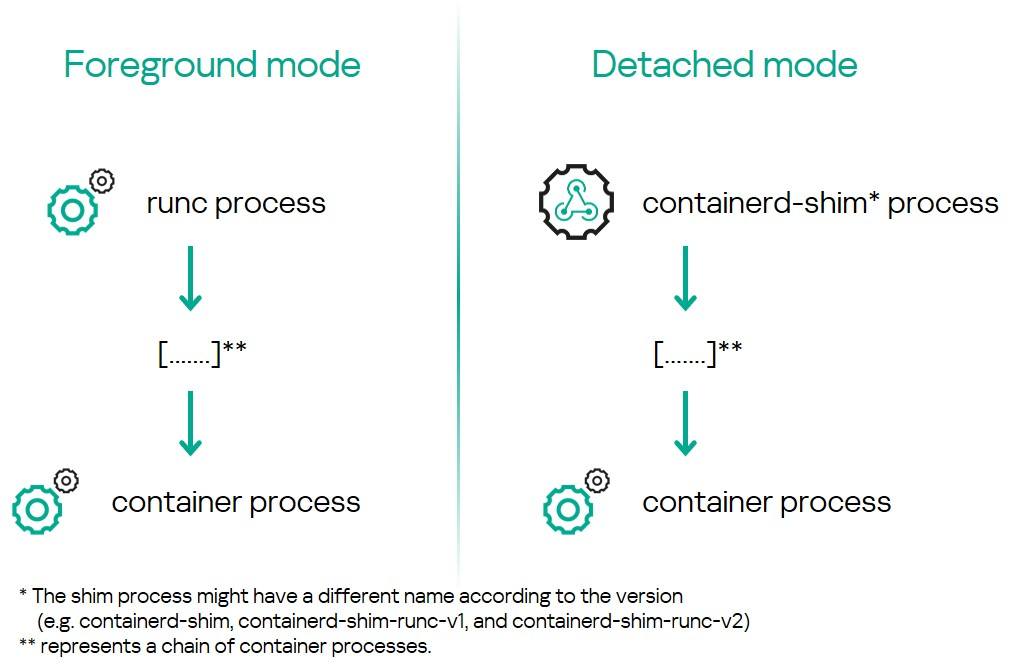
It’s important to note which mode runc has been executed in, since it supports two modes: foreground mode and detached mode. The resulting process tree may vary depending on the chosen mode. In foreground mode, a long-running runc process remains in the foreground as a parent process for the container process, primarily to handle the stdio so the end user can interact with the running container.
In detached mode, however, there will be no long-running runc process. After creating the container, runc exits, leaving the caller process to take care of the stdio. In most cases, this is containerd or CRI-O. As we can see in the screenshot below, when we execute a detached container using runc, the runc process will create it and immediately exit. Hence, the parent process of the container is the host’s PID 1 (systemd process).
However, if we create a detached container using Docker CLI, for example, we’ll notice that the parent of the container process is a shim process, not PID 1!
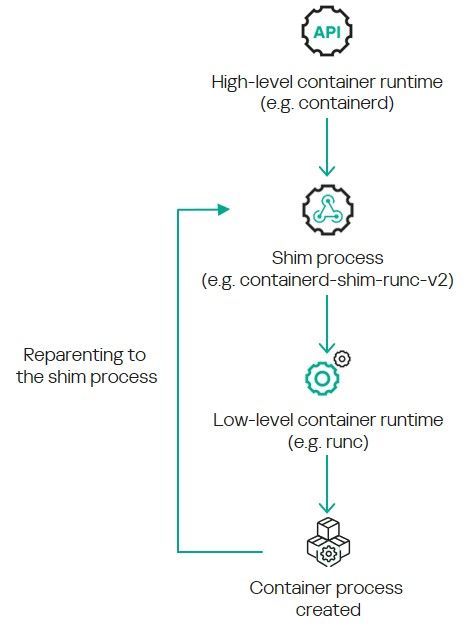
In modern architectures, communication between high- and low-level container runtimes is proxied through a shim process. This allows containers to run independently of the high-level container runtime, ensuring the sustainability of the running container even if the high-level container runtime crashes or restarts. The shim process also manages the stdio of the container process so users can later attach to running containers via commands like docker exec -it , for example. The shim process can also redirect stdout and stderr to log files that users can later inspect either directly from the filesystem or via commands like kubectl logs .
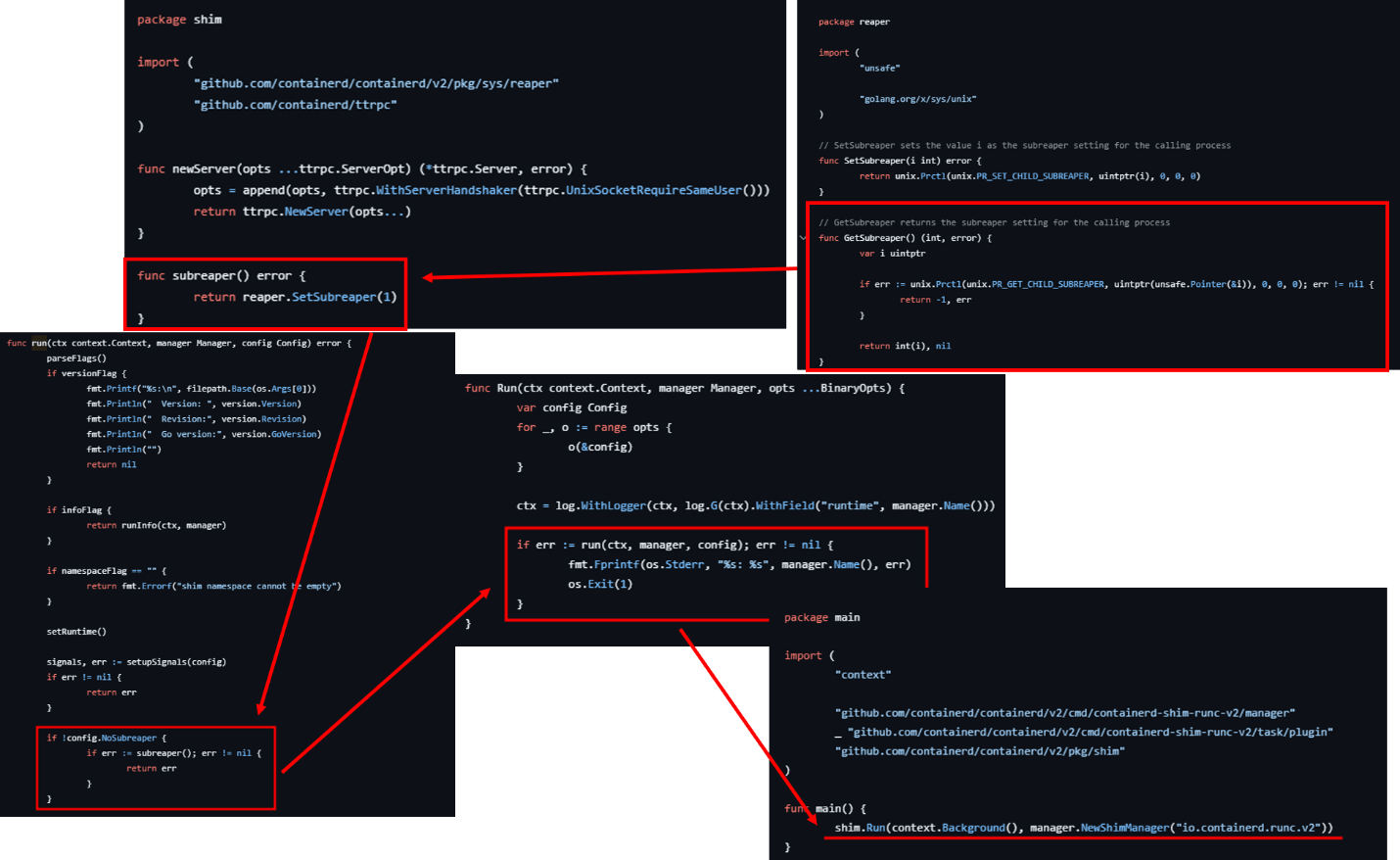
When a detached container is created using Docker CLI, the high-level container runtime, for example, containerd, executes a shim process that calls runc as a low-level container runtime for the sole purpose of creating the container in detached mode. After that, runc immediately exits. To avoid orphan processes or reparenting to the PID 1, as in the case when we executed runc ourselves, the shim process explicitly sets itself as a subreaper to adopt the container processes after runc exits. A Linux subreaper process is a designated parent that takes care of orphaned child processes in its chain (instead of init), allowing it to manage and clean up its entire process tree.
This is implemented in the latest V2 shim and is the default in the modern containerd implementations.
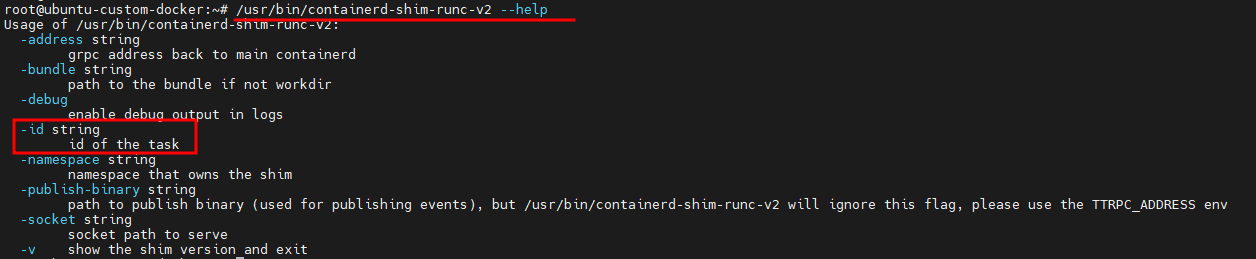
When we check the help message of the containerd-shim-runc-v2 process, for example, we notice that it accepts the container ID as a command-line argument, and calls it the id of the task.
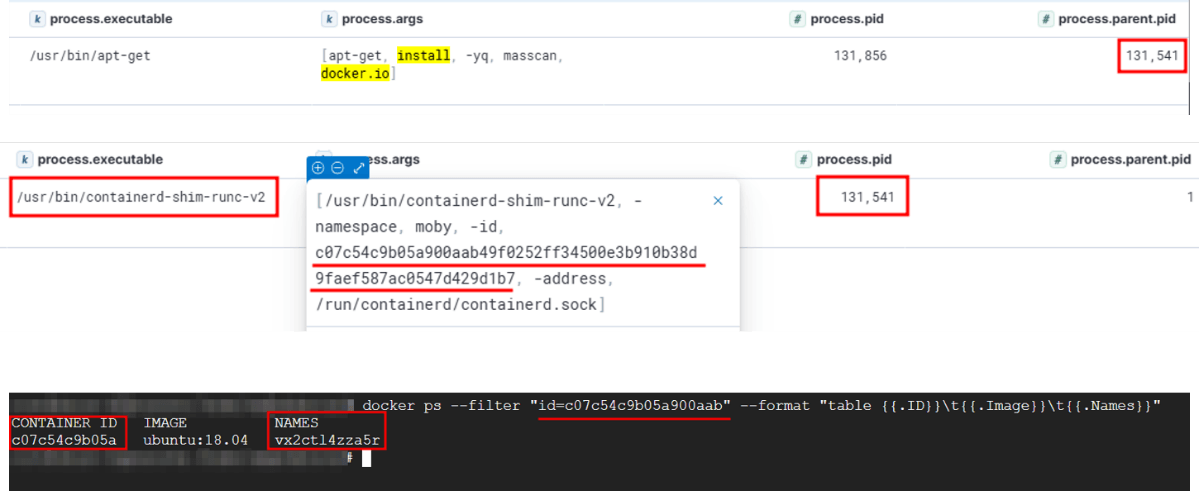
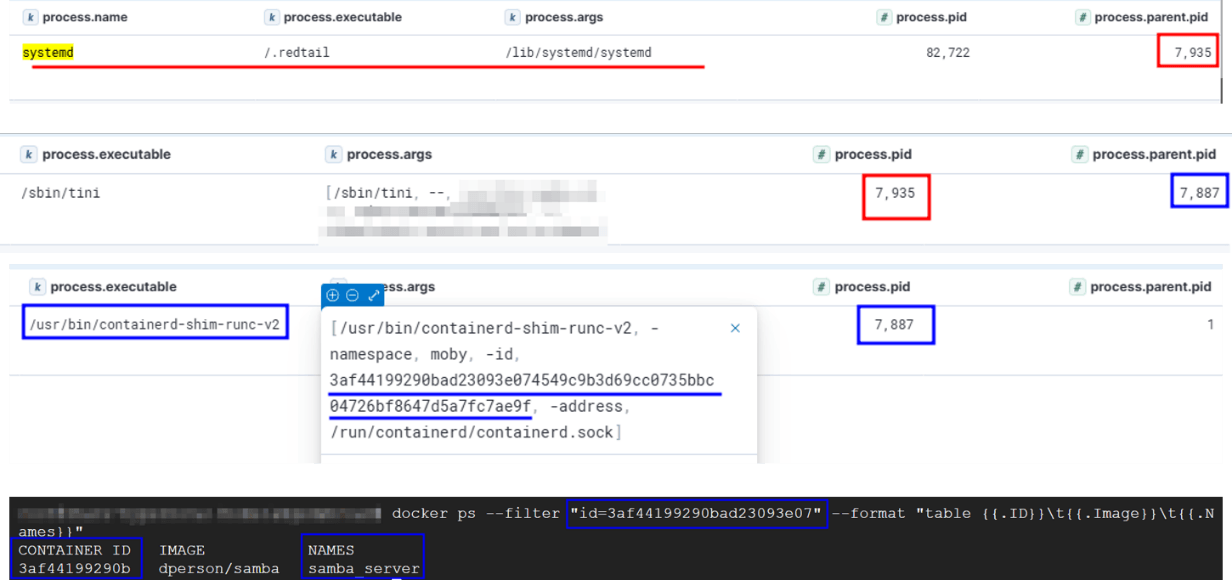
We can confirm this by checking the command-line arguments of the running containerd-shim-runc-v2 processes and comparing them with the running containers.
So far, we’ve successfully identified container processes from the host’s perspective. In modern architectures, one of the following processes will typically be seen as a predecessor process for the containerized processes:
We can also use the command-line arguments of the shim process to determine which container the process belongs to.
Although tracking the child processes of the shim process can sometimes lead to easy wins, it is often not as easy as it sounds, especially when there are a lot of subprocesses between the shim process and the malicious process. In this case, we can take a bottom-to-top approach, pivoting from the malicious process, tracking its parents all the way up to the shim process to confirm that it was executed inside a running container. It then becomes a matter of choosing the process whose behavior we may need to check for malicious or suspicious activities.
Since containers typically run with minimal dependencies, attackers often rely on shell access to either execute commands directly, or install missing dependencies for their malware. This makes container shells a critical focus for detection. But how exactly do these shells behave? Let’s take a closer look at one of the key shell processes in containerized environments.
In this post, we focus on the behavior of BusyBox-based containers. We also included Alpine-based containers as an example of an image base that relies on BusyBox to implement many core Linux utilities, helping to keep the image lightweight. For the sake of demonstration, Alpine images that depend on other utilities are outside the scope of this post.
BusyBox provides minimalist replacements for many commonly used UNIX utilities, combining them into one small executable. This allows for the creation of lightweight containers with significantly reduced image sizes. But how does the BusyBox executable actually work?
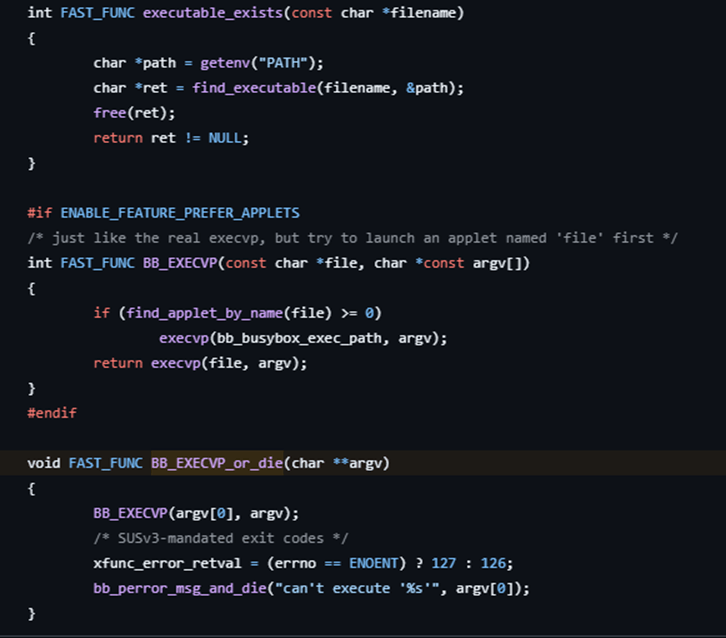
BusyBox has its own implementation of system utilities, known as applets. Each applet is written in C and stored in the busybox/coreutils/ directory as part of the source code. For example, the UNIX cat utility has a custom implementation named cat.c. At runtime, BusyBox creates an applet table that maps applet names to their corresponding functions. This table is used to determine which applet to execute based on the command-line argument provided. This mechanism is defined in the appletlib.c file.
When an executed command calls an installed utility that is not a default applet, BusyBox relies on the PATH environment variable to determine the utility’s location. Once the path is identified, BusyBox spawns the utility as a child process of the BusyBox process itself. This dynamic execution mechanism is critical to understanding how command execution works within a BusyBox-based container.
Now that we have a clear understanding of how the BusyBox binary operates, let’s explore how it functions when running inside a container. What happens, for example, when you execute the sh command inside such containers?
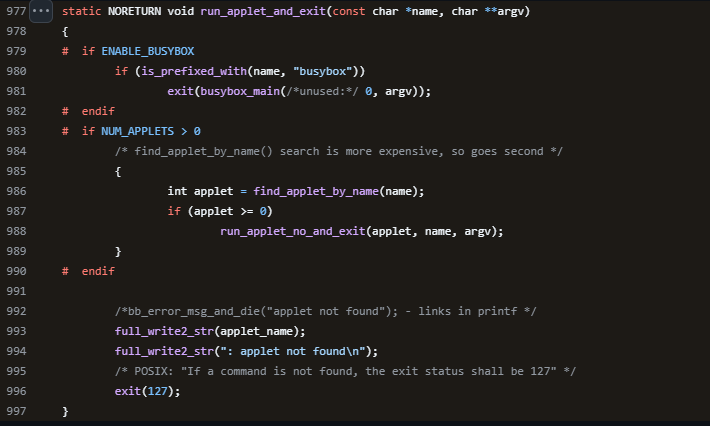
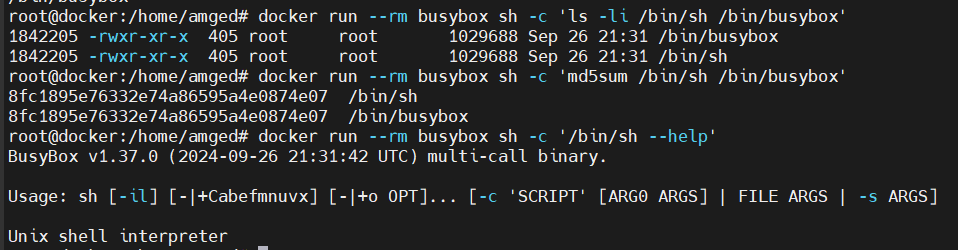
In both BusyBox and Alpine containers, executing the sh command to access the shell doesn’t actually invoke a standalone binary called sh. Instead, the BusyBox binary itself is executed. In BusyBox containers we can verify that /bin/sh is replaced by BusyBox by comparing the inodes of /bin/sh and /bin/busybox using ls -li and confirm that both have the same inode number. We can also print their MD5 hash to see that they are the same, and by executing /bin/sh --help, we’ll see that the banner of BusyBox is the one that’s printed.
On the other hand, in the Alpine containers, /bin/sh is a symbolic link to /bin/busybox. This means that when you run the sh command, it actually executes the BusyBox executable referred to by the symbolic link. This can be confirmed by executing readlink -f /bin/sh and observing the output.
Hence, inside BusyBox- or Alpine-based containers, all shell commands are either executed directly by the BusyBox process or are launched as child processes under the BusyBox process. These processes run within isolated namespaces on the host operating system, providing the necessary containerization while still utilizing the shared kernel of the host.
From a threat hunting perspective, having a non-standard shell process for the host OS, like BusyBox in this case, should prompt further investigation. Why would a BusyBox shell process be running on a Debian or a RedHat OS? Combining this conclusion with the previous one allows us to confirm that the shell was executed inside a container when runc or shim is observed as the predecessor process to the BusyBox process. This knowledge can be applied not only to the BusyBox process but also to any other process executed inside a running container. This knowledge is crucial for effectively determining the origin of suspicious behavior while hunting for threats using the host execution logs.
Some security tools, such as Kaspersky Container Security, are designed to monitor container activity and detect suspicious behavior. Others, such as Auditd, provide enriched logging at the kernel level based on preconfigured rules that capture system calls, file access, and user activity. However, these rules are often not optimized for containerized environments, further complicating the distinction between host and container activity.
While investigating execution logs, threat hunters and incident responders might overlook some activities on Linux machines, thinking they are part of normal operations. However, the same activities performed inside a running container should raise suspicion. For example, installing utilities such as Docker CLI may be normal on the host, but not inside a container. Recently, in a Compromise Assessment project, we discovered a crypto mining campaign in which the threat actor installed Docker CLI inside a running container in order to easily communicate with dockerd APIs.
In this example, we detected the installation of Docker CLI inside a container by tracing the process chain. We then determined the origin of the executed command and confirmed the container in which the command was executed by checking the command-line argument of the shim process.
During another investigation, we detected an interesting event where the process name was systemd while the process executable path was /.redtail. To identify the origin of this process, we followed the same procedure of tracking the parent processes.
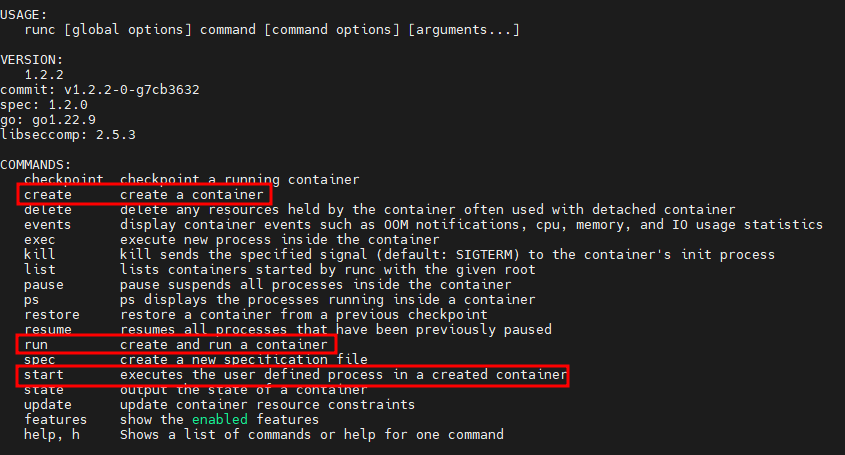
Another interesting fact we can leverage is that a Docker container is always created by a runc process as the low-level container runtime. The runc help message reveals the command-line arguments used to create, run or start a container.
Monitoring these events helps threat hunters and incident responders identify the ID of the subject container and detect any abnormal entrypoints. A container’s entrypoint is its main process and it will be the process spawned by runc. The screenshot below shows an example of the creation of a malicious container detected by hunting for entrypoints with suspicious command-line arguments. In this case, the command line contains a malicious base64-encoded command.
Containerized environments are now part of most organizations’ networks because of the deployment and dependency encapsulation feasibility they provide. However, they are usually overlooked by security teams and decision makers because of a common misunderstanding about container isolation. This results in undesirable situations when these containers are compromised, and the security team is not fully equipped with the knowledge or tools to help during response activities, or even to monitor or detect in the first place.
The approach discussed in this post is one of the procedures that we typically follow in our Compromise Assessment and Incident Response services when we need to hunt for threats in historical host execution logs with container visibility issues. However, in order to detect container-based threats in time, it is crucial to protect your systems with a solid containerization monitoring solution, such as Kaspersky Container Security.
Source: Government of India
Source: Government of India (4)
At least 27 Palestinians were killed and dozens wounded by Israeli fire near a food distribution site in the southern Gaza Strip on Tuesday, local health authorities said, in the third day of chaos and bloodshed to affect the aid operation.
The Israeli military said its forces had opened fire on a group of individuals who had left designated access routes near the distribution centre in Rafah.
It added it was still investigating what had happened.
The deaths came hours after Israel said three of its soldiers had been killed in fighting in the northern Gaza Strip, as its forces pushed ahead with a months-long offensive against Hamas militants that has laid waste to much of the enclave.
A spokesperson for the International Committee of the Red Cross told media that its field hospital in Rafah received 184 casualties, adding that 19 of those were declared dead upon arrival, and eight died of their wounds shortly after.
More than 35 patients required immediate intervention, the spokesperson added.
The U.S.-backed Gaza Humanitarian Foundation launched its first distribution sites last week in an effort to alleviate widespread hunger amongst Gaza’s war-battered population, most of whom have had to abandon their homes to flee fighting.
The Foundation’s aid plan, which bypasses traditional aid groups, has come under fierce criticism from the United Nations and established charities which say it does not follow humanitarian principles.
The private group, which is endorsed by Israel, said it distributed 21 truckloads of food early on Tuesday and that the aid operation was “conducted safely and without incident within the site”.
However, there have been reports of repeated killings near Rafah as crowds gather to get desperately needed supplies.
On Sunday, Palestinian and international officials reported that at least 31 people were killed and dozens more injured. On Monday, three more Palestinians were reportedly killed by Israeli fire.
The Israeli military has denied targeting civilians gathering for aid and called reports of deaths during Sunday’s distribution “fabrications” by Hamas.
On Tuesday, it said IDF forces had identified “a number of suspects” moving towards them while deviating from the access routes. “The forces fired evasive shots, and after they did not move away, additional shots were fired near the individual suspects who were advancing towards the forces,” it said.
MASS EVACUATIONS ORDERED
U.N. Secretary-General António Guterres said on Monday he was “appalled” by reports of Palestinians killed and wounded while seeking aid and called for an independent investigation.
The Israeli military issued new evacuation orders to residents of several districts in Khan Younis in the southern Gaza Strip late on Monday, warning that the army would act forcefully against militants operating in those areas.
The military told residents to head west towards the Mawasi humanitarian area. Palestinian and United Nations officials say there are no safe areas in the enclave, and that most of its 2.3 million population has become internally displaced.
The territory’s health ministry said on Tuesday that the new evacuation orders could halt work at the Nasser Hospital, the largest, still-functioning medical facility in the south, endangering the lives of those being treated there.
Israel launched its military campaign in Gaza following the October 7, 2023 assault in which Hamas-led gunmen killed 1,200 people and took 251 hostages, by Israeli tallies.
In the subsequent fighting, more than 54,000 Palestinians have been killed, local health authorities say.
(Reuters)
Source: Government of India
Source: Government of India (4)
Astronomers working with South Africa‘s SKA telescope are pushing authorities to ensure that any licensing agreement with Elon Musk’s Starlink will protect their groundbreaking observations, a senior scientist said.
Discussions to bring Musk’s internet service Starlink in South Africa have already been contentious, with parent company SpaceX criticising local shareholding laws while backing equity equivalent programmes.
Attaching astronomy-linked licensing conditions may further complicate attempts to introduce Starlink to the country of Musk’s birth, where he has already said he is deterred by government Black empowerment policies.
South Africa said it will review its Information and Communication Technology sector rules but will not back down on government policies to transform the economy three decades after white-minority rule ended.
Scientists fear South Africa‘s Square Kilometre Array (SKA-Mid), the world’s most powerful radio telescope together with another array co-hosted in Australia, will have their sensitive space observations distorted by Starlink‘s low-orbiting satellites.
“It will be like shining a spotlight into someone’s eyes, blinding us to the faint radio signals from celestial bodies,” Federico Di Vruno, co-chair of International Astronomical Union Centre for the Protection of the Dark and Quiet Sky, told Reuters in a telephone interview.
Di Vruno said the SKA Observatory, where he is spectrum manager, and the South African Radio Astronomy Observatory (SARAO) were lobbying for license requirements to reduce the impact on observations in certain frequency ranges, including some that SKA-Mid uses.
That could direct Starlink to steer satellite beams away from SKA receivers or stop transmission for a few seconds to minimise interference, he said.
South Africa‘s current SKA antennae, in the remote Northern Cape town of Carnarvon, use the 350 megahertz to 15.4 gigahertz bandwidth, a range also used by most satellite operators for downlinks.
MAJOR OBSERVATIONS
South Africa‘s MeerKAT radio telescope, a precursor to SKA-Mid which will be incorporated into the larger instrument, has already discovered a rare giant radio galaxy that is 32 times the size of the Milky Way.
Last year, it found 49 new galaxies in under three hours, according to SARAO.
SKA Observatory, an international body, also campaigns for conditions on licensing agreements with other major satellite operators such as Amazon and Eutelsat’s OneWeb to ensure quiet skies amid a boom in new satellite launches.
“We are trying to follow different technical and regulatory avenues to mitigate this issue on the global stage,” Di Vruno said.
(Reuters)
Source: United Kingdom – Executive Government & Departments
Britain’s pubs, cafes, restaurants and hotels to save £3 million under emissions cutting scheme.
Pubs, cafes, restaurants and hotels across the UK will have lower energy bills thanks to a new emissions cutting trial as part of the government’s Plan for Change.
Over 600 small and medium sized hospitality businesses will receive free energy and carbon reduction assessments to cut energy costs, support productivity and boost growth.
Funded by the government and delivered by Zero Carbon Services, one of the UK’s leading net-zero advisers for the hospitality sector, the trial is expected to save businesses over £3 million. This will help pubs and restaurants to keep more money in their pockets – while allowing them to invest in jobs and continue to be the hubs of communities.
Minister for Industry Sarah Jones said:
Pubs, restaurants and cafes are a cornerstone for communities across the country, with the hospitality sector employing millions of people and contributing billions to the economy.
By providing business owners with expert advice to cut bills and reduce emissions, this will help them keep more money in their pockets to grow their business, employ local people and continue to serve your pint of lager or fish and chips.
Zero Carbon Services CEO Mark Chapman said:
Climate change is already impacting hospitality with extreme weather events reducing sales and increasing food supply costs. Combined with other cost increases, there has never been a more important time to both recover lost profits and take credible action on reducing carbon emissions, the key cause of climate change.
We’ve already helped thousands of UK pubs, restaurants and hotels, to cut carbon and costs and thanks to this scheme, we can now offer that support for free to even more independent businesses.
Most venues have opportunities to save energy, food and money without realising it. By combining smart data with one-to-one coaching, we help operators take simple, practical steps to reduce waste, lower emissions, and improve day-to-day efficiency. It’s about making small changes that add up — cutting waste, protecting profits and building a stronger, more resilient sector.
Kate Nicholls, Chief Executive of UKHospitality, said:
Hospitality businesses have already made great strides to reduce their emissions but are keen to go further and faster in order to save costs and become more sustainable.
We’re pleased to support this new trial that can help businesses further cut their emissions, and we’re looking forward to working with the government and Zero Carbon Services on its rollout.
Emma McClarkin, CEO of the British Beer and Pub Association, said:
This initiative is welcome and will give valuable insights into the ways the sector can become more energy efficient which could help to cut down on energy bills.
This is no small sum and we’re pleased that government has acted on our calls to support the sector through boosting funding to undertake this kind of work.
Steve Alton, CEO of British Institute of Innkeeping, said:
Running a lean, sustainable pub business is vital for operators across the UK. We have supported our members with their carbon measurement and reduction over the past 2 years as part of our Sustainability Champions programme, so we are delighted that Zero Carbon Services can now offer more support via free assessments and coaching to over 600 operators.
The hospitality sector is largely made up of SMEs and supports 3.5 million jobs, while contributing £93 billion to the UK economy.
The scheme will support businesses to make cost effective changes such as fixing insulation gaps, upgrading to low energy lighting or tweaking heating settings that will add up to significant savings over the year.
A recent report from the Federation of Small Businesses found that 64% of small businesses believe sustainability should be a high priority for the government, but only 26% of small businesses believe they have the appropriate knowledge to transition their business to net zero.
The Zero Carbon Services Hospitality trial will help hospitality businesses by putting business owners in direct contact with the expertise of trusted energy and sustainability advisers.
The launch of the trial comes ahead of the government’s modern Industrial Strategy, which will turbocharge growth in the UK’s key sectors including clean energy. Meanwhile, a renewed Industrial Decarbonisation Strategy will set the strategic direction for the government’s approach to working with industry towards a competitive and low carbon industrial base in the UK, ensuring growth opportunities are captured in tandem with emissions reductions.
The government has provided £350,000 to fund the Zero Carbon Services Hospitality trial, which will run from May 2025 to March 2026.