U.S. Coast Guard sent this bulletin at 06/01/2025 01:30 PM EDT
06/01/2025 01:18 PM EDT
SAN DIEGO — The crew of the Coast Guard Cutter PETREL (WPB-87350) interdicted 16 migrants from a 25-foot sail boat, approximately 54 miles Southwest, off Point Loma, California.
Source: People’s Republic of China in Russian – People’s Republic of China in Russian –
Source: People’s Republic of China – State Council News
ISTANBUL, June 1 (Xinhua) — Ukraine and Russia will resume talks in Istanbul on June 2 as part of ongoing diplomatic efforts to end the conflict, Turkish authorities announced Sunday.
According to a statement from the Turkish presidential office, the meeting of the delegations is scheduled for 13:00 local time /10:00 GMT/ at the Ciragan Palace, located on the European side of Istanbul on the shore of the Bosphorus Strait.
The previous round of direct talks between the parties took place in this city on May 16, the parties held a face-to-face meeting for the first time since March 2022. However, it was not possible to reach an agreement on a ceasefire. –0–
Source: People’s Republic of China in Russian – People’s Republic of China in Russian –
Source: People’s Republic of China – State Council News
JERUSALEM, June 1 (Xinhua) — The Israel Defense Forces (IDF) said Sunday that it and the Shin Bet security service killed a Hamas cell commander in an airstrike in the Gaza Strip on May 30.
The IDF statement said that Khalil Abd al-Nasser Muhammad Khatib, the commander of Hamas’s Al-Mawasi Battalion cell in the central Gaza Strip, was identified during an intelligence operation on May 30 and was subsequently killed in an IDF airstrike. The location of the operation was not specified.
According to the statement, the Hamas commander was responsible for an attack that killed 21 IDF soldiers in the al-Mawasi area of central Gaza in January 2024. The slain leader also led other attacks on Israeli army units.
Hamas has yet to comment on Israel’s statement. -0-
Source: People’s Republic of China in Russian – People’s Republic of China in Russian –
Source: People’s Republic of China – State Council News
BEIJING, June 1 (Xinhua) — China’s inter-regional tourist trips rose 10.8 percent year-on-year on Saturday, the first day of the nationwide holiday to mark the traditional Chinese Dragon Boat Festival, official data from the Ministry of Transport showed Sunday.
According to the agency, more than 230.97 million interregional trips were made on Saturday.
The largest share of transportation was accounted for by automobile transport, which made 209.99 million passenger trips, which is 11.3 percent more in a year-on-year comparison.
Passenger traffic on rail transport amounted to almost 18.12 million person-times, which is 5 percent more year-on-year, while on water transport it amounted to 959 thousand person-times, increasing by 21.3 percent year-on-year.
Airlines handled 1.911 million passenger flights, the same as last year.
The Dragon Boat Festival, also known as the Duanwu Festival, is celebrated on the fifth day of the fifth month of the Chinese lunar calendar. This year, it falls on May 31, and the national holiday for the festival runs from May 31 to June 2. –0–
oday, the New York Daily News published an op-ed by Governor Kathy Hochul regarding her commitment to addressing New York’s housing crisis, including converting the vacant 5 Times Square office building into 1,250 new homes. Text of the op-ed can be viewed online and is available below:
Behind each one of my housing reforms — each proposal to build more and build better — are New Yorkers like Niya Newman, who I helped move into a permanently affordable unit in Gowanus. For Niya and her son, a few hundred dollars rent isn’t just the difference between new clothes or a family vacation, it’s the difference between staying in New York or joining the ranks of hard-working families who just couldn’t get by in the city they love.
As I handed Niya the keys, her eyes were filled with tears. I know that feeling as a mom — that sense of possibility that comes when you have the dignity of a home that makes you feel valued. Whether it’s converting an existing office building or investing in an area that had been left behind, like the Gowanus area, hearing stories like Niya’s remind me of the extraordinary importance of this fight.
For decades, community and state leaders have failed to harness the aspiration and boldness needed to break through barriers and build the future New Yorkers deserve. Even as our neighbors in New Jersey and Connecticut have implemented ambitious plans to build more housing and drive down costs, New York’s supply has been stagnant.
To create more stories like Niya’s means using every tool in our toolkit — new strategies and projects that weren’t even possible just a few years ago. We have the tools now because I fought for and secured historic changes to bring our laws into the 21st century and put your families at the forefront.
Just look at converting underused and vacant offices into apartments — it is a simple concept: What if we took the most costly part of development — building the actual buildings — out of the equation, and put to use otherwise unused space? But in many parts of New York City where the opportunity was greatest, it wasn’t even possible due to 60-year-old laws and a lack of key tools to keep up with the demand.
Over my last three budgets, I have been determined to break through these barriers. In the aftermath of the pandemic, we saw the over supply of empty office space looming over the skyline. With the housing crisis only worsening, we knew this was an opportunity to be innovative. We were able to break through those barriers — lifting the residential Floor Area Ratio cap, providing tax incentives for affordable housing and office conversions to housing.
Now we are starting to see those actions take shape. The latest example is a massive office-to-housing conversion announced at 5 Times Square — bringing us one step closer to solving the housing crisis by proving that we can create more supply with what already exists. This conversion of a 38-story office tower in one of the largest business hubs in the world, will create up to 1,250 new homes, including 313 that will be permanently affordable.
And we’re not stopping there. It’s part of a wave of new, innovative office-to-housing conversions throughout New York City since we took action last year, with approximately 10,000 new apartments completed or currently under construction since last April. We need to see that number of conversions increase even more.
And conversions are only part of what we’re doing to increase our housing supply. As part of my state budget this year, I invested more than $1 billion for affordable housing to help secure “City of Yes for Housing Opportunity,” the most significant pro-housing rezoning in the city’s history, which is expected to create more than 80,000 homes.
I also fought hard to extend the completion deadline for 421-a projects, and as a result, up to 71,000 homes, including 21,000 affordable homes — like Niya’s — which were previously at risk can now be built. Building for the future has to be our first priority — these programs are about incentivizing housing growth in communities of all shapes and sizes.
I’m fighting to make New York more affordable for families by tackling the highest cost that New Yorkers have to endure, the cost of their rent or their mortgage. I am committed to using every lever of power to break down the barriers that have held us back and suppressed housing growth. And as governor, I will partner with anyone who shares that vision.
New Yorkers deserve safe, stable and affordable homes — and the only way we can do that is to build more housing.
Source: United States of America – The White House (video statements)
“With the help of patriots like you, we’re going to produce our own metal, unleash our own energy, secure our own future, build our country, control our destiny, and we are once again going to put Pennsylvania steel into the backbone of America like never before.” –President Donald J. Trump
Source: Northern Territory Police and Fire Services
Our CBR is the ACT Government’s key channel to connect with Canberrans and keep you up-to-date with what’s happening in the city. Our CBR includes a monthly print edition, email newsletter and website.
You can easily opt in or out of the newsletter subscription at any time.
The ACT Government will install a ‘midblock pedestrian crossing’ with traffic lights on Canberra Avenue near Burke Crescent.
A midblock pedestrian crossing is a designated area for pedestrians to cross a street between intersections.
The crossing will improve safety for students commuting to and from St Edmund’s and St Clare’s Colleges, as well as the broader Canberra community.
The ACT Government will fast-track design of the crossing to support the approval process and enable construction. More information will be provided to the local school community on timing in the next couple of months.
The announcement comes during National Road Safety Week 2025, a time to reflect on the impact of road trauma and the collective responsibility to keep our roads safe.
Everyone has a role in road safety. Each action behind the wheel makes a difference.
All Canberrans are being urged to take the pledge to drive so others survive.
This means:
obey the speed limit
wear a seatbelt
don’t drive while under the influence of drugs or alcohol
“Indigenous Peoples have been stewards of Canada’s lands and waters for time immemorial. National Indigenous History Month is a time to celebrate the histories, cultures, languages, knowledge, and traditions of First Nations, Inuit, and Métis Peoples.
“Indigenous leadership and perspectives will be foundational to how this government delivers its mandate. We will address past harms, take a distinctions-based approach, and advance self-determination, while upholding Modern Treaties and self-government agreements.
“Central to this commitment is the long-term wealth and prosperity of First Nations, Inuit, and Métis. To that end, we have doubled the Indigenous Loan Guarantee Program from $5 billion to $10 billion – and opened it to sectors outside of energy and natural resources to catalyze more Indigenous-led infrastructure, transportation, and trade projects across the country.
“As Canada moves forward with nation-building projects, the government will be firmly guided by the principle of free, prior, and informed consent.
“We will work in full partnership with Indigenous Peoples – advancing shared priorities from health care, food security, housing, and education to conservation, climate action, and emergency management. We move forward on the important work of the calls to action in the Truth and Reconciliation Commission’s Final Report, the National Inquiry into Missing and Murdered Indigenous Women and Girls’ Calls for Justice, and the implementation of the United Nations Declaration on the Rights of Indigenous Peoples Act.”
Today marks the start of Filipino Heritage Month. This is an opportunity to highlight the achievements and experiences of the third largest Asian community in the country.
The Filipino community in Canada is one of the fastest-growing populations, now representing nearly one million people. This community has played a vital role in helping build a stronger and more vibrant Canada.
Tragically, this year’s celebrations are overshadowed by the horrific attack at Vancouver’s Lapu-Lapu Festival on April 26, which claimed the lives of 11 people and left many others injured. This senseless act of violence has deeply affected not only the Filipino community, but all Canadians.
As we share in your sorrow and loss, we also stand in solidarity and hope. May this month continue to be a symbol of unity, resilience and strength in the face of adversity.
Filipino Canadians have made lasting contributions to this country’s vibrant history and continue to shape its future. Members of the community have made their mark in diverse fields including health care, entrepreneurship, the arts, sport, science, finance, social justice and politics. They are integral to our country and have played a key role in building the unified, inclusive society that, today, makes us so proud to be Canadian.
Throughout June, I encourage everyone to learn more about the rich traditions and history of the Filipino-Canadian community. And to those celebrating Philippine independence on June 12, I wish you a joyful 127th anniversary.
“For generations, the Canadian Armed Forces have answered the call to serve – upholding our sovereignty with unwavering resolve. On Canadian Armed Forces Day, we honour their sacrifice and service to our great nation.
“In an increasingly dangerous and divided world, the new government will rebuild, rearm, and reinvest in the Canadian Armed Forces. We will rapidly procure new equipment and technology, secure the Arctic, build our defence industrial capacity, create new partnerships, and support our people by making the Armed Forces a lifelong career.
“Our investments will be spent strategically and effectively to put Canada on track to exceed our NATO defence spending target by 2030.
“Now more than ever, we need to defend our sovereignty and invest in the Canadian Armed Forces. We are indebted to those who serve, and we affirm our responsibility to serve them in return.”
In June, we celebrate Italian Heritage Month. People of Italian descent have been in Canada since the 1880s and are an integral part of our society, making it more dynamic.
Our country’s first Italian community numbered around 2,000 people at the end of the 19th century. In the 2021 census, more than 1.5 million people claimed Italian origins. Home to one of the largest Italian diasporas in the world, Canada is proud of this community’s vibrant, shared culture. For generations, people of Italian descent have enriched Canadian society, thanks in part to the Little Italy neighbourhoods in many major Canadian cities that have helped make our country more diverse and more open to the world.
The contributions made by people of Italian descent don’t stop at the gates of these neighbourhoods. They have also made notable impacts in finance, politics, cuisine, music, entrepreneurship, education, science and many other fields.
Italian Heritage Month is a time to recognize the rich culture and traditions of Italian Canadians and to celebrate the spirit of community that brings us together. Let’s take this opportunity to come together and learn about the heritage of our neighbours of Italian ancestry!
In June, we are pleased to mark Portuguese Heritage Month, an opportunity to celebrate the history and culture of the Luso-Canadian community, an integral part of our national fabric.
Portuguese people have made Canada their home since the early 1950s—most of them from the Azores and Madeira—in search of a better life. Armed with their courage and will, they settled on Canadian soil to help create the country we cherish today.
More than 500 years after the first Portuguese explorers set foot in Canada, there are now almost 500,000 people of Portuguese origin living here. Present in all our major cities, they form one of the largest Portuguese diasporas in the world. They also excel in a variety of fields; from education and politics to the arts, finance and community service, members of Luso-Canadian communities are making Canada stronger through their vitality and hard work.
Throughout June, I invite everyone to celebrate the heritage and culture of Luso-Canadians and to mark Portugal Day on June 10. Dia de Portugal, de Camões e das Comunidades Portuguesas is the perfect time to reflect on what unites us and recognize just how significantly our fellow citizens of Portuguese origin have contributed to our culture and diversity.
Premier David Eby has issued the following statement celebrating Pride season:
“From Vancouver Island to northern B.C. to the Kootenays, people throughout British Columbia are starting to celebrate Pride.
“June 1 marks the beginning of Pride season in many parts of Canada and around the world, and is a time for all of us to recognize and celebrate the many victories gained by 2SLGBTQIA+ people over the decades.
“People around the province will be taking part in events in their communities – from Pets for Pride in Kelowna and Pride Roller Disco in the Alberni Valley, to the iconic Vancouver Pride Parade, which draws tens of thousands of spectators and participants from around the world.
“Pride season is much more than a celebration. It is also a declaration that hate and discrimination have no place in British Columbia, and everyone has the right to live in safety without fear of violence or discrimination. Our government is committed to protecting the rights of everyone to be who they truly are and love who they love.
“I look forward to attending Pride events this year with my family and I encourage everyone to get out in their community and take part with their friends and neighbours.
“To everyone celebrating this season, happy Pride!”
Jennifer Blatherwick, parliamentary secretary for gender equity, said:
“Pride is a season to celebrate and embrace all people for who they are. As we celebrate Pride, let’s continue to support services and lift up safe spaces for our 2SLGBTQIA+ community.
“Thank you to everyone who works hard to make Pride a success in communities throughout our province and to those who advocate for 2SLGBTQIA+ rights year-round.”
Ottawa, Ontario (June 1, 2025) — Traditional unceded Algonquin Territory
The Honourable Rebecca Alty, Minister of Crown-Indigenous Relations, the Honourable Rebecca Chartrand, Minister of Northern and Arctic Affairs, the Honourable Mandy Gull-Masty, Minister of Indigenous Services, and the Honourable Steven Guilbeault, Minister of Canadian Identity and Culture and Minister responsible for Official Languages, issued the following statement:
“Today marks the start of National Indigenous History Month, a time to honour and celebrate the unique histories and diverse cultures of First Nations, Inuit and Métis. To move Canada forward, we must continue to learn from Indigenous Peoples, their experiences, and build on the significant contributions Indigenous Peoples make in advancing Canada. Our everlasting relationship is based on respect for Indigenous rights. We must reflect on the lasting harms caused by colonization and consider the role we each play in advancing reconciliation.
This month is also a celebration of the beauty and diversity of Indigenous languages. We recognize that the preservation and promotion of Indigenous languages are paramount to community connections, identity, and histories. We honour the voices and contributions of Indigenous leaders, Elders, Knowledge Keepers, artists, business owners, and youth, who continue to shape the unique fabric of this country in profound and inspiring ways.
National Indigenous History Month invites us to reflect on what unites us: equity, respect for human rights, diversity, and a shared hope for a more inclusive future. It also calls on us to recognize the vital role Indigenous Peoples play as stewards of the environment, and to learn from their deep, enduring connection to the land. We must build a brighter, stronger, more inclusive Canada for future generations, by embracing the journey of reconciliation in true partnership with First Nations, Inuit and Métis.”
The Honourable David J. McGuinty, Minister of National Defence, issued the following statement today in recognition of Canadian Armed Forces Day:
“Today, we honour the brave members of the Canadian Armed Forces and thank them for their unwavering dedication to our country. Whether serving at home or abroad, they uphold peace, freedom, and democracy with professionalism, resilience, and a deep commitment to Canadian values.
Members of the Canadian Armed Forces work tirelessly to protect Canada’s sovereignty, support communities in times of crisis, and stand shoulder to shoulder with our allies to promote global peace and security.
In a world of growing threats, we must secure Canadian sovereignty by strengthening our military. That’s why we are making historic investments in our defence capabilities—modernizing equipment, embracing cutting-edge technology, and reinforcing security infrastructure in the North. These efforts ensure that our Forces are ready to meet today’s challenges and those of tomorrow.
Supporting our military means supporting its people. We are working to improve housing, childcare, health care, and career opportunities for CAF members and their families—because their well-being is a national priority.
To all current and former members of the Canadian Armed Forces, and to your families: thank you. Your service and sacrifices represent the very best of Canada. I am proud to stand with you and deeply grateful for all you do in service to our nation.”
Invasive mussels threaten the water systems that families, farmers and businesses rely on and can cause millions in damages. Alberta is currently 100 per cent free of the tiny invaders but the risk is growing across North America. From clogging irrigation pipes, damaging pumps and disrupting water delivery, zebra and quagga mussels can put the food, farms and livelihoods that Albertans depend on at risk.
As of June 1, it is now mandatory for every boat, whether powered or paddled, entering the province from the east and south to get inspected for invasive mussels or other invasive species. If an inspection station is not open, all watercrafts crossing these high-risk borders must be inspected before launch and within 7 days or face fines up to $4,200.
Inspectors work to inspect and decontaminate a watercraft (Credit: Alberta government)
“It just takes one invasive mussel to cause millions in damages to our waters and waterways — that’s why mandatory inspections are now required. Alberta’s watercraft inspectors are trained to know where these deceptively small quagga and zebra mussels hide. If you’re coming from the east or the south, you must get your boat inspected – no exceptions and no shortcuts.”
Until Sept. 30, upon crossing into Alberta from the eastern or southern borders, anyone transporting a watercraft needs to stop at a station for inspection. If the nearest station is closed, inspections are still required within seven days and before launching into any Alberta waterbody.
Inspectors will provide a sticker for watercraft owners to display as proof of inspection. It remains mandatory for anyone travelling with a watercraft to stop when passing an open station, regardless of entry point.
Alberta’s government has also invested in opening 11 watercraft inspection stations this year with increased staff and longer operating hours, more K-9 detection teams and additional mobile decontamination units.
Information on station locations, operating hours and more can be found at alberta.ca/watercraftinspections.
Quick facts:
Alberta is the first province in Canada to require mandatory inspections for watercraft coming from high-risk areas to protect Alberta jobs, businesses and water infrastructure.
In 2024, 13,408 watercraft inspections were completed – the most since 2019 – and 15 watercrafts were confirmed positive for invasive mussels.
About 20 per cent of drivers transporting watercraft attempted to bypass watercraft inspection stations in 2024.
Anyone crossing via Alberta’s western or northern borders with a motorized or non-motorized watercraft is still required to stop if they’re passing an open inspection station.
Budget 2025 is investing $18 million over five years to expand Alberta’s aquatic invasive species inspection, detection and rapid response programs.
Premier David Eby has released the following statement in celebration of Filipino Heritage Month:
“June is Filipino Heritage Month, a time to celebrate the rich history, vibrant culture and invaluable contributions of the Filipino community in British Columbia and beyond.
“This year, we hold this celebration alongside deep sorrow, under the backdrop of the tragic attack that took place at the Lapu Lapu Day Festival in Vancouver. Our hearts continue to grieve with the Filipino community, and we are committed to supporting all those affected in every way we can.
“We have witnessed communities across British Columbia coming together to heal, lift each other up and show compassion. This strength in unity – ‘bayanihan’ – is at the heart of the Filipino spirit. It is defined by deep caring for one another and resilience in the face of hardship. These values have not only shaped the Filipino experience in B.C., but have also enriched the cultural fabric of our province’s history and culture over decades.
“The ‘kapwa’ represents a shared humanity in Filipino culture. This month, more than ever, let us honour the community by coming together, learning and working to create a more inclusive province for everyone.”
Niki Sharma, Attorney General, said:
“The celebration of the Filipino Heritage Month this year carries the weight of the tragedy after the Lapu Lapu Day Festival in Vancouver. In this moment of grief and healing, we stand in solidarity with the Filipino community in B.C.
“From early migration in the 1880s, with the first settlements on Bowen Island and New Westminster, to more than 174,000 people calling B.C. home today, the Filipino community is one of the fastest-growing in Canada. We are proud to be home to the second-largest Filipino diaspora in the country.
“During this month, let us honour the community by supporting, learning from, and celebrating Filipino culture together.”
Mable Elmore, MLA for Vancouver-Kensington, said:
“The Filipino spirit is defined by compassion, resilience and unity. As we mark Filipino Heritage Month, we honour the memories of those lost after the Lapu Lapu Day Festival and carry with us the values that make our community strong.
“As the MLA for Vancouver-Kensington, I mourn for my community and remain committed to supporting all those affected by this tragedy. We are healing, we are rising and we are emerging stronger. I am so proud to stand with the community and to represent all the Filipinos who came before me to make B.C. the vibrant and diverse province we call home.
“Filipino Heritage Month is a chance to learn about our culture, heritage and the incredible contributions our community makes to the cultural mosaic that defines our province. Let us embody the values of the ‘kapwa’ and come together in support and celebration.”
Manama, Bahrain – 1 June 2025: The Central Bank of Bahrain announced the signing of a Memorandum of Understanding (MoU) with the National Bank of the Kyrgyz Republic. The MoU was signed by HE Khalid Humaidan, Governor of the Central Bank of Bahrain, and HE Melis Turgunbaev, Chairman of the National Bank of the Kyrgyz Republic.
Commenting on this occasion, HE Khalid Humaidan said: “We are honored to embark on this official partnership, which represents a strategic step toward strengthening bilateral relations and expanding opportunities for the advancement of the financial services sector, contributing to the growth and prosperity of both brotherly nations. We remain firmly committed to fostering such partnerships as part of our ongoing efforts to support the financial services ecosystem and to further solidify the Kingdom of Bahrain’s position as a leading global financial center.”
The 15th National Games Fencing test event held at Kai Tak Arena, Kai Tak Sports Park on May 31 and June 1 has concluded, the National Games Coordination Office (Hong Kong) (NGCO) said.
The test event, which was also the Challenge Cups Fencing Championships, consisted of the men’s and women’s épée, foil and sabre competitions featuring the open and veteran divisions. Over 500 athletes competed in all six event categories.
The test covered a wide array of areas, including event operations and procedures, competition organisation, venue setup, sports and prize presentations, information systems, medical services, volunteer services and broadcast arrangements.
NGCO Head Yeung Tak-keung said that this test event is the first fencing event ever held at Kai Tak Sports Park. Both venue facilities and competition arrangements have achieved the expected results.
Since last November, Hong Kong has completed test events for all eight National Games competition events.
The General Administration of Sport of China recently announced the Games’ schedule and the competition events in Hong Kong will be held from October 31 to November 20. The NGCO is making thorough preparations for the events.
Click here for information on the 15th National Games.
overnor Kathy Hochul directed state office buildings and landmarks to illuminate in the colors of the Pride flag and raise LGBTQ+ progress Pride flags today, June 1, to celebrate New York’s LGBTQ+ community and mark the beginning of Pride month. The Governor also issued a proclamation designating June 2025 as LGBTQ+ Pride Month in the Empire State. The Pride flag will be raised at the State Capitol, the Empire State Plaza and the Governor’s Executive Mansion.
“New York is the birthplace of the LGBTQ+ rights movement — members of the community have marched for equality since 1969, and every year one of the world’s largest Pride marches takes place in New York City,” Governor Hochul said. “Now more than ever, we are fighting to protect LGBTQ+ rights and protections — all New Yorkers deserve to be safe, heard and valued regardless of who they love or how they identify. New York is proud of its history and will always celebrate Pride.”
The following State landmarks will illuminate various colors of the Pride flag on June 1 and June 23-30, and Capital region landmarks will be lit the weekend of June 7-9:
One World Trade Center
Governor Mario M. Cuomo Bridge
Kosciuszko Bridge
The H. Carl McCall SUNY Building
State Education Building
Alfred E. Smith State Office Building
Empire State Plaza
State Fairgrounds – Main Gate & Expo Center
Niagara Falls
The “Franklin D. Roosevelt” Mid-Hudson Bridge
Grand Central Terminal – Pershing Square Viaduct
Albany International Airport Gateway
MTA LIRR – East End Gateway at Penn Station
Fairport Lift Bridge over the Erie Canal
Moynihan Train Hall
Walkway Over the Hudson State Historic Park
The Pride flag will be flown at the following State agencies and office buildings throughout New York State:
New York State Capitol
Empire State Plaza
Governor’s Executive Mansion
Alfred E. Smith State Office Building
New York State Office of General Services
New York State Department Of Transportation
New York State Office for People With Developmental Disabilities
New York State Workers’ Compensation Board
Hampton Plaza
Harriman Campus
Ten Eyck
Binghamton State Office Building
Dulles State Office Building
Henderson-Smith State Office Building
State Preparedness Training Center (Oriskany)
Homer Folks Facility
Senator John H. Hughes State Office Building
Utica State Office Building
Adam Clayton Powell, Jr. State Office Building
Eleanor Roosevelt State Office Building
Hudson Valley Transportation Management Center
Perry B. Duryea State Office Building
Additionally, Governor Hochul announced that the Pride flag will be flown at the following State parks across New York State:
Allegany State Park
Artpark
Bayard Cutting Arboretum
Belmont Lake State Park
Bethpage State Park
Caleb Smith State Park
Clay Pit Ponds State Park Preserve
Clermont State Historic Site
Connetquot River State Park
DF Riverbank State Park
FDR Four Freedoms State Park
FDR State Park
Gantry Plaza State Park
Green Lakes State Park
Hamlin State Park
Hempstead Lake State Park
Hither Hills State Park
Jones Beach State Park
Lake Taghkanic State Park
Letchworth State Park
Marsha P Johnson State Park
Mills-Norrie State Park
Montauk Downs State Park
Niagara Falls State Park
Orient Beach State Park
Philipse Manor Hall
Planting Fields State Park
Robert Moses State Park
Roberto Clemente State Park
Saratoga Spa State Park
Shirley Chisholm State Park
Sunken Meadow State Park
Taconic State Park State Park
Valley Stream State Park
Wellesley Island State Park
Throughout her positions in local and state government, Governor Hochul has championed policies and made investments to support marginalized New Yorkers. A national leader in advocating for LGBTQ+ rights, she signed legislation to make New York a safe haven for LGBTQ+ youth and paved the way for an Equal Rights Amendment to be embedded in the New York State Constitution.
The LGBTQ+ community has been no stranger to the Trump administration’s attacks and the federal government’s pursuit to strip away rights and protections from people who are trying to be themselves. These attacks have dismantled years of civil rights progress and advocacy, rolling back protections for LGBTQ+ individuals and sheltering accessibility to information for individuals who are seeking to learn more about their identity and receive gender-affirming care.
Every year, New York City is home to one of the world’s largest Pride marches and Pride events in the world. This year, the Pride march will take place on June 29 — annually, the last Sunday in June — and throughout June, Empire State Development’s Division of Tourism/I LOVE NY will continue to encourage tourists to discover all the events and destinations awaiting them across New York State through I LOVE NY LGBTQ. The I LOVE NY LGBTQ website features travel guides, blogs and a Pride event calendar with events taking place throughout New York State. For more information on LGBTQ travel and Pride events, click here.
Source: People’s Republic of China – Ministry of National Defense
China’s Ministry of National Defense expressed strong dissatisfaction and firm opposition on Sunday to the United States defense chief’s speech at the Shangri-La Dialogue, which it said was filled with hegemonic logic and seriously provoked China’s sovereign rights and interests while distorting China’s policy positions.
The ministry’s spokesman Zhang Xiaogang made these remarks in a statement responding to the US defense secretary Pete Hegseth’s speech at the high-profile security summit on Saturday.
US Defense Secretary Pete Hegseth arrives for a trilateral meeting between Japan, the US and Australia, at the Shangri-La Dialogue security summit in Singapore, May 31, 2025. [Photo/Agencies]
The senior US official, in his speech, urged Asia-Pacific countries to increase their military spending to five percent of GDP to counter perceived threats from China in the region, including in the South China Sea and the Taiwan Strait.
Zhang said the US is accustomed to using the Shangri-La Dialogue to create disputes, incite confrontation, and seek its own interests.
The US remarks were rife with deeply ingrained hegemonic logic and Cold War mentality, he said, underscoring that the speech seriously ignored the joint efforts of regional countries to maintain prosperity and stability and deviated from the common desire of countries worldwide for peace and development.
The spokesman noted that the actions of the US are clear to the whole world.
“For its own selfish interests, the US launches tariff wars and trade wars; forms ‘small circles’ and engages in bloc confrontation, causing deep concerns among countries; strengthens military deployments in the Asia-Pacific, rudely interferes in the internal affairs of other countries, and stirs up tensions,” Zhang said.
Facts have repeatedly shown that the US, by going against the trend and acting willfully, will ultimately harm itself, the military official said.
Zhang reiterated China’s position on the Taiwan question and the South China Sea issue.
“The Taiwan question is purely China’s internal affair, and the US has no right to make irresponsible remarks, let alone attempt to use it as a bargaining chip to contain China,” he said.
The People’s Liberation Army will resolutely safeguard national sovereignty and territorial integrity and firmly crush any “Taiwan independence” separatist plots and any external interference, Zhang said.
“Our determination and will are rock-solid, and our capabilities and means are strong and reliable,” he said.
Emphasizing that the South China Sea is one of the busiest and safest shipping lanes globally, he said China will continue to resolve disputes through dialogue and consultation with relevant countries, uphold territorial sovereignty and maritime rights and interests in accordance with the law, and work with regional countries to build a sea of peace, friendship, and cooperation.
The US, fearing no chaos in the South China Sea, forms cliques and stirs up trouble, posing the greatest threat to regional peace and stability, Zhang said.
The spokesman said that China has always been a defender and builder of peace and development in the Asia-Pacific.
The Chinese military will work with regional countries to jointly oppose hegemonism that harms the Asia-Pacific, prevent geopolitical conflicts from being introduced into the region, and oppose any country or force that creates trouble here, he stressed.
“We will actively pursue the concept of a community with a shared future for mankind and the three major global initiatives, working together to maintain long-term peace, stability and prosperity in the Asia-Pacific,” said Zhang.
Source: People’s Republic of China – State Council News
Moscow, June 1 /Xinhua/ — A military unit in the village of Sredniy in the Irkutsk region of Russia was attacked by a UAV, which was the first drone attack in Siberia. The corresponding information was published on the Telegram channel of the governor of the Irkutsk region Igor Kobzev.
“At the moment, it is known that this was a drone attack on a military unit in the village of Sredniy. The first in Siberia. One drop was on an old building in Novomaltinsk. The exact number of UAVs has not yet been counted. Operational and security services have been pulled to the scene: FSB officers, the Ministry of Emergency Situations, and Russian National Guard fighters. An operational headquarters was established. I also went to the Usolsky District,” noted I. Kobzev.
The governor also stressed that there is no threat to the lives and health of residents, and no buildings were damaged in the attack. –0–
Source: The Conversation – Canada – By Pascal Michelberger, Postdoctoral Scholar, Western Academy for Advanced Research, Western University
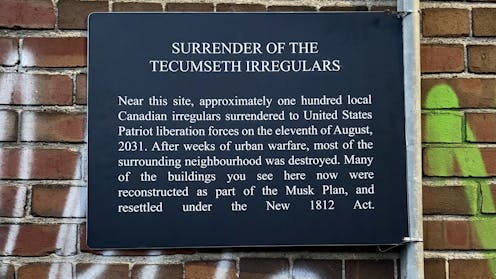
Artist Dara Vandor’s futuristic, commemorative historical plaques on Toronto streets project a U.S.-annexed Canada. (Dara Vandor)
As part of her ongoing public art series, Pax Americana, Toronto visual artist Dara Vandor has been posting aluminum signs in public spaces.
These are plaques that reimagine, as the artist writes, the city as “a site of future conflict and occupation” by the United States. The signage, in the style of commemorative historical markers, echoes U.S. President Donald Trump’s recent and repeated threats to annex Canada and “is meant to serve as a dark warning, inviting contemplation on the fragility of nationhood.”
“This spot served as the center of operations for United States Army snipers during Operation McKinley, the campaign to liberate the northern territory formerly known as Canada. From February to May 2035, this site, code-named ‘The Hot Dog Stand,’ served as a concealed sniper’s nest, providing precision fire support, disrupting insurgent movements, and protecting advancing American units.”
Vandor’s thought-provoking project, which she told CBC Newswas sparked by anger at Trump’s threats to Canadian sovereignty, underlines how storytelling can be a powerful tool in times of conflict, especially when it affords itself the artistic freedom to envision potential futures before they can become reality.
Psychological effects
In order to understand how exactly stories such as the one portrayed on Vandor’s plaques can make a real impact on the way we navigate moments of crisis, we can turn to the work of conflict analysis experts such as Solon Simmons.
The term describes the psychological effect that a story can have on its readers after they finish reading. As Simmons puts it:
“What makes stories so important (as opposed to just interesting or entertaining) is the effect of the story, and this effect doesn’t end when the story ends. It leaves the viewer/reader/listener with a feeling.”
Simmons also explains that the kind and amount of post-plot pressure placed upon an audience depends on the type of story being told.
Projected unhappy ending exerts pressure
A story, for example, featuring a struggle in which the antagonist eventually triumphs over the protagonist is what Simmons calls a “satirical struggle story.”
“Satirical” in this context does not necessarily mean that stories of this kind include elements of mockery or sarcasm. Rather, the label goes back to the influential research contributions of Canadian literary theorist Northrop Frye and American historian Hayden White, from which Simmons derives his own framework.
This is exactly how to understand the story told over its several episodes on Vandor’s Pax Americana plaques: the U.S., as the story’s antagonist, abuses its power and ends up getting away with it, defeating Canadian resistance and annexing what is now only referred to as the “northern territory.”
As Simmons suggests, conflict stories like this one, where what is viewed as injustice is allowed to prevail, exercise a relatively high level of post-plot pressure. This is mainly because the unhappy ending leaves audiences dissatisfied and with a sense of loss to grapple with.
Reader reactions
Simmons also explains that not all readers react to this particular kind of post-plot pressure in the same way. Vandor’s project, for example, has brought out some critical and upset responses.
Julian Bleecker — a researcher, author, designer and engineer with a PhD in history of consciousness whose design studio offers services around future imagining and planning — voiced his objection to the project in a blog post.
But, as Simmons argues, conflict stories in which the happy ending never comes can also leave readers with a productive sense of post-plot pressure. In that case, feeling dissatisfied with the story’s outcome can instead motivate people to mobilize and strategize against the perceived injustice.
Seen in this light, the plaques’ imagined collapse of Canadian sovereignty can therefore also serve as a stark and urgent inspiration, begging response.
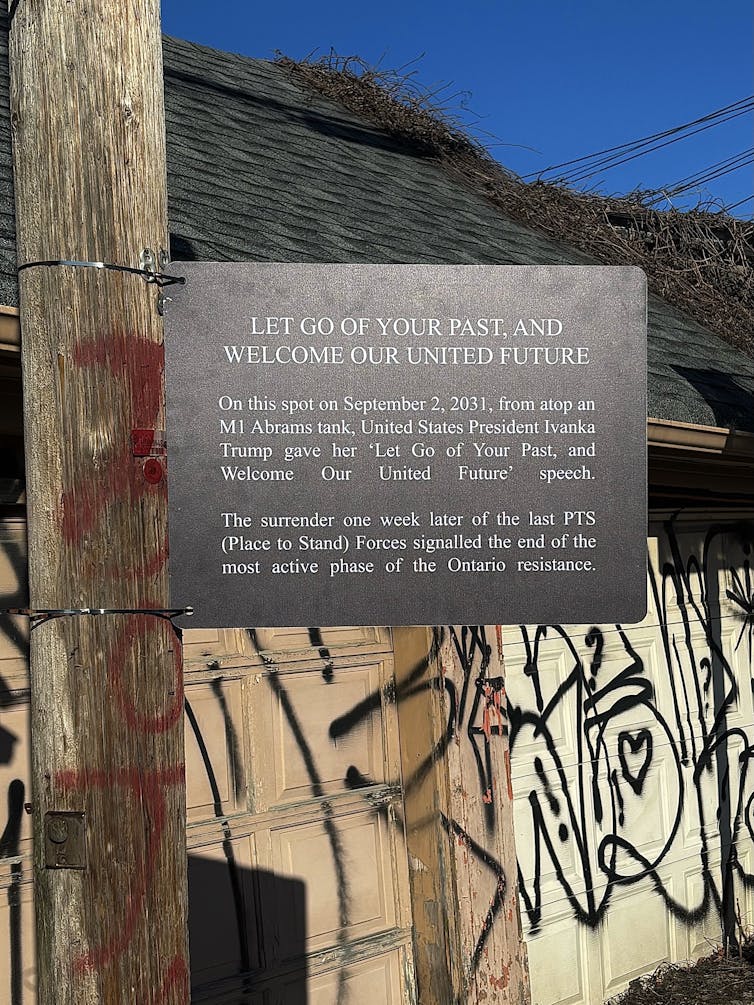
In Dara Vandor’s speculative future, U.S. President Ivanka Trump, standing on a tank, exhorts Torontonians to ‘Let go of your past, and welcome to our united future.’ (Dara Vandor)
What makes Vandor’s ongoing project especially valuable is that it moves its reflections on the past into an imagined future. The actual conflict that the plaques refer to is still part of the present, and its future still undecided. Whatever lessons we draw from their cautionary tale about Canadian annexation, we still have time to act upon them before that imagined future can become reality.
Importance of resistance in the present
This is exactly what leads historian Camille Bégin to conclude that the project’s appeal to the importance of resistance in the present is particularly strong:
“It really shows us that the future is not written, that it’s in our hands to act in the present to forge the future that we want.”
Even though Vandor’s project tells a story of Canadian defeat, it also highlights that Canadians did resist, a thought that should appeal to anyone opposed to Trump’s vision of territorial expansion.
Or, and this is perhaps the most hopeful reflection coming out of the project, if Canadians come together and resist now, Trump’s threat of annexation may never get that far.
Pascal Michelberger does not work for, consult, own shares in or receive funding from any company or organisation that would benefit from this article, and has disclosed no relevant affiliations beyond their academic appointment.
Source: People’s Republic of China in Russian – People’s Republic of China in Russian –
Source: People’s Republic of China – State Council News
URUMQI, June 1 (Xinhua) — The first freight train on the China-Europe/China-Central Asia international freight train route departed from Korla city in northwest China’s Xinjiang Uygur Autonomous Region on Saturday.
After leaving the country through the Xinjiang Khorgos checkpoint, the train will transport cargo to five junction railway stations, namely Almaty, Medea and Astana in Kazakhstan, as well as Tashkent and Chukursay in Uzbekistan.
It has been revealed that the freight train is carrying 41 containers containing various household goods worth approximately $1.29 million.
It is noteworthy that this is the first international freight train in Xinjiang carrying goods sold through barter trade. The opening of this route will both deepen cooperation between China and Central Asia in terms of production capacity through barter trade and improve the logistics network in Xinjiang. -0-
Source: People’s Republic of China in Russian – People’s Republic of China in Russian –
Source: People’s Republic of China – State Council News
GAZA, June 1 (Xinhua) — At least 31 Palestinians were killed Sunday in Israeli shelling near a humanitarian aid center in the southern Gaza Strip, Palestinian sources said.
At least 31 people were killed and dozens of others were seriously wounded this morning when Israeli troops opened fire near a humanitarian aid distribution point in Rafah in the southern Gaza Strip where residents had gathered to receive aid, the Gaza Health Authority said in a statement.
Most of the wounds were to the upper body and the death toll could rise due to the severity of the injuries, said Mohammed Abu Afash, director of the Gaza Medical Aid Organization, adding that ambulances were having difficulty reaching the scene due to ongoing Israeli military action.
Eyewitnesses told Xinhua that thousands of people arrived at the aid center in the early morning hours when gunfire and explosions began.
Calling the incident part of a “series of repeated attacks” by Israel on aid distribution points, the Hamas-controlled Gaza government’s press office said in a press statement that the work in the area was carried out in coordination with a US-Israeli company and under the supervision of the Israeli military.
Also on Sunday, the Israel Defense Forces (IDF) said in a statement that it was not aware of any casualties in the attack on the aid distribution site and that the matter was still under review.
Israeli media, citing military sources, claim that the target of Israeli military operations in the area were “terrorist elements.”
Israel closed border crossings and reduced humanitarian aid into Gaza on March 2. Limited access has been allowed since May 22. –0–
Source: People’s Republic of China – State Council News
ABUJA, June 1 (Xinhua) — At least 21 people were killed and three others injured when a bus carrying a group of athletes returning from the recently concluded Nigerian National Sports Festival was involved in a road accident on a busy highway in the north of the country, traffic police said.
Olusegun Ogungbemide, the Federal Road Safety Authority spokesman, said on Saturday evening that a bus carrying athletes representing Kano Northern State at the 2025 National Sports Festival crashed on the Kaduna-Kano Expressway on Saturday afternoon.
The bus left the road at high speed and crashed into bushes. The traffic police named the cause of the tragedy as “driver fatigue and speeding.” –0–
Source: People’s Republic of China in Russian – People’s Republic of China in Russian –
Source: People’s Republic of China – State Council News
URUMQI, June 1 (Xinhua) — The passenger flow between the two countries at Tianshan International Airport in Urumqi, northwest China’s Xinjiang Uygur Autonomous Region, increased by 47 percent in the past year after the China-Georgia visa-free agreement came into effect on May 28, 2024, indicating increasingly active bilateral people-to-people exchanges.
The airport has a direct passenger route to the Georgian capital Tbilisi, operated by Chinese airlines Air China and Southern Airlines. Air China is currently operating three round trips per week, while Southern Airlines increased its weekly round trips from four to seven on Sunday.
As it became known, since the introduction of the mutual visa-free regime, the number of round-trip flights connecting the two countries has exceeded 570. -0-
Source: The Conversation – Canada – By Nathaniel Laywine, Assistant Professor, Communication and Media Studies, York University, Canada
Generative AI draws from limited datasets, often reproducing errors and bias.(Shutterstock)
What does it mean to think, act and work as a Jewish professor when human freedoms are under siege and authoritarian power gains ground? And how can we draw on our Jewish identities to navigate the sweeping encroachment of new technologies like AI?
As communication scholars, colleagues and collaborators, we have spent a lot of time trying to answer these questions in our scholarship by taking cues from the intellectuallineage of our shared culture.
Lately, Donald Trump’s administration has demonstrated a heavy investment in cataloguing and categorizing Jewish professors. In April, the Equal Employment Opportunity Commission (EEOC) sent text messages to the personal cellphones of faculty and staff at Barnard College, asking them to self-identify as Jewish and/or Israeli. The text message also asked them to disclose any instances of antisemitic discrimination or harassment they had experienced.
Presumably, the text message inquiry itself was not recognized by its senders as an instance of such harassment.
We do not believe being a Jewish professor means silencing our students as they protest atrocities in Gaza, and it certainly doesn’t mean revoking their visas or deporting them. Rather, it means drawing upon the tools of our forebears to question systems of oppression, wherever and however they may arise.
We simultaneously occupy both privileged and marginal positions within the university and North American society at large. This makes us acutely aware of how fragile conditional tolerance is, and how quickly a list of names can be used to justify repression or violence.
Collection and use of data
As communication and media scholars, we’re often critical of how data are aggregated, stored and disseminated. The EEOC questionnaire concerns us because it reduces the complexities of Jewish identity and the profound harms of antisemitism to a handful of abstract and ideologically determined data points.
Our recent research on generative AI (genAI) and its incompatibility with Jewish cultural expression shows that meaningful efforts to combat antisemitism — and other forms of oppression — must centre the knowledge and experiences of affected communities.
Our research found that outputs of chatbots such as ChatGPT are unable to tell jokes in a Jewish comedic style without resorting to offensive tropes. In another forthcoming study, we argue that genAI is equally incapable of representing the multifaceted “intersectional identities” of Jewish people except by smashing together rudimentary cultural signifiers (such as rainbows for queerness or bagels for Jewishness).
In each case, these platforms rely on datasets to determine what Jewishness is, and these datasets originate from the narratives that other people tell about Jewish people, rather than the ones we tell about ourselves.
Futzing is a Yiddish word that means messing around via hands-on experimentation. (Shutterstock)
Critical strategies
These platforms have increasingly become parts of daily life and communicative infrastructure. To investigate them, we adopted two critical strategies from our shared heritage as Ashkenazi Jews: kibbitzing and futzing.
Both terms are Yiddish. Kibbitzing is a lively, informal way of thinking and talking together. It’s somewhere between joking, arguing and exchanging ideas. It is grounded in our relationships, histories and biases; kibbitzing is how we make shared meaning together through many voices.
Kibbitzing values contradiction, humour and the messiness of human conversation. Unlike AI chatbots, which follow scripted, dialogic, question-and-answer routines based on quantifiable patterns in data, kibbitzing is unpredictable, non-linear and intentionally disorganized.
When we kibbitz, we build understanding by challenging one another and reflecting on what each of us brings to the table. In the age of genAI, kibbitzing offers a way to talk that is full of friction, laughter and deep, collective insight.
Futzing means messing around via hands-on experimentation, with no set agenda and no official guidance. This unstructured inquiry is an acknowledgement of Jews’ historical role as outsiders within European society. As we write in our forthcoming article, these practices reflect what social theorist Michel de Certeau calls “making do,” a tactical means of collective empowerment in a hostile society.
Using futzing as a methodology, we started exploring genAI, drawing on our curiosity to see what might happen by playing, testing and responding in real time.
Futz first, then kibbitz
Each of us futzed on our own at first, with no ambition to crack the code or reverse-engineer the algorithm. Later, when we began kibbitzing together, we realized our scattered efforts were actually circling around shared concerns. Futzing helped us see patterns, surprises and contradictions — things we might have missed with a more rigid approach. Kibbitzing helped us connect those patterns and reconcile the contradictions.
Drawing on our culture this way allows us to imagine inclusive, anti-oppressive Jewish epistemologies that respond to the complexity of the current political moment. Jewish identity — like all identities — is porous and resistant to fixed form. Our shared North American Ashkenazi identity is just one of many possible perspectives that comprise a broader identity of Jewishness.
That is not a problem to be solved. Rather, it is a strength and a bond between us. Readers may well see their own cultural traditions, vernaculars and ancestral practices in this light too, as techniques of resilience and joy in the face of hardship and oppression.
There is an irony here. The deeper we dig into the intellectual roots of our own culture, the more common ground we might discover with everyone else’s. And that makes us feel a whole lot safer than getting a text from the EEOC ever could.
The authors do not work for, consult, own shares in or receive funding from any company or organisation that would benefit from this article, and have disclosed no relevant affiliations beyond their academic appointment.
Source: The Conversation – Canada – By Pascal Michelberger, Postdoctoral Scholar, Western Academy for Advanced Research, Western University
Artist Dara Vandor’s futuristic, commemorative historical plaques on Toronto streets project a U.S.-annexed Canada. (Dara Vandor)
As part of her ongoing public art series, Pax Americana, Toronto visual artist Dara Vandor has been posting aluminum signs in public spaces.
These are plaques that reimagine, as the artist writes, the city as “a site of future conflict and occupation” by the United States. The signage, in the style of commemorative historical markers, echoes U.S. President Donald Trump’s recent and repeated threats to annex Canada and “is meant to serve as a dark warning, inviting contemplation on the fragility of nationhood.”
“This spot served as the center of operations for United States Army snipers during Operation McKinley, the campaign to liberate the northern territory formerly known as Canada. From February to May 2035, this site, code-named ‘The Hot Dog Stand,’ served as a concealed sniper’s nest, providing precision fire support, disrupting insurgent movements, and protecting advancing American units.”
Vandor’s thought-provoking project, which she told CBC Newswas sparked by anger at Trump’s threats to Canadian sovereignty, underlines how storytelling can be a powerful tool in times of conflict, especially when it affords itself the artistic freedom to envision potential futures before they can become reality.
Psychological effects
In order to understand how exactly stories such as the one portrayed on Vandor’s plaques can make a real impact on the way we navigate moments of crisis, we can turn to the work of conflict analysis experts such as Solon Simmons.
The term describes the psychological effect that a story can have on its readers after they finish reading. As Simmons puts it:
“What makes stories so important (as opposed to just interesting or entertaining) is the effect of the story, and this effect doesn’t end when the story ends. It leaves the viewer/reader/listener with a feeling.”
Simmons also explains that the kind and amount of post-plot pressure placed upon an audience depends on the type of story being told.
Projected unhappy ending exerts pressure
A story, for example, featuring a struggle in which the antagonist eventually triumphs over the protagonist is what Simmons calls a “satirical struggle story.”
“Satirical” in this context does not necessarily mean that stories of this kind include elements of mockery or sarcasm. Rather, the label goes back to the influential research contributions of Canadian literary theorist Northrop Frye and American historian Hayden White, from which Simmons derives his own framework.
This is exactly how to understand the story told over its several episodes on Vandor’s Pax Americana plaques: the U.S., as the story’s antagonist, abuses its power and ends up getting away with it, defeating Canadian resistance and annexing what is now only referred to as the “northern territory.”
As Simmons suggests, conflict stories like this one, where what is viewed as injustice is allowed to prevail, exercise a relatively high level of post-plot pressure. This is mainly because the unhappy ending leaves audiences dissatisfied and with a sense of loss to grapple with.
Reader reactions
Simmons also explains that not all readers react to this particular kind of post-plot pressure in the same way. Vandor’s project, for example, has brought out some critical and upset responses.
Julian Bleecker — a researcher, author, designer and engineer with a PhD in history of consciousness whose design studio offers services around future imagining and planning — voiced his objection to the project in a blog post.
But, as Simmons argues, conflict stories in which the happy ending never comes can also leave readers with a productive sense of post-plot pressure. In that case, feeling dissatisfied with the story’s outcome can instead motivate people to mobilize and strategize against the perceived injustice.
Seen in this light, the plaques’ imagined collapse of Canadian sovereignty can therefore also serve as a stark and urgent inspiration, begging response.
In Dara Vandor’s speculative future, U.S. President Ivanka Trump, standing on a tank, exhorts Torontonians to ‘Let go of your past, and welcome to our united future.’ (Dara Vandor)
What makes Vandor’s ongoing project especially valuable is that it moves its reflections on the past into an imagined future. The actual conflict that the plaques refer to is still part of the present, and its future still undecided. Whatever lessons we draw from their cautionary tale about Canadian annexation, we still have time to act upon them before that imagined future can become reality.
Importance of resistance in the present
This is exactly what leads historian Camille Bégin to conclude that the project’s appeal to the importance of resistance in the present is particularly strong:
“It really shows us that the future is not written, that it’s in our hands to act in the present to forge the future that we want.”
Even though Vandor’s project tells a story of Canadian defeat, it also highlights that Canadians did resist, a thought that should appeal to anyone opposed to Trump’s vision of territorial expansion.
Or, and this is perhaps the most hopeful reflection coming out of the project, if Canadians come together and resist now, Trump’s threat of annexation may never get that far.
Pascal Michelberger does not work for, consult, own shares in or receive funding from any company or organisation that would benefit from this article, and has disclosed no relevant affiliations beyond their academic appointment.