Category: DJF

  • MIL-OSI Africa: Rand Water conducts major maintenance work

    Source: South Africa News Agency

    Rand Water is scheduled to conduct major maintenance work on its key infrastructure starting Thursday, 29 May 2025. 

    In a statement issued on Tuesday, Rand water said the maintenance is part of its commitment to ensuring a sustainable and efficient water supply.

    “The objective of this planned maintenance is to increase capacity and enhance plant availability, reliability, and operational efficiency, supporting a more resilient and adaptable water supply network in preparation of the anticipated increased supply volumes from August 2025,” Rand Water said.

    The entity said the maintenance activities will commence at different times and locations across various municipalities, with the main maintenance operation scheduled to start on Thursday at 3am, and anticipated to be concluded on Monday, 2 June, at 5pm.

    Rand Water reported that during this period, pumping capacity will be reduced at the Eikenhof, Palmiet, Mapleton, and Zwartkopjes systems. 

    Areas within the cities of Johannesburg, Ekurhuleni, and Tshwane may experience low pressure or intermittent water supply. 

    “The maintenance may also impact water provision to the local municipalities of Rand West, Mogale City, Merafong, Madibeng, Lesedi, Govan Mbeki, Rustenburg, Royal Bafokeng Administration, and Victor Khanye, Thembisile Hani, Midvaal and Emfuleni. The maintenance work has been strategically scheduled during the low consumption months of May to July 2025, to minimise disruptions and better manage the potential impact on water supply,” the entity said.

    The scope of work and associated impacts are outlined below:

    City of Ekurhuleni Metropolitan Municipality

    Description

    Affected system

    Planned date

    Planned duration

       Impact on supply

    Tie-in of B16 

    pipeline from 

    Zuikerbosch, 

    Station 5

    Mapleton System

    From 29 May at 

    03h00 to 02 June 

    2025 at 17h00

    107 hours

    No pumping at Mapleton Pumping 

    Station for the whole duration.

    Klipriviersberg 

    isolation for 

    cleaning & inspection

    Palmiet System

    From 03 June 

    2025 at 06h00 to 

    16h00

    10 hours

    Pumping will be reduced to 67% 

    for 10 hours.

    Russel Road 

    meter installation

    Palmiet System

    03 June 2025 

    from 06h00 to 

    18h00

    12 hours

    No supply to the following meters: 

    Southern Areas, 

    Barlow Road

    Zwartkopjes 

    Station valves 

    replacements

    Zwartkopjes 

    System

    From 30 June at 

    05h00 to 02 July 

    2025 at 07h00

    50 hours

    No pumping for the duration of the 

    maintenance work.

    The key objective for the major work is to connect the newly constructed B16 pipeline, which will be supplying water from the new Station 5A at Zuikerbosch Water Treatment Plant to Engine Room 3 at Mapleton Booster Pumping Station. 

    The City of Ekurhuleni will also take an opportunity to carry out their maintenance in their electrical infrastructure.

    City of Tshwane Metropolitan Municipality

    Description

    Affected system

    Planned date

    Planned duration

    Impact on supply

    Tie-in of B16 

    pipeline from 

    Zuikerbosch, 

    Station 5

    Mapleton System

    From 29 May at 

    03h00 to 02 June 

    2025 at 17h00

    107 hours

    No pumping at Mapleton Pumping 

    Station for the whole duration.

    Klipriviersberg 

    isolation for 

    cleaning & 

    inspection

    Palmiet System

    From 03 June 

    2025 at 06h00 to 

    16h00

    10 hours

    Pumping will be reduced to 67% 

    for 10 hours.

    The above-mentioned work will affect the City of Tshwane meters that are supplied from the above[1]mentioned systems.

    City of Johannesburg Metropolitan Municipality

    Description

    Affected system

     Planned date

    Planned duration

    Impact on supply

    Klipriviersberg 

    isolation for 

    cleaning & 

    inspection

    Palmiet 

    System

    03 June 2025 from 

    06h00 to 16h00

    10 hours

    Pumping will be reduced to 67% 

    for 10 hours.

    Pipe leak 

    repairs at 

    Zuikerbosch 

    Plan

    Eikenhof 

    System


    48 hours

    No pumping for 6 hours. It will be 

    increased to 50% for 42 hours and 

    then be increased 80% for the 

    remaining 19 days.

    Cleaning of 

    Sedimentation 

    Tank at 

    Vereeniging 

    Plant

    Eikenhof 

    System

    30 June 2025 from 

    05h00 to 21 July 

    2025

    21 hours

    No pumping for 6 hours. It will be 

    increased to 50% for 42 hours and 

    then be increased 80% for the 

    remaining 19 days.

    Zwartkopjes 

    Station valves 

    replacements

    Zwartkopjes 

    System

    30 June from 05h00 

    to 02 July 2025 until 

    07h00

    50 hours

    No pumping for the duration of the 

    maintenance work.

    The above-mentioned work will affect the City of Johannesburg meters that are supplied from the above1] mentioned systems.

    Description

    Affected system

    Planned date 

    Planned duration

    Impact on supply

    Pipe leak repairs at 

    Zuikerbosch Plant

    Eikenhof System

    30 June 2025 

    from 05h00 to 

    02 July 2025 

    at 05h00.

    48 hours

    No pumping for 6 hours. It 

    will be increased to 50% for 

    42 hours and then be 

    increased 80% for the 

    remaining 19 days.

    Cleaning of 

    Sedimentation 

    Tank at 

    Vereeniging Plant

    Eikenhof System


    30 June 2025 

    from 05h00 to 

    21 July 2025


    21 days

    No pumping for 6 hours. It 

    will be increased to 50% for 

    42 hours and then be 

    increased 80% for the 

    remaining 19 days.

    The above-mentioned work will affect the Mogale, Merafong, Royal Bafokeng and Rand West meters that are supplied from the Eikenhof system.

    For more information on the affected areas, visit Rand Water website:
    https://www.randwater.co.za/media/media_statements/Rand%20Water%20Planned%20Maintenance%20for%20May%20to%20July%202025%20%2022%20May%202025%20_.pdf

    MIL OSI Africa

  • MIL-OSI China: Notice of website maintenance

    Source: Republic of Taiwan – Ministry of Foreign Affairs

    Notice of website maintenance

    • Date:2025-05-16
    • Data Source:Public Diplomacy Coordination Council

    The Ministry of Foreign Affairs website (www.mofa.gov.tw) and its subdomains, including the Youth Programs website (www.youthtaiwan.net) and the Minister’s Mailbox (eyes.mofa.gov.tw), will be unavailable due to maintenance work from Friday, May 23, 19:00 (Taipei time) to Saturday, May 24, 20:00 (Taipei time). We apologize for any inconvenience this may cause.

    MIL OSI China News

  • MIL-OSI China: Former President Tsai visits UK Parliament and delivers speech at LSE, deepening bilateral ties

    Source: Republic of Taiwan – Ministry of Foreign Affairs

    May 20, 2025  

    No. 165  

    Former President Tsai Ing-wen visited Europe from May 10 to 19, traveling to Lithuania and Denmark before continuing to the United Kingdom. On May 15, the first day of her stay in the United Kingdom, she visited the UK Parliament at the invitation of British-Taiwanese All-Party Parliamentary Group (APPG) Cochairs Sarah Champion MP and Lord Rogan. She was warmly welcomed by parliamentarians from across the political spectrum. 


    The former president met with House of Commons Speaker Sir Lindsay Hoyle and took part in a reception at the House of Lords, where she delivered a speech. She exchanged greetings with nearly 50 parliamentarians and staff, including former Lord Speaker Baroness D’Souza, House of Lords Deputy Speaker Baroness Finlay, Trade Envoy to Taiwan Lord Faulkner, Labour Friends of Taiwan Chair Navendu Mishra MP, former Conservative Party leader Sir Iain Duncan Smith MP, Conservative Shadow Minister for Innovation and Technology Ben Spencer MP, and Liberal Democrat Foreign Affairs Spokesperson Calum Miller MP.


    In her address at the House of Lords, former President Tsai said that the growing threat of antidemocratic forces was testing democracy around the world, adding that this demonstrated the need for Taiwan and the United Kingdom to work together in defense of freedom and democracy. She commended the House of Commons for passing a motion last November clarifying that United Nations General Assembly Resolution 2758 made no reference to Taiwan. This was important in countering reckless behavior in the Taiwan Strait, she explained. Highlighting Taiwan’s position on the front line of defending democracy, former President Tsai said that Taiwan was a critical deterrent to China’s expansionist ambitions and would continue to contribute to protecting democratic values.


    APPG Cochair Champion noted that Taiwan and the United Kingdom had a deep friendship and shared core values. She said that the United Kingdom should continue to pay attention to peace and stability across the Taiwan Strait, which she added were essential to global security and prosperity. Cochair Champion noted that in recent years the Taiwan-UK partnership had deepened. She expressed hope that cooperation would expand in semiconductors, artificial intelligence, renewable energy, advanced manufacturing, economic resilience, and other areas.


    Former President Tsai also delivered a speech titled “In an Era of Shifting World Order: Taiwan as a Stabilizing Force” at her alma mater, the London School of Economics and Political Science (LSE). The event was moderated by incoming LSE Law School Dean Andrew Murray, who represented the university and LSE President Larry Kramer. Around 100 people, including General Counsel Elizabeth Messud, attended the speech. In her remarks, former President Tsai noted that the international community was experiencing a reassignment of security responsibilities and a rebalancing of trade relations. She said that to appropriately respond to multiple challenges such as economic fragmentation, political extremism, and military conflict, the function of multilateralism was becoming even more important. The former president emphasized that Taiwan had shown a high degree of resilience in turbulent times in the past, such as during supply chain restructuring, and had proven to be a trustworthy and competitive strategic partner. She added that Taiwan was ready to play a more proactive role in the new world order by further deepening cooperation with democratic countries and contributing to the global trade system. Her remarks were enthusiastically received by the audience. 


    During her visit to the United Kingdom, former President Tsai also gave an address at Cambridge University, met with faculty and students at the School of Oriental and African Studies, attended a forum hosted by the Royal United Services Institute, and met with Taiwanese people working in the United Kingdom on technology startups and in the arts.


    Taiwan-UK relations have witnessed significant progress in recent years. In 2023, the United Kingdom signed the Enhanced Trade Partnership arrangement with Taiwan, becoming the first European country to establish a formal economic and trade framework with Taiwan. The United Kingdom is Taiwan’s fourth-largest trading partner in Europe, third-largest source of investment, and fifth-most popular destination for Taiwanese students studying abroad. The countries collaborate closely in fields such as technological innovation, renewable energy, and societal resilience. Taiwan will further work together with the United Kingdom and other like-minded countries to advance democratic resilience and prosperity. It looks forward to the United Kingdom continuing to demonstrate its commitment to security in the Indo-Pacific region by deploying naval vessels through the Taiwan Strait and taking other concrete actions. 

    MIL OSI China News

  • MIL-OSI China: State visit by Palauan President Whipps concludes; successfully deepens bilateral relations

    Source: Republic of Taiwan – Ministry of Foreign Affairs

    State visit by Palauan President Whipps concludes; successfully deepens bilateral relations

    • Date:2025-05-24
    • Data Source:Department of East Asian and Pacific Affairs

    May 24, 2025
    No. 173

    President of the Republic of Palau Surangel S. Whipps, Jr. and his delegation concluded a successful state visit to Taiwan on the morning of May 24. Following President Lai Ching-te’s December visit to Pacific allies entitled “Smart and Sustainable Development for a Prosperous Austronesian Region” and Minister of Foreign Affairs Lin Chia-lung’s January trip to Palau as special presidential envoy and head of an industrial fact-finding mission, this visit marked the further deepening of diverse and robust cooperation between Taiwan and Palau under the Diplomatic Allies Prosperity Project. It also underlined the significant accomplishments that the two countries had achieved thanks to their staunch commitment to jointly promoting sustainable development. 

    During his visit, President Whipps met with President Lai, attended a state banquet, and together with President Lai witnessed the signing of bilateral agreements on technical cooperation and diplomatic staff training and cooperation. Accompanied by Minister Lin, President Whipps also visited industries related to the Diplomatic Allies Prosperity Project in central and southern Taiwan. The tour reflected Taiwan’s continuing efforts to strengthen the resilience of Palau’s tourism-centered economy through integrated diplomacy and demonstrated the substantive success of bilateral collaboration.

    Leaving Taiwan today, the Palauan delegation was seen off at the airport by Vice Minister of Foreign Affairs Remus Li-kuo Chen. Since establishing diplomatic ties 26 years ago, Taiwan and Palau have enjoyed a solid friendship, mutual trust, and steadfast cooperation across all domains. The Ministry of Foreign Affairs will continue to uphold the close and cordial cooperative partnership between the two countries, promote the Diplomatic Allies Prosperity Project, and deepen bilateral relations. It will also work with Palau to advance peace, stability, and prosperity in the Indo-Pacific. (E)

    MIL OSI China News

  • MIL-OSI USA: Understanding Wildfire Behavior Across Alaska Using Remote Sensing of Fire Intensity

    Source: US Geological Survey

    After a wildfire, land managers need timely information about its impact to develop treatment strategies. USGS scientists investigated the utility of instantaneous satellite-derived estimates of fire intensity in Alaska, where the remoteness and inaccessibility of many wildfire sites make ground-based investigations difficult.

    MIL OSI USA News

  • MIL-OSI USA: Armstrong pays tribute to nation’s military heroes on Memorial Day

    Source: US State of North Dakota

    Gov. Kelly Armstrong released the following statement today in observance of Memorial Day. Armstrong paid tribute to the nation’s military heroes at the Memorial Day ceremony at the North Dakota Veterans Cemetery near Mandan.

    “Because of these selfless men and women, we live in the greatest country on Earth. And we must never take for granted the freedoms we enjoy – or forget those who died to protect them,” Armstrong said. “While today is a day for remembrance, it’s also a day for commitment. We can live our lives in a way that honors the memories of those who made the ultimate sacrifice. To be a worthy nation, we must be worthy of their service – to continue to support and care for those who have served, making sure that they and their families have the resources they need to live healthy, fulfilling lives.”

    MIL OSI USA News

  • MIL-OSI USA: Armstrong directs flags at half-staff Thursday in honor of state Rep. Cynthia Schreiber-Beck

    Source: US State of North Dakota

    Gov. Kelly Armstrong has directed all U.S. and North Dakota flags to be flown at half-staff on Thursday, May 29, and encourages North Dakotans to do the same at their homes and businesses, as a mark of respect as state Rep. Cynthia “Cindy” Schreiber-Beck of Wahpeton is laid to rest.

    Schreiber-Beck died May 18 at age 70. She had served in the state House of Representatives since 2015 and also served as executive director of the North Dakota Agricultural Aviation Association for nearly four decades and as a commissioner on the North Dakota Aeronautics Commission from 1997 to 2022.

    Armstrong directed flags to be flown at half-staff on the day of Schreiber-Beck’s burial, which will take place during a private ceremony Thursday in Wahpeton. Funeral services will be held at 4 p.m. Wednesday at the Fargo Air Museum, 1609 19th Ave. N., with visitation starting at 2 p.m.

    MIL OSI USA News

  • MIL-OSI Europe: Choose Europe for your startup and scaleup

    Source: European Union 2

    The Commission has launched an EU startup and scaleup strategy to make Europe a great place for starting and growing global technology-driven companies. It’s part of the broader Choose Europe initiative, and it will help strengthen Europe’s competitiveness.

    MIL OSI Europe News

  • MIL-OSI Europe: OSCE seminar in Turkmenistan addresses effective communication in the digital age

    Source: Organization for Security and Co-operation in Europe – OSCE

    Headline: OSCE seminar in Turkmenistan addresses effective communication in the digital age

    Participants discuss a practical task during an OSCE-organized training seminar on the use of new technologies in interaction between state institutions and media, Ashgabat, 27 May 2025, OSCE (OSCE) Photo details

    The use of new technologies in interaction between state institutions and media was in focus of an OSCE-organized training seminar that took place on 27 and 28 May 2025 in Ashgabat.
    The training seminar targeted officials of Turkmenistan’s key state institutions who are in charge of communications work and websites of their institutions as well as journalists representing print, broadcast and online media.
    The training seminar familiarized participants with best communications practices of state institutions and aimed to contribute to enhancing their contacts with media though the use of new technologies.
    Guido Keel, Senior Advisor to the OSCE Representative on Freedom of the Media and Živilė Navickaitė-Babkin, strategic communication expert from Lithuania delivered the seminar focusing on core principles of effective communication and modern instruments used by state institutions in interaction with the media.
    “The OSCE commitments on freedom of information and access to information are enshrined in a number of the Organization’s key document, including the Helsinki Final Act, the fiftieth anniversary of which we celebrate this year,” said John MacGregor, Head of the OSCE Centre in Ashgabat.
    “These documents commit governments to be more transparent by providing timely and reliable information and facilitate a well-informed and responsive dialogue,” emphasized MacGregor.
    The seminar participants learnt about a corporate newsroom, its traditional organization, structure and functions, and talked about the essential role of strategic thinking in communications. The experts shared most common mistakes in interaction with the media and provided recommendations for creating user-friendly content. The event also discussed opportunities and limits of multimodal communication and how artificial intelligence changes communications.
    “Our seminar highlights the importance of providing accurate reliable information to our citizens, especially in this age of digital technologies and   artificial    intelligence,” added MacGregor.

    MIL OSI Europe News

  • MIL-OSI Russia: Students of the Polytechnic Institute of Social Sciences won the tournament of young chefs

    Translation. Region: Russian Federal

    Source: Peter the Great St Petersburg Polytechnic University – Peter the Great St Petersburg Polytechnic University –

    Polytechnics won the Yunus Akhmetzyanov Young Chefs Tournament, which was held in Kazan at the Kazan-Expo International Exhibition Center. Students from Moscow, the Sverdlovsk Region, Tatarstan, and other regions of Russia participated in the competition. ISPO SPbPU was represented by three teams of 2nd and 3rd year students.

    To get to the final of the international tournament, the guys had to pass a serious competitive selection. The participants had to prepare an original set of three dishes (appetizer, main course, dessert) on the theme “National Lunch of Your Region”. The ISPO teams presented dishes of St. Petersburg cuisine, successfully passed the semi-finals and performed well in the final stage.

    Egor Ivanov, Ekaterina Romanova and Aleksandr Kiselev won in the Fundamental Knowledge category. The guys prepared a set called “Petrovsky Nocturne”, consisting of forshmak with gorgonzola mousse, a hot dish – chicken roll, mashed potatoes with spinach, wild mushroom mousse, and a dessert called “Blancmange”.

    In the nomination “Technologies of the Future” the best were Irina Murtazina, Darya Shramova and Ivan Voronin. They presented the set “Gold of the North”. Cloudberry was used in each of the three dishes: in the quail appetizer “Northern Desire”, the hot dish of rabbit lapin à Petersburg and in the dessert “White Forest”.

    In the nomination “Art of serving a dish”, the first place was taken by Maria Petrova, Anastasia Semenova and Andrey Bratok. The team prepared a set called “Monplaisir”: bruschetta with roast beef in honey-mustard sauce, duck breast sous-vide under raspberry sauce with pumpkin and celery puree and a tarte charlotte dessert. The guys said that they were inspired by the 19th century, when European culture, including gastronomic culture, came to the Northern capital.

    The jury included international pastry chef, TV presenter, author of cookbooks Nina Tarasova, head of the tournament directorate Mikhail Sharipov, chef and brand chef of the Kazan restaurant chain Andrey Sakhovsky and other experts. The tournament participants received recommendations from authoritative chefs not only from Russia, but also from representatives of other countries, including Azerbaijan, Turkey, Tunisia, Iran, UAE, Saudi Arabia, Morocco.

    After the tournament, Azerbaijani chef Tahir Amiraslanov visited the Institute of Secondary Vocational Education. In 1984, he graduated from the Leningrad Institute of Soviet Trade. Now Tahir Amiraslanov is the general director of the Center for Azerbaijani National Culinary Arts, the president of the national association of chefs of Azerbaijan, and the author of books on cooking and the art of nutrition. Tahir Amiraslanov gave a lecture to students of the ISPO. He shared stories from his student days, revealed the secrets of preparing some dishes, their composition and serving. After a tour of the Museum of the History of the Development of Public Catering in St. Petersburg, Tahir Amiraslanov donated his books to the ISPO.

    Please note: This information is raw content directly from the source of the information. It is exactly what the source states and does not reflect the position of MIL-OSI or its clients.

    MIL OSI Russia News

  • MIL-OSI Russia: Ethiopia’s Central Bank: Leading Transformative Reform

    Source: IMF – News in Russian

    May 28, 2025

    Ethiopia has taken historic steps to address macroeconomic imbalances while fostering sustainable growth

    Over the past year, Ethiopia—Africa’s second most populous country—has embarked on a comprehensive transformation of its monetary and exchange rate regimes. After decades of tight control, the country has liberalized the foreign exchange regime, adopted a more flexible exchange rate, moved to an interest rate-based monetary policy, and ended central bank financing of government. In parallel, the National Bank of Ethiopia (NBE) is updating its legal framework and internal organization. 

    These reforms aim to address acute foreign exchange shortages and inflation, creating conditions for high, sustainable growth. The authorities are also tackling budgetary constraints, financial vulnerabilities in state-owned enterprises and state-owned banks, and a sovereign debt restructuring while mitigating social impacts and managing humanitarian pressures. The IMF is supporting Ethiopia’s reform efforts through a four-year $3.4 billion Extended Credit Facility Arrangement.

    During the 2025 IMF-World Bank Spring Meetings, Mamo Mihretu, Governor of the National Bank of Ethiopia discussed these key reforms with Abebe Aemro Selassie, Director of the IMF’s African Department. The following is an edited transcript of the conversation, focusing on key highlights (view video). 

    Abebe Aemro Selassie: Ethiopia is undergoing significant reforms that are reshaping its economic landscape. Can you provide some context regarding the state of the economy before these reforms?

    Mamo Mihretu: After two decades of sustained economic growth, primarily driven by public investment, Ethiopia faced unsustainable macroeconomic imbalances. The state’s reliance on external creditors, the large public bank, and NBE led to foreign exchange shortages, limited access to credit for the private sector, high inflation, financial stability risks, and debt vulnerabilities.

    Abebe Aemro Selassie: What are the primary objectives of the reform agenda that Ethiopia has embarked upon?

    Mamo Mihretu: We launched our Homegrown Economic Reform Program in 2019. The objective of the reforms was to address fundamentally, boldly, and conclusively the sources of macroeconomic instability in Ethiopia and create a much more open, investment-friendly, and private-sector-friendly environment. These objectives are critical for our job creation agenda that will increase income and improve livelihoods.

    Abebe Aemro Selassie: Can you elaborate on some of the key reforms in Ethiopia’s monetary policy?

    Mamo Mihretu: We have made historic changes, including the revision of the Central Bank Act to prioritize price stability. We introduced a monetary policy rate, implemented open market operations for liquidity management with banks, and established a Monetary Policy Committee to advise on monetary policy decisions based on comprehensive assessments of economic conditions. Interest rates are now positive in real terms. Inflation has declined from 30 percent to 13 percent.

    Abebe Aemro Selassie: What about the reforms related to foreign exchange? What changes have been implemented?

    Mamo Mihretu: Ethiopia has a market-based foreign exchange regime for the first time in five decades. We comprehensively liberalized foreign exchange transactions and eliminated the requirement to surrender export earnings to the NBE. The early results have been promising; we expect exports to double and have already tripled our foreign reserves, while foreign exchange availability has also increased.

    Abebe Aemro Selassie: Communication appears to be a vital aspect of your reform strategy. Can you discuss its importance?

    Mamo Mihretu: Building credibility and trust is essential. We are investing in transparent communication and actively monitor market dynamics. By maintaining open channels of dialogue with stakeholders, we aim to foster a supportive environment for these reforms.

    Abebe Aemro Selassie: What lessons have emerged from your experience in implementing these reforms?

    Mamo Mihretu: Several key lessons stand out. First, preparation and coordination among government agencies are crucial. Second, the sequencing of reforms matters; it helps maintain stability and manage public expectations. Finally, adapting to evolving economic conditions is vital for the success of any reform effort.

    Abebe Aemro Selassie: What are the next steps for Ethiopia in terms of reform and economic development?

    Mamo Mihretu: We have to deepen the current monetary policy reforms as we move to a fully-fledged interest-rate based monetary policy. We are also working on deepening the foreign exchange market. Most importantly we are decisively addressing macroeconomic instability to create a strong foundation for sustainable growth.

    https://www.imf.org/en/News/Articles/2025/05/28/cf-ethiopias-central-bank-leading-transformative-reform

    MIL OSI

    MIL OSI Russia News

  • MIL-OSI United Nations: U.S. Soccer Legend Jozy Altidore Named WFP High-Level Supporter

    Source: World Food Programme

    WASHINGTON, D.C. (May 27, 2025) — On the heels of World Football Day, the World Food Programme (WFP) has named Jozy Altidore, renowned Haitian-American professional soccer player and philanthropist, as its newest High-Level Supporter. In this role, Altidore will work to raise awareness and funds for WFP’s emergency food assistance and nutrition programs around the world, including Haiti, his parents’ homeland.

    “Being named a High-Level Supporter of WFP is more than a title, it’s a personal mission. With deep roots in Haiti, I’ve seen how hunger can devastate entire communities,” said Altidore. “I’m committed to using my voice and platform to help WFP bring hope and lasting change where it’s needed most.” 

    Altidore—known as a powerhouse striker for both the U.S. Men’s National Team and Major League Soccer (MLS)’s Toronto FC— is also part-owner of the Buffalo Bills. A steadfast supporter of WFP, Altidore has brought attention to WFP’s life-saving programs in Haiti and recently donated the equivalent of 100,000 school meals as part of World Food Program USA’s ERASE HUNGER® campaign. To learn more about Altidore’s work with us, visit wfpusa.org/jozy-altidore 

    “We are thrilled to welcome Jozy to our esteemed team of High-Level Supporters,” said Barron Segar, World Food Program USA President and CEO. “Jozy brings tremendous passion and an infectious energy and enthusiasm to our mission that we hope will inspire younger Americans, athletes, and sports fans alike to join us in fighting global hunger.” 

    Beyond WFP, Altidore’s philanthropic work has focused on providing children across the globe with access to education, healthcare, and the nutrition necessary to thrive. He partnered with the Saint Luke Foundation for Haiti and served as an ambassador for Hope for Haiti. Altidore supported Haitian development programs and helped fundraise for pediatric medical research and treatments. He is also a founding member of LeBron James’ More Than a Vote campaign. 

    Altidore joins a respected roster of High-Level Supporters, including American celebrity chef Eitan Bernath, Bolivian mountain climbers Cholitas Escaladoras Maya, Congolese soccer player Distel Zola, Brazilian celebrity chef Rita Lobo and Congolese artist Innoss’B. 

    About the United Nations World Food Programme 

    The United Nations World Food Programme is the world’s largest humanitarian organization saving lives in emergencies and using food assistance to build a pathway to peace, stability and prosperity for people recovering from conflict, disasters and the impact of climate change. 


    About World Food Program USA  
    World Food Program USA, a 501(c)(3) organization based in Washington, D.C., proudly supports the mission of the United Nations World Food Programme by mobilizing American policymakers, businesses and individuals to advance the global movement to end hunger. To support or learn more about World Food Program USA’s mission, please visit www.wfpusa.org.   


    MIL OSI United Nations News

  • MIL-OSI United Nations: 28 May 2025 News release Seventy-eighth World Health Assembly concludes: historic outcomes, consequential highlights

    Source: World Health Organisation

    The  Seventy-eighth World Health Assembly (WHA78), the annual meeting of World Health Organization’s (WHO) Member States, came to a close Tuesday, as health leaders lauded vast accomplishments and global solidarity.

    The Assembly, WHO’s highest decision-making body, convened from 19 May to 27 May, under the theme “One World for Health”. Member States considered approximately 75 items and sub-items across all areas of health, engaging in lively debate and adopting consequential resolutions to improve health for all.

    “The words ‘historic’ and ‘landmark’ are overused, but they are perfectly apt to describe this year’s World Health Assembly,” said Dr Tedros Adhanom Ghebreyesus, WHO Director-General. “The adoption of the Pandemic Agreement and the approval of the next increase in assessed contributions, along with the numerous other resolutions that Member States adopted are a sign to the world that we can achieve cooperation in the face of conflict, and unity amid division.”

    World’s first pandemic agreement: equity for all

    On 20 May, Member States adopted the historic WHO Pandemic Agreement. The moment was met with heartfelt applause, celebrating over three years of intense negotiations by the Intergovernmental Negotiating Body, comprising WHO’s Member States.

    The adoption of the Agreement is a once-in-a-generation opportunity to safeguard the world from a repeat of the suffering caused by the COVID-19 pandemic. The Agreement aims to enhance global coordination and cooperation, equity and access for future pandemics, all while respecting national sovereignty.

    Over the next year, Member States will build on the Resolution, by holding consultations on the Pathogen Access and Benefit Sharing system (PABS), an annex to the Agreement which would enhance equitable access to medical advancements.

    Sustainable financing: protecting the future of global health

    In a changing financial landscape, Member States united to protect WHO’s critical work by approving the second 20% increase in assessed contributions (ACs). By 2030–2031, ACs will make up 50% of WHO’s core budget, providing more predictable, resilient, and flexible funding.

    The Assembly’s commitment to sustainable financing did not stop there; at a high-level pledging event during WHA78, health leaders pledged at least US$ 210 million for WHO’s Investment Round, the fundraising campaign for the Organization’s global health strategy for the next four years (the Fourteenth  General Programme of Work). In addition to the US$ 1.7 billion already raised for the Investment Round, these pledges mark a significant step toward sustainable financing of WHO. Since launching in May 2024, the Investment Round has attracted 35 new contributors – moving WHO closer to the broader donor base envisioned in the Director-General’s ongoing transformation agenda.

    Action for health: major decisions and resolutions

    WHA 78 was steadfast in addressing ongoing health issues and adaptable in targeting threats and conflicts. The accomplishments of the Assembly spanned many areas of health as Member States 

    • adopted a new resolution highlighting the global health financing emergency;
    • endorsed first-ever resolutions on lung and kidney health, highlighting the upcoming UN General Assembly focus on noncommunicable diseases;
    • adopted a new resolution on science-driven norms and standards for health policy and implementation;
    • adopted a new target to halve the health impacts of air pollution by 2040; 
    • adopted an innovative resolution to promote social connection with growing evidence linking it to improved health outcomes and reduced risk of early death; 
    • adopted a resolution for a lead-free future;
    • adopted a resolution to address rare diseases, protecting the over 300 million people globally who live with one of more than 7000 rare diseases;
    • agreed to expand the provisions of the International Code of Marketing of Breast-milk Substitutes to tackle the digital marketing of formula milk and baby foods; 
    • adopted a resolution to accelerate the eradication of Guinea worm disease.

    The Assembly adopted other resolutions on digital health, the health and care workforce, medical imaging, nursing and midwifery, sensory impairment, and skin diseases, among others. Two new official WHO health campaigns were established: World Cervical Cancer Elimination Day and World Prematurity Day.

    Strengthening health emergency preparedness and response

    The World Health Assembly also discussed WHO’s work in health emergencies. Over the last year, WHO responded internationally to 51 graded emergencies across 89 countries and territories, including global outbreaks of cholera and mpox – a public health emergency of international concern – as well as multiple humanitarian crises. Working with over 900 partners across 28 health clusters, WHO helped provide health assistance for 72 million people in humanitarian settings. Nearly 60% of new emergencies were climate-related, highlighting the growing health impacts of climate change.

    During the Assembly, Member States

    • considered matters pertaining to WHO’s work in health emergencies and commended the Organization’s leadership in this space;
    • noted the Director-General’s report on implementation of the health emergency prevention, preparedness, response and resilience (HEPR) framework and expressed their support for the strengthening of the global architecture;
    • considered the health needs of people in Ukraine and the occupied Palestinian territory;
    • noted the Director-General’s report on progress made in implementing the International Health Regulations (2005); and
    • approved a decision to strengthen the research base on public health and social measures to control outbreaks.

    MIL OSI United Nations News

  • MIL-OSI Canada: Canada Invests in Green Jobs for Youth

    Source: Government of Canada News

    May 28, 2025                                                     Ottawa, Ontario                                                            Natural Resources Canada

    Today, the Honourable Tim Hodgson, Minister of Energy and Natural Resources, and the Honourable Patty Hajdu, Minister of Jobs and Families, announced $15 million to create 470 employment and skills training opportunities for youth across Canada in natural resources sectors including energy, forestry, mining, earth sciences and clean technology.

    Through the Science and Technology Internship Program (STIP) – Green Jobs, employers in natural resources sectors can apply for funding to hire, train and mentor youth aged 15 to 30 for up to 12 months. These job opportunities will ensure that Canada’s natural resources sectors remain a source of economic growth and prosperity in the future.

    STIP – Green Jobs is part of the Government of Canada’s Youth Employment and Skills Strategy (YESS), which supports youth in gaining the hands-on skills and experience they need to effectively transition into the labour market.

    Visit Natural Resources Canada’s STIP – Green Jobs page to find out how to apply to be an employer or an intern. 

    MIL OSI Canada News

  • MIL-OSI Canada: CBSA Makes a Major Cannabis Seizure at the Montreal Marine and Rail Service

    Source: Government of Canada News

    Montreal, Quebec, May 28, 2025 – Canada Border Services Agency

    On April 30, 2025, border services officers at Montreal’s Marine and Rail Service located 641.83 kg of suspected cannabis in a container being exported to Spain. 

    During the inspection, border services officers detected the contraband concealed in pallet bags inside cardboard boxes within the container. The cannabis, valued at over CA $4.8 million, was seized by the Canada Border Service Agency (CBSA) and turned over to the Royal Canadian Mounted Police (RCMP). The investigation is ongoing.

    The CBSA is committed to protecting our communities from contraband and organized crime. CBSA reiterates that although cannabis has been legalized and regulated in Canada, the import or export of cannabis in any form without a permit or exception authorized by Health Canada is a serious criminal offence, punishable by arrest and prosecution. 

    MIL OSI Canada News

  • MIL-OSI Asia-Pac: Former President Tsai visits UK Parliament and delivers speech at LSE, deepening bilateral ties

    Source: Republic of China Taiwan

    May 20, 2025  
    No. 165  

    Former President Tsai Ing-wen visited Europe from May 10 to 19, traveling to Lithuania and Denmark before continuing to the United Kingdom. On May 15, the first day of her stay in the United Kingdom, she visited the UK Parliament at the invitation of British-Taiwanese All-Party Parliamentary Group (APPG) Cochairs Sarah Champion MP and Lord Rogan. She was warmly welcomed by parliamentarians from across the political spectrum. 
     
    The former president met with House of Commons Speaker Sir Lindsay Hoyle and took part in a reception at the House of Lords, where she delivered a speech. She exchanged greetings with nearly 50 parliamentarians and staff, including former Lord Speaker Baroness D’Souza, House of Lords Deputy Speaker Baroness Finlay, Trade Envoy to Taiwan Lord Faulkner, Labour Friends of Taiwan Chair Navendu Mishra MP, former Conservative Party leader Sir Iain Duncan Smith MP, Conservative Shadow Minister for Innovation and Technology Ben Spencer MP, and Liberal Democrat Foreign Affairs Spokesperson Calum Miller MP.
     
    In her address at the House of Lords, former President Tsai said that the growing threat of antidemocratic forces was testing democracy around the world, adding that this demonstrated the need for Taiwan and the United Kingdom to work together in defense of freedom and democracy. She commended the House of Commons for passing a motion last November clarifying that United Nations General Assembly Resolution 2758 made no reference to Taiwan. This was important in countering reckless behavior in the Taiwan Strait, she explained. Highlighting Taiwan’s position on the front line of defending democracy, former President Tsai said that Taiwan was a critical deterrent to China’s expansionist ambitions and would continue to contribute to protecting democratic values.
     
    APPG Cochair Champion noted that Taiwan and the United Kingdom had a deep friendship and shared core values. She said that the United Kingdom should continue to pay attention to peace and stability across the Taiwan Strait, which she added were essential to global security and prosperity. Cochair Champion noted that in recent years the Taiwan-UK partnership had deepened. She expressed hope that cooperation would expand in semiconductors, artificial intelligence, renewable energy, advanced manufacturing, economic resilience, and other areas.
     
    Former President Tsai also delivered a speech titled “In an Era of Shifting World Order: Taiwan as a Stabilizing Force” at her alma mater, the London School of Economics and Political Science (LSE). The event was moderated by incoming LSE Law School Dean Andrew Murray, who represented the university and LSE President Larry Kramer. Around 100 people, including General Counsel Elizabeth Messud, attended the speech. In her remarks, former President Tsai noted that the international community was experiencing a reassignment of security responsibilities and a rebalancing of trade relations. She said that to appropriately respond to multiple challenges such as economic fragmentation, political extremism, and military conflict, the function of multilateralism was becoming even more important. The former president emphasized that Taiwan had shown a high degree of resilience in turbulent times in the past, such as during supply chain restructuring, and had proven to be a trustworthy and competitive strategic partner. She added that Taiwan was ready to play a more proactive role in the new world order by further deepening cooperation with democratic countries and contributing to the global trade system. Her remarks were enthusiastically received by the audience. 
     
    During her visit to the United Kingdom, former President Tsai also gave an address at Cambridge University, met with faculty and students at the School of Oriental and African Studies, attended a forum hosted by the Royal United Services Institute, and met with Taiwanese people working in the United Kingdom on technology startups and in the arts.
     
    Taiwan-UK relations have witnessed significant progress in recent years. In 2023, the United Kingdom signed the Enhanced Trade Partnership arrangement with Taiwan, becoming the first European country to establish a formal economic and trade framework with Taiwan. The United Kingdom is Taiwan’s fourth-largest trading partner in Europe, third-largest source of investment, and fifth-most popular destination for Taiwanese students studying abroad. The countries collaborate closely in fields such as technological innovation, renewable energy, and societal resilience. Taiwan will further work together with the United Kingdom and other like-minded countries to advance democratic resilience and prosperity. It looks forward to the United Kingdom continuing to demonstrate its commitment to security in the Indo-Pacific region by deploying naval vessels through the Taiwan Strait and taking other concrete actions. 

    MIL OSI Asia Pacific News

  • MIL-OSI Asia-Pac: State visit by Palauan President Whipps concludes; successfully deepens bilateral relations

    Source: Republic of China Taiwan

    State visit by Palauan President Whipps concludes; successfully deepens bilateral relations

    Date:2025-05-24
    Data Source:Department of East Asian and Pacific Affairs

    May 24, 2025No. 173President of the Republic of Palau Surangel S. Whipps, Jr. and his delegation concluded a successful state visit to Taiwan on the morning of May 24. Following President Lai Ching-te’s December visit to Pacific allies entitled “Smart and Sustainable Development for a Prosperous Austronesian Region” and Minister of Foreign Affairs Lin Chia-lung’s January trip to Palau as special presidential envoy and head of an industrial fact-finding mission, this visit marked the further deepening of diverse and robust cooperation between Taiwan and Palau under the Diplomatic Allies Prosperity Project. It also underlined the significant accomplishments that the two countries had achieved thanks to their staunch commitment to jointly promoting sustainable development. During his visit, President Whipps met with President Lai, attended a state banquet, and together with President Lai witnessed the signing of bilateral agreements on technical cooperation and diplomatic staff training and cooperation. Accompanied by Minister Lin, President Whipps also visited industries related to the Diplomatic Allies Prosperity Project in central and southern Taiwan. The tour reflected Taiwan’s continuing efforts to strengthen the resilience of Palau’s tourism-centered economy through integrated diplomacy and demonstrated the substantive success of bilateral collaboration.Leaving Taiwan today, the Palauan delegation was seen off at the airport by Vice Minister of Foreign Affairs Remus Li-kuo Chen. Since establishing diplomatic ties 26 years ago, Taiwan and Palau have enjoyed a solid friendship, mutual trust, and steadfast cooperation across all domains. The Ministry of Foreign Affairs will continue to uphold the close and cordial cooperative partnership between the two countries, promote the Diplomatic Allies Prosperity Project, and deepen bilateral relations. It will also work with Palau to advance peace, stability, and prosperity in the Indo-Pacific. (E)

    MIL OSI Asia Pacific News

  • MIL-OSI USA: Duckworth Joins Ossoff, Kelly in Reigniting Push to Ban Congressional Stock Trading

    US Senate News:

    Source: United States Senator for Illinois Tammy Duckworth
    May 27, 2025
    [WASHINGTON, D.C.] – U.S. Senator Tammy Duckworth (D-IL) joined U.S. Senators John Ossoff (D-GA) and Mark Kelly (D-AZ) in reintroducing legislation to ban stock trading by Members of Congress. The Ban Congressional Stock Trading Act would require all members of Congress, their spouses and dependent children to place their stocks into a qualified blind trust or divest the holding—ensuring they cannot use inside information to influence their stock trades and make a profit.
    “As Donald Trump continues to corruptly enrich himself and his billionaire friends through luxury jets from foreign powers, suspicious market manipulation and shady cryptocurrency scams, Congress must lead by example to help restore trust and integrity in government,” said Duckworth. “That is why I’m proud to help reintroduce the Ban Congressional Stock Trading Act to ensure every Member of Congress complies with this commonsense, ethical best practice.”
    The American people overwhelmingly support this policy, with 86% saying they back the measure, including 88% of Democrats, 87% of Republicans and 81% of Independents.
    In addition to Duckworth, Ossoff and Kelly, this bill is cosponsored by U.S. Senators Tammy Baldwin (D-WI), Brian Schatz (D-HI), Jeanne Shaheen (D-NH), Reverend Raphael Warnock (D-GA) and Michael Bennet (D-CO).
    Duckworth has pushed to prevent Members of Congress from being able to trade stocks for years. She first helped introduce the Ban Congressional Stock Trading Act in 2023, the same year she helped introduce the bipartisan, bicameral Ending Trading and Holdings in Congressional Stocks (ETHICS) Act to prohibit members of Congress, their spouses and dependent children from abusing their positions for personal financial gain by owning or trading securities, commodities or futures.
    -30-

    MIL OSI USA News

  • MIL-OSI USA: ICE, federal partners conduct immigration enforcement operations on Nantucket, Martha’s Vineyard

    Source: US Immigration and Customs Enforcement

    CAPE COD, Mass. — U.S. Immigration and Customs Enforcement, in partnership with the Federal Bureau of Investigation, the Drug Enforcement Administration, the Bureau of Alcohol, Tobacco, Firearms and Explosives and the U.S. Coast Guard conducted immigration enforcement operations on Nantucket and Martha’s Vineyard May 27. The operation yielded around 40 apprehensions including a documented gang member and at least one child sex offender.

    “Operations like this highlight the strong alliances that ICE shares with our fellow law enforcement partners,” said ICE Enforcement and Removal Operations Boston acting Field Office Director Patricia H. Hyde. “ICE officers and FBI, DEA and ATF agents worked together to arrest a significant number of illegal alien offenders which included at least one child predator. Our partners in the U.S. Coast Guard facilitated a safe and efficient transport of the alien offenders off Nantucket and Martha’s Vineyard, ensuring the safety of the residents of those communities. ICE and our federal partners made a strong stand for prioritizing public safety by arresting and removing illegal aliens from our New England neighborhoods.”

    Officers with ICE Boston and agents with FBI Boston, DEA New England and ATF Boston arrested around 40 alien offenders on the two islands, many of whom had U.S. criminality including a documented member of the notorious MS-13 street gang and at least one child sex offender.

    “This operation highlights FBI Boston’s ongoing commitment to supporting our partners at the Department of Homeland Security with identifying and apprehending those who are breaking the law by violating our immigration laws and, in some cases, committing crimes that endanger public safety,” said Kimberly Milka, acting Special Agent in Charge of the FBI’s Boston Division.

    USCG Sector Southeastern New England assisted the immigration enforcement operation by safely transporting aliens from Nantucket and Martha’s Vineyard. USCG provided small boats and a cutter to support ICE operations on the islands.

    Members of the public with information about suspected immigration violations or related criminal activity are encouraged to contact the ICE Tip Line at 866-DHS-2-ICE (866-347-2423) or submit information online via the ICE Tip Form.

    Learn more about ICE’s mission to increase public safety in our communities on X at @EROBoston.

    MIL OSI USA News

  • MIL-OSI Europe: EU survey: record high trust in the EU and strong support for common defence

    Source: European Union 2

    The latest Eurobarometer survey shows the highest level of trust in the EU in 18 years and highest-ever support for the euro. It also reveals that Europeans would like to see a stronger and more assertive EU through common defence. Also, peace remains the value that best represents the EU.

    MIL OSI Europe News

  • MIL-OSI United Kingdom: Work on new base for Plymouth’s athletes gets underway

    Source: City of Plymouth

    A new home for Plymouth’s athletes is getting on track with work starting on the concrete foundation for their new pavilion.

    Councillor Sue Dann, Cabinet Member for Customer Services, Sport, Leisure and HR and OD, started the big dig to mark the start of work which will see foundations laid and services run into the site.

    The preparation work is being carried out as part of a massive city investment in sports and wellbeing at the former Brickfields Sports Centre and wider site.

    Now called Foulston Park, the ambitious project has been delivered through a partnership involving Plymouth Argyle, Argyle Community Trust, Plymouth City Council, Plymouth Albion RFC and Devonport Community Leisure Limited.

    City of Plymouth Athletics Club is also a key stakeholder and as part of the extensive negotiations that enabled the redevelopment to go ahead, surrendered the lease on their old club house in return for support for a new pavilion to be built.

    The old pavilions was a wooden clubhouse on land on the other side of the car park, but their new home will be track side, with the Foulston project contractors preparing the land for foundations and utilities to run into the new building.

    The new pavilion is a steel fabricated unit and will be installed over the summer. Costing in the region of £50,000, it has been funded through grants from Plymouth City Council, the Armada Athletics Network and the club.

    Chair of the club, Paul Crutchley said: “This is a very exciting time for the club and is something we have wanted to see happen for a long time. Having the pavilions and a modernised weight and gym facility closer to the track will enable athletes and coaches to train more effectively as well as providing a focal point for the athletic community and support athlete rehabilitation.”

    Getting the pavilion installed is just part of the job. Work needs to be carried out to transform the interior, with plans for a small kitchen, a separate meeting room and small storage room – work he is hoping to persuade club volunteers to help with.

    Councillor Sue Dann said: “There are around 330 club members with aspiring athletes and a host of volunteers who give up their time to support, coach and encourage people of all ages and ability on their athletic journey.

    “They do an incredible job and are truly unsung heroes! It’s good to be able to make their life a little bit easier with the new pavilion. As a city we have committed to being a great place to grow up and grow old and access to great facilities is part of this commitment.

    “We want Foulston Park is be a place where everyone can enjoy keeping fit and well – whatever their chosen activity!”

    Mark Lovell, Chief Executive Officer at Argyle Community Trust added: “We are proud to have already supported the health and wellbeing of hundreds of people across the city since opening The Hub at Foulston Park just a couple of months ago.

    “The gym is providing best in class equipment in an inclusive environment to support fitness journeys and the range of fitness classes means there’s something for everyone.

    “The athletics track is an extremely important and popular part of this as we continue to support local athletes and position Foulston Park as a destination for creating opportunities and inspiring people of all ages and abilities through sport.”

    This is another step in the wider Foulston Park development due to finish late summer 2026. The Hub opened its doors at the end of March and offers a range of health and wellbeing opportunities, including a state-of-the-art gym, physical activity programmes, mental health support, youth and veterans’ programmes and life skills training.

    Much more than just a fitness centre, it has been designed as a friendly and welcoming space for all, whether people are looking to get fitter and healthier, connect with others or simply enjoy a safe and supportive environment. Once complete the park will also see:

    • A new permanent home for Plymouth Argyle’s Academy and Plymouth Argyle Women
    • Extensive community and sport facilities which will include:
      • New grass and all-weather 3G pitches
      • Play zone exclusively for public use
      • Better public access, landscaped public areas and parking

    MIL OSI United Kingdom

  • MIL-OSI Global: What a 120-year-old research station is telling us about the warming of the sea around the UK

    Source: The Conversation – UK – By Tim Smyth, Head of Group: Marine Processes and Observations, Plymouth Marine Laboratory

    Platslee/Shutterstock

    A marine heatwave has been building in the ocean surrounding the UK during an exceptionally warm and dry spring. In other words, the sea surface temperature has been within the top 10% of records for each day of the year since at least the beginning of 2025.

    How can we know the temperature of the sea surface over such a large area? Throughout April and May 2025, scientists have been able to map and monitor the seas surrounding the UK via satellites, buoys and other floating devices, plus computer models that simulate the ocean’s physical and chemical properties.

    Infrared detectors mounted on pole-orbiting satellites can infer the temperature of the top layer of the ocean and have been doing so continuously since the late 1970s. These sensors cannot “see” through clouds, which is why other sources of data are essential.

    These datasets are now 45 years old, which is long enough to create a baseline assessment of the climate during that time. This is important to properly contextualise any departures from the long-term average. Without it, scientists would not know how severe and widespread a marine heatwave truly is.

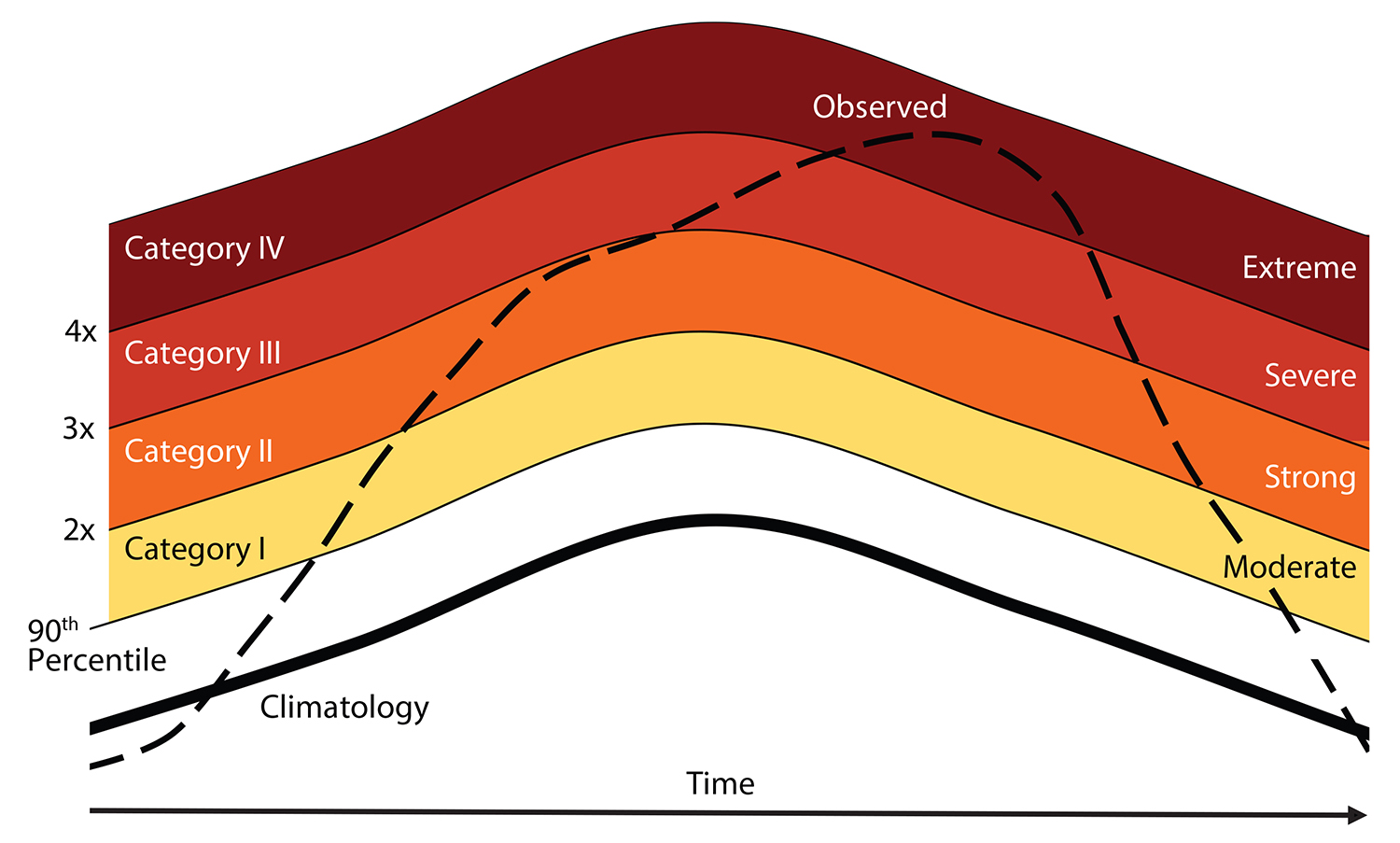
    Thanks to a research station that has been collecting ocean temperatures in the western English Channel for over a century, we know that this part of the sea south of Devon is 2.7°C warmer than the 120-year average, which makes it a category II (“strong”) marine heatwave within the four-category scheme.

    The importance of long-term monitoring

    Marine heatwaves are different to what we expect in a meteorological heatwave. Since 2023, the waters around the UK have been regularly experiencing marine heatwave conditions, because the data shows that the sea temperature has been in the top 10% of records: but most of us would admit that a sea temperature of 10°C in early March doesn’t exactly conjure up the impression of a heatwave.

    The search for better definitions of a marine heatwave continues among scientists, particularly as long-term baseline temperatures continue to warm and the top 10% of warm temperatures shifts upwards. Datasets gathered over several decades in the same place are valuable to this effort.

    For example, the Plymouth Marine Laboratory and the Marine Biological Association have been monitoring conditions in the western English Channel for over a century. One of the longest running surveys in the world is situated 20 miles south of Plymouth.

    Station E1 was originally founded by the International Council for the Exploration of the Seas in 1902, as part of the English (hence the “E”) effort in ocean observation.

    What sets E1 apart is the near continuous nature of its recording since then, the frequency of its data collection (monthly in winter, fortnightly in summer) and its sampling throughout the entire water column (80 metres deep), not just at the surface. This enables scientists to observe the seasonal progression of water mixing and layer formation in that location.

    The 123-year old dataset shows that sea surface temperatures have increased markedly within the past 40 years, at a rate of around 0.6°C a decade. Warm anomalies have been increasingly common, and cold anomalies increasingly rare.

    Marine heatwave conditions have become increasingly frequent, particularly since 2010. The data also shows that at a depth of 50 metres – well below the top layer of the ocean – temperatures have also increased markedly. The ongoing marine heatwave is not just a surface phenomenon.

    Fishers are catching octopus in large numbers off Devon and Cornwall due to the warm sea temperatures.
    Captured by Aixa/Shutterstock

    What caused this heatwave?

    The marine heatwave of spring 2025 has resulted from a combination of factors. It boils down to the fact that more energy is being put into the ocean during the day than is being lost at night.

    March 2025 was the sunniest March on record (since 1910), with UK Met Office statistics showing there were around 185 hours of sunshine. April set new records for UK solar power generation, with a peak of 12.2 gigawatts (GW) being produced on April 1 out of a possible solar generating capacity of 18 GW.

    May continued that trend, with long periods of clear skies under areas of the atmosphere with persistent high pressure. High-pressure areas are also associated with relatively low winds, which restricts the mixing of the warm surface with cooler deep water.

    During the spring, rapidly lengthening days mean the time for energy in (day) outweighs energy out (night). It has also been notable that the spring phytoplankton bloom was very early this year (during early March). This is when tiny plant cells at the seawater surface burst into life, like plants on land. The bloom finished relatively early and the surface waters cleared earlier.

    The conditions during May at E1 resembled those we would ordinarily associate with midsummer, with the phytoplankton bloom sitting deeper in the water. The clearer water at the surface allowed sunlight to penetrate deeper.

    It is evident from our century-plus of measurements that marine heatwaves are happening more frequently and that there appears to be an almost continuous marine heatwave state emerging around the UK.

    The intensity of a marine heatwave is generally tied to persistent high-pressure areas remaining static over the UK, but it is still unclear whether or not this is an emerging climate pattern, or just an episode within the general patterns of change within UK seas.


    Don’t have time to read about climate change as much as you’d like?

    Get a weekly roundup in your inbox instead. Every Wednesday, The Conversation’s environment editor writes Imagine, a short email that goes a little deeper into just one climate issue. Join the 45,000+ readers who’ve subscribed so far.


    Tim Smyth receives funding from Natural Environment Research Council and UK Research and Innovation.

    ref. What a 120-year-old research station is telling us about the warming of the sea around the UK – https://theconversation.com/what-a-120-year-old-research-station-is-telling-us-about-the-warming-of-the-sea-around-the-uk-257378

    MIL OSI – Global Reports

  • MIL-OSI Global: Why do we cry happy tears? The science behind this emotional paradox

    Source: The Conversation – UK – By Michelle Spear, Professor of Anatomy, University of Bristol

    maxbelchenko/Shutterstock.com

    Tears are usually seen as a sign of sadness or pain, but it’s not uncommon for people to cry during life’s most joyful moments: weddings, births, reunions, sporting triumphs, or even just an unexpected act of kindness.

    These “happy tears” seem contradictory, but they offer a fascinating window into how the human brain handles intense emotion.

    Crying is a complex biological response to emotional overload – and it doesn’t discriminate between good and bad feelings. Whether triggered by grief or elation, tears are often the result of our brain attempting to process more than it can manage in the moment.

    Both positive and negative emotions activate the limbic system, the part of the brain involved in processing feelings and memory. Within this system, the amygdala – an almond-shaped cluster of neurons – acts as an emotional alarm bell, detecting arousal and signalling the body to respond.

    When highly stimulated, the amygdala activates other brain areas including the hypothalamus, which controls involuntary physical functions like heartbeat, breathing and tear production.

    Another key structure is the anterior cingulate cortex, which plays a role in emotion regulation, decision-making and empathy. It helps coordinate the brain’s response to emotional conflict, such as experiencing joy and sadness at the same time. These overlapping pathways explain why a sudden surge of happiness can still produce a reaction typically associated with distress.

    The limbic system explained.

    Scientists believe happy crying is a form of emotional homeostasis: a way of bringing us back to equilibrium after an emotional high. Crying activates the parasympathetic nervous system, which slows the heart rate and relaxes the body after the adrenaline spike of intense feeling. In other words, tears help us calm down.

    This idea of “resetting” isn’t unique to happiness. Crying in response to stress or trauma serves a similar purpose. What’s striking about happy crying is how it illustrates the body’s effort to balance opposing forces: relief after fear, gratitude after hardship, pride after struggle.

    Happy tears

    So-called “happy” tears are rarely just that. Often they emerge from a blend of emotions. For example, a parent watching their child graduate may be proud, nostalgic, and a little melancholic all at once. A long-awaited reunion might stir joy and the pain of absence. Psychologists refer to this as a dual-valence response – an emotional state that contains both positive and negative elements.

    These emotional blends engage memory systems as well, particularly the hippocampus, which processes and retrieves personal history. That’s why a joyful moment can unexpectedly bring a lump to the throat – it activates memories of previous loss, struggle or longing.

    Interestingly, humans are the only animals known to shed emotional tears. While many mammals produce reflex tears to lubricate the eye, only humans cry in response to emotion. This probably evolved as a form of non-verbal communication, especially in early social groups.

    Tears signal vulnerability, authenticity and emotional depth. Crying during joyful moments demonstrates to others that something profoundly meaningful has occurred.

    In this way, happy crying can strengthen social bonds, invite empathy and create shared moments of catharsis. Research has even shown that people are more likely to offer help to someone who is crying, regardless of whether the tears are sad or joyful.

    So why do we cry when we’re happy? Because happiness is not a simple emotion. It is often tangled with memory, relief, awe and the sheer weight of meaning. Tears are the brain’s way of processing this complexity, of marking a moment that matters, even when it’s joyful. Far from being a contradiction, happy tears remind us that emotional life is rich, messy and above all deeply human.

    Michelle Spear does not work for, consult, own shares in or receive funding from any company or organisation that would benefit from this article, and has disclosed no relevant affiliations beyond their academic appointment.

    ref. Why do we cry happy tears? The science behind this emotional paradox – https://theconversation.com/why-do-we-cry-happy-tears-the-science-behind-this-emotional-paradox-256482

    MIL OSI – Global Reports

  • MIL-OSI Video: WATCH: ICE Tip Sparks EPIC Takedown of 5 Illegal Aliens Outside Home Improvement Store

    Source: United States of America – The White House (video statements)

    One ICE Tip. Five aliens down.

    Got a tip? Call ICE now—866-DHS-2-ICE. That’s 866-347-2423.

    https://www.youtube.com/watch?v=itSW_UWoZdk

    MIL OSI Video

  • MIL-OSI USA: H.R. 980, Veterans Readiness and Employment Improvement Act of 2025

    Source: US Congressional Budget Office

    Bill Summary

    H.R. 980 would expand the types of flight training available to veterans under the Veteran Readiness and Employment (VR&E) program and extend the reduction of pension payments from the Department of Veterans Affairs (VA) for veterans and survivors who reside in Medicaid nursing homes. The bill also would establish new outreach requirements for VA related to the VR&E program.

    Estimated Federal Cost

    The estimated budgetary effects of H.R. 980 are shown in Table 1. Over the 2025‑2035 period, the bill would change net direct spending by less than $500,000 and increase spending subject to appropriation by $137 million. The costs of the legislation fall within budget functions 550 (health) and 700 (veterans benefits and services).

    Table 1.

    Estimated Budgetary Effects of H.R. 980


    By Fiscal Year, Millions of Dollars


    2025

    2026

    2027

    2028

    2029

    2030

    2031

    2032

    2033

    2034

    2035

    2025-2030

    2025-2035


    Increases or Decreases (-) in Direct Spending


    Estimated Budget Authority

    *

    2

    2

    2

    2

    2

    2

    -21

    3

    3

    3

    10

    *

    Estimated Outlays

    *

    2

    2

    2

    2

    2

    2

    -21

    3

    3

    3

    10

    *


    Increases in Spending Subject to Appropriation


    Estimated Authorization

    2

    12

    12

    13

    13

    13

    14

    14

    15

    15

    15

    65

    138

    Estimated Outlays

    2

    11

    12

    13

    13

    13

    14

    14

    15

    15

    15

    64

    137

    * = between -$500,000 and $500,000.

    Basis of Estimate

    For this estimate, CBO assumes that H.R. 980 will be enacted in fiscal year 2025 and that provisions will take effect upon enactment. CBO also estimates that outlays will follow historical spending patterns for affected programs.

    Direct Spending

    H.R. 980 would expand the types of flight training available to veterans under the VR&E program. The bill also would extend the reduction of pension payments for veterans and survivors who reside in a Medicaid nursing home. The costs of both of those programs are paid from mandatory appropriations. In total, the bill would change net direct spending by less than $500,000 over the 2025‑2035 period (see Table 2).

    Table 2.

    Estimated Changes in Direct Spending Under H.R. 980


    By Fiscal Year, Millions of Dollars


    2025

    2026

    2027

    2028

    2029

    2030

    2031

    2032

    2033

    2034

    2035

    2025-2030

    2025-2035

    Flight Training


    Estimated Budget Authority

    *

    2

    2

    2

    2

    2

    2

    3

    3

    3

    3

    10

    24

    Estimated Outlays

    *

    2

    2

    2

    2

    2

    2

    3

    3

    3

    3

    10

    24

    Pensions


    Estimated Budget Authority

    0

    0

    0

    0

    0

    0

    0

    -24

    0

    0

    0

    0

    -24

    Estimated Outlays

    0

    0

    0

    0

    0

    0

    0

    -24

    0

    0

    0

    0

    -24

    Total Changes


    Estimated Budget Authority

    *

    2

    2

    2

    2

    2

    2

    -21

    3

    3

    3

    10

    *

    Estimated Outlays

    *

    2

    2

    2

    2

    2

    2

    -21

    3

    3

    3

    10

    *

    Flight Training.Veterans with service-connected disabilities that negatively affect their ability to work can receive vocational rehabilitation services such as educational assistance, job training, skills counseling, and independent-living services. For veterans pursuing education or training programs, VA pays their tuition, fees, and related costs as well as housing allowances. Under current law, the benefit can be used for flight training that leads to a college degree; section 3 would allow veterans to use the benefit for flight training programs that do not lead to a degree. (Non-degree flight training programs are often provided by vocational pilot schools rather than colleges or universities; they issue licenses or certifications upon successful completion.)

    Using information from VA on the number of students using the Post-9/11 GI Bill for non‑degree flight training, CBO expects that roughly 120 veterans who would not otherwise receive vocational rehabilitation would pursue such training under the bill each year, at an average annual cost of $18,300 per person. As a result, CBO estimates that enacting section 3 would increase direct spending by $24 million over the 2025-2035 period.

    Pensions. Under current law, VA reduces pension payments to veterans and survivors who reside in Medicaid nursing homes to $90 per month. That required reduction expires November 30, 2031. Section 5 would extend that reduction for six months through May 31, 2032. CBO estimates that extending that requirement would reduce VA benefits by $10 million per month. (Those benefits are paid from mandatory appropriations and are therefore considered direct spending.) As a result of that reduction in beneficiaries’ income, Medicaid would pay more of the cost of their care, increasing spending for that program by $6 million per month. Thus, enacting section 5 would reduce net direct spending by $24 million over the 2025-2035 period.

    Spending Subject to Appropriation

    Section 4 would require VA to hold monthly informational sessions with school officials to answer questions concerning the VR&E program and to offer in-person or virtual briefings for veterans regarding VR&E services. CBO estimates that VA would need two trained outreach specialists at each of its 56 regional offices to provide those activities. Using information on VA personnel expenses, CBO estimates that implementing section 4 would increase spending subject to appropriation by $137 million over the 2025‑2035 period (see Table 3).

    Table 3.

    Estimated Increases in Spending Subject to Appropriation Under H.R. 980


    By Fiscal Year, Millions of Dollars


    2025

    2026

    2027

    2028

    2029

    2030

    2031

    2032

    2033

    2034

    2035

    2025-2030

    2025-2035

    Outreach


    Authorization

    2

    12

    12

    13

    13

    13

    14

    14

    15

    15

    15

    65

    138

    Estimated Outlays

    2

    11

    12

    13

    13

    13

    14

    14

    15

    15

    15

    64

    137

    Pay-As-You-Go Considerations

    The Statutory Pay-As-You-Go Act of 2010 establishes budget-reporting and enforcement procedures for legislation affecting direct spending or revenues. The net changes in outlays that are subject to those pay-as-you-go procedures are shown in Table 2.

    Increase in Long-Term Net Direct Spending and Deficits

    CBO estimates that enacting H.R. 980 would not increase net direct spending by more than $2.5 billion in any of the four consecutive 10-year periods beginning in 2036.

    CBO estimates that enacting H.R. 980 would not increase on‑budget deficits by more than $5 billion in any of the four consecutive 10-year periods beginning in 2036.

    Mandates

    The bill contains no intergovernmental or private-sector mandates as defined in the Unfunded Mandates Reform Act.

    Estimate Reviewed By

    David Newman
    Chief, Defense, International Affairs, and Veterans’ Affairs Cost Estimates Unit

    Kathleen FitzGerald
    Chief, Public and Private Mandates Unit

    Christina Hawley Anthony
    Deputy Director of Budget Analysis

    Phillip L. Swagel

    Director, Congressional Budget Office

    MIL OSI USA News

  • MIL-OSI USA: Volcanic ash is critical to tracking changes in eruption behavior

    Source: US Government research organizations

    An NSF-funded ashfall study links magma composition shifts to volcanic tremors, offering a powerful new tool for monitoring eruptions and protecting communities

    U.S. National Science Foundation-funded researchers discovered that subtle changes in magma composition may drive tremors during volcanic eruptions, offering a new tool for forecasting volcanic activity and guiding hazard assessments.

    Volcano forecasts are critical for protecting lives and property by warning nearby residents to evacuate, take safety precautions and seek emergency services. In addition to offering new clues into the cause of volcanic tremor, a key eruption monitoring parameter, this study shows the benefit of combining petrological data collection, like ashfall, with geophysical data to improve eruption forecasting, hazard assessment and decision-making during volcanic crises.

    After lying dormant for 50 years, the Cumbre Vieja volcano in the Canary Islands erupted in September 2021, forcing thousands of residents to evacuate. Over the next 85 days, the eruption destroyed over 3,000 buildings and hundreds of acres of farmland.

    Working with local scientists, a research team led by Queens College of the City University of New York (CUNY), in collaboration with the CUNY Graduate Center and the American Museum of Natural History, set up a system near the volcano that collected samples of falling ash almost daily, capturing 94% of the eruption timeline. This study represents an unprecedented level of detail, revealing critical insights into internal magma properties and eruption dynamics throughout the three-month eruption.

    Analysis revealed that in the first week of the eruption, magma had higher concentrations of silica, a chemical compound that makes magma more viscous and usually more explosive. Silica content then gradually decreased for two months but increased again as a precursory signal to the end of the eruption. The team found a correlation between silica content and the strength of the volcano’s tremor, a seismic “rattling” associated with liquid and gas movement beneath the surface. They suggest that more viscous, silica-rich magma may cause stronger volcanic tremors.

    MIL OSI USA News

  • MIL-OSI USA: WY Military Department Retiree Council Hosts Outreach Event for National Guard Retirees

    Source: US State of Wyoming


    Wyoming National Guard

    CHEYENNE, Wyo. – The Wyoming Military Department Retiree Council is pleased to announce that it will be holding an outreach event for National Guard Retirees on May 27, 2025, from 5 to 7 p.m. at the National Guard Armory located at 2101 Washakie Ave., Worland, Wyoming 82401.

    The purpose of this outreach event is to provide National Guard Retirees in the area with an update on the mission and objectives of the Retiree Council. The council aims to support and serve the needs of retired National Guard members, ensuring that they have access to relevant information and resources. This event offers an opportunity for attendees to have their questions answered by knowledgeable representatives.

     Retiree Support Assistant Kenton Franklin from the Wyoming Military Department will be available during the event to address any inquiries or concerns. For further information about the event, please contact Mr. Franklin at (307)-630-4062 or via email at kenton.franklin@wyo.gov.

    The Wyoming Military Department Retiree Council encourages all National Guard Retirees in the area to attend this outreach event. By participating, retired members will gain valuable insights into the resources and support available to them, fostering a strong and interconnected community of military retirees in Wyoming.

    MIL OSI USA News

  • MIL-OSI China: 47th Chinese naval escort taskforce conducts multi-subject training 2025-05-28 21:50:45 In recent days, the 47th Chinese naval escort taskforce, which is undertaking escort mission in the Gulf of Aden, has organized multi-subject training for its special operations forces (SOF) members based on the actual situation of the escort mission.

    Source: People’s Republic of China – Ministry of National Defense

      BEIJING, May 28 — In recent days, the 47th Chinese naval escort taskforce, which is undertaking escort mission in the Gulf of Aden, has organized multi-subject training for its special operations forces (SOF) members based on the actual situation of the escort mission. The training covered gunnery, visit, board, search, and seizure (VBSS), confrontation between red and blue forces, and other subjects, aiming to enhance the capabilities of the SOF members in performing diversified tasks.

      (Video Editor: Lin Congyi)

    loading…

    MIL OSI China News

  • MIL-OSI China: China, UAE advance cross-border payment cooperation

    Source: People’s Republic of China – State Council News

    BEIJING, May 28 — China’s Cross-Border Interbank Payment System (CIPS) and the central bank of the United Arab Emirates (UAE) have signed a memorandum of understanding to enhance cross-border payment cooperation, the People’s Bank of China (PBOC), China’s central bank, announced on Wednesday.

    The signing is expected to improve payment infrastructure and the efficiency of cross-border payments, according to an online statement by the PBOC, which administers and regulates CIPS.

    Accordingly, CIPS and the central bank of the UAE will work together to develop a cross-border payment connectivity program, which will provide local currency clearing services for financial institutions in the Middle East and North Africa.

    The two sides will also deepen exchanges on risk management and compliance, and make cross-border payment systems safer and more stable, according to the statement.

    MIL OSI China News

  • MIL-OSI China: China promotes digital transformation of electronic information manufacturing

    Source: People’s Republic of China – State Council News

    BEIJING, May 28 — China has released an implementation plan for the digital transformation of the electronic information manufacturing industry, setting a goal for major enterprises to achieve a numerical control rate of over 85 percent in key production processes by 2027.

    Released by the Ministry of Industry and Information Technology along with other government organs, the plan underscores the electronic information manufacturing industry as a strategic, fundamental, and pioneering sector of the national economy.

    With a large overall scale, long industrial chains, and broad coverage, it plays a key role in integrating the real and digital economies, advancing new industrialization and fostering new quality productive forces, according to the plan.

    The plan further outlines that by 2027, new information infrastructure will be largely established to support the digital transformation and intelligent upgrading of the electronic information manufacturing industry. This infrastructure will see advanced computing and artificial intelligence deeply integrated into industry development.

    It envisions that by 2030, a relatively sound data infrastructure system for the electronic information manufacturing industry will be in place, and an industrial database will be largely completed. By then, a number of flagship smart products will be developed, and a digital ecosystem will take shape.

    The efficiency and quality of the digital transformation will see significant improvements, and new breakthroughs in moving up towards the top end of the global value chain are expected to be achieved by 2030.

    Efforts will be made to promote digital transformation across the entire industrial chain and speed up the trial and adoption of innovative products such as smart wearable devices and intelligent robots, according to the plan.

    MIL OSI China News