Category: DJF

  • MIL-OSI Europe: EUROPE/ITALY – Father Mandonico, of the Society of African Missions: “The missionary Pope reminds us of the need not to close ourselves in our fortresses”

    Source: Agenzia Fides – MIL OSI

    Friday, 23 May 2025

    SMA

    Rome (Agenzia Fides) – “One particular trait stands out about the missionary Robert Francis Prevost, OSA, who became Pope Leo XIV. Those who knew him closely do not have any striking gestures to share, but they reiterate one quality: he is a man who knows how to listen.” This is what Father Andrea Mandonico, general archivist of the Society of African Missions, says when sharing his testimony about the figure of the new Pontiff, which he sees as “a particular challenge.”“For a missionary to become Pope is an unprecedented experience for the Catholic Church. Pope Leo is not the missionary who has experienced the most heroic adventures, he is not the one who has raised his voice the most, he is not the one who has built the most schools or dispensaries,” Father Mandonico notes. “Rather, he left his mark by opening his heart and mind to those he met.” Because truly, as he said in the first Mass with the cardinals in the Sistine Chapel, even those in authority “disappear so that Christ may remain.”The College of Cardinals, in electing Leo XIV, was fully aware that it was entrusting the Petrine ministry to a missionary.“We must seek together how to be a missionary Church, a Church that builds bridges, in dialogue, always open to receiving, like this square with open arms,” Father Andrea recalls, evoking the words of Pope Leo XIV in his first message from the central loggia of St. Peter’s Basilica. The Pontiff had invited each person to become a “bridge” of God’s love for all.“The missionary Pope is a particular challenge for us missionaries,” the archivist insists. “And in our Italy, perhaps, it is even more so today than in other regions of the world.” According to Father Mandonico, the figure of the new Pope recalls the urgency of the mission, precisely at a time when it might seem that “leaving for distant lands is a vocation already outdated.” His witness challenges all Christians “not to close themselves up in a fortress,” but to keep their gaze on the people, “ad gentes,” and to open their communities “to the breath of the world.” “Today he is Peter. And we too, missionaries in Italy and in every corner of the world, want to start again from here,” he concludes. (AP) (Agenzia Fides, 23/5/2025)
    Share:

    MIL OSI Europe News

  • MIL-OSI Europe: Cardinal Tagle at the Pontifical Mission Societies Assembly: let us learn from the Apostles, made missionaries by the encounter with the Risen Christ

    Source: Agenzia Fides – MIL OSI

    VaticanMedia

    Rome (Agenzia Fides) – The missionary work of the Church has its source in the wonder of those who encountered the Risen Jesus, “and were sent by Him”. And even today, the people and entities involved in missionary work can persevere and renew their zeal only through a personal encounter with the Risen Christ, “who changes lives”. Cardinal Luis Antonio Gokim Tagle reminded the National Directors of the Pontifical Mission Societies (PMS), gathered in Rome for their annual General Assembly, that the experience witnessed of the first disciples of Jesus during the early Church, remains the benchmark for every authentic missionary work and initiative.Who “animates” the “animators”The meeting between Cardinal Tagle and the National Directors of the PMS took place in the late afternoon of Wednesday, March 21, at the International Center of San Lorenzo da Brindisi. In his addres, the Cardinal began by defining the task and responsibilities entrusted to his interlocutors in the audience. He recalled that the PMS National Director can be seen as “the sign, symbol and instrument of the Church’s missionary identity, according to the teachings of the Second Vatican Council.”For this reason, the Mission Director is called to be “the face, voice, hands, feet and heart of a Church that makes mission and mission that makes the Church in his/her local Church”.Since their origin – the Cardinal recalled – the Pontifical Missionary Societies “have been expressions of the Catholic faithful’s fidelity to Christ, transformed into missionary co-responsibility, i.e. missionary discipleship”.However, apostolic zeal is never a self-generated impulse nor the result of the mechanical application of a “missionary method.””To animate others to mission,” the Cardinal repeated several times, “we must be animated for mission, just like the first disciples.” He added, “we often forget that only the encounter with the Risen One made them missionaries. The gift of the Holy Spirit sealed their missionary zeal, their courage and creativity in proclaiming the good things God had done in Jesus Christ”. Therefore, insisted the Pro Prefect of the Missionary Dicastery “missionary animation is not just a task but a spiritual encounter with the Risen Lord that transforms one’s life, making one search for people with whom to share the Good News”. In this regard, the Cardinal suggested that valuable insights could be drawn from the readings proposed by the Church’s liturgy during the Easter season, the “time of the Risen One.”The apostolic foundations of missionary cooperationIn the accounts of the beginning of missionary work, the inherent nature and genetic traits of missionary work are revealed: the universal destination of the Gospel’s message of liberation, care for the poor, and the solicitude for cooperation and sharing of goods, gifts, charisms, and ministries. Cardinal Tagle highlighted these aspects through suggestive examples. For instance – the Cardinal reminded the National Directors of the PMS gathered in Assembly – when disputes arose over the requirement for non-Jews converting to Christianity to undergo circumcision, Paul and Barnabas went to Jerusalem and “convened an assembly with the apostles and elders.” This became the first Council, the Council of Jerusalem, where they held a “conversation in the Holy Spirit,” involving the apostles and elders, listening to God’s Word and discerning the movements of the Spirit. “Thus, an ‘organization’ of universal scope but deeply spiritual in nature was taking shape.”From those early steps of the nascent Church – noted Cardinal Tagle – it emerges that prayer, listening to the Word of God, discernment, mutual respect are distinctive traits that characterize every form of organized universal missionary cooperation. This – added the Cardinal – is “the ‘soul’ of the ‘organization.’”The Apostle – continued the Cardinal Pro-Prefect, choosing other events of the first Christian communities immediately linked to the mission of the PMS – also initiated a fundraising campaign among the new Gentile Churches in Macedonia and Achaia to support the poor Church in Jerusalem. The Apostle of the Gentiles praised the Churches of Macedonia for sharing what they could, despite their poverty, testifying to the “circulation of love” between young and older Churches, which also drives the activities of the PMS. “Whoever sows sparingly,” as stated in the Second Letter of Saint Paul to the Corinthians, “will also reap sparingly, and whoever sows bountifully will also reap bountifully…for God loves a cheerful giver.”Common prayer, sharing of the Eucharist and also of material goods accompanied the life of the early Christian communities. The community sold their possessions and laid the proceeds at the apostles’ feet, who distributed them according to the need of each. In this regard, Cardinal Tagle recalled the story of Ananias and Sapphira, narrated in the Acts of the Apostles. They sold a piece of land but kept part of the proceeds for themselves. Peter rebuked them, saying, “You have not lied to men but to God.” After this, both Ananias and Sapphira died. In the Church of Christ, the Cardinal remarked, such events occurred “even shortly after the Resurrection and Pentecost.” However, the essential traits accompanying and characterizing the first apostolic work were those of prayer, mutual respect, listening, and sharing. These are all elements that today characterize and make every authentic missionary cooperation recognizable.The Cardinal reiterated that even the Pontifical Mission Societies draw “from this first Easter experience.” The work of the PMS National Directors can also be seen and lived as an extension of that of the first Apostles. “We too,” the Cardinal concluded, “can animate mission and animate our organization by learning from them who had encountered the Risen Lord and had been sent by Him in the power of the Holy Spirit.” (GV) (Agenzia Fides, 23/5/2025)
    Share:

    MIL OSI Europe News

  • MIL-OSI Europe: ASIA/PHILIPPINES – National Director of the Pontifical Mission Societies: “There is a need to embody faith in political action”

    Source: Agenzia Fides – MIL OSI

    PPCRV

    Rome (Agenzia Fides) – “After the 2025 midterm elections, we can say that there is still much to be done to create an authentic political consciousness in the nation. We use the word ‘politics’ in the noblest and highest sense of the word, namely, as the administration and care of the common good,” Father Esteban Lo, a priest from Manila and National Director of the Pontifical Mission Societies (PMS) in the Philippines, one of the participants in the General Assembly of the Pontifical Mission Societies currently taking place in Rome, told Fides. “When it comes to political elections, the phenomena of vote-buying, corruption, political dynasties, and factionalism affect the entire people, which is, of course, predominantly Catholic. From this, it can be deduced that in these moments, the Catholic conscience, illuminated by faith, struggles to emerge,” the National Director added.”Today, the Filipino people demonstrate great popular piety, but when it comes to issues and practices such as politics, a dichotomy arises. Therefore, we must deepen and assimilate the vision of the Church’s social teaching, which we know is a focus of the apostolic ministry of Pope Leo XIV. We must embody faith in political action,” he notes.In the May 12 elections, with a record turnout of nearly 69 million voters, more than 18,000 public offices at all levels of government were filled: Of the 354 seats in the lower house of parliament, the majority went to the coalition formed by the Lakas Party and other parties supporting incumbent President Ferdinand Marcos. In particular, the 12 Senate seats up for grabs (half of the 24 seats that make up the assembly) attracted political and media attention, and at least five went to candidates supporting the Duterte family. The Philippine political system is dominated by two political dynasties, which also faced each other in this election. They are the families of President Ferdinand Marcos Jr. (son of the former dictator of the same name) and his Vice President Sara Duterte (daughter of former President Rodrigo Duterte). The two clans, which had formed an alliance with a view to the 2022 presidential elections, are now in open conflict, and in this context, the midterm elections have become a kind of “referendum” on the dominance of one side or the other. Meanwhile, Rodrigo Duterte has been arrested and is on trial before the International Criminal Court in The Hague for “crimes against humanity” committed during the “war on drugs” launched during his presidency. And his daughter, Sara, the current Vice President, was impeached by the House of Representatives on February 7, which must be confirmed or overturned by the Senate. Five candidates close to the Marcos alliance won seats in the Senate, five other elected candidates are close to Duterte, while two “independents” received the support of the Duterte clan in the final stages of the campaign, thus being considered part of the opposition. After the election, President Marcos Jr. admitted – also based on polls that showed a significant decline in his popularity and public approval – that people were dissatisfied with the government’s performance. “The scenarios are open, and we will see how the political situation evolves,” the National Director of the Pontifical Mission Societies told Fides. “Surely, we are in a time when even the Catholic Church, as a historic institution, no longer has the influence on the conscience of citizens that it had in the past: just think of the non-violent revolution of 1986. The context and culture have changed rapidly.” “Our hope,” Father Lo concluded, “remains firm because it is anchored in Christ. Our commitment and our mission in society will continue. Ultimately, we can say that everything depends on the Christian witness of our lives.” (PA) (Agenzia Fides, 23/5/2025)
    Share:

    MIL OSI Europe News

  • MIL-OSI Security: INTERPOL convenes South American police chiefs in Brasilia to discuss organized crime threats

    Source: Interpol (news and events)

    23 May 2025

    The officials discussed intensifying cooperation to combat the continent’s most powerful organized crime groups.

    LYON, France: Senior police leaders from eleven South American countries met in Brasilia on Thursday to address the growing threat posed by transnational organized crime groups.

    The fourth INTERPOL Chiefs of Police meeting for South America allowed the officials to share insights into their respective efforts against organized crime and contribute to a regional plan to combat specific crime groups.

    In his remarks to the police leaders, INTERPOL Secretary General Valdecy Urquiza said:

    “Criminal groups from South America are continually expanding their reach throughout and beyond the region, where one in every three INTERPOL Notices is related to organized crime.

    “This meeting offers a dedicated space to reinforce regional police cooperation and fight organized crime effectively on a global scale.”

    Representatives at the meeting will include seven police chiefs and four deputy police chiefs from the eleven countries.

    The first INTERPOL Chiefs of Police meeting for South America took place in 2018 to strengthen ties between law enforcement within the region and to foster greater information-sharing.

    South American police records shared through INTERPOL have since doubled and countries in the region have played leading roles in recent INTERPOL initiatives targeting organized crime, such as INTERPOL cooperation against the ‘Ndrangheta (I-CAN) and the Silver Notice pilot.

    INTERPOL’s Regional Bureau in Buenos Aires, Argentina helps coordinate operational work in the region, tackling crimes such as child sexual abuse, corruption, cybercrime, human trafficking, money laundering and terrorism.

    Police leaders from the following countries participated in the fourth INTERPOL Chiefs of Police meeting: Argentina, Bolivia, Brazil, Chile, Colombia, Ecuador, Guyana, Paraguay, Peru, Uruguay, and Venezuela.

    MIL Security OSI

  • MIL-OSI Security: Around the Air Force: Allied Fighter Training, Oracle-M Satellite Test, Real ID Compliance

    Source: United States Air Force

    In this week’s look Around the Air Force, the newest hub for allied fighter training reaches initial operational capability, a milestone in monitoring space between Earth and the moon, and federal installations now require all visitors seeking base access to possess a REAL ID.

    MIL Security OSI

  • MIL-OSI Global: US solar manufacturers lag skyrocketing market demand

    Source: The Conversation – USA – By Mojtaba Akhavan-Tafti, Associate Research Scientist, University of Michigan

    Americans continue to want solar energy. AP Photo/Sue Ogrocki

    U.S. consumer demand for renewable energy continues to grow, with more solar panel capacity installed in 2024 than in 2023, which saw more than in 2022. But U.S. trade policy is in flux, and high tariffs have been imposed on imported solar panels, which may cause shortages.

    I am a scholar who studies the Sun, as well as an entrepreneur who is working to harness its power here on Earth by creating new designs for generating solar electricity. As part of that effort, I’ve studied market trends and manufacturing capabilities in the U.S. and abroad. Right now, U.S. manufacturers do not produce enough solar panels to meet the nation’s demand, but industry investments and federal tax incentives have been making progress, though recent federal moves have created uncertainty.

    In 2024, U.S. installers put up enough solar panels to generate 50 gigawatts of electricity – enough to power New York City for a year.

    U.S. manufacturers made only a small fraction of that – 4.2 GW of solar modules in the first half of 2024. That was a big boost, though – a 75% increase compared with the same period in 2023. And the prices were roughly three times the cost of imports.

    A look at recent imports

    In 2024, the U.S. imported far more panels than the country needed, suggesting developers may be stockpiling panels for future projects.

    Most of those imported panels were made in Asia, particularly Malaysia, Vietnam and Thailand. In fact, nearly all of the U.S.-made panels used at least some components from overseas. China currently makes about 97% of the world’s supply of photovoltaic wafers, which are building blocks of solar panels.

    The effects of proposed U.S. trade policies on the solar industry remain unclear. Through 2024, manufacturing continued a yearslong ramp-up to take advantage of government policies favoring domestic manufacturing. And imported panels seem slated to suffer from ever-increasing tariffs, which drive up costs.

    Domestic production rises

    Since 2010, U.S. solar panel production has increased about eightfold. But U.S.-made panels are more expensive than imported alternatives. In 2024, U.S.-made panels typically cost 31 cents per watt, but imported panels, even including tariffs that existed before President Donald Trump’s second term, cost about one-third of that: 11 cents per watt.

    But domestic manufacturers are bringing costs down by ramping up production while relying on the government to maintain or increase tariffs on imports, which may make U.S. panels more competitive domestically in the future.

    Reliance on overseas sources

    Despite that increase in domestic production, U.S. demand for solar panels has grown even faster. To meet demand, the U.S. imports a substantial portion of its solar photovoltaic modules.

    Tariffs, including a 30% tariff on solar cells and solar panels starting in 2018, aimed to boost domestic manufacturing.

    But those tariffs and falling global prices made solar installations more costly in the U.S. than in the rest of the world. The average global cost of installed solar systems dropped from $1.15 per watt in 2012 to $0.72 per watt in 2016, nearly half that of U.S. installations.

    The 2018 tariffs, as well as earlier rounds in 2012 and 2014, have shifted the source of U.S. imports of solar panels – from China and Taiwan to Malaysia and South Korea. Manufacturers are also building solar panels in Singapore and Germany to maintain access to the U.S. market. And Chinese companies are even investing in U.S. solar manufacturers to take advantage of federal incentives and avoid tariffs.

    New tariffs emerge

    Trump’s proposal for new tariffs on foreign-made solar goods, including panels and components, particularly target Chinese-owned companies in Southeast Asia.

    They could include a potential 375% tariff on Thai products – nearly quadrupling prices – and a 3,500% tariff on products from Cambodia.

    In contrast, U.S.-made solar panels will be cheaper. But a reduced supply of solar panels will raise prices even of domestic-made panels, at least until U.S. manufacturing can catch up with the demand. Some developers have begun to delay or cancel solar installations to address rising costs.

    Domestic investment

    Due in large part to the Biden administration’s Inflation Reduction Act, enacted in 2022, the U.S. solar panel industry has seen significant investments.

    Since the law’s enactment, more than 95 GW of manufacturing capability have been added across the solar supply chain in the U.S., including new facilities that in a year can construct enough solar panels to produce nearly 42 GW, beyond existing manufacturing levels. This growth in manufacturing capabilities is largely located in Texas and Georgia.

    Still, the new administration’s shifting priorities and trade policies make the landscape uncertain. Before Trump began discussing various solar-related trade policies, the industry projected it would install an average of 45 GW of solar panels every year for the next decade.

    Mojtaba Akhavan-Tafti owns shares in APT Solar Solutions Inc. in Ann Arbor, Michigan. He receives funding from public and private organizations to develop and commercialize three-dimensional solar modules.

    ref. US solar manufacturers lag skyrocketing market demand – https://theconversation.com/us-solar-manufacturers-lag-skyrocketing-market-demand-256944

    MIL OSI – Global Reports

  • MIL-OSI Global: In 2025, Tornado Alley has become almost everything east of the Rockies − and it’s been a violent year

    Source: The Conversation – USA – By Daniel Chavas, Associate Professor of Atmospheric Science, Purdue University

    A deadly tornado hit London, Ky., on May 16, 2025, just a few weeks after another tornado outbreak in the state. Allison Joyce/AFP/Getty Images

    Violent tornado outbreaks, like the storms that tore through parts of St. Louis and London, Kentucky, on May 16, have made 2025 seem like an especially active, deadly and destructive year for tornadoes.

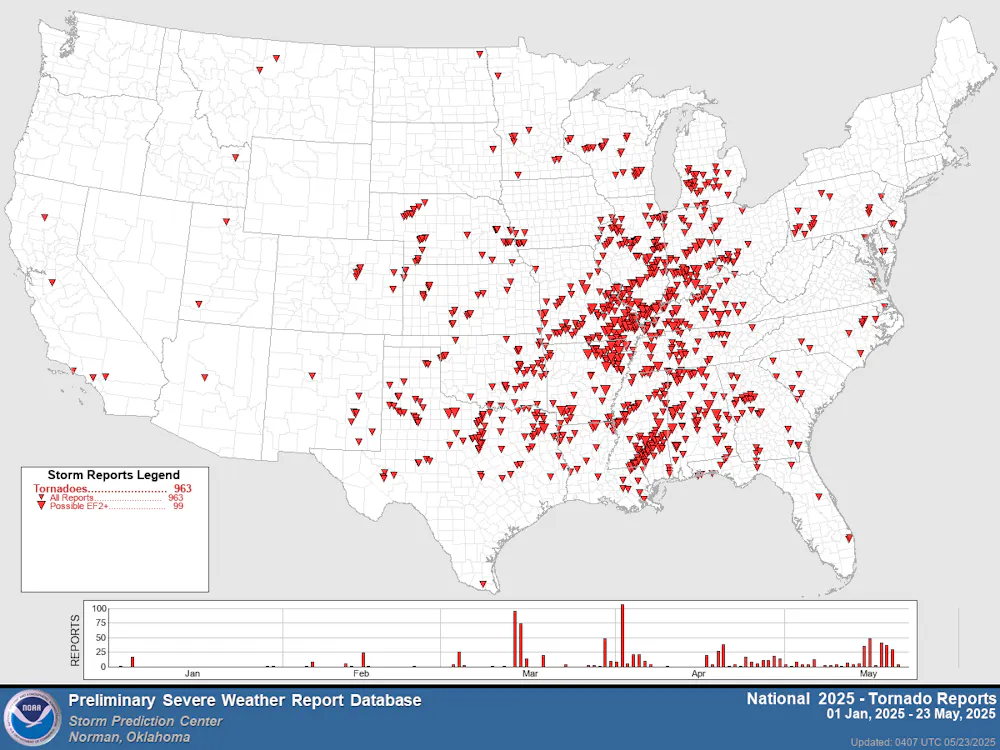
    The U.S. has had more reported tornadoes than normal – over 960 as of May 22, according to the National Weather Service’s preliminary count.

    That’s well above the national average of around 660 tornadoes reported by that point over the past 15 years, and it’s similar to 2024 – the second-most active year over that same period.

    The National Weather Service tracks reported tornadoes based on local storm reports, allowing for comparisons throughout the year. The red line shows 2025 through May 22.
    NOAA National Storm Prediction Center

    I’m an atmospheric scientist who studies natural hazards. What stands out about 2025 so far isn’t just the number of tornadoes, but how Tornado Alley has encompassed just about everything east of the Rockies, and how tornado season is becoming all year.

    Why has 2025 been so active?

    The high tornado count in 2025 has a lot to do with the weather in March, which broke records with 299 reported tornadoes – far exceeding the average of 80 for that month over the past three decades.

    March’s numbers were driven by two large tornado outbreaks: about 115 tornadoes swept across more than a dozen states March 14-16, stretching from Arkansas to Pennsylvania; and 145 tornadoes hit March 31 to April 1, primarily in a swath from Arkansas to Iowa and eastward. The 2025 numbers are preliminary pending final analyses.

    While meteorologists don’t know for sure why March was so active, there were a couple of ingredients that favor tornadoes:

    By April and May, however, those ingredients had faded. The weak La Niña ended and the Gulf waters were closer to normal.

    April and May also produced tornado outbreaks, but the preliminary count over most of this period, since the March 31-April 1 outbreak, has actually been close to the average, though things could still change.

    A tornado on May 18, 2025, tore apart homes in Bennett, Colorado.
    Helen H. Richardson/MediaNews Group/The Denver Post via Getty Images

    What has stood out in April and May is persistence: The jet stream has remained wavy, bringing with it the normal ebb and flow of stormy low-pressure weather systems mixed with sunny high-pressure systems. In May alone, tornadoes were reported in Colorado, Minnesota, Delaware, Florida and just about every state in between.

    Years with fewer tornadoes often have calm periods of a couple of weeks or longer when a sunny high-pressure system is parked over the central U.S. However, the U.S. didn’t really get one of those calm periods in spring 2025.

    Tornado Alley shifts eastward

    The locations of these storms have also been notable: The 2025 tornadoes through May have been widespread but clustered near the lower and central Mississippi Valley, stretching from Illinois to Mississippi.

    That’s well to the east of traditional Tornado Alley, typically seen as stretching from Texas through Nebraska, and farther east than normal. April through May is still peak season for the Mississippi Valley, though it is usually on the eastern edge of activity rather than at the epicenter. The normal seasonal cycle of tornadoes moves inland from near the Gulf Coast in winter to the upper Midwest and Great Plains by summer.

    Where local forecast centers reported tornadoes in 2025, through May 22. Data is preliminary, pending final analysis.
    NOAA Storm Prediction Center

    Over the past few decades, the U.S. has seen a broad shift in tornadoes in three ways: to the east, earlier in the year and clustered into larger outbreaks.

    Winter tornadoes have become more frequent over the eastern U.S., from the southeast, dubbed Dixie Alley for its tornado activity in recent years, to the Midwest, particularly Kentucky, Illinois and Indiana.

    Meanwhile, there has been a steady and stark decline in tornadoes in the “traditional” tornado season and region: spring and summer in general, especially across the Great Plains.

    It may come as a surprise that the U.S. has actually seen a decrease in overall U.S. tornado activity over the past several decades, especially for intense tornadoes categorized as EF2 and above. There have been fewer days with a tornado. However, those tornado days have been producing more tornadoes. These trends may have stabilized over the past decade.

    Deadlier tornadoes

    This eastward shift is likely making tornadoes deadlier.

    Tornadoes in the Southeastern U.S. are more likely to strike overnight, when people are asleep and cannot quickly protect themselves, which makes these events dramatically more dangerous. The tornado that hit London, Kentucky, struck after 11 p.m. Many of the victims were over age 65.

    The shift toward more winter tornadoes has also left people more vulnerable. Since they may not expect tornadoes at that time of year, they are likely to be less prepared. Tornado detection and forecasting is rapidly improving and has saved thousands of lives over the past 50-plus years, but forecasts can save lives only if people are able to receive them.

    Average number of tornadoes by month, 2000-2024. Source: NOAA

    This shift in tornadoes to the east and earlier in the year is very similar to how scientists expect severe thunderstorms to change as the world warms. However, researchers don’t know whether the overall downward trend in tornadoes is driven by warming or will continue into the future. Field campaigns studying how tornadoes form may help us better answer this question.

    Remember that it only takes one

    For safety, it’s time to stop focusing on spring as tornado season and the Great Plains as Tornado Alley.

    Tornado Alley is really all of the U.S. east of the Rockies and west of the Appalachians for most of the year. The farther south you live, the longer your tornado season lasts.

    Forecasters say it every year for hurricanes, and we badly need to start saying it for tornadoes too: It only takes one to make it a bad season for you or your community. Just ask the residents of London, Kentucky; St. Louis; Plevna and Grinnell, Kansas; and McNairy County, Tennessee.

    Listen to your local meteorologists so you will know when your region is facing a tornado risk. And if you hear sirens or are under a tornado warning, immediately go to your safe space. A tornado may already be on the ground, and you may have only seconds to protect yourself.

    Daniel Chavas receives funding from the National Science Foundation, NASA, and NOAA. He is a member of the American Geophysical Union and American Meteorological Society.

    ref. In 2025, Tornado Alley has become almost everything east of the Rockies − and it’s been a violent year – https://theconversation.com/in-2025-tornado-alley-has-become-almost-everything-east-of-the-rockies-and-its-been-a-violent-year-257169

    MIL OSI – Global Reports

  • MIL-OSI Global: How abortion laws focusing on fetal viability miss the mark on women’s experiences

    Source: The Conversation – USA – By Katrina Kimport, Professor of Sociology, University of California, San Francisco

    Abortion policy in the U.S. often focuses on fetal viability and fails to address the concerns of actual pregnant people. John Fedele/Tetra Images via GettyImages

    During the 2024 presidential campaign, politicians and their surrogates repeatedly raised concerns about abortion later in pregnancy. The topic grabbed media attention and continues to inspire strong emotions, but most of the discussions include numerous misunderstandings.

    These debates tend to focus almost exclusively on the status of a presumed healthy fetus: Does it have a heartbeat? Can it feel pain? Can it survive outside of the pregnant person’s body? Laws in the U.S. routinely use these fetal development markers to restrict abortion rights.

    The problem with this framing, however, is that the preoccupation with these fetal development markers originated in law and politics, not in science or medicine. And, most importantly, not from the lives, needs and experiences of pregnant people.

    We are medical sociologists who specialize in research on abortion. We noticed that fetal development markers shape the experience of pregnant patients. But that doesn’t mean these markers feel meaningful to people who get abortions.

    We wanted to understand how patients who have abortions later in pregnancy, including from states with laws banning abortion after specified markers like “viability,” thought about their pregnancy and abortion. Do they think about abortion in terms of the development of their fetus? We analyzed interviews with 30 women who obtained abortions later in pregnancy to answer this question.

    A history of limitations

    Long before the 2022 U.S. Supreme Court’s Dobbs v. Jackson Women’s Health Organization decision overturned the constitutional right to abortion, thousands of people each year in the U.S. were denied abortion services. Often, this was because they were beyond the pregnancy gestational limit imposed by their state’s abortion laws.

    These limits were rooted in fetal development markers. For instance, some states such as Maine and Washington allow abortion until a particular developmental point, such as presumed fetal viability. This is the point in pregnancy when the fetus might survive outside the uterus. Even in states considered supportive of abortion rights, such as California and Illinois, limits based on fetal development are still in force today.

    Since the Dobbs ruling, more abortion seekers are being denied the chance to get the procedure or facing long delays because of laws based on ideas about fetal development markers. But in fact, laws focused on fetal markers often end up jeopardizing the life and health of pregnant patients and furthering suffering, our study shows.

    Fetal development markers explained

    Fetal development markers sound like they are established clinical terms, but they aren’t. Some, like “potential fetal viability,” are concepts that started in legal thinking in the early 1970s. Then, when they were incorporated into limits on legal abortion, clinicians had to figure out how to apply them in a health care setting.

    Laws premised on fetal development markers around the U.S. have led to a host of lawsuits and general confusion among medical practitioners, as the language they use often doesn’t translate into medical contexts.

    It’s worth noting that common shorthand is to assign a specific gestation to a particular marker – for example, saying that viability starts at 24 weeks. But this ignores the fact that fetal viability depends on many factors, including fetal weight, sex, genetics and availability of neonatal intensive care resources.

    Only about half of infants born at 24 weeks of gestation will even survive long enough to be discharged from the hospital. Among infants born at 28 weeks, that rises to more than 90%. And of course, just looking at whether a baby was discharged from the hospital does not capture the acute impairments that babies born this prematurely experience and ongoing medical care they will require for much, if not all, of their lives.

    Focusing on the fetus’s viability overlooks the baby’s viability

    When we interviewed women who had abortions after 24 weeks of pregnancy, it became evident that these legal definitions were entirely irrelevant to the realities of their fetuses’ health.

    Some described carrying a fetus with a serious health issue that doctors told them would lead to its death soon after birth, just not during pregnancy. For instance, one woman we interviewed learned that a child with her fetus’s diagnosis would be born alive but would have regular seizures, cognitive disabilities and an inability to control its own movement.

    “I couldn’t imagine bringing a child into this world who would suffer and not have cognition of why, or be able to understand a good day from a bad day,” she said. To her, having an abortion was a way to protect her son: “I can’t give him that life of pain if I have a choice.”

    Women in similar situations struggled with the way their states’ laws focused on fetal viability but ignored the fact that the life their baby would have would be very brief and characterized by deep, sometimes constant pain. To them, the law reduced “viability” to the ability to survive birth, without consideration of the quality of their child’s life and the degree of its suffering.

    Overlooking women’s health

    Research and journalism have documented harrowing obstetric emergencies and their physical consequences in states where abortion has been banned. These traumatic events are often directly linked to laws that, in effect, leave little to no room to protect the pregnant patient’s life and health. The women in our study repeatedly highlighted that when a state’s law emphasizes “fetal viability” at the time an abortion is sought, the pregnant patient’s future health – both emotional and physical – takes a back seat.

    One woman we interviewed explained that she was so desperate not to be pregnant that she considered suicide because the fetal development-based law in her state meant she would not have access to a needed abortion. She had to travel out of state for her abortion. In her interview, she said the staff at the abortion clinic “saved my life. They definitely did. If it wasn’t for them, I probably wouldn’t be here.”

    We also interviewed a woman who had a medical condition that made pregnancy and laboring very dangerous for her, but she decided to take that risk to start a family. Once it was clear that her fetus had a serious health issue and would die in utero or shortly after birth, she no longer wanted to risk her own health.

    “Never mind the suffering, like needless suffering for the baby — I would also have to go through a cesarean surgery for that,” she said. But in her state, a fetal development-based law prohibited her from receiving an abortion. She, too, had to travel in order to get one.

    Ultimately, the women we interviewed found the laws based in fetal development markers to be nonsensical and cruel when applied to their pregnancies. One woman we interviewed, whose fetus’s severe medical condition was only diagnosable by doctors after her state’s 24-week viability cutoff, put the issue in stark terms.

    She was denied an abortion even after multiple specialists told her there was “100% certainty” her baby would have a bad outcome – an outcome that one specialist gently told her “no parent wants.” She had to fly halfway across the country to get the abortion she needed, far away from her support system.

    She said, “What sense does that make? I can’t imagine anybody looking at that and saying, ‘Yes, that was the desired outcome of this policy.’”

    Katrina Kimport receives funding from the Society of Family Planning and an anonymous private foundation.

    Tracy A. Weitz receives funding from the Society of Family Planning, Education Foundation of America, and William and Flora Hewlett Foundation. She is affiliated with Cambridge Reproductive Health Consultants, Fund Access Forward, Democracy Forward, Abortion Bridge Collaborative (Women’s Donors Network), Breast Cancer Action.

    ref. How abortion laws focusing on fetal viability miss the mark on women’s experiences – https://theconversation.com/how-abortion-laws-focusing-on-fetal-viability-miss-the-mark-on-womens-experiences-245998

    MIL OSI – Global Reports

  • MIL-OSI Global: Like many populist leaders, Trump accuses judges of being illegitimate obstacles to safety and democracy

    Source: The Conversation – USA – By Michael Gregory, Assistant Professor of Philosophy, Clemson University

    The front entrance of the E. Barrett Prettyman United States Court House, the workplace of Judge James Boasberg, along with other federal and appeals court judges, is seen in Washington, D.C. Philip Yabut/Getty Images

    Federal judges and at times Supreme Court justices have repeatedly challenged – and blocked – President Donald Trump’s attempts to reshape fundamental aspects of American government.

    Many of Trump’s more than 150 executive orders, including one aimed at eliminating the Department of Education, have been blocked by injunctions and lawsuits.

    When a majority of Supreme Court justices ruled on May 16, 2025, that the Trump administration could not deport a group of Venezuelan immigrants without first giving them the right to due process in court, Trump attacked the court.

    “The Supreme Court of the United States is not allowing me to do what I was elected to do,” Trump wrote on Truth Social. “This is a bad and dangerous day for America!” he continued in the post.

    As the Trump administration faces other orders blocking its plans, the president and his team are framing judges not just as political opponents but as enemies of democracy.

    Trump, for example, has called for the impeachment of James Boasberg, a federal judge who also issued orders blocking the deportation of immigrants in the U.S. to El Salvador. Attorney General Pam Bondi has said that Boasberg was “trying to protect terrorists who invaded our country over American citizens,” and Trump has also called Boasberg and other judges who ruled against him or his administration “left-wing activists.”

    “We cannot allow a handful of communist, radical-left judges to obstruct the enforcement of our laws and assume the duties that belong solely to the president of the United States,” Trump said at a rally in April 2025. “Judges are trying to take away the power given to the president to keep our country safe.”

    As a scholar of legal and political theory, I believe this kind of talk about judges and the judicial system is not just misleading, it’s dangerous. It mirrors a pattern seen across many populist movements worldwide, where leaders cast independent courts and judges as illegitimate obstacles to what they see as the will of the people.

    By confusing the idea that the people’s will must prevail with what the law actually says, these leaders justify intimidating judges and their sound legal rulings, a move that ultimately undermines democracy.

    President Donald Trump shakes hands with Supreme Court Chief Justice John Roberts at his inauguration on Jan. 20, 2025, in Washington, D.C.
    Chip Somodevilla/Getty Images

    Thwarting ‘the will of the American people’?

    In the face of judicial rulings against them, Trump and other administration officials have suggested on multiple occasions that judges are antagonistic to what the American people voted for.

    Yet these rulings are merely a reflection of the rule of law.

    Trump and supporters such as Elon Musk have characterized the rulings as a sign that a group of elite judges are abusing their power and acting against the will of the American people. The rulings that enforce the law, according to this argument, stand in opposition to the popular mandate American voters give to elected officials like the president.

    “If ANY judge ANYWHERE can stop EVERY Presidential action EVERYWHERE, we do NOT live in a democracy,” Elon Musk posted on X in February 2025. “When judges egregiously undermine the democratic will of the people, they must be fired,” Musk added.

    And U.S. Rep. Mike Johnson, the Republican speaker of the House of Representatives, said in March 2025, “We do have the authority over the federal courts, as you know. We can eliminate an entire district court.”

    Framing judges as enemies of democracy or as obstacles to the people’s will departs sharply from the traditional view – held across political lines – that the judiciary is an essential, nonpartisan part of the American constitutional system.

    While previous presidents have expressed frustration with specific court decisions or judges’ political leanings, their critiques mostly focused on specific legal reasoning.

    Supreme Court Justice Ketanji Brown Jackson warned against the Trump administration’s charge that judges were actively undermining democracy. In late April 2025, she said during a conference for judges that “relentless attacks on judges are an attack on democracy.”

    So, are judges obstructing democracy – or protecting it?

    Are unelected judges a sign of democracy?

    The U.S. Constitution established an independent judiciary as a coequal branch of government, alongside the legislative and executive branches. Federal judges are appointed for life and cannot be removed for political reasons. The country’s founders thought this protection could insulate judges from political pressures and ensure that courts uphold the Constitution, not the popularity of a given policy.

    Yet as the federal judiciary has expanded in size and power, the arguments about the relationship between democracy and judicial independence have become louder among some political scientists and legal philosophers.

    Some critics take issue with the fact that federal judges are appointed by politicians, not elected to their positions – a fact that others argue contributes to their independence.

    Federal judges often serve longer on the bench than many elected officials.

    Why, some critics argue, should a small group of unelected experts be allowed to overturn decisions made by elected officials?

    Other democratic theorists, however, say that federal judges can act as a check on elected leaders who may misuse or abuse their power, or pass laws that violate people’s legal rights. This indirectly strengthens democracy by giving people a meaningful way to have recourse against laws that go against their rights and what they actually voted for.

    A common story across countries

    The argument that judges are an enemy to democracy is not unique to the U.S.

    Authoritarian leaders from across the world have used similar language to justify undermining the courts.

    In the Philippines, then-President Rodrigo Duterte in 2018 told Maria Lourdes Sereno, a top judge who was an outspoken critic of Duterte’s war on drugs, “I am now your enemy.” Shortly after, the Philippines Supreme Court voted to oust Sereno from the court. These judges cited Sereno’s failure to disclose personal financial information when she was first appointed to the court as the reason for her removal.

    Filipino protesters and outside critics alike viewed Sereno’s removal as politically motivated and said it undermined the country’s judicial independence.

    El Salvador President Nayib Bukele’s allies in the legislative assembly similarly voted in May 2021 to remove the government’s attorney general as well all five top judges for obstructing Bukele’s plans to imprison, without proper due process, large numbers of people. Bukele replaced the attorney general and judges with political loyalists, violating constitutional procedure.

    Kamala Harris, then vice president of the U.S., was among the international observers who said the removal of judges in El Salvador made her concerned about El Salvador’s democracy. Bukele justified the judges’ removal by saying he was right and that he refused to “listen to the enemies of the people” who wanted him to do otherwise.

    And in April 2024, a minister in Israeli Prime Minister Benjamin Netanyahu’s Cabinet called Attorney General Gali Baharav-Miara an “enemy of the people,” blaming her for protests outside Netanyahu’s home. This disparagement was part of Netanyahu’s broader efforts to weaken judges’ role and independence and to remove judicial constraints on executive power.

    Judge James Boasberg is one example of a judge who was personally attacked by President Donald Trump for issuing various rulings on the administration’s plans to deport Venezuelan immigrants.
    Drew Angerer/AFP via Getty Images

    Pushing against democracy

    In the name of weakening what they call undemocratic institutions, these and other leaders try to discredit independent judges. This attempt helps these leaders gain power and silence dissent.

    Their attempts to disparage and discredit judges misrepresent judges’ work by asserting that it is political in nature – and thus subject to political criticism and even intimidation. But in the U.S., judges’ constitutionally mandated work takes place in the realm of law, not politics.

    By confusing the idea that the people’s will must prevail with what the law actually says, these leaders justify intimidating judges and their rulings, a move that ultimately undermines democracy.

    Independent judges may not always make perfect decisions, and concerns about their interpretations or potential biases are legitimate. Judges sometimes make decisions that are objectionable from a moral and legal standpoint.

    But when political leaders portray judges as the problem, I believe it’s crucial to ask: Who truly benefits from silencing judges?

    Michael Gregory does not work for, consult, own shares in or receive funding from any company or organization that would benefit from this article, and has disclosed no relevant affiliations beyond their academic appointment.

    ref. Like many populist leaders, Trump accuses judges of being illegitimate obstacles to safety and democracy – https://theconversation.com/like-many-populist-leaders-trump-accuses-judges-of-being-illegitimate-obstacles-to-safety-and-democracy-255472

    MIL OSI – Global Reports

  • MIL-OSI Global: From furry friends to fish, turning up the heat helps animals fight germs − how Mother Nature’s cure offers humans a lesson on fever

    Source: The Conversation – USA – By Phil Starks, Associate Professor of Biology, Tufts University

    Sick animals often move to warmer places to raise their body temperature. GK Hart/Vikki Hart/Stone via Getty Images

    Why do people get fevers when we get sick?

    It’s a common misconception that pathogens, such as SARS-CoV-2 or the flu, cause fevers. But as biology professors, we know it’s not that simple. Pathogens cause fevers only indirectly.

    When your immune system detects harmful microbes, your body raises its internal temperature to create a hostile environment. Turning up the heat suppresses the proliferation of invaders. In short, the fever is the body’s way of fighting back.

    Although many people don’t understand fever’s purpose, animals certainly utilize it. Even so-called “simple creatures,” such as lizards, fish and insects, use fever to recover from illness.

    The body’s response

    Suppose you catch a virus. The immune system responds by releasing molecules called pyrogens, which induce fever. They signal the brain’s hypothalamus to raise the body’s set point temperature – like adjusting a thermostat.

    Normal body temperature hovers around 98.6 degrees Fahrenheit (37 degrees Celsius), but fevers commonly increase temperatures to 100.4-104 F (38-40 C).

    When that happens, your muscles contract, causing shivers, and blood vessels constrict to retain heat. You’ll feel cold until your body reaches the new set point, often prompting you to add clothes or snuggle into blankets. When the infection subsides, pyrogens decrease and the hypothalamus resets the temperature. You sweat, your blood vessels dilate, and you cool off. You’re feeling better.

    There’s a reason why you shiver when you have a fever.
    Edwin Tan/E+ via Getty Images

    Mammals, lizards, fish and insects

    Humans are not special in this regard; all mammals are capable of generating fevers. Even without taking their temperature, you might recognize the signs in a familiar companion. When dogs have a fever, they often lose their appetite, become lethargic and may shiver − behaviors that closely resemble how people respond when they’re running a fever.

    This adaptive response to infection is widespread in nature. Even cold-blooded animals, which rely on the environment for warmth, raise their temperature behaviorally.

    Lizards move to warmer areas when sick. If they’re blocked from doing so − or given fever-reducing drugs − their survival rates drop. Zebrafish swim to warmer waters during infection; a rise of just 5.4 F (3 C) correlates with improved gene expression, stronger antiviral responses and higher survival. Naked mole rats – a social, subterranean cold-blooded mammal that looks like a hot dog with teeth – generate fevers in response to infection, despite their unusual physiology.

    Insects, too, show remarkable responses. Desert locusts elevate their body temperature when infected, doing so in a dose-dependent manner: more pathogen, higher temperature. This behavior increases their chance of survival and reproduction.

    Honeybees have a unique way of fighting a fever.
    Joannis S. Duran/Moment via Getty Images

    Honeybees are among the most sophisticated. These social insects regulate brood temperature with extraordinary precision, keeping it between 90-95 F (32-35 C). They warm the hive by contracting flight muscles and cool it by fanning wings, sometimes spreading water on the comb to induce evaporative cooling.

    If their larvae are exposed to heat-sensitive fungal spores, the colony raises the temperature − essentially giving itself a fever. The increased heat prevents spore germination and protects the next generation. Once the threat has passed, the bees restore their normal hive temperature.

    If fevers don’t wind down within 24 to 36 hours, it’s time to see a doctor.

    Treating a fever

    These examples show that evolution has favored the fever response. Yet when humans get a fever, our instinct is often to bring it down – using aspirin, removing blankets or applying cold compresses. And sometimes that’s appropriate. Adults should seek medical attention if fever exceeds 103 F (39.4 C); children at 102 F (38.9 C); and infants younger than three months at 100.4 F (38 C).

    But mild to moderate fevers often help more than they hurt. Reducing a fever too soon − via medication or environmental cooling − may interfere with the body’s natural defense, prolonging illness.

    This isn’t a new idea. Nearly a century ago, Austrian physician Julius Wagner-Jauregg pioneered an extreme method called malariotherapy: infecting syphilis patients with malaria. The high fever induced by malaria killed the syphilis-causing bacteria. Once the bacteria was eliminated, doctors treated the malaria with quinine.

    The approach was risky but effective enough to win Wagner-Jauregg the Nobel Prize in 1927. Although some patients died from the treatment, and many others relapsed, it remained in use for about two decades, until replaced by penicillin. Think of Wagner-Jauregg’s treatment like using a sledgehammer to drive a nail; it worked, though the wall didn’t always survive.

    Much remains to be discovered about how fever affects the immune response. Still, the underlying message holds: Fever fights infection.

    The fact that so many diverse creatures developed similar fever responses suggests a powerful pattern known as convergent evolution − when different species with enormously complex evolutionary histories converge on a similar solution. Despite different evolutionary paths, all these organisms faced the same challenge − infection − and arrived at the same solution: fever.

    Phil Starks received past funding from the NSF for providing research experiences for undergraduates (REU).

    Harry Bernheim had grants from the NIH in the 1980’s.

    ref. From furry friends to fish, turning up the heat helps animals fight germs − how Mother Nature’s cure offers humans a lesson on fever – https://theconversation.com/from-furry-friends-to-fish-turning-up-the-heat-helps-animals-fight-germs-how-mother-natures-cure-offers-humans-a-lesson-on-fever-229078

    MIL OSI – Global Reports

  • MIL-OSI Video: President Ramaphosa engages members of the media on conclusion of his working visit to the US – Q&A

    Source: Republic of South Africa (video statements)

    President Ramaphosa engages members of the media on conclusion of his working visit to the US – Q&A

    https://www.youtube.com/watch?v=isZUp_b4cuE

    MIL OSI Video

  • MIL-OSI Asia-Pac: Govt saddened by tunnel accident

    Source: Hong Kong Information Services

    The Transport Department today said it is deeply saddened by the passing of an operator staff member in a traffic accident while working at Nam Wan Tunnel, and expressed its deepest condolences to the family of the deceased.

    In the small hours of today, the staff member was conducting traffic management on the closed slow lane at the Kowloon-bound entrance to facilitate the recovery of a broken-down vehicle in the slow lane inside the tunnel.

    The department said it attaches great importance to work safety and has long required operators to strictly comply with relevant work guidelines. Initial investigations revealed that all staff members at the scene were wearing reflective vests and were following the operator’s guidelines.

    Police investigations into the cause of incident are underway. The department has requested that the operator render full assistance to the investigations and submit a detailed report on the case.

    The department will follow up appropriately upon its findings and has requested the contractor to provide all practicable assistance to the family of the deceased.

    MIL OSI Asia Pacific News

  • MIL-OSI USA: Hickenlooper, Cantwell, Lummis, Wicker Reintroduce Bill to Clear Space Junk, Protect Space Exploration

    US Senate News:

    Source: United States Senator John Hickenlooper – Colorado
    ORBITS Act would create landmark program to clean up dangerous orbital debris threatening space exploration, satellites, and commercial space operations
    Bill unanimously passed Senate last Congress
    WASHINGTON – Today, U.S. Senators John Hickenlooper, Maria Cantwell, Cynthia Lummis, and Roger Wicker reintroduced the bipartisan Orbital Sustainability (ORBITS) Act to establish a first-of-its-kind demonstration program that would reduce the nearly 1 million pieces of space junk in orbit.
    “Dangerous debris in Earth’s orbit threatens American satellites and jeopardizes future space exploration missions,” said Hickenlooper. “It’s time we clean up the clutter and protect our critical space operations.”
    “The Orbital Sustainability or ORBITS Act will jumpstart the technology development we need to address the very serious problem of orbital debris that threatens our scientific satellites, human space exploration and commercial space services,” said Cantwell.  “The longer we delay in taking meaningful action, the less safe our activities in orbit become.”
    “Space is getting more and more crowded with debris that poses a real threat to our satellites,” said Lummis. “People in Wyoming and across the country depend on satellites for our national security, weather forecasting, wildfire monitoring, GPS navigation, and communications essential for our way of life. The ORBITS Act addresses this growing challenge and helps maintain safe human spaceflight operations above the earth. This bipartisan solution will protect America’s interests in space for generations to come.”
    “The ORBITS Act would address a key aspect of the complex space debris problem. We should be empowering NASA to partner with the U.S. space industry in active debris removal technology to tackle space junk threats. The United States is the world’s premier spacefaring nation, and I look forward to continuing our leadership,” said Wicker.
    The ORBITS Act passed the Senate in the 118th Congress.
    Space junk, or orbital debris, currently threatens human space exploration, scientific research missions, and emerging commercial space services. There are approximately 8,000 metric tons of debris currently in orbit, including at least 900,000 individual pieces of debris that are potentially lethal to satellites. Because of the threats from debris already in orbit, simply preventing more debris in the future is not enough. The ORBITS Act will jumpstart a program focused on research, development, and the demonstration of technologies capable of safely carrying out successful Active Debris Remediation (ADR) missions to create a robust commercial market for these services.
    In recent years, NASA canceled a planned spacewalk and maneuvered the International Space Station (ISS) to avoid colliding with orbital debris. Due to growing amounts of debris, the ISS has performed numerous Pre-Determined Debris Avoidance Maneuvers (PDAM) in the past year alone. 
    Specifically, the bill contains the following provisions:
    Orbital Debris Remediation List
    Directs NASA, in coordination with the Departments of Commerce, Defense, and the National Space Council, to publish a list of debris objects that pose the greatest risk to the safety of orbiting spacecraft and on-orbit activities

    Active Orbital Debris Remediation Demonstration Program
    Directs NASA to establish a demonstration program to partner with industry in developing technology for remediating debris objects through repurposing or removal from orbit
    The NASA program will promote competition by incentivizing  two or moreteams of technology developers to conduct demonstrations of successful debris remediation

    Asks NASA to partner with other nations to address debris in orbit that belongs to them

    Active Debris Remediation (ADR) Services
    Encourages the U.S. government to buy ADR services from  industry partners once they succeed in the demonstration and are commercially available
    Requires an economic assessment of the long-term demand for ADR services

    Uniform Orbital Debris Standards
    Directs the National Space Council to update the Orbital Debris Mitigation Standard Practices (ODMSP) used by U.S. government space missions
    Encourages the FAA and FCC to use the updated standards and practices as the basis for federal regulations applicable to all space activities
    Directs the U.S. to encourage other nations to align their regulations with ours to encourage effective and non-discriminatory regulation worldwide

    Space Traffic Coordination Standard Practices
    Directs the Department of Commerce, in coordination with the National Space Council and the FCC, to develop and promote standard practices for avoiding near misses and collisions between spacecraft in orbit

    Key supporters of the bill include the Aerospace Industry Association, Secure World Foundation, and CONFERS.
    Full text of the ORBITS Act is available HERE.

    MIL OSI USA News

  • MIL-OSI Video: President Cyril Ramaphosa arrives at the White House and is received by President Donald Trump.

    Source: Republic of South Africa (video statements)

    President Cyril Ramaphosa arrives at the White House and is received by President Donald Trump, President of the United States

    https://www.youtube.com/watch?v=UGFdBa9hhhY

    MIL OSI Video

  • MIL-OSI USA: Hinson Named Co-Chair of Biofuels Caucus, Will Use Position to Advocate for Iowa Biofuels

    Source: United States House of Representatives – Congresswoman Ashley Hinson (IA-01)

    Washington, D.C. – Today, Congresswoman Ashley Hinson was announced as a co-chair for the Congressional Biofuels Caucus alongside Representatives Angie Craig (D-MN), Adrian Smith (R-NE), Mark Pocan (D-WI), Julie Fedorchak (R-ND), and Nikki Budzinski (D-IL).

    “Biofuels are key to Iowa’s economy and key to American energy dominance,” said Co-chair Hinson. “Since coming to Congress, I have worked tirelessly to expand access to Iowa biofuels and support Iowa’s biofuels producers by fighting to secure permanent year-round E15, increase biofuels blending targets, and replace foreign energy with homegrown biofuels. I’m honored to co-lead the biofuels caucus and will continue working with President Trump and other caucus members to increase domestic energy production and support Iowa agriculture.”

    “Increasing the production and availability of homegrown biofuels is a critical piece of the puzzle when it comes to the all-of-the-above energy policy we need to stay ahead,” said Co-chair Craig. “I’m proud to be relaunching the Biofuels Caucus alongside my bipartisan colleagues this Congress so we can continue our work to lower prices at the pump, create opportunities for local producers and strengthen our energy security.”

    “American biofuel producers have an untapped ability to power the future of liquid fuels, whether ethanol blends, biodiesel, or sustainable aviation fuel,” said Co-chair Smith. “Advancing sound policy can unlock billions of dollars in savings at the pump and hundreds of thousands of added jobs for the American people. I thank Co-chairs Craig and Pocan and congratulate Co-chairs Hinson, Fedorchak, and Budzinski for joining me to strengthen this bipartisan caucus and continue working to inform our colleagues in the House of the value of biofuels for American energy abundance.”

    “I am glad to join my colleagues in the Congressional Biofuels Caucus,” said Co-chair Pocan. “Corn growers in Wisconsin deserve to have an even playing field in the market dominated by the oil and gas industry. This Caucus will showcase how biofuels can help us reach our emissions reduction goals while investing in rural jobs and infrastructure.”

    “Biofuels are a growing part of America’s energy strategy and another way North Dakota is helping fuel the world,” said Co-chair Fedorchak. “It’s an honor to serve as a co-chair of this bipartisan caucus to advance policies that will help expand domestic energy production, empower rural America, and deliver practical solutions for North Dakotans.”

    “I came to Congress to be a strong voice for the people of Central and Southern Illinois—especially our hardworking farmers. Few issues are more critical to their success than strengthening the biofuels industry and expanding market opportunities,” said Co-chair Budzinski. “That’s why promoting the use of homegrown, sustainable biofuels has been a central focus of my work in Congress, and I’m looking forward to continuing that commitment as co-chair of this bipartisan caucus.

    The Congressional Biofuels Caucus advocates for policies which reflect the capacity of American biofuels producers to meet the demand for reliable and affordable liquid fuels while growing rural economies, high-paying jobs, and value-added markets for agricultural commodities. The caucus recognizes biofuels are key to American energy independence and responsible stewardship of our resources.

    Additional members of the caucus include: Reps. Dusty Johnson (R-SD), Darin LaHood (R-IL), Jim Baird (R-IN), Scott Peters (D-CA), Tom Emmer (R-MN), Andre Carson (D-IN), Ann Wagner (R-MO), Emanuel Cleaver (D-MO), James Comer (R-KY), Brett Guthrie (R-KY), Marcy Kaptur (D-OH), Suzanne Bonamici (D-OR), Sam Graves (R-MO), Don Bacon (R-NE), Mike Bost (R-IL), Pete Stauber (R-MN), Michelle Fischbach (R-MN), Randy Feenstra (R-IA), Marianette Miller Meeks (R-IA), Zach Nunn (R-IA), Mike Flood (R-NE), Eric Sorensen (D-IL), Brad Finstad (R-MN), Tracey Mann (R-KS), Derrick Van Orden (R-WI), Mark Alford (R-MO), Sharice Davids (D-KS), Kristen McDonald Rivet (D-MI), Brian Jack (R-GA), and Mark Messmer (R-IN).

    ###

    MIL OSI USA News

  • MIL-OSI United Kingdom: A Reset Relationship and New Opportunities for Northern Ireland

    Source: United Kingdom – Executive Government & Departments

    Press release

    A Reset Relationship and New Opportunities for Northern Ireland

    Secretary of State Hilary Benn MP underlines the benefits for Northern Ireland of recent trade deals, and a new intended partnership agreement with the European Union.

    Secretary of State for Northern Ireland, Hilary Benn.

    It has been a momentous month – both for Northern Ireland and for the entire United Kingdom. First came the Government’s trade deals with India and the USA which will open up new opportunities for Northern Ireland exporters. 

    Next, on Monday, the UK played host to the first-ever UK-EU summit at Lancaster House in London as we set out to build a new partnership with the European Union. In recent years, our relationship with the EU has – at times – been strained, but in an era in which global instability is rising, it makes sense to build stronger ties with our European friends and neighbours.

    And then, on Thursday, we marked the anniversary of the referenda on the 1998 Good Friday Agreement held in Northern Ireland and Ireland. By voting ‘yes’, the people chose and secured a chance for peace in Northern Ireland; a peace which has lasted in the almost three decades since and helped pave the way for Northern Ireland’s transformation. It was an agreement which remains to this day proof of the power of courageous political leadership, and people’s willingness to compromise in hope of a better future.

    The agreement with the European Union will help to create growth and lower household bills across the UK as a whole. 

    It is a particularly good deal for Northern Ireland. Our economy is already vibrant – think of our aerospace, life sciences, manufacturing, and film and television industries – and this agreement will further help Northern Ireland which experienced stronger growth than the United Kingdom as a whole last year. Peace has delivered real economic benefits.

    Of particular significance will be the deal we reached on agrifood and plants, which will smooth flows of trade, ease the frictions for businesses and protect the UK internal market. Applying the same rules across the UK will give businesses greater certainty, and mean we can eliminate paperwork and mandatory identity and physical checks on goods moving under these arrangements. 

    All of this will save up to £1 million a month for those firms using the ‘red lane’ and we’ll see a real difference in garden centres, with bans on so-called ‘high risk’ plants being eliminated – a commitment made in Safeguarding the Union – and plants being able to move within the UK without barriers. 

    This deal will also maintain Northern Ireland’s unique access to both the UK and EU markets and the advantages that the Windsor Framework offers to businesses and the economy. So, it’s no surprise that businesses have welcomed it. The Ulster Farmers Union called it ‘a major step forward for Northern Ireland’s agri-food industry’. The Horticultural Trades Association have said that their sector will save millions. And big name retailers such as Asda and M&S have praised the removal of frictions too. The message is clear from business – this is good news for Northern Ireland and good news for you.

    The other outcomes of Monday’s summit are also good for Northern Ireland. Our new security and defence partnership with the EU will support our national security and the aerospace, defence and space industry which is already home to more than 9,000 jobs in Northern Ireland. Our closer law enforcement relationship with the EU will help prevent crime. Closer cooperation on decarbonisation and energy will lower prices and make our country greener and more resilient. And it’ll become easier to travel to mainland Europe through e-Gates. 

    Northern Ireland’s prosperity is intrinsically linked to its strong relationship with the rest of the UK, and it can only benefit further from our new partnership with the EU. The steps we are taking will bring practical benefits, and Monday’s summit makes me even more confident that Northern Ireland’s economy will continue to flourish as a thriving and growing part of the UK.

    This article also featured in the Belfast Telegraph.

    Updates to this page

    Published 23 May 2025

    MIL OSI United Kingdom

  • MIL-OSI United Kingdom: AI experiments see “Humphrey” help townhalls cut costs and improve services

    Source: United Kingdom – Government Statements

    Press release

    AI experiments see “Humphrey” help townhalls cut costs and improve services

    AI experts are experimenting to build new AI within “Humphrey” to help speed up admin in areas like planning and social care, as 25 councils trial new AI tech from Whitehall.

    • AI experts are experimenting to build new AI within “Humphrey” to help speed up admin in areas like planning and social care, as 25 councils trial new AI tech from Whitehall.
    • Early research on the tech shows officials are saved from 60-minutes of admin for each hour-long meeting, saving staff from what half say is the worst thing about their job.
    • Comes as “Humphrey” is taking notes in the Prime Minister’s Council of Nations and Regions meeting taking place today, with talks covering recent trade deals and how AI can improve public services.

    Local councils across the country are trialling a new AI tool called ‘Minute’ – part of the “Humphrey” suite being rolled out across Whitehall – to cut burdensome admin tasks to improve services for citizens as part of the UK government’s Plan for Change.

    It comes as the Prime Minister brings together Heads of the devolved governments and elected English Mayors today at the Council of the Nations and Regions for talks on recent trade deals, as well as how AI can improve public services and maximise the technology’s benefits for people across UK. ‘Minute’ has been used to take notes in the meeting, marking the first time AI has been used in a meeting chaired by a UK Prime Minister.

    25 local councils are currently taking part in the early-stage trial of ‘Minute’ to speed up note taking across the services they provide, including West Berkshire Council and Stockton-on-Tees Borough Council. This includes streamlining burdensome admin tasks in the planning process to help hit the government’s target of building 1.5 million homes by 2030.

    This could help speed up actions after planning meetings, allowing officers to focus on the task at hand, rather than paperwork, and make informed decisions to get homes built. This will support approvals, so bricks can be laid and homes built faster.

    The tool also helps take detailed notes in meetings between social care workers and their supervisors, allowing workers to focus on offering more support instead of being bogged down by bureaucracy.

    The trial comes as alongside a push from government to help local councils use technology to improve the dozens of essential services they are responsible for delivering to local residents – from planning approvals to housing, pest control and parking permits. It includes a new AI Knowledge Hub published today, sharing exciting examples of how local councils are using technology so others can learn from them – such as an AI assistant that speeds up the reporting of fly-tipping and graffiti in central London.

    ‘Minute’ is part of ‘Humphrey’, the package of AI tools built to help civil servants deliver for ministers and the public more effectively. It uses generative AI to turn meetings into notes and adds unique tools to help tweak and correct summaries more efficiently. Early tests of the technology in central government showed that officials were saved, on average, from one hour of admin per one hour meeting, with nearly half of them saying note-taking is the least enjoyable part of their job.

    In the pilot, the tool helps local councils automate requirements for note taking and record keeping so officials can focus on helping residents more quickly.

    The trial announced today follows the Prime Minister setting out that he will “push forward with the digitisation of government services” to find £45 billion worth of productivity savings to make the state more productive and agile and deliver the Plan for Change.

    AI and Digital Government Minister Feryal Clark said:

    From parking permits and planning permission, local councils handle some of the services that impact our daily lives most. For too long, they have been left to fend for themselves when keeping up with rapid innovations in AI and digital technology – when we know it has huge potential to help solve many of the challenges they face.

    That’s why “Humphrey”, a suite of exciting AI tools built in my department, is being sent to townhalls to help them fast track planning decisions, build 1.5 million homes and take meeting notes more quickly. This is just the first step as we are also going to work with local councils to help them buy and build the technology they need to deliver our Plan for Change and support their local communities more effectively.

    Lords Minister for Housing and Local Government Baroness Taylor said:

    Local councils are on the frontline of housing delivery, and we’re backing them with cutting-edge AI technology like ‘Minute’, so officers can spend less time buried in admin and more time helping to get Britain building.

    This is alongside our landmark reforms to deliver 1.5 million homes, including the Planning and Infrastructure Bill, which will get working people and families in to secure homes and boost economic growth right across the country.

    Earlier this year, the government’s State of Digital Government Review unveiled that local councils were spending £5 billion per year on technology, despite employing half the number of digital specialists they should be. The report also found that each of the 320 local authorities negotiate technology contracts with big tech companies independently – when many are buying exactly the same tools – making this spending much less effective.

    Work has also begun to look at how technology built by the UK government, like the upcoming GOV.UK App which will give people access to public services on their phones, can help councils save money while delivering a better, more consistent service for citizens. It will also aim to improve data sharing between councils and other public bodies, as well as helping councils negotiate contracts together and share best practices.

    It comes alongside a new AI Knowledge Hub being published, sharing practical examples of how AI is being used in government and across local councils so other organisations across the UK can take their work forward. The publication of the website delivers against a recommendation made in the AI Opportunities Action Plan, aiming to help the public sector adopt AI more quickly and effectively.

    Other areas set to be discussed today include how by working with devolved governments and mayors the UK can ensure it has the infrastructure and capability needed to power AI, and ways to facilitate better data sharing.

    DSIT media enquiries

    Email press@dsit.gov.uk

    Monday to Friday, 8:30am to 6pm 020 7215 3000

    Updates to this page

    Published 23 May 2025

    MIL OSI United Kingdom

  • MIL-OSI Russia: China is the world leader in total installed hydroelectric power capacity

    Translation. Region: Russian Federal

    Source: People’s Republic of China in Russian – People’s Republic of China in Russian –

    Source: People’s Republic of China – State Council News

    CHENGDU, May 23 (Xinhua) — China ranks first in the world in the number of reservoirs and dams, as well as in the installed capacity of hydroelectric power plants (HPPs), according to the 28th Congress of the International Commission on Large Dams (ICOLD) held in Chengdu, capital of southwest China’s Sichuan Province.

    Congress participants noted that China, in the process of responding to climate risks, has developed a comprehensive systemic solution that can be adopted by other countries around the world.

    According to the National Energy Administration of China, as of December 2024, China had built more than 94,000 dams, the highest number in the world. The country’s total installed hydroelectric power capacity reached 436 million kW, of which 377 million kW were conventional hydroelectric power plants.

    China’s annual hydroelectric power generation capacity was 1.42 trillion kilowatt-hours, accounting for 57 percent of the country’s total renewable electricity generation.

    The total capacity of China’s reservoirs is approaching 1 trillion cubic meters, including flood-control capacity of 185.6 billion cubic meters. The reservoirs provide an annual water supply of 270 billion cubic meters and support the irrigation of 532 million mu (about 35.5 million hectares) of farmland. -0-

    MIL OSI Russia News

  • MIL-OSI Russia: China makes stern representation to Japan over detention of Taiwanese fishing vessel

    Translation. Region: Russian Federal

    Source: People’s Republic of China in Russian – People’s Republic of China in Russian –

    Source: People’s Republic of China – State Council News

    BEIJING, May 23 (Xinhua) — China has made stern representations to Japan over the detention of Taiwan’s fishing vessel Hongzaitou 6 and demanded immediate correction of mistakes and effective measures to prevent similar incidents from happening again, Foreign Ministry spokesperson Mao Ning said Friday.

    A Chinese Foreign Ministry spokeswoman made the remarks at a regular press conference when asked about China’s reaction to Japan’s actions.

    “The Chinese government attaches great importance to protecting the legitimate rights and interests of Chinese fishermen, including those from the Taiwan region. In accordance with the China-Japan Fisheries Agreement, the Japanese side has no right to take law enforcement measures against Chinese vessels in the relevant waters,” Mao Ning emphasized. -0-

    MIL OSI Russia News

  • MIL-OSI Russia: Vice Chairman of China Meets with Chairman of Turkmenistan’s Mejlis

    Translation. Region: Russian Federal

    Source: People’s Republic of China in Russian – People’s Republic of China in Russian –

    Source: People’s Republic of China – State Council News

    BEIJING, May 23 (Xinhua) — Chinese Vice President Han Zheng met with Turkmen Parliament (Mejlis) Chairwoman Dunyagozel Gulmanova in Beijing on Friday.

    Han Zheng noted that in recent years, under the strategic guidance of the leaders of the two countries, China-Turkmenistan relations have been elevated to the level of a comprehensive strategic partnership, and a community of shared destiny has been realized at the bilateral level.

    China is willing to work with Turkmenistan to implement the important consensus reached by the leaders of the two countries, firmly support each other and accelerate cooperation in areas such as natural gas, digital economy, green development and new energy, Han Zheng said.

    According to him, China is ready to work with Turkmenistan to expand humanitarian exchanges, strengthen international cooperation and promote sustainable and long-term development of bilateral relations.

    D. Gulmanova, in turn, stated that the friendship between Turkmenistan and China has its roots in the distant past. Turkmenistan is ready to further increase exchanges and cooperation with China in such areas as legislation, environmental protection, youth, economy and trade, as well as in the cultural and humanitarian sphere, to achieve common development. -0-

    MIL OSI Russia News

  • MIL-OSI Russia: Breaking: Xi Jinping hopes Germany will provide fair, transparent and non-discriminatory business environment for Chinese businesses

    Translation. Region: Russian Federal

    Source: People’s Republic of China in Russian – People’s Republic of China in Russian –

    Source: People’s Republic of China – State Council News

    BEIJING, May 23 (Xinhua) — Chinese President Xi Jinping on Friday expressed hope that Germany will provide a fair, transparent and non-discriminatory business environment for Chinese businesses, and called on China and the EU to send a positive signal of upholding multilateralism and free trade and deepening open and win-win cooperation.

    These words were spoken during a telephone conversation between Xi Jinping and German Chancellor Friedrich Merz. –0–

    MIL OSI Russia News

  • MIL-OSI Russia: China reports significant growth in online digital sales

    Translation. Region: Russian Federal

    Source: People’s Republic of China in Russian – People’s Republic of China in Russian –

    Source: People’s Republic of China – State Council News

    BEIJING, May 23 (Xinhua) — Online sales of digital goods in China grew 8.4 percent year on year in the first four months of 2025, data released by the Ministry of Commerce showed on Friday.

    In particular, according to the data, during the reporting period, sales of intelligent robots and smart home systems grew by 87.6 percent and 16 percent year-on-year, respectively.

    An official from the e-commerce department of the ministry attributed the growth to the high level of integration of domestic and foreign trade in e-commerce, as well as the strong potential of linking global production and supply chains.

    From January to April, online trade-in sales of 15 categories of home appliances and digital products increased by 11.5 percent year-on-year.

    The consumption of services also saw significant growth, with online sales in the arts and tourism sectors growing by 31.9 percent and 25.4 percent year-on-year, respectively. -0-

    MIL OSI Russia News

  • MIL-OSI Canada: Statement by Prime Minister Carney commemorating the Komagata Maru incident

    Source: Government of Canada – Prime Minister

    Today, the Prime Minister, Mark Carney, issued the following statement commemorating the Komagata Maru incident:

    “In 1914, the Komagata Maru steamship anchored in Vancouver’s harbour after a long journey across the Pacific. The 376 people aboard – of Sikh, Muslim, and Hindu faiths – arrived seeking refuge and dignity.

    “Canadian authorities however, using exclusionary and discriminatory laws, refused them entry. For two months, passengers were detained on the ship and denied access to food, water, and medical care. When they were forced to return to India, many were imprisoned or killed there.

    “The Komagata Maru tragedy is a stark reminder of how, in moments of our history, Canada fell short of the values we hold dear. We cannot rewrite the past, but we must confront it; to act with purpose, to ensure that such injustices are never repeated, and to build a stronger future where inclusion is not a slogan, but a reality – lived, practised, and defended.

    “Let this solemn anniversary serve as a call of remembrance and conscience. To honour the past is to learn from it, and to learn from it is to act.”

    MIL OSI Canada News

  • Russia and Ukraine start prisoner exchange, but not yet completed

    Source: Government of India

    Source: Government of India (4)

    Russia and Ukraine began a major prisoner swap on Friday that was agreed on at their first direct talks in more than three years, a Ukrainian military source said on Friday.

    U.S. President Donald Trump said the prisoner exchange had already been completed but Kyiv and Moscow did not confirm this and the military source said the swap was still under way.

    Russia and Ukraine each agreed at two hours of talks in Istanbul last week to swap 1,000 prisoners, but failed to agree to a ceasefire proposed by Trump. Previous prisoner swaps have been mediated by the United Arab Emirates.

    The prisoner swap was the only concrete step towards peace the two sides agreed at their talks in Istanbul.

    “Congratulations to both sides on this negotiation. This could lead to something big???,” Trump said in a post on Truth Social.

    Hundreds of thousands of soldiers on both sides are believed to have been wounded or killed in Europe’s deadliest war since World War Two, although neither side publishes accurate casualty figures. Tens of thousands of Ukrainian civilians have also died as Russian forces have besieged and bombarded Ukrainian cities.

    Ukraine says it is ready for a 30-day ceasefire immediately, but Russia, which launched the war by invading its neighbour in 2022 and now occupies about a fifth of Ukraine, says it will not pause its assaults until conditions are met first. A member of the Ukrainian delegation called those conditions “non-starters”.

    Trump, who has shifted U.S. policy from supporting Ukraine towards accepting some of Russia’s account of the war, had said he could tighten sanctions on Russia if Moscow blocked a peace deal. But after speaking to Putin on Monday he decided to take no action for now.

    Moscow says it is ready for peace talks while the fighting goes on, and wants to discuss what it calls the war’s “root causes”, including its demands Ukraine cede more territory, and be disarmed and barred from military alliances with the West. Kyiv says that is tantamount to surrender and would leave it defenceless in the face of future Russian attacks.

    (Reuters)

  • MIL-OSI USA: Around the Air Force: Allied Fighter Training, Oracle-M Satellite Test, Real ID Compliance

    Source: United States Air Force

    Headline: Around the Air Force: Allied Fighter Training, Oracle-M Satellite Test, Real ID Compliance

    In this week’s look Around the Air Force, the newest hub for allied fighter training reaches initial operational capability, a milestone in monitoring space between Earth and the moon, and federal installations now require all visitors seeking base access to possess a REAL ID.

    MIL OSI USA News

  • MIL-OSI Security: Florida Man Found Guilty by Jury

    Source: US FBI

    SOUTH BEND – Late yesterday, Stephen Forte, 63 years old, of Lakeland, Florida, was found guilty of two felony counts after a one-day jury trial presided over by United States District Court Judge Damon R. Leichty, announced Acting United States Attorney Tina L. Nommay.

    Specifically, Forte was found guilty of abusive sexual contact and interference with the duties of a flight crew member, both committed within the special aircraft jurisdiction of the United States for conduct occurring on a flight from St. Petersburg, Florida to South Bend, Indiana.

    Sentencing is scheduled for September 5, 2025, at 10:00 am. Any specific sentence to be imposed will be determined by the District Court Judge after consideration of federal statutes and the United States Sentencing Guidelines.

    This case was investigated by the Federal Bureau of Investigation with assistance from the St. Joseph County Airport Authority Department of Public Safety.  The case was prosecuted by Assistant United States Attorneys Jerome W. McKeever and Hannah T Jones.

    MIL Security OSI

  • MIL-OSI Security: Sin City Deciples Member Sentenced to 180 Months in Prison

    Source: US FBI

    HAMMOND- Roger Lee Ervin Burton, age 55, of Merrillville, Indiana, was sentenced by United States District Court Judge Philip P. Simon after pleading guilty to a racketeering conspiracy announced Acting United States Attorney Tina L. Nommay.

    Burton was sentenced to 180 months in prison followed by 2 years of supervised release. 

    According to the Second Superseding Indictment, the Sin City Deciples, originally formed in 1967 in Gary, Indiana, is an outlaw motorcycle organization in which its members and associates engaged in acts of violence, extortion, and narcotics distribution in the Northern District of Indiana and elsewhere.

    Burton served as a National Board Member of the entire club and was described by informants as one of the top three leaders in the criminal organization.  

    The agencies involved in this prosecution were: the Bureau of Alcohol, Tobacco, Firearms and Explosives, the East Chicago Police Department, the Federal Bureau of Investigation, the Gary Police Department, the Griffith Police Department, the Hammond Police Department, the Internal Revenue Service-Criminal Investigation Division, the Lake County Sheriff’s Department, Indiana High Intensity Drug Trafficking Area officers and agents, the Merrillville Police Department, the Munster Police Department, and the Schererville Police Department.   Also aiding were the Lake County Prosecutor’s Office, the U.S. Attorney’s Offices for the Eastern District of Arkansas, the Northern District of Illinois, the Southern District of Indiana, the Western District of Kentucky, and the Western District of Pennsylvania.

    This case was prosecuted by Assistant United States Attorneys David J. Nozick, Michael J. Toth, and former Assistant United States Attorney Kimberly L. Schultz.  

    This case was part of an Organized Crime Drug Enforcement Task Force (OCDETF) investigation. OCDETF identifies, disrupts, and dismantles the highest-level drug traffickers, money launderers, gangs, and transnational criminal organizations that threaten the United States by using a prosecutor-led, intelligence-driven, multi-agency approach that leverages the strengths of federal, state, and local law enforcement agencies against criminal networks.

    This case was also part of Project Safe Neighborhoods (PSN), a program bringing together all levels of law enforcement and the communities they serve to reduce violent crime and gun violence, and to make our neighborhoods safer for everyone. On May 26, 2021, the Department launched a violent crime reduction strategy strengthening PSN based on these core principles: fostering trust and legitimacy in our communities, supporting community-based organizations that help prevent violence from occurring in the first place, setting focused and strategic enforcement priorities, and measuring the results.

    MIL Security OSI

  • MIL-OSI Global: Five ways to inspire ocean connection: reflections from my 40-year marine ecology career

    Source: The Conversation – UK – By Martin Attrill, Professor of Marine Ecology, University of Plymouth

    For 40 years, I’ve worked as a marine ecologist and, since 1992, I’ve been based in Plymouth, Devon – a global hub for coastal marine research and teaching. As I think back to how our understanding of life in our oceans has changed over that time, here are five lessons I have learnt.

    1. Start with the basics

    Back in the 1970s, the band America wrote: “The ocean is a desert with its life underground, and the perfect disguise above”. Many people I speak to actually don’t see much beyond that grey-blue surface.

    Back in 2014 my colleagues and I were quite shocked at the response to a big survey we did on public perception of the marine environment in the UK, particularly when we break out of our marine bubbles. If an organism was remotely colourful or interesting, most people assumed it didn’t live in UK waters.

    That reminded me not to underestimate how little most people know, or care, about UK seas. Make no assumptions.

    While Blue Planet and other beautiful TV series have undoubtedly helped raise the profile of the world’s seas, some have potentially reinforced this view of local waters – that you have to travel to far-off exotic locations to find any interesting and spectacular life.

    2. Inspire deep connection

    Research shows the almost unparalleled restorative power of being in, on, under or by the sea. You do not need to dive to feel a strong ocean connection – building sandcastles, catching crabs on a line in a harbour, skimming stones or letting the cold water wash over your feet can work wonders.

    Rockpooling is also an incredible window into the underwater world – suddenly all this weird and wonderful life opens up to us in a small, simple and accessible puddle.

    Rockpooling is a fun and easy way to explore marine life.
    Laura Schwormstedt/Shutterstock

    People need to be given more opportunities to form lasting connections with the ocean. Organisations such as Plymouth’s Ocean Conservation Trust and Devon Wildlife Trust are bringing young people to the sea, sometimes for the first time.

    Enabling ocean connection is just as important for people who don’t have the chance or ability to physically be there, for example through virtual reality. I’ve also been involved in transforming Plymouth Sound into the UK’s first national marine park – this concept is all about engaging people with this stretch of coastline, getting them connected to the ocean and inspiring them to care. And the marine park model could be replicated around the UK.


    Local science, global stories.

    This article is part of a series, Secrets of the Sea, exploring how marine scientists are developing climate solutions.

    In collaboration with the BBC, Anna Turns travels around the West Country coastline to meet ocean experts making exciting discoveries beneath the waves.


    3. Take the pressure off

    If you leave the ocean alone, it can recover. Very few shallow areas of our global ocean remain untouched. But, as demonstrated so well in David Attenborough’s latest film, Ocean, if you remove all the most damaging impacts (particularly physical fishing damage), then the sea has great powers of recovery.

    In the UK, bluefin tuna and humpback whales have returned as the pressure to hunt them has been better managed. The cold water reefs on the seabed in Lyme Bay off the south coast of England have recovered remarkably just four years after a ban on towed fishing gear was introduced.

    Today, there are so few properly protected areas where all damaging or extractive activities are completely removed to give nature a chance, particularly in the UK. Some habitats may need a bit of help from us – active restoration or replanting of seagrass beds and oyster reefs will help kickstart regrowth.

    What is seagrass? The Ocean Conservation Trust explains.

    4. Plastic is a distraction

    The flow of plastics into the ocean must certainly be stopped. But I worry that the plastic pollution problem is a bandwagon that so many businesses, media outlets and governments have jumped on. Has a decade-long focus on “solving” the plastic crisis been a troublesome distraction? Banning single-use straws can seem like an easy win because leaders can be seen to be taking action – but it does little to solve the ocean’s biggest problems.

    Meanwhile, the most complex and hard to resolve activities that seriously harm our seas, such as industrial overfishing, are still not being dealt with. The most damaging fishing practices such as trawling and dredging continue legally, astonishingly even within designated marine protected areas. Such highly damaging activities have no place near sensitive habitats and this has been so well demonstrated in Ocean.

    The recent UK ban on sandeel fishing gives me hope. This landmark decision was made to benefit nature (protecting food supply for seabirds), restricting a fishery that does not even supply food for humans. Sandeels are used to make fishmeal and fish oil to feed farmed fish and livestock.

    Yet, damaging fishing practices such as trawling and dredging continue legally, even within designated marine protected areas. Such highly damaging activities have no place near sensitive habitats.

    I firmly believe that the most effective and straightforward solution for the UK is to prohibit all towed fishing gear from within at least three miles of the coast – including developing a series of fully protected marine reserves.

    In Lyme Bay, this approach has led to a real win-win because the seas are now recovering, and local fishers, holidaymakers and coastal communities are benefiting too.


    Read more:
    David Attenborough’s Ocean reveals how bottom trawling is hurting sealife in horrifying detail


    5. Add a dose of ocean optimism

    Rising eco-anxiety, particularly in younger people, is not surprising given the state of the world. Faced with the nature and climate crisis, it is easy to feel utter despair.

    Climate change will undoubtedly change our planet. Yet, without oceans absorbing most of the carbon (while producing half the oxygen we breathe), this planet would already be uninhabitable for human civilisation. Making our oceans as healthy and resilient as possible is therefore crucial.

    Right now, we need some ocean optimism. Sharing the stories of progress and innovation that show how patches of the sea are recovering can demonstrate what’s possible and inspire further positive action. By showcasing areas now rich with diverse marine life now that industrial-scale damage has been stopped or whale populations that are booming now that harpoons are a thing of the past, a vision for a better, bluer future can become reality at scale.

    Listen to episode one of Secrets of the Sea here on BBC Sounds, presented by Anna Turns for The Conversation.


    Don’t have time to read about climate change as much as you’d like?

    Get a weekly roundup in your inbox instead. Every Wednesday, The Conversation’s environment editor writes Imagine, a short email that goes a little deeper into just one climate issue. Join the 45,000+ readers who’ve subscribed so far.


    Martin Attrill receives and has received funding from a series of government, NGO and private sector bodies, all of which is directed to the University of Plymouth, not personally. Current and recent funding includes from UK Government (NEIRF), Heritage Lottery Fund, Natural Environmental Research Council, EU INTERREG and ERDF. He is affiliated with Ocean Conservation Trust (Chief Scientific Advisor) and a trustee of the Manta Trust.

    ref. Five ways to inspire ocean connection: reflections from my 40-year marine ecology career – https://theconversation.com/five-ways-to-inspire-ocean-connection-reflections-from-my-40-year-marine-ecology-career-250162

    MIL OSI – Global Reports

  • MIL-OSI Global: West Nile virus found in the UK for the first time – what you need to know

    Source: The Conversation – UK – By Paul Hunter, Professor of Medicine, University of East Anglia

    Kwangmoozaa/Shutterstock.com

    For the first time, traces of the West Nile virus have been found in mosquitoes in the UK, according to a report published this week by the UK Health Security Agency.

    Here’s what you need to know about the virus and the disease it causes.

    What is West Nile virus?

    West Nile virus is a mosquito-borne virus first identified in Uganda in 1937. It belongs to the same viral family as dengue and yellow fever. The virus is most commonly transmitted by Culex mosquitoes, particularly the species Culex pipiens, which mainly feeds on birds.

    Birds are the primary host for West Nile virus, and the virus spreads in a cycle from infected birds to mosquitoes and then back to birds. Occasionally, mosquitoes can transmit the virus to humans or other animals.

    Most human infections – around 80% – cause no symptoms. When symptoms do occur, they are usually mild: fever, fatigue, headaches, body aches and sometimes nausea. But in rare cases, around one in 150 infections, the virus can cause severe illness, including encephalitis (inflammation of the brain) or meningitis. Older adults, especially those over 50, are most at risk of serious complications.

    The virus cannot normally be spread from person to person, though rare cases of transmission have occurred through blood transfusions or from mother to baby during pregnancy.


    Get your news from actual experts, straight to your inbox. Sign up to our daily newsletter to receive all The Conversation UK’s latest coverage of news and research, from politics and business to the arts and sciences.


    How did it get to the UK?

    Although the exact route isn’t known, experts believe the virus may have arrived in the UK via migratory birds infected elsewhere. The mosquitoes probably picked up the virus after feeding on these birds during their northward journey.

    The detection was made as part of a routine mosquito surveillance programme run by the Animal and Plant Health Agency. Mosquitoes collected from marshlands in south-east England tested positive in PCR (polymerase chain reaction) tests, which detect fragments of the virus’s genetic material.

    It’s important to note that a positive PCR test doesn’t necessarily mean the virus is infectious. After a mosquito becomes infected, the virus needs time – several days – to multiply inside the mosquito before it can be transmitted. And this process is highly temperature dependent.

    Can the virus spread in the UK?

    The UK’s relatively cool climate has, until now, helped keep mosquito-borne diseases at bay. At summer temperatures of around 15°C, it can take up to 100 days for the virus to develop inside a mosquito – longer than the insect’s lifespan. In contrast, in hotter climates (above 30°C), this process can take just a few days.

    For a local outbreak to occur, there would need to be a critical mass of infected birds and mosquitoes, with enough warm weather to sustain multiple cycles of transmission. So far, that hasn’t happened in the UK.

    But climate change could alter the equation. With rising global temperatures and longer, hotter summers, the conditions that allow viruses such as West Nile to spread may become more common in the UK.

    What’s happening elsewhere?

    West Nile virus was once limited to Africa and the Middle East but has spread significantly in recent decades. Large outbreaks have been recorded in countries including Greece, Romania, Israel, Russia and the US.

    The US outbreak began in New York City in 1999 when an unusual number of birds were found dead in a city zoo. A veterinary pathologist at the Bronx Zoo, Tracey McNamara, helped link the bird deaths to the human illnesses being reported.

    Since then, the virus has spread across most of the US, Canada and parts of South America, resulting in over 60,000 reported human cases, 28,000 hospitalisations and more than 3,000 deaths.

    In 2024, 19 European countries reported a total of 1,436 local cases, most in men over 65, with 125 deaths. Most were in Italy, Greece and Spain – countries with hot, mosquito-friendly summers.

    Outbreaks were also reported in birds and horses, which are both susceptible to the virus.

    Should UK residents be concerned?

    While the detection of West Nile virus in UK mosquitoes is noteworthy, experts emphasise that the public health risk remains very low. No human cases have been reported in the UK to date, and current summer temperatures are not yet conducive to sustained transmission.

    The greater risk for most British people probably comes from travel – particularly to southern Europe, where cases are rising.

    Travellers are advised to take standard mosquito precautions: wear light-coloured clothing, long sleeves and trousers, and use insect repellent, especially in the evening when mosquitoes are most active.

    For now, the virus is unlikely to spread widely in the UK. But as climate patterns shift, continued surveillance and public awareness will be key to staying ahead of the risk.

    Paul Hunter consults for the World Health Organization. He receives funding from National Institute for Health Research and has received funding from the World Health Organization and the European Regional Development Fund.

    ref. West Nile virus found in the UK for the first time – what you need to know – https://theconversation.com/west-nile-virus-found-in-the-uk-for-the-first-time-what-you-need-to-know-257295

    MIL OSI – Global Reports

  • MIL-OSI Security: Federal Grand Jury in Louisville Returns Superseding Indictment Charging Three Men with Murder of Federal Witness

    Source: US FBI

    Louisville, KY – On May 6, 2025, a federal grand jury in Louisville returned a superseding indictment charging three men with conspiring to kill, and ultimately murdering, a witness in a federal investigation. Two of the defendants were previously charged with drug trafficking and firearms-related charges.    

    U.S. Attorney Michael A. Bennett of the Western District of Kentucky, Special Agent in Charge Jim Scott of the DEA Louisville Field Division, Acting Special Agent in Charge Olivia Olson of the FBI Louisville Field Office, Special Agent in Charge John Nokes of the ATF Louisville Field Division, Special Agent in Charge Rana Saoud of Homeland Security Investigations Nashville, Special Agent in Charge Karen Wingerd of the Internal Revenue Service, Criminal Investigation, Cincinnati Field Office, and Chief Paul Humphrey of the Louisville Metro Police Department made the announcement.

    According to the superseding indictment, Anyelle Curtley, Sr., 47, of Louisville, Delrico Nelson, 48, of Macomb, Illinois, and Antoyne Penick, 48, of Louisville, are each charged with conspiracy to tamper with a witness or informant by killing and conspiracy to retaliate against a witness or informant by killing. The superseding indictment alleges that between December 28, 2023, and January 31, 2023, Curtley Sr., Nelson, and Penick conspired and agreed to kill Victim 1 with the intent to prevent the testimony of Victim 1 in an official proceeding and to prevent Victim 1 from communicating with a law enforcement officer or judge information relating to the commission of a federal offense. Additionally, the superseding indictment alleges that the three men conspired and agreed to kill Victim 1 in retaliation for providing information to a law enforcement officer relating to the commission of a federal offense.

    Also, according to the superseding indictment, Curtley Sr. and Nelson, aided and abetted by each other, killed Victim 1, who was a person assisting a federal investigation, while that assistance was being rendered and because of it. Finally, the superseding indictment alleges that Curtley Sr. and Nelson aided and abetted each other in the murder of Victim 1 through the use of a firearm.

    This indictment supersedes an indictment returned March 5, 2024, charging Curtley, Sr. and others with drug trafficking and firearms related charges.

    The March 5, 2024, indictment charged Carl Delph, 53, of California, Curtley, Sr., Anyelle Curtley, Jr., 26, Adrian Richie, 35, Joseph Cousins, 39, Alandro O’Neal, 50, Jeroy Boyd, 44, Ameer Ellis, 45, Paul Butler, Jr., 35, and Susan Jenkins, 41, all of Louisville, with conspiracy to possess with intent to distribute controlled substances. Beginning as early as May 9, 2023, and continuing through February 21, 2024, the defendants conspired to possess with the intent to distribute and distributed over 50 grams of methamphetamine, over 400 grams of fentanyl, and over 500 grams of cocaine.

    Delph and Curtley, Sr. were also charged with a money laundering conspiracy.

    Delph was also charged with distributing over 500 grams of cocaine and distributing over 400 grams of fentanyl.

    Curtley, Sr. was also charged with distributing methamphetamine, cocaine, and fentanyl, attempting to possess with the intent to distribute cocaine and fentanyl, possessing with the intent to distribute fentanyl, possessing a firearm in furtherance of a drug trafficking crime, and possessing a firearm as a convicted felon. On December 28, 2023, Curtley, Sr., possessed a Glock, model 27, .40 caliber handgun. Curtley, Sr. was prohibited from possessing a firearm because he had previously been convicted the following felony offense.

    On May 19, 2010, in the United States District Court for the Western District of Kentucky, Curtley, Sr. was convicted of possession with intent to distribute cocaine and possession of a firearm by a convicted felon.

    Curtley, Jr. was also charged with distributing fentanyl and cocaine.

    Richie and Cousins were also charged with distributing fentanyl.

    O’Neal, Ellis, and Jenkins were also charged with distributing methamphetamine.

    Boyd was also charged with distributing cocaine.

    Butler, Jr. was also charged with distributing methamphetamine and fentanyl.

    Cousins and O’Neal have pled guilty and are pending sentencing before a United States District Judge.

    An additional federal indictment was returned on March 5, 2024, charging Christopher Curtley, 50, and Penick, both of Louisville, with conspiracy to possess with intent to distribute controlled substances. Beginning as early as January 9, 2024, and continuing through February 29, 2024, the defendants conspired to distribute methamphetamine, fentanyl, and heroin.

    Christopher Curtley was also charged with distributing fentanyl and methamphetamine.

    Penick was also charged with distributing fentanyl, methamphetamine, and heroin. Penick was also charged with possessing a firearm in furtherance of a drug trafficking crime and possession of a firearm by a convicted felon. On January 24, 2024, Penick possessed a Heritage Manufacturing Inc., Model Rough Rider, .22 caliber revolver. Penick was prohibited from possessing a firearm because he had previously been convicted of the following felony offenses.

    On September 27, 2017, in Jefferson Circuit Court, Penick was convicted of flagrant non-support.

    On October 19, 2015, in Clark Circuit Court, Clark County, Indiana, Penick was convicted of theft.

    On November 1, 2010, in Clark Superior Court, Clark County, Indiana, Penick was convicted of theft, robbery (two counts), and dealing in marijuana.

    Those charges against Christopher Curtley and Penick remain pending.

    Curtley Sr. and Penick previously appeared before a U.S. Magistrate Judges of the U.S. District Court for the Western District of Kentucky on the underlying drug and firearm charges. Nelson appeared before a U.S. Magistrate Judge for Central District of Illinois on May 8, 2025. Curtley Sr., Nelson, and Penick have been ordered detained pending trial. If convicted of the offenses alleged in the superseding indictment, all three defendants face a potential sentence of death, life, or any term of years. A federal district court judge will determine any sentence after considering the sentencing guidelines and other statutory factors.

    There is no parole in the federal system. 

    This case is being investigated by the DEA, FBI, HSI, ATF, IRS-CI, and the Louisville Metro Police Department, with assistance from the Kentucky State Police and Macomb, Illinois Police Department.

    Assistant U.S. Attorneys Frank Dahl and Josh Porter are prosecuting the case, with assistance from paralegal Aaron Cooper.

    This case is part of Operation Take Back America, a nationwide initiative that marshals the full resources of the Department of Justice to repel the invasion of illegal immigration, achieve the total elimination of cartels and transnational criminal organizations (TCOs), and protect our communities from the perpetrators of violent crime. Operation Take Back America streamlines efforts and resources from the Department’s Organized Crime Drug Enforcement Task Forces (OCDETFs) and Project Safe Neighborhood (PSN).

    An indictment is merely an allegation. All defendants are presumed innocent until proven guilty beyond a reasonable doubt in a court of law.

    ###

    MIL Security OSI