Category: DJF

  • MIL-OSI Analysis: Johannesburg’s creative hubs are booming: how artists are rejuvenating a failing inner city

    Source: The Conversation – Africa – By Mariapaola McGurk, Lecturer in Innovation & Entrepreneurship, University of Auckland, Waipapa Taumata Rau

    Johannesburg is weathering a storm of crises. Nowhere is its complex tangle of challenges more visible than in the inner city, where crime, overcrowding, and infrastructure collapse – such as roads literally exploding – paint a grim picture. Cultural institutions haven’t been spared either, with long-standing landmarks like the Johannesburg Art Gallery caught in cycles of neglect and crisis.


    Read more:
    South Africa doesn’t need new cities: it needs to focus on fixing what it’s got


    Yet, while many avoid the inner city or speak only of its decline, the creative and cultural practitioners of Johannesburg never left. In fact, artists, architects, fashion designers, animators, musicians and the like have been hard at work. They’re building, dreaming and shaping a new urban reality that could become the beacon of hope this city needs.

    As a researcher and visual artist, I recently completed a PhD study that focused on Johannesburg’s cultural and creative industries. My research revealed that a clear understanding of the existing structures and dynamics within this industry is essential for developing effective strategies to strengthen its role in local economic development.

    Here I explore one such opportunity: creative hubs. I argue that they represent a low-hanging fruit for the inner city’s growth and revitalisation.

    Urban renewal

    Numerous articles have explored strategies for the city’s economic development and urban renewal. One group of scholars recently outlined four critical focus areas: coordinated efforts across government levels; an active civil society; a shift in political culture; and restored leadership in a revitalised administration.

    These are vital interventions, but they still beg a deeper question. What is the new “gold” of the “City of Gold”, the mining town founded in 1886 and on track to become a megacity by 2030?

    What is it that truly sets Johannesburg apart, nationally and globally? What strengths already exist that, if nurtured, could help address the city’s challenges? The answer may not lie in building something entirely new, but in recognising and investing in what already thrives. The city’s people, its culture, and its extraordinary creativity.

    In 2004, Unesco launched the Creative Cities Network. Today it comprises 246 cities in 80 member states. South Africa has three cities in the network: Cape Town (design), Durban (literature) and Overstrand (gastronomy). Johannesburg has never applied to belong.

    Cities are acknowledging the economic and social value of the cultural and creative industries, particularly in addressing challenges such as youth unemployment, micro-enterprise growth, equity and community development.

    Yet cities globally are grappling with how to retain creative professionals. This is the case in cities like Toronto, Sydney, Los Angeles, Cologne or Barcelona. Rising property prices, the redevelopment of industrial areas into commercial or luxury spaces, and short-term rental agreements are displacing these professionals from the urban cores they help energise. Cities are coming up with incentives and programmes to correct this.

    A recent World Cities Cultural Forum report offers a solution in the form of Creative Land Trusts. These permanently hold land and assets at affordable rates for creatives. They take property out of speculative real estate markets. They’re designed to support not galleries or theatres, but the studios and workspaces where creative production actually happens.

    Similar initiatives are happening in London, Helsinki and San Francisco.

    Mapping Johannesburg’s creative hubs

    Unlike cities that are trying to reverse the exodus of creatives, Johannesburg’s inner city has seen a recent surge in creative hub development.

    A creative hub is a physical or digital space (in this case physical) designed to bring together cultural and creative professionals for studio space, collaboration, networking and the exchange of ideas.

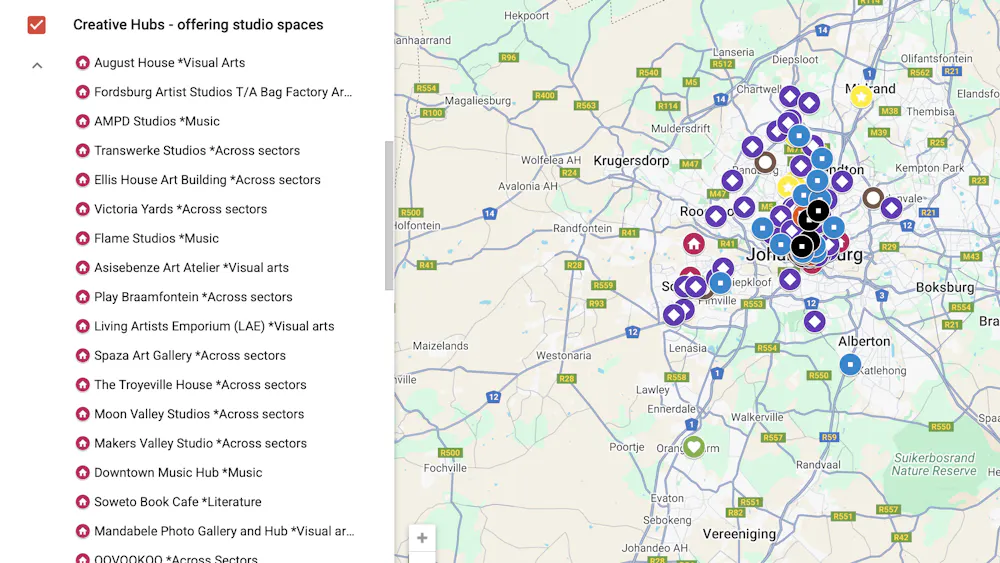
    Over the last year, 21 creative hubs have been mapped in the city, the majority newly established. Notable examples include Transwerke Studios, Asisebenze Art Atelier, Victoria Yards and Oovookoo. Remarkably, 19 of the 21 hubs identified in my open-source mapping process are in the inner city. Only two are government run – Transwerke and Downtown Music Hub.

    Across Johannesburg, creative hubs buzz with independent activity, yet share a common commitment to cultivating talent, business support and community impact. They are evidence of innovative partnerships between creatives and property developers.

    Inside these spaces, artists and creatives get opportunities through gallerist and investor visits (access to markets). They build practical and entrepreneurial skills through tailored workshops. And they collaborate on projects that place social upliftment at their heart.

    Some hubs focus on offering studio spaces, while others extend their reach beyond their walls, blending artistic expression with community development and public engagement.

    By actively building community and opportunity, creative hubs are becoming

    lighthouses for the new urban economy.

    They are small business incubators, urban beautification engines and potential cultural tourism hotspots. An event like Contra Fair opens the doors of art studio hubs once a year. Entrepreneur and social activist Tebogo Moalusi has now taken the lead in the establishment of Creative20. This will become a platform for revitalising Johannesburg’s creative cities campaign.

    Neglected by the city

    And yet the cultural and creative industries remain almost entirely absent from the city’s strategic planning. The Johannesburg 2040: Growth and Development Strategy fails even to mention the sector.

    This is despite Gauteng, the province that houses Johannesburg, being the epicentre of South Africa’s creative economy. It contributes 46.3% of the industry’s gross domestic product and generates the highest employment impact. Johannesburg hosts the majority of creative businesses in the province.


    Read more:
    The real Johannesburg: 6 powerful photos from a gritty new book on the city


    The Gauteng 2030 Strategy highlights three high-growth sectors: agro-processing, cultural and creative industries, and high-tech/knowledge sectors, including digital and gaming. Two of these directly involve the creative economy. Yet there’s been little effort to integrate them into Johannesburg’s urban development agenda.

    If Johannesburg is serious about inclusive economic development and sustainable urban growth, it must recognise and invest in the cultural and creative industries which are already thriving within its borders.

    Mariapaola McGurk consults to Creative20 Organisation

    ref. Johannesburg’s creative hubs are booming: how artists are rejuvenating a failing inner city – https://theconversation.com/johannesburgs-creative-hubs-are-booming-how-artists-are-rejuvenating-a-failing-inner-city-260224

    MIL OSI Analysis

  • MIL-OSI USA: NCDHHS, First Lady Anna Stein Celebrate Launch of Unshame NC, A Public Awareness Campaign to Reduce Stigma and Promote Evidence-Based Care for Substance Use Disorder

    Source: US State of North Carolina

    Headline: NCDHHS, First Lady Anna Stein Celebrate Launch of Unshame NC, A Public Awareness Campaign to Reduce Stigma and Promote Evidence-Based Care for Substance Use Disorder

    NCDHHS, First Lady Anna Stein Celebrate Launch of Unshame NC, A Public Awareness Campaign to Reduce Stigma and Promote Evidence-Based Care for Substance Use Disorder
    jawerner

    The North Carolina Department of Health and Human Services and First Lady Anna Stein, in collaboration with Shatterproof, announced the launch of the Unshame North Carolina (Unshame NC) campaign to end stigma related to substance use disorder. Unshame NC has two primary goals: to increase knowledge and awareness of substance use disorder and medications for opioid use disorder (MOUD) as a treatment option.

    “Stigma is deeply rooted and causes real harm to people and communities across North Carolina,” said NC Health and Human Services Secretary Dev Sangvai. “Unshame NC is part of a collaborative effort from all of us to end stigma, build acceptance and increase support for treatment for people on their path to recovery.”

    Many people struggling with substance use don’t seek help because of stigma,” said North Carolina First Lady Anna Stein. “This campaign will highlight the stories of people who have experience with substance use disorder and recovery and bring greater awareness to effective methods of treatment for opioid use disorder.”

    NCDHHS and First Lady Stein launched Unshame NC this morning at the Wake County Drug Overdose Prevention Coalition meeting. The website, https://www.unshamenc.org/ includes testimonials from North Carolinians sharing their personal stories of substance use, hope and recovery. Facebook and Instagram content will help drive users to the website, which provides links to resources, including information on how to find the right treatment center, and guidance for providers and for family members seeking care for a loved one. NCDHHS contracted with national non-profit Shatterproof to develop and implement the Unshame NC campaign.

    Recent data from a statewide survey indicates 57% of North Carolinians know someone with opioid use disorder. Despite this widespread issue, only 34% of North Carolina residents know how to find quality treatment for themselves or their loved ones. Additionally, only one in five adults in North Carolina recognizes that opioid use disorder is a medical condition. These findings highlight the urgent need for comprehensive education that connects people to lifesaving resources and treatment.

    “There’s no better evidence that recovery is real than a life changed,” said Kelly Crosbie, MSW LCSW, NCDHHS Director of the Division of Mental Health, Developmental Disabilities and Substance Use Services. “We’re pairing the stories of people in recovery with a statewide effort to increase access to MOUD, so more people can benefit from evidence-based care. Real access means supporting people on the recovery journey that makes sense for them, without judgment—and offering them every opportunity for lifesaving treatment, that includes MOUD.”

    Unshame NC focuses on the voices and experiences of North Carolinians impacted by substance use disorder. Through storytelling, education, and grassroots activation, the campaign demonstrates that people with substance use disorder are valued members of our communities—our family, neighbors, and coworkers—and highlights actionable ways we can ensure everyone has the support they need to thrive.

    “While most North Carolinians believe that people with SUD can recover with treatment, stigma and misinformation can create barriers to care,” said Courtney McKeon, Senior Vice President for Shatterproof’s National Stigma Initiative and longtime resident of The Research Triangle. “We see this often regarding medications for opioid use disorder (MOUD), a gold standard of care. Through the stories of North Carolinians, we have the opportunity to increase understanding of all treatment options and support individuals on their path to improved health and wellness.”

    “It’s not just about overdoses. It’s not just about lives that were lost or lives that were saved,” says Michael, one of Unshame NC’s story sharers. “It’s also about how we treat the people who went through it and how we bring them out of the shadows. How do we welcome them back into society? How do we get them back to where we need to be? And that requires a lot of folks like me to speak out and help break the stigma.”

    People with substance use disorder flourish in environments that offer both community support and multiple pathways for treatment. If you want to share your story with NCDHHS and Unshame NC, you can get involved by filling out a Story Sharer Interest Form or joining the Unshame NC coalition. 

    Follow @UnshameNC on Facebook and Instagram or visit us at www.UnshameNC.org to hear people’s stories and learn more.

    If you or someone you know is in crisis, NCDHHS provides somewhere to go, someone to talk to and someone to respond. You can find the help that is right for you 24/7 on the NCDHHS Crisis Services website.

    The 988 Lifeline Chat and Text – 988 Suicide & Crisis Lifeline is free, confidential, and available to everyone 24/7 by call, text, or chat.

    North Carolinians can call the 24/7 Peer Warmline at 1-855-PEERS NC (855-733-7762) to speak with a Peer Support Specialist. Peer Support Specialists (or “peers”) are people living in recovery with mental illness and/or substance use disorder who provide support to others who may have similar life experiences and can benefit from their lived experiences. 

    The NC Recovery Helpline (800-688-4232) offers support and referrals for treatment and resources.

    ###

    About Shatterproof

    Shatterproof is a national nonprofit organization dedicated to reversing the addiction crisis in the U.S. Shatterproof is focused on guiding communities, removing systemic barriers to recovery, mobilizing the country to advocate for change, and ending stigma in the United States. Find Shatterproof on Facebook, X, and YouTube or follow us on Instagram. To learn more, visit www.Shatterproof.org.

    El Departamento de Salud y Servicios Humanos de Carolina del Norte (NCDHHS, por sus siglas en inglés) y la Primera Dama Anna Stein, en colaboración con Shatterproof, anunciaron el lanzamiento de la campaña Unshame North Carolina (Unshame NC) para poner fin al estigma relacionado con el trastorno por consumo de sustancias. Unshame NC tiene dos objetivos principales: aumentar el conocimiento y la conciencia del trastorno por consumo de sustancias y los medicamentos para el trastorno por consumo de opioides (MOUD) como opción de tratamiento.

    “El estigma está profundamente arraigado y causa un daño real a las personas y comunidades de Carolina del Norte”, dijo el secretario de Salud y Servicios Humanos de Carolina del Norte, Dev Sangvai. “Unshame NC es parte de un esfuerzo de colaboración de todos nosotros para poner fin al estigma, generar aceptación y aumentar el apoyo para el tratamiento de las personas en su camino hacia la recuperación”.

    Muchas personas que luchan con el uso de sustancias no buscan ayuda debido al estigma”, dijo la primera dama de Carolina del Norte, Anna Stein. “Esta campaña destacará las historias de las personas que tienen experiencia con el trastorno por consumo de sustancias y la recuperación y generará una mayor conciencia sobre los métodos efectivos de tratamiento para el trastorno por consumo de opioides”.

    NCDHHS y la Primera Dama Stein lanzaron Unshame NC esta mañana en la reunión de la Coalición de Prevención de Sobredosis de Drogas del Condado de Wake. El sitio web, https://www.unshamenc.org/ incluye testimonios de habitantes de Carolina del Norte que comparten sus historias personales sobre el uso de sustancias, la esperanza y la recuperación. El contenido de Facebook e Instagram ayudará a dirigir a los usuarios al sitio web, que proporciona enlaces a recursos, incluso la información sobre cómo encontrar el centro de tratamiento adecuado, y orientación para los proveedores y para los familiares que buscan atención para un ser querido. NCDHHS contrató a la organización nacional sin fines de lucro Shatterproof para desarrollar e implementar la campaña Unshame NC.

    Datos recientes de una encuesta estatal indican que el 57% de los habitantes de Carolina del Norte conocen a alguien con trastorno por consumo de opioides. A pesar de este problema generalizado, solo el 34% de los residentes de Carolina del Norte saben cómo encontrar un tratamiento de calidad para ellos o sus seres queridos. Además, solo uno de cada cinco adultos en Carolina del Norte reconoce que el trastorno por uso de opioides es una afección médica. Estos hallazgos resaltan la necesidad urgente de una educación integral que conecte a las personas con recursos y tratamientos que salvan vidas.

    “No hay mejor evidencia de que la recuperación es real que una vida cambiada”, dijo Kelly Crosbie, MSW LCSW, Directora de NCDHHS de la División de Salud Mental, Discapacidades del Desarrollo y Servicios de Uso de Sustancias. “Estamos combinando las historias de las personas en recuperación con un esfuerzo estatal para aumentar el acceso a medicamentos para el trastorno por uso de opioides (MOUD, por sus siglas en inglés), para que más personas puedan beneficiarse de la atención basada en la evidencia. El acceso real significa apoyar a las personas en el viaje de recuperación que tiene sentido para ellas, sin juzgarlas, y ofrecerles todas las oportunidades para un tratamiento que salve vidas, esto incluye MOUD”.

    Unshame NC se centra en las voces y experiencias de los habitantes de Carolina del Norte afectados por el trastorno por consumo de sustancias. A través de la narración de historias, la educación y la movilización popular, la campaña demuestra que las personas con trastorno por uso de sustancias son miembros valiosos de nuestras comunidades (nuestra familia, vecinos y compañeros de trabajo) y destaca las formas prácticas en que podemos garantizar que todos tengan el apoyo que necesitan para prosperar.

    “Si bien la mayoría de los habitantes de Carolina del Norte creen que las personas con trastornos por uso de sustancias (SUD, por sus siglas en inglés) pueden recuperarse con tratamiento, el estigma y la desinformación pueden crear barreras para la atención”, dijo Courtney McKeon, vicepresidenta senior de la Iniciativa Nacional de Estigma de Shatterproof (Shatterproof’s National Stigma Initiative) y habitante desde hace mucho tiempo del Research Triangle. “Vemos esto a menudo con respecto a los medicamentos para el trastorno por uso de opioides (MOUD), un estándar de oro de atención. A través de las historias de los habitantes de Carolina del Norte, tenemos la oportunidad de aumentar la comprensión de todas las opciones de tratamiento y apoyar a las personas en su camino hacia una mejor salud y bienestar”.

    “No se trata solo de sobredosis. No se trata solo de vidas que se perdieron o de vidas que se salvaron”, dice Michael, uno de los participantes de la historia de Unshame NC. “También se trata de cómo tratamos a las personas que pasaron por eso y cómo las sacamos de las sombras. ¿Cómo los recibimos de nuevo a la sociedad? ¿Cómo conseguir que vuelvan a estar a donde tenemos que estar? Y eso requiere que mucha gente como yo hable y ayude a romper el estigma”.

    Las personas con trastorno por uso de sustancias prosperan en entornos que ofrecen tanto apoyo comunitario como múltiples vías de tratamiento. Si quiere compartir su historia con NCDHHS y Unshame NC, puedes participar completando un Formulario de interés para compartir historias o uniéndose a la coalición Unshame NC

    Siga @UnshameNC en Facebook y Instagram o visítenos en el sitio web; www.UnshameNC.org para escuchar las historias de las personas y obtener más información.

    Si usted o alguien que conoce está en crisis, NCDHHS proporciona un lugar a donde ir, alguien con quien hablar y alguien quien responde. Puede encontrar la ayuda adecuada para usted las 24 horas del día, los 7 días de la semana en el sitio web de Servicios de crisis de NCDHHS.

    La línea 988 de Prevención del Suicidio y Crisis (988 Lifeline Chat and Text – 988 Suicide & Crisis Lifeline) es gratuita, confidencial y está disponible para todos 24/7 por llamada, mensaje de texto o chat.

    Los habitantes de Carolina del Norte pueden llamar a la Línea de Ayuda de Pares al 1-855-PEERS NC (855-733-7762) para hablar con un Especialista en Apoyo de Pares. Los especialistas en apoyo entre pares (o “pares”) son personas que viven en recuperación con enfermedades mentales y/o trastornos por uso de sustancias quienes brindan apoyo a otras personas que pueden tener experiencias de vida similares y pueden beneficiarse de sus experiencias vividas. La línea de ayuda para Recuperación NC (NC Recovery Helpline) (800-688-4232) ofrece apoyo y referencias para tratamiento y recursos.

    ###

    Acerca de Shatterproof

    Shatterproof es una organización nacional sin fines de lucro dedicada a revertir la crisis de adicción en los EE. UU. Shatterproof se centra en guiar a las comunidades, eliminar las barreras sistémicas para la recuperación, movilizar al país para abogar por el cambio y poner fin al estigma en los Estados Unidos. Encuentra Shatterproof en Facebook, X y YouTube o síguenos en Instagram. Para obtener más información, visita www.Shatterproof.org.

    Jul 21, 2025

    MIL OSI USA News

  • MIL-OSI Security: Giovanni Vicente Mosquera Serrano Added to FBI’s Ten Most Wanted Fugitives List

    Source: US FBI

    In June 2025, the U.S. District Court for the Southern District of Texas issued a federal arrest warrant for Mosquera Serrano after he was charged with conspiring to provide and providing material support to a foreign terrorist organization, as well as conspiracy and distribution of cocaine in Colombia intended for distribution in the U.S.

    Formed in the early 2010s, TdA has recently exploded in membership and criminal activity in the U. S.

    “At first, TdA was primarily composed of former inmates and individuals from Venezuela,” said Soyez. “Over time, the gang and the organization evolved. They became a more structured and powerful criminal group involved in various activities, including drug trafficking, extortion, and human trafficking.”

    The gang’s influence has spread throughout Latin America and into the U.S., and they have established major networks for drug distribution, weapons trafficking, and human trafficking—and have even partnered with other criminal organizations.

    For law enforcement trying to protect their communities, this transnational organized crime system creates a challenge.

    “What we’ve seen over time, as we look back in our history dealing with transnational organized crime, is how quickly these criminal organizations can spread,” said Soyez. “We know the instability they can cause to our cities and our communities, and so I think from the FBI’s perspective, it’s something we want to be ahead of.”

    The FBI and law enforcement partners are focused on finding these dangerous criminals and bringing justice to victims of their crimes. Adding Mosquera Serrano to the Ten Most Wanted Fugitives list provides an opportunity for law enforcement to work with the public in fighting transnational organized crime across the country.

    “With TdA, we’ve seen instances of extreme violence and intimidation, causing a terror in our communities,” said Soyez. “Naming Mosquera Serrano as a Top Ten fugitive really highlights TdA and shows our aggressiveness to go after its leadership.”

    Mosquera Serrano is 37 years old and has black hair and brown eyes. He is a Venezuelan national and speaks Spanish. Aliases include Jhovanni San Vicente, “El Viejo,” and Jhovanni Vicente Mosquera Serrano.

    Investigators believe that Mosquera Serrano may be in Venezuela or Colombia and that he should be considered armed and dangerous.

    “The FBI, along with our federal partners and international partners, can seek justice in foreign countries, and so, we would encourage those with any information, whether it’s inside the U.S. or another country, to please report that information because the FBI has the ability to bring justice and arrest Mosquera Serrano, even if it’s not within the United States,” said Soyez.

    If you have any information about Mosquera Serrano, please contact your local FBI office or the nearest American embassy or consulate or call the FBI at 1-800-CALL-FBI (1-800-225-5324). You can also submit a tip online at tips.fbi.gov or contact the FBI via WhatsApp at 571-379-3951. WhatsApp is neither a government-operated nor a government-controlled platform.

    MIL Security OSI

  • MIL-OSI Security: NATO Secretary General highlights new opportunity for support at Ukraine Defence Contact Group meeting

    Source: NATO

    On Monday (21 July 2025) NATO Secretary General Mark Rutte took part in an online meeting of the Ukraine Defence Contact Group (UDCG). The meeting was hosted by the German Minister of Defence, Boris Pistorius, and the UK Defence Secretary, John Healey.

    Speaking to Defence Ministers who joined for the meeting, the Secretary General highlighted the initiative that he and US President Donald J Trump announced last week to boost support for Ukraine by opening additional US assets to Ukraine through investment by Allies in Europe and Canada. This new initiative is open-ended and has already seen numerous Allies express interest in contributing. It complements a range of other initiatives through which Allies support Ukraine and provides new access to US equipment and technology that Ukraine has requested for urgent delivery. This voluntary effort will be coordinated by NATO, given the experience and infrastructure the Alliance provides, including through its command in Wiesbaden, Germany – NATO Security Assistance and Training for Ukraine (NSATU) – that is already coordinating support for Ukraine and has logistical hubs in the eastern part of the Alliance. The UDCG will also continue to play a vital role.

    This initiative and others bring together the three key decisions made by leaders at the NATO Summit in The Hague just a few weeks ago: increasing defence investment, ramping up defence production, and supporting Ukraine. The aim of all Allied security assistance to Ukraine is to bring the conflict to a just and lasting end as quickly as possible.

    MIL Security OSI

  • MIL-OSI Africa: African media are threatened by governments and big tech – book tracks the latest trends

    Source: The Conversation – Africa – By Hayes Mabweazara, Senior Lecturer in Sociological & Cultural Studies (Media, Culture & Society), University of Glasgow

    Media capture happens when media outlets lose their independence and fall under the influence of political or financial interests. This often leads to news content that favours power instead of public accountability.

    Media Capture in Africa and Latin America: Power and Resistance is a new book edited by news media scholars Hayes Mawindi Mabweazara and Bethia Pearson. It explores how this dynamic plays out in the global south and how journalists and citizens are resisting it. We asked them four questions.


    What is media capture and how has it reshaped itself in recent times?

    Media capture describes how media outlets are influenced, manipulated or controlled by powerful actors – often governments or large corporations – to serve their interests. It’s an idea that helps us understand how powerful groups in society can have a negative influence on news media. While this idea isn’t new, what has changed is how subtly and pervasively it now operates.

    These groups include big technology organisations that own digital media platforms – such as X, owned by xAI (Elon Musk), and Instagram and Facebook, owned by Meta. But it’s also important to consider Google as a large search engine that shapes the news content and audience of many other platforms.

    Palgrave Macmillan

    This matters because the media are important for the functioning of democratic societies. Ideally, they provide information, represent different groups and issues in society, and hold powerful actors to account.

    For example, one of the key roles of the media is to provide accurate information for citizens to be able to decide how to vote in elections. Or to decide what they think about important issues. One big concern, then, is the effect of inaccurate or biased information on democracy.

    Or it might be that accurate information is harder to access because algorithms and platforms make it easier to access inaccurate or biased information. These can be intended and unintended consequences of the technology itself, but algorithms can amplify misinformation and fake news – especially if this content has the potential to go viral.

    So, what’s particular about media capture in the global south?

    This is a really interesting question that is still being investigated, but we have some ideas.

    First of all, it’s useful to know that media capture scholarship from the global north emerged around the time of the 2008 financial crisis. The influence of financial institutions on business journalists was one of the first areas of study. Since then, research in the US has focused on the capture of government-funded media organisations like Voice of America. And on how digital platforms like Google and Facebook can lead to capture.

    In the global south, scholars have drawn attention to the importance of large media corporations in understanding media capture. For example, in Latin America, there’s a high level of what’s called “media concentration”. This is when many media outlets are owned by a few companies. These companies often own companies in other sectors, which means that critical reporting on business interests presents a conflict of interest.


    Read more: Public trust in the media is at a new low: a radical rethink of journalism is needed


    But to focus on Africa, scholars have drawn attention to governments as a source of pressure on journalists and editors. This can be through direct pressure or what we might call “covert” pressure. Withholding advertising that helps to fund media outlets is an example, or offering financial incentives to stop investigating certain topics.

    Researchers are also concerned about the influence of big tech in Africa. Digital platforms like Google and Facebook can shape the news and information that citizens have access to.

    Can you share some of the studies from the book?

    Our book includes many interesting studies – from Colombia, Brazil and Mexico in Latin America to Ethiopia and Morocco in Africa. We’ll share a few African cases here to give an overview of the issues.

    The book’s contribution on Ghana warns us that although more overt “old” types of media capture may have subsided, transitional democracies can feature messier, more nuanced forms of media control. This can be evident in government pressures and through capture of regulators.

    In the Morocco chapter, we see the threat to media freedom presented by digital platforms owned by global tech giants. This is known as “infrastructural capture”. It means news organisations become dependent on tech giants to set the rules of the game for democratic communication.

    Another compelling case is Nigeria, where researchers explore ties between media ownership and political patronage. The authors argue that the Nigerian press is failing in its democratic duty because of its reliance on advertising and sponsorship income from the state. Added to this are ineffective regulatory mechanisms and close relationships with some big businesses that own newspapers and printing presses.

    How can media capture be resisted in the global south?

    The studies in the book show some ways forward and we do think it’s important to be optimistic! Resistance takes many forms. Sometimes it comes through legal and policy reform aimed at increasing transparency and media diversity. In other cases, it’s driven by social movements, investigative journalists and independent media who continue to operate under pressure.

    The chapter on Uganda shows that journalist groups working with media advocacy organisations can strategically act to resist government media capture and harmful regulations. For example, to push back against one legislative change, several groups formed a temporary network called Article 29 (named after the article in the Ugandan constitution protecting free speech) and the African Centre for Media Excellence produced a report criticising the proposed changes.


    Read more: Western media outlets are trying to fix their racist, stereotypical coverage of Africa. Is it time African media did the same?


    One of the chapters on Ghana also shows how networks such as journalists, media associations, human rights groups and legal organisations can mobilise to push back against government influence. Organisations including the Ghana Journalists Association and Ghana Independent Broadcasters Association have played key roles in, for example, taking the media regulator to court to overturn laws that would have led to censorship. These findings are echoed in Latin America, where research on Mexico and Colombia also found professional journalism to be a strong source of resistance.

    The conversation must also include rethinking how we define capture itself. If we frame it only as total control, we risk missing the everyday ways influence operates – and the spaces where it can be resisted. We would also say it’s really important that citizens are aware and alert to the issues when they think about how they access news media and what platforms they use. This is sometimes called “media literacy” and is about people being more knowledgeable about where trustworthy news comes from.


    You can listen to a podcast about the book over here.

    – African media are threatened by governments and big tech – book tracks the latest trends
    – https://theconversation.com/african-media-are-threatened-by-governments-and-big-tech-book-tracks-the-latest-trends-258017

    MIL OSI Africa

  • MIL-OSI Africa: Johannesburg’s creative hubs are booming: how artists are rejuvenating a failing inner city

    Source: The Conversation – Africa – By Mariapaola McGurk, Lecturer in Innovation & Entrepreneurship, University of Auckland, Waipapa Taumata Rau

    Johannesburg is weathering a storm of crises. Nowhere is its complex tangle of challenges more visible than in the inner city, where crime, overcrowding, and infrastructure collapse – such as roads literally exploding – paint a grim picture. Cultural institutions haven’t been spared either, with long-standing landmarks like the Johannesburg Art Gallery caught in cycles of neglect and crisis.


    Read more: South Africa doesn’t need new cities: it needs to focus on fixing what it’s got


    Yet, while many avoid the inner city or speak only of its decline, the creative and cultural practitioners of Johannesburg never left. In fact, artists, architects, fashion designers, animators, musicians and the like have been hard at work. They’re building, dreaming and shaping a new urban reality that could become the beacon of hope this city needs.

    As a researcher and visual artist, I recently completed a PhD study that focused on Johannesburg’s cultural and creative industries. My research revealed that a clear understanding of the existing structures and dynamics within this industry is essential for developing effective strategies to strengthen its role in local economic development.

    Here I explore one such opportunity: creative hubs. I argue that they represent a low-hanging fruit for the inner city’s growth and revitalisation.

    Urban renewal

    Numerous articles have explored strategies for the city’s economic development and urban renewal. One group of scholars recently outlined four critical focus areas: coordinated efforts across government levels; an active civil society; a shift in political culture; and restored leadership in a revitalised administration.

    These are vital interventions, but they still beg a deeper question. What is the new “gold” of the “City of Gold”, the mining town founded in 1886 and on track to become a megacity by 2030?

    Work by artist Candice Kramer at Bag Factory Artists Studios. Mark Straw

    What is it that truly sets Johannesburg apart, nationally and globally? What strengths already exist that, if nurtured, could help address the city’s challenges? The answer may not lie in building something entirely new, but in recognising and investing in what already thrives. The city’s people, its culture, and its extraordinary creativity.

    In 2004, Unesco launched the Creative Cities Network. Today it comprises 246 cities in 80 member states. South Africa has three cities in the network: Cape Town (design), Durban (literature) and Overstrand (gastronomy). Johannesburg has never applied to belong.

    Cities are acknowledging the economic and social value of the cultural and creative industries, particularly in addressing challenges such as youth unemployment, micro-enterprise growth, equity and community development.

    Artist Mankebe Seakoe at Contra Fair. Mark Straw

    Yet cities globally are grappling with how to retain creative professionals. This is the case in cities like Toronto, Sydney, Los Angeles, Cologne or Barcelona. Rising property prices, the redevelopment of industrial areas into commercial or luxury spaces, and short-term rental agreements are displacing these professionals from the urban cores they help energise. Cities are coming up with incentives and programmes to correct this.

    A recent World Cities Cultural Forum report offers a solution in the form of Creative Land Trusts. These permanently hold land and assets at affordable rates for creatives. They take property out of speculative real estate markets. They’re designed to support not galleries or theatres, but the studios and workspaces where creative production actually happens.

    Similar initiatives are happening in London, Helsinki and San Francisco.

    Mapping Johannesburg’s creative hubs

    Unlike cities that are trying to reverse the exodus of creatives, Johannesburg’s inner city has seen a recent surge in creative hub development.

    A creative hub is a physical or digital space (in this case physical) designed to bring together cultural and creative professionals for studio space, collaboration, networking and the exchange of ideas.

    Some creative hubs offer gallery spaces. Mark Straw

    Over the last year, 21 creative hubs have been mapped in the city, the majority newly established. Notable examples include Transwerke Studios, Asisebenze Art Atelier, Victoria Yards and Oovookoo. Remarkably, 19 of the 21 hubs identified in my open-source mapping process are in the inner city. Only two are government run – Transwerke and Downtown Music Hub.

    Across Johannesburg, creative hubs buzz with independent activity, yet share a common commitment to cultivating talent, business support and community impact. They are evidence of innovative partnerships between creatives and property developers.

    Mapping Johannesburg’s creative hubs. Google Maps/Mariapaola McGurk

    Inside these spaces, artists and creatives get opportunities through gallerist and investor visits (access to markets). They build practical and entrepreneurial skills through tailored workshops. And they collaborate on projects that place social upliftment at their heart.

    Some hubs focus on offering studio spaces, while others extend their reach beyond their walls, blending artistic expression with community development and public engagement.

    By actively building community and opportunity, creative hubs are becoming

    lighthouses for the new urban economy.

    They are small business incubators, urban beautification engines and potential cultural tourism hotspots. An event like Contra Fair opens the doors of art studio hubs once a year. Entrepreneur and social activist Tebogo Moalusi has now taken the lead in the establishment of Creative20. This will become a platform for revitalising Johannesburg’s creative cities campaign.

    Neglected by the city

    And yet the cultural and creative industries remain almost entirely absent from the city’s strategic planning. The Johannesburg 2040: Growth and Development Strategy fails even to mention the sector.

    Bag Factory Artists Studios hosting a public event. Mark Straw

    This is despite Gauteng, the province that houses Johannesburg, being the epicentre of South Africa’s creative economy. It contributes 46.3% of the industry’s gross domestic product and generates the highest employment impact. Johannesburg hosts the majority of creative businesses in the province.


    Read more: The real Johannesburg: 6 powerful photos from a gritty new book on the city


    The Gauteng 2030 Strategy highlights three high-growth sectors: agro-processing, cultural and creative industries, and high-tech/knowledge sectors, including digital and gaming. Two of these directly involve the creative economy. Yet there’s been little effort to integrate them into Johannesburg’s urban development agenda.

    If Johannesburg is serious about inclusive economic development and sustainable urban growth, it must recognise and invest in the cultural and creative industries which are already thriving within its borders.

    – Johannesburg’s creative hubs are booming: how artists are rejuvenating a failing inner city
    – https://theconversation.com/johannesburgs-creative-hubs-are-booming-how-artists-are-rejuvenating-a-failing-inner-city-260224

    MIL OSI Africa

  • MIL-OSI Africa: Ghana has a rare treasure, a crater made when a meteor hit Earth: why it needs to be protected

    Source: The Conversation – Africa – By Marian Selorm Sapah, Senior lecturer, University of Ghana

    Impact craters are formed when an object from space such as a meteoroid, asteroid or comet strikes the Earth at a very high velocity. This leaves an excavated circular hole on the Earth’s surface.

    It is a basic geological process that has shaped the planets from their formation to today. It creates landscapes and surface materials across our solar system. The moon is covered with them, as are planets like Mercury, Mars and Venus. On Earth, impacts have influenced the evolution of life and even provided valuable mineral and energy resources. However, very few of the impact craters on Earth are visible because of various processes that obscure or erase them.

    Most of the recognised impact craters on Earth are buried under sediments or have been deeply eroded. That means they no longer preserve their initial forms.

    The Bosumtwi impact crater in Ghana is different, however. It is well preserved (not deeply eroded or buried under sediments). Its well-defined, near-circular basin, filled by a lake, is surrounded by a prominent crater rim that rises above the surface of the lake and an outer circular plateau. This makes it a target for several research questions.

    As an Earth scientist, I joined a research team from 2019 to better understand the morphology of the crater. We carried out a morphological analysis of the crater (a study of its form, structure and geological features).

    This study concluded that the activities of illegal miners are a threat to the sustainability of the crater. We also discovered that the features of the Bosumtwi impact crater can be considered as a terrestrial representation for a special type of impact crater known as rampart craters. These are common on the planets Mars and Venus and are found on icy bodies of the outer solar system (like Ganymede, Europa, Dione, Tethys and Charon).

    For future studies, the Bosumtwi impact crater can be used to help understand how rampart craters form on Mars and Venus. So the Bosumtwi impact crater should be protected and preserved.


    Read more: Curious Kids: Why are there so few impact craters on Earth?


    The crater

    The Bosumtwi impact crater is in Ghana’s mineral-rich Ashanti gold belt. It is the location of the only natural inland lake in Ghana. As one of the world’s best-preserved young meteorite impact craters it is designated as an International Union of Geological Sciences geoheritage site.

    It is one of only 190 confirmed impact crater sites worldwide, one of only 20 on the African continent. Its lake is one of six meteoritic lakes in the world, recognised for their outstanding scientific value.

    Satellite view of the Bosumtwi Impact Crater showing areas of Artisanal and Small scale Gold Mining activities. David Baratoux

    At almost 1.07 million years old, the crater offers unparalleled opportunities for studying impact processes, climate history and planetary evolution. It’s an irreplaceable natural laboratory for researchers and educators.

    Beyond its scientific importance, the crater holds cultural significance for the Ashanti people of Ghana. The lake at its centre serves as a sacred site and spiritual landmark. The crater’s breathtaking landscape also supports eco-tourism and local livelihoods, contributing to Ghana’s economic development while maintaining exceptional aesthetic value.

    The research

    As part of further research work on the 2019 study, in 2025 we have discovered through field work and satellite data analysis that illegal artisanal mining is prevalent in the area and threatening the crater. This refers to informal, labour-intensive extraction of minerals, primarily gold. It is conducted by individuals or small groups using basic tools and rudimentary machinery. The use of toxic chemicals such as mercury and cyanide, and practices such as river dredging, cause severe environmental harm.

    Illegal miners are encroaching on and around the crater rim, posing severe threats to its environment and sustainability. Their activities have become more prevalent over the course of less than 10 years, indicating a growing problem. If unchecked, it could lead to irreversible damage to the crater.

    These mining operations risk contaminating the lake with toxic heavy metals. The consequences of these are grave. They include destroying critical geological evidence, accelerating deforestation, and degrading the land. All this damages the crater’s scientific, cultural and economic value.

    The International Union of Geological Sciences geoheritage designation of the crater underscores the urgent need for protection measures. The loss of this rare geological wonder would represent not just a national tragedy for Ghana, but a blow to global scientific heritage.

    Immediate action is required. This includes enhanced satellite monitoring (tracking illegal mining, deforestation and environmental changes) using optical imagery (such as Sentinel-2, Landsat, PlanetScope). These tools can detect forest loss, identify mining pits and sediment runoff, and analyse changes over time.

    Stricter enforcement of mining bans, and community engagement programmes, will help preserve the Bosumtwi impact crater’s unique attributes for future generations of scientists, students, tourists and local communities who depend on its resources.

    – Ghana has a rare treasure, a crater made when a meteor hit Earth: why it needs to be protected
    – https://theconversation.com/ghana-has-a-rare-treasure-a-crater-made-when-a-meteor-hit-earth-why-it-needs-to-be-protected-260600

    MIL OSI Africa

  • MIL-OSI Africa: Africa’s minerals are being bartered for security: why it’s a bad idea

    Source: The Conversation – Africa – By Hanri Mostert, SARChI Chair for Mineral Law in Africa, University of Cape Town

    A US-brokered peace deal between the Democratic Republic of Congo (DRC) and Rwanda binds the two African nations to a worrying arrangement: one where a country signs away its mineral resources to a superpower in return for opaque assurances of security.

    The peace deal, signed in June 2025, aims to end three decades of conflict between the DRC and Rwanda.

    A key part of the agreement binds both nations to developing a regional economic integration framework. This arrangement would expand cooperation between the two states, the US government and American investors on “transparent, formalized end-to-end mineral chains”.

    Despite its immense mineral wealth, the DRC is among the five poorest countries in the world. It has been seeking US investment in its mineral sector.

    The US has in turn touted a potential multi-billion-dollar investment programme to anchor its mineral supply chains in the traumatised and poor territory.

    The peace that the June 2025 deal promises, therefore, hinges on chaining mineral supply to the US in exchange for Washington’s powerful – but vaguely formulated – military oversight.

    The peace agreement further establishes a joint oversight committee – with representatives from the African Union, Qatar and the US – to receive complaints and resolve disputes between the DRC and Rwanda.

    But beyond the joint oversight committee, the peace deal creates no specific security obligations for the US.

    The relationship between the DRC and Rwanda has been marred by war and tension since the bloody First (1996-1997) and Second (1998-2003) Congo wars. At the heart of much of this conflict is the DRC’s mineral wealth. It has fuelled competition, exploitation and armed violence.

    This latest peace deal introduces a resources-for-security arrangement. Such deals aren’t new in Africa. They first emerged in the early 2000s as resources-for-infrastructure transactions. Here, a foreign state would agree to build economic and social infrastructure (roads, ports, airports, hospitals) in an African state. In exchange, it would get a major stake in a government-owned mining company. Or gain preferential access to the host country’s minerals.

    We have studied mineral law and governance in Africa for more than 20 years. The question that emerges now is whether a US-brokered resources-for-security agreement will help the DRC benefit from its resources.

    Based on our research on mining, development and sustainability, we believe this is unlikely.

    This is because resources-for-security is the latest version of a resource-bartering approach that China and Russia pioneered in countries such as Angola, the Central African Republic and the DRC.

    Resource bartering in Africa has eroded the sovereignty and bargaining power of mineral-rich nations such as the DRC and Angola.

    Further, resources-for-security deals are less transparent and more complicated than prior resource bartering agreements.

    DRC’s security gaps

    The DRC is endowed with major deposits of critical minerals like cobalt, copper, lithium, manganese and tantalum. These are the building blocks for 21st century technologies: artificial intelligence, electric vehicles, wind energy and military security hardware. Rwanda has less mineral wealth than its neighbour, but is the world’s third-largest producer of tantalum, used in electronics, aerospace and medical devices.

    For almost 30 years, minerals have fuelled conflict and severe violence, especially in eastern DRC. Tungsten, tantalum and gold (referred to as 3TG) finance and drive conflict as government forces and an estimated 130 armed groups vie for control over lucrative mining sites. Several reports and studies have implicated the DRC’s neighbours – Rwanda and Uganda – in supporting the illegal extraction of 3TG in this region.

    The DRC government has failed to extend security over its vast (2.3 million square kilometres) and diverse territory (109 million people, representing 250 ethnic groups). Limited resources, logistical challenges and corruption have weakened its armed forces.

    This context makes the United States’ military backing enormously attractive. But our research shows there are traps.

    What states risk losing

    Resources-for-infrastructure and resources-for-security deals generally offer African nations short-term stability, financing or global goodwill. However, the costs are often long-term because of an erosion of sovereign control.

    Here’s how this happens:

    Examples of loss or near-loss of sovereignty from these sorts of deals abound in Africa.

    For instance, Angola’s US$2 billion oil-backed loan from China Eximbank in 2004. This was repayable in monthly deliveries of oil, with revenues directed to Chinese-controlled accounts. The loan’s design deprived Angolan authorities of decision-making power over that income stream even before the oil was extracted.

    These deals also fragment accountability. They often span multiple ministries (such as defence, mining and trade), avoiding robust oversight or accountability. Fragmentation makes resource sectors vulnerable to elite capture. Powerful insiders can manipulate agreements for private gain.

    In the DRC, this has created a violent kleptocracy, where resource wealth is systematically diverted away from popular benefit.

    Finally, there is the risk of re-entrenching extractive trauma. Communities displaced for mining and environmental degradation in many countries across Africa illustrate the long-standing harm to livelihoods, health and social cohesion.

    These are not new problems. But where extraction is tied to security or infrastructure, such damage risks becoming permanent features, not temporary costs.

    What needs to change

    Critical minerals are “critical” because they’re hard to mine or substitute. Additionally, their supply chains are strategically vulnerable and politically exposed. Whoever controls these minerals controls the future. Africa must make sure it doesn’t trade that future away.

    In a world being reshaped by global interests in critical minerals, African states must not underestimate the strategic value of their mineral resources. They hold considerable leverage.

    But leverage only works if it is wielded strategically. This means:

    • investing in institutional strength and legal capacity to negotiate better deals

    • demanding local value creation and addition

    • requiring transparency and parliamentary oversight for minerals-related agreements

    • refusing deals that bypass human rights, environmental or sovereignty standards.

    Africa has the resources. It must hold on to the power they wield.

    – Africa’s minerals are being bartered for security: why it’s a bad idea
    – https://theconversation.com/africas-minerals-are-being-bartered-for-security-why-its-a-bad-idea-260594

    MIL OSI Africa

  • MIL-OSI Africa: Unlocking Africa’s E-Mobility Future: Upcoming Webinar on Public Transport Electrification

    Source: APO

    Electrifying public transport is no longer just an aspiration for Africa—it is rapidly becoming a reality. On Wednesday, 23 July 2025, stakeholders from across the continent and beyond will convene virtually to explore the path forward in a high-impact webinar where industry experts discuss “The Future of Public Transport Electrification in Africa: Opportunities, Trends and Challenges.”

    The webinar will focus on unlocking practical solutions and scalable models to accelerate the shift to zero-emission mobility—particularly electric buses and paratransit systems, which form the backbone of Africa’s urban mobility landscape.

    Key Themes:

    • Energy and Charging Infrastructure
      Practical strategies for grid preparedness, depot-based and on-route charging, and strengthening public-private collaboration.
    • Innovative Procurement Models
      An exploration of models such as leasing, pay-as-you-go, and city-led ownership—what’s working, and where?
    • Electrifying Paratransit
      Addressing one of Africa’s most vital and informal transport systems—minibus taxis and other modes—and how e-mobility can integrate meaningfully into this space.

    Moderator:

    Prian Reddy, Senior Programme Manager: Zero Emission Buses (Africa), C40 Cities

    Expert Panel:

    • Hans van Toor, Strategy & Innovation, Roam
    • Moses Nderitu, Managing Director, BasiGo
    • Justin Coetzee, Founder, GoMetro

    Why You Should Attend:

    • Hear real-world insights from cities and transport operators already rolling out electric buses.
    • Learn about infrastructure readiness, energy strategies, and funding models fit for African cities.
    • Explore how electrification can include and uplift paratransit and informal transport sectors.
    • Connect with the experts and decision-makers shaping Africa’s low-carbon transport future.

    This event is designed for public officials, transport authorities, urban planners, mobility innovators, infrastructure investors, and all professionals interested in the continent’s clean, just energy transition.

    Join us for a crucial conversation that will help define the next phase of Africa’s transport transformation.

    Date: Wednesday, 23 July 2025
    Time: 10:00 WAT / 11:00 SAST & CAT / 12:00 EAT
    Register here: https://apo-opa.co/44GYAlJ

    Distributed by APO Group on behalf of VUKA Group.

    Additional Information:
    Link to Webinar: https://apo-opa.co/44GYAlJ 
    LinkedIN: https://apo-opa.co/4f24pxt 
    Website: https://apo-opa.co/40vphHw 
    Draft Programme: https://apo-opa.co/4f0Nxr4

    Media files

    .

    MIL OSI Africa

  • MIL-OSI Africa: Kaspersky: Advanced Persistent Threat (APT41) targets Southern African organisation in espionage attack

    Source: APO

    Kaspersky Managed Detection and Response experts (www.Kaspersky.co.za) have observed a cyber espionage attack on an organisation in Southern African and have linked it to the Chinese-speaking  APT41 group. Although the threat actor has shown limited activity in Southern Africa, this incident reveals that the cyber attackers have targeted government IT services in one of the countries in the region, attempting to steal sensitive corporate data — including credentials, internal documents, source code, and communications.

    APT (Advanced Persistent Threat) is a category of threat actors known for carrying out concerted, stealthy, and ongoing attacks against specific organisations, as opposed to opportunistic, isolated incidents that account for most cybercriminal activity. The adversaries’ techniques observed during the attack in Southern Africa allowed Kaspersky to attribute it to the Chinese-speaking APT41 group with a high confidence. The primary goal of the attack was cyber espionage, which is typical for this threat actor. The attackers attempted to collect sensitive data from the machines they compromised within the organisation’s network.

    It is noteworthy that APT41 typically has been showing quite limited activity in the Southern African region. APT41 specialises in cyber espionage and targets organisations across various industries, including telecommunications providers, educational and healthcare institutions, IT, energy, and other sectors, with known activity in at least 42 countries.

    Based on Kaspersky experts’ analysis, the attackers may have gained access to the organisation’s network through a web server exposed to the Internet. Using a credential harvesting technique – known in professional terms as registry dumping – the attackers obtained two corporate domain accounts: one with local administrator rights on all workstations and another belonging to a backup solution, which had domain administrator privileges. These accounts allowed the attackers to compromise additional systems within the organisation.

    One of the stealers used for data collection was a modified Pillager utility, designed for exporting and decrypting data. The attackers compiled its code from an executable file into a Dynamic Link Library (DLL). With it, they aimed to gather saved credentials from browsers, databases, administrative tools, as well as project source code, screenshots, active chat sessions and their data, email correspondence, lists of installed software, operating system credentials, Wi-Fi credentials, and other information.

    The second stealer used during the attack was Checkout. In addition to saved credentials and browser history, it was also capable of collecting information on downloaded files and browser-stored credit card data. The attackers also used the RawCopy utility and a version of Mimikatz compiled as a Dynamic Link Library (DLL) to dump registry files and credentials, as well as Cobalt Strike for Command and Control (C2) communication on compromised hosts.

    “Interestingly, as one of their C2 communication channels besides Cobalt Strike, the attackers chose the SharePoint server within the victim’s infrastructure. They communicated with it using custom C2 agents connected with a web-shell. They may have chosen SharePoint because it was an internal service already present in the infrastructure and unlikely to raise suspicion. Moreover, in that case, it probably offered the most convenient way to exfiltrate data and control compromised hosts through a legitimate communication channel,” explains Denis Kulik, Lead SOC Analyst at Kaspersky Managed Detection and Response service.

    “In general, defending against such sophisticated attacks is impossible without comprehensive expertise and continuous monitoring of the entire infrastructure. It is essential to maintain full security coverage across all systems with solutions capable of automatically blocking malicious activity at an early stage — and to avoid granting user accounts excessive privileges,” comments Denis Kulik.

    To mitigate or prevent similar attacks, organisations are advised to follow these best practices:

    • Ensure that security agents are deployed on all workstations within the organisation without exception, to enable timely incident detection and minimise potential damage.
    • Review and control service and user account privileges, avoiding excessive rights assignments – especially for accounts used across multiple hosts within the infrastructure.
    • To protect the company against a wide range of threats, use solutions from the Kaspersky Next (https://apo-opa.co/44EI2e3) product line that provide real-time protection, threat visibility, investigation and the response capabilities of EDR and XDR for organisations of any size and industry. Depending on your current needs and available resources, you can choose the most relevant product tier and easily migrate to another one if your cybersecurity requirements are changing.
    • Adopt managed security services by Kaspersky such as Compromise Assessment (https://apo-opa.co/4m8aElL), Managed Detection and Response (MDR) (https://apo-opa.co/4m6do37) and / or Incident Response (https://apo-opa.co/44VsAsP), covering the entire incident management cycle – from threat identification to continuous protection and remediation.  They help to protect against evasive cyberattacks, investigate incidents and get additional expertise even if a company lacks cybersecurity workers.
    • Provide your InfoSec professionals with an in-depth visibility into cyberthreats targeting your organisation. The latest Kaspersky Threat Intelligence (https://apo-opa.co/3TQbRlK) will provide them with rich and meaningful context across the entire incident management cycle and helps them identify cyber risks in a timely manner.

    A detailed analysis of the incident is available on Securelist (https://apo-opa.co/46mfGGS).

    Kaspersky Managed Detection and Response service monitors suspicious activity and helps organisations respond swiftly to minimise impact. This is a part of Kaspersky Security Services, a team delivering hundreds of information security projects every year for Fortune Global 500 organisations: incident response, managed detection, SOC consulting, red teaming, penetration testing, application security, digital risks protection. 

    Distributed by APO Group on behalf of Kaspersky.

    For further information please contact:
    Nicole Allman
    nicole@inkandco.co.za

    Social Media:
    Facebook: https://apo-opa.co/414B7bE
    X: https://apo-opa.co/4lYjIJQ
    YouTube: https://apo-opa.co/452Opa9
    Instagram: https://apo-opa.co/4lGn6JK
    Blog: https://apo-opa.co/4l8kweB

    About Kaspersky:
    Kaspersky is a global cybersecurity and digital privacy company founded in 1997. With over a billion devices protected to date from emerging cyberthreats and targeted attacks, Kaspersky’s deep threat intelligence and security expertise is constantly transforming into innovative solutions and services to protect individuals, businesses, critical infrastructure, and governments around the globe. The company’s comprehensive security portfolio includes leading digital life protection for personal devices, specialized security products and services for companies, as well as Cyber Immune solutions to fight sophisticated and evolving digital threats. We help millions of individuals and over 200,000 corporate clients protect what matters most to them. Learn more at www.Kaspersky.co.za

    Media files

    .

    MIL OSI Africa

  • MIL-OSI Africa: Morocco: African Development Bank approves €100 Million to empower women and youth entrepreneurs in building inclusive and sustainable agriculture

    Source: APO

    The Board of Directors of the African Development Bank Group (www.AfDB.org) has approved a €100 million loan to support Morocco’s inclusive solidarity-based agriculture program, focused on empowering women and young people.

    The project aims to generate sustainable economic opportunities for women and youth, boost food security, and strengthen the resilience of small-scale farming against climate change. It will stimulate entrepreneurship through tailored financing and incentive mechanisms and by bolstering technical and financial support systems.

    The program will also facilitate the deployment of new agricultural production and service infrastructure, helping to anchor women in local value chains, strengthen their skills, and boost their productivity. These actions will encourage the emergence of women entrepreneurs across agriculture, agro-processing and digital technologies. It will support the new roadmap for employment by promoting rural entrepreneurship.

    “Women who have the ambition to undertake and succeed in agriculture are our priority,” said Achraf Tarsim, head of the African Development Bank country office in Morocco. “Through this new operation, we will support them step by step to build a modern, inclusive and resilient agriculture, capable of revealing the full potential of those who aspire to innovate and create value and employment in their territories.”

    Aligned with Morocco’s priorities, the program will support the implementation of the Green Generation 2020-2030 Strategy, Morocco’s plan for transforming agriculture into a more inclusive, sustainable and efficient sector; the National Solidarity Agriculture Program, and the National Youth Entrepreneurship Program.

    For more than 50 years, the African Development Bank Group has supported the Kingdom in a partnership based on a shared and integrated vision of development. Over the period, the Bank invested nearly €15 billion in more than 150 high-impact projects in strategic sectors such as transport, water, energy, agriculture, social protection, governance and finance.

    Distributed by APO Group on behalf of African Development Bank Group (AfDB).

    Media contact:
    Fahd Belbachir
    Principal Communication and External Relations Officer
    media@afdb.org

    About the African Development Bank Group:
    The African Development Bank Group is Africa’s premier development finance institution. It comprises three distinct entities: the African Development Bank (AfDB), the African Development Fund (ADF) and the Nigeria Trust Fund (NTF). On the ground in 41 African countries with an external office in Japan, the Bank contributes to the economic development and the social progress of its 54 regional member states. For more information: www.AfDB.org

    Media files

    .

    MIL OSI Africa

  • MIL-OSI Africa: Integrating youth in agrifood systems transformation in Zimbabwe

    Source: APO


    .

    The Food and Agriculture Organization of the United Nations (FAO) in collaboration with the Government of Zimbabwe launched a technical cooperation programme to enhance national capacity to support meaningful youth engagement in agrifood systems through policy support, leadership development and institutional strengthening.

    FAO provides technical support to the Government of Zimbabwe to ensure that youth are meaningfully integrated into agrifood systems as key actors in productivity, innovation, and food security. This project builds upon the experiences of the FAO in Zimbabwe including the Green Jobs for Rural Youth Employment. It represents a crucial step in addressing the youth-related knowledge and skills and policy gaps identified in previous initiatives.

    FAO highlights the urgency of creating 10–12 million new jobs annually in Africa and positions agrifood systems especially given their rapid growth and high potential for value addition as key to unlocking youth employment. Drawing on FAO Investment Guidelines for Youth in Agrifood Systems, the approach emphasizes integrating youth perspectives throughout the project cycle. The approach encourages recognizing youth as a diverse group with varied needs, capacities, and aspirations, and calls for collaboration among public, private, and civil society actors to create enabling environments.

    “This project is set to inform and shape future priorities for collaboration between the Government of Zimbabwe and FAO on youth-related matters. By fostering this collaboration, the project aims to create an enabling environment that supports more effective interventions for youth engagement in agrifood systems, ultimately empowering young people to take a leading role in transforming these systems for the better,” said Patrice Talla, FAO Subregional Coordinator for Southern Africa and Representative to Zimbabwe.

    This milestone comes at an opportune time when the country is starting to operationalize the second phase of the Agriculture and Food Systems and Rural Transformation Strategy (AFSRTS 2.0) with a particular focus on mainstreaming and integrating youth in agrifood systems.

    “Mainstreaming youth is not an optional add-on; it is the fundamental strategy for achieving resilient, productive, and transformed agrifood systems and rural communities. The Government of Zimbabwe will provide visionary leadership, enact enabling policies, prioritize budget allocation for youth mainstreaming initiatives within Strategy 2.0, and ensure coordination across ministries,” said Mr. Jairos Mandizadza, Director – Gender Mainstreaming, Inclusivity and Wellness in the Ministry of Lands, Agriculture, Fisheries, Water and Rural Development in his keynote address.

    As part of its commitment to enhancing youth participation in Zimbabwe’s agrifood systems, the FAO-led project will initiate a consultative and participatory process to support the development of a comprehensive national strategy that integrate youth issues. The approach is designed to engage a wide spectrum of stakeholders, from primary producers to tertiary institutions and development partners while ensuring that the strategy is grounded in local realities and informed by diverse perspectives.

    As the project gains momentum, young people across Zimbabwe are expressing optimism and a renewed sense of purpose.

    “With this project we are energised, motivated, by being heard, valued, seen and more importantly included, we are no longer participants but change makers and this proves that there is nothing for us which can be done without us,” said Getrude Chambati, Secretary for the World Food Forum Zimbabwe Chapter.

    The process of project implementation will include a combination of face-to-face stakeholder consultations, strategic planning meetings, and a desk review of existing work by other partners in the sector. This blended methodology will ensure that the strategy builds on past efforts while introducing fresh, youth-centred insights. The project ultimately aims to support Zimbabwe in formulating a National Youth Investment Plan and a Youth-inclusive Agrifood Systems Strategy, laying the groundwork for sustainable and inclusive agricultural transformation.

    The inception meeting provided the platform to key stakeholders, including youths to review and provide input on how the draft AFSRTS 2 can integrate more youths issues. This was achieved through breakout sessions where participants were put into groups to review and update pillars of the AFSRTS 2. During the launch key stakeholders had the opportunity to appreciate the current youth in agrifood systems frameworks and policies at national, regional and international levels.

    Going forward, the project is poised to play a transformative role in shaping Zimbabwe’s agrifood landscape by supporting the development of a robust national strategy and targeted investment plans for youth. By enhancing the capacity and skills of both young people and agriculture ministry personnel, FAO is committed to strengthening governance and leadership frameworks that support youth inclusion. This marks a pivotal step toward building a more resilient, inclusive, and future-ready agrifood system, driven by the energy, innovation, and potential of Zimbabwe’s youth.

    Distributed by APO Group on behalf of Food and Agriculture Organization of the United Nations (FAO): Regional Office for Africa.

    MIL OSI Africa

  • MIL-OSI United Kingdom: British Muslim Trust appointed as new partner to monitor and tackle anti-Muslim hatred

    Source: United Kingdom – Government Statements

    News story

    British Muslim Trust appointed as new partner to monitor and tackle anti-Muslim hatred

    The Combatting Hate Against Muslims Fund was established this year to tackle the record levels of anti-Muslim hate.

    • British Muslim Trust will receive funding as part of a new government drive against record levels of anti-Muslim hate.
    • Funding will boost victim support and strengthen hate crime reporting nationwide.
    • The Trust unites decades of expertise from Aziz Foundation and Randeree Charitable Trust.

    The British Muslim Trust (BMT) has been selected as the recipient of the government’s new Combatting Hate Against Muslims Fund, a key initiative to address the rise in anti-Muslim hatred across England.

    The fund was established this year to respond to the evolving nature of religious intolerance and targeted hate incidents faced by Muslim communities, which are at the highest level on record.

    BMT will use the funding to develop a robust reporting system that captures both online and offline incidents of anti-Muslim hatred, including those that may go unreported to the police.

    It will also enable the organisation to provide direct support to victims, raise awareness of what constitutes a hate crime, and encourage greater reporting from affected communities.

    Lord Khan, Minister for Faith, said:

    The rise of anti-Muslim hatred in this county is alarming and deeply concerning.

    That’s why we established this new fund: to ensure we’re doing everything we can to deeply understand the situation our Muslim communities are facing, provide them with the support they need and give us the tools needed to tackle this unacceptable hatred.

    I look forward to working with the British Muslim Trust on our shared ambition to create a safer, more tolerant society for everyone as part of our Plan for Change.

    By analysing the data collected, the BMT will help identify the trends and drivers behind these incidents, providing the government with the evidence needed to shape effective policy and inform action to tackle anti-Muslim hate moving forward, helping to deliver on our Safer Streets mission as part of our Plan for Change.

    The BMT brings together the Aziz Foundation and Randeree Charitable Trust to form a comprehensive organisation, combining their expertise and strong community foundations, gained from over twenty-years of work, to meet the demands of today’s landscape.

    Shabir Randeree, CBE, will serve as the Chair of the Board of Directors, bringing with him a wealth of cross-sector experience, knowledge and a firm commitment to championing the welfare of ethnic minorities in Britain.

    Shabir Randeree, Chair of the Board of Directors at the British Muslim Trust, said:

    Tackling anti-Muslim hatred is essential to building safer, more inclusive communities – and we are proud to have been appointed to deliver this important work.

    The British Muslim Trust will work closely with partners across the country to support victims, listen to communities, and help ensure that every person can live free from fear and hatred.

    Notes to Editors:

    • The British Muslim Trust will begin receiving reports and monitoring incidents from early autumn.
    • In establishing the BMT, The Aziz Foundation and Randeree Charitable Trust have also worked closely with Akeela Ahmed MBE, who they intend to appoint as CEO, drawing on her decades of experience in working with grassroots organisations and policy-level anti-hate work.
    • Incidents of hate crime directed towards Muslims is at a record high in England and Wales – as set out in recent government statistics: Hate crime, England and Wales, year ending March 2024 – GOV.UK
    • The window to bid for this funding under the Combatting Hate Against Muslims Fund ran from 7 April for six weeks. More information about the assessment criteria used to select the grant partner can be found in the fund’s prospectus, linked here: Combatting Hate Against Muslims fund: prospectus – GOV.UK
    • The Randeree Charitable Trust has spent decades supporting and funding organisations which work to empower young people, support interfaith dialogue, religious understanding and community cohesion. Through this work, the Trust has built a deep and widespread network which will support in establishing the British Muslim Trust’s within communities across the country.
    • The Aziz Foundation supports individuals from British Muslim communities by empowering them to advance their careers and make valuable contributions to society through providing Master’s scholarships and other resources. The foundation has spent a decade nurturing confident leaders of Muslim background to address social challenges and promote positive change within their communities and beyond.

    • NPCC’s National Police Advisor for Hate Crime Paul Giannasi said:

    “The Crime Survey for England and Wales demonstrates that hate crime has a greater impact on victims when compared to non-targeted crime. It damages our society, creating fear and division in communities that are targeted. 

    “We also know that hate crime has traditionally been underreported and have seen evidence that this is a particular challenge with those affected by anti-Muslim hatred.

    “The police will not tolerate hate crime and would encourage all victims to report crimes, whether direct to the police or through third-party facilities provided by community groups. 

    “We welcome the funding that government has committed to address this issue and any initiative that helps victims to seek and receive the services they deserve.”

    • Imam Qasim, Exec. Chairman & Founder, Al-Khair Foundation, said:

    “Al Khair Foundation welcomes the establishment of the British Muslim Trust as a dedicated platform through which members of the public may report hate crimes. 

    “This timely and much-needed initiative constitutes a significant milestone in the advancement of community cohesion and the restoration of trust and confidence among affected communities.”

    Updates to this page

    Published 21 July 2025

    MIL OSI United Kingdom

  • MIL-OSI Russia: SPbPU representatives took part in the cross-university examination of the Priority-2030 program

    Translation. Region: Russian Federal

    Source: Peter the Great St. Petersburg Polytechnic University –

    An important disclaimer is at the bottom of this article.

    The Sociocenter, with the support of the Ministry of Education and Science of Russia, has completed the selection of experts to conduct a cross-university examination of the implementation of the Priority-2030 program. Among them are the head of the SPbPU Office of Technological Leadership Oleg Rozhdestvensky, Vice-Rector for Continuing and Pre-University Education Dmitry Tikhonov and Director of the Department of Economics and Finance Elena Vinogradova.

    In total, 156 representatives of universities participating in the Priority 2030 program and scientific organizations will be involved in the cross-university examination of the Priority 2030 program.

    The selection of experts was a multi-stage process. At the correspondence stage, the selection committee assessed the professional experience and motivation of candidates based on their resumes and essays. As a result, 225 people received an invitation to an educational intensive course at Bauman Moscow State Technical University. There, the candidates’ leadership qualities, teamwork skills, ability to analyze information and formulate constructive proposals were assessed. The final stage was an online meeting with the participation of expert candidates, representatives of the Sociocenter and the Ministry of Education and Science of Russia, at which five strategically important areas of modern higher education were formulated:

    target model and strategic positioning; university development management; strategic technology projects and change projects; knowledge production, transfer and application system for technological leadership; leadership and development team.

    After the final list of experts was approved, the Sociocenter team began the final preparation of a large-scale expert work that will cover 113 universities participating in the Priority 2030 program. From September, experts will begin visiting universities across the country to assess their condition and develop recommendations for further development.

    Cross-university assessment is an innovative format for assessing the activities of universities, in which the assessment is carried out by representatives of the professional community of university specialists themselves. This mechanism allows combining the principles of objective assessment with the possibility of mutual learning and dissemination of best practices.

    “This is an excellent expert tool that has not only proven its effectiveness over the past couple of years, but has also ensured the formation of a community of qualified specialists in the field of university development,” commented Oleg Rozhdestvensky, Head of the SPbPU Office of Technological Leadership. “And the main difference this year is that such expert work is becoming systemic — more and more people and universities are getting involved. This is extremely important given the focus of most universities on the federal agenda of achieving technological leadership and the upcoming changes in the higher education system in the country.”

    The Russian Ministry of Education and Science has been implementing the Priority 2030 program since 2021. Since 2025, the program has become part of the federal project Universities for a Generation of Leaders of the national project Youth and Children.

    Based on materials from the Federal State Autonomous Institution “Sociocenter”

    Please note: This information is raw content obtained directly from the source of the information. It is an accurate report of what the source claims and does not necessarily reflect the position of MIL-OSI or its clients.

    .

    MIL OSI Russia News

  • MIL-OSI Russia: 2,139 freight trains passed through Manzhouli checkpoint in January-June this year

    Translation. Region: Russian Federal

    Source: People’s Republic of China in Russian – People’s Republic of China in Russian –

    An important disclaimer is at the bottom of this article.

    Source: People’s Republic of China – State Council News

    BEIJING, July 21 (Xinhua) — A total of 2,139 freight trains passed through Manzhouli Port on China-Europe international freight routes in the first half of this year, the press service of the people’s government of the city of the same name in the Inner Mongolia Autonomous Region said Monday.

    These trains transported about 228 thousand standard containers /twenty-foot equivalent unit, TEU/. In particular, 1,360 similar trains passed through this border crossing in the opposite direction, delivering more than 141 thousand TEU to China. Compared to the same period last year, both indicators increased by 7.4 percent and 5.4 percent, respectively.

    As of last month, in terms of the volume of freight train transportation on return trips through the Manzhouli border crossing, this border crossing has been ranked first in the country for six months in a row.

    The Manzhouli checkpoint is located on the border of China with the Zabaikalsky Krai of Russia. Currently, China-Europe freight trains entering China connect Manzhouli with more than 60 cities in the country, including Harbin, Shanghai and Guangzhou. The range of products imported to China through this checkpoint includes essential goods, electronics, cars, edible oil, lumber, etc. -0-

    Please note: This information is raw content obtained directly from the source of the information. It is an accurate report of what the source claims and does not necessarily reflect the position of MIL-OSI or its clients.

    .

    MIL OSI Russia News

  • MIL-OSI Russia: CPC launches new round of disciplinary inspections

    Translation. Region: Russian Federal

    Source: People’s Republic of China in Russian – People’s Republic of China in Russian –

    An important disclaimer is at the bottom of this article.

    Source: People’s Republic of China – State Council News

    BEIJING, July 21 (Xinhua) — China has launched the sixth round of routine disciplinary inspections by the 20th Central Committee of the Communist Party of China (CPC Central Committee). As of Sunday, teams of inspectors had been dispatched to 16 provinces, autonomous regions and municipalities directly under the central government, according to an official statement released Monday.

    In addition, joint inspections will be carried out in 10 sub-provincial cities in cooperation with relevant inspection authorities at the provincial level.

    According to the statement, the work under the new round of disciplinary inspections will focus on violations of political and organizational discipline, as well as discipline in following the principles of honesty and integrity, discipline in relation to the masses, labor and everyday discipline.

    Teams of inspectors will be deployed to designated units for a period of approximately two and a half months. Access to duty telephone lines and mailboxes will be open to receive messages and complaints from the public until September 23 this year. -0-

    Please note: This information is raw content obtained directly from the source of the information. It is an accurate report of what the source claims and does not necessarily reflect the position of MIL-OSI or its clients.

    .

    MIL OSI Russia News

  • MIL-OSI Russia: Rosneft held a corporate festival “Energy of Talents” in Moscow

    Translation. Region: Russian Federal

    Source: Rosneft – An important disclaimer is at the bottom of this article.

    The final of Rosneft’s corporate creative festival “Energy of Talents” was held in Moscow at the Mosproducer conference center, in which employees of 44 of the Company’s enterprises from all over the country took part.

    Rosneft has been holding annual creative festivals for its employees since 2011. In 2025, more than 7,000 people from 59 Group Companies applied to participate in the Energy of Talents selection round, which was held online. The jury members viewed hundreds of creative numbers in various nominations.

    Participants who qualified for the final competed over two days in dancing, singing, playing musical instruments, original genre, fine art and photography. Winners in six nominations were selected by a professional jury, with voting in two nominations taking place online.

    Between performances, participants and spectators had the opportunity to take master classes under the guidance of professional teachers in choreography, vocals, acting, public speaking and instrumental genres.

    The company supports significant projects in Russian cultural life that are aimed at reviving and preserving spiritual and national values. With the support of the Company, the State Hermitage Museum has been holding various exhibitions and expositions since 2018. Thus, in 2024, the museum opened an updated permanent exhibition “Culture and Art of China”.

    With the Company’s support, the Mariinsky Theatre artists under the direction of Valery Gergiev performed in Qatar with the production of “A Thousand and One Nights”; a concert dedicated to the 95th anniversary of Alexandra Pakhmutova was held in Volgograd; a number of exhibitions were organized at the Jewish Museum and Tolerance Center in Moscow. In 2023-2024, Tatyana Navka’s ice shows “Evenings on a Farm” and “The Nutcracker” were held in Moscow, and the show “The Love Story of Scheherazade” toured in the Indian city of Ahmedabad.

    Department of Information and AdvertisingPJSC NK RosneftJuly 21, 2025

    Please note: This information is raw content obtained directly from the source of the information. It is an accurate report of what the source claims and does not necessarily reflect the position of MIL-OSI or its clients.

    .

    MIL OSI Russia News

  • MIL-OSI Russia: Rosneft sums up the results of the polar bear field research season

    Translation. Region: Russian Federal

    Source: Rosneft – An important disclaimer is at the bottom of this article.

    Specialists from the Rosneft Arctic Research Center, together with scientists from the country’s leading research institutes, have summed up the results of the polar bear field season as part of the Tamura corporate biodiversity conservation program. Three expeditions were conducted in the spring to study the Arctic predator population.

    Representatives of the Company, the Ministry of Natural Resources and Environment of the Russian Federation, the A.N. Severtsov Institute of Ecology and Evolution of the Russian Academy of Sciences, as well as specialists from the Biotechnology Campus (BTC) Center for Whole-Genome Sequencing, spoke about scientific work in the north of Krasnoyarsk Krai at a press breakfast.

    In 2025, scientists were faced with the task of conducting the first full-scale aerial survey of the Kara subpopulation of polar bears in Russian practice. Specialists made 25 flights, the total length of air routes was almost 24 thousand km. During the expeditions, about 170 thousand photographs were taken, as well as 540 thousand infrared photographs, which will be processed using artificial intelligence.

    According to the expedition participants, 8 flights of the laboratory aircraft were made from the village of Sabetta in Yamal for a comprehensive survey of the inner delta of the Gulf of Ob and the southeastern part of the Kara Sea. During the aerial visual observations, 22 polar bears, 23 walruses, 616 seals, 77 belugas, and rare bird species were recorded.

    Ten helicopter flights were made from the village of Dikson to survey the ice of a number of islands, as well as the ice in the Yenisei Gulf to Sever Bay and along the northern coast of the Taimyr Peninsula to the mouth of the Uboynaya River. During the work, 37 polar bears of various ages and both sexes were registered. 10 animals were tagged with satellite collars and ear tags for remote tracking of migration routes. Scientists also took samples of the polar bears’ fur and blood to study their health and genetic affiliation to a particular subpopulation – the samples are already being studied by BTK specialists. The location of two abandoned polar bear maternity dens and the habitat of the bears’ main food source – the ringed seal – were also determined.

    Also from the village of Dikson, scientists surveyed the central and south-eastern waters of the Kara Sea. Specialists carried out 7 flights and registered 12 polar bears, 16 belugas and 420 seals. Specialists noted that based on the results of the work, the number and distribution density of polar bears and their food sources in the Kara Sea will be determined.

    Rosneft pays special attention to environmental issues and biodiversity conservation and is implementing the largest comprehensive Arctic region study program since Soviet times. The goal of the new Tamura research program, which started in 2024, is to update information on the state of key animal species in the northern region. The Tamura program includes studying the Kara subpopulation of polar bears, wild reindeer populations in western Taimyr, and valuable bird and fish species in the Yenisei estuary. The data obtained will allow scientists to draw conclusions about the state of ecosystems and develop measures to preserve the region’s biodiversity. In 2024, scientists conducted five expeditions, and ten expeditions will be held in total over four years.

    Department of Information and AdvertisingPJSC NK RosneftJuly 21, 2025

    Please note: This information is raw content obtained directly from the source of the information. It is an accurate report of what the source claims and does not necessarily reflect the position of MIL-OSI or its clients.

    .

    MIL OSI Russia News

  • MIL-OSI Security: Smithfield man sentenced to over two years in prison for illegally possessing a firearm

    Source: United States Bureau of Alcohol Tobacco Firearms and Explosives (ATF)

    NEWPORT NEWS, Va. – A Smithfield man was sentenced yesterday to two years and four months in prison for being a felon in possession of a firearm.

    According to court documents, on May 25, 2024, law enforcement conducted a traffic stop on Ahmod Keshawn Finney, 24, and placed him in custody pursuant to outstanding state arrest warrants. While Finney was being detained, officers observed and recovered a loaded handgun from the vehicle. The handgun was stolen and was equipped with an extended magazine and a machinegun conversion device.

    As a previously convicted felon, Finney cannot legally possess firearms or ammunition.

    Erik S. Siebert, U.S. Attorney for the Eastern District of Virginia; Anthony A. Spotswood, Special Agent in Charge of the Bureau of Alcohol, Tobacco, Firearms and Explosives Washington Field Division; Col. Matthew D. Hanley, Superintendent of Virginia State Police; and Steve R. Drew, Chief of Newport News Police, made the announcement after sentencing by U.S. District Judge Jamar K. Walker.

    Assistant U.S. Attorney Peter G. Osyf prosecuted the case.

    This case is part of Project Safe Neighborhoods (PSN), a program bringing together all levels of law enforcement and the communities they serve to reduce violent crime and gun violence, and to make our neighborhoods safer for everyone. On May 26, 2021, the Department launched a violent crime reduction strategy strengthening PSN based on these core principles: fostering trust and legitimacy in our communities, supporting community-based organizations that help prevent violence from occurring in the first place, setting focused and strategic enforcement priorities, and measuring the results.

    A copy of this press release is located on the website of the U.S. Attorney’s Office for the Eastern District of Virginia. Related court documents and information are located on the website of the District Court for the Eastern District of Virginia or on PACER by searching for Case No. 4:24-cr-86.

    MIL Security OSI

  • MIL-OSI Security: U.S. Attorney’s Office Filed 84 Border-Related Cases This Week

    Source: United States Bureau of Alcohol Tobacco Firearms and Explosives (ATF)

    SAN DIEGO – Federal prosecutors in the Southern District of California filed 84 border-related cases this week, including charges of assault on a federal officer, bringing in aliens for financial gain, reentering the U.S. after deportation, and importation of controlled substances.

    The U.S. Attorney’s Office for the Southern District of California is the fourth-busiest federal district, largely due to a high volume of border-related crimes. This district, encompassing San Diego and Imperial counties, shares a 140-mile border with Mexico. It includes the San Ysidro Port of Entry, the world’s busiest land border crossing, connecting San Diego (America’s eighth largest city) and Tijuana (Mexico’s second largest city).

    In addition to reactive border-related crimes, the Southern District of California also prosecutes a significant number of proactive cases related to terrorism, organized crime, drugs, white-collar fraud, violent crime, cybercrime, human trafficking and national security. Recent developments in those and other significant areas of prosecution can be found here.

    A sample of border-related arrests this week:

    • On July 11, Nicolas Duarte-Moreno, a Mexican citizen, was arrested and charged with Bringing in Aliens for Financial Gain. According to a complaint, Duarte-Moreno was arrested by Customs and Border Protection officers after he attempted to enter the U.S. in a Mitsubishi Eclipse Spyder through a Sentri lane at the Otay Mesa Port of Entry with an undocumented immigrant hiding in the vehicle. Officers found the immigrant from Guatemala concealed in the cargo area where the convertible top retracts. While CBP officials dismantled the cargo area by removing bolts and speakers to find and extricate the immigrant, he complained that he could not breathe. He was immediately taken to a hospital.
    • On July 15, Luis Angel Galvez Alvarez, Julio Cesar Oros Castro and Francisco Javier Castro Acosta, all Mexican citizens, were arrested and charged with Importation of a Controlled Substance. According to a complaint, the trio attempted to enter the U.S. about the same time, each driving a Freightliner tractor through the Otay Mesa Commercial Facility. Customs and Border Protection officers stopped each vehicle; they found about 29 pounds of cocaine concealed in the walls behind the beds of each tractor. The complaint said all three drivers admitted they were employed by the same trucking company.
    • On July 16, Jorge Ismael Valencia-Julian, a Mexican citizen, was arrested and charged with Deported Alien Found in the United States. According to a complaint, Valencia-Julian was arrested by a Border Patrol agent who tracked his footprints for five hours as the defendant tried to escape in rough terrain. Valencia-Julian was previously deported in March 2024 at the San Ysidro Port of Entry.

    Also recently, a number of defendants with criminal records were convicted by a jury or sentenced for border-related crimes such as illegally re-entering the U.S. after previous deportation. Here are a few of those cases:

    • On July 11, 2025, Ricardo Velez-Torres, a Mexican National who was previously convicted of Burglary in the First Degree in 2006 and Illegal Reentry in 2002, was sentenced in federal court to 21 months in custody for again entering the U.S. illegally.
    • On July 18, Julio Leyva-Solis, a Mexican national who was previously convicted of the felony facilitation of human smuggling, felony theft of property on three occasions, and felony possession of methamphetamine, was sentenced in federal court to 12 months plus one day in custody for again entering the U.S illegally.

    Pursuant to the Department’s Operation Take Back America priorities, federal law enforcement has focused immigration prosecutions on undocumented aliens who are engaged in criminal activity in the U.S., including those who commit drug and firearms crimes, who have serious criminal records, or who have active warrants for their arrest. Federal authorities have also been prioritizing investigations and prosecutions against drug, firearm, and human smugglers and those who endanger and threaten the safety of our communities and the law enforcement officers who protect the community.

    The immigration cases were referred or supported by federal law enforcement partners, including Homeland Security Investigations (HSI), Immigration and Customs Enforcement’s Enforcement and Removal Operations (ICE ERO), Customs and Border Protection, U.S. Border Patrol, the Drug Enforcement Administration (DEA), the Federal Bureau of Investigation (FBI), the U.S. Marshals Service (USMS), and the Bureau of Alcohol, Tobacco, Firearms and Explosives (ATF), with the support and assistance of state and local law enforcement partners.

    Indictments and criminal complaints are merely allegations and all defendants are presumed innocent until proven guilty beyond a reasonable doubt in a court of law.

    MIL Security OSI

  • MIL-OSI Security: Pierre Man Sentenced to More Than 12 Years in Federal Prison for Distributing Methamphetamine in Central South Dakota

    Source: United States Bureau of Alcohol Tobacco Firearms and Explosives (ATF)

    PIERRE – United States Attorney Alison J. Ramsdell announced today that U.S. District Judge Eric C. Schulte has sentenced a Pierre, South Dakota, man convicted of Conspiracy to Distribute a Controlled Substance and Possession of a Firearm by a Prohibited Person. The sentencing took place on July 14, 2025.

    Scott Reiners, age 37, was sentenced to 12 years and four months in federal prison, followed by five years of supervised release, and ordered to pay a $200 special assessment to the Federal Crime Victims Fund. Reiners was further ordered to pay a $1,000 fine.

    Reiners was indicted by a federal grand jury in July 2024 . He pleaded guilty on April 3, 2025.

    The conviction stemmed from a drug conspiracy between September 2022 and April 2023 in which Reiners and several other individuals conspired to distribute methamphetamine in and around the central South Dakota area, including within the Crow Creek and Lower Brule Sioux Indian Reservations. As part of the conspiracy, Reiners was involved in distributing between 5 kilograms and 15 kilograms of methamphetamine. Reiners was also involved in a traffic stop where law enforcement seized 254 grams of 97% pure methamphetamine and a handgun. Reiners is prohibited from possessing firearms due to three prior felony convictions.

    This case is part of Project Safe Neighborhoods (PSN), a program bringing together all levels of law enforcement and the communities they serve to reduce violent crime and gun violence, and to make our neighborhoods safer for everyone. On May 26, 2021, the Department launched a violent crime reduction strategy strengthening PSN based on these core principles: fostering trust and legitimacy in our communities, supporting community-based organizations that help prevent violence from occurring in the first place, setting focused and strategic enforcement priorities, and measuring the results.

    This case was investigated by the Federal Bureau of Investigation, the Bureau of Indian Affairs, and the Bureau of Alcohol, Tobacco, Firearms, and Explosives. Assistant U.S. Attorney Meghan Dilges prosecuted the case.

    Reiners was immediately remanded to the custody of the U.S. Marshals Service. 

    MIL Security OSI

  • MIL-OSI Analysis: Idi Amin made himself out to be the ‘liberator’ of an oppressed majority – a demagogic trick that endures today

    Source: The Conversation – Global Perspectives – By Derek R. Peterson, Ali Mazrui Professor of History & African Studies, University of Michigan

    Idi Amin addresses the United Nations General Assembly in 1975. Bettmann/Getty Images

    Fifty years ago, Ugandan President Idi Amin wrote to the governments of the British Commonwealth with a bold suggestion: Allow him to take over as head of the organization, replacing Queen Elizabeth II.

    After all, Amin reasoned, a collapsing economy had made the U.K. unable to maintain its leadership. Moreover the “British empire does not now exist following the complete decolonization of Britain’s former overseas territories.”

    It wasn’t Amin’s only attempt to reshape the international order. Around the same time, he called for the United Nations headquarters to be moved to Uganda’s capital, Kampala, touting its location at “the heart of the world between the continents of America, Asia, Australia and the North and South Poles.”

    Amin’s diplomacy aimed to place Kampala at the center of a postcolonial world. In my new book, “A Popular History of Idi Amin’s Uganda,” I show that Amin’s government made Uganda – a remote, landlocked nation – look like a frontline state in the global war against racism, apartheid and imperialism.

    Doing so was, for the Amin regime, a way of claiming a morally essential role: liberator of Africa’s hitherto oppressed people. It helped inflate his image both at home and abroad, allowing him to maintain his rule for eight calamitous years, from 1971 to 1979.

    The phony liberator?

    Amin was the creator of a myth that was both manifestly untrue and extraordinarily compelling: that his violent, dysfunctional regime was actually engaged in freeing people from foreign oppressors.

    The question of Scottish independence was one of his enduring concerns. The “people of Scotland are tired of being exploited by the English,” wrote Amin in a 1974 telegram to United Nations Secretary General Kurt Waldheim. “Scotland was once an independent country, happy, well governed and administered with peace and prosperity,” but under the British government, “England has thrived on the energies and brains of the Scottish people.”

    Even his cruelest policies were framed as if they were liberatory. In August 1972, Amin announced the summary expulsion of Uganda’s Asian community. Some 50,000 people, many of whom had lived in Uganda for generations, were given a bare three months to tie up their affairs and leave the country. Amin named this the “Economic War.”

    In the speech that announced the expulsions, Amin argued that “the Ugandan Africans have been enslaved economically since the time of the colonialists.” The Economic War was meant to “emancipate the Uganda Africans of this republic.”

    “This is the day of salvation for the Ugandan Africans,” he said. By the end of 1972, some 5,655 farms, ranches and estates had been vacated by the departed Asian community, and Black African proprietors were queuing up to take over Asian-run businesses.

    Ugandan Asian refugees arrive at an airport in the U.K. after being expelled from Uganda.
    P. Felix/Daily Express/Hulton Archive/Getty Images

    A year later, when Amin attended the Organization of African Unity summit in Addis Ababa, Ethiopia, his “achievements” were reported in a booklet published by the Uganda government. During his speech, Amin was “interrupted by thunderous applauses of acclamation and cheers, almost word for word, by Heads of State and Government and by everybody else who had a chance to hear it,” according to the the report.

    It was, wrote the government propagandist, “very clear that Uganda had emerged as the forefront of a True African State. It was clear that African nationalism had been born again. It was clear that the speech had brought new life to the freedom struggle in Africa.”

    Life at the front

    Amin’s policies were disastrous for all Ugandans, African and Asian alike. Yet his war of economic liberation was, for a time, a source of inspiration for activists around the world. Among the many people gripped by enthusiasm for Amin’s regime was Roy Innis, the Black American leader of the civil rights organization Congress of Racial Equality.

    In March 1973, Innis visited Uganda at Amin’s invitation. Innis and his colleagues had been pressing African governments to grant dual citizenship to Black Americans, just as Jewish Americans could earn citizenship from the state of Israel.

    Over the course of their 18 days in Uganda, the visiting Americans were shuttled around the country in Amin’s helicopter. Everywhere, Innis spoke with enthusiasm about Amin’s accomplishments. In a poem published in the pro-government Voice of Uganda around the time of his visit, Innis wrote:

    “Before, the life of your people was a complete bore,

    And they were poor, oppressed, exploited and economically sore.

    And you then came and opened new, dynamic economic pages.

    And showered progress on your people in realistic stages.

    In such expert moves that baffled even the great sages,

    your electric personality pronounced the imperialists’ doom.

    Your pragmatism has given Ugandans their economic boom.”

    In May 1973, Innis was back in Uganda, promising to recruit a contingent of 500 African American professors and technicians to serve in Uganda. Amin offered them free passage to Uganda, free housing and free hospital care for themselves and their families. The American weekly magazine Jet predicted that Uganda was soon to become an “African Israel,” a model nation upheld by the energies and knowledge of Black Americans.

    Roy Innis, national director of the Congress of Racial Equality, in 1972.
    Bettmann/Getty Images

    As some have observed, Innis was surely naive. But his enthusiasm was shared by a great many people, not least a great many Ugandans. Inspired by Amin’s promises, their energy and commitment kept institutions functioning in a time of great disruption. They built roads and stadiums, constructed national monuments and underwrote the running costs of government ministries.

    Patriotism and demagoguery

    Their ambitions were soon foreclosed by a rising tide of political dysfunction. Amin’s regime came to a violent end in 1979, when he was ousted by the invading army of Tanzania and fled Uganda.

    But his brand of demagoguery lives on. Today a new generation of demagogues claim to be fighting to liberate aggrieved majorities from outsiders’ control.

    In the 1970s, Amin enlisted Black Ugandans to battle against racial minorities who were said to dominate the economy and public life. Today an ascendant right wing encourages aggrieved white Americans to regard themselves as a majority dispossessed of their inheritance by greedy immigrants.

    Amin encouraged Ugandans to regard themselves as frontline soldiers, engaged in a globally consequential war against foreigners. In today’s America, some people similarly feel themselves deputized to take matters of state into their own hands. In January 2021, for instance, a right-wing group called “Stop the Steal” organized a rally in Washington. Vowing to “take our country back,” they stormed the Capitol building.

    The racialized demagoguery that Idi Amin promoted inspired the imagination of a great many people. It also fed violent campaigns to repossess a stolen inheritance, to reclaim properties that ought, in the view of the aggrieved majority, to belong to native sons and daughters. His regime is for us today a warning about the compelling power of demagoguery to shape people’s sense of purpose.

    Derek R. Peterson receives funding from the John D. and Catherine T. MacArthur Foundation and the Andrew Mellon Foundation.

    ref. Idi Amin made himself out to be the ‘liberator’ of an oppressed majority – a demagogic trick that endures today – https://theconversation.com/idi-amin-made-himself-out-to-be-the-liberator-of-an-oppressed-majority-a-demagogic-trick-that-endures-today-256969

    MIL OSI Analysis

  • MIL-OSI United Kingdom: Occupied Palestinian Territories: joint statement, 21 July 2025

    Source: United Kingdom – Executive Government & Departments 3

    News story

    Occupied Palestinian Territories: joint statement, 21 July 2025

    The UK and 25 international partners gave a joint statement on the Occupied Palestinian Territories.

    Joint statement by:

    • foreign ministers of Australia, Austria, Belgium, Canada, Denmark, Estonia, Finland, France, Iceland, Ireland, Italy, Japan, Latvia, Lithuania, Luxembourg, The Netherlands, New Zealand, Norway, Poland, Portugal, Slovenia, Spain, Sweden, Switzerland and the UK
    • EU Commissioner for Equality, Preparedness and Crisis Management

    We, the signatories listed below, come together with a simple, urgent message: the war in Gaza must end now.

    The suffering of civilians in Gaza has reached new depths. The Israeli government’s aid delivery model is dangerous, fuels instability and deprives Gazans of human dignity. We condemn the drip feeding of aid and the inhumane killing of civilians, including children, seeking to meet their most basic needs of water and food. It is horrifying that over 800 Palestinians have been killed while seeking aid. The Israeli Government’s denial of essential humanitarian assistance to the civilian population is unacceptable. Israel must comply with its obligations under international humanitarian law.

    The hostages cruelly held captive by Hamas since 7 October 2023 continue to suffer terribly. We condemn their continued detention and call for their immediate and unconditional release. A negotiated ceasefire offers the best hope of bringing them home and ending the agony of their families.

    We call on the Israeli government to immediately lift restrictions on the flow of aid and to urgently enable the UN and humanitarian NGOs to do their life saving work safely and effectively.

    We call on all parties to protect civilians and uphold the obligations of international humanitarian law. Proposals to remove the Palestinian population into a “humanitarian city” are completely unacceptable. Permanent forced displacement is a violation of international humanitarian law.

    We strongly oppose any steps towards territorial or demographic change in the Occupied Palestinian Territories. The E1 settlement plan announced by Israel’s Civil Administration, if implemented, would divide a Palestinian state in two, marking a flagrant breach of international law and critically undermine the two-state solution. Meanwhile, settlement building across the West Bank including East Jerusalem has accelerated while settler violence against Palestinians has soared. This must stop.

    We urge the parties and the international community to unite in a common effort to bring this terrible conflict to an end, through an immediate, unconditional and permanent ceasefire. Further bloodshed serves no purpose.  We reaffirm our complete support to the efforts of the US, Qatar and Egypt to achieve this.

    We are prepared to take further action to support an immediate ceasefire and a political pathway to security and peace for Israelis, Palestinians and the entire region.

    This statement has been signed by: 

    • The Foreign Ministers of Australia, Austria, Belgium, Canada, Denmark, Estonia, Finland, France, Iceland, Ireland, Italy, Japan, Latvia, Lithuania, Luxembourg, The Netherlands, New Zealand, Norway, Poland, Portugal, Slovenia, Spain, Sweden, Switzerland and the UK 

    • The EU Commissioner for Equality, Preparedness and Crisis Management

    Media enquiries

    Email newsdesk@fcdo.gov.uk

    Telephone 020 7008 3100

    Email the FCDO Newsdesk (monitored 24 hours a day) in the first instance, and we will respond as soon as possible.

    Updates to this page

    Published 21 July 2025

    MIL OSI United Kingdom

  • MIL-OSI Asia-Pac: Hostel scheme applications open

    Source: Hong Kong Information Services

    The Development Bureau and the Education Bureau announced that the Hostels in the City Scheme will start accepting applications today.

    Through the scheme, the Government has streamlined development control procedures to encourage and facilitate the market to convert commercial buildings into student hostels on a self-financing privately funded basis to increase the supply of hostel places, thereby strengthening Hong Kong’s position as an international hub for post-secondary education.

    Specifically, operators may make use of the facilitation measures under the scheme to apply for converting commercial buildings into eligible student hostels.

    In terms of planning procedures, the Town Planning Board has already expanded the definition of “Hotel” under the planning regime to cover eligible student hostels under the scheme. As a result, since “Hotel” is an always permitted use in most commercial sites, no planning procedures would be required for converting those commercial buildings into student hostels.

    Under the buildings regime, converted student hostels under the scheme will continue to be treated as non-domestic buildings for plot ratio and site coverage calculations, meaning that the existing gross floor area (GFA) of the commercial building can be retained.

    Moreover, facilities previously exempted from GFA calculations before conversion, such as car parking spaces and loading/unloading areas, can be retained and continue to be exempted from GFA calculation, so as to facilitate developers/operators to flexibly convert these facilities into facilities supporting hostel uses, such as gyms and study rooms, so that the hostel better suits the study and daily needs of the student tenants.

    In terms of land administration, most of the leases stated for non-industrial use allow student hostel use without the need for lease modification or payment of premiums. For the small number of cases where a lease modification is needed, the Lands Department will assess the amount of premium payment.

    The scheme welcomes wholesale conversion of an entire commercial building into a student hostel, while permitting partial conversion if specific conditions are fulfilled.

    Industrial buildings and buildings in industrial zonings are not eligible under the scheme. However, commercial buildings that have undergone wholesale conversions from industrial buildings located on non-industrial zonings would be eligible under the scheme, provided that the relevant land administration procedures have been completed.

    Interested developers/operators need to submit applications to the Education Bureau using a prescribed form, and fulfil eligibility criteria under the scheme.

    The Government has launched a dedicated website to announce the scheme’s details. The Education Bureau will also publish the list of student hostels with approvals secured on the website in the future.

    The Development Projects Facilitation Office under the Development Bureau will provide one-stop facilitation services to applicants, including handling enquiries related to facilitation measures and application progress.

    MIL OSI Asia Pacific News

  • MIL-OSI Submissions: Microbes in deep-sea volcanoes can help scientists learn about early life on Earth, or even life beyond our planet

    Source: The Conversation – USA – By James F. Holden, Professor of Microbiology, UMass Amherst

    A submersible, which travels to the seafloor to collect rock and microbe samples, is lifted by the arm of a research vessel. James F. Holden

    People have long wondered what life was first like on Earth, and if there is life in our solar system beyond our planet. Scientists have reason to believe that some of the moons in our solar system – like Jupiter’s Europa and Saturn’s Enceladus – may contain deep, salty liquid oceans under an icy shell. Seafloor volcanoes could heat these moons’ oceans and provide the basic chemicals needed for life.

    Similar deep-sea volcanoes found on Earth support microbial life that lives inside solid rock without sunlight and oxygen. Some of these microbes, called thermophiles, live at temperatures hot enough to boil water on the surface. They grow from the chemicals coming out of active volcanoes.

    Because these microorganisms existed before there was photosynthesis or oxygen on Earth, scientists think these deep-sea volcanoes and microbes could resemble the earliest habitats and life on Earth, and beyond.

    To determine if life could exist beyond Earth in these ocean worlds, NASA sent the Cassini spacecraft to orbit Saturn in 1997. The agency has also sent three spacecraft to orbit Jupiter: Galileo in 1989, Juno in 2011 and most recently Europa Clipper in 2024. These spacecraft flew and will fly close to Enceladus and Europa to measure their habitability for life using a suite of instruments.

    A diagram of the interior of Saturn’s moon Enceladus, which may have hot plumes beneath its ocean.
    Surface: NASA/JPL-Caltech/Space Science Institute; interior: LPG-CNRS/U. Nantes/U. Angers. Graphic composition: ESA

    However, for planetary scientists to interpret the data they collect, they need to first understand how similar habitats function and host life on Earth.

    My microbiology laboratory at the University of Massachusetts Amherst studies thermophiles from hot springs at deep-sea volcanoes, also called hydrothermal vents.

    Diving deep for samples of life

    I grew up in Spokane, Washington, and had over an inch of volcanic ash land on my home when Mount St. Helens erupted in 1980. That event led to my fascination with volcanoes.

    Several years later, while studying oceanography in college, I collected samples from Mount St. Helens’ hot springs and studied a thermophile from the site. I later collected samples at hydrothermal vents along an undersea volcanic mountain range hundreds of miles off the coast of Washington and Oregon. I have continued to study these hydrothermal vents and their microbes for nearly four decades.

    Crewed submarines travel deep underwater to collect samples from hydrothermal vents.
    Gavin Eppard, WHOI/Expedition to the Deep Slope/NOAA/OER, CC BY

    Submarine pilots collect the samples my team uses from hydrothermal vents using human-occupied submarines or remotely operated submersibles. These vehicles are lowered into the ocean from research ships where scientists conduct research 24 hours a day, often for weeks at a time.

    The samples collected include rocks and heated hydrothermal fluids that rise from cracks in the seafloor.

    The submarines use mechanical arms to collect the rocks and special sampling pumps and bags to collect the hydrothermal fluids. The submarines usually remain on the seafloor for about a day before returning samples to the surface. They make multiple trips to the seafloor on each expedition.

    Inside the solid rock of the seafloor, hydrothermal fluids as hot at 662 degrees Fahrenheit (350 Celsius) mix with cold seawater in cracks and pores of the rock. The mixture of hydrothermal fluid and seawater creates the ideal temperatures and chemical conditions that thermophiles need to live and grow.

    Plumes rising from hydrothermal vents in the Atlantic Ocean.
    P. Rona / OAR/National Undersea Research Program; NOAA

    When the submarines return to the ship, scientists – including my research team – begin analyzing the chemistry, minerals and organic material like DNA in the collected water and rock samples.

    These samples contain live microbes that we can cultivate, so we grow the microbes we are interested in studying while on the ship. The samples provide a snapshot of how microbes live and grow in their natural environment.

    Thermophiles in the lab

    Back in my laboratory in Amherst, my research team isolates new microbes from the hydrothermal vent samples and grows them under conditions that mimic those they experience in nature. We feed them volcanic chemicals like hydrogen, carbon dioxide, sulfur and iron and measure their ability to produce compounds like methane, hydrogen sulfide and the magnetic mineral magnetite.

    The thermophilic microbe Pyrodictium delaneyi isolated by the Holden lab from a hydrothermal vent in the Pacific Ocean. It grows at 194 degrees Fahrenheit (90 Celsius) on hydrogen, sulfur and iron.
    Lin et al., 2016/The Microbiology Society

    Oxygen is typically deadly for these organisms, so we grow them in synthetic hydrothermal fluid and in sealed tubes or in large bioreactors free of oxygen. This way, we can control the temperature and chemical conditions they need for growth.

    From these experiments, we look for distinguishing chemical signals that these organisms produce which spacecraft or instruments that land on extraterrestrial surfaces could potentially detect.

    We also create computer models that best describe how we think these microbes grow and compete with other organisms in hydrothermal vents. We can apply these models to conditions we think existed on early Earth or on ocean worlds to see how these microbes might fare under those conditions.

    We then analyze the proteins from the thermophiles we collect to understand how these organisms function and adapt to changing environmental conditions. All this information guides our understanding of how life can exist in extreme environments on and beyond Earth.

    Uses for thermophiles in biotechnology

    In addition to providing helpful information to planetary scientists, research on thermophiles provides other benefits as well. Many of the proteins in thermophiles are new to science and useful for biotechnology.

    The best example of this is an enzyme called DNA polymerase, which is used to artificially replicate DNA in the lab by the polymerase chain reaction. The DNA polymerase first used for polymerase chain reaction was purified from the thermophilic bacterium Thermus aquaticus in 1976. This enzyme needs to be heat resistant for the replication technique to work. Everything from genome sequencing to clinical diagnoses, crime solving, genealogy tests and genetic engineering uses DNA polymerase.

    DNA polymerase is an enzyme that plays an essential role in DNA replication. A heat-resistant form from thermophiles is useful in bioengineering.
    Christinelmiller/Wikimedia Commons, CC BY-SA

    My lab and others are exploring how thermophiles can be used to degrade waste and produce commercially useful products. Some of these organisms grow on waste milk from dairy farms and brewery wastewater – materials that cause fish kills and dead zones in ponds and bays. The microbes then produce biohydrogen from the waste – a compound that can be used as an energy source.

    Hydrothermal vents are among the most fascinating and unusual environments on Earth. With them, windows to the first life on Earth and beyond may lie at the bottom of our oceans.

    James F. Holden receives funding from NASA.

    ref. Microbes in deep-sea volcanoes can help scientists learn about early life on Earth, or even life beyond our planet – https://theconversation.com/microbes-in-deep-sea-volcanoes-can-help-scientists-learn-about-early-life-on-earth-or-even-life-beyond-our-planet-260977

    MIL OSI

  • MIL-OSI Submissions: Microbes in deep-sea volcanoes can help scientists learn about early life on Earth, or even life beyond our planet

    Source: The Conversation – USA – By James F. Holden, Professor of Microbiology, UMass Amherst

    A submersible, which travels to the seafloor to collect rock and microbe samples, is lifted by the arm of a research vessel. James F. Holden

    People have long wondered what life was first like on Earth, and if there is life in our solar system beyond our planet. Scientists have reason to believe that some of the moons in our solar system – like Jupiter’s Europa and Saturn’s Enceladus – may contain deep, salty liquid oceans under an icy shell. Seafloor volcanoes could heat these moons’ oceans and provide the basic chemicals needed for life.

    Similar deep-sea volcanoes found on Earth support microbial life that lives inside solid rock without sunlight and oxygen. Some of these microbes, called thermophiles, live at temperatures hot enough to boil water on the surface. They grow from the chemicals coming out of active volcanoes.

    Because these microorganisms existed before there was photosynthesis or oxygen on Earth, scientists think these deep-sea volcanoes and microbes could resemble the earliest habitats and life on Earth, and beyond.

    To determine if life could exist beyond Earth in these ocean worlds, NASA sent the Cassini spacecraft to orbit Saturn in 1997. The agency has also sent three spacecraft to orbit Jupiter: Galileo in 1989, Juno in 2011 and most recently Europa Clipper in 2024. These spacecraft flew and will fly close to Enceladus and Europa to measure their habitability for life using a suite of instruments.

    A diagram of the interior of Saturn’s moon Enceladus, which may have hot plumes beneath its ocean.
    Surface: NASA/JPL-Caltech/Space Science Institute; interior: LPG-CNRS/U. Nantes/U. Angers. Graphic composition: ESA

    However, for planetary scientists to interpret the data they collect, they need to first understand how similar habitats function and host life on Earth.

    My microbiology laboratory at the University of Massachusetts Amherst studies thermophiles from hot springs at deep-sea volcanoes, also called hydrothermal vents.

    Diving deep for samples of life

    I grew up in Spokane, Washington, and had over an inch of volcanic ash land on my home when Mount St. Helens erupted in 1980. That event led to my fascination with volcanoes.

    Several years later, while studying oceanography in college, I collected samples from Mount St. Helens’ hot springs and studied a thermophile from the site. I later collected samples at hydrothermal vents along an undersea volcanic mountain range hundreds of miles off the coast of Washington and Oregon. I have continued to study these hydrothermal vents and their microbes for nearly four decades.

    Crewed submarines travel deep underwater to collect samples from hydrothermal vents.
    Gavin Eppard, WHOI/Expedition to the Deep Slope/NOAA/OER, CC BY

    Submarine pilots collect the samples my team uses from hydrothermal vents using human-occupied submarines or remotely operated submersibles. These vehicles are lowered into the ocean from research ships where scientists conduct research 24 hours a day, often for weeks at a time.

    The samples collected include rocks and heated hydrothermal fluids that rise from cracks in the seafloor.

    The submarines use mechanical arms to collect the rocks and special sampling pumps and bags to collect the hydrothermal fluids. The submarines usually remain on the seafloor for about a day before returning samples to the surface. They make multiple trips to the seafloor on each expedition.

    Inside the solid rock of the seafloor, hydrothermal fluids as hot at 662 degrees Fahrenheit (350 Celsius) mix with cold seawater in cracks and pores of the rock. The mixture of hydrothermal fluid and seawater creates the ideal temperatures and chemical conditions that thermophiles need to live and grow.

    Plumes rising from hydrothermal vents in the Atlantic Ocean.
    P. Rona / OAR/National Undersea Research Program; NOAA

    When the submarines return to the ship, scientists – including my research team – begin analyzing the chemistry, minerals and organic material like DNA in the collected water and rock samples.

    These samples contain live microbes that we can cultivate, so we grow the microbes we are interested in studying while on the ship. The samples provide a snapshot of how microbes live and grow in their natural environment.

    Thermophiles in the lab

    Back in my laboratory in Amherst, my research team isolates new microbes from the hydrothermal vent samples and grows them under conditions that mimic those they experience in nature. We feed them volcanic chemicals like hydrogen, carbon dioxide, sulfur and iron and measure their ability to produce compounds like methane, hydrogen sulfide and the magnetic mineral magnetite.

    The thermophilic microbe Pyrodictium delaneyi isolated by the Holden lab from a hydrothermal vent in the Pacific Ocean. It grows at 194 degrees Fahrenheit (90 Celsius) on hydrogen, sulfur and iron.
    Lin et al., 2016/The Microbiology Society

    Oxygen is typically deadly for these organisms, so we grow them in synthetic hydrothermal fluid and in sealed tubes or in large bioreactors free of oxygen. This way, we can control the temperature and chemical conditions they need for growth.

    From these experiments, we look for distinguishing chemical signals that these organisms produce which spacecraft or instruments that land on extraterrestrial surfaces could potentially detect.

    We also create computer models that best describe how we think these microbes grow and compete with other organisms in hydrothermal vents. We can apply these models to conditions we think existed on early Earth or on ocean worlds to see how these microbes might fare under those conditions.

    We then analyze the proteins from the thermophiles we collect to understand how these organisms function and adapt to changing environmental conditions. All this information guides our understanding of how life can exist in extreme environments on and beyond Earth.

    Uses for thermophiles in biotechnology

    In addition to providing helpful information to planetary scientists, research on thermophiles provides other benefits as well. Many of the proteins in thermophiles are new to science and useful for biotechnology.

    The best example of this is an enzyme called DNA polymerase, which is used to artificially replicate DNA in the lab by the polymerase chain reaction. The DNA polymerase first used for polymerase chain reaction was purified from the thermophilic bacterium Thermus aquaticus in 1976. This enzyme needs to be heat resistant for the replication technique to work. Everything from genome sequencing to clinical diagnoses, crime solving, genealogy tests and genetic engineering uses DNA polymerase.

    DNA polymerase is an enzyme that plays an essential role in DNA replication. A heat-resistant form from thermophiles is useful in bioengineering.
    Christinelmiller/Wikimedia Commons, CC BY-SA

    My lab and others are exploring how thermophiles can be used to degrade waste and produce commercially useful products. Some of these organisms grow on waste milk from dairy farms and brewery wastewater – materials that cause fish kills and dead zones in ponds and bays. The microbes then produce biohydrogen from the waste – a compound that can be used as an energy source.

    Hydrothermal vents are among the most fascinating and unusual environments on Earth. With them, windows to the first life on Earth and beyond may lie at the bottom of our oceans.

    James F. Holden receives funding from NASA.

    ref. Microbes in deep-sea volcanoes can help scientists learn about early life on Earth, or even life beyond our planet – https://theconversation.com/microbes-in-deep-sea-volcanoes-can-help-scientists-learn-about-early-life-on-earth-or-even-life-beyond-our-planet-260977

    MIL OSI

  • MIL-OSI Submissions: ‘Democratizing space’ is more than just adding new players – it comes with questions around sustainability and sovereignty

    Source: The Conversation – USA – By Timiebi Aganaba, Assistant Professor of Space and Society, Arizona State University

    A group of people gaze up at the Moon in Germany. AP Photo/Markus Schreiber

    India is on the Moon,” S. Somanath, chairman of the Indian Space Research Organization, announced in August 2023. The announcement meant India had joined the short list of countries to have visited the Moon, and the applause and shouts of joy that followed signified that this achievement wasn’t just a scientific one, but a cultural one.

    India’s successful lunar landing prompted celebrations across the country, like this one in Mumbai.
    AP Photo/Rajanish Kakade

    Over the past decade, many countries have established new space programs, including multiple African nations. India and Israel – nations that were not technical contributors to the space race in the 1960s and ‘70s – have attempted landings on the lunar surface.

    With more countries joining the evolving space economy, many of our colleagues in space strategy, policy ethics and law have celebrated the democratization of space: the hope that space is now more accessible for diverse participants.

    We are a team of researchers based across four countries with expertise in space policy and law, ethics, geography and anthropology who have written about the difficulties and importance of inclusion in space.

    Major players like the U.S., the European Union and China may once have dominated space and seen it as a place to try out new commercial and military ventures. Emerging new players in space, like other countries, commercial interests and nongovernmental organizations, may have other goals and rationales. Unexpected new initiatives from these newcomers could shift perceptions of space from something to dominate and possess to something more inclusive, equitable and democratic.

    We address these emerging and historical tensions in a paper published in May 2025 in the journal Nature, in which we describe the difficulties and importance of including nontraditional actors and Indigenous peoples in the space industry.

    Continuing inequalities among space players

    Not all countries’ space agencies are equal. Newer agencies often don’t have the same resources behind them that large, established players do.

    The U.S. and Chinese programs receive much more funding than those of any other country. Because they are most frequently sending up satellites and proposing new ideas puts them in the position to establish conventions for satellite systems, landing sites and resource extraction that everyone else may have to follow.

    Sometimes, countries may have operated on the assumption that owning a satellite would give them the appearance of soft or hard geopolitical power as a space nation – and ultimately gain relevance.

    Small satellites, called CubeSats, are becoming relatively affordable and easy to develop, allowing more players, from countries and companies to universities and student groups, to have a satellite in space.
    NASA/Butch Wilmore, CC BY-NC

    In reality, student groups of today can develop small satellites, called CubeSats, autonomously, and recent scholarship has concluded that even successful space missions may negatively affect the international relationships between some countries and their partners. The respect a country expects to receive may not materialize, and the costs to keep up can outstrip gains in potential prestige.

    Environmental protection and Indigenous perspectives

    Usually, building the infrastructure necessary to test and launch rockets requires a remote area with established roads. In many cases, companies and space agencies have placed these facilities on lands where Indigenous peoples have strong claims, which can lead to land disputes, like in western Australia.

    Many of these sites have already been subject to human-made changes, through mining and resource extraction in the past. Many sites have been ground zero for tensions with Indigenous peoples over land use. Within these contested spaces, disputes are rife.

    Because of these tensions around land use, it is important to include Indigenous claims and perspectives. Doing so can help make sure that the goal of protecting the environments of outer space and Earth are not cast aside while building space infrastructure here on Earth.

    Some efforts are driving this more inclusive approach to engagement in space, including initiatives like “Dark and Quiet Skies”, a movement that works to ensure that people can stargaze and engage with the stars without noise or sound pollution. This movement and other inclusive approaches operate on the principle of reciprocity: that more players getting involved with space can benefit all.

    Researchers have recognized similar dynamics within the larger space industry. Some scholars have come to the conclusion that even though the space industry is “pay to play,” commitments to reciprocity can help ensure that players in space exploration who may not have the financial or infrastructural means to support individual efforts can still access broader structures of support.

    The downside of more players entering space is that this expansion can make protecting the environment – both on Earth and beyond – even harder.

    The more players there are, at both private and international levels, the more difficult sustainable space exploration could become. Even with good will and the best of intentions, it would be difficult to enforce uniform standards for the exploration and use of space resources that would protect the lunar surface, Mars and beyond.

    It may also grow harder to police the launch of satellites and dedicated constellations. Limiting the number of satellites could prevent space junk, protect the satellites already in orbit and allow everyone to have a clear view of the night sky. However, this would have to compete with efforts to expand internet access to all.

    The amount of space junk in orbit has increased dramatically since the 1960s.

    What is space exploration for?

    Before tackling these issues, we find it useful to think about the larger goal of space exploration, and what the different approaches are. One approach would be the fast and inclusive democratization of space – making it easier for more players to join in. Another would be a more conservative and slower “big player” approach, which would restrict who can go to space.

    The conservative approach is liable to leave developing nations and Indigenous peoples firmly on the outside of a key process shaping humanity’s shared future.

    But a faster and more inclusive approach to space would not be easy to run. More serious players means it would be harder to come to an agreement about regulations, as well as the larger goals for human expansion into space.

    Narratives around emerging technologies, such as those required for space exploration, can change over time, as people begin to see them in action.

    Technology that we take for granted today was once viewed as futuristic or fantastical, and sometimes with suspicion. For example, at the end of the 1940s, George Orwell imagined a world in which totalitarian systems used tele-screens and videoconferencing to control the masses.

    Earlier in the same decade, Thomas J. Watson, then president of IBM, notoriously predicted that there would be a global market for about five computers. We as humans often fear or mistrust future technologies.

    However, not all technological shifts are detrimental, and some technological changes can have clear benefits. In the future, robots may perform tasks too dangerous, too difficult or too dull and repetitive for humans. Biotechnology may make life healthier. Artificial intelligence can sift through vast amounts of data and turn it into reliable guesswork. Researchers can also see genuine downsides to each of these technologies.

    Space exploration is harder to squeeze into one streamlined narrative about the anticipated benefits. The process is just too big and too transformative.

    To return to the question if we should go to space, our team argues that it is not a question of whether or not we should go, but rather a question of why we do it, who benefits from space exploration and how we can democratize access to broader segments of society. Including a diversity of opinions and viewpoints can help find productive ways forward.

    Ultimately, it is not necessary for everyone to land on one single narrative about the value of space exploration. Even our team of four researchers doesn’t share a single set of beliefs about its value. But bringing more nations, tribes and companies into discussions around its potential value can help create collaborative and worthwhile goals at an international scale.

    Tony Milligan receives funding from the European Research Council (ERC) under the European Union’s Horizon 2020 research and innovation programme (Grant agreement No. 856543).

    Adam Fish, Deondre Smiles, and Timiebi Aganaba do not work for, consult, own shares in or receive funding from any company or organization that would benefit from this article, and have disclosed no relevant affiliations beyond their academic appointment.

    ref. ‘Democratizing space’ is more than just adding new players – it comes with questions around sustainability and sovereignty – https://theconversation.com/democratizing-space-is-more-than-just-adding-new-players-it-comes-with-questions-around-sustainability-and-sovereignty-257306

    MIL OSI

  • MIL-OSI Submissions: ‘Democratizing space’ is more than just adding new players – it comes with questions around sustainability and sovereignty

    Source: The Conversation – USA – By Timiebi Aganaba, Assistant Professor of Space and Society, Arizona State University

    A group of people gaze up at the Moon in Germany. AP Photo/Markus Schreiber

    India is on the Moon,” S. Somanath, chairman of the Indian Space Research Organization, announced in August 2023. The announcement meant India had joined the short list of countries to have visited the Moon, and the applause and shouts of joy that followed signified that this achievement wasn’t just a scientific one, but a cultural one.

    India’s successful lunar landing prompted celebrations across the country, like this one in Mumbai.
    AP Photo/Rajanish Kakade

    Over the past decade, many countries have established new space programs, including multiple African nations. India and Israel – nations that were not technical contributors to the space race in the 1960s and ‘70s – have attempted landings on the lunar surface.

    With more countries joining the evolving space economy, many of our colleagues in space strategy, policy ethics and law have celebrated the democratization of space: the hope that space is now more accessible for diverse participants.

    We are a team of researchers based across four countries with expertise in space policy and law, ethics, geography and anthropology who have written about the difficulties and importance of inclusion in space.

    Major players like the U.S., the European Union and China may once have dominated space and seen it as a place to try out new commercial and military ventures. Emerging new players in space, like other countries, commercial interests and nongovernmental organizations, may have other goals and rationales. Unexpected new initiatives from these newcomers could shift perceptions of space from something to dominate and possess to something more inclusive, equitable and democratic.

    We address these emerging and historical tensions in a paper published in May 2025 in the journal Nature, in which we describe the difficulties and importance of including nontraditional actors and Indigenous peoples in the space industry.

    Continuing inequalities among space players

    Not all countries’ space agencies are equal. Newer agencies often don’t have the same resources behind them that large, established players do.

    The U.S. and Chinese programs receive much more funding than those of any other country. Because they are most frequently sending up satellites and proposing new ideas puts them in the position to establish conventions for satellite systems, landing sites and resource extraction that everyone else may have to follow.

    Sometimes, countries may have operated on the assumption that owning a satellite would give them the appearance of soft or hard geopolitical power as a space nation – and ultimately gain relevance.

    Small satellites, called CubeSats, are becoming relatively affordable and easy to develop, allowing more players, from countries and companies to universities and student groups, to have a satellite in space.
    NASA/Butch Wilmore, CC BY-NC

    In reality, student groups of today can develop small satellites, called CubeSats, autonomously, and recent scholarship has concluded that even successful space missions may negatively affect the international relationships between some countries and their partners. The respect a country expects to receive may not materialize, and the costs to keep up can outstrip gains in potential prestige.

    Environmental protection and Indigenous perspectives

    Usually, building the infrastructure necessary to test and launch rockets requires a remote area with established roads. In many cases, companies and space agencies have placed these facilities on lands where Indigenous peoples have strong claims, which can lead to land disputes, like in western Australia.

    Many of these sites have already been subject to human-made changes, through mining and resource extraction in the past. Many sites have been ground zero for tensions with Indigenous peoples over land use. Within these contested spaces, disputes are rife.

    Because of these tensions around land use, it is important to include Indigenous claims and perspectives. Doing so can help make sure that the goal of protecting the environments of outer space and Earth are not cast aside while building space infrastructure here on Earth.

    Some efforts are driving this more inclusive approach to engagement in space, including initiatives like “Dark and Quiet Skies”, a movement that works to ensure that people can stargaze and engage with the stars without noise or sound pollution. This movement and other inclusive approaches operate on the principle of reciprocity: that more players getting involved with space can benefit all.

    Researchers have recognized similar dynamics within the larger space industry. Some scholars have come to the conclusion that even though the space industry is “pay to play,” commitments to reciprocity can help ensure that players in space exploration who may not have the financial or infrastructural means to support individual efforts can still access broader structures of support.

    The downside of more players entering space is that this expansion can make protecting the environment – both on Earth and beyond – even harder.

    The more players there are, at both private and international levels, the more difficult sustainable space exploration could become. Even with good will and the best of intentions, it would be difficult to enforce uniform standards for the exploration and use of space resources that would protect the lunar surface, Mars and beyond.

    It may also grow harder to police the launch of satellites and dedicated constellations. Limiting the number of satellites could prevent space junk, protect the satellites already in orbit and allow everyone to have a clear view of the night sky. However, this would have to compete with efforts to expand internet access to all.

    The amount of space junk in orbit has increased dramatically since the 1960s.

    What is space exploration for?

    Before tackling these issues, we find it useful to think about the larger goal of space exploration, and what the different approaches are. One approach would be the fast and inclusive democratization of space – making it easier for more players to join in. Another would be a more conservative and slower “big player” approach, which would restrict who can go to space.

    The conservative approach is liable to leave developing nations and Indigenous peoples firmly on the outside of a key process shaping humanity’s shared future.

    But a faster and more inclusive approach to space would not be easy to run. More serious players means it would be harder to come to an agreement about regulations, as well as the larger goals for human expansion into space.

    Narratives around emerging technologies, such as those required for space exploration, can change over time, as people begin to see them in action.

    Technology that we take for granted today was once viewed as futuristic or fantastical, and sometimes with suspicion. For example, at the end of the 1940s, George Orwell imagined a world in which totalitarian systems used tele-screens and videoconferencing to control the masses.

    Earlier in the same decade, Thomas J. Watson, then president of IBM, notoriously predicted that there would be a global market for about five computers. We as humans often fear or mistrust future technologies.

    However, not all technological shifts are detrimental, and some technological changes can have clear benefits. In the future, robots may perform tasks too dangerous, too difficult or too dull and repetitive for humans. Biotechnology may make life healthier. Artificial intelligence can sift through vast amounts of data and turn it into reliable guesswork. Researchers can also see genuine downsides to each of these technologies.

    Space exploration is harder to squeeze into one streamlined narrative about the anticipated benefits. The process is just too big and too transformative.

    To return to the question if we should go to space, our team argues that it is not a question of whether or not we should go, but rather a question of why we do it, who benefits from space exploration and how we can democratize access to broader segments of society. Including a diversity of opinions and viewpoints can help find productive ways forward.

    Ultimately, it is not necessary for everyone to land on one single narrative about the value of space exploration. Even our team of four researchers doesn’t share a single set of beliefs about its value. But bringing more nations, tribes and companies into discussions around its potential value can help create collaborative and worthwhile goals at an international scale.

    Tony Milligan receives funding from the European Research Council (ERC) under the European Union’s Horizon 2020 research and innovation programme (Grant agreement No. 856543).

    Adam Fish, Deondre Smiles, and Timiebi Aganaba do not work for, consult, own shares in or receive funding from any company or organization that would benefit from this article, and have disclosed no relevant affiliations beyond their academic appointment.

    ref. ‘Democratizing space’ is more than just adding new players – it comes with questions around sustainability and sovereignty – https://theconversation.com/democratizing-space-is-more-than-just-adding-new-players-it-comes-with-questions-around-sustainability-and-sovereignty-257306

    MIL OSI

  • MIL-OSI Submissions: Why is heart cancer so rare? A biologist explains

    Source: The Conversation – USA – By Julie Phillippi, Associate Professor of Cardiothoracic Surgery and Bioengineering, University of Pittsburgh

    When heart cancer does happen, it can be particularly serious. Olga Pankova/Moment via Getty Images

    Curious Kids is a series for children of all ages. If you have a question you’d like an expert to answer, send it to CuriousKidsUS@theconversation.com.


    Why is heart cancer so rare? – Jackson, age 12, Davis, California


    You probably know someone who is affected by cancer. This disease results when cells divide uncontrollably and can make a person sick, sometimes very seriously.

    Cancer can occur anywhere in the body because every tissue and organ is made up of billions or even trillions of cells. But there are some parts of the body where cancer doesn’t happen as often, such as the heart. Studies show 3 in 10,000 people develop heart cancer. In comparison, 1 in 20 women are expected to develop breast cancer. Why is that?

    I’m a biologist who specializes in the blood vessels of the cardiovascular system. A big part of my work focuses on how cells interact with their environment to regulate the function of tissues and organs. Disease can develop when things go wrong.

    Turns out, heart cells have unique features that make them super resistant to cancer.

    How cancer starts

    Cells produce more cells to grow, replace older or worn-out cells or to repair damaged tissues. This process is called cell division. Each type of cell in the body divides at different rates based on multiple factors, including what their function is and a person’s age.

    For example, the cells of a growing human embryo divide extremely fast, undergoing four divisions in three days. The cells that make up the skin, nails and hair regularly replenish across your lifespan. Bone cells divide at a rate that will give you an entirely new skeleton approximately every 10 years.

    Whether and how often a cell divides is tightly regulated by a series of molecular checkpoints. During cell division, genes within DNA are duplicated and evenly distributed into two daughter cells. Damage to these genes caused by exposure to harmful chemicals, ultraviolet light or radiation can result in mutations that cause disease. Mutations can just happen randomly, too. When there are mutations on the genes regulating cell division, cancer can develop.

    Cells move through a series of checkpoints before division.
    OpenStax, CC BY-SA

    What protects heart cells from cancer?

    Even though the heart is the first organ to form and start working during early development, cells in the adult heart divide very few times after birth, with division dramatically declining after age 20. In fact, less than 50% of heart cells are replaced over the course of an average human life. That means half of the heart cells you’re born with will be helping pump blood for your entire life.

    This low rate of cell division in the adult heart likely serves as its primary defense against cancer. The less often a cell divides, the fewer opportunities there are for mistakes during DNA replication.

    The heart’s location in the body gives it more protection from certain cancer-causing factors.
    OpenStax, CC BY-SA

    The heart is also less directly exposed to cancer-causing factors, such as UV light on the skin or inhaled substances in the lung, due to its protected location in the chest.

    Unfortunately, the heart’s low rate of cell division has some downsides, such as a reduced ability to repair and replace cells damaged by disease, injury or aging.

    Why heart cancer still happens

    Even with the heart’s resistance to cancer, tumors may still form.

    When cancer is found in the heart, it’s often the result of cancer cells migrating from another part of the body to the heart. This process is called metastasis. Certain types of skin cancers or cancers in the chest are more likely to spread to the heart, though this is still rare.

    When they do happen, heart tumors can be quite serious and more aggressive than other cancers. A study analyzing more than 100,000 heart cancer cases in the United States found that patients who underwent surgery and chemotherapy to treat their heart cancer survived longer than those who did not.

    Successful cancer care spans multiple areas of medicine. These include palliative care, which focuses on relieving pain and addressing symptoms, and integrative medicine, which considers the mind-body-spirit connection.

    Heart cancer holds clues to heart regeneration

    Understanding how heart cells divide and what causes that process to change offers clues about disease and shapes ideas for new treatments.

    For example, research into how heart cells divide helps scientists better understand why the heart doesn’t heal well after a heart attack. Researchers found that although failing hearts have more dividing cells than healthy hearts, they need help to recover fully.

    New technologies, such as the ability to reprogram blood cells into heart cells, have allowed researchers to develop new heart disease models to study and one day achieve heart regeneration. This opens doors for new treatments for heart diseases, including cancer.

    Understanding why cancer doesn’t happen is just as important for developing new and better treatments as knowing why it does. The answers to both questions lie truly at the heart.


    Hello, curious kids! Do you have a question you’d like an expert to answer? Ask an adult to send your question to CuriousKidsUS@theconversation.com. Please tell us your name, age and the city where you live.

    And since curiosity has no age limit – adults, let us know what you’re wondering, too. We won’t be able to answer every question, but we will do our best.

    Julie Phillippi receives funding from the National Heart Lung and Blood Institute.

    ref. Why is heart cancer so rare? A biologist explains – https://theconversation.com/why-is-heart-cancer-so-rare-a-biologist-explains-256055

    MIL OSI

  • MIL-OSI United Kingdom: Inquiry to uncover truth of Orgreave

    Source: United Kingdom – Executive Government & Departments

    News story

    Inquiry to uncover truth of Orgreave

    Inquiry into violent confrontation at Orgreave to be established this year, with the Rt Revd Dr Pete Wilcox, Bishop of Sheffield, appointed as chair.

    The Home Secretary visiting the site alongside campaigners and the National Union of Mineworkers

    An inquiry into the violent confrontation between police, picketers and subsequent protesters at Orgreave 41 years ago will be established as the government delivers its manifesto commitment to uncover the truth.

    The inquiry, expected to launch in the autumn, will investigate the events surrounding clashes at the Orgreave Coking Plant in 1984, causing 120 injuries. In total, 95 picketers were arrested and initially charged with riot and violent disorder, but all charges were later dropped after evidence was discredited.

    The inquiry will be statutory, with the appropriate powers to compel people to provide information where necessary.

    The Rt Revd Dr Pete Wilcox, the Bishop of Sheffield, has agreed to chair the inquiry, which is intended to aid the public’s understanding of how the events on the day, and immediately after, came to pass.

    The event has left a lasting impact on those present that day and their families, as well as undermining the wider mining community’s confidence in policing for decades.

    That is why, as the government looks to rebuild public confidence in policing as part of its Plan for Change, it is delivering on this manifesto commitment to bring to light what happened at Orgreave, with the Home Secretary visiting the site alongside the campaigners and the National Union of Mineworkers who have fought for years for answers.

    Home Secretary Yvette Cooper said: 

    Every community should have confidence in their police, but we know what happened at Orgreave cast a shadow over communities in Yorkshire and other mining areas.

    The violent scenes and subsequent prosecutions raised concerns that have been left unanswered for decades, and we must now establish what happened.

    I pay tribute to the campaigners who never stopped in their search for truth and justice, and I look forward to continuing to work with them as we build an inquiry that gets the answers they and their communities deserve.

    The Rt Revd Dr Pete Wilcox said:

    I am extremely grateful to the Home Secretary for the opportunity to chair this inquiry and for the support I shall be given in doing so. I do not underestimate the weight of expectation or the significance of the task. 

    I look forward to engaging with stakeholders in the coming weeks over the draft terms of reference, and to working with the government to identify experts to support me on the independent panel.

    I expect the panel to begin its work in the autumn, and we will endeavour to deliver an inquiry which is thorough and fair, and which will uncover what happened at Orgreave as swiftly as possible.

    The government has engaged with campaign groups throughout the process of designing the inquiry to ensure their concerns and experiences are considered.

    Formal consultation between the Home Secretary and the Rt Revd Dr Pete Wilcox on the inquiry’s terms of reference has already begun, and further engagement with key stakeholders will be an important part of that process. The inquiry will aim to deliver swiftly to ensure the wellbeing of those searching for answers is not unduly impacted.

    A final copy of the terms of reference will then be published at the earliest opportunity.

    Orgreave Truth and Justice Campaign Secretary, Kate Flannery, said: 

    We have waited a long time for this day and this is really positive news. All these years of hard work by the OTJC and our many supporters has helped to influence this constructive announcement. We appreciate the Home Secretary’s commitment to holding some kind of Orgreave inquiry. 

    We now need to be satisfied that the inquiry is given the necessary powers to fully investigate all the aspects of the orchestrated policing at Orgreave, and have unrestricted access to all relevant information including government, police and media documents, photos and films.

    The National Union of Mineworkers General Secretary, Chris Kitchen, said:

    The NUM welcome the announcement the Home Secretary, Yvette Cooper, has made to hold a statutory inquiry into the policing at Orgreave and subsequent court case abandoned after police evidence was discredited.

    It is hugely welcome to see this government fulfil its pledge made in the Labour Party Manifesto to the mining community. The events at Orgreave, and throughout the strike, destroyed the trust between the police and mining communities even now, 41 years later. It is vital that this trust is won back and the NUM believe this inquiry will go some way to rebuilding that trust.

    The NUM will offer the Rt Revd Dr Pete Wilcox, Bishop of Sheffield, any assistance that he requires to ensure that the inquiry uncovers the truth about who orchestrated the events at Orgreave and the failed court case so that precautions can be put in place, so it never happens again.

    South Yorkshire’s Mayor, Oliver Coppard, said:

    What happened at Orgreave remains one of the most controversial episodes in policing history. The violent clashes, the arrest of 95 miners, the collapse of the subsequent trial after revelations about police conduct, and the absence of any investigation or accountability scarred those involved, and people across our entire community.

    So, the announcement of a public inquiry into the events at Orgreave is a landmark moment for justice and accountability. We wouldn’t have got this without the sheer determination of the campaigners and a government and Home Secretary who have listened to the long-held concerns.

    The inquiry represents an opportunity to examine not only the actions of South Yorkshire Police and other forces on that day, but also the broader role of government at the time. It’s a step towards setting the historical record straight, ensuring lessons are learned, and restoring public trust.

    We owe it to the miners, their families, and our communities to ensure that the events of Orgreave are finally understood. My hope is that the public inquiry is completed at pace and that at the end of the process it brings closure and a sense of justice for those involved and their families in particular, and that we are finally able to turn the page on the events of that moment in our history.

    Updates to this page

    Published 21 July 2025

    MIL OSI United Kingdom