Source: People’s Republic of China in Russian – People’s Republic of China in Russian –
Source: People’s Republic of China – State Council News
BEIJING, June 23 (Xinhua) — State Council Taiwan Affairs Office spokesperson Chen Binhua on Monday criticized Taiwan Chief Executive Lai Qingde’s speech, saying it fully exposed his hard-headed stance on “Taiwan independence.”
As Chen Binhua noted in response to a reporter’s question, in this speech full of lies and deceit, Lai Qingde deliberately distorted and fragmented history, openly imposed the absurd theory of “Taiwan independence” and vainly tried to fabricate grounds for the “independence” narrative. -0-
Source: People’s Republic of China – State Council News
Moscow, June 23 /Xinhua/ — Unprovoked aggression against Iran has no justification, Russian President Vladimir Putin said on Monday during a meeting with Iranian Foreign Minister Abbas Araghchi.
“This absolutely unprovoked aggression against Iran has no basis or justification,” V. Putin emphasized, noting that A. Araghchi is visiting Russia “at a difficult time of sharp aggravation of the situation in the region and around” Iran.
“Our position on the current events is well known, it is clearly stated, articulated by the Foreign Ministry on behalf of Russia. And you know about the position we have taken in the UN Security Council,” the Russian president added.
A. Araghchi, in turn, thanked the Russian side for resolutely condemning the aggressive actions against Iran.
On the night of June 13, Israel launched massive strikes on Iran. The stated goal of the operation was to destroy Tehran’s work on the nuclear program. In response, the Iranian side began to strike Israeli territory. On the night of Sunday, the US army attacked three key nuclear facilities in Iran. –0–
The report and recommendations of the 2024 Labour Relations Code Review Panel are now posted publicly for review and feedback.
The review panel’s report has been posted on the govTogetherBC website where people can share their views on how B.C.’s labour relations laws should be updated to meet the needs of today’s workplaces.
The Ministry of Labour will consider this feedback to determine next steps on the panel’s recommendations.
The code governs the relationships between provincially regulated employers, their workers and trade unions. It covers issues related to collective bargaining, notably how workers join unions, how employers and unions interact, and how disputes are resolved.
The independent Labour Relations Code Review Panel was appointed on Feb. 1, 2024, and includes Michael Fleming, Sandra Banister and Lindsie Thomson as its three members. On Aug. 31, 2024, the panel submitted its report to the former minister of labour with recommendations.
Their task was to review the code to ensure B.C.’s labour laws keep up with the needs of today’s workplaces, and are consistent with the rights and protections enjoyed by other Canadians.
Between Feb. 16 and May 7, 2024, the panel did research, received written submissions and held public hearings throughout the province. The panel considered input from Indigenous partners, labour organizations, businesses, industry stakeholders, individual citizens and legal professionals. Submissions received during the engagement period are available on the govTogetherBC website.
The Minister of Labour is required by legislation to appoint a committee of special advisers every five years to undertake an independent review of the code and make recommendations.
The last comprehensive review took place in 2018, which resulted in several substantive amendments to the code in 2019 and 2022. Before 2018, comprehensive reviews of the code took place in 1992 and 2003. Substantive amendments were made in 2001 and 2002.
Learn More:
View the Labour Relations Code review 2024 engagement webpage and the panel’s report: https://engage.gov.bc.ca/govtogetherbc/engagement/labour-relations-code-review/
Read the Feb. 1, 2024, Labour Relations Code news release: https://news.gov.bc.ca/releases/2024LBR0003-000100
Learn more about the Labour Relations Code review in 2018: https://engage.gov.bc.ca/govtogetherbc/engagement/labour-relations-code-review-results-2018/
View the Labour Relations Code: https://www.bclaws.gov.bc.ca/civix/document/id/complete/statreg/96244_01
Source: United States Small Business Administration
SACRAMENTO, Calif. – The U.S. Small Business Administration (SBA) is reminding private nonprofit (PNP) organizations in Missouri of the July 22, deadline to apply for low interest federal disaster loans to offset physical damage caused by severe winter storms, straight-line winds, tornadoes and flooding occurring March 30–April 8.
The disaster declaration covers the Missouri counties of Bollinger, Butler, Cape Girardeau, Carter, Cooper, Douglas, Dunklin, Howell, Iron, Madison, Maries, Mississippi, New Madrid, Oregon, Ozark, Pemiscot, Reynolds, Ripley, Scott, Shannon, Stoddard, Texas, Vernon, Wayne and Webster.
Under this declaration, PNPs providing services of a governmental nature are eligible to apply for business physical disaster loans. Eligible PNPs may borrow up to $2 million to repair or replace disaster-damaged or destroyed real estate, machinery and equipment, inventory, and other business assets.
Applicants may be eligible for a loan amount increase of up to 20% of their physical damages, as verified by the SBA, for mitigation purposes. Eligible mitigation improvements might include insulating pipes, walls and attics, weather stripping doors and windows, and installing storm windows to help protect property and occupants from future damage caused by any disaster.
“One distinct advantage of SBA’s disaster loan program is the opportunity to fund upgrades reducing the risk of future storm damage,” said Chris Stallings, associate administrator of the Office of Disaster Recovery and Resilience at the SBA. “I encourage businesses and homeowners to work with contractors and mitigation professionals to improve their storm readiness while taking advantage of SBA’s mitigation loans.”
PNPs are also eligible to apply for Economic Injury Disaster Loans (EIDLs) to help meet working capital needs. The loans may be used to pay fixed debts, payroll, accounts payable, and other bills not paid due to the disaster. EIDL assistance is available regardless of whether the PNP suffered any physical property damage.
Interest rates can be as low as 3.62% with terms up to 30 years. Interest does not accrue, and payments are not due, until 12 months from the date of the first loan disbursement. The SBA sets loan amounts and terms based on each applicant’s financial condition.
The SBA encourages applicants to submit their loan applications promptly. Applications will be prioritized in the order they are received, and the SBA remains committed to processing them as efficiently as possible.
To apply online, visit sba.gov/disaster. Applicants may also call SBA’s Customer Service Center at (800) 659-2955 or email disastercustomerservice@sba.gov for more information on SBA disaster assistance. For people who are deaf, hard of hearing, or have a speech disability, please dial 7-1-1 to access telecommunications relay services.
The deadline to return physical damage applications is July 22, 2025. The deadline to return economic injury applications is Feb. 23, 2026.
###
About the U.S. Small Business Administration
The U.S. Small Business Administration helps power the American dream of business ownership. As the only go-to resource and voice for small businesses backed by the strength of the federal government, the SBA empowers entrepreneurs and small business owners with the resources and support they need to start, grow, expand their businesses, or recover from a declared disaster. It delivers services through an extensive network of SBA field offices and partnerships with public and private organizations. To learn more, visit www.sba.gov.
Thank you for your kind invitation. It is a pleasure to join you this morning to discuss the key obstacles to completing the single European market from the ECB’s perspective.
40 years ago Jacques Delors presented a now-famous“White Paper”, outlining a bold and comprehensive vision for completing the single European market. This historic document identified 279 obstacles, many of them legal in nature, that stood in the way of the free movement of goods, people, capital and services across Europe.
Delors’ White Paper did not come out of nowhere – it was conceived as a solution to tackle the challenges plaguing Europe in 1985: eurosclerosis, competitiveness crisis, paralysing political tensions. These issues dominated the headlines of the time.
Policymakers overcame these obstacles with the Single European Act building on a clear and actionable timeline. And the rest, as they say, is history.
Source: United States Senator for Idaho Mike Crapo
Washington, D.C.—In addition to making the 2017 Trump tax rates permanent, Republicans are working to deliver additional tax relief for American families, communities and small businesses.
Investments in workers and small businesses:
No tax on tips for millions of tipped workers.
No tax on overtime for millions of America’s hourly workers.
No tax on auto loan interest for new cars made in the U.S.
Repeals the Democrats’ onerous IRS reporting requirements on gig workers.
Increases the 1099-MISC threshold, reducing the paperwork burden for small businesses and workers.
Investments in families, seniors and children:
Strengthens employer-provided childcare credit and boosts childcare assistance.
Creates school choice tax credits to expand education freedom and opportunity for students.
Provides a $6,000 bonus exemption to millions of low- and middle-income seniors, slashing their tax burden.
Enhances 529 savings accounts to make education more affordable for families.
Establishes savings accounts for newborns, building financial security for the next generation.
Click HERE for a bill overview.
Click HERE to view text of the Finance reconciliation bill.
Click HERE for a section-by-section.
Source: United States Senator for Idaho Mike Crapo
Washington, D.C.—Republicans’ legislation permanently extends critical pro-growth provisions and introduces new incentives for domestic investment, providing certainty for American job creators to spur domestic economic activity and invest in workers.
Restores and makes permanent critical business provisions:
Full expensing for domestic R&D to encourage domestic innovation.
Full expensing for new capital investments, like machinery and equipment, to boost domestic production.
Restores interest deductibility to a globally competitive standard to help finance critical domestic investments.
Boosts Made-in-America manufacturing:
Full expensing for new factories and factory improvements to accelerate domestic manufacturing.
Enhances Opportunity Zone incentives:
Permanently renews and enhances the Opportunity Zone program, driving $100+ billion of investment to rural and distressed communities.
Click HERE for a bill overview.
Click HERE to view text of the Finance reconciliation bill.
Source: United States Senator for Idaho Mike Crapo
Washington, D.C.–Senate Finance Committee Chairman Mike Crapo (R-Idaho) today released the Joint Committee on Taxation’s (JCT) revenue estimate of the Finance Committee’s tax title, which shows that under a current policy baseline, the legislation has a net revenue impact of $442 billion.
“Washington has a spending problem, not a tax problem. Extending the Trump tax cuts prevents a $4 trillion tax increase—this is not a change in current tax policy or tax revenue. This score more accurately reflects reality by measuring the effects of tax policy changes relative to the status quo.
“Republicans are poised to make the 2017 Trump tax cuts permanent, promoting more stability in the tax code and avoiding tax cliffs. That certainty and stability is what families and businesses need to make long-term investments that drive growth, accelerate productivity and increase prosperity across all segments of the economy.
“Not only does this bill make the Trump tax cuts permanent, but it provides additional tax relief to middle-class American families, communities and small businesses. Despite Democrats’ false rhetoric, Senate Republicans’ bill provides:
More than $82 billion in inflation tax relief targeted at income brackets below the $200,000 threshold.
A $165 billion benefit for the over-90 percent of low and middle-income taxpayers claiming the standard deduction.
A $91 billion benefit to low and middle-income seniors.
An additional $124 billion investment in children of low- and middle-income families, on top of the doubled child tax credit being made permanent.
Additional relief for workers, including no tax on tips and no tax on overtime.
“The bill pays for these changes by eliminating hundreds of billions of dollars in Biden Green New Deal spending. And, the Council of Economic Advisers estimates that making the Trump tax cuts permanent—combined with other Trump Administration pro-growth policies—will increase federal revenues by more than $4 trillion, more than offsetting deficit estimates.
“Extending good tax policy, delivering targeted relief and reining in wasteful spending is the best way to restore economic prosperity and opportunity for all Americans.”
Click HERE for the JCT table.
Click HERE for a bill overview.
Click HERE to view text of the Finance reconciliation bill.
On Monday 23 June a tour of the World Forum took place; this is the location where the 2025 NATO Summit will be held on 24 and 25 June. Prime Minister Dick Schoof and NATO Secretary-General Mark Rutte visited the site for a look at both the front and behind-the-scenes preparations.
Enlarge imagePhoto: Ministry of Foreign Affairs / Bart Maat
Enlarge imagePhoto: Ministry of Foreign Affairs / Bart Maat
Following this, King Willem-Alexander also visited the World Forum. The King was given a tour of the venue where some 8,000 people will soon gather for the Summit. Among them will be heads of state and government and foreign ministers of NATO and partner countries.
The King walked the same route that the NATO leaders will take: through the VIP entrance, past the place where the media will be addressed (the ‘doorstep’) and to the leaders lounge. He also visited the conference hall where on Wednesday 25 June the meeting of the North Atlantic Council will take place.
The King also met with members of the Summit organisation team and spoke with volunteers from the accreditation and registration centre.
On Monday 23 June a tour of the World Forum took place; this is the location where the 2025 NATO Summit will be held on 24 and 25 June. Prime Minister Dick Schoof and NATO Secretary-General Mark Rutte visited the site for a look at both the front and behind-the-scenes preparations.
Enlarge imagePhoto: Ministry of Foreign Affairs / Bart Maat
Enlarge imagePhoto: Ministry of Foreign Affairs / Bart Maat
Following this, King Willem-Alexander also visited the World Forum. The King was given a tour of the venue where some 8,000 people will soon gather for the Summit. Among them will be heads of state and government and foreign ministers of NATO and partner countries.
The King walked the same route that the NATO leaders will take: through the VIP entrance, past the place where the media will be addressed (the ‘doorstep’) and to the leaders lounge. He also visited the conference hall where on Wednesday 25 June the meeting of the North Atlantic Council will take place.
The King also met with members of the Summit organisation team and spoke with volunteers from the accreditation and registration centre.
The European Union Agency for Asylum (EUAA) has just published two Country Guidance documents on international protection matters arising from the situation in Syria and Sudan, respectively. Recently endorsed by the Management Board of the EUAA, these documents are meant to assist national asylum authorities in assessing applications for international protection lodged by Syrian and Sudanese nationals in EU+ countries, thereby fostering convergence of asylum decisions at the European level.
The interim Country Guidance on Syria takes stock of the significant changes on international protection needs caused by the fall of the Assad government in December 2024. While the persons previously persecuted solely by the Assad regime are generally considered no longer at risk, individuals targeted by other armed actors are still exposed, and new groups may be in need of international protection.
Developed by a network of senior policy officials from EU+ countries under the auspices of the EUAA, this interim document provides critical guidance at a time when many EU Member States are resuming examination of asylum applications from Syrian nationals. It will be complemented by a fuller update intended to be published at the end of 2025.
The Country Guidance on Sudan is the first of its kind published on the situation in this country, often referred to as one of the worst humanitarian crises in the world today. Since the civil war broke out in Khartoum in April 2023, attacks on civilians, forced displacements and widespread human rights violations have continued unabated and spread across the country.
In this context, the publication identifies a range of profiles likely to qualify for refugee status and provides an assessment of the level of indiscriminate violence across the country, for subsidiary protection assessment purposes. Also drafted by senior policy officials from EU+ countries, this document aims to assist national asylum authorities in navigating through the complexities of the situation in Sudan, the seventh country covered by EUAA Country Guidance publications.
Background
The EUAA Country Guidance documents provide country-specific, common analysis and guidance in relation to the assessment criteria of international protection needs established in the Qualification Directive and in the newly adopted Qualification Regulation. In accordance with Article 11 of the EUAA Regulation, Member States have the obligation to take into account the guidance notes and common analysis when examining applications for international protection, without prejudice to their competence for deciding on individual applications.
The European Union Agency for Asylum (EUAA) has just published two Country Guidance documents on international protection matters arising from the situation in Syria and Sudan, respectively. Recently endorsed by the Management Board of the EUAA, these documents are meant to assist national asylum authorities in assessing applications for international protection lodged by Syrian and Sudanese nationals in EU+ countries, thereby fostering convergence of asylum decisions at the European level.
The interim Country Guidance on Syria takes stock of the significant changes on international protection needs caused by the fall of the Assad government in December 2024. While the persons previously persecuted solely by the Assad regime are generally considered no longer at risk, individuals targeted by other armed actors are still exposed, and new groups may be in need of international protection.
Developed by a network of senior policy officials from EU+ countries under the auspices of the EUAA, this interim document provides critical guidance at a time when many EU Member States are resuming examination of asylum applications from Syrian nationals. It will be complemented by a fuller update intended to be published at the end of 2025.
The Country Guidance on Sudan is the first of its kind published on the situation in this country, often referred to as one of the worst humanitarian crises in the world today. Since the civil war broke out in Khartoum in April 2023, attacks on civilians, forced displacements and widespread human rights violations have continued unabated and spread across the country.
In this context, the publication identifies a range of profiles likely to qualify for refugee status and provides an assessment of the level of indiscriminate violence across the country, for subsidiary protection assessment purposes. Also drafted by senior policy officials from EU+ countries, this document aims to assist national asylum authorities in navigating through the complexities of the situation in Sudan, the seventh country covered by EUAA Country Guidance publications.
Background
The EUAA Country Guidance documents provide country-specific, common analysis and guidance in relation to the assessment criteria of international protection needs established in the Qualification Directive and in the newly adopted Qualification Regulation. In accordance with Article 11 of the EUAA Regulation, Member States have the obligation to take into account the guidance notes and common analysis when examining applications for international protection, without prejudice to their competence for deciding on individual applications.
Source: United Kingdom – Executive Government & Departments
Press release
First RAF flight for British nationals leaves Israel
As announced by the Foreign Secretary in the House of Commons, A RAF flight to take vulnerable British nationals and their dependents out of Israel and the Occupied Palestinian Territories (OPTs) has departed this afternoon.
The RAF flight to transport vulnerable British nationals and their dependents out of Israel and the OPTs left today
Further flights will be based on demand and the latest security situation
British nationals should continue to register their presence in Israel and the OPTs to be contacted with further guidance on potential further flights
Addressing the House of Commons today, the Foreign Secretary announced the first RAF flight to help vulnerable British nationals wanting to leave Israel and the OPTs has taken off this afternoon (23 Jun) from Tel Aviv’s Ben Gurion Airport.
The flight is for vulnerable British nationals plus their immediate family members who are eligible to travel. All passengers must hold a valid travel document and non-British immediate family members require valid visas/permission to enter or remain that was granted for more than six months.
The government has worked with partners in recent weeks to enable this flight to operate, with further flights to be considered depending on demand and the latest security situation on the ground. British nationals in Israel and the OPTs urged to continue to register their presence to be contacted with further guidance on any future flights.
Foreign Secretary David Lammy said:
Throughout the crisis, the safety of British Nationals in the region has been our top priority. That is why the UK Government is working with the Israeli authorities to arrange RAF and charter flights to help those wanting to leave.
Today’s flight will bring British nationals and their dependents safely back to the UK. While the situation in the Middle East remains volatile, we are working around the clock to secure more flights and bring more people home.
Due to ongoing restrictions in Israeli airspace and the security situation on the ground, the government used an RAF A-400M aircraft for the flight from Tel Aviv to Cyprus – with passengers due to transfer on to a civilian charter aircraft for the onwards journey to the UK this afternoon.
Those eligible for the flights will be expected to pay for their seat – and payment will be taken on registration via the flight booking form. This fee will be refunded to those who are not allocated a seat – in line with the government’s approach to previous charter flights from the region.
UK Government officials have been working around the clock to keep British nationals safe, with consular officers deployed to the border in Jordan and extra consular support based near the border in Egypt. These officials are on hand to provide advice on onward travel to British nationals crossing and support to vulnerable British nationals. FCDO Rapid Deployment Teams are working across the region to bolster the support offered by British Embassy officials.
British nationals should continue to register via the Register Your Presence portal that will be used to confirm any further details in due course.
Commercial flights are continuing to operate from Egypt and Jordan, and international land border crossings to these countries remain open.
The situation remains volatile and the government’s ability to run flights out of Israel and the OPTs could change at short notice.
WHO Assistant Director– General for Health Systems, Dr Yukiko Nakatani, addressed the meeting:
“In today’s world, self-care is not a luxury. It is a necessity and an important component of universal health coverage. As we face many global challenges, self-care offers a simple yet powerful way to protect our health and promote well-being. It combines the wisdom of traditional practices with science-based strategies and personal experience.”
The following morning, a vibrant yoga session took place on the lawns of Allée des Drapeaux, drawing participants from the diplomatic community, local residents, and international visitors.
Dr. Sylvie Briand, WHO Chief Scientist, shared her reflections on the day:
“A systematic review on yoga reflects the latest science and confirms yoga’s positive effects on mental health, cardiovascular function, physical fitness and quality of life. Investment in and implementation of this type of rigorous science enables WHO to develop evidence-based guidance to support national policies and programmes that reflect the lived experiences, needs and benefits reported by millions of people worldwide.”
In Delhi, WHO’s South-East Asia office hosted a virtual celebration on the morning of 21 June, allowing global participation through live streaming. The event featured guided yoga sessions and reflections on yoga’s global impact.
In her address, Saima Wazed, WHO Regional Director for South-East Asia, emphasized the broader significance of the day:
“This year’s theme, ‘Yoga for One Earth, One Health,’ reminds us of the deep connection between our well-being and the health of our planet. Yoga is more than just physical exercise—it is a journey toward inner peace and harmony. In a world facing environmental challenges, yoga offers a path to sustainability. It encourages us to live simply, consume mindfully, and respect the natural world. When we care for the Earth, we care for ourselves.”
She also highlighted compelling research:
77% of people report feeling physically stronger after regular yoga practice.
82% of patients with chronic inflammation experienced nearly a 50% reduction in symptoms after six weeks of daily yoga.
A Harvard Medical School study found that 60% of participants with depression experienced significant symptom reduction after practicing yoga twice a week for eight weeks.
At the WHO Regional Office for the Eastern Mediterranean (EMRO), colleagues marked the occasion with a practical and accessible approach. Diana Tawadros, a certified yoga instructor and EMRO staff member, led a session demonstrating simple stretches for the neck, arms, and shoulders— designed to reduce tension and improve posture and perfect for those spending long hours at their desks.
Diana’s sessions are supported by the EMRO Staff Association and are open to all colleagues. Those interested in joining can contact Diana Tawadros or Maha El Bakry via email.
To mark the occasion, WHO Regional Office for Europe (EURO) shared a calming 10-minute desk- yoga video to encourage everyone to take a mindful pause, showing that even a few minutes of movement and breath can support well-being—no mat or change of clothes required.
WHO continues to promote yoga as a powerful tool for health and well-being. Its mYoga app, launched in 2022, provides accessible, evidence-based yoga guidance for people of all ages and backgrounds. WHO is also developing a technical report on yoga training standards to ensure quality, safety, and inclusivity in yoga instruction worldwide.
“,”datePublished”:”2025-06-23T05:00:00.0000000+00:00″,”image”:”https://cdn.who.int/media/images/default-source/initiatives/who-global-centre-for-traditional-medicine/yoga-day-2025-un-geneva-palais-stretch.jpeg?sfvrsn=5de226a3_5″,”publisher”:{“@type”:”Organization”,”name”:”World Health Organization: WHO”,”logo”:{“@type”:”ImageObject”,”url”:”https://www.who.int/Images/SchemaOrg/schemaOrgLogo.jpg”,”width”:250,”height”:60}},”dateModified”:”2025-06-23T05:00:00.0000000+00:00″,”mainEntityOfPage”:”https://www.who.int/news/item/23-06-2025-international-day-of-yoga-2025—one-earth–one-health”,”@context”:”http://schema.org”,”@type”:”NewsArticle”}; ]]>
The World Health Organization (WHO) today released its report on the Global Tobacco Epidemic 2025 at the World Conference on Tobacco Control in Dublin, warning that action is needed to maintain and accelerate progress in tobacco control as rising industry interference challenges tobacco policies and control efforts.
Protecting people from tobacco smoke with smoke-free air legislation;
Offering help to quit tobacco use;
Warning about the dangers of tobacco with pack labels and mass media;
Enforcing bans on tobacco advertising, promotion and sponsorship; and
Raising taxes on tobacco.
Since 2007, 155 countries have implemented at least one of the WHO MPOWER tobacco control measures to reduce tobacco use at best-practice level. Today, over 6.1 billion people, three-quarters of the world’s population, are protected by at least one such policy, compared to just 1 billion in 2007. Four countries have implemented the full MPOWER package: Brazil, Mauritius, the Netherlands (Kingdom of the), and Türkiye. Seven countries are just one measure away from achieving the full implementation of the MPOWER package, signifying the highest level of tobacco control, including Ethiopia, Ireland, Jordan, Mexico, New Zealand, Slovenia and Spain.
However, there are major gaps. Forty countries still have no MPOWER measure at best-practice level and more than 30 countries allow cigarette sales without mandatory health warnings.
“Twenty years since the adoption of the WHO Framework Convention on Tobacco Control, we have many successes to celebrate, but the tobacco industry continues to evolve and so must we,” said Dr Tedros Adhanom Ghebreyesus, WHO Director-General. “By uniting science, policy and political will, we can create a world where tobacco no longer claims lives, damages economies or steals futures. Together, we can end the tobacco epidemic.”
The WHO Global Tobacco Epidemic 2025 report, developed with support from Bloomberg Philanthropies, was launched during the 2025 Bloomberg Philanthropies Awards for Global Tobacco Control. The awards celebrated several governments and nongovernmental organizations (NGOs) making progress to reduce tobacco use.
“Since Bloomberg Philanthropies started supporting global tobacco control efforts in 2007, there has been a sea change in the way countries prevent tobacco use, but there is still a long way to go,” said Michael R. Bloomberg, founder of Bloomberg LP and Bloomberg Philanthropies and WHO Global Ambassador for Noncommunicable Diseases and Injuries. “Bloomberg Philanthropies remains fully committed to WHO’s urgent work – and to saving millions more lives together.”
The WHO Global Tobacco Epidemic 2025 report reveals that the most striking gains have been in graphic health warnings, one of the key measures under the WHO Framework Convention on Tobacco Control (FCTC), that make the harms of tobacco impossible to ignore:
110 countries now require them – up from just 9 in 2007 – protecting 62% of the global population; and
25 countries have adopted plain packaging.
WHO warns, however, that enforcement is inconsistent, and smokeless tobacco packaging remains poorly regulated. The new report is accompanied by a new data portal that tracks country-by-country progress between 2007–2025.
Despite their effectiveness, 110 countries haven’t run anti-tobacco campaigns since 2022. However, 36% of the global population now lives in countries that have run best-practice campaigns, up from just 19% in 2022. WHO urges countries to invest in message-tested and evaluated campaigns.
Taxes, quit services and advertising bans have been expanding, but many improvements are needed:
Taxation: 134 countries have failed to make cigarettes less affordable. Since 2022, just 3 have increased taxes to the best-practice level.
Cessation: Only 33% of people globally have access to cost-covered quit services.
Advertising bans: Best-practice bans exist in 68 countries, covering over 25% of the global population.
Around 1.3 million people die from second-hand smoke every year. Today, 79 countries have implemented comprehensive smoke-free environments, covering one-third of the world’s population. Since 2022, six additional countries (Cook Islands, Indonesia, Malaysia, Sierra Leone, Slovenia and Uzbekistan) have adopted strong smoke-free laws, despite industry resistance, particularly in hospitality venues.
There has been a growing trend to regulate the use of e-cigarettes or ENDS – Electronic Nicotine Delivery Systems. The number of countries regulating or banning ENDS has grown from 122 in 2022 to 133 in 2024, a clear signal of increased attention to these products. However, over 60 countries still lack any regulations on ENDS.
WHO is calling for urgent action in areas where momentum is lagging. “Governments must act boldly to close remaining gaps, strengthen enforcement, and invest in the proven tools that save lives. WHO calls on all countries to accelerate progress on MPOWER and ensure that no one is left behind in the fight against tobacco,” said Dr Ruediger Krech, Director of Health Promotion.
The Honourable Eleanor Olszewski, Minister of Emergency Management and Community Resilience and Minister responsible for Prairies Economic Development Canada (PrairiesCan), will announce federal investments to bolster the global competitiveness and productivity at cutting-edge Alberta businesses in fields like manufacturing, agri-food, technology and health sciences.
Minister Olszewski will be joined by Doug Griffiths, President & CEO, Edmonton Chamber of Commerce; Corey Smith, President & CEO, RAM Elevators + Lifts; and, James Neufeld, Founder & CEO, samdesk.
Speakers will take questions from the media following the remarks.
Date: Tuesday, June 24, 2025
Time: 10:00 a.m. (MT)
Location: samdesk 10130 103 St, Unit 750 Edmonton, AB
NEWARK, N.J. – A Passaic County, New Jersey, man pled guilty to being a convicted felon in possession of ammunition, U.S. Attorney Alina Habba announced.
Justin Pope, 38, of Clifton, New Jersey, pled guilty before U.S. District Judge Brian R. Martinotti in Newark federal court to an indictment charging him with two counts of being a convicted felon in possession of ammunition.
According to documents filed in these cases and statements made in Court:
On July 12, 2023, law enforcement officers responded to a report of shots fired in a public parking lot in Clifton, New Jersey. A review of the surveillance footage from the area showed Pope and a female individual engaged in an altercation while inside of a vehicle. As the female individual exited the vehicle, Pope pointed a handgun and fired multiple shots at the victim at close range. Law enforcement subsequently recovered ammunition from the scene.
The following day, on July 13, 2023, law enforcement reviewed a video on a social media account depicting Pope firing a gun in the air in which he stated, “Can’t find me . . . Police. Y’all never gonna find me.” Law enforcement also recovered ammunition from the scene.
Pope was arrested a few hours later after he attempted to board a bus in New York City and brandished a firearm to bus employees. At the time of his arrest, law enforcement recovered a firearm from Pope, which was later identified as a privately made 9mm firearm with a large capacity magazine attached, which was loaded with one round of 9mm ammunition.
Pope had previously been convicted of aggravated assault in New Jersey in connection with the shooting of a child.
U.S. Attorney Habba credited special agents of the FBI, under the direction of Special Agent in Charge Stefanie Roddy in Newark; officers of the Clifton Police Department, under the direction of Chief Thomas Rinaldi; officers of the Paterson Police Department, under Officer in Charge Patrick Murray; officers of the Passaic County Sheriff’s Department under Sheriff Thomas Adamo; officers of the Passaic Police Department, under Chief Luis Guzman; and officers of New York City Police Department, under the direction of Commissioner Edward Caban, with the investigation leading to the charges.
The charges of being a felon in possession of ammunition each carry a maximum penalty of 15 years in prison and a fine of up to $250,000.
Pope’s sentencing is scheduled for October 21, 2025.
The government is represented by Assistant United States Attorney Rachelle M. Navarro of the Bank Integrity, Money Laundering, and Recovery Unit in Newark.
Saul Morales-Garcia, an Illegal Alien, Charged with Attempted Second-Degree Murder
ALBANY, NEW YORK – Tuesday June 17, after leaving his office in downtown Albany, United States Attorney John A. Sarcone III was the victim of a life-threatening incident. Saul Morales-Garcia, an illegal alien from El Salvador, who entered the United States in 2021 after a prior deportation, lunged at Sarcone while brandishing a knife and yelling aggressively in a foreign language Sarcone could not readily identify. Sarcone ran to the lobby of the Hilton Hotel and Morales-Garcia stopped and still shouting in a foreign language turned and started to walk away. Sarcone immediately contacted Albany County Sheriff Craig D. Apple Sr. Sarcone went back to the street and maintained a safe distance and yelled out to Garcia-Morales to gain his attention to prevent Morales-Garcia from disappearing as Sarcone believed an innocent person would be killed by Morales-Garcia. Before law enforcement arrived, Morales-Garcia charged at Sarcone again screaming and yelling at Sarcone in a foreign language while wielding the knife to make a slitting-the-throat gesture at Sarcone. Sarcone again ran to the lobby of the Hilton where again Morales-Garcia stopped, turned and began to walk away but was apprehended when Sheriff’s deputies arrived. Morales-Garcia was taken into custody and the knife was recovered.
Sarcone was physically unharmed, but emotionally rattled and stated, “I felt an obligation to the public as the chief Federal law enforcement officer in the district that includes the city of Albany. I feared for my life but I couldn’t let this individual harm and potentially kill others.”
Albany County Sheriff Craig Apple said: “U.S. Attorney John Sarcone’s selfless actions likely saved lives.”
Morales-Garcia was charged with attempted second-degree murder, criminal possession of a weapon in the third degree, and menacing in the second degree and remanded without bail. He made an appearance in Albany City Court yesterday and an order of protection was issued for Sarcone. Morales-Garcia may also face federal charges; the Federal Bureau of Investigation (FBI) and Homeland Security Investigations are involved in the ongoing investigation.
Sarcone was appointed U.S. Attorney in the Northern District of New York by Attorney General Pamela Bondi in March. “Public safety is our highest priority,” said U.S. Attorney Sarcone. “I am relieved that no one was harmed. I appreciated the swift response by the Albany County Sheriff’s office which was within minutes although it seemed like an eternity.” Sarcone emphasized that such brazen and violent behavior underscores the importance of public vigilance and the need for a strong collaboration between federal and local authorities. At Sarcone’s request, his office is recused from prosecuting Morales-Garcia for illegal re-entry into the country, which is a felony, and the case has been assigned to the United States Attorney for the Southern District of New York for prosecution.
Sarcone stated, “I have spent the last three months going to 27 of the 32 counties thus far in my district conducting meetings with the District Attorneys, Sheriffs, State Police and local police Chiefs accompanied by the heads of all the Federal law enforcement agencies in the Northern District to offer assistance from federal law enforcement and my office to help combat the infiltration of gangs, drug, human traffickers, and sexual predators. My offer of help has been well-received, and the results have been tremendous in helping these communities get rid of violent criminals. The citizens of Albany, and visitors who come to Albany, should be able to feel safe walking down our streets.”
St. Paul, Minn. – Roberto Carlos Munoz-Guatemala, 39, a citizen of Mexico, has been charged federally with assault on a federal officer with a dangerous or deadly weapon and resulting in bodily injury, announced Acting U.S. Attorney Joseph H. Thompson.
According to court documents, in December 2022, Munoz was charged with repeatedly sexually abusing a minor victim. He was ultimately convicted of Fourth-Degree Criminal Sexual Conduct, a felony offense.
On June 17, 2025, multiple federal agencies attempted to effectuate an administrative warrant for Munoz’s arrest due to lack of legal status in the United States. Officers and agents—clearly identified as “POLICE”—pulled Munoz over for a traffic stop. Munoz repeatedly refused to comply with commands from law enforcement officers to lower the windows and open the door. Officers told Munoz they would break a window if Munoz continued to refuse. When Munoz refused to comply, the victim in this case, an ERO Officer, used a spring-loaded window punch to break the rear window of the car and then reached into Munoz’s car to attempt to unlock the door.
While the ERO Officer’s arm was inside the car, Munoz put the vehicle in drive. Munoz drove up onto the curb and accelerated at a high rate of speed. The ERO Officer’s arm was caught in the car. As Munoz drove, the ERO Officer was dragged in the moving vehicle. The ERO Officer twice fired his taser at Munoz to get him to stop. Munoz was undeterred. He continued driving away as the ERO Officer screamed.
With the ERO Officer’s arm caught in the broken window and the ERO Officer being dragged along the road, Munoz began weaving back and forth, in an apparent attempt to shake the ERO Officer from the car. Munoz drove back and forth, driving up on the curb and weaving past a vehicle, all while dragging the ERO Officer. When Munoz got off the curb and reentered the street, the force knocked the ERO Officer free from the car. Munoz continued his flight. In total, Munoz dragged the ERO Officer approximately 100 yards down the street.
The ERO Officer was transported to the hospital, where he received treatment for injuries sustained from being dragged by Munoz. The ERO Officer suffered a significant cut to his right arm that required 20 stitches to close. He suffered a significant cut to his left hand that required 13 stitches. The ERO Officer also suffered abrasions to his left knee, elbows, and face.
“Law enforcement officers deserve our respect, our gratitude, and our protection,” said Acting
U.S. Attorney Joseph H. Thompson. “Defendant Munoz—a convicted sex offender illegally present in the country—violently assaulted a federal officer who was just trying to do his job. The injuries the officer sustained were severe but could have been so much worse. The U.S. Attorney’s Office has no tolerance for violence against law enforcement officers.”
“Munoz had no legal right to be in this country—and certainly not free in the community after a conviction for sexually abusing a minor,” said Special Agent in Charge Alvin M. Winston Sr. of FBI Minneapolis. “Instead of complying with a lawful immigration arrest, he chose to violently resist — dragging a deportation officer with his vehicle and putting that officer’s life at risk. The FBI takes any assault on a federal officer with the utmost seriousness, and we are committed to working alongside our law enforcement partners to ensure this individual is held fully accountable. There is no tolerance for this kind of violence—not against federal agents, not against local officers, not against anyone who wears a badge.”
“This was a brazen and cowardly act by a criminal illegal alien who has complete disregard for the laws of our country and clearly places himself above the lives of others,” said Peter Berg, ICE ERO Field Office Director for St. Paul. “The deportation officer involved in this incident— someone who has dedicated his life to upholding the law and protecting this nation—was severely wounded by a fleeing suspect who should have never been in the United States in the first place.”
These cases are a result of an investigation conducted by the FBI, ERO, and HSI. Assistant U.S. Attorney Raphael B. Coburn is prosecuting the case.
An earlier version of this press release noted that defendant Munoz-Guatemala is a citizen of Guatemala. He is in fact a citizen of Mexico.
A complaint is merely an allegation, and the defendant is presumed innocent until proven guilty beyond a reasonable doubt in a court of law.
Minneapolis, Minn. – Two Nevada residents, formally of Minnesota, were charged by Information with Conspiracy to Engage in Voter Registration Fraud, announced Acting U.S. Attorney Joseph H. Thompson.
“Election fraud strikes at the heart of our democracy,” said Acting U.S. Attorney Joseph H. Thompson. “Thankfully, the FBI stopped this fraud in its tracks, before anyone successfully cast a fraudulent ballot. But we will stay vigilant. Whether its jury bribery, witness tampering, or now election fraud—crimes that threaten our democracy have no place in Minnesota.”
“Nothing is more central to our democracy than fair and impartially conducted elections,” said Special Agent in Charge Alvin M. Winston Sr. of FBI Minneapolis. “Through their actions, Combs and Williams attempted to deprive the citizens of Minnesota of a secure and reliable election process. Along with our partners, the FBI will stop at nothing to identify and bring to justice anyone who threatens the security of our electoral system.”
According to court documents, beginning in 2021 and continuing through 2022, Ronnie Williams and Lorraine Lee Combs participated in a conspiracy to generate fictitious names and information that they used to fill out Minnesota voter registration applications. Williams and Combs then signed a form certifying that they “have read and understand this statements” and “that giving false information is a felony punishable by not more than 5 years imprisonment or a fine of not more than $10,000, or both.”
According to court documents, Williams then provided the completed voter registration forms to Foundation 1, an entity seeking to register voters in Minnesota, which submitted the false voter registration applications to county election offices across Minnesota. Foundation 1 paid Williams for the registrations, and Williams split the proceeds with Combs.
Williams is scheduled to appear for an arraignment and change of plea hearing before U.S. District Court Judge Laura M. Provinzino on July 8, 2025.
This case is the result of an investigation conducted by the Federal Bureau of Investigation. The U.S. Attorney’s Office wishes to thank the Justice Department’s Public Integrity Section for partnering with the U.S. Attorney’s Office on this case. The U.S. Attorney’s Office also wishes to thank the Office of the Minnesota Secretary of State and the Carver County Sheriff’s Office for their assistance and full cooperation with this investigation.
Assistant U.S. Attorney Harry M. Jacobs and Trial Attorney Jonathan Jacobson of the Justice Department’s Public Integrity Section are prosecuting this case.
A Chicago‑area man who acted as a money launderer for a Mexico‑based drug trafficking organization was sentenced June 11, 2025 to nearly five years in federal prison.
Jose Eladio Medina Valenzuela, age 45, from Cicero, Illinois, received the prison term after a January 6, 2025 guilty plea to one count of conspiracy to commit money laundering.
n a plea agreement, Medina Valenzuela admitted that, from May 2020 to October 2020, he worked with others to obtain proceeds from the sale of methamphetamine in Iowa and transfer those proceeds to individuals in Mexico to promote and facilitate the drug trafficking organization and operation. Two drug traffickers obtained and distributed over 100 pounds of methamphetamine in Iowa, and they took a portion of those methamphetamine proceeds—over $335,000—to Medina Valenzuela in Cicero. Medina Valenzuela then worked with others to get the methamphetamine proceeds to sources of supply in Mexico.
Medina Valenzuela was sentenced in Cedar Rapids by United States District Court Judge Leonard T. Strand. Medina Valenzuela was sentenced to 57 months’ imprisonment. He must also serve a two‑year term of supervised release after the prison term. There is no parole in the federal system.
Medina Valenzuela is being held in the United States Marshal’s custody until he can be transported to a federal prison.
The case was prosecuted by Assistant United States Attorney Dillan Edwards and investigated by the Federal Bureau of Investigation; the Tri-County Drug Enforcement Task Force consisting of the Waterloo Police Department, Cedar Falls Police Department, Black Hawk County Sheriff’s Department, Evansdale Police Department, Waverly Police Department, Hudson Police Department, La Porte City Police Department, and the Bremer County Sheriff’s Department; the Iowa Division of Narcotics Enforcement; the Drug Enforcement Administration; the United States Postal Inspection Service; and Homeland Security Investigations. This effort is part of an Organized Crime Drug Enforcement Task Forces (OCDETF) operation. OCDETF identifies, disrupts, and dismantles the highest-level criminal organizations that threaten the United States using a prosecutor-led, intelligence-driven, multi-agency approach. Additional information about the OCDETF Program can be found at https://www.justice.gov/OCDETF.
United States Attorney Lesley A. Woods announced that criminal charges have been filed in the United States District Court for the District of Nebraska against five individuals following their encounters with federal law enforcement during the service of a civil search warrant on Glenn Valley Foods in Omaha, Nebraska, on June 10, 2025.
Marvin Aleman Zepeda, age 37, is charged in a one-count Criminal Complaint. Count I alleges that Zepeda used a deadly or dangerous weapon to assault, resist, or impede a federal officer. The maximum possible penalty if convicted is not more than 20 years’ imprisonment, a $250,000 fine, a term of supervised release of not more than 3 years, and a special assessment of $100.
Osmar Lorenzo-Genchi, age 20, is charged in a two-count Criminal Complaint. Count I alleges that Lorenzo-Genchi used a deadly or dangerous weapon to assault, resist, or impede a federal officer. The maximum possible penalty if convicted is not more than 20 years’ imprisonment, a $250,000 fine, a term of supervised release of not more than 3 years, and a special assessment of $100. Count II charges willfully injuring or committing any depredation against any property of the United States in excess of $1,000.00. The maximum possible penalty if convicted is not more than 10 years’ imprisonment, a $250,000 fine, a term of supervised release of not more than 3 years, and a special assessment of $100.
Alejandra Lopez-Garcia, age 28, is charged in a two-count Information. Count I alleges that Lopez-Garcia assaulted, resisted, or impeded a federal officer. The maximum possible penalty if convicted is not more than 1 year of imprisonment, a $100,000 fine, a term of supervised release of not more than 1 year, and a special assessment of $25. Count II charges willfully injuring or committing any depredation against any property of the United States. The maximum possible penalty if convicted is not more than 1 year of imprisonment, a $100,000 fine, a term of supervised release of not more than 1 year, and a special assessment of $25.
Aliyah Reyna Lozano, age 18, is charged in a one-count Information. Count I alleges that Lozano assaulted, resisted, opposed, impeded, intimidated, and interfered with a federal officer. The maximum possible penalty if convicted is not more than 1 year of imprisonment, a $100,000 fine, a term of supervised release of not more than 1 year, and a special assessment of $25.
Aaron Urbanski, age 36, is charged in a two-count Information. Count I alleges that Urbanski assaulted, resisted, or impeded a federal officer. The maximum possible penalty if convicted is not more than 1 year of imprisonment, a $100,000 fine, a term of supervised release of not more than 1 year, and a special assessment of $25. Count II charges willfully injuring or committing any depredation against any property of the United States. The maximum possible penalty if convicted is not more than 1 year of imprisonment, a $100,000 fine, a term of supervised release of not more than 1 year, and a special assessment of $25.
Criminal Complaints and Informations are charging documents that contain one or more individual counts that are merely accusations. Every defendant is presumed innocent unless and until proven guilty.
Special Agent in Charge Eugene Kowel of the Federal Bureau of Investigation Omaha Field Office said, “The FBI is supporting ICE and working with all our DOJ partners in immigration enforcement operations across the country. Assaulting a law enforcement officer engaged in their lawful duties or damaging government property is not protected under the First Amendment — it is a criminal offense which we will investigate and apprehend those responsible. As part of our newly formed Homeland Security Task Force, we are working with our partners to protect our community by eliminating criminal cartels, foreign gangs, and transnational criminal organizations operating in Nebraska and Iowa.”
These cases are part of the Take Back America Task Force, led by Homeland Security Investigations and U.S. Immigration and Customs Enforcement with support from the Federal Bureau of Investigation, the Drug Enforcement Administration, the United States Marshals Service, and the Bureau of Alcohol, Tobacco, Firearms, and Explosives. Operation Take Back America is a nationwide federal initiative that marshals the full resources of the Department of Justice to repel the invasion of illegal immigration, achieve the total elimination of cartels and transnational criminal organizations (TCOs), and protect our communities from the perpetrators of violent crime.
Contact Amy Donato at 402-661-3700 for further information.
United States Attorney Lesley A. Woods announced that Jesse T. Hill, 35, of Hickman, Nebraska, entered a plea of guilty to an Information alleging that he committed conspiracy to commit bank fraud in front of United States Magistrate Judge Jacqueline M. DeLuca. Judge DeLuca scheduled Hill’s sentencing for September 11, 2025, at 3 p.m. before United States District Court Judge Susan M. Bazis. Hill faces a maximum possible penalty of 30 years’ imprisonment, a fine of up to $ 1 million, and a mandatory special assessment of $100. Hill additionally has agreed to pay restitution and forfeit his interest, if any, in a property in Puerto Rico, a PC-12/47E Pilatus Aircraft, and funds in a Charles Schwab account.
Individual 1 operated a real estate business in Nebraska. Individual 1 died on November 2, 2022.
Hill was an investment advisor operating in Nebraska. In 2013, Hill organized JT Equity Trading, LLC which operated as a hedge fund until 2018. Hill then organized First SOJO Capital Group, LLC (“First SOJO”) in 2019. First SOJO was a Registered Investment Advisor in Nebraska that managed two pooled investment vehicles: Outlier Fund I, LP and Outlier Fund II, LP. First SOJO used the services of Piedmont Fund Services from late 2021 until April 2022, when Piedmont Fund Services terminated their relationship with Hill due to significant investment losses. At no point in time did Piedmont Fund Services provide services to Individual 1 or any of Individual 1’s controlled entities.
Beginning in November 2020, Hill and Individual 1 began attempting to obtain loans from financial institutions throughout Nebraska and western Iowa. The loans were sought in the name of Individual 1 and/or Individual 1’s entities. It was represented that these loans were to be used for real estate investments and the alleged collateral for the loans was an investment account of Individual 1 and/or Individual 1’s entity that was managed by Hill. Hill and Individual 1 would grant a surety with the financial institution, typically in the form of a control agreement, a commercial security agreement, or an assignment of account. Hill would falsely claim that Individual 1 and/or Individual 1’s entities were clients of his through his own investment entities JT Equity or First SOJO. Hill would prepare and present fraudulent invoices from JT Equity or Piedmont Fund Services to the financial institutions. Hill would falsely represent values of alleged funds that Individual 1 and/or an entity of Individual 1 had in an account that Hill managed. Hill would falsely represent that no other financial institution had a security interest in these fictitious accounts. Throughout the process of obtaining or attempting to obtain the loans, Hill and Individual 1 would engage with each financial institution to facilitate the loan process to include meeting with the financial institution in person, communicating by telephone, communicating by text message, or communicating by email. Hill knew that the representations being made to the financial institutions in order to obtain loans by Individual 1 and/or Individual 1’s entity were false and were being done with the intent to defraud.
As a result of this scheme, Hill and Individual 1 attempted to obtain at least $45,650,000.00 in loans from at least 19 different financial institutions.
The majority of the funds that were fraudulently obtained went into a failed investment scheme. A portion of the proceeds from fraudulent loans obtained later in the scheme were used to pay off or pay down fraudulent loans obtained earlier in the scheme. Proceeds were deposited in a Charles Schwab account, were used to purchase a property in Puerto Rico, and were used to purchase an ownership interest in a PC-12/47E Pilatus Aircraft.
This case was investigated by the Federal Bureau of Investigation, the Federal Deposit Insurance Corporation – Office of the Inspector General, Federal Housing Finance Agency – Office of the Inspector General, and the Board of Governors of the Federal Reserve System – Office of the Inspector General with assistance from the Nebraska State Patrol, Lincoln Police Department, and the Lancaster County Sheriff’s Office.
United States Attorney Lesley A. Woods announced that Carinda M. Blair, 39, of Omaha, Nebraska, was sentenced on June 11, 2025, in federal court in Omaha for conspiracy to distribute methamphetamine. Chief United States District Court Judge Robert F. Rossiter, Jr. sentenced Blair to 78 months’ imprisonment. There is no parole in the federal system. After Blair’s release from prison, she will begin a two-year term of supervised release.
Blair was charged as a result of her involvement with a Mexico Source of Supply (SOS) of methamphetamine and was a local courier who was distributing the SOS’s methamphetamine in Nebraska and Iowa.
On August 17, 2023, Federal Bureau of Investigation and Drug Enforcement Administration surveillance observed a suspected drug courier go to Blair’s Omaha apartment and conduct a drug deal. In a subsequent search warrant on the Mexico SOS’s phone number, messages confirmed that Blair had arranged the drug deal with the SOS. Messages indicated that Blair was a regular customer of the SOS beginning in March of 2023 and was consistently buying ounces of methamphetamine from the SOS on a weekly basis.
This case was investigated by the Federal Bureau of Investigation, the Drug Enforcement Administration, and the Douglas County Sheriff’s Office.
United States Attorney Lesley A. Woods announced that a federal civil search warrant was executed on June 10, 2025, at an Omaha, Nebraska, business in relation to a Take Back America Task Force worksite enforcement operation. U.S. Immigration and Customs Enforcement, Homeland Security Investigations (HSI), and with other federal law enforcement partners entered the Glenn Valley Foods facility in search of workers who were not authorized to work in the United States.
HSI performed an audit of Glenn Valley Foods’ employee I-9 Forms to verify the authenticity and validity of employee identity documents. The audit revealed a large number of suspected fraudulent identification documents or documents that did not authorize certain identified employees to legally work in the United States. The audit also revealed that multiple identities of United States citizens were being fraudulently used by workers at that location, and numerous victim complaints were received at HSI in connection with those stolen identities prior to the enforcement operation.
During the operation, HSI encountered approximately 76 unlawfully present aliens at the facility. These workers were using Social Security numbers that had not been issued to them. HSI referred several criminal allegations to the United States Attorney’s Office for the District of Nebraska. Among the criminal allegations referred are allegations of fraudulent use of Social Security numbers, assaults on federal officers and damage to federal property, illegal reentry of previously deported aliens, and other criminal concerns.
Possible charging determinations have not been made at this time as this is an active and ongoing investigation.
This case is part of the Take Back America Task Force, led by Homeland Security Investigations and U.S. Immigration and Customs Enforcement with support from the Federal Bureau of Investigation, the Drug Enforcement Administration, the United States Marshals Service, and the Bureau of Alcohol, Tobacco, Firearms, and Explosives. Operation Take Back America is a nationwide federal initiative that marshals the full resources of the Department of Justice to repel the invasion of illegal immigration, achieve the total elimination of cartels and transnational criminal organizations (TCOs), and protect our communities from the perpetrators of violent crime.
What does it mean to live a good life? Psychologists and social scientists have been focusing on a new idea called flourishing – a sense of well-being that goes beyond just happiness or success. It’s about your whole life being good, including how you interact with other people and your community. So then, how do Africans fare when it comes to flourishing?
Victor Counted is a psychological scientist whose research across 40 African countries offers a data-rich rethinking of flourishing on the continent. His findings challenge the dominant narrative that Africa is “lagging behind” in development by showing a more nuanced picture of what it means to live a good life. We asked him more.
What is flourishing?
Flourishing is more than economic growth or individual happiness. It’s a multidimensional state of being that reflects how people feel about their lives and how well their lives are actually going. So it also measures people’s values within their community.
The idea of well-being often carries a Eurocentric emphasis on the individual – personal satisfaction, autonomy, achievement. Flourishing accounts for how whole a person is in relation to their environment.
It includes the social, spiritual and ecological contexts in which one lives. So, it’s not just about how one feels, but how one lives – fully, meaningfully and in a satisfying relationship with the world around us.
What’s the Global Flourishing Study?
The Global Flourishing Study tries to measure global patterns of human flourishing. It’s an ongoing five-year longitudinal study in over 200,000 participants across 22 countries.
I was one of the team of global scholars brought together to examine the trends on what it means to live well across cultures and life circumstances.
The study identifies six key dimensions of flourishing:
Happiness and life satisfaction
Mental and physical health
Meaning and purpose
Character and virtue
Close social relationships
Financial and material stability
Participants rate how they’re doing in each of these areas on a scale from 0 to 10. Further questions capture experiences related to trust, loneliness, hope, resilience, and other related well-being variables.
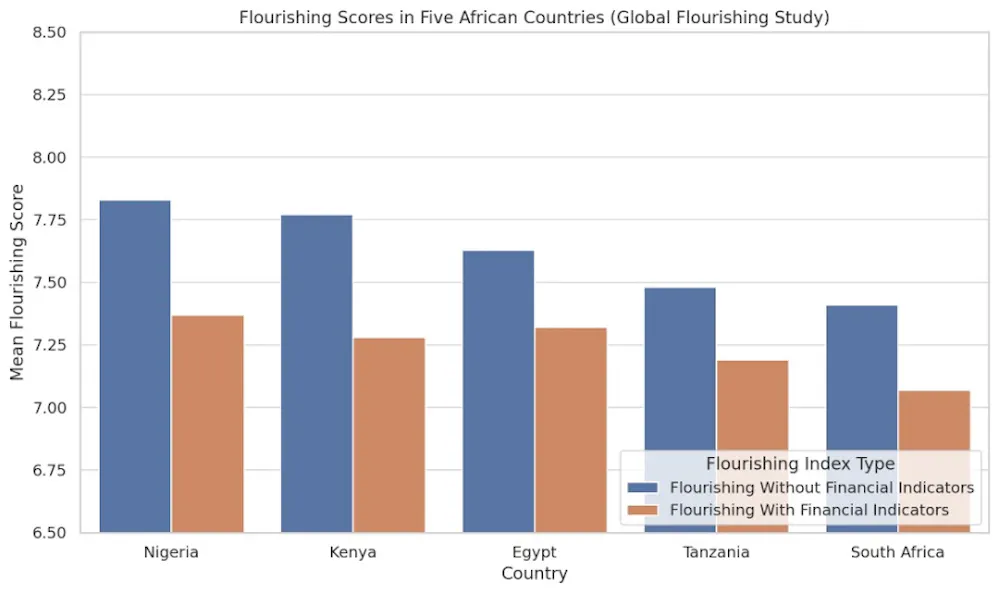
Of the 22 nations, five were African: Nigeria, Kenya, South Africa, Tanzania and Egypt.
While these countries didn’t top the global rankings (Indonesia and Mexico did), Nigeria, Kenya and Egypt all reported relatively high flourishing scores, especially when well-being was considered apart from financial status.
Nigeria, for example, ranked 5th globally in flourishing scores that excluded financial indicators – ahead of many wealthier nations. Nigerians indicated strengths in social relationships, character and virtues (like forgiveness or helping others). But potential areas of growth included financial well-being, housing, ethnic discrimination and education.
Overall, this suggests that while material resources matter, they’re not the only thing that determines well-being. Kenya ranked 7th, Egypt 10th, Tanzania 11th and South Africa 13th. Each showed unique strengths in areas like meaning, social connection or mental health.
You did a separate study on flourishing in Africa. What did you find?
In a 2024 study we analysed data from the Gallup World Poll (2020–2022) to explore 38 indicators of well-being across 40 African countries.
This study offered a more detailed and culture-sensitive picture of how Africans experience and prioritise flourishing. The dimensions explored were derived from both local and universal sources, allowing for regionally relevant insights.
We found that African populations often score high in meaning, character and social relationships – despite economic hardship. This offers an important corrective to western assumptions about well-being.
Some of our key findings were:
● There is significant diversity between and within African countries. Mauritius consistently ranked highest in life evaluations (overall satisfaction with their lives), while countries like Sierra Leone and Zimbabwe scored lowest.
● East African countries such as Rwanda and Ethiopia showed strong performance in social well-being indicators (like feeling respected or learning new things daily) even when economic indicators were low.
● Countries in West Africa, such as Senegal and Ghana, scored high in emotional well-being, with many people reporting positive daily emotions like enjoyment and laughter.
● Southern African nations, despite challenges like income inequality, displayed resilience through strong community ties and cultural practices rooted in the philosophy of ubuntu.
The results reinforced that flourishing in Africa cannot only be reduced to gross domestic product (GDP) per capita (a measure of the average economic output per person in a country) – nor to western norms of success.
What can African countries focus on to flourish?
In my view, the path to greater flourishing lies in embracing local knowledge and investing in culturally relevant development priorities. Instead of following western pathways – centred on individual advancement – Africa can model alternative flourishing pathways that reflect what matters most to African people.
1. Prioritise local knowledge systems
African ideas about a connected society – like ubuntu (southern Africa), ujamaa (east Africa), teranga or wazobia (west Africa), and al-musawat wal tarahum (north Africa) teach people to care for each other and live in peace. These values help people live meaningful lives and can inform leadership and legislation.
2. Redefine development metrics
Western development models focus on individual achievement, economic output and material consumption. GDP per capita fails to capture the everyday realities and aspirations of African communities. We should also measure things like how happy people are, how hopeful they feel about the future, how strong and resilient their communities are, and how clean, safe and dignifying their living environments are.
This is not a new idea – for years development scholars have called for a shift away from narrow economic indicators toward a focus on human dignity, agency, and the real opportunities people have to pursue the lives they value. What’s new is the growing availability of data and the momentum to take these alternative metrics seriously in shaping national policies and priorities.
3. Invest in education for character development
Quality education is essential to unlocking the continent’s potential to flourish. But Africa needs more than just academic skills and workforce readiness – it needs a strategy for intentional development of values and habits that shape how a person thinks, feels, and acts with integrity.
Part of the problem lies in how the humanities – fields like history, literature, philosophy, and religious studies – are often undervalued or underfunded in education systems. But it is precisely these disciplines that nurture moral imagination, critical reflection, and civic responsibility. We need educational models that form not just workers, but whole persons – people who can think ethically, act responsibly, and lead with character in their communities.
What does Africa offer the world in terms of flourishing?
Africa is not waiting to be saved. Across the continent, people are building communities of care, cultivating joy amid hardship, and passing on values of unity, faith, and compassion. This is what development looks like when rooted in human dignity.
Africa flourishing goals offer an alternative vision for development – one that starts with what Africa already has, not what it lacks. These are locally emic aspirations for well-being. They are shaped by Africa’s indigenous knowledge systems, cultural values, and religious/spiritual traditions. Pursuing these goals means prioritising wholeness over wealth, community over consumption, and resilience over rescue.
The continent has so much to offer the world: wisdom, strong community values, and ways of staying resilient and living fully even in hard times. But many of these local insights are missing in the global science of well-being.
Victor Counted consults for Africa Flourishing Initiative
Source: The Conversation – Africa – By Victor Counted, Associate Professor of Psychology, Regent University
What does it mean to live a good life? Psychologists and social scientists have been focusing on a new idea called flourishing – a sense of well-being that goes beyond just happiness or success. It’s about your whole life being good, including how you interact with other people and your community. So then, how do Africans fare when it comes to flourishing?
Victor Counted is a psychological scientist whose research across 40 African countries offers a data-rich rethinking of flourishing on the continent. His findings challenge the dominant narrative that Africa is “lagging behind” in development by showing a more nuanced picture of what it means to live a good life. We asked him more.
What is flourishing?
Flourishing is more than economic growth or individual happiness. It’s a multidimensional state of being that reflects how people feel about their lives and how well their lives are actually going. So it also measures people’s values within their community.
The idea of well-being often carries a Eurocentric emphasis on the individual – personal satisfaction, autonomy, achievement. Flourishing accounts for how whole a person is in relation to their environment.
It includes the social, spiritual and ecological contexts in which one lives. So, it’s not just about how one feels, but how one lives – fully, meaningfully and in a satisfying relationship with the world around us.
What’s the Global Flourishing Study?
The Global Flourishing Study tries to measure global patterns of human flourishing. It’s an ongoing five-year longitudinal study in over 200,000 participants across 22 countries.
I was one of the team of global scholars brought together to examine the trends on what it means to live well across cultures and life circumstances.
The study identifies six key dimensions of flourishing:
Happiness and life satisfaction
Mental and physical health
Meaning and purpose
Character and virtue
Close social relationships
Financial and material stability
Participants rate how they’re doing in each of these areas on a scale from 0 to 10. Further questions capture experiences related to trust, loneliness, hope, resilience, and other related well-being variables.
Of the 22 nations, five were African: Nigeria, Kenya, South Africa, Tanzania and Egypt.
While these countries didn’t top the global rankings (Indonesia and Mexico did), Nigeria, Kenya and Egypt all reported relatively high flourishing scores, especially when well-being was considered apart from financial status.
Courtesy Victor Counted
Nigeria, for example, ranked 5th globally in flourishing scores that excluded financial indicators – ahead of many wealthier nations. Nigerians indicated strengths in social relationships, character and virtues (like forgiveness or helping others). But potential areas of growth included financial well-being, housing, ethnic discrimination and education.
Overall, this suggests that while material resources matter, they’re not the only thing that determines well-being. Kenya ranked 7th, Egypt 10th, Tanzania 11th and South Africa 13th. Each showed unique strengths in areas like meaning, social connection or mental health.
You did a separate study on flourishing in Africa. What did you find?
In a 2024 study we analysed data from the Gallup World Poll (2020–2022) to explore 38 indicators of well-being across 40 African countries.
This study offered a more detailed and culture-sensitive picture of how Africans experience and prioritise flourishing. The dimensions explored were derived from both local and universal sources, allowing for regionally relevant insights.
We found that African populations often score high in meaning, character and social relationships – despite economic hardship. This offers an important corrective to western assumptions about well-being.
Some of our key findings were:
● There is significant diversity between and within African countries. Mauritius consistently ranked highest in life evaluations (overall satisfaction with their lives), while countries like Sierra Leone and Zimbabwe scored lowest.
● East African countries such as Rwanda and Ethiopia showed strong performance in social well-being indicators (like feeling respected or learning new things daily) even when economic indicators were low.
● Countries in West Africa, such as Senegal and Ghana, scored high in emotional well-being, with many people reporting positive daily emotions like enjoyment and laughter.
● Southern African nations, despite challenges like income inequality, displayed resilience through strong community ties and cultural practices rooted in the philosophy of ubuntu.
The results reinforced that flourishing in Africa cannot only be reduced to gross domestic product (GDP) per capita (a measure of the average economic output per person in a country) – nor to western norms of success.
What can African countries focus on to flourish?
In my view, the path to greater flourishing lies in embracing local knowledge and investing in culturally relevant development priorities. Instead of following western pathways – centred on individual advancement – Africa can model alternative flourishing pathways that reflect what matters most to African people.
1. Prioritise local knowledge systems
African ideas about a connected society – like ubuntu (southern Africa), ujamaa (east Africa), teranga or wazobia (west Africa), and al-musawat wal tarahum (north Africa) teach people to care for each other and live in peace. These values help people live meaningful lives and can inform leadership and legislation.
2. Redefine development metrics
Western development models focus on individual achievement, economic output and material consumption. GDP per capita fails to capture the everyday realities and aspirations of African communities. We should also measure things like how happy people are, how hopeful they feel about the future, how strong and resilient their communities are, and how clean, safe and dignifying their living environments are.
This is not a new idea – for years development scholars have called for a shift away from narrow economic indicators toward a focus on human dignity, agency, and the real opportunities people have to pursue the lives they value. What’s new is the growing availability of data and the momentum to take these alternative metrics seriously in shaping national policies and priorities.
3. Invest in education for character development
Quality education is essential to unlocking the continent’s potential to flourish. But Africa needs more than just academic skills and workforce readiness – it needs a strategy for intentional development of values and habits that shape how a person thinks, feels, and acts with integrity.
Part of the problem lies in how the humanities – fields like history, literature, philosophy, and religious studies – are often undervalued or underfunded in education systems. But it is precisely these disciplines that nurture moral imagination, critical reflection, and civic responsibility. We need educational models that form not just workers, but whole persons – people who can think ethically, act responsibly, and lead with character in their communities.
What does Africa offer the world in terms of flourishing?
Africa is not waiting to be saved. Across the continent, people are building communities of care, cultivating joy amid hardship, and passing on values of unity, faith, and compassion. This is what development looks like when rooted in human dignity.
Africa flourishing goals offer an alternative vision for development – one that starts with what Africa already has, not what it lacks. These are locally emic aspirations for well-being. They are shaped by Africa’s indigenous knowledge systems, cultural values, and religious/spiritual traditions. Pursuing these goals means prioritising wholeness over wealth, community over consumption, and resilience over rescue.
The continent has so much to offer the world: wisdom, strong community values, and ways of staying resilient and living fully even in hard times. But many of these local insights are missing in the global science of well-being.
– Which African countries are flourishing? Scientists have a new way of measuring well-being – https://theconversation.com/which-african-countries-are-flourishing-scientists-have-a-new-way-of-measuring-well-being-257458
Source: United States Senator for Illinois Tammy Duckworth
June 21, 2025
[CHICAGO, IL] – U.S. Senator Tammy Duckworth (D-IL) and Illinois Lieutenant Governor Juliana Stratton today joined Chicago-area health care advocates, Medicaid recipients and their families to call out the Trump Administration and Republican’s dangerous, relentless attempts to slash Medicaid with their Big, Beautiful Betrayal. Duckworth spoke in support and defense of the millions of Americans who rely on Medicaid including pregnant women, children with disabilities as well as people in nursing homes—and demanded that Republicans put their constituents’ lives ahead of Trump’s ego by working with Democrats to protect the critical basic needs program. Photos from the press conference are available on Senator Duckworth’s website.
“Republicans told us in Project 2025 that they’d come for Medicaid—and this is one of the rare times the GOP is actually keeping its word,” Duckworth said. “Make no mistake: there’s no way to pay for Trump’s $4 trillion tax break for billionaires without putting it on the backs of Americans who are already struggling to pay the bills. As Republicansthreatened health care for 16 million Americans—including 3.4 million Illinoisans—to appease Trump and his billionaire buddies, I’ll keep working with Illinois health care advocates to protect and defend Medicaid.”
“Since we saw the earliest versions of the Big Ugly Bill, it has been clear that Congressional Republicans have no intention of passing a budget that works for all, nor do they care about the harm that will fall on working families if they succeed. Nothing makes their priorities more obvious than the axe hovering over Medicaid.” said Lt. Governor Juliana Stratton. “Grandparents thrown out of nursing homes, farmers and rural families with no hospital to call in an emergency – that’s who the Trump administration is throwing under the bus to cover a tax cut for billionaires. That’s not who we are in Illinois. Everyone – no matter their zip code or who they voted for – deserves access to healthcare.”
“Mental health is not optional. It is essential. And Medicaid is how we fund it. We must invest in the care that gives people a real chance at recovery,” said Sara Gray, Executive Director, National Alliance on Mental Illness (NAMI) Illinois.
“The proposed Medicaid cuts would have devastating consequences for older adults and the caregivers who support them. Medicaid is not just a safety net—it is a lifeline that provides access to home and community-based services, long-term care, and essential health coverage. These cuts would threaten the independence, dignity, and well-being of millions of older Americans. We urge lawmakers to prioritize the needs of aging adults and protect the integrity of Medicaid,” said Diane Slezak, President of AgeOptions.
“We are facing some of the most dangerous threats the disability community has seen,” said Karen Tamley, President and CEO of Access Living, a disability service and advocacy center in Chicago. “Congress is considering budget proposals that would slash billions from Medicaid—the lifeline that makes it possible for disabled people to live, work, and thrive. These aren’t just numbers on a page—these cuts would take away life sustaining healthcare, personal care assistants, medical equipment, and essential therapies our community relies on.”
Last month, Duckworth joined Caring Across Generations’ 24-hour Capitol Hill vigil to call out Donald Trump and Elon Musk for their heartless, relentless attempts to slash Medicaid funding.
Source: United Kingdom – Executive Government & Departments
Speech
The UK unequivocally condemns the Taliban’s edict denying women their right to education: UK statement at the UN Security Council
Statement by Ambassador James Kariuki, UK Deputy Permanent Representative to the UN, at the UN Security Council meeting on Afghanistan.
President, since our last Council briefing on Afghanistan, another school year has begun with secondary schools and higher education remaining closed to women and girls.
It is now over three years since the Taliban’s edict denying them their right to education.
The United Kingdom continues to unequivocally condemn this ban and urges its immediate reversal.
Education is not the only sector from which half of Afghanistan’s population is barred.
We remain deeply concerned by the Taliban’s shortsighted ban on women’s medical education and by the challenges Afghan women and girls face in accessing life-saving healthcare, including sexual and reproductive health services.
As we heard from Ms Bahous, nearly 8 in 10 young Afghan women are excluded from education, employment and training opportunities.
It is unacceptable that the Taliban’s restrictive edicts deny Afghan women and girls their rights and fundamental freedoms.
The United Kingdom supports calls for greater accountability efforts, including the referral of Afghanistan to the International Court of Justice for violations of CEDAW, the Convention on the Elimination of All Forms of Discrimination against Women.
The Taliban must also recognise the negative impact of their draconian policies on Afghanistan’s economic growth and long-term prosperity.
As Director Bahous has highlighted, the Taliban’s ban on secondary education for girls is estimated to cost $1.5 billion by 2030
During the last financial year, the UK distributed over $230 million in assistance to the Afghan people.
Last week, in partnership with the Food and Agriculture Organisation, we announced a new food security initiative, responding to climate-related challenges through the delivery of drought-resistant seeds and more nutritious crops, improved irrigation and training in sustainable farming practices.
Half a million Afghans are set to benefit from this UK-funded programme.
The UK has also continued to engage constructively with the UN-led process, including the comprehensive approach.
But reliance on humanitarian assistance is not sustainable in the long term, and the UK’s continued engagement in a process in which the Taliban are not fully committed or willing to take meaningful steps towards meeting their international obligations is not guaranteed.
We therefore urge the Taliban to reverse course and demonstrate their readiness to work towards an Afghanistan at peace with itself, its neighbours and the international community.
The Armed Forces Flag was raised today following a ceremony outside Plymouth Guildhall, marking the start of Armed Forces Week.
The ceremony was attended by the Lord Mayor of Plymouth, Councillor Kathy Watkin and Captain Iain Ritchie representing the Naval Base Commander, alongside other military and civic leaders.
The flag will be flown all week, as events take place across the city, including the Strength of Spirit Games Rehabilitation Triathlon, hosted by the Royal Navy on Thursday 26 June and Armed Forces Day in association with Babcock International, on Saturday 28 June, both on Plymouth Hoe.
Councillor Sally Haydon, Cabinet Member for Events, said: “Plymouth is incredibly proud of its military history and Armed Forces based in the city. Armed Forces Week is an opportunity to celebrate and say thank you to our military, from serving personnel to reservists, veterans and cadets, for all the admirable work they do.
“On Thursday we are extremely privileged to be able to hold the Strength of Spirit Games, ahead of celebrating Armed Forces Day on Plymouth Hoe, which is looking to be a truly spectacular event.”
Captain Iain Richie, HMNB Devonport’s Captain of the Base (COB) said: “Armed Forces Week in Plymouth is a celebration of the strong relationship between the Armed Forces based in and around the city and the community that supports us. People will know that ships, submarines, Commandos, Gunners, and medical personnel from Plymouth are continually deployed to protect the UK and provide stability around the globe; none of that would be possible without the support of the people of Plymouth. Events this week will showcase our close bond with the city.”
Visitors are encouraged to come along to Plymouth Hoe and watch the athletes compete in the Strength of Spirit Games Rehabilitation Triathlon, sponsored by AECOM and Defence Recovery. The event starts with the swim at Tinside Lido, followed by the cycle and static row, before crossing the all-important finish line!
For the second year running the games will include the Plymouth School Sports Partnership Junior Rowing Challenge, sponsored by AECOM, from 10am to 11.15am, also on Plymouth Hoe. This will see children from military families will take part in their own thrilling rowing challenge, representing 24 local primary schools.
Darren Carlile, Head of National Security UK&I AECOM, said: “AECOM is proud to stand behind the Armed Forces community, including serving personnel and veterans. As a former member of the Corps of Royal Engineers and a colleague to many fellow veterans, I witness daily the exceptional skills and value they bring to our organisation.
“We’re honoured to once again support the Strength of Spirit Games, including the inspiring Rehabilitation Triathlon, and we’ll be cheering on all the remarkable athletes taking part. We’re also thrilled to back the Plymouth School Sports Partnership Junior Rowing Challenge and wish every student competing the very best of luck.”
There will be plenty more interactive displays, military equipment, thrilling demonstrations, and entertainment to enjoy at Armed Forces Day, delivered in association with Babcock , on Saturday, from 10am. Visitors can get up close to the Merlin Mk4 helicopter and chat to the aircrew, and watch an air demonstration from 4pm, with the Swordfish W5856, Yak-52 and the Black Cats Helicopter Display. (Subject to weather).
John Gane, Site Managing Director of Babcock’s Devonport facility, said: “Celebrating the significant contribution that our Armed Forces bring to the nation through this series of events is fantastic. As a proud signatory of the Armed Forces Covenant, an employer of veterans and reservists, and one of the UK’s largest defence businesses, it is a privilege to support Plymouth Armed Forces Day again this year.
“We’ve got an action-packed display planned on 28 June, featuring plenty of hands-on activities for all ages, including a variety of Science, Technology, Engineering and Maths (STEM) challenges to try, and where you can find out more about the wide range of career opportunities available, including our award-winning apprenticeships.”
Armed Forces Day will see ‘villages’ set up across the Hoe, from each Military Service, Emergency Services and the Veterans Village supported by the Royal British Legion Devon County, which includes over 100 charities and organisations offering information and advice, plus lots of hands-on activities to try.
There will be a range of live music performances throughout the day, finishing with a free evening concert, sponsored by C&G Catering, featuring: Company B, Not the Cowboys, Be Here Now and Good Times.
For all the latest information about Plymouth Armed Forces Day including the full programme, and the Strength of Spirit Games, visit: plymoutharmedforcesday.co.uk.