Category: Economics

  • MIL-OSI Economics: Lufthansa Group reports an operating profit of 1.3 billion euros for the third quarter following a strong summer travel season

    Source: Lufthansa Group

    Carsten Spohr, Chairman of the Executive Board and CEO of Deutsche Lufthansa AG:

    “Today, we are reporting on another strong summer travel season, with a record seat load factor of 88 percent in August. Particularly in view of the fact that global air traffic again reached its capacity limits this summer, I would like to thank our employees for their efforts and our customers for the patience we sometimes had to ask for.
    Global demand remains intact and bookings for the fourth quarter are also at a high level compared to the previous year, particularly in the premium classes.

    With all passenger airlines operating at a profit, Eurowings, Austrian Airlines and Brussels Airlines even generated record results in the third quarter. Lufthansa Technik and Lufthansa Cargo also remain on track. 
    At the same time, delayed aircraft deliveries, punctuality issues at our hubs in Germany and regulatory disadvantages are impacting our core brand. Lufthansa Airlines has therefore launched the “Turnaround” program to address these and structural internal challenges.

    Across the group, we are continuing to invest in the largest fleet modernization in our history, in premium offers for our guests and in an even more international positioning. These three central pillars of our strategy will enable us to further expand our role as the leading airline group in Europe.”

    Results
    The Group increased its revenue by five percent year-on-year to 10.7 billion euros (previous year: 10.3 billion euros) in the third quarter due to the higher number of flights and the revenue growth at Lufthansa Technik. This was the strongest quarter in terms of revenue in the history of the Lufthansa Group. The Group generated an operating profit (Adjusted EBIT) of 1.3 billion euros (previous year: 1.5 billion euros), resulting in an operating margin of 12.5 percent (previous year: 14.3 percent). The year-on-year decline was due to significant cost increases, particularly in fees, MRO expenses and personnel. Net profit fell to 1.1 billion euros (previous year: 1.2 billion euros).

    Lufthansa Group Passenger Airlines expand capacity

    The Lufthansa Group airlines welcomed more than 40 million guests on board their aircraft in the third quarter, an increase of six percent over the previous year. At 94 percent of available capacity (prior-year period: 88 percent), the seat load factor rose to 87 percent in the third quarter (previous year: 86 percent). In terms of the seat load factor, August was the strongest month in the company’s history, with a load factor of 88 percent.

    Due to the industry-wide capacity growth, average yields fell by 3.5 percent compared to the previous year, although the development in the various traffic regions was mixed: While average yields in continental traffic in the third quarter remained almost at the previous year’s level (-0.4 percent), they fell significantly by 14 percent in the Asia/Pacific region. Due to the improved passenger load factor, the decline in unit revenues (RASK) was less pronounced at minus 2.7 percent. Unit costs increased by 4.5 percent compared to the previous year due to higher fees, as well as higher material and personnel costs. 

    Overall, the Group’s passenger airlines generated an Adjusted EBIT of 1.2 billion euros in the third quarter (previous year: 1.4 billion euros). The decline in the operating profit of the passenger airlines is mainly driven by the 234 million euros decline in the result of Lufthansa Airlines. Delays in the delivery of new aircraft and the associated need to continue operating older aircraft, increased location costs, higher staff costs and expenses for compensation payments following flight irregularities had an above-average impact on the result of Lufthansa Airlines.

    Turnaround program at Lufthansa Airlines is making progress

    Lufthansa Airlines is consistently implementing its Turnaround program. The aim is to increase efficiency, reduce complexity and improve product quality, thereby making the airline fit for the future. Among other things, the Turnaround plan envisages shifting more short-haul traffic to more cost-efficient flight operations. Further efficiency gains are to be achieved by optimizing the network and increasing flexibility and automation. By 2026, the measures will have a gross EBIT effect of around 1.5 billion euros.

    Till Streichert, Chief Financial Officer of Deutsche Lufthansa AG:

    “The Lufthansa Group will continue to focus on generating cash flow and creating value for our shareholders. For this, the Turnaround program at Lufthansa Airlines and the fleet modernization are core elements. I am confident that on this basis we will position all our passenger airlines to be sustainably efficient and profitable.”

    Lufthansa Technik’s result on par with last year, positive performance at Lufthansa Cargo

    In the third quarter, Lufthansa Technik continued to benefit from the high demand for air travel and the associated increase in demand from airlines worldwide for maintenance and repair services. Lufthansa Technik generated an Adjusted EBIT of 167 million euros in the third quarter (previous year: 168 million euros).

    The airfreight business continued to recover in the third quarter compared with the previous quarter. Lufthansa Cargo achieved an operating profit of 38 million euros (previous year: 1 million euros) in the traditionally seasonally weak third quarter for air freight. This trend confirms the anticipated normalization in the air freight market. Furthermore, Lufthansa Cargo is optimally positioned to benefit from strong e-commerce business with Asia, which has prompted Lufthansa Cargo to shift capacity from the transatlantic to the Asia/Pacific region. 

    Adjusted free cash flow clearly positive, balance sheet further strengthened

    The Lufthansa Group generated an operating cash flow of 635 million euros in the third quarter of 2020 (previous year: 1.2 billion euros). After deducting net capital expenditure, primarily for new fuel-efficient aircraft, the Group recorded an Adjusted free cash flow of 128 million euros in the quarter. In the first nine months, the Adjusted free cash flow was 1.0 billion euros (previous year: 1.7 billion euros).

    The Group continued to strengthen its balance sheet during the first nine months of the year, supported by the positive cash flow. At 5.1 billion euros, net debt was below the year-end level 2023 (December 31, 2023: 5.7 billion euros). Net pension liabilities decreased to 2.6 billion euros (December 31, 2023: 2.7 billion euros). Compared to the beginning of the year, available liquidity increased by around 1 billion euros to 11.4 billion euros and was therefore well above the target range of 8-10 billion euros as of the reporting date.

    Outlook

    The Lufthansa Group expects demand for air travel to remain strong in the remaining months of the year. The load factors booked for November and December are well above the levels observed at the same time last year. Demand remains particularly high in the premium classes, i.e. Business Class and First Class.

    The Lufthansa Group plans to increase its capacity in the fourth quarter further compared to the previous year. For the full year 2024, it expects a capacity of around 91 percent compared to the pre-crisis level.

    The Group also expects to report a positive operating result in the fourth quarter. Overall, the Lufthansa Group is therefore confirming its expectation of achieving an Adjusted EBIT of 1.4 to 1.8 billion euros for the full year.

    Further information

    Further information on the results of individual business segments will be published in the report for the third quarter of 2024. This will be published at the same time as this press release on October 29, 2024, at 7:00 a.m. at

    https://investor-relations.lufthansagroup.com/en/investor-relations.html.

    The traffic figures for the third quarter of 2024 will also be published at 7:00 a.m. at https://investor-relations.lufthansagroup.com/en/financial-reports-publications/traffic-figures.html


    Jan. – Sept.
    2024
     
    Jan. – Sept. 2023
     
    Change in %
     
    July – Sept.
    2024
     
    July – Sept. 2023
     
    Change in %
    Revenue and result


    Total revenue
     
    €m
     
    28,137
     
    26,681
     
    5
     
    10,738
     
    10,275
     
    5
    Of which traffic revenue
     
    €m
     
    23,578
     
    22,583
     
    4
     
    9,246
     
    8,832
     
    5
    Adjusted EBIT
     
    €m
     
    1,177
     
    2,280
     
    -48
     
    1,340
     
    1,468
     
    -9
    Adjusted EBIT margin
     
    %
     
    4.2%
     
    8.5%
     
    -4.3%p
     
    12.5
     
    14.3
     
    -1.8%p
    EBIT
     
    €m
     
    1,249
     
    2,218
     
    -44
     
    1,461
     
    1,441
     
    1
    Net profit / loss
     
    €m
     
    830
     
    1,606
     
    -48
     
    1,095
     
    1,192
     
    -8
    Earnings per Share
     
     
    0,69
     
    1,34
     
    -49
     
    0,92
     
    1,00
     
    -8
    Key balance sheet and cash flow statement figures


    Total assets
     
    €m
     
    46,439
     
    46,591
     
    0


    Cash flow from operating activities
     
    €m
     
    3,423
     
    4,320
     
    -21
     
    635
     
    1,220
     
    -48
    Net capital expenditures
     
    €m
     
    1,815
     
    2,421
     
    -25
     
    61
     
    550
     
    -89
    Adjusted free cash flow
     
    €m
     
    1,006
     
    1,663
     
    -40
     
    128
     
    592
     
    -78
    Employees


    Employees as of 30 September
     
    Number
     
    100,518
     
    117,187
     
    -14


    MIL OSI Economics

  • MIL-OSI Economics: AIIB Commits EUR75 Million to Support ENGIE’s Global Renewable Energy Expansion, Decarbonization

    Source: Asia Infrastructure Investment Bank

    The Asian Infrastructure Investment Bank (AIIB) has committed EUR75 million to a EUR500 million sustainability-linked green loan facility to support ENGIE’s global renewable energy portfolio expansion and decarbonization efforts.

    The ENGIE Sustainability Linked Green Loan Project has been co-financed with the International Finance Corporation (IFC) and Société de Promotion et de Participation pour la Coopération Economique (Proparco). This is AIIB’s second engagement with ENGIE, one of the world’s largest multinational electric utilities and independent power producers, following the financing of the 400MW Gujarat Solar Project earlier this year.

    AIIB joins IFC and Proparco to provide a green sustainability-linked loan facility to support the expansion of the group’s clean energy assets in Poland and South Africa, both AIIB members. Proceeds will finance the acquisition, development and construction of over 550MW of installed capacity. In line with sustainability-linked principles, remuneration of the loan will be linked to ENGIE’s global performance in terms of greenhouse gas emissions, renewable energy expansion and occupational health and safety.

    “This project reinforces AIIB’s global mandate, strong partnership and innovative focus on climate finance,” said Najeeb Haider, AIIB Director General, Project and Corporate Finance Clients, Global. “With its agility and international presence in strategic markets, AIIB is uniquely placed to support multinational energy groups like ENGIE to advance the energy transition in Asia and beyond with their investments. We congratulate ENGIE and our cofinancing partners on their respective achievements.”

    Through the loan, AIIB is supporting its members by leveraging ENGIE’s global leadership in green energy and climate transition. ENGIE aims to invest EUR22-25 billion in renewable energy and low-carbon energy solutions between 2023 and 2025. The projects are aligned with AIIB’s Energy Sector Strategy, which directs the Bank to support traditional energy conglomerates and state-owned enterprises as they shift their corporate strategies and business modalities to redirect investments toward the energy transition.

    “To accelerate the energy transition, considerable resources and efforts are needed from many stakeholders,” said Jean-Marc Turchini, Group Head of Corporate Finance at ENGIE. “Our partnership with AIIB is certainly a meaningful contribution and we feel grateful for what they achieved with this financing. We are also proud to highlight the innovative structure of this most recent corporate loan, which includes climate-related targets for scope 3 emissions and a health and safety performance indicator that covers ENGIE employees and subcontractors on all sites, reflecting ENGIE’s sustainability and social ambitions.”

    About AIIB

    The Asian Infrastructure Investment Bank (AIIB) is a multilateral development bank whose mission is Financing Infrastructure for Tomorrow in Asia and beyond – infrastructure with sustainability at its core. We began operations in Beijing in 2016 and have since grown to 110 approved members worldwide. We are capitalized at USD100 billion and AAA-rated by the major international credit rating agencies. Collaborating with partners, AIIB meets clients’ needs by unlocking new capital and investing in infrastructure that is green, technology-enabled and promotes regional connectivity.

    MIL OSI Economics

  • MIL-OSI Economics: Lumma/Amadey: fake CAPTCHAs want to know if you’re human

    Source: Securelist – Kaspersky

    Headline: Lumma/Amadey: fake CAPTCHAs want to know if you’re human

    Attackers are increasingly distributing malware through a rather unusual method: a fake CAPTCHA as the initial infection vector. Researchers from various companies reported this campaign in August and September. The attackers, primarily targeting gamers, initially delivered the Lumma stealer to victims through websites hosting cracked games.

    Our recent research into the adware landscape revealed that this malicious CAPTCHA is spreading through a variety of online resources that have nothing to do with games: adult sites, file-sharing services, betting platforms, anime resources, and web apps monetizing through traffic. This indicates an expansion of the distribution network to reach a broader victim pool. Moreover, we discovered that the CAPTCHA delivers not only Lumma but also the Amadey Trojan.

    Malicious CAPTCHA in ad networks

    To avoid falling for the attackers’ tricks, it’s important to understand how they and their distribution network operate. The ad network pushing pages with the malicious CAPTCHA also includes legitimate, non-malicious offers. It functions as follows: clicking anywhere on a page using the ad module redirects the user to other resources. Most redirects lead to websites promoting security software, ad blockers, and the like – standard practice for adware. However, in some cases, the victim lands on a page with the malicious CAPTCHA.

    Examples of sites redirecting the user to a CAPTCHA

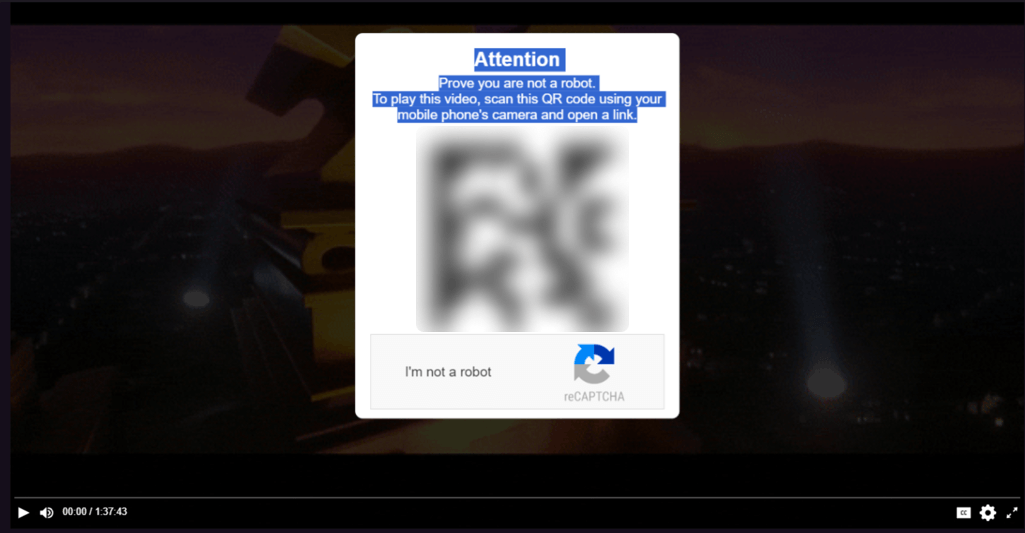
    Unlike genuine CAPTCHAs designed to protect websites from bots, this imitation serves to promote shady resources. As with the previous stage, the victim doesn’t always encounter malware. For example, the CAPTCHA on one of the pages prompts the visitor to scan a QR code leading to a betting site:

    CAPTCHA with QR code

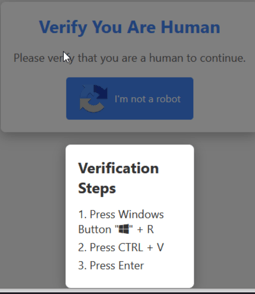
    The Trojans are distributed through CAPTCHAs with instructions. Clicking the “I’m not a robot” button copies the line powershell.exe -eC bQBzAGgAdABhAMAIgA= to the clipboard and displays so-called “verification steps”:

    • Press Win + R (this opens the Run dialog box);
    • Press CTRL + V (this pastes the line from the clipboard into the text field);
    • Press Enter (this executes the code).

    CAPTCHA with instructions

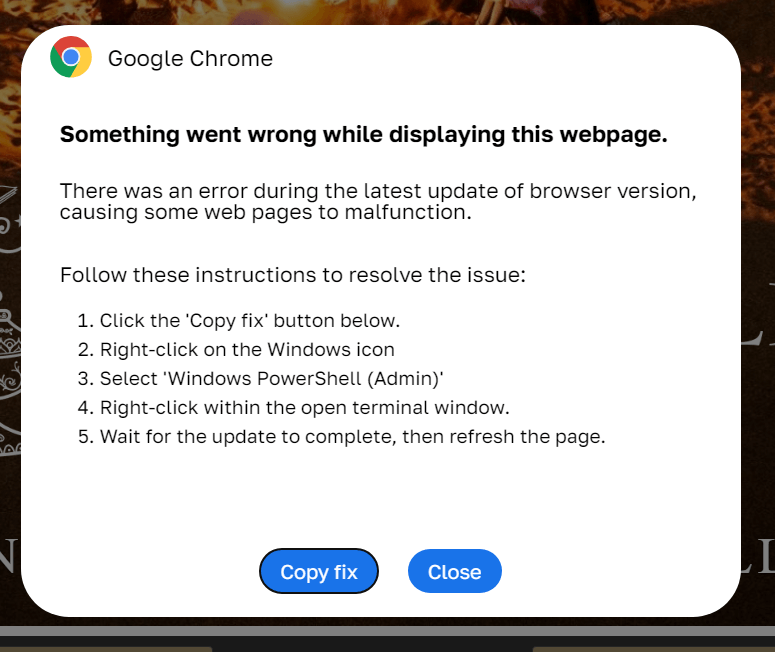
    We’ve also come across similar instructions in formats other than CAPTCHAs. For instance, the screenshot below shows an error message for a failed page load, styled like a Chrome message. The attackers attribute the problem to a “browser update error” and instruct the user to click the “Copy fix” button. Although the page design is different, the infection scenario is identical to the CAPTCHA scheme.

    Fake update error message

    The line from the clipboard contains a Base64-encoded PowerShell command that accesses the URL specified there and executes the page’s content. Inside this content is an obfuscated PowerShell script that ultimately downloads the malicious payload.

    Payload: Lumma stealer

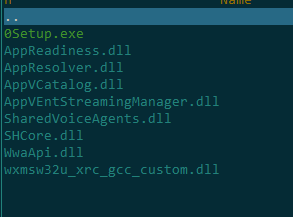
    Initially, the malicious PowerShell script downloaded and executed an archive with the Lumma stealer. In the screenshot below, the stealer file is named 0Setup.exe:

    Contents of the malicious archive

    After launching, 0Setup.exe runs the legitimate BitLockerToGo.exe utility, normally responsible for encrypting and viewing the contents of removable drives using BitLocker. This utility allows viewing, copying, and writing files, as well as modifying registry branches – functionality that the stealer exploits.

    Armed with BitLocker To Go, the attackers manipulate the registry, primarily to create the branches and keys that the Trojan needs to operate:


    That done, Lumma, again using the utility, searches the victim’s device for files associated with various cryptocurrency wallets and steals them:

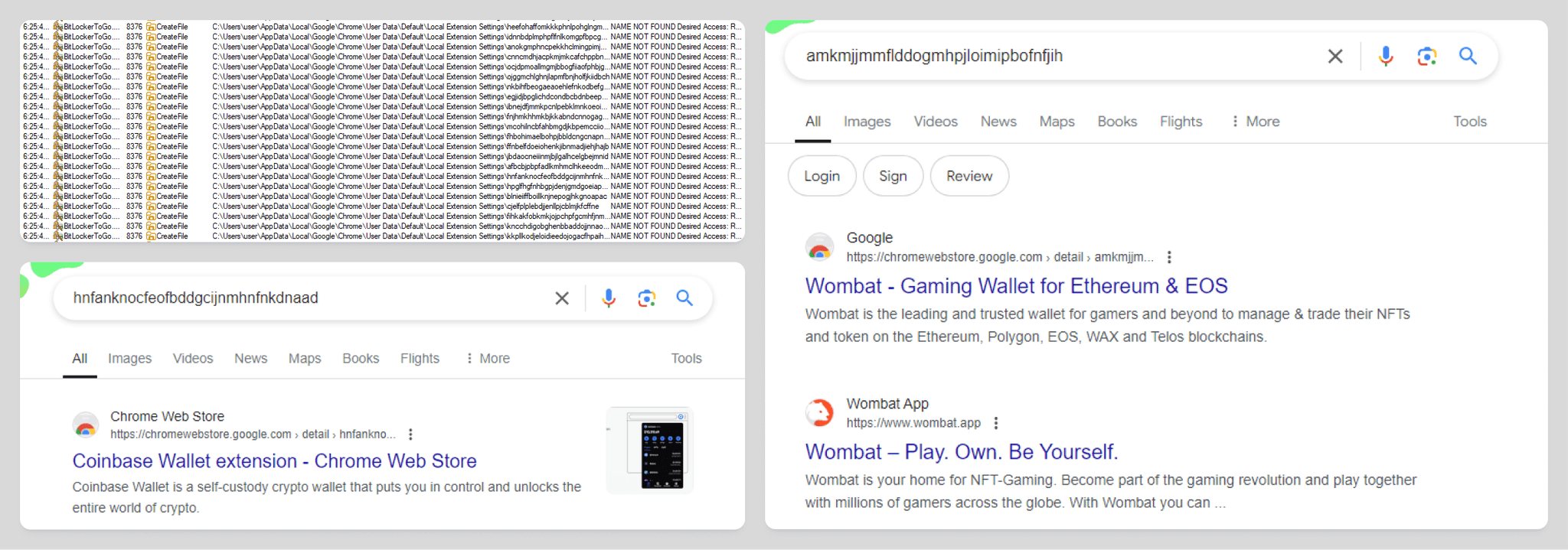
    Then, the attackers view browser extensions related to wallets and cryptocurrencies and steal data from them:

    Following this, the Trojan attempts to steal cookies and other credentials stored in various browsers:

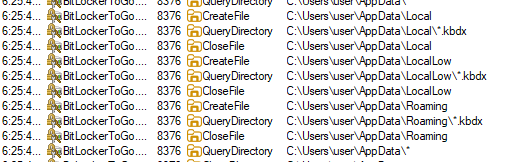
    Finally, the malware searches for password manager archives to steal their contents as well:

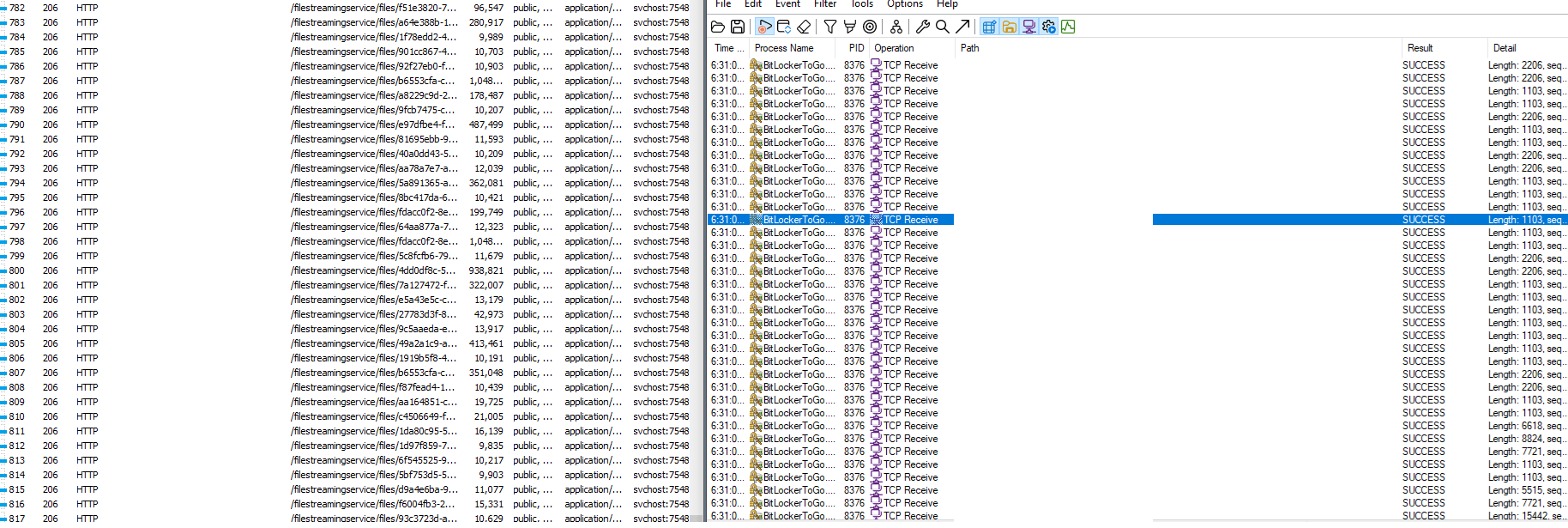
    Throughout the data collection process, the Trojan tries to use the same BitLocker To Go to send the stolen data to the attackers’ server:

    Once the malware has found and exfiltrated all valuable data, it starts visiting the pages of various online stores. The purpose here is likely to generate further revenue for its operators by boosting views of these websites, similar to adware:

    Payload: Amadey Trojan

    We recently discovered that the same campaign is now spreading the Amadey Trojan as well. Known since 2018, Amadey has been the subject of numerous security reports. In brief, the Trojan downloads several modules for stealing credentials from popular browsers and various Virtual Network Computing (VNC) systems. It also detects crypto wallet addresses in the clipboard and substitutes them with those controlled by the attackers. One of the modules can also take screenshots. In some scenarios, Amadey downloads the Remcos remote access tool to the victim’s device, giving the attackers full access to it.

    Snippet of Amadey code used in this campaign

    Statistics

    From September 22 to October 14, 2024, over 140,000 users encountered ad scripts. Kaspersky’s telemetry data shows that out of these 140,000, over 20,000 users were redirected to infected sites, where some of them saw a fake update notification or a fake CAPTCHA. Users in Brazil, Spain, Italy, and Russia were most frequently affected.

    Conclusion

    Cybercriminals often infiltrate ad networks that are open to all comers. They purchase advertising slots that redirect users to malicious resources, employing various tricks to achieve infections. The above campaign is of interest because (a) it leverages trust in CAPTCHA to get users to perform unsafe actions, and (b) one of the stealers makes use of the legitimate BitLocker To Go utility. The malware works to enrich its operators both by stealing victims’ credentials and crypto wallets, and by exploiting online stores that pay money for traffic to their websites.

    Indicators of compromise

    e3274bc41f121b918ebb66e2f0cbfe29
    525abe8da7ca32f163d93268c509a4c5
    ee2ff2c8f49ca29fe18e8d18b76d4108
    824581f9f267165b7561388925f69d3av

    MIL OSI Economics

  • MIL-OSI Economics: 43rd Half Yearly Report on Management of Foreign Exchange Reserves: April – September 2024

    Source: Reserve Bank of India

    The Reserve Bank of India has today released the 43rd half-yearly report on management of foreign exchange reserves with reference to end-September 2024.

    The position of foreign exchange reserves as on October 18, 2024 is as under:

    US $ Billion
    Foreign Exchange Reserves (i+ii+iii+iv)* 688.27
    i. Foreign Currency Assets (FCA) 598.24
    ii. Gold 67.44
    iii. Special Drawing Rights (SDRs) 18.27
    iv. Reserve Tranche Position (RTP) 4.32
    * Difference, if any, is due to rounding-off.

    It may be recalled that in February 2004, the Reserve Bank had started a process of compiling half yearly reports and placing them in the public domain for bringing about more transparency and enhancing the level of disclosure in relation to management of the country’s foreign exchange reserves.

    (Puneet Pancholy)  
    Chief General Manager

    Press Release: 2024-2025/1391

    MIL OSI Economics

  • MIL-OSI Economics: Euro area economic and financial developments by institutional sector: second quarter of 2024

    Source: European Central Bank

    29 October 2024

    • As of October 2024, ECB quarterly financial accounts provide more details on loans by counterpart sector granted by other financial institutions (OFIs) and information on debt securities issuance of non-financial corporations (NFCs) via financing conduits. OFIs are creditors of 23% of loans granted to NFCs by financial sector
    • Euro area net saving increased to €795 billion in four quarters to second quarter of 2024, compared with €787 billion one quarter earlier
    • Household debt-to-income ratio decreased to 83.4% in second quarter of 2024 from 87.8% one year earlier
    • NFCs’ debt-to-GDP ratio (consolidated measure) decreased to 69.3% in second quarter of 2024 from 71.8% one year earlier

    New details on other financial institutions and the financing of other sectors

    As of October 2024, the quarterly sector accounts published by the ECB provide more detailed financial accounts data on OFIs, which constitute the second largest financial sector in the euro area after monetary financial institutions (MFIs).[1] OFIs mainly provide financing to NFCs and to a lesser extent to households and other sectors. They also channel funds to and from the rest of the world.

    This new release provides counterpart sector data, such as loans granted by the OFI subsectors to NFCs (Chart 1). The release also includes new data on euro area NFC financing conduits which are captive financial institutions that raise funds by issuing debt securities to be used by their parent corporation.[2]

    Chart 1

    Loans to NFCs by financial subsector

    (outstanding amounts at the of end of the second quarter of 2024, as percentages of financial sector loans to NFCs)

    Source: ECB.

    * Loans from NFC financing conduits to NFCs are estimated based on the financing conduits’ issuance of debt securities.

    Total euro area economy

    Euro area net saving increased to €795 billion (6.7% of euro area net disposable income) in the four quarters to the second quarter of 2024, compared with €787 billion in the four quarters to the previous quarter. Euro area net non-financial investment decreased to €440 billion (3.7% of net disposable income), mainly due to decreased investment by NFCs (Chart 2 and Table 1 in the Annex).

    Euro area net lending to the rest of the world increased to €388 billion (from €336 billion previously) reflecting the increased net saving and decreased net non-financial investment. Household net lending increased to €549 billion (4.6% of net disposable income) from €501 billion. Net lending of NFCs (€233 billion, 2.0% of net disposable income) and that of financial corporations (€124 billion, 1.0% of net disposable income) were broadly unchanged. Government net borrowing stood broadly unchanged at €517 billion, contributing negatively (-4.3% of net disposable income) to euro area net lending.

    Chart 2

    Euro area saving, investment and net lending to the rest of the world

    (EUR billions, four-quarter sums)

    Sources: ECB and Eurostat.

    * Net saving minus net capital transfers to the rest of the world (equals change in net worth due to transactions).

    Data for euro area saving, investment and net lending to the rest of the world (Chart 2)

    Households

    Household financial investment increased at a higher annual rate of 2.3% in the second quarter of 2024 (after 2.0% in the previous quarter). Among its components, investment in currency and deposits (2.3%, after 1.6%) and investment in shares and other equity (0.8%, after 0.4%) grew at higher rates due to investment fund shares, while investment in debt securities increased at a lower rate (27.9%, after 38.5%).

    Households continued to directly buy, in net terms, mainly debt securities issued by general government and MFIs. Households were overall net sellers of listed shares, selling predominantly listed shares of non-financial corporations, while buying listed shares issued by the rest of the world (i.e. shares issued by non-euro area residents) and MFIs (Table 1 below and Table 2.2 in the Annex).

    The household debt-to-income ratio[3] decreased to 83.4% in the second quarter of 2024 from 87.8% in the second quarter of 2023. The household debt-to-GDP ratio declined, to 52.2% in the second quarter of 2024 from 54.4% in the second quarter of 2023 (Chart 3).

    Table 1

    Financial investment and financing of households, main items

    (annual growth rates)

    Financial transactions

    2023 Q2

    2023 Q3

    2023 Q4

    2024 Q1

    2024 Q2

    Financial investment*

    2.0

    1.8

    1.9

    2.0

    2.3

    Currency and deposits

    1.3

    0.3

    0.8

    1.6

    2.3

    Debt securities

    48.6

    56.9

    54.3

    38.5

    27.9

    Shares and other equity**

    1.3

    1.1

    0.4

    0.4

    0.8

    Life insurance

    -0.2

    -0.7

    -0.6

    -0.2

    0.0

    Pension schemes

    2.4

    2.4

    2.2

    2.3

    2.3

    Financing***

    2.4

    1.6

    0.9

    1.1

    1.4

    Loans

    1.8

    1.0

    0.5

    0.6

    0.6

    Source: ECB.

    * Items not shown include: loans granted, prepayments of insurance premiums and reserves for outstanding claims and other accounts receivable.

    ** Includes investment fund shares.

    *** Items not shown include: financial derivatives’ net liabilities, pension schemes and other accounts payable.

    Data for financial investment and financing of households (Table 1)

    Chart 3

    Debt ratios of households and NFCs

    (percentages of GDP)

    Sources: ECB and Eurostat.

    * Outstanding amount of loans, debt securities, trade credits and pension scheme liabilities.
    ** Outstanding amount of loans and debt securities, excluding debt positions between NFCs
    *** Outstanding amount of loan liabilities.

    Data for debt ratios of households and NFCs (Chart 3)

    Non-financial corporations

    Financial transactions

    2023 Q2

    2023 Q3

    2023 Q4

    2024 Q1

    2024 Q2

    Financing*

    1.7

    1.2

    0.8

    0.8

    1.0

    Debt securities

    0.7

    1.5

    1.3

    1.9

    2.9

    Loans

    3.8

    1.9

    1.7

    1.4

    1.3

    Shares and other equity

    -0.0

    0.4

    0.3

    0.4

    0.8

    Trade credits and advances

    5.2

    2.2

    1.2

    0.6

    1.8

    Financial investment**

    2.9

    2.4

    1.8

    1.9

    2.1

    Currency and deposits

    -0.6

    -1.2

    -1.2

    0.5

    2.9

    Debt securities

    23.3

    27.9

    23.0

    10.6

    7.8

    Loans

    5.9

    5.2

    5.1

    4.4

    4.5

    Shares and other equity

    1.2

    1.2

    1.0

    1.4

    1.3

    MIL OSI Economics

  • MIL-OSI Economics: Frank Elderson: Transcript of video recording for Finance and Biodiversity Day of 16th United Nations Conference on Biological Diversity (COP16)

    Source: European Central Bank

    Contribution by Frank Elderson, Member of the Executive Board of the ECB and Vice-Chair of the Supervisory Board of the European Central Bank (ECB), 16th meeting of the Conference of the Parties to the Convention on Biological Diversity – Finance and Biodiversity Day

    Cali, 28 October 2024

    The global economy and finance need nature to survive. Analysis by the ECB shows that the economy depends critically on nature: 72% of non-financial businesses in the euro area – around 4.2 million individual companies – would experience significant problems as a result of ecosystem degradation. These businesses rely on ecosystem services like fertile soils, timber and clean water. And 75% of bank loans are tied to these businesses. So, if they run into trouble, the banks that finance them will too. This interdependence underscores why the ECB made nature one of the focus areas of its climate and nature plan for 2024 and 2025. It is also why we push banks under our supervision to manage all material nature-related risks.

    The ECB does not stand alone in recognising this threat. The value of nature for the economy is acknowledged by the global Network of Central Banks and Supervisors for Greening the Financial System, which has 141 members worldwide. Additionally, a recent stocktake by the Financial Stability Board showed that a growing number of policy authorities around the world are considering the potential implications of nature-related risks for financial stability.

    In recognition of the vital importance of nature for the economy, international fora must ensure that nature considerations are fully integrated into regulation and supervision, alongside ongoing efforts to account for climate-related considerations. This starts with identifying exposures and vulnerabilities to nature-related risks.

    While central banks and supervisors are not nature policymakers, we must take nature into account to fulfil our mandate of price stability and safe and sound banks. Otherwise, we risk failing to deliver on our mandate.

    My message on this Finance and Biodiversity Day is clear: if you destroy nature, you destroy the economy. The right conditions must be established for nature – and consequently the economy – to thrive. The economy needs nature to survive. Financial stability needs nature to survive. To deliver on our mandate, we need nature to survive. And the survival of nature requires financing. Therefore, your success here in Cali is vitally important.

    Thank you. Buena suerte.

    MIL OSI Economics

  • MIL-OSI Economics: Luis de Guindos: Interview with ANSA

    Source: European Central Bank

    Interview with Luis de Guindos, Vice-President of the ECB, conducted by Domenico Conti

    29 October 2024

    At the latest press conference, President Lagarde spoke of a series of economic indicators pointing lower and of downside risks to growth. The Survey of Professional Forecasters published by the ECB foresees inflation of 1.9% in 2025, compared with 2.2% in the projections by ECB experts. In this context, will the Governing Council have the option to make back-to-back interest rate cuts, as occurred in September and October?

    In short, on the current economic situation, we don’t have good news with respect to growth but we do have good news with respect to inflation.

    On growth, we have revised down our projections twice – before the summer and in September. We see that the downside risks that we identified are crystallising, mainly because consumption is not recovering as expected. Even though real disposable income has increased because wages are catching up with past inflation, households are not increasing their spending. This could be due to structural factors, including a lack of confidence owing to past inflation, the pandemic or geopolitical risks. But it is clear that the recovery in consumption is not happening at the pace we had previously projected.

    On inflation, we have the opposite happening. The latest figures are good, in terms of both headline inflation and underlying inflation. Most measures of underlying inflation are declining, and we are confident that we will be able to reach our 2% target over the medium term in the course of 2025.

    Regarding possible future cuts, we have been very clear that we will keep all options open at forthcoming meetings, both in terms of the number of cuts and the size of these cuts. But what is most relevant for the transmission of monetary policy and the impact of financial conditions on aggregate demand is the medium-term trajectory, which is evidently that of an easing cycle. Fine-tuning monetary policy is very complex and the important signal is the medium-term trajectory.

    Geopolitical risks will play a role in the forthcoming monetary policy decisions. To what extent are the risks associated with the conflicts in the Middle East and the risks of a further escalation in trade tariffs pushing the ECB to take a prudent approach in reducing interest rates?

    Geopolitical factors play a very important role in our analysis. For example, the conflict in the Middle East has an impact on energy prices and upcoming elections could have an impact on international trade, global growth and inflation. This is one reason why we have to be very prudent with our decisions. When you are in a dark room full of uncertainty, for example because of geopolitical risks that you cannot control, you have to take very careful steps.

    Another important element is fiscal policy. Governments are now submitting their medium-term budgetary plans to the European Commission. This will give us more clarity on the fiscal outlook, which is an element that we take into consideration in our analysis and decision-making. So geopolitical risks, the possibility of distortions in international trade plus what will happen with fiscal policy will all feed into our decisions in the near future.

    In its new operational framework that came into force in September 2024, the ECB anticipates that a substantial contribution to providing liquidity to the banking sector will come from a structural portfolio of securities and from new longer-term refinancing operations, under conditions to be defined at a later date. What point has the discussion reached and what guidance is there?

    The operational framework has to be used to implement our monetary policy, it cannot condition it. And we have said very clearly that all monetary policy instruments in our toolkit remain available to us. This will include, for example, non-conventional measures, such as targeted longer-term refinancing operations and quantitative easing.

    Right now, we are in a situation of ample liquidity, which we are gradually reducing by discontinuing reinvestments, which will come to a complete halt at the beginning of next year. Once that liquidity has been significantly reduced, a combination of the monetary policy instruments at our disposal will help us deliver enough liquidity to the banking system.

    In my view, when we discuss the structural portfolio, we will need to take into account the actual liquidity situation of the banks and look not only at the average, but also at the dispersion in the banking sector. We have not decided on the size of the structural portfolio, but it will need to be large enough to deliver sufficient liquidity to the banking system.

    The latest monetary policy strategy review in 2021 took place at a time of strong deflationary pressures linked to various factors, including digitalisation and globalisation. Since then the landscape has changed. We find ourselves in a fragmented geopolitical context with the return of inflationary shocks. How will all this be reflected in the coming monetary policy strategy review? When will the discussion begin and what topics will it cover?

    We have established a couple of workstreams at the technical level to examine these factors, namely how the landscape has changed, how the new environment could have an impact on inflation, and our evolving policy toolkit. But this will not be discussed by the Governing Council until next year, with conclusions expected in the second half of 2025.

    What is crystal clear is that the definition of price stability as 2% inflation over the medium term will not be up for debate. And several other elements, such as the importance of financial stability considerations or accounting for climate change in our work, are already established. Instead, this review will mostly be an assessment of the previous strategy review while considering new elements, such as the changed economic and inflation environment, the possibility of deglobalisation and other structural elements that could affect the inflation outlook.

    Importantly, we will look at the consequences of measures we have used in the past. For every monetary policy decision, we need to look not only at short-term effects but also further ahead at possible unwanted effects. Quantitative easing, for example, is an instrument that proved to be very useful to fight deflation and the impact of the pandemic, but it also caused some side effects. In that respect, now that we have started the opposite process of quantitative tightening, we have much more information on the potential consequences of quantitative easing.

    Are you referring to fiscal side effects?

    No. I’m referring, for instance, to the impact on financial stability or on national central banks’ profit and loss accounts. These are side effects that can be better taken into consideration and that were not obvious at the time.

    Italy has seen inflation fall to below 2% from a high of close to 12% two years ago, and its growth rate is in line with the European average. While real disposable income is improving, investment is feeling the effects of a still restrictive monetary policy and politicians have criticised the ECB’s cautious stance in the last few months. How would you explain to Italian politicians and households the need for a cautious approach in reducing interest rates, and how do you plan to reassure them about the current transition from still restrictive interest rates to a more neutral stance?

    Above all else, we listen to all opinions carefully and with an open mind. The ECB and central banks are independent institutions, meaning that they need to display an additional level of responsibility and accountability.

    What I would say to Italian and European citizens is that it’s important to be cautious and prudent. We have reduced interest rates and the trajectory of our monetary policy is very clear, but there is a huge amount of uncertainty and we cannot make mistakes. That’s why a gradual approach to implementing monetary policy is essential.

    That being said, I’d like to reassure them that things are moving in the right direction. Inflation has fallen significantly. Most people look more closely at price levels than at inflation, but at the end of the day, current price levels are a consequence of past inflation. We can’t claim victory yet, but we have made good progress so far. And despite an economic slowdown, we have so far managed to reduce inflation without causing a recession in the euro area. When you look at the labour market, the situation remains positive. So I hope that in the medium term it will become more evident that we are on the right track.

    In its draft budget, the Italian government is seeking a contribution of around €3.5 billion from the banking sector by targeting deferred tax assets (DTAs). Has the ECB been consulted on the merits of this approach and what guidance is being formulated on this measure?

    In general, our assessment of banking sector taxes is quite clear from the legal opinions we have issued on proposals by several countries. Our view is that such taxes should not impair banks’ solvency or the transmission of monetary policy in terms of hampering the flow of credit to the real economy.

    In this specific case, we don’t have the definitive version of the tax yet, so it’s difficult to form an opinion about it. But I hope that solvency will be one of the items taken into consideration, which would be positive from our perspective.

    In my view, the design of the previous version of the tax was balanced, for example, because it made tax revenues and bank solvency compatible. Of the many approaches taken by other European countries that imposed taxes on the banking sector, I believe this was the most balanced one.

    Completing the banking union is one of the most urgent objectives that will make Europe more resilient and more competitive. Despite this, a cross-border merger like the potential merger between Unicredit and Commerzbank currently under discussion is treated as a national matter in both countries. What lessons can we learn from this and why is a cross-border merger between European banks still hitting the headlines in Europe in 2024?

    Given the importance of banks’ funding for the real economy, completing the banking union should be the number one priority on the European Union’s economic agenda. I acknowledge that there are political hurdles to achieving that, but it will be very difficult to have a real economic and monetary union without a banking union. Greater coordination of fiscal policy, for example through a common fiscal instrument or progress towards the capital markets union, would also be important.

    If you want a single banking market, you need to have genuine pan-European banks. This is why cross-border consolidation of the banking sector is important. I don’t discuss the merits of individual cases, but in my view, a European approach should prevail over a national one. That’s the way forward for European integration.

    In any case, our assessment of any merger and acquisition transaction is always based exclusively on prudential and solvency criteria. This is the guiding principle for us, based on European regulation.

    The Italian government has voiced its support for the merger between Unicredit and Commerzbank, which would strengthen European banking consolidation. At the same time, Italy is the only Member State that hasn’t ratified the treaty to reform the European Stability Mechanism (ESM), which is an important element in completing the banking union. How important will it be to remove this obstacle?

    In my previous answer, I referred to how important it is for a European approach to prevail over a national one. But this principle has to be consistent from all angles and in all kinds of situations. In my opinion, a pro-European approach to the integration of the economy, the banking system and the capital markets should be the one that prevails for all the items under discussion, including ESM reform. Ratifying the reformed ESM Treaty would be a clear pro-European decision.

    MIL OSI Economics

  • MIL-OSI Economics: CBB Governor receives PM Fellowship Program candidate

    Source: Central Bank of Bahrain

    Published on 28 October 2024

    Manama, Kingdom of Bahrain – 28 October 2024 – HE Khalid Humaidan, Governor of the Central Bank of Bahrain, affirmed that the PM Fellowship Program reflects the Kingdom of Bahrain’s commitment to investing in its national workforce and engaging them in comprehensive development, under the leadership of His Majesty King Hamad bin Isa Al Khalifa and in line with the vision of His Royal Highness Prince Salman bin Hamad Al Khalifa, the Crown Prince and Prime Minister.

    HE the Governor received at his office Mr. Rashed Adel Kamal, the CBB employee selected as a candidate for the 10th intake of the Prime Minister’s Fellowship Program, and  congratulated him on his selection, wishing him ongoing success and benefit from the program’s opportunities.

    Mr. Kamal expressed his gratitude to HE the Governor for his continuous support for CBB employees in achieving their aspirations.

    Share this

    MIL OSI Economics

  • MIL-OSI Economics: Samsung TV Plus Hits 88 Million Monthly Active Users

    Source: Samsung

    As streaming expands consumer options and access to premium content, Samsung TV Plus, Samsung’s free ad-supported TV (FAST) and on-demand (AVOD) service, has seen remarkable growth. Now with 88 million monthly active users and an over 50% increase in global viewership YoY, Samsung TV Plus’ audience scale and engagement make it the #1 app in the U.S. on the #1 TV brand.
    The service’s rapid expansion has been fueled by its core U.S. user base of Gen Zers, Millennials, and Gen Xers, who over-index in the key advertising 18-49 demographic. Samsung TV Plus continues to strengthen its global presence with recent launches in Singapore and the Philippines, and is soon to launch in Thailand, expanding its availability to 30 territories worldwide.
    As viewers grow wary of rising subscription prices and continue to pour into free alternatives, major publishers and content owners have embraced the opportunities in FAST and AVOD. Samsung TV Plus has become a key pillar in the distribution strategies of many of the world’s most established media companies, sports leagues, independent studios, and creators.

    With a wealth of free premium content, Samsung TV Plus has carved out a unique offering across a wide array of genres with more than 3,000 channels and tens of thousands of on-demand options that keep audiences coming back. The service’s viewership growth is propelled by increased consumption across both linear and AVOD, with on-demand viewing surging more than 400% YoY globally, and making it an even more powerful engine for audience engagement.
    “The success of Samsung TV Plus reflects our commitment to delivering a superior user experience with high-quality content that resonates with consumers. When we embarked on this ambitious journey, our vision was to offer a premium streaming alternative that was both simple to use and free. The strategic bets we made nearly a decade ago have established a strong foundation for a service now enjoyed by 88 million streamers each month, and the path ahead is bright and promises continued growth well into the future,” said Salek Brodsky, Senior Vice President & General Manager at Samsung TV Plus.

    For advertisers, Samsung TV Plus brings together curated fan-favorite content with the sophisticated audience targeting and full-funnel performance marketing and measurement capabilities of digital. In addition to over-indexing in the 18-49 demographic, Samsung TV Plus also over-indexes on primetime and late-night viewing in the U.S. Samsung Ads offers several innovative ad solutions on Samsung TV Plus, ranging from Contextual Audience Collectives around top-performing content genres to interactive shoppable ad and gaming experiences designed to drive outcomes.
    “As the ad-supported streaming ecosystem continues to surge in popularity, Samsung TV Plus has emerged as a clear favorite among viewers across key demographics, with advertisers in prime verticals already leveraging its immense opportunity,” said Michael Scott, Vice President, Head of Ad Sales & Operations, Samsung Ads. “With today’s announcement, it’s evident that our viewers continue to be super leaned in and engaged, choosing to return time and time again. For advertisers looking to drive outcomes and prove results, Samsung TV Plus brings together the best of TV and streaming to offer an effective and measurable performance-driven solution.”

    MIL OSI Economics

  • MIL-OSI Economics: Samsung Music Frame WICKED Edition is Now Available

    Source: Samsung

    Samsung today announced availability for Music Frame WICKED Edition, a customizable wireless speaker designed to seamlessly blend into any environment and enhance the home entertainment experience. This new edition, created in partnership with Universal Pictures’ spectacular film adaptation of the iconic stage musical (in cinemas November 22), brings a unique combination of art and technology to offer consumers a personalized and immersive audio experience. It’s available for purchase starting today on Samsung.com and at the Samsung 837 retail experience store in New York City.
    “Music Frame represents an entirely new category of audio – a customizable speaker that doubles as a picture frame. Not only can you display your favorite print photos – you can also create an orchestra of sound with your favorite playlist,” said James Fishler, Senior Vice President, Home Entertainment & Display Division at Samsung Electronics America. “Music and art evoke such strong memories, and Music Frame offers a seamless way to capture both in one innovative device. This limited-time Music Frame WICKED Edition beautifully brings this concept to life, helping you unlock the music within.”

    Directed by acclaimed filmmaker Jon M. Chu (“Crazy Rich Asians,” “In the Heights”), Wicked is the untold story of the witches of Oz, starring Emmy-, Grammy- and Tony-winning powerhouse Cynthia Erivo (“Harriet,” Broadway’s “The Color Purple”) as Elphaba, a young woman misunderstood because of her unusual green skin, who has yet to discover her true power, and Grammy-winning, multi-platinum recording artist and global superstar Ariana Grande as Glinda, a popular young woman gilded by privilege and ambition, who has yet to discover her true heart.
    Unlocking the Music Within Homes With “Wicked”
    In collaboration with Wicked, Music Frame WICKED Edition offers a unique combination of functionality and aesthetic appeal. It includes a Wicked edition Photo Frame with three photo cards featuring autographs and images of the film’s beloved characters, including one exclusive picture only available with Music Frame WICKED Edition.
    Further enhancing the experience, Music Frame WICKED Edition comes with a specially designed limited edition Wicked-themed bezel and customized Wicked-themed packaging, adding an extra touch of excitement and making the unboxing experience truly enchanting.

    Music Frame is also fully customizable, allowing users to effortlessly match their home decor with photo frames and optional art panels. The sleek and slim design, combined with a discreet wall-mount bracket and slim power cable, ensures the Music Frame blends seamlessly into any environment.
    Elevating Homes With Immersive Sound and Smart Features
    With its rich, immersive sound, Music Frame WICKED Edition enables users to transform their living space into a surround sound haven. Equipped with Dolby Atmos1 technology, it creates a multidimensional audio experience that brings every note and sound to life. Music Frame can also work closely with other compatible Samsung screens and soundbars using Q-Symphony2, which offers a more immersive, three-dimensional sound experience.
    Boasting two-channel 120W sound quality, Music Frame WICKED Edition incorporates clear and powerful sound via SpaceFit Sound Pro for optimized audio based on the acoustics of a given room, as well as Adaptive Sound that adjusts audio settings based on content to deliver premium audio performance. These features ensure that Music Frame WICKED Edition offers exceptional sound quality and versatility, making it a perfect addition to any home.
    The built-in Alexa3 and Chromecast offer easy smart home integration with supported devices, while Airplay and Tap Sound4 provide seamless connectivity with Android and iOS devices. Versatile connectivity options — including Bluetooth, Wi-Fi, and Optical — ensure the device meets all audio needs.
    Music Frame WICKED Edition is available now on Samsung.com, as well as at the Samsung 837 retail experience store in New York City. For more information, please visit Samsung.com.

    MIL OSI Economics

  • MIL-OSI Economics: RBI imposes monetary penalty on The Gondia District Central Co-operative Bank Ltd., Maharashtra

    Source: Reserve Bank of India

    The Reserve Bank of India (RBl) has, by an order dated October 21, 2024, imposed a monetary penalty of ₹2.60 lakh (Rupees Two lakh sixty thousand only) on The Gondia District Central Co-operative Bank Ltd., Maharashtra (the bank) for contravention of the provisions of section 20 read with section 56 of the Banking Regulation Act, 1949 (BR Act) and non-compliance with certain directions issued by RBI on ‘Membership of Credit Information Companies (CICs) by Co-operative Banks’. This penalty has been imposed in exercise of powers vested in RBI, conferred under section 47A(1)(c) read with sections 46(4)(i) and section 56 of the BR Act and section 25 of the Credit Information Companies (Regulation) Act, 2005.

    The statutory inspection of the bank was conducted by the National Bank for Agriculture and Rural Development (NABARD) with reference to its financial position as on March 31, 2023. Based on supervisory findings of contravention of statutory provisions / non-compliance with RBI directions and related correspondence in that regard, a notice was issued to the bank advising it to show cause as to why penalty should not be imposed on it for its failure to comply with the said provisions/directions.

    After considering the bank’s reply to the notice, oral submissions made during the personal hearing and examination of additional submissions made by it, RBI found, inter alia, that the following charges against the bank were sustained, warranting imposition of monetary penalty:

    The bank had:

    1. sanctioned a loan to its director; and

    2. failed to obtain the membership of three CICs.

    This action is based on deficiencies in regulatory compliance and is not intended to pronounce upon the validity of any transaction or agreement entered into by the bank with its customers. Further, imposition of this monetary penalty is without prejudice to any other action that may be initiated by RBI against the bank.

    (Puneet Pancholy)  
    Chief General Manager

    Press Release: 2024-2025/1387

    MIL OSI Economics

  • MIL-OSI Economics: RBI imposes monetary penalty on The Vaijapur Merchants Co-operative Bank Limited, Vaijapur, Maharashtra

    Source: Reserve Bank of India

    The Reserve Bank of India (RBl) has, by an order dated October 21, 2024, imposed a monetary penalty of ₹7.50 lakh (Rupees Seven lakh fifty thousand only) on The Vaijapur Merchants Co-operative Bank Limited, Vaijapur, Maharashtra (the bank), for non-compliance with specific directions issued by RBI under Supervisory Action Framework (SAF) and with the certain directions issued by RBI on ‘Know Your Customers (KYC) norms’. This penalty has been imposed in exercise of powers vested in RBI, conferred under section 47A(1)(c) read with section 46(4)(i) and section 56 of the Banking Regulation Act, 1949.

    The statutory inspection of the bank was conducted by RBI with reference to its financial position as on March 31, 2023. Based on supervisory findings of non-compliance with RBI directions and related correspondence in that regard, a notice was issued to the bank advising it to show cause as to why penalty should not be imposed on it for its failure to comply with the said directions.

    After considering the bank’s reply to the notice and oral submissions made by it during the personal hearing and examination of additional submissions made by it, RBI found, inter alia, that the following charges against the bank were sustained, warranting imposition of monetary penalty:

    The bank had:

    1. made donation to certain entity and offered higher interest rates on deposits (fresh/renewal) than those offered by State Bank of India in non-adherence to directions issued under SAF.

    2. failed to put in place a robust software to throw alerts as part of effective identification and reporting of suspicious transactions.

    This action is based on deficiencies in regulatory compliance and is not intended to pronounce upon the validity of any transaction or agreement entered into by the bank with its customers. Further, imposition of this monetary penalty is without prejudice to any other action that may be initiated by RBI against the bank.

    (Puneet Pancholy)  
    Chief General Manager

    Press Release: 2024-2025/1388

    MIL OSI Economics

  • MIL-OSI Economics: Enes Yilmazer Features Samsung’s IAC as the Ultimate in Home Luxury

    Source: Samsung

    Samsung announced its collaboration with luxury lifestyle content creator Enes Yilmazer to illustrate the transformative impact of the All-in-One LED IAC in high-end homes. Known for his expertise in showcasing the world’s most exclusive properties on his eponymous YouTube channel, Yilmazer recently hosted a tour of a $30-million home in Los Angeles, where he demonstrated how the 130-inch direct-view LED (dvLED) display can serve as a centerpiece for all luxury residences, elevating home entertainment capabilities and interior design elements.

    Elevated home viewing
    Drawing on Samsung’s industry leadership and years of innovation with the world’s first modular 146-inch microLED The Wall, Samsung’s All-in-One IAC offers best-in-class visual displays capable of producing images with vivid color expression, reduced noise and a full range of grays and blacks. Built-in LED HDR technology turns any content into HDR-level, lifelike quality, transforming movies, television shows, live events, photography or digital art into stunning spectacles.

    A powerful 500-nit display provides incredible visibility in any light conditions. In the Los Angeles home, where the huge floor-to-ceiling window design incorporates extensive natural light, the the All-in-One LED IAC allows high-networth homeowners and their guests to enjoy high-quality content even in the daytime.
    “When I first saw Samsung’s All-in-One IAC, I was captivated by its vibrant picture quality and how it seamlessly blends into any space and design, whether it’s a spacious living room or a state-of-the-art home theater,” Yilmazer said. “More than just a screen, the IAC allows high-networth homeowners to make a grand visual statement with an immersive viewing experience.”

    Effortless installation and integration
    Time is the ultimate luxury, and the All-in-One IAC delivers with its Quick Build structure and built-in control box, which streamline the installation and configuration process to allow set-up in as little as two hours. Installation only requires mounting the wall brackets, docking two backplates and hanging four preset modules. Samsung also works with homeowners to develop a bespoke installation beyond traditional shapes and sizes to integrate the display into their desired space. No matter the room configuration or style, the screen’s thin, minimalist and bezel-less design embodies sophistication with an edge-to-edge picture for immersive viewing.

    MIL OSI Economics

  • MIL-OSI Economics: Almost there – navigating the last mile of disinflation in Latin America

    Source: Bank for International Settlements

    The Covid-19 pandemic required unprecedented policy actions from central bankers. After a faster-than-expected economic recovery, inflation surged to decades-high levels. Central banks raised policy rates and inflation fell substantially. Strong monetary policy frameworks helped Latin American central banks in keeping long-term inflation expectations anchored and avoiding financial crises.

    However, the final stage of reducing inflation to target levels, “the last mile,” remains challenging. While inflation is much lower, it is still not yet at target. Some countries even experienced a rebound. The final stage of disinflation will be different from the first phase. Base effects from the waning of the transitory factors that pushed up inflation play a much smaller role now. High and persistent growth in services prices will be a challenge, especially as wages continue to rise. Expansionary fiscal policies are counteracting restrictive monetary policies, complicating the path to achieving inflation targets. In addition, inflation is increasingly driven by domestic factors, reflecting greater economic and labour market disparities among countries.

    Central banks will have to proceed cautiously in the period ahead.

    MIL OSI Economics

  • MIL-OSI Economics: Denis Beau: Perspectives on increasing prominence of digital money

    Source: Bank for International Settlements

    Good afternoon, Ladies and Gentlemen,

    I am glad to join you virtually today for the Hong Kong FinTech Week, to share our perspective at the Banque de France on the development of digital payments and its implication for the fulfilment of our mandate to ensure the proper functioning of payment systems.

    Although wholesale and retail payments are being transformed by distinct trends, they present similar challenges from a safety and efficiency perspective. To meet these challenges, we have been at the Banque de France simultaneously acting on three key levers. First, the provision of central bank money services. Second, the support to industry initiatives in line with our policy goals. Third, the promotion of adjustments to the regulatory and supervisory framework. 

    In that context, I would like to explain in my introductory remarks how we consider using our first lever, the provision of central bank money services.

    1. Wholesale digital payments

    In the wholesale space, the security and efficiency of financial transactions between financial intermediaries importantly hinges on the nature of the settlement asset chosen. 

    Lessons learned from past financial crises have underlined the critical importance of using secure settlement assets. In response, members of the Bank for International Settlements have committed to promoting the use of central bank money in the wholesale payments space and mitigate both liquidity and counterparty risks. This commitment is reflected in Principle 9 of the CPMI-IOSCO’s Principles for financial market infrastructures (PFMIs), designed to strengthen and preserve financial stability. And they have been successful in the implementation of this policy as central bank money is actually the very dominant settlement asset in the wholesale space.

    However, as tokenisation of assets gains momentum, private settlement assets, particularly stablecoins, are being used and are likely to be settlement assets of choice, to settle transactions in tokenised assets, absent the availability of central bank money on Distributed Ledger Technology (DLT). In addition, the proliferation of uncoordinated settlement solutions resulting from the lack of public sector response to the tokenisation of finance could lead to increased liquidity fragmentation.

    This is why we consider that we need to adapt the provision of central bank money to the demands of an increasingly digital financial system, particularly as transactions involving tokenised assets gain prominence, to prevent regression in the safety and efficiency of wholesale transactions. 

    Accordingly, the Banque de France was one of the first central banks to launch an ambitious experimental program focused on the use of wholesale central bank digital currency (CBDC) in various settlement processes for varied assets. 

    In addition, in an evolving landscape, where traditional infrastructures are likely to coexist with new DLT systems, interoperability will be crucial in preventing market fragmentation and central bank money can help ensure it. The Payment-vs-Payment (PvP) experiment in CBDC we recently conducted with the Hong Kong Monetary Authority is an illustration of this, with an interoperability mechanism supported by SWIFT to ensure synchronised settlement of both legs of the transaction.

    Since May 2024, the Eurosystem has also been testing various interoperable solutions for settling tokenised financial assets via central bank money and we are actively contributing to it. Looking further ahead, the BIS has put forward the vision of a global unified ledger-a long-term vision that could begin with the establishment of regional unified ledgers, such as a European Unified Ledger. Project Agorá is likely to be an important building block in an exploratory approach to make this vision concrete and test it, and we are also taking part in it.

    2. Retail digital payments

    In the retail space, contrary to the wholesale one, we observe the coexistence and complementarity of central bank money – in the form of cash – and private money. While their respective role has evolved over time with users’ habits, in Europe it has undergone very rapid and significant changes in the past few decades, in relation with the development of the digital economy. The use of cash has steadily declined: in 2022, cash was used in 50% of in-store payments in France, compared with 68% in 2016. Meanwhile, cashless payment solutions have rapidly developed, boosted by the growth of e-commerce and innovative solutions such as contactless and mobile payments.

    These changes bring many benefits for consumers, with payments becoming increasingly convenient, faster and innovative. The Banque de France therefore strongly supports and encourages innovation by payments stakeholders and the private sector. 

    However, digitalisation also comes with challenges for central banks. 

    • First, regulatory and supervisory frameworks need to be adopted to foster innovation in a trusted environment. This is what we have done in the case of private digital assets in Europe where the MiCA regulation has provided a clear, harmonised regulatory framework for crypto-asset service providers (CASPs) and stablecoins issuers, with the support of the Banque de France.
    • Second, the development of digital payments comes with increased dependence on a few dominant non-EU players – international card schemes and global technology providers (BigTechs). Those stakeholders exploit large network effects and own many proprietary standards used in retail payments. In Europe, that trend raises issues in terms of operational resilience, market competition and innovation, and ultimately, challenges the strategic autonomy of European players.

    The Banque de France has helped to address those dependency issues with first a clear support, along with the Eurosystem, to the emergence of pan-European solutions for retail payments such as the European Payments Initiative. Their digital wallet called Wero has just been launched in France, after Germany and Belgium, for person-to-person payments in the first stage. It will gradually expand coverage, to other countries and use cases (e-commerce and in-store payments) in the next years.

    We have also intensively contributed to the preparation underway of a retail CBDC, namely the digital euro. This new form of public money would be comparable to a “digital banknote”. Its legal tender would make it usable everywhere in the euro area, in all contexts – therefore supporting European integration. It would offer cash-like privacy – notably thanks to the offline functionality that would also strengthen our resilience. The underlying standards and infrastructures would be governed by European players – also supporting our strategic autonomy.

    The digital euro is also intended to perpetuate the “public-private partnership” that lies at the heart of our monetary system. It would be distributed by banks and other private intermediaries, with a viable and attractive business model, therefore preserving financial intermediation. It could also facilitate the development of private pan-European projects that could benefit from its open and harmonised standards to extend their scope and benefit from large network effects.

    Conclusion

    As payments become increasingly digital, central banks face the issue of revisiting the way they provide central bank money services to their economy. At the Banque de France, we consider that the Eurosystem should stand ready to adapt its provision of central bank money both in the wholesale and retail spaces. We see this as necessary to maintain the ‘singleness of money’ in our economy and the robustness of our monetary system, both from a stability and sovereignty perspective. On the wholesale side, a CBDC would appropriately accompany and secure a trend towards the tokenisation of financial assets. It could also be a first step towards the provision of a new and decentralised form of infrastructure, a European Unified Ledger. In the retail sphere, we see the deployment of a digital euro as a natural evolution of, and complement to cash, whose success should be built on a strong public-private partnership.


    MIL OSI Economics

  • MIL-OSI Economics: Eddie Yue: Keynote address – Hong Kong FinTech Week 2024

    Source: Bank for International Settlements

    Good morning everyone. Welcome to the 9th Hong Kong FinTech Week, an annual event where vision, inspiration and innovation come together to shape the future of fintech.  It’s wonderful to welcome so many old and new friends today to discuss this exciting topic.

    This year’s theme is “Illuminating New Pathways in Fintech”. It captures where we are right now – at a critical juncture on our fintech journey.  We are seeing an unprecedented acceleration in financial development, fuelled by cutting-edge technologies.

    Having arrived at this point after marking a number of significant milestones along the way, it’s perhaps time to take stock and ask ourselves “What’s on the horizon for Fintech?”

    What we have learned from innovation and fintech

    Before I delve into that question, let’s revisit our overarching vision, which is to nurture a vibrant fintech ecosystem. Like instruments in an orchestra, so do individual players in the fintech ecosystem, whether they are agile start-ups or established institutions, each have their own parts to play. 

    But let’s be honest, a vibrant fintech ecosystem cannot be built overnight. Technology is continuously disrupting everything, including our financial markets.  For many of us, embracing change isn’t always easy, and sometimes the process of driving innovation may even feel uncomfortable and disorienting.  But change is often also a good opportunity to reflect on how we can innovate to better serve the greater good.

    Our Fintech 2025 strategy is a powerful testament to our commitment to innovation. Over the last few years, we have driven some positive transformations in our fintech ecosystem, and I would like to take the next few minutes to share three lessons we have learned along the way.

    First, innovation is not an end in itself, but a means to solve real-world problems. Whether it’s faster payments or better banking access for SMEs, technology is a means to help transform everyday experience and bring benefits to the real economy.  One area we’ve been focusing on is enhancing cross-border payments.  The link between our Faster Payment System (FPS) and Thailand’s PromptPay is one example, providing consumers with a seamless cross-border payment experience and bringing us closer to a world of truly borderless transactions.  Another example is the cross-boundary e-CNY pilot, which allows Hong Kong people to set up e-CNY wallets locally, with linkage to the FPS for cross-boundary payments.  Whether you are buying coffee in Bangkok or settling a bill in a Shenzhen restaurant, payment is as simple as if you were in Hong Kong.

    Another example is the use of technology to address long-standing pain points in the data ecosystem. By linking up isolated data islands and combining sources from the public and private sectors, we are expanding and diversifying our data network.  The linkage between HKMA’s Commercial Data Interchange and the Government’s data gateway is now fully operational, helping to address the industry’s need for government data which can be used to support the credit needs of SMEs.  

    The second thing we have learned is the need to be bold in driving innovation. We need to have an “explorer” mindset to try out innovative ideas even if they are only at a formative stage.  One good example is tokenisation, which is just taking shape as we pioneer different use cases and solutions with Project Ensemble to explore and define the tokenisation landscape.  Working with the industry, we hope to showcase how innovation and regulation can work together to create new opportunities for our financial markets. 

    But a major trend like this inevitably comes with a need for clear guidance and market confidence, and we value your feedback and views as we navigate this evolving landscape. That is why we have been engaging with market players through the Ensemble and stablecoin sandboxes to help us formulate regulatory requirements that are risk-based and fit-for-purpose.

    Our third lesson is the importance of collaboration. Innovation thrives when we come together – cross-sector and cross-border partnerships let us tap into network effects and our collective knowledge, while playing to our individual strengths.

    Numerous collaborations are underway between the HKMA, various jurisdictions, and fintech players from both local and global markets. These partnerships, big and small, have proved to be essential building blocks that support further progress.

    I’ve talked about the three lessons we’ve learned so far: focus on real-world problems, be bold and be collaborative. These lessons are steering us into the next phase of our fintech journey.

    “What’s on the horizon for fintech?”

    So what’s this next phase? While we have yet to chart out our Fintech 2030 Strategy, I can think of two areas that the HKMA should focus on in the next few years. 

    Our first area of focus is tokenisation, including the novel idea of “Finternet” coined by the Bank for International Settlements (BIS). Let me first make clear that tokenisation is not the same as crypto-assets.  There has been some confusion because they both ride on blockchain technology, but don’t mix them up.  Crypto-assets are mostly speculative and our stance is to let the market grow and develop while putting guardrails around it to protect investors.  Tokenisation, on the other hand, is an innovative way to record the value and ownership of money and assets in digital form on a programmable ledger.  This will make it much easier for individuals, corporates, and financial institutions to access and trade these assets, thereby creating a more inclusive ecosystem that benefits everyone, whoever and wherever they are.

    We believe that tokenisation has the potential to create hyper-connectivity among users, data, and services that is essential to drive economic progress. This calls for a visionary shift to align with the constant advances in technology.

    The BIS has also recently introduced the “Finternet” concept. This envisions an internet-like network of interoperable financial ecosystems that places individuals and businesses at the heart of financial interactions.    

    Many of the ideas and concepts from the “Finternet” resonate closely with the HKMA’s tokenisation project. We envision a future where tokenisation integrates seamlessly with financial and real-world assets, enabling operations and transactions otherwise impossible with today’s technology.  Now you might be wondering, how can something as virtual as tokenisation connect with tangible assets?

    Let’s look at trade finance. Imagine you’re an SME importing goods from overseas.  Traditionally, you’d face a mountain of paper documents, like bills of lading and invoices.  With tokenised electronic bills of lading, you can now transfer these digital assets to a financial institution in exchange for funding. 

    Unlike a mere PDF copy of a bill of lading, this approach allows you to track real-time shipment status on the blockchain, eliminates paper, reduces the need for verification, and lowers fraud risks. We are actively exploring this through the Ensemble Sandbox to resolve frictions in trade finance.

    Tokenisation also ties in with green and sustainable finance, as it may open up new business models and opportunities for businesses and investors. For example, tokenised carbon credits traded on blockchain offer better transparency and credibility in carbon data, helping us tackle the issue of double counting that bedevils carbon trading today. 

    Another example can be found in the infrastructure for the electric vehicle (EV) industry. By leveraging real-time data from EV charging stations, we can turn the energy generated into a tokenised revenue stream for institutional investors.  We are looking closely at this model, as it has the potential to be replicated in various settings, mobilising funds to support the transition to a low-carbon economy.

    Our second area of focus is Artificial Intelligence (A.I.) and data, which will help build a smarter and data-driven financial future for everyone. I would like to expand on those two keywords “Smarter” and “Data-driven”.  When I say “Smarter”, I’m talking about the need to promote digitalisation in the banking industry, while ensuring we have the right safeguards in place. 

    In recent years, the banking industry has been leveraging A.I. to promote efficiency, analyse data, and enhance customer experience. The HKMA stance is clear: we are committed to encouraging responsible A.I. adoption.  Back in 2019, we already outlined the high-level principles on the use of A.I. by banks, and this policy guidance remains relevant today.

    Then we see the explosive uptake of Generative A.I. (GenA.I.) in the past two years. GenA.I. has the potential to transform how financial institutions operate, innovate, and engage with their customers.  As we stand at the dawn of this revolution, the HKMA recognises the opportunity to provide more targeted support to accelerate GenA.I. development, by collaborating with the best minds from various sectors.  To achieve this, we have launched various cross-sectoral initiatives, including the FiNETech series, research projects, and training sessions, all aimed at expediting digital transformation.

    Financial institutions are actively exploring the vast potential of GenA.I., from risk assessment to anti-fraud measures and customer interactions. In August this year, we launched the GenA.I.  Sandbox in collaboration with Cyberport to unlock the full potential of tailored GenA.I.  applications catering to the unique needs of Hong Kong’s financial market.  This innovative platform allows banks to pilot GenA.I.  use cases in a risk-managed environment, complete with technical support and targeted supervisory feedback.

    As we move forward, the HKMA will take an interactive and iterative approach, carefully evaluating the results of the Sandbox trials and sharing best practices. We will also provide additional supervisory guidance as necessary to ensure that the adoption of GenA.I. promotes responsible innovation, while maintaining the integrity of the banking sector.

    So, what about “Data-driven”? The aim here is to harness the power of data to reinforce Hong Kong’s leading position as a smart digital economy, both locally and globally.  To do that, open data flow is key.  Domestically, our two initiatives – Commercial Data Interchange and Interbank Account Data Sharing – will continue to integrate data networks which used to run in isolated silos.  This will help simplify KYC and credit risk assessments, thereby helping SMEs secure bank financing more easily, faster, and hopefully more cheaply.

    Meanwhile, we are working closely with the Mainland to facilitate cross-boundary data sharing, first by expediting the pilot for cross-boundary credit referencing with Mainland credit reference platforms.  This will allow SMEs with cross-boundary operations to use this full set of credit data to enhance their access to bank financing.  Internationally, we are collaborating with the BIS Innovation Hub on Project Aperta, which aims to connect domestic open finance infrastructures across jurisdictions, to enable secure and consumer-consented sharing of financial data.   Seamless cross-border data portability will allow consumers to open overseas accounts much faster, and speed up international trade at reduced cost.

    Closing

    What the future may hold for us is uncertain, but we are committed to charting the next phase of financial innovation with continuing efforts in the two areas I just talked about: tokenisation and AI.

    Ultimately, we envision a borderless fintech ecosystem where innovation will drive business development.  To realise this vision, we must dream big and push the boundaries of what is possible.   Let’s all embrace the spirit of innovation and collaboration as we move forward together. 

    If we liken our Fintech journey to an orchestra playing a symphony, we are about to begin the next movement of our fintech symphony.  We don’t know whether it will be “allegro”, or “adagio”.  What we know is that the stage is already set, the instruments are tuned, and the world is waiting.  Hong Kong’s commitment to shaping a vibrant and dynamic financial future has never been stronger.

    Thank you and I hope you gain inspiration from the coming week.

    MIL OSI Economics

  • MIL-OSI Economics: Klaas Knot: Partly cloudy skies in the euro area, with a silver lining

    Source: Bank for International Settlements

    Good morning everyone,

    It is my pleasure to present the euro area perspective in this panel session on the Global Economic Outlook. The latest PMI releases point to steady global growth.  Weakness in manufacturing is compensated by strong growth in the service sector.

    However, as you can see in the left hand chart, the economic situation in the euro area is less favorable than the global average. The current mood is a bit like October weather in Amsterdam. Not as bad as some people would have you believe, but definitely not great either.

    Economic growth in the euro area has been sluggish for two years now. As shown in the right hand chart, especially domestic demand has been weak. Initially, this could be explained by falling real wages. Over the past two years, however, wages have largely been catching up with prices. The short-term outlook is pointing to slow growth while economic sentiment remains subdued and the household savings rate is still higher than before the pandemic. Looking further ahead though, we do expect the economy to strengthen. Rising real incomes will allow households to consume more and the gradually fading effects of restrictive monetary policy will support consumption and investment.

    Zooming in on the various member states, confidence is not low everywhere. Economic sentiment is significantly above the long-term average in for instance Spain, Portugal and Greece. The mood is especially good in the service sector, benefiting from the reallocation of consumption from goods to services after the pandemic. This growth boost is particularly visible in tourism and hospitality. But also other sectors of the economy perform relatively well in these countries.

    MIL OSI Economics

  • MIL-OSI Economics: Klaas Knot: Want a strong financial system? Implement Basel III

    Source: Bank for International Settlements

    Thank you Ralph, and thank you for the invitation to speak here before this distinguished audience.

    You are all leaders of big organisations. So you are familiar with the question of strategic change: how do you navigate your bank through the waves of financial market sentiment, changing consumer preferences and technological innovation? A sound strategy starts with a lot of thinking, for sure. Strategic thinking. Board room discussions. A couple of consultants perhaps.

    Finally there is a strategy. A Strategy with a capital S. You know where you want to go and how. But now you enter a crucial phase: implementation. How do you get all corners of your bank from A to B? Because all the strategic thinking in the world will come to nothing if your bank does not follow suit. Implementation is key.

    So how would you feel if, after 13 years, your plans are still stuck in the implementation phase? I ask because that’s the situation we are in with Basel III. When I became governor back in 2011, we were discussing the implementation of Basel III. And now, towards the end of my second term, we are still discussing the implementation of Basel III.

    By now, some of you might think: ‘ok, so this morning we got war for breakfast, and now for lunch we get a central banker who wants to talk about the rules. What’s next? We’ve heard this scratchy old broken record dozens of times before!’ But, as you know, these are often the best records.

    So let me take a step back here. Where are we coming from? In 2010, the Basel Committee on Banking Supervision introduced the first set of Basel III standards. A set of international rules designed to fortify the global banking system after the worst financial crisis since the Great Depression. These reforms were not just a patch-up job. They were a complete overhaul of banking regulation to improve bank resilience, transparency, and risk management. Basel III focused on increasing capital adequacy, introducing the leverage ratio, and creating more stringent liquidity requirements. With the memory of the crisis still fresh, national implementation of this first part of Basel III went relatively quickly.

    This first set of standards was then complemented in 2017 by the final Basel III standards. They focused on enhancing the risk-weighting framework, introducing more robust capital floors, and limiting the variation in banks’ internal risk models. These standards, by now famously known as the Basel endgame, have not yet been implemented by jurisdictions around the world. The EU, in its implementation, deviated on important points, making banking regulation weaker than agreed in the new standards. In the US and the UK, initial legislation proposals have also been weakened, with some elements not fully aligned with the Basel III agreement. Legislators also point at each other when making these adjustments. US banks spent tens of millions of dollars on a lobbying campaign that included ads in the middle of American football games. I don’t think it’s ethical to interrupt football games for any kind of message, let alone on Basel III.

    But on a serious note: our failure to implement fully what had already been agreed upon back in 2017 should be worrying. Not only to me, as a regulator, but also to you, as bankers. To explain why, let me give you my version of a pro-Basel lobbying commercial.

    Implementation of Basel III will increase the credibility of capital ratios and strengthen the banking sector. Think of it as a safety net, your safety net. It will ensure that when the next economic shock comes-and it will come-you will be better prepared to withstand it. The capital buffers required by Basel III are not a burden; they are a shield, allowing you to absorb losses while maintaining operations, protecting your customers and preserving your reputation in times of stress.

    Many in the banking sector view regulation as a constraint, something that limits profitability and imposes undue costs. But it’s just the other way around. Basel III is not an obstacle to growth, it is an enabler of sustainable, long-term growth. Banks with strong capital positions and sound liquidity management are better positioned to extend and rollover credit, invest in new technologies and fund large-scale projects. They are better able to maintain lending during an economic downturn. And stronger banks can secure more favourable funding conditions, attract long-term customers and build partnerships that increase shareholder value.

    Basel III works best when it works everywhere. When Basel III is implemented unevenly across jurisdictions, it creates a patchwork of regulations that opens the door to regulatory arbitrage. Banks may be tempted to shift operations to regions with looser standards. Consistency across borders is not just in regulators’ interests-it’s in yours as well. An uneven playing field undermines confidence in the global banking system, disrupts competition, and ultimately increases systemic risk. It puts banks at risk of operating in jurisdictions where regulatory frameworks are not equipped to deal with crises, leaving you exposed when things go wrong.

    By contrast, global implementation of Basel III creates a level playing field, ensuring that all banks-no matter where they operate-adhere to the same high standards. This uniformity strengthens global financial stability and, in turn, enhances the confidence of your shareholders, customers, and counterparties.

    The opposition to Basel III reflects a kind of short-term thinking, that, frankly, I find hard to understand. Weakening of Basel III may give you a few basis points in capital relief, but it exposes you to long-term vulnerabilities. As the memory of the global financial crisis fades, we risk entering a race to the bottom. A race that would be very dangerous for financial stability. Or, as Daniel Davis said in his much-quoted Financial Times article, ‘while the road to hell is paved with good intentions, the road to the next banking crisis is paved with good exemptions.’

    So in short, it is essential to implement the Basel III standards in all jurisdictions. Not least because, as you know, financial markets are not waiting for us to learn the lessons of 13 years ago. New risks are always emerging, as the events in March last year showed. The demise of Silicon Valley Bank and Credit Suisse not only brought lessons for banks and supervisors. They also highlighted that we may need some targeted changes in banking regulation beyond Basel III. I want to mention three areas here: liquidity, interest risk and AT1 instruments.

    First on liquidity. Partly as a result of social media and digitalisation, the outflow of deposits at SVB was much faster than in previous cases, and much faster than LCR calculations take into account. This raises the question of whether the LCR should be calibrated differently for certain types of deposits. The aim would be to increase banks’ resilience and provide incentives to attract longer and more diversified funding.

    Another avenue which should be explored in the light of the SVB case is whether unrealised losses should be better reflected in the capitalisation of banks. Here I’m referring to the difference between market and book value for bonds which are held to maturity. And we should look at how to address the issue that, in times of stress, banks may be hesitant to use instruments in the liquidity buffer that are not marked to market daily for accounting purposes.

    The turmoil last year also showed how important it is that banks are operationally prepared for liquidity stress. Banks need credible and tested contingency funding plans and they must be operationally ready to access central bank liquidity facilities in times of stress. While this may be more of an issue in the US, we should also look at how this can be improved in the EU. 

    Then interest rate risk. When banks fail to cover this risk sufficiently, changes in market interest rates can lead to substantial losses and, in extreme cases, even to bank failure. The recent developments at regional banks in the US offer a vivid illustration of this.

    The events last year underline the importance of regulation for interest rate risk management and the need for prudent assumptions about customer behaviour. Capital is also necessary to absorb the uncertainty of customer behaviour. In order to promote global harmonisation, we should explore the inclusion of interest rate risk in the Pillar 1 requirements. 

    And last but not least, we need to think about AT1. Rather than acting to stabilise a bank as a going concern in stress, international experience has shown that AT1 absorbs losses only at a very late stage of a bank failure. We saw this in the case of Credit Suisse in 2023, with the Swiss National Bank noting that ‘the AT1 features designed for early loss absorption in a going concern were not effective’. In this instance, AT1 only absorbed losses when the point of non-viability was imminent and failed to stabilise the entity at an earlier stage of stress. This should encourage regulators to reflect on the role and functioning of AT1 instruments in determining the capital position of banks.

    These are all important things that we have to look into. But first and foremost we have to implement Basel III. And while I know this is primarily a message to regulators and lawmakers, it is also a message to you. Because what a strong signal it would be if you as a group would say: don’t water down Basel III. Don’t give us weak rules, give us strong rules. Strong rules that apply to all banks wherever they are and whatever their size. It would not only be a strong signal to us, regulators and lawmakers, it would also be the rational thing to do. Because strong rules are in your interest. Because a strong financial system based on a level playing field is in your interest. Because regulation is not a constraint on the financial industry, it is a license to operate.

    MIL OSI Economics

  • MIL-OSI Economics: Fabio Panetta: Statement – meeting of the Development Committee

    Source: Bank for International Settlements

    This year marks the 80th anniversary of the Bretton Woods institutions. In this turbulent time, their mission is more important than ever. Together they must foster growth, create jobs, increase stability, build resilience, fight poverty, and reduce inequalities, all while facing massive global challenges – climate change, fragility, mass migration, pandemics, and the risks stemming from new technologies and demographic trends.

    We believe that the World Bank Group (WBG), the International Monetary Fund (IMF), and the wider system of multilateral development banks (MDBs) should pursue this complex mission cooperatively, leveraging their respective comparative advantages. In this regard, we greatly appreciate the Development Committee Paper, “A Future-Ready World Bank Group,” for its comprehensive report on what has been accomplished under the WBG Evolution, launched in October 2022.

    We commend the WBG for progress made in improving its operational and financial model to better serve all its clients, with particular attention to the poorest and the most vulnerable. It demonstrates an impressive amount of work that is reshaping and revamping the organization with an eye to strengthening partnership and collaboration within the WBG and with other MDBs.

    Our constituency continues to advocate for improved monitoring and reporting of the impact of WBG operations, by incorporating better data, impact evaluation, and lessons learned from past experiences. We will continue to ensure that impact and accountability anchor any reforms to operational efficiency and effectiveness. Improved measurement standards in the 22 indicators of the new WBG Scorecard are particularly welcome, and we look forward to further improvements.

    One of the most important tools the WBG can provide is knowledge. It benefits all countries and is necessary to raise the impact of financial flows on development. To this end, we strongly support the newly envisioned Knowledge Compact and the new Knowledge Hubs, designed to favor the flow of expertise and lessons learned around the globe.

    We commend management for further achievement in implementing the G20 Capital Adequacy Framework (CAF) Review, launched under the Italian G20 Presidency, which has increased the IBRD’s financing capacity by up to $150 billion over the next decade. We congratulate the Bank for the newly adopted IBRD Framework of Restoration Measures, while calling for rapid approval of remaining reforms to ensure its full functionality and alignment with major regional MDBs.

    We also applaud the work that the MDBs are jointly making to better recognize the value of existing callable capital. While continuing the dialogue with credit rating agencies, we urge management to integrate a part of callable capital into the WB’s capital adequacy metrics. We also appreciate the newly established enhanced callable capital, and we call for the most inclusive approach in recognizing the financial leverage of shareholders’ voluntary contributions in a way that is consistent with the credit rating agencies’ practice.

    We should be very cautious in designing any reform of IBRD pricing which may have negative impacts on IBRD and IDA financial capacity, which we have been striving to expand. Moreover, we should be aware of any conflicting effects on the newly established Framework for Financial Incentives. We also call for greater analysis of spillovers of price changes for the broader MDBs system, as well as on their implications for the Bank budget anchor and the incentives for country graduation and private sector financing.

    We urge MDBs to develop effective partnerships with climate and environmental vertical funds so as to maximize scarce concessional resources. MDBs can greatly help improve access to these funds at scale and speed. Thanks to their financial leverage, MDBs can also augment the resources available in vertical funds, by associating programmatic approaches with their parallel subscription of WBG hybrid capital and portfolio guarantees, to strengthen predictability of resources for beneficiary countries. We look forward to continuing work with the WBG to implement the conclusions of the forthcoming G20 Independent High-Level Expert Group Review on the Vertical Climate and Environmental Funds.

    We appreciate the WBG’s new approach to private capital mobilization. Enhanced country diagnostics, stronger country dialogue, and closer collaboration among the WBG institutions are needed to increase the supply of effective projects. The WBG guarantees platform, the publication of GEMs data, the introduction of new products to mitigate foreign exchange risks, and the promotion of policy reforms specifically designed to improve the business environment will all help lower the actual and perceived risks of private investment in developing countries. Project standardization and securitization will contribute to attracting investors and accelerating the WBG’s portfolio turnover, thus making capital more efficient.

    The poorest countries are facing the greatest hardships, and 700 million people worldwide are still trapped in extreme poverty. It is our duty to help them overcome challenges and build a more equitable future. As the largest international development fund in the world, IDA has a major responsibility to help low-income countries return to the path of recovery and sustainable growth, as well as transition out of conflicts, poverty, and deprivation.

    This year, IDA21 negotiations are creating a new architecture in order to better integrate IDA into a One WBG and strengthen its alignment with the Evolution agenda. IDA must continue to be centered on concessional financing, meaningful policy commitments, and result-oriented targets.

    At this crucial juncture, we are committed to ensuring that IDA remains the largest and most impactful partnership between borrowers – at different income levels – and donors. Highly concessional resources are a vital source of financing for low-income IDA countries, especially those lacking significant access to capital markets. At a time of heightened debt vulnerabilities, higher interest rates, and lower FDIs, this is even more important. We should collectively deploy all efforts to mobilize adequate concessional finance for IDA21.

    In this collective effort, the rule-based formula to increase IBRD transfers under better financial conditions and higher incomes – agreed upon in 2018 – is playing a crucial countercyclical role, and it should make shareholders proud of the IBRD’s increased role among the key contributors to IDA. The 2018 agreement remains a sign of solidarity and mutual responsibility for a poverty-free world.

    We also commend the further efforts of IDA itself to stretch its own balance sheet with new CAF measures. These measures allow for more efficient deployment of resources belonging to IDA beneficiaries. We support their full engagements in this decision to best calibrate the appropriate balance between the degree concessionality and volumes, should a trade-off emerge.

    Our ultimate goal is to spur long-term development through an effective IDA21. The IDA model is well tested in delivering complex and transformative projects in key sectors, based on country ownership. Mission 300, in partnership with the African Development Bank, is an excellent model for using IDA resources through regional multiphase approaches, building partnerships and – together with IFC and MIGA – mobilizing private capital. IDA is also uniquely positioned to deliver infrastructures for regional integration, along with projects and policy reforms to strengthen industrial development and the local private sector. This is especially important in fighting food insecurity, increasing access to healthcare and job opportunities, building sustainable local value chains for critical minerals, and preparing for pandemics.

    Rising active conflicts and regional instability call on the WBG to renew its approach in addressing the root causes of fragility and maintaining effective engagement in conflict situations. This requires reducing geographical inequalities, promoting broad-based growth, supporting public service delivery in situations of active conflict, and strengthening institutions – including effective and decentralized justice systems and community dispute-resolution mechanisms to mitigate and prevent social conflicts.

    As part of this effort, the Italian G7 Presidency is working with its partners to ensure a successful replenishment of IDA21, building a solid package that addresses all of these critical issues. IDA must remain relevant to the needs of its clients, particularly Africa and fragile countries. A collective endeavour will be paramount in striking the right balance among donor contributions, internal efficiency, and borrower effort, while broadening the donor base.

    Africa is a top priority for this constituency, an agenda further advanced during the G7 Italian Presidency. The Mattei Plan, launched by the Italian Government at the Italy-Africa Summit last January, aims to build a renewed relationship with African countries based on equal cooperation, shared interests, and mutual benefits to foster economic growth and social development at the local level.

    MIL OSI Economics

  • MIL-OSI Economics: How Apple developed the world’s first end-to-end hearing health experience

    Source: Apple

    Headline: How Apple developed the world’s first end-to-end hearing health experience

    October 28, 2024

    UPDATE

    Inside the Audio Lab:
    How Apple developed the world’s first end‑to‑end hearing health experience

    Apple’s state-of-the-art Audio Lab in Cupertino, California, supports the innovative work of its acoustic engineers. They use the lab to conduct user studies in various listening rooms and test new features in its anechoic chambers, which completely absorb reflective sounds and isolate external noise.

    The Audio Lab is the hub for the design, measurement, tuning, and validation of all of Apple’s products with speakers or microphones. It’s also the center for Apple’s multiyear, cross-team collaboration to build the groundbreaking new hearing health features on AirPods Pro 2. Available today as a free software update,1 the end-to-end experience helps minimize exposure to loud environmental noise with Hearing Protection, track hearing with an at-home Hearing Test, and receive assistance for perceived mild to moderate hearing loss using AirPods Pro as a clinical-grade Hearing Aid.

    According to the World Health Organization, approximately 1.5 billion people around the world are living with hearing loss. “Hearing loss affects individuals in every region and country, yet often goes unrecognized. Hearing is a core component of communication for so many and is an important factor for health and wellbeing,” says Shelly Chadha, M.D., the World Health Organization’s technical lead for hearing. “Technology can play an important role in raising awareness and providing intervention options for those affected by hearing loss.”

    “Every person’s hearing is different, so we created an innovative, end-to-end hearing health experience that addresses this variability in a way that’s both simple to use and adaptable to a wide range of needs. That’s especially important because hearing loss affects people of all ages with different levels of tech savviness,” says Sumbul Desai, M.D., Apple’s vice president of Health. “With the Hearing Aid feature, we wanted to build something so intuitive, it felt like an extension of your senses. We knew the results would literally change people’s lives — and democratize access to treatment for a condition that affects more than a billion people.”

    Engineers used highly specialized spaces across the Audio Lab to help make these breakthrough features possible.

    “From the quietest sounds we can hear for the Hearing Test feature, to speech in noisy restaurants for the Hearing Aid feature, and even concert levels for Hearing Protection, we can bring the real world into our acoustics facilities with playback of calibrated soundscapes from all over the world, or take accurate acoustic measurements at the touch of a button,” says Kuba Mazur, Apple’s hearing health lead engineer within Acoustics Engineering.

    The Longwave anechoic chamber was built on a separate foundation that uses springs to isolate it from the rest of the lab, allowing for accurate sound measurements without any noise or vibration disturbances. The chamber includes a custom-built loudspeaker and microphone arc that can measure head-related transfer functions, or in other words, how sound interacts with the human body. Having both the loudspeaker and microphone arrays within this chamber makes it a unique space with many applications, including AirPods, iPhone, and HomePod development.

    “Your ears are natural amplifiers, each uniquely shaped and often slightly asymmetric,” Mazur continues. “When sound reaches one ear first before the other, it creates a time difference in how we perceive sound. This is important for us to understand so we can build experiences that accurately represent the sounds in your environment. And we do this in our anechoic chambers by having someone sit in a rotating chair with AirPods Pro to capture the audio.”

    On the other side of the Audio Lab, to ensure the highest sound quality in every audio product Apple makes, the Fantasia Lab uses a spherical array of 50 loudspeakers to simulate hundreds of real-world sound scenes — like a shopping mall, busy street, or travel on an airplane — in a tightly controlled, evenly distributed sound field.

    To fine-tune and validate the Hearing Aid feature, a broad demographic of study participants with a wide range of hearing levels were put into this controlled environment to complete a speech-in-noise test. The test consisted of a participant sitting in a chair in the middle of the space while a complex sound scene, like a noisy restaurant, played. The participant then had to repeat the words of a single speaker, distinguishing from background conversations.

    “This lab is about recreating. Just as our users experience their everyday lives moving through shopping malls or having dinner with loved ones, we had to ensure these features would meet their needs,” says Mazur. “We brought the outside in to tune and validate features that we’re building on AirPods, like the Hearing Aid feature, Conversation Boost, and Transparency mode.”

    Additionally, three clinical-grade audiometric booths — the type that patients would typically encounter during hearing tests in a clinician’s office — are permanently installed in the Audio Lab. For internal testing, the engineering team worked with audiologists in the booths to conduct thousands of clinical-grade audiometry tests and software-based hearing tests prior to moving the new Hearing Test feature into clinical validation studies.

    Design is also core to the user experience and played an important role in user testing of the new features. One key experience was taking the test itself. The team had to identify design approaches that would simplify the Hearing Test and Hearing Aid setup. It also needed to be easier to understand than the typical series of numbers a person receives during a doctor’s visit.

    “Within our health features, we focus on clarity and meeting users where they’re at,” says Heather Daniel, a producer in Apple’s Design Studio who helps manage all of the design work for health features. “Take the Hearing Test feature. We understood that for many people, this might be their very first time taking a hearing test, so we had to make it as seamless as possible.”

    Simplifying these experiences required teams across Apple working together every step of the way to build this software to meet the requirements for clinical testing and delivering the best product to customers.

    “Just thinking about the innovation that was necessary, the density of the technology that goes into AirPods, and the amount of effort and attention to detail that went into building these complex software features,” Mazur continues, “so many teams came together — including software and hardware engineering, design, health, accessibility, clinical ops, regulatory, and the human factors engineering team — to ensure the best quality and experience.”

    The end-to-end hearing health experience on AirPods Pro 2 is just the latest example of Apple’s commitment to helping users on their personal health journeys. For many team members, it’s the epitome of what is possible when innovation meets passion to deliver products and software that are useful and help improve users’ day to day.

    “The fact that people can walk around wearing their AirPods, that they can protect their hearing at concerts and get insights on their hearing health using these features over time — AirPods are doing what each person wants or needs them to do,” says Mazur. “They’re truly the interface to the ear.”

    1. Some features are not available in all regions. For more information about availability, visit apple.com.

    Press Contact

    Zaina Khachadourian

    Apple

    zkhachadourian@apple.com

    Apple Media Helpline

    media.help@apple.com

    MIL OSI Economics

  • MIL-OSI Economics: Three takeaways from the first ICC WCF Europe and Asia Summit 

    Source: International Chamber of Commerce

    Headline: Three takeaways from the first ICC WCF Europe and Asia Summit 

    Here are 3 highlights from the event: 

    1. Accelerating the transition to a net-zero economy 

    Co-hosted by the Union of Chambers and Commodity Exchanges of Türkiye (TOBB), the Summit featured opening speeches by ICC Chair, Philippe Varin, ICC Secretary General John W.H Denton AO and WCF Chair Rifat Hisarcıklıoğlu with a clear message on the role of business to lead the charge on climate action in the final stretch ahead of the United Nations climate conference (COP29) in Baku from 11 to 22 November. 

    “Our collective response to the challenge of climate change will shape the world for generations to come. We are at a pivotal moment in history, where what we choose to do – or not do – will, most certainly, echo far into the future.”  

    ICC Chair, Philippe Varin 

    1. Boosting cross border business for SMEs 

    ICC’s new ICC One Click platform was unveiled by ICC Chair Philippe Varin.  Designed to help small businesses grow through international trade, ICC One Click is a one-stop gateway to ICC’s extensive and practical range of tools and services for every step of the trade journey. Available in several languages, the platform features trusted ICC solutions including ICC Model Contracts, Incoterms® Rules, ATA Carnets and Dispute Resolution – as well as specialised services made available by ICC institutional partners – such as the Global Trade Helpdesk. 

    1. Insights from the global real economy   

    Findings of the first ICC World Chambers Federation Global Economic Survey were presented at the Summit during a panel discussion led by ICC Lead Economist Melanie Laloum.  The “Chamber Pulse” survey captures insights from over 200 chambers of commerce from businesses on key economic and sustainability issues across economies that collectively account for 90% of global GDP.  

    Building on the resounding success of the ICC WCF World Chambers Congress, WCF regional summits are aimed at tackling global challenges through a regional perspective. They are co-hosted with local chambers further extending ICC’s impact and global reach. 

    The next regional summit will be the first WCF Africa Summit, hosted by Kenya. “Africa’s Global Future: Integrated, Innovative, and Sustainable” will take place from 9 to 11 April 2025 in Nairobi.     

    Learn more about the ICC World Chambers Federation. 

    MIL OSI Economics

  • MIL-OSI Economics: Streamline collaboration with new chat and channels experience in Microsoft Teams

    Source: Microsoft

    Headline: Streamline collaboration with new chat and channels experience in Microsoft Teams

    Working together can turn great ideas into reality and bring people together as a team. We’ve been paying attention to our customers’ evolving needs in the AI-powered workplace, which require faster, simpler, and smarter solutions to achieve more. Over the past year, we’ve made Microsoft Teams twice as fast and added new features like intelligent recap for meetings; custom emojis for fun and expression; co-editable code blocks for developers; “Meet now” for quick, informal huddle in chat; and more.

    We’re thrilled to announce the next step in our journey to shape the future of collaboration with the introduction of the new chat and channels experience. This new experience is designed to help you collaborate more efficiently and effectively. It’s simple by default, enabling everyone to stay on top of what matters, and it’s powerful on demand, allowing you to organize information and communicate your way. The new chat and channels experience is coming to public preview in November.

    [embedded content]

    “The redesigned Microsoft Teams chat & channels experience has simplified the way we work at T‑Mobile. It has streamlined our communication, and our employees appreciate the flexibility to customize Teams to match the way they like to collaborate.”

    —Aravind Manchireddy, SVP, Technology Operations, T‑Mobile

    Simple by default

    The pace of work has increased exponentially, making it more challenging to keep up with the high volume of conversations, manage messages scattered across different locations, and find information. We’ve redesigned the chat and channels experience to simplify your digital workspace by bringing chats, teams, and channels into one place under Chat. This integrates both chat and channels into your critical workflows, making it easier to access, triage, and organize your conversations.

    At launch, a self-service, guided onboarding flow within the product will help users discover the new experience and configure it to their preferences. Users who prefer to keep chat and channels separate can easily do so during the onboarding process, or at any time later, without needing IT assistance.

    The new @mentions view helps you get up to speed on messages directed at you in one place, ensuring conversations that require your attention do not slip through the cracks. Breeze through your daily triage with the new filters that help you focus on what’s important now, like unread messages in chats or channels, without muted conversations or meeting chats getting in the way. Catch up asynchronously on meeting chats at your convenience with Copilot meeting recap.

    Powerful on demand

    Communicating and collaborating with multiple people on multiple projects can feel like trying to keep your desk or office organized. Just as a cluttered workspace can make it harder to find what you need and stay productive, a busy digital workspace can make it challenging to catch up, find information, and stay effective throughout the day. The new chat and channels experience in Teams empowers you to organize your work environment to fit your needs. With custom sections, you can bring all relevant conversations on a project or topic together into one place, be it in chats, channels, meetings, including Teams bots or AI agents. The new favorites section is available for everyone by default, bringing together all your pinned chats and channels from the previous experience.

    Every user has a unique way of working. Now, you can customize Teams chat and channels to align with your personal workflow and preferred information consumption style. With new controls, you can choose to view chat and channels separately, see message previews, or display all channels in a single list. This way, you create a digital workspace that truly helps you soar.

    See what’s next for the new chat and channels experience in Teams

    Embark on your journey with the new chat and channels experience today and transform the way you connect, focus, and collaborate. Join hundreds of customers like VML, who are using the new chat and channels experience as part of the Teams private preview program.

    Your work isn’t limited to just a desktop, so we’re excited to bring the new chat and channels experience to all devices for seamless productivity. This is coming to desktop, mobile, iOS, and Android, ensuring you can stay connected and efficient wherever you are.

    We’re just getting started, and we’re committed to making Teams more streamlined and simpler with enhancements like threaded conversations. We’re beginning to test threaded conversations with customers this quarter and will expand testing in early 2025, with broad availability expected in mid-2025.

    To learn more and deep dive into the full list of features, visit the Tech Community blog and the new Microsoft Adoption page. Customers with access to Teams public preview will be able to try out the new interface starting in November 2024. To activate, choose “Get started” when you see the welcome screen for the new chat and channels experience.

    For the latest research insights on the future of work and generative AI, visit WorkLab. 

    MIL OSI Economics

  • MIL-OSI Economics: New Home experience in the Xbox app on Windows now available for Xbox Insiders

    Source: Microsoft

    Headline: New Home experience in the Xbox app on Windows now available for Xbox Insiders

    MIL OSI Economics

  • MIL-OSI Economics: Fannie Mae Announces Changes to Appraisal Alternatives Requirements

    Source: Fannie Mae

    WASHINGTON, DC – Fannie Mae (FNMA/OTCQB) today announced changes to the eligibility requirements for Value Acceptance (previously known as appraisal waivers) and Value Acceptance + Property Data (also known as inspection-based appraisal waivers), two key components of the company’s valuation modernization options. The changes are part of Fannie Mae’s ongoing efforts to offer a balance of traditional appraisals and appraisal alternatives to confirm a property’s value in order to meet the needs of the market.  

    Beginning in Q1 2025, for purchase loans for primary residences and second homes, the eligible loan-to-value (LTV) ratios for Value Acceptance will increase from 80% to 90% and Value Acceptance + Property Data will increase from 80% to the program limits. Both options are designed to match the risk of the collateral and the loan transaction.

    “Fannie Mae is on a journey of continuous improvement to make the home valuation process more effective, efficient, and impartial for lenders, appraisers, and secondary mortgage market participants while maintaining Fannie Mae’s safety and soundness,” said Jake Williamson, Senior Vice President of Single-Family Collateral & Quality Risk Management, Fannie Mae. “Responsibly increasing the eligibility for valuation options that leverage data- and technology-driven approaches can also help reduce costs for borrowers.”

    Since early 2020, Fannie Mae estimates the use of appraisal alternatives such as Value Acceptance and Value Acceptance + Property Data on loans Fannie Mae has acquired saved mortgage borrowers more than $2.5 billion.

    Value Acceptance leverages a robust data and modeling framework to confirm the validity of a property’s value and sale price. Alternatively, Value Acceptance + Property Data utilizes trained and vetted third-party property data collectors, such as appraisers, real estate agents, and insurance inspectors, who conduct interior and exterior data collection on the subject property. Lenders are notified of transactions that are eligible for Value Acceptance or Value Acceptance + Property Data via Fannie Mae’s Desktop Underwriter®.

    MIL OSI Economics

  • MIL-OSI Economics: Introductory Remarks at the IMF’s African Department Press Briefing

    Source: International Monetary Fund

    By Abebe Selassie, Director
    Annual Meetings, October 2024

    October 25, 2024

    As Prepared for Delivery

    Good morning, or good afternoon to those of you joining us online from Africa and beyond. Thank you for joining us today for the release of the October IMF Regional Economic Outlook for sub-Saharan Africa.

    Before we begin and take your questions, I would like to share some thoughts on the current economic developments in the region

    The first point I would like to make is that economic growth in sub-Saharan Africa remains subdued, especially in per capita terms.

    We are projecting growth of 3.6 percent this year, the same as last year, with some signs of a pickup to 4.2 percent next year. This pace is not sufficient to significantly reduce poverty or to recover ground lost in recent years, let alone address the substantial developmental challenges ahead. It is also still far from the 6-7 percent growth rates the region enjoyed until about a decade ago.

    But as always, it is important to highlight the considerable differences across countries in the region. Despite lackluster average growth, nine of the world’s 20 fastest-growing economies are in sub-Saharan Africa—and those with more diversified economic structures are the ones doing better. These countries continue to experience strong growth. In contrast, in many resource intensive countries, growth is very anemic and poverty is rising sharply.

    The second point I want to make is that we are seeing some improvement in macroeconomic imbalances. Inflation continues to decline, and budget deficits have begun to narrow, reverting to pre-crisis levels. Debt-to-GDP ratios are also stabilizing albeit at a high level, which are positive signs for the region’s economic health.

    However, a third point I would like to stress is the challenging political and social backdrop against which governments are implementing much-needed reforms. The cost-of-living crisis, particularly due to higher food prices, has been more acute in our region. And this has intensified the strain on households who spend a larger share of household expenses on food. Governments are making fiscal adjustments by increasing revenue and compressing spending. But elevated interest burdens continue to strain public finances and they add to the sense that government services are not improving or even deteriorating.

    Against this backdrop, our report discusses the tough balancing act that policymakers face:

    • Pursing macroeconomic stability;
    • while meeting development needs, including strengthening social safety nets to protect the most vulnerable;
    • and designing reforms that are socially and politically acceptable.

    This latter point—making reforms acceptable—requires effective communication and consultation, improved governance to rebuild public trust, and measures that help promote inclusive growth through job creation.

    I would also like to highlight the intensified engagement of the Fund in the region. Our involvement is at one of the highest levels in recent history, with numerous ongoing programs and financial arrangements. Since 2020, the Fund has made available over $60 billion in financing for the region.

    However, declining official development assistance is challenging the effectiveness of our support. While countries like Benin, Côte d’Ivoire, Kenya, Senegal, and Cameroon have returned to markets this year, access for many other countries remains limited, and financing conditions remain costly and difficult. This forces countries to make significant adjustments with limited external financing.

    Much work remains to be done to reinvigorate reforms and tap into the region’s tremendous potential. We delve into these topics in our upcoming Regional Economic Outlook, where we discuss policy considerations for calibrating strategies amid diverse circumstances and constrained financing.

    Thank you for your attention. I am now happy to take your questions.

    MIL OSI Economics

  • MIL-OSI Economics: Chair’s Statement Fiftieth Meeting of the IMFC – Mr. Mohammed Aljadaan, Minister for Finance of Saudi Arabia

    Source: International Monetary Fund

    October 25, 2024

    In the context of the Fiftieth Meeting of the IMFC that took place in Washington, D.C. on 24th and 25th October, several IMFC members discussed the global macroeconomic and financial impact of current wars and conflicts, including with regard to Russia, Ukraine, Israel, Gaza, Lebanon, and in other places. IMFC members underscored that all states must act in a manner consistent with the Purposes and Principles of the UN Charter in its entirety. They acknowledged, however, that the IMFC is not a forum to resolve geopolitical and security issues which are discussed in other fora.


    ****

    IMFC members agreed on the following text:


    Securing a soft landing and breaking from the current low growth-high debt path are the policy priorities for the global economy. We welcome the IMF’s efforts to enhance its surveillance, lending toolkit, and capacity development, and become more representative. Looking ahead, we remain committed to multilateral cooperation to promote global prosperity and address shared challenges.


    1. The global economy has moved closer to a soft landing. Economic activity has proven resilient, with global growth steady and inflation continuing to moderate. However, this masks important divergences across countries. Uncertainty remains significant and some downside risks have increased. Ongoing wars and conflicts continue to impose a heavy burden on the global economy. Medium-term growth prospects remain weak, and global public debt has reached record highs.
    1. We will work to further secure a soft landing while stepping up our reform efforts to shift away from a low growth-high debt path and address other medium-term challenges. Fiscal policy should pivot toward consolidation, where needed, to ensure debt sustainability and rebuild buffers. Consolidation should be underpinned by credible medium-term plans and institutional frameworks while protecting the vulnerable and supporting growth-enhancing public and private investments. Monetary policy must ensure inflation returns durably to target, consistent with central bank mandates, remain data-dependent, and be well communicated. Financial sector authorities should continue to closely monitor risks in banks and non-banks, including from property markets. We will continue to enhance financial regulation and supervision, including via timely finalization and implementation of internationally agreed reforms, and harness the benefits of financial and technological innovation, while mitigating the risks. We will pursue well-calibrated and sequenced growth-enhancing structural reforms to ease binding constraints to economic activity, boost productivity, increase labor market participation, promote social cohesion, and support the climate and digital transitions.
    1. We remain committed to international cooperation to improve the resilience of the global economy and build prosperity, while ensuring the smooth functioning of the international monetary system. We reiterate our commitments on exchange rates, addressing excessive global imbalances, and our statement on the rules-based multilateral trading system, as made in April 2021, and reaffirm our commitment to avoid protectionist measures.
    1. We will continue to support countries as they undertake reforms and address debt vulnerabilities and liquidity challenges. We welcome the progress made on debt treatments under the G20 Common Framework (CF) and beyond. We remain committed to addressing global debt vulnerabilities in an effective, comprehensive, and systematic manner, including stepping up the CF’s implementation in a predictable, timely, orderly, and coordinated manner, and enhancing debt transparency. We look forward to further work at the Global Sovereign Debt Roundtable on ways to address debt vulnerabilities and restructuring challenges. We encourage the IMF and the World Bank to develop further their proposal to support countries with sustainable debt but experiencing liquidity challenges.
    1. We welcome the policy priorities set out in the Managing Director’s Global Policy Agenda, and welcome the start of Ms. Kristalina Georgieva’s second five-year term as Managing Director.
    1. We support the IMF’s surveillance focus on country-tailored advice to help members assess risks, bolster policy and institutional frameworks, and calibrate macrofinancial and macrostructural policies to enhance resilience, ensure debt sustainability, and boost inclusive and sustainable growth. We look forward to the Comprehensive Surveillance Review that will set future surveillance priorities.
    1. We welcome the recent reforms to the lending toolkit. We welcome the completion of the review of PRGT facilities and financing that aims to bolster the IMF’s capacity to support low-income countries in addressing their balance of payments needs, mindful of their vulnerabilities, while restoring the self-sustainability of the Trust. We welcome the Review of Charges and the Surcharge Policy, which will alleviate the financial cost of Fund lending for borrowing countries, while preserving their intended incentives and safeguarding the Fund’s financial soundness. We welcome the enhanced cooperation with the World Bank on climate action, and with the World Bank and the World Health Organization on pandemic preparedness, which will further enhance the effectiveness of IMF support through the Resilience and Sustainability Trust (RST). We look forward to the Review of the GRA Access Limits, the Review of Program Design and Conditionality, the Review of the Short-term Liquidity Line, and the comprehensive Review of the RST. We continue to invite countries to explore voluntary channeling of SDRs, including through MDBs, where legally possible, while preserving their reserve asset status.
    1. We support the IMF’s efforts to strengthen capacity development and to secure appropriate financing. We welcome the ongoing work with the World Bank on the Domestic Resource Mobilization Initiative.
    1. We reaffirm our commitment to a strong, quota-based, and adequately resourced IMF at the center of the global financial safety net. We have secured, or are working to secure, domestic approvals for our consent to the quota increase under the 16th General Review of Quotas (GRQ) by mid-November this year, as well as relevant adjustments under the New Arrangements to Borrow (NAB). As a safeguard to preserve the Fund’s lending capacity in case of a delay in securing timely consent to the quota increase, creditors for Bilateral Borrowing Agreements are working to secure approvals for transitional arrangements for maintaining IMF access to bilateral borrowing. We acknowledge the urgency and importance of realignment in quota shares to better reflect members’ relative positions in the world economy, while protecting the quota shares of the poorest members. We welcome the Executive Board’s ongoing work to develop by June 2025 possible approaches as a guide for further quota realignment, including through a new quota formula, under the 17th
    1. We welcome the new 25th chair on the Executive Board for Sub-Saharan Africa, strengthening the voice and representation of the region. We also welcome Liechtenstein as a new member. We appreciate staff’s high-quality work and dedication to support the membership. We encourage further efforts to improve staff diversity and inclusion. We reiterate our commitment to strengthen gender diversity at the Executive Board and will continue to work to achieve the voluntary objectives to increase the number of women in Board leadership positions.
    1. We reiterate our strong commitment to the Fund on its 80th anniversary and look forward to further discussing at our next meeting ways to ensure the Fund remains well-equipped to meet future challenges, in line with its mandate, and in collaboration with partners and other IFIs. We ask our Deputies to prepare for this discussion.
    1. Our next meeting is expected to be held in April 2025.
    IMF Communications Department
    MEDIA RELATIONS

    PRESS OFFICER: Randa Elnagar

    Phone: +1 202 623-7100Email: MEDIA@IMF.org

    @IMFSpokesperson

    MIL OSI Economics

  • MIL-OSI Economics: Podcast: Tackling the world’s toughest problems with AI

    Source: Microsoft

    Headline: Podcast: Tackling the world’s toughest problems with AI

    MOLLY WOOD: Juan, thanks so much for joining me.  

    JUAN LAVISTA FERRES: Thank you, Molly, for the invitation.  

    MOLLY WOOD: So when you think about the reason you have the Microsoft AI for Good Lab, what would you say is the high-level mission?   

    JUAN LAVISTA FERRES: So our mission is to help the world with AI, help organizations around the world on some of the world’s greatest challenges. We are not experts on the problems that we’re solving. Our expertise is in AI. And the reason why it’s important, today, a majority of the expertise works in the financial sector or in the tech industry. The organizations that work with us across the world, these organizations typically do not have the structural capacity to hire the AI talent that is needed to solve this problem—not to hire, not to attract, not to retain. And that’s why, for us, it’s so critical, like, we believe that by donating our time it would make a bigger impact than just a philanthropic donation, and hope that some of these organizations could hire, because it’s going to be difficult for them to hire. So we’re trying to fill that gap, and along those lines try to help these researchers understand how they can use AI and do a knowledge transfer to them.  

    MOLLY WOOD: And as the capabilities of large language model AI expand, are you widening the aperture of ways you offer help to these organizations?   

    JUAN LAVISTA FERRES: With large language models, we are now being able to solve problems we couldn’t solve before. A lot of the data, a lot of the problems—whenever, like, organizations store data, a significant amount of data is unstructured data, whether it’s images or video or text. And until very recently, specifically text, that was a very difficult problem to solve. And even if the information was in text, it didn’t mean that you could do something with it. Now, thanks to large language models, that is changing because suddenly you have a new tool in your toolbox.   

    MOLLY WOOD: Tell us how you first started to see that potential in data science and AI.  

    JUAN LAVISTA FERRES: Before coming to Microsoft, I used to work in the Inter American Development Bank, and part of my job was to evaluate projects, and these projects can expand from health to water and sanitation, with a focus in Latin America and developing countries. And that’s the first time that I saw how technology could potentially help these countries and organizations within those countries. Then I moved to Microsoft. I started working in Bing, I worked with Xbox, with Windows, and at one point in my career, a person very dear to me had lost a child to SIDS. SIDS is Sudden Infant Death Syndrome, and it’s the number one cause of death of babies in the US between one month and one year old. And, basically, SIDS is when your baby dies and doctors don’t know why. He was doing an amazing job raising awareness. I asked, I would love to see if we could help, not just with raising awareness, but could we actually help on the data science side? And that was kind of a crazy idea, but he put us in contact with the people at Seattle Children’s Hospital. We found online, there’s an open data set that the CDC has. It’s a data set that has every single baby that has been born, that was born in the US, for the last more than 20, 30 years. And it’s a cohort of those babies that died before one year. Using that data, we were able to find some insights about SIDS, and then we share those insights with these doctors. This is just basically using AI algorithms on top of that data. A lot of these insights, these doctors were aware, but some of the insights the doctors were not aware, and immediately after talking to these doctors, we realized two or three things. The first one is, these researchers didn’t have enough knowledge to work with the data that we were using. So just helping them, and this is not a huge data set, you have 4 million babies that are born in the US every year. So like 10 years worth of data is 40 million rows. So it wasn’t a huge data set, but it was difficult enough for them to work with it. But more important, they were not aware too much about the algorithms that we would be using. So they immediately saw a lot of value. And that started this relationship, this collaboration, between us and these doctors about SIDS. And at one point we were invited to share this with Satya and with Brad.   

    MOLLY WOOD: Satya Nadella and Brad Smith, I should say, the CEO and president of Microsoft.    

    JUAN LAVISTA FERRES: Correct. Yes. And they saw the value of the things that we were doing.  

    MOLLY WOOD: And then, what is your day-to-day job at the AI for Good Lab?   

    JUAN LAVISTA FERRES: My background is the combination between healthcare and AI. So I usually tend to work a lot in healthcare-related projects, but some of my favorite projects that I have done over the years myself has been on giraffes, which are very dear to me. We still work with this amazing organization out of Tanzania, and basically it’s using AI models to identify—this is not just identifying a giraffe, this is identifying giraffe number 45. How is this giraffe related from a social network, like, giraffes live in social networks. How have these social networks changed over time? What is the difference between genders on giraffes? And this information is critical to understand for conservation efforts.  

    MOLLY WOOD: Okay, first of all, giraffes are my favorite animal, so thank you for doing that. And I want to hear more about that idea of tech transfer, knowledge transfer. I know that’s central to what you wrote about in the book you recently released, right? It’s called AI for Good: Applications in Sustainability, Humanitarian Action, and Health.  

    JUAN LAVISTA FERRES: Yeah, so we started thinking about the book because anytime that we wanted to work with teams, teams on the ground, it was difficult to explain what they could do with AI. But one recipe that worked really well for us is, we wanted to showcase what other problems we were solving, even if these problems have nothing to do with the type of projects that they had. It was useful for them to understand what else the tool can do, correct? To give you an example, one of the early projects was working with NOAA on detecting and tracking beluga whales underwater in Alaska.   

    MOLLY WOOD: Let me jump in here, that’s NOAA, the National Oceanic and Atmospheric Administration.   

    JUAN LAVISTA FERRES: Yes, that is an AI project where you get acoustic data and you try to find a particular beluga whale. When working with another organization out of California, their job was to help on trying to find war crimes. They asked, when we show that example, could you use this for detecting a certain type of weapons that makes a very distinct sound. And basically we told them, well, if it makes a very distinct sound and you have these in recordings, they have millions of videos, the answer is likely yes. Because these problems are basically the same problem. You have what is called an acoustic fingerprint. Long story short, it became really easy for us to explain AI by example. And these examples have a lot of variants. Like, you go from projects about disaster response. You have projects on climate change, for example, on trying to measure how climate change is affecting the Himalayas and how dangerous that could be. You have these lakes on top of the mountains that if they don’t, like, they could actually go down and that could kill people, basically. So, this organization out of Nepal uses these models to measure these.   

    MOLLY WOOD: Okay, so far you’ve covered pretty much two of my three favorite animals in giraffes and whales, and if you say that you’re also working on hummingbirds, I’m going to apply for a job at your lab…   

    JUAN LAVISTA FERRES: We are working with a lot of birds in the Amazon, that includes hummingbirds…    

    MOLLY WOOD: I will have my resume in your inbox by the end of the day. I know also AI for good is a broad remit, and can you tell us how you’ve also applied it to arts and culture?  

    JUAN LAVISTA FERRES: Yeah, so, AI is very broad. It can, as a general purpose technology, can be used for many things. So one project that we did was a collaboration between Microsoft and Iconem, that is a company out of France, and the French government, was to, on the anniversary, the 80th anniversary for D-Day, was to use vision models to do a description of the pictures. Also leverage a large language model to make searches. This was a website that we launched. And this information could help historians. It also could help people that wanted to learn more about the D-Day. We are working on a few other projects. One of the best scenarios for, if you ask me, for cultural heritage, is the power of vision models to make descriptions, particularly for blind people. This has been used in museums now. And we are using for a few other projects where, given a picture or given even a video, you can make a very accurate description of what you see there. That is certainly a game changer for a lot of these low-vision and blind individuals.   

    MOLLY WOOD: Clearly there is tech transfer and knowledge transfer and value in the work itself. And also it seems like there must be some extrapolations from a business lens about how to make do with limited resources, right? This is the situation that nonprofits are always in, but many businesses are too. I wonder if you can talk about what learnings you’ve gotten.    

    JUAN LAVISTA FERRES: I think in general, a lot of the problems that we work with nonprofits are problems that could be working, like you said, in multiple industries. When we see the same problem being asked by multiple organizations, we try to focus on those projects. And let me give you a great example of that. That is our disaster assessment tools. Whenever there is a natural disaster, a lot of organizations need to have an understanding of what is happening on the ground. How many people were affected? Where are those people affected? And when we talked to multiple organizations, like from UN agencies to the international organization of migration, to American Red Cross, to different Red Crosses across the world, everybody was looking for something like that. That’s why we decided to say, hey, this is going to be a pillar for us. This is going to be an area of investment. Let’s build tools. So we’re not just at the beginning, we are going to help you do these disaster assessment maps, but ideally we will give you the tools so you can do it yourself. And that’s an area that for us has been an area of priority. So we work with these organizations on the ground and we provide them with these disaster assessment AI models to generate disaster assessment maps.  

    MOLLY WOOD: One of the central tenets of doing good is also mitigating harm or avoiding harm. I want to ask you about AI responsibility and how you define and think about responsible AI.  

    JUAN LAVISTA FERRES: Responsible AI is at the core of the projects we do. And this is also a place where I think Microsoft was much ahead of other organizations. And this is, for the last five years, we have our Office of Responsible AI. We have Natasha Crampton, who’s our Chief Responsible AI Officer, does an amazing job and has an amazing team try to help us, not just us, but multiple teams across Microsoft and even influence the industry in many ways on how we can use AI in a responsible way. So for every project we have, it goes through a responsible AI process to try to make sure that we mitigate as much as possible any potential harms from these models. When we’re working with, for example, people that are losing their voice through degenerative diseases like ALS. When you work with them, you realize that their tone of voice that eventually they will lose. And, eventually, they will use machines to speak. But the tone of voice is critical to their identity. It’s very important. And thanks to AI, thanks to generative AI models today, you can clone a person’s voice and you can use a machine that will speak on your same tone of voice, which is a game changer for people that suffer from these diseases. But at the same time, you can use the same technology to clone someone else’s voice and do scams. And that is also happening today. So, and of course, if you want to use some of this technology, Microsoft is really restrictive in that technology for good reasons, because that technology could be used for bad purposes, particularly scamming.  

    MOLLY WOOD: In your book, you talk about how AI can better analyze data without human bias and remedy pattern recognition deficits, which also seems key to sort of imagining these unintended consequences. Can you give us some examples of how that works?   

    JUAN LAVISTA FERRES: Bias is a great issue and it’s something that as a society we need to make sure that we address. There’s different types of biases. There was a study that was published a few years ago, it was published in the New England Journal of Medicine. That is the most prestigious medical journal in the world. And what they found was, they took a random sample of people in California that died and asked their family members whether they were left-handed or right-handed. And what they found, what the researchers found, was that left-handed people were dying nine years younger than right-handed people. This is really disturbing. Like, that’s the equivalent of smoking 120 cigarettes per day. And the study claimed that the issue, the reason why this was happening is because we live in a world that is made for right-handed people, not for left-handed people, whether you’re driving, or the tools, and that’s why these individuals were dying nine years younger. What the researchers didn’t fully realize is that for a long period of time, there was a discrimination against left-handed people because parents would force their kids to be right-handed. I know that because my grandfather was one of them. He was forced to be right-handed. Eventually, they stopped doing that, and this generated this artificial increase in the left-handed population to the right level, that is roughly 10 percent. So 10 percent of the population is left-handed. But if you look at 1920s, 1950s, 1930s, those numbers were like 3 percent, 3.5 percent. So that generated this artificial increase, this artificial increase is the one that gives us the illusion that left-handed people die younger, when in reality, that’s not the case. The challenge from an AI perspective is that if you have a life insurance company, and you have that data set, and one of your features in the data set is if the person is left-handed or right-handed, what the model will tell you is that you need to charge more to the left-handed people because they will die younger, when in reality that’s not the case.  

    MOLLY WOOD: Right.   

    JUAN LAVISTA FERRES: So, a majority of the data we collect has some biases. It’s critical to understand those biases to make sure that we don’t perpetuate those biases. Not all the biases are generated by changes in culture, like the left-handed. Some type of biases could happen just because we have an unconscious bias in the way we hire. There was another example a few years ago where a company decided to use AI models to do the screening process in HR. And even though gender was not one of the features, the model learned that the chances of being hired was affected by gender because that was some of the behaviors of that company before. And the problem is that once you train a model with that data, the model will perpetuate that bias and will just continue. So we need to understand that the data that we’re using to train AI models is the code of that model. So if the data has issues because it has some bias, the model will learn those biases and will perpetuate those biases. And working to solve bias is not an easy problem. In some cases we can at least detect it and try to work with it, but it’s not an easy problem.   

    MOLLY WOOD: I want to switch gears a little bit. WorkLab is, of course, a podcast for business leaders who want to get a handle on how work is changing. And it feels to me like what the AI for Good Lab is doing also lets those business leaders think maybe more creatively about how to deploy and use AI in their organizations, and I wonder if you can speak to that based on the experiences you’ve had. How can AI help people grapple with the bigger challenges they face?   

    JUAN LAVISTA FERRES: Yeah, again, I think the book describes that in the sense that like a lot of the examples that we have could be used for other purposes. The techniques we use, like computer vision techniques, they can be applied for multiple scenarios in different industries. Even, for example, the disaster assessment tools. So every time there’s a big natural disaster, we use these disaster assessment tools to build the maps and share these maps with organizations on the ground. But even insurance companies have reached out to us, saying, hey, could we use that same technology? We don’t work with those companies, but they are solving the same problem, basically. So I would say, in general, the answer is yes. I would say a majority of the programs that we work for, these nonprofit organizations, could be applied to other areas.   

    MOLLY WOOD: I grew up in and around nonprofits. This is the work that my mom did my whole life and, like any business, the backend, the operations of things are really crucial. And sometimes you have organizations that are understaffed, they’re underfunded, and it feels to me like a key component of being able to use AI to do good at a nonprofit is, frankly, the simple ability to make better spreadsheets, to operate more efficiently, to have summaries of emails to just move more quickly in the world. Has that been your experience?   

    JUAN LAVISTA FERRES: That is definitely my experience. And there’s a whole group in Microsoft that works specifically in those scenarios. This is the Tech for Social Impact that is also within Microsoft philanthropies. They do an amazing job helping on some of those scenarios. And like you said, this is particularly affecting the nonprofits where every single person, we need to make sure that they’re as productive as possible. A lot of these scenarios, from reviewing to sending emails to—my wife runs a nonprofit, she runs a bilingual school, and from communications to notifications to applying for grants, these tools help them a lot. So yes, the answer is yes. There’s a whole group in Microsoft, like a lot of folks in a lot of those scenarios that, like I mentioned, that Microsoft takes for social impact.   

    MOLLY WOOD: What is next for the lab? What are you most excited about?   

    JUAN LAVISTA FERRES: So we’ve been working a lot in the Amazon. We’re going to be in Cali, in Colombia, for COP, biodiversity [summit]. And we are working with organizations, nonprofit organizations, and some government agencies in Colombia to use our models to measure and sometimes even alert on potential deforestation. Deforestation is something that’s critical for the Amazon, it’s critical for Colombia, it’s critical for any, all the countries that are within the Amazon. So we want to make it easy for these countries to be able to measure deforestation and to detect deforestation.   

    MOLLY WOOD: Okay, I want to ask you before I let you go a couple of lightning round, quick questions. How do you use AI yourself, at work or in your personal life?   

    JUAN LAVISTA FERRES: So I use AI every day for doing our job in many ways. But for me, what has been a game changer, particularly in large language models, have been the ability to edit my English, as you likely realize by my perfect English accent, I’m not a native speaker of English. So when you’re either publishing or you’re working in an organization, it’s expected to have very good English. And it would take a lot of effort for me to edit my English. And I think in many ways, large language models are helping me a lot on that end. I use it a lot for research, for helping to find things. I think it’s a great research assistant. It sometimes makes a mistake, and that’s something that we always need to be conscious about, but it’s an amazing tool that can help on the research side. And yes, I’m using it more and more, I would say.   

    MOLLY WOOD: In your experience, what is the use case for AI that seems to be the biggest unlock for people that really gives them kind of an aha moment?   

    JUAN LAVISTA FERRES: I think there’s a lot of scenarios, but having friends and working with people with disabilities, I think this technology is a true game changer. I have friends that are blind that are using vision models to help them navigate the world and help them understand and see pictures or see where they are, to help them with their life. And I think anybody that wants to know how AI is changing the world should talk with people with disabilities. We live in a world where 1.3 billion people suffer from disabilities. And I would say for a lot of those communities, this is really a huge game change. I’m also very passionate, like I mentioned, about healthcare. I think that there’s a huge potential on how we can use this technology to help better understand the disease and the diagnostics.  

    MOLLY WOOD: And then finally, if you wouldn’t mind, fast forward 3 to 5 years. And what do you think will be the most profound change in the way we work?   

    JUAN LAVISTA FERRES: It’s difficult to talk about the future in many ways. But I think these AI models will help us, have the huge potential to help with the digital divide in many ways. It can also exacerbate for those people that do not have access to the technology, and this is something that, like, the human computer interaction will become much easier, much more natural. And that is something that is going to change the way a lot of people live and work. I am concerned that in order to use this technology, you first need to have access to electricity. We live in a world where 750 million people do not have access to electricity. You actually have to be connected. You have 2.3 billion people that are not connected. So I’m concerned that this technology is great as long as you have access. So, I think that one of the critical aspects of the world is to make sure that we provide them the tools for having that accessibility.  

    MOLLY WOOD: Thank you again to Juan Lavista Ferres, Microsoft Chief Data Scientist and the director of the AI for Good Lab at Microsoft. I really appreciate the time.   

    JUAN LAVISTA FERRES: Thank you very much, Molly. 

    [Music]  

    MOLLY WOOD: Please subscribe if you have not already, and check back for the rest of season 7, where we will continue to explore how AI is transforming every aspect of how we work. If you’ve got a question or a comment, please drop us an email at worklab@microsoft.com, and check out Microsoft’s Work Trend Indexes and the WorkLab digital publication, where you’ll find all our episodes, along with thoughtful stories that explore how business leaders are thriving in today’s new world of work. You can find all of it at microsoft.com/worklab. As for this podcast, please, if you don’t mind, rate us, review us, and follow us wherever you listen. It helps us out a ton. The WorkLab podcast is a place for experts to share their insights and opinions. As students of the future of work, Microsoft values inputs from a diverse set of voices. That said, the opinions and findings of our guests are their own, and they may not necessarily reflect Microsoft’s own research or positions. WorkLab is produced by Microsoft with Godfrey Dadich Partners and Reasonable Volume. I’m your host, Molly Wood. Sharon Kallander and Matthew Duncan produced this podcast. Jessica Voelker is the WorkLab editor.

    MIL OSI Economics

  • MIL-OSI Economics: PRESS BRIEFING: AFRICA’S REGIONAL ECONOMIC OUTLOOK

    Source: International Monetary Fund

    October 25, 2024

    PARTICIPANTS:


    ABEBE AEMRO SELASSIE

    Director, African Department

    International Monetary Fund


    KWABENA AKUAMOAH-BOATENG

    Communications Officer

    *   *  *  *  * 

              MR. AKUAMOAH-BOATENG: Good morning, good afternoon, and good evening to everybody in the room and those joining us from around the world.  I am Kwabena Akuamoah-Boateng with the IMF’s communications Department.  Welcome to this press briefing on the Regional Economic Outlook for Sub-Saharan Africa, and I’ll be your moderator today. 

              I am pleased to welcome Abebe Aemro Selassie, Director of the IMF’s African Department.  Abe, welcome.  Abe will give us opening remarks on the report which we just released, titled Reform Amid Great Expectations.  Before we turn it to Abe, just a reminder that we have simultaneous interpretation in English, Portuguese, and French online and also in the room.  The report and analytical notes are now available on our website@imf.org/Africa.  

              MR. SELASSIE: Good morning.  Good afternoon to those watching us online.  And thank you, as Kwabena said, for joining us today for the release of the IMF’s Regional Economic Outlook for Sub-Saharan Africa.  I would like to share a couple of perspectives on recent economic developments before taking your questions.  

              The first point I would like to make is that economic growth in Sub-Saharan Africa remains subdued, particularly in per capita terms.  We are projecting growth this year at around 3.6 percent, the same as last year, with some signs that it is beginning to accelerate, and we’re projecting that it will reach around 4.2 percent next year.  This space, needless to say, is not sufficient to reduce poverty or indeed to recover the lost ground in recent years, much less the developmental challenges that countries have been facing.  Still far below the 6.7 percent growth rates the region enjoyed until about a decade ago, of course. 

              But as always, it is important to highlight the considerable differences in circumstances across the region.  In particular, the average [masks] quite a lot of variation.  For example, 9 out of the fastest, 29 out of the 20 fastest growing economies are in Sub-Saharan Africa, particularly those with more diversified structures which are doing well. 

              The second point I want to stress is that we are seeing some improvement in macroeconomic imbalances.  Specifically, inflation continues to decline.  Budget deficits have begun to narrow, reverting to pre-crisis levels.  And debt-to-GDP ratios are also stabilizing, albeit at a high level.  And interest payments remain high.  

              The third point I want to stress, and we touch on in our report also, is that the political and social environment facing governments as they have been implementing these difficult reforms remains, of course, difficult.  The cost-of-living crisis over the last several years that we’ve been talking about — around the world has been particularly acute in Sub-Saharan Africa.  This, of course, has intensified strains on households who spend a very large share of income relative to other regions on food, for example.  Governments are also making fiscal adjustments at a time when financing remains difficult.  All of these are putting quite a lot of strain on government services and, indeed, you know, the population.  

              Against the [inaudible] backdrop in our report, we discussed the tough balancing act that policymakers in the region face.  You know, one of these, of course, is to continue to sustain improvements in macroeconomic balances, make room to spend on development and social protection, and to do so, to do reforms that are socially and politically acceptable.  The latter, making reforms acceptable, requires quite a bit of communication, consultation, improved governance to build confidence, and, of course, measures to promote inclusive growth through job creation.  

              Lastly, I would like to highlight that, you know, at the Fund, we have been doing our utmost, utmost, to provide the region with the resources that’s needed to spread the period over which reforms can be made.  Specifically, since 2020, we have provided funding to the tune of $60 billion and stand ready to do more as and when countries ask.  

              That said, our support, coming as it is against the backdrop of declining official development assistance, difficult market conditions, even if more recently a few countries have returned to market, also means that countries continue to face a very difficult time and a very difficult funding environment.  

              Much work remains to be done, of course, in the region, by policymakers, by people in the region, but we remain extremely optimistic about the region’s prospects.  And I have no doubt, no doubt, that this challenging period will also be overcome, and growth resuscitated. 

              MR. AKUAMOAH-BOATENG: So, before we turn to the room for your questions, a few ground rules.  For those of you in the room, please raise your hand when you called upon.  Please identify yourself, your organization, and try as much as possible to stick to one question.  For those online, please put your questions in the chat or raise your hand and then we will come to you.  Iwill start from my right.  The gentleman then.  

              QUESTIONER: I am a journalist working for the East African.   You mentioned about the economic growth in East Africa and especially that Sub-Saharan Africa is still remaining actually subdued.  Are you still optimistic about the economy back in the region?  And this takes me to my second question about the equity whereby these countries are saying about the interest rates and that there is no kind of equity.  What do you have to tell them?  

              MR. AKUAMOAH-BOATENG: All right, thank you.   Lady, the lady in the pink.

              QUESTIONER: Good morning.  Thanks for taking my question.  One question about the region and another about South Africa itself.   On the region, in the context of the growing protectionism that the IMF has warned of, how do you see the region’s trade and export prospects?  And in particular, with a U.S. election coming up, could increase protectionism be bad for measures such as the AGOA, the African Growth and Opportunity Act, which African countries have taken advantage of?  Then, on South Africa, the Fund — is more pessimistic than South Africa’s own government on the prospects for our public finances.  Whereas our own treasury sees debt stabilizing in the next fiscal year, the Fund doesn’t see it stabilizing out over the forecast period, as I understand it.  So why are you so much more pessimistic and also does the Fund, have you changed your view on the outlook for South Africa at all following our elections and the formation of a national unity government?  Thank you.  


              MR. SELASSIE: Thank you.  On growth prospects, as I said, we continue to see … aggregate numbers continue to show that growth is very tepid.  But as I said in my opening remarks also.  So as always, you know, there is quite a bit of heterogeneity in the, in the growth numbers, quite a lot of differentiation.   And I think East Africa has some of the fastest grow, faster growing economies.  I mean, the countries like Rwanda, of course, Uganda, they’re all, you know, growth is holding up relative to, say, oil exporters, some of our largest economies where gross remains very weak.  

              On, I think, the other question you had is about the cost of borrowing for countries. I mean, it is worrisome how high it remains.  One good sign is that, you know, at least some countries have started to return to markets, but at more expensive levels than in the past.  And in any case, you know, borrowing from capital markets, particularly at these high rates, can only — can only be used for a small sliver of borrowing, perhaps for refinancing needs.  If the totality of borrowing — if the average cost of borrowing is going to be at that level, I think it would be difficult for countries.  

              What can be done about it?  As always, kind of, you know, no silver bullet.  We’ve been making the case for continued increased availability of concessional financing for countries in the region.   We think that is one thing that can be done.  Countries themselves, of course, have — a lot of reforms that they could pursue to try and reduce imbalances and thus recourse to borrowing.  So, a mix of policy measures.

              On trade and the geopolitical environment.   I think first the point is I’m not sure kind of the region will be spared if continue — geopolitical tensions continue.  To amplify there almost certainly will reduce growth rates, affect financial flows, and that is going to have some effect on the region, even if most countries in the region are — have limited integration into global supply chains.  

              Second, I do hope that even in an environment where geopolitical tensions may go up a notch, there remains the will that initiatives like AGOA will be protected and renewed.  I know discussions are underway and for renewal next year and we do hope that that this can happen.  It certainly is one of the more important things that can be done.  Particularly all the more so, I think — if more concessional financing is not going to be made available to open avenues for countries to at least use trade — as an engine of growth and creating employment which is so desperately needed.  

              Turning to South Africa.  Just, I think, a couple of things here.  First, I think there’s an issue of vintage.  That is our Article IV mission was I think much earlier this year and economic developments since then have been better.  So we have a team going out next month which will be doing a comprehensive assessment at the latest data and — we’ll take that into account.  

              Second, you know, some of the differences probably also are on account of the external environment.  You know, with cost now with funding, with the easing cycle that we’ve seen, the revision to interest rates, global path for financing conditions, I think those also will have material impact, particularly for South Africa — on the debt outlook.  We are very, very hopeful that the direction of policies in South Africa will remain one where, you know, the imbalances that have built up last couple of years are being addressed.  And we are looking forward to having good discussions in the next month.  

              MR. AKUAMOAH-BOATENG: All right, thanks Abe.   We’ll take another two from here.   Lady in the head wrap.  

              QUESTIONER: With the recent Staff-Level Agreement, how will the new ECF program address Sierra Leone’s debt vulnerabilities and fiscal challenges, especially given the high domestic T-bill rates and the fiscal pressures from loss making entities like the Electricity Distribution and Supply Agency.  

              MR. AKUAMOAH-BOATENG: All right.  Let’s take the gentleman.  

              QUESTIONER: You cited the need for communication and transparency.  My question is: I would like to know how critical the corruption diagnostic program is for Kenya’s ongoing IMF program which ends in April next year.  And secondly, Kenya reckons or believes that your debt sustainability indicators should also include remittances in addition to tourism receipts for more accurate assessment of the debt situation. Will this be taken in — into account going forward?  And in your opinion is Kenya’s Debt sustainable? 

              MR. AKUAMOAH-BOATENG: Any more questions on Kenya?   No.  Okay, so we take the Sierra Leone and Kenya questions and then we’ll come back to the room.  

              MR. SELASSIE: On Sierra Leone, really, I am very happy that we’re going to be able to move forward with this ECF program which will, which we are hoping to take to the board very soon.  What will little help do?  I mean, first and foremost, you know, the program itself, the contents of the policies are of course, something that have been designed by the government.   And what we are doing is providing, you know, policy advice as the government’s been developing these programs, about best practices in other countries, what could be done in a different way.   And second, providing financing so that the reforms can be implemented over a period of time.  

              And as you noted, the level of debt in Sierra Leone is particularly elevated.  The cost of domestic borrowing is high and very limited access to capital markets abroad.   So, what we are providing is, of course, zero-interest financing over a substantial period of time to help ease the cost of financing that the government is facing.  We hope these resources can be used to roll out social protection programs to foster more development spending and keep the government’s cost of borrowing as low as possible.  This is exactly why countries turn to us.  And, you know, I think there’s a moment right now in — in Sierra Leone — to build on the stabilization efforts of the last couple of years and reinvigorate growth.  So, we’re very much looking to supporting the government’s reform efforts.

              On Kenya.  You know, I think the government has been out to explain, to say that better effort could have been done to explain why it is that — that particular taxes, particular reforms are being pursued.  That’s the point that — we’re noting — on communication.  Second, also, I think there’s a lot of questions remain about how well, how efficiently and effectively government resources are being used.  Our experience, and I think this is also common sense, is that government, you know, people’s willingness to pay more taxes is directly correlated to assurances that the resources are being used effectively and transparently.  So, I think promoting transparency, showing to what purpose government resources are being used in a — in a much more effective way than has been the case — would help in the long run effort to generate tax revenue.  

              The diagnostic assessment that the Kenya government has requested, we strongly welcome.  We will be sending a team out to basically, you know, see what areas of weaknesses, strengths Kenya has relative to other countries in terms of, you know, how public accounts are accounted for.  And, you know, we’re looking forward to working with the government in a very constructive way and providing some ideas, some thoughts on what could be done.  

              And then on the debt issue.  As we’ve said in the past, you know, debt in Kenya, there’s always, you know, there’s — we’ve always been of the view that it’s closer to a liquidity challenge — than a solvency challenge.  There are a lot of strengths in this economy and what we do when we work with governments, of course, is always to continue updating this assessment.  Our assessment to date is that debt remains sustainable, but there has to be a path that will assure that specifically the primary balance needs to move towards the debt stabilizing level.  We, of course, are always looking at ways to make sure that our assessment is a reasonable one.  So, you know, I think we already include remittances, but if there are other signs of strength in the economy, we will include that.  So, this debt assessment is an ongoing thing rather than a one-off thing.  

              MR. AKUAMOAH-BOATENG: All right, thank you.   Let’s go online before we come back to the room.  I see Julian Samboko.  Please unmute, identify yourself, and then ask your question.  Please limit it to one if you can.  Thanks, Julian.  Please go ahead.  

              QUESTIONER: Thank you very much.  Can you hear me?  

              MR. AKUAMOAH-BOATENG: Yes, we can.  Please go ahead.  

              QUESTIONER: Thank you very much.  Quick question to Abe on Kenya.  The government is in talks with the UAE for a 1.5-billion-dollar facility.   The National Treasury has indicated that IMF Had initially expressed misgivings about Kenya going this route with the UAE.  Could you give us some color around what sticky issues the IMF saw in this arrangement?   Thank you.  

              MR. AKUAMOAH-BOATENG: All right, thank you.   We also have Idris online.   Idris.  Sorry, Idris, we can’t hear you.  If you could unmute, identify yourself, and ask your question.  

              QUESTIONER: Yes, sorry, sorry.  Thank you so much.  Well, I would like to bring you back in Senegal.  Recent news has highlighted the depth situation that is more significant than what was reflected in the official data.  So, this raises two questions — to the Director.   Beyond the debate on who is responsible for what.  Can we expect the IMF often turned to as last resort by countries to intervene in this context and to support Senegal, who apparently is facing tough difficulties?   And the second question is what lessons can be drawn from the situation with the view to improve the transparency of public finance data in the Sub-Saharan region.  Thanks.  

              MR. AKUAMOAH-BOATENG: All right, thank you.   We have [Matsu Lee] online.  

              QUESTIONER: Yeah, sure.  I wanted to ask — about Sudan and what the IMF thinks of the impact on the economy of the conflict there and — the status of the IMF programs there.  And if you could, any update on Ethiopia and its negotiations with private creditors, particularly VR Capital.  Thanks a lot.   

              MR. AKUAMOAH-BOATENG: All right, thank you.   Abe.  

              MR. SELASSIE: Okay.  On the — on Kenya and in particular, borrowing, including — some new borrowing that has been in the news.  You know, it goes back to the point I made earlier about making sure that the average — the weighted average cost of borrowing, the borrowing cost on average, remains at a healthy level for all countries.  It’s not just for Kenya, but all countries.  So, if countries are borrowing at 8, 9, 10 percent for the entirety of their debt stock, you pretty soon are going to get into debt problems because that will tend to be much higher than the growth rates that that countries have.  

              So, a really important reason why we keep talking about this funding squeeze, why there is need for increased concessional financing to support the region reach its development funding goals, why we ourselves provide financing, is of course, to lower — the weighted average cost of funding.  So, it’s not so much that a single loan will be the cause of debt problems, but the totality, the total average cost has to be as low as possible.  So, it’s in that context that we often will flag concerns if a particular loan is going to be — tilting the average cost of funding to a higher-level causing debt problems down the road.  So, I am sure it’s in that context that discussions will be — that any discussions that have been had with the team have taken place.

              On Senegal.  As we’ve said, we strongly welcome — the, you know, pursuit by the new administration of the WAEMU wide requirements for each coming — each new administration to do an audit of public accounts.  This is, I think, really a great — a great policy that the WAEMU countries have.  

              Second, we also, in particular welcome the government’s readiness to, you know, make public its findings.  But this work, I understand, is still ongoing.  So we are going to wait until the [inaudible] has, you know, finalized the numbers and also hopefully identified how the overruns in spending, how the debt numbers fail to capture the true extent of the numbers.   So, we’re going to wait until — we have the full findings before we can hear anything further.  

              Needless to say, we stand ready to work with governments that are always ready to tackle the challenges that they are facing.  So, this is no different for Senegal.  And as I said, we welcome the openness, the transparency the government has shown, and we will work with them to find a way forward.   

              And in terms of lessons for countries and the region, I think it goes back to this key point that if the social contract in our countries is going to be strengthened, if we’re going to have better governance, improved governance, improved development outcomes, it really is important that we have, you know, public accounts that are as transparent as true as possible.  We of course do our utmost to push for the publication of accounts for all, you know, public data, all public finance data being made available.  And I think it shows us that we need to continue a lot more work here and we’ll do so in the coming years.  

              MR. AKUAMOAH-BOATENG: Okay.  Take the lady in black, first row.  

              QUESTIONER: Hi, good morning.  Thank you for taking my questions.  My name is Nume Ekeghe from This Day Newspaper Nigeria.  What is — my questions are: what are the IMF’s projections for the social impact of false subsidy removal and forex unification in Nigeria, particularly in terms of poverty, inequality, and food security?  Also beyond the immediate impact of the fuel subsidy removal and forest unification, what is IMF’s medium term outlook for Nigeria’s economy?  And then lastly, can you give, can IMF give like recommendations on how to strengthen Nigeria’s fiscal policy and improve revenue considering all the reforms that I just spoke about now?   Thank you.

              MR. AKUAMOAH-BOATENG: Thank you.  Any other questions on Nigeria?  Okay, gentleman in the middle, purple tie.  

              QUESTIONER: Nigeria, of course, has been mentioned and has gone through two really pertinent reforms in terms of liberalization of foreign exchange market and also the removal of fuel subsidies.  Considering that when the IMF does extend facilities to countries, it does request that certain reforms have to take place in terms of reducing subsidies.  So, since Nigeria has already done that, there has been some talk around Nigeria approaching the IMF for funding.  Again, this is within business circles, not at the government level.  I just wanted to get some kind of statement from the IMF in terms of whether or not Nigeria has approached you and, you know, what that would entail. 

              MR. AKUAMOAH-BOATENG: All right, thank you.   Maybe one more question on Nigeria and then we can come.  Green suits in front.  

              QUESTIONER: Thanks, Governor.  Good morning.  My name is Onyinye Nwachukwu from Business Day Nigeria.  Still staying on the reforms which the IMF has been recommending for a very, very long time now.  Yeah, we all know that the subsidy has finally been removed and then the effects, you know, have been, you know, unified and all that.  But I’ve seen tremendous pain on Nigerians, you know, since these reforms, you know, were announced.  So, I just wanted to find out, you know, whether you think anything has gone wrong with these reforms — one.  And then whether you still stand by those recommendations that pushed these reforms.  

              MR. AKUAMOAH-BOATENG: Okay.

              QUESTIONER: And then what more do you think, like she asked, the government should be doing urgently to remedy the tough situation back home?  


              MR. SELASSIE: Thanks.  So you know, just to be very clear, it wasn’t the case that when, you know, subsidies were significant when the exchange rate was being kept at an artificial level.  There were other imbalances that were present in the economy, including very, very high levels of inflation.  Reserves were, you know, being run out.  Government’s ability to borrow from markets was of course, heavily compromised.  And — this was the really difficult trade off that governments in Nigeria over recent years have faced.  This inability to have a healthy macroeconomic situation, one that will foster growth, diversification, resources to invest in health and education that were needed because so much resources were being used by fuel subsidies.  

              So that is the first point I want to make that it’s not – I’m not sure, kind of the situation predating the recent changes was a sustainable one.  It wasn’t sustainable.  You know, and the pressures that were being felt were even if there was not outright macroeconomic default, you know, or there was less investment in health, less investment in education, so there was pain being felt elsewhere.  

              Second, the immediate effect, of course, of doing these changes always, always causes quite a lot of dislocation.  You have noted the inflation, and you know, we have absolutely, absolutely no doubt that conditions at the moment are extremely, extremely difficult.  On top of a situation, as I noted earlier, where, you know, the effect of the food price shock in recent years has been quite acute in our countries, in our region.   Food accounts for a higher share of the consumption basket.  Now you have fuel prices going up, which will have percolated — additional effect on other essential goods.  So all of this well recognized.  

              It’s also why we have been on record again and again and again about the need to put in place measures — to target the most vulnerable and do, you know, social protection over the years as these reforms have been implemented.  I know there are some steps that are being taken in that direction, but I think really some of the savings from the fuel subsidy reforms of the exchange rate subsidy being removed should, in our view, be directed to helping cushion the effect on the most vulnerable households.  

              There was a question about whether there has been a request for funding from the IMF.  No, there has not been a request for funding from the IMF from Nigeria.  But to just be very clear, you know, this is also a question that has come up in the context of some other countries.  You know, if and when countries turn to us, we hope that they do so having a very clear plan of how they want, you know, what kind of economic reforms they want to pursue, and turning to us would be a way to help reduce the funding costs that they face, as I said earlier.  It’s the right of every country that’s in good standing with the IMF to borrow and have access to the concessional financing that we provide.  So, but there is no request for funding from Nigeria at the moment.  

              MR. AKUAMOAH-BOATENG: We shall go to the side of the room.  Gentlemen on the first row.  

              QUESTIONER: My first question has to do with in your World Economic Outlook report, you projected about 3 percent for Ghana.  But when your staff came to Accra, Ghana for their tariff review program, they were optimistic about revising Ghana’s growth outlook.  Has that been done as we speak right now?  And what is the outlook for Ghana as well?  And also, about the debt restructuring program.  Ghana is almost through your level, the commercial, bilateral creditors.  Is it enough to still put us on that path to debt sustainability or there are still some concerns?   And also, as we go forward, what do you think will be the major threats to the Ghanaian economy?  Thank you.   

              MR. AKUAMOAH-BOATENG: All right, thank you.   Any other questions on Ghana?   Ghana?  Yes, lady in the red jacket.  

              QUESTIONER: Hello Good morning.  My name is Naa Ashorkor Cabutey Adodoadji I work with Asaase Radio in Accra, Ghana.  Yes, as he said, I would like to know what policy advice you have given to the government development after completing the debt restructuring program.  Thank you.  

              MR. AKUAMOAH-BOATENG: Thank you.  We can take one more on Ghana.  

              QUESTIONERAnd still on this, I would want to find out, you know, what the — how is the Fund working with Ghanaian authorities to ensure a sustainable balance between the necessary government spending and debt sustainability.  And how will this influence the quest for government to get onto the international market again for borrowing?  


              MR. SELASSIE: So, on the  growth projection, I think being with the press, you understand deadlines, and the deadline for submission of the WEO numbers, because we have to do it for the entire membership, was, I think, in, you know, mid- to late-August.  So, at that time, our projections were 3 percent in Ghana.  The team subsequently went out, of course, to Accra, and you know, as is always the case, did updates and projections, and I think we are now projecting closer to 4 percent.  So, that is the difference.  And you know, had we been going to, had the deadline been, you know, mid-October, I think the 4 percent number would have been the one that would have shown in the WEO print.  

              You know, I think Ghana, of course, has gone through a really wrenching period of macroeconomic instability and, you know, decided to move forward with a comprehensive set of reforms.  I think these reforms are beginning to bear fruit, and that’s the growth numbers that we’re seeing.  And going forward, really, it is continuing to strike a healthy balance between the need — continued need to address all the development spending needs Ghana has with avoiding debt sustainability.  So that requires, you know, maintaining modest levels of fiscal deficits going through an election cycle now, avoiding the pitfalls to which Ghana — has, you know, pitfalls Ghana has faced in election cycles in the past.  These will all be critical to making sure that, you know, going forward, Ghana can have a healthy macroeconomic situation.

              On debt.  Yes, I think, you know, really, again, faster progress than we, you know, fast progress, which is really, really welcome.  But there remains, you know, a significant amount of debt that needs to be agreed on consistent with the parameters of the program with non-Eurobond commercial creditors.  And we hope that progress can be made on that in the coming weeks and months.  I think the government needs to stay strong and make sure that it gets the best deal that it can — for the people of Ghana, and we hope they do so.  

              MR. AKUAMOAH-BOATENG: I know we have a lot of hands in the room, but I see some hands online.  Let’s just go online and I’ll come back to you in the room 

              QUESTIONER: Hello, can you hear me?  

              MR. AKUAMOAH-BOATENG: Yes, we can hear you.  

              QUESTIONER: Okay, thank you.  

              MR. AKUAMOAH-BOATENG: Looks like we lost him.


              QUESTIONER: So, the Regional Economic Outlook it spoke about the sort of difficult balancing act policymakers are facing and the need for sort of carefully designed communications to sort of set out the need for reforms that may be unpopular.  Many of these reforms are sort of typically espoused or supported by the IMF, whether as part of a program or not.  And there is, you know, often sort of criticism when, you know, when these reforms are painful, as Abe mentioned.  There is often sort of criticism of the IMF.  But the report sort of didn’t really seem to me to sort of talk about, you know, the IMF’s role in this and in communicating about these reforms.  So, I was wondering, is the IMF prepared to sort of discuss some more its role of sort of, you know, prior actions?  For example, when it comes to programs the mild reform milestones that countries need to hit as part of programs and to address the sort of perception of these reforms and that they may be sort of unpopular, quote unquote, — IMF pushed reform.  


              QUESTIONER: So, I was — my question was about the climate change topic, which poses a significant risk to the African economy.  And the IMF has established its Resilience and Sustainability Trust, to which several African countries have already subscribed.  But this assistance alone does not appear to be sufficient given the magnitude of the need. So, I wanted to know, to this date, what is the assessment of this program and how is the IMF positioning itself to help African countries mobilize the full financing they require?  

              MR. AKUAMOAH-BOATENG: So, Abe, there’s another question which we received, which is written from.  His question is, what is the general outlook for Lusophone countries in Sub-Saharan Africa?  

              MR. SELASSIE: Rachel, on the question on the role of the IMF as we work with governments when they’re doing implement, you know, difficult reforms, I think, you know, again, there’s a lot of humility that is needed as outsiders when we go and work with countries who are trying to advance very, very difficult reforms.  

              The first point to say is that I think over the years we have learned a lot about, you know, what types of reform programs work, what don’t, what puts strain on inequality.  And we make sure to inform the advice that we give to countries on these issues.  For example, you know, we increasingly emphasize how important it is to avoid doing spending compression, spending cuts and instead spend more on, you know, to where fiscal adjustment is necessary to raise more money by, to do this, to affect this adjustment by doing revenue mobilization.  This is again, you know, drawing on the lessons where cuts in spending have in the past affected spending on health, on education, really, really crucial areas — for developing countries to help sustain growth and improve social outcomes.  

              Second, we have also been out there for the last several years, particularly on the part of our work in low-income countries, the Africa region, using phrases like “brutal funding squeeze.”  It is not common at the Fund that we use phrases like that.  We have been saying this exactly because countries are, you know, policymakers are in a really, really invidious position.  They have very high levels of debt.  They cannot get any access to rolling over, doing any financing of this debt.   So, and you know, we have been making the case and providing resources, but also urging others to come with us so that the reforms, the efforts that countries have to make can be spread over many years.  So again, this is another example of why we have been, you know, advocating the way we have about difficult funding environment facing countries.  

              And then last but not least, you know, we always advise countries and work with countries to make sure that reforms can be as sensitive as possible to the most vulnerable.  In particular, we work on rolling out social programs.  So, we do our utmost to make sure that, you know, programs are as reasonable as possible.  And that’s what I can tell you about how we approach the reforms that we call for.

              On climate change.  You know, again, we are very proud as an institution to be probably one of the only sources of incremental additional financing that’s being made available to countries to pursue their climate resilience work.  So the Resilience of Sustainability Trust, which is funded by — from the re-channeling of SDRs amounting to about 45 billion, I would say is one of the, you know, incremental, again, incremental, not moving money between pots as tends to happen on climate finance, but new sources of financing that is out there.  And we already have 11 programs in the region where we’re working with countries to improve their policies to adapt to climate change.  

              But more resources are needed, and we’re doing a lot of work also to make sure that we can help catalyze more resources.  So, we have financing roundtables, which we’ve been preparing and working with country authorities in several countries.  The most recent one in Madagascar.  It’s long road to go.  Long road to go.  But I think both the core developmental challenge but as well as the climate change challenges our countries face will require quite a lot of reforms and international support.  

              Oh, Lusophone countries.  I think quite a lot of heterogeneity and in those country cases.   You know, from Angola, Mozambique, Cape Verde, São Tomé, of course.  So, I think we can follow up with specific numbers later.  

              MR. AKUAMOAH-BOATENG: We’re almost out of time, so I will take one last round of questions, starting from the lady in the front.   Please keep your questions brief so that we can move on.  

              QUESTIONER: Thank you, Kwabena, for taking my question.  Mr. Selassie, I will take it from a different slant.  You talked about, you acknowledged the cost-of-living crisis, as well as you mentioned that we should do socially acceptable reforms.  Most of the reforms that African governments are doing are not socially acceptable.  As it were in the case of Nigeria, you addressed that earlier, which is making the Fund very unpopular.  And not just the IMF, the World Bank itself.  So, what is the advice of the Fund to governments, as it were, across Africa in terms of spending?  Because even most of the savings that are gotten from removal of subsidy from petrol and all of that, the citizens still do not see it.  So, what is the fund’s advice then?  Secondly, the Intergovernmental Group of 24 had a press briefing here on Tuesday and they’ve given the IMF four key reforms as to how they want to see the IMF.  You are celebrating 80 years this year.  They want to see the IMF serve the needs of developing and poorer countries.  As the Director of African Department, what is your outlook at least for the next decade?  

              MR. AKUAMOAH-BOATENG: We take the lady in the front.  Let’s keep the questions as brief as possible.  

              QUESTIONER: My question is regarding the title of the report, Reforms Amidst Great Expectations.  And there’s been a lot of questions regarding the challenges that Africa are facing and some of the reforms that are being implemented.  So, could you talk about the Great Expectations and the countries that you forecast above 5?  What are they doing right?  And what lessons can other ministers as well as bankers learn from there?  

              MR. AKUAMOAH-BOATENG: One last question.   Gentleman with the blue shirt, and then we wrap up.  

              QUESTIONER: Two quick ones.  One on Zambia.  Do you expect to extend — the program there after the drought they’ve had?  The second is on the DSDR paper that came out on Wednesday.  There’s talks about liquidity measures or measures to improve liquidity for countries, like you were talking about Kenya, for instance.  But it was pretty light on detail.  Could you give us an idea about what sort of tools that could be?  


              MR. SELASSIE: A lot of good questions.  So, you know, on the work we do.  Nigeria is a case where we don’t have a program.  So, the work we do is regular Article IV surveillance.  It’s no different to the dialogue we have maybe about SWANA region or other countries, Japan or the UK and we put out, we, of course, express our thoughts on what would be a better use of public resources.  And I think over the years, what Nigeria has been thirsting for is a lot of investment in infrastructure, a lot of, you know, investment that’s required in health, education, and the like.  I think those have been as strong views expressed in Nigeria, as — continued sustaining subsidies for fuel and other areas.  

              At the end of the day, these are really deeply domestic and deeply political choices that governments have to make.  They have made choices that we think move in the direction of better use of public resources in a way that will unlock this incredible potential that the economy has to make it more dynamic to invest and to facilitate growth.  And we welcome those reforms while also recognizing, as I said earlier, that it has entailed quite a lot of cost, interim adjustment costs, and a better job, as I said, can be done by rolling out social protection, particularly for the most vulnerable.  

              On the reforms that are ongoing at the IMF.  I think, you know, this last four or five years have been a period of incredible, incredible change in our institution.  One, these changes have been in the direction of making it possible to do more work in the region, to have, you know, much more intensified engagement in the region through all manner of ways.  Including the Resilience and Sustainability Trust that I noted earlier.  So to my mind, these changes are already underway.  More, of course, needs to be done.  We don’t ever rest on our laurels, and, you know, we are consulting incessantly with the membership, with various groups to make sure that we are moving in a direction where we are addressing the needs of countries, the needs of the membership.  So that’s continuing to happen, and that will be taking place. 

              Just to give you a small example, you know, one of the things we’ve been very heavily involved in recent years is this high-level working group that African Ministers have created to come up with reform proposals.  And those are the kind of discussions that have contributed to changes in the, you know, surcharges, additional charges on some borrowing that other additional countries have, the length of programs, et cetera.  So we are doing quite a lot of work listening to the membership.  

              Why did we call it Reforms Amidst Great Expectations?  I think, you know, when we’ve been — when we’ve seen the protests that have been happening on the streets, you know, the, you know, the dialogue, the chatter, one thing that has struck us really is that how much, you know, how great the expectations of the young people is of our governments, of us also, of course, as an institution, but of governments itself.  This is really something to revel in.  You know, people wanting to hold governments more to account, people wanting better outcomes, better use of public resources.  And it was a nod — to that why, you know. we titled the report Reforms Amid Great Expectations.

              On Zambia, it really goes back to the issue of climate change.  The Minister was showing me some pictures of Vic Falls, which really, I’ve never seen — never seen Victoria Falls as dry as he showed the pictures, he showed me and brings through in a very stark way, having been there a couple of times.   Shows what kind of wrenching damage climate change is doing to the continent.  By the same token, he was telling me the Northern part of the country has been flooded like historic floods there.  

              So, you know, we are very cognizant.  We are working on recalibrating the program and providing more financing, augmenting the program to make sure that the government has additional resources it can use to defray some of the effects of this on the most vulnerable households.  

              And then lastly, on the SDR paper, I think this is one of our frequent papers that looks at global liquidity conditions and makes an assessment of what needs to be done.  I would disentangle this from other work and ideas that have been floating about what more can be done to use SDR for other purposes.  That discussion, I think, has yet to begin in earnest.  

              MR. AKUAMOAH-BOATENG: All right, thank you very much, Abe.  Unfortunately, that’s all the time we have.  Now if you have questions, we aren’t able to get to, please do send them to me or anybody on our team, and we’ll try and get back to you as soon as possible.  And a reminder, you can find the reports, the analytical notes, and the related materials on our website@imf.org/Africa.  

              The meetings continue later this morning we have our press briefing for the Western Hemisphere Department.  And then in the afternoon we have our IMFC press briefing.   And then tomorrow morning we have the African Finance Minister’s press briefing.  

              On behalf of Abe, the African and Communications Departments, we thank you all for coming and see you next time.  

              MR. SELASSIE: Thank you.  


     *   *  *  *  *

    IMF Communications Department
    MEDIA RELATIONS

    PRESS OFFICER: KWABENA AKUAMOAH-BOATENG

    Phone: +1 202 623-7100Email: MEDIA@IMF.org

    @IMFSpokesperson

    MIL OSI Economics

  • MIL-OSI Economics: Germany pledges EUR 150,000 to help developing economies meet farm trade standards

    Source: World Trade Organization

    WTO Director-General Ngozi Okonjo-Iweala said: “Germany demonstrates once again its commitment to helping developing countries and LDCs maximize the benefits of trade by improving their ability to comply with SPS requirements. This contribution will allow them to participate more actively in global agricultural markets for the benefit of thousands of farmers.”

    Ambassador Heidecke said: “The STDF makes important contributions to help developing countries and LDCs implement SPS standards and tackle global challenges. The German Ministry for Food and Agriculture is therefore very pleased to be renewing its support to help the STDF carry out its projects.”

    Overall, Germany has donated CHF 10.6 million to the STDF since 2006 and CHF 38.5 million to the various WTO trust funds over almost 25 years.

    The STDF is a global multi-stakeholder partnership to facilitate safe and inclusive trade, established by the Food and Agriculture Organization (FAO) of the United Nations, the World Organisation for Animal Health (OIE), the World Bank Group, the World Health Organization (WHO) and the WTO, which houses and manages the partnership. The STDF responds to evolving needs, drives inclusive trade and contributes to sustainable economic growth, food security and poverty reduction, in support of the United Nations Sustainable Development Goals.

    Share

    MIL OSI Economics

  • MIL-OSI Economics: African Development Bank President calls for bold, innovative and practical solutions to tackle poverty in Africa

    Source: African Development Bank Group

    Climate change, global financial shocks and growing food insecurity are threatening Africa, the world’s fastest-growing continent and hampering achievement of global development goals. To tackle these challenges and speed up the continent’s efforts to achieve these goals, the president of the African Development Bank, Dr. Akinwumi Adesina on Thursday called for bold reforms from development partners.  

    “We need bolder resolve, innovative and practical solutions, and stronger coordinated action at scale,” he said during a meeting of multilateral development bank (MDB) heads with the G20 Global Alliance against Hunger and Poverty. The MDB leaders met on the sidelines of the International Monetary Fund and the World Bank Group’s ongoing annual meetings in Washington DC.

    Adesina who is leading the Bank’s delegation participating in key sessions of the Bretton Wood institutions’ meetings, will highlight his priority concerns for Africa: combatting hunger and eliminating malnutrition, providing electricity to 300 million people by 2030, scaling up infrastructure for agricultural and industrial transformation, combatting climate change, and supporting some of the world’s most fragile nations by mobilizing additional resources for the African Development Fund – the  Bank Group’s concessional lending arm.

    “Our strength lies in consolidating our collaboration, mobilizing resources at speed and scale, and deploying them where they are needed most,” Adesina said.

    High on Adesina’s agenda is the opportunity to consolidate partnerships with partner multilateral development banks such as the World Bank.

    The two institutions are working on co-hosting an Africa Energy Summit in Tanzania in January 2025 to accelerate Mission 300, a joint initiative to connect 300 million people in Africa to electricity by 2030. At that summit, African leaders are expected to endorse an Africa Energy Compact.

    Dr. Adesina is accompanied by a team of the institution’s senior management team  including the Bank’s Senior Vice President Marie Laure Akin-Olugbade, Hassatou N’Sele, Vice President for Finance and Chief Financial Officer, Kevin Kariuki, Vice President for Power, Energy, Climate and Green Growth, Beth Dunford, Vice President, Agriculture, Human and Social Development, Chief Economist and Vice President, Economic Governance and Knowledge Management, Kevin Urama, as well as Nnenna Nwabufo, Vice President for the Regional Development, Integration and Business Delivery Complex.

    Also in Washington, Adesina will participate in a meeting of heads of MDBs, hold bilateral meetings with development partners and host a meeting of the Africa Investment Forum’s founding partners.

    The 2024 Africa Investment Forum which will take place in Morocco in December, offers bountiful opportunities for international investors. The forum has attracted over $180 billion in investment interest in Africa over the last five years across various sectors including agribusiness, energy, roads and transport, health, and digital technology.

    Earlier this week, US Secretary of the Treasury Janet Yellen spoke on the Evolution of MDBs and their significant achievements in the development agenda for Africa and the world.  She highlighted the increase in May of the Bank’s callable capital, the Mission 300 joint initiative with the World Bank and the African Development Bank’s work on addressing fragility in various parts of the continent.

    “Outside of crisis contexts, countries are increasingly addressing the underlying drivers of fragility and conflict, such as in the case of an African Development Bank loan to the Democratic Republic of Congo to invest in increasing agricultural productivity in communities that had been displaced,” Yellen said.

    Next week, Adesina will travel to Des Moines, Iowa, where he will take part in the 2024 Borlaug Dialogue and World Food Prize. A number of African Heads of State and Government are expected in Iowa for high-level meetings around global food security and agricultural innovation.

    The 2024 IMF Annual Meetings take place from October 21–26 in Washington, DC. The meetings include the International Monetary and Financial Committee (IMFC) and the Development Committee, a joint forum of the IMF and the World Bank.

    MIL OSI Economics