Category: Economics

  • MIL-OSI Economics: kapitalmagazin.de: BaFin warns consumers about website and identity fraud

    Source: Bundesanstalt für Finanzdienstleistungsaufsicht – In English

    The financial supervisory authority BaFin warns against alleged fixed-term deposit offers from the website kapitalmagazin.de. BaFin expressly points out that Ucapital Asset Management LLP – regulated by the British Financial Conduct Authority – contrary to the information in the imprint does not operate the website and does not have a branch in Germany. This is a case of identity theft.

    Anyone providing financial or investment services in Germany may do so only with authorisation from BaFin. However, some companies offer these services without the necessary authorisation.

    The information provided by BaFin is based on section 37 (4) of the German Banking Act (Kreditwesengesetz – KWG).

    Please be aware:

    BaFin, the German Federal Criminal Police Office (BundeskriminalamtBKA) and the German state criminal police offices (Landeskriminalämter) recommend that consumers seeking to invest money online should exercise the utmost caution and do the necessary research beforehand in order to identify fraud attempts at an early stage.

    MIL OSI Economics

  • MIL-OSI Economics: ECB to adapt collateral framework to address climate-related transition risks

    Source: European Central Bank

    29 July 2025

    • Climate factor to protect Eurosystem against potential decline in value of collateral in event of adverse climate-related transition shocks
    • Measure to address forward-looking climate-related uncertainties, enhancing resilience of Eurosystem’s monetary policy implementation
    • Measure to apply to marketable assets issued by non-financial corporations, taking effect in second half of 2026

    The Governing Council of the European Central Bank (ECB) has decided to introduce a new measure within the collateral framework to better manage financial risks related to the climate crisis.

    The value of collateral from counterparties in the Eurosystem’s refinancing operations is sensitive to climate change-related uncertainties. Since the Eurosystem’s refinancing operations are a key instrument in maintaining price stability, the Governing Council has decided to introduce a “climate factor” which could reduce the value assigned to eligible assets pledged as collateral, depending on the extent to which an asset can be impacted by these uncertainties. This acts as a buffer against the possible financial impact of uncertainties related to climate change. It will complement the Eurosystem’s existing risk management toolbox by considering forward-looking climate scenario analyses and therefore improve the resilience of the Eurosystem’s monetary policy implementation. The calibration of the measure will preserve adequate collateral availability.

    The Governing Council has decided to introduce the climate factor focusing on marketable assets issued by non-financial corporations as well as their affiliated entities, and adverse events specifically associated with the green transition. The climate factor will apply to individual assets and its calibration will take into account sector-level data of non-financial corporation bonds in the 2024 climate stress test of the Eurosystem’s balance sheet[1], the issuer’s CSPP climate score and the asset’s residual maturity.

    This measure is due to be implemented in the second half of 2026. It will be regularly reviewed by the Governing Council to reflect the increasing availability of data and models, as well as relevant regulatory developments and advances in risk assessment capabilities.

    For media queries, please contact Clara Martín Marqués, tel.: +49 69 1344 17919.

    MIL OSI Economics

  • MIL-OSI Economics: Secretary-General of ASEAN welcomes the Prime Minister of Malaysia on his official visit to the ASEAN Headquarters/ASEAN Secretariat

    Source: ASEAN

    Secretary-General of ASEAN, Dr. Kao Kim Hourn, today warmly welcomed The Honourable Anwar Ibrahim, ASEAN Chair for 2025 and the Prime Minister of Malaysia, on the occasion of his official visit to the ASEAN Headquarters/ASEAN Secretariat.
     
    The official visit started with a tree planting ceremony, to be followed by signing of the guestbook, presentation of an artwork, as well as other high-level engagements. The engagements would include an Interface between the Prime Minister and the Secretary-General of ASEAN, the Committee of Permanent Representatives to ASEAN (CPR), and the Ambassador of Timor-Leste to ASEAN, as well as the delivery of a Policy Speech. The Policy Speech will be attended by members of the diplomatic corps in Jakarta, representatives of ASEAN-associated entities, academia and think tanks, business leaders, and staff members of the ASEAN Secretariat.

    The post Secretary-General of ASEAN welcomes the Prime Minister of Malaysia on his official visit to the ASEAN Headquarters/ASEAN Secretariat appeared first on ASEAN Main Portal.

    MIL OSI Economics

  • MIL-OSI Economics: Secretary-General of ASEAN receives artwork from the Prime Minister of Malaysia

    Source: ASEAN

    During his official visit to the ASEAN Headquarters/ASEAN Secretariat, The Honourable Anwar Ibrahim, ASEAN Chair in 2025 and Prime Minister of Malaysia, presented a Malaysian artwork to Secretary-General of ASEAN, Dr. Kao Kim Hourn. This gesture symbolised Malaysia’s commitment to cultural exchange and collaboration within the ASEAN Community and marked a significant moment in fostering deeper ties between Malaysia and ASEAN. The artwork will serve as a lasting reminder of this important official visit and the shared values of unity and cooperation among the ASEAN Member States.

    The post Secretary-General of ASEAN receives artwork from the Prime Minister of Malaysia appeared first on ASEAN Main Portal.

    MIL OSI Economics

  • MIL-OSI Economics: Samsung Electronics Earns Marker of Global Trust With EU RED Certification

    Source: Samsung

    ▲ Taeyong Son, Executive Vice President of Visual Display Business at Samsung Electronics and Frank L. Blaimberger, Vice President of TÜV SÜD, were present at the EU RED certification ceremony.
     
    Samsung Electronics today announced that its latest TVs, monitors and commercial display products have been technically evaluated for compliance with the European Union’s Radio Equipment Directive (RED), including updated cybersecurity requirements that take effect on August 1, 2025.
     
    “With the growing emphasis on security in the industry, we are strengthening security features to stay ahead of this evolving trend,” said Taeyong Son, Executive Vice President of Visual Display Business at Samsung Electronics. “In addition to this achievement, we are committed to introducing innovations with advanced security and technology globally, thereby reinforcing customer trust in our solutions.”
     
    The EU’s RED, introduced in 2016, establishes essential requirements for the safety, electromagnetic compatibility and efficient spectrum use of radio-equipped products. In 2022, the EU announced expanded cybersecurity rules under the RED to improve protection against network threats, safeguard personal data and reduce the risk of fraud. These new provisions will become mandatory starting August 2025.
     
    The TÜV SÜD assessment covers Samsung’s entire 2024–2025 visual display lineup for the European market, including TVs, monitors, digital signage and Color E-Paper. Samsung is actively extending this compliance process to all applicable product lines as part of its global regulatory readiness strategy.
     
    In fact, this focus on compliance reflects a broader, ongoing commitment to product security across Samsung’s ecosystem. In 2024, the company’s proprietary cryptographic module,
     

    Samsung CryptoCore, earned FIPS 140-3 certification from the U.S. National Institute of Standards and Technology (NIST).1 As of 2025, Samsung CryptoCore has been integrated into Tizen OS,2 the operating system powering Samsung Smart TVs, to enhance protection across key product lines including TVs, monitors and digital signage.
    In addition, Samsung Smart TVs are equipped with its Samsung Knox security platform, which has earned Common Criteria (CC) certification every year since 2015 — further underscoring Samsung’s leadership in consumer device security.

     
    For more information, visit www.samsung.com.
     
     
    1 Recognized in the United States, Canada, UK, Germany, France, South Korea, Japan, Singapore, Australia and New Zealand.
    2 Tizen OS 9.0.

    MIL OSI Economics

  • MIL-OSI Economics: ABAC Calls for Open, Predictable and Rules-Based Trade in Standalone Statement Hai Phong, Viet Nam | 25 July 2025 APEC Business Advisory Council

    Source: APEC – Asia Pacific Economic Cooperation

    At its meeting this week in Hai Phong, Viet Nam, the APEC Business Advisory Council (ABAC) calls on APEC Leaders to reaffirm their commitment to open, predictable, rules-based, non-discriminatory and competitive markets.

    The Chair of ABAC’s Regional Economic Integration Working Group, Anna Curzon of ABAC New Zealand, noted the region’s remarkable success in raising living standards and creating jobs and opportunities has been grounded in open markets and underpinned by the global system of trade rules. But that is now in jeopardy in the face of mounting trade tensions, policy volatility and global uncertainty.

    “The current turmoil, including rising protectionism, is a distraction from the critical work of revitalizing businesses and our economies, and tackling critical challenges to achieving a prosperous, sustainable future. It poses substantial threats to the international economic outlook,” said Curzon.

    “In our Open Markets Statement, we are presenting our Leaders with more than recommendations—we are offering a strategic roadmap to restore the economic dynamism that defines our region. Our ask is simple. We are urging our Leaders to help create the breathing room we need to get back to work,” concluded Curzon.

    The statement can be found here.

    For further information, please contact:

    Stephanie Honey (Ms), REIWG Lead Staffer at +64 21 352 633 and [email protected]
    Antonio Basilio (Mr), Director of the ABAC Secretariat at +63 917 849 3351 and [email protected]

    MIL OSI Economics

  • MIL-OSI Economics: ABAC Issued Declaration on Sustainable AI Infrastructure and Investment Hai Phong, Viet Nam | 25 July 2025 APEC Business Advisory Council

    Source: APEC Secretariat

    The APEC Business Advisory Council (ABAC) released its Declaration on Sustainable Artificial Intelligence (AI) Infrastructure and Investment, underscoring the business community’s commitment to a sustainable AI future.

    AI is rapidly transforming economies and societies across the region. It holds immense potential to unlock innovation, drive productivity, and promote inclusive growth. However, none of this works without infrastructure—underpinned by data centers and the electricity grids that support them. The full benefits of AI cannot be realized without resilient, efficient, and sustainable infrastructure to support its development and deployment.

    “Energy gaps are deepening inequality and limiting participation in the digital economy. The digital divide isn’t just about tech anymore—it’s about capital access, grid resilience and human capacity. Our declaration reaffirms our commitment to APEC’s 2025 vision of ‘Building a Sustainable Tomorrow’,” said Jan De Silva, Chair of ABAC’s AI and Digital Innovation Working Group.

    This meeting took place in advance of APEC’s first Digital and AI Ministerial meeting taking place August 4-6 in Incheon, Korea. ABAC has committed to four priority actions:

    • Accelerating Investment in Sustainable AI Infrastructure
    • Embedding Sustainability into the AI Lifecycle
    • Fostering Cross-Economy Collaboration and Investment
    • Advocating for Enabling Policies and Standards

    “ABAC reaffirms its commitment to shaping an AI-powered future that is not only innovative and inclusive but also sustainable and resilient. We invite governments, industry, academia, and civil society to join us in this shared effort to build responsible AI across the APEC region,” said ABAC Chair, HS Cho.

    The full declaration can be found here.

    For further information, please contact:

    Amanda Doyle (Ms), AIDIWG Lead Staffer at +1-905-467-0019 and [email protected]
    Antonio Basilio (Mr), Director of the ABAC Secretariat at +63 917 849 3351 and [email protected]

    MIL OSI Economics

  • MIL-OSI Economics: ToolShell: a story of five vulnerabilities in Microsoft SharePoint

    Source: Securelist – Kaspersky

    Headline: ToolShell: a story of five vulnerabilities in Microsoft SharePoint

    On July 19–20, 2025, various security companies and national CERTs published alerts about active exploitation of on-premise SharePoint servers. According to the reports, observed attacks did not require authentication, allowed attackers to gain full control over the infected servers, and were performed using an exploit chain of two vulnerabilities: CVE-2025-49704 and CVE-2025-49706, publicly named “ToolShell”. Additionally, on the same dates, Microsoft released out-of-band security patches for the vulnerabilities CVE-2025-53770 and CVE-2025-53771, aimed at addressing the security bypasses of previously issued fixes for CVE-2025-49704 and CVE-2025-49706. The release of the new, “proper” updates has caused confusion about exactly which vulnerabilities attackers are exploiting and whether they are using zero-day exploits.

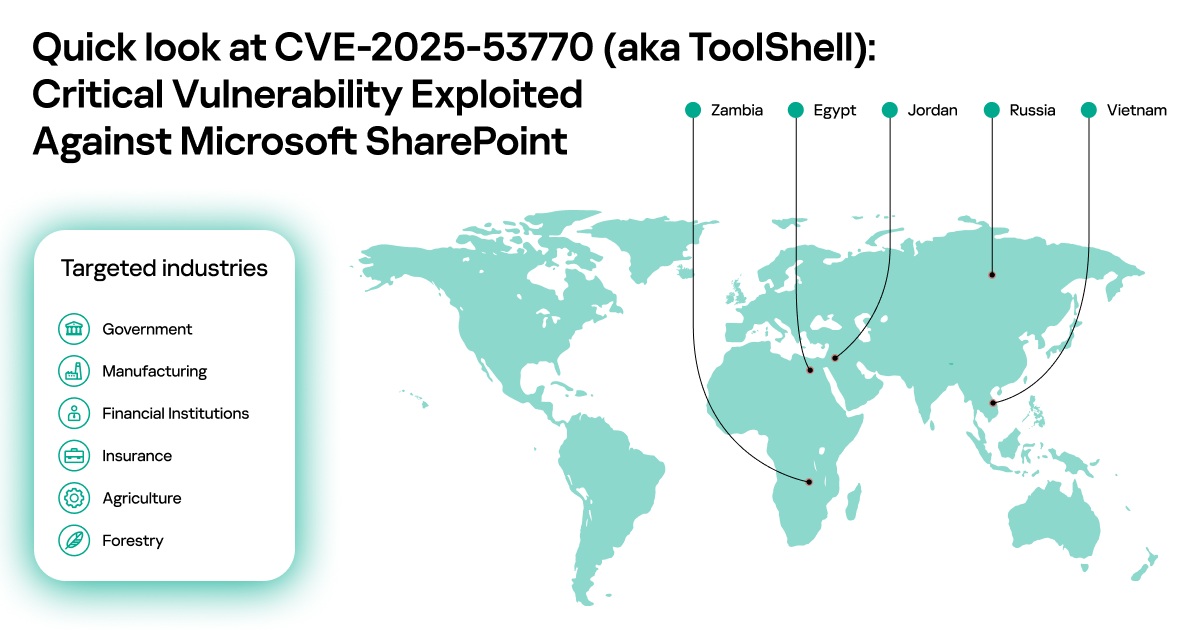
    Kaspersky products proactively detected and blocked malicious activity linked to these attacks, which allowed us to gather statistics about the timeframe and spread of this campaign. Our statistics show that widespread exploitation started on July 18, 2025, and attackers targeted servers across the world in Egypt, Jordan, Russia, Vietnam, and Zambia. Entities across multiple sectors were affected: government, finance, manufacturing, forestry, and agriculture.

    While analyzing all artifacts related to these attacks, which were detected by our products and public information provided by external researchers, we found a dump of a POST request that was claimed to contain the malicious payload used in these attacks. After performing our own analysis, we were able to confirm that this dump indeed contained the malicious payload detected by our technologies, and that sending this single request to an affected SharePoint installation was enough to execute the malicious payload there.

    Our analysis of the exploit showed that it did rely on vulnerabilities fixed under CVE-2025-49704 and CVE-2025-49706, but by changing just one byte in the request, we were able to bypass those fixes.

    In this post, we provide detailed information about CVE-2025-49704, CVE-2025-49706, CVE-2025-53770, CVE-2025-53771, and one related vulnerability. Since the exploit code is already published online, is very easy to use, and poses a significant risk, we encourage all organizations to install the necessary updates.

    The exploit

    Our research started with an analysis of a POST request dump associated with this wave of attacks on SharePoint servers.

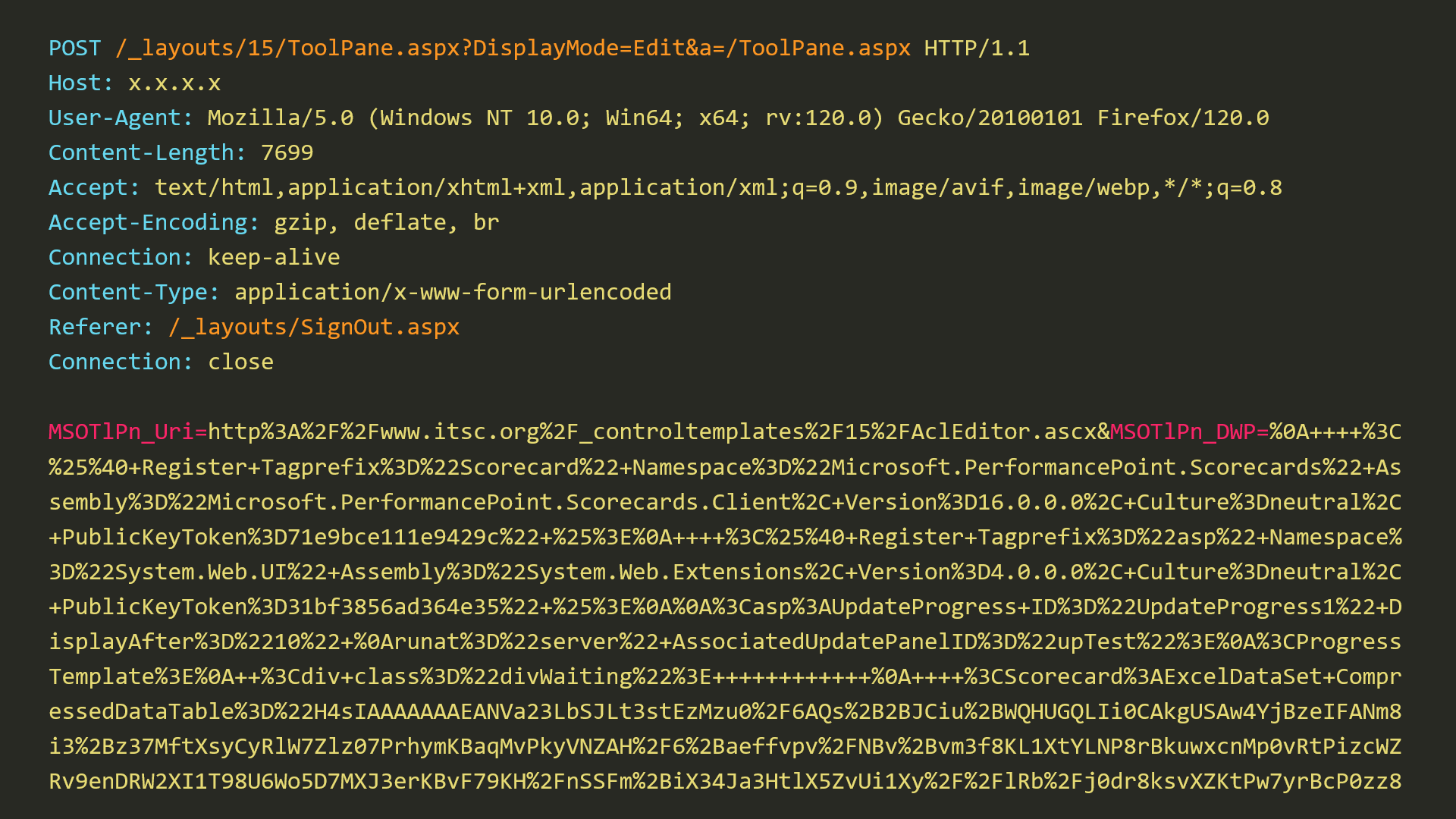
    Snippet of the exploit POST request

    We can see that this POST request targets the “/_layouts/15/ToolPane.aspx” endpoint and embeds two parameters: “MSOtlPn_Uri” and “MSOtlPn_DWP”. Looking at the code of ToolPane.aspx, we can see that this file itself does not contain much functionality and most of its code is located in the ToolPane class of the Microsoft.SharePoint.WebPartPages namespace in Microsoft.SharePoint.dll. Looking at this class reveals the code that works with the two parameters present in the exploit. However, accessing this endpoint under normal conditions is not possible without bypassing authentication on the attacked SharePoint server. This is where the first Microsoft SharePoint Server Spoofing Vulnerability CVE-2025-49706 comes into play.

    CVE-2025-49706

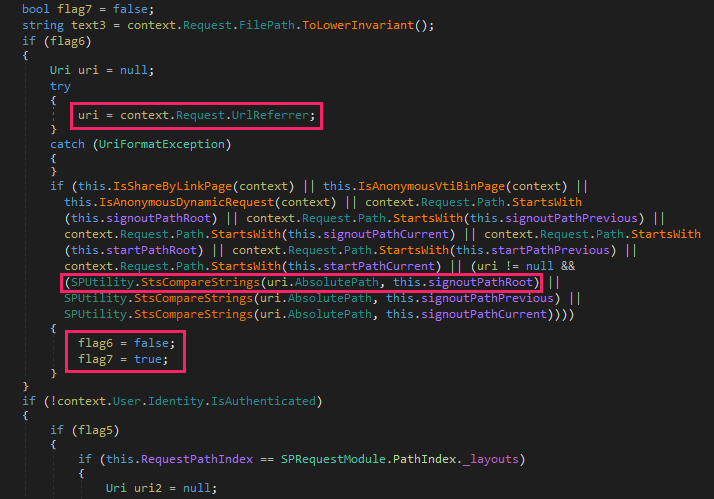
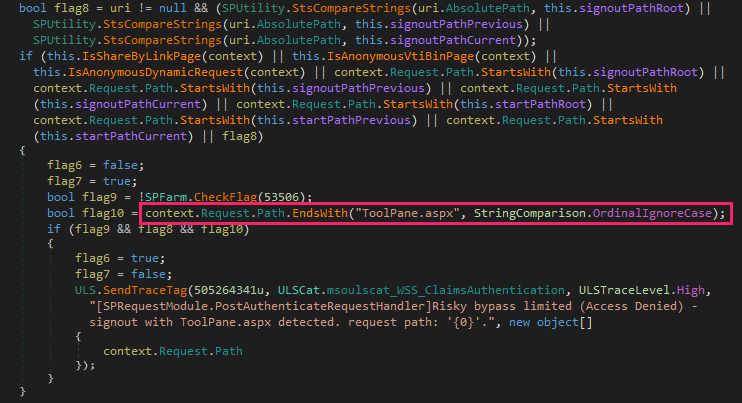
    This vulnerability is present in the method PostAuthenticateRequestHandler, in Microsoft.SharePoint.dll. SharePoint requires Internet Information Services (IIS) to be configured in integrated mode. In this mode, the IIS and ASP.NET authentication stages are unified. As a result, the outcome of IIS authentication is not determined until the PostAuthenticateRequest stage, at which point both the ASP.NET and IIS authentication methods have been completed. Therefore, the PostAuthenticateRequestHandler method utilizes a series of flags to track potential authentication violations. A logic bug in this method enables an authentication bypass if the “Referrer” header of the HTTP request is equal to “/_layouts/SignOut.aspx”, “/_layouts/14/SignOut.aspx”, or “/_layouts/15/SignOut.aspx” using case insensitive comparison.

    Vulnerable code in PostAuthenticateRequestHandler method (Microsoft.SharePoint.dll version 16.0.10417.20018)

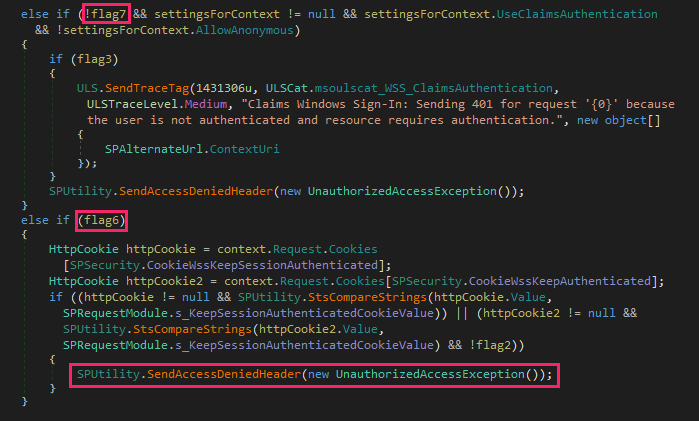
    The code displayed in the image above handles the sign-out request and is also triggered when the sign-out page is specified as the referrer. When flag6 is set to false and flag7 is set to true, both conditional branches that could potentially throw an “Unauthorized Access” exception are bypassed.

    Unauthorized access checks bypassed by the exploit

    On July 8, 2025, Microsoft released an update that addressed this vulnerability by introducing additional checks to detect the usage of the “ToolPane.aspx” endpoint with the sign-out page specified as the referrer.

    CVE-2025-49706 fix (Microsoft.SharePoint.dll version 16.0.10417.20027)

    The added check uses case insensitive comparison to verify if the requested path ends with “ToolPane.aspx”. Is it possible to bypass this check, say, by using a different endpoint? Our testing has shown that this check can be easily bypassed.

    CVE-2025-53771

    We were able to successfully bypass the patch for vulnerability CVE-2025-49706 by adding just one byte to the exploit POST request. All that was required to bypass this patch was to add a “/” (slash) to the end of the requested “ToolPane.aspx” path.

    Bypass for CVE-2025-49706 fix

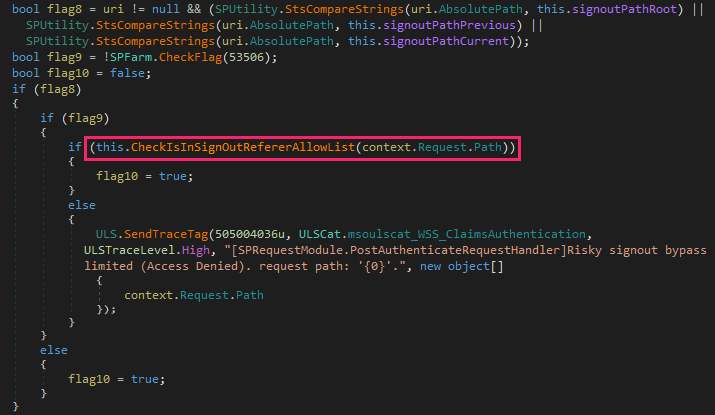
    On July 20, 2025, Microsoft released an update that fixed this bypass as CVE-2025-53771. This fix replaces the “ToolPane.aspx” check to instead check whether the requested path is in the list of paths allowed for use with the sign-out page specified as the referrer.

    CVE-2025-53771 fix (Microsoft.SharePoint.dll version 16.0.10417.20037)

    This allowlist includes the following paths: “/_layouts/15/SignOut.aspx”, “/_layouts/15/1033/initstrings.js”, “/_layouts/15/init.js”, “/_layouts/15/theming.js”, “/ScriptResource.axd”, “/_layouts/15/blank.js”, “/ScriptResource.axd”, “/WebResource.axd”, “/_layouts/15/1033/styles/corev15.css”, “/_layouts/15/1033/styles/error.css”, “/_layouts/15/images/favicon.ico”, “/_layouts/15/1033/strings.js”, “/_layouts/15/core.js”, and it can contain additional paths added by the administrator.

    While testing the CVE-2025-49706 bypass with the July 8, 2025 updates installed on our SharePoint debugging stand, we noticed some strange behavior. Not only did the bypass of CVE-2025-49706 work, but the entire exploit chain did! But wait! Didn’t the attackers use an additional Microsoft SharePoint Remote Code Execution Vulnerability CVE-2025-49704, which was supposed to be fixed in the same update? To understand why the entire exploit chain worked in our case, let’s take a look at the vulnerability CVE-2025-49704 and how it was fixed.

    CVE-2025-49704

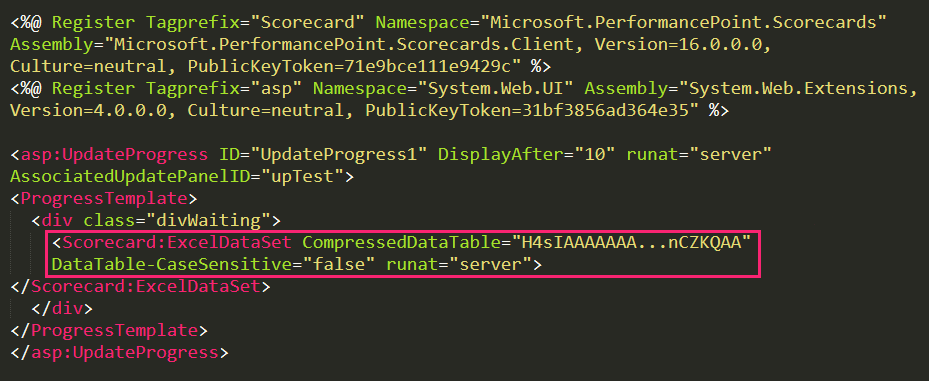
    CVE-2025-49704 is an untrusted data deserialization vulnerability that exists due to improper validation of XML content. Looking at the exploit POST request, we can see that it contains two URL encoded parameters: “MSOtlPn_Uri” and “MSOtlPn_DWP”. We can see how they are handled by examining the code of the method GetPartPreviewAndPropertiesFromMarkup in Microsoft.SharePoint.dll. A quick analysis reveals that “MSOtlPn_Uri”  is a page URL that might be pointing to an any file in the CONTROLTEMPLATES folder and the parameter “MSOtlPn_DWP” contains something known as WebPart markup. This markup contains special directives that can be used to execute safe controls on a server and has a format very similar to XML.

    WebPart markup used by the attackers

    While this “XML” included in the “MSOtlPn_DWP” parameter does not itself contain a vulnerability, it allows attackers to instantiate the ExcelDataSet control from Microsoft.PerformancePoint.Scorecards.Client.dll with CompressedDataTable property set to malicious payload and trigger its processing using DataTable property getter.

    Code of the method that handles the contents of ExcelDataSet’s CompressedDataTable property in the DataTable property getter

    Looking at the code of the ExcelDataSet’s DataTable property getter in Microsoft.PerformancePoint.Scorecards.Client.dll, we find the method GetObjectFromCompressedBase64String, responsible for deserialization of CompressedDataTable property contents. The data provided as Base64 string is decoded, unzipped, and passed to the BinarySerialization.Deserialize method from Microsoft.SharePoint.dll.

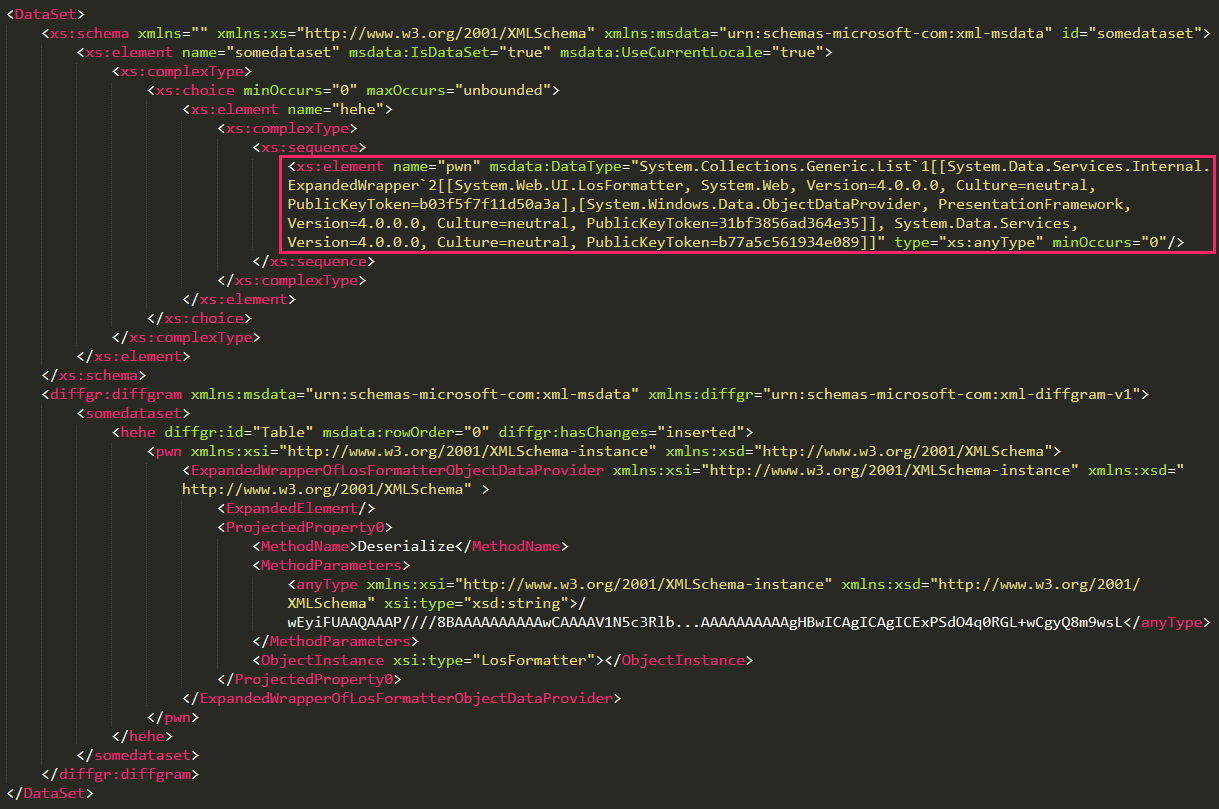
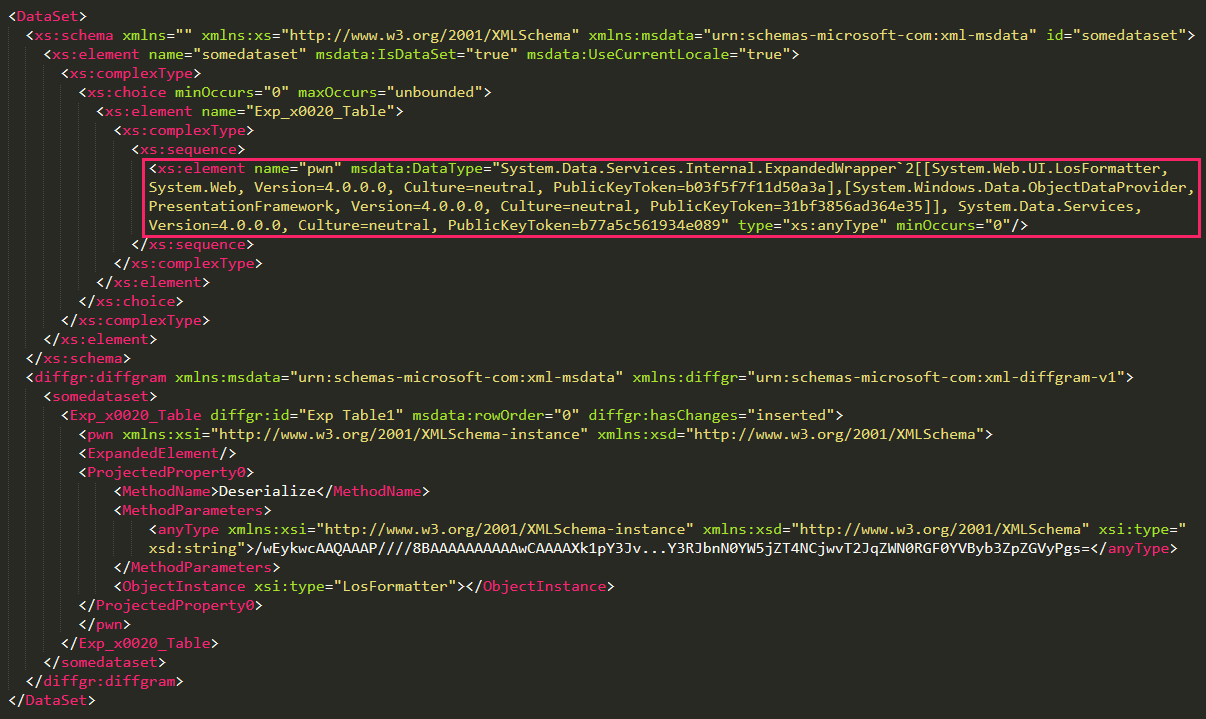
    DataSet with XML content exploiting CVE-2025-49704 (deserialized)

    Attackers use this method to provide a malicious DataSet whose deserialized content is shown in the image above. It contains an XML with an element of dangerous type “System.Collections.Generic.List1[[System.Data.Services.Internal.ExpandedWrapper2[…], System.Data.Services, Version=4.0.0.0, Culture=neutral, PublicKeyToken=b77a5c561934e089]]”, which allows attackers to execute arbitrary methods with the help of the well-known ExpandedWrapper technique aimed at exploitation of unsafe XML deserialization in applications based on the .NET framework. In fact, this shouldn’t be possible, since BinarySerialization.Deserialize in Microsoft.SharePoint.dll uses a special XmlValidator designed to protect against this technique by checking the types of all elements present in the provided XML and ensuring that they are on the list of allowed types. However, the exploit bypasses this check by placing the ExpandedWrapper object into the list.

    Now, to find out why the exploit worked on our SharePoint debugging stand with the July 8, 2025 updates installed, let’s take a look at how this vulnerability was fixed. In this patch, Microsoft did not really fix the vulnerability but only mitigated it by adding the new AddExcelDataSetToSafeControls class to the Microsoft.SharePoint.Upgrade namespace. This class contains new code that modifies the web.config file and marks the Microsoft.PerformancePoint.Scorecards.ExcelDataSet control as unsafe. Because SharePoint does not execute this code on its own after installing updates, the only way to achieve the security effect was to manually run a configuration upgrade using the SharePoint Products Configuration Wizard tool. Notably, the security guidance for CVE-2025-49704 does not mention the need for this step, which means at least some SharePoint administrators may skip it. Meanwhile, anyone who installed this update but did not manually perform a configuration upgrade remained vulnerable.

    CVE-2025-53770

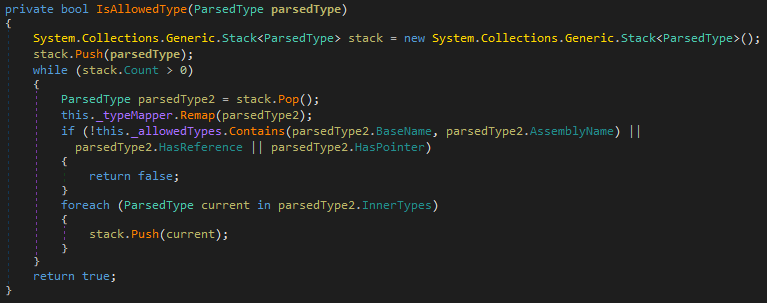
    On July 20, 2025, Microsoft released an update with a proper fix for the CVE-2025-49704 vulnerability. This patch introduces an updated XmlValidator that now properly validates element types in XML, preventing exploitation of this vulnerability without requiring a configuration upgrade and, more importantly, addressing the root cause and preventing exploitation of the same vulnerability through controls other than Microsoft.PerformancePoint.Scorecards.ExcelDataSet.

    DataSet with XML content exploiting CVE-2025-49704 (deserialized)

    CVE-2020-1147

    Readers familiar with previous SharePoint exploits might feel that the vulnerability CVE-2025-49704/CVE-2025-53770 and the exploit used by the attackers looks very familiar and very similar to the older .NET Framework, SharePoint Server, and Visual Studio Remote Code Execution Vulnerability CVE-2020-1147. In fact, if we compare the exploit for CVE-2020-1147 and an exploit for CVE-2025-49704/CVE-2025-53770, we can see that they are almost identical. The only difference is that in the exploit for CVE-2025-49704/CVE-2025-53770, the dangerous ExpandedWrapper object is placed in the list. This makes CVE-2025-53770 an updated fix for CVE-2020-1147.

    DataSet with XML content exploiting CVE-2020-1147

    Conclusions

    Despite the fact that patches for the ToolShell vulnerabilities are now available for deployment, we assess that this chain of exploits will continue being used by attackers for a long time. We have been observing the same situation with other notorious vulnerabilities, such as ProxyLogon, PrintNightmare, or EternalBlue. While they have been known for years, many threat actors still continue leveraging them in their attacks to compromise unpatched systems. We expect the ToolShell vulnerabilities to follow the same fate, as they can be exploited with extremely low effort and allow full control over the vulnerable server.

    To stay better protected against threats like ToolShell, we as a community should learn lessons from previous events in the industry related to critical vulnerabilities. Specifically, the speed of applying security patches nowadays is the most important factor when it comes to fighting such vulnerabilities. Since public exploits for these dangerous vulnerabilities appear very soon after vulnerability announcements, it is paramount to install patches as soon as possible, as a gap of even a few hours can make a critical difference.

    At the same time, it is important to protect enterprise networks against zero-day exploits, which can be leveraged when there is no available public patch for vulnerabilities. In this regard, it is critical to equip machines with reliable cybersecurity solutions that have proven effective in combatting ToolShell attacks before they were publicly disclosed.

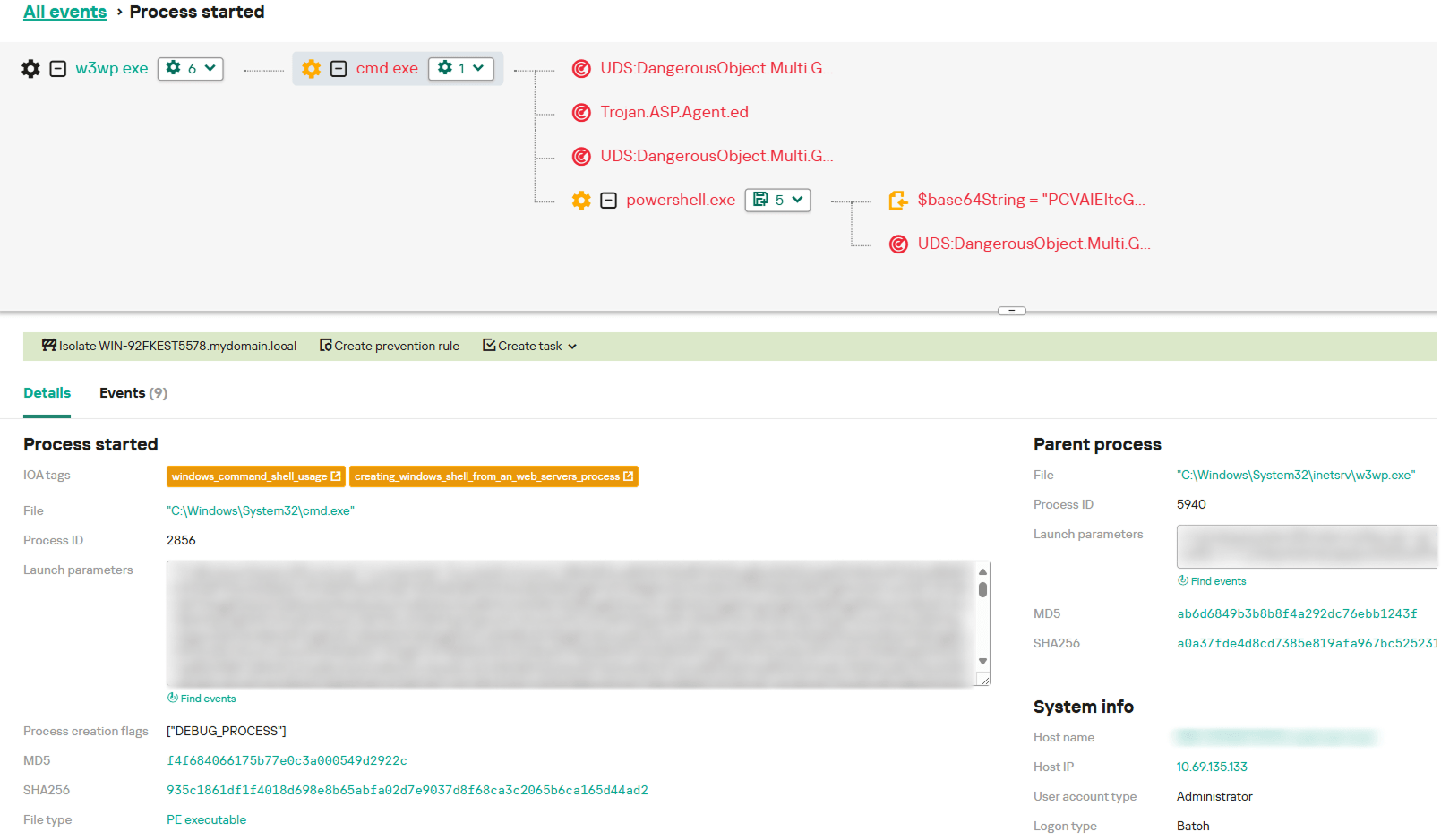
    Kaspersky Next with its Behaviour detection component proactively protects against  exploitation of these vulnerabilities. Additionally, it is able to detect exploitation and the subsequent malicious activity.

    Kaspersky products detect the exploits and malware used in these attacks with the following verdicts:

    • UDS:DangerousObject.Multi.Generic
    • PDM:Exploit.Win32.Generic
    • PDM:Trojan.Win32.Generic
    • HEUR:Trojan.MSIL.Agent.gen
    • ASP.Agent.*
    • PowerShell.Agent.*

    MIL OSI Economics

  • MIL-OSI Economics: ToolShell: a story of five vulnerabilities in Microsoft SharePoint

    Source: Securelist – Kaspersky

    Headline: ToolShell: a story of five vulnerabilities in Microsoft SharePoint

    On July 19–20, 2025, various security companies and national CERTs published alerts about active exploitation of on-premise SharePoint servers. According to the reports, observed attacks did not require authentication, allowed attackers to gain full control over the infected servers, and were performed using an exploit chain of two vulnerabilities: CVE-2025-49704 and CVE-2025-49706, publicly named “ToolShell”. Additionally, on the same dates, Microsoft released out-of-band security patches for the vulnerabilities CVE-2025-53770 and CVE-2025-53771, aimed at addressing the security bypasses of previously issued fixes for CVE-2025-49704 and CVE-2025-49706. The release of the new, “proper” updates has caused confusion about exactly which vulnerabilities attackers are exploiting and whether they are using zero-day exploits.

    Kaspersky products proactively detected and blocked malicious activity linked to these attacks, which allowed us to gather statistics about the timeframe and spread of this campaign. Our statistics show that widespread exploitation started on July 18, 2025, and attackers targeted servers across the world in Egypt, Jordan, Russia, Vietnam, and Zambia. Entities across multiple sectors were affected: government, finance, manufacturing, forestry, and agriculture.

    While analyzing all artifacts related to these attacks, which were detected by our products and public information provided by external researchers, we found a dump of a POST request that was claimed to contain the malicious payload used in these attacks. After performing our own analysis, we were able to confirm that this dump indeed contained the malicious payload detected by our technologies, and that sending this single request to an affected SharePoint installation was enough to execute the malicious payload there.

    Our analysis of the exploit showed that it did rely on vulnerabilities fixed under CVE-2025-49704 and CVE-2025-49706, but by changing just one byte in the request, we were able to bypass those fixes.

    In this post, we provide detailed information about CVE-2025-49704, CVE-2025-49706, CVE-2025-53770, CVE-2025-53771, and one related vulnerability. Since the exploit code is already published online, is very easy to use, and poses a significant risk, we encourage all organizations to install the necessary updates.

    The exploit

    Our research started with an analysis of a POST request dump associated with this wave of attacks on SharePoint servers.

    Snippet of the exploit POST request

    We can see that this POST request targets the “/_layouts/15/ToolPane.aspx” endpoint and embeds two parameters: “MSOtlPn_Uri” and “MSOtlPn_DWP”. Looking at the code of ToolPane.aspx, we can see that this file itself does not contain much functionality and most of its code is located in the ToolPane class of the Microsoft.SharePoint.WebPartPages namespace in Microsoft.SharePoint.dll. Looking at this class reveals the code that works with the two parameters present in the exploit. However, accessing this endpoint under normal conditions is not possible without bypassing authentication on the attacked SharePoint server. This is where the first Microsoft SharePoint Server Spoofing Vulnerability CVE-2025-49706 comes into play.

    CVE-2025-49706

    This vulnerability is present in the method PostAuthenticateRequestHandler, in Microsoft.SharePoint.dll. SharePoint requires Internet Information Services (IIS) to be configured in integrated mode. In this mode, the IIS and ASP.NET authentication stages are unified. As a result, the outcome of IIS authentication is not determined until the PostAuthenticateRequest stage, at which point both the ASP.NET and IIS authentication methods have been completed. Therefore, the PostAuthenticateRequestHandler method utilizes a series of flags to track potential authentication violations. A logic bug in this method enables an authentication bypass if the “Referrer” header of the HTTP request is equal to “/_layouts/SignOut.aspx”, “/_layouts/14/SignOut.aspx”, or “/_layouts/15/SignOut.aspx” using case insensitive comparison.

    Vulnerable code in PostAuthenticateRequestHandler method (Microsoft.SharePoint.dll version 16.0.10417.20018)

    The code displayed in the image above handles the sign-out request and is also triggered when the sign-out page is specified as the referrer. When flag6 is set to false and flag7 is set to true, both conditional branches that could potentially throw an “Unauthorized Access” exception are bypassed.

    Unauthorized access checks bypassed by the exploit

    On July 8, 2025, Microsoft released an update that addressed this vulnerability by introducing additional checks to detect the usage of the “ToolPane.aspx” endpoint with the sign-out page specified as the referrer.

    CVE-2025-49706 fix (Microsoft.SharePoint.dll version 16.0.10417.20027)

    The added check uses case insensitive comparison to verify if the requested path ends with “ToolPane.aspx”. Is it possible to bypass this check, say, by using a different endpoint? Our testing has shown that this check can be easily bypassed.

    CVE-2025-53771

    We were able to successfully bypass the patch for vulnerability CVE-2025-49706 by adding just one byte to the exploit POST request. All that was required to bypass this patch was to add a “/” (slash) to the end of the requested “ToolPane.aspx” path.

    Bypass for CVE-2025-49706 fix

    On July 20, 2025, Microsoft released an update that fixed this bypass as CVE-2025-53771. This fix replaces the “ToolPane.aspx” check to instead check whether the requested path is in the list of paths allowed for use with the sign-out page specified as the referrer.

    CVE-2025-53771 fix (Microsoft.SharePoint.dll version 16.0.10417.20037)

    This allowlist includes the following paths: “/_layouts/15/SignOut.aspx”, “/_layouts/15/1033/initstrings.js”, “/_layouts/15/init.js”, “/_layouts/15/theming.js”, “/ScriptResource.axd”, “/_layouts/15/blank.js”, “/ScriptResource.axd”, “/WebResource.axd”, “/_layouts/15/1033/styles/corev15.css”, “/_layouts/15/1033/styles/error.css”, “/_layouts/15/images/favicon.ico”, “/_layouts/15/1033/strings.js”, “/_layouts/15/core.js”, and it can contain additional paths added by the administrator.

    While testing the CVE-2025-49706 bypass with the July 8, 2025 updates installed on our SharePoint debugging stand, we noticed some strange behavior. Not only did the bypass of CVE-2025-49706 work, but the entire exploit chain did! But wait! Didn’t the attackers use an additional Microsoft SharePoint Remote Code Execution Vulnerability CVE-2025-49704, which was supposed to be fixed in the same update? To understand why the entire exploit chain worked in our case, let’s take a look at the vulnerability CVE-2025-49704 and how it was fixed.

    CVE-2025-49704

    CVE-2025-49704 is an untrusted data deserialization vulnerability that exists due to improper validation of XML content. Looking at the exploit POST request, we can see that it contains two URL encoded parameters: “MSOtlPn_Uri” and “MSOtlPn_DWP”. We can see how they are handled by examining the code of the method GetPartPreviewAndPropertiesFromMarkup in Microsoft.SharePoint.dll. A quick analysis reveals that “MSOtlPn_Uri”  is a page URL that might be pointing to an any file in the CONTROLTEMPLATES folder and the parameter “MSOtlPn_DWP” contains something known as WebPart markup. This markup contains special directives that can be used to execute safe controls on a server and has a format very similar to XML.

    WebPart markup used by the attackers

    While this “XML” included in the “MSOtlPn_DWP” parameter does not itself contain a vulnerability, it allows attackers to instantiate the ExcelDataSet control from Microsoft.PerformancePoint.Scorecards.Client.dll with CompressedDataTable property set to malicious payload and trigger its processing using DataTable property getter.

    Code of the method that handles the contents of ExcelDataSet’s CompressedDataTable property in the DataTable property getter

    Looking at the code of the ExcelDataSet’s DataTable property getter in Microsoft.PerformancePoint.Scorecards.Client.dll, we find the method GetObjectFromCompressedBase64String, responsible for deserialization of CompressedDataTable property contents. The data provided as Base64 string is decoded, unzipped, and passed to the BinarySerialization.Deserialize method from Microsoft.SharePoint.dll.

    DataSet with XML content exploiting CVE-2025-49704 (deserialized)

    Attackers use this method to provide a malicious DataSet whose deserialized content is shown in the image above. It contains an XML with an element of dangerous type “System.Collections.Generic.List1[[System.Data.Services.Internal.ExpandedWrapper2[…], System.Data.Services, Version=4.0.0.0, Culture=neutral, PublicKeyToken=b77a5c561934e089]]”, which allows attackers to execute arbitrary methods with the help of the well-known ExpandedWrapper technique aimed at exploitation of unsafe XML deserialization in applications based on the .NET framework. In fact, this shouldn’t be possible, since BinarySerialization.Deserialize in Microsoft.SharePoint.dll uses a special XmlValidator designed to protect against this technique by checking the types of all elements present in the provided XML and ensuring that they are on the list of allowed types. However, the exploit bypasses this check by placing the ExpandedWrapper object into the list.

    Now, to find out why the exploit worked on our SharePoint debugging stand with the July 8, 2025 updates installed, let’s take a look at how this vulnerability was fixed. In this patch, Microsoft did not really fix the vulnerability but only mitigated it by adding the new AddExcelDataSetToSafeControls class to the Microsoft.SharePoint.Upgrade namespace. This class contains new code that modifies the web.config file and marks the Microsoft.PerformancePoint.Scorecards.ExcelDataSet control as unsafe. Because SharePoint does not execute this code on its own after installing updates, the only way to achieve the security effect was to manually run a configuration upgrade using the SharePoint Products Configuration Wizard tool. Notably, the security guidance for CVE-2025-49704 does not mention the need for this step, which means at least some SharePoint administrators may skip it. Meanwhile, anyone who installed this update but did not manually perform a configuration upgrade remained vulnerable.

    CVE-2025-53770

    On July 20, 2025, Microsoft released an update with a proper fix for the CVE-2025-49704 vulnerability. This patch introduces an updated XmlValidator that now properly validates element types in XML, preventing exploitation of this vulnerability without requiring a configuration upgrade and, more importantly, addressing the root cause and preventing exploitation of the same vulnerability through controls other than Microsoft.PerformancePoint.Scorecards.ExcelDataSet.

    DataSet with XML content exploiting CVE-2025-49704 (deserialized)

    CVE-2020-1147

    Readers familiar with previous SharePoint exploits might feel that the vulnerability CVE-2025-49704/CVE-2025-53770 and the exploit used by the attackers looks very familiar and very similar to the older .NET Framework, SharePoint Server, and Visual Studio Remote Code Execution Vulnerability CVE-2020-1147. In fact, if we compare the exploit for CVE-2020-1147 and an exploit for CVE-2025-49704/CVE-2025-53770, we can see that they are almost identical. The only difference is that in the exploit for CVE-2025-49704/CVE-2025-53770, the dangerous ExpandedWrapper object is placed in the list. This makes CVE-2025-53770 an updated fix for CVE-2020-1147.

    DataSet with XML content exploiting CVE-2020-1147

    Conclusions

    Despite the fact that patches for the ToolShell vulnerabilities are now available for deployment, we assess that this chain of exploits will continue being used by attackers for a long time. We have been observing the same situation with other notorious vulnerabilities, such as ProxyLogon, PrintNightmare, or EternalBlue. While they have been known for years, many threat actors still continue leveraging them in their attacks to compromise unpatched systems. We expect the ToolShell vulnerabilities to follow the same fate, as they can be exploited with extremely low effort and allow full control over the vulnerable server.

    To stay better protected against threats like ToolShell, we as a community should learn lessons from previous events in the industry related to critical vulnerabilities. Specifically, the speed of applying security patches nowadays is the most important factor when it comes to fighting such vulnerabilities. Since public exploits for these dangerous vulnerabilities appear very soon after vulnerability announcements, it is paramount to install patches as soon as possible, as a gap of even a few hours can make a critical difference.

    At the same time, it is important to protect enterprise networks against zero-day exploits, which can be leveraged when there is no available public patch for vulnerabilities. In this regard, it is critical to equip machines with reliable cybersecurity solutions that have proven effective in combatting ToolShell attacks before they were publicly disclosed.

    Kaspersky Next with its Behaviour detection component proactively protects against  exploitation of these vulnerabilities. Additionally, it is able to detect exploitation and the subsequent malicious activity.

    Kaspersky products detect the exploits and malware used in these attacks with the following verdicts:

    • UDS:DangerousObject.Multi.Generic
    • PDM:Exploit.Win32.Generic
    • PDM:Trojan.Win32.Generic
    • HEUR:Trojan.MSIL.Agent.gen
    • ASP.Agent.*
    • PowerShell.Agent.*

    MIL OSI Economics

  • MIL-OSI Economics: Money Market Operations as on July 24, 2025

    Source: Reserve Bank of India


    (Amount in ₹ crore, Rate in Per cent)

      Volume
    (One Leg)
    Weighted
    Average Rate
    Range
    A. Overnight Segment (I+II+III+IV) 6,08,438.16 5.47 4.75-6.45
         I. Call Money 15,971.76 5.54 4.75-5.65
         II. Triparty Repo 4,10,930.35 5.44 5.00-5.55
         III. Market Repo 1,79,185.50 5.53 5.00-6.00
         IV. Repo in Corporate Bond 2,350.55 5.68 5.60-6.45
    B. Term Segment      
         I. Notice Money** 91.54 5.35 4.95-5.51
         II. Term Money@@ 555.00 5.45-5.90
         III. Triparty Repo 1,621.75 5.40 5.40-5.65
         IV. Market Repo 142.44 5.50 5.50-5.50
         V. Repo in Corporate Bond 0.00
      Auction Date Tenor (Days) Maturity Date Amount Current Rate /
    Cut off Rate
    C. Liquidity Adjustment Facility (LAF), Marginal Standing Facility (MSF) & Standing Deposit Facility (SDF)
    I. Today’s Operations
    1. Fixed Rate          
    2. Variable Rate&          
      (I) Main Operation          
         (a) Repo          
         (b) Reverse Repo          
      (II) Fine Tuning Operations          
         (a) Repo Thu, 24/07/2025 1 Fri, 25/07/2025 1,421.00 5.51
         (b) Reverse Repo          
    3. MSF# Thu, 24/07/2025 1 Fri, 25/07/2025 362.00 5.75
    4. SDFΔ# Thu, 24/07/2025 1 Fri, 25/07/2025 1,17,991.00 5.25
    5. Net liquidity injected from today’s operations [injection (+)/absorption (-)]*       -1,16,208.00  
    II. Outstanding Operations
    1. Fixed Rate          
    2. Variable Rate&          
      (I) Main Operation          
         (a) Repo          
         (b) Reverse Repo          
      (II) Fine Tuning Operations          
         (a) Repo Wed, 23/07/2025 2 Fri, 25/07/2025 50,001.00 5.53
         (b) Reverse Repo Fri, 18/07/2025 7 Fri, 25/07/2025 2,00,027.00 5.49
    3. MSF#          
    4. SDFΔ#          
    D. Standing Liquidity Facility (SLF) Availed from RBI$       10,403.21  
    E. Net liquidity injected from outstanding operations [injection (+)/absorption (-)]*     -1,39,622.79  
    F. Net liquidity injected (outstanding including today’s operations) [injection (+)/absorption (-)]*     -2,55,830.79  
    G. Cash Reserves Position of Scheduled Commercial Banks          
         (i) Cash balances with RBI as on July 24, 2025 9,49,868.65  
         (ii) Average daily cash reserve requirement for the fortnight ending July 25, 2025 9,63,288.00  
    H. Government of India Surplus Cash Balance Reckoned for Auction as on¥ July 24, 2025 1,421.00  
    I. Net durable liquidity [surplus (+)/deficit (-)] as on June 27, 2025 5,79,904.00  

    @ Based on Reserve Bank of India (RBI) / Clearing Corporation of India Limited (CCIL).

    – Not Applicable / No Transaction.

    ** Relates to uncollateralized transactions of 2 to 14 days tenor.

    @@ Relates to uncollateralized transactions of 15 days to one year tenor.

    $ Includes refinance facilities extended by RBI.

    * Net liquidity is calculated as Repo+MSF+SLF-Reverse Repo-SDF.

    Ajit Prasad          
    Deputy General Manager
    (Communications)    

    Press Release: 2025-2026/778

    MIL OSI Economics

  • MIL-OSI Economics: Liberia salutes African Development Bank President Adesina in landmark Government session

    Source: African Development Bank Group
    Liberian President Joseph Nyuma Boakai convened the full spectrum of his government leadership to hear from African Development Bank President Dr. Akinwumi Adesina, whom he lauded for a transformative decade at the helm of Africa’s premier development finance institution.

    MIL OSI Economics

  • MIL-OSI Economics: Tunisia: African Development Bank unveils 2025 Country Report – A Roadmap for Inclusive and Sustainable Growth

    Source: African Development Bank Group
    The African Development Bank has presented its 2025 Country Focus Report for Tunisia. Titled “Unlocking Tunisia’s Capital for Sustainable Development,” it highlights key levers for fostering more inclusive, resilient, and sustainable growth through improved mobilization of the country’s human, financial, and…

    MIL OSI Economics

  • MIL-OSI Economics: The Gambia: African Development Fund Approves $19.93 Million Grant to Tackle Fragility and Expand Opportunities for Rural Youth and Women

    Source: African Development Bank Group
    The Board of Directors of the African Development Bank Group has approved $19.93 million grant funding for the Resilience Building – Vulnerable Youth and Women Support Project, designed to improve access to basic social services for underserved communities in The Gambia.

    MIL OSI Economics

  • MIL-OSI Economics: Secretary-General of ASEAN meets with Minister of Foreign Affairs of the People’s Republic of China

    Source: ASEAN

    Secretary-General of ASEAN, Dr. Kao Kim Hourn, today met with H.E. Wang Yi, Member of the Political Bureau of the Communist Party of China (CPC) Central Committee, Director of the Office of the Central Commission for Foreign Affairs and Minister of Foreign Affairs of China, on the sidelines of his visit to China.
     
    Both sides acknowledged the progress made under the ASEAN-China Comprehensive Strategic Partnership and discussed ways to further advance cooperation across all three pillars of the ASEAN Community and ASEAN Connectivity, including the deliverables of ASEAN-China cooperation in 2025. SG Dr. Kao welcomed China’s continued support for ASEAN Centrality and regional integration, especially towards the implementation of the ASEAN 2045: Our Shared Future.

    The post Secretary-General of ASEAN meets with Minister of Foreign Affairs of the People’s Republic of China appeared first on ASEAN Main Portal.

    MIL OSI Economics

  • MIL-OSI Economics: Press Briefing Transcript: Julie Kozack, Director, Communications Department, July 24, 2025

    Source: International Monetary Fund

    July 24, 2025

    SPEAKER:  Ms. Julie Kozack, Director of the Communications Department, IMF

    MS. KOZACK: Good morning, and welcome to the IMF Press Briefing. It is wonderful to see all of you, both those of you here in person and colleagues online as well. I’m Julie Kozack, Director of the Communications Department at the IMF. As usual, this briefing is embargoed until 11 A.M. Eastern Time in the United States. I’ll start with a few announcements and then I’ll take your questions in person on Webex and via the Press Center.
    First, we will be releasing our flagship publication, the World Economic Outlook Update, next Tuesday, July 29th. The report will offer fresh insights into the current global economic trends and external imbalances.
    For your planning purposes, our Executive Board will be in recess from August 4th through the 15th, and we will notify you in due course on the date of our next press briefing.
    And with that, I will now open the floor for your questions. For those connecting virtually, please turn on both your camera and microphone when speaking, and the floor is opened.

    QUESTIONER: Just wanted to ask you about the tariff situation that’s unfolding at the moment, given the recent trade deals that the U.S. has struck with its key trading partners, including Japan, Indonesia, Philippines, just recently. The European Union is under negotiations that’s coming to fruition soon. It looks like the consensus is kind of around a 15 to 20% tariff rate in that range, that the US is, sort of agreeing with its partners for. And I just wanted to know if the IMF views that as an acceptable rate? Whether this would be detrimental to the global economy. I know we have the WEO coming out in a few days. Just wanted to get your take on what’s unfolding right now.

    MS. KOZACK: Let us see if there’s any other questions on this topic before I answer. If anyone online wants to come in on this topic, please let us know.
    So let me start with where we are. Since April, when we think about the global economy, we see activity indicators that reflect a complex backdrop shaped by trade tensions. We also saw that in the first quarter of the year, the data showed some front-loading of exports and imports ahead of, at that time, what was expected tariff increases. The more recent data points to trade diversion and to some unwinding of the front-loading. And at the same time, we are seeing some trade deals. Some have lowered tariffs. And at the same time, there’s also been some deals or some, not deals, but we have seen increases in tariffs, for example, on steel, aluminum, and copper. So, our team is assessing all of this information as it is coming in. And they will put together a comprehensive picture, which we will talk about in the WEO next week.

    I would also just remind that when we released our WEO in April, we talked about a period of very high uncertainty. And at that time, we had in our WEO a reference forecast, right? And that reflected the fact that we were in an uncertain environment where there were many different paths forward. For example, we had an effective tariff rate of the U.S. of about 25 percent based on April 2nd announcements. That effective tariff rate for the U.S. declined to 14 percent based on the pause of April 9th. And of course, one of the important factors for assessing the impact of the deals on the U.S. economy and the global economy will be what is the new effective tariff rate that will prevail.
    So, all of that work is ongoing, and we will have a full assessment next week in the WEO.

    QUESTIONER: So, would the 15 to 20 percent rate be higher than what we saw in the April WEO?

    MS. KOZACK: I think the way I would answer that is to simply say that we are looking at all the deals in April, and we had an effective rate around 14 percent. There, of course, has been movement since April. There have been deals. There have been some reductions in some tariff rates. There have been increases in other tariff rates. So, the team is going to have to put together that comprehensive assessment to determine what would be the new effective tariff rate that would prevail. And then, we would be in a position to compare it to what we had based on the April 2 announcement, what we had based on the April 9 pause, and then where we are today.
    And another very important factor will be what is the overall impact on uncertainty, right? We have talked about being in a very highly uncertain environment. So, of course, we will be looking at that closely as well.

    QUESTIONER: The president of Ukraine recently signed a law that regulates the anti-corruption bodies in the country. How does the IMF view this law, and how can this impact IMF Ukraine cooperation moving forward? And secondly, Ukrainian Prime Minister Yulia Svyrydenko said Ukraine is facing a significant budget shortfall and is likely seeking a new IMF loan. What is the IMF’s assessment of the possibility of launching a new program?

    MS. KOZACK: Any other questions on Ukraine?

    QUESTIONER: I just wanted to follow up on whether, despite the moves by the Ukrainian government, can the IMF land to Ukraine?

    MS. KOZACK: Are there questions online on Ukraine? On Ukraine, let me just step back and remind kind of where we are with Ukraine.
    On June 30th, the IMF Board completed the Eighth Review of the EFF program and that enabled a disbursement of half a billion U.S. dollars. And that brought total disbursements under the program to U.S. $10.6 billion. Ukraine’s economy remains resilient. The authorities met, and this was reported as part of the Eighth Review, all of the end-March and continuous quantitative performance criteria; they met the prior action that was required for that review, and they also met two structural benchmarks.
    With respect to the specific questions, on the first question that you had, the enacted law, as we see it, neutralizes the effectiveness of Ukraine’s anti-corruption institutions. And from our perspective, that would be very problematic for macroeconomic stability and growth in Ukraine. Stepping back a bit, you know, the establishment and the development of independent institutions to detect and prosecute corruption cases has been central to the IMF’s engagement with Ukraine over the past 10 years. And these institutions have contributed to an improvement in governance in Ukraine over that period.
    Why is this important for Ukraine? From our perspective, Ukraine needs a robust anti-corruption architecture. And that will help level the playing field, improve the business climate, and attract private investment into Ukraine. And it’s a central piece of Ukraine’s reform agenda. So, from our perspective, safeguarding the independence of anti-corruption institutions remains a critical policy priority.
    We do take note of the government’s intention to introduce a new bill to restore the independence of the anti-corruption institutions.
    So, what I can say now is that in the coming weeks, the IMF Staff and the authorities are expected to intensify discussions about the 2026 budget and s to do an assessment of Ukraine’s financing needs, both for 2026 and over the medium term. They will be intensifying discussions to put together that comprehensive picture. That work is essential for the current program and any future potential engagement that we would have with Ukraine.

    QUESTIONER: If it finishes, what was the Staff assessment of the First Review of the agreement with Argentina and when would the Board’s definition be? And following the report on external reserves published this week, I think it was on Monday, does the IMF’s concerns continue?

    QUESTIONER: Has the Board already met to evaluate the First Review? And do you know if Argentina has requested a waiver? And how does the IMF assess the recent rate in this area, action rate and interest rates? And what are the causes of this change in monetary and exchange rate policy? Thank you.

    QUESTIONER: Yes, to add up to what was asked if there are any concerns regarding the impact of the exchange rates on inflation as well? And also, if the concerns remain regarding the weak external position for Argentina.

    QUESTIONER: President Milei has already confirmed that, for fiscal reasons, he will veto the laws recently passed by the Congress to increase pensions, extend the pension moratorium and declare an emergency disability. So, then has this intention being talked with the IMF previously or what is the IMF position on this matter?

    MS. KOZACK: On Argentina, here is what I can share today. So first, I want to mention that discussions on the First Review, which many of you have mentioned, are very advanced at this stage. And the next step in these discussions will be to reach a Staff-Level Agreement between the authorities and Staff. And we believe that that can happen very shortly. After the Staff-Level Agreement is reached, then Staff will present the documents to the Executive Board for their approval and consideration.
    What I can also add, and we have talked about that before here, is that the program has been off to a strong start. It has been underpinned by the continued implementation of tight macroeconomic policies, including a strong fiscal anchor and a tight monetary policy stance. The transition to a more flexible exchange rate regime has been smooth. Disinflation has resumed. And Argentina has reassessed international capital markets earlier than had been initially anticipated under the program.
    Given that our Staff and the authorities are very engaged in these discussions, which again are at an advanced stage, I’m not going to provide any further details now. We will give space for them to bring those discussions to a conclusion, and then we will, of course, communicate once those discussions have come to a conclusion. And again, we do think that a Staff-Level agreement could happen very, very shortly.

    QUESTIONER: Will the Board meeting be before, and start the holiday recess, or after? Because we are talking about 15 days, if not.

    MS. KOZACK: So right now, I don’t have any further details to share with you, but certainly once a Staff-Level Agreement is reached, we will be communicating, including the potential timing for formal Board discussion.

    QUESTIONER: Can you please kindly update us on the current status of the discussion between the IMF and the Republic of Senegal regarding the temporarily suspended disbursements? Especially with the Annual Meetings approaching in October in Washington, is there a realistic prospect of finalizing the matter before then? This is the first question.
    The second one, following the recent meeting between His Excellency, the President of the Republic of Senegal, Bassirou Diomaye Faye, and Mrs. Gita Gopinath, First Deputy Managing Director of the IMF, could you kindly also share some insight into the key topics discussed? What were the main points of their exchange, particularly in regard to economic and financial cooperation?

    MS. KOZACK: Any other questions on Senegal Online? Does anyone want to come in on Senegal?

    QUESTIONER: I have a follow-up because investors have been expecting the Board to consider the waiver by September. Is that timeline realistic? And the government also said it shared everything in its findings for reconciliation with the IMF. Does the Fund feel it has everything it needs in order to make the decision on the waiver?

    QUESTIONER: Have you received the report done by Mazars? And, is it enough to conclude the misreporting, and can we have maybe a time for the Board? And then, when can we expect also a new program?

    MS. KOZACK: So, let me turn to these questions.
    I’ll start by saying that the IMF remains closely engaged with Senegal. And as part of this process, as was noted, First Deputy Managing Director Gita Gopinath met with President Bassirou Faye during his visit to Washington, D.C. on July 9th. Our First Deputy Managing Director (FDMD), Gopinath, emphasized the IMF’s continued support, as Senegal works to resolve the misreporting matter. And the President reaffirmed his government’s strong commitment to transparency and reform.

    What I can also share is that an IMF Staff team will visit Dakar. The mission is tentatively planned for later in August. The purpose of the mission is going to be to discuss the steps needed to bring the misreporting case to our Executive Board. And the team will also use the opportunity to initiate discussions on the contours of a new IMF-supported program for Senegal. We are also working closely with the authorities to design the corrective actions aimed at addressing the root causes of the misreporting and, of course, to strengthen capacity development in Senegal.

    With respect to the questions on the report by Mazars, what I can share there is that we have received a preliminary debt inventory that has been prepared by Forvis Mazars. Our IMF Staff are currently reviewing that report and all the information in detail. The preliminary assessment in the report is broadly aligned with expectations, and the final validation is ongoing. And I will leave it at that on Senegal. That is what I can share for now.

    QUESTIONER: My question is on Japan. Last week, the upper house election in Japan was over, but still unclear on the composition of a new government. And what is it you are recommending? But almost all parties pledged fiscal — expansionary fiscal policies, from providing cash to reduction of consumption tax. And what is your recommendation to the new government, especially on fiscal policy, given the power of debt in Japan? And my second question is on monetary policy of Federal Reserve next week. And should the Federal Reserve cut interest rates preemptively under the circumstance of huge pressure from President Donald Trump.

    MS. KOZACK: Let us start with Japan. So maybe let me just step back a little bit to give an overview of how we assessed the Japanese economy in our April WEO.
    So, at that time, we expected growth to strengthen in Japan, and we expected inflation to converge to the Bank of Japan’s 2 percent target by 2027. Growth was projected to accelerate from 0.2 percent in 2024 to 0.6 percent this year. At the same time, and as has been the case for quite some time, Japan continues to have high levels of public debt. And because of that, our advice for Japan is for a clear fiscal consolidation plan to offset pressures from rising interest payments and also from aging-related spending. And because of this advice, we assess that Japan has limited fiscal space, again because of high public debt and these future spending needs.

    In the near term, our advice to Japan is that given this limited fiscal space, it is essential that any response to shocks, any fiscal response to shocks, is both temporary and also targeted. And by targeted, I mean targeted toward vulnerable households and firms that may be most affected by shocks. Generalized subsidies and tax cuts, in our view, should be avoided. And that is because they are not targeted to the most vulnerable, and they are not an efficient use of Japan’s limited fiscal space.

    And then, on your second question, what I can say about the U.S. economy is that the U.S. economy has proven to be resilient in the past few years. It is something that we have been talking about for quite some time. But we do see high-frequency data that indicate moderating domestic demand and low consumer and business sentiment in the U.S. In addition, and as we mentioned before, there was a strong front-loading of imports into the U.S. in the first quarter. And that, in anticipation of tariffs, and that led to an important drag on growth in the first quarter. At the same time, in the U.S., labor markets remain resilient, and the unemployment rate remains relatively low.

    With respect to inflation, we do see inflation on a path towards the Fed’s 2 percent target, but it is subject to upside risks. And that means that the Fed’s task is complex given the very highly uncertain economic environment. So the Fed will need to take into account both policies undertaken by the U.S. administration, as well as incoming data in, and of course, data on potential wage pressures as it comes to thinking about, you know, the extent of rate decisions and the timing of any rate decisions going forward.

    QUESTIONER: On Argentina, can the IMF confirm that there was a meeting on Tuesday between the Board and Staff regarding the first program review? And I know you said you wouldn’t be able to divulge much details, but I’m going to ask it anyway. When should you expect Argentina’s $2 billion disbursement?

    MS. KOZACK: So, on the first question, all I can say on this is that it’s not unusual for IMF Staff to informally brief the Executive Board on a broad range of issues. And on the timing of the disbursement, as I already indicated, we will provide more information on the timing for a formal Board meeting only once a Staff-Level Agreement has been reached. And that formal Board meeting would indicate the time when any disbursement would be made available to the Argentine authorities.

    QUESTIONER: First, let me say on behalf of my colleague from the U.S., around the world, as well as in Africa, to say thank you to Gita for everything that she has done. Our engagements with African journalists, especially. So that’s part of what I wanted to say, thank you to her. I know she’s leaving.
    And my question now goes to if you can provide updates on African nations. And I have two specific questions, one on Malawi and one on South Africa. The recent reports on Malawi said the country is facing macroeconomic challenges. I know in 2020 they received the completed HIPC program. Could you provide any updates on whether the country has reached out for any assistance regarding HIPC? Whether they qualify for another Heavily Indebted Poor Countries Initiative (HIPC) program to help them? We know in the past year, they’ve experienced floods, droughts, and natural issues that have affected the economy. I was wondering if the IMF is providing any assistance to them.
    The other question is on South Africa. We see growing tension between South Africa and the U.S. So, can you talk about if there’s any economic implication? South Africa is the largest economic in. Africa is also seen as a gateway to the continent. What are the macroeconomic issues, implications for the South African Development Community region (SADC), and also for the continent as a whole?

    MS. KOZACK: With respect to Malawi, what I can say is we completed the Article IV Consultation with Malawi just yesterday, July 22nd, 2025, or two days ago. So that was the 2025 Article IV Consultation that has been completed. And of course, there will be a lot of rich discussion of the state of the Malawian economy in that report. With respect to your more specific question on HIPC, what I can say is that Malawi completed the HIPC process in 2006. And at that time, Malawi secured U.S. $3.1 billion of debt relief through the HIPC Initiative and the Multilateral Debt Relief Initiative or otherwise known as MDRI. Since 2006, our assessment is that public debt in Malawi has returned to unsustainable levels. Total public debt is reached 88 percent of GDP at the end of 2024. And the interest bill on public debt is estimated to approach about 7 percent of GDP, which is quite high.

    We continue to urge the authorities to take decisive steps to restore public debt sustainability. Completing an external debt Restructuring and addressing the high cost of domestic borrowing are both essential to do this. And of course, strengthening public debt management and securing concessional financing will also be critical. So again, Malawi already completed the HIPC process in 2006.

    And then, on South Africa. What I can say about South Africa, I can talk a bit about how we see the outlook for South Africa, the economic outlook. So right now, based on the April WEO, we see the current economic outlook for South Africa as subdued. We projected growth in April at 1 percent for this year and 1.3 percent for next year. Uncertainty, including related to global trade policies, is weighing on activity in South Africa. And that it’s causing firms and households to delay their investment decisions and also consumption decisions.

    And I would also refer you to the April REO, Regional Economic Outlook, for Africa, and that includes some estimates on the impact of uncertainty and financial conditions on the Sub-Saharan Africa region.
    And finally, we of course continue to assess developments in South Africa, and we’ll be providing an update in the July WEO.

    QUESTIONER: I just had two follow-up questions. One was on your comments about the Fed. As you know, the tension between the Trump administration and the Fed, particularly Chair Powell, has been increasing lately. The President is going to go tour the Fed building that’s being renovated. It is a subject of controversy. Given that the IMF has been a stalwart defender of Central Bank independence, should any of this lead to Chair Powell’s replacement or his resignation? Just wondering, what kind of signal that would send to financial markets, to other countries, what kind of precedent would that set? And secondly, regarding First Deputy Managing Director Gopinath’s departure, can you walk us through the process for choosing a replacement for her?
    Traditionally, this has been a position that the U.S. has had a very strong hand in choosing. It has typically been an American. Do you expect the U.S. Treasury Department, for example, to basically recommend a candidate to the Managing Director?

    MS. KOZACK: On your first question for quite some time, the IMF has consistently advocated for Central Bank independence. And we’ve said it’s critical to ensuring that Central Banks are able to achieve their mandated objectives, such as low and stable inflation. And as we have seen through the disinflation process that has been taking place over the last few years, the credibility of Central Banks around the world has been instrumental in anchoring inflation expectations and in bringing down inflation across, you know, across the world. And across many countries in the world. And it is also important that independence, of course, it must coexist with clear accountability to the public.
    And on the question about the process, on Gita Gopinath’s decision to return to Harvard, maybe just to step back to say that on July 21st, you know, the Managing Director announced that Gita Gopinath, our First Deputy Managing Director, would be leaving the Fund at the end of August to return to Harvard University. She will be the inaugural Gregory and Ania Coffey Professor of Economics in the Department of Economics.

    And for your background, Ms. Gopinath joined the Fund in January 2019 as the first female Chief Economist of the Fund. And she was promoted to First Deputy Managing Director in January of 2022. I can add that this was a personal decision for Ms. Gopinath. She will return to her roots in academia, where she will continue to push the research frontier in international finance and macroeconomics. And she will also be training the next generation of economists.
    With respect to the selection of process and how the process works, the Managing Director selects and appoints the First Managing Director and the three Deputy Managing Directors of the Fund. The appointment is subject to approval by the Fund’s Executive Board. And in making the selection, the Managing Director consults with the Executive Board regarding the type of qualifications that, in the view of the Executive Board, a First Deputy Managing Director or a Deputy Managing Director should possess.

    QUESTIONER: My first question is regarding Sri Lanka. When can we expect the next review for the IMF-supported program? And secondly, given the uncertainties and risks that are currently opposing the economy for Sri Lanka, is there any decision or any exploration by the IMF to revisit some of the targets that have been implemented in the program that was given to Sri Lanka?

    QUESTIONER: I would like to know that now Sri Lanka has already finished four reviews, and now we are heading for the fifth one. What is the overall view of the IMF? That Sri Lanka’s performance, how we perform during these four reviews? And what are the expectations for the next review in brief? Thank you very much.

    MS. KOZACK: I have a question here that came in through the Press center on Sri Lanka. The question is what is the status of the IMF review of Sri Lanka’s program, an assessment of the macroeconomic outlook as well as the status of the review of the current mission that is visiting Sri Lanka. So, let me go ahead and take these. So, stepping back, on July 1st, the IMF’s Executive Board completed the Fourth Review under the EFF arrangement with Sri Lanka. This provided the country with U.S. $350 million to support its economic policies and reforms, and it brought total IMF financial support to U.S. $1.74 billion.

    What I can add is that Sri Lanka’s ambitious reform agenda continues to deliver commendable outcomes. Inflation remains low, revenue collection is improving and reserves, international reserves, continue to accumulate for the country. The post-crisis growth rebound to 5 percent in 2024 is quite remarkable. The revenue-to-GDP ratio improved from 8.2 percent in 2022 to 13.5 percent in 2024. The debt restructuring is nearly complete. And program performance has been generally strong overall, and the government remains committed to program objectives.

    What I can also add is that although the economic outlook remains positive for Sri Lanka, global trade policy and uncertainties do pose risks. And so, as the team moves forward to the Fifth Review, which we expect will be held in the fall, they will, of course, be looking at the overall and making an overall assessment of Sri Lanka’s economy. You know, including any implications from trade tensions or uncertainty. And of course, that will be — they will take that into account in discussions with the authorities on policies, and all of the program matters as part of the Fifth Review.

    QUESTIONER: Hi Julie. Thank you for taking my question. I have two questions, one on Syria and one on Egypt. So today there was the Saudi Syrian Investment Forum in Damascus, and it was said that in addition to the Saudi investments in support that there will be some global support on this. And the IFC was mentioned as well. So, what’s the IMF’s call on this, given that we have one of the G20 countries pledging this huge amount of investments in support? And how will the IMF contribute in this? That’s on Syria.

    And on Egypt, a few weeks ago in our press briefing here, it was mentioned that the two reviews, the Fifth and the Sixth, will be done together in the fall. Can we say that this is going to be in fall after the Annual Meeting, after the WEO report is published for the — for the region and for the global? And what, what is the main factor that we’re looking at here that would ultimately change the way it’s viewed, how Egypt’s economy is viewed in light of all the recent developments?

    MS. KOZACK: On Syria, what I can say is, and as we discussed here before, an IMF staff team did visit Syria from June 1st through 5th, and that was the first visit since 2009. The team was there to assess economic and financial conditions in Syria and to discuss with the authorities their economic policy and capacity building priorities, ultimately to support the recovery of the Syrian economy. With your specific question, what I can say there is that we have mentioned that Syria will need substantial international assistance to support the authorities’ efforts to rehabilitate the economy, meet urgent humanitarian needs, and rebuild essential institutions and infrastructure. And this not only includes concessional financial support, but it also extends to capacity development. And here, the IMF is committed to supporting Syria in its recovery efforts. The IMF Staff is working in coordination with other partners to develop a detailed roadmap for policy and capacity building priorities for some of the key economic institutions. So that’s kind of within our mandate, and that includes the Finance Ministry, the Central Bank, and the Statistics Agency.

    With respect to Egypt, what I can say on Egypt is that the IMF Staff conducted a mission to Cairo in May 2025. The mission noted continued progress under Egypt’s macroeconomic reform program, including improvements in inflation and foreign exchange reserves. However, additional time was needed to finalize key policy measures, particularly those related to reducing the state’s footprint in the economy by advancing the implementation of the state ownership policy and leveling the playing field for businesses. To allow for this continued work, the Fifth and Sixth Reviews under the EFF will be combined, and they are expected to be completed in the fall. Our team remains committed to supporting Egypt in advancing reforms to strengthen resilience and foster inclusive and private sector led growth.

    MS. KOZACK: Coming back to the Press Center, I have a question that has come in on Ghana. It says Ghana’s Finance Minister is presenting the mid-year budget today, following a first half marked by notable improvements in key economic indicators. However, concerns are rising about potential new fiscal slippages, and that could undermine gains in inflation control, currency stability, and overall recovery. Does the IMF share these concerns? And second question, what is your view on the role of monetary policy at this point, especially as the Bank of Ghana prepares to review its policy stance?

    Again, stepping back, on July 7th, the IMF’s Executive Board completed the Fourth Review of Ghana’s ECF arrangement. And after Board approval, Ghana received about U.S. $367 million, bringing total support to around U.S. $2.3 billion since May 2023.
    With respect to the budget here, I can say that the IMF has welcomed the government’s corrective actions, including a strong 2025 budget and an audit of payables to quantify and address the pre-election fiscal slippages. The authorities have recently implemented changes to their public financial management and public procurement acts, and this helps improve the overall fiscal responsibility framework in Ghana. And the authorities have also adopted a strategy to address issues in the energy sector. I can add that the mid-year budget review is fully in line with the parameters and objectives of the IMF-supported program.

    And with respect to the question on monetary policy, what I can say is that Ghana has made good progress since the beginning of the program in reducing inflation. Inflation was extremely high at the end of 2022 at 54 percent. It has now come down substantially to 14 percent at end June 2025. Going forward, it will be important for monetary policy to remain sufficiently tight, consistent with bringing inflation down to the Bank of Ghana’s target range, which is 8 percent plus or minus 2 percentage points.

    QUESTIONER: I’m going to ask about digital assets. One very specifically. There’s this controversy with El Salvador that is going around and around, but the government says they’re still buying Bitcoin, and it seems that the IMF is saying they are just moving things around between wallets. And I wanted you to address that. Also, with the passage here in the U.S. of the GENIUS Act, I guess, what does the IMF, what do they think the impacts of this sort of increasing legitimization of digital assets in the U.S. is going to be in terms of other economies, in terms of the ability to implement monetary policy? I just wonder if you have any comment on that. Thank you very much for taking the question.

    QUESTIONER: I have a question, specifically on El Salvador. How does the IMF assess the country’s continued Bitcoin accumulation in the context of the fiscal and transparency standards embedded in the Extended Fund Facility, the $1.4 billion program that was agreed last December? To what extent could this strategy complicate monitoring or risk management of this program?

    MS. KOZACK: So, on El Salvador, I’ll start with El Salvador and then Matthew, I’ll get to your question on the GENIUS Act. So again, stepping back. So, on June 27th, the IMF Executive Board completed El Salvador’s annual Article IV Consultation and concluded the First Review of the EFF that enabled El Salvador to have access to U.S. $118 million. And so far, $231 million has been disbursed under the EFF program that was approved in February.
    Program performance has been solid in El Salvador. The economy has continued to expand as macroeconomic imbalances are being addressed. The key fiscal and reserve targets were met at the time of the review with margins. And substantial progress continues with the ambitious reform agenda in the areas of governance, transparency, and financial resilience.
    And risks from Bitcoin continue to be mitigated. Regarding the questions on Bitcoin, I don’t have much new to say other than as we have stated in the past, the total amount of Bitcoin held across government-owned wallets remains unchanged, and that is consistent with El Salvador’s program commitments. The accumulation of Bitcoin by the Strategic Bitcoin Reserve Fund is consistent with program conditionality. And the increases in the Bitcoin Reserve Fund relate to movements across various government-owned wallets.
    And on your second question on the GENIUS Act, let me get to this one. Let me just step back for a moment, and then I’ll kind of come directly to the GENIUS Act.

    So, first, the GENIUS Act covers stablecoins, and stablecoins are a key type of privately issued crypto asset that aims to maintain a stable value. They do bring potential benefits, including cheaper and faster cross-border payments, increased financial inclusion, and greater portfolio diversification. So those are some of the potential benefits. There are operational risks, of course, associated with stablecoins if they are not properly regulated under an appropriate policy framework.

    Now, turning to the GENIUS Act. The GENIUS Act provides a comprehensive foundation for financial innovation and deepening. And that is balanced with consideration of consumer protection and market integrity goals and a clear identification of the institutional framework for oversight.
    Now, with respect to the kind of implications of the GENIUS Act, we, of course, are continuing to very actively monitor developments of stablecoins. We are assessing the potential implications of the GENIUS Act. And for us at the IMF, what is going to be especially important are going to be the implications for the international monetary system and the potential for spillovers to other jurisdictions. So that’s work that is ongoing, and our teams are making those assessments at this time.

    QUESTIONER: Any update on UAE economy outlook for GCC region and oil economy in general?

    MS. KOZACK: What I can share on UAE and the GCC in general, and I’ll be — and, of course, next week as part of the WEO update, we will, of course, be providing an update for the GCC region.
    So, starting with the UAE. Near-term growth in the UAE has been strong, and it is expected to remain healthy at over 4 percent in 2025. That was the assessment at the time of the April WEO. What we are seeing is robust growth in the non-hydrocarbon activity, and it is boosted by tourism, construction, public expenditure, and financial services. So those are the drivers of growth. Oil production is also increasing faster than expected, given the reversal of oil production cuts. And the UAE economy has demonstrated resilience to lower oil prices and increased oil price volatility this year.

    Now, turning to the GCC, what I can say for the GCC is that despite oil production cuts, GCC growth is estimated to have rebounded to 1.4 percent in 2024. And our projection at the time of the April WEO was that it will increase further to 3.3 percent in 2025. Non-hydrocarbon output growth is expected to remain strong, supported by rapid investment, construction, and accelerated reforms to diversify the GCC economies.
    Inflation remains low in the GCC, and our policy advice is for fiscal policy to remain prudent while strengthening fiscal reform implementation. And of course, we encourage policymakers in the region to continue reforms to support economic diversification. And as I noted, we will be providing an update of this assessment as part of the WEO update.
    And with that, I’m going to bring this Press Briefing to a close. Thank you all for your participation today.

    As a reminder, this briefing is embargoed until 11:00 A.M. Eastern Time in the United States. A transcript will be made available later on our website, IMF.org. Should you have any clarifications or additional queries, please do reach out to my colleagues via media@imf.org.

    This concludes our Press Briefing. I wish everyone a wonderful day, and I look forward to seeing you all next time.

    IMF Communications Department
    MEDIA RELATIONS

    PRESS OFFICER: Meera Louis

    Phone: +1 202 623-7100Email: MEDIA@IMF.org

    MIL OSI Economics

  • MIL-OSI Economics: Resource Advisory: Understanding electricity generation capacity in the United States

    Source: US Energy Information Administration – EIA

    Headline: Resource Advisory: Understanding electricity generation capacity in the United States

    U.S. ENERGY INFORMATION ADMINISTRATION
    WASHINGTON DC 20585

    FOR IMMEDIATE RELEASE
    July 24, 2025

    The U.S. Energy Information Administration (EIA) publishes monthly data on operating, planned, and retired electricity generating capacity in the United States.

    All EIA resources that discuss electricity capacity rely on data that power plant builders and operators report to EIA on the Form EIA-860 (annual) and Form EIA-860M (monthly) surveys. These data can answer important questions often asked of EIA, including:

    • How much natural gas capacity is currently operating in the United States?
    • How many solar projects are planned to come online this year?
    • How much nuclear capacity has retired since 2010?
    • How has battery capacity changed since 2010?
    Table 1. Net summer capacity of operating electricity generators by select fuel sources (megawatts)
      June 2024 June 2025
    Natural gas 506.6 508.4
    Coal 175.1 172.4
    Wind 150.2 154.8
    Solar photovoltaic 104.9 134
    Nuclear 96.8 98.4
    Hydropower 79.8 79.9

    Key terms
    Generator: A generator is a unit that produces electric power. A power plant typically has multiple generators. EIA data on capacity is organized by generator, not by power plant.

    Net summer capacity: When tracking electricity generation capacity, EIA—and most of the electricity industry—typically relies on net summer capacity. Net summer capacity is the maximum amount of power that generation equipment can supply to the grid at the time of summer peak demand.

    Utility-scale: Utility-scale systems include power plants that have at least 1 megawatt of electricity generation capacity. EIA data on capacity are largely limited to utility-scale power plants.

    Operating capacity
    The EIA-860M spreadsheet has a tab labeled “Operating” that includes all U.S. utility-scale electricity generators along with their county, state, net summer capacity, technology, energy source, operating year, planned retirement date (if applicable), and operating status.

    The data are lagged by one month and are the most current and most complete capacity data available.

    EIA also has several tables with distilled data that are lagged by two months, but you may find these tables easier to navigate or to track trends:

    • Electric Power Monthly Tables 6.2a, 6.2b, and 6.2c show electricity generating capacity by state for all sources, renewable sources, and fossil fuel sources, respectively. Tables show current data compared with year-ago data.
    • Monthly Energy Review Table 7.7a tracks national electricity generation capacity by source since 1950.

    Planned capacity additions
    The EIA-860M spreadsheet has a tab labeled “Planned” that includes all U.S. utility-scale electricity generators that operators plan to bring online, along with their county, state, net summer capacity, technology, energy source, planned time frame for entering operation, and current status.

    The schedules for capacity additions often change; the 860M shows specific projects planned to come online, but it is not a forecasting tool.

    Electric Power Monthly Table 6.5 lists planned electricity capacity additions, lagged one month behind the EIA-860M.

    Retired capacity
    The EIA-860M spreadsheet has a tab labeled “Retired” that includes all U.S. utility-scale electricity generators that operators that have retired since 2002, along with their county, state, net summer capacity, technology, energy source, and retirement date.

    Electric Power Monthly Table 6.6 lists planned electricity capacity retirements, lagged one month behind the EIA-860M.

    Forecasts and projections
    EIA relies on 860M data to forecast capacity changes in its Short-Term Energy Outlook Table 7e by fuel source for the current and next calendar year. These forecasts sometimes include capacity additions or retirements not reported on the EIA-860M, based on EIA’s interpretation of the market. EIA’s Annual Energy Outlook 2025 Table 9 presents multiple scenarios for the capacity that would need to be built over the long term under multiple market and policy conditions.

    EIA has experts available to discuss capacity data and trends. Members of the press can contact EIA’s media relations team with any questions or requests at EIAMedia@eia.gov.

    The data described in this advisory were prepared by the U.S. Energy Information Administration, the statistical and analytical agency within the U.S. Department of Energy. By law, EIA’s data, analysis, and forecasts are independent of approval by any other officer or employee of the U.S. government. The views in the product and this press release therefore should not be construed as representing those of the U.S. Department of Energy or other federal agencies.

    EIA Press Contact: Chris Higginbotham, EIAMedia@eia.gov

    MIL OSI Economics

  • MIL-OSI Economics: Apple and MLB announce September “Friday Night Baseball” schedule

    Source: Apple

    Headline: Apple and MLB announce September “Friday Night Baseball” schedule

    Apple and Major League Baseball (MLB) today unveiled the September schedule for “Friday Night Baseball,” the weekly doubleheader streaming every Friday on Apple TV+ throughout the 2025 regular season. Available in 60 countries and regions, fans can enjoy two marquee matchups each week with enhanced production quality, expert commentary, and no local broadcast restrictions.

    September “Friday Night Baseball” Schedule on Apple TV+ 

    Friday, 9/5
    Washington Nationals at Chicago Cubs
    2:20 p.m. ET

    Milwaukee Brewers at Pittsburgh Pirates
    6:40 p.m. ET

    Friday, 9/12
    New York Yankees at Boston Red Sox
    7:10 p.m. ET

    Los Angeles Angels at Seattle Mariners
    10:10 p.m. ET

    Friday, 9/19
    Toronto Blue Jays at Kansas City Royals
    7:40 p.m. ET

    San Francisco Giants at Los Angeles Dodgers
    10:10 p.m. ET

    Friday, 9/26
    Detroit Tigers at Boston Red Sox
    7:10 p.m. ET (makeup game)

    September highlights include late-season games with serious playoff implications, featuring baseball’s most historic rivalries. Reigning MVP Aaron Judge and the New York Yankees visit Fenway Park to take on the Boston Red Sox on September 12, and Shohei Ohtani and the defending champion Los Angeles Dodgers face off with the San Francisco Giants at Dodger Stadium on September 19.

    Presented by Chevrolet and Essilor, “Friday Night Baseball” is produced by MLB Network’s Emmy Award-winning production team in partnership with Apple’s live sports production team.

    Each week, coverage features distinguished broadcast teams, including Wayne Randazzo (play-by-play), Dontrelle Willis (analyst), Heidi Watney (sideline reporter), Alex Faust (play-by-play), Ryan Spilborghs (analyst), and Tricia Whitaker (sideline reporter). Game-by-game announcer assignments will be revealed weekly. Siera Santos, Russell Dorsey, and Xavier Scruggs return to host live pregame coverage from the studio and on the field throughout the month.

    Pricing and Availability

    Apple TV+ is available for $9.99 (U.S.) per month with a seven-day free trial for new subscribers. For a limited time, eligible customers who purchase and activate a new iPhone, iPad, Apple TV, or Mac can enjoy three months of Apple TV+ for free.1

    MIL OSI Economics

  • MIL-OSI Economics: Martin Slouka to head up the Monetary and Financial Statistics Division

    Source: Czech National Bank

    Martin Slouka will become Director of the Monetary and Financial Statistics Division of the Czech National Bank’s Research and Statistics Department on 1 August 2025. The Bank Board decided on his appointment at its meeting on 24 July 2025.

    Martin Slouka graduated in statistical and insurance engineering from the Faculty of Informatics and Statistics of the Prague University of Economics and Business. He has been working at the CNB since 2005, specialising in statistics and data processing within the Monetary and Financial Statistics Division. He has held the positions of head of the Microdata Statistics Unit and Deputy Director of the Monetary and Financial Statistics Division since 2015. He has participated in numerous training courses abroad, including internships at the European Central Bank and other central banks in Europe and at the International Monetary Fund. He has represented the CNB in the ECB/ESCB working group for the development and collection of granular credit and credit risk data since 2019.

    Jakub Holas
    Director, Communications Division

    MIL OSI Economics

  • MIL-OSI Economics: Consultation deadline extended by three weeks

    Source: Isle of Man

    The Isle of Man Financial Services Authority has extended the deadline for responses to its public consultation on the Financial Services (Miscellaneous Provisions) Bill.

    Feedback on the proposals aimed at enhancing the Island’s regulatory framework can now be submitted up to Monday 1 September 2025. The draft Bill includes plans to revise measures within the:

    • Collective Investment Schemes Act 2008
    • Designated Businesses (Registration and Oversight) Act 2015
    • Financial Services Act 2008
    • Insurance Act 2008

    The consultation documents are available to view on the Isle of Man Government Engagement Hub. Comments should be sent to Policy@iomfsa.im or to Casey Houareau, Policy Adviser, Isle of Man Financial Services Authority, PO Box 58, Finch Hill House, Bucks Road, Douglas, IM99 1DT.

    MIL OSI Economics

  • MIL-OSI Economics: AI-supported ground processes: Lufthansa, Fraport, and zeroG drive innovation at Frankfurt Airport

    Source: Lufthansa Group

    Lufthansa and Fraport AG have signed an agreement to further optimize aircraft handling at Frankfurt Airport. Together with Lufthansa subsidiary zeroG, the partners are introducing the innovative AI-based camera solution “seer”.

    The goal is to use real-time data to make the turnaround process– i.e., the procedures involved in aircraft handling – more transparent, punctual, and efficient.

    Every step of the handling process, from docking the passenger boarding bridge to loading baggage and refueling at the respective aircraft positions, is recorded by a camera. The AI system then automatically timestamps the respective process steps. This increases the quantity and quality of the available information, which is bundled in a central data base (“single source of truth”).

    Gradual installation at all aircraft positions

    The AI-supported turnaround process is the result of an intensive development and pilot phase that began in 2023. From February to May 2024, Lufthansa and Fraport tested the system at selected aircraft parking positions at Frankfurt Airport. Currently, “seer” is being used at five aircraft parking positions. The number of positions is expected to rise to 20 by the end of the third quarter this year. This will be followed by a gradual, comprehensive rollout at Frankfurt Airport.

    “Transparent ground processes enable us to further improve our punctuality and service quality. This benefits our guests in particular”, says Jens Ritter, CEO of Lufthansa Airlines. “That is why we are working intensively on modernizing our operational processes with innovative technologies such as the AI-based ‘seer’ solution. When all partners at Frankfurt Airport use their handling data and exchange it among each other, we can become more efficient and even more punctual together.”

    Lufthansa is contributing its extensive operational experience to the project and combining it with Fraport’s airport expertise. zeroG brings together the requirements of the airline and the airport, develops the entire underlying AI and computer vision intelligence behind “seer” as the technological core, and thus ensures seamless integration into existing processes. All airlines and system partners at the location will benefit from “seer”.

    “At Fraport, we are driving forward a wide range of AI solutions to optimize processes at our airports, reduce the workload of our employees, and increase the satisfaction of our passengers and customers“, says Stefan Schulte, CEO of Fraport AG. “The AI-supported turnaround is a perfect example of this. The increased transparency of the data gives our employees and partners a more accurate picture of the individual steps involved in aircraft handling, enabling them to adapt the subsequent work steps accordingly. This not only has a positive effect on the respective handling process, but also on the entire airport operation.“

    “Aircraft don’t earn money by being on the ground – yet this is where the most complex processes take place under intense time pressure. This is exactly where our solution helps: with the support of camera-based AI models, we make processes visible, analyzable, and controllable – in real time,” explains Manuel van Esch, Managing Director of zeroG. “This not only brings greater transparency for airlines and airport operators but also improves punctuality and resource utilization.”

    The close cooperation between Lufthansa, zeroG, and Fraport is an example of successful partnership in aviation. Together, innovations are being developed and implemented that not only strengthen Frankfurt and its airport but also set international standards.

    MIL OSI Economics

  • MIL-OSI Economics: Secretary-General of ASEAN meets with Vice Minister of Culture and Tourism of China

    Source: ASEAN – Association of SouthEast Asian Nations

    Secretary-General of ASEAN, Dr. Kao Kim Hourn, today met with H.E. Gao Zheng, Vice Minister of Culture and Tourism of China in Beijing. Both sides exchanged views on strengthening cooperation in culture and tourism under the ASEAN-China Comprehensive Strategic Partnership. The meeting highlighted a shared vision for enhancing cultural exchanges and tourism synergy, paving the way for innovative collaborations that celebrate cultural heritage and enrich tourism experiences, while fostering sustainable growth across ASEAN and China.

    The post Secretary-General of ASEAN meets with Vice Minister of Culture and Tourism of China appeared first on ASEAN Main Portal.

    MIL OSI Economics

  • MIL-OSI Economics: ADB President Calls for Increased Innovation Investment at STS Forum

    Source: Asia Development Bank

    ADB President Masato Kanda urged increased investment in science, technology, and innovation to drive inclusive and sustainable growth in Southeast Asia during his keynote address at the 9th Science and Technology in Society (STS) Forum ASEAN–Japan Conference in Jakarta.

    MIL OSI Economics

  • MIL-OSI Economics: Secretary-General of ASEAN meets with Vice Minister of Foreign Affairs and SOM Leader for East Asian Cooperation of China

    Source: ASEAN

    Secretary-General of ASEAN, Dr. Kao Kim Hourn, today met with H.E. Sun Weidong, Vice Minister of Foreign Affairs and SOM Leader for East Asian Cooperation of China, in Beijing. The meeting served as an opportunity to exchange views on the ASEAN-China Comprehensive Strategic Partnership, and discussed ways to further enhance cooperation in various areas, including the preparations for the upcoming 28th ASEAN-China Summit in October 2025. Both sides also exchanged views on regional and international developments of common interest and concern.

    The post Secretary-General of ASEAN meets with Vice Minister of Foreign Affairs and SOM Leader for East Asian Cooperation of China appeared first on ASEAN Main Portal.

    MIL OSI Economics

  • MIL-OSI Economics: Result of the Overnight Variable Rate Repo (VRR) auction held on July 24, 2025

    Source: Reserve Bank of India

    Tenor 1-day
    Notified Amount (in ₹ crore) 50,000
    Total amount of bids received (in ₹ crore) 1,421
    Amount allotted (in ₹ crore) 1,421
    Cut off Rate (%) 5.51
    Weighted Average Rate (%) 5.53
    Partial Allotment Percentage of bids received at cut off rate (%) NA

    Ajit Prasad          
    Deputy General Manager
    (Communications)    

    Press Release: 2025-2026/775

    MIL OSI Economics

  • MIL-OSI Economics: Coming Soon on July 29 at 9:00 AM ET: World Economic Outlook Update, July 2025

    Source: International Monetary Fund

    COMING SOON

    Launch of the July 2025 World Economic Outlook Update

    The World Economic Outlook (WEO) is a survey of prospects and policies by the IMF staff, usually published twice a year, with updates in between. It presents analyses and projections of the world economy in the near and medium term, which are integral elements of the IMF’s surveillance of economic developments and policies in its member countries and of the global economic system. 

    RELEASE DATE
    • TUESDAY, JULY 29 at 9:00 AM ET: Press Briefing: World Economic Outlook Update, July 2025
    • Speakers:

      • Pierre-Olivier Gourinchas, Chief Economist and Director, Research Department, IMF
      • Petya Koeva-Brooks, Deputy Director, Research Department, IMF
      • Deniz Igan, Division Chief, Research Department, IMF
      • Moderator: José Luis de Haro, Communications Officer, IMF

    Publications

    MIL OSI Economics

  • MIL-OSI Economics: Canada contributes CAD 250,000 for food, animal and plant health standards

    Source: WTO

    Headline: Canada contributes CAD 250,000 for food, animal and plant health standards

    WTO Director-General Ngozi Okonjo-Iweala welcomed Canada’s donation: “Compliance with international standards enhances food security in both importing and exporting countries by facilitating trade in agricultural products. The long-term impact of STDF-related programs will benefit producers, traders and governments along global and regional value chains, helping them raise export revenues, income levels and living standards. The STDF will continue to facilitate inclusive and safe trade worldwide, in close partnership with Canada.”
    Heath MacDonald, Canada’s Minister of Agriculture and Agri-Food, said: “The Government of Canada will continue to support global efforts to adopt international standards for food safety and animal and plant health. Investing in larger-scale capacity building projects, like the Standards and Trade Development Facility, will help improve food security, reduce poverty, and promote sustainable economic growth around the world.”
    Beyond participation in the STDF Working Group, Canadian officials have shared expertise to strengthen the delivery of STDF projects. This includes innovative projects to pilot the use of Codex Guidelines on voluntary third-party assurance programmes (vTPA) in Africa and Central America for more effective risk-based food safety systems. For instance, the Canadian Food Inspection Agency (CFIA) hosted a learning visit for regulators from Honduras and Belize in 2024, and co-organized webinars in March and April 2025 attended by more than 100 experts, many in Africa, to share insights from Canada’s risk-based food safety model. Additionally, the CFIA will host a learning visit for regulators from Rwanda and Uganda in September 2025, as a follow up to the April 2025 webinar and to further share information on this model.  
    This donation underscores Canada’s major and long-standing commitment to the STDF’s programme goal, bringing its total contributions to CHF 7.6 million since 2005.
    Canada has contributed over CHF 15 million to WTO trust funds over the past 23 years.
    The STDF is a global multi-stakeholder partnership that promotes safe and inclusive trade. It was established by the Food and Agriculture Organization of the United Nations (FAO), the World Bank Group, the World Health Organization (WHO), the World Organization for Animal Health (WOAH), and the WTO, which houses and manages the partnership.
    In support of the United Nations’ Sustainable Development Goals (SDGs), the STDF responds to evolving SPS needs, drives inclusive trade and contributes to sustainable economic growth, poverty reduction, food security and resilience to climate change.
    Developing economies and least developed countries are encouraged to apply to the STDF for SPS project and project preparation grants. Information on how to apply is available here.
    To date, the STDF has funded over 260 safe trade projects benefiting developing and least developed country economies.

    MIL OSI Economics

  • MIL-OSI Economics: Moody’s Corporation Reports Results for Second Quarter 2025

    Source: Moody’s

    Headline: Moody’s Corporation Reports Results for Second Quarter 2025

    Moody’s Corporation (NYSE: MCO) today announced results for the second quarter 2025 and updated select metrics within its outlook for full year 2025.

    The Second Quarter 2025 Earnings Release and other earnings materials can be found on the Moody’s IR website at ir.moodys.com. In addition, the Earnings Release will be furnished with the Securities and Exchange Commission (SEC) on a Form 8-K and will be available on the SEC website at www.sec.gov.

    “This past quarter, Moody’s provided the insights and expertise that helped markets make sense of a complex and rapidly changing global landscape,” said Rob Fauber, President and Chief Executive Officer of Moody’s. “We continue to innovate and invest in our business as we capitalize on the deep currents that are driving demand for our solutions, and we are strengthening the earnings engine of the company by delivering strong recurring revenue growth combined with real cost discipline.”

    Teleconference Details:

    Date and Time

    July 23, 2025, at 9:00 a.m. ET

    Webcast

    The webcast and its replay can be accessed through Moody’s Investor Relations website, ir.moodys.com within “Events & Presentations”.

    Dial In

    U.S. and Canada

    +1-888-596-4144

    Other callers

    +1-646-968-2525

    Passcode

    515 6491

    Dial In Replay

    A replay will be available immediately after the call on July 23, 2025 and until July 30, 2025.

    U.S. and Canada

    +1-800-770-2030

    Other callers

    +1-609-800-9909

    Confirmation code

    515 6491

    For further information, please contact Investor Relations at ir@moodys.com.

    ABOUT Moody’s

    In a world shaped by increasingly interconnected risks, Moody’s (NYSE:MCO) data, insights, and innovative technologies help customers develop a holistic view of their world and unlock opportunities. With a rich history of experience in global markets and a diverse workforce of approximately 16,000 across more than 40 countries, Moody’s gives customers the comprehensive perspective needed to act with confidence and thrive.

    Source: Moody’s Corporation Investor Relations

    MIL OSI Economics

  • MIL-OSI Economics: Asian Development Blog: Your Questions Answered: How Will the Big Beautiful Bill Affect Asia and the Pacific?

    Source: Asia Development Bank

    Economists Ahmad Miraj and Gabriele Ciminelli, with ADB’s Economic Research and Development Impact Department, answer questions about the recently approved One Big Beautiful Bill Act in the United States, based on research for the July 2025 Asian Development Outlook.

    MIL OSI Economics

  • MIL-OSI Economics: ADB Lowers Economic Growth Forecast for Asia and the Pacific

    Source: Asia Development Bank

    ADB has lowered its growth forecasts for economies in developing Asia and the Pacific this year and next year. The downgrades are driven by expectations of reduced exports amid higher United States (U.S.) tariffs and global trade uncertainty, as well as weaker domestic demand.

    MIL OSI Economics

  • MIL-OSI Economics: Asian Development Outlook (ADO) July 2025: Slower Growth Amid Tariffs and Uncertainty

    Source: Asia Development Bank

    Tariffs and trade uncertainty are dampening the outlook for developing Asia and the Pacific, with growth forecasts downgraded to 4.7% for 2025 and 4.6% for 2026. Risks include renewed tariff hikes, geopolitical tensions, and further property market weakness in the People’s Republic of China.

    MIL OSI Economics