Category: Economics

  • MIL-OSI Economics: Directions under Section 35A read with Section 56 of the Banking Regulation Act, 1949 – Ramgarhia Co-operative Bank Limited, New Delhi – Extension of Period

    Source: Reserve Bank of India

    The Reserve Bank of India issued Directions under Section 35A read with Section 56 of the Banking Regulation Act, 1949 to Ramgarhia Co-operative Bank Limited, New Delhi vide Directive No. DEL.DOS.EXG_SSM.No.S515/12-10-013/2022-2023 dated July 07, 2022 for a period of 06 months up to close of business on January 08, 2023, which was last extended vide Directive No. DOR.MON.D-88/12.28.115/2024-25 dated January 06, 2025. The Reserve Bank of India is satisfied that in the public interest, it is necessary to further extend the period of operation of the Directive beyond close of business on April 08, 2025.

    2. Accordingly, the Reserve Bank of India, in the exercise of powers vested in it under sub-section (1) of Section 35A read with Section 56 of the Banking Regulation Act, 1949, hereby extends the Directive for a further period of 03 months from close of business on April 08, 2025 to close of business on July 08, 2025, subject to review.

    3. The aforesaid extension by the Reserve Bank of India should not per-se be construed to imply that the Reserve Bank of India is satisfied with the financial position of the bank.

    4. Other terms and conditions of the Directive under reference, shall remain unchanged.

    (Puneet Pancholy)  
    Chief General Manager

    Press Release: 2025-2026/54

    MIL OSI Economics

  • MIL-OSI Economics: Result of the Daily Variable Rate Repo (VRR) auction held on April 08, 2025

    Source: Reserve Bank of India

    Tenor 1-day
    Notified Amount (in ₹ crore) 50,000
    Total amount of bids received (in ₹ crore) 23,515
    Amount allotted (in ₹ crore) 23,515
    Cut off Rate (%) 6.26
    Weighted Average Rate (%) 6.27
    Partial Allotment Percentage of bids received at cut off rate (%) NA

    Ajit Prasad          
    Deputy General Manager
    (Communications)    

    Press Release: 2025-2026/53

    MIL OSI Economics

  • MIL-OSI Economics: Panasonic Group provides monetary and in-kind donations to support earthquake victims in Myanmar

    Source: Panasonic

    Headline: Panasonic Group provides monetary and in-kind donations to support earthquake victims in Myanmar

    Osaka, Japan, April 8, 2025 - The Panasonic Group would like to express its heartfelt condolences to the families and relatives of those who lost their lives in the earthquake that struck central Myanmar on March 28, 2025, and extends its deepest sympathies to everyone who has been affected by it.
    The Panasonic Group has decided to donate a total of approximately 12 million yen (approximately US$80,000) to Japan Platform, a specified nonprofit corporation, and the Myanmar Red Cross Society to aid the relief efforts for the victims.
    Additionally, the Panasonic Group has provided emergency support to Myanmar, which continues to suffer from severe power outages, by supplying essential items such as approximately 900 LED lights and lanterns, as well as about 5,800 dry batteries produced by Panasonic Group companies.
    The above donations and contributions are provided by Panasonic Holdings Corporation Co., Ltd., Panasonic Asia Pacific Pte. Ltd., Panasonic Singapore, and Panasonic Energy Thailand Co., Ltd.
    The Panasonic Group sincerely prays for the swift recovery of the affected areas.

    MIL OSI Economics

  • MIL-OSI Economics: Money Market Operations as on April 07, 2025

    Source: Reserve Bank of India


    (Amount in ₹ crore, Rate in Per cent)

      Volume
    (One Leg)
    Weighted
    Average Rate
    Range
    A. Overnight Segment (I+II+III+IV) 6,67,515.48 6.12 0.01-7.15
         I. Call Money 17,239.13 6.16 5.10-6.30
         II. Triparty Repo 4,31,084.95 6.11 5.80-6.27
         III. Market Repo 2,17,626.40 6.14 0.01-6.65
         IV. Repo in Corporate Bond 1,565.00 6.39 6.30-7.15
    B. Term Segment      
         I. Notice Money** 226.20 6.08 5.75-6.35
         II. Term Money@@ 911.00 6.10-6.35
         III. Triparty Repo 12,725.00 6.19 6.10-6.25
         IV. Market Repo 581.09 6.18 6.15-6.30
         V. Repo in Corporate Bond 0.00
      Auction Date Tenor (Days) Maturity Date Amount Current Rate /
    Cut off Rate
    C. Liquidity Adjustment Facility (LAF), Marginal Standing Facility (MSF) & Standing Deposit Facility (SDF)
    I. Today’s Operations
    1. Fixed Rate          
    2. Variable Rate&          
      (I) Main Operation          
         (a) Repo          
         (b) Reverse Repo          
      (II) Fine Tuning Operations          
         (a) Repo Mon, 07/04/2025 1 Tue, 08/04/2025 16,505.00 6.26
         (b) Reverse Repo          
      (III) Long Term Operations^          
         (a) Repo          
         (b) Reverse Repo          
    3. MSF# Mon, 07/04/2025 1 Tue, 08/04/2025 542.00 6.50
    4. SDFΔ# Mon, 07/04/2025 1 Tue, 08/04/2025 1,65,387.00 6.00
    5. Net liquidity injected from today’s operations [injection (+)/absorption (-)]*       -1,48,340.00  
    II. Outstanding Operations
    1. Fixed Rate          
    2. Variable Rate&          
      (I) Main Operation          
         (a) Repo          
         (b) Reverse Repo          
      (II) Fine Tuning Operations          
         (a) Repo          
         (b) Reverse Repo          
      (III) Long Term Operations^          
         (a) Repo          
         (b) Reverse Repo          
    3. MSF#          
    4. SDFΔ#          
    D. Standing Liquidity Facility (SLF) Availed from RBI$       7,065.99  
    E. Net liquidity injected from outstanding operations [injection (+)/absorption (-)]*     7,065.99  
    F. Net liquidity injected (outstanding including today’s operations) [injection (+)/absorption (-)]*     -1,41,274.01  
    G. Cash Reserves Position of Scheduled Commercial Banks
         (i) Cash balances with RBI as on April 07, 2025 9,37,717.86  
         (ii) Average daily cash reserve requirement for the fortnight ending April 18, 2025 9,31,571.00  
    H. Government of India Surplus Cash Balance Reckoned for Auction as on¥ April 07, 2025 16,505.00  
    I. Net durable liquidity [surplus (+)/deficit (-)] as on March 21, 2025 1,11,247.00  
    @ Based on Reserve Bank of India (RBI) / Clearing Corporation of India Limited (CCIL).
    – Not Applicable / No Transaction.
    ** Relates to uncollateralized transactions of 2 to 14 days tenor.
    @@ Relates to uncollateralized transactions of 15 days to one year tenor.
    $ Includes refinance facilities extended by RBI.
    & As per the Press Release No. 2019-2020/1900 dated February 06, 2020.
    Δ As per the Press Release No. 2022-2023/41 dated April 08, 2022.
    * Net liquidity is calculated as Repo+MSF+SLF-Reverse Repo-SDF.
    ¥ As per the Press Release No. 2014-2015/1971 dated March 19, 2015.
    # As per the Press Release No. 2023-2024/1548 dated December 27, 2023.
    ^ As per the Press Release No. 2024-2025/2082 dated February 05, 2025, Press Release No. 2024-2025/2138 dated February 12, 2025, and Press Release No. 2024-2025/2209 dated February 20, 2025.
    Ajit Prasad          
    Deputy General Manager
    (Communications)    
    Press Release: 2025-2026/51

    MIL OSI Economics

  • MIL-OSI Economics: Southeast Asia Poised to Become a Global Hub for Sustainable Aviation Fuel

    Source: ASEAN

    JAKARTA, 8 April 2025 — Southeast Asia’s abundant agricultural feedstocks offer potential for the region to become a global hub for SAF, according to a joint Canadian-ASEAN research project.

    The “Promoting the Production of Sustainable Aviation Fuels (SAF) from Agricultural Waste in the ASEAN Region” project marks a significant step towards a more sustainable aviation future in Southeast Asia. It was carried out by the ASEAN Secretariat, GHD, Boeing, Canadian Trade and Investment Facility for Development (CTIF), funded by Global Affairs Canada (GAC), and implemented by Cowater International, the Institute of Public Administrators of Canada (IPAC).

    SAF is a renewable or waste-derived aviation fuel that meets sustainability criteria, reduces greenhouse gas emissions, and is compatible with existing aircraft and infrastructure, as a “drop-in” fuel.  Aviation engines can currently run on a mix of 50% SAF and 50% conventional aviation fuel, but the industry is working towards a 100% SAF mix. SAF lowers carbon emissions over the fuel’s life cycle by up to 80%, depending on the feedstock, with the potential to reduce even more in the future. SAF can be made from a wide variety of sources: cover crops and other nonedible plants, agricultural and forestry waste, non-recyclable municipal waste, industrial plant off-gassing and other feedstocks.

    As part of the project, a techno-economic assessment was conducted in Cambodia, Indonesia, Lao PDR, Malaysia, Philippines, Thailand, and Vietnam, focusing on feedstock availability, technology pathways, carbon intensity, logistics, environmental and social aspects, institutional frameworks, and financial assessment.

    With improvements in economic feasibility, SAF production in ASEAN could surpass regional demand, enabling exports both within and beyond ASEAN.

    The expansion of SAF feedstock supply is expected to stem from enhanced farming practices and large-scale biomass utilisation rather than land expansion. The report emphasised that mechanisation, improved irrigation, and R&D in crop optimisation could boost feedstock availability without increasing deforestation or land conversion.

    Beyond environmental benefits, the project highlighted SAF’s role in fostering gender equality and economic development. The SAF sector offers opportunities for job creation, upskilling, and workforce diversification, with a strong emphasis on inclusive participation of women and marginalised communities.

    Deputy Secretary-General for the ASEAN Economic Community, Satvinder Singh, commended the initiative, stating: “This initiative marks a significant step in advancing ASEAN’s commitment to sustainable aviation. By leveraging regional resources and innovation, we are not only addressing environmental challenges but also driving economic growth and enhancing energy security. The successful completion of this project underscores ASEAN’s capacity for effective collaboration in tackling climate challenges while creating new opportunities for our communities.”

    CTIF Project Manager Hendry Predy also commented on the initiative stating “CTIF technical assistance supported Southeast Asia countries with a project to improve the ability of the energy sector to assess the reliability of the upstream feedstock supply and the potential for sustained use and production within the region. The recommendations from the proposed project informed on the future development and operation of the pilot areas in selected member countries (Cambodia, Lao PDR, Indonesia, Malaysia, the Philippines, Thailand, and Vietnam) to convert agricultural waste and residues to SAF. The project and recommendations supported the ASEAN Secretariat in ascertaining the reliability of feedstock supply for renewable fuels.”

    Sharmine Tan, Boeing’s regional sustainability lead for Southeast Asia said “SAF is the biggest opportunity to cut aviation emissions over the next 30 years. This research highlights Southeast Asia’s rich SAF feedstock potential, positioning the region as a key player in meeting global SAF demand. To unlock this potential, governments and industry must act decisively, harmonise sustainability policies, invest in infrastructure, and scale local production to build a robust regional SAF ecosystem. Southeast Asia has a unique opportunity to lead sustainable aviation while driving economic growth and environmental stewardship.”

    Sachin Narang, GHD’s Executive Advisor – Energy and Infrastructure, said, “The successful completion of this project represents a major milestone in ASEAN’s journey toward sustainable aviation. The insights gained will serve as a foundation for future SAF initiatives, investments, and policy development across the region.”

    The ASEAN Secretariat, together with its partners, invites continued collaboration with governments, industry leaders, research institutions, and investors to support the regional transition to SAF. Building on the findings of this project, the next phase will focus on areas such as enabling policy development, strengthening technical capacity, and mobilising investment to support SAF deployment, among other collaborative efforts. Together, ASEAN governments, businesses and communities can help shape a sustainable aviation future that contributes meaningfully to regional and global sustainability goals.

    The full Techno-Economic Assessment Report for the project can be referred to here: https://asean.org/wp-content/uploads/2025/04/12634962-RPT-6-Techno-Economic-Assessment-Final-Report_April-2025.pdf

    Media contacts:

    ASEAN Secretariat

    Mustika L. Hapsoro Media Officer, mustika.hapsoro@asean.org

    Image Credit: ASEAN Secretariat
    The post Southeast Asia Poised to Become a Global Hub for Sustainable Aviation Fuel appeared first on ASEAN Main Portal.

    MIL OSI Economics

  • MIL-OSI Economics: Samsung Electronics Announces Earnings Guidance for First Quarter 2025

    Source: Samsung

    Samsung Electronics today announced its earnings guidance for the first quarter of 2025.
     
    Consolidated Sales: Approximately 79 trillion Korean won
    Consolidated Operating Profit: Approximately 6.6 trillion Korean won
     
    The above estimates are based on K-IFRS. Please note that Korean disclosure regulations do not allow earnings estimates to be offered as a range. To comply with such regulations, the above figures represent the median of the estimate ranges provided below.
     
    Sales: 78 trillion to 80 trillion Korean won
    Operating Profit: 6.5 trillion to 6.7 trillion Korean won
     
    ※  2024 4Q and 2024 1Q consolidated figures based on K-IFRS are as follows

    (in trillion won)

    2024.4Q

    2024.1Q

    Sales
    75.79
    71.92
    Operating profit
    6.49
    6.61

    MIL OSI Economics

  • MIL-OSI Economics: Gabon: African Development Bank-Funded Study Underscores Importance of Economic Diversification

    Source: African Development Bank Group
    The African Development Bank (AfDB), through its Transition States Coordination Office and its Gabon Country Office, held a workshop in close collaboration with the Government of Gabon to present the findings of a political economy study titled “Towards a Successful Transition and Lasting Stability in Gabon:…

    MIL OSI Economics

  • MIL-OSI Economics: CanREA’s 2025 “Go Solar Guide” helps Canadians navigate residential installations

    Source: – Press Release/Statement:

    Headline: CanREA’s 2025 “Go Solar Guide” helps Canadians navigate residential installations

    As it continues to encourage Canadians to consider residential solar installations, the Canadian Renewable Energy Association published the 2025 edition of its annual “Go Solar Guide”. Read more.
    The post CanREA’s 2025 “Go Solar Guide” helps Canadians navigate residential installations appeared first on Canadian Renewable Energy Association.

    MIL OSI Economics

  • MIL-OSI Economics: ACP Statement: MISO’s Proposal Threatens Reliability and Affordability for Millions of Americans

    Source: American Clean Power Association (ACP)

    Headline: ACP Statement: MISO’s Proposal Threatens Reliability and Affordability for Millions of Americans

    WASHINGTON, D.C. April 7, 2025 —The American Clean Power Association (ACP) released the following statement from ACP Vice President of Markets & Transmission Carrie Zalewski related to ACP’s protest to the Federal Energy Regulatory Commission (FERC), opposing the Midcontinent Independent System Operator’s (MISO) proposed Expedited Resource Addition Study (ERAS):  
    “At a time of skyrocketing energy demand, MISO is headed down a concerning path of sidelining critical resources rather than diversifying its generation mix—a grid 45 million Americans rely on to be increasingly reliable and affordable. This proposal sets a dangerous precedent that could cause significant and lasting damage, injecting massive disruption to MISO’s already overburdened queue process. 
    “MISO must prioritize solutions that can swiftly address reliability needs — not burden consumers with expensive and unreliable outcomes. ACP urges FERC to reject the ERAS proposal.” 
    MISO ERAS is not a one-time emergency request, and lacks guardrails on timing, scope, and implementation. 
    The proposal does not address resolutions for existing concerns regarding systemic issues causing interconnection delays and readiness constraints, such as permitting, supply chain issues, and financing. 
    Further, MISO has not accounted for potential cost shifts to projects already in the queue, and in addition, has not demonstrated its ability to adequately implement the mechanism without shifting significant internal resources.   
    With a 15-state footprint, MISO’s proposed mechanism for accelerated interconnection would harm customers in the existing interconnection queue, create unfair grid access by excluding independent power producers, hinder competition, and increase costs for consumers.  
    MISO does not use objective metrics tied to its own stated resource adequacy concerns to select eligible projects and makes no attempt to limit the size of the program or penalize speculative projects to limit impacts to the existing queue. 
    ### 

    MIL OSI Economics

  • MIL-OSI Economics: Verizon to report 1Q earnings April 22, 2025

    Source: Verizon

    Headline: Verizon to report 1Q earnings April 22, 2025

    NEW YORK – Verizon Communications Inc. (NYSE, Nasdaq: VZ) will report first-quarter 2025 earnings on Tuesday, April 22, 2025.

    The company will present results on a webcast beginning at 8:30 a.m. Eastern Time. First-quarter 2025 materials will be available at 7:00 a.m. ET on Verizon’s Investor Relations website, https://www.verizon.com/about/investors. These materials will include:

    • Detailed information on Verizon’s first quarter results, including a recording and transcript of management’s commentary;
    • Verizon’s earnings news release; and
    • Financial tables.

    MIL OSI Economics

  • MIL-OSI Economics: Verizon Frontline provides critical Unmanned Aircraft Systems support for New Orleans PD during Mardi Gras

    Source: Verizon

    Headline: Verizon Frontline provides critical Unmanned Aircraft Systems support for New Orleans PD during Mardi Gras

    What you need to know:

    • The Verizon Frontline Crisis Response Team supported the New Orleans Police Department (NOPD) with Unmanned Aircraft Systems (UAS) support during the busiest week of Mardi Gras.
    • The NOPD requested the support of the Verizon Frontline team due to their experience with advanced UAS technology and long-standing commitment to meeting the mission-critical communications needs of the public safety community.
    • The team conducted more than 140 flights, totalling over 45 hours in the air, to assist NOPD in its mission of keeping officers and festival attendees safe.

    NEW ORLEANS – The Verizon Frontline Crisis Response Team recently completed a deployment in support of the New Orleans Police Department (NOPD) during the city’s annual Mardi Gras celebrations.

    To help enhance situational awareness for first responders during Mardi Gras, the NOPD requested the Verizon Frontline Crisis Response Team provide UAS overwatch support during the busiest week of festivities. The team conducted more than 140 flights, totalling over 45 hours in the air, to assist NOPD in achieving its mission of keeping the festivities safe.

    UAS overwatch missions assist public safety agencies with threat assessment and real-time decision making while helping reduce risk to personnel and increasing efficiency of operations.

    “We’re honored to be asked to support New Orleans first responders during a large-scale event like Mardi Gras,” said Chris Sanders, a senior manager who leads the Verizon Frontline Crisis Response Team’s UAS program. “This is the first time UAS is being used on a large scale during Mardi Gras, and to be asked for by name speaks to how much our public safety partners trust us and how Verizon Frontline remains on the cutting edge when it comes to leveraging technology to support our nation’s first responders.”

    “Mardi Gras is one of the largest events the NOPD manages each year, and ensuring the safety of our residents and visitors is our top priority,” said Officer Reese Harper, NOPD director of communications. “Utilizing Unmanned Aircraft Systems during this year’s festivities provided our officers with enhanced situational awareness, helping us monitor crowds, respond more effectively to potential concerns, and keep the celebration safe for everyone. We are always exploring ways to strengthen public safety through innovation and strategic resources.”

    Held annually, the Mardi Gras celebrations in New Orleans date back to the 16th century and the city’s origins. The multi-day celebration consists of parades and carnival festivities, where millions of people attend. Mardi Gras also generates over $1 billion for the economy in New Orleans.

    The mission of the NOPD is to provide professional police services to the public in order to maintain order and protect life and property. In order to accomplish this mission, the NOPD is committed to the philosophy of Community Oriented Policing as a means to inform organizational decisions and prioritize crime fighting and quality of life initiatives by engaging each neighborhood and community organization in collaborative problem-solving partnerships.

    The Verizon Frontline Crisis Response Team provides on-demand, emergency assistance during crisis situations to government agencies and emergency responders on a 24/7 basis at no cost to the supported agencies. Verizon Frontline Crisis Response Team members set up portable cell sites, Wi-Fi hotspots, charging stations and other Verizon Frontline devices and solutions that enable communications and/or improve network performance.

    Verizon Frontline is the advanced network and technology built for first responders – developed over three decades of partnership with public safety officials and agencies on the front lines – to meet their unique and evolving needs. Learn more at our site.

    MIL OSI Economics

  • MIL-OSI Economics: Canada initiates WTO dispute regarding US duties on automobiles and auto parts

    Source: World Trade Organization

    Canada claims the measures are inconsistent with the United States’ obligations under various provisions of the General Agreement on Tariffs and Trade (GATT) 1994.

    Further information is available in document WT/DS637/1

    What is a request for consultations?

    The request for consultations formally initiates a dispute in the WTO. Consultations give the parties an opportunity to discuss the matter and to find a satisfactory solution without proceeding further with litigation. After 60 days, if consultations have failed to resolve the dispute, the complainant may request adjudication by a panel.

    Share

    MIL OSI Economics

  • MIL-OSI Economics: Committee advances discussions on trade-related climate measures and technology transfer

    Source: WTO

    Headline: Committee advances discussions on trade-related climate measures and technology transfer

    Trade-related climate measures
    Members discussed two new proposals, namely the Republic of Korea’s communication titled “Key Considerations for Trade-related Climate Measures (TrCMs): Suggested approaches toward a sustainable future” and the submission of Djibouti, presented by Burkina Faso, on behalf of least developed countries (LDCs) on “Perspectives on LDC environment-friendly trade and trade-related climate challenges”.
    Members welcomed the two submissions, noting the need to collectively address regulatory fragmentation and trade disruptions arising from the increasing use of TrCMs. Many supported the Republic of Korea’s call to ensure that TrCMs are consistent, interoperable, flexible and transparent, while striking a balance between climate objectives and WTO trade rules.
    Recognizing the challenges that LDCs face in adapting to trade-related climate policies, members emphasized the importance of addressing their specific needs and ensuring fair, equitable trade. They called for stronger support in technology transfer, capacity building and other measures to enhance LDCs’ economic situation, trade and climate resilience.
    As a follow-up to thematic sessions on TrCMs and guiding questions from the Committee Chair (Ambassador Erwin Bollinger of Switzerland), members also engaged in a substantive discussion on the way forward in addressing TrCMs in the Committee.
    Technology transfer
    On 1 April, the Committee held its 5th thematic session on technology transfer. The co-coordinators, Ms. Chanikarn Dispadung of Thailand and Mr. Richard Tarasofsky of Canada, briefed members on the key takeaways from the session.
    They said the session addressed a wide spectrum of challenges and opportunities in environmental technology transfer, fostering experience-sharing among international organizations, member governments and the private sector. Speakers identified key barriers to technology transfer, including high costs and technical requirements; supply, demand and knowledge/IP gaps; and the need for adequate funding and innovative financing mechanisms.
    Other identified barriers included stakeholder engagement and trust; infrastructure; and market size for technology absorption.  Best practices and successful approaches were also highlighted. These included needs-based and locally tailored solutions; public-private partnerships; South-South collaboration; innovative financing mechanisms; and possibilities for integrating climate technology and governance frameworks.
    Delegates emphasized the importance of tailored solutions that adapt to local contexts, with enabling conditions like skilled labour, investment and regulatory frameworks. Concrete recommendations were made for WTO action, including coordination and knowledge-sharing with relevant international organizations, as well as more targeted technical assistance through existing frameworks such as Aid for Trade.
    The thematic session series, launched in November 2023 at the request of members, serves as a platform to deepen understanding of specific issues of interest through concrete case studies and practical experience sharing. Previous sessions have addressed topics such as the clean energy transition and trade-related climate measures.
    All presentations and the co-moderators’ report from the 5th thematic session are available here.
    Transparency and information sharing
    As part of WTO “reform by doing”, the Committee followed up on a proposal from Barbados, Colombia, India, Grenada, Paraguay, Singapore, St. Kitts and Nevis, the United Kingdom and Uruguay to further improve “Administrative processes to enhance clarity and accessibility of information”.  
    Moreover, at the request of a group of members — Argentina, Australia, Brazil, Japan, India, Paraguay and the United States — the WTO Secretariat provided a briefing on its current and planned workstreams related to trade and environment, covering activities across various WTO divisions and with outside organizations. Members appreciated the detailed briefing provided. They reaffirmed the value of regular updates and suggested exploring ways to enhance two-way communication. Additionally, members continued discussions on improving other processes to ensure greater clarity and accessibility of information within the Committee and across committees.
    Additionally, the WTO Secretariat presented the 2023 update to the WTO Environmental Database.
    The Secretariat of the United Nations Framework Convention on Climate Change (UNFCC) presented outcomes from the 2024 Climate Change Conference (COP29) and outlined preliminary plans for COP30, scheduled for November 2025 in Brazil. The WTO Secretariat also provided an update on its initial preparations for COP30, noting that planning is still in the early stages. The Secretariat will continue to keep members informed of any developments.
    More information about the WTO Secretariat at COP29 is available here.
    Other
    Members were further briefed on developments regarding the Dialogue on Plastics Pollution and Environmentally Sustainable Plastics Trade (DPP) and the Trade and Environmental Sustainability Structured Discussions (TESSD).
    The European Union provided an update on its Green Deal, highlighting recent regulatory changes aimed at simplifying processes and reducing compliance burdens for businesses. Members welcomed the update and reiterated concerns about the trade impact of key measures, particularly the EU Deforestation Regulation and the Carbon Border Adjustment Mechanism.
    Parties to the Agreement on Climate Change, Trade, and Sustainability (ACCTS) — Costa Rica, Iceland, New Zealand and Switzerland — briefed the Committee on the key features (JOB/TE/93) of ACCTS as an innovative agreement on trade, climate change and environmental sustainability. Trade liberalization in environmental goods and services under the Agreement will be extended to all WTO members on a non-discriminatory basis.
    The UN Food and Agriculture Organization and the Organisation for Economic Co-operation and Development presented their latest work related to trade and the environment.
    Next meeting
    The next Committee meeting will take place during “WTO Trade and Environment Week,” scheduled for 30 June to 4 July 2025.

    Share

    MIL OSI Economics

  • MIL-OSI Economics: Ninja Theory celebrates 11BAFTA Games Awards nominations for Senua’s Saga: Hellblade II

    Source: Microsoft

    Headline: Ninja Theory celebrates 11BAFTA Games Awards nominations for Senua’s Saga: Hellblade II

    But today, we wanted to shine a light on Senua’s Saga: Hellblade II, which picked up a staggering 11 nominations across a wide variety of categories, covering practically every element of the art of making games, and beyond. It’s a major moment for developer Ninja Theory (which previously picked up 9 nominations, winning in 5 categories, for Hellblade: Senua’s Sacrifice), a testament to the hard work and care that went into creating this singular experience.

    To celebrate this moment, we spoke to developers across the studio about the work that went into their nominated category, and what it means to see this recognition.

    [embedded content]

    Animation

    “The whole animation team was thrilled to be specifically recognised in the Animation category. We’re glad that all the hard work, love and specific vision for Senua’s Saga: Hellblade II has been received so well.

    “Our aim was to bring Senua, her cohort and adversaries to life as vividly as possible , whether it was the up-close nuance of an intimate moment between friends or life and death struggle against her deepest fears.”

    Guy Midgley, Ninja Animation Director

    Photo Credit: Gareth Dutton


    Artistic Achievement

    “The team at Ninja Theory has always had such a passion for taking the art to new places in our games, but to have the recognition from BAFTA is incredible and means so much to everyone here.

    “For Senua’s Saga we learnt so much on the journey, whether it was getting to grips with new features of UE5 and understanding how they could allow us to present our vision like never before, working with costume designers to build the real-life outfits for us to scan and understand their movements, or training how to fly professional drones so that we could capture meaningful data from the beauty of the Iceland landscape.”

    Mark Slater-Tunstill, Ninja VFX Director


    Audio Achievement

    “To bring to life the world, the reality of Senua through sound is a privilege, a journey that requires a strong vision and a certain bravery that leads to finding a unique voice.

    “Receiving this nomination brings a lot of joy to the whole Ninja audio team, who have worked tirelessly and with such craftsmanship to deliver an experience like no other.”

    David García Díaz, Ninja Audio Director

    Photo Credit: Gareth Dutton


    British Game

    “We’re very proud to receive a nomination for Best British Game and have Hellblade II sit alongside such a diverse and creative group of nominees in the category. Best British Game is a particularly special category for me, as I see it as a vehicle for inspiring the next generation of developers in my home country.

    “I like to think that there will be a kid out there somewhere that will see the wonderful games being created in the UK and it will spark in them a dream to one day feel the same pride that I do in receiving a BAFTA nomination of their own.”

    Dom Matthews, Ninja Studio Head

    Photo Credit: Gareth Dutton

    [embedded content]

    Game Beyond Entertainment

    “In Senua’s Saga, Ninja Theory have represented one of the most misunderstood of conditions with incredible skill, respect and sensitivity. Their depiction of psychosis was crafted with unerring attention to the underlying clinical neuroscience and, more importantly, to the personal experiences of those who have themselves carried the burden of psychosis.

    “Ninja Theory have told the story, and amplified the voice, of people who are frequently unheard or dismissed. It has been an enormous privilege to play a small part in their work and to observe the depth and range of its impact in challenging stigma.”

    Paul Fletcher, Bernard Wolfe Professor of Health Neuroscience, University of Cambridge

    Photo Credit: Gareth Dutton


    Music

    “To tell a story without words that connects the emotions with the listener, that is the quest of all the musicians involved in the creation of the soundtrack for the game.

    “At the core of it is the word ‘collaboration’: From Heilung, Ren and Arunka, the fantastic voices and talent of Helen and Abbi, plus our own composers here at Ninja. It’s an honour for us to receive this nomination for a work that is done with great passion and care.”

    David García Díaz, Ninja Audio Director

    Photo Credit: Gareth Dutton


    Narrative

    “Our heroine Senua faces down both inner and outer conflicts with persistence and strength of heart, and I feel fortunate to be part of the team sharing her unique perspective with the world.

    “Storytelling is always foremost in our minds with all of Ninja Theory’s games, and I’m deeply honoured and grateful that the team’s work in this area has been recognised by BAFTA with a nomination in the Narrative category.”

    Lara Derham, Writer and Stage Director

    Photo Credit: Gareth Dutton


    Performer in a Leading Role – Melina Juergens as Senua

    “I am deeply honored to be nominated at this year’s BAFTA Games Awards as ‘Performer in a Leading Role’ for my portrayal of Senua for the second time. It means the world to have my work as a performer recognized in such a meaningful way.

    “BAFTA Games Awards play a vital role in elevating gaming as an art form, putting it on the same cultural stage as film and television. Their commitment to celebrating creativity, storytelling, and innovation in games is incredible, and their charity work, supporting new talent and making the industry more accessible is truly inspiring.

    “In Senua’s Saga, we managed to push the performance tech further than ever before, which gave me the freedom to pour everything into my performance, knowing that every emotion and every little nuance would come through on screen. It was an incredible and rewarding experience.”

    Melina Juergens

    Photo Credit: Gareth Dutton

    [embedded content]

    Performer in a Supporting Role – Aldís Amah Hamilton as Ástríðr

    “It’s hard to put into words how much this nomination means to me and how grateful I am to everyone involved in creating this beautiful game, and for allowing me to be a part of that creation. Every step of the process has been an unforgettable experience. I’ve made dear friends, learned new skills, worked abroad for the first time, and taken part in making something meaningful. As a gamer from the age of 5, I couldn’t have imagined what my future would hold. And to receive this recognition for our work goes beyond what I could ever have dreamed of. Thank you dearly dear Ninjas and Xbox for giving me the honor of working with you.”

    Aldís Amah Hamilton

    Photo Credit: Thelma Arngrims


    Performer in a Supporting Role – Abbi Greenland and Helen Goalen as The Furies

    “We are delighted to be jointly nominated for our role as the Furies. Working on Senua’s Saga was a joy thanks to the brilliance of David García Díaz and his dream team.

    “We are a theatre company who work a lot with vocal improvisation and it was really exciting to collaborate with David in this way. It was fascinating for us to get an insight into how games are made. Everyone works so incredibly hard and it’s wonderful to see the team receiving such recognition for this.”

    Helen Goalen and Abbi Greenland


    Technical Achievement

    “It’s a great honour to receive a Technical Achievement BAFTA nomination for Hellblade II, alongside a shortlist of excellent and varied nominees. This nomination celebrates not just the technology itself, but the vision and perseverance of the entire team; it’s a testament to the detail, artistry and technical effort we poured into crafting Senua’s world and its inhabitants, as part of our dedication to pushing the boundaries of interactive storytelling. We’re immensely grateful to BAFTA for this acknowledgement, and it fuels our passion to continue creating experiences that aim to resonate on a profound level. Thank you.”

    Gavin Costello, Ninja Technical Director


    Congratulations to everyone at Ninja Theory for their work on Senua’s Saga: Hellblade II, and to all the recipients of BAFTA nominations this year.

    You can watch the BAFTA Games Awards live on Tuesday, April 8 at 11am Pacific / 2pm Eastern / 7pm UK via YouTube and Twitch.

    MIL OSI Economics

  • MIL-OSI Economics: A Colombian judge leads judicial transformation with Copilot 

    Source: Microsoft

    Headline: A Colombian judge leads judicial transformation with Copilot 

    MIL OSI Economics

  • MIL-OSI Economics: Samsung Announces Support for HDR10+ Netflix Shows and Movies on Smart TVs & Monitors

    Source: Samsung

    Samsung support for Netflix shows and movies in HDR10+1 across its smart TVs and monitors. With HDR10+, viewers can enjoy richer contrast, deeper colors and stunning visual depth, making their favorite Netflix titles more immersive than ever.
    “HDR10+ enhances the way we watch content, delivering deeper contrast and more vibrant colors for a truly cinematic experience,” said Taeyong Son, Executive Vice President of Visual Display Business at Samsung Electronics. “We are excited to bring this technology to Netflix’s 300 million plus members and will continue collaborating with various partners to expand HDR10+ support across our product lineup and the broader streaming ecosystem.”

    HDR10+ is a next-generation high dynamic range (HDR) technology pioneered by Samsung, designed to optimize picture quality scene by scene. By dynamically adjusting brightness and contrast levels, HDR10+ ensures that each frame is displayed with exceptional clarity and detail, staying true to the creator’s intent.
    With this integration, viewers can experience enhanced realism and depth across a growing library of HDR10+ content, making every scene feel more lifelike. HDR10+ content on Netflix will be accessible on 2025 Samsung Neo QLED, OLED and Lifestyle TVs — as well as 2025 and 2024 monitor models — with support for additional models in the future.
    This launch marks a significant step in expanding HDR10+ content, bringing enhanced picture quality to more viewers. In addition to Netflix, Samsung is actively working with a growing network of industry partners to further extend HDR10+ support. For more information on Samsung TVs, please visit www.samsung.com.

    MIL OSI Economics

  • MIL-OSI Economics: Introducing the Llama 4 herd in Azure AI Foundry and Azure Databricks

    Source: Microsoft

    Headline: Introducing the Llama 4 herd in Azure AI Foundry and Azure Databricks

    We are excited to share the first models in the Llama 4 herd are available today in Azure AI Foundry and Azure Databricks, which enables people to build more personalized multimodal experiences. These models from Meta are designed to seamlessly integrate text and vision tokens into a unified model backbone. This innovative approach allows developers to leverage Llama 4 models in applications that demand vast amounts of unlabeled text, image, and video data, setting a new precedent in AI development.

    We are excited to share the first models in the Llama 4 herd are available today in Azure AI Foundry and Azure Databricks, which enables people to build more personalized multimodal experiences. These models from Meta are designed to seamlessly integrate text and vision tokens into a unified model backbone. This innovative approach allows developers to leverage Llama 4 models in applications that demand vast amounts of unlabeled text, image, and video data, setting a new precedent in AI development.

    Create with Azure AI Foundry

    Today, we are bringing Meta’s Llama 4 Scout and Maverick models into Azure AI Foundry as managed compute offerings:

    • Llama 4 Scout Models
      • Llama-4-Scout-17B-16E
      • Llama-4-Scout-17B-16E-Instruct
    • Llama 4 Maverick Models
      • Llama 4-Maverick-17B-128E-Instruct-FP8

    Azure AI Foundry is designed for multi-agent use cases, enabling seamless collaboration between different AI agents. This opens up new frontiers in AI applications, from complex problem-solving to dynamic task management. Imagine a team of AI agents working together to analyze vast datasets, generate creative content, and provide real-time insights across multiple domains. The possibilities are endless.

    To accommodate a range of use cases and developer needs, Llama 4 models come in both smaller and larger options. These models integrate mitigations at every layer of development, from pre-training to post-training. Tunable system-level mitigations shield developers from adversarial users, empowering them to create helpful, safe, and adaptable experiences for their Llama-supported applications.

    Llama 4 Scout models: Power and precision

    We’re sharing the first models in the Llama 4 herd, which will enable people to build more personalized multimodal experiences. According to Meta, Llama 4 Scout is one of the best multimodal models in its class and is more powerful than Meta’s Llama 3 models, while fitting in a single H100 GPU. And Llama4 Scout increases the supported context length from 128K in Llama 3 to an industry-leading 10 million tokens. This opens up a world of possibilities, including multi-document summarization, parsing extensive user activity for personalized tasks, and reasoning over vast codebases.

    Targeted use cases include summarization, personalization, and reasoning. Thanks to its long context and efficient size, Llama 4 Scout shines in tasks that require condensing or analyzing extensive information. It can generate summaries or reports from extremely lengthy inputs, personalize its responses using detailed user-specific data (without forgetting earlier details), and perform complex reasoning across large knowledge sets.

    For example, Scout could analyze all documents in an enterprise SharePoint library to answer a specific query or read a multi-thousand-page technical manual to provide troubleshooting advice. It’s designed to be a diligent “scout” that traverses vast information and returns the highlights or answers you need.

    Llama 4 Maverick models: Innovation at scale

    As a general-purpose LLM, Llama 4 Maverick contains 17 billion active parameters, 128 experts, and 400 billion total parameters, offering high quality at a lower price compared to Llama 3.3 70B. Maverick excels in image and text understanding with support for 12 languages, enabling the creation of sophisticated AI applications that bridge language barriers. Maverick is ideal for precise image understanding and creative writing, making it well-suited for general assistant and chat use cases. For developers, it offers state-of-the-art intelligence with high speed, optimized for best response quality and tone.

    Targeted use cases include optimized chat scenarios that require high-quality responses. Meta fine-tuned Llama 4 Maverick to be an excellent conversational agent. It is the flagship chat model of the Meta Llama 4 family—think of it as the multilingual, multimodal counterpart to a ChatGPT-like assistant.

    It’s particularly well-suited for interactive applications:

    • Customer support bots that need to understand images users upload.
    • AI creative partners that can discuss and generate content in various languages.
    • Internal enterprise assistants that can help employees by answering questions and handling rich media input.

    With Maverick, enterprises can build high-quality AI assistants that converse naturally (and politely) with a global user base and leverage visual context when needed.

    Architectural innovations in Llama 4: Multimodal early-fusion and MoE

    According to Meta, two key innovations set Llama 4 apart: native multimodal support with early fusion and a sparse Mixture of Experts (MoE) design for efficiency and scale.

    • Early-fusion multimodal transformer: Llama 4 uses an early fusion approach, treating text, images, and video frames as a single sequence of tokens from the start. This enables the model to understand and generate various media together. It excels at tasks involving multiple modalities, such as analyzing documents with diagrams or answering questions about a video’s transcript and visuals. For enterprises, this allows AI assistants to process full reports (text + graphics + video snippets) and provide integrated summaries or answers.
    • Cutting-edge Mixture of Experts (MoE) architecture: To achieve good performance without incurring prohibitive computing expenses, Llama 4 utilizes a sparse Mixture of Experts (MoE) architecture. Essentially, this means that the model comprises numerous expert sub-models, referred to as “experts,” with only a small subset active for any given input token. This design not only enhances training efficiency but also improves inference scalability. Consequently, the model can handle more queries simultaneously by distributing the computational load across various experts, enabling deployment in production environments without necessitating large single-instance GPUs. The MoE architecture allows Llama 4 to expand its capacity without escalating costs, offering a significant advantage for enterprise implementations.

    Commitment to safety and best practices

    Meta built Llama 4 with the best practices outlined in their Developer Use Guide: AI Protections. This includes integrating mitigations at each layer of model development from pre-training to post-training and tunable system-level mitigations that shield developers from adversarial attacks. And, by making these models available in Azure AI Foundry, they come with proven safety and security guardrails developers come to expect from Azure.

    We empower developers to create helpful, safe, and adaptable experiences for their Llama-supported applications. Explore the Llama 4 models now in the Azure AI Foundry Model Catalog and in Azure Databricks and start building with the latest in multimodal, MoE-powered AI—backed by Meta’s research and Azure’s platform strength.

    The availability of Meta Llama 4 on Azure AI Foundry and through Azure Databricks offers customers unparalleled flexibility in choosing the platform that best suits their needs. This seamless integration allows users to harness advanced AI capabilities, enhancing their applications with powerful, secure, and adaptable solutions. We are excited to see what you build next.

    MIL OSI Economics

  • MIL-OSI Economics: Samsung Partners with Schoolscape to Provide Innovative Education Solutions

    Source: Samsung

    Samsung Electronics continues its long-standing partnership with Schoolscape, a leading organisation dedicated to advancing education by connecting schools with innovative solutions and top-rated suppliers. As one of Schoolscape’s key partners, Samsung is actively contributing to the digital transformation of education by offering state-of-the-art products designed to enhance learning and teaching experiences.


    At recent Schoolscape exhibitions held in Cape Town, Johannesburg, and Durban, Samsung showcased its wide range of B2B education solutions tailored to meet the evolving needs of educators and students in the digital age. Among the featured products were the Samsung WAD Interactive Display, Smart Signage, Monitors, Tablets, and the latest Galaxy S25 smartphones. These products are designed to facilitate interactive and engaging learning environments, allowing educators to deliver dynamic lesson plans while keeping students actively involved.
     
    As the world increasingly embraces digital learning, the integration of cutting-edge technologies like artificial intelligence (AI) has made it essential for students to manage digital tools and navigate digital learning environments. Samsung’s education solutions provide schools with the necessary tools to foster these skills, helping students prepare for a future driven by technology. Samsung’s interactive displays, such as the Samsung WAD, are particularly critical for creating a connected classroom ecosystem, enabling seamless collaboration and enriching educational outcomes by linking ideas, concepts, and materials more effectively.
     
    Vincent Mahlangu, responsible for B2B Sales at Samsung Electronics, delivered an address at the Cape Town, Johannesburg and Durban exhibitions, where he emphasised the impact of Samsung’s hardware and software solutions in the classroom to the school principals in attendance. He highlighted how products like the Samsung tablets, equipped with Samsung’s Knox security platform, offer an added layer of protection for both students and schools. “In the event a tablet is lost, Knox ensures all information is protected and traceable, providing peace of mind to both the students and the school,” Mahlangu explained. Samsung’s focus on security complements its overall mission to provide schools with reliable, durable, and secure products that elevate the teaching and learning experience.


    Samsung is committed to providing products that not only meet the immediate needs of the classroom but also support long-term learning goals. With Samsung’s range of digital solutions, schools can easily build an immersive, future-ready learning environment that keeps pace with the latest innovations in education technology.
     
    For more information on Samsung’s B2B education solutions and to explore the full range of products available, visit Samsung’s website.

    MIL OSI Economics

  • MIL-OSI Economics: AI-Powered Health Tracker on your Finger anium

    Source: Samsung

    Samsung recently launched the Galaxy Ring, a ground-breaking AI-powered healthcare device designed to seamlessly integrate into your daily routine and elevate your overall wellbeing[1]. As World Health Day approaches on 7 April 2025, the Galaxy Ring emerges as the perfect solution for individuals seeking to monitor and enhance both their physical and mental health1. Now available in South Africa, this wearable device blends state-of-the-art technology with sleek, stylish design for an all-encompassing wellness experience.
     
    Enhance Your Health and Wellbeing with the Galaxy Ring
    The Galaxy Ring is more than just a stylish accessory; it’s a personalised wellness tool that offers a wealth of health benefits. By continuously tracking your physical and mental health, it helps you take proactive steps toward a balanced lifestyle1. Whether it’s monitoring your heart rate, skin temperature, or stress levels, the Galaxy Ring provides real-time data that empowers you to make healthier choices every day.
     
    Samsung has always been exceptional in creating products that focus on the user experience, and the Galaxy Ring continues this legacy. From improving sleep quality to enhancing mental wellbeing, this device is designed to help you live a healthier, more informed life.
     
    Design and Comfort – A Device You’ll Want to Wear Every Day
    Designed with both functionality and style in mind, the Galaxy Ring features a sleek, curved titanium[2] body that’s as lightweight as it is durable. Available in silver, gold, and black, the ring can be worn on any finger, ensuring comfort without sacrificing aesthetics. Additionally, LED lights on the ring indicate its charging status, so you’ll always know when it’s time to power up.
     
    Advanced Technology for Precise Health Monitoring
    Packed with advanced sensors, the Galaxy Ring provides reliable health insights[3]. These include an Optical Bio-signal Sensor, Skin Temperature Sensor, and Accelerometer. These sensors track critical health metrics, such as heart rate, body temperature, and physical activity, giving you a comprehensive overview of your health in real-time. By continuously monitoring both your physical and mental wellbeing, the Galaxy Ring helps you stay ahead of potential health concerns and empowers you to make data-driven decisions that improve your overall quality of life.


    Long-lasting Battery and Seamless Experience
    With a seven-day battery life on a single charge[4], the Galaxy Ring ensures that you spend more time tracking and less time charging. It also features automatic or manual pairing with your smartphone, allowing you to control calls with simple gestures—such as answering or ending calls directly from the device.
     
    Size Matters – Find the Perfect Fit
    To ensure comfort and the perfect fit, a Sizing Kit will be shipped directly to your home. Try on a sample ring for more than a day to make sure it’s just right before confirming your order.
     
    Sleep Better with Personalised Insights
    Sleep plays a crucial role in your overall health, and the Galaxy Ring provides essential tools to improve your sleep quality. With the Sleep Time Guidance feature, it offers personalised suggestions, including the optimal bedtime tailored to your unique sleep patterns. Additionally, the Sleep Score provides in-depth analysis of your sleep quality, including snore detection and actionable tips for better rest. Improving your sleep has never been easier.
     
    Available in South Africa
    The Galaxy Ring is now available in South Africa to let you embrace a more personalised and stylish approach to health and wellness. It is available in Samsung stores, online, the Samsung Shop App, as well as participating retailers and operators, at a recommended retail price of R7,999[5].
     
    [1]Samsung Health tracking features are intended for general wellness and fitness purposes only. Not intended for use in detection, diagnosis, treatment, monitoring or management of any medical condition or disease. Any health related information accessed through the device and application should not be treated as medical advice. Users should seek any medical advice from a physician.
    [2]Titanium is only applied on Galaxy Ring device frame.
    [3]For Samsung Health AI features, the health data tracked from Samsung Galaxy Ring must be synchronised with the Samsung Health app. Needs at least the previous day’s activity and sleep data, and heart rate data during sleep. Not intended for use in detection, diagnosis, treatment of any medical condition.
    [4]Based on the battery life of a size 13 product. Battery life will vary depending on ring size.
    [5]Recommended Retail Price Only. Prices may vary per retailer.

    MIL OSI Economics

  • MIL-OSI Economics: Samsung Introduces Real-Time Visual AI on Galaxy S25 Series With Gemini Live Update

    Source: Samsung

    Samsung Electronics Co., Ltd. today announced the rollout of a new AI experience with Gemini Live, bringing real-time visual conversations with AI to Galaxy users. The feature will begin rolling out on April 7, starting with the Galaxy S25 series available for any users free of charge.1
    Through AI-powered assistance, Galaxy users can more naturally engage in conversational interactions that make everyday tasks easier. Just press and hold the side button to show Gemini Live what you see while simultaneously interacting with it in a live conversation.
    Imagine picking out an outfit or reorganizing a closet. Gemini Live can now make those everyday decisions easier. By simply pointing the camera, users can get suggestions on how to categorize items and optimize space, or share their screen while browsing online retailers to receive personalized style advice. With the ability to see what the user sees and respond in real time, Galaxy S25 series feels like a trusted friend who’s always ready to help.

    “Together with Google, we are marking a bold step toward the future of mobile AI, delivering smarter interactions that are deeply in sync with how we live, work and communicate,” said Jay Kim, Executive Vice President and Head of Customer Experience Office, Mobile eXperience Business at Samsung Electronics. “With this new visual capability, Galaxy S25 series brings next-generation AI experiences to life, setting new standards for how users engage with the world through their devices.”
    Starting April 7, Gemini Live with camera and screen sharing capabilities will start rolling out to all Galaxy S25 series users at no additional cost. For more information about Galaxy S25 series, please visit: Samsung Newsroom, Samsungmobilepress.com and Samsung.com.
    1 Gemini Live requires a Google Account.

    MIL OSI Economics

  • MIL-OSI Economics: UK consumers to shell out GBP2.3 billion on Easter, reveals GlobalData

    Source: GlobalData

    UK consumers to shell out GBP2.3 billion on Easter, reveals GlobalData

    Posted in Retail

    Over 40% of UK Easter shoppers have reported that they intend to spend more this year, leading to a projected total expenditure of GBP2.3 billion. This surge in spending will be driven primarily by food & drink and luxury Easter eggs purchases. With Easter falling on 20 April 2025, three weeks later than last year, retailers should prepare by promoting alcoholic beverages and outdoor furniture amid the potential for a warmer Easter bank holiday weekend. This focus will further encourage consumers to engage in outdoor activities and social gatherings, according to, says GlobalData, a leading data analytics company.

    GlobalData’s latest UK Easter Intentions report reveals that Easter remains an important event for consumers, with shoppers planning to spend an average of GBP124.75–GBP12.35 more than last year. Food & drink and gifting are expected to dominate spending, accounting for over 70% of shoppers’ Easter budgets. Purchases of luxury Easter eggs will boost gifting sales, with 46% of Easter gifting shoppers planning to buy these items this year.

    Aliyah Siddika, Associate Retail Analyst at GlobalData comments: “The UK consumers’ growing preference for luxury Easter eggs is strengthening year-on-year. The appeal of quality over quantity is driving this trend as luxury Easter eggs are more appealing to shoppers as they feature unique flavors and designs. Marks & Spencer is successfully capitalizing on this preference ahead of the event, with its ‘Scrummy Bunny Munch Loaded Egg’, priced at GBP12.00, which is filled with treats such as pretzels and popcorn. This unique offering caters to those shoppers seeking an alternative to the traditional milk chocolate Easter egg.”

    37% of consumers with children agree that they “plan to do more Easter-related activities this year”, an 8ppt increase on 2024. This enthusiasm by parents to seek out activity-based products to mark the occasion is expected to boost spending ahead of the event.

    Siddika continues: “While parents are eager to celebrate Easter with their families, they are also feeling the financial pinch and will be more selective about their spending. This creates an opportunity for retailers to offer products that not only enhance the Easter experience but also provide value for money.”

    Retailers must focus on Easter products that emphasise family time, such as DIY Easter craft kits, baking kits and at-home Easter egg hunts to encourage spending from parents of young children.

    Siddika concludes: “The later date of Easter this year presents an extended opportunity for retailers to build momentum for the occasion. To keep shoppers engaged, retailers should reserve limited-time discounts and bundle deals for the week of Easter. Hosting Easter-themed events, such as instore egg hunts, crafting workshops, or cooking demonstrations closer to the occasion will also help to attract families and encourage impulse purchases.”

    MIL OSI Economics

  • MIL-OSI Economics: Australia card payments market to grow at 6.3% in 2025, forecasts GlobalData

    Source: GlobalData

    Australia card payments market to grow at 6.3% in 2025, forecasts GlobalData

    Posted in Banking

    The Australian card payments market is projected to reach AUD1.1 trillion ($726.4 billion) in 2025e, growing at 6.3% compared to the previous year. This growth is driven by the rising consumer spending and increasing consumer preference for cashless transactions, reveals GlobalData, a leading data and analytics company.

    GlobalData’s report, “Australia Cards and Payments: Opportunities and Risks to 2028,” reveals that card payment value in Australia registered a growth of 7.2% in 2024, supported by nearly 100% banked population and strong payment acceptance infrastructure. The value grew further to register an estimated growth of 6.3% in 2025 to reach AUD1.1 trillion ($726.4 billion).

    Poornima Chinta, Senior Banking and Payments Analyst at GlobalData, comments: “Australia’s payment card market is well developed with each individual holding over two cards along with the highest frequency of card payments in the Asia-Pacific region, which stands at 238 in 2024. Widespread adoption of contactless payments, growing preference for electronic payments, and the burgeoning ecommerce market are all contributing to this growth.

    A well-developed payment infrastructure, with strong POS terminal uptake, is also a major driver for the rise in card payments. The number of POS terminals per one million inhabitants in Australia rose from 36,012 in 2020 to 40,046 in 2025. In addition to the traditional POS terminals, companies are offering POS solutions designed to target SMEs. For instance, Fiserv launched its Clover POS solution in March 2025, specially targeting SMEs operating in the hospitality, service, and retail sectors.

    Debit card payments held a significant share of the total card payments market, accounting for 58.9% in the total payment value in 2024. The growing popularity of debit cards can be attributed to their convenience and the increasing consumer inclination towards budgeting and managing expense.

    Credit and charge cards, on the other hand, accounted for the remaining 41.1% share in value in 2024. Consumer reluctance towards taking credit-card debt and the growing uptake of BNPL solutions such as Afterpay and Klarna are posing a threat to the credit and charge card market.

    Contactless cards are also widely used in Australia with strong penetration and awareness. Australian consumers and financial institutions alike have embraced the technology, with extensive acceptance infrastructure in the country being the major reason why these cards are so popular.

    According to GlobalData’s 2024 Financial Services Consumer Survey*, 77% of the respondents in Australia indicated having access to a contactless card and used it for payments.

    Chinta concludes: “The Australian card payments market is expected to continue its upward growth trajectory driven by the convenience of electronic payments, widespread payment infrastructure, and the increased accessibility of contactless technology. The card payments market is anticipated to increase at a compound annual growth rate of 5.2% between 2025 and 2029 to reach AUD1.4 trillion ($924.4 billion) in 2029.”

    *GlobalData’s 2024 Financial Services Consumer Survey was carried out in Q2 2024. Approximately 67,292 respondents aged 18+ were surveyed across 41 countries.

    MIL OSI Economics

  • MIL-OSI Economics: Thales announces next-generation Inertial Measurement Unit (IMU) for resilient navigation

    Source: Thales Group

    Headline: Thales announces next-generation Inertial Measurement Unit (IMU) for resilient navigation

    • Thales is a global leader in inertial navigation solutions and the first and only manufacturer in France to produce this unique solution based on 3-axis Ring Laser Gyro and MEMS (Micro-ElectroMechanical Systems) accelerometer technology. ​
    • New unit is designed for large-scale production with same level of performance as Thales’s best-in-class TopAxyz IMU, in a lighter, smaller and less power-consuming package.
    • This solution is a key achievement resulting from years of research and investment. It is manufactured at Thales’s Valence and Châtellerault sites in France, which provide a sustainable industrial foundation for meeting the long-term demands of both commercial and military markets.
    © Thales” id=”image-a12d2c27-d73e-44a5-baa5-72485ff149e4″ data-id=”a12d2c27-d73e-44a5-baa5-72485ff149e4″ data-original=”https://cdn.uc.assets.prezly.com/a12d2c27-d73e-44a5-baa5-72485ff149e4/-/inline/no/Thales+IMU+MEMS.jpg” data-mfp-src=”https://cdn.uc.assets.prezly.com/a12d2c27-d73e-44a5-baa5-72485ff149e4/-/resize/1200x/-/format/auto/” alt=”© Thales”/>
    © Thales

    Thales today announces an innovative technology – with the creation of a new Inertial Measurement Unit (IMU), in its TopAxyz product line, which uses MEMS technology, creating a breakthrough in navigation solutions.

    The new unit, built on Thales’s proven TopAxyz IMU technology, is the result of extensive investment not only in research and development, but also in advanced production facilities, with state-of-the art technology and expertise in inertial navigation. The result is a more resilient navigation system which is more compact (20% smaller), lighter (10% less) and less power-consuming, thanks to the use of MEMS accelerometers, instead of mechanical ones.

    Best-in-class performance

    TopAxyz is the best-in-class navigation unit on the market today and can be used in a large range of civil and military applications such as aeroplanes, helicopters, UAVs, land vehicles, weapons, launchers and naval. Combat proven, the new IMU maintains the same level of high performance, delivering precise localization, navigation, attitude and heading information, but also offers enhanced resilience in harsh environments such as strong acceleration, vibration, electromagnetic fields and hypervelocity. In commercial aviation, TopAxyz has cumulated 35 million flight hours, demonstrating the best level of accuracy, safety and reliability even in the most critical conditions.

    In recent years, GPS jamming and spoofing operations have become increasingly common, affecting the navigation of both civilian and military platforms across all environments – air, land, and sea. Therefore reliable and trustworthy real-time navigation systems that withstand these external threats are essential. The TopAxyz new IMU maintains resilient navigation capability, despite these threats.

    Technological innovation

    This innovative design is based on Thales’s advanced sensors, using a three-axis Ring Laser Gyrometer (RLG) and three digital MEMS accelerometers with a very small mass and form factor, in a single unit. The MEMS technology facilitates serial production, allowing for a rapid increase in production rates. This development will significantly contribute to the growth of production, which began with the tripling of capacity currently underway at the Thales site in Châtellerault.

    Thales – global leader in civil aeronautics and inertial navigation solutions

    Thales is a leading player in inertial navigation solutions for over fifty years. This latest-generation Inertial Measurement Unit (IMU) capitalizes on the Group’s solid experience expertise in designing high-end Inertial Navigation Systems, based on RLG technology.

    Availability

    First customer deliveries are expected in early H2 2026.

    “With the introduction of MEMS technology, Thales opens a new chapter of its fifty year history in advanced inertial solutions,” said Florent Chauvancy, Vice President Flight Avionics activities, Thales. “This new generation IMU integrating MEMS is a technological and industrial breakthrough towards ever more resilient and competitive navigation solutions, with optimized Size, Weight and Power consumption and best-in-class performance.”

    MIL OSI Economics

  • MIL-OSI Economics: Thales signs a contract to deliver the Ground Master 200 MM/C Multi Mission Compact radar to Sweden

    Source: Thales Group

    Headline: Thales signs a contract to deliver the Ground Master 200 MM/C Multi Mission Compact radar to Sweden

    • The Swedish Defence Materiel Administration (Försvarets materielverk – FMV) has chosen the Thales Ground Master 200 Multi-Mission Compact radar to strengthen Swedish sovereign airspace capabilities.
    • The first deliveries are scheduled for 2026, demonstrating Thales‘s ability to deliver quickly to meet its customers’ needs.
    • Sweden is the fifth NATO country to select this highly mobile multi-mission medium range radar.
    © FMV

    Stockholm/Paris 3 April 2025 – The Swedish Defence Materiel Administration (FMV) signed an agreement with Thales for the delivery of the Thales Ground Master 200 Multi-Mission Compact radar (GM200 MM/C). Building on strong international NATO cooperation, the agreement will contribute to maintaining Swedish airspace sovereignty.

    Thanks to Thales’s strong industrial ramp-up programme and ability to produce in short lead times, the first deliveries are scheduled for 2026.

    The GM200 MM/C medium range radar will contribute to strengthening the recognised air picture for the Swedish Armed Forces. The radar delivers more time-on-target across a wide spectrum of threats thanks to the latest generation in 4D AESA technology*.

    The compact design of the system also provides increased mission flexibility due to its mobility and short deployment times.

    “We are very proud to be selected by FMV to further strengthen Swedish sovereign and defence capabilities in an increasingly challenging environment. The Thales GM200 MM/C, with its high-end technology, will play a vital role contributing to the overall national security”, says Håkan Ahlström, Country Director Sweden, Thales.

    *AESA: Active Electronically Scanned Array (a unique dual axis multi-beam providing unrestricted beam steering flexibility in elevation and bearing)

    About Thales

    Thales (Euronext Paris: HO) is a global leader in advanced technologies for the Defence, Aerospace, and Cyber & Digital sectors. Its portfolio of innovative products and services addresses several major challenges: sovereignty, security, sustainability and inclusion.

    The Group invests more than €4 billion per year in Research & Development in key areas, particularly for critical environments, such as Artificial Intelligence, cybersecurity, quantum and cloud technologies.

    Thales has more than 83,000 employees in 68 countries. In 2024, the Group generated sales of €20.6 billion.

    MIL OSI Economics

  • MIL-OSI Economics: Verizon Business debuts industry-defining broadcast private 5G and AI solution at NAB 2025

    Source: Verizon

    Headline: Verizon Business debuts industry-defining broadcast private 5G and AI solution at NAB 2025

    What you need to know:

    • Verizon Business is helping broadcasters solve many of their challenges and will showcase a first-of-its-kind mobile Private 5G Network framework featuring a portable, environmentally controlled setup built on NVIDIA and brought to life with key partners including FanDuel TV, Haivision, and Ericsson
    • Verizon Business experts will be featured on various panels throughout the show, discussing the future of live content and remote production

    LAS VEGAS, NV – Broadcasters face the challenge of managing dozens of camera feeds during a live event, they’re constantly struggling with location-based connectivity, all while having the pressure of capturing every critical moment flawlessly. Until now. At the 2025 National Association of Broadcasters (NAB) Show, Verizon Business (Booth W#2530) is showcasing a range of innovative solutions including a first-of-its-kind portable Private 5G Network framework designed to reduce many of these live-broadcasting pain points for broadcasters. 

    This mobile environmentally controlled setup is built on NVIDIA accelerated computing, including NVIDIA AI Enterprise and NVIDIA Holoscan for Media, which demonstrate intelligent video prioritization for live production by using AI to manage numerous camera feeds and highlight key moments. This allows directors to focus on the most compelling content and create a more dynamic and engaging live production. The combined mobile framework can be deployed to leverage different types of spectrum, including C-band, CBRS, and millimeter wave. The Verizon mobile framework comes to life with key partners including FanDuel TV, Haivision, and Ericsson.

    “Live content production and experiential events are evolving rapidly, demanding innovative approaches to content creation, distribution, and fan engagement,” said Daniel Lawson, SVP, Global Solutions, Verizon Business. “We are demonstrating at NAB 2025 how our Private 5G Network, coupled with Enterprise AI solutions, enables more efficient, cost-effective broadcast workflows. Our first-of-its-kind mobile framework is a testament to our commitment to innovation and our dedication to providing cutting-edge solutions to meet the evolving demands of the industry.”

    Visit Verizon Business at Booth #W2530 – thought leadership sessions

    Verizon Business (Booth #W2530) experts will have a strong presence at the NAB show, leading and participating in several sessions, including:

    Saturday, April 5, 12 p.m. PT, at the NAB Main Stage, Verizon’s Daniel Lawson, SVP, Global Solutions will deliver the Opening Remarks for the 2025 Devoncroft Executive Summit

    Monday, April 7, 12 p.m. PT, at W222-W223, ErinRose Widner, Global Head of Business Strategy, Media & Entertainment, Verizon Business will lead a panel: AI on Location: Deploying Private Networks and Edge Compute for Next Gen Production Workflows’

    Monday, April 7, 2 p.m. PT, at W1768 Theater 1, Tim Stevens, Global Leader of Strategic Innovation, Verizon Business will discuss ‘Unplugging Sports: The Private Wireless Revolution’

    These sessions, along with many others, will delve into the latest trends in live media, AI and automation, and how technology is being leveraged to enhance engagement and interactivity. For more information, visit Verizon Media & Entertainment to learn more.

    MIL OSI Economics

  • MIL-OSI Economics: How ToddyCat tried to hide behind AV software

    Source: Securelist – Kaspersky

    Headline: How ToddyCat tried to hide behind AV software

    To hide their activity in infected systems, APT groups resort to various techniques to bypass defenses. Most of these techniques are well known and detectable by both EPP solutions and EDR threat-monitoring and response tools. For example, to hide their activity in Windows systems, cybercriminals can use kernel-level rootkits, in particular malicious drivers. However, in the latest versions of Windows, kernel-mode drivers are loaded only if digitally signed by Microsoft. Attackers get round this protection mechanism by using legitimate drivers that have the right signature, but contain vulnerable functions that allow malicious actions in the context of the kernel. Monitoring tools track the installation of such drivers and check applications that perform it. But what if a security solution performs unsafe activity? Such software enjoys the trust of monitoring tools and doesn’t raise suspicions.

    And that’s precisely what ToddyCat attackers exploited by running their tool in the context of a security solution.

    Detection

    In early 2024, while investigating ToddyCat-related incidents, we detected a suspicious file named version.dll in the temp directory on multiple devices.

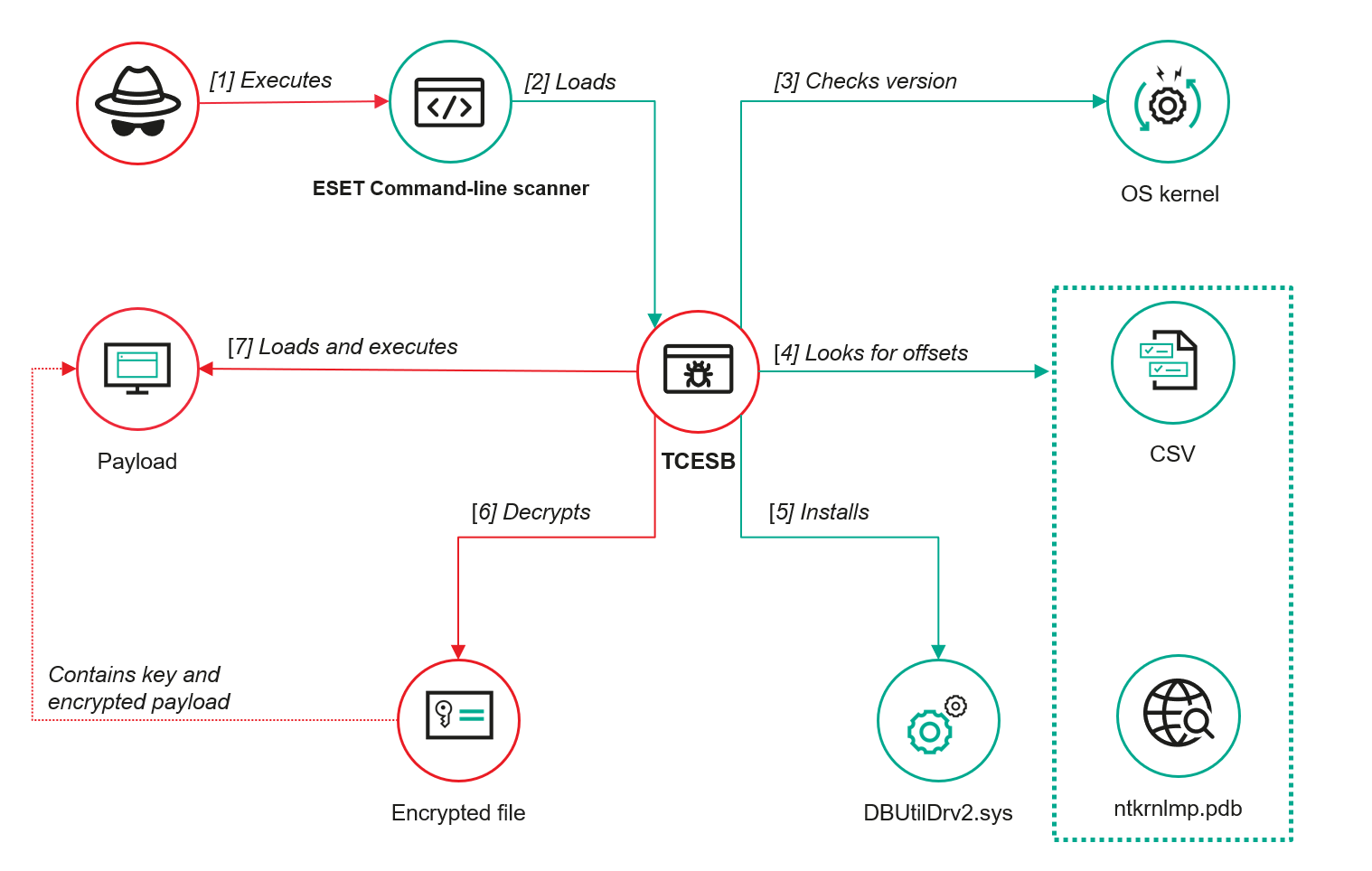
    This 64-bit DLL, written in C++, turned out to be a complex tool called TCESB. Previously unseen in ToddyCat attacks, it is designed to stealthily execute payloads in circumvention of protection and monitoring tools installed on the device.

    Kaspersky products detect this tool as Trojan.Win64.ToddyCat.a, Trojan.Win64.ToddyCat.b.

    DLL proxying

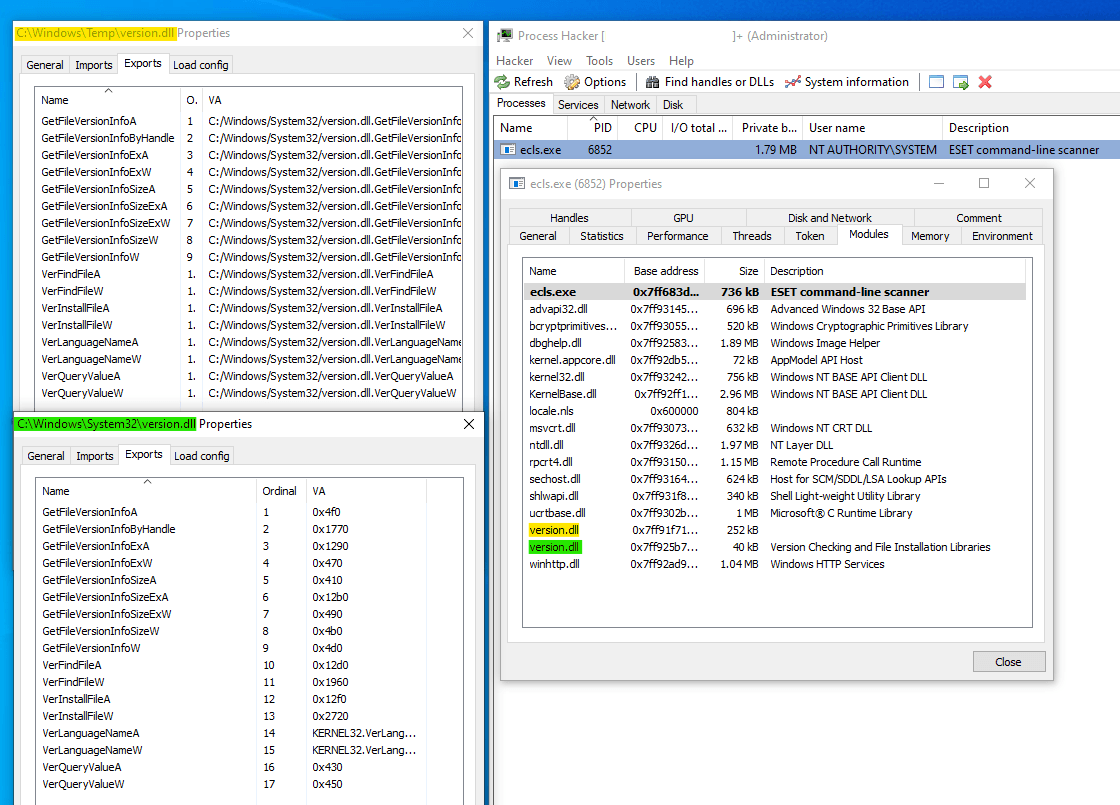
    Static analysis of the DLL library showed that all functions exported by it import functions with the same names from the system file version.dll (Version Checking and File Installation Libraries).

    List of functions exported by TCESB

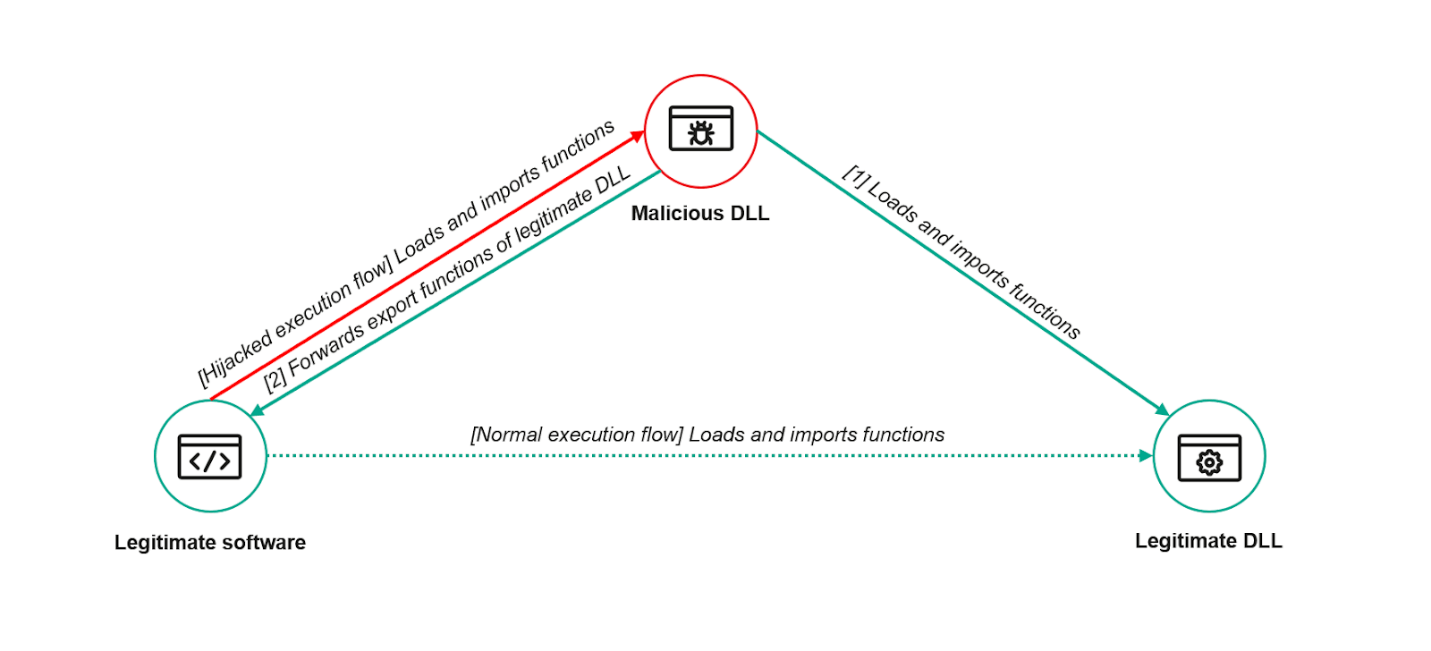
    This indicates that the attackers use a DLL-proxying technique (Hijack Execution Flow, T1574) to run the malicious code. By means of this technique, a malicious DLL exports all functions of a legitimate one, but instead of implementing them, redirects calls to these functions to the original DLL. This way, an application that loads the malicious library will continue to work as normal, with the malicious code running in the context of this application in the background.

    Schematic of DLL proxying

    However, this is not enough to launch malware. For a malicious DLL to be able to take control, the application that loads it must contain insecure code. Such code searches for loaded dynamic library images in folders where they should not be located. If one of these folders contains a malicious library, the vulnerable application will load it instead of the legitimate one. Microsoft has an official advisory on preventing unsafe DLL loading.

    CVE-2024-11859 vulnerability in ESET Command line scanner

    It took us a while to find the file that loads the TCESB tool. We studied the system directories on devices where the malicious DLLs were found. On one of these, in the same folder as TCESB, there was an extensionless executable file named ecls. We believe that the operator, when transferring files to the device, made a mistake in the filename and moved two copies of it. After performing malicious activity, the file with the extension was deleted, while the other one remained in the system. This file turned out to be a component of ESET’s EPP solution – a scanner launched from the command line (ESET Command line scanner). Dynamic analysis showed that the scanner insecurely loads the system library version.dll, first checking for the file in the current directory, then searching for it in the system directories. This can result in a malicious DLL library being loaded, which constitutes a vulnerability. We compiled a report with a detailed description of it, and sent it to ESET as part of the Coordinated Vulnerability Disclosure process. ESET registered the CVE-2024-11859 vulnerability, then on January 21, 2025 released an update for the ecls file patching the security issue. On April 4, information about this vulnerability appeared in an ESET security advisory.

    To analyze TCESB, we ran it in a virtual environment. In the address space of the ESET Command-line scanner process, we can see two version.dll files. One is the system library, the other is the DLL of the TCESB tool.

    Malicious and legitimate libraries in the memory of the ecls.exe process

    Basic functionality

    To determine the main functions of the malicious tool, we examined the strings located in its DLL.

    Snippet of the list of strings that TCESB contains

    The strings are not obfuscated. The search shows that most of them belong to the open-source malicious tool EDRSandBlast, designed to bypass security solutions. Kaspersky solutions detect it with the verdict HEUR:HackTool.Win64.EDRSandblast.a. ToddyCat created the TCESB DLL on its basis, modifying the original code to extend the malware’s functionality. The resulting tool’s capabilities include modifying operating system kernel structures to disable notification routines, for example, about a process creation event in the system or a load event.

    Searching for addresses in the kernel memory

    To find the structures in the kernel memory needed to disable notification routines, TCESB determines the version of the Windows kernel in the context of which it is running. To do this, it uses the GetNtoskrnlVersion() function.

    Function for getting the Windows kernel version implemented in TCESB

    Next, to get information about the memory offsets of the structures corresponding to the operating system kernel version, TCESB uses one of two data sources: a CSV or PDB file.

    First, the tool checks the CSV file contained in its own resources section. Stored there in table form is information about several popular kernel versions and their corresponding offsets.

    TCESB searches this file line by line for a match with the previously obtained version of the current Windows kernel.

    Snippet of the function for getting and reading a CSV file from TCESB resources

    We studied the CSV file in the EDRSandBlast repository and its change history. The contents of the TCESB CSV fully match the CSV data in the EDRSandBlast version of August 13, 2022, while the original malware commit of October 6, 2023 adds lines that are missing in the TCESB resource. This indicates a time period during which the creators of TCESB used the EDRSandBlast code.

    If the CSV file does not contain data on structures corresponding to the required kernel version, TCESB reads their addresses from the PDB file. To get it, the malware accesses the file C:WindowsSystem32ntoskrnl.exe, which contains information about the kernel file version, and inserts the data from this file into the following template, generating a URL:

    This is the address of Microsoft debug information server, where TCESB sends a GET request to download the PDB file. The received file is saved in the current TCESB directory, and data on the offsets of the required kernel memory structures are read from it.

    Vulnerable driver

    To modify the kernel structures that store callbacks used to notify applications of system events, TCESB deploys the Bring Your Own Vulnerable Driver (BYOVD) technique (Exploitation for Defense Evasion, T1211). It does this by installing a vulnerable driver in the system through the Device Manager interface, using an INF file with installation information.

    Snippet of decompiled code for installing the TCESB driver

    TCESB uses the Dell DBUtilDrv2.sys driver, which contains the CVE-2021-36276 vulnerability. This is a utility driver used to update PC drivers, BIOS and firmware.

    Launching the payload

    Once the vulnerable driver is installed in the system, TCESB runs a loop in which it checks every two seconds for the presence of a payload file with a specific name in the current directory – the payload may not be present at the time of launching the tool. Presumably, this is to allow the operator to verify that the tool was run without errors, so that the payload file can be moved without risk of detection. As soon as the file appears in the path being checked, it is passed to the decryption function.

    Snippet of decompiled TCESB code

    The tool creates its own log file for recording all stages of execution in detail.

    Example of log file contents

    We studied two samples of the TCESB tool. Although we were unable to obtain the payload files, our research shows that they have different names ( kesp and ecore) and both are extensionless.

    Our analysis of the tool code found that the data in the payload file is encrypted using AES-128.

    Snippet of code for determining the encryption algorithm

    The decryption key is in the first 32 bytes of the payload file, followed by the encrypted data block. Below is a snippet of code for reading the key:

    Snippet of code for reading the key from the payload file

    The key decrypts the data block:

    Snippet of code for reading and decrypting the payload file

    The read data is placed in memory and executed.

    Takeaways

    We discovered a sophisticated tool that the ToddyCat APT group tried to use for stealth execution in compromised systems. This tool exploits a chain of vulnerabilities, as well as an old version of a known open-source malware that the attackers modified to extend its functionality.

    Schematic of tool operation

    To detect the activity of such tools, it’s recommended to monitor systems for installation events involving drivers with known vulnerabilities. Lists of such drivers can be found on the loldrivers project website, for example. It’s also worth monitoring events associated with loading Windows kernel debug symbols on devices where debugging of the operating system kernel is not expected. We also advise using operating system tools to check all loaded system library files for the presence of a digital signature.

    Indicators of compromise

    Malicious Files Hashes

    D38E3830C8BA3A00794EF3077942AD96       version.dll 008F506013456EA5151DF779D3E3FF0F       version.dll

    Legitimate file for DLL proxying

    8795271F02B30980EBD9950FCC141304       ESET Command-line scanner

    Legitimate files for BYOVD

    B87944DCC444E4C6CE9BB9FB8A9C0DEF       dbutildrv2.INF DE39EE41D03C97E37849AF90E408ABBE       DBUtilDrv2.cat DACB62578B3EA191EA37486D15F4F83C       dbutildrv2.sys
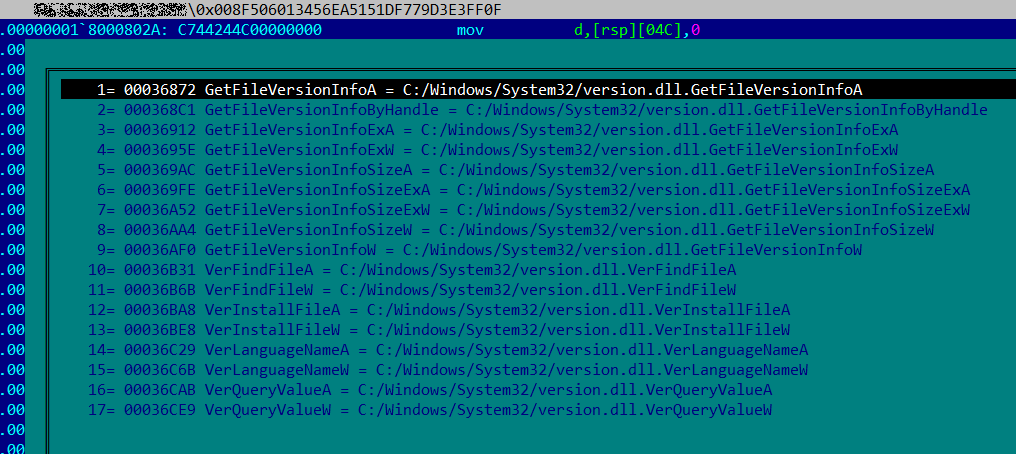
    MIL OSI Economics

  • MIL-OSI Economics: BSTDB and Express Leasing Strengthen Partnership to Support Small Business, Green Finance and Women Entrepreneurs in Moldova

    Source: Black Sea Trade and Development Bank

    Press Release | 07-Apr-2025

    Empowering Businesses with Sustainable Finance and Equal Growth Opportunities

    The Black Sea Trade and Development Bank (BSTDB) has provided a USD 3 million combined Micro and SME, Green, and Gender Equality Credit Line to the Moldovan microfinance institution Express Leasing and Microcredit SRL.

    The financing will support micro and small businesses across Moldova, including projects with sustainability impact. This initiative reflects BSTDB’s commitment to SMEs and climate-conscious financing, helping to align its operations with the climate priorities of its shareholders and contributing to the broader decarbonization efforts in the region.

    A portion of the funds will be allocated to supporting women entrepreneurs, promoting inclusive economic growth and fostering greater opportunities for women-led businesses in the country.

    “The financing to Express Leasing consists of  three  key components, all aimed at  supporting sustainable market development, a  core objective of BSTDB’s  strategy. By extending funds for green investments and empowering women entrepreneurs, we are not only strengthening Moldova’s SME sector but also enhancing our contribution to a low-carbon and more inclusive regional economy,” said Dr. Serhat Köksal, BSTDB President.

    We are honored to strengthen our collaboration with BSTDB through this credit line that will enable us to reach more entrepreneurs, particularly women and those committed to sustainability,” said Sergiu Rosca, Executive Director of Express Leasing. “This partnership empowers us to continue supporting Moldova’s small businesses—the backbone of our economy—while also driving green innovation and inclusivity in finance.


    OCN ICS “Express Leasing & Microcredit” SRL is a limited liability leading non-bank financial institution incorporated in the Republic of Moldova. Owned 100% by Broadhurst Investment Limited (registered in Cyprus), the company’s main activity is loan and lease financing focusing on SMEs and micro-financing sector.

    The Black Sea Trade and Development Bank (BSTDB) is an international financial institution established by Albania, Armenia, Azerbaijan, Bulgaria, Georgia, Greece, Moldova, Romania, Russia, Türkiye, and Ukraine. The BSTDB headquarters are in Thessaloniki, Greece. BSTDB supports economic development and regional cooperation by providing loans, credit lines, equity and guarantees for projects and trade financing in the public and private sectors in its member countries. The authorized capital of the Bank is EUR 3.45 billion. For information on BSTDB, visit www.bstdb.org.


    Contact: Haroula Christodoulou

    : @BSTDB

    MIL OSI Economics

  • MIL-OSI Economics: F-16 fighter jet deal bolsters Philippines air defense amid rising regional tensions, says GlobalData

    Source: GlobalData

    In a significant step toward strengthening the air defense capabilities of the Philippines, the US government has approved the potential sale of 20 F-16 fighter jets valued at approximately $5.6 billion. This acquisition will enhance the Philippine Air Force’s ability to safeguard its airspace, improve regional security, and boost interoperability with allied forces in the Indo-Pacific, says GlobalData, a leading data and analytics company.

    GlobalData’s report, “The Global Military Fixed-Wing Aircraft Market 2025-2035,” reveals that the Philippines will be spending about $5.1 billion on procuring various types of aircrafts over the next 10 years. Out of which, 79% will be directed towards the procurement of combat aircrafts.

    Udayini Aakunoor, Aerospace & Defense Analyst at GlobalData, comments: “Amid the growing geopolitical tensions in the South China Sea, F-16s are expected to serve as a deterrent against potential security threats while reinforcing the country’s territorial defense. The advanced air-to-air and air-to-ground capabilities of the combat-proven F-16 aircraft will allow the Philippine Air Force to conduct more effective patrols, intercept potential threats, and respond to any incursions into its airspace.”

    This procurement aligns with the Philippines’ strategic goal of deepening defense ties with the US. The two countries have maintained a long-standing military partnership, reinforced through the Enhanced Defense Cooperation Agreement (EDCA) and frequent joint military exercises. The F-16’s compatibility with US and NATO-standard weaponry, combined with joint military exercises such as Balikatan, ensures that the Philippines can operate seamlessly alongside allied air forces in the event of a regional security crisis.

    Aakunoor concludes: “With the F-16 acquisition, the Philippines is poised to make significant strides in modernizing its air force under the long-term Horizon 3 military modernization program, equipping the aircraft fleet with the necessary capabilities such as advanced avionics and precision-guided munitions to address current and future security challenges in the Indo-Pacific region. This development underscores the country’s commitment to strengthening its military readiness and strategic partnerships in an increasingly contested geopolitical landscape in the region.”

    MIL OSI Economics

  • MIL-OSI Economics: Malaysia credit and charge card payments market to grow by 6.8% in 2025, forecasts GlobalData

    Source: GlobalData

    Malaysia credit and charge card payments market to grow by 6.8% in 2025, forecasts GlobalData

    Posted in Banking

    Malaysia’s credit and charge card payments market is expected to register a growth of 6.8% to reach MYR245.7 billion ($53.7 billion) in 2025. This growth will be driven by the rising consumer spending and increasing consumer preference for cashless transactions, reveals GlobalData, a leading data and analytics company.

    GlobalData’s Payment Cards Analytics reveals that credit and charge card payment value in Malaysia registered a growth of 7.9% in 2024, driven by the rise in consumer spending. The value is forecast to register a compound annual growth rate (CAGR) of 5.5% between 2025 and 2029 to reach MYR304.3 billion ($66.5 billion) in 2029.

    Kartik Challa, Senior Banking and Payments Analyst at GlobalData, comments: “Credit and charge cards were the most preferred payment cards in Malaysia, accounting for 59.7% of total card payment value in 2024. This was mainly driven by the rewards, discounts, cashback, and interest-free installment facilities offered with these cards, as well as developing payment infrastructure and a growing e-commerce market.”

    Malaysians are increasingly using credit and charge cards for payments, with the frequency of payments per card standing at 82.8 times in 2024, much higher compared to 37.7 times for debit cards. This figure is anticipated to further rise to 107.1 by 2029.

    Challa adds: “This is driven by banks offering flexible repayment options and value-added benefits such as cashback, reward points, discounts, and installment facilities. CIMB Malaysia offers ‘0% Easy Pay,’ allowing customers to pay for purchases in monthly interest free installment of up to 36 months at more than 1,000 participating merchants.”

    Growing POS terminalization has been another key driver for the rise of credit and charge cards in Malaysia. The number of POS terminals per million inhabitants in Malaysia stood at 27,693 in 2024, which is higher compared to its peers such as Thailand (13,507), Indonesia (8,142), India (6,964) and Vietnam (5,988), though there is significant room for further expansion of POS infrastructure.

    Rising e-commerce payments are also contributing to the growth in credit and charge card usage. According to GlobalData’s E-Commerce Analytics, credit and charge cards are one of the most preferred payment methods for online payments, with 17.1% share in 2024.

    Moreover, banks in Malaysia offer debt consolidation option to credit card holders, which will further help boost usage. For instance, UOB offers the UOB Bank Transfer program, which allows customers to consolidate their outstanding credit card balances from other banks. The program is designed to help credit card holders to manage their debt and avoid default by offering lower interest rate and extended repayment terms.

    Challa concludes: “The Malaysian credit and charge card market is poised for sustained growth over the next five years, driven by the economic recovery, growing consumer preference for electronic payments, a rising middle-class and young working population, and growth in e-commerce payments. However, challenges such as global trade war between major countries, and geopolitical uncertainty remain obstacles to the market.”

    *GlobalData’s 2024 Financial Services Consumer Survey was carried out in Q2 2024. Approximately 67,292 respondents aged 18+ were surveyed across 41 countries.

    MIL OSI Economics

  • MIL-OSI Economics: Alzheon’s valiltramiprosate poised to meet high unmet need for MCI APOE4 homozygotes, says GlobalData

    Source: GlobalData

    Alzheon’s valiltramiprosate poised to meet high unmet need for MCI APOE4 homozygotes, says GlobalData

    Posted in Pharma

    At the recently held AD/PD 2024 International Conference on Alzheimer’s and Parkinson’s Diseases (PD), Alzheon presented promising Phase III APOLLOE4 trial results for its drug ALZ-801 (valiltramiprosate) in treating mild cognitive impairment (MCI) in APOE4 homozygous patients, highlighting its potential to meet the high unmet need for a safe, effective treatment in this population, says GlobalData, leading data and analytics company.

    Pippa Salter, Managing Neurology Analyst at GlobalData, comments: “Given the APOLLOE4 results, it remains to be seen whether Alzheon will pursue regulatory approval for early AD or if it will pivot to just the MCI patient population. There is also the potential for expansion as Alzheon plans to evaluate valiltramiprosate in additional patient populations, with prevention in APOE4 homozygotes a promising option since the results of the APOLLOE4 trial showed that valiltramiprosate was more effective the earlier in the disease it was administered.”

    The results presented in MCI patients are particularly promising as Alzheon is targeting a subset of AD patients where there is high unmet need. AD patients who are APOE4 homozygous typically have more rapid clinical decline, and a higher risk of developing amyloid-related imaging abnormalities (ARIAs).

    Salter continues: “The current disease-modifying therapies (DMTs) approved for the treatment of early AD—Eisai/Biogen’s Leqembi (lecanemab) and Eli Lilly’s Kisunla (donanemab)—are associated with risk of ARIA. As such, their use is limited in APOE4 homozygotes, with some regulators only approving these drugs for patients with one copy or no copy of the APOE4 gene, such as the EMA’s approval of Leqembi. In contrast to the mAbs, valiltramiprosate resulted in no increased risk of ARIA when compared with placebo. Thus, Alzheon will be able to position valiltramiprosate as a safe and effective treatment option for a patient population with high unmet need.”

    GlobalData’s Alzheimer’s Disease in Major Markets, Disease Management, Epidemiology, Pipeline Assessment, Unmet Needs and Drug Forecast to 2033 report  reveals that valiltramiprosate will generate US sales of approximately $663.3 million in the MCI patient populations in 2033, accounting for 82% of its potential total early AD sales.

    Salter concludes: “The fact that valiltramiprosate is orally administered gives it a further competitive advantage over the anti-Aβ mAbs in terms of ease of administration for patients.”

    MIL OSI Economics