Category: Economics

  • MIL-OSI Economics: Phillips 66 Issues Letter to Shareholders

    Source: Phillips

    Confirms Elliott Investment Management’s Nomination of Director Candidates

    HOUSTON–(BUSINESS WIRE)– Phillips 66 (NYSE:PSX) (the “Company”) today issued the following letter to its shareholders. The Company values shareholder feedback and is fully committed to continuing open engagement with all shareholders. This has been consistently demonstrated and expressed over the course of nearly two dozen meetings with Elliott Investment Management (“Elliott”) since October 2023, including the most recent meeting on March 3, 2025.
    The Company also confirmed Elliott has nominated seven directors for election to Phillips 66’s Board of Directors (the “Board”) at the Company’s 2025 Annual Meeting. As the Company disclosed on February 19, the Board will present its recommendation regarding the director nominations with its definitive proxy statement to be filed with the U.S. Securities and Exchange Commission and made available to all shareholders eligible to vote at the 2025 Annual Meeting.
    Following the proper procedures and in accordance with the Company’s By-Laws, the Board intends to put forward another management proposal to declassify the Board at our 2025 Annual Meeting and notes that it has done so five times since its 2015 Annual Meeting.
    Fellow Shareholders:
    At Phillips 66, we are committed to maximizing value for our shareholders through operational excellence and disciplined capital allocation.
    We have a strong track record since our formation in 2012. We have built out a large-scale, competitive, high return Midstream platform, enhanced our chemicals position through Chevron Phillips Chemical Company (CPChem) and have made sustainable improvement to refining operations. These actions have positioned Phillips 66 as the leading energy business it is today.
    Moreover, these actions have delivered substantial value for our shareholders. This includes total shareholder returns of 474%1 and returning $43 billion to shareholders through dividends and share repurchases. Most importantly, we have done all this while sustaining industry-leading safety performance.
    We Have Made Significant Progress on our Strategic Priorities
    Phillips 66 has taken substantial action to deliver on our objectives that we laid out in 2022, and further enhanced in 2023. Our actions have led to significant progress and achievements, enhancing shareholder returns and operational efficiency. We are a business that will always act decisively when we can realize sustainable long-term growth to the benefit of our shareholders and all stakeholders.
    Delivering strong total shareholder returns of 65%2since Mark Lashier became President and CEO of Phillips 66 on July 1, 2022, significantly outperforming the S&P 500 Energy Index (33%2) and our proxy peer group median (22%2)
    Returning significant capital to shareholders with $13.6 billion in share repurchases and dividends from July 2022 through year-end 2024, exceeding our shareholder distribution target
    Reducing refining costs by $1 per barrelsince 2022 and committing to continued improvement
    Maximizing value from our wellhead-to-market strategyby capturing $500 million of run rate synergies from our DCP Midstream acquisition (above our initial target of $300 million) and increasing our Midstream segment’s adjusted EBITDA by $1.5 billion since 2022
    Maintaining our financial resiliencewith strong investment grade credit ratings (A3 / BBB+), engaging in a business optimization that has resulted in over $3 billion in non-core asset divestitures to date and capturing significant cost reductions since 2022 totaling $1.2 billion on a run-rate basis
    Earning industry recognition for our exemplary safety performancein Midstream, Refining and Chemicals in 2022 and 2023
    We Continue to Strengthen Our Business and Our Board
    Below is an update on a number of our key strategic objectives and the actions underway:
    Optimizing Our Business We have demonstrated a commitment to evolving the business over time. We continue to high-grade our assets and capitalize on our growth platform to generate strong returns and significant free cash flow. We have simplified our business with over $3 billion in divestitures in the past year and returned over $5 billion to shareholders through a combination of share repurchases and dividends. We anticipate that our integrated NGL value chain growth strategy will be significantly strengthened with the pending EPIC acquisition.
    Maintaining a Culture of Continuous Improvement, Operational Excellence and Cost Discipline Our culture of continuous improvement demands, and will continue to demand, that we consistently and rigorously evaluate opportunities to optimize our cost structure and operational efficiency to maximize value for shareholders. While we have successfully reduced refining costs per barrel since 2022, as noted above, we recognize that we have more work to do in operations and costs. We are prioritizing our most competitive refineries and continuing to identify and execute cost-savings opportunities. Recently, we announced that we would cease operations at our Los Angeles Refinery in the fourth quarter of 2025, which will allow us to further high-grade our business. We continue to evaluate additional opportunities for efficiency enhancements.
    Returning Cash to Our Shareholders As previously outlined, our 2025–2027 strategic targets include returning over 50% of net operating cash flow to shareholders while driving strong operational performance, implementing further cost reductions and continuing our focus on disciplined capital allocation.
    Ensuring Strong Corporate Governance and Board Oversight We recognize the importance of strong corporate governance and have taken proactive steps to ensure that our Board remains aligned with shareholder interests and is best positioned to oversee the Company’s strategy. Over the past four years, we have welcomed five new independent directors to the Board, including two in 2024. Bob Pease, a director we identified in partnership with Elliott Investment Management (“Elliott”), brings extensive experience in refining and the energy industry broadly. Grace Puma, our most recent addition to the Board, brings strong supply chain experience. Additionally, as we have many times before in 2015, 2016, 2018, 2021 and 2023, we will be seeking shareholder approval of a management proposal to declassify the Board at our 2025 Annual Meeting. Our Board is committed to an evolution that will be responsive to shareholders and beneficial to the business for the long-term.
    We are Listening to Our Shareholders
    We regularly engage with our shareholders through our cross-functional shareholder engagement program to obtain feedback and respond to investor input. In 2024, we engaged with shareholders representing over 60% of our outstanding shares and we will continue to build on that momentum in 2025. It was in this spirit that we first engaged with Elliott in October 2023, to hear their ideas and work together collaboratively. Constructive discussions led to the realization of a common focus on our ambitious goals to maximize shareholder value. We continued constructive dialogue with Elliott throughout 2024, including adding Bob Pease to our Board in February 2024 with Elliott’s support.
    Despite several attempts to reach agreement on adding another director to Phillips 66’s Board, Elliott has chosen to forego constructive dialogue with us and launch their activist playbook. This included a series of attacks and proposals regarding the monetization of certain business units and, for the first time in our discussions, floating the idea of a separation.
    Nevertheless, we remain fully committed to constructive engagement and finding a path forward with Elliott that will benefit all shareholders.
    On Monday, March 3, our team travelled to New York and met with Elliott to express our continued commitment to finding a constructive path forward and offering to interview their director nominees. The meeting ended with Elliott representatives stating there were no immediate next steps. The next day, Elliott leaked their slate of director nominees to the media, issued a press release and filed a preliminary proxy statement. Our leadership team and Board stand ready to engage constructively when Elliott is ready despite these actions, which showed no genuine interest in engagement with Phillips 66.
    The Board continuously and aggressively evaluates the portfolio and other alternatives with a view to maximizing long-term shareholder value – and is willing to take decisive action to achieve this goal. As always, we seriously and comprehensively review shareholder feedback with a focus on creating long-term value.
    The Bottom Line
    Phillips 66 is dedicated to transparency, accountability, and sustainable value creation for shareholders.
    We have made substantial progress and realize there is more work to be done. We will continue to pursue opportunities that strengthen our position to the benefit of our shareholders. We look forward to your input and to provide further updates on our progress.
    Sincerely,
    Mark E. Lashier Chairman and Chief Executive Officer
    Glenn F. Tilton Lead Independent Director

    1 Total Shareholder Return (“TSR”) from May 1, 2012 to March 4, 2025.

    2 Total Shareholder Return (“TSR”) from June 30, 2022 to March 4, 2025.

    About Phillips 66
    Phillips 66 (NYSE: PSX) is a leading integrated downstream energy provider that manufactures, transports and markets products that drive the global economy. The company’s portfolio includes Midstream, Chemicals, Refining, Marketing and Specialties, and Renewable Fuels businesses. Headquartered in Houston, Phillips 66 has employees around the globe who are committed to safely and reliably providing energy and improving lives while pursuing a lower-carbon future. For more information, visit phillips66.com or follow @Phillips66Co on LinkedIn.
    Forward-Looking Statements
    This document contains forward-looking statements within the meaning of the federal securities laws relating to Phillips 66’s operations, strategy and performance. Words such as “anticipated,” “commitments,” “estimated,” “expected,” “planned,” “scheduled,” “targeted,” “believe,” “continue,” “intend,” “will,” “would,” “objective,” “goal,” “project,” “efforts,” “strategies” and similar expressions that convey the prospective nature of events or outcomes generally indicate forward-looking statements. However, the absence of these words does not mean that a statement is not forward-looking. Forward-looking statements included in this news release are based on management’s expectations, estimates and projections as of the date they are made. These statements are not guarantees of future events or performance, and you should not unduly rely on them as they involve certain risks, uncertainties and assumptions that are difficult to predict. Therefore, actual outcomes and results may differ materially from what is expressed or forecast in such forward-looking statements. Factors that could cause actual results or events to differ materially from those described in the forward-looking statements include: changes in governmental policies or laws that relate to our operations, including regulations that seek to limit or restrict refining, marketing and midstream operations or regulate profits, pricing, or taxation of our products or feedstocks, or other regulations that restrict feedstock imports or product exports; our ability to timely obtain or maintain permits necessary for projects; fluctuations in NGL, crude oil, refined petroleum, renewable fuels and natural gas prices, and refining, marketing and petrochemical margins; the effects of any widespread public health crisis and its negative impact on commercial activity and demand for refined petroleum or renewable fuels products; changes to worldwide government policies relating to renewable fuels and greenhouse gas emissions that adversely affect programs including the renewable fuel standards program, low carbon fuel standards and tax credits for renewable fuels; potential liability from pending or future litigation; liability for remedial actions, including removal and reclamation obligations under existing or future environmental regulations; unexpected changes in costs for constructing, modifying or operating our facilities; our ability to successfully complete, or any material delay in the completion of, any asset disposition, acquisition, shutdown or conversion that we have announced or may pursue, including receipt of any necessary regulatory approvals or permits related thereto; unexpected difficulties in manufacturing, refining or transporting our products; the level and success of drilling and production volumes around our midstream assets; risks and uncertainties with respect to the actions of actual or potential competitive suppliers and transporters of refined petroleum products, renewable fuels or specialty products; lack of, or disruptions in, adequate and reliable transportation for our products; failure to complete construction of capital projects on time or within budget; our ability to comply with governmental regulations or make capital expenditures to maintain compliance with laws; limited access to capital or significantly higher cost of capital related to illiquidity or uncertainty in the domestic or international financial markets, which may also impact our ability to repurchase shares and declare and pay dividends; potential disruption of our operations due to accidents, weather events, including as a result of climate change, acts of terrorism or cyberattacks; general domestic and international economic and political developments, including armed hostilities (such as the Russia-Ukraine war), expropriation of assets, and other diplomatic developments; international monetary conditions and exchange controls; changes in estimates or projections used to assess fair value of intangible assets, goodwill and property and equipment and/or strategic decisions with respect to our asset portfolio that cause impairment charges; investments required, or reduced demand for products, as a result of environmental rules and regulations; changes in tax, environmental and other laws and regulations (including alternative energy mandates); political and societal concerns about climate change that could result in changes to our business or increase expenditures, including litigation-related expenses; the operation, financing and distribution decisions of equity affiliates we do not control; and other economic, business, competitive and/or regulatory factors affecting Phillips 66’s businesses generally as set forth in our filings with the Securities and Exchange Commission. Phillips 66 is under no obligation (and expressly disclaims any such obligation) to update or alter its forward-looking statements, whether as a result of new information, future events or otherwise.
    Additional Information
    Phillips 66 plans to file a proxy statement and accompanying WHITE proxy card with the U.S. Securities and Exchange Commission (the “SEC”) in connection with its 2025 Annual Meeting of Shareholders (the “2025 Annual Meeting”) and its solicitation of proxies for Phillips 66’s director nominees and for other matters to be voted on. Phillips 66 may also file other relevant documents with the SEC regarding its solicitation of proxies for the 2025 Annual Meeting. PHILLIPS 66 SHAREHOLDERS ARE STRONGLY ENCOURAGED TO READ THE PROXY STATEMENT (AND ANY AMENDMENTS AND SUPPLEMENTS THERETO) AND ACCOMPANYING WHITE PROXY CARD AND ANY OTHER RELEVANT SOLICITATION MATERIALS WHEN THEY BECOME AVAILABLE AS THEY WILL CONTAIN IMPORTANT INFORMATION. Shareholders may obtain copies of the proxy statement, any amendments or supplements to the proxy statement and other documents (including the WHITE proxy card) as and when filed by Phillips 66 with the SEC without charge from the SEC’s website at www.sec.gov. Copies of the documents filed by Phillips 66 with the SEC also may be obtained free of charge at Phillips 66’s investor relations website at https://investor.phillips66.com or upon written request sent to Phillips 66, 2331 CityWest Boulevard, Houston, TX 77042, Attention: Investor Relations.
    Certain Information Regarding Participants
    Phillips 66, its directors, certain of its executive officers and employees may be deemed to be participants in connection with the solicitation of proxies from Phillips 66 shareholders in connection with the matters to be considered at the 2025 Annual Meeting. Information regarding the names of such directors and executive officers and their respective interests in Phillips 66, by securities holdings or otherwise, is available in Phillips 66’s proxy statement for the 2024 annual meeting of shareholders, which was filed with the SEC on April 3, 2024 (the “2024 Proxy Statement”), including in the sections captioned “Executive Compensation Program Overview,” “Director Compensation,” “Compensation Discussion and Analysis,” “Executive Compensation Tables” and “Beneficial Ownership of Phillips 66 Securities.” To the extent that Phillips 66’s directors and executive officers have acquired or disposed of securities holdings since the applicable “as of” date disclosed in the 2024 Proxy Statement, such transactions have been or will be reflected on Statements of Changes in Ownership of Securities on Form 4 or Initial Statements of Beneficial Ownership of Securities on Form 3 filed with the SEC, including: Form 4s filed by Gregory Hayes on April 2, 2024, May 2, 2024, June 4, 2024, July 2, 2024, August 2, 2024, September 4, 2024, October 2, 2024, November 4, 2024, December 4, 2024, January 3, 2025, January 17, 2025, February 4, 2025 and March 4, 2025 ; Form 4s filed by Richard G. Harbison on December 9, 2024, February 11, 2025 and February 13, 2025 ; Form 4s filed by Mark E. Lashier on April 2, 2024, May 16, 2024, December 9, 2024, February 11, 2025 and February 13, 2025 ; Form 4 filed by Glenn F. Tilton on January 17, 2025 ; Form 4s filed by Brian Mandell on December 9, 2024, February 11, 2025 and February 13, 2025 ; Form 4s filed by Kevin J. Mitchell on August 19, 2024, December 9, 2024, February 11, 2025 and February 13, 2025 ; Form 4s filed by Zhanna Golodryga on December 9, 2024, February 11, 2025 and February 13, 2025 ; Form 4 filed by Marna C. Whittington on January 17, 2025 ; Form 4s filed by Vanessa A. Sutherland on January 21, 2025, February 11, 2025 and February 13, 2025 ; Form 4 filed by Douglas T. Terreson on January 17, 2025 ; Form 4 filed by Denise R. Singleton on January 17, 2025 ; Form 4 filed by Denise L. Ramos on January 17, 2025 ; Form 4 filed by Julie L. Bushman on January 17, 2025 ; Form 4 filed by Lisa A. Davis on January 17, 2025 ; Form 4 filed by John E. Lowe on January 17, 2025 ; Form 4/A filed by Gary K. Adams on March 20, 2024 and Form 4 filed by Gary K. Adams on January 17, 2025 ; Form 4 filed by Charles M. Holley on January 17, 2025 ; Form 4 filed by Robert W. Pease on January 17, 2025 ; Form 3 filed by Ann M. Kluppel on May 16, 2024 and Form 4s filed by Ann M. Kluppel on December 9, 2024, February 11, 2025 and February 13, 2025 ; Form 3 filed by Don Baldridge on June 5, 2024 and Form 4s filed by Don Baldridge on December 9, 2024, January 3, 2025, February 13, 2025 and March 3, 2025 ; Form 3 filed by Grace Puma on October 11, 2024 and Form 4s filed by Grace Puma on October 11, 2024 and January 17, 2025. Additional information can also be found in Phillips 66’s Annual Report on Form 10-K for the year ended December 31, 2023, filed with the SEC on February 21, 2024.

    Source: Phillips 66
    MIL OSI Economics

  • MIL-OSI Economics: Why the most-favoured nation principle matters for business 

    Source: International Chamber of Commerce

    Headline: Why the most-favoured nation principle matters for business 

    We use necessary cookies to make our site work. We’d also like to set optional cookies to optimize site functionality and to give you the most relevant experience. We won’t set optional cookies unless you enable them. Using this tool will set a cookie on your device to remember your preferences.

    The technical storage or access is strictly necessary for the legitimate purpose of enabling the use of a specific service explicitly requested by the subscriber or user, or for the sole purpose of carrying out the transmission of a communication over an electronic communications network.

    The technical storage or access is necessary for the legitimate purpose of storing preferences that are not requested by the subscriber or user.

    The technical storage or access that is used exclusively for statistical purposes. The technical storage or access that is used exclusively for anonymous statistical purposes. Without a subpoena, voluntary compliance on the part of your Internet Service Provider, or additional records from a third party, information stored or retrieved for this purpose alone cannot usually be used to identify you.

    The technical storage or access is required to create user profiles to send advertising, or to track the user on a website or across several websites for similar marketing purposes.

    MIL OSI Economics

  • MIL-OSI Economics: NEW REPORT: Clean Energy Dominates in 2024

    Source: American Clean Power Association (ACP)

    Headline: NEW REPORT: Clean Energy Dominates in 2024

    • 93% of new energy capacity that came online last year was solar, wind, and storage • 49 GW of clean energy installed in 2024 • Clean energy in the U.S. surpasses 300 GW of overall capacity

    WASHINGTON, March 5, 2025 – The American Clean Power Association (ACP) today released its Snapshot of Clean Power in 2024, a preview of the upcoming full Clean Power Annual Market Report that shows a dominant year for clean energy in 2024. The data from ACP demonstrates an industry entering a new chapter with incredible momentum. 
    The clean energy industry shattered records in 2024, deploying an unprecedented 49 GW of capacity—a remarkable 33% increase over the previous record of 37 GW set in 2023. This dramatic acceleration reflects the industry’s extraordinary momentum: after taking more than 40 years to build the first 200 GW of utility-scale clean power capacity, it took just three years to build an additional 100 GW (2022-2024). With total clean energy capacity now reaching 313 GW connected to the U.S. grid, these installations are delivering reliable power to millions of American homes and businesses nationwide.  
    “The only way to meet skyrocketing energy demand is to embrace all American energy resources. The clean energy sector’s dominant performance in 2024 demonstrates the unique role clean power is playing in bringing electricity online now to support increased manufacturing and data centers. Reliable energy depends on reliable policy,” said ACP CEO Jason Grumet. “Our nation’s economic growth and digital dominance require aggressive pursuit of a true all of the above energy strategy.” 
    Key Highlights:  
    New Capacity: 93% of new energy capacity that came online in 2024 was clean energy — exceeding the previous five-year average of 75%. 
    Utility-Scale Solar: More than 33 GW of solar capacity was deployed in 2024.  
    Utility-Scale Energy Storage: More than 11 GW of energy storage was deployed in 2024. 
    Strong Wind Pipeline: Including both offshore and onshore wind, the overall wind pipeline is 40 GW, with 20 GW under construction.  
    Manufacturing Growth: 46 U.S. primary component manufacturing projects across the utility-scale wind, solar, and storage supply chains came online in 2024. 
    Red States Lead the Way: Red states saw some of the fastest growth in clean power capacity 2024, with Mississippi, Louisiana, and Kentucky increasing operational capacity by more than 200% year-over-year. 
    A public version of this report can be found on ACP’s Clean Energy Resources page. ACP’s full Clean Power Annual Market Report 2024 will be released in April.  

    MIL OSI Economics

  • MIL-OSI Economics: Transforming the Future: The Impact of Artificial Intelligence in Korea

    Source: International Monetary Fund

    Summary

    This paper examines the economic impact of Artificial Intelligence (AI) in Korea. Korea is among the global frontrunners in AI adoption, with higher adoption rates among larger, younger, and technologically advanced firms. AI holds the promise for boosting productivity and output, though the effects are more pronounced among larger and mature Korean firms. About half of jobs are exposed to AI, with higher exposures among female, younger, more educated, and higher income workers. Korea’s strong innovation and digital infrastructure highlights its AI readiness, while enhancing labor market flexibility and social safety nets are essential to fully harness AI’s potential.

    Subject: Aging, Digitalization, Employment, Human capital, Labor, Labor market policy, Labor markets, Population and demographics, Production, Productivity, Technology

    Keywords: Aging, AI, Artificial Intelligence, Digitalization, Employment, Growth, Human capital, Labor force, Labor market, Labor market policy, Labor markets, Productivity, Productivity, Total factor productivity

    MIL OSI Economics

  • MIL-OSI Economics: Euro area bank interest rate statistics: January 2025

    Source: European Central Bank

    5 March 2025

    Bank interest rates for corporations

    Chart 1

    Bank interest rates on new loans to, and deposits from, euro area corporations

    (percentages per annum)

    Data for cost of borrowing and deposit interest rates for corporations (Chart 1)

    The composite cost-of-borrowing indicator, which combines interest rates on all loans to corporations, decreased in January 2025. The interest rate on new loans of over €1 million with a floating rate and an initial rate fixation period of up to three months decreased by 13 basis points to 4.18%. The rate on new loans of the same size with an initial rate fixation period of over three months and up to one year fell by 18 basis points to 3.88%, driven by both the interest rate and the weight effects. The interest rate on new loans of over €1 million with an initial rate fixation period of over ten years increased by 9 basis points to 3.51%. In the case of new loans of up to €250,000 with a floating rate and an initial rate fixation period of up to three months, the average rate charged fell by 30 basis points to 4.33%.
    As regards new deposit agreements, the interest rate on deposits from corporations with an agreed maturity of up to one year fell by 13 basis points to 2.67% in January 2025. The interest rate on overnight deposits from corporations stayed almost constant at 0.76%.
    The interest rate on new loans to sole proprietors and unincorporated partnerships with a floating rate and an initial rate fixation period of up to one year decreased by 7 basis points to 4.56%.

    Table 1

    Bank interest rates for corporations

    i.r.f. = initial rate fixation
    * For this instrument category, the concept of new business is extended to the whole outstanding amounts and therefore the business volumes are not comparable with those of the other categories. Outstanding amounts data are derived from the ECB’s monetary financial institutions balance sheet statistics.

    Data for bank interest rates for corporations (Table 1)

    Bank interest rates for households

    Chart 2

    Bank interest rates on new loans to, and deposits from, euro area households

    Data for cost of borrowing and deposit interest rate for households (Chart 2)

    The composite cost-of-borrowing indicator, which combines interest rates on all loans to households for house purchase, decreased in January 2025. The interest rate on loans for house purchase with a floating rate and an initial rate fixation period of up to one year decreased by 10 basis points to 4.06%. The rate on housing loans with an initial rate fixation period of over one and up to five years fell by 8 basis points to 3.49%. The interest rate on loans for house purchase with an initial rate fixation period of over five and up to ten years decreased by 48 basis points to 2.88%. The rate on housing loans with an initial rate fixation period of over ten years fell by 12 basis points to 2.97%, driven by both the interest rate and the weight effects. In the same period the interest rate on new loans to households for consumption increased by 23 basis points to 7.64%.
    As regards new deposits from households, the interest rate on deposits with an agreed maturity of up to one year decreased by 12 basis points to 2.33%. The rate on deposits redeemable at three months’ notice stayed almost constant at 1.72%. The interest rate on overnight deposits from households remained broadly unchanged at 0.34%.

    Table 2

    Bank interest rates for households

    i.r.f. = initial rate fixation
    * For this instrument category, the concept of new business is extended to the whole outstanding amounts and therefore the business volumes are not comparable with those of the other categories; deposits placed by households and corporations are allocated to the household sector. Outstanding amounts data are derived from the ECB’s monetary financial institutions balance sheet statistics.
    ** For this instrument category, the concept of new business is extended to the whole outstanding amounts and therefore the business volumes are not comparable with those of the other categories. Outstanding amounts data are derived from the ECB’s monetary financial institutions balance sheet statistics.

    Data for bank interest rates for households (Table 2)

    Further information

    The data in Tables 1 and 2 can be visualised for individual euro area countries on the bank interest rate statistics dashboard. Additionally, tables containing further breakdowns of bank interest rate statistics, including the composite cost-of-borrowing indicators for all euro area countries, are available from the ECB Data Portal. The full set of bank interest rate statistics for both the euro area and individual countries can be downloaded from ECB Data Portal. More information, including the release calendar, is available under “Bank interest rates” in the statistics section of the ECB’s website.

    For media queries, please contact Nicos Keranis, tel.: +49 69 1344 7806

    Notes:

    • In this press release “corporations” refers to non-financial corporations (sector S.11 in the European System of Accounts 2010, or ESA 2010), “households” refers to households and non-profit institutions serving households (ESA 2010 sectors S.14 and S.15) and “banks” refers to monetary financial institutions except central banks and money market funds (ESA 2010 sector S.122).
    • The composite cost-of-borrowing indicators are described in the article entitled “Assessing the retail bank interest rate pass-through in the euro area at times of financial fragmentation” in the August 2013 issue of the ECB’s Monthly Bulletin (see Box 1). For these indicators, a weighting scheme based on the 24-month moving averages of new business volumes has been applied, in order to filter out excessive monthly volatility. For this reason the developments in the composite cost of borrowing indicators in both tables cannot be explained by the month-on-month changes in the displayed subcomponents. Furthermore, the table on bank interest rates for corporations presents a subset of the series used in the calculation of the cost of borrowing indicator.
    • Interest rates on new business are weighted by the size of the individual agreements. This is done both by the reporting agents and when the national and euro area averages are computed. Thus changes in average euro area interest rates for new business reflect, in addition to changes in interest rates, changes in the weights of individual countries’ new business for the instrument categories concerned. The “interest rate effect” and the “weight effect” presented in this press release are derived from the Bennet index, which allows month-on-month developments in euro area aggregate rates resulting from changes in individual country rates (the “interest rate effect”) to be disentangled from those caused by changes in the weights of individual countries’ contributions (the “weight effect”). Owing to rounding, the combined “interest rate effect” and the “weight effect” may not add up to the month-on-month developments in euro area aggregate rates.
    • In addition to monthly euro area bank interest rate statistics for January 2025, this press release incorporates revisions to data for previous periods. Hyperlinks in the main body of the press release lead to data that may change with subsequent releases as a result of revisions. Unless otherwise indicated, these euro area statistics cover the EU Member States that had adopted the euro at the time to which the data relate.
    • As of reference period December 2014, the sector classification applied to bank interest rates statistics is based on the European System of Accounts 2010 (ESA 2010). In accordance with the ESA 2010 classification and as opposed to ESA 95, the non-financial corporations sector (S.11) now excludes holding companies not engaged in management and similar captive financial institutions.

    MIL OSI Economics

  • MIL-OSI Economics: Verizon adds new partners Singtel, Skylo to worldwide IoT platform

    Source: Verizon

    Headline: Verizon adds new partners Singtel, Skylo to worldwide IoT platform

    What you need to know:

    • Singtel joins Bell Canada and Telenor IoT as Mobile Network Operator (MNO) partners providing international IoT connectivity through Verizon’s Global IoT Orchestration offering, which is now commercially available.
    • Skylo is powering satellite-IoT connectivity and services for network assurance in areas where terrestrial connectivity is challenged.
    • Verizon Business IoT customers can now access wireless services in up to 200 territories around the world, conveniently managed through Verizon Business’ ThingSpace IoT management platform.

    NEW YORK – Verizon Business has added IoT connectivity services from two new partners — Singapore-based operator Singtel and satellite service provider Skylo — to its suite of global IoT offerings. Verizon Business IoT customers can now access wireless services in up to 200 territories worldwide using complementary satellite, roaming, and native eSIM services from Verizon and its partners, all conveniently managed through the Verizon ThingSpace IoT management portal.

    Singapore-based communications technology group Singtel is the latest to partner with Verizon Business for its Global IoT Orchestration service, which allows Verizon Business customers to activate devices internationally using partner-MNO networks and services. Singtel will be a key partner supporting customers with the deployment of IoT connectivity in the Asia Pacific region. Global IoT Orchestration is now commercially available, offering international connectivity services from Singtel and previously announced collaborators Bell Canada and Telenor IoT.

    In the United States, Verizon will be positioned to offer IoT connectivity from satellite service provider Skylo, extending domestic network coverage to areas where cellular connectivity may be challenged. Coverage availability is expected to expand internationally in the future.

    Global IoT Orchestration is integrated in the Verizon ThingSpace IoT management platform, through which IoT connectivity and services in all territories — domestic and international — can be managed centrally on a single pane of glass using a seamless API interface or web portal. With Global IoT Orchestration, Verizon customers can activate devices in international regions using eSIM profiles from Verizon’s international carrier partners. In supported markets, customers can operate their devices just like a local network subscriber in that territory, with all the advantages of local connectivity.

    Global IoT Orchestration is available to U.S.-based customers activating IoT devices internationally. Contact Verizon Business here to learn more.

    Executive Statements

    “Our IoT services and platforms are designed to meet our customers’ needs wherever they do business, which is all around the world. We’re thrilled to see Global IoT Orchestration in-market now and satellite-enhanced IoT coverage in the U.S. to be available nearterm, enabling worldwide connectivity for our customers from the best partners in the industry,” said Shamik Basu, Vice President, Strategic Connectivity, Verizon Business. “We’re proud to offer an IoT capability that’s expansive, mobile, and conveniently managed through Verizon ThingSpace.”

    “Singtel is excited to support Verizon’s customers with our multi-domestic network offerings, so they can seamlessly manage their enterprise IoT applications and critical operational data, securely and in real time across the Asia Pacific region. Just as their customers can gain valuable insights from the diverse markets in this region, this partnership will pave the way for us to provide enhanced coverage for our customers in North America, facilitating increased customer reach, innovation and development in various industries across the world for all our stakeholders,” said Mr Lee Kwang Yong, Vice President, Enterprise Products, Singtel Singapore.

    “Skylo is honored to deepen our commercial relationship with Verizon for Industrial and Enterprise IoT Solutions. The Verizon ThingSpace platform is world renowned for managing and orchestrating IoT devices, and Skylo NTN allows customers to ensure that they and their devices are always connected and never lose coverage,” said Tarun Gupta, Chief Product Officer and co-founder of Skylo.

    MIL OSI Economics

  • MIL-OSI Economics: Deputy Secretary-General of ASEAN for Economic Community receives the visit from the United States-China Economic and Security Review Commission

    Source: ASEAN

    Deputy Secretary-General of ASEAN for ASEAN Economic Community Satvinder Singh receives the visit from the United States-China Economic and Security Review Commission earlier today at the ASEAN Secretariat/ASEAN Headquarters in Jakarta. Both sides discussed the latest development in US-ASEAN economic relations, including on regional supply chain and investment trends.

    The post Deputy Secretary-General of ASEAN for Economic Community receives the visit from the United States-China Economic and Security Review Commission appeared first on ASEAN Main Portal.

    MIL OSI Economics

  • MIL-OSI Economics: RBI appoints Dr. Ajit Ratnakar Joshi as new Executive Director

    Source: Reserve Bank of India

    The Reserve Bank of India (RBI) has appointed Dr. Ajit Ratnakar Joshi as Executive Director (ED) with effect from March 03, 2025.

    Prior to being promoted as ED, Dr. Joshi was serving as Principal Adviser in Department of Statistics and Information Management.

    Dr. Joshi has experience of over three decades in the areas of statistics, information technology, and cyber risk management. He also served as member of faculty at the Institute of Development and Research in Banking Technology, Hyderabad. He has also served as member of several committees and working groups relating to compilation of macroeconomic statistics and policy issues.

    As Executive Director, Dr. Joshi will look after Department of Statistics and Information Management and Financial Stability Department.

    Dr. Joshi has a master’s degree in statistics from Nagpur University, Ph.D. in monetary economics from the Indian Institute of Technology Madras, Diploma in Development Policy and Planning from the Institute of Economic Growth, Delhi and is a certified associate of the Indian Institute of Banking and Finance (CAIIB).

    (Puneet Pancholy)  
    Chief General Manager

    Press Release: 2024-2025/2302

    MIL OSI Economics

  • MIL-OSI Economics: Michelle Doyle-Lowe: Effective oversight is vital to the smooth operation of our payments system

    Source: Bank for International Settlements

    Good morning everyone and welcome to this important training initiative that is being facilitated by the World Bank, as part of Barbados’ Payments System Modernisation Project. I am Michelle Doyle, Deputy Governor of the Central Bank of Barbados, and Executive Sponsor for this project.  Whether you are joining us in person or online, a warm Monday morning welcome to the World Bank team, the CEO of our sister regulator, the Financial Services Commission (FSC), Warrick Ward, and his team, as well as members of the Central Bank’s Executive, management, and members of staff.

    The modernisation of our payments system is not merely an infrastructural upgrade; it is a leap toward creating a more resilient, responsive, and innovative financial ecosystem that will further serve the evolving needs of Barbadians and our economy. This project represents the Central Bank’s vision for a future where financial transactions are seamless, secure, interoperable, and accessible to all.

    The role of the Central Bank to oversee the development of our payments market is well established in our legislative structures such as the National Payments System Act and the Central Bank Act. This mandate to monitor and regulate the payments system is underpinned by the fact that Payments are the backbone of the financial system and impact on financial system stability and integrity. Effective payments oversight is therefore vital for ensuring the smooth operation of financial transactions to mitigate risks and protect consumers. In addition, the Central Bank’s collaboration with the FSC on payments oversight is vital for adequate governance and regulation of our evolving payments ecosystem.                   

    Let me take this opportunity to introduce and thank key members of the World Bank team who have been supporting us over the last couple of months to advance the five workstreams that are required to make this modernisation project a success. The Payments Oversight workstream is augmented by the legal and regulatory review workstream; the procurement and implementation of an Instant Payment System; the operationalisation of new payment functionality such as QR codes, etc.; and the digital financial literacy workstream to drive the adoption of digital payments in our market. We have Nicholas Smith, Senior Financial Sector Specialist – whom many of us have come to fondly refer to as Nick, given our frequent calls, touchpoint meetings, and WhatsApp messages on all matters related to this project. 

    We are also fortunate to have with us the World Bank experts who will be facilitating this three-day session:

    • Corina Arteche – is a consultant with the World Bank for more than 10 years, specialising in payment system reform strategies and the implementation of the oversight function. Previously, Corina was a manager at the Central Bank of Venezuela where she was responsible for off-site supervision of financial institutions and oversight of the payment and settlement systems. Corina holds a Master’s degree in Information and Communication Technology Applied to Education from the Complutense University of Madrid and a Postgraduate Diploma in Economics from the University of Manchester. She has been integral to the development of our Payments Oversight workstream, and capacity building in this area.
    • Holti Banka – is a Senior Financial Sector Specialist with the Payments Systems Development Group of the World Bank. Some of you may remember Holti as a panellist at last year’s Annual Review Seminar. His work covers different aspects of retail payments including fast payments, national payment strategies, cost measurement of payment instruments, and payments infrastructure interoperability, among others. Holti has participated in numerous payments related conferences, published articles in several academic journals and is on the Editorial Board of the Journal of Payments Strategy and Systems. He received his PhD in International Development/Economic Policy from the University of Maryland.

    Let me also take this opportunity to introduce other members of the World Bank Team joining us online- Ragheb al Buderi (Payment Systems and Procurement Consultant), Elize Jackson (Technical Consultant), Bernardo Barradas (Payment Systems Legal Consultant). 

    Throughout this three-day session, we will cover the key components of the payments oversight function, including: 

    1. Objectives of payments oversight 
    2. Components of the national payment system 
    3. Guidelines for off-site oversight 
    4. Assessment of systemically important payment systems using PFMI 
    5. Assessment methodologies for retail payment systems; and 
    6. Oversight of payment service providers

    Corina, you have a diverse group of participants. Beyond our Bank Supervision team, there are representatives from various departments across the Central Bank, such as Operations, Foreign Exchange and Fund Management, Management Information Systems, and Research and Economic Analysis, to name a few. We are all in your capable hands. Rest assured, we have had our coffee or tea and look forward to your insights and guidance, as we roll-up our sleeves to cover the breadth of material that you have prepared for the next few days.  I encourage each of you to ask questions and to share your thoughts during the presentations and break-out sessions. 

    Whether you are joining us virtually or in person, thank you for your attention and commitment to this important initiative. Let us seize this opportunity to learn, collaborate, and innovate. I wish you a productive, engaging, and enlightening workshop.

    I now turn over to the World Bank team to commence the session, and to Runako Brathwaite, Deputy Director in our Payments Oversight Unit, whom has worked assiduously to make this session a reality.

    Thank you.

    MIL OSI Economics

  • MIL-OSI Economics: Claudia Buch: Ten years of the banking union – laying the groundwork for the next decade

    Source: Bank for International Settlements

    It has been more than 15 years since the global financial crisis, but its lessons are as relevant as ever. Europe reacted to the financial crisis and the European debt crisis by strengthening its institutions and regulations, with the banking union as a key element. Today’s challenges are different, but we still need more European integration and a deeper internal market to face these challenges.

    Let’s look back at what has been achieved in the past ten years. The global financial crisis caused substantial damage to the real economy, with gross domestic product in Europe falling by 4.3% in 2009 alone. Significant state intervention was necessary to stabilise the financial system and prevent even greater losses. Providing direct assistance to banks put a major fiscal strain on the euro area – even more so than the international financial assistance for individual countries during the euro area sovereign crisis.

    Banks in Europe today are more stable and better capitalised than they were ten years ago when the banking union was created, and non-performing exposures have fallen significantly. We now have European banking supervision which can apply common standards, assess risks consistently and take measures when banks show vulnerabilities. The Single Resolution Mechanism – the second pillar of the banking union – ensures that stress in the banking sector can be managed with funds provided by industry, without recourse to taxpayers’ money.

    All of this improves risk management – and the provision of banking services is not possible without taking risk. Banks transform short-term deposits into long-term loans and they diversify risk, which contributes to growth and prosperity. We as supervisors do not want to impede risk-taking. But it is our task to protect depositors and ensure that the financial system runs smoothly. And the larger the risks, the more capital banks need to absorb unexpected shocks so that when crises hit, deposits are secure and funding for the real economy is ensured.

    MIL OSI Economics

  • MIL-OSI Economics: Andrew Hauser: Monetary policy in a VUCA World

    Source: Bank for International Settlements

    Introduction

    In the late 1980s, as the Iron Curtain fell, the US Army War College threw away its old Cold War playbook. In its place, trainee strategists were taught to see the world as Volatile, Uncertain, Complex and Ambiguous: or ‘VUCA’ for short. The implications were far-reaching. Out went the old certainties. And in came a new approach that stressed the importance of approaching problems from different angles, drawing on multiple perspectives and scenarios, learning from mistakes, making robust decisions, and communicating openly about the uncertainties.

    Where the military began, the business world followed: VUCA begat a million Harvard Business Review articles. Inevitably perhaps, it lost some of its shine in the decades that followed. But today it’s back – with a vengeance. The rules of global trade have been turned on their head. New geopolitical realities are dawning. Artificial intelligence, the energy transition, demographic change and the long shadow of COVID-19 are fundamentally changing our concepts of economic activity and work. And Australia, like elsewhere, is seeking new sources of productivity growth. With the world in flux, companies, households and governments must change how they think, act and plan – just like those army cadets of the 1980s.

    Monetary policy cannot affect these profound changes. But it does have one key job – and that is to ensure that, of all the things people do have to worry about, inflation is not one. High inflation hurts everyone. It hits living standards, particularly for those on low and fixed incomes. And it disrupts households and companies’ plans. The past few years have been a vivid reminder of that. Around the world, core inflation reached multi-decade highs (Graph 1).

    MIL OSI Economics

  • MIL-OSI Economics: Jorgovanka Tabaković: Serbia 2027 – striving towards a high-income economy

    Source: Bank for International Settlements

    Slides accompanying the speech

    Honourable members of the Government, esteemed representatives of the diplomatic corps, respected business leaders, dear fellow economists, ladies and gentlemen,

    I would like to begin by saying, after the introductory remarks, that we should remember that the word “artificial intelligence” contains an essential falsehood in its name: artificial intelligence does not exist because creativity is inherently human. Artificial intelligence operates based on algorithms and the data input into the tools you have, such as your mobile phone. The trend of applying so-called artificial intelligence in all fields will ultimately have two consequences that are unacceptable for human civilisation – losing the truth and not knowing what is true versus what is a deep fake, and losing the human being, who is the only creative entity capable of making decisions and creating what is called “intelligence”. While artificial intelligence can perform many technical processes faster, easier, and more efficiently, it cannot think.

    Some say that one should not live in the past but always move forward. However, we have an obligation to respect the past to better understand where we are today and to have guidance for the future.

    And the past teaches us that nothing should be taken for granted, as there are no final victories! Neither peace nor stability should be assumed, as they are not a given! That is why I will reiterate my conclusions from the previous two forums – what distinguishes theory from practice is our responsibility towards people, growth and development, and social stability. We depend on the conditions of the times we live in, but also on the decisions which we make and for whose consequences we bear responsibility.

    Ladies and gentlemen,

    (Slide 2) In October 2024, Serbia officially received an investment-grade credit rating! Congratulations to everyone!

    I always emphasise, and I will do so again today, that on the economic front, no one can achieve much alone. No matter how brilliant they may be. This historic success is the result of teamwork by the President, the Government of the Republic of Serbia, and the National Bank of Serbia, and it belongs to all our citizens.

    By joining the ranks of the one-third of the world’s countries characterised by high business certainty, i.e. low investment risk, we have received yet another confirmation of the economic progress made over the past decade.

    Most of those present today surely remember the period when Serbia had one major portfolio investor who invested in the Republic of Serbia’s bonds. Just one. And that investor only invested in our country’s securities because the interest rates were exceptionally high, which brought them excellent returns.

    For many years now, the Republic of Serbia’s bonds have been recognised as comparable to those of countries with investment-grade ratings, sought after by a large number of the world’s largest global investors – those who have recognised our economic reform programme and all the results achieved over the past decade.

    And I will reiterate today that the credit rating is the result of good political and economic decisions in the country, as one cannot be separated from the other. The continuity of political stability is a necessary precondition for the substantial and by no means easy structural reforms that develop the society we are part of.

    We must preserve stability if we want a high-income economy – and I am sure that is the desire of everyone present at this forum today!

    We must preserve stability in this competitive world full of challenges, where changes in the global order are happening faster than ever, and where the economic gap between key economies is widening!

    This stability, along with sound policies, has enabled Serbia, even in the most complex conditions, to achieve numerous records last year!

    • Last year, we returned inflation within the target tolerance band of 3±1.5%, with growth that was among the highest in Europe!
    • We secured the country’s record-high FX reserves of EUR 29.3 bn, which is 120% higher than in the pre-pandemic period. Gold reserves also reached a record-high level, currently standing at 48.7 tonnes.
    • Dinar savings increased by nearly 40% last year.
    • We also saw record-high FDI worth EUR 5.2 bn.
    • Formal employment in the private sector is at a record high, with over 160,000 more people employed than in the pre-pandemic period.
    • The unemployment rate is at its lowest level.

    (Slide 3) The list of achievements is quite long, but the list of global risks is growing longer… That is why today, as we summarise the results and analyse the challenges, I will divide my presentation into four parts:

    1. I will start with inflation factors.
    2. I will continue with the measures of monetary and macroprudential policy.
    3. I will specifically discuss the indicators of our economy’s resilience to external risks.
    4. I will conclude with the National Bank of Serbia’s February projections, with a special focus on risks, various forms of risks, and their different effects on society and the economy.

    I will proceed in order.

    (Slide 4) Excellent news – in June last year, inflation was twice as low compared to end-2023, based on all key components – energy and food prices, as well as prices within core inflation.

    Amid unfavourable global and domestic weather conditions, inflation stabilised at around 4.3% in the second half of last year.

    • (Slide 5) It was precisely the unfavourable weather conditions that caused the prices of certain food commodities, such as cocoa and coffee, to rise sharply on global exchanges, which affected global food prices.
    • Additionally, the rise in prices of personal services remained elevated in many countries, which can be linked to the high growth in real wages, which constitute a significant part of the service sector’s costs.

    (Slide 6) When it comes to inflation factors, in the next few minutes, I will share the findings of our two studies.

    The first analysis provides additional quantitative evidence in support of lower inflationary pressures by comparing the distribution of y-o-y price increases for goods and services in the consumer basket, as seen in the charts. The data confirm that in 2024, there was a significant reduction in the share of goods and services that recorded double-digit growth. Around 25% of goods and services did not become more expensive, and 100 products and services in the consumer basket became cheaper in 2024.

    In the second analysis, we examined the phenomenon of faster price increases for cheaper brands compared to more expensive brands of the same products, creating an impression of higher inflation than the actual rate. This phenomenon has been colloquially termed cheapflation.

    The analysis shows that in Serbia, during the period from 2022 to 2024, which was marked by increased global pressures, the cumulative price increase for cheaper brands within the food and beverages category was 5 pp higher than for more expensive brands of the same products.

    • One of the reasons for this phenomenon is the low elasticity of demand for food, which is the lowest for the cheapest brands.
    • Also, more pronounced price increases often lead to the substitution of more expensive products with cheaper alternatives, thereby increasing demand for the cheapest brands and generating additional price pressures.
    • However, there is also the issue of an imperfect market structure, which makes it easier for increased costs of producers and merchants to be passed on to retail prices more than fully, a problem I have pointed out on several occasions.

    To conclude the first topic.

    Inflation has been curbed both domestically and globally. The good news is that in Serbia, we achieved this result in terms of inflation alongside high GDP growth!

    However, there is no room for complacency. Uncertain and dynamic developments in international commodity and financial markets call for caution, as evidenced by the rise in inflation late last year in many countries.

    (Slide 7) The second topic builds on the first – namely, the measures of monetary and macroprudential policy in 2024.

    With inflation returning within the target band in May last year, and with projections indicating movement around the midpoint by the end of the monetary policy horizon, conditions were created for the start of monetary easing.

    • Namely, we cut the key policy rate three times, by a total of 75 bp, to 5.75%.
    • Our measures were transmitted to money and credit market interest rates, with lending activity increasing by 8.2% and the dinarisation of receivables also going up.
    • Dinar savings recorded a record nominal increase of over RSD 53 bn, reaching over RSD 191 bn. This means that dinar savings are almost eleven times higher than in 2012! Let me remind you that the results of our latest analysis of the profitability of dinar and FX savings confirm that over the past twelve years, dinar savings have been more profitable than FX savings, both in the short and long term.
    • To protect the interests of financial service consumers, we also decided to temporarily cap interest rates on loan agreements concluded with citizens, which will be specifically regulated by law.
    • We also adopted regulations under our jurisdiction that will enable the implementation of the government programme for housing loans for young people.
    • In addition, and thanks to all of this, the share of NPLs in total loans fell to its lowest level of 2.5% in December.

    I conclude this topic by stating that our cautious approach is justified and that this is confirmed by the fact that we have achieved all three goals – low inflation in the medium term, high economic growth, and preserved financial stability of the country!

    (Slide 8) The third topic I will discuss is the resilience of the Serbian economy, which was confirmed even during 2024, amid continuous external shocks.

    • First, in 2024, we maintained relative stability of the dinar exchange rate against the euro, with the dinar gaining 0.1%.
    • Last year, we bought over EUR 2.7 bn net in the FX market, or EUR 11.2 bn since 2017, which has been an important factor behind the growth in FX reserves.
    • FX reserves stood at their record high of EUR 29.3 bn at end-2024, covering over seven months of imports of goods and services and 167% of money supply M1.
    • Gold reserves, which traditionally serve as a safe haven, rose to a record level of 48.7 tonnes, with their value being over seven times higher than in July 2012. The adequacy of our decisions is also confirmed by the fact that the price of gold in the global market increased by around 30% last year, and the rise continues this year.
    • GDP growth of 3.9% in 2024 was among the highest in Europe, driven by fixed investment and private consumption. The investment growth was supported by record-high profitability of the corporate sector, high FDI inflows, and government capital investment. At the same time, the growth in private consumption was driven by further increases in employment and real disposable income of the population.
    • The value of exports of goods and services in 2024 reached EUR 43 bn, which is nearly 85% higher than in the pre-pandemic year of 2019. Within the goods sector, manufacturing exports grew by nearly 3%, despite still weak external demand. The reason for this resilience is the strategic focus on production and geographical diversification of markets and investors. Exports of services are also growing on solid foundations, driven by exports of information and telecommunications services.
    • (Slide 9) FDI inflows were also record-high at over EUR 5.2 bn, despite all the uncertainties in the global market.
    • An important element of resilience is the responsible conduct of fiscal policy, with a fiscal deficit of 2% of GDP, despite strong government capital investment. Particularly important is the fact that the growth in fiscal revenues is based on solid foundations – increased profitability and positive factors in the labour market, while the application of special fiscal rules for pension and public sector wage growth continues.

    Esteemed participants of the Forum,

    All these results we are achieving, even in an environment characterised by low growth among our key trading partners, have secured us, for the first time in history, an investment-grade credit rating from Standard & Poor’s. Once again, congratulating all citizens on this success, I would like to say that we would certainly have received not only a positive outlook from Fitch but also the rating if political circumstances had not led to the agency’s caution.

    (Slide 9) The final topic concerns our expectations going forward and the challenges facing economic policymakers. However, before I move on to the projections, I would like to highlight the trends I have been discussing for years, often at this very place. However, it seems to me that it has never been more important to discuss this!

    “Say goodbye to the world you knew – today we live in a new era!” The conditions in which we operate economically are the most challenging, and technologically the most advanced! This is a time of enormous social divisions in all countries. In diplomatic terms, we define this as an unprecedented polarisation of society. “People always know about misfortune and evil, but good remains hidden”, said Meša Selimović.

    A particular challenge today is conducting policies in the era of fake news, and in an environment where individuals believe that policies can be pursued through social networks. I have been highlighting this phenomenon for several years as a major risk to society and democracy. And it has long been said that people can be divided into two groups: those who move forward and achieve something, and those who follow them and criticise. I will reiterate: healthy scientific and social scepticism that questions everything is always welcome, and that is why we are here. However, scepticism that questions growth and development has no social or economic basis. And any influence that leads to a slowdown in potential growth has a direct negative effect on people’s standard of living and prospects for progress!

    I will now move on to the projections.

    • Regarding inflation, we expect that in Q1, y-o-y inflation will move around the upper bound of the target tolerance band. For the rest of the year, we expect it to gradually slow down and approach the midpoint by the end of the year, which is the level around which it will move until the end of the projection horizon.
    • Such inflation dynamics will be supported by continued restrictive monetary policy conditions, lower imported inflation, an expected slowdown in real wage growth, an expected decline in petroleum product prices, in line with futures, and an expected decline in fruit and vegetable prices, assuming an average agricultural season this year.
    • In terms of economic activity, we expect a further acceleration in GDP growth to 4.5% this year. For the next two years, we project growth between 4% and 5%, i.e. closer to 5% in 2027, when the “Expo” will be held.Such GDP growth will be driven by domestic demand, with growth in private consumption supported by:
      • positive trends in the labour market and further increases in disposable income, as well as
      • more favourable monetary conditions.
        At the same time, we expect that wage growth in the medium term will be in line with productivity growth, contributing to medium-term price stability.
    • Fixed investment growth will be supported by:
      • increased profitability of the corporate sector in previous years,
      • planned high government capital investment in transport, energy, and utility infrastructure, as well as
      • more favourable financial conditions.
    • We also expect continued FDI inflows, which will, through new technologies and more modern equipment, as well as new knowledge, contribute to the growth in total factor productivity.
    • All of this together will contribute to further growth in both private and government investment, as well as its share in GDP of over 25% in the medium term.
    • Due to the acceleration of the investment cycle and growth in private consumption, we expect that this year and the next, imports of goods and services will grow slightly faster than exports, resulting in a negative contribution of net exports to economic growth. On the other hand, in 2027, when the “Expo” will be held, we expect the contribution of net exports to be positive.

    Of course, these, like all macroeconomic projections, are accompanied by numerous global risks, which I will present in a slightly different way than usual. I repeat, I will provide a global context.

    • First, long-standing geopolitical tensions have been further exacerbated by the rise of global protectionism. Along with disruptions related to climate change, they continue to influence the volatility of global energy and other primary commodity prices and may have negative effects on both global economic growth and inflation.
    • Furthermore, one of the growing structural problems, which the IMF particularly highlighted in October, is the widening income gap between Europe and the United States. The income gap reflects declining productivity growth in Europe, which extends to the level of individual enterprises. The response to such movements implies structural changes in the European economy, of which we are a part, with the aim of increasing productivity and competitiveness.
    • This is also supported by the accelerated development of the so-called artificial intelligence, which brings enormous transformative changes, creating both opportunities and challenges! According to the findings of the World Economic Forum, in the period from 2025 to 2030, structural changes driven by artificial intelligence in the labour market will create around 14% of new jobs, while around 7% of existing jobs will be eliminated. Thus, the net effect of these changes will be positive in terms of creating new jobs, but the distribution of these changes across regions and countries remains to be seen. For our region to have such an outcome, we must work together to ensure that the transformation, which is inevitable, proceeds in a way that the closure of some jobs opens doors to others, of higher quality.
    • This also requires a deeper analysis of demographic trends, namely the process of reducing the working-age population, which is a challenge for all countries. And that is why it is important to invest in people and activate that part of the population that is outside the active labour force.

    When it comes to new sources of growth, I first want to state that the current growth model in Serbia has proven to be good. Ten years ago, in 2014, the share of investment in GDP was around 16%, and in 2024 – around 24%. The share of government investment was only 2.2%, and in recent years, it has been over 7%. The unemployment rate has been reduced from over 20% to around 8%, while youth unemployment has more than halved, and the number of formally employed people has increased by almost 400,000! The coverage of the average consumer basket by the average wage is at its highest level, around 95%, and is 30 pp higher than ten years ago! Thus, the current growth model has proven to be good!

    When we talk about the coming period and new sources of growth, it is certainly best to have innovations and new technologies, where domestic companies should also play a significant role. Unfortunately, the key new technologies that will shape the world in the coming decades are in the hands of the United States and China, and the technological gap is widening. And it is precisely here, and for this reason, that there is room for greater cooperation and integration at the level of the entire European market.

    I will also recall the October analysis by the IMF, which highlights that a deeper and larger single European market would stimulate the necessary growth in productivity. It notes that the two previous waves of enlargement – in 1995 and 2004 – brought benefits not only to the countries joining the EU but also to the founding member states of the EU, which experienced significant income growth. Therefore, a joint response in terms of developing new technologies could have a multiplier effect on the growth and development of all European economies!

    Esteemed participants of the Business Forum,

    I have spoken about global risks and potential responses, particularly from policymakers in Europe, of which we are a part. Among domestic risks, I highlight the potentially missed opportunities for high growth and the time needed to return to the trajectory we have secured, which places us at the top of Europe in terms of growth.

    That is why today, as in previous forums, I will remind everyone that we have an obligation never to forget that stability is priceless, and there is no alternative to it. Without stability, any discussion about sustainable income growth and societal development loses its meaning!

    On behalf of the NBS, I can promise:

    • we will continue to work in the public interest,
    • relative exchange rate stability has no alternative,
    • there will be no negative interest rates in Serbia, as money must fulfil one of its fundamental roles – to earn through savings and the concept of interest. “Negative interest rates are a sign of central banks’ desperation, not a solution to economic problems.”

    In every decision we make, we have been and will continue to be guided by the stability of the system! I believe that in these uncertain times, this is the key to duration. We cannot influence the policies and decisions of major powers, but we can and must support our development opportunities.

    Finally, I congratulate the Serbian Association of Economists on their well-deserved selection as the host of the 21st World Congress of Economists, which will be held in June next year!

    And finally, I ask you all, not expecting an answer: how many phone numbers do you know if you were to lose your phone and the contacts stored in it? Do you know how to calculate a discount on prices when you’re out shopping? And how will your children, who rely on ChatGPT and mobile phones to do their homework, manage if, at some point, they can’t charge their phone or if someone, just for fun, takes away their phone and all these devices that represent progress and development? Never forget that, above all, we are human beings who must think for ourselves, make our own decisions, and not forget the most basic things – to use our own brains and our own hearts!

    Thank you all. I wish you a successful 32nd Kopaonik Business Forum.

    MIL OSI Economics

  • MIL-OSI Economics: Changes in the Lufthansa Supervisory Board

    Source: Lufthansa Group

    At the forthcoming Annual General Meeting of Deutsche Lufthansa AG on 6 May 2025, Dr Astrid Stange, Angela Titzrath and Erich Clementi will be standing for re-election to the Supervisory Board for a further three-year term.

    Dr Thomas Enders will resign from the Supervisory Board at his own request at the end of the Annual General Meeting on 6 May 2025. 

    The Supervisory Board proposes to the Annual General Meeting on 6 May 2025 that Dr Alexis von Hoensbroech (54), CEO of the Canadian airline WestJet, be elected to the Supervisory Board for a term of three years to fill the vacant position.

    MIL OSI Economics

  • MIL-OSI Economics: Undercover miner: how YouTubers get pressed into distributing SilentCryptoMiner as a restriction bypass tool

    Source: Securelist – Kaspersky

    Headline: Undercover miner: how YouTubers get pressed into distributing SilentCryptoMiner as a restriction bypass tool

    In recent months, we’ve seen an increase in the use of Windows Packet Divert drivers to intercept and modify network traffic in Windows systems. This technology is used in various utilities, including ones for bypassing blocks and restrictions of access to resources worldwide. Over the past six months, our systems have logged more than 2.4 million detections of such drivers on user devices.

    Dynamics of Windows Packet Divert detections (download)

    The growing popularity of tools using Windows Packet Divert has attracted cybercriminals. They started distributing malware under the guise of restriction bypass programs and injecting malicious code into existing programs.

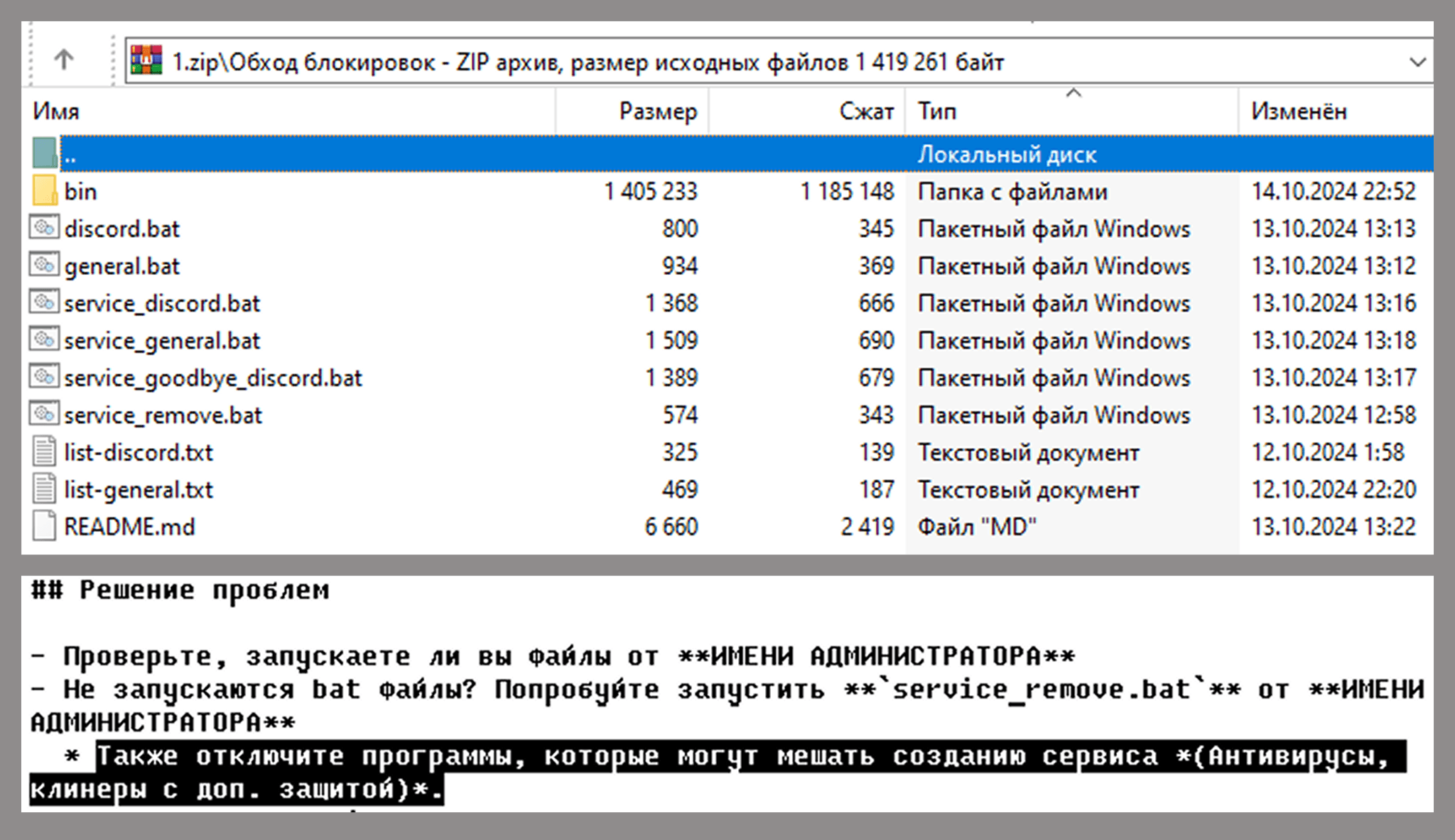
    Such software is often distributed in the form of archives with text installation instructions, in which the developers recommend disabling security solutions, citing false positives. This plays into the hands of attackers by allowing them to persist in an unprotected system without the risk of detection. Most active of all have been schemes for distributing popular stealers, remote access tools (RATs), Trojans that provide hidden remote access, and miners that harness computing power to mine cryptocurrency. The most commonly used malware families were NJRat, XWorm, Phemedrone and DCRat.

    Blackmail as a new infection scheme

    We recently uncovered a mass malware campaign infecting users with a miner disguised as a tool for bypassing blocks based on deep packet inspection (DPI). The original version of the tool is published on GitHub, where it has been starred more than 10,000 times. There is also a separate project based on it that is used to access Discord and YouTube.

    According to our telemetry, the malware campaign has affected more than 2,000 victims in Russia, but the overall figure could be much higher. One of the infection channels was a YouTuber with 60,000 subscribers, who posted several videos with instructions for bypassing blocks, adding a link to a malicious archive in the description. These videos have reached more than 400,000 views. The description was later edited and the link replaced with the message “program does not work”.

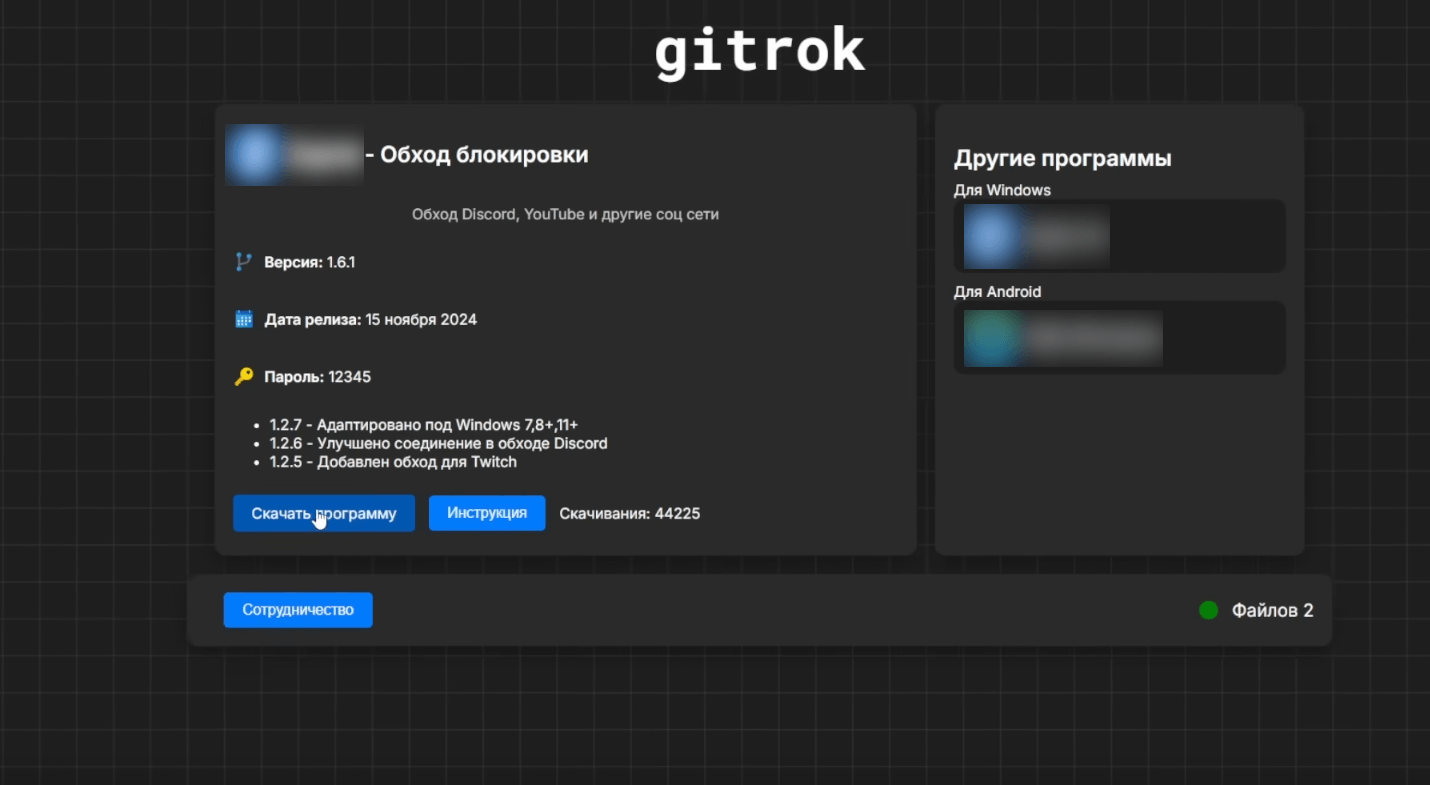
    The link pointed to the malicious site gitrok[.]com, which hosted the infected archive. The counter at the time of posting the video showed more than 40,000 downloads.

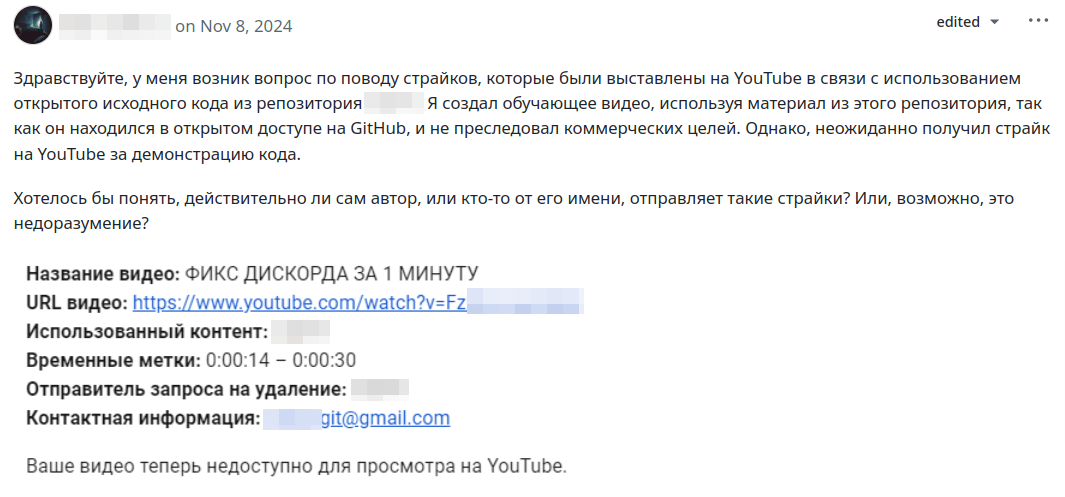
    Later, in discussions in the tool’s original repository, we found messages about a new distribution scheme: attackers under the guise of the tool developers sent strikes about the videos with instructions for bypassing restrictions. Next, the attackers threatened the content creators under the pretext of copyright infringement, demanding that they post videos with malicious links or risk shutdown of their YouTube channels.

    Translation:

    Hi, I have a question about YouTube strikes on the use of open-source code from the repository [REDACTED].
    I created a tutorial video using materials from this repository, since it was publicly available on GitHub, and the video was non-commercial. But I still got hit with a YouTube strike for demonstrating the code.
    I’d like to know if it’s the authors themselves or someone on their behalf who send the strikes? Or is it just a misunderstanding?

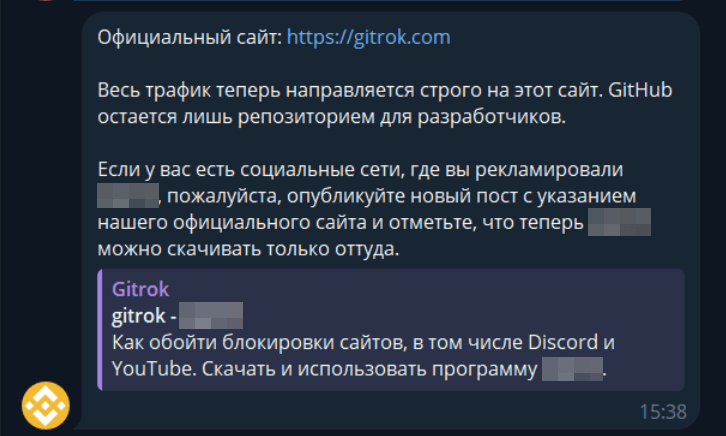
    This way, the scammers were able to manipulate the reputation of popular YouTubers to force them to post links to infected files.

    Example of a fraudulent message asking a YouTuber to post a link to a malicious site

    Translation:

    Official website: https://gitrok.com
    All traffic should be now directed strictly to this site. GitHub remains solely a repository for developers.
    If you have social networks where you’ve advertised [REDACTED], please publish a new post with a mention of our official website, and note that you can now download [REDACTED] only from there.

    YouTuber complaints about cybercriminal activity

    Translation:

    Dear program developer @[REDACTED] YouTubers who showed how the program works and helped people unblock YouTube in Russia are having problems with scammers handing out strikes and threatening to delete these creators’ channels. They force you to shoot 2 more videos for your channel so that if anything happens they can send 2 more strikes, then it’s 3 strikes and you’re out – Google will delete the channel. YouTubers feel pressured to give in to the scammers’ demands to save their channels. But that only makes things worse.

    SCAMMERS FORCE YOUTUBERS TO SHOOT VIDEOS OF THEIR PROGRAM, THAT’S WHY I DON’T HAVE A SINGLE YOUTUBE VIDEO OF THIS PROGRAM…

    In addition, we found a Telegram channel actively distributing the malicious build and a video tutorial on a YouTube channel with 340,000 subscribers.

    And in December 2024, users reported the distribution of a miner-infected version of the same tool through other Telegram and YouTube channels, which have since been shut down.

    Infected archive

    All the discovered infected archives contained one additional executable file, while the original start script general.bat had been modified to run this file using PowerShell. In one version, if the security solution on the victim’s device deleted the malicious file, the modified start script displayed the message “File not found, disable all antiviruses and re-download the file, that will help!” to persuade the victim to run the malicious file, bypassing protection:

    Contents of the original (left) and modified (right) general.bat start script

    The malicious executable is a simple loader written in Python and packed into an executable application using PyInstaller. In some cases, the script has been additionally obfuscated using the PyArmor library.

    Example of the unpacked loader

    The loader retrieves the URL of the next-stage payload from a hardcoded path on one of two domains: canvas[.]pet or swapme[.]fun. After the download, it saves the payload named t.py in a temporary directory and runs it.

    Note that the payload can be downloaded only from Russian IP addresses, indicating that the malware campaign was aimed at users in Russia.

    Second-stage malware loader

    The next stage of the infection chain was a custom Python loader based on open-source code snippets. Below are the execution steps for this script:

    1. Scanning the current environment for artifacts of running on a virtual machine or in a sandbox. The loader compares system data (computer and user names, MAC addresses, unique disk identifiers (HWID), GPU parameters, etc.) with predefined lists of values used by virtual environments.
    2. Adding the AppData directory to Microsoft Defender exclusions.
    3. GET request to http://193.233.203[.]138/WjEjoHCj/t. Depending on the response ( true/false) and the specified probability, the script either downloads the executable file from the server at http://9x9o[.]com/q.txt, or uses a hardcoded block of data in Base64 format. The resulting file is saved at %LocalAppData%driverpatch9t1ohxw8di.exe.
    4. Modifying the payload. The executable file just written to disk is modified by appending random blocks of data to the end until it reaches 690 MB in size. This technique is used to hinder automatic analysis by antivirus solutions and sandboxes.
    5. Gaining persistence in the system. The loader creates a service named DrvSvc and sets its description to that of the legitimate Windows Image Acquisition (WIA) service:

    SilentCryptoMiner

    The downloaded di.exe is a SilentCryptoMiner sample based on the open-source miner XMRig. This is a covert miner able to mine multiple cryptocurrencies (ETH, ETC, XMR, RTM and others) using various algorithms. For stealth, SilentCryptoMiner employs process hollowing to inject the miner code into a system process (in this case, dwm.exe). The malware is able to stop mining while the processes specified in the configuration are active. It can be controlled remotely via a web panel. The miner is coded to scan for indicators of running in a virtual environment and check the size of the executable itself, which must be at least 680 MB and no more than 800 MB – this is how the attackers make sure that the miner was run by the above-described loader.

    The miner configuration is Base64-encoded and encrypted using the AES-CBC algorithm with the key UXUUXUUXUUCommandULineUUXUUXUUXU and the initialization vector UUCommandULineUU. It has many parameters, including: the algorithm and URL for mining; a list of programs which upon execution cause the miner to temporarily stop and free its resources; a link to the remote configuration that the miner will receive every 100 minutes.

    The campaign makes use of the Pastebin service to store configuration files. We detected several accounts distributing such files.

    Takeaways

    The topic of restriction bypass tools is being actively exploited to distribute malware. The above campaign limited itself to distributing a miner, but threat actors could start to use this vector for more complex attacks, including data theft and downloading other malware. This underscores once again that, while such tools may look enticing, they pose a serious threat to user data security.

    Indicators of compromise

    Infected archives

    574ed9859fcdcc060e912cb2a8d1142c
    91b7cfd1f9f08c24e17d730233b80d5f

    PyInstaller loaders

    9808b8430667f896bcc0cb132057a683
    0c380d648c0c4b65ff66269e331a0f00

    Malicious Python scripts

    1f52ec40d3120014bb9c6858e3ba907f
    a14794984c8f8ab03b21890ecd7b89cb

    SilentCryptoMiner

    a2a9eeb3113a3e6958836e8226a8f78f
    5c5c617b53f388176173768ae19952e8
    ac5cb1c0be04e68c7aee9a4348b37195

    Malicious domains and IPs

    hxxp://gitrok[.]com
    hxxp://swapme[.]fun
    hxxp://canvas[.]pet
    hxxp://9x9o[.]com
    193.233.203[.]138
    150.241.93[.]90

    MIL OSI Economics

  • MIL-OSI Economics: Deputy Secretary-General of ASEAN for Economic Community meets Deputy Director-General of United Nations Industrial Development Organization

    Source: ASEAN

    Deputy Secretary-General of ASEAN for ASEAN Economic Community Satvinder Singh meets Deputy Director-General of the United Nations Industrial Development Organization (UNIDO) Ciyong Zou earlier today at the ASEAN Secretariat/ASEAN Headquarters in Jakarta. Both sides exchanged views on the regional industrial cooperation and closer engagement between ASEAN and UNIDO.

    The post Deputy Secretary-General of ASEAN for Economic Community meets Deputy Director-General of United Nations Industrial Development Organization appeared first on ASEAN Main Portal.

    MIL OSI Economics

  • MIL-OSI Economics: Global Leaders Convene in Rome for the 2025 IDEAS-NDB Conference on Evaluation for Transformational Change

    Source: New Development Bank

    Rome, Italy, 5 March 2025: Global leaders, policymakers and evaluation experts have come together in Rome for the first day of the 2025 IDEAS-NDB Conference, on the topic of “Multi-Dimensional Evaluation for Influence & Transformation”. Jointly organised by International Development Evaluation Association (IDEAS) and the Independent Evaluation Office (IEO) of the New Development Bank (NDB), the conference will examine how evaluation can drive real-world transformational change in today’s complex global landscape. Lasting for two days, the event is being held at the headquarters of the Food and Agriculture Organization of the United Nations (FAO).

    With the world facing rising geopolitical tensions, economic uncertainty, climate change and widening social inequities, the role of evaluation in shaping evidence-based decision-making has never been more crucial.

    The FAO Director-General Dr. Qu Dongyu highlighted the important role of evaluation as the cornerstone of learning and innovation to ensure effective sustainable development policies, stating: “We cannot solve food security challenges without understanding efficiency, effectiveness and the impacts of investment. Evaluation must move beyond metrics – it must shape the policies and innovations that will help us ensure sufficient and healthy foods for future generations. I believe that this conference can be a stepping-stone towards driving meaningful progress.”

    The event welcomed around 400 global delegates, with Professor Michael Kremer, winner of the 2019 Nobel Memorial Prize in Economics, delivering the keynote speech on the conference theme of multi-dimensional evaluation for influence and transformation. He was joined by senior government officials, policy and decision-makers, high-level officials and heads of evaluation offices from major multilateral development institutions, and representatives of academic and research institutions, non-governmental organizations, the private sector and others.

    Over the two days, the conference will feature high-level discussions, expert panels, and strategy sessions examining a range of interconnected themes crucial to evaluation’s role in tackling the world’s most pressing challenges. These include how evaluation supports progress in achieving the Sustainable Development Goals (SDGs) and understanding the complex relationships between the goals; addressing the nexus of climate change, crises, and development through robust evaluation; recognising the importance of context and culture in shaping evaluation practices; mainstreaming gender equality, human rights, and equity within evaluation frameworks; building evaluation capacity at all levels; and exploring evaluation for sustainable development in the BRICS nations (Brazil, Russia, India, China and South Africa) and other emerging markets and developing countries (EMDCs), which are priority areas for NDB.

    With participation from government agencies, multilateral institutions, the private sector, civil society organisations, and evaluation professionals, the event serves as a global call to action—pushing for more impact-driven, inclusive, and forward-looking evaluation frameworks.

    Ashwani K. Muthoo, Director General of IEO at NDB underscored the urgency for evaluators to change and innovate: “Evaluation must evolve to reflect the complexity of today’s world. We must go beyond traditional metrics to capture lived experiences, measure systemic change, and ensure that development efforts truly reach those who need them most.”

    ——————————

    New Development Bank (NDB)

    NDB is a multilateral bank established in 2015 by Brazil, Russia, India, China and South Africa (BRICS) with the aim of mobilising resources for infrastructure and sustainable development projects in BRICS countries and emerging markets and developing countries (EMDCs). In alignment with its members’ development objectives and commitments under the Sustainable Development Goals (SDGs) and the Paris Agreement, NDB prioritises high-impact operations that are climate-smart, disaster-resilient, technology-integrated, and socially inclusive. NDB’s Independent Evaluation Office (IEO) is responsible for independently evaluating the Bank’s policies, strategies, processes, initiatives and operations. IEO also contributes and provides oversight to improve the effectiveness of the Bank’s quality assurance and self-evaluation activities.

    MIL OSI Economics

  • MIL-OSI Economics: Influencers see Alexa+ as game-changer in personalized AI experiences, reveals GlobalData

    Source: GlobalData

    Influencers see Alexa+ as game-changer in personalized AI experiences, reveals GlobalData

    Posted in Business Fundamentals

    Amazon’s unveiling of Alexa+, a generative AI-powered upgrade to its Alexa voice assistant, has ignited significant discussion among social media influencers in the last week of February 2025. The rollout, promising enhanced personalization, context awareness, and agentic actions, has been met with both excitement and reservations. Influencers see that the enhanced Alexa+ has the potential to be a game-changer in providing  personalized AI experiences, reveals the Social Media Analytics Platform of GlobalData, a leading data and analytics company.

    Shreyasee Majumder, Social Media Analyst at GlobalData, comments: “Influencers’ discussions primarily focused on the potential of Alexa+ to enhance the user experience, emphasizing its capacity to manage complex requests, perform multiple tasks concurrently (such as booking reservations and ordering groceries), and integrate effortlessly with other Amazon services. Optimism is prevalent regarding the advanced natural language processing capabilities and the prospect of more personalized and engaging interactions. Several influencers point to use cases like assisting children with homework and resolving household disagreements as areas where Alexa+ could demonstrate significant value.

    “Alongside, the consensus also seems to be building around Apple that it needs to drastically improve its AI capabilities to remain competitive in the rapidly evolving landscape of voice assistants and AI-powered devices.”

    Below are a few popular influencer opinions captured by GlobalData’s Social Media Analytics Platform:

    1. Mark Gurman, Chief Correspondent on Apple and Tech News at Bloomberg LP:

    “The new Alexa+ is basically ChatGPT Voice Mode on steroids, with personality, context and memory of past conversations and people. It’s extremely impressive. It is frightening how far behind Apple is in this space.”

    1. Rowan Cheung, Founder & CEO at The Rundown:

    “Amazon just unveiled the all-new Alexa+ powered by Amazon’s AI models and Claude. It’s like ChatGPT Voice taken to the next level with personalization, memory of past conversations, and of course, agentic action features. Pricing starts at $19.99/month but is free for all Amazon Prime members. Most importantly, this means ~100M+ people are about to have their first experience with real AI-powered voice agents soon. Could be another ‘ChatGPT moment’ for consumers outside of the tech community. (Let’s hope it runs more smoothly than the launch of Apple Intelligence)”

    1. Brian Roemmele, Engineer at PromptExpertise.com:

    “The new AlexaPlus is quite a game changer. Of course you can talk to Alexa but you can type to it also. The rate of acceleration is incredibly increasing. FREE in Amazon Prime…”

    1. Marsha Collier, President at The Collier Company Inc:

    “Amazon Unveils Alexa Powered by Generative AI. Amazon is aiming to catch up in generative artificial intelligence and to reboot its virtual assistant, which has been leapfrogged by powerful chatbots. “Until right this moment, right this moment, we have been limited by the technology,” Panos Panay, the head of Amazon’s devices, said at a media event. “Alexa+ is that trusted assistant that can help you conduct your life and your home”.”

    1. Shelly Palmer, CEO at The Palmer Group:

    “In a “better late than never” moment, Amazon has unveiled Alexa+: an advanced version of its voice assistant that integrates generative AI to enhance user interactions. Priced at $19.99 per month (but free for Amazon Prime members), the service is set to launch with early access in the U.S. next month, initially available on Echo Show devices, with plans for broader international and device expansion…”

    1. Kim, Technology Expert:

    “Amazon has unveiled Alexa+, an enhanced version of its voice assistant powered by generative AI technologies. This upgrade enables Alexa+ to handle multiple requests in a single command and perform tasks autonomously on behalf of users. For instance, it can book restaurants, create recipes, set timers automatically, and control various smart home devices based on your preferences and mood…”

    MIL OSI Economics

  • MIL-OSI Economics: World Obesity Day: GlobalData highlights need to tackle stigma and raise awareness on obesity’s growing impact

    Source: GlobalData

    World Obesity Day: GlobalData highlights need to tackle stigma and raise awareness on obesity’s growing impact

    Posted in Pharma

    Every year 04 March is observed as World Obesity Day to challenge stigma and misconceptions surrounding obesity. The day aims to raise public awareness about the condition, which affects over 200 million people in the seven major markets (7MM*). Despite advancements in treatment, many face challenges such as limited access to care, making awareness and better support essential for addressing this growing health issue, according to GlobalData, a leading data and analytics company.

    GlobalData’s latest report “Obesity: Seven-Market Drug Forecast and Market Analysis- Update,” reveals that the unmet needs in this space remain, and the arrival of effective weight loss medications onto the market is just one step towards the solution.

    Costanza Alciati, Pharma Analyst at GlobalData, comments: “Many new drugs are expected to reach the obesity market in the next decade: by 2031, GlobalData expects 23 candidates to be approved in the major markets. This will offer a wider range of options for patients, hoping that treatment access will have improved by then.”

    GlobalData forecasts that the number of individuals living with obesity across the 7MM to increase at an annual growth rate (AGR) of 0.7% through 2031.

    Alciati continues: “Some of the biggest issues for patients is access to specialists and affordable treatment. An increased awareness of what this condition entails and what other diseases it can lead to is crucial for people to understand that it is not just some extra weight”.

    The key opinion leaders interviewed by GlobalData are hopeful for the future of obesity treatment, after seeing the improvements over the last five years.

    Alciati concludes: “However, most improvements have come from the pharmaceutical sector, with a lot of investments going into this therapeutic area. Alas, many more changes are still needed in our society and in the food industry to ensure better metabolic health of citizens.”

    *7MM: The US, France, Germany, Italy, Spain, the UK, and Japan.

    MIL OSI Economics

  • MIL-OSI Economics: Diagnosed prevalent cases of prostate cancer across 8MM to reach 4.24 million in 2033, forecasts GlobalData

    Source: GlobalData

    Diagnosed prevalent cases of prostate cancer across 8MM to reach 4.24 million in 2033, forecasts GlobalData

    Posted in Pharma

    The burden of five-year diagnosed prevalent cases of prostate cancer is expected to increase at an annual growth rate (AGR) of 3.10% from around 3.23 million in 2023 to 4.24 million in 2033 across the eight major markets (8MM*), forecasts GlobalData, a leading data and analytics company.

    GlobalData’s latest report, “Prostate Cancer: Epidemiology Forecast to 2033,” reveals that the increase is partly attributed to the increased survival rate of prostate cancer patients due to modern medicine, combined with underlying demographic changes in the respective markets.

    The prevalence of prostate cancer is known to vary depending on the market region. According to GlobalData epidemiologists, the US had the highest number of five-year diagnosed prevalent cases of prostate cancer in 2023 with 1.11 million cases, whereas Spain had the lowest number of prevalent cases at 128,000.

    Bishal Bhandari, PhD, Associate Director of Epidemiology at GlobalData, comments: “The growth of the five-year diagnosed prevalent cases of prostate cancer in the 8MM is the result of longer life expectancy and an increase in the incidence of the disease. The patient survivals are also steadily rising, due to improved prevention, early diagnosis, and treatment. In 2023, only 25% of the diagnosed prevalent cases of prostate cancer in the 8MM were in advanced stages.”

    GlobalData epidemiologists also observed an age difference in prostate cancer. The biggest risk factor for prostate cancer is advancing age. This forecast reflects the burden in older men; in 2023, more than 85% of cases occurred in men ages 60 years and older. Only 1% of cases occurred in men younger than age 50 years.

    Bhandari concludes: “A major factor that will impact the epidemiology of prostate cancer cases in the coming years will be the role of prostate-specific antigen (PSA) testing for prostate cancer screening. PSA screening can detect prostate cancer early, but it can also result in the detection of non-life-threatening tumors, causing unnecessary anxieties. Therefore, PSA screening guidelines vary between countries and have changed over time. Future changes in PSA screening guidelines would likely have a major impact on the diagnosis of prostate cancer cases.”

    *8MM: The US, France, Germany, Italy, Spain, the UK, Japan, and China

    MIL OSI Economics

  • MIL-OSI Economics: [Toyota Times] Never Giving up on “Mobility for All” – the Toyota Employees Working to Leave No One Behind

    Source: Toyota

    Headline: [Toyota Times] Never Giving up on “Mobility for All” – the Toyota Employees Working to Leave No One Behind

    For some people, even the simple wish to go outside is not easily fulfilled. For others, a power outage can be a life-or-death situation. This episode talks to Toyota employees working to contribute to medicine and nursing care with mobility.

    MIL OSI Economics

  • MIL-OSI Economics: IAI Task Force Convenes 75th Meeting to Advance the Final Year Implementation of the IAI Work Plan IV (2021-2025)

    Source: ASEAN

    JAKARTA, 5 March 2025 – The 75th Initiative for ASEAN Integration (IAI) Task Force Meeting was held today at the ASEAN Headquarters/ASEAN Secretariat, marking a significant  milestone as the IAI Work Plan IV (2021-2025) enters its final year. The meeting reviewed progress, assessed ongoing initiatives, and set priorities for the remaining implementation period to ensure the Work Plan’s successful completion.

    Chaired by Ambassador Ton Thi Ngoc Huong, Permanent Representative of Viet Nam to ASEAN, the meeting was attended by IAI Task Force members from all ASEAN Member States, the Ambassador of Timor-Leste to ASEAN, representatives from the ASEAN Secretariat, and attachment officers from Cambodia, Lao PDR, Myanmar, Viet Nam (CLMV) and Timor-Leste. Discussions focused on key priorities, the status of ongoing projects, and ensuring that the initiatives continue to advance ASEAN integration while addressing development gaps in the region. Additionally, the Meeting discussed the roles of the IAI Task Force in the ASEAN Economic Community Strategic Plan 2025-2030 and the progress of developing the new IAI Work Plan V.

    During the meeting, four new projects were accredited, bringing the total number of IAI projects under the current Work Plan IV (2021-2025) to 95. These projects encompass 17 out of the 24 actions (70.8 percent) across the five strategic areas and all four enabling actions.

    For more information on the IAI, please visit https://asean.org/our-communities/initiative-for-asean-integration-narrowing-development-gap-iai-ndg/

    ###

    The post IAI Task Force Convenes 75th Meeting to Advance the Final Year Implementation of the IAI Work Plan IV (2021-2025) appeared first on ASEAN Main Portal.

    MIL OSI Economics

  • MIL-OSI Economics: ASEAN and Japan strengthen ties to advance comprehensive strategic Partnership

    Source: ASEAN

    KARUIZAWA, 5 March 2025 – Senior Officials of ASEAN and Japan attending the 40th ASEAN-Japan Forum in Karuizawa reaffirmed their commitment to further advancing the ASEAN-Japan Comprehensive Strategic Partnership (CSP) based on mutual trust and respect, mutual benefit and equal partnership.

    The meeting welcomed the continued momentum of strengthening ASEAN-Japan relations, following the successful convening of the 27th ASEAN-Japan Summit in October 2024 as well as the Commemorative Summit on the 50th anniversary of ASEAN-Japan Friendship and Cooperation in December 2023 in Tokyo.  

    Both sides reviewed ASEAN-Japan cooperation, acknowledging the significant progress made in implementing the Joint Vision Statement on ASEAN-Japan Friendship and Cooperation: Trusted Partners and its corresponding Implementation Plan. They reaffirmed their commitment to working closely in carrying out the Implementation Plan to further enhance collaboration in various sectors.

    Discussions also emphasised strengthening cooperation under the three pillars of the CSP, namely Heart-to-Heart Partners across Generation, Partners for Co-creation of Economy and Society of the Future, and Partners for Peace and Stability. Both sides agreed to enhance cooperation on traditional and emerging areas, including combating transnational crime, cyber security, digitalisation, green transition, science and technology, sustainable development and climate action.

    Japan reaffirmed its strong support for ASEAN Centrality and ASEAN Community-building efforts. ASEAN welcomed Japan’s commitment to supporting the ASEAN Outlook on the Indo-Pacific (AOIP) through concrete projects and activities, aimed at fostering practical cooperation in the key areas of the AOIP, with a view to contributing to the advancement of the CSP in an open, transparent and inclusive manner. ASEAN also welcomed Japan’s proposal for a Joint Statement on the further promotion and implementation of the AOIP, for adoption at the 28th ASEAN-Japan Summit this year.

    Both sides shared their respective views on regional and international issues of mutual interest and agreed to enhance collaboration in addressing emerging challenges, with a view to promoting peace, stability and prosperity in the region.

    The 40th ASEAN-Japan Forum was co-chaired by Permanent Secretary of the Ministry of Foreign Affairs of Singapore, Albert Chua, and Senior Deputy Foreign Minister of Japan, Namazu Hiroyuki, and attended by Senior Officials of ASEAN Member States or their Representatives, and the Deputy Secretary-General of ASEAN for ASEAN Political-Security Community. Timor-Leste attended as Observer.

    ***

    Images Credit: 40th ASEAN-Japan Forum
    The post ASEAN and Japan strengthen ties to advance comprehensive strategic Partnership appeared first on ASEAN Main Portal.

    MIL OSI Economics

  • MIL-OSI Economics: Money Market Operations as on March 04, 2025

    Source: Reserve Bank of India


    (Amount in ₹ crore, Rate in Per cent)

      Volume
    (One Leg)
    Weighted
    Average Rate
    Range
    A. Overnight Segment (I+II+III+IV) 5,66,314.76 5.97 4.99-6.50
         I. Call Money 13,610.28 6.27 5.15-6.40
         II. Triparty Repo 3,82,192.65 5.93 5.65-6.18
         III. Market Repo 1,68,859.58 6.05 4.99-6.50
         IV. Repo in Corporate Bond 1,652.25 6.29 6.25-6.50
    B. Term Segment      
         I. Notice Money** 140.00 6.17 6.05-6.30
         II. Term Money@@ 275.50 6.30-7.25
         III. Triparty Repo 0.00
         IV. Market Repo 70.48 6.25 6.25-6.25
         V. Repo in Corporate Bond 0.00
      Auction Date Tenor (Days) Maturity Date Amount Current Rate /
    Cut off Rate
    C. Liquidity Adjustment Facility (LAF), Marginal Standing Facility (MSF) & Standing Deposit Facility (SDF)
    I. Today’s Operations
    1. Fixed Rate          
    2. Variable Rate&          
      (I) Main Operation          
         (a) Repo          
         (b) Reverse Repo          
      (II) Fine Tuning Operations          
         (a) Repo Tue, 04/03/2025 1 Wed, 05/03/2025 5,855.00 6.26
         (b) Reverse Repo          
      (III) Long Term Operations^          
         (a) Repo          
         (b) Reverse Repo          
    3. MSF# Tue, 04/03/2025 1 Wed, 05/03/2025 143.00 6.50
    4. SDFΔ# Tue, 04/03/2025 1 Wed, 05/03/2025 2,17,894.00 6.00
    5. Net liquidity injected from today’s operations [injection (+)/absorption (-)]*       -2,11,896.00  
    II. Outstanding Operations
    1. Fixed Rate          
    2. Variable Rate&          
      (I) Main Operation          
         (a) Repo Fri, 21/02/2025 14 Fri, 07/03/2025 41,046.00 6.26
         (b) Reverse Repo          
      (II) Fine Tuning Operations          
         (a) Repo          
         (b) Reverse Repo          
      (III) Long Term Operations^          
         (a) Repo Fri, 21/02/2025 45 Mon, 07/04/2025 57,951.00 6.26
      Fri, 14/02/2025 49 Fri, 04/04/2025 75,003.00 6.28
      Fri, 07/02/2025 56 Fri, 04/04/2025 50,010.00 6.31
         (b) Reverse Repo          
    3. MSF#          
    4. SDFΔ#          
    D. Standing Liquidity Facility (SLF) Availed from RBI$       8,302.70  
    E. Net liquidity injected from outstanding operations [injection (+)/absorption (-)]*     2,32,312.70  
    F. Net liquidity injected (outstanding including today’s operations) [injection (+)/absorption (-)]*     20,416.70  
    G. Cash Reserves Position of Scheduled Commercial Banks
         (i) Cash balances with RBI as on March 04, 2025 9,10,913.15  
         (ii) Average daily cash reserve requirement for the fortnight ending March 07, 2025 9,22,740.00  
    H. Government of India Surplus Cash Balance Reckoned for Auction as on¥ March 04, 2025 5,855.00  
    I. Net durable liquidity [surplus (+)/deficit (-)] as on February 07, 2025 -1,973.00  
    @ Based on Reserve Bank of India (RBI) / Clearing Corporation of India Limited (CCIL).
    – Not Applicable / No Transaction.
    ** Relates to uncollateralized transactions of 2 to 14 days tenor.
    @@ Relates to uncollateralized transactions of 15 days to one year tenor.
    $ Includes refinance facilities extended by RBI.
    & As per the Press Release No. 2019-2020/1900 dated February 06, 2020.
    Δ As per the Press Release No. 2022-2023/41 dated April 08, 2022.
    * Net liquidity is calculated as Repo+MSF+SLF-Reverse Repo-SDF.
    ¥ As per the Press Release No. 2014-2015/1971 dated March 19, 2015.
    # As per the Press Release No. 2023-2024/1548 dated December 27, 2023.
    ^ As per the Press Release No. 2024-2025/2013 dated January 27, 2025, Press Release No. 2024-2025/2138 dated February 12, 2025, and Press Release No. 2024-2025/2209 dated February 20, 2025.
    Ajit Prasad          
    Deputy General Manager
    (Communications)    
    Press Release: 2024-2025/2298

    MIL OSI Economics

  • MIL-OSI Economics: Asia’s Next Growth Frontier

    Source: International Monetary Fund

    Opening Remarks by the IMF Managing Director Kristalina Georgieva
    At a conference on Asia and the IMF: Resilience through Cooperation, Tokyo, Japan, March 5, 9AM JST

    March 4, 2025

    (As Prepared for Delivery)

    I would like to thank Finance Minister Kato for welcoming us today and want to express my gratitude to Governor Ueda for joining. I’m very sorry I can’t be with you in person. But thankfully technology allows me to join you virtually.

    Those who have been to Tokyo’s Skytree know that it has the best views of the city. And like so much in Japan, it’s an engineering masterpiece. Gazing across Tokyo’s skyline, it’s hard to imagine just how much the city—and the country—has changed in the 80 years since the Bretton Woods Institutions were established.

    After World War II, Japan invested heavily in infrastructure and manufacturing and introduced sweeping reforms. These set the country on a path to becoming an economic powerhouse.

    Inspired by Japan’s success, other countries in Asia followed suit. Today, the region contributes over 60 percent of global growth, and is home to some of the world’s largest, most innovative companies.

    Of course, Asia is a very diverse continent, with a mix of advanced economies, emerging and frontier markets, and small island states. Demographics and income levels vary too.

    But across the region, openness and deepening economic ties have been crucial to countries’ success.

    The world is changing, however. Many countries face weaker growth prospects and are saddled with high public debt. The COVID-19 pandemic and recent geopolitical developments have brought into focus the importance of security of supplies. Trade is no longer the engine of global growth it used to be. And we are in the midst of massive transformations, from rapid advances in AI to changing patterns of capital flows and trade. 

    Against this background, governments worldwide are shifting their priorities. The new US administration is rapidly reshaping its policies on trade, taxation, public spending, deregulation, and digital assets. And other governments are also recalibrating their approaches and adjusting their policies.

    The future of growth

    How should countries in Asia adapt? Let me highlight three opportunities.

    First, the shift toward services-led growth. While trade in goods has flattened, service flows are surging. In fact, services have already drawn about half of the region’s workers, up from just 22 percent in 1990.

    Economists have traditionally thought of services as less productive than manufacturing. Our research suggests otherwise. Asia’s labor productivity in financial services is four times higher than in manufacturing, and twice as high in business services.

    Second, digitalization and AI. The demand for digital products and services in the region has accelerated quickly and is on track to continue growing faster than the region’s GDP. Japan’s Rakuten, China’s Alibaba Group, and Indonesia’s GoTo Group now rival e-commerce giants Amazon and Walmart.

    In AI development, Japan and China are racing ahead, followed closely by South Korea and Singapore. This could be an important boost for productivity. In Singapore, for example, an estimated 40 percent of jobs could be made more productive by AI. The country has several digital economy agreements now in place, enabling digital companies in the region to connect and share data more easily.

    That brings me to my third point: greaterregional cooperation andtrade. On the surface, it might look as if the world is retreating from integration. But regionally, countries are leaning in.

    Over the past four decades, intra-regional trade in Asia has increased by 43 percent. Today, more than half of Asian trade is regional.

    The trend is the same for foreign direct investment. FDI from Asian countries to Japan, for example has nearly doubled over the past decade, as market opportunities in Japan’s technology sector grow.

    Together, the shift toward services, digitalization and AI, and greater regional integration can lift growth. But to harness these opportunities, the region will need to carefully navigate domestic developments and global changes.

    The IMF’s role

    That is where the IMF comes in. We strive to be trusted partners to our member countries, provide country-specific advice and safeguard the stability of the global economy. Our work spans economic analysis, policy advice, financing and capacity development.

    And as the world economy has changed, we too have evolved. From managing fixed exchange rates in the 1970s, to active surveillance of countries’ economic and financial policies and more systematic coverage of spillovers.

    More recently, our thinking on capital flow management and foreign exchange interventions has changed, and we’ve upgraded our lending toolkit to include more flexible instruments tailored to emerging market economies.

    Thanks in large part to Japan’s support, we are also offering more support to low-income countries, especially in capacity development, and a stronger presence around the world through our regional technical assistance centers.

    We are grateful to Japan for the deep engagement in thinking about the future of the Fund. Today’s discussions are an important part of that. 

    My colleagues and I are keenly interested in ideas and reflections on:

    • how we can best support our members, especially the most vulnerable among them, to grow and build economic resilience;
    • how to tailor more of our advice to support countries’ efforts to deepen regional collaboration, by thinking through our strategic engagement with groups like the ASEAN, the Pacific Island countries, as well as medium sized and larger economies; and
    • how to strengthen the global financial safety net. We’re assessing how IMF facilities can be further improved to support resilience in our member countries. And we are working closely with regional arrangements to enhance crisis prevention and response capabilities.

    We know from experience that reforms are hard, but we also know they can steer countries towards stronger and durable growth and can achieve a more stable and prosperous global economy.

    You can count on the IMF in this journey.

    Deputy Managing Director Nigel Clarke and the rest of our team are excited to be part of today’s productive discussion. I look forward to the outcome.

    Thank you.

    IMF Communications Department
    MEDIA RELATIONS

    PRESS OFFICER:

    Phone: +1 202 623-7100Email: MEDIA@IMF.org

    MIL OSI Economics

  • MIL-OSI Economics: Huawei Cloud Stack Announces Six Scenario-specific Solutions for Carriers to Drive Efficiency, Revenue Growth, and Digital Inclusion

    Source: Huawei

    Headline: Huawei Cloud Stack Announces Six Scenario-specific Solutions for Carriers to Drive Efficiency, Revenue Growth, and Digital Inclusion

    [Barcelona, Spain, March 4, 2025] At MWC 2025, during the Huawei Cloud Carrier Forum, themed “Take a Cloud Leap to Transform from Telco to Techco”, Huawei released six Huawei Cloud Stack-based scenario-specific solutions for carriers around the world, as well as a Telco2Techco Cloud Leap Program. They aim to help carriers enhance operational efficiency and generate new revenue streams through cloud innovation.
    Shang Haifeng, President of Huawei’s Huawei Cloud Stack Business Dept, delivering an opening speech through digital human

    Today, more and more carriers are transforming themselves from traditional telecommunications companies (telcos) to technology companies (or techcos). Shang Haifeng, President of the Huawei Cloud Stack Business Dept at Huawei, said: “This [telco-to-techco] transformation is not just about adopting new technologies; it is about redefining the role of carriers in a digital-first world. At Huawei Cloud, we are proud to partner with global carriers on their journey to becoming techcos.”
    Johnny Lyu, CTO of International Business, Huawei Cloud Stack, delivering a keynote

    In recent years, carrier transformation has typically started with an all-cloud transformation for boosting operational efficiency and enriching services for an enhanced customer experience. Johnny Lyu, CTO of International Business at Huawei Cloud Stack, said: “Huawei Cloud Stack offers a reliable cloud foundation. Today, we are releasing six scenario-specific solutions for carriers, helping them improve the efficiency of their businesses, platforms, and services, and start a second growth curve.”
    Huawei Cloud Stack’s six scenario-specific solutions for carriers include three for enhancing internal operational efficiency and three out-of-the-box solutions aimed at driving external revenue growth.
    Leap to Cloud to improve efficiency
    FinTech: This solution supports secure, high-performance, and flexible operational capabilities for Mobile Money. It helps ensure the compliance of both mobile financial services and data while enhancing user experience for their customers.
    Marketing big data: This solution offers an efficient, one-stop, cloud-native data foundation with 200 built-in data models for simplified development. It guarantees 99.999% availability on the cloud, supporting customer acquisition and retention by carriers.
    AICC: A solid, centrally managed cloud foundation for Artificial Intelligence Contact Center (AICC) ensures 24/7 availability for services such as digital ambassadors for customer service, AI scheduling, and AI voice analytics.
    Spark innovation with out-of-the-box solutions
    Smart government: Huawei Cloud Stack provides a unified cloud operations platform, enhancing capabilities in product listing, metering and billing, and customer management. This enables better public services for both businesses and residents as well as digitalized, modernized city governance.
    Smart education: This solution offers course management, remote classrooms, and exam management on the cloud. A high-concurrency, high-performance platform supports AI-generated live captions in multiple languages as well as knowledge graphs.
    Cloud phone: Huawei Cloud Stack supports cloud-based virtual phones with pre-installed apps, such as gaming and office tools. These virtual phones can serve as data backups for users, with flexible permissions control, helping carriers drive 4G conversion among subscribers.
    Launch ceremony of Huawei’s Telco2Techco Cloud Leap Program

    Huawei Cloud Stack, together with Orange, Zain Kuwait, iSoftStone, and ULearning, jointly launched the Telco2Techco Cloud Leap Program underpinned by six scenario-specific solutions for carriers. Focusing on 10+ innovative service scenarios, this program offers project support, marketing support, training, enablement, and more, helping carriers accelerate the transition from telcos to techcos.
    MWC Barcelona 2025 is held from March 3 to March 6 in Barcelona, Spain. During the event, Huawei will showcase its latest products and solutions at stand 1H50 in Fira Gran Via Hall 1.In 2025, commercial 5G-Advanced deployment will accelerate, and AI will help carriers reshape business, infrastructure, and O&M. Huawei is actively working with carriers and partners around the world to accelerate the transition towards an intelligent world.For more information, please visit: https://carrier.huawei.com/en/events/mwc2025

    MIL OSI Economics

  • MIL-OSI Economics: Global Industry Partners Jointly Release Net5.5G Best Practices & Deployment Guide Whitepaper

    Source: Huawei

    Headline: Global Industry Partners Jointly Release Net5.5G Best Practices & Deployment Guide Whitepaper

    [Barcelona, Spain, March 4, 2025] At MWC Barcelona 2025, the Broadband Development Congress (BDC), hosted by the World Broadband Association (WBBA), was a resounding success. Themed “Smarter Broadband: Investment. Innovation. Intelligence,” the congress attracted over 200 industry leaders from global industry organizations, standards organizations, government agencies, carriers, and device vendors. Attendees exchanged views on key issues, including the Net5.5G evolution path, network technology innovation, and commercial practices.
    Ryan Qiu, Vice President of Huawei’s Data Communication Product Line, delivering a keynote speech titled “Accelerating Net5.5G Innovation, Striding to an Intelligent Era”

    In his keynote speech at the congress, Ryan Qiu, Vice President of Huawei’s Data Communication Product Line, noted that the integration of AI into carriers’ strategies is gaining momentum, with Net5.5G serving as a catalyst for the in-depth convergence of networks and AI. To address this trend, Huawei has introduced AI WAN, a cutting-edge solution that comprehensively empowers IP networks in the Net5.5G era using AI. Featuring a three-layer architecture comprising AI routers, AI new connections, and AI new brain, this solution enables carriers to unlock new network value across diverse scenarios, including individual, home, and enterprise settings.
    Industry Consensus on Net5.5G: Global Leaders Call for Enhanced Cooperation
    At the congress, global industry leaders from organizations such as the WBBA, IPv6 Forum, International Telecommunication Union (ITU-T), and Internet Engineering Task Force (IETF) reached a consensus during the “Fireside Chat: Forward-Looking Dialogue on the Evolution of Next-Gen Networks.” Net5.5G has now become an industry-wide consensus, making significant strides in areas including industry development, policy formulation, and commercial practices. The leaders called for enhanced industry collaboration and continued joint efforts to drive the commercial success of Net5.5G, thereby guiding the sustainable development of the Internet industry.
    Establishment of Net5.5G Industry Cooperation Mechanism and Phased Progress of Global Pioneer Program
    With the advent of the Net5.5G era, the WBBA, IPv6 Forum, ITU-T, IETF, and Network Innovation and Development Alliance (NIDA) have collaborated to establish a next-generation network cooperation mechanism. While the WBBA and IPv6 Forum drive industry consensus, the ITU-T explores future network needs, the IETF spearheads the formulation of network technology standards, and the NIDA defines network construction standards and facilitates technology adoption. This multi-party collaboration marks a new phase of global network upgrades and lays a solid foundation for an intelligent society.
    The Global Net5.5G Pioneer Program has made steady progress. At the congress, industry leaders jointly released the latest progress of the program. To date, a number of outstanding Net5.5G pioneers have emerged globally, including 18 visionary pioneers, 2 region pioneers, and 18 business pioneers.
    Accelerated Net5.5G Commercial Deployment and Release of Best Practices Whitepaper
    Multiple carriers shared their experience and achievements in Net5.5G commercial deployment. As the integrated operator in Spain by user count, MasOrange builds an efficient capacity growth, ultimate experience and intent-based automation Net5.5G converged IP network. 400GE/800GE, SRv6 + slicing meet traffic surging and automatic network scheduling requirements, and supports new services such as edge computing in the future. Based on Network Digital Map,through AI empowerment, MasOrange will stride to AN L4, a new phase of intelligent evolution.Turkcell, a digital carrier in Türkiye, has built a stable, flexible, and experience-centric target network by leveraging key Net5.5G technologies such as 400GE/800GE, SRv6/slicing, and Network Digital Map. This network features ultra-high bandwidth, ultra-low latency, ultra-high reliability, and intelligence, significantly enhancing customer service experience and generating new business value. In addition, the WBBA has released the Net5.5G
    Best Practices & Deployment Guide Whitepaper, showcasing global Net5.5G best practices and providing valuable insights and inspiration for the industry.
    As Net5.5G continues to evolve, the WBBA urges global industry organizations to strengthen industry cooperation and jointly drive industry innovation in technical standards, policies, and commercial practices to foster a thriving data communications ecosystem.
    MWC Barcelona 2025 is held from March 3 to March 6 in Barcelona, Spain. During the event, Huawei will showcase its latest products and solutions at stand 1H50 in Fira Gran Via Hall 1. In 2025, commercial 5G-Advanced deployment will accelerate, and AI will help carriers reshape business, infrastructure, and O&M. Huawei is actively working with carriers and partners around the world to accelerate the transition towards an intelligent world. For more information, please visit: https://carrier.huawei.com/en/events/mwc2025

    MIL OSI Economics

  • MIL-OSI Economics: Brunei Darussalam: Stand-Alone Proposal to Move Brunei Darussalam to a 24-Month Article IV Consultation Cycle from its Current 12-Month Cycle

    Source: International Monetary Fund

    International Monetary Fund. Asia and Pacific Dept “Brunei Darussalam: Stand-Alone Proposal to Move Brunei Darussalam to a 24-Month Article IV Consultation Cycle from its Current 12-Month Cycle”, IMF Staff Country Reports 2025, 059 (2025), accessed March 4, 2025, https://doi.org/10.5089/9798229003162.002

    MIL OSI Economics

  • MIL-OSI Economics: Samsung One UI 7 Beta Rolls Out to More Galaxy Devices

    Source: Samsung

    Samsung Electronics today announced the availability of Galaxy AI1 features on more Galaxy devices through the One UI 7 beta program, designed to offer the most natural and seamless mobile AI experience.
    The beta program will be available for Galaxy Z Fold6 and Z Flip6 in India, Korea, the U.K. and the U.S. starting this week, rolling out to more devices later this month2 including Galaxy S23 and Galaxy Tab S10 series. Users can apply to join the beta program via Samsung Members. The official update of One UI 7 will be available starting in April.
    Integrating leading AI agents with multimodal capabilities into every touch point of the interface, One UI 7 marks a significant leap forward in creating a new kind of mobile experience where every interaction feels more intuitive than ever before.

    1 Galaxy AI features by Samsung will be provided for free until the end of 2025 on supported Samsung Galaxy devices.
    2 Availability may vary by device model and market.

    MIL OSI Economics

  • MIL-OSI Economics: Phillips 66 – PSX – DFAN14A – Additional Proxy Soliciting Materials – Non-Management (definitive)

    Source: Phillips

    To receive notifications via email, enter your email address and select at least one subscription below. After submitting your information, you will receive an email. You must click the link in the email to activate your subscription. You can sign up for additional subscriptions at any time.
    * Required

    MIL OSI Economics

  • MIL-OSI Economics: Phillips 66 to speak at Piper Sandler 25th Annual Energy Conference

    Source: Phillips

    HOUSTON–(BUSINESS WIRE)– Mark Lashier, chairman and CEO of Phillips 66 (NYSE: PSX), will participate in a fireside chat at the Piper Sandler 25th Annual Energy Conference at 1:50 p.m. ET on Tuesday, March 18, 2025.
    Lashier will discuss the company’s plans to continue advancing strategic priorities across its segments to deliver shareholder value and maintaining its ongoing commitment to disciplined capital allocation.
    To access the webcast, go to the Events and Presentations section of the Phillips 66 Investors site, phillips66.com/investors. A replay will be archived on the Events and Presentations page the day after the event, and a transcript will be available at a later date.
    About Phillips 66
    Phillips 66 (NYSE: PSX) is a leading integrated downstream energy provider that manufactures, transports and markets products that drive the global economy. The company’s portfolio includes Midstream, Chemicals, Refining, Marketing and Specialties, and Renewable Fuels businesses. Headquartered in Houston, Phillips 66 has employees around the globe who are committed to safely and reliably providing energy and improving lives while pursuing a lower-carbon future. For more information, visit phillips66.com or follow @Phillips66Co on LinkedIn.

    Source: Phillips 66

    MIL OSI Economics