Category: Economy

  • MIL-OSI USA: Tuberville Speaks on Importance of Boosting U.S. Economy to Help Struggling Seniors

    US Senate News:

    Source: United States Senator Tommy Tuberville (Alabama)

    WASHINGTON – Yesterday, during a Senate Special Committee on Aging hearing, U.S. Senator Tommy Tuberville (R-AL) asked about common misconceptions surrounding tariffs and how they can be used to stimulate the economy and create job growth. During the discussion, Sen. Tuberville also focused on the unprecedented amount of credit card debt in our country and how Congress can help Americans return to financial stability. Sen. Tuberville also addressed reining in the unsustainable expansion of the federal welfare system.

    Read Senator Tuberville’s remarks below or watch on YouTube or Rumble.

    TUBERVILLE: “Thank you, Mr. Chairman. Thanks for being here this afternoon, fellas.

    Mr. Ferry, a lot of misconceptions about, floating around the media about tariffs and how they’ll hurt the American economy. Can you speak to how tariffs, if they’re done right, will boost the economy?”

    MR. JEFF FERRY: “Thank you for the question, Senator. That’s an absolutely true statement. Tariffs done right will stimulate our economy. I just want to say, following on from what Mr. Lawson said, that there is no money tree. The percentage of old people in our economy continues to grow, I’m sitting here as a living, breathing example of that. And we have fewer people in work earning, in a sense, less real wages than 50 years ago when we had four working people for every retired person. Now, we’re getting close to two, I think. So, we need to make this economy grow and we need to raise the real incomes and the value of the production of every single worker.

    Tariffs are a key way we can do that because what tariffs do is they handicap imports and they allow domestic production to grow. We want to tariff the high value, highly productive, high growth manufacturing sectors, which is roughly three quarters of the entire manufacturing sector in the United States. And by doing so, we will produce more cars, more computers, more machinery, more machine tools, more medical equipment, and more steel, and more aluminum and all of that. All those industries pay higher wages.

    As an example, the average large steel company is, today, paying its average steel worker over a hundred-thousand dollars a year. The average steel worker no longer works with hot molten metal. He works in a computer control room. And tariffs are a key way to stop the handicap this economy has due to an overvalued dollar and due to trade cheating, from countries like China and Germany. So, they’re an absolutely essential tool.”

    TUBERVILLE: “Do you do you see an increase in job opportunities with increased tariffs?”

    MR. JEFF FERRY: “Yes. I mean mathematically well, yes. We will see a higher labor force participation rate with increased tariffs because domestic production will rise, and those jobs will attract people to get off the sofa and go out and get those jobs. But most crucially, I see a transition from people working for places like Jimmy John’s at minimum wage, into high value jobs, which not only pay more today, but offer them career opportunities to get on a rising escalator.”

    TUBERVILLE: “Thank you. Mr. Antoni, Americans are upside down in credit card debt. 1.17 trillion dollars. Eighty-five percent of Americans have credit cards, eighty-five percent of Americans over 65 have a credit card. What can be done at the congressional level to encourage savings and keep more money in the pockets of Americans when it comes to credit.”

    MR. E.J. ANTONI: “Sir, thank you for the question. A big disincentive to save has historically been inflation because as your money is sitting there in the bank, or even if it’s in in equities, whatever the case may be, much of the growth that it’s experiencing is simply just the dollar losing value. So, it doesn’t really, there’s not really much of an incentive there. If you want to get rid of inflation and you want to not only incentivize people to save, but disincentivize them from borrowing, you got to get inflation down. And I think the way you have to do that is by cutting government spending.

    The only other thing I would add is to help the people who are already in so much credit card debt, who are suffering with the combination of high credit card debt and high interest rates, is you need to get the interest rates down. And the interest rate is simply a price. It’s the price to borrow money. If you want to reduce the price of something, reduce the demand. So, reduce the demand for borrowed money. All marginal spending by this congress is by definition borrowed. So, if you reduce that spending, you will also reduce the demand for borrowed money and help bring interest rates down.”

    TUBERVILLE: “Thank you. Mr. Bragdon, you talk a lot about this unsustainable expansion of the federal welfare programs that have caused massive increases in spending, particularly SNAP. SNAP spending has grown by more than seventy-three percent since the last Farm Bill. It’s predicted we’ll spend more on SNAP in the next ten years than we have in the last two decades. This is over the top.

    So, what’s your thoughts here on this massive increase in the TFP and what recommendation do you have to address this farm bill with SNAP?”

    MR. TARREN BRAGDON: “Senator, thank you for the question. I think it’s really twofold.

    One, the authority for setting the food stamp program, the SNAP program, really relies on Congress. And when you look at what the Biden administration did with the Thrifty Food Plan by just through guidance, literally, a bureaucrat with a pen and a power trip, dramatically increasing that benefit, and then that going, as my colleague said, into borrowed money and increasing interest rates.

    You also took away the incentive that people have to go into the workforce because it pays more not to work. And as I talked about, it drives even higher food inflation because SNAP benefits can only be used for food. And as we saw with the research that I cited, that drives increased demand and raises food prices.

    I think there’s really twofold things that need to be done within the SNAP program. One is greater anti-fraud measures. If you look at the improper payments, that’s fraud and waste within the SNAP program, that’s primarily driven by individuals who are receiving benefits, who are no longer eligible, either because an income change, they moved or some other benefit change or life change.

    The second piece is really looking at how do we effectively use work requirements for working age, able-bodied adults. We’ve seen this work well with adults with no kids and disabilities. We recommend that pro-work, anti-poverty policy be expanded to more working-age adults who have school age children.”

    Senator Tommy Tuberville represents Alabama in the United States Senate and is a member of the Senate Armed Services, Agriculture, Veterans’ Affairs, HELP, and Aging Committees.

    MIL OSI USA News

  • MIL-OSI Russia: Financial News: Stock Index of Benchmark Stock Issuers to Appear on the Market

    Translartion. Region: Russians Fedetion –

    Source: Central Bank of Russia –

    The Bank of Russia, together with the Moscow Exchange, launched shareholder value creation programIt is addressed to Russian public joint-stock companies and is aimed at increasing their investment attractiveness, increasing capitalization and supporting best corporate practices.

    The program provides for the creation of a benchmark – a group of issuers capable of growing at an accelerated rate and thus acting as a driver of capitalization of the entire stock market. Issuers whose shares are included in the first and second levels of the Moscow Exchange listing can participate in the program. Their securities will be included in the calculation base of its new stock index. It will become a useful benchmark for the market and a guide for investors on which securities are best to invest in. Based on the index, professional participants will be able to form collective investment funds, as well as index strategies for trust management.

    The applications of candidates will be reviewed by a committee consisting of representatives of the Moscow Exchange, the Bank of Russia and the Analytical Credit Rating Agency. They will assess the effectiveness of corporate governance, the level of information transparency of the issuer and its financial and economic indicators. The status of the program participant will need to be confirmed at least once a year.

    Vladimir Chistyukhin, First Deputy Chairman of the Bank of Russia:

    “We will consider the program’s implementation successful if we achieve two results. First, the number of its participants will grow, which implies the dissemination of best practices in the market. Second, the share of the program participants’ value in the total market capitalization will grow. We believe that the launch of the program will not only stimulate demand for equity instruments. We expect that investors will view the shares of benchmark issuers as attractive objects for portfolio investments. We will be glad if representatives of various industries join the program, as well as those who have recently held an IPO or are preparing for an initial placement.”

    Viktor Zhidkov, Chairman of the Board of the Moscow Exchange:

    “Over the long term, the market grows primarily due to high-quality issuers. It is wonderful when such issuers become more numerous, and the process of their emergence is orderly and transparent. This can be facilitated by a number of procedures and instruments that the Bank of Russia and the Moscow Exchange have tried to combine within the framework of the shareholder value creation program. Discussing how best to broadcast the new benchmark to the market, we came to the conclusion that the launch of a separate stock index is preferable to marking or creating a separate sector. Thus, the issuer will receive the status of a program participant precisely after the official inclusion of its shares in the calculation base of the new index. I hope that the market will appreciate our initiative, and the criteria for inclusion in the corresponding index will become a guide for a wide range of issuers.”

    Applications from issuers to participate in the program will be accepted from March 31 to June 15, 2025, inclusive.

    Preview photo: Emerald_media / Shutterstock / Fotodom

    Please note: This information is raw content directly from the source of the information. It is exactly what the source states and does not reflect the position of MIL-OSI or its clients.

    Please Note; This Information is Raw Content Directly from the Information Source. It is access to What the Source Is Stating and Does Not Reflect

    HTTPS: //VVV.KBR.ru/Press/Event/? ID = 23328

    MIL OSI Russia News

  • MIL-OSI Russia: Financial news: The Bank of Russia and the Moscow Exchange have launched a program to create shareholder value for public companies

    Translartion. Region: Russians Fedetion –

    Source: Moscow Exchange – Moscow Exchange –

    The Bank of Russia, together with the Moscow Exchange, launched Shareholder Value Creation ProgramIt is addressed to Russian public joint-stock companies and is aimed at increasing their investment attractiveness, increasing capitalization and supporting best corporate practices.

    The program provides for the creation of a benchmark – a group of issuers capable of growing at an accelerated rate and thus acting as a driver of capitalization of the entire stock market. Issuers whose shares are included in the first and second levels of the Moscow Exchange listing can participate in the Program. Their securities will be included in the calculation base of the new Moscow Exchange stock index. It will become a useful benchmark for the market and a guide for investors on which securities are best to invest in. Based on the index, professional participants will be able to form collective investment funds, as well as index strategies for trust management.

    The candidates’ applications will be reviewed by a committee consisting of representatives of the Moscow Exchange, the Bank of Russia and the Analytical Credit Rating Agency. They will assess the corporate governance, the level of information transparency of the issuer and its financial and economic indicators. The status of the Program participant will need to be confirmed at least once a year.

    Vladimir Chistyukhin, First Deputy Chairman of the Bank of Russia:

    “We will consider the implementation of the Program successful if we achieve two results. Firstly, the number of its participants will grow, which implies the dissemination of best practices in the market. Secondly, the share of the value of the Program participants in the total market capitalization will increase. We believe that the launch of the Program will not only stimulate demand for equity instruments. We expect that investors will look at the shares of benchmark issuers as attractive objects for portfolio investments. We will be glad if representatives of various industries join the Program, as well as those who have recently held an IPO or are preparing for an initial placement.”

    Viktor Zhidkov, Chairman of the Board of Moscow Exchange:

    “Over the long term, the market grows primarily due to high-quality issuers. It is wonderful when such issuers become more numerous, and the process of their emergence is orderly and transparent. This can be facilitated by a number of procedures and instruments that the Bank of Russia and the Moscow Exchange have tried to combine within the framework of the Shareholder Value Creation Program. Discussing how best to broadcast the new benchmark to the market, we came to the conclusion that launching a separate stock index is preferable to marking or creating a separate sector. Thus, the issuer will receive the status of a participant in the Program precisely after the official inclusion of its shares in the calculation base of the new index. I hope that the market will appreciate our initiative, and the criteria for inclusion in the corresponding index will become a guide for a wide range of issuers.”

    Applications from issuers to participate in the Program will be accepted from March 31 to June 15, 2025, inclusive.

    Contact information for media 7 (495) 363-3232Pr@moex.kom

    Please note: This information is raw content directly from the source of the information. It is exactly what the source states and does not reflect the position of MIL-OSI or its clients.

    Please Note; This Information is Raw Content Directly from the Information Source. It is access to What the Source Is Stating and Does Not Reflect

    HTTPS: //VVV. MEEX.K.M.M.

    MIL OSI Russia News

  • MIL-OSI Russia: Financial news: The Bank of Russia has raised the property criterion for assigning the status of a qualified investor

    Translartion. Region: Russians Fedetion –

    Source: Central Bank of Russia –

    The minimum amount of assets that a person must own to be recognized as a qualified investor increases from 6 to 12 million rubles. And from January 1, 2026, to 24 million rubles. The corresponding indicationThe regulator was registered by the Russian Ministry of Justice.

    According to the Bank of Russia, such a measure will reduce the number of cases in which a person receives the status of a qualified investor, but does not understand the specifics of complex financial instruments and the risks associated with them.

    The comprehensive reform that the regulator is consistently implementing is aimed at giving people more opportunities to obtain such status based on knowledge and experience, and at creating more investors in the market who make informed decisions.

    Preview photo: Ulisse / Shutterstock / Fotodom

    Please note: This information is raw content directly from the source of the information. It is exactly what the source states and does not reflect the position of MIL-OSI or its clients.

    Please Note; This Information is Raw Content Directly from the Information Source. It is access to What the Source Is Stating and Does Not Reflect

    HTTPS: //vv. KBR.ru/Press/Event/? ID = 23329

    MIL OSI Russia News

  • MIL-OSI New Zealand: Business confidence signals progress

    Source: New Zealand Government

    Business confidence remains very high and shows the economy is on track to improve, Economic Growth Minister Nicola Willis says.

    “The latest ANZ Business Outlook survey, released yesterday, shows business confidence and expected own activity are ‘still both very high’.”

    The survey reports business confidence fell eight points to +54 in January, while expected own activity eased four points to +46.

    ANZ summarises the business confidence change between months as “easing, but still extremely high”.

    “This is another sign that the business outlook is on the right track. I’m pleased to see businesses feel more confident about the economy,” Nicola Willis says.

    “I know New Zealanders have been doing it tough. Many have suffered through a high cost of living and sky-high interest rates. 

    “This survey result, along with NZIER’s this month, shows things are set to get better.

    “New Zealanders are impatient for that change, and so am I. That’s why I am focused on driving economic growth to go further and faster.

    “We’ve already had positive progress with inflation under control and interest rates finally coming down. The fact that firms expect an increase in their own activity is a sign of future economic growth.

    “Economic growth means more and better-paying jobs for Kiwis and creates community wealth, bringing in the revenue we need to pay for the world-class infrastructure, health and education services New Zealanders deserve.

    “That is where we are heading.”

    MIL OSI New Zealand News

  • MIL-OSI: Enlight to Report Fourth Quarter and Full Year 2024 Financial Results on Wednesday, February 19, 2025

    Source: GlobeNewswire (MIL-OSI)

    TEL AVIV, Israel, Jan. 30, 2025 (GLOBE NEWSWIRE) — Enlight Renewable Energy Ltd. (“Enlight”, “the Company”, NASDAQ: ENLT, TASE: ENLT.TA), a leading global renewable energy platform, today announced it will release its financial results for the fourth quarter and full year ended December 31, 2024, before market open on Wednesday, February 19, 2025.

    Conference Call Information

    Enlight will host a conference call to review its financial results and business outlook at 8:00 AM ET on Wednesday, February 19, 2025. Management will deliver prepared remarks followed by a question-and-answer session. Participants can join by conference call or webcast:

    Conference Call

    Please pre-register to join by conference call:
    https://register.vevent.com/register/BI9b595c26a5dc4208953cad5b9bb5f4e8
    Upon registering, you will be emailed a dial-in number, direct passcode and unique PIN.

    Webcast

    Please register and join by webcast: https://edge.media-server.com/mmc/p/74sp8fv8

    The press release with the financial results as well as the investor presentation materials will be accessible from the Company’s website prior to the conference call. Approximately one hour after completion of the live call, an archived version of the webcast will be available on the Company’s investor relations website at https://enlightenergy.co.il/info/investors/.

    About Enlight

    Founded in 2008, Enlight develops, finances, constructs, owns, and operates utility-scale renewable energy projects. Enlight operates across the three largest renewable segments today: solar, wind and energy storage. A global platform, Enlight operates in the United States, Israel and 10 European countries. Enlight has been traded on the Tel Aviv Stock Exchange since 2010 (TASE: ENLT) and completed its US IPO (NASDAQ: ENLT) in 2023. Learn more at enlightenergy.co.il.

    Investor Contact

    Yonah Weisz
    Director IR
    investors@enlightenergy.co.il

    Erica Mannion or Mike Funari
    Sapphire Investor Relations, LLC
    +1 617 542 6180
    investors@enlightenergy.co.il

    Cautionary Note Regarding Forward-Looking Statements

    This press release contains forward-looking statements within the meaning of the U.S. Private Securities Litigation Reform Act of 1995. We intend such forward-looking statements to be covered by the safe harbor provisions for forward-looking statements as contained in Section 27A of the Securities Act of 1933, as amended, and Section 21E of the Securities Exchange Act of 1934, as amended. All statements contained in this press release other than statements of historical fact, including, without limitation, statements regarding the Company’s expectations relating to the Project, the PPA and the related interconnection agreement and lease option, and the completion timeline for the Project, are forward-looking statements. The words “may,” “might,” “will,” “could,” “would,” “should,” “expect,” “plan,” “anticipate,” “intend,” “target,” “seek,” “believe,” “estimate,” “predict,” “potential,” “continue,” “contemplate,” “possible,” “forecasts,” “aims” or the negative of these terms and similar expressions are intended to identify forward-looking statements, though not all forward-looking statements use these words or expressions. These statements are neither promises nor guarantees, but involve known and unknown risks, uncertainties and other important factors that may cause our actual results, performance or achievements to be materially different from any future results, performance or achievements expressed or implied by the forward-looking statements, including, but not limited to, the following: our ability to site suitable land for, and otherwise source, renewable energy projects and to successfully develop and convert them into Operational Projects; availability of, and access to, interconnection facilities and transmission systems; our ability to obtain and maintain governmental and other regulatory approvals and permits, including environmental approvals and permits; construction delays, operational delays and supply chain disruptions leading to increased cost of materials required for the construction of our projects, as well as cost overruns and delays related to disputes with contractors; our suppliers’ ability and willingness to perform both existing and future obligations; competition from traditional and renewable energy companies in developing renewable energy projects; potential slowed demand for renewable energy projects and our ability to enter into new offtake contracts on acceptable terms and prices as current offtake contracts expire; offtakers’ ability to terminate contracts or seek other remedies resulting from failure of our projects to meet development, operational or performance benchmarks; various technical and operational challenges leading to unplanned outages, reduced output, interconnection or termination issues; the dependence of our production and revenue on suitable meteorological and environmental conditions, and our ability to accurately predict such conditions; our ability to enforce warranties provided by our counterparties in the event that our projects do not perform as expected; government curtailment, energy price caps and other government actions that restrict or reduce the profitability of renewable energy production; electricity price volatility, unusual weather conditions (including the effects of climate change, could adversely affect wind and solar conditions), catastrophic weather-related or other damage to facilities, unscheduled generation outages, maintenance or repairs, unanticipated changes to availability due to higher demand, shortages, transportation problems or other developments, environmental incidents, or electric transmission system constraints and the possibility that we may not have adequate insurance to cover losses as a result of such hazards; our dependence on certain operational projects for a substantial portion of our cash flows; our ability to continue to grow our portfolio of projects through successful acquisitions; changes and advances in technology that impair or eliminate the competitive advantage of our projects or upsets the expectations underlying investments in our technologies; our ability to effectively anticipate and manage cost inflation, interest rate risk, currency exchange fluctuations and other macroeconomic conditions that impact our business; our ability to retain and attract key personnel; our ability to manage legal and regulatory compliance and litigation risk across our global corporate structure; our ability to protect our business from, and manage the impact of, cyber-attacks, disruptions and security incidents, as well as acts of terrorism or war; the potential impact of the current conflicts in Israel on our operations and financial condition and Company actions designed to mitigate such impact; changes to existing renewable energy industry policies and regulations that present technical, regulatory and economic barriers to renewable energy projects; the reduction, elimination or expiration of government incentives for, or regulations mandating the use of, renewable energy; our ability to effectively manage our supply chain and comply with applicable regulations with respect to international trade relations, tariffs, sanctions, export controls and anti-bribery and anti-corruption laws; our ability to effectively comply with Environmental Health and Safety and other laws and regulations and receive and maintain all necessary licenses, permits and authorizations; our performance of various obligations under the terms of our indebtedness (and the indebtedness of our subsidiaries that we guarantee) and our ability to continue to secure project financing on attractive terms for our projects; limitations on our management rights and operational flexibility due to our use of tax equity arrangements; potential claims and disagreements with partners, investors and other counterparties that could reduce our right to cash flows generated by our projects; our ability to comply with tax laws of various jurisdictions in which we currently operate as well as the tax laws in jurisdictions in which we intend to operate in the future; the unknown effect of the dual listing of our ordinary shares on the price of our ordinary shares; various risks related to our incorporation and location in Israel; the costs and requirements of being a public company, including the diversion of management’s attention with respect to such requirements; certain provisions in our Articles of Association and certain applicable regulations that may delay or prevent a change of control; and other risk factors set forth in the section titled “Risk factors” in our Annual Report on Form 20-F for the fiscal year ended December 31, 2023, filed with the Securities and Exchange Commission (the “SEC”) and our other documents filed with or furnished to the SEC.

    These statements reflect management’s current expectations regarding future events and speak only as of the date of this press release. You should not put undue reliance on any forward-looking statements. Although we believe that the expectations reflected in the forward-looking statements are reasonable, we cannot guarantee that future results, levels of activity, performance and events and circumstances reflected in the forward-looking statements will be achieved or will occur. Except as may be required by applicable law, we undertake no obligation to update or revise publicly any forward-looking statements, whether as a result of new information, future events or otherwise, after the date on which the statements are made or to reflect the occurrence of unanticipated events.

    The MIL Network

  • MIL-OSI: Talonvest Capital Negotiates $49.5M Bridge Loan for Six-Property Portfolio Owned by Volta Global

    Source: GlobeNewswire (MIL-OSI)

    NEWPORT BEACH, Calif., Jan. 30, 2025 (GLOBE NEWSWIRE) — Talonvest Capital, Inc., a boutique self-storage and commercial real estate advisory firm, has successfully negotiated the refinance of a state-of-the-art portfolio on behalf of its client, Volta Global. The portfolio includes six strategically converted properties located in the high-growth states of Texas, North Carolina, and Alabama. The portfolio comprises 467,468 net rentable square feet (NRSF) across 4,434 self-storage units and 103,000 rentable square feet of industrial space in two locations.

    The non-recourse bridge loan, provided by a debt fund, features interest-only payments, substantial cash-out proceeds, an earnout provision, and a competitive interest rate. The lender also funded the remaining construction draws on several properties, offering significant benefits to the borrower. Through negotiations, Talonvest secured a 35-basis point improvement in the loan spread from the initial market quotes to the final rate.

    Jeff Evans, President of Volta Global, commented, “The Talonvest team proved to be an outstanding partner in this transaction. We deeply valued their strategic insight and expert guidance. By leveraging their extensive lender network, Talonvest facilitated a new lending relationship with the capabilities and enthusiasm to close not only on this transaction, but for future opportunities as well.”

    The Talonvest team responsible for this transaction included David DiRienzo, Britt Taylor, Mason Brusseau, and Lauren Maehler.

    About Talonvest Capital Inc.:

    Talonvest Capital is a commercial real estate advisory firm specializing in sourcing cutting-edge capital programs and advising on capital market trends for industrial, self-storage, multifamily, office, and retail property owners. Talonvest Capital offers a unique boutique approach by leveraging the company’s collective institutional knowledge and remaining highly engaged throughout the entire assignment, including the closing process, to deliver tailored capital solutions for their clients.   With over four decades of experience, Talonvest Capital has a unique perspective from its team’s previous experience on the lending side, managing institutional equity, executing nationwide joint venture investments, and facilitating diverse capital placements for clients across the United States. Learn more at https://talonvest.com.

    Photos accompanying this announcement are available at:

    https://www.globenewswire.com/NewsRoom/AttachmentNg/dd9ac5a1-f339-42ce-82ac-36cea360157a

    https://www.globenewswire.com/NewsRoom/AttachmentNg/e73d3b5b-5127-4e81-ad84-aea911ce8cb7

    https://www.globenewswire.com/NewsRoom/AttachmentNg/defa038b-bd9d-4251-a609-ace8e8dfc6e0

    The MIL Network

  • MIL-OSI: The Victory Bancorp, Inc. Announces 2024 Fourth Quarter Earnings

    Source: GlobeNewswire (MIL-OSI)

    LIMERICK, Pa., Jan. 30, 2025 (GLOBE NEWSWIRE) — The Victory Bancorp, Inc. (OTCQX: VTYB), the holding company for The Victory Bank, today announced record growth and financial highlights for the year ended December 31, 2024.

    Financial Highlights for 2024:

    • Loan Growth: Loans increased by $26.6 million despite much higher interest rates and softening demand for loans, underlining the Bank’s commitment to a strong lending culture and continued investment in lending infrastructure.
    • Deposit Growth: Deposits grew by $33 million in 2024, driven by the bank’s focus on delivering exceptional customer service and focus on relationship banking.
    • Capital Acquisition: The Bancorp successfully issued $4.65 million of subordinated debt in the fourth quarter, of which $2.5 million was down-streamed to the bank to support growth initiatives and enhance capital strength.
    • Net consolidated earnings: Earnings rose by $83 thousand year-over-year in the fourth quarter. Compared to the third quarter, earnings remained stable, with a slight decrease from $586 thousand to $558 thousand. The return on average equity for the fourth quarter was 7.58%.
    • Book Value: Book value per common share remained nearly consistent, decreasing slightly from $14.89 in the third quarter to $14.84 in the fourth quarter. This stability reflects a solid foundation and demonstrates the company’s ability to maintain value per share despite market fluctuations.
    • Stockholders’ Equity: As of December 31, 2024, the company’s equity position grew by $1.4 million compared to the end of 2023.
    • Dividends: The bank paid a quarterly cash dividend of $0.065 per share; $0.26 per share for the calendar year

    Loan Quality Metrics: The bank maintained superior loan quality metrics that outperformed peers:

    • Losses to Average Loans at 0.0% as of December 31, 2024, compared to the peer average of 0.05% (as of September 30, 2024).
    • 30-89 Day Past Due Loans at 0.01%, significantly better than the peer average of 0.42%.
    • Non-Performing Loans at 0.05%, well below the peer average of 0.49%.

    Bank Leader, Joseph W. Major, stated, “The year 2024 has been a remarkable period of growth and achievement. Despite a challenging economic landscape, our team’s dedication and strategic initiatives have driven record results. The $26.7 million growth in our loan portfolio and $33 million increase in deposits underscore our ability to attract and retain high-value clients, and earnings showed substantial improvement based on improvements to net interest margin and overall balance sheet growth. Additionally, our successful capital acquisition strengthens our financial foundation and positions us for continued expansion.”

    “Our commitment to maintaining exceptional asset quality remains unwavering. The fact that our loan quality metrics significantly outperform peers is a testament to the vast experience of our lending and credit teams, our disciplined approach to risk management and our focus on long-term stability.”

    “We are excited about the future and remain committed to delivering exceptional value to our shareholders, clients, and communities.”

    Victory Bancorp, Inc. is traded on the OTCQX market under the symbol VTYB (https://www.otcmarkets.com) and is the parent company of The Victory Bank, a Pennsylvania state-chartered commercial bank, headquartered in Limerick, Pennsylvania, which is located just outside the Philadelphia market in Montgomery County. The Victory Bank was established in 2008 as a specialized business lender that provides high-quality banking services to small and mid-sized businesses and professionals through its three offices located in Montgomery and Berks Counties, Pennsylvania. Additional information about Victory Bancorp is available on its website, VictoryBank.com.

    This presentation may contain forward-looking statements (within the meaning of Private Securities Litigation Reform Act of 1995). Actual results may differ materially from the results discussed in these forward-looking statements. Factors that might cause such a difference include, but are not limited to, general economic conditions, changes in interest rates, deposit flows, loan demand, real estate values, and competition; changes in accounting principles, policies, or guidelines; changes in legislation or regulation; and other economic; competitive, governmental, regulatory, and technological factors affecting the Company’s operations, pricing, products, and services.

    Contact:
    Joseph W. Major
    ,
    Chairman and Chief Executive Officer

    Robert H. Schultz,
    Chief Financial Officer, Chief Operating Officer

    Owen Magers
    Investor Relations
    484-791-3435

    The Victory Bancorp, Inc.
    548 N. Lewis Rd.
    Limerick, PA 19468

             
    CONSOLIDATED FINANCIAL HIGHLIGHTS (unaudited)        
    (dollars in thousands, except per share data)            
        December 31,   September 30,   December 31,
    Selected Financial Data   2024   2024   2023
                 
    Investment securities $ 44,642   $ 46,110   $ 47,931  
                 
    Loans, net of allowance for loan losses   390,954     395,213     364,383  
                 
    Total assets   461,024     467,939     442,163  
                 
    Deposits   397,080     398,169     364,032  
                 
    Borrowings   15,440     24,692     36,200  
                 
    Subordinated debt   17,309     12,851     12,830  
                 
    Stockholders’ equity $ 29,337   $ 29,437   $ 27,948  
                 
    Book value per common share $ 14.84   $ 14.89   $ 14.17  
                 
    Allowance/loans   0.92 %   0.91 %   0.94 %
                 
    Nonperforming assets/total assets   0.05 %   0.04 %   0.49 %
                 
        3 Months Ended
        December 31,   September 30,
      December 31,
    Selected Operations Data   2024   2024   2023
                 
    Interest income $ 7,281   $ 7,526   $ 6,680  
                 
    Interest expense   3,886     4,064     3,337  
                 
    Net interest income   3,395     3,462     3,343  
                 
    Provision for loan losses   (32 )   71     170  
                 
    Other income   299     239     210  
                 
    Other expense   3,000     2,895     2,748  
                 
    Income before income taxes   726     735     635  
                 
    Income taxes   (168 )   (149 )   (160 )
                 
    Net income $ 558   $ 586   $ 475  
    Earnings per common share (basic) $ 0.28   $ 0.30   $ 0.24  
                 
    Earnings per common share (diluted) $ 0.28   $ 0.29   $ 0.23  
                 
    Return on average assets (annualized)   0.48 %   0.50 %   0.45 %
                 
    Return on average equity (annualized)   7.58 %   8.14 %   6.97 %
                 
    Net charge-offs (recoveries)/average loans   0.00 %   0.00 %   0.00 %

    The MIL Network

  • MIL-OSI: DIAGNOS Announces Financial Contribution of $400,000 from the Government of Canada

    Source: GlobeNewswire (MIL-OSI)

    BROSSARD, Quebec, Jan. 30, 2025 (GLOBE NEWSWIRE) — Diagnos Inc. (“DIAGNOS” or the “Corporation”) (TSX Venture: ADK, OTCQB: DGNOF, FWB: 4D4A), a pioneer in early detection of critical health issues through the use of its FLAIRE platform based on Artificial Intelligence (AI), announces today that it was granted a financial contribution of up to CA$400,000 from the Canada Economic Development for Quebec Regions organization (CED) to implement an international marketing strategy for CARA (the “Project”).

    As per the terms of the financial assistance agreement signed between DIAGNOS and CED, CED has committed to making a refundable contribution up to $400,000 to DIAGNOS, calculated at 50% of eligible expenses related to the Project, for the period of June 7, 2024 to June 30, 2026. Repayment of the contribution by DIAGNOS will begin 24 months after the end of the Project and span over 60 months, no interest bearing.

    Mr. André Larente, President and CEO of DIAGNOS, said “We would like to thank CED for its support and trust in DIAGNOS. We are proud to be recognized by the Government of Canada as being a key asset in the Canadian economy.”

    More details are available in the press release from CED, dated January 29, 2025, which can be found at this address: link

    About CED
    CED is the key economic development player for Quebec’s regions for small and medium-sized enterprises (SMEs). In order to accomplish its core responsibility, which is economic development in Quebec, CED fosters business start-ups and growth. It helps them become more innovative, productive and competitive. It supports efforts to engage the regions of Quebec and attract investments that will help boost the economic well-being of Quebec and Canada.

    Additional information is available at CED | About DEC

    About DIAGNOS
    DIAGNOS is a publicly traded Canadian corporation dedicated to early detection of critical health problems based on its FLAIRE Artificial Intelligence (AI) platform. FLAIRE allows for quick modifying and developing of applications such as CARA (Computer Assisted Retina Analysis). CARA’s image enhancement algorithms provide sharper, clearer and easier-to-analyze retinal images. CARA is a cost-effective tool for real-time screening of large volumes of patients.

    Additional information is available at www.diagnos.com and www.sedarplus.com.

    For further information, please contact:

    Mr. André Larente, President
    DIAGNOS Inc.
    Tel: 450-678-8882 ext. 224
    alarente@diagnos.ca

    This news release contains forward-looking information. There can be no assurance that forward-looking information will prove to be accurate, as actual results and future events could differ materially from those anticipated in these statements. DIAGNOS disclaims any intention or obligation to publicly update or revise any forward-looking information, whether as a result of new information, future events or otherwise. The forward-looking information contained in this news release is expressly qualified by this cautionary statement.

    Neither the TSX Venture Exchange nor its Regulation Services Provider (as that term is defined in the policies of the TSX Venture Exchange) accepts responsibility for the adequacy or accuracy of this release.

    The MIL Network

  • MIL-OSI: Mitsubishi HC Capital America Shares Predictions for 2025 in the Equipment Finance Industry

    Source: GlobeNewswire (MIL-OSI)

    CHICAGO, Jan. 30, 2025 (GLOBE NEWSWIRE) — With the start of a year that is expected to have less inflation, monetary easing and more economic growth, Mitsubishi HC Capital America, the largest non-bank, non-captive finance provider in North America, has outlined six key predictions that are likely to play a significant role in shaping the equipment finance industry in 2025.

    “The convergence of economic shifts and technological advancements in 2024 has created a unique financing landscape for 2025,” said Brian Rosa, President of Commercial Finance for Mitsubishi HC Capital America. “While many organizations may take a measured approach initially, we’re seeing that those who strategically leverage financing solutions – particularly for technology and sustainability initiatives – are positioning themselves for significant growth.”

    1. Banks pull back on small business lending

    Recent Federal Reserve data shows bank lending to small businesses dropped by 18% in 2024. However, the U.S. Chamber of Commerce reports 60% of small businesses plan to make significant capital investments in 2025, up from 42% two years ago.

    This divergence creates both challenges and opportunities for small businesses looking to secure financing in 2025. Small business owners should partner with independent lenders for creative and flexible financing options to stay competitive and thrive in the new year.

    2. AI and supercomputing needs will need financing support

    Much like the infinite nature of the scale that supercomputing projects offer the world, financing these projects feels equally as infinite. Large scale computing projects involving AI or cloud computing will become more frequent and larger in 2025 and in the years to come. Driven by hyperscalers and other large companies, these projects require a significant amount of time, capital and energy to complete. “Financing models that can support project completion and scale as the project grows will be a necessary lever for tech companies to support these projects,” adds Rosa.

    3. Technology enables new financing models and competitive advantage

    “Advancements in technology are revolutionizing equipment financing through enhanced usage analytics and “as-a-service” models,” explains Rosa. “Advanced IoT and telematics now provide real-time analytics and insights, enabling both financing providers and customers to make faster, more informed decisions about equipment utilization.”

    This technology allows lenders to develop more competitive rates based on actual usage patterns, while creating new opportunities for usage-based financing structures. Beyond basic implementation, organizations that can creatively apply these technological capabilities to develop innovative financing solutions will gain a competitive edge. The winners, he says, will be those who can leverage these tools to identify market trends faster and develop flexible financing arrangements that align with true operational needs.

    4. High inventory levels will make rentals attractive

    The flexibility of short-term leases and equipment rental opportunities are helping organizations take advantage of higher inventory levels and use new technology without a large payment or significant operating expense.

    Rosa explains, “Short-term leases provide organizations with more flexibility, and the financing landscape is evolving to support this trend.” He further says that the increasing popularity of these financing models will help organizations more accurately budget for a project, allowing them to buy the equipment they need without restricting their up-front cash flow. With an increase in demand for projects and an influx of equipment that is available, Rosa projects it will be less expensive and more flexible for companies to rent equipment.

    5. Business case for sustainability remains strong

    In recent years, both U.S. and Canadian governments and corporations have pulled back on sustainability initiatives. However, the business case for sustainability remains strong and we expect corporations to continue to fund sustainability programs, says Rosa.

    He adds, “Prioritizing sustainability initiatives that have a direct business case will aid organizations in making an impact not just on the world, but also their bottom line. From financing electric vehicle projects to supporting more sustainable manufacturing in supply chains, environmentally friendly investments will drive shareholder returns on clean energy targets.”

    6. Shifting Political Dynamics in the U.S. and Canada
    New leadership in the U.S. with talks of international tariffs, along with a very fluid political environment in Canada, will impact both countries in 2025, predicts Rosa. He expects governments in both countries to take a cautious approach to determine the next steps with rate cuts as economic data is released.

    “Organizations that position themselves to take advantage of new regulations or seize new opportunities quickly will be well suited in 2025,” Rosa anticipates.

    About Mitsubishi HC Capital America

    Mitsubishi HC Capital America is a commercial finance company that has extensive capabilities throughout North America with its affiliate, Mitsubishi HC Capital Canada, combining a consultative approach and expansive digital platform to help organizations of all sizes accelerate growth. With $7.5 billion in assets and more than 800 employees, the company is the largest non-captive, non-bank commercial finance company in North America. Mitsubishi HC Capital America partners with equipment manufacturers, dealers, and distributors, as well as end customers, in providing customized financial solutions, including transportation and commercial finance. Dedicated to improving the communities where it operates, the company is committed to the United Nations Sustainable Development Goals. Visit Mitsubishi HC Capital America for more information.

    The MIL Network

  • MIL-OSI: ASUS Named One of Fortune’s World’s Most Admired Companies for the 10th Time in 2025

    Source: GlobeNewswire (MIL-OSI)

    TORONTO, Jan. 30, 2025 (GLOBE NEWSWIRE) — ASUS today announced it has been listed among Fortune’s World’s Most Admired Companies for 2025, marking the 10th time the company has earned this prestigious accolade. ASUS was recognized for its use of corporate assets, social responsibility, and long-term investment — core values that drive the company’s global competitiveness and have established it as an industry leader.

    “We are honored to be recognized by Fortune for the tenth time,” said Jonney Shih, Chairman of ASUS. “This achievement reaffirms the success of our Design Thinking approach, which prioritizes customer satisfaction as the key to driving sustainable growth. At the heart of this success is our unwavering commitment to a culture of radical truth and transparency, which empowers our teams to innovate, overcome challenges, and fully embrace revolutionary technologies like AI.”

    The World’s Most Admired Companies list is one of the most comprehensive rankings of corporate reputations compiled annually by Fortune magazine with Korn Ferry, a global organizational consulting firm. The consistent placement of ASUS on this list reflects its unwavering commitment to technological advancement and its ability to deliver products and services that meet the highest standards of quality and performance.

    ASUS has long been a leader in the tech industry, known for its relentless pursuit of user-centricity and innovation in areas like AI, gaming, and sustainability. ASUS continues to push the boundaries of innovation, as demonstrated by the launch of the new sub-1kg Zenbook A14 in Canada today. This commitment to cutting-edge technology is also reflected in its latest lineup of groundbreaking devices, including the Zenbook DUO, ROG Strix SCAR 18, and ROG Flow Z13—along with many more innovations unveiled at CES 2025. By consistently delivering industry-leading advancements, ASUS reinforces its position as a global technology pioneer.

    NOTES TO EDITORS

    Fortune Ranking: https://fortune.com/ranking/worlds-most-admired-companies/
    Zenbook A14: https://asus.com/ca-en/laptops/for-home/zenbook/asus-zenbook-a14-ux3407/
    ASUS Zenbook A14 ASUS Store Where to Buy Link: https://shop.asus.com/ca-en/zenbook-a14-ux3407-copilot-pc.html
    Zenbook DUO: https://www.asus.com/ca-en/laptops/for-home/zenbook/asus-zenbook-duo-2024-ux8406/
    ROG Strix SCAR 18: https://rog.asus.com/ca-en/laptops/rog-strix/rog-strix-scar-18-2025/
    ROG Flow Z13: https://rog.asus.com/ca-en/laptops/rog-flow/rog-flow-z13-2025/
    ASUS LinkedIn: https://www.linkedin.com/company/asus/posts/
    ASUS Pressroom: http://press.asus.com
    ASUS Canada Facebook: https://www.facebook.com/asuscanada/
    ASUS Canada Instagram: https://www.instagram.com/asus_ca
    ASUS Canada YouTube: https://ca.asus.click/youtube
    ASUS Global X (Twitter): https://www.x.com/asus

    About ASUS

    ASUS is a global technology leader that provides the world’s most innovative and intuitive devices, components, and solutions to deliver incredible experiences that enhance the lives of people everywhere. With its team of 5,000 in-house R&D experts, the company is world-renowned for continuously reimagining today’s technologies. Consistently ranked as one of Fortune’s World’s Most Admired Companies, ASUS is also committed to sustaining an incredible future. The goal is to create a net zero enterprise that helps drive the shift towards a circular economy, with a responsible supply chain creating shared value for every one of us.

    An image accompanying this announcement is available at https://www.globenewswire.com/NewsRoom/AttachmentNg/c1b7e066-031d-4bab-9d95-fd8f2fd37804

    The MIL Network

  • MIL-OSI Global: Red Sea crisis: supply chain issues set to continue despite Gaza ceasefire

    Source: The Conversation – UK – By Gokcay Balci, Lecturer in Sustainable Freight Transport and Logistics, University of Leeds

    A large container ship passing through the Suez Canal in Egypt. byvalet / Shutterstock

    The world’s major shipping companies say they won’t be sending vessels back to the Red Sea any time soon despite a pledge by Iran-backed Houthi militants in Yemen not to attack them as long as the ceasefire in Gaza holds.

    French shipping and logistics company CMA CGM said in a statement on January 25 that the improved stability was “a positive but fragile sign” for the industry, and that it would continue to prioritise alternative routes.

    Since November 2023, one month after the war in Gaza began, the Houthis have launched missile and drone attacks against roughly 190 commercial and naval ships in the Red Sea’s Bab al-Mandab Strait. The group claims to have carried out attacks on vessels connected with Israel, or heading to its ports, in solidarity with Palestinians in the Gaza Strip. Though this has not always been the case.

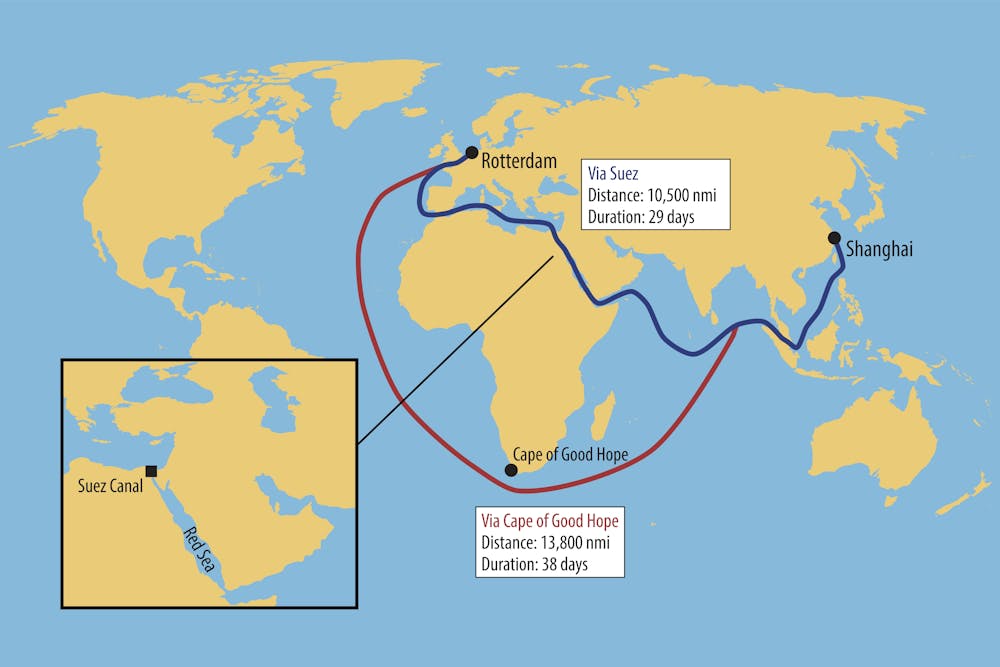
    These attacks have prompted many shipping companies to stop using the Red Sea – a route that around 12% of global trade usually passes through – and divert around the southern tip of Africa. This route adds more than 7,000 nautical miles on to a typical round-trip voyage. The number of commercial ships using the Suez Canal to pass between the Mediterranean and the Red Sea plummeted from over 26,000 in 2023 to 13,200 in 2024.

    Supply chains have had to deal with higher shipping costs, product delivery delays, and increased carbon emissions as a result of this diversion. The Gaza ceasefire gave some hope that the disruption would finally end. But shipping lines will not hurry back to the region until long-term security is guaranteed.

    Since November 2023, shipping companies have been diverting their vessels around the southern tip of Africa to avoid the Red Sea.
    Dimitrios Karamitros / Shutterstock

    During the early stages of the crisis, moving a container from Shanghai in China to Europe cost approximately 250% more than before the war in Gaza began. This was largely due to increased fuel costs and higher insurance premiums. Freight rates (the price companies pay to transport goods) remained high throughout 2024, despite some fluctuations.

    The cost of moving a 40-foot container from Shanghai to Rotterdam in the Netherlands, for example, surged from around US$4,400 on average in January to above US$8,000 by August. This had dropped to US$4,900 at the end of the year.

    It is too early to say whether these costs will be passed on to consumers in the form of higher prices – full transmission through the supply chain to consumer prices can take upwards of 12 months. But some estimates suggest global consumer prices could rise by 0.6% on average in 2025 as these increased shipping costs filter through the supply chain.

    Diverting around southern Africa also resulted in delays in the delivery of many goods and components. The proportion of container ships that arrived on schedule dropped from 60% on average worldwide in 2023 to about 50% throughout 2024. This created congestion at ports because ships often arrived at their destination later than planned, resulting in further delivery delays.

    Unreliable transit times are a significant issue for supply chains because they make it difficult for businesses to plan inventory and coordinate production schedules. Indeed, several vehicle manufacturers, including Tesla and Volvo, temporarily suspended manufacturing in early 2024 due to a lack of components. And food supply chains, including those for avocados, tea and coffee, were also affected by delays.

    Since then, many companies have adapted by increasing their safety stock levels and transporting cargo using alternative modes of transport like air and rail. Some European firms have also adopted a strategy called “nearshoring”, where they source products from regions closer to home such as Turkey and Morocco instead of relying on suppliers in Asia.

    Increased emissions

    The longer route around southern Africa requires that ships travelling between Europe and Asia use around 33% more fuel on average than they would use by travelling through the Red Sea at the same speed.

    Over the past decade, most shipping companies have employed a “slow steaming” policy to economise on fuel use and minimise their carbon emissions. But diverted ships have been travelling around 5% faster than usual in an attempt to minimise delays. The increased vessel speeds will have caused the associated emissions toll to rise – large container vessels require 2.2% more fuel for every 1% increase in speed.

    More data is required to determine the precise amount of additional emissions caused by diverting shipping away from the Red Sea. But estimates suggest that approximately 13.6 million tonnes of CO₂ were emitted by ships rerouted from the Red Sea between December 2023 and April 2024 – equivalent to the carbon emissions of nine million cars over the same period. If ships continue to avoid the region, the increased emissions could amount to 41 million extra tonnes of CO₂ per year.

    Some cargo has also shifted from sea transport to air freight, which has a far greater environmental footprint. Shipping a kilogram of product by long-haul air freight generates at least 50 times more CO₂ emissions on average than container shipping.

    Carbon emissions have increased due to the diversion of vessels around southern Africa.
    David G40 / Shutterstock

    Before returning to the Suez Canal, container lines will want to see a prolonged period of stability around the Red Sea. This is due, in part, to safety and security concerns related to the crew, cargo and the ship.

    But shipping companies also have operational challenges to keep in mind associated with the scheduling of port calls and voyages. Shipping lines will find it difficult to switch back to the longer route around Africa immediately if attacks in the Red Sea resume.

    And, at least for now, the situation in the Bab al-Mandab Strait remains unpredictable. In a televised speech on January 20, Houthi leader Abdul-Malik al-Houthi warned: “We have our finger on the trigger.”

    With other disruptions continuing to affect global shipping, such as port strikes, low water levels in the Panama Canal and extreme weather events, supply chain issues are likely to continue throughout 2025.

    Gokcay Balci does not work for, consult, own shares in or receive funding from any company or organisation that would benefit from this article, and has disclosed no relevant affiliations beyond their academic appointment.

    ref. Red Sea crisis: supply chain issues set to continue despite Gaza ceasefire – https://theconversation.com/red-sea-crisis-supply-chain-issues-set-to-continue-despite-gaza-ceasefire-248469

    MIL OSI – Global Reports

  • MIL-OSI Global: If we listen to how Gen Z really feel about democracy they might stop telling us they prefer authoritarianism

    Source: The Conversation – UK – By Melissa Butcher, Professor Emeritus, Social and Cultural Geography, Royal Holloway University of London

    New research from broadcaster Channel 4 reveals a troubling trend towards support for authoritarianism among young people in the UK. The report “Gen Z: Trends, Truth and Trust” found that 52% of the 2,000 13-27 year olds surveyed would agree that “the UK would be better with a strong leader in charge who does not have to bother with Parliament and elections”.

    This correlates with a 2023 study from pro-democracy organisation Open Society Foundations, which found 42% of young people in its global sample felt military rule was a good way of running a country. Other research has found a disillusionment with democracy among young people.

    These are trends to be worried about. But Gen Z are not somehow inherently anti-democratic. Understanding why these trends are happening is vital if young people are to participate in democracy.

    At Cumberland Lodge, an education charity that uses dialogue to address social division and conflict, I’m working with colleagues and young people on a nationwide youth and democracy network to re-think what politics in the UK could look like.

    Hearing Gen Z

    Our team has conducted 12 discussion groups with 101 young people around the country, looking at what stops them getting involved with democratic practices and institutions. Using this research as a starting point, we are now working with a core group of young people to develop their capacities to engage with, and re-imagine democracy.

    What we are learning is that young people’s disengagement is not necessarily a sign of apathy or anti-democratic tendencies. The young people we are working with want to engage with politics, but they feel a vast sense of distrust. They see politicians as prioritising their own and corporate interests over public good, and willing to break promises on issues that affect young people’s lives.

    Feeling unsupported by their political system makes young people feel vulnerable – especially in the face of a multitude of global crises. In their lifetime, the world has lurched from a global financial crisis to a worldwide pandemic and to war in Europe. They have to navigate housing shortages, a lack of mental health support, the climate emergency, artificial intelligence and changing identity and social roles.

    A perception of an “elite” system that is supposed to work for everyone, but excludes or even actively works against the sectors of society most affected by these crises, harms young people’s trust in democracy.

    Gen Z deal with an onslaught of information about a rapidly changing world.
    DimaBerlin/Shutterstock

    But a shift towards support for authoritarianism is by no means inevitable. The Open Society Foundations study found that 86% of young people surveyed still wanted to live in a democracy.

    In Channel 4’s research, too, 73% of Gen Z think democracy is a “very” or “fairly good” way of governing the UK. And young people want to learn about democracy and the democratic process.

    Our youth and democracy network shows young people are not apathetic. Many want to get involved. They want a better, fairer world. They see the shortcomings of the current system and imagine something better.

    Getting young people involved

    To enable this to happen, political and media literacy is crucial for providing young people with necessary knowledge and confidence. Investment in education on democracy is necessary, as many young people in our network wanted to engage but felt overwhelmed and uncertain about where to start. Liam in Sunderland said:

    Most people our age aren’t educated on [democracy and politics]. It’s restricted knowledge. We’re given the impression that we can’t do anything about it anyway, so just don’t worry.

    Young people want representatives who understand and engage with the day-to-day realities of their lives, rather than seeing Gen Z as a photo opportunity, as Chloe from Liverpool argued.

    They’ll come here and they’ll speak to us, but they’re not coming there to listen; they’re coming here so they can go back to wherever they came from and be like ‘oh I spoke to a young person’.

    Many of the young people in our youth network are calling for reform of the political system in order to facilitate these changes: a new voting system, or an exploration of forms of direct democracy.

    But importantly, what we have seen in this research over the last year, is that young people can shift how they view power. We think of democracy as more than just systems of governance, but it’s also how we organize, how we communicate with each other, how we mobilise around social issues, and how we build consensus.

    In this sense democracy is not solely something external and out of reach but something that can emerge when young people come together.

    By working to improve democratic education and to put a system in place that listens to and engages with young people, politicians can help Gen Z re-imagine a democracy that gives them a future. At that point, they might stop telling researchers that they prefer authoritarianism.

    Melissa Butcher is a member of the Green Party.

    ref. If we listen to how Gen Z really feel about democracy they might stop telling us they prefer authoritarianism – https://theconversation.com/if-we-listen-to-how-gen-z-really-feel-about-democracy-they-might-stop-telling-us-they-prefer-authoritarianism-248628

    MIL OSI – Global Reports

  • MIL-OSI Global: Most of Britain’s peat bogs could stop forming new peat as the climate changes – new study

    Source: The Conversation – UK – By Jonathan Ritson, Research Fellow, Geography, University of Manchester

    Joe Dunckley / shutterstock

    By the 2080s, climate change will mean most of Britain’s peatlands could be too dry to form new peat. That’s the stark warning from a new academic study my colleagues and I just published in the Journal of Applied Ecology.

    Peat bogs are found in areas where there is lots of rain but poor drainage. These vital ecosystems are relied upon to deliver drinking water, host rare plant and bird life and to mitigate the risk of floods by slowing rainwater as it heads downstream.

    Perhaps most importantly, peatlands also sequester huge amounts of carbon. That’s because peat is made of the remnants of plants accumulated over hundreds or thousands of years. Waterlogged conditions mean the plants don’t fully decompose, so the carbon they’re made of is kept in the ground and isn’t released into the atmosphere. Peat can be several metres deep so all that plant matter adds up – per square metre, a typical British peat bog stores far more carbon than a tropical rainforest.

    As peat needs very wet conditions to form, our study first mapped out the temperature and rainfall conditions under which this has occurred in the UK in the past. We then took the Met Office’s UK climate projections and looked at where these conditions would continue to occur by the 2080s. The results were, quite frankly, shocking.

    Although small pockets of favourable conditions may still be present in Wales, and larger ones in Scotland, the outlook for England is dismal, with barely any areas continuing to be suitable for peat formation due to increasing temperatures and lower summer rainfall.

    UK peatlands. The large red patch at the top of mainland Scotland is the Flow Country.
    James Hutton Institute / Biogeochemistry

    In the “Flow Country” of northern Scotland, a bog so big it has been designated a Unesco world heritage site, the area in which we might expect peatlands to thrive is likely to be reduced by at least 50% even in the best-case climate scenario. This scenario of mild warming is, unfortunately, unlikely to happen. More extreme scenarios of peatland degradation are increasingly realistic.

    We still don’t know exactly what this will mean for the peatlands in places like Exmoor or Dartmoor in southern England, however we do know that life will become more and more challenging for these precious ecosystems. Not experiencing the temperature and rainfall that caused peat formation in the first place could mean they start to emit the carbon currently stored, as this is reliant on them staying wet and boggy.

    Peatlands are naturally resilient and aren’t going to disappear overnight (the Peak District in northern England was heavily degraded for over a century, yet still hosts many metres of peat soils). But conservation and restoration work is going to be ever more necessary if we are to preserve these landscapes as carbon sinks rather than sources.

    More money for conservation

    One ray of light in all this is that the challenging conditions in England could actually unlock more money for conservation efforts. The UK Peatland Code is a climate finance initiative that allows landowners to generate income from peatland restoration by selling carbon credits. The number of credits they can claim is based on the difference in avoided emissions from a “do nothing” scenario in which they do no restoration.

    Our new results show that doing nothing could be even worse than previously thought, meaning more carbon finance may be unlocked. Perversely, bad news for England’s peatlands could bring about the money needed to save them.

    Thankfully, through measures such as the government’s Nature for Climate scheme and ongoing investment in fundamental peatland science, the UK has something of a head start in peatland restoration. Techniques that were once trialled in small areas are now being rolled out across whole landscapes.

    Gully blocking to raise peatland water tables and limit carbon loss, as part of the GGR-Peat project at the National Trust High Peak Estate.
    Jonathan Ritson

    The Great North Bog initiative, as one example, has linked together restoration organisations, researchers and landowners to deliver restoration across four national parks and three national landscapes. This is truly the scale that is needed if the UK is serious about meeting its climate targets.

    More will be required, however, as huge swathes of peatland remain in a degraded state. While bleak messages like those in our new study could lead to resignation about the effects of climate change, there is an alternative way of looking at it: we must show how bad things could get if we don’t do anything, and then see this as a call to action.

    Jonathan Ritson has received funding from charities delivering peatland restoration.

    ref. Most of Britain’s peat bogs could stop forming new peat as the climate changes – new study – https://theconversation.com/most-of-britains-peat-bogs-could-stop-forming-new-peat-as-the-climate-changes-new-study-248515

    MIL OSI – Global Reports

  • MIL-OSI Global: Canada’s electric vehicle industry is facing existential threats — here’s how it can still flourish

    Source: The Conversation – Canada – By Charles Conteh, Professor of Public Policy and Administration, Department of Political Science, Brock University

    The electric vehicle (EV) industry has been one of the most defining technological trends of the past decade, transforming the automotive sector while fuelling advancements in manufacturing.

    Yet after billions of taxpayer dollars have been invested, the EV industry in Canada is facing headwinds. Chief among these are the trade tariff threats from U.S. President Donald Trump.

    For a country with an automotive sector that exports 91 per cent of its parts to the U.S., the threats feel existential. They may also be seen as a betrayal of the centuries-long economic and cultural partnership between two neighbours sharing one of the world’s longest and most porous borders.

    Adding to these international headwinds are three other obstacles within the EV industry: high costs, limited battery range and sparse battery charging infrastructure. These concerns continue to affect firms here in Canada, with the likes of Stellantis juggling high inventory, slow sales and falling revenue.

    These challenges have sparked skepticism about the future of EVs in Canada and whether the federal and provincial governments’ multi-billion-dollar investments in the industry are wise.

    As researchers who study Canada and other countries’ innovation policy initiatives amid breakneck changes in technologies and markets, we argue that Canada has every reason to ratchet up its commitments in the months and years ahead.

    Along with artificial intelligence, EV represents the emergent frontier of advanced manufacturing in the digital age. Winners of this innovation race will stand to dominate the global market for the foreseeable future.

    The case for staying the course

    Despite current challenges, EVs remain the future of the automotive sector. Even conservative estimates suggest that by 2040, around three-quarters of new car sales will be fully electric globally.

    Canada’s position in the EV industry is stronger than recent news coverage indicates. The country ranked first among 30 countries in a 2024 EV battery supply chain report, outperforming even China.

    This ranking reflects Canada’s vast reserves of critical minerals essential for EV battery production and its burgeoning battery manufacturing sector.

    Over the past few years, Canada has attracted significant investments from manufacturers like Umicore, Northvolt and Volkswagen-owned PowerCo.

    Canada has reasons to be optimistic about EV and energy storage demand. While concerns about U.S. protectionism loom, Canada’s commitment to zero-emission vehicles ensures fiscal incentives and policies that will likely boost short-term demand.

    On the environmental, social and governance front, Canada outperforms many of its global competitors in battery manufacturing. Though by no means perfect, the country’s climate change policy ambitions, clean electricity grid and commitment to sustainable mining position it as a global leader in the EV space.

    Advanced manufacturing

    Canada’s robust innovation ecosystem for advanced manufacturing is another key strength. A prime example is the Ontario Vehicle Innovation Network (OVIN).

    OVIN commercializes advanced automotive technologies and manages the development, testing, piloting and uptake of transportation and infrastructure technologies. It operates seven regional technology development sites across Ontario, including in Waterloo, Hamilton, Windsor-Essex, Durham and Toronto.

    By serving as a bridge between government, industry and researchers, OVIN has become a model for multi-level governance, with projects jointly funded by the federal and provincial governments and close working relationships with municipalities.

    As the EV industry navigates economic and policy challenges, initiatives like OVIN are crucial for driving long-term growth and competitiveness.

    The road ahead

    While Canada’s automotive innovation ecosystem is generally robust, it requires some calibration to overcome current challenges and claim the next frontier of the global EV race.

    In particular, Canada needs to consolidate its EV innovation ecosystem by integrating the upstream of its domestic supply chain assets with the downstream of its technology commercialization and adoption.

    In other words, this means getting more critical minerals to market and making sure a substantial portion of the materials mined in Canada are processed and used domestically to build batteries and vehicles, so the entire EV production cycle benefits Canada’s economy.

    Such an endeavour will require Canada to establish the right policies, regulations and financial support to tap into its vast reserves of critical minerals to supply the country’s battery plants.

    It is the presence of these reserves that made Canada attractive to the automakers in the first place. Leveraging them wisely will be critical for the country’s long-term success in the EV industry.

    Charles Conteh receives funding from the Social Sciences and Humanities Research Council of Canada.

    Tia Henstra does not work for, consult, own shares in or receive funding from any company or organisation that would benefit from this article, and has disclosed no relevant affiliations beyond their academic appointment.

    ref. Canada’s electric vehicle industry is facing existential threats — here’s how it can still flourish – https://theconversation.com/canadas-electric-vehicle-industry-is-facing-existential-threats-heres-how-it-can-still-flourish-248103

    MIL OSI – Global Reports

  • MIL-OSI: ASUS Announces the Ultra-Light Zenbook A14, Now Available for Pre-Order in Canada

    Source: GlobeNewswire (MIL-OSI)

    KEY POINTS

    • Unload: Sub-1kg minimalist tone-on-tone all-Ceraluminum™ chassis for the ultimate on-the-go experience
    • Unplugged: Energy-efficient Snapdragon® X AI-enabled processor can deliver multi-working-day battery life
    • Unlimited: Optimum Copilot+ performance, user-centric design and seamless cross-device experiences

    TORONTO, Jan. 30, 2025 (GLOBE NEWSWIRE) — ASUS today announced that the Zenbook A14 (UX3407QA-DS52-CA) — the lightest 14-inch Copilot+ PC on the market1, and also the first all-Ceraluminum™ ASUS laptop, is now available for pre-order online on the ASUS Store, with shipments beginning on February 14th. It will also be available at select retailers starting February 14th, with additional configurations available later in the year. In addition to being the lightest 14-inch Copilot+ PC on the market2, the Zenbook A14 is also the first ASUS laptop boasting the new Qualcomm Snapdragon X® AI-enabled processor, offering extreme efficiency and up to 32 hours of battery life3.

    Unload: Redefining thin and light

    Weighing in at 990g (2.18lbs) – which is around 450g (1lb) less than most thin and light laptops4Zenbook A14 sets the new benchmark for ultraportable Copilot+ PCs. Its elegant, lightweight design is ideal for frequent travelers, allowing them to move effortlessly without being weighed down by their tech.

    The chassis is crafted entirely from our innovative Ceraluminum™, a sumptuously tactile material that’s 30% lighter and three times stronger than anodized aluminum. This advanced material ensures durability and portability, making it ideal for everyday use. The nature-inspired Iceland Gray colorway adds a sophisticated touch to the minimalist look, aligning with the Zenbook tradition of timeless design.

    Unplugged: Multi-day battery life

    Zenbook A14 delivers outstanding multi-day battery life, enabled by the power-efficient Qualcomm® Snapdragon™ X Series processor and a high-capacity 70Wh battery. It can provide up to 32 hours of continuous video playback on a single charge, ensuring no interruption over the course of multiple working days.

    The innovative thermal solution, featuring dual lightweight fans and a heat pipe, optimizes key component placement for quiet, effective cooling. With performance reaching up to 45W chipset power and a 0dB Whisper Mode for silent operation, the laptop offers exceptional power efficiency. Even when unplugged, Zenbook A14 delivers consistent performance with no drop in capabilities, making it the perfect travel companion for long flights, road trips, or meeting-packed days.

    Unlimited: A Copilot+ PC driven by the Qualcomm®Snapdragon X Series

    With a Qualcomm® Hexagon NPU (up to 45 TOPS) for AI tasks, Zenbook A14 offers advanced Copilot+ PC experiences, offering real-time insights, performance optimization, and enhanced responsiveness for multi-tasking and productivity. Users can expect seamless video playback, efficient app loading, and rapid task switching.

    Zenbook A14 comes with Microsoft Phone Link to allow users to connect their Android or iOS mobile phone to Windows. Additionally, it also comes with Qualcomm Snapdragon™ Seamless™ integration, which creates a cross-device ecosystem that allows users to switch between compatible Qualcomm® Snapdragon™-powered devices without interruption. It enhances productivity by enabling easy file sharing, screen mirroring, and synchronization between mobile devices and the laptop.

    Security is a top priority with smart privacy features, including Adaptive Lock and Adaptive Dimming to secure sensitive information when users step away from the laptop, and a Microsoft Pluton security chip for an additional layer of hardware protection. The Windows passkey feature offers an added layer of login security.

    Zenbook A14 also offers a refined user experience with an enlarged touchpad featuring Smart Gesture support for comfortable navigation, smudge-free keycaps on the well-spaced keys that have a comfortable 1.3mm travel, and a full suite of I/O ports that allows users to connect devices and peripherals without the need for adapters or dongles. The user-centric design also includes a precision-designed ASUS EasyLift™ hinge for stable, wobble-free screen opening and balanced weight distribution.

    For an immersive multimedia experience, the Zenbook A14 boasts a 14-inch WUXGA Lumina OLED NanoEdge display that delivers vibrant colors and deep contrasts, supported by two powerful speakers for rich audio output. Snapdragon Sound™ features High-Resolution Audio for rich, detailed 24-bit / 192kHz sound, ultra-low latency to ensure audio syncs seamlessly with visuals, and advanced noise cancelation to reduce background noise for clear voice calls and immersive audio.

    AVAILABILITY & PRICING

    The Zenbook A14 (UX3407QA-DS52-CA) powered by the Snapdragon™ X processor is available for pre-order now on the ASUS Store, with deliveries starting from February 14, 2025. More configurations will be available later in Q1.

    • Zenbook A14 (UX3407QA-DS52-CA), (beige) with 16GB of RAM and 512GB of storage for CA$1,299 at selected retailers and the ASUS Store, available for pre-order starting from today.
    • Zenbook A14 (UX3407QA-BS51-CB), grey version with 16GB of RAM and 1TB of storage for CA$1,449 in exclusivity on Best Buy and the ASUS Store, available starting from end of February 2025.
    • Zenbook A14 (UX3407QA-DS51-CA), grey version with 32GB of RAM and 1TB of storage for CA$1,649 at selected retailers and the ASUS Store, available later in Q1 2025.

    Please contact your local ASUS representative for further information.

    SPECIFICATIONS

    ASUS Zenbook A14 (UX3407) 

    Model UX3407QA-DS52-CA UX3407QA-BS51-CB UX3407QA-DS51-CA
    Marketing Name Zenbook A14
    Operating System Windows 11 Home
    Color Zabriskie Beige Iceland Gray Iceland Gray
    Material Magnesium Aluminum
    Weight 990g (2.18lbs)
    Dimensions 31.07 x 21.39 x 1.34 ~ 1.59 cm (12.23″ x 8.42″ x 0.53″ ~ 0.63″)
    Display OLED, 14″, 60Hz, 1920×1200, 100% DCI-P3
    Processor Qualcomm® Snapdragon™ X
    Graphics Qualcomm® Adreno™ GPU
    Memory 16GB LPDDR5X (on board) 16GB LPDDR5X (on board) 32GB LPDDR5X (on board)
    Storage 512 Gb PCIe 4.0 SSD (1 x M.2 2280 slot) 1 TB PCIe 4.0 SSD (1 x M.2 2280 slot) 1 TB PCIe 4.0 SSD (1 x M.2 2280 slot)
    Keyboard English Bilingual French English
    Webcam 1080 FHD IR Camera
    Wi-Fi Wi-Fi 6E + Bluetooth 5.3
    IO Ports 1 x USB 3.2 Gen 2 Type-A
    2 x USB 4.0 Gen 3 Type-C (DP, PD support) 
    1 x HDMI 2.1 (TMDS) 
    1 x 3.5 Audio Combo Jack
    Battery 70Whr
    AC Adapter Type-C, 65W AC Adapter, Output: 20V DC, 3.25A, 65W, Input: 100-240V AC 50/60GHz universal
    Availability ASUS Store and selected retailers, pre-order now ASUS Store and Best Buy, late February ASUS Store and selected retailers later in Q1
    MSRP C$1,299 C$1,449 C$1,649


    NOTES TO EDITORS

    ASUS Zenbook A14 (UX3407) Product Page: https://asus.com/ca-en/laptops/for-home/zenbook/asus-zenbook-a14-ux3407/

    ASUS Zenbook A14 ASUS Store Where to Buy Link: https://shop.asus.com/ca-en/zenbook-a14-ux3407-copilot-pc.html

    ASUS Zenbook Page: https://www.asus.com/ca-en/site/zenbook/

    ASUS LinkedIn: https://www.linkedin.com/company/asus/posts/

    ASUS Pressroom: http://press.asus.com

    ASUS Canada Facebook: https://www.facebook.com/asuscanada/

    ASUS Canada Instagram: https://www.instagram.com/asus_ca

    ASUS Canada YouTube: https://ca.asus.click/youtube

    ASUS Global X (Twitter): https://www.x.com/asus

    About ASUS

    ASUS is a global technology leader that provides the world’s most innovative and intuitive devices, components, and solutions to deliver incredible experiences that enhance the lives of people everywhere. With its team of 5,000 in-house R&D experts, the company is world-renowned for continuously reimagining today’s technologies. Consistently ranked as one of Fortune’s World’s Most Admired Companies, ASUS is also committed to sustaining an incredible future. The goal is to create a net zero enterprise that helps drive the shift towards a circular economy, with a responsible supply chain creating shared value for every one of us.

    _____________________________________
    ¹ According to overall laptop weight, as of December 31, 2024 based on internal ASUS market analysis comparing Zenbook A14 (UX3407) with competing products in its class (laptops certified by Microsoft as Copilot+ PCs) from multiple vendors.
    ² According to overall laptop weight, as of December 31, 2024, based on internal ASUS market analysis comparing Zenbook A14 (UX3407) with competing products in its class (laptops certified by Microsoft as Copilot+ PCs) from vendors including Acer, Apple, HP, Huawei, Lenovo, Microsoft and Samsung.
    ³ Battery tests conducted by ASUS on August 7, 2024, using the 1080p Video Playback scenario. Test configuration: Zenbook A14 (UX3407), FHD OLED panel, Qualcomm Snapdragon X CPU, 1TB SSD, 32GB RAM. Test settings: WiFi enabled but disconnected (not connected to any access point), Windows Power Plan set to Balanced, display brightness set to 150cd/m2. Actual battery life may vary depending on product configuration, usage, operational conditions and power management settings. Battery life will decrease over the lifetime of the battery.
    ⁴ The 15-inch Apple Macbook Air (M3 chip) is 3.3 lbs. The 14-inch Lenovo Slim 7i Aura Edition is 2.84 lbs. The 13.8-inch Microsoft Surface 7th Edition is 2.96 lbs.

    A photo accompanying this announcement is available at: https://www.globenewswire.com/NewsRoom/AttachmentNg/93149c0f-c652-42c7-a4ac-03d1b2c752fe

    The MIL Network

  • MIL-OSI Security: Federal Courts Authorize IRS “John Doe” Summonses to Trident Trust Entities

    Source: United States Attorneys General 2

    Summonses Are for Records Relating to U.S. Taxpayers Who May Have Used Network of Offshore Service Providers to Hide Assets and Evade Taxes

    The U.S. District Court for the Northern District of Georgia entered an order earlier this week authorizing the IRS to serve John Doe summonses on TT (USA) Holdings Inc.; Trident Corporate Services Inc. and Trident Fund Services Inc., entities that are members of a multinational group of affiliated companies generally operating under the trade name “Trident Trust” and collectively referred to as the “Trident Trust Group.”

    Separately, on Dec. 18, 2024, the U.S. District Court for the District of South Dakota entered an order, unsealed on Jan. 21, authorizing service of a similar John Doe summons on Trident Trust Company (South Dakota) Inc. The United States also previously obtained approval in the U.S. District Court for the Southern District of New York for the IRS to serve John Doe summonses on a different affiliate entity of the Trident Trust Group, as well as to third party financial service companies, banks and courier services that may have information about Trident Trust Group’s U.S. taxpayer clients.

    The United States is not alleging that any of the entities engaged in wrongdoing. Rather, the IRS uses John Doe summonses to obtain information about possible violations of internal revenue laws by individuals whose identities are unknown. These summonses seek information about U.S. individuals who may have used the Trident Trust Group’s services to underreport their worldwide income and conceal their ownership of certain foreign assets that U.S. individuals are required to report to the U.S. government.

    “The Justice Department and the IRS are dedicated to unearthing tax evasion that uses foreign bank accounts and offshore shell corporations,” said Deputy Assistant Attorney General David A. Hubbert of the Justice Department’s Tax Division. “We will use the many tools available to us, including John Doe summonses like the ones authorized by the courts here, to ensure that taxpayers are fully meeting their responsibilities.”

    Federal law requires certain individual taxpayers, including all U.S. citizens and residents with gross annual income above the reporting threshold, to pay taxes on all income earned worldwide. They must also disclose certain foreign financial accounts, assets and controlled foreign corporations. Failure to report these offshore arrangements can result in serious civil and criminal consequences.

    The government’s petitions allege that Trident Trust Group is an offshore service provider operating in nearly 30 countries worldwide, and it has provided corporate, trust and fund administration services for over 40 years. The petitions further allege that Trident Trust Group offers services that enable offshore account and entity concealment, like mail forwarding and retention, and ready-to-use “shelf” companies. For example, the petitions allege that Trident Trust Group personnel have listed themselves as the founders, directors and officers of thousands of Panamanian companies to help their U.S. clients potentially conceal their interests in and income from those foreign entities.

    A declaration from an IRS revenue agent that accompanied the petitions alleges that at least nine U.S. taxpayers used Trident Trust Group’s services to avoid compliance with U.S. tax laws. The declaration further alleges that the IRS learned of this noncompliance through the Offshore Voluntary Disclosure Program, a program that allowed U.S. taxpayers to voluntarily disclose foreign accounts or entities used to evade tax in exchange for settling their civil liabilities on fixed terms.

    These orders authorize the IRS to issue summonses to TT (USA) Holdings Inc.; Trident Corporate Services Inc.; Trident Fund Services Inc. and Trident Trust Company (South Dakota) Inc seeking information about U.S. taxpayer clients who may have used the services of the entities and the broader Trident Trust Group to establish, maintain, operate or control any foreign financial account or other foreign asset; any foreign corporation, company, trust, foundation or other legal entity or any foreign or domestic financial account or other asset in the name of such foreign entity from 2014 through 2023. By obtaining these records, the IRS expects to be able to identify clients of the Trident Trust Group to investigate whether they potentially used the group’s services to avoid or evade federal taxes.

    Additional information about the Tax Division and its enforcement efforts may be found on the division’s website.

    Tax Division Attorneys Christina T. Lanier and Brij B. Patnaik are handling the case in the U.S. District Court for the District of South Dakota; and they, along with Elisabeth K. Kryska of the Tax Division, are handling the case in the Northern District of Georgia. Assistant U.S. Attorney Anthony J. Sun for the Southern District of New York is handling the case in the U.S. District Court for the Southern District of New York.

    MIL Security OSI

  • MIL-OSI NGOs: Joint Statement by humanitarian, development and human rights organisations in Lebanon: We need a Permanent Ceasefire and a Just Recovery

    Source: Oxfam –

    We, the undersigned organisations operating in Lebanon, urgently call on parties to abide by their commitments towards a permanent ceasefire in Lebanon and appeal to the international community to ensure the respect and full implementation of the temporary ceasefire agreement, now being extended until February 18th 2025.

    While the temporary ceasefire remains in effect and has been extended, we express deep concern about the numerous reported violations that continue to weaken the agreement.. Over 800 violations by Israeli forces[1] and at least one violation by Hezbollah[2] have been reported. As of January 23, 2025 violations by Israeli forces have included indiscriminate ground and air attacks, killing at least 30 people, since November 27, 2024, bringing the total number of people killed by Israeli forces since October 8, 2023 to 4,285, including 241 health care workers, and 17,200 wounded[3]. On Sunday January 26, 2025, alone, Israeli military forces killed 24 individuals, including six women and a Lebanese soldier, and injured 134 including 12 children in the South of Lebanon[4]. Thousands of people, including women and children, older people and people with disabilities have been uprooted from their homes, cut off from food, healthcare and education and exposed to hugely traumatic events – with, so far, no accountability for the destruction or indiscriminate killing.

    This agreement represents a step towards implementing UN Security Resolution 1701 and included a “phased withdrawal of the Israeli Defense Forces south of the Blue Line and the parallel deployment of the Lebanese Armed Forces (LAF) south of the Litani river” that “should not exceed 60 days”.[5] There is still an opportunity to transform temporary undertakings into longer term commitments.

    While many are attempting to return to their homes, hundreds of thousands of people still face the grim reality of either not being able to return because of ongoing Israeli forces’ ground occupation or because of the scale of destruction. Israeli forces have razed entire villages and destroyed agricultural lands and vital infrastructure, including hospitals and schools. Lands are contaminated by unexploded ordnance posing threats to life and risks for the reconstruction efforts.

    As human rights and humanitarian organisations, we will continue supporting all affected people with emergency assistance, recovery and reconstruction[6], but the humanitarian crisis remains severe. Plans for recovery and reconstruction have begun amidst a lingering socio-economic crisis and skyrocketing poverty rates, with nearly one Third of children in Lebanon facing crisis levels of hunger[7]. The economic losses due to the conflict are estimated at 8.5 billion USD[8], and Lebanon desperately needs support for its recovery. The consequences of this destruction will be felt in Lebanon for years to come, and yet again, with no accountability.

    As humanitarian and human rights organisations involved in the immediate relief, early recovery and reconstruction efforts in Lebanon, we urgently call for:

    1. Immediate, Unconditional and Definitive Ceasefire in Lebanon and the Region:
    • The international community to take every step possible, including through diplomatic and political leverage, to ensure an immediate and definitive ceasefire in Lebanon. The temporary and conditional agreement must allow for a transition to a permanent ceasefire.
    • The international community must also ensure the respect and implementation  of the pause in hostilities in Gaza and an end to excessive use of force in the West Bank, acknowledging that this is essential to protect civilians and prevent further escalation and regional spillover.

    1. Unconditional Humanitarian Access and Scaling Up Assistance:
    • Ensure rapid, unhindered access to conflict-affected areas and safeguard humanitarian facilities and personnel across the country.
    • Fully fund the humanitarian flash appeal to address the acute needs across Lebanon to enable the provision of immediate, flexible funding for gender, age and disability responsive humanitarian responses, including cash assistance, safe shelter, and healthcare.
    • Support reconstruction efforts through grants, not loans, and fund early warning and early action and anticipatory action to mitigate further shocks.

    1. Inclusive Recovery Focusing on Social Cohesion:
    1. Supporting Local and National NGOs in Response Planning and Implementation:
    • Increase financial and logistical support to local and national NGOs[9], including women’s rights and women-led organizations, and ensure these are at the forefront of responding to the crisis and receive direct, timely and flexible funding to meet growing needs.

    1. Halt the Transfer of Arms to Conflict Parties:
    • Suspend immediately the transfer of all weapons, parts, munitions, and ammunition to parties to the armed conflict when there is a risk they might be used to commit or facilitate violations of IHL and IHRL and other further grave violations in Lebanon and the region.

    1. Accountability and Respect for International Law:

    There is cautious optimism following recent political developments, including the appointments of both President and Prime Minister. However, meaningful international support is critical to fulfill the aspirations of the people in Lebanon for sustainable peace and justice. It is the persistent failure to seek accountability for violations that has fuelled cycles of violence now affecting the entire region. The time for action is now to ensure a just recovery and lasting peace in Lebanon and the region.

    MIL OSI NGO

  • MIL-OSI United Kingdom: Employment prospects for neurodiverse people set to be boosted with launch of new expert panel

    Source: United Kingdom – Executive Government & Departments

    People who are neurodiverse will benefit from better employment prospects and more inclusive workplaces thanks to the work and advice of a new expert panel launched today [Wednesday 29 January].

    • An independent panel of academics with expertise and experiences of neurodiversity will advise government on improving job chances for neurodiverse people
    • Just 31% of people with a neurodiversity condition in employment compared to 54.7% of disabled people overall  
    • Panel launch is part of the government’s Plan for Change to support more people into work, boost living standards and grow the economy  

    The panel – headed up by Professor Amanda Kirby and comprising of leading academics in the neurodiversity field – will develop recommendations for ministers this summer, as part of the government’s Plan for Change, which will put money back into people’s pockets, boost living standards, and drive economic growth.  

    The latest employment figures demonstrate the stark reality for many, with the employment rate for disabled people with autism at 31% compared to 54.7% for all disabled people – highlighting a significant gap for some neurodiverse people.  

    The work of the panel will focus on what actions employers can take to foster a more inclusive workplace but also what actions the government can introduce to break down barriers to opportunity for people with a neurodiverse condition, such as autism. 

    Minister for Social Security and Disability, Sir Stephen Timms, said:  

    For too long disabled people and those with a neurodiversity condition have been left behind, ignored, and not given the support they need to get into work.  

    As part of our Plan for Change, we will turn this around, and with the expertise of these leading academics we will achieve our mission of supporting neurodivergent people into the workplace and reaching our 80% employment rate ambition.

    Building on and broadening previous neurodiversity work, the panel met for the first time to begin work on supporting the Government’s drive to improve the employment experiences of neurodivergent people.  

    Chair of the Academic Panel, Professor Amanda Kirby, said:

    I am delighted to chair this panel in what I see is an important and essential piece of work considering how we can drive forward neuroinclusive practices in workplaces to maximise the potential of all and make this become ‘business as usual’

    This panel follows the launch of the Keep Britain Working review, led by Sir Charlie Mayfield, to explore how businesses and government can collaborate to unlock disabled talent.  

    The latest figures show the disability inactivity rate was 41.7% in Q3 2024, compared to 14.7% for non-disabled people. Improving the employment prospect of disabled people and helping them achieve independence is at the heart of the government’s health and disability reforms.   

    Building on our Get Britain Working White Paper, the government will bring forward proposals in the spring to reform the welfare system to help people who can work secure employment.  

    The government will work closely with charities, disabled people and people with health conditions to ensure their voices are at the centre of any policy changes which affect them and to move beyond a binary system of fit or not fit to work.  

    Updates to this page

    Published 30 January 2025

    MIL OSI United Kingdom

  • MIL-OSI United Kingdom: The role of AI in the future of women’s health

    Source: United Kingdom – Executive Government & Departments

    Minister of State for Women’s Health, Baroness Merron, spoke at the Responsible AI: Women and Healthcare Conference 2025, in London.

    I am absolutely delighted to be able to join you today, and I know I am amongst a very wide range of diverse voices and contributors here.

    I want to say thank you for making the time to be here today and to take part, and for sharing your insight on an issue which has the potential to hugely impact for good. I might add, hugely impact our health system for many decades to come. Let me tell you, I’ve just come from speaking in the Chamber about osteoporosis, and I was asked a question by a Peer about the role of AI so I was very glad to be able to say I’m actually on my way to a conference to address this very point.

    So, I say that because I want you to know how relevant this is in Parliament, and there is rightly a push for progress in the way that we are all committed to.

    Since coming into government, we haven’t, and I haven’t, shied away from recognising the huge challenges that we’ve got to address in our health system, and I’m firmly of the view that our health service can only address the challenges of the future and indeed, the challenges of today, if we use the technologies of tomorrow.

    It’s no good looking to the technologies of the past, and we are absolutely committed to delivering the digital transformation that potentially brings these benefits to life.

    We know about the important point about health inequalities, that there are those for whom the NHS hasn’t been there when they need it, even though it should have been. So, as we look to build an NHS that’s fit for the future, it has to be about improvement for everybody, not just a select group.

    It should not matter about what is your age, your ethnicity, your wealth, your religion, your sex, or where you live. We have to work together to create a Britain, I believe, where everybody can live a healthier life for longer.

    A key part of this has to be and must be women’s health to ensure that women are not sidelined in any way and, because that simply creates a negative effect on millions of lives, both directly but indirectly as well.

    We know that women live a greater proportion of their lives in ill health and disability, and 60% of women in this country feel their health issues are not taken seriously. I know that women’s voices are often not heard, and I believe that’s to the detriment not just of the care that’s given, but also to our healthcare system.

    So, for many, when this is combined with other factors like their ethnicity, or the area that they live in, it leads to even worse outcomes. Now that is a challenge to take on and to take it on fully, and we will do that. So, as we speak today, we know we’re on the brink of a technological revolution in healthcare and in many other areas.

    AI will drive incredible amounts of change in our country, and we do have the opportunity to harness it, to turbocharge growth and to boost the quality of lives for all, including women.

    So, we as a government are throwing our full support behind this because AI, as I referred to earlier, is the technology of today. It’s already being deployed in our economy. It’s already revolutionising the delivery of services, including public services, and very much changing how we deliver healthcare.

    So, I don’t need to explain to all of you, because you will explain it better to me about how AI can make a transformational difference to the health of our country.

    However, we have to bear in mind the experience of the past. We do know of instances in the past where not enough care has been taken with new technologies, and we’ve seen the damage that can do. So AI, without doubt opens doors to exciting and very real new possibilities, but we do need to build public confidence and trust that AI is being used responsibly, it’s being used safely and effectively for everyone, and I do think there is a job of work to be done there.

    Without enough care, AI could potentially, in a not good way, incorporate all the same biases that have plagued our healthcare system for too long. There is already evidence of AI healthcare technologies working more effectively for men than for women.

    So, for conditions such as liver disease and kidney disease, algorithms have been hailed as the best without accounting for this absolutely crucial point, and not enough of the patient data used to train these models has been from women. So that means that the AI models have translated the biases from our existing clinical methods into their own approaches.

    So there needs to be much greater attention to developing technologies responsibly, and inclusively that don’t leave women or indeed any other part of our population behind. By perpetuating these biases that may in part be a product of who is in the room developing these new technologies, possibly. Women are significantly underrepresented in the AI sector, as is commonly the case in other technology sectors.

    One study suggested, I noted, that only a quarter of the AI workforce is female, and I have no doubt that having more women in the room, as we have today, would do a huge amount to help. Although, I do have to say it is not all the responsibility of women to ensure the woman’s perspective. Not at all.

    So, as we look to AI, we need to ensure that 51% of our population must be worked with and for. This is not a minority group. We are a majority group and with particular healthcare needs. So, by taking steps to eliminate bias in healthcare AI, we will build trust, and I do think trust is so important, to build trust in this next wave of healthcare technologies and ensure that digital solutions can work for everyone.

    We are, in government, committed to providing that support and enabling your efforts to come to fruition. We have supported the delivery of the Standing Together recommendations, which is a crucial piece of work developing standards for AI data sets, ensuring that they do reflect the diversity of the patient population and mean that we can see products that work for everybody.

    With the National Institute for Health and Care Research, we are making sure that the UK research community incorporates sex and gender into its research, supporting the crucial work in the research inclusion strategy and finalising a sex and gender policy framework for funders through the Medical Science, Sex and Gender Equity Project. But there is, of course, so much more to do and so much further that we can go to help you achieve the goal of making AI in healthcare work for everyone.

    We will stand by your side in this crucial endeavour, and we are committed to enabling your efforts and finding ways to do that, because I believe it’s only with your expertise and your insight that the potential for digital transformation can be fully realised because what we want to see is faster diagnosis. We want to see better treatment. We want more efficient care to every person across the country.

    It is thanks to your advocacy and to your knowledge and your initiative that we will ensure that we learn the lessons from the past, and we will make sure that nobody is left out as we look to the future.

    So, let me thank you again for attending the conference today. I know that together we have the ability to achieve great things and making sure that the digital health revolution is one that’s embraced, that is safe and is fair for everyone, and will unlock the benefits of AI to improve the health of the nation.

    I am looking forward to that. So, thank you very much.

    Updates to this page

    Published 30 January 2025

    MIL OSI United Kingdom

  • MIL-OSI USA: Justice Department Sues to Block Hewlett Packard Enterprise’s Proposed $14 Billion Acquisition of Rival Wireless Networking Technology Provider Juniper Networks

    Source: US State of North Dakota

    Acquisition Would Eliminate Competition Between Two of the Three Top Wireless Networking Firms, Raise Prices, and Diminish Innovation for American Businesses

    Note: View the complaint here.

    The Justice Department today sued to block Hewlett Packard Enterprise Co.’s (HPE) proposed $14 billion acquisition of rival wireless local area network (WLAN) technology provider Juniper Networks Inc. (Juniper). HPE and Juniper are the second- and third- largest providers, respectively, of enterprise-grade WLAN solutions in the United States. The complaint, filed in the Northern District of California, alleges that the proposed transaction would eliminate fierce head-to-head competition between the companies, raise prices, reduce innovation, and diminish choice for scores of American businesses and institutions, in violation of Section 7 of the Clayton Act.  

    “HPE and Juniper are successful companies. But rather than continue to compete as rivals in the WLAN marketplace, they seek to consolidate — increasing concentration in an already concentrated market,” said Acting Assistant Attorney General Omeed A. Assefi of the Justice Department’s Antitrust Division. “The threat this merger poses is not theoretical. Vital industries in our country — including American hospitals and small businesses — rely on wireless networks to complete their missions. This proposed merger would significantly reduce competition and weaken innovation, resulting in large segments of the American economy paying more for less from wireless technology providers.”

    WLAN technology — which includes hardware, software, and advanced artificial intelligence — is critical for the modern workplace. Millions of Americans today create and share company resources and access the internet from wireless-enabled devices. Retail employees wirelessly process payments and log inventory. Doctors access medical records on phones and tablets and track life-saving patient care on the go. University students take notes on their laptops and access course materials from their dorm rooms. Wireless networking is the primary means by which many employees connect to their employer’s computer network and the internet.

    As alleged in the complaint, Juniper has been a disruptive force that has grown rapidly from a minor player to among the three largest enterprise-grade WLAN suppliers in the U.S. Juniper has also introduced innovative tools that have materially decreased the cost of operating a wireless network for many customers. This competitive pressure has forced HPE to discount its offerings and invest in its own innovation. HPE recognized and tracked Juniper’s growing significance and engaged in a campaign, including mandatory training for its engineers and salespeople, to “beat” Juniper when competing for contracts. Indeed, just a month before the proposed acquisition was announced, front-line HPE salespeople were concerned that “[t]he Juniper threat [was] dire” because in dozens of opportunities Juniper was “trying to unseat” HPE. Senior HPE executives shared this view; one former HPE executive reminded his team that “there are no rules in a street fight” with Juniper and encouraged them to “kill” Juniper when going head-to-head for sales opportunities.

    Now, HPE seeks to acquire its smaller, innovative rival. The proposed transaction between HPE and Juniper, if allowed to proceed, would further consolidate an already highly concentrated market — and leave U. S. enterprises facing two companies commanding over 70% of the market: the post-merger HPE and market leader Cisco Systems Inc. This substantial lessening competition in a critically important technology market poses the precise threat that the Clayton Act was enacted to prevent.

    Hewlett Packard Enterprise Company is headquartered in Spring, Texas. Its WLAN-focused business unit is located in Santa Clara, California.

    Juniper Networks Inc. is headquartered in Sunnyvale, California. 

    MIL OSI USA News

  • MIL-OSI USA: Federal Courts Authorize IRS “John Doe” Summonses to Trident Trust Entities

    Source: US State of North Dakota

    Summonses Are for Records Relating to U.S. Taxpayers Who May Have Used Network of Offshore Service Providers to Hide Assets and Evade Taxes

    The U.S. District Court for the Northern District of Georgia entered an order earlier this week authorizing the IRS to serve John Doe summonses on TT (USA) Holdings Inc.; Trident Corporate Services Inc. and Trident Fund Services Inc., entities that are members of a multinational group of affiliated companies generally operating under the trade name “Trident Trust” and collectively referred to as the “Trident Trust Group.”

    Separately, on Dec. 18, 2024, the U.S. District Court for the District of South Dakota entered an order, unsealed on Jan. 21, authorizing service of a similar John Doe summons on Trident Trust Company (South Dakota) Inc. The United States also previously obtained approval in the U.S. District Court for the Southern District of New York for the IRS to serve John Doe summonses on a different affiliate entity of the Trident Trust Group, as well as to third party financial service companies, banks and courier services that may have information about Trident Trust Group’s U.S. taxpayer clients.

    The United States is not alleging that any of the entities engaged in wrongdoing. Rather, the IRS uses John Doe summonses to obtain information about possible violations of internal revenue laws by individuals whose identities are unknown. These summonses seek information about U.S. individuals who may have used the Trident Trust Group’s services to underreport their worldwide income and conceal their ownership of certain foreign assets that U.S. individuals are required to report to the U.S. government.

    “The Justice Department and the IRS are dedicated to unearthing tax evasion that uses foreign bank accounts and offshore shell corporations,” said Deputy Assistant Attorney General David A. Hubbert of the Justice Department’s Tax Division. “We will use the many tools available to us, including John Doe summonses like the ones authorized by the courts here, to ensure that taxpayers are fully meeting their responsibilities.”

    Federal law requires certain individual taxpayers, including all U.S. citizens and residents with gross annual income above the reporting threshold, to pay taxes on all income earned worldwide. They must also disclose certain foreign financial accounts, assets and controlled foreign corporations. Failure to report these offshore arrangements can result in serious civil and criminal consequences.

    The government’s petitions allege that Trident Trust Group is an offshore service provider operating in nearly 30 countries worldwide, and it has provided corporate, trust and fund administration services for over 40 years. The petitions further allege that Trident Trust Group offers services that enable offshore account and entity concealment, like mail forwarding and retention, and ready-to-use “shelf” companies. For example, the petitions allege that Trident Trust Group personnel have listed themselves as the founders, directors and officers of thousands of Panamanian companies to help their U.S. clients potentially conceal their interests in and income from those foreign entities.

    A declaration from an IRS revenue agent that accompanied the petitions alleges that at least nine U.S. taxpayers used Trident Trust Group’s services to avoid compliance with U.S. tax laws. The declaration further alleges that the IRS learned of this noncompliance through the Offshore Voluntary Disclosure Program, a program that allowed U.S. taxpayers to voluntarily disclose foreign accounts or entities used to evade tax in exchange for settling their civil liabilities on fixed terms.

    These orders authorize the IRS to issue summonses to TT (USA) Holdings Inc.; Trident Corporate Services Inc.; Trident Fund Services Inc. and Trident Trust Company (South Dakota) Inc seeking information about U.S. taxpayer clients who may have used the services of the entities and the broader Trident Trust Group to establish, maintain, operate or control any foreign financial account or other foreign asset; any foreign corporation, company, trust, foundation or other legal entity or any foreign or domestic financial account or other asset in the name of such foreign entity from 2014 through 2023. By obtaining these records, the IRS expects to be able to identify clients of the Trident Trust Group to investigate whether they potentially used the group’s services to avoid or evade federal taxes.

    Additional information about the Tax Division and its enforcement efforts may be found on the division’s website.

    Tax Division Attorneys Christina T. Lanier and Brij B. Patnaik are handling the case in the U.S. District Court for the District of South Dakota; and they, along with Elisabeth K. Kryska of the Tax Division, are handling the case in the Northern District of Georgia. Assistant U.S. Attorney Anthony J. Sun for the Southern District of New York is handling the case in the U.S. District Court for the Southern District of New York.

    MIL OSI USA News

  • MIL-OSI Security: Justice Department Sues to Block Hewlett Packard Enterprise’s Proposed $14 Billion Acquisition of Rival Wireless Networking Technology Provider Juniper Networks

    Source: United States Attorneys General

    Acquisition Would Eliminate Competition Between Two of the Three Top Wireless Networking Firms, Raise Prices, and Diminish Innovation for American Businesses

    Note: View the complaint here.

    The Justice Department today sued to block Hewlett Packard Enterprise Co.’s (HPE) proposed $14 billion acquisition of rival wireless local area network (WLAN) technology provider Juniper Networks Inc. (Juniper). HPE and Juniper are the second- and third- largest providers, respectively, of enterprise-grade WLAN solutions in the United States. The complaint, filed in the Northern District of California, alleges that the proposed transaction would eliminate fierce head-to-head competition between the companies, raise prices, reduce innovation, and diminish choice for scores of American businesses and institutions, in violation of Section 7 of the Clayton Act.  

    “HPE and Juniper are successful companies. But rather than continue to compete as rivals in the WLAN marketplace, they seek to consolidate — increasing concentration in an already concentrated market,” said Acting Assistant Attorney General Omeed A. Assefi of the Justice Department’s Antitrust Division. “The threat this merger poses is not theoretical. Vital industries in our country — including American hospitals and small businesses — rely on wireless networks to complete their missions. This proposed merger would significantly reduce competition and weaken innovation, resulting in large segments of the American economy paying more for less from wireless technology providers.”

    WLAN technology — which includes hardware, software, and advanced artificial intelligence — is critical for the modern workplace. Millions of Americans today create and share company resources and access the internet from wireless-enabled devices. Retail employees wirelessly process payments and log inventory. Doctors access medical records on phones and tablets and track life-saving patient care on the go. University students take notes on their laptops and access course materials from their dorm rooms. Wireless networking is the primary means by which many employees connect to their employer’s computer network and the internet.

    As alleged in the complaint, Juniper has been a disruptive force that has grown rapidly from a minor player to among the three largest enterprise-grade WLAN suppliers in the U.S. Juniper has also introduced innovative tools that have materially decreased the cost of operating a wireless network for many customers. This competitive pressure has forced HPE to discount its offerings and invest in its own innovation. HPE recognized and tracked Juniper’s growing significance and engaged in a campaign, including mandatory training for its engineers and salespeople, to “beat” Juniper when competing for contracts. Indeed, just a month before the proposed acquisition was announced, front-line HPE salespeople were concerned that “[t]he Juniper threat [was] dire” because in dozens of opportunities Juniper was “trying to unseat” HPE. Senior HPE executives shared this view; one former HPE executive reminded his team that “there are no rules in a street fight” with Juniper and encouraged them to “kill” Juniper when going head-to-head for sales opportunities.

    Now, HPE seeks to acquire its smaller, innovative rival. The proposed transaction between HPE and Juniper, if allowed to proceed, would further consolidate an already highly concentrated market — and leave U. S. enterprises facing two companies commanding over 70% of the market: the post-merger HPE and market leader Cisco Systems Inc. This substantial lessening competition in a critically important technology market poses the precise threat that the Clayton Act was enacted to prevent.

    Hewlett Packard Enterprise Company is headquartered in Spring, Texas. Its WLAN-focused business unit is located in Santa Clara, California.

    Juniper Networks Inc. is headquartered in Sunnyvale, California. 

    MIL Security OSI

  • MIL-OSI: Calian to Hold Conference Call Following Announcement of First Quarter FY 2025 Results

    Source: GlobeNewswire (MIL-OSI)

    OTTAWA, Ontario, Jan. 30, 2025 (GLOBE NEWSWIRE) — Calian® Group Ltd. (TSX:CGY), a diverse products and services company providing innovative healthcare, communications, learning and cybersecurity solutions, will hold a conference call at 8:30 a.m. Eastern Time on Thursday, February 13, 2025, to discuss results for the three-month period ended December 31, 2024. The results will be released before markets open.

    Interested participants from the financial and media community should join the live presentation by going to the Calian website and clicking on the Investors section to find the conference call link or directly via the following URL: https://edge.media-server.com/mmc/p/iq588voh.

    A replay of the audio webcast will be available at the same location following the conclusion of the call.

    About Calian

    We keep the world moving forward. Calian® helps people communicate, innovate, learn and lead safe and healthy lives. Every day, our employees live our values of customer commitment, integrity, innovation, respect and teamwork to engineer reliable solutions that solve complex problems. That’s Confidence. Engineered. A stable and growing 40-year company, we are headquartered in Ottawa with offices and projects spanning North American, European and international markets.

    Visit calian.com to learn about innovative healthcare, communications, learning and cybersecurity solutions.

    Product or service names mentioned herein may be the trademarks of their respective owners.

    Media inquiries:
    media@calian.com
    613-599-8600

    Investor Relations inquiries:
    ir@calian.com

    DISCLAIMER

    Certain information included in this press release is forward-looking and is subject to important risks and uncertainties. The results or events predicted in these statements may differ materially from actual results or events. Such statements are generally accompanied by words such as “intend”, “anticipate”, “believe”, “estimate”, “expect” or similar statements. Factors which could cause results or events to differ from current expectations include, among other things: the impact of price competition; scarce number of qualified professionals; the impact of rapid technological and market change; loss of business or credit risk with major customers; technical risks on fixed price projects; general industry and market conditions and growth rates; international growth and global economic conditions, and including currency exchange rate fluctuations; and the impact of consolidations in the business services industry. For additional information with respect to certain of these and other factors, please see the Company’s most recent annual report and other reports filed by Calian with the Ontario Securities Commission. Calian disclaims any intention or obligation to update or revise any forward-looking statements, whether as a result of new information, future events or otherwise. No assurance can be given that actual results, performance or achievement expressed in, or implied by, forward-looking statements within this disclosure will occur, or if they do, that any benefits may be derived from them.

    Calian · Head Office · 770 Palladium Drive · Ottawa · Ontario · Canada · K2V 1C8
    Tel: 613.599.8600 · Fax: 613-592-3664 · General info email: info@calian.com

    The MIL Network

  • MIL-OSI: DDB Miner Announces Revolutionary Cloud Mining Platform, Offering Dogecoin (DOGE) Enthusiasts Up to $15,000 Daily

    Source: GlobeNewswire (MIL-OSI)

    BIRMINGHAM, United Kingdom, Jan. 30, 2025 (GLOBE NEWSWIRE) — DDB Miner, a leading innovator in cloud mining technology, is revolutionizing the cryptocurrency mining industry by offering Dogecoin (DOGE) enthusiasts a seamless and highly profitable way to generate passive income from home. With cutting-edge mining infrastructure powered entirely by renewable energy, DDB Miner provides an accessible and sustainable cloud mining solution.

    Empowering Users Through Cloud Mining

    Cryptocurrency mining, a fundamental process in blockchain networks, traditionally requires expensive hardware and extensive technical knowledge. DDB Miner eliminates these barriers with a user-friendly cloud mining platform that allows individuals to participate in mining without the need for costly equipment or maintenance. By leveraging advanced remote mining farms, users can efficiently mine DOGE and other popular cryptocurrencies with ease.

    About DDB Miner

    As a pioneer in the cloud mining sector, DDB Miner operates over 180 mining farms globally, housing more than 100,000 state-of-the-art mining machines. With a commitment to security, transparency, and sustainability, DDB Miner has attracted over 9 million users worldwide, solidifying its reputation as a trusted leader in the industry.

    Key Benefits of DDB Miner’s Cloud Mining Services:

    • Instant $12 Registration Bonus – New users receive an immediate sign-up reward.
    • Daily Earnings & Payouts – Users can earn up to $15,000 per day with automated daily withdrawals.
    • Zero Hidden Fees – No service or management fees, ensuring maximum profitability.
    • Diverse Cryptocurrency Support – Mine BTC, LTC, ETH, DOGE, BCH, SOL, XRP, BNB, USDC, and USDT.
    • Affiliate Program with Lucrative Bonuses – Earn up to $22,000 in referral rewards.
    • Industry-Leading Security – Advanced protection with McAfee® and Cloudflare® security protocols.
    • 100% Uptime Guarantee – Reliable operations backed by 24/7 technical support.

    How to Get Started with DDB Miner

    Joining DDB Miner is a quick and simple process:

    1. Register an Account – Sign up in just two minutes and start mining instantly.
    2. Select a Mining Contract – Choose from various contract options, including $100, $500, and $1,000 plans, each offering different profit margins and durations.
    3. Start Earning Immediately – Users begin receiving payouts the following day, with the option to withdraw funds once reaching a $100 threshold.

    Unlock Additional Earnings Through the DDB Miner Affiliate Program

    DDB Miner’s Affiliate Program presents an exciting opportunity for users to maximize earnings by referring friends and colleagues. With no referral limits, participants can generate up to $20,000 in monthly bonuses, making it an attractive option for those seeking passive income without upfront investment.

    Join the Future of Cloud Mining Today

    DDB Miner is redefining the cryptocurrency mining experience, making it more accessible, sustainable, and profitable than ever before. Whether you’re a seasoned investor or a beginner looking to enter the crypto space, DDB Miner provides the tools and resources needed for success.

    For more information, visit the DDB Miner Official Website or download the DDB Miner app from Google Play or the Apple Store.

    Media Contact:

    Katerina Audrey
    DDB Miner Media Relations
    Email: info@ddbminer.com
    Website: https://ddbminer.com

    Disclaimer: This press release is provided by “DDB Miner”. The statements, views, and opinions expressed in this content are solely those of the sponsor and do not necessarily reflect the views of this media platform. We do not endorse, verify, or guarantee the accuracy, completeness, or reliability of any information presented. This content is for informational purposes only and should not be considered as financial, investment, or trading advice. Investing in cloud mining and related opportunities involves significant risks, including the potential loss of capital. Readers are strongly encouraged to conduct their own research and consult with a qualified financial advisor before making any investment decisions. Do your own research before doing any investments.

    A photo accompanying this announcement is available at https://www.globenewswire.com/NewsRoom/AttachmentNg/7458b4da-e47e-4ee6-866d-c32a31b77964

    The MIL Network

  • MIL-OSI Africa: Secretary-General’s remarks to the Ambassadorial-Level meeting of the Peacebuilding Commission [as delivered]

    Source: United Nations – English

    t is a pleasure to be here with you today.

    I wish to start by congratulating the Member States that have recently been elected to the Peacebuilding Commission.

    I also congratulate Brazil for leading the PBC during its 18th session and welcome Germany’s candidacy for the chair of the 19th session.

    Excellencies,

    Our world is in trouble. 

    We see spreading conflicts and widening geopolitical divisions.

    We face a deepening climate crisis and widening inequalities.

    We are confronting the proliferation of weapons and the spread of disinformation.

    All of this and more makes the work of the Peacebuilding Commission more critical than ever.

    I want to salute the Commission for its vital advisory role to the Security Council, including in the context of UN mission transitions.

    I also recognize your important convening role within the UN and beyond – engaging civil society, the private sector, international and regional organizations, and financial institutions.

    Now we have the chance to consolidate and expand that work. 

    The Pact for the Future charts a course to reforming international cooperation – including by prioritizing prevention, mediation and peacebuilding.

    It seeks to break siloes by advancing coordination with regional organizations, developing innovative approaches and fostering the full participation of women, youth and marginalized groups in peace processes.

    And, fundamentally, the Pact calls for strengthening the Peacebuilding Commission.
    This year’s Review of the Peacebuilding Architecture offers an opportunity to further advance these efforts and strengthen the role of the PBC – namely its relationship with the Security Council.

    My recent report on Peacebuilding and Sustaining Peace lays out concrete suggestions around inflection points where the Commission can help catalyze national efforts.

    This includes working to fully empower the Commission to mobilize political and financial support for nationally-owned peacebuilding and prevention strategies.

    As the review unfolds, I encourage the Commission to draw on its rich experience to guide deliberations at the General Assembly and Security Council – with actionable recommendations towards strengthening the peacebuilding architecture and transforming people’s lives.

    Excellencies,

    This brings me to a vital issue: financing.

    The General Assembly’s approval of assessed contributions to the Peacebuilding Fund marks an important step.

    But it is still a far cry from the “quantum leap” of $500 million per year that is needed.

    As many Member States have highlighted, voluntary contributions remain paramount – and I encourage countries to provide additional support to the Fund.

    Given the urgent and expanding needs for peacebuilding support, I trust that the Review of the Peacebuilding Architecture will further examine how to ensure the predictability, adequacy and sustainability of the Fund – including by exploring innovative financing mechanisms, public-private partnerships and blended funding models.

    Excellencies,

    We must never waver in our commitment to pursue, achieve and sustain peace.

    The Peacebuilding architecture – consisting of the Peacebuilding Commission, the Peacebuilding Support Office and the Peacebuilding Fund – working together with UN Country Teams, are essential tools to help translate aspirations into reality.

    I look forward to continuing to work with you all to strengthen our peacebuilding architecture and help build a world of peace and prosperity for all largely thanks to your precious intervention.

    Thank you very much. 

    MIL OSI Africa

  • MIL-OSI: Amid Trump Funding Freeze, Crowded Raises $7.5M to Improve Nonprofit Efficiency

    Source: GlobeNewswire (MIL-OSI)

    MIAMI, Jan. 30, 2025 (GLOBE NEWSWIRE) — With nonprofits facing new financial uncertainty in the wake of President Trump’s federal funding freeze, Crowded, the mission-driven fintech platform simplifying financial management for nonprofit organizations, today announced it has raised $7.5 million in its Series A funding round, bringing its total funding to $13.5 million to date.

    President Trump’s executive order to halt certain federal grants and funding has put thousands of nonprofit programs at risk, leaving organizations scrambling for alternative financial solutions. The uncertainty has heightened the need for transparency, efficiency, and real-time access to financial resources—challenges that Crowded directly addresses through its AI-driven financial management tools.

    The round was led by Flashpoint a $500m transatlantic VC that counts Guesty, Chili Piper and Mesh Payments among their portfolio companies with participation from the Florida Opportunity Fund, Wilson’s Bird Capital led by Efi Shema, as well as follow-on investments from existing investors Sarona Ventures and The Garage.

    Crowded is trusted by over 35 institutional customers, including renowned organizations such as Harvard Athletics, Pi Kappa Alpha Fraternity, and leading councils of Girl Scouts of the USA. Harvard Athletics is utilizing Crowded’s platform for select teams to manage per diems for student-athletes. These student-athletes can now spend their per diems with digital debit cards and make instant, fee-free transfers with their peers.

    By digitizing financial management and eliminating manual processes, Crowded enables nonprofits to redirect their focus from administrative tasks to community-focused work. Crowded’s robust platform provides nonprofits with tailored multi-chapter banking, payment processing, expense management, and AI-powered tax filing services, empowering organizations with tools for financial oversight and compliance. 

    “In the wake of President Trump’s executive order & funding freeze, the spotlight on nonprofit financial management and accountability has never been brighter,” said Daniel Grunstein, Co-Founder and CEO of Crowded. “Nonprofits handle $3.9 trillion in payments annually and make up 14% of US GDP, yet outdated systems and fragmented processes hold back their efficiency and impact. This funding allows us to expand our nonprofit financial management platform with payment processing, compliance, and AI-powered taxation tools—giving nonprofits the modern infrastructure they need to operate as seamlessly as the world’s top enterprises. By solving these challenges, we’re enabling organizations to focus less on administration and more on their mission to drive change.”The lead investor, Flashpoint, emphasized the potential for Crowded’s mission-driven approach. “With the recent funding freeze creating uncertainty for nonprofits, solutions like Crowded are more critical than ever,” said Noam Wolf at Flashpoint. “Crowded is dedicated to helping nonprofits focus on their mission rather than their balance sheets, and this moment highlights the urgent need for financial transparency and resilience. We are proud to support their growth and look forward to seeing them empower more organizations to do good.”

    About Crowded
    Crowded is an all-in-one financial management platform for nonprofits that allows for 100% online multi-chapter nonprofit banking, built-in payment processing, transparent spending tools, and AI-powered tax filing and compliance. Nonprofit finances are managed remotely and effectively; saving time on reporting, reimbursements, and officer handovers. 

    Founded in 2021 and headquartered in Miami, Florida with offices in Tel Aviv, Israel, Crowded serves a diverse range of nonprofit sectors, including membership groups and charitable and religious institutions, helping them ensure financial clarity, transparency, and sustainability. 

    Users can learn more at bankingcrowded.com.

    About Flashpoint
    Flashpoint is an international tech investment manager with over $500 million AUM focused on US and Western European tech companies originating from Europe and Israel. Flashpoint manages six venture funds across three products: Venture Capital, Venture Debt, and Direct Secondaries. Headquartered in London with offices in New York, and Tel Aviv, the funds have invested in 72 companies and completed 23 exits, including Shazam (to Apple), Chess.com (to PokerStars founders and General Atlantic), and Marketman (to PSG).

    Users can learn more at http://www.flashpointvc.com

    Contact

    PR for Crowded
    Orian Tal
    orian@thepitch.media

    A photo accompanying this announcement is available at https://www.globenewswire.com/NewsRoom/AttachmentNg/8548d593-caa3-4e9d-ad1a-e2f7048016b1

    The MIL Network

  • MIL-OSI: Landsbankinn hf.: 2024 financial results of Landsbankinn

    Source: GlobeNewswire (MIL-OSI)

    • Landsbankinn’s profit in 2024 was ISK 37.5 billion after taxes, as compared with ISK 33.2 billion the previous year.
    • Return on equity (ROE) in 2024 was 12.1%, compared with 11.6% in 2023.
    • Profit in the fourth quarter of 2024 was ISK 10.6 billion and return on equity 13.3%.
    • The Board of Directors intends to propose that the Annual General Meeting approve a dividend payment in the amount of nearly ISK 19 billion for the year 2024, corresponding to around 50% of the year’s profit.
    • Total taxes paid by the Bank, both income tax and a special tax on financial undertakings, amounted to ISK 17.2 billion.
    • Operating expenses increase in line with price levels yet the Bank’s cost-income ratio has never been lower, or 32.4%.
    • Lending grew by ISK 177 billion during the year, or 10.8%. Customer deposits increased by ISK 180 billion, or 17,2%, at the same time.
    • Increased activity and new services contributed to growing commission income, with net fee and commission income increasing by 2.3%. 
    • Net interest margin as a ratio of average asset position was 2.7% in 2024 compared to 3.0% for 2023. The net interest margin of domestic households was 2.1%.
    • Use of Landsbankinn’s app continued to grow and surveys show that users are very satisfied with it. Customers who invest their under Smart Savings in the app grew by 39% in 2024, meaning that around 59,000 customers now gain the best interest terms offered on a non-indexed account.
    • Net credit impairment of financial assets was negative by ISK 2.8 billion, with ISK 2.7 billion thereof attributable to natural disaster on the Reykjanes peninsula.
    • The capital ratio at year end was 24.3%. The Financial Supervisory Authority (FSA) of the Central Bank of Iceland sets Landsbankinn’s total capital requirement at 20.4%.
    • Today, the Bank publishes detailed sustainability information, including calculation of the carbon footprint of its credit portfolio, which has decreased by 20% from the reference year, 2019.
    • In 2024, 57.7% of the Bank’s new funding was green and a total of 61.3% of non-domestic funding is green.
    • In September, the FSA published the results of its assessment, finding that Landsbankinn is eligible to control a qualifying holding in TM tryggingar hf. (TM). The conclusion of the Icelandic Competition Authority in the same case is pending.
    • The Pillar III risk report for 2024 is published alongside the annual financial statements.
    • Landsbankinn’s Annual & Sustainability Report will be published 13 February 2025.

       
    Lilja Björk Einarsdóttir, CEO of Landsbankinn:  

    “Landsbankinn achieved all of its main objectives in 2024, whether related to customer service, financial performance or operations. Profit amounted to ISK 10.6 billion in the fourth quarter and ISK 37.5 billion for the full year. Annualised return on equity was 12.1%. The fourth quarter was one of the strongest in the Bank’s history.

    The Bank’s strong performance is built on solid foundations. Over the past ten years, the Bank’s total assets have grown by ISK 1,083 billion and equity by ISK 74 billion, alongside total dividend payments to shareholders amounting to ISK 192 billion. Operating expenses have remained stable, the number of full-time positions has decreased in tandem with technological advancements and the ratio of operating expenses to average total assets – a common measure of bank efficiency – has never been lower. As a result, the Bank’s competitiveness and strength have increased, enabling it to better support value creation and investments. The net interest margin has declined between periods, and the Bank is positioned to offer more favourable terms while still maintaining acceptable profitability.

    The Bank’s strong financial position benefits society by increasing lending capacity. Total loan growth for the year amounted to ISK 177 billion, with around 60% of this increase from corporate lending. Landsbankinn remains the largest lender to the construction industry and has maintained a strong position in lending to fisheries, despite intense competition from foreign financial institutions, which can offer better terms due to greater economies of scale and lower taxes. Our focus on improving services for small and medium-sized enterprises has yielded strong results and we see many opportunities in this market. Demand for the Bank’s mortgage loans exceeded expectations, clearly indicating that borrowers are seeking competitive terms, fast service, and high-quality customer support. When the fixed interest rate period ended for customers who had fixed rates when they were at their lowest, we personally called each one to offer advice and go over the available options.

    The increase in lending is backed by strong financing, not least growing customer deposits, which increased by ISK 180 billion over the year. Competitive rates and first-rate digital services have played a key role in this development. Throughout the year, the number of customers using the Bank’s Smart Savings in the app grew by 39%, allowing them to benefit from the best available rates on unrestricted accounts. Currently, around 59,000 individuals use this simple and favourable savings solution. Funding on both international and domestic capital markets was also successful. A noteworthy milestone was the issuance of senior non-preferred bonds, the first-ever issuance of its kind by an Icelandic bank. The success of bond issuances confirms the Bank’s strong financial position, which was also reflected in an upgrade in its credit rating. We believe that all conditions are in place for further improvements in the credit rating over the coming 1-2 years.

    The Bank’s net interest margin declined during the year, reflecting the lower interest rate environment and there was a slight decrease in net interest income. Fee and commission income grew, particularly due to strong performance in acquiring services, where the Bank has firmly established its position. In 2024, 757 new businesses joined our acquiring services, including several of the country’s largest retail companies. The payment acquiring service has expanded the Bank’s service offering, boosted customer satisfaction, and created new growth opportunities in the corporate market: Nearly 40% of businesses that joined the service had no prior banking relationship with us.

    Similarly, the Bank’s acquisition of TM presents significant growth opportunities, both on the corporate and retail side. We believe that the integration of banking and insurance services will be beneficial for customers, cost-efficient and full of potential, as evidenced by the success of similar models across Europe. At the same time, the acquisition will diversify revenue streams and support long-term profitability. The Bank’s strategic focus in recent years, providing outstanding service across Iceland both on-site and through leading digital solutions, including a top-tier app, creates exciting opportunities for both the Bank and TM.

    One of the most significant events on the Icelandic market last year was JBT’s acquisition of Marel. Landsbankinn has long held an indirect ownership stake in Marel through Eyrir Invest, dating back to Eyrir’s refinancing in 2009. The value of this stake in Eyrir has fluctuated significantly over the years, at times impacting the Bank’s financial results considerably. Overall, the Bank’s involvement with Marel and Eyrir has been successful.

    The vast majority of our customers use Landsbankinn’s app for their banking needs. The app is intuitive, offering unique features not available elsewhere and user satisfaction surveys indicate high approval. We are committed to continuous improvement, having released 33 app updates last year. Alongside our focus on development of the app and other digital innovation, we remain dedicated to the human element in customer service. We operate 35 branches and outlets across Iceland and this year we placed even greater emphasis on enabling employees all over the country to work on tasks that are not limited to geographic location. The results have been undeniably positive, reflected in shorter processing and wait times, as well as higher employee satisfaction, with staff appreciating the diverse and challenging work opportunities. Landsbankinn is a trusted bank for a successful future and its performance in recent years proves that with a dedicated and ambitious team, anything is possible.”

    Landsbankinn’s financial calendar  

    • Annual General Meeting 19 March 2025  
    • Q1 2025 results 30 April 2025  
    • Q2 2025 results 17 July 2025  
    • Q3 2025 results 23 October 2025  
    • Annual results 2025 29 January 2026 


    For further information contact:

    Public Relations, pr@landsbankinn.is

    Investor Relations, ir@landsbankinn.is

    Attachments

    The MIL Network

  • MIL-OSI: Cegedim’s revenue grew 6.3% in 2024

    Source: GlobeNewswire (MIL-OSI)


    PRESS RELEASE

    Quarterly financial information as of December 31, 2024
    IFRS – Regulated information – Not audited

    Cegedim’s revenue grew 6.3% in 2024

    • Full year revenue rose 4.7% like for like to €654.5 million
    • Fourth quarter revenue grew 5.9% like for like to €178.7 million
    • All operating divisions contributed to growth in the fourth quarter

    Boulogne-Billancourt, France, January 30, 2025, after the market close

    Revenue

      Fourth quarter Change Q4 2024 / 2023
    in millions of euros 2024 2023

    reclassified(1)

    Reclassification(1) 2023

    Reported

    Reported

    vs. reclassified(1)

    Like for like(2)(3)

    vs. reclassified(1)

    Software & Services 80.1 75.7 (8.7) 84.4 +5.8% +2.8%
    Flow 27.0 24.2 (0.6) 24.8 +12.0% +11.7%
    Data & Marketing 38.4 35.8 0.0 35.8 +7.1% +7.1%
    BPO 21.2 19.6 0.0 19.6 +7.8% +7.8%
    Cloud & Support 12.0 11.3 +9.3 2.0 +6.2% +6.2%
    Cegedim 178.7 166.6 0.0 166.6 +7.2% +5.9%
      Full year Change FY 2024 / 2023
    in millions of euros 2024 2023

    reclassified(1)

    Reclassification(1) 2023

    Reported

    Reported

    vs. reclassified(1)

    Like for like(2)(4)

    vs. reclassified(1)

    Software & Services 307.8 302.3 (24.3) 326.6 +1.8% (1.2)%
    Flow 100.3 93.4 (2.5) 95.9 +7.3% +7.2%
    Data & Marketing 125.9 114.9 0.0 114.9 +9.6% +9.6%
    BPO 82.7 71.5 0.0 71.5 +15.8% +15.8%
    Cloud & Support 37.8 33.9 +26.8 7.1 +11.3% +11.3%
    Cegedim 654.5 616.0 0.0 616.0 +6.3% +4.7%

    Cegedim’s consolidated fourth quarter 2024 revenues rose to €178.7 million, up 7.2% as reported and 5.9% like for like(2) compared with the same period in 2023. All operating divisions contributed to like for like growth in the fourth quarter.

    Over the full year, revenues rose 6.3% as reported and 4.7% like for like compared with 2023. Marketing, health insurance, HR, and cloud businesses delivered the most solid growth over the full year. As expected, the Software & Services division felt the impact of comparisons with Ségur public health investment spending in 2023 and a slowdown in international sales because the Group decided to refocus its UK doctor software activities on Scotland, and then later decided to voluntarily place that business under administration.

    Analysis of business trends by division 

    • Software & Services
    Software & Services Fourth quarter Change Q4 2024 / 2023 Full year Change FY 2024 / 2023
    in millions of euros 2024 2023

    Reclassified(3)

    Reported

    vs. reclassified(1)

    Like for like(2)

    vs. reclassified(1)

    2024 2023

    reclassified(1)

    Reported

    vs. reclassified(1)

    Like for like(2)

    vs. reclassified(1)

    Cegedim Santé 21.3 18.1 +17.2% +1.8% 80.2 76.5 +4.8% (7.1)%
    Insurance, HR, Pharmacies, and other services 47.2 44.9 +5.1% +5.1% 176.7 173.3 +2.0% +1.9%
    International businesses 11.6 12.7 (8.2)% (3.5)% 50.9 52.5 (3.0)% (3.0)%
    Software & Services 80.1 75.7 +5.8% +2.8% 307.8 302.3 +1.8% (1.2)%

    Revenues at Cegedim Santé grew 17.2% as reported in the fourth quarter and 1.8% like for like. Reported growth over the full year came to 4.8%, but like-for-like revenues fell 7.1% due to the absence of Ségur public health investments, which generated revenue of €4.7 million in 2023. Reported growth includes Visiodent from March 1, 2024. The new subsidiary has already started marketing Group products like the Maiia appointment scheduling app and the Claude Bernard database to its clients, but those sales are not reflected in like-for-like growth.

    Others French subsidiaries saw reported revenue growth of 5.1% in the fourth quarter and 2% over the full year (1.9% LFL; Phealing acquired in Q4 2023). Over both the fourth quarter and the full year, the division was propelled by growth at the insurance businesses, thanks to robust project-based sales, and by HR, which is still getting a boost from its client diversification strategy. On the other hand, sales to pharmacies were down substantially—as they were at some of the competitors. This was partly because equipment sales slowed after many pharmacies updated their equipment in 2023. In addition, the pharmacy software business took in more than €2 million in Ségur public health investment revenues in 2023, creating a tough comparison.

    Internationally, revenues from software sales to UK doctors declined, as expected, following the Group’s decision early in the year to refocus the activity on Scotland. Unfortunately, the market proved too sluggish for this plan to succeed. On December 10, the Group decided to deconsolidate this subsidiary after announcing it would be voluntarily placed under administration. That move aggravated the drop in reported revenues in the fourth quarter, which came to 8.2%.

    Flow Fourth quarter Change Q4 2024 / 2023 Full year Change FY 2024 / 2023
    in millions of euros 2024 2023

    reclassified(1)

    Reported

    vs. reclassified(1)

    Like for like(2)

    vs. reclassified(1)

    2024 2023

    reclassified(1)

    Reported

    vs. reclassified(1)

    Like for like(2)

    vs. reclassified(1)

    e-business 15.0 14.0 +7.1% +6.7% 58.5 55.4 +5.6% +5.3%
    Third-party payer 12.0 10.2 +18.7% +18.7% 41.8 38.0 +9.9% +9.9%
    Flow 27.0 24.2 +12.0% +11.7% 100.3 93.4 +7.3% +7.2%

    Fourth-quarter growth in e-business, e-invoicing, and digitized data exchanges was 7.1%. The boost came from a rebound in Invoicing & Purchasing in France and a continued surge at the Healthcare Flow segment, which started early in the year, owing to dynamic new offerings for hospitals that are designed to make their drug purchasing secure. Growth over the full year was a solid 5.6%.

    The digital data flow business dealing with reimbursement of healthcare payments in France (Third-party payer) experienced 18.7% growth in Q4. It was boosted by strong growth in demand for its fraud and long-term illness detection offerings. Over the full year, this trend more than offset the transfer of revenue attributable to the Allianz contract—now attributed to the BPO business—and allowed the unit to post growth of 9.9%.

    • Data & Marketing
    Data & Marketing Fourth quarter Change Q4 2024 / 2023 Full year Change FY 2024 / 2023
    in millions of euros 2024 2023

    reclassified(1)

    Reported

    vs. reclassified(1)

    Like for like(2)

    vs. reclassified(1)

    2024 2023

    reclassified(1)

    Reported

    vs. reclassified(1)

    Like for like(2)

    vs. reclassified(1)

    Data 22.4 21.0 +6.3% +6.3% 65.5 64.5 +1.6% +1.6%
    Marketing 16.0 14.8 +8.2% +8.2% 60.4 50.4 +19.9% +19.9%
    Data & Marketing 38.4 35.8 +7.1% +7.1% 125.9 114.9 +9.6% +9.6%

    Data businesses posted 6.3% yoy growth in the fourth quarter, cementing an improvement over the second half, particularly in France. Thanks to its strong presence on the ground and its agility in adapting to customer demands, the Data business has been able to post positive growth of 1.6% in 2024, following a remarkable year in 2023.

    The Marketing segment had a solid fourth quarter, up 8.2%, and a record year, with growth of 19.9%. The performance showed the soundness of its phygital media strategy for pharmacies and was bolstered by special ad campaigns during the Olympics.

    BPO Fourth quarter Change Q4 2024 / 2023 Full year Change FY 2024 / 2023
                    in millions of euros 2024 2023

    Reclassified(4)

    Reported

    vs. reclassified(1)

    Like for like(2)

    vs. reclassified(1)

    2024 2023

    reclassified(1)

    Reported

    vs. reclassified(1)

    Like for like(2)

    vs. reclassified

    Insurance BPO 15.4 14.0 +9.9% +9.9% 60.0 49.9 +20.2% +20.2%
    Business Services BPO 5.8 5.6 +2.8% +2.8% 22.7 21.6 +5.5% +5.5%
    BPO 21.2 19.6 +7.8% +7.8% 82.7 71.5 +15.8% +15.8%

    The Insurance BPO business grew by 9.9% over the fourth quarter, chiefly owing to its overflow business, which has been flourishing since the start of the year. Growth over the full year amounted to 20.2%, partly thanks to a favorable comparison stemming from the April 1, 2023, launch of the Allianz contract.

    Business Services BPO (HR and digitalization) reported growth of 2.8% in the fourth quarter and 5.5% over the full year on the back of a popular compliance offering and new clients.

    • Cloud & Support
    Cloud & Support Fourth quarter Change Q4 2024 / 2023 Full year Change FY 2024 / 2023
    in millions of euros 2024 2023

    reclassified(1)

    Reported

    vs. reclassified(1)

    Like for like(2)

    vs. reclassified(1)

    2024 2023

    reclassified(1)

    Reported

    vs. reclassified(1)

    Like for like(2)

    vs. reclassified(1)

    Cloud & Support 12.0 11.3 +6.2% +6.2% 37.8 33.9 +11.3% +11.3%

    The Cloud & Support division’s trajectory continued over the fourth quarter, with growth of 6.2% bringing FY growth to 11.3%. The progress reflects our expanded range of sovereign cloud-backed products and services, which earned the ANSSI security visa for SecNumCloud certification.

    Highlights

    Apart from the items cited below, to the best of the company’s knowledge, there were no events or changes during Q4 2024 that would materially alter the Group’s financial situation.

    On December 10, 2024, Cegedim announced that it had voluntarily placed its UK subsidiary—INPS, which sells software for doctors—under administration.

    Significant transactions and events post December 31, 2024
    To the best of the company’s knowledge, there were no post-closing events or changes after December 31, 2024, that would materially alter the Group’s financial situation.

    Outlook

    Like-for-like revenue growth(1) in 2024 was just below the bottom of the announced 5% to 8% range compared with 2023. Had the Group not refocused INPS on Scotland and then closed it later in the year, it would have met the 5% target. This performance is unlikely to jeopardize the outlook for recurring operating income, which is expected to continue improving.
    That said, the deconsolidation of INPS is likely to result in significant non-cash adjustments.
    These statements are not forecasts and are based on financial information that has not yet been audited.

    —————

    WEBCAST ON JANUARY 30, 2025 AT 6:15 PM (PARIS TIME)
    The webcast is available at: www.cegedim.fr/webcast
    The FY 2024 revenue presentation is available at:
    https://www.cegedim.fr/documentation/Pages/presentation.aspx

    Financial calendar:

    2025 March 27 after the close

    March 28 at 10:00 am

    April 24 after the close

    June 13 at 9:30

    July 24 after the close

    September 25 after the close

    September 26 at 10:00 am

    October 23 after the close

    2024 results

    SFAF meeting

    Q1 2025 revenues

    Shareholders’ general meeting

    H1 2025 revenues

    H1 2025 results

    SFAF meeting

    Q3 2025 revenues

    Financial calendar: https://www.cegedim.fr/finance/agenda/Pages/default.aspx

    Disclaimer
    This press release is available in French and in English. In the event of any difference between the two versions, the original French version takes precedence. It was sent to Cegedim’s authorized distributor on January 30, 2025, no earlier than 5:45 pm Paris time.
    The figures cited in this press release include guidance on Cegedim’s future financial performance targets. This forward-looking information is based on the opinions and assumptions of the Group’s senior management at the time this press release is issued and naturally entails risks and uncertainty. For more information on the risks facing Cegedim, please refer to Chapter 7, “Risk management”, section 7.2, “Risk factors and insurance”, and Chapter 3, “Overview of the financial year”, section 3.6, “Outlook”, of the 2023 Universal Registration Document filled with the AMF on April 3, 2024, under number D.24-0233.

    About Cegedim:
    Founded in 1969, Cegedim is an innovative technology and services group in the field of digital data flow management for healthcare ecosystems and B2B, and a business software publisher for healthcare and insurance professionals. Cegedim employs nearly
    6,700 people in more than 10 countries and generated revenue of over €654 million in 2024.
    Cegedim SA is listed in Paris (EURONEXT: CGM).
    To learn more please visit: www.cegedim.fr
    And follow Cegedim on X: @CegedimGroup, LinkedIn, and Facebook.

    Aude Balleydier
    Cegedim
    Media Relations
    and Communications Manager

    Tel.: +33 (0)1 49 09 68 81
    aude.balleydier@cegedim.fr

    Damien Buffet
    Cegedim
    Head of Financial
    Communication

    Tel.: +33 (0)7 64 63 55 73
    damien.buffet@cegedim.com

    Céline Pardo
    Becoming RP Agency
    Media Relations Consultant

    Tel.:        +33 (0)6 52 08 13 66
    cegedim@becoming-group.com


    ____________________________________________________________________________________________________________________________________________________

    (1) At constant scope and exchange rates.

    Annexes

    Breakdown of revenue by quarter and division

    in millions of euros   Q1 Q2 Q3 Q4 Total
    Software & Services   74.3 77.8 75.6 80.1 307.8
    Flow   25.4 24.2 23.7 27.0 100.3
    Data & Marketing   27.0 32.3 28.2 38.4 125.9
    BPO   20.2 19.7 21.6 21.2 82.7
    Cloud & Support   9.0 9.1 7.7 12.0 37.8
    Group revenue   155.9 163.1 156.8 178.7 654.5
    in millions of euros   Q1
    reclassified
    Q2
    reclassified
    Q3
    reclassified
    Q4
    reclassified
    Total
    reclassified
    Software & Services   74.4 76.2 76.0 75.7 302.3
    Flow   24.0 22.8 22.4 24.2 93.4
    Data & Marketing   24.6 30.3 24.1 35.8 114.9
    BPO   14.4 18.4 19.0 19.6 71.5
    Cloud & Support   8.4 7.4 6.8 11.3 33.9
    Group revenue   145.9 155.1 148.3 166.6 616.0

    Revenue breakdown by geographic zone, currency, and division at December 31, 2024

    as a % of consolidated revenues   Geographic zone   Currency
      France EMEA
    ex. France
    Americas   Euro GBP Other
    Software & Services   83.5% 16.4% 0.1%   86.9% 11.4% 1.7%
    Flow   92.1% 7.9% 0.0%   94.6% 5.4% 0.0%
    Data & Marketing   97.9% 2.1% 0.0%   98.1% 0.0% 1.9%
    BPO   100.0% 0.0% 0.0%   100.0% 0.0% 0.0%
    Cloud & Support   99.9% 0.1% 0.0%   100.0% 0.0% 0.0%
    Cegedim Health Data UK   90.6% 9.3% 0.1%   92.2% 6.6% 1.2%

    (1)   As of January 1, 2024, our Cegedim Outsourcing and Audiprint subsidiaries—which were previously housed in the Software & Services division—as well as BSV—formerly of the Flow division—have been moved to the Cloud & Support division in order to capitalize on operating synergies between cloud activities and IT solutions integration.
    (2)   At constant scope and exchange rates.
    (3)   The positive currency impact of 0.2% was mainly due to the pound sterling. The positive scope effect of 1.1% was attributable to the first-time consolidation in Cegedim’s accounts of Visiodent starting March 1, 2024.
    (4)   The positive currency impact of 0.2% was mainly due to the pound sterling. The positive scope effect of 1.4% was attributable to the first-time consolidation in Cegedim’s accounts of Visiodent starting March 1, 2024.

    (1)   3To take advantage of synergies, Cegedim Outsourcing, Audiprint, and BSV have been reassigned to the Cloud & Support division.
    (2)   At constant scope and exchange rates.

    (1)   4To take advantage of synergies, Cegedim Outsourcing, Audiprint, and BSV have been reassigned to the Cloud & Support division.
    (2)   At constant scope and exchange rates.

    Attachment

    The MIL Network

  • MIL-OSI United Kingdom: Scheme to improve Verulamium Park lakes and adjoining meadow is approved

    Source: St Albans City and District

    Publication date:

    A major scheme to make lasting improvements to Verulamium Park’s artificial lakes and an adjoining meadow has been approved.

    The project will provide new wetlands, nature walks and plant beds where native species can thrive.

    Among the aims are enhancing the water quality of the lakes, improving biodiversity and making the area more attractive to visitors.

    One feature will be the dredging of the heavily silted lakes with silt recycled to provide highly fertile planting areas around the edges.

    Councillors on the Public Realm Committee of St Albans City and District Council, which owns the park, approved the scheme at its meeting on Tuesday 28 January.

    The project will likely cost a seven-figure sum with the Council previously having set aside a £2.2 million budget for the work.

    Councillor Helen Campbell, the Committee’s Chair, said afterwards:

    This is a landmark moment for the Council and everyone who loves our flagship Verulamium Park.

    I am thrilled that we have at last agreed a sound and exciting plan for an area of the park that is in need of improvement.

    The next stage will be commissioning detailed designs and putting the work out to tender to see if it is indeed affordable.

    This has been a complex and challenging task, not least because of the financial constraints upon our budget, but with this plan in place I know our residents will be delighted to hear that we are making substantial progress.

    The Council had been looking at various options for improving the area around the lakes and Bell Meadow which is beside the park’s St Michael’s Street entrance.

    Bell Meadow is a flood plain and the ground is often under water or waterlogged. It   is currently closed for safety reasons as parts of the footpath were persistently flooded and slippery underfoot.

    The lakes were built more than 80 years ago to a design that would not be allowed today.

    One possible option, supported by the Environment Agency, was to return the Ver to its natural path as it flows through Bell Meadow.

    A working group, set up to look at options, has ruled this out as it would cost between £4m to £6m, well beyond the available budget.

    The group’s preferred option, accepted by the Committee at its meeting, is to retain the river in its current channel, but create a wetland in the meadow along with a permanent, raised footpath.

    Both artificial lakes will be narrowed by planting beds created around the perimeter, using extracted silt. Nature walks will wind through these areas.

    Cllr Campbell added:

    I know our residents are keen to see this area of the park improved, but I would warn this is a long-term project and it will be a few years before it is completed.

    The goal is to transform this area of much-loved Verulamium Park and create new wetlands, footpaths, wildlife habitats and nature walks. It won’t solve the flooding as the area is a floodplain, and with climate change we are getting more and more deluges of rain.

    This means we have had to adapt our project to these conditions in order to make improvements that are sustainable.

    We have now agreed on an imaginative and realistic option and can move forward, finalise detailed plans, gain the necessary permissions and put the work out to tender to see if it is within our budget.

    The Council has been working with partner organisations, including the Environment Agency, on a project to ‘Revitalise the River Ver’ as it flows through central St Albans.

    Work will start shortly on restoring the Ver, a rare chalk stream, to its more natural state in a stretch from Ye Olde Fighting Cocks pub to the Cottonmill allotments.

    Cllr Campbell added:

    The Environment Agency, which has a responsibility for rivers, will continue to support our work on Bell Meadow and the lakes. This will be our project, though, rather than a joint one as the river will be largely unaffected.

    Photo: Verulamium Park.

    Media contact:  John McJannet, Principal Communications Officer: 01727- 819533; john.mcjannet@stalbans.gov.uk.

    MIL OSI United Kingdom