Category: Economy

  • MIL-OSI: CBORD Achieves StateRAMP Authorization for Online Transaction Processing

    Source: GlobeNewswire (MIL-OSI)

    ITHACA, N.Y., Oct. 09, 2024 (GLOBE NEWSWIRE) — CBORD, a leading provider of integrated technology solutions powering access, foodservice, nutrition, commerce, and card systems for higher education, acute healthcare, senior living, and business campuses, is thrilled to announce its CBORD Online Transaction Processing solution has achieved StateRAMP Authorization, reaffirming its commitment to data security and compliance.

    StateRAMP, a nationally recognized risk authorization management program, provides a standardized approach to assessing cloud products. Achieving StateRAMP Authorization demonstrates CBORD’s dedication to meeting the highest security and compliance standards, ensuring the trust and confidence of government agencies and organizations.

    CBORD’s Online Transaction Processing, a cutting-edge solution designed to securely process and manage financial transactions across various platforms, has undergone a rigorous third-party assessment and review by the StateRAMP Program Management Office. This achievement reflects CBORD’s unwavering commitment to delivering a secure and reliable solution government agencies can rely on to safeguard their data and operations.

    Josh Elder, CBORD’s information security officer, expressed his excitement about achieving StateRAMP Authorization, saying, “At CBORD, we are committed to ensuring our solutions are secure, reliable, and compliant. Achieving StateRAMP Authorization enables us to demonstrate our commitment to meeting the rigorous cybersecurity requirements needed to serve state and local governments.”

    Government agencies and organizations can now confidently rely on CBORD’s StateRAMP Authorized CBORD Online Transaction Processing to streamline their operations, reduce risk, and enhance data security.

    For more information about CBORD Online Transaction Processing and CBORD’s StateRAMP Authorization, please visit https://stateramp.org/product-list/. You can also contact CBORD at marketing@cbord.com.

    About CBORD
    CBORD, a Roper Technologies company (Nasdaq: ROP), is a leading provider of food and nutrition management software, integrated security solutions, campus card and cashless systems, and commerce platforms for healthcare, senior living, higher education, and business campuses. With over 10,000 organizations using CBORD solutions globally, CBORD is committed to delivering innovative and comprehensive technology solutions that enhance the daily lives of patients, residents, students, staff and administrators.

    Contact:
    CBORD
    marketing@cbord.com
    http://www.cbord.com

    A photo accompanying this announcement is available at https://www.globenewswire.com/NewsRoom/AttachmentNg/5aa2cf77-87a1-40af-a062-227480eea855

    The MIL Network

  • MIL-OSI: Bel Fuse Schedules Third Quarter 2024 Financial Results Conference Call

    Source: GlobeNewswire (MIL-OSI)

    WEST ORANGE, N.J., Oct. 09, 2024 (GLOBE NEWSWIRE) — Bel Fuse Inc. (Nasdaq: BELFA and BELFB), a designer, manufacturer, and provider of products that power, protect and connect electronic circuits, today announced plans to release preliminary financial results for the third quarter after market close on Wednesday, October 23, 2024. An earnings conference call has been scheduled as follows:

    When: Thursday, October 24, 2024 at 8:30 a.m. ET
    Dial in: 877.407.0784, or international: 201.689.8560
    Online: https://ir.belfuse.com/events-and-presentations
    How: Live over the internet – Simply log on to the web at the address above
    Replay: 844.512.2921, or international: 412.317.6671
    Conference ID:   13749258

    A replay will be available after 12:30 p.m. ET for 30 days following the call.

    About Bel
    Bel (http://www.belfuse.com) designs, manufactures and markets a broad array of products that power, protect and connect electronic circuits. These products are primarily used in the networking, telecommunications, computing, military, aerospace, medical, transportation and broadcasting industries. Bel’s product groups include Power Solutions and Protection (front-end, board-mount and industrial power products, module products and circuit protection), Connectivity Solutions (expanded beam fiber optic, copper-based, RF and RJ connectors and cable assemblies), and Magnetic Solutions (integrated connector modules, power transformers, power inductors and discrete components). The Company operates facilities around the world.

    Contacts:

    Bel Fuse Inc.

    Lynn Hutkin, VP Financial Reporting & Investor Relations
    ir@belf.com

    Three Part Advisors
    Jean Marie Young, Managing Director
    Steven Hooser, Partner
    jyoung@threepa.com
    shooser@threepa.com

    The MIL Network

  • MIL-OSI: RCP Advisors Secondary and Co-investment Programs Ranked Among Top by PitchBook

    Source: GlobeNewswire (MIL-OSI)

    DALLAS, Oct. 09, 2024 (GLOBE NEWSWIRE) — P10, Inc. (NYSE: PX), a leading private markets solutions provider, today announced that its subsidiary, RCP Advisors (RCP), has been recognized by PitchBook in its 2023 Global Manager Performance Score League Tables, an annual ranking of asset manager funds to inform LP decision-making. RCP’s secondary family of funds (RCP SOF I-IV) ranked among the top ten secondary programs, while its co-investment program (RCPDirect I-IV) achieved the highest performance score in the co-investment category.

    “This recognition is a testament to the deep expertise and dedication of the RCP team,” said Luke Sarsfield, P10 Chairman and Chief Executive Officer. “RCP has a focused approach in the small buyout market that is well positioned to deliver continued exceptional results.”

    RCP Advisors specializes in private equity primary fund, secondary fund, and co-investment fund strategies, focusing on North American small buyout fund managers. The strong ranking by PitchBook underscores the firm’s consistent approach in providing investors access to the attractive small buyout space.

    “Our top-performing strategy is a result of our firm-wide commitment to the North American small buyout market,” said Jon Madorsky, Managing Partner and Co-Portfolio Manager of Secondary Funds at RCP. “Our laser focus gives us unique deal flow and diligence opportunities. We’re extremely proud of what we’ve achieved together at RCP.”

    Dave McCoy, Managing Partner and Co-Portfolio Manager of Co-investments at RCP added, “We are honored that our RCPDirect co-investment program has been recognized by PitchBook with a top performance score. Our team works hard to achieve these results, and I want to further thank our GPs and their portfolio management teams, without which our high-quality deal flow and operating performance would not be possible.”

    For more information about RCP, please visit https://www.rcpadvisors.com/.

    About P10
    P10 is a leading multi-asset class private markets solutions provider in the alternative asset management industry. P10’s mission is to provide its investors differentiated access to a broad set of investment solutions that address their diverse investment needs within private markets. As of June 30, 2024, P10 has a global investor base of more than 3,700 investors across 50 states, 60 countries, and six continents, which includes some of the world’s largest pension funds, endowments, foundations, corporate pensions, and financial institutions. Visit http://www.p10alts.com.

    About RCP
    Founded in 2001, RCP Advisors, a subsidiary of P10, Inc. (NYSE: PX), is a private equity investment firm that provides access to North American small buyout fund managers through primary funds, secondary funds, and co-investment funds, as well as customized solutions and research services. RCP believes it is one of the largest fund sponsors focused on this niche, with over $14.7 billion in committed capital* and 56 full-time professionals as of September 30, 2024.

    Past performance is not a guarantee of future results. There can be no assurance that a fund will achieve comparable results as any prior investments or prior investment funds of RCP. Source: PitchBook. The PitchBook Manager Performance Scores (the “Performance Scores”) are a third-party rating published by PitchBook, an independent third-party, on 9/20/24 (data as of most current date). The PitchBook Global Manager Performance Score League Tables (the “League Tables”) are a third-party rating published by PitchBook on 7/30/24 (data as of 12/31/23). The Performance Scores are a quantitative framework designed to assess the performance track record of a fund manager’s closed-end private market strategies, also known as fund families. The Performance Scores aggregate historical performance of each manager’s family of funds across vintage years and reflect the extent to which certain fund families outperformed or underperformed a benchmark, which is based on IRR across all fund vintages within the same fund strategy peer group (e.g., fund-of-funds, secondaries, co-investment, etc.). For the “co-investment – general” fund strategy, a total of 768 fund families across 1,479 funds were included in their evaluation. For the “Secondaries funds” fund strategy, a total of 60 fund families across 209 funds were included in their evaluation. To be included in the ranking, PitchBook required fund families to have at least two funds that are at least five years in age with a Z-score to qualify. Comparisons made by PitchBook are to fund sponsors with investment strategies, structures and investment terms and conditions that are different (in some cases, materially) than those of RCP. Additional information regarding the criteria and methodology underlying the Performance Scores are available here.

    Neither P10 nor RCP have not made any payment to PitchBook or any of its affiliates to be considered for this ranking or in connection with any other services. The Performance Scores should not be considered an endorsement of RCP or its funds by the authors or distributors of such rankings. The Performance Scores are developed on a proprietary basis exclusively by PitchBook. Neither P10 nor RCP have not independently verified the data used in PitchBook’s Performance Scores and makes no representations about the accuracy or completeness of such information or Performance Scores. This ranking is not to be construed as indicative of RCP’s future performance or the future performance of any investment vehicle managed by RCP. The Performance Scores should not be relied upon when making a decision to invest in any fund. *“Committed capital” primarily reflects the capital commitments associated with RCP’s SMAs, focused commingled funds, and advisory accounts advised by RCP since the firm’s inception in 2001 (including funds that have since been sold, dissolved, or wound down and certain historical advisory accounts for which RCP’s advisory contracts have expired). We include capital commitments in our calculation of committed capital if (a) we have full discretion over the investment decisions in an account or have responsibility or custody of assets or (b) we do not have full discretion to make investment decisions but play a role in advising the client on asset allocation, performing investment manager due diligence and recommending investments for the client’s portfolio and/or monitoring and reporting on their investments. For our discretionary SMAs and commingled funds, as well as for our non-discretionary advisory accounts for which RCP is responsible for advising on all investments within the client’s portfolio, committed capital is calculated based on aggregate capital commitments to such accounts. For non-discretionary accounts where RCP is responsible for advising only a portion of the client portfolio investments, committed capital is calculated as capital commitments by the client to those underlying investments which were made based on RCP’s recommendation or with respect to which RCP advises the client. Committed capital does not include (i) certain historical non-discretionary advisory accounts no longer under advisement by RCP, (ii) assets managed or advised by the Private Capital Unit or HB Units of RCP 2, (iii) capital commitments to funds managed or sponsored by RCP’s affiliated (but independently operated) management companies, and (iv) RCP’s ancillary products or services.

    Forward-Looking Statements
    Some of the statements in this release may constitute “forward-looking statements” within the meaning of Section 27A of the Securities Act of 1933, Section 21E of the Securities Exchange Act of 1934 and the Private Securities Litigation Reform Act of 1995. Words such as “will,” “expect,” “believe,” “estimate,” “continue,” “anticipate,” “intend,” “plan” and similar expressions are intended to identify these forward-looking statements. Forward-looking statements discuss management’s current expectations and projections relating to our financial position, results of operations, plans, objectives, future performance, and business. The inclusion of any forward-looking information in this release should not be regarded as a representation that the future plans, estimates, or expectations contemplated will be achieved. Forward-looking statements reflect management’s current plans, estimates, and expectations, and are inherently uncertain. All forward-looking statements are subject to known and unknown risks, uncertainties, assumptions and other important factors that may cause actual results to be materially different; global and domestic market and business conditions; successful execution of business and growth strategies and regulatory factors relevant to our business; changes in our tax status; our ability to maintain our fee structure; our ability to attract and retain key employees; our ability to manage our obligations under our debt agreements; our ability to make acquisitions and successfully integrate the businesses we acquire; assumptions relating to our operations, financial results, financial condition, business prospects and growth strategy; and our ability to manage the effects of events outside of our control. The foregoing list of factors is not exhaustive. For more information regarding these risks and uncertainties as well as additional risks that we face, you should refer to the “Risk Factors” included in our annual report on Form 10-K for the year ended December 31, 2023, filed with the U.S. Securities and Exchange Commission (“SEC”) on March 13, 2024, and in our subsequent reports filed from time to time with the SEC. The forward-looking statements included in this release are made only as of the date hereof. We undertake no obligation to update or revise any forward-looking statement as a result of new information or future events, except as otherwise required by law.

    Ownership Limitations
    P10’s Certificate of Incorporation contains certain provisions for the protection of tax benefits relating to P10’s net operating losses. Such provisions generally void transfers of shares that would result in the creation of a new 4.99% shareholder or result in an existing 4.99% shareholder acquiring additional shares of P10, and it expires at the third anniversary of the IPO, October 2024.

    P10 Investor Contact:
    info@p10alts.com

    P10 Media Contact:
    Taylor Donahue
    pro-p10@prosek.com

    The MIL Network

  • MIL-OSI: South Plains Financial, Inc. Announces Third Quarter 2024 Earnings Call

    Source: GlobeNewswire (MIL-OSI)

    LUBBOCK, Texas, Oct. 09, 2024 (GLOBE NEWSWIRE) — South Plains Financial, Inc. (NASDAQ:SPFI) (“South Plains” or the “Company”), the parent company of City Bank, today announced that its third quarter 2024 financial results will be released after market close on Wednesday, October 23, 2024. The Company will host a conference call and webcast at 5:00 p.m. ET on the same day to discuss the financial results.

    Investors and analysts interested in participating in the call are invited to dial 1-877-407-9716 (international callers please dial 1-201-493-6779) approximately 10 minutes prior to the start of the call. A live audio webcast of the conference call will be available on the Company’s website at https://www.spfi.bank/news-events/events.     

    A replay of the conference call will be available within two hours of the conclusion of the call and can be accessed through the News & Events tab of the Company’s website as well as by dialing 1-844-512-2921 (international callers please dial 1-412-317-6671). The pin to access the telephone replay is 13749147. The replay will be available until November 6, 2024.  

    About South Plains Financial, Inc.

    South Plains is the bank holding company for City Bank, a Texas state-chartered bank headquartered in Lubbock, Texas. City Bank is one of the largest independent banks in West Texas and has additional banking operations in the Dallas, El Paso, Greater Houston, the Permian Basin, and College Station, Texas markets, and the Ruidoso, New Mexico market. South Plains provides a wide range of commercial and consumer financial services to small and medium-sized businesses and individuals in its market areas. Its principal business activities include commercial and retail banking, along with investment, trust, and mortgage services. Please visit https://www.spfi.bank for more information.

    Contact: Mikella Newsom, Chief Risk Officer and Secretary
      investors@city.bank
      (866) 771-3347
       

        Source: South Plains Financial, Inc.

    The MIL Network

  • MIL-OSI: Employers Holdings, Inc. Appoints Michael Pedraja as its Next CFO

    Source: GlobeNewswire (MIL-OSI)

    RENO, Nev., Oct. 09, 2024 (GLOBE NEWSWIRE) — Employers Holdings, Inc. (NYSE: EIG), a leading provider of workers’ compensation insurance, is pleased to announce that Michael Pedraja will join the company as Executive Vice President and Chief Financial Officer (Designate), effective February 3, 2025. He will assume the role of Executive Vice President and Chief Financial Officer effective on or about March 31, 2025.

    Mr. Pedraja succeeds outgoing Executive Vice President, Chief Financial Officer, Michael Paquette, who will retire in March 2025.

    Mr. Pedraja has more than 30-years of experience as a corporate financial services leader in various insurance-related roles.

    “With a proven track record in financial leadership and a deep understanding of the insurance industry, Michael will be instrumental in driving our strategic goals, optimizing our financial operations, and helping to shape the next phase of the Company’s transformation,” said Katherine Antonello, President and Chief Executive Officer of Employers Holdings, Inc.

    As Chief Financial Officer, Mr. Pedraja will serve as a member of Employers Holdings’ executive leadership team and will be charged with leading the financial and investor relations functions of the business.

    Most recently, he served as Group Chief Financial Officer for Ariel Re Services, a leading reinsurance underwriter. His professional career spans roles from Senior Vice President and Treasurer of The Allstate Corporation to insurance-focused Investment Banker at Aon Securities, Barclays and Credit Suisse. Mr. Pedraja received a bachelor’s degree in accounting from DePaul University.

    “The team has a done a wonderful job in solidifying EMPLOYERS as America’s small business insurance specialist,” said Mr. Pedraja. “It is an honor to partner with Kathy and the leadership team to further that position while profitably growing the business and driving shareholder value.”

    About EMPLOYERS

    Employers Holdings, Inc. (NYSE: EIG), is a holding company with subsidiaries that are specialty providers of workers’ compensation insurance and services (collectively “EMPLOYERS®”) focused on small and mid-sized businesses engaged in low-to-medium hazard industries. EMPLOYERS leverages over a century of experience to deliver comprehensive coverage solutions that meet the unique needs of its customers. Drawing from its long history and extensive knowledge, EMPLOYERS empowers businesses by protecting their most valuable asset – their employees – through exceptional claims management, loss control, and risk management services, creating safer work environments.

    EMPLOYERS is also proud to offer Cerity®, which is focused on providing digital-first, direct-to-consumer workers’ compensation insurance solutions with fast, and affordable coverage options through a user-friendly online platform.

    EMPLOYERS operates throughout the United States, apart from four states that are served exclusively by their state funds. Insurance is offered through Employers Insurance Company of Nevada, Employers Compensation Insurance Company, Employers Preferred Insurance Company, Employers Assurance Company, and Cerity Insurance Company, all rated A – (Excellent) by A.M. Best. Not all companies do business in all jurisdictions. EIG Services, Inc., and Cerity Services, Inc., are subsidiaries of Employers Holdings, Inc. EMPLOYERS® is a registered trademark of EIG Services, Inc., and Cerity® is a registered trademark of Cerity Services, Inc. For more information, please visit http://www.employers.com and http://www.cerity.com.

    Forward-Looking Statements

    In this press release, the Company and its management discuss and make statements based on currently available information regarding their intentions, beliefs, current expectations, and projections of, among other things, the Company’s future performance, economic or market conditions, including current levels of inflation, changes in interest rates, labor market expectations, catastrophic events or geo-political conditions, legislative or regulatory actions or court decisions, business growth, retention rates, loss costs, claim trends and the impact of key business initiatives, future technologies and planned investments. Certain of these statements may constitute “forward-looking” statements as that term is defined in the Private Securities Litigation Reform Act of 1995. Forward-looking statements can be identified by the fact that they do not relate strictly to historical or current facts and are often identified by words such as “may,” “will,” “could,” “would,” “should,” “expect,” “plan,” “anticipate,” “target,” “project,” “intend,” “believe,” “estimate,” “predict,” “potential,” “pro forma,” “seek,” “likely,” or “continue,” or other comparable terminology and their negatives. The Company and its management caution investors that such forward-looking statements are not guarantees of future performance. Risks and uncertainties are inherent in the Company’s future performance. Factors that could cause the Company’s actual results to differ materially from those indicated by such forward-looking statements include, among other things, those discussed or identified from time to time in the Company’s public filings with the Securities and Exchange Commission (SEC), including the risks detailed in the Company’s Quarterly Reports on Form 10-Q and the Company’s Annual Reports on Form 10-K. Except as required by applicable securities laws, the Company undertakes no obligation to publicly update or revise any forward-looking statements, whether as a result of new information, future events, or otherwise.

    Media Contact:

    Kimberly Eye
    Vice President, Marketing & Communications
    keye@employers.com

    Investor Relations Contact:
    Michael Paquette
    Executive Vice President, Chief Financial Officer
    mpaquette@employers.com

    The MIL Network

  • MIL-OSI: APA Corporation Provides Third-Quarter 2024 Supplemental Information and Schedules Results Conference Call for November 7 at 10 a.m. Central Time

    Source: GlobeNewswire (MIL-OSI)

    HOUSTON, Oct. 09, 2024 (GLOBE NEWSWIRE) — APA Corporation (Nasdaq: APA) today provided supplemental information regarding certain third-quarter 2024 financial and operational results. This information is intended only to provide additional information regarding current estimates management believes will affect results for the third-quarter 2024. It is provided to assist investors, analysts and others in formulating their own estimates, and is not intended to be a comprehensive presentation of all factors that will affect third-quarter 2024 results. Actual results and the impact of factors identified here may vary depending on the impact of other factors not identified here and are subject to finalization of the financial reporting process for third-quarter 2024.

    Estimated Average Realized Prices – 3Q24
      Oil (bbl) NGL (bbl) Natural Gas (Mcf)
    United States $76.25 $20.75 $0.15
    International $80.00 $45.75 $3.30
    Egypt tax barrels: 35 MBoe/d
    Realized gain on commodity derivatives (before tax): $3 million
    Dry hole costs (before tax): $10-$15 million
    Net gain on oil and gas purchases and sales (before tax):
    Includes gain on natural gas purchased and sold to Cheniere.
    $178 million
    General and Administrative Expense: $100 million

    Production update

    APA curtailed approximately 103 MMcf/d of U.S. natural gas production in the third quarter in response to weak or negative Waha hub prices. APA also curtailed an estimated 10,000 barrels per day of natural gas liquids during the quarter, which were mostly associated with the voluntary gas curtailments. Previous third quarter guidance issued in July contemplated curtailments of ~90 MMcf/d of natural gas and ~7,500 barrels per day of NGLs.

    Asset sales update

    In September, APA announced an agreement to divest non-core assets in the Permian Basin for $950 million, prior to customary closing adjustments. At the time of the announcement, these properties had an estimated net production of ~21 MBOE/D (57% oil). Fourth-quarter guidance issued with the divestiture announcement removed production from the pending divestiture for the entirety of the fourth quarter, though the transaction is not expected to close until later in the fourth quarter.

    Weighted-average shares outstanding

    The estimated weighted-average basic common shares for the third quarter is 370 million, compared with a weighted average of 371 million shares in the second-quarter 2024. APA repurchased 0.1 million shares at an average price of $29.32 per share during the third quarter.

    Third-quarter 2024 earnings call

    APA will host a conference call to discuss its third-quarter 2024 results at 10 a.m. Central time, Thursday, November 7. The conference call will be webcast from APA’s website at http://www.apacorp.com and investor.apacorp.com. Following the conference call, a replay will be available for one year on the “Investors” page of the company’s website.

    About APA

    APA Corporation owns consolidated subsidiaries that explore for and produce oil and natural gas in the United States, Egypt and the United Kingdom and that explore for oil and natural gas offshore Suriname and elsewhere. APA posts announcements, operational updates, investor information and press releases on its website, http://www.apacorp.com.

    Forward-Looking Statements

    This news release contains forward-looking statements within the meaning of Section 27A of the Securities Act of 1933 and Section 21E of the Securities Exchange Act of 1934. Forward-looking statements can be identified by words such as “anticipates,” “intends,” “plans,” “seeks,” “believes,” “continues,” “could,” “estimates,” “expects,” “goals,” “guidance,” “may,” “might,” “outlook,” “possibly,” “potential,” “projects,” “prospects,” “should,” “will,” “would,” and similar references to future periods, but the absence of these words does not mean that a statement is not forward-looking. These statements include, but are not limited to, statements about future plans, expectations, and objectives for operations, including statements about our capital plans, drilling plans, production expectations, asset sales, and monetizations. While forward-looking statements are based on assumptions and analyses made by us that we believe to be reasonable under the circumstances, whether actual results and developments will meet our expectations and predictions depend on a number of risks and uncertainties which could cause our actual results, performance, and financial condition to differ materially from our expectations. See “Risk Factors” in APA’s Form 10-K for the year ended December 31, 2023, and in our quarterly reports on Form 10-Q, filed with the Securities and Exchange Commission for a discussion of risk factors that affect our business. Any forward-looking statement made in this news release speaks only as of the date on which it is made. Factors or events that could cause our actual results to differ may emerge from time to time, and it is not possible for us to predict all of them. APA and its subsidiaries undertake no obligation to publicly update any forward-looking statement, whether as a result of new information, future development or otherwise, except as may be required by law.

    Contacts

    Investor: (281) 302-2286 Gary Clark
    Media: (713) 296-7276 Alexandra Franceschi
    Website: http://www.apacorp.com  

    APA-F

    The MIL Network

  • MIL-OSI USA: NFIB Honors Sen. John Albers with Guardian of Small Business Award

    Source: US State of Georgia

    ATLANTA (October 9, 2024) — The National Federation of Independent Business (NFIB) has presented its prestigious Guardian of Small Business Award to state Sen. John Albers (R–Roswell) this week in Roswell. Sen. Albers, representing parts of Cobb, Cherokee, and Fulton counties, was honored at The Fickle Pickle, a local NFIB member business in Roswell. Business owner Andy Badgett presented the award.

    The Guardian of Small Business Award is NFIB’s highest honor, given in recognition of a legislator’s leadership and support for small businesses. The NFIB Georgia Leadership Council, comprised of NFIB members from across the state, voted to honor Sen. Albers for his outstanding advocacy on behalf of small businesses.

    “John Albers has been an unwavering supporter of small businesses since entering the Georgia Senate over 10 years ago,” said NFIB State Director Hunter Loggins. “In 2023-24, Sen. Albers achieved a 100 percent NFIB Voting Record and led the charge to place Referendum Question A on the November ballot, which will ease financial burdens on small businesses by raising the threshold for the state tax on tangible personal property.”

    In accepting the award, Sen. Albers expressed his gratitude for the recognition and reinforced his commitment to helping Georgia’s small businesses thrive.

    “It is an incredible honor to receive the Guardian of Small Business Award from the NFIB,” said Sen. Albers. “Small businesses are the backbone of our communities and economy, and I remain deeply committed to championing policies that foster their success. I will continue working to ensure that entrepreneurs across Georgia have the support they need to grow, create jobs, and drive our state’s prosperity.”

    Referendum Question A, which Albers helped spearhead, is set to appear on the November ballot. If passed, the measure will raise the tax threshold on tangible personal property, offering much-needed financial relief to small businesses.

    **See attached photo for your use.

    # # # #

    Sen. John Albers serves as Chairman of the Senate Committee on Public Safety. He represents the 56th Senate District which includes portions of Cherokee, Cobb and North Fulton counties. He may be reached at his office at 404.463.8055 or by email at john.albers@senate.ga.gov.

    For all media inquiries, please reach out to SenatePressInquiries@senate.ga.gov.

    MIL OSI USA News

  • MIL-OSI USA: Donating, Volunteering amid the New Mexico Fires and Floods

    Source: US Federal Emergency Management Agency

    Headline: Donating, Volunteering amid the New Mexico Fires and Floods

    Donating, Volunteering amid the New Mexico Fires and Floods

    After every major disaster — no less after the South Fork and Salt Fires and flooding — people come together to help. A couple of popular ways to do this is to make a donation and to volunteer your time. To make the most of your contributions and your valuable time, it’s important for New Mexicans to follow guidelines for donating and volunteering responsibly,  

    Cash is Best 

    Financial contributions to recognized disaster relief organizations are the fastest, most flexible and most effective method of donating. Organizations on the ground know what items and quantities are needed, often buy in bulk with discounts and, if possible, purchase through businesses local to the disaster, which supports economic recovery. 

    Cash, check or online donations offer voluntary agencies the most flexibility in obtaining the most-needed resources. Many charities specialize in providing relief in disaster areas, yet they face significant financial barriers to getting their staff, equipment, and supplies into impacted areas. 

    Your donation helps put experienced disaster responders on the ground and gives them the tools they need to help New Mexico residents recover. 

    More than $2 million has been donated to the Community Foundation of Lincoln County that’s being used to assist residents impacted by the fires and floods with immediate needs. In addition, the Community Foundation of Southern New Mexico has raised more than $1 million and has already distributed more than $350,000 to non-governmental organizations and communities in Lincoln, Otero, Rio Arriba and San Juan counties including the Mescalero Apache Reservation. These funds will provide financial resources to support immediate and long-term recovery needs. 

    Monetary donations can be made to the Community Foundation of Southern New Mexico by visiting their website  Greatest Needs Impact Fund for Lincoln & Otero (fcsuite.com). In addition, donations can be made to the Community Foundation of Lincoln County by visiting their website, The Shelter Fund | Community Foundation Of Lincoln County | Ruidoso (cfolc.org). 

    Beware of Bogus Solicitations  

    Unscrupulous solicitors for phony scam charities may play on your sympathy for your New Mexico neighbors whose homes and property have been damaged in the fires and floods. Be wary of any solicitation that may come to you by phone, letter, email or a face-to-face visit.

    Under New Mexico law, charitable organizations existing, operating, or soliciting in the state must register with the New Mexico Department of Justice and file annual reports with the Attorney General’s office. You can check to see if a charity is registered with the state by visiting https://secure.nmag.gov/CharitySearch/.

    In-Kind Donations 

    Yes, many kinds of donated items are needed. However, without thoughtful planning, donated goods can further burden a community that is already in crisis. Knowing what is needed, where it is needed and getting it there at the right time are the keys to successful donating. Critical needs change rapidly. Before collecting, confirm the need:

    • Not everything is needed. Used clothing is never needed.  
    • Bulk donations are best. Pallet loads of a single item, sorted, and boxed. 
    • Timing is important. Too soon or too late and no one wins. 
    • Transportation needs to be worked-out. How will it get to where it is needed? 

    If you have questions about in-kind donations or to make an in-kind donation, email fema-ruidoso-wildfires-val@fema.dhs.gov and nmvoad@nvoad.org. 

    Voluntary Agencies Active in New Mexico

    FEMA’s Voluntary Agency Liaisons (VALs) in New Mexico serve as an important link between FEMA programs and community partners. They have engaged with nearly 200 affiliates of the National Voluntary Organizations Active in Disaster (VOADs), non-profits, government, faith-and community-based organizations to identify survivor resources, unmet needs, and provide critical information on FEMA and it’s programs. The VALs have also identified more than 170 survivor resources being provided from local, state, national VOADs as well as faith- and community-based organizations and government entities. 

    The VALs have also been working with State Disaster Case Management (DCM) to assist with identifying survivor resources in Lincoln, Otero, Rio Arriba, San Juan counties and the Mescalero Apache Reservation, as well as connections to other agencies to assist with unmet needs. Lastly, the FEMA VALs have been coordinating with the Village of Ruidoso and local stakeholders in Lincoln County to develop a Community Organization Active in Disaster (COAD) and Long-Term Recovery Group (LTRG) that will help assist with long-term recovery efforts for individuals and households with disaster-related, unmet needs. 

    The numerous operations VALs have coordinated in this disaster include:

    • The American Red Cross sheltered nearly 800 New Mexicans and distributed 17,331 meals and 18,846 snacks to people. They also distributed 7,983 clean-up kits and other emergency supply items to 588 households.
    • Twenty-six donation centers and points of distribution (PODs) in Lincoln County, Mescalero, and surrounding counties were identified. The Salvation Army assisted with more than 11 donation centers and PODs in areas affected by the fires and floods. It also managed donation warehouses in Roswell and Ruidoso Downs and distributed more than 130,000 relief items and supplies to impacted families. 
    • More than 5,100 individual volunteers affiliated with Voluntary Organizations Active in Disaster (VOAD) such as the American Red Cross, Samaritan’s Purse, Team Rubicon, and Southern Baptists Disaster Relief have contributed more than 110,000 hours to the response and recovery. Nearly 30 local, regional, state, and national organizations have reported volunteers and volunteer hours to FEMA and the Village of Ruidoso. 
    • Samaritan’s Purse, Team Rubicon, Southern Baptists Disaster Relief, and other local faith-based groups assisted nearly 400 households with flood and fire cleanup, content recovery, debris removal, etc. 

    How to Volunteer 

    Volunteers can expect to be called on to work in a variety of disaster relief situations. Nonprofits and volunteers often distribute bottled water and nonperishable food; help demolish homes and businesses damaged in the disaster, and clear out fallen trees and other debris. 

    Rule Number One: Do Not Self-Deploy 

    Do not just “show up” to volunteer. Trusted organizations operating in New Mexico’s affected areas know where volunteers are needed. Depending on the current phase of the fires and flooding, volunteers can be extremely helpful to ensure citizens can return to their new normal. By working with an established nonprofit organization, the appropriate safety, training and skills are considered. 

    And remember, recovery lasts a lot longer than media attention. There will be volunteers needed in parts of New Mexico for many months — perhaps many years. 

    Here’s How You Can Help 

    If you have items to donate, time to volunteer in support of a nonprofit, or cash to give and have questions, email fema-ruidoso-wildfires-val@fema.dhs.gov and nmvoad@nvoad.org. 

    FEMA wants to help you help others. 

    To find a list of trusted organizations, additional information on donations, volunteering and other resources, visit National Voluntary Organizations Active in Disaster. 

    angela.ambroise

    MIL OSI USA News

  • MIL-OSI Africa: Secretary-General’s message on World Post Day [scroll down for French version]

    Source: United Nations – English

    strong>Download the video: https://s3.amazonaws.com/downloads2.unmultimedia.org/public/video/evergreen/MSG+SG+/SG+WORLD+POST+DAY+25+JUL+24/MSG+SG+WORLD+POST+DAY+25+JUL+24+clean.mp4

    On this World Post Day, we mark a historic milestone – the 150th anniversary of the Universal Postal Union.

    In times of war and peace, crises and upheaval, the international postal network has delivered — connecting communities and upholding the fundamental right to communicate.

    The UPU is also one of the earliest examples of multilateralism in action.

    Global cooperation helped guarantee a single postal territory worldwide – one that leaves no one behind by delivering messages, goods, and financial services to some of the most remote places on earth.

    Looking ahead, the UPU continues to leverage new technologies to provide essential services to humanity.  

    On this important day, let’s honour and celebrate the work of the Universal Postal Union to bridge distances and unite the world.  

    *****
    En cette Journée mondiale de la poste, nous célébrons une date historique : le 150e anniversaire de l’Union postale universelle (UPU).

    En temps de paix comme en temps de guerre, de crises et de troubles, le réseau postal international remplit invariablement sa mission : il rapproche les gens à travers le monde et défend le droit fondamental de communiquer.

    L’UPU est l’une des premières illustrations du multilatéralisme en action.

    En travaillant main dans la main, les pays sont parvenus à faire du monde un territoire postal unique, concrétisant ainsi la promesse de ne laisser personne de côté en rendant possible la livraison de courriers et de colis, de même que la prestation de services financiers, jusque dans les lieux les plus reculés de la planète.

    Organisation tournée vers l’avenir, l’UPU continue de tirer parti des nouvelles technologies pour fournir des services essentiels à l’humanité.

    En ce jour important, rendons hommage au travail mené par l’UPU pour réduire les distances et unir les personnes à travers le monde.
     

    MIL OSI Africa

  • MIL-OSI Global: How the ‘social cost of carbon’ measurement can hide economic inequalities and mask climate suffering

    Source: The Conversation – Canada – By Majid Hashemi, Adjunct assistant professor, Economics Department, Queen’s University, Ontario

    The social cost of carbon (SCC) is an essential tool for climate decision-making around the world. SCC is essentially a large cost-benefit calculation that helps policymakers compare the benefits of reducing carbon dioxide (CO2) emissions to the society-wide costs of continued use.

    The “right” SCC has long been an open debate, with several studies attempting to estimate it using a range of methods. In fact, there are more than 323 studies that provide varying SCC estimates in one form or another.

    Most studies focus on the global level working with aggregate SCC values from countries around the world. This global value, however, hides an important nuance. When one looks at individual SCC values at the country level a clear picture emerges. Poorer countries have proportionally lower SCCs than richer ones.


    Read more:
    Don’t applaud the COP28 climate summit’s loss and damage fund deal just yet – here’s what’s missing


    To put this in context, the United States Environmental Protection Agency (EPA) recommends a global social cost of carbon at US$208 per ton of CO2 for 2024 (average of recent studies).

    The Government of Canada uses the same EPA value after exchange rate. When this global estimate (i.e., the aggregate damages to the entire planet) is broken down to country-specific estimates (i.e., the damages to a particular country), it reveals SCCs of less than US$1 for poor countries.

    Does this imply that poorer countries bear lower costs due to climate change impacts? Not at all, in fact the reality is quite the opposite. Studies reveal that the damages associated with climate change are proportionally higher for lower-income countries. These damages are often hidden in SCC values in ways that reveal much about the inequalities of our modern world.

    Why is the social cost of carbon lower?

    The answer is the modelling approach.

    To estimate the social cost of carbon, a complicated model integrates multidisciplinary scientific evidence into a single framework to analyze climate change damages. These models incorporate “damage functions” that account for various pathways through which climate change impacts societies.

    Pathways include some of the things that we can measure, such as reduced agricultural productivity, increased energy expenditures for space heating and cooling, flood-related property damages and premature death due to extreme temperatures and weather events.

    Despite the comprehensive nature of these climate damage models, a critical disparity remains. The monetary value of damages is significantly smaller in poorer countries than in richer ones. Again, this does not mean the impacts are less severe; instead, it reflects the lower overall economic value of losses in these regions because of their lower overall income levels.

    One of the three studies referenced by the U.S. EPA’s guidance on SCC finds climate-change-related agriculture damages and premature deaths account for 45 per cent and 49 per cent of the total global damages, respectively. In poorer countries these percentages are likely much lower given both a comparatively undervalued agricultural sector and lower ability to pay for life saving equipment.

    Simply put, extreme global economic inequality hides the very real losses and damages experienced by many in poorer countries. This is because the comparative wealth gap between them and richer countries results in a lower relative SCC value.

    What does this mean?

    To a national policymaker, an almost zero SCC means that climate change-related projects will likely compete neck-and-neck with basic-needs projects (e.g., addressing malnutrition). From the global perspective, this leaves poorer countries with little incentive to allocate resources to the fight against climate change. Poor countries may even see their investments in such efforts as nothing more than donations to richer countries.

    Indeed, from such a simple SCC-based perspective any CO2 emissions reduction step a poorer country takes could result in a higher SCC value in richer countries — a value which they are likely to receive very little of. What can be done to address this imbalance?


    Read more:
    How COP28 failed the world’s small islands


    One proposed solution has been to use the differences in SCC values between poorer and richer countries to inform international climate negotiations on the implied historical responsibility and liability, commonly known as the loss and damage funds.

    Additionally, international development assistance to climate adaptation funds should be more equitably aligned with SCC imbalances to ensure that richer countries — which will benefit more from emission reduction efforts — help bear the burden in supporting poorer countries’ adaptation and mitigation efforts.

    While methods for estimating SCC values have become more sophisticated in recent years, addressing the global-versus-country-specific imbalance requires a combination of financial transfers and practical co-operation between richer and poorer nations. This will help ensure that the costs and benefits of global CO2 emissions reductions are shared more equally, accounting for both ethical and economic considerations.

    Majid Hashemi does not work for, consult, own shares in or receive funding from any company or organisation that would benefit from this article, and has disclosed no relevant affiliations beyond their academic appointment.

    ref. How the ‘social cost of carbon’ measurement can hide economic inequalities and mask climate suffering – https://theconversation.com/how-the-social-cost-of-carbon-measurement-can-hide-economic-inequalities-and-mask-climate-suffering-233041

    MIL OSI – Global Reports

  • MIL-OSI Global: Hurricane Milton: Flooded industrial sites and toxic chemical releases are a silent, growing threat

    Source: The Conversation – USA – By James R. Elliott, Professor of Sociology, Rice University

    An industrial storage tank overturned by Hurricane Helene in Asheville, N.C., shows the power of fast-moving floodwater. Sean Rayford/Getty Images

    Hundreds of industrial facilities with toxic pollutants are in Hurricane Milton’s path as it heads toward Florida, less than two weeks after Hurricane Helene flooded communities across the Southeast.

    Milton, expected to make landfall as a major hurricane late on Oct. 9, is bearing down on boat and spa factories along Florida’s west-central coast, along with the rubber, plastics and fiberglass manufacturers that supply them. Many of these facilities use tens of thousands of registered contaminants each year, including toluene, styrene and other chemicals known to have adverse effects on the central nervous system with prolonged exposure.

    Farther inland, hundreds more manufacturers that use and house hazardous chemicals onsite lie along the Interstate 4 and Interstate 75 corridors and their feeder roads. And many are in the path of the storm’s intense winds and heavy rainfall.

    Black dots indicate facilities in EPA’s 2022 Toxic Release Inventory within Hurricane Milton’s projected impact zone.
    Rice University Center for Coastal Futures and Adaptive Resilience, CC BY-ND

    Helene’s heavy rainfall in late September 2024 flooded industrial sites across the Southeast. A retired nuclear power plant just south of Cedar Key, Florida, was flooded by Helene’s storm surge.

    In disasters like these, the industrial damage can unfold over days, and residents may not hear about releases of toxic chemicals into water or the air until days or weeks later, if they find out at all.

    Yet pollution releases are common.

    After Hurricane Ian broadsided Florida’s western coast in 2022, runoff that included hazardous materials from damaged storage tanks and local fertilizer mining facilities, in addition to millions of gallons of wastewater, was visible from space, spilling across the coastal wetlands into the Gulf of Mexico. A year earlier, Hurricane Ida triggered more than 2,000 reported chemical spills.

    During Hurricane Harvey in 2017, floodwater surrounded chemical facilities near Houston. Some caught fire as cooling systems failed, releasing huge volumes or pollutants into the air. Emergency responders and residents, who didn’t know what risks they might face, blamed the chemicals for causing respiratory illnesses.

    Many types of toxic material can spread, settle and change the long-term health and environmental safety of surrounding communities – often with little notice to residents. Our team of environmental sociologists and anthropologists has mapped hazardous industrial sites across the country and paired them with hurricanes’ projected impact maps to help communities hold nearby facilities accountable.

    Major polluters on Gulf Coast at high risk”

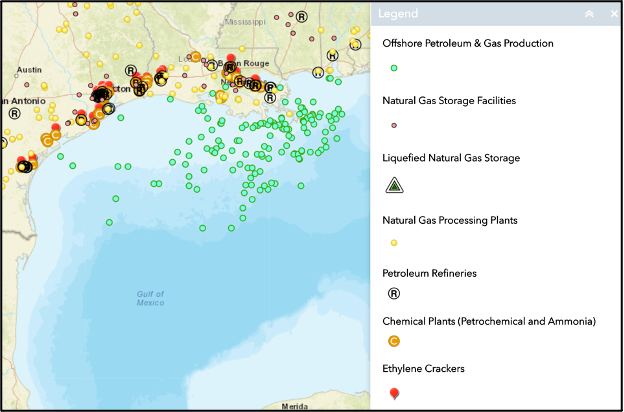
    The risks from industrial facilities are most obvious along the U.S. Gulf Coast, where many major petrochemical complexes are clustered in harm’s way. These refineries, factories and storage facilities are often built along rivers or bays for easy shipping access.

    But those rivers can also bring storm surge flooding that can raise the ocean by several feet during hurricanes. The storm surge from Helene was over 10 feet above ground level in Florida’s Big Bend and over 6 feet in Tampa Bay. With Milton, forecasters warning of a 10- to 15-foot storm surge at Tampa Bay.

    A boom surrounds flooded railcars to try to contain leaks at a chemical plant in Braithwaite, La., after Hurricane Isaac in 2012.
    AP Photo/David J. Phillip

    A recent study found evidence of two to three times more pollution releases during hurricanes in the Gulf of Mexico than during normal weather from 2005 to 2020.

    The effects of these pollution releases fall disproportionately on low-income communities and people of color, further exacerbating environmental health risks.

    Why residents may not hear about toxic releases

    The statistics are disconcerting, yet they get little attention. That is because hazardous releases remain largely invisible due to limited disclosure requirements and scant public information. Even emergency responders often don’t know exactly which hazardous chemicals they are facing in emergency situations.

    The U.S. Environmental Protection Agency requires major polluters to file only very general information about chemicals and on-site risks in their risk management plans. Some large-scale fuel storage facilities, such as those holding liquefied natural gas, are not even required to do that.

    These risk management plans outline “worst-case” scenarios and are supposed to be publicly accessible. But, in reality, we and others have found them difficult to access, heavily redacted and housed in federal reading rooms with limited access. The reason local officials and national scientific review panels often give for the secrecy is to protect the facilities from terrorist attack.

    Oil storage tanks and industrial facilities line the Houston Ship Channel, which is vulnerable to storm surge from Gulf of Mexico hurricanes.
    AP Photo/David J. Phillip

    Adding to this opacity is the fact that many states – including those along the Gulf – suspend restrictions on pollution releases during emergency declarations. Meanwhile, real-time incident notifications from the National Response Center – the federal government’s repository for all chemical discharges into the environment – typically lag by a week or more,

    We believe this limited public information on rising chemical threats from our changing climate should be front-page news every hurricane season. Communities should be aware of the risks of hosting vulnerable industrial infrastructure, particularly as rising global temperatures increase the risk of extreme downpours and powerful hurricanes.

    Mapping the risks nationwide to raise awareness

    To help communities understand their risks, our team at Rice University’s new Center for Coastal Futures and Adaptive Resilience investigates how industrial communities in flood-prone areas nationwide can better adapt to such threats, socially as well as technologically.

    Our interactive map shows where elevated future flood risks threaten to inundate major polluters that we identify using the EPA’s Toxic Release Inventory.

    The U.S. has several hot spots with clusters of flood-prone polluters. Houston’s Ship Channel, Chicago’s waterfront steel industries and the harbors at Los Angeles and New York/New Jersey are among the biggest.

    Three of the biggest hot spots, where large numbers of industrial facilities with toxic materials face elevated future flood risks, are in the Northeast, the northwestern Gulf Coast and the southern end of the Great Lakes.
    Rice University Center for Coastal Futures and Adaptive Resilience, CC BY-ND

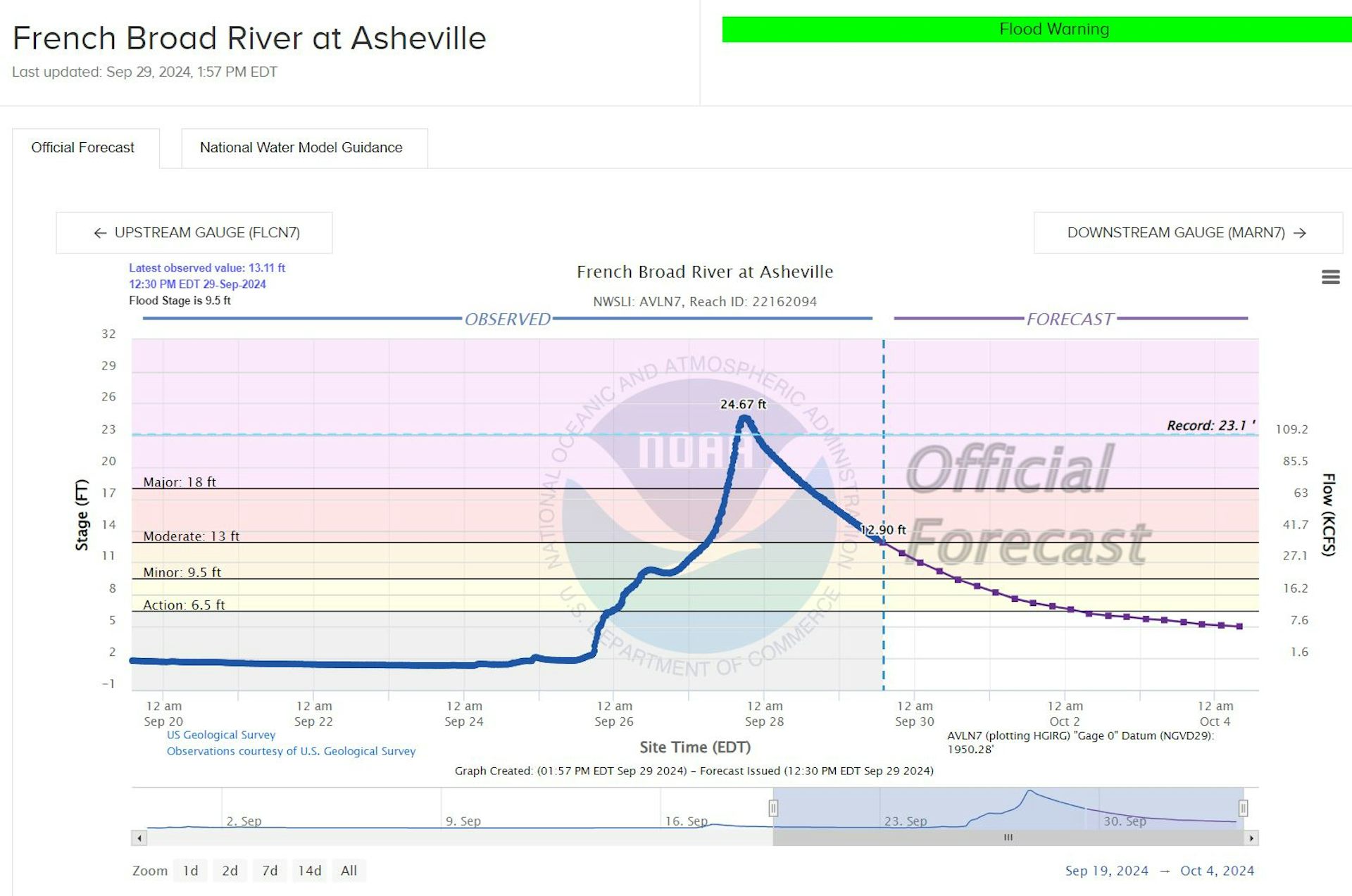
    But, as Helene revealed, there can also be great concern in less obvious spots. Inland, particularly in the mountains, runoff can quickly turn normally tame rivers into fast-rising torrents. The French Broad River at Asheville, North Carolina, rose about 12 feet in 12 hours during Helene and set a new flood stage record.

    When hurricanes and tropical storms are headed for the U.S., our interactive maps show where major polluters are located in the storm’s projected cone of impact. The maps identify hazardous flood-prone facilities down to the address, anywhere in the country.

    Knowledge is the first step

    Knowing where these sites are located is only the first step. Often, it’s up to communities themselves, many of them already overexposed and historically underserved, to raise concerns and demand strategies for mitigating the health, economic and environmental risks that industrial sites at risk of flooding and other damage can pose.

    These discussions can’t wait until a disaster is on the way. By knowing where these risks may be, communities can take steps now to build a safer future.

    This article, originally published Sept. 30, has been updated with Hurricane Milton.

    James R. Elliott receives funding from the National Science Foundation and the National Renewable Energy Lab.

    Dominic Boyer receives funding from the National Science Foundation, NOAA and Texas Sea Grant.

    Phylicia Lee Brown has nothing to disclose.

    ref. Hurricane Milton: Flooded industrial sites and toxic chemical releases are a silent, growing threat – https://theconversation.com/hurricane-milton-flooded-industrial-sites-and-toxic-chemical-releases-are-a-silent-growing-threat-239977

    MIL OSI – Global Reports

  • MIL-Evening Report: Do recent class actions against ‘flex commission’ car loans mean consumer voices are getting stronger?

    Source: The Conversation (Au and NZ) – By Jeannie Marie Paterson, Professor of Law, The University of Melbourne

    Gatot Adri/Shutterstock

    It’s been more than five years since the banking royal commission, but its findings continue to have an impact on the financial services sector.

    Law firm Maurice Blackburn recently announced it had settled with ANZ in a class action over allegedly unlawful “flex commissions” built into car loans made by Esanda between 2011 and 2016.

    ANZ agreed to settle the proceedings for $85 million on a “no admission of liability” basis. However, two further flex commission class actions – against Westpac & St George and Macquarie Leasing – remain on foot and will be heard this month.

    Class actions are a growing trend in the ways consumers seek to access justice. Many cases are simply too small to be pursued individually.

    On top of this, a recent High Court ruling could see organisations come under greater scrutiny over the systems they put in place. Could all of this mean consumers are getting a stronger voice?

    What are flex commissions?

    Many car dealers offer to provide financing for prospective car buyers as an alternative to getting a loan directly from a bank. But dealers typically don’t have their own huge reserves of funds to lend out.

    This financing usually comes from a finance company or bank lender through what is sometimes called a “white label” product.

    Many car dealers offer financing arrangements directly to customers.
    Tikhomirov Sergey/Shutterstock

    Dealers will usually be paid a commission on the loans they arrange by the lender. Prior to 2018, some lenders offered these car dealers arranging loans what is called a “flex commission”.

    Flex commissions allowed car dealers to set the interest rate on car loans above an agreed base rate.

    Higher interest rates meant a greater commission for the car dealer, but were not always in the interests of the borrower.

    Banned and heavily criticised

    Flex commissions were formally banned by Australia’s corporate watchdog, the Australian Securities and Investments Commission (ASIC), in November 2018.

    ASIC had been concerned that borrowers were paying excessively high interest rates on dealer-arranged car loans, and that the commissions were not fair or transparent.

    The watchdog’s own research found about 15% of customers were being charged an interest rate that was 7% or more above the base rate.

    Their main concern was that many car dealers weren’t increasing rates in line with actual credit risk, but rather opportunistically to target inexperienced or vulnerable consumers.

    Shortly after the ban, the final report of the banking royal commission didn’t mince words. Commissioner Kenneth Hayne noted a lack of transparency and a misplaced trust:

    Many borrowers knew nothing of these arrangements. Lenders did not publicise them; dealers did not reveal them. […] To the borrower, the dealer might have appeared to be acting for the borrower by submitting a loan proposal on behalf of the borrower. The borrower was given no indication that in fact the dealer was looking after its own interests.

    Why were class actions needed?

    Neither ASIC’s ban nor the criticisms of the banking royal commission guaranteed any redress for borrowers subject to loans with flex commissions.

    ASIC suggested flex commissions may have contravened the National Consumer Credit Protection Act by being unfair, or the ASIC Act by being misleading. But it is difficult and expensive for individuals to pursue such claims themselves in court.

    ASIC itself can seek compensation on behalf of borrowers, or require redress to be paid as part of other enforcement action. The watchdog has already gone down this road in some of the especially egregious instances of misconduct identified by the royal commission, such as fees for no service.

    Where individual action is too hard or regulator action lacking, consumers’ best option for redress may lie in a class action – taken on a no-win, no-fee basis. The likelihood of a good result may be increased in instances where the class action “piggybacks” on an adverse report from the regulator.

    Corporations may face increasing scrutiny

    It’s reasonable to ask why upstream lenders are being targeted in “flex commission” class actions when it is the car dealers who allegedly wronged borrowers.

    The ongoing class actions do not allege the lenders themselves misled borrowers or treated them unfairly. However, in this context that may not matter.

    In each of the class actions, Maurice Blackburn has argued the car dealers were acting as the representatives of the lenders, which they say makes the lenders responsible for the car dealers’ alleged misconduct.

    A recent High Court ruling may mean corporations have to take greater responsibility for the systems they oversee.
    Shutterstock

    Moreover, in these and similar cases, a recent High Court ruling that centred on “systemic unconscionable conduct” could make it harder for such upstream entities to argue their distance from alleged wrongdoing in systems they put in place.

    Better access to justice

    There has been a rise in consumer protection class actions in recent years, supported by changes in rules of procedure in several jurisdictions.

    Justice Bernard Murphy of the Federal Court of Australia has argued these changes promote the important value of access to justice:

    The important thing to remember is that class actions are critical in ensuring that people can obtain redress for mass civil wrongs. Laws which are not, in fact, readily capable of enforcement by ordinary Australians are little more than an illusion.

    This trend is important. Dishonest or unfair conduct has long been prohibited in the National Consumer Credit Protection Act, but this hasn’t been used much to date.

    Given the current flex commission actions closely follow the findings of ASIC, we should watch the regulator closely for hints of any future actions in other areas. Many could spark discussions that ultimately lead to stronger protection for consumers.

    But when they are successful, we also need to keep an eye on the actual payout to borrowers and hope it takes place without undue delay.

    Jeannie Marie Paterson has previously received funding from the Australian Research Council, DFAT and the Menzies Foundation.

    ref. Do recent class actions against ‘flex commission’ car loans mean consumer voices are getting stronger? – https://theconversation.com/do-recent-class-actions-against-flex-commission-car-loans-mean-consumer-voices-are-getting-stronger-240795

    MIL OSI AnalysisEveningReport.nz

  • MIL-OSI Economics: DDG Ellard urges swift action on fisheries subsidies to aid Pacific sustainability goals

    Source: WTO

    Headline: DDG Ellard urges swift action on fisheries subsidies to aid Pacific sustainability goals

    Thank you, and good afternoon, distinguished excellencies and to all.
    I appreciate the invitation to engage with you on the pressing environmental challenges confronting the Pacific region, and how a multilateral approach can help tackle those challenges and foster sustainable solutions. 
    Severely affected by the triple planetary crisis of climate change, biodiversity loss, and pollution, the Pacific Islands have a unique understanding of how trade and trade policy can contribute to addressing these challenges. And that’s why I’m so pleased that this discussion is taking place at the WTO.
    Trade is vital for climate adaptation and resilience, because it facilitates the development and dissemination of adaptation technologies, improves access to essential goods and services during climate shocks, and fosters synergies between climate finance and trade aid to bolster supply chains and trade-related infrastructure.
    The participation and leadership of the Pacific Islands at the WTO in addressing environmental challenges is commendable, including through Fiji’s role as a co-coordinator of the Dialogue on Plastics Pollution and Environmentally Sustainable Plastics Trade (DPP).
    I encourage you to continue bringing forward your interests in the Committee on Trade and Environment, as well as in other environmental initiatives at the WTO to ensure that trade policy supports your adaptation and energy transition efforts.
    Let me now turn to the issue of fisheries subsidies.
    I visited the Pacific in 2022 just as two important and complementary events coincided:
    the adoption of the Agreement on Fisheries Subsidies at MC12, and   
    the adoption of the 2050 Strategy for the Blue Pacific Continent by the Pacific Islands Forum Leaders.
    There are many synergies between these two historic achievements, paving the way toward a sustainable, prosperous, and resilient Pacific region.
    As the 2050 Strategy underscores, the Pacific islands countries are the custodians of nearly 20% of the earth’s surface, including vast swaths of ocean.  During my visits to the Pacific, I have witnessed firsthand how the ocean is central not only to the economies of the region, but also to the core identity of its people. Therefore, it is particularly fitting that, through the 2050 Strategy, all Pacific governments have committed to collective action to improve the health of the ocean and prevent the over-exploitation of its resources.
    As we know, the Western and Central Pacific Ocean is home to one of the world’s largest fisheries, supplying more than half of the world’s tuna from predominantly sustainable stocks. However, the sustainability of fishery resources in the Pacific and worldwide, is threatened by harmful subsidies, which total around USD 22 billion annually.
    The WTO Agreement on Fisheries Subsidies is a decisive response to these challenges. It prohibits subsidies to vessels involved in illegal, unreported, and unregulated (IUU fishing), and to fishing in the unregulated high seas. It also restricts subsidies for activities affecting overfished stocks, unless they are implemented to rebuild the stocks to a biologically sustainable level. By enhancing transparency and enforcing these rules, the Agreement promises significant benefits for fishing communities across the region, aligning with the Blue Pacific Strategy.
    However, this potential will be realized only when the Agreement enters into force, which requires ratification by 2/3 of our 166 Members. To date, we have received 83 out of the 111 instruments of acceptance, and our goal is to hit the required target by the end of the year. The process for acceptance is well under way in many WTO Members, and I strongly urge those who have not yet ratified – including in the Pacific, where fisheries are so vital – to do so as soon as possible.
    I should emphasize that ratification unlocks access to the technical assistance and capacity-building from the WTO Fish Fund. We have more than USD 12 million in the bank, in addition to resources provided by the FAO and the World Bank, our partners in the Fund. This Fund will help developing and LDC Members implement the Agreement and improve their fisheries management – the Fund demonstrates the commitment to work closely with developing Members and LDCs every step of the way.
    But we know our negotiating work is not done.  I encourage Members to constructively engage on the ongoing negotiations on fisheries subsidies contributing to overcapacity and overfishing – Fish 2 – which, together with Fish 1, would constitute comprehensive disciplines to fully meet UN SDG 14.6.  As you know, although WTO Members have not reached an agreement on these provisions yet, they did make significant progress, and we are very close. The four-year sunset clause in Fish 1, initially proposed by the Pacific region, creates a powerful incentive to conclude these negotiations quickly. 
    While the current text may not be ideal or perfect for all, most developing and developed Members believe that it would improve the status quo, perhaps with a few adjustments that are well socialized with the Membership.
    The latest version of the new disciplines circulated by the Chair of the negotiations is a balanced approach.  On one hand, it contains strong disciplines on the largest fishers and subsidizers, as well as those engaged in distant water fishing.    
    On the other hand, the text exempts small-scale and artisanal fishing from its disciplines, as well as least developed Members and small fishing nations. It also includes a review clause to assess the effectiveness of disciplines, with the possibility to amend the Agreement later.
    Sustainable fisheries are crucial for the livelihoods of those who depend on them. The adoption and entry into force of both WTO fisheries agreements will therefore go a long way to helping Pacific nations fulfil the commitments in 2050 Strategy.
    I know we can count on the Pacific and all Members for their continued deep and earnest engagement. At this point, concluding Fish 2 will require significant commitment at the highest political level, to complete negotiations on Fish 2, and to ensure the ratification and entry into force of Fish 1. And so much is at stake, for our ocean, the fish, and those whose livelihood depends on them.  Whether we can finish our work is completely in Members’ – your – hands. 
    Thank you.

    Share

    MIL OSI Economics

  • MIL-OSI: Urgently Earns AutoTech Breakthrough Award for ‘Overall Transportation Tech of the Year’

    Source: GlobeNewswire (MIL-OSI)

    VIENNA, Va., Oct. 09, 2024 (GLOBE NEWSWIRE) — Urgent.ly, Inc. (Nasdaq: ULY) (“Urgently”), a U.S.-based leading provider of digital roadside and mobility assistance technology and services, today announced it has earned the “Overall Transportation Tech of the Year” award in the 2024 AutoTech Breakthrough Awards, conducted by AutoTech Breakthrough, a leading market intelligence organization that recognizes the standout companies, products and services in the global automotive and transportation technology markets today. This year’s program attracted thousands of nominations from over 15 different countries throughout the world.

    Urgently was recognized for its next-generation yield-based pricing technology, which was introduced earlier this year. This AI-driven dynamic pricing technology makes it possible to reliably predict and optimize job prices for roadside assistance services, leading to higher-quality customer experiences. Real-time yield-based pricing allows Urgently to better manage surges in roadside assistance demand, similar to surge pricing used by ride-hail services.

    Insights and predictive pricing generated by this technology empower Urgently’s customer partners to build roadside assistance programs that best fit their business goals, such as:

    • Maximizing performance while maintaining a stable cost structure
    • Balancing performance and cost by market
    • Increasing performance by market or job attribute, such as a premium/VIP program

    “This award is the result of our hard-working data and engineering teams who developed our yield-based pricing technology, and who continually look for ways to apply technology to advance the roadside experience,” said Matt Booth, Chief Executive Officer, Urgently. “We’re thrilled to be featured alongside other automotive technology leaders and to be recognized for our innovative work in this industry.”

    For more information about Urgently’s roadside and mobility assistance solutions, visit https://www.geturgently.com/industry-solutions.

    More information about the AutoTech Breakthrough Awards is available at https://autotechbreakthrough.com/.

    About Urgently

    Urgently is focused on helping everyone move safely, without disruption, by safeguarding drivers, promptly assisting their journey, and employing technology to proactively avert possible issues. The company’s digitally native software platform combines location-based services, real-time data, AI and machine-to-machine communication to power roadside assistance solutions for leading brands across automotive, insurance, telematics and other transportation-focused verticals. Urgently fulfills the demand for connected roadside assistance services, enabling its partners to deliver exceptional user experiences that drive high customer satisfaction and loyalty, by delivering innovative, transparent and exceptional connected mobility assistance experiences on a global scale. For more information, visit http://www.geturgently.com.

    Forward Looking Statements

    This press release contains or may contain “forward-looking statements” within the meaning of the Securities Act of 1933, as amended, and Section 21E of the Exchange Act of 1934, as amended, which statements involve substantial risks and uncertainties. Forward-looking statements generally relate to future events or Urgently’s future financial or operating performance. Such statements are based upon current plans, estimates and expectations of management of Urgently in light of historical results and trends, current conditions and potential future developments, and are subject to various risks and uncertainties that could cause actual results to differ materially from such statements. The inclusion of forward-looking statements should not be regarded as a representation that such plans, estimates and expectations will be achieved. Forward-looking terms such as “may,” “will,” “could,” “should,” “would,” “plan,” “potential,” “intend,” “anticipate,” “project,” “predict,” “target,” “believe,” “continue,” “estimate” or “expect” or the negative of these words or other words, terms and phrases of similar nature are often intended to identify forward-looking statements, although not all forward-looking statements contain these identifying words. All statements, other than historical facts, including, without limitation, statements regarding Urgently’s yield-based pricing technology. These statements are based on the current assumptions of Urgently’s management and are neither promises nor guarantees, but involve a significant number of factors that may cause our actual performance or achievements to be materially different from any future performance or achievements stated or implied by the forward-looking statements. For factors that could cause actual results to differ materially from the forward-looking statements in this press release, please see the risks and uncertainties detailed in our filings with the Securities and Exchange Commission (“SEC”), including in our annual report on Form 10-K for the year ended December 31, 2023, which was filed with the SEC on March 29, 202, our quarterly reports on Form 10-Q, including our quarterly report on Form 10-Q for the quarter ended June 30, 2024, which was filed with the SEC on August 13, 2024, and other filings and reports that we may file from time to time with the SEC. All forward-looking statements reflect Urgently’s beliefs and assumptions only as of the date of this press release. Urgently undertakes no obligation to update forward-looking statements to reflect future events or circumstances.

    Contacts:
    For Press: media@geturgently.com
    For Investors: investorrelations@geturgently.com

    The MIL Network

  • MIL-OSI USA: Golden urges regulators to adopt proposed delay to lobster gauge increase, calls for level playing field with Canadian lobstermen

    Source: United States House of Representatives – Congressman Jared Golden (ME-02)

    WASHINGTON — Congressman Jared Golden (ME-02) yesterday sent a letter urging the Atlantic States Marine Fisheries Commission (ASFMC) to formally adopt a delay to a lobster gauge increase in the Gulf of Maine until at least July 2025. He called on the Commission to gather more accurate lobster stock data in the meantime while also addressing the unequal regulatory burden between Maine and Canadian lobstermen.

    “It is my hope that the ASFMC will ultimately support a long-term pause of the amendment to allow additional time for the technical committee to consider the stock’s health more carefully.…” Golden wrote. “…These efforts should coincide with robust engagement with your Canadian counterparts to address the regulatory disparity between American and Canadian lobstermen and create a level playing field for all harvesters in the Gulf of Maine.”

    Lobstermen gauge the size of a lobster by measuring its carapace from eye socket to tail. Lobsters that are smaller than the minimum gauge size must be put back in the water so they can grow, protecting the lobster population for the future. According to the ASMFC, lobster stock decline in Lobster Management Area 1 has surpassed 35 percent — the trigger point for an automatic increase in allowable catch size from 3 1/4 inches to 3 5/16 inches. However, Maine fishermen have questioned the data used to justify these changes, including concerns that ASMFC stock data is out of date. 

    This new rule — known as Addendum 27 — was originally scheduled to begin in January 2025. Following calls in April and August from Golden and industry leaders, ASMFC voted to approve a delay until July 2025. However, the Commission has yet to formally adopt the measure — Addendum 31 — which means implementation is still currently slated for January.  

    In his letter, Golden noted that moving forward with the gauge increase is estimated to cause theloss of more than 680 jobs and $59.6 million to Maine’s economy. Any such change in the Gulf of Maine would not apply to Canadian lobstermen.

    The New England Fishermen’s Stewardship Association would like to express our gratitude to Congressman Golden for highlighting the problems associated with an increase in the minimum gauge size in area 1 for lobster,” Dustin Delano, a lobsterman and chief operating officer of the New England Fishermen’s Stewardship Association said.We feel the many negative, unintended consequences in this ‘proactive approach’ in management were severely overlooked, will cause major disruptions to the market, and place American dealers and harvesters at a major disadvantage from their Canadian counterparts.

    “Congressman Golden’s support to review data used to regulate the lobster fishery is vital to the fishermen’s survival, Virginia Olsen, commercial lobsterman and director of the Maine Lobstering Union said. The last thing our industry needs is rules with unintended consequences.”  

    In July, Golden introduced a bipartisan amendment to the federal budget that would block any proposed gauge increase for one year. 

    Golden’s newest letter can be found here, and is included below in full:


    +++


    October 8, 2024

    Robert Beal
    Executive Director
    Atlantic States Marine Fisheries Commission
    1050 North Highland St, Suite 200 A-N
    Arlington, VA 22201

    Dear Director Beal and Commissioners,

    I am writing to you again requesting that the Atlantic States Marine Fisheries Commission (ASMFC) and the American Lobster Board delay the implementation of the Lobster Management Area 1 gauge increase, Addendum XXVII, currently scheduled to begin in January 2025. While I believe that the proposal as written in Addendum XXXI to delay a gauge increase until July 1, 2025, is the better of the two options presented by the ASMFC, I encourage the Commission to proceed solely based on the full consideration of all data sources and a commitment from Canadian regulators to enhance their conservation measures.

    As you know, the intent of Addendum XXVII is to mitigate declining stocks of American lobster proactively, a goal shared by harvesters, dealers, and the ASFMC. In my conversations with lobstermen and dealers, it has always been clear that their top concerns are the sustainability of the stock and the ability for it to be harvested by future generations. That is why, as I previously stated in my letter to you on April 29, 2024, I am concerned that the data used to arrive at the trigger index for a gauge increase is overly precautionary and has limitations that do not entirely reflect the current status of the stock.

    It is my hope that the ASFMC will ultimately support a long-term pause of the amendment to allow additional time for the technical committee to consider the stock’s health more carefully while considering other resiliency measures and incorporating thorough scientific data and objective analysis acceptable to regulators and members of the commercial lobster fishery. Other data that has not been considered or will become available include mandatory harvester reporting, the conservation equivalent from a reduction of overall lobster licenses, and the 2025 lobster stock assessment. These efforts should coincide with robust engagement with your Canadian counterparts to address the regulatory disparity between American and Canadian lobstermen and create a level playing field for all harvesters in the Gulf of Maine.

    Without a longer-term pause, devastating economic consequences are on the horizon for Maine’s lobster industry. For the latest year data is available, it is estimated that if Addendum XXVII goes into effect, it would decrease the value of lobster landings, resulting in a loss of over 680 jobs and $59.6 million to Maine’s economy. I am deeply concerned about how this economic impact would impact the industry and the hundreds of communities in Maine that depend on a viable lobster fishery. Few involved in the fishery or these communities are adequately prepared for the economic disruption that would likely occur.

    These decisions must always include those with significant experience, the harvesters themselves. I trust that you, as the regulators, will also consider and incorporate their invaluable input in matters before you.

    Sincerely,


    ###

    MIL OSI USA News

  • MIL-OSI: Nasdaq Announces End-of-Month Open Short Interest Positions in Nasdaq Stocks as of Settlement Date September 30, 2024

    Source: GlobeNewswire (MIL-OSI)

    NEW YORK, Oct. 09, 2024 (GLOBE NEWSWIRE) — At the end of the settlement date of September 30, 2024, short interest in 3,067 Nasdaq Global MarketSM securities totaled 12,246,444,747 shares compared with 12,241,625,467 shares in 3,057 Global Market issues reported for the prior settlement date of September 13, 2024. The mid-September short interest represents 2.94 days compared with 3.06 days for the prior reporting period.

    Short interest in 1,663 securities on The Nasdaq Capital MarketSM totaled 2,136,615,501 shares at the end of the settlement date of September 30, 2024, compared with 2,107,947,669 shares in 1,670 securities for the previous reporting period. This represents a 1.32 day average daily volume; the previous reporting period’s figure was 1.34.

    In summary, short interest in all 4,730 Nasdaq® securities totaled 14,383,060,248 shares at the September 30, 2024 settlement date, compared with 4,727 issues and 14,349,573,136 shares at the end of the previous reporting period. This is 2.49 days average daily volume, compared with an average of 2.57 days for the prior reporting period.

    The open short interest positions reported for each Nasdaq security reflect the total number of shares sold short by all broker/dealers regardless of their exchange affiliations. A short sale is generally understood to mean the sale of a security that the seller does not own or any sale that is consummated by the delivery of a security borrowed by or for the account of the seller.

    For more information on Nasdaq Short interest positions, including publication dates, visit http://www.nasdaq.com/quotes/short-interest.aspx or http://www.nasdaqtrader.com/asp/short_interest.asp.

    About Nasdaq:
    Nasdaq (Nasdaq: NDAQ) is a leading global technology company serving corporate clients, investment managers, banks, brokers, and exchange operators as they navigate and interact with the global capital markets and the broader financial system. We aspire to deliver world-leading platforms that improve the liquidity, transparency, and integrity of the global economy. Our diverse offering of data, analytics, software, exchange capabilities, and client-centric services enables clients to optimize and execute their business vision with confidence. To learn more about the company, technology solutions, and career opportunities, visit us on LinkedIn, on X @Nasdaq, or at http://www.nasdaq.com.

    Media Contact:
    Jennifer Lawson
    jennifer.lawson@nasdaq.com

    NDAQO

    A photo accompanying this announcement is available at https://www.globenewswire.com/NewsRoom/AttachmentNg/c5c14985-744e-48e0-9ad9-7d9fdca96cc0

    The MIL Network

  • MIL-OSI: CORRECTION – Fanhua Announces Changes to the Board of Directors and Management Team

    Source: GlobeNewswire (MIL-OSI)

    GUANGZHOU, China, Oct. 09, 2024 (GLOBE NEWSWIRE) — The board of directors (the “Board”) of Fanhua Inc. (Nasdaq: FANH) (the “Company” or “Fanhua”), a leading independent technology-driven financial services provider in China, today issued an updated press release to correct its press release disseminated on October 1, 2024 which announced changes to its board of directors and management team (the “Original Announcement”). The statement regarding the professional experience of the newly appointed chairperson of the Board in the Original Announcement is hereby replaced with and changed to “Since June 2023, Ms. Hang Suong Nguyen has served as the Vice President of WEALTH WILL LIMITED, overseeing operational strategies and driving the company’s capital deployment and growth in multiple emerging markets. Prior to that, from late 2018 until May 2023, she held the position of Sales Director at Trustwell Far East Pte. Ltd., where she was responsible for formulating and executing sales strategies, managing the sales team, analyzing market demands, maintaining customer relationships, and expanding business channels, making significant contributions to the company’s cross-border business. She obtained her Bachelor’s degree in International Business from Vietnam National University in 2008 and her Master’s degree in Business Administration from Hanoi University of Science and Technology in 2009.” Except for the above, there are no other changes to the Original Announcement. The updated press release is as follows.

    GUANGZHOU, China, October 9, 2024 (GLOBE NEWSWIRE) — the board of directors (the “Board”) of Fanhua Inc. (Nasdaq: FANH) (the “Company” or “Fanhua”), a leading independent technology-driven financial services provider in China, today announced that Ms. Hang Suong Nguyen has been appointed as the new Chairperson of the Board, effective September 30, 2024.

    Ms. Hang Suong Nguyen, Chairperson of the Board

    Since June 2023, Ms. Hang Suong Nguyen has served as the Vice President of WEALTH WILL LIMITED, overseeing operational strategies and driving the company’s capital deployment and growth in multiple emerging markets. Prior to that, from late 2018 until May 2023, she held the position of Sales Director at Trustwell Far East Pte. Ltd., where she was responsible for formulating and executing sales strategies, managing the sales team, analyzing market demands, maintaining customer relationships, and expanding business channels, making significant contributions to the company’s cross-border business. She obtained her Bachelor’s degree in International Business from Vietnam National University in 2008 and her Master’s degree in Business Administration from Hanoi University of Science and Technology in 2009.

    The Board also announces that incumbent independent directors Mr. Yunxiang Tang and Mr. Allen Lueth, along with incumbent executive director Mr. Ben Lin, have tendered their resignations from the Board due to personal reasons, effective September 30, 2024. Additionally, Mr. Lin has resigned from the position of Chief Strategy Officer.

    The Board has appointed Ms. Jiaxing Shi as Independent Director and the Chair of the Audit Committee and Mr. Changfu Li as Independent Director and the Chair of the Compensation Committee to fill the vacancies left by the departure of Mr. Tang and Mr. Lueth, effective September 30, 2024.

    Ms. Jiaxing Shi, Independent Director and the Chair of Audit Committee

    Ms. Jiaxing Shi has served as the Investment Operations Manager at YD Network Technology Co Ltd. since March 2024, overseeing the company’s investment strategy, and financial due diligence to optimize long-term returns. Prior to this role, she served as senior audit professionals at UHY LLP and Marcum LLP from 2022 to 2024. Prior to that, she served as senior manager position in financial reporting and investor relations role at Aurora Mobile Ltd. (Nasdaq: JG) from 2018 to 2022. She received an MBA Degree in Financial Management from Goldey-Beacom College in 2018 and a Master Degree in Accounting from St. John’s University in 2015. She received Bachelor’s Degree in Inner Mongolia University of Finance and Economics in 2013.

    Mr. Changfu Li, Independent Director and the Chair of Compensation Committee

    Mr. Changfu Li has over a decade of experience in senior management, with a focus on strategic operations and cost management across various industries. Mr. Li has served as a consulting advisor at Beijing Shanying Legal Consulting Co., Ltd since November 2023. Prior to this, he served as a procurement supervisor at Shanghai Sanqing Industrial Development Co., Ltd. from June 2010 to March 2020, where he managed procurement operations and contributed to sales strategy planning. And later he was promoted to Vice President of Administration and Purchasing Manager at the company’s Guangzhou branch in March 2020. Before that, from 2006 to 2010, Mr. Li held the position of procurement associate at Zhejiang Shalangsi Craft Co., Ltd. Mr. Li earned his bachelor’s degree in International Economics and Trade from Yanbian University in 2006.

    With the appointment and departure of these directors, the composition of the Board will be adjusted accordingly. Below is the updated list of board members:

    Ms. Hang Suong Nguyen, Chairperson of Fanhua Inc.

    Mr. Yinan Hu, Vice Chairperson and Chief Executive Officer of Fanhua Inc.

    Mr. Peng Ge, Executive Director and Chief Financial Officer of Fanhua Inc.

    Mr. Mengbo Yin, Independent Director and Chair of Nominating and Governance Committee of Fanhua Inc.

    Ms. Jiaxing Shi, Independent Director and Chair of Audit Committee of Fanhua Inc.

    Mr. Changfu Li, Independent Director and Chair of Compensation Committee of Fanhua Inc.

    Mr. Yinan Hu, Vice Chairperson and Chief Executive Officer of Fanhua, commented: “We are thrilled to announce that Ms. Nguyen has been appointed as our new Chairperson, a decision that signifies a major milestone for the Company’s strategic upgrade towards pursuing growth by harnessing the power of artificial intelligence. At the same time, we deeply appreciate the significant contributions that Mr. Yunxiang Tang, Mr. Allen Lueth, and Mr. Ben Lin have made during their tenure. As we look ahead, our commitment to our strategic goals and growth remains unwavering. With Ms. Nguyen at the helm as Chairperson, we are poised to build upon our momentum and achieve even greater heights.”

    Ms. Hang Suong Nguyen, Chairperson of Fanhua, stated: “It is my pleasure to join the Board and take on the role of Fanhua’s Chairperson. I understand the significant responsibility that comes with this position and I am confident in our Company’s future. And I look forward to working with all of Fanhua’s team members to meet challenges and achieve great success together.”

    About Fanhua Inc.

    Driven by its digital technologies and professional expertise in the insurance industry, Fanhua Inc. is the leading independent financial service provider in China, focusing on providing insurance-oriented family asset allocation services that covers customers’ full lifecycle and a one-stop service platform for individual sales agents and independent insurance intermediaries.

    With strategic focus on long-term life insurance products, we offer a broad range of insurance products, claims adjusting services and various value-added services to meet customers’ diverse needs, through an extensive network of digitally empowered sales agents and professional claims adjustors. We also operate Baowang (www.baoxian.com), an online insurance platform that provides customers with a one-stop insurance shopping experience.

    For more information about Fanhua Inc., please visit https://ir.fanhgroup.com.

    Forward-looking Statements

    This press release contains statements of a forward-looking nature. These statements, including the statements relating to the Company’s future financial and operating results, are made under the “safe harbor” provisions of the U.S. Private Securities Litigation Reform Act of 1995. You can identify these forward-looking statements by terminology such as “will,” “expects,” “believes,” “anticipates,” “intends,” “estimates” and similar statements. These forward-looking statements involve known and unknown risks and uncertainties and are based on current expectations, assumptions, estimates and projections about Fanhua and the industry. Potential risks and uncertainties include, but are not limited to, those relating to its ability to attract and retain productive agents, especially entrepreneurial agents, its ability to maintain existing and develop new business relationships with insurance companies, its ability to execute its growth strategy, its ability to adapt to the evolving regulatory environment in the Chinese insurance industry, its ability to compete effectively against its competitors, quarterly variations in its operating results caused by factors beyond its control including macroeconomic conditions in China. Except as otherwise indicated, all information provided in this press release speaks as of the date hereof, and Fanhua undertakes no obligation to update any forward-looking statements to reflect subsequent occurring events or circumstances, or changes in its expectations, except as may be required by law. Although Fanhua believes that the expectations expressed in these forward-looking statements are reasonable, it cannot assure you that its expectations will turn out to be correct, and investors are cautioned that actual results may differ materially from the anticipated results. Further information regarding risks and uncertainties faced by Fanhua is included in Fanhua’s filings with the U.S. Securities and Exchange Commission, including its annual report on Form 20-F.

    For more information, please contact:

    Fanhua Inc.

    Investor Relations

    Tel: +86 (20) 8388-3191

    Email: ir@fanhgroup.com 

    The MIL Network

  • MIL-OSI USA: Senator Baldwin Announces $5.2 Million Contract for Sturgeon Bay Business

    US Senate News:

    Source: United States Senator for Wisconsin Tammy Baldwin
    STURGEON BAY, WI – U.S. Senator Tammy Baldwin (D-WI) announced today that the U.S. Coast Guard has awarded Marine Travelift in Sturgeon Bay a $5.2 million contract for equipment to support maintenance and repairs of the Coast Guard fleet, estimated to support 50-60 jobs. Senator Baldwin successfully pushed the Coast Guard to ensure the Buy America Act was abided by for this project, in line with her work to strengthen Buy America requirements for federal contracts to ensure taxpayer dollars are supporting the Made in Wisconsin economy and Wisconsin workers.
    “To me, it’s simple: when we invest taxpayer dollars, we should be supporting American businesses, workers, and communities whenever possible,” said Senator Baldwin. “I was proud to champion strong Buy America requirements so businesses like Marine Travelift and workers in Northeastern Wisconsin reap the benefits of critical investments we’re making to safeguard our nation.”
    “Marine Travelift is honored to be selected for this critical task to support the men and women of the U.S. Coast Guard,” said Marine Travelift President and CEO Erich Pfeifer. “They deserve the best U.S.-built equipment to help accomplish their life-saving missions, and supplier opportunities like this are a direct result of Senator Baldwin’s relentless push to ensure fairness for Wisconsin manufacturers in federal agency purchasing.”
    Marine Travelift was awarded a $5.2 million contract from the U.S. Coast Guard to build a 620-ton mobile boat hoist, the largest such unit any U.S. federal agency has ever acquired. The funding comes from the annual funding legislation Senator Baldwin supported for fiscal year 2019.
    Senator Baldwin has long championed Buy America policies to support American businesses and workers. She fought to advance her American Made Navy Act in this year’s annual defense legislation, which would ensure by 2033 any new Navy ship purchased uses 100% domestically produced materials. She also successfully worked to include strong Buy America standards in the Bipartisan Infrastructure Law and the Inflation Reduction Act.

    MIL OSI USA News

  • MIL-OSI USA: Baldwin Brings Home Nearly $190,000 to Support Economic Development in Northeast Wisconsin

    US Senate News:

    Source: United States Senator for Wisconsin Tammy Baldwin
    WISCONSIN – Today, U.S. Senator Tammy Baldwin (D-WI) announced she helped deliver nearly $190,000 to support small businesses, local jobs, and economic development in Oconto and Sheboygan counties. The funding comes through the U.S. Department of Agriculture’s (USDA) Rural Business Development Grants Program which was funded by the Baldwin-backed 2024 annual government funding bill.
    “Moving our Made in Wisconsin economy forward means investing in every corner of our state to create economic opportunity for families,” said Senator Baldwin. “I am proud to go to bat for Wisconsin and deliver funding that will help create jobs, grow local businesses, and build a stronger future for our state.”
    The following projects received funding:
    Sheboygan County Economic Development Corp: $99,000 to establish a revolving loan fund to serve small rural businesses in Sheboygan County. The project will serve at least ten businesses.
    Oconto County Economic Development Corp: $90,000 to provide technical assistance to small, rural businesses located in Oconto County. Assistance will be targeted for those located in the villages of Suring and Lena. At least ten businesses will be served with this assistance, creating five and saving another five jobs.

    MIL OSI USA News

  • MIL-OSI USA: Deluzio Announces Nearly $600,000 to Provide Transitional Housing for Domestic Violence Victims and Survivors in Beaver County

    Source: United States House of Representatives – Congressman Chris Deluzio (PA-17)

    CENTER TOWNSHIP, PA — Today, Congressman Chris Deluzio announced that a $594,500 federal grant has been awarded to the Women’s Center of Beaver County to support their efforts to provide safe, transitional housing for people experiencing domestic violence. The Women’s Center supports victims and survivors of domestic and sexual violence in Beaver County, providing crisis intervention, emergency shelter, counseling, legal and medical advocacy, and prevention education. This grant comes from the U.S. Department of Justice, as part of the Transitional Housing Assistance Grants for Victims of Domestic Violence, Dating Violence, Sexual Assault, and Stalking Program. 

    “Far too many people, especially women, face the horrific consequences of abuse in daily life,” said Congressman Deluzio. “We must make sure that everyone fleeing domestic violence has somewhere safe they can go. I’m glad to see this federal funding come to the Women’s Center of Beaver County to support their important work of caring for the survivors and victims of domestic abuse.”  

    The Women’s Center will use these funds to move survivors of domestic violence, dating violence, sexual assault, or stalking who are homeless or in need of housing assistance to permanent housing. With this funding, the Women’s Center will provide 35 scattered site, private landlord housing residences for 35 survivors and their families. In collaboration with partner Beaver County Rehabilitation Center (BCRC), the Women’s Center will provide a holistic, victim-centered, and multidisciplinary approach. The project will help clients for at least six months, and a maximum length of two years.  

    Services will be specifically tailored to historically underserved communities: communities of color, people with disabilities, older adults, individuals with limited English proficiency, individuals who are Deaf/hearing impaired, and LGBTQ individuals. Support services include rental and utility assistance, case management, safety planning, transportation, career counseling, financial and credit counseling, support groups, individual counseling, job training, education attainment, and housing advocacy. One additional staff member will be hired to implement the program, and once people find permanent housing, the program will provide follow-up services to participants for at least 3 months. 

    The Women’s Center of Beaver County is the only comprehensive domestic violence and sexual assault resource center in Beaver County. The organization’s mission is to promote cultural change and end violence through supporting and sheltering victims and survivors of abuse, as well as advocacy and education. 

    ###

    MIL OSI USA News

  • MIL-OSI New Zealand: Health – GP closures regrettable, get ready for more

    Source: GenPro

    Recent closures of general practices and calls for unprofitable GPs to run cafes to stay afloat are more evidence that communities are paying the price from years of government underfunding of primary health care.

    “While the list of reasons for the closures of Hataitai Medical Practice and North Taranaki’s Parklands Medical Centre could differ, we know there are two common themes – that many general practices are financially unsustainable and struggle to recruit and retain staff,” said Dr Angus Chambers, Chair of the General Practice Owners Association (GenPro).

    “These two symptoms are a direct consequence of a 20-year-old funding model which has not kept pace with the costs of running a general practice and the changing health needs in our communities.”

    More than 2000 Wellington patients will have to find a new doctor next year after the 40-year-old Haitaitai practice closes, and not enough clinical staff can be found to keep open the Parklands centre in Bell Block, so it is closing and merging with another practice seven kilometres away.

    “The closures were announced in the same week we learned that a committee established by Health New Zealand-Te Whatu Ora allegedly told a struggling GP practice to set up a café inside the clinic to bring in extra cash.

    “Closures and desperate measures do nothing to improve and treat the health needs of our patients and keep the doors open on clinics providing medical, urgent and mental health care,” Dr Chambers said.

    A recent survey by General Practice New Zealand, which represents the bulk of primary health organisations, found that more than 60 percent of PHOs had clinics in their networks facing closure, 61 percent were reducing services, and all were restricting patient access. Among reasons given were financial pressures and burnout and retention of GPs.

    “GenPro’s own survey in August also showed that financial pressures were weighing on general practices, with 83 percent concerned about their financial viability.

    “Hardly a month goes by without an announcement of a GP clinic shutting its doors, closures of after-hours services, cessation of new patient enrolments, or some other reduction in scope of services. Regretfully, I predict more of these closures and reductions are on the way unless something changes.”

    “The funding model is based on health attendances from the last millennium, which was a vastly different health environment. Our inability to negotiate funding – because it’s imposed by the government – is the key reason that funding is not keeping pace with rising costs, and general practices are therefore closing.

    “GenPro has lodged a complaint with the Commerce Commission about our inability to have effective input into the decisions crucial to achieving the best outcomes for our patients.
     
    “The government must as a matter of urgency increase its support of primary healthcare, overhaul the current out-of-date funding model, and help increase the supply of medical professionals into primary healthcare,” Dr Chambers said.

    “GenPro, which represents half of all general practices in Aotearoa, is ready to work with the Minister and Commissioner to develop the solutions needed,” Dr Chambers said.

    MIL OSI New Zealand News

  • MIL-OSI Canada: Government advances Made-in-Canada sustainable investment guidelines and mandatory climate disclosures to accelerate progress to net-zero emissions by 2050

    Source: Government of Canada News

    News release

    October 9, 2024 – Toronto, Ontario – Department of Finance Canada

    The federal government is leading the world with a bold climate plan to grow our economy and reach net-zero emissions by 2050. Achieving this goal will require between $125 billion and $140 billion in investment into Canada every year. As a cornerstone of Canada’s net-zero economic plan, the federal government’s $93 billion suite of major economic tax credits are already available to help attract this investment.

    Beyond incentives to attract investment to Canada, investors need robust and transparent guidelines to credibly classify their investments into the clean economy on the path to net-zero. That is why in the 2023 Fall Economic Statement and Budget 2024, the government committed to develop a sustainable finance taxonomy identifying “green” and “transition” investments and to expand the coverage of mandatory climate disclosure requirements to private companies. Moving forward with these commitments is essential for market certainty, for Canada to unlock net-zero investments, and to uphold the Paris climate target of limiting global warming to 1.5°C above pre-industrial levels.

    Today in Toronto at the Principles for Responsible Investment conference, the Honourable Chrystia Freeland, Deputy Prime Minister and Minister of Finance, announced:

    • A plan to deliver Made-in-Canada sustainable investment guidelines; and,
    • Mandatory climate-related financial disclosures for large, federally incorporated private companies.

    The Made-in-Canada sustainable investment guidelines will become an important, voluntary tool for investors, lenders, and other stakeholders navigating the global race to net-zero by credibly identifying “green” and “transition” economic activities. These guidelines will provide the certainty needed to accelerate the flow of private capital into sustainable activities across the Canadian economy. From building electric vehicle batteries, to generating clean energy, to decarbonizing emissions-intensive heavy industries, these guidelines will identify job-creating activities in a way that is scientifically credible and aligned with limiting global temperature rise to 1.5°C above pre-industrial levels. The Canadian taxonomy will be developed and governed by an external, third-party organization(s).

    To attract more private capital into Canada’s largest corporations and ensure Canadian businesses can continue to effectively compete as the world races towards net-zero, the government is also moving forward with mandating climate-related financial disclosures for large, federally incorporated private companies. These disclosures will help investors better understand how large businesses are thinking about and managing risks related to climate change, ensuring that capital allocation aligns with the realities of a net-zero economy. Specifically, the government intends to bring forward amendments to the Canada Business Corporations Act that will require these disclosures. The government will launch a regulatory process to determine the substance of these disclosure requirements and the size of private federal corporations that would be subject to them. As small- and medium-sized businesses will not be subject to the requirements, the government is considering ways to encourage those businesses to voluntarily release climate disclosures, if they wish.

    The federal government is ready to work with provincial and territorial partners to ensure broad disclosure coverage across the Canadian economy. The government will seek to harmonize its regulations with those that will be required from public companies by securities regulators. More details will be released in due course.

    These two sustainable finance initiatives will mobilize further private sector capital towards activities essential to building a net-zero economy. More private sector capital will enable businesses to grow the economy, create more good-paying jobs for Canadians, and boost their resiliency against the risks posed by climate change.

    In addition to these announcements, today, the federal government successfully issued an additional $2 billion in green bonds, through a re-opening of Canada’s second green bond issued in February.

    Together, today’s progress is about building a flourishing Canadian sustainable finance industry and sending a clear signal to corporate boards and shareholders, at home and around the world, that Canada is their trusted partner for putting private capital to work in the race to net-zero.

    Quotes

    “In the 21st century, a competitive economy is a net-zero economy. We are seizing Canada’s economic advantages to attract investment and ensure Canadian workers benefit their fair share in the global race to net-zero. Today’s release of a path for Made-in-Canada sustainable investment guidelines and climate disclosures from large companies will accelerate the flow of private capital into Canada, in turn growing our economy, creating good jobs, and advancing our progress to net-zero emissions by 2050.”

    The Honourable Chrystia Freeland, Deputy Prime Minister and Minister of Finance

    “Building a cleaner economy is not only an environmental imperative, it is a major economic opportunity. The development of a sustainable investment taxonomy, paired with heightened transparency on climate disclosures, amounts to an important stepping stone for Canada on the path towards that cleaner economy. These initiatives will help mobilize needed private sector financial flows to build a cleaner economy and give investors who are looking for the sustainable option the clear direction they seek.”

    The Honourable Steven Guilbeault, Minister of Environment and Climate Change

    “Canadian workers and businesses are already attracting historic investment in areas such as clean energy, critical minerals, and electric vehicles, and seeing the associated benefits for job creation and economic growth. With changes announced today, investors will have more certainty that companies are taking real and serious action to address the climate crisis and drive down emissions, while building a strong economy.”

    The Honourable Jonathan Wilkinson, Minister of Energy and Natural Resources

    “Fighting climate change as well as protecting the economy and Canadians from the costs of climate inaction is a priority for our government. It’s important to send a clear signal to Canadian companies and organizations that climate risks and opportunities are critical to integrate into corporate culture and decision making, and that’s what we’re doing.”

    The Honourable François-Philippe Champagne, Minister of Innovation, Science and Industry

    “Creating a financial system that is sustainable and globally competitive is essential for Canada’s economic future. In order to compete both at home and abroad, we are moving forward with sustainable investment guidelines and mandatory climate disclosures to help provide credibility, accountability, and transparency in the marketplace. These are essential conditions for investors and companies to fill the investment gap necessary to meet the climate challenge while seizing generational opportunities for clean prosperity.”

    Ryan Turnbull, Parliamentary Secretary to the Deputy Prime Minister and Minister of Finance and to the Minister of Innovation, Science and Industry

    Quick facts

    • In Budget 2024, the federal government committed to provide an update by the end of 2024 on the development of Made-in-Canada sustainable investment guidelines, in recognition that promoting credible climate investment and combatting greenwashing are critical to fostering investor confidence and mobilizing the private investment Canada needs to achieve net-zero by 2050. 

    • In the 2023 Fall Economic Statement, the federal government committed to develop options for making climate disclosures mandatory, as part of expanding mandatory climate disclosures across the Canadian economy. It also first announced the government’s commitment to developing a Made-in-Canada taxonomy. 

    • The development of a Made-in-Canada sustainable finance taxonomy and regulations to require climate disclosures from large companies builds on the important work done by the Sustainable Finance Action Council.

    • The federal government is investing over $160 billion in its net-zero economic plan, including through a $93 billion suite of tax credits for major economic investments in:

      • Carbon capture, utilization, and storage;
      • Clean technology;
      • Clean hydrogen;
      • Clean technology manufacturing;
      • Clean electricity; and,
      • Electric vehicle (EV) supply chains.
    • In addition to tax credits for major economic investments, the federal government is attracting net-zero private sector investment by:

      • Catalyzing private investment in low-carbon projects, technologies, businesses, and supply chains through the $15 billion Canada Growth Fund, which has already invested over $2 billion across eight deals, including three novel Carbon Contracts for Difference;
      • Leveraging at least $20 billion from the Canada Infrastructure Bank to build major clean electricity and clean growth infrastructure projects;
      • Securing Canada’s advantage as the world’s supplier of choice for critical minerals and the clean technologies they enable, by further developing supply chains through a $3.8 billion Critical Minerals Strategy; and,
      • Building more clean, affordable, and reliable power, and supporting innovation in electricity grids, including offshore wind, through the $3 billion recapitalization of the Smart Renewables and Electrification Pathways Program.
    • The third-party, arm’s-length organization(s) will further develop and implement the taxonomy.

    • The Department of Finance, Environment and Climate Change Canada, and Innovation, Science and Economic Development Canada will work together to make the required legislative and regulatory changes for mandatory climate disclosures.

    Related products

    Associated links

    Contacts

    Media may contact:

    Katherine Cuplinskas
    Deputy Director of Communications
    Office of the Deputy Prime Minister and Minister of Finance
    Katherine.Cuplinskas@fin.gc.ca

    Media Relations
    Department of Finance Canada
    mediare@fin.gc.ca
    613-369-4000

    General enquiries:

    Phone: 1-833-712-2292
    TTY: 613-369-3230
    E-mail: financepublic-financepublique@fin.gc.ca

    Stay Connected

    MIL OSI Canada News

  • MIL-OSI Canada: Government advances Made-in-Canada sustainable investment guidelines to accelerate progress to net-zero emissions by 2050

    Source: Government of Canada News

    Backgrounder

    October 9, 2024

    The Government of Canada supports the development of voluntary Made-in-Canada sustainable investment guidelines (otherwise known as a taxonomy) that would categorize investments based on scientifically determined eligibility criteria that are consistent with the goal of reaching net-zero emissions by 2050 and limiting global temperature rise to 1.5°C above pre-industrial levels.

    This is a high standard that will be important for building and maintaining the credibility of a Canadian taxonomy, which will mobilize private capital for low- or non-emitting activities with a “green” category.

    Importantly, the Canadian taxonomy would also establish a “transition” category to identify, and boost funding for, scientifically credible pathways to rapidly decarbonize Canada’s emissions-intensive sectors. Canada’s leadership in the transition aspect of taxonomy will be a notable and valuable contribution to the international dialogue on transition finance.

    The development of the metrics-based Canadian taxonomy would first focus on the following sectors for the Canadian economy: electricity, transportation, buildings, agriculture and forestry, manufacturing, and extractives, including mineral extraction and processing, and natural gas. A taxonomy for two to three priority sectors will be released within 12 months of the arm’s-length, third-party organization(s) beginning its work.

    Once finalized, the Canadian taxonomy would be available for entities such as financial institutions, lenders, and companies to use on a voluntary basis. It would not be mandatory.

    Details of the Canadian Taxonomy

    This backgrounder outlines the government’s expectations for the development and implementation of the Canadian taxonomy, including:

    1. Guiding Principles
    2. Defining green and transition investments
    3. Priority Sectors
    4. Company-level expectations
    5. Governance and Funding

    Background on Taxonomy

    To close the climate financing gap, financial market participants, including banks, insurers, pension plans and asset managers, have indicated that they need clarity about what economic activities are considered “green” or “transition.” A taxonomy is a tool that can provide this clarity by promoting a shared understanding or classification system that defines or categorizes these activities.

    Like the proposed Canadian taxonomy, many international taxonomies also use detailed eligibility criteria, anchored in climate science, to support the taxonomy’s credibility among international investors. These eligibility criteria often involve the use of performance-based metrics and thresholds to demonstrate what economic activities are aligned with pathways to limiting global temperature rise to 1.5°C above pre-industrial levels, in line with the Paris Agreement. These taxonomies likewise aim to preserve interoperability with other jurisdictions to reflect the global nature of financial and capital markets.

    A taxonomy supports a wide range of use cases. For example, taxonomies can be used to set standards for classifying climate-related financial instruments (e.g., bonds or loans), and/or to evaluate the green or transition credentials of financial instruments and issuers.
    The aim of the Canadian taxonomy would be to mobilize investment in support of Canada’s net-zero transition by enabling investors to understand and communicate which key activities and investments will deliver a Canadian net-zero economy.

    Over 40 jurisdictions worldwide are developing or have implemented taxonomies, which generally are calibrated to a particular country’s domestic economic reality and priorities. This is an opportunity to develop a Made-in-Canada taxonomy that aligns with Canada’s net-zero pathways and drives transformational investments within Canada’s economy that will also create good-paying, sustainable jobs.

    The Sustainable Finance Action Council (SFAC), which was composed of 25 of Canada’s leading deposit-taking institutions, insurance companies, and pension funds, was launched by the Government of Canada in May 2021 to help lead the Canadian financial sector towards integrating sustainable finance into standard industry practice. The SFAC’s recommendations on taxonomy, including its Taxonomy Roadmap Report, have been important inputs for informing the Government of Canada’s next steps on taxonomy. The Government of Canada thanks the SFAC for its advice on taxonomy and its valuable contribution to building a sustainable finance market in Canada throughout its mandate, which concluded on March 31, 2024.

    i. Guiding Principles

    The Canadian taxonomy would be developed and maintained in accordance with the following principles (Guiding Principles), which draw from the recommendations of the SFAC and international organizations, as well as from international taxonomy precedents.

    These Guiding Principles are intended to ensure that the Canadian taxonomy fulfills its objective of being a credible and usable tool for financial market participants and others to identify green and transition investments.

    Guiding Principles

    • Usable

      Mobilize capital toward the net-zero transition.

    • Credible

      Clear, rigorous, and credible science-based criteria that align with limiting global temperature rise to 1.‍5°C above pre-industrial levels, with no or low overshoot and all relevant emissions scopes considered.​ Any activity which receives the green or transition taxonomy label must be scientifically defensible as being aligned with this.

    • Comprehensive

      Cover transition and green activities that make a material positive contribution to climate change mitigation, addressing high-emitting sectors.

    • Interoperable

      Be interoperable and broadly compatible with other major science-based taxonomies and frameworks globally, while reflecting Canada’s own economic context.

    • Transparent

      A governance structure that is transparent, efficient, adaptive, and results-oriented; safeguards scientific integrity; and engages with key stakeholders, including provincial and territorial governments, civil society, financial market participants, industry, and Indigenous partners.

    • Dynamic

      A built-in review process to ensure the Canadian taxonomy is updated as the landscape evolves.

    • Holistic

      Do-No-Significant-Harm criteria addressing environmental, social, and Indigenous objectives.

    ii. Defining green and transition investments

    At a high level, the Canadian taxonomy would define which economic activities are green or transition in line with SFAC recommendations, as follows:

    • Green: low-or zero-emitting activities, such as green hydrogen, solar, and wind energy generation, or those that enable them, such as electricity transmission lines and hydrogen pipelines; and,
    • Transition: decarbonizing emission-intensive activities that are critical for sectoral transformation and consistent with a net-zero, 1.5°C transition pathway, such as installing lower-emitting (electric) furnaces to produce steel.

    Activities are expected to be classified according to a categorization framework to be confirmed and operationalized. The figure below shows an example of such a framework proposed by the SFAC.

    SFAC Taxonomy Roadmap Report Categorization Framework

    For clarity, in this framework:

    Green activities are expected to be those that:

    • Do not have material scope 1 and 2 emissions;
    • Have low or zero downstream scope 3 emissions; and,
    • Sell into or benefit from markets that are expected to grow in the global
      net-zero transition.

    Transition activities are expected to be those that:

    • Have material scope 1 and 2 emissions but make significant emission reductions;
    • Have low or zero scope 3 emissions; and,
    • Do not create carbon lock-in and path dependency.

    As well as activities that:

    • Have material scope 3 emissions but significantly reduce their scope 1 and
      2 emissions;
    • Do not face immediate demand-side risk (i.e., market contraction); and,
    • Have lifespans proportionate to when global demand for their products is expected to decline.

    iii. Priority Sectors

    The initial phase of taxonomy development would focus on developing eligibility criteria for the following priority sectors. A taxonomy for two to three priority sectors will be released within 12 months of the arm’s-length, third-party organization(s) beginning its work. The final determination of eligible activities would rest with the third-party organization(s) which will develop, implement, and maintain the Canadian taxonomy, and align with the guiding principles, including scientific credibility and alignment with limiting global warming to 1.5°C:

    Electricity, which could include activities related to low- and zero-emitting electricity generation, electricity storage, and grid infrastructure improvements.

    Transportation, which could include low- and zero-emitting passenger and freight transportation activities in a variety of transportation modes (e.g., road, rail, marine transport) as well as enabling infrastructure (e.g., electric vehicle charging).

    Buildings, which could include the construction and operation of high-performance buildings, the retrofitting of buildings to improve their performance, and the installation of equipment to reduce the emissions of buildings and their occupants.

    Agriculture and Forestry, which could include the sustainable production of crops and livestock, activities to decarbonize agricultural production, and the planting, sustainable management, and restoration of forests.

    Heavy Industry:

    These important sectors of the Canadian economy have been prioritized based on the following criteria:

    • Anticipated future levels of green and transition investment opportunity, including as assessed by market participants;
    • Importance of their decarbonization for decarbonizing the Canadian economy, based on current sectoral emissions and projections of future emission reductions; and
    • Economic significance to Canada, including current levels of investment and economic activity.

    Further below is a list of examples of activities within these sectors that may be eligible for a green or transition taxonomy label, subject to the development of activity-specific performance criteria and Do-No-Significant-Harm requirements.

    iv. Company-level expectations

    The Government of Canada supports the adoption of net-zero targets, credible transition plans, and robust climate disclosures by Canadian companies. These are key infrastructure elements of a robust sustainable finance market and are essential to achieving net-zero goals, fostering transparency, and enabling informed decision-making.

    The Government of Canada has committed to moving towards mandatory climate-related financial disclosures across a broad spectrum of the Canadian economy. Mandatory disclosure requirements are already in place for federal Crown corporations and federally regulated financial institutions. The Government of Canada intends to bring forward amendments to the Canada Business Corporations Act to enable climate-related financial disclosure requirements for large, federally incorporated private companies.

    The Government of Canada encourages the developers of the taxonomy to consider including these company-level requirements as part of the eligibility criteria for green and transition labelling in the Canadian taxonomy, in line with SFAC’s recommendations.

    Potential Company-Level Actions for Taxonomy Users

    • Net-Zero Targets

      A commitment to reach net-zero emissions by 2050 or earlier, usually with interim targets.​

    • Credible Transition Plans

      A strategy that lays out the company’s targets, actions, and/or resources for its transition toward a lower-carbon economy, including actions such as reducing its greenhouse gas emissions.​

    • Robust Climate Disclosure

      The provision of information about a company’s climate-related governance, risk management, strategy, and metrics and targets.​

    v. Governance and Funding

    Developing a taxonomy requires significant climate science and sectoral expertise and engagement with stakeholders, including financial market participants, industry, civil society, governments, regulators, and Indigenous partners. In addition, good governance practices are needed to oversee the development and implementation of a Canadian taxonomy that safeguards scientific integrity and meets market needs. The guiding principle of scientific credibility will ensure that the taxonomy’s green and transition labels are only applied to activities that are in line with the goal of limiting global warming to 1.5°C with no or limited overshoot.

    The Canadian taxonomy would be developed, implemented, and maintained at arm’s length to the Government of Canada by an organization or organizations external-to-government.

    The final determination of guiding principles, eligible activities, priority sectors and company-level expectations would rest with the external-to-government organization.

    The Government of Canada would contribute funding to support the technical work to develop the eligibility criteria for the taxonomy.

    Examples of Potential Taxonomy Eligible Activities

    Under the Canadian taxonomy, a range of economic activities that contribute to Canada’s net-zero transition will be eligible for a “green” or “transition” label, which, for example, could be used in the context of labelled bond issuances. Not all economic activities will be eligible.

    Through a survey of international taxonomies, the following examples of activities in priority sectors that may be eligible for a green and/or transition label were identified. These examples are in no way intended to direct the work of the arm’s length organization or organizations who will develop, implement, and maintain the Canadian taxonomy, who would make final determinations with respect to the inclusion of and criteria for these example activities, in line with the guiding principles, including alignment with limiting global warming to 1.5°C. As such, these examples should be considered indicative only, not prescriptive.

    It is expected that activity-specific performance criteria would be developed for each activity included in the Canadian taxonomy along, with Do-No-Significant-Harm requirements, to define the circumstances under which that activity would be eligible for green or transition labelling. That is, only some forms of a given activity might be eligible while other forms of the same activity might be ineligible. Some forms of an eligible activity may be green-eligible while other forms would be transition-eligible. As such, the examples below show activities that may  be eligible, subject to activity-specific criteria and Do-No-Significant-Harm requirements.

    These examples are not intended to be exhaustive. The international taxonomies surveyed to identify these examples reflect the economic and net-zero transition needs of other jurisdictions, which may be different from those of Canada, so it is to be expected that the Canadian taxonomy could break new ground and include sub-sectors or activities not covered in these examples. For example, it could include green and transition activities in the agricultural sector such as certain forms of crop and livestock agriculture.

    In consideration of Canada’s economic makeup, the taxonomy could potentially include activities that significantly reduce the emissions of existing natural gas production and/or the emissions associated with a limited buildout of existing production sites. The technical drafters may also consider a broad range of possible eligibility criteria for existing natural gas production, such as the displacement of more polluting fuels internationally, provided they are aligned with limiting global temperature rise to 1.5°C above pre-industrial levels. Based on the Guiding Principles, the Government does not anticipate new natural gas production to be eligible. The final determination of eligible activities across all sectors will be made by the arms length, external organization(s).

    In the electricity sector, examples of potentially eligible green or transition activities include:

    • Co-generation of heating or cooling and electricity from solar energy;
    • Electricity generation from bioenergy;
    • Electricity generation using concentrated solar power (CSP) technology;
    • Electricity generation from geothermal energy;
    • Electricity generation from hydropower;
    • Electricity generation from ocean energy technologies;
    • Electricity generation using solar photovoltaic technology;
    • Electricity generation from wind power;
    • Storage of electricity; and,
    • Transmission and distribution of electricity.

    In the transportation sector, examples of potentially eligible green or transition activities include:

    • Low carbon transport infrastructure, such as electric vehicle charging.
    • Zero-emission and low-emission operations of the following modes of transportation:
      • Air transport, including ground handling operations;
      • Freight transport by road;
      • Inland water transport;
      • Road passenger transport;
      • Sea and coastal water transport;
      • Railway transport; and,
      • Urban and suburban passenger land transport.

    In the buildings sector, examples of potentially eligible green or transition activities include:

    • Acquisition and ownership of low-emitting and energy-efficient buildings;
    • Construction of low-emitting and energy-efficient new buildings;
    • Installation of energy efficiency equipment;
    • Installation of renewable energy technologies; and,
    • Renovation of existing buildings to reduce emissions and/or improve energy efficiency.

    In the agriculture and forestry sectors, examples of potentially eligible green or transition activities include:Footnote 1

    • Afforestation;
    • Conservation, restoration, and maintenance of natural forests; and,
    • Sustainable forest management.

    In the heavy industry sector, examples of potentially eligible green or transition activities include:

    • The low-emission or energy-efficient manufacturing of:
      • Aluminum;
      • Basic chemicals, such as ammonia, aromatics BTX, carbon black, chlorine, nitric acid, and soda ash;
      • Cement;
      • Hydrogen;
      • Iron and steel; and,
      • Plastics in primary form.
    • The manufacturing of:
      • Batteries;
      • Energy efficiency equipment for buildings, such as energy-efficient appliances and light sources, energy-efficient HVAC systems, heat pumps, and energy-efficient building automation and control systems;
      • Equipment for the production of hydrogen through electrolysis;
      • Low-carbon technologies for household sector;
      • Low-carbon technologies for transport, such as low-carbon vehicles that meet transportation sector criteria; and,
      • Renewable energy technologies.
    • The mining of:Footnote 2
      • Copper;
      • Iron ore;
      • Lithium; and,
      • Nickel.

    MIL OSI Canada News

  • MIL-OSI Security: Defense News: SECNAV Del Toro As-Written Remarks at the San Francisco Fleet Week Senior Leaders Seminar

    Source: United States Navy

    Introduction/Thank you

    Good afternoon, everyone! It is an honor to be here onboard USS Tripoli (LHA 7) for the start of San Francisco Fleet Week and this Senior Leader Seminar.

    Mr. Loeven, thank you for inviting me for this wonderful occasion and for providing me with the opportunity to say a few words.

    Captain Harrington, thank you for hosting us here on your ship—this incredible instrument of American naval power and a phenomenal example of our Navy-Marine Corps team.

    Representative Garamendi, it’s wonderful to see you. Thank you for joining us, and for your steadfast partnership and advocacy for our Sailors and Marines in Congress.

    Ambassador Romualdez, it is wonderful to see you. Thank you for your ongoing efforts to strengthen the critical partnership between our nations.

    Lieutenant General Cederholm, thank you for your leadership and guidance of our Marines and Sailors at One MEF.

    Vice Admiral Downey, Ms. Forbes, Mr. Wunderman, Mr. Vaca, and Mr. Gonzales, thank you for being part of the panel in a few minutes to discuss how the Bay Area can work with us to restore our national maritime industry.

    To the rest of our distinguished guests and panelists in later sessions, thank you for coming.

    It truly is wonderful to be back here in San Francisco.

    San Francisco holds a special place in my heart—when I was a student at the Naval Postgraduate School in Monterey, my wife Betty and I would often make the drive up to the city with our kids.

    History

    This city’s rich maritime and naval history and tradition is worth celebrating, not just annually during Fleet Week, but yearlong.

    San Francisco Bay once hosted an extensive Naval presence from Port Chicago to Treasure Island, and two major Naval shipyards—Hunters Point and Mare Island.

    Mare Island Naval Shipyard was the first U.S. Navy base established on the Pacific coast and, in the middle of last century, was the only shipyard on the West Coast that built nuclear submarines.

    In fact, the first commanding officer of Mare Island Naval Shipyard—indeed the man hand selected by the 22nd Secretary of the Navy, James Dobbin to establish the shipyard—was also our Navy’s first Admiral, and our first Hispanic-American Admiral, David Glasgow Farragut.

    I think he’s a little more famous for his service during the Civil War, but I would submit that his work creating a basing and repair station on the West Coast for the Navy had nearly as profound an impact on the future of our Navy and our Nation.

    And during World War I, the Union Iron Works Shipyard south of the Embarcadero built cruisers, submarines, and battleships and during World War II, nearly two thirds of Liberty and Victory ships were built in the Bay area.

    On a more somber note, I was most recently here in July for the 80th commemoration of the Port Chicago Disaster.

    If any of you are unfamiliar with the story, 258 African-American Sailors were wrongfully and shamefully labeled as criminals for refusing to work in unsafe conditions during World War II.

    Thanks to the work of my General Counsel, Mr. Sean Coffey, and his military assistant Captain Justin Pilling, I was able to make the decision in July to set aside the court martial results of all Sailors convicted as part of the Port Chicago incident.

    That action was about more than correcting the historical record.

    It was and is a resounding affirmation of the values we, as Americans, hold dear—justice, equality, and the right to a safe workplace.

    The legacy of the Port Chicago Sailors should inspire us all to be more vigilant, to speak truth to power, and to never give up on the pursuit of liberty and justice.

    San Francisco has long been a key part of our nation’s maritime industry—and our naval heritage.

    And while we don’t currently build naval ships here, our relationships with industry here and academic partnerships through the Naval Postgraduate School are integral to developing the fleet of the future.

    World Today

    The world our nation faces today is much different than when I was sworn in as Secretary of the Navy in August 2021, much less during my career on active duty or the end of World War II.

    In Europe, the unprovoked and illegal Russian invasion of Ukraine continues—and is now well into its third year.

    This conflict poses a direct threat to European security and the principles of democracy and sovereignty upon which our international order is built.

    In July, we, alongside our NATO allies, convened in Washington to reaffirm our unwavering support for Ukraine.

    We stand united in our commitment to helping Ukraine defend its sovereignty and territorial integrity, recognizing that their struggle is not just for their own freedom but for the preservation of democracy worldwide.

    Beyond the European theater, for the first time since World War II, we face a comprehensive maritime power—our pacing challenge—in the Indo-Pacific.

    The People’s Republic of China continues to assert its unlawful maritime claims through its naval, coast guard, and maritime militia forces.

    I can assure you that the PRC is watching the ongoing conflicts in Europe and the Red Sea closely and drawing valuable lessons for its own strategic ambitions.

    In the Red Sea and Gulf of Aden, we have been working tirelessly alongside our NATO allies and Middle Eastern partners to protect innocent civilian mariners and commercial shipping from Iranian-aligned Houthi attacks.

    Following the October 7th attacks in Israel one year ago this week, our Navy and Marine Corps were swiftly deployed to the region, forming a formidable and integrated force capable of responding to any threat.

    Carrier Air Wing Three, our “Battle Axe,” played a pivotal role in protecting civilian mariners, deploying over sixty air-to-air missiles and over 420 air-to-surface weapons.

    The Bataan Amphibious Ready Group, with the embarked 26th Marine Expeditionary Unit, made significant contributions by deterring hostile Houthi attacks and preventing the conflict from escalating throughout the region.

    Our warships, including the Carney, Mason, Gravely, Laboon, Thomas Hudner, and Eisenhower, have demonstrated exceptional performance under fire, successfully deterring and defeating missile and drone attacks targeting innocent maritime shipping.

    And last week, Cole and Bulkeley—the latter of which I had the honor and privilege to construct and commission as her first commanding officer—launched interceptors in defense of Israel from nearly 200 Iranian ballistic missiles.

    As President Biden said, “Our support for Israel’s security is ironclad. We unequivocally condemn this brazen attack by Iran.”

    The actions of our ships and their crews echo the valiant and heroic legacies of their namesakes.

    Vice Admiral John D. Bulkeley, the namesake of the ship I commissioned, was awarded the Medal of Honor for bringing Douglas MacArthur through Japanese controlled waters in a PT boat to safety in the dark early days of World War II.

    As a destroyer skipper in the Mediterranean later in the war, he spotted a pair of German ships that threatened to overwhelm the group of vulnerable coastal vessels he was assigned to protect.

    Despite being outnumbered and outgunned, and with just one of his destroyer’s main guns operable, Bulkeley charged into close action and sank both German ships without losing a single one of his sailors.

    As he later said of his actions on that day in 1944, and I quote, “What else could I do? You engage, you fight, you win. That was the reputation of our Navy then, and in the future.”

    Ladies and gentlemen, that is still the reputation of our Navy and Marine Corps—and it will remain our reputation because of the brave men and women who have chosen, in this era of accelerating change and uncertainty, to serve our country.

    They truly have earned our deepest respect and gratitude.

    Their exceptional service and courage in the face of danger represents the absolute best of our Navy, Marine Corps, and indeed our Nation.

    And if anyone is inspired to join the Navy or Marine Corps, I’m happy to administer the oath right here!

    Maritime Statecraft

    Last fall, at Harvard University’s John F. Kennedy School of Government, I set out a vision for a new Maritime Statecraft to guide our nation through an era of intense strategic competition.

    This comprehensive approach extends beyond traditional naval diplomacy and maritime competition, encompassing a whole-of-government effort to build robust U.S. and allied maritime power, both commercial and naval.

    Maritime Statecraft recognizes that great naval power requires the solid foundation of a thriving commercial maritime industry.

    Investing in economic development, trade, education, science, innovation, and climate diplomacy can enhance our global competitiveness and support our maritime industry.

    A cornerstone of Maritime Statecraft is the revitalization of U.S. commercial shipping and shipbuilding.

    By restoring the competitiveness of these sectors, we can not only improve the cost-effectiveness of naval shipbuilding but also strengthen our national economy and maritime capabilities.

    To achieve this goal, I have worked tirelessly with cabinet leaders across the administration to raise awareness and advocate for long-term solutions to the Navy’s challenges.

    The solutions to many of our Navy’s most pressing issues lie in renewing the health of our nation’s broader seapower ecosystem.

    A significant step in this direction was our creation of the Government Shipbuilder’s Council.

    This interagency body brings together representatives from the Maritime Administration (MARAD), Coast Guard, National Oceanic and Atmospheric Administration (NOAA), and even the Army to address common ship construction and maintenance challenges.

    Furthermore, we have catalyzed multiple White House-led interagency processes on both naval and commercial shipbuilding, involving the National Security Council, National Economic Council, and various departments across the Executive Branch. These efforts aim to identify and implement effective strategies for strengthening our maritime capabilities.

    In addition, my team is working closely with Congress to revitalize existing authorities and create new incentives for building and flagging commercial ships in the United States.

    By investing in domestic shipbuilding, we can support our naval shipbuilding efforts, create jobs, and boost our domestic manufacturing base.

    And as part of Maritime Statecraft, it is essential to forge strong partnerships with local governments, suppliers, and leaders.

    These collaborations will be instrumental in revitalizing our nation’s maritime industry.

    By working closely with local officials, we can identify and address the specific challenges and opportunities, including potential infrastructure improvements, streamlining regulatory processes, and attracting investment to support shipbuilding, repair, and maritime-related industries.

    I have long advocated for the restoration and expansion of some of our nation’s smaller, dormant, and underutilized shipyards as part of the effort to rebuild our maritime industrial capacity, and nowhere is that more applicable than here in San Francisco.

    We are confident that these initiatives will yield significant returns for naval shipbuilding and sealift.

    By adopting a holistic approach to Maritime Statecraft, we can position the United States to maintain its global leadership and safeguard our national interests.

    Conclusion

    As we move to the panel, I want to leave you with one question.

    The theme for this session is “Reimagining the American Maritime Industry.”

    At the heart of the matter the question I would ask us to ponder today, this week, and moving into our shared future is:

    “How can the Bay Area and the Navy work together to restore the comprehensive maritime power of the United States?”

    Whether through workforce development, improving and increasing maritime infrastructure, partnerships in the technology sector and with academia, or revitalizing dormant or underutilized shipyards, the Navy is prepared to work alongside you, to partner with you, and to succeed together.

    Thank you for joining us today, and may God grant the Navy, the Marine Corps, San Francisco, and indeed our Nation fair winds and following seas.

    MIL Security OSI

  • MIL-OSI Security: Defense News: Secretary of the Navy Emphasizes Strategic Partnerships and Maritime Dominance at San Francisco Fleet Week

    Source: United States Navy

    San Francisco, CA – October 9, 2024 – Secretary of the Navy Carlos Del Toro delivered keynote remarks at the Senior Leader Seminar aboard USS Tripoli during San Francisco Fleet Week today.

    In his opening remarks, Secretary Del Toro underscored the historical significance of San Francisco to the U.S. Navy and the nation’s maritime heritage. He emphasized the need to revitalize the American maritime industry to meet the challenges of a complex global security environment, marked by the ongoing conflict in Ukraine, China’s assertive actions in the Indo-Pacific, and threats to maritime security in the Red Sea.

    “The world our nation faces today is much different than when I was sworn in as Secretary of the Navy,” said Secretary Del Toro. “We face a comprehensive maritime power – our pacing challenge – in the Indo-Pacific. The People’s Republic of China continues to assert its unlawful maritime claims, and we must be prepared to respond.”

    The Secretary commended the bravery and professionalism of U.S. Navy and Marine Corps personnel who have been deployed to deter aggression and protect freedom of navigation around the world. He cited recent examples of successful naval operations, including the defense of Israel from Iranian missile attacks and the ongoing efforts to safeguard commercial shipping in the Red Sea.

    “The actions of our ships and their crews echo the valiant and heroic legacies of their namesakes,” said the Secretary, drawing inspiration from the courage of naval heroes like Vice Admiral John D. Bulkeley. “Ladies and gentlemen, that is still the reputation of our Navy and Marine Corps – and it will remain our reputation because of the brave men and women who have chosen to serve our country.”

    Secretary Del Toro outlined his vision for Maritime Statecraft, a comprehensive approach that extends beyond traditional naval power to encompass a whole-of-government effort to strengthen the U.S. maritime industry. He stressed the importance of investing in domestic shipbuilding, fostering innovation, and building strong partnerships with local governments and industry leaders.

    “Maritime Statecraft recognizes that great naval power requires the solid foundation of a thriving commercial maritime industry,” emphasized the Secretary. “By restoring the competitiveness of these sectors, we can not only improve the cost-effectiveness of naval shipbuilding but also strengthen our national economy and maritime capabilities.”

    The Secretary’s remarks set the stage for a dynamic panel discussion moderated by Ms. Emily Desai, Senior Deputy Director for Strategic Program Planning and External Affairs at the Governor’s Office of Business and Economic Development. The panel featured Vice Adm. James Downey, Commander of Naval Sea Systems Command; Ms. Elaine Forbes, Director of the Port of San Francisco; Mr. Jim Wunderman, CEO of the Bay Area Council; Mr. Sal Vaca, Founder of Richmond Build; and Mr. Robert Gonzales of Mare Island Dry Dock. The panelists explored ways in which the Bay Area can contribute to the revitalization of the American maritime industry, including workforce development, infrastructure improvements, and technological innovation.

    Congressman John Garamendi, representing California’s 8th District, delivered closing remarks, reinforcing the importance of collaboration between government, industry, and local communities to ensure a strong and prosperous maritime sector. He commended the Secretary’s leadership in advancing Maritime Statecraft and pledged his continued support for initiatives to strengthen America’s sea power.

    The Senior Leader Seminar served as a powerful call to action, emphasizing the critical link between a robust maritime industry and national security. By fostering collaboration and innovation, the U.S. Navy and its partners are working to ensure that America remains a global maritime leader in the 21st century.

    MIL Security OSI

  • MIL-OSI Security: Eight Charged in $68M Social Adult Day Care and Home Health Care Scheme

    Source: United States Attorneys General

    An indictment was unsealed today in Brooklyn, New York, charging eight defendants for their alleged roles in a scheme to defraud Medicaid of approximately $68 million through the operation of two social adult day cares and a home health care financial intermediary that were paying kickbacks and bribes for services that were not provided.

    According to court documents, Zakia Khan, 53, of Brooklyn, and Ahsan Ijaz, 27, of Brooklyn, owned two social adult day cares, Happy Family Social Adult Day Care Center Inc. (Happy Family) and Family Social Adult Day Care Center Inc. (Family Social), and a financial intermediary, Responsible Care Staffing Inc. (Responsible Care), for the New York Medicaid Consumer Directed Personal Assistance Services Program (CDPAP), which permits family members of Medicaid recipients to receive payment for assisting Medicaid recipients with activities of daily living. Beginning in approximately October 2017, in exchange for kickbacks and bribes, marketers Elaine Antao, 45, also known as Aleena, of Brooklyn, Omneah Hamdi, 61, of Brooklyn, and Manal Wasef, 44, of Brooklyn, allegedly referred Medicaid recipients to Happy Family, Family Social, and/or Responsible Care. The marketers in turn allegedly paid kickbacks and bribes to Medicaid recipients for social adult day care and CDPAP services that Happy Family, Family Social, and Responsible Care billed to Medicaid but were not provided or were induced by kickbacks and bribes. Ansir Abassi, 38, also known as Zaib Abassi and Ansir Zaib, of Brooklyn, and Amran Hashmi, 53, of Brooklyn, allegedly managed Happy Family and Family Social and the marketers. To carry out the kickback scheme, Khan, Antao, Ijaz, Abassi, and Hamdi allegedly used business entities to launder the fraud proceeds and generate the cash used to pay kickbacks and bribes. Seema Memon, 30, of Brooklyn, an employee of Happy Family who was previously charged by complaint on July 1, was also indicted.

    “As alleged in the indictment, these defendants orchestrated a years-long scheme to defraud Medicaid of tens of millions of dollars for social adult day care and home care services for seniors that they did not provide,” said Principal Deputy Assistant Attorney General Nicole M. Argentieri, head of the Justice Department’s Criminal Division. “The defendants allegedly paid cash bribes and kickbacks to recruiters and Medicaid recipients as part of a scheme to enrich themselves at the expense of vital programs for senior citizens. Today’s charges make clear that the Criminal Division will not tolerate schemes that brazenly steal from federal health care programs.”

    “Social adult day care and home health services are meant to help seniors, but as alleged, the defendants allegedly turned their businesses into a brazen cash grab of millions of dollars from the Medicaid program,” said U.S. Attorney Breon Peace for the Eastern District of New York. “My office is committed to investigating and prosecuting those who plunder taxpayer-funded, federal health care programs dollars while purporting to offer health care services.” 

    “HHS-OIG is committed to working with our law enforcement partners to investigate allegations that bribes and kickbacks are paid with Medicaid monies,” said Special Agent in Charge Naomi Gruchacz of the Department of Health and Human Services Office of Inspector General (HHS-OIG). “Individuals and entities that participate in the federal health care system are required to obey the laws meant to preserve the integrity of program funds and the provision of appropriate, quality services to patients.”

    “The crimes outlined in this indictment took advantage of a network that offers essential health care and other services to those in need,” said Interim Commissioner Thomas G. Donlon of the New York City Police Department (NYPD). “Let it be clear: anyone who attempts to profit by defrauding the system will face consequences, as these schemes drain already limited resources and deprive beneficiaries of crucial funds. I commend our NYPD investigators and federal law enforcement partners for their successful and continued collaboration.”

    “As alleged, the defendants saw nothing beyond the dollar signs associated with their crimes, and in turn defrauded the U.S. government of $68 million in welfare funds meant for one of our country’s most vulnerable populations,” said Special Agent in Charge William S. Walker of Homeland Security Investigations (HSI) New York. “Today’s announcement underscores the HSI New York El Dorado Task Force’s unrelenting focus on dismantling and disrupting financial fraud schemes that exploit the American public and hurt our economy.”

    Khan is charged with conspiracy to commit health care fraud, three counts of health care fraud, conspiracy to defraud the United States and to pay and receive health care kickbacks, paying health care kickbacks, conspiracy to commit money laundering, and money laundering. If convicted, she faces a maximum penalty of 20 years in prison for each count of conspiracy to commit money laundering and money laundering, 10 years in prison for each count of conspiracy to commit health care fraud, health care fraud, and paying health care kickbacks, and five years in prison for conspiracy to defraud the United States and to pay and receive health care kickbacks.

    Abassi, Antao, Hamdi, and Ijaz are charged with conspiracy to commit health care fraud, conspiracy to defraud the United States and to pay and receive health care kickbacks, conspiracy to commit money laundering, and money laundering. If convicted, they face a maximum penalty of 20 years in prison for each count of conspiracy to commit money laundering and money laundering, 10 years in prison for conspiracy to commit health care fraud, and five years in prison for conspiracy to defraud the United States and to pay and receive health care kickbacks.

    Hashmi is charged with conspiracy to commit health care fraud, three counts of health care fraud, conspiracy to defraud the United States and to pay and receive health care kickbacks, and paying health care kickbacks. If convicted, he faces a maximum penalty of 10 years in prison for each count of conspiracy to commit health care fraud, health care fraud, and paying health care kickbacks, and five years in prison for conspiracy to defraud the United States and to pay and receive health care kickbacks.

    Memon is charged with conspiracy to commit health care fraud, conspiracy to defraud the United States and to pay and receive health care kickbacks, and paying health care kickbacks. If convicted, she faces a maximum penalty of 10 years in prison for each count of conspiracy to commit health care fraud and paying health care kickbacks and five years in prison for conspiracy to defraud the United States and to pay and receive health care kickbacks.

    Wasef is charged with conspiracy to commit health care fraud and conspiracy to defraud the United States and to pay and receive health care kickbacks. If convicted, she faces a maximum penalty of 10 years in prison for conspiracy to commit health care fraud and five years in prison for conspiracy to defraud the United States and to pay and receive health care kickbacks.

    HHS-OIG, NYPD, and HSI are investigating the case.

    Trial Attorney Patrick J. Campbell of the Criminal Division’s Fraud Section is prosecuting the case. Assistant U.S. Attorney Tanisha R. Payne for the Eastern District of New York is assisting with forfeiture matters.

    The Fraud Section leads the Criminal Division’s efforts to combat health care fraud through the Health Care Fraud Strike Force Program. Since March 2007, this program, currently comprised of nine strike forces operating in 27 federal districts, has charged more than 5,400 defendants who collectively have billed federal health care programs and private insurers more than $27 billion. In addition, the Centers for Medicare & Medicaid Services, working in conjunction with HHS-OIG, are taking steps to hold providers accountable for their involvement in health care fraud schemes. More information can be found at http://www.justice.gov/criminal-fraud/health-care-fraud-unit.

    An indictment is merely an allegation. All defendants are presumed innocent until proven guilty beyond a reasonable doubt in a court of law.

    MIL Security OSI

  • MIL-OSI USA: U.S. House Passes Case Measure To Further Strengthen Partnerships Between The United States And Pacific Island Nations

    Source: United States House of Representatives – Congressman Ed Case (Hawai‘i – District 1)

    (Washington, DC) – U.S. Congressman Ed Case (Hawai’i-First District) today announced that the U.S. House of Representatives has passed H.R. 7159, his proposed Pacific Partnership Act, to further increase U.S. engagement in the critical Pacific region.

    Case, a Co-Chair and Founding Member of the first-ever Congressional Pacific Islands Caucus, introduced the measure together with 25 other bipartisan colleagues. 

    “Our country’s Indo-Pacific Strategy states in no uncertain terms that no region is of more consequence to the world and to everyday Americans than the Indo-Pacific,” said Case in remarks during full House debate on the measure. “The United States and our allies and partners around the world who are aligned with an international rules-based order share the common vision  of a free and open Indo-Pacific whose governance, priorities, goals and prosperity are determined by the countries of the Indo-Pacific  without manipulation and dominance by malicious actors.

    “This is especially true of the Pacific Islands themselves, in the heart of the Pacific, which today face the challenges of increased natural disasters and human and drug trafficking, economic sustainability, threats to democracy and more. It is crucial that the United States continue to extend our hand of full partnership in assisting the countries of the Pacific to meet these challenges, as we have for generations.”

    The Pacific Partnership Act requires an annually-updated Strategy for Pacific Partnership that sets specific goals for United States engagement with the Pacific Islands, assesses the threats and pressures to the region and a plan to address such threats, and analyzes the needs and goals of the Pacific Islands in the context of the national interests of the United States. The bill also requires the strategy to be developed in consultation with the governments of Pacific Islands countries, ensuring that the United States follows through on its commitment to support Pacific-led priorities. The bill further extends diplomatic courtesies to the Pacific Islands Forum, the primary multilateral organization of the Pacific Islands nations, and requires increased collaboration in U.S. efforts in the Pacific with ally and partner nations including Australia, New Zealand and Japan.

    “I am honored to co-lead this bipartisan legislation with Congressman Case that builds off of the actions of successive administrations to strengthen United States engagement in the Pacific Islands,” said Congressman Andy Barr (R-KY 6th District).  “It is essential that the United States demonstrates that we are not merely interested in the region, but we are invested in an evolving, enduring relationship with our Pacific Islands partners. 

    “This important, forward-looking legislation ensures that all arms of the United States government are in coordination to support a rules-based order and address threats to sovereign nations across the region.”

    “As a Pacific nation, the United States has a responsibility to engage and strengthen the partnerships that have ensured the region’s security and prosperity for decades,” said Congressman Gregory W. Meeks (D-NY 5th District), the Ranking Member of the House Foreign Affairs Committee, which approved Case’s bill unanimously. “This legislation will ensure future administrations build on President Biden’s leadership to maintain our focus on the Pacific Islands.”

    “I want to thank Congressman Case for this much-needed bipartisan bill, said Congresswoman Aumua Amata Coleman Radewagen (R-American Samoa).  “The United States is a Pacific nation, and our region is critically important to U.S. interests. While Congress has extended the Compacts of Free Association for another 20 years for three Pacific Island countries, there are 11 other nations who need our attention. The United States has enduring cultural, historic, economic, and people-to-people connections with the Pacific Islands. The Pacific Partnership Act will go far in providing better focus for U.S. engagement with Pacific Island nations.”

    “The United States is a Pacific nation, and it is critical that we partner with our friends in the Pacific to tackle shared challenges including climate resilience, healthcare, and economic development,” said Congressman Ami Bera, M.D. (D-CA 6th District). “This bill designates the Pacific Islands Forum (PIF) as an international organization with diplomatic privileges and encourages the establishment of a PIF mission in America. The bill also solidifies our commitment to the region by codifying the Pacific Partnership Strategy. By strengthening our diplomatic presence in the region, we ensure that the United States remains a reliable partner in promoting a free, resilient, and prosperous Pacific.”

    “The Pacific Partnership Act bolsters our longstanding relationship with the Pacific Islands, a crucial region in our defense against the Chinese Communist Party,” said Congressman Steve Womack (R-AR 3rd District).

    “This bill strengthens our partnerships and supports American defense. This is particularly meaningful to my constituents in Northwest Arkansas, given the high concentration of Marshallese in our region. I am proud to be a cosponsor of this bill and am pleased it passed the House.”

     “We must counter ongoing aggression from the PRC by building effective relationships with our allies and partners in the Indo-Pacific region,” said Congressman Ted Lieu (D-CA 36th District). “The Pacific Partnership Act would support diplomatic, strategic and economic relationships in the Indo-Pacific and strengthen our defenses against CCP aggression. I am pleased to have been a cosponsor on this important bill and am hopeful that it will be signed into law.”

    “Throughout my career, I have witnessed firsthand the critical importance of American leadership in the Indo-Pacific,” said Congressman Neal Dunn, M.D. (R-FL 2nd District).  “Continuing the crucial partnership to strengthen diplomatic, economic, and security ties with the Pacific Islands is essential to counteract the malign influence of the Chinese Communist Party.

    “The Pacific Partnership Act benefits both America and the Indo-Pacific. The U.S. must continue to show strength and promote regional stability and cooperation.”

    “The U.S. shares a long history with the Pacific Islands, and we must continue to prioritize our diplomatic, economic, and security relationships in the region,” said Congresswoman Katie Porter (D-CA 47th District).  “Pacific Islanders abroad and in the U.S. are counting on us to counter Chinese aggression, right our historic wrongs, and strengthen our cooperation with these important partners. As a member of the Natural Resources Committee’s Indo-Pacific Taskforce and a cosponsor of the Pacific Partnerships Act, I’m glad we are moving forward on developing a forward-looking framework to help shape U.S. policy in the Indo-Pacific for the years to come.”

    “The Pacific Partnerships Act stands to shift America’s perspective of global affairs, by acknowledging our country’s deep cultural ties to the Pacific and refocusing on the region as core to national security,” said Congressman James Moylan (R-Guam).

    “The bill’s requirement for consecutive national strategies on Pacific will provide continuity and focus to our nation’s engagement with Pacific partners. I thank Rep. Case for his work on this bill, and his specific focus on elevating small pacific island communities such as Guam.”

    “The U.S.’s longstanding partnerships with the Pacific Islands are critical to national security. The Pacific Partnership Act, which I was proud to cosponsor, ensures we have a strategy for engaging with nations in the Indo-Pacific region and sets us up to support our allies while also preserving U.S. diplomatic, economic, and security interests,” said Congressman Donald Norcross (D-NJ 1st District). “Today, I was pleased to see this legislation pass the House of Representatives, marking an important step forward in enhancing our national security.”

    “Supporting our friends and allies in the Indo-Pacific is essential to guaranteeing American security in the region and across the world,” said Congressman Raja Krishnamoorthi (D-IL 8th District). “This legislation will bolster security, stability, and growth across the Pacific Islands while expanding collaboration on efforts to combat the Chinese Communist Party’s continuing aggression.”

    “A strong Indo-Pacific is critical for our national security and economy,” said Congresswoman Marilyn Strickland (D-WA 10th District). “The Pacific Islands are key partners, and the Pacific Partnership Act further solidifies our relationship and diplomacy with them.”

    Case continued: “As ourselves a Pacific nation for over two centuries, we have enjoyed a mutually beneficial partnership with the Pacific Islands which only continues to increase in historic, economic, cultural and strategy significance.

    “Our Pacific Partnership Act advances the breadth and depth of our engagement with the Pacific Islands on issues of particular importance to the Pacific Islands, as recently reconfirmed in the Pacific Islands Forum summit in Tonga. In doing so, we advance the mutual national and international interests of like-minded nations throughout the Indo-Pacific who are committed to an international rules-based democratic order.”

    ·        Copy of H.R. 7159 is here.

    ·        Summary of the bill is here.

    ·        Text of Case’s House Remarks are here.

    ·        Video Case’s Remarks Pacific Partnership Act Floor Speech

    ###

    MIL OSI USA News

  • MIL-OSI Russia: Financial news: On 10.10.2024, the deposit auction of JSC “SME Corporation” will take place

    MILES AXLE Translation. Region: Russian Federation –

    Source: Moscow Exchange – Moscow Exchange –

    Please note: This information is raw content directly from the source of the information. It is exactly what the source states and does not reflect the position of MIL-OSI or its clients.

    Please note; This information is raw content directly from the information source. It is accurate to what the source is stating and does not reflect the position of MIL-OSI or its clients.

    https://www.moex.com/n73850

    Category24-7, MIL-AXIS, Moscow, Moskov Stotsk Exchange, Russians Savings, Russian Federation, Russians Language, Russian economy

    Post navigation


    Archives

    Archives Privations of the Police Proudly would trust WordPress

    Parameters
    Date of the deposit auction 10/10/2024
    Placement currency RUB
    Maximum amount of funds placed (in placement currency) 700,000,000.00
    Placement period, days 37
    Date of deposit 10/14/2024
    Refund date 11/20/2024
    Minimum placement interest rate, % per annum 18.00
    Conditions of imprisonment, urgent or special Urgent
    Minimum amount of funds placed for one application (in placement currency) 700,000,000.00
    Maximum number of applications from one Participant, pcs. 1
    Auction form, open or closed Open
    Basis of the Agreement General Agreement
     
    Schedule (Moscow time)
    Preliminary applications from 10:30 to 10:40
    Applications in competition mode from 10:40 to 10:50
    Setting a cut-off percentage or declaring the auction invalid until 11:30
       
    Additional terms  

    MIL OSI Russia News

  • MIL-OSI Russia: Financial news: Prospects for the development of remote identification of clients of financial organizations: report of the Bank of Russia

    MILES AXLE Translation. Region: Russian Federation –

    Source: Central Bank of Russia –

    Digitalization of the financial sector, development of remote service channels have created a demand for remote identification of clients of financial institutions. Bank of Russia offers to discuss directions for further development of this institution, the need to introduce new mechanisms and technological solutions, as well as possible risks and ways to minimize them.

    For example, despite the active use of new technologies, including audio and video communications, the personal presence of the client is still required when opening an account at a bank. This is due, in particular, to threats in the field of information security, including identity substitution using artificial intelligence algorithms. The Bank of Russia and Rosfinmonitoring plan to develop special regulations that will allow banks to identify clients via video communications, but such an opportunity, as suggested in the report, will be provided only within the framework of an experimental legal regime.

    The report pays special attention to the problem of identification carried out by bank payment agents.

    Preview photo: Stock-Asso / Shutterstock / Fotodom

    Please note: This information is raw content directly from the source of the information. It is exactly what the source states and does not reflect the position of MIL-OSI or its clients.

    Please note; This information is raw content directly from the information source. It is accurate to what the source is stating and does not reflect the position of MIL-OSI or its clients.

    http://vvv.kbr.ru/press/event/?id=21066

    MIL OSI Russia News

  • MIL-OSI USA: Disaster Recovery Center Opens in Buncombe County

    Source: US Federal Emergency Management Agency

    Headline: Disaster Recovery Center Opens in Buncombe County

    Disaster Recovery Center Opens in Buncombe County

    Raleigh, N.C. – A Disaster Recovery Center will open Thursday, Oct. 10 in Asheville (Buncombe County) to assist North Carolina survivors who experienced losses from Helene.

    The Buncombe County center is located at: 

    A.C. Reynolds High School
    1 Rocket Dr.
    Asheville, NC 28803
    Open: 8 a.m. – 7 p.m., Monday through Sunday  

    A Disaster Recovery Center is a one-stop shop where survivors can meet face-to-face with FEMA representatives, apply for FEMA assistance, receive referrals to local assistance in their area, apply with the U.S. Small Business Administration (SBA) for low-interest disaster loans and much more.

    FEMA financial assistance may include money for basic home repairs, personal property losses or other uninsured, disaster-related needs, such as childcare, transportation, medical needs, funeral or dental expenses.

    A Comfort Care Center will also be available at this location where survivors can shower, do laundry and take advantage of other services.

    Additional recovery centers will be opening soon. To find other center locations go to fema.gov/drc or text “DRC” and a Zip Code to 43362. All centers are accessible to people with disabilities or access and functional needs and are equipped with assistive technology.  

    Homeowners and renters in 27 North Carolina counties and tribal members of the Eastern Band of Cherokee Indians can visit any open center. No appointment is needed. 

    It is not necessary to go to a center to apply for FEMA assistance. The fastest way to apply is online at DisasterAssistance.gov or via the FEMA app. You may also call 800-621-3362. If you use a relay service, such as video relay, captioned telephone or other service, give FEMA your number for that service.

    For the latest information about the North Carolina recovery, visit fema.gov/disaster/4827. Follow FEMA on X at x.com/femaregion4 or on Facebook at facebook.com/fema.

    barbara.murien…

    MIL OSI USA News