Category: Economy

  • MIL-OSI Analysis: How tea, chocolate and apples could help lower your blood pressure

    Source: The Conversation – UK – By Christian Heiss, Professor of Cardiovascular Medicine, Head of Department of Clinical and Experimental Medicine, University of Surrey

    Pixel-Shot/Shutterstock

    We’re constantly told to “eat healthy” – but what does that actually mean? Even doctors sometimes struggle to offer clear, practical advice on which specific foods support health, why they work and what real benefits people can expect.

    A growing body of research is starting to offer some answers. Along with colleagues, I have researched whether a group of plant compounds called flavan-3-ols could help lower blood pressure and improve blood vessel function. The results suggest these everyday compounds may have real potential for protecting heart health.

    Flavan-3-ols – sometimes called flavanols or catechins – are natural plant compounds that belong to the flavonoid family. They’re part of what gives plants their colour and helps protect them from sunlight and pests.

    For us, they show up in some of our most familiar foods: cocoa, green and black tea, grapes, apples and even some berries. That slightly tart or bitter note you taste in dark chocolate or strong tea? That’s flavan-3-ols at work.

    Scientists have long been interested in their health effects. In 2022, the Cosmos trial (Cocoa Supplement and Multivitamin Outcomes Study), which followed over 21,000 people, found that cocoa flavanols, but not multivitamin supplements, reduced deaths from cardiovascular disease by 27%. Our study set out to dig even deeper, focusing specifically on their effects on blood pressure and endothelial function (how well blood vessels dilate and respond to blood flow).


    Get your news from actual experts, straight to your inbox. Sign up to our daily newsletter to receive all The Conversation UK’s latest coverage of news and research, from politics and business to the arts and sciences.


    We analysed data from 145 randomised controlled trials involving more than 5,200 participants. These studies tested a range of flavan-3-ol-rich foods and supplements, including cocoa, tea, grapes, apples and isolated compounds like epicatechin, and measured their effects on two key cardiovascular markers: blood pressure and flow-mediated dilation (FMD): a measure of how well the inner lining of blood vessels functions.

    The studies ranged from short-term (a single dose) to longer-term interventions lasting weeks or months. On average, participants consumed about 586 mg of flavan-3-ols daily; roughly the amount found in two to three cups of tea, one to two servings of dark chocolate, two tablespoons of cocoa powder, or a couple of apples.

    Regular consumption of flavan-3-ols led to an average drop in office blood pressure of 2.8 mmHg systolic (the top number) and 2.0 mmHg diastolic (the bottom number).

    But for people who started with elevated blood pressure or diagnosed hypertension, the benefits were even greater with reductions of up to 6–7 mmHg systolic and 4 mmHg diastolic. That’s comparable to the effects of some prescription blood pressure medications and could significantly lower the risk of heart attacks and strokes.

    We also found that flavan-3-ols improved endothelial function, with an average 1.7% increase in FMD after sustained intake. This benefit appeared even in participants whose blood pressure was already normal, suggesting these compounds may help protect blood vessels through multiple pathways.

    Side effects were uncommon and typically mild, usually limited to minor digestive issues, suggesting that adding flavan-3-ol-rich foods to your diet is generally safe.

    Supporting cardiovascular health

    While the benefits were most pronounced in those with high blood pressure, even people with normal readings saw improvements in vascular function. This suggests flavan-3-ols may help prevent cardiovascular problems before they begin.

    High blood pressure is one of the major drivers of heart disease worldwide, even at levels that don’t qualify as full-blown hypertension (140/90 mmHg or higher). Recent guidelines from the European Society of Cardiology now recognise that even “elevated” blood pressure (120–139 systolic and 70–89 diastolic) carries increased risk.

    Lifestyle changes, particularly diet and exercise, are recommended by doctors as first-line strategies. But patients and even healthcare providers often lack clear, specific guidance on which foods truly make a difference. Our findings help fill this gap by showing that boosting flavan-3-ol intake through everyday foods may offer a simple, evidence-based way to support cardiovascular health.

    What about supplements?

    Some studies tested supplements or isolated flavan-3-ol compounds, but these generally showed smaller effects than whole foods like tea or cocoa. This may be because other beneficial compounds in whole foods work together, enhancing absorption and effectiveness.

    At present, it appears both safer and more effective to focus on getting flavan-3-ols from foods rather than high-dose supplements, especially for people taking medications, since interactions are not fully understood.

    The studies we reviewed suggest that 500–600 mg of flavan-3-ols daily may be enough to see benefits. You could reach this by combining two to three cups of green or black tea, one to two servings (about 56g) of dark chocolate or two to three tablespoons of cocoa powder, two to three apples, plus other flavan-3-ol-rich fruits like grapes, pears and berries

    Eating apples, pears, grapes and berries could help support your heart health.
    Oksana Klymenko/Shutterstock

    Small daily swaps, then, like trading a sugary snack for an apple and a piece of dark chocolate or adding an extra cup of tea, could gradually improve your heart health over time. Because flavan-3-ol content can vary between foods, monitoring your blood pressure at home may help you see if it’s making a difference for you.

    More research is needed, particularly in people with diabetes, where the results were less consistent. We also need to better understand how flavan-3-ols interact with medications and whether even greater benefits can be achieved when combined with other healthy habits.

    But the evidence is now strong enough to recommend flavan-3-ol-rich foods as part of a heart-healthy diet. As clinicians seek practical, affordable lifestyle strategies for patients, these findings bring us closer to the idea of using food as medicine.

    Of course, flavan-3-ols aren’t a magic fix. They won’t replace medication for everyone. But combined with other healthy habits, they may offer a meaningful – and delicious – boost to cardiovascular health. And unlike many health fads, this isn’t about exotic superfoods or expensive powders. It’s about foods many of us already enjoy, used a little more intentionally.

    Christian Heiss has received funding from Lipton Teas & Infusions, Ageless Science, iThera, the Medical Research Council, the EPSRC, European Partnership on Metrology, co-financed from European Union’s Horizon Europe Research and Innovation Programme and UK Research and Innovation. He is member of the board of the European Society of Vascular Medicine, president of the Vascular, Lipid and Metabolic Medicine Council of the Royal Society of Medicine, and chairperson-elect of the ESC WG Aorta and Peripheral Vascular Diseases.

    ref. How tea, chocolate and apples could help lower your blood pressure – https://theconversation.com/how-tea-chocolate-and-apples-could-help-lower-your-blood-pressure-256631

    MIL OSI Analysis

  • MIL-OSI United Kingdom: Statement on latest position on waste service industrial action

    Source: City of Birmingham

    Published: Wednesday, 9th July 2025

    Statement from Cllr John Cotton, leader of the city council –

    “Throughout this process the council has sought to be reasonable and flexible, but we have reached the absolute limit of what we can offer. It is well known that the council has an equal pay risk, we have been negotiating since before Christmas but have now run out of time.

    “We have negotiated in good faith but unfortunately Unite has rejected all offers so we must now press ahead to both address our equal pay risk and make much needed improvements to the waste service. This is a service that has not been good enough for a long time and we must improve it.

    “Unite’s demands would leave us with another equal pay bill of hundreds of millions of pounds, which is totally unacceptable, and would jeopardise the considerable progress we have made in our financial recovery. We must be fair to all our staff, and I will not repeat the mistakes of the past by making decisions that would ultimately result in further cuts to services and the sale of more council assets. 

    “Successive administrations have failed to close off the council’s equal pay liabilities, costing the people of Birmingham hundreds of millions of pounds and that must end now. 

    “We need to deliver a better waste service; creating an efficient, improved service is a crucial part of our need to become financially sustainable and is what the people of Birmingham need. We cannot delay this any longer.  

    “So, we will be communicating with our staff and trade unions as to next steps. Voluntary Redundancy remains on the table, as do opportunities for training and redeployment across the council.

    “We have worked really hard to end this dispute and we apologise for all the disruption and appreciate residents’ patience. This is a service that needs to be improved into one that the residents of Birmingham deserve and I am committed to ensuring that happens.”

    MIL OSI United Kingdom

  • MIL-OSI Submissions: How the Catholic Church helped change the conversation about capital punishment in the United States

    Source: The Conversation – USA (3) – By Austin Sarat, William Nelson Cromwell Professor of Jurisprudence and Political Science, Amherst College

    Helen Prejean has been one of the most high-profile opponents of the death penalty for decades. Brooks Kraft LLC/Sygma via Getty Images

    Thirty years ago, the film “Dead Man Walking” had its debut in movie theaters around the United States. It was a box office hit, and critics lavished it with praise. Lead actress Susan Sarandon won an Academy Award for her portrayal of Sister Helen Prejean, the spiritual adviser to a death row inmate played by Sean Penn.

    But the film’s impact went far beyond the artistic realm. It exposed a mass audience to a perspective on the death penalty informed by the Catholic faith of a devout, if somewhat unconventional, nun.

    The actual Sister Helen had published her memoir, “Dead Man Walking,” two years before, raising her profile as an activist against the death penalty. Recalling her experience outside the execution chamber of Elmo Patrick Sonnier, one of the people she counseled, Prejean later wrote, “I touched him in the only way I could. I told him: ‘Look at my face. I will be the face of Christ, the face of love for you.’”

    She made it her mission to show that “everybody’s worth more than the worst thing they’ve ever done in their life.” As she once told an interviewer, “Jesus said, ‘Love your enemy.’ Jesus didn’t say, ‘Execute the hell out of the enemy.’”

    That belief was featured prominently in the film and offered a counterpoint to the popular tough-on-crime rhetoric of the 1990s. Back then, 80% of the American public supported capital punishment.

    Today, that is no longer true. Support for the death penalty has declined to around 50%.

    As a death penalty scholar, I have studied those changes. The church’s anti-death penalty teaching has helped provide both a moral foundation and political respectability for those working to end the death penalty.

    The 1995 film was inspired by Prejean’s memoir.

    Church teachings

    But that teaching is relatively new in the church, dating back to the past half-century. For most of its history, the Catholic Church did not oppose the death penalty.

    During the Middle Ages, the church endorsed the execution of heretics and held firm that secular authorities could and should put people to death for serious crimes. And in the early 20th century, Vatican City’s penal code permitted the death penalty for anyone who attempted to kill a pope. Pope Paul VI changed that in 1969.

    When John Paul II became pope a decade later, he pushed the church further away from its historic embrace of the death penalty, calling it “cruel and unnecessary.” And in 2018, under Pope Francis, the Vatican revised the section on capital punishment in the Catechism, the summary of Catholic doctrine.

    The death penalty “is inadmissible because it is an attack on the inviolability and dignity of the person,” and deprives “the guilty of the possibility of redemption,” the new version says. This teaching committed the church to work for its abolition.

    In his 2020 encyclical Fratelli Tutti, Francis stated that the death penalty is “inadequate from a moral standpoint and no longer necessary from that of penal justice.” In 2024, he again called for “the abolition of the death penalty, a provision at odds with Christian faith and one that eliminates all hope of forgiveness and rehabilitation.”

    Impact in the US

    The changed situation of capital punishment in this country is largely attributable to a change in the strategy and tactics of the abolitionist movement. Instead of talking about the death penalty in abstract terms, activists began to focus on the day-to-day realities of its administration.

    Today, advocates in what I have called the “new abolitionism” focus on the prospect of executing the innocent, racial discrimination in capital sentencing, and the financial costs associated with the death penalty. Among Catholics working to end the death penalty, however, the moral questions about state killing have long been a central focus.

    The U.S. Conference of Catholic Bishops focused on morality in its own campaign to end capital punishment, which was launched in 2005. And from time to time, popes have made special appeals to government officials in the U.S., asking them to spare the life of someone awaiting execution.

    A seminarian attends a public hearing in Connecticut in 2011 on legislation to replace capital punishment with life in prison for certain murders.
    AP Photo/Jessica Hill

    Legal historian Sara Mayeux argues that Catholic anti-death penalty activism in the U.S. has been less intense than anti-abortion work. Nevertheless, the impact of the church is reflected in the fact that in the past 50 years, Catholic support for capital punishment fell more than it did among evangelicals, mainline Protestants, Black Protestants and other religious groups.

    In December 2024, as the term of President Joe Biden, a devout Catholic, was coming to a close, the Catholics Mobilizing Network, which advocates against capital punishment, called on the president to commute the sentences of the 40 people then on federal death row. Francis, too, publicly prayed for their sentences to be commuted.

    Biden did so for 37 federal death row inmates, changing their sentences to life in prison without parole.

    Anti-death penalty superstar

    As the church’s official position against capital punishment has evolved, Prejean has been a consistent voice asking Americans to recognize and respond to the humanity of all those touched by murder. She is, in words I am sure she would resist, a superstar in the movement, thanks to her countless public appearances, interviews, protests and actions to lobby legislators.

    Sister Helen Prejean talks to detainees during a discussion of ‘Dead Man Walking’ at Department Of Corrections Division 11 in Chicago.
    AP Photo/Nam Y. Huh

    In 2021, she wrote, “I’m on fire to abolish government killing because I’ve seen it far too close-up, and I have a pretty good idea by now how it works – or doesn’t.”

    Thirty years ago, “Dead Man Walking” gave its viewers a chance to see capital punishment “close-up.” It didn’t preach or hit anyone over the head with an overtly abolitionist message. Instead, it asked viewers to see the death penalty from many sides and make up their own minds about whether anyone should be put to death, even for the most horrible crimes.

    Between then and now, America has undertaken precisely the kind of conversation about capital punishment that the film exemplified and inspired.

    Austin Sarat does not work for, consult, own shares in or receive funding from any company or organization that would benefit from this article, and has disclosed no relevant affiliations beyond their academic appointment.

    ref. How the Catholic Church helped change the conversation about capital punishment in the United States – https://theconversation.com/how-the-catholic-church-helped-change-the-conversation-about-capital-punishment-in-the-united-states-260481

    MIL OSI

  • MIL-OSI Submissions: How the Catholic Church helped change the conversation about capital punishment in the United States

    Source: The Conversation – USA (3) – By Austin Sarat, William Nelson Cromwell Professor of Jurisprudence and Political Science, Amherst College

    Helen Prejean has been one of the most high-profile opponents of the death penalty for decades. Brooks Kraft LLC/Sygma via Getty Images

    Thirty years ago, the film “Dead Man Walking” had its debut in movie theaters around the United States. It was a box office hit, and critics lavished it with praise. Lead actress Susan Sarandon won an Academy Award for her portrayal of Sister Helen Prejean, the spiritual adviser to a death row inmate played by Sean Penn.

    But the film’s impact went far beyond the artistic realm. It exposed a mass audience to a perspective on the death penalty informed by the Catholic faith of a devout, if somewhat unconventional, nun.

    The actual Sister Helen had published her memoir, “Dead Man Walking,” two years before, raising her profile as an activist against the death penalty. Recalling her experience outside the execution chamber of Elmo Patrick Sonnier, one of the people she counseled, Prejean later wrote, “I touched him in the only way I could. I told him: ‘Look at my face. I will be the face of Christ, the face of love for you.’”

    She made it her mission to show that “everybody’s worth more than the worst thing they’ve ever done in their life.” As she once told an interviewer, “Jesus said, ‘Love your enemy.’ Jesus didn’t say, ‘Execute the hell out of the enemy.’”

    That belief was featured prominently in the film and offered a counterpoint to the popular tough-on-crime rhetoric of the 1990s. Back then, 80% of the American public supported capital punishment.

    Today, that is no longer true. Support for the death penalty has declined to around 50%.

    As a death penalty scholar, I have studied those changes. The church’s anti-death penalty teaching has helped provide both a moral foundation and political respectability for those working to end the death penalty.

    The 1995 film was inspired by Prejean’s memoir.

    Church teachings

    But that teaching is relatively new in the church, dating back to the past half-century. For most of its history, the Catholic Church did not oppose the death penalty.

    During the Middle Ages, the church endorsed the execution of heretics and held firm that secular authorities could and should put people to death for serious crimes. And in the early 20th century, Vatican City’s penal code permitted the death penalty for anyone who attempted to kill a pope. Pope Paul VI changed that in 1969.

    When John Paul II became pope a decade later, he pushed the church further away from its historic embrace of the death penalty, calling it “cruel and unnecessary.” And in 2018, under Pope Francis, the Vatican revised the section on capital punishment in the Catechism, the summary of Catholic doctrine.

    The death penalty “is inadmissible because it is an attack on the inviolability and dignity of the person,” and deprives “the guilty of the possibility of redemption,” the new version says. This teaching committed the church to work for its abolition.

    In his 2020 encyclical Fratelli Tutti, Francis stated that the death penalty is “inadequate from a moral standpoint and no longer necessary from that of penal justice.” In 2024, he again called for “the abolition of the death penalty, a provision at odds with Christian faith and one that eliminates all hope of forgiveness and rehabilitation.”

    Impact in the US

    The changed situation of capital punishment in this country is largely attributable to a change in the strategy and tactics of the abolitionist movement. Instead of talking about the death penalty in abstract terms, activists began to focus on the day-to-day realities of its administration.

    Today, advocates in what I have called the “new abolitionism” focus on the prospect of executing the innocent, racial discrimination in capital sentencing, and the financial costs associated with the death penalty. Among Catholics working to end the death penalty, however, the moral questions about state killing have long been a central focus.

    The U.S. Conference of Catholic Bishops focused on morality in its own campaign to end capital punishment, which was launched in 2005. And from time to time, popes have made special appeals to government officials in the U.S., asking them to spare the life of someone awaiting execution.

    A seminarian attends a public hearing in Connecticut in 2011 on legislation to replace capital punishment with life in prison for certain murders.
    AP Photo/Jessica Hill

    Legal historian Sara Mayeux argues that Catholic anti-death penalty activism in the U.S. has been less intense than anti-abortion work. Nevertheless, the impact of the church is reflected in the fact that in the past 50 years, Catholic support for capital punishment fell more than it did among evangelicals, mainline Protestants, Black Protestants and other religious groups.

    In December 2024, as the term of President Joe Biden, a devout Catholic, was coming to a close, the Catholics Mobilizing Network, which advocates against capital punishment, called on the president to commute the sentences of the 40 people then on federal death row. Francis, too, publicly prayed for their sentences to be commuted.

    Biden did so for 37 federal death row inmates, changing their sentences to life in prison without parole.

    Anti-death penalty superstar

    As the church’s official position against capital punishment has evolved, Prejean has been a consistent voice asking Americans to recognize and respond to the humanity of all those touched by murder. She is, in words I am sure she would resist, a superstar in the movement, thanks to her countless public appearances, interviews, protests and actions to lobby legislators.

    Sister Helen Prejean talks to detainees during a discussion of ‘Dead Man Walking’ at Department Of Corrections Division 11 in Chicago.
    AP Photo/Nam Y. Huh

    In 2021, she wrote, “I’m on fire to abolish government killing because I’ve seen it far too close-up, and I have a pretty good idea by now how it works – or doesn’t.”

    Thirty years ago, “Dead Man Walking” gave its viewers a chance to see capital punishment “close-up.” It didn’t preach or hit anyone over the head with an overtly abolitionist message. Instead, it asked viewers to see the death penalty from many sides and make up their own minds about whether anyone should be put to death, even for the most horrible crimes.

    Between then and now, America has undertaken precisely the kind of conversation about capital punishment that the film exemplified and inspired.

    Austin Sarat does not work for, consult, own shares in or receive funding from any company or organization that would benefit from this article, and has disclosed no relevant affiliations beyond their academic appointment.

    ref. How the Catholic Church helped change the conversation about capital punishment in the United States – https://theconversation.com/how-the-catholic-church-helped-change-the-conversation-about-capital-punishment-in-the-united-states-260481

    MIL OSI

  • MIL-OSI Submissions: ‘Big Beautiful Bill’ will have Americans paying higher prices for dirtier energy

    Source: The Conversation – USA (2) – By Daniel Cohan, Professor of Civil and Environmental Engineering, Rice University

    Congress passed Donald Trump’s tax and spending bill on July 3, 2025. Kevin Carter/Getty Images

    When congressional Republicans decided to cut some Biden-era energy subsidies to help fund their One Big Beautiful Bill Act, they could have pruned wasteful subsidies while sparing the rest. Instead, they did the reverse. Americans will pay the price with higher costs for dirtier energy.

    The nearly 900-page bill that President Donald Trump signed on July 4, 2025, slashes incentives for wind and solar energy, batteries, electric cars and home efficiency while expanding subsidies for fossil fuels and biofuels. That will leave Americans burning more fossil fuels despite strong public and scientific support for shifting to renewable energy.

    As an environmental engineering professor who studies ways to confront climate change, I think it is important to distinguish which energy technologies could rapidly cut emissions or need a financial boost to become viable from those that are already profitable but harm the environment. Unfortunately, the Republican bill favors the latter while stifling the former.

    The Spring Creek Mine in Decker, Mont., is just one mine in the Powder River Basin, the most productive coal-producing region in the U.S.
    AP Photo/Matthew Brown

    Cuts to renewable electricity

    Wind and solar power, often paired with batteries, provide over 90% of the new electricity added nationally and around the world in recent years. Natural gas turbines are in short supply, and there are long lead times to build nuclear power plants. Wind and solar energy projects – with batteries to store excess power until it’s needed – offer the fastest way to satisfy growing demand for power. Recent technological breakthroughs put geothermal power on the verge of rapid growth.

    However, the One Big Beautiful Bill Act rescinds billions of dollars that the Inflation Reduction Act, enacted in 2022, devoted to boosting domestic manufacturing and deployments of renewable energy and batteries.

    It accelerates the phaseout of tax credits for factories that manufacture equipment needed for renewable energy and electric vehicles. That would disrupt the boom in domestic manufacturing projects that had been stimulated by the Inflation Reduction Act.

    Efforts to build new wind and solar farms will be hit even harder. To receive any tax credits, those projects will need to commence construction by mid-2026 or come online by the end of 2027. The act preserves a slower timeline for phasing out subsidies for nuclear, geothermal and hydrogen projects, which take far longer to build than wind and solar farms.

    However, even projects that could be built soon enough will struggle to comply with the bill’s restrictions on using Chinese-made components. Tax law experts have called those provisions “unworkable,” since some Chinese materials may be necessary even for projects built with as much domestic content as possible. For example, even American-made solar panels may rely on components sourced from China or Chinese-owned companies.

    Princeton University professor Jesse Jenkins estimates that the bill will mean wind and solar power generate 820 fewer terawatt-hours in 2035 than under previous policies. That’s more power than all U.S. coal-fired power plants generated in 2023.

    That’s why BloombergNEF, an energy research firm, called the bill a “nightmare scenario” for clean energy proponents.

    However, one person’s nightmare may be another man’s dream. “We’re constraining the hell out of wind and solar, which is good,” said U.S. Rep. Chip Roy, a Texas Republican who is backed by the oil and gas industry.

    Federal tax credits for homeowners who install solar panels will now expire at the end of 2025.
    AP Photo/Michael Conroy

    Electric cars and efficiency

    Cuts fall even harder on Americans who are trying to reduce their carbon footprints and energy costs. The quickest phaseout comes for tax credits for electric vehicles, which will end on Sept. 30, 2025. And since the bill eliminates fines on car companies that fail to meet fuel economy standards, other new cars are likely to guzzle more gas.

    Tax credits for home efficiency improvements such as heat pumps, efficient windows and energy audits will end at the end of 2025. Homeowners will also lose tax credits for installing solar panels at the end of the year, seven years earlier than under the previous law.

    The bill also rescinds funding that would have helped cut diesel emissions and finance clean energy projects in underserved communities.

    Federal tax credits for buying electric vehicles will end on Sept. 30, 2025.
    AP Photo/Jae C. Hong

    Support for biofuels and fossil fuels

    Biofuels and fossil fuels fared far better under the bill. Tens of billions of dollars will be spent to extend tax credits for biofuels such as ethanol and biodiesel.

    Food-based biofuels do little good for the climate because growing, harvesting and processing crops requires fertilizers, pesticides and fuel. The bill would allow forests to be cut to make room for crops because it directs agencies to ignore the effects of biofuels on land use.

    Meanwhile, the bill opens more federal lands and waters to leasing for oil and gas drilling and coal mining. It also slashes the royalties that companies pay to the federal government for fuels extracted from publicly owned land. And a new tax credit will subsidize metallurgical coal, which is mainly exported to steelmakers overseas.

    The bill also increases subsidies for using captured carbon dioxide to extract more oil and gas from the ground. That makes it less likely that captured emissions will only be sequestered to combat climate change.

    Summing it up

    With fewer efficiency improvements, fewer electric vehicles and less clean power on the grid, Princeton’s Jenkins projects that the law will increase household energy costs by over $280 per year by 2035 above what they would have been without the bill. The extra fossil fuel-burning will negate 470 million tons of anticipated emissions reductions that year, a 7% bump.

    The bill will also leave America’s clean energy transition further behind China, which is deploying more solar and wind power and electric vehicles than the rest of the world combined.

    No one expected President Joe Biden’s Inflation Reduction Act to escape unscathed with Republicans in the White House and dominating both houses of Congress, even though many of its projects were in Republican-voting districts. Still, pairing cuts to clean energy with support for fossil fuels makes Trump’s bill uniquely harmful to the world’s climate and to Americans’ wallets.

    This article includes some material previously published on June 10, 2025.

    Daniel Cohan receives research funding from the Carbon Hub at Rice University. He previously received research funding from Project InnerSpace, the Mitchell Foundation, the National Science Foundation, NASA, and the Environmental Protection Agency.

    ref. ‘Big Beautiful Bill’ will have Americans paying higher prices for dirtier energy – https://theconversation.com/big-beautiful-bill-will-have-americans-paying-higher-prices-for-dirtier-energy-260588

    MIL OSI

  • MIL-OSI Submissions: ‘Big Beautiful Bill’ will have Americans paying higher prices for dirtier energy

    Source: The Conversation – USA (2) – By Daniel Cohan, Professor of Civil and Environmental Engineering, Rice University

    Congress passed Donald Trump’s tax and spending bill on July 3, 2025. Kevin Carter/Getty Images

    When congressional Republicans decided to cut some Biden-era energy subsidies to help fund their One Big Beautiful Bill Act, they could have pruned wasteful subsidies while sparing the rest. Instead, they did the reverse. Americans will pay the price with higher costs for dirtier energy.

    The nearly 900-page bill that President Donald Trump signed on July 4, 2025, slashes incentives for wind and solar energy, batteries, electric cars and home efficiency while expanding subsidies for fossil fuels and biofuels. That will leave Americans burning more fossil fuels despite strong public and scientific support for shifting to renewable energy.

    As an environmental engineering professor who studies ways to confront climate change, I think it is important to distinguish which energy technologies could rapidly cut emissions or need a financial boost to become viable from those that are already profitable but harm the environment. Unfortunately, the Republican bill favors the latter while stifling the former.

    The Spring Creek Mine in Decker, Mont., is just one mine in the Powder River Basin, the most productive coal-producing region in the U.S.
    AP Photo/Matthew Brown

    Cuts to renewable electricity

    Wind and solar power, often paired with batteries, provide over 90% of the new electricity added nationally and around the world in recent years. Natural gas turbines are in short supply, and there are long lead times to build nuclear power plants. Wind and solar energy projects – with batteries to store excess power until it’s needed – offer the fastest way to satisfy growing demand for power. Recent technological breakthroughs put geothermal power on the verge of rapid growth.

    However, the One Big Beautiful Bill Act rescinds billions of dollars that the Inflation Reduction Act, enacted in 2022, devoted to boosting domestic manufacturing and deployments of renewable energy and batteries.

    It accelerates the phaseout of tax credits for factories that manufacture equipment needed for renewable energy and electric vehicles. That would disrupt the boom in domestic manufacturing projects that had been stimulated by the Inflation Reduction Act.

    Efforts to build new wind and solar farms will be hit even harder. To receive any tax credits, those projects will need to commence construction by mid-2026 or come online by the end of 2027. The act preserves a slower timeline for phasing out subsidies for nuclear, geothermal and hydrogen projects, which take far longer to build than wind and solar farms.

    However, even projects that could be built soon enough will struggle to comply with the bill’s restrictions on using Chinese-made components. Tax law experts have called those provisions “unworkable,” since some Chinese materials may be necessary even for projects built with as much domestic content as possible. For example, even American-made solar panels may rely on components sourced from China or Chinese-owned companies.

    Princeton University professor Jesse Jenkins estimates that the bill will mean wind and solar power generate 820 fewer terawatt-hours in 2035 than under previous policies. That’s more power than all U.S. coal-fired power plants generated in 2023.

    That’s why BloombergNEF, an energy research firm, called the bill a “nightmare scenario” for clean energy proponents.

    However, one person’s nightmare may be another man’s dream. “We’re constraining the hell out of wind and solar, which is good,” said U.S. Rep. Chip Roy, a Texas Republican who is backed by the oil and gas industry.

    Federal tax credits for homeowners who install solar panels will now expire at the end of 2025.
    AP Photo/Michael Conroy

    Electric cars and efficiency

    Cuts fall even harder on Americans who are trying to reduce their carbon footprints and energy costs. The quickest phaseout comes for tax credits for electric vehicles, which will end on Sept. 30, 2025. And since the bill eliminates fines on car companies that fail to meet fuel economy standards, other new cars are likely to guzzle more gas.

    Tax credits for home efficiency improvements such as heat pumps, efficient windows and energy audits will end at the end of 2025. Homeowners will also lose tax credits for installing solar panels at the end of the year, seven years earlier than under the previous law.

    The bill also rescinds funding that would have helped cut diesel emissions and finance clean energy projects in underserved communities.

    Federal tax credits for buying electric vehicles will end on Sept. 30, 2025.
    AP Photo/Jae C. Hong

    Support for biofuels and fossil fuels

    Biofuels and fossil fuels fared far better under the bill. Tens of billions of dollars will be spent to extend tax credits for biofuels such as ethanol and biodiesel.

    Food-based biofuels do little good for the climate because growing, harvesting and processing crops requires fertilizers, pesticides and fuel. The bill would allow forests to be cut to make room for crops because it directs agencies to ignore the effects of biofuels on land use.

    Meanwhile, the bill opens more federal lands and waters to leasing for oil and gas drilling and coal mining. It also slashes the royalties that companies pay to the federal government for fuels extracted from publicly owned land. And a new tax credit will subsidize metallurgical coal, which is mainly exported to steelmakers overseas.

    The bill also increases subsidies for using captured carbon dioxide to extract more oil and gas from the ground. That makes it less likely that captured emissions will only be sequestered to combat climate change.

    Summing it up

    With fewer efficiency improvements, fewer electric vehicles and less clean power on the grid, Princeton’s Jenkins projects that the law will increase household energy costs by over $280 per year by 2035 above what they would have been without the bill. The extra fossil fuel-burning will negate 470 million tons of anticipated emissions reductions that year, a 7% bump.

    The bill will also leave America’s clean energy transition further behind China, which is deploying more solar and wind power and electric vehicles than the rest of the world combined.

    No one expected President Joe Biden’s Inflation Reduction Act to escape unscathed with Republicans in the White House and dominating both houses of Congress, even though many of its projects were in Republican-voting districts. Still, pairing cuts to clean energy with support for fossil fuels makes Trump’s bill uniquely harmful to the world’s climate and to Americans’ wallets.

    This article includes some material previously published on June 10, 2025.

    Daniel Cohan receives research funding from the Carbon Hub at Rice University. He previously received research funding from Project InnerSpace, the Mitchell Foundation, the National Science Foundation, NASA, and the Environmental Protection Agency.

    ref. ‘Big Beautiful Bill’ will have Americans paying higher prices for dirtier energy – https://theconversation.com/big-beautiful-bill-will-have-americans-paying-higher-prices-for-dirtier-energy-260588

    MIL OSI

  • MIL-OSI Russia: INNOPROM-2025: New Horizons of Industrial Development

    Translation. Region: Russian Federal

    Source: Peter the Great St. Petersburg Polytechnic University –

    An important disclaimer is at the bottom of this article.

    The 15th anniversary industrial exhibition INNOPROM continues its work in Yekaterinburg. Today the pavilions opened their doors to all categories of visitors, and the flow of guests has noticeably increased. The trend of this year’s exhibition is the demonstration of advanced developments that have already proven their effectiveness in real production conditions.

    The delegation of the Polytechnic University takes part in key events of the business program, where current issues of industrial development, innovative technologies and scientific and technical cooperation are discussed.

    Thus, at the Polytechnic stand, a cooperation agreement was signed between the Federal State Autonomous Institution “Digital Industrial Technologies” and Peter the Great St. Petersburg Polytechnic University.

    The document, which envisages cooperation between the parties in order to implement joint expert and analytical activities aimed at highlighting the results and stimulating the development and effective application of advanced digital and production technologies, artificial intelligence technologies in industrial sectors of the Russian Federation economy, was signed by the director of the organization Eduard Shantayev and the chief designer for the key scientific and technological development area of SPbPU “System Digital Engineering”, director of the Advanced Engineering School of SPbPU “Digital Engineering” Alexey Borovkov.

    Alexey Borovkov also took part in the events of the INNOPROM business program, including the session “Fast. Complex. Precise. How additive technologies accelerate industrial development.” The participants discussed the prospects for industry growth due to increased demand for additive technologies and materials, tools for interaction between business, science and the state, as well as successful cases of implementing such technologies in industry.

    During his speech, Alexey Ivanovich spoke about a world-class project carried out in the interests of the Fuel Division of the Rosatom State Corporation – the development of a digital twin of a VVER-1000 fuel assembly (FA) with an anti-debris filter and mixing grids.

    The optimized design of the anti-debris filter and the geometry of the mixing grids of the fuel assembly was developed in six months and, in contrast to the original product, is 10 times more efficient, the speaker emphasized.

    Alexey Borovkov also presented the developments of the Polymer Composite Materials laboratory of the Advanced Engineering School of SPbPU “Digital Engineering”, including demonstrators of overprinting and induction welding technologies for thermoplastic composite materials, as well as automated laying out of thermoplastic unidirectional prepregs.

    According to Alexey Borovkov, overprinting technology is ideal for working with engineering polymers due to the absence of a number of technological limitations and is of great interest for integration into large technological chains: laying out – stamping – printing.

    An award ceremony was held at the Polytechnic stand. For his great contribution to the development of Peter the Great St. Petersburg Polytechnic University, the General Director of the Union of Defense Industry Enterprises of the Sverdlovsk Region Vladimir Shchelokov received the “For Merits” badge of distinction. The honorary award was presented to him by the Scientific Secretary of SPbPU Dmitry Karpov.

    SPbPU is an active member of the Union. The University improves the quality of personnel training in the military-industrial complex, as well as in the field of scientific research and educational services. The Union participates in the implementation of federal target programs and technology platforms to achieve leadership in the leading high-tech sectors of the economy: aviation and engine building, rocket and space industry, nuclear power complex, shipbuilding, electronic and radio-electronic industry and others. The Union includes more than 100 enterprises and organizations.

    It is a great honor for me to receive this award. I would like to express my gratitude for the fruitful cooperation with the Polytechnic University. A distinctive feature of your university is the ability to implement projects, and visual confirmation of this can be seen at the exhibition stand. There is much to learn from the Polytechnic University. And I am sincerely proud of our friendship, – said Vladimir Shchelokov.

    In turn, Vladimir Shchelokov awarded the director of the Center for Scientific and Technological Partnership and Targeted Training of SPbPU Oleg Ipatov with a commemorative medal “80 Years of the Great Victory”.

    This year, INNOPROM pays special attention to machines, units, machine tools and robotic systems that are actively used in various industries today. The technological potential of SPbPU is presented at a separate stand. Here, visitors can get acquainted with innovative developments that have undergone practical testing and are ready for implementation in industrial production.

    At the exhibition, a team from the Laboratory of Light Materials and Structures (LLMS) of IMMiT demonstrated electric arc 3D printing. Right before the eyes of the audience, a “Laval nozzle” was created – a gas channel of a special profile designed to accelerate the gas flow to supersonic speeds.

    The printing technology is based on melting metal wire using an electric arc. This approach allows for high-speed production of products: up to 2.2 kg/h for aluminum alloys and up to 6 kg/h for steel. The key advantage is the absence of restrictions on the shape of the part: the manipulator easily moves along the rail system and follows the growth of the product, which allows for the implementation of the concept of an open production cell.

    The laboratory carries out a full cycle of implementation of additive technologies – design and launch of 3D printing installations, personnel training, technical support and production support.

    Mikhail Kuznetsov, Head of the Laser and Additive Technologies Research Laboratory at the Institute of Metallurgy and Metallurgy at St. Petersburg Polytechnic University, spoke about the laboratory’s work at INNOPROM: At the exhibition, we presented the “Nomad” laser cladding complex, samples made using laser welding and additive technologies. Of particular interest are the hip joint cups. The samples were made as part of R&D in close cooperation with the Armalit JSC company with the participation of the Vreden Institute of Traumatology and are evidence of how modern solutions can effectively work to address the challenges of import substitution and technological sovereignty of the country. We held a number of productive meetings with industry representatives and engineering centers from different regions of Russia. It is especially valuable that enterprises from a wide variety of industries, from aircraft manufacturing to medicine, are interested in our technologies. This indicates a high degree of versatility and applied significance of our solutions.

    The Polytechnic University was also represented in the international agenda of the forum. Candidate of Technical Sciences, Associate Professor of the Higher School of Computer Technology and Information Systems of Peter the Great St. Petersburg Polytechnic University, Leading Researcher of the Gazpromneft-Polytech Scientific and Educational Center, Analyst in the project “Automation of Seismic Data Processing Using Artificial Neural Networks” Sergey Khlopin took part in the round table “Russian-Chinese Scientific and Technical Cooperation in the Field of Development and Implementation of High Technologies”. As part of the session “Projects and Technologies in the Field of Intellectual Production”, he made a report “Current Models for the Implementation of Digital Technological Projects in the Field of Geological Exploration”. Sergey Vladimirovich spoke about the cooperation between SPbPU and Chinese partners.

    Sergey Khlopin, commenting on the results of his speech, noted: This year, INNOPROM-2025 became a platform for demonstrating the start of the work process of Gazpromneft-Polytech REC specialists in the field of AI application for geological exploration. One of the key tasks that the models being created will be aimed at solving in the future is the labor-intensive manual processing of seismic information. In tests, the model shows accuracy comparable to classical methods on linear data, but significantly exceeds them in cases with nonlinear dependencies, which are more common in practice. However, the project has just started, so the team faces various difficulties during development. Neural networks do not always give the correct result. We are solving the problem of the relevance of the data received.

    Since 2018, Polytech has implemented more than 20 contracts for research and development work with 12 of the largest industrial and research companies in China. The most active cooperation is in the field of telecommunications and IT technologies, aviation industry, automotive industry and new materials. During the discussion of the interaction of the Gazpromneft-Polytech REC with an industrial partner, Sergey Khlopin demonstrated the successful experience of implementing a scientific project aimed at the practical application of the results of industrial operation. He also emphasized the importance of further developing cooperation and expressed confidence in the formation of reliable partnerships with representatives of the PRC in an alliance with an industrial partner.

    Please note: This information is raw content obtained directly from the source of the information. It is an accurate report of what the source claims and does not necessarily reflect the position of MIL-OSI or its clients.

    .

    MIL OSI Russia News

  • MIL-OSI China: From resilient economy to wider opening up, China’s 14th five-year plan delivers remarkable results

    Source: People’s Republic of China – State Council News

    From resilient economy to wider opening up, China’s 14th five-year plan delivers remarkable results

    BEIJING, July 9 (Xinhua) — With the 14th Five-Year Plan period (2021-2025) nearing conclusion, China has clocked up a series of landmark achievements, including a resilient economy, solid steps in green transition and unwavering opening up.

    At a press conference on Wednesday, Zheng Shanjie, head of the National Development and Reform Commission (NDRC), described the five years as a period of “pioneering progress, transformative breakthroughs, and historic achievements.”

    “China has become the most stable, reliable, and dynamic force in global development,” he said.

    RESILIENCE

    According to Zheng, China’s economic increment is projected to exceed 35 trillion yuan (4.89 trillion U.S. dollars) in the five-year period, contributing about 30 percent annually to global economic growth.

    Over the first four years of the period, the economy expanded at an average annual growth rate of 5.5 percent, Zheng said, noting that despite the shocks of the pandemic and trade bullying, the growth of China, given its vast economic scale, is an unprecedented achievement.

    The steady economic performance has also translated into tangible livelihood improvements. Urban job creation stood at more than 12 million each year, reflecting the populous country’s stable labor market.

    The growth has especially been driven by deepening economic transformation. Domestic demand accounted for 86.4 percent of the GDP increase on average, with final consumption contributing 56.2 percent — an 8.6 percentage point increase over the previous planning period.

    Innovation played a key role in driving development. The country’s total R&D expenditure surged nearly 50 percent, or 1.2 trillion yuan, from 2020 to 2024, and its R&D intensity reached 2.68 percent, approaching the average of OECD economies.

    China’s national strength has been significantly enhanced during the five-year period, which will also offer opportunities for global development, Zheng said, adding that no matter how the international landscape evolves, the country will manage its own affairs well and push forward Chinese modernization.

    GREEN TRANSITION

    The five-year period also marked a leap forward in China’s ecological transformation, with more efficient energy utilization and a better natural environment.

    China has fulfilled its green promises and shouldered the responsibility of a major country. From 2021 to 2024, energy consumption per unit of GDP fell 11.6 percent, cutting carbon emissions by around 1.1 billion tonnes, nearly half the European Union’s total emissions in 2024.

    As a global leader in renewable energy, China’s installed renewable energy capacity reached 2.09 billion kilowatts by May 2025, more than doubling that in 2020. One in three kilowatt-hour of electricity nationwide is now from green sources.

    The adoption of green lifestyles has surged, with new energy vehicle ownership soaring to 31.4 million in 2024, up significantly from 4.92 million in 2020.

    Looking ahead, Zhou Haibing, a deputy head of the NDRC, said the next five-year period from 2026 to 2030 will be critical for achieving China’s 2030 target to peak carbon emissions.

    “We will redouble efforts and implement more pragmatic measures to promote the green transition in economic and social development and accelerate the modernization of harmony between humanity and nature,” he said.

    WIDER OPENING UP

    According to the press conference, foreign direct investment into China totaled 4.7 trillion yuan from 2021 through May 2025. Foreign-invested enterprises now account for one-third of China’s imports and exports, one-quarter of its industrial output, and one-seventh of its tax revenue, while creating more than 30 million jobs.

    Zhou hailed the success of foreign firms as a vivid testament to China’s improving business environment, which is becoming more market-oriented, law-based and internationalized.

    China has twice reduced its negative list for foreign investment since 2021. All restrictions on foreign access to the manufacturing sector have been lifted, and further liberalization has occurred in agriculture and services. Pilot initiatives in healthcare and value-added telecommunications have opened new opportunities for foreign businesses.

    Solid efforts have been made to ensure foreign firms receive national treatment and enjoy strong intellectual property protection.

    “China’s policies on attracting and utilizing foreign investment are consistent,” Zhou said, noting that China will continue to ease market access and expand openness in an orderly way, ensuring foreign companies have equal access to policy benefits, from public procurement to standard-setting.

    China remains and will continue to be an ideal, safe and promising destination for global investors, he said.

    MIL OSI China News

  • MIL-OSI USA: FALQs: The 80th Anniversary of the Arab League

    Source: US Global Legal Monitor

    The following is a guest post by George Sadek, a senior foreign law specialist at the Law Library of Congress covering covering laws of Arabic-speaking countries and Islamic law. George has written numerous posts for In Custodia Legis, including the New Multinational Report on the Acquisition of Citizenship through International Adoption, FALQS: Qatar’s New Counterterrorism Law, and FALQ: Saudi Arabia Imposes Enhanced Penalties on Violators of Hajj Regulation. This post is part of our Frequently Asked Legal Questions series. 

    The Arab League, also known as the League of Arab States, was formed in Cairo on March 22, 1945, initially with seven members: Egypt, Iraq, Jordan, Lebanon, Saudi Arabia, Syria, and Yemen. This year (2025), it celebrates its 80th anniversary. I thought this occasion would be a good opportunity to address the purpose of the Arab League, its members, its headquarters, Secretary General, and charter.

    Who are the members of the Arab League?

    The Arab league has 22 members. In addition to the founding members listed above, the members include Algeria, Bahrain, Comoros, Djibouti, Kuwait, Libya, Mauritania, Morocco, Oman, the Palestinian Authority, Qatar, Somalia, Sudan, Tunisia, and United Arab Emirates.

    What is the purpose of the Arab League?

    The main purpose of the Arab League is to enhance cooperation among Arab countries. For instance, in April 1950, members of the Arab League signed a joined defense agreement among themselves. Additionally, in April 1983, members of the Arab League signed the Riyadh Arab Agreement for judicial cooperation.

    Article 3 of the charter of the Arab League provides that the league assists member states to cooperate in the following matters:

    1-Economic and financial affairs, including commercial relations, customs, currency and questions of agriculture and industry;

    2-Communications, railroads, roads, aviation, navigation, and telegraphs;

    3-Cultural affairs;

    4- Passports, visas, execution of judgments, and extradition of criminals;

    5-Social and health affairs.

    Who is the current secretary general of the Arab League?

    Ahmed Aboul Gheit is the current secretary general of the Arab League. He assumed this position in July 2016. He is the former minister of foreign affairs of the Arab Republic of Egypt from between 2004 and 2011.

    Where is the Arab League headquarters located?

    According to article 10 of the charter of the Arab League, the headquarters of the Arab League is in Cairo, Egypt. However, there has been a recent debate among Arab countries as to whether the headquarters should moved to Saudi Arabia or Qatar.

    Where can I find additional resources?

    For legal developments taking place in countries that are members of the Arab League, please consult the Law Library resource, the Global Legal Monitor.

    If you have a question regarding laws of Arab countries, you can also submit it using the  Ask a Librarian form on our website.

    MIL OSI USA News

  • MIL-OSI NGOs: ​​​​​​​‘Do not invest in US gas exports’ Greenpeace warns EU, backed by new report

    Source: Greenpeace Statement –

    ‘Do not invest in US gas exports’ Greenpeace warns EU, backed by new report

    Brussels – As European leaders and companies are pushing for increased imports of US liquefied gas (LNG), a new report by Greenpeace USA, Earthworks, and Oil Change International highlights the climate threats and financial risks posed by five major new liquefied gas export projects proposed for the US Gulf Coast, most of them still awaiting a final investment decision.[1]

    “What we found was crystal clear – any further investment in LNG is not compatible with a livable climate,” said Andres Chang, Senior Research Specialist at Greenpeace USA and lead author of the report. “The massive growth in infrastructure along the Texas and Louisiana Gulf Coast has already created significant public health and ecosystem impacts, threatening entire coastal communities. But it doesn’t stop there. We believe this report shows that, if built, these projects would put global climate goals even further out of reach.”

    The report analyses five major US LNG projects – Venture Global CP2, Cameron LNG Phase II, Sabine Pass Stage V, Cheniere Corpus Christi LNG Midscale 8-9, and Freeport LNG Expansion – and finds that each would fail the climate test derived from models in the US Department of Energy’s 2024 LNG Export public interest studies.[2] Each would increase greenhouse gas emissions by edging out renewable energy and driving up global fossil fuel use, undermining the world’s ability to meet the Paris Agreement targets and driving more frequent and intense extreme weather events. The report suggests that future US administrations could therefore revoke export authorisations issued under current US President Trump.

    Pressured by Trump and facing the threat of sweeping tariffs, the EU Commission is proposing increased LNG imports.[3] It has also agreed to look into direct public investments by the EU and its member states in gas export facilities outside the EU – including potentially the five US LNG projects analysed in this report – in its Affordable Energy Action Plan released in February 2025.[4]

    “Increasing US gas imports will deepen Europe’s dependence on the US, making the EU and national governments even more vulnerable to Trump’s political extortion. EU leaders must break free from fossil fuel dependency and take control of Europe’s future by investing in a renewable, secure and peaceful energy system. A ban on all new fossil fuel projects in the EU would be the right first step, certainly not funding projects abroad,” said Thomas Gelin, Greenpeace EU climate and energy campaigner.

    Another result of Trump’s pressure is the calls by some Member States and other EU policymakers to weaken the EU methane regulation, which was adopted just last year, in order to continue importing US liquefied gas despite the fact that its production – mostly coming from fracking – is associated with particularly high methane emissions.[5][6]

    “This report adds to a rapidly growing body of evidence that financing U.S. LNG is not a sound decision for insurers, investors, or purchasers – something the EU and America’s Asian allies must keep in mind as President Trump pressures them to increase their imports of U.S. LNG under threat of sweeping tariffs. Countries with climate commitments, such as those in the EU, should be very wary of the climate cost of importing US LNG,” said Dr Dakota Raynes, Senior Manager of Research, Policy, and Data at Earthworks.

    European energy companies have already signed long-term purchase agreements for four of the projects analysed in the report. These contracts extend well beyond 2035, the year by which Europe must phase-out fossil gas if it is serious about meeting its international climate commitments. These companies include SEFE (Germany), BASF (Germany), GASTRADE S.A. (Greece), DTEK (Ukraine), TotalEnergies (France), PKN Orlen (Poland), Gap (Portugal) and Equinor (Norway) – several of which are fully or partially state-owned.[7] 

    “Fossil fuel dependency has long externalized its true costs, forcing communities to bear the burden of pollution, sickness, and economic instability,” says James Hiatt, founder and director of For a Better Bayou. “For decades the oil and gas industry has known about the devastating health and climate impacts of its operations, yet it continues to expand, backed by billions in private and public financing. These harms are not isolated – they’re systemic, and they threaten all of us. This report is a call to conscience. It’s time we stop propping up deadly false solutions and start investing in a transition to energy systems that sustain life, not sacrifice it.”

    Greenpeace calls on EU leaders to stop new long-term purchase agreements for liquefied gas and drop the proposal for direct financial investments in gas export facilities. Instead, the EU should impose a ban on all new fossil fuel projects, including new liquefied gas import terminals, stop all public investments in fossil fuel infrastructure and agree to end fossil gas by 2035 at the latest.

    ENDS

    Notes

    Read the full report: Failing the climate test: LNG projects awaiting final investment decision do not stand up to US Government analysis

    Read the European media briefing

    Watch the press conference recording

    [1] At the time of drafting of the report, all five were awaiting a final investment decision. On June 24, 2025, Cheniere Corpus Christi LNG announced a positive final investment decision.

    [2] December 2024 | ENERGY, ECONOMIC, AND ENVIRONMENTAL ASSESSMENT OF US LNG EXPORTS

    [3] Trump says EU must buy $350B of US energy to get tariff relief – POLITICO

    [4] Action Plan for Affordable Energy 

    [5] The Member States are: Bulgaria, Czechia, Greece, Hungaria, Romania, Slovakia and Slovenia.

    [6] Liquefied natural gas carbon footprint is worse than coal | Cornell Chronicle

    [7] Source: Sierra Club US LNG Export Tracker, date as of 4 June 2025

    Contacts

    Greenpeace International Press Desk: [email protected], +31 (0) 20 718 2470 (available 24 hours)

    Katie Nelson, Senior Communications Specialist, Greenpeace USA, [email protected], +1 (678) 644-1681, (GMT -8)

    MIL OSI NGO

  • MIL-OSI: Charli Capital Announces Proposed Transaction for Strategic Reverse Takeover

    Source: GlobeNewswire (MIL-OSI)

    VANCOUVER, British Columbia, July 09, 2025 (GLOBE NEWSWIRE) — CharliAI Inc. d/b/a Charli Capital (“Charli Capital” or the “Company”), a leading provider of AI-driven infrastructure for capital markets, today announced it has entered into a binding letter agreement (“Letter Agreement”) with 1348514 B.C. Ltd. (“ShellCo”), a reporting issuer in British Columbia and Alberta. The Letter Agreement outlines the proposed acquisition of Charli Capital by ShellCo, resulting in a reverse takeover of ShellCo, subject to regulatory and shareholder approvals (the “Proposed Transaction”).

    Charli Capital is transforming capital markets with its breakthrough “Multidimensional AI” platform, delivering real-time, automated insights across both public and private markets. Purpose-built and designed for private investors, family offices, advisors, and fund managers, Charli Capital’s technology is engineered to:

    • Accelerate Diligence & Surface Smart Deals: AI-powered investor relations tools and instant scorecards for alternative investments.
    • Deliver Always-On Market Intelligence: Unified, automated access to financials, valuations, forecasts, and comparable data for both public and private companies.
    • Unlock Private Market Opportunity: Addressing the inefficiencies in private market data, Charli Capital empowers investors with actionable intelligence and transparency in a sector where 99% of companies are private and data is often fragmented or inaccessible.

    Charli Capital’s platform is built on years of advanced R&D in Agentic AI, data science, and leading-edge digital twin technologies to outperform traditional solutions in accuracy, reasoning, and speed.

    “The Proposed Transaction marks a pivotal milestone for Charli Capital,” said Kevin Collins, CEO of Charli Capital. “By becoming a public company through this reverse merger with ShellCo, we will significantly increase awareness of Charli Capital among key stakeholders, accelerate the scale of our AI-powered platform, and deliver next-generation market intelligence to a broader audience of investors, advisors, and institutions.”

    Eric Massie, CEO and Director of ShellCo, added, We are excited to partner with Charli Capital, whose innovative technology and vision align with our commitment to delivering value to shareholders and the broader capital markets ecosystem.”

    The Proposed Transaction positions Charli Capital to accelerate its mission of democratizing access to private and public market intelligence, and is also expected to:

    • Enhance transparency and trust for stakeholders.
    • Expand access to growth capital.
    • Enable broader adoption of Charli Capital’s AI-driven solutions in the global investment community.

    Overview of Proposed Transaction

    • Reverse Takeover Structure: ShellCo will acquire all issued and outstanding equity securities of Charli Capital, resulting in Charli Capital becoming the public entity.
    • Binding Agreement: The Letter Agreement creates binding obligations on both parties, subject to customary closing conditions and regulatory approvals.

    About Charli Capital
    Charli Capital is redefining the future of private investing with a first-of-its-kind dual-sided network, powered by Charli’s multidimensional AI. Our platform empowers investors to uncover hidden opportunities, access high-quality deal flow, and engage in a new era of data-driven, intelligent capital allocation. Charli Capital is where next-generation investment decisions begin.

    Cautionary Statements

    As noted above, completion of the Proposed Transaction is subject to a number of conditions. There can be no assurance that the Proposed Transaction will be completed as proposed or at all.

    Investors are cautioned that, except as disclosed in the management information circular of the Company to be prepared in connection with the Proposed Transaction, any information released or received with respect to the Proposed Transaction may not be accurate or complete and should not be relied upon.

    This news release does not constitute an offer to sell, or a solicitation of an offer to buy, any securities in the United States. The securities have not been and will not be registered under the United States Securities Act of 1933, as amended (the “U.S. Securities Act”) or any state securities laws and may not be offered or sold within the United States or to U.S. Persons unless registered under the U.S. Securities Act and applicable state securities laws or an exemption from such registration is available.

    Forward-Looking Information and Statements

    This news release contains “forward-looking information” within the meaning of applicable securities laws. All statements contained herein that are not clearly historical in nature may constitute forward-looking information.

    Generally, such forward-looking information or forward-looking statements can be identified by the use of forward looking terminology such as “plans”, “expects” or “does not expect”, “is expected”, “budget”, “scheduled”, “estimates”, “forecasts”, “intends”, “anticipates” or “does not anticipate”, or “believes”, or variations of such words and phrases or may contain statements that certain actions, events or results “may”, “could”, “would”, “might” or “will be taken”, “will continue”, “will occur” or “will be achieved”. The forward-looking information and forward-looking statements contained herein include, but are not limited to, statements regarding: the Company will complete the Proposed Transaction; becoming a public company will enhance transparency and trust for stakeholders, expand access to growth capital, and enable broader adoption of Charli’s AI-driven solutions in the global investment community; the resulting issuer will carry out the business of Charli; and the Proposed Transaction will significantly increase awareness of Charli Capital among key stakeholders, accelerate the scale of its AI-powered platform, and deliver next-generation market intelligence to a broader audience of investors, advisors, and institutions.

    Forward-looking information in this news release are based on certain assumptions and expected future events, namely: the Company will have the ability to complete the Proposed Transaction; becoming a public company will give the Company the ability to enhance transparency and trust for stakeholders, expand access to growth capital, and enable broader adoption of Charli’s AI-driven solutions in the global investment community; the resulting issuer will have the ability to carry out the business of Charli; and the Proposed Transaction will have the ability to significantly increase awareness of Charli Capital among key stakeholders, accelerate the scale of its AI-powered platform, and deliver next-generation market intelligence to a broader audience of investors, advisors, and institutions.

    These statements involve known and unknown risks, uncertainties and other factors, which may cause actual results, performance or achievements to differ materially from those expressed or implied by such statements, including but not limited to: the Company will not complete the Proposed Transaction; becoming a public company will not give the Company the ability to enhance transparency and trust for stakeholders, expand access to growth capital, nor enable broader adoption of Charli’s AI-driven solutions in the global investment community; the resulting issuer will not have the ability to carry out the business of Charli; and the Proposed Transaction will not significantly increase awareness of Charli Capital among key stakeholders, accelerate the scale of its AI-powered platform, nor deliver next-generation market intelligence to a broader audience of investors, advisors, and institutions.

    Readers are cautioned that the foregoing list is not exhaustive. Readers are further cautioned not to place undue reliance on forward-looking statements, as there can be no assurance that the plans, intentions or expectations upon which they are placed will occur. Such information, although considered reasonable by management at the time of preparation, may prove to be incorrect and actual results may differ materially from those anticipated.

    Forward-looking statements contained in this news release are expressly qualified by this cautionary statement and reflect the Company’s expectations as of the date hereof and are subject to change thereafter. The Company undertakes no obligation to update or revise any forward-looking statements, whether as a result of new information, estimates or opinions, future events or results or otherwise or to explain any material difference between subsequent actual events and such forward-looking information, except as required by applicable law.

    For media inquiries, please contact:

    Fatema Bhabrawala
    Director of Media Relations
    fbhabrawala@allianceadvisors.com

    The MIL Network

  • MIL-OSI Analysis: My city was one of hundreds expecting federal funds to help manage rising heat wave risk – then EPA terminated the grants

    Source: The Conversation – USA – By Brian G. Henning, Professor of Philosophy and Environmental Studies and Science, Gonzaga University

    The Pacific Northwest heat wave of 2021 left cities across Washington state sweltering in dangerous temperatures. AP Photo/Ted S. Warren

    In June 2021, a deadly heat wave pushed temperatures to 109 degrees Fahrenheit (43 Celsius) in Spokane, Washington, a northern city near the Idaho border where many homes weren’t built with central air conditioning.

    As the heat lingered for over a week, 19 people died in Spokane County and about 300 visited hospitals with signs of heat-related illnesses.

    Scientists say it’s not a matter of if, but when, another deadly heat wave descends on the region. To help save lives, the city teamed up with my university, Gonzaga, to start preparing for a hotter future.

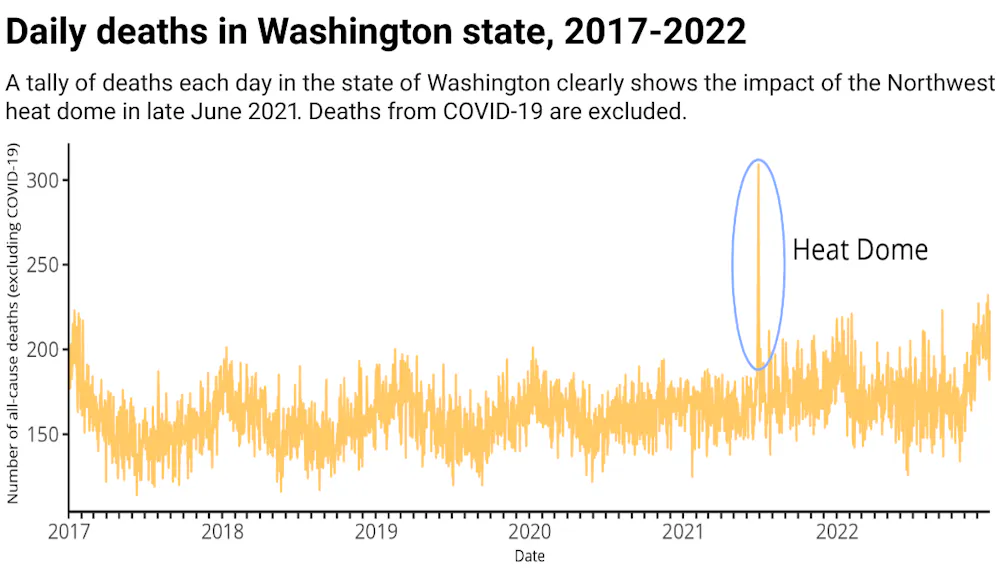
    A chart of all deaths, excluding COVID-19, shows the extraordinary impact the 2021 heat dome had in Washington.
    ‘In the Hot Seat’ report, 2022

    We were excited and relieved when the community was awarded a US$19.9 million grant from the Environmental Protection Agency to help it take concrete steps to adapt to climate change and boost the local economy in the process. The grant would help establish resilience hubs with microgrids and help residents without air conditioning install energy-efficient cooling systems. The city doesn’t have the means to make these improvements on its own, even if they would save lives and money in the long run.

    Less than a year later, the Trump administration abruptly terminated the funding.

    Spokane’s grant wasn’t the only one eliminated – about 350 similar grants that had been awarded to help communities across the country manage climate changes, from extreme heat and wildfire smoke to rising seas and flooding, were also terminated on the grounds that they don’t meet the White House’s priorities. Many other grants to help communities have also been terminated.

    Many of the communities that lost funding are like Spokane: They can’t afford to do this kind of work on their own.

    Why cities like Spokane need the help

    Like many communities in the American West, Spokane was founded in the late 19th century on wealth from railroads and resource extraction, especially gold, silver and timber.

    Today, it is a city of 230,000 in a metro area of a half-million people, the largest on the I-90 corridor between Minneapolis and Seattle. In many ways, Spokane could be on the cusp of a renaissance.

    In January 2025, the U.S. Department of Commerce announced a $48 million grant to develop a tech hub that could put the Inland Northwest on a path to become a global leader in advanced aerospace materials. But then, in May, the Trump administration rescinded that grant as well.

    The lost grants left the economy – and Spokane’s ability to adapt fast enough to keep up with climate changes – uncertain.

    Heat waves are becoming a growing risk in Spokane, known for its river and falls that tumble near downtown.
    Roman Eugeniusz/Wikimedia Commons, CC BY-SA

    This is not a wealthy area. The median household income is nearly $30,000 less than the state average. More than 13 out of every 100 people in Spokane live in poverty, above the national average, and over 67% of the children are eligible for free or reduced lunch.

    The city is a light blue island in a dark red sea, politically speaking, with a moderate mayor. Its congressional district has voted Republican by wide margins since 1995, the year that then-House Speaker Tom Foley lost his reelection bid.

    Lessons from the 2021 heat dome

    The 2021 heat wave was a catalyzing event for the community. The newly formed Gonzaga Institute for Climate, Water and the Environment brought together a coalition of government and community partners to apply for the EPA’s Climate and Environmental Justice Community Change Grant Program. The grants, funded by Congress under the Inflation Reduction Act of 2022, were intended to help communities most affected by pollution and climate change build adaptive capacity and boost the safety of their residents.

    A key lesson from the 2021 heat dome was that temporary, or pop-up, cooling centers don’t work well. People just weren’t showing up. Our research found that the best approach is to strengthen existing community facilities that people already turn to in moments of difficulty.

    Half the $19.9 million award was for outfitting five resilience hubs in existing libraries and community centers with solar arrays and battery backup microgrids, allowing them to continue providing a safe, cool space during a heat wave if the power shuts down.

    The locations and plans for five resilience hubs to serve Spokane, and the infrastructure they would receive.
    Gonzaga Institute for Climate, Water and the Environment

    Another $8 million in grant funding was meant to provide 300 low- to moderate-income homeowners with new high-efficiency electric heat pump heating, ventilation and air conditioning systems, providing more affordable utility bills while improving their ability to cool their homes and reducing fossil fuel emissions.

    Communities are left with few options

    Now, this and other work is at risk in Spokane and cities and towns like it around the country that also lost funding.

    According to the Trump administration, the program – designed to help hundreds of communities around the country become safer – was “no longer consistent with EPA funding priorities.”

    A class action lawsuit was recently filed over the termination of the grants by a coalition that includes Earth Justice and the Southern Environmental Law Center. If the case is successful, Spokane could see its funding restored.

    Meanwhile, the city and my team know we have to move fast, with whatever money and other resources we can find, to help Spokane prepare for worsening heat. We formed the Spokane Climate Resilience Collaborative – a partnership between community organizations, health officials and the city – as one way to advance planning for and responding to climate hazards such as extreme heat and wildfire smoke.

    As concentrations of heat-trapping gasses accumulate in the atmosphere, both the frequency and severity of heat waves increase. It is only a matter of time before another deadly heat dome arrives.

    Brian G. Henning receives funding from the Environmental Protection Agency.

    ref. My city was one of hundreds expecting federal funds to help manage rising heat wave risk – then EPA terminated the grants – https://theconversation.com/my-city-was-one-of-hundreds-expecting-federal-funds-to-help-manage-rising-heat-wave-risk-then-epa-terminated-the-grants-259009

    MIL OSI Analysis

  • MIL-OSI: Mid-Year 2025 Emerging Risks Survey Snapshot

    Source: GlobeNewswire (MIL-OSI)

    ARLINGTON, Va. and CHICAGO, July 09, 2025 (GLOBE NEWSWIRE) — The Casualty Actuarial Society (CAS) and the Society of Actuaries (SOA) jointly published findings from their May 2025 Mid-Year Flash Survey of U.S. risk managers. To keep current with the pace of change, this flash survey supplements the 18th Annual Emerging Risks Survey conducted in November 2024. The annual online questionnaire asks risk managers to rank current and emerging risks, and researchers track those rankings over time.

    Top current risks shifted between the November 2024 and May 2025 surveys. In May, risk managers chose financial volatility as a current risk 24.1% more often than in November, raising it to the top of the list. Globalization shift was chosen 7.4% more often, lifting this risk to the second spot. Wars (including civil wars) decreased by 11.2%, dropping it off the top five list. Technology risks also dropped significantly, while climate change remained in the top five current risks.

    Top Current Risks

    Rank November 2024 Survey Findings May 2025 Survey Findings
    1 Wars (including civil wars) Financial volatility
    2 Financial volatility Globalization shift
    3 Climate change Failed and failing states
    4 Failed and failing states Climate change
    5 Disruptive technologies Liability regimes and regulatory framework
         

    Though respondents’ concerns about current risks have changed significantly since November 2024, their views of emerging risks remain relatively stable. However, the mid-year survey did uncover changes in the perceptions of some emerging risks. For example, Wars (including civil wars) declined by 3.9% from the top of the emerging risk list to seventh and financial volatility rose by 4.2% from sixth to second.

    Top Emerging Risks

    Rank November 2024 Survey Findings May 2025 Survey Findings
    1 War (including civil wars) Disruptive technology
    2 Climate change (tied with War) Financial volatility
    3 Disruptive technology Climate change
    4 Cyber networks Cyber networks
    5 Demographic shift Demographic shift
         

    When asked about the most concerning risk scenarios, respondents listed economic slowdown most often, which is a significant change from previous years. On the other hand, the rate at which inflation was cited as a concern remains very similar to the previous surveys.

    “Since 2022, a mid-year flash survey has been done to offer different data points to capture risk managers’ perceptions of quickly changing environments,” said David Schraub, FSA, MAAA, CERA, CFA, and one of the report authors. “Also, a mid-year flash survey can mitigate the possibility of responses being overly influenced by recent events, a phenomenon also known as recency bias.”

    Survey Details
    Sponsored by the CAS and SOA, the May 2025 flash survey was an online questionnaire and included 150 participants. Respondents’ area of practice included life, property and casualty, and health insurance as well as pensions and risk management. The online questionnaire asked risk managers to rank current and emerging risks. The survey uses four categories to measure risks as perceived by risk managers: top current risk, top five emerging risks, top emerging risk and top emerging risk combinations.

    Read the key findings report for more details and graphs.

    About the Casualty Actuarial Society
    The Casualty Actuarial Society (CAS) is a leading international organization for credentialing, professional education and research. Founded in 1914, the CAS is the world’s only actuarial organization focused exclusively on property-casualty risks and serves over 10,000 members worldwide. CAS members are sought after globally for their insights and ability to apply analytics to solve insurance and risk management problems. Visit www.casact.org.

    About the Society of Actuaries
    With roots dating back to 1889, the Society of Actuaries (SOA) is the world’s largest actuarial professional organization with more than 32,000 actuaries as members. Through research and education, the SOA’s mission is to advance actuarial knowledge and enhance the ability of actuaries to provide expert advice and relevant solutions for financial, business and societal challenges. Visit www.soa.org.

    The MIL Network

  • MIL-OSI: Live Oak Bancshares, Inc. Announces Date of Second Quarter 2025 Financial Results

    Source: GlobeNewswire (MIL-OSI)

    WILMINGTON, N.C., July 09, 2025 (GLOBE NEWSWIRE) — Live Oak Bancshares, Inc. (NYSE: LOB) today announced that it will report its second quarter 2025 financial results after U.S. financial markets close on Wednesday, July 23, 2025.

    In conjunction with this announcement, Live Oak will host a conference call to discuss the company’s financial results and business outlook on Thursday, July 24, 2025, at 9:00 a.m. ET.

    The call will be accessible by telephone and webcast using Conference ID: 25229. A supplementary slide presentation will be posted to the website prior to the event, and a replay will be available for 12 months following the event.

    The conference call details are as follows:

    Live Telephone Dial-In
    U.S.: 800.549.8228
    International: +1 646.564.2877
    Pass Code: None Required

    Live Webcast Log-In
    Webcast Link: investor.liveoakbank.com
    Registration: Name and Email Required
    Multi-Factor Code: Provided After Registration

    About Live Oak Bancshares
    Live Oak Bancshares, Inc. (NYSE: LOB) is a financial holding company and parent company of Live Oak Bank. Live Oak Bancshares and its subsidiaries partner with businesses that share a groundbreaking focus on service and technology to redefine banking. To learn more, visit liveoakbank.com

    Contacts:
    Walter J. Phifer | CFO
    910.202.6929

    Claire Parker | Investor Relations
    910.597.1592

    The MIL Network

  • MIL-OSI: Banzai Appoints Dean Ditto as Chief Financial Officer

    Source: GlobeNewswire (MIL-OSI)

    SEATTLE, July 09, 2025 (GLOBE NEWSWIRE) — Banzai International, Inc. (NASDAQ: BNZI) (“Banzai” or the “Company”), a leading marketing technology company that provides essential marketing and sales solutions, today announced the appointment of Dean Ditto, CPA, as Chief Financial Officer of the Company, effective July 14, 2025. Mr. Ditto replaces Interim Chief Financial Officer, Alvin Yip, who will continue with the Company in the role of Chief Accounting Officer.

    Dean Ditto has over 30 years’ experience as a strategic financial leader with a track record of implementing critical business initiatives that drive profitable growth at both public and private companies. Prior to joining Banzai, Mr. Ditto was Chief Financial Officer of Akerna Corp. a SaaS technology company where he led a corporate restructuring plan that produced cost savings of $6 million annually. Previously, he was CFO of Mydecine Innovations Group, Inc., a biotech and life sciences company, where he raised $40 million through public and private offerings to support drug and IP development and operations. As CFO of Sigue Corporation, a closely-held Fintech provider, Mr. Ditto worked to improve the business planning, budgeting and financial analysis processes. He has also served in financial leadership roles at OSI Systems, Dental Lab Holdings, KARL STORZ Endoscopy-America, Countrywide Home Loans, Giant Bicycle USA, and Ford Motor Company. Mr. Ditto holds a Bachelor of Arts in Economics and Management from Albion College, and holds a Master of Business Administration from the Kelley School of Business at Indiana University.

    “On behalf of our board and management team, I would like to welcome Dean to the position. We are privileged to have someone of his caliber and financial skill set serve as our CFO,” said Joe Davy, Founder and CEO of Banzai. “I would like to thank Alvin for his contribution in leading us to this inflection point, and welcome Dean’s capabilities in scaling public technology companies. His achievements as well as expertise in financial management of listed companies will make a significant addition to the strategic operation and development of Banzai going forward.”

    Mr. Ditto added, “I am excited to be appointed as CFO as we prepare Banzai for the future in a rapidly evolving market. I look forward to working with Joe, the executive team, and the finance team as we continue to execute on our strategic and financial priorities focused on value-added growth and our commitments to all shareholders.”

    About Banzai

    Banzai is a marketing technology company that provides AI-enabled marketing and sales solutions for businesses of all sizes. On a mission to help their customers grow, Banzai enables companies of all sizes to target, engage, and measure both new and existing customers more effectively. Banzai has over 90,000 customers including RBC, Dell Technologies, New York Life, Thermo Fisher Scientific, Thinkific, and ActiveCampaign. Learn more at www.banzai.io. For investors, please visit https://ir.banzai.io.

    Forward-Looking Statements

    This press release contains forward-looking statements within the meaning of the Private Securities Litigation Reform Act of 1995. Forward-looking statements often use words such as “believe,” “may,” “will,” “estimate,” “target,” “continue,” “anticipate,” “intend,” “expect,” “should,” “would,” “propose,” “plan,” “project,” “forecast,” “predict,” “potential,” “seek,” “future,” “outlook,” and similar variations and expressions. Forward-looking statements are those that do not relate strictly to historical or current facts. Examples of forward-looking statements may include, among others, statements regarding Banzai International, Inc.’s (the “Company’s”): future financial, business and operating performance and goals; annualized recurring revenue and customer retention; ongoing, future or ability to maintain or improve its financial position, cash flows, and liquidity and its expected financial needs; potential financing and ability to obtain financing; acquisition strategy and proposed acquisitions and, if completed, their potential success and financial contributions; strategy and strategic goals, including being able to capitalize on opportunities; expectations relating to the Company’s industry, outlook and market trends; total addressable market and serviceable addressable market and related projections; plans, strategies and expectations for retaining existing or acquiring new customers, increasing revenue and executing growth initiatives; and product areas of focus and additional products that may be sold in the future. Because forward-looking statements relate to the future, they are subject to inherent uncertainties, risks and changes in circumstances that are difficult to predict and many of which are outside of our control. Forward-looking statements are not guarantees of future performance, and our actual results of operations, financial condition and liquidity and development of the industry in which the Company operates may differ materially from those made in or suggested by the forward-looking statements. Therefore, investors should not rely on any of these forward-looking statements. Factors that may cause actual results to differ materially include changes in the markets in which the Company operates, customer demand, the financial markets, economic, business and regulatory and other factors, such as the Company’s ability to execute on its strategy. More detailed information about risk factors can be found in the Company’s Annual Report on Form 10-K and the Company’s Quarterly Reports on Form 10-Q under the heading “Risk Factors,” and in other reports filed by the Company, including reports on Form 8-K. The Company does not undertake any duty to update forward-looking statements after the date of this press release.

    Investor Relations
    Chris Tyson
    Executive Vice President
    MZ Group – MZ North America
    949-491-8235
    BNZI@mzgroup.us
    www.mzgroup.us

    Media
    Nancy Norton
    Chief Legal Officer, Banzai
    media@banzai.io

    The MIL Network

  • MIL-OSI: Willis Aviation Services Limited Announces Long-Term Base Maintenance Partnership with Jet2.com

    Source: GlobeNewswire (MIL-OSI)

    COCONUT CREEK, Fla., July 09, 2025 (GLOBE NEWSWIRE) — Willis Lease Finance Corporation (NASDAQ: WLFC) (“WLFC” or the “Company”), the leading lessor of commercial aircraft engines and global provider of aviation services, announced today that its subsidiary, Willis Aviation Services Limited (“WASL”), a premier provider of aircraft maintenance, repair and overhaul (“MRO”) services, has secured a commitment from leading leisure airline Jet2.com (“Jet2”) for two base maintenance lines for the upcoming season.

    This announcement follows the successful completion of a single maintenance line for Jet2 this year, highlighting the strong performance and capabilities of the WASL delivery team in Teesside. Building on that success, Jet2 has expanded its commitment by adding a second maintenance line. Both lines will be carried out at WASL’s new state-of-the-art facility located at Teesside International Airport in Northeast England.

    As aircraft maintenance services remain in high demand across the UK and Europe, WASL’s recently announced expansion plans at Teesside add essential capacity to the UK MRO sector to perform heavy maintenance checks, transitional activity and paint for airlines and lessors globally. Further, the new Teesside facility is expected to create a significant number of new highly skilled jobs and contribute to the pipeline of talent that supports both immediate operational needs and long-term skill development in the region.

    “We are thrilled to continue our work supporting Jet2’s fleet at our expanding Teesside facility,” said Austin C. Willis, WLFC’s Chief Executive Officer. “Our investment in Teesside enables WASL to deliver essential services for airlines including Jet2 and reflects our commitment to driving local economic growth and creating skilled jobs in the UK aerospace industry.”

    “We are pleased with WASL’s engagement and performance with its base maintenance services for our fleet as we uphold the highest standards of safety, operational excellence and reliability for our customers,” said Chris Hubbard, Director of Engineering & Maintenance at Jet2.com. “We look forward to continuing our partnership with WASL in the 2025 and 2026 season.”

    Willis Lease Finance Corporation

    Willis Lease Finance Corporation (“WLFC”) leases large and regional spare commercial aircraft engines, auxiliary power units and aircraft to airlines, aircraft engine manufacturers and maintenance, repair, and overhaul providers worldwide. These leasing activities are integrated with engine and aircraft trading, engine lease pools and asset management services through Willis Asset Management Limited, as well as various end-of-life solutions for engines and aviation materials provided through Willis Aeronautical Services, Inc. Through Willis Engine Repair Center®, Jet Centre by Willis, and Willis Aviation Services Limited, the Company’s service offerings include Part 145 engine maintenance, aircraft line and base maintenance, aircraft disassembly, parking and storage, airport FBO and ground and cargo handling services. Willis Sustainable Fuels intends to develop, build and operate projects to help decarbonize aviation.

    Except for historical information, the matters discussed in this press release contain forward-looking statements that involve risks and uncertainties. Do not unduly rely on forward-looking statements, which give only expectations about the future and are not guarantees. Forward-looking statements speak only as of the date they are made, and we undertake no obligation to update them to reflect any change in the Company’s expectations or any change in events, conditions or circumstances on which the forward-looking statement is based, except as required by law. Our actual results may differ materially from the results discussed in forward-looking statements. Factors that might cause such a difference include, but are not limited to: the effects on the airline industry and the global economy of events such as war, terrorist activity and the COVID-19 pandemic; changes in oil prices, rising inflation and other disruptions to world markets; trends in the airline industry and our ability to capitalize on those trends, including growth rates of markets and other economic factors; risks associated with owning and leasing jet engines and aircraft; our ability to successfully negotiate equipment purchases, sales and leases, to collect outstanding amounts due and to control costs and expenses; changes in interest rates and availability of capital, both to us and our customers; our ability to continue to meet changing customer demands; regulatory changes affecting airline operations, aircraft maintenance, accounting standards and taxes; the market value of engines and other assets in our portfolio; and risks detailed in the Company’s Annual Report on Form 10-K and other continuing  and current reports filed with the Securities and Exchange Commission. It is advisable, however, to consult any further disclosures the Company makes on related subjects in such filings. These statements constitute the Company’s cautionary statements under the Private Securities Litigation Reform Act of 1995.

     CONTACT: Lynn Mailliard Kohler
      Director, Global Corporate Communications
      (415) 328-4798

    The MIL Network

  • MIL-OSI: Little Pepe Surges Past $4.5M as Stage 4 Presale Ends Successfully and Stage 5 Begins

    Source: GlobeNewswire (MIL-OSI)

    DUBAI, United Arab Emirates, July 09, 2025 (GLOBE NEWSWIRE) — Little Pepe ($LILPEPE) continues to make waves in the crypto market, officially closing Stage 4 of its presale with a remarkable $4.5 million raised in total. With each stage gaining more traction than the last, the project has now entered Stage 5, pricing its native token at $0.0014.

    The latest milestone makes Little Pepe’s position as one of the most talked-about meme coins of 2025—one that’s backed by real technological innovation.

    Little Pepe — A Meme Coin with Real Tech Power

    Little Pepe is redefining what a meme coin may be by blending cultural hype with serious blockchain generation. At the heart of the project is the Little Pepe Chain, a custom-constructed, Ethereum-based Layer 2 community engineered for speed, scalability, and low costs. This infrastructure allows both customers and investors to transact at high volumes without being laid low with the delays and high gas fees that regularly plague Ethereum’s mainnet.

    By integrating a lightning-speedy EVM Layer 2 protocol, Little Pepe positions itself as greater than only a viral sensation—it turns into a next-generation meme coin built to serve the evolving needs of crypto in 2025. It captures the energy of the meme culture while providing real, scalable infrastructure that helps long-term utility and adoption.

    LILPEPE Ecosystem

    Fueling the ecosystem is the $LILPEPE token, an ERC-20 asset that powers every transaction on the Little Pepe Chain. It’s the utility token at the heart of the project—responsible for gas fees, network operations, and the growing economic activity tied to the Little Pepe movement. With each presale round, demand for the token increases, supported by strong community growth and rising interest from retail investors.

    As Little Pepe continues to expand its presence across social platforms, $LILPEPE is evolving into more than a meme—it’s becoming a recognized asset with long-term potential.

    Stage 5 Now Live at $0.0014

    Following the successful completion of Stage 4, the Stage 5 of the $LILPEPE presale is now officially going on. Priced at $0.0014, $LILPEPE is available exclusively through the official website: littlepepe.com. With earlier phases filling rapidly, many investors are moving quickly to secure their allocation before the next price jump.

    Each presale stage marks a strategic step forward in the project’s roadmap, increasing not only token value but also anticipation for future exchange listings and ecosystem development.

    The Rise of Meme Coins with Utility

    In 2025, meme coins are entering a new phase—one where community appeal must be matched by real-world utility and scalability. Little Pepe exemplifies this evolution. By blending cultural branding with a fully operational Layer 2 blockchain, it stands out as a project that delivers on both hype and infrastructure. As other tokens fade after initial virality, $LILPEPE is building the tools and foundations to remain relevant far beyond its presale stages.

    With $4.5 million raised, a live Stage 5 presale, and an innovative EVM Layer 2 backbone, Little Pepe is proving it’s more than just another meme coin. It’s a high-potential crypto ecosystem built for today’s demands and tomorrow’s growth. As the presale continues, early adopters have a rare opportunity to be part of what could be the most iconic meme coin launch of the year.

    About Little Pepe

    Little Pepe is a next-gen Layer 2 blockchain designed to merge meme culture with high-speed, low-cost decentralized infrastructure. Built for scalability, security, and accessibility, Little Pepe supports EVM-compatible applications and is powered by means of the $LILPEPE token. The project’s mission is to create a meme coin environment wherein utility meets virality, empowering users through cutting-edge technology and lightning-fast transactions.

    For more information:
    Website: https://littlepepe.com/
    Telegram: https://t.me/littlepepetoken
    Twitter: https://x.com/littlepepetoken

    Contact Details: COO- James Stephen Email: media@littlepepe.com

    Disclaimer: This content is provided by Little Pepe. The statements, views, and opinions expressed in this content are solely those of the content provider and do not necessarily reflect the views of this media platform or its publisher. We do not endorse, verify, or guarantee the accuracy, completeness, or reliability of any information presented. We do not guarantee any claims, statements, or promises made in this article. This content is for informational purposes only and should not be considered financial, investment, or trading advice.Investing in crypto and mining-related opportunities involves significant risks, including the potential loss of capital. It is possible to lose all your capital. These products may not be suitable for everyone, and you should ensure that you understand the risks involved. Seek independent advice if necessary. Speculate only with funds that you can afford to lose. Readers are strongly encouraged to conduct their own research and consult with a qualified financial advisor before making any investment decisions. However, due to the inherently speculative nature of the blockchain sector—including cryptocurrency, NFTs, and mining—complete accuracy cannot always be guaranteed.Neither the media platform nor the publisher shall be held responsible for any fraudulent activities, misrepresentations, or financial losses arising from the content of this press release. In the event of any legal claims or charges against this article, we accept no liability or responsibility.Globenewswire does not endorse any content on this page.

    Legal Disclaimer: This media platform provides the content of this article on an “as-is” basis, without any warranties or representations of any kind, express or implied. We assume no responsibility for any inaccuracies, errors, or omissions. We do not assume any responsibility or liability for the accuracy, content, images, videos, licenses, completeness, legality, or reliability of the information presented herein. Any concerns, complaints, or copyright issues related to this article should be directed to the content provider mentioned above.

    A photo accompanying this announcement is available at https://www.globenewswire.com/NewsRoom/AttachmentNg/b64e458b-ff9e-43ae-a170-9b19ffb4096b

    The MIL Network

  • MIL-OSI United Kingdom: Greens join protest to shut down Glasgow company shipping gas for Russia

    Source: Scottish Greens

    Putin’s enablers are not welcome in Scotland.

    Scottish Green MSP Ross Greer has joined members of the Ukrainian community in Scotland and the Ukraine Solidarity Campaign at a protest outside the Glasgow HQ of shipping company Seapeak, over their role in helping Russia to export gas despite the sanctions placed on it over Putin’s illegal invasion of Ukraine.

    Seapeak has been found to still ship over $5.5 billion of Russian Liquefied Natural Gas (LNG) each year.

    Ross Greer will be speaking at the rally in Glasgow today. He has previously demanded that the UK Government sanction Seapeak, but Labour Ministers have so far refused to take action. 

    Ross said:

    “It is appalling that the UK Labour government refuses to shut Seapeak down. People across Scotland are horrified when they learn that a company based here continues to fund Russia’s war machine. For as long as Seapeak remains untouched from sanctions, they will continue to ship gas out of Russia, throwing a lifeline to Putin’s war economy as a result.”

    In 2022, Ross was sanctioned by the Russian government for his work in solidarity with Ukraine. 

    Ross said:

    “Earlier this year, I wrote to UK Ministers, demanding that they shut down Seapeak’s UK operations. Despite the overwhelming evidence shared with them, they would not take action. They continue to allow Russia to profit from shipping operations here in the UK whilst claiming to stand with Ukraine.

    “Tens of thousands of Ukrainians have been killed and much of their country is left in ruins from Putin’s illegal invasion. If we were in Ukraine’s position, we would rightly be furious that our so-called allies were allowing complicit businesses like Seapeak to stay open. It is time to end this scandal and prove that Putin’s enablers are not welcome in Scotland.”

    MIL OSI United Kingdom

  • MIL-OSI Russia: Qingdao hosts first SCO conference on cooperation in standardization

    Translation. Region: Russian Federal

    Source: People’s Republic of China in Russian – People’s Republic of China in Russian –

    An important disclaimer is at the bottom of this article.

    Source: People’s Republic of China – State Council News

    QINGDAO, July 9 (Xinhua) — The first conference of the Shanghai Cooperation Organization (SCO) on standardization cooperation was held in Qingdao, east China’s Shandong Province, on Tuesday, marking the establishment of the first standardization cooperation mechanism within the SCO to provide institutional guarantees for such cooperation within the organization.

    The event was jointly initiated by the State Administration for Market Regulation of the People’s Republic of China and the Russian Federal Agency for Technical Regulation and Metrology (Rosstandart).

    The conference participants held an in-depth exchange of views on the creation of a mechanism for cooperation in the field of standardization within the SCO, strengthening cooperation on standardization in key areas, creating an information platform on standardization and building capacity in this area.

    Following the event, the Qingdao Initiative was adopted to strengthen cooperation between national standardization bodies of the SCO member states.

    As experts point out, the conference will help to build an information platform for SCO member states on standardization, facilitate the creation of working groups on cooperation in the field of technical standards in key areas, promote cooperation on standardization within the SCO in such important areas as artificial intelligence and low-altitude economics, and facilitate the alignment of standards between the countries of the organization. -0-

    Please note: This information is raw content obtained directly from the source of the information. It is an accurate report of what the source claims and does not necessarily reflect the position of MIL-OSI or its clients.

    .

    MIL OSI Russia News

  • MIL-OSI Asia-Pac: FS continues visit to Seoul, Korea (with photos)

    Source: Hong Kong Government special administrative region

    The Financial Secretary, Mr Paul Chan, continued his visit to Seoul, Korea, today (July 9). He attended a seminar on the development of capital markets in Hong Kong and Korea, as well as a business luncheon cohosted by the Hong Kong Economic and Trade Office (Tokyo) and the Korea Chamber of Commerce and Industry. He also held several meetings respectively with the Chairman of the Financial Services Commission of Korea, Mr Kim Byung-hwan, and leaders in the investment sector to exchange views on the landscapes and developments of the financial markets and investment circles, and to promote further collaboration between the two markets.

    In the morning, Mr Chan attended and delivered a keynote speech at the Hong Kong-Korea Capital Markets Conference, organised by CSOP Asset Management. Conference participants included the Chairman of the Korea Financial Investment Association, Mr Seo Yoo-seok, as well as representatives from local pension funds, insurance companies, brokerage firms and other institutional investors and financial institutions.

    MIL OSI Asia Pacific News

  • MIL-OSI USA: Governor Newsom deploys firefighter strike team to support Oregon wildfire response

    Source: US State of California 2

    Jul 8, 2025

    SACRAMENTO — As wildfire conditions intensify across the Pacific Northwest, Governor Newsom has directed the deployment of a CAL FIRE Type 3 engine strike team to assist firefighting efforts in southern Oregon. The deployment includes five fire engines and a strike team leader who will join suppression operations just north of the California–Oregon border.

    “Just as Oregon supported our state during the Los Angeles firestorms, we’re glad to support our Northern neighbors with strike teams and fire engines to aid in their wildfire response efforts. I’m proud California can lend a helping hand to fellow Americans in their time of need.” 

    Governor Gavin Newsom

    CAL FIRE engines being sent to support wildfire suppression in Oregon

    This mobilization comes in response to a significant lightning event that ignited numerous wildfires across the region. Southern Oregon has experienced more than 2,000 lightning strikes in recent days, compounded by high temperatures and gusty winds. The National Weather Service has issued Red Flag Warnings through July 8 for much of southern and central Oregon, signaling elevated fire danger and the need for immediate firefighting reinforcements.

    Upon arrival in Medford, CAL FIRE resources will seamlessly integrate into Oregon’s Department of Forestry command structure to support suppression efforts on active fires. This response is part of a long-standing interstate mutual aid agreement that strengthens wildfire readiness across the western United States.

    California remains prepared to send additional resources should conditions escalate.

    “We stand with Oregon during this critical time, just as they’ve stood with us during some of California’s toughest fire seasons,” said Anale Burlew, Chief Deputy Director of CAL FIRE. “These mutual aid partnerships are built on trust, coordination, and a shared commitment to public safety.”

    Press releases, Recent news

    Recent news

    News What you need to know: The $101 million being made available today will support the development of affordable multifamily rental housing in Los Angeles, prioritizing the needs of displaced residents in the fire-devastated regions. Los Angeles, California – Six…

    News SACRAMENTO – Governor Gavin Newsom today announced the deployment of an additional 18 highly skilled Urban Search and Rescue Team members to Texas to assist with ongoing response efforts related to severe flooding impacts.The deployment includes a total of four…

    News Perris, California — On June 18, 2025, the First Partner visited the Inland Empire to meet with California communities impacted by the Trump Administration’s federal immigration raids. The First Partner visited TODEC, a local nonprofit organization that’s become…

    Jul 8, 2025

    What you need to know: The passage of Proposition 1 by California voters adds rocket fuel to Governor Gavin Newsom’s transformational overhaul of the state’s behavioral health system. These reforms refocus existing funds to prioritize Californians with the most serious mental health and substance use issues, who are too often experiencing homelessness. They also fund more than 11,150 new behavioral health beds and supportive housing units and 26,700 outpatient treatment slots.

    Los Angeles, California – California took a major step forward in correcting the damage from 50 years of neglect to the state’s mental health system with the passage of Proposition 1. This historic measure — a signature priority of Governor Gavin Newsom — adds rocket fuel to California’s overhaul of the state’s behavioral health systems. It provides a full range of mental health and substance abuse care, with new accountability metrics to ensure local governments deliver for their communities.

    This is the biggest reform of the California mental health system in decades and will finally equip partners to deliver the results all Californians need and deserve. Treatment centers will prioritize mental health and substance use support in the community like never before. Now, it’s time to roll up our sleeves and begin implementing this critical reform – working closely with city and county leaders to ensure we see results.

    Governor Gavin Newsom

    newsom-news-template
    IMG_3682-min
    contact-governor-landing
    workers-FxAJ5fkakAAtVI3
    priorities-and-progress-image
    economy-F-isBKpbsAAxdab
    gun-violence-San Diego Guns Package 2.18.22_2

    What they’re saying: 

    • Sacramento Mayor Darrell Steinberg, original author of the Mental Health Services Act: “Twenty years ago, I never could have dreamed that we would have the strong leadership we have today, committing billions and making courageous policy changes that question the conventional wisdom on mental health. Now, with the passage of Proposition 1. California is delivering on decades old promises to help people living with brain-based illnesses, to live better lives, to live independently and to live with dignity in our communities. This is a historic moment and the hard work is ahead of us.“
    • Senator Susan Eggman (D-Stockton), author of Senate Bill 326: “Today marks a day of hope for thousands of Californians who are struggling with mental illness – many of whom are living unhoused. I am tremendously grateful to my fellow Californian’s for passing this important measure.  And I am very appreciative of this Governor’s leadership to transform our behavioral health care system!”
    • Assemblymember Jacqui Irwin (D-Thousand Oaks), author of Assembly Bill 531: “This started as an audacious proposal to address the root cause of homelessness and today, Californians can be proud to know that they did the right thing by passing Proposition 1. Now, it’s time for all of us to get to work, and make sure these reforms are implemented and that we see results.”

    Bigger picture: Transforming the Mental Health Services Act into the Behavioral Health Services Act and building more community mental health treatment sites and supportive housing is the last main pillar of Governor Newsom’s Mental Health Movement – pulling together significant recent reforms like 988 crisis line, CalHOPE, CARE Court, conservatorship reform, CalAIM behavioral health expansion (including mobile crisis care and telehealth), Medi-Cal expansion to all low-income Californians, Children and Youth Behavioral Health Initiative (including expanding services in schools and on-line), Older Adult Behavioral Health Initiative, Veterans Mental Health Initiative, Behavioral Health Community Infrastructure Program, Behavioral Health Bridge Housing, Health Care Workforce for All and more.

    More details on next step here

    Press releases, Recent news

    Recent news

    News What you need to know: The $101 million being made available today will support the development of affordable multifamily rental housing in Los Angeles, prioritizing the needs of displaced residents in the fire-devastated regions. Los Angeles, California – Six…

    News SACRAMENTO – Governor Gavin Newsom today announced the deployment of an additional 18 highly skilled Urban Search and Rescue Team members to Texas to assist with ongoing response efforts related to severe flooding impacts.The deployment includes a total of four…

    News Perris, California — On June 18, 2025, the First Partner visited the Inland Empire to meet with California communities impacted by the Trump Administration’s federal immigration raids. The First Partner visited TODEC, a local nonprofit organization that’s become…

    Jul 8, 2025

    What you need to know: The passage of Proposition 1 by California voters adds rocket fuel to Governor Gavin Newsom’s transformational overhaul of the state’s behavioral health system. These reforms refocus existing funds to prioritize Californians with the most serious mental health and substance use issues, who are too often experiencing homelessness. They also fund more than 11,150 new behavioral health beds and supportive housing units and 26,700 outpatient treatment slots.

    Los Angeles, California – California took a major step forward in correcting the damage from 50 years of neglect to the state’s mental health system with the passage of Proposition 1. This historic measure — a signature priority of Governor Gavin Newsom — adds rocket fuel to California’s overhaul of the state’s behavioral health systems. It provides a full range of mental health and substance abuse care, with new accountability metrics to ensure local governments deliver for their communities.

    This is the biggest reform of the California mental health system in decades and will finally equip partners to deliver the results all Californians need and deserve. Treatment centers will prioritize mental health and substance use support in the community like never before. Now, it’s time to roll up our sleeves and begin implementing this critical reform – working closely with city and county leaders to ensure we see results.

    Governor Gavin Newsom

    newsom-news-template
    IMG_3682-min
    contact-governor-landing
    workers-FxAJ5fkakAAtVI3
    priorities-and-progress-image
    economy-F-isBKpbsAAxdab
    gun-violence-San Diego Guns Package 2.18.22_2

    What they’re saying: 

    • Sacramento Mayor Darrell Steinberg, original author of the Mental Health Services Act: “Twenty years ago, I never could have dreamed that we would have the strong leadership we have today, committing billions and making courageous policy changes that question the conventional wisdom on mental health. Now, with the passage of Proposition 1. California is delivering on decades old promises to help people living with brain-based illnesses, to live better lives, to live independently and to live with dignity in our communities. This is a historic moment and the hard work is ahead of us.“
    • Senator Susan Eggman (D-Stockton), author of Senate Bill 326: “Today marks a day of hope for thousands of Californians who are struggling with mental illness – many of whom are living unhoused. I am tremendously grateful to my fellow Californian’s for passing this important measure.  And I am very appreciative of this Governor’s leadership to transform our behavioral health care system!”
    • Assemblymember Jacqui Irwin (D-Thousand Oaks), author of Assembly Bill 531: “This started as an audacious proposal to address the root cause of homelessness and today, Californians can be proud to know that they did the right thing by passing Proposition 1. Now, it’s time for all of us to get to work, and make sure these reforms are implemented and that we see results.”

    Bigger picture: Transforming the Mental Health Services Act into the Behavioral Health Services Act and building more community mental health treatment sites and supportive housing is the last main pillar of Governor Newsom’s Mental Health Movement – pulling together significant recent reforms like 988 crisis line, CalHOPE, CARE Court, conservatorship reform, CalAIM behavioral health expansion (including mobile crisis care and telehealth), Medi-Cal expansion to all low-income Californians, Children and Youth Behavioral Health Initiative (including expanding services in schools and on-line), Older Adult Behavioral Health Initiative, Veterans Mental Health Initiative, Behavioral Health Community Infrastructure Program, Behavioral Health Bridge Housing, Health Care Workforce for All and more.

    More details on next step here

    Press releases, Recent news

    Recent news

    News What you need to know: The $101 million being made available today will support the development of affordable multifamily rental housing in Los Angeles, prioritizing the needs of displaced residents in the fire-devastated regions. Los Angeles, California – Six…

    News SACRAMENTO – Governor Gavin Newsom today announced the deployment of an additional 18 highly skilled Urban Search and Rescue Team members to Texas to assist with ongoing response efforts related to severe flooding impacts.The deployment includes a total of four…

    News Perris, California — On June 18, 2025, the First Partner visited the Inland Empire to meet with California communities impacted by the Trump Administration’s federal immigration raids. The First Partner visited TODEC, a local nonprofit organization that’s become…

    MIL OSI USA News

  • MIL-OSI USA: Governor Newsom commits $101 million to jumpstart critical rebuilding efforts after LA Fires

    Source: US State of California 2

    Jul 8, 2025

    What you need to know: The $101 million being made available today will support the development of affordable multifamily rental housing in Los Angeles, prioritizing the needs of displaced residents in the fire-devastated regions.

    Los Angeles, California – Six months after the LA Fires, Governor Gavin Newsom and the California Department of Housing and Community Development (HCD) announced the release of $101 million to help rapidly rebuild critically needed, affordable multifamily rental housing in the fire-devastated Los Angeles region. Thousands of families are still displaced by the wildfires that raged through the Greater Los Angeles Region in January 2025, placing an incredible strain on an already tight rental market.

    Tomiquia Moss, Secretary of the California Business, Consumer Services and Housing Agency: “The State’s special Multifamily Finance Super NOFA will galvanize the collective public-private response to the wildfires in Los Angeles County, expediting and expanding opportunities to build affordable housing for low-income residents. By prioritizing affordable housing projects that are ready to go, these funds will accelerate household stability, climate and health outcomes in communities.”

    Today’s funding

    HCD’s Multifamily Finance Super NOFA (MFSN) allows affordable housing developers to apply to multiple funding programs through a single application. In February 2025, HCD released a MFSN Notice of Funding Availability (NOFA) announcing $382 million available for development of affordable multifamily rental housing statewide. A separate $50 million Tribal MFSN was released in March 2025.

    The special MFSN NOFA announced today (MFSN-LA Disaster) provides an additional $101 million in funding to support recovery and rebuilding efforts from 2025 wildfires within Los Angeles County. This MFSN-LA Disaster NOFA has been designed to meet the immediate housing needs of disaster-impacted areas and residents in Los Angeles as quickly as possible by prioritizing projects that are: close to wildfire burn areas; ready to begin construction immediately upon award; and include a resident preference for households displaced by the Los Angeles County wildfires.

    HCD Director Gustavo Velasquez: “HCD has taken a program built on efficiency and further refined it specifically to help the Los Angeles region rebuild from unimaginable tragedy. Our team has gone above and beyond to ensure this program is designed to provide housing stability for fire-displaced families as quickly as possible.”

    This MFSN-LA Disaster NOFA provides a two-phase award process to accelerate the delivery of affordable housing. If funds remain after all applications for shovel-ready projects have been assessed, applications will continue to be accepted for all eligible projects until the funds are expended.

    Funding available through this MFSN-LA Disaster NOFA includes grants for the infrastructure needed to facilitate housing development with a focus on disaster resilience and mitigation, low-interest loans for the development of new multifamily units affordable to low-income and very low-income households, and operating subsidy reserves to support the long-term financial feasibility of the projects. All projects will be required to remain affordable for at least 55 years.

    Multifamily Finance Super NOFA (MFSN)

    This year marks the third round of MFSN, which provides applicants the opportunity to apply simultaneously for a combination of awards from the Multifamily Housing Program (MHP), Supportive Housing MHP, Infill Infrastructure Grant Program, Transit-Oriented Development Program, and Veterans Housing and Homelessness Prevention Program. This is the first MFSN round to offer capitalized operating subsidy reserve funding through MHP to support operations.   

    MFSN makes funds more accessible to developers (including emerging and community-based developers), enables the funding to further serve the lowest-income Californians, and increases the range of potential applicants and target populations to achieve better outcomes in health, climate, and household stability.

    Application materials for MFSN-LA Disaster will be available July 21, 2025. Applicants applying for the first phase of funding must upload all required application documents to the HCD website no later than August 21, 2025, at 4:00 p.m. PDT.

    For more information, including webinars and workshops, please visit HCD’s Multifamily Finance Super NOFA webpage.

    Historic fire recovery 

    Today’s announcement builds on Governor Newsom’s broader efforts to cut red tape and expedite the rebuilding of homes and businesses to support disaster survivors.

    Yesterday, the governor announced the substantial completion of the public debris removal program from more than 10,000 fire damaged parcels — marking the fastest major disaster cleanup in American history. The Governor also signed an executive order removing more barriers to rebuilding homes and schools. He also joined local officials to unveil a new blueprint for recovery, a step-by-step plan to accelerate rebuilding and provide support to impacted families and communities. The near-completion of the public debris removal program comes months ahead of schedule.

    Recent news

    News SACRAMENTO – Governor Gavin Newsom today announced the deployment of an additional 18 highly skilled Urban Search and Rescue Team members to Texas to assist with ongoing response efforts related to severe flooding impacts.The deployment includes a total of four…

    News Perris, California — On June 18, 2025, the First Partner visited the Inland Empire to meet with California communities impacted by the Trump Administration’s federal immigration raids. The First Partner visited TODEC, a local nonprofit organization that’s become…

    News SACRAMENTO – Governor Gavin Newsom today announced the deployment of skilled Urban Search and Rescue Team members to Texas to assist with ongoing response efforts related to severe flooding impacts. “California stands with all those who have lost loved ones,…

    MIL OSI USA News

  • SEBI bars Jane Street over alleged Bank Nifty manipulation

    Source: Government of India

    Source: Government of India (4)

    Jane Street has been barred from the Indian securities market by its markets regulator, which has said the U.S. firm used its trading strategies to “manipulate” a key stock market index, leading to losses for millions of retail investors, allegations Jane Street has rejected.

    WHAT EXACTLY IS SEBI ACCUSING JANE STREET OF DOING?

    The Securities and Exchange Board of India (SEBI) in its interim order said Jane Street accumulated large volumes of constituent stocks of the Bank Nifty index, which comprises the 12 top Indian bank stocks, in the cash and futures markets, thus pushing up the index prices.

    Simultaneously, Jane Street took short positions in the derivatives segment by buying cheap “put” options and selling expensive “call” options linked to the Bank Nifty, the regulator said.

    The SEBI order said that during the second half of most days in which Jane Street’s positions were studied, the U.S. firm reversed the first leg of its trade, selling the constituents in the cash and futures markets, thereby pushing down the price of the index and its constituents.

    This, in turn, led to a rise in value for the “put” options and a drop in value for “call” options, earning Jane Street large profits, which outweighed any losses that were incurred during the first leg of the trade.

    SEBI said this trading pattern created “a false or misleading appearance of market activity” and attracted “unsuspecting” investors to trade at levels that were “artificial and temporary”.

    WHAT IS JANE STREET SAYING ABOUT ITS INDIA TRADING STRATEGY?

    Jane Street, in an internal email to its employees, said the activities in question were what is known as an “arbitrage trade”, which is commonly used by large trading firms in financial markets.

    In an arbitrage trade, firms simultaneously buy and sell the same asset in different markets and pocket the profits from the difference in prices.

    In its internal memo, Jane Street argued there was a large gap between the price of the Bank Nifty index in the options markets and the price implied by the level at which the stocks were trading. This divergence, it said, was clearly observed and Jane Street traded in a direction consistent with closing that gap.

    Arbitrage trading is legal in India.

    WHAT FACTORS WERE CRUCIAL TO JANE STREET’S INDIA STRATEGY?

    According to details in the SEBI order, the first is size.

    In the first leg of the trade, where Jane Street was buying shares of constituents of the Bank Nifty Index, it was doing so in volumes large enough to move the index.

    Its trades made up 15%-25% of the entire market’s traded value in the constituents of the banking index, SEBI said.

    The second is the distortions between the cash and derivative markets in India.

    India’s derivatives-to-cash market ratio in terms of volume is the highest in the world, SEBI said. In 2024, this ratio was 400 times.

    In its order, SEBI highlighted Jane Street’s trading activities on January 17, 2024 – one of the trading days under investigation – saying the U.S. firm traded roughly $1.2 trillion (103 trillion rupees) worth of cash-settled options on the Nifty Bank index.

    That amount equates to roughly 353 times the trading volumes of the bank stocks in the index.

    WHO ARE THE LOSERS IN INDIA’S DERIVATIVES MARKET?

    Proprietary trading giants such as Jane Street have made hefty profits from India’s derivatives market, which accounts for roughly 61% of equity options contracts that are currently traded worldwide, according to data from the Futures Industry Association.

    In the 12 months to March 2024, proprietary traders and foreign investors made gross profits of 330 billion rupees and 280 billion rupees, respectively, a SEBI study in September 2024 showed.

    During that same period, retail traders lost 524 billion rupees.

    On Monday, SEBI said retail investor losses on derivative trades widened by 41% to 1.06 trillion rupees in the subsequent year. It did not blame proprietary traders for the widening losses of retail investors and nor did it provide fresh data on gains made by proprietary traders.

    WHAT ARE THE NEXT STEPS FOR JANE STREET AND SEBI?

    SEBI has seized $567 million of Jane Street’s funds, equivalent to the amount of what it calls “unlawful gains”.

    The U.S. firm can deposit that amount and regain access to the Indian markets. It also has 21 days to file its reply or any objections to the order, and can also challenge the order judicially via the Securities Appellate Tribunal.

    SEBI, meanwhile, is working on a final order and also expanding its investigation into Jane Street’s trade on indexes other than the Bank Nifty.

    -Reuters

  • MIL-OSI: YieldMax® ETFs Announces Distributions on ULTY, TSLY, LFGY, CRSH, YMAX, and Others

    Source: GlobeNewswire (MIL-OSI)

    CHICAGO and MILWAUKEE and NEW YORK, July 09, 2025 (GLOBE NEWSWIRE) — YieldMax® today announced distributions for the YieldMax® Weekly Payers and Group A ETFs listed in the table below.

    ETF Ticker1 ETF Name Distribution
    Frequency
    Distribution
    per Share
    Distribution
    Rate
    2,4
    30-Day
    SEC Yield3
    ROC5 Ex-Date &
    Record
    Date
    Payment
    Date
    CHPY YieldMax® Semiconductor Portfolio Option Income ETF Weekly $0.3488 32.97% 0.04% 100.00% 7/10/25 7/11/25
    GPTY YieldMax® AI & Tech Portfolio Option Income ETF Weekly $0.2952 32.61% 0.00% 100.00% 7/10/25 7/11/25
    LFGY YieldMax® Crypto Industry & Tech Portfolio Option Income ETF Weekly $0.4817 63.13% 0.00% 100.00% 7/10/25 7/11/25
    QDTY YieldMax® Nasdaq 100 0DTE Covered Call ETF Weekly $0.1909 22.51% 0.00% 100.00% 7/10/25 7/11/25
    RDTY YieldMax® R2000 0DTE Covered Call ETF Weekly $0.3040 34.13% 1.65% 100.00% 7/10/25 7/11/25
    SDTY YieldMax® S&P 500 0DTE Covered Call ETF Weekly $0.1398 16.22% 0.07% 100.00% 7/10/25 7/11/25
    ULTY YieldMax® Ultra Option Income Strategy ETF Weekly $0.0960 80.35% 0.00% 100.00% 7/10/25 7/11/25
    YMAG YieldMax® Magnificent 7 Fund of Option Income ETFs Weekly $0.1263 43.26% 63.17% 90.54% 7/10/25 7/11/25
    YMAX YieldMax® Universe Fund of Option Income ETFs Weekly $0.1347 51.13% 82.40% 95.41% 7/10/25 7/11/25
    BRKC YieldMax® BRK.B Option Income Strategy ETF Every 4
    weeks
    $0.5029 –  –  35.53% 7/10/25 7/11/25
    CRSH YieldMax® Short TSLA Option Income Strategy ETF Every 4
    weeks
    $0.2156 56.91% 3.08% 91.57% 7/10/25 7/11/25
    FEAT YieldMax® Dorsey Wright Featured 5 Income ETF Every 4
    weeks
    $1.4445 50.97% 52.99% 0.00% 7/10/25 7/11/25
    FIVY YieldMax® Dorsey Wright Hybrid 5 Income ETF Every 4
    weeks
    $1.0277 33.52% 35.26% 0.00% 7/10/25 7/11/25
    GOOY YieldMax® GOOGL Option Income Strategy ETF Every 4
    weeks
    $0.3077 33.16% 3.29% 0.00% 7/10/25 7/11/25
    OARK YieldMax® Innovation Option Income Strategy ETF Every 4
    weeks
    $0.3439 50.21% 2.88% 95.16% 7/10/25 7/11/25
    SNOY YieldMax® SNOW Option Income Strategy ETF Every 4
    weeks
    $0.4710 35.69% 2.27% 62.42% 7/10/25 7/11/25
    TSLY YieldMax® TSLA Option Income Strategy ETF Every 4
    weeks
    $0.3873 65.00% 2.76% 82.33% 7/10/25 7/11/25
    TSMY YieldMax® TSM Option Income Strategy ETF Every 4
    weeks
    $0.6378 50.37% 2.87% 95.76% 7/10/25 7/11/25
    XOMO YieldMax® XOM Option Income Strategy ETF Every 4
    weeks
    $0.3649 36.44% 3.62% 92.57% 7/10/25 7/11/25
    YBIT YieldMax® Bitcoin Option Income Strategy ETF Every 4
    weeks
    $0.3812 46.36% 1.54% 87.99% 7/10/25 7/11/25
    Weekly Payers & Group B ETFs scheduled for next week: CHPY GPTY LFGY QDTY RDTY SDTY ULTY YMAG YMAX BABO DIPS FBY GDXY JPMO MARO MRNY NVDY PLTY


    Standardized Performance and Fund details can be obtained by clicking the ETF Ticker in the table above or by visiting us at
    www.yieldmaxetfs.com

    Performance data quoted represents past performance and is no guarantee of future results. Investment return and principal value of an investment will fluctuate so that an investor’s shares, when sold or redeemed, may be worth more or less than their original cost and current performance may be lower or higher than the performance quoted above. Performance current to the most recent month-end can be obtained by calling (866) 864-3968.

    Note: DIPS, FIAT, CRSH, YQQQ and WNTR are hereinafter referred to as the “Short ETFs.”

    Distributions are not guaranteed. The Distribution Rate and 30-Day SEC Yield are not indicative of future distributions, if any, on the ETFs. In particular, future distributions on any ETF may differ significantly from its Distribution Rate or 30-Day SEC Yield. You are not guaranteed a distribution under the ETFs. Distributions for the ETFs (if any) are variable and may vary significantly from period to period and may be zero. Accordingly, the Distribution Rate and 30-Day SEC Yield will change over time, and such change may be significant.

    Investors in the Funds will not have rights to receive dividends or other distributions with respect to the underlying reference asset(s).

    1 All YieldMax® ETFs shown in the table above (except YMAX, YMAG, FEAT, FIVY and ULTY) have a gross expense ratio of 0.99%. YMAX, FEAT have a Management Fee of 0.29% and Acquired Fund Fees and Expenses of 0.99% for a gross expense ratio of 1.28%. YMAG has a management fee of 0.29% and Acquired Fund Fees and Expenses of 0.83% for a gross expense ratio of 1.12%. FIVY has a Management Fee of 0.29% and Acquired Fund Fees and Expenses of 0.59% for a gross expense ratio of 0.88%. “Acquired Fund Fees and Expenses” are on fees and expenses that the Fund incurs from investing in the shares of other investment companies, namely other YieldMax® ETFs. ULTY has a gross expense ratio of 1.40%, and a net expense ratio after the fee waiver of 1.30%. The Advisor has agreed to a fee waiver of 0.10% through at least February 28, 2026
    2 The Distribution Rate shown is as of close on July 8, 2025. The Distribution Rate is the annual distribution rate an investor would receive if the most recent distribution, which includes option income, remained the same going forward. The Distribution Rate is calculated by annualizing an ETF’s Distribution per Share and dividing such annualized amount by the ETF’s most recent NAV. The Distribution Rate represents a single distribution from the ETF and does not represent its total return. Distributions may also include a combination of ordinary dividends, capital gain, and return of investor capital, which may decrease an ETF’s NAV and trading price over time. As a result, an investor may suffer significant losses to their investment. These Distribution Rates may be caused by unusually favorable market conditions and may not be sustainable. Such conditions may not continue to exist and there should be no expectation that this performance may be repeated in the future. 
    3 The 30-Day SEC Yield represents net investment income, which excludes option income, earned by such ETF over the 30-Day period ended June 30, 2025, expressed as an annual percentage rate based on such ETF’s share price at the end of the 30-Day period. 
    4 Each ETF’s strategy (except those of the Short ETFs) will cap potential gains if its reference asset’s shares increase in value, yet subjects an investor to all potential losses if the reference asset’s shares decrease in value. Such potential losses may not be offset by income received by the ETF. Each Short ETF’s strategy will cap potential gains if its reference asset decreases in value, yet subjects an investor to all potential losses if the reference asset increases in value. Such potential losses may not be offset by income received by the ETF. 
    ROC refers to Return of Capital. The ROC percentage indicates how much the distribution reflects an investor’s initial investment. The figures shown for each Fund in the table above are estimates and may later be determined to be taxable net investment income, short-term gains, long-term gains (to the extent permitted by law), or return of capital. Actual amounts and sources for tax reporting will depend upon the Fund’s investment activities during the remainder of the fiscal year and may be subject to changes based on tax regulations. Your broker will send you a Form 1099-DIV for the calendar year to tell you how to report these distributions for federal income tax purposes

    Each Fund has a limited operating history and while each Fund’s objective is to provide current income, there is no guarantee the Fund will make a distribution. Distributions are likely to vary greatly in amount.

    Important Information

    This material must be preceded or accompanied by the prospectus. For all prospectuses, click here.

    Tidal Financial Group is the adviser for all YieldMax® ETFs.

    THE FUND, TRUST, AND ADVISER ARE NOT AFFILIATED WITH ANY UNDERLYING REFERENCE ASSET.

    Risk Disclosures (applicable to all YieldMax ETFs referenced above, except the Short ETFs)

    YMAX, YMAG, FEAT and FIVY generally invest in other YieldMax® ETFs. As such, these Funds are subject to the risks listed in this section, which apply to all the YieldMax® ETFs they may hold from time to time.

    Investing involves risk. Principal loss is possible.

    Referenced Index Risk. The Fund invests in options contracts that are based on the value of the Index (or the Index ETFs). This subjects the Fund to certain of the same risks as if it owned shares of companies that comprised the Index or an ETF that tracks the Index, even though it does not.

    Indirect Investment Risk. The Index is not affiliated with the Trust, the Fund, the Adviser, or their respective affiliates and is not involved with this offering in any way. Investors in the Fund will not have the right to receive dividends or other distributions or any other rights with respect to the companies that comprise the Index but will be subject to declines in the performance of the Index.

    Russell 2000 Index Risks. The Index, which consists of small-cap U.S. companies, is particularly susceptible to economic changes, as these firms often have less financial resilience than larger companies. Market volatility can disproportionately affect these smaller businesses, leading to significant price swings. Additionally, these companies are often more exposed to specific industry risks and have less diverse revenue streams. They can also be more vulnerable to changes in domestic regulatory or policy environments.

    Call Writing Strategy Risk. The path dependency (i.e., the continued use) of the Fund’s call writing strategy will impact the extent that the Fund participates in the positive price returns of the underlying reference asset and, in turn, the Fund’s returns, both during the term of the sold call options and over longer periods.

    Counterparty Risk. The Fund is subject to counterparty risk by virtue of its investments in options contracts. Transactions in some types of derivatives, including options, are required to be centrally cleared (“cleared derivatives”). In a transaction involving cleared derivatives, the Fund’s counterparty is a clearing house rather than a bank or broker. Since the Fund is not a member of clearing houses and only members of a clearing house (“clearing members”) can participate directly in the clearing house, the Fund will hold cleared derivatives through accounts at clearing members.

    Derivatives Risk. Derivatives are financial instruments that derive value from the underlying reference asset or assets, such as stocks, bonds, or funds (including ETFs), interest rates or indexes. The Fund’s investments in derivatives may pose risks in addition to, and greater than, those associated with directly investing in securities or other ordinary investments, including risk related to the market, imperfect correlation with underlying investments or the Fund’s other portfolio holdings, higher price volatility, lack of availability, counterparty risk, liquidity, valuation and legal restrictions.

    Options Contracts. The use of options contracts involves investment strategies and risks different from those associated with ordinary portfolio securities transactions. The prices of options are volatile and are influenced by, among other things, actual and anticipated changes in the value of the underlying instrument, including the anticipated volatility, which are affected by fiscal and monetary policies and by national and international political, changes in the actual or implied volatility or the reference asset, the time remaining until the expiration of the option contract and economic events.

    Distribution Risk. As part of the Fund’s investment objective, the Fund seeks to provide current income. There is no assurance that the Fund will make a distribution in any given period. If the Fund does make distributions, the amounts of such distributions will likely vary greatly from one distribution to the next.

    High Portfolio Turnover Risk. The Fund may actively and frequently trade all or a significant portion of the Fund’s holdings. A high portfolio turnover rate increases transaction costs, which may increase the Fund’s expenses.

    Liquidity Risk. Some securities held by the Fund, including options contracts, may be difficult to sell or be illiquid, particularly during times of market turmoil.

    Non-Diversification Risk. Because the Fund is “non-diversified,” it may invest a greater percentage of its assets in the securities of a single issuer or a smaller number of issuers than if it was a diversified fund.

    New Fund Risk. The Fund is a recently organized management investment company with no operating history. As a result, prospective investors do not have a track record or history on which to base their investment decisions.

    Price Participation Risk. The Fund employs an investment strategy that includes the sale of call option contracts, which limits the degree to which the Fund will participate in increases in value experienced by the underlying reference asset over the Call Period.

    Single Issuer Risk. Issuer-specific attributes may cause an investment in the Fund to be more volatile than a traditional pooled investment which diversifies risk or the market generally. The value of the Fund, which focuses on an individual security (ARKK, TSLA, AAPL, NVDA, AMZN, META, GOOGL, NFLX, COIN, MSFT, DIS, XOM, JPM, AMD, PYPL, SQ, MRNA, AI, MSTR, Bitcoin ETP, GDX®, SNOW, ABNB, BABA, TSM, SMCI, PLTR, MARA, CVNA, HOOD, BRK.B), may be more volatile than a traditional pooled investment or the market as a whole and may perform differently from the value of a traditional pooled investment or the market as a whole.

    Inflation Risk. Inflation risk is the risk that the value of assets or income from investments will be less in the future as inflation decreases the value of money. As inflation increases, the present value of the Fund’s assets and distributions, if any, may decline.

    Indirect Investment Risk. The Index is not affiliated with the Trust, the Fund, the Adviser, or their respective affiliates and is not involved with this offering in any way.

    Risk Disclosures (applicable only to GPTY)

    Artificial Intelligence Risk. Issuers engaged in artificial intelligence typically have high research and capital expenditures and, as a result, their profitability can vary widely, if they are profitable at all. The space in which they are engaged is highly competitive and issuers’ products and services may become obsolete very quickly. These companies are heavily dependent on intellectual property rights and may be adversely affected by loss or impairment of those rights. The issuers are also subject to legal, regulatory, and political changes that may have a large impact on their profitability. A failure in an issuer’s product or even questions about the safety of the product could be devastating to the issuer, especially if it is the marquee product of the issuer. It can be difficult to accurately capture what qualifies as an artificial intelligence company.

    Technology Sector Risk. The Fund will invest substantially in companies in the information technology sector, and therefore the performance of the Fund could be negatively impacted by events affecting this sector. Market or economic factors impacting technology companies and companies that rely heavily on technological advances could have a significant effect on the value of the Fund’s investments. The value of stocks of information technology companies and companies that rely heavily on technology is particularly vulnerable to rapid changes in technology product cycles, rapid product obsolescence, government regulation and competition, both domestically and internationally, including competition from foreign competitors with lower production costs. Stocks of information technology companies and companies that rely heavily on technology, especially those of smaller, less-seasoned companies, tend to be more volatile than the overall market. Information technology companies are heavily dependent on patent and intellectual property rights, the loss or impairment of which may adversely affect profitability.

    Risk Disclosure (applicable only to MARO)

    Digital Assets Risk: The Fund does not invest directly in Bitcoin or any other digital assets. The Fund does not invest directly in derivatives that track the performance of Bitcoin or any other digital assets. The Fund does not invest in or seek direct exposure to the current “spot” or cash price of Bitcoin. Investors seeking direct exposure to the price of Bitcoin should consider an investment other than the Fund. Digital assets like Bitcoin, designed as mediums of exchange, are still an emerging asset class. They operate independently of any central authority or government backing and are subject to regulatory changes and extreme price volatility.

    Risk Disclosures (applicable only to BABO and TSMY)

    Currency Risk: Indirect exposure to foreign currencies subjects the Fund to the risk that currencies will decline in value relative to the U.S. dollar. Currency rates in foreign countries may fluctuate significantly over short periods of time for a number of reasons, including changes in interest rates and the imposition of currency controls or other political developments in the U.S. or abroad.

    Depositary Receipts Risk: The securities underlying BABO and TSMY are American Depositary Receipts (“ADRs”). Investment in ADRs may be less liquid than the underlying shares in their primary trading market.

    Foreign Market and Trading Risk: The trading markets for many foreign securities are not as active as U.S. markets and may have less governmental regulation and oversight.

    Foreign Securities Risk: Investments in securities of non-U.S. issuers involve certain risks that may not be present with investments in securities of U.S. issuers, such as risk of loss due to foreign currency fluctuations or to political or economic instability, as well as varying regulatory requirements applicable to investments in non-U.S. issuers. There may be less information publicly available about a non-U.S. issuer than a U.S. issuer. Non-U.S. issuers may also be subject to different regulatory, accounting, auditing, financial reporting, and investor protection standards than U.S. issuers.

    Risk Disclosures (applicable only to GDXY)

    Risk of Investing in Foreign Securities. The Fund is exposed indirectly to the securities of foreign issuers selected by GDX®’s investment adviser, which subjects the Fund to the risks associated with such companies. Investments in the securities of foreign issuers involve risks beyond those associated with investments in U.S. securities.

    Risk of Investing in Gold and Silver Mining Companies. The Fund is exposed indirectly to gold and silver mining companies selected by GDX®’s investment adviser, which subjects the Fund to the risks associated with such companies.

    The Fund invests in options contracts based on the value of the VanEck Gold Miners ETF (GDX®), which subjects the Fund to some of the same risks as if it owned GDX®, as well as the risks associated with Canadian, Australian and Emerging Market Issuers, and Small-and Medium-Capitalization companies.

    Risk Disclosures (applicable only to YBIT)

    YBIT does not invest directly in Bitcoin or any other digital assets. YBIT does not invest directly in derivatives that track the performance of Bitcoin or any other digital assets. YBIT does not invest in or seek direct exposure to the current “spot” or cash price of Bitcoin. Investors seeking direct exposure to the price of Bitcoin should consider an investment other than YBIT.

    Bitcoin Investment Risk: The Fund’s indirect investment in Bitcoin, through holdings in one or more Underlying ETPs, exposes it to the unique risks of this emerging innovation. Bitcoin’s price is highly volatile, and its market is influenced by the changing Bitcoin network, fluctuating acceptance levels, and unpredictable usage trends.

    Digital Assets Risk: Digital assets like Bitcoin, designed as mediums of exchange, are still an emerging asset class. They operate independently of any central authority or government backing and are subject to regulatory changes and extreme price volatility. Potentially No 1940 Act Protections. As of the date of this Prospectus, there is only a single eligible Underlying ETP, and it is an investment company subject to the 1940 Act.

    Bitcoin ETP Risk: The Fund invests in options contracts that are based on the value of the Bitcoin ETP. This subjects the Fund to certain of the same risks as if it owned shares of the Bitcoin ETP, even though it does not. Bitcoin ETPs are subject, but not limited, to significant risk and heightened volatility. An investor in a Bitcoin ETP may lose their entire investment. Bitcoin ETPs are not suitable for all investors. In addition, not all Bitcoin ETPs are registered under the Investment Company Act of 1940. Those Bitcoin ETPs that are not registered under such statute are therefore not subject to the same regulations as exchange traded products that are so registered.

    Risk Disclosures (applicable only to the Short ETFs)

    Investing involves risk. Principal loss is possible.

    Price Appreciation Risk. As part of the Fund’s synthetic covered put strategy, the Fund purchases and sells call and put option contracts that are based on the value of the underlying reference asset. This strategy subjects the Fund to certain of the same risks as if it shorted the underlying reference asset, even though it does not. By virtue of the Fund’s indirect inverse exposure to changes in the value of the underlying reference asset, the Fund is subject to the risk that the value of the underlying reference asset increases. If the value of the underlying reference asset increases, the Fund will likely lose value and, as a result, the Fund may suffer significant losses.

    Put Writing Strategy Risk. The path dependency (i.e., the continued use) of the Fund’s put writing (selling) strategy will impact the extent that the Fund participates in decreases in the value of the underlying reference asset and, in turn, the Fund’s returns, both during the term of the sold put options and over longer periods.

    Purchased OTM Call Options Risk. The Fund’s strategy is subject to potential losses if the underlying reference asset increases in value, which may not be offset by the purchase of out-of-the-money (OTM) call options. The Fund purchases OTM calls to seek to manage (cap) the Fund’s potential losses from the Fund’s short exposure to the underlying reference asset if it appreciates significantly in value. However, the OTM call options will cap the Fund’s losses only to the extent that the value of the underlying reference asset increases to a level that is at or above the strike level of the purchased OTM call options. Any increase in the value of the underlying reference asset to a level that is below the strike level of the purchased OTM call options will result in a corresponding loss for the Fund. For example, if the OTM call options have a strike level that is approximately 100% above the then-current value of the underlying reference asset at the time of the call option purchase, and the value of the underlying reference asset increases by at least 100% during the term of the purchased OTM call options, the Fund will lose all its value. Since the Fund bears the costs of purchasing the OTM calls, such costs will decrease the Fund’s value and/or any income otherwise generated by the Fund’s investment strategy.

    Counterparty Risk. The Fund is subject to counterparty risk by virtue of its investments in options contracts. Transactions in some types of derivatives, including options, are required to be centrally cleared (“cleared derivatives”). In a transaction involving cleared derivatives, the Fund’s counterparty is a clearing house rather than a bank or broker. Since the Fund is not a member of clearing houses and only members of a clearing house (“clearing members”) can participate directly in the clearing house, the Fund will hold cleared derivatives through accounts at clearing members.

    Derivatives Risk. Derivatives are financial instruments that derive value from the underlying reference asset or assets, such as stocks, bonds, or funds (including ETFs), interest rates or indexes. The Fund’s investments in derivatives may pose risks in addition to, and greater than, those associated with directly investing in securities or other ordinary investments, including risk related to the market, imperfect correlation with underlying investments or the Fund’s other portfolio holdings, higher price volatility, lack of availability, counterparty risk, liquidity, valuation and legal restrictions.

    Options Contracts. The use of options contracts involves investment strategies and risks different from those associated with ordinary portfolio securities transactions. The prices of options are volatile and are influenced by, among other things, actual and anticipated changes in the value of the underlying reference asset, including the anticipated volatility, which are affected by fiscal and monetary policies and by national and international political, changes in the actual or implied volatility or the reference asset, the time remaining until the expiration of the option contract and economic events.

    Distribution Risk. As part of the Fund’s investment objective, the Fund seeks to provide current income. There is no assurance that the Fund will make a distribution in any given period. If the Fund does make distributions, the amounts of such distributions will likely vary greatly from one distribution to the next.

    High Portfolio Turnover Risk. The Fund may actively and frequently trade all or a significant portion of the Fund’s holdings.

    Liquidity Risk. Some securities held by the Fund, including options contracts, may be difficult to sell or be illiquid, particularly during times of market turmoil.

    Non-Diversification Risk. Because the Fund is “non-diversified,” it may invest a greater percentage of its assets in the securities of a single issuer or a smaller number of issuers than if it was a diversified fund.

    New Fund Risk. The Fund is a recently organized management investment company with no operating history. As a result, prospective investors do not have a track record or history on which to base their investment decisions.

    Price Participation Risk. The Fund employs an investment strategy that includes the sale of put option contracts, which limits the degree to which the Fund will participate in decreases in value experienced by the underlying reference asset over the Put Period.

    Single Issuer Risk. Issuer-specific attributes may cause an investment in the Fund to be more volatile than a traditional pooled investment which diversifies risk or the market generally. The value of the Fund, for any Fund that focuses on an individual security (e.g., TSLA, COIN, NVDA, MSTR), may be more volatile than a traditional pooled investment or the market as a whole and may perform differently from the value of a traditional pooled investment or the market as a whole. Inflation Risk. Inflation risk is the risk that the value of assets or income from investments will be less in the future as inflation decreases the value of money. As inflation increases, the present value of the Fund’s assets and distributions, if any, may decline.

    Risk Disclosures (applicable only to CHPY)

    Semiconductor Industry Risk. Semiconductor companies may face intense competition, both domestically and internationally, and such competition may have an adverse effect on their profit margins. Semiconductor companies may have limited product lines, markets, financial resources or personnel. Semiconductor companies’ supply chain and operations are dependent on the availability of materials that meet exacting standards and the use of third parties to provide components and services.

    The products of semiconductor companies may face obsolescence due to rapid technological developments and frequent new product introduction, unpredictable changes in growth rates and competition for the services of qualified personnel. Capital equipment expenditures could be substantial, and equipment generally suffers from rapid obsolescence. Companies in the semiconductor industry are heavily dependent on patent and intellectual property rights. The loss or impairment of these rights would adversely affect the profitability of these companies.

    Risk Disclosures (applicable only to YQQQ)

    Index Overview. The Nasdaq 100 Index is a benchmark index that includes 100 of the largest non-financial companies listed on the Nasdaq Stock Market, based on market capitalization.

    Index Level Appreciation Risk. As part of the Fund’s synthetic covered put strategy, the Fund purchases and sells call and put option contracts that are based on the Index level. This strategy subjects the Fund to certain of the same risks as if it shorted the Index, even though it does not. By virtue of the Fund’s indirect inverse exposure to changes in the Index level, the Fund is subject to the risk that the Index level increases. If the Index level increases, the Fund will likely lose value and, as a result, the Fund may suffer significant losses. The Fund may also be subject to the following risks: innovation and technological advancement; strong market presence of Index constituent companies; adaptability to global market trends; and resilience and recovery potential.

    Index Level Participation Risk. The Fund employs an investment strategy that includes the sale of put option contracts, which limits the degree to which the Fund will benefit from decreases in the Index level experienced over the Put Period. This means that if the Index level experiences a decrease in value below the strike level of the sold put options during a Put Period, the Fund will likely not experience that increase to the same extent and any Fund gains may significantly differ from the level of the Index losses over the Put Period. Additionally, because the Fund is limited in the degree to which it will participate in decreases in value experienced by the Index level over each Put Period, but has significant negative exposure to any increases in value experienced by the Index level over the Put Period, the NAV of the Fund may decrease over any given period. The Fund’s NAV is dependent on the value of each options portfolio, which is based principally upon the inverse of the performance of the Index level. The Fund’s ability to benefit from the Index level decreases will depend on prevailing market conditions, especially market volatility, at the time the Fund enters into the sold put option contracts and will vary from Put Period to Put Period. The value of the options contracts is affected by changes in the value and dividend rates of component companies that comprise the Index, changes in interest rates, changes in the actual or perceived volatility of the Index and the remaining time to the options’ expiration, as well as trading conditions in the options market. As the Index level changes and time moves towards the expiration of each Put Period, the value of the options contracts, and therefore the Fund’s NAV, will change. However, it is not expected for the Fund’s NAV to directly inversely correlate on a day-to-day basis with the returns of the Index level. The amount of time remaining until the options contract’s expiration date affects the impact that the value of the options contracts has on the Fund’s NAV, which may not be in full effect until the expiration date of the Fund’s options contracts. Therefore, while changes in the Index level will result in changes to the Fund’s NAV, the Fund generally anticipates that the rate of change in the Fund’s NAV will be different than the inverse of the changes experienced by the Index level.

    YieldMax® ETFs are distributed by Foreside Fund Services, LLC. Foreside is not affiliated with Tidal Financial Group, or YieldMax® ETFs.

    © 2025 YieldMax® ETFs

    The MIL Network

  • MIL-OSI: Bitget Lists Tanssi (TANSSI) for Spot Trading with 8,878,000 in Token Rewards

    Source: GlobeNewswire (MIL-OSI)

    VICTORIA, Seychelles, July 09, 2025 (GLOBE NEWSWIRE) — Bitget, the leading cryptocurrency exchange and Web3 company, has announced the listing of Tanssi (TANSSI) on its spot trading platform. Tanssi is a decentralized infrastructure protocol. Besides being available for spot trading, Bitget will also launch an exclusive PoolX  campaign and a CandyBomb campaign.

    Trading for the TANSSI/USDT pair will begin on July 9, 2025, at 11:00 (UTC), with withdrawals available starting July 10, 2025, at 12:00 (UTC). Eligible users can participate in a PoolX campaign to earn a share of 888,000 TANSSI by locking a minimum of 100 TANSSI, up to a maximum of 10,000,000 TANSSI. The campaign will run from July 9, 2025, 11:00 to July 19, 2025, 11:00 (UTC).

    In addition, Bitget will launch a CandyBomb event offering a total of 7,990,000 TANSSI in rewards. The trading pool is divided into two segments: new users can trade TANSSI and SOL for a chance to win from a 5,330,000 TANSSI pool, while the general TANSSI trading pool offers 2,660,000 TANSSI for all eligible participants. The CandyBomb campaign will run from 9 July 2025, 11:00 till 16 July 2025, 11:00 (UTC).

    Tanssi is transforming the way developers deploy appchains by offering a streamlined, infrastructure-free approach backed by Ethereum-level security. Designed for use cases such as real-world assets (RWAs), stablecoins, and coordination protocols, Tanssi automates the full stack, handling validator orchestration, decentralized sequencing, RPCs, indexers, and explorers right out of the box. Developers can launch quickly with a prebuilt EVM chain or tailor a substrate-based runtime, gaining deterministic performance, rapid finality, and complete control over governance, fees, and upgrade logic.

    This flexible architecture enables teams to deploy sovereign chains without shared bottlenecks or external dependencies, accelerating time to market while maintaining full autonomy. With Tanssi, launching an appchain becomes as seamless as deploying a smart contract, offering both speed and scalability for today’s most ambitious Web3 applications.

    Bitget continues to expand its offerings, positioning itself as a leading platform for cryptocurrency trading. The exchange has established a reputation for innovative solutions that empower users to explore crypto within a secure CeDeFi ecosystem. With an extensive selection of over 800 cryptocurrency pairs and a commitment to broadening its offerings to more than 900 trading pairs, Bitget connects users to various ecosystems, including Bitcoin, Ethereum, Solana, Base, and TON. The addition of Tanssi into Bitget’s portfolio marks a significant step toward expanding its ecosystem by embracing niche communities and fostering innovation in decentralized economies, further solidifying its role as a gateway to diverse Web3 projects and cultural movements.

    For more details on Tanssi, visit here.

    About Bitget

    Established in 2018, Bitget is the world’s leading cryptocurrency exchange and Web3 company. Serving over 120 million users in 150+ countries and regions, the Bitget exchange is committed to helping users trade smarter with its pioneering copy trading feature and other trading solutions, while offering real-time access to Bitcoin priceEthereum price, and other cryptocurrency prices. Formerly known as BitKeep, Bitget Wallet is a world-class multi-chain crypto wallet that offers an array of comprehensive Web3 solutions and features including wallet functionality, token swap, NFT Marketplace, DApp browser, and more.

    Bitget is at the forefront of driving crypto adoption through strategic partnerships, such as its role as the Official Crypto Partner of the World’s Top Football League, LALIGA, in EASTERN, SEA and LATAM markets, as well as a global partner of Turkish National athletes Buse Tosun Çavuşoğlu (Wrestling world champion), Samet Gümüş (Boxing gold medalist) and İlkin Aydın (Volleyball national team), to inspire the global community to embrace the future of cryptocurrency.

    For more information, visit: WebsiteTwitterTelegramLinkedInDiscordBitget Wallet

    For media inquiries, please contact: media@bitget.com

    Risk Warning: Digital asset prices are subject to fluctuation and may experience significant volatility. Investors are advised to only allocate funds they can afford to lose. The value of any investment may be impacted, and there is a possibility that financial objectives may not be met, nor the principal investment recovered. Independent financial advice should always be sought, and personal financial experience and standing carefully considered. Past performance is not a reliable indicator of future results. Bitget accepts no liability for any potential losses incurred. Nothing contained herein should be construed as financial advice. For further information, please refer to our Terms of Use.

    A photo accompanying this announcement is available at https://www.globenewswire.com/NewsRoom/AttachmentNg/f663baeb-175a-447f-aaf6-79b6eb4f8641

    The MIL Network

  • MIL-OSI: OTC Markets Group Welcomes Somerset Trust Holding Company to OTCQX

    Source: GlobeNewswire (MIL-OSI)

    NEW YORK, July 09, 2025 (GLOBE NEWSWIRE) — OTC Markets Group Inc. (OTCQX: OTCM), operator of regulated markets for trading 12,000 U.S. and international securities, today announced Somerset Trust Holding Company (OTCQX: SOME) (the “Company”), the holding company of Somerset Trust Company, has qualified to trade on the OTCQX® Best Market. Somerset Trust Holding Company upgraded to OTCQX from the Pink® market.

    Somerset Trust Holding Company begins trading today on OTCQX under the symbol “SOME.”  U.S. investors can find current financial disclosure and Real-Time Level 2 quotes for the Company on www.otcmarkets.com.

    The OTCQX Market enables companies to demonstrate the value of being a public company by providing transparent trading and easy access to company information for shareholders. To qualify for OTCQX, community banks must meet high financial standards, follow best practices in corporate governance, and demonstrate compliance with applicable securities laws.

    Monroe Financial Partners Inc. is acting as the Company’s corporate broker.

    About Somerset Trust Holding Company
    Somerset Trust Holding Company (OTCQX: SOME) (the “Company”), the holding company of Somerset Trust Company (the “Bank”), is headquartered in Somerset, Pennsylvania. The Bank is a state-chartered bank, which has an expansive network of branches throughout southwestern Pennsylvania, northern Maryland, and northern Virginia and offers a variety of consumer and commercial lending and deposit products, together with trust and investment management services, an extensive ATM network, and online and mobile banking for consumers and businesses. The Company’s and the Bank’s revenues are derived from a variety of sources, including the Bank’s portfolio of residential real estate, commercial mortgage and commercial and consumer loans, investment and trust services, and securities portfolio.

    About OTC Markets Group Inc.
    OTC Markets Group Inc. (OTCQX: OTCM) operates regulated markets for trading 12,000 U.S. and international securities. Our data-driven disclosure standards form the foundation of our public markets: OTCQX® Best Market, OTCQB® Venture Market, OTCID™ Basic Market and Pink Limited™ Market. Our OTC Link® Alternative Trading Systems (ATSs) provide critical market infrastructure that broker-dealers rely on to facilitate trading. Our innovative model offers companies more efficient access to the U.S. financial markets.

    OTC Link ATS, OTC Link ECN, OTC Link NQB, and MOON ATS™ are each SEC regulated ATS, operated by OTC Link LLC, a FINRA and SEC registered broker-dealer, member SIPC. To learn more about how we create better informed and more efficient markets, visit www.otcmarkets.com.

    Subscribe to the OTC Markets RSS Feed

    Media Contact:
    OTC Markets Group Inc., +1 (212) 896-4428, media@otcmarkets.com

    The MIL Network

  • MIL-OSI: OTC Markets Group Welcomes Whitecap Resources Inc. to OTCQX

    Source: GlobeNewswire (MIL-OSI)

    NEW YORK, July 09, 2025 (GLOBE NEWSWIRE) — OTC Markets Group Inc. (OTCQX: OTCM), operator of regulated markets for trading 12,000 U.S. and international securities, today announced Whitecap Resources Inc. (TSX: WCP; OTCQX: WCPRF), a leading Canadian oil & natural gas company, has qualified to trade on the OTCQX® Best Market.

    Whitecap Resources Inc. begins trading today on OTCQX under the symbol “WCPRF.” U.S. investors can find current financial disclosure and Real-Time Level 2 quotes for the company on www.otcmarkets.com.

    Upgrading to the OTCQX Market is an important step for companies seeking to provide transparent trading for their U.S. investors. For companies listed on a qualified international exchange, streamlined market standards enable them to utilize their home market reporting to make their information available in the U.S. To qualify for OTCQX, companies must meet high financial standards, follow best practice corporate governance and demonstrate compliance with applicable securities laws.

    About Whitecap Resources Inc.
    Whitecap Resources Inc. is a leading Canadian oil & natural gas company focused on the development of high impact resource plays in the Western Canadian Sedimentary Basin. Whitecap’s objective is to deliver significant returns to shareholders through a combination of profitable organic growth, a sustainable base dividend, opportunistic share repurchases, and investment grade financial strength.

    About OTC Markets Group Inc.
    OTC Markets Group Inc. (OTCQX: OTCM) operates regulated markets for trading 12,000 U.S. and international securities. Our data-driven disclosure standards form the foundation of our public markets: OTCQX® Best Market, OTCQB® Venture Market, OTCID™ Basic Market and Pink Limited™ Market. Our OTC Link® Alternative Trading Systems (ATSs) provide critical market infrastructure that broker-dealers rely on to facilitate trading. Our innovative model offers companies more efficient access to the U.S. financial markets.

    OTC Link ATS, OTC Link ECN, OTC Link NQB, and MOON ATS™ are each SEC regulated ATS, operated by OTC Link LLC, a FINRA and SEC registered broker-dealer, member SIPC. To learn more about how we create better informed and more efficient markets, visit www.otcmarkets.com.

    Subscribe to the OTC Markets RSS Feed

    Media Contact:
    OTC Markets Group Inc., +1 (212) 896-4428, media@otcmarkets.com

    The MIL Network

  • MIL-OSI Asia-Pac: LCQ8: Arrangement for approving property lettings under Mortgage Insurance Programme

    Source: Hong Kong Government special administrative region – 4

         Following is a question by the Hon Louis Loong and a written reply by the Secretary for Financial Services and the Treasury, Mr Christopher Hui, in the Legislative Council today (July 9):
     
    Question:
     
         In order to help homeowners under the Mortgage Insurance Programme (MIP) meet their special needs arising from changes in personal or family circumstances, the HKMC Insurance Limited (HKMC) announced in August last year a new arrangement, in which a waiver of the owner occupancy requirement under MIP will be granted, on a case-by-case basis, to an eligible homeowner applying for renting out the property subject to the fulfilment of one of the following three conditions: (i) the homeowner’s family is expecting newborn(s) or adopting child(ren), resulting in a change in housing needs; (ii) the homeowner has become unemployed and requires more flexible housing or financial arrangements; or (iii) the homeowner has other special needs to rent out the property, and has been residing in the relevant property for not less than 12 months. In addition, homeowners whose applications are approved will be subject to undertakings that so long as the waiver is in effect, they or their spouses or cohabitants who are also obligors under the MIP should not purchase any additional residential properties in Hong Kong. In this connection, will the Government inform this Council:
     
    (1) whether it knows the respective numbers of applications received and approved for waiver of the owner occupancy requirement by HKMC on the basis of the conditions (i), (ii) and (iii); and
     
    (2) whether consideration will be given to the enhancement of the existing arrangement to provide further assistance to homeowners under MIP who wish to seek alternative accommodation by waiving their restriction on purchasing additional residential properties in Hong Kong for a period of up to 12 months, so as to give them a window of time to dispose of their properties under MIP upon acquisition of new properties; if not, of the reason for that?
     
    Reply:
     
    President,
     
         The Mortgage Insurance Programme (MIP) is administered by the HKMC Insurance Limited (HKMCI) for promoting home ownership in Hong Kong. In August 2024, the HKMCI put in place a new arrangement under the MIP to approve on a case-by-case basis eligible homeowners’ applications for renting out their self-occupied properties, so as to help them meet their special needs arising from changes in personal or family circumstances (new arrangement).
     
         After consulting the HKMCI, our reply to the two parts of the question is as follows:
     
    (1) As of end-June 2025, the HKMCI has received about 1 800 applications for the new arrangement. Among them, 1 697 applications were approved, while the remaining applications were either rejected for not meeting the eligibility requirements or are under processing. The breakdowns of the applications approved are as follows:
     

    Reason for application Number
    The homeowner’s family is expecting newborn(s) or
    adopting child(ren), resulting in a change in housing needs
    336
    (20%)
    The homeowner has become unemployed and requires more
    flexible housing or financial arrangements
    41
    (2%)
    The homeowner has other special needs to rent out his/her property, and has been residing in the relevant property for
    not less than 12 months
    1 320
    (78%)
    Total 1 697
    (100%)

     
    (2) As the aim of the MIP is to promote home ownership, the owner occupancy requirement remains a key eligibility criterion of the MIP. The new arrangement is an exceptional measure that seeks to assist those with special needs. In fact, the MIP by nature is an insurance product, with credit risk being one of the key factors of consideration. If homeowners who have been given consent to rent out their properties under the MIP are allowed to purchase additional residential properties without having sold their existing ones, it is likely for the respective homeowners to take on extra financing liabilities on top of their current high loan-to-value ratio mortgage loans. This will bring additional credit risk to the MIP.
     
         The new arrangement has been launched for around one year and operating smoothly, offering substantial assistance to homeowners with special needs. The HKMCI has no plan to make changes to the new arrangement at the moment, and will keep the MIP under review from time to time in the light of the market circumstances.

    MIL OSI Asia Pacific News

  • MIL-OSI Asia-Pac: 2025 Maker in China SME Innovation and Entrepreneurship Global Contest – Hong Kong Chapter opens for enrolment

    Source: Hong Kong Government special administrative region – 4

    ​The 2025 Maker in China SME Innovation and Entrepreneurship Global Contest – Hong Kong Chapter (MiCHK) opens for enrolment today (July 9). Hong Kong start-ups and small and medium-sized enterprises (SMEs) are welcome to join the contest, seizing the opportunity to expand into the Mainland market. The deadline for enrolment is August 20.
     
    The contest focuses on frontier innovation and technology (I&T) fields that drive the development of new quality productive forces, including fintech, AI and big data, intelligent devices and robotics, smart living and smart mobility, third generation Internet and metaverse, semiconductors and integrated circuits, biomedicine and health, low-altitude economy and aerospace, new energy and green technology, as well as new materials.
     
    The contest serves as a vital bridge for Hong Kong start-ups and SMEs to tap into the Mainland market, while also allowing Mainland investors and enterprises to know more about the local industry’s I&T products and solutions. The MiCHK 2025 Final will be held on September 25 this year, during which one-on-one business matching sessions will be arranged for the top 10 finalists to meet with investors and representatives of enterprises from the Mainland to promote financing and interfacing of businesses. In addition, the contesting teams will have the opportunity to receive support to participate in various start-up programmes and exhibition activities, and to showcase their potential innovative projects to different regions through multiple platforms. The champion, first runner-up and second runner-up will represent the Hong Kong Special Administrative Region (HKSAR) to compete in the national-level Maker in China SME Innovation and Entrepreneurship Global Contest Final to be held in Guangzhou in the fourth quarter of this year, when they will compete with the winning teams of other regional chapters for the championship and opportunities to gain multifaceted support in connecting with Mainland investors, setting up businesses in Mainland entrepreneurial parks, and receiving guidance on outcome transformation.
     
    The MiCHK 2025 is jointly organised by the Digital Policy Office of the HKSAR Government, the China Centre for Promotion of SME Development of the Ministry of Industry and Information Technology of the People’s Republic of China, the Department of Youth Affairs of the Liaison Office of the Central People’s Government in the HKSAR, and the China International Cooperation Association of SMEs. It is formulated by the Hong Kong Cyberport Management Company Limited, the Angel Investment Foundation and the Guangzhou SME’s Promotion Association For Specialization Refinement Differentiation Innovation Development. For more details about the contest, please visit makerinchina.hk/.

    MIL OSI Asia Pacific News

  • MIL-OSI Asia-Pac: Anti-Scam Consumer Protection Charter 3.0

    Source: Hong Kong Government special administrative region – 4

    The following is issued on behalf of the Hong Kong Monetary Authority:

    The Hong Kong Monetary Authority (HKMA), the Securities and Futures Commission (SFC), the Insurance Authority (IA) and the Mandatory Provident Fund Schemes Authority (MPFA) today (July 9) announced the launch of the Anti-Scam Consumer Protection Charter 3.0 (the Charter 3.0). This joint effort is fully supported by the Consumer Council, the Hong Kong Association of Banks, the Hong Kong Police Force, and the Office of the Communications Authority.

    Building on the success of the Charters 1.0 and 2.0, launched in 2023 and 2024 respectively, the Charter 3.0 represents a significant step forward in anti-scam actions by establishing a collaborative framework between financial regulators and technology firms and telecommunications firms in combatting financial fraud and scams targeting the Hong Kong public. The Charter 3.0 introduces six key principles (see Annex), focusing on the reporting of suspected financial fraud and scams, checking of advertisers, internal monitoring processes, enforcement of terms of service, and collaboration on public education and awareness.

    During the launch event, executives from financial regulators, technology firms and telecommunications firms engaged in productive discussions on the latest trends of financial fraud and scams as well as their collaborative efforts for the common purpose of combatting such fraud and scams. 

    The Chief Executive of the HKMA, Mr Eddie Yue, said, “The fight against financial fraud and scams and to protect the public requires a united front, bringing together the public and private sectors, as well as the community at large. The Charter 3.0 represents a significant milestone in this endeavour, harnessing the collective strength of the financial, technology, and telecommunications industries to better safeguard the public.”

    The Chief Executive Officer of the SFC, Ms Julia Leung, added, “The Charter 3.0 is a meaningful step forward, bringing in major technology and telecommunications companies to join the fight against online scams. It is our shared responsibility to disrupt these threats at their source. This initiative not only echoes global governments and regulators’ call to action but also positions Hong Kong as a leader in safeguarding the financial world’s digital future. Together, we are building a safer, more responsible online landscape that prioritises vigilance, collaboration, and public trust.”

    The Chief Executive Officer of the IA, Mr Clement Cheung, said, “The Charter 3.0 represents the outcome of collaborative efforts made by key stakeholders in forging a robust and resilient alliance to prevent financial fraud and scams. The IA will leverage on this platform to strengthen public education and empower policy holders so that they can safeguard effectively against the increasingly sophisticated plots concocted by swindlers.”

    The Managing Director of the MPFA, Mr Cheng Yan-chee, said, “MPF is the valuable retirement reserve accumulated by the working population. The MPFA will not tolerate any fraudulent activities that undermine their retirement savings in MPF. We are pleased to see financial regulators, enforcement agencies and relevant organisations together with major technology and telecommunications companies under the Charter 3.0 stepping up efforts in combatting scams and enhancing anti-scam awareness in the community. We urge the working population to stay vigilant and join hands with us by proactively reporting suspected scams to safeguard their MPF interests.”

    MIL OSI Asia Pacific News