Category: Economy

  • MIL-OSI Global: Sex and disability: Nigerian women share their stories

    Source: The Conversation – Africa – By Obasanjo Bolarinwa, Senior lecturer, York St John University

    Imagine feeling invisible simply because of your body. Now imagine that invisibility extends into how society treats your desires, your safety, and your rights.

    That is the everyday reality for many women with disabilities in developing countries, where 80% of people with disabilities live. And it’s an issue the policymakers must address to promote inclusive policies that reach the most marginalised.

    We are global health researchers and authors of a recent qualitative study that explores the sexual experiences of women with disabilities in Lagos, Nigeria.

    Despite growing global interest in sexual and reproductive health, the voices of women with disabilities have remained largely unheard, especially in low- and middle-income countries such as Nigeria.

    Our research aims to break this silence.

    The women in our study told us they had sexual needs and desires like any other women, but they faced particular challenges such as societal stigma, inadequate access to reproductive health services, widespread misconceptions about contraception and sexual harassment. They suggested how more accessible health services and better legal protection could help them.

    How we did our study

    We spoke to 24 women in Lagos between the ages of 20 and 45. Sixty-seven percent of participants had physical disabilities, while 33% had visual impairments.

    Participants were recruited through local networks and came from a range of educational, employment and marital backgrounds. They were asked open-ended questions in interviews conducted in English, Yoruba or Pidgin.

    We focused on how disability influenced their sexual activity, autonomy, contraceptive use, engagement in risky sexual behaviours, and experiences of sexual violence.

    What we learnt

    Our research found that the women were mostly sexually active and understood their sexual rights.

    However, they faced major barriers:

    • physical limitations

    • poor access to affordable contraceptives

    • misinformation

    • vulnerability to sexual violence, with limited support available

    • widespread stigma that made it difficult for them to express their sexuality freely and safely.

    ‘We are not asexual’

    Many participants rejected the stereotype that they were “asexual” or uninterested in sex. They emphasised they had sexual needs and desires just like any other woman.

    Some participants expressed that being disabled made certain sex positions painful or physically impossible.

    A woman who was in her thirties told us that her husband complained that she couldn’t “do different styles”.

    Other women expressed sadness, frustration, or even guilt for not being able to satisfy their partners, leading to feelings of rejection and abandonment.

    Accessing modern contraceptives was another major issue.

    Some of the women said they were afraid of using contraceptives because of health myths – like the fear that birth control might worsen their disability or cause infertility.

    Others struggled to go to pharmacies because of their limited mobility and obstacles such as being unable to use stairs.

    Several women said they had experienced harassment, assault or rape, often linked to their vulnerability and social isolation.

    One woman described her sexual assault.

    If I were not disabled and nothing was wrong with me, the one that happened to me would not happen. Because of my leg, I didn’t have any energy to shout, and the people that were supposed to assist me did not show up. If I had legs and was complete, the thing that happened to me will not happen.

    A visually impaired woman said she couldn’t defend herself or even recognise her attacker when she was abused.

    Another said:

    If I had legs, that thing would not have happened to me.

    A number of women also spoke about the fear of being blamed or shamed about their sexual harassment experience. Others said people in their communities believed they had no right to complain.

    It’s not all bad

    Still, it wasn’t all despair. The women in the study had clear and actionable suggestions.

    They called for accessible health facilities, better education for men about disability and sex, and more media campaigns to challenge stigma.

    They wanted laws that specifically protected them against sexual harassment and health systems that included them in terms of physical accessibility and financial subsidy.

    Some called for free or subsidised contraceptives or door-to-door services for those unable to travel.

    One participant simply asked for a walking aid so she could visit the hospital when she needed to.

    We are not invisible

    The findings highlight the need for accessible, affordable sexual and reproductive health services tailored to women with disabilities.

    This includes disability-friendly healthcare, public education to challenge stereotypes, stronger legal protections, and initiatives that empower women to assert their rights.

    Society needs to stop pretending that women with disabilities are invisible.
    They are here. They are sexually active. And they have a right to love, pleasure, safety and choice.

    Obasanjo Bolarinwa works for York St. John University, United Kingdom.

    Blessing Babalola works for Federal University Oye-Ekiti.

    CLIFFORD O ODIMEGWU works for the University of the Witwatersrand.

    Aliu Mohammed does not work for, consult, own shares in or receive funding from any company or organisation that would benefit from this article, and has disclosed no relevant affiliations beyond their academic appointment.

    ref. Sex and disability: Nigerian women share their stories – https://theconversation.com/sex-and-disability-nigerian-women-share-their-stories-254405

    MIL OSI – Global Reports

  • MIL-OSI Video: Focus Session – TARGET Services: A glance into the future

    Source: European Central Bank (video statements)

    The go-live of the Eurosystem Collateral Management System (ECMS) on 16 June 2025 adds the final piece of the Eurosystem’s puzzle to create a more integrated and innovative European financial infrastructure, as outlined in 2015. Learn more about where we stand today and where we are heading to as we take a glance into future initiatives regarding the TARGET Services.

    https://www.youtube.com/watch?v=SqDNEcpsjM4

    MIL OSI Video

  • MIL-OSI: Hyra Holdings Approves $500M Innovation Fund and IPO Roadmap to 2030 at 2025 AGM

    Source: GlobeNewswire (MIL-OSI)

    HANOI, Vietnam, May 19, 2025 (GLOBE NEWSWIRE) — Hyra Holdings, a global innovation group investing in frontier technologies, today announced that shareholders have formally approved three landmark initiatives during its 2025 Annual General Meeting (AGM). These include the launch of the $500 million Hyra Combinator Venture Fund, a major expansion of the company’s decentralized AI infrastructure, and an official roadmap to IPO by 2030.

    The 2025 Annual General Meeting marks a strategic turning point in Hyra Holdings’ global expansion journey

    Accelerating Innovation Across AI, Blockchain, and Web3
    Since 2024, Hyra Holdings has launched three pioneering platforms that redefine the decentralized technology landscape:

    • Hyra Network: A Layer-3 blockchain designed for ultra-scalable, cross-chain Web3 applications.
    • Hyra AI: The world’s first edge-powered, decentralized artificial intelligence infrastructure.
    • Hyra Bid: A reverse auction marketplace powered by blockchain for fair, transparent bidding.

    Hyra’s ecosystem surpassed 1 million global users, with active operations and strategic expansions in Singapore, Dubai, and the United States—positioning the company as a key enabler of the next-generation digital economy.

    2M+ Edge AI Devices and $30M Data Center in Asia
    Hyra AI now powers over 2 million edge AI devices across 205+ countries and territories, delivering a combined 360,000 TFLOPS of compute power—projected to reach 918,000 TFLOPS by the end of 2025.

    “We are shifting the AI paradigm from cloud to edge,” said Chung Tran, Founder and Chairman of Hyra Holdings. “Real-time AI now lives on the devices people already use—smartphones, routers, and personal nodes.”

    To support this decentralized infrastructure, Hyra will begin construction in Q4/2025 on Hyra Zone, a sovereign AI data center based in Asia. The facility’s $30 million Phase 1 investment has already been approved at the AGM.

    $500M Hyra Combinator Fund – Fueling Deep-Tech Ventures
    Hyra’s new venture arm, the Hyra Combinator Fund, aims to raise $500 million by 2030. The fund will utilize a blended capital structure, combining institutional investments, venture partnerships, and public-private co-investment.

    Its goal: incubate and accelerate 150+ startups in the fields of AI, Fintech, Web3, and Quantum Computing—particularly in emerging and undercapitalized markets.

    “We’re not just deploying capital—we’re building the infrastructure, networks, and systems that future innovation depends on,” said Mr. Tran Nam Chung.

    IPO Roadmap: A Hybrid Global Strategy
    Hyra Holdings reaffirmed its IPO roadmap to 2030, evaluating listing options across Singapore, Dubai, and the United States.

    The company will maintain its Hybrid Holding Model, combining centralized strategic direction at the group level with decentralized execution across product companies: Hyra AI, Hyra Network, and Hyra Digital.

    Hyra’s 2030 targets include:

    • 9 core products launched
    • Active presence in 30+ countries
    • 1 billion TFLOPS in decentralized compute power

    About Hyra Holdings
    Hyra Holdings is a global innovation group founded in 2021 and headquartered in Singapore. With operations across Southeast Asia, the Middle East, and the United States, Hyra invests in and builds foundational technologies for the intelligent digital economy—including decentralized AI, Web3 infrastructure, and next-gen digital services. Its portfolio spans product ecosystems, venture funding, and strategic partnerships to enable decentralized innovation and inclusive growth.

    Media Contact
    Website: https://hyraholdings.com
    Press Inquiries: press@hyraholdings.com
    LinkedIn: https://linkedin.com/company/hyraholdings

    Photos accompanying this announcement are available at

    https://www.globenewswire.com/NewsRoom/AttachmentNg/11aef9ad-480a-46c1-b3c3-2f4ef34a5110

    https://www.globenewswire.com/NewsRoom/AttachmentNg/1350a58b-0e96-49d7-9d2c-c4629262fc5f

    The MIL Network

  • MIL-OSI Global: For a Canadian in London, King Charles’ Royal Garden Party inspires sustainability education

    Source: The Conversation – Canada – By Janice Denoncourt, Associate Professor in Intellectual Property and Innovation Law, Nottingham Trent University

    On a glorious afternoon recently, I had the good fortune to attend a specially themed Education and Skills Garden Party hosted at Buckingham Palace in London to celebrate the contributions of educators in the United Kingdom and beyond.

    As a Canadian citizen living and working in education in the United Kingdom, I was invited to attend by the High Commission of Canada in London.

    The occasion provided a relaxing yet exciting opportunity to reflect on my involvement embedding sustainability into education related to innovation and intellectual property (IP) rights law.

    Royal Gardens as oasis

    King Charles has been a lifelong supporter of sustainability education, which is a new addition to the curricula. For me, the Royal garden and lake beautifully highlighted concerns with sustainability.

    The King’s Royal garden at the Palace is an oasis in the city of London, alive with foliage and wildlife that guests may stroll around and explore. According to the event leaflet: “A survey of the Garden by the London Natural History Society revealed a wealth of flora and fauna, some quite rare species.”

    Garden parties are a special way for members of the Royal Family to speak to a broad range of people, all of whom have made a positive impact on their community. Today these events are a way to recognize and reward public service.

    A network of sponsors is used to invite guests, including lord-lieutenants, societies and associations, government departments and local government, as well as representatives of various churches and other faiths.

    Charles first marked the issue of pollution in 1970 when he was a 21-year-old student. The King continues to champion his lifelong passion regarding the importance of the health of the environment and living sustainably.

    ‘The garden party at Buckingham Palace for Queen Victoria’s Golden Jubilee,’ painting by Frederick Sargent, 1887.
    (Royal Collection (U.K.) 407255/Wikipedia)

    Why intellectual property and sustainability?

    Since 2004, I have been an innovation, intellectual property rights and business law educator. My research group contributed to a publication called The Guide to The Sustainable Development Goals (SDGs), developed to explore the connections between the United Nation’s 17 SDGs, sustainable development and IP.

    Intellectual property is of concern because we need to envision and build a common future with innovation and creativity. How sustainability challenges are overcome depends on the commercialization of new green technology catalysts.

    However, this process is complex. Choosing between solar versus wind, or hydro, geothermal or tidal energy technologies involves making difficult choices. IP rights, such as patents, provide practical scientific information about new green technologies. This information helps society to prioritize public, private and alternative financing to support climate change mitigation and adaptation.

    Canadian firms have patented numerous climate change mitigation technologies.

    For example, the Toronto-based WhalePower has significantly advanced fluid dynamics and has filed Canadian, European Union, United States, Chinese and Indian patents to protect its new technology. Their award-winning invention, inspired by the bumpy flippers of humpback whales, results in more efficient and reliable wind turbine blades.


    Read more:
    Here’s why UK tides are soon going to play a much bigger part in powering your home


    This “tubercle” technology, named for a rounded point of a bone, also has applications for hydroelectric turbines and for revolutionizing fan design. These blades, featuring tubercles (bumps) on the leading edge, reduce aerodynamic drag and improve performance. WhalePower also generates revenue by licensing its patented technology to other companies to use in wind turbines.

    Patents encourage knowledge sharing

    Patents encourage knowledge sharing, because the way the invention works must be disclosed, rather than kept secret.

    For example, new tidal energy inventors can read Whalepower’s patents and be inspired to further advance the new technology with additional incremental innovations.

    A granted patent is published for free online and digitally tagged using globally recognized classification codes to facilitate easy searching by scientists, investors and financiers. The data collected on the patent register is also used to design new climate innovation research studies and inform policy-making.

    In this manner, IP often stimulates investment by providing the legal rights needed to justify longer-term investment in a changing landscape of innovation.

    Long-term investment into green technology is a form of environmental stewardship that I discuss in more detail in my article “Companies and UN 2030 Sustainable Development Goal 9 Industry, Innovation and Infrastructure.” IP rights support firms like Whalepower by enabling knowledge tools that can bring sustainable development goals closer to fruition.

    Patent attorneys and Earthshot Prize

    The significant role of IP rights in promoting sustainability gained a higher profile when the United Kingdom’s Chartered Institute of Patent Attorneys (CIPA) became an Official Nominator for the annual Earthshot Prize launched by Prince William’s Royal Foundation in 2020.

    CIPA helps to identify and nominate solutions for the environmental challenges that the prize aims to address. One nominated solution that uses DNA sequencing and nature’s own colours to create sustainable dyes to reduce the use of water and harmful chemicals in the fashion industry, Colorifix, was a runner-up in the 2023 edition.


    Read more:
    Can marketing classes teach sustainability? 4 key insights


    CIPA provides crucial IP rights checks to finalists, ensuring that their innovations have no outstanding IP issues. This partnership is an example of how the Royal Family works together with CIPA to use the power of IP to help solve sustainability challenges.

    As the King stated when he was Prince of Wales in 2017: “Mine is not a new commitment, but perhaps you will allow me to restate my determination to join you in continuing to do whatever I can, for as long as I can, to maintain not only the health and vitality of the ocean and all that depends upon it, but also the viability of that greatest and most unique of living organisms — nature herself.”

    Janice Denoncourt is affiliated with the British Association for Canadian Studies (BACS)..

    ref. For a Canadian in London, King Charles’ Royal Garden Party inspires sustainability education – https://theconversation.com/for-a-canadian-in-london-king-charles-royal-garden-party-inspires-sustainability-education-256869

    MIL OSI – Global Reports

  • MIL-OSI Global: The rise of psychedelic capitalism: Work harder and be happy about it?

    Source: The Conversation – Canada – By Kevin Walby, Associate Professor of Criminal Justice, University of Winnipeg

    Once stigmatized and outlawed, psychedelics are moving from the counterculture to the mainstream. From Prince Harry’s use of psilocybin to National Football League quarterback Aaron Rodgers’ adventures with ayahuasca, our media is awash with accounts of their professed benefits.

    Hundreds of universities around the world are now engaging in psychedelic research. And psychedelic legalization initiatives are taking hold.

    Psychedelics are becoming big business. Just as private capital flooded the cannabis sector years ago, a psychedelic gold rush is underway.

    Wealthy entrepreneurs are investing in the psychedelic industry while biotechnology start-ups are raising capital and running clinical trials on novel psychedelic molecules. Venture capitalists are eyeing the prospects of a new lucrative mass market.

    The authors of this article have a new book out: ‘Psychedelic Capitalism’ published by Fernwood.
    (Fernwood)

    Three causes for concern

    To date, most debates about psychedelics have offered little critical analysis of their relationship to the political economy of modern capitalism and broader power structures. In our new book Psychedelic Capitalism, we make three central claims about the so-called psychedelic renaissance.

    First, the medicalization of psychedelics is likely to restrict access and reinforce existing health and social inequalities.

    Second, the corporatization of psychedelics will enable economic elites to dominate the market while appropriating the vast reservoir of knowledge built up by Indigenous communities, public institutions and underground researchers.

    And third, rather than representing progressive drug reform, the limited legalization of select psychedelics for medical use will help to entrench and sustain the drug war and the criminalization of most drug use.

    Ignoring community knowledge

    Across North America, we’re seeing a medicalization of psychedelics, where a range of problems are presented as treatable by these substances. This is happening in a way that boosts corporate control of the process and pushes aside community and Indigenous knowledge.

    We have seen this scenario play out in Australia. Substances such as psilocybin and MDMA are legally available, but only through a doctor’s prescription and at great financial cost — raising questions about equity, access and who these therapies are for.

    Framing psychedelics as pharmaceutical commodities and individualized health-care solutions reinforces the prohibitionist narrative that these substances are unsuitable for use outside of the medical context. This narrative shifts attention away from how medicalized use might perpetuate a neoliberal ideology — locating mental “disorder” within an individual, rather than addressing more systemic causes such as poverty, inequality and social exclusion.

    It also disregards centuries of traditions created by Indigenous community use, as well as the values of the psychedelic underground.

    A system built on expensive individual therapy, medically trained gatekeepers and hyper-controlled clinical access is not the model that most advocates have envisioned.

    A pill-only model for productivity and happiness

    The foundations of psychedelic capitalism were largely created by public innovation at the public’s expense and are now in the process of being taken over by private capital.

    Psychedelic conferences increasingly resemble corporate trade shows. The psychedelic tourism industry continues to expand and cater to elite clients. For-profit companies like Mind Medicine and Compass Pathways are eliminating psychotherapy from their treatment protocols and embracing a “pill-only” model favoured by Big Pharma.

    Psychedelics, including microdosing and psychedelic-assisted therapy, are marketed as a way for the general population to extract more work out of their already overworked lives, and to be happy about it in the process.

    Companies are competing to capture intellectual property to harness profits from existing compounds and erect legal barriers around new chemicals and their applications.

    The for-profit ketamine industry already offers a glimpse into the future of corporatized psychedelic therapy. This includes a lack of attention to risks, deceitful marketing and little consideration to therapeutic care.

    There has been a surge of new patent applications (and granted patents) in the U.S. on substances such as psilocybin, LSD, DMT, 5-MeO DMT and mescaline that seek to secure exclusivity, monopolize supply chains and privatize knowledge that already exists in the public domain.

    Psychedelics have been swept up into the well-rehearsed capitalist playbook where private players are fabricating exclusionary rights over what are ultimately the products of collective human struggle and intellectual achievement.

    Medical legalization of psychedelics

    The medicalized approach to psychedelic mainstreaming also connects to drug law and policy.

    Across North America, the biomedical approach is the main influence on drug law and the primary avenue for psychedelic access in most jurisdictions. This approach is widely supported by psychedelic capitalists who have a financial stake in medical legalization and want to limit legal access to anything outside of the medical-pharma frame.

    In the United States, places like Oregon and Colorado have more holistic legal models that include elements of community control to prevent corporate capture. But most state initiatives remain limited in scope and are centred around medicalized therapy, particularly for military veterans. Even in Oregon, which has been lauded for its progressive drug policies, there has been an unmistakable drift toward medicalization.

    Canada’s cannabis industry exemplifies how processes of legalization can become intertwined with the interests of corporate-dominated industries.

    As Michael Devillaer, professor of psychiatry and behavioural neurosciences and author of Buzz Kill (2024), has explained, the cannabis industry has prioritized profit maximization, product promotion and increased consumption at the expense of public health concerns.

    What is best for public interest?

    As the medical legalization of psychedelics deepens, we are likely to see the intensification of criminal penalties for recreational and other uses.

    In fact, police seizures of psychedelics like psilocybin in the U.S. have increased in recent years. Global arrests for the transportation of compounds such as ayahuasca, iboga and peyote have also increased.

    These problems are likely to be exacerbated by systems of bifurcated scheduling, where a drug product is placed in a different class from the active ingredient or substance.

    For example, if the U.S. Food and Drug Administration (FDA) were to approve psilocybin for depression or MDMA for PTSD, it is likely that only FDA-approved medicinal psilocybin and MDMA products would be rescheduled, while the substances themselves would continue to be prosecuted as restricted narcotics.

    It is in the public interest to move beyond a myopic focus on medical legalization to a more open, decriminalized model of public access. An approach like this would not only mitigate the threats associated with corporate capture, it would also reduce the harms associated with criminalization and the war on drugs.

    Community-controlled decriminalization is a better path to mainstreaming psychedelics than relinquishing power to the medical industry and pharmaceutical cartels that provide monopolized services to primarily affluent customers.

    And treating drug use and dependence as a public health issue and incentivizing harm reduction and support services for at-risk populations would go a long way to mitigating the tragedies of the drug war.

    Kevin Walby receives funding from the Social Sciences and Humanities Research Council of Canada.

    Jamie Brownlee does not work for, consult, own shares in or receive funding from any company or organisation that would benefit from this article, and has disclosed no relevant affiliations beyond their academic appointment.

    ref. The rise of psychedelic capitalism: Work harder and be happy about it? – https://theconversation.com/the-rise-of-psychedelic-capitalism-work-harder-and-be-happy-about-it-253003

    MIL OSI – Global Reports

  • MIL-OSI Global: Believe it or not, there was a time when the US government built beautiful homes for working-class Americans to deal with a housing crisis

    Source: The Conversation – USA – By Eran Ben-Joseph, Professor of Landscape Architecture and Urban Planning, Massachusetts Institute of Technology (MIT)

    The U.S. Housing Corporation built nearly 300 homes in Bremerton, Wash., during World War I. National Archives

    In 1918, as World War I intensified overseas, the U.S. government embarked on a radical experiment: It quietly became the nation’s largest housing developer, designing and constructing more than 80 new communities across 26 states in just two years.

    These weren’t hastily erected barracks or rows of identical homes. They were thoughtfully designed neighborhoods, complete with parks, schools, shops and sewer systems.

    In just two years, this federal initiative provided housing for almost 100,000 people.

    Few Americans are aware that such an ambitious and comprehensive public housing effort ever took place. Many of the homes are still standing today.

    But as an urban planning scholar, I believe that this brief historic moment – spearheaded by a shuttered agency called the United States Housing Corporation – offers a revealing lesson on what government-led planning can achieve during a time of national need.

    Government mobilization

    When the U.S. declared war against Germany in April 1917, federal authorities immediately realized that ship, vehicle and arms manufacturing would be at the heart of the war effort. To meet demand, there needed to be sufficient worker housing near shipyards, munitions plants and steel factories.

    So on May 16, 1918, Congress authorized President Woodrow Wilson to provide housing and infrastructure for industrial workers vital to national defense. By July, it had appropriated US$100 million – approximately $2.3 billion today – for the effort, with Secretary of Labor William B. Wilson tasked with overseeing it via the U.S. Housing Corporation.

    Over the course of two years, the agency designed and planned over 80 housing projects. Some developments were small, consisting of a few dozen dwellings. Others approached the size of entire new towns.

    For example, Cradock, near Norfolk, Virginia, was planned on a 310-acre site, with more than 800 detached homes developed on just 100 of those acres. In Dayton, Ohio, the agency created a 107-acre community that included 175 detached homes and a mix of over 600 semidetached homes and row houses, along with schools, shops, a community center and a park.

    Designing ideal communities

    Notably, the Housing Corporation was not simply committed to offering shelter.

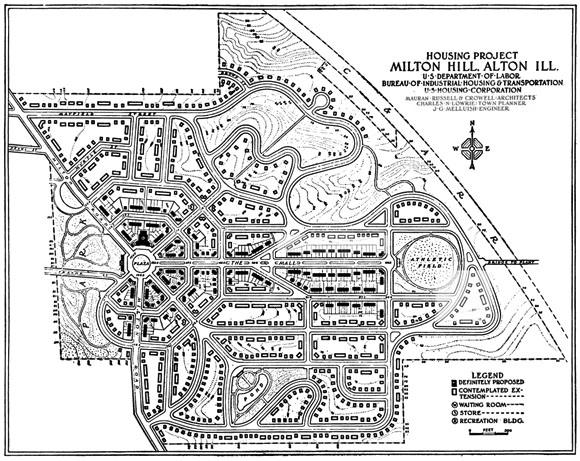
    Its architects, planners and engineers aimed to create communities that were not only functional but also livable and beautiful. They drew heavily from Britain’s late-19th century Garden City movement, a planning philosophy that emphasized low-density housing, the integration of open spaces and a balance between built and natural environments.

    Milton Hill, a neighborhood designed and developed by the United States Housing Corporation in Alton, Ill.
    National Archives

    Importantly, instead of simply creating complexes of apartment units, akin to the public housing projects that most Americans associate with government-funded housing, the agency focused on the construction of single-family and small multifamily residential buildings that workers and their families could eventually own.

    This approach reflected a belief by the policymakers that property ownership could strengthen community responsibility and social stability. During the war, the federal government rented these homes to workers at regulated rates designed to be fair, while covering maintenance costs. After the war, the government began selling the homes – often to the tenants living in them – through affordable installment plans that provided a practical path to ownership.

    A single-family home in Davenport, Iowa, built by the U.S. Housing Corporation.
    National Archives

    Though the scope of the Housing Corporation’s work was national, each planned community took into account regional growth and local architectural styles. Engineers often built streets that adapted to the natural landscape. They spaced houses apart to maximize light, air and privacy, with landscaped yards. No resident lived far from greenery.

    In Quincy, Massachusetts, for example, the agency built a 22-acre neighborhood with 236 homes designed mostly in a Colonial Revival style to serve the nearby Fore River Shipyard. The development was laid out to maximize views, green space and access to the waterfront, while maintaining density through compact street and lot design.

    At Mare Island, California, developers located the housing site on a steep hillside near a naval base. Rather than flatten the land, designers worked with the slope, creating winding roads and terraced lots that preserved views and minimized erosion. The result was a 52-acre community with over 200 homes, many of which were designed in the Craftsman style. There was also a school, stores, parks and community centers.

    Infrastructure and innovation

    Alongside housing construction, the Housing Corporation invested in critical infrastructure. Engineers installed over 649,000 feet of modern sewer and water systems, ensuring that these new communities set a high standard for sanitation and public health.

    Attention to detail extended inside the homes. Architects experimented with efficient interior layouts and space-saving furnishings, including foldaway beds and built-in kitchenettes. Some of these innovations came from private companies that saw the program as a platform to demonstrate new housing technologies.

    One company, for example, designed fully furnished studio apartments with furniture that could be rotated or hidden, transforming a space from living room to bedroom to dining room throughout the day.

    To manage the large scale of this effort, the agency developed and published a set of planning and design standards − the first of their kind in the United States. These manuals covered everything from block configurations and road widths to lighting fixtures and tree-planting guidelines.

    A single-family home in Bremerton, Wash., built by the U.S. Housing Corporation.
    National Archives

    The standards emphasized functionality, aesthetics and long-term livability.

    Architects and planners who worked for the Housing Corporation carried these ideas into private practice, academia and housing initiatives. Many of the planning norms still used today, such as street hierarchies, lot setbacks and mixed-use zoning, were first tested in these wartime communities.

    And many of the planners involved in experimental New Deal community projects, such as Greenbelt, Maryland, had worked for or alongside Housing Corporation designers and planners. Their influence is apparent in the layout and design of these communities.

    A brief but lasting legacy

    With the end of World War I, the political support for federal housing initiatives quickly waned. The Housing Corporation was dissolved by Congress, and many planned projects were never completed. Others were incorporated into existing towns and cities.

    Yet, many of the neighborhoods built during this period still exist today, integrated in the fabric of the country’s cities and suburbs. Residents in places such as Aberdeen, Maryland; Bremerton, Washington; Bethlehem, Pennsylvania; Watertown, New York; and New Orleans may not even realize that many of the homes in their communities originated from a bold federal housing experiment.

    These homes on Lawn Avenue in Quincy, Mass., in 2019 were built by the U.S. Housing Corporation.
    Google Street View

    The Housing Corporation’s efforts, though brief, showed that large-scale public housing could be thoughtfully designed, community oriented and quickly executed. For a short time, in response to extraordinary circumstances, the U.S. government succeeded in building more than just houses. It constructed entire communities, demonstrating that government has a major role and can lead in finding appropriate, innovative solutions to complex challenges.

    At a moment when the U.S. once again faces a housing crisis, the legacy of the U.S. Housing Corporation serves as a reminder that bold public action can meet urgent needs.

    Eran Ben-Joseph does not work for, consult, own shares in or receive funding from any company or organization that would benefit from this article, and has disclosed no relevant affiliations beyond their academic appointment.

    ref. Believe it or not, there was a time when the US government built beautiful homes for working-class Americans to deal with a housing crisis – https://theconversation.com/believe-it-or-not-there-was-a-time-when-the-us-government-built-beautiful-homes-for-working-class-americans-to-deal-with-a-housing-crisis-253512

    MIL OSI – Global Reports

  • MIL-OSI Global: Tomato trade dispute between the US and Mexico is boiling over again – with 21% tariffs due in July

    Source: The Conversation – USA – By Andrew Muhammad, Professor of Agriculture and Resource Economics, University of Tennessee

    The country of origin – Mexico – is noted on the label of a package of Campari tomatoes for sale in the produce section of a Safeway grocery store on March 4, 2025, in Denver. AP Photo/David Zalubowski

    Although technically they’re a fruit, tomatoes are one of the most-consumed vegetables, according to the U.S. Department of Agriculture. Among the fresh produce the nation buys from foreign countries, tomatoes often rank first or second, behind avocados.

    This trade is now jeopardized because the Trump administration has revived a three-decade-old effort to limit imports.

    As economists who study global trade issues affecting agricultural commodities and processed food products, we have assessed the benefits of imported tomatoes and other products on consumers and businesses. Fresh tomato imports ensure year-round availability for consumers, contribute significantly to the U.S. economy by generating billions in sales and supporting thousands of jobs, and promote competitive pricing that benefits both consumers and businesses.

    New import restrictions could put all that at risk because domestic production cannot satisfy national demand. For tomatoes, like steel and other products, efforts to reverse trade imbalances can decrease consumer satisfaction and potentially destroy more jobs and economic activity than they create.

    Initiating a dumping investigation

    This tussle over tomatoes began in the 1990s.

    At that time, unprecedented growth in tomato imports from Mexico prompted U.S. producers to ask the Clinton administration to investigate whether they were being sold at unfairly low prices. If that were the case, it would violate both World Trade Organization rules and U.S. trade policy.

    The U.S. responded with an antidumping investigation, conducted by the Department of Commerce and U.S. International Trade Commission. The agencies were tasked with seeing if imports are being sold in the U.S. at less than fair market value – the definition of dumping.

    Dumping can harm domestic producers by depressing local prices to compete with imports, causing financial distress. An antidumping duty is essentially a tariff.

    The Commerce Department ruled against Mexican producers, finding that they had engaged in dumping, but reached an agreement with them. Mexican tomato exporters agreed to set minimum prices, leading the U.S. to call off its investigation. The U.S. and Mexico have subsequently entered into a string of suspension agreements over the years.

    The first was implemented in 1996, and the most recent took effect in 2019 during President Donald Trump’s prior term after his administration had threatened to impose a 17.5% tomato tariff.

    Squashing the tomato suspension agreement

    But in April 2025, the Commerce Department announced that it would withdraw from the latest tomato suspension agreement. The Trump administration plans to begin to impose, starting in July, antidumping duties of 21% on fresh tomatoes imported from Mexico.

    It is not obvious at this stage if American importers and consumers will bear the full burden of this tariff, or if Mexican tomato exporters will absorb this cost.

    This move is supposed to benefit fresh tomato producers in the U.S. – most of which are in Florida, with a significantly smaller number located in California. The tariffs could, however, hurt produce distributors, wholesalers and retailers, as well as American consumers.

    People in the U.S. have become accustomed to buying fresh tomatoes to toss into their salads and stuff into their sandwiches year-round, even though in most of the country you can only harvest field-grown tomatoes in the warmest months of the year.

    Focusing only on fresh tomatoes

    This dispute doesn’t involve all the tomatoes and tomato products Americans eat.

    U.S. tomato production is split into two main categories. Fresh tomatoes are usually purchased in a supermarket’s fresh produce section, to be consumed whole, chopped or sliced. This dispute is about those tomatoes.

    The other kind is processing tomatoes, which companies use for making tomato paste, canned or stewed tomatoes and tomato sauce. California leads the nation in processing tomato production. Unlike fresh tomatoes, where the U.S. imports far more than it produces or exports, the U.S. is actually running a trade surplus in processed tomato products.

    When the North American Free Trade Agreement was implemented in January 1994, U.S. fresh tomato production was more than four times the quantity of imported fresh tomatoes: 3.7 billion pounds (1.7 million metric tons) produced versus only 870 million pounds (400,000 metric tons) imported.

    Domestic production has steadily declined since then, while imports have increased. Imported fresh tomatoes are now twice as plentiful: 2.2 billion pounds (1 million metric tons) were grown in the U.S. in 2023, compared with 4.4 billion pounds (2 million metric tons)“ imported .

    This happened as Americans were eating more fresh tomatoes than ever: almost 20 pounds (9 kilograms) per capita in 2023.

    Mexico supplies most of the fresh tomatoes Americans buy in supermarkets.
    Justin Sullivan/Getty Images

    Influx didn’t clearly affect prices

    In 2024, fresh tomato imports totaled US$3.6 billion, with $3.1 billion coming from Mexico. This was a 367% increase since NAFTA took effect, adjusted for inflation.

    Given that costs of production are lower in Mexico for many products, especially in the fresh produce sector where labor costs are less than half U.S. levels, you might figure that this arrangement has kept prices for fresh tomatoes in the U.S. low. But there’s little evidence to support that. Instead, the opposite seems true.

    In 1995, the price that U.S. importers paid of Mexican tomatoes was 31 cents per pound. Since then, import prices have steadily increased to 74 cents per pound in 2024. They have often exceeded prices paid to American farmers and kept pace with the overall rise in food prices the past three decades.

    While restricting imported Mexican tomatoes might benefit U.S. tomato producers by making it easier for them to raise their prices, there are other factors to consider. Imports play a crucial role in boosting economic activity and creating jobs. According to a recent study, these imports generated a total economic impact of more than $8 billion.

    The extra $5 billion comes from all the value-added activities associated with getting that produce from the border to consumers. That total economic impact supports approximately 47,000 U.S. jobs tied to tomato storage, distribution, wholesaling and retailing.

    We would expect antidumping duties on imported fresh tomatoes to increase prices, and reduce the amount of fresh tomatoes Americans can buy. That would also shrink some of the economic impact and eliminate some of the jobs spurred by the imported tomato boom.

    The authors do not work for, consult, own shares in or receive funding from any company or organization that would benefit from this article, and have disclosed no relevant affiliations beyond their academic appointment.

    ref. Tomato trade dispute between the US and Mexico is boiling over again – with 21% tariffs due in July – https://theconversation.com/tomato-trade-dispute-between-the-us-and-mexico-is-boiling-over-again-with-21-tariffs-due-in-july-255813

    MIL OSI – Global Reports

  • MIL-OSI United Kingdom: Grants of £3,000 available for local festivals across the Lancaster district Festival organisers across the Lancaster district are being invited to apply for small grants of £3,000 to help them grow and reach new audiences.

    Source: City of Lancaster

    Festival organisers across the Lancaster district are being invited to apply for small grants of £3,000 to help them grow and reach new audiences.

    The funding is being made available by Lancaster City Council via the UK Shared Prosperity Fund and is part of ongoing efforts to support festivals that celebrate the local area and help to attract visitors.

    Councillor Martin Bottoms, cabinet member with responsibility for Morecambe regeneration and local economy, said: “Festivals bring our communities together, support local talent, and make our district a vibrant place to live, work and visit. These small grants are designed to give organisers a helping hand to develop and expand their reach.”

    The closing date for applications is 5pm on Friday May 30.

    The earliest start date for projects is July 1 and they need to have taken place by the end of March 2026. For more details of the fund and how to apply visit www.lancaster.gov.uk/ukspf.

    The UK Shared Prosperity Fund aims to improve pride in place and increase life chances across the UK investing in communities and place, supporting local business, and people and skills. For more information, visit https://www.gov.uk/government/publications/uk-shared-prosperity-fund-prospectus

    Last updated: 19 May 2025

    MIL OSI United Kingdom

  • MIL-OSI Economics: Reserve Bank of India cancels the licence of HCBL Co-operative Bank Ltd., Lucknow

    Source: Reserve Bank of India

    The Reserve Bank of India (RBI), vide order dated May 19, 2025, has cancelled the licence of “HCBL Co-operative Bank Ltd., Lucknow”. Consequently, the bank ceases to carry on banking business, with effect from the close of business on May 19, 2025. The Commissioner and Registrar of Cooperative, Uttar Pradesh has also been requested to issue an order for winding up the bank and appoint a liquidator for the bank.

    The Reserve Bank cancelled the licence of the bank as:

    1. The bank does not have adequate capital and earning prospects. As such, it does not comply with the provisions of Section 11(1) and Section 22 (3) (d) read with Section 56 of the Banking Regulation Act, 1949.

    2. The bank has failed to comply with the requirements of Sections 22(3) (a), 22 (3) (b), 22(3)(c), 22(3) (d) and 22(3)(e) read with Section 56 of the Banking Regulation Act, 1949.

    3. The continuance of the bank is prejudicial to the interests of its depositors.

    4. The bank with its present financial position would be unable to pay its present depositors in full; and

    5. Public interest would be adversely affected if the bank is allowed to carry on its banking business any further.

    2. Consequent to the cancellation of its licence, “HCBL Co-operative Bank Ltd., Lucknow” is prohibited from conducting the business of ‘banking’ which includes, among other things, acceptance of deposits and repayment of deposits as defined in Section 5(b) read with Section 56 of the Banking Regulation Act, 1949 with immediate effect.

    3. On liquidation, every depositor would be entitled to receive deposit insurance claim amount of his/her deposits up to a monetary ceiling of ₹5,00,000/- (Rupees five lakh only) from Deposit Insurance and Credit Guarantee Corporation (DICGC) subject to the provisions of DICGC Act, 1961. As per the data submitted by the bank, 98.69% of the depositors are entitled to receive full amount of their deposits from DICGC. As on January 31, 2025, DICGC has already paid ₹21.24 crore of the total insured deposits under the provisions of Section 18A of the DICGC Act, 1961 based on the willingness received from the concerned depositors of the bank.

    (Puneet Pancholy)  
    Chief General Manager

    Press Release: 2025-2026/371

    MIL OSI Economics

  • MIL-OSI Asia-Pac: Speech by CE at Welcome Dinner for Global Prosperity Summit 2025 (English only) (with photos)

    Source: Hong Kong Government special administrative region

    Following is the speech by the Chief Executive, Mr John Lee, at the Welcome Dinner for the Global Prosperity Summit 2025 today (May 19):

    President Wu Hailong of China Public Diplomacy Association, Commissioner Cui Jianchun (Commissioner of the Ministry of Foreign Affairs of the People’s Republic of China in the Hong Kong Special Administrative Region), Mrs Regina Ip (Convenor of the Non-official Members of the Executive Council and Chairperson of Savantas Policy Institute), Professor Yang Jiemian, Chairman of the Academic Advisory Council of Shanghai Institutes for International Studies, Mr Iñaki Amate, Chair of the European Chamber of Commerce in Hong Kong, distinguished guests, ladies and gentlemen, 
    Given today’s global turmoil, connectivity has never been more important. In a time of economic uncertainty, Hong Kong serves as a welcoming financial harbour. Here, information, capital, goods and people flow freely, thanks to our common law system and a legal regime similar to that of many of the world’s leading financial hubs. With economies everywhere seeking security, seeking ways of boosting their economy, Hong Kong is proving highly attractive to them.

    MIL OSI Asia Pacific News

  • MIL-OSI Asia-Pac: Erick Tsang promotes GBA in Egypt

    Source: Hong Kong Information Services

    Secretary for Constitutional & Mainland Affairs Erick Tsang and Commissioner for the Development of the Guangdong-Hong Kong-Macao Greater Bay Area Maisie Chan are on a duty visit to Egypt from May 17 to 20 to promote the development opportunities of the Guangdong-Hong Kong-Macao Greater Bay Area (GBA).

    During his stay in the Egyptian capital, Cairo, Mr Tsang met Chinese Ambassador to Egypt Liao Liqiang and exchanged views with representatives of the political and business sectors.

    Mr Tsang today attended the Guangdong-Hong Kong-Macao Greater Bay Area-Africa (Egypt) Economic & Trade Cooperation Exchange Conference and delivered a speech to promote the development opportunities of the GBA to the political and business sectors.

    He said that with the central authorities’ full support, the Hong Kong Special Administrative Region and other bay area cities complement each other’s strengths and work closely together to promote the GBA’s high-quality development.

    Mr Tsang also noted that Hong Kong possesses the institutional advantages of “one country, two systems”, with a business environment that is highly market-oriented and internationalised, underpinned by the rule of law, a free flow of capital, a robust financial regulatory regime, a simple and low tax regime, and a global pool of professional talent.

    He encouraged enterprises to capitalise on Hong Kong’s unique advantages of having the staunch support of the motherland and being closely connected to the world by establishing a foothold in the city and tapping into the huge GBA market.

    Mr Tsang added that Hong Kong, as a world-renowned metropolis and China’s most internationalised city, should play its unique roles and functions as a super connector and super value-adder, commence more international co-operation, contribute to the country’s high-quality opening up and development, and further enhance its global influence in the changing international landscape.

    He will depart for Hong Kong this afternoon, arriving on May 20.

    MIL OSI Asia Pacific News

  • MIL-OSI Security: Critical measures needed to fight money laundering and terrorist financing

    Source: Interpol (news and events)

    19 May 2025

    VIENNA, Austria – Countries need to take critical measures to target the huge illicit profits generated by drug trafficking, human trafficking, migrant smuggling, and frauds and scams, international organisations urged today, warning that behind every dollar laundered is a victim – a family destroyed, a life lost, a community damaged.

    This was the urgent call to action by leaders from the Financial Action Task Force (FATF), INTERPOL and the UN Office on Drugs and Crime (UNODC) in Vienna today, at a high-level side event on the first day of the 34th Session of the Commission on Crime Prevention and Criminal Justice (CCPCJ).

    Prioritising an economic and financial crime approach to crime prevention is critical to reduce the harm that crime causes to our societies, and to ensure financial stability and economic growth.

    At today’s CCPCJ, FATF, INTERPOL and UNODC collectively called on governments to improve asset recovery efforts to remove organized crime and terrorist groups’ ability to expand value and territory, and to cooperate internationally to make financial investigations more targeted and effective.

    Finance ministers have called for greater efforts to fight crime and terrorism by cutting off the profits which enable them. The FATF, the global watchdog on illicit finance covering over 200 jurisdictions, responded to this call by tightening standards for asset recovery.

    Assessments of the FATF Global Network found that almost 80 per cent of countries are at low or moderate level of effectiveness on asset recovery.

    UNODC Executive Director Ghada Waly said:

    “This is a call to action to define innovative and scalable solutions to combat economic crime. Let us work together through our partnerships and use the opportunity of this CCPCJ and the 15th UN Crime Congress in 2026 to accelerate collective responses against criminal and terrorist financing to ensure our financial systems are drivers of peace, security, and prosperity.”

    FATF President Elisa de Anda Madrazo said:

    “The FATF is committed to providing countries with the tools and the international forum to collectively tackle the challenges we all face today. This is critical to financial stability, development, peace, and security. Global defences against illicit finance are only as strong as our weakest link, so we are sounding the alarm so that all countries work together to meet the complex, transnational threats of today. We cannot let crime thrive.”

    From the operational perspective, INTERPOL has implemented its recently launched Silver Notice, designed to improve the speed and effectiveness of international cooperation in targeting criminal assets. Currently, 51 countries that are part of the pilot have indicated they will make use of the new Notice to request information on assets worldwide.

    INTERPOL Acting Executive Director of Police Services Cyril Gout said:

    “Illicit finance is not just one of many criminal threats – it is the enabler of them all. This is why INTERPOL focuses on developing and delivering innovative tools to facilitate international law enforcement cooperation and tackle illicit financial flows. We are proud to serve as a bridge between international commitments and national action.”

    The three leaders highlighted their recent collective work in developing practical tools for practitioners to dramatically improve their capabilities in working across jurisdictional lines, with FATF President Elisa de Anda Madrazo noting that, “Criminals do not confine themselves within national borders, so we need to ensure that our borders do not provide opportunities for criminals to hide money and frustrate our pursuit of them.”

    Later this year, the three organizations, together with the Egmont Group of Financial Intelligence Units, will release practical guidance for practitioners on key avenues of international collaboration.

    The leaders stressed the strengthening of the FATF’s international standards on anti-money laundering and terrorism financing and called for accelerated progress on cooperating across borders and capacity building ahead of the UN 2026 Crime Congress, to be hosted by the United Arab Emirates.

    They also recognized the positive impact of Member States increasingly working with the private sector and civil society on joint approaches to fighting financial crime and welcomed the acceleration of operational work through public private partnerships and task forces.

    High-level participants at the event, “Global Call to Action to Combat Money Laundering and the Financing of Terrorism: International Cooperation”, discussed the critical steps that Member States must take to dramatically improve international cooperation to fight money laundering and terrorist financing, including capacity building, the effective implementation of the risk-based approach, public-private partnerships, and innovating through new technologies.

    The 15th UN Crime Congress, Abu Dhabi, 25 – 30 April 2026, will provide its Member States the opportunity to grapple with these difficult issues and to commit to scalable and innovative responses to financial crime.

    MIL Security OSI

  • MIL-OSI: Flexera appoints Mike Jerich to President to capitalize on next wave of company growth

    Source: GlobeNewswire (MIL-OSI)

    ITASCA, Ill., May 19, 2025 (GLOBE NEWSWIRE) — Flexera, the global leader in technology spend and risk management, today announced the appointment of Mike Jerich as President. Jim Ryan will remain CEO. This leadership appointment comes at a time of continued growth and momentum across Flexera’s product portfolio and customer base.

    Jerich brings over 25 years of experience in the enterprise technology sector, with a proven track record of driving operational excellence, scaling global teams, and ensuring customer retention. Most recently, he served as Chief Executive Officer at HungerRush, where he was instrumental in helping hone their strategic framework as a leading provider of restaurant technology solutions. Jerich also previously held senior leadership positions at ServiceMax (now PTC), FinancialForce, IPC Systems, IntelePeer and Level 3 Communications.

    “I’m honored to join Flexera at such a pivotal moment,” said Jerich. “With a powerful platform for FinOps, ITAM and SaaS management, we are uniquely positioned to help organizations gain visibility and insight over their technology spend and risk, regardless of the type of technology, where it lives or who owns it. I look forward to working with our talented team to accelerate innovation, strengthen our partner relationships and drive customer value.”

    As President, Jerich will be responsible for overseeing day-to-day operations, executing the company’s strategic vision, and expanding its global presence across ITAM, FinOps and SaaS Management.

    “Mike is a thoughtful, strategic technology leader with the vision, energy, and a strong operational discipline needed to drive consistent growth while we scale into our next phase,” said Jim Ryan, CEO of Flexera. “His appointment marks a new chapter in our journey—one that’s focused on impact, innovation, and capitalizing on momentum.”

    The announcement follows a series of recent milestones for Flexera, including:

    • Record company growth in 2024, driven by increasing customer and partner demands to optimize IT spend, mitigate increasing risk and rationalize complexity
    • The acquisition of Spot, bolstering the Flexera FinOps portfolio with AI-enabled Kubernetes cost management and commitment management provided by the Eco, Ocean, Elastigroup and CloudCheckr products; this comes one year after the acquisition of Snow Software
    • The launch of its Cloud License Management capability, empowering FinOps and ITAM teams to optimize software running in the cloud and drive impactful cost savings
    • Flexera executive team additions of experienced, results-driven leaders including Greg Petraetis as Chief Revenue Officer (formerly of SAP and Employ) and Leslie Alore as Senior Vice President of Marketing (formerly of Ivanti and Iron Mountain)

    As organizations navigate increasing financial pressure and volatile global market conditions, Flexera continues to deliver actionable insight at the intersection of ITAM, FinOps and SaaS management for hybrid IT environments.

    Follow Flexera

    About Flexera
    Flexera helps organizations understand and maximize the value of their technology, saving billions of dollars in wasted spend. Powered by the Flexera Technology Intelligence Platform, our award-winning IT asset management, FinOps and SaaS management solutions provide comprehensive visibility and actionable insights on an organization’s entire IT ecosystem. This intelligence enables IT, finance, procurement, FinOps and cloud teams to address skyrocketing costs, optimize spend, mitigate risk and identify opportunities to create positive business outcomes. More than 50,000 global organizations rely on Flexera and its Technopedia reference library, the largest repository of technology asset data. Learn more at flexera.com.

    For more information, contact:
    Ciri Haugh
    Flexera
    publicrelations@flexera.com

    A photo accompanying this announcement is available at https://www.globenewswire.com/NewsRoom/AttachmentNg/5a044b8a-18cb-4595-9dcf-4caffe2179c5

    The MIL Network

  • MIL-OSI: Amanda Dana Honored with ‘Inspiring Leader Award’ by Orange Bank & Trust and Hudson Valley Investment Advisors

    Source: GlobeNewswire (MIL-OSI)

    MIDDLETOWN, N.Y., May 19, 2025 (GLOBE NEWSWIRE) — The Mid-Hudson Valley business community gathered Thursday, May 8, at The Country Club at Otterkill in Campbell Hall as Amanda Dana, Director of Tourism for Orange County and Executive Director of the Orange County Film Office, was honored with the 2025 WGW Inspiring Leader Award.

    The recognition was presented by Orange Bank & Trust Company and Hudson Valley Investment Advisors, Inc. as part of the “Women Guiding Women” (WGW) initiative, which was created to empower and elevate women in the business world.

    Dana has been an integral part of Orange County’s leadership team since 2018, when she was named Tourism Director. As the organization expanded, it acquired the Orange County Film Office, which expanded her role to include serving as Executive Director. Dana is also the Past President of Hudson Valley Tourism, Inc., the 10-county regional destination marketing organization. She has more than 25 years of sales and marketing experience in the Hudson Valley, having spent 18 years in executive recruiting/talent management, and 10 years in real estate and economic development, including a role at the Orange County Partnership, where she led its Business Retention & Expansion division.

    “Amanda’s vision, dedication, and passion have helped elevate Orange County’s profile, which has had a tremendous impact on our local economy,” said Carla Alfieri, SVP/Senior Private Banking Officer at Orange Bank & Trust Company. “She exemplifies a WGW Inspiring Leader, and we were thrilled to honor her at this year’s event.”

    Dana said, “I am truly honored to be recognized by Orange Bank & Trust Company. Promoting our region and sharing all it has to offer has been a highlight of my career, and it means so much to be acknowledged by an organization that is a cornerstone of our community.”

    The program also included a panel discussion on navigating the stages to a successful and enjoyable retirement, from your 20s to your 60s, as well as potential forks in the road that can pop up along the way. The discussion was moderated by WGW host, Kathy Cole, VP Private Banking Officer, Orange Bank & Trust, and featured Carla Alfieri, SVP/Senior Private Banking Officer, Orange Bank & Trust Company, Cynthia Hand, VP, Trust Officer, Orange Bank & Trust Company; and Kelly Lynch-Moloney, VP/Portfolio Manager, Hudson Valley Investment Advisors, Inc.

    About Orange Bank & Trust Company
    Orange Bank & Trust Company is the Hudson Valley’s premier financial institution focusing on commercial lending, business banking, payment processing and wealth management services. For more than 133 years, Orange Bank & Trust Company has been an economic engine of the community, with more than $2.5 billion in assets and playing a vital role in increasing opportunities for local businesses, creating jobs for generations of residents, spurring region-defining developments, and maximizing investments to neighborhood-serving non-profits. The Bank is regularly recognized as one of New York’s top places to work.

    L-R: Margaret Kranz, AVP Branch Manager, Orange Bank & Trust; Kathy Cole, VP Private Banking Officer, Orange Bank & Trust; Kelly Lynch-Moloney, CFP ®, VP Portfolio Manager, Hudson Valley Investment Advisors, Inc.; Amanda Dana, Director of Tourism for Orange County, Executive Director of the Orange County Film Office and 2025 Inspiring Leader Winner; Damiane Doyle, 1st VP Commercial Team Leader, Orange Bank & Trust; Cynthia Hand, Esq., VP, Trust Officer, Orange Bank & Trust; Carla Alfieri, Senior Vice President, Director of Private Banking, Orange Bank & Trust; Candice Varetoni, AVP Marketing Officer, Orange Bank & Trust

    Contact Info: Candice Varetoni, AVP Marketing Officer,
    Cvaretoni@orangebanktrust.com

    A photo accompanying this announcement is available at https://www.globenewswire.com/NewsRoom/AttachmentNg/5be3e78e-2fd6-452b-a86c-0c131bfa14d5

    The MIL Network

  • MIL-OSI Global: How aid cuts could make vulnerable communities even less resilient to climate change

    Source: The Conversation – UK – By Kalle Hirvonen, Senior Research Fellow, International Food Policy Research Insitute; Research Fellow, UNU-WIDER, United Nations University

    An irrigation project in Mozambique. Marcos Villalta / Save the Children, CC BY-NC-ND

    As global temperatures rise and climate-related disasters become more frequent, the need to adapt is rapidly increasing. That need for adaptation – from adjusting farming practices to diversifying livelihoods and strengthening infrastructure – is most acute in vulnerable low- and middle-income countries such as Bangladesh, Ethiopia, Haiti and Vietnam.

    Despite contributing a negligible share of historical global greenhouse gas emissions, these countries are facing the brunt of climate change. Yet as the demand for long-term resilience grows, international aid priorities are shifting in the opposite direction.

    Over the past three years, several major rich countries have substantially cut their development aid budgets. Remaining funds have been redirected towards emergency relief.

    This shift could undermine the climate finance commitments made by wealthy countries to mobilise US$300 billion (£228 billion) a year for climate action in the most vulnerable low- and middle-income countries by 2035.


    Get your news from actual experts, straight to your inbox. Sign up to our daily newsletter to receive all The Conversation UK’s latest coverage of news and research, from politics and business to the arts and sciences.


    Emergency aid, while vital for saving lives during crises such as droughts and floods, is reactive by nature. It arrives only after disaster has struck, often with a substantial delay.

    By contrast, climate adaptation is proactive. It focuses on anticipating future risks and helping communities prepare for changing environments.

    A key part of this is supporting transitions away from sectors like crop agriculture that are particularly vulnerable to climate-related shocks. In some cases, adapting to a changing climate may also require helping families move safely — turning relocation into a choice rather than a last resort.

    In Ethiopia, one of the world’s most drought-prone countries, a US government-funded food security programme aimed to strengthen resilience by offering livelihood training, organising savings groups and providing a US$200 lump sum to poor rural households. Research shows that this programme improved food security and protected assets during periods of drought.

    Livestock farming in the Somali region of Ethiopia which was severely affected by droughts in 2011.
    Malini Morzaria/EUECHO, CC BY-NC-ND

    In Nicaragua, families who received cash transfers alongside vocational training or investment grants were better protected against drought shocks than those relying on cash alone. These households could supplement farming with other income sources. This made them less vulnerable to drought-related losses and helped stabilise their earnings throughout the year.

    These schemes are known as “cash-plus programmes”. They help create the conditions for households to adapt and thrive. But when climate and environmental shocks overwhelm the resilience of local communities, relocation may still become the only viable option.

    That’s why proactive adaptation efforts need to be scaled up and broadened — not only to meet immediate needs but to support longer-term transitions. This includes investing in sustainable livelihoods through diversified income sources, skills training and, when necessary, enabling safe and voluntary relocation.

    Some pilot interventions that supported seasonal rural-to-urban migration have shown what’s possible. In Bangladesh, a small migration subsidy of just US$8.50 helped the participating poor farm households affected by seasonal famine cover travel costs.

    Migration for temporary work increased by 22%, and families back home experienced improvements in food security. With even modest support, people were able to access job opportunities in cities and strengthen their resilience.

    Programmes that make it easier for people to choose to move from rural areas to cities could help families move with dignity rather than in desperation. However, scaling up such initiatives successfully remains a challenge, requiring strong political commitment and effective governance.

    Climate relocation

    Without proactive planning and support, migration often happens out of necessity rather than choice. This kind of displacement typically occurs within national borders rather than across continents — contrary to popular narratives.

    In fact, 59% of the world’s forcibly displaced population live within their own country. By the end of 2023, a record 75.9 million people across 116 countries were internally displaced — a 51% increase over the previous five years, driven in part by climate change.

    A family leave their home in Oklahoma, US, as a result of the 1930s dust bowl disaster.
    Dorothea Lange/Library of Congress, Farm Security Administration/Office of War Information.

    History provides sobering lessons about relocation triggered by environmental collapse. In the 1930s, a severe drought and dust storms struck the Great Plains in the US, creating the “dust bowl”. This devastated farmland and forced millions of people to leave their homes, as economic hardship became widespread and the land so degraded that crops wouldn’t grow.

    Today, similar patterns loom as droughts, floods and rising seas threaten livelihoods around the world. Small island states such as Tuvalu face existential threats from rising sea levels, with entire communities at risk of being displaced.

    These mounting threats underscore a hard truth: the window for effective climate adaptation is rapidly closing. As climate disruptions intensify, the case for long-term investment in resilience has never been clearer. Without proactive adaptation, the cycle of crisis and response will only deepen.

    Societies can adapt, but doing so takes foresight, investment and courage. In the face of escalating climate risks, bold, forward-looking policies are not a luxury — they are a necessity. By supporting longer-term strategies, rich-country governments and aid charities can enable vulnerable communities to withstand, adapt and, when necessary, move with dignity.


    Don’t have time to read about climate change as much as you’d like?

    Get a weekly roundup in your inbox instead. Every Wednesday, The Conversation’s environment editor writes Imagine, a short email that goes a little deeper into just one climate issue. Join the 45,000+ readers who’ve subscribed so far.


    Kalle Hirvonen’s recent and ongoing research has been funded by the CGIAR Trust Fund (https://www.cgiar.org/funders/), the United States Agency for International Development (USAID), the U.S. National Institutes of Health (NIH) and the Ministry for Foreign Affairs of Finland.

    Olli-Pekka Kuusela does not work for, consult, own shares in or receive funding from any company or organisation that would benefit from this article, and has disclosed no relevant affiliations beyond their academic appointment.

    ref. How aid cuts could make vulnerable communities even less resilient to climate change – https://theconversation.com/how-aid-cuts-could-make-vulnerable-communities-even-less-resilient-to-climate-change-255358

    MIL OSI – Global Reports

  • MIL-OSI Russia: Meeting after 45 years: 1980 graduates gathered for a gala evening at the State University of Management

    Translation. Region: Russian Federal

    Source: State University of Management – Official website of the State –

    On May 16, a meeting of 1980 graduates was held at the State University of Management, organized by a graduate of the State University of Management, Senator of the Russian Federation Vasily Golubev.

    The vice-rector of the State University of Management, Artem Terpugov, gave a welcoming speech.

    “I congratulate you on your 45th graduation anniversary. It is gratifying to see you again within the walls of the State University of Management after so many years. It is nice that so many people came. Thank you Vasily Yuryevich, who initiated this meeting. Your graduation came at a good time, you faced interesting challenges, and then – a difficult transition period. You are the ones who accepted the first challenge of the transition period in the economy and were able to turn it in the right direction, so that today our country is among the leaders of economic development,” noted Artem Evgenievich.

    The initiator of the meeting, Vasily Golubev, also addressed his classmates.

    “I often visit the university and see the changes that are taking place: the infrastructure is changing, classrooms are being modernized, new programs are appearing. And today, GUU occupies a worthy place among the country’s universities. The economy needs it, especially in an era of change, when specialists with new thinking and new approaches are needed. We ourselves were like that, and we remain like that,” Vasily Yuryevich shared.

    The grand opening of the meeting was concluded by the adviser to the rector of the State University of Management, Sergei Chuev.

    “We are meeting in the auditorium named after Olga Vasilyevna Kozlova, a legendary leader who was the rector of our university for 35 years, and it was she who built the new buildings. We perceive our graduates as part of the university. After all, a university is not only a building, departments, programs, but also people: teachers, employees, graduates, students. It is great that there is a friendly company, that you are gathering again at GUU in such a large group,” concluded Sergey Vladimirovich.

    After that, the graduates went on a tour of the campus. Olga Kharlamova, Director of the Scientific Library of the State University of Management, spoke about the history of the State University of Management, which began in 1980, the founding and development of the library, as well as modern changes and the introduction of new technologies.

    In addition, Vasily Golubev left his wishes for the university in a special book of reviews and suggestions from honorary graduates.

    Please note: This information is raw content directly from the source of the information. It is exactly what the source states and does not reflect the position of MIL-OSI or its clients.

    MIL OSI Russia News

  • MIL-OSI USA: Prepared Remarks Before SEC Speaks

    Source: Securities and Exchange Commission

    Thank you, Cicely, for your kind introduction. Ladies and gentlemen, I am very happy to be with you at my first SEC Speaks conference as SEC Chairman, though I have been a regular at this event over the past 15 years or so.[1] 

    The event has experienced some rather precipitous fits and starts over the past couple of years, and I shall make sure that it stays on track as valuable, comprehensive public outreach by the agency. 

    I extend my thanks to the folks at the Practising Law Institute for organizing the conference. I would also like to thank:

    • The SEC staff who have the annual opportunity to talk a little bit publicly about their work over the past year and discuss some of the things that they expect to come in the next few months,
    • The commentators taking part on the various panels who can pose questions and make observations that can help to focus the discussion on critical topics and perspectives that might not be top of mind to those of us within the halls of the SEC,
    • You here live in the audience where you have a chance to meet each other and talk to panelists, and
    • You viewing online who have a convenient opportunity to participate virtually.  

    Innovation and the SEC

    Today I intend to discuss innovation. In particular, about how the Securities and Exchange Commission should not fear innovation. Rather, it should embrace and champion it.

    Markets, by their nature, evolve. They are dynamic because they are made up of human beings. When human beings encounter problems, they innovate to solve them because there is a demand — and there are rewards — for solutions. In a free society, human nature rises to the occasion with inventiveness and competitive spirit, plus Adam Smith’s invisible hand to provide incentives beyond mere altruism. All of that is a good thing.  

    Over the decades, including during my time as a Commissioner from 2002 to 2008 and before that on the staff of two SEC chairmen, the SEC has both enabled innovation and, unfortunately at times, stifled it. Fortunately, innovation — in other words, progress — eventually won the day. Let me take a few moments to revisit some recent history. 

    In the late 1960s, there was a big, beautiful bull market. Trading volume doubled to some 12 million shares a day — which I realize sounds quaint today — overwhelming the paper-based clearance and settlement systems and transfer agent duties. Efficiency began to deteriorate as rising stacks of paper stock certificates had to be physically delivered by clerks trundling carts carrying boxes of those paper certificates to and from various broker-dealers up and down Wall Street and in other financial districts all across America. Investors paid the price for this inefficiency as securities were misplaced, misdirected, lost, or delivered late. Fails ballooned and many inadequately capitalized broker-dealers were caught by that whiplash of scuttled transactions. As a Band-Aid, trading times each day were reduced and exchanges eventually closed on Wednesdays to allow firms time to process the mountains of certificates. At times, the New York Stock Exchange closed two days in a week to catch up on the paperwork.

    The breakdown over an antiquated system became known as the “Paperwork Crisis.”

    As William Dentzer, the first CEO of the Depository Trust Company, or DTC, put it: “The paperwork crisis caused the post-trade processing of hundreds of millions of dollars to be delayed or to fail entirely, dividends to investors to be misdirected, and brokerage firms to go bust.”[2]

    Very much to its credit, the SEC at the time was proactive. It was clear that what needed to be done was to move to electronic transactions and book-entry. But how would we get there? The agency constructively held roundtables and engaged with industry. It used its rulemaking authority and powers of persuasion to allow for new ways of back-office processing of trades and other efficiencies tied to information technology. As a result of that collaboration between the SEC and market participants, the DTC was eventually established as an industry co-operative, later becoming the Depository Trust & Clearing Corporation. The computerization of securities was born with the SEC very much at the forefront of advancing that effort.

    As things go, that late 1960s bull market was inevitably followed by a severe, long-lived bear market. Many broker-dealers went out of business because of the crushing downturn in revenues, rather than inadequate back-office capacity as in the preceding bull market. The SEC worked with Congress and the securities industry to enact the Securities Investor Protection Act in 1970. That law established the Securities Investor Protection Corporation, an industry-backed insurance fund to protect investors from losses in the event their broker fails. It was a positive innovation for investors in which the SEC played a significant role.

    In the late 1980s and early 1990s, the American Stock Exchange and other organizations had come up with a creative response to the SEC’s identification of program trading of index stocks as a contributor to the 1987 market break. They proposed an instrument for trading a basket of stocks — “SPIDERS” — the S&P Depository Receipts, which is a basket of equities traded as a fund.  It was the earliest exchange-traded fund, or ETF. But, the proposal languished at the Commission for several years, as the Divisions at the time raised various issues with this new fund. In no uncertain terms, Chairman Richard Breeden demanded that the Division heads “figure it out”[3] and gave them a limited amount of time to do so. He was emphatic about getting it done right away. And the SEC did. The SPDR launched in 1993. Some at the SEC were worried whether the market would accept this innovation. In fact, it took some effort by the sponsoring firms to persuade institutions to purchase the product. But, it grew to $1 billion in three years. Chairman Breeden’s view was, let the market decide; we cannot be the arbiter. I think we can all agree that the innovation of SPDRs and ETFs has been a boon for investors. 

    During Arthur Levitt’s tenure as chairman in the mid-to-late 1990s, proprietary trading systems took off in popularity, controversially drawing trading off-exchange. Chairman Levitt believed that the SEC needed to provide regulatory flexibility for the electronic markets to be able to innovate. So, Regulation Alternative Trading Systems, or “Reg ATS,” adopted in 1999, allowed for ATSs to be regulated like broker-dealers, rather than exchanges. 

    As we moved to a new century, the market came up with another innovation: the gold fund, the first commodity ETF. This concept had been internally bouncing around the Divisions like a pinball and across town to the Commodity Futures Trading Commission. Although it took a while, innovation prevailed, and investors gained the option to invest in gold without physically owning it.

    Crypto Innovation

    This brings me to today. The crypto markets have been languishing in SEC limbo for years.

    Initially, the SEC first pursued what I call the “head-in-the-sand” approach — perhaps hoping that crypto would go away. Then, it pivoted and pursued a shoot-first-and-ask-questions-later approach of regulation through enforcement. The “just come in to visit” entreaty often meant coming home to a subpoena. It seemed like a catch-22 for market participants. This environment did not create trust. In reality, the message was, “You go figure it out.” That is a fine approach if the regulator plays an active role in interacting with the marketplace to encourage solutions and adapt existing rules and practices if the existing approaches are inapposite to new developments in technology. Old ways of doing things should not be immutable, especially if Congress has granted an agency discretion to make changes consistent with Congressional intent and in the public interest. While the SEC must be faithful to its statutes in any effort to be innovative, it should use its available authority and discretion to adapt to and accommodate new developments.

    The SEC’s claim at the time that it was willing to talk to prospective registrants proved ephemeral at best because the SEC made no adaptations to registration forms or other regulatory requirements to accommodate this new technology. I have been told that market participants would in good faith enter what they thought were policy meetings with Commission staff only to receive enforcement inquiries shortly after their meeting. If that culture were not bad enough, SEC leadership for too long prevented staff from communicating with market participants when complicated legal questions arose. I am pleased to announce that I recently directed Division of Corporation Finance staff to maintain transparent interactions with the public. When staff is allowed to talk openly with industry, market participants can move more nimbly and allocate capital to productive uses. 

    It is a new day at the SEC. While I have directed Commission staff across our policy Divisions to begin drafting rule proposals related to crypto, the staff continue to “clear the brush” through staff-level statements. For example, last week the staff of the Division of Trading and Markets issued a set of FAQs that addressed broker-dealer and transfer agent questions. While the views of the staff are not rules or regulations of the Commission, they can provide useful insights for the public.[4] Ultimately, the Commission is, of course, responsible and must itself squarely address these issues to ensure that the public has clear rules of the road. 

    Last, as I mentioned at a recent Crypto Task Force roundtable, I would like the Commission to allow SEC registrants to custody and trade both securities and non-securities under one roof. Enabling this reality could reduce costs for investors while allowing non-security trading to enter a regulated environment at the federal level expeditiously. This would be an initial step towards the possibility of eventually achieving a “super-app” reality. Thank you to Commissioner Hester Peirce, the Crypto Task Force, and Trading and Markets staff for their continued efforts.       

    FinHub

    In keeping with this theme of innovation and the progress of the Crypto Task Force, we have asked Congress for reprogramming approval to integrate the functions of the agency’s Strategic Hub for Innovation and Financial Technology, or “FinHub” into other parts of the agency.  

    Established in 2018, FinHub was created during a critical period of emerging technologies. The rapid development of distributed ledger technology, including digital assets, artificial intelligence, and machine learning, required a centralized effort to build understanding at the SEC. Unfortunately, FinHub over time came to be perceived by many in the digital asset industry as a tool for enforcement rather than a tool to foster innovation. Moreover, as currently constituted, FinHub is too small to be viable and efficient, and this staff expertise can be better utilized elsewhere in the agency.

    The principles and priorities under which FinHub was founded are being integrated into the very fabric of the SEC. I will ensure that innovation will be ingrained in the culture SEC-wide, as it should be, and not focused on one small office.

    Investing in Private Funds

    Financial innovation sometimes means getting out of the way of capital formation and allowing all investors to gain the benefits of our robust markets.

    Since 2002, the SEC staff has taken the position that closed-end funds investing 15% or more of their assets in private funds should impose a minimum initial investment requirement of $25,000 and restrict sales to investors that satisfy the accredited investor standard.  As a result, many retail investors have missed out on opportunities to invest in closed-end funds that invest in private investment funds, like hedge funds and private equity funds.

    Much has changed since 2002 — including the growth of private markets and the increased oversight and enhanced reporting by both private fund advisers and registered funds. Indeed, in the last 10 years alone, private fund assets have almost tripled from $11.6 trillion to $30.9 trillion.[5]  Allowing this option could increase investment opportunities for retail investors seeking to diversify their investment allocation in line with their investment time horizon and risk tolerance.

    With this in mind, I intend to have the Commission address this situation and reconsider this 23-year-old practice concerning investments by closed-end funds in private funds. This common-sense approach will give all investors the ability to seek exposure to a growing and important asset class, while still providing the investor protections afforded to registered funds. We must consider and resolve important disclosure issues for these products, particularly for those that trade on exchanges, including conflicts of interest, illiquidity, and fees.

    CAT

    Before I close, I want to mention a topic that has drawn significant scrutiny, the Consolidated Audit Trail, known by the innocuous-sounding nickname “CAT.” This particular “CAT” has quite an appetite for data and computer power, with costs rising to nearly $250 million a year. These costs are divvied up and eventually, one way or another, fall on the shoulders of investors. The financial services industry and Congress have rightly pushed back on the seemingly endless cost increases and the risks of storing so much sensitive data together. Much of the increases are due to changing demands for information and access.

    Therefore, I have instructed the staff to undertake a comprehensive review of the CAT. In addition to examining the costs of the system, I would like to see the staff take a hard look at the reporting requirements and scope of what is collected. I look forward to the agency engaging with the public on this important issue.

    Conclusion

    As I begin my tenure as Chairman, I can tell you that we are getting back to our roots of promoting, rather than stifling, innovation. The markets innovate, and the SEC should not be in the business of telling them to stand still.

    It is a new day at the SEC, and I look forward to what we are going to be able to accomplish for investors and the markets.

    Thank you.


    [1] These remarks reflect my individual views as Chairman of the Commission and do not necessarily reflect the views of the Commission or my fellow Commissioners.

    [4] See 17 C.F.R. § 202.1(d).  Staff statements represent the views of the respective office or division; they are not rules, regulations, or statements of the Commission.  Further, the Commission neither approves nor disapproves their content.  Staff statements have no legal force or effect: they do not alter or amend applicable law, and they create no new or additional obligations for any person.

    MIL OSI USA News

  • MIL-OSI USA: Jefferson, Liquidity Facilities: Purposes and Functions

    Source: US State of New York Federal Reserve

    Thank you, President Bostic, for that kind introduction and for the opportunity to talk to this group today.1 I am delighted to be here, and I look forward to discussions at this important conference.
    The theme of today’s conference is developments in financial intermediation and potential implications for monetary policy. As this conference embarks on a larger discussion of the role of banks and nonbanks in various market segments—including credit markets, Treasury and money markets, and payments—I believe it is worth taking a step back to explore an important background factor, which is how and why central banks provide liquidity.

    The provision of liquidity by central banks is a foundational element of financial intermediation. Central banks should be able to provide liquidity effectively for the financial system to function smoothly. Today, I will take this opportunity to discuss some aspects of liquidity provision by the central banks. Of course, the main forms of liquidity provided by central banks—namely, currency and bank reserves—are the foundation of safe liquidity in the economy. It is vital for a central bank to make clear that it stands ready to provide liquidity should stress emerge. But a central bank must also take steps to minimize moral hazard. “Moral hazard” in this context refers to the concern that publicly provided liquidity might encourage private financial institutions to take on excessive risk.
    What I would like to focus on in this speech are two types of liquidity provision that aim to reduce the frictions associated with the basic operations of banks. The first type of liquidity is intraday credit, which is key in handling payment system frictions during the day, and the second one is overnight credit, which deals with a range of frictions.2 I will also highlight some design features of broadly similar liquidity facilities in three other advanced economies: the U.K., Japan, and the euro area. I believe it is valuable to look at other central banks’ experiences with liquidity provision, which entails recognizing the important differences that exist across jurisdictions and mandates and considering what lessons can be learned.
    At their core, liquidity facilities support the smooth operation and stability of the banking system, the effective implementation of monetary policy, and the furtherance of a safe and efficient payment system. This activity in turn supports the flow of credit to businesses and households. Last year, the Federal Reserve Board issued a public request for information (RFI) seeking to identify operational frictions in these facilities, and those comments are under review. I hope that today’s discussion about how facilities operate in the U.S. and around the globe can further that dialogue among participants at this conference.
    How It Works in the U.S.Let me start by discussing how liquidity provisions work in the U.S., as summarized in slide 3. Banks maintain deposit accounts at the Federal Reserve (Fed). The balances in these accounts, known as reserves, are the most liquid assets that banks have and are used to meet payment flows as households and business customers of banks carry out their regular business. Banks often experience mismatches in the timing of payment inflows and outflows, which could occasionally cause the balance in a bank’s account at the Fed to become negative. To help institutions manage this mismatch and promote the smooth functioning of the payment system, the Fed extends intraday credit, also known as daylight overdrafts.
    Intraday credit facilities provide temporary credit to depository institutions such as commercial banks and credit unions to foster the smooth functioning of the payment system. If a bank temporarily lacks the funds to process payments, it can use intraday credit to avoid delaying payments until it has sufficient liquidity. The Fed provides intraday credit on both a collateralized and an uncollateralized basis. Collateralized intraday credit is provided free of charge, whereas uncollateralized credit incurs a fee. Since this type of credit is provided on an intraday basis, the Fed expects banks to have positive balances in their accounts by the end of the operational day. If a bank has a negative balance at the end of day, it incurs an overnight overdraft and pays a penalty.
    The Fed also provides overnight credit through the discount window to approved counterparties against a broad range of collateral. This type of liquidity provision is designed to mitigate short-term misallocations of liquidity. For example, a bank may need to settle a large payment at the end of the day, but it may temporarily have insufficient funds in its account to do so. To meet the payment obligation, the bank could borrow in private interbank markets—in which financial institutions lend funds to each other on a short-term basis—or from the central bank. The rate on overnight credit also helps central banks with monetary policy implementation. In addition, overnight liquidity facilities often serve as a first line of defense against stresses, and they stand ready to provide liquidity when institutions face outflows.
    All discount window loans are collateralized, and a wide range of bank assets, including a variety of loans and securities, are eligible to serve as collateral.3 The Fed operates three separate facilities under the discount window: primary credit, secondary credit, and seasonal credit.
    The first one, primary credit, is available to generally sound banks at a rate that is currently set at the top of the target range for the federal funds rate. Providing liquidity at this rate supports the implementation of monetary policy because institutions can turn to the Fed if conditions tighten in money markets that might otherwise push overnight money market rates above levels that would be consistent with the Fed’s target range. As I noted earlier, primary credit also helps deal with idiosyncratic funding challenges that banks might be experiencing. Most of the funding provided is on an overnight basis; however, funding is available for up to 90 days.
    The next one, secondary credit, is available to banks that are not sufficiently healthy to have access to primary credit. It is available at a higher rate, features higher haircuts on collateral, and is limited to overnight credit.4
    The third facility, seasonal credit, provides short-term liquidity to smaller institutions that experience sizable seasonal fluctuations in their balance sheets. Typically, these are banks located in agricultural or tourist areas.
    Short-Term Credit Provision across JurisdictionsLooking at central banks’ experiences across jurisdictions provides useful insights about different approaches to providing liquidity.5 Central banks choose a combination of interest rates, collateral requirements, collateral valuation practices, and other design features to encourage usage of facilities while minimizing undesired consequences—in particular, moral hazard. For example, a central bank facility that provides liquidity at an attractive interest rate could be very effective in ensuring that shocks to the financial system do not disrupt the flow of credit but may potentially increase moral hazard. If that facility only accepted a narrow set of high-quality collateral, however, then the moral hazard associated with it could be reduced. Alternatively, the usage of a facility that charges an interest rate above the market rate (a so-called penalty rate) is likely limited, but if the facility accepted a broad range of collateral, usage can be encouraged.6 In these two examples, the counterbalancing choices are with respect to the interest rate charged and the eligible collateral. Different central banks might prefer one approach over the other depending on specific aspects of their frameworks and banking systems.
    Of course, there are challenges in comparing liquidity facilities across jurisdictions given important differences with respect to central banks’ legal authorities, monetary policy frameworks, the size of the economy and financial sector, and institutional structures. This divergence is also true across the four advanced economies that I will consider today: the U.S., the U.K., Japan, and the euro area. There can be large differences in each jurisdiction’s banking sector and central bank balance sheets relative to the size of their economies, highlighting the need to use caution when comparing aspects of their liquidity provision.
    With that caveat in mind, let’s look at the design features of some foreign central bank liquidity facilities that are fairly similar to the Fed’s discount window. As shown in figure 1, the Bank of England (BOE) operates two such short-term facilities: an operational standing facility and a discount window. The operational standing facility features lower rates but restricts acceptable collateral to high-quality, highly liquid sovereign debt. The discount window facility accepts a broader range of collateral but charges a higher rate.
    Which facility an eligible borrower turns to in the U.K. depends on the sorts of collateral that are being pledged. In the U.S., whether an institution has access to primary or secondary credit depends on the condition of the borrower. The BOE monitors borrower conditions, and the Fed also sets haircuts on collateral based on asset riskiness. The differences in design considerations could influence how eligible borrowers integrate these facilities into their regular liquidity management practices.
    The Bank of Japan (BOJ) has two facilities: one that provides overnight loans and another that provides somewhat longer-term funding up to three months. Because the BOJ has been operating a system with a very large supply of reserves for some time, its lending facilities tend not to be used extensively, other than in stress periods.
    The European Central Bank (ECB) operates a marginal lending facility quite similar to the Fed’s discount window. It can meet the idiosyncratic funding needs of individual banks and serves as a ceiling on interbank rates and thus helps the ECB implement monetary policy. This facility is an important element of the ECB framework even though the ECB’s approach to monetary policy implementation involves providing the banking system with a sizable amount of reserves through weekly (repo) lending operations.7
    The international differences show that central banks can accomplish their objectives using facilities with quite different designs. As I noted earlier, one of the vital purposes of a short-term liquidity facility is to be able to provide support to the banking systems during stress. The Fed, the BOE, the BOJ, and the ECB have been able to do so. Figure 2 shows short-term credit provision over time for the four central banks: the BOJ, the green line; the Fed, the black line; the ECB, the blue line; and the BOE, the red line.8 Each line is the monthly short-term credit outstanding as a share of central bank assets in 2019. This figure illustrates a few important points.
    First, at most times, use of the short-term central bank liquidity facilities is modest. Second, central bank provision of short-term liquidity can increase very rapidly during times of stress.9 For example, the Fed and the ECB provided substantial short-term liquidity during the 2007–09 financial crisis. Third, the figure also illustrates that stress is not always global in nature and peak usage does not necessarily coincide. For instance, short-term liquidity provision rose in the euro area during the European sovereign debt crisis that began in late 2009 and peaked in 2012, but it did not increase much in the U.S. Similarly, short-term liquidity provision increased in the U.S. during the March 2023 banking stress episode, but it did not increase in the euro area. I also want to highlight that during stress events, central banks complement their regular short-term standing liquidity facilities with other facilities. Therefore, stress events may not necessarily result in an increase in liquidity provision through a short-term standing facility.
    Now let’s turn to more recent developments. Over the past few years, as central banks have shrunk their balance sheets, liquidity has been gradually reduced, which has made the existing liquidity provision tools more relevant. The BOE and the ECB have indicated that they are moving toward operating frameworks in which short-term liquidity providing repo operations will play a key role.10
    The Fed has stated that it will continue to operate in an ample-reserves regime. In this regime, the primary credit rate is positioned to be slightly above the rate expected to prevail in interbank markets so use of the discount window should typically remain modest. Still, the facility remains available to be used. Figure 3 shows the discount window credit as a share of Fed assets over the past decade. As you can see from this figure, over the past few years, the discount window has been used more than was the case before the pandemic. Increased usage may be due to the discount rate being set closer to private market rates than was the case before the pandemic, the availability of longer maturity loans, and shifts in communication.
    Intraday Credit Provision across JurisdictionsJust as there are differences with respect to the provision of overnight liquidity across central banks, there are also differences in the provision of intraday credit. One difference is with respect to unresolved intraday overdrafts. As I noted earlier, it is possible for banks to incur overnight overdrafts if they fail to take such action as requesting an overnight loan, although overnight overdrafts are not considered business as usual and carry a penalty rate in the U.S., currently set at the primary credit rate plus 400 basis points.11 The BOJ does something quite similar. By charging a high penalty on overnight overdrafts, both the Fed and the BOJ discourage overdrafts.
    In contrast to the Fed and the BOJ, the ECB and the BOE can automatically convert most of the intraday overdrafts into an overnight loan from the business-as-usual facility seamlessly, without action on the part of the bank, against the same collateral at the end of the day.12 That feature creates a greater similarity between intraday credit and overnight credit in those jurisdictions. The relationship between intraday credit and overnight credit is going to be an important one for central banks amid developments in payment systems, including advances in technology and the expansion of payment system operating hours.
    ConclusionToday, I provided an overview of the Fed’s provision of liquidity through the discount window and intraday credit and highlighted some similarities and differences across jurisdictions. In summary, the Fed’s discount window and intraday credit facilities have many features that are similar to those found in other central bank facilities. While differences in institutional, legal, and financial system structures across jurisdictions make central bank short-term lending context specific, looking at the experiences of central banks across other jurisdictions is informative, as central banks share similar goals and face similar challenges when it comes to liquidity provision.
    The Fed is continually assessing and striving to improve the operational aspects of discount window and intraday credit. The Federal Reserve System has made several important advancements to ensure that liquidity provision meets the needs of the 21st century economy. For example, Reserve Banks have worked to streamline the use of electronic files when establishing access to the discount window and made technological advancements in the process for requesting a discount window loan. The Federal Reserve System launched a convenient online portal called “Discount Window Direct” for requesting and prepaying discount window loans that is generally accessible to banks 24–7. To improve familiarity with the discount window, Reserve Banks have conducted outreach to banks and made efforts to guide them in using the program.
    To complement these efforts, the Board issued an RFI last September seeking input on the operations of the discount window and intraday credit. Any issues identified in the responses to the RFI can help the Fed understand further improvements that may promote efficiency and reduce the burden on banks.
    I look forward to hearing insights you may have into central banks’ liquidity facilities and how these issues intersect with the topics that will be discussed at this conference. Thank you!
    ReferencesArseneau, David, Mark Carlson, Kathryn Chen, Matt Darst, Dylan Kirkeeng, Elizabeth Klee, Matt Malloy, Benjamin Malin, Emilie O’Malley, Friederike Niepmann, Mary-Frances Styczynski, Melissa Vanouse, and Alexandros P. Vardoulakis (2025). “Central Bank Liquidity Facilities around the World,” FEDS Notes. Washington: Board of Governors of the Federal Reserve System, February 26.
    Jefferson, Philip N. (2024a). “A History of the Fed’s Discount Window: 1913–2000,” speech delivered at Davidson College, Davidson, North Carolina, October 8.
    Jefferson, Philip N. (2024b). “The Fed’s Discount Window: 1990 to the Present,” speech delivered at the Charlotte Economics Club, Charlotte, North Carolina, October 9.

    1. The views expressed here are my own and are not necessarily those of my colleagues on the Federal Reserve Board or the Federal Open Market Committee. Return to text
    2. I refer to primary credit lending as overnight lending for simplicity even though banks are able to borrow for maturities of up to three months. The vast majority of primary credit lending is overnight. See Jefferson (2024a) and (2024b) for a summary of the evolution of the discount window. Return to text
    3. Examples of assets that may serve as collateral include, but are not limited to, U.S. Treasury securities, investment-grade corporate bonds, U.S. government agency-backed mortgage securities, commercial and industrial loans, commercial real estate loans, agricultural loans secured by farmland, one- to four-family mortgage loans, and auto loans. For more detail on assets that may serve as collateral, please see Federal Reserve Banks (n.d.), “Collateral Eligibility – Securities and Loans,” Discount Window Direct. Return to text
    4. The Fed lends less than the fair market value of the collateral provided to manage the credit risk associated with its lending operations. For example, if a bank needs a loan of $100, a portfolio of securities valued at $200 may be required to be posted if the discount or haircut associated with that portfolio is 50 percent. The difference between the amount that the Fed will lend on a particular asset and the fair market value of that asset reflects the haircut, or margin. These haircuts differ, for instance, with the historical price volatility and credit risk associated with the asset. Information on the haircuts for different assets may be found at Federal Reserve Banks (n.d.), “Collateral Valuation,” Discount Window Direct. Return to text
    5. See Arseneau and others (2025). Return to text
    6. A penalty rate in the Board’s emergency lending regulation is defined as a rate that is higher than the market rate in normal circumstances, affords liquidity in unusual and exigent circumstances, and encourages repayment of the credit and discourages use of the program or facility as the unusual and exigent circumstances that motivated the program or facility recede and economic conditions normalize. See Regulation A—Extensions of Credit by Federal Reserve Banks, 12 CFR pt. 201.4(d)(7) (2024). Return to text
    7. See Isabel Schnabel (2024), “The Eurosystem’s Operational Framework,” speech delivered at the Money Market Contact Group meeting, Frankfurt, Germany, March 14. Return to text
    8. Values in figure 2 represent the marginal lending facility for the euro area, the complementary lending facility for Japan, the operational standing lending facility for the U.K., and primary credit for the U.S. Return to text
    9. See Jefferson (2024a) for a longer historical perspective on the Fed’s liquidity provision over time. Return to text
    10. See, for example, B (2024), “Transitioning to a Repo-Led Operating Framework,” discussion paper (London: BOE, December 9).
    See, for example, Schnabel, “The Eurosystem’s Operational Framework.” Return to text
    11. See Board of Governors of the Federal Reserve System (2023), Federal Reserve Policy on Payment System Risk (PDF), (Washington: Board of Governors), p. 33. Return to text
    12. The BOE is a special case because, for most institutions, intraday overdrafts are seamlessly converted into an overnight loan if the institution signed up to use the operational standing facility in advance. Institutions that have not signed up in advance and end the day with an overdrawn reserve account face an overdraft charge of 2 percent plus the Bank Rate or another rate set at discretion. Return to text

    MIL OSI USA News

  • MIL-OSI: Patriot Bank Expands Its Board and Senior Leadership Team

    Source: GlobeNewswire (MIL-OSI)

    • Richard Smith, Jeff Seabold and Thedora Nickel elected Directors.
    • Paul Simmons appointed EVP, Chief Credit Officer
    • Nicole L. Wells appointed SVP, Head of Operations
    • Rebecca Mais appointed SVP, High Net Worth and Specialty Deposits
    • Raquel Gillett appointed SVP, Digital Transformation and Risk Analytics

    STAMFORD, Conn., May 19, 2025 (GLOBE NEWSWIRE) — Patriot Bank, N.A. (“Patriot Bank”), the wholly owned subsidiary of Patriot National Bancorp, Inc. (NASDAQ: PNBK), is pleased to announce the election of Richard Smith, Jeffrey Seabold and Thedora Nickel to serve on the Patriot Bank’s Board of Directors and the appointment of the following leaders to the management team:

    • Paul Simmons as Executive Vice President, Chief Credit Officer
    • Nicole L. Wells as Senior Vice President, Head of Operations
    • Rebecca Mais as Senior Vice President, High Net Worth and Specialty Deposits
    • Raquel Gillett as Senior Vice President, Digital Automation and Risk Analytics

    These appointments strengthen Patriot Bank’s leadership team as the organization focuses on delivering exceptional banking services to high-net-worth clients and the fiduciaries who serve them.

    “We are delighted to welcome Richard, Jeff, Teddy, Paul, Nicole, Rebecca, and Raquel to their new roles,” said Steven Sugarman, Chief Executive Officer of Patriot Bank. “Their collective expertise and vision will advance Patriot’s mission to empower our clients while delivering exceptional value to our shareholders.”

    Richard Smith, Director

    Richard Smith brings 40 years of banking expertise, specializing in private banking for high-net-worth individuals. Beginning his career as a banking analyst with Manufacturers Hanover in New York, he later held senior roles at Imperial Bank and Comerica Bank in Southern California. In 2005, Smith founded The Private Bank of California and served as its President. After its sale to Banc of California in 2012, he was named President of Banc of California’s Private Banking Division. Smith serves on the Board of CalPrivate Bank, the Zimmer Children’s Museum, and the Westside Food Bank in Los Angeles.

    “It is a privilege to join Patriot Bank’s Board of Directors,” said Smith. “Patriot Bank’s commitment to serving high net worth clients and their advisors aligns with my passion for fostering strong client relationships.”

    Jeffrey Seabold, Director

    Jeff Seabold is an accomplished entrepreneur, investor, and executive leader with almost 30 years of experience in corporate strategy, business development, and executive management. He has a proven history in real estate finance and commercial banking.

    Mr. Seabold is the Co-Founder and a Director of The Change Company CDFI LLC and Change Lending LLC, a certified Community Development Financial Institution (CDFI) focused on home lending. Previously, Mr. Seabold was the Co-Founder and Executive Vice Chairman of Banc of California, Inc., a publicly traded bank holding company and federally chartered national bank headquartered in Irvine, California. Seabold was also the Founder of CS Financial, Inc., a national mortgage finance company, Co-Founder for Camden Capital Partners, LLC, a bridge & mezzanine real estate lender and servicer, and the Founder of Camden Escrow, Inc., a real estate settlement services provider.

    “I’m proud to join the Board of Directors at Patriot Bank and support its mission of delivering personalized, high-quality banking solutions,” said Seabold. “Throughout my career, I have seen the value of building lasting relationships based on trust, service, and understanding. I look forward to contributing my experience to help Patriot Bank deepen its connection with clients and to build a trusted financial partner for our clients.”

    Thedora Nickel, Director

    Thedora Nickel has over 30 years of banking leadership experience, with deep expertise in domestic and international operations, client service, and organizational transformation. She currently serves as Executive Director of The Change Company and Change Lending. Prior to this role, Nickel was Chief Administrative Officer at Banc of California where she led the strategic direction of key enterprise and operational functions. She previously held several senior leadership positions at Bank of America over a 25-year career, most recently as SVP, Group Operations Executive, overseeing national research, resolution, and reconcilement functions in support of the bank’s bank centers, capture sites, and cash vaults. Earlier, she led the Transaction Services West Region with responsibility for over two thousand employees and five processing units. A certified Six Sigma Executive, Nickel also dedicates her time mentoring MBA students at the University of California, Irvine and serves on the board of The Whole Child, a non-profit organization serving vulnerable families in Los Angeles County.

    “I’m honored to join Patriot Bank’s Board of Directors,” said Nickel. “With my experience driving operational excellence and delivering client-focused solutions, I look forward to helping the organization build a strong foundation for sustainable growth.”

    Paul Simmons, Executive Vice President, Chief Credit Officer

    Paul Simmons is a seasoned banking executive with over 35 years of experience in commercial lending, credit, and financial services. Prior to joining Patriot Bank, Mr. Simmons served as Executive Vice President and Chief Credit Officer of Sunwest Bank, Silvergate Bank and Banc of California. He has overseen all aspects of credit administration, asset quality, and lending operations. He also held senior leadership positions at Citigroup, GE Capital, Apollo Real Estate Advisors, and Zions Bancorporation. A graduate of Brigham Young University, Simmons is recognized for his strategic acumen and breadth of experience.

    “I’m honored to join Patriot Bank as its Chief Credit Officer,” said Simmons. “Over my career, I have been fortunate to lead credit organizations at banks of all sizes — always with a focus on building strong credit cultures, managing risk with discipline, and partnering with lending teams to drive smart, sustainable growth. I am excited to be a part of this high-performing executive team to bring that same approach to Patriot Bank and to contribute to Patriot Bank’s turnaround focused on serving our clients with excellence.”

    Nicole L. Wells, Senior Vice President, Head of Operations

    With over 30 years of experience in banking and financial services, Nicole L. Wells joins Patriot Bank as its Senior Vice President and Head of Operations. She served as Head of Strategic Retail Operations at Santander Bank, N.A. in Greater Boston, a role she started in September 2020. Previously, Ms. Wells served as SVP, Private Banking Operations at Banc of California. Wells also held roles at Bank of America, Countrywide Bank, Western Federal Credit Union, and Citibank. Wells holds an M.P.A. in Public Administration with a focus on Organizational Leadership from California State University-Dominguez Hills and completed the Executive Education Program at Columbia Business School.

    “I am delighted to join Patriot Bank and lead its bank operations,” said Wells. “My experience in driving strategic business enablement, simplification, and process excellence will support the Bank’s commitment to delivering seamless, client-focused services.”

    Rebecca Mais, Senior Vice President, High Net Worth and Specialty Deposits

    Rebecca Mais joins Patriot Bank as its Senior Vice President, High Net Worth and Specialty Deposits. Ms. Mais, bringing over 17 years of experience, leading Private Banking and Non-Profit divisions. Previously, she held leadership roles at Banc of California, Bank of Hope and Commerce Bank, where she specialized in market expansion and developing customized deposit solutions for high-net-worth individuals, centers-of-influence, and specialized sectors, including real estate, entertainment, Institutional Banking, Non-Profits, RIA and Business Management Services. Mais is passionately committed to the families and communities we serve and is the Board Secretary of the Westside Food Bank Non-Profit. She is a highly engaged, results-driven, and client-centric leader who is recognized for her ability to drive deposit growth and foster long-term client relationships. Mais holds an Executive M.B.A. from Pepperdine University’s Graziadio School of Business and a B.S. in Business Administration/Fashion Merchandising from Philadelphia University.

    “It’s a privilege to work with such an incredible team to deliver tailored financial solutions that meet the unique needs of our remarkable clients,” said Mais. “I look forward to building Patriot into a client-focused bank able to empower the communities we serve.”

    Raquel Gillett, Senior Vice President, Digital Transformation and Risk Analytics

    Raquel Gillett joins Patriot Bank as its Senior Vice President of Digital Transformation and Risk Analytics, bringing over 20 years of experience in banking and financial services. Previously, she served in senior roles at The Change Company, COR Clearing, Banc of California, California National Bank, and Southern Pacific. She has led technology-driven process improvements as well as overseen financial controls. Ms. Gillett is highly experienced implementing innovative digital risk and reporting solutions, integrating systems, and optimizing reporting frameworks.

    “I am thrilled to join Patriot Bank to lead its digital transformation, leveraging technology to empower our bankers to serve our clients safely and with operational excellence. Strengthening our risk analytics will allow Patriot to pursue our mission and vision safely and soundly,” Gillett said.

    For more information about Patriot Bank, please visit www.bankpatriot.com.

    Media Contact:

    Kirsten Hoekman
    Patriot Bank, N.A.
    Phone: (203) 252-5905
    Email: khoekman@bankpatriot.com

    The MIL Network

  • MIL-OSI: 180 Degree Capital Corp. Issues Q1 2025 Shareholder Letter

    Source: GlobeNewswire (MIL-OSI)

    MONTCLAIR, N.J., May 19, 2025 (GLOBE NEWSWIRE) — 180 Degree Capital Corp. (NASDAQ:TURN) today issued the following Q1 2025 Shareholder Letter:

    Fellow Shareholders,

    As discussed in our press release issued on April 14, 2025, we ended the first quarter of 2025 with a net asset value per share (“NAV”) of $4.42. We are pleased with our performance in Q1 2025, that we believe favorably positions 180 Degree Capital as we continue to make progress on the steps required to complete our proposed Business Combination with Mount Logan Capital Inc. (“Mount Logan”). For those of you who may not have had a chance to listen to our joint call with the team from Mount Logan or to review the presentation deck that summarizes the proposed transaction, both can be found at https://ir.180degreecapital.com/ir-calendar/detail/2908/180-degree-capital-and-mount-logan-capital-proposed-merger. Our excitement for the potential of this transaction to create value for our shareholders has only grown since we announced this proposed Business Combination and conducted this joint call.

    We noted in a press release issued on May 7, 2025, that we filed an amended preliminary joint proxy statement/prospectus on Schedule 14A with the Securities and Exchange Commission (“SEC”) regarding our proposed Business Combination with Mount Logan includes Mount Logan’s financial statements which were prepared in accordance with accounting principles generally accepted in the US, or US GAAP. The conversion of Mount Logan’s financial statements from International Financial Reporting Standards, or IFRS, to US GAAP is an important milestone as now we are in a position to be able to speak freely with current and potential investors regarding historical financial performance and apples-to-apples comparisons of Mount Logan to its publicly traded peers. This conversion to US GAAP also resulted in favorable improvements in historical financial metrics, including an increase in Mount Logan’s reported fee-related earnings in 2024 under IFRS to approximately $9.1 million under US GAAP, and an increase in the reported shareholder equity value of Mount Logan as of December 31, 2024, under IFRS to approximately $104.1 million under US GAAP.

    We believe that the availability of Mount Logan’s US GAAP financial statements will add to the strong indications of support we have received from initial conversations with our shareholders following the filing of our initial joint proxy statement/prospectus in late March 2025. We believe our investors who have signed voting agreements and/or provided indications of support already understood the potential that we believe exists to create significant value for shareholders of 180 Degree Capital through this Business Combination even before Mount Logan’s US GAAP financial statements were available. We appreciate all of this support and patience as we move steadily through the SEC review process, toward the start of soliciting votes, and the ultimate goal of the completion of our proposed Business Combination.

    As mentioned earlier, our belief about the potential of our proposed Business Combination to create significant shareholder value for 180 Degree Capital shareholders has only grown stronger since our initial announcement in January 2025. This belief is amplified by numerous significant shareholders who have voiced their support for our proposed Business Combination to us, as well as new shareholders who were drawn to invest in 180 Degree Capital based on what we believe to be a shared view that our proposed Business Combination is a unique opportunity for future value creation. We continue to believe that converting to an operating company will make 180 Degree Capital’s net asset value a floor for our stock price rather than the ceiling as it is for most closed-end funds. The pro forma combination of our businesses, based on 180 Degree Capital’s net asset value and Mount Logan’s equity value, respectively as of December 31, 2024, less estimated merger-related expenses and other estimated adjustments, yields a combined entity with an estimated shareholder equity value of nearly $140 million. While the ultimate ratio of ownership between 180 Degree Capital and Mount Logan shareholders will be based on 180 Degree Capital’s net asset value at closing of the Business Combination, if the transaction closed on December 31, 2024, the portion of this equity value ascribed to 180 Degree Capital shareholders would equate to more than 180 Degree Capital’s net asset value as of that date. This fact is only one of the multitude of reasons we are so excited about this proposed transaction and its potential opportunity to create meaningful value for 180 Degree Capital’s shareholders.

    To remind everyone of our original views and comments included in our Q4 2024 Shareholder Letter issued on February 14, 2025, Mount Logan has the following attributes that we believe will provide value to 180 Degree Capital shareholders:

    • Mount Logan has what we believe to be an outstanding management team comprised of its CEO, Ted Goldthorpe, its Co-Presidents, Matthias Ederer and Henry Wang, and its CFO, Nikita Klassen;
    • Mount Logan’s asset management platform has approximately $2.4+ billion of assets under management (as of September 30, 2024) that we believe generates predictable fee revenue that can be used to benefit the growth of the combined company and its shareholders;
    • Mount Logan has operational leverage and unique investment access through its association with BC Partners, a leading global private equity and credit firm;
    • Mount Logan is focused on what we believe is the fast-growing market of private credit;
    • We believe that Mount Logan remains undiscovered by the majority of investors due to it being listed on the Cboe Canada exchange rather than a US national exchange; and
    • We believe Mount Logan is significantly undervalued by public market investors.

    For 35 years, I have been a value investor attempting to uncover great companies that I believe are trading below their intrinsic value. As we spent more time with Ted and his colleagues over the past 10 months, it became abundantly clear to us that: 1) we believe Mount Logan is one of these great undiscovered and undervalued companies and 2) the combination of our two companies has the potential to unlock substantial value for 180 Degree Capital shareholders by:

    1. Providing a path to a combined entity that, based on combined shareholder equity as of December 31, 2024, and an estimated distribution of ownership as of the date of the announcement of the Business Combination, would result in 180 Degree Capital shareholder’s portion of the combined shareholder equity being higher than our NAV as of the date of signing of the definitive agreement on January 16, 2025, and as of March 31, 2025.

      For those of our investors who feel more comfortable assessing value based on net asset value/book value, we note that publicly traded comparable companies to what would be our combined company often trade at multiples of book value rather than discounts. For those investors who are comfortable or more interested in valuing based on operating company metrics, we believe the valuation of our combined business will be based on a multiple of fee-related revenues attributed to earnings from the management of permanent and semi-permanent capital vehicles. Other similar businesses commonly trade at significantly higher multiples of operating metrics than the multiple implied by the value of Mount Logan set by the terms of our proposed Business Combination.

    2. Changing to an asset-light operating company that leverages an association with BC Partners enables economies of scale that are not possible at 180 Degree Capital’s current size; and
    3. Substantially increasing the available capital for us to be able to leverage our relationships with small and microcapitalization public companies, to develop capital structure solutions that seek to unlock value and generate favorable risk-adjusted returns.

    As the table below shows, we believe our shareholders have benefited from our ability to generate positive returns on our investments since we took over management of 180 Degree Capital. These returns were offset by material declines in the legacy private portfolio that we inherited.

    Public Portfolio
    Contribution to Change in NAV
    (Q4 2016-Q1 2025)
    Legacy Private Portfolio
    Contribution to Change in NAV
    (Q4 2016-Q1 2025)
    +$3.35/share -$2.41/share
      TURN Public Portfolio Gross Total (Excluding SMA Carried Interest) TURN Public Portfolio Gross Total (Including SMA Carried Interest) Change in NAV Change in Stock Price Russell Microcap Index Lipper Peer Group Average
    Inception to Date
    Q4 2016 – Q1 2025
    +198.7% +218.3% -37.0% -4.1% +44.3% +66.1%

    On a relative basis, our gross total return for Q1 2025 of +4.5% compares favorably to the –14.4% total return for the Russell Microcap Index.1 The difference between our gross total return and our net total return, or change in NAV, of -4.7% to $4.42 as of March 31, 2025, was primarily the result of expenses related to our Business Combination, including almost $300,000 in additional professional fees resulting from the public efforts to derail our proposed Business Combination. Our day-to-day operating expenses declined by over 30% from Q1 2024.

    Public Portfolio Performance in Q1 2025

    The slide below shows the basis for our investment performance in Q1 2025:

    Ticker Symbol Shares Owned @ 12/31/24 Net Shares Purchased (Sold) During Quarter Shares Owned @ 3/31/25 Value @ 12/31/24 Cash (Invested) Received from Sales / Dividends Value @ 3/31/25 Value + Cash Received Total Q/Q Net Change % Change
    ACNT 377,750 (10,890) 366,860 $4,223,245 $133,731 $4,644,448 $4,778,179 $554,934 13.1%
    AREN 992,992 0 992,992 $1,330,609 $0 $1,717,876 $1,717,876 $387,267 29.1%
    AVNW 0 10,200 10,200 $0 ($210,768) $195,534 $195,534 ($15,234) (7.2%)
    BCOV 1,053,580 (1,053,580) 0 $4,583,073 $4,688,431 $0 $4,688,431 $105,358 2.3%
    CVGI 410,000 0 410,000 $1,016,800 $0 $471,500 $471,500 ($545,300) (53.6%)
    IVAC 1,046,597 (1,046,597) 0 $3,558,430 $4,293,141 $0 $4,293,141 $734,711 20.6%
    LTRX 656,139 12,572 668,711 $2,703,293 ($34,949) $1,665,090 $1,665,090 ($1,073,151) (39.2%)
    MAMA 0 20,000 20,000 $0 ($122,552) $130,200 $130,200 $7,648 6.2%
    PBPB 1,091,206 0 1,091,206 $10,279,161 $0 $10,377,369 $10,377,369 $98,209 1.0%
    PBPB/WS 80,605 0 80,605 $351,558 $0 $327,256 $327,256 ($24,301) (6.9%)
    RFIL 472,506 0 472,506 $1,847,498 $0 $2,216,053 $2,216,053 $368,555 19.9%
    SCOR 400,451 0 400,451 $2,338,634 $0 $2,751,098 $2,751,098 $412,465 17.6%
    SNCR 854,788 0 854,788 $8,205,965 $0 $9,308,641 $9,308,641 $1,102,677 13.4%
    SNCR-RS 12,000 12,000 24,000 $103,665 $0 $222,784 $222,784 $119,119 114.9%
    Total Other   $0 ($193,561) $185,350 $185,350 ($8,211) (4.2%)
    Total Public Portfolio $40,541,931 $8,553,473 $34,213,199 $43,328,502 $2,224,746  
    Public Portfolio Gross Total Return (Excluding Carried Interest from SMA) 4.5%
    Public Portfolio Gross Total Return (Including Carried Interest from SMA) 4.5%

    I, as the largest individual shareholder of 180 Degree Capital, and Daniel as a top-ten shareholder, could not be more excited about the future of the combined entity. We are not the only ones who understand the potential for value creation from this Business Combination. Some of our largest shareholders have signed either voting agreements or non-binding indications of support, that when combined with ownership of management and the board, account for approximately 27% of our outstanding shares in the aggregate. We appreciate the time and consideration these shareholders spent to understand the merits of this proposed Business Combination and their support for it. We also appreciate the time and interest of new shareholders who have become interested in 180 Degree Capital’s common stock because of the proposed Business Combination.

    We believe the proposed Business Combination to be the best opportunity to build value for all shareholders of 180 Degree Capital. We believe strongly in its future under the leadership of Ted and his colleagues. I have been an investor in the public markets for 35 years, during which time investors entrusted me with billions of dollars of capital. We are interested in building true value for shareholders over the short and long term. We believe this combination achieves both of these objectives. We look forward to discussing these updates to our preliminary joint proxy statement/prospectus and to having robust conversations with all of our current and potential future shareholders. Feel free to reach out to us at any time and thank you, as always, for your support.

    All the best,

    Kevin M. Rendino
    Chairman and Chief Executive Officer

    The table below summarizes 180 Degree Capital’s performance over periods of time through the end of Q1 20251:

      Quarter 1 Year 5 Year Inception to Date
      Q1 2025 Q1 2024- Q1 2025 Q1 2020- Q1 2025 Q4 2016- Q1 2025
    TURN Public Portfolio Gross Total Return
    (Excluding SMA Carried Interest)
    4.5% 5.6% -6.8% 198.7%
    TURN Public Portfolio Gross Total Return
    (Including SMA Carried Interest)
    4.5% 0.8% 43.8% 218.3%
             
    Change in NAV -4.7% -14.3% -30.5% -37.0%
             
    Change in Stock Price 8.2% -7.5% -2.6% -4.1%
             
    Russell Microcap Index -14.4% -7.0% 76.1% 44.3%
    Russell Microcap Growth Index -17.8% -5.0% 43.5% 29.6%
    Russell Microcap Value Index -11.3% -6.0% 106.7% 57.7%
    Russell 2000 Index -9.5% -4.0% 86.2% 65.3%
    Lipper Peer Group -10.1% -6.6% 113.2% 66.1%


    About 180 Degree Capital Corp.

    180 Degree Capital Corp. is a publicly traded registered closed-end fund focused on investing in and providing value-added assistance through constructive activism to what we believe are substantially undervalued small, publicly traded companies that have potential for significant turnarounds. Our goal is that the result of our constructive activism leads to a reversal in direction for the share price of these investee companies, i.e., a 180-degree turn. Detailed information about 180 Degree Capital and its holdings can be found on its website at www.180degreecapital.com.

    Press Contact:
    Daniel B. Wolfe
    Robert E. Bigelow
    180 Degree Capital Corp.
    973-746-4500
    ir@180degreecapital.com

    Additional Information and Where to Find It

    In connection with the proposed Business Combination, 180 Degree Capital intends to file with the SEC and mail to its shareholders a proxy statement on Schedule 14A (the “Proxy Statement”), containing a form of WHITE proxy card. In addition, the surviving Delaware corporation, Mount Logan Capital Inc. (“New Mount Logan”) plans to file with the SEC a registration statement on Form S-4 (the “Registration Statement”) that will register the exchange of New Mount Logan shares in the Business Combination and include the Proxy Statement and a prospectus of New Mount Logan (the “Prospectus”). The Proxy Statement and the Registration Statement (including the Prospectus) will each contain important information about 180 Degree Capital, Mount Logan, New Mount Logan, the Business Combination and related matters. SHAREHOLDERS OF 180 DEGREE CAPITAL AND MOUNT LOGAN ARE URGED TO READ THE PROXY STATEMENT AND PROSPECTUS CONTAINED IN THE REGISTRATION STATEMENT AND OTHER DOCUMENTS THAT ARE FILED OR WILL BE FILED WITH THE APPLICABLE SECURITIES REGULATORY AUTHORITIES AS WELL AS ANY AMENDMENTS OR SUPPLEMENTS TO THESE DOCUMENTS CAREFULLY AND IN THEIR ENTIRETY WHEN THEY BECOME AVAILABLE BECAUSE THEY WILL CONTAIN IMPORTANT INFORMATION ABOUT 180 DEGREE CAPITAL, MOUNT LOGAN, NEW MOUNT LOGAN, THE BUSINESS COMBINATION AND RELATED MATTERS. Investors and security holders may obtain copies of these documents and other documents filed with the applicable securities regulatory authorities free of charge through the website maintained by the SEC at https://www.sec.gov and the website maintained by the Canadian securities regulators at www.sedarplus.ca. Copies of the documents filed by 180 Degree Capital are also available free of charge by accessing 180 Degree Capital’s investor relations website at https://ir.180degreecapital.com.

    Certain Information Concerning the Participants

    180 Degree Capital, its directors and executive officers and other members of management and employees may be deemed to be participants in the solicitation of proxies in connection with the Business Combination. Information about 180 Degree Capital’s executive officers and directors is available in 180 Degree Capital’s Annual Report filed on Form N-CSR for the year ended December 31, 2024, which was filed with the SEC on February 14, 2025, and in its proxy statement for the 2024 Annual Meeting of Shareholders (“2024 Annual Meeting”), which was filed with the SEC on March 1, 2024. To the extent holdings by the directors and executive officers of 180 Degree Capital securities reported in the proxy statement for the 2024 Annual Meeting have changed, such changes have been or will be reflected on Statements of Change in Ownership on Forms 3, 4 or 5 filed with the SEC. These documents are or will be available free of charge at the SEC’s website at https://www.sec.gov. Additional information regarding the persons who may, under the rules of the SEC, be considered participants in the solicitation of the 180 Degree Capital shareholders in connection with the Business Combination will be contained in the Proxy Statement when such document becomes available.

    Mount Logan, its directors and executive officers and other members of management and employees may be deemed to be participants in the solicitation of proxies from the shareholders of Mount Logan in favor of the approval of the Business Combination. Information about Mount Logan’s executive officers and directors is available in Mount Logan’s annual information form dated March 13, 2025, available on its website at https://mountlogancapital.ca/investor-relations and on SEDAR+ at https://www.sedarplus.com. To the extent holdings by the directors and executive officers of Mount Logan securities reported in Mount Logan’s annual information form have changed, such changes have been or will be reflected on insider reports filed on SEDI at https://www.sedi.ca/sedi/. Additional information regarding the persons who may, under the rules of the SEC, be considered participants in the solicitation of the Mount Logan shareholders in connection with the Business Combination will be contained in the Prospectus included in the Registration Statement when such document becomes available.

    Non-Solicitation

    This letter and the materials accompanying it are not intended to be, and shall not constitute, an offer to buy or sell or the solicitation of an offer to buy or sell any securities, or a solicitation of any vote or approval, nor shall there be any sale of securities in any jurisdiction in which such offer, solicitation or sale would be unlawful prior to registration or qualification under the securities laws of any such jurisdiction. No offering of securities shall be made, except by means of a prospectus meeting the requirements of Section 10 of the U.S. Securities Act of 1933, as amended.

    Forward-Looking Statements

    This letter and the materials accompanying it, and oral statements made from time to time by representatives of 180 Degree Capital and Mount Logan, may contain statements of a forward-looking nature relating to future events within the meaning of federal securities laws. Forward-looking statements may be identified by words such as “anticipates,” “believes,” “could,” “continue,” “estimate,” “expects,” “intends,” “will,” “should,” “may,” “plan,” “predict,” “project,” “would,” “forecasts,” “seeks,” “future,” “proposes,” “target,” “goal,” “objective,” “outlook” and variations of these words or similar expressions (or the negative versions of such words or expressions). Forward-looking statements are not statements of historical fact and reflect Mount Logan’s and 180 Degree Capital’s current views about future events. Such forward-looking statements include, without limitation, statements about the benefits of the Business Combination involving Mount Logan and 180 Degree Capital, including future financial and operating results, Mount Logan’s and 180 Degree Capital’s plans, objectives, expectations and intentions, the expected timing and likelihood of completion of the Business Combination, and other statements that are not historical facts, including but not limited to future results of operations, projected cash flow and liquidity, business strategy, payment of dividends to shareholders of New Mount Logan, and other plans and objectives for future operations. No assurances can be given that the forward-looking statements contained in this press release will occur as projected, and actual results may differ materially from those projected. Forward-looking statements are based on current expectations, estimates and assumptions that involve a number of risks and uncertainties that could cause actual results to differ materially from those projected. These risks and uncertainties include, without limitation, the ability to obtain the requisite Mount Logan and 180 Degree Capital shareholder approvals; the risk that Mount Logan or 180 Degree Capital may be unable to obtain governmental and regulatory approvals required for the Business Combination (and the risk that such approvals may result in the imposition of conditions that could adversely affect New Mount Logan or the expected benefits of the Business Combination); the risk that an event, change or other circumstance could give rise to the termination of the Business Combination; the risk that a condition to closing of the Business Combination may not be satisfied; the risk of delays in completing the Business Combination; the risk that the businesses will not be integrated successfully; the risk that the cost savings and any other synergies from the Business Combination may not be fully realized or may take longer to realize than expected; the risk that any announcement relating to the Business Combination could have adverse effects on the market price of Mount Logan’s common stock or 180 Degree Capital’s common stock; unexpected costs resulting from the Business Combination; the possibility that competing offers or acquisition proposals will be made; the risk of litigation related to the Business Combination; the risk that the credit ratings of New Mount Logan or its subsidiaries may be different from what the companies expect; the diversion of management time from ongoing business operations and opportunities as a result of the Business Combination; the risk of adverse reactions or changes to business or employee relationships, including those resulting from the announcement or completion of the Business Combination; competition, government regulation or other actions; the ability of management to execute its plans to meet its goals; risks associated with the evolving legal, regulatory and tax regimes; changes in economic, financial, political and regulatory conditions; natural and man-made disasters; civil unrest, pandemics, and conditions that may result from legislative, regulatory, trade and policy changes; and other risks inherent in Mount Logan’s and 180 Degree Capital’s businesses. Forward-looking statements are based on the estimates and opinions of management at the time the statements are made. Readers should carefully review the statements set forth in the reports, which 180 Degree Capital has filed or will file from time to time with the SEC and Mount Logan has filed or will file from time to time on SEDAR+.

    Neither Mount Logan nor 180 Degree Capital undertakes any obligation, and expressly disclaims any obligation, to publicly update any forward-looking statement, whether as a result of new information, future events or otherwise, except as required by law. Any discussion of past performance is not an indication of future results. Investing in financial markets involves a substantial degree of risk. Investors must be able to withstand a total loss of their investment. The information herein is believed to be reliable and has been obtained from sources believed to be reliable, but no representation or warranty is made, expressed or implied, with respect to the fairness, correctness, accuracy, reasonableness or completeness of the information and opinions. The references and link to the website www.180degreecapital.com and mountlogancapital.ca have been provided as a convenience, and the information contained on such websites are not incorporated by reference into this press release. Neither 180 Degree Capital nor Mount Logan is responsible for the contents of third-party websites.

    1. Past performance is not an indication or guarantee of future performance. Gross unrealized and realized total returns of 180 Degree Capital’s cash and securities of publicly traded companies are compounded on a quarterly basis, and intra-quarter cash flows from investments in or proceeds received from privately held investments are treated as inflows or outflows of cash available to invest or withdrawn, respectively, for the purposes of this calculation. 180 Degree Capital is an internally managed registered closed-end fund that has a portion of its assets that are fair valued on a quarterly basis by the Valuation Committee of its Board of Directors, and 180 Degree Capital does not have an external manager that is paid fees based on assets and/or returns. Please see 180 Degree Capital’s filings with the SEC, including its 2024 Annual Report on Form N-CSR for information on its expenses and expense ratios.

    The MIL Network

  • MIL-OSI: Oxford Lane Capital Corp. Announces Net Asset Value and Selected Financial Results for the Fourth Fiscal Quarter and Provides April Net Asset Value Update

    Source: GlobeNewswire (MIL-OSI)

    GREENWICH, Conn., May 19, 2025 (GLOBE NEWSWIRE) — Oxford Lane Capital Corp. (NasdaqGS: OXLC) (NasdaqGS: OXLCP) (NasdaqGS: OXLCL) (NasdaqGS: OXLCO) (NasdaqGS: OXLCZ) (NasdaqGS: OXLCN) (NasdaqGS: OXLCI) (NasdaqGS: OXLCG) (“Oxford Lane,” the “Company,” “we,” “us” or “our”) announced today the following financial results and related information:

    • As previously announced, on March 26, 2025, our Board of Directors declared the following distributions on our common stock:
    Month Ending Record Date Payment Date Amount Per Share
    July 31, 2025 July 17, 2025 July 31, 2025 $0.09
    August 31, 2025 August 15, 2025 August 29, 2025 $0.09
    September 30, 2025 September 16, 2025 September 30, 2025 $0.09
     
    • Net asset value (“NAV”) per share as of March 31, 2025 stood at $4.32, compared with a NAV per share on December 31, 2024 of $4.82.
    • In addition, management’s unaudited estimate of the range of the NAV per share of our common stock as of April 30, 2025, is between $3.98 and $4.08. This estimate is not a comprehensive statement of our financial condition or results for the month ended April 30, 2025. This estimate did not undergo the Company’s typical quarter-end financial closing procedures and was not approved by our Board of Directors. We advise you that our NAV per share for the quarter ending June 30, 2025 may differ materially from this estimate, which is given only as of April 30, 2025. See additional information under “Supplemental Information Regarding April Net Asset Value Estimate” below.
    • Net investment income (“NII”), calculated in accordance with U.S. generally accepted accounting principles (“GAAP”), was approximately $75.4 million, or $0.18 per share, for the quarter ended March 31, 2025.
    • Our core net investment income (“Core NII”) was approximately $95.8 million, or $0.23 per share, for the quarter ended March 31, 2025.
      • Core NII incorporates all applicable cash distributions received, or entitled to be received (if any, in either case), on our collateralized loan obligation (“CLO”) equity investments. See additional information under “Supplemental Information Regarding Core Net Investment Income” below.
      • We emphasize that our taxable income may differ materially from our GAAP NII and/or our Core NII, and that neither GAAP NII nor Core NII should be relied upon as indicators of our taxable income.
    • Total investment income for the quarter ended March 31, 2025 amounted to approximately $121.2 million, which represented an increase of approximately $6.7 million from the quarter ended December 31, 2024.
      • For the quarter ended March 31, 2025 we recorded investment income as follows:
        • Approximately $115.3 million from our CLO equity and CLO warehouse investments, and
        • Approximately $5.9 million from our CLO debt investments and other income.
    • Our total expenses for the quarter ended March 31, 2025 were approximately $45.8 million, compared with total expenses of approximately $42.0 million for the quarter ended December 31, 2024.
    • As of March 31, 2025, the following metrics applied (note that none of these metrics represented a total return to shareholders):
      • The weighted average yield of our CLO debt investments at current cost was 15.9%, down from 16.6% as of December 31, 2024.
      • The weighted average effective yield of our CLO equity investments at current cost was 15.9%, down from 16.1% as of December 31, 2024.
      • The weighted average cash distribution yield of our CLO equity investments at current cost was 20.5%, down from 23.9% as of December 31, 2024.
    • For the quarter ended March 31, 2025, we recorded a net decrease in net assets resulting from operations of approximately $120.8 million, or $0.28 per share, comprised of:
      • NII of approximately $75.4 million;
      • Net realized losses of approximately $8.5 million; and
      • Net unrealized depreciation of approximately $187.7 million.
    • During the quarter ended March 31, 2025, we made additional investments of approximately $526.2 million, and received approximately $136.0 million from sales and repayments of our CLO investments.
    • For the quarter ended March 31, 2025, we issued a total of approximately 60.7 million shares of common stock pursuant to an “at-the-market” offering. After deducting the sales agent’s commissions and offering expenses, this resulted in net proceeds of approximately $300.5 million. As of March 31, 2025, we had approximately 453.2 million shares of common stock outstanding and as of April 30, 2025, we had approximately 467.3 million shares of common stock issued and outstanding.
    • On May 15, 2025, our Board of Directors declared the required monthly dividends on our 6.25% Series 2027 Term Preferred Shares, 6.00% Series 2029 Term Preferred Shares, and 7.125% Series 2029 Term Preferred Shares as follows:
    Preferred
    Shares Type
    Per Share
    Dividend
    Amount
    Declared
    Record Dates Payment Dates
    6.25% – Series 2027   $ 0.13020833   June 16, 2025, July 17, 2025, August 15, 2025 June 30, 2025, July 31, 2025, August 29, 2025
    6.00% – Series 2029   $ 0.12500000   June 16, 2025, July 17, 2025, August 15, 2025 June 30, 2025, July 31, 2025, August 29, 2025
    7.125% – Series 2029   $ 0.14843750   June 16, 2025, July 17, 2025, August 15, 2025 June 30, 2025, July 31, 2025, August 29, 2025

    In accordance with their terms, each of the 6.25% Series 2027 Term Preferred Shares, 6.00% Series 2029 Term Preferred Shares, and 7.125% Series 2029 Term Preferred Shares will pay a monthly dividend at a fixed rate of 6.25%, 6.00% and 7.125%, respectively, of the $25.00 per share liquidation preference, or $1.5625, $1.5000 and $1.78125 per share per year, respectively. This fixed annual dividend rate is subject to adjustment under certain circumstances, but will not, in any case, be lower than 6.25%, 6.00% and 7.125% per year, respectively, for each of the 6.25% Series 2027 Term Preferred Shares, 6.00% Series 2029 Term Preferred Shares and 7.125% Series 2029 Term Preferred Shares.

    Supplemental Information Regarding April Net Asset Value Estimate

    The fair value of the Company’s portfolio investments may be materially impacted after April 30, 2025 by circumstances and events that are not yet known. To the extent the Company’s portfolio investments are impacted by market volatility in the U.S. or worldwide, the Company may experience a material impact on its future net investment income, the fair value of its portfolio investments, its financial condition and the financial condition of its portfolio investments. Investing in our securities involves a number of significant risks. For a discussion of the additional risks applicable to an investment in our securities, please refer to the section titled “Risk Factors” in our prospectus and the section titled “Principal Risks” in our most recent annual report or semi-annual report, as applicable.

    The unaudited estimate of the range of the NAV per share of our common stock as of April 30, 2025 included in this press release (the “preliminary financial data”) has been prepared by, and is the responsibility of, Oxford Lane Capital Corp.’s management. PricewaterhouseCoopers LLP has not audited, reviewed, compiled, or applied agreed-upon procedures with respect to the preliminary financial data. Accordingly, PricewaterhouseCoopers LLP does not express an opinion or any other form of assurance with respect thereto.

    Supplemental Information Regarding Core Net Investment Income 

    We provide information relating to Core NII (a non-GAAP measure) on a supplemental basis. This measure is not provided as a substitute for GAAP NII, but in addition to it. Our non-GAAP measures may differ from similar measures by other companies, even in the event of similar terms being utilized to identify such measures. Core NII represents GAAP NII adjusted for additional applicable cash distributions received, or entitled to be received (if any, in either case), on our CLO equity investments. Oxford Lane’s management uses this information in its internal analysis of results and believes that this information may be informative in assessing the quality of Oxford Lane’s financial performance, identifying trends in its results and providing meaningful period-to-period comparisons.

    Income from investments in the “equity” class securities of CLO vehicles, for GAAP purposes, is recorded using the effective interest method; this is based on an effective yield to the expected redemption utilizing estimated cash flows, at current cost, including those CLO equity investments that have not made their inaugural distribution for the relevant period end. The result is an effective yield for the investment in which the respective investment’s cost basis is adjusted quarterly based on the difference between the actual cash received, or distributions entitled to be received, and the effective yield calculation. Accordingly, investment income recognized on CLO equity securities in the GAAP statement of operations differs from the cash distributions actually received by the Company during the period (referred to below as “CLO equity adjustments”). 

    Furthermore, in order for the Company to continue qualifying as a regulated investment company for tax purposes, we are required, among other things, to distribute at least 90% of our investment company taxable income annually. While Core NII may provide a better indication of our estimated taxable income than GAAP NII during certain periods, we can offer no assurance that will be the case, however, as the ultimate tax character of our earnings cannot be determined until after tax returns are prepared at the close of a fiscal year. We note that this non-GAAP measure may not serve as a useful indicator of taxable earnings, particularly during periods of market disruption and volatility, and, as such, our taxable income may differ materially from our Core NII.

    The following table provides a reconciliation of GAAP NII to Core NII for the three months ended March 31, 2025:

      Three Months Ended  
    March 31, 2025  
      Amount   Per Share  
    Amount  
    GAAP net investment income…………………………………………   $ 75,354,120      $ 0.18   
    CLO equity adjustments……………………………………….………   20,458,574      0.05   
    Core net investment income……………………………………………   $ 95,812,694      $ 0.23   
                 

    We will host a conference call to discuss our fourth fiscal quarter results today, Monday, May 19, 2025 at 9:00 AM ET. Please call 1-833-470-1428, access code number 818188 to participate. A recording of the conference call will be available for replay for approximately 30 days following the call. The replay number is 1-866-813-9403, and the replay passcode is 138532.  

    A presentation containing additional details regarding our quarterly results of operations has been posted under the Investor Relations section of our website at www.oxfordlanecapital.com

    About Oxford Lane Capital Corp. 

    Oxford Lane Capital Corp. is a publicly-traded registered closed-end management investment company principally investing in debt and equity tranches of CLO vehicles. CLO investments may also include warehouse facilities, which are financing structures intended to aggregate loans that may be used to form the basis of a CLO vehicle.

    Forward-Looking Statements

    This press release contains forward-looking statements subject to the inherent uncertainties in predicting future results and conditions. Any statements that are not statements of historical fact (including statements containing the words “believes,” “plans,” “anticipates,” “expects,” “estimates” and similar expressions) should also be considered to be forward-looking statements. These statements are not guarantees of future performance, conditions or results and involve a number of risks and uncertainties.  Certain factors could cause actual results and conditions to differ materially from those projected in these forward-looking statements. These factors are identified from time to time in our filings with the Securities and Exchange Commission. We undertake no obligation to update such statements to reflect subsequent events, except as may be required by law.

    Contact:
    Bruce Rubin
    203-983-5280

    The MIL Network

  • MIL-OSI: Gilat Reports First Quarter 2025 Results

    Source: GlobeNewswire (MIL-OSI)

    Revenues Increased 21% Year-over-Year with Adjusted EBITDA of $7.6 Million

    Reiterates Guidance for 2025

    PETAH TIKVA, Israel, May 19, 2025 (GLOBE NEWSWIRE) — Gilat Satellite Networks Ltd. (NASDAQ: GILT, TASE: GILT), a worldwide leader in satellite networking technology, solutions and services, today reported its results for the first quarter, ended March 31, 2025.

    First Quarter 2025 Financial Highlights

    • Revenues of $92million, up 21% compared with $76.1million in Q12024;
    • GAAP operating loss of $2.7 million,compared with GAAP operating income of $5.4 million in Q1 2024 mainly due to a loss of about $3.6 million from Gilat Stellar Blu’s ramp up process, amortization of purchased intangibles derived from the Stellar Blu acquisition, and other operating expenses, related to earnout liabilities and one-time acquisition-related costs;
    • Non-GAAP operating income of $5.2million, compared with $6.6million in Q1 2024;
    • GAAP net loss of $6.0 million, or $0.11 per share, compared with GAAP net income of $5.0 million, or $0.09 per diluted share, in Q1 2024;
    • Non-GAAP net income of $1.8 million, or $0.03 per diluted share, compared with $6.0 million, or $0.11 per diluted share, in Q1 2024;
    • Adjusted EBITDA of $7.6 million, compared with $9.3 million in Q1 2024, which includes a loss of about $3.6 million from Gilat Stellar Blu’s ramp up process. Adjusted EBITDA, excluding such loss, was $11.2 million.

    Forward-Looking Expectations

    The Company today reiterated its guidance for 2025.

    Expectations are for revenue between $415 and $455 million, representing year-over-year growth of 42% at the midpoint. Adjusted EBITDA is expected to be between $47 and $53 million, representing year-over-year growth of 18% at the midpoint.  

    Management Commentary

    Adi Sfadia, Gilat’s CEO, commented: “Gilat delivered solid Q1 2025 results, demonstrating strong execution across the company and positive impact from our new organizational structure. Gilat Defense is experiencing significant momentum, fueled by growing demand for its broad portfolio of products and services and is becoming an increasingly important contributor to our growth. This growth is supported by macro-geopolitical factors that are driving increased investment in secure, mission-critical communications worldwide.”

    Mr. Sfadia added, “Regarding Gilat Commercial, our IFC business continues to expand as we deliver on customer commitments and grow our market base. Gilat Stellar Blu’s ramp up is on track, and its Sidewinder ESA is now flying on over 150 aircraft, with strong feedback and additional orders expected very soon. We are collaborating with our partners to expand into new applications such as ISR and VVIP aviation. We’re also in the process of developing OEM installation and broader modem compatibility, further establishing Sidewinder as the go-to multi-orbit IFC solution.”

    Mr. Sfadia concluded, “Based on our strong beginning to 2025 and as Stellar Blu’s ramp up finalizes, we are on track to deliver a record year in both revenues and non-GAAP profitability as we capture the expanding opportunities in mission-critical communications and next-generation satellite solutions.”

    Key Recent Announcements

    • Gilat Receives Over $15 Million in Orders from Leading Satellite Operators
    • Gilat Receives a Multimillion Order from a Global Defense Organization
    • Gilat Receives over $11 Million Defense Contract from a Leading UAV Company
    • Gilat Awarded Up to $23 Million Multi-Year Contract to Service Satellite Transportable Terminal Units for US DoD Customers
    • Gilat Receives $6 Million Defense Contract to Provide Military Communications solutions in Asia-Pacific
    • Gilat Receives $4 Million in Orders for Advanced Portable Satellite Terminals from Global Defense Customers
    • Gilat Awarded Over $5 Million to Support Critical Connectivity for Defense Forces

    Conference Call Details

    Gilat’s management will discuss its first quarter 2025 results and business achievements and participate in a question-and-answer session:

    Date: Monday, May 19, 2025
    Start: 09:00 AM EST / 16:00 IST
    Dial-in: US: 1-888-407-2553
      International: +972-3-918-0609

    A simultaneous webcast of the conference call will be available on the Gilat website at http://www.gilat.com and through this link: https://veidan.activetrail.biz/gilatq1-2025.

    The webcast will also be archived for a period of 30 days on the Company’s website and through the link above.

    Non-GAAP Measures

    The attached summary unaudited financial statements were prepared in accordance with U.S. Generally Accepted Accounting Principles (GAAP). To supplement the consolidated financial statements presented in accordance with GAAP, the Company presents non-GAAP presentations of gross profit, operating expenses, operating income, income before taxes on income, net income, Adjusted EBITDA, and earnings per share. The adjustments to the Company’s GAAP results are made with the intent of providing both management and investors with a more complete understanding of the Company’s underlying operational results, trends, and performance. Non-GAAP financial measures mainly exclude, if and when applicable, the effect of stock-based compensation expenses, amortization of purchased intangibles, lease incentive amortization, other non-recurring expenses, other integration expenses, other operating expenses (income), net, and income tax effect on the relevant adjustments.

    Adjusted EBITDA is presented to compare the Company’s performance to that of prior periods and evaluate the Company’s financial and operating results on a consistent basis from period to period. The Company also believes this measure, when viewed in combination with the Company’s financial results prepared in accordance with GAAP, provides useful information to investors to evaluate ongoing operating results and trends. Adjusted EBITDA, however, should not be considered as an alternative to operating income or net income for the period and may not be indicative of the historic operating results of the Company; nor is it meant to be predictive of potential future results. Adjusted EBITDA is not a measure of financial performance under GAAP and may not be comparable to other similarly titled measures for other companies. Reconciliation between the Company’s net income and adjusted EBITDA is presented in the attached summary financial statements.

    Non-GAAP presentations of gross profit, operating expenses, operating income, income before taxes on income, net income, adjusted EBITDA and earnings per share should not be considered in isolation or as a substitute for any of the consolidated statements of operations prepared in accordance with GAAP, or as an indication of Gilat’s operating performance or liquidity.

    About Gilat

    Gilat Satellite Networks Ltd. (NASDAQ: GILT, TASE: GILT) is a leading global provider of satellite-based broadband communications. With over 35 years of experience, we create and deliver deep technology solutions for satellite, ground and new space connectivity and provide comprehensive, secure end-to-end solutions and services for mission-critical operations, powered by our innovative technology. We believe in the right of all people to be connected and are united in our resolution to provide communication solutions to all reaches of the world.

    Our portfolio includes a diverse offering to deliver high value solutions for multiple orbit constellations with very high throughput satellites (VHTS) and software defined satellites (SDS). Our offering is comprised of a cloud-based platform and high-performance satellite terminals; high performance Satellite On-the-Move (SOTM) antennas; highly efficient, high-power Solid State Power Amplifiers (SSPA) and Block Upconverters (BUC) and includes integrated ground systems for commercial and defense, field services, network management software, and cybersecurity services.

    Gilat’s comprehensive offering supports multiple applications with a full portfolio of products and tailored solutions to address key applications including broadband access, mobility, cellular backhaul, enterprise, defense, aerospace, broadcast, government, and critical infrastructure clients all while meeting the most stringent service level requirements. For more information, please visit: www.gilat.com

    Certain statements made herein that are not historical are forward-looking within the meaning of the Private Securities Litigation Reform Act of 1995. The words “estimate”, “project”, “intend”, “expect”, “believe” and similar expressions are intended to identify forward-looking statements. These forward-looking statements involve known and unknown risks and uncertainties. Many factors could cause the actual results, performance or achievements of Gilat to be materially different from any future results, performance or achievements that may be expressed or implied by such forward-looking statements, including, among others, changes in general economic and business conditions, inability to maintain market acceptance to Gilat’s products, inability to timely develop and introduce new technologies, products and applications, rapid changes in the market for Gilat’s products, loss of market share and pressure on prices resulting from competition, introduction of competing products by other companies, inability to manage growth and expansion, loss of key OEM partners, inability to attract and retain qualified personnel, inability to protect the Company’s proprietary technology and risks associated with Gilat’s international operations and its location in Israel, including those related to the hostilities between Israel and Hamas. For additional information regarding these and other risks and uncertainties associated with Gilat’s business, reference is made to Gilat’s reports filed from time to time with the Securities and Exchange Commission. We undertake no obligation to update or revise any forward-looking statements for any reason.

    Contact:

    Gilat Satellite Networks
    Hagay Katz, Chief Products and Marketing Officer
    hagayk@gilat.com

    Alliance Advisors

    GilatIR@allianceadvisors.com
    Phone: +1 212 838 3777

    GILAT SATELLITE NETWORKS LTD.      
    CONSOLIDATED STATEMENTS OF INCOME (LOSS)      
    U.S. dollars in thousands (except share and per share data)      
        Three months ended
     March 31,
       
          2025       2024  
        Unaudited
             
    Revenues $ 92,037     $ 76,078  
    Cost of revenues   63,639       48,024  
             
    Gross profit   28,398       28,054  
             
    Research and development expenses, net   11,621       9,319  
    Selling and marketing expenses   8,202       7,077  
    General and administrative expenses   6,784       8,077  
    Other operating expenses (income), net   4,538       (1,810 )
             
    Total operating expenses   31,145       22,663  
             
    Operating income (loss)   (2,747 )     5,391  
             
    Financial income (expenses), net   (936 )     513  
             
    Income (loss) before taxes on income   (3,683 )     5,904  
             
    Taxes on income   (2,313 )     (940 )
             
    Net income (loss) $ (5,996 )   $ 4,964  
             
    Earnings (losses) per share (basic and diluted) $ (0.11 )   $ 0.09  
             
    Weighted average number of shares used in              
    computing earnings (losses) per share (Basic and Diluted)   57,037,671       57,016,585  
             
    GILAT SATELLITE NETWORKS LTD.
    RECONCILIATION BETWEEN GAAP AND NON-GAAP CONSOLIDATED STATEMENTS OF INCOME (LOSS)
    FOR COMPARATIVE PURPOSES
    U.S. dollars in thousands (except share and per share data)
        Three months ended   Three months ended
        March 31, 2025   March 31, 2024  
        GAAP   Adjustments (*)   Non-GAAP   GAAP   Adjustments (*)   Non-GAAP  
        Unaudited   Unaudited
                               
    Gross profit $ 28,398   810   $ 29,208   $ 28,054   726   $ 28,780
    Operating expenses 31,145   (7,090)   24,055   22,663   (499)   22,164
    Operating income (loss) (2,747)   7,900   5,153   5,391   1,225   6,616
    Income (loss) before taxes on income (3,683)   7,900   4,217   5,904   1,225   7,129
    Net income (loss) $ (5,996)   7,823   $ 1,827   $ 4,964   1,050   $ 6,014
                             
    Earnings (losses) per share (basic and diluted) $ (0.11)   $ 0.14   $ 0.03   $ 0.09   $ 0.02   $ 0.11
                             
                             
    Weighted average number of shares used in computing earnings (losses) per share                      
      Basic 57,037,671       57,037,671   57,016,585       57,016,585
      Diluted 57,037,671       58,005,232   57,016,585       57,108,734
                             
                             
     (*)  Adjustments reflect the effect of stock-based compensation expenses as per ASC 718, amortization of purchased intangibles, other operating income (expenses), net, other integration expenses and income tax effect on such adjustments which is calculated using the relevant effective tax rate.  
                             
            Three months ended           Three months ended    
            March 31, 2025           March 31, 2024    
            Unaudited           Unaudited    
                             
    GAAP net income (loss)   $ (5,996)           $ 4,964    
                           
    Gross profit                    
    Stock-based compensation expenses   173           150    
    Amortization of purchased intangibles   600           507    
    Other integration expenses   37           69    
          810           726    
    Operating expenses                    
    Stock-based compensation expenses   901           717    
    Stock-based compensation expenses related to business combination   607           1,324    
    Amortization of purchased intangibles   884           257    
    Other operating expenses (income), net *)   4,538           (1,810)    
    Other integration expenses   160           11    
            7,090           499    
                             
    Taxes on income   (77)           (175)    
                             
    Non-GAAP net income   $ 1,827           $ 6,014    
                             
                             
    *) Including M&A expenses related to business combinations in the amounts of $2,205 and $318 for the three months ended March 31, 2025 and 2024, respectively
                             
    GILAT SATELLITE NETWORKS LTD.      
    SUPPLEMENTAL INFORMATION      
    U.S. dollars in thousands      
           
           
    ADJUSTED EBITDA:      
           
       Three months ended
       March 31,
       2025     2024 
      Unaudited
           
    GAAP net income (loss) $ (5,996 )   $ 4,964  
    Adjustments:      
    Financial expenses (income), net   936       (513 )
    Taxes on income   2,313       940  
    Stock-based compensation expenses   1,074       867  
    Stock-based compensation expenses related to business combination   607       1,324  
    Depreciation and amortization (*)   3,962       3,481  
    Other operating expenses (income), net   4,538       (1,810 )
    Other integration expenses   197       80  
           
    Adjusted EBITDA $ 7,631     $ 9,333  
           
    (*) Including amortization of lease incentive      
           
    SEGMENT REVENUES:      
           
       Three months ended
       March 31,
        2025       2024  
      Unaudited
           
    Commercial $ 64,220     $ 41,193  
    Defense   23,011       17,230  
    Peru   4,806       17,655  
           
    Total revenues $ 92,037     $ 76,078  
           
    GILAT SATELLITE NETWORKS LTD.      
    CONSOLIDATED BALANCE SHEETS      
    U.S. dollars in thousands      
           
      March 31,   December 31,
        2025       2024  
      Unaudited   Audited
           
    ASSETS      
           
    CURRENT ASSETS:      
    Cash and cash equivalents $ 63,783     $ 119,384  
    Restricted cash   470       853  
    Trade receivables, net   49,164       49,600  
    Contract assets   33,394       24,941  
    Inventories   59,431       38,890  
    Other current assets   34,395       21,963  
           
       Total current assets   240,637       255,631  
           
    LONG-TERM ASSETS:      
    Restricted cash   13       12  
    Long-term contract assets   7,450       8,146  
    Severance pay funds   5,847       5,966  
    Deferred taxes   9,912       11,896  
    Operating lease right-of-use assets   6,400       6,556  
    Other long-term assets   8,539       5,288  
           
    Total long-term assets   38,161       37,864  
           
    PROPERTY AND EQUIPMENT, NET   69,878       70,834  
           
    INTANGIBLE ASSETS, NET   64,928       12,925  
           
    GOODWILL   169,444       52,494  
           
    TOTAL ASSETS $ 583,048     $ 429,748  
           
    GILAT SATELLITE NETWORKS LTD.      
    CONSOLIDATED BALANCE SHEETS (Cont.)      
    U.S. dollars in thousands      
           
      March 31,   December 31,
        2025       2024  
      Unaudited   Audited
           
    LIABILITIES AND SHAREHOLDERS’ EQUITY      
           
    CURRENT LIABILITIES:      
    Current maturities of long-term loan $ 3,000     $  
    Trade payables   20,364       17,107  
    Accrued expenses   48,245       45,368  
    Advances from customers and deferred revenues   71,701       18,587  
    Operating lease liabilities   2,865       2,557  
    Other current liabilities   24,617       17,817  
           
       Total current liabilities   170,792       101,436  
           
    LONG-TERM LIABILITIES:      
    Long-term loans   57,469       2,000  
    Accrued severance pay   6,536       6,677  
    Long-term advances from customers and deferred revenues   254       580  
    Operating lease liabilities   3,608       4,014  
    Other long-term liabilities   44,875       10,606  
           
       Total long-term liabilities   112,742       23,877  
           
    SHAREHOLDERS’ EQUITY:      
    Share capital – ordinary shares of NIS 0.2 par value   2,736       2,733  
    Additional paid-in capital   944,657       943,294  
    Accumulated other comprehensive loss   (6,411 )     (6,120 )
    Accumulated deficit   (641,468 )     (635,472 )
           
    Total shareholders’ equity   299,514       304,435  
           
    TOTAL LIABILITIES AND SHAREHOLDERS’ EQUITY $ 583,048     $ 429,748  
           
    GILAT SATELLITE NETWORKS LTD.      
    CONSOLIDATED STATEMENTS OF CASH FLOWS      
    U.S. dollars in thousands      
           
      Three months ended
      March 31,
      2025   2024
      Unaudited
    Cash flows from operating activities:      
    Net income (loss) $ (5,996 )   $ 4,964  
    Adjustments required to reconcile net income (loss)      
     to net cash provided by (used in) operating activities:      
    Depreciation and amortization   3,905       3,425  
    Stock-based compensation expenses   1,681       2,191  
    Accrued severance pay, net   (22 )     (55 )
    Deferred taxes, net   1,984       451  
    Decrease (increase) in trade receivables, net   4,528       (8,797 )
    Decrease (increase) in contract assets   (7,798 )     6,248  
    Decrease in other assets and other adjustments (including short-term, long-term      
    and effect of exchange rate changes on cash, cash equivalents and restricted cash)   18,390       3,507  
    Increase in inventories   (11,456 )     (3,193 )
    Decrease in trade payables   (7,828 )     (666 )
    Decrease in accrued expenses   (6,358 )     (1,240 )
    Decrease in advances from customers and deferred revenues   (1,096 )     (2,754 )
    Increase in other liabilities   3,454       139  
    Net cash provided by (used in) operating activities   (6,612 )     4,220  
           
    Cash flows from investing activities:      
    Purchase of property and equipment   (1,490 )     (793 )
    Investment in other asset   (2,500 )      
    Acquisitions of subsidiary, net of cash acquired   (104,943 )      
    Net cash used in investing activities   (108,933 )     (793 )
           
    Cash flows from financing activities:      
    Repayment of short-term debt, net         (2,744 )
    Proceeds from long-term loan, net of associated costs   58,970        
    Net cash provided by (used in) financing activities   58,970       (2,744 )
           
    Effect of exchange rate changes on cash, cash equivalents and restricted cash   592       (268 )
           
    Increase (decrease) in cash, cash equivalents and restricted cash   (55,983 )     415  
           
    Cash, cash equivalents and restricted cash at the beginning of the period   120,249       104,751  
           
    Cash, cash equivalents and restricted cash at the end of the period $ 64,266     $ 105,166  
           

    The MIL Network

  • MIL-OSI: AMD Announces Agreement to Divest ZT Systems Data Center Infrastructure Manufacturing Business to Sanmina

    Source: GlobeNewswire (MIL-OSI)

    • $3 billion in cash and stock, inclusive of a contingent payment of up to $450 million
    • AMD retains ZT Systems’ rack-scale AI solutions design and customer enablement expertise to accelerate quality and time-to-deployment for cloud customers
    • Divestiture and preferred NPI manufacturing partnership with Sanmina consistent with intentions announced at the time of ZT Systems acquisition

    SANTA CLARA, Calif., May 19, 2025 (GLOBE NEWSWIRE) — AMD (NASDAQ: AMD) today announced it has entered into a definitive agreement to sell ZT Systems’ U.S.-headquartered data center infrastructure manufacturing business to Sanmina (NASDAQ: SANM), a leading integrated manufacturing solutions company. As part of the transaction, Sanmina becomes a preferred new product introduction (NPI) manufacturing partner for AMD cloud rack and cluster-scale AI solutions. AMD will retain ZT Systems’ world-class design and customer enablement teams to accelerate the quality and time-to-deployment of AMD AI systems for cloud customers.

    Sanmina will purchase the manufacturing business from AMD for $3 billion in cash and stock, inclusive of a contingent payment of up to $450 million and subject to customary adjustments for working capital and other items. The transaction is expected to close near the end of 2025, subject to regulatory approvals and customary closing conditions. The intent to seek a strategic partner to acquire ZT Systems’ world-class data center infrastructure manufacturing business was announced in August 2024 at the time of the original acquisition announcement.

    “By combining the deep experience of our AI systems design team with our new preferred NPI partnership with Sanmina, we expect to strengthen our U.S-based manufacturing capabilities for rack and cluster-scale AI systems and accelerate quality and time-to-market for our cloud customers,” said Forrest Norrod, executive vice president and general manager, Data Center Solutions business unit at AMD. “The ZT Systems manufacturing business and its expert team remain a very important and strategic partner to AMD. We look forward to working with Sanmina to deliver world-class design, quality and manufacturing of AMD AI solutions supported by our open ecosystem approach.”

    Sanmina is a U.S.-headquartered leading integrated manufacturing solutions provider serving the fastest growing segments of global Electronic Manufacturing Services (EMS), offering end-to-end design, manufacturing, logistics and repair solutions for OEMs across a variety of industries.

    “ZT Systems’ liquid cooling capabilities, high-quality manufacturing capacity and significant cloud and AI infrastructure experience are the perfect complement to Sanmina’s global portfolio, mission-critical technologies and vertical integration capabilities,” said Jure Sola, Chairman and CEO of Sanmina Corporation. “Together, we will be better able to deliver a competitive advantage to our customers with solutions for the entire product lifecycle. We look forward to our ongoing partnership with AMD as we work together to set the standard for quality and flexibility to benefit the entire AI ecosystem.”

    Advisors
    Morgan Stanley & Co. LLC is acting as exclusive financial advisor to AMD and Latham & Watkins LLP is serving as the company’s legal advisor.

    About AMD
    For more than 55 years AMD has driven innovation in high-performance computing, graphics and visualization technologies. Billions of people, leading Fortune 500 businesses and cutting-edge scientific research institutions around the world rely on AMD technology daily to improve how they live, work and play. AMD employees are focused on building leadership high-performance and adaptive products that push the boundaries of what is possible. For more information about how AMD is enabling today and inspiring tomorrow, visit the AMD (NASDAQ: AMD) website, blog, LinkedIn and X pages. 

    Cautionary Statement

    The statements in this press release includes forward-looking statements concerning Advanced Micro Devices, Inc. (“AMD”), ZT Group Int’l, Inc (“ZT Systems”) and Sanmina Corporation (“Sanmina”), the proposed transaction described herein and other matters. Forward-looking statements may discuss goals, intentions and expectations as to future plans, trends, events, results of operations or financial condition, or otherwise, based on current beliefs and involve numerous risks and uncertainties that could cause actual results to differ materially from expectations. Forward-looking statements speak only as of the date they are made or as of the dates indicated in the statements and should not be relied upon as predictions of future events, as there can be no assurance that the events or circumstances reflected in these statements will be achieved or will occur. Forward-looking statements can often, but not always, be identified by the use of forward-looking terminology including “believes,” “expects,” “may,” “will,” “should,” “seeks,” “intends,” “plans,” “pro forma,” “estimates,” “anticipates,” “designed,” or the negative of these words and phrases, other variations of these words and phrases or comparable terminology. The forward-looking statements relate to, among other things, Sanmina as a preferred NPI strategic partner and expected benefits and results from such preferred strategic partnership; AMD’s ability to accelerate the quality and time-to-deployment of AMD AI systems with ZT Systems design and customer enablement teams, obtaining applicable regulatory approvals, satisfying other closing conditions to the transaction, the expected timing of the transaction, the expected benefits to result from the transaction, AMD’s ability to accelerate AI innovation while providing the choice and open ecosystem options that customers want, the ability of AMD to leverage the systems expertise of the ZT Systems design team while optimizing AMD’s operational structure, and AMD’s ability to drive growth across its data center and AI businesses. These forward-looking statements involve risks and uncertainties that could cause actual results to differ materially from those contemplated by the statements. These risks include, among other things: failure to formalize the contemplated preferred NPI manufacturing partnership between AMD and Sanmina or the failure for such preferred strategic partnership to achieve its anticipated results; failure to accelerate the quality and time-to-deployment of AMD AI systems with ZT Systems design and customer enablement teams; failure to obtain applicable regulatory approvals in a timely manner or otherwise; failure to satisfy other closing conditions to the transaction or to complete the transaction on anticipated terms and timing; negative effects of the announcement of the transaction; risks that AMD will not realize expected benefits from the transaction or may take longer to realize than expected; the risk that disruptions from the transaction will harm business plans and operations; significant transaction costs, or difficulties and/or unknown or inestimable liabilities in connection with the transaction; restrictions during the pendency of the transaction that may impact the ability to pursue certain business opportunities or strategic transactions; the potential impact of the announcement or consummation of the transaction on AMD’s, Sanmina’s or either of their relationships with suppliers, customers, employees and regulators; and demand for AMD’s or Sanmina’s products. For a discussion of factors that could cause actual results to differ materially from those contemplated by forward-looking statements, see the section captioned “Risk Factors” in AMD’s Annual Report on Form 10-K for the fiscal year ended December 28, 2024, subsequent Quarterly Reports on Form 10-Q and other filings with the SEC. While the list of factors presented here is considered representative, no such list should be considered to be a complete statement of all potential risks and uncertainties. Unlisted factors may present significant additional obstacles to the realization of forward-looking statements. AMD does not assume, and hereby disclaims, any obligation to update forward-looking statements, except as may be required by law.

    Contact:
    Brandi Martina
    AMD Communications
    (512) 705-1720
    Brandi.Martina@amd.com

    Liz Stine
    AMD Investor Relations
    (720) 652-3965
    Liz.Stine@amd.com

    The MIL Network

  • MIL-OSI: LanzaTech Announces First Quarter 2025 Financial Results

    Source: GlobeNewswire (MIL-OSI)

    CHICAGO, May 19, 2025 (GLOBE NEWSWIRE) — LanzaTech Global, Inc. (NASDAQ: LNZA) (“LanzaTech” or the “Company”), a carbon management solutions company, today reported its financial and operating results for the first quarter of 2025.

    Key Takeaways:

    • Reported total revenue of $9.5 million for the first quarter of 2025 as compared to $10.2 million for the first quarter of 2024. The year-over-year decrease was driven primarily by lower revenues in the biorefining and Joint Development Agreement (“JDA”) & Contract Research businesses, which was largely offset by a significant increase in CarbonSmart™ revenue.
    • Continued to shift the Company’s core operations from research and development to the global deployment of LanzaTech’s commercially proven technology, with incremental actions being taken to sharpen the business focus, streamline operations, and improve the Company’s cost structure.
    • Closed $40 million of preferred equity capital in May of 2025; however, after completing its assessment as required by Generally Accepted Accounting Principles (“GAAP”), management has concluded that its continuing actions such as ongoing liquidity initiatives, together with the terms of the preferred capital, and the execution of cost reduction plans, do not alleviate substantial doubt about the Company’s ability to continue as a going concern.

    First Quarter 2025 Financial Results
    The table below outlines key results for the first quarter of 2025:

    All amounts in millions ($) Three Months Ended March 31,
        2025       2024  
    Revenue $ 9.5     $ 10.2  
    Cost of revenue   7.5       6.8  
    Gross Profit   2.0       3.4  
    Operating expenses   33.0       29.6  
    Net loss   (19.2 )     (25.5 )
    Adjusted EBITDA loss (1) $ (30.5 )   $ (22.1 )
                   

    (1)   See “Non-GAAP Financial Measures” and “Reconciliations of GAAP Net Loss to Adjusted EBITDA” sections herein for an explanation and reconciliations of non-GAAP measures used throughout this release.

    Revenue

    • Reported total revenue of $9.5 million for the first quarter of 2025 as compared to total revenue of $10.2 million for the first quarter of 2024. The decrease was driven primarily by lower biorefining and JDA & Contract Research revenues year-over-year, which were offset by a significant increase in CarbonSmart revenue:
      • Biorefining revenue for the first quarter of 2025 was $2.9 million as compared to $5.0 million for the first quarter of 2024. The year-over-year decrease was driven primarily by the first quarter of 2024 benefiting from engineering and other services contracts with existing customers which have since reached the completion of their current development phase.
      • JDA & Contract Research revenue for the first quarter of 2025 was $2.4 million as compared to $4.3 million for the first quarter of 2024. The year-over-year decline was attributable to the completion of certain government projects during 2024, compounded by a period of downtime prior to new projects commencing.
      • CarbonSmart revenue for the first quarter of 2025 was $4.2 million as compared to $0.9 million for the first quarter of 2024. The year-over-year increase was attributable to incremental direct fuel sales as a result of establishing licensing arrangements, identifying partners, and developing supply chain infrastructure during the third quarter of 2024.

    Cost of Revenue

    • For the first quarter of 2025, the cost of revenue was $7.5 million as compared to $6.8 million for the first quarter of 2024. The year-over-year increase was driven in part by a change in revenue mix related to a rise in revenue generated by CarbonSmart, which is a lower margin business as compared to biorefining and JDA & Contract Research. Additionally, the biorefining business experienced margin contraction during the first quarter of 2025 as compared to the same period in 2024 as a result of customer mix.

    Operating Expenses

    • For the first quarter of 2025, operating expenses were $33.0 million as compared to $29.6 million for the first quarter of 2024. The year-over-year increase was primarily driven by incremental costs associated with sharpening the business focus, streamlining operations, and evaluating strategic options.

    Net Loss

    • For the first quarter of 2025, net losses were $19.2 million as compared $25.5 million for the first quarter of 2024. Net loss decreased year-over-year primarily as a result of a $17.9 million non-cash gain on financial instruments being recorded in the first quarter of 2025, that was partially offset by expenses incurred associated with evaluating strategic options and a $6.5 million non-cash loss recorded related to equity method investees.

    Adjusted EBITDA Loss

    • For the first quarter of 2025, adjusted EBITDA loss was $30.5 million as compared to $22.1 million for the first quarter of 2024. The increase in adjusted EBITDA loss year-over-year was primarily attributable to higher selling, general and administrative expenses as a result of evaluating strategic options, along with lower revenue and higher cost of sales period-over-period.

    Balance Sheet and Liquidity
    As of March 31, 2025, LanzaTech had $23.4 million in total cash, restricted cash, and investments, compared to total cash of $58.1 million at the end of December 31, 2024. The Company subsequently closed $40 million of preferred equity capital in May of 2025.

    About LanzaTech
    LanzaTech Global, Inc. (NASDAQ: LNZA) is the carbon recycling company transforming waste carbon into sustainable fuels, chemicals, materials, and protein. Using its biorecycling technology, LanzaTech captures carbon generated by energy-intensive industries at the source, preventing it from being emitted into the air. LanzaTech then gives that captured carbon a new life as a clean replacement for virgin fossil carbon in everything from household cleaners and clothing fibers to packaging and fuels. For more information about LanzaTech, please visit https://lanzatech.com.

    Forward Looking Statements
    This press release includes forward-looking statements regarding, among other things, the plans, strategies and prospects, both business and financial, of LanzaTech. These statements are based on the beliefs and assumptions of LanzaTech’s management. Although LanzaTech believes that its plans, intentions and expectations reflected in or suggested by these forward-looking statements are reasonable, LanzaTech cannot assure you that it will achieve or realize these plans, intentions or expectations. Forward-looking statements are inherently subject to risks, uncertainties and assumptions. Generally, statements that are not historical facts, including statements concerning possible or assumed future actions, business strategies, events or results of operations, are forward-looking statements. These statements may be preceded by, followed by or include the words “believes,” “estimates,” “expects,” “projects,” “forecasts,” “may,” “will,” “should,” “seeks,” “plans,” “scheduled,” “anticipates,” “intends” or similar expressions. The forward-looking statements are based on projections prepared by, and are the responsibility of, LanzaTech’s management. These forward-looking statements are not guarantees of future performance, conditions or results, and involve a number of known and unknown risks, uncertainties, assumptions and other important factors, many of which are outside LanzaTech’s control, that could cause actual results or outcomes to differ materially from those discussed in the forward-looking statements, including the Company’s ability to continue operations as a going concern; the Company’s ability to obtain the stockholder approvals necessary to consummate the subsequent equity financing contemplated by the Series A Convertible Senior Preferred Stock Purchase Agreement, dated May 7, 2025; the Company’s ability to attract new investors and raise substantial additional financing to fund its operations and/or execute on its other strategic options; the Company’s ability to regain compliance with the listing rules of Nasdaq and maintain the listing of its securities on Nasdaq; and the Company’s ability to achieve profitability. LanzaTech may be adversely affected by other economic, business, or competitive factors, and other risks and uncertainties, including those described under the header “Risk Factors” in its Form 10-K for the year ended December 31, 2024, its Form 10-Q for the quarter ended March 31, 2025 and in future SEC filings. New risk factors that may affect actual results or outcomes emerge from time to time and it is not possible to predict all such risk factors, nor can LanzaTech assess the impact of all such risk factors on its business, or the extent to which any factor or combination of factors may cause actual results to differ materially from those contained in any forward-looking statements. Forward-looking statements are not guarantees of performance. You should not put undue reliance on these statements, which speak only as of the date hereof. All forward-looking statements attributable to LanzaTech or persons acting on its behalf are expressly qualified in their entirety by the foregoing cautionary statements. LanzaTech undertakes no obligations to update or revise publicly any forward-looking statements.

    Non-GAAP Financial Measures
    To supplement our financial statements presented in accordance with US GAAP and to provide investors with additional information regarding our financial results, we have presented adjusted EBITDA, a non-GAAP financial measure. Adjusted EBITDA is not based on any standardized methodology prescribed by US GAAP and is not necessarily comparable to similarly titled measures presented by other companies.

    We define adjusted EBITDA as our net loss, excluding the impact of depreciation, interest income, net, stock-based compensation expense, change in fair value of warrant liabilities, change in fair value of Brookfield SAFE liabilities, loss on Brookfield SAFE extinguishment, change in fair value of the FPA Put Option and Fixed Maturity Consideration liabilities, change in fair value of our outstanding convertible note and related transaction costs, change in fair value of Brookfield Loan and(loss) gain from equity method investees. We monitor adjusted EBITDA because it is a key measure used by our management and Board of Directors to understand and evaluate our operating performance, to establish budgets, and to develop operational goals for managing our business. We believe adjusted EBITDA helps identify underlying trends in our business that could otherwise be masked by the effect of certain expenses that we include in net loss. Accordingly, we believe adjusted EBITDA provides useful information to investors, analysts, and others in understanding and evaluating our operating results and enhancing the overall understanding of our past performance and future prospects.

    Adjusted EBITDA is not prepared in accordance with US GAAP and should not be considered in isolation of, or as an alternative to, measures prepared in accordance with US GAAP. There are a number of limitations related to the use of adjusted EBITDA rather than net loss, which is the most directly comparable financial measure calculated and presented in accordance with US GAAP. For example, adjusted EBITDA: (i) excludes stock-based compensation expense because it is a significant non-cash expense that is not directly related to our operating performance; (ii) excludes depreciation expense and, although this is a non-cash expense, the assets being depreciated and amortized may have to be replaced in the future; (iii) excludes gain or losses on equity method investee; and (iv) excludes certain income or expense items that do not provide a comparable measure of our business performance. In addition, the expenses and other items that we exclude in our calculations of adjusted EBITDA may differ from the expenses and other items, if any, that other companies may exclude from adjusted EBITDA when they report their operating results. In addition, other companies may use other measures to evaluate their performance, all of which could reduce the usefulness of our non-GAAP financial measures as tools for comparison.

     
    LANZATECH GLOBAL INC.
    CONSOLIDATED BALANCE SHEETS
    (Unaudited, in thousands, except share and per share data)
     
      March 31,   December 31,
        2025       2024  
    Assets      
    Current assets:      
    Cash and cash equivalents $ 13,778     $ 43,499  
    Held-to-maturity investment securities   7,411       12,374  
    Trade and other receivables, net of allowance   9,058       9,456  
    Contract assets   13,267       18,975  
    Other current assets   14,157       15,030  
    Total current assets   57,671       99,334  
    Property, plant and equipment, net   20,225       22,333  
    Right-of-use assets   28,482       26,790  
    Equity method investment         4,363  
    Equity security investment   14,990       14,990  
    Other non-current assets   4,467       6,873  
    Total assets $ 125,835     $ 174,683  
    Liabilities and Shareholders’ Equity      
    Current liabilities:      
    Accounts payable $ 6,434     $ 5,289  
    Other accrued liabilities   7,506       8,876  
    Warrants   549       3,531  
    Fixed Maturity Consideration and current FPA Put Option liability   4,123       4,123  
    Contract liabilities   5,291       6,168  
    Accrued salaries and wages   2,451       2,302  
    Current lease liabilities   166       158  
    Total current liabilities   26,520       30,447  
    Non-current lease liabilities   30,144       30,619  
    Non-current contract liabilities   5,433       5,233  
    FPA Put Option liability   30,015       30,015  
    Brookfield SAFE liability         13,223  
    Brookfield Loan liability   18,416        
    Convertible Note   15,969       51,112  
    Other long-term liabilities   512       587  
    Total liabilities   127,009       161,236  
           
    Shareholders’ Equity      
    Common stock, $0.0001 par value, 600,000,000 and 600,000,000 shares authorized; 197,897,580 and 194,915,711 shares issued and outstanding as of March 31, 2025 and December 31, 2024, respectively   19       19  
    Additional paid-in capital   983,991       981,638  
    Accumulated other comprehensive income   3,648       1,393  
    Accumulated deficit   (988,832 )     (969,603 )
    Total shareholders’ equity   (1,174 )     13,447  
    Total liabilities and shareholders’ equity $ 125,835     $ 174,683  
     
    LANZATECH GLOBAL INC.
    CONSOLIDATED STATEMENTS OF OPERATIONS
    (Unaudited, in thousands, except share and per share data)
     
      Three Months Ended March 31,
        2025       2024  
    Revenues:      
    Contracts with customers and grants $ 3,057     $ 6,250  
    CarbonSmart product sales   4,204       863  
    Collaborative arrangements   1,050       2,223  
    Related party transactions   1,172       908  
    Total revenues   9,483       10,244  
    Costs and operating expenses:      
    Contracts with customers and grants(1)   2,902       4,998  
    CarbonSmart product sales(1)   4,136       919  
    Collaborative arrangements(1)   461       796  
    Related party transactions(1)   14       57  
    Research and development expense   16,494       17,061  
    Depreciation expense   781       1,530  
    Selling, general and administrative expense   15,748       11,037  
    Total cost and operating expenses   40,536       36,398  
    Loss from operations   (31,053 )     (26,154 )
    Other income (expense):      
    Interest income, net   438       1,148  
    Other income, net   17,918       179  
    Total other income, net   18,356       1,327  
    Loss before income taxes   (12,697 )     (24,827 )
    Income tax expense          
    Loss from equity method investees, net   (6,532 )     (681 )
    Net loss $ (19,229 )   $ (25,508 )
           
    Other comprehensive loss:      
    Changes in credit risk of fair value instruments   2,696        
    Foreign currency translation adjustments   (441 )     42  
    Comprehensive loss $ (16,974 )   $ (25,466 )
           
    Net loss per common share – basic and diluted $ (0.10 )   $ (0.13 )
    Weighted-average number of common shares outstanding – basic and diluted   196,514,267       196,974,508  
                   
    (1)   exclusive of depreciation              
     
    LANZATECH GLOBAL INC.
    CONSOLIDATED STATEMENTS OF CASH FLOWS
    (Unaudited, in thousands)
     
      Three Months Ended March 31,
        2025       2024  
    Cash Flows From Operating Activities:      
    Net loss $ (19,229 )   $ (25,508 )
    Adjustments to reconcile net loss to net cash used in operating activities:      
    Share-based compensation expense   2,280       2,529  
    Gain on change in fair value of SAFE and warrant liabilities   (2,932 )     (13,277 )
    Loss on Brookfield SAFE extinguishment   6,216        
    Loss on change in fair value of the Brookfield Loan   11,426        
    Loss on change in fair value of the FPA Put Option and the Fixed Maturity Consideration liabilities         13,045  
    Gain on change in fair value of Convertible Note   (35,143 )      
    Provisions for losses on trade and other receivables, net of recoveries   126        
    Depreciation of property, plant and equipment   781       1,530  
    Amortization of discount on debt security investment   (37 )     (360 )
    Non-cash lease expense   490       496  
    Non-cash recognition of licensing revenue   (1,108 )     (641 )
    Loss from equity method investees, net   6,532       681  
    Unrealized (Gain)/Loss on net foreign exchange   275       (224 )
    Changes in operating assets and liabilities:      
    Accounts receivable, net   240       645  
    Contract assets   5,837       (1,029 )
    Accrued interest on debt investment   32       (177 )
    Other assets   895       (3,012 )
    Accounts payable and accrued salaries and wages   1,171       (2,207 )
    Contract liabilities   463       616  
    Operating lease liabilities   (467 )     (485 )
    Other liabilities   1,051       (911 )
    Net cash used in operating activities   (21,101 )     (28,289 )
    Cash Flows From Investing Activities:      
    Purchase of property, plant and equipment   (713 )     (1,480 )
    Proceeds from maturity of debt securities   5,000       10,700  
    Net cash provided by investing activities   4,287       9,220  
    Cash Flows From Financing Activities:      
    Proceeds from issue of equity instruments of the Company         234  
    Repurchase of equity instruments of the Company         (48 )
    Partial settlement of the Brookfield Loan   (12,500 )      
    Net cash (used in)/provided by financing activities   (12,500 )     186  
    Effects of currency translation on cash, cash equivalents and restricted cash   (389 )     48  
    Net decrease in cash, cash equivalents and restricted cash   (29,703 )     (18,835 )
    Cash, cash equivalents and restricted cash at beginning of period   45,737       76,284  
    Cash, cash equivalents and restricted cash at end of period $ 16,034     $ 57,449  
    Supplemental disclosure of non-cash investing and financing activities:      
    Acquisition of property, plant and equipment under accounts payable   255       141  
    Extinguishment of the Brookfield SAFE   13,274        
    Issuance of the Brookfield Loan   (19,490 )      
     
    LANZATECH GLOBAL INC.
    Reconciliation of GAAP Net Loss to Adjusted EBITDA
    (Unaudited, in thousands)
     
      Three Months Ended March 31,
        2025       2024  
    Net Loss $ (19,229 )   $ (25,508 )
    Depreciation   781       1,530  
    Interest income, net   (438 )     (1,148 )
    Stock-based compensation expense and change in fair value of Brookfield SAFE and warrant liabilities (1)   (652 )     (10,748 )
    Loss on Brookfield SAFE extinguishment   6,216        
    Change in fair value of the FPA Put Option and Fixed Maturity Consideration liabilities (net of interest accretion reversal)         13,045  
    Change in fair value of Convertible Note and related transaction costs   (35,143 )      
    Change in fair value of Brookfield Loan   11,426        
    Loss from equity method investees, net   6,532       681  
    Adjusted EBITDA $ (30,507 )   $ (22,148 )
     
    (1)   Stock-based compensation expense represents expense related to equity compensation plans.

    Investor Relations Contact
    Kate Walsh
    VP, Investor Relations & Tax
    Investor.Relations@lanzatech.com

    The MIL Network

  • MIL-OSI: Infinium will deploy Electric Hydrogen’s electrolyzer plant at large-scale eFuels facility in Texas

    Source: GlobeNewswire (MIL-OSI)

    PECOS, Texas, May 19, 2025 (GLOBE NEWSWIRE) — Electric Hydrogen, an American manufacturer of high-power electrolyzer plants, announced today that Infinium, a leading producer of commercial eFuels, has selected Electric Hydrogen’s 100 megawatt (MW) HYPRPlant for its large-scale eFuels facility in Texas, Project Roadrunner.

    Electric Hydrogen’s HYPRPlant is a complete solution that lowers hydrogen total installed project cost by up to 60% relative to other electrolyzer solutions. The company manufactures HYPRPlants in the United States: its proprietary electrochemical stacks are built in Electric Hydrogen’s Massachusetts gigafactory while the chemical process modules are manufactured in Texas, drawing on strong local expertise from the oil and gas industry. Electric Hydrogen’s innovative technology and modular manufacturing approach make the HYPRPlant less expensive and more reliable than imported Chinese product, enhancing American energy technology leadership and competitiveness.

    “We are very pleased to be working with Electric Hydrogen and have been impressed with the HYPRPlant design and commercial package,” said Robert Schuetzle, CEO of Infinium. “Low-cost renewable hydrogen is a critical component to eFuel production, and the industry needs the kind of innovation and thoughtful execution we have seen from Electric Hydrogen.”

    Once production begins, Project Roadrunner—expected to be the largest eFuels production facility in the world—will produce sustainable aviation fuel (eSAF), eDiesel and eNaphtha from CO2, power and water for the aviation, heavy-duty trucking, plastics and maritime sectors. The project will bolster American technological advances and bring skilled jobs and economic growth to West Texas. Many of those workers are expected to bring skills and expertise they developed in the oil and gas sector. The facility is projected to commence commercial e-fuels production in 2027.

    “This cutting-edge project exemplifies how low-cost, industrial-scale clean hydrogen production will drive new markets for American-made fuels and support the buildout of domestic manufacturing facilities,” said Raffi Garabedian, Electric Hydrogen’s CEO and Co-founder. “We’re honored to be selected as Infinium’s electrolyzer manufacturer of choice.”

    Brookfield Asset Management and Breakthrough Energy Catalyst are financing partners for Infinium’s Project Roadrunner, making it the world’s first large-scale project-financed eFuels project. The project will supply sustainable aviation fuel over a 10-year period to International Airlines Group (IAG), one of the largest airline companies in the world through subsidiaries Aer Lingus, British Airways, Iberia, LEVEL and Vueling.

    This project announcement follows the unveiling of HYPRPlant, the announcement of Electric Hydrogen’s strategic partnership with Texas-based Titan Production Equipment and the company’s selection as Uniper’s exclusive electrolysis partner for the 200MW Green Wilhemshaven project in Northern Germany.

    To learn more about Electric Hydrogen’s HYPRPlant, visit https://eh2.com/.

    About Electric Hydrogen 
    Electric Hydrogen manufactures, delivers and commissions the world’s most powerful electrolyzers to make clean hydrogen projects economically viable today. The company’s complete HYPRPlant includes all system components required to turn water and electricity into the lowest cost clean hydrogen. Electric Hydrogen has a team of more than 300 people in the United States and Europe. The company was founded in 2020 and is headquartered in Devens, Massachusetts. To learn more about how critical industries leverage Electric Hydrogen’s advanced proton exchange membrane (PEM) technology, visit https://eh2.com/.

    About Infinium
    Infinium is a leading provider of gas conversion solutions and developer of eFuels projects. Our offerings include ultra-low carbon synthetic eFuels, solutions enabling monetization of flare gas and RNG, and patented technology designed to support the rapidly evolving energy industry. Infinium is a company of “firsts”—the first to produce commercial volumes of power-to-liquid clean eFuels; the first to develop and deploy modular gas conversion technology; and the only clean fuels innovator offering end-to-end solutions to customers at every step in their energy journey. Industry leaders including Amazon, American Airlines, Borealis and IAG are customers of Infinium. Learn more at www.infiniumco.com.

    Contact
    V2 Communications for Electric Hydrogen
    electrichydrogen@v2comms.com

    Photos accompanying this announcement are available at:

    https://www.globenewswire.com/NewsRoom/AttachmentNg/3117612d-0390-47a5-95db-6815670b9948

    https://www.globenewswire.com/NewsRoom/AttachmentNg/99612c8f-dd87-434c-af24-cb006611fd8a

    The MIL Network

  • MIL-OSI: LIS Technologies Inc. to Unleash American Energy: Closing of Third Consecutive Oversubscribed Funding Round of $11.93M and Totaling Over $47M to Rebirth the Only United States Origin and Patented Technology for Laser Uranium Enrichment

    Source: GlobeNewswire (MIL-OSI)

    Oak Ridge, Tennessee, May 19, 2025 (GLOBE NEWSWIRE) — LIS Technologies Inc. (“LIST” or “the Company”), a proprietary developer of advanced laser technology and the only USA-origin and patented laser uranium enrichment company, today announced that it has closed its third consecutive oversubscribed funding round of $11.93 million and now totaling over $47 Million raised to date. The round drew continued support from repeat investors, including Innovating Capital, alongside other prominent, seasoned and industry investors in advanced nuclear technology.

    Due to a growing appetite within the United States for a robust domestic nuclear fuel supply chain, alongside strong support from returning investors, the Company’s recent financing round was oversubscribed. The raise underscores LIST’s position as an emerging leader in the United States enriched uranium fuel market and validates the Company’s success in attracting and retaining top researchers, scientists, regulatory experts and former U.S. national leaders to help drive the revival of the nation’s only patented laser‑enrichment technology.

    “Despite the volatile market conditions of this year, we continue to deliver on our objectives, and investors clearly recognize the value of our progress,” said Jay Yu, Executive Chairman and President of LIS Technologies Inc. “This marks our third consecutive oversubscribed financing round, highlighting investor’s confidence in LIST’s seasoned management team and our mission to revive the only U.S.‑origin, patented laser enrichment technology, which was independently evaluated and determined to meet all elements required for TRL-4, conforming to the Department of Energy guide DOE G 413.3-4A. We are here to answer the call and help build back the United States’ nuclear capabilities, support a reliable, robust domestic fuel supply for current civil nuclear reactors, microreactors, small modular reactors and to truly unleash American energy.”

    In late 2024, LIS Technologies Inc. was selected as one of six domestic companies to participate in the Low-Enriched Uranium (LEU) Enrichment Acquisition Program. This initiative allocates up to $3.4 billion overall, with contracts lasting for up to 10 years. Each awardee is slated to receive a minimum contract of $2 million.

    The Company’s proprietary Condensation Repression Isotope Selective Laser Activation (CRISLA) technology is the world’s only proven U.S.-origin and patented advanced laser enrichment solution. Optimized for Low-Enriched Uranium (LEU), which is crucial for the continued operation of the United States’ current fleet of 94 nuclear reactors, and High-Assay Low-Enriched Uranium (HALEU), which is required to power the next generation of advanced nuclear reactors, CRISLA overcomes many of the complexities and limitations of traditional 16um CO2 lasers, featuring a streamlined design due to its lower absorption and shorter wavelength at 5.3µm. The CRISLA-3G laser isotope separation technology was recently evaluated and determined to meet all elements required for TRL-4, conforming to the Department of Energy guide DOE G 413.3-4A and is protected by a patent from the United States Patent and Trademark Office (USPTO).

    “The success of this and our previous raises underscores the confidence that investors have in our mission, team and technology,” said Christo Liebenberg, Co-Founder and CEO of LIS Technologies Inc. “This raise will enable us to continue growing operations, add more senior technical engineers, regulatory leaders and to rapidly advance our projects, which would be closer to demonstration activities crucial for meeting the Company’s growth objectives.”

    The funding secured in this raise will enable the Company to advance into its next phase of growth. This includes systems engineering, integration and testing of our Test Demonstration Facility in our newly upgraded laboratories in Oak Ridge TN, while also developing LIST’s own proprietary lasers in the United States. Our goal over the next couple years is to not only repeat earlier baseline results, but to optimize it, and then demonstrate that our technology can produce LEU in a single stage, and HALEU in two stages, with fully scaled and industrialized equipment. The funding also allows us to diversify the CRISLA technology into stable isotopes and medical isotopes.

    About LIS Technologies Inc.

    LIS Technologies Inc. (LIST) is a USA based, proprietary developer of a patented advanced laser technology, making use of infrared lasers to selectively excite the molecules of desired isotopes to separate them from other isotopes. The Laser Isotope Separation Technology (L.I.S.T) has a huge range of applications, including being the only USA-origin (and patented) laser uranium enrichment company, and several major advantages over traditional methods such as gas diffusion, centrifuges, and prior art laser enrichment. The LIST proprietary laser-based process is more energy-efficient and has the potential to be deployed with highly competitive capital and operational costs. L.I.S.T is optimized for LEU (Low Enriched Uranium) for existing civilian nuclear power plants, High-Assay LEU (HALEU) for the next generation of Small Modular Reactors (SMR) and Microreactors, the production of stable isotopes for medical and scientific research, and applications in quantum computing manufacturing for semiconductor technologies. The Company employs a world class nuclear technical team working alongside leading nuclear entrepreneurs and industry professionals, possessing strong relationships with government and private nuclear industries.

    In 2024, LIS Technologies Inc. was selected as one of six domestic companies to participate in the Low-Enriched Uranium (LEU) Enrichment Acquisition Program. This initiative allocates up to $3.4 billion overall, with contracts lasting for up to 10 years. Each awardee is slated to receive a minimum contract of $2 million.

    For more information please visit: LaserIsTech.com

    For further information, please contact:
    Email: info@laseristech.com
    Telephone: 800-388-5492
    Follow us on X Platform
    Follow us on LinkedIn

    Forward Looking Statements

    This news release contains “forward-looking statements” within the meaning of Section 21E of the Securities Exchange Act of 1934, as amended, and the Private Securities Litigation Reform Act of 1995. In this context, forward-looking statements mean statements related to future events, which may impact our expected future business and financial performance, and often contain words such as “expects”, “anticipates”, “intends”, “plans”, “believes”, “will”, “should”, “could”, “would” or “may” and other words of similar meaning. These forward-looking statements are based on information available to us as of the date of this news release and represent management’s current views and assumptions. Forward-looking statements are not guarantees of future performance, events or results and involve known and unknown risks, uncertainties and other factors, which may be beyond our control. For LIS Technologies Inc., particular risks and uncertainties that could cause our actual future results to differ materially from those expressed in our forward-looking statements include but are not limited to the following which are, and will be, exacerbated by any worsening of global business and economic environment: (i) risks related to the development of new or advanced technology, including difficulties with design and testing, cost overruns, development of competitive technology, loss of key individuals and uncertainty of success of patent filing, (ii) our ability to obtain contracts and funding to be able to continue operations and (iii) risks related to uncertainty regarding our ability to commercially deploy a competitive laser enrichment technology, (iv) risks related to the impact of government regulation and policies including by the DOE and the U.S. Nuclear Regulatory Commission; and other risks and uncertainties discussed in this and our other filings with the SEC. Only after successful completion of our Phase 2 Pilot Plant demonstration will LIS Technologies be able to make realistic economic predictions for a Commercial Facility. Readers are cautioned not to place undue reliance on these forward-looking statements, which apply only as of the date of this news release. These factors may not constitute all factors that could cause actual results to differ from those discussed in any forward-looking statement. Accordingly, forward-looking statements should not be relied upon as a predictor of actual results. We do not undertake to update our forward-looking statements to reflect events or circumstances that may arise after the date of this news release, except as required by law.

    The MIL Network

  • MIL-OSI United Kingdom: PM secures new agreement with EU to benefit British people

    Source: United Kingdom – Executive Government & Departments

    News story

    PM secures new agreement with EU to benefit British people

    UK secures new agreement with the European Union to support British businesses, back British jobs, and put more money in people’s pockets.

    • UK secures new agreement with the European Union to support British businesses, back British jobs, and put more money in people’s pockets.
    • Package will help make food cheaper, slash red tape, open up access to the EU market and add nearly £9 billion to the UK economy by 2040.
    • Prime Minister hails agreement as ‘good for jobs, good for bills, and good for our borders’.

    The Prime Minister has today confirmed a new agreement with the European Union which will deliver on his core mission to grow the economy, back British jobs and put more money in people’s pockets.

    Extensive negotiations over the last six months have led to the third major deal struck by the government in as many weeks, following the US and India – which the Prime Minister says will be “good for jobs, good for bills and good for our borders”.

    As part of the deal, a new SPS agreement will make it easier for food and drink to be imported and exported by reducing the red tape that placed burdens on businesses and led to lengthy lorry queues at the border. This agreement will have no time limit, giving vital certainty to businesses.

    Some routine checks on animal and plant products will be removed completely, allowing goods to flow freely again, including between Great Britain and Northern Ireland. Ultimately this could lower food prices and increase choice on supermarket shelves – meaning more money in people’s pockets. 

    The EU is the UK’s largest trading partner. After the 21% drop in exports and 7% drop in imports seen since Brexit, the UK will also be able to sell various products, such as burgers and sausages, back into the EU again, supporting these vital British industries.

    Closer co-operation on emissions through linking our respective Emissions Trading Systems will improve the UK’s energy security and avoid businesses being hit by the EU’s carbon tax due to come in next year – which would have sent £800 million directly to the EU’s budget.

    Combined, the SPS and Emissions Trading Systems linking measures alone are set to add nearly £9 billion to the UK economy by 2040, in a huge boost for growth.

    British steel exports are protected from new EU rules and restrictive tariffs, through a bespoke arrangement for the UK that will save UK steel £25 million per year.  

    The UK will enter talks about access to EU facial images data for the first time, on top of the existing arrangements for DNA, fingerprint and vehicle registration data. This will enhance our ability to catch dangerous criminals and ensure they face justice more quickly. 

    British holidaymakers will be able to use more eGates in Europe, ending the dreaded queues at border control. Pets will also be able to travel more easily, with the introduction of ‘pet passports’ for UK cats and dogs – eliminating the need for animal health certificates for every trip.

    Prime Minister Keir Starmer will say:

    It’s time to look forward. To move on from the stale old debates and political fights to find common sense, practical solutions which get the best for the British people.

    We’re ready to work with partners if it means we can improve people’s lives here at home.

    So that’s what this deal is all about – facing out into the world once again, in the great tradition of this nation. Building the relationships we choose, with the partners we choose, and closing deals in the national interest. Because that is what independent, sovereign nations do.

    Today will also see the agreement of the new Security and Defence Partnership, which will pave the way for the UK defence industry to participate in the EU’s proposed new £150 billion Security Action for Europe (SAFE) defence fund – supporting thousands of British jobs and boosting growth.

    At a time of increasing global uncertainty and volatility, this will formalise UK-EU co-operation on defence to ensure Europe’s safety and security.

    Minister for European Union Relations and lead Government negotiator, Nick Thomas-Symonds said:

    Today is a historic day, marking the opening of a new chapter in our relationship with the EU that delivers for working people across the UK.

    Since the start of these negotiations, we have worked for a deal to make the British people safer, more secure and more prosperous. Our new UK-EU Strategic Partnership achieves all three objectives. It delivers on jobs, bills and borders. Today is a day of delivery. Britain is back on the world stage with a Government in the service of working people.

    The UK and the EU have also agreed to co-operate further on a youth experience scheme – which could see young people able to work and travel freely in Europe again. The scheme, which would be capped and time-limited, would mirror existing schemes the UK has with countries such as Australia and New Zealand.

    The Prime Minister is clear that bringing down migration remains an absolute priority for him, which is why today’s agreement also majors on further work on finding solutions to tackle illegal migration – including on returns and a joint commitment to tackle channel crossings.

    The UK and EU have also reached a new twelve year agreement that protects Britain’s fishing access, fishing rights and fishing areas with no increase in the amount of fish EU vessels can catch in British waters, providing stability and certainty for the sector. The UK will also back coastal communities by investing £360 million into our fishing industry to go towards new technology and equipment to modernise the fleet, training to help upskill the workforce, and funding to help revitalise coastal communities, support tourism and boost seafood exports. The British fleet will also benefit from the SPS agreement which slashes costs and red tape to help exports.

    This agreement meets the red lines set out in the government’s manifesto – no return to the single market, no return to the customs union, and no return to freedom of movement.

    The UK will continue to hold talks with the European Union on the details of each commitment.

    Updates to this page

    Published 19 May 2025

    MIL OSI United Kingdom

  • MIL-OSI: Toobit Strengthens European Presence as Platinum Sponsor of Dutch Blockchain Week 2025

    Source: GlobeNewswire (MIL-OSI)

    GEORGE TOWN, Cayman Islands, May 19, 2025 (GLOBE NEWSWIRE) — Toobit, an award-winning cryptocurrency exchange, will be participating in the upcoming Dutch Blockchain Week 2025 (DBW25) happening from May 19 to 25 as a Platinum Sponsor. The exchange will also be hosting a booth happening at the event’s Dutch Blockchain Summit, which will be held at Amsterdam’s Meervaart Theater on May 21 and 22.

    DBW25 is one of Europe’s leading blockchain gatherings, bringing together industry leaders, developers, investors, and regulators to explore innovations in digital assets and decentralized technologies. Organized by the BCNL Foundation, the largest Web3 ecosystem in the Netherlands, the event will serve as a hub for collaboration and knowledge-sharing, showcasing the evolving role of blockchain technology in finance and beyond.

    “We’re excited to be part of Dutch Blockchain Week, where some of the most important conversations around blockchain technology take place,” said Mike Williams, Chief Communication Officer of Toobit. “We look forward to building on meaningful discussions and exploring new innovations and opportunities in the space.”

    Toobit’s participation in the event comes on the heels of its successful participation in Web3 Amsterdam earlier this year, where the exchange similarly took on the role of Platinum Sponsor. The cryptoasset exchange had then mentioned its burgeoning presence in the Netherlands, as well as its intent to reach out to physically meet and engage its collaborators within the European crypto ecosystem.

    Dutch Blockchain Week provides a key platform for discussing emerging trends in security, accessibility, and innovations in crypto trading. Toobit joins a global network of professionals shaping the future of digital finance, contributing to the industry’s ongoing evolution. At the event, Toobit will also showcase its latest trading solutions, explore partnerships, and connect with the broader blockchain community.

    For more information on Dutch Blockchain Week 2025, visit https://dutchblockchainweek.com/

    About Toobit

    Toobit is where the future of crypto trading unfolds—an award-winning cryptocurrency derivatives exchange built for those who thrive exploring new frontiers. With deep liquidity and cutting-edge technology, Toobit empowers traders worldwide to navigate the digital asset markets with confidence. We offer a fair, secure, seamless, and transparent trading experience, ensuring every trade is an opportunity to discover what’s next.

    For more information about Toobit, visit: Website | X | Telegram | LinkedIn | Discord | Instagram

    Contact: Davin C.

    Email: market@toobit.com

    Website: www.toobit.com

    Disclaimer: This is a paid post and is provided by Toobit. The statements, views, and opinions expressed in this content are solely those of the content provider and do not necessarily reflect the views of this media platform or its publisher. We do not endorse, verify, or guarantee the accuracy, completeness, or reliability of any information presented. We do not guarantee any claims, statements, or promises made in this article. This content is for informational purposes only and should not be considered financial, investment, or trading advice.Investing in crypto and mining-related opportunities involves significant risks, including the potential loss of capital. It is possible to lose all your capital. These products may not be suitable for everyone, and you should ensure that you understand the risks involved. Seek independent advice if necessary. Speculate only with funds that you can afford to lose. Readers are strongly encouraged to conduct their own research and consult with a qualified financial advisor before making any investment decisions. However, due to the inherently speculative nature of the blockchain sector—including cryptocurrency, NFTs, and mining—complete accuracy cannot always be guaranteed.

    Neither the media platform nor the publisher shall be held responsible for any fraudulent activities, misrepresentations, or financial losses arising from the content of this press release. In the event of any legal claims or charges against this article, we accept no liability or responsibility. Globenewswire does not endorse any content on this page.

    Legal Disclaimer: This media platform provides the content of this article on an “as-is” basis, without any warranties or representations of any kind, express or implied. We assume no responsibility for any inaccuracies, errors, or omissions. We do not assume any responsibility or liability for the accuracy, content, images, videos, licenses, completeness, legality, or reliability of the information presented herein. Any concerns, complaints, or copyright issues related to this article should be directed to the content provider mentioned above.

    A photo accompanying this announcement is available at https://www.globenewswire.com/NewsRoom/AttachmentNg/0ea5067d-f871-42b3-9943-971a00218907

    The MIL Network

  • MIL-OSI United Kingdom: Former Chinese takeaway owner sentenced after spending money on Apple and Burberry products instead of paying VAT bill

    Source: United Kingdom – Executive Government & Departments

    Press release

    Former Chinese takeaway owner sentenced after spending money on Apple and Burberry products instead of paying VAT bill

    Suspended sentence for bankrupt who defrauded HMRC

    • Former Chinese takeaway owner Zhang Jin Chen sold his house in Portsmouth and spent money from the sale in shops such as Apple and Burberry 

    • Chen knew he owed HM Revenue and Customs (HMRC) more than £43,000 in VAT at the time he made the purchases and other cash withdrawals 

    • The 51-year-old then filed for bankruptcy, claiming he only had £20 in his bank account

    A former Chinese takeaway owner who withdrew thousands of pounds from his bank account and bought items from shops such as Apple and Burberry instead of settling his tax bill has been sentenced. 

    Zhang Jin Chen owed HM Revenue and Customs (HMRC) more than £43,000 in VAT when he sold the house he owned with his then wife in Portsmouth in the autumn of 2020. 

    However, Chen disposed of £107,550 of his proceeds from the house sale without paying HMRC back. 

    The 51-year-old then applied for his own bankruptcy the following summer, claiming he only had £20 in his bank account, and £100 in cash. 

    Chen, of Havant Road, Portsmouth, was found guilty of fraudulently disposing of property as a bankrupt under the Insolvency Act 1986. 

    He was sentenced to 12 months in prison, suspended for 18 months, at Portsmouth Crown Court on Friday 16 May.  

    He was also ordered to complete 150 hours of unpaid work and 10 days of rehabilitation activity. 

    Mark Stephens, Chief Investigator at the Insolvency Service, said: 

    Zhang Jin Chen had the money available to pay the VAT he owed to HMRC twice over following the sale of his house but chose not to do so. Instead, he withdrew huge sums of money in cash and made purchases from the likes of Burberry and Apple. 

    Individuals who are declared bankrupt commit a criminal offence when they put assets out of the reach of creditors in the five years leading up to their bankruptcy. 

    Chen clearly intended to conceal his affairs and defraud HMRC so he could be more than £100,000 better off, instead of little over £60,000 if he had paid his debts.

    Chen ran a Chinese takeaway called Fortune House from an address on Albert Road in Portsmouth. He registered Fortune House as a business with HMRC in February 2012 but did not register it for VAT. 

    HMRC officials visited the takeaway in February 2020, finding evidence that Fortune House should have been VAT registered since December 2012. 

    Chen applied for bankruptcy in July 2021, stating that he knew he owed HMRC £43,876 in VAT but that he could not repay the debts. 

    However, in October 2020, Chen and his ex-wife sold their jointly owned house on Garnier Street in Portsmouth. 

    Over the next two months, Chen withdrew his proceeds of the sale in cash, the largest of which were two withdrawals of £30,000 in November 2020. 

    He also spent more than £3,500 on Apple products in November and December 2020 and a further £880 on a purchase from Burberry nine days before Christmas. 

    Chen signed a five-year Bankruptcy Restrictions Undertaking in March 2022 restricting him from being able to borrow more than £500 without disclosing his bankrupt status.  

    The restrictions also prevent him holding certain roles in public organisations. 

    The Insolvency Service is seeking to recover the funds under the Proceeds of Crime Act 2002.

    Further information

    Updates to this page

    Published 19 May 2025

    MIL OSI United Kingdom

  • MIL-OSI Africa: AI-driven motion capture is transforming sports and exercise science

    Source: The Conversation – Africa – By Habib Noorbhai, Professor (Health & Sports Science), University of Johannesburg

    In sport, the margin between success and failure is often measured in milliseconds. It could be a cricketer adjusting their foot positioning, a runner refining their sprint start or a footballer perfecting their passing.

    This is where motion capture comes in – among the many approaches being used for athletic performance and movement analysis.

    Conventional motion capture tracks a person’s movements by using sensors or reflective markers linked to cameras. This provides data that helps sport scientists analyse how to improve an athlete’s performance, personalise their training programme and prevent possible injury.

    But for decades, motion capture in sport has been done using cumbersome suits and complex camera systems. These technologies offer high precision, but have remained out of reach for many because of their cost, technical demands and rigid laboratory constraints.

    As sport evolves, so too must the technology that analyses it. The way we measure human movement is experiencing a major transformation. Markerless motion capture (enabled by artificial intelligence, computer vision, depth sensors and multiple-camera systems) is set to revolutionise sports performance analysis.

    As a health and sports scientist with a focus on data, innovation and technology, I co-authored a study on markerless motion capture in sports and exercise. We reviewed and compared various motion capture options so that users can choose what system is best for their needs and budgets.

    This matters because markerless motion capture provides a practical alternative that’s accessible, scalable and adaptable to real-world settings. It’s a shift that promises to transform how athletes train, how they move, how injuries are assessed and how coaches refine performance.

    The problem with traditional motion capture

    Marker-based motion capture has long been considered the gold standard for analysing movement. Various systems use optoelectronic (devices that emit or detect light) tracking. They’ve provided researchers and coaches with precise three-dimensional (3D) data on joint angles, movement efficiency and biomechanical load. But these systems come with challenges.

    Traditional motion capture in a research laboratory, with screen analysis. Courtesy Habib Noorbhai

    Firstly, the need for reflective markers placed on the body introduces variability. Even slight misplacements can compromise data accuracy.

    Secondly, these systems are largely confined to laboratory environments. While they work well for controlled studies, they can’t always capture the dynamics of real-world sports performance.

    Thirdly, the cost of such setups, often reaching tens of thousands of dollars, limits their use to elite teams and well-funded research labs. This financial barrier places the technology out of reach for grassroots sport, where talent development is crucial.

    The rise of markerless motion capture

    Markerless motion capture, driven by deep learning and computer vision, allows movement to be tracked directly from video footage, without requiring physical markers. Models such as OpenPose, TensorFlow Pose Estimate and MeTRAbs can now identify and analyse human joint positions in 3D, all from a single video feed.

    A cricket bowler in action using pose estimation (markerless motion capture) in Plotly. Courtesy Habib Noorbhai

    This approach has profound implications. It means that coaches can capture real-time movement data from training sessions without interrupting the natural flow of play. Athletes can analyse their technique with nothing more than a smartphone camera. It opens the door for motion capture to move beyond the lab and onto the field, the court or the gym floor.

    Where markerless motion capture works best

    The ability to track movement in real-world environments makes markerless motion capture particularly valuable in high-speed and dynamic sports.

    In football, tracking player movement during passing drills can inform tactical decisions. In sprinting, coaches can analyse stride length and ground contact time without disrupting training sessions. In baseball and cricket, batting mechanics can be assessed without requiring players to wear cumbersome tracking suits or markers.

    Beyond performance analysis, the implications for injury management and rehabilitation are just as compelling.

    By integrating markerless motion capture into injury rehabilitation programmes, physiotherapists can monitor movement deficiencies in real time. A player recovering from an anterior cruciate ligament injury, for example, can have their gait and knee valgus angles monitored remotely. This reduces the need for repeated clinic visits.

    Barriers

    Despite its potential, markerless motion capture is not without its challenges. While deep learning models are improving, they still struggle with occlusion: where body parts become temporarily hidden from view. Variations in lighting, camera angles and player body types can affect tracking accuracy too.

    To improve robustness across diverse sports settings, these issues need ongoing refinement in pose estimation algorithms. (These are computer vision techniques used to locate and track key points of the body on a person in a video.)


    Read more: Supershoes have transformed competitive distance running, but they remain controversial


    Another key limitation is validation. Traditional motion capture systems have been extensively tested for accuracy, but markerless models are still undergoing further validation in sport-specific contexts.

    Ensuring consistency and reliability will be crucial in convincing elite teams to transition away from marker-based setups.

    A future without markers?

    The question remains: will markerless motion capture completely disrupt and replace traditional systems? The reality is likely to be more nuanced.

    While marker-based motion capture will retain its place in highly controlled research settings, markerless alternatives will dominate practical, field-based applications. The accessibility, ease of use and real-time capabilities of markerless systems make them a game-changer.


    Read more: VAR and peace? Why tech-assisted refereeing won’t do away with disputed decisions at the World Cup


    As AI models become more sophisticated and sensor technology advances, the precision of markerless systems will continue to improve. The future of motion capture lies not in replacing one method with another, but in integrating multiple approaches to create a seamless, scalable and accurate framework for movement analysis.

    It’s no longer a question of whether markerless motion capture will take over, but when. And as the technology matures, the benefits for coaches, athletes and scientists alike will only continue to grow. It’s set to play an integral role in shaping the next generation of athletic performance and movement analysis.

    – AI-driven motion capture is transforming sports and exercise science
    – https://theconversation.com/ai-driven-motion-capture-is-transforming-sports-and-exercise-science-254646

    MIL OSI Africa