Category: Education

  • MIL-OSI Submissions: Data on sexual orientation and gender is critical to public health – without it, health crises continue unnoticed

    Source: The Conversation – USA – By John R. Blosnich, Associate Professor of Social Work, University of Southern California

    As part of the Trump administration’s efforts aimed at stopping diversity, equity and inclusion, the government has been restricting how it monitors public health. Along with cuts to federally funded research, the administration has targeted public health efforts to gather information about sexual orientation and gender identity.

    In the early days of the second Trump administration, the Centers for Disease Control and Prevention took down data and documents that included sexual orientation and gender identity from its webpages. For example, data codebooks for the Behavioral Risk Factor Surveillance System were replaced with versions that deleted gender identity variables. The Trump administration also ordered the CDC to delete gender identity from the National Violent Death Reporting System, the world’s largest database for informing prevention of homicide and suicide deaths.

    For many people, sexual orientation and gender identity may seem private and personal. So why is personal information necessary for public health?

    Decades of research have shown that health problems affect some groups more than others. As someone who has studied differences in health outcomes for over 15 years, I know that one of the largest health disparities for LGBTQ+ people is suicide risk. Without data on sexual orientation and gender identity, public health cannot do the work to sound the alarm on and address issues that affect not just specific communities, but society as a whole.

    Clinicians are concerned about the purging of health data that is essential to patient care.

    Alarms and benchmarks

    Health is determined by the interplay of several factors, including a person’s genetics, environment and personal life. Of these types of health information, data on personal lives can be the most difficult to collect because researchers must rely on people to voluntarily share this information with them. But details about people’s everyday lives are critical to understanding their health.

    Consider veteran status. Without information that identifies which Americans are military veterans, the U.S. would never have known that the rate of suicide deaths among veterans is several times higher than that of the general population. Identifying this problem encouraged efforts to reduce suicide among veterans and military service personnel.

    Studying the rates of different conditions occurring in different groups of people is a vital role of public health monitoring. First, rates can set off alarm bells. When people are counted, it becomes easier to pick up a problem that needs to be addressed.

    Second, rates can be a benchmark. Once the extent of a health problem is known, researchers can develop and test interventions. They can then determine if rates of that health problem decreased, stayed the same or increased after the intervention.

    My team reviewed available research on how sexual orientation and gender identity are related to differences in mortality. The results were grim.

    Of the 49 studies we analyzed, the vast majority documented greater rates of death from all causes for LGBTQ+ people compared with people who aren’t LGBTQ+. Results were worse for suicide: Nearly all studies reported that suicide deaths were more frequent among LGBTQ+ people. A great deal of other research supports this finding.

    Without data on sexual orientation and gender identity, these issues are erased.

    Lost data costs everyone

    Higher death rates among LGBTQ+ people affect everyone, not just people in the LGBTQ+ community. And when suicide is a major driver of these death rates, the costs increase.

    There are societal costs. Deaths from suicide result in lost productivity and medical services that cost the U.S. an estimated $484 billion per year. There are also human costs. Research suggests that for every suicide death, about 135 people are directly affected by the loss, experiencing grief, sadness and anger.

    President Donald Trump’s targeting of research on sexual orientation and gender identity comes at a time when more Americans than ever – an estimated 24.4 million adults – identify as lesbian, gay, bisexual or transgender. That’s more than the entire population of Florida.

    LGBTQ+ people live in every state in the country, where they work as teachers, executives, janitors, nurses, mechanics, artists and every other profession or role that help sustain American communities. LGBTQ+ people are someone’s family members, and they are raising families of their own. LGBTQ+ people also pay taxes to the government, which are partly spent on monitoring the nation’s health.

    Stopping data collection of sexual orientation and gender identity does not protect women, or anyone else, as the Trump administration claims. Rather, it serves to weaken American public health. I believe counting all Americans is the path to a stronger, healthier nation because public health can then do its duty of detecting when a community needs help.

    John R. Blosnich receives funding from the National Institutes of Health. He is affiliated with the U.S. Department of Veterans Affairs (VA), however all time and effort into writing this piece was done outside of his work with the VA. The opinions expressed are those of Dr. Blosnich and do not necessarily represent those of his institution, funders, or any affiliations.

    ref. Data on sexual orientation and gender is critical to public health – without it, health crises continue unnoticed – https://theconversation.com/data-on-sexual-orientation-and-gender-is-critical-to-public-health-without-it-health-crises-continue-unnoticed-255380

    MIL OSI

  • MIL-OSI Submissions: Sleep loss rewires the brain for cravings and weight gain – a neurologist explains the science behind the cycle

    Source: The Conversation – USA – By Joanna Fong-Isariyawongse, Associate Professor of Neurology, University of Pittsburgh

    Getting enough sleep is one of the most effective ways to restore metabolic balance in the brain and body. SimpleImages/Moment via Getty Images

    You stayed up too late scrolling through your phone, answering emails or watching just one more episode. The next morning, you feel groggy and irritable. That sugary pastry or greasy breakfast sandwich suddenly looks more appealing than your usual yogurt and berries. By the afternoon, chips or candy from the break room call your name. This isn’t just about willpower. Your brain, short on rest, is nudging you toward quick, high-calorie fixes.

    There is a reason why this cycle repeats itself so predictably. Research shows that insufficient sleep disrupts hunger signals, weakens self-control, impairs glucose metabolism and increases your risk of weight gain. These changes can occur rapidly, even after a single night of poor sleep, and can become more harmful over time if left unaddressed.

    I am a neurologist specializing in sleep science and its impact on health.

    Sleep deprivation affects millions. According to the Centers for Disease Control and Prevention, more than one-third of U.S. adults regularly get less than seven hours of sleep per night. Nearly three-quarters of adolescents fall short of the recommended 8-10 hours sleep during the school week.

    While anyone can suffer from sleep loss, essential workers and first responders, including nurses, firefighters and emergency personnel, are especially vulnerable due to night shifts and rotating schedules. These patterns disrupt the body’s internal clock and are linked to increased cravings, poor eating habits and elevated risks for obesity and metabolic disease. Fortunately, even a few nights of consistent, high-quality sleep can help rebalance key systems and start to reverse some of these effects.

    How sleep deficits disrupt hunger hormones

    Your body regulates hunger through a hormonal feedback loop involving two key hormones.

    Ghrelin, produced primarily in the stomach, signals that you are hungry, while leptin, which is produced in the fat cells, tells your brain that you are full. Even one night of restricted sleep increases the release of ghrelin and decreases leptin, which leads to greater hunger and reduced satisfaction after eating. This shift is driven by changes in how the body regulates hunger and stress. Your brain becomes less responsive to fullness signals, while at the same time ramping up stress hormones that can increase cravings and appetite.

    These changes are not subtle. In controlled lab studies, healthy adults reported increased hunger and stronger cravings for calorie-dense foods after sleeping only four to five hours. The effect worsens with ongoing sleep deficits, which can lead to a chronically elevated appetite.

    Sleep is as important as diet and exercise in maintaining a healthy weight.

    Why the brain shifts into reward mode

    Sleep loss changes how your brain evaluates food.

    Imaging studies show that after just one night of sleep deprivation, the prefrontal cortex, which is responsible for decision-making and impulse control, has reduced activity. At the same time, reward-related areas such as the amygdala and the nucleus accumbens, a part of the brain that drives motivation and reward-seeking, become more reactive to tempting food cues.

    In simple terms, your brain becomes more tempted by junk food and less capable of resisting it. Participants in sleep deprivation studies not only rated high-calorie foods as more desirable but were also more likely to choose them, regardless of how hungry they actually felt.

    Your metabolism slows, leading to increased fat storage

    Sleep is also critical for blood sugar control.

    When you’re well rested, your body efficiently uses insulin to move sugar out of your bloodstream and into your cells for energy. But even one night of partial sleep can reduce insulin sensitivity by up to 25%, leaving more sugar circulating in your blood.

    If your body can’t process sugar effectively, it’s more likely to convert it into fat. This contributes to weight gain, especially around the abdomen. Over time, poor sleep is associated with higher risk for Type 2 diabetes and metabolic syndrome, a group of health issues such as high blood pressure, belly fat and high blood sugar that raise the risk for heart disease and diabetes.

    On top of this, sleep loss raises cortisol, your body’s main stress hormone. Elevated cortisol encourages fat storage, especially in the abdominal region, and can further disrupt appetite regulation.

    Sleep is your metabolic reset button

    In a culture that glorifies hustle and late nights, sleep is often treated as optional. But your body doesn’t see it that way. Sleep is not downtime. It is active, essential repair. It is when your brain recalibrates hunger and reward signals, your hormones reset and your metabolism stabilizes.

    Just one or two nights of quality sleep can begin to undo the damage from prior sleep loss and restore your body’s natural balance.

    So the next time you find yourself reaching for junk food after a short night, recognize that your biology is not failing you. It is reacting to stress and fatigue. The most effective way to restore balance isn’t a crash diet or caffeine. It’s sleep.

    Sleep is not a luxury. It is your most powerful tool for appetite control, energy regulation and long-term health.

    Joanna Fong-Isariyawongse does not work for, consult, own shares in or receive funding from any company or organization that would benefit from this article, and has disclosed no relevant affiliations beyond their academic appointment.

    ref. Sleep loss rewires the brain for cravings and weight gain – a neurologist explains the science behind the cycle – https://theconversation.com/sleep-loss-rewires-the-brain-for-cravings-and-weight-gain-a-neurologist-explains-the-science-behind-the-cycle-255726

    MIL OSI

  • MIL-OSI Submissions: Work requirements are better at blocking benefits for low-income people than they are at helping those folks find jobs

    Source: The Conversation – USA (2) – By Anne Whitesell, Assistant Professor of Political Science, Miami University

    Meeting work requirements to get government benefits can lead to burdensome paperwork. JackF/iStock via Getty Images Plus

    Republican lawmakers have been battling over a bill that includes massive tax and spending cuts. Much of their disagreement has been over provisions intended to reduce the cost of Medicaid.

    The popular health insurance program, which is funded by both the federal and state governments, covers about 78.5 million low-income and disabled people – more than 1 in 5 Americans.

    On May 22, 2025, the House of Representatives narrowly approved the tax, spending and immigration bill. The legislation, which passed without any support from Democrats, is designed to reduce federal Medicaid spending by requiring anyone enrolled in the program who appears to be able to get a job to either satisfy work requirements or lose their coverage. It’s still unclear, however, whether Senate Republicans would support that provision.

    Although there are few precedents for such a mandate for Medicaid, other safety net programs have been enforcing similar rules for nearly three decades. I’m a political scientist who has extensively studied the work requirements of another safety net program: Temporary Assistance for Needy Families.

    As I explain in my book, “Living Off the Government? Race, Gender, and the Politics of Welfare,” work requirements place extra burdens on low-income families but do little to lift them out of poverty.

    Work requirements for TANF

    TANF gives families with very low incomes some cash they can spend on housing, food, clothing or whatever they need most. The Clinton administration launched it as a replacement for a similar program, Aid to Families with Dependent Children, in 1996. At the time, both political parties were eager to end a welfare system they believed was riddled with abuse. A big goal with TANF was ending the dependence of people getting cash benefits on the government by moving them from welfare to work.

    Many people were removed from the welfare rolls, but not because work requirements led to economic prosperity. Instead, they had trouble navigating the bureaucratic demands.

    TANF is administered by the states. They can set many rules of their own, but they must comply with an important federal requirement: Adult recipients have to work or engage in an authorized alternative activity for at least 30 hours per week. The number of weekly hours is only 20 if the recipient is caring for a child under the age of 6.

    The dozen activities or so that can count toward this quota range from participating in job training programs to engaging in community service.

    Some adults enrolled in TANF are exempt from work requirements, depending on their state’s own policies. The most common exemptions are for people who are ill, have a disability or are over age 60.

    To qualify for TANF, families must have dependent children; in some states pregnant women also qualify. Income limits are set by the state and range from US$307 a month for a family of three in Alabama to $2,935 a month for a family of three in Minnesota.

    Adult TANF recipients face a federal five-year lifetime limit on benefits. States can adopt shorter time limits; Arizona’s is 12 months.

    An administrative burden

    Complying with these work requirements generally means proving that you’re working or making the case that you should be exempt from this mandate. This places what’s known as an “administrative burden” on the people who get cash assistance. It often requires lots of documentation and time. If you have an unpredictable work schedule, inconsistent access to child care or obligations to care for an older relative, this paperwork is hard to deal with.

    What counts as work, how many hours must be completed and who is exempt from these requirements often comes down to a caseworker’s discretion. Social science research shows that this discretion is not equally applied and is often informed by stereotypes.

    The number of people getting cash assistance has fallen sharply since TANF replaced Aid to Families with Dependent Children. In some states caseloads have dropped by more than 50% despite significant population growth.

    Some of this decline happened because recipients got jobs that paid them too much to qualify. The Congressional Budget Office, a nonpartisan office that provides economic research to Congress, attributes, at least in part, an increase in employment among less-educated single mothers in the 1990s to work requirements.

    Not everyone who stopped getting cash benefits through TANF wound up employed, however. Other recipients who did not meet requirements fell into deep poverty.

    Regardless of why people leave the program, when fewer low-income Americans get TANF benefits, the government spends less money on cash assistance. Federal funding has remained flat at $16.5 billion since 1996. Taking inflation into account, the program receives half as much funding as when it was created. In addition, states have used the flexibility granted them to direct most of their TANF funds to priorities other than cash benefits, such as pre-K education.

    Many Americans who get help paying for groceries through the Supplemental Nutrition Assistance Program are also subject to work requirements. People the government calls “able-bodied adults without dependents” can only receive SNAP benefits for three months within a three-year period if they are not employed.

    A failed experiment in Arkansas

    Lawmakers in Congress and in statehouses have debated whether to add work requirements for Medicaid before. More than a dozen states have applied for waivers that would let them give it a try.

    When Arkansas instituted Medicaid work requirements in 2018, during the first Trump administration, it was largely seen as a failure. Some 18,000 people lost their health care coverage, but employment rates did not increase.

    After a court order stopped the policy in 2019, most people regained their coverage.

    Georgia is currently the only state with Medicaid work requirements in effect, after implementing a waiver in July 2023. The program has experienced technical difficulties and has had trouble verifying work activities.

    Other states, including Idaho, Indiana and Kentucky, are already asking the federal government to let them enforce Medicaid work requirements.

    Then-Gov. Asa Hutchinson speaks during a news conference in 2017, in Little Rock, Arkansas, calling for Medicaid work requirements.
    AP Photo/Andrew DeMillo

    What this may mean for Medicaid

    The multitrillion-dollar bill the House passed 215-214 would introduce Medicaid work requirements nationwide by late 2026 for childless adults age 19 to 64, with some exemptions.

    But most people covered by Medicaid in that age range are already working, and those who are not would likely be eligible for work requirement waivers. An analysis by KFF – a nonprofit that informs the public about health issues – shows that in 2023, 44% of Medicaid recipients were working full time and another 20% were working part time. In 2023, that was more than 16 million Americans.

    About 20% of the American adults under 65 who are covered by Medicaid are not working due to illness or disability, or because of caregiving responsibilities, according to KFF. This includes both people caring for young children and those taking care of relatives with an illness or disability. In my own research, I read testimony from families seeking work exemptions because caregiving, including for children with disabilities, was a full-time job.

    The rest of the adults under 65 with Medicaid coverage are not working because they are in school, are retired, cannot find work or have some other reason. It’s approximately 3.9 million Americans. Depending on what counts as “work,” they may be meeting any requirements that could be added to the program.

    The Congressional Budget Office estimates that introducing Medicaid work requirements would save around $300 billion over a decade. Given past experience with work requirements, it is unlikely those savings would come from Americans finding jobs.

    My research suggests it’s more likely that the government would trim spending by taking away the health insurance of people eligible for Medicaid coverage who get tangled up in red tape.

    This article was updated on May 22, 2025, with details about the House of Representatives’ passage of the budget bill.

    Anne Whitesell is a 2024-2025 PRRI Public Fellow.

    ref. Work requirements are better at blocking benefits for low-income people than they are at helping those folks find jobs – https://theconversation.com/work-requirements-are-better-at-blocking-benefits-for-low-income-people-than-they-are-at-helping-those-folks-find-jobs-256839

    MIL OSI

  • MIL-OSI Submissions: Critical minerals don’t belong in landfills – microwave tech offers a cleaner way to reclaim them from e-waste

    Source: The Conversation – USA (2) – By Terence Musho, Associate Professor of Engineering, West Virginia University

    Broken electronics still contain valuable critical minerals. Beeldbewerking/iStock/Getty Images Plus

    When the computer or phone you’re using right now blinks its last blink and you drop it off for recycling, do you know what happens?

    At the recycling center, powerful magnets will pull out steel. Spinning drums will toss aluminum into bins. Copper wires will get neatly bundled up for resale. But as the conveyor belt keeps rolling, tiny specks of valuable, lesser-known materials such as gallium, indium and tantalum will be left behind.

    Those tiny specks are critical materials. They’re essential for building new technology, and they’re in short supply in the U.S. They could be reused, but there’s a problem: Current recycling methods make recovering critical minerals from e-waste too costly or hazardous, so many recyclers simply skip them.

    Sadly, most of these hard-to-recycle materials end up buried in landfills or get mixed into products like cement. But it doesn’t have to be this way. New technology is starting to make a difference.

    A treasure trove of critical materials is often overlooked in e-waste, including gallium in LEDs, indium in LCDs, and tantalum in surface mount capacitors.
    Ansan Pokharel/West Virginia University, CC BY

    As demand for these critical materials keeps growing, discarded electronics can become valuable resources. My colleagues and I at West Virginia University are developing a new technology to change how we recycle. Instead of using toxic chemicals, our approach uses electricity, making it safer, cleaner and more affordable to recover critical materials from electronics.

    How much e-waste are we talking about?

    Americans generated about 2.7 million tons of electronic waste in 2018, according to the latest federal data. Including uncounted electronics, a survey by the United Nations suggests that the U.S. recycles only about 15% of its total e-waste.

    Even worse, nearly half the electronics that people in Northern America sent to recycling centers end up shipped overseas. They often land in scrapyards, where workers may use dangerous methods like burning or leaching using harsh chemicals to pull out valuable metals. These practices can harm both the environment and workers’ health. That’s why the Environmental Protection Agency restricts these methods in the U.S.

    The tiny specks matter

    Critical minerals are in most of the technology around you. Every phone screen has a super-thin layer of a material called indium tin oxide. LEDs glow because of a metal called gallium. Tantalum stores energy in tiny electronic parts called capacitors.

    All of these materials are flagged as “high risk” on the U.S. Department of Energy’s critical materials list. That means the U.S. relies heavily on these materials for important technologies, but their supply could be easily disrupted by conflicts, trade disputes or shortages.

    Right now, just a few countries, including China, control most of the mining, processing and recovery of these materials, making the U.S. vulnerable if those countries decide to limit exports or raise prices.

    These materials aren’t cheap, either. For example, the U.S. Geological Survey reports that gallium was priced between US$220 to $500 per kilogram in 2024. That’s 50 times more expensive than common metals like copper, at $9.48 per kilogram in 2024.

    Revolutionizing recycling with microwaves

    At West Virginia University’s Department of Mechanical, Materials and Aerospace Engineering, I and materials scientist Edward Sabolsky asked a simple question: Could we find a way to heat only specific parts of electronic waste to recover these valuable materials?

    If we could focus the heat on just the tiny specks of critical minerals, we might be able to recycle them easily and efficiently.

    The solution we found: microwaves.

    This equipment isn’t very different from the microwave ovens you use to heat food at home, just bigger and more powerful. The basic science is the same – electromagnetic waves cause electrons to oscillate, creating heat.

    In our approach, though, we’re not heating water molecules like you do when cooking. Instead, we heat carbon, the black residue that collects around a candle flame or car tailpipe. Carbon heats up much faster in a microwave than water does. But don’t try this at home; your kitchen microwave wasn’t designed for such high temperatures.

    West Virginia University researchers are using this experimental microwave reactor to recycle critical materials from end-of-life electronics.
    Ansan Pokharel/West Virginia University, CC BY

    In our recycling method, we first shred the electronic waste, mix it with materials called fluxes that trap impurities, and then heat the mixture with microwaves. The microwaves rapidly heat the carbon that comes from the plastics and adhesives in the e-waste. This causes the carbon to react with the tiny specks of critical materials. The result: a tiny piece of pure, sponge-like metal about the size of a grain of rice.

    This metal can then be easily separated from leftover waste using filters.

    So far, in our laboratory tests, we have successfully recovered about 80% of the gallium, indium and tantalum from e-waste, at purities between 95% and 97%. We have also demonstrated how it can be integrated with existing recycling processes.

    Why the Department of Defense is interested

    Our recycling technology got its start with help from a program funded by the Defense Department’s Advanced Research Projects Agency, or DARPA.

    Many important technologies, from radar systems to nuclear reactors, depend on these special materials. While the Department of Defense uses less of them than the commercial market, they are a national security concern.

    We’re planning to launch larger pilot projects next to test the method on smartphone circuit boards, LED lighting parts and server cards from data centers. These tests will help us fine-tune the design for a bigger system that can recycle tons of e-waste per hour instead of just a few pounds. That could mean producing up to 50 pounds of these critical minerals per hour from every ton of e-waste processed.

    If the technology works as expected, we believe this approach could help meet the nation’s demand for critical materials.

    How to make e-waste recycling common

    One way e-waste recycling could become more common is if Congress held electronics companies responsible for recycling their products and recovering the critical materials inside. Closing loopholes that allow companies to ship e-waste overseas, instead of processing it safely in the U.S., could also help build a reserve of recovered critical minerals.

    But the biggest change may come from simple economics. Once technology becomes available to recover these tiny but valuable specks of critical materials quickly and affordably, the U.S. can transform domestic recycling and take a big step toward solving its shortage of critical materials.

    Terence Musho has received funding from Defense Advanced Research Projects Agency, the National Science Foundation and the Department of Energy.

    ref. Critical minerals don’t belong in landfills – microwave tech offers a cleaner way to reclaim them from e-waste – https://theconversation.com/critical-minerals-dont-belong-in-landfills-microwave-tech-offers-a-cleaner-way-to-reclaim-them-from-e-waste-254908

    MIL OSI

  • MIL-OSI Submissions: Public health and private equity: What the Walgreens buyout could mean for the future of pharmacy care

    Source: The Conversation – USA (2) – By Patrick Aguilar, Professor of Practice of Organizational Behavior, Washington University in St. Louis

    Pharmacies are more than just stores – they’re vital links between people and their health care.

    One of us, Patrick, witnessed this firsthand in 2003 while working as a pharmacy technician at Walgreens in a midsize West Texas town. Each day involved handling hundreds of prescriptions as they moved through the system – meticulously counting pills, deciphering doctors’ handwriting and sorting out confusing insurance issues. The experience revealed that how pharmacies are owned and managed is as much a public health issue as it is a financial one.

    Fast-forward to today, and Walgreens – one of the world’s largest pharmacy chains, which filled nearly 800 million U.S. prescriptions in 2024 – is at a turning point. In March, the company announced it would be acquired by private equity firm Sycamore Partners for US$10 billion, just 10% of its peak market value. That deal takes the storied pharmacy chain off the public market for the first time in nearly 100 years.

    We’re professors who study the intersection of medicine and business, and we think this deal offers a window into the future of pharmacy care. It matters not just to pharmacists but also to the tens of millions of Americans who rely on outlets like Walgreens to meet their everyday health needs.

    The rise and struggles of Walgreens

    A lot has changed in the pharmacy industry since 1901, when Charles R. Walgreen Sr. purchased the Chicago drugstore where he served as a pharmacist. The company went public in 1927, expanded rapidly throughout the 20th century and grew to 8,000 stores by 2013. By 2014, a merger with the European pharmacy chain Alliance Boots made Walgreens one of the largest pharmacy chains in the world.

    More recently, however, the picture for the pharmacy industry hasn’t been so rosy. Labor costs have risen. Front-end retail sales – things like snacks, greeting cards and cosmetics – have fallen. And financial pressures from pharmacy benefit managers – those third-party groups that manage the cost of prescription drug benefits on the behalf of insurers – have grown.

    All of these things have significantly constrained revenues across the industry, leading stores to shutter. Some estimates suggest that as many as one-third of U.S. retail pharmacies have closed since 2010.

    Against that backdrop, Sycamore Partners’ March acquisition of Walgreens raises big questions. What does Sycamore see in this investment, and what might their strategies imply about the future of American pharmacy care?

    Framing the private equity bet

    Private equity firms typically buy companies, streamline their operations and seek to sell them for a profit within five to seven years of the acquisition.

    This growing movement of private equity into the global economy is by no means limited to health care. In 2020, private equity firms employed 11.7 million U.S. workers, or about 7% of the country’s total workforce. The total assets under management by such investors have grown by over 11% annually over the past two decades, a trend that’s expected to continue.

    In looking at Walgreens, Sycamore, like many of these businesses, likely sees an opportunity to buy low, cut costs and improve profitability. One survey of private equity investors found that the most common self-reported sources of value creation in these deals for companies of Sycamore’s size were changing the product and marketing it more robustly to drive demand, changing incentives for those within the business, and facilitating a high-value exit.

    While private owners may have more patience than public markets, critics argue that private equity firms tend to have a short-term focus, looking for quick, predictable services of margin improvement – like, for example, cutting jobs.

    There’s some evidence in favor of that claim. One study found that employment often drops in the years following a private equity buyout. And if the focus shifts to repaying debt or prepping for resale, long-term projects, such as investing in future innovation, can get deprioritized.

    The history of privatized public companies offers a mix of successes and failures. Dell Technologies and hotel chain Hilton are two prominent examples of companies that went private, restructured successfully and came back stronger. In those cases, going private helped management focus without the constant pressure of quarterly earnings reports.

    On the other hand, companies such as Toys R Us, which was taken private in 2005 and filed for bankruptcy in 2018, show how high debt and missed innovation can lead to collapse.

    What’s next for Walgreens

    So, where does this leave Walgreens − and the investors involved in the deal?

    If part of the returns will be driven by “buying low” – the easiest indicator of potential future success to measure as of today – Sycamore started well: Its purchase price represents a mere 8% premium over the market trading value on the day of the announcement, significantly less than the 46% seen across industries in 2023. That said, Sycamore financed 83.4% of the purchase with debt, a number on the high end for these kinds of transactions. Health care groups have pointed to this number while raising concerns that innovation-focused investments may take a back seat to debt obligations.

    As the dust settles on the purchase, Sycamore has indicated an interest in splitting Walgreens into three business units: one focused on U.S. pharmacies, one on U.K. pharmacies and one on U.S. primary health care through its VillageMD subsidiary.

    That’s not unusual: Sycamore has used a similar approach before with its investment in the office supply retailer Staples, a strategy that has garnered strong financial returns but been called into question for its long-term sustainability.

    Given the significant financial challenges VillageMD has faced since its acquisition by Walgreens, this represents an opportunity to separately evaluate and optimize its performance. Meanwhile, Sycamore’s historic focus on retail and customer-focused businesses might help it modernize the in-store experience or optimize staffing.

    For more than a century, Walgreens has survived and adapted to sweeping changes in retail. Now, it’s entering a new chapter – one that could reshape not just its own future but the role of pharmacies in American life.

    Will Sycamore help Walgreens thrive, using its resources to strengthen services and deliver more value to customers? Or will pressure to generate quick returns create problems? Either way, the answer matters – not just for investors but for anyone who’s ever relied on their neighborhood pharmacy to stay healthy.

    The authors do not work for, consult, own shares in or receive funding from any company or organization that would benefit from this article, and have disclosed no relevant affiliations beyond their academic appointment.

    ref. Public health and private equity: What the Walgreens buyout could mean for the future of pharmacy care – https://theconversation.com/public-health-and-private-equity-what-the-walgreens-buyout-could-mean-for-the-future-of-pharmacy-care-253598

    MIL OSI

  • MIL-OSI Submissions: Smartphones are once again setting the agenda for justice as the Latino community documents ICE actions

    Source: The Conversation – USA – By Allissa V. Richardson, Associate Professor of Journalism, USC Annenberg School for Communication and Journalism

    Smartphone witnessing helped spur the anti-ICE protests in Los Angeles. AP Photo/Ethan Swope

    It has been five years since May 25, 2020, when George Floyd gasped for air beneath the knee of a Minneapolis police officer at the corner of 38th Street and Chicago Avenue. Five years since 17-year-old Darnella Frazier stood outside Cup Foods, raised her phone and bore witness to nine minutes and 29 seconds that would galvanize a global movement against racial injustice.

    Frazier’s video didn’t just show what happened. It insisted the world stop and see.

    Today, that legacy continues in the hands of a different community, facing different threats but wielding the same tools. Across the United States, Latino organizers are raising their phones, not to go viral but to go on record. They livestream Immigration and Customs Enforcement raids, film family separations and document protests outside detention centers. Their footage is not merely content. It is evidence, warning – and resistance.

    Here in Los Angeles where I teach journalism, for example, several images have seared themselves into public memory. One viral video shows a shackled father stepping into a white, unmarked van as his daughter sobs behind the camera, pleading with him not to sign any official documents. He turns, gestures for her to calm down, and blows her a kiss. In another video, filmed across town, Los Angeles Police Department officers on horseback charge into crowds of peaceful protesters, swinging wooden batons with chilling precision.

    In Spokane, Washington, residents form a spontaneous human chain around their neighbors mid-raid, their bodies and cameras erecting a barricade of defiance. In San Diego, a video shows white allies yelling “Shame!” as they chase a car full of National Guard troops from their neighborhood.

    The impact of smartphone witnessing has been immediate and unmistakable – visceral at street level, seismic in statehouses. On the ground, the videos helped inspire a “No Kings” movement, which organized protests in all 50 states on June 14, 2025.

    Lawmakers are intensifying their focus on immigration policy as well. As the Trump administration escalates enforcement, Democratic-led states are expanding laws that limit cooperation with federal agents. On June 12, the House Oversight Committee questioned Democratic governors about these measures, with Republican lawmakers citing public safety concerns. The hearing underscored deep divisions between federal and state approaches to immigration enforcement.

    The legacy of Black witnessing

    What’s unfolding now is not new – it is newly visible. As my research shows, Latino organizers are drawing from a playbook that was sharpened in 2020 and rooted in a much older lineage of Black media survival strategies that were forged under extreme oppression.

    In my 2020 book “Bearing Witness While Black: African Americans, Smartphones and the New Protest Journalism,” I document how Black Americans have used media – slave narratives, pamphlets, newspapers, radio and now smartphones – to fight for justice. From Frederick Douglass to Ida B. Wells to Darnella Frazier, Black witnesses have long used journalism as a tool for survival and transformation.

    Latino mobile journalists are building on that blueprint in 2025, filming state power in moments of overreach, archiving injustice in real time, and expanding the impact of this radical tradition.

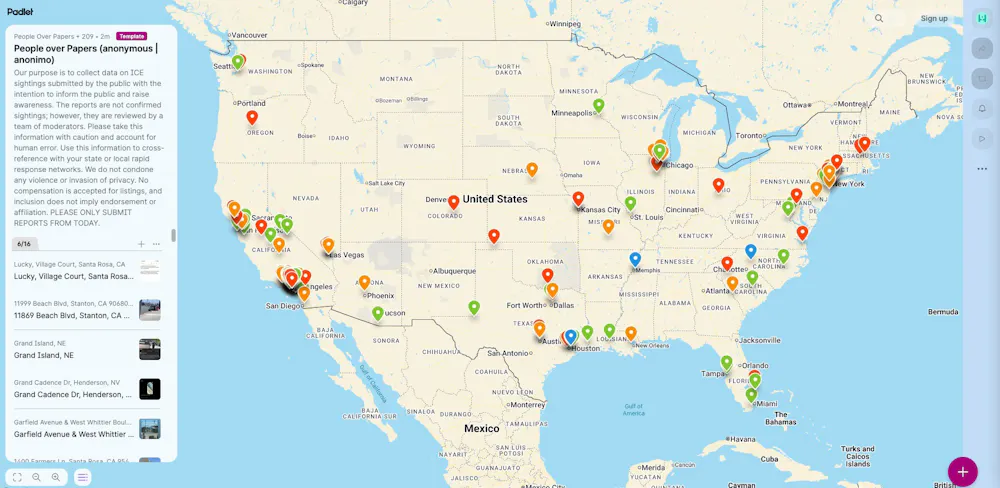
    Their work also echoes the spatial tactics of Black resistance. Just as enslaved Black people once mapped escape routes during slavery and Jim Crow, Latino communities today are engaging in digital cartography to chart ICE-free zones, mutual aid hubs and sanctuary spaces. The People Over Papers map channels the logic of the Black maroons – communities of self-liberated Africans who escaped plantations to track patrols, share intelligence and build networks of survival. Now, the hideouts are digital. The maps are crowdsourced. The danger remains.

    Likewise, the Stop ICE Raids Alerts Network revives a civil rights-era tactic. In the 1960s, organizers used wide area telephone service lines and radio to circulate safety updates. Black DJs cloaked dispatches in traffic and weather reports – “congestion on the south side” signaled police blockades; “storm warnings” meant violence ahead. Today, the medium is WhatsApp. The signal is encrypted. But the message – protect each other – has not changed.

    Layered across both systems is the DNA of the “Negro Motorist Green Book,” the guide that once helped Black travelers navigate Jim Crow America by identifying safe towns, gas stations and lodging. People Over Papers and Stop ICE Raids are digital descendants of that legacy. Where the Green Book used printed pages, today’s tools use digital pins. But the mission remains: survival through shared knowledge, protection through mapped resistance.

    The People Over Papers map is a crowdsourced collection of reports of ICE activity across the U.S.
    Screenshot by The Conversation U.S.

    Dangerous necessity

    Five years after George Floyd’s death, the power of visual evidence remains undeniable. Black witnessing laid the groundwork. In 2025, that tradition continues through the lens of Latino mobile journalists, who draw clear parallels between their own community’s experiences and those of Black Americans. Their footage exposes powerful echoes: ICE raids and overpolicing, border cages and city jails, a door kicked in at dawn and a knee on a neck.

    Like Black Americans before them, Latino communities are using smartphones to protect, to document and to respond. In cities such as Chicago, Los Angeles and El Paso, whispers of “ICE is in the neighborhood” now flash across Telegram, WhatsApp and Instagram. For undocumented families, pressing record can mean risking retaliation or arrest. But many keep filming – because what goes unrecorded can be erased.

    What they capture are not isolated incidents. They are part of a broader, shared struggle against state violence. And as long as the cameras keep rolling, the stories keep surfacing – illuminated by the glow of smartphone screens that refuse to look away.

    Allissa V. Richardson receives funding from the Ford Foundation and the John D. and Catherine T. MacArthur Foundation.

    ref. Smartphones are once again setting the agenda for justice as the Latino community documents ICE actions – https://theconversation.com/smartphones-are-once-again-setting-the-agenda-for-justice-as-the-latino-community-documents-ice-actions-258980

    MIL OSI

  • MIL-OSI Submissions: Metro Detroit is growing – but its suburbs are telling a more complicated story

    Source: The Conversation – USA – By Grigoris Argeros, Professor of Sociology, Eastern Michigan University

    Detroit is still a majority Black city, but the share of white, Asian and Hispanic residents is growing. DOMINIC GWINN/Middle East Images/AFP via Getty Images

    Following decades of population loss, Detroit may finally be turning a corner.

    According to the U.S. Census Bureau’s most recent estimates, the city saw an increase in population for both 2023 and 2024.

    An additional 11,000 people moved into the city in the years 2023 and 2024, a small gain in a city with a population of 645,705 – but one which marked a symbolic shift.

    The census data shows just over 1% growth in the past year alone and 0.7% the year before compared with a nearly 25% loss between 2000 and 2010.

    As an urban sociologist studying issues related to race and ethnicity, I am interested in how Detroit’s population is changing, and where different groups live in both the city and its suburbs.

    Analyzing population trends in the metro Detroit area using data from the U.S. Census Bureau, I wanted to understand how racial, ethnic and socioeconomic trends are unfolding, and what those changes can tell us about the evolution and vitality of Detroit.

    Black Detroiters relocate, city diversifies

    From 2010 to 2023, Detroit’s racial and ethnic makeup continued to gradually diversify even as the city was declining in population.

    While Black residents are still the majority, their proportion of the total number fell from around 84% to 79%.

    Other groups, in contrast, increased their share of the city’s population. Between 2010 and 2023, the percentage of Hispanic residents grew from 6.6% to 8.3%, the percentage of white residents grew from 8.2% to 10.7%, and the percentage of Asian residents grew from 1.3% to 1.7%.

    These shifts reflect a steady and ongoing diversification of Detroit’s population, indicative of new migration trends and shifting neighborhood dynamics.

    Suburbs in flux

    In addition to Detroit’s recent population growth, a broader story is unfolding in the city’s suburbs.

    The population of the suburban area as a whole increased 0.73% from 2023 to 2024, but growth was not evenly spread. Collectively, the outer-ring suburbs gained almost 20,000 people, increasing by 1%. Communities such as the city of Troy and Macomb Township accounted for a significant share of that growth.

    A map of Detroit and the surrounding suburbs, with shading to indicate which areas are considered to be the ‘inner’ and ‘outer’ suburbs.
    Grigoris Argeros, CC BY

    Inner-ring suburbs, such as Southfield, Warren and others, grew less vigorously – gaining just 4,000 people, or 0.31%.

    These differences highlight the necessity of complicating the conventional city-versus-suburb narrative to acknowledge the many economic and racial divisions across the metropolitan region.

    The socioeconomic statuses of residents of the inner- and outer-ring suburbs diverged between 2000 and 2020.

    My analysis of census data shows that although both subregions witnessed increases in median household incomes, the rates of change were significantly higher in the outer-ring suburbs, with a 37.7% increase versus a 16.8% increase in the inner rings.

    The data shows a similar trend in higher education attainment. Outer ring suburbs gained 7.1% more residents with college degrees or higher during this period, while the inner suburbs lost 7.5%.

    Homeownership patterns in the two suburban regions also diverged over those two decades, increasing 18% in the outer rings and decreasing 10% in the inner rings.

    The data on poverty and immigration also reveal contrasting results.

    According to my calculations of census data, inner-ring suburbs experienced a 77% increase in poverty, while the outer ring experienced a lesser, though considerable, 50.8% bump in poverty during the 2000-2020 period.

    Meanwhile, during the same time period, the foreign-born populations in the outer suburbs expanded by 24.9%, with increases of at least 10,000 in places such as Sterling Heights, Novi and Canton. In contrast, the inner suburbs saw more modest gains — around 5,000 in cities such as Dearborn Heights and Warren — while their overall foreign-born share declined by nearly 20%.

    Together, the above trends highlight the necessity of not viewing the suburban area as a monolith. These patterns reflect national trends, in which many older, inner-ring suburbs are experiencing socioeconomic stagnation or decline while newer, outer-ring suburbs continue to attract more people who have higher incomes.

    Mixed neighborhoods grow

    Residential segregation also differentiates inner and outer suburban rings.

    Segregation levels remain high in the inner suburbs, especially between white and Black residents. While outer suburbs tend to be more integrated today, the rate of change there has been more modest over the past two decades.

    Social scientists measure segregation using a tool called the “dissimilarity index.” The index represents the proportion of one group that would need to move to establish an equal distribution of the population based on their relative numbers. It ranges from 0 to 100. A score of 0 means equal distribution across neighborhoods, while a score of 100 means the two groups live in completely separate areas.

    From 2000 to 2020, white-Black segregation across the region decreased from 84.4% to 68.3% on the index, while white-Hispanic segregation decreased from 47.6% to 39.9%. Together, these numbers indicate a broader trend toward more integrated living patterns.

    In the inner-ring suburbs, segregation fell across the board. White-Black segregation went down by 15.6%; white-Asian and white-Hispanic segregation dropped even more, by 43.2% and 30.7%, respectively.

    These trends suggest that while the outer suburbs currently have lower levels of segregation, the inner suburbs are integrating more rapidly, reflecting shifting patterns of neighborhood change and increasing racial and ethnic diversity.

    Detroit has come a long way since exiting bankruptcy in 2014. Its recent population growth and increasing diversity show important signs of renewal.

    Grigoris Argeros does not work for, consult, own shares in or receive funding from any company or organization that would benefit from this article, and has disclosed no relevant affiliations beyond their academic appointment.

    ref. Metro Detroit is growing – but its suburbs are telling a more complicated story – https://theconversation.com/metro-detroit-is-growing-but-its-suburbs-are-telling-a-more-complicated-story-257875

    MIL OSI

  • MIL-OSI Submissions: US bombs Iran’s nuclear sites: What led to Trump pulling the trigger – and what happens next?

    Source: The Conversation – USA – By Javed Ali, Associate Professor of Practice of Public Policy, University of Michigan

    US President Donald Trump addresses the nation on Iran strikes on June 21, 2025 Carlos Barria/AFP via Getty Images

    In the early hours of June 22, 2025, local time, the United States attacked three nuclear facilities in Iran with “bunker buster” bombs and Tomahawk missiles.

    Following more than a week of Israeli strikes on various targets in Iran – which had prompted retaliatory strikes from Tehran – the U.S. move marks a possible inflection point in the conflict. In initial comments on the strikes at the Fordo, Isfahan and Natanz facilities, President Donald Trump said that Iran’s nuclear program had been “completely and fully obliterated.” In response, Iran’s Foreign Minister Abbas Araghchi said the U.S. had “crossed a very big red line.”

    The Conversation U.S. turned to Javed Ali, an expert on Middle East affairs at the University of Michigan and a former senior official at the National Security Council during the first Trump administration, to talk through why Trump chose now to act and what the potential repercussions could be.

    What do we know about the nature and timing of US involvement?

    President Trump has been forcefully hinting for days days that such a strike could happen, while at the same time opening up a window of negotiation by suggesting as late as June 20 that he would make a decision “within the next two weeks.” We know Trump can be very unpredictable, but he must have assessed that the current conditions presented an opportunity for U.S. action.

    Trump met with the National Security Council twice in the days leading up to the strike. Typically at such meetings the president is presented with a menu of military options, which usually boil down to three: a narrow option, a middle ground and a “if you really want to go big” strike.

    The one he picked, I would argue, is somewhere between the narrow option and the middle ground one.

    The “go big” options would have been an attack on nuclear sites and Iranian leadership – be that senior members of Iran’s Revolutionary Guard, or possibly the Supreme Leader Ayatollah Ali Khamenei. The more narrow approach would have been just one facility, likely to have been Fordo – a deeply fortified uranium enrichment site buried within a mountain.

    What did occur was a strike there, but also at two other sites – Isfahan and Natanz.

    U.S. military chiefs confirmed that that 12 GBU-57s – the so-called 30,000-pound bunker busters – were dropped by B-2 bombers on Fordo, and two on Isfahan.

    That suggests to me that the military goal of the operation was to destroy Iran’s ability to produce and or store highly enriched uranium in a one-time strike rather than drag the U.S. into a more prolonged conflict.

    Has the strike achieved Trump’s objectives?

    It will take some time to properly assess the extent to which Iran’s ability to produce or store highly enriched uranium has been damaged.

    Certainly we know that the bombs hit their targets, and they have been damaged – but to what extent is not immediately clear. General Dan Caine, chairman of the Joint Chiefs of Staff, said that all three target sites had suffered “extremely severe damage and destruction” – possibly rolling back from Trump’s “fully obliterated” assessment. Perhaps most tellingly, Iran has not commented yet on the extent of the damage.

    But to Trump, the objective was not just military but political, too. Trump has long said “no” to a nuclear Iran while at the same time has expressed that he has no desire to drag the U.S. into another war.

    And this strike may allow Trump to achieve those seemingly contradictory goals. If U.S. initial assessments are correct, Iran’s nuclear program will have been severely compromised. But the strikes won’t necessarily pull U.S. into the conflict fully – unless Iran retaliates in such a way that necessitates further U.S. action.

    And that is what Iran’s supreme leader and his military generals will need to work out: Should Iran retaliate and, if so, is it prepared to deal with a heavier U.S. military response – especially when there is no end in sight to its current conflict with Israel.

    An operational timeline of a strike on Iran is displayed during a news conference with U.S. Chairman of the Joint Chiefs of Staff Gen. Dan Caine and U.S. Defense Secretary Pete Hegseth on June 22, 2025.
    Andrew Harnik/Getty Images

    What options does Iran have to retaliate against US?

    Iran has in the past tried to respond proportionately to any attack. But here is the problem for Iran’s leaders: There is no feasible proportionate response to the United States. Iran has no capability to hit nuclear plants in the U.S. – either conventionally or through unconventional warfare.

    But there are tens of thousands of U.S. troops in the region, stationed in Iraq, Syria, the United Arab Emirates, Oman, Qatar and Jordan. All are in range of Iran’s ballistic, drones or cruise missiles.

    But that military inventory has been depleted – both by using ballistic missiles in waves of attacks against Israel and by Israel hitting missile launch and storage sites in Iran.

    Similarly, Tehran’s capacity to respond through one of its proxy or aligned groups in the region has been degraded. Hezbollah in Lebanon and Gaza’s Hamas – both of whom have ties to Iran – are in survival mode following damaging attacks from Israel over the past 18 months.

    The Houthis in Yemen are in many ways the “last man standing” in Iran’s so-called “Axis of Resistance.” But the Houthis have limited capability and know that if they do attack U.S. assets, they will likely get hit hard. During Operation Rough Rider from March to May this year, the Trump administration launched over 1,000 strikes against the Houthis.

    Meanwhile Shia militias in Iraq and Syria that could be encouraged to attack U.S. bases haven’t been active in months.

    Of course, Iran could look outside the region. In the past the country has been involved in assassinations, kidnappings and terror attacks abroad that were organized through its Quds Force or via operatives of MOIS, its intelligence service.

    But for Iran’s leaders, it is increasingly looking like a lose-lose proposition. If they don’t respond in a meaningful way, they look weak and more vulnerable. But if they do hit U.S. targets in any meaningful way, they will invite a stronger U.S. involvement in the conflict, as Trump has warned.

    The parallel I see here is with the killing of Iranian general and commander of the Quds Force, Qassem Soleimani, in January 2020 by a U.S. drone strike.

    On that occasion, Iran promised a strong retaliation. Its retaliatory attack against the U.S. Ain al-Asad air base in Iraq involved 27 ballistic missiles and caused the physical destruction of some of the facilities on base as well as traumatic brain injury-type symptoms to dozens of troops and personnel, but no deaths. Nevertheless, after this both the U.S. and Iran then backed off from deepening the conflict.

    The circumstances now are very different. Iran is already at war with Israel. Moreover, the U.S. went after Iran’s crown jewels – its nuclear program – and it was on Iranian territory. Nonetheless, Khameini knows that if he retaliates, he risks provoking a larger response.

    Trump suggested ‘further attacks’ could occur. What could that entail?

    The U.S. has suggested that it has the intelligence and ability to hit senior leadership in Iran. And any “go big option” would have likely involved strikes on key personnel. Similarly there could be plans to hit the Iranian economy by attacking oil and gas targets.

    A satellite image of the Fordo nuclear facility in Iran prior to the U.S. strike on June 22, 2025.
    Maxar/Getty

    But such actions risk either damaging the global economy or drawing the U.S. deeper into the conflict – it would evolve from a “one and done” strike to a cycle of attacks and responses. And that could widen political cracks between hawks in the administration and parts of Trump’s MAGA faithful who are against the U.S. being involved in overseas wars.

    Is there any opportunity of a return to diplomacy?

    Trump has not closed his “two weeks” window for talks – theoretically it is still open.

    But will Iran come to table? Leaders there had already said they were not willing to entertain any deal while under attack from Israel. Araghchi, Iran’s foreign minister, said after the U.S. strikes that the time for diplomacy had now passed.

    In any event, you have to ask, what can Iran come to the table with? Do they have much of a nuclear program anymore? And if not, what would they try to negotiate? It would seem, using one of Trump’s phrases, they “don’t have the cards” to make much of a deal.

    Javed Ali does not work for, consult, own shares in or receive funding from any company or organization that would benefit from this article, and has disclosed no relevant affiliations beyond their academic appointment.

    ref. US bombs Iran’s nuclear sites: What led to Trump pulling the trigger – and what happens next? – https://theconversation.com/us-bombs-irans-nuclear-sites-what-led-to-trump-pulling-the-trigger-and-what-happens-next-259519

    MIL OSI

  • MIL-OSI Submissions: The sleeper Supreme Court decision that could have profound impacts on the Trump administration agenda – and restore faith in the high court

    Source: The Conversation – USA – By Ray Brescia, Associate Dean for Research and Intellectual Life, Albany Law School

    The Trump administration has tried to punish or suppress speech and opposition to administration policies. Baac3nes/Getty Images

    The American public’s trust in the Supreme Court has fallen precipitously over the past decade. Many across the political spectrum see the court as too political.

    This view is only strengthened when Americans see most of the justices of the court dividing along ideological lines on decisions related to some of the most hot-button issues the court handles. Those include reproductive rights, voting rights, corporate power, environmental protection, student loan policy, worker rights and LGBTQ+ rights.

    But there is one recent decision where the court was unanimous in its ruling, perhaps because its holding should not be controversial: National Rifle Association v. Vullo. In that 2024 case, the court said that it’s a clear violation of the First Amendment’s free speech provisions for government to force people to speak and act in ways that are aligned with its policies.

    The second Trump administration has tried to wield executive branch power in ways that appear to punish or suppress speech and opposition to administration policy priorities. Many of those attempts have been legally challenged and will likely make their way to the Supreme Court.

    The somewhat under-the-radar – yet incredibly important – decision in National Rifle Association v. Vullo is likely to figure prominently in Supreme Court rulings in a slew of those cases in the coming months and years, including those involving law firms, universities and the Public Broadcasting Service.

    That’s because, in my view as a legal scholar, they are all First Amendment cases.

    Will the Supreme Court continue to protect free speech rights, as it did unanimously in 2024?
    Geoff Livingston/Getty Images

    Why the NRA sued a New York state official

    In May 2024, in an opinion written by reliably liberal Sonia Sotomayor, a unanimous court ruled that the efforts of New York state government officials to punish companies doing business with the NRA constituted clear violations of the First Amendment.

    Following its own precedent from the 1960s, Bantam Books v. Sullivan, the court found that government officials “cannot attempt to coerce private parties in order to punish or suppress views that the government disfavors.”

    Many of the current targets of the Trump administration’s actions have claimed similar suppression of their First Amendment rights by the government. They have fought back, filing lawsuits that often cite the National Rifle Association v. Vullo decision in their efforts.

    To date, the most egregious examples of actions that violate the principles announced by the court – the executive orders against law firms – have largely been halted in the lower courts, with those decisions often citing what’s now known as the Vullo decision.

    While these cases may still be working their way through the lower courts, it is likely that the Supreme Court will ultimately consider legal challenges to the Trump administration’s efforts in a range of areas.

    These would include the executive orders against law firms, attempts to cut government grants and research funding from universities, potential moves to strip nonprofits of their tax-exempt status, and regulatory actions punishing media companies for what the White House believes to be unfavorable coverage.

    The court could also hear disputes over the government terminating contracts with a family of companies that provides satellite and communications support to the U.S. government generally and the military in particular.

    Despite the variety of organizations and government actions involved in these lawsuits, they all can be seen as struggles over free speech and expression, like Vullo.

    Whether it is private law firms, multinational corporations, universities or members of the media, all have one thing in common: They have all been targeted by the Trump administration for the same reason – they are engaged in actions or speech that is disfavored by President Donald Trump.

    Protecting speech, regardless of politics

    U.S. Supreme Court Justice Robert Jackson, front, took leave to help prosecute war criminals at the Nuremberg trials at the end of World War II.
    Bettman/Getty Images

    The NRA, an often-controversial gun-rights advocacy organization, was the plaintiff in the Vullo decision.

    But just because the groups that have been targeted by the Trump administration are across the political divide from the NRA does not mean the outcome in decisions relying on the court’s opinion will be different. In fact, these groups can rely on the same arguments advanced by the NRA, and are, I believe, likely to win.

    Vullo isn’t the only decision on which the court can rely when considering challenges to the Trump administration’s efforts targeting these groups.

    In 1943, Supreme Court Justice Robert Jackson wrote the majority opinion in West Virginia State Board of Education v. Barnette, where the court found that students who refused to salute the American flag and recite the Pledge of Allegiance at school could not be expelled.

    Jackson’s opinion is a forceful rejection of government attempts to control what people say: “If there is any fixed star in our constitutional constellation, it is that no official, high or petty, can prescribe what shall be orthodox in politics, nationalism, religion, or other matters of opinion or force citizens to confess by word or act their faith therein.”

    In the wake of World War II, Jackson took a leave from the court and served as a prosecutor in the Nuremberg trials of Nazi leaders. Prosecuting them for their atrocities, Jackson saw how the Nuremberg defendants wielded government authority to punish enemies who resisted their rise and later opposed their rule.

    If some of the cases testing the state’s power to force fidelity to the executive branch reach the Supreme Court, the cases could offer the justices the opportunity to, once again, speak with one voice as they did in NRA v. Vullo, to demonstrate it can be evenhanded and will not play politics with the First Amendment.

    This story has been updated with the correct year for the Supreme Court’s decision in West Virginia State Board of Education v. Barnette.

    Ray Brescia does not work for, consult, own shares in or receive funding from any company or organization that would benefit from this article, and has disclosed no relevant affiliations beyond their academic appointment.

    ref. The sleeper Supreme Court decision that could have profound impacts on the Trump administration agenda – and restore faith in the high court – https://theconversation.com/the-sleeper-supreme-court-decision-that-could-have-profound-impacts-on-the-trump-administration-agenda-and-restore-faith-in-the-high-court-258216

    MIL OSI

  • MIL-OSI Submissions: Rethinking engineering education: Why focusing on learning preferences matters for diversity

    Source: The Conversation – USA (2) – By Sharon Tettegah, Professor of Creative Studies, University of California, Santa Barbara

    Retention and recruitment efforts designed to boost diversity in engineering programs often fall short of their goals. gorodenkoff/Getty Images

    For decades, colleges, government agencies and foundations have experimented with recruitment and retention efforts designed to increase diversity in engineering programs.

    However, the efforts have not significantly boosted the number of women, students of color, individuals with disabilities and other underrepresented groups studying and earning degrees in STEM and engineering fields.

    Latino, Black, Native American and Alaska Native students are underrepresented among science and engineering degree recipients at the bachelor’s degree level and above. The groups are also underrepresented among STEM workers with at least a bachelor’s degree.

    Women are also underrepresented in the STEM workforce and among degree recipients in engineering and computer and information sciences.

    I study equity and social justice in STEM learning. In my recent study, I found that more students from diverse backgrounds could excel in engineering programs if course content were tailored to a wider variety of learning preferences.

    Why it matters

    Focusing on learning preferences could boost diversity in engineering courses and careers.
    Morsa Images/Getty Images

    During my time as a program officer at the National Science Foundation, an independent federal agency that supports science and engineering, I reviewed plenty of research focused on broadening participation and diversifying student enrollment in STEM fields.

    Progress can stall on efforts to boost diversity because college instructors do not consider the synergistic relationship between the content and the learner.

    Teachers are the mediators, and it is students’ experiences with the curriculum that matter.

    It was long a common belief that students have different learning styles. These included kinesthetic, learning through hands-on experiences and physical activity; auditory, learning by listening to information; and visual, learning by seeing information.

    More recent research does not support the idea that teaching students according to their learning style leads to improved learning.

    That’s why I prefer the term “learning preferences” rather than learning styles. We all have preferences – whether for ice cream flavors, home decor or how we receive information, including how we learn.

    Learning preferences are broader and more flexible, allowing multiple ways of engaging with content.

    For example, let’s say a teacher always presented equations in a classroom and the student just could not get it. However, it was the only way the information was presented. To the individual learner, they have failed. Some people would say, “These kids can’t learn,” and subsequently counsel the student out of the class.

    Then, years are spent repeating the same cycle.

    Students should have opportunities to connect with engineering content in multiple ways.
    10’000 hours/Getty Images

    However, educators can broaden their viewpoints if they look at the students as customers. If a customer is shopping for a shirt, they look for one that catches their eye. Ultimately, they find one they like.

    Instructors need to take the same approach when trying to help students understand what is happening in class. For instance, if I have trouble with equations, I should be provided with options to engage with the lesson in ways that align with my learning preferences.

    What’s next?

    Learning styles have been heavily researched. However, content preferences have not been well explored.

    In a truly democratic education system, curriculum design should reflect the voices of all stakeholders and not just those in positions of power, namely instructors.

    Using data mining and artificial intelligence, educators have a variety of options for creating content for the various preferences a learner may want or need. For example, if a student prefers other representational content, such as word problems, graphics or simulations, AI can create diverse representations so that the learner is exposed to a variety of representations.

    I argue that future studies need to consider the use of technologies such as adaptive learning applications to understand students’ learning preferences.

    Prioritizing diverse learning perspectives in STEM could help create a more inclusive and responsive learning environment.

    The Research Brief is a short take on interesting academic work.

    Sharon Tettegah received funding from the National Science Foundation for this work. Award Abstract # 1826632
    Coordinating Curricula and User Preferences to Increase the Participation of Women and Students of Color in Engineering

    ref. Rethinking engineering education: Why focusing on learning preferences matters for diversity – https://theconversation.com/rethinking-engineering-education-why-focusing-on-learning-preferences-matters-for-diversity-251095

    MIL OSI

  • MIL-OSI Submissions: Harvard fights to keep enrolling international students – 4 essential reads about their broader impact

    Source: The Conversation – USA (2) – By Corey Mitchell, Education Editor

    Graduates of Harvard’s John F. Kennedy School of Government celebrate during commencement exercises in Cambridge, Mass. AP Photo/Steven Senne, File

    A federal judge in Boston on May 23, 2025, temporarily blocked a Trump administration order that would have revoked Harvard University’s authorization to enroll international students.

    The directive from the U.S. Department of Homeland Security and resulting lawsuit from Harvard have escalated the ongoing conflict between the Trump administration and the Ivy League institution.

    It’s also the latest step in a White House campaign to ramp up vetting and screening of foreign nationals, including students.

    Homeland Security officials accused Harvard of creating a hostile campus climate by accommodating “anti-American” and “pro-terrorist agitators.” The accusation stems from the university’s alleged support for certain political groups and their activities on campus.

    In early April, the Trump administration terminated the immigration statuses of thousands of international students listed in a government database, the Student and Exchange Visitor Information System. The database includes country of citizenship, which U.S. school they attend and what they study.

    Barring Harvard from enrolling international students could have significant implications for the campus’s climate and the local economy. International students account for 27% of the university’s enrollment.

    Here are four stories from The Conversation’s archive about the Trump administration’s battle with Harvard and the economic impact of international students.

    1. A target on Harvard

    This isn’t the first time the Trump administration has targeted the university.

    The White House has threatened to end the university’s tax-exempt status, and some media outlets have reported that the Internal Revenue Service is taking steps in that direction.

    But it is illegal to revoke an entity’s tax-emempt status “on a whim,” according to Philip Hackney, a University of Pittsburgh law professor, and Brian Mittendorf, an accounting professor at Ohio State University.

    “Before the IRS can do that, tax law requires that it first audit that charity,” they wrote. “And it’s illegal for U.S. presidents or other officials to force the IRS to conduct an audit or stop one that’s already begun.”

    Several U.S. senators, all Democrats, have urged the IRS inspector general to see whether the IRS has begun auditing Harvard or any nonprofits in response to the administration’s requests or whether Trump has violated any laws with his pressure campaign.

    Hackney and Mittendorf wrote that the Trump administration’s moves are part of a larger push to exert control over Harvard, including its efforts to increase its diversity and its response to claims of discrimination on campus.


    Read more:
    Can Trump strip Harvard of its charitable status? Scholars of nonprofit law and accounting describe the obstacles in his way


    University of Michigan students on campus on April 3, 2025, in Ann Arbor, Mich.
    Bill Pugliano/Getty Images

    2. International students help keep ‘America First’

    The U.S. has long been the global leader in attracting international students. But competition for these students is increasing as other countries vie to attract the scholars.

    In a recent story for The Conversation, David L. Di Maria, vice provost for global engagement at the University of Maryland, Baltimore County, wrote that stepped-up screening and vetting of students could make the U.S. a less attractive study destination.

    Di Maria wrote that such efforts could hamper the Trump administration’s ability to achieve its “America First” priorities related to the economy, science and technology, and national security.

    Trump administration officials have emphasized the importance of recruiting top global talent. And Trump has said that international students who graduate from U.S. colleges should be awarded a green card with their degree.

    Research shows that international students launch successful startups at a rate that is eight to nine times higher than their U.S.-born peers. Roughly 25% of billion-dollar companies in the U.S. were founded by former international students, Di Maria noted.


    Read more:
    Deporting international students risks making the US a less attractive destination, putting its economic engine at risk


    3. A boost to local economies

    Indeed, international students have a tremendous economic impact on local communities.

    If these global scholars stay home or go elsewhere, that’s bad economic news for cities and towns across the United States, wrote Barnet Sherman, a professor of multinational finance and trade at Boston University.

    With the money they spend on tuition, food, housing and other other items, international students pump money into the local economy, but there are additional benefits.

    On average, a new job is created for every three international students enrolled in a U.S. college or university. In the 2023-24 academic year, about 378,175 jobs were created, Sherman wrote.

    In Greater Boston, where Harvard is located, there are about 63,000 international students who contribute to the economy. The gains are huge – about US$3 billion.


    Read more:
    International students infuse tens of millions of dollars into local economies across the US. What happens if they stay home?


    4. Rising number of international students

    The rising number of foreign students studying in the U.S. has long led to concerns about U.S. students being displaced by international peers.

    The unease is often fueled by the assumption that financial interests are driving the trend, Cynthia Miller-Idriss of American University and Bernhard Streitwieser of George Washington University wrote in a 2015 story for The Conversation.

    A common claim, they wrote, is the flawed assumption that “cash-strapped public universities” aggressively recruit more affluent students from abroad who can afford to pay rising tuition costs. The pair wrote that, historically, shifting demographics on college campuses result from social and economic changes.

    In today’s context, Miller-Idriss and Streitwieser maintain that the argument that colleges prioritize international students fails to account for the global role of U.S. universities, which help support national security, foster international development projects and accelerate the pace of globalization.


    Read more:
    Foreign students not a threat, but an advantage


    This story is a roundup of articles from The Conversation’s archives.

    ref. Harvard fights to keep enrolling international students – 4 essential reads about their broader impact – https://theconversation.com/harvard-fights-to-keep-enrolling-international-students-4-essential-reads-about-their-broader-impact-257506

    MIL OSI

  • MIL-OSI Submissions: Air traffic controller shortages in Newark and other airports partly reflect long, intense training − but university-based training programs are becoming part of the solution

    Source: The Conversation – USA (2) – By Melanie Dickman, Lecturer in Aviation Studies, The Ohio State University

    Air traffic controllers observe a plane taking off from San Francisco International Airport in 2017. AP Photo/Jeff Chiu

    Air traffic controllers have been in the news a lot lately.

    A spate of airplane crashes and near misses have highlighted the ongoing shortage of air traffic workers, leading more Americans to question the safety of air travel.

    The shortage, as well as aging computer systems, have also led to massive flight disruptions at airports across the country, particularly at Newark Liberty International Airport. The staffing shortage is also likely at the center of an investigation of a deadly crash between a commercial plane and an Army helicopter over Washington, D.C., in January 2025.

    One reason for the air traffic controller shortage relates to the demands of the job: The training to become a controller is extremely intense, and the Federal Aviation Administration wants only highly qualified personnel to fill those seats, which has made it difficult for what has been the sole training center in the U.S., located in Oklahoma City, to churn out enough qualified graduates each year.

    As scholars who study and teach tomorrow’s aviation professionals, we are working to be part of the solution. Our program at Ohio State University is applying to join over two dozen other schools in an effort to train air traffic controllers and help alleviate the shortage.

    Air traffic controller school

    Air traffic control training today – overseen by the Federal Aviation Administration – remains as intense as it’s ever been.

    In fact, about 30% of students fail to make it from their first day of training at the FAA Academy in Oklahoma City to the status of a certified professional air traffic controller. The academy currently trains the majority of the air traffic controllers in the U.S.

    Before someone is accepted into the training program, they must meet several qualifications. That includes being a U.S. citizen under the age of 31 and speaking English clearly enough to be understood over the radio. The low recruitment age is because controllers currently have a mandatory retirement age of 56 – with some exceptions – and the FAA wants them to work for at least 25 years in the job.

    They must also pass a medical exam and security investigation. And they must pass the air traffic controller specialists skills assessment battery, which measures an applicant’s spatial awareness and decision-making abilities.

    Candidates, additionally, must have three years of general work experience, or a combination of postsecondary education and work experience totaling at least three years.

    This alone is no easy feat. Fewer than 10% of applicants meet those initial requirements and are accepted into training.

    An air traffic controller monitors a runway in the tower at John F. Kennedy International Airport in New York.
    AP Photo/Seth Wenig

    Intense training

    Once applicants meet the initial qualifications, they begin a strenuous training process.

    This begins with several weeks of classroom instruction and several months of simulator training. There are several types of simulators, and a student is assigned to a simulator based on the type of facility for which they will be hired – which depends on a trainee’s preference and where controllers are needed.

    There are two main types of air traffic facilities: control towers and radar. Anyone who has flown on a plane has likely seen a control tower near the runways, with 360 degrees of tall glass windows to monitor the skies nearby. Controllers there mainly look outside to direct aircraft but also use radar to monitor the airspace and assist aircraft in taking off and landing safely.

    Radar facilities, on the other hand, monitor aircraft solely through the use of information depicted on a screen. This includes aircraft flying just outside the vicinity of a major airport or when they’re at higher altitudes and crisscrossing the skies above the U.S. The controllers ensure they don’t fly too close to one another as they follow their flight paths between airports.

    If the candidates make it through the first stage, which takes about six months and extensive testing to meet standards, they will be sent to their respective facilities.

    Once there, they again go to the classroom, learning the details of the airspace they will be working in. There are more assessments and chances to “wash out” and have to leave the program.

    Finally, the candidates are paired with an experienced controller who conducts on-the-job training to control real aircraft. This process may take an additional year or more. It depends on the complexity of the airspace and the amount of aircraft traffic at the site.

    Two control towers watch over Newark Liberty International Airport, where a shortage of air traffic controllers has led to blackouts and other problems lately.
    AP Photo/Seth Wenig

    Increasing the employment pipeline

    But no matter how good the training is, if there aren’t enough graduates, that’s a problem for managing the increasingly crowded skies.

    The FAA is currently facing a deficit of about 3,000 controllers and has unveiled a plan in May 2025 to increase hiring and boost retention. In addition, Congress is mulling spending billions of dollars to update the FAA’s aging systems and hire more air traffic controllers.

    Other plans include paying retention bonuses and allowing more controllers to work beyond the age of 56. That retirement age was put in place in the 1970s on the assumption that cognition for most people begins to decline around then, although research shows that age alone is not necessarily a predictor of cognitive abilities.

    But we believe that aviation programs and universities can play an important role fixing the shortage by providing FAA Academy-level training.

    Currently, 32 universities including the Florida Institute of Technology and Arizona State University partner with the FAA in its collegiate training initiative to provide basic air traffic control training, which gives graduates automatic entry into the FAA Academy and allows them to skip five weeks of coursework.

    The institution where we work, Ohio State University, is currently working on becoming the 33rd this summer and plans to offer an undergraduate major in aviation with specialization in air traffic control.

    This helps, but an enhanced version of this program, announced in October 2024, allows graduates of a select few of those universities to skip the FAA Academy altogether and go straight to a control tower or radar facility once they’ve passed all the extensive tests. These schools must match or exceed the level of rigor in their training with the FAA Academy itself.

    At the end of the program, students are required to pass an evaluation by an FAA-approved evaluator to ensure that the student graduating from the program meets the same standards as all FAA Academy graduates and is prepared to go to their assigned facility for further training. So far, five schools, such as the University of North Dakota, have joined this program and are currently training air traffic controllers. We intend to join this group in the near future.

    Allowing colleges and universities to start the training process while students are still in school should accelerate the pace at which new controllers enter the workforce, alleviate the shortage and make the skies over the U.S. as safe as they can be.

    Melanie Dickman is a member at large of the Air Traffic Controllers Association

    Brian Strzempkowski does not work for, consult, own shares in or receive funding from any company or organization that would benefit from this article, and has disclosed no relevant affiliations beyond their academic appointment.

    ref. Air traffic controller shortages in Newark and other airports partly reflect long, intense training − but university-based training programs are becoming part of the solution – https://theconversation.com/air-traffic-controller-shortages-in-newark-and-other-airports-partly-reflect-long-intense-training-but-university-based-training-programs-are-becoming-part-of-the-solution-249715

    MIL OSI

  • MIL-OSI Submissions: Texas’ annual reading test adjusted its difficulty every year, masking whether students are improving

    Source: The Conversation – USA (2) – By Jeanne Sinclair, Assistant Professor, Faculty of Education, Memorial University of Newfoundland

    Millions of Americans take high-stakes exams every year. Caiaimage/Chris Ryan/iStock via Getty Images

    Texas children’s performance on an annual reading test was basically flat from 2012 to 2021, even as the state spent billions of additional dollars on K-12 education.

    I recently did a peer-reviewed deep dive into the test design documentation to figure out why the reported results weren’t showing improvement. I found the flat scores were at least in part by design. According to policies buried in the documentation, the agency administering the tests adjusted their difficulty level every year. As a result, roughly the same share of students failed the test over that decade regardless of how objectively better they performed relative to previous years.

    From 2008 to 2014, I was a bilingual teacher in Texas. Most of my students’ families hailed from Mexico and Central America and were learning English as a new language. I loved seeing my students’ progress.

    Yet, no matter how much they learned, many failed the end-of-year tests in reading, writing and math. My hunch was that these tests were unfair, but I could not explain why. This, among other things, prompted me to pursue a Ph.D. in education to better understand large-scale educational assessment.

    Ten years later, in 2024, I completed a detailed exploration of Texas’s exam, currently known as the State of Texas Assessments of Academic Readiness, or STAAR. I found an unexpected trend: The share of students who correctly answered each test question was extraordinarily steady across years. Where we would expect to see fluctuation from year to year, performance instead appears artificially flat.

    The STAAR’s technical documents suggest that the test is designed much like a norm-referenced test – that is, assessing students relative to their peers, rather than if they meet a fixed standard. In other words, a norm-referenced test cannot tell us if students meet key, fixed criteria or grade-level standards set by the state.

    In addition, norm-referenced tests are designed so that a certain share of students always fail, because success is gauged by one’s position on the “bell curve” in relation to other students. Following this logic, STAAR developers use practices like omitting easier questions and adjusting scores to cancel out gains due to better teaching.

    Ultimately, the STAAR tests over this time frame – taken by students every year from grade 3 to grade 8 in language arts and math, and less frequently in science and social studies – were not designed to show improvement. Since the test seems designed to keep scores flat, it’s impossible to know for sure if a lack of expected learning gains following big increases in per-student spending was because the extra funds failed to improve teaching and learning, or simply because the test hid the improvements.

    Why it matters

    Ever since the federal education policy known as No Child Left Behind went into effect in 2002 and tied students’ test performance to rewards and sanctions for schools, achievement testing has been a primary driver of public education in the United States.

    Texas’ educational accountability system has been in place since 1980, and it is well known in the state that the stakes and difficulty of Texas’ academic readiness tests increase with each new version, which typically come out every five to 10 years. What the Texas public may not know is that the tests have been adjusted each and every year – at the expense of really knowing who should “pass” or “fail.”

    The test’s design affects not just students but also schools and communities. High-stakes test scores determine school resources, the state’s takeover of school districts and accreditation of teacher education programs. Home values are even driven by local schools’ performance on high-stakes tests.

    Students who are marginalized by racism, poverty or language have historically tended to underperform on standardized tests. I believe STAAR’s design makes this problem worse.

    On May 28, 2025, the Texas Senate passed a bill that would eliminate the STAAR test and replace it with a different, shorter test or a norm-referenced test. As best as I can tell, this wouldn’t address the problems I uncovered in my research.

    What still isn’t known

    I plan to investigate if other states or the federal government use similarly designed tests to evaluate students.

    My deep dive into Texas’ test focused on STAAR before its 2022 redevelopment. The latest iteration has changed the test format and question types, but there appears to be little change to the way the test is scored. Without substantive revisions to the scoring calculations “under the hood” of the STAAR test, it is likely Texas will continue to see flat performance.

    This article was updated on May 31, 2025, to clarify some language and the type of data used in the chart, replace a link and add a comment from the Texas Education Agency.

    The Texas Education Agency responded to a pre-publication request for comment after the piece was published. A spokesman refuted several of the scholar’s research conclusions, including that it behaved like a norm-referenced test. However, the scholar stands by them.

    The Research Brief is a short take on interesting academic work.

    Jeanne Sinclair receives funding from the Social Science and Humanities Research Council (SSHRC) of Canada.

    ref. Texas’ annual reading test adjusted its difficulty every year, masking whether students are improving – https://theconversation.com/texas-annual-reading-test-adjusted-its-difficulty-every-year-masking-whether-students-are-improving-244159

    MIL OSI

  • MIL-OSI Submissions: Our trans health study was terminated by the government – the effects of abrupt NIH grant cuts ripple across science and society

    Source: The Conversation – USA (2) – By Jae A. Puckett, Associate Professor of Psychology, Michigan State University

    Funding cuts to trans health research are part of the Trump administration’s broader efforts to medically and legally restrict trans rights. AP Photo/Lindsey Wasson

    Given the Trump administration’s systematic attempts to medically and legally disenfranchise trans people, and its abrupt termination of grants focused on LGBTQ+ health, we can’t say that the notice of termination we received regarding our federally funded research on transgender and nonbinary people’s health was unexpected.

    As researchers who study the experiences of trans and nonbinary people, we have collectively dedicated nearly 50 years of our scientific careers to developing ways to address the health disparities negatively affecting these communities. The National Institutes of Health had placed a call for projects on this topic, and we had successfully applied for their support for our four-year study on resilience in trans communities.

    However, our project on trans health became one of the hundreds of grants that have been terminated on ideological grounds. The termination notice stated that the grant no longer fit agency priorities and claimed that this work was not based on scientific research.

    Termination notice sent to the authors from the National Institutes of Health.
    Jae A. Puckett and Paz Galupo, CC BY-ND

    These grant terminations undermine decades of science on gender diversity by dismissing research findings and purging data. During Trump’s current term, the NIH’s Sexual and Gender Minority Research Office was dismantled, references to LGBTQ+ people were removed from health-related websites, and datasets were removed from public access.

    The effects of ending research on trans health ripple throughout the scientific community, the communities served by this work and the U.S. economy.

    Studying resilience

    Research focused on the mental health of trans and nonbinary people has grown substantially in recent years. Over time, this work has expanded beyond understanding the hardships these communities face to also study their resilience and positive life experiences.

    Resilience is often understood as an ability to bounce back from challenges. For trans and nonbinary people experiencing gender-based stigma and discrimination, resilience can take several forms. This might look like simply continuing to survive in a transphobic climate, or it might take the form of being a role model for other trans and nonbinary people.

    As a result of gender-based stigma and discrimination, trans and nonbinary people experience a range of health disparities, from elevated rates of psychological distress to heightened risk for chronic health conditions and poor physical health. In the face of these challenges and growing anti-trans legislation in the U.S., we believe that studying resilience in these communities can provide insights into how to offset the harms of these stresses.

    Studies show anti-trans legislation is harming the mental health of LGBTQ+ youth.

    With the support of the NIH, we began our work in earnest in 2022. The project was built on many years of research from our teams preceding the grant. From the beginning, we collaborated with trans and nonbinary community members to ensure our research would be attuned to the needs of the community.

    At the time our grant was terminated, we were nearing completion of Year 3 of our four-year project. We had collected data from over 600 trans and nonbinary participants across the U.S. and started to follow their progress over time. We had developed a new way to measure resilience among trans and nonbinary people and were about to publish a second measure specifically tailored to people of color.

    The termination of our grant and others like it harms our immediate research team, the communities we worked with and the field more broadly.

    Loss of scientific workforce

    For many researchers in trans health, the losses from these cuts go beyond employment.

    Our project had served as a training opportunity for the students and early career professionals involved in the study, providing them with the research experience and mentorship necessary to advance their careers. But with the termination of our funding, two full-time researchers and at least three students will lose their positions. The three lead scientists have lost parts of their salaries and dedicated research time.

    These NIH cuts will likely result in the loss of much of the next generation of trans researchers and the contributions they would have made to science and society. Our team and other labs in similar situations will be less likely to work with graduate students due to a lack of available funding to pay and support them. This changes the landscape for future scientists, as it means there will be fewer opportunities for individuals interested in these areas of research to enter graduate training programs.

    The Trump administration has directly penalized universities across the country for ‘ideological overreach.’
    Zhu Ziyu/VCG via Getty Images

    As universities struggle to address federal funding cuts, junior academics will be less likely to gain tenure, and faculty in grant-funded positions may lose their jobs. Universities may also become hesitant to hire people who work in these areas because their research has essentially been banned from federal funding options.

    Loss of community trust

    Trans and nonbinary people have often been studied under opportunistic and demeaning circumstances. This includes when researchers collect data for their own gains but return little to the communities they work with, or when they do research that perpetuates theories that pathologize those communities. As a result, many are often reluctant to participate in research.

    To overcome this reluctance, we grounded our study on community input. We involved an advisory board composed of local trans and nonbinary community members who helped to inform how we conducted our study and measured our findings.

    Our work on resilience has been inspired by feedback we received from previous research participants who said that “[trans people] matter even when not in pain.”

    Abruptly terminating projects like these can break down trust between researchers and the populations they study.

    Loss of scientific knowledge

    Research that focuses on the strengths of trans and nonbinary communities is in its infancy. The termination of our grant has led to the loss of the insights our study would have provided on ways to improve health among trans and nonbinary people and future work that would have built off our findings. Resilience is a process that takes time to unfold, and we had not finished the longitudinal data collection in our study – nor will we have the protected time to publish and share other findings from this work.

    Meanwhile, the Department of Health and Human Services released a May 2025 report stating that there is not enough evidence to support gender-affirming care for young people, contradicting decades of scientific research. Scientists, researchers and medical professional organizations have widely criticized the report as misrepresenting study findings, dismissing research showing benefits to gender-affirming care, and promoting misinformation rejected by major medical associations. Instead, the report recommends “exploratory therapy,” which experts have likened to discredited conversion therapy.

    Transgender and nonbinary people continue to exist, regardless of legislation.
    Kayla Bartkowski/Getty Images

    Despite claims that there is insufficient research on gender-affirming care and more data is needed on the health of trans and nonbinary people, the government has chosen to divest from actual scientific research about trans and nonbinary people’s lives.

    Loss of taxpayer dollars

    The termination of our grant means we are no longer able to achieve the aims of the project, which depended on the collection and analysis of data over time. This wastes the three years of NIH funding already spent on the project.

    Scientists and experts who participated in the review of our NIH grant proposal rated our project more highly than 96% of the projects we competed against. Even so, the government made the unscientific choice to override these decisions and terminate our work.

    Millions of taxpayer dollars have already been invested in these grants to improve the health of not only trans and nonbinary people, but also American society as a whole. With the termination of these grants, few will get to see the benefits of this investment.

    Jae A. Puckett has received funding from the National Institutes of Health.

    Paz Galupo has received funding from the National Institutes of Health.

    ref. Our trans health study was terminated by the government – the effects of abrupt NIH grant cuts ripple across science and society – https://theconversation.com/our-trans-health-study-was-terminated-by-the-government-the-effects-of-abrupt-nih-grant-cuts-ripple-across-science-and-society-254021

    MIL OSI

  • MIL-OSI Submissions: Teens say they can access firearms at home, even when parents lock them up, new research shows

    Source: The Conversation – USA – By Katherine G. Hastings, PhD Candidate in Population and Public Health, University of British Columbia

    Most households that own firearms have more than one − and owners often don’t secure all of them. StockPlanets/E+ via Getty Images

    More than half of U.S. teens living in households with firearms believe they can access and load a firearm at home. Even when their parents report storing all firearms locked and unloaded, more than one-third of teens still believe they could access and load one. These are the main findings of our new study, published in the journal JAMA Network Open.

    We are behavioral scientists investigating youth injury prevention and youth safety. In this study, we analyzed national survey data from nearly 500 parents who owned firearms and their teens. One survey asked the parents to report how many firearms they had in the home and how they stored each one. Another asked their teens to estimate how quickly they could access and load a firearm at home.

    While the presence of unlocked and loaded firearms in the home was weakly linked to perceived access among teens, we found that parents’ storage practices alone were a poor predictor of whether teens believed they could access a firearm. What’s more, in households with more than one firearm, locking up more firearms was not at all linked to perceived access among teens if at least one remained unsecured.

    In short, just one unlocked firearm can undo the protective benefit of securing all other firearms in the home, our results showed.

    Why it matters

    In the U.S., firearms are now the leading cause of death among children and teens. In most of these cases, the firearm used belonged to a parent, relative or friend.

    Our study focused on teens’ beliefs about firearm access, not their actual access. However, these perceptions may provide important clues around firearm access and use. Prior research shows that teens who believe they can access a firearm are more likely to access and carry one. This is particularly concerning for teens who already have a higher risk for dying by suicide.

    One of the most widely supported ways to reduce teen injuries and deaths by firearms is to encourage owners to keep firearms locked and unloaded. However, most firearm-owning households in the U.S. have multiple firearms, and owners often store some firearms securely but not all.

    Firearms are the leading cause of death among children and teens.
    Kypros/Stock Photos Gun Safe via Getty Images

    Despite evidence that securely storing firearms saves lives, efforts to promote that messaging may be less effective when it is not universally applied to all firearms in the home or when teens still know how to access them.

    Our study also points to the need for messaging and safety strategies that consider teen behavior amid household firearm dynamics. For example, teens may observe where firearms are stored or know where keys or combinations are kept and unlock firearms in moments of impulsivity or emotional distress. Beyond securely storing firearms, encouraging parents to treat every firearm in the household as a potential source of risk and talking with teens about how to address conflicts and promote mental and emotional well-being may also be protective.

    Additionally, our study adds support for universal laws that require securely storing all firearms in homes in which children live and mandating routine assessments of teen firearm access by pediatricians.

    What still isn’t known

    It is still unclear how teens’ beliefs about their access to firearms affects whether they actually seek them out – or how the variability of parents’ practices on storing firearms affects teen access.

    Another important question is how teens’ perceptions of their access to firearms at home may vary depending on cultural backgrounds, geography and different households’ attitudes and beliefs around firearm use.

    Additionally, our study looked only at teens ages 14 to 18. Further research is needed to explore these associations among younger children in firearm-owning households.

    The Research Brief is a short take on interesting academic work.

    Rebeccah Sokol receives funding from the National Institutes of Health and Centers for Disease Control and Prevention.

    Katherine G. Hastings does not work for, consult, own shares in or receive funding from any company or organization that would benefit from this article, and has disclosed no relevant affiliations beyond their academic appointment.

    ref. Teens say they can access firearms at home, even when parents lock them up, new research shows – https://theconversation.com/teens-say-they-can-access-firearms-at-home-even-when-parents-lock-them-up-new-research-shows-256550

    MIL OSI

  • MIL-OSI Submissions: Adolescents who smoke or vape may believe tobacco’s perceived coping benefits outweigh accepted health risks

    Source: The Conversation – USA – By Adriana Espinosa, Associate Professor of Psychology, City College of New York

    Many parents are unaware of their adolescents’ tobacco use. Naveen Asaithambi/iStock via Getty Images Plus

    Tobacco use in a variety of forms is common in adolescent life today, with over 2.25 million youth using.

    Huge progress has been made over the past few decades in reducing cigarette use among young people. But tobacco use – primarily through e-cigarettes, also known as vapesremains a complex problem for public health and policy.

    In 2024, just over 8% of U.S. middle and high school students reported having used a tobacco product. Among tobacco users, nearly 6% used e-cigarettes, more than a quarter of whom used an e-cigarette product daily.

    We are behavioral health researchers. Our team’s ongoing research examines the factors associated with adolescent tobacco product use in the U.S.

    According to our research, many adolescents who smoke and use vapes are aware of the health risks associated with tobacco use, which demonstrates the effectiveness of public health education campaigns.

    But our research has also found that some adolescents also view tobacco use as helpful in relieving emotional distress. These perceived benefits increase the likelihood of initiating and continuing tobacco use.

    When combined with factors such as easy access to tobacco products or living with someone who uses them, the risk of adolescent use more than doubles, which sets the stage for harmful physical and mental health effects.

    Parental awareness and adolescents’ motivations to use tobacco

    As a mother of a teenager, one of us, Adriana, has experienced this firsthand. For months, my 14-year-old son was vaping in his room, and I had no idea. When he finally told me that he turned to vaping whenever he felt upset, it was like coming face-to-face with the very issues we study.

    This scenario illustrates both the compelling reasons why adolescents may use tobacco and nicotine products and the reality that many parents don’t realize their kids are smoking or vaping.

    Since 2022, our team has been examining the factors associated with tobacco use among more than 8,000 adolescents ages 12 to 17 from the Population Assessment of Tobacco and Health, or PATH, study – the largest multiyear, nationally representative study of tobacco use in the U.S. We looked at the use of cigarettes, electronic products, traditional or filtered cigars, cigarillos, pipes, hookahs, smokeless or dissolvable tobacco and more.

    We found that emotional distress, along with the belief that tobacco products help manage negative emotions, are significant factors driving adolescent tobacco use.

    This highlights the complexity of the issue – that even when teens recognize the health risks of tobacco use, vaping and other forms of tobacco use may function as a coping strategy, albeit an unhealthy one, for the wide range of emotional challenges that come with adolescence.

    Teachers and school administrators are struggling to control vaping among students because many devices are small, odorless and easy to conceal.
    Peter Dazeley/Photodisc via Getty Images

    Harmful effects of adolescent tobacco use

    Research has shown that adolescents may perceive e-cigarettes as a more appealing and less harmful alternative to traditional cigarettes.

    The availability of flavored options further increases the appeal of these products and can contribute to the progression from occasional to regular use and ultimately the development of nicotine dependence.

    A growing body of research continues to reveal the harmful effects of tobacco use, including vaping, on developing brains and lungs. Exposure to nicotine during adolescence can interfere with brain development, impair attention and learning, and increase the risk of use and dependence on other substances later in life.

    What makes vaping especially difficult to manage is its stealth. Unlike combustible products, many vaping devices are small, odorless and very easy to conceal. As a result, parents, teachers and school administrators are struggling to detect and curb vaping among teens.

    Strategies for addressing why teens use tobacco

    In our view, policy efforts that focus primarily on raising awareness about health risks, restricting access to tobacco products or reducing the appeal of e-cigarettes or vapes will reach only a subset of youth who use them, and not those who may use for emotional reasons.

    And while such bans may limit access to tobacco products in formal settings, the availability of these products from friends and social networks, online platforms or unregulated markets will not likely be reduced solely through that type of health messaging.

    As our findings show, these efforts may miss a stronger, even more enduring driver of youth tobacco use: the pervasive belief that tobacco use helps manage stress, anger and other difficult emotions. Our research highlights that emotional distress and the perception that tobacco use can help them cope with stress are central to why many adolescents begin and continue using these products, even when they are aware of the health risks.

    In this context, simply limiting access to tobacco products or repeating well-known health warnings will do little to address the underlying emotional motivations to use.

    We believe that to make meaningful progress, policy and prevention interventions will need to address the underlying motives for use, and not just focus on the harmful health effects of nicotine or means of access.

    This includes integrating emotional and behavioral health support into tobacco prevention strategies and expanding school-based and community mental health services. And while public health education campaigns such as The Real Cost have been successful in reducing the number of adolescents who begin using e-cigarettes, our findings suggest more emphasis on the emotional drivers of tobacco use is warranted.

    Adriana Espinosa receives funding from the National Institutes of Health (NCI and NIMHD).

    Lesia M. Ruglass receives funding from the National Institutes of Health (NIGMS, NIDA, NCI, and NIMHD).

    ref. Adolescents who smoke or vape may believe tobacco’s perceived coping benefits outweigh accepted health risks – https://theconversation.com/adolescents-who-smoke-or-vape-may-believe-tobaccos-perceived-coping-benefits-outweigh-accepted-health-risks-254294

    MIL OSI

  • MIL-OSI Submissions: Older adults with dementia misjudge their financial skills – which may make them more vulnerable to fraud, new research finds

    Source: The Conversation – USA – By Ian McDonough, Associate Professor of Psychology, Binghamton University, State University of New York

    Older adults generally have a good sense of their own financial abilities – unless they have dementia. shapecharge/E+ via Getty Images

    Older adults diagnosed with dementia lose their ability to assess how well they manage their finances, according to a recent study I co-authored in The Gerontologist. In comparison, people of the same age who don’t have dementia are aware of their financial abilities – and this awareness improves over time.

    For our study, we used data from over 2,000 adults in the U.S. age 65 and older, collected during a long-term study on aging.
    We focused on how participants’ financial skills changed over time. The study began in 1998 and is still running, but we probed data collected between 1998 and 2009.

    Participants were assessed at one year, two years, five years and 10 years for their ability to carry out everyday tasks, including ones that required handling money. For example, they had to calculate the cost of a gym membership and a store discount rate, fill out part of a tax return and assess the cost of medical services. They also rated how well they thought they could do everyday financial tasks. Initially, none of the participants were diagnosed with dementia, but over the course of the decade, 87 participants, or 3.1%, received a dementia diagnosis.

    We found that even though participants’ performance on financial tasks declined as they aged, older adults who did not have dementia and older adults who had mild cognitive impairment were appropriately aware of their financial abilities. What’s more, that awareness increased over time. However, participants who were diagnosed with dementia during the study and experienced severe cognitive decline often misjudged how well they performed financial tasks.

    Financial scams targeting older adults are on the rise.

    The lack of insight into one’s cognitive abilities is called anosognosia. This study reveals a new type called financial anosognosia.

    Why it matters

    As people get older, their financial management skills start to deteriorate. The combination of a lifelong accumulation of wealth, declining financial abilities and a lack of awareness of those declines puts older adults at serious risk for financial scams.

    Few tools are available that can support families in helping cognitively impaired adults manage their finances. Our research suggests that there is a critical window of time after people begin to experience cognitive decline during which they are still aware of their financial abilities. We believe that this is when people can take action to secure their finances and develop systems to protect themselves from fraud.

    What still isn’t known

    Close friends or family members are often tempted to take away the financial autonomy of an older adult who is mismanaging their finances. However, that may not be the best solution, particularly for people who feel that handling their finances is a core part of their identity. More research is needed to identify how best to balance personal autonomy and the need to protect a person’s finances.

    What’s next

    This study used paper-and-pencil tasks to assess financial performance. But increasingly, many older adults are using online banking.

    E-banking simplifies many calculations, which may be helpful for older adults with declining cognition. However, e-banking can also make finances more of a black box, which may decrease a person’s awareness of their financial abilities. Furthermore, e-banking is constantly advancing, putting older adults at a disadvantage because they are more likely to be less cognitively flexible and to learn more slowly.

    We hope to explore whether older adults with and without cognitive decline have similar awareness of their ability to appropriately manage their finances online and identify potential financial scams.

    The Research Brief is a short take on interesting academic work.

    Ian McDonough receives funding from The National Institutes of Health.

    ref. Older adults with dementia misjudge their financial skills – which may make them more vulnerable to fraud, new research finds – https://theconversation.com/older-adults-with-dementia-misjudge-their-financial-skills-which-may-make-them-more-vulnerable-to-fraud-new-research-finds-256973

    MIL OSI

  • MIL-OSI Submissions: RFK Jr’s shakeup of vaccine advisory committee raises worries about scientific integrity of health recommendations

    Source: The Conversation – USA – By Santosh Kumar Gautam, Associate Professor of Development and Global Health Economics, University of Notre Dame

    The Advisory Committee on Immunization Practices played a key role in the rollout of COVID-19 vaccines. Frederic J. Brown / AFP via Getty Images

    On June 11, 2025, Health Secretary Robert F. Kennedy Jr. announced a slate of eight new members to serve on the Advisory Committee on Immunization Practices, which advises the Centers for Disease Control and Prevention on national vaccine policy.

    The announcement, made on the social media platform X, comes two days after Kennedy removed all 17 of the serving committee members. Kennedy called their replacements “a bold step in restoring public trust” rooted in “radical transparency and gold standard science.”

    However, public health experts decried the removals, pointing to Kennedy’s promise not to change the committee and warning that the move politicizes its work and undermines its scientific integrity. Health experts have also noted that multiple new committee members appointed on June 11 have voiced anti-vaccine views that are not evidence-based.

    The Conversation U.S. asked Santosh Kumar Gautam, an expert in global health policy at the University of Notre Dame, to explain how the vaccine committee’s guidance has shaped vaccine recommendations for the public, and what the changes might mean for peoples’ ability to access vaccines in the future.

    What is the Advisory Committee on Immunization Practices?

    The Advisory Committee on Immunization Practices, or ACIP, is a panel of experts appointed to advise the CDC on how to use vaccines to protect the health of people in the U.S. The committee’s job is to review multiple strands of scientific evidence to recommend which vaccines should be used, who should get them and when they should be given. Its guidance affects vaccine schedules for both children and adults, insurance coverage and public health policy across the country.

    The committee was formed in 1964 to establish national vaccine policy as federal immunization programs began to expand. It can have up to 19 voting members, who are appointed by the secretary of Health and Human Services. Members are experts in areas such as medicine, public health and immunology. Member usually serve overlapping four-year terms to ensure continuity. All 17 previous members were appointed at different times during the Biden administration. Removing all members of the committee at once is unprecedented.

    The group also includes nonvoting members from government health agencies, including the Food and Drug Administration and the National Institutes of Health. There are also representatives from more than 30 medical and public health organizations, such as the American Academy of Pediatrics and the American College of Physicians.

    These nonvoting members share useful information and real-world experience such as practical issues in administering vaccines in hospitals, management of vaccine side effects and insights into adverse events. Their input helps the committee make recommendations that reflect both science and practical needs.

    The committee meets three times a year to review new data on vaccine safety and effectiveness. Its next meeting is scheduled for June 25-27 and is expected to include discussions on COVID-19 and HPV vaccines, with recommendation votes planned for COVID-19 boosters, human papilloma virus and influenza vaccines. The meeting is open to the public and will be telecast live online.

    What is the committee’s role in vaccine policy?

    The committee makes its recommendations to the CDC by reviewing scientific evidence about a vaccine’s safety and efficacy, as well as practical issues, such as how easy a vaccine is to use, how it affects different groups, its side-effects and how it fits into the health system. The recommendations don’t just consider whether a vaccine works, but how it can be most effectively deployed to protect the American public from disease outbreaks.

    The new lineup of the vaccine advisory committee may lead to changes in children’s vaccine schedules.
    SementsovaLesia/iStock via Getty Images Plus

    The committee looks at data from clinical trials and other research to examine the most recent data on a vaccine’s safety, efficacy and use in everyday settings. When new vaccines come out or a change occurs in the way a disease spreads or behaves, the committee often revises its advice. It also responds to public health emergencies such as recent measles outbreaks in the U.S.

    The committee has made many updates over time. It changed flu shot guidance when new strains appeared. It lowered the recommended age for the HPV vaccine based on new research. And it adjusted vaccine plans for meningitis to better protect people at higher risk.

    What was the committee’s role during the COVID-19 pandemic?

    The committee played a vital role in evaluating vaccine safety and effectiveness and authorizing the use of vaccines for different age groups by reviewing clinical trial data, from Pfizer-BioNTech, Moderna, Johnson & Johnson and other vaccine manufacturers.

    The committee also developed step-by-step guidelines for who should get vaccinated first, based on how likely people were to catch the virus, their risk of serious disease, the type of work they did and whether they came from a population that was historically underserved or at higher risk. It also issued tailored guidance for pregnant and breastfeeding women, immunocompromised people and children and adolescents as more trial data became available.

    These recommendations shaped vaccine rollout strategies at both national and state levels, guided insurance coverage and influenced COVID-19 vaccination policies in other countries around the world.

    Public health experts have expressed concern that Robert F. Kennedy Jr.’s decision to replace all 17 members of the vaccine advisory committee will erode its ability to provide evidence-based guidance.

    Who are the new members that Kennedy appointed?

    Although Kennedy promised more transparency, he handpicked the advisory committee’s new members without revealing how they were selected. Historically, the body’s members are selected after an extensive vetting process that can take two years.

    The newly appointed members have expertise in psychiatry, neuroscience, epidemiology, biostatistics and operations management. However, several have been linked to vaccine-related misinformation, particularly relating to COVID-19 vaccines, raising concerns about the scientific neutrality of the committee moving forward.

    For example, Retsef Levi, a professor of operations management at MIT Sloan School of Management, has publicly called for suspension of COVID-19 mRNA vaccines, claiming they cause serious harm and death in young people – a statement not supported by evidence.

    Another member, physician and biochemist Robert Malone, made scientifically inaccurate statements about the dangers of mRNA COVID-19 vaccines during the pandemic.

    A third member, epidemiologist and biostatistician Martin Kulldorff helped write the Great Barrington Declaration, which opposed lockdowns and argued that people at low risk of severe illness or death should be allowed to contract COVID-19 to build natural immunity – a stance that was heavily debated among health experts.

    What happens now?

    The committee’s new makeup and Kennedy’s decades-long anti-vaccine stance threaten to erode the integrity of scientific decision-making and commitment to ethical standards in vaccine recommendations.

    Kennedy’s overhaul of the Advisory Committee on Immunization Practices will likely affect how insurers, doctors and the public make decisions about vaccines – and vaccine policy generally. For example, the advisory committee’s decisions directly affect which vaccines are covered by health insurance. If a vaccine is not recommended by the committee, many insurance plans, including those under the Affordable Care Act, are not required to cover it. This means families could face out-of-pocket costs, making it harder for children to access routine immunizations.

    The advisory committee also plays a key role in shaping the U.S. childhood vaccine schedule. Given Kennedy’s long-held skepticism about childhood vaccines — including those for measles and polio — some public health experts worry that the newly appointed members could push to revisit or revise vaccine recommendations, especially for newer and more debated vaccines like those for COVID-19 or HPV.

    States usually base their school entry vaccine requirements on the committee’s guidelines, and insurers often use them to determine which vaccines are covered. As a result, shifts in policy to childhood vaccinations could influence both school vaccination mandates and access to vaccines for millions of children.

    Santosh Kumar Gautam does not work for, consult, own shares in or receive funding from any company or organization that would benefit from this article, and has disclosed no relevant affiliations beyond their academic appointment.

    ref. RFK Jr’s shakeup of vaccine advisory committee raises worries about scientific integrity of health recommendations – https://theconversation.com/rfk-jrs-shakeup-of-vaccine-advisory-committee-raises-worries-about-scientific-integrity-of-health-recommendations-258674

    MIL OSI

  • MIL-OSI Australia: People you may not know attended an ACT public school

    Source: Northern Territory Police and Fire Services

    In brief

    • Over the years, many well-known people have attended a Canberra public school.
    • Some attended for a short time, for university or alongside training at the Australian Institute of Sport.
    • This article lists some of these people.

    It’s no secret Canberra is a great place to live. It’s also, unsurprisingly, a great place to go to school.

    We’ve pulled together a list of well-known people who have attended an ACT public school or university.

    From actors to authors and artists to activists, plenty of impressive Aussies were educated right here in Canberra.

    Some may have stayed only a while. Some came just for uni or a sporting scholarship. Regardless, we’re happy to claim them.

    While this is not an exhaustive list, you’re bound to discover something new as you scroll.


    SCREEN AND STAGE

    Alan Alder – Ballet dancer and teacher

    Canberra High School

    Wil Anderson – Comedian and TV presenter

    University of Canberra

    Imogen Bailey – Model, actress, singer

    Melrose High School, Phillip College (now Canberra College)

    Jon Casimir – TV producer and executive

    Hawker College

    Jackie Chan – Actor

    Dickson College

    Ronny Chieng – Comedian

    Australian National University

    Gary Eck – Comedian and TV presenter

    Latham Primary School, Belconnen High School, Hawker College

    Tim Ferguson – Comedian and TV presenter

    School Without Walls (now closed), Narrabundah College

    Leon Ford – Director and screenwriter

    Telopea Park School, Narrabundah College

    Hannah Gadsby – Comedian

    Australian National University

    Richard Glover – Writer and radio presenter

    Australian National University

    Alister Grierson – Director and screenwriter

    Australian National University

    Liv Hewson – Actor and playwright

    Alfred Deakin High School, Canberra College

    Matthew Le Nevez – Actor

    Telopea Park School

    Paul McDermott – Comedian and TV presenter

    Dickson College, Australian National University

    Rhys Muldoon – Actor

    Scullin Primary School (closed, now Southern Cross Early Childhood School), Belconnen High School, Hawker College

    Alex O’Loughlin – Actor

    Macquarie Primary School

    Felicity Packard – Screenwriter and academic

    Lyneham High School, University of Canberra, Australian National University

    Rachel Perkins – Director, producer and screenwriter

    Melrose Primary School (now closed)

    Tanzeal Rahim – Director and writer

    University of Canberra

    Helen Razer – Radio presenter and writer

    Weston Creek High School (closed, now part of Mount Stromlo High School), Narrabundah College

    Richard Roxburgh – Actor

    Australian National University

    Ben Snow – Visual Effects, Writer, Director

    Narrabundah College, University of Canberra

    James Wan – Director

    Lake Tuggeranong College

    Mia Wasikowska – Actor

    Cook Primary School (now closed), Ainslie Primary School, Canberra High School

    Kirsty Webeck – Comedian

    Mt Stromlo High School, Narrabundah College, University of Canberra

    Sara Zwangobani – Actor

    Cook Primary School (now closed), Hawker College


    BOOKS AND NEWS

    Bettina Arndt – Journalist

    Australian National University

    Cynthia Banham – Journalist and academic

    Australian National University

    Rosemary Church – International news anchor

    University of Canberra

    Morris Gleitzman – Author

    Canberra College of Advanced Education (now the University of Canberra)

    Irma Gold – Author and podcaster

    University of Canberra

    Stan Grant – Journalist and author

    Australian National University

    Emma Grey – Author

    Garran Primary School, University of Canberra, Australian National University, Canberra Institute of Technology

    Marion Halligan – Author

    Australian National University. Marian also taught English at Canberra High School.

    Sonya Heaney – Author

    Melrose High School, University of Canberra

    Jack Heath – Author

    Lyneham High School, Narrabundah College

    Ingrid Jonach – Author

    University of Canberra

    Emma Macdonald – Journalist

    North Ainslie Primary School, University of Canberra

    Andrew Marlton aka First Dog on the Moon – Cartoonist

    Yarralumla Primary School

    Karen Middleton – Journalist

    Belconnen High School, Hawker College

    Garth Nix – Author

    Turner Primary School, Lyneham High School, Dickson College

    Dan O’Malley – Author

    Garran Primary School

    Sarah Oakes – Editor and Journalist

    University of Canberra

    Debra Oswald – Screenwriter and author

    Australian National University

    Stephanie Owen Reeder – Author

    University of Canberra

    Jamila Rizvi – Author and journalist

    Lyneham High School, Hawker College

    Brendan Shanahan – Author and journalist

    Narrabundah College, Australian National University

    Kimberley Starr – Author

    Garran Primary School

    Gabrielle Tozer – Author and Journalist

    University of Canberra

    Karen Viggers – Author and vet

    Australian National University

    Sam Vincent – Author and journalist

    University of Canberra

    Amanda Whitley – HerCanberra founder

    University of Canberra


    SPORTS

    Suzy Batkovic – Basketballer

    Lake Ginninderra College (now UC SSC Lake Ginninderra)

    Darren Beadman – Jockey

    Garran Primary School, Lyneham High School

    Michael Bevan – Cricketer

    Stirling College (became part of Canberra College)

    Abby Bishop – Basketballer

    Lake Ginninderra College (now UC SSC Lake Ginninderra)

    Justin Blumfield – AFL player

    Melrose High School

    Andrew Bogut – Basketballer

    Lake Ginninderra College (now UC SSC Lake Ginninderra)

    Edwina Bone – Hockey player

    University of Canberra

    Caroline Buchanan – BMX and mountain bike rider

    Duffy Primary School, Lanyon High School, Erindale College

    Liz Cambage – Basketballer

    UC SSC Lake Ginninderra (now UC SSC Lake Ginninderra)

    Bradley Clyde – Rugby league player

    Hawker College

    Matthew Dellavedova – Basketballer

    Lake Ginninderra College (now UC SSC Lake Ginninderra)

    Brennon Dowrick – Gymnast

    Lake Ginninderra College (now UC SSC Lake Ginninderra), University of Canberra

    Danté Exum – Basketballer

    Lake Ginninderra College (now UC SSC Lake Ginninderra)

    Linley Frame – Swimmer

    Lake Ginninderra College (now UC SSC Lake Ginninderra)

    George Gregan – Rugby union player

    University of Canberra

    Aaron Hamill – AFL player

    Fadden Primary School, Melrose High School, Phillip College (became part of Canberra College)

    Lincoln Hall – Mountain climber

    Telopea Park School, Australian National University

    Shane Heal – Basketballer

    Lake Ginninderra College (now UC SSC Lake Ginninderra)

    James Hird – AFL player

    Ainslie Primary School

    Andrew Illie – Tennis player

    Lake Ginninderra College (now UC SSC Lake Ginninderra)

    Joe Ingles – Basketballer

    Lake Ginninderra College (now UC SSC Lake Ginninderra)

    Lauren Jackson – Basketballer

    Lake Ginninderra College (now UC SSC Lake Ginninderra)

    Stephen Larkham – Rugby Union player and coach

    Australian National University

    Scott Miller – Swimmer

    Lake Ginninderra College (now UC SSC Lake Ginninderra)

    Patty Mills – Basketballer

    Lanyon High School, UC SSC Lake Ginninderra

    Joanne Morgan – Netballer and coach

    Lake Ginninderra College (now UC SSC Lake Ginninderra)

    Cameron Myers – Athlete

    UC SSC Lake Ginninderra

    Lucas Neill – Soccer player

    Lake Ginninderra College (now UC SSC Lake Ginninderra)

    Rennae Stubbs – Tennis player

    Lake Ginninderra College (now UC SSC Lake Ginninderra)

    Petria Thomas – Swimmer and Commonwealth Games Chef de Mission

    Lake Ginninderra College (now UC SSC Lake Ginninderra), University of Canberra

    Marianna Tolo – Basketballer

    Lake Ginninderra College (now UC SSC Lake Ginninderra)

    Emily Van Egmond – Soccer player

    Lake Ginninderra College (now UC SSC Lake Ginninderra)

    Mark Viduka – Soccer player

    Lake Ginninderra College (now UC SSC Lake Ginninderra)

    Todd Woodbridge – Tennis player and commentator

    Lyneham High School, Lake Ginninderra College (now UC SSC Lake Ginninderra)

    Ned Zelic – Soccer player

    Lake Ginninderra College (now UC SSC Lake Ginninderra)


    MUSIC

    Peter Blakeley – Singer and songwriter

    Hughes Primary School

    Peter Casey – Musical director

    Cook Primary School (now closed)

    Matt Cooper, Matt Parkitny, Alex Pearson, Joel Tyrrell, Trenton WoodleyHands Like Houses band members

    Melba High School and Copland College (amalgamated to become Melba Copland Secondary School) and Canberra High School between them

    Martin CraftSidewinder band member

    Narrabundah College

    Cameron Emerson-Elliott, Toby MartinYouth Group band members

    Narrabundah College

    Frank Gambale – Guitarist

    Canberra High School

    Peter GarrettMidnight Oil band member and former politician

    Australian National University

    Adam Hyde, Reuben StylesPeking Duk band members

    Lyneham High School and Dickson College between them

    Hayley Jensen – Singer and songwriter

    Australian National University, University of Canberra

    Steven KilbeyThe Church band member

    Lyneham High School

    Lisa Moore – Pianist

    Telopea Park School

    Tim Omaji aka Timomatic – Singer, songwriter and dancer

    Narrabundah College

    Tim Rogers – Musician, You Am I band member

    Australian National University

    Sally Whitwell – Classical pianist and composer

    Australian National University


    AND STILL MORE

    Jess Cochrane – Artist

    Mt Stromlo High School

    Stefania Ferrario – Activist and model

    Telopea Park School, Narrabundah College

    Rosalie Gascoigne – Artist

    Australian National University

    Bob Hawke – Former Prime Minister of Australia

    Australian National University

    Tziporah Malkah (formerly Kate Fischer) – Model and actress

    Narrabundah College

    Sam Mostyn – Current Governor General of Australia

    South Curtin Primary School (became Curtin Primary School), Woden Valley High School (became part of Alfred Deakin High School), Narrabundah College

    Hetti Perkins – Art curator, writer and activist

    Melrose Primary School (now closed)

    Patricia Piccinini – Artist

    Narrabundah College

    Sam Prince – Zambreros founder, entrepreneur and doctor

    Lake Ginninderra College (now UC SSC Lake Ginninderra)

    Kevin Rudd – former Prime Minister of Australia

    Australian National University

    Gough Whitlam – Former Prime Minister of Australia

    Telopea Park School


    A COUPLE OF NOTABLE MENTIONS FROM OVER THE BORDER

    David Campese – Rugby Union player and commentator

    Queanbeyan High School

    Mark Webber – Formula One driver and commentator

    Isabella Street Primary School, Karabar High School


    ENROL YOUR CHILD IN AN ACT SCHOOL

    Today, more than 50,000 students are enrolled across the ACT’s 92 public schools.

    To find a school or enrol your child, visit the ACT Education website.

    To apply for university in Canberra, you’ll typically apply through the Universities Admissions Centre (UAC) or directly to the university.


    Read more like this


    Get ACT news and events delivered straight to your inbox, sign up to our email newsletter:


    MIL OSI News

  • MIL-OSI United Kingdom: Help us future-proof city play areas

    Source: City of Norwich

    Families across Norwich are being called on to help shape the future of their local play spaces.

    With many play areas showing their age and traditional funding sources coming to an end, Norwich City Council is launching a consultation to gather ideas, spark creativity, and set priorities for future investment.

    Norwich has 74 play areas, 17 multi-use games areas (MUGAs), 5 skate parks and 1 BMX track, all managed by the city council

    Whether you’re a parent, a child, a teacher, or a local resident, your voice matters. From drawing dream playgrounds to sharing thoughts in a quick survey or coming to a pop-up event, there are several fun and easy ways to get involved.

    Cllr Emma Hampton, cabinet member for parks and open spaces, said:

    “Norwich is fortunate to have so many play areas which we know are an important part of resident’s wellbeing, and we need to plan their future – help us shape what comes next.

     “We’re inviting everyone to be part of the conversation and help us build spaces that children love, and communities are proud of.”

    Play area pop-up events schedule – come and see us in the summer holidays

    (All events run from 10am to 2pm)

    • Wednesday 23 July – Eaton Green and Enfield Road
    • Monday 28 July – Harford Park and Chapelbreak
    • Tuesday 29 July – Heigham Park and West End Street
    • Wednesday 30 July – Chapelfield Park and Sewell Park
    • Thursday 31 July – Jenny Lind and Peterson Road
    • Monday 4 August – Pilling Park and Greenfields
    • Wednesday 6 August – Heartsease Rec and Marion Road
    • Friday 8 August – Eaton Park and Waterloo Park

    The consultation will also be taken directly into some local schools, through a partnership with Norwich Youth Advisory Board.

    Work to review the play areas is already underway, looking at things like accessibility, equipment, age suitability and where they’re located. Everything residents share will help:

    • Shape the play strategy
    • Prioritise improvements
    • Create inclusive spaces
    • Plan for future needs

    A draft plan is set to be shared later this year. The consultation is open from Monday 30 June until Sunday 10 August 2025. Take part at gettalkingnorwich.gov.uk/play

    MIL OSI United Kingdom

  • MIL-OSI United Kingdom: Appointment of Lord-Lieutenant for Roxburgh, Ettrick and Lauderdale: 30 June 2025

    Source: United Kingdom – Prime Minister’s Office 10 Downing Street

    Press release

    Appointment of Lord-Lieutenant for Roxburgh, Ettrick and Lauderdale: 30 June 2025

    The King has been pleased to appoint Mr John Jeffrey JP, DL as His Majesty’s Lord-Lieutenant for Roxburgh, Ettrick and Lauderdale.

    The King has been pleased to appoint Mr John Jeffrey JP, DL as His Majesty’s Lord-Lieutenant for Roxburgh, Ettrick and Lauderdale, to succeed Richard Scott, The Duke of Buccleuch and Queensberry KT, KBE, CVO, DL, FSA, FRSE following his retirement on 4th July 2025.

    Background

    Mr Jeffrey was educated at Merchiston Castle School in Edinburgh and then at Newcastle University where he graduated with a BSc (Hons) in Agriculture. He is a fellow of the Royal Agricultural Society, a Justice of the Peace, and Deputy Lieutenant of the County of Roxburghshire. Mr Jeffrey runs his own farm estates business and has played Rugby nationally and internationally including on the Scotland Men’s national team and for the British Lions. John was a founding member and Vice-Chair of the My Name’5 Doddie Foundation which works to find a cure for MND. He has held a number of Board and Governance roles including the Moredun Foundation for Animal Health & Welfare, Border Union Agricultural Society and the British Lions Trust. John is also the former Chairman of Scottish Rugby and vice-chair of World Rugby.

    Updates to this page

    Published 30 June 2025

    MIL OSI United Kingdom

  • MIL-OSI United Kingdom: Plymouth Armed Forces Week 2025 proves to be a huge success.

    Source: City of Plymouth

    Visitors and residents turned up in their thousands to show respect to our Service Personnel past and present in a week-long celebration in Plymouth which culminated in the spectacular Armed Forces Day – in association with international defence company Babcock International Group (Babcock), on Saturday 28 June. For a city with a proud military history, this was a real opportunity to come together and celebrate.

    On Monday 23 June, the week opened with an official ceremonial raising of the Armed Forces flag outside Plymouth Guildhall, which was attended by the Lord Mayor of Plymouth, Councillor Kathy Watkin and Captain Iain Ritchie representing the Naval Base Commander, alongside other military and civic leaders.

    The sun shone for the participants and spectators of the Strength of Spirit Games Rehabilitation Triathlon, hosted by the Royal Navy, sponsored by AECOM and Defence Recovery. The city welcomed over 150 Service Personnel in recovery and medically discharged veterans, who took part in the swim, bike and row events with an international team from the Netherlands, taking full advantage of the newly refurbished art-deco Tinside Lido and the view over Plymouth Hoe.

    The Plymouth School Sports Partnership Junior Rowing Challenge, sponsored by AECOM took place for the second year, with 150 children from military families, representing 24 local primary schools, competing on the Hoe. Thank you to our sponsors and delivery partners South West Highways, Plymouth Active Leisure and Samworth Brothers Cornwall for their support.

    Congratulations to all participants who took part in the Strength of Spirit Games. Plympton St. Maurice Primary were the overall winning team at The Plymouth School Sports Partnership Junior Rowing Challenge.

    Darren Carlile, Head of National Security UK&I AECOM, said: “The Strength of Spirit Games and Junior Rowing Competition brought together exceptional individuals, each demonstrating remarkable resilience, determination and character. From the enthusiasm of the junior participants to the inspiring strength of veterans, it was great to see such memorable moments. Congratulations to all who took part.”

    Plymouth Armed Forces Day took place on Saturday with a full day’s programme incorporating, displays, parades, demonstrations, and entertainment culminating in an evening concert. It was a wonderful opportunity to recognise and celebrate the contributions of the Armed Forces both past and present.

    Cabinet Member for Community Safety, Libraries, Events, Cemeteries and Crematoria, Councillor Sally Haydon, said: “The week-long Armed Forces celebration in Plymouth is not only an opportunity to see inspirational athletes and enjoy a family-fun day of thrilling demonstrations, interactive displays and entertainment, but also a hugely important week to show our support to the Armed Forces community and to thank them for the great work they do”.

    Visitors from far and wide came to explore the military villages and enjoyed tackling some of the hands-on challenges and climbing on-board the vehicles and equipment, including the Royal Marines Raiding Craft and the Army’s weapon displays. There were dynamic displays from the Royal Navy including the battlefield ambulance and dive tank whilst, the RAF recruitment team chatted to visitors about career opportunities and the Cadets were running desk-top simulators for visitors to try.

    John Gane, Site Managing Director at Babcock’s Devonport facility, said: “Hosting this military showcase annually in Plymouth provides an excellent opportunity for the community to learn more about the critical role that our Armed Forces play in keeping our country safe – something Babcock is proud to support. This year’s events attracted more visitors than ever before, and we were pleased to welcome so many visitors to our busy stand on Armed Forces Day.”

    One of the many highlights included the Merlin Mk4 helicopter which commanded a steady flow of visitors throughout the day chatting to the air crew and engineers.

    The Emergency Services had an array of displays and equipment to explore, including the Fire Service, Police, Dartmoor Search and Rescue Team Plymouth, RNLI and Coastguard Search and Rescue. They all had teams on-hand to offer advice and explain how and when they use their emergency equipment.

    The Veterans Village, supported by the Royal British Legion Devon County, saw a continuous stream of visitors to the 100+ charities and organisations offering information, support and advice, for both serving military personnel and veterans. For the car enthusiast there were plenty of vintage military vehicles to admire, plus a display from City West Country and Ocean BMW Motorbikes.

    Families loved the arena programme with the Parade of Standards, led by the City of Plymouth Pipe Band and thrilling demonstrations from Team Endeavours Punishers Wheelchair Rugby, plus REORG Ju Jitsu who were new to the event and wowed the crowds with their exciting demonstration.  There were Cadet parades and bands and live music, including the Theatre Royal’s Plymouth’s Armed Forces Choir.

    Congratulations to Pennycross Primary School for breaking the fastest time world record at the Junior Field Gun tournament, which ran throughout the day. They were presented the silver trophy by Vice Admiral, Andrew Burns, Fleet Commander of the Royal Navy, and they also won the points cup!

    The day finished with a lively free evening concert, sponsored by C&G Catering, which included a line-up of brilliant performances where the crowds danced and sang a-long to, with the stunning backdrop of Plymouth Sound National Marine Park.

    Thank you to our Armed Forces Day sponsors and delivery partners, Babcock International, Royal British Legion Devon County, C&G Catering, Foster for Plymouth, South West Highways, Plymouth CityBus, and Ivor Dewdney Pasties for their support.

    To watch the video from Armed Forces Day, and for more information, visit: plymoutharmedforcesday.co.uk. For further information about Babcock International, visit: babcockinternational.com

    For more information about other events taking place in the city, visit: visitplymouth.co.uk

    MIL OSI United Kingdom

  • MIL-OSI United Kingdom: Young pupils champion Deaf Awareness

    Source: Scotland – City of Perth

    The competition, which formed part of a wider initiative to promote deaf awareness, invited primary school pupils to create posters showcasing a superhero who is deaf, highlighting the importance of representation and understanding. 

    A judging panel selected three winning entries from the submissions received. The panel consisted of Councillor Ian Massie, member of the Learning and Families Committee, Fiona Mackay, Service Manager for Inclusion and Additional Support, David McPhee, Team Leader for Equalities, Ronald Burns, a resident and employee of the council who is a deaf BSL user and Kirsty Lockhart, Inclusion Co-ordinator. Additionally, Kirsten from Crieff High School and George Brodie, a previous pupil who is now studying Art at Dundee University were part of the judging panel. 

    The judges praised the entries as “very imaginative and eye-catching”, reflecting the pupils’ thoughtful engagement with the theme.  

    The winning entries from Hanna, Pitlochry Primary School, Taylor, Goodlyburn Primary School and Evie, Oakbank Primary School, were celebrated in a special presentation at the pupil’s schools where they received certificates and prizes for their outstanding work. 

    In addition to the poster competition, around 500 pupils participated in deaf awareness, using the online resource aimed at raising awareness about deafness and promoting inclusive communication strategies. The resource included a retelling of the well-know Elmer story in sign language by Hazel Burns, Librarian at Perth High School. 

    This resource will be a valuable addition to the ongoing work of the Hearing Support team who provide vital support to around 110 children and young people, both at home and within their educational setting. By complementing existing services, the resource will help further embed understanding and inclusion across primary schools within the Perth and Kinross area. 

    Congratulations to all the winners for their inspiring designs and to every pupil who took part in this important initiative.

    Councillor Ian Massie, selection panel judge and member of the Council’s Learning and Families Committee said: “This competition has been a fantastic way to engage young people in raising deaf awareness within their own and other schools in Perth and Kinross. The creativity and empathy shown in the pupils’ designs are truly inspiring, and we are incredibly proud of their efforts.”

    Councillor Peter Barrett, Equalities Lead for Perth and Kinross Council, added:
    “Raising awareness about deafness and promoting equality is vital in building a more inclusive community. The work these pupils have done, both through their superhero designs and the online resource, demonstrates a deep understanding and commitment to making a difference to those in our communities who are deaf. 

    MIL OSI United Kingdom

  • MIL-OSI United Kingdom: Night to remember as gallery’s goddess is conserved

    Source: City of Leeds

    A breath-taking, life-sized artwork depicting its painter’s wife as a beautiful goddess has gone on display after being delicately conserved by experts at Leeds Art Gallery.

    The romantic tribute Goddess of Night, by artist Quentin Bell is part of a new exhibition exploring different portrayals of women over the past 400 years, after it was the subject of a careful restoration project by specialist paper conservator James Caverhill.

    Separating the fragile piece from its backing, James began the painstaking process of repairing a split which had occurred in the brittle paper over many years.

    Drawn in astonishing detail on fragile material, the remarkable piece is one of a pair, with its companion Goddess of Day – also part of the gallery’s collection – having been generously gifted last year by Vanda Walton.

    Both pieces are now proudly on display in the gallery as part of its current Portrayals of Women exhibition, which explores how women have been portrayed from the 17th century to the present day.

    Bell was the nephew of Virginia Woolf, as well as a renowned ceramicist and former professor of fine art at The University of Leeds. He based both artworks on his beloved wife Anne Olivier Bell, known as Olivier, completing the captivating portraits in the early years of their marriage.

    Olivier, a distinguished art expert herself, met her future husband during a study trip to Paris in 1937 where he painted her for the first time.

    In 1945, she worked for the Monuments, Fine Arts and Archives Branch of the Control Commission for Germany, one of the so-called ‘Monuments Men’ featured in the 2014 film starring George Clooney.

    She was also one of the first members of the Arts Council, a role which included escorting paintings from Munich’s Alte Pinakothek on goods trains across Germany for display at the National Gallery in London.

    Both Goddess of Day and Goddess of Night hung in the couple’s Sussex home for many years until 1980, when Bell gifted both paintings to his friend and colleague Peter Walton, Vanda’s late husband.

    The works, which were cherished and well cared for, remained in Peter and Vanda’s home until last year when they were generously donated to the gallery.

    Kirsty Young, Leeds Art Gallery’s assistant curator of fine art, said: “Both these works by Bell have a unique and timeless beauty, even more so because of the personal story behind them and the powerful emotional connection the artist clearly had with his subject.

    “Bell’s works frequently reference classical mythology and these works that have a strong architectural quality to them are a perfect reflection of this.

    “In various mythologies, day and night are personified as female deities that control the cycle of light and darkness. These portrayals often highlight female power, beauty, wisdom and influence. The figures here are clearly identifiable through the symbolic items they are holding.

    “The nature of works on paper means that over time, they can be subject to this kind of deterioration as the paper can become very brittle, so we’re extremely fortunate to have James’s expertise in conserving Goddess of Night in readiness for display.

    “Bell painted Olivier a number of times through his career, and as well as being a companion in life, she was clearly also a huge inspiration to him artistically, so we’re looking forward to sharing their story with visitors through these stunning artworks.”

    Bell’s works are part of Leeds Art Gallery’s impressive fine art collection which is designated as being of national and international importance. The collection of works on paper is one of the finest in Britain and consists of over 10,000 items dating from 1450 to the present day.

    The Portrayals of Women exhibition brings together a range of artworks from Leeds Art Gallery’s nationally renowned works on paper collection. It features a selection of works including historic pieces by Ottavio Leoni and Rembrandt Harmenszoon van Rijn, to recent acquisitions by contemporary artists Skye Davies and SHARP

    Councillor Salma Arif, Leeds City Council’s executive member for adult social care, active lifestyles and culture, said: “The opportunity to learn about and be inspired by stunning artworks like this is exactly why our gallery and its incredible collection are so important to life and culture in Leeds.

    “Preserving and conserving these works means that future generations will also be able to learn about them and their fascinating stories for many years to come.”

    Jane Bhoyroo, principal keeper at Leeds Art Gallery added:  “We are very grateful for this recent gift which enables us to continue to grow the city’s outstanding collection. We look forward to sharing this remarkable work with our audiences”.

    For more details about Leeds Art Gallery’s Portrayals of Women exhibition, please visit: Portrayals of Women | Leeds Museums and Galleries | Days out and exhibitions

    ENDS

    MIL OSI United Kingdom

  • MIL-OSI Russia: Artek at 100%! Polytech took part in the anniversary of the children’s center

    Translation. Region: Russian Federal

    Source: Peter the Great St Petersburg Polytechnic University – Peter the Great St Petersburg Polytechnic University –

    The International Children’s Center “Artek” celebrates its centenary this year. Over its century-long history, the camp has become a real forge of talents. It unites children from different regions of Russia and countries and opens up new horizons for them.

    Artek hosted the technology festival “From Dream to Progress”, dedicated to the development of the latest technologies in various sectors of the country – construction, agriculture, space industry, medicine. The event was attended by representatives of the Russian ministries, universities, as well as various companies such as VKontakte, Russian Railways, Sberbank.

    Polytech is one of Artek’s key partners. Every year, the university holds specialized shifts at the International Children’s Center aimed at developing engineering thinking, modern skills, and scientific and technical creativity, helping talented children find their way.

    The University organized several interactive platforms for the participants of the anniversary shift. One of them was called “Programming Microorganisms”. There, schoolchildren learned how genetic engineering changes medicine, agro-industry and food technologies. Under the guidance of IBSiB students Alena Babich and Matvey Mokan, the children immersed themselves in the world of genetic code, tried to create and edit DNA on models.

    At the site “Electronics for Space and Telecommunication Systems of the “Smart Environment”” the participants got acquainted with the latest systems of space and ground communications, got the opportunity to work with a real nanosatellite. As part of teams, they processed data received from spacecraft and ground sources of radio signals. Engineer of the Institute of Electrical Engineering and Telecommunications Alexandra Kuznetsova and assistant of the institute Sergey Melnikov spoke about promising professions in the field of space technologies.

    At the “Smart City Unmanned Systems” site, schoolchildren equipped models of unmanned vehicles with the necessary equipment. They studied the operating principles of sensors and probes, understood the logic of placing devices on unmanned vehicles, and gained an understanding of the technologies of the “smart city” of the future. The master class was conducted by Georgy Vasilyanov, senior lecturer at the Institute of Scientific and Technical Sciences, and Vladimir Voronov, engineer at the Institute of Scientific and Technical Sciences. The site continued a long-standing tradition. Every year, Polytechnic University holds a specialized shift in Artek dedicated to the technologies of the “smart city” and autonomous transport.

    For us, cooperation with Artek is an opportunity to spark children’s interest in science and innovation today. We see how the children who have attended our shifts return home with new knowledge and a desire to change the world for the better. During specialized shifts, we strive to inspire participants by showing them the connection between school knowledge, university education and the professions of the future. Through the interaction of science and industry, we demonstrate how innovations make life better, and high-quality education opens the way to the profession of your dreams, – noted Artem Egupov, Director of the Center for Work with Applicants at SPbPU.

    On Artek’s birthday, Polytech prepared interactive platforms demonstrating key areas of technological development. Not only the participants of the Artek shift, but also children from all over Crimea invited to this event were able to get acquainted with the advanced developments of the university.

    The festival’s guests of honor were Deputy Prime Minister of Russia Dmitry Chernyshenko and Minister of Education of the Russian Federation Sergey Kravtsov, who viewed the exhibits. Dmitry Chernyshenko especially noted the interactive platforms of SPbPU, emphasizing that they attract the largest number of participants and serve as a striking example of an effective combination of educational methods with modern technologies.

    The Artek anniversary ended with a celebration in which more than 4,000 children took part. The main event was the musical “100 Years of the Childhood Road” – a colorful show that told about the centuries-old history of the camp, from the first days to the present day.

    Please note: This information is raw content directly from the source of the information. It is exactly what the source states and does not reflect the position of MIL-OSI or its clients.

    MIL OSI Russia News

  • MIL-OSI United Kingdom: Message to headteachers: understanding GCSE, AS and A level grading

    Source: United Kingdom – Executive Government & Departments

    Correspondence

    Message to headteachers: understanding GCSE, AS and A level grading

    A message to school and college leaders written by Sir Ian Bauckham, Ofqual’s Chief Regulator.

    Applies to England

    Documents

    Details

    A message to school and college leaders detailing important information about the approach to grading for GCSE, AS and A level this summer.

    Updates to this page

    Published 30 June 2025

    Sign up for emails or print this page

    MIL OSI United Kingdom

  • MIL-OSI Russia: Artificial Intelligence Is Changing China’s Education Landscape

    Translation. Region: Russian Federal

    Source: People’s Republic of China in Russian – People’s Republic of China in Russian –

    Source: People’s Republic of China – State Council News

    BEIJING, June 30 (Xinhua) — Imagine replacing the blackboard with a big screen and students tapping on learning tablets to answer questions instead of writing answers with pencils. Artificial intelligence (AI) is making this a reality, offering Chinese students new learning methods and narrowing the digital divide between urban and rural areas.

    At a middle school in Guiyang City, capital of Guizhou Province, southwest China, English teacher Zeng Xing discovered that AI had changed the game thanks to an intelligent classroom system developed by Chinese AI giant iFlytek.

    Zeng Xing assigns exercises to his students using the classroom learning tablets, and students can instantly submit their answers via their personal learning tablets. At the same time, each student’s detailed answers are displayed on the large screen at the front of the classroom.

    By analyzing the results using AI and big data, the system allows Zeng Xing to provide personalized instructions tailored to the specific needs of each student.

    “We can now quickly identify students’ weaknesses and tailor curriculum accordingly, which is much more effective than before,” she said.

    The intelligent classroom system also allows students to improve their speaking skills through personalized interactive dialogues based on a large database of English movies, news, and poetry. The AI can evaluate students’ pronunciation and provide feedback, helping them speak more accurately and confidently.

    “AI has created opportunities for basic education in remote areas like Guizhou,” said Huang Hui, principal of a middle school in Guizhou province, where difficult terrain and complicated transportation systems limit educational resources.

    AI-based tools play a very important role in bridging the educational gap between urban and rural areas by expanding learning resources and improving accessibility, Huang Hui added.

    In addition to enhancing classroom learning, AI also enriches students’ extracurricular activities.

    At Tsinghua University Elementary School, students are using AI to exercise during breaks. With a wave of their hand, they can activate intelligent exercise equipment to track the duration and frequency of their exercise.

    Beyond basic education, AI is also having a significant impact on higher education. As China’s DeepSeek AI assistant gains popularity, many colleges and universities have announced that they will integrate it into their backend systems.

    Colleges and universities, as innovation hubs and talent incubators, should actively introduce new technologies and take a leading role, said Wang Lei, a professor at Beijing Normal University’s School of Public Administration.

    “When conducting scientific research, tasks such as project design, massive data collection, and literature review are time-consuming,” says Qian Minghui, a researcher at Renmin University of China. “Using DeepSeek with a special document database can greatly improve efficiency. It acts as a research assistant and can even help conduct research and identify the right scientific and technical team.”

    The expected technological revolution will open up great opportunities for education, Chinese Education Minister Huai Jinpeng told Xinhua News Agency on the sidelines of the annual session of the National People’s Congress.

    He said that in 2025, China will release a white paper on AI education to help students improve their literacy and develop the skills needed in the digital age and artificial intelligence.

    Starting from the upcoming fall semester, Beijing’s primary and middle schools will offer students at least eight hours of AI training per school year to cultivate future-oriented and innovative talents.

    Despite the benefits of AI in transforming education, it also raises concerns about data security, privacy, and academic integrity.

    “It is imperative that we develop policies on the use of artificial intelligence, strengthen technology supervision and ethics training for teachers and students,” said Tan Liang, deputy director of the information center at the Beijing Academy of Educational Sciences. -0-

    MIL OSI Russia News

  • MIL-OSI United Kingdom: Portsmouth’s call to shape the future of accessibility at community event

    Source: City of Portsmouth

    Local organisations and community groups are invited to a special event to learn how to make their services easier to use and more welcoming for children and young people with special educational needs and disabilities (SEND).

    The event, called Portsmouth: Our Inclusive City, will take place on Thursday 3 July from 10am to 1pm at Portsmouth Central Library. It is being organised by Portsmouth City Council and delivered by Kids, a national charity that supports disabled children and young people.

    The event will focus on thinking about accessibility first making sure that services are designed with everyone in mind, especially those who may face barriers.

    Attendees will learn how to work together with families and young people to improve services. This way of working is called co-production, which means listening to people’s experiences and using their ideas to make things better.

    Councillor Nick Dorrington, Cabinet Member for Children, Families and Education at Portsmouth City Council:

    “Creating inclusive services that genuinely meet the needs of our communities is essential for helping children, young people, and families thrive.

    “Co-production is a powerful way to achieve this by working together, we ensure that lived experiences shape the way services are designed and delivered. National Co-production Week is a fantastic opportunity to celebrate this approach and inspire more organisations to embed it in their everyday work.”

    Dynamite, a young person’s group in Portsmouth use this approach already to ensure those aged 14 – 25 years old have a say in how services for young people are run.

    The group organise an initiative called young inspectors, where three to four young people visit a venue in the city to check it for accessibility.

    The scheme builds confidence in each individual and helps shape improvements through constructive feedback.

    Michelle Cowley, group co-ordinator at Dynamite said:

    “Being involved in co-production has been incredibly rewarding. The initiative highlights the value of listening to people with lived experience. When young people are given the opportunity to share their views and shape the services they use, it creates a real sense of ownership and pride.

    “We’ve seen first-hand how this approach boosts confidence, encourages independence, and leads to more inclusive, thoughtful services across the city.”

    Tickets are available for organisations and community groups who want to create services that are inclusive and accessible.

    For more information and to get your ticket, visit www.portsmouthlocaloffer.org/CCW.

    MIL OSI United Kingdom

  • MIL-OSI Russia: Polytechnic University awarded diplomas to graduates of unique drawing program

    Translation. Region: Russian Federal

    Source: Peter the Great St Petersburg Polytechnic University – Peter the Great St Petersburg Polytechnic University –

    On June 24, a ceremony was held at the Technopolis Polytech research building to present diplomas of professional retraining to the first graduates of the joint program of the Civil Engineering Institute and the engineering company NanoSoft, “Digital Drawing Teacher.”

    The Digital Drawing Teacher program is a unique initiative aimed at training teachers of schools and secondary vocational education organizations. It was developed by teachers of the Civil Engineering Institute with the support of the Russian developer of engineering software, NanoSoft, based on the nanoCAD software product. The goal of the program is to revive high-quality teaching of drawing in schools in accordance with the instructions of the President of the Russian Federation. The first group of teachers was trained online. Participants represented St. Petersburg, the Leningrad Region, the Yamalo-Nenets Autonomous Okrug, Chelyabinsk and other cities. They mastered modern methods of teaching drawing using the domestic nanoCAD software.

    Deputy Chairman of the Education Committee of St. Petersburg Pavel Rozov, a graduate of the Polytechnic University, congratulated the graduates on the successful completion of their studies. He highly praised the initiative of SPbPU and the Civil Engineering Institute to revive the teaching of drawing.

    Vice-Rector for Additional and Pre-University Education at SPbPU Dmitry Tikhonov emphasized the special importance of training teachers working with engineering specialties for the development of technical education in the country. He thanked the NanoSoft company for its support in implementing this educational initiative.

    Director of programs for developing interaction with educational and scientific organizations “NanoSoft Development” Oleg Egorychev noted the strategic importance of integrating domestic import-substituting engineering software into educational programs at all levels.

    Director of the Civil Engineering Institute Marina Petrochenko reported that the Digital Drawing Teacher project is a striking example of successful cooperation between the state, educational institutions and business on the path to ensuring the technological sovereignty of the country.

    Also congratulating were the director of the Center for Additional Professional Programs at ISI, Ksenia Strelets, and the authors and teachers of the course, Elena Knyazeva and Dmitry Molodtsov.

    Marina Petrochenko and Oleg Egorychev presented graduates with professional retraining diplomas, certificates from NanoSoft, as well as memorable gifts and Polytechnic graduate badges. Oleg Egorychev presented letters of gratitude for their contribution to the implementation of Russian software in the educational process to Liliya Talipova and Dmitry Molodtsov.

    I would like to highlight the accessible and understandable video lessons, thanks to which the material was easily and effectively absorbed. High-quality presentations were an excellent addition, allowing for a deeper understanding of the theoretical aspects. The opportunity to ask questions and receive detailed answers from curators and teachers was invaluable, – shared Svetlana Vavilova, a drawing teacher at School No. 252 in St. Petersburg.

    The training allowed me not only to master modern digital teaching tools, but also to take a fresh look at educational technologies. Each module was well-thought-out and practically applicable. The training format combined theory and practice, there was an opportunity to exchange experiences with colleagues, – said Alexander Bondarenko, a technology teacher at School No. 55 in St. Petersburg.

    Please note: This information is raw content directly from the source of the information. It is exactly what the source states and does not reflect the position of MIL-OSI or its clients.

    MIL OSI Russia News

  • MIL-OSI Russia: NSU has completed an internship program for foreign specialists in the field of engineering InteRussia

    Translation. Region: Russian Federal

    Source: Novosibirsk State University – Novosibirsk State University –

    The Novosibirsk State University has completed the InteRussia internship program for foreign engineering specialists, which ran from June 2 to 27. Akademgorodok was visited by 17 students from 14 countries, including Chile, Jordan, India, Pakistan, Brazil, Albania, Serbia, Bangladesh, Turkmenistan, Belarus, Indonesia, Ecuador, Uzbekistan, and Tanzania. This was the first experience for the university in holding such a long event with the participation of young researchers from different countries.

    The internship was organized by the Gorchakov Fund, the Siberian Branch of the Russian Academy of Sciences, and the ANO “Mezhdunarodniki” with the support of the Directorate of the World Youth Festival and the Presidential Grants Fund.

    Adelina Kozulina, an employee of the NSU Education Export Department and coordinator of the InteRussia international internship, summed up the results of the project and commented:

    — This is our second experience of holding an international internship Interussia together with the Gorchakov Fund. I think that this time the experience was very positive. The guys were friendly and sociable, they really successfully integrated into our team and the academic atmosphere. It was very easy to interact and communicate with them. This time we had a wider geography, the participants came from different countries. For the NSU Education Export Department, this was a very interesting experience.

    For a month, young researchers were trained at the university in two promising areas – “Artificial Intelligence and Medicine” and “Modern Quantum and Information Technologies in Electronics and Photonics”. The event resulted in the preparation and presentation of their own scientific project.

    Evgeny Pavlovsky, Head of the Laboratory of Streaming Data Analytics and Machine Learning Faculty of Mechanics and Mathematics of NSU and the head of the Artificial Intelligence and Medicine department, noted at the school’s closing ceremony:

    — I am glad that we successfully held and completed this school, which involved very talented young researchers. Thanks to this internship, you not only learned something new, but also got imbued with the special atmosphere of Akademgorodok. You made new contacts and will continue to work together. I am sure that you can become those who will shape our good future with artificial intelligence both in healthcare and in other areas.

    Artur Pogosov, professor of the Department of Semiconductor Physics Physics Department of NSU, Head of the Department of General Physics at NSU Physics Department, thanked the participants for their energy, attention and curiosity:

    — Quantum mechanics and quantum computing is an amazing and complex field of knowledge, based on deep philosophical ideas. As a rule, our students spend an entire academic year to master this area. For you, it was rather a quick and unexpected jump. But even this short period allowed you to see the complexity, beauty and mystery of the quantum world. I wish you success in your further studies, research, a brilliant career and future.

    The school participants thanked the organizers and noted the special friendly atmosphere that had developed during the internship. They also expressed confidence that they would interact and continue their joint research work.

    Annageldi Khydyrov, Turkmenistan:

    — I work as a leading programmer and developer in the field of AI. This is not my first trip to Russia. This time I chose the direction of “Artificial Intelligence and Medicine”. My experience here will be very helpful for my further research. The professors taught at the highest level, we not only studied theory, but also practiced. Previously, I was little familiar with the use of AI in medicine, thanks to this internship, new horizons of understanding opened up for me. We became very close friends with all the participants, I am sure that we will continue to cooperate.

    Bashar Firas Issaf Al-Sayegh, Jordan:

    — I chose quantum technologies because I have a basic background in physics and am currently deciding in which area to continue my studies and research. This international internship allowed me to make a choice regarding the topic of my master’s and later doctoral dissertations. This concerns the technical side and training. I would also like to note the social aspect. It was a wonderful experience for all participants. We met people from all over the world, we talked about our cultures, languages, traditions, heritage and religions. This is a unique experience for me as well, because now I know that there are people on this planet who have the same ambitions, needs and human feelings. I am returning home more confident and with a stock of interesting stories.

    Please note: This information is raw content directly from the source of the information. It is exactly what the source states and does not reflect the position of MIL-OSI or its clients.

    MIL OSI Russia News