Category: Education

  • MIL-OSI Analysis: Are Israel’s actions in Iran illegal? Could it be called self-defence? An international law expert explains

    Source: The Conversation – Global Perspectives – By Shannon Bosch, Associate Professor (Law), Edith Cowan University

    Israel’s major military operation against Iran has targeted its nuclear program, including its facilities and scientists, as well as its military leadership.

    In response, the United Nations Security Council has quickly convened an emergency sitting. There, the Israeli ambassador to the UN Danny Danon defended Israel’s actions as a “preventative strike” carried out with “precision, purpose, and the most advanced intelligence”. It aimed, he said, to:

    dismantle Iran’s nuclear programme, eliminate the architects of its terror and aggression and neutralise the regime’s ability to follow through on its repeated public promise to destroy the state of Israel.

    So, what does international law say about self-defence? And were Israel’s actions illegal under international law?

    When is self-defence allowed?

    Article 2.4 of the UN charter states:

    All members shall refrain in their international relations from the threat or use of force against the territorial integrity or political independence of any state, or in any other manner inconsistent with the Purposes of the United Nations.

    There are only two exceptions:

    1. when the UN Security Council authorises force, and
    2. when a state acts in self-defence.

    This “inherent right of individual or collective self-defence”, as article 51 of the UN charter puts it, persists until the Security Council acts to restore international peace and security.

    So what’s ‘self-defence’ actually mean?

    The International Court of Justice (ICJ) has consistently interpreted self-defence narrowly.

    In many cases, it has rejected arguments from states such as the United States, Uganda and Israel that have sought to promote a more expansive interpretation of self-defence.

    The 9/11 attacks marked a turning point. The UN Security Council affirmed in resolutions 1368 and 1373 that the right to self-defence extends to defending against attacks by non-state actors, such as terrorist groups. The US, invoking this right, launched its military action in Afghanistan.

    The classic understanding of self-defence – that it’s justified when a state responds reactively to an actual, armed attack – was regarded as being too restrictive in the age of missiles, cyberattacks and terrorism.

    This helped give rise to the idea of using force before an imminent attack, in anticipatory self-defence.

    The threshold for anticipatory self-defence is widely seen by scholars as high. It requires what’s known as “imminence”. In other words, this is the “last possible window of opportunity” to act to stop an unavoidable attack.

    As set out by then-UN Secretary-General Kofi Annan in 2005:

    as long as the threatened attack is imminent, no other means would deflect it and the action is proportionate, this would meet the accepted interpretation of self defence under article 51.

    As international law expert Donald Rothwell points out, the legitimacy of anticipatory self-defence hinges on factual scrutiny and strict criteria, balancing urgency, legality and accountability.

    However, the lines quickly blurred

    In 2002, the US introduced a “pre-emptive doctrine” in its national security strategy.

    This argued new threats – such as terrorism and weapons of mass destruction – justified using force to forestall attacks before they occurred.

    Critics, including Annan, warned that if the notion of preventive self-defence was widely accepted, it would undermine the prohibition on the use of force. It would basically allow states to act unilaterally on speculative intelligence.

    Annan acknowledged:

    if there are good arguments for preventive military action, with good evidence to support them, they should be put to the Security Council, which can authorise such action if it chooses to.

    If it does not so choose, there will be, by definition, time to pursue other strategies, including persuasion, negotiation, deterrence and containment – and to visit again the military option.

    This is exactly what Israel has failed to do before attacking Iran.

    Lessons from history

    Israel’s stated goal was to damage Iran’s nuclear program and prevent it from developing a nuclear weapon that could be used against it.

    This is explicitly about preventing an alleged, threatened, future attack by Iran with a nuclear weapon that, according to all publicly available information, Iran does not currently possess.

    This is not the first time Israel has advanced a broad interpretation of self-defence.

    In 1981, Israel bombed Iraq’s Osirak nuclear reactor, which was under construction on the outskirts of Baghdad. It claimed a nuclear-armed Iraq would pose an unacceptable threat. The UN Security Council condemned the attack.

    As international law stands, unless an armed attack is imminent and unavoidable, such strikes are likely to be considered unlawful uses of force.

    While there is still time and opportunity to use non-forcible means to prevent the threatened attack, there’s no necessity to act now in self defence.

    Diplomatic engagement, sanction, and international monitoring of Iran’s nuclear program – such as through the International Atomic Energy Agency – remain the lawful means of addressing the emerging threat posed by Tehran.

    Preserving the rule of law

    The right to self-defence is not a blank cheque.

    Anticipatory self-defence remains legally unsettled and highly contested.

    So were Israel’s attacks on Iran a legitimate use of “self-defence”? I would argue no.

    I concur with international law expert Marko Milanovic that Israel’s claim to be acting in preventive self-defence must be rejected on the facts available to us.

    In a volatile world, preserving these legal limits is essential to avoiding unchecked aggression and preserving the rule of law.

    Shannon Bosch does not work for, consult, own shares in or receive funding from any company or organisation that would benefit from this article, and has disclosed no relevant affiliations beyond their academic appointment.

    ref. Are Israel’s actions in Iran illegal? Could it be called self-defence? An international law expert explains – https://theconversation.com/are-israels-actions-in-iran-illegal-could-it-be-called-self-defence-an-international-law-expert-explains-259259

    MIL OSI Analysis

  • MIL-OSI Analysis: Jaws at 50: how a single movie changed our perception of white sharks forever

    Source: The Conversation – Global Perspectives – By John Long, Strategic Professor in Palaeontology, Flinders University

    Shane Myers Photography/Shutterstock

    It’s been 50 years since Steven Spielberg’s movie Jaws first cast a terrifying shadow across our screens.

    At a low point during production, Spielberg worried he’d only ever be known for “a big fish story”. The film, however, did not tank.

    Jaws broke box office records and became the highest-grossing movie at the time, only surpassed by the first Star Wars released two years later in 1977.

    A combination of mass advertising, familiar “hero” tropes and old-school showmanship launched Jaws as the first modern blockbuster.

    Hollywood, and our relationship to oceans and the sharks within them, would never be the same.

    The novel Jaws was based on was a bestseller in its own right.
    Snap Shot/Shutterstock

    An unrealistic monster

    In Peter Benchley’s 1974 novel that Jaws is based on, the shark is 6 metres long. For added screen excitement, in the movie it grew to a whopping 7.6 metres.

    However, that’s unrealistically large.

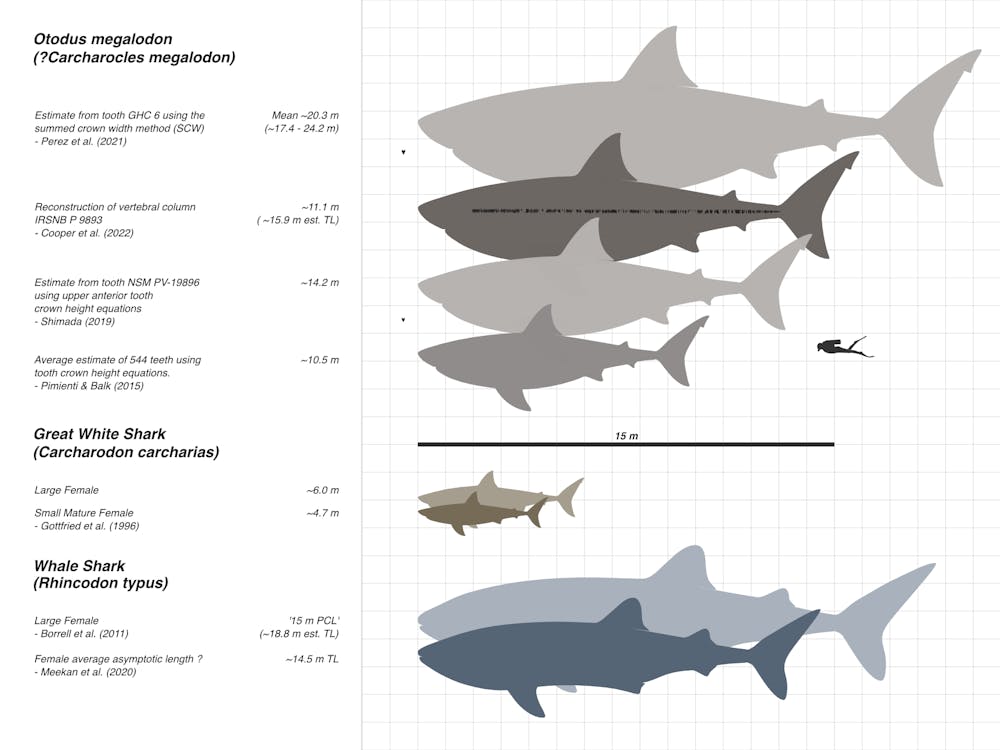
    The average size of a mature great white (Carcharodon carcharias, also known as the white shark) is between 4.6 and 4.9 metres for female sharks and up to 4 metres for male sharks.

    The largest recorded living specimens peak at about 6 metres, with one monster specimen caught in Cuba in 1945 reaching 6.4 metres.

    Earth’s oceans have seen bigger predatory sharks in the past. The biggest one of all time was the megalodon (Otodus megalodon) which lived from 23 to 3 million years ago, and may have been up to 24 metres in length. However, it looked nothing like the modern white shark.

    We don’t know precisely how big the megalodon was, but certainly larger than the great white shark.
    Steveoc 86/Wikimedia Commons, CC BY-SA

    They’re not even directly related – another thing scientists learned quite recently.

    Who was the megalodon, then?

    White sharks first evolved between 6 and 4 million years ago in the shadows of the megalodon. A recent study showed the megalodon’s large serrated teeth show signs of it being a supreme opportunistic super-predator.

    That means it ate just about anything, but especially liked whales and marine mammals.


    Read more:
    Friday essay: Giant shark megalodon was the most powerful superpredator ever. Why did it go extinct?


    But white sharks are not directly related to the megalodon, whose lineage began with a shark called Cretalamna during the age of dinosaurs about 100 million years ago.

    By contrast, the white shark lineage began with an ancient mako shark, Carcharodon hastalis. It was 7 to 8 metres long and had large, similarly shaped teeth to the modern white shark but lacking serrated edges.

    A fossil intermediate species, Carcharodon hubbelli shows the transition over time from weakly serrated to strongly serrated teeth.

    White shark fossil species. Left, the serrated fossil tooth teeth of the extant white shark; right, a similarly shaped unserrated tooth of the extinct giant mako shark which gave rise to white sharks.
    John Long, CC BY

    How did Jaws affect white shark populations?

    Last year, the International Shark Attack File reported 47 unprovoked shark bites to humans worldwide, resulting in seven fatalities. This was well below the previous ten-year average of 70 bites per year; your chances of getting bitten by a shark are extremely rare.

    Following the movies that made up the Jaws franchise, there was an increase in hunting and killing sharks – with a particular focus on great white sharks that were already going into a decline due to overfishing, trophy hunting and lethal control programs.

    Between 80% and 90% of white sharks have disappeared globally since the middle of the 20th century. Recent estimates calculate there are probably less than 500 individual white sharks in Australian waters right now.

    When Jaws first aired, scientists didn’t know how long sharks took to reproduce, or how many offspring a white shark could have each year. We now know it takes about 26 years for a male and 33 years for a female to sexually mature before they can start having pups.

    Data about white shark births is sparse, but recently a 5.6-metre-long female caught on a drum line off the coast of Queensland had just four large pups inside her. This is a very small number. Some large sharks, such as the whale shark, can give birth to up to 300 young.

    Now that we know just how slow they are to breed, it’s clear it will take many decades to reestablish the “pre-Jaws” population of white sharks – important apex predators in the marine ecosystem.

    Charlie Huveneers from Flinders University about to take a tissue sample for research on white sharks. There is still a lot we don’t know about their biology.
    Andrew Fox, Adelaide, CC BY

    Will white sharks survive?

    White sharks are currently listed as vulnerable.

    This classification means if we don’t change the current living conditions for white sharks, including impacts caused by human activities such as commercial fishing, and the impacts of climate change and ocean pollution, they will continue to decline and eventually could go extinct.

    Currently, white sharks are protected in several countries and form the basis for an important tourist industry in Australia, South Africa, western United States and most recently Nova Scotia, Canada.

    These sharks are iconic apex predators that fascinate people. One of us (John) went cage diving with them recently off the Neptune Islands of South Australia and can attest to how breathtaking it is to watch them in their natural environment.

    In terms of economic impact, they are worth far more alive than dead.

    White sharks are a growing tourism draw in several countries.
    Andrew Fox, Adelaide, CC BY

    There’s still much we don’t know about white sharks

    The complete white shark genome was first published only in 2019. It has 4.63 billion base pairs, making it much larger than the human genome (3.2 billion base pairs).

    The genome revealed some surprising things, like how white sharks show strong molecular adaptations for wound-healing processes, and a suite of “genome stability” genes – those used in DNA repair or DNA damage response.

    The transcriptome (or sum total of the messenger RNA) of the white shark showed greater similarity to the human transcriptome than to that of other fishes. This hints that “unexpressed genes” in the shark could one day play a role in uncovering genetic pathways for potential cures in human diseases.

    Jaws and its sequels certainly brought white sharks to the attention (and nightmares) of humans, with devastating impacts on how we treated them as a species.

    Our relationship with white sharks reflects our relationship with nature more broadly – a feared antagonist within the current capitalist paradigm; an enemy to be tamed, contained or consumed.

    As we learn more of the peril and potential of these remarkable creatures, we can learn how to live with them, to see beyond our fears and value their role within our delicate ocean ecosystems.

    John Long receives funding from The Australian Research Council.

    Heather L. Robinson does not work for, consult, own shares in or receive funding from any company or organisation that would benefit from this article, and has disclosed no relevant affiliations beyond their academic appointment.

    ref. Jaws at 50: how a single movie changed our perception of white sharks forever – https://theconversation.com/jaws-at-50-how-a-single-movie-changed-our-perception-of-white-sharks-forever-258306

    MIL OSI Analysis

  • MIL-OSI Analysis: Is Sabrina Carpenter’s Man’s Best Friend album cover satire or self-degradation? A psychology expert explores our reactions

    Source: The Conversation – Global Perspectives – By Katrina Muller-Townsend, Lecturer in Psychology, Edith Cowan University

    Island Records

    Sabrina Carpenter’s Man’s Best Friend album cover has fans divided.

    Carpenter poses on all fours, her glossy blond hair grasped by a male figure cropped from the frame. Her wide-eyed expression intensifies an ambiguous performance of subservience, tapping into a visual language tied to female objectification, from classic pin-up imagery to contemporary pop culture.

    The emotionally loaded image plays on her hyper-feminine, tongue-in-cheek pop star persona, forcing us to question where irony ends and objectification begins.

    Is it satire, or self-degradation?

    Up for debate

    At first glance, the cover seems like just another stylised, provocative pop image. It delivers what we’ve come to expect: a bold, ironic twist on the exaggerated Juno-style pose she reinvents on stage.

    To some fans, it’s clever satire: a pop star reclaiming and amplifying her image to mock industry norms. Satire uses exaggeration, irony, or humour to critique power structures – and Carpenter’s pose walks that tightrope.

    To others it crosses a line, reinforcing regressive attitudes about women’s sexuality and drawing criticism from domestic violence advocates.

    The debate reflects our unresolved discomfort about gender, power and control. There is a tension between Carpenter’s ironic persona and the submissive pose, creating uncertainty for the viewer.

    We can use psychology to better understand this dichotomy.

    The schema violation

    This mismatch between expectation and perception is a schema violation.

    A schema is a mental shortcut: a template built from experience and unspoken rules that helps us make sense of the world and predict what to expect. When something breaks that pattern, it’s called a schema violation.

    Carpenter’s brand is cheeky, self-aware irony – so when she adopts a pose steeped in submission and hyper-femininity as in this album image, it feels off.

    That can trigger cognitive dissonance: the mental tension we feel when two ideas (here, empowerment and obedience) don’t align.

    To resolve the conflict, some fans reinterpret the image as feminist sarcasm. Others reject it, fearing it panders to outdated, dangerous norms.

    Both reactions reflect our emotional and ideological investments in who Carpenter is or should be.

    Exploring confirmation bias

    Part of this conflicted reaction is driven by confirmation bias: our tendency to filter information to support what we already believe.

    Fans who see Carpenter as witty and empowered interpret the image as intentionally ironic. Others – more sceptical of the industry’s history of exploiting female sexuality – view it as a throwback to damaging norms.

    Either way, our interpretations often reflect more about ourselves than about Carpenter’s intent.

    When her image contradicts both her public persona and our social values, it creates a gap between what we think is right and what we want to be right. So, we try to explain it away, by either defending the image or criticising it.

    Satire and scandal

    Carpenter’s cover follows a long tradition of female artists whose work straddles satire and scandal, complicating public reception.

    Madonna’s Like a Prayer drew outrage for mixing religion with sexual imagery. Yet it positioned her as a provocateur – a woman resisting the lack of agency that so often defines sexualised media.

    Miley Cyrus’ Bangerz era shocked fans with a bold shift from Hannah Montana innocence to hypersexualised rebellion, challenging the narrow roles women in pop culture are confined to.

    Doja Cat’s shift from glam pop princess to glitch villainess unsettled audiences. Was it satire, rebellion, or just chaos?

    These women, like Carpenter, force us to confront our own discomfort with women who won’t stay in one lane.

    Performer and provocateur

    Audience reaction is also shaped by emotional investment in Carpenter’s persona. Through carefully curated social media, interviews and lyrics, fans build intimate narratives forming parasocial relationships – one-sided emotional bonds with celebrities.

    When an image contradicts that imagined persona, it can feel jarring, even like betrayal.

    Audiences often expect idols to be empowering but not polarising, sexy but safe, to challenge norms – but only in ways that affirm our own values.

    Carpenter’s image breaks that implicit contract, which creates discomfort for some viewers.

    Carpenter’s cover raises uncomfortable but necessary questions about how much freedom female artists have to be both critical and complicit. Can they play with society and play along, to be both performer and provocateur?

    This highlights the double bind many women face in media and popular culture. Female artists are expected to both subvert and satisfy; to entertain without offending; empower without alienating. The burden to be palatable and provocative is one male artists rarely face.

    It’s what we make of it

    Is Carpenter undermining herself or subverting the system? Perhaps both. Or perhaps the image isn’t the message: our reaction is.

    The image forces us to confront not only our perception of Sabrina Carpenter but also our cultural discomfort with women who defy neat categorisation. Satire demands interpretation, especially when it comes from women addressing sex or power.

    More than provocation, Carpenter’s cover mirrors our cultural struggle to accept women who defy simple labels of satire or submission. The image can reflect broader social ideals and tensions projected onto public figures.

    What we see says more about our assumptions than her intent. Understanding those reactions doesn’t kill the fun – it deepens it.

    Katrina Muller-Townsend does not work for, consult, own shares in or receive funding from any company or organisation that would benefit from this article, and has disclosed no relevant affiliations beyond their academic appointment.

    ref. Is Sabrina Carpenter’s Man’s Best Friend album cover satire or self-degradation? A psychology expert explores our reactions – https://theconversation.com/is-sabrina-carpenters-mans-best-friend-album-cover-satire-or-self-degradation-a-psychology-expert-explores-our-reactions-259043

    MIL OSI Analysis

  • MIL-OSI New Zealand: Luxon wraps up successful Shanghai visit

    Source: New Zealand Government

    Prime Minister Christopher Luxon has concluded the successful Shanghai leg of his official visit to China, accompanied by Ministers Louise Upston and Mark Mitchell and a delegation of senior New Zealand business leaders from across the food and beverage, health and wellbeing, education, and tourism sectors.

    “Our bilateral trade relationship with China is one of our most important, with two-way trade exceeding NZ$39 billion in the year ending March 2025. 

    “This relationship accounts for more than 20 per cent of New Zealand’s total goods and services exports,” Mr Luxon says.

    “It’s been great to see $400 million of commercial agreements signed today between New Zealand businesses and their Chinese partners. This is a clear sign of the strength and momentum in our trade relationship.

    “We also announced we would be making it easier for Chinese nationals to transit via New Zealand by removing the need to get a transit visa, instead being able to get a New Zealanders Electronic Travel Authority (NZeTA), significantly cutting costs and time for visitors. 

    “This resulted in one of the major announcements in Shanghai, that China Eastern Airlines was launching twice weekly flights to South America via Auckland.” 

    Mr Luxon participated in a tourism livestream event watched by over 10 million people, to promote New Zealand travel offerings.

    “New Zealand welcomed 248,000 visitors from China in the past year, with holiday arrivals up 31 per cent. We’ve made recent changes to visa settings to make it easier for Chinese visitors to enjoy New Zealand’s natural beauty and warm hospitality,” Mr Luxon says.

    Mr Luxon also visited Fudan University, one of China’s most prestigious academic institutions, to promote New Zealand as a destination for world-class research, study, and partnership.

    “We’re focused on deepening our education links through student connections, institutional partnerships, and joint research that benefits both countries,” Mr Luxon says.

    Mr Luxon also met with Shanghai Party Secretary Chen Jining to discuss Shanghai as a gateway for a high proportion of New Zealand goods, services and people-to-people flows, and other bilateral issues.

    The Prime Minister will now travel to Beijing, where he will meet with China’s leaders.

    MIL OSI New Zealand News

  • MIL-OSI Security: Pacific Partnership 2025 Conducts Mission Stop in Suva, Fiji, June 13, 2025 [Image 23 of 26]

    Source: United States Navy (Logistics Group Western Pacific)

    Issued by: on


    SUVA, Fiji (June 13, 2025) Operations Specialist 1st Class Ashley Stanley, left, with the Pacific Partnership 2025 (PP-25) team, bids farewell to students of Waiqanake District School after a rugby match as part of PP-25 in Suva, Fiji, June 13, 2025. Now in its 21st iteration, the Pacific Partnership series is the largest annual multinational humanitarian assistance and disaster management preparedness mission conducted in the Indo-Pacific. Pacific Partnership works collaboratively with host and partner nations to enhance regional interoperability and disaster response capabilities, increase security and stability in the region, and foster new and enduring friendships in the Indo-Pacific. (U.S. Navy photo by Mass Communication Specialist 2nd Class Moises Sandoval/Released)

    Date Taken: 06.13.2025
    Date Posted: 06.17.2025 04:59
    Photo ID: 9116988
    VIRIN: 250613-N-ED646-3680
    Resolution: 6937×4624
    Size: 6.58 MB
    Location: SUVA, FJ

    Web Views: 8
    Downloads: 0

    PUBLIC DOMAIN  

    MIL Security OSI

  • MIL-OSI Russia: A young couple from NSU became finalists of the All-Russian competition “Student Families of Russia”

    Translation. Region: Russian Federal

    Source: Novosibirsk State University – Novosibirsk State University –

    The All-Russian competition “Student Families of Russia” was organized by the Ministry of Science and Higher Education of Russia together with the Tambov State University named after G.R. Derzhavin and Gzhel State University as part of the implementation of the federal project “Family Support” of the national project “Family”. Young families in which both spouses aged 18 to 35 are officially married and are university students could take part in it. In the selection stage, the couple needs to record a video business card, pass a psychological test and submit a portfolio of achievements. As a result, 30 couples made it to the finals, who will go to Gzhel to represent their universities.

    NSU will be represented in the final by a married couple, Vyacheslav and Maria Kolobenko. Maria is graduating this year. Faculty of Natural Sciences, and Vyacheslav – Mechanics and Mathematics. The couple met in 2023 at Miss NSU. Vyacheslav was the organizer, and Maria was a participant. After the competition, the guys began to actively communicate.

    – We got to talking and were surprised to learn that we were both from Primorsky Krai. I am from Ussuriysk, and Masha is from Arsenyev, that is, only 100 kilometers from each other. We started dating on February 14 last year, and in May I realized that “well, that’s it, mine!” We went to Primorsky Krai and met our parents. Later, at the end of 2024, I proposed to Masha, and in April of this year we got married.

    The university invited us to participate in the competition, and we were not against it. We applied and passed. It’s cool that there is such an opportunity to go somewhere together, compete, spend time together, and even usefully, – said Vyacheslav Kolobenko.

    In July, the young couple will go to Gzhel. The final program includes thematic areas, master classes, round tables, discussions and research in focus groups on strengthening and popularizing family values, as well as meetings with government officials on issues of supporting young families.

    We wish victory to Vyacheslav and Maria!

    Please note: This information is raw content directly from the source of the information. It is exactly what the source states and does not reflect the position of MIL-OSI or its clients.

    MIL OSI Russia News

  • MIL-Evening Report: Horse whipping is painful and cruel. The latest incident shows why it should be banned

    Source: The Conversation (Au and NZ) – By Anne Quain, Senior Lecturer, Sydney School of Veterinary Science, University of Sydney

    Doug Pensinger/Getty Images

    Last week, the peak body for equestrian sport in Australia suspended a prominent member after footage allegedly depicted Australian Olympic dressage rider Heath Ryan whipping a horse more than 40 times.

    Ryan confirmed he was the rider in the footage, which was reportedly taken about two years ago.

    He explained the horse, Nico, had belonged to a friend who had been hospitalised for serious injuries inflicted by the animal.

    Ryan wrote Nico had “always been a problem child” and was about to be sent to slaughter.

    However, Ryan, an experienced trainer and instructor, intervened to “salvage” the horse.

    Footage appears to show Heath Ryan whipping a horse repeately.
    DressageHub, CC BY

    But horses, just like humans, feel pain, which is why more needs to be done to minimise the use of whips on horses.

    What happened next?

    The footage depicts Ryan mounted on Nico, forcefully whipping him.

    Both the whoosh of the whip travelling at speed and the sound of it contacting Nico’s flesh are audible.

    Nico kicks out several times in response, yet the whipping continues.

    Nico seems “shut down” – a term used to describe a horse when they appear to have no understanding of what they need to do to make an adverse experience stop.

    Whipping causes horses pain. The skin in the gluteal area of the horse, which Ryan repeatedly struck with the whip, is sensitive to pain just like the skin of humans.

    This is not the first time whipping has been in the spotlight. In July 2024, footage emerged of three-time Olympic dressage gold medallist Charlotte Dujardin repeatedly whipping a horse on the hind legs.

    This led to the International Equestrian Federation fining her CHF 10,000 (A$18,867) and imposing a 12-month suspension.


    Read more:
    The Paris Olympics horse-whipping scandal shows the dangers of ‘Disneyfication’ in horse sports


    More recently in Australia, in May 2025, the RSPCA prosecuted a case against trainer Liandra Gray, who was recorded striking a horse with a padded racing whip more than 40 times. A Tasmanian court found Gray had caused unreasonable and unjustifiable pain and the whip use constituted cruelty.

    Equestrian Australia’s national dressage rules forbid excessive use of whips.

    Despite stating he “hated” whipping Nico, Ryan argued he was acting in the horse’s interests.

    After an undisclosed period, Nico was re-homed, and according to Ryan “is now thriving in a loving and competitive home with an exciting future”.

    Does the end justify the means?

    Ryan’s justification of his treatment of Nico is based on the positive consequences for the horse (avoiding slaughter) and the current owners (Nico can continue to be ridden).

    This justification is a type of consequentialism, where an outcome is judged to be good or not based on the consequences it brings about. This raises an important question: what counts as a “good” outcome and by whose standard are we judging?

    Ryan’s justification points to a culture where horses’ needs and interests are not respected and where they are valued solely for their utility to humans.

    But we know horses are sensitive, sentient beings, capable of suffering.

    The relationship between a rider and horse is often described as a partnership. In reality, horses have little choice.

    The equipment and cues riders rely on to control horses work because they are aversive and even painful. Because horses are motivated to escape from painful stimuli, they rapidly learn to perform in the desired way.

    Because of this reliance on aversive stimuli to control horses, it is essential riders remove it as soon as the horse performs the desired behaviour (for example, releasing tension on the reins).

    Why was Nico a ‘problem child’ in the first place?

    During riding, a horse knows it has responded correctly if the rider removes the aversive stimulus that was used to cue the horse.

    If the rider removes the stimulus at the wrong time or not at all, the horse may become confused, stressed and express unwanted behaviours.

    If this is repeated, the unwanted responses can quickly become a habit and the horse may be labelled a problem.

    Based on the footage, it seems that instead of learning to move forward to escape pressure from the rider’s heels or whip, Nico appears to have developed a habit of stalling (slowing or coming to a stop instead of moving forward).

    Stress and fear can impair animals’ ability to learn and problem solve and horses vary considerably in their personalities and ability to learn what humans require of them.

    The combination of personality, stress, fear and rider inconsistencies can quickly lead to the development of unwanted behaviours.

    It is likely Nico’s behaviour reflects these factors.

    It’s time for a change

    This incident likely taught Nico to fear humans and to expect that being ridden will involve inescapable pain unless he does exactly what his rider wants.

    Training methods like this are considered outdated and unethical.

    This is because there is ample scientific evidence showing the modification of unwanted behaviour in ridden horses can be achieved without resorting to violence to force them into submission.

    International groups such as the International Society for Equitation Science (ISES) and the Federation of Veterinarians of Europe have highlighted the risks of misusing aversive training stimuli.

    They argue training methods that lead to fear and stress are inefficient and pose unacceptable welfare risks.

    ISES has even developed a set of 10 principles for training even the most difficult horses.

    While Ryan has justified his intervention as the only possible solution to Nico’s unwanted behaviour, the scientific evidence shows it is neither necessary nor ethical to violently whip a horse to teach it a lesson.

    Anne Quain has consulted for animal welfare organisations including the RSPCA. She is a member of the Australian Veterinary Association, the Australian and New Zealand College of Veterinary Scientists, and the European College of Animal Welfare and Behaviour Medicine in Animal Welfare Science, Ethics and Law. She has been a recipient of an Australian Companion Animal Health Foundation Grant. She has undertaken two residencies at The Ethics Centre.

    Cathrynne Henshall receives funding from the Hong Kong Jockey Club Welfare Research Funding

    ref. Horse whipping is painful and cruel. The latest incident shows why it should be banned – https://theconversation.com/horse-whipping-is-painful-and-cruel-the-latest-incident-shows-why-it-should-be-banned-259041

    MIL OSI AnalysisEveningReport.nz

  • MIL-OSI China: China releases new grassland vegetation map of ‘roof of the world’

    Source: People’s Republic of China – State Council News

    Pregnant Tibetan antelopes are pictured under a rainbow in Qiangtang National Nature Reserve in southwest China’s Xizang Autonomous Region, June 16, 2024. [Photo/Xinhua]

    China has released its most detailed map yet of grassland vegetation on the Qinghai-Tibet Plateau, using a scale of 1:500,000.

    The map, developed by a team led by Wang Yanfen, a professor at the University of Chinese Academy of Sciences (UCAS), was officially unveiled on Tuesday during an academic seminar on grassland vegetation mapping.

    Experts at the seminar noted that the map, based on field surveys and multi-source remote sensing data, accurately depicts plant formation distributions and holds significant implications for climate adaptation, sustainable development, and future research on ecosystem functions across the plateau.

    The Qinghai-Tibet Plateau, known as the “roof of the world” and “Asia’s water tower,” serves as a vital ecological security barrier for China. Its ecosystem is dominated by grasslands, which are ecologically fragile and highly sensitive to global climate change.

    Over the past 50 years, intensified climate change and growing human activity have altered vegetation distribution patterns, rendering existing maps outdated.

    The launch of the second scientific expedition on the plateau in 2017 provided a new opportunity to update the grassland vegetation map.

    Wang said that 65 plant formations or formation groups have been identified, and compared to previously published versions, the new map reveals significant vegetation changes over the past 40 years.

    For instance, the proportion of alpine meadows that prefer wet and cold conditions has increased from 50 to 69 percent in the grasslands, which strongly confirms the ongoing trend of warming and wetting on the plateau, she added.

    In the process of preparing the map, the research team integrated in situ surveys, multi-temporal satellite remote sensing data, and artificial intelligence technology.

    This approach synthesized spectral, structural and functional characteristics of plants alongside environmental factors like terrain and hydrothermal conditions, Wang explained.

    This innovative approach overcomes the challenges of accurately identifying and classifying plant communities in complex high-altitude environments, which has traditionally been a difficult task.

    “Unlike conventional mapping techniques, it places greater emphasis on the intrinsic relationship between plant community attributes and their corresponding habitat characteristics, thereby ensuring objectivity and efficiency in the mapping process,” said Wang.

    MIL OSI China News

  • MIL-OSI New Zealand: Otago students to benefit from more classrooms

    Source: New Zealand Government

    The Government’s ensuring hundreds more students in Otago benefit from new, safe, warm and dry classrooms.
    A $27 million investment into new infrastructure will help make sure schools meet the needs of their communities and gets ahead of new growth.
    It will support the construction of:

    Six new teaching spaces at Dunstan High School
    A twelve-teaching space expansion at Te Kura Whakatipu o Kawarau

    The investment is in addition to the purchase of a site at Ladies Mile in Queenstown last year, which will accommodate a new primary school in the area.
    “Queenstown in particular, has had strong and steady growth over the last decade, and we are committed to ensuring they are equipped to teach the basics brilliantly. Planning for the two growth projects is underway and is expected to begin in the next 12 months. This means that students, families and the Otago community can benefit sooner,” Education Minister Erica Stanford says.
    “Funding for the construction of the new primary school at Ladies Mile will be considered in future years. Securing the land at this time means that we will be able to hit ‘go’ on construction when capacity is needed.” 
    This announcement builds on the Government’s commitment to ongoing investment in school property, and follows recent announcements to support growth in Canterbury, the Central North Island and provision of specialist education. 
    “Quality education is crucial to growing the regions. These new classrooms are an investment in the future of young learners in Otago Central Lakes and builds on the 120 new classrooms announced for Canterbury in the last month,” South Island Minister James Meager says.
    “There is huge potential for Otago Central Lakes to become a hub for digital and tech investors, alongside our traditional backbone industries of tourism and agriculture. To enable that investment, we need to foster brilliance in our young people by investing in their future and building for growth. We also need a high-quality education infrastructure to attract the best quality workforce to our regions.”
    “Our efficiencies in school property delivery allows more schools, communities and children benefit sooner. The use of standardised building designs and offsite manufacturing have lowered the average cost of a classroom by 28%, allowing 30% more classrooms to be delivered last year compared to 2023. We will continue to drive costs down so more Kiwi kids can thrive,” Ms Stanford says.

    MIL OSI New Zealand News

  • MIL-Evening Report: ER Report: A Roundup of Significant Articles on EveningReport.nz for June 19, 2025

    ER Report: Here is a summary of significant articles published on EveningReport.nz on June 19, 2025.

    Australian citizens in Iran and Israel are desperate to leave. Is the government required to help?
    Source: The Conversation (Au and NZ) – By Jane McAdam, Scientia Professor and ARC Laureate Fellow, Kaldor Centre for International Refugee Law, UNSW Sydney As thousands of Australian citizens and permanent residents stuck in Iran and Israel continue to register for repatriation flights, the government is scrambling to find safe ways to evacuate them. With

    Popular period-tracking apps can hold years of personal data – new NZ research finds mixed awareness of risk
    Source: The Conversation (Au and NZ) – By Anna Friedlander, PhD Candidate in Sociology, University of Waikato Shutterstock/Krotnakro Period-tracking apps are popular digital tools for a range of menstrual, reproductive and general health purposes. But the way these apps collect and use data involves risk. Many apps encourage users to log information well beyond their

    Migrating bogong moths use the stars and Earth’s magnetic field to find ancestral summer caves each year
    Source: The Conversation (Au and NZ) – By Eric Warrant, Professor of Zoology at the University of Lund, Visiting Fellow at the Australian National University, and Adjunct Professor, University of South Australia Vik Dunis/iNaturalist, CC BY-NC It’s a warm January summer afternoon, and as I traverse the flower-strewn western slopes of Australia’s highest mountain, Mount

    Jaws at 50: how a single movie changed our perception of white sharks forever
    Source: The Conversation (Au and NZ) – By John Long, Strategic Professor in Palaeontology, Flinders University Shane Myers Photography/Shutterstock It’s been 50 years since Steven Spielberg’s movie Jaws first cast a terrifying shadow across our screens. At a low point during production, Spielberg worried he’d only ever be known for “a big fish story”. The

    Robot eyes are power hungry. What if we gave them tools inspired by the human brain?
    Source: The Conversation (Au and NZ) – By Adam D Hines, Research Fellow, Centre for Robotics, Queensland University of Technology A hexapod robot navigating outdoors. Adam Hines Robots are increasingly becoming a part of our lives – from warehouse automation to robotic vacuum cleaners. And just like humans, robots need to know where they are

    Winter viruses can trigger a heart attack or stroke, our study shows. It’s another good reason to get a flu or COVID shot
    Source: The Conversation (Au and NZ) – By Tu Nguyen, PhD Candidate, Department of Paediatrics, University of Melbourne, Murdoch Children’s Research Institute Irina Shatilova/Shutterstock Winter is here, along with cold days and the inevitable seasonal surge in respiratory viruses. But it’s not only the sniffles we need to worry about. Heart attacks and strokes also

    School playgrounds are one of the main locations for bullying. How can they be set up to stop it?
    Source: The Conversation (Au and NZ) – By Brendon Hyndman, Associate Dean (Academic), Faculty of Arts and Education, Charles Sturt University Dan Kenyon/ Getty Images Children spend thousands of hours in playgrounds at school. A lot of this time does not have the same levels of teacher preparation and supervision as classrooms do. Research shows

    Would you cheat on your tax? It’s a risky move, the tax office knows a lot about you
    Source: The Conversation (Au and NZ) – By Robert B Whait, Senior Lecturer in Taxation Law, University of South Australia Soon, more than 15 million Australians should be lodging a tax return with the Australian Taxation Office in the hope of receiving at least a small refund. About 60% of taxpayers use an accountant to

    Companies are betting on AI to help lift productivity. Workers need to be part of the process
    Source: The Conversation (Au and NZ) – By Llewellyn Spink, AI Corporate Governance Lead, Human Technology Institute, University of Technology Sydney The Conversation, CC BY-NC Australia’s productivity is flatlining, posting the worst vitals we’ve seen in 60 years. Politicians and chief executives are prescribing artificial intelligence (AI) like it’s the new penicillin – a wonder

    Is Sabrina Carpenter’s Man’s Best Friend album cover satire or self-degradation? A psychology expert explores our reactions
    Source: The Conversation (Au and NZ) – By Katrina Muller-Townsend, Lecturer in Psychology, Edith Cowan University Island Records Sabrina Carpenter’s Man’s Best Friend album cover has fans divided. Carpenter poses on all fours, her glossy blond hair grasped by a male figure cropped from the frame. Her wide-eyed expression intensifies an ambiguous performance of subservience,

    Kicked out for coming out: more than half of LGBTIQ+ flatmates face discrimination for their identity
    Source: The Conversation (Au and NZ) – By Brodie Fraser, Senior Research Fellow, He Kāinga Oranga Housing and Health Research Programme, University of Otago Sangar Akreyi/Getty Images People who belong to the LGBTIQ+ community say flatting is fraught with difficulties that go well beyond learning new routines and sharing space with strangers. Our new research

    Tracing the Drax family’s millions – a story of British landed gentry, slavery and sugar plantations
    Source: The Conversation (Au and NZ) – By Paul Lashmar, Reader in Journalism, City St George’s, University of London ‘Planting the sugar-cane’: vast fortunes were made from the trades in both sugar and human slaves in the Americas. Schomburg Center for Research in Black Culture, Photographs and Prints Division, The New York Public Library Rich

    Nineteen Eighty-Four might have been inspired by George Orwell’s fear of drowning
    Source: The Conversation (Au and NZ) – By Nathan Waddell, Associate Professor in Twentieth-Century Literature, University of Birmingham George Orwell had a traumatic relationship with the sea. In August 1947, while he was writing Nineteen Eighty-Four (1949) on the island of Jura in the Scottish Hebrides, he went on a fishing trip with his young

    What happens when aid is cut to a large refugee camp? Kenyan study paints a bleak picture
    Source: The Conversation (Au and NZ) – By Olivier Sterck, Associate professor, University of Oxford Humanitarian needs are rising around the world. At the same time, major donors such as the US and the UK are pulling back support, placing increasing strain on already overstretched aid systems. Global humanitarian needs have quadrupled since 2015, driven

    Grok’s ‘white genocide’ responses show how generative AI can be weaponized
    Source: The Conversation (Au and NZ) – By James Foulds, Associate Professor of Information Systems, University of Maryland, Baltimore County Someone altered the AI chatbot Grok to make it insert text about a debunked conspiracy theory in unrelated responses. Cheng Xin/Getty Images The AI chatbot Grok spent one day in May 2025 spreading debunked conspiracy

    Politics with Michelle Grattan: an ‘impatient’ Jim Chalmers on taking political risks in Labor’s second term
    Source: The Conversation (Au and NZ) – By Michelle Grattan, Professorial Fellow, University of Canberra Asanka Ratnayake/Getty Images While the world’s media is largely focused on conflict in the Middle East, the focus for many Australians remains at home, with the government preparing the long task ahead of trying to lift Australia’s productivity. Last week,

    View from The Hill: Jim Chalmers wants to get on with economic reform and tax is in his sights
    Source: The Conversation (Au and NZ) – By Michelle Grattan, Professorial Fellow, University of Canberra Jim Chalmers speaking to the National Press Club June 18, 2025. Screenshot from the ABC Broadcast, CC BY-NC Jim Chalmers cast his Wednesday National Press Club speech as a second instalment in a two-part presentation that was kicked off by

    Iran’s long history of revolution, defiance and outside interference – and why its future is so uncertain
    Source: The Conversation (Au and NZ) – By Amin Saikal, Emeritus Professor of Middle Eastern and Central Asian Studies, Australian National University; and Vice Chancellor’s Strategic Fellow, Victoria University Israeli Prime Minister Benjamin Netanyahu has gone beyond his initial aim of destroying Iran’s ability to produce nuclear weapons. He has called on the Iranian people

    95 lawyers demand stronger NZ stand over Israel amid Middle East tensions
    Asia Pacific Report Ninety-five New Zealand lawyers — including nine king’s counsel — have signed a letter demanding Prime Minister Christopher Luxon, Foreign Minister Winston Peters and two other ministers urge the government to take a stronger stand against Israel’s “catastrophic” actions in Gaza. The letter has been sent amid rising tensions in the region,

    Gay and bisexual men will soon be able to donate blood and plasma
    Source: The Conversation (Au and NZ) – By Yasmin Mowat, Clinical Project Manager, Kirby Institute, UNSW Sydney AnnaStills/Getty Images Many gay and bisexual men have been excluded from donating blood and plasma (the liquid portion of blood) for decades because of rules developed during the HIV crisis in the 1980s. The Australian Red Cross’ blood

    MIL OSI AnalysisEveningReport.nz

  • MIL-Evening Report: ER Report: A Roundup of Significant Articles on EveningReport.nz for June 19, 2025

    ER Report: Here is a summary of significant articles published on EveningReport.nz on June 19, 2025.

    Australian citizens in Iran and Israel are desperate to leave. Is the government required to help?
    Source: The Conversation (Au and NZ) – By Jane McAdam, Scientia Professor and ARC Laureate Fellow, Kaldor Centre for International Refugee Law, UNSW Sydney As thousands of Australian citizens and permanent residents stuck in Iran and Israel continue to register for repatriation flights, the government is scrambling to find safe ways to evacuate them. With

    Popular period-tracking apps can hold years of personal data – new NZ research finds mixed awareness of risk
    Source: The Conversation (Au and NZ) – By Anna Friedlander, PhD Candidate in Sociology, University of Waikato Shutterstock/Krotnakro Period-tracking apps are popular digital tools for a range of menstrual, reproductive and general health purposes. But the way these apps collect and use data involves risk. Many apps encourage users to log information well beyond their

    Migrating bogong moths use the stars and Earth’s magnetic field to find ancestral summer caves each year
    Source: The Conversation (Au and NZ) – By Eric Warrant, Professor of Zoology at the University of Lund, Visiting Fellow at the Australian National University, and Adjunct Professor, University of South Australia Vik Dunis/iNaturalist, CC BY-NC It’s a warm January summer afternoon, and as I traverse the flower-strewn western slopes of Australia’s highest mountain, Mount

    Jaws at 50: how a single movie changed our perception of white sharks forever
    Source: The Conversation (Au and NZ) – By John Long, Strategic Professor in Palaeontology, Flinders University Shane Myers Photography/Shutterstock It’s been 50 years since Steven Spielberg’s movie Jaws first cast a terrifying shadow across our screens. At a low point during production, Spielberg worried he’d only ever be known for “a big fish story”. The

    Robot eyes are power hungry. What if we gave them tools inspired by the human brain?
    Source: The Conversation (Au and NZ) – By Adam D Hines, Research Fellow, Centre for Robotics, Queensland University of Technology A hexapod robot navigating outdoors. Adam Hines Robots are increasingly becoming a part of our lives – from warehouse automation to robotic vacuum cleaners. And just like humans, robots need to know where they are

    Winter viruses can trigger a heart attack or stroke, our study shows. It’s another good reason to get a flu or COVID shot
    Source: The Conversation (Au and NZ) – By Tu Nguyen, PhD Candidate, Department of Paediatrics, University of Melbourne, Murdoch Children’s Research Institute Irina Shatilova/Shutterstock Winter is here, along with cold days and the inevitable seasonal surge in respiratory viruses. But it’s not only the sniffles we need to worry about. Heart attacks and strokes also

    School playgrounds are one of the main locations for bullying. How can they be set up to stop it?
    Source: The Conversation (Au and NZ) – By Brendon Hyndman, Associate Dean (Academic), Faculty of Arts and Education, Charles Sturt University Dan Kenyon/ Getty Images Children spend thousands of hours in playgrounds at school. A lot of this time does not have the same levels of teacher preparation and supervision as classrooms do. Research shows

    Would you cheat on your tax? It’s a risky move, the tax office knows a lot about you
    Source: The Conversation (Au and NZ) – By Robert B Whait, Senior Lecturer in Taxation Law, University of South Australia Soon, more than 15 million Australians should be lodging a tax return with the Australian Taxation Office in the hope of receiving at least a small refund. About 60% of taxpayers use an accountant to

    Companies are betting on AI to help lift productivity. Workers need to be part of the process
    Source: The Conversation (Au and NZ) – By Llewellyn Spink, AI Corporate Governance Lead, Human Technology Institute, University of Technology Sydney The Conversation, CC BY-NC Australia’s productivity is flatlining, posting the worst vitals we’ve seen in 60 years. Politicians and chief executives are prescribing artificial intelligence (AI) like it’s the new penicillin – a wonder

    Is Sabrina Carpenter’s Man’s Best Friend album cover satire or self-degradation? A psychology expert explores our reactions
    Source: The Conversation (Au and NZ) – By Katrina Muller-Townsend, Lecturer in Psychology, Edith Cowan University Island Records Sabrina Carpenter’s Man’s Best Friend album cover has fans divided. Carpenter poses on all fours, her glossy blond hair grasped by a male figure cropped from the frame. Her wide-eyed expression intensifies an ambiguous performance of subservience,

    Kicked out for coming out: more than half of LGBTIQ+ flatmates face discrimination for their identity
    Source: The Conversation (Au and NZ) – By Brodie Fraser, Senior Research Fellow, He Kāinga Oranga Housing and Health Research Programme, University of Otago Sangar Akreyi/Getty Images People who belong to the LGBTIQ+ community say flatting is fraught with difficulties that go well beyond learning new routines and sharing space with strangers. Our new research

    Tracing the Drax family’s millions – a story of British landed gentry, slavery and sugar plantations
    Source: The Conversation (Au and NZ) – By Paul Lashmar, Reader in Journalism, City St George’s, University of London ‘Planting the sugar-cane’: vast fortunes were made from the trades in both sugar and human slaves in the Americas. Schomburg Center for Research in Black Culture, Photographs and Prints Division, The New York Public Library Rich

    Nineteen Eighty-Four might have been inspired by George Orwell’s fear of drowning
    Source: The Conversation (Au and NZ) – By Nathan Waddell, Associate Professor in Twentieth-Century Literature, University of Birmingham George Orwell had a traumatic relationship with the sea. In August 1947, while he was writing Nineteen Eighty-Four (1949) on the island of Jura in the Scottish Hebrides, he went on a fishing trip with his young

    What happens when aid is cut to a large refugee camp? Kenyan study paints a bleak picture
    Source: The Conversation (Au and NZ) – By Olivier Sterck, Associate professor, University of Oxford Humanitarian needs are rising around the world. At the same time, major donors such as the US and the UK are pulling back support, placing increasing strain on already overstretched aid systems. Global humanitarian needs have quadrupled since 2015, driven

    Grok’s ‘white genocide’ responses show how generative AI can be weaponized
    Source: The Conversation (Au and NZ) – By James Foulds, Associate Professor of Information Systems, University of Maryland, Baltimore County Someone altered the AI chatbot Grok to make it insert text about a debunked conspiracy theory in unrelated responses. Cheng Xin/Getty Images The AI chatbot Grok spent one day in May 2025 spreading debunked conspiracy

    Politics with Michelle Grattan: an ‘impatient’ Jim Chalmers on taking political risks in Labor’s second term
    Source: The Conversation (Au and NZ) – By Michelle Grattan, Professorial Fellow, University of Canberra Asanka Ratnayake/Getty Images While the world’s media is largely focused on conflict in the Middle East, the focus for many Australians remains at home, with the government preparing the long task ahead of trying to lift Australia’s productivity. Last week,

    View from The Hill: Jim Chalmers wants to get on with economic reform and tax is in his sights
    Source: The Conversation (Au and NZ) – By Michelle Grattan, Professorial Fellow, University of Canberra Jim Chalmers speaking to the National Press Club June 18, 2025. Screenshot from the ABC Broadcast, CC BY-NC Jim Chalmers cast his Wednesday National Press Club speech as a second instalment in a two-part presentation that was kicked off by

    Iran’s long history of revolution, defiance and outside interference – and why its future is so uncertain
    Source: The Conversation (Au and NZ) – By Amin Saikal, Emeritus Professor of Middle Eastern and Central Asian Studies, Australian National University; and Vice Chancellor’s Strategic Fellow, Victoria University Israeli Prime Minister Benjamin Netanyahu has gone beyond his initial aim of destroying Iran’s ability to produce nuclear weapons. He has called on the Iranian people

    95 lawyers demand stronger NZ stand over Israel amid Middle East tensions
    Asia Pacific Report Ninety-five New Zealand lawyers — including nine king’s counsel — have signed a letter demanding Prime Minister Christopher Luxon, Foreign Minister Winston Peters and two other ministers urge the government to take a stronger stand against Israel’s “catastrophic” actions in Gaza. The letter has been sent amid rising tensions in the region,

    Gay and bisexual men will soon be able to donate blood and plasma
    Source: The Conversation (Au and NZ) – By Yasmin Mowat, Clinical Project Manager, Kirby Institute, UNSW Sydney AnnaStills/Getty Images Many gay and bisexual men have been excluded from donating blood and plasma (the liquid portion of blood) for decades because of rules developed during the HIV crisis in the 1980s. The Australian Red Cross’ blood

    MIL OSI AnalysisEveningReport.nz

  • MIL-OSI New Zealand: Getting more trainee teachers into rural schools

    Source: New Zealand Government

    The Government’s ensuring some of New Zealand’s most isolated schools get the pipeline of teachers they need to teach the basics brilliantly.

    “For most new teachers, school placements play a significant role in deciding where they choose to teach once they qualify as a teacher. We know rural and isolated schools struggle to fill these rolls. This Government is helping address that so more children benefit from excellent teachers in the classroom,” Education Minister Erica Stanford says.

    $494,000 will fund “Go Rural: Isolated Placements Fund” – an initiative that contributes to the costs student teachers incur. Up to 123 student teachers in their final year of study will be eligible for a payment of $4,000 to take up a professional experience placement in a rural or isolated school.

    “We know students’ factor in additional accommodation, childcare and travel costs for when they choose where they undertake their placement. This investment will make it easier for them to take up placements in some of our most unique communities.

    Applications for the fund will be available in early 2026.

    “This is just one of several initiatives we have put in place to ensure more Kiwi kids benefit from quality teaching and leadership in the classroom. Through Budget 2025 we are expanding the School Onsite Training Programme (SOTP) by 530 places, supporting up to 800 teachers to access an Aspiring Principal Programme and funding approximately 115,000 teacher registrations and practicing certificates.

    “We are committed to supporting our incredible teachers. By growing the skills and knowledge in our workforce, our tamariki have the very best chance to thrive at school and beyond,” Ms Stanford says.

    MIL OSI New Zealand News

  • MIL-OSI New Zealand: Exercise NZ – International Yoga Day 2025: Yoga’s Timeless Path to Well-being

    Source: Exercise NZ

    Saturday, June 21st, marks International Yoga Day,  a global celebration of one of the world’s oldest and most holistic forms of movement and mindfulness. With origins dating back over 5,000 years in India, yoga has transcended borders and generations to become a powerful global movement with over 300 million people practising worldwide today.

    Research-based evidence continues to grow, supporting the notion that yoga benefits all aspects of our overall well-being, including mental, emotional, social, and physical health. Encouragingly, yoga participation in Aotearoa remains steady,  a reflection of its lasting appeal and value. Increasingly, Kiwis are recognising that the true benefits of yoga unfold through consistent, ongoing practice. As one of the most effective, accessible, and sustainable paths to overall well-being, yoga offers long-term rewards for those who embrace it as part of their lifestyle. With different styles and methods of practice, it is a modality that can be incorporated into any life stage or capacity. International Yoga Day is a wonderful starting point and an invitation to make yoga a regular, enriching part of everyday life.

    Research consistently promotes the potential health benefits related to the regular practice of yoga, such as improvements in mood, focus, and resilience. A Harvard Medical School article notes that yoga can be as effective as standard exercise in reducing anxiety and depression symptoms, with added benefits to brain function, heart rate variability, and emotional balance. The same review highlights how yoga practice increases thickness in the cerebral cortex and hippocampus, areas of the brain tied to memory and learning. Additionally, further research in Frontiers in Integrative Neuroscience confirms yoga’s positive effects on brain structure and function, particularly in areas related to self-awareness and emotional regulation.

    Why Yoga Works: Evidence-Based Benefits

    Yoga can reduce symptoms of depression and anxiety by up to 40%
    Regular practice improves sleep, focus, and heart rate variability
    Yoga enhances flexibility, balance, and core strength, reducing the risk of injury
    Long-term practice supports emotional regulation and mental clarity
    Yoga may increase brain volume in key areas related to cognition and memory

    This International Yoga Day, ExerciseNZ and YogaNZ invite you to go beyond a single day of practice and consider how yoga could become a lasting part of your life. Take a moment to pause, breathe deeply, and move with intention. Whether you’re stepping into a studio, unrolling your mat at home, or trying yoga for the first time, you’re joining a global movement toward greater wellbeing, mindfulness, and inner peace.

    MIL OSI New Zealand News

  • MIL-OSI Australia: Interview with Mark Kenny, Democracy Sausage, Australian National University podcast

    Source: Australian Parliamentary Secretary to the Minister for Industry

    Mark Kenny:

    G’day there and welcome to Democracy Sausage from the Australian National University. I’m Mark Kenny director of ANU’s Australian Studies Institute and I’m delighted to welcome back to Democracy Sausage federal Treasurer, Jim Chalmers. G’day there Jim.

    Jim Chalmers:

    It’s nice to see you again, Mark, thanks for having me back on your podcast.

    Kenny:

    It’s a great pleasure. There’s a fair bit happening in the world, it seems like the pace of events is such really, I don’t know. You have spoken about this, written about it a few times as well, the rate of change, the number of events that are happening globally and the significance of them and the combination of them. I think and the way things tend to sort of – we end up with these compound problems, don’t we, or compound challenges. I wonder how tiring that is for you but also how in a sense it makes things feel like they are moving so fast.

    Take the election for example, a big moment in Australia and a huge historic result as you were, I think, at some pains to grapple with as the numbers tumbled out on election night as you were sitting there on the ABC. But the election itself even seems – even though the 48th parliament hasn’t sat yet – the election feels likes it was quite a while ago now.

    Chalmers:

    Old news.

    Kenny:

    It’s extraordinary, isn’t it?

    Chalmers:

    It really is.

    Kenny:

    And not in a good way necessarily because most of these events we’re talking about aren’t things that we would automatically dial‑in if we could. Wars breaking out and various calamities, environmental and so forth. How does it feel to you? Does it feel to you like, in politics now, there’s this sense that governments age more quickly because of, just the sort of cadence of events and exposure, and having to explain it and navigate it all?

    Chalmers:

    It feels almost exactly as you’ve described it, the pace of change and churn is accelerating. And in my part of the shop I think about the fact that even in the last not even 2 decades we’ve had 4 major economic shocks now – a GFC, COVID, an inflation shock and now the shock that comes from these escalating trade and geopolitical tensions. And so the world is moving fast, the global economy is in lots of ways a perilous place because of this cascading change that we’re seeing that we need to respond to.

    And so I do feel like our responsibility really in this environment is, there’s an element of making our economy more resilient in the face of all this uncertainty and volatility but also a sense of working out how do we make our people, our economy, a beneficiary of all this churn and change.

    It would be naive I think to assume that this change is temporary, short term and that we will return to some long period of normalcy like we saw after the end of the Cold War. And so this really dominates our thinking – the international environment, the pace of change, the way that change is accelerating really is the primary influence on the way we think about this second term.

    Kenny:

    Yeah you have written about this in the past. You’ve got a reputation, quite rightly, as a thinker and someone who reads a lot and thinks a lot about the big historical trends and the forces that are happening underneath it. How do you reflect on that period that you talked about – that you just made reference to – the period after the Cold War? Of course we always hear it described as framed by the end of history argument and all of that. Now sort of, I suppose, what are we, quarter of a century after the 90s have ended. How do we look back on that now? How do you look back on it?

    Chalmers:

    Well I look at it in sort of 3 periods. There’s the period from the end of the Second World War to the end of the Cold War.

    Kenny:

    Which we are saying is about sort of ‘89, ‘90 that sort of time.

    Chalmers:

    Yeah, that’s right. And you know momentous change in that period, dominated by the Cold War essentially. Then you had the end of the Cold War until the GFC, and others have described that as the Great Moderation.

    Kenny:

    I suppose you’d say until September 11 though wouldn’t you almost –

    Chalmers:

    Yeah in security terms, you’ll forgive me for having sort of an economic lens –

    Kenny:

    – an economic frame, yeah.

    Chalmers:

    But sure in the first decade of the 2000s, the world changed dramatically and the thing for us as Australians is we were among the primary beneficiaries of that period of moderation between the end of the Cold War and the early 2000s. We, the Australian economy, partly by choice, by intelligent policy choices in the ‘80s and ‘90s but also the way that the world was structured was very beneficial for Australia.

    And now we think about these 4 shocks in 2 decades and also against the backdrop of all of this technological change, demographic change, our industrial base is changing and the world is fragmenting. And so now we have to work out collectively, not just as a government but as Australians, how do we become the primary beneficiaries of all of this churn and change in the same way that we were the primary beneficiaries of that period of calm from the end of the Cold War.

    Kenny:

    Yeah, because during that period I suppose the rules held. There was a thing called the international rules‑based order, there was a sense in which there was at least a predictability about the framing of whatever might happen. Whereas now we don’t have that. We have this sort of sense of, particularly with the US being in a sense the chief architect and enforcer of that international order, having itself begun to walk away from it in quite dramatic ways, economic ways of course with tariffs and everything which we can come to.

    But that really – on top of things like pandemics and financial crises and the like – it really makes it, it means that we basically now have what replaced the predictability of the rules is the unpredictability of what follows, almost as a permanent dynamic.

    Chalmers:

    I think that’s a good way to describe it. Unpredictability is a good way of thinking even about these trade tensions that we’ve got right now because from day‑to‑day, week‑to‑week, the state of the negotiation between the US and China is changing. It’s the unpredictability that is making people wary, making investors wary and decision makers wary. It’s the sense of a lack of stability and predictability, I think as you rightly point out.

    And we’ve got this big fragmentation in the world and we shouldn’t over‑interpret that but we shouldn’t under‑interpret it either. The world is fragmenting, it has a huge influence on how we think about our own economy. And again it’s against these – we’ve got all these short term volatility – we see the gold price, the oil price bouncing around, stock markets have been bouncing around before and since so‑called Liberation Day, but that kind of masks a bigger structural change in the global economy.

    There’s a big change in the way that the world conducts its business now. And the responsibility on us as decision makers in government, but also in the private sector and the community more broadly, is to work out how do we make our people beneficiaries of that rather than victims of it.

    Kenny:

    And as you said in the early 2000s for example we were in a very good position to be beneficiaries. I remember covering budgets during that time and they were constantly framed by revenue upgrades, mostly from resources, and the budget was constantly in better shape than it was predicted to be.

    Now we are talking about a different world, much less predictable one. But I think I’ve heard you say, and I put the question to you I suppose rhetorically but where would you rather be in the circumstance that we’re in now, would it be Australia or somewhere else? We are still pretty well positioned.

    Chalmers:

    For sure. I hope it’s not talking out of school, but when Governor Phil Lowe and I used to go to these G20 conferences and we would sit there and we’d – when we were speaking in between the sessions or having a cup of tea or something we’d say, we’d look around the room and you’d say, who would you rather be in this group than us. And it’s an important bit of perspective and what I try to do in the speech at the National Press Club is to say we shouldn’t choose between these false binaries.

    There’s a bunch of people that will always talk the economy down. There’s a bunch of people – and maybe politicians are sometimes guilty of this – who will only ever talk the place up. Let’s just put it into its proper perspective.

    Australia in lots of ways is outperforming the world. The fact that we’ve got inflation down, while keeping unemployment low, we’ve got real wages growing again, the combination of things that we’ve got in our economy is something that a lot of our peer countries would like to see in their own economies. And we can recognise that at the same time as we can recognise our economy is not productive enough, the budget needs to be more sustainable, we need to be more resilient in the face of all this global uncertainty that you and I are talking about today.

    And so I think it’s not just possible to have those views simultaneously, it’s imperative that we do. That we have the proper perspective about our economy. Our economy in global terms is performing quite well, particularly our labour market, which in lots of ways to me is the most important thing, how people are actually earning and providing for their loved ones –

    Kenny:

    It’s like how the economy works for people.

    Chalmers:

    It’s the people‑facing part of the economy matters the most to me. And in some of those areas it’s been extraordinary, we’ve got the lowest average unemployment of any government in the last 50 years, at the same time as we’ve got inflation down and got real wages up.

    So it’s a long way of saying, let’s have some perspective about the economy. I’m going to try and get better at saying here is all the things that are going really well that we’re really pleased about, here are the things where we need to be doing better if we want to lift living standards for people in our country. Productivity, budget sustainability, resilience in the world, these are the things where we can acknowledge and work together on making things better.

    Kenny:

    Well let’s go to that productivity thing, because the Prime Minister recently at the Press Club and then you in the speech to the Press Club as well talking about productivity. And I think you have made the point before that the first term, how did you put it, the first term was basically –

    Chalmers:

    Primarily.

    Kenny:

    – primarily about fighting inflation but with an eye to productivity and the second term is about lifting productivity with an eye to keeping inflation under control. Is that sort of broadly what you were saying?

    Chalmers:

    Yeah it is, and I said that the morning after the election on the Insiders panel. I’d sat kind of in one corner of the ABC studio for about 6 or 7 hours in the evening and rocked up to the other corner of the studio in the morning. And that is how I see it.

    Kenny:

    Imagine what it’s like for David Speers.

    Chalmers:

    Exactly. I guess the point that I’m trying to make is we already have a productivity agenda. It’s substantial, it’s ambitious. But the bulk of our first term was about fighting inflation. And in the second term I think we still care about inflation, cost of living, real wages, still a huge focus of us but we will focus more on productivity, more on the supply side of the economy.

    When we talk about productivity, I think it’s important to remember it comes back to what we were just saying about the labour market more broadly. Productivity can come across as this kind of cold and soulless concept. It’s about how efficiently we use inputs to create outputs in our economy.

    Kenny:

    Is it widely understood, do you think, in the electorate when politicians and economists talk about productivity? What’s your – you’re an MP right, you represent people, you have your own electorate, you’re dealing with constituents all the time, right. What’s the general understanding of this as a term?

    Chalmers:

    It’s not a word that people use when they bail you up at Coles or Woolies. I acknowledge that. But it’s really the most important thing that will deliver higher living standards for people. And so I try not to think of productivity as that cold and soulless concept. Productivity is about a more dynamic economy, which lifts living standards, and a more dynamic society where we create more opportunities for more of our people.

    And what I’m trying to do is I’m trying to broaden the national policy and political conversation beyond the tired old fights over things like industrial relations. Productivity is about how we adapt and adopt technology, it’s how we transform our energy resources, it’s about making our businesses more competitive, it’s about the care economy, it’s about human capital, how we invest in people.

    Kenny:

    A lot of these things are things that as you say, they’re good, everyone would agree they’re all public goods. They’re things that should happen and so forth. Many of them – particularly if we think about human capital and getting more from people because they can contribute more and that adds to dynamism in the economy and creativity and opportunities all those brilliant things – but in a sense they’re long‑term investments that are required aren’t they?

    We are sitting here in a university. University education and training, obviously been a strong priority of the government. But it needs that’s the – I guess what I’m getting at is these aren’t things that you can just sort of flick a switch and make happen, right. They take long‑term planning and thinking and commitment and funding.

    Chalmers:

    Well 2 things about that. I mean, first of all there are 2 visions for productivity. And this is not the place for partisan reflections but there’s a view that says we’ll only get productivity if we make people work harder and longer for less. That is essentially our political opponent’s view of productivity.

    We think we’ll get productivity if we invest in people, their ability to adapt and adopt technology in a more modern economy. And so the way that our opponents think about productivity, that will never be our jam. That will never be – that’s not what we are on about.

    We are not trying to screw down people’s wages and working conditions. We think there’s a better way to go about it. But I think you’re absolutely bang on when you talk about – I think of it as the delayed gratification when it comes to productivity policy. There are some elements of economic policy where you get a bang for your buck sooner.

    Productivity is one of those things you got to chip away at and I’ve tried to point out, there’s not one thing as you rightly say, you can’t just flick one switch. If there was one switch we could flick somebody would have flicked it already to make our economy more productive. You’ve got to chip away, you’ve got to have a broader idea of productivity and you’ve got to work with people and bring people together. And that’s what we intend to do.

    Kenny:

    Let’s take a quick break and be back in a moment. Welcome back. I’m talking with Treasurer Jim Chalmers, ANU alum, among many things. Dr Chalmers, the productivity matter we were just talking about, there’s going to be this roundtable, the Prime Minister has announced, and you’ve spoken about at the Press Club as well.

    Obviously, the criticism that people will make if they want to will be another talk fest. We see these from time to time. From what I understand you’re girding against this, you’re trying to design it in ways that will mean that it has to deliver something more than kind of rhetoric and disagreement in a sense.

    Chalmers:

    Exactly right. I mean first of all I acknowledge it’s kind of unusual to have the Prime Minister and the Treasurer at the National Press Club 8 days apart but it’s deliberate. Because what we’re trying to do is in the Prime Minister’s great speech that he gave at the Press Club. And what I’m trying to do as well, is to say we’ve got a big agenda, it’s ambitious, our priority is delivering what we took to the election but we’ve got an obligation to work out what comes next.

    And the best way to do that, the tone that Anthony sets in our government is to try and do that together. And I know when you bring people together there will always be an element of people who want to say that it’s failed before it’s even happened. And it might be that people bring the same old talking points and maybe progress is hard to come by. But that’s not a reason not to have a crack at it and see where there might be common ground.

    Kenny:

    There’s an acceptance right across the board that productivity is an issue. That lifting productivity is the ticket to higher living standards and to insulating the economy as well against some of these external shocks. So it’s a good starting place, but then you get as you say, people sort of usually retreating in to certain camps defending their position and looking for gains from others.

    Chalmers:

    There might be a bit of that but let’s see how far we can get if we don’t take that approach. I think broadly people do understand it would be better if our economy was more productive, our budget more sustainable and that we are more resilient in a world that is as uncertain as it is.

    I think that is broadly understood and what I want to try to do at this roundtable is to go beyond problem ID into ideas. I want people to bring specific things and I want them to help build consensus, not just leave it to the government to build consensus.

    Kenny:

    So in other words within the framework of this round table you are looking for people to be talking to each other?

    Chalmers:

    Each other yeah.

    Kenny:

    So that the unions for example talking with employers. And together perhaps agreeing on something they can agree on, which will shift the needle as they say.

    Chalmers:

    And there are so many areas where this is so important. I mean technology, artificial intelligence is going to be a game changer in our economy.

    Kenny:

    It is for everyone right.

    Chalmers:

    Yeah and we need to work together to work out how do we get the best version of that. And so that is our hope and let’s be blunt about it, it remains to be seen how much appetite there is for that. But I think we owe it to ourselves to try to work out where there’s common ground. That’s what the round table is all about.

    People have been terrific about it in the conversations I’ve had with them so far, already there’s a heap of interest. People will be able to feed in, even if they’re not in the Cabinet room that week and so I think it’s set up to succeed, it remains to be seen whether it will.

    Kenny:

    So we’re going to be looking for the productivity of the productivity roundtable.

    Chalmers:

    That’s right, or we’ll get the Productivity Commission to measure it.

    Kenny:

    Yeah because it’s not – you can’t measure it just by butchers paper can you, and annoying‑smelling textas. It’s literally about, I mean the term people often use is concrete, but what’s substantive or concrete comes from it, and can actually result in policy changes. And you’re confident that that can actually achieve something?

    Chalmers:

    I’m confident about that. We’ve got a big agenda on productivity, even this week the Cabinet agreed some next steps. We’ve got the Productivity Commission working on a bunch of stuff. We really have everything we need to succeed except consensus and I hope that seeking consensus is not a naive undertaking. I feel cautiously confident that we can make some progress but it remains to be seen.

    Kenny:

    Consensus of course was the big word in the 1980s with Bob Hawke in particular and the summits that were held and so forth. And we know of course Kevin Rudd had his 2020 – I can’t remember what it was called exactly.

    Chalmers:

    2020 Summit I believe.

    Kenny:

    I think it was summit. This is much more, I suppose surgical in a sense.

    Chalmers:

    Deliberately. We did the Jobs and Skills Summit at the start of our government and I don’t like how that’s been caricatured, the outcomes of that. I actually think we made a lot of progress then.

    But rather than hundreds of people in the room, we will host a small group in the Cabinet room. We won’t do a lot of problem ID, the problem is broadly understood. We want people to bring their ideas. We want them to be responsible and realistic about that. We want them to see the whole chessboard when it comes to our national economy, not just their own kind of specific narrow interests.

    Kenny:

    Yeah because that’s always the frustration for governments isn’t it, it’s all very well for various interests to be pushing their position and perhaps that’s the way our economy and our society has been set up. But our governments have to try to look at the whole – as you say – chessboard, and figure out the implications of each of those moves and what it does to the whole.

    Chalmers:

    And even in budget terms, it’s very easy to call for huge tax cuts. It’s very easy to call for huge new outlays in one area or another. I don’t dismiss people who call for those things but we have to make it all add up at the end of the day. And so hopefully the kind of guidance we give people about how they approach this opportunity in the Cabinet room in the second half of August, hopefully people take that seriously. I think we will make more progress if they do.

    Kenny:

    Yeah. Now I mentioned before how you were there on election night and you were watching the events unfold. Do you think in the frame of what we have just been talking about the fact that it is such a stonking majority that the government has. And whilst it’s not impossible for the government to be turfed out at the next election, it’s not impossible but it doesn’t seem very likely to anyone who has been watching the game for a long time.

    I mean it is just, that would be such a dramatic turnaround from the current situation. I’m not asking you to comment on that particularly but what I am interested in is whether that changes the dynamic in a thing like this productivity roundtable and in the way generally people are looking at things. There’s a sort of a, I think a level of predictability, about who it is that these interests groups will be dealing with for this term and probably the next. Is that an opportunity for everyone?

    Chalmers:

    First of all, I don’t believe that a third term is assured. I don’t think those assurances –

    Kenny:

    I know you have to say it and I agree.

    Chalmers:

    No, no I believe it. There’s no assurances in politics. There’s no assurances in politics. I do think that there is a sense of relief that the election’s resolved and resolved decisively. I do think that there’s an element of that in the broader community and in the stakeholders I deal with. A little bit of an element of predictability in a very unpredictable world to join up where we began this conversation. So there is, I think that.

    For us, you mentioned sitting on the set on election night. The kind of 3 stages I progressed through were firstly surprise, secondly relief. An overwhelming sense of relief. And then thirdly most importantly a sense of gratitude and the reason I mentioned that sense of gratitude is because whether this government has 3 more years to live or 6 more years to live, I am more determined than I’ve ever been to make the most of the opportunity.

    Because when you think about where we were at at the end of 2024, it was conceivable that we could lose the election and the clarifying impact of that when you think about the clock is ticking on all of us. The clarifying impact of what could have been a close run thing but turned out to be a decisive thing. Surprised, relieved and grateful and determined to make the most of this opportunity for however long it lasts.

    Kenny:

    James McGrath, who you were on with, seemed to be moving through those stages slightly more slowly. His weren’t identical stages, they were the opposite I suppose. But he took some time it seemed to me to accept what the numbers were saying. But nonetheless as you say it was a very dramatic night. Just dwelling on that for a moment, how did you feel or how do you feel now reflecting on the sort of brutality of the way your fellow Queenslander Peter Dutton was ejected from politics altogether in that process? There’s a finality about it.

    Chalmers:

    First of all, on James, I genuinely felt for James. We’ve lost our share of national elections too and it’s just, it dawns on you at some point that you’ve got to do opposition for another 3 years and it’s a horrendous –

    Kenny:

    Slog.

    Chalmers:

    So I respect James and I felt for him sitting next to him, and it was a rugged night for him. Yeah, the brutality of 2 leaders of 2 of the 4 biggest parties in the parliament hit the fence on election night. That’s an extraordinary thing. And a brutal thing.

    The thing you will notice, I hope you notice, is I don’t dance on anyone’s political grave. I think politics is tough enough as it is when you’re in it that you shouldn’t dump on people when they’re out of it. And there’s a psychological thing about your own local community telling you they don’t want you anymore, I can only imagine that that is especially rugged for him. But I don’t want to dance on his political grave.

    I hope he doesn’t mind me saying that I’ve been in touch with him since he lost. We had a friendly exchange. He played politics as hard as anyone, if not harder than most. And so we acknowledge that too but I genuinely wish him well and his family. Politics is hard yards for everyone and to be disposed of with that level of brutality I can only imagine is really tough.

    Kenny:

    Yeah. I think it should be said that people who dealt with him, with Peter Dutton at a personal level, his colleagues. And he was popular at a personal level because there was a warmth about him and I’ve certainly said this in things I’ve written in the past as well. He was as you say, a very hard political player but he wasn’t like some other leaders that I won’t mention that weren’t particularly popular with their colleagues. Nonetheless, an extraordinarily badly‑designed campaign, it’s just unbelievable.

    Look in the brief amount of time we’ve got left, can I explore this idea that the Prime Minister has used a bit and you’ve used in your speech as well, made reference to this idea of progressive patriotism. I’m quite fascinated by this. I think the idea that the political right has had a mortgage on patriotism in the past I think is wrong. But it’s an ill‑defined concept at least or it’s a work in progress. How would you frame it?

    Chalmers:

    First of all you’re being characteristically humble, Mark, in not pointing out to all of your listeners that you have been grappling with, publicly, with some of these concepts for some time. I have listened to you and read you with interest in the past about this concept about patriotism. And really what Anthony is talking about when he talks about progressive patriotism is this sense that we can have Australian answers to these very difficult global questions.

    His progressive patriotism is really about Australian exceptionalism. It’s about the fact that we’ve built together, not just governments, but as a country, we’ve built together Medicare and superannuation, and the Pharmaceutical Benefits Scheme and all these sorts of things, which around the world other countries envy.

    And so a sense of patriotism which is progressive, which is exceptional and what I try to say in my contribution to this in tipping my hat to him. And this idea that he has prosecuted, is it’s also very pragmatic, it’s very practical. It’s not especially ideological. It’s progressive in the sense that it’s about being more inclusive, looking to the future not just to the past. But it’s practical, it’s pragmatic, it’s about problem solving. That’s what we intend to bring to this reform task in the second term.

    Kenny:

    Yeah so things like the Pharmaceutical Benefits Scheme, universal health insurance, Medicare, that sort of roped in to this, right. I guess what I’m trying to get at is what’s beyond what we already do and know, what’s the use of the term if it is just to describe in a sense what we already do?

    Chalmers:

    I think it’s about recognising this huge opportunity that Australia has because of the progress we’ve made together, because of the way that we think about ourselves and each other. The responsibilities that we have to each other, we don’t believe in this kind of scorched‑earth view of the world that says when the world economy is going berserk it’s everyone for themselves.

    And so I think that’s central to it, that’s the progressive part of it, this sense that we’re all in it together at the worst times and in the worst crises. And also a sense of confidence and optimism that despite everything that’s coming at us from around the world we have it within us to respond effectively, not just to play defence, not just to play off the back foot, but to make this work for us. And that’s the mindset that we all need to have.

    Four shocks in 2 decades, all of this churn and change in the world, a lot of progress we’ve made as Australians. A lot to be proud of, but a lot that we need to do together and we have everything we need, as I said before, except this sense of consensus about the way forward and if Anthony’s second term is to be anything it’s about the search for that.

    Kenny:

    One of the things that’s really challenged the consensus, this will probably be the last question here, but one of the things that’s challenged that consensus, probably the most dramatic challenge to any sort of political consensus over the last 15 years or so has been the argument over climate change. It has just been so divisive and so unproductive to go back to a theme we have been talking about before. Just the amount of time that’s been wasted and policy reversals and division and so forth.

    You’ve studied, I mean you wrote your PhD about Paul Keating’s period you’ve thought about this a lot, right. The idea of the great reform era of the ‘80s and ‘90s, the things that have been done there. Most of those things of course as is well known can’t be done again, they don’t need to be done again.

    But the big reform question now it seems to me and I’m interested in your thoughts about this is decarbonisation of the economy. It’s the transition. We often hear that you shouldn’t waste a crisis. I guess you could also say you shouldn’t waste a huge majority, right. Is this a mandate to accelerate the process of Australia’s economic transition because that’s about resilience as well isn’t it?

    Chalmers:

    The energy transformation is a big part of our reform agenda, and we come at that with ambition not because we’ve got a big majority but because we’ve got a big responsibility. And we do have a big opportunity to be again as the whole world’s energy sources transform and transition, Australia’s got a really compelling role to play in that. I’m excited about our critical minerals, I’m excited about our human capital base, our renewables sector.

    And so I think one of the reasons why we’ve been, I say we, charitably, why the kind of ideology of the extremes on climate change has dominated the conversation. But in the investor communities I knock around in, this is not seen as an especially ideological thing. This is seen as to be about the future of our economy. The future of our industrial base, how we attract and deploy capital more efficiently. This is a very mainstream idea apart from the ideological extremes of X and social media.

    Kenny:

    We understand that Sussan Ley is reviewing all policies and one of those policies it turns out is apparently, is the commitment to net zero. Or at least that’s what a number of people are urging the Coalition to do, is to walk away from commitment to net zero by 2050. What’s your feeling about that?

    Chalmers:

    I think if they walked away it would show they haven’t learnt anything from the last couple of elections. And it feels like from my distance I’m not an expert on the internals of the Liberal and National parties, but it feels like they are setting themselves up for a big barney on this.

    And that’s not good for the way we think about our economy, the way we think about attracting capital and investment, the way we think about certainty in our economy, that would be a bad thing. First of all, if they spent the next 3 years fighting about this but also if they walked away from something that most sane people see as a sensible way to go for an economy like ours.

    Kenny:

    Jim, thanks so much for coming on Democracy Sausage again, for being back here on your old alma mater, the campus of ANU. It’s been a great pleasure talking to you and we’ll look forward to doing so again at some point.

    Chalmers:

    I really enjoyed being back, Mark, and having another great chat, thanks so much.

    Kenny:

    That’s Democracy Sausage for this week. Until next week bye for now.

    MIL OSI News

  • MIL-OSI USA: Pallone, Hospital Leaders Warn of Catastrophic Consequences of Republican Medicaid Cuts at Saint Peter’s “Save Our Hospitals” Event

    Source: United States House of Representatives – Congressman Frank Pallone (6th District of New Jersey)

    New Brunswick, NJ – Congressman Frank Pallone, Jr. (NJ-06) was joined today by hospital leaders, physicians, patients, and health care advocates at Saint Peter’s University Hospital to warn that the Republican budget reconciliation bill slashes more than a trillion dollars from Medicaid and the Affordable Care Act over the next decade, which would devastate New Jersey’s safety-net hospitals and take health care away from hundreds of thousands of residents. This is the largest cut to Americans’ health care in history.  

    Speaking at a press conference, Pallone detailed how Trump’s Big Ugly Bill, which passed the House last month, would eliminate coverage for at least 360,000 New Jerseyans, and strip up to $3.6 billion a year from the state’s Medicaid program known as NJ FamilyCare. The cuts in the Republican bill would also slash an estimated $300 million in payments to New Jersey hospitals and other health care providers, forcing safety-net providers like Saint Peter’s to face catastrophic financial losses, reduce services, or close programs entirely.

    “Let’s be very clear: these cuts are not theoretical. They are real, they are dangerous, and they will directly harm patients,” Pallone said. “NJ FamilyCare covers nearly 1.8 million New Jerseyans, including 60 percent of those living in nursing home and 40 percent of all births statewide. If Republicans get their way, hospitals like Saint Peter’s will be forced to cut back services, lay off staff, or shutter programs entirely.”

    “The House Republican bill would slash Medicaid funding by hundreds of billions of dollars—cuts that would have devastating effects on our most vulnerable populations,” said Leslie D. Hirsch, FACHE, president and CEO of Saint Peter’s Healthcare System, who also serves on the American Hospital Association Board of Trustees and as chair of its Regional Policy Board 2 for New Jersey, New York, and Pennsylvania. “At Saint Peter’s, we are committed to a Catholic mission of humble service, especially to those most in need. Medicaid is not a luxury, it’s a lifeline. Cuts to Medicaid could strip millions of individuals of access to even the most basic care. When people lose access to primary care, they turn to emergency departments, chronic conditions go untreated, health outcomes worsen, and tragically, preventable deaths increase. While we all agree that eliminating fraud, waste and abuse is important, gutting Medicaid is not the answer. These cuts could force painful decisions that would be felt immediately in the communities we serve.”

    “Any cuts to Medicaid would be devastating not only for patients, but also for the hospitals and health care providers who rely on this funding to keep their doors open,” said New Jersey Citizen Action Healthcare Program Director, Laura Waddell. “In New Jersey, these proposed cuts would slash $300 million in federal funding to our hospitals, cap $3.4 billion in Medicaid reimbursements through provider taxes, and lead to a significant rise in charity care cases.  The window of opportunity is closings to stop these cuts and we need all of our New Jersey federal delegation from both sides of the aisle, to join Congressman Pallone in standing up for the patients and health care consumers in our state and vote ‘no’ to any cuts to health care.”

    “The impact of any cuts to Medicaid funding for our 1.8million citizens would be devastating to the most vulnerable amongst us, children, working families, the elderly, people with disabilities. and those of lower incomes. These cuts are deeply alarming and completely unacceptable. I remain committed to working with our congressional delegation to do everything possible to ensure the well being of all our citizens and to protect this important program, “ Assemblyman Danielsen. 

    “The cuts to Medicaid will have grave consequences to our New Jersey residents-whether they are children, low-income adults, disabled individuals, and elderly residents,” said Assemblyman Egan (D-Middlesex, Somerset). “Hospitals, like Robert Wood Johnson Barnabas and Saint Peter’s University Hospital, may face major financial losses.  Many New Jersey residents will not receive the care they need from the hospitals they rely on, which could lead to needless deaths.  We need to work together to ensure that this does not happen, and I thank Congressman Pallone for fighting the good fight for New Jersey.”

    Saint Peter’s University Hospital faces potential losses of tens of millions of dollars annually if the Republican cuts are enacted. Health care leaders warned that the magnitude of the proposed cuts would force hospitals across New Jersey to reduce critical services such as maternity care, cancer treatment, mental health programs, and emergency care.

    The Republican Big Ugly Bill cuts funding to hospitals by limiting the payments that state Medicaid programs can make to hospitals, long-term care providers, and many other cash-strapped providers so they can stay in business and provide the services residents need. The Republican bill also cuts off a state’s ability to generate the funds they need to support their Medicaid programs—including payments to struggling hospitals—through a provider tax. 

    On Monday, Senate Republicans unveiled their bill that would even further reduce a state’s ability to generate these funds and cut provider payments–meaning even more devastating cuts for New Jersey and its hospitals. The House and Senate bill both prohibit new or increased provider taxes and prevent states from making certain new payments to providers, while the Senate bill also slashes the provider taxes and payments that states like New Jersey already have in place.

    Joining Pallone at the event were Garrick Stoldt, CFO of Saint Peter’s; Jim Choma, Vice President for Catholic Mission; Dr. Mariela Kapoor, Internal Medicine Physician at Saint Peter’s Family Health Center; Christine Stearns, Chief Government Relations Officer for the New Jersey Hospital Association; representatives from New Jersey Citizen Action; and local elected officials. A former patient of Saint Peter’s also spoke about how critical Medicaid coverage was to receiving care during a serious medical emergency.

    Pallone, who serves as top Democrat on the House Energy and Commerce Committee, has led Democratic opposition to the Republican Medicaid cuts in Congress. The House passed the Republican bill last month and now it is up for consideration in the Senate.   

    MIL OSI USA News

  • MIL-OSI USA: Murray, DeLauro, Scott, Baldwin Call on Department of Education to Immediately Cease Illegal Plan to Transfer Career and Technical Education Program Responsibilities to Labor Department

    US Senate News:

    Source: United States Senator for Washington State Patty Murray

    As McMahon and Trump attempt to illegally dismantle ED, top lawmakers call on McMahon to follow the explicit mandates in key authorizing and appropriations laws—ensuring essential educational programs are faithfully administered for students nationwide

    Washington, D.C. — Today, Senator Patty Murray (D-WA), Vice Chair of the Senate Appropriations Committee; Congresswoman Rosa DeLauro (D-CT-03), Ranking Member of the House Appropriations Committee and Ranking Member of the Labor, Health and Human Services, Education, and Related Agencies Subcommittee; Congressman Robert C. “Bobby” Scott (D-VA-03), Ranking Member of the House Committee on Education and the Workforce; and Senator Tammy Baldwin (D-WI), Ranking Member of the Senate Appropriations Subcommittee on Labor, Health and Human Services, Education, and Related Agencies, sent a letter to Department of Education (ED) Secretary Linda McMahon calling out the Department’s illegal efforts to attempt to transfer responsibility over career and technical education (CTE) programs to the Department of Labor (DOL).

    “We write to express our deep opposition to attempts, including the Interagency Agreement (IAA) dated May 21st, to move the administration of any aspect of career and technical education (CTE) programs authorized under the Carl D. Perkins Career and Technical Education Act of 2006 or the adult education programs authorized under the Adult Education and Family Literacy Act in Title II of the Workforce Innovation and Opportunity Act from the Department of Education to the Department of Labor,” write the lawmakers, noting that: “Perkins CTE and adult education are education programs whose purpose is to expand educational opportunities to youth and adults. Any attempt to move these programs to Labor would fundamentally alter the purposes of those programs and risk turning them into short-term job training programs, no different than those that are funded under WIOA. Most importantly, it would upend decades of work that took place at the state and local level to embed CTE programs into secondary and postsecondary offerings and improve the quality of CTE and adult education.”

    The lawmakers noted that in addition to being illegal, ED’s attempt to transfer administration of grant funding for CTE programs to DOL while maintaining some policy functions at ED would actually create more inefficiency and trouble for everyone who depends on the programs: “This likely would mean states, institutions of higher education, and school districts would have to work with two federal agencies in the administration of these programs, leading to delays in agency decision-making and grant administration. This will likely lead to increased inefficiency in the administration of these important programs.”

    “We have a simple demand: to follow our nation’s education and appropriations laws as Congress wrote them. Congress authorized the Department of Education to carry out Perkins career and technical education programs and adult education programs, and Congress annually appropriates funding to the Department of Education to carry out these programs,” state the lawmakers. “Should the Trump Administration have ideas for changing which agency should administer the federal career and technical education program, then the administration needs to propose its ideas to Congress for full and fair consideration through the normal legislative process. In the meantime, we urge you to cease plans to implement this IAA immediately and implement CTE and adult education programs as specified in authorizing and annual appropriations laws.”

    The full letter is available HERE and below:

    The Honorable Linda McMahon

    Secretary

    U.S. Department of Education

    400 Maryland Avenue, SW

    Washington, DC  20202

    Dear Secretary McMahon:

    We write to express our deep opposition to attempts, including the Interagency Agreement (IAA) dated May 21st, to move the administration of any aspect of career and technical education (CTE) programs authorized under the Carl D. Perkins Career and Technical Education Act of 2006[1] (Perkins) or the adult education programs authorized under the Adult Education and Family Literacy Act in Title II of the Workforce Innovation and Opportunity Act (WIOA)[2] from the Department of Education to the Department of Labor (Labor). Congress authorized the Department of Education to carry out career and technical education programs, most recently with the bipartisan reauthorization of Perkins in 2018 and adult education programs in WIOA. Congress also appropriates funding annually, on a bipartisan basis, to the Department of Education to carry out career and technical education programs and adult education programs. You have also acknowledged in congressional testimony, that only Congress is responsible for determining whether to dismantle the Department of Education and its programs. We write to remind you that it is not within your authority to move the administration of these programs to any other agency. Perkins CTE and adult education are education programs whose purpose is to expand educational opportunities to youth and adults. Any attempt to move these programs to Labor would fundamentally alter the purposes of those programs and risk turning them into short-term job training programs, no different than those that are funded under WIOA. Most importantly, it would upend decades of work that took place at the state and local level to embed CTE programs into secondary and postsecondary offerings and improve the quality of CTE and adult education. 

    Congress passed the Strengthening Career and Technical Education for the 21st Century Act in 2018 to reauthorize Perkins and clearly vested responsibility for administering the law to the Department of Education.[3] The law also vests the Secretary of Education with various responsibilities, including: allotting funds to States;[4] rulemaking under the law;[5] assisting States in establishing State-determined levels of performance required under the law;[6] carrying out numerous reporting requirements;[7] making grants to outlying areas;[8] making grants to Indian tribes, Alaska Natives, and Native Hawaiian organizations;[9] reviewing and approving State plans;[10] working with States to implement improvement activities;[11] withholding a portion of an eligible agency’s allotment if the agency is not properly implementing improvement activities;[12] waiving distribution rules for Perkins formula dollars under certain circumstances;[13] and enforcing maintenance of effort requirements;[14] among other activities. But the law does not contain any provisions that would permit you to offload your responsibilities to another agency.

    Additionally, Congress authorized the Secretary of Education to carry out adult education programs in Title II of WIOA. As part of that title, Congress directed the Secretary to undertake various responsibilities in administering the adult education programs, including awarding grants to eligible agencies;[15] determining allotments for formula disbursements;[16] awarding grants to outlying areas;[17] carrying out fiscal management provisions;[18] enforcing supplement not supplant and maintenance of effort provisions;[19] carrying out national leadership activities;[20] awarding grants to state for integrated literacy and civics education;[21] and carrying out certain reporting requirements.[22] WIOA Title II does not contain any provisions that would permit you to offload your responsibilities to another agency.

    Congress also passes annual, bipartisan appropriations that provide funding to the Department of Education to carry out the Perkins career and technical education programs and the WIOA Title II adult education programs. As part of that annual appropriations process, Congress does not provide affirmative authority to the Department of Education to transfer career and technical education funding or adult education funding to Labor. In fact, the only transfer authority provided to the Department of Education by the annual appropriations bill is the authority to transfer one percent of discretionary funds between education appropriations accounts, so long as no such appropriation is increased by more than three percent by any such transfer.[23] Such a limited transfer within the Department of Education is not what you are contemplating here.[24] Moreover, transfers of any other type, including the type contemplated by the Department’s May 21st  IAA with the Department of Labor, are prohibited by section 512 of Division D of the Further Consolidated Appropriations Act, 2024 (and maintained by the Full-Year Continuing Appropriations and Extensions Act, 2025), which states, “None of the funds made available in this Act may be transferred to any department, agency, or instrumentality of the United States Government, except pursuant to a transfer made by, or transfer authority provided in, this Act or any other appropriation Act.”[25] As with the authorizing statutes, the annual appropriations process clearly requires the Department of Education to carry out both Perkins career and technical education programs and adult education programs.

    In testimony to Congress, you have stated that you will follow the law.[26] In May, before the House Appropriations Subcommittee on Labor, Health and Human Services, Education and Related Agencies, you testified that only Congress can abolish the Department of Education and end its functions, stating about you and President Trump, “We both know and understand that the Department of Education cannot be closed unless Congress votes to do that.”[27] But, troublingly, you also said about the Department that, “It is actually a pass-through mechanism for funding that is appropriated by Congress. And whether the channels of that funding are through HHS or whether they’re funneled through the DOJ, or whether they’re funneled through Treasury or SBA or other departments, the work is going to continue to get done.”[28]

    Respectfully, federal agencies are not interchangeable entities that simply hand out money to states and localities. Instead, each agency provides its own specific expertise in the administration of federal programs, in this case education programs. The Department of Education has the expertise in working with state educational agencies, institutions of higher education, and local school districts in the administration of these programs. Schools in local communities and state educational agencies rely on the guidance and technical expertise from the educational experts at the Department of Education to carry out these programs. Congress recognizes the expertise that specific agencies provide and very deliberately decides which agency to vest authority with when passing laws. Congress was similarly clear in 2018, when it vested the Department of Education with the authority to carry out Perkins career and technical education programs and did not provide any mechanism in the law for the Department to transfer that authority to another agency.

    The May 21 IAA flies in the face of laws enacted by Congress, annual appropriations requirements, and practice in states. The IAA also seems to purport to transfer the administration of grant funding for CTE and adult education programs to the Department of Labor, while maintaining some policy functions for CTE and adult education programs at your Department. This likely would mean states, institutions of higher education, and school districts would have to work with two federal agencies in the administration of these programs, leading to delays in agency decision-making and grant administration.  This will likely lead to increased inefficiency in the administration of these important programs.

    We have a simple demand – to follow our nation’s education and appropriations laws as Congress wrote them. Congress authorized the Department of Education to carry out Perkins career and technical education programs and adult education programs and Congress annually appropriates funding to the Department of Education to carry out these programs. Relying on interagency agreements drafted behind closed doors with no notice to the lawmakers who are responsible for the authorization and appropriations for these programs  cannot be considered “working with Congress” as one of your staff recently claimed you were doing on this matter.[29] Should the Trump Administration have ideas for changing which agency should administer the federal career and technical education program, then the administration needs to propose its ideas to Congress for full and fair consideration through the normal legislative process. In the meantime, we urge you to cease plans to implement this IAA immediately and implement CTE and adult education programs as specified in authorizing and annual appropriations laws. If you continue to flout the very clear reading of the law in this case, it will affirm deep concerns we have about how you will faithfully execute all laws you are tasked with carrying out as the Secretary of Education. 

    Sincerely,

    MIL OSI USA News

  • MIL-OSI China: Growing Chinese market offers greater stability, opportunity to world economy

    Source: People’s Republic of China – State Council News

    From durian plantations to iron ore mines, producers around the world are placing their bets on China’s consumption boom.

    As the world’s second-largest importer, China boasts a vast market of 1.4 billion increasingly prosperous individuals. This market is offering much-needed stability amid subdued global growth and rising protectionism and unilateralism.

    Vendors transport packaged durians at Haijixing Market, a large wholesale fruit market, in Nanning, south China’s Guangxi Zhuang Autonomous Region, April 25, 2023. [Photo/Xinhua]

    As China strives to stimulate domestic demand across the board while expanding voluntary and unilateral opening up in an orderly manner, its vast market will create more opportunities and choices for the world.

    A market too big to ingnore 

    A freshly harvested durian in Malaysia can now land on a Chinese plate within a day — a logistic sprint to satisfy China’s growing appetite for the “king of fruits.”

    Eyeing a bigger slice of the multi-billion-U.S. dollar market in China, the Southeast Asian country began exporting fresh durian to China last August, adding to its existing trade in frozen pulp and processed products.

    “Over 70 percent of Malaysia’s durian exports went to China between 2017 and 2023,” said Edwyn Chiang, secretary general of the Malaysia International Durian Industry Development Association.

    The durian frenzy in China, the world’s top consumer of the spiky fruit, epitomizes the nation’s broad import appetite. From Brazilian soybeans to German machinery, the breadth of China’s consumption continues to buoy global trade even as other engines sputter.

    Boosting imports is critical to China’s high-quality development. By bringing in high-quality foreign goods and services, they not only directly meet domestic production and consumption needs, but also stimulate market competition, elevate overall supply standards, and ultimately fulfill people’s aspirations for better lives, said Yu Chunhai, a professor at Renmin University of China.

    An anchor of stability 

    Nearly half a world away, in Nyagatare, a district in Rwanda’s eastern province, the sun beats down on the vibrant chili fields of Gashora Farm PLC, where a story of cooperation and prosperity is unfolding.

    The farm’s link to the Chinese market began in 2018 when Managing Director Dieudonne Twahirwa attended the China International Import Expo in Shanghai. “The Chinese market is enormous. We saw strong demand for Rwandan dried chili,” Twahirwa said.

    In 2024, the Gashora Farm partnered China’s Hunan Modern Agriculture International Development Co., Ltd. to launch the Rwanda-Hunan Chili Pepper Industry Demonstration Project. Under a contract farming model, the project covers 100 hectares and spans the entire value chain — from seedling cultivation to export. In the first season following the signing of the deal, 200 tonnes of dried chili were shipped to China.

    “The Chinese market offers more than orders. It brings stability and investment,” said Twahirwa.

    Chili is among the growing number of African products entering the Chinese market. In the first five months of 2025, China’s imports of African coffee, cocoa beans and frozen strawberries surged 145.7 percent, 88.6 percent, and 82 percent, respectively, according to Chinese customs data.

    “China’s expanding imports directly benefit other countries by creating more trade opportunities. For instance, more African products are entering the Chinese market thanks to China’s favorable trade policy for the region,” said Bai Ming, a researcher at the Chinese Academy of International Trade and Economic Cooperation.

    China has recently announced that it is ready to negotiate and sign the agreement of China-Africa Economic Partnership for Shared Development to implement the zero-tariff treatment for 100 percent tariff lines for 53 African countries that have diplomatic relations with China.

    Challenges remain 

    Despite China’s huge potential to expand imports, challenges and difficulties remain due to the uncertainty of international trade policies and slowing global economic growth, experts cautioned. This trend is evident in the recent decline of imports into China.

    Commenting on the decline of imports in May, National Bureau of Statistics (NBS) spokesperson Fu Linghui said at a press conference early this week that slowing global trade growth inevitably affected China’s import growth and the restrictive trade measures by some countries also had adverse effects on imports. The drop in international commodity prices, meanwhile, also impacted import data. In the first five months of 2025, the average prices of China’s imported iron ore, crude oil, coal and soybeans all decreased.

    As China makes efforts to promote economic restructuring and consumption-led growth, Bai noted that it would be an exaggeration to say that the decline in imports in recent months indicates weak progress in China’s transition toward consumption-driven growth.

    The latest NBS data showed that China’s consumer spending in May posted its strongest growth in nearly 18 months, with retail sales of consumer goods expanding 6.4 percent year on year in May, a 1.3-percentage-point increase from April.

    Bai said China’s import expansion would also hinge on the availability of high-quality and price-friendly foreign products, and whether foreign supplies can match the country’s consumption needs. He added that some countries’ restrictive measures on exports to China further complicated the matter. 

    MIL OSI China News

  • MIL-Evening Report: Popular period-tracking apps can hold years of personal data – new NZ research finds mixed awareness of risk

    Source: The Conversation (Au and NZ) – By Anna Friedlander, PhD Candidate in Sociology, University of Waikato

    Shutterstock/Krotnakro

    Period-tracking apps are popular digital tools for a range of menstrual, reproductive and general health purposes. But the way these apps collect and use data involves risk.

    Many apps encourage users to log information well beyond their menstrual cycle, including sexual activity, medications, sleep quality, exercise, social activity and perimenopause symptoms. As well as this logged data, apps often collect location and other personally identifiable information.

    Period tracking apps may pose a particularly high risk in places where abortion is illegal because user data may be accessed by law enforcement on request.

    Our new research examines how aware app users in Aotearoa New Zealand are of these risks. We found a range of levels of understanding and perspectives on risk, from untroubled to concerned and deeply worried about the implications of digital tracking for reproductive rights.

    Privacy, data and risk

    The first period-tracking app was released in 2013. Since then, hundreds of such apps have been created, with collectively hundreds of millions of downloads worldwide.

    A recent analysis found app downloads are particularly prevalent in North America, Europe, Australia and Aotearoa. The same study found three apps – Flo, Clue and Period Tracker – make up the majority of downloads.

    Some period apps can link to and import information from other apps and wearables. For example, Clue can link to and import information from the Oura smart ring and Apple Health, both of which gather personal health metrics. Flo can similarly import information from other health apps.

    A recent analysis of period app privacy policies found they often collect a range of personally identifiable information.

    Personal health data flows to third parties

    Some participants in our research have used an app for a decade or longer. This means the app holds a comprehensive database of years of intimate health data and other personal information, including some which they may not have chosen to provide.

    This data can be used by a range of third parties in commercial, research or other applications, sometimes without app users’ explicit knowledge or consent. One study found many period apps exported more data than was declared in privacy policies, including to third parties.

    Another study reported that apps changed privacy policies without obtaining user consent. Apps can also infer sensitive information not explicitly logged by users by combining data.

    In 2021, Flo reached a settlement with the US Federal Trade Commission on charges over its sharing of user data with marketing and analytics companies without user consent.

    App privacy policies often state that user data may be accessed by law enforcement on request, which is a major concern in places where abortion is illegal. Users may explicitly log the start and end of pregnancies, but pregnancy can also be inferred or predicted using other data. In some cases, period app data may therefore reveal a user’s miscarriage or abortion.

    Making sense of the risk in New Zealand

    Our exploration of user attitudes about the risk of period-tracking apps has revealed that about half of participants were unconcerned about their data. Some imagined positive uses for their data, such as improving the app or contributing to reproductive healthcare research. These potential uses are often highlighted by period-tracking apps in marketing materials.

    Other participants were concerned about their data. Some had risk minimisation strategies, including limiting what information they logged. Concerned participants were often resigned to uncontrolled uses of their data.

    One said:

    [there’s] no such thing as private data these days.

    Another thought that:

    everyone that does anything online […] is kind of accepting the fact that your data is being potentially accessed and used by third parties. It’s just kind of where it is now.

    About a third of participants in our study contextualised their concerns with respect to reproductive rights and abortion access, especially since the 2022 overturn of Roe v Wade in the US.

    Others wondered if what happened in the US could happen in New Zealand. One participant referenced concepts such as rangatiratanga and mana motuhake (self determination) when thinking about period app data. She said:

    I worry about the politics that happen overseas coming here to Aotearoa […] knowing that I don’t have full control or rangatiratanga over the data I provide .  I worry for all users about what this information can be used for in future, as much as we like to say ‘this is New Zealand, that would never happen here’, we have no idea.

    With gender and reproductive rights at risk around the world, such concerns are reasonable and justified.

    Study participants used period-tracking apps for diverse reasons, including to plan for periods, to track pain and communicate it to doctors, to help get pregnant, and to learn about their bodies. Some participants told us that using period apps was empowering. Some perceived period apps as risky, with limits to how they can mitigate the risk.

    Menstruators shouldn’t have to trade data privacy and security in order to access the benefits of period-tracking apps. Legislators and policy makers should understand the benefits and risks and ensure strong data protections are in place.

    The authors do not work for, consult, own shares in or receive funding from any company or organisation that would benefit from this article, and have disclosed no relevant affiliations beyond their academic appointment.

    ref. Popular period-tracking apps can hold years of personal data – new NZ research finds mixed awareness of risk – https://theconversation.com/popular-period-tracking-apps-can-hold-years-of-personal-data-new-nz-research-finds-mixed-awareness-of-risk-258920

    MIL OSI AnalysisEveningReport.nz

  • MIL-OSI USA: Wyden, Merkley, Crapo, Risch Celebrate Senate Passage of Secure Rural Schools Reauthorization

    US Senate News:

    Source: United States Senator Ron Wyden (D-Ore)

    June 18, 2025

    U.S. House of Representatives must act to fulfill federal responsibility for rural, forested counties in Oregon and nationwide

    Washington D.C.— U.S. Senators Ron Wyden and Jeff Merkley, both D-Ore., along with U.S. Senators Mike Crapo and Jim Risch, both R-Idaho, celebrated today’s unanimous Senate passage of their legislation to reauthorize the U.S. Forest Service’s Secure Rural Schools and Self-Determination Program (SRS) through Fiscal Year 2026.

    “This is a significant, encouraging and urgently needed step for Oregonians living and working in counties that have depended for decades on these federal investments for local schools, roads, law enforcement and more,” said Wyden, who co-authored the initial bipartisan SRS legislation in 2000.  “I’m glad the Senate has once again done the right thing by passing this bill in a timely fashion, and I strongly urge the House to act ASAP to reconnect this proven lifeline for rural communities in Oregon and nationwide.”

    “By passing our bipartisan bill, the Senate has taken critical action to provide reliable funding that is crucial to keeping schools and libraries open, maintaining roads, restoring watersheds, and ensuring there are police officers and firefighters to keep rural?communities safe,?said Merkley.?“The House must not fail to act again and swiftly pass our bill to extend the SRS program so Oregon communities can maintain access to these important lifelines and resources.”

    “In many rural counties in Idaho, the loss of resource revenue sharing from vast tracts of federally owned land inhibit counties’ ability to support local schools or even fund basic emergency services–including search and rescue,” said Crapo.  “The Senate’s unanimous passage of legislation to reauthorize the Secure Rural Schools program is a critical first step in meeting the federal government’s responsibility to rural communities containing tax exempt public lands.  Without SRS, many counties in Idaho and across the country will fall short of the financial means of providing for these integral community functions for local residents and visitors alike.  I urge the U.S. House of Representatives to move expeditiously on this legislation.”

    “Idaho counties rely on SRS funding for schools, road maintenance, and other essential services. Until we can bring historic timber revenue back to these areas, this program must be reauthorized,” said Risch. “The federal government made a promise to rural communities, and I’m proud to see the Senate follow through.”

    The bill was led by Wyden, Merkley, Crapo and Risch. The measure was co-sponsored by Senators Dan Sullivan, R-Ala., Jacky Rosen, D-Nev., Shelley Moore Capito, R-W. Va., Jeanne Shaheen, D-N.H., Steve Daines, R-Mont., Mark Kelly, D-Ariz., Josh Hawley, R-Mo., Maggie Hassan, D-N.H., John Curtis, R-Utah, Patty Murray, D-Wash., Rick Scott, R-Fla., Amy Klobuchar, D-Minn., Tim Sheehy, R-Mont., Michael Bennet, D-Colo., Lisa Murkowski, R-Ala., Jim Justice, R-W. Va., Catherine Cortez Masto, D-Nev., John Hickenlooper, D-Colo., and Adam Schiff, D-Calif.

    Wyden, Merkley, Crapo and Risch introduced the legislation in the 118th Congress and the Senate unanimously passed it in November 2024.  It did not receive a vote in the U.S. House of Representatives before the end of the Congress.  The House must reauthorize the program as soon as possible to avoid a gap in funding for rural counties that rely on the program for much-needed services.

    The full text of the bill is here.

    MIL OSI USA News

  • MIL-OSI USA: Senator Murkowski Celebrates Passage of Secure Rural Schools Reauthorization in Senate

    US Senate News:

    Source: United States Senator for Alaska Lisa Murkowski

    06.18.25

    Washington, DC – U.S. Senator Lisa Murkowski (R-AK) today helped facilitate the Senate’s passage of legislation she is cosponsoring, the Secure Rural Schools Reauthorization Act of 2025, by unanimous consent. Murkowski worked with the leaders of the Energy and Natural Resources (ENR) Committee and her Democratic colleagues to secure passage of several bills, including this measure to provide critical relief to communities impacted by declines in timber receipts. SRS funds are used to support schools, roads, and additional municipal services. Senator Murkowski has consistently used her role on the ENR Committee to advocate for this legislation.

    “If you’re a city manager building a budget or a school administrator looking at new hires, you need financial certainty. That’s why renewing the Secure Rural Schools program before funding lapses has been one of my top priorities in this Congress, and today was a crucial step in that process,” Senator Murkowski said. “I hope my colleagues in the House will quickly pass this legislation to provide stability for Alaska’s schools and local governments.”

    Background

    The Secure Rural Schools and Community Self-Determination Act was enacted in 2000 to assist communities negatively impacted by declining timber sale revenues. Payments to eligible communities may be used to support schools and roads, fire prevention, emergency services, and eligible lands projects. This reauthorization also makes permanent changes made via the 2018 Farm Bill and the Infrastructure Investment and Jobs Act to help Resource Advisory Committees work more effectively.

    The Secure Rural Schools Reauthorization Act renews the program through 2026. The measure now goes to the House for further consideration.

    The Forest Service controls 22 million acres of land in Alaska. That includes 17 million acres in Southeast and several million more acres in Southcentral. How much each eligible borough receives is based in part on how much federal forest land is located within its boundaries.

    MIL OSI USA News

  • MIL-OSI USA: Risch, Crapo Celebrate Senate Passage of Secure Rural Schools Reauthorization

    US Senate News:

    Source: United States Senator for Idaho James E Risch

    WASHINGTON – U.S. Senators Jim Risch and Mike Crapo (both R-Idaho) today celebrated the Senate’s unanimous passage of their legislation to reauthorize the U.S. Forest Service’s Secure Rural Schools and Self-Determination Program (SRS) through Fiscal Year 2026.

    “Idaho counties rely on SRS funding for schools, road maintenance, and other essential services. Until we can bring historic timber revenue back to these areas, this program must be reauthorized,” said Risch. “The federal government made a promise to rural communities, and I’m proud to see the Senate follow through.”

    “In many rural counties in Idaho, the loss of resource revenue sharing from vast tracts of federally owned land inhibit counties’ ability to support local schools or even fund basic emergency services–including search and rescue,” said Crapo. “The Senate’s unanimous passage of legislation to reauthorize the Secure Rural Schools program is a critical first step in meeting the federal government’s responsibility to rural communities containing tax-exempt public lands. Without SRS, many counties in Idaho and across the country will fall short of the financial means to provide for these integral community functions for local residents and visitors alike. I urge the U.S. House of Representatives to move expeditiously on this legislation.”

    Risch and Crapo are joined by U.S. Senators Ron Wyden (D-Ore.), Jeff Merkley (D-Ore.), Dan Sullivan (R-Alaska), Jacky Rosen (D-Nev.), Shelley Moore Capito (R-W.Va.), Jeanne Shaheen (D-N.H.), Steve Daines (R-Mont.), Mark Kelly (D-Az.), Josh Hawley (R-Mo.), Maggie Hassan (D-N.H.), John Curtis (R-Utah), Patty Murray (D-Wash.), Rick Scott (R-Fla.), Amy Klobuchar (D-Minn.), Tim Sheehy (R-Mont.), Michael Bennet (D-Colo.), Lisa Murkowski (R-Alaska), Jim Justice (R-W.Va.), Catherine Cortez Masto (D-Nev.), John Hickenlooper (D-Colo.), and Adam Schiff (D-Calif.) in cosponsoring the legislation.

    The legislation also authorizes retroactive payments for fiscal years 2024 and 2025. Risch and Crapo introduced the legislation in the 118th Congress, and the Senate unanimously passed it in November 2024. It did not receive a vote in the U.S. House of Representatives before the end of the Congress. The House must reauthorize the program as soon as possible to avoid a gap in funding for rural counties that rely on the program for much-needed services.

    MIL OSI USA News

  • MIL-OSI USA: Risch, Crapo Celebrate Senate Passage of Secure Rural Schools Reauthorization

    US Senate News:

    Source: United States Senator for Idaho James E Risch

    WASHINGTON – U.S. Senators Jim Risch and Mike Crapo (both R-Idaho) today celebrated the Senate’s unanimous passage of their legislation to reauthorize the U.S. Forest Service’s Secure Rural Schools and Self-Determination Program (SRS) through Fiscal Year 2026.

    “Idaho counties rely on SRS funding for schools, road maintenance, and other essential services. Until we can bring historic timber revenue back to these areas, this program must be reauthorized,” said Risch. “The federal government made a promise to rural communities, and I’m proud to see the Senate follow through.”

    “In many rural counties in Idaho, the loss of resource revenue sharing from vast tracts of federally owned land inhibit counties’ ability to support local schools or even fund basic emergency services–including search and rescue,” said Crapo. “The Senate’s unanimous passage of legislation to reauthorize the Secure Rural Schools program is a critical first step in meeting the federal government’s responsibility to rural communities containing tax-exempt public lands. Without SRS, many counties in Idaho and across the country will fall short of the financial means to provide for these integral community functions for local residents and visitors alike. I urge the U.S. House of Representatives to move expeditiously on this legislation.”

    Risch and Crapo are joined by U.S. Senators Ron Wyden (D-Ore.), Jeff Merkley (D-Ore.), Dan Sullivan (R-Alaska), Jacky Rosen (D-Nev.), Shelley Moore Capito (R-W.Va.), Jeanne Shaheen (D-N.H.), Steve Daines (R-Mont.), Mark Kelly (D-Az.), Josh Hawley (R-Mo.), Maggie Hassan (D-N.H.), John Curtis (R-Utah), Patty Murray (D-Wash.), Rick Scott (R-Fla.), Amy Klobuchar (D-Minn.), Tim Sheehy (R-Mont.), Michael Bennet (D-Colo.), Lisa Murkowski (R-Alaska), Jim Justice (R-W.Va.), Catherine Cortez Masto (D-Nev.), John Hickenlooper (D-Colo.), and Adam Schiff (D-Calif.) in cosponsoring the legislation.

    The legislation also authorizes retroactive payments for fiscal years 2024 and 2025. Risch and Crapo introduced the legislation in the 118th Congress, and the Senate unanimously passed it in November 2024. It did not receive a vote in the U.S. House of Representatives before the end of the Congress. The House must reauthorize the program as soon as possible to avoid a gap in funding for rural counties that rely on the program for much-needed services.

    MIL OSI USA News

  • MIL-OSI United Kingdom: New scanner could improve brain tumour treatment Scientists at the University of Aberdeen and NHS Grampian have been awarded £350,000 of Scottish Government funding to investigate a new way to scan brain tumours.

    Source: University of Aberdeen

    FCI scanner

    Scientists at the University of Aberdeen and NHS Grampian have been awarded £350,000 of Scottish Government funding to investigate a new way to scan brain tumours.
    Funded by a Chief Scientist Office Translational Clinical Studies grant, the team will use Aberdeen-designed, Field Cycling Imaging (FCI) to generate never-before seen images of glioblastoma brain tumours.
    Glioblastoma is the most common and aggressive type of brain tumour with over 3,000 new patients in the UK diagnosed each year. Half of all patients die within 15 months of diagnosis even after extensive surgery, radiotherapy and chemotherapy.
    Field cycling imaging (FCI) is a new and specialist type of low-field MRI scan pioneered in Aberdeen. The FCI scanner follows in the footsteps of the full body MRI scanner, also invented at the University around 50 years ago which has gone on to save millions of lives around the world. The FCI derives from MRI but can work at low and ultra-low magnetic fields which means it is capable of seeing how organs are affected by diseases in ways that were previously not possible.
    While similar to MRI, in that MRI uses strong magnetic fields and radio waves to produce detailed images of the inside of the body, the FCI scanner can vary the strength of the magnetic field during the patient’s scan. This means the FCI acts like multiple scanners in one and can extract more information about the tissues.
    A further benefit of this new technology is that it can detect tumours without having to inject dye into the body, known as contrast agents, which have been associated with kidney damage and allergic reactions in some patients.
    The Aberdeen scanner is the only one of its type used in patients anywhere in the world.
    The team of doctors and scientists involved in this project will scan glioblastoma patients undergoing chemotherapy after surgery and chemoradiotherapy.
    They hope to show that, unlike conventional MRI scans, FCI can tell the difference between tumour growth, known as progression, and ‘pseudo-progression’ which looks like tumour but is not cancerous tissue.

    Ultimately this study and related future work will improve quality, effectiveness and healthcare cost-effectiveness in the treatment of glioblastoma patients across Scotland and beyond.” Professor Anne Kiltie

    If they can distinguish pseudo-progression from true progression this could improve care and quality of life in future patients.
    Professor Anne Kiltie, Friends of ANCHOR Chair in Clinical Oncology at the University of Aberdeen, who is leading the study said: “We already have evidence that FCI is effective in detecting tumours in breast tissue and brain damage in patients following a stroke.
    “Applying this exciting new technology to glioblastoma patients could give us a much more accurate and detailed picture of what is going on in their brain. If we can detect true tumour progression early, we can swap the patient to a potentially more beneficial type of chemotherapy. Also, being able to verify that a patient has pseudo-progression will prevent effective chemotherapy being stopped too early, because it was thought that the tumour has progressed, thus worsening prognosis.
    “Providing certainty will also reduce anxiety for both patients and relatives and improve the quality of life of patients.
    “Importantly, having a reliable method to identify progressive disease will allow development and more precise evaluation of emerging potential treatments. This is of particular importance as patients currently have a limited choice of treatments for combatting their cancer.
    “Ultimately this study and related future work will improve quality, effectiveness and healthcare cost-effectiveness in the treatment of glioblastoma patients across Scotland and beyond.”
    Sarah-Jane Hogg, chief executive at Friends of ANCHOR, added: “This is a really promising development and another example of the pioneering work coming out of the University of Aberdeen.
    “Professor Kiltie’s role at the University is fully funded by Friends of ANCHOR through our Dream Big appeal, and our thanks go to our donors and fundraisers for the part they’ve played in supporting this work.”

    MIL OSI United Kingdom

  • MIL-Evening Report: Migrating bogong moths use the stars and Earth’s magnetic field to find ancestral summer caves each year

    Source: The Conversation (Au and NZ) – By Eric Warrant, Professor of Zoology at the University of Lund, Visiting Fellow at the Australian National University, and Adjunct Professor, University of South Australia

    Vik Dunis/iNaturalist, CC BY-NC

    It’s a warm January summer afternoon, and as I traverse the flower-strewn western slopes of Australia’s highest mountain, Mount Kosciuszko, I am on the lookout for a tell-tale river of boulders that winds its way down into the alpine valleys below.

    Here, hidden in cave-like hollows and crevices formed deep within the river of boulders, is one of the most spectacular natural phenomena in the insect world – the summer mass gathering of an iconic Australian insect, the bogong moth (Agrotis infusa).

    Tightly huddled together in their dim cool cavernous world, with each moth’s head pushed slightly under the wings of the moth just ahead, millions of bogong moths sleep out the summer, slumbering in a state of dormancy known as “aestivation”.

    Their little bodies coat the stone surfaces in an endless soft brown carpet, with 17,000 of them tiling each square metre of cave wall. It’s a sight that never fails to take my breath away.

    Bogong moths sleep through the summer heat clinging to the walls of caves in the Snowy Mountains of New South Wales.
    Eric Warrant

    Marathon migrations

    To get here, these moths have flown from all over southeast Australia through the spring, arriving from as far away as south-eastern Queensland and far-western Victoria. Converted to human body length, these journeys of roughly 1,000 kilometres would be equivalent to a person circumnavigating Earth twice.

    The moths’ marathon voyages to the Alps are likely undertaken to escape the lethal heat of the coming summer in their breeding areas. When the cool of autumn arrives, the moths leave the mountains to produce their own offspring and die.

    Every summer, bogong moths travel up to 1,000 kilometres to sleep through the heat in cool mountain caves.
    Eric Warrant

    But how on Earth do they know how to find these caves? How do they know the direction to travel and how do they know when they’ve arrived?

    These questions have fascinated me and the other members of my research group for many years. It turns out bogong moths possess a most extraordinary ability to navigate, harnessing Earth’s magnetic field and the stars as compasses to follow their inherited migratory direction.

    Moths, magnets and stars

    We made these remarkable discoveries in a specialised lab we built a few years ago near Adaminaby in the Snowy Mountains of New South Wales.

    First we light-trapped bogong moths that were either migrating towards the Alps in spring or away again in autumn. We next placed them in a special flight arena inside the lab, and finely controlled Earth’s magnetic field (with magnetic coils around the arena) and the starry night sky (by projecting a highly realistic starry night sky on the roof of the arena).

    Because we already knew bogong moths have a magnetic sense, we used the coils to completely remove, or null, the magnetic field in the arena. This ensured any orientation using the stars was not confounded by the ability to detect Earth’s magnetic field.

    The orientation of the nighttime sky determines the moths’ direction of movement. When researchers showed moths random star patterns, they flew in random directions.
    Dreyer et al./Nature

    What we found next astounded us. Using only the local Australian starry night sky projected above them, bogong moths flying in our arena were able to discern and follow their inherited migratory direction – both in spring and in autumn.

    If we turned this projected sky by 180°, the moths turned and flew in exactly the opposite direction. If we then took all of the stars in this projected natural sky and randomly distributed them across the roof of the arena, the moths became completely confused and lost their ability to migrate in their inherited migratory direction.

    Navigators with tiny brains

    In the absence of all other possible cues, bogong moths clearly used the stars as a true compass to discern a geographic direction relative to north.

    This is the first invertebrate we so far know of that can do this. Only human beings and some species of night-migratory birds are known to have this ability.

    But in moths this ability is even more remarkable considering their brain is approximately one-tenth the volume of a grain of rice and their eyes only a couple of millimetres wide.

    A magnetic backup system

    We made a final discovery when we moved our flight arena up onto the hill behind the lab under the magnificent dome of the natural starry sky. As expected, the moths were beautifully oriented in their inherited migratory direction.

    But on one of these nights the sky was heavily overcast with cloud. To our great surprise, the moths remained oriented in their migratory direction, even though the stars were obscured.

    The only remaining cue that could have been used was Earth’s magnetic field, which showed very clearly that moths rely on two compasses – a magnetic compass and a stellar compass.

    But of course, two compasses will always be better than one – if one becomes corrupted or drops out, the other can take over. Nature’s perfect solution for robust navigation!

    Bogong moths under threat

    Despite its fantastic abilities, this tiny navigator is under threat. A result of anthropogenic climate change, the recent drought in Australia saw bogong moth numbers fall by a jaw-dropping 99.5%.

    Endless thousands of generations of bogong moths have slept through summer in a few specific caves dotted across these outcrops.
    Eric Warrant

    Endangered alpine marsupials that depend on the moth’s arrival in spring for food – such as the mountain pygmy possum – suffered heavily as a result.

    Droughts in southeast Australia are only predicted to worsen in both frequency and intensity. The future of the bogong moth, as well as the fragile alpine ecosystem that depends on it, does not look very bright.

    Eric Warrant receives funding from the Swedish Research Council, the European Research Council, the Wenner-Gren Foundation and the Carl Tryggers Foundation. He is a Fellow of the Australian Academy of Science, The German National Academy of Science Leopoldina, the Royal Danish Society of Sciences and Letters, the Royal Institute of Navigation and the Royal Physiographic Society.

    ref. Migrating bogong moths use the stars and Earth’s magnetic field to find ancestral summer caves each year – https://theconversation.com/migrating-bogong-moths-use-the-stars-and-earths-magnetic-field-to-find-ancestral-summer-caves-each-year-259361

    MIL OSI AnalysisEveningReport.nz

  • MIL-OSI Canada: Nirmala Naidoo to the annual conference of the National Campus and Community Radio Association

    Source: Government of Canada News

    Nanaimo, British Columbia
    June 18, 2025

    Nirmala Naidoo, Commissioner for Alberta and the Northwest Territories
    Canadian Radio-television and Telecommunications Commission (CRTC)

    Check against delivery

    Thank you for the invitation to speak today and for that warm welcome. Before I begin, I would like to acknowledge that we are on the traditional territory of the Coast Salish Peoples, including the traditional territories of the Snuneymuxw and Snaw-Naw-As First Nations. I thank them and pay respect to their Elders.

    Let me begin by saying: it’s great to be among my fellow broadcasters. In my short time with you today so far, I can see the excitement and exuberance for community broadcasting and news that so many of you have. It’s wonderful to be around that energy once again.

    My background is in the other side of broadcasting, of course, in television. But as a former journalist and anchor, and current CRTC Commissioner for Alberta and the Northwest Territories, I share your passion. Across my career I have seen firsthand how broadcasting connects people and how trusted sources of news can help inform public debate.

    And community and campus radio, as you all know, is all about connecting people. From its beginnings at Queen’s University amongst some student hobbyists in the 1920s, community and campus radio has blossomed into a vibrant community. There are stations across our country, from CHLY-FM here in Nanaimo to CJBI-FM broadcasting from Bell Island in Newfoundland and Labrador, and everywhere in between. Each of them plays a vital role in connecting Canadians in their communities to new opportunities, new artists, and the local news and information that matters to them.

    Campus and community stations continue to be a great entry point into radio for so many Canadians. I will give you a personal example from my own time at the University of Alberta to illustrate what I mean. For myself and so many of my fellow students, our campus radio station at the University of Alberta, CJSR, was our gateway into the world of local broadcasting. At CJSR we created content tailored specifically to our audience – our fellow students and the surrounding community.

    It was staffed and supported by the community it served. It was a place of hands-on learning, where students gained the real-world experience that would later become a career for some. It might have been only a few steps from our classrooms, but our time there prepared us better than any textbook could have.

    For some, campus and community radio provided the first step to a career in broadcast journalism or radio production. For others, community and campus radio provided a launching pad to stardom: Bob Cole, the longtime Hockey Night in Canada announcer started his career as a volunteer at CHFM in St. John’s; Tom Green hosted an overnight program in Ottawa on CHUO-FM; and back at the University of Alberta, I was lucky enough to witness k.d. lang’s rise from precocious talent to international star. Though lang would have certainly risen to the top regardless, I like to think CJSR played a small role in her emergence as we continually wore out recordings of her local band k.d. and the Reclines long before the artist’s Grammy wins and appearances on David Letterman.

    Connecting Canadians through broadcasting

    These are the types of Canadian success stories we love to see. And currently at the CRTC, we are focused on modernizing our broadcasting framework so we can ensure those same opportunities are still there for Canada’s next generation of radio producers, broadcast journalists, and yes, hockey announcers, comedians, and country western virtuosos.

    But before I get to the details of some of our ongoing proceedings, I’d like to give you one more example from my experiences, this one from earlier this year. I want to show you how the goals of NCRA members and those of the CRTC are often aligned and, importantly, how you can help us reach our goals together.

    Earlier this year I had the privilege of being on a panel that was considering two applications for a new radio licence to serve the community of Yellowknife in the Northwest Territories. The CRTC is still considering the applications and the public record, and we expect to issue our decision in the coming weeks.

    But I bring up that hearing not to discuss the decision, but to relate the incredible levels of engagement we saw in Yellowknife concerning local radio. Over two days in Yellowknife we convened in front of a packed and engaged audience, many of whom lined up first thing in the morning to ensure a seat. And in February, that meant braving temperatures of minus forty – you would have thought k.d. lang herself was going to be there.

    We heard from local and Indigenous residents, musicians, journalists, business owners and more. We heard, and could clearly see, how important local radio was to this community. How they depended on local news from trusted local sources. How evacuees and first responders relied on local radio for vital information during last year’s devastating wildfires. And we heard how important it was for those stations to be staffed and run by people in their communities who know their markets.

    I imagine for many of you that is starting to sound familiar, and well it should. Local radio is grounded in the communities they serve, whether they are broadcasting in remote areas or for localized communities living in our largest cities. And at the CRTC, we are working to ensure the conditions are favourable for radio stations to be part of the future of Canadian broadcasting.

    But to do that, we need your help. The CRTC is an independent quasi-judicial tribunal that regulates the Canadian communications sector in the public interest and makes decisions based on the public record. And that last point is key. All of our decisions are based on the interventions, submissions, and contributions of anyone who wants to provide input on our proceedings – from the largest broadcasters to members of the public.

    So when it comes to shaping the future of Canadian broadcasting, everyone has a role to play. You know your communities better than anyone else – we need your input to help us understand the needs of your stations and the communities you serve.

    Public participation is critical to CRTC proceedings. It’s how we ensure that the decisions we make are in the public interest, and how we ensure Canadians have access to the media, entertainment, and news that they enjoy and need.

    There are so many ways you can engage with the CRTC: by submitting a formal intervention, chatting with me here today, or simply giving us a call with your questions. Some of my colleagues are here with me today. They would be happy to answer your questions, and we have brought some cards in case you need to contact us in the future.

    When you take part in our proceedings, you are giving your stations and the communities you serve a voice in the regulatory process. So I encourage you to do so, either as part of the NCRA, your individual station, or simply as someone who listens and watches to content on radio, television or online.

    I would like to take the rest of my time today to turn to the broadcasting modernization process, our environment, and a few of our ongoing proceedings.

    Modernizing the broadcasting industry and ongoing radio policy proceedings

    We started the modernization process soon after Parliament adopted the Online Streaming Act, which amended the Broadcasting Act. While we have been moving quickly, this is the first major overhaul of Canada’s broadcasting frameworks since 1993 – it’s a big job.

    And as we have been working, we have been watching alongside all of you as the world in which we operate has become more unstable and uncertain. We know that the broadcasting industry is not immune to those currents of change.

    So it has made our job doubly difficult: we must do what we can to address the current challenges facing the broadcasting industry while also ensuring the frameworks we create will sustain a successful broadcasting system years into the future.

    We are taking into account both of these goals in all of our proceedings. There are two ongoing in particular concerning audio broadcasting that I would like to touch on.

    The first is our proceeding focused on reducing the regulatory burden on radio stations operating in Canada. By streamlining requirements, our goal is to help radio stations remain dynamic and competitive while still ensuring their programming serves the public interest.

    I know the NCRA submitted an intervention in this proceeding, and we thank you for it. We will continue to review all the information submitted on the public record, and will make a decision on this key issue as quickly as possible.

    Secondly, there is a review of the definition of Canadian content for audio services. In line with our efforts on the audio-visual side, we need to modernize our approach to radio and audio regulatory policy. So earlier this year, we sought comments on the definition for audio services, and received comments from a wide range of groups, communities, and industry members. Everything submitted to us will help us update the definition of Canadian content for audio services.

    This included French-speaking, Indigenous and official language-minority communities – many of which I know your members serve. If we are going to ensure our broadcasting system supports our homegrown musicians, we need to ensure the definition of Canadian content captures the full breadth of our country.

    The updated definition will be used to support the creation, distribution, and discoverability of Canadian and Indigenous audio content across radio and online audio streaming platforms.

    Ultimately, we want to ensure our system gives Canadians access to the audio and music content they want, and our aim is to help ensure that content can be easily discovered and enjoyed.

    And the timing for this update is fortuitous – we can see that perhaps at no other time in Canadian history has there been such an appetite for Canadian talent and a desire across the country to see Canadians succeed. We want to help ensure our broadcasting frameworks are creating the conditions for Canadian musicians, artists, and performers to excel. 

    Supporting local news

    At the same time, we are focused on ensuring local news is part of the Canadian broadcasting system and widely available. Given the instability I mentioned before and the growing prevalence of natural disasters like the wildfires currently affecting the Prairies, ensuring local news and information is widely available is more critical than it has ever been.

    Just as we heard in Yellowknife, we know this includes community radio stations. That’s why we decided the Community Radio Fund of Canada would receive additional funding as part of last year’s decision on base contributions that online services must make to support the Canadian broadcasting system. Community, campus and Indigenous stations can benefit through the Local Journalism Initiative administered by the Fund.

    And we are also currently looking at how to help support local news produced by commercial radio stations. Late last year we held a consultation on this, and we are exploring how we can best support local stations in rural and remote communities. We are currently considering an application submitted by the Canadian Association of Broadcasters to run this fund, as well as all submissions made to us as part of this proceeding. We hope to have a decision ready in the coming weeks.

    Additionally, as part of our implementation of the Online News Act, we have established a framework which aims to ensure the largest online platforms fairly compensate Canadian news organizations when their content appears on those services. Google has secured an exemption from the mandatory bargaining under the Act and has committed $100 million annually for five years to support Canadian news organizations. Google’s initial contribution is being disbursed by the Canadian Journalism Collective, and news organizations across Canada are now receiving funding as a result of the Act. 

    Finally, I want to mention a decision we made just last week to modify the Independent Local News Fund, or ILNF. The decision was made after a consultation last fall reviewing the ILNF and its support for local news. We wanted to make sure that local, independent television stations across the country were supported as they produced news. We also wanted to address how any additional funding coming into the audio-visual broadcasting system should be allocated.

    The decision is an important step in supporting local news and information, and confirms that high-quality and diverse local news are an integral part of the Canadian broadcasting system. It also ensures that Canadians have access to local news and information in whatever medium they prefer: all recipients of ILNF funding are now required to make their local news and information available online.

    Although this recent decision supports television broadcasters, I mention it to point out how seriously we are taking the importance of local news and content. It remains a central part of Canadian broadcasting, and impartial news and information is something to be protected and preserved for years into the future.

    Conclusion

    The decisions and proceedings I have detailed today are key pieces of our ongoing work, but they are just a part of our overall modernizing of Canada’s broadcasting frameworks.

    And the message I want to leave you with today is that taken together, all of our proceedings, whether we are talking about removing regulatory burden or revising Canadian content definitions, are about connecting people.

    These are goals the CRTC and NCRA members share.

    We want to connect Canadians to the music and content they enjoy.

    We want to connect artists to new opportunities and new audiences.

    And we want to connect all Canadians to the local news and information they need, when they need it.

    These goals shape our decisions in the same way they guide the work you do each and every day at your local station.

    So, as I mentioned before, work with us. Contribute to our proceedings. Help give your communities and your stations a voice.

    Let’s work together to set up the next generation of Canadian broadcasting to succeed, to excel, and to thrive.

    Thank you.

    MIL OSI Canada News

  • MIL-OSI USA: King Blasts Defense Secretary for Presenting Incomplete FY26 Pentagon Budget

    US Senate News:

    Source: United States Senator for Maine Angus King

    WASHINGTON, D.C. — Today, in a hearing of the Senate Armed Services Committee (SASC), U.S. Senator Angus King (I-ME) blasted the Department of Defense (DoD) for not presenting the committee with a full year 2026 fiscal budget that fully reflects the department’s funding priorities and needs. In an unprecedented move, the DoD is submitting its FY2026 budget in two pieces – the core budget that reflects no increase in spending, and an additional budget via the GOP reconciliation bill to make up the difference and match the threats facing the United States.

    In the conversation with Defense Secretary Pete Hegseth, King suggested that the DoD budget needs to be presented to the committee in its entirety to prevent a yearly partisan decision making process.

    “Let me talk about the budget. I don’t understand why the budget is coming to us in two pieces. Why not give us an honest base budget instead of putting a piece of it in reconciliation? As I understand it, OMB (the Office of Management and Budget) is saying we are going to have a flat defense budget for the next four or five years. Are we playing reconciliation every year from now on? Why not give us an honest budget telling us what your priorities are, and we can consider it. This committee always works on a bipartisan basis on the defense budget. We all want to see some increases in the defense budget, yet you are giving us this fake [version] — here is a piece of the project, here is another. In the base budget you are cutting ship building in half and saying, well we’re going to make it up in reconciliation. Are we going to have reconciliation every year? Which basically puts a significant part, 10% or 15% of the defense budget in a wholly partisan decision-making process, whereas in the history of this committee it has always been bipartisan. Why are we doing it this way,” asked Senator King.

    “Senator, from our view the budget number, $961 [billion], meets the requirements for threats we face,” responded Secretary Hegseth.

    “That’s not the number. The number is $892.6 [billion]. You’re adding reconciliation. That is my whole point. Why not give us a base budget of $961 [billion] or whatever the right number is? What you consider the right number and then we can operate and make our decisions? Why do it in this bifurcated way that really is fooling the American people about what the defense budget is,” Senator King questioned.  

    Secretary Hegseth replied,” We are not trying to fool anybody, sir. It is two bills, one budget. We’re working with OMB. I feel very comfortable with the number of $961 billion.”

    “That’s not my question. Why is it being done this way? Why is it being done this way? Why don’t you give us a straight up budget for the defense department? That is my question,” said Senator King.

    “Senator, this is a straight up budget for the defense department. It’s a 13% increase over what Joe Biden gave us,” responded Secretary Hegseth.

    Senator King replied, “It is not. It is a two-part defense budget. Part of it is in reconciliation instead of in the budget that is being presented to this committee. This committee only has a partial review of the budget. I don’t understand why we can’t have an honest, straight forward, budget instead of this son of OCO (overseas contingency operation), that you’re putting over on us.

    As a member of the Senate Armed Services Committee (SASC), Senator King has long championed sound fiscal Defense funding for priorities in Maine and across the United States. Maine defense industries, University of Maine, and the Maine National Guard rely on annual funding levels and Defense Department budget details to plan investments and maintain their workforce. There is over $4 billion in defense business conducted annually in Maine impacting every county. Budget bills help these stakeholders with short-term and long-term forecasting and are economic drivers for the state of Maine.

    MIL OSI USA News

  • MIL-OSI USA: June 18th, 2025 Heinrich Raises Alarm About New Mexico Public Lands at Risk in Republicans’ Reconciliation Bill

    US Senate News:

    Source: United States Senator for New Mexico Martin Heinrich

    WASHINGTON — Today, U.S. Senator Martin Heinrich (D-N.M.), Ranking Member on the U.S. Energy and Natural Resources Committee, released a list of public lands in New Mexico that are at risk of being sold off if Republicans’ reconciliation package becomes law. Senate Republicans’ reconciliation package mandates the unprecedented sale of two to three million acres of public land, including in both Bureau of Land Management and U.S. Forest Service lands.

    “Our public lands hold our shared identity: they are where we gather, fish, hunt, and hike. These lands house our collective history, support jobs, and sustain our rural economies. From the hiking trails near the Sandia Crest to the biking trails of the Monumental Loop to the lands surrounding the Santuario de Chimayo, these places are the anvil on which our identities are forged. We can’t let Republicans take them from us.

    “Republicans can’t fool us: their scheme to sell public lands has nothing to do with affordable housing or lowering costs for families. It’s a direct attack on every New Mexican, whether you have an elk tag, a fishing license, a backpack, a tent, a mountain bike, or a soft spot, special memory, or sacred connection to a particular place important to you, your family, and your ancestors.

    “Now is the time to raise your voices and join our fight to keep public lands in public hands – before we lose these lands forever.”

    The following list includes many, but not all, of the places in New Mexico at risk of being sold off if Senate Republicans’ reconciliation bill becomes law:

    BERNALILLO COUNTY

    • Manzanita Mountains Recreation Zone
      • Oak Flat
      • Pine Flat
      • Tunnel Canyon
      • Cedro Trailheads
    • Sandia Mountains
      • Forest Service Lands East of Sandia Crest
      • 10K Trail

    CHAVES COUNTY

    • BLM Land Surrounding Bitter Lake National Wildlife Refuge

    CIBOLA COUNTY

    • Mount Taylor (Except Mines)
    • Lobo Canyon
    • La Jara Mesa
    • Zuni Canyon
    • Quartz Hill

    DOÑA ANA COUNTY

    • BLM Land Northeast of Las Cruces
    • Monumental Loop Mountain Biking Route

    EDDY COUNTY

    • La Cueva Trail System

    GRANT COUNTY

    • Fort Bayard Trail System
    • Little Walnut Trail
    • Dragonfly Trail

    LINCOLN COUNTY

    • Grindstone Canyon Loop Trail
    • Ski Run Road

    LOS ALAMOS COUNTY

    • St. Peter’s Dome Trail
    • Forest Service Land and Trails Around Pajarito Ski Area
    • Hiking Trails North and East of Los Alamos

    LUNA COUNTY

    • Little Florida Mountains, via Rockhound State Park
    • Florida Mountains Wilderness Study Area
    • Access to Cooke’s Peak WSA

    MCKINLEY COUNTY

    • Quaking Aspen Campground
    • Sixmile Canyon
    • The Hogback
    • Jagged Edge
    • Zuni Mountain Trail System

    OTERO COUNTY

    • Alamo Canyon trail
    • Dog Canyon Trail
    • Lower Karr Campground

    RIO ARRIBA COUNTY

    • Sombrillo Area of Critical Environmental Concern

    SAN JUAN COUNTY

    • Glade Run Recreation Area

    SAN MIGUEL COUNTY

    • Skyline Trailhead
    • Access to Pecos Wilderness

    SANDOVAL COUNTY

    • Ball Ranch/Espinosa Ridge Area of Critical Environmental Concern
    • Placitas Trailhead
    • Crest of Montezuma
    • Buffalo Tract
    • Strip Mine Trailhead

    SANTA FE COUNTY

    • Lands Between Santuario de Chimayo and Santa Cruz Lake
    • Diablo Canyon
    • Caja del Rio
    • Atalaya Trail
    • La Cieneguilla Petroglyph Site
    • Borrego Mesa Trailhead and Campground

    SIERRA COUNTY

    • East Side of Caballo Lake

    SOCORRO COUNTY

    • The Box Recreation Area
    • San Lorenzo Canyon
    • Quebradas Backcountry Byway
    • Socorro Nature Area

    TAOS COUNTY

    • Lands Surrounding Historic High Road to Taos
    • Recreation Areas on Highway 64 Towards Angel Fire
    • Cabresto Lake and Access to the Latir Peak Wilderness
    • NMDGF Unit 49 Hunting Area

    VALENCIA COUNTY

    • Manzano Wilderness Study Area
    • Encino Trailhead
    • Trigo Canyon Trailhead

    MIL OSI USA News

  • MIL-OSI Russia: Interest in Chinese language in Russia is growing due to expansion of contacts with China — Russian President V. Putin

    Translation. Region: Russian Federal

    Source: People’s Republic of China in Russian – People’s Republic of China in Russian –

    Source: People’s Republic of China – State Council News

    St. Petersburg, June 19 /Xinhua/ — Interest in the Chinese language is growing in Russia, which is connected with the expansion of contacts and the growth of economic activity in Russian-Chinese relations. This was stated by Russian President Vladimir Putin, answering a question from the Director General of the Chinese news agency Xinhua Fu Hua during a meeting with heads of international news agencies on the sidelines of the 28th St. Petersburg International Economic Forum, which is being held in St. Petersburg from June 18 to 21.

    “I can say that interest in the Chinese language is growing in Russia. There is nothing surprising here, and there is nothing that would distinguish Russian-Chinese relations in this case from any other relations of our country with other countries in the event of an expansion of the volume of contacts and economic activity,” the Russian leader noted.

    As V. Putin said, contacts between Russia and China are growing in all areas. In particular, student exchanges continue. “We have 51 thousand Chinese students studying in Russia, and approximately 25 thousand Russian young people studying in China,” he said, adding that direct contacts have been established between Russian and Chinese universities.

    The Russian President also noted contacts in the cultural and humanitarian fields, which are facilitated by the regular holding of thematic cross-years of Russia and China.

    “And if my memory serves me right, we started these thematic years with the Year of the Chinese Language in Russia and the Year of the Russian Language in China. It is no coincidence. I think we did it very correctly, since it stimulated the interest of both nations in each other,” he emphasized.

    V. Putin explained that when he previously spoke about his close relatives studying Chinese, he was talking about his granddaughter, who speaks Chinese fluently with her teacher from Beijing.

    “But my daughter, back in the early 2000s, before all these significant and well-known events, she began to study Chinese on her own initiative. Simply because she wanted to. She hired a teacher and studied,” the Russian president added. –0–

    MIL OSI Russia News

  • MIL-OSI United Kingdom: expert reaction to final draft guidance on donanemab and lecanemab

    Source: United Kingdom – Executive Government & Departments

    Scientists comment on final NICE draft guidance on the use of donanemab and lecanemab for Alzheimer’s disease. 

    Prof Charles Marshall, Professor of Clinical Neurology, Queen Mary University of London, said:

    “This will be very disappointing news to people living with Alzheimer’s disease. However, the decision is understandable given the high cost to the NHS of giving the drugs for a relatively modest benefit. There are several things which would help to get disease-modifying treatments for Alzheimer’ disease approved in the future. Firstly, we need better information about the true impact of living with Alzheimer’s disease for both the person affected and their family, so that we can better capture all of the benefit on quality of life that these drugs might have. Secondly, we need improved NHS clinics that can offer high quality diagnosis and monitoring of dementia so that the costs of setting up this diagnosis and monitoring are not weighed against the benefit of the drugs. Finally, we need more effective drugs so that the magnitude of benefit becomes indisputable, and there is currently good reason to be hopeful about this.”

    Prof Rob Howard, Professor of Old Age Psychiatry, UCL, said:

    “Nobody should be surprised that NICE have confirmed their earlier view that the new Alzheimer’s disease treatments would not be cost-effective if used within the NHS. Well-conducted clinical trials demonstrated that the actual size of benefits experienced by patients were too small to be noticeable, treatment carries risks of side-effects, and the annual cost of the drugs and safety monitoring required would have been close to the cost of a nurse’s salary for each treated patient.

    “We need better treatments that can make an appreciable difference to the lives of people with dementia and these can only come from further research and study.”


    Prof Paresh Malhotra, Head, Division of Neurology, Imperial College London, said:

    “The draft guidance documents from NICE on lecanemab and donanemab mean that these treatments will not be available for people with Alzheimer’s Disease via the NHS. This is not totally unexpected but does create a significant gap between what is done in other countries as well as the private sector, and what will be done for NHS patients. The modest effects and significant costs of these drugs have, understandably, been used to justify these decisions. The treatments would require major infrastructure changes to deliver to all those who are potentially eligible. Perhaps the biggest impact (or lack of it), is that there will be no impetus to change our general approach to make dementia diagnosis faster and to provide longer-term specialist input for people living with Alzheimer’s Disease. New and initially controversial treatments catalysed services and healthcare provision for other neurological conditions such as MS and stroke. People with Alzheimer’s Disease, and Dementia more broadly, will have to continue to wait. In the meantime, we will try to push against the more nihilistic attitudes that are sometimes associated with this very common devastating disease.”


    Hilary Evans-Newton, Chief Executive at Alzheimer’s Research UK, said:

    “This rejection is a painful setback for people affected by Alzheimer’s — but sadly not a surprising one. The drugs’ modest benefits, combined with the significant costs of delivering them in the NHS, meant they faced insurmountable challenges. People with early Alzheimer’s in England and Wales now face a long wait for innovative new treatments as they won’t be able to access lecanemab or donanemab unless they can afford to pay privately.

    “This decision sends a troubling signal to the life sciences sector — undermining confidence in the UK as a home for research, innovation and clinical trials. That risks lasting damage to both patients and the economy. NICE’s decision should ring alarm bells for a government that, only a year ago, pledged to make the UK a global leader in dementia treatments.

    “While these drugs are not a cure and do come with potentially serious side effects, they represent an important first step in changing the course of Alzheimer’s. With over 30 Alzheimer’s drugs now in late-stage trials globally, momentum is building – and more will enter regulatory systems in the years ahead. Without intervention from government, people with Alzheimer’s will continue to miss out — not because science is failing, but because the system is. Government must work with NICE, the NHS and industry to pilot licensed drugs, gather more data, and prepare the health system for what’s ahead.

    “One major barrier remains early and accurate diagnosis. Without it, patients can’t access current – or future – treatments. Alongside piloting, urgent investment in diagnostic services is vital if we are to give people a fair chance at the vast progress dementia research is making.”

    Professor Fiona Carragher, Alzheimer’s Society’s Chief Policy and Research Officer, said: 

    “There is no doubt that today’s decision is a setback for people with Alzheimer’s disease. It is highly disappointing that we are in a situation where treatments that slow the progression of the condition are not available on the NHS. 

    “The reality we’re faced with is that these treatments remain out of reach of both the NHS and most eligible people with Alzheimer’s disease. In other diseases like cancer, treatments have become more effective, safer and cheaper over time. It’s essential we see similar progress in dementia.  

    “The fact is, even if donanemab and lecanemab were made available on the NHS tomorrow, too many patients wouldn’t be able to access them because the health system isn’t ready to deliver them. The science is flying but the system is failing. 

    “What we need now is for the UK government to commit to the long-term investment needed to fundamentally change dementia diagnosis so that we are ready for new treatments.  This relies on an early diagnosis and access to specialist diagnostic tests, yet currently a third of people with dementia don’t have a diagnosis at all.  

    “The needs of people with dementia have long been overlooked and this cannot continue. We are heading towards a future where disease-slowing treatments reduce the devastating impact of dementia, and we cannot afford to delay preparing the NHS for them.” 

    NICE published final draft guidance on donanemab and final draft guidance on lecanemab at 00:01 UK time on Thursday 19th June. 

    Declared interests

    Prof Charles Marshall: I have received personal fees from Lilly, Eisai and Roche

    Prof Rob Howard: No COI

    Prof Paresh Malhotra:

    National Specialty Lead for Dementia and Neurodegeneration, NIHR Research Delivery Network

    Honorary Consultant Neurologist, Imperial College Healthcare NHS Trust

    Serviced Practice Consultant Neurologist, Cleveland Clinic London

    NHSE Working Group Member (Lecanemab and Amyloid PET)

    Trustee, Alzheimer’s Society

    Recipient of ‘Drugs Only’ Grant for NIHR funded Trial, Shire/Takeda

    Independent Data Monitoring Committee, J&J

    Research funding from NIHR, ARUK, Alzheimer’s Society, MRC, DPUK, BHF, Lifearc, FIFA, FA, UK DRI

    For all other experts, no reply to our request for DOIs was received.

    MIL OSI United Kingdom

  • MIL-OSI New Zealand: Universities – Aotearoa to host world-leading conference on women’s entrepreneurship – UoA

    Source: University of Auckland (UoA)

    A major international conference in Auckland is putting the spotlight on how to better support female founders and highlighting wāhine Māori perspectives on entrepreneurship.

    What do female entrepreneurs really want and why is the system still stacked against them? These are a couple of the big questions due to be tackled at the world’s leading research conference on women’s entrepreneurship held in Aotearoa New Zealand for the first time ever this year.

    The Diana International Research Conference from 1-4 July, brings together top researchers and industry experts from around the world to tackle funding inequities, structural barriers and discuss the future of women-led enterprise, with a spotlight on te ao Māori perspectives.

    “This is the only conference that focuses solely on women’s entrepreneurship research, and it’s an opportunity to garner insights from interested attendees, researchers and founders,” says Professor Chris Woods, the Business School’s Theresa Gattung Chair for Women in Entrepreneurship, and Diana Conference co-chair.

    “We’ll be asking: What do women entrepreneurs want? How do we bridge the gap between academic research and industry, and how can we tackle the barriers women face when building businesses?”

    Hosted by the Business School’s Aotearoa Centre for Enterprising Women, the conference includes keynote talks, academic sessions, and a public-facing Impact Day on Friday 4 July, a one-day forum featuring panels on capital access, wāhine Māori leadership, and entrepreneurial futures.

    The day opens with ‘A boomer, Gen X, millennial and Gen Z walk into a panel’: Mana wāhine across the generations’.

    Business School senior lecturer Dr Kiri Dell (Ngāti Porou) says the panel will spotlight the unique strengths wāhine Māori bring to entrepreneurship. The kōrero will also explore te ao Māori concepts of sovereignty and entrepreneurship.

    “It’s about being role models, sharing networks and giving each other emotional support, challenging mainstream models of the ‘hyper solo, winner takes all’ entrepreneur model,” says Dell. “We’ll discuss what values-led approaches, honouring both the past and the present, can look like.”

    Next up, ‘The Supply and Demand Challenge: Getting More Capital to Women-Led Businesses’ panel will discuss why women still receive just 2 percent of global venture capital investment, with insights from venture capital, angel investment, and female founders actively raising capital.

    In the final session, business leader, author, philanthropist and investor Dame Theresa Gattung joins Darsel Keane (Centre for Innovation and Entrepreneurship), Sophie Bradley (co-CEO, Girls Mean Business), and research fellow Dr Amanda Elam (co-founder, Galaxy Diagnostics) to explore what the future holds for wāhine entrepreneurs in Aotearoa and beyond.

    Panel MC and conference co-host Dr Janine Swail, a senior lecturer at the Business School, says it’s a privilege to host a conference that spans academic research, PhD students, practitioners and community voices.

    “This is the only global conference that bridges academic research with real world insights and perspectives, with a dedicated focus on women’s entrepreneurship, and it’s happening here in Tāmaki Makaurau.”

    MIL OSI New Zealand News