Category: Education

  • MIL-OSI Africa: International Atomic Energy Agency (IAEA) and Food and Agriculture Organization (FAO) Conduct First Atoms4Food Assessment Mission to Burkina Faso


    Download logo

    In a critical step toward addressing food insecurity in West Africa, the International Atomic Energy Agency (IAEA) and the Food and Agriculture Organization (FAO) of the United Nations have launched their first joint Atoms4Food Initiative Assessment Mission in Burkina Faso. 

    This mission aims to identify key gaps and opportunities for delivering targeted technical support to Burkina Faso for food and agriculture in a country where an estimated 3.5 million people—nearly 20% of the population—are facing food insecurity. By leveraging nuclear science and technology, Atoms4Food seeks to bolster agricultural resilience and agrifood systems in one of the region’s most vulnerable nations.

    The mission, conducted from 26 May to 1 June, assessed how nuclear and related technologies are being used in Burkina Faso to address challenges in enhancing crop production, improving soil quality and in animal production and health, as well as human nutrition.

    The Atoms4Food Initiative was launched jointly by IAEA and FAO in 2023 to help boost food security and tackle growing hunger around the world. Atoms4Food will support countries to use innovative nuclear techniques such as sterile insect technique and plant mutation breeding to enhance agricultural productivity, ensure food safety, improve nutrition and adapt agrifood systems to the challenges of climate change. Almost €9 million has been pledged by IAEA donor countries and private companies to the initiative so far.

    As part of the Atoms4Food initiative, Assessment Missions are used to evaluate the specific needs and priorities of participating countries and identify critical gaps and opportunities where nuclear science and technology can offer impactful solutions. Based on the findings, tailored and country-specific solutions will be offered.

    Burkina Faso is one of 29 countries who have so far requested to receive support under Atoms4Food, with more expected this year. Alongside Benin, Pakistan, Peru and Türkiye, Burkina Faso was among the first countries to request an Atoms4Food Assessment Mission in 2025.

    A large proportion of Burkina Faso’s population still live in poverty and inequality.  Food insecurity has been compounded by rapid population growth, gender inequality and low levels of educational attainment. In addition, currently, 50% of rice consumed in Burkina Faso is imported. The government aims to achieve food sovereignty by producing sufficient rice domestically to reduce reliance on imports.

    “Hunger and malnutrition are on the rise globally, and Burkina Faso is particularly vulnerable to this growing challenge,” said IAEA Director General Rafael Mariano Grossi. “This first Atoms4Food assessment mission marks a significant milestone in our collective efforts to harness the power of nuclear science to enhance food security. As the Atoms4Food Initiative expands worldwide, we are committed to delivering tangible, sustainable solutions to reduce hunger and malnutrition.”

    The mission was conducted by a team of ten international experts in the areas of crop production, soil and water management, animal production and health and human nutrition. During the mission, the team held high-level meetings with the Burkina Faso Ministries of Agriculture, Health and Environment and conducted site visits to laboratories including the animal health laboratory and crop breeding facility at the Institute of Environment and Agricultural Research, the crop genetics and nutrition laboratories at the University Joseph Ki-Zerbo, and the bull station of the Ministry of Agriculture in Loumbila.

    “The Government of Burkina Faso is striving to achieve food security and sovereignty, to supply the country’s population with sufficient, affordable, nutritious and safe food, while strengthening the sustainability of the agrifood systems value-chain,” said Dongxin Feng, Director of the Joint FAO/IAEA Centre for Nuclear Techniques in Food and Agriculture and head of the mission to Burkina Faso. “Though much needs to be done, our mission found strong dedication and commitment from the Government in developing climate-resilient strategies for crops, such as rice, potato, sorghum and mango, strengthening sustainable livestock production of cattle, small ruminants and local poultry, as well as reducing malnutrition among infants and children, while considering the linkages with food safety.”

    The Assessment Mission will deliver an integrated Assessment Report with concrete recommendations on areas for intervention under the Atoms4Food Initiative. This will help develop a National Action Plan in order to scale up the joint efforts made by the two organizations in the past decades, which will include expanding partnership and resource mobilization. “Our priority now is to deliver a concrete mission report with actionable recommendations that will support the development of the National Action Plan aimed at improving the country’s long term food security,” Feng added. 

    Distributed by APO Group on behalf of Food and Agriculture Organization of the United Nations (FAO): Regional Office for Africa.

    MIL OSI Africa

  • Air India crash: PM Modi visits Ahmedabad crash site, assesses damage, meets injured

    Source: Government of India

    Source: Government of India (4)

    Prime Minister Narendra Modi on Friday visited the site of the Air India crash in Ahmedabad, where the London-bound flight carrying 242 people went down a day earlier.

    The aircraft crashed minutes after takeoff from Sardar Vallabhbhai Patel International Airport, killing 241 people. Only one passenger – a British national of Indian origin – survived.

    “The scene of devastation is saddening,” PM Modi said in a post on X after reviewing the wreckage. “Met officials and teams working tirelessly in the aftermath. Our thoughts remain with those who lost their loved ones in this unimaginable tragedy.”

    After his visit to the crash site, the Prime Minister proceeded to Ahmedabad Civil Hospital, where he met the injured and offered support to grieving families. He also interacted with doctors and medical staff — including those who had been hurt in the crash — and reviewed the condition of patients receiving treatment.

    Later, the Prime Minister chaired a high-level review meeting in Ahmedabad, joined by Gujarat Chief Minister Bhupendra Patel, Union Civil Aviation Minister Ram Mohan Naidu Kinjarapu, State Home Minister Harsh Sanghavi, and other senior officials from both the Central and State governments.

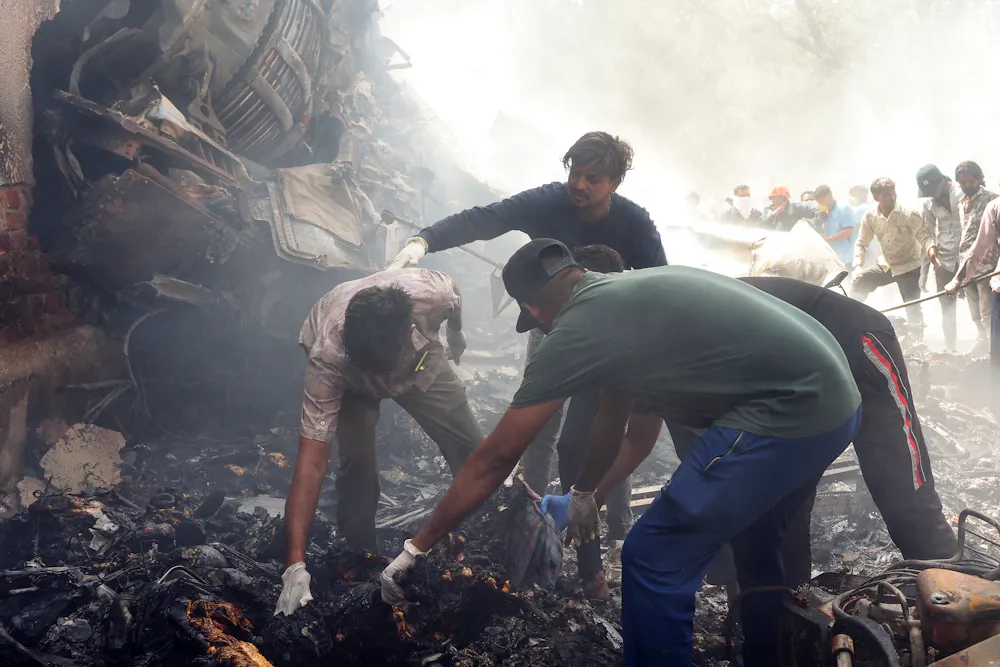
    Flight AI-171, headed to London Gatwick, crashed into the hostel complex of BJ Medical College at 1:38 p.m. IST on Thursday, triggering a massive blaze and a large-scale emergency response.

    Union Home Minister Amit Shah visited the crash site on Thursday and later chaired a high-level meeting with Civil Aviation Minister Naidu, Gujarat Chief Minister Bhupendra Patel, and senior officials to review relief and rescue measures.

    Shah said DNA testing was underway to confirm the identities of the victims and assured that results would be delivered at the earliest by Gujarat’s Forensic Science Laboratory (FSL) and the National Forensic Sciences University (NFSU). DNA samples of family members arriving from abroad would be collected on arrival, he added.

    A formal investigation into the crash has been launched by the Aircraft Accident Investigation Bureau (AAIB) in accordance with international protocols under the International Civil Aviation Organization (ICAO), said Civil Aviation Minister Naidu. A high-level expert committee is also being formed to examine the incident and suggest safety improvements to prevent future tragedies.

    The United States National Transportation Safety Board (NTSB) announced it would send a team of investigators to India to assist the AAIB.

    “The NTSB will be leading a team of US investigators travelling to India to assist the Aircraft Accident Investigation Bureau with its investigation into the crash of an Air India Boeing 787 in Ahmedabad, India, Thursday,” the agency said, noting that all official updates would come from the Indian government under ICAO’s Annex 13 protocols.

    Rescue and Relief Operations Continue

    Rescue operations continued through the night as teams sifted through debris for missing aircraft parts.

    Parts of the plane’s fuselage were scattered around the smouldering building into which it crashed. The tail of the plane was stuck on top of the building.

    Air India CEO Campbell Wilson reached Ahmedabad early Friday. The airline said it had set up Friends & Relatives Assistance Centres at Ahmedabad, Mumbai, Delhi, and Gatwick airports to support the families of those on board.

    “These centres are facilitating the travel of family members to Ahmedabad,” Air India posted on X. Emergency contact numbers were also issued for those seeking information: 1800 5691 444 for calls from within India, and +91 8062779200 for international callers.

    The Tata Group, which took over Air India in 2022, announced a compensation of Rs 1 crore for the family of each deceased passenger.

    “Tata Group will provide Rs 1 crore to the families of each person who has lost their life in this tragedy. We will also cover the medical expenses of those injured and ensure that they receive all necessary care and support. Additionally, we will provide support in the building up of the B J Medical’s hostel,” Tata Sons Chairman N Chandrasekaran said on X.

    Earlier, Air India released a breakdown of the nationalities of those on board: 169 were Indian nationals, 53 British, seven Portuguese, and one Canadian.

    (With inputs from agencies)

  • DGT, Shell India roll out green skills, EV training programme across five states

    Source: Government of India

    Source: Government of India (4)

    The Directorate General of Training (DGT), under the Ministry of Skill Development and Entrepreneurship (MSDE), has partnered with Shell India to launch a Green Skills and Electric Vehicle (EV) training programme. The initiative, implemented by Edunet Foundation, Shell’s training partner, will be conducted across selected Industrial Training Institutes (ITIs) and National Skill Training Institutes (NSTIs) in Delhi-NCR, Gujarat, Maharashtra, Tamil Nadu, and Karnataka.

    The initiative is part of the Centre’s broader efforts to align skill development with India’s transition to a low-carbon future. It is aimed at preparing students and trainers for emerging opportunities in green energy and e-mobility sectors.

    According to the MSDE, the programme will be delivered in a phased, multi-tier model. Four NSTIs will host a 240-hour advanced EV Technician course covering EV systems, diagnostics, and battery technologies. In parallel, 12 ITIs equipped with Shell-supported laboratories will offer a 90-hour job-oriented EV skills course. An additional 50-hour foundational green skills module is being introduced in ITIs without physical labs to build basic awareness around sustainability.

    All modules have been jointly developed by DGT, Shell India, and Edunet Foundation, and are aligned with industry requirements. More than 250 trainers will also undergo upskilling under a dedicated Training of Trainers (ToT) component. On completion, participants will receive certification jointly issued by Shell and DGT, and receive structured placement support.

    A key feature of the programme is the establishment of specialised EV skill labs within selected institutes, aimed at delivering hands-on training and practical exposure to industry standards.

    “This collaboration with Shell India reflects the government’s deeper commitment to aligning skilling with sustainability,” said Shri Jayant Chaudhary, Minister of State (Independent Charge), MSDE and Minister of State for Education. “Green energy, electric mobility, and the broader climate transition are not just environmental imperatives—they represent a generational opportunity for India to lead through innovation, talent, and enterprise.”

    Speaking on the partnership, Trishaljit Sethi, Director General of Training at MSDE, said the programme is a step towards bringing “cutting-edge training infrastructure and industry-relevant curriculum” to vocational training centres. “By integrating EV technologies into our ITIs and NSTIs, we are equipping students with hands-on experience aligned with real-world demand,” she said.

    Mansi Madan Tripathy, Chairperson, Shell Group of Companies in India and Senior Vice President, Shell Lubricants, Asia-Pacific, said the programme was part of Shell’s commitment to building a low-carbon future. “Through our collaboration with DGT and Edunet Foundation, we are providing students with practical and future-ready expertise in green energy and electric mobility,” she said.

    The launch comes as India intensifies its push towards net-zero emissions. Government schemes such as the Faster Adoption and Manufacturing of Hybrid and Electric Vehicles (FAME), alongside state-level EV policies in Delhi, Maharashtra, and Tamil Nadu, are driving demand for a skilled green workforce.

    The programme is expected to strengthen employability in green mobility sectors while ensuring alignment with national skill development frameworks.

  • MIL-OSI Asia-Pac: President Lai meets delegation led by French National Assembly Taiwan Friendship Group Chair Marie-Noëlle Battistel

    Source: Republic of China Taiwan

    Details
    2025-06-05
    President Lai hosts state banquet for President Bernardo Arévalo of Republic of Guatemala  
    At noon on June 5, President Lai Ching-te hosted a state banquet at the Presidential Office for President Bernardo Arévalo of the Republic of Guatemala and his wife. In his remarks, President Lai noted that Taiwan and Guatemala have both undergone an arduous democratization process, and therefore, in face of the continuous expansion of authoritarian influence, must join hands in brotherhood and come together in solidarity to safeguard our hard-earned freedom and democracy. President Lai also expressed hope that both countries will work together and continue to deepen various exchanges and cooperation, taking a friendship that has lasted over 90 years to new heights. A translation of President Lai’s remarks follows: Once again, I would like to offer a warm welcome to President Arévalo and First Lady Lucrecia Peinado, who are leading this delegation to Taiwan. President Arévalo’s previous visit to Taiwan was 31 years ago. Back then, Taiwan did not have direct presidential elections, and the nation was continuing to make progress toward democratization. Today, 31 years later, Taiwan has conducted direct presidential elections eight times, with three transfers of power between political parties. On this visit, I am sure that President Arévalo will gain a deep appreciation for Taiwan’s free and democratic atmosphere.  Taiwan and Guatemala have both undergone an arduous democratization process. A little over 200 years ago, the people of Guatemala took a stand against colonial oppression, seeking national dignity and the freedom of its people. Eighty-one years ago, President Arévalo’s father, Juan José Arévalo, became Guatemala’s first democratically elected president, establishing an important foundation for subsequent democratic development.  Our two peoples have democracy in their blood. Both know the value of freedom and democracy and are willing to take a stand for those values. Therefore, in face of the continuous expansion of authoritarian influence, our two countries must join hands in brotherhood to respond to threats and challenges, and come together in solidarity to safeguard our hard-earned freedom and democracy. I hope that both countries will work together to continue to deepen various exchanges and cooperation, taking a friendship that has lasted over 90 years to new heights. I hope that on this visit, in addition to gaining a deeper understanding of Taiwan’s political, economic, and social development, President Arévalo can also reacquaint himself with the democratic vitality and cultural diversity of Taiwan by sampling various gourmet delicacies and once again experiencing the beauty of our scenery and warmth of our people. Guatemala is a very beautiful country. In the future, I hope to have a chance to personally experience that beauty, explore Mayan civilization, and savor local Guatemalan coffee. In closing, I wish the visiting delegation a smooth and successful trip, and beautiful, unforgettable memories. May President Arévalo enjoy the best of health, and may the diplomatic friendship between our two countries endure. President Arévalo then delivered remarks, stating that at different times and by different means, the people of Taiwan and Guatemala have relentlessly sought to defend freedom and democracy. We share the same expectations, he said, and are walking the right path amid today’s complex international circumstances.  President Arévalo stated that Taiwan and Guatemala are true democratic nations, where the government’s goal is to serve all the people. He noted that this is far from easy under current circumstances, as many authoritarian regimes use their long-term hold on power to safeguard the interests of select groups and neglect the wellbeing of the population as a whole. President Arévalo said that last week Guatemala commemorated the 40th anniversary of its constitution, which was enacted in 1985 and is Guatemala’s ultimate guide, setting the foundation for democracy and clearly outlining the path ahead. He said that over the past 40 years, Guatemala has continued to follow the democratic blueprint established by the constitution and end the civil war so that the nation could make the transition to real democracy. Although more than a few ambitious people have attempted to destroy that process from within, he noted, the people of Guatemala have never given up the pursuit of democracy as an ideal. President Arévalo stated that our two sides’ coming together here is due to such shared values as freedom and democracy as well as the idea of serving all the people. He underlined that the governments of both countries will continue to work hard and provide mutual support to smooth out each other’s path of democracy, freedom, and justice. President Arévalo emphasized that the government of Guatemala will always be Taiwan’s ally, and that he firmly believes Taiwan is Guatemala’s most reliable partner on the path of democracy and economic prosperity and development. The president said he hopes this visit will be the first step towards setting a new course for the governments and peoples of both countries. Also in attendance at the banquet were Guatemala Minister of Foreign Affairs Carlos Ramiro Martínez, Minister of the Economy Gabriela García, and Guatemala Ambassador Luis Raúl Estévez López.  

    Details
    2025-06-05
    President Lai welcomes President Bernardo Arévalo of Republic of Guatemala with military honors  
    On the morning of June 5, President Lai Ching-te welcomed with full military honors President Bernardo Arévalo of the Republic of Guatemala and his wife, who are leading a delegation of cabinet members visiting Taiwan for the first time, demonstrating the deep and enduring alliance between our nations. In remarks, President Lai noted that over the past few years, bilateral cooperation between Taiwan and Guatemala has grown closer and more diverse, and said that moving forward, based on a foundation of mutual assistance for mutual benefit, we will continue to promote programs in line with international trends, spurring prosperity and development in both our nations. The military honors ceremony began at 10:30 a.m. in the Entrance Hall of the Presidential Office. After a 21-gun salute and the playing of the two countries’ national anthems, President Lai and President Arévalo each delivered remarks. A translation of President Lai’s remarks follows: Today, President Arévalo and First Lady Lucrecia Peinado are leading a delegation of cabinet members visiting Taiwan for the first time, demonstrating the deep and enduring alliance between our nations. On behalf of the people and government of the Republic of China (Taiwan), I want to extend my sincerest welcome. Last year, our two countries celebrated the 90th anniversary of diplomatic ties, providing mutual support all along the way. Especially over the past few years, bilateral cooperation has grown closer and more diverse. We have a long record of remarkable results, whether in terms of medicine and public health, education and culture, technological cooperation, or economic and trade exchanges. Moving forward, based on a foundation of mutual assistance for mutual benefit, Taiwan and Guatemala will continue to promote programs in line with international trends. We will continue to strengthen exchange and cooperation for young people, as well as scholarship programs, and actively cultivate high-tech and information and communications technology industry talent, spurring prosperity and development in both our nations. Although separated by a great distance, the peoples of both countries are closely connected by their ideals and values. I am confident that with President Arévalo’s support, bilateral exchanges and cooperation will become closer and more diverse, beginning a very promising new chapter. I wish the visiting delegation a smooth and successful trip. President Arévalo then delivered remarks, saying that on behalf of the government and people of Guatemala, he is honored to visit the Republic of China (Taiwan), this beautiful nation, and to receive full military honors, which reflects the mutual respect between our two nations as well as our solid friendship. Especially as this state visit comes as we celebrate 90 years of formal diplomatic ties, he said, he has brought the foreign minister, economics minister, private secretary to the president, and social communication secretary as members of his delegation, in the hope of our ties embarking on a new chapter. President Arévalo said that Guatemala-Taiwan ties have in recent years been growing steadily on a foundation of mutual understanding and cooperation, making significant progress, and that our peoples have also cultivated sincere friendships and cooperative relationships across many fields. Our nations are especially promoting public health, education, agricultural technology, and infrastructure, he said, key fields which are conducive to economic and social development. He expressed his hope that on such good foundations of the past, we can further strengthen our bilateral ties for the future. President Arévalo stated that through this state visit they not only want to reaffirm the good bilateral ties between our nations, but that they also hope to define a trajectory for the future of our cooperation in the direction of expanding economic cooperation, building economic and trade alliances, and facilitating investment to foster a Taiwan-Guatemala relationship that benefits both peoples. He then expressed gratitude to the people of Taiwan for helping Guatemala over the past 90 years and reaffirmed the unwavering support of Guatemala for the Republic of China (Taiwan). On the occasion of this visit, he said, he hopes to extend a friendly hand to the people of Taiwan, adding that he looks forward to our nations continuing to take major steps forward on the road of mutual assistance and prosperity. Also in attendance at the welcome ceremony were Dean of the Diplomatic Corps and Saint Vincent and the Grenadines Ambassador Andrea Clare Bowman, and members of the foreign diplomatic corps in Taiwan.  

    Details
    2025-06-03
    President Lai confers decoration on President Hilda C. Heine of Republic of the Marshall Islands, hosts state banquet  
    At noon on June 3, President Lai Ching-te, accompanied by Vice President Bi-khim Hsiao, conferred a decoration upon President Hilda C. Heine of the Republic of the Marshall Islands, and hosted a state banquet for President Heine and her husband at the Presidential Office. In remarks, President Lai thanked President Heine for her commitment to deepening the diplomatic partnership between our nations and speaking up for Taiwan in the international arena. He also expressed hope for Taiwan and the Marshall Islands to work together to address various challenges through an even greater diversity of exchanges, and that together, we can contribute even more to peace, stability, and development throughout the Pacific region. At the decoration ceremony, President Lai personally conferred the Order of Brilliant Jade with Grand Cordon on President Heine before delivering remarks, a translation of which follows:  The Marshall Islands was the first Pacific ally that I visited after taking office as president. When I arrived there, I was immediately drawn to its beautiful scenery. And I received a very warm welcome from the local people. This gesture showed the profound friendship between our two nations. I was truly touched. I also remember trying your nation’s special Bob Whisky for the first time. The flavor was as unique and impressive as the landscape of the Marshall Islands.  In addition to welcoming our distinguished guests today, we also presented President Heine with the Order of Brilliant Jade with Grand Cordon. On behalf of the people of Taiwan, I want to thank President Heine for her commitment to deepening the diplomatic partnership between our nations, and for staunchly speaking up for Taiwan in the international arena. Both I and the people of Taiwan are profoundly grateful to President Heine for her friendship and support. Over the past few years, cooperation between Taiwan and the Marshall Islands has grown ever closer. And this visit by our distinguished guests will allow our two countries to further expand areas of bilateral exchange. I have always believed that only through mutual assistance and trust can two countries build a longstanding and steadfast partnership. I once again convey my sincere aspiration that Taiwan and the Marshall Islands work together to address various challenges through an even greater diversity of exchanges. Together, we can contribute even more to peace, stability, and development throughout the Pacific region. In closing, I want to thank President Heine and First Gentleman Thomas Kijiner, Jr. for leading this delegation to Taiwan, which deepens the foundations of our bilateral relationship. May our two nations enjoy a long and enduring friendship. President Heine then delivered remarks, stating that she felt especially privileged to receive the Order of Brilliant Jade with Grand Cordon of the Republic of China (Taiwan), and humbly accepted the honor with the utmost gratitude, humility, and deep responsibility. This is a deep responsibility, she said, because she understands that since its inception in 1933, this order has been bestowed upon a select few. She then thanked President Lai for this great honor. President Heine stated that the banquet was not just a celebration of our bilateral friendship, but a true reflection of the generosity of the Taiwan spirit and a testament to the enduring ties between our nations, founded on shared values and aspirations, including a respect for the rule of law, the preservation of human dignity, and a deep commitment to democracy. President Heine stated that the Taiwan-Marshall Islands partnership continues to evolve through practical cooperation and mutual support. In recent years, she said, our countries have worked hand in hand across a range of vital sectors, including the recent opening of the Majuro Hospital AI and Telehealth Center and the ongoing and successful Taiwan Health Center, various technical training and scholarship programs, and various climate change adaptation projects in renewable energy, coastal resilience, and sustainable agriculture.   President Heine emphasized that the Marshall Islands continues to be a proud and vocal supporter of Taiwan’s meaningful participation in the United Nations system and other international organizations. Taiwan’s exclusion from these platforms, she said, is not only unjust, but is bad for the world, and the global community needs Taiwan’s voice and expertise.  President Heine also expressed sincere appreciation to all of the Taiwanese friends who have contributed their efforts to deepening bilateral relations, including government officials, healthcare workers, teachers, engineers, and volunteers. The people of the Marshall Islands, she said, deeply appreciate and value everyone’s efforts and service. President Heine said that as we celebrate our partnership, let us look to the future with hope and determination, continue to work together, learn from one another, and support one another to champion a world where all nations can chart their own course based on peace and international law. Also attending the state banquet were Marshall Islands Council of Iroij Chairman Lanny Kabua, Minister of Foreign Affairs and Trade Kalani R. Kaneko, Minister of Finance David Paul, Nitijela Standing Committee on Foreign Affairs and Trade Chairperson Joe Bejang, and Charge d’Affaires a.i. Anjanette Davis-Anjel of the Embassy of the Republic of the Marshall Islands.  

    Details
    2025-06-03
    President Lai and President Hilda C. Heine of Marshall Islands hold bilateral talks and witness signing of agreements
    On the morning of June 3, President Lai Ching-te, accompanied by Vice President Bi-khim Hsiao, held bilateral talks with President Hilda C. Heine of the Republic of the Marshall Islands at the Presidential Office following a welcome ceremony with military honors for her and her husband. The leaders also jointly witnessed the signing of a letter of intent for sports exchanges and a memorandum of understanding regarding the Presidents’ Scholarship Fund. President Lai then presided over a launch ceremony for a loan program to purchase aircraft. In remarks, President Lai thanked the government and the Nitijela (parliament) of the Marshall Islands for their longstanding support for Taiwan’s international participation and for voicing staunch support for Taiwan at numerous international venues. President Lai said that Taiwan looks forward to continuing to deepen its diplomatic partnership with the Marshall Islands and build an even closer cooperative relationship across a range of fields, engaging in mutual assistance for mutual benefits and helping each other achieve joint and prosperous development to yield even greater well-being for our peoples. A translation of President Lai’s remarks follows: I once again warmly welcome President Heine, First Gentleman Thomas Kijiner, Jr., and our guests to Taiwan. During my visit to the Marshall Islands last year, I said that Taiwan and the Marshall Islands are truly a family. When Vice President Hsiao and I took office last year, President Heine led a delegation to Taiwan. It is now one year since our inauguration, and I am delighted to see President Heine once again, just as if I were seeing family arrive from afar. Through my visit to the Marshall Islands, I gained a profound sense of the friendship between the peoples of our two nations, well-demonstrated by bilateral exchanges in such areas as healthcare, agriculture, and education. And it is thanks to President Heine’s longstanding support for Taiwan that our countries have been able to further advance collaboration on even more issues, including women’s empowerment and climate change. In recent years, the geopolitical and economic landscape has changed rapidly. We look forward to Taiwan and the Marshall Islands continuing to deepen our partnership and build an even closer cooperative relationship. In just a few moments, President Heine and I will witness the signing of several documents, including a memorandum of understanding and a letter of intent, to expand bilateral cooperation in such fields as sports, education, and transportation. Taiwan will take concrete action to work with the Marshall Islands and advance mutual prosperity and development, writing a new chapter in our diplomatic partnership. I would also like to take this opportunity to express gratitude to the government and Nitijela of the Marshall Islands. In recent years, the Nitijela has passed annual resolutions backing Taiwan’s international participation, and President Heine and Marshallese cabinet members have been some of the strongest advocates for Taiwan’s international participation, voicing staunch support for Taiwan at numerous international venues. Building on the pillars of democracy, peace, and prosperity, Taiwan will continue to work with the Marshall Islands and other like-minded countries to deepen our partnerships, engage in mutual assistance for mutual benefits, and help one another achieve joint and prosperous development. I have every confidence that the combined efforts of our two nations will yield even greater well-being for our peoples and see us make even more contributions to the world. President Heine then delivered remarks, and began by conveying warm greetings of iokwe from the people and government of the Republic of the Marshall Islands to the people and government of the Republic of China (Taiwan). She said she was deeply honored to be in Taiwan for an official visit, and extended appreciation to President Lai and his government for their gracious invitation and warm welcome. President Heine stated that this year marks 27 years of diplomatic ties between our two nations, and that they are proud of this enduring friendship. This special and enduring relationship, she said, is grounded in our shared Austronesian heritage, and strengthened by mutual respect for each other’s democratic systems and our steadfast commitment to the core values of freedom, justice, and the rule of law. President Heine stated that Taiwan’s continued support has been invaluable to the people and national development of the Marshall Islands, particularly in the areas of health, education, agriculture, and climate change. She also expressed deep appreciation to Taiwan for providing Marshallese students with opportunities to study in Taiwan, and for the care extended to Marshallese who travel here for medical treatment. President Heine also announced that she would be presenting a copy of a resolution by the people and government of the Republic of the Marshall Islands reiterating their appreciation for the support provided by the people and government of the Republic of China (Taiwan), and calling on the United Nations to take immediate action to resolve the inappropriate exclusion of Taiwan’s 23 million people from the UN system. She added that she looked forward to the bilateral discussions later that day, and to continuing the important work that both countries carry out together. After the bilateral talks, President Lai and President Heine witnessed the signing of a letter of intent regarding sports exchanges and a memorandum of understanding regarding the Presidents’ Scholarship Fund by Minister of Foreign Affairs Lin Chia-lung (林佳龍) and Marshallese Minister of Foreign Affairs and Trade Kalani R. Kaneko. President Lai then presided over a launch ceremony for a loan program to purchase aircraft, marking the formal beginning of Taiwan-Marshall Islands air transport cooperation. The visiting delegation also included Council of Iroij Chairman Lanny Kabua, Minister of Finance David Paul, and Nitijela Standing Committee on Foreign Affairs and Trade Chair Joe Bejang. They were accompanied to the Presidential Office by Charge d’Affaires a.i. Anjanette Davis-Anjel of the Embassy of the Republic of the Marshall Islands.

    Details
    2025-06-03
    President Lai welcomes President Hilda C. Heine of Republic of the Marshall Islands with military honors  
    President Lai Ching-te welcomed President Hilda C. Heine of the Republic of the Marshall Islands and her husband on the morning of June 3 with full military honors. In remarks, President Lai thanked President Heine and the people and government of the Marshall Islands for demonstrating such high regard for our nations’ diplomatic ties. The president said that over our 27 years of diplomatic relations, our cooperation in healthcare, agriculture, fisheries, education and training, and climate change has yielded many positive results. And moving ahead, he said, Taiwan will continue to deepen collaboration across all domains for mutual prosperity and growth. The welcome ceremony began at 10:30 a.m. in the plaza fronting the Presidential Office. President Lai and President Heine each delivered remarks after a 21-gun salute, the playing of the two countries’ national anthems, and a review of the military honor guard. A translation of President Lai’s remarks follows: On behalf of the people and government of the Republic of China (Taiwan), it is a great pleasure to welcome President Heine, First Gentleman Thomas Kijiner, Jr., and their delegation with full military honors as they make this state visit to Taiwan. When I traveled to the Marshall Islands on a state visit last December, I was received with great warmth and courtesy. I once again thank President Heine and the people and government of the Marshall Islands for demonstrating such high regard for our nations’ diplomatic ties. Taiwan and the Marshall Islands share Austronesian cultural traditions, and we are like-minded friends. Throughout our 27 years of diplomatic relations, we have always engaged with each other in a spirit of reciprocal trust and mutual assistance. Our cooperation in healthcare, agriculture, fisheries, education and training, and climate change has yielded many positive results. This is President Heine’s first state visit to Taiwan since taking office for a second time. We look forward to engaging our esteemed guests in in-depth discussions on issues of common concern. And moving ahead, Taiwan will continue to deepen collaboration with the Marshall Islands across all domains for mutual prosperity and growth. In closing, I thank President Heine, First Gentleman Kijiner, and their entire delegation for visiting Taiwan. I wish you all a pleasant and successful trip.  A transcript of President Heine’s remarks follows: Your Excellency President Lai Ching-te, Vice President [Bi-khim] Hsiao, honorable members of the cabinet, ambassadors, distinguished guests, ladies and gentlemen: It is my pleasure to extend warm greetings of iokwe on behalf of the people and the government of the Republic of the Marshall Islands. I wish to also convey my appreciation to Your Excellency President Lai, for the hospitality and very warm welcome – kommol tata. This visit marks my seventh official state visit to this beautiful country. It’s a testament to my strong commitment to further deepening ties between the Republic of the Marshall Islands and the Republic of China (Taiwan). During this visit, I look forward to engaging in meaningful discussions with Your Excellency President Lai to further strengthen the bilateral relationship between our two nations and our peoples.  For over a quarter-century, Taiwan has been a strong ally and friend to the Marshall Islands. Our partnership has thrived across many sectors, including education, healthcare, infrastructure, and economic development. Through Taiwan’s generous support and collaboration, we have made significant progress in improving the lives of our people, empowering our communities, and fostering sustainable growth. The Marshall Islands deeply values our partnership with Taiwan and appreciates Taiwan’s support over the years. Despite our small size and limited voice on the global stage, the Marshall Islands deeply cherishes our friendship with Taiwan, and to that end, I wish to reaffirm my government’s commitment to Taiwan’s meaningful participation in the United Nations system. Taiwan has consistently demonstrated its commitment to the principles of democracy, human rights, and the rule of law. In light of current constraints in global affairs, it is now more urgent than ever that the international community of nations recognize the fundamental rights of the 23 million Taiwanese people and recognize Taiwan’s aspiration to engage fully in global affairs. It is with this in mind that I wish to reiterate to Your Excellency President Lai, the Taiwanese people, and the world that under my government, Marshall Islands will continue to acknowledge Taiwan’s contribution on the global stage and urge like-minded countries to advocate for Taiwan’s meaningful engagement in the international arena. In closing, may I once again extend our sincere appreciation to Your Excellency President Lai, the people and government of the Republic of China (Taiwan), for your warm welcome.  Also in attendance at the welcome ceremony were Charge d’Affaires a.i. Anjanette Davis-Anjel of the Embassy of the Republic of the Marshall Islands, Dean of the Diplomatic Corps and Saint Vincent and the Grenadines Ambassador Andrea Clare Bowman, and members of the foreign diplomatic corps in Taiwan.  

    Details
    2025-05-20
    President Lai interviewed by Nippon Television and Yomiuri TV
    In a recent interview on Nippon Television’s news zero program, President Lai Ching-te responded to questions from host Mr. Sakurai Sho and Yomiuri TV Shanghai Bureau Chief Watanabe Masayo on topics including reflections on his first year in office, cross-strait relations, China’s military threats, Taiwan-United States relations, and Taiwan-Japan relations. The interview was broadcast on the evening of May 19. During the interview, President Lai stated that China intends to change the world’s rules-based international order, and that if Taiwan were invaded, global supply chains would be disrupted. Therefore, he said, Taiwan will strengthen its national defense, prevent war by preparing for war, and achieve the goal of peace. The president also noted that Taiwan’s purpose for developing drones is based on national security and industrial needs, and that Taiwan hopes to collaborate with Japan. He then reiterated that China’s threats are an international problem, and expressed hope to work together with the US, Japan, and others in the global democratic community to prevent China from starting a war. Following is the text of the questions and the president’s responses: Q: How do you feel as you are about to round out your first year in office? President Lai: When I was young, I was determined to practice medicine and save lives. When I left medicine to go into politics, I was determined to transform Taiwan. And when I was sworn in as president on May 20 last year, I was determined to strengthen the nation. Time flies, and it has already been a year. Although the process has been very challenging, I am deeply honored to be a part of it. I am also profoundly grateful to our citizens for allowing me the opportunity to give back to our country. The future will certainly be full of more challenges, but I will do everything I can to unite the people and continue strengthening the nation. That is how I am feeling now. Q: We are now coming up on the 80th anniversary of the end of World War II, and over this period, we have often heard that conflict between Taiwan and the mainland is imminent. Do you personally believe that a cross-strait conflict could happen? President Lai: The international community is very much aware that China intends to replace the US and change the world’s rules-based international order, and annexing Taiwan is just the first step. So, as China’s military power grows stronger, some members of the international community are naturally on edge about whether a cross-strait conflict will break out. The international community must certainly do everything in its power to avoid a conflict in the Taiwan Strait; there is too great a cost. Besides causing direct disasters to both Taiwan and China, the impact on the global economy would be even greater, with estimated losses of US$10 trillion from war alone – that is roughly 10 percent of the global GDP. Additionally, 20 percent of global shipping passes through the Taiwan Strait and surrounding waters, so if a conflict breaks out in the strait, other countries including Japan and Korea would suffer a grave impact. For Japan and Korea, a quarter of external transit passes through the Taiwan Strait and surrounding waters, and a third of the various energy resources and minerals shipped back from other countries pass through said areas. If Taiwan were invaded, global supply chains would be disrupted, and therefore conflict in the Taiwan Strait must be avoided. Such a conflict is indeed avoidable. I am very thankful to Prime Minister of Japan Ishiba Shigeru and former Prime Ministers Abe Shinzo, Suga Yoshihide, and Kishida Fumio, as well as US President Donald Trump and former President Joe Biden, and the other G7 leaders, for continuing to emphasize at international venues that peace and stability across the Taiwan Strait are essential components for global security and prosperity. When everyone in the global democratic community works together, stacking up enough strength to make China’s objectives unattainable or to make the cost of invading Taiwan too high for it to bear, a conflict in the strait can naturally be avoided. Q: As you said, President Lai, maintaining peace and stability across the Taiwan Strait is also very important for other countries. How can war be avoided? What sort of countermeasures is Taiwan prepared to take to prevent war? President Lai: As Mr. Sakurai mentioned earlier, we are coming up on the 80th anniversary of the end of WWII. There are many lessons we can take from that war. First is that peace is priceless, and war has no winners. From the tragedies of WWII, there are lessons that humanity should learn. We must pursue peace, and not start wars blindly, as that would be a major disaster for humanity. In other words, we must be determined to safeguard peace. The second lesson is that we cannot be complacent toward authoritarian powers. If you give them an inch, they will take a mile. They will keep growing, and eventually, not only will peace be unattainable, but war will be inevitable. The third lesson is why WWII ended: It ended because different groups joined together in solidarity. Taiwan, Japan, and the Indo-Pacific region are all directly subjected to China’s threats, so we hope to be able to join together in cooperation. This is why we proposed the Four Pillars of Peace action plan. First, we will strengthen our national defense. Second, we will strengthen economic resilience. Third is standing shoulder to shoulder with the democratic community to demonstrate the strength of deterrence. Fourth is that as long as China treats Taiwan with parity and dignity, Taiwan is willing to conduct exchanges and cooperate with China, and seek peace and mutual prosperity. These four pillars can help us avoid war and achieve peace. That is to say, Taiwan hopes to achieve peace through strength, prevent war by preparing for war, keeping war from happening and pursuing the goal of peace. Q: Regarding drones, everyone knows that recently, Taiwan has been actively researching, developing, and introducing drones. Why do you need to actively research, develop, and introduce new drones at this time? President Lai: This is for two purposes. The first is to meet national security needs. The second is to meet industrial development needs. Because Taiwan, Japan, and the Philippines are all part of the first island chain, and we are all democratic nations, we cannot be like an authoritarian country like China, which has an unlimited national defense budget. In this kind of situation, island nations such as Taiwan, Japan, and the Philippines should leverage their own technologies to develop national defense methods that are asymmetric and utilize unmanned vehicles. In particular, from the Russo-Ukrainian War, we see that Ukraine has successfully utilized unmanned vehicles to protect itself and prevent Russia from unlimited invasion. In other words, the Russo-Ukrainian War has already proven the importance of drones. Therefore, the first purpose of developing drones is based on national security needs. Second, the world has already entered the era of smart technology. Whether generative, agentic, or physical, AI will continue to develop. In the future, cars and ships will also evolve into unmanned vehicles and unmanned boats, and there will be unmanned factories. Drones will even be able to assist with postal deliveries, or services like Uber, Uber Eats, and foodpanda, or agricultural irrigation and pesticide spraying. Therefore, in the future era of comprehensive smart technology, developing unmanned vehicles is a necessity. Taiwan, based on industrial needs, is actively planning the development of drones and unmanned vehicles. I would like to take this opportunity to express Taiwan’s hope to collaborate with Japan in the unmanned vehicle industry. Just as we do in the semiconductor industry, where Japan has raw materials, equipment, and technology, and Taiwan has wafer manufacturing, our two countries can cooperate. Japan is a technological power, and Taiwan also has significant technological strengths. If Taiwan and Japan work together, we will not only be able to safeguard peace and stability in the Taiwan Strait and security in the Indo-Pacific region, but it will also be very helpful for the industrial development of both countries. Q: The drones you just described probably include examples from the Russo-Ukrainian War. Taiwan and China are separated by the Taiwan Strait. Do our drones need to have cross-sea flight capabilities? President Lai: Taiwan does not intend to counterattack the mainland, and does not intend to invade any country. Taiwan’s drones are meant to protect our own nation and territory. Q: Former President Biden previously stated that US forces would assist Taiwan’s defense in the event of an attack. President Trump, however, has yet to clearly state that the US would help defend Taiwan. Do you think that in such an event, the US would help defend Taiwan? Or is Taiwan now trying to persuade the US? President Lai: Former President Biden and President Trump have answered questions from reporters. Although their responses were different, strong cooperation with Taiwan under the Biden administration has continued under the Trump administration; there has been no change. During President Trump’s first term, cooperation with Taiwan was broader and deeper compared to former President Barack Obama’s terms. After former President Biden took office, cooperation with Taiwan increased compared to President Trump’s first term. Now, during President Trump’s second term, cooperation with Taiwan is even greater than under former President Biden. Taiwan-US cooperation continues to grow stronger, and has not changed just because President Trump and former President Biden gave different responses to reporters. Furthermore, the Trump administration publicly stated that in the future, the US will shift its strategic focus from Europe to the Indo-Pacific. The US secretary of defense even publicly stated that the primary mission of the US is to prevent China from invading Taiwan, maintain stability in the Indo-Pacific, and thus maintain world peace. There is a saying in Taiwan that goes, “Help comes most to those who help themselves.” Before asking friends and allies for assistance in facing threats from China, Taiwan must first be determined and prepared to defend itself. This is Taiwan’s principle, and we are working in this direction, making all the necessary preparations to safeguard the nation. Q: I would like to ask you a question about Taiwan-Japan relations. After the Great East Japan Earthquake in 2011, you made an appeal to give Japan a great deal of assistance and care. In particular, you visited Sendai to offer condolences. Later, you also expressed condolences and concern after the earthquakes in Aomori and Kumamoto. What are your expectations for future Taiwan-Japan exchanges and development? President Lai: I come from Tainan, and my constituency is in Tainan. Tainan has very deep ties with Japan, and of course, Taiwan also has deep ties with Japan. However, among Taiwan’s 22 counties and cities, Tainan has the deepest relationship with Japan. I sincerely hope that both of you and your teams will have an opportunity to visit Tainan. I will introduce Tainan’s scenery, including architecture from the era of Japanese rule, Tainan’s cuisine, and unique aspects of Tainan society, and you can also see lifestyles and culture from the Showa era.  The Wushantou Reservoir in Tainan was completed by engineer Mr. Hatta Yoichi from Kanazawa, Japan and the team he led to Tainan after he graduated from then-Tokyo Imperial University. It has nearly a century of history and is still in use today. This reservoir, along with the 16,000-km-long Chianan Canal, transformed the 150,000-hectare Chianan Plain into Taiwan’s premier rice-growing area. It was that foundation in agriculture that enabled Taiwan to develop industry and the technology sector of today. The reservoir continues to supply water to Tainan Science Park. It is used by residents of Tainan, the agricultural sector, and industry, and even the technology sector in Xinshi Industrial Park, as well as Taiwan Semiconductor Manufacturing Company. Because of this, the people of Tainan are deeply grateful for Mr. Hatta and very friendly toward the people of Japan. A major earthquake, the largest in 50 years, struck Tainan on February 6, 2016, resulting in significant casualties. As mayor of Tainan at the time, I was extremely grateful to then-Prime Minister Abe, who sent five Japanese officials to the disaster site in Tainan the day after the earthquake. They were very thoughtful and asked what kind of assistance we needed from the Japanese government. They offered to provide help based on what we needed. I was deeply moved, as former Prime Minister Abe showed such care, going beyond the formality of just sending supplies that we may or may not have actually needed. Instead, the officials asked what we needed and then provided assistance based on those needs, which really moved me. Similarly, when the Great East Japan Earthquake of 2011 or the later Kumamoto earthquakes struck, the people of Tainan, under my leadership, naturally and dutifully expressed their support. Even earlier, when central Taiwan was hit by a major earthquake in 1999, Japan was the first country to deploy a rescue team to the disaster area. On February 6, 2018, after a major earthquake in Hualien, former Prime Minister Abe appeared in a video holding up a message of encouragement he had written in calligraphy saying “Remain strong, Taiwan.” All of Taiwan was deeply moved. Over the years, Taiwan and Japan have supported each other when earthquakes struck, and have forged bonds that are family-like, not just neighborly. This is truly valuable. In the future, I hope Taiwan and Japan can be like brothers, and that the peoples of Taiwan and Japan can treat one another like family. If Taiwan has a problem, then Japan has a problem; if Japan has a problem, then Taiwan has a problem. By caring for and helping each other, we can face various challenges and difficulties, and pursue a brighter future. Q: President Lai, you just used the phrase “If Taiwan has a problem, then Japan has a problem.” In the event that China attempts to invade Taiwan by force, what kind of response measures would you hope the US military and Japan’s Self-Defense Forces take? President Lai: As I just mentioned, annexing Taiwan is only China’s first step. Its ultimate objective is to change the rules-based international order. That being the case, China’s threats are an international problem. So, I would very much hope to work together with the US, Japan, and others in the global democratic community to prevent China from starting a war – prevention, after all, is more important than cure.

    MIL OSI Asia Pacific News

  • New training initiative launched to prepare youth for green jobs

    Source: Government of India

    Source: Government of India (4)

    The Directorate General of Training (DGT), under the Ministry of Skill Development and Entrepreneurship (MSDE), has partnered with Shell India to launch a Green Skills and Electric Vehicle (EV) training programme. The initiative, implemented by Edunet Foundation, Shell’s training partner, will be conducted across selected Industrial Training Institutes (ITIs) and National Skill Training Institutes (NSTIs) in Delhi-NCR, Gujarat, Maharashtra, Tamil Nadu, and Karnataka.

    The initiative is part of the Centre’s broader efforts to align skill development with India’s transition to a low-carbon future. It is aimed at preparing students and trainers for emerging opportunities in green energy and e-mobility sectors.

    According to the MSDE, the programme will be delivered in a phased, multi-tier model. Four NSTIs will host a 240-hour advanced EV Technician course covering EV systems, diagnostics, and battery technologies. In parallel, 12 ITIs equipped with Shell-supported laboratories will offer a 90-hour job-oriented EV skills course. An additional 50-hour foundational green skills module is being introduced in ITIs without physical labs to build basic awareness around sustainability.

    All modules have been jointly developed by DGT, Shell India, and Edunet Foundation, and are aligned with industry requirements. More than 250 trainers will also undergo upskilling under a dedicated Training of Trainers (ToT) component. On completion, participants will receive certification jointly issued by Shell and DGT, and receive structured placement support.

    A key feature of the programme is the establishment of specialised EV skill labs within selected institutes, aimed at delivering hands-on training and practical exposure to industry standards.

    “This collaboration with Shell India reflects the government’s deeper commitment to aligning skilling with sustainability,” said Shri Jayant Chaudhary, Minister of State (Independent Charge), MSDE and Minister of State for Education. “Green energy, electric mobility, and the broader climate transition are not just environmental imperatives—they represent a generational opportunity for India to lead through innovation, talent, and enterprise.”

    Speaking on the partnership, Trishaljit Sethi, Director General of Training at MSDE, said the programme is a step towards bringing “cutting-edge training infrastructure and industry-relevant curriculum” to vocational training centres. “By integrating EV technologies into our ITIs and NSTIs, we are equipping students with hands-on experience aligned with real-world demand,” she said.

    Mansi Madan Tripathy, Chairperson, Shell Group of Companies in India and Senior Vice President, Shell Lubricants, Asia-Pacific, said the programme was part of Shell’s commitment to building a low-carbon future. “Through our collaboration with DGT and Edunet Foundation, we are providing students with practical and future-ready expertise in green energy and electric mobility,” she said.

    The launch comes as India intensifies its push towards net-zero emissions. Government schemes such as the Faster Adoption and Manufacturing of Hybrid and Electric Vehicles (FAME), alongside state-level EV policies in Delhi, Maharashtra, and Tamil Nadu, are driving demand for a skilled green workforce.

    The programme is expected to strengthen employability in green mobility sectors while ensuring alignment with national skill development frameworks.

  • MIL-OSI Asia-Pac: Draft Pok Fu Lam Outline Zoning Plan approved

    Source: Hong Kong Government special administrative region

    Draft Pok Fu Lam Outline Zoning Plan approved 
    The approved OZP has incorporated amendments, which mainly involve rezoning the 4.72-hectare site for the proposed Global Innovation Centre by the University of Hong Kong (HKU) in Pok Fu Lam. To allow the HKU to review and adjust its proposal in response to the views expressed by the representers during the plan-making process and to consult relevant stakeholders including the local community before submitting its revised proposal for the Government’s consideration, the site is zoned “Undetermined” in the interim. Upon the HKU’s completion of the review and engagement with the community on the revised proposal, further rezoning of the site will be processed in accordance with the Town Planning Ordinance.
     
    Other amendments include rezoning narrow strips of land along Victoria Road and a strip of land to the south of Wah Mei House, Wah Fu Estate, to suitable zonings to reflect the existing alignment of Victoria Road and the land grant boundary of Wah Fu Estate.
     
    The Notes and Explanatory Statement of the OZP have been amended taking into account the above amendments. Opportunity is also taken to update the general information of various land use zones and the planning circumstances, where appropriate.
     
    The approved Pok Fu Lam OZP No. S/H10/23 is available for public inspection during office hours at (i) the Secretariat of the Town Planning Board, (ii) the Planning Enquiry Counters, (iii) the Hong Kong District Planning Office, and (iv) the Southern Home Affairs Enquiry Centre.
     
    Copies of the approved OZP are available for sale at the Map Publications Centre in North Point. The electronic version of the OZP can be viewed at the Town Planning Board’s website (www.tpb.gov.hkIssued at HKT 16:00

    NNNN

    MIL OSI Asia Pacific News

  • MIL-Evening Report: News of the Air India plane crash is traumatic. Here’s how to make sense of the risk

    Source: The Conversation (Au and NZ) – By Hassan Vally, Associate Professor, Epidemiology, Deakin University

    simonkr/Getty Images

    On Thursday afternoon local time, an Air India passenger plane bound for London crashed shortly after takeoff from the northwestern Indian city of Ahmedabad. There were reportedly 242 people onboard, including two pilots and ten cabin crew.

    The most up-to-date reports indicate the death toll has surpassed 260, including people on the ground.

    Miraculously, one passenger – British national Vishwashkumar Ramesh – survived the crash.

    Thankfully, catastrophic plane crashes such as this are very rare. But seeing news of such a horrific event is traumatic, particularly for people who may have a fear of flying or are due to travel on a plane soon.

    If you’re feeling anxious following this distressing news, it’s understandable. But here are some things worth considering when you’re thinking about the risk of plane travel.

    Just how dangerous is flying?

    One of the ways to make sense of risks, especially really small ones, is to put them into context.

    Although there are various ways to do this, we can first look to figures that tell us the risk of dying in a plane crash per passenger who boards a plane. Arnold Barnett, a professor at the Massachusetts Institute of Technology, calculated that in 2018–22, this figure was one in 13.7 million. By any reckoning, this is an incredibly small risk.

    And there’s a clear trend of air travel getting safer every decade. Barnett’s calculations suggest that between 2007 and 2017, the risk was one per 7.9 million.

    We can also compare the risks of dying in a plane crash with those of dying in a car accident. Although estimates of motor vehicle fatalities vary depending on how you do the calculations and where you are in the world, flying has been estimated to be more than 100 times safer than driving.

    Evolution has skewed our perception of risks

    The risk of being involved in a plane crash is extremely small. But for a variety of reasons, we often perceive it to be greater than it is.

    First, there are well-known limitations in how we intuitively estimate risk. Our responses to risk (and many other things) are often shaped far more by emotion and instinct than by logic.

    As psychologist Daniel Kahneman explains in his book Thinking, Fast and Slow, much of our thinking about risk is driven by intuitive, automatic processes rather than careful reasoning.

    Notably, our brains evolved to pay attention to threats that are striking or memorable. The risks we faced in primitive times were large, immediate and tangible threats to life. Conversely, the risks we face in the modern world are generally much smaller, less obvious, and play out over the longer term.

    The brain that served us well in prehistoric times has essentially remained the same, but the world has completely changed. Therefore, our brains are susceptible to errors in thinking and mental shortcuts called cognitive biases that skew our perception of modern risks.

    This can lead us to overestimate very small risks, such as plane crashes, while underestimating far more probable dangers, such as chronic diseases.

    Why we overestimate the risks of flying

    There are several drivers of our misperception of risks when it comes to flying specifically.

    The fact events such as the Air India plane crash are so rare makes them all the more psychologically powerful when they do occur. And in today’s digital media landscape, the proliferation of dramatic footage of the crash itself, along with images of the aftermath, amplifies its emotional and visual impact.

    The effect these vivid images have on our thinking around the risks of flying is called the availability heuristic. The more unusual and dramatic an event is, the more it stands out in our minds, and the more it skews our perception of its likelihood.

    It’s natural to perceive the risk of flying as being greater than it truly is.
    OlegRi/Shutterstock

    Another influence on the way we perceive risks relevant to flying is called dread risk, which is a psychological response we have to certain types of threats. We fear certain risks that feel more catastrophic or unfamiliar. It’s the same reason we may disproportionately fear terrorist attacks, when in reality they’re very uncommon.

    Plane crashes usually involve a large number of deaths that occur at one time. And the thought of going down in a plane may feel more frightening than dying in other ways. All this taps into the emotions of fear, vulnerability and helplessness, and leads to an overweighting of the risks.

    Another factor that contributes to our overestimation of flying risks is our lack of control when flying. When we’re passengers on a plane, we are in many ways completely dependent on others. Even though we know pilots are highly trained and commercial aviation is very safe, the lack of control we have as passengers triggers a deep sense of vulnerability.

    This absence of control makes the situation feel riskier than it actually is, and often riskier than activities where the threat is far greater but there is an (often false) sense of control, such as driving a car.

    In a nutshell

    We have an evolutionary bias toward reacting more strongly to particular threats, especially when these events are dramatic, evoke dread and when we feel an absence of control.

    Although events such as Air India crash affect us deeply, air travel is still arguably the safest method of transport. Understandably, this can get lost in the emotional aftermath of tragic plane crashes.

    Hassan Vally does not work for, consult, own shares in or receive funding from any company or organisation that would benefit from this article, and has disclosed no relevant affiliations beyond their academic appointment.

    ref. News of the Air India plane crash is traumatic. Here’s how to make sense of the risk – https://theconversation.com/news-of-the-air-india-plane-crash-is-traumatic-heres-how-to-make-sense-of-the-risk-258907

    MIL OSI AnalysisEveningReport.nz

  • MIL-OSI Global: Just one man survived the Air India crash. What’s it like to survive a mass disaster?

    Source: The Conversation – Global Perspectives – By Erin Smith, Associate Professor and Discipline Lead (Paramedicine), La Trobe University

    Viswashkumar Ramesh, a British citizen returning from a trip to India, has been confirmed as the only survivor of Thursday’s deadly Air India crash.

    “I don’t know how I am alive,” Ramesh told family, according to his brother Nayan, in a video call moments after emerging from the wreckage. Another brother Ajay, seated elswhere on the plane, was killed.

    The Boeing 787-7 Dreamliner crashed into a medical college less than a minute after taking off in the city of Ahmedabad, killing the other 229 passengers and 12 crew. At least five people were killed on the ground.

    Surviving a mass disaster of this kind may be hailed as a kind of “miracle”. But what is it like to survive – especially as the only one?

    Surviving a disaster

    Past research has shown disaster survivors may experience an intense range of emotions, from grief and anxiety to feelings of loss and uncertainty.

    These are common reactions to an extraordinary situation.

    Some people may develop post-traumatic stress disorder (PTSD) and have difficulty adjusting to a new reality after bearing witness to immense loss. They may also be dealing with physical recovery from injuries sustained in the disaster.

    Most people recover after disasters by drawing on their own strengths and the support of others. Recovery rates are high: generally less than one in ten of those affected by disasters develop chronic, long-term problems.

    However, being a sole survivor of a mass casualty may have its own complex psychological challenges.

    Survivor’s guilt

    Survivors can experience guilt they lived when others died.

    My friend, Gill Hicks, spoke to me for this article about the ongoing guilt she still feels, years after surviving the 2005 bombings of the London underground.

    Lying trapped in a smoke-filled train carriage, she was the last living person to be rescued after the attack. Gill lost both her legs.

    Yet she still wonders, “Why me? Why did I get to go home, when so many others didn’t?”

    In the case of a sole survivor, this guilt may be particularly acute. However, research addressing the impact of sole survivorship is limited. Most research that looks at the psychological impact of disaster focuses on the impact of disasters more broadly.

    Those interviewed for a 2013 documentary about surviving large plane crashes, Sole Survivor, express complex feelings – wanting to share their stories, but fearing being judged by others.

    Being the lone survivor can be a heavy burden.

    “I didn’t think I was worthy of the gift of being alive,” George Lamson Jr. told the documentary, after surviving a 1985 plane crash in Nevada that killed all others on board.

    Looking for meaning

    People who survive a disaster may also be under pressure to explain what happened and relive the trauma for the benefit of others.

    Vishwashkumar Ramesh was filmed and interviewed by media in the minutes and hours following the Air India crash. But as he told his brother: “I have no idea how I exited the plane”.

    It can be common for survivors themselves to be plagued by unanswerable questions. Did they live for a reason? Why did they live, when so many others died?

    These kinds of unaswerable questions reflect our natural inclination to look for meaning in experiences, and to have our life stories make sense.

    For some people, sharing a traumatic experience with others who’ve been through it or something similar can be a beneficial part of the recovery process, helping to process emotions and regain some agency and control.

    However, this may not always be possible for sole survivors, potentially compounding feelings of guilt and isolation.

    Coping with survivor guilt

    Survivor guilt can be an expression of grief and loss.

    Studies indicate guilt is notably widespread among individuals who have experienced traumatic events, and it is associated with heightened psychopathological symptoms (such as severe anxiety, insomnia or flashbacks) and thoughts of suicide.

    Taking time to process the traumatic event can help survivors cope, and seeking support from friends, family and community or faith leaders can help an individual work through difficult feelings.

    My friend Gill says the anxiety rises as the anniversary of the disaster approaches each year. Trauma reminders such as anniversaries are different to unexpected trauma triggers, but can still cause distress.

    Media attention around collectively experienced dates can also amplify trauma-related distress, contributing to a cycle of media consumption and increased worry about future events.

    On the 7th of July each year, Gill holds a private remembrance ritual. This allows her to express her grief and sense of loss, and to honour those who did not survive. These types of rituals can be a valuable tool in processing feelings of grief and guilt, offering a sense of control and meaning and facilitating the expression and acceptance of loss.

    But lingering guilt and anxiety – especially when it interferes with day-to-day life – should not be ignored. Ongoing survivor guilt is associated with significantly higher levels of post-traumatic symptoms.

    Survivors may need support from psychologists or mental health professionals in the short and long term.

    Erin Smith does not work for, consult, own shares in or receive funding from any company or organisation that would benefit from this article, and has disclosed no relevant affiliations beyond their academic appointment.

    ref. Just one man survived the Air India crash. What’s it like to survive a mass disaster? – https://theconversation.com/just-one-man-survived-the-air-india-crash-whats-it-like-to-survive-a-mass-disaster-258905

    MIL OSI – Global Reports

  • MIL-OSI Global: News of the Air India plane crash is traumatic. Here’s how to make sense of the risk

    Source: The Conversation – Global Perspectives – By Hassan Vally, Associate Professor, Epidemiology, Deakin University

    simonkr/Getty Images

    On Thursday afternoon local time, an Air India passenger plane bound for London crashed shortly after takeoff from the northwestern Indian city of Ahmedabad. There were reportedly 242 people onboard, including two pilots and ten cabin crew.

    The most up-to-date reports indicate the death toll has surpassed 260, including people on the ground.

    Miraculously, one passenger – British national Vishwashkumar Ramesh – survived the crash.

    Thankfully, catastrophic plane crashes such as this are very rare. But seeing news of such a horrific event is traumatic, particularly for people who may have a fear of flying or are due to travel on a plane soon.

    If you’re feeling anxious following this distressing news, it’s understandable. But here are some things worth considering when you’re thinking about the risk of plane travel.

    Just how dangerous is flying?

    One of the ways to make sense of risks, especially really small ones, is to put them into context.

    Although there are various ways to do this, we can first look to figures that tell us the risk of dying in a plane crash per passenger who boards a plane. Arnold Barnett, a professor at the Massachusetts Institute of Technology, calculated that in 2018–22, this figure was one in 13.7 million. By any reckoning, this is an incredibly small risk.

    And there’s a clear trend of air travel getting safer every decade. Barnett’s calculations suggest that between 2007 and 2017, the risk was one per 7.9 million.

    We can also compare the risks of dying in a plane crash with those of dying in a car accident. Although estimates of motor vehicle fatalities vary depending on how you do the calculations and where you are in the world, flying has been estimated to be more than 100 times safer than driving.

    Evolution has skewed our perception of risks

    The risk of being involved in a plane crash is extremely small. But for a variety of reasons, we often perceive it to be greater than it is.

    First, there are well-known limitations in how we intuitively estimate risk. Our responses to risk (and many other things) are often shaped far more by emotion and instinct than by logic.

    As psychologist Daniel Kahneman explains in his book Thinking, Fast and Slow, much of our thinking about risk is driven by intuitive, automatic processes rather than careful reasoning.

    Notably, our brains evolved to pay attention to threats that are striking or memorable. The risks we faced in primitive times were large, immediate and tangible threats to life. Conversely, the risks we face in the modern world are generally much smaller, less obvious, and play out over the longer term.

    The brain that served us well in prehistoric times has essentially remained the same, but the world has completely changed. Therefore, our brains are susceptible to errors in thinking and mental shortcuts called cognitive biases that skew our perception of modern risks.

    This can lead us to overestimate very small risks, such as plane crashes, while underestimating far more probable dangers, such as chronic diseases.

    Why we overestimate the risks of flying

    There are several drivers of our misperception of risks when it comes to flying specifically.

    The fact events such as the Air India plane crash are so rare makes them all the more psychologically powerful when they do occur. And in today’s digital media landscape, the proliferation of dramatic footage of the crash itself, along with images of the aftermath, amplifies its emotional and visual impact.

    The effect these vivid images have on our thinking around the risks of flying is called the availability heuristic. The more unusual and dramatic an event is, the more it stands out in our minds, and the more it skews our perception of its likelihood.

    It’s natural to perceive the risk of flying as being greater than it truly is.
    OlegRi/Shutterstock

    Another influence on the way we perceive risks relevant to flying is called dread risk, which is a psychological response we have to certain types of threats. We fear certain risks that feel more catastrophic or unfamiliar. It’s the same reason we may disproportionately fear terrorist attacks, when in reality they’re very uncommon.

    Plane crashes usually involve a large number of deaths that occur at one time. And the thought of going down in a plane may feel more frightening than dying in other ways. All this taps into the emotions of fear, vulnerability and helplessness, and leads to an overweighting of the risks.

    Another factor that contributes to our overestimation of flying risks is our lack of control when flying. When we’re passengers on a plane, we are in many ways completely dependent on others. Even though we know pilots are highly trained and commercial aviation is very safe, the lack of control we have as passengers triggers a deep sense of vulnerability.

    This absence of control makes the situation feel riskier than it actually is, and often riskier than activities where the threat is far greater but there is an (often false) sense of control, such as driving a car.

    In a nutshell

    We have an evolutionary bias toward reacting more strongly to particular threats, especially when these events are dramatic, evoke dread and when we feel an absence of control.

    Although events such as Air India crash affect us deeply, air travel is still arguably the safest method of transport. Understandably, this can get lost in the emotional aftermath of tragic plane crashes.

    Hassan Vally does not work for, consult, own shares in or receive funding from any company or organisation that would benefit from this article, and has disclosed no relevant affiliations beyond their academic appointment.

    ref. News of the Air India plane crash is traumatic. Here’s how to make sense of the risk – https://theconversation.com/news-of-the-air-india-plane-crash-is-traumatic-heres-how-to-make-sense-of-the-risk-258907

    MIL OSI – Global Reports

  • MIL-OSI Russia: Happy birthday to Sergey Chuev!

    Translation. Region: Russian Federal

    Source: State University of Management – Official website of the State –

    Immediately after Russia Day, the State University of Management celebrates the birthday of the adviser to the rector’s office of the State University of Management, head of the department of state and municipal administration, candidate of historical sciences, member of the Union of Writers of Russia and a true patriot, Sergei Chuev.

    Sergey Vladimirovich is known for his active work at the State University of Management and beyond. Thus, he spent the beginning of the summer in Blagoveshchensk, at the 10th International Public Writers’ and Publishing Forum. He barely had time to return when he took part in a round table discussion with the Chairman of the Presidential Council for the Development of Civil Society and Human Rights Valery Fadeyev on the topic of preparing a textbook on economics. The birthday boy does a lot to restore and popularize the rich history of our university, in particular, he contributed to the opening of a memorial exhibition in the Scientific Library of the State University of Management. He regularly participates in various conferences and forums as a speaker. He enthusiastically joins all projects dedicated to literature. He often appears as an expert political scientist on television. In general, he is an incredibly active employee – an example of an excellent leader at a university for the best managers in the country.

    For the greater benefit of our university and the country as a whole, we wish Sergei Chuev to continue his career in the same spirit, to successfully carry out all his projects and come up with new ones, to delight his colleagues with his easy sense of humor, to always be healthy and cheerful, and to look down on troubles in the literal and figurative sense of the word.

    Please note: This information is raw content directly from the source of the information. It is exactly what the source states and does not reflect the position of MIL-OSI or its clients.

    MIL OSI Russia News

  • MIL-OSI USA: Mississippi Should Keep U.S. History Assessment

    US Senate News:

    Source: United States Senator for Mississippi Roger Wicker

    WASHINGTON – U.S. Senator Roger Wicker, R-Miss., and Mary Werner, Mississippi Education Board Member, penned an op-ed in Mississippi Today on the importance of keeping the U.S. history assessment in public schools. The Mississippi Board of Education will have a final vote in June to decide if the test should be eliminated. Senator Wicker and Ms. Werner argue that the history assessment is worth keeping as students prepare to enter higher education and the workforce.

    Sen. Roger Wicker and Education Board Member: Mississippi Should Keep U.S. History Assessment

    “The Mississippi Board of Education will soon decide whether to end the U.S. history assessment that our students must pass before receiving a high school diploma.

    Today, Mississippi students take four subject matter tests before graduating. Three are federally mandated: algebra, biology, and English. U.S. history is not, so it has landed on the chopping block. Some students would undoubtedly welcome the change, but we believe it would do them a disservice.

    One of us is a member of the Board of Education — and the only one to vote in April against this proposal to eliminate the American history test. The other is a concerned citizen and statewide elected official. We both share a deep interest in giving Mississippi’s students everything they need for success in our rapidly changing world.

    When our students cross the graduation stage, they reach out to receive their diploma. The hand-off is more than a picture-perfect moment. It is a symbol of one generation bestowing the responsibilities of citizenship onto next. In Mississippi, those duties come quickly. We hold elections every single year. Within one or two cycles, all the graduates will have had a chance to exercise their fundamental right to vote. It would be reassuring to know they are equipped with the civics and history knowledge they will need to choose wisely in the ballot box.

    The current U.S. history assessment helps us prepare them for a life of citizenship. Students field questions about historic American political parties and the views these groups espoused. They are quizzed about the effects of landmark legislation and asked to place significant national events in chronological order. By the end, students have demonstrated familiarity with technical political science terms. Graduates walk the stage having handled such topics as tariffs, the Federal Reserve, income tax, and the Monroe Doctrine – each a timely issue.

    Members of the Board of Education have been weighing the pros and cons of keeping the test, such as: Each assessment eats into student and staff time. Administering the test is not free. Teachers could use extra time to give students practical career skills. Removing the history exam can make way for workforce training. A U.S. history course will remain a graduation requirement, so eliminating the test frees educators from “teaching to the test.”

    We are sympathetic to each of these important considerations. Education is a complicated endeavor, full of trade-offs. But the test has two primary benefits, and they are worth the costs. The first goes to the students, who leave the test room more conversant in American history than many of their fellow citizens. They understand the forces that have shaped our nation, and they can develop informed opinions about political candidates and current events. The second benefit reaches the students who will come next. Every assessment gives us valuable insights by which we can hone curriculum and teaching strategies.

    Our state has been making remarkable strides in education, and this progress is equipping the very Mississippians who will lead our state into the 21st century. As they take on our future, we believe they should be as knowledgeable as possible about our past.”

    MIL OSI USA News

  • MIL-Evening Report: Just one man survived the Air India crash. What’s it like to survive a mass disaster?

    Source: The Conversation (Au and NZ) – By Erin Smith, Associate Professor and Discipline Lead (Paramedicine), La Trobe University

    Vishwashkumar Ramesh, a British citizen returning from a trip to India, has been confirmed as the only survivor of Thursday’s deadly Air India crash.

    “I don’t know how I am alive,” Ramesh told family, according to his brother Nayan, in a video call moments after emerging from the wreckage. Another brother Ajay, seated elswhere on the plane, was killed.

    The Boeing 787-7 Dreamliner crashed into a medical college less than a minute after taking off in the city of Ahmedabad, killing the other 229 passengers and 12 crew. At least five people were killed on the ground.

    Surviving a mass disaster of this kind may be hailed as a kind of “miracle”. But what is it like to survive – especially as the only one?

    Surviving a disaster

    Past research has shown disaster survivors may experience an intense range of emotions, from grief and anxiety to feelings of loss and uncertainty.

    These are common reactions to an extraordinary situation.

    Some people may develop post-traumatic stress disorder (PTSD) and have difficulty adjusting to a new reality after bearing witness to immense loss. They may also be dealing with physical recovery from injuries sustained in the disaster.

    Most people recover after disasters by drawing on their own strengths and the support of others. Recovery rates are high: generally less than one in ten of those affected by disasters develop chronic, long-term problems.

    However, being a sole survivor of a mass casualty may have its own complex psychological challenges.

    Survivor’s guilt

    Survivors can experience guilt they lived when others died.

    My friend, Gill Hicks, spoke to me for this article about the ongoing guilt she still feels, years after surviving the 2005 bombings of the London underground.

    Lying trapped in a smoke-filled train carriage, she was the last living person to be rescued after the attack. Gill lost both her legs.

    Yet she still wonders, “Why me? Why did I get to go home, when so many others didn’t?”

    In the case of a sole survivor, this guilt may be particularly acute. However, research addressing the impact of sole survivorship is limited. Most research that looks at the psychological impact of disaster focuses on the impact of disasters more broadly.

    Those interviewed for a 2013 documentary about surviving large plane crashes, Sole Survivor, express complex feelings – wanting to share their stories, but fearing being judged by others.

    Being the lone survivor can be a heavy burden.

    “I didn’t think I was worthy of the gift of being alive,” George Lamson Jr. told the documentary, after surviving a 1985 plane crash in Nevada that killed all others on board.

    Looking for meaning

    People who survive a disaster may also be under pressure to explain what happened and relive the trauma for the benefit of others.

    Vishwashkumar Ramesh was filmed and interviewed by media in the minutes and hours following the Air India crash. But as he told his brother: “I have no idea how I exited the plane”.

    It can be common for survivors themselves to be plagued by unanswerable questions. Did they live for a reason? Why did they live, when so many others died?

    These kinds of unaswerable questions reflect our natural inclination to look for meaning in experiences, and to have our life stories make sense.

    For some people, sharing a traumatic experience with others who’ve been through it or something similar can be a beneficial part of the recovery process, helping to process emotions and regain some agency and control.

    However, this may not always be possible for sole survivors, potentially compounding feelings of guilt and isolation.

    Coping with survivor guilt

    Survivor guilt can be an expression of grief and loss.

    Studies indicate guilt is notably widespread among individuals who have experienced traumatic events, and it is associated with heightened psychopathological symptoms (such as severe anxiety, insomnia or flashbacks) and thoughts of suicide.

    Taking time to process the traumatic event can help survivors cope, and seeking support from friends, family and community or faith leaders can help an individual work through difficult feelings.

    My friend Gill says the anxiety rises as the anniversary of the disaster approaches each year. Trauma reminders such as anniversaries are different to unexpected trauma triggers, but can still cause distress.

    Media attention around collectively experienced dates can also amplify trauma-related distress, contributing to a cycle of media consumption and increased worry about future events.

    On the 7th of July each year, Gill holds a private remembrance ritual. This allows her to express her grief and sense of loss, and to honour those who did not survive. These types of rituals can be a valuable tool in processing feelings of grief and guilt, offering a sense of control and meaning and facilitating the expression and acceptance of loss.

    But lingering guilt and anxiety – especially when it interferes with day-to-day life – should not be ignored. Ongoing survivor guilt is associated with significantly higher levels of post-traumatic symptoms.

    Survivors may need support from psychologists or mental health professionals in the short and long term.

    Erin Smith does not work for, consult, own shares in or receive funding from any company or organisation that would benefit from this article, and has disclosed no relevant affiliations beyond their academic appointment.

    ref. Just one man survived the Air India crash. What’s it like to survive a mass disaster? – https://theconversation.com/just-one-man-survived-the-air-india-crash-whats-it-like-to-survive-a-mass-disaster-258905

    MIL OSI AnalysisEveningReport.nz

  • MIL-Evening Report: Why did Israel defy Trump – and risk a major war – by striking Iran now? And what happens next?

    Source: The Conversation (Au and NZ) – By Amin Saikal, Emeritus Professor of Middle Eastern and Central Asian Studies, Australian National University; and Vice Chancellor’s Strategic Fellow, Victoria University

    Alarmed by an intelligence assessment that Iran will be able to produce nuclear weapons within months if not weeks, Israel has launched a massive air campaign aiming to destroy the country’s nuclear program.

    Israel’s air strikes hit Iran’s main nuclear enrichment facility at Natanz, as well as its air defences and long-range missile facilities.

    Among the dead are Hossein Salami, the chief of Iran’s powerful Revolutionary Guards Corps; Mohammad Bagheri, the commander-in-chief of the military; and two prominent nuclear scientists.

    Iranian Supreme Leader Ayatollah Ali Khamenei has promised “severe punishment” in response. Iran could potentially target Israel’s own nuclear sites and US bases across the Persian Gulf. Israel claimed Iran launched 100 drones towards it just hours after the attack.

    The Middle East is yet again on the precipice of a potentially devastating war with serious regional and global implications.

    Stalled nuclear talks

    The Israeli operations come against the backdrop of a series of inconclusive nuclear talks between the United States and Iran. These negotiations began in mid-April at President Donald Trump’s request and aimed to reach a deal within months.

    Israeli Prime Minister Benjamin Netanyahu opposed the talks, pressing for military action instead as the best option to halt Iran’s nuclear program.

    The diplomatic efforts had stalled in recent weeks over Trump’s demand that Iran agree to a zero-uranium enrichment posture and destroy its stockpile of some 400 kilograms of enriched uranium at a 60% purity level. This could be rapidly enriched further to weapons-grade level.

    Tehran refused to oblige, calling it a “non-negotiable”.

    Netanyahu has long pledged to eliminate what he has called the Iranian “octopus” – the regime’s vast network of regional affiliates, including Hamas in Gaza, Hezbollah in Lebanon, the regime of former Syrian leader Bashar al-Assad, and the Houthi militants in Yemen.

    Following Hamas’ attack on Israel on October 7 2023, Israel’s military has considerably degraded these Iranian affiliates, one by one. Now, Netanyahu has now gone for beheading the octopus.

    Trump keeping his distance

    Netanyahu has in the past urged Washington to join him in a military operation against Iran. However, successive US leaders have not found it desirable to ignite or be involved in another Middle East war, especially after the debacle in Iraq and its failed Afghanistan intervention.

    Despite his strong commitment to Israel’s security and regional supremacy, Trump has been keen to follow this US posture, for two important reasons.

    He has not forgotten Netanyahu’s warm congratulations to Joe Biden when he defeated Trump in the 2020 US presidential election.

    Nor has Trump been keen to be too closely aligned with Netanyahu at the expense of his lucrative relations with oil-rich Arab states. He recently visited Saudi Arabia, Qatar and the United Arab Emirates on a trip to the Middle East, while bypassing Israel.

    Indeed, this week, Trump had warned Netanyahu not to do anything that could undermine the US nuclear talks with Iran. He has been keen to secure a deal to boost his self-declared reputation as a peace broker, despite not having done very well so far on this front.

    But as the nuclear talks seemed to be reaching a dead end, Netanyahu decided now was the moment to act.

    The Trump administration has distanced itself from the attack, saying it had no involvement. It remains to be seen whether the US will now get involved to defend Israel if and when Iran retaliates.

    What a wider war could mean

    Israel has shown it has the capacity to unleash overwhelming firepower, causing serious damage to Iran’s nuclear and military facilities and infrastructure. But the Iranian Islamic regime also has the capability to retaliate, with all the means at its disposal.

    Despite the fact the Iranian leadership faces serious domestic issues on political, social and economic fronts, it still has the ability to target Israeli and US assets in the region with advanced missiles and drones.

    It also has the capability to close the Strait of Hormuz, through which 20–25% of global oil and liquefied natural gas shipments flow. Importantly, Iran has strategic partnerships with both Russia and China, as well.

    Depending on the nature and scope of the Iranian response, the current conflict could easily develop into an uncontrollable regional war, with none of the parties emerging as victor. A major conflict could not only further destabilise what is already a volatile Middle East, but also upend the fragile global geopolitical and economic landscape.

    The Middle East cannot afford another war. Trump had good reasons to restrain Netanyahu’s government while the nuclear negotiations were taking place to see if he could hammer out a deal.

    Whether this deal can be salvaged amid the chaos is unclear. The next round of negotiations was due to be held on Sunday in Oman, but Iran said it would not attend and all talks were off until further notice.

    Iran and the US, under Barack Obama, had agreed a nuclear deal before – the Joint Comprehensive Plan of Action. Although Netanyahu branded it “the worst deal of the century”, it appeared to be holding until Trump, urged by Netanyahu, unilaterally withdrew from it in 2018.

    Now, Netanyahu has taken the military approach to thwart Iran’s nuclear program. And the region – and rest of the world – will have to wait and see if another war can be averted before it’s too late.

    Amin Saikal does not work for, consult, own shares in or receive funding from any company or organisation that would benefit from this article, and has disclosed no relevant affiliations beyond their academic appointment.

    ref. Why did Israel defy Trump – and risk a major war – by striking Iran now? And what happens next? – https://theconversation.com/why-did-israel-defy-trump-and-risk-a-major-war-by-striking-iran-now-and-what-happens-next-258917

    MIL OSI AnalysisEveningReport.nz

  • MIL-OSI Global: Why did Israel defy Trump – and risk a major war – by striking Iran now? And what happens next?

    Source: The Conversation – Global Perspectives – By Amin Saikal, Emeritus Professor of Middle Eastern and Central Asian Studies, Australian National University; and Vice Chancellor’s Strategic Fellow, Victoria University

    Alarmed by an intelligence assessment that Iran will be able to produce nuclear weapons within months if not weeks, Israel has launched a massive air campaign aiming to destroy the country’s nuclear program.

    Israel’s air strikes hit Iran’s main nuclear enrichment facility at Natanz, as well as its air defences and long-range missile facilities.

    Among the dead are Hossein Salami, the chief of Iran’s powerful Revolutionary Guards Corps; Mohammad Bagheri, the commander-in-chief of the military; and two prominent nuclear scientists.

    Iranian Supreme Leader Ayatollah Ali Khamenei has promised “severe punishment” in response. Iran could potentially target Israel’s own nuclear sites and US bases across the Persian Gulf. Israel claimed Iran launched 100 drones towards it just hours after the attack.

    The Middle East is yet again on the precipice of a potentially devastating war with serious regional and global implications.

    Stalled nuclear talks

    The Israeli operations come against the backdrop of a series of inconclusive nuclear talks between the United States and Iran. These negotiations began in mid-April at President Donald Trump’s request and aimed to reach a deal within months.

    Israeli Prime Minister Benjamin Netanyahu opposed the talks, pressing for military action instead as the best option to halt Iran’s nuclear program.

    The diplomatic efforts had stalled in recent weeks over Trump’s demand that Iran agree to a zero-uranium enrichment posture and destroy its stockpile of some 400 kilograms of enriched uranium at a 60% purity level. This could be rapidly enriched further to weapons-grade level.

    Tehran refused to oblige, calling it a “non-negotiable”.

    Netanyahu has long pledged to eliminate what he has called the Iranian “octopus” – the regime’s vast network of regional affiliates, including Hamas in Gaza, Hezbollah in Lebanon, the regime of former Syrian leader Bashar al-Assad, and the Houthi militants in Yemen.

    Following Hamas’ attack on Israel on October 7 2023, Israel’s military has considerably degraded these Iranian affiliates, one by one. Now, Netanyahu has now gone for beheading the octopus.

    Trump keeping his distance

    Netanyahu has in the past urged Washington to join him in a military operation against Iran. However, successive US leaders have not found it desirable to ignite or be involved in another Middle East war, especially after the debacle in Iraq and its failed Afghanistan intervention.

    Despite his strong commitment to Israel’s security and regional supremacy, Trump has been keen to follow this US posture, for two important reasons.

    He has not forgotten Netanyahu’s warm congratulations to Joe Biden when he defeated Trump in the 2020 US presidential election.

    Nor has Trump been keen to be too closely aligned with Netanyahu at the expense of his lucrative relations with oil-rich Arab states. He recently visited Saudi Arabia, Qatar and the United Arab Emirates on a trip to the Middle East, while bypassing Israel.

    Indeed, this week, Trump had warned Netanyahu not to do anything that could undermine the US nuclear talks with Iran. He has been keen to secure a deal to boost his self-declared reputation as a peace broker, despite not having done very well so far on this front.

    But as the nuclear talks seemed to be reaching a dead end, Netanyahu decided now was the moment to act.

    The Trump administration has distanced itself from the attack, saying it had no involvement. It remains to be seen whether the US will now get involved to defend Israel if and when Iran retaliates.

    What a wider war could mean

    Israel has shown it has the capacity to unleash overwhelming firepower, causing serious damage to Iran’s nuclear and military facilities and infrastructure. But the Iranian Islamic regime also has the capability to retaliate, with all the means at its disposal.

    Despite the fact the Iranian leadership faces serious domestic issues on political, social and economic fronts, it still has the ability to target Israeli and US assets in the region with advanced missiles and drones.

    It also has the capability to close the Strait of Hormuz, through which 20–25% of global oil and liquefied natural gas shipments flow. Importantly, Iran has strategic partnerships with both Russia and China, as well.

    Depending on the nature and scope of the Iranian response, the current conflict could easily develop into an uncontrollable regional war, with none of the parties emerging as victor. A major conflict could not only further destabilise what is already a volatile Middle East, but also upend the fragile global geopolitical and economic landscape.

    The Middle East cannot afford another war. Trump had good reasons to restrain Netanyahu’s government while the nuclear negotiations were taking place to see if he could hammer out a deal.

    Whether this deal can be salvaged amid the chaos is unclear. The next round of negotiations was due to be held on Sunday in Oman, but Iran said it would not attend and all talks were off until further notice.

    Iran and the US, under Barack Obama, had agreed a nuclear deal before – the Joint Comprehensive Plan of Action. Although Netanyahu branded it “the worst deal of the century”, it appeared to be holding until Trump, urged by Netanyahu, unilaterally withdrew from it in 2018.

    Now, Netanyahu has taken the military approach to thwart Iran’s nuclear program. And the region – and rest of the world – will have to wait and see if another war can be averted before it’s too late.

    Amin Saikal does not work for, consult, own shares in or receive funding from any company or organisation that would benefit from this article, and has disclosed no relevant affiliations beyond their academic appointment.

    ref. Why did Israel defy Trump – and risk a major war – by striking Iran now? And what happens next? – https://theconversation.com/why-did-israel-defy-trump-and-risk-a-major-war-by-striking-iran-now-and-what-happens-next-258917

    MIL OSI – Global Reports

  • MIL-OSI Africa: Basic Education Committee Chairperson Deeply Saddened by Eastern Cape Floods, Express Condolences


    Download logo

    The Chairperson of the Portfolio Committee on Basic Education, Ms Joy Maimela, has expressed her profound sadness and concern following the devastating floods in the Eastern Cape province, which have led to significant loss of life, displacement and widespread damage to infrastructure, including critical school facilities and scholar transport.

    The committee is particularly heartbroken by the tragic incident in which a scholar transport minibus, carrying learners, was swept away by raging floodwaters near Mthatha. “We extend our deepest condolences to the families and communities who have lost their loved ones in this unimaginable tragedy. Our thoughts are with those who are still searching for missing children and adults,” said Ms Maimela.

    “This is a national tragedy that has deeply impacted our education sector. The reports of learners being caught in these devastating floods underscore the urgent need for robust disaster preparedness and response mechanisms, particularly as they relate to the safety and wellbeing of our children. This disruption to schooling, coupled with the tragic loss of life, presents an immense challenge to the provincial education system.”

    Ms Maimela said the committee calls on the authorities to prioritise search and rescue operations and to ensure all available resources are deployed to continue the search for missing individuals, to provide psycho-social support to learners, educators and families impacted by this disaster and to assess and repair school infrastructure to minimise disruption to learning.

    On Tuesday, a 22-seater scholar transport minibus was swept off the R61, carrying 13 learners, two other passengers and the driver. Search and rescue operation are ongoing and several learners are still unaccounted for.

    “We pray with you that our young learners and all those impacted by the floods will be found safe and sound. Furthermore, we call on all to take extra precautions with our precious cargo during this rainy season,” emphasised Ms Maimela.

    Distributed by APO Group on behalf of Republic of South Africa: The Parliament.

    MIL OSI Africa

  • MIL-OSI Africa: Committee on Cooperative Governance and Traditional Affairs (COGTA) Committee Chairperson Calls for Assistance for Flood Victims in Eastern Cape and KZN


    Download logo

    The Chairperson of the Portfolio Committee on Cooperative Governance and Traditional Affairs, Dr Zweli Mkhize, has noted with sadness the severe flooding that has left 49 people dead so far and others without homes as flood waters washed away houses and destroyed road infrastructure in the Eastern Cape.

    According to media reports, the disruptive rains, strong winds and snowfall that have hit the province hard started on Monday. Schooling has been suspended in the affected areas and some 58 schools have been damaged in the OR Tambo coastal area, Amathole East and Alfred Nzo West, the most affected areas in the province.

    The bodies of four children, a driver and a conductor who were on a bus that was carried away in flood waters as it was crossing a bridge near Mthatha on Tuesday morning are among those that have been recovered.

    Dr Mkhize said the committee calls for assistance from all those who are able to assist the families affected by floods in the Eastern Cape, particularly in the worst affected districts. Dr Mkhize said disasters of this nature are not new, they come and go, even this one is certainly going to pass. “We note its catastrophic consequences with broken hearts, however,” emphasised Dr Mkhize.

    He said the committee extends its heartfelt condolences to the bereaved families and relatives of those who passed away as a result of the floods. “We are with you in this very difficult and heavy time of loss of the loved ones. May their souls rest in eternal peace.” As floods continue, according to media reports, the number of victims may rise.

    KwaZulu-Natal also experienced flooding and at least 68 schools across nine districts in KZN have been damaged, although no fatalities have been recorded according to media reports. The committee has noted reports of injuries arising from damage to houses and other infrastructure in parts of KZN in the past few days as a result of adverse weather conditions.

    Distributed by APO Group on behalf of Republic of South Africa: The Parliament.

    MIL OSI Africa

  • MIL-OSI Africa: Committee Chairperson Calls on Eastern Cape (EC) Education Department to Attend to Infrastructure Damage


    Download logo

    The Select Committee on Education, Sciences and the Creative Industries has called on the provincial Department of Education in the Eastern Cape to proactively determine infrastructure damage and the number of learners affected by the weekend floods.

    The Chairperson of the committee, Mr Makhi Feni, said the floods happened just when mid-year exams were in full swing and children should be allowed access once schools have been thoroughly cleaned.

    The committee sends its heartfelt condolences to families and friends of the deceased. “It hurts to realise that no circuit or district decision was made with regards to closure of schools on Monday when warning of two cold fronts across the country had been issued by SA Weather Service. This calls for proper and proactive leadership from circuit level right up to the province.”

    The provincial government revised the number of the deceased due to floods to be around 49. A number of young learners were affected when their school transport was swept away by the floods.

    Mr Feni said the Department of Education must attend to school infrastructure and the cleaning of affected schools. “Parents should be bold and refuse with their children when these kinds of warnings are issued. We want empowered parents who are aware of their surroundings and the debates around such matters as the climate change and its impact. But young children cannot make these decisions.”

    Mr Feni said if children writing exams were from the impacted schools they should be provided with all the support they need, including catching up of the lost day. “But before children are allowed back in schools those should be allowed only once the schools had been thoroughly cleaned and are conducive to learning.”

    Distributed by APO Group on behalf of Republic of South Africa: The Parliament.

    MIL OSI Africa

  • MIL-OSI Africa: Uganda: Govt Unveils Shs72.3 Trillion Budget to Drive Full Monetisation of Economy


    Download logo

    The Ministry of Finance Planning and Economic Development has unveiled a Shs72.136 trillion national budget for the 2025/2026 financial year, setting its sights on transforming every corner of the country into a hub of commercial activity.

    Presented by Finance Minister Matia Kasaija at the Kololo Ceremonial Grounds on Thursday, 12 June, 2025, the budget signals a strong shift towards full monetisation of Uganda’s economy, underpinned by commercial agriculture, industrialisation, digital transformation, and expanded access to markets.

    Speaking against the backdrop of a rapidly growing economy, Kasaija painted a picture of a Uganda ready to transition from resilience to acceleration.

    “The budget for next financial year, and over the medium term, is focused on people and wealth creation,” he said.

    Consequently, the theme of the financial year 2025/26 is: “Full Monetisation of Uganda’s Economy through Commercial Agriculture, Industrialisation, Expanding and Broadening Services, Digital Transformation and Market Access.’”

    The Shs72.3 trillion resource envelope represents one of the largest in Uganda’s history, with domestic revenue expected to contribute Shs37.2 trillion, roughly 60 percent of the total. The rest will be financed through borrowing and grants. The budget deficit is estimated at 7.6 percent of GDP.

    But Kasaija reassured Ugandans, stating that the government had a clear strategy to enhance domestic revenue mobilisation, widen the tax base, and strengthen tax administration.

    “Government plans to collect Shs37.2 trillion in domestic revenue next financial year,” he said, adding that focus would be placed on tackling smuggling, corruption at Uganda Revenue Authority (URA), and leveraging digital tools like the Electronic Fiscal Receipting and Invoicing System to plug leakages.

    Priority sectors such as health, education, agriculture, infrastructure, and tourism received large shares of the allocation.

    Healthcare emerged as a major beneficiary, with Shs5.87 trillion earmarked for next year. Kasaija detailed plans to functionalise Health Centre IVs, scale up e-health systems, and expand emergency medical services. He said the government had already delivered 20 digital X-ray machines and installed CT scanners in 14 out of 16 regional referral hospitals.

    “We are strengthening the National Ambulance and Emergency Care System,” he added.

    In education, the Minister allocated Shs5.04 trillion to support Universal Primary and Secondary Education, student loans, the construction of new seed schools, and improvements in teacher recruitment and digital inspections.

    Kasaija also confirmed the upcoming operationalisation of Bunyoro and Busoga universities, as well as continued investment in sports infrastructure ahead of African Champions Cup (CHAN) and African Cup of Nation (AFCON 2027).

    “In order to improve compliance with quality standards, Government digitised school inspections in all public schools and TVET institutions,” he said.

    Wealth creation programmes, a lifeline for millions of Ugandans received renewed commitment, with Shs2.43 trillion directed towards the Parish Development Model (PDM), Emyooga, the Uganda Development Bank (UDB), and other grassroots economic empowerment initiatives.

    Kasaija said the PDM alone would receive Shs .059 trillion in FY2025/2026, ensuring every parish continues to receive Shs100 million annually.

    “These investments are changing the lives of Ugandans by boosting household incomes, enhancing food security and creating employment opportunities,” he noted.

    He revealed that over 2.6 million Ugandans have already benefited from PDM funds, with investments spanning food crops, livestock, poultry, and microenterprises. To enhance efficiency and eliminate corruption, PDM operations have been fully digitised, using systems such as the WENDI and ZAIDI apps.

    On the industrial and agricultural front, the government committed Shs1.86 trillion to agro-industrialisation. This includes funding for agricultural research, irrigation schemes, fertilisers, extension services, and value addition. Kasaija highlighted the completion of 145 solar-powered irrigation schemes and the ongoing construction of 157 more.

    He singled out the Agricultural Credit Facility, now worth over Shs1 trillion in disbursements, as a key driver of agricultural transformation.

    “I have provided additional capital of Shs50 billion to the Agricultural Credit Facility next financial year, in addition to insurance that benefits all farmers including PDM beneficiaries.”

    Uganda’s industrial and energy ambitions were also prominently featured, with Kasaija announcing an allocation of Shs875.8 billion for mineral-based industrial development and oil and gas. The East African Crude Oil Pipeline is now 58 percent complete, and an agreement has been signed for the construction of a 60,000-barrel-per-day oil refinery. Once oil production starts in 2026, government expects annual revenues of US$1 to 2.5 billion.

    “Uganda currently saves up to US$72.8 million annually on fuel imports,” Kasaija said, citing the impact of the Uganda National Oil Company’s direct importation of petroleum products, which eliminated middlemen and reduced speculative pricing.

    Tourism, another pillar of the economy, was allocated Shs430 billion, with an additional Shs2.2 trillion indirectly supporting tourism infrastructure such as roads, ICT, and security.

    The government aims to position Uganda as a competitive MICE (Meetings, Incentives, Conferences, and Exhibitions) destination in Africa, following recent successes. “Uganda now ranks 7th in Africa in MICE tourism,” Kasaija stated.

    Even as he celebrated Uganda’s achievements, such as coffee exports surging past US$1.83 billion and tourism earnings reaching US$1.52 billion, Kasaija called on Ugandans to embrace value addition and export diversification.

    “While it took the country more than a century to reach US$1 billion in annual coffee export earnings, it has taken just one year to double these earnings,” he said. “I therefore implore Ugandans to grow more coffee and, most importantly, add value to our coffee before we export it.”

    AUDIO: Minister Kasaija

    Kasaija expressed confidence in the direction the country is taking. With projected economic growth of 7 percent in FY2025/2026 and a GDP per capita increase to US$1,324, Uganda is moving steadily towards middle-income status.

    “The necessary foundation has already been established, the speed of economic transformation is destined to be faster in the medium term.” Kasaija concluded.

    Distributed by APO Group on behalf of Parliament of the Republic of Uganda.

    MIL OSI Africa

  • Air India crash: PM Modi visits Ahmedabad crash site, calls it a scene of “devastation”

    Source: Government of India

    Source: Government of India (4)

    Prime Minister Narendra Modi on Friday visited the site of the Air India crash in Ahmedabad, where the London-bound flight carrying 242 people went down a day earlier.

    The aircraft crashed minutes after takeoff from Sardar Vallabhbhai Patel International Airport, killing 241 people. Only one passenger – a British national of Indian origin – survived.

    “The scene of devastation is saddening,” PM Modi said in a post on X after reviewing the wreckage. “Met officials and teams working tirelessly in the aftermath. Our thoughts remain with those who lost their loved ones in this unimaginable tragedy.”

    He was accompanied by Union Civil Aviation Minister Ram Mohan Naidu Kinjarapu, Gujarat State Home Minister Harsh Sanghavi, and other senior officials during the site inspection.

    Flight AI-171, headed to London Gatwick, crashed into the hostel complex of BJ Medical College at 1:38 p.m. IST on Thursday, triggering a massive blaze and a large-scale emergency response.

    Union Home Minister Amit Shah visited the crash site on Thursday and later chaired a high-level meeting with Civil Aviation Minister Naidu, Gujarat Chief Minister Bhupendra Patel, and senior officials to review relief and rescue measures.

    Shah said DNA testing was underway to confirm the identities of the victims and assured that results would be delivered at the earliest by Gujarat’s Forensic Science Laboratory (FSL) and the National Forensic Sciences University (NFSU). DNA samples of family members arriving from abroad would be collected on arrival, he added.

    A formal investigation into the crash has been launched by the Aircraft Accident Investigation Bureau (AAIB) in accordance with international protocols under the International Civil Aviation Organization (ICAO), said Civil Aviation Minister Naidu. A high-level expert committee is also being formed to examine the incident and suggest safety improvements to prevent future tragedies.

    The United States National Transportation Safety Board (NTSB) announced it would send a team of investigators to India to assist the AAIB.

    “The NTSB will be leading a team of US investigators travelling to India to assist the Aircraft Accident Investigation Bureau with its investigation into the crash of an Air India Boeing 787 in Ahmedabad, India, Thursday,” the agency said, noting that all official updates would come from the Indian government under ICAO’s Annex 13 protocols.

    Rescue and Relief Operations Continue

    Rescue operations continued through the night as teams sifted through debris for missing aircraft parts.

    Parts of the plane’s fuselage were scattered around the smouldering building into which it crashed. The tail of the plane was stuck on top of the building.

    Air India CEO Campbell Wilson reached Ahmedabad early Friday. The airline said it had set up Friends & Relatives Assistance Centres at Ahmedabad, Mumbai, Delhi, and Gatwick airports to support the families of those on board.

    “These centres are facilitating the travel of family members to Ahmedabad,” Air India posted on X. Emergency contact numbers were also issued for those seeking information: 1800 5691 444 for calls from within India, and +91 8062779200 for international callers.

    The Tata Group, which took over Air India in 2022, announced a compensation of Rs 1 crore for the family of each deceased passenger.

    “Tata Group will provide Rs 1 crore to the families of each person who has lost their life in this tragedy. We will also cover the medical expenses of those injured and ensure that they receive all necessary care and support. Additionally, we will provide support in the building up of the B J Medical’s hostel,” Tata Sons Chairman N Chandrasekaran said on X.

    Earlier, Air India released a breakdown of the nationalities of those on board: 169 were Indian nationals, 53 British, seven Portuguese, and one Canadian.

    (With inputs from agencies)

  • MIL-OSI United Kingdom: New report calculates NHS outdoor spaces save the NHS £82 million per year A report by researchers at the University of Aberdeen, commissioned by Public Health Scotland and SEFARI Gateway, calculates for the first time, the economic value of outdoor spaces in NHS Scotland sites.

    Source: University of Aberdeen

    A report by researchers at the University of Aberdeen, commissioned by Public Health Scotland and SEFARI Gateway, calculates for the first time, the economic value of outdoor spaces in NHS Scotland sites.
    Published today by SEFARI Gateway,this is the first study in the world to look at the value of outdoor green spaces within hospitals, health centres and GP surgeries used by staff, patients and their families, and the public for walking and relaxing.
    The team asked people about their visits and how they valued different types of outdoor spaces. They then followed Office for National Statistics guidelines and used bespoke economic analysis to calculate the value in monetary terms.
    The survey of 2,449 adults across all fourteen regional NHS Scotland health boards found that people spend roughly 87 million hours a year in NHS outdoor spaces.
    The health benefits from these visits is valued at around £82 million a year, which is what it would cost the NHS to provide the same benefits through healthcare services.
    The authors say that in addition to supporting physical and mental health, outdoor spaces at NHS Scotland sites ‘offer value simply by being pleasant and accessible places for people to enjoy.’ When this broader value is factored in, these spaces are estimated to be worth around £125 per adult each year at health centres, and £146 per adult each year at hospitals.
    The project was jointly funded and supported by the SEFARI Gateway (Scotland’s Centre of Expertise for Knowledge Exchange and Innovation) and Public Health Scotland and will contribute to the implementation of the NHS Scotland Climate Emergency and Sustainability Strategy building on previous research commissioned by Public Health Scotland and NatureScot.

    We believe these findings will be instrumental in shaping how NHS outdoor spaces are designed, maintained, and used across Scotland.” Dr Luis Loria-Rebolledo

    Charles Bestwick, Director of SEFARI Gateway said: “As well as providing significant health benefits to the public, the green spaces in the NHS estate can contribute to Net Zero targets as well as Scotland’s biodiversity strategy. The monetary value of the green spaces also helps provide information to the NHS when it comes to managing the NHS estate.”
    Dr Neil Chalmers, Health Economist at Public Health Scotland, said: “Half of NHS Scotland’s estates comprise of outdoor green spaces with park-like vegetation such as grass and trees. These areas are well frequented for walking and relaxing, with our research estimating that approximately half the population visited an NHS Scotland open space in the past year, leading to a total of 122 million estimated annual visits.
    “This has a real impact on the mental and physical health of those who visit these areas, as well as a positive knock-on effect on NHS services that can now be visualised in cost savings. This research underlines the importance of maintaining quality and accessible outdoor green spaces on the NHS estate in Scotland, so that everyone in society can continue to benefit from them.”
    Dr Luis Loria-Rebolledo, Research Fellow in the Health Economics Research Unit at the University of Aberdeen, who led the research added: “As the first study of its kind anywhere in the world, our research highlights the significant value of NHS Scotland’s open spaces, not only for their role in enhancing mental and physical health, but also in promoting social well-being and environmental sustainability.
    “These spaces are crucial for improving public health, offering people places to relax, recover, and exercise.
    “We believe these findings will be instrumental in shaping how NHS outdoor spaces are designed, maintained, and used across Scotland. Just as importantly, they offer valuable lessons that can be applied in healthcare settings around the world”

    Related Content

    MIL OSI United Kingdom

  • MIL-OSI Australia: State School Teachers’ Union of WA

    Source: Murray Darling Basin Authority

    G’day everyone.

    I acknowledge the traditional owners of the land on which the Conference is taking place today, and I pay my respects to elders, past and present.

    I’m really sorry I can’t be there today in person but thank you so much for the opportunity to talk to you today.

    More importantly, thank you for what you do every day. 

    And the tens of thousands of teachers just like you that you represent.

    You’re here because you believe in the power of education.

    And so do I.

    To change lives and to change countries.

    And you’re here because you believe in the power of public education.

    And so do I.

    I’m a product of it, and proud of it.

    There’s really only one job in politics that I’ve ever wanted, and this is it.

    And there’s one reason more than anything else that I wanted to do it, to do what we’re doing right now.

    Fixing the funding of our schools.

    Not just because it’s the right thing to do, but because of what it will do.

    Western Australia was the first state I signed an agreement with last year to get this done.

    And that money is flowing right now.

    Since then, every state and territory has signed up.

    It means $16.5 billion in extra Commonwealth funding to public schools right across the country over the next decade and more after that.

    It’s the biggest new investment in public education by an Australian Government ever.

    More than 50 years ago, Whitlam talked about funding schools based on need.

    More than a decade ago, David Gonski produced a formula to make it happen.

    This is the money that makes it real.

    It won’t just change lives, its impact will ricochet through generations.

    You know that because you see what education does every day.

    You know that if a child finishes school, their kids are more likely to finish school too, and then go on to TAFE or to university.

    That’s what education does.

    I said a minute ago that this money is already rolling out here in WA, and we’re already starting to see the impact of it.

    Last week, I was in Yale Primary School in Thornlie.

    There, they are using some of this funding to boost school attendance rates.

    It’s part of the Complex Behaviour Support Coordinators Initiative that we’re funding.

    A full-time coordinator at the school, building a whole school approach to attendance.

    And the early evidence is that attendance is already up at Yale by about 10 per cent.

    That’s just one example of what we’re using this funding for.

    It’s also funding the Small Group Tuition Initiative.

    Catch up tutoring.

    More individualised support for students who start behind or fall behind, to catch up and keep up.

    One of the things that you asked us to tie this funding to.

    That’s now rolling out this year to 350 WA public schools.

    It’s just another example of what this funding does and can do.

    And what your advocacy does.

    A big part of why this is happening is because of you, because when others gave up, you didn’t.

    There’s more to do to make our education system better and fairer. 

    To train more teachers and to make sure they have the skills they need to succeed.

    To cut down the admin and give you more time to teach.

    Why you became a teacher in the first place.

    There’s more to do to build respect – in the classroom and across the country – for the most important job in the world.

    The most important profession in the world.

    Teaching.

    But today, I just wanted to say thanks.

    Thank you for everything that you do.

    I’m really looking forward to working with Sabine Winton, the new Minister for Education here in WA.

    And I’m really looking forward to continuing to work with you.

    To build that better and fairer education system that we all want and that our country needs.

    Have a great conference.

    MIL OSI News

  • MIL-OSI Global: What do we know about the Air India crash? How did one man survive? What now? An aviation safety expert explains

    Source: The Conversation – Global Perspectives – By Guido Carim Junior, Senior Lecturer in Aviation, Griffith University

    The back of Air India flight 171 after it crashed into a residential building in Ahmedabad. Sam Panthaky / AFP via Getty Images

    An Air India flight crashed shortly after takeoff from Ahmedabad in northwest India on Thursday afternoon local time, killing more than 260 people.

    The Boeing 787-8 Dreamliner, Flight AI171, was carrying 242 people bound for London. Only one passenger, a British man, survived.

    The plane crashed less than a minute after takeoff, coming down on top of a college hostel around 1.5 kilometres from the runway. Little is known so far about the cause of the incident.

    As an aviation safety expert, it is hard to avoid a sense of disbelief that an event such as this – involving one of the most advanced passenger jets in the world, built on the lessons of many earlier accidents – could happen in the 21st century.

    Trouble after takeoff

    Air crashes such as this one, in which a plane experiences trouble immediately after takeoff, are now extremely rare. They were more common in the past.

    In one infamous 1999 incident, 32 people died when LAPA Flight 3142 crashed during takeoff from Buenos Aires. During the accident investigation, it emerged that the Boeing 737’s wing flaps had not been in the right position for takeoff and the crew had ignored alarms from the plane’s internal warning system.

    The 2009 emergency landing of US Airways Flight 1549 on New York’s Hudson River also occurred shortly after takeoff. In that case, the problem was quite different: a collision with a flock of Canada geese shut down both engines, leading to a powerless aircraft.

    However, the aviation industry puts a lot of resources into learning from accidents so they don’t happen again. LAPA Flight 3142 led to recommended improvements in pilot training and flight procedures. The rules for engine design were changed after the “miracle on the Hudson”.

    So whatever caused the Air India crash, it may not be something we have seen before.

    How did one passenger survive?

    One passenger survived the crash. We don’t know exactly how.

    He was sitting in seat 11A, next to an emergency exit. Reports say the plane “broke in half”, and the passenger found himself in the front half while the rear caught fire. He then walked from the wreckage and was found by rescuers.

    Why did he survive when everybody else died? Research suggests that, in general, the seats at the back of the plane are the safest place to be in a crash – but this man was quite close to the front.

    Based on what we know so far, my expert opinion is that we have no better explanation than to call it luck or a miracle.

    Where to from here?

    We won’t have a clear idea of what happened until a full investigation has been carried out. Air crash investigations follow a protocol laid out by an International Civil Aviation Organization document called Annex 14.

    India’s Aircraft Accident Investigation Bureau will lead this investigation, putting together a team that will be assisted by representatives from the US National Transport Safety Bureau and the UK Air Accidents Investigation Branch, representing the countries of the plane’s manufacturer and passengers aboard.

    Rescuers sift through the wreckage of Flight AI171 in Ahmedabad.
    Sam Panthaky / AFP via Getty Images

    The team will conduct a forensic investigation of the crash site to make sense of what happened. Alongside material evidence found at the site, they will look at the data stored in the plane’s “black box”, which includes data from the flight recorder and cockpit voice recorder, to learn about what happened in the leadup to the crash.

    A slow, steady process

    Air crash investigations can take a long time. Typically a preliminary report will be published 3 to 6 months after the crash, followed by a final report a year or two later.

    The report will provide factual information on the cause of the accident and make recommendations. Depending on the cause, these might be changes to maintenance procedures, pilot and crew procedures, or even the design of parts of the aircraft.

    Indian authorities will then disseminate these recommendations to whoever needs them around the world. The process is slow, but it moves in the direction of safer air travel. Everyone will be waiting to find out and learn.

    In the meantime, it’s best to remember that we still don’t know what happened or why. Everyone wants answers, but speculation can do more harm than good.

    Guido Carim Junior does not work for, consult, own shares in or receive funding from any company or organisation that would benefit from this article, and has disclosed no relevant affiliations beyond their academic appointment.

    ref. What do we know about the Air India crash? How did one man survive? What now? An aviation safety expert explains – https://theconversation.com/what-do-we-know-about-the-air-india-crash-how-did-one-man-survive-what-now-an-aviation-safety-expert-explains-258910

    MIL OSI – Global Reports

  • MIL-OSI Global: Speculation about the cause of Air India crash is rife. An aviation expert explains why it’s a problem

    Source: The Conversation – Global Perspectives – By Natasha Heap, Program Director for the Bachelor of Aviation, University of Southern Queensland

    It has only been a few hours since Air India flight AI171 crashed in Ahmedabad, killing more than 260 people, yet public speculation about the causes of the disaster is already rife.

    Parts of the media seem to be encouraging this. For example, earlier today I was contacted by an international news organisation for an interview about the tragedy. While I agreed, I cautioned that I could only say “it is too early to speculate”. They decided not to proceed with the interview. No reason was given, but perhaps it was my aversion to speculation.

    Of course, I want to know as much as anyone else what caused this disaster. But publicly speculating at such an early stage, when there is so little evidence available, is more than unhelpful. It is also harmful, as many examples throughout history have shown.

    Like an archaeological excavation

    Aviation accident investigations start as soon as first responders have extinguished the fires and completed the search for survivors – the first and foremost driver when responding to such a disaster – and have declared the site safe. The identification of the victims will then commence, completed by a different agency, parallel to the accident investigation.

    State authorities aren’t the only people involved. The aircraft manufacturer (in this case Boeing) will usually send representatives to assist the investigation, as can the home countries of victims. Investigators in the country where the accident occurred may also request assistance from countries with more experience in aviation accident investigation.

    An early step for investigators is finding the black boxes (flight data recorders and cockpit voice recorder) among the debris. These contain data about the flight itself, what the aircraft was doing, and what the pilots were saying.

    But a plane crash investigation involves much more than just finding the black box.

    An aviation accident investigation is akin to an archaeological excavation – methodical and painstaking. If the evidence is not collected and preserved for later analysis at the time, it will be irrevocably lost.

    In the case of Air India Flight 171 the scene is further complicated by the crash location – a building. It will take time for the aeroplane wreckage, victims and personal belongings to be sorted from the building debris. This must occur before the search for answers can commence.

    Investigators will also gather witness statements and any video of the event. Their analysis will be further informed by company documentation, training, and regulatory compliance information.

    Around 80% of aviation accidents are due to “human factors”.

    According to the International Civil Aviation Organisation human factors are:

    what we know about human beings including their abilities, characteristics, and limitations, the design of procedures and equipment people use, and the environment in which they function and the tasks they perform.

    It could take several years for the full forensic investigation into this disaster to run its full course. For example, the final report into the Sea World helicopter crash in Queensland, Australia, back in 2023, which claimed the lives of four people and injured nine others, was only released in April this year.

    A history of speculation – and vilification

    There is a long history of undue and harmful public speculation about the possible causes of a plane crash.

    For example, since the disappearance of Malaysia Airlines flight MH370 on March 8, 2014, speculation has swirled about whether chief pilot Zaharie Ahmad Shah was responsible for the disaster and the deaths of the other 238 people on board. This has deeply upset his sister, Sakinab Shah. In 2016, she told CNN she feels her brother is a “scapegoat” she must defend.

    Similarly, the pilots of the British Midlands accident near Kegworth in 1989, in which 47 people died, were also publicly vilified.

    The pilots, who survived the crash, were experienced but misidentified which engine had failed, and shut down the wrong one. They were widely criticised in the press for the error, tarnishing their reputations, losing their jobs, and no doubt causing more stress to their families. The investigation later revealed the pilots themselves had not received any simulator training as they transitioned to a newer variant of the aircraft they were flying.

    This shows how undue public speculation about an airline disaster can add to the distress of victims and their families.

    Respect the process

    No doubt pilots and aviation experts are speculating in private right now about the causes of this particular disaster. Cafes, pubs and crew rooms will be rife with discussions and opinions. It is human nature to want to know what happened.

    But to speculate in public won’t assist the investigative process. Nor will it help the families of the victims, or the first responders and investigators themselves, get through this horrible time.

    Investigators need to work without external pressures to ensure accurate findings. Respecting this process maintains integrity and supports the many people who are currently experiencing unimaginable grief.

    Natasha Heap does not work for, consult, own shares in or receive funding from any company or organisation that would benefit from this article, and has disclosed no relevant affiliations beyond their academic appointment.

    ref. Speculation about the cause of Air India crash is rife. An aviation expert explains why it’s a problem – https://theconversation.com/speculation-about-the-cause-of-air-india-crash-is-rife-an-aviation-expert-explains-why-its-a-problem-258911

    MIL OSI – Global Reports

  • MIL-Evening Report: What do we know about the Air India crash? How did one man survive? What now? An aviation safety expert explains

    Source: The Conversation (Au and NZ) – By Guido Carim Junior, Senior Lecturer in Aviation, Griffith University

    The back of Air India flight 171 after it crashed into a residential building in Ahmedabad. Sam Panthaky / AFP via Getty Images

    An Air India flight crashed shortly after takeoff from Ahmedabad in northwest India on Thursday afternoon local time, killing more than 260 people.

    The Boeing 787-8 Dreamliner, Flight AI171, was carrying 242 people bound for London. Only one passenger, a British man, survived.

    The plane crashed less than a minute after takeoff, coming down on top of a college hostel around 1.5 kilometres from the runway. Little is known so far about the cause of the incident.

    As an aviation safety expert, it is hard to avoid a sense of disbelief that an event such as this – involving one of the most advanced passenger jets in the world, built on the lessons of many earlier accidents – could happen in the 21st century.

    Trouble after takeoff

    Air crashes such as this one, in which a plane experiences trouble immediately after takeoff, are now extremely rare. They were more common in the past.

    In one infamous 1999 incident, 32 people died when LAPA Flight 3142 crashed during takeoff from Buenos Aires. During the accident investigation, it emerged that the Boeing 737’s wing flaps had not been in the right position for takeoff and the crew had ignored alarms from the plane’s internal warning system.

    The 2009 emergency landing of US Airways Flight 1549 on New York’s Hudson River also occurred shortly after takeoff. In that case, the problem was quite different: a collision with a flock of Canada geese shut down both engines, leading to a powerless aircraft.

    However, the aviation industry puts a lot of resources into learning from accidents so they don’t happen again. LAPA Flight 3142 led to recommended improvements in pilot training and flight procedures. The rules for engine design were changed after the “miracle on the Hudson”.

    So whatever caused the Air India crash, it may not be something we have seen before.

    How did one passenger survive?

    One passenger survived the crash. We don’t know exactly how.

    He was sitting in seat 11A, next to an emergency exit. Reports say the plane “broke in half”, and the passenger found himself in the front half while the rear caught fire. He then walked from the wreckage and was found by rescuers.

    Why did he survive when everybody else died? Research suggests that, in general, the seats at the back of the plane are the safest place to be in a crash – but this man was quite close to the front.

    Based on what we know so far, my expert opinion is that we have no better explanation than to call it luck or a miracle.

    Where to from here?

    We won’t have a clear idea of what happened until a full investigation has been carried out. Air crash investigations follow a protocol laid out by an International Civil Aviation Organization document called Annex 14.

    India’s Aircraft Accident Investigation Bureau will lead this investigation, putting together a team that will be assisted by representatives from the US National Transport Safety Bureau and the UK Air Accidents Investigation Branch, representing the countries of the plane’s manufacturer and passengers aboard.

    Rescuers sift through the wreckage of Flight AI171 in Ahmedabad.
    Sam Panthaky / AFP via Getty Images

    The team will conduct a forensic investigation of the crash site to make sense of what happened. Alongside material evidence found at the site, they will look at the data stored in the plane’s “black box”, which includes data from the flight recorder and cockpit voice recorder, to learn about what happened in the leadup to the crash.

    A slow, steady process

    Air crash investigations can take a long time. Typically a preliminary report will be published 3 to 6 months after the crash, followed by a final report a year or two later.

    The report will provide factual information on the cause of the accident and make recommendations. Depending on the cause, these might be changes to maintenance procedures, pilot and crew procedures, or even the design of parts of the aircraft.

    Indian authorities will then disseminate these recommendations to whoever needs them around the world. The process is slow, but it moves in the direction of safer air travel. Everyone will be waiting to find out and learn.

    In the meantime, it’s best to remember that we still don’t know what happened or why. Everyone wants answers, but speculation can do more harm than good.

    Guido Carim Junior does not work for, consult, own shares in or receive funding from any company or organisation that would benefit from this article, and has disclosed no relevant affiliations beyond their academic appointment.

    ref. What do we know about the Air India crash? How did one man survive? What now? An aviation safety expert explains – https://theconversation.com/what-do-we-know-about-the-air-india-crash-how-did-one-man-survive-what-now-an-aviation-safety-expert-explains-258910

    MIL OSI AnalysisEveningReport.nz

  • MIL-Evening Report: Speculation about the cause of Air India crash is rife. An aviation expert explains why it’s a problem

    Source: The Conversation (Au and NZ) – By Natasha Heap, Program Director for the Bachelor of Aviation, University of Southern Queensland

    It has only been a few hours since Air India flight AI171 crashed in Ahmedabad, killing more than 260 people, yet public speculation about the causes of the disaster is already rife.

    Parts of the media seem to be encouraging this. For example, earlier today I was contacted by an international news organisation for an interview about the tragedy. While I agreed, I cautioned that I could only say “it is too early to speculate”. They decided not to proceed with the interview. No reason was given, but perhaps it was my aversion to speculation.

    Of course, I want to know as much as anyone else what caused this disaster. But publicly speculating at such an early stage, when there is so little evidence available, is more than unhelpful. It is also harmful, as many examples throughout history have shown.

    Like an archaeological excavation

    Aviation accident investigations start as soon as first responders have extinguished the fires and completed the search for survivors – the first and foremost driver when responding to such a disaster – and have declared the site safe. The identification of the victims will then commence, completed by a different agency, parallel to the accident investigation.

    State authorities aren’t the only people involved. The aircraft manufacturer (in this case Boeing) will usually send representatives to assist the investigation, as can the home countries of victims. Investigators in the country where the accident occurred may also request assistance from countries with more experience in aviation accident investigation.

    An early step for investigators is finding the black boxes (flight data recorders and cockpit voice recorder) among the debris. These contain data about the flight itself, what the aircraft was doing, and what the pilots were saying.

    But a plane crash investigation involves much more than just finding the black box.

    An aviation accident investigation is akin to an archaeological excavation – methodical and painstaking. If the evidence is not collected and preserved for later analysis at the time, it will be irrevocably lost.

    In the case of Air India Flight 171 the scene is further complicated by the crash location – a building. It will take time for the aeroplane wreckage, victims and personal belongings to be sorted from the building debris. This must occur before the search for answers can commence.

    Investigators will also gather witness statements and any video of the event. Their analysis will be further informed by company documentation, training, and regulatory compliance information.

    Around 80% of aviation accidents are due to “human factors”.

    According to the International Civil Aviation Organisation human factors are:

    what we know about human beings including their abilities, characteristics, and limitations, the design of procedures and equipment people use, and the environment in which they function and the tasks they perform.

    It could take several years for the full forensic investigation into this disaster to run its full course. For example, the final report into the Sea World helicopter crash in Queensland, Australia, back in 2023, which claimed the lives of four people and injured nine others, was only released in April this year.

    A history of speculation – and vilification

    There is a long history of undue and harmful public speculation about the possible causes of a plane crash.

    For example, since the disappearance of Malaysia Airlines flight MH370 on March 8, 2014, speculation has swirled about whether chief pilot Zaharie Ahmad Shah was responsible for the disaster and the deaths of the other 238 people on board. This has deeply upset his sister, Sakinab Shah. In 2016, she told CNN she feels her brother is a “scapegoat” she must defend.

    Similarly, the pilots of the British Midlands accident near Kegworth in 1989, in which 47 people died, were also publicly vilified.

    The pilots, who survived the crash, were experienced but misidentified which engine had failed, and shut down the wrong one. They were widely criticised in the press for the error, tarnishing their reputations, losing their jobs, and no doubt causing more stress to their families. The investigation later revealed the pilots themselves had not received any simulator training as they transitioned to a newer variant of the aircraft they were flying.

    This shows how undue public speculation about an airline disaster can add to the distress of victims and their families.

    Respect the process

    No doubt pilots and aviation experts are speculating in private right now about the causes of this particular disaster. Cafes, pubs and crew rooms will be rife with discussions and opinions. It is human nature to want to know what happened.

    But to speculate in public won’t assist the investigative process. Nor will it help the families of the victims, or the first responders and investigators themselves, get through this horrible time.

    Investigators need to work without external pressures to ensure accurate findings. Respecting this process maintains integrity and supports the many people who are currently experiencing unimaginable grief.

    Natasha Heap does not work for, consult, own shares in or receive funding from any company or organisation that would benefit from this article, and has disclosed no relevant affiliations beyond their academic appointment.

    ref. Speculation about the cause of Air India crash is rife. An aviation expert explains why it’s a problem – https://theconversation.com/speculation-about-the-cause-of-air-india-crash-is-rife-an-aviation-expert-explains-why-its-a-problem-258911

    MIL OSI AnalysisEveningReport.nz

  • MIL-OSI New Zealand: Joint Statement: By the Foreign Ministers of the Republic of Indonesia and New Zealand at the 12th Joint Ministerial Commission

    Source: New Zealand Government

    His Excellency Sugiono, Minister for Foreign Affairs of the Republic of Indonesia, and Rt Hon Winston Peters, Minister of Foreign Affairs of New Zealand, convened the 12th meeting of the Joint Ministerial Commission (JMC) on 13th June 2025 in Jakarta, Indonesia. 
    The Ministers welcomed meeting in person, underscoring the importance of regular consultations between themselves, Leaders and other Cabinet colleagues to strengthen the relationship in ways that deliver real benefits and advance shared values.
    The Ministers celebrated the cooperation between Indonesia and New Zealand under the Comprehensive Partnership agreed by Leaders in 2018, and the achievements under the 2025-2029 Plan of Action. 
    The Ministers committed to intensify cooperation across the seven pillars of the Comprehensive Partnership to strengthen bilateral ties and achieve the ambitious goals set out in the 2025-2029 Plan of Action.
     
    Reviewing the implementation of the first year of the Plan of Action 2025-2029, and way forward 

    “Friends for Good” Ties

    The Ministers acknowledged intensive recent engagement between the two countries, including Minister Peters’ attendance at President Prabowo’s inauguration in October 2024, and meetings between our Prime Minister and President, and Foreign Ministers at APEC in November 2024, as well as increased engagements by senior officials. 
    Both Ministers agreed to further increase two-way dialogue and acknowledged the importance of face-to-face engagement, and regular hosting of key relationship architecture meetings, in maintaining our “Friends for Good” ties.
    The Ministers agreed to encourage relevant stakeholders to bolster bilateral relations and cooperation, including through bilateral defence talks and the annual Senior Officials Meeting on Trade and Investment Framework.
    Both Ministers also noted the significant potential for promoting Parliamentary and civil society exchanges to further strengthen bilateral and people-to-people ties.
    Enhancing Trade and Economic Partnerships to Advance Growth of Both Economies
    The Ministers highlighted the importance of enhancing mutual prosperity and strengthening trade and economic connections. Ministers recalled the goal in the Plan of Action to grow two-way trade to NZ$6 billion by the end of 2029.  They highlighted the need for New Zealand and Indonesia to increase mutual cooperation in the face of global economic uncertainty.
    Both Ministers highlighted the importance of resolving non-tariff trade barriers to ensure trade continuity and growth. Ministers welcomed agreement of the Cooperation Arrangement on Halal Standards.  The Arrangement will facilitate the convenience, security, safety and certainty of halal food traded between our countries. Ministers noted the intent for New Zealand and Indonesia to work together to further support the Indonesian national program of food resilience and the Nutritious Meal programme.

    The Ministers noted the positive trend of New Zealand’s investment in Indonesia, and agreed to continue efforts to encourage investment flows.
    Ministers welcomed the year-round direct flights between Auckland and Bali and committed to continue to work towards unlocking the full potential of enhanced air connectivity to facilitate increased people-to-people, business and trade flows.
    Both Ministers reconfirmed the importance of a rules-based, free and open trade environment, with the World Trade Organisation at its core, as critical for the regional and global economy. The Ministers welcomed the implementation of the upgraded ASEAN-Australia-New Zealand Free Trade Area (AANZFTA), which entered into force in April 2025, and ongoing cooperation under the Regional Comprehensive Economic Partnership (RCEP).
    The Ministers acknowledged the process of Indonesia’s accession to the Organisation for Economic Co-operation and Development (OECD) and the Comprehensive and Progressive Agreement for Trans-Pacific Partnership (CPTPP) as an important step to foster economic integration, accelerate economic reform, and support mutual prosperity. 
    Both Ministers reaffirmed their nations’ commitment to preventing illegal money laundering and other illegal financing activities to enhance financial integrity and transparency and to further promote economic growth and development.
     
    Renewable Energy and Environment Cooperation 
    The Ministers highlighted the importance of renewable energy, including geothermal cooperation, which has been a significant part of the relationship since the 1970s and welcomed the renewed Partnership Arrangement in renewable energy and energy conservation signed in September 2024. 
    Ministers announced a further NZ$15 million investment in Phase 2 of the New Zealand-Maluku Access to Renewable Energy Support (NZMATES 2.0) programme to continue to improve access to reliable, renewable electricity for remote and small islands while building local industry service capacity.
    The Ministers acknowledged strong collaboration between the Indonesia and New Zealand geothermal industries, including under the Pūngao Ngawha (Panas Bumi) Indonesia-New Zealand Partnership Programme (PINZ), that provides access to New Zealand’s world-renowned technical and training capabilities, with the aim of assisting Indonesia to further accelerate the development of its geothermal energy sector and broader energy transition.
    The Ministers emphasised their shared commitment to adapting to and mitigating the impacts of climate change under the Paris Agreement and expressed willingness to expand climate related and environmental cooperation through comprehensive climate change dialogue that includes both mitigation and adaptation strategies.
     

    Education, Tourism, Science, Technology and Innovation, and People-to-People Cooperation

    Ministers welcomed the significant increase in the annual allocation of tertiary scholarships under the Manaaki New Zealand Scholarship Programme (MNZSP), from 45 to 70, for Indonesia for this year and the next two years, reflecting their mutual dedication to deepening people-to-people connections, strengthening capacity in renewable energy and public governance, and developing disadvantaged regions. 
    The Ministers welcomed the Arrangement on Education Cooperation to refresh areas of cooperation, including increased education and higher education policy dialogues to enhance education system development and resilience.
    The Ministers underscored the importance of enhancing people-to-people connections, particularly in education and tourism, as a bedrock of strong bilateral ties. Both Ministers welcomed the exchange of cultural missions and promotions to serve this purpose.
    Ministers welcomed further exchanges of officials’ level visits to New Zealand focused on good governance, public sector performance and integrity and other sectors to advance bilateral relations.
    The Ministers encouraged closer cooperation between Indonesia and New Zealand in supporting research collaboration as highlighted in the Arrangement on Education Cooperation.
     
    Development Cooperation 
    Both Ministers welcomed the past year’s implementation progress under the Statement of Partnership (SoP) 2025-2029 signed in July 2024 and reviewed in May 2025. The SoP has strengthened and elevated both the development relationship and mutual commitment to focus on development cooperation and other strategic issues and is strongly aligned with Indonesia’s national priorities in two areas: climate and economic resilience; and inclusive human development.
     
    Defence, Security, Cyber and Maritime Cooperation

    Ministers acknowledged New Zealand and Indonesia’s long-standing defence relationship and committed to continuing to strengthen these ties, including through regular Defence Ministers’ meetings. They welcomed the upcoming visit to Jakarta by New Zealand Navy ship HMNZS Te Kaha and the recent visit by the Chief of the Royal New Zealand Navy.
    The Ministers announced new funding towards ongoing cooperation on security issues through continued support for the Jakarta Centre for Law Enforcement Cooperation (JCLEC). The funding provided by New Zealand will enable the continued delivery of high-quality capacity building initiatives and collaboration between law enforcement agencies to combat transnational organised crime in the region. 
    The Ministers also reaffirmed their commitment to the Bali Process and welcomed progress against the Adelaide Strategy for Cooperation, which sets out the priority areas of cooperation for the Bali Process Working Groups. This includes an upcoming Joint Tabletop Exercise co-hosted by New Zealand, Indonesia, Australia and Viet Nam, through the Working Group on Disruption of Criminal Networks Involved in People Smuggling and Trafficking in Persons from 23 to 26 June 2025. 
    The Ministers agreed to continue to implement the refreshed cooperation arrangement on counter-terrorism, and identify opportunities for dialogue on preventing violent extremism. 
    Ministers highlighted the importance of active participation by our militaries in training activities, annual defence talks and joint exercises, including Exercise Super Garuda Shield.
     

    Regional and Multilateral Agenda

    The Ministers emphasised ASEAN’s central role in the dynamic regional architecture and their shared commitment to ongoing dialogue and cooperation through ASEAN-led mechanisms and processes, particularly the East Asia Summit (EAS), the ASEAN Regional Forum (ARF), and ASEAN Defence Ministers’ Meeting Plus (ADMM-Plus).
    The Ministers welcomed the ASEAN-New Zealand Joint Statement on the ASEAN Outlook on the Indo-Pacific in 2023 to maintain regional stability and to serve as a framework to strengthen bilateral relations to advance economic relations and maritime governance under international law.
    The Ministers welcomed the implementation of the ASEAN-New Zealand Plan of Action (POA) (2021-2025) and its substantial progress achieved across the four themes outlined in the POA – Peace, Prosperity, People, and Planet. They further welcomed activity throughout 2025 to commemorate 50 years of dialogue relations between New Zealand and ASEAN, including preparations under way for a Commemorative Summit in Malaysia in October. Minister Sugiono confirmed Indonesia’s support for New Zealand’s proposal to elevate the relationship to a Comprehensive Strategic Partnership, and noted the development of a new ASEAN-New Zealand Plan of Action (2026-2030) to guide future cooperation. 
    Ministers reaffirmed their shared commitment to maintaining and promoting security and stability in the South China Sea. Ministers underscored their strong support for freedom of navigation and overflight and unimpeded trade, and their unwavering support for the 1982 United Nations Convention on the Law of the Sea (UNCLOS). Ministers emphasised the need for the peaceful resolution of disputes in accordance with international law, particularly UNCLOS. In this regard, Ministers recalled the 2016 ruling of the South China Sea Arbitral Tribunal, constituted under UNCLOS. They underscored the importance of further progress towards an effective and substantive Code of Conduct that is consistent with international law, including the 1982 UNCLOS.
    Ministers expressed concern about the conflict and humanitarian crisis in Myanmar.  Ministers called on stakeholders and parties in Myanmar, in particular the armed forces and security forces concerned, to immediately cease violence, including the targeting of civilians, and to engage in inclusive dialogue. Ministers emphasised the importance of a peaceful, stable and unified Myanmar, affirmed their strong support for ASEAN-led efforts in line with the ASEAN Five-Point Consensus and encouraged the international community to work together in a pragmatic and constructive way to support peace and stability in Myanmar.
    The Ministers expressed concern about the dire humanitarian situation in Gaza and reiterated their calls for all parties to cease all hostilities; release all remaining hostages; facilitate the rapid, safe, unimpeded, and sustained delivery of humanitarian aid; adhere to international humanitarian law; and protect aid workers to enable their lifesaving work. Ministers reaffirmed their support for the implementation of a two-state solution consistent with international law and relevant United Nations resolutions.
    Ministers exchanged views on the war against Ukraine and reiterated support for efforts to achieve a comprehensive, just and lasting peace.  In that context, Ministers continued to reaffirm their respect for sovereignty, political independence and territorial integrity, and reiterated their call for compliance with the United Nations Charter and international law.
    The Ministers acknowledged the challenges to the multilateral system from shifting geopolitical dynamics, a tightly constrained financial environment and increasingly complex global risks. They reaffirmed their strong support for multilateralism and the international rules-based system, and acknowledged its important role in underpinning global stability, resilience and prosperity. The Ministers committed to collaborating on efforts to strengthen the multilateral system, increase inclusivity and transparency, and to safeguard and advance human rights, in order to support a system that is more responsive to today’s challenges. 

    Conclusion

    Ministers reviewed the implementation of the Plan of Action for 2025-2029 and discussed their common interest in advancing bilateral cooperation and delivering tangible outcomes.
    Both Ministers reaffirmed their commitment to utilise and advance the implementation of existing cooperation frameworks to deliver our shared interests. 
    Both Ministers were ready to explore more cooperation in the future to support both nations’ interests, as confirmation of their strong stance as Friends for Good.
    Minister Peters expressed his sincere gratitude to Minister Sugiono and the Indonesian Government for the warm welcome and hospitality accorded to him during the visit, and looked forward to hosting Minister Sugiono at the 13th JMC in New Zealand in 2026.

    MIL OSI New Zealand News

  • MIL-OSI Russia: Donor stem cells from China given to patient in Kazakhstan for treatment purposes for the first time

    Translation. Region: Russian Federal

    Source: People’s Republic of China in Russian – People’s Republic of China in Russian –

    Source: People’s Republic of China – State Council News

    BEIJING, June 13 (Xinhua) — A student from east China’s Anhui Province has become China’s first donor to have his stem cells transported to Kazakhstan to help a patient.

    According to the People’s Daily newspaper, the young man Xiaoding /name changed/ graduated from Anhui University of Technology and was registered with the China Bone Marrow Donation Program /CMDP/. In April this year, he was invited to the Red Cross Society of Huainan City, Anhui Province, due to the fact that he had undergone bone marrow typing. He was told that he would match the type of a patient in Kazakhstan.

    The process of collecting donor stem cells took place on Tuesday at the First Hospital of China University of Science and Technology (Hefei, Anhui Province). The procedure lasted about three hours, after which a package of hematopoietic stem cells from a young Chinese man was delivered to Kazakhstan.

    In a note sent with a similar package, Xiaoding writes: “The sunrise of each day brings new hope, and it is the gift of life. I wish you happiness on this end of the earth and look forward to the day when, having recovered, you will be able to travel freely across the vast steppes of Kazakhstan and set out on your long and wonderful life journey.” -0-

    MIL OSI Russia News

  • MIL-Evening Report: How long is a vagina? And how do I know if mine is ‘short’?

    Source: The Conversation (Au and NZ) – By Keersten Fitzgerald, Lecturer in General Practice, University of Sydney

    Jarrod Simpson/Getty

    We often use the word vagina to describe everything “down there”, but that’s not actually anatomically correct.

    The vagina is the stretchy, muscular tube that connects the external genitalia, or vulva, to the cervix, which is the entrance to the uterus (womb).

    Because it’s barely visible from the outside, many vagina owners wonder how long theirs is, or should be.

    Worried teenagers going through puberty regularly asked “Dolly Doctor” – the medical advice column Melissa wrote for over 20 years in Dolly magazine – whether their vaginas were too small or short.

    Often they were asking because inserting a tampon was difficult or painful.

    The vagina is an incredibly adaptable part of the body and its length can change – across your lifetime, within the month, and with hormonal changes and sexual arousal.

    Length at different life stages

    Before puberty, the vagina usually measures between 5.5 and 8cm in length.

    During puberty (usually between 8–13 years old), not only does the length of the vagina increase, but hormones also change the vaginal lining.

    In the time of life between puberty and menopause, oestrogen levels rise and cause the lining of the vagina to thicken and soften. This is what makes the vagina moist and responsive to stimuli, such as when aroused.

    By adulthood, the vagina is typically between 6.5cm and 12.5cm. This varies greatly from person to person and continues to change at different times during our lives.

    What else can change the vagina’s length?

    When someone has their period, generally the cervix sits in a lower position, meaning the vaginal canal is shorter. Then, after menstruation, the cervix lifts upwards again and reaches its highest point during ovulation.

    The length of the vagina also changes during different reproductive stages. For example, in pregnancy the cervix sits higher up, meaning the vagina is longer.

    On the other hand, menopause, along with many other impacts such as vaginal dryness, can shorten the vaginal canal.

    A pelvic organ prolapse can also make the vagina shorter. This is when the pelvic floor becomes weakened and organs such as the womb or bladder bulge into the vagina.


    Read more:
    What is pelvic organ prolapse and how is it treated?


    There are also some very rare conditions that can affect the development of the vagina before birth, such as vaginal atresia, which can cause the vagina to not fully form.

    What about sex?

    Sex also has a large impact on vaginal length.

    When someone with a vagina becomes aroused the vagina gets longer and moves the cervix further from the vaginal opening, which allows for sexual penetration.

    Despite this lengthening of the vagina, contact with the cervix can still occur during sex, for example with a sex toy, finger or penis. Some people will find cervical stimulation painful or sensitive, while for others it may be pleasurable.

    How sex feels can also change depending on your menstrual cycle.

    Remember, when you have your period, the cervix is likely to be sitting lower, so this can increase the chance of contact with the cervix during sex, especially during certain sexual positions.

    Touching the cervix during sex is very unlikely to cause any damage, although sometimes with vigorous sexual intercourse it can cause bruising. This is not usually dangerous and heals on its own.

    Ongoing communication with your partner is crucial to check in and see what feels good for both of you.

    So, how long is my vagina?

    It can be useful to feel the length of your vagina and the position of your cervix.

    For example, if you want to use a menstrual cup during your period, some brands will have different sizes. If you have a shorter vaginal canal, then a shorter or smaller cup may achieve a better fit.

    However, other factors – such as your age and how heavy your periods are – can also impact what size is right for you.

    To feel the position of your cervix, first wash your hands with soap and water. This is best done around the time of your period, when the vaginal canal will be shorter.

    Find a comfortable position, such as sitting, squatting or having one leg bent up on a chair. Then insert your finger into the vagina aiming up and back.

    The vagina feels soft and squishy, whereas the cervix is smooth and firm, with a tiny divot in the centre – imagine a mini doughnut.

    If you have to really stretch to feel the cervix, you may opt for a longer cup, whereas if you don’t need to insert your whole finger, it is probably sitting a bit lower and you may be more comfortable with a smaller size.

    Keep in mind, this will just give you a rough idea of your vagina’s length and where your cervix is sitting (although it may change tomorrow).


    Read more:
    Menstrual cups are safe and sustainable – but they can be tricky for first-time users, our new study shows


    Does the length of your vagina matter?

    All of our bodies are unique and there is a wide range of “normal”. Generally, having a “short” or “long” vagina doesn’t make any real difference.

    For example, a 2009 study of women over the age of 40 found vaginal length doesn’t affect sexual activity or function.

    The vagina is extremely elastic and can stretch and mould to accommodate a variety of needs, before returning back to its baseline.

    There are some symptoms that would be worth discussing with your GP though, such as pain during sex, difficulty inserting tampons or menstrual cups, or if you are concerned about a prolapse.

    Melissa Kang is affiliated in a volunteer capacity with the Australian Association for Adolescent Health and the International Association for Adolescent Health. She was the medical writer for the Dolly Doctor column in Dolly magazine between 1993 and 2016.

    Keersten Fitzgerald does not work for, consult, own shares in or receive funding from any company or organisation that would benefit from this article, and has disclosed no relevant affiliations beyond their academic appointment.

    ref. How long is a vagina? And how do I know if mine is ‘short’? – https://theconversation.com/how-long-is-a-vagina-and-how-do-i-know-if-mine-is-short-256206

    MIL OSI AnalysisEveningReport.nz

  • MIL-Evening Report: Trump may push Albanese on defence spending, but Australia has leverage it can use, too

    Source: The Conversation (Au and NZ) – By Thomas Corben, Research Fellow, Foreign Policy and Defence, University of Sydney

    Ahead of a prospective meeting between Prime Minister Anthony Albanese and US President Donald Trump at the G7 Summit Canada, two key developments have bumped defence issues to the top of the alliance agenda.

    First, in a meeting with Deputy Prime Minister Richard Marles late last month, US Secretary of Defence Pete Hegseth urged Australia to boost defence spending to 3.5% of gross domestic product (GDP).

    This elicited a stern response from Albanese that “Australia should decide what we spend on Australia’s defence.”

    Then, this week, news emerged the Pentagon is conducting a review of the AUKUS deal to ensure it aligns with Trump’s “America First” agenda.

    Speculation is rife as to the reasons for the review. Some contend it’s a classic Trump “shakedown” to force Australia to pay more for its submarines, while others say it’s a normal move for any new US administration.


    Read more:
    Trump may try to strike a deal with AUKUS review, but here’s why he won’t sink it


    The reality is somewhere in between. Trump may well see an opportunity to “own” the AUKUS deal negotiated by his predecessor, Joe Biden, by seeking to extract a “better deal” from Australia.

    But while support for AUKUS across the US system is strong, the review also reflects long-standing and bipartisan concerns in the US over the deal. These include, among other things, Australia’s functional and fiscal capacity to take charge of its own nuclear-powered submarines once they are built.

    So, why have these issues come up now, just before Albanese’s first face-to-face meeting with Trump?

    To understand this, it’s important to place both issues in a wider context. We need to consider the Trump administration’s overall approach to alliances, as well as whether Australia’s defence budget matches our strategy.

    Trump, alliances and burden-sharing

    Senior Pentagon figures noted months ago that defence spending was their “main concern” with Australia in an otherwise “excellent” relationship.

    But such concerns are not exclusive to Australia. Rather, they speak to Trump’s broader approach to alliances worldwide – he wants US allies in Europe and Asia to share more of the burden, as well.

    Trump’s team sees defence spending (calculated as a percentage of GDP) as a basic indicator of an ally’s seriousness about both their own national defence and collective security with Washington.

    As Hegseth noted in testimony before Congress this week, “we can’t want [our allies’] security more than they do.”

    Initially, the Trump administration’s burden-sharing grievances with NATO received the most attention. The government demanded European allies boost spending to 5% of GDP in the interests of what prominent MAGA figures have called “burden-owning”.

    Several analysts interpreted these demands as indicative of what will be asked of Asian partners, including Australia.

    In reality, what Washington wants from European and Indo-Pacific allies differs in small but important ways.

    In Europe, the Trump administration wants allies to assume near-total responsibility for their own defence to enable the US to focus on bigger strategic priorities. These include border security at home and, importantly, Chinese military power in the Indo-Pacific.

    By contrast, Trump’s early moves on defence policy in Asia have emphasised a degree of cooperation and mutual benefit.

    The administration has explicitly linked its burden-sharing demands with a willingness to work with its allies – Japan, South Korea, Australia and others – in pursuit of a strategy of collective defence to deter Chinese aggression.

    This reflects a long-standing recognition in Washington that America needs its allies and partners in the Indo-Pacific perhaps more than anywhere else in the world. The reason: to support US forces across the vast Pacific and Indian oceans and to counter China’s growing ability to disrupt US military operations across the region.

    In other words, the US must balance its demands of Indo-Pacific allies with the knowledge that it also needs their help to succeed in Asia.

    This means the Albanese government can and should engage the Trump administration with confidence on defence matters – including AUKUS.

    It has a lot to offer America, not just a lot to lose.

    Australian defence spending

    But a discussion over Australia’s defence spending is not simply a matter of alliance management. It also speaks to the genuine challenges Australia faces in matching its strategy with its resources.

    Albanese is right to say Australia will set its own defence policy based on its needs rather than an arbitrary percentage of GDP determined by Washington.

    But it’s also true Australia’s defence budget must match the aspirations and requirements set out in its 2024 National Defence Strategy. This is necessary for our defence posture to be credible.

    This document paints a sobering picture of the increasingly fraught strategic environment Australia finds itself in. And it outlines an ambitious capability development agenda to allow Australia to do its part to maintain the balance of power in the region, alongside the United States and other partners.

    But there is growing concern in the Australian policy community that our defence budget is insufficient to meet these goals.

    For instance, one of the lead authors of Australia’s 2023 Defence Strategic Review, Sir Angus Houston, mused last year that in order for AUKUS submarines to be a “net addition” to the nation’s military capability, Australia would need to increase its defence spending to more than 3% of GDP through the 2030s.

    Otherwise, he warned, AUKUS would “cannibalise” investments in Australia’s surface fleet, long-range strike capabilities, air and missile defence, and other capabilities.

    There’s evidence the Australian government understands this, too. Marles and the minister for defence industry, Pat Conroy, have both said the government is willing to “have a conversation” about increasing spending, if required to meet Australia’s strategic needs.

    This is all to say that an additional push from Trump on defence spending and burden-sharing – however unpleasantly delivered – would not be out of the ordinary. And it may, in fact, be beneficial for Australia’s own deliberations on its defence spending needs.

    Thomas Corben receives funding from the Australian Department of Defence.

    ref. Trump may push Albanese on defence spending, but Australia has leverage it can use, too – https://theconversation.com/trump-may-push-albanese-on-defence-spending-but-australia-has-leverage-it-can-use-too-258811

    MIL OSI AnalysisEveningReport.nz

  • MIL-OSI USA: Padilla Joins Lawmakers, DACA Recipients, Advocates to Call for Permanent Protections Ahead of DACA’s 13th Anniversary Amid Growing Hostility Against Immigrant Communities

    US Senate News:

    Source: United States Senator Alex Padilla (D-Calif.)

    Padilla Joins Lawmakers, DACA Recipients, Advocates to Call for Permanent Protections Ahead of DACA’s 13th Anniversary Amid Growing Hostility Against Immigrant Communities

    WASHINGTON, D.C. — As Immigration and Customs Enforcement (ICE) raids and mass deportation assaults intensify in Los Angeles and across the country, U.S. Senator Alex Padilla (D-Calif.), Ranking Member of the Senate Judiciary Immigration Subcommittee, marked the upcoming 13th anniversary of the Deferred Action for Childhood Arrivals (DACA) policy by urging Congress to take immediate action to deliver permanent protections for millions of families, parents, and individuals who are increasingly at risk amid President Trump’s mass deportation agenda. Padilla joined U.S. Senate Democratic Whip Dick Durbin (D-Ill.), Ranking Member of the Senate Judiciary Committee, and Representatives Sylvia R. Garcia (D-Texas-29) and Delia C. Ramirez (D-Ill.-03), along with DACA recipients, Dreamers, advocates, and dozens of immigrant youth and leaders from the Home is Here campaign, to call attention to the blaring threats to the future of DACA and push for the passage of the Dream Act.
    From abductions without warrants, deportations without due process, and the end to other temporary programs, the 13th anniversary of DACA is an important reminder that any effort to limit or end DACA will have painful, far-reaching consequences for the national economy and communities in every corner of the United States. California has over 160,000 DACA recipients who have been contributing to the country for years, and if the policy ended, it could cost the nation nearly $650 billion while potentially cutting over 400,000 workers.
    “Time and time again, we’ve seen the same playbook from Donald Trump. When things go wrong, he scapegoats immigrants. To distract the country from his failed agenda, Trump’s rolling out illegal deportations, ignoring due process, and launching ICE raids in my hometown of Los Angeles,” said Senator Padilla. “This week, as we should be celebrating the 13th Anniversary of DACA, I understand the fear of hundreds of thousands of Dreamers because they feel even more at risk. In addition to being our neighbors and loved ones, Dreamers are our teachers and caregivers, nurses and doctors, small business owners and construction workers paying taxes just like the rest of us. We must pass the Dream Act to provide permanent protections for Dreamers who contribute so much to our country and economy, finally giving them the peace of mind they deserve.”
    “In 2010, I sent a letter, joined by the late Senator Richard Lugar, a Republican from Indiana, asking then-President Obama to stop the deportation of Dreamers. And thirteen years ago this week, President Obama responded—he announced the DACA program. More than 835,000 Dreamers have since come forward and received DACA, which has allowed them to contribute more fully to their country as teachers, nurses, doctors, engineers, and small business owners. Now in their 13th year of waiting, we, the lawmakers, must honor Dreamers’ patience, act on our promises, and finally provide them a pathway to citizenship. I will continue to fight for them—and I urge my Republican colleagues to join me,” said Senator Durbin.
    “I am someone who takes immense pride in being raised in the United States and have always felt American in every way but on paper. And while I have every reason to feel filled with hate after being discriminated against because of my identity, or seeing the ways hard working people like my parents have had to work twice as hard than the average person just to make ends meet, I still love this country deeply. As we approach the 13th anniversary of DACA, this moment is a reminder that immigrants are integral to this country. This is our home, and we urge Congress to do what we know is possible and popular among the vast majority of Americans: deliver a pathway to citizenship now,” said Adrien, a DACA recipient and College student studying computer engineering.
    “For 13 years, I’ve held up my end of the bargain – to work, go to school, pay my taxes, and stay out of trouble. But for those same 13 years, politicians have dangled my future for political points, all while failing to pass a pathway to citizenship for Dreamers like me. Because of this inaction, we’ve been attacked by the President, the courts, elected officials, and states like Texas, who are trying to take away our work permits, in-state tuition, and more. At this very moment, we’re waiting for a judge to modify his decision that would affect thousands of Dreamers like me.  And that isn’t just a moral failure – it’s an economic disaster waiting to happen. The courts can’t decide our future forever. Congress must finally deliver what they’ve promised for years – a pathway to citizenship, stability, and dignity,” said Mariana, a DACA recipient.
    “For 13 years, DACA has been an extraordinary success for the entire country, clearly demonstrating why the process for undocumented immigrants to obtain legal status must remain our long-term, central goal. Nearly 1 million people can live, work, and contribute openly to the only country they’ve ever called home because of DACA. It’s well past time for Congress to pass a permanent legislative solution that provides certainty to DACA recipients, Dreamers, their families, and the country that relies on them,” said Todd Schulte, President of FWD.us.
    “On DACA’s 13th anniversary, it is important to celebrate the wonderful things that DACA has done for our communities across the country and throughout the years. But, we always knew that it was not enough. We need Congress to pass a pathway to citizenship for all DACA recipients, immigrant youth, and our entire communities. With our communities under attack in unprecedented ways, we are beyond the point of urgency. We need words to become action,” said Diana Pliego, Senior Campaigns Strategist at NILC.
    “As we mark the 13th anniversary of DACA, Make the Road Nevada stands with thousands of DACA recipients—and with the undocumented youth still left out—who call this country home. DACA has proven the power and promise of offering protections to immigrant communities. But it’s not enough. Year after year, we’ve seen how vulnerable the program remains, and why we need permanent protections now more than ever. Congress must act to finally deliver stability and security to our neighbors, coworkers, friends, and loved ones—because no one’s future should depend on a temporary policy,” said Leo Murrieta, Executive Director with Make the Road Nevada.
    “As someone who was a DACA recipient, I know firsthand how critical this program has been in opening paths to economic mobility not just for recipients but also for our families and local communities. With DACA, recipients have been able to advance their careers as teachers, lawyers, nurses, mental health practitioners, business owners, and other valued employees. As we reflect on the thirteenth anniversary of DACA, while witnessing the militarized chaos sown in Los Angeles, we are also present to the fact that we need a more permanent solution and a pathway to citizenship for the many who call this country home and contribute to its spirit, economy, and culture. Our community has waited far too long for a working immigration system that keeps families together and treats every person regardless of their status with dignity and respect. Congress must act diligently and swiftly to work toward a solution like the Dream and Promise Act that protects the state and the people they represent,” said Iliana Perez, Executive Director of Immigrants Rising.
    “DACA was never meant to be the finish line—it was a promise, a lifeline, and a call to action. As families across the country live in renewed fear of enforcement raids, we recommit to the fight for permanent protections. Dreamers are not only essential to our communities—they represent the very best of America’s promise. It’s time for Congress to meet this moment with courage and pass lasting solutions that honor their contributions and humanity,” said María Teresa Kumar, President and Co-Founder of Voto Latino.
    Senator Padilla is a leading voice in Congress for immigration reform. He delivered remarks on the Senate floor earlier this week ahead of DACA’s 13th anniversary, pushing for permanent protections for Dreamers rather than the indiscriminate ICE raids stoking fear in Los Angeles communities. To commemorate the 12th anniversary of DACA, Padilla joined immigration advocates, DACA recipients, and other lawmakers to urge Congress to pass a pathway to citizenship for Dreamers and call on former President Biden to protect Dreamers and long-term undocumented communities through executive action. He previously joined his Senate colleagues and directly impacted immigrant youth leaders for a press conference calling on Republicans in Congress to work with Democrats to pass permanent protections for DACA recipients after the 5th Circuit’s 2022 ruling left these recipients in limbo.

    MIL OSI USA News