Over the past eleven years, the Government of India has made significant strides in empowering the youth, recognizing them as the nation’s most valuable asset. With over 65% of its population under the age of 35, India has focused on transforming its youth into a driving force for national growth through reforms in education, skilling, employment, entrepreneurship, and sports.
Revolutionizing Education
With the introduction of the National Education Policy 2020, the government aims to boost the Gross Enrolment Ratio and enhance the quality of education from preschool to university level. The number of universities has nearly doubled from 760 in 2014–15 to 1,334 in 2025, alongside significant expansions in IITs, IIMs, and AIIMS.
The number of Indian Institutes of Technology (IITs) has grown from 16 to 23, following the addition of seven new IITs over the past decade.
The Indian Institutes of Management (IIMs) have also seen steady growth, increasing from 13 in 2014 to 21 by May 2025, reflecting a broader push to strengthen management education across the country.
In the medical education sector, the transformation has been even more striking. The number of All India Institutes of Medical Sciences (AIIMS) has more than tripled—from 7 in 2014 to 23. Medical colleges across the nation have surged from 387 to 2,045, now offering over 1.9 lakh medical seats as of 2024.
Skilling for the Future
Initiatives like PM Kaushal Vikas Yojana have trained over 1.63 crore youth in industry-relevant skills. The job-readiness of graduating students has seen a sharp rise from 33.9% in 2014 to 51.3% in 2024.
Expanding Employment Opportunities
Schemes like the Rozgar Mela have distributed around 10 lakh government job appointment letters, while EPFO data shows a substantial rise in formal employment, with over 3.45 crore young subscribers added since 2020.
Boosting Entrepreneurship
The Startup India programme has supported over 1.6 lakh startups, generating more than 17.6 lakh jobs. Loan disbursement under MUDRA Yojana surged, with the credit limit raised to ₹20 lakh to aid small entrepreneurs.
Building a Sporting Nation
Through Khelo India, Target Olympic Podium Scheme (TOPS), and hosting major events like the National Games, India is nurturing world-class athletes. Notable achievements include 6 medals at the 2024 Paris Olympics and a record 29 medals at the Paralympics.
Youth Engagement in Nation-Building
The Agnipath scheme and the National Youth Festival 2025 have provided platforms for leadership, service, and innovation, connecting youth directly with national development goals.
Conclusion
India’s focused efforts over the last decade have laid a solid foundation for empowering its youth. By investing in education, skills, jobs, entrepreneurship, and sports, the government is unlocking the vast potential of young Indians to lead the country toward a prosperous and developed future.
Celebrate International Day of Play across the Herbert Art Gallery & Museum and Coventry Transport Museum, in collaboration with the 50 Things to Do Before You’re 5 app.
The museums will be hosting a wide variety of activities and workshops throughout the day, as part of the United Nation’s annual celebration of the power of play.
The United Nations General Assembly adopted a resolution to create a new International Day of Play, with more than 140 countries as co-sponsors. The goal was to spotlight the importance of play in children’s lives, learning, and development, and to call attention to the need to protect and support children’s right to play.
On 11 June, the museums will be helping families in the city to achieve activities based on the 50 Things to Do Before You’re 5 app, from the Council’s Start for Life Team.
What to expect on the day:
Visit both the Herbert and Coventry Transport Museum to enjoy a wide range of play-based activities.
We will have a mixture of self-led activities for you to explore, along with facilitated workshops led by our Learning and Engagement Team.
Messy play activities will be included, so come prepared with spare clothes for your little ones and avoid wearing anything you are precious about.
Outdoor activities, including mud kitchen activities, potion making and nature art will happen in the community garden space at the Herbert.
The transport museum will introduce your little ones to lots of STEM inspired activity, encouraging early engineering skills, problem solving and construction.
We will provide you with an activity overview on the day, so you know what is happening, where and when, plus an easy-to-use checklist to tick of your activities as you go.
Our museum environment is very relaxed and friendly. You can join in for as long or as little as you like throughout the day.
Complete 10 or more activities across the day and receive a certificate and badge for your child.
To find out more about the 50 Things to Do Before You’re 5 app for Coventry, please visit: 50 Things to Do | Coventry
Source: People’s Republic of China in Russian – People’s Republic of China in Russian –
Source: People’s Republic of China – State Council News
BEIJING, June 4 (Xinhua) — Chinese scientists have achieved a new milestone in the development of quantum communication by successfully building a 300-kilometer-long fully connected quantum secure direct communication (QSDC) network, which is practically applicable to long-distance communication use.
A major breakthrough by a research team from Shanghai Jiaotong University has preserved the accuracy of a quantum state by more than 85 percent after transmitting data between four users over a distance of 300 km, Science and Technology Daily reported.
Published in the journal Science Bulletin, the latest research aims to overcome two key limiting factors for quantum networking – data transmission range and throughput.
The team developed an innovative dual-pumped structure with high anti-jamming capability to successfully realize QSDC over a distance of more than 300 km, while the photon pair transmission frequency was stabilized at 300 to 400 Hz, which theoretically allows for data transmission rates of several bits per second.
The result follows a team of researchers from Beijing in February this year reporting a world record in testing quantum direct communication over standard optical fibre, achieving continuous and uninterrupted data transmission over a distance of 104.8 km.
Quantum direct communication was previously proposed by researchers at Tsinghua University. It enables secure communication by using quantum states and has advantages such as detecting and preventing eavesdropping, compatibility with existing networks, simplified management processes, and covert data transmission.
QSDC systems are expected to be widely used in finance and other areas with extremely high information security requirements. -0-
Source: People’s Republic of China in Russian – People’s Republic of China in Russian –
Source: People’s Republic of China – State Council News
SARAJEVO, June 4 (Xinhua) — The U.S. proposal to impose tariffs on EU goods signals a broader shift in its policies and could cause significant damage to transatlantic economic ties, Adnan Huskic, an analyst and associate professor at the Sarajevo School of Science and Technology, told Xinhua in a recent interview.
“This move reflects a simplistic approach to global trade and deep-rooted mistrust of Europe,” he said. “Such measures go beyond economics and demonstrate the continued abdication of the United States’ role in ensuring security on the European continent.”
Although Bosnia and Herzegovina is not a member of the European Union, Huskic noted, it remains closely linked to EU countries, especially Germany, its main export market. “Any economic downturn in Germany or the EU will have serious side effects for Bosnia and the entire Western Balkans,” he said.
A. Huskic also expressed concern about the fragmented response of the region to global changes. “The countries of the Western Balkans often act independently of each other and do not maintain strategic cooperation. Such fragmentation makes them vulnerable to global shocks, and ultimately they have to adapt to the dynamics created by the main players in this arena.”
The change in the US approach to global interaction has created uncertainty among its partners, said A. Huskic, adding that the new reality is the United States, characterized by an inconsistent and unpredictable policy.
“The rest of the world must stand firm in defense of free trade,” he added.
The expert also pointed to Europe’s lag in emerging technologies and the need for reform. According to him, the EU is currently lagging behind in artificial intelligence and other innovative areas, and its economic model is in dire need of change.
The EU must quickly reform and seek global partners with similar goals to become more autonomous and innovative, added A. Huskic. –0–
Source: The Conversation – Africa – By Richard Calland, Emeritus Associate Professor in Public Law, UCT. Visiting Adjunct Professor, WITS School of Governance; Director, Africa Programme, University of Cambridge Institute for Sustainability Leadership, University of Cambridge
But there is an opportunity to recast development finance as strategic investment: “country platforms”.
Country platforms are government-led, nationally owned mechanisms that bring together a country’s climate priorities, investment needs and reform agenda, and align them with the interests of development partners, private investors and implementing agencies. They function as a strategic hub: convening actors, coordinating funding, and curating pipelines of projects for investment.
Think of them as the opposite of donor-driven fragmentation. Instead of dozens of disconnected projects driven by external priorities, a country platform enables governments to set the agenda and direct finance to where it is needed most. That could be renewable energy, climate-smart agriculture, resilient infrastructure, or nature-based solutions.
The Independent High Level Expert Group on Climate Finance, on which I serve, is striving to find new ways to ramp up finance – both public and private – in quality and quantity. I agree with those who argue that country platforms could be the innovation that unlocks the capital urgently needed to tackle climate overshoot and buttress economic development.
The model is already being tested. More than ten countries have launched their platforms, and more are in the pipeline.
For African countries, the opportunity could not be more timely. African governments are racing to deliver their Nationally Determined Contributions. These are the commitments they’ve made to reduce their greenhouse gas emissions as part of climate change mitigation targets set out in the Paris Agreement. Implementing these plans is often being done under severe fiscal constraints.
At the same time global capital is looking for investment opportunities. But it needs to be convinced that the rewards will outweigh the risks.
Where it’s being tested
In Africa, South Africa’s Just Energy Transition Partnership has demonstrated both the potential and the complexity of a country platform. Egypt and Senegal also have country platforms at different stages of implementation. Kenya and Nigeria are exploring similar mechanisms. The African Union’s Climate Change and Resilient Development Strategy calls for country platforms across the continent.
New entrants can learn from countries that started first.
But country platforms come in different shapes and sizes according to the context.
Another promising example is emerging through Mission 300, an initiative of the World Bank and African Development Bank, working with partners like The Rockefeller Foundation, Global Energy Alliance for People and Planet, and Sustainable Energy for All. It aims to connect 300 million people to clean electricity by 2030.
Central to this initiative are Compact Delivery and Monitoring Units. These are essentially country platforms anchored in electrification. They reflect how a well-structured country platform can make an impact. Twelve African countries are already moving in this direction. All announced their Mission 300 compacts at the Africa Heads of State Summit in Tanzania.
This growing cohort reflects a continental commitment to putting energy-driven country platforms at the heart of Africa’s development architecture.
Why now – and why Africa?
A well-functioning country platform can help in a number of ways.
Firstly, it can give the political and economic leadership a clear goal. The platform can survive elections and show stability, certainty and transparency to the investment world.
Secondly, national ownership and strategic alignment can reduce risk and build confidence. That would encourage investment.
Thirdly, it builds trust among development partners and investors through clear priorities, transparency, and national ownership.
Fourthly, it moves beyond isolated pilot projects to system-level transformation – meaning structural change. The transition in one sector, energy for example, creates new value chains that create more, better and safer jobs. Country platforms put African governments in charge of their own economic development, not as passive recipients of climate finance.
The country sets its investment priorities and then the match-making with international climate finance can begin.
Making it work: what’s needed
Developing the data on which a country bases its investment and development plans, and blending those with the fiscal, climate and nature data, is complex. For this reason country platforms require investment in institutional capacity, cross-ministerial collaboration, and strong coordination between finance ministries, environment agencies and economic planners. And especially, in leadership capability.
African countries must take charge of this capacity and capability acceleration.
Second, development partners can respond by providing money as well as supporting African leadership, aligning with national strategies, and being willing to co-design mechanisms that meet both investor expectations and local realities.
Capacity is especially crucial given the scale of Africa’s needs. According to the African Development Bank, Africa will require over US$200 billion annually by 2030 to meet its climate goals. Donor aid will provide only a fraction of this. It will require smart, coordinated investment and careful debt management. Country platforms provide the structure to govern the process.
Seizing the opportunity
Country platforms represent one of the most promising innovations in climate and development finance architecture. Properly designed and led, they offer African countries the opportunity to take ownership of their climate and development futures – on their own terms.
Country platforms could be the “buckle” that finally enables the supply and demand sides of climate finance to come together. It will require commitment, strategic and technical capability, and, above all, smart leadership.
Richard Calland works for the University of Cambridge Institute for Sustainability Leadership. He is also an Emeritus Associate Professor at the University of Cape Town and an Adjunct Visiting Professor at the University of Witwatersrand School of Governance. He serves on the Advisory Council of the Council for the Advancement of the South African Constitution, Chairs of the Board of Sustainability Education and is a member of the Board of Chapter Zero Southern Africa.
Source: The Conversation – Africa – By Richard Calland, Emeritus Associate Professor in Public Law, UCT. Visiting Adjunct Professor, WITS School of Governance; Director, Africa Programme, University of Cambridge Institute for Sustainability Leadership, University of Cambridge
But there is an opportunity to recast development finance as strategic investment: “country platforms”.
Country platforms are government-led, nationally owned mechanisms that bring together a country’s climate priorities, investment needs and reform agenda, and align them with the interests of development partners, private investors and implementing agencies. They function as a strategic hub: convening actors, coordinating funding, and curating pipelines of projects for investment.
Think of them as the opposite of donor-driven fragmentation. Instead of dozens of disconnected projects driven by external priorities, a country platform enables governments to set the agenda and direct finance to where it is needed most. That could be renewable energy, climate-smart agriculture, resilient infrastructure, or nature-based solutions.
The Independent High Level Expert Group on Climate Finance, on which I serve, is striving to find new ways to ramp up finance – both public and private – in quality and quantity. I agree with those who argue that country platforms could be the innovation that unlocks the capital urgently needed to tackle climate overshoot and buttress economic development.
The model is already being tested. More than ten countries have launched their platforms, and more are in the pipeline.
For African countries, the opportunity could not be more timely. African governments are racing to deliver their Nationally Determined Contributions. These are the commitments they’ve made to reduce their greenhouse gas emissions as part of climate change mitigation targets set out in the Paris Agreement. Implementing these plans is often being done under severe fiscal constraints.
At the same time global capital is looking for investment opportunities. But it needs to be convinced that the rewards will outweigh the risks.
Where it’s being tested
In Africa, South Africa’s Just Energy Transition Partnership has demonstrated both the potential and the complexity of a country platform. Egypt and Senegal also have country platforms at different stages of implementation. Kenya and Nigeria are exploring similar mechanisms. The African Union’s Climate Change and Resilient Development Strategy calls for country platforms across the continent.
New entrants can learn from countries that started first.
But country platforms come in different shapes and sizes according to the context.
Another promising example is emerging through Mission 300, an initiative of the World Bank and African Development Bank, working with partners like The Rockefeller Foundation, Global Energy Alliance for People and Planet, and Sustainable Energy for All. It aims to connect 300 million people to clean electricity by 2030.
Central to this initiative are Compact Delivery and Monitoring Units. These are essentially country platforms anchored in electrification. They reflect how a well-structured country platform can make an impact. Twelve African countries are already moving in this direction. All announced their Mission 300 compacts at the Africa Heads of State Summit in Tanzania.
This growing cohort reflects a continental commitment to putting energy-driven country platforms at the heart of Africa’s development architecture.
Why now – and why Africa?
A well-functioning country platform can help in a number of ways.
Firstly, it can give the political and economic leadership a clear goal. The platform can survive elections and show stability, certainty and transparency to the investment world.
Secondly, national ownership and strategic alignment can reduce risk and build confidence. That would encourage investment.
Thirdly, it builds trust among development partners and investors through clear priorities, transparency, and national ownership.
Fourthly, it moves beyond isolated pilot projects to system-level transformation – meaning structural change. The transition in one sector, energy for example, creates new value chains that create more, better and safer jobs. Country platforms put African governments in charge of their own economic development, not as passive recipients of climate finance.
The country sets its investment priorities and then the match-making with international climate finance can begin.
Making it work: what’s needed
Developing the data on which a country bases its investment and development plans, and blending those with the fiscal, climate and nature data, is complex. For this reason country platforms require investment in institutional capacity, cross-ministerial collaboration, and strong coordination between finance ministries, environment agencies and economic planners. And especially, in leadership capability.
African countries must take charge of this capacity and capability acceleration.
Second, development partners can respond by providing money as well as supporting African leadership, aligning with national strategies, and being willing to co-design mechanisms that meet both investor expectations and local realities.
Capacity is especially crucial given the scale of Africa’s needs. According to the African Development Bank, Africa will require over US$200 billion annually by 2030 to meet its climate goals. Donor aid will provide only a fraction of this. It will require smart, coordinated investment and careful debt management. Country platforms provide the structure to govern the process.
Seizing the opportunity
Country platforms represent one of the most promising innovations in climate and development finance architecture. Properly designed and led, they offer African countries the opportunity to take ownership of their climate and development futures – on their own terms.
Country platforms could be the “buckle” that finally enables the supply and demand sides of climate finance to come together. It will require commitment, strategic and technical capability, and, above all, smart leadership.
– Development finance in a post-aid world: the case for country platforms – https://theconversation.com/development-finance-in-a-post-aid-world-the-case-for-country-platforms-257994
Source: The Conversation – USA – By John Nielsen-Gammon, Regents Professor of Atmospheric Sciences, Texas A&M University
Hail can be destructive, yet the cost of the damage often isn’t publicly tracked.NOAA/NSSL
On Jan. 5, 2025, at about 2:35 in the afternoon, the first severe hailstorm of the season dropped quarter-size hail in Chatham, Mississippi. According to the federal storm events database, there were no injuries, but it caused $10,000 in property damage.
How do we know the storm caused $10,000 in damage? We don’t.
That estimate is probably a best guess from someone whose primary job is weather forecasting. Yet these guesses, and thousands like them, form the foundation for publicly available tallies of the costs of severe weather.
If the damage estimates from hailstorms are consistently lower in one county than the next, potential property buyers might think it’s because there’s less risk of hailstorms. Instead, it might just be because different people are making the estimates.
We are atmosphericscientists at Texas A&M University who lead the Office of the Texas State Climatologist. Through our involvement in state-level planning for weather-related disasters, we have seen county-scale patterns of storm damage over the past 20 years that just didn’t make sense. So, we decided to dig deeper.
We looked at storm event reports for a mix of seven urban and rural counties in southeast Texas, with populations ranging from 50,000 to 5 million. We included all reported types of extreme weather. We also talked with people from the two National Weather Service offices that cover the area.
Storm damage investigations vary widely
Typically, two specific types of extreme weather receive special attention.
After a tornado, the National Weather Service conducts an on-site damage survey, examining its track and destruction. That survey forms the basis for the official estimate of a tornado’s strength on the enhanced Fujita scale. Weather Service staff are able to make decent damage cost estimates from knowledge of home values in the area.
They also investigate flash flood damage in detail, and loss information is available from the National Flood Insurance Program, the main source of flood insurance for U.S. homes.
Tornadoes in May 2025 destroyed homes in communities in several states, including London, Ky. AP Photo/Timothy D. Easley
Most other losses from extreme weather are privately insured, if they’re insured at all.
Insured loss information is collected by reinsurance companies – the companies that insure the insurance companies – and gets tabulated for major events. Insurance companies use their own detailed information to try to make better decisions on rates than their competitors do, so event-based loss data by county from insurance companies isn’t readily available.
Losing billion-dollar disaster data
There’s one big window into how disaster damage has changed over the years in the U.S.
The National Oceanic and Atmospheric Administration, or NOAA, compiled information for major disasters, including insured losses by state. Bulk data won’t tell communities or counties about their specific risk, but it enabled NOAA to calculate overall damage estimates, which it released as its billion-dollar disasters list.
From that program, we know that the number and cost of billion-dollar disasters in the United States has increased dramatically in recent years. News articles and even scientific papers often point to climate change as the primary culprit, but a much larger driver has been the increasing number and value of buildings and other types of infrastructure, particularly along hurricane-prone coasts.
Previous estimates can still be retrieved from NOAA’s online data archive, but by shutting down that program, the window into current and future disaster losses and insurance claims is now closed.
Emergency managers at the county level also make local damage estimates, but the resources they have available vary widely. They may estimate damages only when the total might be large enough to trigger a disaster declaration that makes relief funds available from the federal government.
Patching together very rough estimates
Without insurance data or county estimates, the local offices of the National Weather Service are on their own to estimate losses.
There is no standard operating procedure that every office must follow. One office might choose to simply not provide damage estimates for any hailstorms because the staff doesn’t see how it could come up with accurate values. Others may make estimates, but with varying methods.
The result is a patchwork of damage estimates. Accurate values are more likely for rare events that cause extensive damage. Loss estimates from more frequent events that don’t reach a high damage threshold are generally far less reliable.
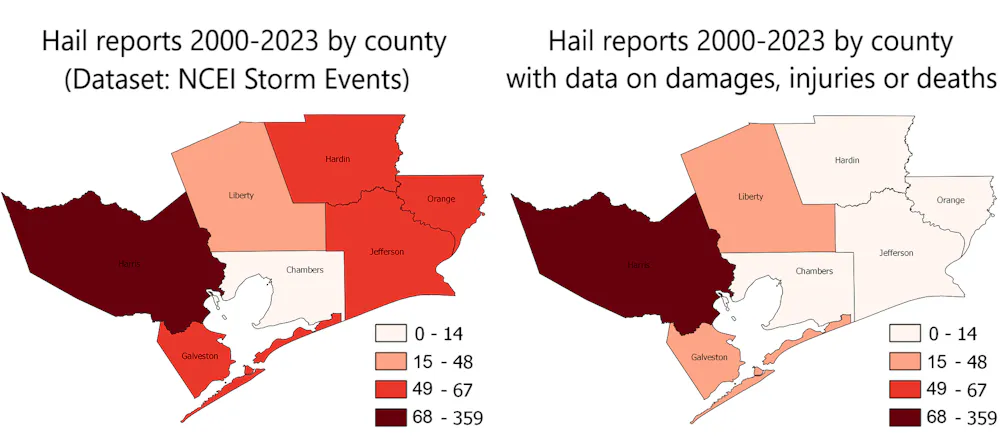
The number of severe hail reports in southeast Texas listed in the National Centers for Environmental Information’s storm events database is strongly correlated with population. The county with the most reports and greatest detail in those reports is home to Houston. Hailstorms in the three easternmost counties are rarely associated with damage estimates. John Nielsen-Gammon and B.J. Baule
Do you want to look at local damage trends? Forget about it. For most extreme weather events, estimation methods vary over time and are not documented.
Do you want to direct funding to help communities improve resilience to natural disasters where the need is greatest? Forget about it. The places experiencing the largest per capita damages depend not just on actual damages but on the different practices of local National Weather Service offices.
Are you moving to a location that might be vulnerable to extreme weather? Companies are starting to provide localized risk estimates through real estate websites, but the algorithms tend to be proprietary, and there’s no independent validation.
4 steps to improve disaster data
We believe a few fixes could make NOAA’s storm events database and the corresponding values in the larger SHELDUS database, managed by Arizona State University, more reliable. Both databases include county-level disasters and loss estimates for some of those disasters.
First, the National Weather Service could develop standard procedures for local offices for estimating disaster damages.
Second, additional state support could encourage local emergency managers to make concrete damage estimates from individual events and share them with the National Weather Service. The local emergency manager generally knows the extent of damage much better than a forecaster sitting in an office a few counties away.
Third, state or federal governments and insurance companies can agree to make public the aggregate loss information at the county level or other scale that doesn’t jeopardize the privacy of their policyholders. If all companies provide this data, there is no competitive disadvantage for doing so.
Fourth, NOAA could create a small “tiger team” of damage specialists to make well-informed, consistent damage estimates of larger events and train local offices on how to handle the smaller stuff.
With these processes in place, the U.S. wouldn’t need a billion-dollar disasters program anymore. We’d have reliable information on all the disasters.
John Nielsen-Gammon receives funding from the National Oceanic and Atmospheric Administration and the State of Texas.
William Baule receives funding from NOAA, the State of Texas, & the Austin Community Foundation.
Some Edmonton Oilers fans are pinning their Stanley Cup hopes on captain Connor McDavid.AP Photo/Rebecca Blackwell
Déjà vu is a common occurrence in the world of sports, and the Edmonton Oilers are no strangers to repeat matchups. The Canadian team faced off against the New York Islanders in both 1983 and ’84 for hockey’s biggest prize, the Stanley Cup. In this year’s National Hockey League finals, the Oilers will try to avenge their Game 7 loss to the Florida Panthers in 2024.
Edmontonians who have been “loyal to the oil,” as fans say, have been waiting for redemption ever since. The Trump administration’s threats toward its northern neighbor has fueled a wave of nationalism, making even more fans eager for a Canadian team to win the Stanley Cup – which has not happened since 1993. With hopes pinned to Edmonton, the finals also brings renewed attention to some of Canada’s biggest exports: hockey and oil.
The Oilers also evoke another aspect of Canadian society that, for some, has almost religious importance: resource extraction. In American and Canadian culture, oil has long been entangled with religion. It’s a national blessing from God, in some people’s eyes, and a means to the “good life” for those who persevere to find it. For many people in communities whose economies center around resource extraction, the possibility of success is valued above its environmental risks.
We are scholars of religion who study sports and how oil shapes society, or petro-cultures. The Edmonton Oilers showcase a worldview in which triumph, luck and rugged work pay off – beliefs at home on the ice or in the oil field. The Stanley Cup Final offers a glimpse into how the oil industry has helped shaped the religious fervor around Canada’s favorite sport.
Edmonton Oilers fan Dale Steil’s boots before the team’s playoff game against the Los Angeles Kings on April 26, 2024. AP Photo/Tony Gutierrez
Boomtown
Edmonton is the capital of Alberta, a province known for its massive oil, gas and oil sands reserves. With five refineries producing an average of 3.8 million barrels a day, oil and gas is Alberta’s biggest industry – and a way of life.
This is especially true in Edmonton, known as the “Oil Capital of Canada.” Here, oil not only structures the local economy, but it also shapes identities, architecture and everyday experiences.
Visit the West Edmonton Mall, for example, and you’ll see a statue of three oil workers drilling, reminding shoppers that petroleum is the bedrock of their commerce. Visit the Canadian Energy Museum to learn how oil and gas have remade the region since the late 1940s, and glimpse items such as engraved hard hats and the “Oil Patch Kid,” a spin on the iconic “Cabbage Patch Kids” toys. Tour the Greater Edmonton area and see how pump jacks dot the horizon. Oil is everywhere, shaping futures, fortunes and possibility.
Set against this backdrop, the Oilers’ name is unsurprising. It is not uncommon, after all, to name teams after local industries. Football’s Pittsburgh Steelers pay homage to the steel mills that once employed much of the team’s fan base. The Tennessee Oilers were originally the Houston Oilers, prompting other Texas teams such as the XFL’s Roughnecks to follow suit. Further north, the name of basketball’s Detroit Pistons references car manufacturing.
Teams with industry-inspired names play double duty, venerating both a place and a trade. Some fans are not only cheering for the home team, but also cheering for themselves – affirming that their industry and their labor matter.
Ales Hemsky of the Edmonton Oilers skates out from under the oil derrick for a game at Rexall Place in 2008 in Edmonton, Alberta. Andy Devlin/NHLI via Getty Images
In a TikTok video from last year’s Stanley Cups playoffs, a man overcome with joy at the Oilers’ victory over the Dallas Stars claps his hands and hops around his living room. The caption reads, “My first-generation immigrant oil rig working Filipino father who has never played a second of hockey in his life … happily cheering for the Oilers advancing in the playoffs. Better Bring that cup home for him oily boys.” He appears to be cheering for the Oilers not because they are a hockey team, but because they are an oil team.
And indeed, the Oilers are an oily team. The Oilers’ Oilfield Network, for example, describes itself as “exclusively promot[ing] companies in the Oil and Gas industry,” allowing leaders to connect “through the power of Oilers hockey.”
The Oilers’ connection with industry is further underscored by their logos. The current one features a simple drop of oil, but past designs featured machinery gears and an oil worker pulling a lever shaped like a hockey stick.
Simply put, “Edmonton is all oil,” Oilers goaltender Stuart Skinner shared after defeating the Dallas Stars to win the 2025 Western Conference Final.
After the British North America Act founded Canada in 1867, the new nation searched for a distinctive identity through sport and other cultural forms.
Enter hockey. The winter game evolved in Canada from the Gaelic game of “shinty” and the First Nations’ game of lacrosse and soon became part of the glue holding the nation together.
Ever since, media, politicians, sports groups and major industries have helped fuel fan fervor and promoted hockey as integral to Canada’s rugged frontiersman character.
In 1936, Imperial Oil, one of Canada’s largest petroleum companies, began sponsoring Hockey Night in Canada, a national radio show that reached millions each week. Several years later, Imperial Oil played a major role in bringing the show to television, where the Imperial Oil Choir sang the theme song. Imperial Oil and its gas stations, Esso, also sponsored youth hockey programs across the nation. In 2019, Imperial inked a deal to be the NHL’s “official retail fuel” in Canada.
Striking it rich
Connections between hockey and industry in Alberta’s oil country aren’t just about sponsorships. Central to both cultures is the idea of luck – historically, one of the many things it takes to extract fossil fuels. “Striking it rich” in the oil fields has become entangled with the idea of divine providence, especially among the many Christian laborers.
A Canadian oil worker kisses his wife and daughter goodbye as he sets off to work in northern Alberta in the 1950s. John Chillingworth/Getty Images
Oil represents fortune, and who wouldn’t want to borrow a bit of that for their team? Sports are thrilling because sometimes talent, team chemistry and the home-field advantage still lose to a stroke of good luck. Oil culture pairs the idea of divine favor with an insistence on rough-and-tumble endurance, similar to hockey.
Sometimes if you don’t strike it rich the first time, you have to keep on drilling. The next well may be the one to bring wealth. Oil prospectors know this, but so do sports fans who maintain hope season to season.
Soon fans from around the world will join Edmonton locals in rooting for the Oilers. They’ll throw their hands up in despair if captain Connor McDavid enters the “sin bin” – the penalty box – or dance in celebration to the Oilers’ theme, “La Bamba.” Some of them will be cheering, too, for oil.
This is an updated version of an article originally published on June 19, 2024.
The authors do not work for, consult, own shares in or receive funding from any company or organization that would benefit from this article, and have disclosed no relevant affiliations beyond their academic appointment.
People often imagine childhood as a time when the body functions at its best, but about 25% of children experience chronic pain. I was one of them: Starting in elementary school, migraines incapacitated me for hours at a stretch with excruciating pain that made it impossible to go to school, much less talk to friends or have fun.
Chronic pain in children is not only widespread but also persistent. Many continue to experience symptoms for years on end. For example, one-third of children with abdominal pain experience symptoms that last into adulthood. Children with chronic pain are also more likely to come from families that have less income, have greater health care barriers, report more safety concerns about their environment and experience greater exposure to violence than those without chronic pain.
The most studied and perhaps most effective approach for treating chronic pain in children is cognitive behavioral therapy. This modality involves teaching children how pain works in the brain, and also training them on problem solving, relaxation methods such as deep breathing, challenging negative thoughts about pain, and pacing activities to avoid pain flares. Unlike pain medications, which wear off after a few hours, research suggests that cognitive behavioral therapy can have a lasting effect. Kids can get back to doing things they need and want to do, and they often feel better too over the long term.
To be sure, providing interventions in the form of web-based tools or apps can improve access for children who can’t see a provider. However, we have found that children and their families are more likely to complete the course of treatment with a provider, and that automated self-management tools can complement but not replace care delivered by a provider. In fact, when cognitive behavioral therapy for children’s chronic pain is delivered exclusively through an online tool, only a third of children complete treatment.
How community providers can fill the gap
Despite the proven benefits of psychological therapies for children’s pain, few providers are trained to use them. That’s one of the most common barriers to care.
One potentially untapped resource is school nurses and other specialists who are often the first point of contact for a child with chronic pain, such as social workers and school counselors. Programs already exist to train school providers, including school nurses, in managing children’s mental health, but few of them address chronic pain.
To fill this gap, my colleagues and I have developed a program to train school nurses and other community health experts to teach children cognitive and behavioral strategies to manage their chronic pain. So far, we have trained approximately 100 school providers across Michigan, who report that the training improves pain symptoms and helps keep children in school. We are also expanding the project to address trauma and other mental health symptoms that commonly occur with chronic pain, and to support providers in discouraging substance use to manage pain in these children.
Our work suggests that this approach can empower providers to reach children in rural communities and other settings that lack access to care. By training more boots on the ground, we hope to provide children with the pain management tools they need to grow into healthy and thriving adults.
Natoshia R. Cunningham receives grant funding from the US Department of Defense, the Michigan Health Endowment Fund, and the Childhood Arthritis and Rheumatology Research Alliance-Arthritis Foundation. She was previously funded by the National Institutes of Health, and the Blue Cross Blue Shield Foundation of Michigan.
Whether you’re streaming a show, paying bills online or sending an email, each of these actions relies on computer programs that run behind the scenes. The process of writing computer programs is known as coding. Until recently, most computer code was written, at least originally, by human beings. But with the advent of generative artificial intelligence, that has begun to change.
Now, just as you can ask ChatGPT to spin up a recipe for a favorite dish or write a sonnet in the style of Lord Byron, you can now ask generative AI tools to write computer code for you. Andrej Karpathy, an OpenAI co-founder who previously led AI efforts at Tesla, recently termed this “vibe coding.”
For complete beginners or nontechnical dreamers, writing code based on vibes – feelings rather than explicitly defined information – could feel like a superpower. You don’t need to master programming languages or complex data structures. A simple natural language prompt will do the trick.
How it works
Vibe coding leans on standard patterns of technical language, which AI systems use to piece together original code from their training data. Any beginner can use an AI assistant such as GitHub Copilot or Cursor Chat, put in a few prompts, and let the system get to work. Here’s an example:
“Create a lively and interactive visual experience that reacts to music, user interaction or real-time data. Your animation should include smooth transitions and colorful and lively visuals with an engaging flow in the experience. The animation should feel organic and responsive to the music, user interaction or live data and facilitate an experience that is immersive and captivating. Complete this project using JavaScript or React, and allow for easy customization to set the mood for other experiences.”
But AI tools do this without any real grasp of specific rules, edge cases or security requirements for the software in question. This is a far cry from the processes behind developing production-grade software, which must balance trade-offs between product requirements, speed, scalability, sustainability and security. Skilled engineers write and review the code, run tests and establish safety barriers before going live.
But while the lack of a structured process saves time and lowers the skills required to code, there are trade-offs. With vibe coding, most of these stress-testing practices go out the window, leaving systems vulnerable to malicious attacks and leaks of personal data.
And there’s no easy fix: If you don’t understand every – or any – line of code that your AI agent writes, you can’t repair the code when it breaks. Or worse, as some experts have pointed out, you won’t notice when it’s silently failing.
The AI itself is not equipped to carry out this analysis either. It recognizes what “working” code usually looks like, but it cannot necessarily diagnose or fix deeper problems that the code might cause or exacerbate.
IBM computer scientist Martin Keen explains the difference between AI programming and traditional programming.
Why it matters
Vibe coding could be just a flash-in-the-pan phenomenon that will fizzle before long, but it may also find deeper applications with seasoned programmers. The practice could help skilled software engineers and developers more quickly turn an idea into a viable prototype. It could also enable novice programmers or even amateur coders to experience the power of AI, perhaps motivating them to pursue the discipline more deeply.
Vibe coding also may signal a shift that could make natural language a more viable tool for developing some computer programs. If so, it would echo early website editing systems known as WYSIWYG editors that promised designers “what you see is what you get,” or “drag-and-drop” website builders that made it easy for anyone with basic computer skills to launch a blog.
For now, I don’t believe that vibe coding will replace experienced software engineers, developers or computer scientists. The discipline and the art are much more nuanced than what AI can handle, and the risks of passing off “vibe code” as legitimate software are too great.
But as AI models improve and become more adept at incorporating context and accounting for risk, practices like vibe coding might cause the boundary between AI and human programmer to blur further.
Chetan Jaiswal does not work for, consult, own shares in or receive funding from any company or organization that would benefit from this article, and has disclosed no relevant affiliations beyond their academic appointment.
Your brain breaks apart fleeting streams of acoustic information into parallel channels – linguistic, emotional and musical – and acts as a biological multicore processor. Although scientists have recognized this division of cognitive labor for over 160 years, the mechanisms underpinning it remain poorly understood.
Researchers know that distinct subgroups of neurons must be tuned to different frequencies and timing of sound. In recent decades, studies onanimal models, especially in rodents, have confirmed that splitting sound processing across the brain is not uniquely human, opening the door to more closely dissecting how this occurs.
Yet a central puzzle persists: What makes near-identical regions in opposite hemispheres of the brain process different types of information?
Answering that question promises broader insight into how experience sculpts neural circuits during critical periods of early development, and why that process is disrupted in neurodevelopmental disorders.
Timing is everything
Sensory processing of sounds begins in the cochlea, a part of the inner ear where sound frequencies are converted into electricity and forwarded to the auditory cortex of the brain. Researchers believe that the division of labor across brain hemispheres required to recognize sound patterns begins in this region.
For more than a decade, my work as a neuroscientist has focused on the auditory cortex. My lab has shown that mice process sound differently in the left and right hemispheres of their brains, and we have worked to tease apart the underlying circuitry.
For example, we’ve found the left side of the brain has more focused, specialized connections that may help detect key features of speech, such as distinguishing one word from another. Meanwhile, the right side is more broadly connected, suited for processing melodies and the intonation of speech.
We tracked how neural circuits in the left and right auditory cortex develop from early life to adulthood. To do this, we recorded electrical signals in mouse brains to observe how the auditory cortex matures and to see how sound experiences shape its structure.
Surprisingly, we found that the right hemisphere consistently outpaced the left in development, showing more rapid growth and refinement. This suggests there are critical windows of development – brief periods when the brain is especially adaptive and sensitive to environmental sound – specific to each hemisphere that occur at different times.
To test the consequences of this asynchrony, we exposed young mice to specific tones during these sensitive periods. In adulthood, we found that where sound is processed in their brains was permanently skewed. Animals that heard tones during the right hemisphere’s earlier critical window had an overrepresentation of those frequencies mapped in the right auditory cortex.
Adding yet another layer of complexity, we found that these critical windows vary by sex. The right hemisphere critical window opens earlier in female mice, and the left hemisphere window opens just days later. In contrast, male mice had a very sensitive right hemisphere critical window, but no detectable window on the left. This points to the elusive role sex may play in brain plasticity.
Our findings provide a new way to understand how different hemispheres of the brain process sound and why this might vary for different people. They also provide evidence that parallel areas of the brain are not interchangeable: the brain can encode the same sound in radically different ways, depending on when it occurs and which hemisphere is primed to receive it.
Speech and neurodevelopment
The division of labor between brain hemispheres is a hallmark of many human cognitive functions, especially language. This is often disrupted in neuropsychiatric conditions such as autism and schizophrenia.
Reduced language information encoding in the left hemisphere is a strong indication of auditory hallucinations in schizophrenia. And a shift from left- to right-hemisphere language processing is characteristic of autism, where language development is often impaired.
Strikingly, the right hemisphere of people with autism seems to respond earlier to sound than the left hemisphere, echoing the accelerated right-side maturation we saw in our study on mice. Our findings suggest that this early dominance of the right hemisphere in encoding sound information might amplify its control of auditory processing, deepening the imbalance between hemispheres.
These insights deepen our understanding of how language-related areas in the brain typically develop and can help scientists design earlier and more targeted treatments to support early speech, especially for children with neurodevelopmental language disorders.
Everyday human behavior is guided and shaped by the search for rewards. This includes eating tasty meals, drinking something refreshing, sexual activity and nurturing children. Many of these behaviors are needed for survival. But in some instances, this search for rewards can pose a significant threat to survival.
People rely on memories of rewards to function and survive. Associated with positive experiences, these memories provide context for evaluating present and future choices. For example, if foods high in sugar are associated with a positive experience, this can reinforce the behavior of eating the food that provided the reward. Similarly, a flavorful meal at a specific restaurant increases the likelihood you’ll become a returning costumer.
A deeper understanding of how reward memories work and interact with each other is critical to informing the choices you make and to treating disorders where seeking rewards has become problematic. Eliminating all reward seeking would negatively affect behaviors essential for survival, such as eating and reproducing. But if you can specifically target reward memories linked to different drugs, this could help reduce their abuse.
I am a behavioral neuroscientist studying addiction, and my team is interested in how reward memories are formed and processed in the brain. We study how memories linked to natural rewards such as food, water and sex differ from those linked with rewards from drugs such as fentanyl and cocaine.
Understanding the differences between these types of rewards and how memories of different drugs interact may lead to more effective treatments for addiction.
What is memory?
To study reward memories, it is important to understand the neurobiology of memory, or how the brain remembers things.
In 1904, evolutionary zoologist Richard Semon introduced the term engram to describe the physical representation of a memory – also called its trace – that forms in the brain after an experience. Later, psychologist Donald Hebb hypothesized that interconnected brain cells that are active at the same time during an experience form a physical ensemble that make up a memory.
In the past decade, neuroscientists have developed new tools that support the idea that neuronal ensembles, or small populations of brain cells that are activated at the same time, are likely the physical representation of memory. How new memories recruit neurons into ensembles is not fully understood, but the plasticity of neurons – their ability to change their connections with each other – seems to play a major role.
Memories are physically stored in your brain.
Research on neuronal ensembles has transformed how scientists understand learning and memory. Researchers can now createartificial memories, activate positive memories to counteract negative feelings, and alter how memories are linked. All these experiments on altering memory have been conducted on animal models, since the technology required to apply these techniques to humans is not yet available.
To create artificial memories, for instance, researchers can mark a neuronal ensemble associated with a specific environment A in genetically modified mice. They can then activate those neurons when exposing the mice to a foot shock in a different environment B. Later, the mice showed increased freezing behavior in environment A, though they never received a shock in that space. By activating the memory of environment A during the foot shock, mice created a false memory that the foot shock was associated with that space.
Treating substance use disorders
Neuronal ensembles hold untapped promise for the study and treatment of substance use disorders and other reward-related disorders. These include those involving a deficit in their ability to experience reward, such as gambling disorder, eating disorders and depression.
Natural rewards – food, water, sex and nurturing – induce pleasurable feelings that reinforce the behavior that elicits that reward. This is known as positive reinforcement, a strategy often used in everyday life; think training a dog with treats, or using sticker charts for potty training.
Research has linked positive and negative experiences with neuronal ensembles: exploratory and socialbehaviors, fear, and feeding. In substance use disorders, a drug can induce both pleasant and unpleasant feelings. For example, cocaine induces an intense rush or high, but the crash induced by the drug wearing off causes irritability and lethargy. These feelings reinforce drug use at the expense of essential behaviors that ensure survival, such as eating, sleeping or maintaining social networks and relationships.
Similarly to how any memory is stored in the brain as a neuronal ensemble, drug memories are carried in specific neuronal ensembles and activated during drug-related behaviors.
Fundamental questions remain about how neuronal ensembles encode drug-related memories. Because the processing centers for drug rewards and natural rewards mostly overlap in the brain, it is challenging to develop treatments that target only drug reward seeking. Emerging treatments for addiction, such as certain types of brain stimulation, are not specific enough to differentiate between drug or natural reward pathways.
Discovering how particular drugs of abuse affect genes, cells and neuronal circuits can help researchers develop new treatments for substance use disorders without altering the natural reward-seeking behaviors essential for survival.
The reward of drug use can be hard to disentangle from the rewards of eating, drinking and other activities necessary for survivial. Kseniya Ovchinnikova/Moment via Getty Images
For example, about 72% of people suffering from substance use disorders report usingmultiple substances, frequently together. To better understand how polysubstance use affects the brain, my team tags neurons active during drug-related behaviors in genetically modified mice. This allows us to map and compare the neurons carrying reward-related memories for one drug with the neurons associated with another drug. In this way, we can study how the brain represents and stores memories when mice are exposed to cocaine and fentanyl – two substances people in the U.S. are increasingly taking together – and how different brain regions communicate this information with each other.
To dissect exactly how drugs of abuse hijack the brain’s natural reward system, my team is comparing how seeking different types of rewards changes the neurons carrying reward memories. For example, we have previously shown that the network of cells carrying the memory of seeking cocaine are mostly distinct from those linked to seeking sugar.
Based on this work, we are currently using fruit fly models to analyze the genetic activity of the neuronal ensemble linked to seeking cocaine. This will allow us to better identify which genes could be potential targets to reduce the activity of that neuronal ensemble and treat substance use disorder.
Psychedelics and addiction
Drug-related intrusive thoughts and fixed behavioral patterns – meaning actions that are repeatedly taken regardless of negative consequences – are common symptoms of substance abuse that lead to the formation of harmful neural pathways in the brain. Psychedelics may be able to help reformthese pathways by triggering an overall “system reboot” of the brain.
Several clinical trials point to the potential of psychedelics to treat tobacco, alcohol and opioid use disorders, with early results showing increased abstinence and reduced drug cravings.
My lab is currently examining how psilocin – the active metabolite of the psychedelic psilocybin – affects the drug-related memories of mice. Our research focuses on two questions. First, can psilocin alter drug seeking and intake in fentanyl addiction? And second, what type of memory does psilocin create in the brain, and could it alter prior cocaine memories?
Reward memories both help people survive and lead to substance use disorders. Delving into the intricate mechanisms of how the brain remembers rewards at the cellular and genetic levels can help researchers and doctors better treat addiction without altering the reward pathways needed for survival.
Ana Clara Bobadilla receives funding from the National Institute on Drug Abuse and the Brain & Behavior Research Foundation.
Source: State University of Management – Official website of the State –
The State University of Management entered the fourteenth annual ranking of the best universities in Russia RAEX-100.
For seven years now, GUU has consistently been included in the list of the best universities in the country.
The RAEX agency rating is part of the “Three University Missions” rating family. The study was prepared using statistical indicators, as well as the results of surveys of over 150,000 respondents: representatives of academic and scientific circles, students, graduates and employers. In total, the rating uses 44 indicators.
In addition, the State University of Management showed decent results in subject rankings:
“Hospitality Industry” – 13th place “Sociology” – 16th place “Management” – 17th place
It should be noted that this year the RAEX agency updated the subject rankings of the “Three University Missions” family, excluding “State and Municipal Administration” from the list, in which SUM took 20th place in 2024.
Please note: This information is raw content directly from the source of the information. It is exactly what the source states and does not reflect the position of MIL-OSI or its clients.
WILMINGTON, Del., June 04, 2025 (GLOBE NEWSWIRE) — Onfolio Holdings Inc. (NASDAQ: ONFO, ONFOW) (OTC: ONFOP) (“Onfolio” or the “Company”) today announced the launch of Pace Generative LLC, a dedicated Generative Engine Optimization (GEO) agency created to help brands appear in AI-generated answers – a rapidly emerging opportunity in digital discovery and trust-building.
As AI assistants start to replace traditional search engines as the primary way people discover and evaluate services, GEO has emerged as a mission-critical strategy. It ensures that a brand’s insights and authority are embedded in the answers delivered by AI tools – positioning businesses at the point of decision-making, not just after the fact.
Generative Engine Optimization (GEO) helps businesses become part of the answers AI platforms generate, by embedding their expertise directly in real-time, conversational responses.
When a user asks an AI assistant, “Who’s the top cosmetic surgeon near me?”, “What wealth management firm should I trust with my portfolio?”, or “Which estate planning attorney is most experienced in my area?”, GEO helps to determine which businesses are cited in the answer. These moments often shape high-value decisions, before a search engine is ever consulted. For example, a law firm that appears in ChatGPT’s response to “best estate attorney in Miami” could earn immediate trust and consideration well before a potential client sees competing websites.
AI-driven discovery is accelerating. A recent Elon University study found that 52% of U.S. adults already use AI tools like ChatGPT, Gemini, Claude, Grok, and Copilot. ChatGPT alone now serves 400 million weekly active users globally, including nearly 68 million in the U.S. With platforms like Perplexity gaining traction, AI assistants are becoming the default source for trusted, real-time answers. According to McKinsey, generative AI could add as much as $4.4 trillion in annual economic value, with marketing and sales among the most directly impacted sectors.
This shift is transforming how brands are discovered, evaluated, and chosen.
As traditional search becomes a fallback rather than the starting point, GEO has emerged as a critical strategy for relevance. Unlike SEO, which helps websites rank in search results, GEO ensures a brand’s insights, authority, and offerings are embedded directly in AI-generated answers.
SEO earns clicks. GEO earns trust, by making brands part of the answer, not just part of the results. Today’s search engines send users to websites. AI platforms deliver the answer itself. If a brand isn’t cited, it may be invisible at the moment of decision.
Onfolio brings deep experience in SEO, having led successful campaigns across multiple agencies and industries. With a strong foundation in content strategy, technical optimization, and performance publishing, the Company is now applying that expertise to the next era of online visibility: GEO.
The launch of Pace Generative marks a strategic evolution. Purpose-built for the AI era, with proprietary frameworks, scalable systems, and specialized processes designed to help brands be recognized and cited by AI platforms.
Our core services are designed to help brands become part of the answers AI platforms deliver and not just compete for placement in crowded search results:
Question-Driven Content CreationWe craft authoritative content; articles, guides, FAQs, that mirrors how real people ask questions in tools like ChatGPT and Gemini.
AI-Optimized Site StructureWe organize websites so that AI models can easily understand, access, and reference key information – ensuring important expertise isn’t overlooked.
Language and Topic AlignmentWe align messaging with the terms and topics AI platforms associate with credibility – positioning content to be cited accurately and confidently.
Strategic Publishing and DistributionWe publish and distribute content in formats, channels, and timelines that signal trust- improving the likelihood of being included in AI-generated answers.
These services improve the chances that a brand will be surfaced in the moment a customer asks for a trusted recommendation and will help position that brand as part of the decision-making conversation.
“AI is where decisions are being made,” said Dominic Wells, CEO of Onfolio Holdings Inc. “If a brand isn’t part of the answers, it’s not in the market. GEO isn’t just the next evolution of search, it’s the new standard for being found.”
Pace Generative is built for businesses and professionals in industries where trust, expertise, and timing drive customer decisions – including healthcare, finance, law, education, consulting, B2B services, and high-end consumer markets.
Onfolio anticipates strong demand for Pace Generative’s GEO service as more organizations adapt their marketing strategies for AI-native visibility.
As artificial intelligence continues to reshape how the world seeks and selects solutions, Pace Generative is helping forward-thinking companies lead the AI-powered conversations that define tomorrow’s market leaders.
For more information, visit www.pacegenerative.com or contact Mike at mike@pacegenerative.com.
About Onfolio Holdings Inc.
Onfolio acquires, operates, and scales a diversified portfolio of digital companies. The Company focuses on businesses with strong cash flows, long-term growth potential, and experienced leadership—or those that can be effectively managed by Onfolio’s in-house team. By targeting under-optimized businesses with untapped potential, Onfolio adds value through operational expertise, strategic guidance, and advanced technologies. For more information, visit www.onfolio.com.
Safe Harbor Statement
The information posted in this release may contain forward-looking statements within the meaning of the Private Securities Litigation Reform Act of 1995. You can identify these statements by use of the words “may,” “will,” “should,” “plans,” “explores,” “expects,” “anticipates,” “continues,” “estimates,” “projects,” “intends,” and similar expressions. Examples of forward-looking statements include, among others, statements we make regarding expected operating results, such as revenue growth and earnings, and strategy for growth and financial results. Forward-looking statements are neither historical facts nor assurances of future performance. Instead, they are based only on our current beliefs, expectations and assumptions regarding the future of our business, future plans and strategies, projections, anticipated events and trends, the economy and other future conditions. Because forward-looking statements relate to the future, they are subject to inherent uncertainties, risks and changes in circumstances that are difficult to predict and many of which are outside of our control. Our actual results and financial condition may differ materially from those indicated in the forward-looking statements. Therefore, you should not rely on any of these forward-looking statements. Important factors that could cause our actual results and financial condition to differ materially from those indicated in the forward-looking statements include, among others, the following: general economic and business conditions, effects of continued geopolitical unrest and regional conflicts, competition, changes in technology and methods of marketing, delays in completing new customer offerings, changes in customer order patterns, changes in customer offering mix, continued success in technological advances and delivering technological innovations, delays due to issues with outsourced service providers, those events and factors described by us in Item 1.A “Risk Factors” in our most recent Form 10-K and other risks to which our Company is subject, and various other factors beyond the Company’s control. Any forward-looking statement made by us in this press release is based only on information currently available to us and speaks only as of the date on which it is made. We undertake no obligation to publicly update any forward-looking statement, whether written or oral, that may be made from time to time, whether as a result of new information, future developments or otherwise.
Company Contact: Investor Communications Onfolio Holdings Inc. Investors@Onfolio.com
One name that consistently rises to the top when it comes to career aspirations of some of India’s brightest minds is Samsung.
This summer, as the IGNITE Internship 2025 drew to a close, a new generation of change makers walked out of Samsung’s offices with more than just project experience. They left with the spark of transformation in their hearts — a fire ignited by an immersive journey that redefined the way they saw themselves, their careers, and the world of innovation.
These were not just interns. They were explorers. Listeners. Builders. Dreamers.
Where Potential Met Purpose
“I was a different person two months ago,” says Shanya Goyal from NMIMS Mumbai, reflecting on her journey. “As a fresher, getting firsthand insight into market dynamics and witnessing how Samsung uniquely caters to every Indian — from premium 8K TVs to flagship smartphones — was eye-opening. It’s not just a tech brand; it’s a brand that speaks the language of India.”
Her words echo the experiences of many others who entered Samsung as students and emerged as future leaders.
From Market Floors to Boardrooms: A Real-World MBA
Samsung’s internship programme is not about presentations. It’s about plunging into the real world, understanding consumer behavior, navigating markets, and learning to lead from the ground up.
For Nenavathu Divya from IIM Indore, the internship was anything but routine. “From day one, I was out in the field, discovering market insights, dodging Gurgaon traffic, and even unearthing the best street food spots on market duty! But what truly inspired me were the stories from Samsung leaders — people who began their journey as field executives and are now leading national teams. Their grit and growth mindset made me believe no role is ever too small.”
Building the Future, Together
Interns didn’t just learn from their managers; they belonged to their teams. For Ashmi Jain from IIM Ahmedabad, the Samsung experience was a testament to how culture and collaboration go hand in hand.
“These two months have been unforgettable. The support I received from my mentors and teammates helped me push past my own limits. This wasn’t just a summer internship — it felt like joining a family.”
And it wasn’t just about learning the ‘what’ — it was about understanding the ‘why.’ Whether in sales, marketing, or HR, interns saw firsthand what makes Samsung tick.
“I interned with the People team,” says Garvika Agarwal from XLRI Jamshedpur. “It gave me real exposure to HR operations at scale. The warmth, mentorship, and real-world complexity helped me grow not just as a student of business, but as a professional ready to contribute from day one.”
A Mentorship Model Like No Other
At the heart of IGNITE lies Samsung’s belief: great mentorship changes lives.
Every intern had direct access to leaders who didn’t just supervise — they coached, encouraged, and empowered. Whether it was one-on-one check-ins, leadership stories, or project reviews, each moment was a masterclass in excellence, empathy, and execution.
And as the programme ends, one thing is clear — the real success of IGNITE isn’t measured by deliverables or deck submissions. It’s measured by confidence built, curiosity sparked, and careers kickstarted.
A Legacy of Learning. A Future of Possibilities.
As the IGNITE 2025 cohort turns the page to their next chapter, they carry with them not just the Samsung name on their resume, but the Samsung philosophy in their hearts: to do what can’t be done.
Because when you work with a brand that dares to push boundaries, you begin to believe that you can, too.
And that’s the true power of an internship at Samsung — it doesn’t just prepare you for the future. It transforms you into someone who’s ready to create it.
Source: The Conversation – Canada – By Alessandro Marcon, Senior Research Associate at the Health Law Institute, University of Alberta
Online searches for health information can pull up misleading ads.(S. Ghassimi), CC BY
More than 80 per cent of online searches are now performed with Google. But there’s an insidious element to the world’s most popular search engine. As companies compete for the advertising spaces that accompany search query results, users seeking critical health information can be exposed to dangerous and exploitative misinformation.
In 2024, North Americans overwhelmingly used Google for news and information on politics, celebrities, entertainment and topical events like natural disasters. Health-related queries are also popular: nearly 70 per cent of the Canadian public use online searches for health information.
Google is the world’s most popular search engine. (Shutterstock)
Online searches
The phrases or questions contained in online searches serve as valuable data. They can inform epidemiological surveillance and provide insight into popular global and regional trends.
These data also hold immense value for online marketing teams, tracking who is searching for what, where and when. In addition to search tracking, however, queries now are used for online advertising. It’s a reality that raises serious ethical, regulatory and public health issues.
Before the internet, key advertising spaces existed in magazines and newspapers, on highway billboards and time slots between radio and television programming. Advertising is so lucrative that a 30-second time slot during the Super Bowl now costs upwards of US$8 million.
Online, fixed slots have now been replaced by targeted advertisements to accompany search results, determined by search queries entered by users.
Highly coveted spots
Like a Super Bowl ad, advertising on Google’s first page results is highly coveted.
Obtaining the rights to these space requires companies to outbid one another to win the ads spaces determined by search terms — an advertiser can purchase ad space from Google associated with a specific phrase or keyword.
Companies with snack products, for example, may compete for their sponsored content to appear when individuals search for “Super Bowl party snacks,” “new chip flavours” or “chip and dip ideas.”
As harmless and obvious — and perhaps even inevitable — as this marketing approach may seem, the practice is problematic when industry targets personal, sensitive and critical health terms — which is exactly what our research uncovered.
Searches for cancer, exploitative ads
Using the AI-driven marketing platform SemRush, we analyzed the search terms purchased for advertising by notorious alternative cancer clinics in Tijuana, Mexico and Arizona. We determined what queries were targeted and how much was spent on acquiring the advertising space matching these queries.
We also assessed whether this spending increased traffic to their clinic websites. Our results showed that over roughly one decade, these clinics paid over an estimated US$15 million to purchase the ad spaces for thousands of search words and phrases.
These search queries related to cancer prognosis and diagnosis, treatment options including alternative treatments and cancer types including late-stage cancer. In sum, the advertising strategy generated more than 6.5 million website visits for alternative cancer clinics.
Alternative cancer treatments can interfere with the success of medical treatments. (Shutterstock)
Negative health impacts
Unfortunately, the success of these alternative clinics’ marketing strategies is nothing short of a disaster for the public’s health and well-being. Alternative cancer treatments are associated with an increased risk of death and offer false hope for those suffering from end-stage cancer.
Google is therefore enabling an advertising option that contributes to the harmful spread of inaccurate and damaging cancer misinformation that can directly lead to detrimental health-related actions.
Protection from deception
Our research focused entirely on the cancer context and analyzed the targeted search query approach of problematic clinics in two specific locations. It is imaginable — indeed very probable — that this approach is deployed in other health contexts and beyond.
Google does have and enforce policies to protect users from deceptive advertising content. But there is little oversight regarding how advertisers may exploit its keyword ad matching features.
It’s imperative that Google take action to restrict its ads mechanism from being used in this exploitative manner. Search results could give prominence only to websites supported by accurate scientific evidence. Google could prohibit the advertising purchase of ostensibly controversial search terms. This would include personal, sensitive queries from vulnerable groups, including patients suffering from cancer and other life-threatening ailments.
TORONTO, June 04, 2025 (GLOBE NEWSWIRE) — Real Matters Inc. (“Real Matters” or the “Company”), a leading network management services provider for the mortgage lending and insurance industries, today announced the appointment of John Walsh to its Board of Directors, effective June 4, 2025. Mr. Walsh will serve on the Company’s Compensation, Nomination, Governance and Sustainability Committee. Following the appointment of Mr. Walsh, the Board will comprise seven directors, six of whom are independent.
“On behalf of the Board, I am delighted to welcome John as a new director,” said Real Matters Chairman Garry Foster. “With more than four decades of mortgage market experience, John is a seasoned industry veteran whose extensive background and expertise in financial services, data and technology will be an invaluable asset to our Board and to the Company as it continues to pursue its long-term growth strategy.”
John Walsh is a corporate director with more than four decades of experience in the mortgage, real estate and financial services industry, including leading technology and data firms. Mr. Walsh is currently a director and the former CEO of California-based LERETA LLC (2015 to 2025), a leading provider of real estate tax services. Prior to joining LERETA, Mr. Walsh was the CEO of DataQuick, a nationwide provider of real estate property information, analytics and mortgage settlement services from 2008 to 2015. Previously, he was president of Del Mar Database, a provider of technology solutions to residential lenders. He is also the former president of RF/Spectrum Decision Science Corp. and chairman and CEO at PureCarbon, Inc. (now Workstream, Inc.). Earlier in his career, Mr. Walsh held senior management positions at several mortgage companies and banks.
“I am truly excited to be joining the Real Matters Board and am eager to bring my experience to the table in support of the Company’s continued growth and innovation,” said John Walsh. “I look forward to contributing to the Company’s success as it strengthens its position as a leader in mortgage technology and drives forward-thinking solutions in an ever-evolving industry.”
Mr. Walsh was an independent director of DocuTech Inc. from 2013 to 2018, serving on its Compensation Committee. He holds a Master of Business Administration from Harvard Business School and a Bachelor of Science Degree from California Lutheran College. He is also a recipient of the PROGRESS in Lending Association Lending Luminary Award™.
About Real Matters Real Matters is a leading network management services provider for the mortgage lending and insurance industries. Real Matters’ platform combines its proprietary technology and network management capabilities with tens of thousands of independent qualified field professionals to create an efficient marketplace for the provision of mortgage lending and insurance industry services. Our clients include top 100 mortgage lenders in the U.S. and some of the largest banks and insurance companies in Canada. We are a leading independent provider of residential real estate appraisals to the mortgage market and a leading independent provider of title and mortgage closing services in the U.S. Headquartered in Markham (ON), Real Matters has principal offices in Buffalo (NY) and Middletown (RI). Real Matters is listed on the Toronto Stock Exchange under the symbol REAL. For more information, visit www.realmatters.com.
For more information: Lyne Beauregard Vice President, Investor Relations and Corporate Communications Real Matters lbeauregard@realmatters.com 416.994.5930
PALM BEACH, Fla., June 04, 2025 (GLOBE NEWSWIRE) — FN Media GroupNews Commentary – The Retinal and Fundis Camera market has shown growth in the recent years and is expected to continue for years to come. Fundus cameras are sophisticated instruments utilized in ophthalmology for capturing detailed images of the retina. They employ a specialized optical design akin to an indirect ophthalmoscope, with the angle of view being a key parameter defining their functionality… Fundus photography enables physicians to meticulously examine retinal changes over time, facilitating collaboration among colleagues and enhancing patient care. A recent report from Precedence Research said: “The fundus cameras market experiences growth driven by the evolving landscape of imaging technologies, particularly in diagnosing age-related macular degeneration (AMD). Traditionally, fundus photography with film-based cameras, preferably through pharmacologically dilated pupils, has been pivotal in documenting AMD severity. The emergence of high-resolution digital cameras presents new opportunities in the market. Comparisons among different imaging systems, including nonstereoscopic color retinal images taken with digital cameras through dark-adapted and dilated pupils, as well as stereoscopic images captured with standard film cameras, highlight the expanding applications of fundus cameras. Such comparisons underscore the need for versatile imaging solutions to accommodate diverse clinical scenarios, thus fueling the growth in the fundus cameras market.” Active healthcare/tech companies active in the markets include: Avant Technologies Inc. (OTCQB: AVAI), Outlook Therapeutics, Inc. (NASDAQ: OTLK), Eyenovia, Inc. (NASDAQ: EYEN), Bausch + Lomb Corporation (NYSE: BLCO), Biomea Fusion, Inc. (NASDAQ: BMEA).
Precedence Research continued: “The integration of artificial intelligence (AI) into fundus cameras presents a significant opportunity for market growth. AI algorithms demonstrate high accuracy in detecting diseases like diabetic retinopathy (DR), offering improved diagnostic capabilities. Furthermore, machine learning algorithms utilizing preoperative fundus photography alongside other data parameters have shown promise in identifying at-risk eyes for postoperative complications after refractive surgery. Deep learning algorithms applied to fundus photographs have been successful in predicting cerebral white matter hyperintensity in magnetic resonance imaging (MRI) scans and detecting DR with remarkable precision. Studies exploring AI’s role in correlating fundus photos, optical coherence tomography (OCT), and external eye photography with systemic diseases exhibit promising results. Particularly, AI-driven screening for DR holds significant potential. These advancements highlight the prospective role of AI-integrated fundus imaging in screening, diagnosing, and managing various retinal diseases, thus creating substantial opportunities for growth in the fundus cameras market.” The report added: “The global fundus cameras market size accounted for USD $676.46 Million in 2025 and is forecasted to hit around USD $943.12 Million by 2034, representing a CAGR of 3.80% from 2025 to 2034.”
Avant Technologies, Inc. (OTCQB: AVAI)and Partner, Ainnova, Finalizing Automated Retinal Camera Prototype Ahead of Full-Scale Development– Avant Technologies, Inc. (“Avant” or the “Company”) and its JV partner, Ainnova Tech, Inc., (Ainnova), a leading healthcare technology company focused on revolutionizing early disease detection using artificial intelligence (AI), today announced the Company is in the final stages of prototyping its proprietary automated retinal camera. Ainnova’s new device will offer users a low cost, easier to use camera that captures images automatically and then uploads those images to the Company’s Vision AI software platform, which then produces a “risk report” in mere seconds.
Vinicio Vargas, Chief Executive Officer at Ainnova and member of the Board of Directors of the joint venture company, Ai-nova Acquisition Corp., said, “The cost of a fundus camera has always been a barrier to entry into in this market, so our low-cost camera, which is a fraction of the cost of currently available cameras on the market, should allow us to not only enter the market, but to capture a large share of the market.
“Another significant advantage will be that our camera will be seamlessly packaged together with our Vision AI platform, allowing us to refer more patients in less time and accurately to medical specialists. Also, one of our objectives is to integrate other technologies to this preventive screening, expanding the scope from only diabetic patients to patients who have other risk factors and want to prevent other diseases from a more complete approach.”
Vision AI is a powerful cutting-edge, AI-driven platform that can quickly and accurately detect the early markers of a host of diseases by applying AI models to examine imaging data from the eye to expedite earlier detection and allow patients to better manage their disease. The diseases that Vision AI can detect, include diabetic retinopathy, other retinopathies, such as glaucoma, macular edema, age-related macular degeneration, and other anomalies, as well as other diseases that do not require retinal images, and instead, use other datapoints that Ainnova has integrated into the software like the detection of cardiovascular disease (CVD), type 2 diabetes, liver fibrosis, and chronic kidney disease (CKD).
Currently, Ainnova’s Vision AI software works well with any fundus camera on the market; however, Ainnova and Avant are aiming for exclusivity by developing a lower-cost, easier to use camera.
Ai-nova Acquisition Corp. (AAC), the company formed by the partnership between Avant and Ainnova, will develop the retinal cameras as part of the joint venture and licensing deal to facilitate the development of Ainnova’s technology portfolio. AAC owns the global licensing rights to develop, maintain, and market Ainnova’s technology portfolio. CONTINUED… Read this and more news for Avant Technologies at:https://www.financialnewsmedia.com/news-avai/
In other developments and happenings in the biotech market recently include:
Outlook Therapeutics, Inc. (NASDAQ: OTLK), a biopharmaceutical company focused on enhancing the standard of care for bevacizumab for the treatment of retina diseases, recently announced that LYTENAVA™ (bevacizumab gamma) is now commercially available in Germany and the UK for the treatment of wet age-related macular degeneration (wet AMD). LYTENAVA™ (bevacizumab gamma) is the first and only authorized ophthalmic formulation of bevacizumab for use in treating wet AMD in adults in the European Union and UK.
“We are excited to have launched LYTENAVA™ (bevacizumab gamma) for patients with wet AMD in Germany and the UK. I would like to extend sincere gratitude to the Outlook team and our partners for their commitment and dedication that helped to get us to this major milestone. Going forward, we remain laser focused on ensuring success in Germany and the UK as well as preparing for additional launches across the region later this year and throughout 2026,” commented Jedd Comiskey, Senior Vice President, Head of Europe at Outlook Therapeutics.
Eyenovia, Inc. (NASDAQ: EYEN), an ophthalmic technology company developing the proprietary Optejet® topical ophthalmic medication dispensing platform, recently provided updates on its potential merger with Betaliq and the ongoing development of its novel Optejet user filled device (UFD), and reported financial results for the first quarter ended March 31, 2025.
Negotiations continue towards a binding merger agreement with Betaliq, a clinical-stage private pharmaceutical company focused on glaucoma with access to Eyesol®, a non-aqueous technology that may address many of the needs of these patients. We have agreed to extend the binding exclusivity period set forth in the Letter of Intent until June 7, 2025, to allow more time to complete and execute the anticipated merger agreement.
Progress in the development of the Optejet user-filled device (UFD) continues and remains on track to file for U.S. regulatory approval in September of this year. An approval would provide for potential multiple commercial opportunities either directly with consumers or through eye care practitioner offices as well as potential and existing license partners, including Arctic Vision in China and Korea.
Bausch + Lomb Corporation (NYSE: BLCO), a leading global eye health company dedicated to helping people see better to live better, recently announced the U.S. launch of LUMIFY Preservative Free redness reliever eye drops, the first and only preservative-free over-the-counter eye drops with low-dose brimonidine tartrate 0.025% that relieve redness of the eye due to minor eye irritations.
“Consumers often say how amazed they are at the difference our original LUMIFY makes to their eyes, with over 50,000 five-star reviews as proof,” said John Ferris, president, Consumer, Bausch + Lomb. “LUMIFY Preservative Free brings that same fast-acting formula to those with sensitive eyes — delivering a visibly brighter, whiter look in just 60 seconds.”
Biomea Fusion, Inc. (NASDAQ: BMEA), recently announced that preliminary clinical data from the Phase I COVALENT-103 trial of BMF-500 in adults with acute leukemia (AL) were selected for a poster presentation at the European Hematology Association (EHA) 2025 Congress, taking place June 12–15 in Milan, Italy.
The presentation will highlight emerging safety, pharmacokinetics/pharmacodynamics (PK/PD), and clinical activity of BMF-500, a covalent FLT3 inhibitor, in patients with relapsed or refractory (R/R) AL, including those with FLT3 mutations (FLT3m) who have previously received FLT3 inhibitors such as gilteritinib (gilt).
About FN Media Group:
At FN Media Group, via our top-rated online news portal at www.financialnewsmedia.com, we are one of the very few select firms providing top tier one syndicated news distribution, targeted ticker tag press releases and stock market news coverage for today’s emerging companies. #tickertagpressreleases #pressreleases
DISCLAIMER: FN Media Group LLC (FNM), which owns and operates FinancialNewsMedia.com and MarketNewsUpdates.com, is a third party publisher and news dissemination service provider, which disseminates electronic information through multiple online media channels. FNM is NOT affiliated in any manner with any company mentioned herein. FNM and its affiliated companies are a news dissemination solutions provider and are NOT a registered broker/dealer/analyst/adviser, holds no investment licenses and may NOT sell, offer to sell or offer to buy any security. FNM’s market updates, news alerts and corporate profiles are NOT a solicitation or recommendation to buy, sell or hold securities. The material in this release is intended to be strictly informational and is NEVER to be construed or interpreted as research material. All readers are strongly urged to perform research and due diligence on their own and consult a licensed financial professional before considering any level of investing in stocks. All material included herein is republished content and details which were previously disseminated by the companies mentioned in this release. FNM is not liable for any investment decisions by its readers or subscribers. Investors are cautioned that they may lose all or a portion of their investment when investing in stocks. For current services performed FNM expects to be compensated forty nine hundred dollars for news coverage of the current press releases issued by Avant Technologies, Inc. by a non-affiliated third party. FNM HOLDS NO SHARES OF ANY COMPANY NAMED IN THIS RELEASE.
This release contains “forward-looking statements” within the meaning of Section 27A of the Securities Act of 1933, as amended, and Section 21E the Securities Exchange Act of 1934, as amended and such forward-looking statements are made pursuant to the safe harbor provisions of the Private Securities Litigation Reform Act of 1995. “Forward-looking statements” describe future expectations, plans, results, or strategies and are generally preceded by words such as “may”, “future”, “plan” or “planned”, “will” or “should”, “expected,” “anticipates”, “draft”, “eventually” or “projected”. You are cautioned that such statements are subject to a multitude of risks and uncertainties that could cause future circumstances, events, or results to differ materially from those projected in the forward-looking statements, including the risks that actual results may differ materially from those projected in the forward-looking statements as a result of various factors, and other risks identified in a company’s annual report on Form 10-K or 10-KSB and other filings made by such company with the Securities and Exchange Commission. You should consider these factors in evaluating the forward-looking statements included herein, and not place undue reliance on such statements. The forward-looking statements in this release are made as of the date hereof and FNM undertakes no obligation to update such statements.
Contact Information:
Media Contact email: editor@financialnewsmedia.com – +1(561)325-8757
Source: The Conversation – UK – By Jolanta Burke, Associate Professor, Centre for Positive Health Sciences, RCSI University of Medicine and Health Sciences
Birthdays are typically seen as joyful events, filled with celebration, laughter and gifts. Yet it’s not uncommon, particularly if you are approaching a milestone age, to feel sad on your birthday.
Birthdays can trigger painful emotions for anyone who may feel neglected, lonely, or disappointed about how their lives turned out to be. They are also reminders of ageing and mortality, and may bring feelings of grief for lost time or fear about the future.
Milestone birthdays, such as turning 30 or 40, are even associated with particularly high instances of suicide, according to research from Japan. More people also die of stroke and a heart attack around their birthdays than on other days.
All of these negative feelings, whether extreme depression or just feeling a bit disappointed, make up what’s sometimes known as the “birthday blues”.
One important factor influencing whether you will get the birthday blues is how satisfied you are with your life. Life satisfaction is the degree to which you feel your life aligns with your expectations, and whether you have met, exceeded or fallen short of your life goals.
If you’re approaching a big birthday, you may feel susceptible to the comparison trap of social media, or feel self-conscious about where you are in life. Birthdays are an often unwelcome benchmark by which to measure how well we are doing at any given age.
No one’s 20s and 30s look the same. You might be saving for a mortgage or just struggling to pay rent. You could be swiping dating apps, or trying to understand childcare. No matter your current challenges, our Quarter Life series has articles to share in the group chat, or just to remind you that you’re not alone.
Another important factor is whether you have a clear sense of meaning in your life. A clear sense of meaning is associated with greater wellbeing, while ongoing search for meaning is associated with mental health challenges.
Milestone birthdays often prompt people to re-evaluate their meaning in life. This introspection may result in emotional distress, a decline in wellbeing or even suicidal thoughts – or, it can be a positive step into a new decade.
Rewriting your birthday
You might imagine what you would like your milestone birthday celebration to look like, but sometimes reality does not match up. Perhaps you imagined a big party, only to realise you don’t have the social circle to make it happen, or that friends are busy with work and other commitments. You may long for a quiet birthday with a partner and children, yet find yourself still living with your parents, or without a partner or family of your own.
Here are some practical steps you can take to have a more positive approach to your birthday.
1. Envision your best possible self
My colleague and I once worked with a small group of women aged over 55 who struggled to look forward to their retirement. For many, their future felt uncertain, even frightening. To help them shift their mindset, we introduced an activity “Best Possible Self”.
We encouraged participants to re-imagine their future, focusing on what could go well for them and setting up goals to make their vision come true. After three months, even those who dreaded talking about the future noted a significant increase in hopefulness. The activity reminded them that good times could still come.
Writing about your best possible self for just 20 minutes a day over a few days, especially around your birthday, could help you re-imagine your future and nurture a sense of hope, no matter what stage of life you are in.
2. Pick an alternative birthday setting or an activity
Birthdays don’t have to be a big night out. Plan an activity or visit a place you genuinely enjoy and which brings you happiness or comfort. This could be a walk in a park, attending a theatre performance, or a cosy day at home.
Instead of just going through the motions, focus on enhancing the emotional quality of the experience. Pick a park that holds a special meaning or memories for you, or plan some home-based activities that energise you, such as cooking your favourite meal, creating art or watching a movie you love.
3. Practice mindful awareness
Notice the sounds, smells and other sensations as you go through your day. Pay attention to the emotions that arise, whether it is joy, nostalgia or hope.
Reflect on how your thoughts have changed as a result of this experience. Perhaps think about what you are grateful for, what you’ve achieved in the last year, how far you have come from more challenging times in the past or what your hopeful vision is towards the future.
4. Express and reinforce your positive experiences
Find meaningful ways to express yourself and record your birthday. This might be by writing an entry in a journal, calling someone and sharing your insights, or creating something, like a playlist, photo collage, or drawing to capture this moment.
Fear of ageing is also about fear of the unknown. We can combat this by cultivating hope – recognising what is going well for us in life and believing in the possibility of better days ahead.
To ease the pressure of having a “happy birthday”, it might help to aim instead for a more compassionate “hopeful birthday”. This mindset acknowledges the complexity of ageing, and leaves room for both celebration and vulnerability. In a world that demands constant positivity, where we’re expected to keep smiling, stay positive and suppress discomfort, it offers us a break to be ourselves.
The risk of suicide around birthdays is particularly high for those who have depression or autism. If you are feeling upset about your birthday or belong to a vulnerable group, reach out to a helpline, counsellor, therapist, family member or a friend and ask for support during this challenging time. It is easier to tackle the birthday blues together, than do it on your own.
In the UK: Samaritans are available by phone, for free, at 116 123, or by email at jo@samaritans.org. Further resources can also be found here.
Jolanta Burke does not work for, consult, own shares in or receive funding from any company or organisation that would benefit from this article, and has disclosed no relevant affiliations beyond their academic appointment.
Climate change is already happening. But 36% of the world’s population still disputes the realities of its origins and impacts. When the science is clear but public understanding lags, more lives and livelihoods are put at risk.
The media can act as a bridge between climate solutions and public understanding. A global analysis by the Reuters Institute for the Study of Journalism found that the news media remain the primary source of climate change information, with 31% of people getting it from television and 24% from websites and social media platforms.
Despite all of this, the mainstream media around the world is not doing enough to shoulder the responsibility of preparing the public for the impacts of climate change and environmental degradation. Research indicates that climate change coverage spikes around UN climate summits (Cops) and events like World Water Day, but drops off in between.
That means the stories being told about the environment get the most attention during certain months and consistently less coverage throughout the rest of the year.
I study how the media reports on climate change in authoritarian countries like Iran and across the Middle East and north Africa, a region where heat indices surpass 55°C and severe water shortages persist.
As part of my PhD research, I found that international media reporting of the world’s most climate-vulnerable nations is sporadic, with coverage often increasing around political and environmental events.
Reporting on environmental issues in countries facing conflict, war and political tensions is challenging, as the topic often falls low on the media’s list of priorities.
When it comes to Iran, most of the news making headlines is focused on its nuclear development programme, problems with the west and violations of human rights. The fact that thousands of Iranians die each year from thirst, air pollution and heatwaves rarely makes it into international media, and when it does, it’s usually tied to a political event like protests or US economic sanctions.
For the past few years, I have been researching and writing for news outlets about the Iranian government’s failure to take action towards mitigating climate change. While discussing the issue with climate scientists, I learned that Iran is among the top ten countries globally contributing to carbon emissions.
I also learned that, along with Yemen and Libya, Iran is the only country left to ratify the Paris agreement, a treaty that aims to keep global temperatures to 1.5 degrees above pre-industrial times.
However, when I analysed the media coverage, there was not nearly enough mention of this throughout the year. Most articles were published in November, around the time the UN usually holds its annual climate summits, like the UN climate summit, Cop29, hosted by Azerbaijan last year.
This is a trend I’ve realised through my research and reporting. When the media only covers environmental issues in countries like Iran during political upheavals or climate summits, the world remains largely unaware of these ongoing challenges the rest of the time.
Here’s the problem: just in the past few months, millions of Iranians across the country have been suffering through crippling sand and dust storms, drought and land subsidence, issues that have been exacerbated by climate change.
My PhD research into how the media covers the environment in authoritarian regimes is supported by other studies. I found that articles about water and climate issues in Iran and the Middle East tend to peak around environmental protests and UN climate change summits.
My study shows that Iran received the highest amount of environmental coverage during the 2021 protests in the southwestern province of Khuzestan concerning the lack of water and drought.
The bigger picture
When journalists, editors and media outlets delay reporting on the impact of climate change in countries like Iran, we miss the full scale of the damage. As a result, there’s less pressure on authorities to change policies or prepare the public for the growing environmental challenges like forced migration, hunger, and conflict.
If these countries are more vulnerable to climate change and their governments are doing little to solve the problem, this urgency must be reflected in the media.
This can be achieved if news organisations publish more stories that explore the root causes of environmental problems and include insights from experts who can offer solutions.
If even one story can help save a lake, river or wetland from drying up, that’s a pretty powerful effect.
Don’t have time to read about climate change as much as you’d like?
Sanam Mahoozi does not work for, consult, own shares in or receive funding from any company or organisation that would benefit from this article, and has disclosed no relevant affiliations beyond their academic appointment.
For many, a visit to the dentist brings fear, anxiety, or memories of uncomfortable experiences. But dentistry is changing – and it’s becoming much kinder.
Today, needle-free and drill-free approaches are helping manage tooth decay in ways that are more comfortable, especially for children, anxious patients and those with special healthcare needs. Three of the most promising techniques are silver diamine fluoride (SDF), atraumatic restorative treatment (ART) and the Hall technique.
During the COVID-19 pandemic, many dental clinics sought out non-aerosol-generating procedures (those that don’t spray water or create mist), to reduce viral transmission. SDF and ART became essential treatment approaches during that period – and their popularity has continued to grow. These techniques don’t just make dentistry more acceptable – they challenge the traditional belief that every cavity needs to be drilled and filled.
Tooth decay is caused by bacteria in dental plaque that feed on sugars and produce acids, gradually wearing away the tooth’s surface when tooth brushing isn’t good.
Traditional treatment ordinarily involves numbing a tooth by injection of local anaesthetic followed by removal of the decayed part of the tooth with a drill. The hole (or cavity) left is then then restored or “filled” with a filling material, for example dental composite. While effective, this method can be painful or frightening, especially for younger or vulnerable patients.
But we now understand that not all cavities need to be restored immediately, and that stabilising disease and preventing progression can be just as important.
Parents are often surprised – and relieved – to learn that their child’s cavity might not need an injection or a filling at all. Sometimes, especially for small cavities in baby teeth close to falling out naturally, just monitoring or applying SDF may be enough.
Equally, there’s a growing recognition that patient comfort and trust are essential parts of long-term oral health and quality of life. A traumatic dental experience early in life can deter someone from seeking care for years, making problems worse down the line.
Silver diamine fluoride offers a radically different approach. It is a clear liquid applied directly into a cavity using a small brush. It takes only seconds and requires no drilling, no needles or costly, complicated equipment.
SDF works in two ways. The silver has antibacterial properties that kill the bacteria causing the decay, while the fluoride helps harden the remaining tooth structure. It’s particularly effective for shallow cavities and can stop decay in its tracks. Several studies have found that SDF stopped decay in about 80% of treated cases.
Silver diamine fluoride application.
It’s not a perfect solution. One side effect is that the treated area turns black, which can be an aesthetic concern, especially for front teeth. But for back teeth, or for children who cannot tolerate other options, this may be an acceptable alternative for avoiding needles and drilling or costly treatment under general anaesthetic.
Filling teeth with hand tools, not drills
Atraumatic restorative treatment is another gentle approach. Originally developed for use in areas with limited access to dental equipment, it’s now widely used as a patient-friendly option.
ART involves removing soft, decayed tooth tissue using hand instruments – no noisy drills or anaesthetic injections needed. Once the decay tissue is removed, the cavity is filled with a material called glass ionomer cement. This special material sticks to the tooth, releases fluoride over time, and helps prevent further decay.
The process is quiet, minimally invasive and usually takes less time than conventional treatments. It can often be done with the patient sitting upright, which is particularly helpful for very young children or those with special needs. This treatment doesn’t require a dental chair or power source so it can be done anywhere – from schools to nursing homes.
Crowns without drilling
Another gentle and increasingly popular option for managing decay in children’s teeth is the Hall technique.
Unlike traditional treatments that involve drilling or removing decay, the Hall technique works by sealing the decayed tissue in, rather than taking it out. It uses a preformed metal crown – often called a “stainless steel crown” – that is simply placed over the decayed baby tooth without any drilling, injections, or removal of tooth tissue.
The Hall technique.
Here’s how it works: after checking that the tooth is suitable (usually with an x-ray), the dentist uses small orthodontic separators between the child’s teeth for a few days to create space. Then, in a quick and painless appointment, the crown is gently pushed onto the tooth and held in place with special dental cement. That’s it – no needles, no drill and no discomfort.
By sealing the cavity in this way, the bacteria inside are cut off from the sugars they need to keep causing damage. Over time, the decay becomes inactive, and the crown protects the baby tooth until it naturally falls out.
Parents are often amazed by how well children cope with this approach. In fact, studies show that children who have had the Hall technique often experience less discomfort, fewer dental visits, and better long-term outcomes than those who undergo traditional drilling and
filling.
The future of kinder dentistry
Of course, the best (and kindest) way to avoid needles, drilling and filling is to prevent tooth decay in the first place. But when treatment is needed, the options above are changing the game – and they’re here to stay.
Silver diamine fluoride, atraumatic restorative treatment and the Hall technique aren’t right for every situation, but they’re safe, backed by evidence and a powerful reminder that dental care doesn’t have to be painful to be effective.
For anxious patients, nervous kids, or anyone who’s put off going to the dentist because of fear, these gentler approaches can be the difference between avoiding care and finally getting it.
Dentistry is changing – and it’s time our expectations caught up.
Paul Leavy is currently undertaking his PhD at the Trinity College Dublin (TCD) Centre for Health Policy and Management. Paul Leavy receives funding from the Health Research Board (HRB) as a PhD Scholar under the SPHeRE Programme (2018-1).
Isabel Olegário does not work for, consult, own shares in or receive funding from any company or organisation that would benefit from this article, and has disclosed no relevant affiliations beyond their academic appointment.
Liberal candidate Lee Jae-myung has won South Korea’s snap presidential election with a clear lead. With all of the ballots counted, Lee won almost 50% of the vote, ahead of his conservative rival Kim Moon-soo on 41%. He takes over a country that is deeply divided along gender lines.
Lee’s campaign effectively channelled voter anger. He focused on resetting South Korea’s politics after impeached former president Yoon Suk Yeol, who was from the same party as Kim, unleashed chaos by declaring martial law in December 2024.
However, gender conflict has continued, subtly but powerfully, to shape voter behaviour, campaign strategies and the national debate about who is to blame for the lack of opportunities in South Korea for young men.
The election took place three years after Yoon pipped Lee to the presidency by just a quarter of a million votes – the closest margin in the country’s history. Yoon’s victory was, as has been noted by researcher Kyungja Jung, “the epitome of the utilisation of gender wars”.
A key part of Yoon’s strategy was fostering a sense among young Korean men that it was now them, rather than women, who were the victims of discrimination. He secured 59% of the vote from men in their 20s and 53% from men in their 30s. Just 34% of women in their 20s supported him.
In the latest election, gender was everywhere and nowhere all at once. On the one hand, not a single candidate put forward a meaningful policy to address structural gender discrimination in the workplace, domestic violence or public sexual harassment.
None even mentioned the gaping absence of women candidates, despite thousands of mostly young women having filled the streets demanding democracy after Yoon’s martial law declaration. It was the first time in nearly 20 years that not a single woman stood among the contenders for the highest role in the country.
Lee, positioning himself as the consensus candidate, attempted to neutralise gender as a campaign issue. When reporters asked him whether he would announce any women-related pledges, he said: “Why do you keep dividing men and women? They are all Koreans.”
His remark may sound inclusive. But it signals a strategy to declare the gender issue off-limits for the sake of the greater good, thus sidestepping the specific inequalities that continue to divide the country. It’s a form of unity by erasure.
Lee Jun-seok of the right-wing Reform party, on the other hand, tried to resurrect the same playbook that delivered Yoon to power in 2022. He attempted to provoke, polarise and win the loyalty of disaffected young men.
As Yoon had done three years ago, he called for the abolition of the Ministry of Gender Equality and Family. And during a televised debate, he asked: “If someone says they want to stick chopsticks into women’s genitals, would that count as misogyny?” The question was a nod to a controversial online remark Lee Jae-myung’s son had made years earlier.
Lee Jun-seok’s comment drew widespread condemnation and, ultimately, he only scraped about 7.7% of the total vote. This included over 37% of men in their 20s, while 58% of women in the same age group backed Lee Jae-myung. Gender is a highly political matter in South Korea whichever way you look at it.
Gender wars
This gender divide is now one of the most consistent features of South Korean politics. Women are vocal and visible in public to safeguard not just their own rights, but also South Korea’s democracy.
Yet populist politicians have cultivated a perception among young men – squeezed by stagnant wages, fierce competition over jobs and social expectations – that their diminishing opportunities are due to policies they see as favouring women.
This has resulted in many young South Korean men seeing feminism not as a movement for equality but as an obstacle to their own progress. In reality, their struggle has less to do with gender and more to do with structural inequalities in income and opportunity for all young Koreans.
As Kyungja Jung observed in a paper from 2024: “Misogyny becomes an outlet for their [South Korean men’s] frustration and masculinity crisis as they search for a scapegoat for their struggles in neoliberal society. They blame women rather than the neoliberal economy.”
Young people even from the best universities in Korea feel they cannot compete in the job market no matter what they do. South Korea now has one of the highest rates of young people not in education, employment or training among the OECD countries. This has given rise to the so-called “N-Po” generation, who feel so disadvantaged that they have given up on all future dreams of marriage, family and a career.
South Korea isn’t alone in mobilising backlash against feminism and gender equality. Around the globe, gender has become one of the major fault lines in politics. In the November 2024 US election, Donald Trump led among young men by 14 points, while Kamala Harris had an 18-point edge with young women.
Meanwhile, self-described misogynist Andrew Tate continues to shape young male attitudes online. And in Italy, Giorgia Meloni rose to power on a far-right platform that, despite being a woman herself, reduces women to their roles as mothers and homemakers.
Young women played a key role in the protests against Yoon’s martial law declaration. Icelander / Shutterstock
One model for change in South Korea could be to introduce quotas for women in politics to make their voices heard. Women only occupy around 20% of the 300 seats in South Korea’s National Assembly, trailing well behind the global (27.2%) and Asian (22.1%) averages. If women are not in politics making decisions about themselves, then their voices will not be heard beyond the streets.
Lee Jae-myung’s win has given South Korea a moment to breathe. But the fault lines remain. When an entire demographic, be it young men or women, feels systematically unheard or structurally discriminated against, opportunistic voices can move in to fill the void.
Gender is political. Ignoring it may be just as risky as confronting it head-on.
Ming Gao receives funding from the Swedish Research Council. This research was produced with support from the Swedish Research Council grant “Moved Apart” (nr. 2022-01864). Ming Gao is a member of Lund University Profile Area: Human Rights.
Joanna Elfving-Hwang receives funding from the Academy of Korean Studies. This research was supported by the Core University Program for Korean Studies through the Ministry of Education of the Republic of Korea and Korean Studies Promotion Service of the Academy of Korean Studies (AKS-2022-OLU-2250005).
According to a recent report, the UK rail industry is a relatively safe environment for both passengers and workers. The findings, from the Rail Accident Investigation Branch, came from data on railway accidents for 2024.
But it also showed that there remain areas of concern in the industry. Specifically, it found examples of “not learning” from accidents and incidents. And alarmingly, there has also been a “lack or loss” of learning from historic tragedies.
So how and where can the sector recover that experience and insight in order to learn the lessons? The report findings imply the knowledge exists, but has been forgotten. It may be that, rather than looking back over the previous 12 months, the industry should cast its gaze back 100 or 150 years.
For the rail workforce, a major new historical dataset is being released that might offer some answers. The Railway Work, Life & Death project has added nearly 70,000 cases of worker accidents in England and Wales to its database of staff accidents from before 1939.
Get your news from actual experts, straight to your inbox.Sign up to our daily newsletter to receive all The Conversation UK’s latest coverage of news and research, from politics and business to the arts and sciences.
Until now the records have been available only in hard copy. But digital access via the project website will mean insights from accidents – some dating to the 1850s – can be used to improve rail workforce safety in the present day.
Examples from the project include the case of North Eastern Railway office cleaner Mary Ramsey. She was run over by a train in 1859 at South Shields while taking out the ashes from the station fireplaces. Ivor Richards, who worked for the Rhymney Railway in Cardiff, was just 14 when he was killed crossing the lines in 1916.
These, and the tens of thousands of other historic cases, can be used to explore issues that resonate today. The online dataset offers a platform for people to access knowledge freely and learn from the past. No living person or current organisation is singled out. This means people in the rail industry now can use the records to draw parallels between past and present, and use it as a way into frank discussions about safety today.
The utility of this approach and the value of the data is recognised by the industry. From within the rail sector, accident investigators, health and safety managers and trade union officers will be attending the dataset launch on June 5, at The National Archives of the UK, at Kew, London.
Though the industry has changed radically over the last 200 years, some issues still exist that would have been equally recognisable to workers more than 100 years ago. From working at height, through slips, trips and falls, to working on and around railway lines, the essence of some railway work – and the dangers – remain consistent.
Both used historic examples to address contemporary issues – demonstrating the value of a “useable past” and the potential for this new dataset.
The examples of Mary Ramsey and Ivor Richards might be used to discuss things like safe walking routes, or safety training and certification for going on or near working railway lines. They can start conversations about the mitigations that might have been put in place to prevent an accident, or “safe systems of work”. Even though concepts like safety certification and safe walking routes are anachronistic, they allow a space in which discussion can borrow from the past to focus on the present.
The dataset also has benefits for people beyond the rail industry. This year is being marked as Railway 200 – 200 years since the Stockton and Darlington Railway was launched. This is seen as the birth of the modern system. For historians, we can use the dataset to see the people who kept the railway system running.
There’s a risk that the version of the past that is portrayed is a straightforward one, and railways (particularly steam railways) are seen through rose-tinted spectacles. That view obscures how hard, dirty and dangerous working on the railways was for many people.
Narratives about the railways’ past should challenge people – and acknowledge the difficult bits. This newly released dataset can do exactly that. It documents working conditions, wages, practices and, of course, dangers from working on the railways. It allows anyone to find out more about the past, making research easier and more accessible.
And the dataset lets people tell more diverse stories about who was included in the rail industry.
For example, we can see how disability as a result of a workplace accident was experienced and managed. William Parry was employed as a signalman in south Wales following a 1907 accident on the railways that cost him his leg.
Giving more prominence to under-represented groups – while showing their long-standing presence in the rail industry – has significant social value. It can help support those currently in the industry, as well as show those contemplating a railway career that the workplace is for them. It meshes with the work of groups like Women in Rail and Ethnicity and Race in Rail to encourage greater representation in the industry.
Having spent nearly ten years co-leading the Railway Work, Life & Death project, I sometimes ask myself why I do it – not least given the inherent sadness in many of the cases. But then I see the people behind the statistics, their wider lives, their families and communities, and the window the records gives into life on the railways. That personal connection drives me – alongside the conviction that it can make a difference to today’s industry.
Railway workers from the past and the accidents they often suffered have been largely forgotten, precisely because the industry is now relatively safe. Employee accidents are nowhere near as commonplace or visible as they once were. But there is room for improvement. Remembering the people of the early railway era and learning from their experiences is once again possible through the Railway Work, Life & Death project.
Mike Esbester does not work for, consult, own shares in or receive funding from any company or organisation that would benefit from this article, and has disclosed no relevant affiliations beyond their academic appointment.
Seoul (Agenzia Fides) – Lee Jae-myung, the candidate of the Democratic Party of Korea, is the new President of the Republic of South Korea. His term will last five years. In the 21st presidential elections held on June 3, Lee received 49.42% of the votes cast, while his rival, Kim Moon-soo of the People Power Party, received 41.15%. Voter turnout was the highest in 28 years, with 79.4% of eligible voters, and more than 35.2 million people went to the polls. In his first address to the nation, Lee Jae-myung promised to lead the country out of the crisis it has been going through following the impeachment of former President Yoon Suk-yeol, who had illegally imposed martial law. The 61-year-old lawyer and human rights defender described the election as “judgment day” on the martial law imposed by Yoon and the People Power Party’s inability to prevent it. “The first task is to resolutely defeat the insurgency and ensure that there will never be another military coup against the people using guns and swords,” Lee said. This morning, June 4, Lee was officially confirmed as president by the National Election Commission, assuming presidential powers and command of the armed forces. The new political direction faces several economic and social challenges: In a highly polarized society, the largely export-based economy is exposed to unpredictable protectionist measures by the United States, which is both a major trading partner and the country’s most important security ally. Lee said he wants to increase investment in innovation and technology to boost economic growth, while also strengthening support for middle- and low-income families and combating inequality and corruption. In the area of foreign policy, the president, in presenting the main policy goals for his five-year term, announced his willingness to resume suspended talks with North Korea and to strengthen a trilateral partnership with the United States and Japan. In light of this new political phase, the Catholic Church in Korea has expressed its hopes. In a congratulatory message, the Catholic Bishops’ Conference of Korea recalled that “our people saw the roots of the Constitution shaken in the context of martial law and deeply felt the importance of the proper exercise of state power during the process of arresting and removing the president.” The message, signed by the chairman of the bishops’ conference, Bishop Matthias Iong-hoon Ri, further states: “At this time, we need reliable leadership who will uphold principles and walk the path of justice and true peace even amidst conflict and clashes.” The bishops ask that the new president lead the country “so that it becomes a place where all citizens… can enjoy dignity and respect, in accordance with the spirit of the Constitution.” In particular, the Bishops’ Conference requests: “Please examine the situation so that the South and the North can be reconciled, so that peace can be established on the Korean peninsula, and so that we can respond to the global situation with united forces.” Finally, it expresses the hope that “the Lord may grant wisdom and courage” so that “all the people of our country can become one and enjoy true happiness.” In an official statement, Archbishop Peter Chung Soon-taick, Archbishop of Seoul and Apostolic Administrator of Pyongyang, emphasizes: “President Lee Jae-myung, elected by the will of the people, will now stand by all, not just one side, and I believe that he will unite scattered hearts and demonstrate worthy leadership for all the people. Especially in these days when political conflicts and social tensions are increasing, I sincerely hope that the President will, above all, set an example of moderation and listening.” “I also hope,” the Archbishop continued, “that he will demonstrate a deep sense of responsibility and a strong spirit of solidarity” and that the President will be “a leader who builds bridges, not walls” and “goes beyond partisan interests to restore social trust and the common good.”Father Paul Seong Ki-heon of the Catholic University of Korea added: “Peace is a fundamental value not only for the Catholic Church, but for all humanity. We must think and act proactively for peace. I believe there is a genuine desire for peace in the hearts of our people, and I think the government must certainly commit itself to peace, especially in inter-Korean relations.” (PA) (Agenzia Fides, 4/6/2025)
Share:
Source: Peter the Great St Petersburg Polytechnic University – Peter the Great St Petersburg Polytechnic University –
The Polytechnic University held a defense of projects, the authors of which were tenth-graders of School No. 174 of the Central District of St. Petersburg named after I.K. Beletsky. This is a pre-professional class on the engineering profile in the field of ecology, implemented by the Engineering and Construction Institute of SPbPU and the North-West Interregional Administration of the Federal Service for Supervision of Natural Resources. This event was the result of year-long scientific research of schoolchildren in the field of ecology and environmental protection.
The expert commission included Natalia Politaeva, professor of the Higher School of Hydraulic Engineering and Power Engineering at ISI, and Irina Russkova and Irina Klimova, associate professors of the Higher School of Technosphere Safety. Elena Dyakova, head of the interregional department of state environmental and land supervision for St. Petersburg and the Leningrad Region, also participated.
Young environmental engineers presented developments aimed at solving current environmental problems. Two projects attracted the experts’ special attention. Mark Meshcheryakov and Nikita Shaldenkov proposed a solution for detecting oil spills and monitoring the movement of Space Z vessels. Egor Melnikov developed a system for collecting garbage in city parks with the participation of birds, “Green Beak”.
Participants received valuable recommendations on modernization of developed projects, paid attention to potential areas of development within the framework of engineering and scientific activities. The defense became not only the final point of the academic year, but also a significant step in professional orientation and formation of research competencies.
Cooperation under the Rosprirodnadzor Class program began on May 14 this year, when an agreement was signed between SPbPU and the North-West Interregional Department of the Federal Service for Supervision of Natural Resources Management at School No. 174. This event marked the beginning of the organization of pre-professional education in the field of environmental safety for schoolchildren interested in engineering and scientific careers.
The project competition is of great importance for environmental education of schoolchildren. Many projects have great potential and practical significance. Their authors impressed with their intuition, extraordinary approach and deep knowledge, – noted Natalia Politaeva.
Please note: This information is raw content directly from the source of the information. It is exactly what the source states and does not reflect the position of MIL-OSI or its clients.
After majoring in political science and human rights, and then completing a fast-track master’s in public policy, UConn alum Sudiksha Mallick ’23 (CLAS) ’24 MPP – who has long been interested in education policy – knew that she wanted to work in state government.
“But I wasn’t sure exactly where,” she says, “and I was really looking for some sort of mentorship.”
Eniola Fasola ’20 MA ’24 Ph.D. earned her master’s in economics and her doctorate in agricultural and resource economics from UConn and knew that she ultimately wanted to use her analytical acumen to do work that would have impact.
“There’s something incredibly fulfilling about seeing your skills contribute to projects that can improve lives,” she says.
With a background in city planning and an interest in public finance, Kevin Fitzgerald ’18 (CLAS) ’21 MPA knew that he wanted to contribute to policy changes in a way that allowed him to leverage both of those interests.
“I was drawn to the opportunity to work on state projects,” he says. “I’d previously been in a few town halls, and had worked adjacent to the Department of Economic and Community Development, but really was drawn to the opportunity to contribute to new policy changes through DECD.”
Kevin Fitzgerald ’18 (CLAS) ’21 MPA (Contributed Photo)
Katarina Rodriguez ’16 (CLAS) ’21 MPA, who majored in human development and family sciences at UConn, is interested in data storytelling and the ways that it can be used to support public policies that affect individuals and communities.
“Data storytelling is essentially using data, whether it’s quantitative or qualitative, to broadcast a narrative to an audience that is supported by hard numbers or the accounts of actual constituents,” she explains.
Tazmaya Reid ’17 (CLAS) ’25 MBA has spent the years since she earned her undergraduate degree in political science and human rights working in the nonprofit sector on addressing health and educational disparities across the state.
“In my work at a nonprofit, I supported individuals facing the same challenges, no matter where they lived,” she says, and she was interested in finding ways to work on those issues on a broader scale.
With a background in communication, Carrie Titolo ’24 MPA was not new to the workforce – she’d already spent 15 years working in the nonprofit sector. But where she lacked experience after completing her Master of Public Administration at UConn was in government.
“As someone with no prior experience in state government, it sounded like the perfect opportunity to learn the landscape without the immediate pressure of committing to a permanent role,” she says.
That perfect opportunity for Titolo – and for each of these very different UConn alumni – is the Governor’s Fellowship Program, a unique public-private partnership that’s helping to cultivate cohorts of public service-minded professionals into the next generation of policymaking leaders in Connecticut.
Bright Minds
Launched in 2020, the Governor’s Fellowship Program – a joint effort supported by the Office of the Governor; the Connecticut Department of Administrative Services, or DAS; the Yale University Tobin Center for Economic Policy; and Social Impact Partners for Connecticut – recruits early-to-mid-career candidates twice per year for fellowship placements within state government agencies, with the goal of providing emerging leaders with an opportunity to be involved and make a positive impact on the state by offering innovative ideas and fresh perspectives.
“Fellows are selected and placed at state agencies based on skills and experience,” says Melissa Conway ’16 (CLAS), the chief administrative officer at DAS who coordinates the program. “The process is competitive, and as awareness of the program increases, so does the number of applicants. In recent recruitment cycles, we have received anywhere from 40 to 85 applications.”
After a scoring, evaluation, and interview process that considers professional experience, analytical skills, subject-matter expertise, and communication skills, among other factors, qualified fellows are matched with agency requests that best suit both the candidate’s skills and the agency’s priorities.
Eniola Fasola ’20 MA ’24 Ph.D. (Contributed Photo)
“The state chooses the projects and sets the policy priorities,” says David Wilkinson, the executive director of the Tobin Center at Yale who helped to establish the fellowship program, “and we help bring bright minds from universities in the state to help deliver on agency objectives.”
Fellowships are for one year, and are available to all applicants, not just those from UConn.
But UConn has been well-represented in the program’s cohorts, and recent fellows from UConn have been placed in agencies spanning the scope of state government, including the Departments of Transportation, Economic and Community Development, Aging and Disability Services, and Social Services.
And the work that they’re doing has both depth and reach. Previous governor’s fellows have written major legislation to remove lead from homes in Connecticut’s most vulnerable communities.
They developed plans for allocating billions in federal pandemic relief dollars.
They founded and chaired the Governor’s Afghan Evacuee Taskforce, an interagency-public-private-nonprofit working group focused on coordinated approaches to providing safe haven and resources for resettled evacuees in Connecticut.
And they created and managed the Connecticut Communities Challenge, a competitive grant program to spur investment in high-quality, transit-oriented development.
In addition to their individual projects, fellows in the program are given in-person and virtual group check-ins throughout the year as well as trainings, a speaker series, networking opportunities, and Fellows Days at the State Capitol in Hartford, where they have the opportunity to visit the Governor’s Office, tour the capitol, and meet the governor’s chief of staff.
“Fellows have a unique opportunity to work directly with and learn from leaders in government,” says Conway. “While the work can be challenging at times, it is always meaningful, and the connections that fellows make through the program are lifelong.”
Invited to the Table
For Rodriguez, who is serving her fellowship in the Department of Aging and Disability Services, a lot of her time right now is spent using data from various programs and bureaus within the agency to produce results-based accountability “report cards.”
“I’m answering three very basic questions: How much did we do, how well did we do it, and is anyone better off?” she says. “For example, how much did we do? You can answer that in terms of how much money was spent on a program, how many people were served, how many classes people attended of a specific program – how much work we did, how many service hours or how many caseload hours we provided.”
But in the midst of the 2025 legislative session, Rodriguez has also been called upon to supply data that can help inform proposed bills before the General Assembly that can affect the agency’s constituents and staff.
Katarina Rodriguez ’16 (CLAS) ’21 MPA (Contributed Photo
“I love being invited to the table when there’s something pressing happening at the state level,” says Rodriguez, who was among the fellows able to attend the governor’s State of the State address this year.
“We were up on the balcony, and we got to look down and see all the representatives,” she says. “And we were in a room where a lot of changes will be happening during a very crucial time in American politics.”
The legislative session has also played an important part in Mallick’s fellowship experience thus far. Working out of the Office of the Governor, and reporting to the governor’s senior advisor, she’s gotten a crash course in legislative processes while also working on strategic initiatives surrounding youth family policy.
“Being able to really implement the policies that we’re developing, and to actually be a part of their development, is really, really cool,” Mallick says. “But because I’m in the Capitol building every single day, I’ve been able to join the legislative team a little bit as well – really being able to understand the process better and being a part of bill tracking and coverage and all of that.”
Mallick continues, “I’ve never worked in a place like this. There’s always something happening. Just being able to be in that space and seeing everything that’s going on is a huge learning opportunity every day.”
For their fellowships, Fasola and Fitzgerald – both placed in the Department of Economic and Community Development – are working with the Institute of Data and Economic Analysis, or IDEA, on projects involving concentrated poverty in Connecticut, strengthening the bioscience industry, developing a recession response playbook, mitigating the economic impact of federal tariffs, streamlining efforts to clean up contaminated industrial properties, studying the state’s remote working needs, and exploring opportunities to address Connecticut’s need for housing.
“IDEA is a cross-agency effort focused on developing data-driven policy solutions, exploring opportunities to enhance the agency’s initiatives,” explains Fitzgerald. “It’s a little bit of comparing what other states are rolling out and seeing if we can implement that in Connecticut, testing how effective our initiatives are, and gathering data on the results from current initiatives and looking at opportunities to improve them.”
They’ve taken part in the agency’s work around this year’s legislative session as well.
“One of my goals before joining the program was to better understand how to analyze and interpret legislative proposals,” Fasola says. “This fellowship has helped me make substantial progress in that area. I have had the chance to review and assess the economic implications of legislative bills, which has deepened my understanding of the policymaking process.”
Within the Department of Social Services, Reid has served as a project manager and worked in the Opportunity Center initiative, which is aimed at streamlining access to services across multiple agencies.
“The experience was exciting and kept me on my toes,” Reid says. “I loved the opportunity to collaborate on a multi-agency initiative, which was both engaging and meaningful. I’ve always been passionate about integrating business practices with human services. This experience reaffirmed that path for me and opened my eyes to the wide range of roles and opportunities available in government.”
At the Department of Transportation, or DOT, Titolo reported to the agency’s deputy chief of staff, and she worked on a variety of workforce development programs, partnerships, and initiatives – especially those aimed addressing the agency’s need for engineers and highway and construction professionals.
Carrie Titolo ’24 MPA (Contributed Photo)
“Eric [Scoville, the deputy chief of staff] always made room for me to have a seat at the table and allowed me to take ownership of projects and run with my ideas,” Titolo says. “I loved working with people all across the agency in different roles, and building relationships with our education, nonprofit, and sister agency partners. I was able to apply my skills and talents in a new context, which was both interesting and challenging.”
Since completing her fellowship earlier this year, Titolo has been hired full-time by the DOT. She’s currently serving as a special advisor to the commissioner for strategic partnerships and projects.
And it’s that kind of success that’s part of the fellowship’s overall purpose, according to Wilkinson from the Tobin Center.
“To see some of UConn’s brightest graduates working in state government, serving the people of Connecticut, is a major win for the Governor’s Fellowship,” he says, “and just what we hoped to achieve when we established the program.”
Well-Positioned
The inclusion of so many UConn alumni in the fellowship program, particularly alumni from the UConn School of Public Policy, wasn’t something planned, according to Ryan Baldassario ’16 MA ’22 Cert., the school’s director of engagement.
“It naturally sort of occurred,” Baldassario says. “But I think that’s a testament to our alumni who are active in the public sector. They pursue career opportunities, whether we put it in front of them or not.”
Public Policy alum Fitzgerald learned about the fellowship program shortly after it launched.
Fasola, who studied in the College of Liberal Arts and Sciences and the College of Agriculture, Health and Natural Resources, found it through the Tobin Center on LinkedIn.
School of Business student Reid learned about the program from a community partner and close friend.
“It felt like a sign, an opportunity to contribute from the top down,” she says.
But for Titolo, Mallick, and Rodriguez, the School of Public Policy actually did put the opportunity in front of them – they all decided to apply after the school shared information about the fellowship through its alumni listerv.
“We do have different tools to get career opportunities out to our alumni and to some of our current students,” Baldassario says. “We have an active listserv where we send out opportunities on a weekly basis, if not more frequently. We do encourage students and alumni to come to events – we have networking workshops other alumni events and we have an alumni council where these type of opportunities are shared out as well. We also have a private LinkedIn group that is dedicated to our alumni.”
UConn’s MPA program, Baldassario explains, is also the only Network of Schools of Public Policy, Affairs, and Administration, or NASPAA, accredited Master of Public Administration program in the state, something that helps to position UConn’s students well once they graduate. UConn is also pursuing formal accreditation for its MPP program this year.
“There’s other really quality programs at other institutions, but we do take that extra step to go to accreditation to make sure that we’re upholding those standards,” he says.
“Our students get really good training in their classes,” says Angela Eikenberry, a professor and director at the School of Public Policy, “ and the classes they take, and what we offer – and why we offer it – is driven by a process that we have where we continually try to stay on top of what our students need to be successful.”
That includes identifying needs within state government in Connecticut, and adjusting programs and training for students to help the state meet those needs, notes Eikenberry.
Opportunities like the Governor’s Fellowship Program, notes Baldassario, benefit both the state and UConn graduates.
“These opportunities are essentially allowing students to get more specific full-time experience in the public sector, and then it enables them to have a better idea of where they want to go after that,” Baldassario says. “Do they want to stay in that type of service? Do they want to stay in that type of public-sector work, or do they want to go somewhere different? Do they want to leave state service and go into the nonprofit space? And what skills transfer between those opportunities?”
Passionate and Driven
One of the Governor’s Fellowship Program’s greatest successes, according to Conway from DAS, has been the cultivation of leaders who are passionate about public service.
“After completing their fellowship, many fellows have supported the public sector, either in positions in state government, nonprofits, or organizations that work closely with government,” she says. “In addition, the program has fostered strong networks among the fellows and state professionals by creating a collaborative environment that supports ongoing learning and professional development.”
The six UConn fellows are now a part of that network, and when asked if they’d recommend the Governor’s Fellowship Program to another UConn alum, all six were emphatic with their endorsement.
“I would definitely recommend this program, and would advise anyone interested to pursue it,” says Titolo. “It is not always easy to enter state service without prior experience, and this program provides a truly valuable on ramp – pardon the transportation pun – for qualified candidates looking to make a positive impact on local communities and learn more about how state government works.”
For some, the opportunity to take charge of a project with the support of experienced and encouraging mentorship has proven to be one of the most invaluable parts of their experience.
“You really get to take the initiative and say, ‘This is a project that I’m going to take charge of and lead in my time here,’ and then have the mentorship of people who have been in that field for a long time, and who have had a lot of success in that field,” says Mallick.
“I’ve really appreciated the mentorship I’ve received from colleagues within DECD, like my chief of staff,” says Fitzgerald. “I really appreciate his guidance and introduction to state government, and his willingness to assign projects that are really tailored toward my interests.”
Tazmaya Reid ’17 (CLAS) ’25 MBA (Contributed photo)
But the fellows have also seen growth and changes in themselves through their fellowship experience.
“This experience has definitely increased my confidence, and I’m able to now see the impact of the work that I’m doing directly on Connecticut citizens,” says Rodriguez.
And they’ve found camaraderie amongst themselves as a cohort of like-minded professionals looking to play a role in the policies that impact Connecticut.
“One of the most valuable components of the program for me has been the Fellows Day,” says Fasola. “This event has been a great platform to connect with other fellows, gain insights into their projects, learn from fellowship alumni and engage with program coordinators. The event offers a sense of community, provides mentorship and has shown me how the coordinators are invested in the work we do across various executive agencies and in our professional development.”
“We’ve formed a really close cohort, and I think that being able to learn alongside them has been really valuable,” says Fitzgerald.
“We’re surrounded by other people in the cohort who also are very passionate and driven – who really have this drive for public service, you can tell that they’re all really good people who want to give back,” says Mallick. “Having these people to bounce ideas off of, and this built-in support system – which I don’t think always comes with a job or employment – I think is one of the benefits.”
“One of the most valuable parts was being part of a cohort of fellows, learning from one another, exploring different facets of government, and building lasting connections,” says Reid, who also noted that the format of the fellowship program, and the dedication of the support team, made all the difference.
“Their commitment to our growth and success truly stood out and made the experience even more impactful,” Reid says. “I am forever grateful and honored to have the opportunity to be a fellow.”
The next Governor’s Fellowship Program cohort will launch in late summer 2025; recruitment will reopen in fall 2025 for fellowships starting in January 2026.
More information about theGovernor’s Fellowship Program– including details on qualifications and application materials – is available online from the Connecticut Department of Administrative Services atportal.ct.gov/das.
UConn’s College of Agriculture, Health and Natural Resources (CAHNR) welcomed fellow researchers and poultry industry representatives from across the US and the world to the Storrs campus to continue their interdependent work on the Sustainable Agricultural Systems (SAS) Poultry Project.
In 2020, the U.S. Department of Agriculture’s National Institute of Food and Agriculture (USDA-NIFA) awarded Kumar Venkitanarayanan, CAHNR senior associate dean of research and graduate education and professor of animal science,a $10 million grant in 2020 to lead the initiative.
The group of attendees came from around the world to join the meeting of the Sustainable Agricultural Systems (SAS) Poultry Project (Jason Sheldon/UConn Photo)
“This group has made considerable progress on each component of our project – bird health, human health, and the environmental impact of the poultry industry,” says Venkitanarayanan. “This has been a collective effort, and being able to meet to continue discussing and sharing ideas keeps our work moving forward.”
At the two-day meeting, held at the Innovation Partnership Building, the multi-institutional group and its project teams discussed theiron-going effortsto enhance broiler sustainability without antibiotics and ensure safe approaches to improve chicken, human, and environmental health. The meeting comes as the grant enters its final year and the group begins assessing the scope and breadth of the innovations and impacts made over the last five years.
Indu Upadhyaya, associate extension food safety education speaks at a meeting of the Sustainable Agricultural Systems (SAS) Poultry Project (Jason Sheldon/UConn Photo)Lively discussion at a meeting of the Sustainable Agricultural Systems (SAS) Poultry Project (Jason Sheldon/UConn Photo)
The group has made a number of technological advancements to lower heat stress, improve bird welfare, generate energy from poultry litter, and reduce disease, including aUConn-patented probiotic spray methodthat improves the hatchability and the health of chicks.
Additionally, the project has also developed classes and outreach programs to train producers and the next generation of poultry farmers, includinga class right here at UConn.
Their efforts to ensure the long-term viability, safety, and public trust in antibiotic-restricted poultry farming took a global perspective at the meeting. International speakers discussed poultry production practices around the world, including Mexico, Southeastern Europe, the Middle East, the Indian subcontinent, and Africa.
The meeting also featured an industry panel Q&A and a poster session.
“We approach our work from a One Health perspective, acknowledging the connection between the health of people, animals, and our environment,” says Venkitanarayanan. “This work is critically important for our society and CAHNR is a unique leader in this type of interdisciplinary research.”
Other institutions involved in this project are Appalachian State University, University of Arkansas, University of Georgia, Auburn University, Kansas State University, University of Maryland, University of Minnesota, North Carolina Agricultural and Technical State University, North Carolina State University, Pennsylvania State University, Prairie View Agricultural and Mechanical University, and the USDA Agricultural Research Service (ARS) of Arkansas, Maryland, and Mississippi.
This research is supported by USDA NIFA award number 2020-69012-31823.
This work relates to CAHNR’s Strategic Vision area focused on Ensuring a Vibrant and Sustainable Agricultural Industry and Food Supply.
Source: Saint Petersburg State University of Architecture and Civil Engineering – Saint Petersburg State University of Architecture and Civil Engineering –
David Goldgor
A graduate of the Leningrad Institute of Municipal Construction Engineers (LIICS), a teacher at the Leningrad Civil Engineering Institute (both now SPbGASU), Soviet architect, graphic artist David Semenovich Goldgor (1912–1982) wrote his name into the history of the city on the Neva for centuries: many of the objects he took part in designing decorate Petersburg to this day. But the Nevsky Cranes Memorial, dedicated to the memory of those who died during the Great Patriotic War, other monuments to heroes, and the Victory Arch for him, a front-line soldier, took a special place in his professional biography, since the architect personally experienced all the hardships of the harsh military years.
In 1934, David Goldgor graduated from LIIKS. The young architect began his career in Studio No. 5 of the Lenproekt Institute. He worked under the supervision of Evgeny Levinson and Igor Fomin, already well-known architects at that time. The first taught at our university, and a few years later became a corresponding member of the USSR Academy of Architecture, a doctor of architecture, and a professor. The second would soon head the architectural design department at LIIKS, and in 1951 he would take the position of deputy chief architect of Leningrad. They would assemble a strong team of young Leningrad architects, among whom David Goldgor would become one of the most talented. He would immediately be involved in working on building projects for the Institute of Experimental Medicine. In those years, the architect would also prove himself as a graphic artist.
When the war began, David Goldgor volunteered for the people’s militia and was sent to the first rifle regiment of the 2nd division as a sapper. He took part in combat operations in the Gatchina region. After the blockade was lifted, he worked on the restoration of Leningrad, and in peacetime he returned to his native workshop. Already in 1945, together with the architect Igor Fomin, he drew up a project for a temporary triumphal arch in Leningrad on Obukhovskoy Oborony Avenue near Spartak Garden, intended to welcome the victors.
In 1953, he became the head of the workshop together with Evgeny Levinson, after whose death in 1968 he took full responsibility for the work of the workshop.
David Goldgor always remained true to his work and created projects for residential buildings, public buildings, and memorials. Under his leadership, the area around Smolny was formed, and Kupchino was developed. In collaboration with other architects, he designed the Moscow Hotel and the automatic telephone exchange, which formed the space of Alexander Nevsky Square. Among the widely known objects is the ground pavilion of the Narvskaya metro station, opened in 1955.
In the 1960s and 1970s, David Goldgaard combined his active professional work with teaching at the Department of Architectural Planning at LISI.
Awarded the Medal “For the Defense of Leningrad”.
Other materials of the project “Scientific Regiment”
Please note: This information is raw content directly from the source of the information. It is exactly what the source states and does not reflect the position of MIL-OSI or its clients.
FREMONT, Calif., June 04, 2025 (GLOBE NEWSWIRE) — Enphase Energy, Inc. (NASDAQ: ENPH), a global energy technology company and the world’s leading supplier of microinverter-based solar and battery systems, today announced that IQ8P-3P™ Commercial Microinverters made with domestic content were selected for significant commercial projects on a Florida school, an affordable housing complex in Rhode Island, and a community center in California. These projects, totaling nearly 3 MW, showcase the growing interest in Enphase’s commercial product solution for its reliability, safety, and ability to qualify for the domestic content bonus tax credit, which improves project economics and supports the growth of American manufacturing.
In Palmetto, Florida, the solar installation at the Manatee School for the Arts is projected to be one of the largest rooftop solar projects in state history and the largest using Enphase microinverters produced at its U.S. contract manufacturing facilities. The 2 MW system will use 3,200 IQ8P-3P Microinverters, which are estimated to produce over 3,800,000 kWh annually and offset much of the school’s electricity needs for more than 25 years. The project is expected to result in an estimated $900,000 in annual savings. The installer company, Tampa Bay Solar, has begun construction and commissioning planned for late June 2025.
“Our goal is a 90% reduction in utility costs, freeing up critical operational budget to enhance educational programs and facilities for the community,” said Steve Rutherford, president and founder at Tampa Bay Solar, an installer of Enphase products in Florida. “Thanks to Enphase microinverters made with domestic content at U.S. factories, the school will access critical federal tax incentives while enjoying reliable and safer operations.”
Rock Ridge Homes, an affordable housing apartment complex located in a quiet neighborhood in Woonsocket, Rhode Island, will feature a 666 kW solar installation with 1,282 IQ8P-3P Microinverters across 14 buildings. Construction is set to begin soon.
“This installation is a testament to our dedication to sustainable, high-quality homes that serve both residents and the environment,” said Nikhil Nardhani, director of development at The BLVD Group, a leading developer and owner of affordable housing. “We’re proud to demonstrate how solar technology can enhance affordability and community impact.”
“Apartment residents, along with everyone else, deserve clean, local solar energy without the complexity,” said John Weaver, general manager at installer Commercial Solar Guy. “Our Rock Ridge Homes project uses Enphase IQ8 Commercial Microinverters with domestic content tax incentives to create even more savings for property management while enhancing community sustainability.”
In Modesto, California, installer company Mid-State Solar completed a 150 kW solar project for the Modesto Gospel Mission, an organization that provides services to poor and homeless individuals to meet their tangible and spiritual needs. The project includes IQ8P-3P Microinverters made with domestic content, which gives the organization the opportunity to qualify for the additional 10% domestic content bonus tax credit. It’s estimated that the solar project will offset approximately 45% of the building’s energy load and will provide more than $1 million dollars in lifetime savings.
“Enphase’s decision to supply IQ8 Commercial Microinverters from manufacturing facilities on American soil resonates strongly with our company’s resolve,” said Aaron Yakligian, vice president at Mid-State Solar. “Produced locally, these high-performance components enable us to provide our customers with reliable, safer, top-tier solar solutions. Additionally, the Enphase inverters provide a 25-year warranty which matches the warranty of the modules, hardware, and the building’s new roof. Having no high-voltage DC was also a plus.”
“These projects showcase the versatility of Enphase’s IQ8 Commercial Microinverters across diverse commercial applications,” said Ken Fong, senior vice president and general manager of the Americas and APAC at Enphase Energy. “Additionally, we’re pleased to see our investment in American manufacturing continuing to strengthen the solar industry, create jobs, and help customers secure valuable tax incentives while meeting the highest standards for performance and safety.”
Watch a video about Enphase’s manufacturing process in Texas here. For more information about Enphase commercial microinverters, please visit the Enphase website.
About Enphase Energy, Inc.
Enphase Energy, a global energy technology company based in Fremont, CA, is the world’s leading supplier of microinverter-based solar and battery systems that enable people to harness the sun to make, use, save, and sell their own power — and control it all with a smart mobile app. The company revolutionized the solar industry with its microinverter-based technology and builds all-in-one solar, battery, and software solutions. Enphase has shipped approximately 81.5 million microinverters, and approximately 4.8 million Enphase-based systems have been deployed in over 160 countries. For more information, visit https://enphase.com/.
This press release may contain forward-looking statements, including statements related to the expected capabilities and performance of Enphase Energy’s technology and products, including safety, quality, and reliability; expectations regarding the timing of construction projects; and statements regarding the use of the domestic content bonus tax credit. These forward-looking statements are based on Enphase Energy’s current expectations and inherently involve significant risks and uncertainties. Actual results and the timing of events could differ materially from those contemplated by these forward-looking statements as a result of such risks and uncertainties including those risks described in more detail in Enphase Energy’s most recently filed Annual Report on Form 10-K, and other documents filed by Enphase Energy from time to time with the SEC. Enphase Energy undertakes no duty or obligation to update any forward-looking statements contained in this release as a result of new information, future events or changes in its expectations, except as required by law.
NEW YORK, June 04, 2025 (GLOBE NEWSWIRE) — Mizuho Americas today announced the hiring of Nick Setyan as Managing Director and Senior Equity Research Analyst covering the Restaurant sector. Based in Los Angeles, Setyan reports to the Head of Americas Equity Research, Bill Featherston.
Setyan has 15 years of experience in the restaurant sector. He most recently served as Managing Director and Equity Research Analyst covering the Restaurant sector at Wedbush Securities where he spent his entire career holding various positions with increasing responsibility.
“Nick is one of the top analysts in a dynamic sector drawing increasing interest from investors and issuers,” said Featherston. “His deep industry knowledge and relationships across executive management, franchisees, and owners will be a great asset to Mizuho’s growing research department.”
Setyan holds a Bachelor of Arts in economics and government from Cornell University and was a Bretschneider Fellow at Pembroke College, University of Oxford.
About Mizuho Americas Mizuho Financial Group, Inc. is one of the largest financial institutions in the world as measured by total assets of ~$2 trillion, according to S&P Global 2024. Mizuho’s 65,000 employees worldwide offer comprehensive financial services to clients in 36 countries and 850 offices throughout the Americas, EMEA, and Asia.
Mizuho Americas is a leading Corporate and Investment Bank (CIB) that provides a full spectrum of client-driven solutions across strategic advisory, capital markets, corporate banking, and fixed income and equities sales & trading to corporate, government, and institutional clients in the US, Canada, and Latin America. Through its acquisition of Greenhill, Mizuho enhanced its M&A, restructuring, and private capital advisory capabilities across the Americas, Europe, and Asia. Mizuho Americas employs approximately 4,000 professionals. For more information visit www.mizuhoamericas.com.
For inquiries, please contact: Jim Gorman Executive Director, Media Relations, Mizuho Americas +1-212-282-3867 jim.gorman@mizuhogroup.com