After graduating from the University of California, Berkeley, with a degree in integrative biology and then competing as a professional track and field athlete, I was recruited by the FBI for an intelligence analyst position in the San Francisco Field Office. I worked criminal matters for more than three years before I entered the FBI Academy. I returned to the San Francisco Field Office and spent 12 years as a special agent in the Santa Rosa Resident Agency, working everything from Ponzi schemes to armored car robberies to wine heists to disaster fraud. I am currently coordinating several programs for the Anchorage Field Office.
Who made a difference in your career? How?
After 15 years with the FBI, the excitement of being a special agent began to diminish, as I found myself taking my job for granted.
One day, a colleague handed me a letter that changed everything. The letter was dated April 21, 1972, and it was addressed to a woman named Jane who had expressed interest in becoming an FBI special agent.
Jane was informed that only men could be employed as special agents, because, as the letter stated: “Due to the diverse situations with which special agents are confronted, many of which are combat in nature, we must employ in that capacity men who are fully qualified and on whom we can rely to discharge effectively under any contingency the full range of duties for which they are responsible.” The letter was signed John Edgar Hoover, Director.
This letter awakened in me the realization that the professional opportunities I had been afforded were only possible because of those who refused to accept that women were incapable of performing the duties of an FBI special agent. I reflected on how many women, like Jane, received those rejection letters. Instead of conceding defeat, they worked to prove that women undoubtedly belonged among the ranks of FBI special agents. It was not lost on me that in the same year this letter was written, the first two female special agents were accepted into the FBI Academy. I often ponder the impact of Jane’s letter on my career and the careers of all female agents who have contributed to the FBI.
This letter was a catalyst for me to become a special agent recruiter for the FBI, and I now devote myself to recruiting a diverse range of qualified candidates into the most prestigious law enforcement agency in the world.
As we now celebrate 50 years of female special agents, Jane’s letter is displayed at my workspace as a reminder of the debt I owe her and so many others for paving the way for not only me, but all past, current, and future female special agents.
During his 14-year Test career “King Kohli” has been the backbone of the Indian batting line-up, and his absence is a huge blow as the Indians prepare to tour England next month.
The megastar scored 9,230 runs in 123 Tests at an average of 46.85, including 30 centuries.
These numbers put him in the top five Indian test batsmen of all time, but his legacy extends far beyond his batting achievements.
He made his Test debut in 2011 against the West Indies and played his final match against Australia in January.
He scored centuries against every country he played against, with more than half of these coming overseas.
His seven Test centuries in Australia is the second most by an overseas batsman.
He was at his peak between 2014 and 2019, when he averaged more than 60 in Test cricket and became one of the “fab four” (the world’s best Test batsmen) alongside Steve Smith, Kane Williamson and Joe Root.
His tenure from 2014 to 2022 was a golden age for Indian Test cricket.
India won 40 of 68 Tests (59%) in this period and did not lose a Test series at home. India was the number one ranked Test team in the world from 2016–20 and won its first Test series in Australia in 2018–19.
These statistics make Kohli one of the most successful Test captains of all time.
Beyond these numbers, he was a charismatic and aggressive captain who redefined India’s approach to Test cricket by bringing a more competitive edge to the team.
Mandatory fitness testing and improved dieting and recovery practices, which redefined the team’s standards, are attributed to Kohli’s leadership.
Similarly, Indian success was strongly contributed to by Kohli encouraging the development of a world-class pace bowling attack, which marked a significant shift from the spin-heavy approach of Indian cricket.
Controversies
While Kohli’s energy, passion and intensity contributed to his success as batsman and captain, they also led to numerous confrontations with opposition players, which some believed to be disrespectful and arrogant.
His intense celebrations and assertive body language also drew criticism from conservative cricketing audiences.
Kohli’s collision with Sam Konstas during the Boxing Day Test versus Australia.
Many of these controversies have occurred in Australia, where Kohli enjoyed a love-hate relationship with Australian players and crowds.
Examples include flipping the bird to the crowd, making sandpaper gestures (in reference to the 2018 Australian ball tampering scandal, also known as Sandpapergate) and shoulder-barging young Australian batsman Sam Konstas.
What will his Test legacy be?
For more than a decade, Kohli has been the heartbeat of the Indian Test team, and his retirement marks the end of an era.
He reshaped the mindset of Indian cricket and cultivated a faster, fitter, fiercer, more successful team.
Kohli was also one of the greatest ambassadors of Test cricket, and has played a significant role in ensuring the game remains relevant in an era increasingly dominated by T20 cricket.
He made Test cricket aspirational again because he wanted it to thrive. He knew India needed to dominate the hardest format to be respected.
His social media reach (272 million followers on Instagram and 67.8 million on X) is more than Tiger Woods, LeBron James and Tom Brady combined, and was even referred to by LA2028 Olympics organisers when they announced cricket’s entry into the games.
Love him or hate him, he elevated the spectacle of Test cricket. His electric energy brought the best out of India and its opponents and made him impossible to ignore when batting or fielding.
Nobody is irreplaceable, but nobody can replace Virat.
The authors do not work for, consult, own shares in or receive funding from any company or organisation that would benefit from this article, and have disclosed no relevant affiliations beyond their academic appointment.
In fact, three years on, negotiators from both countries are tentatively exploring the idea of a negotiated way out of a largely stalemated conflict.
So what did the Kremlin’s initial assessment get wrong? Aside from underestimating the vulnerabilities of Russia’s military, analysts have suggested that Moscow also miscalculated the support Russia would receive from Ukrainians in the country’s east who have close ethnic ties to Russia.
Our recently published study on Ukrainian sentiment toward Russia before and after the invasion backs up that assertion. It demonstrates that even those Ukrainians who had close ties to Russia based on ethnicity, language, religion or location dramatically changed allegiances immediately following the invasion. For example, just prior to the invasion of 2022, native Russian speakers in Ukraine’s east tended to blame the West for tensions with Russia. But immediately after the invasion, they blamed Moscow in roughly the same numbers as non-Russian-speaking Ukrainians.
Moreover, this shift was not just a short-lived reaction. Three years after the invasion, we followed up on our survey and found that Ukrainians still blame Russia for tensions to a degree that was never so unanimous before 2022.
A natural experiment
Our study is part of a larger project exploring how effective Russian propaganda has been at influencing Russian-speaking adults in certain former Soviet states. Our inaugural survey was launched in the fall of 2020, while the question regarding tensions between Ukraine and Russia was first posed in February 2022, immediately prior to Russia’s invasion of Ukraine.
Surveys were completed by over 1,000 Russian-speaking people in Ukraine − excluding Crimea and the breakaway Donbas region for security reasons − and in Belarus. While the spring surveys in Ukraine were conducted in person, the others were done by telephone due to the political situation in each country.
Belarus was chosen because it shares a similar historical, linguistic and ethnic background to Ukraine, but the two nations have diverged in their geopolitical paths. Shortly after the fall of the Soviet Union in 1991, Belarus, like Ukraine, forged ahead in attempting to build democratic systems. But after Belarusian President Alexander Lukashenko came to power in 1994, the country become an authoritarian state with a high dependence on Russia for political and economic support.
In broad terms, Ukraine has had an opposite trajectory. Relations between Ukraine and Russia fluctuated over the initial years of independence. But since the Maidan revolution of November 2013 to February 2014, a staunch pro-Western leadership has emerged.
Still, certain segments of the population in Ukraine continued to hold affinities toward Russia – most notably, the Russian-speaking older generation in the country’s east.
Our surveys provide a kind of natural experiment looking at the impact of a Russian invasion on previous pro-Russian public sentiment.
Ukraine serves as the “treatment” group and Belarus as a “quasi-control” group, with the distinguishing factor being a Russian invasion. The questions we asked: “Who do you think is responsible for the worsening tensions between Russia and Ukraine?” and “In general, how do Russian policies affect your country?”
We found that in Ukraine, but not in Belarus, geopolitical views were sharply unified by the experience of the invasion. On one level, this is not surprising – after all, the people of a country being invaded would be expected to hold some degree of resentment to the invading army.
But what we found most interesting is that this effect in Ukraine massively overrode the split among various identities before the invasion. This was most prominent in people’s perceptions of who was to blame for rising tensions.
Prior to the invasion, 69.7% of respondents in Ukraine overall blamed Russia for the tensions between the two countries, with 30.3% blaming NATO, Ukraine or the U.S. By August 2022, 97.3% of respondents in Ukraine blamed Russia for the tensions, with only 2.7% blaming NATO, Ukraine or the U.S.
By comparison, in the neighboring country of Belarus, 15.5% of respondents blamed Russia for the tensions prior to the invasion, and only 21.9% of respondents blamed Russia for the tensions after the invasion.
This near unanimity in Ukraine masks the massive shifts you see when broken down for demographic differences. For example, blame varied widely across regions of Ukraine before the invasion but converged after the invasion. Prior to the invasion, only 36.0% of respondents in the east of Ukraine and 51.4% of respondents in the south of Ukraine blamed Russia for the tensions. After the invasion, over 96% of respondents in both regions blamed Russia.
A similar effect can be seen across other demographic differences. Only 30.6% of Catholics in Ukraine blamed Russia for the tensions prior to the invasion, while 83.0% blamed Russia later on.
What were once stratified opinions before the invasion became uniform afterward.
To check that this trend was not just an immediate post-invasion blip, we conducted the surveys again in September 2024 and February 2025. The overall proportion of Ukrainians who blamed Russia for the tensions remained high, with 85.7% and 84.5%, respectively. And again, these results held across the various demographic breakdowns.
In February 2025, the most recent survey, 77.2% of respondents in the east of Ukraine and 83.0% of respondents in the south blamed Russia. Catholics across Ukraine continued to blame Russia, with 90.7% in September 2024 and 90.6% in February 2025. Overall, there has been a small drop in the percentages of those blaming Russia – with war fatigue a possible reason.
Consequences for peace
Our findings suggest that in times of collective threat, divisions within a society tend to fade as people come together to face a common enemy.
And that could have huge consequences now, as various parties, including the U.S., look at peace proposals to end the Russia-Ukraine war. Among the options being explored is a scenario in which the current front lines are frozen.
This would entail recognizing the Russian-occupied territory of Crimea and the separatist regions of Donetsk and Luhansk as part of Russia. But it would also effectively relinquish Ukraine’s southeastern provinces of Kherson and Zaporizhzhia to Russia.
While our surveys cannot speak to how this will go down among the people of Crimea, Donetsk and Luhansk, the study did include Kherson and Zaporizhzhia. And our findings show that the sense of Ukrainian identity strengthened even among Russian-speaking people in those areas.
Ben Horne has received funding from the Office of Naval Research through the Minerva Research Initiative (Grant: N000142012618).
Catherine Luther has received funding from the Office of Naval Research through the Minerva Research Initiative (Grant: N000142012618).
R. Alexander Bentley has received funding from the Office of Naval Research through the Minerva Research Initiative (Grant: N000142012618)
Under mounting international pressure, Israel announced on May 19, 2025, that it would lift its monthslong humanitarian blockade on Gaza.
The aid, which the Israeli government said would include a “basic amount” of food to stave off starvation, comes as more than 90% of Palestinians in the Gaza Strip are experiencing acute food insecurity.
Despite the staggering number of people at risk of malnutrition and starvation in Gaza, however, two-thirds of Israelis are opposed to allowing humanitarian aid into Gaza. That’s true even when that aid is delivered by international organizations not linked to either Hamas or UNRWA, the U.N.’s aid agency for Palestinian refugees that the Israeli government has banned and refuses to work with.
What drives Israeli opposition to aid?
As researchers with a keen interest in conflict resolutionand humanitarian aid, we wondered whether a key factor driving Israeli attitudes may be misperceptions about the scale of humanitarian need.
To find out to what extent misperceptions shape opposition to humanitarian aid, we surveyed close to 3,000 Jewish Israelis between Jan. 21 and March 19, 2025, across all age groups, regions, income levels and sex in an online survey.
We found that many respondents believed that fewer than 10% of Gazans were going hungry − revealing a stark disconnect between public perception and the situation reported by international humanitarian organizations. Indeed, when asked to explain their opposition to humanitarian aid, one of those we surveyed responded, “They don’t have a shortage of food, it’s just presented that way.” Another replied, “The vast majority of Gaza residents have enough food, there are restaurants and shopping malls operating in Gaza.”
Does credible information change attitudes?
Our survey pointed to the role that media bias and censorship may be playing in distorting Israelis’ understanding of suffering in Gaza.
A recent analysis suggests that more than 35% of articles from Israeli media have been partially redacted and almost 10% completely censored in 2025.
While Israelis are free to consume international news, many do not due to language barriers and perceived bias against Israel.
As a result, what Israeli citizens read, hear and see in national media increasingly reflects the interests of the government.
Furthermore, online platforms such as Facebook and X are designed to promote posts that reinforce users’ preexisting beliefs, resulting in an echo chamber rather than exposing people to diverse viewpoints.
Exposure to dire humanitarian situation
But what happens when people expressing skepticism over the level of suffering in Gaza are presented with credible information?
To test this, we asked a randomly chosen subset of participants to read parts of news articles published by Ynet — Israel’s most popular online news source — about the dire humanitarian conditions in Gaza. These included reports that managed to escape the censor of children whose weight had dropped by half and families surviving on grass and garbage.
We then compared whether those who had read these news reports demonstrated higher levels of support for aid delivery than those who did not. The results showed that exposure to the news reports portraying the humanitarian situation in Gaza led to increased support for humanitarian aid − but only by a modest 5 percentage points increase.
This limited shift underscores how deeply held many Israeli views on the war in Gaza are and how resistant to change attitudes are, even when it comes to basic humanitarian assistance. Understandably, part of this relates to the continued collective shock and anger provoked by the brutal Hamas attack in 2023. In addition to the killings, more than 250 hostages were taken, with dozens still be being held.
Fitting with a broader pattern of Gazans being seen as undeserving of sympathy, our survey found that more than a third of Israelis believe that more than 90% of Palestinians in Gaza support Hamas.
A common refrain we heard is that “there are no uninvolved” in Gaza. Many respondents explicitly justified their opposition to humanitarian aid with statements including, “Everyone in Gaza is involved in what happened on October 7,” or “They don’t deserve to be taken care of after they were happy about what they did to us.”
However, this view starkly contradicts evidence of significant opposition to Hamas within Gaza.
According to the latest poll from the Palestinian Center for Policy and Survey, taken in early May 2025, only 37% of Palestinians in Gaza thought the Oct. 7 attack was “correct.” Moreover, half of all Gaza respondents said they supported recent demonstrations calling for Hamas to relinquish control of Gaza.
Given this reality, Israelis’ attribution of collective responsibility for the Oct. 7 attack creates a troubling moral calculus that rationalizes civilian suffering. Again, it points to the role that misperceptions play in the ongoing conflict and resulting humanitarian crisis.
Another likely reason for the limited impact of being given accurate reporting of the humanitarian crisis is that it represents just a drop in the bucket compared with the broader information environment most Israelis are exposed to.
A single news story, no matter how compelling, is unlikely to outweigh the cumulative effect of months of emotionally charged and partially censored media coverage, political messaging and social media discourse that emphasizes threat and distrust.
In such an environment, deeply entrenched narratives are difficult to shift.
In this regard, the fact that reading even a single brief news story had any effect is encouraging. It suggests that a more accurate and sustained information environment − one that conveys the true extent of humanitarian suffering and the complexity of public sentiment in Gaza − could have a much greater impact on Israeli public opinion.
Jori Breslawski receives funding from The Hartoch Institute of Government, The Colton Foundation, the Smith Richardson Foundation, and the Global Religion Research Initiative.
Carlo Koos receives funding from the European Research Council (www.wareffects.eu)
The Major Sports Events Committee announced today that it has awarded “M” Mark status to the Defining Education Challenge Cup – Hong Kong, China vs Manchester United, scheduled to take place on May 30 at Hong Kong Stadium.
Major Sports Events Committee Chairman Wilfred Ng said that Manchester United is returning to Hong Kong to showcase their skills in an exciting match against Team Hong Kong, China.
“It not only promotes local football development, but also showcases Hong Kong’s vitality and strengthens its status as the centre for major international sports events,” he added.
Justin Foley, 48, of Delaware, Ohio, pleaded guilty in May 2023 to sexually exploiting a minor and possessing child pornography.
Foley was employed as a chemistry teacher at Columbus Alternative High School at the time of his offenses. He used his cell phone and other digital media devices in a hidden manner to capture the genitalia of his female students under their skirts and shorts during the school day.
According to court documents, in August 2022, the Delaware Police Department received CyberTip reports from the National Center for Missing and Exploited Children (NCMEC) regarding numerous images of apparent child sexual abuse material that were uploaded via Google email accounts. Investigators tracked the IP addresses for the reported email accounts to Foley. During the investigation into Foley, officers discovered a second CyberTip report. Five of the IP addresses in the second report belonged to Columbus Public Schools.
Delaware County law enforcement officials executed a search warrant at Foley’s residence on Sept. 20, 2022. Court documents detail that Foley admitted to creating videos in the classroom and hallways of the school at which he taught and that he had created some of these videos as recently as the previous week.
A review of Foley’s devices by the FBI revealed they contained numerous videos that were voyeuristic in nature and appear to have been self-produced. The videos were recorded at the high school Foley worked at, local department stores in central Ohio, public areas of downtown Delaware, Ohio, and various dressing rooms at different unidentified locations. It is apparent from the videos that the victims depicted in them did not know they were being recorded.
Foley created numerous videos of female students in the hallways of Columbus Alternative High School or of females that were students in his classroom. In the videos he secretly recorded, Foley would hide his phone camera or place it beside or behind the victims in attempt to record up their skirts or shorts. Foley then took screenshots from the content he filmed of his victims and created still images of the victim’s nude genitalia, zooming in and “lightening” some of the screenshots to enhance the images.
In addition to the videos he created himself, more than 1,000 images of child sexual abuse material were recovered from Foley’s devices that depicted a series of images of prepubescent females in various stages of nudity or fully nude exposing their genitals or anus to the camera.
Foley was arrested and charged locally in Delaware County in September 2022. He was charged federally in November 2022.
Kenneth L. Parker, United States Attorney for the Southern District of Ohio; J. William Rivers, Special Agent in Charge, Federal Bureau of Investigation (FBI), Cincinnati Division; Westerville Police Chief Charles Chandler; Delaware Police Chief Adam Moore; Delaware County Prosecutor Melissa A. Schiffel; and other members of the FBI’s Child Exploitation and Human Trafficking Task Force announced the sentence imposed today by U.S. District Judge Michael H. Watson. Assistant United States Attorneys Jennifer M. Rausch and Emily Czerniejewski are representing the United States in this case.
Astronomers have observed a galaxy dating to an earlier epoch in the universe’s history that surprisingly is shaped much like our Milky Way – a spiral structure with a straight bar of stars and gas running through its center – but far more massive, offering new insight into galactic formation.
The distant galaxy, called J0107a, was observed as it appeared 11.1 billion years ago, when the universe was about a fifth of its current age. The researchers used data from the Chile-based Atacama Large Millimeter/submillimeter Array (ALMA) and NASA’s James Webb Space Telescope to study the galaxy.
They determined that the galaxy’s mass, including its stars and gas, was more than 10 times greater than that of the Milky Way, and it was forming stars at an annual rate approximately 300 times greater. J0107a was more compact than the Milky Way, however.
“The galaxy is a monster galaxy with a high star formation rate and plenty of gas, much more than present-day galaxies,” said astronomer Shuo Huang of the National Astronomical Observatory of Japan, lead author of the study published this week in the journal Nature.
“This discovery,” said study co-author Toshiki Saito, an astronomer at Shizuoka University in Japan, “raises the important question: How did such a massive galaxy form in such an early universe?”
While a few galaxies that are undergoing star formation at a similar rate to J0107a exist in today’s universe, almost all of them are ones that are in the process of a galactic merger or collision. There was no sign of such circumstances involving this galaxy.
J0107a and the Milky Way have some commonalities.
“They are similarly huge and possess a similar barred structure. However, the Milky Way had plenty of time to form its huge structures, while J0107a didn’t,” Saito said.
In the first few billion years after the Big Bang event 13.8 billion years ago that initiated the universe, galaxies were turbulent entities and were much richer in gas than those existing currently – factors that fostered extreme bursts of star formation. While galaxies with highly organized structures like the barred spiral shape of the Milky Way are common now, that was not the case 11.1 billion years ago.
“Compared to other monster galaxies in the distant universe (dating to an earlier cosmic epoch) whose shapes are usually disturbed or irregular, it is unexpected that J0107a looks very similar to present-day spiral galaxies,” Huang said.
“Theories about the formation of present-day galactic structures may need to be revised,” Huang added.
The Webb telescope, as it peers across vast distances back to the early universe, has found that galaxies with a spiral shape appeared much earlier than previously known. J0107a is now one of the earliest-known examples of a barred spiral galaxy.
About two thirds of spiral galaxies observed in the universe today possess a bar structure. The bar is thought to serve as a form of stellar nursery, bringing gas inward from the galaxy’s spiral arms. Some of the gas forms what are called molecular clouds. Gravity causes the contraction of these clouds, with small centers taking shape that heat up and become new stars.
The bar that is part of J0107a measures about 50,000 light years in length, Huang said. A light-year is the distance light travels in a year, 5.9 trillion miles (9.5 trillion km).
The Webb telescope “has been studying the morphology of early massive galaxies intensely recently. However, their dynamics are still poorly understood,” Saito said.
Director Christopher Wray has named Antony A. Jung as the special agent in charge of the Anchorage Field Office in Alaska. Mr. Jung most recently served as a section chief in the Information Management Division in Winchester, Virginia.
Mr. Jung joined the FBI as a special agent in 2004 and was first assigned to the Baton Rouge Resident Agency in the New Orleans Field Office. He investigated criminal matters and led a Safe Streets Gang Task Force. He was also a crisis negotiator.
In 2009, he transferred to the Miami Field Office. He was then promoted to supervisory special agent and moved to the Criminal Investigative Division at FBI Headquarters and the Department of Justice’s Organized Crime Drug Enforcement Task Force (OCDETF) Fusion Center, where he served to support the FBI and other federal partners.
In 2014, Mr. Jung was selected as a supervisory special agent in the Kansas City Field Office in Missouri. Mr. Jung led a High Intensity Drug Trafficking Area Task Force and squad investigating transnational organized crime and OCDETF matters.
In 2017, Mr. Jung was promoted to assistant special agent in charge of the Criminal and Administrative Branch of the Anchorage Field Office. He also served as the acting special agent in charge.
In 2019, Mr. Jung was promoted to section chief in the Information Management Division, where he led the National Name Check Program Section. The program supports partner agencies across the U.S. government vetting more than 3 million persons seeking federal employment, access to sensitive information, systems, facilities, special accesses, and various immigration matters.
Prior to joining the FBI, Mr. Jung was a lieutenant with the Florida Highway Patrol. As a state trooper, he served on the Tactical Response Team and was a certified police and firearms instructor. Mr. Jung served in the Army National Guard. He earned a Bachelor of Science and a Master of Science in criminal justice from the University of Central Florida and a doctorate in human services from Capella University. He is a recipient of the FBI Director’s Manuel J. Gonzales Ethics Award.
In a major boost to the economic development of India’s northeastern states, corporate giants Reliance Industries, Adani Group, and Vedanta Group have announced massive investment commitments in the region.
The announcements were made at the Rising Northeast Investors Summit 2025, inaugurated by Prime Minister Narendra Modi at Bharat Mandapam in New Delhi on Friday.
The two-day summit aims to project the Northeast as a land of opportunity and attract both global and domestic investors.
Reliance Industries Chairman Mukesh Ambani said the group will invest Rs 75,000 crore in the region over the next five years, in sectors ranging from telecommunications and retail to bioenergy and healthcare. He said the investment is expected to create over 2.5 million direct and indirect jobs.
Ambani noted that Jio’s 5G network already covers 90% of the region’s population and pledged to double its subscriber base this year.
The company will also set up 350 compressed biogas plants, build FMCG manufacturing units, and expand cancer care and genomic research initiatives in collaboration with institutions like Mizoram University.
He also announced the establishment of Olympic training centres across all eight Northeastern states through the Reliance Foundation.
Vedanta Group Chairman Anil Agarwal announced a Rs 80,000 crore investment focused on oil and gas, critical minerals, refining, power, renewables, and digital infrastructure. The investment, he said, would help generate up to 1 lakh jobs.
Agarwal also detailed Vedanta’s plans to expand its social initiatives, including Nand Ghars, handloom skill centres, and digital education platforms for women and children. “Under the Prime Minister’s leadership, this region has become a key engine of growth for Viksit Bharat. The private sector is ready to be a partner in its prosperity,” he said.
Adani Group Chairman Gautam Adani announced a doubling of the group’s earlier commitment, bringing its total planned investment in the Northeast to Rs 1 lakh crore over the next decade. The group will focus on green energy, smart meters, pumped storage, infrastructure development, and capacity building.
“More than infrastructure, we will invest in people,” Adani said. “Every initiative will prioritize local jobs, entrepreneurship, and community engagement.”
According to Adani, the group has already invested Rs 6.2 lakh crore in the region since 2014.
The event, organised by Portsmouth School Library Service, was held at the Kings Theatre and was part of the ‘In Our Words’ reading project organised by Portsmouth Creates.
Children from Year 4 to 6 gathered for an inspiring, free event that not only celebrated literature, but also promoted creativity and storytelling throughout the city.
David Walliams captivated young fans with readings from his bestselling books, and by sharing how he transformed his passion for writing into a world-renowned literary journey.
When asked about the experience, David Walliams said:
“It’s a thrill to perform to so many people. As always I hope to inspire the children to read more. Not just my books! And to share all my top tips for writing their own stories. Perhaps one of those children will be an author one day.”
Councillor Steve Pitt, Leader of Portsmouth City Council said: “This was a great opportunity to bring local schools together to celebrate literature in the city. I know many of David’s books are very popular with school-age children, and we are grateful to him for helping them grow their love for reading.”
David Walliams has revolutionised reading for children and become one of the most influential children’s writers today. Since the publication of his ground-breaking first novel in 2008, The Boy in the Dress, David has seen unprecedented growth, with global sales exceeding 59 million copies across 55 languages. David’s books have spent 79 weeks at industry number one in the UK and 243 non-consecutive weeks at children’s number one. He has now published 43 books, across fiction and picture books, including two charity collaborations, The Queen’s Orang-utan for Comic Relief and Blob for World Book Day (2017).
The ‘In Our Words’ reading project is designed to explore the many layers of Portsmouth – not only its history and literary heritage, but the very essence of how storytelling unites us. With plans to expand its offerings throughout 2025, the project invites residents to engage with Portsmouth’s vibrant cultural scene through a blend of books, conversations, and creative events.
Source: The Conversation – UK – By Daniel Alge, Senior Lecturer in Criminology & Criminal Justice, Brunel University of London
The final report of the Independent Sentencing Review has proposed the most significant reform of sentencing and punishment in England and Wales since the 1990s.
The review, chaired by former Conservative justice secretary David Gauke, calls for a number of changes to address the crisis of overcrowding in prisons. These include using fewer and shorter prison sentences, enhanced opportunities for early release based on good behaviour, and more use of community sentences.
The government has already accepted most of the recommendations in principle, though many will require legislation to bring them into effect. The justice secretary, Shabana Mahmood, has said that the most serious offenders should not be eligible for an earlier release under the proposals.
Prisons in England and Wales have been at or near capacity for a number of years, and frequently exceed their safe capacity. Official data shows that the current adult prison population is estimated to be around 87,700, compared with a maximum operational capacity of around 88,800. However, maximum capacity figures are only recorded annually, and the poor conditions of the prison estate mean the usable maximum may often be lower at any given time.
Want more politics coverage from academic experts? Every week, we bring you informed analysis of developments in government and fact check the claims being made.
In September 2024, prison overcrowding resulted in the emergency early release of around 1,700 prisoners serving sentences of less than five years who had served 40% of their sentence. They would ordinarily have not been eligible for early release until they had served 50% of their sentences.
The Gauke review was commissioned to create a more sustainable solution to prevent further emergency measures. However, both the review and the emergency measures have come under criticism, namely that dangerous offenders will be released and communities and victims will be at risk. The shadow home secretary, Robert Jenrick, has claimed that the most recent proposals will “spark a crime wave”.
So, will shorter sentences make communities less safe?
What does the evidence say?
A core recommendation is that custody should be used only as last resort. It calls for sentences of less than 12 months to only be given in exceptional circumstances, for example, where the offender is known to pose a high level of risk to a specific victim despite being sentenced for a less serious offence.
The research on short-term imprisonment consistently shows that it is ineffective for a number of reasons. Short prison sentences are disproportionately expensive, especially when compared with community sentences. The offenders serving them have committed relatively minor offences, so pose a low risk other than in exceptional cases.
Perhaps the most significant finding is the fact that the shorter the sentence, the higher the reoffending rate. Reoffending is around 55% for prisoners sentenced to less than 12 months, compared with an overall rate of 27.5%. If reoffending can be reduced by using more effective sentences, communities will be safer.
Another key proposal is the “earned progression model”. Under this, most prisoners (except those sentenced for specified serious sexual or violent offences) would be eligible for release after serving one-third of their sentence. They must have engaged constructively with the prison regime.
They would then be supervised intensively in the community by probation services until they had served two-thirds of their sentence. After this, they would not be actively supervised.
Prisoners who fail to engage constructively would not be eligible for release until the halfway point of their sentence. Under the early release policy introduced by the government in September 2024, these prisoners would be released after serving just 40% of their sentences.
There is a sound evidence base for incentivising good behaviour in prison, rather than simply punishing bad behaviour. It is shown to help prisoners develop a sense of autonomy and accountability for their actions. This can help them abstain from reoffending once released.
A focus on effective rehabilitation, rather than punishment alone, runs through the review. For example, recommendations for improved and targeted substance abuse and mental health treatment.
There is widespread evidence across jurisdictions which suggests that a focus on rehabilitation, and not longer prisons sentences, is what reduces overall crime levels and makes communities safer. It also makes economic sense.
The chief inspector of prisons, Charlie Taylor, made clear in his most recent annual report in September 2024 that a fundamental reorientation of prisons towards rehabilitation is needed in order to reduce overall crime levels.
The Howard League for Penal Reform has also welcomed the proposals in the sentencing review.
Concerns
Victims groups have raised concerns about the risk of sex offenders or domestic abusers being released early, even under the current regime. The review recommends strengthening protections for victims, for example by expanding specialist domestic abuse courts and tagging for all perpetrators of violence against women and girls.
More controversially, it recommends increasing trials into the use of voluntary chemical castration for serious sex offenders. The justice secretary is reported to be considering the use of mandatory chemical castration.
Other questions remain around the implementation of the reforms, not least how they would be funded in the current economic climate. The chief inspector of probation, Martin Jones, has warned that without better funding and other reforms in the probation service, the proposals in the Gauke review would be “catastrophic”. The review recommends investing in the strained probation service, and bringing in third-sector organisations to support it.
These are ambitious reforms that would require a considerable investment in the probation service, prisons, community rehabilitation and technology. There are also emerging human rights concerns about the adoption of advanced AI by probation services, as is recommended by the review.
Ultimately, there is little evidence to suggest that fewer prisoners and shorter sentences will make communities less safe. It is ineffective rehabilitation leading to reoffending which comes at a considerable social and economic cost.
Daniel Alge does not work for, consult, own shares in or receive funding from any company or organisation that would benefit from this article, and has disclosed no relevant affiliations beyond their academic appointment.
Source: People’s Republic of China in Russian – People’s Republic of China in Russian –
Source: People’s Republic of China – State Council News
BEIJING, May 23 (Xinhua) — Education cooperation between China and the United States is mutually beneficial, Chinese Foreign Ministry spokesperson Mao Ning said Friday, stressing that China always opposes the politicization of cooperation in education.
The Chinese diplomat made the remarks at a regular press conference, responding to a question about the Trump administration’s decision to stop Harvard University from accepting foreign students.
Mao Ning noted that such actions by the American side damage the image and international reputation of the United States itself. China will firmly protect the legitimate rights and interests of its students and scholars abroad, she added.
The Foreign Ministry spokeswoman reiterated that China opposes groundless accusations, attacks and smear campaigns against it, calling on Washington to lift illegal sanctions against China as soon as possible. -0-
Source: People’s Republic of China – State Council News
BEIJING, May 23 — China will send a record-sized squad in both athlete numbers and event participation to the 26th Asian Athletics Championships which will take place from May 27 to 31 in Gumi, South Korea.
According to the Chinese Athletics Association, 62 athletes – 30 men and 32 women – will compete in 43 events, making it the largest contingent the country has ever dispatched to the continental championships. The Chinese team has an average age of 24, with the oldest athlete aged 32 and the youngest just 17.
While the roster features many up-and-coming athletes, it also includes established stars such as 2020 Olympic silver medalist Zhu Yaming in the men’s triple jump, and 2024 Olympic runner-up Feng Bin in the women’s discus.
At a recent pre-event rally held by the Chinese Athletics Association at the national team’s training base at Beijing Sport University, sprinter Liang Xiaojing spoke on behalf of the athletes, emphasizing the team’s commitment to competing with integrity and determination.
“We will not shy away from challenges. We will give our all on the track and field to showcase the spirit and strength of Chinese athletics,” said Liang. “We are determined to bring glory to our country and stand firmly against doping.”
I am a scholar who studies the Sun, as well as an entrepreneur who is working to harness its power here on Earth by creating new designs for generating solar electricity. As part of that effort, I’ve studied market trends and manufacturing capabilities in the U.S. and abroad. Right now, U.S. manufacturers do not produce enough solar panels to meet the nation’s demand, but industry investments and federal tax incentives have been making progress, though recent federal moves have created uncertainty.
U.S. manufacturers made only a small fraction of that – 4.2 GW of solar modules in the first half of 2024. That was a big boost, though – a 75% increase compared with the same period in 2023. And the prices were roughly three times the cost of imports.
The effects of proposed U.S. trade policies on the solar industry remain unclear. Through 2024, manufacturing continued a yearslong ramp-up to take advantage of government policies favoring domestic manufacturing. And imported panels seem slated to suffer from ever-increasing tariffs, which drive up costs.
Domestic production rises
Since 2010, U.S. solar panel production has increasedabout eightfold. But U.S.-made panels are more expensive than imported alternatives. In 2024, U.S.-made panels typically cost 31 cents per watt, but imported panels, even including tariffs that existed before President Donald Trump’s second term, cost about one-third of that: 11 cents per watt.
But domestic manufacturers are bringing costs down by ramping up production while relying on the government to maintain or increase tariffs on imports, which may make U.S. panels more competitive domestically in the future.
But those tariffs and falling global prices made solar installations more costly in the U.S. than in the rest of the world. The average global cost of installed solar systems dropped from $1.15 per watt in 2012 to $0.72 per watt in 2016, nearly half that of U.S. installations.
The 2018 tariffs, as well as earlier rounds in 2012 and 2014, have shifted the source of U.S. imports of solar panels – from China and Taiwan to Malaysia and South Korea. Manufacturers are also building solar panels in Singapore and Germany to maintain access to the U.S. market. And Chinese companies are even investing in U.S. solar manufacturers to take advantage of federal incentives and avoid tariffs.
New tariffs emerge
Trump’s proposal for new tariffs on foreign-made solar goods, including panels and components, particularly target Chinese-owned companies in Southeast Asia.
Due in large part to the Biden administration’s Inflation Reduction Act, enacted in 2022, the U.S. solar panel industry has seen significant investments.
Since the law’s enactment, more than 95 GW of manufacturing capability have been added across the solar supply chain in the U.S., including new facilities that in a year can construct enough solar panels to produce nearly 42 GW, beyond existing manufacturing levels. This growth in manufacturing capabilities is largely located in Texas and Georgia.
Still, the new administration’s shifting priorities and trade policies make the landscape uncertain. Before Trump began discussing various solar-related trade policies, the industry projected it would install an average of 45 GW of solar panels every year for the next decade.
Mojtaba Akhavan-Tafti owns shares in APT Solar Solutions Inc. in Ann Arbor, Michigan. He receives funding from public and private organizations to develop and commercialize three-dimensional solar modules.
A deadly tornado hit London, Ky., on May 16, 2025, just a few weeks after another tornado outbreak in the state.Allison Joyce/AFP/Getty Images
Violent tornado outbreaks, like the storms that tore through parts of St. Louis and London, Kentucky, on May 16, have made 2025 seem like an especially active, deadly and destructive year for tornadoes.
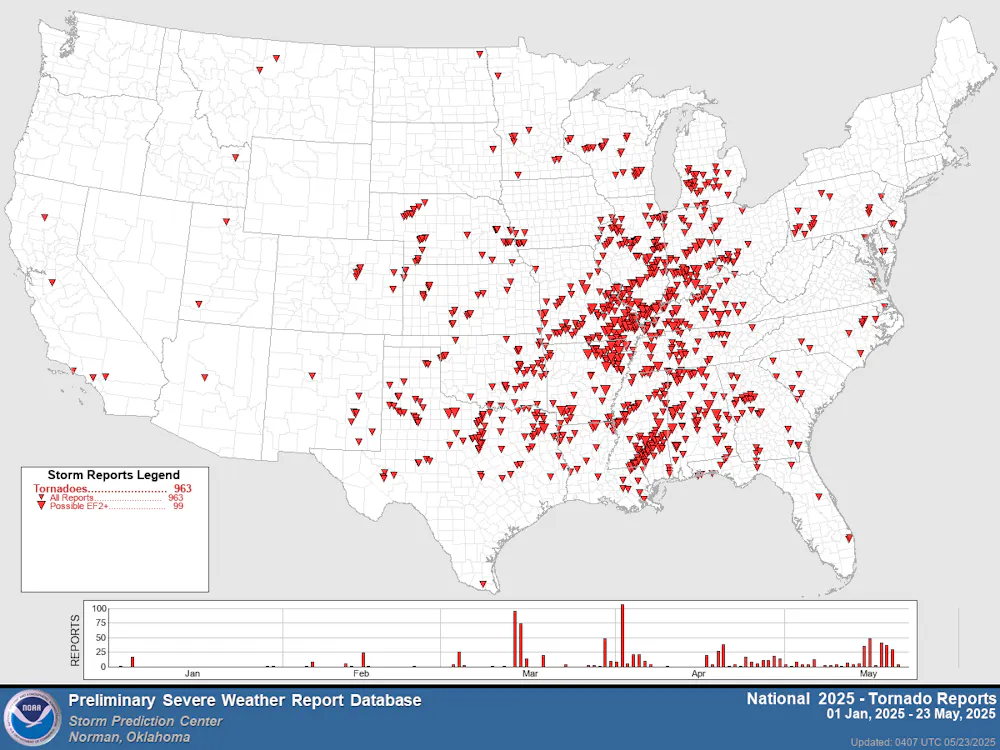
The U.S. has had more reported tornadoes than normal – over 960 as of May 22, according to the National Weather Service’s preliminary count.
That’s well above the national average of around 660 tornadoes reported by that point over the past 15 years, and it’s similar to 2024 – the second-most active year over that same period.
The National Weather Service tracks reported tornadoes based on local storm reports, allowing for comparisons throughout the year. The red line shows 2025 through May 22. NOAA National Storm Prediction Center
I’m an atmospheric scientist who studies natural hazards. What stands out about 2025 so far isn’t just the number of tornadoes, but how Tornado Alley has encompassed just about everything east of the Rockies, and how tornado season is becoming all year.
Why has 2025 been so active?
The high tornado count in 2025 has a lot to do with the weather in March, which broke records with 299 reported tornadoes – far exceeding the average of 80 for that month over the past three decades.
March’s numbers were driven by two large tornado outbreaks: about 115 tornadoes swept across more than a dozen states March 14-16, stretching from Arkansas to Pennsylvania; and 145 tornadoes hit March 31 to April 1, primarily in a swath from Arkansas to Iowa and eastward. The 2025 numbers are preliminary pending final analyses.
While meteorologists don’t know for sure why March was so active, there were a couple of ingredients that favor tornadoes:
April and May also produced tornado outbreaks, but the preliminary count over most of this period, since the March 31-April 1 outbreak, has actually been close to the average, though things could still change.
What has stood out in April and May is persistence: The jet stream has remained wavy, bringing with it the normal ebb and flow of stormy low-pressure weather systems mixed with sunny high-pressure systems. In May alone, tornadoes were reported in Colorado, Minnesota, Delaware, Florida and just about every state in between.
Years with fewer tornadoes often have calm periods of a couple of weeks or longer when a sunny high-pressure system is parked over the central U.S. However, the U.S. didn’t really get one of those calm periods in spring 2025.
Tornado Alley shifts eastward
The locations of these storms have also been notable: The 2025 tornadoes through May have been widespread but clustered near the lower and central Mississippi Valley, stretching from Illinois to Mississippi.
That’s well to the east of traditional Tornado Alley, typically seen as stretching from Texas through Nebraska, and farther east than normal. April through May is still peak season for the Mississippi Valley, though it is usually on the eastern edge of activity rather than at the epicenter. The normal seasonal cycle of tornadoes moves inland from near the Gulf Coast in winter to the upper Midwest and Great Plains by summer.
Where local forecast centers reported tornadoes in 2025, through May 22. Data is preliminary, pending final analysis. NOAA Storm Prediction Center
Winter tornadoes have become more frequent over the eastern U.S., from the southeast, dubbed Dixie Alley for its tornado activity in recent years, to the Midwest, particularly Kentucky, Illinois and Indiana.
The shift toward more winter tornadoes has also left people more vulnerable. Since they may not expect tornadoes at that time of year, they are likely to be less prepared. Tornado detection and forecasting is rapidly improving and has saved thousands of lives over the past 50-plus years, but forecasts can save lives only if people are able to receive them.
Average number of tornadoes by month, 2000-2024. Source: NOAA
This shift in tornadoes to the east and earlier in the year is very similar to how scientists expect severe thunderstorms to change as the world warms. However, researchers don’t know whether the overall downward trend in tornadoes is driven by warming or will continue into the future. Field campaigns studying how tornadoes form may help us better answer this question.
Remember that it only takes one
For safety, it’s time to stop focusing on spring as tornado season and the Great Plains as Tornado Alley.
Listen to your local meteorologists so you will know when your region is facing a tornado risk. And if you hear sirens or are under a tornado warning, immediately go to your safe space. A tornado may already be on the ground, and you may have only seconds to protect yourself.
Daniel Chavas receives funding from the National Science Foundation, NASA, and NOAA. He is a member of the American Geophysical Union and American Meteorological Society.
Abortion policy in the U.S. often focuses on fetal viability and fails to address the concerns of actual pregnant people.John Fedele/Tetra Images via GettyImages
During the 2024 presidential campaign, politicians and their surrogates repeatedly raised concerns about abortion later in pregnancy. The topic grabbed media attention and continues to inspire strong emotions, but most of the discussions include numerous misunderstandings.
These debates tend to focus almost exclusively on the status of a presumed healthy fetus: Does it have a heartbeat? Can it feel pain? Can it survive outside of the pregnant person’s body? Laws in the U.S. routinely use these fetal development markers to restrict abortion rights.
The problem with this framing, however, is that the preoccupation with these fetal development markers originated in law and politics, not in science or medicine. And, most importantly, not from the lives, needs and experiences of pregnant people.
We are medicalsociologists who specialize in research on abortion. We noticed that fetal development markers shape the experience of pregnant patients. But that doesn’t mean these markers feel meaningful to people who get abortions.
We wanted to understand how patients who have abortions later in pregnancy, including from states with laws banning abortion after specified markers like “viability,” thought about their pregnancy and abortion. Do they think about abortion in terms of the development of their fetus? We analyzed interviews with 30 women who obtained abortions later in pregnancy to answer this question.
A history of limitations
Long before the 2022 U.S. Supreme Court’s Dobbs v. Jackson Women’s Health Organization decision overturned the constitutional right to abortion, thousands of people each year in the U.S. were denied abortion services. Often, this was because they were beyond the pregnancy gestational limit imposed by their state’s abortion laws.
These limits were rooted in fetal development markers. For instance, some states such as Maine and Washington allow abortion until a particular developmental point, such as presumed fetal viability. This is the point in pregnancy when the fetus might survive outside the uterus. Even in states considered supportive of abortion rights, such as California and Illinois, limits based on fetal development are still in force today.
Since the Dobbs ruling, more abortion seekers are being denied the chance to get the procedure or facing long delays because of laws based on ideas about fetal development markers. But in fact, laws focused on fetal markers often end up jeopardizing the life and health of pregnant patients and furthering suffering, our study shows.
Fetal development markers explained
Fetal development markers sound like they are established clinical terms, but they aren’t. Some, like “potential fetal viability,” are concepts that started in legal thinking in the early 1970s. Then, when they were incorporated into limits on legal abortion, clinicians had to figure out how to apply them in a health care setting.
Laws premised on fetal development markers around the U.S. have led to a host of lawsuits and general confusion among medical practitioners, as the language they use often doesn’t translate into medical contexts.
Only about half of infants born at 24 weeks of gestation will even survive long enough to be discharged from the hospital. Among infants born at 28 weeks, that rises to more than 90%. And of course, just looking at whether a baby was discharged from the hospital does not capture the acute impairments that babies born this prematurely experience and ongoing medical care they will require for much, if not all, of their lives.
Focusing on the fetus’s viability overlooks the baby’s viability
When we interviewed women who had abortions after 24 weeks of pregnancy, it became evident that these legal definitions were entirely irrelevant to the realities of their fetuses’ health.
Some described carrying a fetus with a serious health issue that doctors told them would lead to its death soon after birth, just not during pregnancy. For instance, one woman we interviewed learned that a child with her fetus’s diagnosis would be born alive but would have regular seizures, cognitive disabilities and an inability to control its own movement.
“I couldn’t imagine bringing a child into this world who would suffer and not have cognition of why, or be able to understand a good day from a bad day,” she said. To her, having an abortion was a way to protect her son: “I can’t give him that life of pain if I have a choice.”
Women in similar situations struggled with the way their states’ laws focused on fetal viability but ignored the fact that the life their baby would have would be very brief and characterized by deep, sometimes constant pain. To them, the law reduced “viability” to the ability to survive birth, without consideration of the quality of their child’s life and the degree of its suffering.
Overlooking women’s health
Research and journalism have documented harrowing obstetric emergencies and their physical consequences in states where abortion has been banned. These traumatic events are often directly linked to laws that, in effect, leave little to no room to protect the pregnant patient’s life and health. The women in our study repeatedly highlighted that when a state’s law emphasizes “fetal viability” at the time an abortion is sought, the pregnant patient’s future health – both emotional and physical – takes a back seat.
One woman we interviewed explained that she was so desperate not to be pregnant that she considered suicide because the fetal development-based law in her state meant she would not have access to a needed abortion. She had to travel out of state for her abortion. In her interview, she said the staff at the abortion clinic “saved my life. They definitely did. If it wasn’t for them, I probably wouldn’t be here.”
We also interviewed a woman who had a medical condition that made pregnancy and laboring very dangerous for her, but she decided to take that risk to start a family. Once it was clear that her fetus had a serious health issue and would die in utero or shortly after birth, she no longer wanted to risk her own health.
“Never mind the suffering, like needless suffering for the baby — I would also have to go through a cesarean surgery for that,” she said. But in her state, a fetal development-based law prohibited her from receiving an abortion. She, too, had to travel in order to get one.
Ultimately, the women we interviewed found the laws based in fetal development markers to be nonsensical and cruel when applied to their pregnancies. One woman we interviewed, whose fetus’s severe medical condition was only diagnosable by doctors after her state’s 24-week viability cutoff, put the issue in stark terms.
She was denied an abortion even after multiple specialists told her there was “100% certainty” her baby would have a bad outcome – an outcome that one specialist gently told her “no parent wants.” She had to fly halfway across the country to get the abortion she needed, far away from her support system.
She said, “What sense does that make? I can’t imagine anybody looking at that and saying, ‘Yes, that was the desired outcome of this policy.’”
Katrina Kimport receives funding from the Society of Family Planning and an anonymous private foundation.
Tracy A. Weitz receives funding from the Society of Family Planning, Education Foundation of America, and William and Flora Hewlett Foundation. She is affiliated with Cambridge Reproductive Health Consultants, Fund Access Forward, Democracy Forward, Abortion Bridge Collaborative (Women’s Donors Network), Breast Cancer Action.
The front entrance of the E. Barrett Prettyman United States Court House, the workplace of Judge James Boasberg, along with other federal and appeals court judges, is seen in Washington, D.C. Philip Yabut/Getty Images
Federal judges and at times Supreme Court justices have repeatedly challenged – and blocked – President Donald Trump’s attempts to reshape fundamental aspects of American government.
When a majority of Supreme Court justices ruled on May 16, 2025, that the Trump administration could not deport a group of Venezuelan immigrants without first giving them the right to due process in court, Trump attacked the court.
“The Supreme Court of the United States is not allowing me to do what I was elected to do,” Trump wrote on Truth Social. “This is a bad and dangerous day for America!” he continued in the post.
As the Trump administration faces other orders blocking its plans, the president and his team are framing judges not just as political opponents but as enemies of democracy.
Trump, for example, has called for the impeachment of James Boasberg, a federal judge who also issued orders blocking the deportation of immigrants in the U.S. to El Salvador. Attorney General Pam Bondi has said that Boasberg was “trying to protect terrorists who invaded our country over American citizens,” and Trump has also called Boasberg and other judges who ruled against him or his administration “left-wing activists.”
“We cannot allow a handful of communist, radical-left judges to obstruct the enforcement of our laws and assume the duties that belong solely to the president of the United States,” Trump said at a rally in April 2025. “Judges are trying to take away the power given to the president to keep our country safe.”
As a scholar of legal and political theory, I believe this kind of talk about judges and the judicial system is not just misleading, it’s dangerous. It mirrors a pattern seen across many populist movements worldwide, where leaders cast independent courts and judges as illegitimate obstacles to what they see as the will of the people.
President Donald Trump shakes hands with Supreme Court Chief Justice John Roberts at his inauguration on Jan. 20, 2025, in Washington, D.C. Chip Somodevilla/Getty Images
Yet these rulings are merely a reflection of the rule of law.
Trump and supporters such as Elon Musk have characterized the rulings as a sign that a group of elite judges are abusing their power and acting against the will of the American people. The rulings that enforce the law, according to this argument, stand in opposition to the popular mandate American voters give to elected officials like the president.
“If ANY judge ANYWHERE can stop EVERY Presidential action EVERYWHERE, we do NOT live in a democracy,” Elon Musk posted on X in February 2025. “When judges egregiously undermine the democratic will of the people, they must be fired,” Musk added.
And U.S. Rep. Mike Johnson, the Republican speaker of the House of Representatives, said in March 2025, “We do have the authority over the federal courts, as you know. We can eliminate an entire district court.”
Framing judges as enemies of democracy or as obstacles to the people’s will departs sharply from the traditional view – held across political lines – that the judiciary is an essential, nonpartisan part of the American constitutional system.
Supreme Court Justice Ketanji Brown Jackson warned against the Trump administration’s charge that judges were actively undermining democracy. In late April 2025, she said during a conference for judges that “relentless attacks on judges are an attack on democracy.”
So, are judges obstructing democracy – or protecting it?
Are unelected judges a sign of democracy?
The U.S. Constitution established an independent judiciary as a coequal branch of government, alongside the legislative and executive branches. Federal judges are appointed for life and cannot be removed for political reasons. The country’s founders thought this protection could insulate judges from political pressures and ensure that courts uphold the Constitution, not the popularity of a given policy.
Other democratic theorists, however, say that federal judges can act as a check on elected leaders who may misuse or abuse their power, or pass laws that violate people’s legal rights. This indirectly strengthens democracy by giving people a meaningful way to have recourse against laws that go against their rights and what they actually voted for.
A common story across countries
The argument that judges are an enemy to democracy is not unique to the U.S.
Authoritarian leaders from across the world have used similar language to justify undermining the courts.
In the Philippines, then-President Rodrigo Duterte in 2018 told Maria Lourdes Sereno, a top judge who was an outspoken critic of Duterte’s war on drugs, “I am now your enemy.” Shortly after, the Philippines Supreme Court voted to oust Sereno from the court. These judges cited Sereno’s failure to disclose personal financial information when she was first appointed to the court as the reason for her removal.
Filipino protesters and outside critics alike viewed Sereno’s removal as politically motivated and said it undermined the country’s judicial independence.
El Salvador President Nayib Bukele’s allies in the legislative assembly similarly voted in May 2021 to remove the government’s attorney generalas well all five top judges for obstructing Bukele’s plans to imprison, without proper due process, large numbers of people. Bukele replaced the attorney general and judges with political loyalists, violating constitutional procedure.
Kamala Harris, then vice president of the U.S., was among the international observers who said the removal of judges in El Salvador made her concerned about El Salvador’s democracy. Bukele justified the judges’ removal by saying he was right and that he refused to “listen to the enemies of the people” who wanted him to do otherwise.
And in April 2024, a minister in Israeli Prime Minister Benjamin Netanyahu’s Cabinet called Attorney General Gali Baharav-Miara an “enemy of the people,” blaming her for protests outside Netanyahu’s home. This disparagement was part of Netanyahu’s broader efforts to weaken judges’ role and independence and to remove judicial constraints on executive power.
Judge James Boasberg is one example of a judge who was personally attacked by President Donald Trump for issuing various rulings on the administration’s plans to deport Venezuelan immigrants. Drew Angerer/AFP via Getty Images
Pushing against democracy
In the name of weakening what they call undemocratic institutions, these and other leaders try to discredit independent judges. This attempt helps these leaders gain power and silence dissent.
Their attempts to disparage and discredit judges misrepresent judges’ work by asserting that it is political in nature – and thus subject to political criticism and even intimidation. But in the U.S., judges’ constitutionally mandated work takes place in the realm of law, not politics.
Independent judges may not always make perfect decisions, and concerns about their interpretations or potential biases are legitimate. Judges sometimes make decisions that are objectionable from a moral and legal standpoint.
But when political leaders portray judges as the problem, I believe it’s crucial to ask: Who truly benefits from silencing judges?
Michael Gregory does not work for, consult, own shares in or receive funding from any company or organization that would benefit from this article, and has disclosed no relevant affiliations beyond their academic appointment.
It’s a common misconception that pathogens, such as SARS-CoV-2 or the flu, cause fevers. But as biologyprofessors, we know it’s not that simple. Pathogens cause fevers only indirectly.
When your immune system detects harmful microbes, your body raises its internal temperature to create a hostile environment. Turning up the heat suppresses the proliferation of invaders. In short, the fever is the body’s way of fighting back.
Although many people don’t understand fever’s purpose, animals certainly utilize it. Even so-called “simple creatures,” such as lizards, fish and insects, use fever to recover from illness.
The body’s response
Suppose you catch a virus. The immune system responds by releasing molecules called pyrogens, which induce fever. They signal the brain’s hypothalamus to raise the body’s set point temperature – like adjusting a thermostat.
When that happens, your muscles contract, causing shivers, and blood vessels constrict to retain heat. You’ll feel cold until your body reaches the new set point, often prompting you to add clothes or snuggle into blankets. When the infection subsides, pyrogens decrease and the hypothalamus resets the temperature. You sweat, your blood vessels dilate, and you cool off. You’re feeling better.
Humans are not special in this regard; all mammals are capable of generating fevers. Even without taking their temperature, you might recognize the signs in a familiar companion. When dogs have a fever, they often lose their appetite, become lethargic and may shiver − behaviors that closely resemble how people respond when they’re running a fever.
This adaptive response to infection is widespread in nature. Even cold-blooded animals, which rely on the environment for warmth, raise their temperature behaviorally.
Lizards move to warmer areas when sick. If they’re blocked from doing so − or given fever-reducing drugs − their survival rates drop. Zebrafish swim to warmer waters during infection; a rise of just 5.4 F (3 C) correlates with improved gene expression, stronger antiviral responses and higher survival. Naked mole rats – a social, subterranean cold-blooded mammal that looks like a hot dog with teeth – generate fevers in response to infection, despite their unusual physiology.
Insects, too, show remarkable responses. Desert locusts elevate their body temperature when infected, doing so in a dose-dependent manner: more pathogen, higher temperature. This behavior increases their chance of survival and reproduction.
Honeybees are among the most sophisticated. These social insects regulate brood temperature with extraordinary precision, keeping it between 90-95 F (32-35 C). They warm the hive by contracting flight muscles and cool it by fanning wings, sometimes spreading water on the comb to induce evaporative cooling.
If their larvae are exposed to heat-sensitive fungal spores, the colony raises the temperature − essentially giving itself a fever. The increased heat prevents spore germination and protects the next generation. Once the threat has passed, the bees restore their normal hive temperature.
If fevers don’t wind down within 24 to 36 hours, it’s time to see a doctor.
Treating a fever
These examples show that evolution has favored the fever response. Yet when humans get a fever, our instinct is often to bring it down – using aspirin, removing blankets or applying cold compresses. And sometimes that’s appropriate. Adults should seek medical attention if fever exceeds 103 F (39.4 C); children at 102 F (38.9 C); and infants younger than three months at 100.4 F (38 C).
But mild to moderate fevers often help more than they hurt. Reducing a fever too soon − via medication or environmental cooling − may interfere with the body’s natural defense, prolonging illness.
This isn’t a new idea. Nearly a century ago, Austrian physician Julius Wagner-Jauregg pioneered an extreme method called malariotherapy: infecting syphilis patients with malaria. The high fever induced by malaria killed the syphilis-causing bacteria. Once the bacteria was eliminated, doctors treated the malaria with quinine.
The approach was risky but effective enough to win Wagner-Jauregg the Nobel Prize in 1927. Although some patients died from the treatment, and many others relapsed, it remained in use for about two decades, until replaced by penicillin. Think of Wagner-Jauregg’s treatment like using a sledgehammer to drive a nail; it worked, though the wall didn’t always survive.
Much remains to be discovered about how fever affects the immune response. Still, the underlying message holds: Fever fights infection.
The fact that so many diverse creatures developed similar fever responses suggests a powerful pattern known as convergent evolution − when different species with enormously complex evolutionary histories converge on a similar solution. Despite different evolutionary paths, all these organisms faced the same challenge − infection − and arrived at the same solution: fever.
Phil Starks received past funding from the NSF for providing research experiences for undergraduates (REU).
Harry Bernheim had grants from the NIH in the 1980’s.
For 40 years, I’ve worked as a marine ecologist and, since 1992, I’ve been based in Plymouth, Devon – a global hub for coastal marine research and teaching. As I think back to how our understanding of life in our oceans has changed over that time, here are five lessons I have learnt.
1. Start with the basics
Back in the 1970s, the band America wrote: “The ocean is a desert with its life underground, and the perfect disguise above”. Many people I speak to actually don’t see much beyond that grey-blue surface.
Back in 2014 my colleagues and I were quite shocked at the response to a big survey we did on public perception of the marine environment in the UK, particularly when we break out of our marine bubbles. If an organism was remotely colourful or interesting, most people assumed it didn’t live in UK waters.
That reminded me not to underestimate how little most people know, or care, about UK seas. Make no assumptions.
While Blue Planet and other beautiful TV series have undoubtedly helped raise the profile of the world’s seas, some have potentially reinforced this view of local waters – that you have to travel to far-off exotic locations to find any interesting and spectacular life.
2. Inspire deep connection
Research shows the almost unparalleled restorative power of being in, on, under or by the sea. You do not need to dive to feel a strong ocean connection – building sandcastles, catching crabs on a line in a harbour, skimming stones or letting the cold water wash over your feet can work wonders.
Rockpooling is also an incredible window into the underwater world – suddenly all this weird and wonderful life opens up to us in a small, simple and accessible puddle.
People need to be given more opportunities to form lasting connections with the ocean. Organisations such as Plymouth’s Ocean Conservation Trust and Devon Wildlife Trust are bringing young people to the sea, sometimes for the first time.
Enabling ocean connection is just as important for people who don’t have the chance or ability to physically be there, for example through virtual reality. I’ve also been involved in transforming Plymouth Sound into the UK’s first national marine park – this concept is all about engaging people with this stretch of coastline, getting them connected to the ocean and inspiring them to care. And the marine park model could be replicated around the UK.
Local science, global stories.
This article is part of a series, Secrets of the Sea, exploring how marine scientists are developing climate solutions.
In collaboration with the BBC, Anna Turns travels around the West Country coastline to meet ocean experts making exciting discoveries beneath the waves.
3. Take the pressure off
If you leave the ocean alone, it can recover. Very few shallow areas of our global ocean remain untouched. But, as demonstrated so well in David Attenborough’s latest film, Ocean, if you remove all the most damaging impacts (particularly physical fishing damage), then the sea has great powers of recovery.
In the UK, bluefin tuna and humpback whales have returned as the pressure to hunt them has been better managed. The cold water reefs on the seabed in Lyme Bay off the south coast of England have recovered remarkably just four years after a ban on towed fishing gear was introduced.
Today, there are so few properly protected areas where all damaging or extractive activities are completely removed to give nature a chance, particularly in the UK. Some habitats may need a bit of help from us – active restoration or replanting of seagrass beds and oyster reefs will help kickstart regrowth.
What is seagrass? The Ocean Conservation Trust explains.
4. Plastic is a distraction
The flow of plastics into the ocean must certainly be stopped. But I worry that the plastic pollution problem is a bandwagon that so many businesses, media outlets and governments have jumped on. Has a decade-long focus on “solving” the plastic crisis been a troublesome distraction? Banning single-use straws can seem like an easy win because leaders can be seen to be taking action – but it does little to solve the ocean’s biggest problems.
Meanwhile, the most complex and hard to resolve activities that seriously harm our seas, such as industrial overfishing, are still not being dealt with. The most damaging fishing practices such as trawling and dredging continue legally, astonishingly even within designated marine protected areas. Such highly damaging activities have no place near sensitive habitats and this has been so well demonstrated in Ocean.
The recent UK ban on sandeel fishing gives me hope. This landmark decision was made to benefit nature (protecting food supply for seabirds), restricting a fishery that does not even supply food for humans. Sandeels are used to make fishmeal and fish oil to feed farmed fish and livestock.
Yet, damaging fishing practices such as trawling and dredging continue legally, even within designated marine protected areas. Such highly damaging activities have no place near sensitive habitats.
I firmly believe that the most effective and straightforward solution for the UK is to prohibit all towed fishing gear from within at least three miles of the coast – including developing a series of fully protected marine reserves.
In Lyme Bay, this approach has led to a real win-win because the seas are now recovering, and local fishers, holidaymakers and coastal communities are benefiting too.
Rising eco-anxiety, particularly in younger people, is not surprising given the state of the world. Faced with the nature and climate crisis, it is easy to feel utter despair.
Climate change will undoubtedly change our planet. Yet, without oceans absorbing most of the carbon (while producing half the oxygen we breathe), this planet would already be uninhabitable for human civilisation. Making our oceans as healthy and resilient as possible is therefore crucial.
Right now, we need some ocean optimism. Sharing the stories of progress and innovation that show how patches of the sea are recovering can demonstrate what’s possible and inspire further positive action. By showcasing areas now rich with diverse marine life now that industrial-scale damage has been stopped or whale populations that are booming now that harpoons are a thing of the past, a vision for a better, bluer future can become reality at scale.
Listen to episode one of Secrets of the Sea here on BBC Sounds, presented by Anna Turns for The Conversation.
Don’t have time to read about climate change as much as you’d like?
Martin Attrill receives and has received funding from a series of government, NGO and private sector bodies, all of which is directed to the University of Plymouth, not personally. Current and recent funding includes from UK Government (NEIRF), Heritage Lottery Fund, Natural Environmental Research Council, EU INTERREG and ERDF. He is affiliated with Ocean Conservation Trust (Chief Scientific Advisor) and a trustee of the Manta Trust.
For the first time, traces of the West Nile virus have been found in mosquitoes in the UK, according to a report published this week by the UK Health Security Agency.
Here’s what you need to know about the virus and the disease it causes.
What is West Nile virus?
West Nile virus is a mosquito-borne virus first identified in Uganda in 1937. It belongs to the same viral family as dengue and yellow fever. The virus is most commonly transmitted by Culex mosquitoes, particularly the species Culex pipiens, which mainly feeds on birds.
Birds are the primary host for West Nile virus, and the virus spreads in a cycle from infected birds to mosquitoes and then back to birds. Occasionally, mosquitoes can transmit the virus to humans or other animals.
Most human infections – around 80% – cause no symptoms. When symptoms do occur, they are usually mild: fever, fatigue, headaches, body aches and sometimes nausea. But in rare cases, around one in 150 infections, the virus can cause severe illness, including encephalitis (inflammation of the brain) or meningitis. Older adults, especially those over 50, are most at risk of serious complications.
The virus cannot normally be spread from person to person, though rare cases of transmission have occurred through blood transfusions or from mother to baby during pregnancy.
Get your news from actual experts, straight to your inbox.Sign up to our daily newsletter to receive all The Conversation UK’s latest coverage of news and research, from politics and business to the arts and sciences.
How did it get to the UK?
Although the exact route isn’t known, experts believe the virus may have arrived in the UK via migratory birds infected elsewhere. The mosquitoes probably picked up the virus after feeding on these birds during their northward journey.
The detection was made as part of a routine mosquito surveillance programme run by the Animal and Plant Health Agency. Mosquitoes collected from marshlands in south-east England tested positive in PCR (polymerase chain reaction) tests, which detect fragments of the virus’s genetic material.
It’s important to note that a positive PCR test doesn’t necessarily mean the virus is infectious. After a mosquito becomes infected, the virus needs time – several days – to multiply inside the mosquito before it can be transmitted. And this process is highly temperature dependent.
Can the virus spread in the UK?
The UK’s relatively cool climate has, until now, helped keep mosquito-borne diseases at bay. At summer temperatures of around 15°C, it can take up to 100 days for the virus to develop inside a mosquito – longer than the insect’s lifespan. In contrast, in hotter climates (above 30°C), this process can take just a few days.
For a local outbreak to occur, there would need to be a critical mass of infected birds and mosquitoes, with enough warm weather to sustain multiple cycles of transmission. So far, that hasn’t happened in the UK.
But climate change could alter the equation. With rising global temperatures and longer, hotter summers, the conditions that allow viruses such as West Nile to spread may become more common in the UK.
What’s happening elsewhere?
West Nile virus was once limited to Africa and the Middle East but has spread significantly in recent decades. Large outbreaks have been recorded in countries including Greece, Romania, Israel, Russia and the US.
The US outbreak began in New York City in 1999 when an unusual number of birds were found dead in a city zoo. A veterinary pathologist at the Bronx Zoo, Tracey McNamara, helped link the bird deaths to the human illnesses being reported.
Since then, the virus has spread across most of the US, Canada and parts of South America, resulting in over 60,000 reported human cases, 28,000 hospitalisations and more than 3,000 deaths.
In 2024, 19 European countries reported a total of 1,436 local cases, most in men over 65, with 125 deaths. Most were in Italy, Greece and Spain – countries with hot, mosquito-friendly summers.
Outbreaks were also reported in birds and horses, which are both susceptible to the virus.
Should UK residents be concerned?
While the detection of West Nile virus in UK mosquitoes is noteworthy, experts emphasise that the public health risk remains very low. No human cases have been reported in the UK to date, and current summer temperatures are not yet conducive to sustained transmission.
The greater risk for most British people probably comes from travel – particularly to southern Europe, where cases are rising.
Travellers are advised to take standard mosquito precautions: wear light-coloured clothing, long sleeves and trousers, and use insect repellent, especially in the evening when mosquitoes are most active.
For now, the virus is unlikely to spread widely in the UK. But as climate patterns shift, continued surveillance and public awareness will be key to staying ahead of the risk.
Paul Hunter consults for the World Health Organization. He receives funding from National Institute for Health Research and has received funding from the World Health Organization and the European Regional Development Fund.
Many of us as children may have wondered what’s going on inside the mind of an animal – what are they thinking and feeling? Most animal researchers study science because of their fascination with animals, but for a long time scientific norms made it impossible to even raise the question of animal consciousness without losing scientific credibility.
Fortunately, those days have ended, thanks in large part to pioneering work by scientists such as Donald Griffin, who argued from the 1980s to his death in 2003 that animal minds should be a topic for scientific study.
We are philosophers who study consciousness, and in our recent research we worked with other scientists to explore what the world might be like from the point of view of corvids, the family of birds that includes ravens, crows, jays and magpies.
“Birdbrain” used to be a common insult but corvids have such surprising intelligence that they are sometimes described by scientists and journalists as “feathered apes”. But we wanted to go beyond intelligence. To do this we examined five dimensions of their experience by combing through studies on their behaviour, cognition, brains, emotions and consciousness.
Get your news from actual experts, straight to your inbox.Sign up to our daily newsletter to receive all The Conversation UK’s latest coverage of news and research, from politics and business to the arts and sciences.
Corvids’ eyes have incredibly sharp resolution that allows them to navigate while flying at high speeds and to find potential sources of food. Their hearing is excellent, perhaps unsurprising for songbirds, allowing them to even distinguish reliable from unreliable group members by assessing and remembering their alert calls.
They also have a good sense of smell, which they use to help them find nuts and other food they have hidden. Unfortunately, we do not know how their smell compares to a lot of other animals, because there are not enough studies on corvids’ sense of smell yet.
Emotional lives
Corvids show cognitive biases, similar to humans. They have negative moods and show signs of pessimism after observing similar states in others.
But they also show positive moods after successfully using tools – just like humans. And they can also show neophobia – wariness of new objects.
Even if you come with treats to give them, corvids are reluctant to fly close to someone they haven’t met before, but are confident with humans they know well – another common human trait.
It is common for people to only attribute emotional livesto mammals, but corvids show that we should study the emotions of birds in more detail.
Integrated experiences
We humans have one stream of consciousness. But birds lack a corpus callosum, the structure that connects the two brain hemispheres in us and other mammals.
Their brain halves show a lot of division of labour, such as using their different eyes to focus on different tasks. However, that doesn’t necessarily mean that their experience is split into two selves – it could suggest a kind of partial unity different from our own.
Perhaps their consciousness is more like split-brain human patients who have had their corpus callosum cut to reduce the effects of seizures. When two pictures are presented in their respective left and right visual fields, these people will draw what they see on the left side with their left hand, whereas they will verbally describe what is on the right, giving the appearance of two selves in one body.
Consciousness across time
Corvids show remarkable abilities in their sense of self across time. Because they often hide food (scientists call this caching), they can remember not just where they hid food, but also what kind of food it was and how long ago they hid it – which is relevant for more perishable foods such as insects, compared to longer-lasting nuts.
Here their memory far outstrips our own or, for that matter, most other animals when it comes to hiding objects, with some corvids caching and remembering over a thousand food items in a month for later consumption. No human would be able to remember that many hiding spots.
Corvids can even plan, collecting and storing a tool such as a spoon for future use.
Is this magpie waiting for the photographer to go away before it hides its nut? Fercast/Shutterstock
A rich sense of self
They not only recognise themselves in mirrors, but also understand other minds. Research has shown corvids go back to remove cached food and hide it elsewhere if they know they have been observed – but only if they have stolen from others in the past.
Male jays will watch the feeding behaviour of a female they want to court, so they can bring their preferred food. Even more solitary corvids, such as ravens, seem to have well-developed social skills, which scientists used to think were largely restricted to mammals.
In all of this, there is still a great deal of uncertainty. Learning about the minds of other animals requires a great deal of inference from sparse and often ambiguous data. But we believe that there is scientific evidence for rich conscious experiences in corvids. For most species, it is a lack of research, not a lack of capacity, that keeps us silent on what their subjective experiences are like.
This research also has implications for corvid welfare. Understanding what the world is like for an animal means understanding what feels good and bad for them. Their good memories may mean they suffer longer from a negative experience, neophobia will mean novel objects should be introduced slowly, their social abilities mean they should be housed in groups. Giving them tools could allow them enriching experiences.
All this should be taken into account when deciding how to care for these birds when kept in cavity, and how to minimise welfare risks in other interactions with them.
The authors do not work for, consult, own shares in or receive funding from any company or organisation that would benefit from this article, and have disclosed no relevant affiliations beyond their academic appointment.
In 2021, Banksy revealed a mural of Oscar Wilde, clad in prisoner garb, making an escape from the abandoned Reading jail. The artist claimed that he would donate profits from the sale of the stencil he used to create the work (a projected £10 million) to set up an arts hub in the Grade II listed building.
This hasn’t yet taken place, but speaking about the work at the time, Banksy dubbed Wilde “the patron saint of smashing two contrasting ideas together to create magic. Converting the place that destroyed him into a refuge for art feels so perfect we have to do it.”
In 1895, Wilde was sentenced to two years of hard labour for “gross indecency” after being convicted of “homosexual acts”. He was posthumously pardoned in 2017 under the Turing Law.
The Ballad of Reading Gaol, which he wrote two years after his release, hypnotically details the psychological and physical horrors of living in isolation in unsanitary single-cells for 23 hours a day.
It also reveals the mind-numbing conditions and physically exhausting jobs that were relentlessly inflicted on prisoners in Wilde’s day. They were required to ascend 56 steps a minute for nine hours a day on a treadmill, break stones and pick oakum (fibres from the ropes used on ships). And to do so in complete silence.
This article is part of Rethinking the Classics. The stories in this series offer insightful new ways to think about and interpret classic books and artworks. This is the canon – with a twist.
In the poem, Wilde details the intense surveillance techniques and harsh punishments adopted by the prison wardens against the “outcast men”.
Oscar Wilde’s prison cell in Reading Gaol as it appears today. Jack1956/Wiki Commons
“Like ape or clown, in monstrous garb,” he writes, the inmates silently trudge the prison yard in their one allotted hour of exercise per day. The poem focuses on one prisoner in particular, named only as CTW, who is sentenced to death for murdering his wife. It traces his walk to the “hideous” shed where he is to be executed, which ghoulishly sees him “cross his own coffin”.
More gothic images abound. CTW’s impending burial in an unhallowed and anonymous grave is described as “with yawning mouth the horrid hole / Gaped for a living thing” while “the very mud cried out for blood”.
Wilde also references a scene from Coleridge’s 1797 masterpiece The Rime of the Ancient Mariner as he envisions phantoms dancing a “grisly masque” in which they sing of inexorable triumph of sin in prison, “the Secret House of Shame”.
Moreover, Wilde denies that the sacrifice that CTW has offered to the prison with his execution is ultimately redemptive for him as:
He did not pass in purple pomp
Nor ride a moon-white steed
Three yards of cord and a sliding board
Are all the gallows need.
In the ballad, Wilde represents the prison experience as sadistic and unrelenting. Much like Banksy over a century later, Wilde used the degree of anonymity the poem afforded (he published it under his cell number, C33) to berate an inhumane society and the distressing penal policy of “hard labour, hard fare, hard board” that he was forced to endure.
The Ballad of Reading Gaol can ultimately be read as a celebration of compassion, resilience and art activism. Through the poem and letters he wrote to the Daily Chronicle, Wilde publicly attempted to “try and change [prison life] for others”.
Wilde and his lover, Lord Alfred Douglas in 1893. British Library
Despite Wilde’s public notoriety, Irish MPs Michael Davitt and T.P. O’Connor even went as far as to quote the ballad in parliamentary debates, which led to the adoption of some of the recommendations that Wilde had made in his letters in the 1898 Prison Reform Act.
Although Wilde, himself, was to suffer the psychological and physical effects of his imprisonment until the end of his short life two years later, the 1898 Act saw the treadmill abolished, ensured solitary confinement could only be used for a maximum of 28 days and children were separated from adult prisoners. And yet, sadly, Wilde’s description of “the foul and dark latrine” of “humanity’s machine” continues to reverberate today.
On August 22 2024, “independent monitors” into the conditions at Wandsworth Prison (where Wilde was briefly held) found it to be “crumbling, overcrowded and vermin-infested, with inmates living in half the cell space available when it was first opened in 1851”.
While Wilde’s “swan song” joins with Banksy’s escaped prisoner to expose the failings of modern penal practices, it also reminds us of the enduring power of art and imagination to foster change.
Beyond the canon
As part of the Rethinking the Classics series, we’re asking our experts to recommend a book or artwork that tackles similar themes to the canonical work in question, but isn’t (yet) considered a classic itself. Here is Sondeep Kandola’s suggestion:
If you are looking for further reading on the topic of prison life and the prison experience, Andy West’s memoir The Life Inside (2022) offers a sobering and often witty reflection on living in the carceral state today. A philosophy teacher in prison, West explores the notion of freedom, redemption and our broken prison system.
You might also be interested to read Brendan Behan’s powerful 1958 autobiography Borstal Boy and Bobby Sands’ courageous Writings from Prison (2020), two incarcerated Irish writers who shared Wilde’s republican sympathies and similarly questioned the ethics and integrity of the British government who imprisoned them.
Sondeep Kandola does not work for, consult, own shares in or receive funding from any company or organisation that would benefit from this article, and has disclosed no relevant affiliations beyond their academic appointment.
Source: Saint Petersburg State University of Architecture and Civil Engineering – Denis Udod, Georgy Abelev, Veronika Asaul and Yuri Kozlov
On May 22, a meeting of the public council under the Housing Committee of the Government of St. Petersburg was held at SPbGASU on the topic of “Searching for and revealing the personnel potential of the city’s housing sector.” The presidium of the meeting included the chairman of the Housing Committee Denis Udod, the chairman of the public council under the Housing Committee Georgy Abelev, the head of the Department of Construction Economics and Housing and Public Utilities of SPbGASU Veronika Asaul and the executive secretary Yuri Kozlov.
Head of the Department for Civil Service and Personnel of the Housing Committee Elena Mayevskaya spoke about current issues in the development of human resources in the housing sector of the Northern capital. The main emphasis is on measures aimed at attracting and retaining highly qualified personnel, especially in the field of cleaning urban areas and servicing housing stock. One of the key aspects is the development of a system of material and non-material incentives, including the establishment of competitive wages for janitors and machine operators, as well as improving working and rest conditions. The speaker noted the desire of the St. Petersburg authorities to ensure the stable functioning of the housing sector through an integrated approach to human resource management, including material compensation, professional development and the creation of attractive working conditions.
Director of the St. Petersburg State Budgetary Educational Institution of Additional Professional Education “Educational and Methodological Center of the Housing Committee” Valery Sapozhnikov spoke about the activities of the center. An important point is the calculation of the required number of specialists undergoing retraining, and the actual training indicators for the previous period. The need for an annual increase in the number of students, the introduction of modern technologies and quality standards is noted, which will improve the efficiency of work in the housing sector. In addition, priority tasks are outlined, including expanding the range of educational services, holding seminars and conferences, introducing innovative approaches to training and practical application of knowledge. Particular attention is paid to the creation of a training center of competencies, which will become a platform for the exchange of experience, scientific research and the introduction of advanced technologies.
Isa Magerramov, a postgraduate student at the Department of Construction Economics and Housing and Public Utilities at SPbGASU, spoke about the personnel shortage in the housing and public utilities sector of St. Petersburg, noting the acute shortage of qualified specialists and the fact that the current personnel training system is not effective enough and needs deep reform.
Isa Magerramov reported that one of the responses to the personnel shortage in the housing and utilities sector was the opening of a specialized program in “Housing and Utilities Economics” at SPbGASU within the framework of the educational program 38.03.01 Economics.
“To solve personnel problems, it is necessary to form a new type of specialist who will have both technical and economic competencies necessary for effective management of the housing and utilities sector. To achieve this goal, a systematic approach is needed with a focus on modernizing the educational system, developing interdisciplinary competencies, interacting with employers and supporting young specialists, which will allow us to prepare competent professionals who are in demand on the labor market,” he noted.
The postgraduate student added: one of the promising areas that contributes to the formation of in-demand management and economic competencies for the effective development of the housing and communal services sector in St. Petersburg is the integration of the scientific potential of SPbGASU, professional standards and new educational solutions.
The participants of the meeting came to a unanimous opinion on the need for a systemic and interdepartmental approach to solving the problem of personnel shortage in the housing sector. It was decided to continue close cooperation between the Housing Committee, educational organizations and employers in the industry.
Please note: This information is raw content directly from the source of the information. It is exactly what the source states and does not reflect the position of MIL-OSI or its clients.
Source: State University of Management – Official website of the State –
On May 30, 2025, the sports festival “GUU – a big family” will be held on the sports field of the State University of Management.
Everyone is invited to the celebration to take part in competitions and contests or just cheer on friends and have a good time.
The program includes: – A quest with exciting sports (and other) tasks; – Master classes from our partners; – For the little ones: face painting and modeling; – Delicious pilaf for a great mood.
To participate in the main competition, you need to assemble a team of 8-10 people and register using a special form.
The team can include your classmates, friends, colleagues, moms and dads, brothers and sisters. And even if none of them support you, you can still register alone and they will select a team for you, because GUU is really a big family!
Date: May 30 Time: 12:00 – 14:30 Place: sports field of the State University of Management (Ryazansky Prospekt, 99)
We are waiting for you, this is definitely not something you can miss!
Please note: This information is raw content directly from the source of the information. It is exactly what the source states and does not reflect the position of MIL-OSI or its clients.
TOLEDO, Ohio – A Venezuelan man residing in Perrysburg, Ohio, has been accused of lying on immigration forms and on applications to purchase a firearm. Anthony Emmanuel Labrador-Sierra, 24, was charged by criminal complaint today for possession of a firearm by an alien unlawfully in the United States, making false statements during the purchase of a firearm, and for using false documents.
According to the criminal complaint and underlying affidavit, Perrysburg Schools reported to the Perrysburg Police Department that they had received information that Labrador-Sierra, a student attending Perrysburg High School, was actually a 24-year-old man who enrolled under false pretenses. Labrador-Sierra is also alleged to have submitted false material information to U.S. Citizenship and Immigration Services about his date of birth in connection with applications for Temporary Protective Status and Employment Authorization Documents in 2024 and 2025.
The complaint further alleges that Labrador-Sierra does not have lawful status to purchase, own or possess a firearm in the United States and that he submitted false information on the Alcohol, Tobacco, Firearms, and Explosives (ATF) Form 4473 to purchase a firearm. Among the alleged false statements he submitted when he purchased a Taurus 9mm, semiautomatic pistol from a licensed firearms dealer, were that he attested to being a United States citizen or national.
If convicted, Labrador-Sierra faces up to 15 years in prison for possession of a firearm by an alien; 10 years in prison for making a false statement during the purchase of a firearm; and up to five years in prison for using false documents.
This case is being investigated by the City of Perrysburg Police Department, U.S. Border Patrol Detroit Sector−Sandusky Bay Station, the FBI Toledo Field Office, the ATF, with assistance from the Wood County Prosecutor’s Office.
The case is being prosecuted by Assistant U.S. Attorneys Robert Melching and Tracey Tangeman for the Northern District of Ohio, and Special Assistant U.S. Attorney Paul Dobson.
This investigation is ongoing. Anyone with knowledge and information about this matter, please call the FBI at 1-800-CALL-FBI (1-800-225-5324) or visit fbi.gov/tips.
A criminal complaint is merely an allegation. The defendant is presumed innocent until proven guilty beyond a reasonable doubt in a court of law.
They were proved wrong on May 22, 2025, when the court blocked St. Isidore. The one-sentence, unsigned order did not indicate how individual justices had voted, nor why, simply declaring it was a split 4-4 decision that leaves in place the Oklahoma Supreme Court’s ruling against the school. Justice Amy Coney Barrett recused herself from the case. Her former employer, the University of Notre Dame, runs a law clinic representing the school’s supporters.
Ever since the proposed school started making headlines, attention has focused on religion. Critics warned a decision in the school’s favor could allow government dollars to directly fund faith-based charter schools nationwide. In part, the justices had to decide whether the First Amendment’s prohibition on government establishing religion applies to charter schools.
But the answer to that question is part of an even bigger issue: Are charters really public in the first place?
The Supreme Court’s order applies only to Oklahoma, so similar cases attempting to open religious charter schools may emerge down the road. As two professors who studyeducation law, we believe future court decisions could impact more than issues of religion and state, determining what basic rights students and teachers do or don’t have at charter schools.
Dueling arguments
In June 2023, the Oklahoma Statewide Virtual Charter School Board approved St. Isidore’s application to open as an online K-12 school. The following year, however, the Oklahoma high court ruled that the proposal was unconstitutional. The justices concluded that charter schools are public under state law, and that the First Amendment’s establishment clause forbids public schools from being religious. The court also found that a religious charter school would violate Oklahoma’s constitution, which specifically forbids public money from benefiting religious organizations.
The Oklahoma Supreme Court in the Oklahoma State Capitol in Oklahoma City, May 19, 2014. AP Photo/Sue Ogrocki, File
On appeal, the charter school claimed that charter schools are private, and so the U.S. Constitution’s establishment clause does not apply.
Moreover, St. Isidore argued that if charter schools are private, the state’s prohibition on religious charters violates the First Amendment’s free exercise clause, which bars the government from limiting “the free exercise” of religion. Previous Supreme Court cases have found that states cannot prevent private religious entities from participating in generally available government programs solely because they are religious.
In other words, while St. Isidore’s critics argued that opening a religious charter school would violate the First Amendment, its supporters claimed the exact opposite: that forbidding religious charter schools would violate the First Amendment.
Are charters public?
The question of whether an institution is public or private turns on a legal concept known as the “state action doctrine.” This principle provides that the government must follow the Constitution, while private entities do not have to. For example, unlike students in public schools, students in private schools do not have the constitutional right to due process for suspensions and expulsions – procedures to ensure fairness before taking disciplinary action.
In Caviness v. Horizon Learning Center, a case from 2010, the U.S. Court of Appeals for the 9th Circuit held that an Arizona charter school corporation was not a state actor for employment purposes. Therefore, the board did not have to provide a teacher due process before firing him. The court reasoned that the corporation was a private actor that contracted with the state to provide educational services.
In contrast, the 4th Circuit ruled in 2022 that a North Carolina charter school board was a state actor under the equal protection clause of the Fourteenth Amendment. In this case, Peltier v. Charter Day School, students challenged the dress code requirement that female students wear skirts because they were considered “fragile vessels.”
The court first reasoned that the board was a state actor because North Carolina had delegated its constitutional duty to provide education. The court observed that the charter school’s dress code was an inappropriate sex-based classification, and that school officials engaged in harmful gender stereotyping, violating the equal protection clause.
If the Supreme Court had sided with St. Isidore – as many analysts thought was likely – then all private charter corporations might have been considered nonstate actors for the purposes of religion.
But the stakes are even greater than that. State action involves more than just religion. Indeed, teachers and students in private schools do not have the constitutional rights related to free speech, search and seizure, due process and equal protection. In other words, if charter schools are not considered “state actors,” charter students and teachers may eventually shed constitutional rights “at the schoolhouse gate.”
Amtrak: An alternate route?
People ride an Amtrak Acela train through Pennsylvania, en route from New York City to Washington, in 2022. AP Photo/Ted Shaffrey
When courts have held that charter schools are not public in state law, some legislatures have made changes to categorize them as public. For example, California passed a law to clarify that charter school students have the same due process rights as traditional public school students after a court ruled otherwise.
Likewise, we believe states looking to clear up charter schools’ ambiguous state actor status under the Constitution can amend their laws. As we explain in a recent legal article, a 1995 Supreme Court case involving Amtrak illustrates how this can be done.
Lebron v. National Railroad Passenger Corporation arose when Amtrak rejected a billboard ad for being political. The advertiser sued, arguing that the corporation had violated his First Amendment right to free speech. Since private organizations are not required to protect free speech rights, the case hinged on whether Amtrak qualified as a government agency.
The court ruled in the plaintiff’s favor, reasoning that Amtrak was a government actor because it was created by special law, served important governmental objectives and its board members were appointed by the government.
Courts have applied this ruling in other instances. For example, the 10th Circuit ruled in 2016 that the National Center for Missing and Exploited Children was a governmental agency and therefore was required to abide by the Fourth Amendment’s protection from unreasonable search and seizure.
Since the Supreme Court did not release any reasoning for its order, we do not know how the justices viewed the “government actor” question in the case from Oklahoma. That said, we believe charter schools fail the test set out in the Amtrak decision. Charter schools do serve the governmental purpose of providing educational choice for students. However, charter school corporations are not created by special law. They also fall short because most have independent boards instead of members who are appointed and removed by government officials.
However, we would argue that states can amend their laws to comply with Lebron’s standard, ensuring that charter schools are public or state actors for constitutional purposes.
This is an updated version of an article originally published on Feb. 27, 2025.
Preston Green III is affiliated with the National Education Policy Center.
Suzanne Eckes does not work for, consult, own shares in or receive funding from any company or organization that would benefit from this article, and has disclosed no relevant affiliations beyond their academic appointment.
Source: Organization for Security and Co-operation in Europe – OSCE
Headline: OSCE and Greek experts train future Romanian border police agents in detecting forged documents
Participants in an OSCE training course for future Romanian border police agents detecting forged documents and impostors at border crossing points, Oradea, 22 May 2025. (OSCE) Photo details
The OSCE Transnational Threats Department, in co-operation with Greek document experts, held a training course on detecting forged documents and impostors at border crossing points for 193 future border police agents studying at the ‘Avram Iancu Training School for Border Police Agents’ in Oradea, Romania, on 22 and 23 May.
The training is particularly timely as Romanian Border Police identified 1,090 cases of forged documents in 2024 and ongoing training ensures border agents can quickly detect fraudulent documents, keeping the country’s borders secure. Through discussions with document experts from Greece, the participants enhanced their knowledge about the latest trends in document forgery including high-quality counterfeit residence permits, signs of tampering such as overprinting on document holder photos and real-world case studies of forged passports with missing pages.
“The training brings added value to the Avram Iancu Training School for Border Police Agents Oradea study programme, making a significant contribution to the training of future border guards in document forgery detection proficiency and, hence, to increased security at Schengen borders. The timing of the training activity is also appropriate, as the students will take the graduation exam between 24 May and 5 June 2025, and will join the operational structures of the Romanian Border Police on 6 June 2025. Therefore, this OSCE training improves their professional capabilities at the beginning of their career in the field of public order and security,” said Police Chief Commissioner Felicia Voicu, Director of the Avram Iancu Training School for Border Police Agents.
This training course is part of an ongoing OSCE project supporting the Organization’s participating States and Partners for Co-operation in reducing the illegal crossing of borders with a fake or stolen identity, funded by the United States.
The first eco-moorings in Oxford have been installed at Aristotle Lane canal to help reduce air pollution along the city’s waterways.
In 2023, the Council and the Canal & River Trust were awarded £193,000 from the Government’s annual Air Quality Grant, to install ‘eco-moorings’ at the Aristotle Lane visitor moorings.
The project has seen the installation of three ‘eco-mooring’ bollards – the first installed outside of London – aiming to provide visiting boaters with electrical power infrastructure as an alternative to diesel engines, generators and wood burners for their daily heat and energy needs.
In Oxford, it is estimated that there are around 140 boaters living on the rivers and canals, with around 70% of them being visiting boaters. However, there are limited locations across the county where electrical power is available for boaters – especially for short-stay moorings.
Without access to electricity, boaters are often forced to run diesel engines to charge up their batteries and/or use wood burning stoves to heat their houseboats, both of which release smoke emissions which have been proven to be harmful to human health. Those most at risk from pollution from boats, are boaters themselves, who are often exposed for longer periods of time and at a closer range.
Wood burners emit particulate matter, also known as PM2.5, which is a type of air pollution. These are very tiny particles, that can have a serious impact on human health. A wide range of scientific studies have been published in recent years showing the negative impacts to human health of long-term exposure to air pollution.
The new eco-moorings aim to provide a cleaner alternative for boaters to use instead of polluting fuels.
The eco-moorings consist of three electric pillars, each containing two sockets, which enable up to six visiting boaters to plug into and connect to the grid for energy.
The sockets have range of capacity, with five 16-amp sockets and one 32-amp socket which can support the charging of electric propulsion boats (e-boats). All sockets also have the capability to become 32-amp in the future, based on demand.
The Oxford eco-moorings project builds upon other successful projects in Islington and Camden. Learnings from the project will help inform future management of Oxfords’ canal – subject to funding.
The Council and Canal & River Trust will also be working to deliver health, air quality and energy advice to boaters through the project. This will include ways and opportunities to transition to cleaner energy systems, as well as information on how to use their current heating in the most efficient way.
“It is fantastic that Oxford’s first eco-moorings are now here and ready to use. Many boaters have no other choice but to use wood-burning and diesel generators to keep warm, but this can be harmful to their health and that of their neighbours. These eco-moorings will provide boaters with the ability to use cleaner forms of heating.”
Councillor Anna Railton, Deputy Leader and Cabinet Member for Zero Carbon Oxford, Oxford City Council
“While boats are a very minor contributor to overall air pollution when compared to road traffic and other sources of emissions, we recognise that they can have a localised impact on air quality; indeed, those most at risk from boat engine fumes are boaters themselves.
“These first eco moorings outside London are the start of a journey for boaters on the Oxford Canal towards reducing emissions. I am delighted that our charity has been able to work in partnership with Oxford City Council to deliver them in time for the busy summer season.”
Ros Daniels, Director for London & South East, Canal & River Trust
Source: United Kingdom – Executive Government & Departments
Press release
Earlier support for speech and language for 20,000 children
Up to 20,000 more young children, including those with SEND, will have their needs identified and supported earlier, breaking down barriers to opportunity.
Up to 20,000 more children are set to benefit from earlier targeted support to overcome speech and language challenges before concerns escalate, as the government ensures every child gets the best start in life through its Plan for Change.
Backed by £3.4 million this year, the Early Language Support for Every Child (ELSEC) programme deploys specialist teams across primary schools and early years settings, helping to identify and respond to speech and language needs, particularly for children with SEND.
Developmental delays have been a growing issue since the pandemic, with more than 40,000 children waiting over 12 weeks for speech and language therapy as of June 2024.
It is particularly prevalent for children with SEND as numbers have skyrocketed from 1.3 million in 2020 to 1.67 million in 2024 – with one in four of these children requiring additional help to overcome difficulties listening, understanding and talking.
A lack of early identification can have a devastating impact on development, social skills, attendance, and academic attainment for all children – holding them back from progressing in school and life.
This is seen by the staggering rise in children requiring specialist support, with the number of children on Education Health Care Plans escalating from under 250,000 in 2015 to over 575,000 in 2024.
The ELSEC programme paves the way for a reformed SEND system that embeds earlier intervention and targeted support, enabling children to thrive at their mainstream school and making sure all children have the best start in life.
Minister for School Standards, Catherine McKinnell said:
When challenges with speech and language go unnoticed, it can have a devastating impact on children’s attainment, attendance, social abilities and future life chances.
ELSEC is turning this around for so many pupils – and particularly those with SEND – helping them find their voice and thrive at school and with their friends and family.
This type of approach is exactly what we want to see in a reformed SEND system that delivers the support children need at the earliest stage and restores parents’ trust in a system which has let them down for too long.
Minister for School Standards, Catherine McKinnell visited Hasmonean primary school in Barnet, which has been part of the ELSEC programme since January, and observed a small group intervention in one of the school’s calming environments. The activity focused on developing children’s social communication skills by engaging the children’s attention, promoting interaction and vocabulary, and making learning and communication fun.
Head of Early Years and SEN Support at Hasmonean Primary School, Jemma Brahams, said:
The ELSEC team first trained me on how to run a small group intervention for our pupils who are experiencing speech and language difficulties. The team was there to help me from the start and was always available as I got used to implementing the approach.
The training provided on these interventions has been huge for us, as we now don’t need to wait for anyone to come into the school or go on any waiting lists – we can just take it forward straightaway. In fact, I’m now able to train other staff members in the school to deliver intervention groups, so we can have it running frequently and across different year groups.
The impact on our pupils’ development has been really positive too. As the activity is creative and interactive, it supports the children’s speech and language development, concentration and attention – we’ve seen so much progress.
Parent of Raphael at Hasmonean Primary school, Deborah, said:
Raphael is 4 and did not speak until recently, he only made noises which was so frustrating for him, but with interventions he has progressed amazingly.
With 3-4 interventions a week he has massively grown in confidence, he is communicating with his friends and expressing himself more than ever – we are now hopeful that Raphael can go to Reception in September which was not an option a few months ago!
This programme has been so impactful for my son and it is amazing to see the work being done for children like Raphael.
Communication needs can manifest itself in a number of ways, including physically through stuttering and issues putting sentences together, as well as difficulty understanding words.
As part of the ELSEC programme, Speech and Language Therapy Assistants become part of the fabric of the school, working across numerous settings in their area to assist pupils aged 2-11 years old who need help with their language skills – whether that’s universal support for the whole class, or specialist 1:1 help for pupils with intensive needs.
Staff are taught to use characters and games to boost engagement and improve expression in ways that children can understand.
This support can also have a huge impact on children’s wellbeing at school, and as a result, their attendance. Last year, SEN children in primary school with Speech Language and Communication Needs (SLCN) as a primary need missed almost a week more of school than children without SEND.
Jointly funded by NHS England, ELSEC has already supported over 200 early years and primary school settings, trained over 3,000 setting staff and provided support to just over 20,000 pupils so far since launching in 2023.
Clinical Coordinator in Barnet’s ELSEC team, Georgia Roskin, said:
It can be very easy for teaching staff to identify children with significant needs but the children with mild-moderate needs often get missed, which can sadly cause long-term speech and language difficulties, and poorer outcomes.
That’s why when we first partner with a setting, we train teaching staff to screen every single child, which assures us (and parents!) that no children go undetected.
We work intensively within a setting for six weeks, helping to identify pupils who may need support, while also upskilling the school staff on different interventions and teaching approaches they can adopt. We then stay in regular contact, coming back into the setting every couple of months to see how they’re getting on and address any new concerns.
NHS National Director for Primary Care and Community Services, Dr Amanda Doyle, said:
It is vital that children with speech, language and communications needs get access to support as early as possible, to help give them the best start in life.
That’s why the NHS is working closely with the Department for Education and early years and primary school settings to transform the way children access support, enabling them to get the right care at the right time.
Chief Executive of the Royal College of Speech and Language Therapists, Steve Jamieson, said:
We’re delighted that the Department for Education and NHS England will fund the Early Language Support for Every Child programme until March 2026.
It has shown that when speech and language therapists, therapy support workers and education staff work together, they can identify children’s needs earlier and put timely support in place.
Providing early intervention for children’s speech, language and communication needs can improve their wellbeing, development, and educational attainment. The extension of the funding means more children will benefit from this important programme.
ELSEC forms one part of the government’s work testing SEND reforms through a reformulated Change Programme focused on early intervention and support in mainstream schools.
Local areas will also test how children in so-called alternative provision – for children who have been excluded or have behavioural needs – can get the right support to return to mainstream provision.
This includes by supporting the expansion of Alternative Provision Specialist Taskforces (APST) – multi-agency teams, including SEN specialists, youth workers, and mental health practitioners, working in AP settings, with mainstream schools to provide holistic support and ensure more children receive the right support to achieve and thrive.
Source: Peter the Great St Petersburg Polytechnic University – Peter the Great St Petersburg Polytechnic University –
The Silk Road Alliance of Architecture and Technology Universities (SRIAATU) International Forum was held in Xi’an, China. The alliance was established in October 2023 under the chairmanship of Xi’an University of Architecture and Technology to develop global architecture, technological innovation, and sustainable infrastructure for life. It includes 55 leading universities from 26 countries specializing in architecture and construction. It is the most important platform for combining the efforts of talented engineers and architects in the implementation of joint scientific and educational projects and cultural exchange.
The forum became an important step in promoting the concept of “green” architecture, based on the integration of education, science and industry in the field of architectural design and construction technologies. The event included a meeting of the Alliance Council, a presidential forum and a series of conferences dedicated to modern challenges and development prospects in the field of architecture and construction.
Peter the Great St. Petersburg Polytechnic University has been a member of the alliance since its foundation and regularly participates in its events. The delegation of SPbPU included the Director of the Civil Engineering Institute Marina Petrochenko and the Director of the Center for Additional Professional Programs of the ISI Ksenia Strelets.
The delegation of SPbPU visited the College of Architecture of Xi’an University of Architecture and Technology (XAUAT), where as a result of constructive negotiations, agreements were reached on holding a joint educational workshop with the participation of teachers from both universities. From XAUAT, the negotiations were attended by Dean of the College of Architecture Lei Zhendong, Vice Dean Dan Yutian, Coordinator of Cooperation with Russian Universities Wu Guanyu and teacher Tong Qingnan.
In addition, representatives of SPbPU took part in an international conference on architecture, which was attended by more than one hundred architects from leading universities around the world.
Participation in the forum allowed the Institute of Civil Engineering to expand its geography of partnerships: preliminary agreements were reached on developing cooperation with such universities as King Chulalongkorn Bangkok University (Thailand), Petronas University of Technology (Malaysia), Gadjah Mada University (Indonesia), Osh Technological University (Kyrgyzstan), Tashkent State Transport University (Uzbekistan) and the University of Moratuwa (Sri Lanka).
Participation in the Alliance of Architectural and Technological Universities of the Silk Road is extremely important for us, as it is one of the largest alliances in the field of architecture and construction. The Civil Engineering Institute actively trains world-class engineers capable of solving complex professional problems in the field of construction and infrastructure development. Participation in the forum allowed us to establish new partnerships with leading universities, which creates a basis for the development of student and teacher exchanges, as well as the implementation of joint educational and scientific projects, – noted the Director of the Civil Engineering Institute Marina Petrochenko.
Please note: This information is raw content directly from the source of the information. It is exactly what the source states and does not reflect the position of MIL-OSI or its clients.