Category: Education

  • MIL-Evening Report: Antarctica has a huge, completely hidden mountain range. New data reveals its birth over 500 million years ago

    Source: The Conversation (Au and NZ) – By Jacqueline Halpin, Associate Professor of Geology, University of Tasmania

    The Gamburtsev Subglacial Mountains are hidden by deep ice. Merkushev Vasiliy/Shutterstock

    Have you ever imagined what Antarctica looks like beneath its thick blanket of ice? Hidden below are rugged mountains, valleys, hills and plains.

    Some peaks, like the towering Transantarctic Mountains, rise above the ice. But others, like the mysterious and ancient Gamburtsev Subglacial Mountains in the middle of East Antarctica, are completely buried.

    The Gamburtsev Mountains are similar in scale and shape to the European Alps. But we can’t see them because the high alpine peaks and deep glacial valleys are entombed beneath kilometres of ice.

    How did they come to be? Typically, a mountain range will rise in places where two tectonic plates clash with each other. But East Antarctica has been tectonically stable for millions of years.

    Our new study, published in Earth and Planetary Science Letters, reveals how this hidden mountain chain emerged more than 500 million years ago when the supercontinent Gondwana formed from colliding tectonic plates.

    Our findings offer fresh insight into how mountains and continents evolve over geological time. They also help explain why Antarctica’s interior has remained remarkably stable for hundreds of millions of years.

    A radar image showing the Gamburtsev mountain range under layers of ice.
    Creyts et al., Geophysical Research Letters (2014), CC BY-SA

    A buried secret

    The Gamburtsev Mountains are buried beneath the highest point of the East Antarctica ice sheet. They were first discovered by a Soviet expedition using seismic techniques in 1958.

    Because the mountain range is completely covered in ice, it’s one of the least understood tectonic features on Earth. For scientists, it’s deeply puzzling. How could such a massive mountain range form and still be preserved in the heart of an ancient, stable continent?

    Most major mountain chains mark the sites of tectonic collisions. For example, the Himalayas are still rising today as the Indian and Eurasian plates continue to converge, a process that began about 50 million years ago.

    Plate tectonic models suggest the crust now forming East Antarctica came from at least two large continents more than 700 million years ago. These continents used to be separated by a vast ocean basin.
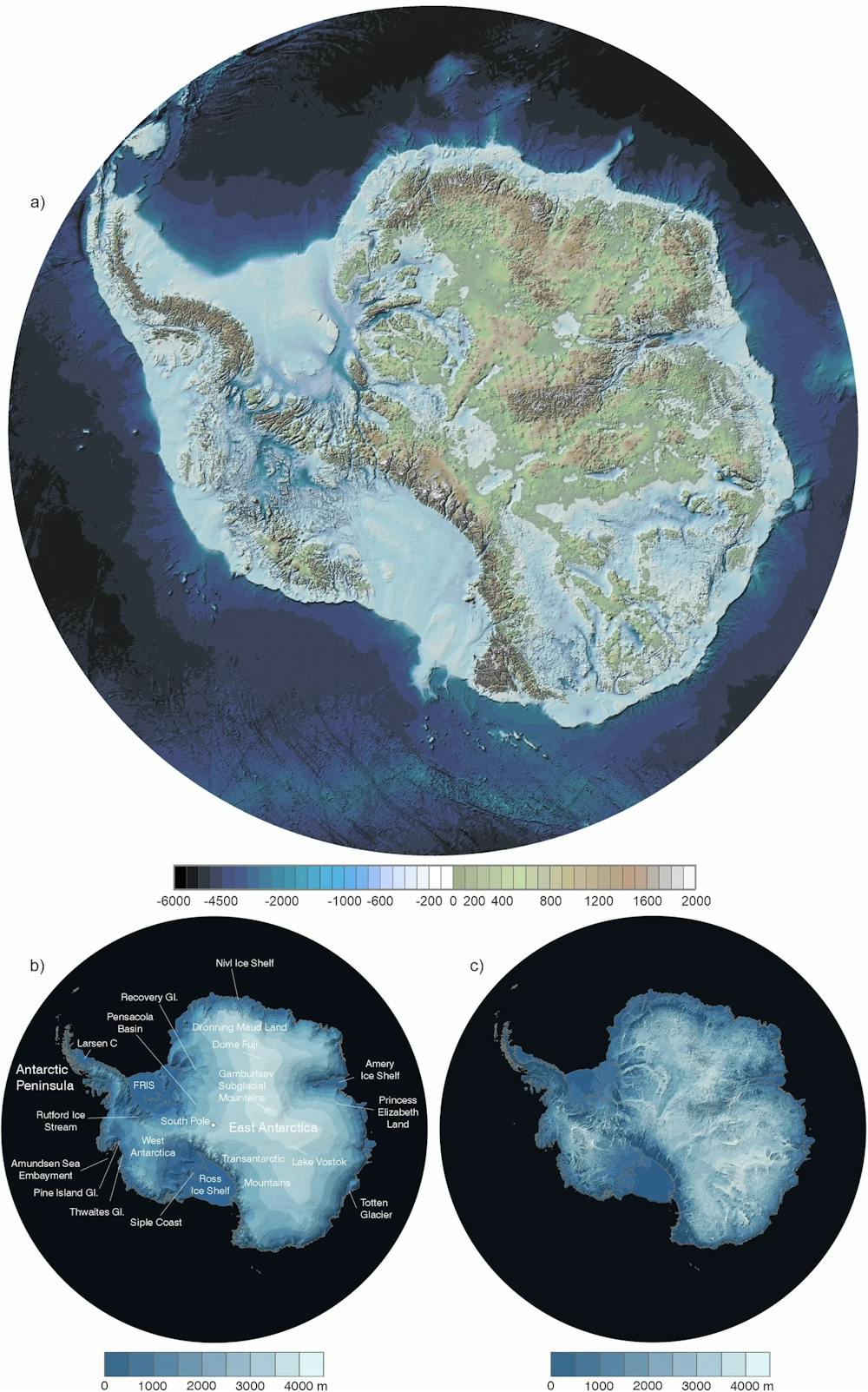
    A map of the topography (a) and surface elevation (b) of Antarctica, measured in metres above sea level; (c) shows ice thickness in metres.
    Pritchard et al., Scientific Data (2025), CC BY

    The collision of these landmasses was key to the birth of Gondwana, a supercontinent that included what is now Africa, South America, Australia, India and Antarctica.

    Our new study supports the idea that the Gamburtsev Mountains first formed during this ancient collision. The colossal clash of continents triggered the flow of hot, partly molten rock deep beneath the mountains.

    As the crust thickened and heated during mountain building, it eventually became unstable and began to collapse under its own weight.

    Deep beneath the surface, hot rocks began to flow sideways, like toothpaste squeezed from a tube, in a process known as gravitational spreading. This caused the mountains to partially collapse, while still preserving a thick crustal “root”, which extends into Earth’s mantle beneath.

    Mountain building causes deep crustal rocks to deform, fold and partially melt.
    Jacqueline Halpin

    Crystal time capsules

    To piece together the timing of this dramatic rise and fall, we analysed tiny zircon grains found in sandstones deposited by rivers flowing from the ancient mountains more than 250 million years ago. These sandstones were recovered from the Prince Charles Mountains, which poke out of the ice hundreds of kilometres away.

    Zircons are often called “time capsules” because they contain minuscule amounts of uranium in their crystal structure, which decays at a known rate and allows scientists to determine their age with great precision.

    These zircon grains preserve a record of the mountain-building timeline: the Gamburtsev Mountains began to rise around 650 million years ago, reached Himalayan heights by 580 million years ago, and experienced deep crustal melting and flow that ended around 500 million years ago.

    Most mountain ranges formed by continental collisions are eventually worn down by erosion or reshaped by later tectonic events. Because they’ve been preserved by a deep layer of ice, the Gamburtsev Subglacial Mountains are one of the best-preserved ancient mountain belts on Earth.

    While it’s currently very challenging and expensive to drill through the thick ice to sample the mountains directly, our model offers new predictions to guide future exploration.

    Geologists Jacqueline Halpin and Jack Mulder stand on the Denman Glacier during recent fieldwork.
    Jacqueline Halpin

    For instance, recent fieldwork near the Denman Glacier on East Antarctica’s coast uncovered rocks that may be related to these ancient mountains. Further analysis of these rock samples will help reconstruct the hidden architecture of East Antarctica.

    Antarctica remains a continent full of geological surprises, and the secrets buried beneath its ice are only beginning to be revealed.

    Jacqueline Halpin receives funding from the Australian Research Council through the ARC Australian Centre for Excellence in Antarctic Science (ACEAS) Special Research Initiative.

    Nathan R. Daczko receives funding from the Australian Research Council.

    ref. Antarctica has a huge, completely hidden mountain range. New data reveals its birth over 500 million years ago – https://theconversation.com/antarctica-has-a-huge-completely-hidden-mountain-range-new-data-reveals-its-birth-over-500-million-years-ago-256231

    MIL OSI AnalysisEveningReport.nz

  • MIL-Evening Report: Pamela Rabe shines in this hypnotic revival of Samuel Beckett’s classic play Happy Days

    Source: The Conversation (Au and NZ) – By Alexander Howard, Senior Lecturer, Discipline of English and Writing, University of Sydney

    Brett Boardman/Sydney Theatre Company

    Samuel Beckett is justly regarded as one of the greatest playwrights of the 20th century – and unquestionably one of the most demanding. Few of his works illustrate this more clearly than Happy Days, first performed in 1961, and currently playing at the Sydney Theatre Company.

    The premise of this visually arresting two-act play – notable as Beckett’s first play to feature a central female character – is simple and simultaneously astonishing.

    A middle-aged woman, Winnie, is buried in a low mound of scorched earth in a barren, sun-blasted landscape. She is buried up to her waist in the first act, and up to her neck in the second.

    Her near-silent and largely unseen husband, Willie, isn’t buried himself but appears to lack the means (and possibly the desire) to dig her out. No explanation is ever given for Winnie’s predicament.

    Each day starts and ends with the piercing ring of a bell. These are Winnie’s only markers of time. She fills the interminable hours with relentless chatter: an increasingly hopeless attempt to hold despair at bay, while clinging desperately to a sense of routine.

    She rations out her dwindling resources and ritually inspects her few remaining possessions: a toothbrush, a lipstick, a mirror, a parasol, a magnifying glass, a comb and, more disturbingly, a small revolver.

    Tackling a psychologically complex character

    Beckett’s authorised biographer, James Knowlson, points out that when Happy Days premiered, its “starkness and boldness” surprised and bewildered audiences more accustomed to naturalistic forms of theatre.

    Critics were initially divided on the play. But with its existential exploration of universal themes such as isolation, time and endurance, it has since become regarded as not only one of the most significant works in Beckett’s oeuvre, but one of the greatest achievements in theatre history.

    Indeed, the esteem in which Happy Days is now held can be seen in comparisons made between Winnie and Shakespeare’s Hamlet.

    This parallel isn’t nearly as far-fetched as it might seem at first. For one thing, Winnie directly quotes from Shakespeare’s famous tragedy early in the first act.

    Pamela Rabe was initially hesitant to take on the role of Winnie when approached by former artistic director Kip Williams.
    Brett Boardman//Sydney Theatre Company

    Also, much like Hamlet, she is a character of great psychological complexity, prone to lengthy reflections on the nature of existence, the passage of time and mortality. Her monologues, like Hamlet’s, are freighted with irony, melancholy and flashes of mordant humour.

    That such a link can be made speaks not only to the strength of Beckett’s writing, but also to the extraordinary challenge – and opportunity – presented by the role of Winnie, for any actor brave enough to take it on.

    Pamela Rabe delivers a truly mesmeric performance as Winnie in the Sydney Theatre Company’s outstanding rendition of Happy Days. She seems highly aware of the role’s magnitude:

    People talk about it being the kind of female Hamlet. I think, well, Jesus, in Hamlet there’s at least another 12 people on the stage.

    Initially approached by former artistic director Kip Williams, Rabe was hesitant to take on the part. She admits playing Winnie was “definitely not on my bucket list”. However, the challenge ultimately proved irresistible.

    Rabe described the process of getting to grips with Beckett’s “meticulous” dramatic prescriptions and constructing Winnie’s world as

    part maths, part archaeology, part slapstick, and very much a privilege. She’s endearing, mercurial, resourceful, wilful, occasionally a bit silly but always full of life.

    Winnie’s monologues are laced with both melancholy and biting humour.
    Brett Boardman//Sydney Theatre Company

    A contemporary spin with wit and pathos

    The production, conceived and directed by Rabe and renowned lighting designer Nick Schlieper, does justice to Beckett’s original vision, while offering a new spin on this most canonical of plays.

    Consider, for instance, the creative team’s striking decisions when it came to set design and staging. While their choices honour Beckett’s stated demand for “maximum simplicity”, they also depart in key visual respects. Gone are the “scorched earth” and “blazing sun” Beckett called for in his original stage directions.

    Instead, Schlieper offers us something approximating a post-apocalyptic tableau: the stage is framed by a narrow proscenium-like window, behind which Winnie, and occasionally Willie (played excellently by Markus Hamilton) appear. This window is set against a monochromatic and featureless void.

    The ash-coloured mound, which brings to mind Mark Rothko’s desolate final abstract expressionist canvases, is amorphous and otherworldly – a monstrous fusion of congealed lava and nuclear slag. Everything is beautifully rendered and deeply unsettling.

    These eerie abstractions heighten the play’s existential stakes, forcing the audience to reckon with the sheer horror of Winnie’s situation, while showcasing the talents of an actor capable of infusing the bleakest of scenarios with wit and pathos.

    They also ensure the production feels contemporary and resonant – particularly in an age haunted by environmental catastrophe and ecological collapse – without retroactively imposing present day values and concerns onto the past.

    Something tells me Beckett, who consistently eschewed easy and all too often reductive interpretations of his work, would have approved.

    Alexander Howard does not work for, consult, own shares in or receive funding from any company or organisation that would benefit from this article, and has disclosed no relevant affiliations beyond their academic appointment.

    ref. Pamela Rabe shines in this hypnotic revival of Samuel Beckett’s classic play Happy Days – https://theconversation.com/pamela-rabe-shines-in-this-hypnotic-revival-of-samuel-becketts-classic-play-happy-days-254068

    MIL OSI AnalysisEveningReport.nz

  • MIL-Evening Report: As Donald Trump cuts funding to Antarctica, will the US be forced off the icy continent?

    Source: The Conversation (Au and NZ) – By Lynda Goldsworthy, Research Associate, Institute for Marine and Antarctic Studies, University of Tasmania

    Mozgova/Shutterstock

    President Donald Trump has begun eroding the United States presence in Antarctica by announcing deep funding cuts to his nation’s science and logistics on the icy continent.

    The Trump administration has significantly reduced funding for both Antarctica’s largest research and logistics station, McMurdo, and the National Science Foundation which funds US research in Antarctica.

    More cuts are foreshadowed. If carried through, US science and overall presence in Antarctica will be seriously diminished – at a time when China is significantly expanding its presence there.

    Since 1958, the US has been a leader in both Antarctic diplomacy and science. Shrinking its Antarctic presence will diminish US capacity to influence the region’s future.

    Why the US matters in Antarctica

    The US has historically focused its Antarctic influence in three key areas:

    1. Keeping Antarctica free from military conflict

    The US has built considerable Antarctic geopolitical influence since the late 1950s. Under President Dwight D. Eisenhower, it initiated (and later hosted) negotiations that led to the development of the 1959 Antarctic Treaty.

    It was also key to establishing the fundamental principles of the treaty, such as using the Antarctic region only for peaceful purposes, and prohibiting military activities and nuclear weapons testing.

    2. Governing Antarctica together

    The US was influential in developing the international legal system that governs human activities in the Antarctic region.

    In the 1970s, expanding unregulated fishing in the Southern Ocean led to serious concerns about the effects on krill-eating species – especially the recovery of severely depleted whale populations.

    The US joined other Antarctic Treaty nations to champion the Convention on the Conservation of Antarctic Marine Living Resources (CAMLR), signed in 1980. It prioritises conservation of Southern Ocean ecosystems and all species, over maximum fish harvesting.

    The US also contributed to the 1991 Protocol on Environmental Protection. Among other measures it prohibits mining and designates Antarctica as “a natural reserve, devoted to peace and science”.

    3. Scientific research and collaboration

    The US operates three year‑round Antarctic research stations: Palmer, Amundsen-Scott and McMurdo.

    McMurdo is Antarctica’s largest research station. Amundsen-Scott is located at the South Pole, the geographic centre of Antarctica, and the point at which all Antarctic territorial claims meet. The South Pole station is thus important symbolically and strategically, as well as for science.

    The US has the largest number of Antarctic scientists of any nation in the continent.

    US scientific work has been at the forefront of understanding Antarctica’s role in the global climate system, and how climate change will shape the future of the planet. It has also played a major role in Southern Ocean ecosystem and fisheries research.

    This research has underpinned important policies. For example, US input into models to predict and manage sustainable krill yields has been pivotal in regulating the krill fishery, and ensuring it doesn’t harm penguin, seal and whale populations.

    The US has also been a staunch supporter of a comprehensive network of marine protected areas in the Southern Ocean. The Ross Sea Region Marine Protected Area proposed by the US and New Zealand is the largest in the world.

    A broad ripple effect

    The US influence in Antarctica extends beyond the list above. For example, the US has a significant Antarctic-based space program. And US citizens make up most Antarctic tourists, and the US plays a significant role in regulating tourism there.

    The full extent of the Trump administration’s cuts is still to play out. But clearly, if they proceed as signalled, the cuts will be a major blow not to just US interests in Antarctica, but those of many other countries.

    The US has the best-resourced logistics network in Antarctica. Its air transport, shipping and scientific field support has traditionally been shared by other countries. New Zealand, for instance, is closely tied with the US in resupply of food and fuel, and uses US air and sea logistics for many operations to the Ross Sea region.

    And joint research programs with the US will be affected by reduced funding in Antarctica directly, and elsewhere.

    For example, reported cuts to the climate programs of NASA and the National Oceanic and Atmospheric Administration (NOAA) may hamper satellite coverage of the Antarctic and Southern Ocean. This would affect Australian scientists collecting data on ocean temperature, sea-ice state and other metrics used in climate research and weather forecasting.

    Worrying times ahead

    China has signalled its intention to be a key geopolitical player in Antarctica and has greatly expanded its Antarctic presence in recent years.

    China has five Antarctic research stations. Its sixth summer station is due for completion in 2027. China also operates two icebreaker ships, helicopters and a fixed-wing aircraft in Antarctica and is building new, large krill trawlers.

    Both China and Russia, are increasingly active in their opposition to environmental initiatives such as marine protected areas.

    A smaller US presence creates greater opportunities for others to shape Antarctica’s geopolitics. This includes pressure to erode decades-long protection of the Antarctic environment, a push for more intensive fish and krill harvesting, and potentially reopening debate on mining in the region.

    Lynda Goldsworthy and Tony Press co-authored the chapter Power at the Bottom of the World in the new book Antarctica and the Earth System.

    A smaller US presence creates opportunities for others to shape Antarctica’s geopolitics.
    Oleksandr Matsibura/Shutterstock

    Lynda Goldsworthy, research associate with IMAS, UTAS, undertakes occasional contract work with the Deep Sea Conservation, is a member of AFMA’s SouthMac advisory group ) and of CSIRO National Benefit Advisory Committee.

    Tony Press receives funding from the Australia-Japan Foundation (Department of .Foreign Affairs and Trade)

    ref. As Donald Trump cuts funding to Antarctica, will the US be forced off the icy continent? – https://theconversation.com/as-donald-trump-cuts-funding-to-antarctica-will-the-us-be-forced-off-the-icy-continent-254786

    MIL OSI AnalysisEveningReport.nz

  • MIL-OSI Russia: The story of an NSU graduate: a path in science and inspiration for future generations

    Translation. Region: Russian Federal

    Source: Novosibirsk State University – Novosibirsk State University –

    Gennady Barykinsky, graduate Physics Department of NSU 1977, dedicated his life to science. Working in the field of laser physics, he always wanted to learn new things. Now, in retirement, he is engaged in historical research, studies genealogy and creates films. In an interview, he spoke about his difficult student years, the path to obtaining a diploma, the principles that helped him along the way, and why he believes that life should be filled with meaning.

    — Tell us why you decided to apply to NSU?

    — In my thoughts, I always went back to two episodes of my life that radically influenced my choice. The first episode, oddly enough, was military service in the Group of Soviet Forces in Germany. Here I was appointed commander of a platoon for controlling a radar guidance station. At that time, I did not understand not only electronics and radio engineering, but also many elementary concepts of physics. The officers literally shoved textbooks on radio engineering at me and demanded that I master all of this. After demobilization, I was constantly tormented by the same thought: “How is this possible? If I was able to master such complex technology in the army, then surely I will not be able to master higher education,” says Gennady.

    The second episode was the purchase of a directory-catalogue of all higher educational institutions in the country. Through selection, Gennady determined that he liked not a narrowly specialized education, but a more universal one – university. He decided that he was not up to Moscow, Leningrad and Kiev were too academic, but the “youth and elegance of Novosibirsk” was just right.

    — I came for the entrance exams. I was placed in the sixth dormitory in one room with three other applicants. In a few days, I heard such words as limit, derivative, integral and many others from these guys for the first time. I finally realized that I had nothing to do at the entrance exams. However, I still went to the first exam in written mathematics for a bad grade. After the exam, going down to the first floor of the university, I saw an announcement inviting applicants who had failed the exam to an interview at the dean’s office of the full-time preparatory department (PD) of NSU, — Gennady recalls.

    The next two semesters of the school year passed in a state of great emotional tension. Gennady actually had to master almost the entire high school curriculum in five exam subjects in 8 months. Therefore, the school day lasted from dawn to dusk. In addition to in-person classes and mandatory homework, Gennady studied at least four hours every day. Therefore, out of 25 exam points, he scored 23, as it turned out, passing points and was still enrolled in the university.

    — What do you remember about studying at NSU?

    — I have never experienced so many emotions in my life as at the beginning of my student years. The first lectures. The first seminars. And in general, many firsts. Somewhere in my soul there is a feeling of pride that all this happened. One of the warmest memories was left by the deputy dean for our course, candidate of physical and mathematical sciences Vasily Vasilyevich Murakhtanov. In my life, I have never met a person who possessed, to a greater extent than Vasily Vasilyevich, a whole set of such qualities in relation to the interlocutor as: intelligence, modesty, tolerance. One day he came up to me and said: “Gennady Mikhailovich, the dean’s office has an offer – you to lead a group of fourth-year physicists on a summer exchange trip to Poland to the University of Krakow, for almost a month.” I agreed. Half a month passes, he approaches again: “Excuse me, but the university administration insists that you head the student construction teams of the university, and instead of a trip to Poland, we will then organize a trip to another, more interesting country for you.” He persuaded me again. Everything happened just like that, I didn’t even regret it, because I managed to go to Cuba, but that’s a completely different story, – Gennady said.

    Gennady calls the path to his diploma work thorny, since he spent a long time choosing a department and tried himself in different scientific institutes: theoretical and applied mechanics, automation and electrometry, thermal physics, chemical kinetics and combustion.

    — This almost led to the fact that I did not have time to submit my fourth-year coursework to the dean’s office. But fate decreed otherwise. My friend Boris Bondarev, an active leader of the student club “Quantum”, advised me to try myself in laser physics. That’s how I ended up in the Laser Physics Department of the Institute of Semiconductor Physics under the supervision of Viktor Vasilyevich Lebedev. I remember him with great warmth — thanks to him, I dedicated my life to laser physics and I do not regret it. My diploma defense was successful — on June 2, 1978, my work was rated “excellent”. Later, its materials were published in the journal “Quantum Electronics”. This experience taught me that persistence and perseverance always bring results, even if the path turns out to be more difficult than expected, — the graduate recalls.

    During his entire period of study, Gennady only once received a bad mark on an exam. It was thermodynamics. Now Gennady is 76 years old, he has been retired for a long time, but he really likes to do research work on studying the history and genealogy of his family. He also creates texts, articles and videos with interest.

    — I am working on the design of my memories and some other topics in films that I have learned to create myself. I never thought that making films is incredibly interesting. A monograph is not excluded! Currently, several films about NSU are in the works: “A Big Film about the NSU SSO in the Period 1976-1979”, “A Film about the First Congress of NSU Graduates, the Creation and Functioning of this Union”, “The Second Part of the Film “NSU in Faces”, “A Film about the Problems of Graduates — Young Scientists”. I want to wish the graduates of 2025 to live by the meaning and essence, and not by the color of the packaging,” Gennady concludes.

    Some of Gennady Barykinsky’s films can be viewed here:

    HTTPS: //vidio.ru/video742583021_456239616

    HTTPS: //vidio.ru/video742583021_456239606

    HTTPS: //vidio.ru/video742583021_456239596

    Please note: This information is raw content directly from the source of the information. It is exactly what the source states and does not reflect the position of MIL-OSI or its clients.

    MIL OSI Russia News

  • MIL-OSI China: Xi’s call for learning from history echoed by int’l community

    Source: China State Council Information Office

    Chinese President Xi Jinping’s signed article recently published in the Russian Gazette newspaper, which called for learning from history, and especially the hard lessons of the Second World War, has resonated with the international community.

    In the article titled “Learning from History to Build Together a Brighter Future,” Xi urged the international community to draw wisdom and strength from the victory in the World Anti-Fascist War, resolutely resist all forms of hegemonism and power politics, and work together to build a brighter future for humanity.

    Echoing Xi’s view, experts and officials in multiple countries stated that in today’s world — where unilateralism, hegemony and bullying practices pose severe threats — the international community should stand on the right side of history, uphold fairness and justice, resolutely safeguard the post-war international order, and work together to secure a brighter future for humanity.

    UPHOLD HISTORICAL TRUTH

    This year marks the 80th anniversary of the victory of the Chinese People’s War of Resistance Against Japanese Aggression, the Soviet Union’s Great Patriotic War and the World Anti-Fascist War. On this occasion, Xi’s call for upholding a correct historical perspective on World War II (WWII) carries significant contemporary relevance, said Alexey Rodionov, a professor of Chinese studies at St. Petersburg State University.

    As emphasized in Xi’s signed article, historical memory and truth serve as inspirations that mirror the present and illuminate the future, said Wirun Phichaiwongphakdee, director of the Thailand-China Research Center of the Belt and Road Initiative.

    Defending history is not only a way to honor the past but also a means of safeguarding fairness and justice in today’s world, he said.

    Katsuo Nishiyama, a Japanese germ warfare scholar and professor emeritus at Shiga University of Medical Science, said any attempts to distort the historical truth of WWII or deny its victorious outcome will not succeed, and the international community will not tolerate attempts to reverse history’s progress.

    To protect historical truth, efforts are still needed to prevent future tragedies, the expert warned.

    French entrepreneur and commentator Arnaud Bertrand said China has become a major country staunchly supporting multilateral institutions and international law. “Xi’s article is a clear window into current Chinese strategic thinking. China is positioning itself as a defender of the post-WWII international order against ‘hegemonic’ forces,” he said.

    RECOGNIZE PIVOTAL CONTRIBUTION

    In his signed article, President Xi stressed that China and the Soviet Union served as the mainstay of resistance against Japanese militarism and German Nazism, making pivotal contribution to the victory of the World Anti-Fascist War.

    As the main theater in the East of the World Anti-Fascist War, China played a pivotal role in defeating Japanese militarism and achieving broader victory over fascism, an outcome made possible by the immense sacrifices of the Chinese people, said Boris Cheltsov, scientific secretary of the Victory Museum in Moscow.

    “The Chinese people displayed extraordinary resilience and courage under extremely difficult conditions,” he said.

    In the article, Xi emphasized that Taiwan’s restoration to China was a victorious outcome of WWII and an integral part of the postwar international order.

    Taiwan is part of China, and China’s sovereignty over Taiwan is both legal and a recognized fact, said Mohab Nassar, associate professor of international law at Cairo University.

    DEFEND JUSTICE, NOT HEGEMONISM

    Today, the global deficits in peace, development, security and governance continue to widen unabated, Xi wrote in his article. To address these deficits, Xi proposed building a community with a shared future for mankind and put forward the Global Development Initiative, the Global Security Initiative and the Global Civilization Initiative as a way forward to steer the reform of the global governance system toward greater fairness and justice.

    Akkan Suver, president of the Marmara Group Foundation in Türkiye, said the three major global initiatives proposed by Xi are fair, just and truly uphold multilateralism.

    Despite rising unilateralism, China firmly opposes all forms of hegemony and power politics and is committed to maintaining international rules and order, which aligns with the common interests of developing countries, Suver said.

    In the face of various conflicts, the international community needs dialogue and cooperation, not division; global development requires rationality and conscience, not power politics, said Suver.

    President Xi has proposed to build a community with a shared future for mankind, emphasizing dialogue rather than confrontation, partnership rather than alliance, and win-win rather than zero-sum outcomes, said Abdullah Al-Dosari, editor in chief of Kuwait’s Al-Arab Electronic Newspaper.

    The Middle East region has long been in turmoil, with peace deficit growing larger and larger, Al-Dosari said, noting that Xi’s proposal has great significance for regional peace and stability. 

    MIL OSI China News

  • MIL-OSI China: Chinese coaches enjoy Premier experience at top English soccer academies

    Source: People’s Republic of China – State Council News

    While hopes are slim for China’s men’s soccer team to reach the next World Cup, the country is already investing in the sport’s future — starting with its coaches. Eight youth coaches from the Chinese Football Association have just returned from a three-week training stint in England, hosted by the Premier League.

    The visit was part of the International Elite Coach Program, a flagship initiative under a Memorandum of Understanding signed between the Premier League and the CFA last October.

    It is designed to support China’s long-term soccer ambitions by equipping local coaches with global expertise.

    Five of the eight coaches selected for the visit are former Chinese national team players.

    Over three weeks, they were hosted at two Premier League Category One Academies — Nottingham Forest and Wolverhampton Wanderers — where they engaged in hands-on training, match preparation and performance analysis alongside experienced club staff.

    The Chinese coaches participated in tactical briefings, reviewed under-18 and under-21 matches and attended competitive fixtures, including three Premier League games. They also joined a Premier League-run Coaching Craft workshop to further hone their technical skills.

    Sean Reed, the Premier League’s Head of Coaching, emphasized that the program mirrors the league’s own youth coach development structure, but was customized to meet the needs of the Chinese coaches.

    “During this trip, the coaches had the opportunity to work with players they had never coached before — many of whom did not speak the same language,” said Reed.

    “This experience challenged them to adapt their approaches to coaching, and strengthened their ability to communicate effectively in unfamiliar environments.

    “One particular task required the coaches to deliver a session without using verbal communication. This encouraged them to find alternative ways to engage and instruct players, reinforcing the idea that football truly is a universal language,” he added.

    Reed praised the coaches’ engagement and growth: “All the coaches have grown in confidence throughout the program. They demonstrated full commitment to every element of this unique experience, building on their football knowledge and bringing energy, curiosity and professionalism to each learning opportunity.”

    Reed said that the visit was just a beginning. To further support the ongoing development of the coaches and maintain engagement, they schedule regular online check-ins, as well as the opportunity to join relevant online sessions and conferences delivered by the Premier League.

    “We also provide tailored digital content designed to support their ongoing development,” he said.

    Among the delegation was Yu Hai, a former left-back who earned 71 caps for China.

    Now transitioning into coaching, currently managing former club Shanghai Port’s Under-19s team, Yu was struck by the intensity of the English training environment.

    “What impressed me most was that every session was run at full match pace,” he said. “Now that I’m a coach, I’ve shifted my attention to tactics and the structure of youth development systems.”

    Li Feiyu, an official of CFA’s technical department, described the visit as “exceptionally rewarding”.

    “The Premier League clubs demonstrated outstanding philosophies in youth development, and impressive professionalism in their academy operations,” said Li. “The experience has provided us with valuable reference points for enhancing our own systems. I believe this collaboration between the CFA and the Premier League holds long-term, constructive significance, and will greatly benefit youth development in Chinese football.”

    Neil Saunders, Director of Football at the Premier League, emphasized the importance of continued cooperation: “This program is part of our long-standing commitment to supporting football development in China.”

    “By working with our clubs to deliver a diverse and enriching itinerary, we’ve enabled the CFA coaching delegation to gain unique insights into elite academy environments. Our support for Chinese football development will continue, even after the delegation has returned to China,” he said.

    This is the second group of Chinese coaches to take part in the initiative, following the first cohort’s visit in September 2024. The program also aligns with the Premier League’s expanding presence in Asia, including the opening of its Beijing office in 2024 — its third international hub after Singapore and the United States.

    The Premier League has been involved in grassroots soccer in China for over 15 years. Since 2009, it has partnered with the British Council to deliver the Premier Skills coaching program in 28 cities across the country, training more than 6,300 grassroots coaches, referees, and physical education teachers.

    MIL OSI China News

  • MIL-Evening Report: ER Report: A Roundup of Significant Articles on EveningReport.nz for May 12, 2025

    ER Report: Here is a summary of significant articles published on EveningReport.nz on May 12, 2025.

    Victoria’s planning reforms could help solve the housing crisis. But they are under threat
    Source: The Conversation (Au and NZ) – By Brendan Coates, Program Director, Housing and Economic Security, Grattan Institute An aerial drone view of northern Melbourne suburbs. Elias Bitar/Shutterstock The federal election campaign was dominated by the housing crisis. But the real power to solve it rests with the states. In Victoria, reforms are underway that

    Footy’s ‘code wars’ are back, but which is actually the No. 1 Australian sport: the NRL or AFL?
    Source: The Conversation (Au and NZ) – By Tim Harcourt, Industry Professor and Chief Economist, University of Technology Sydney NRL Photos, Matt Turner/AAP, Wikimedia, The Conversation, CC BY Every now and then, so-called “code wars” erupt between the major Australia winter football codes: the National Rugby League (NRL) and the Australian Football League (AFL). This

    A prisoner voting ban shows again how few checks there are on parliamentary power
    Source: The Conversation (Au and NZ) – By Stephen Winter, Associate Professor in Political Theory, University of Auckland, Waipapa Taumata Rau Getty Images Justice Minister Paul Goldsmith’s recent announcement that the government would reinstate a total ban on prisoners voting was in keeping with the coalition’s overall tough-on-crime approach. The move was called “ridiculous” and

    ‘We’re just doing our best’ – cultural backlash hits Auckland kava business
    By Coco Lance, RNZ Pacific digital journalist A new Auckland-based kava business has found itself at the heart of a cultural debate, with critics raising concerns about appropriation, authenticity, and the future of kava as a deeply rooted Pacific tradition. Vibes Kava, co-founded by Charles Byram and Derek Hillen, operates out of New Leaf Kombucha

    ‘Fighting more frequent now’ – researcher warns of escalating West Papua conflict
    By Caleb Fotheringham, RNZ Pacific journalist The escalation of violence in West Papua is on par with some of the most intense times of conflict over the past six decades, a human rights researcher says. The United Liberation Movement for West Papua (ULMWP) claims that Indonesia killed at least one civilian and severely injured another

    India-Pakistan ceasefire shouldn’t disguise fact that norms have changed in South Asia, making future de-escalation much harder
    Source: The Conversation (Au and NZ) – By Farah N. Jan, Senior Lecturer in International Relations, University of Pennsylvania A member of the Indian Border Security Force stands guard near the India-Pakistan border. Narinder Nanu/AFP via Getty Images India and Pakistan have seen the scenario play out before: a terror attack in which Indians are

    Homer’s Iliad is a rap battle
    Source: The Conversation (Au and NZ) – By Joshua Forstenzer, Senior Lecturer in Philosophy and Co-Director of the Centre for Engaged Philosophy, University of Sheffield The Anger of Achilles by Jacques-Louis David (1819). Kimbell Art Museum Homer’s Iliad is one of the foundational stories of European civilisation. The Iliad is a long poem – an

    Major brands don’t need to kowtow to Trump: they have the power to bring people together
    Source: The Conversation (Au and NZ) – By Michael Beverland, Professor of Brand Management, University of Sussex Business School, University of Sussex Whatever you think of his personality or politics, it’s impossible to deny the success of Donald Trump as a brand. Supporters and detractors across the world are transfixed by his second term as

    Meteorites and marsquakes hint at an underground ocean of liquid water on the Red Planet
    Source: The Conversation (Au and NZ) – By Hrvoje Tkalčić, Professor, Head of Geophysics, Director of Warramunga Array, Australian National University UAESA / MBRSC / Hope Mars Mission / EXI / Andrea Luck, CC BY Evidence is mounting that a secret lies beneath the dusty red plains of Mars, one that could redefine our view

    Why doesn’t Australia make more medicines? Wouldn’t that fix drug shortages?
    Source: The Conversation (Au and NZ) – By Peter Coomber, PhD Candidate, Pharmaceutical Supply Chains, The University of Queensland IM Imagery/Shutterstock About 400 medicines are in short supply in Australia. Of these, about 30 are categorised as critical. These are ones with a life-threatening or serious impact on patients, and with no readily available substitutes.

    Farmers fear dingoes are eating their livestock – but predator poo tells an unexpected story
    Source: The Conversation (Au and NZ) – By Rachel Mason, PhD candidate in Conservation Biology, Deakin University Kristian Bell/Shutterstock Killing carnivores to protect livestock, wildlife and people is an emotive and controversial issue that can cause community conflict. Difficult decisions about managing predators must be supported by strong scientific evidence. In Australia, predators such as

    ‘Cutting off communications’ – did Trump really just turn his back on Israel?
    ANALYSIS: By Robert Inlakesh Israel is in a weak position and Prime Minister Benjamin Netanyahu’s extremism knows no bounds. The only other way around an eventual regional war is the ousting of the Israeli prime minister. US President Donald Trump has closed his line of communication with Israeli Prime Minister Benjamin Netanyahu, according to various

    View from The Hill: if Jacinta Nampijinpa Price became Liberal deputy it would be a wild ride
    Source: The Conversation (Au and NZ) – By Michelle Grattan, Professorial Fellow, University of Canberra Jacinta Nampijinpa Price’s confirmation she will run for Liberal deputy has put the members of an already shell-shocked party into a new spin. Tuesday’s leadership contest, where the numbers are said to be tight, is a battle for the direction

    Dumped minister Ed Husic labels Deputy Prime Minister Richard Marles ‘factional assassin’
    Source: The Conversation (Au and NZ) – By Michelle Grattan, Professorial Fellow, University of Canberra Industry Minister Ed Husic, dumped from the frontbench ahead of Anthony Albanese’s announcement of his new ministry, has made an excoriating attack on Deputy Prime Minister Richard Marles, describing him as a “factional assassin”. Marles, chief of the Victorian right,

    Philippine advocacy group condemns NZ military pact with Manila, rejects election violence
    Asia Pacific Report The Aotearoa Philippines Solidarity national assembly has condemned the National Party-led Coalition government in New Zealand over signing a “deplorable” visiting forces agreement with the Philippine government “Given the Armed Forces of the Philippines’ appalling human rights record and continuing attacks on activists in the Philippines, it is deplorable for the New

    MIL OSI AnalysisEveningReport.nz

  • MIL-OSI Global: As Donald Trump cuts funding to Antarctica, will the US be forced off the icy continent?

    Source: The Conversation – Global Perspectives – By Lynda Goldsworthy, Research Associate, Institute for Marine and Antarctic Studies, University of Tasmania

    Mozgova/Shutterstock

    President Donald Trump has begun eroding the United States presence in Antarctica by announcing deep funding cuts to his nation’s science and logistics on the icy continent.

    The Trump administration has significantly reduced funding for both Antarctica’s largest research and logistics station, McMurdo, and the National Science Foundation which funds US research in Antarctica.

    More cuts are foreshadowed. If carried through, US science and overall presence in Antarctica will be seriously diminished – at a time when China is significantly expanding its presence there.

    Since 1958, the US has been a leader in both Antarctic diplomacy and science. Shrinking its Antarctic presence will diminish US capacity to influence the region’s future.

    Why the US matters in Antarctica

    The US has historically focused its Antarctic influence in three key areas:

    1. Keeping Antarctica free from military conflict

    The US has built considerable Antarctic geopolitical influence since the late 1950s. Under President Dwight D. Eisenhower, it initiated (and later hosted) negotiations that led to the development of the 1959 Antarctic Treaty.

    It was also key to establishing the fundamental principles of the treaty, such as using the Antarctic region only for peaceful purposes, and prohibiting military activities and nuclear weapons testing.

    2. Governing Antarctica together

    The US was influential in developing the international legal system that governs human activities in the Antarctic region.

    In the 1970s, expanding unregulated fishing in the Southern Ocean led to serious concerns about the effects on krill-eating species – especially the recovery of severely depleted whale populations.

    The US joined other Antarctic Treaty nations to champion the Convention on the Conservation of Antarctic Marine Living Resources (CAMLR), signed in 1980. It prioritises conservation of Southern Ocean ecosystems and all species, over maximum fish harvesting.

    The US also contributed to the 1991 Protocol on Environmental Protection. Among other measures it prohibits mining and designates Antarctica as “a natural reserve, devoted to peace and science”.

    3. Scientific research and collaboration

    The US operates three year‑round Antarctic research stations: Palmer, Amundsen-Scott and McMurdo.

    McMurdo is Antarctica’s largest research station. Amundsen-Scott is located at the South Pole, the geographic centre of Antarctica, and the point at which all Antarctic territorial claims meet. The South Pole station is thus important symbolically and strategically, as well as for science.

    The US has the largest number of Antarctic scientists of any nation in the continent.

    US scientific work has been at the forefront of understanding Antarctica’s role in the global climate system, and how climate change will shape the future of the planet. It has also played a major role in Southern Ocean ecosystem and fisheries research.

    This research has underpinned important policies. For example, US input into models to predict and manage sustainable krill yields has been pivotal in regulating the krill fishery, and ensuring it doesn’t harm penguin, seal and whale populations.

    The US has also been a staunch supporter of a comprehensive network of marine protected areas in the Southern Ocean. The Ross Sea Region Marine Protected Area proposed by the US and New Zealand is the largest in the world.

    A broad ripple effect

    The US influence in Antarctica extends beyond the list above. For example, the US has a significant Antarctic-based space program. And US citizens make up most Antarctic tourists, and the US plays a significant role in regulating tourism there.

    The full extent of the Trump administration’s cuts is still to play out. But clearly, if they proceed as signalled, the cuts will be a major blow not to just US interests in Antarctica, but those of many other countries.

    The US has the best-resourced logistics network in Antarctica. Its air transport, shipping and scientific field support has traditionally been shared by other countries. New Zealand, for instance, is closely tied with the US in resupply of food and fuel, and uses US air and sea logistics for many operations to the Ross Sea region.

    And joint research programs with the US will be affected by reduced funding in Antarctica directly, and elsewhere.

    For example, reported cuts to the climate programs of NASA and the National Oceanic and Atmospheric Administration (NOAA) may hamper satellite coverage of the Antarctic and Southern Ocean. This would affect Australian scientists collecting data on ocean temperature, sea-ice state and other metrics used in climate research and weather forecasting.

    Worrying times ahead

    China has signalled its intention to be a key geopolitical player in Antarctica and has greatly expanded its Antarctic presence in recent years.

    China has five Antarctic research stations. Its sixth summer station is due for completion in 2027. China also operates two icebreaker ships, helicopters and a fixed-wing aircraft in Antarctica and is building new, large krill trawlers.

    Both China and Russia, are increasingly active in their opposition to environmental initiatives such as marine protected areas.

    A smaller US presence creates greater opportunities for others to shape Antarctica’s geopolitics. This includes pressure to erode decades-long protection of the Antarctic environment, a push for more intensive fish and krill harvesting, and potentially reopening debate on mining in the region.

    Lynda Goldsworthy and Tony Press co-authored the chapter Power at the Bottom of the World in the new book Antarctica and the Earth System.

    A smaller US presence creates opportunities for others to shape Antarctica’s geopolitics.
    Oleksandr Matsibura/Shutterstock

    Lynda Goldsworthy, research associate with IMAS, UTAS, undertakes occasional contract work with the Deep Sea Conservation, is a member of AFMA’s SouthMac advisory group ) and of CSIRO National Benefit Advisory Committee.

    Tony Press receives funding from the Australia-Japan Foundation (Department of .Foreign Affairs and Trade)

    ref. As Donald Trump cuts funding to Antarctica, will the US be forced off the icy continent? – https://theconversation.com/as-donald-trump-cuts-funding-to-antarctica-will-the-us-be-forced-off-the-icy-continent-254786

    MIL OSI – Global Reports

  • MIL-Evening Report: Comet, rocket, space junk or meteor? Here’s how to tell your fireballs apart

    Source: The Conversation (Au and NZ) – By Michael J. I. Brown, Associate Professor in Astronomy, Monash University

    A blaze of light streaks across the sky, but what is it? Wendy Miller/Flickr, CC BY-NC-ND

    There’s a blaze of light across the sky! A fireball is seen by thousands, and mobile phone and dashcam footage soon appears on social media.

    But what have people just seen? A mix of social media hashtags suggests confusion about what has streaked overhead. Was it a Soviet Venus probe? Was it one of Elon Musk’s satellites or rockets? Was it a meteor? Was it a comet?

    While these objects have some similarities, there are crucial differences that can help us work out what just passed over our heads.

    Shooting stars, meteors and comets

    Shooting stars can often be seen on dark, clear nights in the countryside as brief flashes of light travelling across the sky. Usually, they are gone in just a second or two.

    To capture a shooting star with this level of detail, your camera settings need to be just right, because they are very brief flashes of light.
    Andrew Xu/Flickr, CC BY-NC-ND

    Shooting “stars” are not stars, of course. They are produced by dust and pebbles burning up high in the atmosphere, typically above 50km in altitude. Comets are often a source of this dust, and regular showers of shooting stars happen when Earth travels through comets’ orbits.

    Sometimes shooting stars burn with colours that reflect their composition – including iron, magnesium and calcium.

    Meteors and shooting stars are actually the same thing. But when people talk about meteors, they often mean bigger and brighter events – bolides. Bolides result from rocks and boulders plunging into Earth’s atmosphere, resulting in bright flashes of light that can outshine all the stars and planets in the night sky.

    Bolides can reach the lower atmosphere and sometimes produce audible sonic booms. Occasionally pieces of the bolide – meteorites – even make it to Earth’s surface.

    The Chelyabinsk fireball was a bolide.

    While bolides can survive longer than shooting stars, they also don’t last for long. As they are initially travelling at tens of kilometres per second, they don’t take long to traverse the atmosphere.

    The Chelyabinsk meteor, the largest bolide known to impact Earth in over a century, shone brightly for only 20 seconds or so.

    If you see something blaze across the sky, it almost certainly isn’t a comet. Comets are so far away from us that their vast speeds are imperceptible to the human eye. Furthermore, while comets are sometimes depicted as fiery, their glow is more subtle.

    Space junk

    Maybe the bright flash you just saw was space junk? Perhaps. The number of orbital rocket launches and satellites has increased rapidly in recent years, and this has resulted in some spectacular reentries, which are often discarded rocket stages.

    Like meteors, space junk travels at vast speeds as it travels through the atmosphere and it begins burning up spectacularly. Also like meteors, you can see colours indicative of the materials burning up, such as steel and aluminium. However, there are a few things that distinguish space junk from meteors.

    When rockets and satellites are launched into orbit, they typically travel along paths that roughly follow Earth’s curvature. So when space junk begins to enter the atmosphere, it’s often travelling almost horizontally.

    Space junk also travels at slower speeds than shooting stars and meteorites, entering Earth’s atmosphere at roughly 8km/s rather than tens of kilometres per second.

    Because of these factors, space junk can take minutes to enter the atmosphere and travels hundreds of kilometres in the process. Over this time, the space junk will slow down and break up into pieces, and the more solidly constructed parts might make it down to Earth.

    The slower pace of space junk fireballs gives people time to grab phones, take footage and post on social media, perhaps with a little colourful commentary added for good measure.

    A Russian rocket reenters the atmosphere over south eastern Australia.

    Rockets

    While space junk can produce a light show, rockets can also put on amazing displays. If you happen to be near Cape Canaveral or Vandenberg Space Force Base in the United States, or Wairoa in Aotearoa New Zealand, then it’s not unexpected to see a rocket launch. You get smoke, flames and thundering noise.

    But in other parts of the world you may get a different view of rockets.

    Rockets that bring satellites into our orbit accelerate to 8km/s. As they do, they travel many hundreds of kilometres at over 100km altitude. American satellite launches often travel near the coast, passing major cities including Los Angeles.

    As rockets approach orbit, they are more subtle than the flames and noise of liftoff. Rockets produce plumes of exhaust gases that rapidly and silently expand in the vacuum of space.

    While these plumes are typically seen near launch sites, they can be visible elsewhere, too.

    Sometimes rocket engines are ignited after reaching an initial orbit to boost satellites to higher orbits, send probes into the Solar System or slow rockets down for reentry. Rockets may also vent excess fuel into space, again producing plumes or spirals of gases. While not necessarily a common occurrence, these have been seen all over the world.

    A deorbit burn over Western Europe.

    Do look up

    There’s a lot to see in the night sky – the familiar Moon, stars and planets. But there’s the unexpected, too – something blazing across the sky in minutes or even mere seconds. While fireballs may be puzzling at first, they are often recognisable and we can figure out what we’ve just witnessed.

    Have you had the good fortune to see a fireball for yourself? If not, pop outside on a clear dark night. Perhaps you will see something unexpected.

    Michael J. I. Brown receives research funding from the Australian Research Council and Monash University.

    ref. Comet, rocket, space junk or meteor? Here’s how to tell your fireballs apart – https://theconversation.com/comet-rocket-space-junk-or-meteor-heres-how-to-tell-your-fireballs-apart-213083

    MIL OSI AnalysisEveningReport.nz

  • MIL-OSI China: China to ramp up teacher training

    Source: People’s Republic of China – State Council News

    Students present flowers to their teachers at a primary school in Wuhan, central China’s Hubei province, March 6, 2025. [Photo/Xinhua]

    China will focus on building high-level teacher training universities over the next five years as part of broader efforts to enhance the country’s teacher education system and capabilities, according to a recent notice.

    Issued by the Ministry of Education and the National Development and Reform Commission, the notice emphasizes combining hard infrastructure investment with soft capacity development, prioritizing the cultivation of future teachers’ scientific literacy and practical skills. Key objectives include building first-class teacher education colleges, specialized disciplines and curricula.

    Reforms will be carried out in existing teacher training programs, integrating undergraduate and postgraduate studies. Practical training and teaching will account for a larger portion of the curriculum for education majors, who will be required to complete more than 18 weeks of mock teaching, the notice said.

    Universities will also be encouraged to have their faculty members participate in training primary and secondary school teachers. Such contributions will be considered in evaluations for higher professional titles and awards, it said.

    More resources will be allocated to teacher training colleges in underdeveloped regions, the notice added.

    Funding will be coordinated through central government budgets, ultra-long-term special national bonds and local special government bonds.

    The ministry and NDRC will plan institutional layouts based on teacher training needs, setting basic criteria for eligible institutions. Local governments will provide guidance and support, with implementation rolled out in phases based on institutional preparedness and detailed plans, the notice said.

    Last year, China had 18.91 million teachers at all education levels, according to the Ministry of Education.

    In 2023, 78 percent of primary school teachers and 93 percent of middle school teachers held bachelor’s degrees or higher, said Li Yongzhi, president of the China National Academy of Educational Sciences.

    The central leadership has attached great importance to teacher training and has repeatedly stressed the need to improve teacher quality, he said.

    China has 226 teacher training universities and nearly 600 universities offering teaching degrees, Li said. A recent initiative has supported recruiting postgraduate students from top universities to teach in primary and secondary schools.

    Teacher salaries have steadily improved, and the goal of ensuring that primary and middle school teachers receive pay no lower than that of local government officials has been largely achieved, he said.

    The central government has invested tens of billions of yuan in improving the working and living conditions of rural teachers in less-developed regions, he added.

    University faculty members have also become a major force in high-tech innovation. More than 40 percent of academicians at the Chinese Academy of Sciences and the Chinese Academy of Engineering, and nearly 70 percent of recipients of the National Science Fund for Distinguished Young Scholars, are employed at higher education institutions, Li said.

    MIL OSI China News

  • MIL-OSI Economics: Secretary-General of ASEAN honours with Traditional Māori Welcome at the University of Auckland

    Source: ASEAN

    In his first official engagement in New Zealand and during his visit to the University of Auckland, Secretary-General of ASEAN, Dr. Kao Kim Hourn, was formally welcomed with a Pōwhiri — a traditional Māori ceremony of hospitality and respect. Dr. Kao expressed his deep appreciation to the University for the warm reception and the opportunity to engage in such a meaningful cultural experience during his visit.

    The post Secretary-General of ASEAN honours with Traditional Māori Welcome at the University of Auckland appeared first on ASEAN Main Portal.

    MIL OSI Economics

  • MIL-OSI Economics: Secretary-General of ASEAN meets with Vice-Chancellor of the University of Auckland

    Source: ASEAN

    Dr. Kao Kim Hourn, Secretary-General of ASEAN, today met with Professor Dawn Freshwater, Vice-Chancellor of the University of Auckland, to explore opportunities for deepening collaboration between universities in ASEAN and in  New Zealand. Their discussion focused on advancing academic and research partnerships to support education and regional development.

    The post Secretary-General of ASEAN meets with Vice-Chancellor of the University of Auckland appeared first on ASEAN Main Portal.

    MIL OSI Economics

  • MIL-Evening Report: A prisoner voting ban shows again how few checks there are on parliamentary power

    Source: The Conversation (Au and NZ) – By Stephen Winter, Associate Professor in Political Theory, University of Auckland, Waipapa Taumata Rau

    Getty Images

    Justice Minister Paul Goldsmith’s recent announcement that the government would reinstate a total ban on prisoners voting was in keeping with the coalition’s overall tough-on-crime approach.

    The move was called “ridiculous” and “stupid” by opposition spokespeople, largely because it contradicted findings by the Supreme Court and the Waitangi Tribunal.

    But behind those concerns about the ban placing an “unreasonable limit on the electoral rights guaranteed under the New Zealand Bill of Rights Act” lies a broader constitutional question to do with parliament’s relationship with the courts.

    In short, removing prisoner voting rights will damage a critical but fragile check on government power – what is known as the “judicial declaration of inconsistency”.

    An ‘executive paradise’

    New Zealand has been described as an “executive paradise” by constitutional lawyer and former prime minister Geoffrey Palmer. There is no upper house, no federal structure, and the courts lack the power to strike down unconstitutional legislation.

    The constitution itself is a collection of statutes and conventions that, for the most part, can be changed by a simple parliamentary majority. The 1990 Bill of Rights Act is a cornerstone of that constitution, but is an ineffectual check on government power.

    When parliament considers a bill that is potentially inconsistent with “the human rights and fundamental freedoms” set out in the Bill of Rights, the attorney-general delivers a report explaining the inconsistencies.

    This is supposed to be a deterrent, and one might think it would be the end of the matter. Unfortunately, that is not the case. Adverse attorney-general reports have appeared regularly (there have been 15 since 2021) without blocking legislation.

    Parliament’s habit of passing legislation that does not comply with the Bill of Rights is why the recently developed judicial declaration of inconsistency is constitutionally important.

    The declaration is a “soft” legal power. It doesn’t strike down laws or rewrite them. Rather, it is a “weak form” of review that enables affected citizens to petition the court to declare a law inconsistent with the Bill of Rights. This should then spur parliament to fix the problem.

    The declaration aims to start a constitutional dialogue between the two branches of government. Enabling citizens to hold parliament accountable, it is a vital instrument in a system otherwise heavily dominated by the executive branch.

    Constitutional dialogue in action

    The High Court issued the first such declaration in the case of Taylor vs Attorney-General in 2015, declaring a total ban on prisoners voting was inconsistent with the Bill of Rights Act. The government appealed, but the Supreme Court affirmed the declaration in a landmark 2018 decision.

    What happened next, however, was just as important. If the declaration was to initiate a constitutional dialogue, it was up to parliament to respond – which it did. In 2020, it rescinded the ban on voting for prisoners incarcerated for less than three years.

    Then, in 2022, it amended the Bill of Rights to require the attorney-general to notify parliament when a superior court issues a declaration of inconsistency. And it required a ministerial report to parliament on the government’s response within six months.

    Those measures put in place a framework for constitutional dialogues. And this process played out in the next (and to date only) declaration of inconsistency. This was in 2022, when the Supreme Court declared prohibiting 16-year-olds from voting was inconsistent with the Bill of Rights.

    In 2023, the government tabled its response and introduced a bill to enable 16-year-olds to vote in local elections. The government initially announced it would do the same for parliamentary elections. But that idea was dropped when it became clear this wouldn’t get the necessary super-majority support of 75% of MPs.

    Chief Justice Helen Winkelmann: courts and parliament could work together.
    Getty Images

    An over-powered parliament

    Although modest, parliament’s responses were constitutionally important because they modelled a new framework for accountability. Chief Justice Helen Winkelmann suggested the process illustrated how courts and parliament could work together in the “gradual and collaborative elaboration” of New Zealand’s constitution.

    An evolving constitutional dialogue would enable the courts to pose a modest check on New Zealand’s over-powered parliament. So, those who hoped they were seeing the dawn of a new constitutional convention will be disheartened by the move to ban all prisoners from voting.

    The current government has already terminated the bill enabling 16-year-olds to vote, without mentioning this contradicted the Supreme Court’s declaration of inconsistency.

    Should parliament now ban prisoner voting, it will have nullified all substantial responses to declarations of inconsistency. That would be a profound constitutional setback.

    Parliament regularly flouts the Bill of Rights. We are now seeing it double down by rolling back its previous responses to judicial declarations.

    New Zealanders already have comparatively little constitutional protection from parliament. Reinstating a total ban on prisoner voting will undermine the practice of constitutional dialogue between the two branches of government. And it will weaken a fragile check on government power.

    Stephen Winter does not work for, consult, own shares in or receive funding from any company or organisation that would benefit from this article, and has disclosed no relevant affiliations beyond their academic appointment.

    ref. A prisoner voting ban shows again how few checks there are on parliamentary power – https://theconversation.com/a-prisoner-voting-ban-shows-again-how-few-checks-there-are-on-parliamentary-power-256226

    MIL OSI AnalysisEveningReport.nz

  • MIL-Evening Report: Footy’s ‘code wars’ are back, but which is actually the No. 1 Australian sport: the NRL or AFL?

    Source: The Conversation (Au and NZ) – By Tim Harcourt, Industry Professor and Chief Economist, University of Technology Sydney

    NRL Photos, Matt Turner/AAP, Wikimedia, The Conversation, CC BY

    Every now and then, so-called “code wars” erupt between the major Australia winter football codes: the National Rugby League (NRL) and the Australian Football League (AFL).

    This animosity likely stems from a phenomenon known as “the Barassi Line”, a cultural and geographical divide based on football preference which runs from Eden, NSW, through Canberra and up to Arnhem Land.


    Read more:
    The Barassi Line: a globally unique divider splitting Australia’s footy fans


    Recently, NRL chair Peter V’Landys claimed victory over the AFL in a strongly worded salvo:

    Rugby league has reaffirmed its standing as the No. 1 sporting code in Australia and the Pacific after the Australian Rugby League Commission (ARLC) announced record-breaking attendances, TV audiences, participation, revenue and assets.

    But is he right to state the NRL as Australia’s No. 1 sport?

    A uniquely Australian battle

    The battleground in Australia is unique: most nations have only one major football code, soccer. Australia though has four – Australian rules football (AFL), rugby league (NRL), soccer and rugby union.

    More competition is good for the consumer and, in this case, the consumer is the Aussie sports fan.

    The way these fans watch, play and pour money into each sport is closely tracked by each league. And the competition for talent, fans, sponsors and eyeballs via TV, digital media and streaming grows every year.

    Thanks to Australian sports media experts SportsIndustryAU, we can now make a direct comparison between the codes.


    What the numbers say

    It’s important to note the NRL’s recent chest-beating refers to audiences in Australia and the Pacific, explaining the code’s push into Papua New Guinea (PNG) and potentially further expansion in New Zealand.


    Read more:
    Sports diplomacy: why the Australian government is spending $600 million on a new NRL team in PNG


    In terms of revenue, the AFL earned 39% more than the NRL in 2024: $1.04 billion compared to the NRL’s $744.8 million.

    In terms of profit, the NRL’s was 51% higher than the AFL in 2024. This was in large part due to the NRL having only half the operational expenses of the AFL.

    However, if we look at operating profit (gross profit minus operating expenses), the AFL was 13% higher than the NRL before it made its annual distributions to clubs. The AFL distributes its profits among its 18 clubs, with smaller clubs receiving more than the more powerful teams.

    In terms of net assets (the value of an organisation’s assets minus its liabilities), the AFL is also richer: it has net assets of $482.3 million compared to $322.4 million for the NRL. The AFL owns Marvel Stadium and a share in the sports data and analytics company Champion Data. By comparison, the NRL has shares in many hotels.

    In terms of TV audience, the NRL was 10% larger in terms of average aggregated audiences for free-to-air and paid subscription services in 2024: 153.7 million to the AFL’s 140.3 million. However, AFL matches go longer and the season features more games than the NRL. Also, these figures do not include streaming numbers, which will be part of future broadcast deals.

    In terms of attendance and membership, the AFL is a clear winner.

    The AFL welcomed 8.4 million fans through the gate in 2024, compared to 4.3 million for the NRL.

    For membership, the AFL’s clubs boasted 1.32 million collectively in 2024. In the NRL, there are slightly more than 400,000 club members (based on club data – the NRL does not release membership data).

    In terms of participation, Ausplay – a national tracking survey led by the Australian Sports Commission – estimates 641,390 Aussie rules players, compared to 531,323 for rugby league (which includes touch football and Oztag).

    No clear-cut answer

    While more of the numbers point to an AFL advantage, this heavyweight battle will never be completely settled, and both codes’ future expansion plans will further muddy the waters.

    The NRL has just announced the Perth Bears will join in 2027 or 2028. This team revives the old North Sydney Bears with a new Western Australia base. This will bring the number of NRL clubs to 19.

    A possible 20th team is slated for New Zealand, or Ipswich in the western Brisbane corridor.

    Similarly, the AFL is expanding, first to Tasmania, which is set to become its 19th club in 2028.

    Beyond that, it’s possible the league will look to the Northern Territory, Canberra or another team in Western Australia or South Australia to join as the 20th team.

    One key advantage for the NRL is its international appeal.

    For two years, it has hosted games in Las Vegas. And after the NRL’s successful Magic Round in Brisbane, CEO Andrew Abdo floated the possibility of taking the event overseas, with Hong Kong and Dubai reportedly expressing interest.

    Of course, as a domestic game, Australian rules football cannot logically expand beyond our shores.

    But whether beyond our boundaries or within, the NRL vs AFL rivalry will continue, and an unequivocal winner will never really be settled on.

    Tim Harcourt does not work for, consult, own shares in or receive funding from any company or organisation that would benefit from this article, and has disclosed no relevant affiliations beyond their academic appointment.

    ref. Footy’s ‘code wars’ are back, but which is actually the No. 1 Australian sport: the NRL or AFL? – https://theconversation.com/footys-code-wars-are-back-but-which-is-actually-the-no-1-australian-sport-the-nrl-or-afl-256088

    MIL OSI AnalysisEveningReport.nz

  • Study finds how obesity is linked to long Covid

    Source: Government of India

    Source: Government of India (2)

    lass=”selectable-text copyable-text x15bjb6t x1n2onr6″ dir=”ltr”>People with excess weight are more likely to experience long-term neurological and mental health symptoms after Covid-19, including headaches, vertigo, smell and taste disorders, sleep disturbances, and depression, according to new research.

    The study was conducted by visiting PhD scholar Debora Barbosa Ronca from the Edith Cowan University (ECU) Centre of Precision Health.

    “We anticipated some level of association between excess weight and post-Covid-19 symptoms based on prior evidence linking obesity with worse long-term Covid-19 outcomes. What stood out was the consistency of findings across a wide range of neurological and neuropsychiatric symptoms—including memory problems, depression, sleep disturbances, and sensory impairments,” said Ronca.

    She noted that while the study did not include subgroup analyses by ethnicity, the inclusion of data from 23 countries suggested the global relevance of the findings.

    Excess weight has been associated with the development of long Covid—or Post-Covid-19 Condition—as defined by the World Health Organization.

    While the mechanisms behind this link are not yet fully understood, Ronca suggested it may be related to an exaggerated inflammatory response caused by excess fatty tissue in the body. Additionally, fat tissue may assist the SARS-CoV-2 virus in entering the body and act as a reservoir, allowing it to spread.

    Some studies have shown that long Covid symptoms can persist for 12 months or longer, highlighting the need for long-term medical support.

    “These symptoms can significantly impact quality of life and may linger for months. As we face overlapping public health challenges in the post-pandemic era—such as long Covid, mental health issues, and rising obesity rates—it’s essential to develop personalised and multidisciplinary care strategies to support affected individuals,” Ronca added.

    She emphasised that healthcare providers should be aware that individuals with excess weight may face a higher risk of experiencing long-term neurological and mental health symptoms after Covid-19.

    “This population may require closer monitoring and integrated care. Combining weight management, mental health support, and rehabilitation into post-Covid care plans could improve patient outcomes,” she said.

    (ANI)

  • MIL-Evening Report: ‘We’re just doing our best’ – cultural backlash hits Auckland kava business

    By Coco Lance, RNZ Pacific digital journalist

    A new Auckland-based kava business has found itself at the heart of a cultural debate, with critics raising concerns about appropriation, authenticity, and the future of kava as a deeply rooted Pacific tradition.

    Vibes Kava, co-founded by Charles Byram and Derek Hillen, operates out of New Leaf Kombucha taproom in Grey Lynn.

    The pair launched the business earlier this year, promoting it as a space for connection and community.

    Byram, a Kiwi-American of Samoan descent, returned to Aotearoa after growing up in the United States. Hillen, originally from Canada, moved to New Zealand 10 years ago.

    Both say they discovered kava during the covid-19 pandemic and credit it with helping them shift away from alcohol.

    “We wanted to create something that brings people together in a healthier way,” the pair said.

    However, their vision has been met with growing criticism, with people saying the business lacks cultural depth, misrepresents tradition, and risks commodifying a sacred practice.

    Context and different perspectives
    Tensions escalated after Vibes Kava posted a promotional video on Instagram, describing their offering as “a modern take on a 3000-year-old tradition” and “a lifestyle shift, one shell at a time”.

    On their website, Hillen is referred to as a “kava evangelist,” while videos feature Byram hosting casual kava circles and promoting fortnightly “kava socials.”

    The kava they sell is bottled, with tag names referencing the effects of each different kava bottle — for example, “buzzy kava” and “chill kava”.

    Their promotional content was later reposted on TikTok by a prominent Pacific influencer, prompting an influx of online input about the legitimacy of their business and the diversity of their kava circles.

    The reposted video has since received more than 95,000 views, 1600 shares, and 11,000 interactions.

    In the TikTok caption, the influencer questioned the ethical foundations of the business.

    “I would like to know what type of ethics was put into the creation of this . . . who was consulted, and said it was okay to make a brand out of a tradition?”

    Criticised the brand’s aesthetic
    Speaking to RNZ Pacific anonymously, the influencer criticised the brand’s aesthetic and messaging, describing it as “exploitative”.

    “Their website and Instagram portray trendy, wellness-style branding rather than a proud celebration of authentic Pacific customs or values,” they said.

    “I feel like co-owner Charles appears to use his Samoan heritage as a buffer against the backlash he’s received.

    “Not to discredit his identity in any way; he is Samoan, and seems like a proud Samoan too.

    “However, that should be reflected consistently in their branding. What’s currently shown on their website and Instagram is a mix of Fijian kava practice served in a Samoan tanoa. That to me is confusing and dilutes cultural authenticity.”

    Fiji academic Dr Apo Aporosa said much of the misunderstanding stems from a narrow perception of kava as simply being a beverage.

    “Most people who think they are using kava are not,” Aporosa said.

    ‘Detached from culture’
    “What they’re consuming may contain Piper methysticum, but it’s detached from the cultural framework that defines what kava actually is.”

    Aporosa said it is important to recognise kava as both a substance and a practice — one that involves ceremony, structure, and values.

    “It is used to nurture vā, the relational space between people, and is traditionally accompanied by specific customs: woven mats, the tanoa bowl, coconut shell cups (bilo or ipu), and a shared sense of respect and order.”

    He said that the commodification of kava, through flavoured drink extracts and Western “wellness” branding, is concerning, and that it distorts the plant’s original purpose.

    “When people repackage kava without understanding or respecting the culture it comes from, it becomes cultural appropriation,” he said.

    He added that it is not about restricting access to kava — it is about protecting its cultural integrity and honouring the knowledge Pacific communities have preserved for upwards of 2000 years.

    Fijian students at the Victoria University of Wellington conduct a sevusevu (kava ceremony) to start off Fiji Language Week. Image: RNZ Pacific/Koroi Hawkins

    ‘We can’t just gatekeep — we need to guide’
    Dr Edmond Fehoko, is a renowned Tongan academic and senior lecturer at Otago University, garnered international attention for his research on the experiences and perceptions of New Zealand-born Tongan men who participate in faikava.

    He said these situations are layered.

    “I see the cultural appreciation side of things, and I see the cultural appropriation side of things,” Fehoko said.

    “It is one of the few practices we hold dearly to our heart, and that is somewhat indigenous to our Pacific people — it can’t be found anywhere else.

    “Hence, it holds a sacred place in our society. But, we as a peoples, have actually not done a good enough job to raise awareness of the practice to other societies, and now it’s a race issue, that only Pacific people have the rights to this — and I don’t think that is the case anymore.”

    He explained that it is part of a broader dynamic around kava’s globalisation — and that for many people, both Pacific and non-Pacific, kava is an “interesting and exciting space, where all types of people, and all genders, come in and feel safe”.

    “Yes, that is moving away from the cultural, customary way of things. But, we need to find new ways, and create new opportunities, to further disseminate our knowledge.

    ‘Not the same today’
    “Our kava practice is not the same today as it was 10, 20 years ago. Kava practices have evolved significantly across generations.

    “There are over 200 kava bars in the United States . . . kava is one of the few traditions that is uniquely Pacific. But our understanding of it has to evolve too. We can’t just gatekeep — we need to guide,” he said.

    Dr Edmond Fehoko . . . “Kava practices have evolved significantly across generations.” Image: RNZ Pacific/ Sara Vui-Talitu

    He added that the issue of kava being commercialised by non-Pacific people cannot necessarily be criticised.

    “It’s two-fold, and quite contradictory,” he said, adding that the criticism against these ventures often overlooks the parallel ways in which Pacific communities are also reshaping and profiting from the tradition.

    “We argue that non-Pacific people are profiting off our culture, but the truth is, many of us are too,” he said.

    “A minority have extensive knowledge of kava . . . and if others want to appreciate our culture, let them take it further with us, instead of the backlash.

    “If these lads are enjoying a good time and have the same vibe . . . the only difference is the colour of their skin, and the language they are using, which has become the norm in our kava practices as well.

    “But here, we have an opportunity to educate people on the importance of our practice. Let’s raise awareness. Kava is a practice we can use as a vehicle, or medium, to navigate these spaces.”

    Vibes Kava co-founder Charles Byram . . . It’s tough to be this person and then get hurt online, without having a conversation with me. Nobody took the time to ask those questions.” Image: Brady Dyer/BradyDyer.com/RNZ Pacific

    ‘Getting judged for the colour of my skin’
    “I completely understand the points that have been brought up,” Byram said in response to the criticism.

    Tearing up, he said that was one of the most difficult things to swallow was backlash fixated on his cultural identity.

    “I felt like I was getting judged for the colour of my skin, and for not understanding who I was or what I was trying to accomplish. If my skin was a bit darker, I might have been given some more grace.

    “I was raised in a Samoan household. My grandfather is Samoan . . . my mum is Samoan. It’s tough to be this person and then get hurt online, without having a conversation with me. Nobody took the time to ask those questions,” he said.

    The pair also pushed back on claims they are focused on profit.

    “We went there to learn, to dive into the culture. We went to a lot of kava bars, interviewed farmers, just to understand the origin of kava, how it works within a community, and then how best to engage with, and showcase it,” Byram said.

    “People have criticised that we are profiting — we’re making no money at this point. All the money we make from this kava has gone back to the farmers in Vanuatu.”

    Representing a minority
    Hillen thinks those criticising them represent a minority.

    “We have a lot of Pasifika customers that come here [and] they support us.

    “They are ecstatic their culture is being promoted this way, and love what we are doing. The negative response from a minority part of the population was surprising to us.”

    Critics had argued that the business showcased confusing blends of different cultural approaches.

    Byram and Hillen said that it is up to other people to investigate and learn about the cultures, and that they are simply trying to acknowledge all of them.

    Byram, however, added that the critics brought up some good points — and that this will be a catalyst for change within their business.

    “Yesterday, we joined the Pacific Business Hub. We are [taking] steps to integrate more about the culture, community, and what we are trying to accomplish here.”

    They also addressed their initial silence and comment moderation.

    ‘Cycle so self-perpetuating’
    “I think the cycle was so self-perpetuating, so I was like . . . I need to make sure I respond with candor, concern, and active communication.

    “So I deleted comments and put a pause on things, so we could have some space before the comments get out of hand.

    “At the end of the day . . . this is about my connection with my culture and people more than anything, and I’m excited to grow from it. I’m learning, and I’m utilising this as a growth point. We’re just doing our best,” Byram said.

    Hillen added: “You have to understand, this business is super new, so we’re still figuring out how best to do things, how to market and grow along with not only the community.

    “What we really want to represent as people who care about, and believe in this.”

    Byram said they want to acknowledge as many peoples as possible.

    “We don’t want to create ceremony or steal anything from the culture. We really just want to celebrate it, and so again, we acknowledge the concern,” he added.

    This article is republished under a community partnership agreement with RNZ.

    MIL OSI AnalysisEveningReport.nz

  • MIL-OSI New Zealand: Check out storm materials for your DIY project

    Source: Secondary teachers question rationale for changes to relationship education guidelines

    If you’re about to dive into some DIY, check out the materials from storm-damaged homes that are available at your community recycling centre.

    With more than 200 of the 1200 Category 3 homes now removed, material from the deconstructed homes have ended up at recycling centres across the city – ready to become someone else’s treasure.

    Grab everything from a whole kitchen, to framing timber, to a door for your next renovation and help these recycled materials find a new home. If the recycling centre doesn’t have the material you’re looking for, please ask them if they can get it.

    The recycling centres with these materials are Devonport, Helensville, Onehunga, Henderson (Tipping Point), Point England (Tāmaki), Wairau, Waiuku and Warkworth. See the Auckland Council website for location details and hours of operation.

    MIL OSI New Zealand News

  • MIL-Evening Report: Major brands don’t need to kowtow to Trump: they have the power to bring people together

    Source: The Conversation (Au and NZ) – By Michael Beverland, Professor of Brand Management, University of Sussex Business School, University of Sussex

    Whatever you think of his personality or politics, it’s impossible to deny the success of Donald Trump as a brand. Supporters and detractors across the world are transfixed by his second term as US president.

    And so far, many corporate brands appear keen to get alongside him. The leaders of Tesla, Amazon and Meta were all prominent guests at Trump’s inauguration in January 2025.

    By then, Mark Zuckerberg had already shifted company policy on fact checking to be more aligned with the political wind. Weeks later, retail giants Walmart and Target had rolled back diversity, equality and inclusion (DEI) initiatives.

    Even the NFL, which had so infuriated Trump in his first term with its support for diversity, has come to heel.

    So now that Trump is back in town, is the only option available to big US organisations to swing to the right? Well, not necessarily.

    Our research suggests that the rise of populism actually represents an opportunity for brands to rebuild a sense of shared national identity.

    And the most well-known brands are the best placed to do this. Their familiar place in people’s everyday lives gives them huge power as non-political agents of collective identity which can cross divides of race, class, geography and age.

    A great example of this was during the presidential election campaign when Trump’s team wanted to organise a publicity stunt involving the Republican candidate “working” at a branch of McDonald’s in Pennsylvania.

    Trump’s love of the golden arches is well known, but McDonald’s is a strongly non-political brand. So what should it do? Refuse and risk a backlash, or accept and be accused of taking sides?

    In the end, the company’s response was a masterclass in neutrality.

    McDonald’s told its employees that the company was neither red (Republican) nor blue (Democrat), but golden. Referring to both presidential candidates’ love of McDonald’s, the company made it clear that the permission granted to Trump illustrated one of their core values, stating: “We open our doors for everyone”.

    The plan worked. And this was partly down to McDonald’s being widely thought of as an authentic brand which connects people.

    Research has shown that people really value a company’s place in local communities. And McDonald’s is a place which hosts children’s birthday parties, where you can catch up with friends, where you might even have had your first ever job.

    This kind of power to unify is something other brands can do too. As something our earlier research shows, brands can benefit from bringing people together, by creating a sense of shared identity.

    Brand new

    In New Zealand for example, ANZ Bank was widely applauded for a campaign featuring Indian immigrants. The advert tells the story of a father and son and their mixed cricketing loyalties (the parent to India, the child to New Zealand).

    It is a tale of immigrants achieving their version of the national dream, through hard work and trademark Kiwi humour. This kind of narrative-driven campaign does not pitch one side against another, but instead highlights the things that bind people together.

    Similarly in the UK, the department store John Lewis has become a seasonal advertising staple as it reminds customers of their shared rituals over Christmas. And Kraft’s “How do you love your Vegemite” campaign allowed new immigrants to participate in local snacking rituals, helping them feel Australian.

    In the US, a 1971 Coca Cola commercial (one of the most lauded adverts ever) presented a united multi-cultural collection of young people as a response to the anti-Vietnam war counter-culture.

    So far, American brands have struggled to navigate the ever-shifting pronouncements coming from the White House in Trump’s second term. Amazon for example, quickly went back on its decision to list the cost of tariffs on products after it was branded a “hostile move”.

    But one brand does stand out. And that’s Ford.

    Perhaps it was inevitable that the car maker which came to symbolise successful 20th century American manufacturing would get this right. And the company’s decision to extend employee discounts to all consumers in what it describes as “unprecedented times” is a clever move.

    Some might call it a cynical tactic to embrace Trump’s tariffs and encourage Americans to buy American. But the firm (which will likely take a huge hit from more expensive imported parts and materials) is doing much more than that.

    Its new campaign (with the slogan “From America for America”) reminds US citizens that the brand is part of their lives, regardless of their political home. Supportive full-page print ads go further, setting out the firm’s long history spent backing the people of America.

    One Ford executive says that the campaign is about “authenticity” and Ford being a brand “that all consumers can rely on, especially in these uncertain times”.

    Authenticity is much prized when the political landscape is so polarised. And while divisions cannot be healed solely by brands, they can help to remind us of shared values and a sense of community. And in doing so, dial down those political tensions.

    The authors do not work for, consult, own shares in or receive funding from any company or organisation that would benefit from this article, and have disclosed no relevant affiliations beyond their academic appointment.

    ref. Major brands don’t need to kowtow to Trump: they have the power to bring people together – https://theconversation.com/major-brands-dont-need-to-kowtow-to-trump-they-have-the-power-to-bring-people-together-249401

    MIL OSI AnalysisEveningReport.nz

  • MIL-Evening Report: Homer’s Iliad is a rap battle

    Source: The Conversation (Au and NZ) – By Joshua Forstenzer, Senior Lecturer in Philosophy and Co-Director of the Centre for Engaged Philosophy, University of Sheffield

    The Anger of Achilles by Jacques-Louis David (1819). Kimbell Art Museum

    Homer’s Iliad is one of the foundational stories of European civilisation. The Iliad is a long poem – an epic – thought to have first been put down in writing in the eighth century BC, though the story is set several hundred years before, perhaps as early as the 12th or 13th century BC.

    It explores a few crucial violent weeks within a much longer war between an alliance of Greek city-states and the city of Troy over Helen, the most beautiful woman in the world. In it, we find ancient Greek gods and humans sharing a common reality. They concurrently star as the central characters of both a mythological and an earthly dramatic encounter, on which the fate of a people rests.

    In his work, public philosopher Cornel West argues that there is a “gangster” inside all of us. The challenge, West teaches, is to learn to keep these “gangster elements” in check so that we can still live with decency and integrity in an often violent and unjust world. This struggle, I contend, is at the heart of both Homer’s Iliad and the art of battle rap.


    This article is part of Rethinking the Classics. The stories in this series offer insightful new ways to think about and interpret classic books and artworks. This is the canon – with a twist.


    Battle rap is an art form where two or more MCs confront one another in a freestyle rap that includes boasts, insults, wordplay and disses (related to but not to be confused with rap beefs like the Kendrick Lamar and Drake feud).

    The history of this kind of verbal jousting goes back at least to flyting – poetic duels usually involving rhyming insults, widespread in northern Europe in the late medieval era. (See Assassin’s Creed Valhalla for its recent reimagining.) And it also has African roots. But its latest iteration is thought to have emerged in the hip-hop scene in New York in the 1980s. The 1981 Busy Bee versus Kool Moe Dee battle at the Harlem World club in New York is an important part of hip-hop lore.


    Read more:
    A brief history of the diss track – from the Roxanne Wars to Megan Thee Stallion


    The rap battles featured in 8 Mile brought the scene mainstream attention.

    It was arguably the 2002 film 8 Mile, however, that starred real battle rap legend, Eminem, that made the art form well known beyond hardcore rap aficionados. Today it is a pop culture streaming event, with millions of followers and official leagues.

    The object of a battle rap is to display flow, braggadocio and quick wit. Humour is often a plus, but lyrically dexterous, rhythmic, creative “burns” are the name of the game.

    So what do the Iliad and battle rap have in common?

    Both art forms encourage us, the listeners, to react, reflect and ultimately select with which speaker to side. We are thrust into the centre of the action without much of a narrator to explain things.

    Both the Iliad and rap battles are part of the oral poetic tradition, since we think the Iliad was orally recited for generations before it was put down in writing. They are therefore both addressed to a live audience.

    Emily Wilson, who translated The Iliad in 2023, gives a lively contemporary reading.

    The Iliad is a story of war between Greeks and Trojans, but also of “beefs”. Menelaus versus Paris over the hand of Helen. Achilles versus Agamemnon, the king of the Greeks who wrongs him by expropriating one of his slaves. And Achilles versus Hector, the Trojan prince who kills Patroclus, Achilles’s closest friend.

    The high moment of the poem is arguably the encounter between Achilles and Hector. Before they battle to the death, Hector offers Achilles a deal: whoever wins won’t disrespect the other’s body.

    In response, Achilles belows: “Curse you, Hector, and don’t talk of oaths to me. Lions and men make no compacts, nor are wolves and lambs in sympathy: they are opposed, to the end. You and I are beyond friendship: nor will there be peace until one or the other dies.”

    Achilles is calling out Hector’s attempt at showing nobility of character, because Hector tries to separate the duty to wage conflict from rage and disrespect of his enemy. Achilles flatly rejects the proposal. For him, the only reason to fight is to satiate his grief-induced rage and so no respect can be given even after death.

    The battle of Hector and Achilles as imagined in Troy (2004).

    Ultimately, Achilles kills Hector and desecrates his body, but Hector was clearly the better man. Two worldviews collide. Which one should we side with?

    In a battle rap, the question of how we judge which MC to be victorious is always at stake. Do we side with the MC who best “rocks the mic” by pleasing the audience, or the one who more lyrically and intelligently cuts the opponent to the bone?

    Here are five more themes shared by The Iliad and battle rap.

    1. The pursuit of fame

    Battle rap has made gifted MCs into street rap legends. Long before record deals were the prize, MCs battled for respect and street fame.

    This pursuit of legendary status also lies at the very heart of The Iliad, as Achilles is warned by his mother, the goddess Thetis, that he will die if he fights in the Trojan war, but in return his “glory never dies”.

    2. Communal belonging

    Battle rappers and the warriors in The Iliad act in their own name but they also represent wider groups heralding from different places. They all, in some way, carry responsibility for and aim to bring reflected fame to their respective communities.

    3. Displaying skill

    Most battle raps take the form of a take down of the opponent, but the real object is to demonstrate verbal prowess. Simply entertaining will not cut it. “You now have to make sense of what you say, in order for us to give you the power,” summarises hip-hop legend KRS-One.

    The Iliad opens with a muse telling the audience that the epic will recount the “wrath of Achilles”, but in fact we find skilful interventions in speech that make us wonder whether the reasons for conflict can ever justify the grief it causes.

    4. An honour code

    What is truly worth living and dying for are central themes in The Iliad, as in battle rap. There we find talk of loyalty, honour, respect, courage, friendship and fame.

    The overt answers given can be taken as embraces of a certain kind of toxic masculinity where dominance, rage, cunning and violence are celebrated, but maybe these answers subtly point to their ultimate hollowness.

    Lurking behind the repeated injunction to “be the best”, battle rap and Homer’s epic invite the question of what is truly worth admiring: skill, dominance, wealth, integrity, courage, beauty, truth, justice, love or glory? They provide no singular answer.

    5. Creativity and living within the ‘funk’ of life

    Instead, we are left to sit within what West calls the “funk of life” – the mess of it all. From there, we can see that the stories we tell ourselves have the power to shape and define our actions and our very lives.

    So the main question becomes: at a time when simplistic stories of violence and domination are presented to us as easy answers to complex social realities, can we create new and richer stories of our own?

    Joshua Forstenzer’s work receives funding from the Yale Center for Faith and Culture as part of its Templeton-funded Life Worth Living project (https://lifeworthliving.yale.edu/).

    ref. Homer’s Iliad is a rap battle – https://theconversation.com/homers-iliad-is-a-rap-battle-252562

    MIL OSI AnalysisEveningReport.nz

  • MIL-Evening Report: India-Pakistan ceasefire shouldn’t disguise fact that norms have changed in South Asia, making future de-escalation much harder

    Source: The Conversation (Au and NZ) – By Farah N. Jan, Senior Lecturer in International Relations, University of Pennsylvania

    A member of the Indian Border Security Force stands guard near the India-Pakistan border. Narinder Nanu/AFP via Getty Images

    India and Pakistan have seen the scenario play out before: a terror attack in which Indians are killed leads to a succession of escalatory tit-fot-tat measures that put South Asia on the brink of all-out war. And then there is a de-escalation.

    The broad contours of that pattern have played out in the most recent crisis, with the latest step being the announcement of a ceasefire on May 10, 2025.

    But in another important way, the flare-up – which began on April 22 with a deadly attack in Indian-controlled Kashmir, in which 26 people were killed – represents significant departures from the past. It involved direct missile exchanges targeting sites inside both territories and the use of advanced missile systems and drones by the two nuclear rivals for the first time.

    As a scholar of nuclear rivalries, especially between India and Pakistan, I have long been concerned that the erosion of international sovereignty norms, diminished U.S. interest and influence in the region and the stockpiling of advanced military and digital technologies have significantly raised the risk of rapid and uncontrolled escalation in the event of a trigger in South Asia.

    These changes have coincided with domestic political shifts in both countries. The pro-Hindu nationalism of Indian Prime Minister Narendra Modi’s government has heightened communal tensions in the country. Meanwhile Pakistan’s powerful army chief, Gen. Syed Asim Munir, has embraced the “two-nation theory,” which holds that Pakistan is a homeland for the subcontinent’s Muslims and India for Hindus.

    Newspapers with front page articles on the India-Pakistan conflict are displayed on May 8, 2025.
    Narinder Nanu/AFP via Getty Images

    This religious framing was even seen in the naming of the two countries’ military operations. For India, it is “Operation Sindoor” – a reference to the red vermilion used by married Hindu women, and a provocative nod to the widows of the Kashmir attack. Pakistan called its counter-operation “Bunyan-un-Marsoos” – an Arabic phrase from the Quran meaning “a solid structure.”

    The role of Washington

    The India-Pakistan rivalry has cost tens of thousands of lives across multiple wars in 1947-48, 1965 and 1971. But since the late 1990s, whenever India and Pakistan approached the brink of war, a familiar de-escalation playbook unfolded: intense diplomacy, often led by the United States, would help defuse tensions.

    In 1999, President Bill Clinton’s direct mediation ended the Kargil conflict – a limited war triggered by Pakistani forces crossing the Line of Control into Indian-administered Kashmir – by pressing Pakistan for a withdrawal.

    Similarly, after the 2001 attack inside the Indian Parliament by terrorists allegedly linked to Pakistan-based groups Lashkar-e-Taiba and Jaish-e-Mohammed, U.S. Deputy Secretary of State Richard Armitage engaged in intense shuttle diplomacy between Islamabad and New Delhi, averting war.

    And after the 2008 Mumbai attacks, which saw 166 people killed by terrorists linked to Lashkar-e-Taiba, rapid and high-level American diplomatic involvement helped restrain India’s response and reduced the risk of an escalating conflict.

    As recently as 2019, during the Balakot crisis – which followed a suicide bombing in Pulwama, Kashmir, that killed 40 Indian security personnel – it was American diplomatic pressure that helped contain hostilities. Former Secretary of State Mike Pompeo later wrote in his memoirs, “I do not think the world properly knows just how close the India-Pakistan rivalry came to spilling over into a nuclear conflagration in February 2019.”

    A diplomatic void?

    Washington as peacemaker made sense: It had influence and a vested interest.

    During the Cold War, the U.S. formed a close alliance with Pakistan to counter India’s links with the Soviet Union. And after the 9/11 terror attacks, the U.S. poured tens of billions of dollars in military assistance into Pakistan as a frontline partner in the “war on terror.”

    Simultaneously, beginning in the early 2000s, the U.S. began cultivating India as a strategic partner.

    A stable Pakistan was a crucial partner in the U.S. war in Afghanistan; a friendly India was a strategic counterbalance to China. And this gave the U.S. both the motivation and credibility to act as an effective mediator during moments of India-Pakistan crisis.

    Today, however, America’s diplomatic attention has shifted significantly away from South Asia. The process began with the end of the Cold War, but accelerated dramatically after the U.S. withdrawal from Afghanistan in 2021. More recently, the wars in Ukraine and the Middle East have consumed Washington’s diplomatic efforts.

    Since President Donald Trump took office in January 2025, the U.S. has not appointed an ambassador in New Delhi or Islamabad, nor confirmed an assistant secretary of state for South and Central Asian Affairs – factors that must have hampered any mediating role for the United States.

    And while Trump said the May 10 ceasefire followed a “long night of talks mediated by the United States,” statements from India and Pakistan appeared to downplay U.S. involvement, focusing instead on the direct bilateral nature of negotiations.

    Should it transpire that Washington’s role as a mediator between Pakistan and India has been diminished, it is not immediately obvious who, if anyone, will fill the void. China, which has been trying to cultivate a role of mediator elsewhere, is not seen as a neutral mediator due to its close alliance with Pakistan and past border conflicts with India. Other regional powers like Iran and Saudi Arabia tried to step in during the latest crisis, but both lack the power clout of the U.S. or China.

    This absence of external mediation is not, of course, a problem in itself. Historically, foreign interference – particularly U.S. support for Pakistan during the Cold War – often complicated dynamics in South Asia by creating military imbalances and reinforcing hardline positions. But the past has shown external pressure – especially from Washington – can be effective.

    Breaking the norms

    The recent escalation unfolded against the backdrop of another dynamic: the erosion of international norms since the end of the Cold War and accelerating after 2001.

    America’s “war on terror” fundamentally challenged international legal frameworks through practices such as preemptive strikes against sovereign states, targeted drone killings and the “enhanced interrogation techniques” of detainees that many legal scholars classify as torture.

    More recently, Israel’s operations in Gaza, Lebanon and Syria have drawn widespread criticism for violations of international humanitarian law – but have resulted in limited consequences.

    Security forces patrol the street near the Wuyan area of Pampore in south Kashmir on May 7, 2025.
    Faisal Khan/Anadolu via Getty Images

    In short, geopolitical norms have been ebbed away and military actions that were once deemed red lines are crossed with little accountability.

    For India and Pakistan, this environment creates both opportunity and risk. Both can point to behaviors elsewhere to justify assertive actions that they have undertaken that, in previous years, would have been deemed a step too far – such as attacks on places of worship and sovereignty violations.

    Multi-domain warfare

    But what truly distinguished the latest crisis from those of the past is, I believe, its multi-domain nature. The conflict is no longer confined to conventional military exchanges along the line of control – as it was for the first five decades of the Kashmir question.

    Both countries largely respected the line of control as a de facto boundary for military operations until the 2019 crisis. Since then, there has been a dangerous progression: first to cross-border airstrikes into each other’s territories, and now to a conflict that spans conventional military, cyber and information spheres simultaneously.

    Reports indicate Chinese-made Pakistani J-10 fighter jets shot down multiple Indian aircraft, including advanced French Rafale jets. This confrontation between Chinese and Western weapons represents not just a bilateral conflict but a proxy test of rival global military technologies – adding another layer of great-power competition to the crisis.

    In addition, the use of loitering drones designed to attack radar systems represents a significant escalation in the technological sophistication of cross-border attacks compared to years past.

    The conflict has also expanded dramatically into the cyber domain. Pakistani hackers, claiming to be the “Pakistan Cyber Force,” report breaching several Indian defense institutions, potentially compromising personnel data and login credentials.

    Simultaneously, social media and a new right-wing media in India have become a critical battlefront. Ultranationalist voices in India incited violence against Muslims and Kashmiris; in Pakistan, anti-India rhetoric similarly intensified online.

    Cooler voices prevailing … for now

    These shifts have created multiple escalation pathways that traditional crisis management approaches weren’t designed to address.

    Particularly concerning is the nuclear dimension. Pakistan’s nuclear doctrine is that it will use nuclear weapons if its existence is threatened, and it has developed short-range tactical nuclear weapons intended to counter Indian conventional advantages. Meanwhile, India has informally dialed back its historic no-first-use stance, creating ambiguity about its operational doctrine.

    Thankfully, as the ceasefire announcement indicates, mediating voices appear to have prevailed this time around. But eroding norms, diminished great power diplomacy and the advent of multi-domain warfare, I argue, made this latest flare-up a dangerous turning point.

    What happens next will tell us much about how nuclear rivals manage, or fail to manage, the spiral of conflict in this dangerous new landscape.

    Farah N. Jan does not work for, consult, own shares in or receive funding from any company or organization that would benefit from this article, and has disclosed no relevant affiliations beyond their academic appointment.

    ref. India-Pakistan ceasefire shouldn’t disguise fact that norms have changed in South Asia, making future de-escalation much harder – https://theconversation.com/india-pakistan-ceasefire-shouldnt-disguise-fact-that-norms-have-changed-in-south-asia-making-future-de-escalation-much-harder-256285

    MIL OSI AnalysisEveningReport.nz

  • MIL-OSI New Zealand: DOC calling for World Heritage applications

    Source: Police investigating after shots fired at Hastings house

    Date:  12 May 2025

    Danica Stent, DOC’s International Manager, says New Zealand’s existing UNESCO World Heritage sites are some of the most remarkable places in the world.

    “Our natural and cultural heritage is central to who we are as a nation. World Heritage sites are a source of national identity and our share of earth’s most unique, significant places.

    “They are also a great source of national pride, containing internationally iconic heritage such as Piopiotahi Milford Sound, world-class hikes including the Routeburn and native species found only in New Zealand like kiwi, takahē and kākāpō.”

    Aotearoa currently has three World Heritage sites: Te Wāhipounamu – South-West New Zealand, Tongariro National Park and the New Zealand subantarctic islands.

    “We want to hear about the places that might make the cut for a new World Heritage site,” Danica says.

    “Pursuing World Heritage status is all about being good tīpuna and protecting our heritage today, for all mokopuna tomorrow.”

    Anyone making an application for the Tentative List should be prepared to submit a full nomination for World Heritage status within the next 10 years.

    Danica says although New Zealand currently has a Tentative List of potential World Heritage sites, it was developed in 2007 and needs updating.

    “Ideas about heritage have evolved over the past few decades. There’s now a greater recognition of the importance of the views and rights of indigenous peoples. For this reason, support from mana whenua will be essential for sites to be considered for the Tentative List.”

    Making the Tentative List is the first step in the process towards becoming a World Heritage site.

    “Robust examination of current sites and potential new sites for the Tentative List is needed to ensure they have local support and a high chance of making it onto the World Heritage List,” Danica says.

    Vicki Soanes, Secretary General, New Zealand National Commission for UNESCO, says the programme seeks to encourage the identification, protection and preservation of cultural and natural heritage around the world considered to be of outstanding value to humanity.

    “The process of refreshing the Tentative List is an important signal to UNESCO about the value New Zealand places on the World Heritage programme,” Vicki says.

    Anyone interested in applying should submit an expression of interest by 31 July 2025, allowing DOC to provide any advice needed to support development of applications. The final closing date for applications is 30 January 2026.

    An independent panel of natural and cultural heritage experts will assess the applications and deliver a report to the Conservation Minister on sites for the Tentative List.

    Cabinet is expected to decide on the final Tentative List by the end of 2026. The list is submitted to the World Heritage Centre, then nominations can be developed for World Heritage status.

    Visit DOC’s website for information on making an application for New Zealand’s World Heritage Tentative List.

    Background information

    New Zealand is a party to the World Heritage Convention under the United Nations Educational, Scientific and Cultural Organization (UNESCO).

    DOC is New Zealand’s lead agency for the Convention, working closely with the Ministry for Culture and Heritage.

    New Zealand’s three World Heritage sites won’t be affected by this review.

    Contact

    For media enquiries contact:

    Email: media@doc.govt.nz

    MIL OSI New Zealand News

  • MIL-OSI Australia: World-first solar thermal demonstrator targets net zero breakthrough for industry and agriculture

    Source:

    12 May 2025

    An illustration of the lightweight plastic mirrors, which are a more cost-effective alternative to traditional glass-based solar thermal systems.

    Industry and academia are collaborating to build a world-first, cost-effective concentrated solar thermal (CST) demonstrator that is set to transform Australia’s industrial heat sector by reducing its reliance on fossil fuels.

    Using lightweight plastic mirrors to focus sunlight on a specific target to create the necessary heat needed for industrial processes, the University of South Australia (UniSA) has joined forces with Impacts Renewable Energy Pty Ltd and Charles Sturt University (CSU) on the clean energy project.

    Leveraging more than a decade of research into durable, weather-resistant reflective coatings, the project – funded by the Federal Government’s Australia’s Economic Accelerator (AEA) Ignite program – will fabricate and install a novel, two-module CST demonstrator incorporating the mirrors.

    These mirrors, created through patented UniSA technology, offer an affordable and easily transportable alternative to traditional glass-based solar thermal systems. They generate heat that can either be applied directly in industrial processes or to heat water to create steam to power a turbine and produce electricity.

    “Industrial process heat accounts for a staggering 25% of global energy use and 20% of CO2 emissions,” says project lead Dr Marta Llusca Jane.

    “Unfortunately, most renewable energy technologies – like photovoltaics – fall short of meeting the high-temperature demands of these sectors. Our plastic-based CST technology fills that gap and does so with significant cost and installation advantages.”

    The project’s first phase will see two full-scale models – each made up of 16 thermoformed and coated panels – constructed, installed and tested at CSU’s “Vineyard of the Future”.

    The panels incorporate a multilayer aluminium-silica reflective coating developed by UniSA’s Future Industries Institute, applied via a physical vapour deposition to ensure durability and optimal solar reflectivity.

    Unlike conventional solar thermal systems that require heavy infrastructure to support fragile glass mirrors, this new system features Impacts’ durable, patented lightweight plastic mirror panels that can be flat-packed, transported, and assembled with ease.

    The goal is to generate solar thermal energy at temperatures between 100°C and 400°C – ideal for processes such as food production, grain and pulse drying, sterilising, solar desalination, mining sites, polluted groundwater remediation and wastewater treatment.

    Dr Llusca Jane says the AEA funding is critical to the project’s success.

    “Without this funding, the technical and financial risks of early-stage commercialisation would be too high for private investors. This demonstrator will allow us to scale the technology for real-world applications,” she says.

    The second stage, to be pursued under the AEA’s Innovate program, will see a larger, commercial-scale pilot tested with key agribusiness and industrial partners. Strong interest has already been expressed by several national and international producers, highlighting the technology’s outstanding commercial potential.

    Industry Professor Colin Hall, inventor of the plastic mirror coating technology currently used in the automotive industry, says the time is ripe for such innovation.

    “We’re seeing record fossil fuel prices and increasing pressure for industries to decarbonise,” Prof Hall says. “This CST solution is uniquely suited to Australia’s hot, dry climate and offers a viable pathway to zero-emissions process heat.”

    With the potential to reduce the cost of renewable process heat for agribusiness and industry by 40% and unlock export opportunities for Australian manufacturing, Dr Llusca Jane says the project signals a green industrial future.

    “By proving this technology in the field, we are laying the foundation for a cleaner, more resilient energy system across Australia and beyond.”

    …………………………………………………………………………………………………………………………

    Contact for interview: Dr Marta Llusca Jane E: Marta.LluscaJane@unisa.edu.au

    Media contact: Candy Gibson M: +61 434 605 142 E: Candy.Gibson@unisa.edu.au

    Other articles you may be interested in

    MIL OSI News

  • MIL-OSI United Kingdom: More scanners across the country for better care of brittle bones

    Source: United Kingdom – Executive Government & Departments

    Press release

    More scanners across the country for better care of brittle bones

    Government announces 29,000 extra bone scans will be delivered each year, helping with earlier diagnosis of illness such as osteoporosis.

    • Government confirms 13 new state-of-the-art DEXA scanners to support better bone care  
    • Tens of thousands of patients set to benefit through extra scans 
    • Scanners are delivered as part of government commitment upheld in Plan for Change

    29,000 extra bone scans per year will be delivered for patients across England thanks to the government rolling out 13 new DEXA scanners. 

    The new scanners were promised as part of the government’s Elective Reform Plan and mark another step closer towards fixing the NHS and making it fit for the future, as set out in the Plan for Change.

    More than one in three women and one in five men will experience a fracture due to osteoporosis in their lifetime and so these scanners are equipped with advanced technology to identify with minute detail the quality of a patient’s bones.

    They will help with early diagnosis of illness such as osteoporosis, which weakens bones, making them so fragile that even a cough or sneeze could cause a painful break for people across the country.    

    13 areas will receive the new equipment this year, including hospitals in West Yorkshire and North East Lincolnshire serving some of the most under resourced and rural communities, with patients already receiving invitations for appointments to use the new scanners. 

    Seven of the new machines will enable trusts to offer new or extended DEXA services, improving access and reducing patient journey times. Another six scanners will replace existing machines, helping to increase the reliability and productivity of bone diagnostic services.

    Health and Social Care Secretary, Wes Streeting, said:

    Having seen the pain of a family member breaking a hip because of her osteoporosis, I know only too well how debilitating  a condition it can be.

    We know that early diagnosis of brittle bone conditions means faster treatment and better outcomes for patients, which is why I promised before the election that we would deliver an extra 15,000 scans a year. The investment the government is making in new scanners across the country will deliver an extra 29,000 scans a year, almost double what I promised.

    Our Plan for Change is cutting waiting lists by investing in our NHS, which is only possible because of the increase in employers’ national insurance.

     Sue Mann, Clinical Lead for Women’s Health at NHS England, said:

    This is a welcome targeted investment for the NHS Trusts across England set to receive these new scanners from this month – they measure tiny reductions in bone density that can help us diagnose osteoporosis in its early stages, before you break a bone.

    These scanners are key tools for prevention, particularly for some women who are known to be at higher risk of osteoporosis such as those who go through early menopause.

    Craig Jones, Chief Executive of the Royal Osteoporosis Society, said: 

    This investment in scanners is really good news for people with osteoporosis.  We want to thank Wes Streeting for ensuring bone scans are part of his package to modernise scanning technology so we can catch diseases like osteoporosis earlier. 

    This, and the recent good news on waiting lists, gives us confidence the NHS is beginning to turn a corner.

    Mr Haitham Hamoda, Trustee and Past Chair British Menopause Society said:

    This is very welcome news. Osteoporosis and related fractures is a significant public health issue. It is estimated that more than one in three women may sustain an osteoporosis related fracture with significant associated morbidity and mortality.

    In addition, women with premature ovarian insufficiency and early menopause have a significantly increased risk of osteoporosis and related fractures. Increasing access and availability to bone density screening and assessment will improve detection and allow earlier discussion of preventative measure and treatment.

    Dr Katharine Halliday, President of the Royal College of Radiologists, said:

    We welcome the pledge for more DEXA scanners which will help to deliver better care for patients at risk of osteoporosis.

    Increasing capacity to deliver scans in the hospitals and regions that need it most will be an important step to make sure patients receive timely, effective care no matter where they live.

    Over three million appointments have already been delivered since the end of June 2024, smashing the government’s target of delivering 2 million extra operations, scans and appointments.  

    Background information:

    The following locations will receive new scanners:

    • Harefield Hospital (Guy’s and St Thomas’ NHS Foundation Trust)

    • North Middlesex Hospital (North Middlesex University Hospital NHS Trust)

    • Newark Hospital (Sherwood Forest Hospitals NHS Foundation NHS Trust)

    • Royal Victoria Infirmary (The Newcastle Upon Tyne Hospitals NHS Foundation Trust)

    • CDC Ellesmere Port (Countess of Chester Hospital NHS Foundation NHS Trust)

    • Buckinghamshire Healthcare NHS Trust

    • Cranleigh Village Hospital (Royal Surrey County Hospital NHS Foundation Trust)

    The following locations will receive replacement scanners:

    • Leeds General Infirmary (Leeds Teaching Hospitals NHS Trust)

    • Wharfedale General Hospital (Leeds Teaching Hospitals NHS Trust)

    • Dewsbury Hospital (Mid Yorkshire Teaching NHS Trust)

    • Diana, Princess of Wales Hospital (Northern Lincolnshire and Goole NHS Foundation Trust)

    • Salford Royal (Northern Care Alliance NHS Foundation Trust)

    • St Catherine’s Hospital (Wirral University Teaching Hospital NHS Foundation Trust)

    Updates to this page

    Published 12 May 2025

    MIL OSI United Kingdom

  • MIL-OSI United Kingdom: Applications open for 30 hours funded childcare expansion

    Source: United Kingdom – Executive Government & Departments

    News story

    Applications open for 30 hours funded childcare expansion

    New data finds half a million children already benefitting from 15 hours extended childcare offer as applications open for tens of thousands more from today.

    Tens of thousands more working parents across England will soon see cash back in their pockets as they can now apply for 30 hours of funded childcare from September. 

    From today (12 May), all eligible working parents of children who will be 9 months old before 1 September can apply to access up to 30 hours of funded childcare a week, saving them up to £7,500 a year per child.  

    With savings from the government’s free breakfast club rollout and school uniform cap, this rises to up to £8,000 for working parents who also have school-aged children, every year. 

    This latest milestone follows the successful rollout of 15 funded hours for children from 9 months last September, with 499,592 children already benefitting from access to more affordable and high-quality early years education and childcare.  

    Despite the inherited delivery challenges, the government is committed to increasing access to childcare that gives every child the best start in life. That’s why through the Plan for Change it has already taken urgent action through hundreds of new school-based nurseries and a £2 billion extra investment compared to last year to support the brilliant existing providers deliver the 35,000 additional staff and 70,000 places required to meet demand for September. 

    A new government survey of parents who took up the childcare entitlements last September has found that the rollout is breaking down barriers to opportunity and playing a key role in supporting British business and kick-starting economic growth.  

    Lower-income families are seeing the biggest impact, with one in five of those earning £20,000 – £40,000 having increased their working hours thanks to the 15 hours brought in last year. 

    Looking ahead to this September, of the 2,723 respondents who are planning to increase their childcare hours, over half (1,425) are intending to up their work hours too – good news for families, and good news for employers. 

    Education Secretary Bridget Phillipson said:

    This government has a clear Plan for Change to break the unfair link between background and opportunity across this country, which starts by ensuring our children start school ready to learn.

    Early years is my number one priority, and making sure families are able to benefit from this rollout is a promise made, and promise kept. But this is just the beginning.

    Through the hard work of the sector, supported by our record investment, landmark school-based nursery rollout and focus on vital early learning support, we will deliver an early years system that gives every child the best start in life.

    The success of the rollout so far is testament to the work and commitment of nurseries, pre-schools and childminders, alongside local authorities, with 6123 of 6337 respondents who applied for government-funded hours last Autumn going on to secure a place.   

    Sophie Lovell, from Nottingham, uses the 15 hours for working parents for her little girl. She said:  

    The government’s childcare support has been great for our family. 

    Having my child in formal childcare has provided wonderful opportunities for her to play, learn, and grow.  

    As a parent, balancing everything can be overwhelming, but knowing your child is supported by trained professionals makes all the difference.

    The government has always been clear that early years is about even more than family finances. Access to high-quality early education and childcare helps children build confidence, learn social skills, and prepare for school, and 83% of parents in the government’s survey agree it is important for children’s social development. 

    With evidence showing the huge benefits of outdoor play to children from improved problem solving to mental and physical health, the government has also today launched a consultation on how it can help nurseries make better use of outdoor space for play and learning. 

    Currently, the government’s early years framework requires provision of outdoor play but only formally recognises indoor space in its requirements for how many children nurseries and childcare providers can take on at any one time. However, 7 in 10 providers say they would make better use of their outdoor space if more flexibility was introduced.   

    The consultation will seek to understand whether to allow providers to include high-quality, accessible and safe outdoor space in meeting those requirements, and the appropriate conditions to be put in place should they include gardens and play areas as a full part of the early learning experience for the youngest children. 

    Justine Roberts, Founder and CEO of Mumsnet, said: 

    We’ve heard from countless women on Mumsnet pushed out of work by unaffordable childcare. This expansion of support is a major step in tackling that – giving parents, especially mothers, the freedom to stay in work if they choose, which benefits families and the economy. 

    We urge all eligible parents to check what they’re entitled to and make full use of it.

    Director of Future of Work and Skills at CBI, Matthew Percival said: 

    It’s good to see the rollout of the final phase of the UK’s childcare expansion. The CBI made the case that expanding childcare support was good for growth because our members told us that the cost of it was preventing parents from working or taking on more hours.  

    Moving from 15 to 30 funded hours gives working families greater flexibility, helps employers access more of the talent they need to grow, and supports a more productive economy.

    Lydia Hopper CEO, Grandir UK said:  

    We are supportive of the inclusion of free-flow outdoor space within the EYFS space requirements.

    At Grandir UK, we’ve actively champion free-flow outdoor play – it’s a big part of how we support children’s learning and development. We draw inspiration from Forest School principles, helping children explore nature and learn through play in the fresh air.

    Whether it’s running, climbing, or simply being outside, we know how much this benefits their physical health, builds confidence, and boosts their overall wellbeing.

    Updates to this page

    Published 12 May 2025

    MIL OSI United Kingdom

  • MIL-OSI United Kingdom: New NHS programme to reduce brain injury in childbirth 

    Source: United Kingdom – Executive Government & Departments

    Press release

    New NHS programme to reduce brain injury in childbirth 

    Government to roll out the Avoiding Brain Injuries in Childbirth (ABC) programme nationally

    • Government rolls out NHS programme to boost maternity safety
    • Scheme will help maternity staff rapidly respond to emergencies and protect mothers and babies 
    • Hundreds of maternity staff, including obstetricians, midwives and anaesthetists, involved in developing and testing quality improvement programme

    Expectant mothers will receive safer maternity care as a new NHS programme to help prevent brain injury during childbirth is rolled out across the country. 

    The Avoiding Brain Injury in Childbirth (ABC) programme will help maternity staff to better identify signs that the baby is in distress during labour so they can act quickly.

    It will also help staff respond more effectively to obstetric emergencies, such as where the baby’s head becomes lodged deep in the mother’s pelvis during a caesarean birth.

    The government programme, which will begin from September and follows an extensive development phase and pilot scheme, will reduce the number of avoidable brain injuries during childbirth – helping to prevent lifelong conditions like cerebral palsy.

    The national rollout is only one step the government is taking to improve maternity services under its Plan for Change to fix the health service, as it reforms the NHS to ensure all women receive safe, personalised and compassionate care.   

    Health and Social Care Secretary Wes Streeting said: 

    All expectant mothers giving birth in an NHS hospital should have peace of mind that they are in safe hands.

    This vital programme will give staff across the country the right tools and training to deliver better care to women and their babies, reducing the devastating impact of avoidable brain injury. 

    Under our Plan for Change, we are supporting trusts to make rapid improvements and training thousands more midwives – but I know more needs to be done. We will put women’s voices right at the heart of our reforms as we work to improve care.

    The national rollout follows a pilot in 12 maternity units that was launched in October and delivered by the Royal College of Obstetricians and Gynaecologists, Royal College of Midwives (RCM) and the THIS (The Healthcare Improvement Studies) Institute.

    The pilot has shown the programme will fill an important gap in current training by bringing multidisciplinary teams together to work more collaboratively than ever before, to improve outcomes. The programme will give clinicians more confidence to take swift action managing an emergency during labour.  

    It is expected to reduce unacceptable inequalities in maternity outcomes across England – so that most maternity units achieve outcomes comparable to the highest-performing 20% of trusts. 

    This government is dedicated to improving maternity services more widely and is committed to training thousands more midwives, as well as setting an explicit target to close the Black and Asian maternal mortality gap.

    In addition, we have allocated an extra £57 million for Start for Life services, helping expectant and new mothers with their infants by providing expert, trusted advice and guidance around pregnancy, birth and motherhood.

    Ranee Thakar, President of the Royal College of Obstetricians and Gynaecologists said:

    The ABC programme supports multidisciplinary maternity teams to deliver safer, more personalised care. Hundreds of maternity staff, including obstetricians, midwives and anaesthetists, have been involved in developing and testing this quality improvement programme.

    We have heard what a difference it makes, supporting teams to work effectively together in time-sensitive and high-pressure situations. The RCOG is extremely proud to have been part of this fantastic collaboration.

    Gill Walton, Royal College of Midwives Chief Executive, said:

    Every midwife, maternity support worker, obstetrician, anaesthetist and sonographer wants to provide good, safe care – and the best way to do that is by working and training together. The ABC programme has brought together all those involved in maternity care, offering practical solutions to some of the most acute clinical challenges.

    Crucially the ABC programme tools and training have been developed based on the voices of women, families and maternity staff. This has been the key to the success of the pilot programme.

    Equally the will and drive of midwives and the wider multidisciplinary team to improve safety and outcomes for women and their families has been evident across the course of the training at the pilot sites.

    The ABC programme has the potential to reduce the devastating impact of brain injuries during childbirth and the RCM is proud to have been part of this innovative programme and we hope to see this adopted and implemented across maternity services.

    Professor Mary Dixon-Woods, Director of The Healthcare Improvement Studies Institute, said:

    The ABC programme design is based on the principle that evidence-based, co-designed patient-focused standardisation of clinical practice can reduce unwarranted variation and improve care and outcomes.

    Crucially, this needs to be supported by comprehensive improvement resources, including training, tools and assets to enable good clinical practice and teamwork and respectful and inclusion communication and decision-making with women and birth partners.

    The pilot has shown that it’s possible to train people effectively and efficiently. A national commitment to implement the programme at scale will be important in ensuring that the benefits are seen.

    Notes to editors 

    The following sites participated in the pilot scheme: 

    • Countess of Chester Hospital NHS Foundation Trust 
    • East Lancashire Hospitals NHS Trust 
    • Lancashire Teaching Hospitals NHS Trust 
    • Liverpool Women’s NHS Foundation Trust 
    • Warrington and Halton Teaching Hospitals NHS Foundation Trust 
    • Wirral University Teaching Hospital NHS Foundation Trust 
    • Croydon Health Services NHS Trust 
    • Epsom and St Helier University Hospitals NHS Trust 
    • St George’s University Hospitals NHS Foundation Trust
    • Barnsley Hospital NHS Foundation Trust
    • Leeds Teaching Hospitals NHS Trust
    • Hull University Teaching Hospitals NHS Trust

    Updates to this page

    Published 12 May 2025

    MIL OSI United Kingdom

  • MIL-OSI New Zealand: Trades and Education – Highbrook Facility Officially Opens Boosting Auckland’s Trades Sector

    Source: Corporate PR for Skills Group

    A cutting-edge trades teaching and training facility which has officially opened at Highbrook is set to unlock educational opportunities across Auckland and fuel growth in the trades industry.

    The opening was marked with a symbolic wire-cutting ceremony — a nod to the electrical trade — led by 24-year-old student Georgia Rensen who recently qualified as an electrician. Georgia’s role in the ceremony highlighted the growing presence and importance of women in trades.

    The event was also attended by the Hon. Erica Stanford, Minister of Education and Minister of Immigration, who officially opened the new 3,300-square-metre, two-storey campus – a major milestone for Skills Group, New Zealand’s largest private training establishment.

    Previously a logistics warehouse, the building has undergone a $4.5 million transformation into a modern learning hub, now dedicated to training students in the electrical trades.

    Skills Group Director Trades School, Di Lithgow, says the new campus reflects the organisation’s commitment to delivering contemporary and effective training environments.

    “This facility represents a significant boost in our capacity to support the growing demand for skilled tradespeople across Auckland,” she says.

    “It’s designed to meet the needs of both students and the wider industry through innovative, hands-on learning.”

    The Highbrook facility follows recent expansions by Skills Group in Christchurch and Dunedin, bringing world-class training environments to key regions across the country.

    Designed using feedback from tutors and drawing on international best practice, the new campus features state-of-the-art workshop classrooms for pre-trade students.

    These spaces combine theory and practice in one cohesive environment.

    “Students don’t have to leave the classroom to apply what they’ve learned,” Di says.

    “They can immediately work on training boards within the same space, creating a seamless learning experience.”

    Workshops are equipped with custom-designed U-shaped benches that allow students to sit or stand while learning about appliances, soldering, and other practical components. This layout also enables tutors to maintain full visibility and engagement with the entire class from a central position.

    “We are incredibly proud to offer this world-class facility in Auckland – one that supports not only our apprentices but also their employers and the broader industry,” Di says.

    The new campus is located at 18 Business Parade North, Highbrook.

    MIL OSI New Zealand News

  • MIL-Evening Report: Why doesn’t Australia make more medicines? Wouldn’t that fix drug shortages?

    Source: The Conversation (Au and NZ) – By Peter Coomber, PhD Candidate, Pharmaceutical Supply Chains, The University of Queensland

    IM Imagery/Shutterstock

    About 400 medicines are in short supply in Australia. Of these, about 30 are categorised as critical. These are ones with a life-threatening or serious impact on patients, and with no readily available substitutes.

    Since 2024, there has been a nationwide shortage of sterile fluid. This continues to affect health care across Australia.

    However, medicine shortages in Australia are not new. We know from past experience that six classes of medications are the most likely to go short: antibiotics, anaesthesia and pain relief treatments, heart and blood pressure medications, hormonal medications, cancer treatments and epilepsy medications.

    So, could we prevent medication shortages if Australia made more medicines?

    Why are there so many shortages?

    Australia has a very small pharmaceutical manufacturing industry. It mainly makes vaccines and some generic medications (ones no longer protected by a patent). In fact, Australia imports 90% of its medications.

    Most raw ingredients are also imported, including the active pharmaceutical ingredient. This is the ingredient that has a therapeutic effect, such as salbutamol to manage asthma or atorvastatin to lower cholesterol. Australia also imports the inactive ingredients known as excipients. These include fillers, bulking agents and preservatives.

    Then there are medication delivery devices (such as inhalers or syringes) and packaging (which has to be sterile) to source.

    A shortage in one ingredient or component – in Australia or internationally – will affect the production and supply of the finished product. This can lead to shortages.

    Often, there are limited sources (or a single source) for medication components. This makes supply chains particularly vulnerable.

    Australia is a small player, globally

    Australia is a small market for pharmaceuticals, compared with other OECD countries.

    So during a shortage of medications, raw materials or other components, suppliers prioritise larger and therefore more valuable markets.

    Australia’s Pharmaceutical Benefits Scheme (PBS) has an underpinning pricing mechanism to provide affordable medicines for Australians. But this also makes the market less attractive to medication manufacturers.

    Therefore, countries where markets are bigger, and offer larger profit margins, are more attractive. This restricts the type and range of medications offered to the Australian market, including when supplies are short.

    Australia needs medicines, raw ingredients and sterile packaging, all of which can be in short supply.
    RGtimeline/Shutterstock

    So could ramping up local manufacture help?

    The answer is maybe.

    But developing Australia’s limited pharmaceutical manufacturing would take many years to reach a level and capacity for sustainable supply.

    Increasing local manufacturing would address access to some medicines. However, domestic manufacturers also need access to raw ingredients. These could also be made locally.

    For pharmaceutical manufacturing to be viable and profitable in Australia there must be “economies of scale”.

    Considerations include the availability of raw materials, production costs (including labour), access and availability of infrastructure and specialist facilities. To justify their investments, companies will ultimately need to sell enough product to cover these and other costs.

    But Australian manufacturers struggle to achieve economies of scale due to the small domestic market. So they would need to export some of their products to supplement domestic sales.

    To boost Australia’s pharmaceutical manufacturing industry, all states and territories would need a coordinated approach to planning and investment. This would also need bipartisan political support and a strategic long-term commitment.

    What could we do in the short term?

    Health authorities stockpiling medicines is the obvious short-term solution to Australian medication shortages. However, we’d need to carefully manage the stored medicines to ensure supply meets demand. We’d also need to make sure medicines are used before they expire. If not carefully managed, a stockpile risks unnecessary expense and waste.

    Currently, state and territories manage the use of medications in their own hospitals. However, we could standardise medication use in hospitals nationally. With co-operation among states and territories this would allow manufacturers and suppliers to better plan production and distribution of medicines. Not only would this provide more certainty for suppliers, it would reduce the states and territories competing with each other for medicines in short supply.

    We also need to review the pricing mechanism for medicines to make the Australian market more attractive for pharmaceutical imports. This would also help Australia move higher up the priority list when medicines are in short supply.

    Peter Coomber is currently employed by Queensland Health as Senior Director Central Pharmacy, and is a RAAF Reservist Pharmaceutical Officer.

    Lisa Nissen receives funding from NHMRC/MRFF and other state and commonwealth research grant schemes. Lisa was previously the state president for the Pharmaceutical Society of Australia (Qld) branch (2008-2015) and a member of the national board. She has previously held positions on the TGA advisory committee for vaccines and advisory committee on scheduling of medicines. Lisa is a current member of AHPRA’s Scheduled Medicines Expert Committee.

    ref. Why doesn’t Australia make more medicines? Wouldn’t that fix drug shortages? – https://theconversation.com/why-doesnt-australia-make-more-medicines-wouldnt-that-fix-drug-shortages-255766

    MIL OSI AnalysisEveningReport.nz

  • MIL-Evening Report: Meteorites and marsquakes hint at an underground ocean of liquid water on the Red Planet

    Source: The Conversation (Au and NZ) – By Hrvoje Tkalčić, Professor, Head of Geophysics, Director of Warramunga Array, Australian National University

    UAESA / MBRSC / Hope Mars Mission / EXI / Andrea Luck, CC BY

    Evidence is mounting that a secret lies beneath the dusty red plains of Mars, one that could redefine our view of the Red Planet: a vast reservoir of liquid water, locked deep in the crust.

    Mars is covered in traces of ancient bodies of water. But the puzzle of exactly where it all went when the planet turned cold and dry has long intrigued scientists.

    Our new study may offer an answer. Using seismic data from NASA’s InSight mission, we uncovered evidence that the seismic waves slow down in a layer between 5.4 and 8 kilometres below the surface, which could be because of the presence of liquid water at these depths.

    The mystery of the missing water

    Mars wasn’t always the barren desert we see today. Billions of years ago, during the Noachian and Hesperian periods (4.1 billion to 3 billion years ago), rivers carved valleys and lakes shimmered.

    As Mars’ magnetic field faded and its atmosphere thinned, most surface water vanished. Some escaped to space, some froze in polar caps, and some was trapped in minerals, where it remains today.

    Four billion years ago (top left), Mars may have hosted a huge ocean. But the surface water has slowly disappeared, leaving only frozen remnants near the poles today.
    NASA

    But evaporation, freezing and rocks can’t quite account for all the water that must have covered Mars in the distant past. Calculations suggest the “missing” water is enough to cover the planet in an ocean at least 700 metres deep, and perhaps up to 900 metres deep.

    One hypothesis has been that the missing water seeped into the crust. Mars was heavily bombarded by meteorites during the Noachian period, which may have formed fractures that channelled water underground.

    Deep beneath the surface, warmer temperatures would keep the water in a liquid state – unlike the frozen layers nearer the surface.

    A seismic snapshot of Mars’ crust

    In 2018, NASA’s InSight lander touched down on Mars to listen to the planet’s interior with a super-sensitive seismometer.

    By studying a particular kind of vibration called “shear waves”, we found a significant underground anomaly: a layer between 5.4 and 8 kilometres down where these vibrations move more slowly.

    This “low-velocity layer” is most likely highly porous rock filled with liquid water, like a saturated sponge. Something like Earth’s aquifers, where groundwater seeps into rock pores.

    We calculated the “aquifer layer” on Mars could hold enough water to cover the planet in a global ocean 520–780m deep — several times as much water as is held in Antarctica’s ice sheet.

    This volume is compatible with estimates of Mars’ “missing” water (710–920m), after accounting for losses to space, water bound in minerals, and modern ice caps.

    Meteorites and marsquakes

    We made our discovery thanks to two meteorite impacts in 2021 (named S1000a and S1094b) and a marsquake in 2022 (dubbed S1222a). These events sent seismic waves rippling through the crust, like dropping a stone into a pond and watching the waves spread.

    The crater caused by meteorite impact S1094b, as seen from NASA’s Mars Reconnaissance Orbiter.
    NASA/JPL-Caltech/University of Arizona

    InSight’s seismometer captured these vibrations. We used the high-frequency signals from the events — think of tuning into a crisp, high-definition radio station — to map the crust’s hidden layers.

    We calculated “receiver functions,” which are signatures of these waves as they bounce and reverberate between layers in the crust, like echoes mapping a cave. These signatures let us pinpoint boundaries where rock changes, revealing the water-soaked layer 5.4 to 8 kilometres deep.

    Why it matters

    Liquid water is essential for life as we know it. On Earth, microbes thrive in deep, water-filled rock.

    Could similar life, perhaps relics of ancient Martian ecosystems, persist in these reservoirs? There’s only one way to find out.

    The water may be a lifeline for more complex organisms, too – such as future human explorers. Purified, it could provide drinking water, oxygen, or fuel for rockets.

    Of course, drilling kilometres deep on a distant planet is a daunting challenge. However, our data, collected near Mars’ equator, also hints at the possibility of other water-rich zones – such as the icy mud reservoir of Utopia Planitia.

    What’s next for Mars exploration?

    Our seismic data covers only a slice of Mars. New missions with seismometers are needed to map potential water layers across the rest of the planet.

    Future rovers or drills may one day tap these reservoirs, analysing their chemistry for traces of life. These water zones also require protection from Earthly microbes, as they could harbour native Martian biology.

    For now, the water invites us to keep listening to Mars’ seismic heartbeat, decoding the secrets of a world perhaps more like Earth than we thought.

    Hrvoje Tkalčić receives funding from The Australian Research Council.

    Weijia Sun works for Institute of Geology and Geophysics, Chinese Academy of Sciences. He receives funding from National Key R&D Program of China.

    ref. Meteorites and marsquakes hint at an underground ocean of liquid water on the Red Planet – https://theconversation.com/meteorites-and-marsquakes-hint-at-an-underground-ocean-of-liquid-water-on-the-red-planet-255408

    MIL OSI AnalysisEveningReport.nz

  • MIL-OSI USA: RELEASE: Harder Introduces Bipartisan Bill to Cut Child Care Costs

    Source: United States House of Representatives – Congressman Josh Harder (CA-10)

    3 in 5 California parents live in a child care desert

    California ranks in the top 5 states with highest child care costs

    WASHINGTON – Today, Rep. Josh Harder (CA-09), a dad of two young daughters, and Rep. Brian Fitzpatrick (PA-01) introduced bipartisan legislation to cut skyrocketing child care costs. The Child Care Workforce and Facilities Act lowers costs by investing in the child care workforce and infrastructure to help ensure that access to care meets high demand. Sen. Amy Klobuchar (D-MN)introduced companion legislation in the U.S. Senate.

    In California, child care is both difficult to find and highly unaffordable. 60% of California parents live in a child care desert, and the state ranks among the top five most expensive in the nation for child care costs. This crisis is estimated to cost California’s economy $17 billion every year.

    “As a dad to two young daughters, my wife and I know firsthand how expensive child care has gotten. Parents are left in a very tough spot trying to find safe, quality child care centers,” said Rep. Harder. “Parents should be able to pay a reasonable price to drop their little ones off at daycare and know they will be safe. This bill is a must-pass for every working parent – we need to get this done.”

    “American families should never have to choose between affordable childcare and the quality their children deserve,” said Rep. Fitzpatrick. “Our bipartisan and bicameral Child Care Workforce Facilities Act directly confronts the untenable challenges facing childcare in our nation by establishing competitive grant programs that strengthen caregiver education, expand childcare facilities, and bolster the dedicated workforce at the heart of our children’s development. This targeted investment will address shortages in our PA-1 community and nationwide, building a stronger foundation for America’s children, families, and future.”

    The Child Care Workforce and Facilities Act addresses the shortage of affordable child care and qualified child care providers, especially in underserved communities, by:

    • Creating $100 million in new grants to support:
      • Education, training, and retention of child care professionals.
      • Construction, renovation, and expansion of child care facilities in areas like the Central Valley where there is a shortage of child care.
    • Requiring grant recipients to demonstrate how their projects would:
      • Make quality child care more affordable and accessible in their community, especially for parents who work non-traditional hours.
      • Expand career opportunities and flexibility for child care professionals by helping workers obtain portable, stackable credentials.
    • Improving retention and compensation for child care workers.

    ###

    MIL OSI USA News