Category: Education

  • MIL-OSI Europe: Answer to a written question – Recognition of gender apartheid – E-000022/2025(ASW)

    Source: European Parliament

    Since the Taliban takeover of Afghanistan in August 2021, the EU has been expressing concerns on the breaches of fundamental rights of Afghans, notably of women and girls, also directly with the Taliban.

    In 2023, the EU listed five Taliban individuals under the EU Global Human Rights Sanction Regime for their role in depriving Afghan girls and women of their right to education, access to justice and equal treatment between men and women[1].

    In reaction to the most recent (December 2024) restrictions ordering to suspend medical education for women and girls the European External Action Service has promptly issued a statement[2].

    Moreover, the EU is supporting all efforts aiming at strengthening the respect of human rights and accountability mechanisms, notably through United Nations’ led initiatives.

    The term ‘gender apartheid’ is not used in international law. But, the policies and practices of the Taliban may amount to gender persecution, which is recognised as a crime against humanity in accordance with Article 7 of the Rome Statute of the International Criminal Court[3] (ICC), to which Afghanistan is a party.

    The EU has recalled this fact on several occasions, also reminding that accountability for human rights violations and abuses and violations of international law must be ensured, notably in the September 2021[4] and March 2023[5] Council conclusions.

    The ICC is an independent judicial institution established to investigate, prosecute and try individuals accused of committing the most serious crimes of concern to the international community.

    The EU does not interfere with the investigative work of the ICC, as this would violate the independence and impartiality of the court.

    • [1] The listed individuals are the acting Taliban Ministers of Higher Education and the Propagation of Virtue and the Prevention of Vice (March 2023) and the Taliban Ministers of Education and Justice and the acting Taliban Chief Justice of the Supreme Court of Afghanistan (July 2023),
      https://eur-lex.europa.eu/legal-content/EN/TXT/PDF/?uri=OJ:L:2023:069I:FULL, https://eur-lex.europa.eu/legal-content/EN/TXT/PDF/?uri=CELEX:32023R1499
    • [2] https://www.eeas.europa.eu/eeas/afghanistan-statement-spokesperson-latest-restrictions-imposed-taliban-women-and-girls_en
    • [3] https://www.icc-cpi.int/sites/default/files/RS-Eng.pdf
    • [4] https://data.consilium.europa.eu/doc/document/ST-11713-2021-REV-2/en/pdf
    • [5] https://data.consilium.europa.eu/doc/document/ST-7264-2023-INIT/en/pdf

    MIL OSI Europe News

  • MIL-OSI USA: NASA’s Webb Sees Galaxy Mysteriously Clearing Fog of Early Universe

    Source: NASA

    Using the unique infrared sensitivity of NASA’s James Webb Space Telescope, researchers can examine ancient galaxies to probe secrets of the early universe. Now, an international team of astronomers has identified bright hydrogen emission from a galaxy in an unexpectedly early time in the universe’s history. The surprise finding is challenging researchers to explain how this light could have pierced the thick fog of neutral hydrogen that filled space at that time.
    The Webb telescope discovered the incredibly distant galaxy JADES-GS-z13-1, observed to exist just 330 million years after the big bang, in images taken by Webb’s NIRCam (Near-Infrared Camera) as part of the James Webb Space Telescope Advanced Deep Extragalactic Survey (JADES). Researchers used the galaxy’s brightness in different infrared filters to estimate its redshift, which measures a galaxy’s distance from Earth based on how its light has been stretched out during its journey through expanding space.

    The NIRCam imaging yielded an initial redshift estimate of 12.9. Seeking to confirm its extreme redshift, an international team lead by Joris Witstok of the University of Cambridge in the United Kingdom, as well as the Cosmic Dawn Center and the University of Copenhagen in Denmark, then observed the galaxy using Webb’s Near-Infrared Spectrograph instrument.
    In the resulting spectrum, the redshift was confirmed to be 13.0. This equates to a galaxy seen just 330 million years after the big bang, a small fraction of the universe’s present age of 13.8 billion years old. But an unexpected feature stood out as well: one specific, distinctly bright wavelength of light, known as Lyman-alpha emission, radiated by hydrogen atoms. This emission was far stronger than astronomers thought possible at this early stage in the universe’s development.
    “The early universe was bathed in a thick fog of neutral hydrogen,” explained Roberto Maiolino, a team member from the University of Cambridge and University College London. “Most of this haze was lifted in a process called reionization, which was completed about one billion years after the big bang. GS-z13-1 is seen when the universe was only 330 million years old, yet it shows a surprisingly clear, telltale signature of Lyman-alpha emission that can only be seen once the surrounding fog has fully lifted. This result was totally unexpected by theories of early galaxy formation and has caught astronomers by surprise.”

    Before and during the era of reionization, the immense amounts of neutral hydrogen fog surrounding galaxies blocked any energetic ultraviolet light they emitted, much like the filtering effect of colored glass. Until enough stars had formed and were able to ionize the hydrogen gas, no such light — including Lyman-alpha emission — could escape from these fledgling galaxies to reach Earth. The confirmation of Lyman-alpha radiation from this galaxy, therefore, has great implications for our understanding of the early universe.
    “We really shouldn’t have found a galaxy like this, given our understanding of the way the universe has evolved,” said Kevin Hainline, a team member from the University of Arizona. “We could think of the early universe as shrouded with a thick fog that would make it exceedingly difficult to find even powerful lighthouses peeking through, yet here we see the beam of light from this galaxy piercing the veil. This fascinating emission line has huge ramifications for how and when the universe reionized.”
    The source of the Lyman-alpha radiation from this galaxy is not yet known, but it may include the first light from the earliest generation of stars to form in the universe.
    “The large bubble of ionized hydrogen surrounding this galaxy might have been created by a peculiar population of stars — much more massive, hotter, and more luminous than stars formed at later epochs, and possibly representative of the first generation of stars,” said Witstok. A powerful active galactic nucleus, driven by one of the first supermassive black holes, is another possibility identified by the team.
    This research was published Wednesday in the journal Nature.
    The James Webb Space Telescope is the world’s premier space science observatory. Webb is solving mysteries in our solar system, looking beyond to distant worlds around other stars, and probing the mysterious structures and origins of our universe and our place in it. Webb is an international program led by NASA with its partners, ESA (European Space Agency) and CSA (Canadian Space Agency).
    Downloads
    Click any image to open a larger version.
    View/Download all image products at all resolutions for this article from the Space Telescope Science Institute.
    View/Download the research results from the journal Nature.

    Laura Betz – laura.e.betz@nasa.govNASA’s Goddard Space Flight Center, Greenbelt, Md.
    Bethany Downer – Bethany.Downer@esawebb.orgESA/Webb, Baltimore, Md.
    Christine Pulliam – cpulliam@stsci.eduSpace Telescope Science Institute, Baltimore, Md.

    Read more about cosmic history, the early universe, and cosmic reionization.
    Article: Learn about what Webb has revealed about galaxies through time.
    Video: How Webb reveals the first galaxies
    More Webb News
    More Webb Images
    Webb Science Themes
    Webb Mission Page

    What Is a Galaxy?
    What is the Webb Telescope?
    SpacePlace for Kids
    En Español
    ¿Qué es una galaxia?
    Ciencia de la NASA
    NASA en español 
    Space Place para niños

    MIL OSI USA News

  • MIL-OSI USA: NSTA Hyperwall Schedule

    Source: NASA

    NASA Science at Commodity Classic Hyperwall Schedule, March 26-29, 2025
    Join NASA in the Exhibit Hall (Booth #779) for Hyperwall Storytelling by NASA experts. Full Hyperwall Agenda below.

    THURSDAY, MARCH 27

    11:00 – 11:15 AM —— Do NASA Science in Your Classroom —— Marc Kuchner
    11:15 – 11:30 AM —— My NASA Data Satellite Data for All —— Angie Rizzi
    11:30 – 11:45 AM —— Lunar and Meteorite Sample Disk Program —— Suzanne Foxworth
    11:45 – 12:00 PM —— DIY Digital Tools: Creating Smart Assets —— Jessica Swann
    1:00 – 1:15 PM —— DIY: Immersive Virtual Field Trips —— Jessica Swann
    1:15 – 1:30 PM —— Kahoot- Weather Terms —— Erin McKinley
    1:30 – 1:45 PM —— Digital Plug and Play Lessons for Your Middle or High School Classroom —— Jessica Swann
    1:45 – 2:00 PM —— Soar to New Heights with the NASA TechRise Student Challenge —— Marisa Cleghorn
    2:00 – 2:15 PM —— GLOBE Clouds: Connecting Satellite Data to Your Classroom —— Jessica Taylor
    2:15 – 2:30 PM —— Step Up to Remote Sensing with STELLA (Science and Technology Education for Land/Life Assessment) —— Mike Taylor
    2:30 – 2:45 PM —— My NASA Data’s New Earth System Data Explorer —— Angie Rizzi
    2:45 – 3:00 PM —— Apollo to Artemis: Sample Collection and Curation —— Kim Willis
    3:30 – 3:45 PM —— Interactive Ways for Learners to Explore NASA Content & Assets —— Astro Materials Docent
    4:00 – 4:15 PM —— Soar to New Heights with the NASA TechRise Student Challenge —— Marisa Cleghorn
    4:15 – 4:30 PM —— Lunar and Meteorite Sample Disk Program —— Suzanne Foxworth
    4:30 – 4:45 PM —— Step Up to Remote Sensing with STELLA (Science and Technology Education for Land/Life Assessment) —— Mike Taylor

    FRIDAY, MARCH 28

    9:15 – 9:30 AM —— Soar to New Heights with the NASA TechRise Student Challenge —— Marisa Cleghorn
    9:45 – 10:00 AM —— Interactive Ways for Learners to Explore NASA Content & Assets —— Astro Materials Docent
    10:00 – 10:15 AM —— Digital Plug and Play Lessons for Your Middle or High School Classroom —— Jessica Swann
    10:15 – 10:30 AM —— GLOBE Clouds: Connecting Satellite Data to Your Classroom —— Jessica Taylor
    10:30 – 10:45 AM —— Do NASA Science in Your Classroom —— Marc Kuchner
    10:45 – 11:00 AM —— DIY: Immersive Virtual Field Trips —— Jessica Swann
    11:00 – 11:15 AM —— Apollo to Artemis: Sample Collection and Curation —— Kim Willis
    11:15 – 11:30 AM —— My NASA Data’s New Earth System Data Explorer —— Angie Rizzi
    11:30 – 11:45 AM —— Step Up to Remote Sensing with STELLA —— Mike Taylor
    11:45 – 12:00 PM —— DIY Digital Tools: Creating Smart Assets —— Jessica Swann
    1:00 – 1:15 PM —— Lunar and Meteorite Sample Disk Program —— Suzanne Foxworth
    1:15 – 1:30 PM —— Soar to New Heights with the NASA TechRise Student Challenge —— Marisa Cleghorn
    1:30 – 1:45 PM —— Kahoot
    1:45 – 2:00 PM —— Apollo to Artemis: Sample Collection and Curation —— Kim Willis
    2:00 – 2:15 PM —— Step Up to Remote Sensing with STELLA —— Mike Taylor
    2:15 – 2:30 PM —— SpacePhys Lab: A Heliophysics VR Experience for Education and Outreach —— Stephen Zaffke
    2:30 – 2:45 PM —— Do NASA Science in Your Classroom —— Marc Kuchner
    2:45 – 3:00 PM —— GLOBE Clouds: Connecting Satellite Data to Your Classroom —— Jessica Talyor
    3:30 – 3:45 PM —— Interactive Ways for Learners to Explore NASA Content & Assets —— Astro Materials Docent
    3:45 – 4:00 PM —— Lunar and Meteorite Sample Disk Program —— Suzanne Foxworth
    4:00 – 4:15 PM —— My NASA Data Satellite Data for All —— Angie Rizzi
    4:15 – 4:30 PM —— Kahoot

    SATURDAY, MARCH 29

    9:15 – 9:30 AM —— Apollo to Artemis: Sample Collection and Curation —— Kim Willis
    9:45 – 10:00 AM —— DIY: Immersive Virtual Field Trips —— Jessica Swann
    10:00 – 10:15 AM —— Lunar and Meteorite Sample Disk Program —— Suzanne Foxworth
    10:15 – 10:30 AM —— Do NASA Science in Your Classroom —— Marc Kuchner
    10:30 – 10:45 AM —— Digital Plug and Play Lessons for Your Middle or High School Classroom —— Jessica Swann
    10:45 – 11:00 AM —— Step Up to Remote Sensing with STELLA (Science and Technology Education for Land/Life Assessment) —— Mike Taylor
    11:15 – 11:30 AM —— DIY Digital Tools: Creating Smart Assets —— Jessica Swann
    11:30 – 11:45 AM —— Kahoot
    11:45 – 12:00 PM —— My NASA Data’s New Earth System Data Explorer —— Angie Rizzi

    MIL OSI USA News

  • MIL-OSI USA: One Month of FEMA Assistance in West Virginia; Stay in Touch with FEMA

    Source: US Federal Emergency Management Agency

    Headline: One Month of FEMA Assistance in West Virginia; Stay in Touch with FEMA

    One Month of FEMA Assistance in West Virginia; Stay in Touch with FEMA

    CHARLESTON, W

    Va

    – Today, March 26, 2025, marks one month since FEMA Individual Assistance was declared for West Virginia following the winter floods on February 15 – 18, 2025

    Since then, FEMA and the state of West Virginia, along with other partner agencies and organizations, have been working to provide resources and connect with the residents in the impacted areas

     To date, six counties – Logan, McDowell, Mercer, Mingo, Wayne, and Wyoming – have been designated for Individual Assistance

    FEMA Individual Assistance provides assistance to meet basic needs for eligible individuals and households impacted by the winter floods

    Additionally, 10 counties have been designated for Public Assistance

    FEMA Public Assistance provides grants so that communities, and the general public as a whole, can respond to and recover from the floods

    “Under the leadership of Governor Morrisey, the state of West Virginia remains dedicated in its commitment to supporting individuals, families, and communities affected by the winter floods,” said WVEMD Director GE McCabe

    “We appreciate the ongoing partnership with FEMA, local governments, and communities to ensure those impacted receive the assistance they need

    We urge all eligible residents to apply for Individual Assistance and remain in contact with FEMA throughout the recovery process

    ”If you registered your damages through a state survey, you still need to register separately for FEMA Individual Assistance

    The information from the state survey was used to help the damage assistance teams scope the extent of the damages

    But residents in the designated counties must additionally apply for FEMA Individual Assistance and may receive help with expenses related to essential items, temporary housing, home repairs, and other needs as a result of the winter flooding

    “It has been a remarkable coordinated effort between local, state, and federal agencies to execute response and recovery missions to the residents and communities of West Virginia who were impacted by the storm,” said Federal Coordinating Officer Mark O’Hanlon

    “FEMA has been working diligently to connect with residents and ensure they have registered for Individual Assistance, by setting up six disaster recovery centers, canvassing communities and speaking to residents at their homes, visiting community locations, and messaging the four ways that residents can apply

    We encourage all residents in the six counties to apply for Individual Assistance and to stay in touch with FEMA about the status of their application

    ” Over 1,600 people have visited a Disaster Recovery Center in West Virginia and more than 3,475 West Virginians have applied for FEMA Individual Assistance

    Residents, both homeowners and renters, in Logan, McDowell, Mercer, Mingo, Wayne, and Wyoming counties who sustained losses can apply for Individual Assistance or track the status of their application in several ways:Visiting DisasterAssistance

    gov

    Downloading the FEMA App

    Calling the FEMA Helpline at 800-621-3362

    Phone lines are open every day and help is available in most languages

    If you use a relay service such as video relay service (VRS) or captioned telephone service, please provide FEMA your number for that service

    Speaking with someone in person

    Disaster Survivor Assistance (DSA) teams are on the ground in impacted communities, walking door-to-door to share information and help residents apply for FEMA assistance

    In coordination with the West Virginia Emergency Management Division (WVEMD) and officials in the impacted counties, FEMA has opened a Disaster Recovery Centers (DRCs) in Logan, McDowell, Mercer, Mingo, and Wyoming Counties

    At a Disaster Recovery Center, you can get help applying for federal assistance, update your application, and learn about other resources available

    Logan County Disaster Recovery CenterMercer County Disaster Recovery CenterSouthern WV Community & Technical College100 College DriveLogan, WV 25601 Hours of operation:Monday to Friday: 9 a

    m

    to 6 p

    m

     Saturdays: 9 a

    m

    to 3 p

    m

    Closed Sundays  Lifeline Princeton Church of God250 Oakvale Road Princeton, WV 24740 Hours of operation:Monday to Friday: 9 a

    m

    to 5 p

    m

    Saturdays: 10 a

    m

    to 2 p

    m

    Closed Sundays Closed April 26McDowell County (Welch) Disaster Recovery Center McDowell County Disaster (Bradshaw) Recovery Center  Board of Education Office900 Mount View High School RoadWelch, WV 24801 Hours of operation:Monday through Friday: 8 a

    m

    to 6 p

    m

     Saturday March 29: 9 a

    m

    to 1 p

    m

    , weather dependentClosed on SundaysBradshaw Town Hall10002 Marshall HwyBradshaw, WV 24817 Hours of operation:Monday to Saturday: 8 a

    m

    to 6 p

    m

    Closed SundaysMingo County Disaster Recovery CenterWyoming County Disaster Recovery CenterWilliamson Campus1601 Armory DriveWilliamson, WV 25661 Hours of operation:Monday through Friday: 8 a

    m

    to 6 p

    m

     Saturdays: 9 a

    m

    to 3 p

    m

    Closed on SundaysWyoming Court House24 Main AvePineville, WV 24874 Hours of operation:Monday through Friday: 8 a

    m

    to 6 p

    m

     Saturdays: 9 a

    m

    to 3 p

    m

    Closed on SundaysAs a reminder, accepting FEMA funds will not affect eligibility for Social Security – including Social Security Disability Insurance (SSDI) and Supplemental Security Income (SSI) – Medicare, Medicaid, Supplemental Nutrition Assistance Program (SNAP) benefits, or other federal benefit programs

     FEMA assistance does not need to be repaid, but residents should file insurance claims as soon as possible

    By law, FEMA cannot cover expenses that have already been covered by other sources like insurance, crowdfunding, local or state programs, donations, or financial assistance from voluntary agencies

    The deadline for residents to apply for Individual Assistance is April 28, 2025, and when applying for FEMA Individual Assistance, provide your 911 address as the location at the time of disaster to ensure accuracy in your application

    For more information on West Virginia’s disaster recovery, visit emd

    wv

    gov, West Virginia Emergency Management Division Facebook page, www

    fema

    gov/disaster/4861, and www

    facebook

    com/FEMA

    ### FEMA’s mission is helping people before, during and after disasters

    Follow FEMA online, on X @FEMA or @FEMAEspanol, on FEMA’s Facebook page or Espanol page and at FEMA’s YouTube account

    Also, follow on X FEMA_Cam

     For preparedness information follow the Ready Campaign on X at @Ready

    gov, on Instagram @Ready

    gov or on the Ready Facebook page

      
    kelly

    magarity
    Wed, 03/26/2025 – 13:12

    MIL OSI USA News

  • MIL-OSI Economics: The ImaSpiiR-X consortium receives support from France 2030 to improve the management of cancer and cardiovascular diseases through medical imaging

    Source: Thales Group

    Headline: The ImaSpiiR-X consortium receives support from France 2030 to improve the management of cancer and cardiovascular diseases through medical imaging

    France 2030 has announced its support for the ImaSpiiR-X consortium, providing €18.2 million in funding over 60 months to move from black-and-white X-ray medical imaging (which displays only tissue density) to full-colour spectral imaging (capable of identifying tissue composition). To achieve this, the consortium will develop next-generation flat-panel detectors that will provide enriched digital radiographic images, along with advanced analysis algorithms.

    ImaSpiiR-X will help physicians in real time to perform more comprehensive and accurate diagnoses, better guide their procedures with the assistance of an advanced imaging system, and therefore save precious minutes in patient care. This is particularly crucial for certain critical conditions such as strokes (cerebrovascular accidents), during which two million neurons are lost every minute. Strokes are the leading cause of disability and the third-leading cause of death in France.

    ImaSpiiR-X brings together key national players from industry and academia: Trixell, the project coordinator, CEA, Thales, Pyxalis, and Claude Bernard University Lyon 1. Located in the Rhône-Alpes region within the world-class competitiveness clusters of Minalogic and Lyonbiopôle, they complement each other by providing the necessary expertise in materials, semiconductors, electronics, and algorithms, with breakthrough technologies serving the medical community. These five partners will oversee the technological development of the project, preclinical validations, and industrial optimisation for the commercialisation of spectral flat-panel detectors. They will also rely on a team of international medical experts.

    This project will strengthen the French ecosystem, a global leader in interventional radiology and real-time image-guided surgery, while improving the quality of care provided to patients. The flat-panel detectors resulting from this collaboration will be manufactured in France, with the majority of supplies sourced from more than 200 French suppliers.

    MIL OSI Economics

  • MIL-OSI Video: Ahead of the Threat Podcast: Episode Eight – Scott Aaronson

    Source: Federal Bureau of Investigation (FBI) (video statements)

    Class is in session! Professor Scott Aaronson, a leading researcher in quantum computers, takes time away from his teaching at the University of Texas at Austin to give Ahead of the Threat a detailed overview of quantum theory and the applications of what a quantum computer could do—when one is invented. Though a real quantum computer remains unlikely for a few more years, its potential to unravel nearly all known encryption has led to the development of post-quantum encryption to protect sensitive data.

    In the episode’s Top Three segment that highlights current cybersecurity news, hosts Bryan Vorndran, assistant director of the FBI’s Cyber Division, and Jamil Farshchi, FBI strategic engagement advisor, discuss Google’s acquisition of the cloud computing company Wiz for $32 billion; the European Union’s Artificial Intelligence Act, and a new ransomware attack at Jaguar Land Rover.

    You can read an FBI Joint Cybersecurity Advisory on Medusa Ransomware at https://www.cisa.gov/news-events/cybersecurity-advisories/aa25-071a. You can also read NIST’s Post-Quantum Cryptography Standardization Overview at https://csrc.nist.gov/projects/post-quantum-cryptography.

    Listen to Ahead of the Threat episodes, read the transcripts, and find related material at https://www.fbi.gov/aheadofthethreat.
    —————————————————
    Subscribe to Ahead of the Threat wherever you get your podcasts:
    Apple Podcasts: https://podcasts.apple.com/us/podcast/ahead-of-the-threat-the-fbi-cyber-podcast/id1774312272
    Spotify: https://open.spotify.com/show/7nV7uYsEK4nH87ADpooAyA
    More ways to follow us: https://ahead-of-the-threat.transistor.fm/subscribe

    Follow us on social media:
    X: https://twitter.com/fbi
    Facebook: https://facebook.com/FBI
    Instagram: https://instagram.com/fbi
    YouTube: youtube.com/user/fbi

    https://www.youtube.com/watch?v=WB9bvr_Nf4w

    MIL OSI Video

  • MIL-OSI Video: Inside the FBI Podcast: My Mission Miniseries – Kelly Walker

    Source: Federal Bureau of Investigation (FBI) (video statements)

    On this My Mission episode of the Inside the FBI Podcast, we’ll meet Kelly Walker, an elementary school teacher-turned-Hazardous Devices School curriculum specialist who helps the Bureau prepare the nation’s civilian public-safety bomb techs to protect communities from explosive threats.

    For a full transcript and additional resources, visit https://www.fbi.gov/news/podcasts.

    You can visit https://www.fbi.gov to learn more about how our field offices support our mission and help keep Americans safe. You can also visit https://www.fbi.gov/mymission to hear other FBI personnel reflect on their unique missions within the Bureau. Finally, you can visit https://www.fbi.gov/tactics to learn more about the FBI’s Critical Incident Response Group.
    —————————————————
    Subscribe to Inside the FBI wherever you get your podcasts:
    Spotify: https://open.spotify.com/show/4H2d3cg…
    Apple Podcasts: https://podcasts.apple.com/us/podcast…
    More ways to follow us: https://inside-the-fbi.transistor.fm/…

    Follow us on social media:
    X: https://twitter.com/fbi
    Facebook: https://facebook.com/FBI
    Instagram: https://instagram.com/fbi
    YouTube: youtube.com/user/fbi

    https://www.youtube.com/watch?v=IfT7HFBSFOY

    MIL OSI Video

  • MIL-Evening Report: Early exposure to air pollution could affect brain development and mental health later in life: new research

    Source: The Conversation (Au and NZ) – By Matthew Hobbs, Associate Professor and Transforming Lives Fellow in Spatial Data Science and Planetary Health, Sheffield Hallam University

    Getty Images

    Exposure to air pollution in early life could have lasting effects on child development and mental health in adolescence, according to our recent study.

    We integrated air pollution data with existing longitudinal data from the Christchurch Health and Development Study (CHDS). The CHDS has followed more than 1,200 children born in the city in 1977, with a strong focus on developmental and mental health outcomes.

    Our aim was to examine how exposure to air pollution shapes development and mental health in later childhood and adolescence. We found an increased risk of attention problems, conduct issues, lower educational attainment and substance abuse in adolescence associated with higher exposure.

    Existing evidence often focuses on adulthood. However, by tracking air pollution exposure from the prenatal period to the age of ten, and linking this data to subsequent cognitive and mental health outcomes, we were able to highlight the long-term consequences of growing up in polluted environments.

    Air pollution is one of the leading environmental contributors to disease, especially respiratory and cardiovascular conditions. Children are especially vulnerable to air pollution because their brains and bodies are developing.

    A growing body of evidence suggests air pollution could affect brain development, educational attainment and mental health, contributing to depression, anxiety and conduct or attention problems. Despite this, few studies have tracked long-term exposure to air pollution from early childhood.

    Patterns of exposure

    We chose to conduct this research in Christchurch because the city is a historical air-pollution hotspot, with a documented history of measurements, and because of its long-running birth cohort study.

    The CHDS collects detailed information on participants’ health, development, education and family backgrounds from prenatal into adulthood.

    The city of Christchurch now enjoys much better air quality, but it was an air-pollution hotspot in the past.
    Flickr/Larry Koester, CC BY-SA

    For this study, we linked historical air-pollution data, measured as the concentration of black smoke from 1977 to 1987, to residential locations of birth cohort members. This allowed researchers to estimate each child’s annual exposure to air pollution during key developmental periods.

    We found four distinct patterns of air-pollution exposure across childhood (see graph below):

    • consistently low (these children had the lowest levels of air pollution throughout childhood)

    • consistently high (this groups had the highest levels of air pollution from birth to the age of ten)

    • elevated preschool (exposure peaked between ages three to six and then declined)

    • high prenatal and postnatal (high exposure before and immediately after birth, but declining later).

    We then examined whether children in the higher exposure groups were more likely to experience adverse impacts on cognition, educational achievement and mental health in later childhood and adolescence.

    We adjusted for a range potential confounders such as socioeconomic status, neighbourhood disadvantage and parental characteristics.

    We found children with elevated pre-school exposure had poorer educational attainment and a higher likelihood of conduct disorders and substance abuse problems. High prenatal and postnatal exposure was linked to a greater risk of attention problems as well as substance abuse in adolescence.

    Children with persistently high air-pollution exposure were more likely to develop attention problems and had higher odds of substance abuse issues in adolescence.

    Researchers identified four different trajectory patterns of exposure to air pollution from the prenatal period through to the age of ten.
    Author provided, CC BY-SA

    What these findings mean

    The effects of air pollution on several outcomes were small at an individual level, but they could be highly important at a population level.

    This is because even small shifts in cognitive and mental health outcomes, when applied to entire populations of children exposed to poor air quality, could have major consequences affecting future educational achievement, workforce productivity and public health burdens.

    These findings support previous research suggesting air pollution could affect brain function by causing inflammation, oxidative stress and affecting neurodevelopmental pathways. Importantly, they reinforce the idea that certain developmental periods, such as the prenatal period and early childhood, may be especially sensitive to pollution exposure.

    We need further research to confirm our findings but potential considerations include reducing children’s exposure to air pollution and improving urban air quality by cutting emissions from vehicles, industry and residential heating.

    We should also promote cleaner energy sources to decrease exposure to harmful pollutants such as nitrogen dioxide and fine particulate matter. Providing better access to green spaces may mitigate the impact of air pollution.

    To strengthen public health and policy measures, we need stricter air quality regulations, particularly around schools and childcare centres. We should also implement air-quality monitoring in urban areas to identify high-risk zones for children.

    Better public information is crucial to minimise indoor and outdoor pollution exposure. This could include the use of air purifiers for indoor activies or limiting outdoor exposure during peak pollution periods.

    Further research and action

    Our study highlights the need for more research on air pollution’s effects on children’s mental health and cognition, particularly in different environmental and socioeconomic contexts.

    Policymakers, educators and healthcare professionals must consider air pollution as a potential risk factor for developmental challenges, not just a physical health concern.

    Air pollution may not be visible in the same way as poor housing or inaccessible healthcare, but its impact on child development could be important at a population level.

    Given the rising prevalence of mental ill health in young people and adults, tackling air pollution could be an overlooked but essential public health strategy for protecting future generations.

    Associate Professor Matthew Hobbs receives funding from Health Research Council of New Zealand and the Clare Foundation, New Zealand.

    Joseph Boden receives funding from the New Zealand Ministry of Business, Innovation and Enterprise, and the Health Research Council of New Zealand.

    Lianne Jane Woodward and Susie (Bingyu) Deng do not work for, consult, own shares in or receive funding from any company or organisation that would benefit from this article, and have disclosed no relevant affiliations beyond their academic appointment.

    ref. Early exposure to air pollution could affect brain development and mental health later in life: new research – https://theconversation.com/early-exposure-to-air-pollution-could-affect-brain-development-and-mental-health-later-in-life-new-research-252644

    MIL OSI AnalysisEveningReport.nz

  • MIL-Evening Report: Tiny robot tools powered by magnets could one day do brain surgery without cutting open the skull

    Source: The Conversation (Au and NZ) – By Changyan He, Lecturer, School of Engineering, University of Newcastle

    Photo supplied.

    Most brain surgery requires doctors to remove part of the skull to access hard-to-reach areas or tumours. It’s invasive, risky, and it takes a long time for the patient to recover.

    We have developed new, tiny robotic surgical tools that may let surgeons perform “keyhole surgery” on the brain. Despite their small size, our tools can mimic the full range of motion of a surgeon’s wrist, creating new possibilities for less-invasive brain surgery.

    Tiny tools for brain surgery

    Robotic surgical tools (around 8 millimetres in diameter) have been used for decades in keyhole surgery for other parts of the body. The challenge has been making a tool small enough (3mm in diameter) for neurosurgery.

    In a project led by the University of Toronto, where I was a postdoctoral fellow, we collaborated with The Hospital for Sick Children (SickKids) in Canada to develop a set of very small neurosurgery tools.

    The tools are only about 3mm in diameter. In a paper published in Science Robotics, we demonstrated these tools could grip, pull and cut tissue.

    Their extremely small size is possible as they are powered not by motors but by external magnetic fields.

    Three magnetic tools: a cutter, a gripper and forceps.
    Changyan He

    Current robotic surgical tools are typically driven by cables connected to electric motors. They work in much the same way as human fingers, which are manipulated by tendons in the hand connected to muscles in the wrist.

    However, pulleys smaller than several millimetres wide to control the instruments are weak and prone to friction, stretch and fracture. This creates challenges in scaling down the instruments, because of difficulties in making the parts of the system, assembling the mechanisms and managing friction in the cables.

    Magnetic controls

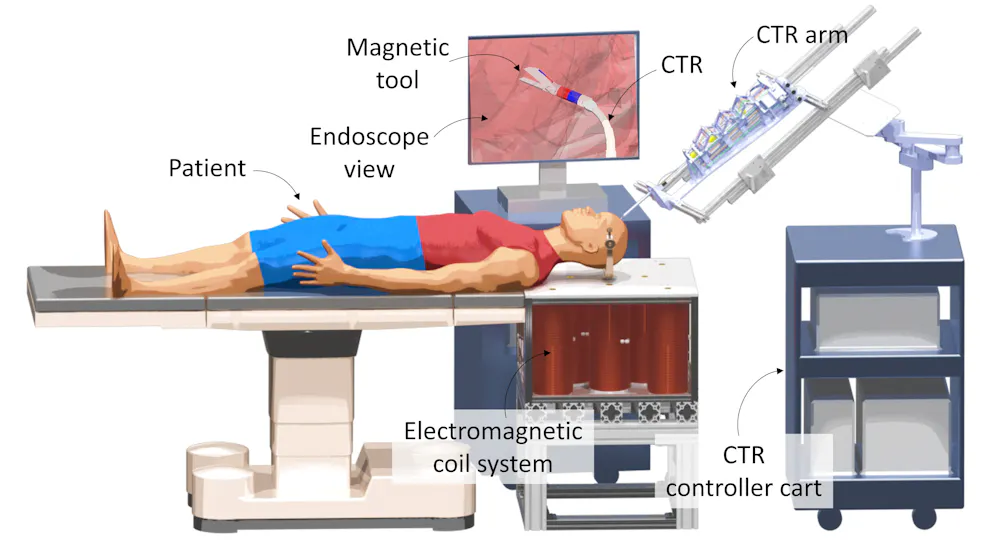
    The new robotic system consists of two parts. The first is the tiny tools themselves: a gripper, a scalpel and a set of forceps. The second part is what we call a “coil table”, which is a surgical table with several electromagnetic coils embedded inside.

    In this design, the patient would be positioned with their head on top of the embedded coils, and the robotic tools would be inserted into the brain via a small incision.

    Patients would lie on a ‘coil table’ containing magnets which are used to control the surgical tools.
    Changyan He

    By altering the amount of electricity flowing into the coils, we can manipulate the magnetic fields, causing the tools to grip, pull or cut tissue as desired.

    In open brain surgery, the surgeon relies on their own dexterous wrist to pivot the tools and tilt their tips to access hard-to-reach areas, such as removing a tumour inside the central cavity of the brain. Unlike other tools, our robotic neurosurgical tools can mimic this with “wristed” movements.

    Surprising precision

    We tested the tools in pre-clinical trials where we simulated the mechanical properties of the brain tissue they would need to work with. In some tests, we used pieces of tofu and raspberry placed inside a model of the brain.

    We compared the performance of these magnetically operated tools with that of standard tools handled by trained surgeons.

    We found the cuts made with the magnetic scalpel were consistent and narrow, with an average width of 0.3–0.4mm. That was even more precise than those from traditional hand tools, which ranged from 0.6 to 2.1mm.

    The magnetic scalpel, shown slicing some tofu inside a model of the brain, can make cuts more precise than those done with traditional tools.
    Changyan He

    As for the grippers, they could pick up the target 76% of the time.

    The magnetic grippers (shown here picking up some raspberry) were successful 76% of the time.
    Changyan He

    From the lab to the operating room

    We were surprised by how well the robotic tools performed. However, there is still a long way to go until this technology could help patients. It can take years, even decades, to develop medical devices, especially surgical robots.

    This study is part of a broader project based on years of work led by Eric Diller from the University of Toronto, an expert on magnet-driven micro-robots.

    Now, the team wants to make sure the robotic arm and magnetic system can fit comfortably in a hospital operating room. The team also wants to make it compatible with imaging systems such as fluoroscopy, which uses x-rays.
    After that, the tools may be ready for clinical trials.

    We’re excited about the potential for a new era of minimally invasive neurosurgical tools.

    Changyan He does not work for, consult, own shares in or receive funding from any company or organisation that would benefit from this article, and has disclosed no relevant affiliations beyond their academic appointment.

    ref. Tiny robot tools powered by magnets could one day do brain surgery without cutting open the skull – https://theconversation.com/tiny-robot-tools-powered-by-magnets-could-one-day-do-brain-surgery-without-cutting-open-the-skull-253042

    MIL OSI AnalysisEveningReport.nz

  • MIL-OSI NGOs: Yemen faces economic freefall and devastating aid crisis after a decade of conflict – Oxfam

    Source: Oxfam –

    A decade after a Saudi-led coalition intervened to restore the internationally recognized government of Yemen to power, the country remains deeply divided, facing economic freefall and a devastating humanitarian crisis, Oxfam said today. 

    Competing financial policies in the North and the South have caused economic collapse. Violations of human rights, the detention of humanitarian workers, and unacceptable conditions on aid imposed by the authorities in Sana’a have exacerbated suffering.  

    In the South, despite strong international support, the internationally recognized government has failed to provide basic services or stabilise the currency. Over the last 10 years, the Yemeni rial has depreciated by more than 90 per cent in government-controlled areas – pushing basics like food, water, and health care out of reach for most Yemenis. This inflation is only worsening – the rial lost 30 per cent of its value in February alone. 

    In the North, the Houthis have made it increasingly difficult and dangerous for the humanitarian community to operate and provide vital food, cash and other assistance. Their arbitrary and unlawful detention of Yemeni humanitarian workers and members of civil society has worsened the already difficult operating environment. Authorities should release all unlawfully held detainees, including Oxfam staff. 

    The environment of restriction and fear imposed by the Houthis, coupled with the US government’s freeze of foreign assistance funding and imposition of heightened legal risks, have caused many humanitarian organisations to wind down their operations, leaving millions of people without the means to survive and without access to education and health services. Families are facing higher prices and reduced humanitarian assistance. 

    “The last decade has been devastating for Yemenis, and we’ll only see these deadly consequences compounded without urgent action from authorities and the international community to allow the economy and the aid community to operate.” 

    Pauline Chetcuti, Head of Humanitarian Advocacy and Campaigns

    Oxfam International

    Pauline Chetcuti, Oxfam International’s Head of Humanitarian Advocacy and Campaigns said: 

     “Yemenis deserve – and have the right – to live in safety, have access to food, water, health care and to lead on a path towards a peaceful future.   

    “The last decade has been devastating for Yemenis, and we’ll only see these deadly consequences compounded without urgent action from authorities and the international community to allow the economy and the aid community to operate.” 

    Education and healthcare services have been decimated, leaving millions without critically needed support, and civil servants without salaries. Health facilities across the country have been significantly impacted by the conflict; just 40 per cent are now only partially functioning or completely out of service due to shortages of staff, funds, electricity, medicines, and equipment. 

    The war has destroyed much of Yemen’s critical infrastructure – the roads, bridges, markets, hospitals, schools, and private factories that powered Yemen’s economy. Though the frontlines have largely been frozen since the ceasefire in April 2022, competing monetary policies and the absence of a full political settlement have left more than 17 million people – nearly half of Yemen’s population – food insecure.  

    Yemeni families are facing higher prices and reduced humanitarian assistance stemming from the US government’s designation of the Houthis as a Foreign Terrorist Organization. The designation creates significant obstacles to life-saving humanitarian assistance and commercial imports of food and medicine. It also adds a barrier to the vital flow of remittances from Yemenis abroad to their families, which account for approximately a fifth of Yemen’s GDP; a vital part of Yemen’s social safety net. Yemenis need to see an end to the Houthis’ rights violations and international attacks, but this designation is unlikely to make that happen. Governments should support international accountability mechanisms for all parties to the conflict – and not penalise Yemeni families by cutting off lifesaving aid. 

    The decade of conflict has killed over 19,000 people and displaced nearly five million people, disproportionately women and children. These figures will only grow as more legal and security barriers are placed on the economy and the aid community.  

    Chetcuti said: “Regional and global powers should collaborate to support a genuine peace instead of supporting aligned factions and furthering their narrow political interests. Only through a Yemeni-led political process that includes women, youth, and civil society can Yemenis emerge from crisis and enjoy basic peace and security.” 

    MIL OSI NGO

  • MIL-Evening Report: Every 3 years, we play the election date waiting game. Are fixed terms the solution?

    Source: The Conversation (Au and NZ) – By Jill Sheppard, Senior Lecturer, School of Politics and International Relations, Australian National University

    With another election campaign unofficially underway, voters may feel it hasn’t been long since they were last at the voting booth.

    Australia’s Constitution dictates:

    every House of Representatives shall continue for three years from the first meeting of the House, and no longer, but may be sooner dissolved by the Governor-General.

    This allows the sitting government to call an election sooner than three years after taking office, but recent norms are for governments to use the full term length available to them.

    But how do politicians and the public feel about this format, and could this change anytime soon?

    Early elections

    In 1998, the John Howard Liberal government called an early election seeking voters’ support for its ambitious plans to introduce a goods and service tax. It came very close to defeat, but clawed its way to victory and nine more years of power.

    In 2016, the Malcolm Turnbull Liberal government took a similar punt, calling an early double dissolution election ostensibly on the issue of union corruption. Again, it came very close to defeat but clawed its way to victory (and six more years of power).

    Despite their reasons for calling early elections, both Howard and Turnbull faced declining global economic conditions and arguably moved tactically to avoid campaigning in the worst of the headwinds.

    Most governments have less appetite for capitalising on external events – like interest rate cuts – when calling an election. Voters already largely distrust politicians, and cynical early elections will only confirm their beliefs.

    Fixed versus non-fixed parliamentary terms

    The ability of a government to unilaterally decide the election date is unusual.

    The political systems most similar to Australia – New Zealand, Canada, the United Kingdom, the United States – all have fixed election dates. Australian states and territories have also increasingly moved to fixed dates, where the government of the day has no discretion over election timing.

    As prime minister, Julia Gillard effectively relinquished her right to manipulate the 2013 election date in her favour. She announced it more than seven months ahead of time. Her government lost the subsequent election.

    Unsurprisingly, there is little political will to move to fixed dates for federal elections. Only current Special Minister of State Don Farrell has expressed even passing support for the idea (and then, only if voters were clearly in favour).

    Fixed terms would undoubtedly benefit voters, who could plan their calendars well in advance. They would also benefit non-government parties and independent candidates, who could budget and plan campaigns around a known election date.

    Who wants longer terms?

    Prime Minister Anthony Albanese supports four-year terms, reflecting long-term Labor Party policy.

    The Liberal Party has generally been more ambivalent. Howard was supportive but “not mad keen” in 2005 and supportive, but resigned to failure in 2024.

    Current leader Peter Dutton also backs longer terms, but observes that, among voters, “generally, there is a reluctance to do anything that makes the life of a politician easier”.

    Beyond voters’ reluctance to grant a one-year extension to politicians’ tenure, the issue of senate term lengths is an obstacle to reform.

    Current tradition sets senate terms twice the length of House of Representatives terms, however, Penny Wong has argued that eight-year terms are too long.

    Both New South Wales and South Australia have experience with eight-year terms in their upper houses, but no other states have yet followed.

    How could (and will) terms be changed?

    Any change to federal parliamentary terms would require a successful referendum. The question has been put to Australians once before, in 1988. Only 33% of voters supported the proposal, and no state achieved majority support.

    Polling from April 2024 finds only 38% support, with 18% unsure. Independent and minor party voters – the fastest growing group in Australian politics – were also the most strongly opposed to longer terms.

    As Dutton noted, voters have been reluctant to support “politician-friendly” referendums in the past. There seems almost no chance the 48th parliament would consider a referendum on the issue.

    Would 4-year terms make politics better?

    David Coleman, recently promoted to the Liberal Party’s frontbench, has confidently declared “businesses and consumers tend to hold off on investment during election periods and the phoney war that precedes them”, and so longer terms would improve the domestic economy.

    The business sector seems to agree.

    Are they right? And what about non-economic outcomes?

    Academic research backs up the assumption governments are less likely to announce major tax reforms in the months leading into an election. Shorter terms might also make governments less likely to introduce austerity (strict cost-cutting) measures.

    The weight of academic evidence suggests that whichever party is in power matters far more than the length of the electoral cycle.

    Researchers have struggled to find differences in how politicians with longer terms (usually four years) behave from those with shorter terms (usually two years). Activity levels for the shorter-term politicians appear slightly more frenetic – more fundraising and expenditure, more campaigning – but the outcomes are similar.

    Longer terms do not seem destined to fix Australia’s political malaise.

    Jill Sheppard receives funding from the Australian Research Council.

    ref. Every 3 years, we play the election date waiting game. Are fixed terms the solution? – https://theconversation.com/every-3-years-we-play-the-election-date-waiting-game-are-fixed-terms-the-solution-250273

    MIL OSI AnalysisEveningReport.nz

  • MIL-OSI USA: Department of Human Services, IUP Announce Collaboration to Train Future Physicians in Clinical Setting at Torrance State Hospital, Helping to Address Urgent Need for Rural Health Care Workers

    Source: US State of Pennsylvania

    March 25, 2025Torrance, PA

    Department of Human Services, IUP Announce Collaboration to Train Future Physicians in Clinical Setting at Torrance State Hospital, Helping to Address Urgent Need for Rural Health Care Workers

    DHS Secretary Dr. Val Arkoosh today joined leadership from the Indiana University of Pennsylvania (IUP) to announce the signing of a clinical training affiliation agreement for students at IUP’s proposed College of Osteopathic Medicine at Torrance State Hospital. This partnership with IUP will educate and train future osteopathic physicians in a clinical setting at Torrance State Hospital while also addressing the urgent need for health care professionals in rural and underserved communities.

    “I began my career practicing medicine in teaching hospitals in Philadelphia, and I saw firsthand how vital hands-on clinical experience in a real hospital environment was to the medical professionals in training,” said Secretary Arkoosh. “It is our hope that this partnership with IUP will give students the skills they need to promote individuals’ health and wellbeing while contributing to their communities’ health and investing in their future careers. I’m grateful for the work staff at Torrance do every day to support Pennsylvanians, and this partnership with IUP will be a vital part of the rural health solution.”

    Speaker list:
    Phil Mader, Director of State Hospital Operations,
    Stacey Keilman, Chief Executive Officer, Torrance State Hospital
    Dr. Michael Driscoll, President, Indiana University of Pennsylvania
    Secretary Valerie Arkoosh, Department of Human Services
    Jonathan Longwill, District Director for Senator Joe Pittman
    Dr. Daleep Rathore, Interim Chief Medical Officer, Department of Human Services
    Dr. Ryan Smith, Founding Associate Dean of Clinical Affairs, IUP Proposed College of Osteopathic Medicine
    Dr. Miko Rose, Founding Dean, IUP Proposed College of Osteopathic Medicine

    MIL OSI USA News

  • MIL-OSI Global: Electric cars are going mainstream – Elon Musk won’t change that

    Source: The Conversation – UK – By Jack Marley, Environment + Energy Editor, UK edition

    “When you ride Tesla, you ride with Hitler” according to a reworked second world war propaganda poster that was discovered in Oakland, California last month.

    When did an electric car brand supposedly become associated with the far right? Perhaps when its CEO, Elon Musk, embraced Donald Trump and the Maga movement that propelled him to a second term as US president. Tesla dealerships have been targets for protests and vandalism, while the company’s sales and stock price have fallen recently.

    “But those same political controversies may ironically help broaden the mass market appeal of electric vehicles,” says Hannah Budnitz, a research associate at the Transport Studies Unit of Oxford University.

    “This is an industry that needs to go beyond the early adopter tech bros – and now might be the moment.”


    This roundup of The Conversation’s climate coverage comes from our award-winning weekly climate action newsletter. Every Wednesday, The Conversation’s environment editor writes Imagine, a short email that goes a little deeper into just one climate issue. Join the 40,000+ readers who’ve subscribed.


    But first, a disclaimer

    Around a fifth of the greenhouse gas emissions heating Earth can be traced to a vehicle exhaust pipe. The more combustion engines that can be replaced with electric batteries, the less getting from A to B will exacerbate climate change.

    However, electric cars, like those sold by Tesla, are an imperfect solution to the climate crisis.

    “Huge amounts of land which could otherwise be used to house people or be dedicated to nature are still reserved for roads and car parks,” says Vera O’Riordan, an energy policy researcher at University College Cork.


    Read more:
    Electric cars aren’t enough to hit climate targets: we need to develop better public transport too


    And while driving an EV doesn’t emit CO₂, it does emit stuff you wouldn’t want to breathe in. Electric cars, which contain heavy batteries, wear down their tyres faster than conventional cars and generate more microplastic particles in the process, according to Henry Obanya, an ecotoxicologist at the University of Portsmouth.

    Obanya estimates that as much as a quarter of all microplastics in the environment could have come from car tyres.


    Read more:
    Car tyres shed a quarter of all microplastics in the environment – urgent action is needed


    So, the strategy of putting an EV in every garage has its limits (not least the fact that not everyone has a garage, or the space to charge an electric car).

    A more efficient way to decarbonise the second-largest emission source by sector (power generation is first) would be to follow the advice of the Intergovernmental Panel on Climate Change. The IPCC, which is made up of scientists and other experts convened by the UN, recommends that countries plan their transport systems according to the maxim “avoid, shift, improve”.

    This involves, O’Riordan explains, avoiding unnecessary journeys by designing towns and cities with amenities in walking distance, shifting passengers onto higher-occupancy vehicles like buses by expanding public transport and improving all travel options by switching from fossil fuels to electric propulsion.

    Let’s assume that decades of car-first urban planning have boxed us in and we don’t have time to undo it before the climate is cooked. How can more motorists be persuaded to turn in their gas-guzzler for a battery-powered model?

    It’s the price, stupid

    Back to Budnitz – and the waning influence of the EV industry’s tech-bro boosters.

    “In 2010, when Tesla became the first American carmaker to go public since Ford in 1956, fully electric cars were still a niche technology,” she says.


    Read more:
    Why the Tesla backlash could help electric cars finally go mainstream


    Back then, Tesla adverts targeted the customers it thought would be early adopters: overwhelmingly, wealthy men like Musk. It worked. Survey after survey in North America and Europe showed that EV ownership in the early 2010s was skewed towards men and those on higher incomes.

    This is in stark contrast to electric car marketing at the dawn of motoring. In 1900, petroleum-powered cars were in the minority (22% of all cars) and were widely considered temperamental “adventure machines” that were prone to breaking down. Electric cars were pitched as a safer, cleaner alternative that was perfect for city travel.


    Read more:
    Electric cars were once marketed as ‘women’s cars’. Did this hold back their development over the next century?


    Perfect, in fact, for wealthy women. During the 1910s, when Victorian attitudes towards gender roles reigned and women were presumed to have limited mobility needs (no need to worry about your battery running flat if you’re not going far), 77% of EVs directly appealed to female consumers.

    “In the short term, this was a successful strategy: car manufacturers that advertised to female consumers survived much longer,” says economic historian Josef Taalbi (Lund University). The only major electric car producer in the US to survive into the 1920s advertised to women, he adds.

    In 2013, there were still less than 60,000 EVs on the road globally. A decade later, almost the same number are sold every day.

    “The transition to electric personal mobility is well underway around the world,” says Budnitz. “Tesla’s troubles won’t stop this – but they can give the car industry an opportunity to make the messaging around electric vehicles more diverse, equitable and inclusive for the mass market.”

    EV manufacturers can make their case to all drivers because they now offer a mass-market product, Budnitz argues. Nowhere is this more true than in Norway, which may become the first country to sell only zero-emission vehicles this year (88.9% of all vehicles sold in Norway in 2024 were fully-electric).

    What’s Norway’s secret?

    “Generous, comprehensive subsidies”, say Agnieszka Stefaniec and Keyvan Hosseini, transport researchers at the University of Southampton.


    Read more:
    How smaller, more affordable electric cars can accelerate the green transition


    “Our recent research shows that affordability is a tool to get everyone on board. When lower-income households face affordability barriers, it’s not just their problem – it’s the missing link to achieving 100%. Smaller, more affordable electric cars could be the game changer needed to bridge this gap.”

    ref. Electric cars are going mainstream – Elon Musk won’t change that – https://theconversation.com/electric-cars-are-going-mainstream-elon-musk-wont-change-that-253060

    MIL OSI – Global Reports

  • MIL-OSI USA: Warren Statement on Arrest of Tufts Student

    US Senate News:

    Source: United States Senator for Massachusetts – Elizabeth Warren

    March 26, 2025

    Washington, D.C. – Following reports that U.S. Department of Homeland Security agents detained an international student in a graduate program at Tufts University, U.S. Senator Elizabeth Warren (D-Mass.) released the following statement:

    “This arrest is the latest in an alarming pattern to stifle civil liberties. The Trump administration is targeting students with legal status and ripping people out of their communities without due process. This is an attack on our Constitution and basic freedoms — and we will push back.”

    MIL OSI USA News

  • MIL-OSI USA: Boozman Leads Bipartisan Bills to Address Doctor Shortage in Rural Areas

    US Senate News:

    Source: United States Senator for Arkansas – John Boozman

    WASHINGTON––U.S. Senator John Boozman (R-AR) is continuing his efforts to increase access to reliable, quality health care for Arkansans by championing legislation that supports and attracts the next generation of doctors and medical professionals to The Natural State.

    Boozman and Senator Jacky Rosen (D-NV) recently introduced the Resident Education Deferred Interest (REDI) Act to ease financial burdens on medical professionals completing their medical training, and the Physicians for Underserved Areas Act to increase available medical residency spots and prioritize placement in rural and underserved areas. 

    Nationwide, the U.S. faces a projected shortage between 37,800 and 124,000 physicians by 2034 according to the Association of American Medical Colleges. More than 500,000 Arkansans live in an area defined by the federal government as lacking the adequate number of health professionals to serve the population. 

    “Addressing the shortage of medical professionals is a necessary step in ensuring Arkansans are able to access affordable and reliable health care no matter where they live,” said Boozman. “These bipartisan bills are practical efforts to encourage students to pursue careers in medicine by helping mitigate some of the financial barriers and burdens associated with internship and residency requirements while also ensuring more medical school graduates train and go on to practice in the communities that desperately need them.”

    Boozman and Rosen’s Resident Education Deferred Interest (REDI) Act would help alleviate the health care provider shortage by allowing medical professionals to defer their student loan payments without accruing interest until the completion of their respective residency or internship programs. This deferment will decrease the financial burden for future doctors, dentists and other medical providers who face a median medical debt of over $200,000 upon graduation.

    The senators also introduced the Physicians for Underserved Areas Act to redistribute available residency slots in a manner that prioritizes areas experiencing physician shortages. Medical professionals are more likely to practice medicine where they completed their residencies, and opening more opportunities in rural communities is a strong step forward to ensure Arkansans have access to reliable health care.

    MIL OSI USA News

  • MIL-OSI USA: News Briefs: February-March 2025

    Source: US Geological Survey

    News Briefs – featuring coastal and ocean science from across the USGS.

    Check out recent news highlights below!

    Connect with us on Social Media

    Check out other coastal and marine news

    Get Our News

    These items are in the RSS feed format (Really Simple Syndication) based on categories such as topics, locations, and more. You can install and RSS reader browser extension, software, or use a third-party service to receive immediate news updates depending on the feed that you have added. If you click the feed links below, they may look strange because they are simply XML code. An RSS reader can easily read this code and push out a notification to you when something new is posted to our site.

    MIL OSI USA News

  • MIL-OSI Global: Donald Trump’s ‘chilling effect’ on free speech and dissent is threatening US democracy

    Source: The Conversation – UK – By Dafydd Townley, Teaching Fellow in US politics and international security, University of Portsmouth

    The second Donald Trump administration has already sent shockwaves through the political establishment on both sides of the Atlantic. Overseas, the focus has been on the administration’s apparent dismantling of the post-war international order and Trump’s apparent pivot away from America’s traditional allies towards a warmer relationship with Russia and Vladimir Putin. But within the United States itself, the greatest concerns are associated with administration actions that, for many, suggest a deliberate destruction of American democracy.

    Such fears in the US are not isolated to the political elites, but are shared by citizens across the entire nation. But what is also emerging is a concerted assault on people’s ability to push back – or even complain – about some of the measures being introduced by Trump 2.0. This will inevitably result in what is often called a “chilling effect”, where it becomes too hard – or too dangerous – to voice dissent.

    Many of Trump’s policies – the mass deportations, the wholesale sacking of public servants by Elon Musk and his Department of Government Efficiency (Doge), the decision to revoke birthright citizenship for the children of undocumented immigrants – have been challenged in the courts. The Trump administration is now embroiled in a range of legal challenges. It is here that Trump’s disdain for a legal system that has temporarily blocked the wishes of the president has emerged.

    Chilling effect

    Judicial decisions calling for the administration to reverse or pause some of these policies have been greeted by Trump and some of his senior colleagues (including Musk and the vice-president J.D.Vance), with noisy complaints at judicial interference in government. Even, in some cases, calls for the impeachment of judges who rule against the government.

    Not only did the administration ignore the court’s ruling that suspended the forced expulsion of Venezuelans to El Salvador, some of whom were in the US legally, but Trump attacked the judge on social media calling him a corrupt “radical left lunatic” and called for his impeachment.

    This stirred the chief justice of the Supreme Court, John Glover Roberts Jr., to intervene. He reminded the president that America doesn’t settle its disputes, saying that the “normal appellate review process exists for that purpose”. Later, Tom Homan, Trump’s chief adviser on immigration issues, told ABC News that the administration would abide by court rulings on the matter.

    The pressure being brought to bear on America’s legal system has not stopped at the judiciary. Trump has recently targeted some of America’s biggest and most powerful law firms, seemingly for no other reason than their acting for clients who have opposed his administration.

    On March 25, Trump signed an executive order targeting Jenner & Block, one of whose partners, Andrew Weissmann, worked with special prosecutor Robert Mueller on the investigation into Russian meddling in the 2016 presidential election. The executive order calls for the firms to be blacklisted from government work and for their employees to have any security clearances removed, for them to be barred from any federal government contracts and refused access to federal government buildings. A death warrant for the firm in other words.


    Sign up to receive our weekly World Affairs Briefing newsletter from The Conversation UK. Every Thursday we’ll bring you expert analysis of the big stories in international relations.


    This follows the news that the head of the prestigious law firm Paul Weiss, Brad Karp, had signed a deal with the White House committing to providing millions of dollars worth of pro-bono legal work for causes nominated by the president. He’s also agreed to stop using diversity, equity and inclusion (DEI) policies, which had been faced with a similar fate.

    Silencing dissent

    This administration’s chilling effect has also extended to an attack on press freedom. Trump has expelled established news organisations from the Pentagon, curtailed access to press events for the esteemed Associated Press, and taken control of the White House press pool, sidelining major media outlets.

    These actions mark a significant downgrading of press freedom in America. They are undermining the role of independent journalism in their key function of holding power to account. By restricting access and silencing critical voices, his administration has raised concerns over transparency and the free flow of information in the domestic media landscapes.

    Universities have traditionally been bastions of independent thought. We saw that with the massive protests against US policy towards Israel and Palestine which have roiled campuses during the conflict in Gaza. But universities are also seen by many in the administration as a hotbed of “woke” activism. Accordingly Trump 2.0 has fixed its sights on one of the most prominent US universities: Columbia.

    Citing what it says is a repeated failure to protect students from antisemitic harassment, the administration cancelled US$400m (£310 million) of federal contracts with the university. Columbia caved in to the pressure moments before the administration’s deadline passed. It agreed to overhaul its disciplinary procedures and “review” its regional studies programmes, starting with those covering the Middle East.

    Columbia’s academic staff are horrified. They are launching legal action against the government, alleging that “the Trump administration is coercing Columbia University to do its bidding and regulate speech and expression on campus”.

    Democracy in peril

    Why is this all so worrying? The legal system, the media and universities are the pillars of US democratic freedoms. The Trump administration’s undermining of these institutions is a blatant attempt to impose an authoritarian rule by bypassing any counterbalance to executive power. And the US Supreme Court has ruled that he is almost entirely immune from prosecution while doing it.

    The checks and balances system of government in the US was designed to ensure that no single branch could dominate the political process. But partisan loyalty, and loyalty to Trump over the party, now outweighs constitutional responsibility for the majority of those within the Republican Party.

    American democracy is under threat. Not from the external existential threats it faced over the past century such as communism and Islamic fundamentalism, but from within its own system. Those Americans who are terrified about this threat are trying to fight back, but Trump’s assault on dissent is so chilling that this is becoming increasingly dangerous.

    Dafydd Townley does not work for, consult, own shares in or receive funding from any company or organisation that would benefit from this article, and has disclosed no relevant affiliations beyond their academic appointment.

    ref. Donald Trump’s ‘chilling effect’ on free speech and dissent is threatening US democracy – https://theconversation.com/donald-trumps-chilling-effect-on-free-speech-and-dissent-is-threatening-us-democracy-253139

    MIL OSI – Global Reports

  • MIL-OSI Global: How two recent productions of Oedipus offer different meanings through the role of the chorus

    Source: The Conversation – UK – By Will Shüler, Vice-Dean of Education and Senior Lecturer, School of Performing and Digital Arts, Royal Holloway University of London

    The London theatre scene was all abuzz in January 2024 when two different star-studded West End productions of the ancient Greek tragedy Oedipus were announced within minutes of each other.

    The first production of the Sophocles tragedy, adapted and directed by Robert Icke and starring Mark Strong and Leslie Manville, ran from October 2024 to January 2025, with a Broadway transfer to New York’s Roundabout Theatre Company planned for this autumn.

    The second – which closes at the end of this month – opened weeks later at the Old Vic in a version by Ella Hickson, co-directed by Hofesh Shechter and Matthew Warchus, and starring Rami Malek and Indira Varma.

    Historically, ancient Greek tragedies were retellings of ancient myths, performed in ways that encouraged the audience to reflect upon an old story in a new way. Two London productions of Oedipus might seem like overkill, but they actually demonstrate the versatility of the tragic form.


    Looking for something good? Cut through the noise with a carefully curated selection of the latest releases, live events and exhibitions, straight to your inbox every fortnight, on Fridays. Sign up here.


    Both productions rework the myth, allowing contemporary audiences to consider different perspectives on the play’s themes of power and knowledge.

    One of the defining aspects of the ancient Greek tragedy is the chorus. Originally they performed in the orchestra of an ancient theatre – the space between the actors and the audience. Their performance of odes was in song and dance form, and the content might reflect upon the play’s events from their perspective, provide background that was either directly or indirectly related to the plot, or spur on the action of the play.

    In Oedipus, the chorus is comprised of citizens of Thebes. The city is suffering from a terrible curse and Oedipus, the king, takes it upon himself to rectify this by following the advice of the gods to discover and punish the murderer of the previous king, Laius.

    The chorus first enters singing – and dancing – about the disasters the people have been facing and prays for their end. For the rest of the play, from the foot of the palace, the chorus observes Oedipus’s investigation, horrific discovery and the piteous aftermath for his family.

    The treatment of the role of the chorus in these two West End productions are essential to the different meanings they make and how they invite audiences to reflect upon the myth in relation to our own world.

    In the Icke adaptation, Oedipus is with his family (wife Jocasta, mother Merope, brother-in-law Creon and three adult children Antigone, Polynices and Eteocles) at his campaign headquarters on the evening of the election.

    In this version the challenge the city faces is governmental corruption. Icke has included more family members than are in Sophocles’s original text and cut the role of the chorus entirely. Its exclusion means the governmental corruption is seen almost entirely from the point of view of this political family.

    The only perspective we get from the citizens is an opening video sequence as Oedipus is interviewed by the press, and the frequent election result updates. The people elect Oedipus. They want what he promises – an end of governmental corruption.

    Icke’s Oedipus strives to do the right thing and break from the string of corrupt, deceitful, narcissistic politicians who have been plaguing the city. The play thereby draws contemporary connections to “draining the swamp” and the “fake news” accusations of Donald Trump.

    Without reflections from the people (the chorus), the play becomes a personal drama about the family’s interests and public image. Oedipus and Jocasta’s grisly ends are entirely about their personal horror at the discovery they have made – that she is actually his mother.

    There is no reflection on how the play’s ending relates to the ongoing trouble faced by the citizens. In this version of events the final impression feels pessimistic – even when leaders try to do the right thing, the system ensures that they will fail.

    In the Old Vic production, the play is set in a Thebes that is suffering from extreme drought (likely alluding to the climate crisis). In Hickson’s adaptation, the chorus remains, but their words have been removed. Only their dance is performed between the scenes of the actors.

    This is not to say that the Sophocles text has been “translated” into movement by Shechter, but rather that the historic function of the chorus (to contemplate, to reflect, to spur on) remains by means of what is communicated in dance – which, according to the Guardian’s theatre critic David Jays becomes “the irresistible core of the tragedy”.

    In the play’s script, each scene ends with the deceptively simple word: “dance”. In performance, Oedipus’ investigation into what is causing the drought, contemplation of prophecies and public speeches to the people of Thebes are all interspersed with Shechter’s evocative choreography. We see their suffering, we see their prayers, we see their perseverance. Their needs never fade into the background but remain the consistent pulse of the play.

    In this version, when Oedipus has his moment of revelation, the rain comes and the people dance in it. This moment imparts impressions of renewed faith, solidarity, fruitfulness, pride, rebirth and life continuing.

    Oedipus enters having blinded himself, not out of personal horror, but in order to cleanse the city and ensure its continued godly favour. In contrast to the Icke production, Schechter and Warchus’s version – though still tragic – is ultimately hopeful.

    The leader has taken responsibility for what they have done and put the needs of the people over his own ambitions and desires. The last moment is not Oedipus’s. It is the chorus’s – and we watch them dance.

    Will Shüler does not work for, consult, own shares in or receive funding from any company or organisation that would benefit from this article, and has disclosed no relevant affiliations beyond their academic appointment.

    ref. How two recent productions of Oedipus offer different meanings through the role of the chorus – https://theconversation.com/how-two-recent-productions-of-oedipus-offer-different-meanings-through-the-role-of-the-chorus-252862

    MIL OSI – Global Reports

  • MIL-OSI USA: Senators Budd, Luján Introduce Bipartisan Bill to Provide Support for Families of Substance Abuse Victims

    US Senate News:

    Source: United States Senator Ted Budd (R-North Carolina)

    Washington, D.C.—U.S. Senators Ted Budd (R-N.C.) and Ben Ray Luján (D-N.M.) introduced the bipartisan Families Care Act today, directing the Administration for Community Living (ACL), under the U.S. Department of Health and Human Services, to provide peer support services for children, grandparents, and caregivers impacted by the opioid crisis.

    “The opioid crisis claims tens of thousands of lives every year, leaving families and caregivers to bear the heavy emotional and practical burdens of supporting children hurt by addiction. No family should be forced to walk this difficult path alone. That’s why Senator Luján and I introduced the Families Care Act, to guarantee that families have the support and resources they need to care for children while providing an opportunity for those who have faced similar life circumstances to share their experiences with others,” said Senator Budd.

    “I’m proud to reintroduce the Families Care Act with Senator Budd to support all of the caregivers who step in when substance use disorder tears families apart. Far too many grandparents and relatives become the primary caregiver when a substance use disorder overtakes their loved one. This legislation will help provide increased support through peer assistance and education, helping reduce caregiver stress and loneliness. By providing essential resources and fostering a supportive community, we can improve caregivers’ well-being and help them show up every day to care for the people they love,” said Senator Luján.

    Read the full bill text HERE.

    Background

    The legislation would require the ACL to provide peer support services through the National Family Caregiver Support Program (NFCSP).

    Senators Budd and Luján previously introduced this legislation in 2024, which was passed out of the Senate Health, Education, Labor, and Pensions (HELP) Committee as part of the Older Americans Act.

    MIL OSI USA News

  • MIL-OSI: PIMCO Names Janet Yellen and Raghuram Rajan to its Global Advisory Board (GAB); Gordon Brown Becomes Chair

    Source: GlobeNewswire (MIL-OSI)

    • Janet Yellen served as Treasury Secretary in the Biden Administration and Chair of the Federal Reserve from 2014 to 2018
    • Raghuram Rajan served as the Governor of the Reserve Bank of India and as Chief Economist at the International Monetary Fund
    • Gordon Brown, former UK Prime Minister, becomes Chair of the GAB
    • Ben Bernanke, former Chair of the Federal Reserve, retiring from role as Chair of PIMCO’s GAB after 10 years service
    • Mark Carney, Canadian Prime Minister, also recently stepped down from GAB

    NEWPORT BEACH, Calif., March 26, 2025 (GLOBE NEWSWIRE) — PIMCO, one of the world’s premier fixed income investment managers, announces the addition of Janet Yellen, former U.S. Secretary of the Treasury and Chair of the Federal Reserve, and Raghuram Rajan, former Governor of the Reserve Bank of India and Chief Economist at the International Monetary Fund, to its Global Advisory Board. The Board provides PIMCO with insights on global economic, political, and strategic developments and their relevance for financial markets.

    In addition, Gordon Brown, former UK Prime Minister (2007-2010) and Chancellor of the Exchequer (1997-2007), becomes Chair of the Board. Mr. Brown, who has been a member of PIMCO’s GAB since its founding in 2015, replaces Ben Bernanke, who is retiring after serving 10 years as Chair of the GAB. Mark Carney, Prime Minister of Canada, previously announced his resignation from PIMCO’s GAB in January, when he announced his candidacy for political office. He had served on the Board since 2020.

    Before serving as the 78th U.S. Secretary of the Treasury from 2021-2025, Secretary Yellen was Chair of the Board of Governors of the Federal Reserve from 2014 to 2018 and Vice Chair 2010 to 2014. Secretary Yellen has also held positions at Harvard University, the London School of Economics, and the University of California, Berkeley, where she is now professor emeritus. Her extensive contributions to economic policy and research have established her as a leading figure in the field.

    Dr. Raghuram Rajan’s career is distinguished by his influential roles in global economic institutions. He was the 23rd Governor of the Reserve Bank of India from 2013 to 2016 – where he implemented key reforms to stabilize the Indian economy – and was Chief Economist and Director of Research at the International Monetary Fund from 2003 to 2006. He is also a Professor of Finance at the University of Chicago Booth School of Business.

    “Secretary Yellen and Dr. Rajan’s deep expertise in economic policy make them remarkable additions to our Global Advisory Board,” said Emmanuel Roman, PIMCO’s Chief Executive Officer. “Their insights will be crucial for us as we continue to navigate the complexities of the global economy and assess their potential impact on markets for our clients.”

    “Understanding the complexities and impact of central bank policymaking, international governance and economic conditions on fast-moving markets are critical components of our investment strategy. Secretary Yellen and Dr. Rajan’s invaluable insights and experience, and Prime Minister Brown’s leadership as chair, will provide PIMCO clients with deep expertise and knowledge in assessing investment risk and opportunity,” said Dan Ivascyn, PIMCO’s Group Chief Investment Officer.

    “We also want to thank Chair Ben Bernanke and Prime Minister Carney for their leadership and valued perspectives over many years on the Global Advisory Board during their constant presence at our investment forums and in guidance to our Investment Committee. We will miss their thoughtful insights and wish them well,” said Mr. Roman.

    The Global Advisory Board consists of a diverse group of experts who provide strategic insights into global economic, political, and strategic developments. Secretary Yellen and Dr. Rajan will join Gordon Brown, Joshua Bolten, former White House Chief of Staff, and Michele Flournoy, U.S. defense policy advisor in two U.S. presidential administrations.

    Janet Yellen
    Janet L. Yellen served as 78th Secretary of the Treasury from 2021 through 2025. Previously, she was a Distinguished Fellow in Residence at the Hutchins Center on Fiscal and Monetary Policy at the Brookings Institution. She also served as Chairman of the Board of Governors of the Federal Reserve System from 2014 through February 2018, Vice Chair of the Board of Governors from 2010 to 2014 and president and chief executive officer of the Federal Reserve Bank of San Francisco from 2004 to 2010. Dr. Yellen previously served as a member of the Board of Governors of the Federal Reserve System from August 1994 through February 1997, whereupon she was appointed by President Bill Clinton to serve as chair of the Council of Economic Advisers, a post she held until August 1999. Dr. Yellen has written on a wide variety of macroeconomic issues, specializing in the causes, mechanisms, and implications of unemployment. She began her career as an assistant professor at Harvard University and then served as an economist with the Federal Reserve’s Board of Governors before joining the faculty of the London School of Economics in 1978. In 1980 she joined the faculty of the University of California at Berkeley, where she was named the Eugene E. and Catherine M. Trefethen Professor of Business and Professor of Economics, and where she is currently a professor emeritus. Dr. Yellen graduated from Brown University in 1967 and received her PhD in economics from Yale University in 1971. She received the Wilbur Cross Medal from Yale in 1997, honorary degrees from Brown, Bard College, NYU, the London School of Economics and Political Science, the University of Warwick, Yale, the University of Michigan and the University of Pennsylvania. She is a member of the Council on Foreign Relations and the American Academy of Arts and Sciences and has served as President of the American Economic Association and the Western Economic Association and a fellow of the Yale Corporation. She is a Distinguished Fellow of the American Economic Association.

    Raghuram Rajan

    Raghuram Rajan is the Katherine Dusak Miller Distinguished Service Professor of Finance at Chicago Booth. He was the 23rd Governor of the Reserve Bank of India between September 2013 and September 2016. Between 2003 and 2006, Dr. Rajan was the Chief Economist and Director of Research at the International Monetary Fund. Dr. Rajan’s research interests are in banking, corporate finance, and economic development. The books he has written include Breaking the Mold: Reimagining India’s Economic Future with Rohit Lamba, The Third Pillar: How the State and Markets hold the Community Behind 2019 which was a finalist for the Financial Times Business Book of the Year prize and Fault Lines: How Hidden Fractures Still Threaten the World Economy, for which he was awarded the Financial Times prize for Business Book of the Year in 2010. Dr. Rajan is a member of the Group of Thirty. He was the President of the American Finance Association in 2011 and is a member of the American Academy of Arts and Sciences. In January 2003, the American Finance Association awarded Dr. Rajan the inaugural Fischer Black Prize for the best finance researcher under the age of 40. The other awards he has received include the Infosys prize for the Economic Sciences in 2012, the Deutsche Bank Prize for Financial Economics in 2013, Euromoney Central Banker Governor of the Year 2014, and Banker Magazine (FT Group) Central Bank Governor of the Year 2016. Dr. Rajan is the Chairman of the Per Jacobsson Foundation, the senior economic advisor to BDT Capital, and a managing director at Andersen Tax.

    About PIMCO
    PIMCO is a global leader in active fixed income with deep expertise across public and private markets. We invest our clients’ capital across a range of fixed income and credit opportunities, drawing upon our decades of experience navigating complex debt markets. Our flexible capital base and deep relationships with issuers have helped us become one of the world’s largest providers of traditional and nontraditional solutions for companies that need financing and investors who seek strong risk-adjusted returns.

    Except for the historical information and discussions contained herein, statements contained in this news release constitute forward-looking statements within the meaning of the Private Securities Litigation Reform Act of 1995. These statements may involve a number of risks, uncertainties and other factors that could cause actual results to differ materially, including the performance of financial markets, the investment performance of PIMCO’s sponsored investment products and separately managed accounts, general economic conditions, future acquisitions, competitive conditions and government regulations, including changes in tax laws. Readers should carefully consider such factors. Further, such forward-looking statements speak only on the date at which such statements are made. PIMCO undertakes no obligation to update any forward-looking statements to reflect events or circumstances after the date of such statements.

    Contact:
    Michael Reid
    PIMCO – Media Relations
    Ph. 212-597-1301
    Email: Michael.Reid@pimco.com

    The MIL Network

  • MIL-OSI USA: Cassidy, Padilla Reintroduce Bill to Modernize Health Care System, Improve Access to Digital Health Services

    US Senate News:

    Source: United States Senator for Louisiana Bill Cassidy
    WASHINGTON – U.S. Senators Bill Cassidy, M.D. (R-LA) and Alex Padilla (D-CA) reintroduced the Health Accelerating Consumers’ Care by Expediting Self-Scheduling (ACCESS) Act to improve patients’ access to modernized health care, provide certainty for patients seeking digital health services, and protect patients’ personal health information.
    “It’s enough to struggle with an illness. Patients should have easy access to the care they need,” said Dr. Cassidy. “There are plenty of tools to provide affordable, quality care. As a doctor, I’m focused on using them.”
    “Every American deserves easy access to physical and mental health care,” said Senator Padilla. “As provider wait times increase, integrating digital health programs into our health care system is essential to efficiently administering care. We cannot let scheduling obstacles prevent Americans in crisis from receiving care when they need it most.”
    The COVID-19 pandemic accelerated the demand for digital health services and other innovative practices. Under current law, however, there is no distinction between illegal referral practices and scheduling services that reduce the barriers associated with accessing necessary and appropriate care. The Health ACCESS Act would adjust the Anti-Kickback Statute (AKS) to remove the regulatory ambiguity allowing digital health and appointment booking platforms to work together to better serve patients. Doing so ultimately improves access to care via user-friendly services, expands provider choice and scheduling availability, and enhances the overall health care experience and ecosystem.
    The Health ACCESS Act is supported by Advanced Dermatology and Cosmetic Surgery, Boston Medical Center, Brownsville Community Health Center (FQHC), California Children’s Hospital Association, California Hospital Association, Circle Medical, Chronic Care Policy Alliance, Corewell Health, Digital Health New York (DHNY), GoHealth Urgent Care, Grow Therapy, HANYS (Health Assoc of NYS), Healthcare Leadership Council (HLC), Housing Works Community Healthcare (FQHC), Illinois Hospital Association, Indiana University Health, Intermountain Health, LabFinder, Main Line Health, Manhattan Cardiology, Medical Offices of Manhattan, Memorial Hermann Health System, Octave, SohoMD, Spring Branch Community Health Center (FQHC), Stanford Children’s Hospital, and The Dermatology Specialists.

    MIL OSI USA News

  • MIL-OSI Global: Global population data is in crisis – here’s why that matters

    Source: The Conversation – UK – By Andrew J Tatem, WorldPop Director, Professor of Spatial Demography and Epidemiology, University of Southampton

    Arthimedes/Shutterstock

    Every day, decisions that affect our lives depend on knowing how many people live where. For example, how many vaccines are needed in a community, where polling stations should be placed for elections or who might be in danger as a hurricane approaches. The answers rely on population data.

    But counting people is getting harder.

    For centuries, census and household surveys have been the backbone of population knowledge. But we’ve just returned from the UN’s statistical commission meetings in New York, where experts reported that something alarming is happening to population data systems globally.

    Census response rates are declining in many countries, resulting in large margins of error. The 2020 US census undercounted America’s Latino population by more than three times the rate of the 2010 census. In Paraguay, the latest census revealed a population one-fifth smaller than previously thought.

    South Africa’s 2022 census post-enumeration survey revealed a likely undercount of more than 30%. According to the UN Economic Commission for Africa, undercounts and census delays due to COVID-19, conflict or financial limitations have resulted in an estimated one in three Africans not being counted in the 2020 census round.

    When people vanish from data, they vanish from policy. When certain groups are systematically undercounted – often minorities, rural communities or poorer people – they become invisible to policymakers. This translates directly into political underrepresentation and inadequate resource allocation.

    As the Brookings Institution, a US research organisation, has highlighted, undercounts have “cost communities of colour political representation over the next decade”.

    This is happening because several factors have converged. Trust in government institutions is eroding worldwide, with the Organisation for Economic Co-operation and Development (OECD) reporting that by late 2023, 44% of people across member countries had low or no trust in their national governments. Research shows a clear trend of declining trust specifically in representative institutions like parliaments and governments. This makes people less likely to respond to government-issued census requests.

    The COVID-19 pandemic created logistical nightmares for census takers. Many countries had to postpone their censuses. Budget cuts to statistical offices reduced capacity, while countries struggled with recruiting field staff.

    International funding for population data is also disappearing. The US-funded Demographic and Health Surveys program, which provided vital survey data across 90 countries for four decades, was terminated in February 2025. Unicef’s Multi-Indicator Cluster program, which carries out household surveys, faces an uncertain future amid shrinking global aid budgets. US government cuts to support for UN agencies and development banks undertaking census support will likely have further impacts.

    This is incredibly worrying to us as geography academics, because gathering accurate population data is fundamentally about making everyone visible. As population scientists Sabrina Juran and Arona Pistiner wrote, this information allows governments to plan for the future of a country and its people.

    The US census directly impacts the allocation of more than US$1.5 trillion (£1.2 trillion) in public resources each year. How can governments distribute healthcare funding without knowing who lives where? How can disaster response be effective if vulnerable populations are invisible in official population counts?

    Solutions that count

    Countries are adapting. The COVID-19 pandemic accelerated the transition to alternative census methodologies. Many countries turned to online questionnaires, telephone interviews and administrative data sources to reduce face-to-face interactions.

    The UN Economic Commission for Africa recommends that countries move from using paper forms for census data collection and embrace new digital technologies that can be cheaper and more reliable. Turkey’s switch in 2011 reduced census costs from US$48.3 million to US$13.9 million while improving data quality and timeliness, and nearly 80% of countries used tablets or smartphones for data collection in the 2020 round of censuses.

    Collecting census data digitally in Pakistan in 2023.
    Abdul Rauf Khan/Shutterstock

    At WorldPop, our research group at the University of Southampton, we’re also helping governments to develop solutions using new technologies. Buildings mapped from satellite imagery using AI, together with counts of populations from small areas, can help create detailed population estimates to support census implementation or provide estimates for undersurveyed areas.

    As we face growing challenges, from climate change to economic inequality, having accurate, reliable and robust population data isn’t a luxury. It’s essential for a functioning society. National statistical offices, UN agencies, academics, the private sector and donors must urgently focus on how to build cost-effective solutions to provide reliable and robust population data, especially in resource-poor settings where recent cuts will be felt hardest.

    When people disappear from the data, they risk disappearing from public policy too. Making everyone count starts with counting everyone.


    Don’t have time to read about climate change as much as you’d like?

    Get a weekly roundup in your inbox instead. Every Wednesday, The Conversation’s environment editor writes Imagine, a short email that goes a little deeper into just one climate issue. Join the 40,000+ readers who’ve subscribed so far.


    Andrew J Tatem works for the University of Southampton, and is Director of WorldPop. His research on mapping populations has been funded by donors such as the Gates Foundation, Wellcome Trust, GAVI.

    Jessica Espey works for the University of Southampton. Her research on data, statistics and evidence use has previously been funded by the William and Flora Hewlett Foundation, Gates Foundation and others.

    ref. Global population data is in crisis – here’s why that matters – https://theconversation.com/global-population-data-is-in-crisis-heres-why-that-matters-251751

    MIL OSI – Global Reports

  • MIL-OSI Global: Humans are bad at reading dogs’ emotions – but we can do learn to do better

    Source: The Conversation – UK – By Juliane Kaminski, Associate professor of comparative Psychology, University of Portsmouth

    Seregraff/Shutterstock

    A lot of dog owners believe that they can tell what their dogs are feeling. They believe that they can assess their dog’s emotions no matter the context.

    Yet newspapers frequently publish stories about dogs who attack “out of nowhere”, where owners claim there were “no signs” prior to the attack. A recent US study has found the answer may lie with humans – as it turns out, we’re not very good at interpreting dogs’ emotions.

    Previous research has shown that experience with dogs affects how successful people are in assessing a dog’s emotional state. As a psychologist, the more I know about dogs and the more I study and observe them, the better I become in assessing their behaviour. However, even experts can struggle to get it right.

    In the recent US study, researchers looked at how successful people are at assessing dogs’ emotions from looking at pictures. The images showed the dogs in different postures such as submissive or anxious. Sometimes the context around the dog was positive (for example, the owner approaching the dog with a lead) and sometimes the context around was negative (a person about to scold the dog).

    The study found that the context influenced whether people assessed the dog’s behavioural response as positive or negative even though the posture and other signals didn’t change.

    Research also suggests we have the tendency to misinterpret some facial expressions of dogs. A 2018 University of Lincoln study examined how children aged three to five years old and their parents interpret dogs’ facial expressions.

    Participants were shown pictures of dogs, for example showing bare teeth, which signals high levels of distress. The children especially misinterpreted that as a smiling and happy dog. The study also showed that interventions, which educated participants on how to interpret dogs’ behavioural signals, increased their understanding of dogs’ stress signals (though this was mostly true in the adults).

    We tend to anthropomorphise and attribute human emotions to our dogs. A good example of this is the so-called guilty look. You often see videos on social media in which a dog avoids eye contact with humans, for example turning its head slightly to the side.

    If this happens after the dog has done something they shouldn’t have, the owner may classify this as indicative of shame or guilt. In reality, dogs avoid eye contact as a kind of deescalation behaviour.
    It indicates that they do not want a confrontation. Perhaps the owner has already reacted to the mishap. Or the dog has learned to expect a reaction from the owner in certain situations. Insecure or fearful dogs also often avoid eye contact because they feel threatened or intimidated. However, this behaviour has little to do with shame.

    Another classic misconception is that a dog that wags its tail is a happy and friendly dog. In reality, a wagging tail only means that the dog is aroused. To assess the dog’s emotional state, you also have to consider the position of the tail. If it is standing upright, then this is more a sign of a tense dog. If it is positioned lower and the movement of the tail is relaxed and wide from left to right, then it is probably a friendly signal.

    We anthropomorphise dogs because we have evolved a human-specific way to interpret others’ emotions. If we see a person who pulls up the corners of their mouth and smiles, then we understand them to be happy or at least cheerful. That leads to problems if we apply that system to interpret other species’ emotional expressions.

    Could do with adding subhead here

    So how can we analyse dogs’ emotional expression in an objective way? One approach that scientists use is a technical method called DogFACS. In this method, each facial muscle is assigned a movement on the surface of the face. Facial movements are documented by numbers and analysed separately from each other.

    In 2013 University of Portsmouth researchers went to dog shelters across the UK and filmed dogs for two minutes each. They then analysed the dogs’ behaviour, including their facial expressions.

    The animal shelter told the researchers how long it took for the filmed dogs to be adopted by new owners. Neither barking nor wagging tails influenced the adoption rate, but only a specific eyebrow movement: the so-called puppy dog eyes look. The more often the dogs raised their eyebrows and produced the puppy dog eyes, the quicker they were rehomed. Nothing else had an effect. This could be because the puppy dog eyes resemble a facial movement that we produce when we are sad and makes us want to care for the dog.

    Could you resist those puppy dog eyes?
    SakSa/Shutterstock

    In fact my 2019 study showed that the facial muscle anatomy of dogs has evolved for facial communication with humans. My team compared the facial muscle anatomy of dogs and wolves and demonstrated that the facial muscles of dogs and wolves are identical – except for one muscle, the levator anguli oculi medialis. This muscle is responsible for the lifting of the inner eyebrow in dogs.

    We may not be much good at reading dogs’ emotions but as the University of Lincoln study shows, we can learn to be.

    Juliane Kaminski receives funding from ASAB.

    ref. Humans are bad at reading dogs’ emotions – but we can do learn to do better – https://theconversation.com/humans-are-bad-at-reading-dogs-emotions-but-we-can-do-learn-to-do-better-252773

    MIL OSI – Global Reports

  • MIL-OSI Global: Britons increasingly trust each other – but trust in politicians has slumped since the pandemic

    Source: The Conversation – UK – By Ben Seyd, Senior Lecturer in Politics, University of Kent

    ITS/Shutterstock

    One surprise in the early days of the pandemic was people’s increased willingness to trust political authorities. According to the British Social Attitudes survey (BSA), the proportion of people trusting government ministers rose from 15% in 2019 to 23% in 2020. Data from Ipsos MORI showed a similar bounce for trust in government ministers and politicians in 2021. Trust in government was also a significant factor in whether people complied with lockdown rules and other restrictions.

    Since then, however, people’s trust in government has plummeted. The latest BSA survey finds that, in 2023, just 14% of the population said they trust government “always” or “most of the time”. Fully 45% of the population trust government “almost never”. These are the most negative set of figures since the BSA began asking questions on trust almost four decades ago.

    This collapse in trust is perhaps unsurprising given the various government shenanigans over the past few years, notably Boris Johnson’s Downing Street lockdown parties and Liz Truss’s disastrous prime ministerial tenure. However, there is also evidence that Britons have become less trusting as a result of dashed expectations over the benefits of Brexit, negative views of government performance in areas like health, and cost of living pressures.

    Yet while Britons are less trusting of those with political authority, they appear to be more trusting in each other. Back in 1999, 29% of the population believed that “most people [in Britain] can be trusted”. Four decades on, that proportion has increased to 46%, topping the previous high of 43% in 1981. This might partly reflect the sense of collective endeavour and neighbourliness that was instilled during the pandemic, when we were encouraged to look out for, and help, other people. There is also evidence that, while people see the country as a whole as becoming more divided, at the local level perceptions of unity outweigh perceptions of division.

    This is a welcome shift, particularly since trust in other people is associated with a range of positive outcomes, including support for international cooperation and international organisations. In an uncertain and dangerous world, social trust may be an important factor shaping the willingness of states to work together.

    Wellbeing of politicians

    The decline of popular trust in government and politicians is concerning. Low trust is associated with support for populist politicians such as Donald Trump and upheavals like Brexit. Low trust could also significantly compromise public acceptance of, and compliance with, official messages and rules in a future pandemic.

    Distrust can also cause direct harm to public figures. As one of us (James) has shown, politicians are generally poor estimators of public trust in themselves. But where they do perceive widespread distrust, often because of repeated experiences of physical or online abuse and intimidation, this has a significant negative effect on their mental health and wellbeing.

    Messages of kindness and community around London during lockdown.
    Alex Yeung/Shutterstock

    Increased security around MPs – the cost of which jumped from £77,234.67 to £4,381,733.40 between 2014 and 2022 – is likely to protect them from the worst excesses of public distrust where it trickles over into extreme behaviour. Yet given the importance of contact for people’s trust, it could also inadvertently fuel more cynicism by increasing the physical distance between politicians and the public.

    The public’s declining regard for politicians and government should be a source of concern. We are hardly likely to recruit the calibre of politician we expect (and need), or indeed encourage a more diverse population of aspiring representatives, if the personal costs of holding elected office are so high.

    At the same time, a look at the bigger picture offers some reassurance. As one of us (Ben) has recently shown, there is little evidence that low trust induces popular scepticism towards democracy itself, or that it weakens public support for state spending or government programmes in key areas like healthcare.

    Trust on the frontline

    The nature and strength of Britain’s civic ties are revealed not only in our trust of politicians and institutions, but also in how we treat the people who provide public services, such as police officers and health workers.

    On the face of it, the picture is not pretty. Over the past few years, rates of public abuse towards frontline service providers have increased. In 2021, 18% of teachers reported having experienced verbal abuse from a parent or carer in the past year. In 2023, that figure had risen to 30%.

    A survey of police officers in 2022 found that 37% had experienced verbal insults at least once a week over the past year. This was an increase from the 29% of officers who reported a similar level of insults in 2020, although the figure dropped slightly in 2023 to 34%.

    Rates of physical abuse of London ambulance staff have more than doubled in four years, with 346 incidents recorded in 2019, increasing to 728 incidents in 2023. A similar picture of public abuse is found for frontline workers in the health service. Polling in 2023 found that 85% of GPs across the UK had received verbal abuse from members of the public during the past year. A 2021 survey by the British Medical Association found more than half of GPs, and one in five hospital doctors, had experienced verbal abuse in the past month.

    While majorities of the British public express trust in many frontline workers such as nurses and doctors (who currently attract 94% and 88% trust ratings), others appear to take a more negative view, extending even to abusive behaviour.

    Given the range of service providers facing such rising antipathy, it seems unlikely that the trigger for this was the pandemic. A better clue is provided by longer-term data on public treatment of doctors.

    Responses are to a survey question reading ‘In the last 12 months, have you personally experienced harassment, bullying or abuse at work from patients, their relatives or members of the public?’.
    Author provided, data from NHS Staff Survey

    NHS survey figures show that rates of abuse towards doctors declined between 2003 and 2011. (The wording of the relevant survey question changed in 2012, which restricts our ability to compare the more recent data). This was precisely the period when resources were pumped into the health service and public satisfaction with the NHS increased. This suggests that public interactions with frontline service workers like doctors are strongly shaped by the quality of the service they face.

    Indeed, GPs themselves ascribe the verbal abuse they and their staff experience to people’s dissatisfaction with the service, including discontent with access to health services. One underappreciated effect of austerity might thus be an increased public frustration with healthcare workers, which on occasion appears to extend to outright abuse.

    More accessible (read: better funded) public services might reduce some negativity towards frontline service workers. However, the important task of rebuilding people’s trust in politicians is – particularly given the negative coverage by much of Britain’s media – likely to be a trickier task.

    James Weinberg receives funding from the Economic and Social Research Council.

    Ben Seyd does not work for, consult, own shares in or receive funding from any company or organisation that would benefit from this article, and has disclosed no relevant affiliations beyond their academic appointment.

    ref. Britons increasingly trust each other – but trust in politicians has slumped since the pandemic – https://theconversation.com/britons-increasingly-trust-each-other-but-trust-in-politicians-has-slumped-since-the-pandemic-252762

    MIL OSI – Global Reports

  • MIL-OSI Global: Why eating yoghurt regularly could lower your risk of bowel cancer

    Source: The Conversation – UK – By Justin Stebbing, Professor of Biomedical Sciences, Anglia Ruskin University

    Josep Suria/Shutterstock

    Hard on the heels of impressive research findings that a glass of milk is good for reducing cancer risk, another recent study has highlighted the potential benefits of yoghurt consumption in lowering the risk of certain types of cancer – particularly colorectal cancer.

    The number of new colorectal cancer cases among people under 55 has doubled globally in recent years, with diagnoses increasing by nearly 20%. As a consultant oncologist, many people have asked me how their risk can be reduced.

    The emerging evidence suggests that regular yoghurt consumption may have a protective effect against certain aggressive forms of colorectal cancer by modifying the gut microbiome, the natural bacteria that live in the gut.

    The gut microbiome plays a crucial role in overall health, influencing digestion, immune function and even cancer risk. The gut bacteria can live inside cancer itself, and in general a healthy balance of these bacteria is thought to be essential for maintaining a strong immune system and preventing inflammation, which can contribute to cancer development.


    Read more:
    Gut bacteria nurture the immune system – for cancer patients, a diverse microbiome can protect against dangerous treatment complications


    Yoghurt contains live cultures of beneficial bacteria, such as lactobacillus bulgaricus and streptococcus thermophilus, which can help maintain this balance.

    The study found that consuming two or more servings of yoghurt per week was associated with a lower risk of a specific type of aggressive colorectal cancer, which occurs on the right side of the colon and is associated with poorer survival outcomes compared with cancers on the left side.

    The study analysed data from over 150,000 participants followed for several decades, indicating that long-term yoghurt consumption may alter the gut microbiome in ways that protect against certain cancers. Researchers surveyed the participants every two years about their yoghurt intake, and measured the amount of Bifidobacterium (a type of bacteria found in yoghurt) in the tumour tissue of 3,079 people within the sample who were diagnosed with colorectal cancer.

    While yoghurt did not directly lower the risk for all types of colorectal cancer, those who ate two or more servings of yoghurt per week had a lower risk of developing Bifidobacterium-positive proximal colon cancer”, a type of colorectal cancer that occurs in the right side of the colon and has one of the lowest survival rates. This new work also validates and builds on previous studies showing similar findings.

    Several mechanisms have been proposed to explain how yoghurt might reduce cancer risk. One key mechanism is the modulation of the gut microbiome. Yoghurt’s probiotics can enhance the diversity and balance of gut bacteria, potentially reducing inflammation and levels of cancer-causing chemicals (carcinogens).

    Additionally, yoghurt may exert anti-inflammatory effects on the colon lining cells, called the mucosa, which could help prevent cancer development. Improving gut barrier function is another potential mechanism, as yoghurt may reduce gut permeability, which is linked to increased cancer risk.

    Choose wisely

    Beyond its potential anti-cancer effects, yoghurt offers several other health benefits. Like milk, it is rich in calcium, which supports bone density and may reduce the risk of brittle bones, known as osteoporosis.

    Regular yoghurt consumption has also been associated with lower blood pressure and reduced risk of cardiovascular disease. Some studies suggest that yoghurt intake may help prevent type 2 diabetes and other diseases too.

    But when incorporating yoghurt into your diet, it’s important to choose wisely. Opt for plain, unflavoured yoghurt to avoid added sugars, which can negate health benefits – for example by causing weight gain, which is a risk factor for obesity and cancer.

    Different fermentation processes can result in varying levels of beneficial bacteria, so look for yoghurts with live cultures. Plain, unsweetened Greek yoghurt is generally higher in protein and lower in sugar, while full-fat yoghurt often has fewer processed ingredients than reduced-fat or non-fat variations.

    Yoghurt contains all nine essential amino acids, and aside from improving gut health, a serving of plain Greek yoghurt contains 15 to 20 grams of protein.

    There are nearly 45,000 cases of bowel cancer every year in the UK, making it the nation’s fourth most common cancer, and third worldwide – but many of these are preventable.

    According to Cancer Research UK data, 54% of all bowel cancers could be prevented by having a healthier lifestyle. Smoking, lack of exercise, alcohol, eating processed meat, and poor diet are all significant factors in the development of bowel cancer.

    The emerging evidence suggests that yoghurt, particularly when consumed regularly, may play a role in reducing the risk of certain aggressive forms of colorectal cancer. While more research is needed to fully understand these effects, incorporating yoghurt into a balanced diet could be a beneficial choice for overall health.

    But as with any dietary recommendation, it’s crucial to consider the broader context of a healthy lifestyle, including a diverse diet rich in fruits, vegetables and whole grains, along with regular physical activity. While yoghurt is not a magic bullet against cancer, it is a nutritious food that can contribute to a healthy diet and potentially offer protective effects against certain cancers.

    As research continues to uncover the complex relationships between diet, gut health and cancer risk, incorporating yoghurt into your daily routine may be a simple yet beneficial step towards a healthier life.

    Justin Stebbing does not work for, consult, own shares in or receive funding from any company or organisation that would benefit from this article, and has disclosed no relevant affiliations beyond their academic appointment.

    ref. Why eating yoghurt regularly could lower your risk of bowel cancer – https://theconversation.com/why-eating-yoghurt-regularly-could-lower-your-risk-of-bowel-cancer-251942

    MIL OSI – Global Reports

  • MIL-OSI Global: Trump’s America is facing an Andrew Jackson moment – and it’s bad news for the constitution

    Source: The Conversation – UK – By Sean Lang, Visiting Fellow in History, Anglia Ruskin University

    Statue of Andrew Jackson in Layfayette Square, Washington DC. Flickr

    How do you deal with an American president who does not obey the US constitution? The question has arisen because the recent episode where deportation flights carrying Venezuelans were dispatched to El Salvador, despite a court ruling that those flights must not proceed, suggests Donald Trump’s administration has a limited understanding of the separation of powers in the US. A president has no power to defy a court order.

    Similarly, a Brown University medical professor, Rasha Alawieh, was deported to Lebanon because of a perceived sympathy for Hezbollah, despite the fact she had a valid US work visa and despite a judge’s order blocking her removal from the US.

    This administration’s seemingly blatant disregarding of constitutional procedure is not the first time such a problem has arisen. Early in the life of the new republic it was posed by the election to the presidency in 1828 of Andrew Jackson. Jackson, an unashamed populist, harboured deep suspicion of all federal institutions. His belief in states’ rights sometimes trumped his commitment to the union.

    Trump echoes Jackson in many ways. Just as Trump reviles Joe Biden, so Jackson scorned his predecessor, John Quincy Adams. Trump’s attacks on institutions such as USAid and the Department of Education, is echoed by Jackson’s extraordinary war on the Bank of the United States, which he thought too big and grand for a democratic people.

    But the parallels come closest in relation to forced expulsion, whether of individuals in Trump’s case, or of whole peoples in Jackson’s.

    When Europeans established their colonies in the Americas, they justified their presence by asserting the philosopher John Locke’s principle that legal title to land belonged to those who farmed it. Since the native peoples were mostly nomadic hunters, this legal fiction enabled the Europeans and their American successors to seize land while claiming it was theirs “by right”.

    But the peoples of the American southeast – the Chickasaw, Choctaw, Creek, Seminole and Cherokee – took the Europeans at their word. They adopted a much more European lifestyle, establishing towns, wearing European clothing, even converting to Christianity. But above all, they started farming the land, even to the point of owning slaves to work on it. They were known, rather patronisingly, as the “five civilised tribes”.

    None of this adoption of western culture would save them, however, when Georgian cotton planters realised, first, that the tribes were sitting on prime cotton-growing land and, subsequently, that there was gold in Cherokee territory. In 1828 the state of Georgia claimed jurisdiction over all the land of the five tribes. Jackson, an old “Indian fighter” and a staunch states-rights southerner who was about to begin his stint as seventh US president, clearly sympathised.

    Jackson’s first State of the Union address made it clear that he intended to remove all the “Indian” tribes to the desert lands west of the Mississippi. In Congress, Jackson’s opponents accused him of betraying the very principles on which the republic had been founded. What had these people done that required their removal – and since they were indeed farmers, why was their right to their own land not to be respected in law?

    Despite these good reasons for these people to be allowed to stay, the 1830 Removal Act passed and the Chickasaw, Choctaw and Creek peoples packed up and left. The Seminole attempted armed resistance but were defeated.

    Supreme Court versus the US president

    The Cherokee took their case to the Supreme Court. The US Supreme Court had originally been intended merely as a final court of appeal, but under its long-sitting chief justice, John Marshall, it had established itself as the ultimate arbiter of what was and was not lawful according to the constitution. And this included acts of the president.

    The court’s new-found constitutional role was deeply resented in the White House as an unacceptable incursion on the rights of the president, even when it ruled in the president’s favour. Now Marshall was being asked to rule on the constitutional legality of Georgia’s claim to the land of the Cherokee people.

    The Cherokee had tried to declare they were a fully independent state, but the court ruled against that. It did, however, find that they constituted a dependent nation within the United States and that, therefore, the State of Georgia had no jurisdiction over them.

    ‘Trail of Tears’: a dark moment in US history.
    Wolfgang Sauber/Wikimedia Commons, CC BY-SA

    Georgia, however, simply ignored the Supreme Court and in 1838 sent in troops to round up and expel the Cherokee people. Some 13,000 people set off on what became known as the “Trail of Tears” – about one-third of them died of weakness, disease and hunger.

    One American officer commented later that: “I fought through the civil war and have seen men shot to pieces and slaughtered by thousands, but the Cherokee removal was the cruellest I ever knew.”

    Jackson was exultant, taunting Marshall that his judgement “has fell still born” and sneering that Marshall had no means of enforcing it. The Cherokee chief, the half-Scottish John Ross, summed up the situation: “We have a country which others covet. This is the only offence we have ever yet been charged with.”

    The Cherokee had found that, if the president chose to ignore it, the US constitution offered no protection to the innocent. It’s a history lesson Greenlanders, Mexicans and Canadians – and indeed many Americans who may fall foul of this administration and seek recourse to the law – would do well to study.

    Sean Lang does not work for, consult, own shares in or receive funding from any company or organisation that would benefit from this article, and has disclosed no relevant affiliations beyond their academic appointment.

    ref. Trump’s America is facing an Andrew Jackson moment – and it’s bad news for the constitution – https://theconversation.com/trumps-america-is-facing-an-andrew-jackson-moment-and-its-bad-news-for-the-constitution-253047

    MIL OSI – Global Reports

  • MIL-OSI United Kingdom: Andy’s career change journey earns a place in national final A University of Aberdeen geology student has reached the final of the UK Career Change Awards after embarking on a degree following service as a Royal Marine Commando and rope access technician on offshore installations.

    Source: University of Aberdeen

    A University of Aberdeen geology student has reached the final of the UK Career Change Awards after embarking on a degree following service as a Royal Marine Commando and rope access technician on offshore installations.
    Andy Rycroft, who lives in Turriff, had written off his chances of succeeding in education with a succession of school reports citing that he was ‘easily distracted, doesn’t listen to instructions, presentation is poor’.
    With no qualifications he enlisted in the Royal Marines and after 32 weeks of the most arduous basic military training in the world, became a Royal Marines Commando serving in Afghanistan and on operations in Canada and the UK.
    The military gave him his first taste of formal training and he gained and NVQ and apprenticeship in engineering.
    But when he left in 2012 he again turned to his practical skills training as a Rope Access Inspection Technician and later worked in the Oil and Gas industry as a project planner.
    It was not until Covid slowed down the pace of the world that he asked what really inspired him and decided to follow his passion for earth and planetary science, signing up to a part-time distance learning course with the University of London Birkbeck.
    During the enrolment process he took a learning differences screening and was diagnosed with dyslexia, making sense of the negative school reports.
    Andy said: “With correct allowances in place and modern technology like recording lectures, Grammarly, reading back aloud and extra reading time in exams, I unlocked the cheat code in my mind.
    “After achieving a distinction in the planetary science certificate, I was eager to complete the degree but decided to come closer to home and accelerate it to full-time learning.
    “So, after 11 years in the Oil industry, I left and the University of Aberdeen accepted me to year two of BSc Geology, where I achieved my proudest grade to date. A 3500 report on the history of earth life with an A1 grade, has given me a huge confidence boost going into my honours years.
    “I am currently in year 3 and getting ready to undertake my mapping project dissertation in the summer of 2025. After I complete my degree in 2026, I will become the first in my family to have a university degree.”
    This remarkable career change has secured him a place as one of only 10 finalists the targetjobs UK Career Change Award Grand Final to be held in London April 25.
    And Andy has plans to put his academic passion for earth sciences to practical use once he has completed his degree.
    “I want to be part of something that makes a tangible impact on people’s lives,” he added. “The current energy crisis in the UK, where some people have to choose between heating and eating, is not something we can sit by and do nothing about. This can only be achieved by investing in wind, battery storage, and electric car charging infrastructure using clean energy sources. I am keen to transition into an industry where I can apply these passions.
    “I’m honoured to be selected for the final out of hundreds of nationwide applications. I had the privilege of meeting representatives from Clifford Chance, the award sponsor and seeing first-hand how seriously they value career changers.
    “Being invited to their stunning HQ in Canary Wharf along with 20 other shortlisted candidates was an incredible and humbling experience. I had the opportunity to pitch my career change journey and present an innovation that breaks down barriers for career changers, showcasing its benefits for both individuals and organisations.”

    MIL OSI United Kingdom

  • MIL-OSI United Kingdom: Successful Intergenerational Partnership in Craigavon brings generations together

    Source: Northern Ireland City of Armagh

    A recent intergenerational project in Craigavon has successfully brought together young and older generations, fostering a new and meaningful partnership between Eire Og Golden Years and Tullygally Primary School.

    Organised by Armagh City, Banbridge and Craigavon Borough Council, the programme ran from January to March, spanning six weeks of exciting and enriching activities aimed at encouraging interaction and building lasting connections across generations.

    The programme featured a variety of engaging sessions, including clay modelling and painting, bingo, drumming workshops, Ceili dancing and window box making. These activities allowed participants to share experiences, learn from one another, and cultivate strong bonds while having fun.

    The initiative was designed to challenge the traditional boundaries between generations, offering young children the chance to interact with older adults and gain wisdom and life experiences, while providing older people with the joy of connecting with younger members of the community.

    “The success of this intergenerational project highlights the power of community and the positive impact of bringing different age groups together,” commented Councillor Kyle Savage, Deputy Lord Mayor of Armagh City, Banbridge and Craigavon.

    “The activities have not only provided fun and creativity but also created new friendships and fostered mutual understanding between the young and the elderly. We are proud to support such initiatives that enrich our community and strengthen our social fabric.”

    The partnership between Eire Og Golden Years and Tullygally Primary School has set the stage for future collaboration, with plans for similar projects in the works.

    The programme was organised by the ABC Council’s Community Development department with funding from the Northern Ireland Executive’s ‘Together: Building a United Community’ (T:BUC) Strategy, which is aimed at improving community relations.

    MIL OSI United Kingdom

  • MIL-OSI United Kingdom: New Tillydrone primary school to open before the summer holidays

    Source: Scotland – City of Aberdeen

    Good progress on a new primary school for the area of Tillydrone has been made and the new building is expected to open before the summer holidays.

    Members of Aberdeen City Council’s Finance and Resources Committee today (26 March 2025) agreed a report which gave an update on the construction work for the replacement for Riverbank school.

    Finance and Resources Committee convener Councillor Alex McLellan said: “Aberdeen City Council is investing significantly in the education estate across Aberdeen, delivering new schools such as the new Tillydrone Primary School, to ensure children and young people have the best learning environment.

    “I am pleased the new Tillydrone Primary School will be completed in the coming weeks and officials are working hard to ensure pupils can access the building from May 2025.”

    Councillor Martin Greig, convener of Education and Children’s Services Committee, said: “The new school will provide top-class facilities for all of its pupils including a 3G sports pitch and external outdoor play. The building will be a tremendous boost for the local area as well as being a fantastic learning facility for pupils at the start of their education. It is an excellent and improved asset for the community.”

    A report to committee said the major contractors are confident that practical completion can be achieved with the purpose of achieving an opening in May 2025. This would allow the pupils of the existing Riverbank Primary School to decant to the new school in advance of the summer recess.

    The report also said the building works have been affected by a number of factors, including poor weather and new utility connections which are out with the control of the main contractor.

    The three-stream primary school with Early Learning and Childcare (ELC) provision will also include a 3G sports pitch and external outdoor play and learning facilities.

    The new school is being built on the site of the former Tillydrone Infant School and on part of the former St Machar Primary School site. 

    MIL OSI United Kingdom

  • MIL-OSI Canada: Improving food safety in Alberta

    Source: Government of Canada regional news (2)

    MIL OSI Canada News