Category: Education

  • MIL-OSI United Kingdom: St Albans Museums Shortlisted for National Award Following Award Wins at Hertfordshire Association of Museums

    Source: St Albans City and District

    Publication date:

    St Albans Museums has been shortlisted for a prestigious national award following a number of award wins locally at Hertfordshire Association of Museums. 

    The Catching the Chain exhibition, which explores the history of criminal justice, and is on display at St Albans Museum + Gallery until 21 April, has been nominated for Temporary or Touring Exhibition of the Year at the 23rd annual Museum + Heritage Awards. 

    The awards celebrate the very best of museums, galleries, and cultural and heritage visitor attractions. The ceremony to reveal the winners will take place on the evening of Thursday 15 May 15 2025 at Hilton Park Lane, London. 

    Other shortlisted museums across the 18 categories include the British Museum, the Natural History Museum, and Horniman Museum and Gardens.

    More locally, the Museums Team have picked up awards for two Arts Council England funded projects at the Hertfordshire Association of Museums awards. The team won the Creative Health Award for their year-long Community in Residence programme with Hertfordshire M.E. / Chronic Fatigue Syndrome Support Group. 

    Learning and Engagement Officer Danielle Cavender-Handley and Archaeologist Tom Lucas each received a Heritage Hero award for their work on Digitising the Park, including the Tread the Past trail around Verulamium Park, Voicing Verulamium in the Hypocaust and the Roman Town House project with Passport to Leisure.

    Councillor Paul de Kort praised the museums team as part of the Leader’s Announcements in this week’s St Albans City and District Strategy and Resource Committee meeting. 

    Councillor Anthony Rowlands, Lead for Museums, echoed Cllr de Kort’s sentiments and said:

    It is wonderful to see the hard work of the museums team being recognised both regionally and nationally. From year-long community focussed programmes to exhibitions and projects which bring history to life, the variety and breadth of what our museums can offer is something to be proud of. We thank Arts Council England for their generous NPO funding which has made each of these projects a possibility.

    Photo above: Danielle Cavender-Handley, right, and Tom Lucas, left, receiving their awards.

    Notes to Editors

    About St Albans Museums

    • St Albans Museums is an award-winning local authority funded museum service which manages and operates two museums, a number of heritage sites and Ancient Scheduled Monuments and cares for the City’s nationally significant collections.
    • Amongst its portfolio, the museum service’s key sites include the city-centre venue St Albans Museum + Gallery and Verulamium Museum, a specialist Roman museum located in a much-loved local park.
    • The Museums operate as part of St Albans City and District Council (SADC) and receive core funding as part of the Community and Place delivery directorate.
    • In April 2023, the Museums Service was awarded just over £1m in funding from Arts Council England as part of its National Portfolio Organisation (NPO) programme. The NPO status has seen the Museums embark on an ambitious programme of events and activities which will be delivered between April 2023 and March 2026.
    • Follow @stalbansmuseums on Facebook, Twitter and Instagram for latest news and updates.
    • St Albans Museums’ collections comprise a wide range of artefacts relating to the development of St Albans over the centuries, from a market town to the modern City we see today.
    • For more information about what is on, visit www.stalbansmuseums.org.uk/whats-on where you can view full listings.
    • St Albans Museum + Gallery is free to visit and open to the public every day 10am – 4pm.
    • Verulamium Museum is a charged-for museum and is open to the public every day 10am-4pm

    About Hertfordshire Association of Museums

    The Hertfordshire Association of Museums is a dynamic and active network supporting all people who work for or volunteer in our museums with the aim of increasing awareness and raising professional standards. Each year, the association delivers a programme of training, network events and meetings plus an annual awards event.

    About Museums + Heritage Awards

    The global awards celebrate the very best in the world of museums, galleries, and cultural and heritage visitor attractions.

    Full shortlist and more information available here: https://awards.museumsandheritage.com

    MIL OSI United Kingdom

  • MIL-OSI USA: Upcoming Discussions on Public Health, Ecology Designed to Get People ‘Thinking Globally’

    Source: US State of Connecticut

    A series of virtual panel discussions this semester from the Office of Global Affairs and International Studies Association aims to prompt students, faculty, and the community to think bigger than themselves, even bigger than UConn, when considering issues that touch nearly every corner of the world.

    “Thinking Globally in 2025” is tackling such topics as public health and ecology in March and April, after having looked at media and misinformation in late February.

    “In some ways, I see this as curating the relevant expertise that’s out there to help people begin to make sense of an incredibly confusing and quite scary world,” says Jane Anna Gordon, a political science professor and series co-organizer. “We want people to come away with the sense that we need a big, broad, diverse community of people if we have any hope of understanding the globe.”

    Sarah W. Dorr, director of professional development at the International Studies Association (ISA) and a research scholar in Global Affairs, says she conceived of the series after noting that ISA members and UConn faculty have vast expertise in a variety of fields, but hadn’t come together for interdisciplinary discussions.

    After developing the idea for a speaker series that would draw from UConn’s faculty and ISA’s national and international network, Dorr approached Global Affairs and connected with Allison Casaly ’12 (CLAS), who serves as its global partnerships manager.

    Casaly says her office also was looking to begin a speaker series, as was Gordon, who had put together a fall-time faculty seminar around the theme of thinking globally. With combined efforts, the three planned for “Thinking Globally” to kick off this semester, featuring three topics they considered particularly impactful in the contemporary world.

    The first, “Our Digital World: Media and Misinformation,” featured UConn journalism assistant professor Amanda J. Crawford as moderator, and as panelists UConn journalism department head and professor Marie K. Shanahan and UConn communication assistant professor Jiyoun Suk, along with Dmitry Chernobrov from the University of Sheffield, England.

    About 80 people registered for the virtual discussion, Dorr says, about half from UConn. The event was open to anyone affiliated with the University or ISA, or from the wider community.

    “With all of the uncertainty going on in the country and in the world, it’s valuable to provide a forum where people can gather and learn about issues, while having the opportunity to ask questions of the experts that we bring in,” Casaly says.

    Dorr adds, “In addition to promoting interdisciplinary discussion, one of the main aims of the series is to get academic expertise down the pipeline and make it available to the wider public in this age of misinformation.”

    The second discussion, “Our World: Public Health,” will happen March 25, featuring Joy Elwell from the UConn schools of Nursing and Medicine as moderator, and as panelists Fumilayo Showers, an assistant professor of sociology and Africana Studies at UConn; Elsio A. Wunder, an assistant professor of pathobiology and veterinary science at UConn; and Stevan M. Weine from the University of Illinois.

    “Our Ecological World: Oceans & Waterways” will happen April 22, featuring Matthew McKenzie, a history professor at UConn; Carmel Christy K.J., a postdoctoral research associate at the Gladstein Family Human Rights Institute at UConn; James O’Donnell, a UConn professor and executive director of the Connecticut Institute for Resilience and Climate Adaptation; Eduardo Urios-Aparisi, an associate professor of Spanish studies and applied linguistics and discourse studies at UConn, along with Neil Oculi from the University Portland and Henry Carey from Georgia State University as moderators.

    While the three organizers say promoting and engaging people with the series is the primary goal, they hope to expand it in the fall and offer it as a for-credit class to UConn students, similar to the online, asynchronous popup course on antisemitism that’s been held since 2022.

    For this course, they expect to require students not just to learn but take that learning and think about what they can do with it through some sort of public project.

    “We want students to take away a holistic understanding of the issue,” Casaly says. “By having people from different disciplines talk about the same broad theme, we’re hoping people can appreciate the diversity of perspectives that exist and the value those different perspectives bring to understanding the issue.”

    Dorr also suggests there may be an opportunity to expand the series into a podcast or abbreviated video format, sort of a here’s-what-you-need-to-know-from-the-experts.

    Snapshots like this might be good teaching tools too, Gordon says.

    “I’m open to any ideas that people may have about how to further all this fantastic content,” Dorr adds.

    While they understand some topics might be more attractive draws for audiences, ideally, they hope to develop a core group that shows up regularly and can take what they learn each month back to their personal and professional contacts.

    “We’re in such a confusing time,” Gordon says. “On the one hand, we’re part of a globe – think about COVID, the transmission of information, election meddling. But at the same time, we’re in a period in which those who are ascending politically are trying to deglobalize or at least become much more exclusionary. That becomes very contradictory and makes people feel nihilistic and isolated. Being able to talk with other people about this, how to work through it, and what to do in response is really urgent.”

    Registration for the March 25 and April 22 events can be done online from the ISA website. The ISA is an interdisciplinary association with more than 7,000 members dedicated to international, transnational, and global affairs. While it’s work spans international borders, it is based at UConn.

    MIL OSI USA News

  • MIL-OSI Global: Scientists in Antarctica: why they’re there and what they’ve found

    Source: The Conversation – Global Perspectives – By David William Hedding, Associate Professor in Geography, University of South Africa

    A media storm blew up in mid-March 2025 when a researcher at South Africa’s isolated Sanae IV base in Antarctica accused one of its nine team members of becoming violent.

    The Conversation Africa asked geomorphologist David William Hedding, who has previously carried out research from the frozen continent, about the work researchers do in Antarctica, what conditions are like and why it matters.

    What do researchers focus on when they’re working in Antarctica?

    Currently, the main focus of research in the Antarctic revolves around climate change because the White Continent is a good barometer for changes in global cycles. It has a unique and fragile environment. It’s an extreme climate which makes it highly sensitive to any changes in global climate and atmospheric conditions. Importantly, the Antarctic remains relatively untouched by humans, so we are able to study processes and responses of natural systems.

    Also, the geographic location of Antarctic enables science that is less suitable elsewhere on the planet. An example of this is the work on space weather (primarily disturbances to the Earth’s magnetic field caused by solar activity). Studying space weather is significant because the magnetic field of the Earth can impact communication platforms, technology, infrastructure and even human health.

    How many countries have teams working there? Where does South Africa fit in?

    Currently, about 30 countries have research stations in the Antarctic but these bases serve a far wider community of researchers. Collaboration is a key component of research in the Antarctic because many study sites are isolated, logistics are a challenge and resources are typically limited.

    The South African base in Antarctica, named SANAE IV usually has between 10 and 12 researchers and base personnel. This research station is situated on a nunatak (a mountain piercing through the ice) in Western Dronning Maud Land. It is an extremely remote location approximately 220km inland from the ice-shelf.

    The researchers and base personnel remain in Antarctica for approximately 15 months working through the cold and dark winter months.

    What have been some of the biggest ‘finds’?

    The biggest research finding from the Antarctic was the discovery of the ozone hole in 1985 by scientists from the British Antarctic Survey. This discovery led to the creation and implementation of the Montreal Protocol, a treaty to phase out chlorofluorocarbons (synthetic chemical compounds composed of chlorine, fluorine, and carbon) which destroy ozone. This was a major breakthrough in terms of slowly healing the ozone layer.

    The second most significant piece of research to come from the Antarctic has been the use of ice cores to reconstruct past climates. Ice cores preserve air bubbles which provide a wealth of information about the conditions of the atmosphere over time. Importantly, ice cores provide an uninterrupted and detailed window into the past 1.2 million years. This is important because only by understanding past climates and the earth’s responses to those changes are we able to predict future responses. This is significant because of the imminent threats resulting from anthropogenic (human-induced) climate change.

    What conditions do scientists work under?

    Conducting research in the Antarctic is extremely difficult for three primary reasons: remoteness, the cold and daylight.

    The remoteness of many study sites makes it difficult to reach. Distances are vast from the limited number of bases in the Antarctic. Thus, logistics for science in the Antarctic is a major challenge and requires collaboration and planning. For example, the geologists from the University of Johannesburg, who work from the SANAE IV base in Antarctica, often spend weeks in the field collecting samples. They travel significant distances via snow mobile and remain self-sufficient while conducting science in tough conditions.

    These tough conditions relate specifically to the cold. Most science only occurs in the austral summer months when temperatures become marginally bearable. Also, the summer season only provides a short window in which to operate because access to Antarctic by sea is limited by extent and thickness of the sea ice.

    Lastly, during summer there is 24 hours of daylight which lengthens the working day but these conditions are also short-lived.

    Why it is important to do scientific work in the area?

    The Antarctic is intricately linked to global systems and plays a major role in influencing these systems.

    For example, climate change will cause significant melting of land-based ice in Antarctica which when added to the oceans will cause sea-level rise and disruptions to global oceanic currents. Therefore, it is critical that we obtain a better understanding of how responses of terrestrial systems, such as the Antarctic, will impact oceanic systems because ultimately changes in ocean currents will impact the oceanic food web.

    In the context of climate change, sea-level rise is a major concern as it will have global impacts for society, so it is critical that the impacts are investigated to enable society to build resilience and adapt.

    David William Hedding receives funding from the National Research Foundation.

    ref. Scientists in Antarctica: why they’re there and what they’ve found – https://theconversation.com/scientists-in-antarctica-why-theyre-there-and-what-theyve-found-252752

    MIL OSI – Global Reports

  • MIL-OSI Global: Trump’s phone call with Putin fails to deliver a full ceasefire – here’s what could happen next

    Source: The Conversation – UK – By Stefan Wolff, Professor of International Security, University of Birmingham

    After more than two hours on the phone on Tuesday, March 17, the US president, Donald Trump, and his Russian counterpart, Vladimir Putin, agreed only to confidence-building measures, not a ceasefire between Ukraine and Russia. The two leaders came away from the call having agreed on a limited prisoner exchange, a suspension of attacks on energy infrastructure, and the creation of working groups to explore further steps towards a ceasefire and ultimately a peace agreement, a proposal which Ukraine’s president, Volodymyr Zelensky has since agreed to in his call with the US president.

    A less charitable way of looking at the outcome of the second call between the two presidents since Trump returned to the White House would be that the ball is now back in America’s court. Putin made it crystal clear to Trump that he is not (yet) in the mood for any compromise.

    This is hardly surprising given recent events.

    The US has pressured Ukraine mercilessly into accepting a proposal for a 30-day ceasefire, which Trump hoped Russia would also agree to. But apart from a vague statement by Trump that he might consider sanctions against Russia, he has so far seemed unwilling to contemplate putting any meaningful equivalent pressure on Putin.


    Sign up to receive our weekly World Affairs Briefing newsletter from The Conversation UK. Every Thursday we’ll bring you expert analysis of the big stories in international relations.


    On the ground, Russia has gained the upper hand in the Kursk region where Ukrainian troops have ceded most of the territory they captured after a surprise offensive last summer. Once Putin’s forces, assisted by thousands of North Korean soldiers, have succeeded in driving the Ukrainians out of Russia, Kyiv will have lost its most valuable bargaining chip in negotiations with Moscow.

    Meanwhile, Russia has also made further gains on the frontlines inside Ukraine especially in parts of Kherson and Zaporizhzhia. These are two of the four regions (the other two are Donetsk and Luhansk) that Putin has claimed for Russia in their entirety since sham referendums in September 2022, despite not yet having full control of them.

    If Russia were to capture yet more Ukrainian territory, Putin would probably find it even easier to convince Trump that his demands are reasonable. The fact that Trump already hinted at a “dividing of assets”, including the nuclear power plant at Zaporizhzhia – Europe’s largest before its forced shutdown in September 2022 – is a worrying indication of how far the Russian president has already pushed the envelope.

    Ukraine war: territory occupied by Russia as at March 18 2025.
    Institute for the Study of War

    But a deal solely between Russia and the US is not going to work. In that sense, time is not only on Putin’s side but also on Zelensky’s.

    The Russian readout of the call between the two presidents claimed that they had discussed “the complete cessation of foreign military assistance and the provision of intelligence information to Kyiv” as a key condition for moving forward – something that Trump subsequently denied in an interview with Fox. This means that, for now, Kyiv is likely to continue to receive US aid.

    Europe at the ready

    Perhaps more importantly in the long term, Europe is also doubling down on support for Ukraine. While Trump and Putin were discussing a carve-up of Ukraine over the phone, the president of the European Commission, Ursula von der Leyen, left no doubt on where the EU stands.

    In a speech at the Royal Danish Military Academy foreshadowing the publication of the commission’s Readiness 2030 white paper on bolstering European defences, she recommitted to developing European “capabilities to have credible deterrence” against a hostile Russia.

    A few hours later, the German parliament passed a multi-billion Euro package that loosens the country’s tight borrowing rules to enable massive investments in defence. This follows announcements of increased defence elsewhere on the continent, including in the UK, Poland, and by the EU itself.

    Meanwhile, the UK and France are leading efforts to assemble a coalition of the willing to help Ukraine. Representatives of the 30-member group gathered in London on March 15 for further talks.

    Afterwards, the UK prime minister, Keir Starmer, released a statement saying that Ukraine’s western partners “will keep increasing the pressure on Russia, keep the military aid flowing to Ukraine and keep tightening the restrictions on Russia’s economy”.

    Undoubtedly, these measures would be more effective if they had Washington’s full buy-in – but they send a strong signal to both the Kremlin and the White House that Ukraine is not alone in its fight against Russia’s continuing aggression.

    Putin’s options

    Putin, meanwhile, may have time on his side in the short term – but he should take note of this. Russian manpower and firepower may dwarf that of Ukraine, but it would be no match for a Ukraine backed by such a coalition of the willing.

    Putin’s apparent plan to drag Trump into the minutiae of negotiating a comprehensive deal may eventually backfire in more ways than one. For a start, really detailed discussions will test the US president’s notoriously short attention span.

    But this will also buy time for Ukraine and its supporters to strengthen Kyiv’s position in future negotiations. And it will continue to strain – but not immediately break – Russia’s economy.

    For now, Trump’s efforts to end the war in Ukraine have stalled. He is attempting to broker a complex ceasefire deal that involves separate agreements with Kyiv and Moscow, pressure on Nato allies, and an attempt to drive a wedge between Russia and China. It’s not clear how this will succeed or indeed where it will end.

    The only certainty is that they are not bringing a just and stable peace for Ukraine any closer.

    Stefan Wolff is a past recipient of grant funding from the Natural Environment Research Council of the UK, the United States Institute of Peace, the Economic and Social Research Council of the UK, the British Academy, the NATO Science for Peace Programme, the EU Framework Programmes 6 and 7 and Horizon 2020, as well as the EU’s Jean Monnet Programme. He is a Trustee and Honorary Treasurer of the Political Studies Association of the UK and a Senior Research Fellow at the Foreign Policy Centre in London.

    Tetyana Malyarenko does not work for, consult, own shares in or receive funding from any company or organisation that would benefit from this article, and has disclosed no relevant affiliations beyond their academic appointment.

    ref. Trump’s phone call with Putin fails to deliver a full ceasefire – here’s what could happen next – https://theconversation.com/trumps-phone-call-with-putin-fails-to-deliver-a-full-ceasefire-heres-what-could-happen-next-252417

    MIL OSI – Global Reports

  • MIL-OSI Global: Ukraine war: how Zelensky rebuilt his relationship with Trump to turn the tables on Putin

    Source: The Conversation – UK – By Natasha Lindstaedt, Professor in the Department of Government, University of Essex

    After Donald Trump’s “very good and productive” phone call with Vladimir Putin earlier this week, all eyes were on his subsequent call with Ukraine’s president, Volodymyr Zelensky.

    Would it, when they last met in the flesh on February 28 at the White House, descend into disastrous acrimony? Or would Zelensky manage to engage with the US president in a cooperative way that encourages him to see Ukraine and its leader in a more favourable light?

    The latter, it seems. In a post on his Truth Social site, Trump referred to their “very good telephone call”, which got the two leaders “very much on track”. Zelensky for his part, talked of a “very good” and “frank” phone call and seemed to agree with everything the US president had to say, taking pains to emphasise and praise Trump and America’s leadership.

    With his vocal support of Trump’s proposal for peace, Zelensky has put the attention back on Putin. He clearly wants to appear to be the more reasonable negotiating partner by going along with the US president’s proposals.

    In spite of Zelensky’s misgivings about how trustworthy Putin is, he has agreed to a limited ceasefire with Russia on energy infrastructure (while stressing that, unlike Putin, he agrees with Trump’s aim for a complete ceasefire).

    Zelensky clearly knows that Russia has a great deal to gain from a pause on attacks on energy grids and oil refineries, given Ukraine’s increasing capacity to use long-range drone attacks. And a maritime ceasefire, if agreed, would also favour Russia.


    Sign up to receive our weekly World Affairs Briefing newsletter from The Conversation UK. Every Thursday we’ll bring you expert analysis of the big stories in international relations.


    But by publicly voicing Ukraine’s support for Trump’s plan for a ceasefire, Zelensky has exposed Putin’s disinterest in stopping hostilities.

    In the call, Zelensky emphasised that Ukraine was happy to support the US call for a ceasefire, without conditions. Putin, meanwhile, in his call with Trump laid out a set of frankly unreasonable demands.

    These included the complete cessation of military aid and intelligence sharing by Ukraine’s allies, including the US. He also demanded a complete halt on Ukrainian troop mobilisation and rearmament.

    The demands were so ridiculous, they were designed to get Ukraine to reject them. Interestingly Trump, when he was interviewed after his phone call with Putin, denied that the pair had discussed aid. Crucially, he didn’t say whether this was something he would agree to.

    But the fact that the two leaders discussed the possibility of an ice hockey match between their two countries is an indication of how Putin is able to manipulate the US president with flattery. It helps that Trump clearly admires Putin and has repeatedly said that he trusts the Russian leader.

    Has Putin overplayed his hand?

    But this could come with a time limit. Trump, who wants a peace deal to trumpet as a crowning achievement, could well get tired of the fact that Putin has made no concessions to allow that deal to progress.

    The Russian leader is clearly hoping that by seeming to engage with the “peace” process, while at the same time dangling the prospect of doing business with Russia – for example by offering the US the chance to explore Russia’s own reserves of rare earth minerals – he can keep Trump on side.

    But while Trump still leans toward Putin, his relationship with Zelensky seems to have improved. The Ukrainian president appears to have learned that Trump doesn’t have a long memory and that flattery goes a long way with the US president.

    Trump, meanwhile, is no longer calling Zelensky a dictator, and as yet there is no mention of halting US military aid or intelligence to Ukraine. There is the opposite, in fact, as the US has said it will assist in finding more Patriot missile defence systems after Zelensky mentioned that they were sorely needed.

    By giving Trump credit for the ceasefire initiative, Zelensky is putting the ball in Russia’s court. And his apparent receptiveness to Trump’s idea about the US taking over Ukraine’s nuclear power plants will appeal to Trump’s transactional instincts. In addition to offering Trump business deals, Zelensky is now consistently offering Trump praise for his peace efforts.

    And it’s clear from the tone of the briefing given by White House press secretary, Karoline Leavitt, after the call that the US was happy with how it went. Leavitt stressed Zelensky’s praise for Trump’s leadership several times.

    The White House reports on a “fantastic” phone call between Donald Trump and Volodymyr Zelensky.

    Zelensky has also successfully turned Trump’s attention to the 35,000 missing children abducted from Ukraine into Russia during the war. The US state department had stopped tracking them and had deleted the evidence it had gathered, but Trump is now vowing to return the children home.

    Putin is generally thought to be stringing these negotiations out as long as possible in order to maximise the amount of Ukrainian territory his army occupies. This could be a risky strategy.

    Ending the war in Ukraine as quickly as possible was one of Trump’s repeated campaign promises. So the question is how long Trump can remain distracted or satisfied by Putin’s false engagement with the peace process.

    The American president seems to be changing his tune on Ukraine more generally. His disastrous Oval Office press conference last month with Zelensky was viewed by some as a ploy to portray Ukraine as a difficult and ungrateful partner compared to Russia who he maintained was only interested in achieving a peaceful end to the war. Now, with Zelensky seemingly agreeing with whatever Trump says, it’s become harder for him to take that line.

    For now, at least, the pressure is back on Putin.

    Natasha Lindstaedt does not work for, consult, own shares in or receive funding from any company or organisation that would benefit from this article, and has disclosed no relevant affiliations beyond their academic appointment.

    ref. Ukraine war: how Zelensky rebuilt his relationship with Trump to turn the tables on Putin – https://theconversation.com/ukraine-war-how-zelensky-rebuilt-his-relationship-with-trump-to-turn-the-tables-on-putin-252693

    MIL OSI – Global Reports

  • MIL-OSI Global: Trump administration seeks to starve libraries and museums of funding by shuttering this little-known agency

    Source: The Conversation – USA – By Devon Akmon, Director of the MSU Museum and CoLab Studio, Michigan State University

    ExplorationWorks, a children’s museum in Helena, Mont., received $151,946 in 2024 from the IMLS to expand its early childhood programs. Lisa Wareham

    On March 14, 2025, the Trump administration issued an executive order that called for the dismantling of seven federal agencies “to the maximum extent consistent with applicable law.” They ranged from the United States Agency for Global Media, which oversees Voice of America, to the Minority Business Development Agency.

    The Institute of Museum and Library Services was also on the list. Congress created the IMLS in 1996 through the Museum and Library Services Act. The law merged the Institute of Museum Services, which was established in 1976, with the Library Programs Office of the Department of Education.

    By combining these two departments, Congress sought to create an overarching agency that could more cohesively and strategically support American museums and libraries. The agency’s mission, programs and funding have been reaffirmed through subsequent legislation, such as the Museum and Library Services Act of 2003.

    The Conversation U.S. interviewed Devon Akmon, who is the director of the MSU Museum at Michigan State University. He explained how the agency supports the nation’s cultural institutions and local communities – and what could be lost if the agency were dissolved.

    What does the Institute of Museum and Library Services do?

    The agency provides financial support to a wide array of cultural and educational institutions, including art, science and history museums, zoos, aquariums, botanical gardens and historic sites. Libraries of all types – public, academic, school and research – also benefit from the agency’s funding.

    Through grants, research and policy initiatives, the IMLS helps these institutions better serve their communities.

    Anne-Imelda Radice, right, former director of the Institute of Museum and Library Services, inspects Denver city records and neighborhood histories in 2008. The volumes were digitized to make them more accessible to the public.
    Brian Brainerd/The Denver Post via Getty Images

    In the 2019 fiscal year, for example, the IMLS awarded funds to libraries in Nebraska to support economic development in 30 rural communities. The project created rotating “innovation studios” in local libraries and provided residents with tools, instructional materials and programming to foster entrepreneurship and creativity. More recently, IMLS awarded a grant to the Hands On Children’s Museum to develop a toolkit that museums across the country can use to support families with relatives who are in prison.

    For libraries, the IMLS might fund technology upgrades, such as virtual reality learning stations, AI-assisted research aids or digitization of rare books. The agency also pays for community programs that take place in libraries, from early childhood reading initiatives to workshops that help people land jobs.

    How has the Institute of Museum and Library Services supported your work at the MSU Museum?

    IMLS grants have played a vital role in enabling the MSU Museum to preserve, enhance and expand access to its collections.

    For example, we’ve used IMLS grants to develop high-quality audio aids for museum visitors who are blind or have poor vision. Recent funding has supported the digitization of over 2,000 vertebrate specimens, including rare and endangered species.

    Beyond financial support, the MSU Museum benefits from IMLS policy papers, professional training opportunities and resources developed through the National Leadership Grants for Museums program. Our staff members also contribute to national campaigns spearheaded by the IMLS, such as its Strategies for Countering Antisemitism & Hate initiative.

    Through these efforts, the IMLS, alongside the American Alliance of Museums, operate as cornerstones of learning and innovation within the museum field.

    Looking beyond Michigan State, what might be lost with its shuttering?

    The IMLS is more than a grantmaking entity – it is the only federal agency dedicated to sustaining the entire museum and library ecosystem in the United States.

    Its funding has sustained museums, advanced digital preservation, expanded accessibility for low-income communities and fueled innovation in educational programming. In 2024 alone, the agency distributed US$266.7 million through grants, research initiatives and policy development. For example, ExplorationWorks, a children’s museum in Helena, Montana, received $151,946 in 2024 from the IMLS to expand its early childhood programs that serve low-income and rural families.

    Without this support, many institutions will struggle to hire and retain qualified staff, leading to fewer exhibitions, stalled research and reduced educational outreach.

    The consequences would be particularly severe for small museums and rural museums, which lack the fundraising capacity of larger urban institutions. They’re often the only sources of cultural and historical education in their regions, and their loss would create cultural voids that cannot easily be filled.

    Trump’s executive order dictated that the Institute of Museum and Library Services and other agencies be eliminated “to the maximum extent consistent with applicable law.” What is the applicable law in this case?

    I’m not a lawyer. But my understanding is that the “applicable law” in this case primarily refers to the Museum and Library Services Act, which, as I noted earlier, was created in 1996 and has been reauthorized multiple times since then.

    Since the IMLS was created through this congressional legislation, it cannot simply be eliminated by an executive order. Congress would need to pass a law to repeal or defund it.

    President George W. Bush signs into law the Museum and Library Services Act on Sept. 25, 2003.
    Tina Hager/White House via Getty Images

    Additionally, the Antideficiency Act prohibits federal agencies from operating without appropriated funding. If Congress were to defund the IMLS rather than repeal its authorizing statute, the agency would be forced to cease operations due to a lack of money, even if the legal framework for its existence remained intact.

    Is there anything else you’d like to add?

    Museums are among the most trusted institutions in the country. They are rare bipartisan beacons of credibility in an era of deep division.

    A 2021 American Alliance of Museums report found that 97% of Americans view museums as valuable educational assets, while 89% consider them trustworthy sources of information. A 2022 American Library Association survey revealed that 89% of voters and 92% of parents believe local public libraries have an important role to play in communities.

    More than just cultural repositories, museums and libraries bring together citizens and offer learning opportunities for everyday people. By presenting science and history through engaging, evidence-based storytelling, museums help bridge ideological divides and encourage informed discourse. People of all political stripes rely on libraries for free internet access, job searches and literacy programs.

    The Institute of Museum and Library Services is central to this work. The agency provides leadership, while funding programs and research that help museums and libraries expand their offerings to reach all Americans.

    Stripping this support would threaten the sustainability of these institutions and weaken their ability to serve as pillars of education, civic engagement and truth. I see it as a disinvestment in an informed, connected and resilient society.

    Devon Akmon receives funding from the Institute of Museum and Library Services. He also serves as the vice chair and secretary of the board of directors for the American Alliance of Museums.

    ref. Trump administration seeks to starve libraries and museums of funding by shuttering this little-known agency – https://theconversation.com/trump-administration-seeks-to-starve-libraries-and-museums-of-funding-by-shuttering-this-little-known-agency-252455

    MIL OSI – Global Reports

  • MIL-OSI Global: What causes the powerful winds that fuel dust storms, wildfires and blizzards? A weather scientist explains

    Source: The Conversation – USA – By Chris Nowotarski, Associate Professor of Atmospheric Science, Texas A&M University

    When huge dust storms like this one in the Phoenix suburbs in 2022 hit, it’s easy to see the power of the wind. Christopher Harris/iStock Images via Getty Plus

    Windstorms can seem like they come out of nowhere, hitting with a sudden blast. They might be hundreds of miles long, stretching over several states, or just in your neighborhood.

    But they all have one thing in common: a change in air pressure.

    Just like air rushing out of your car tire when the valve is open, air in the atmosphere is forced from areas of high pressure to areas of low pressure.

    The stronger the difference in pressure, the stronger the winds that will ultimately result.

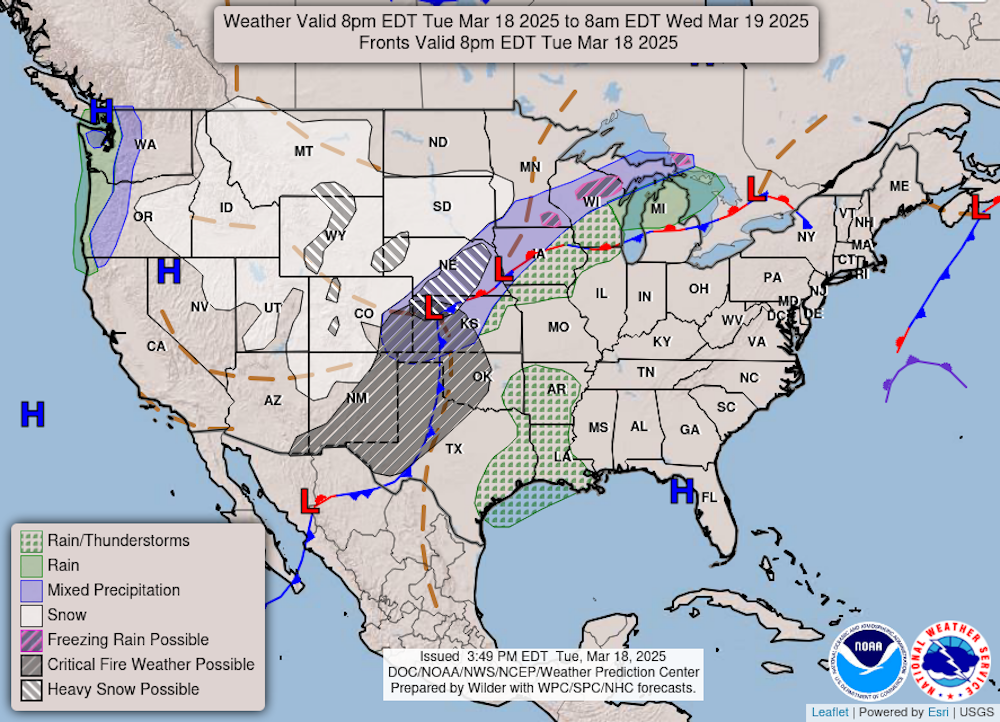
    On this forecast for March 18, 2025, from the National Oceanic and Atmospheric Administration, ‘L’ represents low-pressure systems. The shaded area over New Mexico and west Texas represents strong winds and low humidity that combine to raise the risk of wildfires.
    NOAA Weather Prediction Center

    Other forces related to the Earth’s rotation, friction and gravity can also alter the speed and direction of winds. But it all starts with this change in pressure over a distance – what meteorologists like me call a pressure gradient.

    So how do we get pressure gradients?

    Strong pressure gradients ultimately owe their existence to the simple fact that the Earth is round and rotates.

    Because the Earth is round, the sun is more directly overhead during the day at the equator than at the poles. This means more energy reaches the surface of the Earth near the equator. And that causes the lower part of the atmosphere, where weather occurs, to be both warmer and have higher pressure on average than the poles.

    Nature doesn’t like imbalances. As a result of this temperature difference, strong winds develop at high altitudes over midlatitude locations, like the continental U.S. This is the jet stream, and even though it’s several miles up in the atmosphere, it has a big impact on the winds we feel at the surface.

    Wind speed and direction in the upper atmosphere on March 14, 2025, show waves in the jet stream. Downstream of a trough in this wave, winds diverge and low pressure can form near the surface.
    NCAR

    Because Earth rotates, these upper-altitude winds blow from west to east. Waves in the jet stream – a consequence of Earth’s rotation and variations in the surface land, terrain and oceans – can cause air to diverge, or spread out, at certain points. As the air spreads out, the number of air molecules in a column decreases, ultimately reducing the air pressure at Earth’s surface.

    The pressure can drop quite dramatically over a few days or even just a few hours, leading to the birth of a low-pressure system – what meteorologists call an extratropical cyclone.

    The opposite chain of events, with air converging at other locations, can form high pressure at the surface.

    In between these low-pressure and high-pressure systems is a strong change in pressure over a distance – a pressure gradient. And that pressure gradient leads to strong winds. Earth’s rotation causes these winds to spiral around areas of high and low pressure. These highs and lows are like large circular mixers, with air blowing clockwise around high pressure and counterclockwise around low pressure. This flow pattern blows warm air northward toward the poles east of lows and cool air southward toward the equator west of lows.

    A map illustrates lines of surface pressure, called isobars, with areas of high and low pressure marked for March 14, 2025. Winds are strongest when isobars are packed most closely together.
    Plymouth State University, CC BY-NC-SA

    As the waves in the jet stream migrate from west to east, so do the surface lows and highs, and with them, the corridors of strong winds.

    That’s what the U.S. experienced when a strong extratropical cyclone caused winds stretching thousands of miles that whipped up dust storms and spread wildfires, and even caused tornadoes and blizzards in the central and southern U.S. in March 2025.

    Whipping up dust storms and spreading fires

    The jet stream over the U.S. is strongest and often the most “wavy” in the springtime, when the south-to-north difference in temperature is often the strongest.

    Winds associated with large-scale pressure systems can become quite strong in areas where there is limited friction at the ground, like the flat, less forested terrain of the Great Plains. One of the biggest risks is dust storms in arid regions of west Texas or eastern New Mexico, exacerbated by drought in these areas.

    A dust storm hit Albuquerque, N.M., on March 18, 2025. Another dust storm a few dats earlier in Kansas caused a deadly pileup involving dozens of vehices on I-70.
    AP Photo/Roberto E. Rosales

    When the ground and vegetation are dry and the air has low relative humidity, high winds can also spread wildfires out of control.

    Even more intense winds can occur when the pressure gradient interacts with terrain. Winds can sometimes rush faster downslope, as happens in the Rockies or with the Santa Ana winds that fueled devastating wildfires in the Los Angeles area in January.

    Violent tornadoes and storms

    Of course, winds can become even stronger and more violent on local scales associated with thunderstorms.

    When thunderstorms form, hail and precipitation in them can cause the air to rapidly fall in a downdraft, causing very high pressure under these storms. That pressure forces the air to spread out horizontally when it reaches the ground. Meteorologists call these straight line winds, and the process that forms them is a downburst. Large thunderstorms or chains of them moving across a region can cause large swaths of strong wind over 60 mph, called a derecho.

    Finally, some of nature’s strongest winds occur inside tornadoes. They form when the winds surrounding a thunderstorm change speed and direction with height. This can cause part of the storm to rotate, setting off a chain of events that may lead to a tornado and winds as strong as 300 mph in the most violent tornadoes.

    How a tornado forms. Source: NOAA.

    Tornado winds are also associated with an intense pressure gradient. The pressure inside the center of a tornado is often very low and varies considerably over a very small distance.

    It’s no coincidence that localized violent winds from thunderstorm downbursts and tornadoes often occur amid large-scale windstorms. Extratropical cyclones often draw warm, moist air northward on strong winds from the south, which is a key ingredient for thunderstorms. Storms also become more severe and may produce tornadoes when the jet stream is in close proximity to these low-pressure centers. In the winter and early spring, cold air funneling south on the northwest side of strong extratropical cyclones can even lead to blizzards.

    So, the same wave in the jet stream can lead to strong winds, blowing dust and fire danger in one region, while simultaneously triggering a tornado outbreak and a blizzard in other regions.

    Chris Nowotarski receives funding from the National Science Foundation (NSF), National Aeronautics and Space Administration (NASA), and theDepartment of Energy (DOE).

    ref. What causes the powerful winds that fuel dust storms, wildfires and blizzards? A weather scientist explains – https://theconversation.com/what-causes-the-powerful-winds-that-fuel-dust-storms-wildfires-and-blizzards-a-weather-scientist-explains-252639

    MIL OSI – Global Reports

  • MIL-OSI Global: Insomnia can lead to heart issues − a psychologist recommends changes that can improve sleep

    Source: The Conversation – USA – By Julio Fernandez-Mendoza, Professor of Psychiatry and Behavioral Health, Neuroscience, and Public Health Sciences, Penn State

    Better sleep hygiene habits may help with insomnia. Tetra Images via Getty Images

    About 10% of Americans say they have chronic insomnia, and millions of others report poor sleep quality. Ongoing research has found that bad sleep could lead to numerous health problems, including heart disease.

    Dr. Julio Fernandez-Mendoza is a professor of psychiatry and behavioral health, neuroscience and public health sciences at Penn State College of Medicine. He discusses the need for sleep, why teenagers require more sleep than adults, and how you can get a good night’s sleep without medications.

    Julio Fernandez-Mendoza discusses heart health and sleep.

    The Conversation has collaborated with SciLine to bring you highlights from the discussion that have been edited for brevity and clarity.

    How much sleep is enough for adults and for adolescents?

    Julio Fernandez-Mendoza: Adults who report getting about seven to eight hours of sleep per night generally have the best health, in terms of both physical and mental health, and longevity.

    But that recommendation changes with age. Adults over age 65 may need just six to seven hours of sleep per night. So older people, if otherwise healthy, should not feel anxious if they’re getting just six hours. Young people need the most – at least nine hours – and some younger children may need more.

    How can insufficient sleep harm our health?

    Fernandez-Mendoza: Our team was the first to show that those complaining about insomnia – difficulty falling or staying asleep – were more likely to have high blood pressure and be at risk for heart disease.

    In both teens and adults, we found that insomnia and shortened sleep may lead to elevated stress, hormone levels and inflammation. These problems tend to show up before you develop heart disease.

    As we age, the recommended amount of sleep declines.
    National Sleep Foundation Copyright 2025 National Sleep Foundation, all rights reserved

    What about people who have more serious sleep problems?

    Fernandez-Mendoza: Good sleep hygiene habits include cutting down on caffeine and alcohol, quitting smoking and exercising regularly. I also recommend not skipping meals, not eating too late at night and not eating too much.

    But people with a persistent sleep problem may need to make more behavioral changes. Research studies point to a set of six rules that can improve your sleep. You can follow these changes consistently in the short term, and then choose how to adapt them into your lifestyle down the road.

    First, get up at the same time no matter what. No matter how much sleep you get. This will anchor your sleep/wake cycle, called your circadian rhythm.

    Second, do not use your bed for anything except sleep and sexual activity.

    Third, when you can’t sleep, don’t lie in bed awake. Instead, get out of bed, go into another room if you can, and do an activity that’s enjoyable or relaxing. Go back to bed only when you’re ready to sleep.

    Fourth, get going with daily activities even after a poor night’s sleep. Don’t try to compensate for sleep loss. If you have chronic insomnia, don’t nap, sleep in, or doze during the day or evening even after poor sleep the previous night.

    Fifth, go to bed only when you’re actually sleepy enough to fall asleep.

    And sixth, start with the amount of sleep you’re now getting – with the lowest limit at five hours – and then increase it weekly by 15 minutes.

    These six rules are evidence-based and go above and beyond simple sleep hygiene habits. If they don’t work, see a provider who can help you.

    Your teen isn’t lazy. There are reasons why adolescents sleep in.

    Do you have advice specifically for adolescents?

    Fernandez-Mendoza: Adolescence is a unique developmental period. It’s not just the obvious physical, emotional and behavioral changes that occur during adolescence and puberty – there are changes in a teenager’s brain that can alter their sleep patterns.

    When an adolescent goes through puberty, their internal clock changes so that their sleep schedule shifts to later hours. While it’s true that adolescents are more engaged at night because of their social relationships, there’s also biology behind why they want to stay up late – their internal clocks have shifted. It’s not just choice.

    School start times for most adolescents are at odds with that biological shift. So they don’t get enough sleep, which affects their performance in school. Research suggests that schools with later start times are more closely aligned with the science on child development and don’t put adolescents at risk by making them wake up earlier than their bodies are biologically inclined to.

    Parents can help their teens get better sleep. Set a time for kids to stop doing homework and put away electronics. Instead, they can watch TV with the family or read – something relaxing and enjoyable that will help them wind down before bed.

    You can also gradually move back their wake-up time. Start on weekends, waking them up 30 minutes earlier every day, including school days, until the child reaches the desired wake-up time. Don’t try to reshift them suddenly – for example, waking up a teenager at 5 a.m. like it’s the military – because that doesn’t work. They won’t get used to it, since it’s at odds with their internal clock. So, do it little by little. If that doesn’t work, see a clinical provider.

    What kind of treatments can a sleep clinician provide?

    Fernandez-Mendoza: People should get help if they feel they sleep poorly, if they’re fatigued during the day, or if they snore or grind their teeth. All these issues deserve attention.

    Some people may think a sleep provider just prescribes expensive medication, but that’s not true. There are behavioral, non-drug-based treatments that work. Cognitive behavioral therapy is the first-line treatment recommended for insomnia. Light therapy may also help, which is the use of a bright light therapy lamp at a given time during the day or evening, depending on the person’s sleep problem.

    Watch the full interview to hear more.

    SciLine is a free service based at the American Association for the Advancement of Science, a nonprofit that helps journalists include scientific evidence and experts in their news stories.

    Julio Fernandez-Mendoza currently receives funding from the National Institutes of Health. He sits on the Board of Directors of the Sleep Research Society, a US-based not-for-profit professional association of sleep and circadian scientists.

    ref. Insomnia can lead to heart issues − a psychologist recommends changes that can improve sleep – https://theconversation.com/insomnia-can-lead-to-heart-issues-a-psychologist-recommends-changes-that-can-improve-sleep-251017

    MIL OSI – Global Reports

  • MIL-OSI Global: 5 years on, true counts of COVID-19 deaths remain elusive − and research is hobbled by lack of data

    Source: The Conversation – USA – By Dylan Thomas Doyle, Ph.D. Candidate in Information Science, University of Colorado Boulder

    National COVID-19 memorial wall for the five-year anniversary on March 11, 2025, in London, England. Andrew Aitchison/In Pictures via Getty Images

    In the early days of the COVID-19 pandemic, researchers struggled to grasp the rate of the virus’s spread and the number of related deaths. While hospitals tracked cases and deaths within their walls, the broader picture of mortality across communities remained frustratingly incomplete.

    Policymakers and researchers quickly discovered a troubling pattern: Many deaths linked to the virus were never officially counted. A study analyzing data from over 3,000 U.S. counties between March 2020 and August 2022 found nearly 163,000 excess deaths from natural causes that were missing from official mortality records.

    Excess deaths, meaning those that exceed the number expected based on historical trends, serve as a key indicator of underreported deaths during health crises. Many of these uncounted deaths were later tied to COVID-19 through reviews of medical records, death certificates and statistical modeling.

    In addition, lack of real-time tracking for medical interventions during those early days slowed vaccine development by delaying insights into which treatments worked and how people were responding to newly circulating variants.

    Five years since the beginning of COVID-19, new epidemics such as bird flu are emerging worldwide, and researchers are still finding it difficult to access the data about people’s deaths that they need to develop lifesaving interventions.

    How can the U.S. mortality data system improve? I’m a technology infrastructure researcher, and my team and I design policy and technical systems to reduce inefficiency in health care and government organizations. By analyzing the flow of mortality data in the U.S., we found several areas of the system that could use updating.

    Critical need for real-time data

    A death record includes key details beyond just the fact of death, such as the cause, contributing conditions, demographics, place of death and sometimes medical history. This information is crucial for researchers to be able to analyze trends, identify disparities and drive medical advances.

    Approximately 2.8 million death records are added to the U.S. mortality data system each year. But in 2022 – the most recent official count available – when the world was still in the throes of the pandemic, 3,279,857 deaths were recorded in the federal system. Still, this figure is widely considered to be a major undercount of true excess deaths from COVID-19.

    In addition, real-time tracking of COVID-19 mortality data was severely lacking. This process involves the continuous collection, analysis and reporting of deaths from hospitals, health agencies and government databases by integrating electronic health records, lab reports and public health surveillance systems. Ideally, it provides up-to-date insights for decision-making, but during the COVID-19 pandemic, these tracking systems lagged and failed to generate comprehensive data.

    Getting real-time COVID-19 data from hospitals and other agencies into the hands of researchers proved difficult.
    Gerald Herbert/AP Photo

    Without comprehensive data on prior COVID-19 infections, antibody responses and adverse events, researchers faced challenges designing clinical trials to predict how long immunity would last and optimize booster schedules.

    Such data is essential in vaccine development because it helps identify who is most at risk, which variants and treatments affect survival rates, and how vaccines should be designed and distributed. And as part of the broader U.S. vital records system, mortality data is essential for medical research, including evaluating public health programs, identifying health disparities and monitoring disease.

    At the heart of the problem is the inefficiency of government policy, particularly outdated public health reporting systems and slow data modernization efforts that hinder timely decision-making. These long-standing policies, such as reliance on paper-based death certificates and disjointed state-level reporting, have failed to keep pace with real-time data needs during crises such as COVID-19.

    These policy shortcomings lead to delays in reporting and lack of coordination between hospital organizations, state government vital records offices and federal government agencies in collecting, standardizing and sharing death records.

    History of US mortality data

    The U.S. mortality data system has been cobbled together through a disparate patchwork of state and local governments, federal agencies and public health organizations over the course of more than a century and a half. It has been shaped by advances in public health, medical record-keeping and technology. From its inception to the present day, the mortality data system has been plagued by inconsistencies, inefficiencies and tensions between medical professionals, state governments and the federal government.

    The first national efforts to track information about deaths began in the 1850s when the U.S. Census Bureau started collecting mortality data as part of the decennial census. However, these early efforts were inconsistent, as death registration was largely voluntary and varied widely across states.

    In the early 20th century, the establishment of the National Vital Statistics System brought greater standardization to mortality data. For example, the system required all U.S. states and territories to standardize their death certificate format. It also consolidated mortality data at the federal level, whereas mortality data was previously stored at the state level.

    However, state and federal reporting remained fragmented. For example, states had no unifom timeline for submitting mortality data, resulting in some states taking months or even years to finalize and release death records. Local or state-level paperwork processing practices also remained varied and at times contradictory.

    Death record processing varies by state.
    eric1513/iStock via Getty Images Plus

    To begin to close gaps in reporting timelines to aid medical researchers, in 1981 the National Center for Health Statistics – a division of the Centers for Disease Control and Prevention – introduced the National Death Index. This is a centralized database of death records collected from state vital statistics offices, making it easier to access death data for health and medical research. The system was originally paper-based, with the aim of allowing researchers to track the deaths of study participants without navigating complex bureaucracies.

    As time has passed, the National Death Index and state databases have become increasingly digital. The rise of electronic death registration systems in recent decades has improved processing speed when it comes to researchers accessing mortality data from the National Death Index. However, while the index has solved some issues related to gaps between state and federal data, other issues, such as high fees and inconsistency in state reporting times, still plague it.

    Accessing the data that matters most

    With the Trump administration’s increasing removal of CDC public health datasets, it is unclear whether policy reform for mortality data will be addressed anytime soon.

    Experts fear that the removal of CDC datasets has now set precedent for the Trump administration to cross further lines in its attempts to influence the research and data published by the CDC. The longer-term impact of the current administration’s public health policy on mortality data and disease response are not yet clear.

    What is clear is that five years since COVID-19, the U.S. mortality tracking system remains unequipped to meet emerging public health crises. Without addressing these challenges, the U.S. may not be able to respond quickly enough to public health crises threatening American lives.

    Dylan Thomas Doyle does not work for, consult, own shares in or receive funding from any company or organization that would benefit from this article, and has disclosed no relevant affiliations beyond their academic appointment.

    ref. 5 years on, true counts of COVID-19 deaths remain elusive − and research is hobbled by lack of data – https://theconversation.com/5-years-on-true-counts-of-covid-19-deaths-remain-elusive-and-research-is-hobbled-by-lack-of-data-244799

    MIL OSI – Global Reports

  • MIL-OSI Global: Tyrannical leader? Why comparisons between Trump and King George III miss the mark on 18th-century British monarchy

    Source: The Conversation – USA – By Carla Gardina Pestana, Professor and Joyce Appleby Endowed Chair of America in the World, University of California, Los Angeles

    Are there legitimate comparisons between President Donald Trump and King George III? Rebecca Noble/Getty Images; Kean Collection/Getty Images

    George III, king of Great Britain and its colonies at the time of the American Revolution, has been maligned unfairly.

    During both the first and now the second term of President Donald Trump, commentators in the U.S. have invoked the king’s misdeeds to criticize Trump. When the president bypassed Congress to create a new government agency, appointed its head and stopped payment of millions of dollars of allocated federal funds, his critics noted that he assumed the role of Congress, a power grab that supposedly made him similar to George III. According to this criticism, the president engaged in tyranny, just as the founders accused George of doing.

    As a scholar of early America, I believe, however, that George III has gotten a bad rap. He was not the all-powerful monarch that Trump allegedly aspires to be.

    In the 1770s, the power of the British king was limited by the authority of Parliament. In that system, which Americans and others praised at the time as balanced, the king and the legislature each had specific duties and powers so that neither could control the government alone.

    George III was not an absolutist monarch, to use the language of the day for a power-hungry ruler. The English had struggled in the previous century over the extent of the king’s power. After fighting two civil wars, executing one king, and, eventually, forcing the monarch to agree to rule with Parliament rather than on his own, they believed their liberties were safeguarded.

    This system, known as limited monarchy, was the pride of Great Britain. It was also admired by the American founders. As late as 1774, in his Summary View of the Rights of British America, Thomas Jefferson praised the “free and ancient principles” of the British constitution in which “kings are the servants, not the proprietors of the people.”

    Trump has been compared with King George III by many writers and commentators; the White House on Feb. 19, 2024, issued the fake magazine cover of Trump crowned like a king.
    Various

    No kingly tyranny

    Britons, whether in Great Britain or the colonies, did fear a tyrant, a controlling and abusive leader.

    Some fears came from their study of political theory, which taught that government worked best when composed of various branches that represented the concerns of the different political classes.

    As this theory went, an unbalanced government would descend into tyranny with a too-powerful monarch; oligarchy under a dominant aristocratic class; or anarchy with the people out of control. They believed these perils could be avoided only by maintaining balance.

    Even though the British did not fear imbalance or a tyrant king in their own case, they could see the danger threatening elsewhere in Europe.

    France represented a worst-case scenario. Its absolutist kings had ruled without France’s legislature – the Estates General – for more than a century and a half at the time of the American Revolution. British poet Robert Wolseley’s often reprinted poem declared: “Let France grow proud beneath the tyrant’s lust, While the rackt people crawl and lick the dust. The mighty Genius of this isle disdains Ambitious slavery and golden chains.”

    Within a few years, Anglo-American criticism of kingly tyranny in France would be validated: That country descended into a violent revolution that resulted in decades of warfare and political violence, including the execution of the entire royal family.

    This experience confirmed for the British and Americans that a balanced system was best and that they should count their blessings.

    Why revolt?

    A list of grievances held by the American Colonies against King George III, set down in Thomas Jefferson’s first draft of the American Declaration of Independence, which ultimately included 27 grievances against the king.
    MPI/Getty Images

    If the American revolutionaries admired the British system and sought to copy it in the United States, why did they reject the link to Britain and revolt in the first place?

    Americans did not revolt against the nature of British government. Rather they objected to their changing place within the British Empire. The revolutionary crisis had a number of roots, but most of them arose out of changes in the management of the relationship between the American Colonies and the imperial center.

    From the 1760s, the British government took a more activist role in its American Colonies, limiting their geographical expansion and imposing taxes directly on the population. In the past, Colonists had been free to move west, challenged only by the indigenous residents who fought to defend their lands.

    Now the British government, aiming to put an end to these wars, blocked expansion. At the same time, to pay down the debt accrued in recent war with France – and fought in part in North America – the government levied taxes not via the Colonial legislatures, as it had before, but directly on residents. This change sparked revolt and, eventually, revolution.

    Turning on the king

    American Colonists pull down a statue of King George III in New York City during the American Revolution.
    Corbis via Getty Images

    Before 1776, the Colonists believed that George III would come to their rescue and halt these changes imposed by Parliament. They thought initially that he did not realize how the new policies affected them.

    Only in 1776 did they accept that George III supported the policy changes and would not defend their rights. It was in that context that they turned on him and declared him tyrannical, blaming him for the new policies and calling for a break with Britain. As the Declaration of Independence said: “The history of the present King of Great Britain is a history of repeated injuries and usurpations, all having in direct object the establishment of an absolute Tyranny over these States.”

    Although they complained about the tyranny of George III, their true objection was that their subordinate position within the empire gave them little leverage when opposing policies that king and Parliament agreed to impose on them.

    Once independent, the founders created a system that imitated the British model of mixed governance and created barriers – the powers of Congress and the oversight of the Supreme Court – that they hoped would safeguard their liberties against the threat of renewed tyranny.

    Carla Gardina Pestana does not work for, consult, own shares in or receive funding from any company or organization that would benefit from this article, and has disclosed no relevant affiliations beyond their academic appointment.

    ref. Tyrannical leader? Why comparisons between Trump and King George III miss the mark on 18th-century British monarchy – https://theconversation.com/tyrannical-leader-why-comparisons-between-trump-and-king-george-iii-miss-the-mark-on-18th-century-british-monarchy-251869

    MIL OSI – Global Reports

  • MIL-OSI Global: Atlantic sturgeon were fished almost to extinction − ancient DNA reveals how Chesapeake Bay population changed over centuries

    Source: The Conversation – USA – By Natalia Przelomska, Research Associate in Archaeogenomics, National Museum of Natural History, Smithsonian Institution

    Sturgeon can be several hundred pounds each. cezars/E+ via Getty Images

    Sturgeons are one of the oldest groups of fishes. Sporting an armor of five rows of bony, modified scales called dermal scutes and a sharklike tail fin, this group of several-hundred-pound beasts has survived for approximately 160 million years. Because their physical appearance has changed very little over time, supported by a slow rate of evolution, sturgeon have been called living fossils.

    Despite their survival through several geological time periods, many present-day sturgeon species are at threat of extinction, with 17 of 27 species listed as “critically endangered.”

    Conservation practitioners such as the Virginia Commonwealth University monitoring team are working hard to support recovery of Atlantic sturgeon in the Chesapeake Bay area. But it’s not clear what baseline population level people should strive toward restoring. How do today’s sturgeon populations compare with those of the past?

    VCU monitoring team releases an adult Atlantic sturgeon back into the estuary.
    Matt Balazik

    We are a molecular anthropologist and a biodiversity scientist who focus on species that people rely on for subsistence. We study the evolution, population health and resilience of these species over time to better understand humans’ interaction with their environments and the sustainability of food systems.

    For our recent sturgeon project, we joined forces with fisheries conservation biologist Matt Balazik, who conducts on-the-ground monitoring of Atlantic sturgeon, and Torben Rick, a specialist in North American coastal zooarchaeology. Together, we wanted to look into the past and see how much sturgeon populations have changed, focusing on the James River in Virginia. A more nuanced understanding of the past could help conservationists better plan for the future.

    Sturgeon loomed large for millennia

    In North America, sturgeon have played important subsistence and cultural roles in Native communities, which marked the seasons by the fishes’ behavioral patterns. Large summertime aggregations of lake sturgeon (Acipenser fulvescens) in the Great Lakes area inspired one folk name for the August full moon – the sturgeon moon. Woodland Era pottery remnants at archaeological sites from as long as 2,000 years ago show that the fall and springtime runs of Atlantic sturgeon (Acipenser oxyrinchus) upstream were celebrated with feasting.

    Archaeologists uncover bony scutes – modified scales that resemble armor for the living fish – in places where people relied on sturgeon for subsistence.
    Logan Kistler and Natalia Przelomska

    Archaeological finds of sturgeon remains support that early colonial settlers in North America, notably those who established Jamestown in the Chesapeake Bay area in 1607, also prized these fish. When Captain John Smith was leading Jamestown, he wrote “there was more sturgeon here than could be devoured by dog or man.” The fish may have helped the survival of this fortress-colony that was both stricken with drought and fostering turbulent relationships with the Native inhabitants.

    This abundance is in stark contrast to today, when sightings of migrating fish are sparse. Exploitation during the past 300 years was the key driver of Atlantic sturgeon decline. Demand for caviar drove the relentless fishing pressure throughout the 19th century. The Chesapeake was the second-most exploited sturgeon fishery on the Eastern Seaboard up until the early 20th century, when the fish became scarce.

    Conservation biologists capture the massive fish for monitoring purposes, which includes clipping a tiny part of the fin for DNA analysis.
    Matt Balazik

    At that point, local protection regulations were established, but only in 1998 was a moratorium on harvesting these fish declared. Meanwhile, abundance of Atlantic sturgeon remained very low, which can be explained in part by their lifespan. Short-lived fish such as herring and shad can recover population numbers much faster than Atlantic sturgeon, which live for up to 60 years and take a long time to reach reproductive age – up to around 12 years for males and as many as 28 years for females.

    To help manage and restore an endangered species, conservation biologists tend to split the population into groups based on ranges. The Chesapeake Bay is one of five “distinct population segments” the U.S. Endangered Species Act listing in 2012 created for Atlantic sturgeon.

    Since then, conservationists have pioneered genetic studies on Atlantic sturgeon, demonstrating through the power of DNA that natal river – where an individual fish is born – and season of spawning are both important for distinguishing subpopulations within each regional group. Scientists have also described genetic diversity in Atlantic sturgeon; more genetic variety suggests they have more capacity to adapt when facing new, potentially challenging conditions.

    The study focused on Atlantic sturgeon from the Chesapeake Bay region, past and present. The four archaeological sites included are highlighted.
    Przelomska NAS et al., Proc. R. Soc. B 291: 20241145, CC BY

    Sturgeon DNA, then and now

    Archaeological remains are a direct source of data on genetic diversity in the past. We can analyze the genetic makeup of sturgeons that lived hundreds of years ago, before intense overfishing depleted their numbers. Then we can compare that baseline with today’s genetic diversity.

    The James River was a great case study for testing out this approach, which we call an archaeogenomics time series. Having obtained information on the archaeology of the Chesapeake region from our collaborator Leslie Reeder-Myers, we sampled remains of sturgeon – their scutes and spines – at a precolonial-era site where people lived from about 200 C.E. to about 900 C.E. We also sampled from important colonial sites Jamestown (1607-1610) and Williamsburg (1720-1775). And we complemented that data from the past with tiny clips from the fins of present-day, live fish that Balazik and his team sampled during monitoring surveys.

    Scientists separate Atlantic sturgeon scute fragments from larger collections of zooarchaeological remains, to then work on the scutes in a lab dedicated to studying ancient DNA.
    Torben Rick and Natalia Przelomska

    DNA tends to get physically broken up and biochemically damaged with age. So we relied on special protocols in a lab dedicated to studying ancient DNA to minimize the risk of contamination and enhance our chances of successfully collecting genetic material from these sturgeon.

    Atlantic sturgeon have 122 chromosomes of nuclear DNA – over five times as many as people do. We focused on a few genetic regions, just enough to get an idea of the James River population groupings and how genetically distinct they are from one another.

    We were not surprised to see that fall-spawning and spring-spawning groups were genetically distinct. What stood out, though, was how starkly different they were, which is something that can happen when a population’s numbers drop to near-extinction levels.

    We also looked at the fishes’ mitochondrial DNA, a compact molecule that is easier to obtain ancient DNA from compared with the nuclear chromosomes. With our collaborator Audrey Lin, we used the mitochondrial DNA to confirm our hypothesis that the fish from archaeological sites were more genetically diverse than present-day Atlantic sturgeon.

    Strikingly, we discovered that mitochondrial DNA did not always group the fish by season or even by their natal river. This was unexpected, because Atlantic sturgeon tend to return to their natal rivers for breeding. Our interpretation of this genetic finding is that over very long timescales – many thousands of years – changes in the global climate and in local ecosystems would have driven a given sturgeon population to migrate into a new river system, and possibly at a later stage back to its original one. This notion is supported by other recent documentation of fish occasionally migrating over long distances and mixing with new groups.

    Our study used archaeology, history and ecology together to describe the decline of Atlantic sturgeon. Based on the diminished genetic diversity we measured, we estimate that the Atlantic sturgeon populations we studied are about a fifth of what they were before colonial settlement. Less genetic variability means these smaller populations have less potential to adapt to changing conditions. Our findings will help conservationists plan into the future for the continued recovery of these living fossils.

    The authors do not work for, consult, own shares in or receive funding from any company or organization that would benefit from this article, and have disclosed no relevant affiliations beyond their academic appointment.

    ref. Atlantic sturgeon were fished almost to extinction − ancient DNA reveals how Chesapeake Bay population changed over centuries – https://theconversation.com/atlantic-sturgeon-were-fished-almost-to-extinction-ancient-dna-reveals-how-chesapeake-bay-population-changed-over-centuries-241104

    MIL OSI – Global Reports

  • MIL-OSI: Thea Energy Demonstrates Performance and Controllability of Small and Simple Magnets for Fusion Energy

    Source: GlobeNewswire (MIL-OSI)

    The world’s first superconducting planar coil magnet array successfully created and controlled stellarator-relevant magnetic field structures

    The test campaign results include the hardware validation to the leading approach for a maintainable and dynamically controllable stellarator fusion system

    KEARNY, N.J., March 20, 2025 (GLOBE NEWSWIRE) — Thea Energy, Inc., a fusion technology company advancing the stellarator for the commercialization of a carbon-free and abundant source of energy, today announced the successful operation of the world’s first superconducting planar coil 3×3 magnet array system. This magnet array demonstrates that small and simple electromagnets can practically, precisely, and dynamically create and control stellarator-relevant magnetic fields. Eos, Thea Energy’s initial integrated fusion system, will leverage this proprietary magnet array architecture and its benefits in addition to the inherent advantages of the stellarator, including steady-state operation. “Prototyping and Test of the ‘Canis’ HTS Planar Coil Array for Stellarator Field Shaping” outlines specific details of the system, including operation and results. This paper is available as a preprint on the Company’s website under “Presentations & Publications” and being submitted to a peer-reviewed publication.

    The magnet array operated at a temperature of 20 K and created a precisely controlled magnetic field of up to 47.2 mT on a plane 25 cm from the coils, with maximum field at the coils calculated to be greater than 3 T, in line with the Company’s underwritten performance requirements. Multiple magnetic iso-surfaces were produced corresponding to different locations of the Eos planar coil system. The magnet array also successfully demonstrated the controllability of the inductively coupled neighboring coils, thereby validating that the coils can be controlled individually despite the strong magnetic interactions between them.

    “A herculean effort from the Thea Energy team to establish the processes, infrastructure, and know-how to manufacture and test all magnets in-house has resulted in the successful hardware validation of the peer-reviewed physics basis of our novel system architecture that shows stellarators can be built without complicated coils,” said David Gates, Ph.D., co-founder and chief technology officer of Thea Energy. “The operation and notably, the controllability of this magnet array demonstrates a new key enabler to commercialized fusion energy. We have built a system that uses simpler hardware paired with dynamic software controls to adjust magnet parameters in real time.”

    Brian Berzin, co-founder and chief executive officer of Thea Energy, added, “Shifting system complexity from hardware to software means we can make rapid progress, resulting in the successful construction and operation of this magnet array in a matter of months. Using these mass-manufacturable magnets, we look forward to further testing to show that we can eliminate hardware defects and system wear and tear via scalable software controls. This will enable systems to continually work with high uptime under real-world conditions. These advantages of a practical system architecture will carry through to future generations of Thea Energy fusion power plants.”

    Steven Cowley, Ph.D., laboratory director at the U.S. Department of Energy’s Princeton Plasma Physics Laboratory (PPPL), which is managed by Princeton University, added, “The stellarator is a well-studied form of fusion technology and the practicality brought to the design by the team at Thea Energy, combined with the established physics basis since its invention over 70 years ago at PPPL, presents another possible fusion system design. This magnet array milestone confirms a concept that was created at PPPL – that arrays of planar magnets can be utilized to create and control the magnetic fields required to stabilize the plasma to produce sustained fusion energy. I am excited to see the Company build and scale its hardware while sharing its breakthroughs and results with the broader community.”

    Specific campaign results:

    • The magnet array operated at 20 K, with up to ±140 A in all coils and an estimated maximum total stored energy achieved in the array of 34.5 kJ.
    • The array achieved a magnetic field strength of 47.2 mT at 25 cm from the coils, with maximum field at the coils calculated to be greater than 3 T.
    • The magnet array recreated multiple unique iso-surfaces derived from Eos within 1% error of simulated predictions via fixed physical hardware and dynamic software controls.

    Future testing of unique single-coil and multi-coil quench scenarios will support analytical models showing recovery and reliability of systems leveraging the planar coil stellarator architecture, where systems can continue to operate if a coil fails. Additional work is also planned to further demonstrate the resiliency of this architecture and its ability to actively control and tune out hardware errors via Thea Energy’s closed-loop software control system.

    The U.S. Department of Energy has also certified the completion of this test campaign that included performance markers outlined in the Milestone-Based Fusion Development Program.

    About Thea Energy, Inc.
    Thea Energy, Inc. is building an economical and scalable fusion energy system utilizing arrays of mass-manufacturable magnets and dynamic software controls. Commercial fusion energy can uniquely provide an abundant source of zero-emission power for a sustainable future. Thea Energy is leveraging recent breakthroughs in computation and controls to reinvent the stellarator, a scientifically mature form of magnetic fusion technology. Thea Energy was founded in 2022 as a spin-out of the Princeton Plasma Physics Laboratory and Princeton University, where the stellarator was originally invented. Thea Energy is currently designing its first integrated fusion system, Eos, based on its planar coil stellarator architecture which will produce fusion neutrons at scale and in steady state. To learn more about Thea Energy’s mission, visit https://thea.energy/ and follow us on X and LinkedIn.

    Investor Contact
    Robin Brown
    robin@thea.energy

    Media Contact
    Madeline Joanis
    maddy@thea.energy

    The MIL Network

  • MIL-OSI: NANO Nuclear Energy Adds Two Additional Senior Nuclear Engineers to its Technical Team

    Source: GlobeNewswire (MIL-OSI)

    NANO Nuclear Continues to Attract Top Tier talent to Propel the Development of its Innovative Microreactor Technologies

    New York, N.Y., March 20, 2025 (GLOBE NEWSWIRE) — NANO Nuclear Energy Inc. (NASDAQ: NNE) (“NANO Nuclear” or “the Company”), a leading advanced nuclear energy and technology company focused on developing clean energy solutions, today announced the additions of James Leybourn and Simon Boddington as Senior Nuclear Engineers. Both Mr. Leybourn and Mr. Boddington are based in the U.K. and recently joined NANO Nuclear’s U.K.-based nuclear science and engineering partner Cambridge AtomWorks, led by Professors Ian Farnan and Eugene Shwageraus.

    The additions of Mr. Leybourn and Mr. Boddington build upon the recently announced appointment of Andrew Steer, Ph.D. as NANO Nuclear’s Head of Regulatory Engagement. Their addition to the team brings extensive knowledge in molten salt reactor physics, deep understanding of nuclear safety cases, advanced reactor engineering and innovative fuel system design, all of which will be essential for the ongoing development of NANO Nuclear’s proprietary ‘ZEUS’ and ‘ODIN’ microreactors, as well as the KRONOS MMRTMEnergy System and the LOKI MMRTM.

    Mr. Leybourn is a Chartered Physicist with over 12 years’ experience of Physics and Engineering within the U.K. nuclear industry. He has a proven track record of leading diverse projects, including thermal hydraulics, engineering design and safety case preparation. Prior to joining Cambridge AtomWorks, Mr. Leybourn played a key role in leading the development of a risk-informed work program and introducing systems engineering practices, including fuel route development, at MoltexFLEX, a British nuclear energy company developing advanced small modular molten salt reactors. He is a fuel route expert, having spent much of his career supporting the fuel route of the U.K. Advanced Gas-Cooled Reactor (AGR) fleet. He also led significant projects supporting the AGR defueling programs and has provided support to the Rolls-Royce small modular reactor project.

    Mr. Boddington is a reactor physicist with over 10 years of industry experience covering pressurized water reactors as well as thermal and fast spectrum molten salt reactor designs. Much of his experience is focused on reactor physics and he has assembled, managed and technically led the physics team that designed and delivered the molten salt MolexFLEX and SSR-W reactor concepts, with a focus on maintaining economic design objectives. He has extensive experience in applying analytical and stochastic reactor physics methods to develop core designs, including validation and verification. He graduated with an MPhys from the University of Southampton in 2014, then, completed the nuclear graduate’s scheme, before joining the Core Physics Group at Rolls-Royce.

    “NANO Nuclear continues to expand its technical teams with top professionals and innovators with diverse reactor engineering expertise that we will need to propel our programs forward. These hires also reflect our commitment to becoming a global leader in advanced nuclear energy solutions,” said Professor Ian Farnan, Lead of Nuclear Fuel Cycle, Radiation and Materials of NANO Nuclear. “With expertise spanning molten salt reactor physics, fuel handling, and high-temperature thermal-hydraulics, James and Simon will significantly strengthen NANO Nuclear’s ability to develop, demonstrate, gain regulatory approval, and, eventually commercialize and deploy its next-generation microreactors.”

    Figure 1 – NANO Nuclear Energy Inc. Appoints James Leybourn and Simon Boddington as Senior Nuclear Engineers.

    “The talent we’ve attracted speaks volumes about the progress we’re making,” said Professor Eugene Shwageraus, Lead of Nuclear Reactor Engineering of NANO Nuclear. “NANO Nuclear’s success in recruiting top engineering minds with such outstanding credentials and experience from world-class companies underscores our leadership in next-generation nuclear energy development.”

    “It is essential for us to strengthen our technical capabilities as we enter the next phase of development for our portfolio of energy systems,” said James Walker, Chief Executive Officer of NANO Nuclear. “Bringing Mr. Leybourn and Mr. Boddington on board demonstrates NANO Nuclear’s ambitions of being an innovative and global leader in the industry. Their extensive experience will be invaluable, and I welcome them to NANO Nuclear.”

    About NANO Nuclear Energy, Inc.

    NANO Nuclear Energy Inc. (NASDAQ: NNE) is an advanced technology-driven nuclear energy company seeking to become a commercially focused, diversified, and vertically integrated company across five business lines: (i) cutting edge portable and other microreactor technologies, (ii) nuclear fuel fabrication, (iii) nuclear fuel transportation, (iv) nuclear applications for space and (v) nuclear industry consulting services. NANO Nuclear believes it is the first portable nuclear microreactor company to be listed publicly in the U.S.

    Led by a world-class nuclear engineering team, NANO Nuclear’s reactor products in development include patented KRONOS MMR Energy System, a stationary high-temperature gas-cooled reactor that is in construction permit pre-application engagement U.S. Nuclear Regulatory Commission in collaboration with University of Illinois Urbana-Champaign, “ZEUS”, a portable solid core battery reactor, “ODIN”, a portable low-pressure coolant reactor, and the space focused, portable LOKI MMR, each representing advanced developments in clean energy solutions that are portable, on-demand capable, advanced nuclear microreactors.

    Advanced Fuel Transportation Inc. (AFT), a NANO Nuclear subsidiary, is led by former executives from the largest transportation company in the world aiming to build a North American transportation company that will provide commercial quantities of HALEU fuel to small modular reactors, microreactor companies, national laboratories, military, and DOE programs. Through NANO Nuclear, AFT is the exclusive licensee of a patented high-capacity HALEU fuel transportation basket developed by three major U.S. national nuclear laboratories and funded by the Department of Energy. Assuming development and commercialization, AFT is expected to form part of the only vertically integrated nuclear fuel business of its kind in North America.

    HALEU Energy Fuel Inc. (HEF), a NANO Nuclear subsidiary, is focusing on the future development of a domestic source for a High-Assay, Low-Enriched Uranium (HALEU) fuel fabrication pipeline for NANO Nuclear’s own microreactors as well as the broader advanced nuclear reactor industry.

    NANO Nuclear Space Inc. (NNS), a NANO Nuclear subsidiary, is exploring the potential commercial applications of NANO Nuclear’s developing micronuclear reactor technology in space. NNS is focusing on applications such as the LOKI MMR system and other power systems for extraterrestrial projects and human sustaining environments, and potentially propulsion technology for long haul space missions. NNS’ initial focus will be on cis-lunar applications, referring to uses in the space region extending from Earth to the area surrounding the Moon’s surface.

    For more corporate information please visit: https://NanoNuclearEnergy.com/

    For further NANO Nuclear information, please contact:

    Email: IR@NANONuclearEnergy.com
    Business Tel: (212) 634-9206

    PLEASE FOLLOW OUR SOCIAL MEDIA PAGES HERE:

    NANO Nuclear Energy LINKEDIN
    NANO Nuclear Energy YOUTUBE
    NANO Nuclear Energy X PLATFORM

    Cautionary Note Regarding Forward Looking Statements

    This news release and statements of NANO Nuclear’s management in connection with this news release contain or may contain “forward-looking statements” within the meaning of Section 21E of the Securities Exchange Act of 1934, as amended, and the Private Securities Litigation Reform Act of 1995. In this context, forward-looking statements mean statements related to future events, which may impact our expected future business and financial performance, and often contain words such as “expects”, “anticipates”, “intends”, “plans”, “believes”, “potential”, “will”, “should”, “could”, “would” or “may” and other words of similar meaning. In this press release, forward-looking statements includes those related to the anticipated benefits to NANO Nuclear of the appointment of the senior nuclear engineers, as well as the Company’s regulatory plans in general, as described herein. These and other forward-looking statements are based on information available to us as of the date of this news release and represent management’s current views and assumptions. Forward-looking statements are not guarantees of future performance, events or results and involve significant known and unknown risks, uncertainties and other factors, which may be beyond our control. For NANO Nuclear, particular risks and uncertainties that could cause our actual future results to differ materially from those expressed in our forward-looking statements include but are not limited to the following: (i) risks related to our U.S. Department of Energy (“DOE”) or related state or non-U.S. nuclear fuel licensing submissions, (ii) risks related the development of new or advanced technology and the acquisition of complimentary technology or businesses, including difficulties with design and testing, cost overruns, regulatory delays, integration issues and the development of competitive technology, (iii) our ability to obtain contracts and funding to be able to continue operations, (iv) risks related to uncertainty regarding our ability to technologically develop and commercially deploy a competitive advanced nuclear reactor or other technology in the timelines we anticipate, if ever, (v) risks related to the impact of U.S. and non-U.S. government regulation, policies and licensing requirements, including by the DOE and the U.S. Nuclear Regulatory Commission, including those associated with the recently enacted ADVANCE Act, and (vi) similar risks and uncertainties associated with the operating an early stage business a highly regulated and rapidly evolving industry. Readers are cautioned not to place undue reliance on these forward-looking statements, which apply only as of the date of this news release. These factors may not constitute all factors that could cause actual results to differ from those discussed in any forward-looking statement, and NANO Nuclear therefore encourages investors to review other factors that may affect future results in its filings with the SEC, which are available for review at www.sec.gov and at https://ir.nanonuclearenergy.com/financial-information/sec-filings. Accordingly, forward-looking statements should not be relied upon as a predictor of actual results. We do not undertake to update our forward-looking statements to reflect events or circumstances that may arise after the date of this news release, except as required by law.

    Attachment

    The MIL Network

  • MIL-OSI: Safe Harbor Financial Names Mike Regan as Head of Investor Relations and Data Science

    Source: GlobeNewswire (MIL-OSI)

    GOLDEN, Colo., March 20, 2025 (GLOBE NEWSWIRE) — SHF Holdings, Inc., d/b/a Safe Harbor Financial (“Safe Harbor” or the “Company”) (NASDAQ: SHFS), a fintech leader in facilitating financial services and credit facilities to the regulated cannabis industry, is proud to announce that Michael (Mike) Regan has joined the team as Head of Investor Relations and Data Science.

    In this role, Mike will help investors gain a deeper understanding of the Company’s growth initiatives, while also spearheading the development of innovative, differentiated new products leveraging Safe Harbor’s extensive databases. He earned an MBA from MIT Sloan, where he was the TA for a class on creating and quantitatively analyzing new institutional investment strategies, and a Bachelor of Science in Business Administration majoring in Finance from Georgetown University. His career spans research roles at Credit Suisse, Deutsche Bank, hedge funds Roubaix Capital and Hawkshaw Capital, as well as product innovation at Liberty Mutual. Since 2019, Mike has focused on the legal cannabis sector, most recently as Founder and Director of Research at Excelsior Equities, an investment bank and broker-dealer that provided research, custody, and trading of cannabis equities.

    “We are thrilled to welcome Mike Regan to Safe Harbor as Head of Investor Relations and Data Science,” said Terry Mendez, CEO of Safe Harbor. “Mike’s exceptional track record in investment analysis, product innovation, and his thorough understanding of the legal cannabis sector make him uniquely qualified to advance our growth initiatives. His expertise will be instrumental in developing new solutions for our growth strategies Safe Harbor Protects, Safe Harbor Lends, Safe Harbor Connects, and Safe Harbor Enables programs, ensuring we continue to lead and grow in this evolving industry.”

    “I am excited to join Safe Harbor and contribute to its mission of driving innovation and growth to better serve operators in the legal cannabis sector and beyond,” said Mike Regan. “I see tremendous potential to create meaningful value for our shareholders and clients, and to develop solutions that will shape the future of this industry.”

    About Safe Harbor
    Safe Harbor is among the first service providers to offer compliance, monitoring and validation services to financial institutions, providing traditional banking services to cannabis, hemp, CBD and ancillary operators, making communities safer, driving growth in local economies and fostering long-term partnerships. Safe Harbor, through its financial institution clients, implements high standards of accountability, transparency, monitoring, reporting and risk mitigation measures while meeting Bank Secrecy Act obligations in line with FinCEN guidance on cannabis-related businesses. Over the past decade, Safe Harbor has facilitated more than $25 billion in deposit transactions for businesses with operations spanning more than 41 states and US territories with regulated cannabis markets. For more information, visit www.shfinancial.org.

    Cautionary Statement Regarding Forward-Looking Statements

    Certain information contained in this press release may contain “forward-looking statements” within the meaning of the Private Securities Litigation Reform Act of 1995. Statements other than statements of historical facts included herein may constitute forward-looking statements and are not guarantees of future performance or results and involve a number of risks and uncertainties. Forward-looking statements may include, but are not limited to, statements with respect to trends in the cannabis industry, including proposed changes in U.S and state laws, rules, regulations and guidance relating to Safe Harbor’s services; Safe Harbor’s growth prospects and Safe Harbor’s market size; Safe Harbor’s projected financial and operational performance, including relative to its competitors and historical performance; success or viability of new product and service offerings Safe Harbor may introduce in the future; the impact volatility in the capital markets, which may adversely affect the price of Safe Harbor’s securities; the outcome of any legal proceedings that have been or may be brought by or against Safe Harbor; and other statements regarding Safe Harbor’s expectations, hopes, beliefs, intentions or strategies regarding the future. In addition, any statements that refer to projections, forecasts or other characterizations of future events or circumstances, including any underlying assumptions, are forward-looking statements. The words “anticipate,” “believe,” “continue,” “could,” “estimate,” “expect,” “intends,” “outlook,” “may,” “might,” “plan,” “possible,” “potential,” “predict,” “project,” “should,” “would,” and similar expressions may identify forward-looking statements, but the absence of these words does not mean that a statement is not forward-looking. Forward-looking statements are predictions, projections and other statements about future events that are based on current expectations and assumptions and, as a result, are subject to risks and uncertainties. Actual results may differ materially from those in the forward-looking statements as a result of a number of factors, including those described from time to time in Safe Harbor’s filings with the U.S. Securities and Exchange Commission. Safe Harbor undertakes no duty to update any forward-looking statement made herein. All forward-looking statements speak only as of the date of this press release.

    Contact Information
    Mike Regan, Head of Safe Harbor Investor Relations
    ir@SHFinancial.org
    (720) 826-6282

    KCSA Strategic Communications
    Ellen Mellody
    safeharbor@kcsa.com

    The MIL Network

  • MIL-Evening Report: Australia’s PBS means consumers pay less for expensive medicines. Here’s how this system works

    Source: The Conversation (Au and NZ) – By Bonny Parkinson, Associate Professor, Macquarie University Centre for the Health Economy, Macquarie University

    The United States pharmaceutical lobby has complained to US President Donald Trump that Australia’s Pharmaceutical Benefits Scheme (PBS) is damaging their profits and has urged Trump to put tariffs on pharmaceutical imports from Australia.

    Prime Minister Anthony Albanese defended the scheme, saying Australia’s pharmaceutical subsidy scheme was “not up for negotiation”. Opposition Leader Peter Dutton said he would also protect the PBS, which was the “envy of the world”.

    But what exactly is the PBS, and why does it matter?

    How did the PBS start?

    In the early 1900s, Australians had to pay for medicines out-of-pocket. Some could get free or cheap medicines at public hospitals or through Friendly Society Dispensaries, but otherwise access was restricted to those who could afford to pay.

    At the time, few effective medicines were available. But the development of insulin and penicillin in the 1920s made access to medicines much more important.

    The Constitution gave the federal government limited powers in the provision of health and welfare, which were largely the responsibility of the states. After World War II, the federal government wanted to expand these powers but it encountered several constitutional roadblocks.

    A rare successful referendum in 1946 changed that, enabling the National Health Act 1953 to pass. This established the PBS as we know it today.

    How does the PBS work in practice?

    The PBS covers the cost of medicines prescribed by doctors. Most are dispensed at community pharmacies (such as treatments for heart disease, the pill and antibiotics), but some more expensive ones are available at public hospitals or specialist treatment centres (such as chemotherapies and IVF medicines).

    In 2023–24 there were 930 different medicines and 5,164 brands listed on the PBS, costing the government $17.7 billion.

    The government negotiates the price of each medicine with the pharmaceutical company. Pharmacies then buy these medicines from wholesalers or companies.

    When a patient fills a prescription at a pharmacy, they pay a co-payment. The government pays the difference between the agreed price and the co-payment to the pharmacy – costs that may amount to hundreds of thousands of dollars.

    There are two co-payments: one for concession card holders ($7.70) and one for the general consumer ($31.60). When a patient hits the annual spending limit (safety net threshold), the co-payment falls to $0 for concession patients and $7.70 for the general consumer.

    Overall, patients contribute 8.4% to the total cost of the PBS, while the government pays the rest.

    How are medicine prices set?

    The PBS is split into two categories:

    – F1: new, patent-protected medicines with no competition

    – F2: medicines with multiple brands, including generics.

    F1 medicines

    To be listed on the PBS, a new medicine goes through the following process:

    1. It’s evaluated for safety, efficacy and quality.

    2. A panel of experts (including doctors, pharmacists, epidemiologists, health economists, health consumer advocates and a pharmaceutical industry representative) recommends which medicines should be listed on the PBS, based on effectiveness, safety, cost-effectiveness and the total cost on the budget of the medicine versus alternative treatments.

    3. If the panel recommends a medicine, the price and details of the listing may be further negotiated with the government. (If the panel rejects a medicine, companies may revise their application and re-submit.)

    4. Finally, the health minister, and subsequently the Cabinet, formally approves or rejects the panel’s recommendation. If approved, the medicine is listed on the PBS.

    F2 medicines

    Generic medicine companies may apply to list another brand on the PBS after a medicine loses patent protection. When this happens, the medicine moves from F1 to F2. Immediately, it incurs a mandatory price discount.

    Generic medicine companies may offer pharmacists discounts on the PBS list price (for example, ten for the price of nine). Pharmacists then encourage patients to switch to the cheaper medicine.

    Companies must disclose these discounts to the government, resulting in further price reductions.

    Is the PBS system unique?

    Australia is not special. Many countries use similar assessments to determine whether governments should subsidise new medicines, including the National Institute for Health and Care Excellence (NICE) in the United Kingdom, Canada’s Drug Agency, and Pharmac in New Zealand.

    Small differences exist, including whether the list of medicines is a positive (and they’re subsidised) or negative (meaning they’re not subsidised), whether the lists are established at the central level (such as the PBS in Australia) or local level (such as by province in Canada) or a mixture, and how co-payments are set.

    Generic medicine companies in Australia may offer pharmacists discounts on their products.
    National Cancer Institute/Unsplash

    The biggest outlier is the US. Similar to its health system, the medicines system is a complex and decentralised mix of public and private organisations, including government agencies, independent organisations, health-care providers and payers such as health insurers.

    What are the benefits of the PBS?

    The PBS ensures all Australian patients have access to highly effective medicines. This contributes to a high life expectancy, while keeping health-care costs low relative to other developed countries.

    This has been achieved by keeping prices down for both F1 and F2 medicines. By doing so, it creates room in the government budget to fund other new medicines.

    Without the PBS, either taxes or co-payments would have to increase, or fewer medicines funded.

    Other benefits include having a level playing field for all medicines, while maintaining flexibility to fund highly effective medicines for patients with unmet needs.

    What are the drawbacks of the PBS system?

    No system is without its drawbacks and risks. The PBS’s drawbacks include:

    • limited patient involvement in the process
    • the high frequency of re-submissions and delays to PBS listing
    • companies being unwilling to submit off-patent medicines for PBS listing due to high costs and low rewards
    • the ongoing lack of high-quality clinical evidence about medicines to treat rare diseases and certain patient populations, such as children.

    Another issue is medicine shortages. When PBS-listed brands aren’t available due to supply chain issues, other non-PBS listed brands may be available at full cost to the patient. Increased medicine costs can discourage patients from filling necessary prescriptions, which can have longer-term impacts on health and health expenditure.

    Finally, companies have argued Australia’s small market size plus low PBS prices can make it financially unviable to bring new medicines to Australia.

    The PBS is a crucial part of Australia’s health system, making essential medicines affordable, while keeping costs down. Like any system, it has its challenges and there is ongoing debate about whether and how the system should change.


    Read more:
    Will the US trade war push up the price of medicines in Australia? Will there be drug shortages?


    Bonny Parkinson receives funding from the Australian government to conduct evaluations of medicines to be listed on the Pharmaceutical Benefits Scheme. She also supervises students funded by PhD scholarships (received by the student, not Bonny Parkinson), including the Macquarie University Research Excellence Scholarship and Macquarie University Australian Pharmaceutical Scholarship, with support from six pharmaceutical companies: Amgen Australia, Janssen Australia, MSD Australia, Pfizer Australia, Roche Australia, and Abbvie Australia.

    ref. Australia’s PBS means consumers pay less for expensive medicines. Here’s how this system works – https://theconversation.com/australias-pbs-means-consumers-pay-less-for-expensive-medicines-heres-how-this-system-works-252736

    MIL OSI AnalysisEveningReport.nz

  • MIL-OSI Europe: VATICAN – Cardinal Tagle consecrates Bishops Sangalli and Sarrió Cucarella: Like Saint Joseph, be ‘silent’ heralds of the Word of God

    Source: Agenzia Fides – MIL OSI

    Wednesday, 19 March 2025

    Vatican City (Agenzia Fides) – Bishops are called to be “silent” heralds of the Word of God. They do their work well when, without being protagonists, they become humble “guardians of the active presence of God in his Church”. And if their projects do not progress, it is better to “sleep” like Saint Joseph and “dream the dreams of God,” said Cardinal Luis Antonio Gokim Tagle in an address to Samuele Sangalli and Diego Ramón Sarrió Cucarella during the liturgy of their episcopal ordination in the Vatican Basilica on the afternoon of March 19, the Solemnity of Saint Joseph.Samuele Sangalli, Adjunct Secretary and Head of the Administration of the Dicastery for Evangelization (Section for First Evangelization and the New Particular Churches), was appointed Archbishop and Titular Bishop of Zella by Pope Francis on February 6 (see Fides, 6/2/2025). Diego Ramn Sarrió Cucarella, former President of the Pontifical Institute for Arabic and Islamic Studies (PISAI), of the Missionaries of Africa, was appointed by the Pope as the new Bishop of Laghouat, Algeria, on January 25.More than 30 bishops and Cardinals participated in the solemn ordination liturgy at the main Altar in St. Peter’s Basilica. Cardinal Tagle, Pro-Prefect of the Dicastery for Missions and Principal Consecrator, had as co-consecrators Cardinal Francesco Coccopalmerio of Lombardy and Archbishop Fortunatus Nwachukwu, Secretary of the Dicastery for Evangelization (Department for First Evangelization and the New Particular Churches).On the Solemnity of Saint Joseph and exactly 12 years after the solemn inauguration of Pope Francis’s Petrine Ministry (“for whose complete recovery we pray”), Cardinal Tagle turned his attention to the Spouse of Mary in his homily to offer the two new bishops valuable inspiration for their new journey as Successors of the Apostles. According to the Second Vatican Council, they are called “to care for the flock of which they are shepherds in God’s place, as teachers of doctrine, priests of worship, and ministers of the government of the Church”, and “to be shepherds of the church of God, which he bought with the blood of his own Son,” as Saint Paul says. “Beautiful teachings,” remarked the Filipino Cardinal, “which make even bishops tremble. How can a bishop live up to such a great responsibility? Surely only by the grace of God.””Saint Joseph too,” Cardinal Tagle emphasized, “accepted God’s call in faith.” Faith “is the source of Joseph’s courage and creativity, who always subordinates his project to God’s, even when it is incomprehensible and uncomfortable.” Similarly, the ordained ministry of priests and bishops must be “rooted in a response of faith in God and exercised as a response of faith.” Often, Cardinal Tagle noted, “we plan and expect God to carry out our plans.” In reality, however, “we are not the planners, and God is not the executor of our plans.” And “if your vision and your plans do not seem to be moving forward,” he added, addressing the new Bishops, “sleep like Saint Joseph.” For “when we sleep, we are vulnerable, have less control, and are therefore more receptive and open. Sleep and dream the dreams of God. Wake up to realize the dreams of God with obedience and zeal.”Saint Joseph, according to the Pro-Prefect of the Missionary Dicastery, is also considered a “silent saint.” Not a single word of his is recorded in the Gospels. Nevertheless, “he accompanies, nurtures, and preserves the Word of God, made flesh in Mary’s womb, the most important Word.” And “every thought, every heartbeat, and every action of Joseph speaks of one Word: Jesus. It is the only thing that matters. His own words pale before the greatest Word. He can remain silent.” Following in the footsteps of Saint Joseph, “deacons, priests, and bishops must also remain ‘silent’ when proclaiming the Word of God.” For “it is not our word that counts and must be preserved for posterity, but the Word of God.” And “if our thoughts, plans, decisions, and actions do not speak of Jesus, we could be “like resounding brass or a clanging cymbal.”Furthermore, Saint Joseph is “a reliable guardian of Jesus.” And while carrying out his mission to guard the Son of God, “Joseph knows that Jesus belongs to his Father’s house. Joseph’s house in Nazareth has value only if it remains a shadow of the Father’s house, from which he must draw light.” Along these same lines, Cardinal Tagle noted: “Deacons, priests, and bishops are also called to be guardians of God’s active presence in his Church.” Because “bishops are not substitutes for the eternally living God nor competitors of the Redeemer.” And like Saint Joseph, they are called to be “authentic signs of God’s presence in the Church” with a “discreet visibility of the shadow that depends on the light.”Precisely, imitating the “sober and essential style of Saint Joseph,” at the end of the solemn liturgy, Archbishop Sangalli read a few simple “words of thanks.” They were addressed primarily to the “Providence of God, which has granted this afternoon full of grace” and to Pope Francis, “who has called us to be bishops and to whom we renew our affection and our prayers for a complete recovery as Head of the Church.”The new bishop’s thanks were also directed to the three consecrators, “who truly express the universality of the Church, and to all the other concelebrating cardinals and bishops, for whose service we were admitted to the College of Bishops through the gift of the ‘Spiritus principalis,’ the Spirit who governs and guides the Church.” This Spirit, Archbishop Sangalli added, “I received from the Church” and “from the good example of my dear parents, who today are already in eternal Life.” Finally, the new Archbishop’s thanks also went to the “brothers and family members who have accompanied, supported, and encouraged my journey,” as well as to the clergy and “the Ambrosian people of Lecco and the Seminary of Milan, with my former companions.”Archbishop Sangalli also thanked “the communities and associations I served, not least the Sinderesi Foundation,” as well as the academic communities of the Pontifical Gregorian University and the various universities where Sangalli was a student and professor.The gratitude of the new Archbishop was also expressed towards the Dicastery of Bishops, where Sangalli served for 20 years and lived “in contact with the vibrant heartbeat of the building of the local Churches and the election of their pastors.” The new Archbishop’s final words of thanks went to “the great family of the Dicastery for Evangelization, which opens the whole world to the richness of different traditions and cultures, each capable of sharing and transmitting the Gospel in its own singular way.” (F.B.) (Agenzia Fides, 19/3/2025)
    Share:

    MIL OSI Europe News

  • MIL-OSI United Kingdom: Energy Security & Critical Infrastructure Protection Conference

    Source: United Kingdom – Government Statements

    World news story

    Energy Security & Critical Infrastructure Protection Conference

    Experts from Greece, Cyprus, Bulgaria and the UK met in Athens to discuss energy security and how to best protect critical national Infrastructure.

    Last month, British Embassy Athens, British Embassy Sofia and British High Commission Nicosia, in collaboration with the Office of the Greek National Security Advisor, organized a two-day conference (February 24-25, 2025) that focused on energy security and the protection of critical national infrastructure, held at the Security Studies Centre of the Ministry of Citizen Protection.

    Εxperts from ministries, other state authorities and the energy sector from Greece, Cyprus, Bulgaria and the UK exchanged views, as well as best practices, related to legal and operational challenges, criticality assessments, critical maritime and subsea infrastructure, resilience policy, incident response, interoperability models, defence strategies and international cooperation.  A cross-government UK delegation from the Cabinet Office, Department for Energy Security and Net Zero, Ministry of Defence and Foreign, Commonwealth and Development Office shared lessons learned, both domestically and internationally.

    In her address, British Deputy Head of Mission Susan Geary referred to the constantly changing security environment and welcomed regional efforts to transform the Eastern Mediterranean into an energy hub that contributes to EU and NATO resilience by diversifying energy supply routes:

    Protecting Critical National Infrastructure is a complex endeavour that requires cross-government coordination. Both the public and private sectors have a role to play in assessing the criticality of infrastructure, identifying cross-sector dependencies, and developing best practices for managing vulnerabilities to common risks. Having the right structures, protocols and capabilities in place is vital.

    In his address, National Security Advisor Dr. Thanos Dokos noted, among other things:

    Dealing with hybrid threats and protecting our critical infrastructure have become tasks of rapidly increasing importance for our security. And resilience and preparedness are now part of the daily vocabulary of security professionals. As countries in the Eastern Mediterranean start preparing for the protection of underwater and other critical infrastructure, it is important to cooperate with other EU and NATO countries and learn from each other’s experience and expertise.

    Enhancing energy security, mitigating risks and preventing disruptions are key priorities for all involved. Delegates agreed to explore ways to further collaborate going forward.

    Updates to this page

    Published 20 March 2025

    MIL OSI United Kingdom

  • MIL-OSI Africa: Islamic State in Somalia: the terrorist group’s origins, rise and recent battlefield defeats

    Source: The Conversation – Africa – By Stig Jarle Hansen, Professor of International Relations, Norwegian University of Life Sciences

    The Islamic State in Somalia is an affiliate of the transnational jihadist group Islamic State, known in short as ISIS. Based in the semi-autonomous northern Somalia territory of Puntland, the terrorist group was the target of the first foreign combat operation of the Trump administration in February 2025. Previously, the group has been linked to planned terror attacks on the Vatican and on the Israeli embassy in Stockholm. Stig Jarle Hansen, a researcher and author of several books on jihadism in Africa, examines its origins, rise and recent battlefield defeats in the mountains of Puntland.

    1. The rise of the Islamic State

    Before the establishment of the Islamic State in Somalia in 2015, the Somali jihadist group al-Shabaab had established itself in the north. The small group had extensive connections to smuggling networks. It later split into two and the future leader of the Islamic State in Somalia, Sheikh Abdulqader Muumin, emerged from one of the splinter groups.

    In Somalia, clans define the relationship between people and all actors in the society. The connections of the new group to the Ali Suleiban sub-clan enabled it to profit from the clan’s links to smuggling and maritime piracy groups.

    Puntland is the hub of communication and maritime trade between Somalia and Yemen, as well as the wider Middle East. Smuggling has gone on in the region for centuries. The rugged terrain is ideal for piracy, illegal smuggling and insurgents.

    Puntland has been more or less autonomous from the rest of Somalia for more than three decades, and the Somali government has little influence there today.

    2. The jihadist behind the Islamic State in Somalia

    Muumin lived in Sweden through the 1990s and early 2000s and later moved to the UK. Back in Somalia, he joined al-Shabaab and became a prominent figure in the group’s jihadist videos. Such videos aim to maintain morals, attract new recruits and create sympathy for the group.

    In 2015, Muumin defected to lead the Islamic State in Somalia. His second-in-command was another Ali Suleiban clansman, Mahad Moalim. In 2016, the first video of the group was circulated through Islamic State media outlets.

    A milestone for the group followed its 2017 suicide bombing of the Juba Hotel in Bosaso, Puntland’s commercial capital and sea port. This enabled the Islamic State in Somalia to pressure Bossaso-based businesses to pay it protection money, the single most important source of income. In 2017-2018, the group is believed to have been behind as many as 50 assassinations in central Somalia. The killings were a forceful tool to generate protection money.

    On 27 July 2018, the Somali group was officially designated as a full province by the Islamic State, also known as ISIS. The Maktab al-Karrar regional office was based in the small Puntland chapter, giving it global responsibilities.

    The Somali group was made responsible for the central African and the Mozambique provinces of the Islamic State. Money flowed to the group from the Islamic State, as did extortion money from Bossaso, other northern Puntland cities and more infrequently from Mogadishu.

    In the first half of 2022, the US Treasury claimed that the organisation generated US$2.3 million from extortion payments, related imports, livestock and agriculture. The regional office and Muumin emerged as key financial players in east Africa, and even outside it, from their base in Buur Dexhtaal in Bari Puntland. Indeed, unnamed US officials claimed in 2023 that Muumim had been made the transnational leader of the Islamic State.

    3. An overblown reputation

    The Islamic State’s reputation in Somalia is often overstated. The group has never captured or held large territories. Its numbers in 2024 were estimated to be between 600 and 1,600. That pales in comparison to al-Shabaab in the south of Somalia.

    Its links to a planned attack on the Israeli embassy in Stockholm 2024 were probably weak and failed to hold up in court. And the jihadist linked to a planned attack in the Vatican 2018 seems to have left Islamic State prior to the planning.

    It is also doubtful that Muumin is the global leader of the Islamic State as claimed by some. That’s for two main reasons. First, an Islamic State leader has to be drawn from a tribe related to the prophet (Qureshi). Muumin is not. Second, the Islamic State in Somalia is the smallest of the Islamic State provinces in Africa. It is likely that a leader of a stronger province would have ranked higher.

    Although the income-gathering capacities of the Puntland-based group give it prominence in the Islamic State media, the Islamic State in Somalia does not rank higher than the Islamic State in the Sahara and Mozambique.

    4. Down but not out

    The Puntland authorities launched a relatively successful counter-offensive against the Islamic State in January 2025. This was combined with air support by the US and the United Arab Emirates.

    Puntland won important battles in January and February, including an attack in which it killed 70 Islamic State fighters.

    By late February, the morale of the Islamic State fighters seemed to break. With the fall of Buur Dexhtaal, the main base, in March, all the larger known bases had fallen. Many of the fleeing foreign fighters were captured.

    But the Islamic State is not defeated. The terrain enabled some of the fighters to hide. Neither Muumin, who is in his 70s, nor his second-in-command Abdirahman Fahiye have been reported killed. There are at least several hundred fighters left.

    If the Islamic State is still able to extort money from the northern business community, it could recruit from the large numbers of Oromo Ethiopian refugees in and around Bosaso, as well as locals who need jobs.

    – Islamic State in Somalia: the terrorist group’s origins, rise and recent battlefield defeats
    – https://theconversation.com/islamic-state-in-somalia-the-terrorist-groups-origins-rise-and-recent-battlefield-defeats-252303

    MIL OSI Africa

  • MIL-OSI Global: Islamic State in Somalia: the terrorist group’s origins, rise and recent battlefield defeats

    Source: The Conversation – Africa – By Stig Jarle Hansen, Professor of International Relations, Norwegian University of Life Sciences

    The Islamic State in Somalia is an affiliate of the transnational jihadist group Islamic State, known in short as ISIS. Based in the semi-autonomous northern Somalia territory of Puntland, the terrorist group was the target of the first foreign combat operation of the Trump administration in February 2025. Previously, the group has been linked to planned terror attacks on the Vatican and on the Israeli embassy in Stockholm. Stig Jarle Hansen, a researcher and author of several books on jihadism in Africa, examines its origins, rise and recent battlefield defeats in the mountains of Puntland.

    1. The rise of the Islamic State

    Before the establishment of the Islamic State in Somalia in 2015, the Somali jihadist group al-Shabaab had established itself in the north. The small group had extensive connections to smuggling networks. It later split into two and the future leader of the Islamic State in Somalia, Sheikh Abdulqader Muumin, emerged from one of the splinter groups.

    In Somalia, clans define the relationship between people and all actors in the society. The connections of the new group to the Ali Suleiban sub-clan enabled it to profit from the clan’s links to smuggling and maritime piracy groups.

    Puntland is the hub of communication and maritime trade between Somalia and Yemen, as well as the wider Middle East. Smuggling has gone on in the region for centuries. The rugged terrain is ideal for piracy, illegal smuggling and insurgents.

    Puntland has been more or less autonomous from the rest of Somalia for more than three decades, and the Somali government has little influence there today.

    2. The jihadist behind the Islamic State in Somalia

    Muumin lived in Sweden through the 1990s and early 2000s and later moved to the UK. Back in Somalia, he joined al-Shabaab and became a prominent figure in the group’s jihadist videos. Such videos aim to maintain morals, attract new recruits and create sympathy for the group.

    In 2015, Muumin defected to lead the Islamic State in Somalia. His second-in-command was another Ali Suleiban clansman, Mahad Moalim. In 2016, the first video of the group was circulated through Islamic State media outlets.

    A milestone for the group followed its 2017 suicide bombing of the Juba Hotel in Bosaso, Puntland’s commercial capital and sea port. This enabled the Islamic State in Somalia to pressure Bossaso-based businesses to pay it protection money, the single most important source of income. In 2017-2018, the group is believed to have been behind as many as 50 assassinations in central Somalia. The killings were a forceful tool to generate protection money.

    On 27 July 2018, the Somali group was officially designated as a full province by the Islamic State, also known as ISIS. The Maktab al-Karrar regional office was based in the small Puntland chapter, giving it global responsibilities.

    The Somali group was made responsible for the central African and the Mozambique provinces of the Islamic State. Money flowed to the group from the Islamic State, as did extortion money from Bossaso, other northern Puntland cities and more infrequently from Mogadishu.

    In the first half of 2022, the US Treasury claimed that the organisation generated US$2.3 million from extortion payments, related imports, livestock and agriculture. The regional office and Muumin emerged as key financial players in east Africa, and even outside it, from their base in Buur Dexhtaal in Bari Puntland. Indeed, unnamed US officials claimed in 2023 that Muumim had been made the transnational leader of the Islamic State.

    3. An overblown reputation

    The Islamic State’s reputation in Somalia is often overstated. The group has never captured or held large territories. Its numbers in 2024 were estimated to be between 600 and 1,600. That pales in comparison to al-Shabaab in the south of Somalia.

    Its links to a planned attack on the Israeli embassy in Stockholm 2024 were probably weak and failed to hold up in court. And the jihadist linked to a planned attack in the Vatican 2018 seems to have left Islamic State prior to the planning.

    It is also doubtful that Muumin is the global leader of the Islamic State as claimed by some. That’s for two main reasons. First, an Islamic State leader has to be drawn from a tribe related to the prophet (Qureshi). Muumin is not. Second, the Islamic State in Somalia is the smallest of the Islamic State provinces in Africa. It is likely that a leader of a stronger province would have ranked higher.

    Although the income-gathering capacities of the Puntland-based group give it prominence in the Islamic State media, the Islamic State in Somalia does not rank higher than the Islamic State in the Sahara and Mozambique.

    4. Down but not out

    The Puntland authorities launched a relatively successful counter-offensive against the Islamic State in January 2025. This was combined with air support by the US and the United Arab Emirates.

    Puntland won important battles in January and February, including an attack in which it killed 70 Islamic State fighters.

    By late February, the morale of the Islamic State fighters seemed to break. With the fall of Buur Dexhtaal, the main base, in March, all the larger known bases had fallen. Many of the fleeing foreign fighters were captured.

    But the Islamic State is not defeated. The terrain enabled some of the fighters to hide. Neither Muumin, who is in his 70s, nor his second-in-command Abdirahman Fahiye have been reported killed. There are at least several hundred fighters left.

    If the Islamic State is still able to extort money from the northern business community, it could recruit from the large numbers of Oromo Ethiopian refugees in and around Bosaso, as well as locals who need jobs.

    Stig Jarle Hansen does not work for, consult, own shares in or receive funding from any company or organisation that would benefit from this article, and has disclosed no relevant affiliations beyond their academic appointment.

    ref. Islamic State in Somalia: the terrorist group’s origins, rise and recent battlefield defeats – https://theconversation.com/islamic-state-in-somalia-the-terrorist-groups-origins-rise-and-recent-battlefield-defeats-252303

    MIL OSI – Global Reports

  • MIL-OSI United Kingdom: Widening access to university education

    Source: Scottish Government

    Rise in students from most deprived areas.

    Access to higher education at university for Scottish students from the most deprived areas has increased to a near record high, official figures have shown.

    The latest Higher Education Statistics Agency (HESA) figures for 2023-24 show that 16.7% of full-time first degree entrants to Scottish universities came from the nation’s 20% most deprived areas. This marks an increase from 16.3% the previous year.

    The figures also show an increase overall in the number of Scottish-based students at Scottish universities to 173,795, as well as a rise in full-time Scottish first degree entrants.

    However, non-EU international student numbers have seen a decline in 2023-24 following changes by the UK Government to the immigration system, such as ending the inclusion of family members on student visas.

    Minister for Higher and Further Education Graeme Dey said:

    “These figures show the significant progress of Scotland’s universities in making higher education not only more inclusive, but also attracting a rising number of Scots overall.

    “The number of Scots from the most deprived backgrounds entering university on full-time first degree courses is now up 37% since the establishment of the Commission on Widening Access by this Government.

    “This means many more people, no matter their background, have the opportunity to prosper in their lives.

    “We recognise the issues raised by the sector around a decline in international student numbers and damaging UK migration policies which is why we have proposed a ‘Scottish Graduate Visa’ which would allow us to retain international students after they graduate from Scottish institutions.”

    Background

    Higher Education Student Statistics: UK, 2023/24 | HESA

    MIL OSI United Kingdom

  • MIL-OSI Global: The PKK says it will lay down its arms. What are the chances of lasting peace between Turkey and the Kurds? Podcast

    Source: The Conversation – UK – By Gemma Ware, Host, The Conversation Weekly Podcast, The Conversation

    For over 40 years, the Kurdistan Workers Party, the PKK, has waged an armed insurgency against Turkey, fighting for Kurdish rights and autonomy.

    But in late February, Abdullah Öcalan, the PKK’s imprisoned founder, called for the group to lay down its arms and dissolve itself. Days later, the PKK, which is labelled as a terrorist organisation by Turkey, Europe and the US, declared a ceasefire with Turkey.

    In this episode of The Conversation Weekly podcast, we speak to political scientist Pinar Dinc about what’s led to this moment and whether it could be the beginning of a lasting peace between Turkey and the Kurds.

    Despite being imprisoned in solitary confinement since his capture in 1999, Öcalan has remained a central figure in the Kurdish movement, both in Turkey and across the region.

    His call for the PKK to abandon its armed struggle came months after the leader of a Turkish ultra-nationalist political party launched an initiative to bring an end to the conflict.

    Over the past few decades, previous rounds of peace talks between the PKK and Turkey, most notably in 2009 and 2013-15, have collapsed.

    But Pinar Dinc, an associate professor of political science at Lund University in Sweden, says that since the Hamas-led October 7 attacks on Israel and the war in Gaza, the situation in the Middle East has rapidly changed. “It’s mutually beneficial to put an end to this war,” she says. “Both groups recognise the necessity of addressing regional tensions.”

    Dinc says international support for the Kurdish-led Syrian Democratic Forces in north-eastern Syria, and its Rojava revolution, means that Turkey has been forced to recognise a new “Syrian Kurdish reality”. At the same time, she says, the Kurdish movement has also reached a limit in what it can achieve in an era of modern warfare.

     Turkey has a huge army. It’s one of the biggest armies of Nato. Now we see increased use of drones surveillance and advanced weaponry, and I think the PKK guerrillas in the Qandil mountains, what they refer to as the medya defence zones, they’re also realising that this is getting more and more difficult.

    Limited discussions began in March between the Turkish government and Kurdish political parties on a way forward in peace negotiations. Dinc says this is a real opportunity for a broader reconciliation process, but there will be real challenges in the detail of what it means for Turkey’s Kurdish population.

     The PKK is an outcome of structural problems arising from the longstanding oppression and marginalisation of Kurds in Turkey, and addressing these root causes is essential for achieving lasting peace.

    Listen to the conversation with Dinc on The Conversation Weekly podcast.


    This episode of The Conversation Weekly was written and produced by Mend Mariwany. Sound design was by Eloise Stevens and theme music by Neeta Sarl. Gemma Ware is the executive producer.

    Newsclips in this episode from AP Archive, AFP News Agency, Sky News, Med TV, Gazete Duvar, DW News, Al Jazeera English and France 24 English.

    Listen to The Conversation Weekly via any of the apps listed above, download it directly via our RSS feed or find out how else to listen here.

    Pinar Dinc is the principal investigator of the ECO-Syria project, which receives funding from the Strategic Research Area: The Middle East in the Contemporary World (MECW) at the Centre for Advanced Middle Eastern Studies, Lund University, Sweden.

    ref. The PKK says it will lay down its arms. What are the chances of lasting peace between Turkey and the Kurds? Podcast – https://theconversation.com/the-pkk-says-it-will-lay-down-its-arms-what-are-the-chances-of-lasting-peace-between-turkey-and-the-kurds-podcast-252646

    MIL OSI – Global Reports

  • MIL-OSI Video: Attacks on media in Haiti

    Source: United Nations (Video News)

    The security situation is further deteriorating in Haiti, according to UNESCO and several media outlets. In early March, attacks on the media by armed gangs intensified, alongside rising tensions in Port-au-Prince, the capital. The United Nations Educational, Scientific, and Cultural Organization warns that the ability of journalists to disseminate accurate information is severely limited as a result.
    The attacks targeted several of the country’s most reputable newspapers and broadcasters, including Le Nouvelliste, which has survived dictatorships and disasters for more than a century.
    According to UNESCO, the increase in attacks on the media in Haiti by armed gangs that control most of the capital, Port-au-Prince, is aimed at intimidating journalists and sowing chaos.

    https://www.youtube.com/watch?v=3eJ2DB0jSdY

    MIL OSI Video

  • MIL-OSI Video: Celebrating #WomensHistoryMonth with #Principals of the Year! #whm #womenineducation

    Source: United States of America – Federal Government Departments (video statements)

    Donna and Tracie – the National Association of Secondary School Principals (NASSP)’s 2023 & 2025 National Principals of the Year – share that there are many ways women can step up & make history in their school communities.

    https://www.youtube.com/watch?v=6MrVufDECE8

    MIL OSI Video

  • MIL-OSI United Kingdom: Winchester Litterpickers celebrate 30 years

    Source: City of Winchester

    Winchester Litterpickers are celebrating 30 years of local volunteer litter picks this year. Multiple picks now take place each week and they estimate that around 1,000 sacks of litter are collected every year.

    Some of the volunteers from Winchester Litterpickers 

    Chair of the group Eddie lives in Alresford Road and first joined in 1996, the year after it was founded. He said: “I signed up initially as the two founders of the group came into the school where I was headteacher and sang a litter picking song to the children. It started with a handful of people and quickly grew; we now have around 70 volunteers in total. It’s such a welcoming and friendly group, and we’re getting out in the fresh air too.   

    “The city council helps us by supplying grabbers and we’re in contact with other teams about items we might come across.”

    Elaine, one of the pick leaders, has been involved for over 15 years. She said: “Picking can be a very therapeutic thing to do and it’s good to feel you’re making a bit of a difference. We also collect the aluminium cans separately to support the HIOWAA.”

    The Weeke group heads to local independent business Café Bartella Winchester, run by husband and wife team Sukru and Aysa, after picks. 

    Chris, who lives in Harestock and has been picking with the group since 2018, adds: “It’s giving something back, isn’t it. And the coffee afterwards is a wonderful bonus.”

    Volunteer Ursula agrees: “It’s a lovely group, with lots of interesting, different views and backgrounds. There are a small amount of people who drop litter, and a larger group of people who want places to look nice, and it’s an easy quick positive change you can make to somewhere when you take that litter away.”

    Kevin lives in Bereweeke Avenue. He said: “I hate litter and now that I am retired I have the time to be able to volunteer. I would encourage anyone who has the opportunity to join us and give it a go. You’ll pick it up as you go along – I may have stolen that joke from Eddie!”

    The Keep Britain Tidy Great British Spring Clean takes place from 21 March until 6 April 2025. 

    MIL OSI United Kingdom

  • MIL-OSI USA: Governor Newsom announces appointments 3.19.25

    Source: US State of California 2

    Mar 19, 2025

    SACRAMENTO – Governor Gavin Newsom today announced the following appointments:

    Emily Warren, of Orinda, has been appointed Deputy Secretary for Innovative Mobility Solutions at the California State Transportation Agency. Warren has been an Advisory Venture Parter at Fontinalis Partners, LLC since 2019. She was Head of Public Policy at EverCharge from 2023 to 2024. Warren was Head of Public Policy at Embark Trucks from 2022 to 2023. Warren was Senior Manager of Public Policy at Amazon from 2021 to 2022. She was Senior Policy Advisor at NelsonNygaard Consulting Associates from 2020 to 2021. Warren was Senior Director of Policy and Public Affairs at Lime from 2018 to 2019. She held several roles at Lyft from 2012 to 2019, including Senior Director of Transportation Policy, Director of Transportation Policy, Director of Community Relations, Director of Community Engagement, and Community Manager. Warren was a Municipal Financial Consultant at Public Financial Management from 2011 to 2012. She was Assistant Director of External Affairs for the University of Pennsylvania from 2009 to 2010. Warren is a member of the National Center of Sustainable Transportation Leadership Council and the University of California, Los Angeles Institute of Transportation Studies Advisory Board. She earned a Master of Public Administration degree in Public Finance from the University of Pennsylvania, and a Bachelor of Arts degree in Political Science and Critical Gender Studies from the University of California, San Diego. This position does not require Senate confirmation, and the compensation is $176,004. Warren is a Democrat.

    Eva Spiegel, of Davis, has been appointed Deputy Director of Communications at the California Department of Motor Vehicles. Spiegel was Senior Communications Specialist at Kearns & West from 2021 to 2025. She was Founder and Principal of Spiegel Communications from 2019 to 2021. Spiegel was Director of Communications for the League of California Cities from 2007 to 2019. She was Director of Broadcast Operations and Special Projects at the American Communications Foundation from 1995 to 2006. Spiegel earned a Master of Arts degree in Broadcast and Electronic Communication Arts from California State University, San Francisco, and a Bachelor of Arts degree in Political Science for the University of California, Davis. This position does not require Senate confirmation, and the compensation is $150,000. Spiegel is a Democrat.

    Suzy Shuster, of Beverly Hills, has been appointed to the California Film Commission. Shuster has been Co-Host and Executive Producer of Women’s Sports Now on RokuChannel since 2025, Co-Host of the What the Football Podcast since 2023, and Guest Host on The Rich Eisen Show since 2014. Shuster was a Host/Reporter for University of Southern California Trojans Pregame Show on ESPN 710 from 2003 to 2009. Shuster was a reporter for ABC Sports from 2003 to 2006. She was a Reporter for the NBA on TNT from 2004 to 2006. Shuster was a Reporter/Host of Fox Sports Net and Fox Sports West from 2000 to 2002. She was a Producer for Real Sports with Bryant Gumbel from 1988 to 1999. Shuster was a Producer for ESPN’s SportsCenter from 1997 to 1999. She is a member of the Board of Hillel at Columbia. Shuster earned a Bachelor of Arts degree in History and Art History from Columbia University. This position does not require Senate confirmation, and there is no compensation. Shuster is a Democrat.

    Thomas “Tom” Huntington, of San Francisco, has been appointed to the State Park and Recreation Commission. Huntington has been a Consultant in Non-Profit Organization and Foundation Management since 2013. He was the Western Regional Development Director for the Environmental Defense Fund from 1985 to 2013. Huntington was a River Protection Campaign Coordinator and the Executive Director for the Friends of the River Foundation from 1977 to 1984. He was the Regional Manager and River Guide at OARS Inc. Adventure Travel from 1974 to 1984. Huntington earned a Bachelor of Arts degree in Communications and Teaching from the University of Oregon. This position requires Senate confirmation, and the compensation is $100 per diem. Huntington is a Democrat.

    Press Releases, Recent News

    Recent news

    News Sacramento, California – Governor Gavin Newsom today issued a proclamation declaring March 2025, as Developmental Disabilities Awareness Month.The text of the proclamation and a copy can be found below: PROCLAMATIONCalifornia is proud to join states around the…

    News What you need to know: In the first two months of 2025, California National Guard’s Counter Drug Task Force has seized 1,045 pounds of illicit fentanyl with a street valuation of $6.8 million. SACRAMENTO – Continuing an enhanced focus in 2025 to combat the…

    News What you need to know: 51 projects — including 46 independent features — will generate nearly $580 million in economic activity and employ over 6,490 cast and crew thanks to California’s Film & Television Tax Credit Program. HOLLYWOOD — Governor Newsom today…

    MIL OSI USA News

  • MIL-OSI: Orezone Gold Reports Record Revenue and Net Income for 2024

    Source: GlobeNewswire (MIL-OSI)

    VANCOUVER, British Columbia, March 20, 2025 (GLOBE NEWSWIRE) — Orezone Gold Corporation (TSX: ORE, OTCQX: ORZCF) (“Orezone” or “Company”) is pleased to report its operational and financial results for the fourth quarter and full year ended December 31, 2024, and its 2025 guidance.   All dollar amounts are in USD unless otherwise indicated and abbreviation “M” means million.

    Highlights

    • Q4-2024 gold production of 36,502 oz, a 37% increase from the previous quarter.  
    • 2024 gold production of 118,746 oz, exceeding the mid-point of guidance.
    • AISC per oz sold of $1,273 for Q4-2024 and $1,447 for 2024.
    • Record revenue of $283.5M from the sale of 118,697 gold oz at an average realized price of $2,384 per oz in 2024. Gold sales remain unhedged to rising gold prices.
    • 2024 Adjusted EBITDA of $117.2M, Net Income attributable to Orezone shareholders of $55.7M and Earnings per Share attributable to Orezone shareholders of $0.14 and $0.13 on a basic and diluted basis, respectively.
    • Liquidity of $103.2M at year-end with cash of $74.0M and undrawn debt of $29.2M available to finance 2025 growth plans.
    • Stage 1 of hard rock expansion progress continues with first gold on track for Q4-2025.
    • Advancing work towards a secondary listing on the Australian Securities Exchange in mid-2025.

    Patrick Downey, President and CEO, commented “Strong Q4-2024 gold production of 36,502 oz helped deliver another record year for revenue of $283.5 million and net income of $64.1 million while meeting annual production guidance for a second consecutive year. Importantly, Orezone commenced construction of its hard rock expansion in the second half of 2024, a main step towards sustained production growth and setting the foundation for a transformational 2025 where we expect to pour first gold on this brownfield expansion in Q4-2025. First stage of the hard rock expansion is expected to increase the Company’s annual gold production to 170,000 – 185,000 oz in 2026.

    With continued strong gold prices and the closing of recent financings, the Company is well-placed to make further strategic investments in its Bomboré Mine by undertaking additional discovery-focused exploration on high potential targets and evaluating an accelerated start to the second stage of the hard rock expansion which would further increase annual gold production to 220,000 – 250,000 oz.

    The accomplishments achieved in 2024 is a testament to the strength of our team underpinned by the support of our community and government partners, and new and existing shareholders. We remain steadfast in our goal of creating lasting value for all stakeholders.”

    Highlights for Fourth Quarter and Year Ended December 31, 2024 and Significant Subsequent Events

    (All mine site figures on a 100% basis)   Q4-2024 Q4-2023 FY2024 FY2023
    Operating Performance          
    Gold production oz 36,502 33,916 118,746 141,425
    Gold sales oz 34,833 33,782 118,697 139,696
    Average realized gold price $/oz 2,632 1,986 2,384 1,940
    Cash costs per gold ounce sold1 $/oz 1,077 1,083 1,233 972
    All-in sustaining costs1 (“AISC”) per gold ounce sold $/oz 1,273 1,246 1,447 1,127
    Financial Performance          
    Revenue $000s 91,837 67,580 283,517 271,491
    Earnings from mine operations $000s 45,321 16,108 117,710 97,150
    Net income attributable to shareholders of Orezone1 $000s 30,091 4,012 55,711 43,146
    Net income per common share attributable to shareholders of Orezone          
    Basic $ 0.06 0.01 0.14 0.12
    Diluted $ 0.06 0.01 0.13 0.12
    EBITDA1 $000s 48,139 15,308 128,307 108,418
    Adjusted EBITDA1 $000s 45,058 26,702 117,233 120,036
    Adjusted earnings attributable to shareholders of Orezone1 $000s 27,550 14,267 45,977 53,665
    Adjusted earnings per share attributable to shareholders of Orezone1 $ 0.06 0.04 0.11 0.15
    Cash and Cash Flow Data          
    Operating cash flow before changes in working capital $000s 52,520 28,167 98,444 123,029
    Operating cash flow $000s 28,020 13,891 57,697 79,950
    Free cash flow1 $000s 12,543 682 11,725 36,172
    Cash, end of period $000s 74,021 19,483 74,021 19,483

    1 Cash costs, AISC, EBITDA, Adjusted EBITDA, Adjusted earnings, Adjusted earnings per share, and Free cash flow are non-IFRS measures. See “Non-IFRS Measures” section below for additional information.

    Full Year 2024 Highlights

    • Outstanding Safety Performance: 5.4M hours worked without a lost-time injury and a low total recordable injury frequency rate of 0.75.
    • Strong Liquidity: Available liquidity of $103.2M at year-end with $74.0M in cash and XOF 17.5 billion ($29.2M) available to be drawn on the Phase II debt facility with Coris Bank International (“Coris Bank”). The Company is well-funded to carry out its 2025 growth plans including the completion of stage 1 of the Phase II hard rock expansion and a minimum 20,000 m diamond drilling exploration program.    
    • Gold Production Guidance Achieved: Gold production of 118,746 oz which exceeded the mid-point of guidance, marking the second consecutive year that the Bomboré Mine has met production guidance since the start up of operations.
    • AISC Per Oz Within Updated Guidance: AISC per oz of $1,447 was within the updated guidance range with operating costs impacted by higher-than-anticipated government royalties and power costs. Relative to original guidance, government royalties were $31 per oz higher due to a better realized gold price and power costs were $57 per oz higher from lower-than-normal grid availability due to regional power issues in the H1-2024. These two cost overrun contributors were both out of the Company’s control and if their cost impacts were removed, original AISC guidance of $1,300 per oz to $1,375 per oz would have been met.
    • Record Annual Revenue: Revenue of $283.5M from the sale of 118,697 gold oz at a realized gold price of $2,384 per oz. The Company’s gold sales remain unhedged to rising gold prices.
    • Record EBITDA, Net Income, and Earnings Per Share: Reported record EBITDA of $128.3M and net income attributable to Orezone shareholders of $55.7M, primarily driven by a 23% increase in the realized gold price from the prior year. Net income per share attributable to Orezone shareholders was a record $0.14 per share on a basic basis and $0.13 per share on a diluted basis.
    • Continued Free Cash Flow Generation: Generated free cash flow of $11.7M with cash flow from operating activities totalling $98.4M after deducting taxes paid of $26.2M but before changes in non-cash working capital. Non-cash working capital increased by $40.7M primarily from the build-up of VAT receivables and long-term ore stockpiles. Cash flow used in investing activities totalled $46.0M as capital expenditures remained elevated as the Company executes on its growth initiatives including the Phase II hard rock expansion.
    • Phase II Hard Rock Expansion on Track for First Gold in 2025: The Company’s Board approved a positive construction decision on stage 1 of the Phase II hard rock expansion on July 10, 2024 after the Company had secured $105M in binding debt and equity commitments described below for the construction. Under stage 1, a 2.5M tonnes per annum (“tpa”) process plant will be built to recover gold from hard rock mineral reserves which is expected to increase future production levels by 50% to over 170,000 oz per annum. First gold for stage 1 of the Phase II expansion remains on track for Q4-2025 with commercial production expected shortly thereafter in early 2026.
    • Phase I Debt Reduced, Bridge Loan Repaid, and Phase II Expansion Financing Secured: Principal repayments totalling XOF 24.0 billion ($39.3M) were made on the Company’s senior borrowings with Coris Bank, including the extinguishment of the XOF 12.0 billion ($19.8M) bridge loan. On August 8, 2024, the Company completed a non-brokered private placement for net proceeds of C$64.8M ($47.3M) with a new cornerstone investor, Nioko Resources Corporation (“Nioko”), a leading West African investment group. On December 19, 2024, the Company successfully upsized its senior debt facility with Coris Bank through a new term loan for XOF 35.0 billion ($58.3M) (“Phase II Term Loan”) to be drawn in multiple tranches as construction progresses. The Company made its first drawdown of XOF 17.5 billion ($27.9M) on the Phase II Term Loan in December 2024.
    • Multi-year Exploration Drill Program Initiated: In August 2024, the Company initiated a multi-year discovery focused drill program with an initial 30,000 m of drilling designed to test the broader size and scale of the Bomboré mineralized system. Initial results from drilling at the North Zone intercepted mineralization 240 m below the current reserve pit limit, including 1.67 g/t gold over 46.00 m, demonstrating the continuity and robustness of the mineralized system at depth, both in terms of grade and overall width (see October 10, 2024 news release).

    Q4-2024 Highlights

    • Gold Production: Quarterly gold production of 36,502 oz increased 37% from Q3-2024 as a result of record plant throughput and improved head grades. Mining extended to Siga East and Siga South pits for a full quarter which contributed a greater blend of soft oxide ore at higher grades to the mill feed.
    • AISC Per Oz: AISC per oz sold was $1,273 per oz, a 23% decrease from Q3-2024, driven mainly by improved gold production as a result of higher grades and better plant throughput.
    • EBITDA, Net Income, and Earnings Per Share: Reported EBITDA of $48.1M and net income attributable to Orezone shareholders of $30.1M. Net income per share attributable to Orezone shareholders was $0.06 per share on both a basic and diluted basis.
    • Free Cash Flow: Generated free cash flow of $12.5M with cash flow from operating activities totalling $52.5M after deducting taxes paid of $6.3M but before changes in non-cash working capital. Cash flow used in investing activities totalled $15.5M as expenditures for the Phase II hard rock expansion began to ramp up.

    Events Subsequent to 2024 Year-End

    • Bought Deal Offering: On March 13, 2025, the Company closed on a public offering of common shares on a bought deal basis with Canaccord Genuity Corp. (“Canaccord”) pursuant to which the Company agreed to sell 42,683,000 common shares at a price of C$0.82 per share for aggregate gross proceeds of C$35,000,060. Net proceeds from the offering will be used to conduct early works for stage 2 of the Phase II hard rock expansion and for additional exploration. Under stage 2, processing capacity of the hard rock plant will double from the 2.5Mtpa design in stage 1 to 5.0Mtpa after completion of stage 2.
    • Over-allotment Exercise: Canaccord has exercised its over-allotment in full on the bought deal offering and has agreed to purchase an additional 6,402,450 common shares at a price of C$0.82 per share for aggregate gross proceeds of C$5,250,009. The purchase of shares from the over-allotment closed on March 19, 2025.
    • Private Placement with Nioko: The Company has announced that Nioko intends to acquire, on a non-brokered private placement basis, for 10,719,659 additional common shares at a price of C$0.82 per share for aggregate gross proceeds of C$8,790,121 to maintain its 19.9% share ownership (before the over-allotment exercise). Closing of this private placement is subject to approval of the TSX and is anticipated to occur in late March 2025.
    • Intention to List on the Australian Securities Exchange (“ASX”): The Company intends to pursue a secondary listing on the ASX by mid-2025, subject to market conditions and the satisfaction of ASX listing requirements as announced in its February 23, 2025 press release. The Company believes a dual listing on the ASX will increase trading liquidity and allow it to access a deeper pool of investors, including specialist mining focused funds.

    2024 Performance and 2025 Guidance

    2024 Performance Compared Against Guidance

    Bomboré Mine (100% basis) Unit Original
    FY2024 Guidance
    Revised
    FY2024 Guidance4
    FY2024
    Actuals
    Gold production Au oz 110,000 – 125,000 Unchanged  118,746
    All-In Sustaining Costs123 $/oz Au sold $1,300 – $1,375 $1,400 – $1,475 $1,447
    Sustaining capital12 $M $14 – $15 Unchanged $16.0
    Growth capital – non Phase II Expansion12 $M $16 – $17 Unchanged $17.6
    Growth capital – Phase II Expansion early works12 $M No guidance provided $3.6 $3.6
    Growth capital – Phase II Expansion12 $M No guidance provided $15.0 – $18.0 $15.3
    1. Non-IFRS measures. See “Non-IFRS Measures” section below for additional information.
    2. Foreign exchange rates used to forecast cost metrics include XOF/USD of 600 and CAD/USD of 1.30.
    3. Government royalties of $160/oz included in original AISC guidance based on an assumed gold price of $2,000 per oz. Government royalties of $200/oz were estimated in the revised AISC guidance from a better gold price realized.
    4. Revised guidance details presented in Q3-2024 MD&A.

    2025 Guidance

    Bomboré Mine (100% basis) Unit FY2025 Guidance
    Gold production Au oz 115,000 – 130,000
    All-In Sustaining Costs123 $/oz Au sold $1,400 – $1,500
    Sustaining capital12 $M $9 – $10
    Growth capital (excluding Phase II Expansion)12 $M $44 – $51
    Growth capital – Stage 1 of Phase II Expansion12 $M $75 – $80
    1. Non-IFRS measure. See “Non-IFRS Measures” section below for additional information.
    2. Foreign exchange rates used to forecast cost metrics include XOF/USD of 600 and CAD/USD of 1.35.
    3. Government royalties included in AISC guidance based on an assumed gold price of $2,600 per oz.

    Gold production in 2025 is forecasted to range between 115,000 to 130,000 oz, with the highest production expected in the fourth quarter from the scheduled start-up of the Phase II hard rock plant. Projected gold production from hard rock reserves is between 5,000 to 10,000 oz with actual production dependent on the timing and ramp-up of the new hard rock circuit. Gold production from the existing Phase I oxide plant is guided between 110,000 to 120,000 oz, similar to that achieved in 2024.

    Mining will be concentrated within three main pits delivering most of the direct feed ore with the H pit in the North Zone, and the Siga East and Siga South pits in the South Zone. The 2025 mine plan calls for 22.4M tonnes to be mined by the mining contractor at a strip ratio of approximately 1.8.   The mining contractor placed new excavators, dump trucks, and support equipment into service in November 2024 and is organizing to mobilize additional equipment to site later this year in preparation for the start-up of hard rock mining.

    AISC in 2025 is expected to range between $1,400 to $1,500 per oz sold. AISC per oz is expected to be comparable to 2024 with a small decrease in head grades, an increased strip ratio, and greater government royalties from a higher assumed gold price offset by lower sustaining capital, higher grid utilization, and higher plant throughput from fewer power interruptions and enhanced maintenance practices.

    Sustaining capital is budgeted to fall within the range of $9M to $10M with expenditures directed towards the completion of tailings storage facility (“TSF”) stage 4 lift, extension of the main haul road and perimeter fencing at the southern end of the mining permit, and other capital improvements to the process plant, camp, and mine support equipment and facilities.

    Growth capital is expected to range between $119M to $131M on four major growth projects:

    No. Growth Capital Description Unit FY2025 Guidance
    I. Phase II Hard Rock Expansion – Stage 1 $M $75 – $80
    II. Permanent Back-up Diesel Power Plant $M $22 – $24
    III. TSF Footprint Expansion – Cell 2 $M $11 – $13
    IV. Resettlement Action Plan (“RAP”) $M $11 – $14
      Growth Capital Total $M $119 – $131
           
      Phase II Hard Rock Expansion – Stage 2 $M No guidance provided

    The Company has reserved guidance on 2025 expenditures for stage 2 of the Phase II hard rock expansion until the Company’s Board of Directors has issued a final investment decision to proceed with stage 2 expected later this year. Stage 2 would increase annual gold production to 220,000 – 250,000 oz.  

    I.      Phase II Hard Rock Expansion – Stage 1

    A new 2.5Mtpa hard rock plant to process fresh and lower transition ore is currently under construction and once completed, will operate in tandem with the existing Phase I oxide plant. The current flowsheet for stage 1 of this brownfield expansion consists of a primary jaw crusher, an 18-hour crushed ore stockpile, a single stage 9MW SAG mill, hydrocyclones, and a carbon-in-leach (“CIL”) circuit consisting of five 15.8 m diameter leach tanks. Loaded carbon will be treated in the shared gold recovery circuit, producing gold doré bars from the existing gold room. Tailings from the CIL circuit will be pumped into the expanded tailings facility.

    The Company completed a comprehensive review of the construction progress and costing as part of its annual budgeting exercise for 2025. From this review, schedule to first gold remains in Q4-2025 with a project budget of $90M – $95M with $75M – $80M forecasted in 2025.

    II.      Permanent Back-Up Diesel Power Plant

    A new diesel power plant will be installed to provide continuous power to both the Phase I oxide plant and Phase II hard rock plant when the national grid is unavailable or unable to provide stable power.

    Following a competitive tender, the Company awarded the engineering, supply, installation, and commissioning of this new power plant to Africa Power Services (“APS”). APS will supply 18 Caterpillar diesel gensets with 1.8MW rated capacity each that will function as back-up units to the grid to meet the 18MW to 20MW load demand of both processing circuits. This new power plant is scheduled for final commissioning in October 2025 and will replace the APS genset rentals that are currently providing power on a back-up basis.

    III.      TSF Footprint Expansion – Cell 2

    The TSF starter dam over the Cell 1 footprint was completed prior to the start of processing operations in 2022. Lifts of the Cell 1 embankment walls have been completed each year to add storage to hold the volume of tailings expected to be generated by the mine for the upcoming year. The stage 4 lift is currently in progress and is slated for completion in June 2025 with costs captured under sustaining capital.

    To optimize costs of future tailings lifts and to meet the higher annual storage requirements from the Phase II hard rock expansion, work to expand the TSF footprint southwards into Cell 2 will begin in 2025 and continue into 2026, and include the HDPE lining of the Cell 2 basin and installation of underdrainage to improve water recovery and dam stability. Cell 2 will cover the ultimate TSF footprint and is designed to ensure that future annual lifts will provide sufficient storage of tailings generated each year by the combined oxide and expanded stage 2 (5Mtpa) hard rock operations.

    IV.      Resettlement Action Plan – Phases II, III, and IV

    RAP Phases II and III commenced in 2023 and will see the construction of three new resettlement communities (MV3, MV2, and BV2) to help relocate households occupying areas within the southern half of the Bomboré mining permit. Both MV3 and MV2 were successfully completed in 2024 followed by the start of BV2 construction in late 2024.

    RAP Phase IV was presented as part of the Environment Social Impact Assessment (“ESIA”) submitted by the Company in 2024 to expand the current mining permit by an additional 5.56 km2.

    Construction costs of $8.0M to $10.0M are forecasted in 2025 to complete the remaining construction of BV2 by October 2025 and for the anticipated start of RAP Phase IV construction in Q4-2025. RAP costs of $3.0M to $4.0M are estimated for compensation, consultants, relocation allowances, and livelihood restoration programs.

    Revenue Protection Program for 2025

    The Company has implemented a low-cost revenue protection program for approximately half of its forecasted gold production in 2025 by purchasing 60,000 oz of put options with a strike price of $2,300 per oz at a cost of $0.8M. These options were acquired in November 2024 from a leading Canadian chartered bank and are structured as a monthly program of 5,000 oz options with option expiries at each month-end.

    The purchase of put options allows the Company to secure margin on its gold sales should gold prices fall significantly while retaining full upside to rising gold prices. The Company invested in these put options due to the large capital programs planned for 2025.

    Bomboré Gold Mine, Burkina Faso (100% Basis)

    Operating Highlights   Q4-2024   Q4-2023   FY2024 FY2023  
    Safety          
    Lost-time injuries frequency rate per 1M hrs 0.00   0.00   0.00 0.00  
    Personnel-hours worked 000s hours 1,326   1,301   5,366 4,394  
    Mining Physicals          
    Ore tonnes mined tonnes 2,063,262   2,883,006   7,889,973 9,247,175  
    Waste tonnes mined tonnes 2,655,783   3,048,669   11,921,398 11,237,079  
    Total tonnes mined tonnes 4,719,045   5,931,675   19,811,370 20,484,254  
    Strip ratio waste:ore 1.29   1.06   1.51 1.22  
    Processing Physicals          
    Ore tonnes milled tonnes 1,652,844   1,449,769   5,928,599 5,749,163  
    Head grade milled Au g/t 0.77   0.82   0.71 0.85  
    Recovery rate % 89.1   88.9   88.2 90.4  
    Gold produced Au oz 36,502   33,916   118,746 141,425  
    Unit Cash Cost          
    Mining cost per tonne $/tonne 3.50   3.05   3.49 3.01  
    Mining cost per ore tonne processed $/tonne 7.37   6.31   8.44 6.77  
    Processing cost $/tonne 7.00   10.84   8.27 10.14  
    Site general and admin (“G&A”) cost $/tonne 4.07   4.85   3.90 3.95  
    Cash cost per ore1tonne processed $/tonne 18.44   22.00   20.61 20.86  
    Cash Costs and AISC Details          
    Mining cost (net of stockpile movements) $000s 12,174   9,146   50,008 38,932  
    Processing cost $000s 11,563   15,719   49,049 58,285  
    Site G&A cost $000s 6,719   7,036   23,124 22,707  
    Refining and transport cost $000s 193   141   497 519  
    Government royalty cost $000s 7,512   5,163   22,739 17,508  
    Gold inventory movements $000s (647 ) (606 ) 892 (2,190 )
    Cash costs on a sales basis $000s 37,514   36,599   146,309 135,761  
    Sustaining capital $000s 4,245   3,558   15,997 14,002  
    Sustaining leases $000s 73   73   292 301  
    Corporate G&A cost $000s 2,511   1,874   9,154 7,325  
    All-In Sustaining Costs1on a sales basis $000s 44,343   42,104   171,752 157,389  
    Gold sold Au oz 34,833   33,782   118,697 139,696  
    Cash costs per gold ounce sold1 $/oz 1,077   1,083   1,233 972  
    All-In Sustaining Costs per gold ounce sold1 $/oz 1,273   1,246   1,447 1,127  

    1 Non-IFRS measure. See “Non-IFRS Measures” section below for additional details.

    Bomboré Production Results

    Q4-2024 vs Q4-2023

    Gold production in Q4-2024 was 36,502 oz, an increase of 8% from the 33,916 oz produced in Q4-2023. The higher gold production is attributable to a 14% increase in plant throughput offset by a 6% decrease in head grades.

    The better head grades in Q4-2023 were from the sequencing of higher-grade pits in earlier periods of the mine plan and greater ore release from more tonnes mined allowing for the stockpiling of lower-grade ore. More tonnes were mined in Q4-2023 as a second mining contractor was utilized to assist with mining volumes.

    Plant throughput of 1.65M tonnes in Q4-2024 hit a new quarterly record as processing operations benefitted from higher hourly throughput, greater blend of soft oxide ore, and less maintenance. Improvements to hourly plant throughput were successfully instituted in July 2024 by increasing the mill power and reducing residence time in the CIL circuit with only a minor effect to recovery rates. Mining at the new Siga East and Siga South pits for a full quarter in Q4-2024 resulted in the release of more tonnes of softer oxide ore while completion of all scheduled major plant maintenance in earlier quarters of the year combined with high grid availability resulted in less plant downtime.

    2024 vs 2023

    Gold production in 2024 was 118,746 oz, a decline of 16% from the 141,425 oz produced in 2023. The lower gold production is attributable to a 16% decrease in head grades and a 2% decrease in plant recoveries, partially offset by a 3% increase in plant throughput.

    Head grades in 2023 were higher from the sequencing of higher-grade pits in earlier periods of the mine plan and the processing of high-grade stockpiles accumulated during the Phase I construction, with such stockpiles being fully depleted by June 2023.

    Plant recoveries were lower in 2024 as a direct result of lower head grades, a greater blend of transition ore, and less residence in the CIL circuit.

    Plant throughput was higher in 2024 from the operating procedures followed in the H2-2024 to maximize hourly plant throughput.

    Bomboré Operating Costs

    Q4-2024 vs Q4-2023

    AISC per gold oz sold in Q4-2024 was $1,273, a 2% increase from $1,246 per oz sold in Q4-2023. The higher AISC is the result of: (a) lower head grades; (b) greater per oz royalty costs from a 33% increase in the realized gold price ($2,632/oz vs $1,986/oz) coupled with higher royalty rates that took effect in October 2023; and (c) increased mining costs attributable to deeper pits, drill-and-blast associated with harder transition ore, and higher strip ratio. This cost increase was partially offset by a reduction in power costs from the switch to lower-cost grid power in February 2024 (92% grid utilization in Q4-2024) and from a 14% jump in plant throughput resulting in economies for fixed costs.

    Cash cost per ore tonne processed in Q4-2024 was $18.44 per tonne, a decrease of 16% from $22.00 per tonne in Q4-2023, as a result of the use of lower-cost grid power and a 14% increase in plant throughput positively impacting unit cost for processing ($7.00/tonne vs $10.84/tonne) and site G&A ($4.07/tonne vs $4.85/tonne), partially offset by a 17% increase in mining costs per ore tonne processed ($7.37/tonne vs $6.31/tonne) attributable to higher strip ratio and unit mining cost.

    Mining cost per tonne has increased in Q4-2024 when compared to Q4-2023 ($3.50/tonne vs $3.05/tonne) as lower benches in the pits in the Northern Zone are mined resulting in longer hauls and more transition material that requires some drill-and-blast prior to excavation and greater rehandle prior to feeding into the dump pocket on the ROM pad combined with more grade control drilling for the new Siga pits.

    Processing costs per ore tonne decreased in Q4-2024 when compared to Q4-2023 ($7.00/tonne vs $10.84/tonne) mainly from the continuing cost benefit of utilizing grid power which has lowered power cost from $5.57/tonne in Q4-2023 to $2.39/tonne in Q4-2024, a drop of $3.18/tonne. Grid performance remained reliable and steady in Q4-2024 with 92% utilization, consistent with utilization in Q3-2024, and a significant improvement from Q2-2024 when grid utilization was 34% as issues with the supply system in Ghana and Côte D’Ivoire temporarily reduced power export into Burkina Faso.

    2024 vs 2023

    AISC per gold oz sold in 2024 was $1,447, a 28% increase from $1,127 per oz sold in 2023. The higher AISC is primarily the result of a 16% decline in head grades, higher government royalties from a better realized gold price and higher royalty rates, higher strip ratio and unit cost for mining, and moderate increases in sustaining capital and corporate G&A, partially offset by a reduction in processing costs from the switch to grid power as the primary power source in February 2024.

    Bomboré Growth Capital Projects

    Grid Power Connection

    The powerline to connect Bomboré to Burkina Faso’s national energy grid was successfully energized in February 2024. As of December 31, 2024, the Company has incurred costs of $19.9M, of which $0.2M was incurred in Q4-2024 and $1.6M in 2024. The Company plans to make minor upgrades to the grid connection in 2025 by installing equipment and software that will reduce the quantity of reactive power and hence, surcharges imposed by SONABEL, the state-owned electricity company of Burkina Faso.

    RAP Phases II and III

    Construction of MV3 and MV2 resettlement sites and the relocation of families to their new homes at these sites were completed in 2024. Construction on the BV2 resettlement site commenced in Q4-2024. Compensation payments to affected residents for loss of land, crops, trees, and private structures were also made in the year.

    As of December 31, 2024, the Company has incurred project-to-date costs of $26.5M for RAP Phases II and III, of which $4.3M was incurred in Q4-2024 and $16.0M in 2024.

    Phase II Hard Rock Expansion

    First gold remains on schedule and costs are trending in line with the most recent control budget. The concentrated scope of this expansion when compared to a greenfield project significantly reduces schedule and budget risks with start-up to benefit from the well-established mining, processing, and maintenance teams already on site.

    Construction of stage 1 of Phase II hard rock expansion was officially approved by the Company’s Board in early July 2024. To maintain first gold by Q4-2025, the Company undertook early work activities in H1-2024 which included front-end engineering and design, geotechnical investigations, additional office and camp accommodations, 18MW SAG mill order placement (subsequently cancelled), and bulk earthworks on the new plant layout.

    Lycopodium Minerals Canada (“Lycopodium”) was awarded the engineering and procurement contract and was chosen for their successful track record of designing and constructing numerous gold plants in West Africa, including the Company’s oxide plant that is currently in operations and exceeding nameplate design.

    Progress and milestones achieved on the expansion in 2024 include:

    • Engineering and drafting progress stood at 52% and ahead of plan. All bulk quantities, including concrete, structural steel, and platework, remain in line with budget.
    • Procurement was at 82% of total supply value with all long lead equipment ordered, including a 9MW SAG mill.
    • Early mobilization of concrete contractor with first concrete pour completed in November, three months ahead of schedule.
    • Tender of the structural, mechanical, and piping (“SMP”) contract with contract awarded shortly after year-end.

    All major site installation contracts (concrete, SMP, electrical and instrumentation, and mill installation) have been awarded to the same contractors that successfully delivered on the Phase I oxide construction.

    As of December 31, 2024, the Company has incurred $15.3M in costs for the Phase II hard rock expansion exclusive of the $3.6M spent on early work activities in 2024.

    NON-IFRS MEASURES

    The Company has included certain terms or performance measures commonly used in the mining industry that is not defined under IFRS, including “cash costs”, “AISC”, “EBITDA”, “adjusted EBITDA”, “adjusted earnings”, “adjusted earnings per share”, and “free cash flow”. Non-IFRS measures do not have any standardized meaning prescribed under IFRS, and therefore, they may not be comparable to similar measures presented by other companies. The Company uses such measures to provide additional information and they should not be considered in isolation or as a substitute for measures of performance prepared in accordance with IFRS. For a complete description of how the Company calculates such measures and reconciliation of certain measures to IFRS terms, refer to “Non-IFRS Measures” in the Management’s Discussion and Analysis for the year ended December 31, 2024 which is incorporated by reference herein.

    CONFERENCE CALL AND WEBCAST

    The consolidated financial statements and Management’s Discussion and Analysis are available at www.orezone.com and on the Company’s profile on SEDAR+ at www.sedarplus.ca. Orezone will host a conference call and audio webcast to discuss its fourth quarter and full year 2024 results on March 20, 2025:

    Webcast
    Date:    Thursday, March 20, 2025
    Time:    8:00 am Pacific time (11:00 am Eastern time)
    Please register for the webcast here:  Orezone 2024 Year-End Results and 2025 Guidance

    Conference Call 
    Toll-free in U.S. and Canada: 1-800-715-9871
    International callers: +646-307-1963
    Event ID: 9731374

    QUALIFIED PERSONS

    The scientific and technical information in this news release was reviewed and approved by Mr. Rob Henderson, P. Eng, Vice-President of Technical Services and Mr. Dale Tweed, P. Eng., Vice-President of Engineering, both of whom are Qualified Persons as defined under NI 43-101 Standards of Disclosure for Mineral Projects.

    ABOUT OREZONE GOLD CORPORATION

    Orezone Gold Corporation (TSX: ORE OTCQX: ORZCF) is a West African gold producer engaged in mining, developing, and exploring its 90%-owned flagship Bomboré Gold Mine in Burkina Faso. The Company completed construction of its oxide only process plant in August 2022 and achieved commercial production on its oxide operations on December 1, 2022. The Company is expanding operations and gold production by constructing stage 1 of a Phase II hard rock plant that is expected to materially increase annual and life-of-mine gold production from the processing of hard rock mineral reserves.   Orezone is led by an experienced team focused on social responsibility and sustainability with a proven track record in project construction and operations, financings, capital markets, and M&A.   

    The technical report entitled Bomboré Phase II Expansion, Definitive Feasibility Study is available on SEDAR+ and the Company’s website.

    Patrick Downey
    President and Chief Executive Officer

    Kevin MacKenzie
    Vice President, Corporate Development and Investor Relations

    Tel: 1 778 945 8977
    info@orezone.com / www.orezone.com

    For further information please contact Orezone at +1 (778) 945-8977 or visit the Company’s website at www.orezone.com.

    The Toronto Stock Exchange neither approves nor disapproves the information contained in this news release.

    Cautionary Note Regarding Forward-Looking Statements

    This press release contains certain information that constitutes “forward-looking information” within the meaning of applicable Canadian Securities laws and “forward-looking statements” within the meaning of applicable U.S. securities laws (together, “forward-looking statements”). Forward-looking statements are frequently characterized by words such as “plan”, “expect”, “project”, “intend”, “believe”, “anticipate”, “estimate”, “potential”, “possible” and other similar words, or statements that certain events or conditions “may”, “will”, “could”, or “should” occur, and include, amongst other statements, the Phase II hard rock expansion will increase annual gold production and is expected to pour first gold in Q4-2025.

    All forward-looking statements are subject to a variety of risks and uncertainties and other factors that could cause actual events or results to differ materially from those projected in the forward-looking statements including, but not limited to, terrorist or other violent attacks, the failure of parties to contracts to honour contractual commitments, unexpected changes in laws, rules or regulations, or their enforcement by applicable authorities; social or labour unrest; changes in commodity prices; unexpected failure or inadequacy of infrastructure, the possibility of project cost overruns or unanticipated costs and expenses, accidents and equipment breakdowns, political risk, unanticipated changes in key management personnel, the spread of diseases, epidemics and pandemics diseases, market or business conditions, the failure of exploration programs, including drilling programs, to deliver anticipated results and the failure of ongoing and uncertainties relating to the availability and costs of financing needed in the future, and other factors described in the Company’s most recent annual information form and management’s discussion and analysis filed on SEDAR+ on www.sedarplus.ca. Readers are cautioned not to place undue reliance on forward-looking statements.

    Forward-looking statements are based on the applicable assumptions and factors management considers reasonable as of the date hereof, based on the information available to management at such time. These assumptions and factors include, but are not limited to, assumptions and factors related to the Company’s ability to carry on current and future operations, including: development and exploration activities; the timing, extent, duration and economic viability of such operations, including any mineral resources or reserves identified thereby; the accuracy and reliability of estimates, projections, forecasts, studies and assessments; the Company’s ability to meet or achieve estimates, projections and forecasts; the availability and cost of inputs; the price and market for outputs, including gold; foreign exchange rates; taxation levels; the timely receipt of necessary approvals or permits; the ability to meet current and future obligations; the ability to obtain timely financing on reasonable terms when required; the current and future social, economic and political conditions; and other assumptions and factors generally associated with the mining industry.

    Although the forward-looking statements contained in this press release are based upon what management of the Company believes are reasonable assumptions, the Company cannot assure investors that actual results will be consistent with these forward-looking statements. These forward-looking statements are made as of the date of this press release and are expressly qualified in their entirety by this cautionary statement. Subject to applicable securities laws, the Company does not assume any obligation to update or revise the forward-looking statements contained herein to reflect events or circumstances occurring after the date of this press release.

    The MIL Network

  • MIL-OSI United Kingdom: WayWORD puts the spotlight on women in STEM and art The legacy of a mathematician and writer hailed as one of the earliest pioneers of computer science will be celebrated at an Aberdeen literary festival.

    Source: University of Aberdeen

    Ada LovelaceThe legacy of a mathematician and writer hailed as one of the earliest pioneers of computer science will be celebrated at an Aberdeen literary festival.
    Ada Lovelace, the daughter of Aberdeen-born Romantic poet Lord Byron, is remembered for her groundbreaking work on Charles Babbage’s proposed mechanical general purpose computer, first described in 1837.
    Her legacy is the focus of a special event at the University of Aberdeen’s cross-arts festival WayWORD that will combine the impact of Lovelace’s work on our lives today with a demonstration of new AI technology developed by Aberdeen engineers which enables audiences to enjoy a unique musical performance created from live painted drawings.
    The software, developed by AI developer Jack Caven and AI specialist Dr Andrew Starkey from the University of Aberdeen, translates tangible painted marks into audible sounds in real time and unique for each performance.
    They have worked with visual artist Kate Steenhauer’s on the ‘PaintingMusic’ project and her artwork depicts and pays tribute to Lovelace’s contributions to technological advancement, reflecting on the role of technology today, current advancements in AI and the impacts on our world.
    The project has also produced creative tools for audiences to explore AI’s limitations, encompassing performance and an interactive app which the audience will be able to try on the day.
    Developed using ‘Explainable, Green and Creative AI’, the app allows audiences to create their own interactive ‘performance’ by creating musical scores from their drawings through the Painting Music software.
    The free event will take place at 3.30pm on Wednesday 26th March at St Machar Academy and is supported by Aberdeen City Council Creative Funding and Explorathon: a pan-Scotland festival celebrating research taking place in Scottish institutions and the impact it has on people’s lives which will return in September. Public Engagement and Events Coordinator Charlotte Lever explains, ‘We are supporting this activity as it connects people in local communities who don’t have day-to-day engagement with universities and showcases important research’.
    Earlier in the day at St Machar Academy, all female S1 pupils will attend workshops with Kate exploring Lovelace’s legacy as well as Kate’s own career and experiences as an engineer and visual artist based in Aberdeen.
    Other events in the WayWORD ‘Spring into Summer’ programme across March to May includes a community readthrough of a brand-new play exploring the past, present and future of Torry in Aberdeen, street art workshops with Outlines Collective at Sunnybank Park, and a series of events at Sir Duncan Rice Library including the Aberdeen launch of a new queer Scottish writing anthology Fierce Salvage, and a Gothic writing workshop, Carrion Crow book launch and talk about what it’s really like to be a professional writer with acclaimed author Heather Parry. All of these other WayWORD’s events are free and supported by Creative Scotland’s National Lottery Open Fund for Organisations. Tickets can be booked online at www.waywordfestival.com
    WayWORD is part of the WORD Centre for Creative Writing within the School of Language, Literature, Music and Visual Culture.

    MIL OSI United Kingdom

  • MIL-OSI United Kingdom: Aberdeen among knowledge exchange award winners The University of Aberdeen were among the winners at the 10th Scottish Knowledge Exchange Awards on 19 March.

    Source: University of Aberdeen

    Winners at the 10th Scottish Knowledge Exchange AwardsThe University of Aberdeen were among the winners at the 10th Scottish Knowledge Exchange Awards on 19 March.
    The University, along with partners Vertebrate Antibodies-EpitogenX Ltd, picked up the Powerful Partnership award for their work developing AI-powered diagnostics using Epitogen® technology to detect autoimmune and infectious diseases.
    The internationally recognised collaboration was praised by organisers for yielding “world-first solutions, fostering global recognition, creating skilled talent, and driving economic and health advancements.”
    Read more about this collaborative project
    The event held at the Edinburgh Futures Institute brought together Scotland’s rich ecosystem of talent to celebrate transformational collaborations between businesses, communities, universities, colleges, and research institutes which are solving industry challenges, improving productivity, advancing research and supporting Scotland’s ambition to be one of the most innovative small nations in the world.
    Developments in renewable energy, mental health, medicine and food and drink scooped awards across 10 categories.
    Business Minister Richard Lochhead said: “It was good to see the full breadth of academic and business-led innovation on show at Interface’s annual awards.
    “It demonstrated why our expertise in so many sectors is revered around the world, from renewable energy and health technology, to food and drink.
    “Scotland has been at the forefront of many of the world’s most impactful innovations, from the MRI Scanner and penicillin to televisions and telephones. Yet, by combining research and business, so many new and exciting Scottish breakthroughs are just on the horizon and that is something we should all champion.”
    Amelia Whitelaw, Director of Interface, which organises the Awards, said: “The Scottish Knowledge Exchange Awards celebrate successful partnerships where knowledge is shared to create new solutions. The nominees and winners we are celebrating exemplify how collaboration drives valuable advancements. These partnerships have led to the development of new technologies, products, and services that contribute to economic progress and societal benefit. Their innovations are not only transforming Scotland but also have the potential to make a global impact.”
    The in full:
    Innovation of the Year – sponsored by HGF Ltd
    SolarSub Ltd, in collaboration with the National Manufacturing Institute Scotland (NMIS) at the University of Strathclyde, for refining the design of a solar panel cooling system, optimising it for manufacturing and scalability. Additionally, in partnership with Heriot-Watt University, the technology underwent rigorous field trials to evaluate its performance under extreme heat conditions, ensuring its robustness and efficacy.
    Innovator of the Future – sponsored by Highlands and Islands Enterprise
    Joint winners: Dr Dayi Zhang and Matthew Gibson
    Dr Dayi Zhang, Knowledge Transfer Partnership (KTP) Associate working with the University of Strathclyde and Inspectahire Instrument Co. Ltd for developing a portable, non-invasive ultrasonic device that revolutionises whisky cask monitoring. Designed for Scotland’s iconic whisky industry, the device enhances safety, reduces costs, and minimises carbon emissions, aligning with net zero goals. This innovation preserves cultural heritage while driving environmental progress and local economic growth.
    Matthew Gibson, KTP Associate working with the University of Strathclyde and Ailsa Reliability Solutions Ltd, is creating the next generation of data-driven condition monitoring solutions for the oil and gas sector. This project is developing the Vision© reliability platform and has demonstrated reduced machine downtime and energy waste, in pursuit of net zero and sustainable engineering processes.
    Inward Investment Impact – sponsored by International Social Enterprise Observatory

    Canon Medical Research Europe and the University of Edinburgh for bringing new AI Innovation and thinking to the heart of the business. The relationship contributed to increased inward investment and headcount in Canon Edinburgh as well as new collaborative research funding opportunities in the research and translation of Causal AI.
    Knowledge Exchange Champion – sponsored by Knowledge Exchange UK
    Winner: Professor John Bachtler
    Professor John Bachtler has transformed Scotland’s regional policy knowledge exchange through 40 years of leadership at the European Policies Research Centre at the University of Strathclyde. He advanced policy innovation via networks such as EoRPA and IQ-Net, linking Scotland with European policy frameworks. His strategic insights, mentoring, and impactful KE collaborations strengthened regional development policy, inspired future leaders, and enhanced Scotland’s European policy influence.
    Highly Commended: Dr Andrea Rodriguez and Dr Bryan McCann
    Dr Andrea Rodriguez, the University of Dundee, for sustaining engagement and impact on non-academic audiences by co-designing an international knowledge exchange programme on youth homelessness. Helping Young People Feel at Home took a multi-agency approach, involving critical thinking and dialogue with young people in Scotland and Brazil to improve service provision and professional practices.
    Dr Bryan McCann, Glasgow Caledonian University, has championed knowledge exchange throughout his academic career, establishing several strategic partnerships within the physical activity and mental health sectors. These partnerships have facilitated innovative and high-quality student placements, generated income for impactful knowledge exchange programmes, and contributed to health and wellbeing across Scotland.
    Knowledge Exchange Heroes – team and individual – sponsored by Azets Ltd
    Individual
    Susan Armstrong, KE Lead at Glasgow Caledonian University, has been instrumental in transforming the knowledge exchange landscape at the university through her strategic and collaborative approach. Her efforts, dedication, and unwavering support have significantly advanced the university’s KE initiatives, benefiting both the academic community and industry partners.
    Team
    The Scottish Centre for Food Development and Innovation (SCFDI) at Queen Margaret University has for 10 years championed KE in the food and drink sector in Scotland. They have developed progressive models for industry/academia KE career pathways, supported an impressive SME client portfolio and attracted increasing attention from global food companies and retailers.
    Making a Social Difference
    Scottish Action for Mental Health (SAMH) and Glasgow Caledonian University are collaborating to review, redesign and deliver SAMH’s Psychological Wellbeing services. Through partnership SAMH and GCU have developed the Time for You service, supporting mental health of thousands of members of the public via immediate access to free mental health support, delivered by GCU Trainee Psychologists.
    Making an Environmental Difference
    Renewable Parts Ltd and the University of Strathclyde’s collaboration applies circular economy principles within the wind turbine decommissioning process, promoting the refurbishment and remanufacturing of high-integrity, high-value parts within the wind energy sector, instead of being recycled and returned to raw materials or, worse still, landfill. This circularity approach will have a significant impact on the UK economy and net-zero targets.
    Multiparty Collaboration
    Winner:
    Medical Device Manufacturing Centre (MDMC) – Heriot-Watt University, the University of Edinburgh, the University of Glasgow, the University of Dundee, Robert Gordon University and over 170 medical device companies, to develop and commercialise innovative medical devices.
    Highly Commended:
    The Underwater Intervention for Offshore Renewable Energies (UNITE) project, a partnership between The National Robotarium, Heriot-Watt University, Imperial College London, Frontier Robotics and Fugro, is developing advanced AI and autonomous systems for undertaking remote inspections of offshore wind farms to offer a safe, efficient and sustainable solution for global energy providers.
    Place-based Impact sponsored by Business Gateway
    Winner:
    Digital Dairy Chain – Scotland’s Rural College (SRUC), the University of Strathclyde, the University of the West of Scotland, First Milk, Lactalis, NMR, SmartSTEMs, Kendal Nutricare, CENSIS and Cows & Co, is transforming the dairy sector across the South and West of Scotland and Cumbria. This partnership is driving innovation, enhancing productivity, and stimulating job creation, contributing to sustained economic growth in the region.
    Highly Commended:
    Control of Sheep Scab – Moredun Research Institute, Lewis and Harris Sheep Producers Association, The Old Mill Veterinary Practice, Scottish Government, The Crofters of Lewis & Harris, Lewis Crofters, Neil Fell Mobile Dipping Ltd, Zoetis Animal Health Ltd and Bimeda Ltd has developed a community-led approach to prevent and control sheep scab. This project demonstrates how a coordinated, collaborative effort can effectively prevent disease, improve sheep welfare and productivity, and rekindle a strong sense of community.
    Powerful Partnership sponsored by Skillfluence
    Vertebrate Antibodies-EpitogenX Ltd and the University of Aberdeen have developed transformative AI-powered diagnostics leveraging the innovative Epitogen® recombinant technology for diagnosing autoimmune and infectious diseases. This long-term collaboration has yielded world-first solutions, fostering global recognition, creating skilled talent, and driving economic and health advancements.
    Join the conversation on X at #SKEAwards and LinkedIn at @Interface.

    MIL OSI United Kingdom

  • MIL-OSI Economics: Secretary-General of ASEAN meets with the Chairman of the Institute of Strategic and International Studies (ISIS) Malaysia

    Source: ASEAN

    Secretary-General of ASEAN, Dr. Kao Kim Hourn, today met with the Chairman of the Institute of Strategic and International Studies (ISIS) Malaysia, Datuk Prof. Dr. Mohd Faiz Abdullah, at the ISIS Malaysia office in Kuala Lumpur, Malaysia. During their meeting, Dr. Kao highlighted the important role that Track 2 Institutions such as ISIS Malaysia could play in regional diplomacy, particularly in supporting of Malaysia’s ASEAN Chairmanship priorities this year through platforms such as the annual Asia-Pacific Roundtable (APR).

    The post Secretary-General of ASEAN meets with the Chairman of the Institute of Strategic and International Studies (ISIS) Malaysia appeared first on ASEAN Main Portal.

    MIL OSI Economics

  • MIL-OSI Europe: Written question – Executive agency for education, culture and audiovisual – recovery of funds – E-000933/2025

    Source: European Parliament

    Question for written answer  E-000933/2025/rev.1
    to the Commission
    Rule 144
    Erik Kaliňák (NI)

    According to media reports, the European Education and Culture Executive Agency (EACEA) is set to recover funds granted to the ‘Projekt Fórum’ civil society organisation. This is allegedly due to insufficient documentation concerning the use of funds from the grant for the project ‘Mirrors of Europe’, which ran from 2010 to 2012). The amount to be recovered is likely to be in the region of EUR 160 000 (including legal and enforcement costs)[1].

    Although the EACEA, as an EU executive agency, is responsible for the implementation of designated EU programmes, under Council Regulation 58/2003 the Commission continues to have responsibilities and a number of powers vis-à-vis the executive agencies or programmes, including, inter alia, supervisory power over the implementation of the programmes (Article 20 of the Regulation).

    In view of the above, I would like to ask the Commission for confirmation of the veracity of the above-mentioned media reports.

    • 1.If a confirmation of co-financing was required, does the Commission know whether the ‘Projekt Fórum’ organisation provided such confirmation?
    • 2.There has also been media coverage of the claim by the European Ombudsman that the project did not meet the eligibility requirements for funding under the Culture programme 2007-2013. Is the Commission aware of this allegation, and what are the implications?
    • 3.Does the Commission agree with EACEA’s claim that the use of funds was insufficiently documented? What data were missing?

    Submitted: 5.3.2025

    • [1] https://plus7dni.pluska.sk/aktualne/marta-simeckova-obcianske-zdruzenie-projekt-forum-exekucia-agentura-europska-unia
    Last updated: 20 March 2025

    MIL OSI Europe News