Category: Education

  • MIL-OSI Global: As flu cases break records this year, vaccine rates are declining, particularly for children and 65+ adults

    Source: The Conversation – USA – By Annette Regan, Adjunct Associate Professor of Epidemiology, University of California, Los Angeles

    It’s not too late to get a flu shot. Fat Camera/E+ via Getty Images

    In February 2025, flu rates spiked to the highest levels seen in at least 15 years, with flu outpacing COVID-19 infections and hospitalizations for the first time since the beginning of the COVID-19 pandemic. The Centers for Disease Control and Prevention has classified this flu season as having “high” severity across the U.S.

    The Conversation asked epidemiologist Annette Regan to explain why this flu season is different from last year’s and what people can do to help reduce the spread.

    How do flu cases and hospitalizations this year compare with previous years?

    Beginning in late January and extending through February 2025, flu hospitalizations have been higher than any other week since before 2009.

    Most flu cases appear to be from influenza A strains, with a split between influenza A/H3N2 and influenza A/H1N1. These are two different subtypes of the influenza A virus.

    Researchers believe that historically seasons that are predominated by influenza A/H3N2 infections tend to be more severe, but infections from influenza A/H1N1 can still be very severe.

    This year’s season is also peaking “late” compared with the past three flu seasons, which peaked in early or late December.

    Unfortunately, there have been a number of deaths from flu too this season. Since Jan. 1, 2025, alone, over 4,000 people, including 68 children, have died from flu. While the number of deaths do not mark a record number, it shows that flu can be a serious illness, even in children.

    Unless directed otherwise, everyone ages 6 months and older should get a flu shot.

    Why are flu cases so high this year?

    There are a number of factors behind any severe season, including poor community protection from low immunization rates and low natural immunity, virus characteristics, vaccine effectiveness and increased human contact via travel, office work or schools.

    Unfortunately, flu vaccination rates have declined since the COVID-19 pandemic. At the end of the 2023-24 flu season, 9.2 million fewer doses were administered in pharmacies and doctors’ offices compared with an average year before the pandemic.

    In addition, since 2022, fewer and fewer doses of flu vaccine have been distributed by private manufacturers. Flu vaccination rates for adults have historically been in the 30% to 60% range, much lower than the recommended 70%. Before the COVID-19 pandemic, flu vaccination rates were increasing by around 1% to 2% every year.

    Flu vaccination rates began dropping after the COVID-19 pandemic, especially in higher-risk groups. Flu vaccination in children has dropped from 59% in 2019-20 to 46% in 2024-25. In adults 65 years and older, the group with the greatest risk of hospitalization and death, flu vaccination rates dropped from 52% in 2019-20 to 43% in 2024-25.

    Lower vaccination rates mean a greater portion of the population is not protected by vaccines. Data shows that vaccination reduces the risk of flu hospitalization. Even if a vaccinated person gets infected, they may be less likely to experience severe illness. As a result, low vaccination rates could contribute to higher flu severity this season.

    However, low vaccination rates are probably not the only reason for the high rates of flu this season. In previous severe seasons, genetic changes to the viruses have made them better at infecting people and more likely to cause severe illness.

    The effectiveness of annual flu vaccines varies depending on how well the vaccine matches the circulating virus. The effectiveness of vaccines ranges from 19% to 60% in any given season. In the 2023-24 flu season, the vaccine was 42% effective.

    Similarly, early 2024-25 data from the U.S. shows that the vaccine was 41% to 55% effective against flu hospitalizations in adults and 63% to 78% effective against flu hospitalizations in children.

    Something as simple as regular handwashing could keep you from getting the flu.

    How do seasonal flu symptoms differ from COVID-19 and other illnesses?

    It’s important to remember that people often incorrectly refer to “the flu” when they have a common cold. Flu is caused only by the influenza virus, which tends to be more severe than common colds and more commonly causes a fever.

    Many of the signs and symptoms for flu, COVID-19 and other respiratory viruses are the same and can range from mild coldlike symptoms to pneumonia and respiratory distress. Common flu symptoms are fever, cough and fatigue, and may also include shortness of breath, a sore throat, nasal congestion, muscle aches and headache.

    Some symptoms, such as changes in or loss of taste and smell, are more common for COVID-19. For both COVID-19 and flu, the symptoms do not start until about one to four days after infection, and symptoms seem to last longer for COVID-19.

    The only way to know what virus is causing an infection is to test. This can be done using a rapid test, some of which now test for flu and COVID-19 together, or by seeing a doctor and getting tested using a nasal swab. There are prescription antiviral medications available to treat flu and COVID-19, but they need to be taken near the time that symptoms start.

    Some people are at high risk of severe flu and COVID-19, such as those who are immunosuppressed, have diabetes or have chronic heart or lung conditions. In these cases, it is important to seek early care and treatment from a health care professional. Some doctors will also prescribe via telehealth calls, which can help reduce the strain on doctors’ offices, urgent care centers and emergency rooms when infection rates are high.

    What can people do now to help steer clear of the flu?

    There are a number of ways people can reduce their risk of getting or spreading flu. Since the flu season is still underway, it’s not too late to get a flu vaccine. Even in seasons when the vaccine’s effectiveness is low, it is likely to offer better protection compared with remaining unvaccinated.

    Handwashing and disinfecting high-traffic surfaces can help reduce contact with the flu virus. Taking efforts to avoid contact with sick people can also help, including wearing a mask when in health care facilities.

    Finally, remember to take care of yourself. Exercising, eating healthy and getting sufficient sleep all help support a healthy immune system, which can help reduce chances of infection.

    Those who have been diagnosed with flu or are experiencing flu-like symptoms should avoid contact with other people, especially in crowded spaces. Covering coughs and sneezes can help reduce the amount of virus that is spread.

    Annette Regan receives research funding from the National Institutes of Health, the US Centers for Disease Control and Prevention, and the Global Vaccine Data Network, and she is employed by the Department of Research & Evaluation at Kaiser Permanente Southern California.

    ref. As flu cases break records this year, vaccine rates are declining, particularly for children and 65+ adults – https://theconversation.com/as-flu-cases-break-records-this-year-vaccine-rates-are-declining-particularly-for-children-and-65-adults-250252

    MIL OSI – Global Reports

  • MIL-OSI Global: Texas records first US measles death in 10 years – a medical epidemiologist explains how to protect yourself and your community from this deadly, preventable disease

    Source: The Conversation – USA – By Daniel Pastula, Professor of Neurology, Medicine (Infectious Diseases), and Epidemiology, University of Colorado Anschutz Medical Campus

    Young children are especially vulnerable to measles. Bilanol via Getty Images

    On Feb. 26, 2025, Texas health officials announced the death of a child in a measles outbreak – the first measles death in the United States since 2015. The outbreak was first identified in early February in Gaines County, Texas, where just 82% of kindergartners are vaccinated against measles, compared with 93% on average across the country. As of Feb. 27, there were at least 124 confirmed cases in Texas and nearby towns in New Mexico.

    In an interview with The Conversation U.S. associate health editor Alla Katsnelson, neurologist and medical epidemiologist Daniel Pastula explains why measles is so dangerous and how people and communities can protect themselves from the virus.

    What is measles, and where does it come from?

    Measles is an ancient disease caused by a virus that probably evolved in cattle and jumped into humans around 500 B.C. One of the first written accounts of it comes from a Persian physician named Rhazes in the ninth century C.E., and measles epidemics were described in medieval Europe and western Asia regularly beginning around 1100-1200. The virus got brought over to the Americas in the 1500s, and it wiped out large populations of native people as Europeans colonized the continent.

    By the 1950s in the United States, there were 500,000 reported cases of measles each year – though the true number was probably closer to 4 million . It was so contagious, every kid was thought to have gotten measles by age 15. At that time, measles caused close to 50,000 hospitalizations annually and about 500 deaths, usually in children. It also caused over 1,000 cases of severe brain inflammation every year.

    The first measles vaccine became available in 1963, and scientists improved it over the following decades, causing the number of cases to plummet. In 2000, measles was declared eliminated from the U.S.

    Since then, there have been occasional minor flare-ups, usually brought in by international travelers, but by and large, measles outbreaks have been rare. No one had died of it in the United States in nearly a decade.

    Today, measles infections in the U.S. are almost completely preventable with vaccination.

    For most people, two doses of the MMR vaccine protects against measles for life.
    Sergii Iaremenko/Science Photo Library via Getty Images

    What are the typical symptoms of measles?

    About 10 to 14 days after infection, people suffering from measles experience a very high fever, cold-like symptoms including a runny nose and sneezing, and eye inflammation called conjunctivitis.

    Next, they may develop white spots called Koplik spots inside their mouth and a diffuse, spotty, red rash that starts at the head and neck, then descends across the entire body. This rash is where the disease gets its name – the word “measles” is thought to come from a medieval Dutch word for “little blemishes.”

    Symptoms of measles infection take about three weeks to resolve. People are contagious from about four days before symptoms emerge to four days after the rash starts.

    What are the possible severe outcomes of measles?

    Epidemiologists estimate that 1 in 5 people who are infected with measles get sick enough to be hospitalized. About 1 in 10 develop ear infections, some of which may result in permanent deafness.

    About 1 in 20 people develop severe measles pneumonia, which causes trouble breathing. Reports from west Texas this month suggest that many infected children there have measles pneumonia.

    About 1 in 1,000 people develop severe brain swelling. Both measles pneumonia and brain swelling can be fatal. About 3 in 1,000 people die after contracting measles.

    In about 1 in 10,000 who get sick with measles and recover from it, the virus lies dormant in the brain for about a decade. It then can reactivate, causing a severe, progressive dementia called subacute sclerosing panencephalitis, which is fatal within one to three years. There is no treatment or cure for the disease. I have seen a couple of suspected cases of subacute sclerosing panencephalitis, and none of these patients survived, despite our best efforts.

    Given how contagious measles is and how severe the outcomes can be, physicians and public health experts are gravely concerned right now.

    How does measles spread?

    Measles is one of the most contagious infectious diseases on the planet. The virus is so infectious that if you are in a room with an infected person and you are not vaccinated and have never had measles before, you have a 90% chance of becoming infected.

    The measles virus is transmitted by droplets released into the air by infected people when they cough, sneeze or simply breathe. Virus particles can survive suspended in the air or on indoor surfaces for up to two hours, so people can get infected by touching a surface carrying virus particles and then touching their face.

    Who should get the measles vaccine, and how effective is it?

    The vaccine for measles has historically been called the MMR vaccine because it has been bundled with vaccines for two other diseases – mumps and rubella. Most children in the U.S. receive it as a two-dose regimen, which is 97% effective against measles.

    Children generally get the first dose of the vaccine at 12-15 months old and the second dose when they are 4-6 years old. Infants who haven’t reached their first birthday generally do not receive it since their immune system is not yet fully developed and they do not develop quite as robust of an immune response. In an emergency, though, babies as young as 6 to 9 months old can be vaccinated. If an infant’s mother previously received the MMR vaccine or had been infected herself as a child, her transferred antibodies probably offer some protection, but this wanes in the months after birth.

    People born before 1957 are considered immune without getting the vaccine because measles was so widespread at that time that everyone was presumed to have been infected. However, certain people in this age group, such as some health care workers, may wish to discuss vaccination with their providers. And some people who had the original version of the vaccine in the 1960s may need to get revaccinated, as the original vaccine was not as effective as the later versions.

    In recent years, vaccination rates for measles and other diseases have fallen.

    Based on available evidence, the vaccine is effective for life, so people who received two doses are most likely protected.

    A single dose of the vaccine is 93% effective. Most people vaccinated before 1989 got just one dose. That year, an outbreak in vaccinated children with one dose spurred public health officials to begin recommending two doses.

    People with certain risk factors who received only one dose, and everyone who has never received a dose, should talk to their health care providers about getting vaccinated. Because the vaccine is a live but weakened version of the virus, those who are severely immunocompromised or are currently pregnant cannot get it.

    People who are immunocompromised, which includes those who have chronic conditions such as autoimmune disorders, are undergoing certain cancer treatments or have received an organ transplant, are more susceptible to measles even if they have been vaccinated.

    In the current measles epidemic in Texas, the vast majority of people falling ill are unvaccinated. Public health officials there are urging unvaccinated people in affected areas to get vaccinated.

    What measures can protect communities from measles outbreaks?

    Vaccination is the best way to protect individuals and communities from measles. It’s also the most effective way to curb an ongoing outbreak.

    High rates of vaccination are important because of a phenomenon called herd immunity. When people who are vaccinated do not get infected, it essentially stops the spread of the virus, thereby protecting those who are most susceptible to getting sick. When herd immunity wanes, the risk of infection rises for everyone – and especially for the most vulnerable, such as young children and people who are immunocompromised.

    Because measles is so contagious, estimates suggest that 95% of the population must be vaccinated to achieve herd immunity. Once vaccine coverage falls below that percentage, outbreaks are possible.

    Having robust public health systems also provides protection from outbreaks and limits their spread. Public health workers can detect cases before an outbreak occurs and take preventive steps. During a measles outbreak, they provide updates and information, administer vaccines, track cases and oversee quarantine for people who have been exposed and isolation for people who are contagious.

    Daniel Pastula does not work for, consult, own shares in or receive funding from any company or organization that would benefit from this article, and has disclosed no relevant affiliations beyond their academic appointment.

    ref. Texas records first US measles death in 10 years – a medical epidemiologist explains how to protect yourself and your community from this deadly, preventable disease – https://theconversation.com/texas-records-first-us-measles-death-in-10-years-a-medical-epidemiologist-explains-how-to-protect-yourself-and-your-community-from-this-deadly-preventable-disease-251004

    MIL OSI – Global Reports

  • MIL-OSI Global: What’s a constitutional crisis? Here’s how Trump’s recent moves are challenging the Constitution’s separation of powers

    Source: The Conversation – USA – By Jeffrey Schmitt, Professor of Law, University of Dayton

    President Donald Trump’s various actions that appear to overstep the power of the executive office are creating what many legal scholars call a constitutional crisis. VladSt/DigitalVision Vectors via Getty Images

    In a short few weeks, President Donald Trump has upended many core parts and functions of the U.S. government. He dismantled the U.S. Agency for International Development and fired thousands of government employees. He has also fired several inspectors general and board members of independent agencies.

    Additionally, Trump’s administration has violated court orders to unfreeze federal funding. And Trump has issued an unprecedented number of executive orders, including one that aims to end the practice of birthright citizenship, something that is guaranteed by the plain text of the U.S. Constitution.

    Legal experts have said that all of these actions and more are leading up to, or have already sparked, a constitutional crisis.

    There is not one clear definition of what a constitutional crisis actually is. And, as constitutional law scholar Jeffrey Schmitt explains in an interview with Amy Lieberman, politics and society editor at The Conversation U.S., there is also no comparable historical example for Trump’s exercise of executive power.

    Former USAID employees terminated after the Trump administration dismantled the agency collect their personal belongings at the USAID headquarters on Feb. 27, 2025, in Washington, D.C.
    Chip Somodevilla/Getty Images

    Why are some people calling what is currently underway a constitutional crisis?

    I think legal experts are concerned that Trump is expanding executive power beyond anything we have known in American history. And as executive power continues to expand, we may eventually hit a tipping point that threatens the structure of the government, as laid out in the Constitution.

    If the Constitution has one central feature, it is the separation of powers. The Constitution divides power between the states and the federal government, and federal power is divided between the three branches of government – the executive, judicial and legislative.

    Now, Trump appears to be taking over Congress’ core powers, including taxing and spending. Typically, Congress passes a budget, and the president can sign or veto the bill. Once the budget is passed into law, the president cannot refuse to spend the allocated money.

    There is some history to this. President Richard Nixon refused in the 1970s to spend money Congress had appropriated, and the U.S. Supreme Court then ordered the federal government to spend the money. Federal law now prohibits what’s called “impoundment.”

    How is Trump challenging these laws now?

    Trump is freezing spending on things he does not support politically, like foreign aid. He also is trying to place new conditions on the disbursement of federal funds as a way to control state and private institutions. For example, a recent letter from his administration threatens to withhold federal funding from schools that do not abandon DEI programs.

    Trump has also fired top officials at independent agencies such as a member of the independent National Labor Relations Board, when federal law and Supreme Court precedent indicate that he has no constitutional authority to do so. He has also fired agency watchdogs without following legal requirements to give Congress 30 days notice. When he fired most USAID employees and froze the agency’s foreign aid payments, he shuttered an entire agency established by Congress.

    And his firing of thousands of federal workers isn’t just about who works in government – cuts like this make an agency unable to perform its mission.

    The federal courts are intervening in some cases, but they are blocking only a small fraction of the president’s actions.

    Are there other times in history the country has come close to a constitutional crisis?

    President Abraham Lincoln and President Franklin Delano Roosevelt both led the country during periods of constitutional change, and they both clashed with the Supreme Court.

    Slavery in the federal territories was the constitutional crisis that precipitated the Civil War. This issue dominated politics throughout the 1850s because people thought it would determine the future of slavery as new states were admitted to the Union. When Congress was unable to reach an agreement, the Supreme Court held that it was unconstitutional for Congress to prohibit slavery in the territories in the infamous case of Dred Scott v. Sandford.

    But opposition to the expansion of slavery was the unifying principle of the young Republican Party. So, during the election of 1860, Lincoln argued that Dred Scott was not binding on the country because it was not settled precedent. He acknowledged, though, that the court’s decisions are binding in the case before it.

    When Lincoln campaigned for president in 1860, he promised to appoint judges who would overrule Dred Scott and to work with Congress to ban slavery in the territories. When Lincoln realized that constitutional change was necessary, he worked tirelessly to get the Thirteenth Amendment, which abolished slavery, ratified in 1865.

    Franklin Roosevelt also worked within the constitutional system to expand the role of the federal government in the New Deal, a series of domestic public works programs in the 1930s. When the Supreme Court ruled against early New Deal programs, FDR complained that the justices were old and out of touch.

    So Roosevelt in 1937 proposed packing the Supreme Court with new justices in a transparent attempt to push the court into accepting his broad reading of federal power. This proposed change never became law, but the Supreme Court changed its views on federal power at roughly the same time, ending the crisis. The country overwhelmingly supported the New Deal’s expansion of federal power in several national elections.

    President Donald Trump and Speaker of the House Mike Johnson appear at an event in Miami on Jan. 27, 2025.
    Mandel Ngan/AFP via Getty Images

    How does today’s situation involving Trump differ?

    Unlike Lincoln or Roosevelt, Trump is trying to seize the powers of Congress and unilaterally transform the federal government. Roosevelt worked with Congress to pass legislation and eventually convince the Supreme Court to accept his views. And while Lincoln rejected the court’s proslavery reading of the Constitution, Trump may be rejecting its central feature – the structural balance of power.

    Can the country resolve this crisis?

    Aside from Trump deciding to change course, there is not much that can be done. Courts can issue orders, but they do not have a military and cannot easily enforce them.

    Congress has the power to remove the president, via impeachment. As we learned during Trump’s first term, however, impeachment is not easy.

    If the president decides to ignore the courts – and Congress continues to do nothing – the final constitutional check on Trump’s power will be the next federal election.

    Jeffrey Schmitt does not work for, consult, own shares in or receive funding from any company or organization that would benefit from this article, and has disclosed no relevant affiliations beyond their academic appointment.

    ref. What’s a constitutional crisis? Here’s how Trump’s recent moves are challenging the Constitution’s separation of powers – https://theconversation.com/whats-a-constitutional-crisis-heres-how-trumps-recent-moves-are-challenging-the-constitutions-separation-of-powers-250706

    MIL OSI – Global Reports

  • MIL-OSI Global: As the Kremlin eyes a thaw with the White House, Russia’s pro-war hawks aren’t too happy

    Source: The Conversation – USA – By Adam Lenton, Assistant Professor of Politics & International Affairs, Wake Forest University

    Russian President Vladimir Putin attends a wreath-laying ceremony at the Tomb of the Unknown Soldier in Moscow on Feb. 23, 2025. Sergei Bobylyov/AFP via Getty Images

    At face value, the Kremlin has plenty to celebrate after U.S. and Russian officials held high-level bilateral talks on the war in Ukraine for the first time since the full-scale conflict began in 2022.

    Russian delegates at the meeting, which took place on Feb. 18 in Saudi Arabia, struck an ebullient tone. Foreign Minister Sergey Lavrov concluded that “the American side has begun to better understand our position,” while Kirill Dmitriev, the head of Russia’s sovereign wealth fund and an envoy for Moscow, noted that the delegates managed to loosen up enough to laugh and joke. President Vladimir Putin did not attend the meeting, but he characterized it the following day as “very friendly,” going as far as to describe the American delegation as “completely different people” who were “ready to negotiate with an open mind and without any judgment over what was done in the past.”

    And the talks are far from the only reason for optimism in Moscow. In statements that echoed Kremlin propaganda, U.S. President Donald Trump blamed Ukraine for being invaded and described Ukrainian President Volodymyr Zelenskyy as a “dictator.” The U.S. then sided with Russia in two United Nations votes on the conflict and opposed language describing Russia as the aggressor in a draft G7 statement marking the anniversary of the war.

    This perceived rapprochement between Washington and Moscow has many critics on both sides of the Atlantic.

    Within Russia the reaction has been mixed. And not everybody in Moscow is celebrating the apparent shift in U.S. policy.

    Favoring pragmatism

    Of course, many Russians would welcome a thaw in relations. In January, Russia’s leading independent polling group found that 61% of Russians favored peace talks over continuing the war in Ukraine – the highest level yet. Meanwhile, the number of web searches for “When will the ‘Special Military Operation’ end?” on Yandex, a Russian tech firm, reached its highest-ever weekly total in the wake of the U.S.-Russia talks.

    While public opinion is unlikely to shape the Kremlin’s approach given Putin’s sole control over major foreign policy decisions, evidence suggests that a rapprochement with the United States could also be a boon for Putin at home.

    In a recently published article in the peer-reviewed journal International Security, my co-author Henry Hale and I found that while most Russians view the U.S. and NATO as threats, they largely prefer a pragmatic, measured response from the Kremlin – an approach they believed Putin delivered prior to the war in 2022.

    High-level summits between Russia and the U.S. have tended to be well received, we found. This is because they tap into a widely held preference for cooperation as well as depicting Russia as a geopolitical “equal” to the U.S.

    Pro-war hardliners speak out

    Yet not everyone is pleased with the prospect of closer U.S. ties. Russia’s vocal minority of tub-thumping war supporters is already angry.

    This loose community of so-called “Z-patriots” – a reference to the large “Z” letters marking Russian military equipment at the beginning of the war – has been a double-edged sword for the Kremlin.

    While they have been helpful in mobilizing grassroots support for the war, they have also lambasted Moscow’s execution and made pointed criticisms of top military brass. Such attacks are, in effect, a way of making veiled attacks on Putin himself.

    And we are talking about a sizable minority. Estimates indicate that Z-patriots – the more hawkish and ideologically committed segment of war supporters – represent 13% to 27% of the Russian population.

    One of this group’s most prominent ideologues, Zakhar Prilepin, didn’t pull any punches in a recent interview. He described as “humiliating” the fact that “the Russian media community, political scientists and politicians are dancing with joy and telling us how wonderful everything is (now that) Trump has arrived.”

    There are reasons to take this group seriously. According to Marlène Laruelle, an expert on nationalism and ideology in Russia, the Z-patriots are emerging as key opinion leaders.

    Unlike other ideological camps in Russia, the Z-patriots are very much a product of the war, having emerged from the popular military blogging community and with deep connections to paramilitary and veterans organizations. Indeed, many sympathized with former mercenary Wagner Group chief Yevgeny Prigozhin’s anti-elite rants, while Igor Girkin, a former Donbas warlord who claimed to have sparked the initial war in eastern Ukraine in 2014, openly mocked Putin to his almost million-strong Telegram followers.

    The Kremlin partially cracked down on some of the Z-patriots in 2023. Prigozhin’s ill-fated mutiny in June was followed by his suspicious death in a plane crash later that summer, while Girkin was jailed and handed a four-year prison sentence for “inciting extremism.”

    Yet the Z-patriots remain a force. Girkin, commenting on the U.S.-Russia talks from prison, lamented the “egregious managerial and command failure” over the past three years and sarcastically concluded that Moscow’s political elites, aware of their own weakness, are likely to “‘drag their heels’ in their inimitable style – and with their well-known genius.”

    Other pro-war voices expressed skepticism about the information communicated by the Russian delegation and ironically said they expected the Kremlin would pass a law against “discrediting Russia-American relations,” a play on the March 2022 law against “discrediting” Russia’s military.

    Sanctions relief a concern

    Some of the sharpest criticisms of the Kremlin have been about the economy.

    Recent weeks have seen renewed optimism among many in Russia that sanctions relief is on the horizon and that sought-after Western brands may return. Russia – since 2022 the most sanctioned country in the world – had previously appeared to accept that sanctions would remain for decades to come.

    The Russian delegation at the recent talks emphasized the prospect of economic cooperation with the United States, no doubt believing Trump to be receptive to such mercantile framings.

    A few days later, Putin announced a willingness to develop Russia’s rare earth minerals with foreign partners, including the United States, in what appeared to be an attempt to outbid Zelenskyy.

    This, too, provoked a populist backlash among Z-patriots.

    “Grampa’s lost it,” one wrote in a thinly veiled swipe at Putin.

    Another displayed dismay that “stealing Russia’s natural resources once again became a prospect for mutually beneficial cooperation with American partners.”

    “We’ve barely begun to develop small and medium businesses,” Prilepin noted, deriding the “unbearable” excitement around the possibility of Western brands returning.

    These sentiments have struck a chord with other parts of society. After all, some Russian businesses have benefited from Western brands’ exit from the Russian market. The government is attempting to fend off these criticisms with a new bill proposed to Russia’s parliament on Feb. 27 calling to ban Western companies that had financially supported Ukraine.

    What to do about veterans?

    Perhaps most consequential will be what happens to the hundreds of thousands of Russian soldiers currently on the front lines.

    While runaway military spending and lavish payouts to soldiers continue to strain the Russian economy, demobilization also poses risks.

    A report from the Institute for the Study of War recently concluded that demobilization would be politically risky for the Kremlin, fearful that masses of disgruntled veterans might constitute a potential challenge.

    That said, many of the estimated 700,000 Russian troops in Ukraine will eventually return to civilian life and likely become an important constituency in Russian politics moving forward.

    The Z-patriots may be a product of war, but they will have an afterlife beyond it. Meanwhile, regardless of any Russian rapprochement with the White House – or perhaps because of it – Russia’s hawks won’t be turning into doves anytime soon.

    Adam Lenton does not work for, consult, own shares in or receive funding from any company or organization that would benefit from this article, and has disclosed no relevant affiliations beyond their academic appointment.

    ref. As the Kremlin eyes a thaw with the White House, Russia’s pro-war hawks aren’t too happy – https://theconversation.com/as-the-kremlin-eyes-a-thaw-with-the-white-house-russias-pro-war-hawks-arent-too-happy-250716

    MIL OSI – Global Reports

  • MIL-OSI Global: The science behind airplane deicing – a mechanical engineer explains how chemistry and physics make flying a more uplifting experience

    Source: The Conversation – USA – By Andrew Sommers, Professor of Mechanical and Manufacturing Engineering, Miami University

    A worker deices an airplane at the airport in Brussels. AP Photo/Virginia Mayo

    If you are a frequent flyer, you’ve probably been at the airport waiting to jet somewhere on a winter trip when the voice of an airline employee announces over the intercom that there will be a slight delay while the plane gets deiced. But how does this process actually work, and why is it needed?

    As a mechanical engineer who studies frost growth and water droplets on surfaces, I have come to appreciate the importance of deicing planes. Indeed, deicing is an important safety step performed by the airlines on wintry days because of how snow and ice can affect the physics of flying.

    Why deice?

    In short, deicing is necessary because snow and ice on airplane wings can decrease lift by as much as 30%. Lift is the vertical upward force that keeps a plane in the sky. It is generated when air flows over the wings of a plane.

    Ice and snow can alter how air flows over the wings, which can affect a pilot’s ability to maneuver and control the aircraft. It can also increase the stall speed, which is not good either. Stall speed is the minimum speed needed by an aircraft to generate enough lift to keep it aloft.

    Additionally, ice on the wings can break off in flight, potentially damaging one or more of the flaps on the wings or an engine. Needless to say, deicing has become an indispensable part of flying, especially in the winter months.

    Operators apply green anti-icing fluid to the wing of a plane. The green hue, which indicates a Type IV fluid, helps the operators see which parts they might have missed.
    Orchidpoet/E+ via Getty Images

    Deicing chemicals

    Most people are familiar with the chemical deicers that are used on roads during the winter months. However, the salts in these products can be corrosive, so they’re not used on aircraft.

    Aircraft deicers consist of a water-based solution of glycol – a colorless, odorless organic liquid – mixed with various additives. These additives might include a thickening agent; a substance that prevents corrosion; a surfactant, which decreases the surface tension; a flame retardant, and a dye.

    Glycols are very good at lowering the freezing point of water, which makes it harder for water to freeze or stay frozen on surfaces. Propylene glycol and ethylene glycol are the two most common types used, typically making up 30% to 70% of the deicing solution.

    Glycols are made up of carbon, hydrogen and oxygen atoms. Pictured here is the chemical structure of ethlyene glycol.
    Cacycle/Wikimedia Commons, CC BY-SA

    For years, only ethylene glycol was used in deicers because of its low cost. However, because propylene glycol is less toxic to wildlife and humans, its adoption by commercial airlines has grown steadily since the 1980s.

    How does the deicing process work?

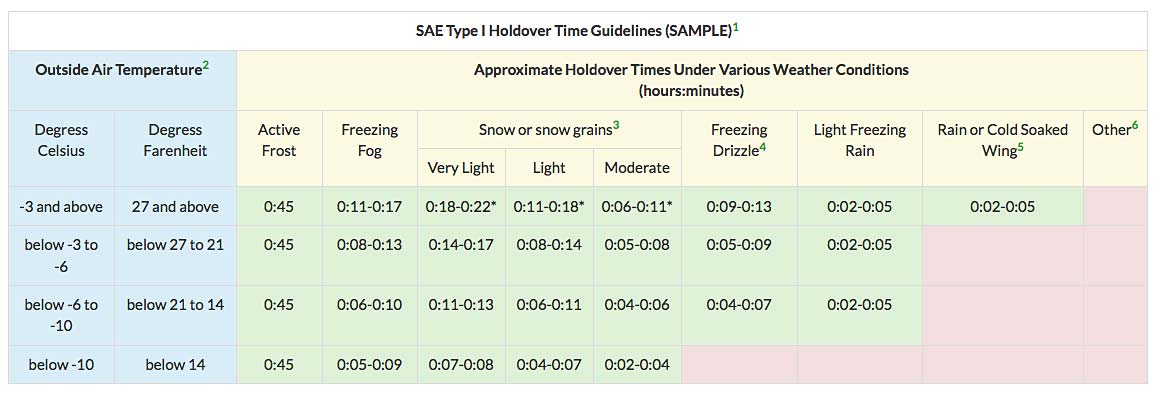
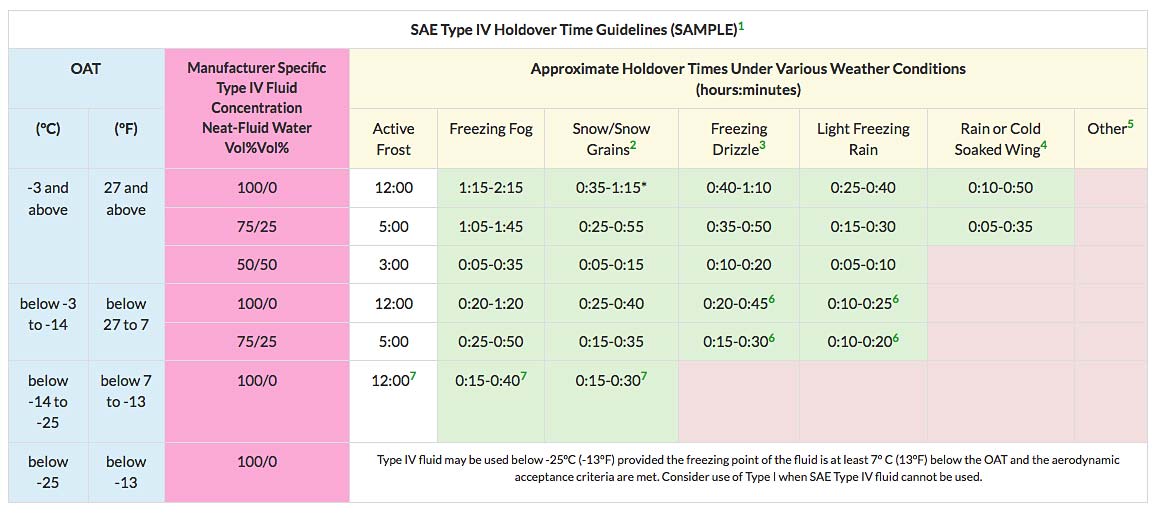
    Airlines use four standard fluid types when deicing aircraft. These fluids have different viscosities – viscosity is a measure of a fluid’s resistance to flow – and holdover times, which is the length of time the fluids are expected to protect the plane during snow or icing conditions.

    The deicing process includes both complex crew logistics and interesting science.

    In the United States, airlines typically use a two-step process before flying. First, they perform deicing using either a heated Type I fluid or a heated solution of Type I fluid and water.

    Deicing removes existing ice and snow from the wings of the plane, which is why airlines often heat the deicing fluid to around 140 to 150 degrees Fahrenheit (60 to 66 degrees Celsius) before application.

    Type I fluids are the thinnest of the deicing fluids, and they’re often red or orange. They spread the easiest on a plane’s surface because they have the lowest viscosity. Since they’re thin enough to flow off a plane when it’s not moving – or moving slowly – they can be applied to any aircraft.

    But as a result, they also have the shortest holdover times, often less than 20 minutes depending on the weather conditions. These holdover times vary, though, and can be less than five minutes for snow if the outside air temperature is below 14 F (minus 10 C).

    Next, the ground crews will typically apply an anti-icing fluid to the aircraft – often Type II or Type IV. Anti-icing solutions are used to help prevent the future accumulation of snow and ice on the wings of planes.

    Type II and Type IV fluids contain thickening agents that increase their viscosity. These thickeners allow the fluid to remain on the aircraft longer to help melt newly forming frost or ice. This translates to longer holdover times – often more than 30 minutes for snow – but it also means the plane needs to reach a higher speed to shear, or blow off, the fluid.

    Once applied, Type II and IV fluids will generally stay on the aircraft until the plane is taxiing down the runaway during takeoff. By then, it has gained enough speed to produce the shear force necessary to remove the fluid from the plane. Type II fluids are a clear or pale straw color, while Type IV fluids are generally green. Including a colored dye helps the ground crew clearly see what parts of the plane have been coated and which areas still need application.

    Type III fluids are not as common anymore. They are formulated to shear off at lower speeds and thus are sometimes used on small commuter aircraft since these planes typically don’t go as fast as commercial jetliners.

    Environmental impact of deicing

    Environmental considerations are also an important part of deicing. Glycols require a lot of oxygen to biodegrade, which can deplete dissolved oxygen in streams or lakes. This, in turn, can threaten aquatic life, like fish and other organisms, that need dissolved oxygen to breathe.

    In addition, ethylene glycol is toxic to wildlife, so the Environmental Protection Agency requires airports to monitor their stormwater runoff. For this reason, most airports collect and treat stormwater runoff on-site or send it to a municipal wastewater treatment facility.

    Airports are also increasingly starting to use fluid recovery systems to recycle the glycols and capture the additives in these fluids, which are often toxic, too. They’ll often use designated areas outside for deicing planes so they can collect and store the fluids after they run off the plane in holding tanks underground until they can be recycled.

    Atmospheric icing

    During flight, planes use other technologies to mitigate the icing risks. For example, most modern aircraft use bleed air systems, which channel hot air from the engine’s compressor through interior ducts to the leading edges of the wings and other critical areas to help prevent ice buildup while the plane is in the sky.

    Some planes also use electrically heated panels embedded in the aircraft’s wings to generate heat. These control systems typically cannot be used while the plane is on the ground, since they rely on cold air flowing across the wing’s surface. This airflow is usually achieved at cruising altitude and is necessary to prevent the plane’s surface from getting too hot.

    Airlines may sometimes also use icephobic coatings to help keep new ice from forming and sticking on the outside surfaces of planes. These coatings delay how soon new ice can form. They can also reduce how strongly the ice adheres to the surface.

    Icephobic polymer coatings can mitigate ice buildup and help reduce ice adhesion on surfaces.
    Hernández Rodríguez et al., 2024., CC BY-SA

    Smaller planes may also use inflatable rubber strips called pneumatic boots on the wings that can be inflated as needed to break off accumulated ice on the leading edge of the wings.

    Flying is truly a modern scientific marvel. A lot of engineering goes into not only getting planes off the ground but also keeping them ice-free during flight. So the next time you experience a weather-related delay at the airport, just remember that deicing is needed to ensure both a safe flight and a truly uplifting one.

    Andrew Sommers does not work for, consult, own shares in or receive funding from any company or organization that would benefit from this article, and has disclosed no relevant affiliations beyond their academic appointment.

    ref. The science behind airplane deicing – a mechanical engineer explains how chemistry and physics make flying a more uplifting experience – https://theconversation.com/the-science-behind-airplane-deicing-a-mechanical-engineer-explains-how-chemistry-and-physics-make-flying-a-more-uplifting-experience-248732

    MIL OSI – Global Reports

  • MIL-OSI Global: Maple seeds’ unique spinning motion allows them to travel far even in the rain, a new study shows

    Source: The Conversation – USA – By Andrew Dickerson, Associate Professor of Mechanical, Aerospace and Biomedical Engineering, University of Tennessee

    Winged seeds called samaras grow on maple trees. These are seeds from the Japanese maple, _Acer palmatum_. AlessandroZocc/iStock via Getty Images Plus

    When wind or other disturbances detach winged maple seeds called samaras from their parent tree, they spin through the air – and can even spin when it’s raining. Impacts by high-speed raindrops only briefly interrupt the seed’s spinning because the seed can shed the drop rapidly and restart its spinning in less time than it takes to blink.

    If you live somewhere with maple trees, you’ve probably seen their striking helicopter seeds – made up of a seed pod attached to a delicate wing. Maple samaras’ unique design and spinning movement can teach physicists like me about seed dispersal patterns and even engineering new types of flying vehicles.

    The samaras’ spinning movement, called autorotation, keeps them in the air for longer so they travel farther.

    The spinning flight of a maple samara.

    In a February 2025 study, my colleagues and I filmed raindrops as they crashed into autorotating samaras. The samaras shed drops by shattering them, flinging the drops off, or rolling out of the way – like they’re turning away from a punch. If a drop falls in just the right place, the spinning seed can cut it in half.

    The movement of a samara as it spins through the air. Our new study captured this pattern using a high-speed camera.
    Breanna Shaeffer and Andrew Dickerson, University of Tennessee-Knoxville

    In order to keep flying, the samaras must shed the entire drop. Samaras shed drops fastest when the drops hit the heavier, round nutlet part of the seed, rather than the wing. Shedding is made easier by the samaras’ mildly water-repellent surface. We estimated that raindrop collisions reduce a samara’s time in flight and the distance it travels while spinning, but by less than 10%.

    Why it matters

    Maples are an important species to the Eastern United States. They provide syrup and timber, making them economically and commercially significant.

    To proliferate in a rapidly changing climate, maples and other samara-bearing species need to disperse their seeds as far as possible.

    My team’s results provide context for other studies focused on how wind transports rotating and nonrotating seeds alike. Some seeds can even travel hundreds of miles.

    From an engineering perspective, the insights gained from our study could inform the design of new types of aerial vehicles that use autorotation to ride the wind without a motor. Mimicking the shapes of these seeds could help such vehicles quickly recover from disruptions to flight.

    Samaras are also visually intriguing. Discovering more about how small, beautiful parts of nature thrive could help scientists get people interested in the environment.

    What still isn’t known

    Maple samaras represent just one way that seeds use the wind to disperse farther. A dandelion’s parachute-like float relies on the seed’s light weight and high drag. A hop tree seed uses a single, wafer-shaped seed to flutter, while triplaris seeds have three wings that achieve a helicopter-like spin. Researchers still aren’t sure how raindrops can affect the flight of these seeds.

    What’s next

    Next, my colleagues and I hope to unravel the flight mechanics of the “rolling samaras” found on tulip poplar and ash trees. These seeds rotate like maple samaras, but the wing also rolls around the axis that runs across its wingspan as it does so.

    Not only do we plan to compare their flight performance against the more recognizable maple samara, but we will also study how these seeds respond to perturbations such as wing damage and crosswinds.

    How I do my work

    I like to uncover the complexity in seemingly simple systems. So many of the brief, small and common interactions in our world are wonderfully beautiful. I seek to tell those stories through a camera lens and with mathematical flair.

    Andrew Dickerson receives funding from the National Science Foundation.

    ref. Maple seeds’ unique spinning motion allows them to travel far even in the rain, a new study shows – https://theconversation.com/maple-seeds-unique-spinning-motion-allows-them-to-travel-far-even-in-the-rain-a-new-study-shows-250341

    MIL OSI – Global Reports

  • MIL-OSI Video: Try Again, Fail Again, Fail Better: Lessons from Community Courts

    Source: US National Institute of Justice (video statements)

    Change doesn’t come easy, particularly within an institution as large and complex as the criminal justice system. Greg Berman, Director of the Center for Court Innovation, offered lessons from several efforts to make reform stick in criminal justice settings. In particular, he focused on the development of community courts — experimental court projects that are attempting to reduce both crime and incarceration in dozens of cities across the U.S. and around the world. He also drew upon his recently-published book Trial & Error in Criminal Justice Reform: Learning from Failure (Urban Institute Press).

    (Opinions or points of view expressed represent the speaker and do not necessarily represent the official position or policies of the U.S. Department of Justice. Any product or manufacturer discussed is presented for informational purposes only and do not constitute product approval or endorsement by the U.S. Department of Justice.)

    https://www.youtube.com/watch?v=TBkESwl47m4

    MIL OSI Video

  • MIL-OSI Video: Violent Repeat Victimization: Prospects and Challenges for Research and Practice

    Source: US National Institute of Justice (video statements)

    Janet L. Lauritsen, Professor of Criminology and Criminal Justice, University of Missouri-St. Louis

    Research tells us that a relatively small fraction of individuals experience a large proportion of violent victimizations. Thus, focusing on reducing repeat victimization might have a large impact on total rates of violence. However, research also tells us that most violent crime victims do not experience more than one incident during a six-month or one-year time period. As a result, special policies to prevent repeat violence may not be cost-effective for most victims.

    Dr. Lauritsen summarizes existing research on repeat violent victimization, both here in the United States and abroad. She provides new findings from the National Crime Victimization Survey about the potential impact that reducing repeat victimization might have on rates of violence in the U.S. She discusses possible factors that can be used to predict whether victimization is likely to be repeated and suggest how such information can inform policy and practice. She also discusses several factors, such as persistent exposure to offenders, that appear to be unique to repeat victimization and most relevant to developing effective policies and practices.
    (Opinions or points of view expressed represent the speaker and do not necessarily represent the official position or policies of the U.S. Department of Justice. Any product or manufacturer discussed is presented for informational purposes only and do not constitute product approval or endorsement by the U.S. Department of Justice.)

    https://www.youtube.com/watch?v=vle3Ia1YG2Y

    MIL OSI Video

  • MIL-OSI Video: Why Is the United States the Most Homicidal Nation in the Affluent World

    Source: US National Institute of Justice (video statements)

    Ohio State University Since World War II, the homicide rate in the U.S. has been three to ten times higher than in Canada, Western Europe, and Japan. This, however, has not always been the case. What caused the dramatic change? Dr. Roth discussed how and why rates of different kinds of homicide have varied across time and space over the past 450 years, including an examination of the murder of children by parents or caregivers, intimate partner violence, and homicides among unrelated adults.

    (Opinions or points of view expressed represent the speaker and do not necessarily represent the official position or policies of the U.S. Department of Justice. Any product or manufacturer discussed is presented for informational purposes only and do not constitute product approval or endorsement by the U.S. Department of Justice.)

    https://www.youtube.com/watch?v=SwwtDNNpNRc

    MIL OSI Video

  • MIL-OSI United Kingdom: Sophie Le Sueur appointed as Chief Officer for Employment, Social Security and Housing28 February 2025 The Government of Jersey is pleased to announce the appointment of Sophie Le Sueur as Chief Officer for Employment, Social Security and Housing. Sophie has been acting as Interim Chief Officer since… Read more

    Source: Channel Islands – Jersey

    28 February 2025

    The Government of Jersey is pleased to announce the appointment of Sophie Le Sueur as Chief Officer for Employment, Social Security and Housing. 

    Sophie has been acting as Interim Chief Officer since September last year and was successful in securing the role permanently following a robust recruitment process, independently overseen by the Jersey Appointments Commission.

    Educated at Beaulieu Convent School, Sophie joined the Government in 2005 as a Careers Advisor. Over the years, she has held eight different roles across the Government of Jersey gaining valuable experience across operations, policy development, and leadership, with a strong focus on improving customer experience and colleague engagement. 

    Sophie said: “I’m honoured to be appointed as Chief Officer for Employment, Social Security and Housing. Having spent my career in Government, I’m passionate about delivering services that truly make a difference to Islanders. I look forward to working with colleagues and stakeholders to drive positive change and create meaningful opportunities for our community.” 

    Minister for Social Security, Deputy Lyndsay Feltham, said: “I congratulate Sophie on her appointment as Chief Officer for Employment, Social Security and Housing. Her extensive experience, leadership skills, and commitment to public service make her an ideal person to lead the department. I look forward to working with her to continue improving services and delivering real benefits for Islanders.”​

    MIL OSI United Kingdom

  • MIL-OSI: Kajeet Applauds School Districts’ Overwhelming Support for E-Rate Wi-Fi Hotspot Program Amid Congressional Review

    Source: GlobeNewswire (MIL-OSI)

    MCLEAN, Va., Feb. 28, 2025 (GLOBE NEWSWIRE) — Kajeet®, a leading provider of wireless connectivity solutions for education, today celebrates the resounding endorsement from school districts nationwide for the Federal Communications Commission’s (FCC) E-Rate program expansion to include Wi-Fi hotspots for off-campus use. This support was powerfully highlighted during a recent Schools, Health & Libraries Broadband (SHLB) Coalition webinar (recording available here), where education leaders underscored the transformative impact of the program on student access to digital learning resources.

    The SHLB webinar, which addressed Senate Majority Leader John Thune’s initiative to enact a Congressional Review Act (CRA) resolution to overturn the FCC’s June 2024 hotspot order, featured persuasive testimony from school district representatives.

    Jill Hobson of Gainesville City Schools recounted poignant experiences, stating, “We had students completing homework in McDonald’s parking lots, as it was their only means of accessing the internet.” She further illustrated the program’s impact with a notable example: “One student, previously struggling academically, achieved grades of A’s and B’s after receiving a hotspot, at last able to stay on pace with her peers.” These narratives underscore a widely shared conviction among districts nationwide: dependable internet access has become an essential requirement for education, rather than a mere convenience.

    Kajeet has long championed equitable access to education through its innovative connectivity solutions, partnering with schools to deploy secure, filtered Wi-Fi hotspots that meet E-Rate requirements. “We’ve seen firsthand how access to safe internet connectivity empowers students, especially in underserved communities,” said Ben Weintraub, CEO at Kajeet. “The overwhelming support from school districts during the SHLB webinar reinforces what we already know: this program is a lifeline for millions of students and families.”

    Critics argue that student connectivity through school-provided hotspots could lead to unrestricted access to platforms like TikTok, but the data tells a different story. In 2024 alone, Kajeet’s advanced filtering technology blocked over 2.7 billion attempts to access TikTok on E-Rate-funded devices, reinforcing the effectiveness of these safeguards. According to Weintraub, “Digital equity shouldn’t come at the cost of student safety—Kajeet’s data-driven approach proves that both can go hand in hand.”

    Despite this groundswell of support, the FCC’s Wi-Fi hotspot initiative faces uncertainty as Senate Majority Leader John Thune and Senator Ted Cruz lead efforts to overturn the program via the CRA. It was also noted in the webinar recording that the program’s reversal would disproportionately harm rural and low-income students. “School districts are telling us loud and clear: E-Rate hotspots are working,” Weintraub said. Kajeet stands in solidarity with these voices, urging policymakers to preserve a program that has proven its value in closing the homework gap.

    As a trusted partner to hundreds of school districts, Kajeet remains committed to supporting educational equity through technology. “We call on Senators to listen to the educators and students who rely on this program,” Weintraub added. “Their success stories are the true measure of E-Rate’s impact.”

    For more information about Kajeet’s E-Rate solutions or to schedule an interview, please contact ljennings@kajeet.com.

    About Kajeet
    Kajeet provides optimized IoT connectivity, software and hardware solutions that deliver safe, reliable, and controlled internet connectivity to nearly 3,000 businesses, schools and districts, state and local governments, and IoT solution providers. Kajeet is the only managed IoT connectivity services provider in the industry to offer a scalable IoT management platform, Sentinel®, that includes complete visibility into real-time data usage, policy control management, custom content filters for added security and multi-network flexibility. To learn more, visit kajeet.com.

    Media Contact:

    Linda Jennings

    Ljennings@kajeet.com

    248-521-3606

    The MIL Network

  • MIL-OSI Global: How to make a political Oscars speech that doesn’t flop – according to rhetorical theory

    Source: The Conversation – UK – By Tom F. Wright, Reader in Rhetoric, University of Sussex

    So, it’s happened. You’re on stage, Oscar statue in hand, facing Hollywood’s finest and millions of viewers. You could keep it simple – thank your agent, your co-stars, your dog. Or you could use this moment to say something that matters.

    That’s exactly what Jane Fonda just did at the 2025 Screen Actors Guild Awards, urging the audience “to resist successfully what is coming at us” as Elon Musk’s Doge holds a chainsaw to the US federal government. From the cold war to civil rights to Trump 2.0, award ceremonies have always been stages for activism.

    Some of these political speeches have been electrifying. Some have flopped. Some have been drowned out by the orchestra before they even got started. If you’re going to make a political speech at the Oscars, you’d better do it right.

    Thankfully, Kenneth Burke — one of the 20th century’s most influential rhetorical scholars — offers a road map. His theories on identification, dramatism and symbolic action explain why some speeches resonate while others fall flat.


    Looking for something good? Cut through the noise with a carefully curated selection of the latest releases, live events and exhibitions, straight to your inbox every fortnight, on Fridays. Sign up here.


    1. Know your two (very different) audiences

    Burke argued in the 1950s that rhetoric isn’t just about persuasion – it’s about identification. A speaker is most persuasive when they convince their audience that they share the same values and concerns. If people feel you’re “one of them”, they’re more likely to listen.

    The Oscars create a unique rhetorical challenge. Inside LA’s Dolby Theatre, you might be surrounded by like-minded pampered progressives. But beyond that room, millions of viewers at home may be far less receptive.

    Michael Moore’s infamous acceptance speech in 2003.

    Director Michael Moore learned this the hard way in 2003 when, after winning best documentary for his film Bowling for Columbine, he stormed the stage and declared: “Shame on you, Mr Bush! Shame on you!” The result? A mix of cheers and boos. And days of being pilloried on cable news. Instead of drawing people in, Moore’s approach alienated half his audience.

    Compare this with Meryl Streep’s speech at the 2017 Golden Globes when collecting her lifetime achievement award. She also criticised her president but framed it differently: “Disrespect invites disrespect. Violence incites violence. When the powerful use their position to bully others, we all lose.”

    She didn’t need to utter Donald Trump’s name. And because she framed her speech as a universal concern, rather than a partisan attack, it resonated beyond the room.

    2. Put yourself in the story

    Burke’s second idea is that all communication is “dramatic” – a performance shaped by setting, characters and conflict. In a political speech, the most compelling “character” is often you, the speaker.

    Audiences don’t just respond to abstract arguments. They connect with people who embody the very struggle they’re speaking about.

    Lily Gladstone accepting the Golden Globe for best actress in 2024.

    Lily Gladstone’s 2024 Golden Globes speech worked this way. When she won best actress for Killers of the Flower Moon, she didn’t start with industry statistics or broad calls for change. Instead, she spoke in Blackfeet, honouring her Indigenous roots: “I just spoke a bit of Blackfeet language, a beautiful community – the nation that raised me.”

    That one sentence transformed her win into a moment of cultural recognition, making her speech as much an act of representation as a speech about representation.

    3. Frame your argument wisely

    If you want your audience to engage, you must frame your message in a way that pulls them in. Whereas a speech that just states a problem can feel like noise, one that connects the issue to a larger story can be powerful.

    This is where Burke’s idea of symbolic action comes in. He defined it as “the making or construction of social reality through symbols that foster identification”. Put another way: words don’t just describe reality, they shape it.

    Oprah Winfrey’s speech from the 2018 Golden Globes.

    Take Oprah Winfrey’s 2018 Golden Globes speech picking up the Cecil B. DeMille award. Instead of simply condemning sexism in Hollywood, she tied it to a broader historical movement, from civil rights to #MeToo: “For too long, women have not been heard or believed if they dared to speak their truth to the power [of] those men. But their time is up. Their time is up!”

    Winfrey wasn’t just talking about change – she was creating it in real time, rallying the room behind a clear, urgent message. That’s the difference between listing a problem and delivering a message that sticks.

    4. Turn your speech into an act of protest

    While framing helps persuade an audience, some moments go further, becoming acts of defiance themselves. This is when a speech moves beyond words into symbolic action.

    Let’s take perhaps the most famous protest in Oscars history. In 1973, Marlon Brando refused to pick up his best actor statue – sending in his place Sacheen Littlefeather, who explained she was there as a protest for Hollywood’s treatment of Native American people.

    Sacheen Littlefeather refuses to accept the best actor Oscar on behalf of Marlon Brando.

    “He very regretfully cannot accept this very generous award,” she told the audience. “And the reasons for this being are the treatment of American Indians today by the film industry … and on television in movie reruns, and also with recent happenings at Wounded Knee.”

    In under a minute, she transformed what could have been a quiet refusal into a national reckoning. The audience’s reaction – some cheering, some booing – only made it clearer. This wasn’t just a speech, it was a moment.

    A speech that merely describes a problem may be forgotten, but one that transforms the moment itself? That’s the stuff of history.

    5. Expect a backlash, and decide if you care

    No matter how well you craft your speech, someone is going to be angry. Burke’s final idea for helping us understand this is the “scapegoat mechanism”, by which one figure is cast as the discordant element that must be removed to restore unity.

    If you make a political speech at the Oscars, it could be you. Vanessa Redgrave learned this in 1978: after winning best supporting actress for her role in Julia, she defended her pro-Palestine activism against attacks from the Jewish Defence League, who she called a “bunch of Zionist hoodlums”. The reaction was instant – cheers mixed with boos.

    Vanessa Redgrave accepts the Oscar for supporting actress in 1978.

    Later that night, screenwriter Paddy Chayefsky publicly rebuked her, saying: “A simple ‘thank you’ would have sufficed.” The backlash hurt Redgrave’s career, but she stood by her words.

    If you’re going to say something political, be prepared to own it. And make sure you beat the orchestra.

    Tom F. Wright does not work for, consult, own shares in or receive funding from any company or organisation that would benefit from this article, and has disclosed no relevant affiliations beyond their academic appointment.

    ref. How to make a political Oscars speech that doesn’t flop – according to rhetorical theory – https://theconversation.com/how-to-make-a-political-oscars-speech-that-doesnt-flop-according-to-rhetorical-theory-250949

    MIL OSI – Global Reports

  • MIL-OSI Global: White House spat with AP over ‘Gulf of America’ ignites fears for press freedom in second Trump era

    Source: The Conversation – UK – By Colleen Murrell, Full Professor in Journalism, Dublin City University

    A federal judge in the District Court of Columbia will shortly decide if the US president, Donald Trump, is allowed to dictate the terms of service of the Associated Press (AP), the US wire agency that proudly proclaims it is read by 4 billion people every day.

    In a (typically for this administration) knee-jerk decision on February 11, White House officials informed AP that its journalists would be barred from entering restricted areas such as the Oval Office and Air Force One until it stops using the geographic term “Gulf of Mexico” – in contravention of an executive order renaming it the “Gulf of America”.

    AP’s style guide explains that the Gulf of Mexico has carried this name for more than 400 years, and that Trump’s order only holds authority within the US. It notes that as a global news agency, it “must ensure that place names and geography are easily recognizable to all audiences”.

    But the style guide adds that, while AP will continue to refer to the body of water by its original name, it will do so “while acknowledging the new name Trump has chosen”.

    According to AP’s executive editor, Julie Pace: “Limiting our access to the Oval Office based on the content of AP’s speech not only severely impedes the public’s access to independent news, it plainly violates the first amendment” – which covers freedom of speech and the press.

    In seeking to overturn the ban, AP brought a lawsuit (AP-v-Budowich-Complaint) against the White House chief of staff, Susan Wiles, the deputy chief of staff, Taylor Budowich, and its press secretary, Karoline Leavitt, in their official capacities.

    After a short hearing, Judge Trevor N. McFadden – who was appointed by Trump – declined to restore AP’s access immediately, and instead set another hearing date for March 20. According to the Washington Post, the judge was “not sufficiently convinced the situation was ‘dire’ enough to warrant such an intervention” – and therefore was “not inclined to act precipitously on the executive office of the president”.

    Following this decision, the White House denied access to Trump’s first cabinet meeting on February 26 to an AP photographer, as well as reporters from Reuters, HuffPost and German newspaper Der Tagesspiegel. Instead, officials allowed in cameras from ABC and Newsmax, plus reporters from Axios, the Blaze, Bloomberg and NPR.

    Pick and mix

    But can the president be allowed this pick-and-mix approach to access to the seat of power?

    The White House press pool has been in place for more than a century, with the seating allocation in the press briefing room decided by the board of the White House Correspondents’ Association. As the major American news agency, AP has traditionally held the coveted middle front-row seat, which it still retains – even though senior officials have tweeted veiled threats to rescind AP’s entire White House credentials.

    The press briefing room holds 49 seats, with some seats shared between two companies on rotation, and a few journalists or photographers permitted to stand in the aisles when there is room. Meanwhile, Air Force One (in reality, two Boeing 747s used on rotation) only has room for 13 people to represent the entire White House press corps. The pool on the plane is ordinarily made up of three agency reporters (AP, Reuters and Bloomberg), four photographers (including from AP), three network TV journalists, a radio reporter and two print reporters.

    Trump has an ongoing fight against “legacy” news outlets that dominated coverage before the advent of the internet. These media often have strict editorial guidelines, but the president has regularly dismissed them as “fake news”. During the election campaign, he ignored well-known programmes such as CBS’s Sixty Minutes in favour of Joe Rogan’s podcast.

    At the Pentagon, Trump’s new military brooms have also been sweeping legacy media companies out of their briefing rooms. This list includes NBC, the New York Times, Politico, CNN and The Washington Post. In their place will go Trump-friendly outlets such as Newsmax and the Washington Examiner.

    ‘Privilege, not a right’

    Meanwhile, a petition by media companies is calling on the US government to “honor its commitment to freedom of expression” by upholding “a nonpartisan defense of a free press”. Included on this petition are the Committee to Protect Journalists, the International Press Institute, and the Society of Professional Journalists.

    Members of the press pool are usually the only reporters that get to throw questions at senior members of the administration. Its members follow the president on important trips both nationally and internationally. AP is a widely trusted non-profit news organisation, and its reports get syndicated to media organisations throughout the world, with any profits used to pay for its staff and its newsgathering.

    CNN reporter Kaitlan Collins questions the White House press secretary Karoline Leavitt over the banning of AP from White House briefings.

    The White House released a statement on February 24: “As we have said from the beginning, asking the president of the United States questions in the Oval Office and aboard Air Force One is a privilege granted to journalists, not a legal right.”

    However, having an independent arbiter making decisions about press pool representation is surely preferable in maintaining a free press and accountability than allowing each administration to pick its own reporters – or even its own facts.

    Colleen Murrell received funding from Irish regulator Coimisiún na Meán (2021-4) for research for the annual Reuters Digital News Report Ireland.

    ref. White House spat with AP over ‘Gulf of America’ ignites fears for press freedom in second Trump era – https://theconversation.com/white-house-spat-with-ap-over-gulf-of-america-ignites-fears-for-press-freedom-in-second-trump-era-251163

    MIL OSI – Global Reports

  • MIL-OSI Global: Emmanuel Macron used every diplomatic trick in the book at the White House – but Trump writes his own rules

    Source: The Conversation – UK – By Helen Drake, Professor of French and European Studies and Director of Loughborough University London’s Institute for Diplomacy and International Affairs, Loughborough University

    If there was a book of diplomacy, then French president Emmanuel Macron threw it at US president Donald Trump in their joint press conference in Washington DC. Macron delivered quite the masterclass in the diplomatic arts. Unthreatening body language and public displays of affection? Check.

    Meeting your interlocutor on any and every inch of common ground? Check. Macron’s willing use of fluent English was a key tactic here. Other than when answering French-language questions (when to have responded in English would have brought Macron yet more domestic grief), he adapted to the language of his hosts.

    Macron and Trump’s press conference.

    Recalling shared memories of happier, shared times? Check. It was smart to remind Trump of his time as a guest at the reopening of Notre Dame cathedral in Paris just a few months previously.

    Gently correcting a friend in danger of veering too far from reality (here, regarding the extent and type of European aid to Ukraine) as you would expect from a true ally? Again, check.

    These are the soft skills of diplomacy as communication between human beings to which Macron typically brings his heart, body and soul. On this occasion and on this criterion he outperformed even himself, and outclassed his host by some degree.

    At times, Trump looked enraptured by this performance from such an interesting specimen of utter Europeanness. At others, the host fidgeted and listened stony-faced to the halting interpretation of Macron’s rapid-fire French. He tried a few gauche niceties of his own (“say hello to your beautiful wife”) and dialled up to the max his personal brand of touchy-feely diplomacy.

    Behind the scenes

    Beyond the memorable set pieces of diplomatic theatre lies, of course, the message itself. This must represent the voice, the interests and the concerns of the state or other diplomatic actor. But it may well go against the flow, disrupting the smooth surface of diplomatic pleasantries.

    Former French president Charles de Gaulle notoriously ruffled cold-war feathers in the 1960s with rousing speeches to stir non-aligned countries and French-speaking people to contest the existing world order. Former foreign minister Dominique de Villepin will be remembered for his eloquent, impassioned plea to the United Nations security council in 2003 against the allied invasion of Iraq.

    Macron has dabbled in free-wheeling diplomacy himself. He claimed in 2019 that Nato was close to “brain death” and maintained a dialogue with Russia’s president Vladimir Putin after the 2022 Russian invasion of Ukraine. In Macron’s account at the press conference with Trump, he closed this line of communication when he learned of the atrocities being perpetrated by Russian forces.

    Articulating France’s global, strategic interests is where Macron feels most comfortable and probably where he is best suited (judged by the standards of his domestic political failings). His trip to Washington at such a pivotal moment in Trump’s second presidency, with the fate of Ukraine in the balance, was a natural move for a leader who, since the beginning of his first mandate in 2017, has sought to lead the European conversation about the continent’s security.

    His sense of urgency to secure greater European autonomy and capacity in its defence lies behind his willingness to talk to all parties. France does, after all, go by the fiendishly untranslatable label of a “puissance d’équilibres” (which means an actor with the power to strike a balance but also perhaps to bring others into balance or even, simply, to keep the peace).

    Macron’s readiness to confront the cold, hard facts of contemporary international relations – he has already told the French they need to put themselves on a wartime footing in economic terms – gives him a track record of sorts in the diplomatic negotiations now to come: between Europeans themselves, and between Europe and the US.

    But facing down Macron’s fancy optics is one particularly awkward fact – namely that Trump does not do diplomacy by the book, or at least not the one he was metaphorically gifted by president Macron. Where the point of diplomacy is to establish a common language with shared codes and expectations in order to ease tensions and bridge differences between parties, Trump’s diplomatic how-to guide boasts new chapters on the arts of bullying, harassment, gaslighting and, of course, the deal.


    Read more:
    Trump and Europe: US ‘transactionalism on steroids’ is the challenge facing leaders now


    For now, the US president is tolerating the quaint diplomatic overtures of these curious Europeans and given the ultra-high stakes of what couldn’t be further from a game, that is diplomacy itself.

    Helen Drake does not work for, consult, own shares in or receive funding from any company or organisation that would benefit from this article, and has disclosed no relevant affiliations beyond their academic appointment.

    ref. Emmanuel Macron used every diplomatic trick in the book at the White House – but Trump writes his own rules – https://theconversation.com/emmanuel-macron-used-every-diplomatic-trick-in-the-book-at-the-white-house-but-trump-writes-his-own-rules-250832

    MIL OSI – Global Reports

  • MIL-OSI Global: The UK’s food system is broken. A green new deal for agriculture could be revolutionary

    Source: The Conversation – UK – By Benjamin Selwyn, Professor of International Relations and International Development, Department of International Relations, University of Sussex

    William Edge/Shutterstock

    The UK’s food system was described as broken in a recent parliamentary report – and it’s not hard to see why. High living costs, a health crisis of diet-related chronic disease, farmers’ incomes squeezed and low pay across the agricultural sector all play their parts.

    And these elements are underpinned by an environmentally destructive mode of agricultural production – the longer the livestock-intensive system prevails, the greater the environmental, economic and social costs.

    The opportunity cost of not dealing with the food crisis is severe. The Food, Farming and Countryside Commission found that the price of the UK’s unhealthy food system is around £268 billion a year – almost equivalent to the government’s entire expenditure on health. And farmers are also worried about the sector as they face an unpredictable climate, smaller profits and changes to tax relief policies.

    I have researched how a green new deal for agriculture – namely a food system that complements rather than undermines the environment, while tackling social inequities – could begin to address these problems.

    In 2024 the UK’s farming sector experienced its second-worst harvest on record. Huge levels of rain last winter disrupted farmers’ ability to grow crops and reduced yields.

    The UK’s population faces a significant health crisis, exacerbated by the high cost of living. In 2022, around two-thirds of the population across all four nations were either overweight or obese.

    Retailers, processors and distributors grab an exorbitant share of the final value of many agricultural products. Sometimes farmers make as little as 1p profit for each item they produce. And farm workers’ earnings can sometimes leave them facing absolute poverty.

    What’s more, the UK farming sector is systemically inefficient. Dairy and meat products provide about 32% of calories consumed in the UK, and less than half (48%) of the protein. At the same time, livestock and their feed make up 85% of the UK’s total land use for agriculture.

    To make matters worse, land ownership is highly concentrated – about 25,000 landowners, typically corporations and members of the aristocracy, own about 50% of England, for example.

    What would change look like?

    A green new deal for agriculture would require a significant reorientation of policy, akin to the 1945 Labour government’s establishment of the welfare state. Critics might decry the costs and difficulties – but the longer the government waits, the greater the economic and environmental costs are likely to be.


    Read more:
    Britain’s unearned wealth has ballooned – a modest capital tax could help avoid austerity and boost the economy


    The government could introduce compulsory sale orders to spread land ownership more evenly. These would enable public bodies to obtain land that has been left derelict, vacant or that has been used in environmentally damaging ways. These measures could be supported by the establishment of community land trusts – non-profit, democratic organisations that own and work land for the benefit of local people.

    And a green new deal for agriculture could start with the government using its ecosystems service payments, where farmers and landowners are paid to manage their land in an environmentally beneficial way, to stimulate a transition to more plant-based proteins. This could combat hardship among farmers and agricultural workers, and tackle food poverty and ill health in the population. It would also establish the basis for a more sustainable agricultural system.


    Read more:
    Subsidised community restaurants could help tackle the UK’s broken food system – here’s how


    The UK think tank Green Alliance has mapped a green protein transition. It would entail an increase in “agro-ecologically” farmed land – that is, methods that bring a more ecological approach to farming. At present, this is about 3% of UK land, and it would have to rise to 60% by 2050. Under the plan, by 2030 10% of farmland would become semi-natural habitat, rising to one-third by 2050. This would protect land and facilitate natural restoration, and would also support agro-ecological farming methods.

    In this scenario, Britons would be projected to eat 45% less meat and dairy, replacing them with alternative proteins – plants and synthetic foods such as those made from precision fermentation. This is a revolutionary technology producing proteins that can be used in new alternatives to meat and dairy.

    Many conceptions of the protein transition from animal sources to more plant products ignore the necessity of improving farmers’ and agricultural workers’ incomes. But this will be crucial.

    Ecosystems service payments should be broadened to include a focus on sustainable incomes. Farms can be paid directly by government for sustainable production to combat farmer poverty. And the real living wage of £12.60 an hour should be compulsory for agricultural workers.

    As land use shifts from livestock grazing and feed crop production, more ground could be used for food crops for human consumption. There would then be more scope to change which food crops are produced – from wheat to legumes, for example.

    Flour made from broad beans – which can be grown in the UK – packs a bigger protein punch than traditional wheat flour.
    Narsil/Shutterstock

    Research has shown that flour made from broad beans is higher in key nutrients – protein, iron and fibre – than wheat flour. Bread, pasta, pizza, cakes and biscuits could increasingly be produced using broad bean flour, underpinning a shift towards more nutritious diets.

    A protein transition would also free up land for fruit and vegetable production for domestic consumption, reducing the UK’s heavy import dependence by using polytunnels and environmentally sustainable greenhouses.

    Climate breakdown means that the frequency of poor harvests will increase. And the volatile economic and political global picture means that affordable food imports cannot be taken for granted.

    A green new deal for agriculture could begin to remedy many of the problems the UK faces due to its broken food system. What’s needed is a coalition including courageous political parties, farmers, and workers within and beyond food production. Working together, these groups would be well placed to withstand the economic, political and environmental shocks that are on the horizon.

    Benjamin Selwyn does not work for, consult, own shares in or receive funding from any company or organisation that would benefit from this article, and has disclosed no relevant affiliations beyond their academic appointment.

    ref. The UK’s food system is broken. A green new deal for agriculture could be revolutionary – https://theconversation.com/the-uks-food-system-is-broken-a-green-new-deal-for-agriculture-could-be-revolutionary-250565

    MIL OSI – Global Reports

  • MIL-OSI Global: How evolution might explain impatience

    Source: The Conversation – UK – By Daniel Read, Professor of Behavioural Science, Warwick Business School, University of Warwick

    DC Studio/Shutterstock

    Nobody likes to wait, and we are willing to pay to avoid it. Expedited shipping, fast food and video streaming are all profitable because they reduce or eliminate that wait. You can test this by asking a group of people to choose between receiving £100 now or £110 in a year. Research shows a significant majority will choose the £100.

    But why do many people choose not to wait, when it seems obvious that they would be better off doing so? Sometimes this impatience is just put down to irrationality, impulsivity or short-sightedness, but there is also a long tradition in psychology and economics that views impatience as, at least in part, a rational response to the world.

    Perhaps the world of today, or perhaps the world in which we evolved.

    Recent research proposes that our evolutionary history shaped our impatience, and uses mathematical models to show how it works.

    The key idea is this. Imagine a large population of identical people who can choose between enjoying an early reward, or a larger reward later in time. An example might be choosing between two hunting grounds, one close and one further away.

    The closer one is guaranteed to yield a small animal quite quickly, while the farther one is likely to yield a big animal but only after a considerable wait or a gruelling hunt. Another example might be eating the juvenile, smaller fruit on a tree or waiting a few months until the fruit are abundant and ripe.

    Of course there is a catch. If the people wait too long for the large reward, there is a chance they won’t live long enough to earn it. And even if they do, the ripe fruit might have vanished before they reached it, perhaps stolen by a rival.

    As the authors of the recent study show, the animals (including humans) they model are better off taking the bird in the hand with even relatively small amounts of risk (you might not reach the birds) and uncertainty (there might not be two birds when you get there).

    Although models like this are simplifications of the real world, they are valuable for conceptualising how evolution might have produced particular tendencies in humans and other animals. But this model doesn’t do a lot to explain the human impatience we see now.

    In most studies of choice over time, people display high levels of impatience even in settings where risk is all but eliminated, and when it is financially beneficial to be patient.

    Struggle with impatience? It’s human nature.
    Khosro/Shutterstock

    One explanation is that the evolved way of valuing the future is still in place even in modern humans. We act as if the world is uncertain and risky, as it would have been for hunter gatherers, even when it is not.

    Good things come to those who wait

    Another explanation might be that we struggle to think about how the £110 is better than the £100. There is a lot of evidence for this.

    Consider, for example, an experiment I carried out in 2012 with psychologists Marc Scholten and Shane Frederick. Participants chose between £700 now or £700 plus £42 in one year.

    When given the choice in terms of monetary amounts, people were impatient. But if the £42 was described instead as “plus 6%” they were much more patient.

    People know that earning 6% a year is a great interest rate. But many people do not do the calculations and the extra £42 seems paltry compared to the £700.

    Another result that does not fit this evolutionary story concerns people’s responses to losses. Take a choice between paying a bill for £100 now or £100 later. A lot of people, often a majority, will prefer to pay the bill now. Indeed, some will prefer to pay £110 now rather than £100 later.

    Yet the possibility that you will not have to pay a future bill, or that the bill might have vanished by the time you get to it (the indebted has forgotten or died) should make you want to delay paying bills as long as possible. The more common response is probably partly due to a fundamental aversion to debt, which does not have an obvious evolutionary basis, but it is associated with religiosity.

    It remains to be seen if these complex preferences (such as patience for negative outcomes) can be explained by the process of natural selection, or if it is something that came later in human development.

    Evolutionary theory is an essential tool for thinking about the foundations of human decision making. The modern world is, however, very different from the environment in which we evolved.

    Daniel Read receives funding from the ESRC.

    ref. How evolution might explain impatience – https://theconversation.com/how-evolution-might-explain-impatience-249325

    MIL OSI – Global Reports

  • MIL-OSI Security: U.S. Central Command Announces New Chief Technology Officer

    Source: United States Central Command (CENTCOM)

    February 28, 2025
    Release Number 20250228-01
    FOR IMMEDIATE RELEASE

    TAMPA, Fla. – U.S. Central Command (CENTCOM) announced the hiring of Joy Shanaberger as the new Chief Technology Officer (CTO). She replaces Sky Moore, who, as a Navy Reservist, was mobilized to serve overseas.

    The CTO advises the CENTCOM Commander on the implementation of cutting-edge innovations across CENTCOM’s operations.

    “Sky Moore is national leader in defense innovation. Over the course of over two years as CENTCOM’s first CTO, Sky supercharged and mainstreamed innovation into the fabric of our warfighting culture in CENTCOM.  From advances in digital technology integration, to the fast-tracking of AI and counter Unmanned Aircraft System (cUAS) to protect service members throughout the region, Sky leaves a lasting legacy impact here at CENTCOM and we wish her well in her next assignment for the Navy,” said CENTCOM commander, General Michael Erik Kurilla.

    Joy Shanaberger joins CENTCOM as a dynamic leader with a background in defense and military innovation, most recently serving as a Senior Advisor in the Office of the Secretary of Defense.  In Washington, D.C., she drove ambitious joint rapid production programs, increasing military capabilities through leap-ahead technology integration.  Joy previously worked as a Special Assistant in the Office of the Under Secretary of Defense for Acquisition, Technology, & Logistics, and was the founder and Chief Executive Officer of Boone, a tech-enabled firm delivering intelligent automation and emerging technology to defense and intelligence communities. She holds an MBA from the George Washington School of Business.

    “We are thrilled to welcome Joy to the CENTCOM team. With our continued focus on People, Partners and Innovation, Joy is the right person, at the right time, to enhance lethality and effectiveness in new ways throughout the CENTCOM region,” said Kurilla.

    “Coming from a legacy of service, adaptability, and overcoming challenges, the opportunity to serve at CENTCOM and have a direct impact on the evolving character of warfare is a huge motivator,” said Shanaberger. “CENTCOM is the perfect proving ground to challenge, stress test, and scale innovation. Being able to serve at the tip of the spear epitomizes why I continue to say yes to public service.”

    -30-

    MIL Security OSI

  • MIL-OSI: LIS Technologies Inc. Appoints Distinguished Professor J. Gary Eden, Ph.D., as its Chairman of the Advisory Board for Laser Engineering and Innovation

    Source: GlobeNewswire (MIL-OSI)

    Oak Ridge, Tennessee, Feb. 28, 2025 (GLOBE NEWSWIRE) — LIS Technologies Inc. (“LIST” or “the Company”), a proprietary developer of advanced laser technology and the only USA-origin and patented laser uranium enrichment company, today announced that it has appointed Professor J. Gary Eden, Ph.D., as its Chairman of the Advisory Board for Laser Engineering and Innovation.

    “It is a pleasure to be involved with such an innovative and highly impactful technology,” said Professor J. Gary Eden, Chairman of the Advisory Board for Laser Engineering and Innovation of LIS Technologies Inc. “I am excited to apply my expertise and in-depth knowledge of advanced laser technologies to help advance LIST’s proprietary, patented technology to its next stage of development and eventual commercialization. The technology holds numerous advantages over other enrichment schemes and will be crucial in ensuring that the roll-out of advanced nuclear technologies, such as Generation IV reactors, is successful.”

    Professor Eden has authored more than 370 referred, archival publications and 106 awarded patents, is a member of multiple honorary organizations, and is a Fellow of the IEEE, Optica, the American Physical Society, the American Association for the Advancement of Science (AAAS), and SPIE. In 1975, he was appointed a National Research Council Postdoctoral Research Associate at the U.S. Naval Research Laboratory (Washington, DC). Professor Eden has demonstrated several powerful laser spectroscopic techniques that have resulted in the discovery of (for example) Rydberg series in the rare gas dimer molecules, the first observation of excitation spectra for the photoassociation of thermal atom pairs, and three body photoassociation.

    As a research physicist in the Laser Physics Branch (Optical Sciences Division) of NRL from 1976 to 1979, he made several contributions to the area of visible and ultraviolet lasers and laser spectroscopy, including the co-discovery of the KrCl rare gas-halide excimer laser, and received a Research Publication Award (1979) for his work at NRL in which he co-discovered the proton beam pumped laser (Ar-N2, XeF). Since joining the faculty of the University of Illinois in 1979, he has been engaged in research in atomic, molecular, and optical physics, laser spectroscopy, and the discovery and development of ultraviolet and vacuum-ultraviolet lasers and lamps for applications in atomic clocks, laser fusion energy, and photochemical processing.

    Figure 1 – LIS Technologies Inc. Appoints J. Gary Eden as its Chairman of the Advisory Board for Laser Engineering and Innovation.

    He has served as Editor-in-Chief of the IEEE Journal of Quantum Electronics, and Editor-in-Chief of Progress in Quantum Electronics. In 1998, Professor Eden served as President of the IEEE Lasers and Electro-Optics Society (LEOS), following earlier service as a member of the LEOS Board of Governors. Professor Eden received the LEOS Distinguished Service Award in 1996, was awarded the IEEE Third Millennium Medal in 2000 and was named a LEOS Distinguished Lecturer for 2003-2005. Between 2015 and 2017, he also served as a Distinguished Lecturer for the American Physical Society Division of Plasma Physics.

    He was awarded the C.E.K. Mees Medal of the Optical Society of America in 2007 and was the recipient of the Fulbright-Israel Distinguished Chair in the Natural Sciences and Engineering for 2007-2008. J. Gary Eden received the Ph.D. degree in Electrical Engineering from the University of Illinois, Urbana. He is a co-founder of Eden Park Illumination and EP Purification.

    “LIS Technologies has assembled an outstanding team of researchers and leaders to spearhead the revival of our proprietary technology,” said Jay Yu, Executive Chairman and President of LIS Technologies Inc. “Professor Eden is an ideal addition to this group, and I am delighted to welcome him to the team. His distinguished career sets a benchmark in the laser spectroscopy field, and I am confident that his role on our Advisory Board will allow us to harness his unique expertise. This will be instrumental in driving innovation and positioning the Company to accelerate the deployment of our technology.”

    Professor Eden joins LIS Technologies as the Company builds on the growing momentum within the United States nuclear energy industry, having been selected on December 2024 as one of six companies to participate in the Low-Enriched Uranium (LEU) Enrichment Acquisition Program. This initiative allocates up to $3.4 billion overall, with contracts lasting for up to 10 years. LIST intends to leverage Professor Eden’s unique expertise to further refine and develop its proprietary laser-based technology. Optimized for both Low-Enriched Uranium (LEU) and High-Assay Low-Enriched Uranium (HALEU), it overcomes the limitations of traditional pulsed 16µm CO2 lasers, featuring a streamlined design due to its lower absorption and shorter wavelength at 5.3µm. Demonstrated in the 1980s and 90s, this technology is protected by a patent from the United States Patent and Trademark Office (USPTO).

    “Professor Eden is one of the leading experts in molecular laser spectroscopy, dedicating his life to advancing innovative technologies across multiple disciplines,” said Christo Liebenberg, CEO of LIS Technologies Inc. “His addition is a significant endorsement of our ambitions and long-term strategy, and his decades of experience and extensive network will be invaluable as we continue developing our proprietary technologies. A reliable and abundant supply of enriched uranium is essential to the United States’ nuclear energy objectives, and I am confident Professor Eden will be instrumental in positioning the Company at the forefront of the industry.”

    About LIS Technologies Inc.

    LIS Technologies Inc. (LIST) is a USA based, proprietary developer of a patented advanced laser technology, making use of infrared lasers to selectively excite the molecules of desired isotopes to separate them from other isotopes. The Laser Isotope Separation Technology (L.I.S.T) has a huge range of applications, including being the only USA-origin (and patented) laser uranium enrichment company, and several major advantages over traditional methods such as gas diffusion, centrifuges, and prior art laser enrichment. The LIST proprietary laser-based process is more energy-efficient and has the potential to be deployed with highly competitive capital and operational costs. L.I.S.T is optimized for LEU (Low Enriched Uranium) for existing civilian nuclear power plants, High-Assay LEU (HALEU) for the next generation of Small Modular Reactors (SMR) and Microreactors, the production of stable isotopes for medical and scientific research, and applications in quantum computing manufacturing for semiconductor technologies. The Company employs a world class nuclear technical team working alongside leading nuclear entrepreneurs and industry professionals, possessing strong relationships with government and private nuclear industries.

    In 2024, LIS Technologies Inc. was selected as one of six domestic companies to participate in the Low-Enriched Uranium (LEU) Enrichment Acquisition Program. This initiative allocates up to $3.4 billion overall, with contracts lasting for up to 10 years. Each awardee is slated to receive a minimum contract of $2 million.

    For more information please visit: LaserIsTech.com
    For further information, please contact:
    Email: info@laseristech.com
    Telephone: 800-388-5492
    Follow us on X Platform
    Follow us on LinkedIn

    Forward Looking Statements

    This news release contains “forward-looking statements” within the meaning of Section 21E of the Securities Exchange Act of 1934, as amended, and the Private Securities Litigation Reform Act of 1995. In this context, forward-looking statements mean statements related to future events, which may impact our expected future business and financial performance, and often contain words such as “expects”, “anticipates”, “intends”, “plans”, “believes”, “will”, “should”, “could”, “would” or “may” and other words of similar meaning. These forward-looking statements are based on information available to us as of the date of this news release and represent management’s current views and assumptions. Forward-looking statements are not guarantees of future performance, events or results and involve known and unknown risks, uncertainties and other factors, which may be beyond our control. For LIS Technologies Inc., particular risks and uncertainties that could cause our actual future results to differ materially from those expressed in our forward-looking statements include but are not limited to the following which are, and will be, exacerbated by any worsening of global business and economic environment: (i) risks related to the development of new or advanced technology, including difficulties with design and testing, cost overruns, development of competitive technology, loss of key individuals and uncertainty of success of patent filing, (ii) our ability to obtain contracts and funding to be able to continue operations and (iii) risks related to uncertainty regarding our ability to commercially deploy a competitive laser enrichment technology, (iv) risks related to the impact of government regulation and policies including by the DOE and the U.S. Nuclear Regulatory Commission; and other risks and uncertainties discussed in this and our other filings with the SEC. Only after successful completion of our Phase 2 Pilot Plant demonstration will LIS Technologies be able to make realistic economic predictions for a Commercial Facility. Readers are cautioned not to place undue reliance on these forward-looking statements, which apply only as of the date of this news release. These factors may not constitute all factors that could cause actual results to differ from those discussed in any forward-looking statement. Accordingly, forward-looking statements should not be relied upon as a predictor of actual results. We do not undertake to update our forward-looking statements to reflect events or circumstances that may arise after the date of this news release, except as required by law.

    Attachment

    The MIL Network

  • MIL-OSI: Inuvo, Inc. Announces Charles D. Morgan’s Retirement; Rob Buchner Joins Board

    Source: GlobeNewswire (MIL-OSI)

    LITTLE ROCK, Ark., Feb. 28, 2025 (GLOBE NEWSWIRE) — Inuvo, Inc. (NYSE American: INUV), a leading provider of artificial intelligence AdTech solutions, announced today that Charles D. Morgan has retired from the Company’s Board of Directors (the “Board”) effective February 27, 2025. Mr. Morgan joined the Board in 2009 and has remained a significant investor in the Company. Concurrently with Mr. Morgan’s retirement, Rob Buchner was appointed, effective February 27th, as a Class III Director of the Company to fill the vacancy created by Mr. Morgan’s departure.

    Richard Howe, Chairman and CEO of Inuvo, stated, “Charles is a visionary leader who has shaped numerous successful companies, including industry giants like Acxiom and more recently, First Orion. His wisdom, vast experience, and sharp decision-making have been instrumental in building Inuvo into the company it is today. I want to express my profound appreciation for his service and leadership.”

    Mr. Morgan commented, “Inuvo’s generative AI technology has the potential to revolutionize modern marketing, much like Acxiom’s consumer data did. It’s been a privilege to contribute to this evolution in audience discovery and targeting. Rich and the team have created something truly groundbreaking, and I’m excited to watch them continue to succeed.”

    Mr. Howe added, “We are pleased to welcome Rob to our board. Rob’s impressive leadership experience at prominent agencies, including Campbell Mithun and Fallon Worldwide, where he was CEO and CMO, makes him a valuable addition to our Board. His expertise in founding and managing companies, as well as his track-record in business growth and transformation, will be a strong asset to Inuvo.”

    Mr. Buchner remarked, “My interactions with Inuvo’s board and executives over the past six months have been incredibly exciting. Their talented team, innovative AI, and disruptive potential make this a truly compelling opportunity. I’m honored to be a part of Inuvo’s future and eager to contribute to its growth.”

    Mr. Buchner is currently Chief Marketing Officer at Covet™, a fintech leveraging AI for personal asset management. Previously, he was CEO of Campbell Mithun (Interpublic Group), where he restructured the agency around data-driven marketing. Prior to that, Mr. Buchner was CMO of Fallon Worldwide, where he led business growth, adding $80 million in net recurring revenue. He also played a key role in developing Fallon’s digital and entertainment practices, earning acclaim for Amazon Theater and BMW Films. He holds a Bachelor of Science from the University of Illinois, Urbana-Champaign.

    About Inuvo
    Inuvo®, Inc. (NYSE American: INUV) is a market leader in Artificial Intelligence built for advertising. Its IntentKey AI solution is a first-of-its-kind proprietary and patented technology capable of identifying and actioning to the reasons why consumers are interested in products, services, or brands, not who those consumers are. To learn more, visit www.inuvo.com.

    Safe Harbor / Forward-Looking Statements
    This press release contains “forward-looking statements” within the meaning of the Private Securities Litigation Reform Act of 1995. These forward-looking statements are subject to risks and uncertainties that may cause actual results to differ materially, including, without limitation risks detailed from time to time in our filings with the Securities and Exchange Commission (the “SEC”), and represent our views only as of the date they are made and should not be relied upon as representing our views as of any subsequent date. You are urged to carefully review and consider any cautionary statements and other disclosures, including the statements made under the heading “Risk Factors” in Inuvo, Inc.’s Annual Report on Form 10-K for the fiscal year ended December 31, 2024 as filed on February 27, 2025, and our other filings with the SEC. Inuvo cannot provide assurances that the assumptions upon which these forward-looking statements are based will prove to have been correct. Should one of these risks materialize, or should underlying assumptions prove incorrect, actual results may vary materially from those expressed or implied in any forward-looking statements, and investors are cautioned not to place undue reliance on these forward-looking statements, which are current only as of this date. Inuvo does not intend to update or revise any forward-looking statements made herein or any other forward-looking statements as a result of new information, future events or otherwise. Inuvo further expressly disclaims any written or oral statements made by a third-party regarding the subject matter of this press release. The information which appears on our websites and our social media platforms is not part of this press release.

    Inuvo Company Contact:
    Wally Ruiz
    Chief Financial Officer
    wallace.ruiz@inuvo.com

    Investor Relations :
    David Waldman / Natalya Rudman
    Crescendo Communications, LLC
    Tel: (212) 671-1020
    inuv@crescendo-ir.com

    The MIL Network

  • MIL-OSI Russia: Diplomas were awarded at the Institute of Continuous Education

    Translartion. Region: Russians Fedetion –

    Source: Saint Petersburg State University of Architecture and Civil Engineering – Saint Petersburg State University of Architecture and Civil Engineering – Sergey Shirshikov and IBFO graduate Anastasia Podolskaya

    The Institute of Continuous Education of SPbGASU awarded diplomas to graduates. Documents on successful completion of the university were received by 627 people: 480 bachelors, 25 specialists, 122 masters. 33 people received diplomas with honors.

    “By combining study with work, our graduates have demonstrated their determination, strength of character, and that they truly deserve to have a higher education. I would like to wish them all success in their professional activities. I would also like to remind you that at SPbGASU you can improve your qualifications, undergo retraining, and receive higher education in other areas. Our doors are always open!” said IBFO Director Sergei Shirshchikov.

    Professor of the Department of Construction Organization Alexander Rudenko shared his opinion about the final qualifying work of his student, a graduate of the bachelor’s degree in the field of training “Construction” Yulia Taranova. The State Attestation Commission noted the high level of Yulia’s final qualifying work on the topic “Design and construction of the building of the puppet theater in Petropavlovsk-Kamchatsky” and its defense.

    “The process of completing the final qualifying work by Yulia Gennadievna was an example of such an attitude to the educational process, which is typical for a researcher and designer, which is what the teachers of our department are trying to teach students. Yulia approached the development of the final qualifying work in the most motivated way, demonstrating the ability to independently work with regulatory literature, high speed of perception of information, erudition, the ability to improve her competencies as the final qualifying work is completed, the ability to develop complex technical solutions independently. I would also like to mention her ability to concentrate at the right moment, which she demonstrated during the defense.”

    The members of the State Examination Commission noted the depth of development and practical significance of the master’s thesis by Yulia Amoskova on the topic “Strategy for an organization’s entry into the warehouse real estate construction market”, completed under the scientific supervision of the head of the construction management department Natalia Pletneva. As Natalia Gennadievna explained, the work analyzes the warehouse real estate market in Russia and, in particular, in St. Petersburg. Possible directions for the development of construction and engineering companies in the warehouse infrastructure construction and operation market are substantiated: custom construction, construction with subsequent leasing of warehouse facilities, construction of warehouses with subsequent provision of warehouse services. Using the example of a specific organization, costs and incomes were calculated in all three areas, while the construction of a warehouse in Shushary and Fyodorovskoye was considered and the best option for the organization was selected.

    In addition, the commission highly appreciated the work of Maria Zolotova, a graduate of the Master’s program in the field of training “Management”, on the topic “Development of a strategy for the implementation of information modeling technologies in the construction project management system”. The strategy considers key aspects related to the integration of information modeling technology (IMT) in the design, construction and operation of facilities. The main focus is on the creation of an organizational structure of the enterprise and a project management system, which include the distribution of roles and responsibilities, the establishment of hierarchies, and the definition of relationships between different departments. Maria Vladimirovna, using the example of creating an evacuation map of a building using IMT, justifies the effectiveness of the solutions proposed in the work. The master’s student’s supervisor, Dean of the Faculty of Economics and Management Galina Tokunova noted her creative activity, initiative and high potential for research work. Guided by the significance of the study and the master’s student’s ability to conduct research, the commission recommended publishing the results of the study, and Maria Zolotova continuing her education in graduate school.

    A graduate of the bachelor’s degree in the field of “Construction” Anastasia Podolskaya was awarded a red diploma. Anastasia works in her specialty, and the knowledge she gained has already come in handy.

    “I studied easily, with pleasure – I also finished school with excellent grades. After school, I immediately entered SPbGASU. Everyone in my family is a programmer, I had no idea what awaited me. In my third year, I went to Finland for six months on an exchange. When I returned, I went to work and continued my studies at IBFO. My plans are to continue working. That’s one hundred percent for sure!”

    Artem Zholobov, a graduate of the bachelor’s degree in the field of “Construction”, has many positive emotions associated with the university. He warmly remembers his mentors and their lectures.

    “The more you work, the more you understand the importance of studying. At work, you do something, and at university you understand why you do it, how everything interacts with each other. Thanks to the university, I work at Atomenergoproekt. If I hadn’t studied here, I wouldn’t have gotten there!”

    Please note: This information is raw content directly from the source of the information. It is exactly what the source states and does not reflect the position of MIL-OSI or its clients.

    MIL OSI Russia News

  • MIL-OSI Russia: Students attended a lecture by representatives of the Samolet company

    Translartion. Region: Russians Fedetion –

    Source: Saint Petersburg State University of Architecture and Civil Engineering – Saint Petersburg State University of Architecture and Civil Engineering – Students at a lecture

    The Center for Student Entrepreneurship and Career of SPbGASU organized a lecture by representatives of one of the largest Russian developers, Samolet. Senior students were among the audience.

    “We hold regular meetings between students and representatives of industry companies. In this way, students get a unique opportunity not only to learn about professions, but also to personally meet the largest construction companies in the country. The dialogue format allows students to ask questions and receive valuable recommendations from professionals, which will certainly help them in their future employment,” noted Veronika Nikiticheva, Deputy Director of the Center for Student Entrepreneurship and Career at SPbGASU.

    Director of Human Resources and Sustainable Development of Samolet, Alexandra Gorchakova, spoke about the company’s history and culture, team values and career opportunities.

    “In terms of construction volumes and land bank, our company ranks first in the country and has over a hundred projects at various stages in its portfolio. With such indicators, we occupy a leading position not only in the domestic market, but also in the European one. We are focused on constantly improving efficiency, for which we are developing new initiatives, introducing automation tools and new digital solutions. This year, we continue to develop the youth direction. We support special projects for young people: hackathons, excursions, career days,” explained Alexandra Gorchakova.

    Maxim Shinkarev, the head of the development project at Samolet, spoke in detail about the development cycle: what stages it includes, what are the responsibilities of each specialist, and what skills are in demand. The presentation allowed students to clearly see the entire cycle, from the selection and registration of land plots to the settlement of new residents.

    Fourth-year student of the construction faculty Egor Vinogradov admits that he learned in detail and directly from industry specialists about how a structure is built and put into operation, about possible risks, about the problems that have to be faced at different stages of construction. “Perhaps, I will contact this company for industrial practice,” Egor concluded.

    Fifth-year construction student Ekaterina Ponomareva intends to develop professionally now, combining studies with work. It turns out that this is also possible at Samolet.

    “I came to the lecture to learn more about construction processes directly from practitioners. I am quite well informed about the company, its large-scale projects and constant development, so I would like to get a job there, especially since I have heard about good salaries,” said Ekaterina.

    Please note: This information is raw content directly from the source of the information. It is exactly what the source states and does not reflect the position of MIL-OSI or its clients.

    MIL OSI Russia News

  • MIL-OSI: The Father of Third-Party Logistics Passes Away

    Source: GlobeNewswire (MIL-OSI)

    NEW FREEDOM, Pa., Feb. 28, 2025 (GLOBE NEWSWIRE) — Nexterus, a world-class supply chain management and third-party logistics (3PL) services provider is saddened to announce the death of its former CEO, Jay Polakoff. Mr. Polakoff was the second-generation owner of Nexterus, America’s oldest privately held non-asset based third party logistics company. He died from injuries sustained in an automobile accident on February 25, 2025, one day before his 89th birthday.

    In 1967, 31-year-old Jay Polakoff inherited the transportation consulting firm his father founded twenty-one years earlier in downtown Baltimore. The boutique firm was called Transportation Bureau of Baltimore and helped small and mid-sized companies audit freight bills and settle disputes with freight companies, namely less-than-truckload (LTL) and truckload with some railroad activity. The firm was small and eked out a modest living for its diminutive staff.

    Jay wanted to build the company his father created. He created a subscription-based service to become the Logistics (then called Traffic) department for small companies. Jay worked up a business model, formulated a basic contract, and began hiring customer service staff and people with expertise in transportation rates and regulation. For amounts as low as $100 per month, the company, often referred to as TBB, provided freight routing, pre-and-post audit of trucking invoices, expediting, and filing and follow-up of claims for loss and damage. The company began to grow as hundreds of customers embraced the value proposition of the country’s first “outsourced” traffic department service. Today, varying resources place the revenue of the third-party logistics industry to be between $200-$300 billion.

    In 1980, Congress began deregulating the trucking industry. With help from transportation attorneys at Grove, Jaskiewicz and Cobert in Washington, DC, Jay began an LTL brokerage by aggregating the volume of TBB’s clients and negotiating with carriers. Older LTL carriers recall how TBB was their first brokerage customer. The list includes Estes ExpressWard Transport and Logistics, Overnite Transportation (sold to UPS and is now T-Force), Roadway Express and many others. With these relationships, TBB grew to be the largest LTL broker in America during the 1990s.

    As deregulation progressed, competitive pressures forced dozens of LTL carriers out of business. The rates charged by these bankrupt entities were not properly filed with the Interstate Commerce Commission (ICC). The estates of the carriers went back to shippers to reclaim the discounted amounts which, at that time, were routinely in the 50% range. A $4 billion national undercharge crisis ensued that took two acts of Congress and a Supreme Court decision to resolve. Jay, using his knowledge as a licensed ICC practitioner, his business degree, vast business experience, and his relationship with Ron Cobert from the DC law firm, developed ironclad LTL contracts that insulated TBB clients from paying a dime to the bankrupt motor carrier estates.

    “My father was a true industry pioneer. He had the business acumen and the courage to create a national powerhouse with LTL brokerage, the country’s first privately held freight payment plan and its first Transportation Management System (TMS).” – Nexterus Chairman, Sam Polakoff

    A few years later, large banks controlling all the nation’s freight payment services, decided rather abruptly to exit the business due to declining opportunities to make money on “float.” Recognizing an opportunity, Jay commissioned his team to evaluate the viability of offering the country’s first privately held freight payment plan. That service launched in 1987 and continues to this day.

    In the mid-1980’s, with the LTL brokerage growing like wildfire, TBB maintained three shifts of typists to create freight invoices, for amounts as little as $35. The typing pool simply couldn’t keep up with the volume, so Jay engaged a general computer programming firm to work with his team to develop what is believed to be America’s first Transportation Management System (TMS). That system went live in the late 1980’s.

    Jay Polakoff successfully led the company from 1967 till his retirement in 2000. He was an early member in today’s influential industry organizations such as the Council of Supply Chain Professionals (CSCMP) then known as the National Council for Physical Distribution Management and Transportation Intermediaries Association then known as Transportation Brokers Conference of America and NASSTRAC. Mr. Polakoff held a bachelor’s degree in business from the University of Baltimore, served as an adjunct professor at his alma mater and was a frequent guest columnist for prominent industry publications such as Inbound Logistics and Traffic World, now part of the Journal of Commerce. He built long-term customer relationships with many companies at their earliest stages including Lands End, QVC Network, Polk Audio and School Specialty.

    Jay Polakoff was born in Brooklyn, New York on February 26, 1936. He was raised in Baltimore and lived the remainder of his years in the greater Baltimore area. He is survived by Ann Polakoff, his wife of 51 years, sons, Ed (Liz) Polakoff, Phil (Lori) Polakoff, Sam (Denise) Polakoff and nine grandchildren including current Nexterus 4th generation CEO, Ryan (Rischelle) Polakoff.

    To learn more about Nexterus, please visit Nexterus.com

    About Nexterus
    Nexterus solves urgent and complex supply chain issues, applying expertise and technology to manage and optimize global supply chains. As America’s oldest private, non-asset-based, third-party logistics (3PL) company, Nexterus helps small and medium-sized companies better compete through the power of their supply chains. With best-in-class strategies and services, Nexterus gives clients the freedom to build their businesses without being distracted by complex supply chain challenges and tedious tasks, allowing these companies to improve productivity, efficiencies, and customer service. Please find us at nexterus.com (https://www.nexterus.com).

    For More Information, contact:
    Mary Schmidt
    Nexterus
    Cell: (717)-817-5763
    Mschmidt@nexterus.com

    A photo accompanying this announcement is available at https://www.globenewswire.com/NewsRoom/AttachmentNg/8237d1b4-fd3d-43bc-b671-c8635f94263d

    The MIL Network

  • MIL-OSI United Kingdom: Budget delivers investment in frontline services to residents

    Source: City of Liverpool

    Liverpool City Council is set to invest an additional £15.3 million in the delivery of frontline services for residents over the coming year.

    The Council’s ‘core spending power’ – the Government’s measure of how much local authorities have to spend – has increased by 10.3 per cent in cash terms as a result of Government funding and a proposed Council Tax increase of 4.99 per cent.

    The Council is to benefit from a £20 million Government ‘recovery grant’ to help areas with greater deprivation and need.

    The budget includes an extra £1.5 million for neighbourhood services to help tackle issues such as flytipping, street cleansing and blight.

    The aim is to build on improvements which have seen a 25 per cent drop in complaints about street cleansing and weeding over the last year.

    Changes have included regular maintenance, litter picking and cleansing at 58 new locations, including central reservations, roundabouts and traffic islands; additional litter picks in areas including Kirkdale, Anfield, Picton and Dingle; and monthly cleansing of 850 communal bin stations.

    There is also £500k for the School Streets programme to improve road safety around primary schools.

    An additional £52 million is being set aside to deal with increased demand for adult and children’s social care, temporary housing and home to school transport. The Council has a legal duty to provide adult and children’s services, and they account for 63 per cent of spending.

    The Council’s financial resilience has been boosted thanks to an improvement programme which has increased the cash total of Council Tax collected in-year by 13 per cent, reduced arrears by £18 million and cut Business Rates debt by £5.3 million.

    In addition, a review of single person Council Tax discount has increased the amount of Council Tax that can be collected by £1.8 million, and changes to empty property premiums is bringing in an additional £8 million per year.

    We have also:

    • Reduced the time taken for an invoice to be paid from 51 to 38 days
    • Cut the amount of debt owed to the Council by £10.7 million in the last quarter,
    • Rolled out electronic invoicing to save on postage.

    The Benefit Maximisation Team has increased income for the most vulnerable households by £7,643,529 – up £433,583 compared to January 2024, and in this budget its staffing will be increased by 50 per cent.

    Council Leader, Cllr Liam Robinson, said: “This is the most positive budget we have been able to present for some time due to the new government giving greater certainty to councils including future multi-year settlements and a bigger share of funding towards cities like Liverpool.

    “The budget continues our investment in the issues we know local people care about such as street cleansing, waste management and improving recycling rates, which is why we are bringing these services back in-house.

    “Like all councils, we continue to face real pressures in areas such as adult and children’s social care, temporary housing and home to school transport, and will continue to work with sector partners to suggest longer term solutions to the Government.“

    Deputy Council Leader and Cabinet Member for Finance, Resources and Transformation, Councillor Ruth Bennett, said: “We are continuing to make great strides in improving our own financial management to drive up income and make the most of every pound. This is helping manage the demand pressures we face in areas such as social care.

    “This rigorous approach is increasing Council Tax collection levels, reducing outstanding Business Rates and cutting the amount of outstanding debt we are owed. “We are determined to become a financially resilient organisation which provides services that are sustainable in the long-term.”

    At the Budget Council meeting on Wednesday 5 March, councillors will be asked to approve a rise of 4.99 per cent in Council Tax, including two per cent ringfenced for adult social care. The majority of households in Liverpool – 59 per cent – live in Band A properties, and will see the charge for the council services element of their bill rise by £84.04 per year. 

    MIL OSI United Kingdom

  • MIL-OSI United Kingdom: Join dazzling bike parade and help to Light Up Leicester!

    Source: City of Leicester

    A DAZZLING bike parade is being planned as part of next month’s Light Up Leicester festival – and everyone is invited to join in the pedal-powered fun!

    Leicester city centre will be lit up with some extraordinary illuminated artworks and nightly performances from Wednesday 12 to Saturday 15 March, as the world-class Light Up Leicester festival returns to the city for a third time.

    The Light Up Leicester Bike Parade takes place on Thursday 13 March and gives participants the chance to be part of the event! The route takes riders on a vibrant 1.5km tour of the city centre, featuring some of the stunning art installations that will be in place for the Light Up Leicester festival.

    Arrive at 5pm at Town Hall Square to ‘bling your bike’ at one of the workshops run by local artists from Graffwerk and Cyclone Works, where you can add lights, colours or sparkle to your bike and get creative, as well as watch live art being created by local street artists. Participants might also like to arrive with their own fairy lights or other novelty lights attached to their bikes, to form part of a glittering cycle parade!  

    Parades will start at 6.30pm, 7pm, 7.30pm and 8pm. Sign up for your chosen start time and meet at Town Hall Square to join the parade.

    Assistant city mayor for environment and transport Cllr Geoff Whittle said: “We are inviting people of all ages to join together and experience the city in a whole new light.

    “The circular bike parade route will meander through the heart of the Light Up Leicester Festival, showing glimpses of the fabulous installations. Our focus is on it being a family-friendly ride, inclusive of all ages and abilities.

    “This will also show people how easy it can be to navigate the city centre by bike – and after the ride, you can use the bike park at Town Hall Square to securely store your bike while you look around on foot. It promises to be a great showcase of our city and a really enjoyable experience for those on the rides – and it’s all free.”

    Leicester city mayor Peter Soulsby said: “We are really looking forward to this festival, which will bring together our diverse communities and promises to be great experience for people of all ages.  

    “Leicester will come alive with light and colour, with extraordinary performances and installations by international artists that people will be able to enjoy free of charge.

    “More than 80,000 people enjoyed Light Up Leicester last time we hosted this festival, in 2022. Thanks to the generous support of our funders and sponsors, this free festival will brighten up the dark winter nights for many thousands more.”

    Presented by Leicester City Council, BID Leicester, Leicester Cathedral and Art Reach, and with additional backing from headline sponsor Highcross Leicester and PPL PRS, Light Up Leicester 2025 will feature four nights of family-friendly performances and activities. Schools and communities are getting involved too, with partners Inspirate and Art Reach working with local groups on projects that will celebrate the city’s diversity and bring an extra dimension to the festival.

    A full festival programme is available at lightupleicester.com/home

    Sign up for the bike parade at www.letsride.co.uk/rides/light-up-ride-leicester-bike-parade and plan your journey into the city by bike at choosehowyoumove.co.uk/

    Light Up Leicester is committed to being a welcoming and accessible event for everyone. A range of adapted bikes, e-cycles and piloted rickshaws can be booked in advance for free by people who need extra support to take part – please email cycle-city@leicester.gov.uk before 6 March to arrange this. Find out more at lightupleicester.com/accessibility/

    MIL OSI United Kingdom

  • MIL-OSI United Kingdom: Educational Improvements for Dundee Primary Pupils

    Source: Scotland – City of Dundee

    Dundee’s primary pupils are making significant educational progress during the earliest stages of their learning journey.

    The Children, Families and Communities Committee will hear that since 2018/19 primary pupils living in the most deprived areas of the city have continued to show higher levels of literacy and numeracy attainment compared to the Scottish average.

    There has also been improvement across all Primary 1, 4 & 7 pupils in the city in reading, writing, listening and talking, literacy, and numeracy.

    The gap between pupils from the most and least deprived areas has remained relatively steady. This is mainly because of increased performance of pupils living in the least deprived areas.

    There are several key strategies and actions to build on this success, actions are being taken to embedding ‘Every Dundee Learning Matters’ (EDLM) improvement strategy, redesigning Head Techer Learning Together Days, and creating stronger working links with Education Scotland Attainment advisors.

    Children, Families and Communities Convener Stewart Hunter said: “This report highlights the great work going on in the city to make sure our primary pupils get good quality education from the start of their learning journey.

    “It’s encouraging to see that the poverty-related attainment gap in Dundee is smaller than the national average and continuing to narrow, highlighting the great work taking place in our schools.

    “We know how important it is to get it right for every pupil and we are committed to ensuring best practice across all our schools, we have several ways in which we are looking to achieve this, including using data to drive improvement and investment with our schools.

    “I want to thank the staff who are doing a great job delivering for our young people and getting their education off to the right start.

    “We will not become complacent, and we will continue to work to give every Dundee learner the best start to their learning journey.”

    This Achievement of Curriculum for Excellence Levels 2023/24 update provides information on the proportion of primary school pupils who have achieved the expected Curriculum for Excellence (CfE) levels in literacy and numeracy relevant to their stage in academic session 2023/24.

    The report is focused of the % of P1, P4 and P7 pupils combined achieving expected Curriculum for Excellence Levels in both literacy and numeracy.

    The Children, Families and Communities Committee will meet on Monday 3rd March.

    MIL OSI United Kingdom

  • MIL-OSI Russia: “A Journey into the World of Research and Discovery”: HSE Introduces Schoolchildren to Become Future Professionals

    Translartion. Region: Russians Fedetion –

    Source: State University Higher School of Economics – State University Higher School of Economics –

    © Higher School of Economics

    On Science Day, the Higher School of Economics hosted a ceremonial event, “Initiation into Future Professionals,” for 10th-grade students in the pre-professional education projects, “Engineering Class in a Moscow School,” “IT Class in a Moscow School,” “Entrepreneurial Class in a Moscow School,” and “Media Class in a Moscow School.”

    At the HSE Culture Center Laboratory of Media Communications in Education met almost three hundred tenth-graders — participants of the project “Media class in a Moscow school”. Director of strategic work with applicants, Deputy Vice-Rector Alexander Chepovsky opened Science Day with the following words: “Science is not just a set of facts and theories. It is a fascinating journey into the world of research, experiments and discoveries. Each of you has the opportunity to become a part of it. We hope that Science Day will inspire you to new achievements and help you discover the world of media. Do not be afraid to experiment and try new things. Each of you is unique, and it is your individuality that will make this world brighter and more interesting. Set ambitious goals and always strive for new heights. You are the future of the media industry, and we believe that you can change this world for the better. I wish you good luck and hope to see your achievements!” He also invited everyone to get acquainted with the prospects of studying at the National Research University Higher School of Economics, after which a series of interesting and useful speeches were held for the visitors.

    Deputy Dean Faculty of Creative Industries Tatyana Tikhomirova spoke about media programs and training areas, as well as about the teachers, many of whom are active media specialists. Press Secretary of the Institute of Biomedical Problems of the Russian Academy of Sciences Oleg Voloshin held a master class, where he examined cases of media coverage of research by scientists who ensure the health of astronauts working in orbit. In addition, a media quiz prepared by Anastasia Chesnokova, an expert of the Laboratory of Media Communications in Education, helped the children test their knowledge gained during their studies in media classes.

    The initiation into future professionals for students of Moscow’s entrepreneurship classes began in the atrium of the main building of the HSE on Pokrovsky Boulevard, 11. Director Center for Academic Development of Students of the National Research University Higher School of Economics Andrey Kozhanov gave an opening speech, after which congratulatory letters were read from the President of the Russian Union of Industrialists and Entrepreneurs and the Higher School of Economics, Alexander Shokhin, and the Chairman of the Board of Trustees of the All-Russian Public Organization of Small and Medium-Sized Entrepreneurship “OPORA RUSSIA” Sergey Borisov.

    On behalf of the business, the participants were congratulated by the Director of Innovation and Ecosystem Development at Wildberries

    However, Science Day did not end with this fiery dance. According to the already established tradition, four business trainings were organized for schoolchildren.

    1. General Director of the Prospect company Olga Barinova held a unique master class on the topic of “Creating and implementing a business idea,” focusing specifically on the implementation of creative ideas.

    2. Lyudmila Bulavkina, serial entrepreneur, business angel, strategic consultant and leading expert at the National Research University Higher School of Economics, conducted a training session in a game format called “Roles in Business, Roles in a Team”.

    3. Angelina Akatova, business trainer of the department for work with educational organizations of the Wildberries company

    4. Co-owner of the IT company RiskProf Alexander Bragin told schoolchildren in accessible language about the opportunities that the use of neural networks in business opens up today.

    The icing on the cake was the speeches of the finalists of the Science for Life conference (in the Step into Business nomination) 2023 Alena Adoratskikh and Veronika Gileva (school No. 1799) and student MIEF, graduates of Irina Balberova’s entrepreneurship class.

    MIEM HSE hosted more than 200 tenth-graders from six Moscow schools participating in the projects “Engineering Class in a Moscow School” and “IT Class in a Moscow School”, who immersed themselves in the world of advanced technologies and engineering professions.

    The official part of the ceremony was opened by the performance of the Russian anthem. The Vice-Rector and Director of MIEM HSE Dmitry Kovalenko addressed the participants with a welcoming speech. He congratulated the schoolchildren on the Day of Russian Science, noted the importance of engineering and IT specialties in the modern world and invited them to continue their education within the walls of the university.

    Leading specialists from HSE partner companies, such as ScanEx Group, Aquarius, and YADRO, as well as MIEM employees, spoke to the participants. They presented current trends in engineering, geoinformatics, IT, computer technology, and artificial intelligence, shared professional insights, and talked about the in-demand competencies of the future.

    The program also included an intellectual quiz “Interesting facts from the engineering and IT industry”, the winners of which received souvenirs from the university. The event ended with a lecture “Professions of the Future and AI”, which aroused keen interest among the audience.

    Throughout the day, there was a thematic photo zone where schoolchildren could take memorable photos with the HSE symbol – a crow.

    Please note: This information is raw content directly from the source of the information. It is exactly what the source states and does not reflect the position of MIL-OSI or its clients.

    MIL OSI Russia News

  • MIL-Evening Report: Albanese’s pitch on beer – temporary freeze on excise indexation

    Source: The Conversation (Au and NZ) – By Michelle Grattan, Professorial Fellow, University of Canberra

    The Albanese government will temporarily freeze the indexation on draught beer excise, in what it describes as a win for drinkers, brewers and businesses.

    The freeze is for two years and starts from the next due indexation date in August. Indexation changes are made twice a year, with the most recent one in February.

    The government says the cost to the budget would be $95 million over four years from 2025-26.

    The Australian Hotels Association had previously called for a freeze on the excise for drinks sold in pubs, clubs, bars, and restaurants.

    In a statement, the government said the move would “take pressure off the price of a beer poured in pubs, clubs and other venues, supporting businesses, regional tourism and customers”.

    Last week it announced relief for Australian distillers, brewers and wine producers.

    At present brewers and distillers get a full remission of any excise paid up to $350,000 each year. The government said it would increase the cap to $400,000 for all eligible alcohol manufacturers and also increase the Wine Equalisation Tax producer rebate cap to $400,000 from July 1 next year. That was estimated to decrease tax receipts by $70 million over five years from 2024-25.

    Prime Minister Anthony Albanese described the temporary excise indexation freeze as “a commonsense measure”.

    Treasurer Jim Chalmers said, “This is a modest change but will help take a little bit of pressure off beer drinkers, brewers and bars”.

    The AHA recently labelled the excise a “hidden” tax, saying it put pressure on the cost of living. It said Australia’s beer tax was the third highest in the OECD.

    The industry and Chalmers had a skirmish over the recent indexation increase. Chalmers said it would equal less than one cent a pint, and warned outlets not to “rip off” or mislead consumers.

    Chalmers wrote to the Australian Consumer and Competition Commission asking it to monitor outlets in February to make sure they “do not take undue advantage” of the rise to “mislead” customers about the impact.

    The federal government introduced the beer excise in 1988, with the tax linked to inflation. The AHA said in September that the recent jump in inflation meant the beer excise rose 8% over the previous six months.

    Michelle Grattan does not work for, consult, own shares in or receive funding from any company or organisation that would benefit from this article, and has disclosed no relevant affiliations beyond their academic appointment.

    ref. Albanese’s pitch on beer – temporary freeze on excise indexation – https://theconversation.com/albaneses-pitch-on-beer-temporary-freeze-on-excise-indexation-250898

    MIL OSI AnalysisEveningReport.nz

  • MIL-OSI Russia: Exercises at the Polytechnic: Readiness Check

    Translartion. Region: Russians Fedetion –

    Source: Peter the Great St Petersburg Polytechnic University – Peter the Great St Petersburg Polytechnic University –

    On February 27, the Polytechnic University held an object training. This time, the Polytechnicians worked out algorithms for actions in the event of an attack by an unmanned vehicle and a fire.

    Activities in the field of anti-terrorist security, fire safety, civil defense and emergency prevention and response are held at SPbPU regularly.

    The head of the training, Vice-Rector for Security at SPbPU Alexander Airapetyan informed the participants of the initial situation and the plan of the training.

    At the first stage, workers and students practiced taking cover in basements (ground) upon receiving the signal “Attention everyone!” with a voice message about the danger “Attack by an unmanned aerial vehicle.”

    According to the scenario, an air raid siren sounded. After receiving the signal, everyone began to descend to the basement. Staff and students responded quickly and moved to shelter in place within eight minutes.

    The second stage was devoted to evacuation from the building in case of fire. According to the plan, the criminal, who was on the territory of the university, decided to arrange a provocation by using an incendiary mixture to set fire to the security post of the third academic building. However, the criminal failed to enter the building, and he set fire to the entrance door (model), after which he tried to escape.

    The attacker was quickly detained by a patrol group of the security organization “Yu-Piter”, and the fire was quickly localized by volunteers of the student fire and rescue squad “Pyotr Velikiy”, which is part of the All-Russian Student Rescue Corps.

    At the end of the event, SPbPU Vice-Rector for Security Alexander Airapetyan thanked all the participants of the exercises, highly appreciating their organization, and emphasized the importance of conducting such training for students and staff.

    Photo archive

    Please note: This information is raw content directly from the source of the information. It is exactly what the source states and does not reflect the position of MIL-OSI or its clients.

    MIL OSI Russia News

  • MIL-OSI USA: Crypto 2.0: Regulatory Whiplash

    Source: Securities and Exchange Commission

    [1]Today the Commission moved the Court to dismiss its enforcement action against Coinbase, a crypto trading platform. This reverse-course midstream – coupled with recent high-profile stays of other litigations – is not only unprecedented, it ignores 80 years of well-established law.  We say we are dismissing the action because of future recommendations that may be made by the “crypto task force dedicated to helping the Commission develop the regulatory framework for crypto assets.”[2] But, whatever the law may be tomorrow, market participants should not be able to avoid the law as it stands today. 

    The Commission has brought numerous actions to enforce the securities laws with respect to crypto assets since their advent, during both Republican and Democratic administrations.[3] And, court after court has upheld the Commission’s jurisdiction in this space.[4] In fact, in the Coinbase matter the Commission moved to dismiss today, the court had found that the Commission adequately pleaded violations of the securities laws. The court explained that: “[t]he SEC has a long history of proceeding through [enforcement] actions to regulate emerging technologies and financial instruments within the ambit of its authority as defined by cases like Howey[.] Using enforcement actions to address crypto-assets is simply the latest chapter in the long history of giving meaning to the securities laws through iterative application to new situations.”[5] The court also held that “the challenged transactions fall comfortably within the framework that courts have used to identify securities for nearly eighty years.”[6] The Commission’s action today blithely tosses aside that body of precedent. 

    I have heard many say that the industry craves legal clarity. Today’s action results in less clarity. I have and will continue to work with participants who seek to operate within the securities laws. Or, should the Commission enact new regulations or Congress change the law, we can progress down a different path. But until that time, we have a framework in place and that framework should be applied and enforced equally as to all participants. 

    Far from clarity, today’s action creates more uncertainty. What exactly is the law as it applies to crypto assets? How can we pursue fraudulent conduct in this space while casting doubt on our regulatory jurisdiction? Are we eroding our ability to police fraudulent Ponzi[7] schemes? Are we poised to give special treatment to crypto assets over traditional assets, or even other emerging assets? What effects will this have on our traditional markets and financial instruments? The newly created crypto task force may intend to make recommendations to answer some of these questions, but we do not have any legally enforceable answers yet. In fact, the most salient change to date has been this retreat from enforcement of the securities laws with respect to crypto.[8] Or, “regulation by non-enforcement.”

    It may well be that “environments in which the law is unclear are havens for bad actors,”[9] but wholesale failure to enforce the law seems worse. There are well known risks in this industry ̶  fraud and manipulation, money laundering, national security concerns, volatility, and retail investor losses  ̶  just to name a few.[10] 

    Lastly, today’s action undermines the credibility of our Division of Enforcement. It creates the specter that the agency will deploy its enforcement resources in conjunction with election cycles or in favor of those with means. This invites criticism that our agency is politicized and sows distrust in government. Our agency’s job is to do what is right for investors, issuers, and capital markets. This is not it. 


    [1] The views that I express are my own as a Commissioner and not necessarily those of the SEC or staff (and are decidedly not those of my current fellow Commissioners). 

    [4] See e.g., SEC v. Binance, Plaintiff Securities and Exchange Commission’s Memorandum of Law in Opposition to Defendants’ Motion to Dismiss the Amended Complaint, 23-cv-01599-ABJ-ZMF, ECF No. 290, at 9-10 (D.D.C. Dec. 4, 2024) (discussing Commission claims “premised solely on secondary market transactions in crypto assets” and that “many courts have allowed a variety of securities laws claims to proceed on such claims,” and citing SEC v. Coinbase,726 F. Supp. 3d 260 (S.D.N.Y. 2024); SEC v. Payward Ventures, Inc., 2024 WL 4511499 (N.D. Cal. Aug. 23, 2024); SEC v. Wahi, 2024 WL 896148 (W.D. Wash. Mar. 1, 2024); Harper v. O’Neal, 2024 WL 3845444, (S.D.Fla. Aug. 16, 2024); Dufoe v. DraftKings Inc., 2024 WL 3278637 (D.Mass. July 2, 2024); In re Ripple Labs Inc., 2024 WL 3074379 (N.D. Cal. Jun. 20, 2024); Patterson v. Jump Trading, 710 F. Supp. 3d 692 (N.D. Cal. 2024); Barron v. Helbiz Inc., 2021 WL 229609 (S.D.N.Y. Jan. 22, 2021), vacated on other grounds, 2021 WL 4519887 (2d Cir. Oct. 4, 2021); Samuels v. Lido DAO, 2024 WL 4815022 (N.D. Cal. Nov. 18, 2024); Hardin v. Tron Found., 2024 WL 4555629 (S.D.N.Y. Oct. 23, 2024); Houghton v. Leshner, 2023 WL 6826814 (N.D. Cal. Sept. 20, 2023); Owen v. Elastos Found., 2021 WL 5868171 (S.D.N.Y. Dec. 9, 2021)). See also Gurbir Grewal, What’s Past is Prologue: Enforcing the Federal Securities Laws in the Age of Crypto (July 2, 2024) (stating “in every case, where federal courts have had to determine whether there were “securities” at issue, the courts have applied the Howey test—looked at the economic realities of the offerings, and, even though the offerings at issue involved supposedly novel technologies, rejected defense arguments that they were not securities” and citing multiple cases in footnotes 26 and 66, including SEC v. LBRY, 639 F. Supp. 3d 211 (D.N.H. 2022); SEC v. Kik Interactive Inc., 492 F. Supp. 3d 169 (S.D.N.Y. 2020); SEC v. Telegram Group Inc., 448 F. Supp. 3d 352 (S.D.N.Y. 2020); SEC v. Blockvest, LLC, 18-CV-2287-GPB(BLM), 2019 WL 625163 (S.D. Cal. Feb. 14, 2019); SEC v. Terraform Labs, No. 23-cv-1346-JSR, 2023 U.S. Dist. LEXIS 230518 (S.D.N.Y. Dec. 28, 2023)).

    [5] SEC v. Coinbase, Opinion and Order, 23-cv-4738, ECF No. 105, at p. 34.

    [6] Id. at p. 2.

    [7] U.S. Securities and Exchange Commission, Investor.gov, Ponzi Scheme (explaining that “[a] Ponzi scheme is an investment fraud that pays existing investors with funds collected from new investors… With little or no legitimate earnings, Ponzi schemes require a constant flow of new money to survive. When it becomes hard to recruit new investors, or when large numbers of existing investors cash out, these schemes tend to collapse.”) (last visited Feb. 27, 2025).

    [8] It seems likely that we will continue down this path. See Commissioner Hester M. Peirce, The Journey Begins (Feb. 4, 2025) (launching a “journey” that will result in the Crypto Task Force “determining how to best disentangle all these strands, including ongoing litigation.”). 

    [10] In fact, on the same day that Coinbase filed a Form 8-K announcing that it had reached an agreement in principle with Commission staff to dismiss the litigation against it, another crypto exchange announced a hack with losses estimated at nearly $1.5 billion, reportedly the largest in crypto history. See David Yaffe-Bellany, Banner Day For Crypto Takes a Turn, N.Y. Times, Feb. 24, 2025; see also Chainalysis, The 2025 Crypto Crime Report (Feb. 2025) (reporting on the “rising role of cryptocurrency in all forms of crime” and noting that “[a]lthough illicit activity on-chain previously revolved heavily around cybercrime, cryptocurrency is now also being used to fund and facilitate all kinds of threats, ranging from national security to consumer protection. As cryptocurrency has gained greater acceptance, illicit on-chain activity, too, has become more varied. For example, some illicit actors primarily operate off-chain, but move funds on-chain for laundering.”); Federal Bureau of Investigation, 2023 Cryptocurrency Fraud Report Released (Sept. 10, 2024) (reporting that “[l]osses related to cryptocurrency fraud totaled over $5.6 billion in 2023, a 45% increase in losses since 2022” and that “[t]he number of complaints from the public regarding cryptocurrency fraud continues to steadily increase, reaching 69,000 in 2023.”); Gurbir Grewal, What’s Past is Prologue: Enforcing the Federal Securities Laws in the Age of Crypto (July 2, 2024) (describing how investors in crypto are being harmed); SEC Office of Investor Education and Advocacy, 5 Ways Fraudsters May Lure Victims Into Scams Involving Crypto-Asset Securities – Investor Alert (Feb. 29, 2024) (issuing an alert “because fraudsters continue to exploit the popularity of crypto assets to lure retail investors into scams”); U.S. Securities and Exchange Commission, Office of Investor Education and Advocacy, Exercise Caution with Crypto Asset Securities: Investor Alert (Mar. 23, 2023) (urging investors to be cautious if investing in crypto asset securities because, among other things, they “can be exceptionally volatile and speculative” and “the risk of loss for individual investors…remains high.”). 

    MIL OSI USA News

  • MIL-OSI USA: UConn’s Institute of Materials Science Celebrates 60 Years of Innovation

    Source: US State of Connecticut

    The Institute of Materials Science (IMS) at the University of Connecticut will celebrate its 60th anniversary throughout 2025, beginning with a special seminar series featuring alumni from the IMS Polymer Program, the IMS Materials Science Program, and the Department of Materials Science and Engineering.

    One of the oldest materials science programs in the nation, IMS was established in 1965 by an act of the Connecticut Legislature with a threefold mission to foster education, research, and outreach in the field of materials science. Since its inception, four directors have led IMS. Leonid V. Azaroff was the Institute’s first director and led IMS from 1966 to 1991. Anthony T. DiBenedetto served as director from 1991 to 1995. Harris L. Marcus served from 1995 to 2013. Today, Steven L. Suib serves as director of the Institute and has seen IMS through 12 years of growth.

    Steven Suib, director of the Institute of Materials Science, leads elected officials and University leaders on a tour of the Science 1 Research Center on June 15, 2023. (Peter Morenus/UConn Photo)

    In fulfillment of its mission to provide educational opportunities in materials science, IMS offers superior graduate research education in the interdisciplinary fields of materials science, polymer science, materials science and engineering, and a certificate program in advanced materials characterization. Its graduates have gone on to become professors, researchers, business owners, and innovators.

    With 36 resident faculty members and 95 affiliate members from 20 departments and UConn Health, the Institute represents the spectrum of STEM disciplines. Suib notes that “the interdisciplinary and highly collaborative traits of faculty throughout IMS are big drivers in terms of new research projects. Our excellent administrative and technical staff work very hard to support our faculty members.”

    Also under the umbrella of IMS are several centers of excellence and specialized laboratories including the Electrical Insulation Research Center (EIRC), the UConn Thermo Fisher Scientific Center for Advanced Microscopy and Materials Analysis (CAMMA), Collins Aerospace Center for Advanced Materials, the Pratt & Whitney Additive Manufacturing Center (PW AMC), the Reverse Engineering Fabrication & Non-Destructive Evaluation (REFINE) lab, and the X-ray Lab. IMS enjoys a partnership with Anton-Paar, a leader in laboratory equipment manufacturing, which brought one of the company’s most high-end rheometers to IMS.

    Through its industry outreach program (the Industrial Affiliates Program or IAP), the Institute offers materials characterization and analysis services to industries throughout the state of Connecticut and beyond. From major corporations to startup operations, the IAP provides many benefits for member and non-member companies, including access to facilities and faculty at UConn, technical programming, and other resources to assist industry partners in resolving materials challenges.

    “Several new outstanding leaders from industry, state agencies, law firms, and other entities have joined our External Advisory Board. We have received excellent advice and support from this group,” Suib says.

    Originally housed in the Edward V. Gant Science Complex, the Institute eventually outgrew that space and in 2023, moved to the newly built Science 1 Research Center, which had been designed specifically for IMS and the Materials Science and Engineering Department (MSE). The move to Science 1 provided for updated laboratory spaces for faculty labs, eight IMS core labs, a state-of-the-art cleanroom, and four undergraduate teaching labs for MSE student instruction.

    “Where you work can make a big difference and this new facility has helped boost the morale of staff, faculty, students, and visitors,” Suib says.  “There are new initiatives and available facilities that have enhanced the educational, research, and outreach activities of IMS.”

    The 60th anniversary celebration began on Friday, Feb. 21, with a seminar featuring Arun Mannodi Kanakkithodi ’17 Ph.D., a Materials Science and Engineering Department graduate who is currently an assistant professor of materials engineering at Purdue University.

    On Friday, March 14, IMS will welcome Jonathan Doll ’11 Ph.D., a graduate of the IMS Polymer Science Program. Doll currently serves as technology manager for materials physics and chemistry at GE Aerospace Research.

    The series will conclude with a seminar on Friday, April 25, featuring Weina Li ’07 Ph.D., a graduate of the IMS Materials Science Program who is currently a technical fellow of non-metallic materials and chemistry at Carrier Global Corporation.  She is also a member of the IMS External Advisory Board.

    MIL OSI USA News