Category: Education

  • MIL-OSI Global: What we learned from Trump and Putin’s phone call – editor’s briefing

    Source: The Conversation – UK – By Jonathan Este, Senior International Affairs Editor, Associate Editor

    Annalena Baerbock, the German foreign minister, spoke for much of the European diplomatic community when she reacted to news of Donald Trump’s phone chat with Vladimir Putin: “This is the way the Trump administration operates,” she declared. “This is not how others do foreign policy, but this is now the reality.”

    The resigned tone of Baerbock’s words was not matched by her colleague, defence minister Boris Pistorius, whose criticism that “the Trump administration has already made public concessions to Putin before negotiations have even begun” was rather more direct.

    Their sentiments were echoed, not only by European leaders, but in the US itself: “Putin Scores a Big Victory, and Not on the Battlefield” read a headline in the New York Times. The newspaper opined that Trump’s call had succeeded in bringing Putin back in from the cold after three years in which Russia had become increasingly isolated both politically and economically.

    This was not lost on the Russian media, where commentators boasted that the phone call “broke the west’s blockade”. The stock market gained 5% and the rouble strengthened against the dollar as a result.

    Reflecting on the call, Putin’s spokesman, Dmitry Peskov, continued with operation flatter Donald Trump by comparing his attitude favourably with that of his predecessor in the White House, Joe Biden. “The previous US administration held the view that everything needed to be done to keep the war going. The current administration, as far as we understand, adheres to the point of view that everything must be done to stop the war and for peace to prevail.

    “We are more impressed with the position of the current administration, and we are open to dialogue.”

    Trump’s conversation with Putin roughly coincided with a meeting of senior European defence officials in Brussels which heard the new US secretary of defense, Pete Hegseth, outline America’s radical new outlook when it comes to European security. Namely that it’s not really America’s problem any more.

    Hegseth also told the meeting in Brussels yesterday that the Trump administration’s position is that Nato membership for Ukraine has been taken off the table, that the idea it would get its 2014 borders back was unrealistic and that if Europe wanted to guarantee Ukraine’s security as part of any peace deal, that would be its business. Any peacekeeping force would not involve American troops and would not be a Nato operation, so it would not involve collective defence.


    Sign up to receive our weekly World Affairs Briefing newsletter from The Conversation UK. Every Thursday we’ll bring you expert analysis of the big stories in international relations.


    International security expert David Dunn believes that the fact that Trump considers himself a consummate deal maker makes the fact that his administration is willing to concede so much ground before negotiations proper have even got underway is remarkable. And not in a good way.

    Dunn, who specialises in US foreign and security policy at the University of Birmingham, finds it significant that Trump spoke with Putin first and then called Ukraine’s president Volodymyr Zelensky to fill him in on the call. This order of priority, says Dunn, is a sign of the subordination of Ukraine’s role in the talks.

    He concludes that “for the present at least, it appears that negotiations will be less about pressuring Putin to bring a just end to the war he started than forcing Ukraine to give in to the Russian leader’s demands”.


    Read more:
    Trump phone call with Putin leaves Ukraine reeling and European leaders stunned


    Hegseth’s briefing to European defence officials, meanwhile, came as little surprise to David Galbreath. Writing here, Galbreath – who specialises in defence and security at the University of Bath – says the US pivot away from a focus on Europe has been years in the making – “since the very end of the cold war”.

    There has long been a feeling in Washington that the US has borne too much of the financial burden for European security. This is not just a Donald Trump thing, he believes, but an attitude percolating in US security circles for some decades. Once the Berlin Wall fell and the Soviet Union disintegrated, the focus for Nato become not so much collective defence as collective security, where “conflict would be managed on Nato’s borders”.

    But it was then the US which invoked article 5 of the Nato treaty, which establishes that “an armed attack against one or more [member states] in Europe or North America shall be considered an attack against them all”. The Bush government invoked Article 5 the day after the 9/11 attacks and Nato responded by patrolling US skies to provide security.

    Pete Hegseth dashes Ukraine’s hopes of a future guaranteed by Nato.

    Galbreath notes that many European countries, particularly the newer ones such as Estonia and Latvia, sent troops to Iraq and Afghanistan. “The persistent justification I heard in the Baltic states was “we need to be there when the US needs us so that they will be there when we need them”.

    That looks set to change.


    Read more:
    US says European security no longer its primary focus – the shift has been years in the making


    The prospect of a profound shift in the world order are daunting after 80 years in which security – in Europe certainly – was guaranteed by successive US administrations and underpinned, not just by Nato but by a whole set of international agreements.

    Now, instead of the US acting as the “world’s policeman”, we have a president talking seriously about taking control of Greenland, one way or another, who won’t rule out using force to seize the Panama Canal and who dreams of turning Gaza into a coastal “riviera” development.

    Meanwhile Russia is engaged in a brutal war of conquest in Ukraine and is actively meddling in the affairs of several other countries. And in China, Xi Jinping regularly talks up the idea of reunifying with Taiwan, by force if necessary, and is fortifying islands in the South China Sea with a view to aggressively pursuing territorial claims there as well.

    And we thought the age of empires was in the rear view mirror, writes historian Eric Storm of Leiden University. Storm, whose speciality is the rise of nation states, has discerned a resurgence of imperial tendencies around the world and fears that the rules-based order that has dominated the decades since the second world war now appears increasingly tenuous.


    Read more:
    How Putin, Xi and now Trump are ushering in a new imperial age


    Gaza: the horror continues

    In any given week, you’d expect the imminent prospect of the collapse of the Gaza ceasefire to be the big international story. And certainly, while Trump and Putin were “flooding the zone” (see last week’s round-up for the origins of this phrase) the prospects of the deal lasting beyond its first phase have become more and more uncertain.

    Hamas has recently pulled back from its threat not to release any more hostages. Earlier in the week it threatened to call a halt to the hostage-prisoner exchange, claiming that the Israel Defense Forces (IDF) had breached the terms of the ceasefire deal. Israeli prime minister, Benjamin Netanyahu, responded – with Trump’s backing – saying that unless all hostages were released on Saturday, all bets were off and the IDF would resume its military operations in the Gaza Strip. Trump added that “all hell is going to break out”.

    The US president has also doubled down on his idea for a redeveloped Gaza and has continued to pressure Jordan and Egypt to accept millions of Palestinian refugees. This, as you would expect, has not made the population of Gaza feel any more secure.

    Nils Mallock and Jeremy Ginges, behavioural psychologists at the London School of Economics, were in the region last month and conducted a survey of Israelis and Palestinians in Gaza to get a feel for how the two populations regard each other. It makes for depressing reading.

    The number of Israelis who reject the idea of a two-state solution has risen sharply since the October 7 2023 attacks by Hamas, from 46% to 62%. And roughly the same proportion of people in Gaza can now no longer envisage living side by side with Israelis. Both sides think that the other side is motivated by hatred, something which is known to make any diplomatic solution less feasible.


    Read more:
    We interviewed hundreds of Israelis and Gazans – here’s why we fear for the ceasefire


    We also asked Scott Lucas, a Middle East specialist at University College Dublin, to assess the likelihood of the ceasefire lasting into phase two, which is when the IDF is supposed to pull out of Gaza, allowing the people there room to being to rebuild, both physically and in terms of governance.

    He responded with a hollow laugh and a shake of the head, before sending us this digest of the key developments in the Middle East crisis this week.


    Read more:
    Will the Gaza ceasefire hold? Where does Trump’s takeover proposal stand? Expert Q&A


    We’ve become very used to seeing apocalyptic photos of the devastation of Gaza: the pulverised streets, choked with rubble, that make the idea of rebuilding seem so remote. But the people of Gaza also cultivated a huge amount of crops – about half the food they ate was grown there. Gazan farmers grew tomatoes, peppers, cucumbers and strawberries in open fields as well as cultivating olive and citrus trees.

    Geographers Lina Eklund, He Yin and Jamon Van Den Hoek have analysed satellite images across the Gaza Strip over the past 17 months to work out the scale of agricultural destruction. It makes for terrifying reading.


    Read more:
    Gaza: we analysed a year of satellite images to map the scale of agricultural destruction


    World Affairs Briefing from The Conversation UK is available as a weekly email newsletter. Click here to get our updates directly in your inbox.


    ref. What we learned from Trump and Putin’s phone call – editor’s briefing – https://theconversation.com/what-we-learned-from-trump-and-putins-phone-call-editors-briefing-249902

    MIL OSI – Global Reports

  • MIL-OSI New Zealand: David Seymour – Speech to Auckland Chamber of Commerce

    Source: New Zealand Government

    Good morning to you all. Thank you to Simon and his team at the Business Chamber for having me. It’s a pleasure to be here.

    I especially want to thank members of the business community for being here this morning. I can imagine it’s been a heavy workload listening to speeches about the economy. Perhaps there’s an opportunity to raise productivity right there, but I hope today I can share ideas that are good for all of us. We know this country cannot change its size or distance to market, and better public policy is our best collective hope.

    I’m going to talk mostly about the economic challenges we face, the Government’s policy prescriptions for fixing them, and report on our progress. However, there is one of those proverbial elephants in the room.

    The Elephant

    This elephant is the breakdown of political consensus on liberal democracy and economic orthodoxy. It is particularly strong across generational lines. If you doubt that, think about Helen Clark’s Government, and how it contrasts with the opposition today.

    There will be some who, at the time, believed Clark’s Labour Government was turning New Zealand into Helengrad. But if we’re objective, Helen Clark’s Government was well to the right of the current opposition. It’s not National that’s changed; they have been consistent. It is Labour who’ve moved radically to the left.

    A broad based, low-rate tax system without any capital gains tax. A pragmatic approach to government ownership, with occasional interventions in rail and banks. A commitment to liberal democracy above all, with one person, one vote, regardless of background.

    In some ways, Helen Clark was even to the right of John Key. She refused to sign the United Nations Declaration on the Rights of Indigenous Peoples, which Key’s Government did. The Māori Party was formed due to her legislating over the Ngati Apa court case with the foreshore and seabed legislation, a position that the Key Government partially reversed.

    The debates at the time were really about the parameters of the social insurance scheme that is the welfare state. The premiums, being taxes, could be higher or lower. The payouts, being benefits and services, could be more or less generous, but the big debates of the day were still about the parameters of a giant insurance scheme.

    Fast forward to today, and we can no longer rely on a cross-party commitment to liberal democracy and economic orthodoxy. Were the Government to change, we would face a Government where one party seriously suggests an appointed Treaty Commissioner should have a veto on the elected Parliament.

    The same party openly opposes the concept of democracy, frequently shouts racial abuse across the debating chamber, where it even gets up to do war dances in people’s faces. Their website even claimed racial genetic supremacy but has few practical policy solutions for the most disadvantaged group in the country.

    The Labour Party constitution is clear that political power should be wielded only by those elected in frequent, free and fair elections conducted by secret ballot. Helen Clark lived it; Chris Hipkins has taken two positions on the Treaty Commissioner in one week.

    Chris Hipkins is a politician we have to admire. Slipperier than an eel fed on sausage rolls, no politician has glided over failure like Chris Hipkins.

    In a multi-year crime wave he was Minister of Police.

    In the biggest attendance and achievement slump in the history of our country he was Minister of Education.

    When the public service added 30 per cent more workers for no better output, he was the Minister for the Public Service.

    In many ways those problems were caused by the COVID-19 pandemic and the Government’s response to it. He was also the Minister for COVID-19, where his responsibilities included testing, tracing, making logical rules, and ordering the vaccines on time.

    Now you see why he wants to campaign on the record of the current Government, instead of his own. He is running what political campaigners call a ‘small target’ strategy, which should come naturally.

    Except, nature abhors a vacuum. Besides Te Pati Māori, you have the Greens. Like the other two, they are very different from their forebears, when liberal democrats like Jeanette Fitzsimmons and Rod Donald campaigned on the environment.

    It you take the time to listen to Chlöe Swarbrick she says things like “Parliament isn’t the system we’d design today,” and “if you think you’re crazy you’re not, it’s the whole system.” She promises taxes on assets, not just gains in asset values.

    The underlying message is that your problems are caused by others’ success, but their gains are ill-gotten so they and the system that enabled them must be torn down. It is a revolutionary, rather than evolutionary, message.

    Stability

    Now, there will be some people here wondering when I’m going to talk about the Government and my role in it. I will, but I think the changes in the political landscape are important and material enough to discuss.

    What’s more, the Government has signed up to a number of policies designed to increase policy stability. One of them I’d like to talk about more than the others, but there’s three in the ‘quasi-constitutional’ space that I think are worth mentioning.

    The four-year term is an old chestnut. It’s been defeated twice before in New Zealand, and we’re a global outlier as a result. We’re one of nine Parliaments in the world beside around 170 that have four or five-year terms.

    The Government is committed to introducing legislation that would put a four-year term to referendum, and make the select committees opposition controlled. Lawmaking would be slower, and would face tough scrutiny at committees where the public can submit. At the moment, select committees have Government-aligned majorities. It is one of the most powerful things we can do to improve the quality of policy making and debate in New Zealand.

    The Treaty Principles Bill also seeks to enhance the role of liberal democracy. Even those who say they vehemently disagree with the Bill are showing up to Parliament and submitting. In fact, there have never been so many submissions to Parliament on one Bill.

    It is not only the contents of the Bill that reinforce liberal democracy, it is the inherent effect of taking the debate back to Parliament that is important. We need to be a country where, as the Labour Party constitution says, important decisions should be made by people subject to frequent, free and fair elections with a secret ballot. In other words, democracy.

    The Regulatory Standards Bill

    The policy stabilising initiative I’d most like to talk about, though, is the Regulatory Standards Bill. It is crucial that we improve the quality and stability of our regulatory environment. The reason is our woeful productivity growth.

    The Government inherited an economy that, on an individual basis, was in recession. Economic output per person has been falling since the September 2022 quarter. In the year to June 2024, GDP per capita fell 2.7 percent.

    Behind those short-term numbers there’s an even bleaker story. While productivity growth averaged 1.4 per cent a year between 1993 and 2013, it only averaged 0.2 per cent over the last decade.

    If productivity growth had continued to grow at 1.4 per cent a year since 2013, productivity, and therefore wages, would today be about 14 per cent higher. New Zealanders would have been much better placed to endure a cost of living crisis if their wages were 14 per cent higher. In a sense, the cost of living crisis is really a productivity crisis.

    Higher productivity means a pay rise and help with the groceries for parents struggling to get by. It means the ability to pay for a doctor’s visit for a sick child. It’s the difference between owning your own home and continuing to rent.

    In short, it’s the difference between a good life and scraping by. Despite what you will hear from the Greens and Te Pāti Māori, we have an obligation to future generations to ensure productivity grows much faster.

    Access to skills and capital really matter for productivity. Skillful people, working with good technology, can produce more than people with less of those things. It’s critical that we do better in education, and this Government can point to a content-rich curriculum, a massive effort to reverse the COVID-19 slump in attendance, and education meeting entrepreneurship in the form of charter schools.

    Charter Schools

    Actually, let’s have a small diversion into charter schools. They are also designed to slow down the political turbulence that prevents people getting their job done. So many times I’ve asked state school teachers, “what if you could sign a contract that stopped the Government of the day introducing new policies, often diametrically opposed to the ones you’ve just got used to, for ten years?”

    That’s what a ten-by-ten-by-ten charter school contract does. It gives educators space to innovate, because innovation is what we need.

    The first school that opened this year, Mastery School in Christchurch, is a partner school to Mastery in Australia. What’s really interesting about Mastery is their use of interns. I believe the last twenty years of degrees for everyone has been a failure. On-the-job learning is coming back into vogue.

    Meanwhile, schools everywhere are desperate for extra teaching assistants, and Bachelor of Education students are working part-time minimum wage jobs completely unrelated to their long-term career. There’s an obvious solution to this, and Mastery are doing it. Because they are bulk funded, they can employ more teaching assistants. It is a win-win.

    The real winners are the students, some of whose families have visited Australia to investigate the schools and moved to Christchurch to attend. They are proven for raising educational achievement. Last year their achievement data showed students achieving at much higher levels than state schools in core areas of reading, mathematics and spelling.

    • Reading: 1.6 years progress in 1 year.
    • Mathematics: 1.5 years progress in 1 year.
    • Spelling: Average of 1.5 years growth after 1 year.
    • Average of 82% attendance across all campuses.

    New funding provided in Budget 24 allows up to around fifteen new charter schools and the conversion of 35 state schools to charter schools this year and the following year. Applications from sponsors who want to open charter schools opened mid-last year.

    Preparation for an expressions of interest process for current state schools to convert into charter schools is underway. The next round of applications to establish new charter schools will also run over the next few months.

    The independent Authorisation Board received 78 applications in its first application round from sponsors wanting to establish charter schools. The country is thirsting for options and innovation.

    Overseas Investment

    While we’re on diversions, it is not only the skills where we need better policy, but also the investment in capital.

    Attracting more overseas investment is a vital part of the Government’s economic strategy. But our overseas investment laws are among the worst in the developed world and they are seriously holding back economic growth and wages.

    Nearly every other developed country has less obstructive laws than New Zealand. They benefit from the flow of money and the ideas that come with overseas investment. The truth is that, in the overseas investment game, New Zealand has been benched by international investors. Being 38th out of 38 countries for openness to investment means we’re simply not in the game.

    International investors report that our rules impose significant compliance costs, delays, and uncertain outcomes. The timeframe for a general benefit test is 70 working days and costs $68,000.

    That’s not to mention the potential investors who are discouraged from even considering New Zealand as an opportunity and simply go elsewhere.

    We are 26th out of 38 for foreign investment as a percentage of GDP, which doesn’t sound so bad until you consider the size of our economy. United States, with its massive internal market, could afford to close itself off, but it is more open than us and gets more investment as a percentage of GDP than us.

    It would be bad enough if the world was standing still, but our partners, such as Australia’s Labor Government, are moving to liberalise their overseas investment settings further.

    There’s a simple equation that is holding back wage growth: workers with more capital get paid more. They work with better tools and technologies and, as a result, they are more productive. Other countries have more capital than us because we have one of the most obstructive overseas investment laws in the world. New Zealand workers have less capital to work with so they get paid less than they could.

    I’ve seen the difference that overseas investment can make. I once visited two businesses in the same industry on the same afternoon. Both had skilled and passionate people with good ideas. One had overseas investment, though, and benefited in two ways. They had more money for machinery, and they had more know-how for manufacturing and marketing their product by receiving knowledge from their partners offshore.

    Growth in the capital that workers have available to use has not kept pace with strong labour force participation. As a result, our capital-to-labour ratio has been flat for the last ten years or so. It’s probably not a coincidence that our productivity growth has also be flat over the past decade.

    If we are going to raise wages, we can’t afford to ignore the simple fact that our competitors gain money and know-how from outside their borders.

    The Government intends to simplify our overseas investment rules and I will be making an announcement about this very shortly.

    Back to Regulation

    So, yes, skills and investment are important, and I’m proud to be lending a hand to the Government’s efforts to bring entrepreneurship into education and investment into the country, but it’s the regulatory environment where I believe we can make the most progress.

    New Zealand’s low wages can be blamed on low productivity, and low productivity can be blamed on poor regulation. Bad regulation is killing our prosperity in three ways.

    1. It adds costs to the things we do. It’s the delays, the paperwork, and the fees that make too many activities cost more than they ought to. It’s the builder saying it takes longer to get the consent than it took to build the thing. It’s the anti-money laundering palaver that ties people in knots doing basic things but somehow doesn’t stop criminals bringing in half a billion dollars of P each year. It’s the daycare centre that took four years to open because different departments couldn’t agree about the road noise outside. I could go on.
    2. There’s the things that just don’t happen because people decide the costs don’t add up once the red tape is factored in.
    3. There’s the big one that goes to the heart of our identity and culture. It’s all the kids who grow up in a country where people gave up or weren’t allowed to try. It’s the climbing wall at Sir Edmund Hillary’s old school with signs saying don’t climb. It’s the lack of nightlife because it’s too hard to get a license. It’s the fear that comes from worrying WorkSafe or some other regulator will come and shut you down. You can’t measure it, but we all know it’s there.

    The Kiwi spirit we are so proud of is being chipped away and killing our vibe. Nobody migrated here to be compliant, but compliance is infantilising our culture, and I haven’t even mentioned orange cones yet.

    It’s clear that now is the time for a significant reset. Many governments over the years have paid lip-service to cutting red tape. This Government is committed to doing something about it.

    Perhaps the biggest single policy problem New Zealand faces is the Resource Management Act. Someone once said you can fill a town hall to stop anything in this country, but you can’t fill a telephone box to get something started.

    Chris Bishop and ACT’s Simon Court are designing new resource management laws starting with the principle of private property rights. The result will be a law that makes it easier to get stuff done in this country.

    My colleague, Brooke van Velden, as Minister for Workplace Relations and Safety, has repealed Fair Pay Agreements and reintroduced 90-day trials. She’s now set her sights on simplifying our health and safety laws, tackling the problems being caused by the Holidays Act, and providing certainty in the law around contractors and personal grievances.

    Another of my colleagues, Nicole McKee, is determined to bring some sanity to our anti-money laundering laws and provide regulatory relief for individuals and businesses who have to use that law. It begins with bringing all AML under the DIA as a single supervisor instead of three, as well as exempting some activities as a start.

    Chris Penk is opening up the building products market to foreign competition to get prices down, and Andrew Bayly is making various reforms to the CCCFA.

    Red Tape Tipline

    In November last year, we launched a new Red Tape Tipline. This is an online tool on the Ministry’s website where people can make submissions about red tape that affects them.

    So far, over 500 tips have been sent in. I am not at all surprised to see such an outpouring of discontent from Kiwis who are sick of red tape.

    The Tipline has quickly become a key tool helping the Ministry to find and deal to the red tape preventing people from getting things done.

    Some of the biggest themes coming through the Tipline are about traffic management and anti-money laundering. The Ministry is working with other government agencies to identify and cut red tape.

    My message to all the tradies, farmers, teachers, chefs, and engineers out there – every person doing productive work – is this: If there’s red tape in your industry that needs to go, we want to know about it.

    Sector reviews

    We also have three sector reviews underway – Early Childhood Education, Agricultural and Horticultural Products, and Hairdressing and Barbering.

    The ECE report was delivered at the end of last year with fifteen recommendations. They will reduce compliance costs and headaches for ECE providers and help encourage more providers into the market, so parents have more affordable options. I’m taking all fifteen recommendations to Cabinet.

    The Agricultural and Horticultural products review has been widely welcomed by farmers, growers and industry. They say that delays in getting access to these products are too long and the process is too complex. They are put at a disadvantage because they cannot get products that have been approved by other OECD countries. I look forward to receiving the final report and progressing changes soon.

    At the end of last year we launched a short, sharp review into outdated rules around the hairdressing and barbering industry. Hairdressers and barbers are a billion-dollar industry of more than 5,000 mostly small businesses employing 13,000 people. They are trying to work with outdated rules from the 1980s which include specifying the amount of space between seats and exactly how bright the lights have to be. The Ministry is engaged with the industry now and will deliver findings by end of March.

    I anticipate announcing the Ministry’s fourth regulatory review in the next few months.

    Regulatory Standards Bill

    I am looking forward to the introduction of the Regulatory Standards Bill later this year.

    The Bill is a long-term solution to ensuring quality of regulation. It seeks to bring the same level of discipline to regulation that the Public Finance Act brings to public spending.

    The Bill will codify principles of good regulatory practice for existing and future regulations. If we want to remain first world, we need to change how we regulate. No law should be passed without showing what problem is being solved, whether the benefits outweigh the costs, and who pays the costs and gets the benefits. These are the basic principles of the Bill.

    Some regulations operate differently in practice than they do in theory. To make regulators accountable to the New Zealanders they regulate, the Bill contains a recourse mechanism by establishing a Regulatory Standards Board. The Board will assess complaints and challenges to regulations, issuing non-binding recommendations and public reports.

    This is about raising the political cost of making bad laws by allowing New Zealanders to hold regulators accountable. The outcome will be better law-making, higher productivity, and higher wages. Because New Zealanders will be able to spend more time doing useful work, and less time complying for little reason.

    Conclusion

    The Government is committed to a goal of delivering more economic growth for New Zealanders. And the way we get that is clear: we need to get government spending down and cut through regulation.

    We don’t unlock growth by transferring significant resources from the private to the public sector. We don’t get richer by taxing you to pay your competitors. And we won’t stay a first world country by just nipping and tucking at the regulatory thicket that’s grown in recent decades. We unleash growth by letting the business community free to invest, create jobs, adopt new technology, innovate, and sell to the world.

    Thank you.

    MIL OSI New Zealand News

  • MIL-OSI USA: Governor McKee, First Lady Announce New Application Period for Spring 2025 Litter-Free Rhode Island Microgrants

    Source: US State of Rhode Island

    Published on Thursday, February 13, 2025

    Governor and First Lady to highlight program during RI 2030 Live series kickoff tonight on Facebook


    PROVIDENCE, RI — Today, Governor Dan McKee, First Lady Susan McKee, and the Rhode Island Department of Environmental Management (RIDEM) announced a new round of available microgrants for spring cleanups as part of the First Lady’s Litter-Free Rhode Island program. This round of grant funding will prioritize projects and cleanups centered around Earth Day throughout Rhode Island.

    The Governor and First Lady will discuss the microgrant program tonight at 6:30 p.m. as part of the Governor’s RI 2030 Live series, a Facebook Live discussion that will highlight different pillars of the Rhode Island 2030 plan. Tune in here.

    “Keeping our communities clean isn’t a one-time task: it takes all of us, everywhere, every day,” said Governor Dan McKee. “This third microgrant opportunity gives our committed community groups and organizations more ways to continue to care for their cities, towns, and backyards. The First Lady and I are looking forward to supporting efforts to keep our state cleaner and greener for all.”

    “Every little bit matters in our efforts to keep Rhode Island clean, healthy, and litter-free,” said First Lady Susan McKee. “I look forward to continuing our support of community groups and organizations to help pick up litter and paint our Rhode Island’s landscape with color.”

    This year, the program is accepting applications for grants of up to $500 each to qualified applicants who host volunteer cleanups and/or beautification projects which will be completed no later than June 30, 2025. Applications will be accepted by RIDEM through April 15, 2025, and can be found here. Applicants do not need to apply for the full $500 and there is no match requirement.

    Awards will be based on the event and its scope (number of participants, scale of the suggested project or cleanup, etc.). Awards will be given out on a rolling basis and are issued through the Rhode Island Infrastructure Bank.

    Funds from this microgrant may be used for equipment (work gloves, trash bags, and trash pickers), marketing (t-shirts, posters, signage, etc.), food and/or water for volunteers, and debris removal (dumpster and hauling fees, etc.). Schools, community groups, and municipal government divisions such as departments of public works and parks and recreation may apply, but all applicants must provide proof of their nonprofit status. There is no monetary match requirement.

    “DEM is proud to continue its partnership with the Governor’s and First Lady’s Litter-Free Rhode Island Microgrants, advancing conservation efforts and promoting ecological stewardship,” said DEM Director Terry Gray. “Maintaining a clean Rhode Island is a collective choice, and by changing our behaviors, we can reduce litter, ultimately protecting our natural spaces and wildlife.”

    “Rhode Island Infrastructure Bank is proud to serve as the fiscal agent for the Litter-Free Rhode Island program. We’re pleased to see that nearly 100 communities have received over $66,000 in microgrants for local cleanup efforts to date,” said William Fazioli, Executive Director of the Rhode Island Infrastructure Bank. “We look forward to continuing our partnership with Governor McKee, First Lady Susan McKee, and RIDEM on this important initiative to reduce litter and make Rhode Island even more beautiful.”

    Once the trash cleanup is complete, DEM requires a “Cleanup Report,” which should include photographs, the number of participants, and the amount of material collected as proof that the grant award was effectively spent as proposed.

    This is the third round of microgrants made available under the Litter-Free Rhode Island program. In 2024, the program awarded more than $66,000 in microgrants to nearly 100 community groups that completed cleanups or projects centered around Earth Day in the spring and coastal cleanups in the fall.

    MIL OSI USA News

  • MIL-OSI Economics: Enhancing supply chain efficiency with agentic systems

    Source: Microsoft

    Headline: Enhancing supply chain efficiency with agentic systems

    The supply chain challenge continues 

    Retailers and consumer goods companies have faced constant change, particularly in supply chains. New sales and distribution models, such as online sales, omnichannel approaches, direct-to-consumer sales, and complex ecosystems, have evolved. External disruptions are frequent, with 90% of leaders reporting supply chain challenges in 20241

    Supply chain agility and resiliency rely on fast and accurate decision making. Poor decisions or slow responses lead to missed promises, negatively impacting revenue and customer satisfaction, and increasing costs due to inefficient shipments and higher inventory levels. 

    To address these challenges, there is an urgent need to improve both the quality and speed of decision making in supply chain management. 

    Microsoft Cloud for Retail

    Connect your customers, your people, and your data.

    Enter agents and agentic systems

    Agentic systems offer a revolutionary opportunity to enhance decision making quality and speed. Triggered by business events, agents collect and analyze relevant data to either act directly or recommend actions. 

    Microsoft announced the ability to build autonomous agents using Microsoft Copilot Studio during Microsoft Ignite in October 2024. In a supply chain context, this capability could, for example, allow for the identification and action upon alternative supply sources in the event of a delayed shipment, with minimal human intervention. 

    Overview of agentic systems 

    In the context of agentic systems, an agent refers to a system capable of autonomous decision making and action. These systems can pursue goals independently without direct human intervention. Agentic systems have the following characteristics: 

    • Autonomy. They operate independently, making decisions and executing tasks without human oversight, escalating to a human when necessary. 
    • Context aware. They interpret data and adjust actions accordingly. 
    • Goal orientation. They can aim to achieve specific objectives. 
    • Learning. They enhance their performance by using new data and past outcomes. 
    • Reasoning and decision making. Agents use reasoning to process information, infer relationships, and make decisions. 
    • Perception and sensing. Agents perceive their environment through sensors or other means, which allows them to be triggered by changes in the process.  
    • Skills and capabilities. Agents possess specific skills or capabilities to perform tasks. These skills can be learned or programmed.   
    • Memory. An agent’s memory stores relevant information for decision making and future actions. 

    Agents can be programmed to pursue specific objectives once activated. For instance, when searching for an alternative supply source, they can prioritize cost minimization rather than selecting the first available option. 

    Agents are already delivering value for customers—for example, one customer has autonomous agents reviewing shipping invoices with more use cases planned. Over time, agents can be developed for various tasks across the organization, with Microsoft Copilot serving as the ‘UI for AI’.  

    Have we heard this before? 

    This may sound like RPA (Robotic Process Automation). You might also question how an agent differs from a copilot. 

    RPA employs rules-based automation, while agents enhance this capability by reasoning over data and using large language models (LLMs) to extract relevant information from extensive datasets. Whereas an RPA-based solution is rigid in terms of the scenarios that it can address and requires programming to make changes, an agent-based process automation solution can learn and improve over time, resulting in more effective outcomes. 

    Agents operate autonomously, unlike copilots who assist users in real-time. An agent can work within Copilot, aligning with the Microsoft vision of Copilot as the UI for AI. In the future, users will have one copilot but multiple agents including many working autonomously behind the scenes. 

    How agents can operate in the retail and consumer goods (RCG) supply chain 

    Agents can be widely applied across the RCG supply chain to automate repetitive tasks, analyze vast amounts of data for insights, and improve supply chain management. An ideal use case involves tasks that are human-intensive, repetitive, and require real-time decision making, where AI can significantly boost efficiency and accuracy. The criteria for an ideal use case includes high data availability, clearly defined achievable outcomes, and the potential for measurable improvements in revenue and cost savings. 

    AI agents can play a crucial role in retail store performance and inventory management practices. An agent can autonomously monitor performance data to alert the store manager when store performance metrics fall below a defined threshold. By comparing performance across similar stores, the agent can identify areas for improvement and recommend actions to improve store performance.  

    Agents can help to avoid stockout and overstock situations at retail locations. By analyzing data from various sources (such as sales, inventory, promotions, and external events), an agent can identify when a sales spike is misaligned with the forecast, leading to a potential shortage, and alert the supply chain team. The agent recommends a replenishment order which it can automatically generate to help ensure optimal stock levels, lower carrying costs, and reduce the likelihood of stockouts or surplus inventory. 

    Mitigating challenges with agentic AI

    Disruptions across the supply chain often lead to product shortages and low case fill rate (CFR), leading to the complex daily task of allocating inventory across your customers. An agent can analyze customer orders, current inventory levels, and product substitution options to identify potential CFR situations. The agent allocates inventory by prioritizing orders based on predefined criteria such as customer loyalty, customer segmentation, order value, SLA fines, and urgency. 

    One of the biggest challenges facing RCG companies in 2025 is assessing the impact of tariffs. AI agents can evaluate and recommend alternative suppliers from different regions to mitigate the risk of high tariffs. This diversification strategy helps in maintaining a steady supply of materials while minimizing costs. By continuously monitoring tariff regulations and market conditions, an AI agent can suggest cost-saving measures such as bulk purchasing before tariff hikes or shifting production to countries with lower tariffs. An agent can assist in negotiating better terms with suppliers by analyzing market conditions and historical pricing data. This helps to ensure that companies get the best possible deals despite tariff fluctuations.  

    What’s next? 

    Consider the significant amount of time and effort that it takes today to answer the question: “How can I optimize my supply chain to boost sales by 10%?”. 

    Although this might feel like a supply chain question, it involves finance, sales, marketing, and possibly manufacturing. It’s such a complex question that answering it is likely to need days or weeks of analysis. 

    Today, agents integrated into Copilot enable users to ask specific questions in defined areas. This capability will expand in scope and complexity over time, eventually leading to a comprehensive redesign of business applications. 

    Project Sophia envisions agents, copilot, and business applications converging into an infinite research canvas.   

    Designed with an AI first approach, Project Sophia lets you ask business questions by analyzing data from various disparate systems and inputs. The AI guides you to view different perspectives, helping you understand and act on insights holistically. 

    Project Sophia reimagines the user experience, supporting each job function to address questions from their perspective while integrating strategic and tactical approaches. 

    Getting started with agentic systems 

    Increasing AI’s potential to scale value chain optimization in retail, consumer goods 

    Agentic AI lends itself well to navigating the complexity of routes to market—integrating manufacturing and sales strategies, selling through multiple channels or direct to consumer, managing multiple product lines and businesses, and integrating marketing and sales efforts globally. 

    Agentic AI is an integral tool that gives LLMs agency, with the ability to act autonomously. Whereas LLMs have previously been used to perform tasks including generating text and summarizing documents, they have not been able to act on their recommendations. Agentic AI on the other hand, is designed to drive goal-based optimizations and can dynamically adapt and execute goals with high predictability and minimal human oversight. Together, advancements in generative AI and agentic AI will redefine strategic value and productivity derived from technology, incorporating more advanced decision making processes with greater accuracy and speed. 

    Identify business problems and scenarios for more strategic engagement 

    As you consider how to use AI agents in a strategic manner, it is vital to frame applications of agentic AI in the larger context of identifying line of business processes that lend themselves to automation: optimizing time-consuming and mundane tasks/scenarios; establishing user trust in the agent’s capabilities and establishing clear operational guardrails for agentic AI including data governance, privacy, security; and instilling confidence in the agent’s value delivery, extending collaborative work management beyond task tracking to planning and execution functions.  

    The integration of agentic AI and generative AI into business applications signifies a monumental shift in how organizations can approach problem solving, strategic planning, and operational efficiency. By using advanced AI capabilities, businesses can anticipate a future where decision making is not only faster and more accurate, but also more insightful and holistic. This convergence of technology paves the way for innovative solutions and unprecedented levels of productivity, firmly with AI at the core of tomorrow’s business landscape. 

    Learn more about agentic systems

    Explore Microsoft Cloud for Retail.

    Sources

    1 https://www.mckinsey.com/capabilities/operations/our-insights/supply-chain-risk-survey  

    MIL OSI Economics

  • MIL-Evening Report: X has been used to represent love and kisses for centuries. But how did it start?

    Source: The Conversation (Au and NZ) – By Katie Barclay, ARC Future Fellow and Professor, Macquarie University

    Wikimedia

    “1,000 Letters and 15,000 Kisses” screamed the headline in an 1898 edition of the English newspaper, the Halifax Evening Courier.

    Harriet Ann McLean, a 32-year-old laundry maid, was suing Francis Charles Matthews, a green grocer, for reneging on the promise of marriage.

    Over a decade-long courtship, Harriet had received 1,030 letters containing 15,000 crosses – kisses – from her “loving, precious, future husband Frank”.

    By 1898, using a cross for a kiss was commonplace for British letter writers – particularly those of the more “ordinary” variety: the increasingly literate servants, tradesmen and shop workers whose love notes drew laughter when their imploding relationships brought them to court.

    The symbol grew in popularity in the following decades, yet its origins have remained obscure.

    X marks the spot (of the kiss)

    Some three decades after Harriet won her suit, someone wrote a letter to Melbourne’s The Sun News asking if its readers knew the origins of using an X for a kiss.

    One correspondent proposed the X resembled the lips of two people kissing. Another thought “the cross marks the spot” where the author had imprinted a kiss for the recipient.

    One reader suggested the cross marks the spot where the writer imprinted a kiss.
    Trove

    The following year, a more confidently penned and rapidly reprinted piece claimed the origins lay in the centuries-old practice of those with low literacy using an X in place of a signature. The article argued that, after marking a document with X, the signee kissed the page as a pledge of good faith, and so the X came to be associated with a kiss.

    This account was to become popular, being rolled out by journalists many times over the following decades. And it may contain some truth. The laundry maids and green grocers who popularised the X as a kiss in their love notes were part of a newly literate community in the 19th century, for whom using an X as a signature was likely familiar.

    However, their 17th and 18th century ancestors had not behaved similarly in their iconography of love. Marks of love on convict tokens, tattoos and the scrappy documents that survive tended to take the form of hearts, crossed Cupid’s arrows and interlinking initials. The cross as a kiss was nowhere to be found.

    One page from an 1801–1803 correspondence between Elizabeth Bass (nicknamed ‘Betsy’ and ‘Bess’) and her husband George Bass. The pair married in October 1800 and lived together for a few months before George sailed for Port Jackson in 1801.
    Mitchell Library, State Library of NSW, MLMSS 1284/Box 122/Item [ 2 ], FL4402612.

    The kiss’s importance throughout history

    The kiss had an important role in European culture. The holy kiss, once a mouth kiss shared by congregants in church, allowed for the mingling of spirits and the creation of a uniform Christian body.

    Similarly, kisses of fealty (also on the mouth) formed part of a ritual that established a contract between superiors who held land, and their vassals who rented it. This tradition was carried well into the 16th century.

    The lovers’ kiss also had many of the above meanings – a kiss of love, loyalty and unity of spirit.

    As such, sending kisses in letters had been common among Europeans for centuries, but was usually done in written form. “I send you a thousand kiss’s”, wrote poet Judith Madan to her husband in 1728.

    Kisses marked intimacy but could also be delivered to children and friends. As English letter writer Rebecca Cooper dispatched to her sister Catherine Elliott in 1764, “love to all friends not forgetting my sweet boy with fifty kisses”.

    Wax dots and ink splots

    Using a cross to symbolise a kiss was not unprecedented. Lovers had used ink splots, wax drippings, or drawings to send secret messages to a beloved from at least the 16th century. But at the time these signs were usually personalised and only interpretable by the intended recipient (or especially persistent historians).

    Using specific marks to represent kisses became more fashionable and recognisable during the Victorian period, starting from around the mid-19th century.

    The detective in an 1850 Charles Dicken’s short story tracked his suspect by a wax dot he left on his envelopes – a kiss for the recipient.

    Similarly, in 1862 the jury for the “Hopley v. Hurst” breach of promise of marriage suit heard that the defendant’s letters to his future bride contained “spots of ink” at the bottom, each representing a kiss.

    In 1871, William Steward of Montrose, Scotland, used “a number of crosses and small circles” at the bottom of a letter to his lover, according to the trial report in the Western Times.

    A letter from the early 20th century, with kisses marked at the bottom of the page. The text reads: ‘Darling, your visit was a wonderfully fragrant episode: I do love you, sweet, oh for June!’
    Mitchell Library, State Library of New South Wales and Courtesy Percy Reginald Stephensen. The work has been digitized into the Library catalogue and the reference is FL9715738.

    Becoming a universal symbol

    The cross as a kiss – initially just one of many symbols used for this purpose – grew in use until it became the predominant choice by the 20th century.

    During the second world war, the cross was even briefly banned by the military censors in Australia, the United Kingdom and United States, due to worries it could be used to send illicit information.

    The cross was found across the United Kingdom, and particularly in Scotland in the early years of its use. It eventually spread to the rest of the Anglophone world, but made less headway on the European continent, where lovers continued to write their kisses out in full.

    As the symbol’s popularity grew, so did the mythology and theories around it – its more mundane origin among working-class lovers forgotten.

    Katie Barclay receives funding from the Australian Research Council.

    ref. X has been used to represent love and kisses for centuries. But how did it start? – https://theconversation.com/x-has-been-used-to-represent-love-and-kisses-for-centuries-but-how-did-it-start-248124

    MIL OSI AnalysisEveningReport.nz

  • MIL-Evening Report: TV show Severance looks at workplace personalities. There are healthier ways to separate home and office life

    Source: The Conversation (Au and NZ) – By Lena Wang, Associate Professor in Management, RMIT University

    Supplied/AppleTV+

    The highly anticipated season two of Severance, released in weekly instalments, has continued to draw interest among viewers around the world.

    A gripping psychological thriller, this TV series provides an extreme illustration of the compartmentalising of work and personal life.

    In the show, “severed” workers agree to a surgical procedure where a device is implanted into the brain to split their memory and experiences in two.

    Once severed, “innies” go to work with no knowledge of the lives and families of their “outies”. And “outies” have no recollection of the activities they performed or the relationships they developed while their “innies” were at work.

    Back in the real world, the hybrid work revolution has led to a seismic shift in work habits. For some, that’s made it harder to mark where work ends and home starts. But there are still healthy ways to keep our personal and professional lives separate.

    A seismic shift in work habits

    Severance’s first season in 2022 premiered in the wake of the global pandemic, when lockdowns forced most workers to work from home for an extended period of time.

    Now, three years later, many employees are still working in a hybrid mode.

    Data from 2024 shows more than one third of Australian still regularly work from home. This arrangement is especially prevalent among knowledge workers. Knowledge-based workers are generally office workers, whose roles can be performed remotely.

    At the same time, fully remote work is also increasing, and some workers are exploring a digital nomad lifestyle which allows them to travel and live anywhere in the world while working remotely.

    The hybrid work model is clearly the business model of choice for the future from the perspective of workers, although some employers are pushing back.

    But hybrid work creates an ongoing challenge for workers who want to create psychological boundaries between work and home domains.

    Creating boundaries between work and home

    People go to great lengths to construct and manage the psychological boundaries between work and the other activities in their personal lives, such as spending time with family, engaging in the community, or practising self-care.

    Humans crave boundaries, but that shouldn’t be taken to extremes.
    Andrey Popov/Shutterstock

    Examples of these boundaries can include an out-of-office reply to notify others of your set working hours, leaving your laptop at work over the weekend or removing work email apps from your personal phone.

    As human beings we crave boundaries that allow us to better focus our attention and be more present in respective life domains.

    Severance provides a critical look at how far workers might go to achieve work-life segregation. Take the character Mark S., who underwent the severance procedure to escape the grief of losing his wife and block that part of his personal life from his working life. Or at least, that’s what we’ve been led to believe.

    Similar to the confrontational and somewhat thorny style of TV series Black Mirror, Severance challenges the audience by presenting a futuristic and innovative method to reduce the tensions people experience when psychological boundaries are not managed.

    Can we sever our identities across domains?

    Creating sensible boundaries across life domains is desirable. But Severance helps us examine how we can’t shut off our home selves completely. Towards the end of season one, the show’s “innies” keep attempting to make contact with their “outies” to find out who they truly are outside work.

    Indeed, personality research shows that while we can take on somewhat different personas in different life domains, our human need for consistency produces enduring self-concepts and patterns of behaviour.

    Digital nomads turn remote work into a lifestyle choice.
    Shutterstock

    Consistency is necessary to maintain the integrity of the self, providing the foundation for us to effectively adapt to different social environments and develop positive wellbeing.

    Research also shows when workers feel they can be bring their authentic selves to work, they experience a sense of self-actualisation, as well as higher job satisfaction and lower burnout. Without these protective elements, it’s no wonder Helly R. repeatedly tried to escape the severed floor.

    Achieving meaning at work

    What is also striking about the work lives of those on the severed floor is how meaningless their jobs appear to be. Throughout season one and into season two, we never truly understand the nature and purpose of their jobs at the mysterious corporation Lumon Industries.

    We know that meaningless, or “bullshit” jobs in the words of American anthropologist David Graeber, are associated with poor mental health. Unfavourable working conditions such as poor management and toxic culture can aggravate this issue, making meaningful work become meaningless.

    In this sense, if we cannot sever our “innies” and “outies” as shown in Severance, negative work experiences would spill over to our family lives, causing a downward spiral.

    Restoring the meaning and purpose in our jobs not only improves our work experiences, but also boosts our self-esteem and enriches our personal lives. This can be done by improving work design, leadership and organisational culture.

    As season two continues, Severance will continue posing sticky ethical questions for us to ponder about the role of work in our lives. While the answers may not be forthcoming, the mysterious twists are almost guaranteed.

    Severance is now streaming on Apple TV+

    Lena Wang previously received funding from various organisations on issues concerning mental health (e.g., National Mental Health Commission). She does not work for, consult, own shares in or receive funding from any company or organisation that would benefit from this article, and have disclosed no relevant affiliations beyond their academic appointment.

    Haiying Kang previously received funding from several organisations on issues concerning employment rights, talent attraction and retention (e.g., Telematics Trust, Department of Defence). She does not work for, consult, own shares in or receive funding from any company or organisation that would benefit from this article, and have disclosed no relevant affiliations beyond their academic appointment.

    Melissa Wheeler has engaged in paid and pro-bono consulting and research relating to issues of applied ethics and gender equality (e.g., Our Watch, Queen Victoria Women’s Centre, VicHealth). She has previously worked for research centres that receive funding from several partner organisations in the private and public sector, including from the Victorian Government.

    ref. TV show Severance looks at workplace personalities. There are healthier ways to separate home and office life – https://theconversation.com/tv-show-severance-looks-at-workplace-personalities-there-are-healthier-ways-to-separate-home-and-office-life-249360

    MIL OSI AnalysisEveningReport.nz

  • MIL-OSI Global: Enzymes are the engines of life − machine learning tools could help scientists design new ones to tackle disease and climate change

    Source: The Conversation – USA – By Sam Pellock, Postdoctoral Scholar in Biochemistry, University of Washington

    Enzymes have complicated molecular structures that are hard to replicate. Design Cells/iStock via Getty Images Plus

    Enzymes are molecular machines that carry out the chemical reactions that sustain all life, an ability that has captured the attention of scientists like me.

    Consider muscle movement. Your body releases a molecule called acetylcholine to trigger your muscle cells to contract. If acetylcholine sticks around for too long, it can paralyze your muscles – including your heart muscle cells – and, well, that’s that. This is where the enzyme acetylcholinesterase comes in. This enzyme can break down thousands of acetylcholine molecules per second to ensure muscle contraction is stopped, paralysis avoided and life continued. Without this enzyme, it would take a month for a molecule of acetylcholine to break down on its own – about 10 billion times slower.

    You can imagine why enzymes are of particular interest to scientists looking to solve modern problems. What if there were a way to break down plastic, capture carbon dioxide or destroy cancer cells as fast as acetylcholinesterase breaks down acetylcholine? If the world needs to take action quickly, enzymes are a compelling candidate for the job – if only researchers could design them to handle those challenges on demand.

    Designing enzymes, unfortunately, is very hard. It’s like working with an atom-sized Lego set, but the instructions were lost and the thing won’t hold together unless it’s assembled perfectly. Newly published research from our team suggests that machine learning can act as the architect on this Lego set, helping scientists build these complex molecular structures accurately.

    What’s an enzyme?

    Let’s take a closer look at what makes up an enzyme.

    Enzymes are proteins – large molecules that do the behind-the-scenes work that keep all living things alive. These proteins are made up of amino acids, a set of building blocks that can be stitched together to form long strings that get knotted up into specific shapes.

    The specific structure of a protein is key to its function in the same way that the shapes of everyday objects are. For example, much like a spoon is designed to hold liquid in a way that a knife simply can’t, the enzymes involved in moving your muscles aren’t well suited for photosynthesis in plants.

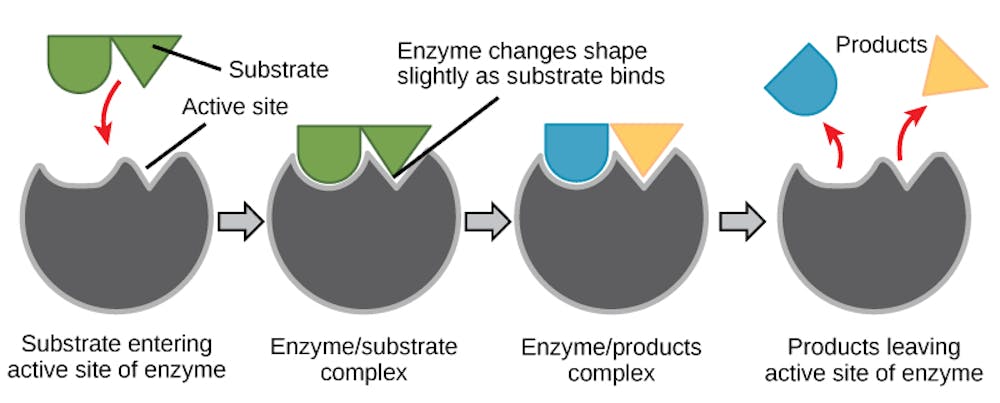
    For an enzyme to function, it adopts a shape that perfectly matches the molecule it processes, much like a lock matches a key. The unique grooves in the enzyme – the lock – that interact with the target molecule – the key – are found in a region of the enzyme known as the active site.

    The induced fit model of enzymes states that both the enzyme and its substrate change shape when they interact.
    OpenStax, CC BY-SA

    The active site of the enzyme precisely orients amino acids to interact with the target molecule when it enters. This makes it easier for the molecule to undergo a chemical reaction to turn into a different one, making the process go faster. After the chemical reaction is done, the new molecule is released and the enzyme is ready to process another.

    How do you design an enzyme?

    Scientists have spent decades trying to design their own enzymes to make new molecules, materials or therapeutics. But making enzymes that look like and go as fast as those found in nature is incredibly difficult.

    Enzymes have complex, irregular shapes that are made up of hundreds of amino acids. Each of these building blocks needs to be placed perfectly or else the enzyme will slow down or completely shut off. The difference between a speed racer and slowpoke enzyme can be a distance of less than the width of a single atom.

    Initially, scientists focused on modifying the amino acid sequences of existing enzymes to improve their speed or stability. Early successes with this approach primarily improved the stability of enzymes, enabling them to catalyze chemical reactions at a higher range of temperatures. But this approach was less useful for improving the speed of enzymes. To this day, designing new enzymes by modifying individual amino acids is generally not an effective way to improve natural enzymes.

    This model of acetylcholinesterase shows acetylcholine (green) bound to its active site.
    Sam Pellock, CC BY-SA

    Researchers found that using a process called directed evolution, in which the amino acid sequence of an enzyme is randomly changed until it can perform a desired function, proved much more fruitful. For example, studies have shown that directed evolution can improve chemical reaction speed, thermostability, and even generate enzymes with properties that aren’t seen in nature. However, this approach is typically labor-intensive: You have to screen many mutants to find one that does what you want. In some cases, if there’s no good enzyme to start from, this method can fail to work at all.

    Both of these approaches are limited by their reliance on natural enzymes. That is, restricting your design to the shapes of natural proteins likely limits the kinds of chemistry that enzymes can facilitate. Remember, you can’t eat soup with a knife.

    Is it possible to make enzymes from scratch, rather than modify nature’s recipe? Yes, with computers.

    Designing enzymes with computers

    The first attempts to computationally design enzymes still largely relied on natural enzymes as a starting point, focusing on placing enzyme active sites into natural proteins.

    This approach is akin to trying to find a suit at a thrift store: It is unlikely you will find a perfect fit because the geometry of an enzyme’s active site (your body in this analogy) is highly specific, so a random protein with a rigidly fixed structure (a suit with random measurements) is unlikely to perfectly accommodate it. The resulting enzymes from these efforts performed much more slowly than those found in nature, requiring further optimization with directed evolution to reach speeds common among natural enzymes.

    Recent advances in deep learning have dramatically changed the landscape of designing enzymes with computers. Enzymes can now be generated in much the same way that AI models such as ChatGPT and DALL-E generate text or images, and you don’t need to use native protein structures to support your active site.

    AI tools are helping researchers design new proteins.

    Our team showed that when we prompt an AI model, called RFdiffusion, with the structure and amino acid sequence of an active site, it can generate the rest of the enzyme structure that would perfectly support it. This is equivalent to prompting ChatGPT to write an entire short story based on a prompt that only says to include the line “And sadly, the eggs never showed up.”

    We used this AI model specifically to generate enzymes called serine hydrolases, a group of proteins that have potential applications in medicine and plastic recycling. After designing the enzymes, we mixed them with their intended molecular target to see whether they could catalyze its breakdown. Encouragingly, many of the designs we tested were able to break down the molecule, and better than previously designed enzymes for the same reaction.

    To see how accurate our computational designs were, we used a method called X-ray crystallography to determine the shapes of these enzymes. We found that many of them were a nearly perfect match to what we digitally designed.

    Our findings mark a key advance in enzyme design, highlighting how AI can help scientists start to tackle complex problems. Machine learning tools could help more researchers access enzyme design and tap into the full potential of enzymes to solve modern-day problems.

    Sam Pellock receives funding from the Washington Research Foundation and Schmidt Futures program.

    ref. Enzymes are the engines of life − machine learning tools could help scientists design new ones to tackle disease and climate change – https://theconversation.com/enzymes-are-the-engines-of-life-machine-learning-tools-could-help-scientists-design-new-ones-to-tackle-disease-and-climate-change-249565

    MIL OSI – Global Reports

  • MIL-OSI USA: In Memoriam: Ross D. MacKinnon, Former Dean of the College of Liberal Arts and Sciences

    Source: US State of Connecticut

    Ross D. MacKinnon, former dean of the College of Liberal Arts and Sciences (CLAS) and Professor Emeritus of geography, passed away from pancreatic cancer at his home in Sonoma, California, surrounded by family, on Jan. 27, 2025, at the age of 82.

    A dedicated leader and scholar, MacKinnon left a lasting impact on UConn and the many students, faculty, and colleagues who had the privilege of working with him.

    As dean of CLAS from 1996 to 2008, he oversaw a period of transformative growth and investment in the College. He played a pivotal role in guiding CLAS through the UConn 2000 capital program, a state-funded initiative that revitalized the University and strengthened its academic foundation.

    Throughout his tenure, he championed major investments in faculty hiring, research, and academic programs. He also spearheaded several multidisciplinary initiatives that continue to shape UConn’s academic community today.

    Among his many accomplishments, he led the creation of the UConn Humanities Institute, which supports humanities scholarship through funding, fellowships, and programming. He was also instrumental in establishing the Human Rights Institute and the Center for Health, Intervention, and Prevention, now known as the Institute for Collaboration on Health, Intervention, and Policy.

    Before joining UConn, MacKinnon served as dean of the Faculty of Social Sciences and professor of geography at the State University of New York at Buffalo. He previously served as head of SUNY Buffalo’s Department of Geography, during which time he strengthened the department’s graduate program and scholarly reputation. Prior to that, he was a faculty member in the University of Toronto’s geography department.

    MacKinnon earned a bachelor’s degree in geography from the University of British Columbia in 1964, a Master of Science in geography from Northwestern University in 1966, and a Ph.D. in geography from Northwestern University in 1968.

    He was a proud Canadian and naturalized U.S. citizen who believed in the promise of America. He loved traveling, sharing a good meal with friends, live jazz, contemporary painting, new plays, UConn men’s and women’s basketball, and the Buffalo Bills. He had a great sense of humor and was quick with encouragement.

    He is survived by his wife, Marilyn Hoskin, and his two daughters, Pam and Caroline MacKinnon.


    His family asks those who wish to honor his memory to take a moment to remember Ross and consider supporting the Dean Ross MacKinnon Endowment for CLAS Graduate Fellows.

    MIL OSI USA News

  • MIL-Evening Report: ‘Mum, what’s the meaning of life?’ How to talk about philosophy with little kids

    Source: The Conversation (Au and NZ) – By Ben Kilby, PhD candidate in Education, Monash University

    Charles Parker/ Pexels , CC BY

    If your young child asks “what’s the meaning of life?” you might laugh it off (how cute!) or freeze in panic (where do I even begin?).

    It’s tempting to dismiss these big questions as too advanced for kids. Plato and Aristotle both believed children weren’t ready for philosophy. In fact, they didn’t think people were ready to study philosophy until they turned 30.

    But children know otherwise. They ask big questions like “Why are we here?” and “What does it mean to be fair?” and “Why do we keep feeding the cat, even though she never says thank you?”

    American researcher and author Jana Mohr Lone has taught philosophy to young children for more than 20 years. As one second-grade child told her:

    […] children don’t know as many things about the world and so our minds are more free to imagine.

    This openness makes children natural philosophers. By encouraging these conversations, you can help them grow into curious, thoughtful and reflective individuals.

    How can parents do this?


    Read more:
    Who am I? Why am I here? Why children should be taught philosophy (beyond better test scores)


    3 steps for philosophical dialogue

    One of the difficulties of engaging in philosophy is people may be unfamiliar with how it works.

    But you can have a philosophical discussion by following three steps:

    • reflection
    • generalisation
    • abstraction.

    When your child asks a deep question like “What’s the meaning of life?” you don’t need to have the answer, you just need to start a conversation.

    First, prompt your child to reflect on the question. You could ask: “What do you think?”

    This allows your child to explore their own experiences. They might say, “I live for football and Bluey!”

    Second, move to generalisation. You can ask, “Do you think that’s the meaning of life for everyone?” This opens up a philosophical discussion beyond the self. Your child might say, “Well, Stella lives for gymnastics and cheese.”

    Finally, prompt towards abstraction, by asking “What makes life meaningful for all people?”

    Football, Bluey and handstands won’t appeal to everyone, but something else might. Now we’re looking for examples (or counter-examples) as a method of inquiry.

    This prompts your child to look for what is common to all people in living a meaningful life. They may respond with something like:

    A lot of people love chocolate but not Aunty Grace. Most people love dogs but maybe not people who really love cats. Everyone loves time with their friends and family.

    Suddenly, you’re having a rich philosophical dialogue. You can continue further inquiry into what really is love, or what makes certain relationships more important than others.

    What we’re doing here is having a dialogue through concepts, academically known as conceptual analysis.

    Philosophy explores concepts like love and kindness that children encounter every day.
    RDNE Stock Project/ Pexels, CC BY


    Read more:
    What is love? A philosopher explains it’s not a choice or a feeling − it’s a practice


    Why should you do this?

    Educational research has found philosophical dialogue improves children’s logical reasoning, reading and maths comprehension, self-esteem and turn-taking.

    Studies have found it benefits children’s academic and social development in early childhood, primary school and high school.

    But beyond these skills, philosophy empowers children to engage meaningfully with the world around them.

    Happiness, identity, fairness, death, reality, time, nature, good, knowledge and purpose are all things children encounter every day. Philosophy with your child can simply be the exploration of what these concepts mean and how they impact our lives.

    Understanding concepts and being able to apply that understanding to life is the foundation of philosophy.

    Kids can ask tricky quesitons. But philosophical approaches prompt them to think through an answer.
    Kampus Productions/ Pexels, CC BY

    Questions to ask your child

    To engage your child in philosophy, start a conversation with them about the concepts they’re encountering.

    If they’re drawing, you could ask what is art? What is imagination?.

    If they don’t want to share their favourite toy: what is fairness? What is kindness?

    If they’re talking to the dog: what is language? What is understanding?

    If they’re emotional: what is happiness? What is sadness?

    If they want to know why they should go to school: what is knowledge?

    If they’re telling you about their dream: what is real?

    Next time your child asks a big question, embrace the moment. By exploring concepts like fairness, love and happiness, you’re helping them interpret the world and become more thoughtful people.

    By asking them to reflect, explore different perspectives and consider the bigger picture, you’ll embark on a philosophical journey that can grow into something meaningful for you both.

    Ben Kilby is the Chair of the Victorian Association for Philosophy in Schools

    ref. ‘Mum, what’s the meaning of life?’ How to talk about philosophy with little kids – https://theconversation.com/mum-whats-the-meaning-of-life-how-to-talk-about-philosophy-with-little-kids-248231

    MIL OSI AnalysisEveningReport.nz

  • MIL-Evening Report: As new charter schools open, we still know too little about how they worked last time

    Source: The Conversation (Au and NZ) – By Jude MacArthur, Senior Lecturer, School of Critical Studies in Education, University of Auckland, Waipapa Taumata Rau

    Phil Walter/Getty Images

    Seven new charter schools are opening their gates, and ACT leader and Associate Education Minister David Seymour – the politician responsible for their existence – has been singing their praises.

    He says some will deliver “new and innovative ways to help students who are struggling at school to succeed, especially neurodiverse students, where there is huge need”.

    Seymour also says charter schools will free teachers from “constant upheavals in education” policy and provide the flexibility to “allow them to better cater to students who are priority learners” – the term charter schools use for “those with neurodiversity and a background of disadvantage and poverty”.

    Such innovation will raise overall educational achievement, he says, particularly for students who are underachieving, disengaged or neurodivergent. It may be too early to tell whether this optimism is justified, but it seems the new charter schools will enjoy a range of benefits unavailable to state schools.

    For example, Seymour recently praised Arapaki School in Christchurch for its teaching ratio of one teacher and three teacher aides for every 25 students. Australian students with this level of resourcing, he said, learned up to 60% faster than those in state schools.

    But teachers, principals and researchers in the state system have been asking for reduced class sizes and one teacher aide per classroom for years. So we need to ask why the resources and privileges being channelled into charter schools can’t be made available to the state school system instead.

    An underfunded education system

    The coalition government has set aside NZ$153 million to fund charter schools over the next four years. These schools are state funded but operated by a “sponsor”: 75% of their teachers must be qualified and 25% can be permanently employed with a “limited authority to teach”.

    The government’s Charter School Agency describes considerable flexibility around teaching, curriculum, governance, hours and days of operation, and how funding is spent.

    According to chief executive Jane Lee, this flexibility supports innovation and provides opportunities for students to learn differently. And there is little doubt a sizeable minority of pupils are not well served in the mainstream system.

    One in five children and young people in our schools need extra support for their learning. For decades, official reports have documented inequities in this area, including poor achievement for disabled and neurodivergent students.

    The problems and solutions are well understood. Disabled and neurodivergent students face barriers to learning because funding, resources and timely support for them and their teachers are inadequate.

    This includes a shortage of teacher aides, specialist teachers and therapists, and class sizes being too big.

    Many teachers try to compensate for these challenges. But research undertaken for the New Zealand Educational Institute warns that without the extra support they can come close to burnout. A damning 2024 report from the Education Hub described the experiences of neurodivergent pupils, their whānau and teachers who viewed

    the current education system as outdated and heading towards major crises, with many seeing home schooling as the only option.

    Lack of supporting evidence

    Rather than addressing under-resourcing in the state system, however, charter school advocates view the problem as a lack of choice, exacerbated by constant upheavals in education policy.

    Associate Education Minister David Seymour.
    Getty Images

    So, what can we learn from the last time charter schools operated between 2012 and 2018? The evidence is mixed, according to an evaluation of eight charter schools undertaken for the Ministry of Education.

    While whānau and student experiences appeared positive, low and uneven response rates from these groups make drawing any conclusion difficult.

    There was evidence of innovative practices in school governance and management, and to a lesser extent in staffing, student engagement and support, teaching and learning. The schools were least innovative in curriculum design and engagement with their communities.

    The schools themselves felt small school rolls and class sizes contributed to their successful operation. As for the key aim of charter school policy supporting priority learners, the report described a good understanding of their needs.

    But insufficient data mean we don’t know whether student achievement improved overall, and we know nothing about the achievement of students who received learning support.

    Focus on state schools instead

    Other questions remain, too. As the New Zealand Educational Institute pointed out last year, the $153 million being spent on charter schools would pay for more than 700 teacher aides in the state system.

    Given the existing shortage of learning-support resources overall, will charter schools (which will also have access to those resources) simply add another layer of competition for state schools?

    And if charter schools themselves struggle to recruit the necessary expertise, will their staff have the professional knowledge of student diversity and inclusion that’s needed to support students and whānau well, and who will judge that?

    Finally, charter schools must select priority group applicants by ballot if there are more applicants than capacity allows. How will they decide on the number of available places?

    At the risk of answering these questions with another question, wouldn’t our thinking be better directed at improving the public education system?

    All children – including those needing learning support – deserve to belong and learn well in their local school, with all the checks and balances that currently ensure equity, inclusion and a fully qualified teaching staff.

    Jude MacArthur currently receives funding from The Teaching and Learning Research Initiative. She has previously received Marsden funding. She is a member of the Teaching Council’s Inclusive Education Advisory Group; The Inclusive Education Action Group; and was a member of the Ministry of Education’s Bicultural and Inclusive Working Group as part of the curriculum refresh.

    ref. As new charter schools open, we still know too little about how they worked last time – https://theconversation.com/as-new-charter-schools-open-we-still-know-too-little-about-how-they-worked-last-time-249474

    MIL OSI AnalysisEveningReport.nz

  • MIL-Evening Report: Want to make sure you don’t swelter in your next home? Check these 12 features before you rent or buy

    Source: The Conversation (Au and NZ) – By Sarah Robertson, Research Fellow, Centre for Urban Research, RMIT University

    Harley Kingston, Shutterstock

    Hot on the heels of the warmest spring on record, Australia is baking through another scorching summer. Heatwaves around the country contributed to the second-warmest January on record. Hot, dry, windy weather again swept across the country this week.

    Finding a home that stays cool in this heat is a real challenge. Homebuyers and renters face two problems: a shortage of heat-resistant homes, and a lack of reliable, independent information about how homes perform in the heat.

    So, how can you avoid buying or renting a “hot box”? Here’s a handy list of 12 features to check next time you’re searching for a place to live.

    Ask these 4 questions before you inspect

    1. Does the house have insulation? Ceiling, wall and underfloor insulation seals the indoor environment, slowing or preventing heat from leaking in or out.

    2. Does it have double-glazed windows? Insulated glass, made from two or more window panes with a space in between, keeps heat out in summer and inside during winter.

    3. How big is the house? Australian homes are among the largest in the world. Cooling a large home with air conditioning can be costly. Check the floor plan to see if you can shut doors and close off internal spaces, so you only cool the parts you need during hot spells.

    4. Has the house had an energy and thermal performance assessment? The Residential Efficiency Scorecard is delivered by the Victorian government on behalf of all Australian governments. The report, undertaken by an accredited assessor, rates a home’s energy use and comfort, and recommends improvements. Other assessments also exist.

    Look for these 8 things during an inspection

    1. Check the colour and nature of external walls, roof and surrounding surfaces. Dark-coloured roofs or walls, and other hard surfaces such as concrete, absorb more heat. This heat builds up during the day and radiates out at night, causing what’s known as the heat island effect.

    2. Look at internal floors and surfaces. Brick walls or concrete surfaces inside can be a good thing, if the hot weather doesn’t last too long. That’s because the home will take longer to heat up. But these heavy materials will also take longer to cool down once the heatwave is over. Good ventilation may compensate for that.

    3. Consider the size and position of windows and doors. Openings on each side of rooms and the house as a whole allows cooling through natural ventilation. You can open up the house and let the cool air flow from one side to the other during the night, or once the cool change comes. Security doors and fly screens will keep insects and potential intruders out.

    4. Is there external shading, such as blinds or greenery? Ensuring windows and walls are shaded on the outside is the best way to keep the heat out, particularly on the west-facing side. Large unshaded glass windows facing north and west can cause the home to heat up in summer. Vertical blinds work well on west-facing windows. On the north side, horizontal shading such as a pergola blocks out the sun in summer – when it is higher in the sky. It also lets the sun in during winter when the sun is lower in the sky, to gently warm the home.

    5. Check for ceiling fans. Ceiling fans cool a home and use little energy. Check how many are installed and where they are located. Ceiling fans are ideal in living spaces, but also work well in bedrooms to help you stay comfortable on hot nights.

    Ceiling fans can make you feel cooler without costing a lot of money.
    Artazum, Shutterstock

    6. Investigate the air-con. If the house has air-conditioning, ask about its age, and look up its energy rating on energyrating.gov.au.

    7. Consider garden spaces. Plants and trees can creating a “microclimate” around your home, keeping it cool. Also look at the landscape beyond the property – a tree-lined street can reduce temperatures and improve thermal comfort during a heatwave.

    8. Note the position of the afternoon sun. Visit potential homes during the mid-late afternoon or check the sun’s path through the home – perhaps using a sun tracking app. If air conditioners are turned on, consider what this might mean for energy bills. What would the home feel like without it? Are there other ways to keep the building cool?

    For more information about home energy efficiency, visit YourHome, Renew, Scorecard, and read the Cooling your Home report.

    Passive Cooling (Your Home)

    Setting higher standards

    Most Australian homes perform poorly when it comes to maintaining a comfortable temperature range indoors. This is particularly true for those built before the 1990s, when minimum energy performance standards were introduced. But these standards set a low bar compared with those overseas.

    This, coupled with the absence of requirements for landlords or sellers (except in the ACT) to have the home assessed or declare a rating, means buyers and renters are left in the dark when it comes to making informed choices.

    Renters and lower-income households are at greatest risk of living in a home that is too hot or too cold. The private rental stock in Australia is among the poorest, most uncomfortable housing in the Western world.

    While the ACT has introduced minimum energy efficiency standards for rental properties, standards across the country contain few provisions that promise improved thermal comfort.

    Until the regulatory landscape changes and energy performance must be disclosed, we hope these tips will help you avoid the worst of Australia’s hot boxes.


    Read more:
    Victorian households are poorly prepared for longer, more frequent heatwaves – here’s what needs to change


    Sarah Robertson has received funding from various sources, including the Lord Mayor’s Charitable Foundation and the Fuel Poverty Research Network. She has benefitted from Australian Research Council, Victorian government and various local government and industry partnerships to support research related to this topic.

    Nicola Willand receives funding for research from various organisations, including the Australian Research Council, the Victorian state government, the Lord Mayor’s Charitable Foundation, the Future Fuels Collaborative Research Centre and the National Health and Medical Research Council. She is a trustee of the Fuel Poverty Research Network charity and affiliated with the Australian Institute of Architects.

    Ralph Horne has received funding from various sources including the Australian Research Council, the Australian Housing and Urban Research Institute and the Victorian government to support research related to this topic.

    Trivess Moore has received funding from various organisations including the Australian Research Council, Australian Housing and Urban Research Institute, Victorian government and various industry partners. He is a trustee of the Fuel Poverty Research Network.

    ref. Want to make sure you don’t swelter in your next home? Check these 12 features before you rent or buy – https://theconversation.com/want-to-make-sure-you-dont-swelter-in-your-next-home-check-these-12-features-before-you-rent-or-buy-249494

    MIL OSI AnalysisEveningReport.nz

  • MIL-Evening Report: 3 statistical stuff-ups that made everyday items look healthier (or riskier) than they really are

    Source: The Conversation (Au and NZ) – By Adrian Esterman, Professor of Biostatistics and Epidemiology, University of South Australia

    VLADIMIR VK/Shutterstock

    Conducting scientific studies is never easy, and there are often major disasters along the way. A researcher accidentally spills coffee on a keyboard, destroying the data. Or one of the chemicals used in the analysis is contaminated, and the list goes on.

    However, when we read the results of the study in a scientific paper, it always looks pristine. The study went smoothly with no hiccups, and here are our results.

    But studies can contain errors, not all of which independent experts or “peer reviewers” weed out before publication.

    Statistical stuff-ups can be difficult to find as it really takes someone trained in statistics to notice something wrong.

    When statistical mistakes are made and found, it can have profound impacts on people who may have changed their lifestyle as a result of the flawed study.

    These three examples of inadvertent statistical mistakes have had major consequences for our health and shopping habits.

    1. Did you throw out your black plastic spoons?

    Late last year, I came across a news article about how black plastic kitchen utensils were dangerous as they could potentially leak toxic flame-retardant chemicals into your food.

    Being a natural sceptic, I looked up the original paper, which was published in the journal Chemosphere. The article looked genuine, the journal was reputable. So – like perhaps many other people – I threw out my black plastic kitchen utensils and replaced them with silicone ones.

    In the study, the authors screened 203 household products (about half were kitchen utensils) made from black plastic.

    The authors found toxic flame retardants in 85% of the products tested, with levels approaching the maximum daily limits set by the Environmental Protection Agency in the United States.

    Unfortunately, the authors made a mistake in their calculations. They were out by a factor of ten. This meant the level of toxic chemicals was well under the daily safety limits.

    In recent weeks, the authors apologised and corrected their paper.

    2. Did you avoid HRT?

    A landmark study raised safety concerns about hormone replacement therapy or HRT (now also known as menopausal hormone therapy). This highlights a different type of statistical error.

    The Women’s Health Initiative (WHI) study involved 10,739 postmenopausal women aged 50-79 recruited from 40 clinical centres in the US. It compared the health of women randomised to take HRT with those who took the placebo. Neither the researchers nor the women knew which treatment had been given.

    In their 2002 paper, the authors reported higher rates of invasive breast cancers in the HRT group. They used a unit called “person-years”. Person-years is a way to measure the total time a group of people spends in a study. For example, if 100 people are in a study for one year each, that makes 100 person-years. If someone leaves the trial after only six months, only that half-year is counted for them.

    The authors showed a rate of 38 invasive breast cancers per 10,000 person-years in the HRT group, compared to 30 per 10,000 person-years in the placebo group. This gives a rate ratio of 1.26 (one rate divided by the other).

    This fairly large increase in breast cancer rates, also expressed as a 26% increase, caused widespread panic around the world, and led to thousands of women stopping HRT.

    But the actual risk of breast cancer in each group is low. The rate of 38 per 10,000 person-years is equivalent to an annual rate of 0.38%. With very small rates like this, the authors should really have used the rate difference rather than the rate ratio. The rate difference is one rate subtracted from the other, rather than divided by it. This equates to an annual increase of 0.08% breast cancer cases in the HRT group – much more modest.

    The authors of the 2002 paper also pointed out that the 26% increase in the rate of breast cancer “almost reached nominal statistical significance”. Almost is not statistical significance, and formally, this means there was no difference in breast cancer rates between the two groups. In other words, the difference between the two groups could have happened by chance.

    The authors should have been more careful when describing their results.

    3. Did Popeye’s spinach change your meals?

    Cartoon character Popeye is a one-eyed, pipe-smoking sailor with mangled English, in love with the willowy Olive Oyl. He is constantly getting into trouble, and when he needs extra energy, he opens a can of spinach and swallows the contents. His biceps immediately bulge, and off he goes to sort out the problem.

    When Popeye ate spinach, his muscles bulged. No wonder sales of spinach rose.

    But why does Popeye eat spinach?

    The story begins in about 1870, with a German chemist, Erich von Wolf or Emil von Wolff, depending on which version of events you read.

    He was measuring the amount of iron in different types of leafy vegetables. According to legend, which some dispute, he was writing the iron content of spinach down in a notebook and got the decimal point wrong, writing 35 milligrams instead of 3.5 milligrams per 100 gram serve of spinach. The error was found and corrected in 1937.

    By then the Popeye character had been created and spinach became incredibly popular with children. Apparently, consumption of spinach in the US went up by a third as a result of the cartoon.

    This story had gained legendary status but has one tiny flaw. In a 1932 cartoon, Popeye explains exactly why he eats spinach, and it’s nothing to do with iron. He says in his garbled English:

    Spinach is full of Vitamin A. An’tha’s what makes hoomans strong an’ helty!

    Adrian Esterman receives funding from the NHMRC, MRFF and ARC.

    ref. 3 statistical stuff-ups that made everyday items look healthier (or riskier) than they really are – https://theconversation.com/3-statistical-stuff-ups-that-made-everyday-items-look-healthier-or-riskier-than-they-really-are-249367

    MIL OSI AnalysisEveningReport.nz

  • MIL-Evening Report: Is AI making us stupider? Maybe, according to one of the world’s biggest AI companies

    Source: The Conversation (Au and NZ) – By Deborah Brown, Professor in Philosophy, Director of the University of Queensland Critical Thinking Project, The University of Queensland

    Nadia Piet + AIxDESIGN & Archival Images of AI/Better Images of AI, CC BY-SA

    There is only so much thinking most of us can do in our heads. Try dividing 16,951 by 67 without reaching for a pen and paper. Or a calculator. Try doing the weekly shopping without a list on the back of last week’s receipt. Or on your phone.

    By relying on these devices to help make our lives easier, are we making ourselves smarter or dumber? Have we traded efficiency gains for inching ever closer to idiocy as a species?

    This question is especially important to consider with regard to generative artificial intelligence (AI) technology such as ChatGPT, an AI chatbot owned by tech company OpenAI, which at the time of writing is used by 300 million people each week.

    According to a recent paper by a team of researchers from Microsoft and Carnegie Mellon University in the United States, the answer might be yes. But there’s more to the story.

    Thinking well

    The researchers assessed how users perceive the effect of generative AI on their own critical thinking.

    Generally speaking, critical thinking has to do with thinking well.

    One way we do this is by judging our own thinking processes against established norms and methods of good reasoning. These norms include values such as precision, clarity, accuracy, breadth, depth, relevance, significance and cogency of arguments.

    Other factors that can affect quality of thinking include the influence of our existing world views, cognitive biases, and reliance on incomplete or inaccurate mental models.

    The authors of the recent study adopt a definition of critical thinking developed by American educational psychologist Benjamin Bloom and colleagues in 1956. It’s not really a definition at all. Rather it’s a hierarchical way to categorise cognitive skills, including recall of information, comprehension, application, analysis, synthesis and evaluation.

    The authors state they prefer this categorisation, also known as a “taxonomy”, because it’s simple and easy to apply. However, since it was devised it has fallen out of favour and has been discredited by Robert Marzano and indeed by Bloom himself.

    In particular, it assumes there is a hierarchy of cognitive skills in which so-called “higher-order” skills are built upon “lower-order” skills. This does not hold on logical or evidence-based grounds. For example, evaluation, usually seen as a culminating or higher-order process, can be the beginning of inquiry or very easy to perform in some contexts. It is more the context than the cognition that determines the sophistication of thinking.

    An issue with using this taxonomy in the study is that many generative AI products also seem to use it to guide their own output. So you could interpret this study as testing whether generative AI, by the way it’s designed, is effective at framing how users think about critical thinking.

    Also missing from Bloom’s taxonomy is a fundamental aspect of critical thinking: the fact that the critical thinker not only performs these and many other cognitive skills, but performs them well. They do this because they have an overarching concern for the truth, which is something AI systems do not have.

    ChatGPT is used by 300 million people each week.
    Alex Photo Stock/Shutterstock

    Higher confidence in AI equals less critical thinking

    Research published earlier this year revealed “a significant negative correlation between frequent AI tool usage and critical thinking abilities”.

    The new study further explores this idea. It surveyed 319 knowledge workers such as healthcare practitioners, educators and engineers who discussed 936 tasks they conducted with the help of generative AI. Interestingly, the study found users consider themselves to use critical thinking less in the execution of the task, than in providing oversight at the verification and editing stages.

    In high-stakes work environments, the desire to produce high-quality work combined with fear of reprisals serve as powerful motivators for users to engage their critical thinking in reviewing the outputs of AI.

    But overall, participants believe the increases in efficiency more than compensate for the effort expended in providing such oversight.

    The study found people who had higher confidence in AI generally displayed less critical thinking, while people with higher confidence in themselves tended to display more critical thinking.

    This suggests generative AI does not harm one’s critical thinking – provided one has it to begin with.

    Problematically, the study relied too much on self-reporting, which can be subject to a range of biases and interpretation issues. Putting this aside, critical thinking was defined by users as “setting clear goals, refining prompts, and assessing generated content to meet specific criteria and standards”.

    “Criteria and standards” here refer more to the purposes of the task than to the purposes of critical thinking. For example, an output meets the criteria if it “complies with their queries”, and the standards if the “generated artefact is functional” for the workplace.

    This raises the question of whether the study was really measuring critical thinking at all.

    The research found that people with higher confidence in themselves tended to display more critical thinking.
    ImYanis/Shutterstock

    Becoming a critical thinker

    Implicit in the new study is the idea that exercising critical thinking at the oversight stage is at least better than an unreflective over-reliance on generative AI.

    The authors recommend generative AI developers add features to trigger users’ critical oversight. But is this enough?

    Critical thinking is needed at every stage before and while using AI – when formulating questions and hypotheses to be tested, and when interrogating outputs for bias and accuracy.

    The only way to ensure generative AI does not harm your critical thinking is to become a critical thinker before you use it.

    Becoming a critical thinker requires identifying and challenging unstated assumptions behind claims and evaluating diverse perspectives. It also requires practising systematic and methodical reasoning and reasoning collaboratively to test your ideas and thinking with others.

    Chalk and chalkboards made us better at mathematics. Can generative AI make us better at critical thinking? Maybe – if we are careful, we might be able to use generative AI to challenge ourselves and augment our critical thinking.

    But in the meantime, there are always steps we can, and should, take to improve our critical thinking instead of letting an AI do the thinking for us.

    The authors do not work for, consult, own shares in or receive funding from any company or organisation that would benefit from this article, and have disclosed no relevant affiliations beyond their academic appointment.

    ref. Is AI making us stupider? Maybe, according to one of the world’s biggest AI companies – https://theconversation.com/is-ai-making-us-stupider-maybe-according-to-one-of-the-worlds-biggest-ai-companies-249586

    MIL OSI AnalysisEveningReport.nz

  • MIL-OSI USA: Capito Votes to Confirm Kennedy for HHS Secretary

    US Senate News:

    Source: United States Senator for West Virginia Shelley Moore Capito
    WASHINGTON, D.C. – U.S. Senator Shelley Moore Capito (R-W.Va.), Chairman of the Senate Labor, Health and Human Services, Education, and Related Agencies (Labor-HHS) Appropriations Subcommittee, issued the following statement after voting to confirm Robert Kennedy Jr. to be Secretary of the U.S. Department of Health and Human Services (HHS):
    “Coming from a state whose residents live with the impact of chronic diseases more than most, I agree with Robert F. Kennedy Jr. that we need to Make America Healthy Again. As the chairman of the subcommittee responsible for funding HHS, I will work closely with Secretary Kennedy to make sure West Virginia’s priorities are considered,” Senator Capito said. “Secretary Kennedy understands the unique health care challenges of rural America and the need to balance embracing new ideas with what has been proven successful in the past. I look forward to working with him to combat the drug crisis in West Virginia and across the country, make the foods we are eating healthier, improve the transparency of our health care systems, and deliver better health care to more Americans.”
    Senator Capito previously met with Kennedy in December 2024 to discuss his nomination and learn more about his vision to lead the department.

    MIL OSI USA News

  • MIL-OSI USA: Murphy To McMahon: You’re Saying It’s A Possibility That A Public School With Programming Related to Race Could Lose Federal Funding

    US Senate News:

    Source: United States Senator for Connecticut – Chris Murphy

    February 13, 2025

    [embedded content]
    WASHINGTON—U.S. Senator Chris Murphy (D-Conn.), a member of the U.S. Senate Health, Education, Labor, and Pensions Committee, on Thursday questioned Linda McMahon at a hearing on her nomination for Secretary of Education. Murphy pressed McMahon on how a Trump administration executive order restricting federal funding for DEI programs will impact schools across the country. McMahon refused to provide clarity for the thousands of teachers and school administrators who are wondering whether offering African American history courses, supporting cultural student groups, or celebrating Black History Month will put their federal funding at risk.
    A full transcript of Murphy’s exchange with McMahon can be found below
    MURPHY: “Thank you very much, Mr. Chairman. Ms. McMahon, good to see you. You and I have spent a lot of time over the years, and I appreciate your willingness to sit before the committee and answer some really important questions.
    “I want to talk to you about an executive order that the Trump administration issued that commands agencies, including the Department of Education, to eliminate grants to organizations and entities that support DEI programs and activities. As you know, this has a lot of schools all across the country scrambling, because they have no idea what that means. They don’t know because the order doesn’t define DEI as to whether they are in compliance or out of compliance, and whether they are going to have their federal grants compromised. How does a school know whether it’s running a DEI program or not?”
    MCMAHON: “Well certainly, and thank you Senator, and it is good to see you again outside of the state of Connecticut, where we run into each other. DEI, I think, has been–it’s a program that’s tough. It was put in place ostensibly for more diversity, for equity and inclusion. And I think what we’re seeing is that it’s having an opposite effect. We are getting back to more segregating of our schools, instead of having more inclusion in our schools. When there are DEI programs that say that Black students need separate graduation ceremonies or Hispanics need separate ceremonies, we are not achieving what we wanted to achieve with inclusion.”
    MURPHY: “Let me give you an example then. So this order applies to Department of Defense schools, and those schools have canceled all programming around Black History Month. So if a school in Connecticut celebrates Martin Luther King Day and has a series of events and programming teaching about Black history, are they in violation of a policy that says schools should stop running DEI programs?”
    MCMAHON: “Not in my view, that is clearly not the case. The celebration of Martin Luther King Day and Black History Month should be celebrated throughout all of our schools. I believe that Martin Luther King was one of the strongest proponents of making sure that we look at all of our populations, when he said that he would hope that his children wouldn’t be judged by the color of their skin, but the content of their character, and I think that is the fundamental basis that we should celebrate Black History Month.”
    MURPHY: “West Point has closed down all ethnic clubs. So the Society of Black Engineers can no longer meet because they believe that to be in compliance with this order, they cannot have groups structured around ethnic or racial affiliations. Would public schools be in violation of this order? Would they risk funding if they had clubs that students could belong to based on their racial or ethnic identity?” 
    MCMAHON: “Well, I certainly today don’t want to address hypothetical situations. I would like, once I’m confirmed, to get in and assess these programs, look at what has been covered–”
    MURPHY: “Isn’t that a pretty easy one? I mean, you’re saying that it’s a possibility that if a school has a club for Vietnamese American students or Black students, where they meet after school, that they could be potentially in jeopardy of receiving federal funding?”
    MCMAHON: “Again, I would like to fully understand what that order is and what those clubs are doing.”
    MURPHY: “That’s pretty chilling. I think schools all around the country are going to hear that. What about educational programming centered around specific ethnic and racial experiences? My son is in a public school. He takes a class called African American History. If you are running an African American history class, could you perhaps be in violation of this executive order?”
    MCMAHON: “I’m not quite certain, and I’d like to look into it further and get back to you on that.”
    MURPHY: “So there’s a possibility– there’s a possibility, you’re saying– that public schools that run African American history classes, right, this is a class that has been taught in public schools for decades, could lose federal funding if they continue to teach African American history?”
    MCMAHON: “No, that’s not what I’m saying. I’m saying that I would like to take a look at these programs and fully understand the breadth of the executive order and get back to you on that.”
    MURPHY: “I think you are going to have a lot of educators and a lot of principals and administrators scrambling right now. Thank you, Mr. Chairman, my time’s expired.”

    MIL OSI USA News

  • MIL-OSI Global: What we learned from Trump and Putin’s phone call

    Source: The Conversation – UK – By Jonathan Este, Senior International Affairs Editor, Associate Editor

    Annalena Baerbock, the German foreign minister, spoke for much of the European diplomatic community when she reacted to news of Donald Trump’s phone chat with Vladimir Putin: “This is the way the Trump administration operates,” she declared. “This is not how others do foreign policy, but this is now the reality.”

    The resigned tone of Baerbock’s words was not matched by her colleague, defence minister Boris Pistorius, whose criticism that “the Trump administration has already made public concessions to Putin before negotiations have even begun” was rather more direct.

    Their sentiments were echoed, not only by European leaders, but in the US itself: “Putin Scores a Big Victory, and Not on the Battlefield” read a headline in the New York Times. The newspaper opined that Trump’s call had succeeded in bringing Putin back in from the cold after three years in which Russia had become increasingly isolated both politically and economically.

    This was not lost on the Russian media, where commentators boasted that the phone call “broke the west’s blockade”. The stock market gained 5% and the rouble strengthened against the dollar as a result.

    Reflecting on the call, Putin’s spokesman, Dmitry Peskov, continued with operation flatter Donald Trump by comparing his attitude favourably with that of his predecessor in the White House, Joe Biden. “The previous US administration held the view that everything needed to be done to keep the war going. The current administration, as far as we understand, adheres to the point of view that everything must be done to stop the war and for peace to prevail.

    “We are more impressed with the position of the current administration, and we are open to dialogue.”

    Trump’s conversation with Putin roughly coincided with a meeting of senior European defence officials in Brussels which heard the new US secretary of defense, Pete Hegseth, outline America’s radical new outlook when it comes to European security. Namely that it’s not really America’s problem any more.

    Hegseth also told the meeting in Brussels yesterday that the Trump administration’s position is that Nato membership for Ukraine has been taken off the table, that the idea it would get its 2014 borders back was unrealistic and that if Europe wanted to guarantee Ukraine’s security as part of any peace deal, that would be its business. Any peacekeeping force would not involve American troops and would not be a Nato operation, so it would not involve collective defence.


    Sign up to receive our weekly World Affairs Briefing newsletter from The Conversation UK. Every Thursday we’ll bring you expert analysis of the big stories in international relations.


    International security expert David Dunn believes that the fact that Trump considers himself a consummate deal maker makes the fact that his administration is willing to concede so much ground before negotiations proper have even got underway is remarkable. And not in a good way.

    Dunn, who specialises in US foreign and security policy at the University of Birmingham, finds it significant that Trump spoke with Putin first and then called Ukraine’s president Volodymyr Zelensky to fill him in on the call. This order of priority, says Dunn, is a sign of the subordination of Ukraine’s role in the talks.

    He concludes that “for the present at least, it appears that negotiations will be less about pressuring Putin to bring a just end to the war he started than forcing Ukraine to give in to the Russian leader’s demands”.


    Read more:
    Trump phone call with Putin leaves Ukraine reeling and European leaders stunned


    Hegseth’s briefing to European defence officials, meanwhile, came as little surprise to David Galbreath. Writing here, Galbreath – who specialises in defence and security at the University of Bath – says the US pivot away from a focus on Europe has been years in the making – “since the very end of the cold war”.

    There has long been a feeling in Washington that the US has borne too much of the financial burden for European security. This is not just a Donald Trump thing, he believes, but an attitude percolating in US security circles for some decades. Once the Berlin Wall fell and the Soviet Union disintegrated, the focus for Nato become not so much collective defence as collective security, where “conflict would be managed on Nato’s borders”.

    But it was then the US which invoked article 5 of the Nato treaty, which establishes that “an armed attack against one or more [member states] in Europe or North America shall be considered an attack against them all”. The Bush government invoked Article 5 the day after the 9/11 attacks and Nato responded by patrolling US skies to provide security.

    Pete Hegseth dashes Ukraine’s hopes of a future guaranteed by Nato.

    Galbreath notes that many European countries, particularly the newer ones such as Estonia and Latvia, sent troops to Iraq and Afghanistan. “The persistent justification I heard in the Baltic states was “we need to be there when the US needs us so that they will be there when we need them”.

    That looks set to change.


    Read more:
    US says European security no longer its primary focus – the shift has been years in the making


    The prospect of a profound shift in the world order are daunting after 80 years in which security – in Europe certainly – was guaranteed by successive US administrations and underpinned, not just by Nato but by a whole set of international agreements.

    Now, instead of the US acting as the “world’s policeman”, we have a president talking seriously about taking control of Greenland, one way or another, who won’t rule out using force to seize the Panama Canal and who dreams of turning Gaza into a coastal “riviera” development.

    Meanwhile Russia is engaged in a brutal war of conquest in Ukraine and is actively meddling in the affairs of several other countries. And in China, Xi Jinping regularly talks up the idea of reunifying with Taiwan, by force if necessary, and is fortifying islands in the South China Sea with a view to aggressively pursuing territorial claims there as well.

    And we thought the age of empires was in the rear view mirror, writes historian Eric Storm of Leiden University. Storm, whose speciality is the rise of nation states, has discerned a resurgence of imperial tendencies around the world and fears that the rules-based order that has dominated the decades since the second world war now appears increasingly tenuous.


    Read more:
    How Putin, Xi and now Trump are ushering in a new imperial age


    Gaza: the horror continues

    In any given week, you’d expect the imminent prospect of the collapse of the Gaza ceasefire to be the big international story. And certainly, while Trump and Putin were “flooding the zone” (see last week’s round-up for the origins of this phrase) the prospects of the deal lasting beyond its first phase have become more and more uncertain.

    Hamas has recently pulled back from its threat not to release any more hostages. Earlier in the week it threatened to call a halt to the hostage-prisoner exchange, claiming that the Israel Defense Forces (IDF) had breached the terms of the ceasefire deal. Israeli prime minister, Benjamin Netanyahu, responded – with Trump’s backing – saying that unless all hostages were released on Saturday, all bets were off and the IDF would resume its military operations in the Gaza Strip. Trump added that “all hell is going to break out”.

    The US president has also doubled down on his idea for a redeveloped Gaza and has continued to pressure Jordan and Egypt to accept millions of Palestinian refugees. This, as you would expect, has not made the population of Gaza feel any more secure.

    Nils Mallock and Jeremy Ginges, behavioural psychologists at the London School of Economics, were in the region last month and conducted a survey of Israelis and Palestinians in Gaza to get a feel for how the two populations regard each other. It makes for depressing reading.

    The number of Israelis who reject the idea of a two-state solution has risen sharply since the October 7 2023 attacks by Hamas, from 46% to 62%. And roughly the same proportion of people in Gaza can now no longer envisage living side by side with Israelis. Both sides think that the other side is motivated by hatred, something which is known to make any diplomatic solution less feasible.


    Read more:
    We interviewed hundreds of Israelis and Gazans – here’s why we fear for the ceasefire


    We also asked Scott Lucas, a Middle East specialist at University College Dublin, to assess the likelihood of the ceasefire lasting into phase two, which is when the IDF is supposed to pull out of Gaza, allowing the people there room to being to rebuild, both physically and in terms of governance.

    He responded with a hollow laugh and a shake of the head, before sending us this digest of the key developments in the Middle East crisis this week.


    Read more:
    Will the Gaza ceasefire hold? Where does Trump’s takeover proposal stand? Expert Q&A


    We’ve become very used to seeing apocalyptic photos of the devastation of Gaza: the pulverised streets, choked with rubble, that make the idea of rebuilding seem so remote. But the people of Gaza also cultivated a huge amount of crops – about half the food they ate was grown there. Gazan farmers grew tomatoes, peppers, cucumbers and strawberries in open fields as well as cultivating olive and citrus trees.

    Geographers Lina Eklund, He Yin and Jamon Van Den Hoek have analysed satellite images across the Gaza Strip over the past 17 months to work out the scale of agricultural destruction. It makes for terrifying reading.


    Read more:
    Gaza: we analysed a year of satellite images to map the scale of agricultural destruction


    World Affairs Briefing from The Conversation UK is available as a weekly email newsletter. Click here to get our updates directly in your inbox.


    ref. What we learned from Trump and Putin’s phone call – https://theconversation.com/what-we-learned-from-trump-and-putins-phone-call-249902

    MIL OSI – Global Reports

  • MIL-OSI Global: Living to tell the story: Lawsuit accuses ER doctor of anti-Indigenous racism

    Source: The Conversation – Canada – By Mary Jane Logan McCallum, Professor of History, University of Winnipeg

    On Jan. 15, 2023, Justin Flett arrived at the emergency room at St. Anthony’s Hospital, in the Pas, Manitoba.

    According to Flett’s statement of claim, submitted to the Court of King’s Bench of Manitoba in December and as reported by CBC News and APTN, he told the triage nurse he was experiencing distressing abdominal pain.

    Flett was assigned a triage score of five, which is intended for non-urgent low-priority cases. The statement of claim alleges that the physician who finally saw Flett insinuated that he was hungover, saying something to the effect of: “I don’t know what to tell you, we don’t treat you here for hangovers.”. Flett was not given diagnostic tests, imaging, a physical examination or pain medication.

    In a statement made through his lawyer, Flett said, “I knew that there was something seriously wrong with me and this doctor didn’t seem to want to take me seriously or help me. In that moment, I just felt worthless.”

    Flett is a father of six, a building contractor, a resident of Winnipeg and a citizen of Tataskweyak First Nation.

    Flett’s statement of claim says he endured an 11-hour bus trip to Winnipeg to seek the care he needed while in severe pain and without other healthcare alternatives.

    Once in Winnipeg, Flett called 911 and requested an ambulance. He was instructed by the operator to take a taxi to Seven Oaks Hospital. There he was triaged as a priority but still told to wait.

    He finally underwent surgery for acute appendicitis more than 30 hours after he first sought care. The surgery left Flett with complications.

    Flett is suing the Winnipeg and Northern Regional health authorities as well as an ER doctor, accusing them of racism and failing to provide timely care.

    As scholars of Indigenous and settler colonial history, we see Flett’s story within an enduring pattern of anti-Indigenous medical racism.

    A pattern of anti-Indigenous medical racism

    Brian Sinclair is not here to personally tell his version of what happened in the 34 hours he spent in September 2008 in the emergency room of a major Winnipeg hospital.

    Structures of Indifference by Mary Jane Logan McCallum and Adele Perry.

    Sinclair, a middle-aged Anishinaabe man, died from what is normally an easily treated infection. In our 2018 book, Structures of Indifference: An Indigenous Life and Death in a Canadian City, we show how Sinclair’s tragic and unnecessary death reveals some painful truths about the ongoing history of settler colonialism, and how its legacies continue to devalue Indigenous life.

    Sinclair’s death and Flett’s accusations can only be understood within a history of settler colonialism and segregated medical care that is exemplified by the “Indian hospitals” that ran from the 1920s to the 1980s. They must also be understood in context of a society that blames Indigenous people for their own deaths.

    Sinclair was assumed to be drunk by medical staff and did not receive timely or adequate care, while Flett accuses medical authorities in Manitoba of the same treatment.

    These types of experiences are not particular to Manitoba, but are mirrored by incidents of medical racism across Canada.

    Tania Dick, Dzawada̱ʼenux̱w registered nurse and current Indigenous Nursing Lead at the University of British Columbia, explained to CBC’s The Current in 2018 that many Indigenous families have their own “Brian Sinclair story.”

    This includes the family of Joyce Echaquan. Echaquan was a 34-year-old Atikamew mother of six, who recorded hospital staff hurling racial slurs at her while withholding medical treatment causing her death in a hospital north of Montréal in September 2020.

    Inadequate treatment

    Both Echequan’s and Sinclair’s families and communities made sure that their deaths did not go unnoticed.

    In Sinclair’s case, an inquest and a number of reports resulted in significant changes to the way that patients are triaged and managed.

    Echaquan’s experience led to an inquest and the development of Joyce’s Principle, which aims to “guarantee to all Indigenous people the right of equitable access, without any discrimination, to all social and health services.”

    These cases have helped fuel a growing awareness about anti-Indigenous medical racism, including among organizations of medical professionals.

    Apologies and pledges

    Two years ago, the College of Physicians and Surgeons of Manitoba (CPSM) apologized and accepted responsibility for failing to fairly treat Indigenous patients and they pledged to take action against anti-Indigenous racism.

    And last year, the Canadian Medical Association (CMA) also acknowledged the racism and discrimination that Indigenous patients and health care providers face. They apologized and pledged to “act against anti-Indigenous racism in health care.”

    When we discuss these stories and the apologies in our classrooms we find our students know it is time to think beyond quick fixes and surface remedies. Rather, we need to address racism and colonialism as powerful determinants of health.

    The inquests, reports and apologies appear to have fallen short. Flett’s lawsuit claims that his treatment violated Sections 7 and 15 of the Canadian Charter of Rights and Freedoms. It seeks damages under Section 24.1, which says that those whose rights or freedoms have been violated can seek remedies from the courts.

    It is a good time for us all to think about the ongoing costs of anti-Indigenous racism in Canada’s past and present.

    The authors do not work for, consult, own shares in or receive funding from any company or organisation that would benefit from this article, and have disclosed no relevant affiliations beyond their academic appointment.

    ref. Living to tell the story: Lawsuit accuses ER doctor of anti-Indigenous racism – https://theconversation.com/living-to-tell-the-story-lawsuit-accuses-er-doctor-of-anti-indigenous-racism-247078

    MIL OSI – Global Reports

  • MIL-OSI USA: Video: Kaine Speaks on Senate Floor in Opposition to RFK, Jr. to Secretary of Health and Human Services

    US Senate News:

    Source: United States Senator for Virginia Tim Kaine

    BROADCAST-QUALITY VIDEO IS AVAILABLE HERE.
    WASHINGTON, D.C. – Today, U.S. Senator Tim Kaine (D-VA), a member of the Senate Health, Education, Labor and Pensions (HELP) Committee, spoke on the Senate floor in opposition to President Trump’s nomination of Robert F. Kennedy, Jr. to lead the Department of Health and Human Services (HHS).
    “I don’t believe Mr. Kennedy can separate fact from fiction. I don’t believe Mr. Kennedy can separate conspiracy from content,” Kaine said. “Now, you wouldn’t want someone suffering from that challenge in any position of leadership at any level of government—local, state, or federal. But this particular position, the Secretary of Health and Human Services, one of the most important positions in the nation as it respects to people’s physical and mental health, is exactly the wrong kind of a position for someone who can’t tell fact from fiction or content from conspiracy.”
    Kaine continued, “… the American public needs to be able to rely on HHS and other critical agencies for information that is not just about the state of their savings account or housing costs. This is about life and death.”
    Kaine then discussed the Gardasil vaccine, which is manufactured in Virginia and protects Americans from certain cancers caused by HPV, and raised concerns about RFK, Jr.’s previous comments on Gardasil. Kaine said, “[RFK, Jr.] has said that the vaccination is one of the most dangerous vaccines ever created. He has said that it’s dangerous and defective. On one of his website articles on his blog, he said that ‘it is inescapable that Gardasil kills girls.’ …He cannot separate fact from fantasy, content from conspiracy.”
    “This inability to tell the difference between fact and fiction and content and conspiracy would be dangerous enough if it was just about health information,” Kaine said. “But this individual’s inability to tell the difference between fact and fiction and between conspiracy and content is not just limited to health.”
    Kaine then brought up a previous post from RFK, Jr. posted on July 5, 2024, in which he refused to “take a side” on 9/11 conspiracy theories. Kaine said, “A lot of Virginia families lost loved ones that day… I don’t take it very well when someone says they won’t take sides about 9/11—when someone admits it’s hard to tell what is a conspiracy theory and what isn’t.”
    “If you cannot tell what happened on 9/11, if you decide to just freelance an opinion 23 years later, and tell the American public—and he’s running for president at the time—I will not take sides on 9/11, you should not have been nominated for this position in the first place,” said Kaine.
    “This is a very, very dangerous vote that we will cast tomorrow. Of any position in the federal government that needs somebody who can tell the difference between fact and fiction, conspiracy and content, HHS Secretary is that position,” Kaine concluded. “And Robert F. Kennedy, Jr. so badly flunks the test of what is needed—careful, reasoned information that people can count on—that I urge my colleagues, even if you voted in a committee, even if you voted on a procedural resolution to move this to the floor, stop now. You can still stop now. Don’t hurt this country. Don’t hurt the health of this country by putting someone in office who can’t even understand what happened on 9/11.”
    Kaine pressed RFK, Jr. on his previous statements regarding 9/11 and the Gardasil vaccine during RFK, Jr.’s nomination hearing. Last week, Kaine joined his colleagues in pressing RFK, Jr. over his conflicts of interest related to anti-vaccine lawsuits and his plan to transfer stake in anti-vaccine lawsuits to his son.

    MIL OSI USA News

  • MIL-OSI USA: February 13th, 2025 Heinrich Statement on Trump’s Threat to Dismantle the Department of Education

    US Senate News:

    Source: United States Senator for New Mexico Martin Heinrich

    WASHINGTON — U.S. Senator Martin Heinrich (D-N.M.) released the following statement on President Trump’s unlawful threat to dismantle the U.S. Department of Education:

    “Gutting the Education Department will have disastrous consequences in New Mexico and across the country. Whether it’s because our kids’ favorite teacher is laid off, their after school program is shuttered, or they lose the help they need learning to read, President Trump’s threatened actions will hurt our kids.

    “As a father and as New Mexico’s senior senator, I will do everything I can to stop President Trump’s attack on our children’s future.”

    Background on How President Trump’s Unlawful Dismantling of the Education Department Will Harm New Mexico’s Students, Parents, and Educators:

    Title I Funding

    87% of schools in New Mexico receive a total of $147 million in federal Title I funding from the Department of Education. This funding supports low-income students with literacy and math. Title I funds are used for:

    • Hiring additional teachers and specialists who support students and their teachers with literacy and math instruction
    • Purchasing additional instructional materials
    • Teacher training
    • Parent engagement
    • Smaller Classroom Sizes

    Federal Pell Grants

    Over 44,000 low-income college students in New Mexico — including students in vocational-technical certificate programs — currently receive a Federal Pell Grant from the Department of Education. Pell Grants help New Mexicans pay for tuition, housing, food, transportation, books, and other education-related costs.

    Individuals with Disabilities Education Act Funding

    The Individuals with Disabilities Education Act (IDEA) funds special education services. 16.5% of New Mexico students are on an individualized education plan (IEP) and receive services under this program. New Mexico receives $120 million per year in IDEA funding from the Department of Education. IDEA funding can be used to pay special education instructors, support services such as behavioral health specialists, and classroom materials and equipment designed for students with disabilities.

    21st Century Community Learning Center (After School Program) Funding

    The Department of Education administers Title IV, Part B funds for after school programs. In New Mexico, 124 schools receive this funding for their after school enrichment and tutoring programs.

    Carl D. Perkins Career and Technical Education Improvement Act Funding

    The Carl D. Perkins Career and Technical Education Improvement Act funds grants for equipment and programming for high school career and technical education programs. New Mexico receives $10.5 million in Carl Perkins Act Career and Technical Education Improvement Act funding from the Department of Education.

    Title II, Part A Funding

    Title II, Part A funds teacher professional development. New Mexico receives over $2 million per year from the Department of Education to help educators improve and expand their teaching skills.

    Title III Funding

    Title III funds help students learn English. 1 out of 3 families in New Mexico speak a language other than English at home and about 1 out of 6 students are classified as English learners. New Mexico currently receives about $9 million per year to help kids learn English.

    MIL OSI USA News

  • MIL-OSI USA: ICYMI: Tuberville Joins “America’s Newsroom” to Discuss Kash Patel, Linda McMahon Confirmation Hearings

    US Senate News:

    Source: United States Senator for Alabama Tommy Tuberville

    “Kash Patel is the Democrats’ worst nightmare”

    WASHINGTON – Today, U.S. Senator Tommy Tuberville (R-AL) joined Dana Perino and Bill Hemmer on Fox News’ “America’s Newsroom” to discuss the importance of confirming President Trump’s nominees. Senator Tuberville specifically mentioned Kash Patel’s nomination for Director of the Federal Bureau of Investigation (FBI) and Linda McMahon’s nomination for Secretary of Education (ED)—who both have hearings today.

    Read excerpts from the interview below or watch on YouTube or Rumble.

    ON LINDA MCMAHON FOR EDUCATION SECRETARY

    HEMMER: “Sir, we could have thrown a dart and picked any one of a number of topics on this. We’ll start with education. You’re close to this. What happens?”

    TUBERVILLE: “Well, I was with President Trump going to the Super Bowl the other day, and he’s adamant that we get our education back because that’s the future for our country. Our young people are our number one commodity, Bill. […] But at the end of the day, we have got to get back to reading, writing, math, civics—teaching our history to our kids, not indoctrinating our kids. And we’re having a hearing today. I was named the Chairman of the Education and the American Family [sub]committee in the HELP [Committee] this past week. I’m looking forward to having hearings and getting our parents back involved in education. My God, we have turned it over to the teachers and the teachers’ unions. It is out of control. We’ve gotta start teaching again.”

    PERINO: “One of your colleagues, Senator Bernie Sanders—there was a rally against Linda McMahon, the nominee to run the Department. He had this to say. [clip from Sen. Sanders at rally] 

    Why don’t they ever have a rally about the dismal test scores that we see across our nation?”

    TUBERVILLE: “Exactly, Dana. And to go back on this, Bernie Sanders has been the chairman of the HELP, the Health, Education, Labor and Pension Committee, for the past [two] years. I think we’ve had one education hearing. They care nothing about education. They wanna indoctrinate. So, again, we’ve got to get back to doing commonsense things where we all understand that our kids are so important, more important than anything else that we do.”

    ON DOGE SHRINKING THE FEDERAL GOVERNMENT

    HEMMER: “Sir, this is moving all very quickly. And there might be, you know what Democrats are saying about the cuts, etcetera, and how it’s gonna hurt people in the end. Can you understand how there could be a measure of uncertainty for people watching this? And if you do, how would you reassure them that the government will still be there for them when needed and necessary?”

    TUBERVILLE: “Well, all you gotta do is look at what President Trump said during his campaign. Everything’s gonna be about the American people, about America First, about everything within our borders, not outside our borders. And it all, again, goes back to education, crime, all the things that are going on in our country that we gotta get better. So yes, there’s gonna be some cuts. But one thing about it, Bill and Dana, if we don’t cut federal spending, we will not have the country that you and I had a chance to grow up in because we will go bankrupt, which we almost already are. It will get worse and we will become a socialist country that will depend on handouts that we don’t have money for.”

    ON KASH PATEL FOR FBI DIRECTOR

    PERINO: “Kash Patel is the President’s nominee to lead the FBI. There’s another hearing that’s happening as we speak—that’s just getting started. He should be confirmed by the end of this week for sure. […] This is what he said about the FBI back on January 30th. [clip of Patel] 

    What time this week do you believe he will get confirmed after this hearing today?”

    TUBERVILLE: “Well, it’ll probably be next week—we’ll have his first vote to get him out of out of cloture and go into the debate. […] He’s the Democrats’ worst nightmare because he knows what we all know up here—that it’s been all corrupt. You know, we have to take back our country in terms of the weaponized criminal justice system. We made a good start with Pam Bondi, Tulsi Gabbard, all these people that have been put in place. But at the end of the day, it’s got to be Kash Patel who’s over the country’s head police office. And again, Kash has been involved in all of it. He knows where the bodies are buried. The Democrats are scared to death because when he gets in, which he will, he’s gonna start shaking it all up. We’ve got some good people, but he’s got to take politics out of the FBI, and he’s got to put trust back in the FBI for the American people because right now, it is a total disaster up here on the hill and especially in my state of Alabama.”

    HEMMER: “Senator, we’ll let you get back to work. And apparently, there’s a lot of work to be done. So, thank you for your time, Senator Tommy Tuberville. Thank you.”

    Senator Tommy Tuberville represents Alabama in the United States Senate and is a member of the Senate Armed Services, Agriculture, Veterans’ Affairs, HELP, and Aging Committees.

    MIL OSI USA News

  • MIL-OSI USA: VIDEO: Ricketts Introduces Resolution Honoring the Life and Legacy of Howard Hawks

    US Senate News:

    Source: United States Senator Pete Ricketts (Nebraska)

    February 13, 2025

    February 13, 2025
    WASHINGTON, D.C. – Today, U.S. Senator Pete Ricketts (R-NE)introduced a resolution honoring the life and legacy of Nebraska community leader Howard Hawks. Ricketts announced the resolution while on a conference call with Nebraska media yesterday:
    “Nebraskans benefitted greatly from Howard Hawks’ leadership and generosity,” Ricketts said. “He was a visionary leader in the business and philanthropic community. He served on the Board of Creighton University and as a University of Nebraska Regent. His historic support for higher education opened countless new doors for Nebraska students. Howard and his wife Rhonda were also great partners and friends during my time as Governor. My resolution will honor his life and legacy.”
    Watch the video HERE.
    The text of the resolution can be found here.

    Print 
    Share 
    Like 
    Tweet 

    MIL OSI USA News

  • MIL-OSI Canada: BCIT begins $48 million renewal of Burnaby Campus

    Source: Government of Canada regional news

    From BCIT News: https://commons.bcit.ca/news/2025/02/south-campus-infrastructure-renewal-scir/

    The British Columbia Institute of Technology (BCIT) is beginning a major revitalization project on the south side of its Burnaby Campus, which will ultimately enrich the applied educational experience for students and further cultivate a thriving work environment for employees. The BCIT South Campus Infrastructure Renewal project (SCIR) provides a unique opportunity to enhance public spaces, improve accessibility, and create a more vibrant and inclusive campus environment. It will also upgrade aging infrastructure to ensure climate resilience and support sustainability efforts.

    With a $48 million investment from the Province of British Columbia, this phase of the SCIR project encompasses the first three of five separate zones of the project with construction set to begin in early 2026 and to run until 2029.

    “Our government is committed to investing in B.C. to strengthen and diversify it, and the best way to do that, is by investing in the future workers of the province,” said Anne Kang, Minister of Post Secondary Education and Future Skills. “The infrastructure upgrades at BCIT today will create a cutting-edge environment to be the foundation for training and education and foster growth, opportunity, and bigger paychecks for all.”

    “It’s great to see schools like BCIT growing and adapting to meet the diverse needs of their students,” said Bowinn Ma, Minister of Infrastructure. “The updates to the South Campus will enhance the student experience while also providing more staff and visitors with an enriched environment, reflecting our government’s commitment to creating sustainable, inclusive, and resilient communities that foster growth and opportunity for all.”

    An initiative that puts people and sustainability at the forefront

    The project involves significant upgrades to critical underground infrastructure in the South Campus area, including electrical, gas, water, sanitary services, and stormwater systems south of Goard Way. These upgrades will enhance climate resilience and prepare the campus for future developments.

    “The South Campus Infrastructure Renewal Project is vital to BCIT’s future – creating a sustainable, interconnected community that enhances education, supports staff and faculty, and fosters industry collaboration,” said Dr. Jeff Zabudsky, BCIT President. “We thank the Province of British Columbia for investing in this transformative initiative that enables BCIT to continue to deliver on its vision of empowering people, shaping BC, and inspiring global progress.”

    Above ground, the campus will see more open spaces, a restored urban greenway, a campus walkway connecting the new Tall Timber Student Housing building to the core of campus, and upgraded wayfinding, bicycle networks, and accessibility throughout public areas. Additionally, the project will support the continued daylighting of Guichon Creek – creating a natural ecological habitat suitable for salmon.

    Notably – this project also marks the retirement of the Energy OASIS site. This highly successful project built by BCIT’s Smart Microgrid Applied Research Team (SMART) includes a large solar panel canopy, control systems, and EV charging. Over its lifespan, OASIS successfully demonstrated how large-scale microgrids can complement and connect to utility networks as well provide resilience when the grid power is not available. The SMART team continues to leverage the learnings of OASIS and looks forward to sharing updates on future projects soon.

    Throughout the revitalization period, the SCIR will function as a Living Lab for students, faculty, researchers, and industry partners. Students, particularly those in Civil Engineering, Ecological Restoration, and Construction Management, will gain hands-on experience through collaboration with industry professionals involved with the project.

    Follow the project and learn more by visiting: https://www.bcit.ca/campus-plan/major-projects/scir/ or by following: https://www.instagram.com/bcitcpf/

    MIL OSI Canada News

  • MIL-OSI USA: Hickenlooper, Graham, Coons, Young, Reintroduce Bipartisan Bill to Advance Domestic Critical Materials Production

    US Senate News:

    Source: United States Senator for Colorado John Hickenlooper
    Legislation will cut reliance on China for critical materials essential to our national security, energy, and emerging tech
    WASHINGTON – Today, U.S. Senator John Hickenlooper, Lindsey Graham, Chris Coons, and Todd Young reintroduced the bipartisan Critical Materials Future Act to establish a pilot program for the Department of Energy to financially support domestic critical material processing projects.
    “American energy independence is a bipartisan goal,” said Hickenlooper. “The U.S. could be a global leader in critical materials, but we need to shore up our domestic supply chains to strengthen our national security. Let’s get to work.”
    “China maintains dominant control over critical mineral processing, which poses significant risks to our national security. It’s important for us to build better and more resilient processing capabilities here at home,” said Graham.
    “Critical minerals are essential to manufacturing the most advanced energy and defense technologies, but the production, processing, and recycling of these materials is dominated by China,” said Coons. “This bipartisan bill will spur the investment we need to regain American control of our critical mineral supply chains.”
    “Our reliance on global supply chains for critical materials poses a significant national security threat, especially as the Chinese Communist Party continues to manipulate this market,” said Young. “Our bill will take innovative steps to identify opportunities for American leadership and investment in critical material projects, strengthen domestic supply chains, and boost our economic and global competitiveness.”
    The U.S. critical minerals list contains 50 minerals – including graphite, nickel, and cobalt – that are essential to our economy, infrastructure, and military capability. Critical minerals are used in smartphones, electric vehicle batteries, solar panels, wind turbines, and more.
    This December, China announced that they would immediately block the export of three critical minerals: gallium, germanium, and antimony to the U.S. China currently controls 90% of the global processing capacity for rare earth elements and over 80% of the processing for other critical minerals like cobalt, gallium, and graphite. Experts have become increasingly concerned with U.S. dependence on China for critical materials, arguing it poses a significant risk to national security.
    The Critical Materials Future Act supports critical material processing projects in the United States by granting the Secretary of Energy the authority and funding to deploy innovative financial mechanisms, such as contracts for differences and advanced market commitments, within this sector.
    The bill also requires the Secretary of Energy to conduct a comprehensive study on the impact of these financial tools on market dynamics and processing projects within the critical materials sector, and to provide recommendations for expanding their use to strengthen America’s processing capabilities.
    In the 119th Congress, Hickenlooper has reintroduced his bipartisan  STRATEGIC Minerals Act to foster critical minerals trade with our international allies, and the bipartisan Unearth Innovation Act to establish a DOE program for critical minerals innovation.
    The Critical Materials Future Act is supported by the Colorado School of Mines, the Bipartisan Policy Center, the National Wildlife Federation, the Society for Mining, Metallurgy, and Exploration, the Key Minerals Forum, Citizens for Responsible Energy Solutions, Employ America, MineTech Ventures, Alta Resource Technologies, the Chamber of Progress, U.S. Critical Minerals, Nyrstar, the Alabama Mobility and Power Center (University of Alabama), South32 Hermosa, Alliance for Mineral Security, South Star Battery Metals Corp, the American Critical Minerals Association, and the Federation of American Scientists. For their statements of support, click HERE.
    Full text of the Critical Materials Future Act is available HERE. A one-pager explanation on this bill is available HERE.

    MIL OSI USA News

  • MIL-OSI USA: Hickenlooper, Tillis Reintroduce Bill to Boost Critical Mineral Innovation, Secure American Leadership

    US Senate News:

    Source: United States Senator for Colorado John Hickenlooper
    Unearth Innovation Act would create a Department of Energy program to drive responsible domestic critical mineral production, develop our energy workforce
    WASHINGTON – Today, U.S. Senators John Hickenlooper and Thom Tillis reintroduced their bipartisan Unearth Innovation Act to spur American innovation and drive responsible production of domestic critical minerals with less environmental impact.
    “We need critical minerals for our clean energy future and national security, but we can’t rely on China or others for them,” said Hickenlooper. “U.S. research and innovation will set a global example for critical minerals sourcing and help develop our energy workforce of tomorrow.”
    “This legislation promotes innovative technologies that will make mining safer, cleaner, and more efficient,” said Tillis. “By collaborating with agencies and experts, we can create high-quality jobs, enhance safety, and equip the next generation with the skills and training needed to strengthen our critical minerals supply chains.”
    The legislation would establish a Mining and Mineral Innovation Program within the Department of Energy (DOE) to increase research, development, and commercialization of advanced mining, recycling, and processing technologies that would reduce environmental and human impacts.
    The U.S. critical minerals list contains 50 minerals – including graphite, nickel, and cobalt – that are essential to our economy, infrastructure, and military capability. Critical minerals are used in smartphones, electric vehicle batteries, solar panels, wind turbines, and more. Currently, the U.S. is largely dependent on China for importing these minerals, which creates supply chain instability and threats to national security.
    Specifically, the Unearth Innovation Act would:
    Support research and development of technologies for identifying, mining, recycling, and processing minerals and to reclaim, remediate, and reuse existing mines
    Promote responsible mining practices that minimize human and environmental impact
    Engage with communities and consult with tribal nations to support strategies to increase the prosperity of mining communities
    Allow DOE to coordinate with federal agencies on mining safety innovations
    Partner with academic institutions and the mining industry to accelerate new mining technologies and create a pipeline into the critical minerals workforce
    In the 119th Congress, Hickenlooper has reintroduced his bipartisan STRATEGIC Minerals Act to foster critical minerals trade with our international allies and the bipartisan Critical Materials Future Act to establish a pilot program to finance domestic critical minerals production.
    The Unearth Innovation Act is supported by the Colorado School of Mines, the Bipartisan Policy Center, the National Wildlife Federation, the Society for Mining, Metallurgy, and Exploration, SAFE’s Center for Critical Minerals Strategy, the Key Minerals Forum, the Zero Emission Transportation Association, Citizens for Responsible Energy Solutions, Employ America, MineTech Ventures, Alta Resource Technologies, the Chamber of Progress, U.S. Critical Minerals, Nyrstar, the Alabama Mobility and Power Center (University of Alabama), South32 Hermosa, Alliance for Mineral Security, South Star Battery Metals Corp, the American Critical Minerals Association, and the Federation of American Scientists. For their statements of support, click HERE.
    A one-pager explanation of the bill can be found HERE.
    Full text of the bill is available HERE.

    MIL OSI USA News

  • MIL-OSI Global: Captain America: what the evolution of the superhero says about the US

    Source: The Conversation – UK – By Laura Crossley, Senior Lecturer in Film, Bournemouth University

    The first time comic fans saw Captain America, he was punching Adolf Hitler. It was 1940 and the image was the cover of the first volume of the Captain America Comics.

    Now, 85 years later, many people know “Cap” best from his depiction in the Marvel Cinematic Universe (MCU). The first film to bring the character to the big screen was Captain America: The First Avenger, in 2011. The film establishes what is probably the best known iteration of Captain America, a mantle taken up by the second world war “super-soldier” Steve Rogers (Chris Evans).

    Each iteration of Captain America correlates to the real US of their time. For Trump’s America, that iteration is played by Anthony Mackie. His MCU character, Sam Wilson, formerly known as Falcon, takes up the mantle in Avengers: Endgame (2019). Mackie now appears in his first standalone film in the role, Captain America: Brave New World.

    But what do other MCU wielders of the shield reveal about their respective era of US history?


    Looking for something good? Cut through the noise with a carefully curated selection of the latest releases, live events and exhibitions, straight to your inbox every fortnight, on Fridays. Sign up here.


    Joe Simon and Jack Kirby, the creators of Captain America, conceived him explicitly as the antithesis to Hitler. By draping Steve Roger in stars and stripes and giving him the name Captain America, their superhero became the symbol of a nation.

    With his origins in the second world war, the Steve Rogers iteration of Captain America is a fairly uncomplicated piece of propaganda, representing the righteousness of the US and its fight against Nazism. Captain America is the archetype of the nationalist superhero. He’s embodiment of the nation state and therefore represents and defends the ideal version of it.

    However, as cultural geographer Jason Dittmer points out in his book Captain America and the Nationalist Superhero (2013), the state and the nation are not necessarily the same thing. The state is the governmental apparatus while the nation is the identity of its people.

    Erskine explains why Rogers was chosen as a super-solder.

    This difference is articulated, to an extent, in Captain America: The First Avenger (2011). The creator of the super-soldier serum, Abraham Erskine (Stanley Tucci) explains that the weak, sickly Rogers was chosen to become the first super-soldier because he understands the value of power. Having never had it, Erskine argues, he would not be corrupted by it. Rogers is not a perfect soldier, but he is a good man and that is more important.

    If we map this onto the US, the implication is that America as a nation is fundamentally good and just, and therefore separate from any potentially problematic policies set by America the state.

    As Rogers’ arc progresses across successive movies, the character becomes increasingly disillusioned with state power and control. His relationship with his own identity as Captain America fluctuates, with his ambivalence often symbolised by his either giving up or reclaiming the shield.

    Enter Sam Wilson

    In one of the closing scenes of Avengers: Endgame (2019), an aged Steve Rogers passes his shield to Sam Wilson (Anthony Mackie), the African-American superhero known as the Falcon.

    In the world of the MCU, Captain America’s shield has never just been a shield – it is a symbol of heroism, of moral values and of “American-ness”. It can be read as a symbol of what America is, and what it could be.

    Captain America: Brave New World is Anthony Mackie’s first standalone film in the role.

    The legacy of Steve Rogers’ Captain America was explored in the TV show The Falcon and the Winter Soldier (2021). The series interrogated topics such as race, patriotism and American identity through the story arcs of two versions of Captain America: the Rogers-approved Wilson and the state-sponsored John Walker (Wyatt Russell). The series explores the concept of heroism and links it to questions of race.

    In American Masculinities: A Historical Encyclopedia (2003), associate professor of American studies Holly Allen argues that: “The basis of American notions of both heroism and manliness has been a tension between virtuous devotion to a higher cause and the quest for personal achievement.”

    This tension is palpably played out in the narrative arc of Rogers and in some ways resolved across the course of his films. His personal achievement (thanks to the super-soldier serum) is put in service of a higher cause, first during the second world war, later with the Avengers and finally in passing the shield to Wilson.

    The state-sponsored shield

    Despite his disillusionment, Rogers is positioned as being the living embodiment of the American dream, rather than a tool of the state. The same cannot be said of Walker, the white, blond, blue-eyed, highly decorated soldier selected to be the next Captain America by the US government.

    Rogers’ Captain America was conceived of to fight against and be ideologically opposed to fascism. But Walker’s short-lived tenure sees him – with the backing of the “Global Repatriation Council” – carrying out raids on safe houses and refuges. He angrily demands that the people he is brutalising show him respect purely because he is Captain America.

    Walker becomes, effectively, the public face of the Global Repatriation Council. Armed with the shield and dubbed the new “Star Spangled Man”, he embodies a particularly American brand of aggressive insertion into global politics. This can be interpreted as a critique of the positioning of America as “the world’s policeman”.

    Wilson’s speech in The Falcon and The Winter Soldier.

    During the show, Walker’s murder of an unarmed dissident brings his stint as Captain America to an end. The shield, mantle and title of Captain America therefore return to Wilson, whose climatic speech in the series’ finale articulates the hostility and judgment he faces as a black man wearing the stars and stripes.

    During the recent promotional tour for Brave New World, Mackie stated that Captain America was a man with “honour, dignity and integrity”, noting that these are virtues not currently embodied by America the state.

    He added that while Cap represents many things, “America” as it currently is should not be one of them. It looks likely then that Wilson’s Captain will return the character to the ideal of the nation as it should be, rather than a tool of state propaganda and repression.

    Unsurprisingly, Mackie has faced enormous backlash to his comments – despite them being almost identical to sentiments expressed by Evans in 2011. Whatever the future of the character in the MCU, ideas around heroism, patriotism and race will be central to the continuing evolution of Captain America.

    Laura Crossley does not work for, consult, own shares in or receive funding from any company or organisation that would benefit from this article, and has disclosed no relevant affiliations beyond their academic appointment.

    ref. Captain America: what the evolution of the superhero says about the US – https://theconversation.com/captain-america-what-the-evolution-of-the-superhero-says-about-the-us-249635

    MIL OSI – Global Reports

  • MIL-OSI Global: We have always used music to express our love – we can now use AI too

    Source: The Conversation – UK – By Hussein Boon, Principal Lecturer – Music, University of Westminster

    GoodStudio/Shutterstock

    As a nine-year-old, I loved singing and took every chance to do so enthusiastically during school assemblies and end-of-year shows. I developed a bit of a reputation, so much so that one day, a classmate asked me to serenade him and a girl. Cut to me belting Donna by 10CC from behind a bush outside his bedroom window.

    My classmate was lacking in musical or lyrical abilities to write and perform his own song. However, if he found himself in a similar position this Valentine’s Day, he could get a little help from AI, and so can you.

    Suno’s Valentine’s Day Experience is a tool to create personalised love songs in response to a three-question prompt. Keenan Freyberg, one of Suno’s co-founders, noted that their generator is similar to a mixtape, a curated collection of songs that can reflect the compiler’s feelings and intentions.

    Music and dance have long served as mediators in matters of love. A British music publisher, writing in 1912, recounted in Pete Doggett’s Electric Shock, noted that music was essential at the start of a courtship, with song lyrics needing to be a blend of directness and obliqueness. This balance should allow the message to be understood while providing a safe way to ignore it if the sentiment is not reciprocated.


    Looking for love this Valentine’s Day? Whether you want to improve your relationship with others or with yourself, The Quarter Life Glow-up can help.

    This six-week newsletter course from The Conversation will bring you research-backed advice and tools to help improve your relationships, your career, your free time and your mental health – no supplements or skincare required.

    Sign up here to start your glow-up at any time


    So, for instance, if you send someone At Last by Etta James you can plausibly deny that it meant anything. You were just sharing a great song. If, however, they share the sentiment and hear a ring of reciprocal feeling in James’s voice then you can bond in a burgeoning romance where “life is like a song”.

    Many of us have probably been guilty of doing this and there are so many love songs out there that there is quite possibly one to help convey every sort of romantic feeling.

    A recent survey by the UK’s Performing Rights Society of 2,000 British respondents identified All of Me by John Legend as the UK’s favourite love song. The song was prompted by an old friend of Legend’s who suggested that he write one for his future-wife, Chrissy Teigen, that conveyed a similar message as Billy Joel’s She’s Always A Woman To Me. The idea that you could love someone, flaws and all, is a pretty powerful and universal sentiment.

    In the US, a similar chart compiled by Billboard of the top 50 songs with love in their title, spanned hits from 1958 to 2011. The top track was Endless Love by Diana Ross and Lionel Richie, a true classic about undying feelings and commitment.

    The most recently released song in the list was Rhianna’s We Found Love featuring Calvin Harris from 2011. The song’s lyrics and central hook, “We found love in a hopeless place,” were written by Calvin Harris and conveys perhaps a more youthful, possibly hedonistic message of love in a club based track.

    All of these songs have really strong sentiments, but they aren’t quite the same as expressing your unique thoughts and feelings for your intended yourself. But if, like my 10CC-loving friend, you lack the skill, AI could help you craft something a bit more specific for your intended.

    Suno’s love song generator asks for you to plug in your love interest’s name, where you met and something nice about them. The product is a personalised love song. While you might not be able to hide your feelings in the words of others with this AI-generated song, there is something brave and worthy about being so forthright.

    Such a direct show of emotion might not be for you but this new development in AI makes clear that music and words have long been essential in the expression of love through the ages. As my experience at the tender age of nine confirms, providing the right words, with a suitable melody, at crucial moments mitigates the awkwardness of males, of all ages, where matters of the heart are concerned. Even in the age of AI.

    Hussein Boon does not work for, consult, own shares in or receive funding from any company or organisation that would benefit from this article, and has disclosed no relevant affiliations beyond their academic appointment.

    ref. We have always used music to express our love – we can now use AI too – https://theconversation.com/we-have-always-used-music-to-express-our-love-we-can-now-use-ai-too-249523

    MIL OSI – Global Reports

  • MIL-OSI Global: Valentine’s Day: the economic value of romantic tradition

    Source: The Conversation – UK – By Sameer Hosany, Professor of Marketing, Royal Holloway University of London

    Evgeny Karandaev/Shutterstock

    We may never know if St Valentine, a martyr beheaded for officiating the forbidden weddings of persecuted Christians, was keen on chocolate and flowers. But we do know that millions of people around the world will be using those very items to celebrate his name on February 14.

    In the UK, it is estimated that 60% of the population will celebrate Valentine’s Day this year, each spending around £52 on gifts and other romantic gestures. The total spend in the US will be about US$27 billion (£22 bilion), including roughly $US500 million on roses.

    So the tradition of spending money on your romantic partner on February 14 seems fairly well established. But it is hard to know exactly when the link began.

    Up until the late 14th century, Valentine’s Day was solely a commemoration of his martyrdom. The shift toward an association with romantic love emerged in the Middle Ages, and is often attributed to the poet Geoffrey Chaucer, who linked Valentine’s Day to romance in his poem Parliament of Fowls.

    But it was the 19th century industrial revolution which brought about the mass production of romantic gifts. Cadbury was the first chocolate maker to commercialise the association between romance and confectionery by producing heart-shaped boxes of chocolates for Valentine’s Day in 1868. These boxes were decorated with images of Cupid, roses and hearts, and would sometimes be kept to store romantic letters and mementos.

    And while Hallmark did not invent the occasion, it played a big part in bolstering its popularity by selling Valentine’s Day postcards in 1910, and then printing its own greetings cards from 1916.

    Now in the US, around 145 million Valentine’s Day cards are exchanged each year, making it the second largest annual occasion for card giving (after Christmas).

    But it’s not just car sellers, florists and chocolate-makers who seek to benefit from the commercial opportunities Valentine’s Day provides. This year for example, IKEA has partnered with a dating app to give nine British couples a “once-in-a-lifetime” first date in an Ikea store, where they will share a meatball dinner for two in bed.

    Lego has launched a travelling campaign in major cities around the world to show off its floral designs, and Coca-Cola has teamed up with a fast-food brand to create a Valentine-themed drive-thru experience.

    Chocolate and marshmallows

    These kinds of one-off marketing campaigns are only possible thanks to a long history of Valentine’s traditions, which vary around the world.

    In Japan for example, it is a two-part celebration. On February 14, women often give “Giri-choco” (“obligation chocolate”) to friends and colleagues, while “home-choco” (“true-feeling chocolate”) is reserved for romantic partners. On March 14, known as White Day, men reciprocate by giving jewellery and less-expensive gifts that are white (marshmallows are a popular choice).

    Celebrations in South Korea are similar to those in Japan, but with the addition of Black Day on April 14 when single people gather at restaurants to eat black noodles (jajangmyeon). In the Philippines, Valentine’s Day is marked by mass weddings organised by the government.

    In Finland and Estonia, Valentine’s Day is known as “Friend’s Day” with the focus on celebrating non-romantic love and friendship. A similar idea, “Galentine’s Day”, which featured in a 2010 episode of the US sitcom Parks and Recreation, has become a popular way of celebrating female friendship.

    Love for sale

    Of course, not all consumers enjoy Valentine’s Day rituals. For many, there is pressure attached to romantic shopping, while for others it is just an unwelcome reminder of their single status.

    It can also bring social pressure, and lead to feelings of obligation and self-loathing.

    But there is a market for that too. Anti-Valentine’s day sentiment has inspired other ways to (not) celebrate, including a box of chocolates aimed at single people.

    And it can be a very valuable day for businesses, large and small. With high levels of participation and spending, Valentine’s Day brings a major surge in revenue for sectors including retail, hospitality and entertainment.

    So although it might not sound very romantic, it’s worth remembering that while money can’t buy you love, love can provide a significant boost to the economy.

    Sameer Hosany does not work for, consult, own shares in or receive funding from any company or organisation that would benefit from this article, and has disclosed no relevant affiliations beyond their academic appointment.

    ref. Valentine’s Day: the economic value of romantic tradition – https://theconversation.com/valentines-day-the-economic-value-of-romantic-tradition-248594

    MIL OSI – Global Reports

  • MIL-OSI Global: Five ways humans have scuppered the love lives of animals

    Source: The Conversation – UK – By Louise Gentle, Principal Lecturer in Wildlife Conservation, Nottingham Trent University

    In Canada, male bears are becoming more nocturnal and overlapping less with females. Erik Mandre / shutterstock

    Frustrated with which dating app to use? Unable to find “the one”? Spare a thought for some of the animal kingdom, where humanity has hampered their efforts to find a mate.

    Humans have destroyed or polluted animal habitats. But perhaps the most obvious way that we have affected animals is by placing barriers, such as roads, between populations, making it hard for individual animals to reach each other. In response to this habitat fragmentation, reptile and bird species have increased the distances they move by 35% and 50% respectively.

    Here are five more ways that humans have scuppered the love lives of animals.

    Noise pollution causes animals to sing louder

    Song is hugely important for birds and some other animals, as it indicates their fitness – those who sing louder, or more elaborately, are better able to defend territories against rivals and attract higher quality mates. But city-living great tits have to sing at a higher frequency than those in rural areas, in order to be heard over the sound of low frequency urban noises, such as traffic and machinery. They also sing faster, shorter songs.

    Songbirds have learned to survive in a noisy world.
    Bildagentur Zoonar GmbH / shutterstock

    And its not just terrestrial animals that have changed their behaviour in response to humans. As oceans are largely dark, most marine animals rely on non-visual cues, such as sound, to help them find food, navigate and attract mates. Although some whale song can be over 180 decibels in volume – comparable to the sound of a rocket launch – and heard thousands of miles away, ocean noises caused by humans can be even louder.

    Not only does noise pollution make it much harder to communicate to potential mates, it has also been linked to more frequent strandings, reduced growth and low fertility in whales and dolphins. Narwhals, for example, have even responded to loud noises by diving deeper into the oceans, using up vital resources that they could be putting into reproducing.

    Human disturbance makes mammals more nocturnal

    Given that humans are daytime dwellers, it’s not surprising that some animals have developed nocturnal habits to avoid coming into contact with us. Animals often practice this sort of risk avoidance, but typically they move in space – away from us. With a reduction in available space, animals are also moving in time.

    Mammals have been found to become more nocturnal in response to human disturbance. This disturbance could be anything from hiking to hunting: animals tend to view all human activity as threatening, whether it is or not.

    For example, large male brown bears become more nocturnal when humans are present. But this creates less competition for food during the day. Consequently, the females stick to their daytime activity, essentially separating the males and females in time, and making it increasing difficult to find a mate that won’t fall asleep on them.

    Introduced species hybridise with locals

    Species that are introduced to areas where they are not usually found, whether on purpose or by accident, often wreak havoc on the native animals, spreading disease and out-competing, or even preying, on them.

    The white headed duck is endangered, thanks to hunting, habitat loss, and the new thread of interbreeding with ruddy ducks.
    smutan / shutterstock

    The ruddy duck was unintentionally introduced to Great Britain from North America around 75 years ago, and quickly spread throughout western Europe. After finding their way to Spain, they mated with the endangered white-headed duck, managing to produce fertile offspring and a new hybrid duck. This is pushing the white-headed duck to extinction – not good if you are a white-headed duck looking for love.

    Chemical pollution turns males into females

    Imagine searching for a reproductive partner only to find none of the opposite sex. This is the unfortunate situation some fish have found themselves in.

    Some streams, containing wastewater or effluents, are polluted with synthetic oestrogens from birth-control pills. A study on fathead minnow fish found that increased levels of synthetic oestrogens caused males to have less developed testicles and early-stage eggs. The fish that developed these intersex traits – both male and female characteristics – were found to have fewer and less mobile sperm, which reduced their fertilisation success. This can lead to less sustainable populations, ultimately resulting in extinctions – hardly a good way to find love.

    A rubbish Valentine’s Day gift

    Animals often ingest plastic and other rubbish, or becoming tangled in it. But rubbish isn’t entirely bad news for all animals.

    For instance, birds often use human-made materials when building nests, implying that some species are intentionally using rubbish to show off to members of the opposite sex. One particular species, the satin bower bird, constructs highly ornate bowers – stages where the males show off to the females – decorated with blue items. The more complex the bower, the better the mating success.

    Bower building, with blue plastic litter.
    Ken Griffiths / shutterstock

    But, as there are relatively few blue items in nature, the males now decorate their bowers with as many bright blue items of human rubbish as possible, including bottles tops, crisp packets, pegs and even blue condom wrappers. So, although humans are making it increasingly difficult for animals to survive and reproduce, for this particular bird, beauty really is in the eye of the beholder.

    Louise Gentle works for Nottingham Trent University

    ref. Five ways humans have scuppered the love lives of animals – https://theconversation.com/five-ways-humans-have-scuppered-the-love-lives-of-animals-249425

    MIL OSI – Global Reports

  • MIL-OSI Global: The ‘romantic’ advertising tricks that give you unrealistic expectations of love

    Source: The Conversation – UK – By Carl W. Jones, Senior Lecturer at Westminster School of Media and Communication, University of Westminster

    Brent Hofacker/Shutterstock

    The run up to February 14 is a good time for selling certain products. And alongside the jewellery and flowers, advertisers also try to sell us something broader: a notion of what we should consider romantic.

    This might involve an idyllic and perfectly filmed holiday destination, or the casting of a glamorous Hollywood star to represent a particular perfume. For research has shown that advertising can shape our expectations of what love should look like – from the perfect partner to the things we should buy for them.

    It’s become a familiar tactic for all kinds of advertising. And it fits with an idea explored by the French literary theorist Roland Barthes in his 1957 collection of essays, Mythologies: that if a message is repeated enough, it becomes true.

    Advertisers seem to have embraced this notion, and we see the same kind of messages repeated year after year, telling potential customers what they should aspire to – and invest in – to achieve their best and most romanticised ideals.

    Whether those ideals are realistic or not is not the goal here. Advertising generates money for brands by creating a commercially driven view of what love should look like.

    There are various techniques available to advertisers to shape those expectations. Emotional appeals, for example, try to evoke feelings of passion and desire.

    Google did this effectively in a simple video which tells a love story through the medium of an online search tool.

    To connect with consumers, some brands use humour to elicit a positive emotional response, like the men’s body shaver company which uses innuendo and suggestive storytelling to sell its product.

    These narratives associate various emotions with specific products or experiences in order to persuade consumer to buy.

    “Social proof” is a different advertising approach which involves relaying a specific message about what consumers can achieve if they turn to a particular brand. You too can be happy if you drink coffee with your new partner at a local branch of McDonalds for example.

    This kind of marketing is designed to appeal to people’s need for social validation. It is advertising which implies that using certain products will lead to a fulfilling romantic life, and that your partner will really love you if you buy them a Toblerone this Valentine’s Day.

    “Targeted marketing” is a method which focuses on creating personalised campaigns for specific audiences. This strategy has become more common as we spend more time online, providing big tech with plenty of data about our likes and dislikes.

    And with online dating still growing in popularity, targeted marketing is applied through apps like Tinder and Hinge, which are able to provide valuable insights into users’ preferences, enabling advertisers to tailor their messages to specific demographics.

    Match up

    Marketing can also apply pressure to consumers to purchase gifts or experiences as a way of demonstrating affection. This could be anything from a box of chocolates to an engagement ring.

    And who came up with the idea that one of those rings should cost the proposer the equivalent of two months’ salary? It was the jewellery company, De Beers.

    In fact, it was only after the company’s 1947 advertising campaign with the slogan “A diamond is forever”, that diamond rings became an engagement tradition at all.

    But depictions of diamonds and perfect lifestyles can lead to feelings of inadequacy or low self-esteem when people compare themselves to idealised portrayals in the media. Research suggests that how we process these romantic ideals is affected by our own attachment styles – the patterns of bonding that we learn as children and carry into our adult relationships.

    Feelings of inadequacy have also inspired alternative Valentine’s Day celebrations. For instance, an Indian chocolate bar created a campaign to “destroy Valentine’s Day” using the assumption that as soon as uncles join a trend, such as celebrating February 14th, it becomes instantly unfashionable – and Generation Z runs for the hills.

    Another harmful effect of advertising romance is how young people’s perception of relationships is shaped by the media promoting unrealistic lifestyles, body shapes and beauty standards. These kinds of branded messages are being delivered to romantic consumers of all ages as the battle for their money and time continues.

    Advertisers want you to buy their products. And to make this happen, they also want you to buy into fabricated expectations of romantic love – through repetition, strategy and a familiar date in February.

    Carl W. Jones does not work for, consult, own shares in or receive funding from any company or organisation that would benefit from this article, and has disclosed no relevant affiliations beyond their academic appointment.

    ref. The ‘romantic’ advertising tricks that give you unrealistic expectations of love – https://theconversation.com/the-romantic-advertising-tricks-that-give-you-unrealistic-expectations-of-love-249672

    MIL OSI – Global Reports

  • MIL-OSI Global: The love we seek: How to build authentic and healthy relationships

    Source: The Conversation – Canada – By DaLissa Alzner, Registered Psychotherapist, Adjunct faculty in the Department of Applied Psychology, Adler University

    A healthy relationship is one where you feel comfortable being your authentic self. (Shutterstock)

    Many people spend much of their lives searching for what is arguably one of the most subjective of human experiences — true love. From popular movies, TV shows and dating apps to a cultural focus on finding “the one,” the phenomenon of love is inescapable. Our preoccupation with social connectedness is biologically connected to our desire for human connection.

    But how do we establish connections across all our relationships that positively contribute to our well-being? Identifying the characteristics of a healthy relationship and being mindful of red flags is a reasonable place to start.

    Love is often one of those things that you just know when you feel it. While it is difficult to define love as an explicit experience or construct, there are certain guides we can use to understand what makes a loving relationship.

    What makes a healthy relationship?

    If you believe that friends are the family we choose, then you have been fortunate to experience a meaningful friendship that positively contributes to a reality where you feel appreciated, valued and have a sense of belonging.

    This experience of connection can be defined as compassionate love — originally coined as a component of the Two-Factor Theory of Love, which suggests love is comprised of two main categories. The first is passionate love, which is the intense longing for someone that may end in sexual connection or rejection. The second is compassionate love, which is associated with friendship, companionship and affection.

    A healthy relationship is one where you feel comfortable being your authentic self. As children, we are encouraged to contribute to social situations by being ourselves. As we grow, however, pre-conceived notions and human constructs like social comparison, stone-walling and gaslighting often push us to conform to certain standards or conceal who we are and how we feel

    Being your authentic self means aligning your actions and behaviours with your core values and beliefs. This allows you to engage in self-discovery and thrive in every environment or relationship you find yourself in.

    This alignment fosters a sense of congruence between your internal self and external expressions, allowing you to interact with others genuinely. Engaging with others authentically allows you to navigate social interactions with integrity and fosters deeper, more meaningful relationships.

    What does love look like?

    While love can be a difficult thing to define, there are some ways that we can sense when it is present, and when it isn’t.

    Celebrating differences: Embracing the authenticity and differences of friends, siblings and partners fosters appreciation. This can reduce criticism, unrealistic expectations and dissatisfaction in relationships. Forcing change may work briefly, but it often leads to resentment and unhappiness.

    Putting in the work: The grass is greener where you water it. Whether it’s a 25-year or five-month partnership, relationships require effort and co-operation. Working through individual differences to achieve a common goal is crucial in relationships. Siblings may need to overlook disagreements, while friends should meet regularly.

    Leaning into language: When extending a gesture or token of appreciation, consider how it will be received by your partner — not by you. For instance, if you enjoy going out for dessert, but the other person prefers staying at home, you might initially think to take them out for dessert. However, to ensure the gesture is meaningful, present it in a way that aligns with their preferences and how they receive affection.

    Diffusion: Acceptance and commitment therapy encourages people to create psychological and emotional space when conflict arises. This makes space for them to process conflict objectively, while also de-personalizing the interaction, contributing to emotional regulation and an ability to respond intentionally. The ability to develop and facilitate this skill is a vital tool for emotional regulation across relationships and circumstances.

    To curate healthy and meaningful relationships, be intentional about nurturing connection, authenticity and mutual respect.
    (Shutterstock)

    Signs love may not be present

    Our need to belong and form meaningful connections drives our desire for companionship. When these efforts fail or relationships break, it is painful. Yet, there are some potential signs that can indicate when love is no longer present in a relationship.

    Lack of communication and avoiding conflict: Poor communication and avoiding conflict can harm relationships. Research shows that not communicating leads to misunderstandings, emotional withdrawal and unresolved issues. Avoiding conflict can result in internalizing emotions, passive-aggressive behaviour and tension. In friendships, poor communication can cause feelings of being unheard or undervalued. Studies indicate that healthy friendships rely on open communication and respectful conflict resolution.

    In family relationships, dysfunctional communication often contributes to division and resentment. Family therapy research has found that a lack of open communication can contribute to generational misunderstandings, leading to dysfunctional family dynamics.

    Lack of empathy and emotional support: Empathy is essential for maintaining a long and satisfying relationship longevity. In the absence of empathy, relationships are more likely to become emotionally disconnected and particularly one sided, where one person is identified as the giver and the other the recipient.

    Within families, particularly between parents and children, the absence of empathy may lead to significant emotional strain. Research has found that if family members fail to offer emotional support or to recognize each other’s needs, it negatively impacts family cohesion and individual well-being.

    Controlling or manipulative behavior: Controlling behaviours, like restricting autonomy or manipulating someone into believing they are the problem in every situation, poses a serious threat to the well-being of a relationship. Research has shown that controlling behaviours often reflect insecurity and can contribute to abusive dynamics in relationships.

    In friendships, manipulation may present as guilt-tripping, isolating from others or using emotional leverage to get one’s way. Research in this area suggests that healthy friendships involve mutual respect and boundaries, and when manipulation is present, satisfaction and trust is significantly reduced.

    In families, controlling behaviours from parents, siblings or other relatives may contribute to a decrease in personal growth. The creation of toxic family dynamics manipulation and control at the hands of family has been found to significantly contribute to damaging effects over time, particularly in the parent-child relationship.

    To curate healthy and meaningful relationships, be intentional about nurturing connection, authenticity and mutual respect. By celebrating differences, putting in effort, communicating openly and practising emotional regulation, it is possible to create meaningful relationships that will positively contribute to our well-being.

    At the same time, we need to be diligent in recognizing and addressing red flags like poor communication and manipulative behaviours. Doing so allows us to safeguard our emotional health. Start today — reflect on your relationships, embrace authenticity and take the steps necessary to build deeper, more supportive connections that enrich your life.

    DaLissa Alzner does not work for, consult, own shares in or receive funding from any company or organisation that would benefit from this article, and has disclosed no relevant affiliations beyond their academic appointment.

    ref. The love we seek: How to build authentic and healthy relationships – https://theconversation.com/the-love-we-seek-how-to-build-authentic-and-healthy-relationships-247674

    MIL OSI – Global Reports