Source: The Conversation – UK – By Lucy Brown, Professor of Film and Television, Head of Screen, Assistant Head of School, Westminster School of Media and Communications, University of Westminster, University of Westminster
The ageist and sexist trope of the cougar, milf, or Mrs Robinson – a desperate older woman pursuing a relationship with a younger, less interested man – is being challenged by a spate of Hollywood movies pairing older women with younger men.
For generations, the idealised relationship on screen has been for an older man and a younger woman. This casting practice dates back to Hollywood’s silent era and mirrors global cultural norms. The real average age gap in the west, meanwhile, is much narrower than the silver screen would have you believe, standing at 2.2 years in the US.
Mirroring what we see in the cinema, however, research on heterosexual relationship preferences in Europe, published in December, indicated that men prefer relationships with younger women. And that preferred gap increases as men age. In contrast, women prefer a smaller age gap as they age. And in their 60s, they tend to prefer a slightly younger partner.
The history of Hollywood age gaps
Many Hollywood classics feature significant age gaps. Debbie Reynolds starred opposite a 40-year-old Gene Kelly when she was just 19 in Singin’ in the Rain (1952). Kim Novak was paired with 50-year-old James Stewart in Vertigo (1958) when she was just 25. And Maria Schneider was only 19 when she was coupled with Marlon Brando, then 49, for Last Tango in Paris (1972).
Reynolds and Schneider have both spoken about the abusive on-set power dynamics that ensued. Reynolds felt assaulted when Kelly “shoved his tongue” down her throat, and Schneider accused both Brando and director Bernardo Bertolucci of sexual assault.
More recent, and now notorious pairings, which demonstrate the ubiquity of double digit age differences include 30-year-old Catherine Zeta-Jones and 69-year-old Sean Connery in Entrapment (1990). A 27-year-old Eva Mendes paired with 47-year-old Denzel Washington in Training Day (2001). And 22-year-old Gemma Arterton as the romantic interest of 40-year-old Daniel Craig in Quantum of Solace (2008).
Actor Laura Dern has reflected that the 20-year age gap between her and Sam Neill in Jurassic Park (1993), which was considered the norm in the 1990s, now feels “completely inappropriate”.
Flipping the script
Audiences are tiring of Hollywood’s habit of pairing younger stars with men old enough to be their fathers and are calling for change.
The casting of Cillian Murphy and Florence Pugh in Oppenheimer (2023) received a backlash for the 20-year age gap between the two actors. This came particularly as the film featured lingering nudity of Pugh, and the age gap was ten years greater than the real life age gap between the characters they play.
When Hollywood has depicted an inversion of this age gap dynamic in the past, it’s generally been done to demonise the older woman. One of the most renowned examples is The Graduate (1967). The film starred Dustin Hoffman as a 21 year old at the mercy of a middle-aged seducer Mrs Robinson (Anne Bancroft). Mrs Robinson is at the periphery of the story and portrayed as a sad, fading beauty in competition with her daughter who eventually “wins” the man.
This depiction of a bitter older woman is being challenged by a surge of recent films that centre characters over 40. Babygirl (2025) stars 57-year-old Nicole Kidman as a CEO in a relationship with an intern 30 years her junior, defying gendered stereotypes and sexual power dynamics.
Similarly, Anne Hathaway, 41 in The Idea of You, falls for a 24-year-old pop star. Unlike the daughter in Mrs Robinson, who is perceived as the competition, her character’s daughter has her back and acknowledges the double standards women face when the age gap is this way around.
Looking for something good? Cut through the noise with a carefully curated selection of the latest releases, live events and exhibitions, straight to your inbox every fortnight, on Fridays. Sign up here.
Even so, 2024 was referred to dismissively by some as “the year of the cougar” following the release of two Netflix romcoms, A Family Affair (again with Nicole Kidman, this time paired with 36-year-old Zac Efron) and Lonely Planet (with 57-year-old Laura Dern and 34-year-old Liam Hemsworth).
Despite this online mockery, the trend looks set to continue. The upcoming Bridget Jones sequel, Mad About the Boy, will show Bridget (played by Renée Zellweger who is now in her 50s) dating a 29-year-old Leo Woodall. Meanwhile I Want Your Sex, set to release in late 2025, will star Olivia Wilde, 40, opposite Cooper Hoffman, 21.
Women still only make up 23% of writers and directors in Hollywood. Interestingly, the recent films featuring older women and younger men couples have more women in key creative roles behind the scenes.
Lonely Planet and Babygirl were written and directed by women (Susannah Grant and Halina Reijn). A Family Affair and May December were written by women (Carrie Solomon and Samy Burch). And I Want Your Sex and Mad About the Boy have a mix of genders on their writing teams.
The need for more women to be involved in the creative decision-making to amplify women’s voices is crucial. Research shows that women make up only 35% of speaking parts and roles for women start to nose-dive post 30.
No wonder then that Reese Witherspoon, Amy Adams and Kerry Washington are just a few of the Hollywood actresses who have established production companies to tell stories that reflect the wide range of women’s experiences, sexual desires and vulnerabilities – and celebrate the complexity and diversity of their relationships.
Lucy Brown does not work for, consult, own shares in or receive funding from any company or organisation that would benefit from this article, and has disclosed no relevant affiliations beyond their academic appointment.
January 2025 was the hottest on record – a whole 1.7°C above pre-industrial levels. If many climate-watchers expected the world to cool slightly this year thanks to the natural “La Niña” phenomena, the climate itself didn’t seem to get the memo. In fact, January 2025’s record heat highlights how human-driven ocean warming is increasingly overwhelming these natural climate patterns.
La Niña is a part of the El Niño southern oscillation, a climate fluctuation that slowly sloshes vast bodies of water and heat between different ocean basins and disrupts weather patterns around the world. El Niño was first identified and christened by Peruvian fishermen who noticed a dismal drop in their catch of sardines that coincided with much warmer than usual coastal waters.
El Niño is now well known to be part of a grander climate reorganisation that also has a reverse cool phase, La Niña. As vast swathes of the eastern Pacific cool down during La Niña, this has knock on effects for atmospheric weather patterns, shifting the most vigorous storms from the central Pacific to the west and disrupting the prevailing winds across the globe.
This atmospheric reaction also helps to amplify the sea surface temperature changes. Typically, La Niña will lower the global temperature by a couple of tenths of a degree Celsius.
In 2024 the Pacific swung from moderate El Niño conditions to a weak La Niña. However, this time around, it’s apparently not enough to stop the world warming – even temporarily. So what’s different this time?
Each La Niña cycle is unique
Scientists aren’t entirely surprised. Each El Niño and La Niña cycle is unique. Following an surprisingly lengthy “triple dip” La Niña starting in 2020, the El Niño that developed in 2023 was also unusual, struggling to stand out against globally warm seas. The switch to a weak La Niña has only slightly cooled a narrow band along the equatorial Pacific, while surrounding waters have remained unusually hot.
Recent research shows human caused warming of the ocean is accelerating – so a year on year rise in temperature is itself getting bigger – and this is dominating to an ever greater extent over El Niño and other natural oscillations in the climate. This means that even during La Niña – when equatorial eastern Pacific waters are cooler than normal – the rest of the world’s oceans have remained remarkably warm.
More carbon, less reflection
There is also a sense of inevitability as greenhouse gas levels continue to grow, even despite the demise of El Niño. During El Niño years, the land tends to absorb less carbon from the atmosphere as large continental areas, such as parts of South America, temporarily dry out causing less plant growth and more carbon-emitting plant decay.
La Niña tends to have the opposite effect. In the strong La Niña of 2011, so much extra rain fell on the normally dry lands of Australia and parts of South America and southeast Asia that sea levels dropped as the land held on to this excess moisture borrowed temporarily from the ocean. This meant more carbon was taken from the atmosphere to feed extra plant growth. But despite the switch to La Niña, the rate of rise in atmospheric carbon in 2024 and January 2025 remains above the already high levels of previous years.
To this we can also add the diminishing effects of particle pollution from industry, big ships and other sources of “aerosols”, which in some regions had added a reflective haze in the atmosphere meaning the world absorbed less sunlight. Clean air policies introduced over time have made the world less smoggy, but they also seem to have caused clouds to reflect less sunlight back to space, adding to global heating.
As industrial activity continues to spew greenhouse gases into the air, while air cleansed of particle pollution causes more sunlight to reach the ground, this growing heating effect is beginning to drown out natural fluctuations, tipping the balance toward record warmth and worsening hot, dry and wet extremes.
The long-term trend is clear
But, just as one swallow doesn’t make a summer, a single month is not reflective of the overall trajectory of climate change. Changing weather patterns from week to week can rapidly shift temperatures especially over big landmasses, which warm up and cool down more quickly than the oceans (it takes a long time to boil up water for your vegetables but not long to super heat an empty pan).
Large areas of Europe, Canada and Siberia experienced much less cold weather than is normal for January (by up to about 7°C). Parts of South America, Africa, Australia and Antarctica also experienced above average temperatures. Along with the balmy oceans, this all contributed to an unexpectedly warm start to 2025.
While this particular warm January isn’t necessarily cause for immediate alarm, it suggests natural cooling phases may become less effective at temporarily offsetting the impact of rising greenhouse gas levels on global temperatures. And to limit the scale of the inevitable, ensuing climate change, there is a clear, urgent need to rapidly and massively cut greenhouse gas emissions and to properly account for the true cost of our lifestyles on societies and the ecosystems that underpin them.
Don’t have time to read about climate change as much as you’d like?
Richard P. Allan does not work for, consult, own shares in or receive funding from any company or organisation that would benefit from this article, and has disclosed no relevant affiliations beyond their academic appointment.
Following Donald Trump’s repeated claims that the US needs to “take back” the Panama canal from Chinese control, the US secretary of state, Marco Rubio, visited Panama to demand the country reduce China’s influence. On the surface, it seems Rubio has succeeded.
On February 3, the Panamanian authorities withdrew from the China’s international infrastructure programme, the Belt and Road Initiative (BRI). This makes Panama the first Latin American country both to endorse and to end cooperation with the BRI.
On February 4, local lawyers urged the country’s supreme court to cancel the concession given to Hong Kong-based CK Hutchison Port Holdings which allows it to operate two ports at either end of the Panama canal. They say it violates the country’s constitution since it contains excessive tax breaks and cedes significant land areas to the port company. The Panamanian authorities are reportedly still considering this.
But what is the reality of China’s presence in the canal, and what does increased US scrutiny mean for Xi Jinping’s signature project?
The Panama canal is a key passage for US trade and military. The US accounts for 74% of canal cargo. However, while Trump’s fears of losing the canal may be understandable, his assertions about China’s influence are exaggerated.
The Panamanian government administers the canal through the Panama Canal Authority. Since 1997, CK Hutchison Port Holdings Limited, a Hong Kong-listed conglomerate with interests in over 53 ports in 24 countries, has operated the Port of Balboa and Port of Cristobal on either end of the canal. These are two out of five ports in the vicinity.
CK Hutchison Holdings Limited is one of the world’s leading port investors and is owned by billionaire Li Ka-shing. The company and projects have no direct ties with the BRI.
The primary risks concerning China’s influence over the canal, as outlined by the US, are the potential for the Chinese Communist Party (CCP) to control the canal and “shut it down”.
Washington has also expressed concerns that the CCP’s access to dual-use port technology allows it to gather intelligence about US ships, such as transshipment patterns and naval routes. It also fears that China can exert an “economic chokehold” on the US in terms of the imposition of rate hikes on transit fees.
The first two points encompass the potential for China to use ports for naval purposes. But while the People’s Liberation Army navy has access to Chinese-owned ports under domestic laws and policies, they require host country permission to use Chinese-operated foreign ports. These ports are also often ill-suited for military support and operations.
So the most probable risk concerns intelligence. If the CCP deems it necessary to national security, it may use the 2020 national security law to gather sensitive data from Hong Kong-based companies.
As for rate hikes, there have been recent increases in response to droughts, maintenance investments and demand. Following Rubio’s visit, the US has claimed it is allowed to transit without paying fees.
This has been denied by Panama’s President, José Raúl Mulino. The fees are equally imposed due to neutrality principles initiated in 1977. There is no evidence that China has played any role in these rate hikes.
Panama’s ‘BRI-xit’ and Trump’s geopolitical gamble
In the unlikely event that CK Hutchison’s concession is cancelled, what would that mean for China’s presence in Panama? China’s investments in Panama precede the BRI, even if they have increased since the initiative’s launch.
The country holds geostrategic importance due to its location and role in international trade. So it’s a critical link for China’s establishment of a regional gateway for its economic and political influence.
This includes securing raw material and energy resource imports and enhancing export capabilities. China’s engagements in Panama include foreign direct investments (FDI), which amounted to around 0.8% in 2023 (compared to 3.6% by Spain and 19.6% by the US), primarily in the logistics, infrastructure, energy and construction sectors.
Most have been promoted as part of the BRI and faced renegotiation or cancellation for various – often geopolitical – reasons.
Since BRI projects in the canal are already quite limited, withdrawing from the initiative is unlikely to result in significant short-term changes. CK Hutchison will only be “slightly affected” in case of a contract cancellation.
What’s more, as the case of Brazil shows, a country can remain unaffiliated with the BRI and still receive Chinese investments.
Therefore, Chinese engagements will probably resume outside the BRI framework. Still, even though China has shown restrained disappointment and argued that Panama has made a “regrettable decision,” Sino-Panamanian relations may cool until Trump’s attention has turned elsewhere.
Trump’s rhetoric over the Panama canal may be exaggerated to appease a domestic audience rooting for a “strongman president”. But it also reflects decades of US concerns about China’s growing clout.
So the administration’s focus on containing China is hardly surprising. Instead, it demonstrates Trump’s broader “make America great again 2.0” strategy. Therefore, Panama’s “BRI-xit” may bolster US resolve on “reclaiming” the Americas.
The Panamanian authorities seem caught between US pressure to limit China’s influence and the economic boost provided by Chinese “pragmatic” investments. So like other BRI countries, they face tough choices in the coming years.
As the largest provider of FDI – US$3.8 billion (£3.05 billion) per annum – and the canal’s biggest customer, US influence and economic leverage over Panama is substantial. Conversely, China’s interests and engagements in the country have increased, and the CCP has made it clear that it is patient and wants to continue cooperation and “resist external interruption”.
Protests have erupted in Panama over Trump’s “muscular approach”, and residents have expressed strong reluctance to return to US rule. Therefore, the question remains whether this is the “great step forward” for Panama’s ties with the US that Rubio suggests or whether Trump’s actions will ultimately push Panama closer to Beijing.
Tabita Rosendal does not work for, consult, own shares in or receive funding from any company or organisation that would benefit from this article, and has disclosed no relevant affiliations beyond their academic appointment.
Source: United States Senator Ben Ray Luján (D-New Mexico)
Washington, D.C. – U.S. Senators Martin Heinrich (D-N.M.) and Ben Ray Luján (D-N.M.) joined U.S. Senator Bill Cassidy, M.D. (R-LA) and 25 of their colleagues in calling for the immediate implementation of the Social Security Fairness Act to provide full Social Security benefits for millions of public servants impacted by Windfall Elimination Provision (WEP) and the Government Pension Offset (GPO). The Social Security Fairness Act, which Senators Heinrich and Luján cosponsored, fully repeals the two unfair Social Security provisions, WEP and GPO. The Social Security Fairness Act was signed into law on January 5, 2024 after Senators Heinrich and Luján voted to advance legislation on the Senate floor.
“The Social Security Fairness Act restores full Social Security benefits for the millions of teachers, police officers, firefighters, and other public servants who are unfairly penalized by the Windfall Elimination Provision (WEP) and the Government Pension Offset (GPO),” wrote the senators.
“The Social Security Administration’s website currently states, ‘SSA expects that it could take more than one year to adjust benefits and pay all retroactive benefits’ owed under the Social Security Fairness Act. We call for the immediate implementation of this legislation to provide prompt relief to the millions of Americans impacted by WEP and GPO,” continued the senators.
Senators Heinrich, Luján, and Cassidy were joined by Senators Dan Sullivan (R-AK), Lisa Murkowski (R-AK), Jerry Moran (R-KS), Shelley Moore Capito (R-WV), Deb Fischer (R-NE), Susan Collins (R-ME), Pete Ricketts (R-NE), John Fetterman (D-PA), Sheldon Whitehouse (D-RI), Alex Padilla (D-CA), John Hickenlooper (D-CO), Angus King (I-ME), Jon Ossoff (D-GA), Jack Reed (D-RI), Dick Durbin (D-IL), Jeff Merkley (D-OR), Jacky Rosen (D-NV), Kirsten Gillibrand (D-NY), Tim Kaine (D-VA), Cory Booker (D-NJ), Mark Warner (D-VA), Peter Welch (D-VT), Amy Klobuchar (D-MN), Richard Blumenthal (D-CT), and Tammy Baldwin (D-WI).
Read the full letter here or below:
Dear Acting Commissioner King,
We write to you concerning the implementation of the Social Security Fairness Act (Public Law No: 118-273). This legislation passed Congress on an overwhelmingly bipartisan basis on December 21st, 2024 and was signed into law on January 5th, 2025. The Social Security Fairness Act restores full Social Security benefits for the millions of teachers, police officers, firefighters, and other public servants who are unfairly penalized by the Windfall Elimination Provision (WEP) and the Government Pension Offset (GPO).
The Social Security Administration’s website currently states, “SSA expects that it could take more than one year to adjust benefits and pay all retroactive benefits” owed under the Social Security Fairness Act. We call for the immediate implementation of this legislation to provide prompt relief to the millions of Americans impacted by WEP and GPO. In the interim, we request monthly updates and briefings regarding the status of the Social Security Administration’s progress towards implementing the Social Security Fairness Act.
Thank you for your prompt attention to this important matter. We look forward to your response.
Montpelier, Vt. – Governor Phil Scott today announced Commissioner of Health Mark A. Levine MD will be retiring at the end of March 2025.
“Dr Levine has been a tremendous asset, to not only me, but the entire State of Vermont. I know this decision weighed heavily on him, as he deeply loves helping others, which was apparent throughout his career in medicine as well as his last eight years in public service,” said Governor Phil Scott. “I will be forever grateful for his advice and counsel over the years, but especially during the pandemic, as he appeared with me daily at press conferences during those difficult days, giving much comfort to Vermonters as our very own “Country Doc.” I wish him well in the next chapter of his life.”
Dr. Levine, 71, of Shelburne was first appointed by Governor Scott in 2017 and is currently one of the Administration’s longest-tenured commissioners. He led his department through the COVID-19 pandemic and has served as a key advisor on public health matters.
“The opportunity to serve Vermonters has been truly career and life-changing for me,” said Dr. Levine. “The work we do is so meaningful, challenging, necessary, and gratifying. While proud of our accomplishments, none of them would have been possible without the professional, dedicated, resilient, and passionate team at the Department of Health. They join me each day in enthusiastically getting up for work and striving to honor and accomplish the mission of the department.”
“Dr. Levine was a steady, reassuring voice through the pandemic, and in the months of recovery that followed,” said Secretary of Human Services Jenney Samuelson. “Each week, during marathon press conferences, he calmly tackled complex topics in epidemiology and public health. I am incredibly grateful for the service and partnership of my friend and colleague, and I wish him all the best in a well-deserved change of pace.”
Key Accomplishments at the Department of Health
Under Commissioner Levine’s leadership, the Department focused on critical public health initiatives including: protecting children’s health through nurse home visiting programs for newborn children, lead exposure reduction, and prevention of adolescent drug, alcohol and tobacco use and vaping; opioid overdose and suicide deaths; health equity; and better emergency preparedness for infectious diseases, natural disasters, and potential biological threats.
About Doctor Mark Levine
Prior to joining the Health Department, Commissioner Levine had an active practice in general internal medicine and served as a Professor and Associate Dean for Graduate Medical Education at UVM’s Larner College of Medicine, where he continues to teach medical students and residents. He served on the American College of Physicians Board of Regents, and as vice president and president-elect of the Vermont Medical Society. Commissioner Levine holds a Bachelor of Arts in biology from the University of Connecticut and an M.D. from the University of Rochester. He completed his residency in internal medicine at UVM, where he served as chief resident, before a fellowship at the University of North Carolina.
The Lucy Letby case is the latest in a number of UK criminal medical cases that, beyond the rights and wrongs of each verdict, raise serious questions around how such cases are tried – especially when the evidence is limited, complex, and circumstantial. These cases often rely heavily on expert witnesses, whose testimony is crucial yet can be open to interpretation.
As an expert in the intersection of criminal and medical law, I am particularly concerned with how prosecution teams gather expert evidence in such cases – and how it is then communicated to juries through expert witnesses.
Generally speaking, in complex medical cases, police and prosecutors may risk becoming overly reliant on a small pool of experts when dealing with highly technical issues beyond their expertise. This dependence can inadvertently lead to “cherry-picking” – selectively presenting evidence that supports a particular narrative, while overlooking alternative perspectives that could provide a more comprehensive or balanced view.
In the Letby case, the prosecution’s selection and interpretation of evidence has now been challenged by an independent panel of 14 neonatal and paediatric experts. Letby is serving 15 whole-life prison terms after being convicted of murdering seven babies and attempting to kill another seven at the Countess of Chester hospital in north-west England. The chair of the panel, retired Canadian neonatologist Dr Shoo Lee, was co-author of a 1989 academic paper on air embolism in babies that was used in the prosecution’s case, but now says this evidence was misinterpreted by the prosecution.
In complex medical cases, I’m concerned that prosecutors – who may lack the medical expertise needed to fully grasp these complexities – may gravitate toward experts whose opinions align with a prosecutorial narrative, whether consciously or not. This can result in a narrowing of expert perspectives which might tend to focus only on those that bolster the case for conviction, while alternative views that could provide a more balanced assessment are excluded or marginalised.
In trials where juries hear only a limited number of expert voices, there’s a risk they may not receive a sufficiently balanced understanding of the case. In addition, rare diagnoses may lack the robust scientific literature typically needed to validate medical opinions in court.
Medical experts, like professionals in any field, can have differing opinions, especially in cases involving judgment calls or grey areas in medical practice. Without exposure to a range of viewpoints, jurors may miss alternative interpretations of the same evidence, which could be crucial for fair deliberation.
Of course, the defence also has the opportunity to call its own experts, potentially offering counter-arguments to prosecution evidence. But decisions by a defence team not to call certain experts may be based on legal strategy, resource constraints, or concerns about how the testimony will withstand cross-examination. When this happens, it can amplify the weight of the prosecution’s selected experts, potentially skewing the jury’s understanding.
Jurors naturally place a high level of trust in experts, assuming their testimony is both accurate and confined to their area of expertise. So, when experts venture beyond their remit, jurors may accept these statements uncritically, unaware that such testimony may lack the depth required in such complex medical cases. This issue is particularly concerning in circumstantial prosecutions where the case often hinges more on expert interpretation than on direct evidence, increasing the risk of misunderstanding or misjudgment.
Expert overreach
Testimony from experts unfamiliar with the practical pressures of certain clinical settings may lead to distorted interpretations of what a “reasonable” course of action would have been under the circumstances. This can result in unfair judgments, particularly when the nuances of clinical decision-making aren’t fully explored.
Experts also sometimes “overreach” their duties in court, offering opinions that extend beyond their remit. In the case of surgeon David Sellu, who was jailed for gross negligence manslaughter in November 2013 before being freed three years later, having spent 15 months in prison, the court of appeal noted that expert witnesses had repeatedly expressed opinions on whether Sellu’s conduct amounted to gross negligence – an assessment the court said should have been left to the jury.
In that case, the experts directly addressed the “ultimate issue” of whether Sellu’s actions were grossly negligent. But that was for the jury to decide, not the experts, and I believe the trial judge should have intervened. A key change needed by the UK legal system, in my view, is to establish clearer guidelines to ensure experts do not exceed their role – whether in a complex financial fraud or criminal medical trial.
Incidentally, while the judge in the Sellu trial didn’t give the jury correct direction (this was a key finding by the court of appeal that made the conviction unsafe), I don’t think it was entirely the judge’s fault. The law surrounding gross negligence manslaughter, particularly when applied to doctors unintentionally causing a patient’s death, is fraught with ambiguity. The lack of clear guidelines on what constitutes “gross” negligence, coupled with inconsistent application of the law, has sparked widespread concerns about its fairness and appropriateness in the medical context..
Make-up of a jury
Letby’s trial also highlights the limitations of the current jury system in such complex medical cases. The original trial was one of the longest in UK legal history, lasting ten months. The idea of jury trials is you’re tried by your peers, but if you’re a healthcare professional, you’re arguably not really being tried by your peers.
In England, jury service is compulsory and jurors are chosen randomly from the electoral register, but there are some exemptions and deferrals available in specific circumstances, such as serious illness, disability, or full-time caregiving. Additionally, people can apply for deferral if serving would cause significant hardship due to work commitments, including shift work or conflicts with important public duties. This is particularly relevant for professionals who cannot easily take extended time away from their roles.
This adds to the question of whether a jury, composed of 12 lay people with no specialised medical knowledge, can effectively assess intricate, often conflicting medical evidence. As Rebecca Helm highlights in her book How Juries Work (2024), while expert testimony aims to enhance jury understanding of complex evidence, jurors often lack the necessary background knowledge to fully grasp or critically assess it. This can lead to challenges in properly weighing competing expert opinions, especially in adversarial systems where experts present differing views.
In the Letby case, the vast amount of medical evidence presented for each baby likely made it challenging for a lay jury to fully comprehend. Additionally, they may have felt intimidated or hesitant to ask the judge questions, further complicating their ability to critically engage with the evidence.
Of course, it’s important to understand the backdrop for cases like this. I’m very aware of how overstretched, understaffed and under-resourced our hospitals are. And in the Letby case, we know that severely premature babies who are born on the cusp of viability often have a lot of comorbidities. It’s vital that jurors have a clear understanding of such specific context – which is outside the normal experience of most of us – when they come to make their decisions.
The jury’s role is to assess expert evidence independently, yet this can be difficult without clear guidance. In the Sellu trial, the absence of a “route to verdict” document was another significant issue. While not always mandatory, such a document is often used in complex cases to help jurors separate medical facts from legal conclusions.
Without it, the jury was left without clear guidance, increasing the risk of confusion and misapplication of the law. While the court of appeal did not say a route to verdict was strictly required, it strongly indicated that its omission contributed to an unfair trial process.
Expert advisors for juries
In complex criminal cases, like fraud or medical trials, where a large amount of expert evidence is presented, it can be challenging for lay jurors to fully understand and assess the evidence. Elsewhere in Europe – including in Italy, Spain and France – expert judges or advisers are often involved in complex cases to help guide the jury and clarify professional standards relevant to the case.
Given the complexity of cases like Sellu and Letby, it’s worth considering whether jury reform is needed in the UK to ensure fair trials. A potential solution is the inclusion of an expert, such as a medico-legal advisor, who can assist juries in understanding and weighing medical evidence. This would provide clarity on complex issues and help jurors navigate the case more effectively. It would be a practical, cost-effective step that maintains the integrity of jury trials, while addressing challenges specific to complex medical manslaughter and murder cases.
This medico-legal expert would serve solely to assist the jury in understanding complex issues presented during the trial, and would have no role in the deliberation or decision-making process. They are separate to the judge who oversees the trial, and their precise expertise would be dependent on the particular nature of the case.
Of course, everything would have to be confidential in accordance with jury rules – their introduction would simply be to facilitate decision-making and explain complex matters to the jury.
I believe it’s in the interests of both parties, the defendant and the prosecution, that the jury fully understands the evidence presented in court. An impartial medico-legal expert could help ensure this understanding, without influencing the case’s outcome. Their role would be beneficial for clarity, helping both parties ensure the jury comprehends the complex evidence before them.
Further, it may also be worth considering specialist medical juries for certain complex criminal cases, such as the Letby trial, where the evidence is highly technical. The sheer volume of complex medical information presented for each baby in this case suggests that a jury without specialised medical knowledge could struggle to fully grasp the evidence.
Appeals process
One of the Letby appeal grounds involved an application to admit fresh evidence from Lee, challenging the conclusions reached from the 1989 study he co-authored. The court of appeal denied this, noting it did not meet the standards for fresh evidence. Refusals such as this highlights an essential aspect of public debate: the need for transparency about how the court of appeal evaluates new evidence, especially in cases that receive significant media attention.
While it remains to be seen whether the court grants a new appeal for Letby, after the criminal cases review commission reviews the latest evidence provided by Lee’s panel, the Thirlwall inquiry has been sitting since September 2023, looking at events at the Countess of Chester Hospital on the basis that Letby is guilty. It will ultimately make recommendations about different aspects of this wider medical ecosystem, but it’s got no legal authority. Inquiries can make valuable recommendations, but they are advisory in nature and cannot enforce legal changes or compel action.
There are numerous other examples where criminal trials have not led to the systemic-level changes that they highlight are urgently needed, beyond the individual verdict. During the trial of Hadiza Bawa-Garba – a junior doctor found guilty of manslaughter in November 2015 on the grounds of gross negligence manslaughter following the death of a six-year-old boy in her care – it was revealed that the Leicester NHS trust’s serious incident report had identified 93 failures, only six of which were attributable to the doctor herself.
Ultimately, while holding individuals accountable is essential, we must also shift our focus towards long-term, systemic reform. Only by addressing the root causes and strengthening oversight within healthcare institutions can we ensure that tragedies are never repeated. The criminal justice system, though necessary in cases of clear criminal conduct, should be complemented by proactive, preventative measures that foster a culture of safety, accountability and transparency in healthcare.
To hear about new Insights articles, join the hundreds of thousands of people who value The Conversation’s evidence-based news. Subscribe to our newsletter.
Amel Alghrani does not work for, consult, own shares in or receive funding from any company or organisation that would benefit from this article, and has disclosed no relevant affiliations beyond their academic appointment.
Source: The Conversation – UK – By Mark Middling, Assistant Professor of Accounting, Northumbria University, Newcastle
When billionaire Jim Ratcliffe took a 27.7% stake in Manchester United back in February 2024, he had big plans. He would, he said, take the club “back to the top of English, European and world football, with world-class facilities for our fans”.
A year later, those ambitions remain a distant dream. Results have not been great, and for many fans, the 2024-25 season is looking like one to forget.
But while the club has been far from ruthless on the pitch, it has been fairly ruthless off it. Cost-cutting measures led to the loss of 250 jobs in a bid to save £10 million a year
And now there is fresh tension between the club and its fan base after supporters were warned of a possible rise in ticket prices to prevent the club breaching the Premier League’s “profit and sustainability rules” (PSR).
These rules were put in place in 2011, with the aim of getting clubs to balance their spending against income. This includes an allowance for an “acceptable” loss level set at a cumulative £105 million over a rolling three-year period.
And some well-established clubs have been close to the limits of PSR, with both Nottingham Forest and Everton receiving point deductions in 2024 for spending breaches.
In their defence, football clubs are not immune from cost pressures, such as rising wages and energy bills, leading to price increases. Nor is Manchester United alone in raising ticket prices.
Fulham was criticised for its “completely misguided” ticket pricing strategy in 2023, and in 2016 Liverpool fans staged a stadium walk out against price hikes. Issues such as these have led to the Football Supporters’ Association’s “Stop Exploiting Loyalty” campaign.
But asking fans to help foot the bill to support the club’s PSR position raises a wider question around the “social contract” between a club and its supporters – and the responsibilities on each side.
Our research suggests that Manchester United’s planned price rise would probably break this social contract.
We found that two of a club’s key responsibilities were fair ticket pricing and maintaining financial sustainability (which PSR aim to control). By suggesting ticket price rises to cover the PSR position, Manchester United would be in breach of both those aspects, essentially using one to deal with the other.
There’s nothing illegal about this approach, but it’s a tactic that might backfire. Our research suggests that a relationship between the club and its supporters should involve everybody pulling in the same direction. However, United have already seen some fans turn away from the club, and further ticket price hikes (they already went up to £66 at the end of 2024) may alienate others.
Clarity
Transparency between club and fans is another issue. For it is difficult for fans to know how close the club are to a potential PSR breach – and how much a ticket price increase would alleviate any pressure.
Although Manchester United file detailed accounts, they do not include clear numbers on PSR calculations. These are only provided privately to Premier League officials.
And while it is understandable that internal club finances would be considered commercially sensitive or private, clubs could do more in terms of being transparent with their fan base. This could be through a broad explanation of PSR in their accounts, or in communication with supporters’ groups.
PSR may be a concern for the club, but should the fans have to help foot the bill for financial issues? Again, our social contract model would suggest not. We advocate that clubs are ultimately responsible for their own financial sustainability, and that they should be as transparent as possible, involving fans in decision-making wherever they can.
That said, our research also shows that fans do have a role to play in contributing to a club’s income, supporting its financial sustainability – but not to the extent that the cost to fans is excessive. Yet a recent BBC poll found that most fans were willing to pay “slightly” or “significantly more” for their tickets next season.
This may provide clubs with a sense of justification for ticket price increases, but they need to be aware of tipping points. Our research found that fans should hold clubs to account, with many well practised at this.
So club owners should take heed of the social contract when thinking about putting more financial pressure on their supporters. If, of course, they sympathise with the view that football without the fans “is nothing”.
The authors do not work for, consult, own shares in or receive funding from any company or organisation that would benefit from this article, and have disclosed no relevant affiliations beyond their academic appointment.
US Drug Enforcement Administration images accompanying a warning about the emergence of nitazenes in Washington DC, June 2022USDEA
In the early hours of September 14 2021, three men parked in a quiet car park in the southern English market town of Abingdon-on-Thames. The men, returning from a night out, had pulled over to smoke heroin.
Unknown to them, the drug had been fortified with a nitazene compound called isotonitazene, a highly potent new synthetic opioid. Two of the men, Peter Haslam and Adrian Davies, overdosed and went into cardiac arrest. The third, Michael Parsons, tried to save them and himself by injecting naloxone, an opioid overdose antidote. Despite paramedics also trying to resuscitate Haslam and Davies, both died at the scene.
Their deaths were among at least 27 fatalities linked to nitazenes that year in the UK. Since then, nitazenes – otherwise known as 2-benzylbenzimidazole opioids – have become more prevalent in the UK’s illegal drug supply, leading some experts to warn that they are a major new threat because of their extreme potency.
In June 2023, the UK’s most recent outbreak of deaths linked to synthetic opioids emerged in the West Midlands when drug dealers used nitazenes to fortify low-purity heroin. By August, there were 21 nitazene-related fatalities in Birmingham alone. In some cases, dealers also added xylazine (colloquially known as “tranq”), a non-opioid sedative used by vets.
The increasing availability of these and other synthetic drugs led the UK’s National Crime Agency (NCA) to warn in August 2024 that “there has never been a more dangerous time to take drugs”. Like Haslam and Davies, many heroin users are unaware they might also be consuming nitazenes, which significantly increase the risk of overdose.
Given their potency, only a small amount of nitazene is required to produce a fatal dose. While some studies have concluded that nitazenes are even more potent than the synthetic opioid fentanyl, which causes many thousands of deaths in the US, the NCA judges it a “realistic possibility” that the potency of both substances are “broadly equivalent” – making them roughly 50 times more potent than heroin.
Illicit drug use is damaging large parts of the world socially, politically and environmentally. Patterns of supply and demand are changing rapidly. In our new longform series Addicted, leading drug experts bring you the latest insights on drug use and production as we ask: is it time to declare a planetary emergency?
Officially, more than 400 deaths plus many non-fatal overdoses were linked to nitazenes in the UK between June 2023 and January 2025. But this is likely to be an underestimate because of gaps within forensic and toxicology reporting. These figures come amid record levels of drug-related deaths in England and Wales. In 2023, there were 5,448 deaths related to drug poisoning, an 11% increase on the previous year and the highest total since records began in 1993.
This is of particular concern given that the UK has the largest heroin market in Europe, comprising around 300,000 users in England alone. While nitazene-related deaths are still relatively low (although by no means insignificant) compared with those from heroin and other opioids, these new synthetic opioids are cheap and easy to buy, and offer dealers multiple advantages over traditional plant-based drugs.
Unlike opium, nitazenes and other synthetic opioids can be produced anywhere in the world using precursor chemicals that are often uncontrolled and widely available. Producer countries including China and India have not yet banned all nitazene compounds, meaning they are sold legally – mostly online. Chemical manufacturing companies in these countries can synthesise nitazenes at scale using a comparatively easy three or four-step process.
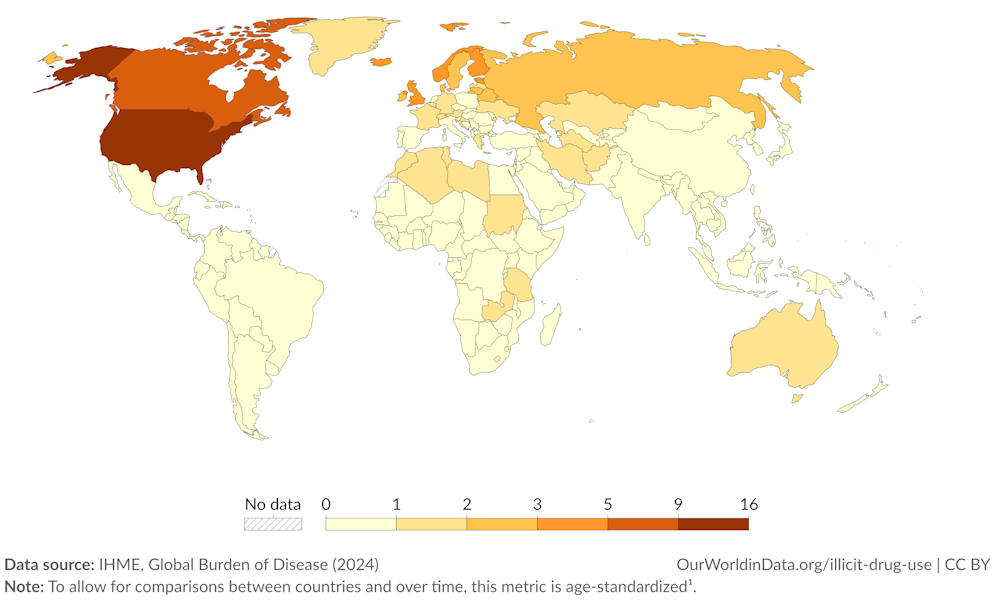
Opioid use death rates around the world:
Estimated deaths from opioid use disorders per 100,000 people in 2021. Our World In Data, CC BY
For the past 15 years, I have researched and advised on the international narcotics industry, especially the Afghan drug trade, as an academic, UK Home Office official and consultant. I’ve observed many shifts within global drug markets, and I believe the increasing availability of synthetic drugs in the UK and Europe may represent a new chapter in illicit drug use here – with the emergence of nitazenes only adding to these concerns.
A brief history of synthetic opioids
New synthetic opioids (NSOs) are one of the fastest-growing groups of new psychoactive substances around the world. The EU Drugs Agency (EUDA) currently monitors 81 NSOs – the fourth-largest group of drugs under observation.
NSOs largely fall into two broad groups: fentanyl and its analogues, and non-fentanyl-structured compounds – these include nitazenes, among many other substances.
Many of these “new” synthetic opioids have, in fact, existed for decades. Nitazenes were first synthesised in the 1950s by the Swiss pharmaceutical company, Ciba Aktiengesellschaft, as pain-relieving analgesics, although they were never approved for medical use.
Prior to 2019, there had only been limited reports of nitazenes in the illegal drug supply – including a “brownish looking powder” found in Italy in 1966; the discovery of a lab in Germany in 1987; several nitazene-related deaths in Moscow in 1998; and a US chemist illegally producing the drug for personal use in 2003. But since nitazenes re-emerged at the end of the last decade, over 20 variants have been discovered.
Paul Janssen, the Belgian chemist who first made fentanyl. Johnson & Johnson
The most common NSO in the illegal drug market, fentanyl, was first synthesised by Belgian chemist Paul Janssen in 1960. Fentanyl, which is roughly 100 times more potent than morphine, was approved in the US in 1968 for pharmaceutical use as an analgesic.
Over the next four decades, however, illegally produced fentanyl resulted in three relatively small outbreaks of deaths in the US. A fourth, larger fentanyl outbreak in Chicago, Detroit and Philadelphia resulted in about 1,000 deaths between 2005 and 2007.
The current US fentanyl crisis started in 2013, expanding to affect much of the country. Between 2014 and 2019, Chinese companies were the main manufacturers of finished fentanyl substances in the US – to combat this, both the Obama and Trump administrations lobbied Beijing to curtail the fentanyl industry.
The Chinese government responded by controlling specific fentanyl analogues. However, every time an analogue was banned, chemists there would slightly adjust the formula to produce a new compound that mirrored the banned substance.
China finally banned all fentanyl-related substances in May 2019, prompting two significant changes in the drug’s supply: a slowdown in the development of new fentanyl analogues, and a reduction in their direct sale to the US from China. Instead, Chinese companies increasingly sent fentanyl precursors to Mexican drug cartels who would synthesise fentanyl (or counterfeit medication) in clandestine labs, before smuggling it across the US border. Consequently, Mexico is now the primary source of fentanyl in the US.
But these supply changes led to another shift in the global drugs arena, as China’s chemical and pharmaceutical businesses – keen to develop new markets – adjusted their focus to producing uncontrolled synthetic substances, including nitazenes. At the same time, they expanded their geographical focus from North America to include Europe and the UK.
The nitazene supply chain
Producing nitazenes is a relatively low-cost exercise. They are largely manufactured in laboratories – both legal and illegal – in China, before being smuggled to the UK and Europe via fast parcel and post networks.
Nitazenes’ high potency means only small quantities are required, making them easier to transport and harder for border officials to detect. Some Chinese vendors have reportedly been offering to hide nitazenes in legitimate goods such as dog food and catering supplies, to circumvent custom controls. All of this decreases the risk to sellers, and lessens the price of doing business.
In March 2024, two China-based sellers operating on the dark web were selling a kilo of nitazene for between €10,000 and €17,000 (£12,000-£20,000). During roughly the same period, a kilo of heroin at the wholesale level in the UK was selling for between £23,000 and £26,000. Once bought, nitazenes are largely used to fortify low-purity heroin, although the drug can also be made into pills.
Video by The Guardian.
Nitazenes are not limited to the dark web. They are widely and openly advertised on the internet, social media and music streaming platforms. In February 2024, one China-based e-commerce site displayed 85 advertisements for nitazenes. Such sites also sell a range of other synthetic drugs, including fentanyl analogues and precursors, xylazines, cannabinoids and methamphetamine.
This means drug dealers in the UK and across the world no longer need to have established connections to underworld figures to source illegal drugs. With a click of a mouse, they can have them delivered to their home address. In this sense, the internet has democratised the drug trade by widening access beyond “traditional” criminals.
In the UK, while the supply of nitazenes is currently assessed as “low”, a number of smaller-scale organised crime groups are importing them to fortify low-purity heroin, before largely dealing it at the “county lines” level. This involves organised crime groups moving drugs – primarily heroin and crack cocaine – across towns, cities and county borders within the UK, using mobile phones or another form of “deal line” to sell to customers.
In November 2023, Leon Brown from West Bromwich was imprisoned for seven years for dealing drugs containing nitazenes – a verdict described as “a great result in our ongoing efforts to tackle county lines drug dealing” by detective sergeant Luke Papps of the South Worcestershire county lines team.
A few larger UK criminal networks have also been involved in nitazene distribution. In October 2023, the police and Border Force conducted raids across north London, arresting 11 people. They dismantled a drug processing site and seized 150,000 tablets containing nitazene – the UK’s largest ever seizure of synthetic opioids – as well as a pill-pressing machine, a firearm, more than £60,000 in cash and £8,000 in cryptocurrency. The police suspected the group had been selling the tablets on the dark web.
Anecdotal reports suggest there have been mixed reactions to the introduction of nitazenes into the illegal drug supply. Richard, a recovering heroin user from Bristol, told Vice magazine that, given their potency, some “people are scared of [nitazenes]” while others are “actively seeking” them.
As has been the case with fentanyl in the US, users build up tolerance and therefore seek stronger doses. Manny, a heroin user from Bristol, told Vice: “I smoked [heroin cut with nitazenes] and it felt like the first time I’d ever taken drugs.”
Video by Vice.
UK-based criminals also use the dark web to export nitazenes abroad. In October 2023, the Australian Border Force identified 22 nitazene discoveries in packages shipped to the country via mail cargo from the UK. British criminals have also trafficked counterfeit medicines containing nitazenes to Ireland and Norway.
Use of nitazenes is now being detected all over the world. Within Europe, Ireland experienced several nitazene outbreaks in 2023-24 while in Estonia, nitazenes now account for a large share of overdose deaths – a trend also seen (to a lesser extent) in Latvia. Preliminary data suggests at least 150 deaths were linked to nitazenes in Europe in 2023.
Nitazenes have also been discovered in fake pain medication such as benzodiazepines, oxycodone and diazepam, which widens the number of people at risk to include those with no opioid tolerance. The death in July 2023 of Alex Harpum, a 23-year-old British student who was preparing for a career as an opera singer, was a stark reminder of the danger of buying fake medicine online that may have been contaminated with nitazenes.
The nitazene ‘boom’ and the global heroin trade
For decades, Afghanistan was the world’s largest opium producer and the source of most of Europe’s heroin. Then in April 2022, the ruling Taliban announced a comprehensive prohibition on the use, trade, transport, production, import and export of all drugs. As a result, poppy cultivation has fallen to historically low levels for a second consecutive year.
While this has not, as yet, translated into a shortage of heroin on European streets, including in the UK and Germany, some indicators suggest a slowdown in heroin supplies to the UK. In the year March 2023-24, the quantity of heroin seized in the UK fell by 54%, from 950kg to 441kg. This is the lowest quantity of heroin seized since 1989, when about 350kg was intercepted.
The NCA assesses that the Taliban ban has created market “uncertainty”. The wholesale price of heroin has increased from roughly £16,000 per kilo prior to the COVID-19 pandemic to about £26,000, while anecdotal reports suggest average heroin purity for users dropped to under 30% (often to 10-20%) in 2024, compared with around 35% in 2023 and 45% in 2022.
Video by UN Story.
Even without the Taliban’s ban, heroin is not easy to produce and supply. Cultivating opium poppy is labour-intensive, taking five or six months. The static nature of opium fields means they are visible and susceptible to eradication; poppy crops can also be negatively affected by blight or drought.
Converting opium into heroin base is also a labour-intensive process that can involve (depending on the production method) at least 17 steps. Acetic anhydride, the main chemical used to convert morphine into heroin, is relatively expensive compared with synthetic precursors. Moreover, heroin is a bulky product, which means it is harder to move in large volumes.
While the relationship between events in opiate-producer countries and the introduction of synthetic opioids to consumer markets should not be overstated, this new type of drug offers economic advantages to criminals whose “sole motivation is greed”.
For decades, Turkish, Kurdish and Pakistani criminal networks have been responsible for importing heroin into the UK. Once in the UK, both Turkish and British groups largely control its wholesale supply, with some participation of Albanian gangs.
To date, there is little evidence to suggest these groups have transitioned to supplying NSOs, including nitazenes. The shifting dynamics in the global drug supply chain, however, could upend traditional markets and the gangs who profit from them.
America’s synthetic drug crisis
The synthetic opioid fentanyl has devastated the US, having been linked to about 75,000 deaths in 2023 alone. It is the primary cause of death for Americans aged 18-49. Canada, too, has experienced a wave of deaths: between January 2016 and June 2024, there were 49,105 apparent opioid deaths there, with fentanyl implicated in a large proportion.
More than 4,300 reports of nitazenes have reached the US National Forensic Laboratory Information System since 2019. They are typically used to fortify fentanyl and other opioids, which can produce a fatal concoction.
Efforts to stem the flow of NSOs, including nitazenes, from China to the US and elsewhere will prove challenging. And even if China does implement stricter controls, other countries could step in to fill the void. According to the Commission on Combating Synthetic Opioid Trafficking:
The overall sizes of these industries, limited oversight efforts and political incentives contribute to an atmosphere of impunity among firms and individuals associated with those industries.
While US and Chinese counter-narcotics cooperation ended in 2022 amid increasing geopolitical tensions, the following November’s summit in Woodside, California, between presidents Joe Biden and Xi Jinping saw them agree to recommence collaboration.
As a result, China recently closed several chemical companies that were shipping fentanyl precursors and nitazenes to the US. These vendors used encrypted platforms and cryptocurrency to conduct the deals, and mislabelled the consignments to try to ensure the substances evaded border controls. China has also outlawed more chemicals and substances, including several nitazene variants.
But President Trump’s imposition of tariffs on imports from China – which sit alongside proposed taxes on imports from Canada and Mexico, in part for supposedly not doing enough to curb the trafficking of fentanyl and its precursors to the US – threatens this counter-narcotics cooperation.
While nitazenes are not yet widely available in the US, their presence within some fentanyl batches is complicating the US opioid crisis – and according to some experts, has the potential to further increase the already shocking number of synthetic opioid-related deaths.
The UK response to nitazenes
Successive UK governments have made tackling NSOs a high priority. Shortly after the most recent nitazene-related deaths were discovered in the UK in summer 2023, the NCA launched Project Housebuilder to lead and coordinate the law enforcement and public health response.
This was soon followed by the establishment of a government-wide Synthetic Opioids Taskforce “to improve…understanding, preparedness and mitigation against this evolving threat”. Chris Philp, then the UK’s combatting drugs minister, stated that “synthetic opioids are at the top of [this government’s] list because of the harm they cause”.
The taskforce has taken a range of measures, such as controlling more NSOs as class A drugs, conducting more intelligence operations at UK borders, widening access to naloxone, and enhancing the UK’s real-time, multi-source drug surveillance system. The government also worked with the US and Canada to learn from their experiences.
Recently, the current UK government banned a further six synthetic opioids and introduced a generic definition of nitazenes as class A drugs. And the UK’s current government, unlike its Conservative predecessor, has also indicated its willingness to consider evidence from the UK’s first drug consumption facility, which recently opened in Glasgow.
Other policy measures worthy of consideration include expanding drug checking services whereby drug users submit drugs to a lab to test what is in them, then are provided with information about the sample. These services offer vital information to the public and authorities about current drug trends.
While there is high uncertainty about what is going to happen next in the UK regarding illicit drug trends, the evolution of the US drug landscape over generations provides some important lessons.
Lessons from the US
The US fentanyl crisis shows drug markets can change quickly with long-lasting consequences. Most heroin on US streets contains – or has been replaced by – fentanyl. According to DEA seizure data, US heroin seizures declined by nearly 70% between 2019 and 2023, whereas fentanyl seizures have increased by 451%.
However, illegal drug markets evolve in different ways and at different paces. In May 1989, Douglas Hogg, a UK Home Office minister, travelled to the US and the Bahamas on a fact-finding mission about crack cocaine, a drug that was predicted to spread from the US to the UK. Upon his return, Hogg noted:
The ethnic, social and economic characters of many of our big cities are very similar to those in the US. If they have a crack problem, why should not we? … The use of crack in Great Britain is likely to develop very substantially over the next few years.
But this “crack invasion”, as some called it, did not materialise in the UK to the extent it had in the US – and the same was true about a predicted wave of methamphetamine use in the UK, which remains low compared with the US.
It is also unlikely the UK and Europe will experience a synthetic opioid crisis on the same scale as the US. The first wave of the US crisis was driven by extensive overprescription of opioids for pain relief. This increased the number of people addicted to opioids, some of whom later turned to heroin, before transitioning to fentanyl. In contrast, large-scale opioid prescriptions have not been a major issue in the UK or Europe, although there is some diversion of legal fentanyl into the illegal drug market in Europe.
Video by The Brookings Institution.
According to Alex Stevens, professor of criminology at the University of Sheffield, another factor differentiating the US and Europe is the provision of drug treatment and harm reduction programmes. Opioid users in Europe, and to a lesser extent in the UK, are much more likely to be in medication-assisted treatment than their US counterparts, thus reducing the number of people at risk. These interventions are reinforced by different socioeconomic factors in much of Europe, such as lower economic inequality, stronger social protections, and better healthcare systems.
None of this, though, means the nitazene threat in the UK and Europe should be underestimated, nor that use and supply of these drugs (and other NSOs) will not increase from its current relatively low base. As the NCA recently warned:
While a zero-tolerance approach from law enforcement, plus advice to users on the heightened dangers, may contain or slow the current uptake, we must prepare for these substances to become widely available, both unadvertised in fortified mixes and in response to user demand as a more potent high.
The future of new synthetic opioids
Predicting the future of NSO use and trafficking is a challenging task. Projections for Europe range from existing opiate stockpiles ensuring that heroin consumer markets remain serviced (assuming the Taliban ban is short-lived), to a heroin shortage which results in more drug dealers turning to NSOs to plug the shortfall, which in turn could lead to lasting changes in European drug markets (as happened in a few countries following the Taliban’s first opium ban in 2000-01).
In such a scenario, it is possible that Turkish criminal networks may exploit their links with Mexico’s Sinaloa cartel to source NSOs. Mexican criminal gangs also operate in Europe, which may increase the likelihood of them trying to open a new NSO market on the continent.
There is also evidence that some Italian criminal organisations have entered the NSO marketplace. In November 2023, Italian authorities announced the seizure of 100,000 doses of synthetic drugs, including fentanyl, as part of operation Painkiller, a joint Italian-American initiative.
Given the many advantages for criminal groups of NSOs, it seems likely they are here to stay. A key question is whether nitazenes (or other NSOs) will supplant traditional heroin as the opioid of choice, as they have done in the US, or remain at relatively low levels in Europe, co-existing with or mixed into the heroin supply.
In December 2023, Paul Griffiths, the EUDA’s scientific director, told Vice: “We’re not seeing much new initiation of heroin use in Europe. So in five to ten years … as heroin users get older and more vulnerable, we’re not going to have much of an opiate problem left.”
But he warned that if heroin use does dry up: “You might then see opioids appearing in other forms and preparations, such as pills, that could potentially become popular among younger age groups who currently do not appear attracted to injecting heroin.”
While previous NSO outbreaks in the UK were relatively short-lived and limited in scale, the most recent nitazene outbreak, which started in summer of 2023, has been more sustained, covered more parts of the UK, and involved more fatalities. The broader trend in Europe also suggests the prevalence and variations of NSOs are increasing at a faster pace than in previous years.
Notwithstanding, nitazene use and supply in the UK currently remains relatively low. In fact, the rate of nitazene-linked deaths – at least those officially reported – decreased between spring 2024 and the end of the year.
In the short term, then, it seems unlikely there will be a nitazene “explosion”. Rather, criminal groups will probably try to increasingly embed nitazenes into the UK drug market at a similar pace to the last 18 months.
However, this situation could change rapidly in future, especially if larger criminal networks involved in heroin importation switch to smuggling NSOs, and there is a genuine shortage of Afghan heroin. This problem would be compounded if drug users start seeking nitazenes, thus creating demand for them.
Either way, the UK government, along with its European partners, should continue to reinforce the whole drug system, to prepare for the worst-case scenario.
To hear about new Insights articles, join the hundreds of thousands of people who value The Conversation’s evidence-based news. Subscribe to our newsletter.
Philip A. Berry does not work for, consult, own shares in or receive funding from any company or organisation that would benefit from this article, and has disclosed no relevant affiliations beyond their academic appointment.
An international panel of medical experts have thrust Lucy Letby back into the spotlight. At a press conference convened by Letby’s legal team, the experts cast doubt over the former nurse’s conviction. Letby was given 15 whole-life sentences for murdering seven babies and attempting to murder seven more.
Speaking at the press conference in London, retired neonatologist Dr Shoo Lee told the assembled reporters: “In all cases death or injury were due to natural causes or just bad medical care.”
Why should we take Dr Lee’s word for it? Well, in part, because he is the author of a key paper on air embolisms, one of the methods that Letby was accused of using to kill babies, which formed a key part of the prosecution’s evidence at the trial.
He also claims that the paper’s findings were misinterpreted at the trial and that a newly updated version of the article would help exonerate Letby rather than convict her.
The Letby conviction has always attracted critical attention because there were no witnesses who could confirm they saw her attacking any of the babies she was convicted of murdering. Nor did anyone see her perform actions that could have constituted the attempted murders of seven others.
Consequently, the prosecution used statistics alongside the medical evidence the expert panel has now cast doubt upon. So how solid is that statistical evidence?
A key piece of statistical evidence is a chart which showed that Lucy Letby was on duty every time one of the crimes of which she was accused occurred, but that none of the other nursing staff were.
On the face of it, it seems quite damning. But when you think about it, it’s unsurprising that Letby’s column is the only one full of crosses. Any of the events at which she was not present she would not have been charged with and consequently wouldn’t appear on the chart.
This is an example of what is known in statistics as the Texas sharpshooter fallacy.
The fallacy is named for a story about a Texan cowboy who likes to head out to his barn after a few drinks for target practice. Invariably, the barn wall gets peppered with random bullet holes during the inebriated exercise, and purely by chance some of these holes are clustered.
One morning the savvy “sharpshooter” gets out his paint cans and daubs a target around this cluster of holes to give the impression of accuracy to anyone who didn’t see the process by which they were made and to draw attention away from the other more dispersed bullet holes.
The sharpshooter fallacy occurs when a conclusion is drawn based only on data consistent with a given hypothesis, ignoring data that doesn’t support the proposed conclusion.
Imagine, for example, you made a chart similar to the one used to convict Letby, this time including only those deaths at which a different member of the nursing staff was present. It’s entirely possible – for example, if they were present for deaths at which Letby was not – that their name would be above the only column full of crosses and not Letby’s.
Indeed, it later transpired that the table did not include six other deaths that occurred during the same period and with which Letby was not charged. The jury was not told about these other deaths.
As Jane Hutton, a professor of medical statistics at the University of Warwick argues: “If you want to find out what went wrong, you need to consider all deaths, not just a subset of them.”
The probability of so many deaths on a neonatal unit in such a short period should be quite low. At first glance, this might seem to make the alternative explanation of murder seem more likely. But this is a classic statistical error.
This mistake is so common in courtrooms that it is known as the prosecutor’s fallacy. The argument starts by showing that, if the suspect is innocent, seeing a particular piece of evidence is extremely unlikely.
For Letby, this is the assertion that if she was innocent of killing these babies, the probability of them dying due to other causes is extremely low. The prosecutor then deduces, incorrectly, that an alternative explanation – the suspect’s guilt – is extremely likely.
The argument neglects to take into account any other possible alternative explanations, in which the suspect is innocent, such as the death of these babies due to inadequate care. It also neglects the possibility that the explanation that the prosecution is proposing, in which the suspect is guilty, may be just as uncommon as the alternative explanations, if not more so.
By just presenting the low probability of these seven babies dying naturally, the inference that an untrained jury is invited to draw runs something along these lines: “The deaths of these babies from natural causes is extremely rare, so the odds that the deaths are the result of murder is correspondingly extremely high.”
However, it must also be taken into account, when weighing up the evidence, that multiple infant murders are also extremely uncommon. What really matters is the relative likelihoods of the different explanations. Weighing these very unusual events against each other is not an easy thing to do.
Criminal cases review
Other statistical issues with the case also deserve more attention: the high number of deaths at the Countess of Chester, even excluding the babies that Letby has been convicted of murdering. Or the possibility of false positive medical identifications of murder, for example.
Whether Letby’s team’s appeal to the Criminal Cases Review Commission will be successful or not remains to be seen. The statistical issues over the case, when taken alongside the doubts about the medical evidence, mean that there is certainly a possibility.
Throughout all this, it’s important to remember the families affected by the events at the Countess of Chester Hospital. Whatever the ultimate truth of the matter, this ongoing case will undoubtedly make dealing with their grief more difficult.
Christian Yates does not work for, consult, own shares in or receive funding from any company or organisation that would benefit from this article, and has disclosed no relevant affiliations beyond their academic appointment.
Source: United Kingdom – Executive Government & Departments
Scientists comment on the Public Accounts Committee (PAC) report on Carbon Capture, Usage and Storage (CCUS) technologies.
Prof Hannah Chalmers, Personal Chair of Sustainable Energy Systems, Institute for Energy Systems, School of Engineering, University of Edinburgh, said:
“CCUS technologies can play a unique role in tackling carbon dioxide emissions. They can be used at large industrial sites to ensure that most of the carbon dioxide produced by activities like iron and steel production is not emitted to the atmosphere. Instead, the carbon dioxide is permanently stored in geological formations (rocks). In the UK, CCUS projects are developing plans to store carbon dioxide in layers of rock that are deep underneath the sea.
“There is also ongoing work to develop and deploy cost-effective approaches to remove carbon dioxide directly from the air. This provides an important option to respond to the widely reported increases in carbon dioxide levels in the atmosphere that are causing significant concern.
“There is significant evidence that including CCUS in a mix of technologies to reduce carbon dioxide emissions will be the most cost-effective way to address climate change. Several large-scale projects have been operating in other countries for many years. Experience from these projects is being used to ensure that the CCUS projects that are being developed in the UK are designed to be reliable and cost-effective.”
Dr Stuart Gilfillan, Reader in Geochemistry, University of Edinburgh, said:
What is CCUS technology, how does it work, does it have limitations?
“CCUS stands for Carbon Capture, Utilisation, and Storage, which is a developing technology which reduces the amount of carbon dioxide (CO2) released into the atmosphere. It works by capturing CO2 at the point source, transporting it and then burying it for safe storage in rocks over a kilometre below the ground surface. Like any technology, it has pros and cons, and costs more than simply releasing the CO2 directly to the atmosphere, which is currently free. CCUS is the only currently available technology that can directly reduce CO2 emissions from sources like power plants and industrial processes. Given that global temperature records are now being broken on an almost daily basis and yesterday’s announcement of the hottest January on record, it is essential tool in the urgent fight against runaway climate change.
What is the existing evidence around the efficacy of CCUS?
“CO2 capture technology has proven successful in capturing up to 90-95% of CO2 emissions from point of sources from power stations and industrial facilities. Successful examples include the Boundary Dam power station in Saskatchewan, Canada, where a large-scale CCUS unit has been operational since 2014, capturing about 1 million tonnes of CO2 per year.
“The long-term storage of CO2 is proven by natural CO2 reservoirs around the world and engineered projects like Sleipner in the North Sea, which have been injecting CO2 beneath the seabed since 1996 without significant issues. Research over the past two decades has developed monitoring technologies that can detect and mitigate potential leakage and to ensure that CO2 remains securely buried in rocks deep underground.
What more evidence may be needed to be confident in its applications?
“No more evidence is required, as exemplified by the UK’s Climate Change Committee (CCC), which is an independent body established under the Climate Change Act who advise the government on emissions targets and report to Parliament on progress made in reducing greenhouse gas emissions. The CCC is clear that CCUS is a critical technology for the decarbonisation of the UK economy, particularly in sectors that are hard to decarbonize directly, such as heavy industry (steel, cement, chemicals) and power generation.
“CCUS is not only as a standalone technology but is an essential part of a broader strategy to reach net-zero emissions by 2050. It compliments energy efficiency, renewable energy deployment, and electrification. CCUS is a clear driver for regional economic development, particularly in regions with suitable geological storage sites and industrial bases, such as the East Coast of Scotland, the Humber region, and North East England, areas that have been ‘left behind’ in recent times.”
Dr Tim Dixon, IEA Greenhouse Gas, Director and General Manager, said:
“Carbon Capture and Storage (CCS) is a necessary technology for the UK and other countries to achieve net-zero, and we need all low-carbon energy technologies. The science case for the role of CCS is provided by the UK’s Climate Change Committee, the Intergovernmental Panel on Climate Change (IPCC) and the International Energy Agency (IEA) and cannot be disputed if climate change is to be taken seriously. The key aspect of CCS is the secure long-term retention of CO2 in deep geological formations, and we have decades of experience in this from around the world. With over 40 large scale projects in operation injecting millions of tonnes every year and many pilot-scale projects, this has allowed us to test the science, the monitoring and the practicalities of geological storage of CO2. Hence CO2 geological storage is a proven technology and the regulations to enable and to ensure that it is safe and secure are based upon this sound science and experience. ”
Professor Paul Fennell FIchemE, Professor of Clean Energy, Imperial College London, said:
“The idea that Carbon Capture and Storage is an unproven technology is simply untrue. There are projects ongoing around the world, and millions of tonnes of CO2 have been safely stored over the last couple of decades. This has not happened in the U.K. because of our sclerotic inability to develop public infrastructure, not because the technology is unproven.”
Dr Greg Mutch, Researcher in Carbon Capture and Storage, Newcastle University, said:
“Carbon capture and storage is a technology that prevents carbon dioxide from entering the atmosphere, by capturing it and storing it underground in ‘empty’ oil & gas reservoirs or saline aquifers. According to the world’s foremost experts on the subject, gathered to contribute the International Panel on Climate Change, carbon capture and storage processes are necessary to achieve climate change mitigation goals at lowest cost. Without scalable CCS technologies by the end of the century, climate change mitigation will cost between 29 and 297% (mean value 138%) more.[1] Moreover, CCS is predicted to provide tens of thousands of jobs in the UK, add several billion pounds in terms of gross value added per year by 2050,[2] and enable other important technologies (hydrogen production etc) that will come with further jobs and economic value.”
[1] IPCC, 2018: Global Warming of 1.5 °C. An IPCC Special Report on the impacts of global warming of 1.5 °C above pre-industrial levels and related global greenhouse gas emission pathways, in the context of strengthening the global response to the threat of climate change, sustainable development, and efforts to eradicate poverty, ed. V. Masson-Delmotte, P. Zhai, H.-O. Portner, D. Roberts, J. Skea, P. R. Shukla, A. Pirani, W. Moufouma-Okia, C. Pean, R. Pidcock, S. Connors, J. B. R. Matthews, Y. Chen, X. Zhou, M. I. Gomis, E. Lonnoy, T. Maycock, M. Tignor and T. Waterfield, Cambridge University Press, 2018.
[2] Energy Innovation Needs Assessment Sub-theme report: Carbon capture, utilisation, and storage, Vivid Economics, Carbon Trust, E4tech, Imperial College London, Frazer-Nash Consultancy, Energy Systems Catapult. Commissioned by the Department for Business, Energy & Industrial Strategy, 2019.
Professor Peter Styring, Director of the UK Centre for Carbon Dioxide Utilization, Professor of Chemical Engineering & Chemistry, University of Sheffield, said:
What is CCUS technology, how does it work, does it have limitations?
“CCUS is carbon capture and storage. This has been primarily focused on CCS as the main driver. It aims to capture carbon dioxide from emitters such as power stations and industries. The current technology temperature swing absorption (TSA) using a chemical reaction with an aqueous amine solvent to capture the CO2 from the mixed waste gas and then to release it in a purified form by increased temperature chemical desorption and then further drying and purification to get a gas that can be in theory transported to a site where the gas can be stored underground. It works but at a high energy cost and the production of amine decomposition products that need to be removed and more amine added. It costs a lot!
“Limitations are the energy and financial costs, permitting regulations on solvent disclosure and the large physical footprint. Full system lifecycle analysis is required but this is not always reported.”
What is the existing evidence around the efficacy of CCUS?
“This is not proven using current technologies. The problem is that the current government funded projects use old technologies to achieve CCS and what is actually needed is a step change to new, lower cost more efficient processes such as solid based pressure swing adsorption (PSA). The whole system tends to be simpler and the energy costs and land use is significantly reduced.”
What more evidence may be needed to be confident in its applications?
“Full evaluation of new technologies and rapid acceleration from proof of concept to capture at scale. The Innovate UK funded Flue2Chem project is a good example of how this is being addressed using mid-TRL technologies. The UK also needs to move away from a single minded storage approach to adding value through the use of CO2 in the production of chemicals that would otherwise be sourced from virgin fossil carbon. SUSTAIN project is making synthetic fuels from captured CO2 and Flue2Chem is making FMCG components, including surfactants and precursors from the CO2.”
Dr Stuart Jenkins, Net Zero Fossil Fuel Fellow, University of Oxford, said:
“The Public Accounts Committee are wrong to have labelled CCUS as ‘unproven’, there are many commercial scale projects around the world, but they are right to question the current model for funding it. We need to make sure the CCUS industry becomes self-sustaining, without the need for major taxpayer funding. One option — asking fossil fuel suppliers to contribute to these costs via a carbon storage mandate — is a fair and responsible approach going forward.
In a recent report we published working with researchers at the University of Oxford and Carbon Balance Initiative [1] we looked at the use of Carbon Storage Mandates, which place an obligation on fossil fuel producers to capture and store a rising fraction of the CO2 they produce, to support the UK’s CCUS industry.
Carbon storage mandates, in tandem with carbon pricing and other mechanisms, could deliver subsidy-free CCUS to the UK and provide investment certainty for companies.”
Dr Stuart Jenkins Our report was funded by the Carbon Capture and Storage Association, and consulted regulators, fossil fuel companies, capture and storage entities, UK Government, and academics on models for CCUS sector support packages.
Professor Paul Fennell: No conflicts other than being involved in CCs research.
Dr Tim Dixon: “Tim is a Director of IEA Environmental Projects Ltd (UK), a Non-Executive Director on the Board for The International CCS Knowledge Centre (Canada). He is also proud to be an Honorary Senior Research Fellow at the Bureau of Economic Geology, University of Texas in Austin, and an Honorary Lecturer at the School of Geosciences at University of Edinburgh. He was an original Board Member of the UK CCS Research Centre. Previously he worked in CCS, emissions trading, clean energy technologies and related areas for AEA Technology (ETSU), for the UK Government‘s Department of Trade and Industry (DTI) and for the Global CCS Institute. He was the EU’s Lead Negotiator for getting CCS in the CDM in UNFCCC in 2011, and a UK negotiator for getting CCS in the London Convention 2004-7, in OSPAR 2006-7, in the EU Emission Trading Scheme 2004-8, and inputting to the EU CCS Directive 2007-8. He gives talks on climate and CCS to schools and public organisations and supported the start of Oxford Climate Society at the University of Oxford. He is a Fellow of the UK Energy Institute, and member of the UK Institute of Physics and the UK Environmental Law Association.”
Dr Stuart Gilfillan “I have received funding from TotalEnergies in the past, for research related to CO2 origins in the subsurface and reservoir connectivity and Equinor on CO2 dissolution in natural CO2 reservoirs. I currently receive funding from the Natural Environment Research Council and Carbfix on CO2 mineralisation.”
Prof Hannah Chalmers “I work collaboratively with industrial partners who are developing CCUS projects in the UK (e.g. as a member of the Advisory Board for the Industrial Decarbonisation Research and Innovation Centre). I currently receive no funding from industry, but have received funding from industrial partners who are actively developing CCUS projects in the UK in the past (e.g. SSE plc).”
Professor Peter Styring: Peter is Professor of Chemical Engineering and Chemistry at the University of Sheffield (an investigator on Flue2Chem and SUSTAIN) and a Co-founder and Director of CCU International.
For all other experts, no response to our request for DOIs was received.
Source: United States Senator for Maine Angus King
WASHINGTON, D.C. — U.S. Senator Angus King (I-ME) is introducing legislation to prohibit direct-to-consumer advertising of pharmaceutical drugs. The Responsibility in Drug Advertising Act would prohibit direct-to-consumer (DTC) advertising of a new drug in the first three years after the drug receives Federal Drug Administration (FDA) approval. The FDA could waive the third year of this prohibition if an affirmative value to public health is established or extend the prohibition if the drug has significant adverse health effects.
The legislation comes as more than 120 million viewers are expected to tune in to Super Bowl LIX this Sunday. Drug advertisers use these high-visibility moments, with millions of eyes on TV screens, to persuade and potentially mislead consumers about specific drugs that can be costlier to patients and possibly hazardous to their health. In the weeks leading up to Super Bowl LIX, the network airing the game has fetched $8 million for each 30-second TV ad slot, as companies pay a premium to tout their newest product to the Super Bowl’s vast audience.
“The widespread use of direct-to-consumer advertising by pharmaceutical companies drives up costs and doesn’t necessarily make patients healthier. It is misleading and frankly not safe for Maine people and all Americans looking for specific treatments to their conditions,” said Senator King. “The Responsibility in Drug Advertising Act would prohibit direct-to-consumer advertising of recently approved pharmaceutical drugs to protect people over profits. This bill is a great step to ensure that patients are getting the best information possible: we can start by making sure newly-approved drugs aren’t allowed to immediately flood the market with promotional ads before we fully understand their impact on the general public.”
Before the mid-1980s, drug companies only provided information about their products to doctors or pharmacists, who would then relay information to their patients when appropriate. But during the 1980s, companies started to market their drugs directly to consumers through ads. To date, federal law does not require the FDA to approve advertisements before they are released to the public. The only major requirement is that advertised information must be presented in consumer-friendly language that is readily understandable.
The United States and New Zealand are the only two countries that even allow direct to consumer drug advertising. In 2007, the World Health Organization (WHO) made a strong recommendation against direct-to-consumer drug advertising, calling it, “a significant risk of exposing more patients to the adverse effects of new drugs.” A study by Dartmouth College and the University of Wisconsin-Madison found that nearly 60 percent of prescription drug advertisements were misleading or false.
Senator King has been a leader in working to reduce prescription drug costs and hold pharmaceutical companies accountable for the content of their ads. Most recently, Senator King cosponsored bipartisan legislation which would require price disclosures on advertisements for prescription drugs in order to inform patients who are considering certain medications after seeing television commercials. He has previously introduced legislation to prohibit pharmaceutical drug manufacturers from claiming tax deductions for consumer advertising expenses. Senator King has also supported a number of commonsense bills to drive down the costs of prescription medication in the United States including the historic Inflation Reduction Act. Thanks to the Inflation Reduction Act, insulin fees are capped at $35/month, Medicare is able to negotiate drug prices, and a $2,000 yearly cap on out-of-pocket expenses has been instituted for Medicare recipients.
Source: United States Senator for Massachusetts – Elizabeth Warren
February 07, 2025
Musk’s Team May Have Obtained Access to Personal Information of Millions of Borrowers; Raises Concerns About Violations of the Law, Failure to Protect Sensitive Information
“The millions of families who rely on ED to help them achieve the American Dream deserve answers about reports that an unelected billionaire and his team now have access to some of their most sensitive personal information.”
Text of Letter (PDF)
Washington, D.C. – U.S. Senator Elizabeth Warren (D-Mass.) and Senate Minority Leader Chuck Schumer (D-N.Y.) led 14 of their colleagues in sending a letter to Acting Secretary of the Department of Education, Denise Carter, launching a probe into recent reports that Elon Musk’s Department of Government Efficiency (DOGE) has infiltrated the Department of Education (ED) and that “DOGE staffers have gained access to federal student loan data, which includes personal information for millions of borrowers.”
The letter was joined by Senators Cory Booker (D-N.J.), Richard Durbin (D-Ill.), Jack Reed (D-R.I.), Ed Markey (D-Mass.), Jeff Merkley (D-Ore.), Alex Padilla (D-Calif), Richard Blumenthal (D-Conn.), Tammy Duckworth (D-Ill.), Mazie Hirono (D-Hawaii), Tina Smith (D-Minn.), Chris Van Hollen (D-Md.), Raphael Warnock (D-Ga.), Ben Ray Luján (D-N.M.), and Ron Wyden (D-Ore.).
There are over 40 million federal student loan borrowers in the United States. ED’s student loan database contains millions of borrowers’ highly sensitive information, including Social Security numbers, marital status, and income data.
“This deeply troubling report raises questions about potential exposures of Americans’ private data, the abuse of this data by the Trump Administration, and whether officials who have access to the data may have violated the law or the federal government’s procedures for handling sensitive information,” wrote the senators.
According to public reporting, “a handful of 19-to-24-year-old engineers linked to Musk’s companies, with unclear titles, could be bypassing regular security protocols” during DOGE’s infiltration of federal agencies. The senators also raised concerns that the access provided to DOGE-affiliated staff by the Department may violate the Privacy Act, which generally prohibits the disclosure of such information.
“We are especially troubled by this reporting given President Trump’s stated pledge to abolish the Department,” concluded the lawmakers. “The millions of families who rely on ED to help them achieve the American Dream deserve answers about reports that an unelected billionaire and his team now have access to some of their most sensitive personal information.”
Additional reporting suggests that DOGE has “fed sensitive data from across the Education Department into artificial intelligence software to probe the agency’s programs and spending.” The 16 senators requested answers from Acting Secretary Carter about DOGE’s access to federal student loan data and any other sensitive databases by February 13, 2025.
A teenager has been found guilty of manslaughter after stabbing his school friend to death in an east London park.
A 16-year-old boy, who cannot be named for legal reasons, was found guilty of the manslaughter of 15-year-old Pharell Garica following a trial at the Old Bailey that concluded on Friday, 7 February.
He was found not guilty of murder.
The jury reached the verdict after deliberating for 15 hours and 39 minutes.
The court heard that the defendant, who was aged 15 at the time, stabbed Pharell in the heart, chased him until he collapsed then fled without helping him and disposed of the weapon.
The defendant admitted stabbing Pharell, but claimed it was in self-defence. However, the jury disagreed with this account.
Detective Chief Inspector Kelly Allen from the Met’s Specialist Crime Command, who led the investigation, said: “Our thoughts very much remain with Pharell’s family and friends, who had to re-live the last traumatic moments of his young life during the trial after the defendant failed to take responsibility for his actions.
“Somehow the defendant came to be in possession of a multi-tool, which he claimed in court was carried to the scene by the victim. The evidence we gathered disputed the defendant’s account that he grabbed the multi-tool and delivered a fatal blow to save his life. When the defendant became in possession of that weapon he had a choice. He could have walked away, he could’ve thrown the multi-tool to the floor. Instead, he chose to stab Pharell in the heart and then chased him, still armed with the knife, until he saw the victim collapse from his fatal injuries. Instead of rushing over to help his former friend, he fled the scene and tried to dispose of the evidence.
“Our investigation revealed that the defendant had a fascination with knives after we found 43 images and videos from 16 and 17 July alone of him playing with knives.”
Detective Chief Superintendent James Conway, who leads policing in Hackney and Tower Hamlets, said: “Pharell’s death was first and foremost a devastating tragedy for his family and friends, but it also had considerable impact across our local communities.
“While overall violence has been reducing in Hackney, tragic events such as this serve as a reminder that too many of our children and young people have to contend with the callous reality of knife crime. We continue to work night and day, with the council, local charities and wider partners to address both the root causes of knife crime and to deter people from carrying knives through police action.
“If any young person feels they need to carry a knife please speak to a parent, carer, teacher, youth leader or adult you trust and we can get you the support to step back from that decision safely.”
Police were called at around 16.05hrs on Tuesday, 23 July to Stellman Close, E5 to reports of a stabbing.
Officers and the London Ambulance Service attended, but sadly Pharell was pronounced dead at the scene.
The court heard that Pharell and the defendant, who used to be friends before a falling out, met in the park shortly before the attack. The defendant had told a mutual friend that he was going to fight Pharell as he was talking about him.
Following Pharell’s death, the police received some information, which led them to make an arrest enquiry at the defendant’s address. He was not home.
Detectives soon tracked him down to a family friend’s house, where he stayed following the manslaughter, and he was arrested at 05:07hrs on Wednesday, 24 July.
Detectives then began their lengthy investigation of gathering evidence to prove the defendant was responsible for killing Pharell. They reviewed hours CCTV that captured the defendant entering the park, before putting his hood-up, walking to the area where the attacked happened with Pharell, chasing Pharell out of the park while still holding the knife and then finally disposing of the weapon.
The weapon was recovered close to where the defendant was seen discarding it on CCTV. The multi-tool was forensically linked to both the defendant and Pharell.
Officers also analysed the defendant’s mobile phone which showed communication of Snapchat between the pair in the days leading up to the manslaughter, as well as 43 videos and photos of the defendant playing with knives only a week before the killing on Tuesday, 16 and Wednesday, 17 July. The defendant also messaged his mother following the attack saying he could not come home, to remove certain items from their home and asking to go to Portugal.
The defendant gave a prepared statement to officers admitting to stabbing Pharell but saying he did it in self-defence after getting the knife off him – something detectives and the jury disputed.
He was charged on Thursday, 25 July and was convicted as above.
He will be sentenced at the same court on Thursday, 17 April.
Source: Federal Bureau of Investigation FBI Crime News (b)
FBI, Clay County Sherriff’s Office and Clay County Schools Partner at Ridgeview High School
JACKSONVILLE, FL—FBI Jacksonville will partner with the Clay County Sheriff’s Office and Clay County District Schools to host “Be Smart with your Kid’s Smartphone” on Thursday, February 27. The event will be held at Ridgeview High School and is free and open to all parents, guardians, and educators. Since 2018, over 3,000 child advocates have attended “Be Smart” events across northeast Florida to learn how to better protect youth from being targeted online by predators and extremists.
“Be Smart with your Kids’ Smartphone” events are led by Special Agents from FBI Jacksonville who investigate crimes against children and terrorism matters. Together with deputies from the Clay County Sheriff’s Office, they will review the latest social media apps that offenders are using to target and manipulate local kids and provide an overview of schemes that specifically target teens. Please note that the content of these presentations may not be appropriate for youth, and parental discretion is advised.
Event: “Be Smart with your Kid’s Smartphone – Parent Edition” Where: Ridgeview High School, 466 Madison Avenue, Orange Park, Florida, 32065
When: Thursday, February 27, 2025, 6:30 – 8:00 p.m.
Who: Free and open to parents and educators from all schools and districts.
Notes: Seating is limited. Registration is highly suggested.
Source: Government of the Russian Federation – An important disclaimer is at the bottom of this article.
Dmitry Grigorenko’s meeting with heads of digital transformation of federal executive bodies
February 7, 2025
Dmitry Grigorenko’s meeting with heads of digital transformation of federal executive bodies
February 7, 2025
Dmitry Grigorenko at a meeting with heads of digital transformation of federal executive bodies
February 7, 2025
Previous news Next news
Dmitry Grigorenko’s meeting with heads of digital transformation of federal executive bodies
Digital transformation programs for 2025 and the planning period 2026–2027 have been adopted for 11 federal ministries and departments. They were reviewed at a meeting of Deputy Prime Minister – Chief of the Government Staff Dmitry Grigorenko with heads of digital transformation of federal executive bodies.
The meeting approved development programs for the Ministry of Emergency Situations, the Ministry of Industry and Trade, the Ministry of Digital Development, the Ministry of Energy, the Russian National Guard, the Federal Service for Supervision in Education and Science, the Federal Archives Agency, the Federal Reserve Agency, the Federal Fisheries Agency, the Federal Bailiff Service, and the Federal Mandatory Medical Insurance Fund. Their projects provide for all the main planning parameters with established target indicators: funding volumes; key results (e.g., harmonizing departmental information resources, increasing the speed of processing interdepartmental requests); infrastructure development (e.g., transferring systems to Russian software and Russian information security tools).
“In total, we have to approve 60 departmental digital transformation programs. Their implementation is aimed at increasing the efficiency of the departments themselves and public administration as a whole. This includes the quality of decisions made based on data received online, and the transparent implementation of key functions, and the speed of providing public services,” commented Dmitry Grigorenko.
For example, the Compulsory Medical Insurance Fund plans to introduce a system of personalized accounting of information on medical care provided in 2025. This will allow receiving information about insured citizens online, reducing errors in medical organizations’ bills, generating information about everyone who is subject to dispensary observation, creating individual medical examination routes for them, etc. Based on this information, personal risks of insured persons will be calculated, and forecasts of medical care consumption will be built.
Taking into account the implementation of the tasks set within the framework of departmental digital transformation programs, a number of additional priorities were also identified at the meeting. Thus, among the tasks for 2025 is to introduce artificial intelligence technologies into the feedback platform. This will allow for the fastest possible classification of citizens’ requests by issue and assessment of the quality of responses to them. Also, special attention will be paid to ensuring information security in 2025.
Please note: This information is raw content directly from the source of the information. It is exactly what the source states and does not reflect the position of MIL-OSI or its clients.
Source: The Conversation – UK – By Magdalena Frennhoff Larsén, Associate Professor in Politics and International Relations, University of Westminster
It is not unusual for international leaders to be invited to meet with EU heads of state or government at the fringes of the European Council meetings. Ukraine’s president, Volodymyr Zelensky, has regularly been invited to address the EU leaders. And while Donald Trump was never invited during his first term as US president, his successor Joe Biden was.
But Keir Starmer’s February 3 visit was significant, because it was the first time since Brexit that a British prime minister was invited to join the EU leaders for their traditional post-summit dinner.
Even before the UK formally left the EU, while the two parties were negotiating the terms for Brexit, British prime ministers were excluded. Not only were they left out of the formal meetings where the other 27 leaders discussed Brexit, but they were also excluded from the post-summit dinner. This caused frustration in Downing Street, and led to complaints about the UK being sidelined.
Want more politics coverage from academic experts? Every week, we bring you informed analysis of developments in government and fact check the claims being made.
There were rumours that Boris Johnson would be invited to a European Council meeting in 2022, but these remained rumours. And even if UK-EU relations improved under the premiership of Rishi Sunak, it was not until the Labour government’s step-change in the signalling of the need for a Brexit “reset” that a dinner invitation was extended.
Symbolically, it was important. After eight rather tumultuous years, the UK and EU were having dinner together again. And against the backdrop of the war in Ukraine and the changing geopolitical landscape, both parties recognised the need for closer cooperation on security and defence.
Starmer wants an ambitious security partnership with the EU. European Council president António Costa recognised that there is a great deal that the EU and the UK can do together in terms of defence and addressing global challenges.
Partners in security
The idea of a security partnership is not new. Already in the political declaration of 2019, which accompanied the withdrawal agreement, the UK and the EU agreed to negotiate such a partnership, including cooperation on foreign, security, and defence policies.
However, in his hurry to “get Brexit done”, Boris Johnson decided not to proceed on this track. As a result, the trade and cooperation agreement, which governs the EU-UK relationship, largely omits security cooperation.
Even without a formal security and defence structure in place, the EU and the UK have worked alongside each other in supporting Ukraine. But the Labour government has repeatedly stressed the need for more formal cooperation arrangements as part of its “reset”. To this end, the foreign secretary, David Lammy, has called for an ambitious and broad-ranging UK-EU security pact.
For the UK it is a relatively easy way to improve relations and rebuild trust with the EU. The EU and the UK face similar geopolitical challenges and are largely aligned in terms of values and interests on security and defence matters. A more coordinated EU-UK response would have greater impact, whether it is about supporting Ukraine, tackling cross-border crime or increasing energy security.
It is also an area where the UK can forge closer links with the EU without crossing its red lines on free movement of people, or membership of the customs union or single market. And the UK – as the only major European military power other than France – is an attractive security partner for the EU.
EU leaders do see potential in such an initiative. Already in the 2022 “strategic compass”, a document which sets out the EU’s security and defence agenda, the EU stressed that it remains open to closer cooperation with the UK.
This has become even more urgent in light of the uncertainty surrounding Trump’s future engagement with Nato and European security. If Trump makes good on his threat to downsize America’s security role in Europe, the EU needs to strengthen its own defence, and it cannot do so effectively without the UK.
However, the EU wants to see concrete proposals for what a security pact would look like. It questioned the genuine commitment to the “reset” after the UK rejected the EU’s proposal around a time-limited and visa-based youth mobility scheme – a move that disappointed the EU, for whom the issue was a top priority. The UK government worried that it could be misinterpreted as a return to free movement of people and rejected the proposal.
While the leaders left the dinner without concrete proposals, they agreed to talk further. There will be an institutional EU-UK summit in the UK in May, where the two parties will discuss what form the deeper security and defence cooperation could take.
European Council president Costa recognised that there is a new positive energy in the EU-UK relationship. It remains to be seen whether this energy, and the signalling about the UK’s commitment to a reset, will eventually translate into an actual EU-UK rapprochement – something both parties would benefit from. Rebuilding trust takes time – and a dinner invitation should be seen as positive sign in itself.
Magdalena Frennhoff Larsén does not work for, consult, own shares in or receive funding from any company or organisation that would benefit from this article, and has disclosed no relevant affiliations beyond their academic appointment.
Every scientific discovery, breakthrough, and innovation we celebrate has been shaped by brilliant minds. However, the minds with more opportunities to shine have predominantly been male. While women constitute 48% of doctoral graduates in the EU, they represent only one third of the total number of researchers in Europe. According to the UN, female researchers also tend to have shorter, less well-paid careers.
Though progress has been made, women remain underrepresented in many fields, in senior academic and decision-making positions. These disparities are driven by challenges such as unconscious bias, a lack of mentorship, and limited access to resources – barriers that continue to hinder the full participation of women in research and innovation.
The International Day of Women and Girls in Science on 11 February is both a celebration and a call to action to inspire young girls and women around the world, to ignite their curiosity and creativity – and to reflect on how best to support their scientific aspirations.
The European Commission is committed to upholding gender equality – one of the core values of the EU. Read how the Commission is supporting equality with some key actions in research and innovation.
Gender equality plans
Gender equality is a priority of the European Research Area (ERA), with actions focused on driving institutional change in research careers at all levels. In 2022, this commitment was strengthened further, with all higher education establishments, research organisations, and public bodies from Member States and Associated Countries applying for Horizon Europe funding now required to implement a Gender Equality Plan (GEP).
These plans must address several areas, including work-life balance, gender balance in leadership and decision-making, gender equality in recruitment and career progression, integration of an inclusive gender dimension into research that acknowledges intersectionality, and measures against gender-based violence.
The EU Award for Gender Equality Champions celebrates and recognises the outstanding results achieved by some change-driving academic and research organisations in the implementation of GEPs. The prize is shaping a community of changemakers who inspire others to adopt gender equality policies and drive meaningful, transformative institutional change.
To date, two award ceremonies have been held, honouring seven champions from Ireland, Spain, Sweden, and France. This year’s ceremony will take place in March 2025.
One of the previous winners is Universitat Rovira I Virgili in Spain where now the majority of research groups in the university are led by women as principal investigators. The university has also run a campaign to prevent sexual harassment and gender-based discrimination among their teaching staff.
Another notable champion is South East Technological University in Ireland. This institution has made impressive strides in achieving gender balance, particularly within its executive management team and across its teaching staff. From assistant lecturers to senior lecturers, the university has worked diligently to ensure that both women and men are equally represented.
Discover how you can apply to become one of the next EU gender equality champions.
EU-funded projects strengthen the gender equality balance in STEM
Strengthening women’s participation in Science, Technology, Engineering and Mathematics (STEM) is not only a matter of equal opportunities and social justice, but also crucial to meet pressing societal challenges, such as the green and digital transitions. According to the “She figures 2021” report, women remain underrepresented among doctoral graduates in most narrow STEM fields.
To tackle this imbalance, the EU is funding research and innovation projects aimed at increasing young girls’ participation in STEM activities, improving the recruitment, retention and promotion of women in science across the EU and beyond.
The Horizon Europe project STREAM IT tackles barriers for underrepresented groups in STEM, focusing on young girls, creating inclusive educational tools. The project aims to provide widely applicable solutions for various stakeholders, including workshop series for supporting girls to orient towards STEM, hands-on activities at science centres and museums, mentoring programme, and establishing collaborative networks on national and international level.
To further boost interest and female participation in STE(A)M (where “A” stands for creative thinking and applied arts), while deconstructing gender stereotypes, three EU-funded projects – Road-STEAMer, The SEER and SENSE – are collaborating to develop and deliver a roadmap for science education in Horizon Europe, in synergy with the EU’s Erasmus programme.
Meet some of the inspiring women behind European R&I
EU actions to eliminate gender inequalities in research and innovation have already yielded significant results, as seen in the stories of several remarkable women in science.
One such example is Dr. Anne L’Huillier, the 2023 Nobel Prize Laureate in Physics, who works on the interaction between short and intense laser fields and atoms. She credits the MSCA programme’s early support for kickstarting her career.
Prof Rana Sanyal, the winner of the 2024 European Prize for Women Innovators and a leading expert in biotechnology, is another prime illustration of the vital role EU funding plays in supporting women researchers.
Alba García-Fernández and Erika Pineda Ramirez are other two EU-funded women researchers dedicated to developing more effective treatments for cancer patients. In honour of the International Day of Women and Girls in Science, they offer inspiring advice for the next generation of female researchers.
“The contribution of women in science is invaluable. We have so much talent and ideas to offer. As Marie Skłodowska-Curie once said: ‘I was taught that the way of progress was neither swift nor easy.’ So, my advice is: believe in yourself and go after what truly excites you. Stay curious, keep learning!” – Alba García-Fernández, MSCA fellow.
Erika Pineda Ramirez emphasises that while the work environment can sometimes make things harder, women researchers should keep trying and never give up because science needs more of their contributions.
Source: State University of Management – Official website of the State –
Head of the Department for Coordination of Scientific Research at the State University of Management, Maxim Pletnev, joined the Public Council of the Ministry for Territory Maintenance and State Housing Supervision of the Moscow Region.
On February 5, 2024, the first meeting of the Public Council of the Ministry for Territory Maintenance and State Housing Supervision of the Moscow Region was held in the Government of the Moscow Region. It included 14 people – representatives of various spheres and industries. Among them was the head of the UKNI GUU Maxim Pletnev, who joined the working group of the Public Council for the Maintenance of Territories of Apartment Buildings in the Moscow Region.
During the first meeting, the participants voted to elect the Chairman of the Public Council — Hero of the Russian Federation, member of the cosmonaut corps Andrey Borisenko. The members of the Public Council defined the key goal of the joint work — to identify problem areas and find effective solutions for current issues in the field of housing supervision, improvement and maintenance of adjacent territories, taking into account the interests of civil society.
Subscribe to the TG channel “Our GUU” Date of publication: 02/07/2025
Please note: This information is raw content directly from the source of the information. It is exactly what the source states and does not reflect the position of MIL-OSI or its clients.
We are pleased to advise that the section of road on the A926 from Rattray to Alyth at Pictfield which was closed for emergency gas repairs has now reopened to traffic.
Temporary traffic signals will be in operation while SGN repair works are ongoing, so some delays should be expected.
Stagecoach East Scotland have confirmed that with the road reopening, they will resume normal operation of their bus services from 2pm today. School transport contracts will also revert to their normal arrangements.
Thank you for your patience while the repairs continue.
Governor Kathy Hochul today announced that, as part of New York State’s continued effort to combat the spread of highly pathogenic avian influenza (HPAI), the Department of Agriculture and Markets (AGM) has issued a new Notice and Order for live bird markets that have not had a detection of HPAI in New York City and Westchester, Suffolk, and Nassau counties. The order requires those markets to sell down all inventory, complete cleaning and disinfection procedures, and remain closed for a period of five days after cleaning and disinfection. In addition, the Notice and Order further outlines quarantine and depopulation procedures for markets that have confirmed detections of HPAI. This Notice and Order follows seven detections of HPAI in markets in Queens, the Bronx, and Brooklyn during routine surveillance conducted by AGM since January 31, 2025. The State reminds farmers to follow good biosecurity measures and emphasizes that the risk to humans remains low.
“Safeguarding public health is all about being proactive, and New York State is continuing our coordinated effort to monitor for the Avian Influenza,” Governor Hochul said. “My top priority will always be to keep New Yorkers safe, and I have directed our state agencies to use all available resources to ensure we are taking every measure necessary to keep the risk to the public low. We will continue to take these measured, common sense steps that will curb the spread of bird flu and ultimately protect our communities.”
New York State Agriculture Commissioner Richard A. Ball said, “We’re continuing to work hard with our partners to combat the spread of HPAI in New York. Today, I signed a Notice and Order requiring that live bird markets in New York City and the surrounding areas close for cleaning and disinfection, even if they haven’t yet had a detection of HPAI in their market. Following seven detections of HPAI in live bird markets in the last week, this Notice and Order is a commonsense measure aimed at getting ahead of the virus, rather than chasing it. We’re working with USDA and other partners to make sure that we can minimize the economic impact to these markets, and we very much appreciate the markets’ cooperation and assistance in protecting public and animal health.”
New York State Health Commissioner Dr. James McDonald said, “While there is no immediate threat to public health and no known cases of HPAIin humans in New York State, we support the Department of Agriculture and Markets’ latest proactive measures to prevent the spread of the disease between animals and humans by temporarily closing live bird markets in New York City and surrounding counties. Those who have regular contact with livestock and wild birds should safeguard their health by wearing personal protective equipment when in contact with these animals. We will remain vigilant in working with our state and local partners to monitor for detections and reduce any potential risks to public health and safety.”
New York State Department of Environmental Conservation Interim Commissioner Sean Mahar said, “Through Governor Hochul’s leadership, New York State is acting aggressively to monitor for and advance actions to reduce the spread of Highly Pathogenic Avian Influenza. DEC remains committed to working comprehensively with our state and federal partners to respond to HPAI and encourages New Yorkers to use our new web-based tool to report suspected HPAI outbreaks in wildlife, and follow proper precautions when handling deceased wildlife. Visit DEC’s website for additional information on safe wildlife handling and proper disposal techniques.”
New York City Health Department Acting Commissioner Michelle Morse said, “The current risk to New Yorkers of bird flu (H5N1) remains low. Avian influenza viruses only present a wider risk if the virus develops the ability to transmit between people – which we have not seen. The NYC Health Department will continue to work closely with the NYS Department of Agriculture and NYS Department of Health to ensure that Live Bird Market staff receive essential information and, if symptoms present themselves, receive any treatment they may need. We are prepared to respond to any disease outbreak, including quickly ramping up testing and treatment, and working closely with providers and community partners to rapidly disseminate messaging.”
HPAI is a contagious viral disease that is known to be deadly to domestic poultry and has been transmitted within and between farms and live bird markets. The temporary shutdown mandated by the Notice and Order is necessary and essential to ensuring a break in HPAI virus transmission within the impacted markets. While AGM’s routine surveillance is effective, after finding seven detections of HPAI in live bird markets within the last week, the temporary shutdown ensures that the State can get ahead of any additional opportunities for transmission of the virus within the markets at the current time. A uniform market closure for a five-day period addresses the persistence and circulation of the virus within the markets by quickly reducing the virus prevalence to zero percent.
Effective immediately, the Notice and Order requires that:
No poultry shall be delivered to live bird markets or distributors covered by the Order from February 7, 2025 through February 14, 2025.
Any market that harbors birds exhibiting clinical signs of HPAI must contact the Department of Agriculture and Markets immediately to undergo investigation and testing.
Markets that test positive for HPAI shall be depopulated; undergo cleaning and disinfection and be empty of birds for five days, at a minimum; and shall remain closed until the market passes cleaning and disinfection inspection by an AGM animal health inspector.
All unaffected live bird markets in New York City and Westchester, Suffolk, and Nassau counties must sell down all inventory for a period of three days beginning on February 7, 2025; complete cleaning and disinfection procedures; and subsequently close for a period of five days following cleaning and disinfection. These markets must pass a cleaning and disinfection inspection by an AGM animal health inspector before reopening.
Cleaning and disinfection includes the removal of all organic debris from all equipment, caging, flooring, etc.; and requires that all surfaces be cleaned with soap or detergent, rinsed with water, and saturated with a disinfectant appropriate for killing the avian influenza virus, in accordance with the manufacturer’s label.
USDA provides indemnity and compensation for losses incurred following a confirmed detection of HPAI on a premise.
State Senator Michelle Hinchey said, “This proactive decision by NYS Agriculture and Markets to temporarily close at-risk poultry markets as a precaution against avian flu is a difficult yet necessary step to curb the spread of this highly contagious disease. New York benefits immensely from having one of the country’s top Animal Diagnostic Labs at Cornell University, which will play a critical role in limiting further spread and reducing disruptions for both farmers and businesses. We are committed to ensuring that the lab has the necessary resources to quickly respond to this and any other pathogen-based threats that may emerge.”
Assemblymember Donna Lupardo said, “After detecting avian flu at seven live bird markets across NYS, the decision was made to temporarily close these markets. Proactive measures, while concerning to businesses and consumers alike, are necessary to help prevent the spread of a virus that has devastated poultry farms across the country. We are fortunate in NYS to have one of the country’s premier Animal Diagnostic Labs at Cornell University whose expertise will be invaluable as we navigate these waters.”
HPAI in Poultry
At Governor Hochul’s direction, AGM, DOH, and DEC continue to collaborate closely on proactive measures to prevent the spread of HPAI and facilitate early detection, as the risk to humans remains low. The New York State Department of Health is also reminding the public that the finding of HPAI in this market does not present an immediate public health concern. Individuals working in the markets will be assessed for potential high-risk exposure and be monitored for symptoms by the New York City Department of Health and Mental Hygiene accordingly. If any become ill, they will be evaluated for infection with avian influenza. Since the start of 2024, there have been 67 human cases of avian influenza in the United States, and none of these have been in New York State.
AGM encourages those involved in poultry production to take extra steps to prevent their flocks from becoming infected. All poultry producers, from small backyard to large commercial operations, should review their biosecurity plans and take precautions to protect their birds. Poultry biosecurity materials and checklists can be found on the USDA’s “Defend the Flock” website.
In addition to practicing good biosecurity, poultry owners should keep their birds away from wild ducks and geese and their droppings. Outdoor access for poultry should be limited at this time, particularly as the State continues to see HPAI detections in wild bird populations.
To report sick birds, unexplained high number of deaths, or sudden drop in egg production, please contact AGM’s Division of Animal Industry at (518) 457-3502 or the USDA at (866) 536-7593.
HPAI in Dairy Cattle
In January, AGM announced that it is implementing new testing initiatives on dairy farms as part of its aggressive, proactive response to the outbreak of HPAI in livestock in other states. Working in close collaboration with federal partners, including USDA’s Animal and Plant Health Inspection Service, FDA, and the National Association of State Departments of Agriculture, and State partners, including DOH, this enhanced testing strategy is part of the State’s effort to protect animal and human health and prevent the transmission of HPAI in livestock in New York State. While there have been no detections of HPAI in livestock in New York to date, the State’s comprehensive approach is aimed at ensuring the state remains free of HPAI and facilitating early detection.
In addition to the new testing initiative, New York State has taken multiple preventative measures to prevent the spread of HPAI and protect animal and human health since the first detection of HPAI in dairy cattle in Texas in March 2024. In April, June, and August 2024, the Department issued orders on import requirements for dairy cattle coming into New York as well as testing requirements for lactating dairy cattle entering fairs or exhibitions. These orders continue to remain in place until further notice.
USDA offers several producer support programs that are available to all dairy producers as well as certain programs only available to dairy producers with HPAI-positive herds. These programs include tools to support biosecurity planning and implementation as well as financial support programs to offset costs associated with HPAI testing, veterinary expenses, personal protective equipment purchases, milk disposal, and milk losses.
Rural America faces many challenges that Congress and the federal government could help alleviate under the new Trump administration.
Rural hospitals and their obstetrics wards have been closing at a rapid pace, leaving rural residents traveling farther for health care. Affordable housing is increasingly hard to find in rural communities, where pay is often lower and poverty higher than average. Land ownership is changing, leaving more communities with outsiders wielding influence over their local resources.
Here are some ways we believe the Trump administration could work with Congress to boost these communities’ health and economies.
1. Rural health care access
One of the greatest challenges to rural health care is its vulnerability to shifts in policy and funding cuts because of rural areas’ high rates of Medicare and Medicaid beneficiaries.
Funding from those federal programs affects rural hospitals, and rural hospitals are struggling.
Nearly half of rural hospitals operate in the red today, and over 170 rural hospitals have closed since 2010. The low population density of rural areas can make it difficult for hospitals to cover operating costs when their patient volume is low. These hospital closures have left rural residents traveling an extra 20 miles (32 km) on average to receive inpatient health care services and an extra 40 miles (64 km) for specialty care services.
The government has created programs to try to help keep hospitals operating, but they all require funding that is at risk. For example:
The Low-volume Hospital Adjustment Act, first implemented in 2005, has helped numerous rural hospitals by boosting their Medicare payments per patient, but it faces regular threats of funding cuts. It and several other programs to support Medicare-dependent hospitals are set to expire on March 31, 2025, when the next federal budget is due.
The rural emergency hospital model, created in 2020, helps qualifying rural facilities to maintain access to essential emergency and outpatient hospital services, also by providing higher Medicare payments. Thus far, only 30 rural hospitals have transitioned to this model, in part because they would have to eliminate inpatient care services, which also limits outpatient surgery and other medical services that could require overnight care in the event of an emergency.
Rural emergency hospitals can get extra funding, but there’s a catch: They have no inpatient beds, so people in need of longer care must go farther. AP Photo/Rogelio V. Solis
Services for pregnant women have also gotten harder to find in rural areas.
Before the COVID-19 pandemic, telehealth – the ability to meet with your doctor over video – wasn’t widely used. It could be difficult for doctors to ensure reimbursement, and the logistics of meeting federal requirements and privacy rules could be challenging.
The pandemic changed that. Improving technology allowed telehealth to quickly expand, reducing people’s contact with sick patients, and the government issued waivers for Medicare and Medicaid to pay for telehealth treatment. That opened up new opportunities for rural patients to get health care and opportunities for providers to reach more patients.
However, the Medicare and Medicaid waivers for most telehealth services were only temporary. Only payments for mental and behavioral health teleheath services continued, and those are set to expire with the federal budget in March 2025, unless they are renewed.
Like their urban peers, rural communities face a shortage of affordable housing.
Unemployment in rural areas today exceeds levels before the COVID-19 pandemic. Job growth and median incomes lag behind urban areas, and rural poverty rates are higher.
Rural housing prices have been exacerbated by continued population growth over the past four years, lower incomes compared with their urban peers, limited employment opportunities and few high-quality homes available for rent or sale. Rural communities often have aging homes built upon outdated or inadequate infrastructure, such as deteriorating sewer and water lines.
Rental homes in older towns can become run down. Community maintenance of pipes and other services also requires funding. LawrenceSawyer/E+ via Getty Images
One proposal to help people looking for affordable rural housing is the bipartisan Neighborhood Homes Investment Act, which calls for creating a new federal tax credit to spur the development and renovation of family housing in distressed urban, suburban and rural neighborhoods.
Similarly, the Section 502 Direct Loan Program through the U.S. Department of Agriculture, which subsidizes mortgages for low-income applicants to obtain safe housing, could be expanded with additional funding to enable more people to receive subsidized mortgages.
3. Locally owned land benefits communities
Seniors age 65 and older own 40% of the agricultural land in the U.S., according to the American Farmland Trust. That means that more than 360 million acres of farmland could be transferred to new owners in the next few decades. If their heirs aren’t interested in farming, that land could be sold to large operations or real estate developers.
A farmer carries organic squash during harvest. Young farmers often struggle to find land to expand their operations. Thomas Barwick/Stone via Getty Images
Congress can take some steps to help communities keep more farmland locally owned.
The proposed Farm Transitions Act, for example, would establish a commission on farm transitions to study issues that affect locally owned farms and provide recommendations to help transition agricultural operations to the next generation of farmers and ranchers.
About 30% of farmers have been in business for less than 10 years, and many of them rent the land they farm. Programs such as USDA’s farm loan programs and the Beginning Farmer and Rancher Development Program help support local land purchases and could be improved to identify and eliminate barriers that communities face.
We believe that by addressing these issues, Congress and the new administration can help some of the country’s most vulnerable citizens. Efforts to build resilient and strong rural communities will benefit everyone.
Randolph Hubach receives funding from the National Institutes of Health and the Health Resources and Services Administration.
Cody Mullen receives funding from the Health Resources and Services Administration. He is affiliated with the National Rural Health Association.
WASHINGTON, DC – The Fannie Mae (FNMA/OTCQB) Home Purchase Sentiment Index® (HPSI) increased 0.3 points in January to 73.4, bouncing back slightly after falling last month for the first time since July. Improvements in consumer optimism toward both homebuying and home-selling conditions, along with even greater expectations that home prices will rise over the next 12 months, drove the increase. However, after a surge in mortgage rate optimism in the second half of last year, January saw a 13-percentage-point decline in the net share of consumers who believe mortgage rates will go down in the next 12 months. In addition, the share of consumers who expect rental prices will go up increased 8 percentage points from last month to 65%. Year over year, the HPSI is up 2.7 points.
“Consumers seem increasingly pessimistic that housing affordability conditions will improve across the board, as a growing share expects home prices, rent prices, and mortgage rates will all go up,” said Kim Betancourt, Vice President of Multifamily Economics and Strategic Research. “The lower optimism toward the mortgage rate outlook was largely expected, as rates have continued to stay elevated and even crossed the 7% threshold in mid-January. As noted in our latest forecast, we currently expect mortgage rates to end 2025 around 6.5%, relatively little changed from where we are today, which will likely continue to hinder relief for housing affordability and home sales activity.”
Betancourt continued: “On the rental side, consumers have indicated a sharply growing expectation over the past two months that rent prices will increase. This mirrors our expectation that multifamily rents will grow between 2.0% and 2.5% this year — up from an estimated 1.0% last year. Even though it remains relatively cheaper for consumers to rent than buy in nearly every U.S. metro, we expect affordability issues will remain a real challenge for both renters and homeowners alike for the foreseeable future.”
Home Purchase Sentiment Index – Component Highlights Fannie Mae’s Home Purchase Sentiment Index (HPSI) increased 0.3 points in January to 73.4. The HPSI is up 2.7 points compared to the same time last year. Read the full research report for additional information.
Good/Bad Time to Buy: The percentage of respondents who say it is a good time to buy a home (22%) and the percentage who say it is a bad time to buy (78%) both stayed the same from last month. The net share of those who say it is a good time to buy increased 2 percentage points month over month to -55%.
Good/Bad Time to Sell: The percentage of respondents who say it is a good time to sell a home (63%) and the percentage who say it’s a bad time to sell (36%) both remained unchanged month over month. The net share of those who say it is a good time to sell increased 1 percentage point month over month to 28%.
Home Price Expectations: The percentage of respondents who say home prices will go up in the next 12 months increased from 38% to 43%, while the percentage who say home prices will go down decreased from 27% to 22%. The share who think home prices will stay the same decreased from 35% to 34%. As a result, the net share of those who say home prices will go up in the next 12 months increased 9 percentage points month over month to 20%.
Mortgage Rate Expectations: The percentage of respondents who say mortgage rates will go down in the next 12 months decreased from 42% to 35%, while the percentage who expect mortgage rates to go up increased from 25% to 32%. The share who think mortgage rates will stay the same increased from 32% to 33%. As a result, the net share of those who say mortgage rates will go down over the next 12 months decreased 13 percentage points month over month to 3%.
Job Loss Concern: The percentage of employed respondents who say they are not concerned about losing their job in the next 12 months increased from 77% to 78%, while the percentage who say they are concerned stayed at 22%. As a result, the net share of those who say they are not concerned about losing their job increased 2 percentage points month over month to 56%.
Household Income: The percentage of respondents who say their household income is significantly higher than it was 12 months ago remained at 17%, while the percentage who say their household income is significantly lower decreased from 11% to 9%. The percentage who say their household income is about the same increased from 70% to 73%, a new survey high. As a result, the net share of those who say their household income is significantly higher than it was 12 months ago increased 2 percentage points month over month to 8%.
About Fannie Mae’s Home Purchase Sentiment Index The Home Purchase Sentiment Index® (HPSI) distills information about consumers’ home purchase sentiment from Fannie Mae’s National Housing Survey® (NHS) into a single number. The HPSI reflects consumers’ current views and forward-looking expectations of housing market conditions and complements existing data sources to inform housing-related analysis and decision-making. The HPSI is constructed from answers to six NHS questions that solicit consumers’ evaluations of housing market conditions and address topics that are related to their home purchase decisions. The questions ask consumers whether they think that it is a good or bad time to buy or to sell a house, what direction they expect home prices and mortgage interest rates to move, how concerned they are about losing their jobs, and whether their incomes are higher or lower than they were a year earlier.
About Fannie Mae’s National Housing Survey The National Housing Survey (NHS) is a monthly attitudinal survey, launched in 2010, which polls a representative sample of adult household financial decision makers in the United States, to assess their attitudes toward owning and renting a home, purchase and rental prices, household finances, and overall confidence in the economy. Each respondent is asked more than 100 questions, making the NHS one of the most detailed longitudinal surveys of its kind to track attitudinal shifts, six of which are used to construct the HPSI (findings are compared with the same survey conducted monthly beginning June 2010). For more information, please see the Technical Notes.
Fannie Mae conducts this survey and shares monthly and quarterly results so that we may help industry partners and market participants target our collective efforts to support the housing market. The January 2025 National Housing Survey was conducted between January 2, 2025, and January 21, 2025. Most of the data collection occurred during the first two weeks of this period. The latest NHS was fielded exclusively through AmeriSpeak®, NORC at the University of Chicago’s probability-based panel, in coordination with Fannie Mae and PSB Insights. Calculations are made using unrounded and weighted respondent-level data to help ensure precision in NHS results from wave to wave. As a result, minor differences in calculated data (summarized results, net calculations, etc.) of up to 1 percentage point may occur due to rounding.
Detailed HPSI & NHS Findings For detailed findings from the Home Purchase Sentiment Index and National Housing Survey, as well as a brief HPSI overview and detailed white paper, technical notes on the NHS methodology, and questions asked of respondents associated with each monthly indicator, please visit the Surveys page on fanniemae.com. Also available on the site are in-depth special topic studies, which provide a detailed assessment of combined data results from three monthly studies of NHS results.
To receive e-mail updates with other housing market research from Fannie Mae’s Economic and Strategic Research Group, please click here.
About the ESR Group Fannie Mae’s Economic and Strategic Research Group, led by Chief Economist Mark Palim, studies current data, analyzes historical and emerging trends, and conducts surveys of consumer and mortgage lender groups to provide forecasts and analyses on the economy, housing, and mortgage markets.
Robert F. Kennedy Jr., who is expected to clear the final hurdles in his confirmation as President Donald Trump’s health secretary, and a host of health influencers have proclaimed that widely used cooking oils such as canola oil and soybean oil are toxic.
T-shirts sold by his “Make America Healthy Again” campaign now include the slogan, “make frying oil tallow again” – a reference to the traditional use of rendered beef fat for cooking.
Seed oils have become a mainstay of the American diet because unlike beef tallow, which is comprised of saturated fats that increase cholesterol levels, seed oils contain unsaturated fats that can decrease cholesterol levels. In theory, that means they should reduce the risk of heart disease.
But research shows that different seed oils have varying effects on risk for heart disease.
Furthermore, seed oils have also been shown to increase risk for migraines. This is likely due to their high levels of omega-6 fatty acids. These fats can increase inflammation, a heightened and potentially harmful state of system immune activation.
As a family physician with a Ph.D. in nutrition, I translate the latest nutrition science into dietary recommendations for my patients. When it comes to seed oils, the research shows that their health effects are more nuanced than headlines and social media posts suggest.
How seed oils infiltrated the American diet
Seed oils — often confusingly referred to as “vegetable oils” — are, as the name implies, oils extracted from the seeds of plants. This is unlike olive oil and coconut oil, which are derived from fruits. People decrying their widespread use often refer to the “hateful eight” top seed oil offenders: canola, corn, soybean, cottonseed, grapeseed, sunflower, safflower and rice bran oil.
These oils entered the human diet at unprecedented levels after the invention of the mechanical screw press in 1888 enabled the extraction of oil from seeds in quantities that were never before possible.
Evaluating the omega-6 to omega-3 fatty acid ratio
Omega-6 and omega-3 fatty acids are essential nutrients that control inflammation. While omega-6s tend to produce molecules that boost it, omega-3s tend to produce molecules that tone it down. Until recently, people generally ate equal amounts of omega-6 and omega-3 fatty acids. However, over the past century, this ratio has changed. Today, people consume 15 times more omega-6s than omega-3s, partly due to increased consumption of seed oils.
In theory, seed oils can cause health problems because they contain a high absolute amount of omega-6 fatty acids, as well as a high omega-6 to omega-3 ratio. Studies have linked an increased omega-6 to omega-3 ratio to a wide range of conditions, including mood disorders, knee pain, back pain, menstrual pain and even preterm birth. Omega-6 fatty acids have also been implicated in the processes that drive colon cancer.
However, the absolute omega-6 level and the omega-6 to omega-3 ratio in different seed oils vary tremendously. For example, safflower oil and sunflower oil have ratios of 125:1 and 91:1. Corn oil’s ratio is 50:1. Meanwhile, soybean oil and canola oil have lower ratios, at 8:1 and 2:1, respectively.
Scientists have used genetic modification to create seed oils like high oleic acid canola oil that have a lower omega-6 to 3 ratio. However, the health benefit of these bioengineered oils is still being studied.
The upshot on inflammation and health risks
Part of the controversy surrounding seed oils is that studies investigating their inflammatory effect have yielded mixed results. One meta-analysis synthesizing the effects of seed oils on 11 inflammatory markers largely showed no effects – with the exception of one inflammatory signal, which was significantly elevated in people with the highest omega-6 intakes.
To complicate things further, genetics also plays a role in seed oils’ inflammatory potential. People of African, Indigenous and Latino descent tend to metabolize omega-6 fatty acids faster, which can increase the inflammatory effect of consuming seed oils. Scientists still don’t fully understand how genetics and other factors may influence the health effects of these oils.
The effect of different seed oils on cardiovascular risk
A review of seven randomized controlled trials showed that the effect of seed oils on risk of heart attacks varies depending on the type of seed oil.
This was corroborated by data resurrected from tapes dug up in the basement of a researcher who in the 1970s conducted the largest and most rigorously executed dietary trial to date investigating the replacement of saturated fat with seed oils. In that work, replacing saturated fats such as beef tallow with seed oils always lowers cholesterol, but it does not always lower risk of death from heart disease.
Taken together, these studies show that when saturated fats such as beef tallow are replaced with seed oils that have lower omega-6 to omega-3 ratios, such as soybean oil, the risk of heart attacks and death from heart disease falls. However, when saturated fats are replaced with seed oils with a higher omega-6 to omega-3 ratio, such as corn oil, risk of death from heart disease rises.
However, seed oils with less favorable ratios, such as corn oil and safflower oil, can be found in countless processed foods, including potato chips, frozen dinners and packaged desserts. Nevertheless, other aspects of these foods, in addition to their seed oil content, also make them unhealthy.
The case for migraines – and beyond
A rigorous randomized controlled trial – the gold standard for clinical evidence – showed that diets high in omega-3 fatty acids and low in omega-6 fatty acids, hence low in seed oils, significantly reduced the risk of migraines
In the study, people who stepped up their consumption of omega-3 fatty acids by eating fatty fish such as salmon experienced an average of two fewer migraines per month than usual, even if they did not change their omega-6 consumption. However, if they reduced their omega-6 intake by switching out corn oil for olive oil, while simultaneously increasing their omega-3 intake, they experienced four fewer migraines per month.
That’s a noteworthy difference, considering that the latest migraine medications reduce migraine frequency by approximately two days per month, compared to a placebo. Thus, for migraine sufferers — 1 in 6 Americans — decreasing seed oils, along with increasing omega-3 intake, may be even more effective than currently available medications.
Overall, the drastic way in which omega-6 fatty acids have entered the food supply and fundamentally changed our biological composition makes this an important area of study. But the question of whether seed oils are good or bad is not black and white. There is no basis to conclude that Americans would be healthier if we started frying everything in beef tallow again, but there is an argument for a more careful consideration of the nuance surrounding these oils and their potential effects.
Mary J. Scourboutakos does not work for, consult, own shares in or receive funding from any company or organization that would benefit from this article, and has disclosed no relevant affiliations beyond their academic appointment.
Source: The Conversation – USA – By Mark S. Chandler, Professor of Practice and Director, Government Relations – Intelligence and Security Studies Department, Coastal Carolina University
U.S. intelligence workers gather information from around the world to help guide leaders’ decisions.da-kuk/E+ via Getty Images
The United States’ security depends on leaders who make well-informed decisions, including matters ranging from diplomatic relations around the world to economic relations, threats to the U.S., up to the deployment of military force. The nation’s intelligence community – 18 federal agencies, some military and others civilian – has the responsibility of gathering information from all over the world and delivering it to the country’s leaders for their use.
As a nearly 40-year veteran of the intelligence community, both in and out of uniform, I know that regardless of what leaders do with the information, the American people need them to have as thorough, unbiased, fact-based and nonpoliticized intelligence assessments as possible.
That’s because reality matters. Those tasked with gathering, analyzing and assembling intelligence material work hard to assemble facts and information to give leaders an advantage over other nations in international relations, trade agreements and even warfare. Reality is so important that a key policy document for the intelligence community tells analysts that their top two priorities are to be “objective” and “independent of political consideration.”
But an investigation into the intelligence community found that during the first Trump administration, intelligence workers at many levels made political value judgments about the information they assembled, and did not report the truest picture possible to the nation’s leaders.
Tulsi Gabbard is President Donald Trump’s choice to be director of national intelligence. AP Photo/John McDonnell
Analysts are a key defense against politicization
In general, each administration develops a national security strategy based on global events and issues, including threats to U.S. interests that are detailed and monitored by the intelligence community. Based on the administration’s priorities and interests, intelligence agencies collect and analyze data. Regular, often daily, briefings keep the president abreast of developments and warn of potential new challenges.
In a perfect world, the president and the national security team use that information to determine which policies and actions are in the nation’s best interests.
With the recent arrival of a new presidential administration, recent reports indicate that at least some workers in the intelligence community are feeling pressure to shift their priorities away from delivering facts and toward manipulating intelligence to achieve specific outcomes.
Current and former intelligence officials have publicly worried that President Donald Trump might be biased against the intelligence community and seek to overhaul it if analyses did not fit his policy objectives.
It happened in Trump’s first term. After Trump left office in 2021, Congress turned to the Office of the Director of National Intelligence – which oversees the entire intelligence community – to investigate whether intelligence reports were politicized under Trump’s leadership.
The investigation determined that they were, up and down the intelligence system. The report found that some people who didn’t agree with the president’s policy views and objectives decided among themselves not to provide a full intelligence picture, while others tried to tailor what they showed the president to match his existing plans.
At times, individual analysts withheld information. And managers, even up to the most senior level, also edited analyses and assessments, seeking to make them more appealing to leaders.
For instance, the report found that top intelligence community officials, members of the National Intelligence Council, “consistently watered down conclusions during a drawn-out review process, boosting the threat from China and making the threat from Russia ‘not too controversial.’”
The ombudsman’s report pointed out that this type of event has happened before – specifically, in 2003 around questions of whether Iraq had weapons of mass destruction – which it was ultimately found not to. As the report describes, “politicians and political appointees had … made up their mind about an issue and spent considerable time pressuring analysts and managers to prove their thesis to the American public.” That biased, politically motivated intelligence led to a war that killed nearly 4,500 U.S. service members, wounded more than 30,000 more, and cost the lives of about 200,000 Iraqi civilians, as well as more than $700 billion in U.S. taxpayer funds.
Intelligence community leaders brief not only the president and others in the executive branch, but also members and committees in Congress. Anna Moneymaker/Getty Images
Leaders don’t have to listen
At some point or other, almost every president makes decisions that run contrary to intelligence assessments. For instance, George H.W. Bush did not prioritize a crumbling Yugoslavia, and the challenges that presented, choosing to focus on Iraq’s 1990 invasion of Kuwait and the resulting U.S. military Operations Desert Shield and Desert Storm.
President Bill Clinton inherited the Yugoslavia situation, in which a failing country was at risk of political implosion, and chose to ignore intelligence warnings until the ethnic cleansing in that country became too public to ignore, at which point he began a U.S.-led NATO air campaign to stop the fighting. Clinton also ignored several intelligence warnings about al-Qaida, even after its deadly attacks on two U.S. embassies in 1998, and in 2000 on the USS Cole, a U.S. Navy destroyer. He chose more limited responses than aides suggested, including passing up an opportunity to kill al-Qaida leader Osama bin Laden.
Elected officials are accountable to the American people, and to history, but I believe accountability is key to ensuring the intelligence community follows its own standards from top to bottom, from senior leaders to the most junior analysts. Failure to abide by those standards harms American national security, and the standards themselves say violations are meant to bring professional, and potentially personal, consequences.
A U.S. military helicopter flies above Kabul during the evacuation of U.S. troops from Afghanistan in 2021. Wakil Kohsar/AFP via Getty Images
Perfection is elusive
It’s impossible for intelligence collection and analysis staff to get everything right – they don’t have a crystal ball. Leaders aren’t under any obligation to follow the intelligence community’s recommendations. But if intelligence officials and political leaders are to have effective relationships that safeguard the nation’s security, each must understand their role and trust that each is doing that work as best as possible.
Providing unvarnished truthful assessments is the job of the intelligence community. That means assessing what’s happening and what might happen as a result of a range of decisions the policymakers might choose. In my experience, putting aside my own views of leaders and their past decisions built trust with them and improved the likelihood that they would take my assessments seriously and make decisions based on the best available information.
It’s not that intelligence professionals can’t have opinions, political ideologies or particular perspectives on policy decisions. All Americans can, and should.
But as a second Trump administration begins, I think of what I told my colleagues and staff over the decades: National security requires us to keep those personal views out of intelligence analysis.
Mark S. Chandler does not work for, consult, own shares in or receive funding from any company or organization that would benefit from this article, and has disclosed no relevant affiliations beyond their academic appointment.
Maps are ubiquitous – on phones, in-flight and car displays, and in textbooks the world over. While some maps delineate and name territories and boundaries, others show different voting blocs in elections, and GPS devices help drivers navigate to their destination.
But no matter the purpose, all maps have something in common: They are political. Making maps is about making decisions about what to omit and what to include. They are subject to selection, classification, abstractions and simplifications. And studying the choices that go into maps, as I do, can reveal different stories about land and the people who claim it as theirs.
Nowhere is this more true than in the contested regions that today include modern-day Israel and the Palestinian territories. Since the establishment of the state of Israel in 1948, different governmental and nongovernmental organizations and political interest groups have engaged in what can best be described as “map wars.”
Maps of the region use the naming of places, the position of borders and the inclusion or omission of certain territories to present contrasting geopolitical visions. To this day, Israel or the Palestinian territories may fall off some maps, depending on the politics of their makers.
This is not exclusive to the Middle East – “map wars” are underway across the globe. Some of the more well-known examples include disputes between Ukraine and Russia, Taiwan and China, and India and China. All are engaged in controversies over the territorial integrity of nation-states.
Israeli Prime Minister Benjamin Netanyahu displays a map of Israel indicating the Golan Heights are inside the state’s borders. Thomas Coex/AFP via Getty Images
A short history of maps
Traditionally, maps have been used to represent cosmologies, cultures and belief systems. By the 17th century, maps that represented spatial relations within a given territory beaome important to the making of nation-states. Such official maps helped annex territories and determine property rights. Indeed, to map a territory meant to know and control it.
More recently, the tools for making maps have become more broadly accessible. Anyone with a computer and internet access can now make and share “alternative maps” that present different visions of a territory and make varied geopolitical claims.
And maps produced in a conflict region, such as Israel and the Palestinian territories, tell a rich story about the relationship between mapmaking and politics.
Mapping the Middle East
During the British Mandate of Palestine from 1917 to 1947, British surveyors mapped the territories to exercise their control over the land and its people. It was an attempt to supersede the more informal Ottoman land claims of the time.
A map shows the shaded areas of the Arab state recommended by the U.N. Special Committee on Palestine in 1947. The unshaded areas are parts of the proposed Jewish state. Underwood Archives/Getty Images
Maps also helped build the Israeli state. Surveyors and planners mapped the land to allocate land rights, and they helped build the state’s infrastructure, including roads and railroads.
But maps also helped create a sense of nationhood. Maps representing a nation’s shape by delineating its national borders are known as “logo” maps. They can enhance feelings of national unity and a sense of national belonging.
Once established, the Israeli state remade the maps of the region. An Israeli Governmental Names Commission came up with Hebrew names to replace formerly Arab and Christian names for different towns and villages on the official map of Israel. At the same time, formerly Palestinian topographies and places were omitted from the map.
Some Palestinian mapmakers, however, continue to make maps that include Palestinian named sites and depict pre-1948 historic Palestine – an area that stretches from River Jordan in the east to the Mediterranean Sea in the west. Such maps are used to advocate for Palestinians’ right to land and foster a sense of national belonging.
A Palestinian woman holds up a map of the British Mandate of Palestine during a protest in Gaza City on Feb. 27, 2020. Mohammed Abed/AFP via Getty Images
At the same time, Palestinian cartographers who work with the Palestinian Authority – the government body that administers partial civil control over Palestinian enclaves in the West Bank – make official maps of the West Bank and Gaza in the hope of establishing a future state of Palestine. They align their maps with United Nations efforts to map the territories according to international law by demarking the West Bank and Gaza as separate from and as occupied by Israel.
After the 1967 war between Israel and its Arab neighbors, Israel occupied the West Bank and Gaza. As a result, map wars intensified, especially between different fractions within Israel. The left-wing “peace camp,” which was dedicated to territorial compromises with the Palestinians, was pitted against an Israeli right wing committed to reclaiming the “Promised Land” for ensuring Israeli security.
Such incompatible geopolitical visions continue to be reflected in the maps produced. “Peace camp” maps adhere to the delineation of the territories according to international law. For example, they include the Green Line – the internationally recognized armistice line between the West Bank and Israel. Official maps produced by the Israeli government, by contrast, stopped delineating the Green Line after 1967.
Broader and border disputes
Not only have different interest groups and political actors used maps of the region to put forth competing geopolitical claims, but maps have also played a central role in sporadic efforts to establish peace in the region.
The 1993 Oslo Accords, for example, relied on maps to provide the framework for Palestinian self-rule in return for security for Israel. The aim was that after a five-year interim period, a permanent peace settlement would be negotiated based on the borders laid out in these maps.
A map of the West Bank with proposed Palestinian-controlled areas in yellow, as per the Oslo II Accords. Wikimedia Commons
Consequently, Palestinian planners and surveyors mapped the territory allocated to a future state of Palestine. With the Oslo Accords promising only a future state – but with its borders and level of sovereignty still uncertain – Palestinian experts nevertheless continue to prepare for governing the territories by mapping them.
The Oslo maps are used to this day to delineate geopolitical visions of Israel and a future state of Palestine that are based on international law. But for many Israelis, the Oslo vision of a two-state solution has died – the attack by Hamas, the Palestinian nationalist political organization that governs Gaza, on Israel on Oct. 7, 2023, was its last blow.
The subsequent war between Israel and Hamas, currently subject to a cease-fire, has from the outset involved maps.
In December 2023, the Israeli military posted an online “evacuation map” that divided the Gaza Strip into 623 zones. Palestinians could go online – provided they have access to electricity and internet in a territory plagued by blackouts – to find out whether their neighborhood was called upon to evacuate. Israeli military commanders used this map to decide where to launch airstrikes and conduct ground maneuvers.
Maps aren’t just for making sense of the past and present – they help people imagine the future, too. And different maps can reveal conflicting geopolitical visions.
In January 2024, for example, various Israeli right-wing and settler organizations organized the Conference for the Victory of Israel. The aim was to plan for resettling Gaza and increase Jewish settlements in the West Bank. Speakers advocated for transferring Palestinians from the Strip to the Sinai through “voluntary emigration.” With Jewish settlers planning for the return to Gaza, and speakers citing both the Bible and Israeli security for justifications, an oversized map showed the location of proposed Jewish settlements.
A man takes a photo with a map showing the Gaza Strip with Jewish settlements during a convention calling to resettle the Gaza Strip on Jan. 28, 2024, in Jerusalem, Israel. Amir Levy/Getty Images
Such maps reveal the desire by some in Israel for a “Greater Israel” – an area described in 1904 by Theodor Herzl, considered the father of modern-day Zionism, as spanning from the brook of Egypt to the Euphrates.
Unsurprisingly, Palestinians make different maps for envisioning the future. Palestine Emerging – a Palestinian and international initiative that brings together various experts, organizations, and funders – uses maps that connect Gaza to the West Bank and the wider region.
A map shows the proposed Gaza-West Bank corridor transport link. Palestine Emerging
Their aim is to transform Gaza into a commercial hub for trade, tourism and innovation and to integrate it into the global economy. Accordingly, maps of urban projects, airports and seaports overlay the cartographic contours of Gaza; and a Gaza-West Bank corridor, which would be sealed for Israeli security, could connect the two geographically separate Palestinian territories.
Such maps reflect the efforts by Palestinian stakeholders to continue surveying the territories that, since the Oslo Accords, were to make up the future state of Palestine.
In a novel twist, U.S. President Donald Trump on Feb. 4, 2025, floated a plan for the U.S. to “take over” Gaza, moving its current inhabitants out and turning the enclave into “”the Riviera of the Middle East.”
Such a move would amount to another attempt to remake borders across the Middle East. It would not, however, end the “map wars” in Israel/Palestine.
This work was supported by the National Science Foundation through the Science and Technology Studies (STS) Program, award #1152322. Any opinions, findings, and conclusions or recommendations expressed in this material are those of the author and do not necessarily reflect the views of the National Science Foundation or any other entity.
Source: The Conversation – USA – By Alex Hinton, Distinguished Professor of Anthropology; Director, Center for the Study of Genocide and Human Rights, Rutgers University – Newark
On Feb. 4, 2025, Trump described his plans for Linda McMahon, his nominee for education secretary. “I want Linda to put herself out of a job,” Trump said, according to The Associated Press.
Education policies in the U.S. are largely carried out at the state and local levels. The Education Department is a relatively small government agency, with just over 4,000 employees and a US$268 billion annual budget. A large part of its work is overseeing $1.6 trillion in federal student loans as well as grants for K-12 schools.
And it ensures that public schools comply with federal laws that protect vulnerable students, like those with disabilities.
Why, then, does Trump want to eliminate the department?
A will to fight against so-called “wokeness” and a desire to shrink the government are among the four reasons I have found.
President Donald Trump waves to supporters at a Jan. 25, 2025, rally in Las Vegas. Ian Maule/Getty Images
First and foremost, Trump and his supporters believe that liberals are ruining public education by instituting what they call a
“radical woke agenda” that they say prioritizes identity politics and politically correct groupthink at the expense of the free speech of those, like many conservatives, who have different views.
Diversity, equity and inclusion, or DEI, initiatives promoting social justice – and critical race theory, or the idea that racism is entrenched in social and legal institutions – are a particular focus of MAGA ire.
So, too, is what Trump supporters call “radical gender ideology,” which they contend promotes policies like letting transgender students play on school sports teams or use bathrooms corresponding with their gender identity, not biological sex.
Trump supporters say that such policies – which the Education Department indirectly supported by expanding Title IX gender protections in 2024 to include discrimination based on gender identity – are at odds with parental school choice rights or, for some religious conservatives, the Bible.
For MAGA supporters, ”radical left“ wokeness is part of liberals’ long-standing attempt to ”brainwash“ others with their allegedly Marxist views that embrace communism.
Trump supporters also argue that “woke” federal public education policy infringes on people’s basic freedoms and rights.
This idea extends to what Trump supporters call “restoring parental rights,” including the right to decide whether a child undergoes a gender transition or learns about nonbinary gender identity at public schools.
Diversity, according to this argument, should include faith-based institutions and homeschooling. Project 2025 proposes that the government could support parents who choose to homeschool or put their kids in a religious primary school by providing Educational Savings Accounts and school vouchers. Vouchers give public funding for students to attend private schools and have been expanding in use in recent years.
For the MAGA faithful, the Education Department exemplifies government inefficiency and red tape.
Project 2025, for example, contends that from the time it was established by the Carter administration in 1979, the Education Department has ballooned in size, come under the sway of special interest groups and now serves as an inefficient “one-stop shop for the woke education cartel.”
To deal with the Education Department’s “bloat” and “suffocating bureaucratic red tape,” Project 2025 recommends shifting all of the department’s federal programs and money to other agencies and the states.
And Trump has taken actions, such as seeking to shut down the U.S. Agency for International Development without the required congressional approval, which suggest he may try to act on his Education Department promises.
Abolishing the department, however, would legally require congressional approval and 60 votes to move forward in the Senate, which is unlikely since Republicans only have 53 seats.
Trump also made similar promises in 2016 that were unfulfilled. And Trump’s executive actions are likely to face legal challenges – like a DEI-focused higher education lawsuit filed on Feb. 3.
Regardless of such legal challenges, Trump’s executive orders related to education demonstrate that he is already attempting to “drain the swamp” – starting with the Education Department.
Alex Hinton receives funding from the Rutgers-Newark Sheila Y. Oliver Center for Politics and Race in America, Rutgers Research Council, and Henry Frank Guggenheim Foundation.
Source: World Trade Organization – WTO (video statements)
The Young Trade Leaders Programme was established to connect young people with the work of the WTO. Nasubila Ng’ambi, from Malawi, is a 2024 participant. She earned her LLB with distinction from Nelson Mandela University in South Africa.
Nasubila shares what inspired her to join the programme and her aspirations as a Young Trade Leader.
Download this video from the WTO website:
https://www.wto.org/english/res_e/webcas_e/webcas_e.htm
Source: The Conversation – Africa – By Catriona Waitt, Professor of Clinical Pharmacology and Global Health, University of Liverpool
Breastfeeding is so important for child health that the World Health Organization (WHO) and Unicef recommend that babies should be breastfed within an hour of birth, be exclusively breastfed for the first six months of life, and then continue breastfeeding in combination with other foods for two years or more.
Infectious disease emergencies can threaten breastfeeding and the lives of mothers and babies. Depending on the disease, there is a risk of passing infection to the baby by close contact or (rarely) through breastmilk. There is also the risk of harm to breastfed infants from medication or vaccination of their mothers.
But separating mothers and babies or stopping breastfeeding also poses risks.
Mothers need proper guidance on the best course of action during an Ebola outbreak.
Threat to mothers and babies
The symptoms of Ebola include fever, tiredness, muscle pain, headache and sore throat followed by vomiting, diarrhoea, rash and, later, bleeding from any part of the body.
Ebola viruses are extremely contagious and people who become infected are at very high risk of death. Pregnant women and infants are more vulnerable and at greater risk than others.
Ebola outbreaks most often occur in countries where breastfeeding is vital for child survival. They have occurred in several African countries and on 30 January 2025 Uganda declared an outbreak, the latest in several the country has endured.
Breastmilk contains many ingredients that help to prevent and fight infection and that strengthen the baby’s own immune system. Replacing breastmilk with other foods or liquids (including infant formula) removes this protection from babies and makes them more likely to become seriously ill.
It’s important to know which actions protect or harm babies and their mothers during outbreaks. Recommendations on infectious diseases must weigh up the risks related to the disease, medical treatments and the risks of not-breastfeeding.
The World Health Organization has published guidelines on how to care for breastfeeding mothers and their infants when one or both have Ebola, but these recommendations are based on “very low quality” evidence, they are mostly expert opinion rather than research-based knowledge.
Women and children have been largely neglected in Ebola research. More is known about Ebola and semen than Ebola and breastmilk.
In a paper just published in the Lancet Global Health, we have outlined a roadmap for research on Ebola and breastfeeding so that mothers and babies can be protected.
We don’t know if breastmilk can be infectious and, if it is, for how long.
We don’t know whether expressed breastmilk can be treated so that it is safe.
We don’t know whether, if both mother and baby are infected, it is better for the baby if the mother keeps breastfeeding, if she is able to.
We don’t know if vaccinating mothers against Ebola helps to protect their breastfed infants from the virus.
We don’t know if there are any risks for breastfed infants if their mothers are infected.
The result of this lack of knowledge is that decisions may be taken that increase risk and suffering for mothers and their babies.
For example, mothers may refuse vaccination because they are fearful that it is risky for their baby. But by refusing vaccination they’d be making themselves vulnerable to Ebola.
Alternatively, they may get vaccinated and stop breastfeeding, making their baby vulnerable to other serious infections.
If mothers and babies who both have Ebola are separated and breastfeeding is stopped, it could reduce the chances of survival.
Mothers and babies deserve better than this.
No more excuses
For many years people have called for more research on Ebola, breastmilk and breastfeeding, but this research has not been undertaken. It is not acceptable that women and children are deprived of breastfeeding because the needed research has not been done.
In our paper, we describe the different groups of breastfeeding women affected by Ebola who must be included in research:
vaccine recipients
mothers who are ill with Ebola
mothers recovering from Ebola
mothers who are infected with Ebola, but have no symptoms
the wider population of breastfeeding mothers in communities experiencing Ebola outbreaks.
The roadmap also includes the research questions that need answering and the study designs that would enable these questions to be answered.
It is up to governments, pharmaceutical companies, researchers, funders and health organisations to act.
Following the Ebola and breastfeeding research roadmap will not necessarily be easy. It is difficult to do research in the middle of an emergency.
But research on vaccination safety can be done outside outbreaks. Putting research plans in place and gaining approvals before outbreaks will also make things easier.
Source: The Conversation – Africa – By Rebecca Ackermann, Professor, Department of Archaeology and Human Evolution Research Institute, University of Cape Town
Here’s how the story of the Taung Child is usually told:
In 1924 an Australian anthropologist and anatomist, Raymond Dart, acquired a block of calcified sediment from a limestone quarry in South Africa. He painstakingly removed a fossil skull from this material.
A year later, on 7 February 1925, he published his description of what he argued was a new hominin species, Australopithecus africanus, in the journal Nature. It was nicknamed the Taung Child, a reference to the discovery site and its young age.
The international scientific community rebuffed this hypothesis. They were looking outside Africa for human origins and argued that the skull more likely belonged to a non-human primate. Dart was vindicated decades later after subsequent similar fossil discoveries elsewhere in Africa.
Dart is portrayed as prescient in most retellings. He’s hailed for elevating the importance of Africa in the narrative of human origins.
But is this a biased and simplified narrative? The discovery played out during a period marked by colonialism, racism and racial segregation and apartheid in South Africa. The history of human origins research is, therefore, intertwined with inequality, exclusion and scientifically unsound ideas.
Viewed against this backdrop, and with a contemporary lens, the figure of Dart, and palaeoanthropology on the African continent more broadly, is complex and worthy of reflection.
The South African Journal of Science has published a special issue to mark the centenary of Dart’s original paper.
A group of African researchers and international collaborators, ourselves among them, contributed papers offering perspectives on the science, history and legacy of palaeoanthropology in South Africa and beyond.
We were particularly interested in exploring how the history of the discovery of early hominins in South Africa influenced the scientific field of palaeoanthropology. Did it promote or limit scientific enquiry? In what ways? What were its cultural effects? And how do they play out now, a century later?
The papers in the special issue unpack a number of issues and highlight ongoing debates in the field of human evolution research in Africa and beyond.
Our goal is to celebrate the remarkable science that the discovery of A. africanus enabled. At the same time we are probing disciplinary legacies through a critical lens that challenges researchers to do science better.
The marginalisation and erasure of voices
Several key themes run through the contributions in the special issue.
One is the unheard voices. The colonial framework in which most palaeoanthropological research in South Africa took place excluded all but a few groups. This is particularly true for Indigenous voices. As a legacy, few African researchers in palaeoanthropology are first authors on prominent research or leading international research teams.
Too often, African palaeoanthropological heritage is the domain of international teams that conduct research on the continent with little meaningful collaboration from local African researchers. This is “helicopter science”. More diverse teams will produce better future work and those of us in the discipline must actively drive this process.
The dominance of western male viewpoints is part of the colonial framework. This theme, too, threads through most of the work in the special issue.
In a bid to redress some of the imbalances, a majority of the authors in the special issue were women, especially African women, and Black Africans more broadly. Many of the papers call for a more considered and equitable approach to the inclusion of African researchers, technicians and excavators in the future: in workshops and seminars, on professional bodies, as collaborators and knowledge creators, and in authorship practices.
Community and practice
Colonial legacies also manifest in a lack of social responsiveness – the use of professional expertise for a public purpose or benefit. This is another theme in the special edition. For example, Gaokgatlhe Mirriam Tawane, Dipuo Kgotleng and Bando Baven consider the broader effects of the Taung Child discovery on the Taung community.
A map showing where the skull was discovered.HERI, Author provided (no reuse)
Tawane is a palaeoanthropologist and grew up in the Taung municipality. She and her co-authors argue that, a century after the discovery of the fossil, there is little (if any) reason for the local community to celebrate it. They argue that more must be done not only to give back to the community, which is beset by socio-economic struggles, but also to build trust in science and between communities and scientists.
Researchers need to understand that there is value in engaging with people beyond academia. This is not merely to disseminate scientific knowledge. It can also enrich communities and co-create a scholarship that is more nuanced, ethical and relevant. Researchers must become more socially responsive and institutions must hold researchers to higher standards of practice.
Resourcing
Another theme which emerges from this special issue is the value of and the need for excellent local laboratory facilities in which to undertake research based on the fossils and depositsassociated with them.
Increased investment in local laboratory facilities and capacity development can create a shift towards local work on the content being led by Africans. It can also increase pan-African collaboration, dismantling the currently common practice of African researchers being drawn into separate international networks.
It is important for international funding bodies to increase investment within African palaeoanthropology. This will facilitate internal growth and local collaborative networks. International and South African investment is also needed to grow local research capacity. Fossil heritage is a national asset.
This is an edited version of an article in the South African Journal of Science. Yonatan Sahle (Department of Archaeology, University of Cape Town, South Africa and Department of History and Heritage Management, Arba Minch University, Ethiopia) co-authored the academic article.
– The fossil skull that rocked the world – 100 years later scientists are grappling with the Taung find’s complex colonial legacy – https://theconversation.com/the-fossil-skull-that-rocked-the-world-100-years-later-scientists-are-grappling-with-the-taung-finds-complex-colonial-legacy-248605
In 1981, American physicist and Nobel Laureate, Richard Feynman, gave a lecture at the Massachusetts Institute of Technology (MIT) near Boston, in which he outlined a revolutionary idea. Feynman suggested that the strange physics of quantum mechanics could be used to perform calculations.
The field of quantum computing was born. In the 40-plus years since, it has become an intensive area of research in computer science. Despite years of frantic development, physicists have not yet built practical quantum computers that are well suited for everyday use and normal conditions (for example, many quantum computers operate at very low temperatures). Questions and uncertainties still remain about the best ways to reach this milestone.
What exactly is quantum computing, and how close are we to seeing them enter wide use? Let’s first look at classical computing, the type of computing we rely on today, like the laptop I am using to write this piece.
Classical computers process information using combinations of “bits”, their smallest units of data. These bits have values of either 0 or 1. Everything you do on your computer, from writing emails to browsing the web, is made possible by processing combinations of these bits in strings of zeroes and ones.
Quantum computers, on the other hand, use quantum bits, or qubits. Unlike classical bits, qubits don’t just represent 0 or 1. Thanks to a property called quantum superposition, qubits can be in multiple states simultaneously. This means a qubit can be 0, 1, or both at the same time. This is what gives quantum computers the ability to process massive amounts of data and information simultaneously.
Imagine being able to explore every possible solution to a problem all at once, instead of once at a time. It would allow you to navigate your way through a maze by simultaneously trying all possible paths at the same time to find the right one. Quantum computers are therefore incredibly fast at finding optimal solutions, such as identifying the shortest path, the quickest way.
Think about the extremely complex problem of rescheduling airline flights after a delay or an unexpected incident. This happens with regularity in the real world, but the solutions applied may not be the best or optimal ones. In order to work out the optimal responses, standard computers would need to consider, one by one, all possible combinations of moving, rerouting, delaying, cancelling or grouping, flights.
Every day there are more than 45,000 flights in the United States alone, and worldwide there are thousands of airlines connecting tens of thousands of airports. This problem would take years to solve for a classical computer.
On the other hand, a quantum computer would be able to try all these possibilities at once and let the best configuration organically emerge. Qubits also have a physical property known as entanglement. When qubits are entangled, the state of one qubit can depend on the state of another, no matter how far apart they are.
This is something that, again, has no counterpart in classical computing. Entanglement allows quantum computers to solve certain problems exponentially faster than traditional computers can.
A common question is whether quantum computers will completely replace classical computers or not. The short answer is no, at least not in the foreseeable future. Quantum computers are incredibly powerful for solving specific problems – such as simulating the interactions between different molecules, finding the best solution from many options or dealing with encryption and decryption. However, they are not suited to every type of task.
Classical computers process one calculation at a time in a linear sequence, and they follow algorithms (sets of mathematical rules for carrying out particular computing tasks) designed for use with classical bits that are either 0 or 1. This makes them extremely predictable, robust and less prone to errors than quantum machines. For everyday computing needs such as word processing or browsing the internet, classical computers will continue to play a dominant role.
There are at least two reasons for that. The first one is practical. Building a quantum computer that can run reliable calculations is extremely difficult. The quantum world is incredibly volatile, and qubits are easily disturbed by things in their environment, such as interference from electromagnetic radiation, which makes them prone to errors.
The second reason lies in the inherent uncertainty in dealing with qubits. Because qubits are in superposition (are neither a 0 or 1) they are not as predictable as the bits used in classical computing. Physicists therefore describe qubits and their calculations in terms of probabilities. This means that the same problem, using the same quantum algorithm, run multiple times on the same quantum computer might return a different solution each time.
To address this uncertainty, quantum algorithms are typically run multiple times. The results are then analysed statistically to determine the most likely solution. This approach allows researchers to extract meaningful information from the inherently probabilistic quantum computations.
From a commercial point of view, the development of quantum computing is still in its early stages, but the landscape is very diverse with lots of new companies appearing every year. It is fascinating to see that in addition to big, established companies like IBM and Google, new ones are joining, such as IQM, Pasqal and startups such as Alice and Bob. They are all working on making quantum computers more reliable, scalable and accessible.
In the past, manufacturers have drawn attention to the number of qubits in their quantum computers, as a measure of how powerful the machine is. Manufacturers are increasingly prioritising ways to correct the errors that quantum computers are prone to. This shift is crucial for developing large-scale, fault-tolerant quantum computers, as these techniques are essential for improving their usability.
Google’s latest quantum chip, Willow, recently demonstrated remarkable progress in this area. The more qubits Google used in Willow, the more it reduced the errors. This achievement marks a significant step towards building commercially relevant quantum computers that can revolutionise fields like medicine, energy and AI.
After more than 40 years, quantum computing is still in its infancy, but significant progress is expected in the next decade. The probabilistic nature of these machines represents a fundamental difference between quantum and classical computing. It is what makes them fragile and hard to develop and scale.
At the same time, it is what makes them a very powerful tool to solve optimisation problems, exploring multiple solutions at the same time, faster and more efficiently than classical computers can.
Domenico Vicinanza, Associate Professor of Intelligent Systems and Data Science, Anglia Ruskin University