Category: Education

  • MIL-OSI Global: Education in Zimbabwe has lost its value: study asks young people how they feel about that

    Source: The Conversation – Africa – By Kristina Pikovskaia, Leverhulme Early Career Research Fellow, University of Edinburgh

    Zimbabwean students and graduates are actively seeking change to the education system. AFP via Getty Images

    Education, especially higher education, is a step towards adulthood and a foundation for the future.

    But what happens when education loses its value as a way to climb the social ladder? What if a degree is no guarantee of getting stable work, being able to provide for one’s family, or owning a house or car?

    This devaluing of higher education as a path to social mobility is a grim reality for young Zimbabweans. Over the past two decades the southern African country has been beset by economic, financial, political and social challenges.

    These crises have severely undermined the premises and promises of education, especially at a tertiary level. A recent survey by independent research organisation Afrobarometer found that 90% of young Zimbabweans had secondary and post-secondary education compared to 83% of those aged between 36 and 55. But 41% of the youth were unemployed and looking for a job as opposed to 26% of the older generation.

    The situation is so dire that it’s become a recurring theme in Zimdancehall, a popular music genre produced and consumed by young Zimbabweans. “Hustling” (attempts to create income-generating opportunities), informal livelihoods and young people’s collapsed dreams are recurrent topics in songs like Winky D’s Twenty Five, Junior Tatenda’s Kusvikira Rinhi and She Calaz’s Kurarama.

    I study the way people experience the informal economy in Zimbabwe and Zambia. In a recent study I explored the loss of education’s value as a social mobility tool in the Zimbabwean context.

    My research revealed how recent school and university graduates think about the role of education in their lives. My respondents felt let down by the fact that education no longer provided social mobility. They were disappointed that there was no longer a direct association between education and employment.

    However, the graduates I interviewed were not giving up. Some were working towards new qualifications, hoping and preparing for economic improvements. They also thought deeply about how the educational system could be improved. Many young people got involved in protests. These included actions by the Coalition of Unemployed Graduates and the #ThisGown protests, which addressed graduate unemployment issues. Some also took part in #ThisFlag and #Tajamuka protests, which had wider socio-economic and political agendas.

    Understanding history

    To understand the current status and state of education in Zimbabwe it’s important to look to the country’s history.

    Zimbabwe was colonised by the British from the late 19th century. The colonial education system was racialised. Education for white students was academic. For Black students, it was mostly practice-oriented, to create a pool of semi-skilled workers.

    In the 1930s education was instrumental in the formation of Zimbabwe’s Black middle class. A small number of Black graduates entered white collar jobs, using education as a social mobility tool. The educational system also opened up somewhat for women.

    Despite some university reforms during the 1950s, the system remained deeply racialised until the 1980s. That’s when the post-colonial government democratised the education system. Primary school enrolment went up by 242%, and 915% more students entered secondary school. In the 1990s nine more state universities were opened.

    However, worsening economic conditions throughout the 1990s put pressure on the system. A presidential commission in 1999 noted that secondary schools were producing graduates with non-marketable skills – they were too academic and focused on examinations. Students’ experiences, including at the university level, have worsened since then.

    The decline has been driven by systemic and institutional problems in primary and secondary education, like reduced government spending, teachers’ poor working conditions, political interference and brain drain. This, coupled with the collapse of the formal economic sector and a sharp drop in formal employment opportunities, severely undermined education’s social mobility function.

    ‘A key, but no door to open’

    My recent article was based on my wider doctoral research. For this, I studied economic informalisation in Zimbabwe’s capital city, Harare. It involved more than 120 interviews during eight months of in-country research.

    This particular paper builds on seven core interviews with recent school and university graduates in the informal sector, as well as former student leaders.

    Winky D’s “Twenty Five” is about young Zimbabweans’ grievances.

    Some noted that education had lost part of its value as it related to one’s progression in society. As one of my respondents, Ashlegh Pfunye (former secretary-general of the Zimbabwe National Students Union), described it, young people were told that education was a key to success – but there was no door to open.

    Some of my respondents were working in the informal sector, as vendors and small-scale producers. Some could not use their degrees to secure jobs, while others gave up their dreams of obtaining a university degree. Lisa, for example, was very upset about giving up on her dream to pursue post-secondary education and tried to re-adjust to her current circumstances:

    I used to dream that I will have my own office, now I dream that one day I’ll have my own shop.

    Those who had university qualifications stressed that, despite being unable to apply their degrees in the current circumstances, they kept going to school and getting more certification. This prepared them for future opportunities in the event of what everyone hoped for: economic improvement.

    Historical tensions

    Some of my interviewees, especially recent university graduates and activists, were looking for possible solutions – like changing the curriculum and approach to education that trains workers rather than producers and entrepreneurs. As Makomborero Haruzivishe, former secretary-general of the Zimbabwe National Students’ Union, said: “Our educational system was created to train human robots who would follow the instructions.”

    Entrepreneurship education is a popular approach in many countries to changing the structure of classic education. In the absence of employment opportunities for skilled graduates, it is supposed to provide them with the tools to create such opportunities for themselves and others.


    Read more:
    Nigeria’s universities need to revamp their entrepreneurship courses — they’re not meeting student needs


    In 2018, the government introduced what it calls the education 5.0 framework. It has a strong entrepreneurship component. It’s too soon to say whether it will bear fruit. And it may be held back by history.

    For example, the introduction of the Education-with-Production model in the 1980s, which included practical subjects and vocational training, was met with resistance because it was seen as a return to the dual system.

    Because of Zimbabwe’s historically racialised education system, many students and parents favour the UK-designed Cambridge curriculum and traditional academic educational programmes. Zimbabwe has the highest number of entrants into the Cambridge International exam in Africa.

    Feeling let down

    The link between education and employment in Zimbabwe has many tensions: modernity and survival, academic pursuits and practicality, promises and reality. It’s clear from my study that graduates feel let down because the modernist promises of education have failed them.

    Parts of this research have been funded by the University of Oxford and the Leverhulme Trust (ECF-2022-055).

    ref. Education in Zimbabwe has lost its value: study asks young people how they feel about that – https://theconversation.com/education-in-zimbabwe-has-lost-its-value-study-asks-young-people-how-they-feel-about-that-244661

    MIL OSI – Global Reports

  • MIL-OSI Global: Sudan war: ethnic divisions are being used to cover up army failures – peace scholar

    Source: The Conversation – Africa – By Jan Pospisil, Associate Professor at the Centre for Peace and Security, Coventry University

    Sudan’s civil war has devastated the country and strained relations with neighbouring South Sudan. Events in January 2025 have stirred up xenophobic feelings in Sudan and outrage in its southern neighbour, heightening the risk of regional instability.

    Early in the year, the Sudanese Armed Forces captured Wad Madani, a town in Sudan’s central Al Gazira state. The paramilitary Rapid Support Forces had seized control of the town at the start of Sudan’s civil war in April 2023.

    In the days following the army’s takeover of Wad Madani, various images and videos surfaced online. They showed brutal reprisals from the soldiers, including systemic killings and torture. Some of these acts were ethnically targeted against South Sudanese workers employed in the region’s agricultural schemes.

    These images sparked outrage in South Sudan. This led to anti-Sudanese riots in the capital Juba and other cities on 16 January 2025, resulting in fatalities, injuries and widespread looting.

    The Sudanese army formed a committee to investigate the attacks in Wad Madani. The credibility of these investigation is questionable, however, given that the committee is composed of army loyalists.

    Further hurting the investigation’s credibility was a statement a few days later from the army’s second-in-command, Mohamed al-Atta, alleging that South Sudanese fighters constitute 65% of the Rapid Support Forces.

    These events have strained relations between Sudan and South Sudan, compounding an already volatile association.

    They also highlight a war strategy the Sudanese army is pursuing to gain domestic support: that the Rapid Support Forces is primarily composed of foreigners, in this case, South Sudanese fighters.


    Read more:
    War in Sudan puts South Sudan in danger too: the world’s youngest nation needs a stable neighbour


    This rhetoric has been fuelled by historical tensions between Sudan and South Sudan arising from the liberation war and the latter’s subsequent independence. South Sudan’s independence resulted in the loss of valuable oil resources for Sudan.

    Further, the narrative that the Rapid Support Forces largely comprises foreign fighters – helpfully for the army – feeds and taps into nationalistic and xenophobic sentiments in Sudan. These sentiments date back to the post-independence efforts of the ruling elite to establish an Islamic and Arab state. This marginalised smaller ethnic groups.

    The army’s rhetoric is further supported by the overlap of tribal and ethnic affiliations across Sudan’s borders, including South Sudan and Chad. There are also the numerous reports of the paramilitary group receiving support from foreign players like the United Arab Emirates.

    I have studied transition processes and conflict dynamics in Sudan and South Sudan for more than 15 years. In my view, the army has used the narrative that the Rapid Support Forces is a foreign one to rally domestic support – and distract attention from its own actions and failures.

    The strategy

    The leadership of the Sudanese Armed Forces has frequently emphasised the Rizeigat origins of the paramilitary forces’ leader, Mohamed Hamdan Dagalo, or Hemedti.

    The Rizeigat tribe spans both the Darfur and Chad border. This has supported claims that the Rapid Support Forces includes Chadians. Reports of the paramilitary group recruiting in Chad and the presence of Chadian militants in Khartoum have further reinforced this portrayal.

    When it comes to South Sudanese involvement, there is documented evidence of South Sudanese fighters participating in the Sudan conflict. However, the scale of their involvement is grossly overstated. Even the highest estimates from my research contacts suggest fewer than 5,000 South Sudanese fighters have been involved. This is a mere fraction of the Rapid Support Forces’ estimated 100,000-strong militia.


    Read more:
    Sudan is burning and foreign powers are benefiting – what’s in it for the UAE


    Another contributing factor to the narrative around South Sudanese involvement is the South Sudan People’s Movement/Army. This is an opposition group that operates along the Sudan-South Sudan border. It targets South Sudanese government forces, sometimes using Sudan as a base of operations.

    Since the onset of the war, I have learned in the course of my work that some South Sudan People’s Movement/Army troops have aligned with the Rapid Support Forces and participated in battles across Khartoum. Others have used their time in Sudan to acquire weapons and supplies for operations in South Sudan.

    However, these opposition fighters are primarily motivated by pragmatic considerations. These include access to resources and political leverage, rather than any ideological alignment with the paramilitary group’s broader goals. These goals include reshaping the power dynamics in Sudan.

    The South Sudanese group’s leader Stephen Buay has formally denied any links with the Rapid Support Forces. However, he has occasionally praised the paramilitary troops’ push against the Sudanese army.

    Buay is participating in peace talks in Nairobi, where he has collaborated with other South Sudanese opposition figures to form a new joint force. This underscores his focus on South Sudan rather than Sudan.

    The implications

    Against this background, al-Atta’s claim that South Sudanese fighters make up most of the Rapid Support Forces is best understood as part of a broader strategy to justify the army’s actions and rally nationalist sentiment.

    This strategy, however, worsens ethnic and regional tensions. It scapegoats South Sudanese fighters and further entrenches divisions between the two nations.


    Read more:
    How militia groups capture states and ruin countries: the case of Sudan’s Rapid Support Forces


    This rhetoric aligns with the Sudanese army regime’s broader propaganda efforts, which frequently vilify perceived outsiders or adversaries to consolidate power and justify its actions on the battlefield.

    This approach risks perpetuating the cycle of violence, mistrust and regional instability.

    Jan Pospisil receives funding from the UK Foreign, Commonwealth and Development Office (FCDO) through the PeaceRep research programme.

    ref. Sudan war: ethnic divisions are being used to cover up army failures – peace scholar – https://theconversation.com/sudan-war-ethnic-divisions-are-being-used-to-cover-up-army-failures-peace-scholar-248325

    MIL OSI – Global Reports

  • MIL-OSI Russia: Day of Military Glory of Russia – Victory at Stalingrad

    Translartion. Region: Russians Fedetion –

    Source: State University of Management – Official website of the State –

    February 2nd is celebrated in Russia as the Day of the defeat of the Nazi troops by the Soviet troops in the Battle of Stalingrad (1943). This was the largest land battle of the Second World War, which had a decisive strategic significance and became a turning point in the Great Patriotic War.

    Stalingrad, in its very name, carried great ideological significance for the USSR, but there were also economic reasons to hold the city at any cost – it opened access to oil sources in the Caucasus and the rich arable lands of the Don, Kuban and Lower Volga region.

    The Battle of Stalingrad was divided into two stages: defensive (from July 17 to November 19, 1943) and offensive (from November 19, 1942 to February 2, 1943). The Red Army was forced to enter the battle with an acute shortage of equipment, on unprepared lines and with recently formed units that were not battle-tested. At the initial stage of the battle, the Germans fought actively and skillfully, surrounded the Russians with entire divisions, took one of the two Soviet armies in pincers, and eventually quickly pushed the defenders back beyond the Don. On July 28, Stalin issued the famous order No. 227 (“Not one step back!”). The stubborn resistance of the Russians, even in encirclement, and the extended front slowed the Wehrmacht’s advance so much that our troops managed to launch a number of counterattacks. Nevertheless, by August 23, the battle had already begun within the city limits.

    The fighting in the city is the most famous part of the Battle of Stalingrad. It was particularly brutal and was fought literally for every house, some of which changed hands so often that they even received their own names on military maps. Both sides suffered huge losses and were short of food. This battle eventually became one of the bloodiest in the history of mankind in terms of the number of irreparable losses: in the Red Army they amounted to just under 480 thousand people, in the Wehrmacht and allied forces – about half a million. The number of civilians killed is still difficult to establish even approximately.

    Realizing that the German troops were bogged down in heavy fighting, the Red Army command began to hatch a plan for a large-scale counterattack in mid-September, which eventually evolved into Operation Uranus. It began on November 19. As a result, General Friedrich Pauls’ 6th Army was surrounded. As is well known, even the promotion of its commander to the rank of Field Marshal did not save it. Another Field Marshal, Erich Manstein, tried to save the situation by developing Operation Winter Storm, and he almost managed to break through the encirclement, but this was thwarted by fresh reinforcements of Soviet troops and his own completely demoralized allies – the Italians, Hungarians and Romanians. “Dumitrescu was powerless to fight the demoralization of his troops alone. “There was nothing left to do but remove them and send them to the rear, to their homeland,” Manstein wrote in his post-war memoirs, “Lost Victories,” about the 3rd Romanian Army and its commander.

    The German group at Stalingrad was completely liquidated as a result of Operation Ring. But it cannot be said that it was easy. The operation was interrupted and adjusted in view of the desperate resistance of the enemy. Nevertheless, the outcome is known. The Germans lost about a quarter of all personnel fighting on the Eastern Front. Germany, for the first time since the beginning of World War II, declared national mourning. Its European allies began to look for ways to leave the war, and Turkey and Japan abandoned their plans to invade the USSR.

    In memory of this battle, one of the largest and most famous memorials in honor of the participants of the Great Patriotic War, “To the Heroes of the Battle of Stalingrad,” was erected on Mamayev Kurgan, the height where the most fierce fighting took place, with the main monument “The Motherland Calls!” The ashes of more than 35,000 defenders of the city rest there in individual and mass graves. The monument-ensemble is an object of cultural heritage of the peoples of Russia and a candidate for inclusion in the UNESCO World Heritage List.

    The State University of Management congratulates on this day of military glory and recalls our #scientific regiment near Stalingrad – university employees who took part in this grand battle:
    -Hero of the Soviet Union, Alexander Davydov, Guard Lieutenant Colonel, Deputy Head of the Nile MIE-MIU department from 1962 to 1985;
    -Gennady Belykh, Colonel, Head of the educational and methodological department of the MIU;
    – George Bryansky, assistant to the division commander for political units, dean of the faculty of organizers of industrial production and construction of MIEI;
    -Peter Burov, Major Engineer, Vice-Rector for the Academic Affairs of MIEI from 1952 to 1962;
    – Vasily Svetlov, assistant to the platoon commander, associate professor of the Department of Political Economy of MEII, chairman of the University Council of Veterans from 1993 to 1997.

    We also remind you that in the Year of the Defender of the Fatherland, on the initiative of the State University of Management, together with the Association “I am proud” and the “People’s Front” of the DPR, the All-Russian competition “Family history. Immortal memory” is being held.

    Subscribe to the TG channel “Our GUU” Date of publication: 02.02.2025

    Please note: This information is raw content directly from the source of the information. It is exactly what the source states and does not reflect the position of MIL-OSI or its clients.

    MIL OSI Russia News

  • MIL-Evening Report: Albanese will pitch to blue collar men with heavy warnings on Dutton’s workplace policies

    Source: The Conversation (Au and NZ) – By Michelle Grattan, Professorial Fellow, University of Canberra

    Prime Minister Anthony Albanese in conversation with Michelle Grattan.

    Anthony Albanese has outlined his pitch to improve his and his government’s standing among men, as he insists he can hold onto majority government at the election to be held in April or May.

    In a wide-ranging interview on The Conversation’s Politics podcast, canvassing both his plans and current issues, the Prime Minister addresses the gender voter gap the polls have been showing, which is worrying Labor strategists.

    On a two-party basis, a December Essential poll had the Coalition on 51% among men, and Labor on 44%, with 4% undecided. Among women, Labor was on 49% and the Coalition on 46%, with 5% undecided.

    In a Resolve poll on preferred prime minister, Peter Dutton polled 40% among men, and Albanese 34%. Among women, Albanese was on 36% and Dutton on 31%.

    Albanese tells the podcast: “One of the things that we will be really campaigning very hard on is the impact on blue collar workers of the Coalition promises to get rid of same job, same pay [law], the definition of casual in employment [and] their plan to essentially go back to wages going backwards, not forwards.”

    Targeting younger voters

    As Labor crafts its election policy, Albanese also flags he is looking to do more for young people.

    Asked who he feels is being “left behind” in Australia at the moment, he points to the issue of “intergenerational equity”.

    “I think that young people feel like they’ve got the rough end of the pineapple compared with previous generations,” he says. This is “something I’m really conscious of”.

    Outlining what the government has done or announced already on student debt, housing supply, schools, the universities accord and free TAFE, he suggests there will be further policies targeted towards younger voters.

    The likeliest election dates

    Albanese confirms he has not locked in an election date. “We make decisions when we finalise them and I’ll consult,” he says.

    “But I’ve always said […] one of the problems with three year terms is that they are too short.”

    The speculation is the election will be either April 12, or one of the first three Saturdays in May, with May 17 the last practical date.

    April 12 would mean scrapping the scheduled March 25 budget. “We certainly are working to hand down a budget in March,” Albanese says. “The ERC [Expenditure Review Committee] will be meeting this week, as it met last week.”

    Asked whether he is confident he could still deliver his program if the election resulted in a minority Labor government, Albanese says: “I’m confident that we can achieve an ongoing majority government at this election. I think there are seats that we currently hold that we have good prospects in.”

    He names two Victorian Liberal seats he had just visited – Menzies and Deakin – among those he believes Labor can win from the Coalition. (After the redistribution, Menzies is notionally a Labor seat by a tiny margin.)

    Watching for a rate cut and trade wars

    Asked when Australia might come out of the present per capital recession, Albanese says things are “heading in a positive direction”, but does not nominate a time.

    He sounds confident about interest rates falling soon:

    All of the economic commentators are saying that that is the most likely prediction of markets. It’s not up to me as prime minister to tell the independent Reserve Bank what to do, but I’m certain that we have created the conditions through, as well as our responsible economic management, producing two budget surpluses – the massive turnaround that we have seen, compared with what the Morrison 2022 budget handed down by the Coalition […] was predicting.

    Prompted about the Reserve Bank’s next meeting on February 18, he says “I’m certainly conscious of that date”.

    With United States President Donald Trump slapping tariffs on Canada, Mexico and China while foreshadowing wider tariffs, Albanese recalls his phone conversation after Trump was elected, in which he reminded the incoming president that America has a trade surplus with Australia. Australia would “put our arguments forward very clearly” if it faced the threat of tariffs, Albanese says.

    Looking ahead

    Looking ahead to this fortnight’s parliamentary sitting, Albanese confirmed to The Conversation that he will not proceed with the Nature Positive legislation. It had been strongly opposed by the Western Australian government, which has its election on March 8.

    But he hopes the Senate will pass the legislation for political donation and spending caps, indicating the government is willing to compromise to get the bill through.

    Looking to a second term, Albanese highlights in particular the opportunities presented by the energy transition.

    “We are positioned better than anywhere else in the world to benefit, in my view, from this transition that’s occurring.”

    He contrasts Dutton’s energy plan, which he describes as a “myopic vision” to make Australia smaller.

    “I want Australia to be more successful, to be enlarged in our optimism and our vision. And I want to lead a government that does that.”

    Michelle Grattan does not work for, consult, own shares in or receive funding from any company or organisation that would benefit from this article, and has disclosed no relevant affiliations beyond their academic appointment.

    ref. Albanese will pitch to blue collar men with heavy warnings on Dutton’s workplace policies – https://theconversation.com/albanese-will-pitch-to-blue-collar-men-with-heavy-warnings-on-duttons-workplace-policies-248851

    MIL OSI AnalysisEveningReport.nz

  • MIL-OSI United Nations: Using the taxonomy for indicators related to the SDGs – Virtual Side Event to the 55th session of the UN Statistical Commission

    Source: United Nations Economic Commission for Europe

    The global effort to achieve the 2030 Agenda is in constant need of better data and statistics. The 2030 Agenda encourages complementing the global indicator framework with additional indicators that are particularly relevant in the regional or national context. There are multiple ways of measuring progress towards SDGs, but which indicators to choose and how to measure might prove challenging.

    KS – the Norwegian Association of Local and Regional Authorities initiated the project “A taxonomy for indicators related to the Sustainable Development Goals”. The taxonomy is all about helping users including policymakers, local and national administrations in choosing indicators that could support them in measuring progress towards the SDGs depending on their own context and priorities. The taxonomy was developed in 2021 by Statistics Norway, in a research and development project funded by KS.

    A taxonomy is a system for classification, a set of rules for arranging and creating order, but not just for the sake of sorting. A taxonomy should also provide a context and a purpose for arranging something. As such, the first purpose of this taxonomy is to sort, evaluate and compare different SDG indicators and indicator sets, but more importantly to identify their central properties and characteristics necessary for a user to assess if the indicators are useful in the user’s context. In the taxonomy these central characteristics are organized under three dimensions:

    • Goal; which tells us what an indicator is about, i.e., which SDG goals and targets, and which TBL (Triple Bottom Line) it may be related to.
    • Perspective; which clarifies why or in which context the indicator is used (the user’s perspective).
    • Quality; which measures how useful the indicator is, in other words, if it is fit-for-purpose. 

    The taxonomy is available from Statistics Norway’s website and in this illustration

    The UNECE Statistical Division and Statistics Norway, in partnership with the CES Steering Group on Statistics for SDGs, are organizing this virtual side-event to the 55th UN Statistical Commission on 6 February where the taxonomy is presented alongside examples of use at the sub-regional level in Norway presented by KS. 

    The event gave an overview of the taxonomy and its key features. Examples of how different indicators sets have been classified using the taxonomy will be shown and there will be opportunities for the participants to ask questions and discuss technical and conceptual questions about the taxonomy and its use.

    The event had 100 virtual participants.

    Moderator:

    Jonathan Gessendorfer – Associate Statistician, UNECE Statistical Division

    Speakers:

    Anne Romsaas – Chief SDG Adviser, The Norwegian Association of Local and Regional Authorities (KS)

    Li Chun Zhang – Senior Researcher, Statistics Norway and Professor of Social Statistics at University of Southampton

    Luis González Morales – Chief, Data Innovation Section, UNSD

    Geir Graff – Innovation adviser, Asker Municipality, Norway

    Jørn Kristian Undelstvedt – Special adviser, Statistics Norway

    Cara Williams – Assistant director, Statistics Canada and co-chair of the IAEG-SDGs.

    Presentations:

    Complete webinar slide deck

    Webinar recording

    MIL OSI United Nations News

  • MIL-OSI China: South African telescope discovers giant galaxy 32 times size of Milky Way

    Source: China State Council Information Office

    South Africa’s MeerKAT telescope has discovered a massive new radio galaxy spanning more than 32 times the size of the Milky Way, a researcher revealed Saturday.

    “MeerKAT’s newest giant radio galaxy find is extraordinary. The plasma jets of this cosmic giant span 3.3 million light-years from end to end — over 32 times the size of the Milky Way,” said Jacinta Delhaize, a lecturer at the University of Cape Town and one of the lead researchers who made the discovery. She shared insights about the finding in an article published Saturday on Independent Online (IOL), a South African news platform.

    According to Delhaize, the colossal galaxy, located 1.44 billion light-years from Earth, has been nicknamed “Inkathazo,” meaning “trouble” in African Xhosa and Zulu languages. “That’s because it’s been a bit troublesome to understand the physics behind what’s going on with Inkathazo,” she explained.

    “This discovery has given us a unique opportunity to study giant radio galaxies. The findings challenge existing models and suggest that we don’t yet understand much of the complicated plasma physics at play in these extreme galaxies,” Delhaize added.

    The discovery was published on Jan. 17 in the Monthly Notices of the Royal Astronomical Society, a peer-reviewed scientific journal.

    Giant radio galaxies, or GRGs, are rare cosmic behemoths spewing jets of hot plasma millions of light-years across intergalactic space. These plasma jets, which glow at radio frequencies, are powered by supermassive black holes at the centers of galaxies.

    The MeerKAT telescope, located in the Karoo region of South Africa, is made up of 64 radio dishes and is operated by the South African Radio Astronomy Observatory (SARAO). It’s a precursor to the Square Kilometer Array (SKA), which will be the world’s largest telescope when it commences science operations around 2028.

    SKA is a network of thousands of radio antennas of varying types and sizes, located at several sites in Western Australia and Southern Africa. With a square kilometer of collecting area, it will feature much higher sensitivity and survey speeds than any other radio instrument developed so far.

    The international big science project was jointly funded, built and run by more than 10 countries, with China being one of the seven founding members and a signatory to the SKA Observatory Convention signed in 2019. 

    MIL OSI China News

  • MIL-Evening Report: What’s driving north Queensland’s deadly, record-breaking floods?

    Source: The Conversation (Au and NZ) – By Steve Turton, Adjunct Professor of Environmental Geography, CQUniversity Australia

    A flooded street in Townsville John Wilkinson/Facebook

    Record-breaking floods across north Queensland have now turned deadly, with one woman drowning while being rescued on Sunday morning. And the floodwaters are still rising, with rain set to continue.

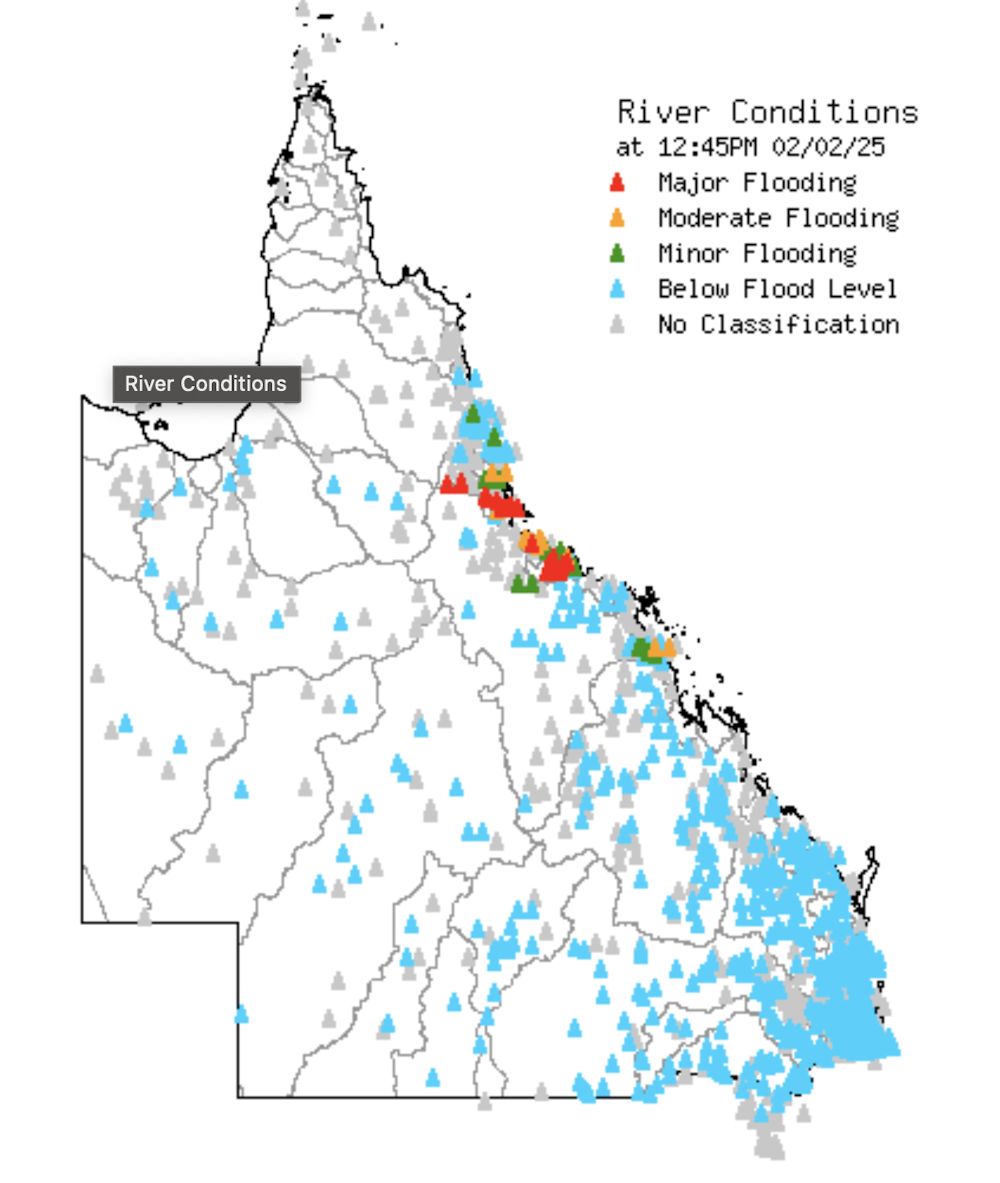
    Over the 48 hours to Sunday, there were reports of up to 1 metre of rainfall in parts of northeast Queensland. The torrential rain continues, particularly in the Herbert Coast region and north to around Tully.

    Major flooding in northern Queensland rivers, as of 12.45pm February 2.
    Bureau of Meteorology

    Residents of Ingham and nearby towns, about 100km from Townsville, are witnessing flooding from the nearby Herbert River. This morning, it was at 15 metres and rising. With more heavy rain forecast for the next 24 hours, the Herbert River is likely to break the 1967 record of 15.2 metres later today.

    Queensland Premier David Crisafulli – who grew up on his family’s sugar cane farm in Ingham – has said the floods will be a “once in a century” event for the town. To make matters worse, authorities say the town has lost power and an extended outage is likely.

    The atmospheric factors behind these floods are very similar to recent floods in the region – and climate change is no doubt playing a role.

    The flood level for the Herbert River at Ingham set in 1967 was 15.2 metres. It’s likely to be breached this afternoon (Sunday February 2).
    Australian Bureau of Meteorology, CC BY

    Where are the floods hitting?

    For many people in Townsville – the largest city in Northern Australia – the unfolding emergency will bring back memories of the devastating February 2019 floods, which caused A$1.24 billion in damage. Residents have been asked to evacuate from several low-lying suburbs which were inundated in 2019.

    Authorities in Townsville asked all residents in the low-lying black zone to evacuate by midday Sunday February 2. Floodwaters could reach second-storey heights in this zone. Residents in pink suburbs have been asked to be on standby.
    Townsville Council, CC BY

    It is too early to say if this flood event will be worse. Fortunately, water levels in the city’s Ross River Dam are much lower than 2019. Townsville Airport has recorded 545mm of rain over the past 48 hours, with many northwest suburbs recording much higher levels. The township of Rollingstone – 60km northwest of Townsville – recorded a whopping 702mm over the 24 hours to 9am Sunday.

    Further north in the Cairns to Daintree region, residents are watching with concern, with many still raw after the record-breaking floods of December 2023.

    What’s behind these floods?

    The ongoing 2025 extreme rainfall event, the 2019 Townsville floods and the 2023 Cairns and Daintree floods are remarkably similar in many ways.

    What triggered each of these floods was prolonged heavy rain falling on the southeast flank of a stationary tropical low weather system. Normally, tropical lows bring wind and rain, but move through quite quickly. But in recent years, we have seen a tendency for these systems to stall, sitting in place over or near land and dumping huge volumes of rain.

    Last week, the Bureau of Meteorology warned that five tropical lows were forming around northern Australia. Most tropical cyclones form from tropical lows embedded in the region’s monsoon trough, a large low pressure band which forms over summer and draws in warm, moist air from the adjacent tropical seas.

    But significant rain events like this one don’t necessarily require a tropical cyclone. Slow-moving deep monsoon lows over land can also deliver huge amounts of rain and widespread flooding.

    These atmospheric conditions allow intense rain bands to form between converging winds: warm, moist winds from the northeast and southeast winds originating from the Coral Sea. As the winds collide, they push the moist air up into the cooler parts of the atmosphere where it condenses and falls as torrential rain.

    More extreme rainfall and higher frequencies of flooded rivers and flash floods around the world have a clear link to climate change and ongoing global heating.

    The main drivers behind these events include warming of the atmosphere. For every 1°C of warming, the atmosphere holds 7% more water vapour. Recent research suggests this figure could be even higher for short duration rainfall.

    Hotter oceans hold more energy, meaning they can also amplify the global water cycle when atmospheric conditions are suitable.

    This year’s latest ever monsoon

    This year, sea surface temperatures in the northwest Coral Sea are 1-2°C above average. Ocean temperatures have risen because of a lack of cloud cover and rain last month. In northwestern Australia, this has given rise to an intensifying marine heatwave.

    This ocean heat is likely to be driven by the Australian monsoon’s latest ever arrival. The monsoon brings heavy rains to northern Australia, triggering the wet season. When it arrives, sea surface temperatures generally drop due to a combination of high cloud cover and the cooling effect of rainwater.

    After a slow start, the North Australian monsoon season is now in full swing.

    The Bureau of Meteorology is monitoring an active monsoon trough for any low pressure systems, which may develop into tropical cyclones over the next week or so. If any cyclone does form, it will gain energy from warmer than usual sea surface temperatures.

    What’s next for north Queensland?

    The flood emergency in north Queensland is far from over. All global circulation models predict heavy rain to continue in the region, extending up towards Cape York and the Gulf Country as an active monsoon surge moves in from Indonesia.

    As river catchments get saturated, more and more water will run off and engorge rivers. Forecasts are for rain to continue well into tonight and the next few days. We are likely to see more flooding in more places this week.

    For the latest updates, check the Bureau of Meteorology’s Queensland flood warnings, ABC Emergency or local ABC radio stations.

    Steve Turton has received funding from the Australian Government.

    ref. What’s driving north Queensland’s deadly, record-breaking floods? – https://theconversation.com/whats-driving-north-queenslands-deadly-record-breaking-floods-248847

    MIL OSI AnalysisEveningReport.nz

  • MIL-Evening Report: What’s driving north Queensland’s record-breaking, deadly floods?

    Source: The Conversation (Au and NZ) – By Steve Turton, Adjunct Professor of Environmental Geography, CQUniversity Australia

    A flooded street in Townsville John Wilkinson/Facebook

    Record-breaking floods across north Queensland have now turned deadly, with one woman drowning while being rescued on Sunday morning. And the floodwaters are still rising, with rain set to continue.

    Over the 48 hours to Sunday, there were reports of up to 1 metre of rainfall in parts of northeast Queensland. The torrential rain continues, particularly in the Herbert Coast region and north to around Tully.

    Major flooding in northern Queensland rivers, as of 12.45pm February 2.
    Bureau of Meteorology

    Residents of Ingham and nearby towns, about 100km from Townsville, are witnessing flooding from the nearby Herbert River. This morning, it was at 15 metres and rising. With more heavy rain forecast for the next 24 hours, the Herbert River is likely to break the 1967 record of 15.2 metres later today.

    Queensland Premier David Crisafulli – who grew up on his family’s sugar cane farm in Ingham – has said the floods will be a “once in a century” event for the town. To make matters worse, authorities say the town has lost power and an extended outage is likely.

    The atmospheric factors behind these floods are very similar to recent floods in the region – and climate change is no doubt playing a role.

    The flood level for the Herbert River at Ingham set in 1967 was 15.2 metres. It’s likely to be breached this afternoon (Sunday February 2).
    Australian Bureau of Meteorology, CC BY

    Where are the floods hitting?

    For many people in Townsville – the largest city in Northern Australia – the unfolding emergency will bring back memories of the devastating February 2019 floods, which caused A$1.24 billion in damage. Residents have been asked to evacuate from several low-lying suburbs which were inundated in 2019.

    Authorities in Townsville asked all residents in the low-lying black zone to evacuate by midday Sunday February 2. Floodwaters could reach second-storey heights in this zone. Residents in pink suburbs have been asked to be on standby.
    Townsville Council, CC BY

    It is too early to say if this flood event will be worse. Fortunately, water levels in the city’s Ross River Dam are much lower than 2019. Townsville Airport has recorded 545mm of rain over the past 48 hours, with many northwest suburbs recording much higher levels. The township of Rollingstone – 60km northwest of Townsville – recorded a whopping 702mm over the 24 hours to 9am Sunday.

    Further north in the Cairns to Daintree region, residents are watching with concern, with many still raw after the record-breaking floods of December 2023.

    What’s behind these floods?

    The ongoing 2025 extreme rainfall event, the 2019 Townsville floods and the 2023 Cairns and Daintree floods are remarkably similar in many ways.

    What triggered each of these floods was prolonged heavy rain falling on the southeast flank of a stationary tropical low weather system. Normally, tropical lows bring wind and rain, but move through quite quickly. But in recent years, we have seen a tendency for these systems to stall, sitting in place over or near land and dumping huge volumes of rain.

    Last week, the Bureau of Meteorology warned that five tropical lows were forming around northern Australia. Most tropical cyclones form from tropical lows embedded in the region’s monsoon trough, a large low pressure band which forms over summer and draws in warm, moist air from the adjacent tropical seas.

    But significant rain events like this one don’t necessarily require a tropical cyclone. Slow-moving deep monsoon lows over land can also deliver huge amounts of rain and widespread flooding.

    These atmospheric conditions allow intense rain bands to form between converging winds: warm, moist winds from the northeast and southeast winds originating from the Coral Sea. As the winds collide, they push the moist air up into the cooler parts of the atmosphere where it condenses and falls as torrential rain.

    More extreme rainfall and higher frequencies of flooded rivers and flash floods around the world have a clear link to climate change and ongoing global heating.

    The main drivers behind these events include warming of the atmosphere. For every 1°C of warming, the atmosphere holds 7% more water vapour. Recent research suggests this figure could be even higher for short duration rainfall.

    Hotter oceans hold more energy, meaning they can also amplify the global water cycle when atmospheric conditions are suitable.

    This year’s latest ever monsoon

    This year, sea surface temperatures in the northwest Coral Sea are 1-2°C above average. Ocean temperatures have risen because of a lack of cloud cover and rain last month. In northwestern Australia, this has given rise to an intensifying marine heatwave.

    This ocean heat is likely to be driven by the Australian monsoon’s latest ever arrival. The monsoon brings heavy rains to northern Australia, triggering the wet season. When it arrives, sea surface temperatures generally drop due to a combination of high cloud cover and the cooling effect of rainwater.

    After a slow start, the North Australian monsoon season is now in full swing.

    The Bureau of Meteorology is monitoring an active monsoon trough for any low pressure systems, which may develop into tropical cyclones over the next week or so. If any cyclone does form, it will gain energy from warmer than usual sea surface temperatures.

    What’s next for north Queensland?

    The flood emergency in north Queensland is far from over. All global circulation models predict heavy rain to continue in the region, extending up towards Cape York and the Gulf Country as an active monsoon surge moves in from Indonesia.

    As river catchments get saturated, more and more water will run off and engorge rivers. Forecasts are for rain to continue well into tonight and the next few days. We are likely to see more flooding in more places this week.

    For the latest updates, check the Bureau of Meteorology’s Queensland flood warnings, ABC Emergency or local ABC radio stations.

    Steve Turton has received funding from the Australian Government.

    ref. What’s driving north Queensland’s record-breaking, deadly floods? – https://theconversation.com/whats-driving-north-queenslands-record-breaking-deadly-floods-248847

    MIL OSI AnalysisEveningReport.nz

  • MIL-OSI USA: Lt. Gov. Kelly Announces Winners of 2nd Annual New Venture Competition

    Source: US State of Nebraska

    . Gov. Kelly Announces Winners of 2nd Annual New Venture Competition


    LINCOLN, NE – Lieutenant Governor Joe Kelly awarded prizes to three teams of aspiring college entrepreneurs through the 2nd Annual Nebraska Governor’s New Venture Competition. Awardees were announced during Thursday’s Nebraska Business Hall of Fame banquet at the Lincoln Marriott Cornhusker Hotel. Ten teams were selected as semi-finalists. The winners, prize amounts and a description of each project follow:


    First Place: Golden Garden Compost, UNO, $20,000 prize

                Golden Garden Compost creates premium organic compost for home gardeners using efficient production and innovative marketing to maximize profits.


    Second Place: brAIn Rot, UNL, $15,000 prize

                brAIn Rot is an educational platform that helps developers enhance their coding skills by solving real world puzzles and competing in coding contests.


    Third Place: IndoFilm, UNL, $10,000 prize

                InfoFilm helps share the impactful stories within the agriculture industry through videography, product photography, branding photography and social media management. 


    “This program is a great opportunity to publicize and support Nebraska-based ideas with world-changing potential,” said Lt. Gov. Kelly. “This year’s pool of finalists brought a variety of ideas to impact education, healthcare, agriculture, AI and other significant areas. They are risk takers willing to put in the long hours for the potential rewards of starting a new venture and watching it blossom.” 


    Governor Jim Pillen created the competition in 2023 to showcase and encourage student-led entrepreneurship. The competition is designed for contemplated and pre-seed businesses. Applicants must designate how their business falls into one of nine industry tracks: Agtech, Fintech/Insurtech, Cleantech, Advanced Manufacturing, Biotech/Healthtech, Emerging Media Arts, Sportstech, General Tech and the Bioeconomy. Submissions must have been received by Dec. 15, 2024. 


    This year, 15 teams – including undergraduate and graduate students – submitted proposals. Participating teams hailed from the University of Nebraska – Lincoln (UNL), University of Nebraska – Omaha (UNO), University of Nebraska – Kearney (UNK) and Metro Community College (MCC). The 15 teams made their initial pitch virtually to a panel of judges representing Flyover Capital, Nebraska Innovation Labs, Nelnet Ventures, Redbud VC and Tech Nebraska. Judges evaluated each project and whittled the group to 10 semi-finalists. 


    “Starting a business is hard enough but starting a business while also attending college is extremely challenging due to time constraints and academic obligations,” said Dan Hoffman, CEO of Invest Nebraska. “Nebraska’s entrepreneurial ecosystem of startup founders, funders, and service providers are excited to mentor and support these young teams as they begin their entrepreneurial journey.”


    Semi-finalist teams were mentored leading up to their final project presentation yesterday during the Nebraska State Chamber of Commerce annual meeting. The judges, from Lincoln Partnership for Economic Development, MOVE Venture Capital, Nelnet, Nave Analytics, Nebraska Public Power District and Workshop, selected the awardees. 


    “I appreciate that Governor Pillen is prioritizing entrepreneurship as a key economic development strategy,” said Nebraska Department of Economic Development (DED) Director K.C. Belitz. “The New Venture Competition is a great way to showcase and encourage the inventiveness of Nebraska’s rising generation. Across the state, we’re building an entrepreneurial ecosystem to support young Nebraskans in turning their ideas into successful businesses.”


    “Congratulations to the 15 teams of students who shared their ideas for pursuing an entrepreneurial opportunity and competed in the New Venture Competition,” added Nebraska Chamber President Bryan Slone.  “We’re always excited to support the next generation of Nebraska business professionals and it was exciting to watch these young entrepreneurs reach new heights.”


    Sponsors for the New Venture Competition include the Nebraska Chamber of Commerce & Industry, Nebraska Public Power District (NPPD), Omaha Public Power District (OPPD), Invest Nebraska, Nebraska Diplomats, Nebraska Economic Developers Association (NEDA) and the Nebraska Department of Economic Development (DED).


    For more information about the Governor’s New Venture Competition, visit the contest’s website: https://negovnewventure.com.


    First Place Team Golden Garden Compost of the University of Nebraska – Omaha

    Second Place Team brAIn Rot of the University of Nebraska – Lincoln

    Third Place Team InfoFilm of the University of Nebraska – Lincoln

    Photos by Sam Rice

    MIL OSI USA News

  • MIL-OSI China: China-Laos Railway draws international travelers

    Source: China State Council Information Office

    Trucks transport railway containers at the Kunming cargo terminal of China United International Rail Containers Co., Ltd. (CRIntermodal) in Kunming, southwest China’s Yunnan Province, on Jan. 2, 2025. [Photo/Xinhua]

    Having long been poring over China’s diversified culture, German vlogger Robert Adolf is particularly fascinated by Yunnan Province, home to over 20 ethnic groups.

    This year’s Spring Festival is unique to Adolf and his mother, who traveled by train to Xishuangbanna, a tropical autonomous prefecture in Yunnan Province and one of the stations along the China-Laos Railway route.

    Adolf has previously explored this 1,035 km-long route linking Kunming of Yunnan to the Laotian capital of Vientiane with eight stops in between, and felt a surge of excitement over how railroads have expanded to smaller cities and villages.

    “It’s now much easier to visit rural areas,” he said.

    Dressed in the traditional attire of the Shui ethnic group, Adolf told Xinhua that he felt “more real … and more to the hearts” in smaller towns. “There’s a family atmosphere.”

    In Yunnan, Adolf has observed the Dai people’s Water-Splashing Festival and the Munao Zongge Festival (meaning “Dancing together”) of the Jingpo people. During the journey, Adolf posted videos on social platforms like Douyin and YouTube, with his bio describing him “on the quest to film all 56 Ethnic Groups in China.”

    He said that people always find ways to keep traditions up to date, and the government helps preserve them by supporting cultural heritage, investing in museums and funding inheritors. “In China, they really keep the culture alive.”

    His mother Anna Adolf referred to the journey in Yunnan as an adventure. “Everywhere I look, people are wearing beautiful clothes, singing and dancing.”

    During the Spring Festival travel season, thousands of passengers travel home or explore new destinations via the China-Laos cross-border train.

    At Kunming South Station, the starting point of the railway, waiting rooms were abuzz with travelers speaking Chinese, Lao, Thai and English, a testament to the cross-border railway’s growing international appeal.

    “We’ve always had a good experience on trains in China. I’m sure this time it will be convenient and comfortable,” Susie, an American living in Beijing, told Xinhua, as she queued up for a train heading to Laos.

    The railway also benefits Thai travelers, who said that it makes the homebound journey faster.

    Since its launch in 2021, the China-Laos Railway, a flagship Belt and Road Initiative project, has handled over 43 million passenger trips and more than 48.3 million tonnes of cargo.

    The Kunming-Vientiane D87 train is painted deep green. It might evoke memories of the old-style passenger trains in China, but its designed speed of 160 km/h integrates efficiency with the need to navigate complex terrain, transporting both passengers and freight.

    Inside some of the train compartments during the Spring Festival holiday, red paper-cut decorations on the windows added a festive touch, marking the first Spring Festival since UNESCO listed the tradition as intangible cultural heritage.

    For Southikiat Thavisouk, a Laotian TV host returning to Vientiane, the railway trip is more than transportation. “It’s a bridge between the Chinese and Laotian people,” he said.

    Having studied at Huaqiao University in China’s Fujian Province, Thavisouk recalled the warm hospitality he received there. Now back in Laos, he sees the Chinese New Year celebrated as well.

    Soulideth Lavanphone, a Laotian tour guide accompanying a group of Chinese travelers, shared a similar sentiment. “I studied in Sichuan, and China is my second home. I’ll do my best to make sure Chinese visitors have a great time in Laos,” he said.

    “Many travelers from Western countries and ASEAN nations have all come to experience the Laos-China Railway firsthand,” said Laotian Consul General in Kunming Pongdong Paxaphacdy with much pride.

    “Tickets are often sold out due to high demand, and we are working on solutions to improve capacity,” Paxaphacdy said.

    “This railway has boosted investment, tourism and connectivity, bringing real benefits to the people. With strong support from both governments, this railway will only continue to grow,” he added. 

    MIL OSI China News

  • MIL-Evening Report: Delayed monsoon and a stalled tropical low: what’s behind north Queensland’s record-breaking floods

    Source: The Conversation (Au and NZ) – By Steve Turton, Adjunct Professor of Environmental Geography, CQUniversity Australia

    A flooded street in Townsville John Wilkinson/Facebook

    Record-breaking floods across north Queensland have now turned deadly, with one woman drowning while being rescued on Sunday morning. And the floodwaters are still rising, with rain set to continue.

    Over the 48 hours to Sunday, there were reports of up to 1 metre of rainfall in parts of northeast Queensland. The torrential rain continues, particularly in the Herbert Coast region and north to around Tully.

    Major flooding in northern Queensland rivers, as of 12.45pm February 2.
    Bureau of Meteorology

    Residents of Ingham and nearby towns, about 100km from Townsville, are witnessing flooding from the nearby Herbert River. This morning, it was at 15 metres and rising. With more heavy rain forecast for the next 24 hours, the Herbert River is likely to break the 1967 record of 15.2 metres later today.

    Queensland Premier David Crisafulli – who grew up on his family’s sugar cane farm in Ingham – has said the floods will be a “once in a century” event for the town. To make matters worse, authorities say the town has lost power and an extended outage is likely.

    The atmospheric factors behind these floods are very similar to recent floods in the region – and climate change is no doubt playing a role.

    The flood level for the Herbert River at Ingham set in 1967 was 15.2 metres. It’s likely to be breached this afternoon (Sunday February 2).
    Australian Bureau of Meteorology, CC BY

    Where are the floods hitting?

    For many people in Townsville – the largest city in Northern Australia – the unfolding emergency will bring back memories of the devastating February 2019 floods, which caused A$1.24 billion in damage. Residents have been asked to evacuate from several low-lying suburbs which were inundated in 2019.

    Authorities in Townsville asked all residents in the low-lying black zone to evacuate by midday Sunday February 2. Floodwaters could reach second-storey heights in this zone. Residents in pink suburbs have been asked to be on standby.
    Townsville Council, CC BY

    It is too early to say if this flood event will be worse. Fortunately, water levels in the city’s Ross River Dam are much lower than 2019. Townsville Airport has recorded 545mm of rain over the past 48 hours, with many northwest suburbs recording much higher levels. The township of Rollingstone – 60km northwest of Townsville – recorded a whopping 702mm over the 24 hours to 9am Sunday.

    Further north in the Cairns to Daintree region, residents are watching with concern, with many still raw after the record-breaking floods of December 2023.

    What’s behind these floods?

    The ongoing 2025 extreme rainfall event, the 2019 Townsville floods and the 2023 Cairns and Daintree floods are remarkably similar in many ways.

    What triggered each of these floods was prolonged heavy rain falling on the southeast flank of a stationary tropical low weather system. Normally, tropical lows bring wind and rain, but move through quite quickly. But in recent years, we have seen a tendency for these systems to stall, sitting in place over or near land and dumping huge volumes of rain.

    Last week, the Bureau of Meteorology warned that five tropical lows were forming around northern Australia. Most tropical cyclones form from tropical lows embedded in the region’s monsoon trough, a large low pressure band which forms over summer and draws in warm, moist air from the adjacent tropical seas.

    But significant rain events like this one don’t necessarily require a tropical cyclone. Slow-moving deep monsoon lows over land can also deliver huge amounts of rain and widespread flooding.

    These atmospheric conditions allow intense rain bands to form between converging winds: warm, moist winds from the northeast and southeast winds originating from the Coral Sea. As the winds collide, they push the moist air up into the cooler parts of the atmosphere where it condenses and falls as torrential rain.

    More extreme rainfall and higher frequencies of flooded rivers and flash floods around the world have a clear link to climate change and ongoing global heating.

    The main drivers behind these events include warming of the atmosphere. For every 1°C of warming, the atmosphere holds 7% more water vapour. Recent research suggests this figure could be even higher for short duration rainfall.

    Hotter oceans hold more energy, meaning they can also amplify the global water cycle when atmospheric conditions are suitable.

    This year’s latest ever monsoon

    This year, sea surface temperatures in the northwest Coral Sea are 1-2°C above average. Ocean temperatures have risen because of a lack of cloud cover and rain last month. In northwestern Australia, this has given rise to an intensifying marine heatwave.

    This ocean heat is likely to be driven by the Australian monsoon’s latest ever arrival. The monsoon brings heavy rains to northern Australia, triggering the wet season. When it arrives, sea surface temperatures generally drop due to a combination of high cloud cover and the cooling effect of rainwater.

    After a slow start, the North Australian monsoon season is now in full swing.

    The Bureau of Meteorology is monitoring an active monsoon trough for any low pressure systems, which may develop into tropical cyclones over the next week or so. If any cyclone does form, it will gain energy from warmer than usual sea surface temperatures.

    What’s next for north Queensland?

    The flood emergency in north Queensland is far from over. All global circulation models predict heavy rain to continue in the region, extending up towards Cape York and the Gulf Country as an active monsoon surge moves in from Indonesia.

    As river catchments get saturated, more and more water will run off and engorge rivers. Forecasts are for rain to continue well into tonight and the next few days. We are likely to see more flooding in more places this week.

    For the latest updates, check the Bureau of Meteorology’s Queensland flood warnings, ABC Emergency or local ABC radio stations.

    Steve Turton has received funding from the Australian Government.

    ref. Delayed monsoon and a stalled tropical low: what’s behind north Queensland’s record-breaking floods – https://theconversation.com/delayed-monsoon-and-a-stalled-tropical-low-whats-behind-north-queenslands-record-breaking-floods-248847

    MIL OSI AnalysisEveningReport.nz

  • MIL-OSI Australia: Supporting young children with disability or developmental concerns

    Source: Ministers for Social Services

    The Albanese Labor Government is extending the National Early Childhood Program (NECP) to support young children with disability or developmental concerns, their families and carers.

    Autism Queensland and the Australian Catholic University (ACU) will each receive an additional $5 million from 2025-26 to 2026-27 to continue activities funded under the NECP.

    Minister for Social Services Amanda Rishworth said the $10 million Federal investment for this extension will mean more children with disability or developmental concerns aged 0-8 years and their families are supported.

    “We recognise the importance of a child’s early years and ensuring they and their families have what they need to ensure a bright future,” Minister Rishworth said.

    “For children with developmental concerns or disability, it is crucial they and their families are given tailored support to ensure they can have their best start in life.

    “The early childhood program activities under the NECP align with Australia’s Disability Strategy 2021-2031 and the Early Years Strategy 2024-2034, helping children and building capacity in their families to support their development. 

    “The NECP was designed in consultation with parents, carers and peak bodies, and the Government is pleased to continue to fund these important activities.”

    The NECP supports young children with newly identified disability or emerging developmental concerns and their parents and carers, increasing readiness for educational environments and providing opportunities to socialise with their peers and siblings in a supported and family-centred environment.

    Initial funding of $13.8 million was awarded following two open grant rounds for 2022-23 to 2024-25. Under these grants:

    • Autism Queensland lead a consortium of organisations including playgroup and autism associations to provide regular, facilitated supports, including playgroups and music programs across the country.
    • ACU provides facilitated group workshops for parents and carers whose children have a newly identified disability or who have concerns regarding their child’s development. 

    More information on the NECP is available on the Department of Social Services website

    MIL OSI News

  • MIL-OSI China: Chinese research team develops groundbreaking prosthetic hand

    Source: China State Council Information Office 2

    A research team from the University of Science and Technology of China (USTC) has unveiled a groundbreaking biomimetic prosthetic hand with high dexterity, which is capable of combing hair, operating smartphones, and even performing intricate sign language gestures.
    The lightweight prosthetic device, which replicates the functionality of a human hand, highlights a significant advancement in prosthetics and humanoid robots, offering hope to millions of amputees worldwide.
    The study was published in Nature Communications, the USTC said on its official website.
    A leap forward in prosthetics
    The human hand, with its 23 degrees of freedom (DOFs) — the number of independent movements it can perform — is a marvel of natural engineering, contributing to 54 percent of the body’s overall functional movements despite weighing only about one-150th of the body’s weight.
    Traditional prosthetic hands, often powered by motors, struggle to balance weight and functionality. Most weigh more than 0.4 kilograms, causing discomfort while offering fewer than 10 DOFs. This limitation confines their ability to perform complex tasks, leading nearly half of users to abandon their prosthetic hands.
    The USTC team addressed these challenges by using shape-memory alloys (SMAs) — materials that “remember” their original shape and return to it when heated — as artificial muscles.
    Combined with a tendon-like transmission system, this innovative approach amplifies the driving force while reducing resistance.
    The team also embedded 23 sensor units in the fingers and wrist for precise motion control and integrated 38 SMA actuators with a cooling module. The result is a prosthetic hand weighing just 0.37 kilograms, lighter than the average human hand, yet capable of 19 active DOFs.
    High dexterity and versatility
    According to the research team, the prosthetic hand demonstrates remarkable dexterity, enabling it to perform tasks such as combing hair, writing, shaking hands, handing out business cards, and even playing chess.
    Its advanced design allows it to replicate 33 standard human grasping modes and six new, more complex ones, such as using scissors, operating smartphones, and performing intricate sign language gestures.
    In clinical tests, a 60-year-old female amputee mastered the device within half a day, successfully completing tasks from the clinically validated hand function test — Southampton Hand Assessment Procedure (SHAP) — and the Wolf Motor Function Test (WMFT), which measures upper extremity motor abilities.
    Its integration with voice recognition technology sets the USTC prosthetic hand apart. It supports 60 languages and 20 dialects with 95 percent accuracy and millisecond-level response times.
    This user-friendly interface makes it accessible to a wide range of users, particularly amputees, according to the research team.
    Compared to similar projects globally, the USTC team’s design stands out for its high DOFs, lightweight construction, and advanced sensory feedback.
    The USTC team’s innovation holds immense promise for both prosthetics and humanoid robotics, according to the research team.
    Its high adaptability opens up a wide range of practical applications across multiple fields, including specialized operations in hazardous environments such as nuclear power plant maintenance or deep-sea equipment repair, medical rehabilitation, flexible manufacturing in high-precision production lines, and home services. 

    MIL OSI China News

  • MIL-OSI United Kingdom: Vision to supercharge city’s knowledge sector announced

    Source: City of Liverpool

    A new ‘Blueprint for Growth’ to supercharge Liverpool’s knowledge sector over the next 15 years is set to create more than a million sq ft of new laboratory and workspace in the city.

    Knowledge Quarter Liverpool’s urban innovation district and placemaking organisation has pledged to help create a range of inclusive innovation opportunities and inspire future generations by focussing on skills development, community engagement, collaboration and inward investment.

    KQ Liverpool’s new 2040 vision has been created following consultation with more than fifty local stakeholders and is underpinned by three core principles; to Convene and Collaborate, Amplify and Attract, Invent and Innovate. 

    As Liverpool and the wider city region continue to suffer from serious inequalities around issues such as health, education and deprivation, tackling those will be crucial to KQ Liverpool’s future plans, alongside support for the essential community work carried out by its partners. 

    This will involve expansion of its existing KQ Futures programme, enabled through the Liverpool City Region Health and Life Sciences Innovation Zone, to engage and inspire local young people about the various career opportunities that exist in their home city in specialist sectors. In 2024, KQ Liverpool hosted hundreds of students at its innovation sites and published an illustrated children’s book, Animates: Learning in Liverpool, which was delivered to every primary school in the city region. 

    It will also seek to boost business growth, job creation and investment into the area while promoting the city region’s high-growth priorities around health and life sciences, materials innovation, AI and robotics. This includes supporting scale-up as well as start-up businesses and simplifying the business support and funding landscape to encourage more innovation-led organisations to start, relocate and stay.

    The physical development of the innovation district itself is another key element of the new vision.

    KQ Liverpool will work with developers and investors including Sciontec to create
    more than a million sq ft of new laboratory and workspace.

    It will play an important role in unlocking the potential of development sites such as Paddington South, Mount Pleasant and Copperas Hill and shaping transport and connectivity improvements across the district, thus making it more accessible and recognisable to residents, businesses and visitors.  

    There will also be fresh focus on the collective influence of KQ Liverpool and its partners around important national and international issues and challenges, rather than the physical boundary of the district itself, helping to attract inward investment and showcase the strengths of its innovation ecosystem. 

    Speaking on behalf of the wide range of partners engaged in KQ Liverpool, its chair Andrew Lewis, who is also Liverpool City Council’s Chief Executive, said: “Our 2040 vision is about improving the lives of those who live and work here, for years to come.  We want to create an innovation generation, supporting new skills in our local communities, highlighting the many incredible innovations that happen here in KQ Liverpool, and encouraging future generations of science and technology pioneers to call Liverpool their home. 

    “We can be proud of the innovation ecosystem and partnerships we have created here in Liverpool, bringing high quality jobs and investment into the city centre, through spin-outs, SMEs, multinationals and global investors who see the enormous potential of KQ Liverpool as a place to do business and create long-term opportunities.”

    Colin Sinclair, chief executive of KQ Liverpool, said: “The foundation of our success to date has been the strength of our partnership, exceeding expectations by challenging the norm and refusing to accept anything average or ordinary.

    “Going forward, our 2040 vision amplifies that ambition. As a partnership, we will do everything in our power to make this place and peoples’ lives better.”

    For further information about KQ Liverpool or the new KQ Liverpool 2040 : A Blueprint for Growth, please click here.

    MIL OSI United Kingdom

  • MIL-OSI United Kingdom: Liverpool to host British Chess Championships

    Source: City of Liverpool

    Liverpool will play host to the prestigious 2025 British Chess Championships alongside a wider chess festival this summer as organisers hope to put on the strongest event in its 121-year history.

    Britain’s top chess players will converge on Liverpool from July 31 to August 10 as the English Chess Federation’s flagship annual event comes to the city for only the second time, it was announced on Friday.

    It will culminate in new British champions being named at all age groups.

    A series of tournaments featuring the cream of Britain’s chess talent, including the Open and Women’s championships, will be held in Liverpool’s landmark St George’s Hall. A weekend congress for amateurs will also be held at the nearby Liverpool Holiday Inn in Lime Street.

    Alongside the competitive events, Liverpool will host a festival and programme of social and cultural activities organised in association with the city’s historic Liverpool Chess Club.

    This will be the 111th British Chess Championships—a series that has run almost unbroken since 1904.

    The last two British Chess Championships, held in Leicester and Hull, have seen record numbers competing. Continuing growth is expected this year.

    UK chess has also been experiencing a boom in participation among amateurs and success at the top level. In 2024, two new English grandmasters were named: teenage sensation Shreyas Royal and England’s newest grandmaster Ameet Ghasi.

    The event is being put on by the English Chess Federation in partnership with Liverpool City Council and St George’s Hall, with support from the Chess Trust and the John Robinson Chess Trust.

    Liverpool City Council’s Cabinet Member for Health, Wellbeing and Culture, Councillor Harry Doyle, said: “Liverpool has a long and rich connection with chess and it’s a hugely popular activity in schools and communities so we are delighted to be hosting the British Chess Championships later this summer.

    “St George’s Hall, with its incredible architecture and acoustics, will offer the perfect backdrop, lending itself perfectly to quiet, focused gameplay, which is sure to result in a thrilling competition for contestants and spectators alike.

    “This is yet another coup for Liverpool, as we continue to position ourselves as a versatile events city, and we look forward to working closely with the English Chess Federation and Chess In Schools and Communities to give a warm Liverpool welcome to the best of the best from the chess world.”

    It is a welcome return to Liverpool, a city steeped in chess culture. Liverpool boasts a thriving local league and, in Liverpool Chess Club, one of the oldest chess clubs in the world founded in 1837. Atticus Chess Club, based in the Cross Keys Pub in Earle Street, is also a former winner of the national club championships.

    Chess was also a key theme as the city hosted the 2023 Eurovision Song Contest for Ukraine with school children encouraged to learn the game to honour the link with Liverpool’s sister city, Odesa. Schools were tasked with producing Eurovision-themed chess pieces and a unique chess event featuring players from Liverpool and Ukraine was held at St Luke’s Bombed Out Church.

    Liverpool last hosted the British in 2008, the year the city was named the European Capital of Culture. That year, Grandmaster Stuart Conquest emerged victorious as the 2008 Open champion while International Master Jovanka Houska won the first of her nine Women’s titles.

    Nigel Towers, the English Chess Federation’s Director for Home Chess, said: “2008 was recognised as a strong event with many titled players. However, we expect the return visit in 2025 to provide an even more competitive championship and one of the strongest British tournaments ever given the increasing numbers of active British grandmasters and international masters and the current generation of top-level juniors.”

    Amos Burn, one of the world’ strongest chess players in the 19th century, was a member of the Liverpool Chess Club from 1867 until his death in 1925, serving as its president for many years.

    Among the top players Liverpool has produced are four-time British Women’s champion Sheila Jackson, the 15th Correspondence World Championship winner John Carleton and International Masters Gary Quillan and Malcolm Pein, a former British junior champion. Nearby Southport has also produced two grandmasters in Nigel Davies and Stuart Haslinger.

    MIL OSI United Kingdom

  • MIL-OSI Australia: Young Australians descend on Canberra for National Youth Week

    Source: Australian Ministers for Education

    Around 100 young people from across the country will be in Canberra this week to work with the Albanese Labor Government on issues that affect them and their communities. 

    Young people will meet with various Ministers across the week to discuss policy solutions to topics that matter to them.

    The week will include the second annual National Youth Forum, where young people will come together to work on policy ideas across the theme of ‘regional, rural, and remote’.

    Attendees will focus on building drought resilience, involving young people in disaster preparedness and response, and getting more regional, rural and remote young people into tertiary education.

    Minister for Youth Dr Anne Aly said the Albanese Government is ensuring young people are genuinely engaged in the policy making process. 

    “By listening to the valuable insights of young people, we can create a better Australia for everyone,” Minister Aly said. 

    “The National Youth Forum provides a valuable opportunity for young people to come together with each other and Government to hash out solutions to real-world problems.

    “All young people from all backgrounds, no matter where you live, no matter who you are, should be able to have a say on government decisions.”

    Aged 13 to 25, participants come from diverse backgrounds and bring a range of experiences to the Forum.

    This includes Aboriginal and Torres Strait Islanders, participants from culturally or linguistically diverse backgrounds, experience of mental ill-health, participants from regional or remote communities, migrants, young parents, participants with experience of being a carer, participants from LGBTQIA+ communities and participants with disability.

    The second annual National Youth Forum will be held on Wednesday 5 February.

    MIL OSI News

  • MIL-OSI NGOs: Sudan: MSF condemns Omdurman market attack

    Source: Médecins Sans Frontières –

    On the morning of 1 February, an RSF explosive hit a market in Omdurman, Khartoum state, causing a scene of devastation at the MSF supported Al Nao hospital as patients, dead bodies and family members arrived at the hospital.

    The Ministry of Health said the attack killed 54 people and injured 158. Medics working in Al Nao hospital described a dreadful scene with men and women, young and old, being brought in for treatment.

    MSF General Secretary Chris Lockyear was in Al Nao hospital as patients started arriving after this atrocious attack.

    “I can see the lives of men, women and children torn apart with injured people lying in every possible space in the emergency room as medics do what they can. There are dozens and dozens of people with devastating injuries, the morgue is full of dead bodies. What I see in front of me is a scene of utter carnage, yet another tragic example of this relentless war on people.” 

    MIL OSI NGO

  • MIL-OSI Canada: Premier’s, minister’s, parliamentary secretaries’ statements on Black History Month

    Source: Government of Canada regional news

    Premier David Eby has issued the following statement celebrating Black History Month:

    “Black History Month is an opportunity for us all to learn about and celebrate the many and diverse contributions of Black people to our province.

    “In 1858, more than 800 Black settlers came north from California to Vancouver Island on the invitation of colonial governor James Douglas. They were promised equality under the law, as well as the right to vote and purchase property. Some settlers formed the Victoria Pioneer Rifle Corps, an all-Black police force.

    “One of the settlers, Mifflin Gibbs, was elected to Victoria council eight years later, becoming the first Black person to hold public office in British Columbia. He was a prominent voice in favour of the colony joining the Canadian Confederation. More than a century later, social worker Rosemary Brown became the first Black woman to be elected to the B.C. legislature. Emery Barnes, a former professional football player with the B.C. Lions, served as the province’s first Black Speaker of the legislative assembly.

    “A Black presence has been a constant in the province’s history, including descendants of the original immigrants. From salmon canner John Sullivan Deas to Emma Stark’s contributions as a school teacher to Seraphim Joe Fortes’ celebrated lifesaving to Barbara Howard on the track in the 1930s to Harry Jerome on the track in the 1960s to Eleanor Collins becoming the first Black entertainer in Canada to host her own national television program, the rich and varied achievements of Black British Columbians have helped make the province the place it is today.

    “We should all feel pride in these accomplishments, while acknowledging the unjust barriers Black people face in their daily lives. Government is working to build an inclusive province where everyone feels they belong, as we build a more just and equitable society for all. Taking part in Black History Month enriches everyone.”

    Lisa Beare, Minister of Education and Child Care, said:
    “Students in B.C. have opportunities to learn about the diverse communities that shape our province, including the accomplishments and challenges of historic and contemporary Black British Columbians. Learning about Black History and other cultural histories helps students appreciate our province’s rich cultural heritage and supports the development of school communities where everyone feels safe, included and represented.”

    Jessie Sunner, parliamentary secretary for anti-racism initiatives, said:
    “Black History Month is a time to honour pioneers like Mifflin Wistar Gibbs, Harry Jerome, Eleanor Collins and Rosemary Brown, whose legacies continue to inspire us. This month gives us the chance to reflect on the ongoing fight against anti-Black racism. Legislation like the Anti-Racism Act aims to remove systemic barriers to government programs and services that Black communities face in the province. Let’s recommit to amplifying Black voices. As we celebrate the rich history and resilience of B.C.’s Black communities, we strive to build a welcoming province for everyone.”

    George Anderson, parliamentary secretary for transit, said:
    “Black History Month is an opportunity to celebrate the excellence and contributions of Black individuals like John Sullivan Deas, Rosemary Brown, Justice Selwyn Romilly and June Francis, who have enriched every facet of our society, from culture and innovation to leadership and service. Here in British Columbia, we honour the achievements of those who have broken barriers and inspired progress, while recognizing the work still needed to ensure equal opportunity for all. I carry with me the stories of struggle, perseverance and hope paved by so many. By breaking down systemic barriers, we can create a future where everyone, regardless of background, can thrive and contribute to a more just world.”

    MIL OSI Canada News

  • MIL-OSI USA: Bar Blast – January 14, 2025

    Source: US State of West Virginia

    West Virginia University College of Law’s

    Spring 2025 On-Campus Interviewing (OCI)

    Attention employers: Are you looking to hire a summer intern/clerk or an entry-level associate? Consider participating in the West Virginia University College of Law’s Spring 2025 On-Campus Interviewing (OCI) Session.  Join many of West Virginia’s top private firms and public offices in recruiting talent at the College of Law! To participate, private sector employers must offer paid compensation to summer interns/clerks. While paid employment is always more attractive to students, public sector employers may post volunteer legal intern positions.

    To register your participation, please click here to create an account and post your position. 


    If you have questions or would like additional information, please contact Brad Grimes, Assistant Director of Career Services for the College of Law, at (304) 293-7750 or at

    tgrimes@mail.wvu.edu.

    MIL OSI USA News

  • MIL-OSI USA: Bar Blast – January 21, 2025

    Source: US State of West Virginia

    Host: West Virginia State Bar

    Location: The Greenbrier Resort, White Sulphur Springs, West Virginia

    CLE: Pending 

    • Cost for CLE Program only $175
    • Cost for Banquet only $195
    • Cost for Both CLE and Banquet $350

    CLICK HERE to REGISTER to attend Live in Person Annual Meeting

    ANNUAL MEETING Live VIRTUAL ATTENDANCE: 

    Cost: $175

    CLICK HERE to REGISTER to attend Live Virtual CLE Program

    FEDERAL/STATE PUBLIC DEFENDERS, FED/STATE LAW CLERKS, LEGAL AID REGISTRATION: 

    • Cost for CLE Program Only $100
    • Cost for Banquet Only $195
    • Cost for Both CLE and Banquet: $295
    • Cost for Virtual CLE Attendance: $100

    CLICK HERE to REGISTER for Public Defenders/Law Clerks/Legal Attendance

    Last Day to Register to Attend CLE and Banquet is March 24, 2025

    Hotel Accommodations:

    The State Bar has reserved a selection of rooms, at the Greenbrier Resort, for guests of the Annual Meeting for the evening of April 3, 2025 with an event rate (including applicable taxes and fees). The last day to reserve a room with the event rate is March 2, 2025. Guests that wish to make reservations over the phone may call the resort’s toll free number 855-441-2078, guests will be asked what group they are calling with and should refer to the West Virginia State Bar. 

    Click Here to reserve a room at the Greenbrier

    The School House Hotel has a limited selection of rooms available to those seeking other hotel arrangements. For pricing and availability please contact 304-536-0999 for reservations, or CLICK HERE to visit online.

    CLICK HERE FOR AGENDA

    MIL OSI USA News

  • MIL-OSI USA: Bar Blast – January 28, 2025

    Source: US State of West Virginia

    Host: West Virginia State Bar

    Location: The Greenbrier Resort, White Sulphur Springs, West Virginia

    CLE: Pending 

    • Cost for CLE Program only $175
    • Cost for Banquet only $195
    • Cost for Both CLE and Banquet $350

    CLICK HERE to REGISTER to attend Live in Person Annual Meeting

    ANNUAL MEETING Live VIRTUAL ATTENDANCE: 

    Cost: $175

    CLICK HERE to REGISTER to attend Live Virtual CLE Program

    FEDERAL/STATE PUBLIC DEFENDERS, FED/STATE LAW CLERKS, LEGAL AID REGISTRATION: 

    • Cost for CLE Program Only $100
    • Cost for Banquet Only $195
    • Cost for Both CLE and Banquet: $295
    • Cost for Virtual CLE Attendance: $100

    CLICK HERE to REGISTER for Public Defenders/Law Clerks/Legal Attendance

    Last Day to Register to Attend CLE and Banquet is March 24, 2025

    Hotel Accommodations:

    The State Bar has reserved a selection of rooms, at the Greenbrier Resort, for guests of the Annual Meeting for the evening of April 3, 2025 with an event rate (including applicable taxes and fees). The last day to reserve a room with the event rate is March 2, 2025. Guests that wish to make reservations over the phone may call the resort’s toll free number 855-441-2078, guests will be asked what group they are calling with and should refer to the West Virginia State Bar. 

    Click Here to reserve a room at the Greenbrier

    The School House Hotel has a limited selection of rooms available to those seeking other hotel arrangements. For pricing and availability please contact 304-536-0999 for reservations, or CLICK HERE to visit online.

    CLICK HERE FOR AGENDA

    MIL OSI USA News

  • MIL-Evening Report: Politics with Michelle Grattan: Albanese dumps Nature Positive legislation and considers shrinking the electoral reform bill

    Source: The Conversation (Au and NZ) – By Michelle Grattan, Professorial Fellow, University of Canberra

    Prime Minister Anthony Albanese has dumped – for the second time – the government’s controversial “Nature Positive” legislation, which had run into strong opposition from the Western Australian Labor government.

    Albanese, speaking on The Conversation’s Politics podcast ahead of a fortnight parliamentary sitting starting next week, said there was not enough support for the legislation, which had been on the draft list of bills for next week, circulated by the government.

    This is the second time the Prime Minister has pulled back from the legislation. Late last year he also said it did not have enough support, despite Environment Minister Tanya Plibersek believing she had a deal with the Greens and crossbench for its passage.

    The legislation would set up a federal Environment Protection Agency, which has riled miners who claim it would add to bureaucracy and delay approvals.

    In recent days WA premier Roger Cook, who was instrumental in heading off the legislation last year, has been lobbying the federal government again. WA faces an election on March 8.

    In an interview on Saturday, Albanese told The Conversation: “I can’t see that it has a path to success. So at this stage, I can say that we won’t be proceeding with it this term. There simply isn’t a [Senate] majority, as there wasn’t last year.

    “The Greens Party on one hand have changed their views”, making another demand during the week, he said. While the Liberals – who began the review of the present Environment Protection Act – “have chosen an obstructionist path,” he said.

    Albanese said the government would continue to discuss the issue with stakeholders in the next term of parliament.

    “Does the environment and protection act need revision from where it was last century? Quite clearly it does. Everyone says that that’s the case. It’s a matter of working to, in a practical way, a commonsense reform that delivers something that supports industry.

    “I want to see faster approvals. We in fact have speeded up approvals substantially.

    “But we also want proper sustainability as well.”

    Albanese also flagged the government might cut back its legislation to reform rules covering electoral donations and spending in order to get a deal to pass it.

    Special Minister of State Don Farrell and the Liberals had been on the brink of a deal in the final week of parliament last year, but negotiations imploded at the eleventh hour.

    Albanese told The Conversation he hoped the legislation could still be passed. “I spoke with [Farrell] today, he is consulting with people across the parliament.

    “What I would say is that we are looking to get reform through. Now whether that is a bigger, broader reform or whether it needs to be narrowed down, we’ll wait and see.

    “But we’re very serious about the reform which would lower the donation declarations, that would put a cap on donations, a cap on expenditure, that would lead to more transparency as well. It’s an important part of supporting our democracy.

    “We see overseas and we’ve seen people like Clive Palmer here spend over $100 million on a campaign. That’s a distortion of democracy – if one person can spend that much money to try to influence an election and we don’t find out all of that information till much later on.”

    The reforms would not start operating until the next term of parliament.

    Albanese said he thought the reform would have “overwhelming support” with the public “and I hope that it receives overwhelming support in the Senate as well”.

    Michelle Grattan does not work for, consult, own shares in or receive funding from any company or organisation that would benefit from this article, and has disclosed no relevant affiliations beyond their academic appointment.

    ref. Politics with Michelle Grattan: Albanese dumps Nature Positive legislation and considers shrinking the electoral reform bill – https://theconversation.com/politics-with-michelle-grattan-albanese-dumps-nature-positive-legislation-and-considers-shrinking-the-electoral-reform-bill-248848

    MIL OSI AnalysisEveningReport.nz

  • MIL-OSI Australia: Western Australia sign on to new school funding and reform agreement

    Source: Australian Ministers for Education

    The Albanese Labor Government and Cook Labor Government have signed an updated school funding and reform agreement.

    As part of this updated agreement, the Commonwealth will provide an additional 5 per cent of the Schooling Resource Standard (SRS) to WA public schools.

    This will lift the Commonwealth’s contribution from 20 per cent to 25 per cent of the SRS by 2034.

    This represents the biggest new investment in WA public schools by the Australian Government ever. This will be tied to reforms to help more students in public schools keep up, catch up and finish high school.

    This includes more individualised support for students, mandating evidenced-based teaching practices and more mental health support in schools.

    As part of the Agreement, WA will remove the provision put in by the Morrison Government allowing the state to claim 4 per cent of public school funding for indirect school costs such as capital depreciation and replace it with recurrent funding on eligible expenses, while also maintaining a share of at least 75 per cent of the SRS for public schools.

    This is not a blank cheque. The Agreement signed today will be followed by an updated WA Bilateral Agreement, which will tie funding to reforms already being delivered in WA schools that will help students catch up, keep up and finish school, such as: 

    • Year 1 phonics and early years numeracy checks to identify students in the early years of school who need additional help
    • evidence-based teaching and targeted and intensive supports such as small-group or catch-up tutoring to help students who fall behind
    • support for students to come to school ready to learn, such as greater wellbeing support for learning and engagement, including counsellors, school psychologists and health nurses
    • trialling place-based approaches to delivering a full-service school model in at least four WA public schools from 2026 which includes community, health and social services support
    • recruiting more co-ordinators to better support students with the most complex needs
    • identifying opportunities to reduce workloads and better support teachers and school leaders through professional learning
    • providing more support and pathways for people to transition to a teaching career in Western Australian public schools, with a focus on First Nations people, people with disability and those from culturally and linguistically diverse backgrounds.

    In addition, the following national targets will be included: 

    • increasing the proportion of students leaving school with a Year 12 certificate by 7.5 percentage points (nationally) by 2030
    • reducing the proportion of students in the NAPLAN ‘Needs Additional Support’ proficiency level for reading and numeracy nationally by 10 per cent
    • increasing the proportion of students in the ‘Strong’ and ‘Exceeding’ proficiency levels for reading and numeracy by 10 per cent by 2030 and trend upwards for priority equity cohorts in the ‘Strong’ and ‘Exceeding’ proficiency levels nationally
    • increasing the Student Attendance Rate, nationally, to 91.4 per cent (2019 level) by 2030
    • increasing the engagement rate (completed or still enrolled) of initial teacher education students by 10 percentage points to 69.7 per cent by 2035.

    This means more help for students and more support for teachers.

    This agreement builds on the previous agreement with Western Australia signed in September last year.

    Quotes attributable to Minister for Education, Jason Clare: 

    “This agreement lifts the Commonwealth’s contribution to 25 percent of the Schooling Resource Standard for WA public schools. 

    “This investment is tied to real, practical reforms to help students catch up, keep up and finish school.”

    Quotes attributable to Premier Roger Cook:

    “The Cook Labor Government is firmly committed to doing what is right for WA students, which is why we were the first state to sign the Better and Fairer Schools Agreement in September last year. This further agreement builds on that deal and provides hundreds of millions of dollars of additional Commonwealth funding to the State through to 2034.

    “This is fantastic news for Western Australian students and teaching staff, it will provide the essential funding needed to ensure students can keep up, catch up and finish school.

    “In particular, students with complex needs will get more support, which is something that the Cook Government has been working on for many years.”

    Quotes attributable to WA Minister for Education Tony Buti:

    “This agreement is good news for Western Australia. Teachers, students and families across the State will benefit as a result of increased funding and increased support for mental health and preparing students for school.

    “I am delighted that Western Australia is one of the first jurisdictions to sign up to this new agreement.”

    MIL OSI News

  • MIL-OSI China: Cambodia ceases mine clearance in 8 provinces after US funding freeze

    Source: China State Council Information Office

    Cambodia has halted mine clearance projects in eight provinces after the United States has frozen funding, a mine clearance chief said on Friday.

    Heng Ratana, director-general of the Cambodian Mine Action Center (CMAC), said the U.S.-funded mine clearance projects in Ratanakiri, Mondulkiri, Stung Treng, Kratie, Tboung Khmum, Kampong Cham, Prey Veng, and Svay Rieng provinces have been suspended for 85 days from Jan. 25 onwards.

    He said in a statement posted on social media that these projects, carried out by CMAC in cooperation with development partners, are to clear “the U.S. origin unexploded ordinances as the remnants of war.”

    CMAC has received a grant of 6.35 million U.S. dollars from the U.S. for mine clearance operations from March 2022 to November 2025, Ratana said, adding that this funding has supported some 200 technical Unexploded Ordnance (UXO) experts.

    He said under these projects, CMAC had so far made remarkable achievements by clearing 561 polygons or 11,195 hectares of cluster munitions or UXOs affected fields, finding and destroying 27,022 landmines and UXOs that included 17,971 cluster munitions and 69 aerial bombs.

    The halt was made after U.S. President Donald Trump last week ordered a sweeping 90-day pause on foreign aid, which included suspending its funded mine clearance projects around the world.

    Cambodia is one of the countries worst affected by landmines and explosive remnants of war (ERWs). An estimated 4 million to 6 million landmines and other munitions had been left over from three decades of war and internal conflicts that ended in 1998.

    According to the Yale University, from 1965 to 1973, the U.S. had dropped over 2.75 million tons of ordnance in 230,516 sorties on 113,716 sites in Cambodia.

    The CMAA’s report showed that from 1979 to 2024, landmine and ERW explosions had claimed 19,834 lives and maimed 45,252 others. 

    MIL OSI China News

  • MIL-OSI China: Foreigners savor flavors of Spring Festival in China

    Source: China State Council Information Office 2

    “Guonian,” which means “crossing the year,” is more than just a festival marking the arrival of the new year for the Chinese people.
    Though the Chinese New Year, or Spring Festival, is now celebrated in many places worldwide, the true meaning of “Guonian” can only be fully understood by experiencing it in China.
    “The celebration is big, stretching for a month with a lot of food, fireworks and cultural events,” said Kayleen Fangbi from Belgium. “I love it.”
    Lanterns and fairy lights adorn every corner, while shops bustle with people laden with large shopping bags, as observed by a Spanish couple traveling in Beijing just days before the Spring Festival, which fell on Jan. 29 this year.
    Spotting the snake-themed decorations, they decided to look up the meanings of the Chinese zodiac online and discovered that this year is the Year of the Snake. “One of us is a Horse, and the other is a Sheep,” they noted, clearly finding it all quite fascinating.
    Invitations to join in the celebration were shared via the Chinese lifestyle app rednote, with many Chinese netizens offering tips and local authorities promoting festive activities. The surge in activity comes as the app gains many users from the United States and other countries, following the U.S. government’s threat to ban TikTok.
    With the trending hashtag “Chinese New Year,” many foreigners shared about their Spring Festival celebrations virtually from wherever they were, with some expressing the joy of savoring an authentic experience of the holiday in China.
    Beyond the traditional fireworks, decorations, dragon dances, and lion dances, Spring Festival celebrations across China feature distinct local traditions, each adding its unique flavor to the holiday. They all share common themes: family reunions and hope for good fortune in the year ahead.
    The diverse social practices throughout the Chinese New Year celebrations, recently listed as an intangible cultural heritage of humanity by UNESCO, offer international visitors a rich array of experiences during this period.

    Artists perform the traditional Yingge dance in Chaoyang District of Shantou City, south China’s Guangdong Province, Jan. 29, 2025. (Xinhua/Lu Hanxin)
    In the Chaoshan region of south China’s Guangdong Province, the traditional Yingge dance adds a vibrant New Year atmosphere to the celebrations. Videos showcasing the dance have garnered millions of views, drawing many travelers to spend the Spring Festival in the area.
    The dancers, dressed in colorful costumes that represent ancient heroes and heroines, hold short wooden sticks and perform rhythmic movements, such as swinging the sticks, striking them together, and stamping their feet.
    “I was completely captivated by the strength and precision of their movements, the rhythmic sounds of their stomping and sticks clashing, and their powerful shouts of encouragement,” said Thanita Raemee from Thailand, after watching Yingge Dance performances.
    It’s said that when the lanterns in Yuyuan Garden light up, the Spring Festival begins in Shanghai, one of the top destinations for foreign visitors in China.

    Tourists from the Republic of Korea visit the Yuyuan Garden Mall in east China’s Shanghai, Dec. 4, 2024. (Photo by Chen Haoming/Xinhua)
    After strolling through the winding corridors and pavilions, a German tourist bought numerous Chinese New Year-themed souvenirs in Yuyuan Garden. “I want to bring the festive blessings to my friends back home,” she said.
    “A major change is that foreign tourists mostly just walked around in the past, but now they bring real spending power,” said Hu Junjie, vice president of Shanghai Yuyuan Tourist Mart (Group) Co., Ltd., adding that they are particularly interested in the lantern displays, traditional Chinese makeup and costumes, special cuisine, and cultural products.
    Tatiana, 70, a visitor from Russia on a trip to the city of Sanya in the southern island province of Hainan, said that she and her daughter came specifically to experience the Spring Festival.
    At a local event, she eagerly took part in interactive activities. “Writing the Chinese character ‘Fu (meaning blessing)’ with a calligraphy brush was such a unique experience,” she said. They also enjoyed watching traditional Chinese cultural performances, including the unique Li and Miao ethnic folk dances of Hainan.
    Russia remains Hainan’s largest source of international tourists and a key market for Sanya’s inbound tourism. The resumption and opening of international flight routes and visa-free policy have attracted more Russian tourists to the island.
    China expects a boom in international visitors during this Spring Festival holiday. Data from Trip.com Group shows that inbound tourism orders for the 2025 Spring Festival rose over 30 percent year on year.
    Data released by the Chinese travel services platform Qunar showed that as of Jan. 28, the number of domestic flights booked during the Spring Festival by travelers with non-Chinese passports has increased by 70 percent year on year.
    This surge is driven by a series of visa-free entry and transit policies China introduced in 2024, along with continuously upgraded payment, transportation, and tourism facilities. Besides, the growing popularity of China as a travel destination on social media, fueled by early travelers sharing their experiences, has contributed to the increase.
    In 2024, cross-border trips to China by foreigners surged by 82.9 percent from the previous year, reaching 64.88 million. Of these, more than 20 million inbound foreign trips were made visa-free, marking an impressive increase of 112.3 percent year on year, according to the National Immigration Administration.

    Tourists from Vietnam wait for entry inspection at the immigration area at Terminal 3 of Beijing Capital International Airport in Beijing, capital of China, Jan. 28, 2025. (Xinhua/Chen Zhonghao)
    To meet an increase in visitors from neighboring countries, such as Japan and the Republic of Korea, the Beijing tourism bureau and leading tourism companies launched special itineraries offering these travelers an opportunity to experience a Beijing-style New Year celebration in just two to three days.
    These short-haul itineraries took visitors to vibrant temple fairs and traditional performances, while also giving them the chance to savor Beijing’s winter delicacies and iconic dishes, such as dumplings, hotpot, and Peking Duck.
    “The Spring Festival is a window to understand China, especially its traditional culture,” said Jiang Yiyi, an expert on leisure sports and tourism at the Beijing Sport University.
    The inscription of the Spring Festival onto the UNESCO Intangible Cultural Heritage list has significantly boosted its global profile. The numerous traditional cultural activities held across China provide foreign visitors with an immersive experience, allowing them to gain a deeper understanding of Chinese traditional culture, according to Jiang.
    Through these diverse activities, foreign visitors can truly experience what British online influencer Shaun Gibson described in his video as a Spring Festival in China that is “warm, lively, delicious, and happy.”

    MIL OSI China News

  • MIL-OSI Australia: Press Conference – Auburn

    Source: Australian Ministers for Education

    JASON CLARE, MINISTER FOR EDUCATION: G’day everyone. Thanks very much for coming along. I think this sign says it all. If Labor wins the next election, we’ll cut student debt by 20 per cent. It’ll be the first piece of legislation that we introduce to the Parliament after the election and it’ll cut the debt of three million Aussies. Today we’re releasing information on what this means in every state and territory across the country and how much average debt people will see cut if we win the next election.

    What this means for a person with the average student debt is we’ll cut their debt by over 5,000 bucks. That’s real money. That’ll make a real difference. And if you’ve got a student debt of $50,000 it will mean that debt is cut by $10,000. That’ll help a lot of some people in their 20s, in their 30s, who’ve just finished uni, got their first job. They might have just moved out of home and are just getting started. Labor will cut your student debt by 20 per cent. 

    Now compare that to Peter Dutton. The only policy that he’s got to help people with the cost of living is this crazy idea that says that he wants taxpayers to pay for their boss’ lunch. Labor will cut your debt. The Liberals want you to pick up the boss’ tab. It’s as basic as that.

    Today I can also announce that the Student Ombudsman has started work. This is a national first, a National Student Ombudsman. You ask why we need this? Well, the evidence is compelling. One in 20 students at university report being raped. One in six students say they’ve been the victims of sexual harassment and one in two say that when they complain to their university, nothing happens. Now for too long, universities have failed their students on this front and previous governments have failed students as well. 

    I want to give a quick shout out to organisations like End Rape on Campus, STOP and Fair Agenda for never giving up and for fighting for this. For wanting a Student Ombudsman to make sure that when the worst happens to students, that there’s somewhere to go to report, to see that real action happens. And that’s what this Student Ombudsman is all about. They start work today.

    But it’s just the first step. The next step is legislation that I’ll introduce to the Parliament next week to give me the power as the Minister for Education to set up a National Code that will set rules that universities need to comply with. That includes requiring vice chancellors to report to their boards every six months on the actions that they’re taking here, making sure that their staff are properly trained to do the investigations they need to do and to make sure that this Ombudsman’s recommendations have real teeth. This Code will mean that when the Ombudsman makes a recommendation about what a university has to do, this Code will require them to implement it. This is real change that’s long overdue and it’s finally happening. Happy to take questions.

    JOURNALIST: Thanks, Minister. It’s Amanda from Nine here. Just a couple on the second announcement, what kind of powers will the Ombudsman actually have to compel universities to do anything at this stage?

    CLARE: The National Student Ombudsman will have the same sort of powers as a Royal Commission does. It’ll have the power to go into university, it’ll have the power to get documents, it’ll have the power to compel people to give evidence. But not only that, the laws that I’ll introduce into the Parliament this week are the next step. They will make sure that when the Ombo makes a recommendation, that it’s implemented. There are ombudsmen all around the country at the moment doing different things. They have the power to make recommendations, but they don’t have the power to make sure they’re implemented. This Ombudsman will, and they will because of the Code that we will introduce legislation to make real this week.

    JOURNALIST: And you talked a bit about sexual assault on campus there but antisemitism has also been a huge issue over the last couple of months, if not years. So, will the Ombudsman have any kind of powers to try and stop the antisemitism that we’re seeing on university campuses?

    CLARE: The short answer to that is yes. The powers of this Ombudsman are broader than just dealing with complaints from students about sexual assault, sexual harassment and sexual violence. They’ll be able to deal with complaints from students about antisemitism or any sort of discrimination or hate that students experience at university. I want our students to be safe. And that’s what the job of this Ombudsman is, to make sure that when the worst happens to students that there’s action that can be taken.

    JOURNALIST: Minister, it’s Josh from Seven News. Just on the debt bill, you said will be the first bill you’ll introduce in the new Parliament. Why not do it in the next two weeks and give students certainty that their debts will be reduced?

    CLARE: We’ve made it very clear when the Prime Minister announced this policy late last year that this is a policy we would take to the next election. We’ve made it clear to 3 million Aussies right across the country that have got a HECS debt that if Labor wins the next election, we will cut your debt by 20 per cent. And this will make a big difference to 3 million Aussies right across the country. What’s the Liberal Party got to offer? They oppose this, Josh. This is the thing people have got to remember when we announced this, the Liberal Party said that they would oppose this. So, if the Liberals win the next Election, this will never happen. We’re making it very clear here today, if Labor wins the next Election, we’ll cut your student debt by 20 per cent.

    JOURNALIST: The PM and Opposition Leader are both at a Lunar New Year event in the electorate of Chisholm today, how important will the Chinese-Australian vote be at the next election? It seems both sides are doing their best to court that vote.

    JASON CLARE: I think everyone’s vote’s going to be critical. You know, in a couple of months time, all Australians will get a chance to vote. They’ll get a chance to choose who they want to run the country for the next three years. And I think the choice is clear. There’s a choice between a Labor government which is acting to help people with the real pressures that they’re under, with the cost of living through tax cuts for every taxpayer, through a $300 energy rebate, through things like the things I’m talking about today, cutting your student debt by 20 per cent, or the Liberal Party that have no real answers at all. And the only policy that they’ve got on this is to make taxpayers’ pay for their boss’ lunch. You know, how crazy is that? This policy is that insane, they had to put out a statement the other day saying it won’t apply to brothels or strip clubs. When you have to put out a statement like that, I think that shows just how insane this policy is. It shows that Peter Dutton hasn’t any real answers for the challenges the Australian people face.

    JOURNALIST: The Trump administration has announced again that it’s going to proceed with tariffs on China. How concerned is the government considering China’s obvious trading economy?

    CLARE: You’re right. China is our biggest trading partner. And the work that we’ve done with China over the last two years, over the last two and a half years, has helped to remove those trade barriers with China. That’s creating jobs here in Australia. When you remove trade barriers for the exports that we sell to China, whether it’s meat or wine or anything else, it creates jobs for farmers, it creates jobs for Aussie workers and that’s a good thing. I think one in four jobs in Australia are related to trade. The things that we dig out of the ground, the things we grow, the things we make and create for our jobs here in Australia. I’d just make the other important point about trade with the US and that is Australia is different to most countries around the world in that America has a trade surplus with Australia. America sells us more than we sell them.

    JOURNALIST: It’s Pablo here from the ABC. Just back on the Ombudsman. The Coalition is being quite critical of the government’s response to anti-Semitism in universities. Have you spoken with the Opposition and do you expect the support on the introduction of this Ombudsman?

    CLARE: The Liberal Party had 10 years to act here and they did bugger all. They did nothing. For 10 years, organisations like End Rape on Campus and STOP and Fair Agenda have been knocking on doors in Parliament House asking for politicians to listen, asking for politicians to act. And the Liberal Party slammed the door on these organisations that are fighting for victims and survivors of sexual assault. I’ve listened and I’ve acted. That’s why we’ve got the Parliament to pass laws to create this Student Ombudsman. It should have happened years ago. It’s finally happening because a Labor government listened and is acting. I hope that the Liberal Party will support this legislation.

    JOURNALIST: And the former boss of the Home Affairs Department, Mike Pezzullo, has been quite critical of the Coalition’s response to the rise in antisemitism and he’s calling for an Operation Sovereign Borders type, multi agency campaign to combat this. Is this something that the government should consider?

    CLARE: The bottom line here is that governments take the advice of our law enforcement agencies on this. Now law enforcement agencies are working hand in glove across the country. Federal agencies and state agencies, federal police, state police, our security agencies, they’re all working closely together and can I give them a shout out. As a former Minister for Home Affairs and a former Minister for Justice, I know how important the work they do is. I’ve got 100 per cent confidence in the work that they’re doing. The work that they’re doing is helping to keep Australians safe. The work that they’re doing is helping to hunt down the perpetrators of these violent evil acts and make sure that they’re locked up. And I back them and I hope that everybody else does too.

    JOURNALIST: Just one more from me, Josh from Seven News. Earlier this week, Peter Dutton claimed the Coalition would be a better friend of China than the Albanese Government. Do you think that claim has any credibility? And should Peter Dutton outline what he’s going to do to improve the relationship?

    CLARE: I think that’s laughable. Just Google what Peter Dutton has said about China over the last 10 years and you’ll realise how ridiculous that statement is.

    JOURNALIST: That’s all the questions we have. Thanks so much for taking us on the phone.

    CLARE: Good on you. Cheers. Thanks, guys.

    MIL OSI News

  • MIL-Evening Report: The far-right is rising at a crucial time in Germany, boosted by Elon Musk

    Source: The Conversation (Au and NZ) – By Matt Fitzpatrick, Professor in International History, Flinders University

    With only a few weeks until Germany’s election, Elon Musk has unambiguously thrown his support behind the far-right Alternative for Germany (AfD) party. In a video address to a party rally last week, he appeared to urge Germans to “move on” from any “past guilt” related to the Holocaust.

    It’s good to be proud of German culture, German values, and not to lose that in some sort of multiculturalism that dilutes everything.

    Troublingly, the AfD is now firmly entrenched as Germany’s second-most popular political party, behind the centre-right Christian Democratic Union (CDU). Like all parties in German elections, however, it cannot win an outright majority. It is also unlikely to be invited to join any ruling coalition that emerges from the February 23 election.

    But the AfD’s anti-migrant, anti-government sloganeering has already seriously distorted Germany’s public debate and democratic culture, leaving many to ask whether it even needs to win elections to see its policies implemented.

    This was evident following a dramatic week in Germany’s Bundestag.

    First, in a radical break with Germany’s political norms, opposition leader Friedrich Merz deliberately drew on the votes of the AfD on Wednesday to ram a radical anti-asylum seeker motion through the parliament.

    It was the first time in the history of the Bundestag that a parliamentary majority was reached with the help of the far right. Merz’s action was widely condemned as a “taboo-breaking” step towards legitimising the AfD.

    Merz tried to take this a step further with a far-reaching bill to tighten immigration controls on Friday. Although the bill narrowly failed, all of the AfD voted with Merz. Twelve members of his own CDU party refused to back him.

    Merz’s courting of the far right is widely seen as politically unnecessary, given his conservative CDU is already leading the national polls, making him the favourite to succeed the Social Democratic Party (SDP)‘s Olaf Scholz as chancellor.

    This raises a couple crucial questions heading into the election. Is it insiders or outsiders that are playing the biggest role in bringing the far right into the mainstream? And just how big a role will the AfD play after the election?

    The Musk effect

    Musk’s embrace of the AfD should come as no surprise, given the integral part he played in Donald Trump’s election victory in the United States. In the German context, however, his behaviour and statements have taken on darker hues.

    Germans know only too well what is at stake when democracy is eroded by those who abuse its freedoms to attack it. Had Musk’s now notorious Nazi salutes following Trump’s inauguration been performed in Berlin, for example, he might have faced up to three years in prison.

    The catchphrase “never again” has underpinned German politics since the second world war. Yet, the response to Musk’s recent provocations was oddly muted in some sections of the German media.

    The German tabloid Bild made embarrassing excuses for his Hitlerian salute, while others spoke vaguely of a “questionable gesture”.

    With a few notable exceptions, it was left to activists to remind Germans of the severity of this gesture – projecting an image of Musk’s salute on a German Tesla plant, alongside the word “heil”.

    Given the seriousness with which Germany patrols representations of its Nazi past, it was surprising just how few journalists were prepared to state without equivocation that “a Hitler salute is a Hitler salute is a Hitler salute”.

    Merz’s embrace of the far right

    Initially, there were some signs Germany’s main political leaders would decry Musk’s attempts to normalise far-right politics in the country.

    When Musk called the AfD the “last spark of hope” in December, both Scholz and Merz quickly condemned his meddling.

    Scholz has continued to label Musk’s blatant attempts to influence German politics as “unacceptable” and “disgusting”.

    Merz claims to be keeping his distance from Musk. But it appears his strategy for winning the election is not far from what Musk is suggesting – mimicking AfD policies and collaborating with the party on anti-immigration votes.

    In his most radical break with the centrism that characterised the CDU under former Chancellor Angela Merkel, Merz cracked the “firewall” against working with the far-right this week. Knowing just what it meant, he used the AfD’s support to pass the starkly worded nationalist border protection motion in the Bundestag.

    The AfD publicly celebrated their good fortune, calling it a “historic day for Germany”.

    Democratic party leaders, meanwhile, registered their shock and dismay. Merkel herself spoke out against Merz, saying it was “wrong” to “knowingly” work with the AfD.

    Her intervention appears to have been critical to the immigration bill failing on Friday, with many of her former supporters in the CDU withholding their votes.

    What AfD’s rise could mean

    Given the two votes in the past week and Musk’s high-profile intervention, many in Germany now fear a CDU victory in the election could signal more collaboration with the AfD.

    The Left Party has denounced Merz as an AfD puppet and demanded Musk be forbidden from entering Germany.

    The Greens’ Robert Habeck, Germany’s vice chancellor, has said Merz’s nationalist coalition would “destroy Europe”. He has also warned Musk to keep his “hands off our democracy”, prompting Musk to label Habeck “a traitor to the German people”.

    Musk is by no means the cause of the AfD’s popularity, but his embrace of the extremist party has given it a global profile and credibility in circles that might not have otherwise considered supporting it.

    Musk has been a controversial figure in Germany ever since his Tesla “gigafactory” arrived in Brandenburg and was promptly accused of felling 500,000 trees and irreparably damaging precious groundwater reserves. Accusations of Tesla breaching German labour laws and even conducting surprise checks on sick workers have also not endeared him to progressive Germans.

    As some commentators have suggested, it is probably not coincidental the AfD’s plans for the German economy would benefit Musk’s business interests. Economic self-interest alone seems insufficient, however, to explain why Musk has gravitated to the extreme right.

    The same might be said of Merz. Electoral calculations alone cannot explain his risky courting of the far right. He has long been the frontrunner to win the next election. Cosying up to the AfD will only make it harder to form a coalition with either Scholz’s Social Democratic Party or the Greens.

    If these two parties refuse to deal with Merz, the only other bloc large enough to deliver his party control of the government would be the AfD. Would he go so far?

    Whether it is formally part of the next government or not, the AfD and its camp followers (such as Musk) could be set to have a much bigger influence on German politics. How this will change Germany in the long term remains to be seen.

    Matt Fitzpatrick receives funding from the Australian Research Council.

    ref. The far-right is rising at a crucial time in Germany, boosted by Elon Musk – https://theconversation.com/the-far-right-is-rising-at-a-crucial-time-in-germany-boosted-by-elon-musk-247895

    MIL OSI AnalysisEveningReport.nz

  • MIL-OSI Australia: Two years of employees receiving paid family and domestic violence leave

    Source: Ministers for Social Services

    Today marks the second-year anniversary of the Albanese Labor Government’s introduction of paid family and domestic violence leave. 

    Labor believes no one should ever have to choose between their job or their safety.

    As one of the first acts of our Government, Labor ensured all 12.4 million workers in Australia – including casuals – received a minimum legislated entitlement of up to 10 days of paid leave each year.  

    Violence against women and children is a problem of epidemic proportions in Australia. One in three women has experienced physical violence since the age of 15, and one in five has experienced sexual violence.

    An independent statutory review into the operation of paid family and domestic violence leave conducted by Flinders University found it is succeeding in supporting the financial security of those escaping or experiencing violence, without jeopardising their income or employment.

    The review found that of the victim-survivors who had taken paid family and domestic violence leave, 91 per cent surveyed said it helped them maintain their income, and 89 per cent said it helped them to retain their employment, with 41 per cent of victim-survivors using the leave to arrange for their safety, 43 per cent to arrange for their children’s safety, 39 per cent to access police services, 22 per cent to access medical services, and 24 per cent to access legal services.

    Minister for Social Services Amanda Rishworth said legislating paid family and domestic violence leave was a milestone achievement which has saved and changed lives. 

    “We know from our many consultations with victim-survivors just how difficult it can be to leave violent situations – and financial means should not be a barrier to safety,” Minister Rishworth said.

    “This entitlement allows people who are working full-time, part-time and casually in Australia to make arrangements to support their safety, and the safety of their families, without fear of losing their jobs or income.

    “We refuse to be a country where people have to sacrifice their safety for a wage. Our legislated 10 days of paid FDV leave provides all employees who are experiencing family and domestic violence the opportunity to build a better life for themselves, free from violence.”

    Minister for Employment and Workplace Relations Senator Murray Watt said these changes are an important step towards making sure workers no longer have to choose between their pay and safety.  

    “This change meant for the first time, all Australian employees – including casuals – can access 10 days paid leave each year when impacted by family and domestic violence,” Minister Watt said. 

    “This critical leave entitlement ensures workers can maintain their financial independence through what is an incredibly difficult and terrifying time in their lives and it saves lives.

    “But this entitlement is under threat from Peter Dutton and the Coalition, with Shadow Minister for Employment and Workplace Relations, Michaelia Cash claiming it’s a ‘perverse disincentive’ to employers hiring women.

    “Peter Dutton and Michaelia Cash need to tell Australians whether paid family and domestic violence leave will be part of the “targeted set of repeals” of workplace laws they’ve promised to take to the election.”

    The Government gave small businesses additional time to adjust to the payment and invested $3.4 million to support the creation and updating of resources on paid FDV leave, including those specifically for small business.

    Paid FDV leave is one of many actions the Government has taken to address family and domestic violence. All governments have committed to ending gender-based violence in one generation under the National Plan to End Violence Against Women and Children 2022-32, supported by Government investment of $4 billion. 

    More information on paid FDV leave is available on the Fair Work Ombudsman’s website

    Small businesses can find out more about how to support employees impacted by FDV by listening to the Small Business, Big Impact podcast, available on the Acast website, Spotify, Google Podcasts, Apple Podcasts, and a range of other podcast platforms. 

    If you or someone you know is experiencing, or at risk of experiencing, domestic, family, or sexual violence, call 1800 737 732, text 0458 737 732 or visit www.1800RESPECT.org.au for online chat and video call services.

    If you are concerned about your behaviour or use of violence, you can contact the Men’s Referral Service on 1300 766 491 or visit www.ntv.org.au

    Feeling worried or no good? Connect with 13YARN Aboriginal & Torres Strait Islander Crisis Supporters on 13 92 76, available 24/7 from any mobile or pay phone, or visit www.13yarn.org.au No shame, no judgement, safe place to yarn.

    MIL OSI News

  • MIL-OSI USA: Transcript: Governor Hochul is a Guest on Univision 41

    Source: US State of New York

    Earlier today, Governor Kathy Hochul was a guest on Univision 41. The Governor spoke with Mariela Salgado on her affordability agenda, immigration, public safety and more.

    AUDIO: The Governor’s remarks are available in audio form here.

    A rush transcript of the Governor’s remarks is available below:

    Mariela Salgado, Univision 41: So we’re very blessed that you’re talking to us and we’re very thankful, because we know how busy you are. So when you guys are ready, let us know. Just give me five minutes before we start, so I know we’re good. We’re good? Okay.

    Governor, so the first question is to talk about the economy, and after I’m done with the question, I’ll just do a quick Spanish question. So, when you talk about your agenda, you talk about fighting for New Yorkers families. And I’ve been in your press conferences, and you talk about your family, you allude to your daughter in law and having to spend — and knowing for yourself how expensive things are — and you talk about inflation, and you see how things have gone up. And you’ve heard what New Yorkers are saying, and you’ve presented an array of so many things. When you planned your agenda for this budget, what were the main areas that you were concerned about when you presented that?

    Governor Hochul: I am concerned so much about New York’s struggling families. My own family, my grandparents were immigrants, came here and lived in great poverty. They were migrant farm workers. My grandpa was a steel worker. My parents lived in a trailer park. We were raised having to get our clothes at used clothing stores. And you know, we were not doing well financially for a long time. But what I also know is my experience as a young mom and how expensive it is to pay for the diapers and the formula, and the kids outgrow their clothes every three months. And not just from my life, but I see now my own son and daughter in law struggling as well.

    So I come to a Budget process and look at it as a statement of my priorities of what I want for New Yorkers and New York families, and to be able to firmly say, “I’m on your side, your family is on my fight and here’s what I’m going to do to find countless ways to put money back in your pockets.” And whether it’s the inflation rebate — which puts money back to the people who weren’t paid because of inflation — $500 per family. Someone with children under the age of four — $1,000 per child, school age child $500. Also covering the cost of all school breakfasts and lunches — that’s money back for every parent to be able to not have to spend $1,600 a year.

    You add it all up, plus a middle class tax cut, there are many families in New York who will receive $5,000 more in their pockets. So, I took my own life experience, but also what I’ve seen as Governor going to every corner of the State and here in the boroughs where life can be hard for people — they struggle, they want to be successful — and anything I can do as Governor to relieve them of that burden is what drives me every single day.

    Mariela Salgado, Univision 41: Now, those are immediate reliefs: the child tax credit, the rebate. Those are things that people are going to get right away and will see an impact on their pockets. But the child care, as a parent, I know how expensive it is. That’s going to take some time because there are spaces that need to be built and things need to be figured out. So when do you think parents are going to start to see those benefits coming through?

    Governor Hochul: We announced a program that for families earning $108,000 or less, their child care costs are kept at $15 a week. Now think about that. An average family pays, right now, $21,000 a year for child care for one child. You may have two and you’re paying even more, but we are saying that there’s families that are struggling. We should have that expense capped at $15. The problem is, we need to have more providers. We need more facilities. So in my Budget, I understood this, and I’m putting $110 million into building new child care facilities, renovating existing ones and making home child care more available for people as well.

    So there’s no one answer, but we’re working hard. I know people want to know when, but it is hard to try to break through a system where no one paid attention before. I’m New York’s first Mom Governor. I had to leave a job I loved because I couldn’t find child care. I know what that does to your family when one income is gone, or if you’re a single parent and you can’t find anyone to watch your children. So those are real struggles, but it’s something I’m fighting for every day and trying to solve for people, and there will come a time when people will have all the access to affordable child care that they need.

    Mariela Salgado, Univision 41: That’s kind of the question with housing — and we’ll go quickly on with the interview, but — these are the things people need: To go from child care to housing, and you’ve done a couple of things. One is the $100 million investment, which is geared to people who — and I’ll talk about what my community needs, which is trying to have the American dream and be a homeowner. We see that a lot in places like Long Island where people have been struggling to be able to access that. When do you think that would be, you know, a reality for them? And then also we talk about New York City, “City of Yes”; creating more space. That’s a very robust plan — long term — but very robust. More than 80,000 new housing there. So, when do you think people in Long Island, per se, will be able to access those benefits?

    Governor Hochul: Well, with respect to the assistance for first time homebuyers, I want to pass it in my Budget this year and make it available almost immediately. So, let’s get through the Budget. It usually wraps up in the spring, and then we’ll talk about how to get that money out there. So, that is so important because that is the manifestation of the dream: to have your own place to call your own. And this is where your family can grow up, and someday, your own children might live in the neighborhood.

    And the problem with places like Long Island and others, is they’ve not built enough housing to meet the demand for people to want to raise their children there. And I’ve taken this on and it’s been a hard fight, but I did support the City with $1 billion to help the Mayor get the “City of Yes” done. But also, we have thousands and thousands of housing units and apartments that are not online because they need repairs done to them.

    So we’re trying to make it so landlords will make those repairs and bring on more units. So what happens is you flood the zone. You bring in as much housing as you can. And then what happens? Prices start to drop. That’s what we also need to have. So people starting out in that first apartment, you can save the money to get that home. We’ll have that apartment available to them. So it’s, it’s a whole continuum of approaches to it, but no other Governor has worked harder on what is people’s largest expense, whether they’re paying rent or mortgage. And some families are paying half of their income, half of their earnings, in just their housing alone. And that doesn’t consider all the other bills they have in covering the cost of children.

    So I know how important it is. My family struggled. My parents lived in a trailer park. My grandparents had a family of 10 in a tiny, little house with two bedrooms. I grew up with that experience, seeing them live like that, and I know how critical it is for people just to feel that they have that within their reach.

    Mariela Salgado, Univision 41: Congestion price was not easy. It was — you had some criticism. First it was one price, then you came to a different, more reduced price, but still people were complaining about what they had to pay because of the economy. We are hearing from people in the Bronx and I’m not sure this is correct, because I’m sure there have to be studies, that some of the people who are driving through the zone are trying to avoid paying the toll, and they’re using their bridges or their roads, and that’s creating more congestion on their roads. Is that something that was considered when that was put in place? Are you going to be looking at it, maybe creating more studies to see if that needs to be tweaked somehow or fixed?

    Governor Hochul: Right. This is a program that was passed back by my predecessor in the Legislature back in 2019. And they did study for many years the environmental impacts and also the traffic impacts. It was supposed to go into effect in June. I knew that $15 was just too much for New Yorkers, especially when inflation was so high. So I paused it. I got a lot of criticism for doing that. But I had to work hard to reduce the price, and we did by 40 percent. So I’m very much aware of the cost and what it does for families.

    But there are areas of our city that are seeing less traffic. But you’re absolutely right, we need to go back to the areas that might be affected in a way that wasn’t anticipated. There is money for traffic mitigation for the Bronx, about $150 million. But also to look at the effects of, if traffic’s congregating — are there higher rates of asthma, for example. I’m very concerned about the health of our children in places like the Bronx. So, of course, this is always going under review and study.

    Mariela Salgado, Univision 41: And another question and I have to talk about the Trump administration because we’ve had conversations with Republican legislators who have told us that there’s a possibility that the new administration might want to somehow revert the plan. Is that something that can happen?

    Governor Hochul: It is already the law. It was supported by the Biden administration and all the — it has already started. So I don’t know if that will happen or not.

    Mariela Salgado, Univision 41: Okay. So we don’t really know? If this is something that–

    Governor Hochul: No.

    Mariela Salgado, Univision 41: And to that effect, we’ve heard President Trump speak highly of you. Do you have a relationship with him? Have you talked to him about certain issues? And the reason I bring it up is because immigration is in everybody’s mind and I know that this is a sanctuary state, and it’s not new in New York, and many states have helped the federal government when it comes to immigrants. Now it’s front and stage, but it’s something that’s been done for a long time. But, of course, there is concern and fear right now among people because it’s frontal. So, are you having any connection with them right now? Are you having conversations with Tom Homan?

    Governor Hochul: I have been having conversations. And what I’ve reinforced is the fact that we have always worked with ICE when it comes to removing people who have committed serious crimes. Whether they’re in their own country, they never should have been able to arrive here, or they do something while they’re here. This has happened. So we want to make sure that all of our citizens and all the residents and all the people who have come before, whether they have status or not, that they’re safe from criminals. So we have said we will work with the Trump administration, just like we did with the Biden administration.

    These ICE raids are not something new. There’s just more attention on them. But this has been going on for a while. But, even though we want to support removing criminals, I want people to not live in fear. It is heartbreaking to me to know that there are children not going to school today, or not going to a doctor’s office, someone who’s ill or a senior citizen needs that appointment. They’re not going to churches. So, people’s lives are being so disrupted because of that.

    And I reinforce the administration that we’ll help you with the criminal element, absolutely. But, let’s not go after these families and separate them. Let’s not have a cruel approach to this.

    I mean, we can find them jobs. I said before, we have 400,000 open jobs in the State of New York. We give people work authorization. They can actually do what they came for and what we want them to do, get a job — get a job and work and take care of their family.

    Mariela Salgado, Univision 41: So, you’re having that conversation with them?

    Governor Hochul: Yes.

    Mariela Salgado, Univision 41: And the reason why I bring it up is because we’re hearing stories like this mom, for example, she was 60-years-old and she had an order of deportation. Her mom never told her to do anything. Now she’s an adult, she has kids, and she has to be deported. So things like that. Or you know, somebody who had a DUI 20 years ago and now is a grandparent. I’m not saying that a DUI is something right to do and people need to be accountable. But urging the administration to see it case by case.

    Governor Hochul: We cannot give up our compassion. We cannot be a State where people are not feeling protected and supported. That’s never been who we are as New Yorkers. And we’re proud of that. So again, it is very easy for me to separate someone who will do harm to other people and say, “You do not belong here.”

    But other people should not have that hanging over their heads that they’ve been doing — especially ones who were brought here as children. I mean, think about those individuals. Or someone who may have done something when they’re 20 and now they’re 60 years old. We have to have compassion for people and understand that they’re part of our society. And we cannot reject them now.

    Mariela Salgado, Univision 41: We’re hearing things from — I like speaking with you. I’m sorry, I know we’re running out of time — but we’re hearing things from teachers. I have a very good relationship with teachers from high schools. And they tell me, “Look, we have gang members here.” You know, like from MS-13. And that’s going to happen in Long Island. They’re going to want to come in. Because some of the police are not going to let them in, so they’re going to have to come in. And that’s the reality.

    Governor Hochul: The gangs have to go. I mean, there’s a gang — a dangerous gang from Venezuela — which is showing up here and causing crimes and wreaking havoc. And we have to just round them up and send them back. That’s not legal activity here. And that is exactly what the administration has been doing.

    Mariela Salgado, Univision 41: But I’m also talking about — sorry to interrupt, Governor — the gangs that are in schools who might be like MS-13.

    Governor Hochul: No, no. MS-13 has been here for a long time. I mean, they murdered a 13-year-old girl on Long Island years ago. I met her parents. So, no, they have been here. And they have to be removed. We cannot have gang members operating freely in our schools, whether they’re from a gang, from another country, or they’re a street gang here. We have to protect our children and our teachers in a school environment. That’s a basic necessity.

    Mariela Salgado, Univision 41: I won’t talk about immigration anymore because I don’t have time. I have two more questions, but I want to shift to subway safety. And I think it’s important because the subway is related to the economy, too. There was a very big fear — I think we’re better now. But there was a moment where the perception of fear was scary.

    Because one thing is, “Oh, we’re okay, the crime has gone down.” You know, Mayor Adams kept saying that. Another thing is people having the perception of being afraid and not going, and that’s hard to break. But now I think it’s better than perception. However we are hearing from people that six months patrolling at night might just not be enough.

    So, then there’s the mental health initiatives that might not be hitting on time. So the question is, do you think it’s being done enough?

    Governor Hochul: I’m very impatient when it comes to protecting our subways, and that’s why I took dramatic steps where I have actually used State support, State money, to hire more police officers, to put them on overtime so we can have those patrols all night long. People coming in for their jobs, whether they’re health care workers, they work the night shift, they work at a hotel or a restaurant. I mean, it is scary to be on a train when there’s not a lot of other people, and you feel so vulnerable. That’s why every single train will have two police officers — not one, but two — patrolling during the nighttime hours. We said six months just so we could manage the Budget. I’m willing to look at the numbers, but I do believe that the crimes are going down.

    But as long as there’s still that really frightening story that you hear where someone’s pushed onto the subway track and, or, you know, assaulted. These are horrible crimes. They do create fear. So, I can tell you the statistics. I just had a briefing with the — I guess it was at the breakfast hosted by the new Commissioner of Police — and she gave statistics that are really, really inspiring to know that our police are working so hard to protect our community. And there’s always going to be those cases that grab the attention of the public and are just creating fear. And that’s something that is unfortunate because it’s not the entire story, but how people feel is what matters to me.

    And I want to help break through that. So, we’re going to keep funding this. Every single train car, at my insistence, now has a camera in it. If someone’s committing a crime, they will be caught. And people know that as well. And also, the Commissioner of Police announced a whole initiative dealing with the quality of life crimes.

    And saying that people with mental health issues need to be removed, we support that. We’re trying to change State law in this Budget that says that if someone who’s not able to take care of themselves does harm to others — they cannot live on the subway. The subways are not rolling homeless shelters. We need to get people into supportive care, housing or hospitalizations. So, we have to do more, but there is progress being made.

    Mariela Salgado, Univision 41: So this could be perpetual if needed. I have one more question. I have 30 seconds, so one more question. And it’s a quick one. I just have to ask it. The possibility of Mayor Adams being pardoned by President Trump — what do you think?

    Governor Hochul: I don’t know that that’s going to happen. We’re also hearing about charges being dropped. Two different things could happen: You get pardoned and you’re forgiven for crimes — which is what a pardon does — or if the charges are dropped. That’s a whole different dynamic. It’s still evolving right now, we really don’t know what the outcome is like.

    Mariela Salgado, Univision 41: Thank you very much, Governor.

    Governor Hochul: Wonderful. Thank you.

    MIL OSI USA News

  • MIL-OSI Global: Trump’s 25% tariffs on Canada and Mexico amp up the risk of a broader trade war

    Source: The Conversation – Global Perspectives – By Markus Wagner, Professor of Law and Director of the UOW Transnational Law and Policy Centre, University of Wollongong

    It’s official. On February 1, US President Donald Trump will introduce a sweeping set of new 25% tariffs on imports from Canada and Mexico. China will also face new tariffs of 10%.

    During the presidential campaign, Trump threatened tariffs against all three countries, claiming they weren’t doing enough to prevent an influx of “drugs, in particular fentanyl” into the US, while also accusing Canada and Mexico of not doing enough to stop “illegal aliens”.

    There will be some nuance. On Friday, Trump said tariffs on oil and gas would come into effect later, on February 18, and that Canadian oil would likely face a lower tariff of 10%.

    This may only be the first move against China. Trump has previously threatened the country with 60% tariffs, asserting this will bring jobs back to America.

    But the US’ move against its neighbours will have an almost immediate impact on the three countries involved and the landscape of North American trade. It marks the beginning of what could be a radical reshaping of international trade and political governance around the world.

    What Trump wants from Canada and Mexico

    While border security and drug trade concerns are the official rationale for this move, Trump’s tariffs have broader motivations.

    The first one is protectionist. In all his presidential campaigning, Trump portrayed himself as a champion of US workers. Back in October, he said tariff was “the most beautiful word in the dictionary”.

    Trump hasn’t hidden his fondness for protectionist trade measures.

    This reflects the ongoing scepticism toward international trade that Trump – and politicians more generally on both ends of the political spectrum in the US – have held for some time.

    It’s a significant shift in the close trade links between these neighbours. The US, Mexico and Canada are parties to the successor of the North American Free Trade Agreement (NAFTA): the United States-Mexico-Canada Agreement (USMCA).

    Trump has not hidden his willingness to use tariffs as a weapon to pressure other countries to achieve unrelated geopolitical goals. This is the epitome of what a research project team I co-lead calls “Weaponised Trade”.

    This was on full display in late January. When the president of Colombia prohibited US military airplanes carrying Colombian nationals deported from the US to land, Trump successfully used the threat of tariffs to force Colombia to reverse course.


    Read more:
    What are tariffs?


    The economic stakes

    The volume of trade between the US, Canada, and Mexico is enormous, encompassing a wide range of goods and services. Some of the biggest sectors are automotive manufacturing, energy, agriculture, and consumer goods.

    In 2022, the value of all goods and services traded between the US and Canada came to about US$909 billion (A$1.46 trillion). Between the US and Mexico that same year, it came to more than US$855 billion (A$1.37 trillion).

    One of the hardest hit industries will be the automotive industry, which depends on cross-border trade. A car assembled in Canada, Mexico or the US relies heavily on a supply of parts from throughout North America.

    Tariffs will raise costs throughout this supply chain, which could lead to higher prices for consumers and make US-based manufacturers less competitive.

    Auto manufacturing stands to be hit hard by Trump’s tariffs.
    Around the World Photos/Shutterstock

    There could also be ripple effects for agriculture. The US exports billions of dollars in corn, soybeans, and meat to Canada and Mexico, while importing fresh produce such as avocados and tomatoes from Mexico.

    Tariffs may provoke retaliatory measures, putting farmers and food suppliers in all three countries at risk.

    Trump’s decision to delay and reduce tariffs on oil was somewhat predictable. US imports of Canadian oil have increased steadily over recent decades, meaning tariffs would immediately bite US consumers at the fuel pump.

    We’ve been here before

    This isn’t the first time the world has dealt with Trump’s tariff-heavy approach to trade policy. Looking back to his first term may provide some clues about what we might expect.

    In 2018, the US levied duties on steel and aluminium. Both Canada and Mexico are both major exporters of steel to the US.

    In his first term, Trump imposed major tariffs on US steel imports.
    ABCDstock/Shutterstock

    Canada and Mexico imposed retaliatory tariffs. Ultimately, all countries removed tariffs on steel and aluminium in the process of finalising the United States-Mexico-Canada Agreement.

    Notably, though, many of Trump’s trade policies remained in place even after President Joe Biden took office.

    This signalled a bipartisan scepticism of unfettered trade and a shift toward on-shoring or re-shoring in US policy circles.

    The options for Canada and Mexico

    This time, Canada and Mexico’s have again responded with threats of retaliatory tariffs.

    But they’ve also made attempts to mollify Trump – such as Canada launching a “crackdown” on fentanyl trade.

    Generally speaking, responses to these tariffs could range from measured diplomacy to aggressive retaliation. Canada and Mexico may target politically sensitive industries such as agriculture or gasoline, where Trump’s base could feel the pinch.

    There are legal options, too. Canada and Mexico could pursue legal action through the United States-Mexico-Canada Agreement’s dispute resolution mechanisms or the World Trade Organization (WTO).

    Both venues provide pathways for challenging unfair trade practices. But these practices can be slow-moving, uncertain in their outcomes and are susceptible to being ignored.

    A more long-term option for businesses in Canada and Mexico is to diversify their trade relationships to reduce reliance on the US market. However, the facts of geography, and the large base of consumers in the US mean that’s easier said than done.

    The looming threat of a global trade war

    Trump’s latest tariffs underscore a broader trend: the widening of the so-called “Overton window” to achieve unrelated geopolitical goals.

    The Overton Window refers to the range of policy options politicians have because they are accepted among the general public.

    Arguments for bringing critical industries back to the US, protecting domestic jobs, and reducing reliance on foreign supply chains gained traction after the ascent of China as a geopolitical and geoeconomic rival.

    These arguments picked up steam during the COVID-19 pandemic and have increasingly been turned into actual policy.

    The potential for a broader trade war looms large. Trump’s short-term goal may be to leverage tariffs as a tool to secure concessions from other jurisdictions.

    Trump’s threats against Denmark – in his quest to obtain control over Greenland – are a prime example. The European Union (EU), a far more potent economic player, has pledged its support for Denmark.

    A North American trade war – foreshadowed by the Canadian and Mexican governments – might then only be harbinger of things to come: significant economic harm, the erosion of trust among trading partners, and increased volatility in global markets.

    Markus Wagner receives funding from the Department of Defence, Australia as a Chief Investigator on a project titled Weaponised Trade.

    ref. Trump’s 25% tariffs on Canada and Mexico amp up the risk of a broader trade war – https://theconversation.com/trumps-25-tariffs-on-canada-and-mexico-amp-up-the-risk-of-a-broader-trade-war-248667

    MIL OSI – Global Reports