Category: Education

  • MIL-OSI Australia: Bulldogs are beautiful companions & worthy AFL team mascots

    Source: Ministers for Social Services

    It was Harry S Truman who said “If you want a friend in (insert name of city where politicians gather), get a dog”.

    Not to malign my many friends in Canberra, Truman had a point.

    My life would be infinitely poorer had I not shared so much of it with dogs.

    And there is one breed of dog in particular that has a very special place in my heart — the British bulldog.

    I love bulldogs. I have a bulldog, Walter. I had two bulldogs until last year when my beloved Tilly died at the ripe old age of 11.

    As honorary patron of the British Bulldog Club of Victoria, I feel it is my solemn duty to speak on behalf of not just the Walters and the Tillies of this country, but on behalf of all bulldogs.

    These canine companions are magnificent. They are loyal, don’t mind a pat (therapeutic for the patter and the pattee), and are content to lie under your study desk ‘til the wee small hours blissfully unstressed by matters of policy and politics.

    So having declared upfront my bias for these lovable lumps, you will understand my outrage that it has been suggested the Western Bulldogs AFL team should drop the bulldog as its mascot.

    The People for the Ethical Treatment of Animals claim the Western Bulldogs club is “supporting the intentional breeding of dogs with painful and debilitating deformities and encouraging people to buy dogs with extreme features that cause them to suffer”.

    Excuse me for being blunt but what a load of rubbish.

    PETA thinks that the Western Bulldogs should rebrand as “the Mutts” to encourage people to “adopt, don’t shop”.

    Don’t get me wrong, pet rescue organisations are absolutely worthy of praise for the role they play.

    But to be honest, PETA’s extreme stance is an insult to ethical breeders of bulldogs and responsible owners alike.

    Bulldogs are one of the breeds known as brachycephalic. They’re dogs that generally have wider, shortened heads and a shortened snout. People sometimes refer to them as having squished faces — just one of their many endearing attributes.

    You know the ones I’m talking about — the chonks that are British bulldogs, Australian bulldogs and their little Frenchie mates, boxers, pugs, chihuahuas, shih tzus and a long list of others.

    Just as poodles have curly hair, and great Danes have long legs, bulldogs have turned up noses. It’s just how they are.

    But, we cannot be naive. There are unethical breeders who will breed features into these dogs because there is a demand for a certain look such as a squishier face. Designer dogs as they’re known.

    But to get that squishier face you also get increased folds of skin around and inside the nose and throat, and that can lead to a condition called brachycephalic obstructive airway syndrome or BOAS.

    BOAS can affect a dog’s ability to breathe, and affected pups can struggle to cope with the heat or even the most usual of activities like exercise, play, eating, drinking and sleeping.

    But PETA is wrong to pretend there has not been extensive research carried out to ensure the wellbeing of bulldogs in Australia.

    Dogs Australia is dedicated to improving the health of dogs and administers the respiratory function grading scheme.

    This groundbreaking scheme by the Kennel Club and the Cambridge Veterinary School provides an international, collaborative, and evidence-based approach — with a clinical assessment and exercise tolerance test — to help improve the health of BOAS-affected breeds globally.

    The data dogs is then shared on the Officially Registered Canine Health Information Database (ORCHID). Breeders can then access this information and make an evidence-based selection of the most suitable stock for breeding purposes.

    The RGF scheme has four grades — 0 means no evidence of BOAS; 1 means mild BOAS; 2 is moderate BOAS; and 3 means clinically affected or severe BOAS.

    And do you know what has happened since the scheme was introduced and breeders had access to the data in the UK? Vets are recording fewer and fewer scores of 2 and 3 in the brachy dogs they see.

    So, just as you can introduce problems into a breed, you can also breed them out. You just need to give people the right information.

    I met several owners and breeders at the Melbourne Royal Show a few weeks ago, who proudly showed their British bulldogs are just as cuddly and affectionate as they are well bred — and always on the lookout for snacks. And I say that with absolutely no judgment.

    Bottom line is, they love their bulldogs.

    And Western Bulldogs fans love their mascot.

    To suggest that big, boofy head should be replaced on the team’s logo is sacrilege.

    Originally published in The West Australian Monday 14 October 2024.

    MIL OSI News

  • MIL-OSI Australia: New investment to make it safer and easier for primary school kids to walk and cycle to school

    Source: New South Wales Premiere

    Published: 14 October 2024

    Released by: Minister for Transport


    A brand new raised pedestrian crossing outside Ryde Public School is one of the projects being funded by the NSW Government to make it easier for kids to walk, ride or scoot to school.

    The new “wombat crossing” on Argyle Avenue, Ryde, will include fencing and concrete blisters to slow vehicles outside Ryde Public School, making it safer for kids to cross before and after school and for community members to access Top Ryde Shopping Centre.

    The new crossing is part of a $10 million Get Kids Active fund, a Minns Labor Government initiative that is delivering projects around primary schools that make it safer and more comfortable for students and their families to walking, scoot or ride to school.

    The new program, announced in early 2024, has seen grants of up to $800,000 secured by 24 councils to deliver new projects.

    The Get Kids Active program has also brought bike skills courses into the school yard, to increase kids’ confidence and safety awareness when on two wheels.

    So far, over 1000 students at 18 schools across NSW have enrolled in the school holiday courses, learning about safely crossing the road with their bikes, correct helmet fitting, riding on ramps and taking part in fun-filled activities like relays.

    The Get Kids Active program will give primary school children and their parents more confidence to ditch the car trip to and from school, and consider walking, bike riding, scootering or skateboarding instead.

    The funding announcement comes as applications open for another $60 million in Get Active NSW grants for councils across the state.

    From 14 October 2024, councils can apply for grants in this latest round of Transport for NSW’s Get NSW Active and Get Kids Active funding programs. Upgrades that can be delivered through these programs include new footpaths and cycleways, and improved safety features for bike riders and pedestrians.  

    Shortlisted applications will be prioritised to ensure that 40 per cent of funding is for Regional Outer Metropolitan projects, and 15 per cent is for projects in Western Parkland City.

    Last year, 108 Get NSW Active projects were completed with a total grant value of $35.1 million. Of these, 50 projects were completed in greater Sydney worth $21.8 million and 58 were completed in regional and outer metropolitan areas worth $13.1 million.

    Quotes attributable to Minister Haylen:

    “The raised wombat crossing outside my own kid’s primary school means they can be seen clearly by oncoming cars, and those cars are slowing down to navigate the bump.

    It’s a small piece of infrastructure, but it gives me a big boost of confidence knowing that my kids can walk, ride or scoot safely to school.

    “With Get Kids Active program, we want to invest in small infrastructure projects like wombat crossings to make everyone’s walks to school safer, no matter where they live in the state.

    “It’s been brilliant to see how this program can make a difference in front of the school gates, now we’re working with the Department of Education on the other side of the school gates to deliver more in-school infrastructure, like bike and scooter parking.”

    Quotes attributable to Ryde Councillor Lyndal Howison:

    “Ryde streets are busy with a lot of traffic congestion. By giving kids safer options to walk, ride or scoot to school, it will open these travel options up as a viable alternative to jumping in the car.

    “It’ll be good for the kids who are out there getting active, and better for everyone else as more cars come off the streets.”

    Quotes attributable to Executive Director of Active Transport Anna Bradley:

    “Data shows less than one in four NSW school children currently walk or ride to and from school, while Transport’s community consultation revealed over 70 per cent of parents and carers ideally want to be walking to school with their children most days.

    “In designing the program, Transport for NSW undertook extensive consultation with parents, carers and community groups which revealed there was a strong interest for children to use active transport more often, as it provides good exercise and quality family time.

    “We also consulted with Aboriginal communities in Redfern, Tamworth and Bourke to understand their journey to school experiences and local perspectives.

    “This program is making small but meaningful infrastructure and education interventions to make it easier for kids across the state to find active and independent ways to travel to school.”

    MIL OSI News

  • MIL-Evening Report: NGV’s Reko Rennie retrospective asks whether he should be considered Australia’s Keith Haring

    Source: The Conversation (Au and NZ) – By Sasha Grishin, Adjunct Professor of Art History, Australian National University

    Installation view of
    OA_RR, 2016-2017 at The Ian Potter Centre: NGV Australia
    Photo Kate Shanasy

    Is Reko Rennie Australia’s equivalent of Keith Haring? Both Rennie, a Melbourne-based Aboriginal artist who celebrates the heritage the Kamilaroi people of northern New South Wales, and Haring, the American pop art great, emerged out of an urban graffiti culture.

    Both create a widely recognisable visual language that has a striking vitality, sense of authenticity and a pulsating vibrancy. Both are deeply autobiographical artists who created a visual code through which to share their personal histories.

    Rennie is an interdisciplinary artist who seamlessly moves between video, printmaking, sculpture, painting and neon art. With more than a hundred works on display, drawn from the artist’s two-decade-long career, this is the first significant retrospective of his art.

    Rennie possesses the gift of creating memorable images that are simultaneously puzzling, intriguing and entertaining. On entering the gallery, you encounter a 1973 Rolls-Royce Corniche decorated with the strange camouflage colours that reoccur throughout Rennie’s art. The physical car is accompanied by a three-channel video work with a Nick Cave and the Bad Seeds soundtrack.

    Installation view of REKOSPECTIVE: The Art of Reko Rennie at The Ian Potter Centre: NGV Australia.
    Photo Kate Shanasy/NGV

    Beginnings

    Although born in Footscray in Melbourne, the artist’s grandmother Julia, who belonged to the Stolen Generation in the 1920s and was enslaved on a pastoral station, raised him and imparted to him his Kamilaroi heritage. In his youth, Rennie saw a photograph of a pastoralist and his wife dressed up for Sunday church and seated in their luxury Rolls-Royce car. At the time, he reflected on the poverty his grandmother would have experienced while working on a pastoral station.

    The markings he made on the car, that are layered with a traditional diamond pattern of the Kamilaroi people, claim ownership over the vehicle. Inside it is a photograph of his grandmother. In the video, with a setting sun as a backdrop, Rennie drives the car down dirt tracks to his home country and, in something resembling burnouts, he makes traditional sand engravings with the tyres of the car. The work is poignant, evocative and becomes quickly embedded in your memory.

    The piece references an earlier one, with a pink 1973 Holden Monaro. In that video, the car performs a series of burnouts and doughnuts, the traditional initiation ceremony with Westie drag-racing culture of suburbia into which the artist was born. This is in contrast with the initiation practices and traditional sand engravings of the Kamilaroi people. The video is accompanied with an operatic score from Yorta Yorta woman, composer and soprano, Deborah Cheetham, performed with the Melbourne Symphony Orchestra. Again, the video becomes a haunting and somewhat surreal experience.

    Street spaces

    Rennie is an artist who looks best when he operates in a public environment.

    His early street art, accompanied by break dancing and hip hop, thrives in the accidental lighting of urban spaces. He loves the way street art can ambush the viewer and employ strategies that catch and hold the gaze of the casual passerby. Keith Haring and Howard Arkley were two of the artists who pointed a way for Rennie to move from the street and onto the gallery wall. Although they may have suggested some of the formal strategies, Aboriginal culture provided the content that would consummate the work and give it a narrative.

    When in 2020 there was a commemoration of the 250th anniversary of Lieutenant James Cook’s first landfall at Botany Bay and the HMB Endeavour’s charting of the East Coast of Australia, the Carriageworks in Sydney commissioned Rennie to make a piece for the occasion.

    Reko Rennie, REMEMBER ME 2020, LEDs, plastic, aluminium, electrical components, National Gallery of Victoria, Melbourne, Gift of the Eva, Mila and Reko Collection through the Australian Government’s Cultural Gifts Program, 2023.
    2023.229

    © Reko Rennie

    His monumental text work is made up of LED neon lettering held up in an aluminium armature. It measures over two-and-a-half metres in height and almost 19 metres in length. The simple message, one anchored in a tradition of street art, reads: “REMEMBER ME”. Cook’s landing marked the beginning of a process of invasion and dispossession, Rennie’s text affirms an opposition to the invasion and stresses that First Nations people survived. Sovereignty was never ceded.

    This message has been at the core of much of Rennie’s art, for instance, in the two neon pieces, OA Warrior I (pink) and OA Warrior I (blue), both from 2020. They are based on an 1800s photograph of a defiant Kamilaroi warrior with his raised club. The message is that the OA (Original Aboriginal) will never cede sovereignty.

    Reko Rennie, Kamilaroi born in 1974, Initiation 2013, synthetic polymer paint on plywood, Collection of the artist.
    Supported by Esther and David Frenkiel

    © Reko Rennie, courtesy blackartprojects, Melbourne

    In a much earlier piece from 2016, that has always been one of my favourites in Rennie’s art, a ten-metre-long banner bears the inscription, “I was always here”. It is made of hand-pressed metallic foil on satin where he employs the geometric diamond patterning of the Kamilaroi people as a background to the words.

    The work commemorates all of the Frontier Wars, massacres and oppression suffered by First Nation peoples in this country and in many other countries in a powerful way.

    ‘We’re not a monoculture.’ Artist Reno Rennie introduces his works.

    Impressive and consistent

    Rennie, who turns 50 this year, exhibited at the 56th Venice Biennale in 2015 and with the 2016 XIII Bienale de Cuenca in Ecuador and has held numerous exhibitions across Australia, Asia, the United States and Europe.

    His star is in the ascendancy and he is widely regarded as one of Australia’s most distinctive and versatile artists, who is attracting international acclaim.

    Beautifully curated by Myles Russel-Cook as his final show at the NGV before he takes up the directorship of ACCA, Rekospective is impressive in scope, consistent in content but not repetitive.

    While Keith Haring died at the age of 31, I feel Reko Rennie will be viewed, in retrospect, as an artist at least as significant as Haring and one of growing importance in Australian art.

    REKOSPECTIVE: The Art of Reko Rennie is at The Ian Potter Centre: NGV Australia until 27 January 2025. Free admission.

    Sasha Grishin does not work for, consult, own shares in or receive funding from any company or organisation that would benefit from this article, and has disclosed no relevant affiliations beyond their academic appointment.

    ref. NGV’s Reko Rennie retrospective asks whether he should be considered Australia’s Keith Haring – https://theconversation.com/ngvs-reko-rennie-retrospective-asks-whether-he-should-be-considered-australias-keith-haring-238881

    MIL OSI AnalysisEveningReport.nz

  • MIL-Evening Report: For people with lung cancer, exercise can be gruelling. It’s also among the most important things

    Source: The Conversation (Au and NZ) – By Kellie Toohey, Associate Professor Clinical Exercise Physiology, Southern Cross University

    Ivan Samkov/Pexels

    When you think of lung cancer treatment, what comes to mind – chemotherapy, radiation, surgery? While these can be crucial, there’s another powerful tool that’s often overlooked: exercise.

    Our recent study, published in the Journal of Science and Medicine in Sport, challenges the common belief that people with lung cancer are too sick to be physically active.

    In fact, we found exercise can play a vital role in improving life for those battling this disease.

    What we did and what we found

    Our review involved analysing 26 high quality studies on how best to incorporate exercise into treatment for lung cancer.

    We found the overwhelming weight of evidence shows exercise offers benefits at every stage of the lung cancer journey. This includes:

    • before surgery (being more fit can lead to faster recovery and potentially fewer complications)
    • after surgery (gentle exercise helps regain strength and makes daily tasks easier)
    • during other treatments (physical activity can ease side effects like fatigue and muscle weakness)
    • at advanced stages of disease (even for late-stage patients, evidence shows exercise can improve quality of life and maintain independence)
    • patients experiencing muscle wasting (evidence shows exercise, especially strength training, helps preserve muscle and keeps patients stronger).

    What does exercise look like?

    When we say “exercise,” we’re not talking about running marathons. For someone with lung cancer, it might mean:

    • taking a short walk around the block
    • doing some gentle cycling on a stationary bike
    • swimming or doing some movement in the water
    • lifting light weights or doing banded exercises
    • doing yoga or tai chi for more mobile, flexible joints, as well as stress and pain reduction.

    The key is to start slowly and listen to your body. What works for one person might not work for another.

    Getting started safely

    If you or a loved one has lung cancer and wants to be more active, start by talking with your doctor. They can advise on any precautions you should take and send you to an exercise specialist if needed.

    You might also consider working with an exercise physiologist or physiotherapist who can design a safe, personalised program.

    It’s OK to start small – even five to ten minutes of activity is beneficial, according to the Cancer Council Australia .

    Try to be consistent, if you can. Regular, gentle exercise is better than occasional intense bursts.

    It can help to keep track of your progress and how you feel after each session. You might also try looking for support groups or exercise classes specifically for cancer patients at local hospitals or community centres.

    The Cancer Council Australia website offers inspiration and ideas on exercises to start with, even in the home.

    The real-world benefits

    Research shows regular physical activity can significantly improve quality of life for lung cancer patients. These can include:

    • reduced fatigue, even though that might seem counterintuitive
    • less breathlessness, as exercise can improve lung function
    • less muscle weakness, which makes daily tasks easier
    • better mood, as physical exercise can help fight depression and anxiety
    • better sleep; many patients report sleeping more easily after starting an exercise routine.
    Exercise can improve lung function and may reduce breathlessness.
    Dragana Gordic/Shutterstock

    Ditch the stigma, and get the exercise support you deserve

    Lung cancer is the second most common cancer diagnosed worldwide. It’s a devastating illness that affects not just the body, but also a person’s mental health and quality of life.

    Unfortunately, there’s often a stigma attached to lung cancer. Many patients feel judged, or that they must have done something – such as smoking – to “deserve” their diagnosis.

    This shame can prevent people from seeking help or joining support programs.

    But here’s an important truth: anyone can get lung cancer, even if they’ve never smoked.

    And regardless of how someone developed the disease, they deserve compassion and the best possible care – including support for physical activity.

    Never too late to start

    It’s important to note exercise can be beneficial even for those receiving palliative care.

    In palliative care, the goals shift from fighting the cancer to enhancing comfort and quality of life, and physical activity can play a significant role in this.

    Even palliative care patients may benefit from exercise.
    PeopleImages.com – Yuri A/Shutterstock

    A lung cancer diagnosis is undoubtedly daunting. But we’re learning patients have more tools to improve their wellbeing than we once thought.

    Exercise isn’t a cure, but it can be a powerful complement to traditional treatments and medications.

    If you or someone you know is facing lung cancer, don’t be afraid to discuss incorporating exercise into the treatment plan with your health-care team. Start small, be patient and consistent, and remember that every bit of movement counts.

    By challenging old assumptions and embracing exercise as part of lung cancer care, we can empower patients to take a more active role in their treatment.

    The authors do not work for, consult, own shares in or receive funding from any company or organisation that would benefit from this article, and have disclosed no relevant affiliations beyond their academic appointment.

    ref. For people with lung cancer, exercise can be gruelling. It’s also among the most important things – https://theconversation.com/for-people-with-lung-cancer-exercise-can-be-gruelling-its-also-among-the-most-important-things-240216

    MIL OSI AnalysisEveningReport.nz

  • MIL-OSI Australia: Building the future – first of 100 public preschools open in South West Sydney

    Source: New South Wales Premiere

    Published: 14 October 2024

    Released by: The Premier, Deputy Premier, Minister for Education and Early Learning


    The first of 100 public preschools to be built by the Minns Labor Government has opened today, as work continues to ensure every child in New South Wales has the best possible start to their education.

    Attached to Gulyangarri Public School in Liverpool, the new public preschool will welcome up to 80 preschoolers each week, providing expanded access to quality, free, early education in South West Sydney.

    Importantly, this preschool is co-located with the primary school, easing students transition into kindergarten and full-time schooling, while easing pick up and drop off for parents with older students at the same school. 

    This is part of the Minns Labor Government’s historic $769 million investment to deliver 100 new public preschools by 2027, doubling the existing number of public preschools across the state. Once complete more than 9,000 families and children will benefit from access to fee-free, high quality early education in their local community.

    Tenders to build 85 of these public preschools are being released by the end of the year, with the first tranche of tenders out to market, including for preschools in the Illawarra and Shoalhaven regions.

    The NSW Government’s work towards delivering universal preschool across the state is in sharp contrast to the former Government, who over twelve years failed to build a single public preschool. 

    Research shows that children who participate in a quality preschool education program for at least five days a fortnight in the year before school are more likely to arrive at school equipped with the social, cognitive and emotional skills they need for learning.

    With the first preschool now open to students, the Minns Labor Government is on track to deliver its commitment of 100 public preschools in full by 2027.

    Children can enrol in public preschools if they turn 4 on or before 31 July in the year before starting school.

    NSW Premier Chris Minns said: 

    “This was one of the largest, and most important commitments we made prior to the election, and it’s fantastic to reach this milestone.

    “We know that early childhood education has lifelong benefits for our states young people and is key to getting parents back into the workforce.

    “As a government there is no better investment than young people and their education.

    “No matter where you decide to raise your family in New South Wales, you should have access to quality, fee-free early education for your children – and that’s exactly what we’re working to deliver.

    “One down, 99 to go!”

    NSW Deputy Premier and Minister for Education and Early Learning Prue Car said:

    “It is wonderful to open the first of our Government’s 100 new public preschools and see Liverpool’s youngest learners begin their educational journey here at the new Gulyangarri Public Preschool. 

    “This is the first step in a major expansion in access to preschool for families across NSW. The Minns Labor Government is investing in our future by giving many more children access to quality preschool before they start school.

    “We made this historic commitment to deliver the biggest expansion in public preschools in NSW’s history because we strongly believe all children should have access to high-quality early education, no matter their postcode.”

    Member for Liverpool Charishma Kaliyanda said:

    “Access to a free, public preschool is a gamechanger for so many families in Liverpool and beyond, and I am delighted that Liverpool will be the first of many communities to access this fantastic initiative.

    “We know how important early childhood education is in improving opportunities for children and families for years to come.

    “The cost of early childcare has previously limited access for many parents. This affordable option, co-located with local public schools, is a lifeline for those families to get their children into a quality preschool.”

    Gulyangarri Public School principal Ian Tapuska said: 

    “The new public preschool will help form strong connections between children, families and school staff, foster a sense of belonging, and help teachers understand and meet the individual needs of children when they start school.

    “The preschoolers will become part of our public education family, and we look forward to supporting a positive transition to school for our youngest learners.”

    MIL OSI News

  • MIL-OSI Asia-Pac: Profiles of kindergartens posted online

    Source: Hong Kong Government special administrative region

         The Education Bureau (EDB) released today (October 14) the web version of the Profile of Kindergartens and Kindergarten-cum-Child Care Centres 2024/25 School Year (www.chsc.hk/kindergarten) to provide basic information on all kindergartens and kindergarten-cum-child care centres (collectively referred to as kindergartens), enhance the transparency of schools and help parents make informed school choices for their children. Mobile applications for iOS and Android versions of the Profile are also available for download.
     
         A spokesman for the EDB said, “The Profile covers information on about 990 kindergartens in Hong Kong, including the list of kindergartens joining the Kindergarten Education Scheme (Scheme) in the 2024/25 school year and the approved school fees of kindergartens for the 2024/25 school year. For kindergartens joining the Scheme, the Profile will show their approved school fees after the deduction of government subsidies. Parents can also refer to the Fees Certificate of respective kindergartens for details of the approved fees, including school fees and meal charges, if applicable.
     
         “Other information in the Profile includes the number and overall professional qualifications of the principal and teaching staff, enrolment, teacher-to-pupil ratios, curriculum details, reference prices of major education items being sold, application fees and registration fees, and information on application for admission. All kindergartens joining the Scheme are required to disclose information on the proportion of major expenses in overall expenditure. The Profile also includes columns on ‘Support to non-Chinese speaking students’ and ‘Support to students with special needs’ for parents’ easy reference.”
     
         The spokesman added, “All kindergartens joining the Scheme are required to undergo the Quality Review (QR) for quality assurance. For those kindergartens that have completed the QR process, information on whether they have met the prescribed standards is indicated in the Profile, and the latest QR Report can be accessed through the link provided.”
     
         The Profile is available in English to help parents of non-Chinese speaking children access information on kindergartens more easily and comprehensively.

    MIL OSI Asia Pacific News

  • MIL-OSI New Zealand: A year later, Kiwis already see ACT’s real change

    Source: ACT Party

    A year after the 2023 election, ACT is celebrating the long list of actions already taken to empower New Zealanders.

    “In Opposition, we spent six years listening to New Zealanders,” says ACT Leader David Seymour. “This resulted in a comprehensive election platform with a commitment not just to change the Government, but to deliver real change.

    “Thanks to New Zealanders’ support, on October 14 we were put in a position to deliver, and less than 11 months after signing the coalition agreement, we’ve made serious progress.

    “The breadth and intensity of our action in Government speaks for itself. Even our critics complain at how we’re punching above our weight for a small team. We call it value for your vote.

    “Below is a list of actions ACT has taken that reflect ideas we campaigned on, and on which Kiwis elected us to deliver. Together, these actions break down barriers for Kiwis working to succeed on their own terms. We’re addressing challenges in the economy, law and order, democracy, education, health and more.”

    THE ECONOMY:

    • Cut wasteful Government spending to get inflation under control.
    • Delivered tax cuts to ease the cost of living.
    • Restored the Reserve Bank’s focused on tackling inflation.
    • Restored the option of 90-day trials for all businesses.
    • Established the Ministry for Regulation to cut red tape to make doing business simpler.
    • Commenced two regulatory reviews for early childhood education and agricultural products.
    • Repealed the Auckland Fuel Tax.
    • Repealed the Ute Tax.
    • Repealed “Fair Pay” Agreements
    • Repealed Labour’s resource management regime.
    • Agreed on core design features for a replacement of the Resource Management Act centred on property rights.
    • Sped up timeframes for overseas investment applications.
    • Increased the use of sanctions for beneficiaries who can work but refuse to take steps to find a job.
    • Eased restrictions to accessing credit under the Credit Contracts and Consumer Finance Act.
    • Scrapped EECA’s “decarbonising industry” (GIDI) fund.
    • Scrapped Auckland Light Rail, the Lake Onslow hydro scheme, and funding for Let’s Get Wellington Moving.
    • Started phasing back in interest deductibility.
    • Suspended the requirement for new Significant Natural Areas.
    • Unveiled a new contracting gateway test to provide certainty to workers and businesses.
    • Began delivering regulatory relief for businesses dealing with anti-money laundering rules.
    • Launched consultation to improve the Holidays Act.
    • Launched a nationwide roadshow to inform improvements to health and safety law.
    • Launched a framework for Regional Deals between central and local government to deliver infrastructure.
    • Stopped blanket speed limit reductions and enabled faster speed limits on our safest roads.
    • Introduced legislation to reverse the oil and gas ban and promote the use of Crown minerals.
    • Introduced tenancy legislation to enable Pet Bonds, restore 90-day ‘no cause’ terminations, and restore tenants’ and landlords’ notice periods to 21 and 42 days.
    • Introduced legislation to improve access to building products available overseas.
    • Introduced a member’s bill to liberalise Easter Trading.

    LAW AND ORDER:

    • Increased funding for Corrections to lift prison capacity.
    • Abolished Labour’s prisoner reduction target.
    • Defunded Section 27 “cultural reports”.
    • Commenced a review of the Firearms Registry.
    • Strengthened consequences for Kāinga Ora tenants who engage in repeated antisocial behaviour.
    • Strengthened Firearms Prohibition Orders.
    • Made gang membership an aggravating factor at sentencing.
    • Introduced legislation to reinstate Three Strikes.
    • Introduced a member’s bill to make rehabilitation or education a condition of parole.
    • Introduced legislation to toughen sentences for attacks on workers and give weight to the victim’s circumstances at sentencing.
    • Introduced legislation to amend Part 6 of the Arms Act affecting clubs and ranges.

    STRENGTHENING DEMOCRACY:

    • Directed the public service to deliver services based on need, not race, and end “progressive procurement” quotas.
    • Abolished the Māori Health Authority.
    • Advanced the Treaty Principles Bill.
    • Restored local referendums on Māori Wards.
    • Scrapped Labour’s law to give 16-year-olds votes in local elections.
    • Broadened the terms of reference of the Covid-19 Royal Commission with a second phase.
    • Defunded the Christchurch Call.
    • Halted work on hate speech laws.
    • Introduced legislation to remove Section 7AA of the Oranga Tamariki Act.
    • Seen Otago University adopt a free speech policy in response to ACT’s coalition agreement.

    EDUCATION:

    • Restored charter schools, now with the option of state school conversion, with the first schools to open next year.
    • Streamlined early childhood education regulations.
    • Delivered an action plan to improve school attendance and started publishing attendance data weekly.
    • Improved the school lunch programme to feed more kids for less money.
    • Switched fees-free university from first year to third.

    HEALTH:

    • Delivered Pharmac its largest-ever budget, which has now funded life-saving medicines.
    • Repealed the Therapeutic Products Act.
    • Restored the sale of medicine containing pseudoephedrine.

    MIL OSI New Zealand News

  • MIL-OSI China: BRI to play role in sustainable development push

    Source: People’s Republic of China – State Council News

    China will step up efforts to boost green development while promoting the Belt and Road Initiative, and support low-carbon transformation in developing countries, China’s ecology and environment minister said.

    The country’s concept and technologies of green development have been widely implemented during BRI infrastructure projects such as the Mombasa-Nairobi Standard Gauge Railway, the Jakarta-Bandung High-Speed Railway and the China-Laos Railway, Huang Runqiu, minister of ecology and environment, said on Friday.

    China has signed 53 agreements on climate change cooperation with 42 developing countries while providing over 3,000 training sessions on ecological and environmental management for personnel in more than 120 countries. It has also provided feasibility assistance to enhance the climate change resilience of developing countries by helping to set up low-carbon demonstration zones, Huang said.

    He made the remarks during a forum on building a green Silk Road and enhancing South-South cooperation during the annual meeting of China Council for International Cooperation on Environment and Development held in Beijing.

    In the future, China will offer more support for low-carbon transformation in developing countries, said Huang, who is also the executive vice-chairperson of the CCICED, adding the country will also share important concepts and the effective practices of coordinated efforts in carbon reduction and pollution control.

    Professor Jeffrey Sachs, director of the Center for Sustainable Development at Columbia University, said at the forum that a green BRI is more important to the world and China than ever before.

    “We are in the period where we need dramatically to accelerate the transformation of the world energy system. And China is the world’s great supplier of the technologies, hardware and software for that transformation because China produces the world’s low-cost and high-quality hardware and software whether it’s for zero-carbon power generation, long-distance power transmission, electric vehicles and supply chains,” Sachs said.

    China has great capacity in those sectors, and the world needs such capacity for accelerated green transformation, Sachs said, adding that the BRI is a great mechanism financially, organizationally, diplomatically, conceptually and in terms of specific project implementation to achieve such transformation.

    MIL OSI China News

  • MIL-Evening Report: How do heat protectants for hair work? A chemistry expert explains

    Source: The Conversation (Au and NZ) – By Daniel Eldridge, Senior Lecturer in Chemistry, Swinburne University of Technology

    Dmitrii Pridannikov/Shutterstock

    Heat can do amazing things to change your hairstyle. Whether you’re using a curling wand to get ringlets, a flat iron to straighten or a hair dryer to style, it’s primarily the heat from these tools that delivers results.

    This comes with casualties. While your hair is surprisingly tolerant to heat compared with many other parts of your body, it can still only withstand so much. Heat treatment hair appliances frequently operate at over 150°C, with some reportedly reaching over 200°C. At these temperatures, your hair can end up fried.

    Many people use heat protectants, often in the form of sprays, to minimise the damage. So how do these protectants work? To answer that, I first have to explain exactly what heat does to your tresses on the molecular level.

    Heating tools can do amazing things – but this often comes at a price.
    Engin Akyurt/Pexels

    What heat does to your hair

    A large proportion of your hair is made up of proteins. There are attractive forces between these proteins, known as hydrogen bonds. These bonds play a big role in dictating the shape of your locks.

    When you heat up your hair, the total attraction of these hydrogen bonds become weaker, allowing you to more easily re-shape your hair. Then, when it cools back down, these attractions between the proteins are re-established, helping your hair hold its new look until the proteins rediscover their normal structure.

    The cuticle – the outermost protective layer of your hair – contains overlapping layers of cells that lose integrity when they’re heated, damaging this outer protective layer.

    Inside that outer layer is the cortex, which is rich in a protein called keratin.

    Many proteins don’t hold up structurally after intense heating. Think of cooking an egg – the change you see is a result of the heat altering the proteins in that egg, unravelling them into different shapes and sizes.

    It’s a similar story when it comes to heating your hair. The proteins in your hair are also susceptible to heat damage, reducing the overall strength and integrity of the hair.

    Heat can also affect substances called melanin and tryptophan in your hair, resulting in a change in pigmentation. Heat-damaged hair is harder to brush.

    The damage is even more devastating if you use heat styling tools such as curling irons or straighteners to heat wet hair, as at the high treatment temperatures, the water soaked up by the fibres can violently evaporate.

    The result of this is succinctly described by science educator and cosmetic chemist Michelle Wong, also known as Lab Muffin. She notes if you heat wet hair this way, “steam will blast through your hair’s structure”.

    This steam bubbling or bursting through the hair can cause substantial damage.

    It’s worth noting hair dryers don’t concentrate heat in the same way as styling tools such as flat irons or curling wands, but you still need to move the hair dryer around constantly to avoid heat building up in one spot and causing damage.

    Once heat damage is done, regardless of whether it is severe or mild, the best remaining options are symptom management or a haircut.

    For all of these reasons, when you’re planning to heat treat your hair, protection is a good idea.

    If you’re heating up hair, protection is a good idea.
    Bucsa Nicolae/Shutterstock

    How hair protectants work

    When you spray on a hair protectant, many possible key ingredients can go to work.

    They can have daunting-looking names like polyvinyl pyrrolidone, methacrylates, polyquaterniums, silicones and more.

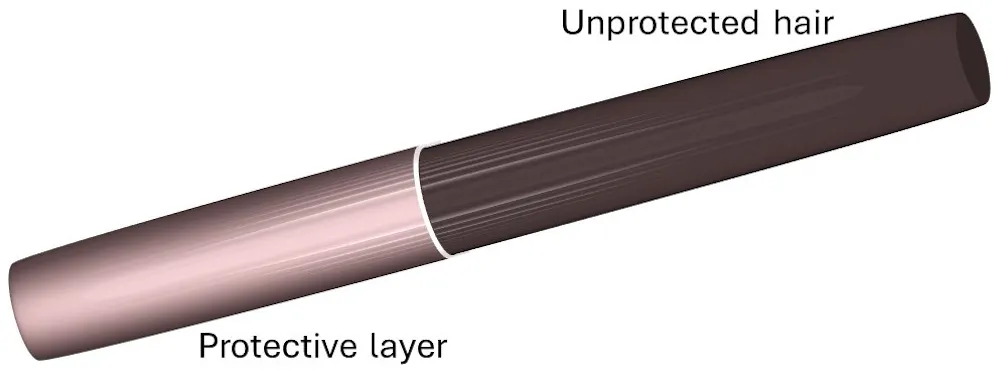
    These materials are chosen because they readily stick onto your hair, creating a coating, a bit like this:

    Hair protectant applies a coating to your hair.
    Author provided

    This coating is a protective layer; it’s like putting an oven mitt on your hands before you handle a hot tray from the oven.

    To demonstrate, I created these by examining hair under a microscope before and after heat protectant was applied:

    These high magnification images of untreated hair, and hair sprayed with a heat treatment spray, show how the product coats your hair strands.
    Author provided

    Just like an oven mitt, a hair protectant delays the heat penetration, results in less heat getting through, and helps spread out the effect of the heat, a bit like in this image:

    Hair protectant can help spread out the effects of the heat.
    Author provided

    This helps prevent moisture loss and damage to both the protective surface cell layer (the cuticle) and the protein structure of the hair cortex.

    For these barriers to work at their best, these heat-protecting layers need to remain bound to your hair. In other words, they stick on really well.

    For this reason, continued use can sometimes cause a buildup which can change the feel and weight of your hair.

    This buildup is not permanent and can be removed with washing.

    One final and important note: just like when you use a mitt for the oven, heat does still get through. The only way to prevent heat damage to your hair altogether is to not use heated styling tools.

    Daniel Eldridge does not work for, consult, own shares in or receive funding from any company or organisation that would benefit from this article, and has disclosed no relevant affiliations beyond their academic appointment.

    ref. How do heat protectants for hair work? A chemistry expert explains – https://theconversation.com/how-do-heat-protectants-for-hair-work-a-chemistry-expert-explains-233206

    MIL OSI AnalysisEveningReport.nz

  • MIL-Evening Report: There’s a plan for free school lunches in Queensland. Is this a good idea?

    Source: The Conversation (Au and NZ) – By Clare Dix, Lecturer In Nutrition & Dietetics, University of the Sunshine Coast

    Queensland Premier Steven Miles has announced free school lunches if Labor is re-elected at the state’s upcoming election on October 26.

    The A$1.4 billion policy would cover primary students in public schools and begin next year. Labor estimates it would save parents about $1,600 per child, per year. On Sunday, Miles said:

    [The program is] universal to avoid stigmatising the kids that need the food the most, but also to ensure that it supports every Queensland family.

    The meals will be delivered in partnership with P&Cs Queensland, Queensland Association of School Tuckshops, school principals, Health and Wellbeing Queensland and non-government food providers.

    The Greens are also campaigning on a pledge to deliver free breakfasts and lunches for every state primary and high school student, costed at $3 billion over the next four years.

    Would a school lunches program help students and families? How would it work in practice?

    An unusual approach for Australia

    Unlike the United Kingdom and United States, Australian does not have a national or state-based free or subsidised school meal program.

    Instead, parents are responsible for providing morning tea and lunch through a “lunchbox system”. Families can also usually pre-order food from a canteen or tuckshop. In some cases, state or territory governments fund charities and non-for-profits to provide breakfast or lunch programs for schools identified as most in need of support.

    Research shows the nutritional quality of food provided to Australian school children often does not meet dietary guidelines. There are mandatory guidelines for state school canteens and tuckshops to follow but these are not always reflected in practice. Research shows many canteen menus contain less-than-desirable options and pricing often does not encourage families to buy healthier options.

    Unfortunately, health survey data shows Australian children’s diets are high in energy dense and nutritionally poor foods. On top of this, the 2023 Foodbank Report shows 36% of Australians are food insecure and about one quarter of these households have children at home who may not have adequate food for school.

    Australia has a ‘lunchbox system’ where families provide the food for school.
    Halfpoint/ Shutterstock

    What are the potential opportunities?

    So the idea of a free school lunch program delivered by organisations familiar with providing food in schools sounds like a positive solution.

    Beyond improving nutrition and health outcomes for more than 326,000 Queensland students, it can also provide other benefits.

    We could see improved school attendance by creating an incentive for students to go to school and improved diets leading to reduced illness. Because well-nourished children are more ready to learn, concentrate and stay on task, school lunches could lead to improved academic performance.

    Importantly, school lunches can reduce inequality and stigma for families who experience food insecurity.

    The school kitchen can also provide a opportunities for students to learn about food preparation and service as well as healthy eating.

    What are the key challenges?

    But we need to make sure the program is properly and sustainably designed. There will be a cost to taxpayers, not just in terms of the set up, but ongoing maintenance.

    The initial implementation will require commercial kitchens and equipment, qualified and trained staff, secure food procurement and supply chains as well as all the policies and procedures to go with this. This raises the question of whether the timeline of starting in Term 1, 2025 is realistic for all schools.

    The roll out needs to be equitable – extra consideration is needed for how this plan will be delivered to rural and remote Queenslanders. We also know access to reliable supplies of food, staff, equipment and support varies greatly across the state.

    The program will also need to cater to children with food allergies and intolerances, food preferences experienced with conditions like autism and attention-deficit hyperactivity disorder (ADHD), and different cultural eating practices.

    This plan has the potential to improve Queensland children’s health and education outcomes, while saving families money, time and stress. But it is complex and success will lie in making sure all Queensland primary students are provided with nutritious and appropriate food at school.

    Clare Dix has received funding from the Australian Department of Health and Aged Care.

    ref. There’s a plan for free school lunches in Queensland. Is this a good idea? – https://theconversation.com/theres-a-plan-for-free-school-lunches-in-queensland-is-this-a-good-idea-241242

    MIL OSI AnalysisEveningReport.nz

  • MIL-OSI Asia-Pac: Hong Kong Scholarship for Excellence Scheme opens for applications

    Source: Hong Kong Government special administrative region

    Hong Kong Scholarship for Excellence Scheme opens for applications
    Hong Kong Scholarship for Excellence Scheme opens for applications
    ******************************************************************

         The Education Bureau (EDB) today (October 14) announced that the Hong Kong Scholarship for Excellence Scheme (HKSES) will, from today until December 31, be open for applications from eligible Hong Kong students who intend to pursue undergraduate or postgraduate studies at world-renowned universities outside Hong Kong starting from the 2025/26 academic year.                              A spokesman for the EDB said, “As a merit-based scheme targeting the most outstanding Hong Kong students, the HKSES seeks to cultivate a cadre of brilliant young achievers with a sense of social responsibility and national identity, an affection for Hong Kong and an international perspective, who will return home after receiving world-class education supported by the scholarship to enrich Hong Kong’s talent pool and competitiveness in the long run. Selection will be based on candidates’ academic achievements and other attributes such as leadership qualities and potential as well as their contributions and commitment to society. Awardees are required to complete their specific study programmes and undertake to return to Hong Kong upon graduation to work for at least two years or a period equivalent to the duration of the scholarship received, whichever is longer.”                              Awardees will receive a non-means-tested scholarship to cover their tuition fees, subject to a ceiling of $300,000 per annum. In addition, the HKSES will provide additional support to financially needy awardees during their studies. Awardees who have passed the means test will receive a bursary of up to $200,000 per student per annum, to cover their living and study-related expenses. The value of the award will be correspondingly reduced if an awardee also receives other awards, both locally and abroad, or assistance to finance his or her same studies overseas.                              Apart from the monetary scholarship, the value of the HKSES also lies in its prestige and recognition as well as other non-monetary benefits. Awardees will receive a series of support and mentorship services to be rendered by the Government and other sectors of the community.                              More details on the HKSES are available on the HKSES website (hkses.edb.gov.hk). Eligible students who intend to pursue their first year of undergraduate or postgraduate studies at world-renowned universities outside Hong Kong in the 2025/26 academic year (i.e. during the period from August 2025 to July 2026) may submit their applications for the scholarship online via the application system on the HKSES website on or before December 31, 2024, by 6pm. Late applications will not be accepted.                              Shortlisted applicants will be invited by the EDB to attend interviews for the scholarship from April 2025 onwards after receiving unconditional offers from their chosen programmes. They will be notified of the results in due course after the interviews.

     
    Ends/Monday, October 14, 2024Issued at HKT 12:20

    NNNN

    MIL OSI Asia Pacific News

  • MIL-Evening Report: Australia has led the way regulating gene technology for over 20 years. Here’s how it should apply that to AI

    Source: The Conversation (Au and NZ) – By Julia Powles, Associate Professor of Law and Technology; Director, UWA Tech & Policy Lab, Law School, The University of Western Australia

    Since 2019, the Australian Department for Industry, Science and Resources has been striving to make the nation a leader in “safe and responsible” artificial intelligence (AI). Key to this is a voluntary framework based on eight AI ethics principles, including “human-centred values”, “fairness” and “transparency and explainability”.

    Every subsequent piece of national guidance on AI has spun off these eight principles, imploring business, government and schools to put them into practice. But these voluntary principles have no real hold on organisations that develop and deploy AI systems.

    Last month, the Australian government started consulting on a proposal that struck a different tone. Acknowledging “voluntary compliance […] is no longer enough”, it spoke of “mandatory guardrails for AI in high-risk settings”.

    But the core idea of self-regulation remains stubbornly baked in. For example, it’s up to AI developers to determine whether their AI system is high risk, by having regard to a set of risks that can only be described as endemic to large-scale AI systems.

    If this high hurdle is met, what mandatory guardrails kick in? For the most part, companies simply need to demonstrate they have internal processes gesturing at the AI ethics principles. The proposal is most notable, then, for what it does not include. There is no oversight, no consequences, no refusal, no redress.

    But there is a different, ready-to-hand model that Australia could adopt for AI. It comes from another critical technology in the national interest: gene technology.

    A different model

    Gene technology is what’s behind genetically modified organisms. Like AI, it raises concerns for more than 60% of the population.

    In Australia, it’s regulated by the Office of the Gene Technology Regulator. The regulator was established in 2001 to meet the biotech boom in agriculture and health. Since then, it’s become the exemplar of an expert-informed, highly transparent regulator focused on a specific technology with far-reaching consequences.

    Three features have ensured the gene technology regulator’s national and international success.

    First, it’s a single-mission body. It regulates dealings with genetically modified organisms:

    to protect the health and safety of people, and to protect the environment, by identifying risks posed by or as a result of gene technology.

    Second, it has a sophisticated decision-making structure. Thanks to it, the risk assessment of every application of gene technology in Australia is informed by sound expertise. It also insulates that assessment from political influence and corporate lobbying.

    The regulator is informed by two integrated expert bodies: a Technical Advisory Committee and an Ethics and Community Consultative Committee. These bodies are complemented by Institutional Biosafety Committees supporting ongoing risk management at more than 200 research and commercial institutions accredited to use gene technology in Australia. This parallels best practice in food safety and drug safety.

    The Gene Technology Regulator has a sophisticated decision-making structure.
    Office of The Gene Technology Regulator, CC BY

    Third, the regulator continuously integrates public input into its risk assessment process. It does so meaningfully and transparently. Every dealing with gene technology must be approved. Before a release into the wild, an exhaustive consultation process maximises review and oversight. This ensures a high threshold of public safety.

    Regulating high-risk technologies

    Together, these factors explain why Australia’s gene technology regulator has been so successful. They also highlight what’s missing in most emerging approaches to AI regulation.

    The mandate of AI regulation typically involves an impossible compromise between protecting the public and supporting industry. As with gene regulation, it seeks to safeguard against risks. In the case of AI, those risks would be to health, the environment and human rights. But it also seeks to “maximise the opportunities that AI presents for our economy and society”.

    Second, currently proposed AI regulation outsources risk assessment and management to commercial AI providers. Instead, it should develop a national evidence base, informed by cross-disciplinary scientific, socio-technical and civil society expertise.

    The argument goes that AI is “out of the bag”, with potential applications too numerous and too mundane to regulate. Yet molecular biology methods are also well out of the bag. The gene tech regulator still maintains oversight of all uses of the technology, while continually working to categorise certain dealings as “exempt” or “low-risk” to facilitate research and development.

    Third, the public has no meaningful opportunity to assent to dealings with AI. This is true regardless of whether it involves plundering the archives of our collective imaginations to build AI systems, or deploying them in ways that undercut dignity, autonomy and justice.

    The lesson of more than two decades of gene regulation is that it doesn’t stop innovation to regulate a promising new technology until it can demonstrate a history of non-damaging use to people and the environment. In fact, it saves it.

    The UWA Tech & Policy Lab receives funding from nationally competitive research grants and philanthropic partners. The present research was supported by GA308883: Effective Ethical Frameworks for the State as an Enabler of Innovation, funded by the Department of Foreign Affairs and Trade.

    Julia Powles is the Director of the Lab and has served as an independent member of the National AI Centre’s Think Tank on Responsible AI, the Australian Government’s National Robotics Strategy Advisory Committee, and the Advisory Panel supporting the Australian Parliamentary Inquiry into the Use of Generative AI in the Australian Education System. Through each of these bodies, she has provided advice on comparative AI regulation.

    Haris Yusoff does not work for, consult, own shares in or receive funding from any company or organisation that would benefit from this article, and has disclosed no relevant affiliations beyond their academic appointment.

    ref. Australia has led the way regulating gene technology for over 20 years. Here’s how it should apply that to AI – https://theconversation.com/australia-has-led-the-way-regulating-gene-technology-for-over-20-years-heres-how-it-should-apply-that-to-ai-240571

    MIL OSI AnalysisEveningReport.nz

  • MIL-OSI Australia: Exercise empowers lung cancer patients to take active role in treatment

    Source: University of South Australia

    14 October 2024

    Coughing, chest pain and a shortness of breath – they’re all distressing symptoms of lung cancer. So, while exercise may seem a counterintuitive activity for lung cancer patients, new research shows otherwise.

    In a cornerstone review from a team of global experts*­ – including Southern Cross University and the University of South Australia – researchers show that exercise may not only improve quality of life and treatment effectiveness, but also boost survival rates for lung cancer patients.

    Lung cancer is the leading cause of cancer-related deaths worldwide. In Australia, it is estimated that 15,122 people will be diagnosed with lung cancer this year alone.

    Examining the effects of exercise on various lung-cancer associated health outcomes, researchers have now developed recommendations for patients and health practitioners, to support exercise before, during and after lung cancer treatments.

    Combined aerobic and resistance training, performed 2-5 times per week, is typically prescribed across the cancer continuum. Researchers say that exercise can support lung cancer patients by:

    • Improving quality of life: Exercise programs demonstrate improvements in fitness, strength, and quality of life for people with lung cancer before, during, and after treatment.
    • Reducing symptoms: Exercise can help manage cancer-related symptoms such as fatigue, breathlessness, and muscle weakness.
    • Reducing post-op complications: Preoperative exercise programs may lead to reduced postoperative complications and shorter hospital stays.
    • Boosting wellbeing: Exercise during treatment can help patients maintain muscle mass, reduce fatigue, and improve psychological well-being.
    • Increasing appetite: Exercise may play a role in managing cancer cachexia (a common complication of cancer that causes you to lose significant amounts of skeletal muscle and body fat) and can be safe for patients with bone metastases when properly prescribed.
    • Easing advanced symptoms: Exercise can be beneficial even for patients with advanced-stage lung cancer, helping to manage symptoms and improve quality of life.

    Lead author Southern Cross University’s Associate Professor Kellie Toohey says to optimise exercise interventions for lung cancer patients, an integrated approach across interdisciplinary care teams was needed.

    “Lung cancer care involves a broad range of healthcare professionals – oncologists, clinical exercise physiologists, dieticians, psychologists, and physical therapists – all of whom must work together to support a patient with exercise,” Associate Professor Toohey says.

    “To facilitate this integration, we need to educate healthcare providers and patients about exercise in lung cancer care.

    “By highlighting the mental and physical benefits of exercise, we hope that patients can be empowered to take a more active role in their treatment and recovery, potentially transforming their lung cancer journey from passive endurance to active participation in health improvement.”

    UniSA researcher Dr Ben Singh says the research challenges beliefs about the inability of people with lung cancer to exercise.

    “There’s an often-held misconception that lung cancer patients are too ill or frail to exercise, particularly because their illness affects their lungs and breathing. But contrary to this belief, research shows that exercise can have many benefits for people with lung cancer,” Dr Singh says.

    “Exercise has the potential to counteract many health issues, not only improving their quality of life, but also potentially influencing treatment outcomes.

    “This is particularly striking given the historically poor prognosis associated with lung cancer.

    “Regular, tailored exercise can help improve a patient’s physical condition, helping them better tolerate the physical demand of diagnosis, surgery, treatment, and recovery. It can also vastly improve a patient’s mental health, helping counteract feelings of depression and anxiety, so often associated with a lung cancer diagnosis.”

    Notes for editors:

    *This research has been conducted by a team of researchers from Southern Cross University, University of Canberra, University of Sydney, University of Technology Sydney, Edith Cowan University, Flinders University, Queensland University of Technology, University of Notre Dame Australia, University of South Australia, Universidade de Caxias do Sul (Brazil), Institute for Respiratory Health, University of Western Australia, University of Queensland, University of Pittsburgh (USA), Campbelltown Hospital, University of Melbourne, The Peter MacCallum Cancer Centre, Griffith University, and Cancer Council Queensland.

    Media contacts

    Southern Cross University: Sharlene King, media office, M +61 429 661 349 E scumedia@scu.edu.au
    UniSA: Annabel Mansfield, media & communications, M +61 479 182 489 E Annabel.Mansfield@unisa.edu.au
    UniSA contact for interview:  Dr Ben Singh E: Ben.Singh@unisa.edu.au

    MIL OSI News

  • MIL-OSI Russia: Scientists from the NSU Climate Center have developed low-carbon building materials

    MILES AXLE Translation. Region: Russian Federation –

    Source: Novosibirsk State University – Novosibirsk State University –

    New building materials with a low carbon footprint have been developed by scientists from the Climate Center of Novosibirsk State University. Large-tonnage man-made waste from the mining, construction and energy industries is used in the production of these materials. Here, mineral raw materials obtained as a result of the demolition of buildings and structures, waste from quarries and mines for the extraction of minerals, metallurgical slag, as well as ash and slag waste from coal combustion at power plants are used. Thanks to the use of technology developed in the laboratory of the Climate Center, new cement-free building materials not only have a much smaller carbon footprint than traditional concrete, but are also capable of absorbing carbon dioxide from the atmosphere.

    — Cement production is associated with high energy costs. The specifics of the technological process involve the firing of mineral raw materials, which results in the emission of carbon dioxide into the atmosphere, which ensures a high level of greenhouse gas emissions. About 800-900 kilograms of CO2 are emitted into the atmosphere per ton of cement produced. This puts the cement industry in third place in terms of anthropogenic carbon dioxide emissions. Therefore, the problem of decarbonization of the construction industry is relevant and quite acute. At our Carbon Polygon, we create technologies aimed at reducing the carbon footprint in the cement industry, developing and implementing alternative mineral binders and “green” building materials based on them, — explained Georgy Lazorenko, Director of the NSU Climate Center.

    In the production of materials, the technogenic mineral raw materials used are subjected to high-intensity mechanical grinding and are divided into different fractions. In some cases, methods of preliminary heat treatment in a high-temperature furnace or in microwave heating chambers are used – depending on the purpose of the finished mixture that scientists intend to obtain. Next, the mineral raw material mixture is mixed with an activator on an alkaline or acidic basis. As a rule, it is an aqueous solution that is mixed with a solid mineral finely dispersed phase. As a result, a solution mixture is formed, the hardening of which ensures the formation of a ceramic or concrete-like material.

    The use of man-made mineral raw materials with a high content of calcium and magnesium cations, capable of reacting with carbon dioxide to form stable carbonate minerals, in the production of binders ensures the binding of CO2 with the developed materials.

    — We conduct research on the ability of materials to absorb carbon dioxide using a specially designed carbonization chamber, into which CO2 is pumped under pressure. Under controlled operating parameters — temperature, humidity and pressure — we forcibly carbonize the material and study the kinetics of the mineral carbonization process, — said Georgy Lazorenko.

    Currently, the technology for producing cement-free low-carbon building materials is being developed in laboratory conditions. In the laboratory of the NSU Climate Center, scientists are optimizing the recipes and technological modes of producing materials, and are also developing approaches aimed at increasing the effect of absorbing carbon dioxide from the atmospheric air by materials. Also, in laboratory conditions, pilot samples of materials have been created using various types of man-made materials from various industrial facilities in the country.

    Various products can be formed from the developed compositions. Currently, samples of tiles have been manufactured that can be used in urban infrastructure, as well as heat and sound insulation materials that can easily compete with products based on ordinary cements in terms of technical qualities and have a significant advantage in terms of carbon footprint.

    Please note: This information is raw content directly from the source of the information. It is exactly what the source states and does not reflect the position of MIL-OSI or its clients.

    Please note; This information is raw content directly from the information source. It is accurate to what the source is stating and does not reflect the position of MIL-OSI or its clients.

    https://vvv.nsu.ru/n/media/nevs/science/scientists-climate-center-nsu-developed-low-carbon-building-materials/

    MIL OSI Russia News

  • MIL-OSI Russia: Dmitry Chernyshenko congratulated MGIMO on its 80th anniversary

    MILES AXLE Translation. Region: Russian Federation –

    Source: Government of the Russian Federation – An important disclaimer is at the bottom of this article.

    Deputy Prime Minister Dmitry Chernyshenko congratulated the Moscow State Institute of International Relations (MGIMO) on its 80th anniversary.

    The Deputy Prime Minister noted that over its rich history, MGIMO has become a symbol of the highest quality of diplomatic education. Graduates of the university form the basis of the Russian diplomatic service, demonstrating patriotism and loyalty to duty in their work.

    The university employs talented teachers, academics, and professors who pass on unique experience to future diplomats, teaching them to find the right solutions in difficult geopolitical conditions for the benefit of our country and in the interests of friendly countries.

    “It is gratifying that MGIMO attracts applicants from different countries: about a thousand foreign students from 81 countries study here. The university has established extensive international relations and interaction with leading universities in the world. This is evidence of MGIMO’s high authority and its achievements in the academic environment,” Dmitry Chernyshenko emphasized.

    Today, our country needs highly qualified specialists – diplomatic workers who are ready to defend Russia’s interests in the international arena. The Deputy Prime Minister expressed confidence that graduates of the Moscow State Institute of International Relations will continue to worthily fulfill the state tasks assigned to them, and MGIMO will maintain its reputation as one of the flagships of Russian education.

    Please note: This information is raw content directly from the source of the information. It is exactly what the source states and does not reflect the position of MIL-OSI or its clients.

    Please note; This information is raw content directly from the information source. It is accurate to what the source is stating and does not reflect the position of MIL-OSI or its clients.

    http://government.ru/nevs/52987/

    MIL OSI Russia News

  • MIL-OSI United Kingdom: City marks Hate Crime Awareness Week

    Source: City of Wolverhampton

    Hate crime is any criminal offence committed against a person or property which is motivated by an offender’s hatred of someone because of their race, colour, ethnic origin or nationality, their religion, their gender or gender identity, their sexual orientation, or their disability.

    It can take many forms, from physical attacks such as an assault, damage to property, offensive graffiti and arson, to verbal abuse or insults or the threat of attack, including the sending of offensive letters, emails or texts, abusive or obscene telephone calls or malicious complaints.

    The Safer Wolverhampton Partnership is calling on people to help raise awareness of the issue, and understand the ways that victims of, or witnesses to, an incident can report hate crime, during this year’s national Hate Crime Awareness Week, which began on Saturday and continues until 19 October. People can:

    • Call police on 101 – or dial 999 if it is an emergency
    • Contact Crimestoppers anonymously on 0800 555 111 or via Crimestoppers 
    • Report in person to the police at any police station or one of the Police Hate Crime drop-ins – see StopHateWLV for details
    • Report at any Third-Party Reporting Centre – independent organisations that have been trained to record hate crimes and incidents, offer support and signpost to other help. See StopHateWLV for details
    • Visit Report It and fill in the online reporting form which will be forwarded to police for investigation
    • If an incident occurs on a train or the Midland Metro, text British Transport Police on 61016
    • If the incident is Islamophobic in nature, Tell MAMA by visiting Tell MAMA or calling on 0800 456 1226
    • If the incident is anti-Semitic, it can be reported via Community Security Trust’s website, CST, or by calling 0208 457 9999.  

    Members of the Safer Wolverhampton Partnership will be at Tesco Wolverhampton, Marston Road, on Wednesday (16 October) from 10am to 12.30pm, Central Library, Snow Hill, on Thursday (17 October) from 10am to 12.30pm and Wednesfield Library, Well Lane, also Thursday from 2pm to 4.30pm, to raise awareness the importance of reporting hate crime, and will also be holding a series of other activities throughout the week.

    Meanwhile, the City of Wolverhampton Council’s Public Health team have been working with the University of Wolverhampton’s Wellbeing champions, who will be supporting with activities this week.

    John Denley, Wolverhampton’s Director of Public Health, said: “The Safer Wolverhampton Partnership takes hate crime incredibly seriously, and all reports will be fully investigated by police.

    “We are using Hate Crime Awareness Week to get people thinking about how they can respond to hate crime if they witness or are victims to it.

    “Most importantly, we’ll be encouraging people to report instances of hate crime, which will enable victims to get the support they need and to ensure those committing it are met with justice.”

    People can find out more about hate crime by logging on to StopHateWLV. For details of National Hate Crime Awareness week, please visit #NationalHCAW

    MIL OSI United Kingdom

  • MIL-OSI Russia: Scientific Symposium at the Polytechnic: New Technologies in Medicine and Physiology

    MILES AXLE Translation. Region: Russian Federation –

    Source: Peter the Great St Petersburg Polytechnic University – Peter the Great St Petersburg Polytechnic University –

    On October 10 and 11, the Polytechnic University hosted a scientific symposium entitled “New Technologies in Preventive Medicine and Physiology”. The event was organized by Peter the Great St. Petersburg Polytechnic University, the St. Petersburg Branch of the Russian Academy of Sciences with the participation of the Preventive Medicine Section of the Medical Sciences Department of the Russian Academy of Sciences and the Physiological Sciences Department of the Russian Academy of Sciences.

    The symposium, dedicated to new technologies in preventive medicine and physiology, was held as part of the events for the 125th anniversary of the founding of SPbPU. The participants were members of the Russian Academy of Sciences, leading experts in the field of immunology, virology, physiology, brain sciences, as well as young scientists, postgraduates and senior students of SPbPU.

    It is a great honor for us that such an event is held at the Polytechnic University. This means that our university is a significant part of the process of forming advanced scientific thought in the field of life sciences in the Russian Federation. Any high-quality research requires a serious material and technical base, constant continuity, and development of educational programs. To achieve maximum efficiency, we must concentrate our knowledge, transmit it, and combine efforts at events like our symposium, – the first vice-rector of SPbPU Vitaly Sergeev opened the event.

    After this, the event participants were greeted by the guests of honor.

    We are facing extremely serious tasks that can only be solved by consolidating all our efforts. The areas that we are discussing at the symposium are priorities. This is the development of mRNA drugs, the creation of vaccines, genetically engineered biological drugs, medicines, and many others. I am confident that today’s event will be another contribution to the development of science not only in St. Petersburg, but also in our country, – emphasized the head of the Rheumatology Research Laboratory, Academician of the Russian Academy of Sciences, Honored Scientist of the Russian Federation, Chief Scientific Secretary of the Presidium of the North-West Branch of the Russian Academy of Medical Sciences Vadim Mazurov.

    Polytechnic University has already become a bit like home for me. For many years, we have been cooperating with the university in two areas. Firstly, this is the educational level: we give online lectures to students. Secondly, we have close scientific cooperation in the field of microRNA, as well as in the creation of vaccines, primarily subunit, recombinant ones. The symposium presents reports on various topics, but all of them are related to the most pressing medical and biological problems, – noted the scientific director of the I. I. Mechnikov Research Institute of Vaccines and Serums, academician of the Russian Academy of Sciences, head of the preventive medicine section of the Department of Medical Sciences of the Russian Academy of Sciences Vitaly Zverev.

    Words of gratitude to the Polytechnic University for holding the symposium were expressed by Academician of the Russian Academy of Sciences, Advisor to the Russian Academy of Sciences Yuri Natochin.

    The first report was given by the Director of the Institute of Biomedical Systems and Biotechnology, Professor of the Russian Academy of Sciences Andrey Vasin. He spoke about the development of “life sciences” at the Polytechnic and the contribution of Polytechnic scientists to the development of these sciences.

    Andrey Vasin presented the main areas of scientific activity of the Institute of Biomedical Systems and Biotechnology and its structural divisions, in particular the Laboratory of Molecular Neurodegeneration under the direction of Ilya Bezprozvanny, the Research Complex “Nanobiotechnology”, the Research Laboratory “Polymer Materials for Tissue Engineering and Transplantology”, the Laboratory of Nano- and Microencapsulation of Biologically Active Substances.

    Yuri Natochin spoke about the problems of stabilizing the physicochemical parameters of blood, Vitaly Zverev spoke about vaccination. Academician of the Russian Academy of Sciences Sergei Seredenin spoke about the report “Pharmacological regulation of Sigma1R chaperone”. Director of the Pasteur Research Institute of Epidemiology and Microbiology of Rospotrebnadzor, Academician of the Russian Academy of Sciences Areg Totolyan spoke about COVID-19 and the development of infectious immunology.

    A joint work dedicated to new technologies for the prevention of infections associated with the provision of medical care was presented by the head of the Department of Epidemiology and Evidence-Based Medicine of the First Moscow State Medical University named after I. M. Sechenov, Academician of the Russian Academy of Sciences Nikolay Briko, an employee of the Kemerovo State Medical University of the Ministry of Health of Russia Elena Brusnina and the director of the Central Research Institute of Epidemiology of Rospotrebnadzor, Academician of the Russian Academy of Sciences Vasily Akimkin.

    The report “Natural technologies for controlling the activity of neural networks in the long-term range” was presented by the Director of the Institute of Higher Nervous Activity and Neurophysiology of the Russian Academy of Sciences, Academician of the Russian Academy of Sciences Pavel Balaban.

    Director of the Federal Center for Brain and Neurotechnology of the Federal Medical and Biological Agency of Russia Vsevolod Belousov spoke about oxidative stress in neurodegenerative diseases.

    On the second day of the symposium, visiting sessions of the Bureau of the Section of Preventive Medicine of the Department of Medical Sciences of the Russian Academy of Sciences and the Bureau of the Department of Physiological Sciences of the Russian Academy of Sciences were held.

    Research in the field of life sciences began at the Polytechnic University back in the 1960s, when the Physics and Mechanics Department began training personnel in the field of “Biophysics”. Our university has become a real forge of personnel for domestic molecular biology, physiology, biophysics, virology and even medicine. Many Polytechnic graduates have been successfully working in the leading scientific institutes of our country for half a century and head some of them. A number of graduates are members of the departments of medical, physiological and medical sciences of the Russian Academy of Sciences. As part of the research conducted at the Polytechnic University, we collaborate with leading Russian and foreign research teams. I am very glad that we were able to gather such a large number of leading scientists of our country in the field of physiology and preventive medicine at the university. I would also like to note that we held two visiting Bureaus – the Department of Physiology of the Russian Academy of Sciences and the section of preventive medicine of the Department of Medical Sciences of the Russian Academy of Sciences, – Andrey Vasin summed up.

    Please note: This information is raw content directly from the source of the information. It is exactly what the source states and does not reflect the position of MIL-OSI or its clients.

    Please note; This information is raw content directly from the information source. It is accurate to what the source is stating and does not reflect the position of MIL-OSI or its clients.

    http://www.spbstu.ru/media/nevs/science_and_innovations/scientific-symposium-at-polytechnic-new-technologies-in-medicine-and-physiology/

    MIL OSI Russia News

  • MIL-OSI Russia: A presentation of the transport company DPD was held for students of the State University of Management

    MILES AXLE Translation. Region: Russian Federation –

    Source: State University of Management – Official website of the State –

    Last week, as part of the project day at the State University of Management, a presentation was held by DPD, the leader in the Russian market for express delivery of parcels and cargo.

    DPD is a reliable transport company providing a full range of transport and logistics services in the business sector.

    At the presentation, students were told about the organization’s activities and its services. Not only senior students were invited to it, but also first-year students studying in the specialty “Logistics and Supply Chain Management” in order to delve into the complex, but very important and interesting process of cargo delivery from the very beginning of their studies.

    The presentation was given by the Director of the Department of Operations of Moscow and the Moscow Region DPD, a graduate of the State University of Management Dmitry Yakushin and the Head of the Department of Technology and Development of Client Services in DPD Operations Svetlana Salakhutdinova. They were very happy to share their experience of working not only at DPD, but also in this area in general. In addition, they answered the students in detail to every question that arose.

    The students were also told about the procedure for completing an internship at DPD, and interested students were given individual consultations regarding further employment.

    Subscribe to the TG channel “Our GUU” Date of publication: 10/14/2024

    Please note: This information is raw content directly from the source of the information. It is exactly what the source states and does not reflect the position of MIL-OSI or its clients.

    Please note; This information is raw content directly from the information source. It is accurate to what the source is stating and does not reflect the position of MIL-OSI or its clients.

    A presentation of the transport company DPD was held for students of the State University of Management

    MIL OSI Russia News

  • MIL-Evening Report: This beautiful peacock spider was only found two years ago. Now it could be dancing its last dance

    Source: The Conversation (Au and NZ) – By Lizzy Lowe, Vice Chancellor’s Research Fellow in Ecology and Entomology, Edith Cowan University

    If you notice a tiny, strikingly coloured spider performing an elaborate courtship dance, you may have seen your first peacock spider.

    New species of peacock spider are discovered every year; the tally is now 113. One newly discovered species, Maratus yanchep, is only known to exist in a small area of coastal dunes near Yanchep, north of Perth.

    As Perth’s suburbs sprawl ever further north and south, it means one problem – the housing crisis – is worsening another, the extinction crisis.

    The dunes which are home to Maratus yanchep are just 20 metres from land being cleared for large new estates.

    If the species was formally listed as threatened, it could be protected. But the spider was only described in 2022 and has not been listed on state or federal threatened species lists. That means Maratus yanchep has no protection, according to the state government.

    What’s so special about a spider?

    Peacock spiders are tiny. Many have bodies just 4–5 mm across. The males only put on their mating displays during short periods of the year, typically August to September. Their size and habits also make it hard to learn about their populations and preferred habitats. This is partly why we’re only now realising how many peacock spider species there are.

    Concerted effort by enthusiasts such as Jurgen Otto has greatly expanded our knowledge. Of the 113 described species, each has distinctive colouring and its own dances (males have the colour and the moves). But we know there are more species of peacock spider waiting to be recognised by western science.

    Many species of peacock spider are only known from within a very small area of suitable habitat.

    This puts the species at high risk of extinction because a single threat such as a large bushfire or a suburban development can destroy all their habitat at once.

    Peacock spiders such as this Maratus tasmanicus are tiny but pack a lot of personality.
    Kristian Bell/Shutterstock

    How can this be allowed?

    Before any native bushland is cleared in Australia, developers have to undertake an environmental impact survey to look for threatened species and assess what damage the development would do. If a threatened species is found, the development can be scaled back or denied.

    The problem is, these surveys only look for species known to be in danger. If a species isn’t listed on Australia’s growing list of threatened species, it won’t be looked for.

    But Maratus yanchep has not been assessed to see if it is threatened. This means it has no protection from development.

    This points to a wider problem. Large, well-known Australian vertebrates such as koalas and platypuses tend to get more attention – and conservation efforts – than humble invertebrates. We face an uphill battle to conserve our wealth of invertebrates.

    Worldwide, many invertebrates are in real danger of disappearing. Australia is home to at least 300,000 invertebrate species, dwarfing the 8,000-odd vertebrates – but only 101 are currently listed under the federal government’s laws protecting threatened species, the Environmental Protection and Biodiversity Act. The problem here is we don’t have enough data to assess most invertebrate species for formal conservation listing and protection.

    Data takes money

    Listing a species as threatened requires a large amount of data on where the species is and isn’t found. This takes time and specialist knowledge. But funding is scarce.

    As a result, our efforts to gather data on invertebrates often relies on passionate volunteers and enthusiasts, who may often pick one genus – say peacock spiders – and set out to expand our knowledge.

    When clear and immediate threats do appear – such as clearing coastal dunes in Yanchep – we are again reliant on the unpaid work of volunteers to gather information.

    The problem of sprawl

    Perth is one of the longest cities in the world. Its suburbs sprawl for 150 kilometres, running from Two Rocks in the north to Dawesville in the south.

    Many Perth residents want to live by the coast, driving demand for new housing on the city outskirts. This drives destruction of native bushland and pushes species towards extinction. Some species tolerate the change from bushland to suburbia, but these are a minority – less than 25%. Small, localised species are at highest risk of extinction.

    Perth’s sprawl shows no sign of slowing. Land clearing for housing has contributed to the worsening plight of the Carnaby’s cockatoo. Fifty years ago, the iconic cockatoo flew over the city in flocks as large as 7,000. There’s nothing like that now.

    Perth’s urban sprawl now stretches beyond Yanchep. Pictured: Yanchep’s beach. The bush area in the background is where maratus yanchep lives.
    Kok Kin Meng/Shutterstock

    What can we do?

    Efforts are underway to protect Maratus yanchep. The not-for-profit charity Invertebrates Australia is working to nominate it for the International Union for Conservation of Nature’s Red List of Threatened Species. Greens MP Brad Pettitt raised the issue in Parliament in August.

    The one thing peacock spiders have going for them is their looks. They are spectacularly beautiful. They’re also easily identified by the distinct patterns on the males – for most species you don’t need expert training to tell them apart, just decent eyesight.

    As a result, peacock spiders have drawn attention from dozens of amateur arachnologists and photographers who collect and share information on where they can be found. This citizen science data is often able to be used as evidence in listing a species as threatened – and unlocking vital protection.

    Images of these spiders also boosts their public profile and support for their protection.

    Despite the recent groundswell of interest in saving this tiny spider, it may be too late. To avoid the mass extinction of iconic Australian species, we must find better ways of building without large-scale habitat clearing.


    Read more:
    Photos from the field: zooming in on Australia’s hidden world of exquisite mites, snails and beetles


    Lizzy Lowe is affiliated with Invertebrates Australia

    Jess Marsh is affiliated with Invertebrates Australia.

    Dr Leanda Denise Mason is affiliated with Centre for People, Place, and Planet.

    ref. This beautiful peacock spider was only found two years ago. Now it could be dancing its last dance – https://theconversation.com/this-beautiful-peacock-spider-was-only-found-two-years-ago-now-it-could-be-dancing-its-last-dance-238437

    MIL OSI AnalysisEveningReport.nz

  • MIL-OSI Russia: Students of the State University of Management won the competition program of the IV Saratov Youth Legal Forum

    MILES AXLE Translation. Region: Russian Federation –

    Source: State University of Management – Official website of the State –

    On October 8-10, 2024, the 4th Saratov Youth Legal Forum “The Role of Law in Ensuring National Security of Modern Russia” was held at the Saratov State Law School, in which students of the State University of Management took part and won the competition program.

    Over the course of three days, at 48 industry sites, more than 500 young researchers from 37 subjects of the Russian Federation and 9 foreign countries exchanged experiences and research developments with each other, and strengthened their knowledge in the field of law and related areas at interactive lectures, business games and master classes.

    The State University of Management was represented at the Forum by IGUIP students in the Jurisprudence program: Alexandra Zhuk, Eva Salnikova, Alisa Savkina, Varvara Yupatova and Karina Meshcheryakova (academic supervisor: Associate Professor of the Department of Private Law Svetlana Titor).

    As part of the Forum, they took part in competitions for draft reports in the following nominations:

    — “Values of Law in the Context of the New World Order,” where Karina Meshcheryakova became the winner;

    — “Traditional family values: the law as a guarantee of their preservation and strengthening of national security”, where Alisa Savkina took third place;

    — “Transformation of Russian state policy in the sphere of labor and youth employment,” where Eva Salnikova became the winner, and Alexandra Zhuk took second place and received the audience award.

    Also, as part of the Forum, students visited the Historical Park in Saratov “Russia – My History” and presented reports at the All-Russian scientific and practical conference “Historical, legal, philosophical and socio-cultural experience of the development of Russian statehood”.

    The result of the large-scale work of the Forum was a resolution that summarized all the results achieved, reflected the opinions of the participants and the recommendations of experts. It will serve as a basis for new research and development in the field of legal science and practice.

    We congratulate our girls on a truly successful trip and a full podium of prize places, and wish them further great achievements in their studies.

    Subscribe to the TG channel “Our GUU” Date of publication: 10/14/2024

    Please note: This information is raw content directly from the source of the information. It is exactly what the source states and does not reflect the position of MIL-OSI or its clients.

    Please note; This information is raw content directly from the information source. It is accurate to what the source is stating and does not reflect the position of MIL-OSI or its clients.

    Students of the State University of Management won the competition program of the IV Saratov Youth Legal Forum

    MIL OSI Russia News

  • MIL-OSI China: World sci-tech forum champions multilateral scientific cooperation

    Source: China State Council Information Office 2

    The 2024 World Science and Technology Development Forum (WSTDF) will be held in Beijing from Oct. 22 to 24, the China Association for Science and Technology announced Thursday.
    The forum will focus on the theme “Science and Technology for the Future,” addressing topics such as artificial intelligence, ocean negative carbon emissions, open science, intelligent manufacturing, urban health and disaster prevention. It aims to gather global insights and promote technological innovation and sustainable development.
    Since its inception in 2019, the forum has prioritized development, fostering multilateral scientific cooperation and working to establish fairer international development partnerships while contributing Chinese solutions to global governance.
    Striving for a global sci-tech community
    The WSTDF champions open cooperation, serving as a bridge for global scientific development. By promoting open-source sharing, the forum aims to unify global expertise to advance technological innovation and social progress.
    Open science and open-source innovation form the backbone of technological application and industrial digitalization, providing crucial solutions to global challenges.
    The 2020 forum saw participants delve into technological and industrial upgrades through open-source innovation, chip development and internationalization of open-source initiatives. They also examined ways to deepen scientific research through open science. Discussions underscored the profound influence of open science, data sharing, and open-source innovation on the global tech landscape.
    The forum culminated in a shared vision of openness, inclusivity, and resource sharing, emphasizing a strategic global perspective for future technological progress.
    The forum has consistently advocated for open governance, urging the global scientific community to embrace collaborative efforts. For instance, the 2020 forum featured a technology service and trading event, establishing the Network for International Cooperation on Technology Commercialization to promote global technology transfer.
    Engaging in global environmental governance
    China advocates for harmony between humanity and nature, accelerating green and low-carbon transformation to promote ecological development. The WSTDF aligns with this vision, prioritizing environmental governance as a key way to advance global sustainability.
    In 2022, the forum launched an initiative on new energy equipment practices, encouraging domestic institutions to harness technological innovation for low-carbon development and high-level talent cultivation, with projects aimed at peaking carbon dioxide emissions and achieving carbon neutrality.
    Collaborating on global public health governance
    Public health is vital for human survival and integral to economic growth, social development and individual well-being. The forum emphasizes enhancing global health governance as a central concern.
    At the inaugural forum in 2019, Fang-Fang Yin, radiation oncology professor at Duke University, discussed the role of artificial intelligence and machine learning in cancer imaging and radiotherapy.
    During the fourth forum in 2022, Yunbing Wang, director of the Chinese National Engineering Research Center for Biomaterials, dean of the College of Biomedical Engineering of Sichuan University, and vice president of the Chinese Society for Biomaterials, presented innovative research and products for treating severe heart diseases.
    In 2023, discussions expanded further, encompassing biomedical technology innovation, clinical advancements and future health industries. Participants also addressed bottlenecks in the field. These exchanges have played a crucial role in advancing technological development and commercialization in health while bolstering global health standards.
    Making efforts to safeguard food security
    Food security is essential for global peace and development, serving as a cornerstone for building a community with a shared future for mankind. In response to significant global challenges regarding food loss and waste, the WSTDF has consistently prioritized food security.
    At the inaugural forum in 2019, overseas scholar Vania G. Zuin Zeidler introduced the bio-circular economy, proposing a natural ecosystem through green, sustainable agriculture and processing systems that produce healthy food and value-added related products. She advocated for sustainable agriculture to address food waste.
    In 2022, discussions focused on technological innovations for high-quality agricultural development. The forum emphasized germplasm resources, seed technology, intellectual property protection and collaboration between scientific institutions and enterprises.
    These efforts have established a strong foundation for achieving global food security and promoting sustainable agricultural development.
    This year’s forum seeks to strengthen international scientific cooperation and tackle global challenges amid unprecedented changes. The event will provide perspectives on technological trends while showcasing China’s commitment to innovation-driven development and a community with a shared future for mankind.

    MIL OSI China News

  • MIL-OSI Asia-Pac: Funding Scheme on Promotion of Family Education 2024-25 opens for application from today

    Source: Hong Kong Government special administrative region

         The Home and Youth Affairs Bureau and the Family Council have launched a new five-year Funding Scheme on the Promotion of Family Education today (October 14) and invite a 2024-25 round of applications. The deadline for applications is November 22.
          
         The Scheme seeks to subsidise non-profit-making community family education projects to raise public awareness of family education and its importance, and further promote family values to enhance family well-being and social harmony.
                                         
         The Scheme covers various family-related themes such as education for new parents, parent-child education, maintenance of family relationships, strengthening of family cohesion and solidarity, inheritance of good family values and traditional virtues, and other marriage-related subjects, etc to meet the needs of different families. Apart from the above-mentioned themes, applicant organisations may apply for funding to organise suitable projects with other family-related themes having regard to the concern or needs of the community. A proposed project may feature more than one theme provided that they are family-related. The funding cap for each 12-month and 18-month project is $800,000 and $1,200,000 respectively.
          
         Details of the Scheme, including the application guide and application form, are available on the website of the Scheme (www.pfe.gov.hk). Interested eligible bodies and non-governmental organisations may submit applications.
     

    MIL OSI Asia Pacific News

  • MIL-OSI Global: Fall of Khrushchev: 60 years since the ‘most democratic coup’ in Soviet history, how Comrade Nikita was toppled

    Source: The Conversation – UK – By Tomas Sniegon, Associate Professor, Department of European Studies, Lund University

    The overthrow of Nikita Khrushchev from the posts of first secretary of the Soviet Communist Party and the leader of the Soviet state in October 1964 was an unprecedented event in the history of the Soviet Union.

    The old leader was deposed by the opposition without violence. He was not imprisoned or killed after losing power. While his predecessors Lenin and Stalin and successors Brezhnev, Andropov and Chernenko all died in power, Khrushchev was sent into retirement, where he lived under supervision for another seven years.

    Unlike the era of the last Soviet leader, Mikhail Gorbachev, the Soviet Union did not disintegrate when its leader had to relinquish power. Six decades have now passed since what has become known as the “most democratic coup” in Soviet history – sometimes referred to as the “little October revolution”.

    Khrushchev, who rose to power on the death of Josef Stalin in 1953, actually came close to being overthrown as early as 1957. At that time, Stalin’s former collaborators and close comrades, including Georgy Malenkov and Vyacheslav Molotov, opposed him. They even gained an upper hand in the party’s highest body, the presidium. But Khrushchev was saved by the support of the army leadership, the KGB political police and the wider party leadership, the central committee.

    Seven years later, however, he was brought down by politicians from the next generation – men who largely owed their powerful positions to him.

    Strongest among them was Leonid Brezhnev, who duly took Khrushchev’s place as first secretary (shortly afterwards renaming his position general secretary, the same title as Stalin). Next in line was Alexander Shelepin, the powerful secretary of the party’s central committee who had run the KGB from 1958 to 1961.

    The role of the KGB, which in October 1964 was headed by Shelepin’s successor Vladimir Semichastny, was crucial in ensuring Khrushchev’s downfall, as its ninth directorate – which was responsible for the protection of state officials – not only protected but also constantly monitored them.

    Semichastny not only knew about the revolt against Khrushchev but was actively involved in it. Had he informed the leader about the plotting, pretty much what he was in the job to do, Khrushchev would more than likely have averted the palace coup this time as well.

    In his memoirs, Semichastny even mentioned the fact that Brezhnev raised the possibility of Khrushchev’s assassination during one conversation with him. But this plan was never put into action. In the event the plot to remove the Soviet leader was completed by non-violent means.

    Reforming leader

    Khrushchev has gone down in history as a reformer who wanted to make Soviet communism less brutal. He strongly criticised Stalin for his abuse of power but, at the same time, he gradually increased his own powers.

    His efforts at political and economic reforms stopped when they posed a threat to maintaining the monopoly of communist power. Despite paying lip service to the idea of less heavy-handed domination of the Soviet bloc from Moscow, he became known for his bloody suppression of the Hungarian revolt in 1956. During the Cuban missile crisis in 1962, he then brought the world to the brink of nuclear war.

    New kind of leadership: Kruschev meeting US president John F Kennedy in Vienna in 1961.

    His initially positive reforms improved the living standards) of the people in his country, but later became chaotic and led to social unrest, including the massacre of workers in Novocherkassk in 1962 and the need to buy grain from the west, which he had previously wanted to ideologically “bury”.

    Also, the rift between the Soviet Union and China at the turn of the 1950s and 1960s caused a certain resentment in Moscow. Khrushchev’s moves towards liberalisation had not caused the rift, which was more due to China’s increased authoritarianism under Mao Zedong during that era. This was exacerbated by border disputes between the two countries as well as disagreements over international relations. But Khrushchev’s critics felt he could – and should – have handled relations more skilfully.

    Fall and legacy

    Having faced down a coup attempt in 1957, by October 1964 Khrushchev found himself politically isolated and without support in either the presidium or in the central committee. His opponents forced him to return prematurely from his vacation in the Georgian report town of Pitsunda to Moscow where he was confronted by his political opponents, led by Brezhnev with the support of other powerful politicians, including Shelepin, Alexei Kosygin and Mikhail Suslov.

    Realising his supporters in the presidium were in the minority and that to retain power would mean involving the army or KGB, which he was not confident would back him, Khruschev resigned.

    Reflecting on how his leadership had rejected Stalinism, he is reported to have said: “I am glad that, finally, the party has matured and can control any individual.”

    But Brezhnev, who manoeuvred himself into power in Khrushchev’s stead, learned from the fall of his predecessor and tightened his grip on the levers of power. Yet the Soviet Union – thanks in large part to Khrushchev – never returned the state terror and mass murder of Stalinism.

    The Soviet Union was to experience another coup attempt against a leader in 1991, when conservative opponents tried to overthrow another reformer, Mikhail Gorbachev. But this attempt, much less prepared and elaborate and lacking the necessary wider support, failed. The Soviet Union collapsed and was formally disbanded just a few months later.

    But for many people, it’s Khrushchev whose reforms and governing style began the gradual disintegration of the Soviet Union as far back as the 1950s, partly thanks to his efforts to impose more democratisation. It is not surprising that the current Russian president, Vladimir Putin, disdains him – especially since Khrushchev, according to Putin, “senselessly donated” Crimea to Ukraine in 1954.

    At least Khrushchev himself was able to live to focus on the positives. He would recall in his memoir how he freed his country from the suffocating fear of Stalinism and was able to raise a generation of younger politicians who were finally not afraid to stand up to him. Sadly, this is no longer a hallmark under the current leadership.

    Tomas Sniegon does not work for, consult, own shares in or receive funding from any company or organisation that would benefit from this article, and has disclosed no relevant affiliations beyond their academic appointment.

    ref. Fall of Khrushchev: 60 years since the ‘most democratic coup’ in Soviet history, how Comrade Nikita was toppled – https://theconversation.com/fall-of-khrushchev-60-years-since-the-most-democratic-coup-in-soviet-history-how-comrade-nikita-was-toppled-241053

    MIL OSI – Global Reports

  • MIL-OSI Asia-Pac: Family-focused scheme launches

    Source: Hong Kong Information Services

    The Home & Youth Affairs Bureau and the Family Council today launched a new five-year “Funding Scheme on the Promotion of Family Education”, and invited applications to it for 2024-25.

    The scheme seeks to subsidise non-profit-making family education projects in the community, thereby promoting family values and enhancing family well-being and social harmony.

    The funding cap for each 12-month projects is $800,000. while the cap for an 18-month project is $1.2million.

    The scheme covers various family-related themes, including education for new parents, parent-child education, maintenance of family relationships, strengthening of family cohesion and solidarity, inheritance of good family values and traditional virtues, and marriage-related subjects.

    Applicants may also apply for funding to organise projects with other family-related themes as required.

    The deadline for 2024-25 applications is November 22.

    Click here for details.

    MIL OSI Asia Pacific News

  • MIL-OSI Video: UK “It humanises politics” hear what members had to say about Learn with the Lords Day | House of Lords

    Source: United Kingdom UK House of Lords (video statements)

    Members help students engage with the work of the House of Lords through our Learn with the Lords programme.

    Hear from Baroness Finlay of Llandaff, Lord Haskel, Baroness Bennett of Manor Castle and Baroness Fookes about why they take part in the programme and why they feel it’s important for young people to get involved with @UKParliament and democracy.

    Find out more about Learn with the Lords https://learning.parliament.uk/en/learn-with-the-lords/

    #HouseOfLords #UKParliament #LearnWithTheLords #Education #Schools

    Catch-up on House of Lords business:

    Watch live events: https://parliamentlive.tv/Lords
    Read the latest news: https://www.parliament.uk/lords/

    Stay up to date with the House of Lords on social media:

    • Twitter: https://twitter.com/UKHouseofLords
    • Instagram: https://www.instagram.com/UKHouseofLords/
    • Facebook: https://www.facebook.com/UKHouseofLords
    • Flickr: https://flickr.com/photos/ukhouseoflords/albums
    • LinkedIn: https://www.linkedin.com/company/the-house-of-lords
    • Threads: https://www.threads.net/@UKHouseOfLords

    #HouseOfLords #UKParliament

    https://www.youtube.com/watch?v=_4LcHgnnciA

    MIL OSI Video

  • MIL-OSI Russia: “Pedagogical Start”: Intern Training Begins at Polytechnic University

    MILES AXLE Translation. Region: Russian Federation –

    Source: Peter the Great St Petersburg Polytechnic University – Peter the Great St Petersburg Polytechnic University –

    An important task of the university’s personnel policy is the development and systematic implementation of fundamentally new tools and mechanisms for the professional development of the teaching staff. Starting from this academic year, the Polytechnic University Four career paths have been introduced: teacher-researcher, teacher-mentor, teacher-practitioner and intern.

    Last week, the training of interns under the Pedagogical Start program began. 75 young specialists began studying the basics of pedagogical activity and teaching methods with subsequent practice. The interns included final-year students and postgraduates who have been working at the university since the beginning of this academic year as educational and auxiliary or engineering personnel. The allocation and financing of full-time positions for interns is carried out from the university’s centralized fund. Each intern is assigned a mentor – an experienced teacher.

    At the organizational meeting with interns and their mentors, the Vice-Rector for Educational Activities, Chairperson of the Selection Committee of the Faculty of the Faculty, Lyudmila Pankova, spoke about the specifics and features of training interns.

    Formation of the career trajectory of interns is aimed at creating additional conditions for attracting, retaining and developing young promising specialists with high potential at our university. Through planned training of interns through the system of training and mentoring, in a year the university receives a formed young specialist, ready for teaching and research activities, possessing pedagogical experience and planning his professional development at the university, – noted Lyudmila Vladimirovna.

    During this academic year, interns will undergo a special professional retraining program and enter the classroom with their mentors. Interns will also undergo an assessment of universal competencies on the presidential platform of the ANO “Russia – Country of Opportunities”.

    The retraining program “Pedagogical Start” includes several thematic modules devoted to the history and development trends of higher education, regulatory framework for educational activities, psychological and pedagogical training, visualization technologies, design of educational resources in a digital educational environment, rhetoric, as well as practices of using artificial intelligence as a teaching tool.

    An important element of the training program for interns is their internship, which includes attending classes with leading teachers of the structural unit where the intern works, developing and conducting practical classes with subsequent discussion of the results with their mentor, and creating an electronic educational resource for their course.

    The modules of the “Pedagogical Start” program are designed so that interns can quickly integrate into the Polytechnic’s teaching community. For example, the first classes include an introduction to the history of our university and a visit to the museum, and the basics of public speaking will be mastered using a specialized VR complex, explained Elena Zima, head of the retraining program and director of the Education Quality Center.

    In the second part of the organizational meeting, representatives of the PPS competition committee discussed topics of interest to interns, their mentors and those responsible for the implementation of personnel policy at the institutes. The employment procedure was covered by the Head of the Personnel Department Maria Pakhomova. Secretary of the PPS competition committee Olga Kalinina answered questions regarding the specifics of the entry conditions and the planned results of the intern’s career trajectory.

    After the organizational meeting, Lyudmila Pankova gave the interns the first lecture under the retraining program on the topic of “Modern trends in education.”

    Please note: This information is raw content directly from the source of the information. It is exactly what the source states and does not reflect the position of MIL-OSI or its clients.

    Please note; This information is raw content directly from the information source. It is accurate to what the source is stating and does not reflect the position of MIL-OSI or its clients.

    https://vvv.spbstu.ru/media/nevs/education/pedagogical-start-at-the-polytechnic-training-trainees-has begun/

    MIL OSI Russia News

  • MIL-OSI USA: Ashcroft Participates in Security Summit – Vows to Maintain Election Integrity in Missouri

    Source: US State of Missouri

    For immediate release:                 October 10, 2024

    Contact:                                         JoDonn Chaney, Communications Director

                                                            (573) 526-0949

    Jefferson City, Mo. — Secretary of State Jay Ashcroft returned yesterday from a two-day election security summit in Omaha, NE, put on by the National Counterterrorism Innovation, Technology and Education Center (NCITE) headquartered at the University of Nebraska.

    Ashcroft and four other secretaries of state, Nebraska’s Bob Evnen, Iowa’s Paul Pate, Kansas’ Scott Schwab, and South Dakota’s Monae Johnson, met together to discuss election and cybersecurity issues in preparation for the upcoming November election.

    “We run elections for the people of the states; we run elections for our government because it is how ‘we the people’ decide that our Republic will move forward,” Ashcroft said. “No matter who wins or loses, or which issues pass or fail, at the end of the day, the American people can rest assured knowing that they were a part of the decision process and that their votes counted and that the votes made a difference.”

    The U.S. Cybersecurity and Infrastructure Security Agency (CISA) presented information to the secretaries as several states, including Missouri, have received threats and “suspicious packages” of recent. The federal agency provides election officials with security assessments and scenarios to help prepare for a variety of possibilities that could including ransomware, physical threats – including de-escalation and anti-active shooter incidents, and threats from foreign adversaries (such as Russia, Iran and China). 

    “It was good to come together in person; to share ideas,” Ashcroft said. “It is our job as the chief election official in our respective states to make sure elections are safe, secure and accurate for everyone participating in the process.”

    Missouri has 116 local election authorities who work to make sure elections run smoothly across the state. Election information, as well as ballot issues, can be found at GoVoteMissouri.com.

    —30—

    Visit http://www.sos.mo.gov to learn more about the Office of the Missouri Secretary of State.

    MIL OSI USA News

  • MIL-OSI Asia-Pac: English Translation of Opening Remarks by Prime Minister Shri Narendra Modi at 21st ASEAN-India Summit in Vientiane, Lao PDR

    Source: Government of India (2)

    Posted On: 10 OCT 2024 7:14PM by PIB Delhi

    Your Excellency, Prime Minister Sonexay Siphandone,

    Your Majesty,

    Excellencies,

    Namaskar।

    Today, I am honored to participate in this meeting for the eleventh time alongside the ASEAN family.

    Ten years ago, I announced India’s ‘Act East’ policy. Over the past decade, this initiative has revitalized the historic ties between India and ASEAN countries, infusing them with renewed energy, direction, and momentum.

    Giving importance to ASEAN centrality, we launched the Indo-Pacific Oceans Initiative in 2019. This initiative complements the “ASEAN Outlook on the Indo-Pacific.”

    Last year, we initiated maritime exercises to enhance regional security and stability.

    Over the last 10 years, our trade with the ASEAN region has nearly doubled, surpassing USD 130 billion.

    Today, India has direct flight connectivity with seven ASEAN countries, and soon, direct flights to Brunei will also commence.

    Additionally, we have opened a new embassy in Timor-Leste.

    In the ASEAN region, Singapore was the first country with which we established FinTech connectivity, and this success is now being emulated in other nations.

    Our development partnership is founded on a people-centric approach. Over 300 ASEAN students have benefited from scholarships at Nalanda University. A Network of Universities has been launched.

    We have also worked to preserve our shared heritage and legacy in Laos, Cambodia, Vietnam, Myanmar, and Indonesia.

    Whether during the COVID pandemic or in response to natural disasters, we have provided mutual assistance and fulfilled our humanitarian responsibilities.

    Funds for collaboration in various sectors, including the Science and Technology Fund, Digital Fund, and Green Fund, have been established. India has contributed over USD 30 million to these initiatives. As a result, our cooperation now spans from underwater projects to space exploration. In other words, our partnership has significantly broadened in every aspect over the past decade.

    And, it is a matter of great satisfaction that in 2022, we elevated it to the status of a ‘Comprehensive Strategic Partnership.’

    Friends,

    We are neighbors, partners in the Global South, and a rapidly growing region in the world. We are peace-loving nations, that respect each other’s national integrity and sovereignty, and we are committed to ensuring a bright future for our youth.

    I believe that the 21st century is the “Asian Century,” a century for India and ASEAN countries. Today, when there is conflict and tension in many parts of the world, the friendship, coordination, dialogue and cooperation between India and ASEAN are of utmost importance.

    I would like to extend my heartfelt congratulations to Prime Minister Sonexay Siphandone of the Lao P.D.R. for successful chairmanship of ASEAN.

    I am confident that today’s meeting will bring new dimensions to the India-ASEAN partnership.

    Thank you very much.

    DISCLAIMER – This is the approximate translation of Prime Minister’s remarks. Original remarks were delivered

    MIL OSI Asia Pacific News

  • MIL-OSI Asia-Pac: Union Home Minister and Minister of Cooperation, Shri Amit Shah addresses 119th Annual Session of PHD Chamber of Commerce and Industry in New Delhi as the Chief Guest

    Source: Government of India (2)

    Union Home Minister and Minister of Cooperation, Shri Amit Shah addresses 119th Annual Session of PHD Chamber of Commerce and Industry in New Delhi as the Chief Guest

    Shri Narendra Modi, first as Chief Minister and then as Prime Minister of the country for the third consecutive term, has been winning the trust of people in a democratic way for the last 23 years

    PM Modi is a rare combination of vision, experience and commitment

    PHD Chamber of Commerce and Industry is an important link between industry and the government

    PHD Chamber should implement policies, plans and vision of the government and communicate the pressing issues of industry to the government

    In the last 10 years, Prime Minister Modi has laid the foundation of making India rank one in every field in the World

    PM Modi took the country out of ‘policy paralysis’ and established the politics of performance

    Indian economy, which earlier figured among the ‘Fragile Five’, has emerged as a ‘bright spot’ in the World, under the leadership of PM Modi  

    The public banking system, which was in shambles before 2014, has earned a profit of ₹1.40 lakh crore in FY 2023-24, under the leadership of Prime Minister Modi  

    By abolishing more than 2000 colonial laws and more than 39,000 compliances, Modi government made the lives of people easier

    PM Modi has established a research foundation at a cost of ₹50 thousand crores, which will take India to the top in the field of research in the world in the next 25 years

    Union Home Minister Shri Amit Shah pays tribute to the renowned industrialist Ratan Tata on his demise

    Ratan Tata ji was a respected figure not only in Indian industrial sector but globally as well, he has left behind a legacy which will continue to guide leaders in the industrial sector for a long time

    Ratan Tata ji worked to build a good society by solving all the problems of the country through his trust

    Posted On: 10 OCT 2024 7:04PM by PIB Delhi

    Union Home Minister and Minister of Cooperation, Shri Amit Shah today addressed the 119th Annual Session of PHD Chamber of Commerce and Industry (PHDCCI) in New Delhi as the Chief Guest. The theme of this year’s annual session was Viksit Bharat @ 2047: Marching Towards the Peak of Progress’. Around 1500 business persons, Chartered Accountants, bankers, advocates etc. from the industry participated in the event.

    Union Home Minister Shri Amit Shah began his address with tributes to the renowned industrialist Shri Ratan Tata, who passed away last night in Mumbai. Shri Amit Shah said that Shri Ratan Tata has been a respected figure not only in the Indian industrial sector but globally as well. He took charge of the Tata Group at a time when the group needed several changes, and Ratan Tata patiently transformed all the businesses of his group and working practices. Shri Shah said that even today, the Tata Group stands as a pole star in India’s industrial landscape. He added that Ratan Tata led his industrial group to a prominent position in the country and globally while adhering to integrity and following all the rules and regulations. Shri Shah also said that through his Trust, Ratan Tata made efforts to address the country’s various problems and contribute to building a better society. He said that Shri Ratan Tata’s legacy will continue to guide industry leaders for a long time.

    Union Home Minister said that this year is going to be a decisive one for Indian industry, and it is at such a time that the 119th annual convention of PHD Chamber of Commerce and Industry (PHDCCI) is being organized. He said that today, there seems to be a crisis of trust in countries worldwide. He said that Shri Narendra Modi, first as the Chief Minister and then as the Prime Minister of the country, has continuously been winning the trust of the people democratically for the past 23 years. Shri Shah said that without stability, policies cannot be implemented effectively and security and development cannot be ensured. He added that stability brings continuity in policies, ideas, and development. Shri Shah further said that PM Modi has get this vast country rid of many problems over the past 10 years and he is now leading the nation for the third consecutive time.

    Shri Amit Shah said that today’s theme Viksit Bharat @ 2047: Marching Towards the Peak of Progress’ is very appropriate. He said that Prime Minister Modi has set two major goals before us: India will become a fully developed nation when the country celebrates the centenary of its independence in 2047 and by 2027, India will become the world’s third-largest economy. He said that to achieve these two goals, PM Modi has been working tirelessly for the past 10 years through various policies and programs. Shri Shah emphasized that PM Modi has implemented visionary policies aimed at developing infrastructure in the country, making India a global manufacturing hub, creating an investment-friendly ecosystem, building a skilled work-force, promoting research and development, pioneering India in emerging technologies like advanced computing, and initiating new ventures in fields like deep-sea exploration, the maritime economy, and space. He added that Prime Minister Modi has not only formulated these policies but also made continuous efforts to ensure their implementation.

    Union Home Minister said that PHD Chamber of Commerce and Industry is a bridge between the industry and the Government. He said that in the coming times, PHD Chamber has to implement the policies, plans and vision of the government and convey the problems of the industry to the government. He added that we have achieved a lot in the last 10 years. Infrastructure like the world’s longest highway tunnel, the world’s highest railway bridge, Mumbai’s world-famous Trans-Harbour Link and Kolkata’s underwater metro have been built in the last 10 years. Shri Shah said that in Andaman-Nicobar Islands and Lakshadweep, work has been done to utilize business opportunities and strengthen these islands from a security point of view by bringing connectivity to remote areas through underwater optical fibre.

    Shri Amit Shah said that every Indian took great pride when Indian flag was hoisted at the Shiva Shakti Point on the Moon. Connecting the underdeveloped regions of the country through the SagarMala project, weaving a network of Vande Bharat Express trains to open a new avenue for comfortable travel in the country, advancing in semiconductor manufacturing to meet not only ours but also needs of the entire world, bringing a new revolution in electric vehicles, and increasing FDI to record levels, making India the fourth-largest holder of foreign exchange reserves in the world, are significant achievements for us.

    Union Home Minister said that we are the fastest-growing start-up economy in the world. We have successfully launched the world’s largest digital payment system, which many countries are now adopting. He said that along with this, Prime Minister Modi has introduced the world’s largest grain storage plan based in cooperatives. Shri Shah said that from food security to health security, we have covered all dimensions, and in the past 10 years under PM Modi’s leadership, the foundation has been laid for India to be at the forefront in every field over the next 25 years. He said that when vision, experience, and commitment come together in one individual, and that individual is the Prime Minister, the country benefits immensely, and Shri Narendra Modi is an excellent example of this.

    Shri Amit Shah said that India is a democracy where people decide who should lead the government. He said that without a comparative study, we cannot make a proper evaluation of the work done. He emphasized the need to look at the comparative situation of the country in 2014 and 2024. He stated that before 2014, everyone used to say that our country was suffering from policy paralysis and no policies were being made, but PM Modi ended this policy paralysis, created numerous policies and brought in politics of performance. Shri Shah added that today, there is no sector where a permanent policy hasn’t been formulated. Earlier, India was amongst the “Fragile Five,” but today, the International Monetary Fund (IMF) calls us a “bright spot” in the global economy.

    Union Home Minister and Minister of Cooperation highlighted that under infrastructure development, projects like the Zoji La tunnel, Chenab rail bridge, and the bridge in Assam are there for everyone to see. He said that earlier, India used to have double-digit inflation, but today we are confidently moving toward double-digit growth. He said that for many years, India’s growth rate has been the highest among G20 countries. Shri Shah said that global investors had lost confidence in India, but today India has become a preferred destination for manufacturing. Shri Shah said that in 2021-22, we attracted a record Foreign Direct Investment (FDI) of $85 billion. He said that today we are leading in many sectors like digital payments. Before 2014, scams worth ₹12 lakh crore had taken place, but in the 10 years of the Modi government, even our opponents cannot accuse us of corruption.

    Shri Amit Shah said that during previous government, terrorism, bomb blasts, and Naxalism had become severe issues for the country, but today we can confidently say that whether it’s Kashmir, Left-Wing Extremism affected areas, or the Northeast, we have successfully eliminated terrorism and extremism. He mentioned that in the Ease of Doing Business rankings, India was previously placed at the 142nd position, but today we have risen to the 63rd position. He also highlighted that the entire banking system was in a fragile state, but in 2023-24, government banks earned a profit of ₹1.40 lakh crore. New policies have been introduced in every sector, helping the country move forward.

    Union Home Minister said that if the country wants to progress, it must have a new education policy, and Prime Minister Shri Narendra Modi brought a New Education Policy that has globalized education while incorporating our heritage. He said that initiatives like GST, Digital India, Bharatmala, SagarMala, PM Gati Shakti, and Startup India have propelled the country forward in all directions.

    Shri Amit Shah said that under the leadership of Prime Minister Shri Narendra Modi and the principle of “Minimum Government, Maximum Governance”, 2,000 outdated colonial laws have been abolished, and over 39,000 compliances across various sectors have been eliminated. He highlighted that in the past 10 years, 80 crore people have been receiving 5 kg of free grain per person, houses provided to 4 crore poor, 15 crore households have received piped water, more than 11 crore people have been given free gas connections, and over 12 crore toilets have been built under the leadership of Prime Minister Shri Narendra Modi. Shri Shah said that Prime Minister Modi has alleviated the concerns of millions and transformed India into a market of 130 crore people. He said that when 60 crore people are excluded from the country’s development process, the country can never progress. Today, with 130 crore people engaged in the nation’s development process, our growth rate has surged upward.

    Union Home Minister and Minister of Cooperation said that the Modi government has made significant efforts in the field of research. He said that for the first time, a research foundation has been established with a budget of ₹50,000 crore. He expressed confidence that in the next 25 years, India will be at the forefront of global research. Shri Shah mentioned that Prime Minister Modi has worked extensively across various sectors. In terms of internet users, India ranks second in the world, while it ranks first in global Fintech adoption and smartphone data consumption. He further highlighted that today half of the world’s daily digital transactions take place in India.

    Shri Amit Shah said that Indian industries must now work towards changing both their size and scale. He emphasized the need for companies to go global and that to establish India’s dominance worldwide, our chambers and industries need to make decisive moves.

    *****

    RK/ASH/PR/PS

    (Release ID: 2063932) Visitor Counter : 115

    Read this release in: Hindi

    MIL OSI Asia Pacific News

  • MIL-OSI Asia-Pac: Ministry of Education organises workshop on Mental Health & Cyber Security on World Mental Health Day

    Source: Government of India

    Posted On: 10 OCT 2024 7:42PM by PIB Delhi

    The Department of School Education and Literacy (DoSEL), Ministry of Education, organized a national online workshop on Mental Health and Cyber Security for the engagement of youth on World Mental Health Day today. The workshop had two sessions on mental health by Dr. Rajesh Sagar, Professor (MD), Psychiatry Department at AIIMS Delhi and on cyber security by and Dr. Rashmi Sharma Yadav, DCP, Indian Cybercrime Coordination Centre, MHA. The workshop was broadcast live on YouTube, reaching over 20 lakh students and educators nationwide.


    Shri Vipin Kumar, Additional Secretary, DoSEL, highlighted the importance of mental well-being and safe utilization of the internet among students. He emphasized the necessity of early intervention to mitigate the potential adverse effects of mental health challenges in today’s digital age.


    Smt. Archana Sharma Awasthi, Joint Secretary, DoSEL, reinforced the commitment of the National Education Policy 2020 to prioritize student well-being. She highlighted the significance of mental health for both students and educators and exhorted everybody to attentively listen and follow the advice given by the experts to maintain good mental health and prevent themselves from being victims of cybercrime.

    Dr. Rajesh Sagar provided valuable insights into prevalent mental health issues such as stress, anxiety, and depression. He emphasized that nearly 50% of mental health disorders emerge before the age of 14, advocating for early intervention. Dr. Sagar identified common stressors including academic pressure, parental conflicts, and bullying, and shared effective coping strategies, such as deep breathing and cognitive restructuring, to foster a happier childhood.

    In her presentation, Dr. Rashmi Sharma Yadav highlighted the importance of cyber hygiene and security for children. She outlined preventive measures against cyberbullying, grooming, and fraudulent online gaming applications. She encouraged students to report cyber fraud through the helpline 1930 and @cyberdost, stressing the importance of responsible internet use, parental awareness, and safeguarding personal information. Both experts suggested that students should share any issues arising with their elders like parents and teachers.

    The workshop engaged students from classes VI to XII from Navodaya Vidyalaya Samiti, Kendriya Vidyalaya Sangathan, Kasturba Gandhi Balika Vidyalayas, CBSE and state government schools across the country and was simultaneously presented in sign language, ensuring accessibility for all participants. The initiative received widespread appreciation from attendees, reflecting a collective commitment to fostering a safer and healthier educational environment.

    *****

    SS/AK

    (Release ID: 2063950) Visitor Counter : 18

    MIL OSI Asia Pacific News