Category: Energy

  • MIL-OSI USA: Funding for Farms to Address Impacts of Climate Change

    Source: US State of New York

    As world leaders gather in New York during Climate Week NYC 2024, Governor Kathy Hochul today highlighted the State’s nation-leading climate efforts, including awarding a record level of funding—more than $33 million—to farms through the Climate Resilient Farming Grant Program. Funded projects aim to help New York’s farmers reduce greenhouse gas emissions, protect water, ensure soil health, and increase on-farm resiliency to the effects of a changing climate. Altogether, the projects are estimated to reduce greenhouse gases by 120,000 metric tons of carbon dioxide equivalent per year – the equivalent of removing 28,560 gasoline powered vehicles from the road for one year. This is nearly double the impact of the previous round of the program. Funding for the program was included in the New York State FY 2025 Enacted Budget as part of the State’s aggressive climate agenda and is supported by additional federal funds through a USDA Climate Smart Commodities grant.

    “New York State is leading the nation in the fight against climate change, and our record investment in the Climate Resilient Farming Program is just one part of my administration’s ambitious efforts to protect our ecosystems and create the green future all New Yorkers deserve,” Governor Hochul said. “This program gives farmers the resources they need to mitigate their impact on the environment, prepare for and respond to whatever weather events the future holds, and continue their critical work contributing to our local economies.

    Led by county Soil and Water Conservation Districts (SWCD), a total of 70 projects will be implemented on 184 farms across New York State. They are supported through $16.14 million in State funding, plus an additional $17 million in federal funds. Of the 70 awarded projects, 39 involve a new farm participant, illustrating the growing reach and impact of the program.

    SWCDs were awarded the grants on behalf of farmers in one of six tracks:

    • Track 1A: Livestock Management: Alternative Waste Management and Precision Feed Management (New York State funds)
    • Track 1B: Manure Storage Cover and Methane Capture Projects (federal funds)
    • Track 2: Adaptation and Resiliency (New York State funds)
    • Track 3A: Healthy Soils NY (systems and Best Management Practices that support soil health and agroforestry (New York State funds)
    • Track 3B: Soil Health Systems (federal funds)
    • Track 4: Agricultural Forestry Management (for carbon sequestration) (New York State funds)

    The Climate Resilient Farming Grant Program follows the State’s Agricultural Environmental Management planning framework and is led and implemented by county SWCDs. County SWCDs work with farms and communities to conserve natural resources and address pressing environmental challenges and opportunities. SWCDs in the following regions were awarded grants through Round 8 of the program:

    • Capital Region: $3,152,885 awarded to work with 11 farms
    • Central New York: $8,241,829 awarded to work with 36 farms
    • Finger Lakes: $12,948,325 awarded to work with 67 farms
    • Long Island: $118,763 awarded to work with four farms
    • Mid-Hudson: $166,400 awarded to work with five farms
    • Mohawk Valley: $608,797 awarded to work with five farms
    • North Country: $3,439,282 awarded to work with 20 farms
    • Southern Tier: $2,827,378 awarded to work with 19 farms
    • Western New York: $1,655,677 awarded to work with 12 farms

    In total, the awarded farms are projected to implement 98,000 acres of cover crops, 23 acres of riparian buffers, and nine manure storage cover and flares systems – the most in a single round, which will provide the largest estimated greenhouse gas emission reduction for a single practice for the program to date. For a complete list and descriptions of projects awarded, please visit the Department of Agriculture and Markets’ website.

    State Agriculture Commissioner Richard A. Ball said, “Farmers care deeply for the health and vitality of New York’s working landscapes. Working in partnership with county Soil and Water Conservation Districts across the state, our farmers are committed to producing food in a way that reduces their environmental footprint and protects our natural resources at the same time. With this record-setting level of funding, we are expanding our reach to even more farms across the State, helping New York State to continue to lead the nation in combating climate change and ensuring a healthy, thriving environment for all.”

    New York State Department of Environmental Conservation Interim Commissioner Sean Mahar said, “With $33 million in new funding announced today, New York’s farmers will be able to better prepare for the impacts of extreme weather events resulting from climate change and reduce operational impacts to the environment, like choosing equipment that helps reduce greenhouse gas emissions and implementing projects to better support soil health and water quality after extreme weather. DEC applauds Governor Hochul and our partners at the Department of Agriculture and Markets for supporting New York farms and advancing sustainable practices to improve the health and resiliency of our agricultural ecosystems and communities with record investments and complementary initiatives like investments through the Clean Water, Clean Air and Green Jobs Environmental Bond Act.”

    New York Farm Bureau President David Fisher said, “Farmers are natural stewards of the environment. We welcome investments in sustainability, especially those investments that help farmers protect the land that is their livelihood. The Climate Resilient Funding Program creates a pathway for farmers to reduce greenhouse gases and take proactive measures in planning for extreme weather conditions.”

    Assemblywoman Donna Lupardo said, “For nearly a decade, the Climate Resilient Farming Program has helped farmers address the impacts of climate change through proven techniques and practices. I’m pleased that this record-level round of funding is reaching so many new participants across the state. Thank you to the Governor, our federal partners, and my colleagues for their continued support for this program and to the Soil and Water Conservation Districts for their dedicated service.”

    Assemblymember Deborah Glick said, “As fresh water sources become scarcer nationwide, sustainable farming has become even more important for New York and the entire US. Thank you to Governor Hochul for on-going support to farms and addressing climate change through the Climate Resilient Farming Grant Program. This program increases sustainability efforts and lowers greenhouse gas emissions while protecting water and soil health through projects led by county Soil and Water Conservation Districts,” said Assemblymember Deborah Glick, Chair of the Environmental Conservation Committee, “This year’s projects will nearly double the reduction in greenhouse gas emissions while abating nutrient pollution and harmful algal blooms, protecting drinking water, and supporting our farmers and New York farms.”

    State Senator Pete Harckham said, “Our farms are facing the consequences of the climate crisis every day. The Climate Resilient Farming Grant program is vital to their efforts to build soil health, protect our environment, and ensure a sustainable local food supply. I’m particularly proud of the Healthy Soil NY program, which promotes a cohesive, scientifically rigorous soil protection strategy. It was true then and true now. With continued support, we can empower New York farmers to lead the way in resilient, climate friendly agriculture.”

    Senator Michelle Hinchey said, “When we say farmers are on the frontlines of the Climate Crisis, we mean their ability to grow our food is directly tied to the environment around them—how healthy the soil is, the weather conditions, and the effects of a changing climate. Their work and our food supply depend on a stable and thriving ecosystem, and as a state, we have a major stake in this process. The Climate Resilient Farming Grant Program is one of the key initiatives where the state can deliver direct support to our farms, helping scale proven sustainability measures and put New York in the best position to protect our food supply for the future. I’m proud to help champion this vital program and congratulate all the awarded projects supporting farms across New York State, including in Columbia and Ulster counties!”

    New York State Soil and Water Conservation Committee Chair Dale Stein said, “Thanks to the partnership between the State and the County Soil and Water Conservation Districts, we have seen great progress in the use of Best Management Practices on our farms to mitigate the impacts of climate change and to help our farmers be better prepared for the increasing number of severe weather events we are all experiencing. Now, with the help of federal funds, our Districts are able to expand their reach even further and welcome even more farms into the program.”

    Launched in 2015, the Climate Resilient Farming Program supports the State’s agricultural sector in meeting its goals to reduce greenhouse gas emissions and increase carbon sequestration on working lands under the State’s Climate Leadership and Community Protection Act. So far, through the program, with expert technical support provided by county SWCDs, 580 farms have been able to implement changes that are contributing to a reduced environmental footprint and increased resiliency to the effects of a changing climate. Round 8 of the program provides $16.14 million in state funding for these projects, consistent with $16 million in Round 7 and a significant increase from $8 million in Round 6.

    Governor Hochul’s Commitment to Soil and Water Conservation Districts

    Under the Governor’s leadership, the Fiscal Year 2025 Budget provides $81.8 million through the Environmental Protection Fund, up $4 million from last year, for agricultural programs and initiatives, such as the Climate Resilient Farming grant program, that are helping farms to implement environmentally sustainable practices and combat climate change. This includes capital investments Soil and Water Conservation Districts oversee, such as supporting dairy farmers to implement projects that enhance manure management systems that sequester carbon and conserve manure nutrients applied to fields and soil to benefit water quality and reduce greenhouse gas emissions. It also includes recent funding in the Eastern Finger Lakes Watershed that galvanizes implementation of the plans and programs to address on-the-ground actions necessary to abate nutrient pollution and harmful algal blooms (HABs), prevent runoff, protect drinking water, and support local farmers.

    New York State’s Nation-Leading Climate Plan 

    New York State’s climate agenda calls for an orderly and just transition that creates family-sustaining jobs, continues to foster a green economy across all sectors and ensures that a minimum of 35 percent, with a goal of 40 percent, of the benefits of clean energy investments are directed to disadvantaged communities. Guided by some of the nation’s most aggressive climate and clean energy initiatives, New York is advancing a suite of efforts – including the New York Cap-and-Invest program (NYCI) and other complementary policies – to reduce greenhouse gas emissions 40 percent by 2030 and 85 percent by 2050 from 1990 levels. New York is also on a path toward a zero-emission electricity sector by 2040, including 70 percent renewable energy generation by 2030, and economy-wide carbon neutrality by mid-century. A cornerstone of this transition is New York’s unprecedented clean energy investments, including more than $28 billion in 61 large-scale renewable and transmission projects across the State, $6.8 billion to reduce building emissions, $3.3 billion to scale up solar, nearly $3 billion for clean transportation initiatives and over $2 billion in NY Green Bank commitments. These and other investments are supporting more than 170,000 jobs in New York’s clean energy sector as of 2022 and over 3,000 percent growth in the distributed solar sector since 2011. To reduce greenhouse gas emissions and improve air quality, New York also adopted zero-emission vehicle regulations, including requiring all new passenger cars and light-duty trucks sold in the State be zero emission by 2035. Partnerships are continuing to advance New York’s climate action with more than 400 registered and more than 150 certified Climate Smart Communities, over 500 Clean Energy Communities, and the State’s largest community air monitoring initiative in 10 disadvantaged communities across the State to help target air pollution and combat climate change.
    MIL OSI USA News

  • MIL-OSI USA: Hickenlooper, Bennet Introduce Public Lands Bill to Protect Gunnison Basin and Surrounding Regions

    US Senate News:

    Source: United States Senator for Colorado John Hickenlooper
    Bill shaped by over a decade of deliberation with Western Colorado leaders and public land users
    Washington, D.C. — U.S. Senators John Hickenlooper and Michael Bennet introduced the Gunnison Outdoor Resources Protection (GORP) Act to permanently protect over 730,000 acres of key portions of the Gunnison Basin and the surrounding regions.
    “Adventurers across Colorado and the country come to the Gunnison Basin for its rugged canyons and untamed wilderness,” said Hickenlooper. “Protecting these additional 730,000 acres will help keep it that way for generations.”
    “For over a decade, Coloradans have come together at trailheads and kitchen tables to share their love for the spectacular landscape in and around Gunnison County,” said Bennet. “This bill proves that people with wide-ranging interests can forge compromise and develop a common vision to protect our public lands for future generations.”
    The bill is based on over a decade of collaboration with local governments, Tribes, and public lands user groups. It has the bipartisan support of six counties in Western Colorado, as well as the Ute Mountain Ute Tribe and local municipalities. A wide variety of local outdoor recreation businesses, ranchers, hunters, anglers, and water users also support the bill.
    “Land is very important to the Ute Mountain Ute Tribe and throughout history we have lost a lot of land that has been taken from the tribe unjustly,” said Manuel Heart, Chairman Ute Mountain Ute Tribe. “To get land back for the tribe by putting it into Trust status as this legislation does, is important to the tribe’s children and grandchildren. The Ute Mountain Ute Tribe appreciates Senator Bennet’s work on the GORP Act, supports the legislation and hopes it will move forward quickly in the US Senate.”
    “Colorado’s great outdoors are known around the world and this bill marks a valuable step in the need to protect the incredible Gunnison Basin for future generations of Coloradans and visitors,” said Colorado Governor Jared Polis. “I appreciate Senator Bennet’s leadership on this issue and look forward to seeing this bill move forward.”
    “As a former resident of the Gunnison Valley and Western Colorado University graduate, I am intimately aware of the importance public lands, wildlife and outdoor recreation are to local communities’ economy and environment,” said Dan Gibbs, Executive Director, Colorado Department of Natural Resources. “Our forests, water, wildlife and open spaces are some of our most precious natural resources and outdoor recreation drives visitors and residents to our state to enjoy our diverse opportunities. I commend the work of Senator Bennet and the many diverse stakeholders on developing the locally driven Gunnison Outdoor Resources Protection Act. Introduction is a great first step and I look forward to working alongside all interested parties as this legislation makes its way through the U.S. Congress.”
    “The GORP Act reflects the way we do business in Gunnison County: we sit down with our neighbors to find common-ground solutions and a way forward to best serve our community. Public lands are our backyard here and I’m proud of the work we’ve done to bring so many stakeholders – snowmobilers, ranchers, mountain bikers, and conservationists to name a few – together,” said Jonathan Houck, Gunnison County Commissioner. “While GORP started in Gunnison County, I couldn’t be happier to stand with five neighboring Western Slope counties in support of this legislation, and I thank Senator Bennet for listening to our communities.”
    “Delta County is glad to have worked with Senator Bennet on the GORP Act,” said the Delta County Commissioners. “Its provisions for Delta County will provide public access to a boat ramp, ensure that the BLM can continue to permit existing motorized boat use, and bring forward a thoughtful balance of uses on public lands in the North Fork Valley. This legislation shows what’s possible when we roll up our sleeves and work together.”
    “The Saguache County Board of Commissioners are pleased to support the introduction of Senator Bennet’s Gunnison Outdoor Resources Protection Act (GORP), and eagerly anticipate the passing of this legislation,” said the Saguache County Commissioners. “We appreciate the many years the many stakeholders have committed to this project.”
    “Pitkin County Is a strong supporter of public lands, and we believe in designating new Wilderness areas in sensitive landscapes, where appropriate,” said Greg Poschman, Chairman, Pitkin County Board of Commissioners. “We are incredibly grateful to Senator Bennet for his work on the GORP Act, and we look forward to celebrating the two proposed Wilderness designations in Colorado’s wild and pristine high country.”
    “Hinsdale County was proud to have collaborated with Senator Bennet, Gunnison County and Ouray County on the GORP Act,” said Kristie Borchers, Chair, Hinsdale County Board of County Commissioners. “We are excited that a key portion of the scenic Cimarron area where Hinsdale, Ouray and Gunnison County come together will be protected by this legislation. This bill will help protect our watersheds and the landscapes that attract the visitors who help drive our mountain town economies in the San Juan Mountains. We look forward to seeing the GORP Act move forward in Congress.”
    “The GORP Act sets the bar for collaborative and beneficial legislation,” said Lynn Padgett, Vice-Chair, Ouray County Board of County Commissioners. “I am forever grateful to Senator Bennet and his team and stakeholders like Gunnison, Hinsdale, and Ouray Counties for enthusiastically working together to include the proposed Uncompahgre Wilderness expansion and especially for protecting Turret Ridge. The peaks of the Cimarron range are unique in their scenery and geology. The GORP Act not only protects important migration areas for elk and key habitats for lynx and moose. The GORP Act protects our precious wildlands, vital to our local economy and quality of life.”
    “Our groups have worked for nearly a decade to craft a vision for public lands in and around Gunnison County that will benefit our economy, environment, and quality of life into the future,” said members of the Gunnison Public Lands Initiative in a joint statement. “The GORP Act reflects the countless hours we spent working together and with communities around the Gunnison Basin. We are eager to see this thoughtful and well-vetted legislation signed into law.”
    Specifically, the GORP Act would:
    Protect over 730,000 acres of public lands in Western Colorado, safeguarding the region’s local economy, world-class recreation, ranching heritage, wildlife habitat, and clean air and water
    Preserve recreational boating in Delta County
    Support the Ute Mountain Ute Tribe’s request to transfer the Pinecrest Ranch from fee ownership to trust ownership
    Hickenlooper and Bennet also championed the CORE Act and Dolores River National Conservation Area and Special Management Area Act as an effort to ensure Colorado public lands are protected. Hickenlooper helped pass both bills through the Senate Committee on Energy and Natural Resources (ENR) with bipartisan support.
    Maps of the areas designated by the bill are available HERE and a summary of the bill HERE. You can find additional information, including support letters and answers to frequently asked questions on the GORP Act website HERE.
    The text of the bill is available HERE.

    MIL OSI USA News

  • MIL-OSI USA: Guthrie, Newhouse, and Fulcher Introduce Bill to Secure America’s Midstream Critical Materials Supply Chain

    Source: United States House of Representatives – Congressman Brett Guthrie (2nd District Kentucky)

    WASHINGTON, D.C. – Congressman Brett Guthrie (KY-02), a senior member of the House Energy & Commerce Committee, Congressman Dan Newhouse (WA-04), and Congressman Russ Fulcher (ID-01) released the following statements after introducing the Securing America’s Midstream Critical Materials Processing Act, which will establish a National Roadmap to provide a pathway to reshore domestic critical material processing facilities away from foreign adversaries like the Chinese Communist Party (CCP) and reduce unworkable permitting barriers to help secure our supply chains. Midstream critical material processors are essential to America’s manufacturing and energy future:

    “Today I was proud to introduce the Securing America’s Midstream Critical Materials Processing Act alongside Congressmen Newhouse and Fulcher to help ensure America has control over its manufacturing and energy future. For too long our nation has been reliant on the CCP and other foreign adversaries for the essential facilities to process critical materials into usable resources for our manufacturing industry. This bill will help provide a pathway to reshoring the processing of critical materials and uncovers the extent to which the CCP has exploited this supply chain. If our nation is to become energy independent once again, secure our supply chains, and reshore job creating industries then we must produce and process our critical materials here at home, I am proud to be leading this bill that will help accomplish this,” said Congressman Guthrie.

    “It is no secret the United States is in a dangerous position with our reliance on adversaries like the CCP for the critical minerals we use in everything from our energy sector to our defense industrial base. This bill is a big step towards bringing critical mineral processing back to our shores and keeping bad actors out of our supply chains. As a member of the House Select Committee on the CCP, I know we as lawmakers need to be doing all we can to prioritize national security before it is too late.” said Congressman Newhouse.

    “Critical minerals are not only vital to America’s energy supply, but to our national security as they are a key component for defense technologies and weaponry. I am proud to introduce this bill alongside Congressman Guthrie and Newhouse to establish a national roadmap to bring the development and processing of key minerals back to the USA. Securing America’s energy independence starts with securing our critical minerals supply chain,” said Congressman Fulcher.

    Background

    • The Securing America’s Midstream Critical Material Processing Act will establish a Dept. of Energy led National Roadmap to reshore domestic critical material processing industry, which will include a comprehensive review of:
      • Current landscape of domestic and global markets for midstream critical material processing
      • The extent to which China and other adversaries employ anti-competitive practices to manipulate critical material markets
      • Opportunities and barriers to reshoring domestic industries, including working alongside allied nations
      • Permitting challenges facing a domestic critical material processing industry
    • This bill requires a Government Accountability Office (GAO) study on how to improve federal permitting to incentivize more investment including:
      • How the Inflation Reduction Act may have fueled Chinese greenfield investment in Free Trade Agreement countries
      • How EPA regulations and litigation raise costs on facilities
      • Ways to improve federal collaboration and coordination to leverage expertise in critical material processing

    ###

    MIL OSI USA News

  • MIL-OSI USA: Rep. Weber’s Bill to Develop Next Generation Pipelines Passes House of Representatives

    Source: United States House of Representatives – Congressman Randy Weber (14th District of Texas)

    Today,  U.S. Rep. Randy Weber’s (TX-14) legislation to advance the next generation of pipelines passed the U.S. House of Representatives. H.R 7073, the Next Generation Pipelines Research and Development Act will strengthen public-private partnerships and improve Federal research, development, and demonstration related to the evolution of key pipeline systems across the country. As our Nation’s infrastructure is rapidly aging, this legislation ensures pipelines are modern, secure, and cost effective, ready to take on our growing energy needs. The success of these systems and new infrastructure technologies will be essential to our international competitiveness, national security, energy independence, and beyond.

    “Pipeline infrastructure is not only vital to Southeast Texas but also crucial to the prosperity of our entire nation,” said Rep. Weber. “It remains the safest, most reliable, and efficient method for transporting the fuel that heats our homes, powers our vehicles, and drives our economy. As we continue to expand our energy resources, it’s imperative that we invest in research and development to ensure our pipelines operate at peak efficiency, fostering both innovation and growth. I thank my colleagues on both sides of the aisle for the bipartisan support that takes us one step closer to ensuring our pipelines are modernized to meet the demands of the future.”

    Highlights of H.R 7073 include:

    • Authorizing the Secretary of Energy, in coordination with the Secretary of Transportation, the Director of the National Institute of Standards and Technology (NIST), the Secretary of Interior, and others, to establish a demonstration initiative and joint research and development program for low-to mid-technology readiness level research projects to achieve deployment.
    • Creating a National Pipeline Modernization Center at the Department of Energy, which will foster collaboration with industry and stakeholders to commercialize cost-effective products and procedures.
    • Conducting a program at NIST of measurement research, development, demonstration, and standardization to ensure the integrity of pipeline facilities and ensure their safety, security, efficiency, sustainability, and resilience.

    Rep. Weber spoke on the House Floor in support of his legislation. Watch here.

    MIL OSI USA News

  • MIL-OSI USA: Smith, Craig, Colleagues Introduce Bipartisan Bill to Codify Year-Round E15

    Source: United States House of Representatives – Congressman Adrian Smith (R-NE)

    Washington, D.C. – Today, Reps. Adrian Smith (R-NE) and Angie Craig (D-MN) along with Reps. Dusty Johnson (R-SD), Nikki Budzinski (D-IL), Mariannette Miller-Meeks (R-IA), and Sharice Davids (D-KS) introduced the Nationwide Consumer and Fuel Retailer Choice Act. This bipartisan, bicameral legislation would extend the Reid vapor pressure (RVP) volatility waiver to enable the year-round, nationwide sale of ethanol blends up to 15 percent. Smith, Craig, and Johnson are co-chairs of the Congressional Biofuels Caucus.

    The bill is the House companion to the Senate bill S. 2707 introduced by Sen. Deb Fischer (R-NE).

    “At a time when agricultural producers are struggling, uncertainty in the energy market is looming, and consumers are paying more at the pumps, the United States cannot afford to leave any opportunity to boost energy production on the table,” said Rep. Smith. “Since I first introduced similar legislation, I have been pushing EPA to allow the uninterrupted sale of E15. Flexibility and greater consumer choice strengthens the U.S. fuel market, and Nebraska’s farmers have the capacity to meet demand. I thank Rep. Craig, Sen. Fischer, and my House colleagues for their cooperation to unlock this sustainable fuel source and provide relief for hard-working Americans at the fuel pump.”

    “Homegrown biofuels are tools we have right now to address climate change, strengthen our nation’s energy infrastructure and lower costs for Americans at the gas pump,” said Rep. Craig. “This bill is the kind of commonsense legislation we need more of in Washington and I’m proud to be a part of the bipartisan coalition fighting for year-round E15 in the House.”

    “E15 supports our farmers, is cleaner for the environment, and lowers the price of gas. Our bipartisan legislation is the only permanent, nationwide solution to unleashing the power of year-round E15. It’s why we’ve been able to bring together a diverse group of stakeholders from the oil/gas, biofuel, ag, and transportation sectors to support our legislation. I am confident that a path forward exists in both the Senate and the House and look forward to working with Congressman Smith to ensure our bill becomes law,” said Sen. Fischer.

    “Securing year-round availability of E15 would provide certainty to the fuel sector, improve the production and supply of American-made fuel, and help drive down the prices at the pump,” said Rep. Johnson. “I am proud to help lead this effort and will continue working to get year-round E15 signed into law.”

    “Higher blends of biofuels help folks save money at the gas pump, reduce our dependence on foreign oil, cut carbon emissions and support critical markets for Illinois family farmers,” said Rep. Nikki Budzinski. “I’m proud to represent one of our nation’s top corn-producing regions and to champion biofuels production on behalf of my constituents – including as a co-lead of the Nationwide Consumer and Fuel Retailer Choice Act. Producers and consumers need more certainty and I’m confident that this legislation can take us across the finish line to secure year-round E-15.”

    “The EPA’s temporary waivers allowing the sale of E15 in the summer are not a viable long-term solution for Iowa’s energy leadership,” said Rep. Miller-Meeks. “This legislation will allow for permanent, nationwide sales of E15 which will lower costs for Americans at the gas pump, reduce emissions, and put an end to fuel supply disruptions. I urge the House and Senate to pass our bipartisan bill to unleash our domestic energy potential.”

    “I’m proud to help introduce this bipartisan bill that would enable permanent, nationwide sales of E15, helping families save at the gas pump while supporting our agricultural community and enhancing our nation’s energy security. This is how Congress should function: both parties coming together to address the most pressing challenges facing everyday folks,” said Rep. Davids.

    Click here to read the bill.

    In the House, additional cosponsors of the Nationwide Consumer and Fuel Retailer Choice Act include Reps. Darin LaHood (R-IL), Eric Sorensen (D-IL), Mike Flood (R-NE), Sam Graves (R-MO), Ashley Hinson (R-IA), Randy Feenstra (R-IA), Dan Kildee (D-MI), Brad Finstad (R-MN), Elissa Slotkin (D-MI), Mary Miller (R-IL), Mark Alford (R-MO), Jake LaTurner (R-KS), Ron Estes (R-KS), Greg Landsman (D-OH), Marcy Kaptur (D-OH), Mike Carey (R-OH), Michelle Fischbach (R-MN), Greg Pence (R-IN), Max Miller (R-OH), Tracey Mann (R-KS), Ann Wagner (R-MO), Robin Kelly ( D-IL), Mike Bost (R-IL), Zach Nunn (R-IA), Michael Guest (R-MS), Don Bacon (R-NE), Blaine Luetkemeyer (R-MO), Buddy Carter (R-GA), and Jason Smith (R-MO).

    Sen. Fischer’s Senate companion to the bill is cosponsored by Sens. Tammy Duckworth (D-IL), Shelley Moore Capito (R-WV), Pete Ricketts (R-NE), John Thune (R-SD), Mike Rounds (R-SD), Roger Marshall (R-KS), Joni Ernst (R-IA), Chuck Grassley (R-IA), Jerry Moran (R-KS), John Hoeven (R-ND), Cindy Hyde-Smith (R-MS), Roger Wicker (R-MS), Tammy Baldwin (D-WI), and Dick Durbin (D-IL).

    BACKGROUND:

    In Congress, Rep. Smith has long championed the issue of year-round availability of E15. This past year, he pushed the administration to extend the availability of E15 during the summer to provide American consumers with access to an affordable biofuel alternative at their local gas station.

    The Nationwide Consumer and Fuel Retailer Choice Act has broad support from stakeholders. Below are statements in support of the bipartisan legislation:

    “Drivers across Nebraska deserve year-round access to E-15 fuel — and thankfully, Representative Smith is answering that call. Families nationwide will benefit from the lower prices and lower emissions it will bring — and hardworking ethanol producers here in Nebraska will gain the certainty they deserve when filling that demand. We appreciate Representative Smith and his colleagues for taking up this bill in the House, and we call on every member of Congress to pass this bipartisan legislation in both chambers as soon as possible,” said Renewable Fuels Nebraska Executive Director Dawn Caldwell.

    “Providing for year-round access to E15 is a practical step in saving money for consumers, reducing emissions for our environment and is approved for 95% of the vehicles on the road today,” said Chris Grams, President of the Nebraska Corn Growers Association. “We deeply value and appreciate the continual leadership of Representative Smith in his efforts to introduce this much needed approach to advance the use of ethanol across the United States. Year-round E15 creates a positive impact and develops demand for farmers locally, statewide and nationally.”

    “We thank our renewable fuel supporters in the House for introducing this bipartisan legislation and continuing to fight for fair market access for E15 and our nation’s farmers and ethanol producers. With just a few months left in this Congress, we urge lawmakers to swiftly adopt this bill and deliver a win for American families seeking cleaner, lower-cost fuel options,” said Renewable Fuels Association President and CEO Geoff Cooper.

    “E15 is one of the best ways to lower costs for consumers while also reducing our carbon emissions. For the past six summers, hardworking families across America have enjoyed big summer savings on E15 ranging from 10 to 30 cents per gallon, with some locations selling the fuel for more than a dollar less per gallon,” said Growth Energy CEO Emily Skor. “But over the last three summers, those savings were only possible thanks to last-minute intervention by EPA. This bill will finally fix the outdated law that threatens to take E15 off the market when consumers need it most during the busy summer driving season. We thank Representative Smith (R-Neb.), Representative Craig (D-Minn), and the bipartisan group of cosponsors for their leadership to ensure we preserve consumer access to lower-carbon, more-affordable fuel options nationwide all year round. With bipartisan bills now introduced in both chambers of Congress, this is our chance to finally get this commonsense legislation across the finish line.”

    ###

    MIL OSI USA News

  • MIL-OSI Global: Hurricane Helene power outages leave over 3 million in the dark – history shows poorer areas often wait longest for electricity to be restored

    Source: The Conversation – USA – By Chuanyi Ji, Associate Professor of Engineering, Georgia Institute of Technology

    Strong winds from Hurricane Helene, one of the most powerful storms to hit the Southeast, flooded roads and cut power in multiple states. AP Photo/Mike Carlson

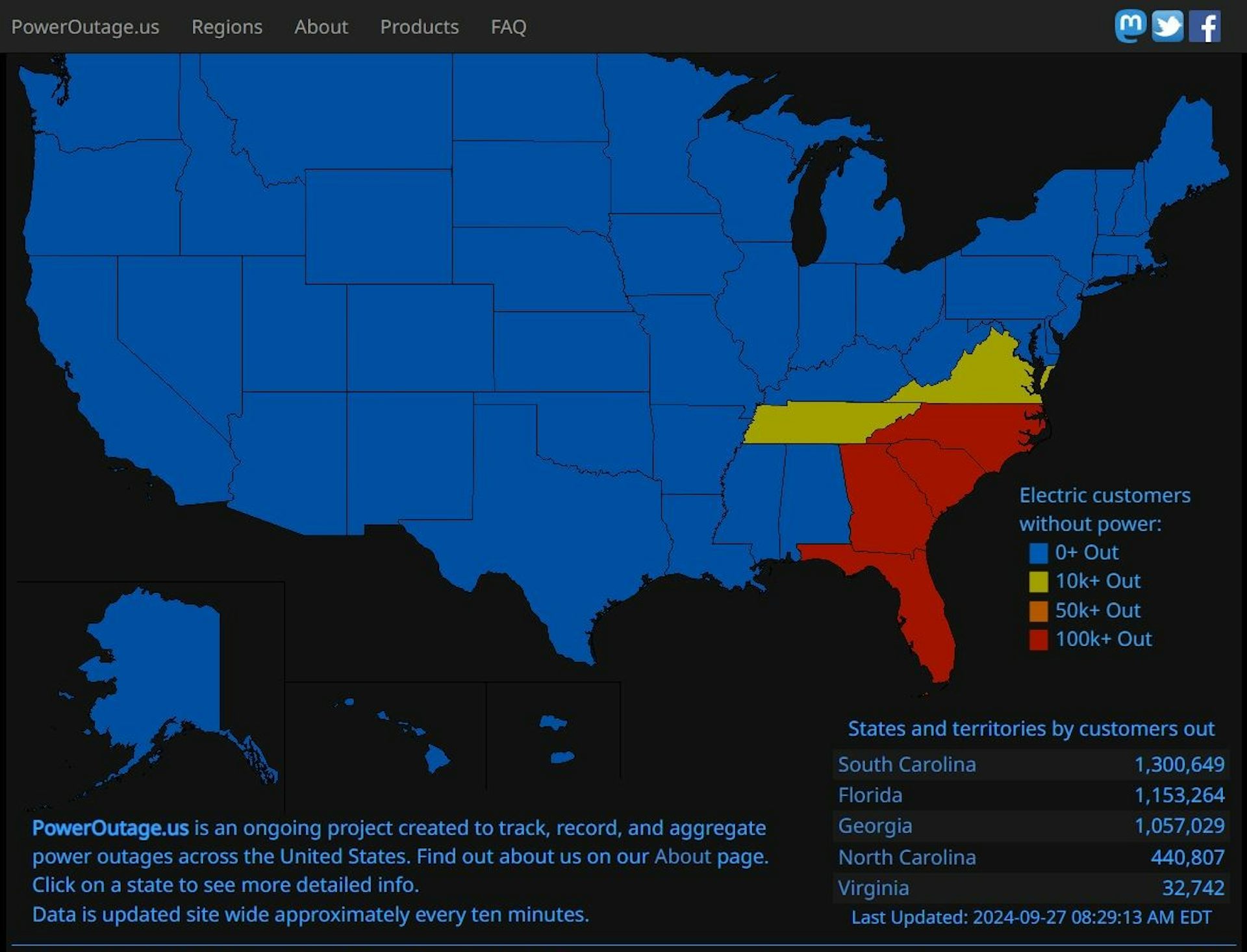
    Hurricane Helene left more than 3 million homes and businesses in the dark across Florida, Georgia and the Carolinas after hitting Florida’s Big Bend region as a powerful Category 4 storm late on Sept. 26, 2024. As Helene’s rains moved inland, officials warned that fixing downed utility lines and restoring power would take several days in some areas.

    Electricity is essential to just about everyone – rich and poor, old and young. Yet, when severe storms strike, socioeconomically disadvantaged communities often wait longest to recover.

    That isn’t just a perception.

    We analyzed data from over 15 million consumers in 588 U.S. counties who lost power when hurricanes made landfall between January 2017 and October 2020. The results show that poorer communities did indeed wait longer for the lights to go back on.

    A 10 percentile drop in socioeconomic status in the Centers for Disease Control and Prevention’s social vulnerability index was associated with a 6.1% longer outage on average. This corresponds to waiting an extra 170 minutes on average for power to be restored, and sometimes much longer.

    The top map shows the total duration of power outages over eight storms by county. The lower map is a comparison with socioeconomic status taken into account, showing that counties with lower average socioeconomic status have longer outages than expected.
    Ganz et al, 2023, PNAS Nexus

    Implications for policy and utilities

    One likely reason for this disparity is written into utilities’ standard storm recovery policies. Often, these polices prioritize critical infrastructure first when restoring power after an outage, then large commercial and industrial customers. They next seek to recover as many households as they can as quickly as possible.

    While this approach may seem procedurally fair, these recovery routines appear to have an unintended effect of often making vulnerable communities wait longer for electricity to be restored. One reason may be that these communities are farther from critical infrastructure, or they may be predominantly in older neighborhoods where power infrastructure requires more significant repairs.

    Commercial areas are often higher on the priority list for faster power recovery in an outage. This store was still closed for several days during Texas’ widespread outages in 2021.
    Montinique Monroe/Getty Images

    The upshot is that households that are already at greater risk from severe weather – whether due to being in flood-prone areas or in vulnerable buildings – and those who are least likely to have insurance or other resources to help them recover are also likely to face the longest storm-caused power outages. Long outages can mean refrigerated food goes bad, no running water and delays in repairing damage, including delays in running fans to dry out water damage and avoid mold.

    Our study spanned 108 service regions, including investor-owned utilities, cooperatives and public utilities. The differential impact on poorer communities did not line up with any particular storm, region or individual utility. We also found no correlation with race, ethnicity or housing type. Only average socioeconomic level stood out.

    How to make power recovery less biased

    There are ways to improve power recovery times for everyone, beyond the necessary work of improving the stability of power distribution.

    Policymakers and utilities can start by reexamining power restoration practices and power infrastructure maintenance, such as replacing aging utility poles and trimming trees, with disadvantaged communities in mind.

    Power providers already have granular data on power usage and grid performance in their service regions. They can begin experimenting with alternative recovery routines that consider the vulnerability of their customers in ways that do not substantially affect average recovery duration.

    People in some Fort Myers, Fla., neighborhoods still lacked water and electricity more than a week after Hurricane Ian in 2022.
    Montinique Monroe/Getty Images

    For socioeconomically vulnerable regions that are likely to experience long outages because of their locations and possibly the aging energy infrastructure, utilities and policymakers can proactively ensure that households are well prepared to evacuate or have access to backup sources of power.

    For example, the U.S. Department of Energy announced in October 2023 that it would invest in developing dozens of resilience hubs and microgrids to help supply local power to key buildings within communities when the wider grid goes down. Louisiana plans several of these hubs, using solar and large-scale batteries, in or near disadvantaged communities.

    Policymakers and utilities can also invest in broader energy infrastructure and renewable energy in these vulnerable communities. The U.S. Department of Energy’s Justice40 program directs that 40% of the benefit from certain federal energy, transportation and housing investments benefit disadvantaged communities. That may help residents who need public help the most.

    Severe weather events are becoming more common as global temperatures rise. That increases the need for better planning and approaches that don’t leave low-income residents in the dark.

    Chenghao Duan, a Ph.D. student at Georgia Tech, also contributed to this article. This is an update to an article originally published on Feb. 7, 2024.

    The authors do not work for, consult, own shares in or receive funding from any company or organization that would benefit from this article, and have disclosed no relevant affiliations beyond their academic appointment.

    ref. Hurricane Helene power outages leave over 3 million in the dark – history shows poorer areas often wait longest for electricity to be restored – https://theconversation.com/hurricane-helene-power-outages-leave-over-3-million-in-the-dark-history-shows-poorer-areas-often-wait-longest-for-electricity-to-be-restored-240001

    MIL OSI – Global Reports

  • MIL-OSI Asia-Pac: Speech by FS at Hong Kong Association Luncheon in London (English only)

    Source: Hong Kong Government special administrative region

         Following is the speech by the Financial Secretary, Mr Paul Chan, at the Hong Kong Association Luncheon in London, the United Kingdom, today (September 27, London time):
     
    Adrian (Chairman of the Hong Kong Association, Mr Adrian Cartwright), members of the Hong Kong Association, ladies and gentlemen, friends of Hong Kong all,

         Good afternoon. I’m delighted to join you, once again, over a welcome lunch.

         The one consistent theme of my trip, first to Spain, now in London, has been the many speaking occasions.
     
         Last night’s Hong Kong Dinner was truly splendid and savory, and now I’m pleased to speak to the Hong Kong Association -thank you for the privilege – because you are very much invested in Hong Kong.
     
         I’m always pleased to speak at such times, especially when the topic is Hong Kong, and particularly to an audience as invested in Hong Kong as you are.

    The state of Hong Kong’s economy
     
         I have much to share, but let me start with a quick update on Hong Kong’s economy. 

         â€‹Last year, our GDP grew by 3.3 per cent as we recovered from the pandemic, and we achieved 3 per cent growth in the first half of this year. 

         The three main drivers fueling our economic growth are: exports, investments, and private consumption. Goods exports have seen significant growth, with Hong Kong serving as a major re-export hub for the Mainland, rising by over 7 per cent in the first half of the year. 

         â€‹For exports of services, tourism remains a key component. It is steadily recovering, with around 30 million visitors in the first eight months of this year, an increase of 44 per cent compared to last year. We expect 46 million visitors for the whole of 2024. 

         With improving economic and business prospects, but amid complex external environment, investment, from both the public and private sectors, expanded by more than 3 per cent in the first half of this year. 

         â€‹Private consumption has been bumpy. It is challenging given changes to the spending patterns of tourists and our residents. 

         Our stock market remains one of Asia’s leading exchanges, with a capitalisation in excess of 3 trillion pounds – 11 times our GDP. The measures announced, earlier this week by the Central Authorities to cut rates, reduce reserve requirement ratios and provide more support to the property sector – is boosting market confidence. The effects are already visible on Hong Kong’s stock market, with record high transactions! Before that, the China Securities Regulatory Commission announced measures in April 2024 that would encourage leading Mainland enterprises to list in Hong Kong. 

         Residential property market prices have fallen by over 6 per cent from the end of last year to August this year – and more than 25 per cent compared to its peak in September 2021. We know property market is an important pillar to any economy, so we remain vigilant, and has been monitoring the market closely. So far, our assessment is that it has been an orderly adjustment. 

         This February, we removed all the demand-side management measures for the residential property market. Overall, the property market is now stabilising. 

         The commencement of the monetary easing cycle by the Federal Reserve will provide support to both the economy and the property sector. 
         
         Currently, inflation is at around 1 per cent, and unemployment is lying low, at just 3 per cent. 

         â€‹Overall, we expect Hong Kong to grow between 2.5 per cent to 3.5 per cent this year. 

         Looking into the future, our economic development will be heading in eight discrete directions: internationally, as finance, trade, shipping, aviation and innovation and technology centres; and, regionally, as Asia Pacific’s legal and dispute resolution centre and intellectual property trading centre. We are committed, too, to becoming the East-meets-West centre for international cultural exchange. 

         Allow me now to highlight two of them: financial services and innovation and technology. 

         Let me start with financial services. Besides traditional areas that we are good at, we are working to become an international green finance and green technology hub. 

    Green and Sustainable Finance
     
         Green transition is a global agenda, bringing along responsibilities and opportunities. 
         â€‹
         Hong Kong has established a clear roadmap to achieve carbon neutrality by 2050, while reducing emissions by 50 per cent by 2035 from our 2005 levels. 

         â€‹We are taking a multi-pronged approach to realise this goal by addressing emission sources: first, achieving net-zero electricity generation by phases; second, enhancing energy efficiency in buildings through the promotion of green building practices; third, promoting green transport, particularly electric vehicles; and fourth, reducing waste. 

         Indeed, the Hong Kong SAR Government (Hong Kong Special Administrative Region Government) will invest more than 20 billion pounds in the next 15 to 20 years to implement climate change mitigation and adaptation measures. 

         However, the International Energy Agency has projected that the global energy transition finance gap will reach $3 trillion a year by 2030 and rise to $4.5 trillion a year by 2040. 

         â€‹Hong Kong is Asia’s No. 1 for green finance: for instance, we issue, over the past three years, 48 billion pounds of green bonds and debts per year on average, accounting for one-third of Asia’s market. But there is much more that we can achieve. 

         One is on green standards. Earlier this year, the Hong Kong Monetary Authority released the Hong Kong Green Taxonomy (Hong Kong Taxonomy for Sustainable Finance), which is compatible with the Common Ground Taxonomy developed by China and the EU (European Union), to assist the financial sector in assessing the “greenness” of projects. 

         Similarly, the Hong Kong Stock Exchange also impose ESG (environmental, social and governance) disclosure requirements for listed entities. 

         â€‹Just a few days ago, the Hong Kong Institute of Certified Public Accountants released the draft financial reporting standards which it plans to implement in August next year. The proposed Hong Kong standards follow those issued by the International Sustainability Standards Board, ISSB. 

         In the realm of green tech, start-ups are a powerhouse for many green innovative solutions, fully reflecting our younger generation’s passion for the environment and a sustainable future. 

         You might have met the delegation of start-ups from the Hong Kong Science Park and Cyberport who are with me on this trip to the United Kingdom. Some of them are engaged in green tech, and while others are engaged in different fields, but they share a common goal: to change people’s lives for the better. 

         We are working to attract more green start-ups in our innovation ecosystem. 

         By the way, our Science Park annually organises an elevator pitch competition where the start-ups have to sell their ideas in just 60 seconds in the lift of Hong Kong’s tallest skyscraper. The winner this year is from Munich seeking to establish a lithium battery recycle plant. 
     
    Innovation and Technology
     
         Let me now turn to innovation and technology. Our focus areas are: AI and big data analytics, biotech and health sciences, fintech and new energy and new materials. 

         The key success factor for the development of AI are algorithms, computing capabilities, data and use case scenarios. Under the “one country, two systems” arrangements, Hong Kong has unique advantages because we are the hub converging the Mainland and international data, and the Greater Bay Area provides us with ample use case scenarios. 

         In order to expedite the development of the eco-system of the aforementioned industries, we have set up the Hong Kong Investment Corporation, HKIC. 

         With six billion pounds at its disposal, the HKIC has a dual mandate. While it seeks financial returns, it also promotes the development of target industries that are crucial for the long-term competitiveness and economic vitality of Hong Kong. The HKIC serves as a tool for the Hong Kong SAR Government to invest and/or co-invest in enterprises, start-ups and important projects. 

         The ​HKIC is “patient capital”. It has already initiated several strategic partnerships in the areas of hard tech, biotech and new energy. 

         What distinguishes the HKIC from other sovereign funds is its investment approach to channel private capital into strategic industries through a collaborative approach, by bringing together like-minded private equity funds, venture capitalists, investors, and even entrepreneurs.

         This is particularly important for start-ups, especially those with original and disruptive technologies because their development cycles are often long, and patient capital is crucial for their success.

         Going forward, the HKIC will expand its collaboration with overseas partners to maximise impact. Next January, the HKIC will host a Roundtable for International Sovereign Wealth Funds, inviting sovereign wealth funds and financial leaders to explore investment opportunities and develop collaborative partnerships. In fact, this September, the HKIC also staged a Hong Kong Start-up Investment and Development Summit. 

         Ladies and gentlemen, I hope to leave ample time for questions, so I will conclude my remarks here. My sincere thanks, once again, to the Hong Kong Association for this welcome opportunity to speak to you. 

         I’m happy now to take your questions. 

         â€‹Thank you.

    MIL OSI Asia Pacific News

  • MIL-OSI USA: Warren, Whitehouse, Casar, Lawmakers Slam 35 Companies for Paying Their Executives More Than They Pay in Federal Income Taxes

    US Senate News:

    Source: United States Senator for Massachusetts – Elizabeth Warren
    September 27, 2024
    Text of Letters (PDF)
    Washington, D.C. – U.S. Senators Elizabeth Warren (D-Mass.) and Sheldon Whitehouse (D-R.I.), and Representative Greg Casar (D-Texas) led their colleagues in slamming 35 major companies that have been paying their executives more than they pay in federal income taxes. The lawmakers point to this as an additional reason why Congress must reform the tax code in 2025 to ensure that big corporations are paying what they owe.
    “For decades, big businesses and the wealthy have skirted their responsibility to pay federal income taxes, leaving hardworking Americans to foot the bill,” wrote the lawmakers. “As Congress considers what to do when some provisions of the 2017 law expire next year, it is critical that we ensure that large, profitable businesses are paying their fair share.” 
    In the first five years following the $2 trillion Tax Cuts and Jobs Act (TCJA) passed by Republicans and signed by President Trump in 2017, 35 companies raked in $277 billion in domestic profits. These companies then paid an average effective income tax rate of just 14.1 percent, almost a third less than the 21 percent statutory rate. Instead of these gains “trickling down” to workers, the corporations paid their executives $9.5 billion – more than they paid in federal income taxes. While executives were making $989,000 per year or more, an average raise of $50,000 per executive, 90 percent of workers saw no earnings increase.
    The most egregious examples of these companies – and the ones the lawmakers wrote to – include: Tesla, TMobile, Netflix, AIG, Ford, NextEra, Darden, MetLife, Duke Energy, First Energy, DISH, Principal Financial, American Electrical Power, Kinder Morgan, Dominion, Oneok, Williams, Xcel Energy, NRG Energy, Salesforce, DTE Energy, Ameren, Sempra Energy, US Steel, Entergy, AmerisourceBergen, PPL, CMS Energy, Evergy, Voya Financial, Atmos Energy, Alliant Energy, Match Group, UGI, and Agilent Tech.
    “Next year, Congress has an opportunity to take bigger strides in reforming our tax code – to raise the corporate rate, close loopholes, and hold big businesses to the same standards as everyday working Americans who pay their fair share,” concluded the lawmakers.
    In addition to Senators Warren and Whitehouse, and Representative Casar, the letters were also signed by Senators Jeff Merkley (D-Ore.), Ed Markey (D-Mass.), Bernie Sanders (I-Vt.), and Peter Welch (D-Vermont), as well as Representatives Jan Schakowsky (D-Ill.), Eleanor Norton (D-D.C.), Mark Pocan (D-Wis.), Pramila Jayapal (D-Wash.), Hank Johnson (D-Ga.), Rashida Tlaib (D-Mich.), Bennie Thompson (D-Miss.), Delia Ramirez (D-Ill.), and Barbara Lee (D-Calif.). 
    Senator Warren has led the fight to close tax loopholes for the wealthy and giant corporations to ensure a more fair tax system: 
    In July 2024, Senator Warren called on Treasury Secretary Janet Yellen to fully implement the 15% Corporate Alternative Minimum Tax signed into law by President Biden in the Inflation Reduction Act two years ago to preemptively stop corporate attempts to avoid paying their fair share.
    In June 2024, Senator Warren delivered remarks at the Washington Center for Equitable Growth to set the agenda on taxes ahead of the 2025 tax fight and urge Democrats to back President Biden’s agenda to tax the rich. Senator Warren’s call came as Congress prepared for major tax policy changes as a large portion of the 2017 Republican tax cuts for the wealthy were set to expire. 
    In March 2024, Senator Warren, along with U.S. Representatives Pramila Jayapal (D-Wash.) and Brendan Boyle (D-Pa.), reintroduced the Ultra-Millionaire Tax Act, popular, comprehensive legislation that would bring in at least $3 trillion in revenue over 10 years by requiring that the top 0.05 percent of American households chip in 2 cents for every dollar of wealth over $50 million. The newly introduced version of the bill included stronger rules on trusts, a common method the ultra-wealthy utilize to avoid paying taxes that cost the federal government between $5 and $7 billion annually. 
    In November 2023, at a hearing of the Senate Finance Committee, Senator Warren called out efforts by lobbyists for giant corporations trying to extend three of the biggest corporate giveaways in the Trump tax cuts: bonus depreciation, R&D expensing, and looser limits on net interest deduction. 
    In October 2023, Senators Warren, Sheldon Whitehouse (D-R.I.), Chris Van Hollen (D-Md.), and Bernie Sanders (I-Vt.) sent a letter to Secretary Janet Yellen and Internal Revenue Service (IRS) Commissioner Daniel Werfel, urging them to proactively use the Treasury Department’s rulemaking authority to close tax loopholes that create inconsistency and unfairness in the tax system and threaten the government’s ability to raise important revenue.
    In August 2023, Senators Warren, Bob Casey (D-Pa.), Richard Blumenthal (D-Conn.), and Sanders sent a letter to the Treasury and IRS, urging them to quickly propose and implement strong rules that close loopholes exploited by crypto tax evaders.
    In April 2023, Senator Warren sent a letter to Secretary Yellen and Commissioner Werfel, urging them to follow through on the commitments of the Biden administration by examining and taking concrete steps to address racial inequities in tax benefits and enforcement.
    In March 2023, Senators Warren, Van Hollen, Sanders, and Whitehouse sent a letter to Treasury Secretary Janet Yellen, urging her to use the full extent of the Treasury Department’s regulatory authority to crack down on the ultra-wealthy’s use of trusts to dodge paying their fair share in taxes.

    MIL OSI USA News