Category: Entertainment

  • MIL-Evening Report: The butterfly effect: this obscure mathematical concept has become an everyday idea, but do we have it all wrong?

    Source: The Conversation (Au and NZ) – By Milad Haghani, Associate Professor & Principal Fellow in Urban Risk & Resilience, The University of Melbourne

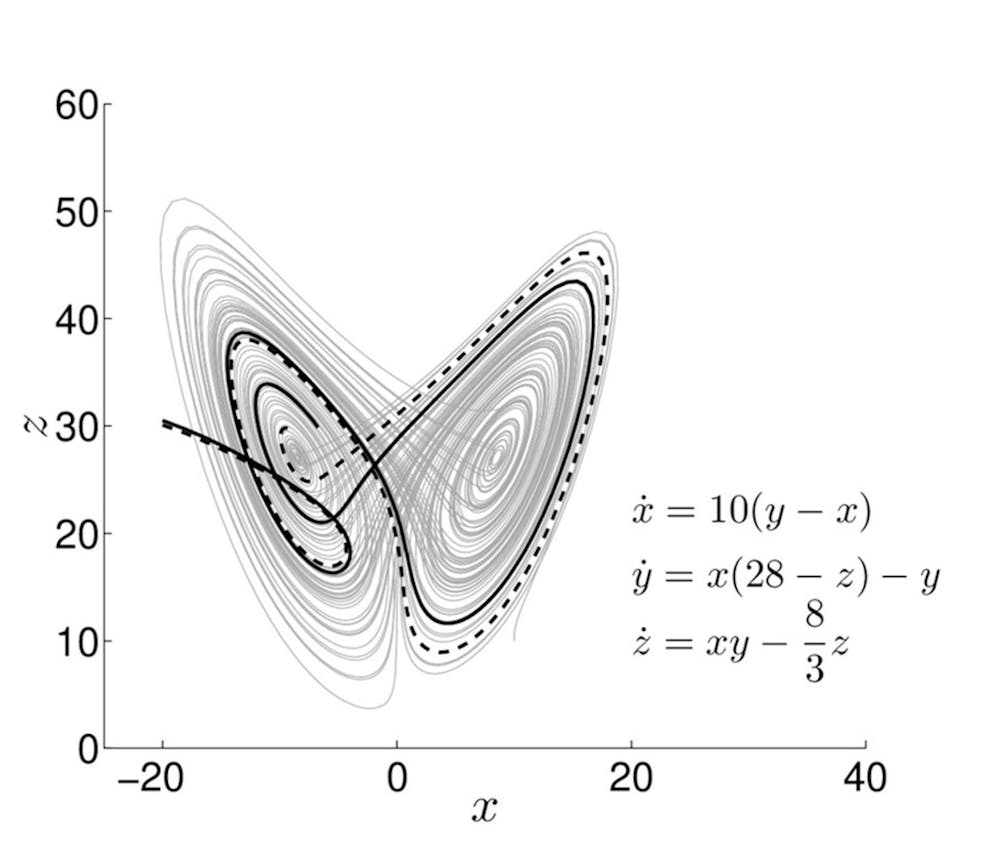
    Edward Lorenz’s mathematical weather model showed solutions with a butterfly-like shape. Wikimol

    In 1972, the US meteorologist Edward Lorenz asked a now-famous question:

    Does the flap of a butterfly’s wings in Brazil set off a tornado in Texas?

    Over the next 50 years, the so-called “butterfly effect” captivated the public imagination. It has appeared in movies, books, motivational and inspirational speeches, and even casual conversation.

    The image of the tiny flapping butterfly has come to stand for the outsized impact of small actions, or even the inherent unpredictability of life itself. But what was Lorenz – who is now remembered as the founder of the branch of mathematics called chaos theory – really getting at?

    A simulation goes wrong

    Our story begins in the 1960s, when Lorenz was trying to use early computers to predict the weather. He had built a basic weather simulation that used a simplified model, designed to calculate future weather patterns.

    One day, while re-running a simulation, Lorenz decided to save time by restarting the calculations from partway through. He manually inputted the numbers from halfway through a previous printout.

    But instead of inputting, let’s say, 0.506127, he entered 0.506 as the starting point of the calculations. He thought the small difference would be insignificant.

    He was wrong. As he later told the story:

    I started the computer again and went out for a cup of coffee. When I returned about an hour later, after the computer had generated about two months of data, I found that the new solution did not agree with the original one. […] I realized that if the real atmosphere behaved in the same manner as the model, long-range weather prediction would be impossible, since most real weather elements were certainly not measured accurately to three decimal places.

    There was no randomness in Lorenz’s equations. The different outcome was caused by the tiny change in the input numbers.

    Lorenz realised his weather model – and by extension, the real atmosphere – was extremely sensitive to initial conditions. Even the smallest difference at the start – even something as small as the flap of a butterfly’s wings – could amplify over time and make accurate long-term predictions impossible.

    The ‘Lorenz Attractor’ found in models of a chaotic weather system has a characteristic butterfly shape.
    Milad Haghani, CC BY

    Lorenz initially used “the flap of a seagull’s wings” to describe his findings, but switched to “butterfly” after noticing a remarkable feature of the solutions to his equations.

    In his weather model, when he plotted the solutions, they formed a swirling, three-dimensional shape that never repeated itself. This shape — called the Lorenz attractor — looked strikingly like a butterfly with two looping wings.

    Welcome to chaos

    Lorenz’s efforts to understand weather led him to develop chaos theory, which deals with systems that follow fixed rules but behave in ways that seem unpredictable.

    These systems are deterministic, which means the outcome is entirely governed by initial conditions. If you know the starting point and the rules of the system, you should be able to predict the future outcome.

    There is no randomness involved. For example, a pendulum swinging back and forth is deterministic — it operates based on the laws of physics.

    Systems governed by the laws of nature, where human actions don’t play a central role, are often deterministic. In contrast, systems involving humans, such as financial markets, are not typically considered deterministic due to the unpredictable nature of human behaviour.

    A chaotic system is a system that is deterministic but nevertheless behaves unpredictably. The unpredictability happens because chaotic systems are extremely sensitive to initial conditions. Even the tiniest differences at the start can grow over time and lead to wildly different outcomes.

    Chaos is not the same as randomness. In a random system, outcomes have no definitive underlying order. In a chaotic system, however, there is order, but it’s so complex it appears disordered.

    A misunderstood meme

    Like many scientific ideas in popular culture, the butterfly effect has often been misunderstood and oversimplified.

    One common misconception is that the butterfly effect implies every small action leads to massive consequences. In reality, not all systems are chaotic, and for systems that aren’t, small changes usually result in small effects.

    Another is that the butterfly effect carries a sense of inevitability, as though every butterfly in the Amazon is triggering tornadoes in Texas with each flap of its wings.

    This is not at all correct. It’s simply a metaphor pointing out that small changes in chaotic systems can amplify over time, making long-term outcomes impossible to predict with precision.

    Taming butterflies

    Systems that are very sensitive to initial conditions are very hard to predict. Weather systems are still tricky, for example.

    Forecasts have improved a lot since Lorenz’s early efforts, but they are still only reliable for a week or so. After that, small errors or imprecisions in the starting data grow larger and larger, eventually making the forecast inaccurate.

    To deal with the butterfly effect, meteorologists use a method called ensemble forecasting. They run many simulations, each starting with slightly different initial conditions.

    By comparing the results, they can estimate the range of possible outcomes and their likelihoods. For example, if most simulations predict rain but a few predict sunshine, forecasters can report a high probability of rain.

    However, even this approach works only up to a point. As time goes on, the predictions from the models diverge rapidly. Eventually, the differences between the simulations become so large that even their average no longer provides useful information about what will happen on a given day at a given location.

    A butterfly effect for the butterfly effect?

    The journey of the butterfly effect from a rigorous scientific concept to a widely popular metaphor highlights how ideas can evolve as they move beyond their academic roots.

    While this has helped bring attention to a complex scientific concept, it has also led to oversimplifications and misconceptions about what it really means.

    Attaching a metaphor to a scientific phenomenon and releasing it into popular culture can lead to its gradual distortion.

    Any tiny inaccuracies or imprecision in the initial description can be amplified over time, until the final outcome is a long way from reality. Sound familiar?

    Milad Haghani does not work for, consult, own shares in or receive funding from any company or organisation that would benefit from this article, and has disclosed no relevant affiliations beyond their academic appointment.

    ref. The butterfly effect: this obscure mathematical concept has become an everyday idea, but do we have it all wrong? – https://theconversation.com/the-butterfly-effect-this-obscure-mathematical-concept-has-become-an-everyday-idea-but-do-we-have-it-all-wrong-246577

    MIL OSI AnalysisEveningReport.nz

  • MIL-OSI USA: Sens. Markey, Cruz Statement on Commerce Committee Vote to Advance AM Radio for Every Vehicle Act

    US Senate News:

    Source: United States Senator for Massachusetts Ed Markey

    Washington (February 5, 2025) – Senator Edward J. Markey (D-Mass.) member of the Science, Commerce, and Transportation Committee, and Ted Cruz (R-Texas), Chairman of the Science, Commerce, and Transportation Committee today released the following statement on the committee’s vote to advance the AM Radio for Every Vehicle Act, bipartisan and bicameral legislation that would direct federal regulators to require automakers to include AM broadcast radio in their new vehicles at no additional charge.

    “Today’s vote to advance the AM Radio for Every Vehicle Act broadcasts a clear message to car manufacturers that AM radio is an essential communication tool for millions of Americans across the country. From emergency response to sports, entertainment, and news, AM radio is a lifeline that must be protected. Our bill ensures that no one is cut off from their communities and that AM radio stays a part of our constituents’ daily lives.”

    In May 2023, Senators Markey and Cruz led their colleagues in introducing the AM Radio for Every Vehicle Act.  The AM Radio for Every Vehicle Act passed through the Senate Commerce Committee in July 2023 and passed through the House Energy and Commerce Committee in September 2024.

    MIL OSI USA News

  • MIL-OSI USA: Spray General Store gets ODHS grant for greater resiliency in disasters

    Source: US State of Oregon

    hen Joni Kabana first saw the Spray General Store in Spray, Oregon, the roof was in disrepair, a tree was threatening the building from the back and it was filled with stuff the owner was storing. The whole building was in rough shape.

    But Kabana felt a calling to do something with the old beloved store.

    “My intuition just said, ‘Let’s do it.’ Sometimes I just go with my gut with what I’m supposed to do,” she said.

    That was 12 years ago. Three years ago, she bought the building. She removed the threatening tree and put on a new roof. At first, she thought the building would be a good place for her photography and writing studio. But it soon morphed into a community center. The Spray General Store now offers the community of Spray – and its 159 residents – and others, a place to visit, a place to create art, play music, take classes and hold meetings – a place to gather and get to know each other. Kabana acts as the event and building manager.

    Throughout the years when the building needed something she applied for grants and asked for donations. As you can imagine, an old building has its needs. One of the store’s needs was for a heater that would heat the kitchen and bathroom.

    Recently Kabana applied for a Resilience Hubs and Networks Grant from the Oregon Department of Human Services Office of Resilience and Emergency Management (OREM). The funding came from Oregon Legislature through House Bill 3409 passed in 2023. The grant allocated $10 million to develop Resilience Hubs throughout Oregon.

    The Spray General Store was one of the grant’s recipients, receiving $26,300. There were more than 700 applicants for this grant money. More than 87 different groups from throughout the state were awarded a grant. $2 million was set aside to provide to each of the Nine Tribes of Oregon $222,222.

    “What impressed me was I had chance to visit Spray. I talked to neighbors, and they all worked together. There had been a big forest fire in Spray. When I went to visit, I opened the doors and there were air filters, water for people. It was a perfect example of what a resilience hub is,” Ed Flick, OREM Director, said.

    “When they told me I got our grant, and they told me we could have heat I got really choked up. I got really emotional. Rarely do we get funding for building issues. That bathroom and kitchen are really freezing. We would hear people scream when they went into the bathroom. Getting heat in the kitchen and bathroom is going to be a game changer for us,” Kabana said.

    Being able to use the kitchen and bathroom in the winter months means the store can hold more community events through off seasons when area businesses are struggling. Being used in the winter can bring more people to town who will use places like the motel, the grocery store and the gas station.

    Some of the grant money will also be used to install electricity in the storage building in the back. That’s where they store blacksmithing and ceramic material used in their classes and also wood and tools.

    “Now if you need a tool or something you go in there and there is no light. You better go in during the day,” Kabana said.

    “This is a wonderful opportunity to upgrade the heating and provide operational costs to keep the General Store functioning year-round. If the need arises, this will be a place the people of Spray can go to seek shelter, water and other resources.” Jenn Bosch, OREM Grants Program Administrator, said.

    Here is what the grant will fund: heat repaired/installed in the kitchen and bathroom; operational costs such as internet, electric, water; outreach; window purchase and installation; and partial costs of an electrical panel in the barn.

    Kabana also wants to bring in a mobile BBQ food cart. There is no restaurant in Spray. And the other two restaurants about an hour’s drive away just closed. She wants to let people have a really good restaurant experience. She hopes to partner the food cart with an event like a float on the nearby John Day River, or an open mic night for musicians.

    Learn more about the Resilience Hubs and Networks Grant: https://www.oregon.gov/odhs/emergency-management/Pages/resilience-grants.aspx

    MIL OSI USA News

  • MIL-OSI Global: Companion review: this sleek but violent film asks interesting ethical questions about our relationship with AI

    Source: The Conversation – UK – By Sarah Artt, Lecturer in English and Film, Edinburgh Napier University

    Science fiction film and television has long been fascinated by robots. But stories that show us uncannily human cyborgs have often tended to veer towards either comedy or horror. Fritz Lang’s Metropolis (1927) and Ridley Scott’s Blade Runner (1982) both imagine a world where beautiful female cyborgs threaten to overstep their original programming. Rarer are stories that suggest it might be possible to love a cyborg, such as Susan Seidelman’s underseen romantic comedy, Making Mr. Right (1987).

    Companion picks up where Alex Garland’s Ex Machina (2014) leaves off. Ex Machina was about a young man tasked with testing the artificial intelligence (AI) of a female robot. Companion, however, posits a world where synthetic humans have become common.

    Companion’s plot also owes much to the themes of rivalry and revenge present in Karyn Kusama’s horror films Jennifer’s Body (2009) and The Invitation (2022), as well as the TV show Battlestar Galactica’s (2004 to 2009) imagining of full cyborg autonomy.

    Companion is a particularly post-Black Mirror (2011) example of science fiction. With its glossy aesthetics, and ubiquitously friction-less technology, it’s a vision of a future where AI and advanced robotics have made our lives easier. But, in typical Black Mirror fashion, this parable offers a warning.


    Looking for something good? Cut through the noise with a carefully curated selection of the latest releases, live events and exhibitions, straight to your inbox every fortnight, on Fridays. Sign up here.


    We meet Iris (Sophie Thatcher) and Josh (Jack Quaid) as they head to a chic, modern lake house for a weekend with friends. At this point, our only real indication that this is science fiction is the fact that the GPS in Josh’s car is a bit better than usual.

    At first, Iris seems like yet another incarnation of the Manic Pixie Dream Girl – quirky and kittenish, but too bland to really be a protagonist. It is only Thatcher’s subtle physical performance that lets us question whether Iris is entirely human. Besotted with Josh and anxious to please, Iris seems like just another girl who has wished for her prince to come and been rewarded with a supermarket meet cute.

    What makes Companion unsettling is not so much its depiction of cyborgs but rather its portrayal of misogyny.

    Survivors of intimate partner violence will recognise Josh. Particularly his ironclad belief that he is a “a nice guy” who is entitled to an attractive partner who places his needs above all else.

    For some audiences, Companion may not feel firmly rooted enough in either science fiction or horror. But then, it’s really only a horror film if you too are kept awake at night by the thought that some people really want a sex robot with customisable intelligence levels (Josh keeps Iris’s at 40%).

    Thatcher’s performance as Iris is fascinatingly glitchy. There is something about her walk – a precision that isn’t quite human. She stands with a stillness that reminds us she is more object than woman. There is a grimace she makes that conveys how she finds it troubling to process veiled commands from a man who isn’t her partner. It represents a feeling female viewers may have had before, when the social programming that tells women to be nice smacks up against their fight or flight response.

    Iris is a sex robot designed with charming slightly buck teeth – a flaw to offset her pore-less skin. The goal is to prevent her from falling into to the uncanny valley (that discomfited feeling when you encounter an object that is a little too life-like) and make her seem more real.

    Some people argue that you should only have sex with a robot if you think that robot would want to have sex with you. But most science fiction doesn’t really go that way – from Bride of Frankenstein (1935) to Black Mirror, most cyborg figures are programmed to consent without question.

    Companion shows us Iris’s point of view as Josh looms over her during sex. Afterwards, her romance-trope laden chatter is shut down by his command that she go to sleep.

    Companion contains aspects of both comedy and horror. But like the best science fiction, it’s central warning is against those who believe that technology can offer them absolute control.

    Sarah Artt does not work for, consult, own shares in or receive funding from any company or organisation that would benefit from this article, and has disclosed no relevant affiliations beyond their academic appointment.

    ref. Companion review: this sleek but violent film asks interesting ethical questions about our relationship with AI – https://theconversation.com/companion-review-this-sleek-but-violent-film-asks-interesting-ethical-questions-about-our-relationship-with-ai-249062

    MIL OSI – Global Reports

  • MIL-OSI Global: 360-degree videos are making social issues and educational content more engaging for Canadians

    Source: The Conversation – Canada – By Victoria (Vicky) McArthur, Associate Professor, School of Journalism and Communication, Carleton University

    Immersive film using virtual reality (VR) or 360-degree video is being used increasingly as a tool for eliciting empathy and emotional identification in fact-based stories. Unlike traditional flat film, immersive films allow viewers to look in any direction while watching the video.

    This immersive quality is what makes these films such an intriguing medium. Nearly a decade ago, American filmmaker Chris Milk described VR as the “ultimate empathy machine” because it can fully immerse viewers in another person’s environment and perspective.

    This sentiment has been echoed by VR journalism pioneer Nonny de la Peña, whose early work explored the unique storytelling characteristics of the medium. Her first VR film, Hunger in Los Angeles, was the first VR documentary to be showcased at the Sundance Film Festival in 2012.

    The film depicts a diabetic man collapsing outside a food bank due to low blood sugar. Viewers reported feeling a great deal of empathy for the man, with some reaching out to try and help him.

    In March 2015, YouTube launched support for publishing and viewing 360-degree videos. Today, anyone can film and share 360-degree video content using commercially available cameras, expanding the possibilities for storytelling and audience engagement.

    Rise of 360-degree video content

    Countless content creators, filmmakers and journalists have produced immersive content using these cameras. In 2016, for instance, CBC produced Highway of Tears, a short 360-degree video about 16-year-old Ramona Wilson, a young Indigenous woman from the Gitxsan Nation who disappeared along Highway 16 near Prince George, B.C., in 1994.

    CBC has produced other 360-degree videos to highlight real-world challenges and experiences, including Ice Rescue from the Victim’s Perspective and Accessibility Advocate Shows What It’s Like to Use a Wheelchair in Winter.

    ‘Highway of Tears: 360 Video’ from CBC.

    Canadian researchers have also been using immersive technologies like virtual reality and 360-degree video as tools for education and empathy-building.

    A group of Canadian researchers conducted an experiment with VR to see if they could foster empathy for the impact of climate change on oceans. Using a VR simulation, they showed participants optimistic and pessimistic future impacts of climate change on oceans. After experiencing the simulation, participants expressed increased empathy and concern for the issue.

    Similarly, at Toronto Metropolitan University, researchers used 360-degree videos to deepen empathy and understanding for people taking care of individuals with dementia. Participants watched 360-degree videos filmed from the perspective of two fictional characters living with dementia. They reported strong emotional responses to the videos and a deeper understanding of living with dementia.

    As immersive technology becomes more accessible, its potential to foster empathy and understanding across a range of social issues continues to grow.

    Is VR truly the ‘ultimate empathy machine’?

    Is immersive technology truly the “ultimate empathy machine?” Presently, there’s no agreement among experts. Some question the scientific rigour used to support such claims. Past research has suffered from small sample sizes, a lack of diversity among research participants and a lack of longitudinal studies investigating the effects of empathy.

    Other researchers suggest that, while empathetic gains have been demonstrated, these effects tend to fade after a short time. One study found that while VR increased emotional empathy for refugees, those feelings were mostly gone after just 10 days. More importantly, these empathic responses didn’t translate into actions like charitable donations.

    Some researchers have taken a more nuanced approach by distinguishing between emotional and cognitive empathy. Cognitive empathy involves knowing how other people think and feel, while emotional empathy involves feeling another person’s emotions. The findings from one research study indicate that VR can improve emotional empathy, but not cognitive empathy.

    This distinction is crucial in assessing VR’s potential as an empathy-building tool. While immersive experiences may create strong emotional responses, their long-term influence and ability to drive meaningful action remain uncertain.

    Knowledge mobilization

    Other research suggests VR and 360-degree video have the potential to be knowledge-transfer tools. Canadian researchers are encouraged to engage the Canadian public through knowledge mobilization — the process of sharing research findings with organizations, people and government.

    Several Canadian research institutions have started using 360-degree video as a knowledge-mobilization tool. For example, researchers at the National Research Council Canada’s (NRC) Hydrogen Laboratory in British Columbia produced a 360-degree video allowing audiences to see the lab and learn more about the research conducted there.

    360-degree video of the Hydrogen Laboratory in Vancouver.

    The NRC has produced other 360-degree video explainers, including one about the Aerial Robotics Laboratory in Montréal and another about the Climatic Testing Facility located in Ottawa.

    At a time when Canadians are inundated with information, immersive video explainers offer a unique way to learn about science and society. While it remains unclear whether VR is truly the “ultimate empathy machine,” its ability to place audiences at the centre of stories and events has been shown to have positive effects on learning, information retention and the transfer of knowledge.

    Immersive film may not be a guaranteed empathy-builder, but it’s far from being an apathy machine. Ultimately, it offers unique perspectives to Canadians wishing to learn more about the world we live in.

    Victoria (Vicky) McArthur receives funding from the Natural Sciences and Engineering Research Council of Canada and the Social Sciences and Humanities Research Council of Canada.

    ref. 360-degree videos are making social issues and educational content more engaging for Canadians – https://theconversation.com/360-degree-videos-are-making-social-issues-and-educational-content-more-engaging-for-canadians-248398

    MIL OSI – Global Reports

  • MIL-OSI Global: Three pop beefs that were more cutting than Matty Healy and Taylor Swift’s

    Source: The Conversation – UK – By Glenn Fosbraey, Associate Dean of Humanities and Social Sciences, University of Winchester

    There has been a sharp intake of breath among Taylor Swift fans following reports that 1975 frontman and songwriter Matty Healy is soon to release a song addressing their public romance from 2023.

    The song in question, God Has Entered My Body, is reportedly the title track of an upcoming 1975 album. According to a report in the Sun, the song includes the lyric “Keep your head up princess, your tiara is falling”. It is reported to be Healy’s response to Swift’s 2024 song The Smallest Man Who Ever Lived, which many fans believe was about their relationship.

    The 1975 frontman has responded to the rumours in typical Healy style, commenting “huge if true” under a post about the story on social media site Reddit.

    This lyrical back and forth is just the latest entry in a rich history of public beefs between pop stars that have been committed to record. Here are some of the most notable examples.


    Looking for something good? Cut through the noise with a carefully curated selection of the latest releases, live events and exhibitions, straight to your inbox every fortnight, on Fridays. Sign up here.


    1. Lennon v McCartney (1971)

    The first mainstream pop “diss track” exchange took place long before the term was even coined. It occurred in 1971 through Paul and Linda McCartney’s Too Many People and John Lennon’s How Do You Sleep?

    Lennon was incensed by the McCartney lyrics “too many people going underground” and “too many people preaching practices”, which he took as attacks on his and Yoko Ono’s avant garde albums and bed-in escapades. In response, he launched a stinging tirade that accused (Paul) McCartney of creating “Muzak”, being only a “pretty face”, and hanging around with sycophants who fed his ego.

    How Do You Sleep? by John Lennon & The Plastic Ono Band.

    The on-record beef ended there, perhaps because McCartney was too busy to focus on his new band Wings, or simply because he didn’t want to risk another lashing from Lennon’s famously sharp tongue.

    Either way, to the relief of Beatles fans everywhere, the two made amends before Lennon’s death in 1980, and Paul finally concluded their lyrical back and forth two years later with the touching Here Today.

    2. Buckingham v Nicks (1977)

    Recorded amid a backdrop of romantic tension and heavy drug use, it’s a wonder that Fleetwood Mac were even able to complete their 12th studio album Rumours, let alone create something that would go on to sell 40 million copies and spend more than a 1,000 weeks in the UK album charts.

    It’d be unfair to say the massive success of the album is due to the lyrical exchanges between the by then estranged couple Lindsey Buckingham and Stevie Nicks, but it certainly didn’t hurt.

    Dreams by Fleetwood Mac.

    Buckingham lit the fuse with Go Your Own Way, which accused Nicks of “packing up and shacking up” with different men. It caused Nicks to write Dreams, where she encouraged him to “listen carefully to the sound of your loneliness, like a heartbeat, drives you mad, in the stillness of remembering what you had”.

    Decades later, one of the bitterest feuds in pop music continues to rumble on, with Buckingham currently sidelined from the group after being fired in 2018. It won’t come as a surprise that their version of events differs, with Buckingham claiming Nicks was behind his sacking, and Nicks accusing him of revisionism. No Lennon and McCartney thawing of the ice here, then. Yet.

    3. Perry v Swift (2014-18)

    Swift was involved in another public spat back in the 2010s. If reports are to be believed, the two pop icons Katy Perry and Swift became close friends in 2009, but by 2013, things seemed to have soured.

    A rift over some backup dancers, some thinly veiled interview comments and a mutual ex-boyfriend have all been the subject of fan theories about the shift in mood.

    Bad Blood by Taylor Swift ft. Kendrick Lamar.

    In terms of diss tracks, Swift struck first, and relatively mildly, with Bad Blood in 2014, stating in an interview shortly after its release that it was about “a female musical artist”. Although she refused to name names, internet sleuths soon believed they’d figured out it was Perry.

    A Twitter spat between Swift and rapper Nicki Minaj then broke out. Minaj complained that her song Anaconda wasn’t nominated for the video-of-the-year award when Swift’s Bad Blood was (stay with me – this will become relevant soon).

    If the near-journalistic speed of those Lennon and McCartney tracks were indicative of the music industry in the early 1970s, Perry’s delayed response to Swift’s (perceived) barb is indicative of modern times, where her releases were kept to a strict three- or four-year cycle.

    Three years on, then, comes Swish Swish, which included lyrics like “you’re a joke / And I’m a court-side killer queen” and “Your game is tired / You should retire”. It featured Nicki Minaj in the music video to further fan the flames (told you it’d become relevant).

    Swish Swish by Katy Perry ft. Nicki Minaj.

    The only problem was that, in the years between their falling out, Swift had transitioned from mere pop musician to word-dominating superstar, so Perry’s insults carried little weight.

    When it comes to diss tracks, then, the old adage of striking while the iron is hot is definitely applicable. The pair have since made up, with Perry sending Swift an actual olive branch in 2018.

    The pair are pictured embracing during the closing scene of Swift’s 2019 music video for You Need To Calm down. Even the Bad Blood controversy seems to be water under the proverbial bridge now, with Perry videoed singing along to the track by fans earlier this year during one of Swift’s Eras tour concerts.

    Glenn Fosbraey does not work for, consult, own shares in or receive funding from any company or organisation that would benefit from this article, and has disclosed no relevant affiliations beyond their academic appointment.

    ref. Three pop beefs that were more cutting than Matty Healy and Taylor Swift’s – https://theconversation.com/three-pop-beefs-that-were-more-cutting-than-matty-healy-and-taylor-swifts-248076

    MIL OSI – Global Reports

  • MIL-OSI: JMU expert available to speak about aviation anxiety

    Source: GlobeNewswire (MIL-OSI)

    HARRISONBURG, Va., Feb. 05, 2025 (GLOBE NEWSWIRE) — On the evening of Jan. 29, 2025, an American Eagle Flight 5342 from Wichita, Kansas, carrying 60 passengers and four crew members, collided midair with an Army helicopter near Reagan Washington National Airport.  

    James Madison University professor Lindsey Harvell-Bowman’s research centers around the psychological experiences of suicidality and death anxiety, as well as mortality salience effects in advocacy messages. Harvell-Bowman, a Wichita native, is also the author of “The Psychology and Communication Behind Flight Anxiety: Afraid to Fly,” a book that examines the intersection of journalism, communication and psychology in affecting the flying public.  

    Some of Harvell-Bowman’s suggestions for the flying public include: 

    • Limit aviation disaster-related media. 
    • Fill carry-on luggage with things that give comfort and joy. 
    • Rely on flight anxiety apps. 
    • Avoid alcohol and antianxiety prescription medications. 

    “When we see incidents like the AA5342 crash, it reminds us that even when things go perfectly, we can still have things go terribly wrong,” said Harvell-Bowman.  

    “A lack of control can negatively affect our psyche with potentially long-term effects. This anxiety has the potential to manifest in passenger violence in the air and in airports, creating more anxiety among the flying public. The media are key to helping keep anxieties low among the flying public and create a healthier flying experience for all,” added Harvell-Bowman.  

    To schedule an interview with Harvell-Bowman, please contact Chad Saylor, saylorcx@jmu.edu.   

    ### 

    The MIL Network

  • MIL-OSI: Bpce: Groupe BPCE Results Q4-24 & 2024

    Source: GlobeNewswire (MIL-OSI)

    Paris, February 5, 2025

    STRONG PERFORMANCES IN 2024

    Excellent performance in Q4-24 •
    • Net income (Group share) of €3.5bn in 2024, strong growth of +26%
    • VISION 2030: dynamic implementation of the strategic project •

    Q4-24: net banking income at €6bn, up +11% YoY; very good performance achieved by retail banking and the global businesses; net income of €913m, +140% YoY
    2024: net banking income of €23.3bn, 5% growth YoY driven by all the business lines; gross operating income up by a strong 18% notably thanks to good cost control; reported net income2of €3.5bn, up by 26% YoY

    Very high levels of solvency and liquidity with a CET1 ratio of 15.6%3 and a LCR of 142%4 at end-2024

    RETAIL BANKING & INSURANCE    Sharp 14% growth in revenues in Q4-24 and 4% in 2024 driven in particular by the confirmed rebound in net interest margins and commissions. The Banque Populaire and Caisse d’Epargne retail banking networks enjoyed sustained growth in their customer bases with the addition of 846,000 new clients6in 2024

    • Local & regional financing: €84bn of funding for our clients of individual, professional, corporate, and institutional clients; 1% year-on-year growth in loan outstandings, rising to a total of €724bn at end-December 2024
    • Deposits & savings7up by €5bn year-on-year, reaching a total of €681bn at end-December 2024
    • Insurance: gross inflows8 of €14.9bn in life insurance in 2024. Premiums up 15% in 2024 YoY. The equipment rate9for P&C and Personal Protection insurance stood at ~35% at end-December 2024
    • Financial Solutions & Expertise: net banking income remained stable in Q4-24 and rose by 2% in full-year 2024 vs. a high basis of comparison in 2023. Good performance reported by the Leasing and Consumer Credit activities
    • Digital & Payments: +5% growth in the number of card transactions at end-December 2024 YoY. Oney net banking income up 8% in full-year 2024

    GLOBAL FINANCIAL SERVICES Strong revenue growth, +8% in Q4-24 and full-year 2024; very dynamic business development in Corporate & Investment Banking, net banking income up 5% in Q4-24 year-on-year; very good performance achieved by Asset Management with net banking income up 11% in Q4-24 year-on-year

    • Corporate & Investment Banking: net banking income of €1.1bn in Q4-24; +19% growth in revenues in Q4-24 YoY for Global Markets, driven by the Fixed-income and Equity segments; net banking income up 2% for Global Finance, driven in particular by Trade Finance activities, and up by 6% for Investment Banking activities in Q4-24
    • Asset & Wealth Management: Natixis IM’s assets under management up 13% YtD, reaching an all-time high of €1,317bn at end-December 2024; very high net fund inflows of €40bn in full-year 2024, particularly from Fixed-Income expertise; net banking income of €968m in Q4-24, reflecting strong growth of 11% YoY.

    Expenses remained stable year-on-year in 2024 and good improvement in the cost/income by 3.5pp

    Prudent provisioning policy: cost of risk of €2.1bn in 2024, i.e. 24bps, standing below the announced guidance level; €596 million in Q4-24, down 20% year-on-year

    Financial strength: CET1 ratio of 15.6%3at end-December 2024; liquidity reserves of €302bn

    VISION 2030 strategic project: fast-paced and dynamic implementation  

    • April 2024: announcement of the project to acquire SGEF, making Groupe BPCE the European leader in equipment leasing; completion of the transaction scheduled for Q1-25.
    • June 2024: plan to create France’s No. 1 payment processor in partnership with BNP Paribas with a view to becoming one of the top 3 players in Europe.
    • June 2024: commercial partnerships with two leaders in their respective markets: Leroy Merlin and Verisure
    • January 2025: announcement of plan to create Europe’s leading asset manager in a joint venture with Generali.
    • Plans to create a shared technology platform for retail banking activities

    1 See the notes on methodology annexed to this press release 2Group share 3 Ratio estimated at end-December 2024 integrating pro forma the coming impact of SGEF and Nagelmackers acquisitions 4Average end-of month LCRs in Q4-24 5 Estimated at end-December 2024 6 196,100 new active clients over the year 7 On-balance sheet savings & deposits within the scope of the Retail Banking & Insurance business unit 8 Excluding reinsurance treaty with CNP Assurance 9 Scope of the individual clients in the BP and CE retail banking networks

    Nicolas Namias, Chairman of the Management Board of BPCE, said: “2024 marked the return of strong performance across all our business lines. Groupe BPCE saw its earnings grow by 26% over the year as a whole and by a total of 140% in the fourth quarter of 2024.

    Banques Populaires and Caisses d’Epargne benefited from the confirmed rebound in their net interest margin along with an extremely buoyant level of commercial activity, illustrated by the arrival of 846,000 new clients in 2024. All the business lines serving the retail banking networks – Insurance, Payments, Financial Solutions & Expertise – generated growth both in full-year 2024 and in the 4thquarter of the year. It also proved to be a remarkable quarter and full-year period for the global business lines managed by Natixis CIB and Natixis IM with, in particular, 19% revenue growth in our capital markets activities in the fourth quarter, and a record-breaking 40 billion euros in net inflows for our asset management activities in the course of the year.

    These results testify to the dynamic implementation of our VISION 2030 strategic project. In the space of a year, we announced the planned acquisition of SGEF, making the Group the front-ranking European equipment leasing specialist, an initiative due to be completed early this year; the creation, with BNP Paribas, of the French leader in payment processing, with a view to becoming one of the top 3 players in Europe; plans to create a champion in asset management with Generali that would be No.1 in Europe in terms of revenues and one of the top 10 asset management specialists worldwide. Today, we announce our ambition to create a common technological platform for the Banques Populaires and Caisses d’Epargne by setting up a joint information system. Designed to further enhance the Group’s performance, this project sets out to optimize the service offered to our 35 million clients and to improve the day-to-day lives of our employees and, in the process, support the development of retail banking in France. These projects give concrete expression to our determination to pursue well-balanced development across our three priority growth areas: France, Europe, and the rest of the world.

    These extremely exciting prospects for the months ahead will be driven by our staff of employees, who this year demonstrated their tremendous mobilization and enthusiasm during the Olympic & Paralympic Games Paris 2024. We gave expression to our promise to share the Games with as many people as possible in every territorial region of France. This event enabled us to strengthen our ties with our clients both in regional France and around the world, and we will continue to foster these relationships by contributing to the sustainable development of the economies in which we do business, in line with our cooperative values.”

    The quarterly financial statements of Groupe BPCE for the period ended December 31, 2024, approved by the Management Board on February 3, 2025, were verified and reviewed by the Supervisory Board, at a meeting chaired by Eric Fougère on February 5, 2025.

    In this document, 2023 figures have been restated on a pro-forma basis (see annex for the reconciliation of reported data to pro-forma data).

    Groupe BPCE

    €m1 Q4-24 Q4-23 % Change 2024 2023 % Change
    Net banking income 6,046 5,462 11% 23,317 22,198 5%
    Operating expenses (4,184) (4,129) 1% (16,384) (16,328) 0%
    Gross operating income 1,862 1,332 40% 6,933 5,870 18%
    Cost of risk (596) (744) (20)% (2,061) (1,731) 19%
    Income before tax 1,262 537 135% 4,956 4,182 19%
    Income tax (326) (159) 106% (1,357) (1,340) 1%
    Net income – Group share 913 381 140% 3,520 2,804 26%
    Exceptional items (64) (100) (35)% (155) (122) 28%
    Underlying2net income – Group share  977 481 103% 3,675 2,925 26%
    Underlying cost to income ratio3 67.8% 74.6% (6.8)pp 69.4% 72.9% (3.5)pp

    1 Reported figures as far as “Net income (Group share)” 2 “Underlying” means exclusive of exceptional items 3 The underlying cost/income ratio of Groupe BPCE is calculated on the basis of net banking income and operating expenses excluding exceptional items. The calculations are detailed in the annex on pages 18 and 24.  

    1.     Groupe BPCE

    Unless specified to the contrary, the financial data and related comments refer to the reported results of the Group and
    business lines; changes express differences between Q4-24 and Q4-23 and between full-year 2024 and full-year 2023.

    Groupe BPCE’s net banking income rose by 11% to reach 6,046 million euros in Q4-24 thanks to strong commercial activity in all business lines. At the end of December 2024, it stood at 23,317 million euros, up 5%.

    Revenues from the Retail Banking & Insurance business unit (RB&I) rose 14% in Q4-24 to 4,064 million euros and stood at 15,397 million euros in full-year 2024, representing growth of 4%. Banques Populaires and Caisses d’Epargne put up a strong commercial performance, attracting more than 846,000 new clients1 across all markets since the beginning of the year.

    Revenues in the Financial Solutions & Expertise business unit, stable in Q4-24 and up 2% in full-year 2024, were driven in particular by the leasing and consumer credit businesses. The Insurance business unit benefited from strong business momentum in life insurance with gross new inflows2 of 14.9 billion euros. Business was buoyant for the Digital & Payments business unit with renewed momentum for Oney.

    Revenues from the Global Financial Services (GFS) business unit were up 8% in Q4-24 and full-year 2024, reaching a total of 2,055 million euros and 7,947 million euros respectively. Corporate & Investment Banking revenues, buoyed up by strong commercial performance across all its business lines, came to 1,087 million euros in Q4-24, up 5%, and to 4,440 million euros in full-year 2024, up 7%. The net banking income generated by Asset & Wealth Management stood at 968 million euros in Q4-24, up 11%, and reached a total of 3,507 million euros in full-year 2024, up 10%. Assets under management, which rose to their highest level ever thanks to record-breaking fund inflows and positive market and currency effects, rose by 13% in the course of the year to reach 1,317 billion euros.

    The net interest margin stood at 7.6 billion euros, up 4% year-on-year, while commission income, which reached 11 billion euros in full-year 2024, was up 7% year-on-year.

    In full-year 2024, operating expenses remained stable at 16,384 million euros, rising 1% to 4,184 million euros in Q4-24, benefitting from positive jaws effects over the 2 periods.

    The underlying cost/income ratio3 improved by 6.8pp in Q4-24 to 67.8%, and by 3.5pp in full-year 2024 to 69.4%

    Gross operating income rose by 40% to 1,862 million euros in Q4-24, and by 18% to 6,933 million euros in full-year 2024.

    Groupe BPCE’s cost of risk, which came to -2,061 million euros in 2024, increased by a total of 19% vs. a low basis of comparison in 2023. In Q4-24, it stood at -596 million euros, down 20%.

    Performing loans are deemed to be rated ‘Stage 1’ or ‘Stage 2,’ while loans with proven risk are rated ‘Stage 3.’

    1    196,100 new active clients in full-year 2024 ² Excluding the reinsurance treaty with CNP Assurances3 The underlying cost/income ratio of Groupe BPCE is calculated on the basis of net banking income and operating expenses excluding exceptional items. The calculations are detailed in the annex on page 24

    For Groupe BPCE, the amount of provisions for performing loans rated ‘Stage 1’ or ‘Stage 2’ corresponds:

    • For the quarter, to a reversal of 31 million euros in Q4-24 vs. an allocation of 34 million euros in Q3-24 and vs. an allocation of 145 million euros in Q4-23,
    • For the 12-month period, a reversal of 177 million euros in 2024 vs. a reversal of 112 million euros in 2023.

    Provisions for loan outstandings with proven risk, rated ‘Stage 3,’ correspond:

    • For the quarter, to an allocation of 627 million euros in Q4-24 vs. an allocation of 488 million euros in Q3-24 and vs. an allocation of 598 million euros in Q4-23,
    • For the 12-month period, an allocation of 2,238 million euros in 2024 vs. an allocation of 1,843 million euros in 2023.

    In Q4-24, the cost of risk for Groupe BPCE stood at 28bps in terms of gross customer outstandings, down 7bps. This figure includes a reversal of 1bp on performing loans (vs. an allocation of 7bps in Q4-23) and an allocation on loan outstandings with proven risk of 29bps vs. an allocation of 28bps in Q4-23.
    In Q4-24, the cost of risk remained stable for the Retail Banking & Insurance business unit at 30bps, including a 1bp provision for performing loans (vs. a 5bps allocation to provisions in Q4-23) and a 30bps allocation on loan outstandings with proven risk, as in Q4-23.
    The cost of risk for the Corporate & Investment Banking business unit came to 55bps (vs. 37bps in Q4-23), including a 13bps reversal on performing loans (vs. a 16bps provision in Q4-23) and a 67bps provision on loans with proven risk (vs. a 21bps provision in Q4-23).

    In 2024, Groupe BPCE’s cost of risk stood at 24bps of gross customer loan outstandings. This figure includes a 2bps reversal of provisions on performing loans (vs. a 1bp reversal in 2023) and a 26bps provision on loans with proven risk (vs. a 22bps provision in 2023).
    The cost of risk was 24bps for the Retail Banking & Insurance business unit (21bps in 2023), including a 2bps reversal on performing loans (as in 2023) and a 26bps provision on loans with proven risk (vs. a 23bps provision in 2023).
    The cost of risk for the Corporate & Investment Banking business unit came to 40bps (24bps in 2023), including a 6bps reversal on performing loans (vs. a 4bps reversal in 2023) and a 46bps provision on loans with proven risk (vs. a 28bps provision in 2023).

    The ratio of non-performing loans to gross loan outstandings stood at 2.5% at December 31, 2024, up 0.1pp compared with end-December 2023.

    Reported net income (Group share) came to 913 million euros in Q4-24, up 140%. In full-year 2024, it stood at 3,520 million euros, up 26%.

    The impact of exceptional items on net income (Group share) was -64 million euros in Q4-24 vs. -100 million euros in Q4-23 and -155 million euros in full-year 2024 vs. -122 million euros in full-year 2023.

    Underlying net income (Group share)1 rose by 103% to stand at 977 million euros in Q4-24, and grew by 26% to 3,675 million euros in full-year 2024.

    1 “Underlying” means exclusive of exceptional items

    2.   A Group mobilized to decarbonize the economy and committed to making impact accessible to all

    Strong commitments in 2024

    • Climate commitments:

    The Group has published new decarbonization ambitions for the 111 most highly emissive industrial sectors: Aluminum, Aviation, Commercial real estate, Residential real estate, Agriculture, Automotive, Steel and Cement, and has strengthened its ambitions in the Power Generation and Oil & Gas sectors.

    • Environmental commitments:

    Groupe BPCE has strengthened its commitment by joining act4nature international.

    • Social commitments by providing financing for players in the social & solidarity-based economy, in social housing and the Public Sector.

    Innovative and concrete actions for our clients

    • The Banques Populaires and Caisses d’Epargne retail banking networks have launched innovations to facilitate home ownership and offer all individual customers energy-efficient renovation solutions to preserve the value of their real-estate assets: for example, by the end of November 2024, over 640 million euros in financing had been granted for energy-efficient home renovation, and the Advice and Sustainable Solutions digital module had received over 5 million unique visitors.
    • The Group serves the SME and ISE clients of the Banques Populaires and Caisses d’Epargne, as well as local communities by providing locally-based advice and by financing the transition of their business models. It has also strengthened its partnership with the European Investment Bank (EIB) for the innovation and energy transition with over one billion euros in transition and decarbonization financing.
    • Green revenues in the CIB rose by +14% in 2024 YoY, driven by sustainable finance and renewable energy & new energy activities including tailored-made solutions and dedicated expertise provided by the Green Hub.

    Groupe BPCE, a pioneer in sustainable finance, launched 5 green and social bond issues in the course of 2024 for an aggregate value of more than 3.6 billion euros, including the 1st Social Bond with a profit-sharing coupon for the benefit of the Institut Robert-Debré du Cerveau de l’Enfant (Children’s Brain Development Institute), supported by APHP (Paris Public Hospitals).

    1 Given the insignificant amount of Natixis CIB’s financing dedicated to freight and passenger ships, Groupe BPCE has not published its action plan for this industrial sector

    3.   Capital, loss-absorbing capacity, liquidity, and funding

    3.1        CET11ratio

    Groupe BPCE’s CET1 ratio at end-December 2024 stood at an estimated 16.2%, unchanged from the previous quarter. It includes the following impacts:

    • Retained earnings: +21bps,
    • Net issuance of cooperative shares: +3bps,
    • Change in risk-weighted assets: – 33bps,
    • Other changes, including variations in the prudential backstop provision, items included under Other Comprehensive Income, and other adjustments: +4bps.

    The Group’s CET1 ratio – presented on a pro-forma basis to reflect the inclusion of the future impacts of the SGEF and Nagelmackers acquisitions (-54bps) – stands at 15.6%,

    At end-December 2024, Groupe BPCE held an equity buffer estimated at 18.6 billion euros above the threshold for triggering the maximum distributable amount (MDA) for equity capital, taking account of the prudential requirements laid down by the ECB applicable on January 2, 2025.

    3.2         TLAC ratio1

    The Total Loss-Absorbing Capacity (TLAC) stood at an estimated 122.1 billion euros at the end of December 2024. The TLAC ratio, expressed as a percentage of risk-weighted assets, stood at an estimated 26.7%2 at the end of December 2024 (without taking account of preferred senior debt for the calculation of this ratio), well above the standard requirements of the Financial Stability Board that were equal to 22.4% at January 2, 2025.

    3.3        MREL ratio1

    Expressed as a percentage of risk-weighted assets at December 31, 2024, Groupe BPCE’s subordinated MREL ratio (without taking account of preferred senior debt for the calculation of this ratio) and the total MREL ratio stood at 26.7%2 and 34.6%, well above the minimum requirements laid down by the SRB at January 2, 2025 of 22.4%3 and 27.3%3 respectively.

    3.4        Leverage ratio1

    At December 31, 2024, the estimated leverage ratio stood at 5.1%, well above the requirement.

    3.5        Liquidity reserves at a high level

    The LCR (Liquidity Coverage Ratio) for Groupe BPCE is well above the regulatory requirement of 100%, at an average of 142% of month-end LCRs for the 4th quarter 2024.
    Liquidity reserves stood at 302 billion euros at December 2024, representing a coverage ratio of 177% of short-term financial debt (including short-term maturities of medium- to long-term financial debt).

    3.6        MLT funding plan: 32% of the 2025 objectives completed as at January 31, 2025

    The size of the MLT funding plan, excluding structured private placements and Asset Backed Securities (ABS), has been set at 23 billion euros for 2025. The breakdown per type of debt is as follows:

    • 10 billion euros in TLAC funding: 2.0 billion euros in Tier 2 funding and 8 billion euros in senior non-preferred debt,
    • 3 billion euros senior preferred debt,
    • 10 billion euros in covered bonds.

    The target for ABS is 8 billion euros.

    At January 31, 2025, Groupe BPCE had raised 7.3 billion euros, excluding structured private placements and ABS (32% of the 23 billion euro funding plan):

    • 5.6 billion euros in TLAC funding: 1.7 billion euros in Tier 2 funding (87% of requirements) and 3.9 billion euros in senior non-preferred debt (49% of requirements),
    • 1.7 billion euros in covered bonds (17% of requirements).

    At January 31, 2025, the amount of ABS raised came to a total of 0.7 billion euros, i.e. 8% of the target.

    Capital adequacy, Total loss-absorbing capacity – see the note on methodology
    1 Estimated at December 31, 2024 2 Groupe BPCE has chosen to waive the possibility provided by Article 72 Ter (3) of the Capital Requirements Regulation (CRR) to use senior preferred debt to ensure compliance with its TLAC/subordinated MREL requirements. 3 Following reception of MREL’s annual letter for 2024

    4.   Results of the business lines

    Unless specified to the contrary, the financial data and related comments refer to the reported results of the Group and
    business lines; changes express differences between Q4-24 and Q4-23 and between full-year 2024 and full-year 2023.

    4.1        Retail Banking & Insurance

    €m1 Q4-24 % Change 2024 % Change
    Net banking income 4,064 14% 15,397 4%
    Operating expenses (2,497) (0)% (9,902) 1%
    Gross operating income 1,567 45% 5,495 10%
    Cost of risk (556) (13)% (1,751) 16%
    Income before tax 998 142% 3,807 8%
    Exceptional items (45) (60)% (115) 3%
    Underlying2income before tax 1,044 98% 3,922 8%
    Underlying cost/income ratio3 60.4% (8.5)pp 63.6% (2.2)pp

    At end-December 2024, loan outstandings rose by 1% to 724 billion euros. Outstanding home loans remained stables at 400 billion euros, while equipment loans rose by 3% during the year to 199 billion euros.

    At end-December 2024, on-balance sheet customer deposits & savings totaled 681 billion euros, representing an increase of 5 billion euros year-on-year, with a 5% rise in term accounts and a 3% year-on-year increase in both regulated and unregulated passbook savings accounts.

    Net banking income for the Retail Banking & Insurance business unit rose by 14% in Q4-24 to 4,064 million euros, and by 4% in full-year 2024 to 15,397 million euros. In Q4-24, these changes reflect the good level of business activities: in the networks, revenues rose by 17% for the Banque Populaire retail banking network and by 14% for the Caisse d’Épargne network. Net banking income for both networks also recorded growth in full-year 2024, by 4% for the Banque Populaire network and by 3% for the Caisse d’Épargne network.

    The Financial Solutions & Expertise business lines continued to benefit from strong sales momentum, particularly in the leasing segment. Revenues remained stable in Q4-24 but saw 2% growth in full-year 2024. In Insurance, premiums4 rose by 15% in 2024, driven by both Non-Life Insurance and Life & Personal Protection Insurance. The Digital & Payments business unit reported a 14% increase in revenues in Q4-24 and 7% growth in full-year 2024, driven by card transactions and instant payment operations.

    Operating expenses remained tightly managed, stable in Q4-24 at 2,497 million euros, and up by just 1% in full-year 2024 to 9,902 million euros.

    The underlying cost/income ratio3 improved by 8.5pp in Q4-24 to 60.4%, and by 2.2pp in full-year 2024 to 63.6%.

    The business unit’s gross operating income benefited from a strong positive jaws effect, rising by 45% in Q4-24 to
    1,567 million euros and by 10% in full-year 2024 to 5,495 million euros.

    The cost of risk amounted to -556 million euros in Q4-24, down 13%, and stood at -1,751 million euros in 2024, up 16%.

    For the business unit as a whole, income before tax amounted to 998 million euros in Q4-24, up 142%, and stood at 3,807 million in full-year 2024, up 8%.

    Underlying income before tax2 amounted to 1,044 million euros in Q4-24, up 98%, and came to 3,922 million euros in full-year 2024, up 8%.

    1 Reported figures until “Income before tax” 2 “Underlying” means exclusive of exceptional items 3 The business line cost/income ratios have been calculated on the basis of net banking income and underlying operating expenses 4Excluding reinsurance treaty with CNP Assurance

    4.1.1         Banque Populaire network
    The Banque Populaire retail banking network is comprised of 14 cooperative banks (12 regional Banques Populaires along
    with CASDEN Banque Populaire and Crédit Coopératif) and their subsidiaries, Crédit Maritime Mutuel, and the Mutual
    Guarantee Companies.

    €m1 Q4-24 % Change 2024 % Change
    Net banking income 1,614 17% 6,098 4%
    Operating expenses (980) 1% (4,047) 2%
    Gross operating income 634 56% 2,051 8%
    Cost of risk (266) (6)% (814) 25%
    Income before tax 352 137% 1,285 (2)%
    Exceptional items (17) 77% (51) ns
    Underlying2income before tax 369 133% 1,336 2%
    Underlying cost/income ratio3 59.7% (10.2)pp 65.5% (1.9)pp

    Loan outstandings remained stable year-on-year, standing at 301 billion euros at the end of December 2024.
    On-balance sheet customer deposits & savings decreased by 2 billion euros year-on-year at the end of December 2024, with term accounts remaining stable during the 12-month period, while both regulated and unregulated passbook savings accounts saw 2% year-on-year growth.

    Net banking income came to 6,098 million euros in full-year 2024, up 4% year-on-year. This included 3.2 billion euros in net interest margin4,5 up 5% year-on-year, and 2.9 billion euros in commissions5 (up 3% year-on-year).
    In Q4-24, net banking income came to a total of 1,614 million euros, up 17% year-on-year.

    Operating expenses rose by a limited 1% in Q4-24 to 980 million euros, and increased by 2% in full-year 2024, to 4,047 million euros.
    The underlying cost/income ratio3 consequently saw a 10.2pp improvement in Q4-24, to 59.7%, and a 1.9pp improvement in full-year 2024, to 65.5%.

    Gross operating income benefited from positive jaws effects, rising by 56% to 634 million euros in Q4-24 and by 8% to 2,051 million euros in full-year 2024.

    The cost of risk stood at -266 million euros in Q4-24, down 6%, and -814 million euros in 2024, up 25%.

    Income before tax came to 352 million euros in Q4-24 (+137%) and 1,285 million euros in 2024 (-2%).

    Underlying income before tax2 amounted to 369 million euros in Q4-24 (+133%) and 1,336 million euros in full-year 2024
    (+2%).

    1 Reported figures until “Income before tax” 2 “Underlying” means exclusive of exceptional items 3 The business line cost/income ratios have been calculated on the basis of net banking income and underlying operating expenses 4 Excluding provisions for home-purchase savings schemes 5 Income on regulated savings has been restated to account for the net interest margin and included under commissions

    4.1.2        Caisse d’Epargne network
    The Caisse d’Epargne retail banking network comprises 15 individual Caisses d’Epargne along with their subsidiaries

    €m1 Q4-24 % Change 2024 % Change
    Net banking income 1,616 14% 6,054 3%
    Operating expenses (1,084) 0% (4,216) 1%
    Gross operating income 531 55% 1,838 10%
    Cost of risk (205) (6)% (640) 16%
    Income before tax 328 161% 1,200 7%
    Exceptional items (27) 171% (60) ns
    Underlying2income before tax 355 162% 1,260 13%
    Underlying cost/income ratio3 65.4% (9.8)pp 68.7% (2.7)pp

    Loan outstandings rose by 1% year-on-year to 376 billion euros at the end of December 2024.
    On-balance sheet customer deposits & savings increased by 5 billion euros year-on-year, with growth in term accounts (+12%) and an increase in regulated and unregulated passbook savings accounts (+3%).

    Net banking income rose by 3% to reach 6,054 million euros in full-year 2024, including:

    • 2.6 billion euros in net interest margin4,5, down 3% year-on-year,
    • 3.4 billion euros in commissions5 up 7% year-on-year.

    Net banking income came to a total of 1,616 million euros, up 14% year-on-year, in Q4-24 and stood at 6,054 million euros, up 3% year-on-year in full-year 2024.

    Operating expenses remained stable at 1,084 million euros in Q4-24, and rose by 1% in full-year 2024 to 4,216 million euros.

    The underlying cost/income ratio3 improved by 9.8pp to 65.4% in Q4-24 and by 2.7pp to 68.7% in full-year 2024.

    Gross operating income benefited from positive jaws effects in Q4-24 (+55%), rising to 531 million euros, and enjoyed 10% growth in full-year 2024, rising to 1,838 million euros.

    The cost of risk came to -205 million euros in Q4-24, down 6%, and to -640 million euros in 2024, up 16%.

    Income before tax rose by 161% to 328 million euros in Q4-24, and came to 1,200 million euros in 2024.
    (+7%).

    Underlying income before tax2 amounted to 355 million euros in Q4-24 (+162%) and 1,260 million euros in full-year 2024
    (+13%).

    1 Reported figures until “Income before tax” 2 “Underlying” means exclusive of exceptional items 3 The business line cost/income ratios have been calculated on the basis of net banking income and underlying operating expenses 4 Excluding provisions for home-purchase savings schemes 5 Income on regulated savings has been restated to account for the net interest margin and included under commissions

    4.1.3        Financial Solutions & Expertise

    €m1 Q4-24 %

    Change

    2024 %

    Change

    Net banking income 334 (0)% 1,303 2%
    Operating expenses (169) 1% (636) 1%
    Gross operating income 165 (2)% 667 3%
    Cost of risk (38) (30)% (108) 11%
    Income before tax 125 11% 555 2%
    Exceptional items 0 ns 0 ns
    Underlying2income before tax 125 11% 555 1%
    Underlying cost/income ratio3 50.7% 1.0pp 48.8% (0.3)pp

    Sales momentum remained strong in services designed for individual customers, particularly in consumer credit, with average loan outstandings (personal loans and revolving credit) up 7% year-on-year, consolidating the Group’s position as France’s leading bank for consumer credit.

    The Leasing activity continued to provide robust support to companies with growth in average outstandings (+10% year-on-year) chiefly driven by equipment leasing (+17%). Energéco, a player committed to the renewable energies sector, had an exceptional year with production exceeding, for the first time, one billion transactions arranged.

    Despite the unfavorable business environment, the business lines working in the housing and real estate sector demonstrated their resilience with confirmation in Q4-2024 of the positive upturn of activity in personal loan guarantees, leading to an increase in gross written premiums (+2% in Q4-24 year-on-year vs. -40% in the first 9 months of 2024).

    Net banking income for the Financial Solutions & Expertise business unit remained stable at 334 million euros in Q4-24, but rose 2% to 1,303 million euros in full-year 2024.

    Operating expenses, which stood at 169 million euros in Q4-24 and 636 million euros in full-year 2024, remained tightly managed.

    The underlying cost/income ratio3 increased by 1.0pp in Q4-24 to 50.7% and improved by 0.3pp in full-year 2024 to 48.8%.

    Gross operating income, which came to 165 million euros in Q4-24, was down 2%; it stood at 667 million euros in full-year 2024, up 3%.

    The cost of risk stood at -38 million euros in Q4-24, down 30%, and at -108 million euros in full-year 2024 (+11%).

    Income before tax rose by 11% to 125 million euros in Q4-24 and increased by 2% to 555 million euros in full-year 2024.

    Underlying income before tax2 rose by 11% in Q4-24 and by 1% in full-year 2024, to 125 million euros and 555 million euros respectively.

    1 Reported figures until “Income before tax” 2 “Underlying” means exclusive of exceptional items 3 The business line cost/income ratios have been calculated on the basis of net banking income and underlying operating expenses

    4.1.4        Insurance1
    The results presented below concern the Insurance business unit held directly by BPCE since March 1, 2022.

    €m2 Q4-24 % Change 2024 % Change
    Net banking income 171 17% 694 10%
    Operating expenses3 (36) (10)%4 (143) (12)%4
    Gross operating income 135 28% 550 17%
    Income before tax 141 32% 566 19%
    Exceptional items 0 ns 0 ns
    Underlying5income before tax 141 30% 566 17%
    Underlying cost/income ratio6 21.3% (5.3)pp 20.7% (4.1)pp

    In Q4-24, premiums7 reached 4.8 billion euros, up 12% thanks to the considerable dynamism demonstrated by Life Insurance and Life & Personal Protection insurance. In full-year 2024, premiums7 rose by 15% to 18.6 billion euros, with a 16% increase for Life & Personal Protection insurance and a 9% increase for Property & Casualty insurance.

    Life insurance assets under management7 reached 103 billion euros at the end of December 2024 thanks to record-breaking net inflows in both euro funds and unit-linked products. Since the end of December 2023, life insurance assets have risen by 12%, driven by significant positive inflows in both euro funds and unit-linked products. Gross inflows7 in life insurance stood at 14.9 billion euros in 2024. Unit-linked products accounted for 53% of inflows7 at the end of December 2024.

    In the Property & Casualty segment, the client equipment rate for both networks was approximately 35%8 at the end of December 2024, up 0.5pp since the end of December 2023.

    Net banking income rose by 17% in Q4-24 to 171 million euros, and rose by 10% to 694 million euros in full-year 2024.

    Operating expenses3 fell by 10%4 year-on-year in Q4-24 to 36 million euros, and by 12%4 in full-year 2024 to 143 million euros.

    The underlying cost/income ratio6 improved by 5.3pp to stand at 21.3% in Q4-24, and improved by 4.1pp to reach 20.7% in full-year 2024.

    Thanks to positive jaws effects in Q4-24 and full-year 2024, EBITDA rose by 28% and 17% respectively.

    Income before tax also improved, rising by 32% to 141 million euros in Q4-24 and by 19% to 566 million euros in full-year 2024.

    Underlying5income before tax came to 141 million euros in Q4-24 (+30%) and to 566 million euros in full-year 2024 (+17%).

    1 BPCE Assurances 2 Reported figures until “Income before tax” 3 “Operating expenses” corresponds to “non-attributable expenses” under IFRS 17, i.e. all costs that are not directly attributable to insurance contracts 4 At constant method: +7% in Q4-24 YoY and +4% in 2024 YoY 5 “Underlying” means exclusive of exceptional items 6 The business line cost/income ratios have been calculated on the basis of net banking income and underlying operating expenses 7 Excluding reinsurance treaty with CNP Assurance
    8 Scope: combined individual clients of the BP and CE networks

    4.1.5         Digital & Payments

    €m1 Q4-24 % Change 2024 % Change
    Net banking income 227 14% 873 7%
    o/w Payments 128 10% 491 6%
    o/w Oney 99 19% 382 8%
    Operating expenses (173) 1% (646) (1)%
    o/w Payments (108) 9% (394) 3%
    o/w Oney (65) (10)% (252) (7)%
    Gross operating income 54 96% 227 39%
    Cost of risk (33) (52)% (126) (26)%
    Income before tax 20 ns 97 ns
    Exceptional items (1) (99)% (5) (96)%
    Underlying2income before tax 21 ns 102 125%
    Underlying cost/income ratio3 76.2% (3.5)pp 73.9% (2.1)pp

    Digital & AI

    At the end of December 2024, 11.8 million customers were active on Banques Populaires and Caisses d’Epargne mobile applications (up 3% vs. end-December 2023).

    The “AI for all” in-house generative AI solution was being used by over 26,000 employees at the end of December 2024 (i.e. 25% of all Group employees.)

    Thanks to transformative AI, 10 million documents had been verified automatically (+71%) by end-December 2024.

    Payments

    Net banking income enjoyed 10% growth in Q4-24 and 6% growth in full-year 2024, while operating expenses rose 9% in Q4-24 and 3% in full-year 2024.

    The widespread use of Wero (European Payments Initiative) enables all customers to send and receive money via instant account-to-account payments in less than 10 seconds. Wero handles 2 million transactions per month and serves over 2 million active customers.

    In the Payment Solutions business, the number of card transactions rose by 5% year-on-year, with continued growth in mobile and instant payments (+54% and +49% year-on-year respectively) and the ongoing rollout of Android POS terminals (multiplied by a factor of 2). The launch of Google Pay has strengthened our range of mobile products.

    Oney Bank

    Net banking income rose by 8% in 2024 thanks to improved margin rates and the asset repricing effect. Oney maintained its leadership position in the BNPL4 segment in France while business was robust in Europe outside France (+19% in volumes year-on-year).

    Management expenses remained well under control, falling by 7% in full-year 2024.

    The sharp drop in the cost of risk in 2024 (-26% YoY) confirms the positive impact of our action plans.
    Net banking income for the Digital & Payments business unit rose by 14% in Q4-24 and by 7% in full-year 2024, to reach 227 million euros and 873 million euros respectively.

    The business unit’s operating expenses were up 1% in Q4-24 and down 1% in full-year 2024, to reach 173 million euros and 646 million euros respectively.

    This led to a 3.5pp improvement in the underlying cost/income ratio3 to 76.2% in Q4-24 and a 2.1pp improvement to 73.9% in full-year 2024.

    Gross operating income, which benefitted from positive jaws effects, rose by 96% in Q4-24 to 54 million euros, and by 39% to 227 million euros in full-year 2024.

    The cost of risk fell by 52% in Q4-24 to -33 million euros, and by 26% in full-year 2024 to -126 million euros.

    Income before tax amounted to 20 million euros in Q4-24 and 97 million euros full-year 2024.

    Underlying2income before tax came to 21 million euros in Q4-24 and 102 million euros in full-year 2024, equal to a sharp rise of 125%.

    1 Reported figures until “Income before tax” 2 “Underlying” means exclusive of exceptional items 3 The business line cost/income ratios have been calculated on the basis of net banking income and underlying operating expenses 4 Buy Now Pay Later

    4.2 Global Financial Services
    The GFS business unit includes the Asset & Wealth Management activities and the Corporate & Investment Banking activities of
    Natixis.

    €m1   Q4-24 % Change Constant Fx % change 2024 % Change Constant Fx % change
    Net banking income   2,055 8% 7% 7,947 8% 8%
    o/w CIB   1,087 5% 5% 4,440 7% 7%
    o/w AWM   968 11% 10% 3,507 10% 10%
    Operating expenses   (1,501) 8% 7% (5,651) 7% 7%
    o/w CIB   (738) 5% 5% (2,889) 8% 8%
    o/w AWM   (763) 11% 10% (2,763) 6% 6%
    Gross operating income   553 8% 7% 2,296 10% 10%
    Cost of risk   (86) 18%   (268) 73%  
    Income before tax   479 14%   2,051 4%  
    Exceptional items   0 ns   0 ns  
    Underlying2income before tax   479 10%   2,051 3%  
    Underlying cost/income ratio3   73.1% 0.7pp   71.1% (0.1)pp  

    GFS revenues rose by 8% in both Q4-24 and full-year 2024 to respectively 2,055 million euros (+7% at constant exchange rates) and 7,947 million euros (+8% at constant exchange rates). These trends are the result of the robust performance of our global business lines.

    In Q4-24, revenues generated by the Corporate & Investment Banking business rose by 5% to 1,087 million euros thanks, in particular, to the strong performance achieved by the Global Markets (+19%) and Global Finance (+2%) activities in full-year 2024. Net banking income for the CIB business in full-year 2024 rose by 7% to 4,440 million euros.

    In Q4-24, Asset & Wealth Management revenues rose 10% at constant exchange rates to 968 million euros, chiefly thanks to higher management fees year-on-year. Assets under management rose by 13% since the begging of the year to reach a historic high of 1,317 billion euros, with record inflows and a strong positive market and change effects.

    GFS operating expenses increased by 8% in Q4-24 and by 7% in 2024, to respectively 1,501 million euros (+7% at constant exchange rates) and 5,651 million euros (+7% at constant exchange rates). This rise in expenses is in line with revenue growth, leading to positive jaws effects in full-year 2024.

    In Q4-24, Corporate & Investment Banking operating expenses rose by 5% in line with revenue growth. Asset & Wealth Management expenses rose by 10% at constant exchange rates in Q4-24.

    The underlying cost/income ratio3 was 73.1% in Q4-24 and 71.1% in full-year 2024, up 0.7pp and down 0.1pp respectively.

    Gross operating income rose 8% in Q4-24 to 553 million euros (+7% at constant exchange rates); it rose 10% in full-year 2024 to 2,296 million euros (+10% at constant exchange rates).

    The cost of risk increased by 18% in Q4-24 and by 73% in full-year 2024, to -86 million euros and -268 million euros respectively.

    Income before tax rose by 14% in Q4-24 to 479 million euros, and by 4% in full-year 2024 to 2,051 million euros.

    Underlying2income before tax for Q4-24 was 479 million euros, up 10%, and stood at 2,051 million euros in full-year 2024, up 3%.

    1 Reported figures until “Income before tax” 2 “Underlying” means exclusive of exceptional items 3 The business line cost/income ratios have been calculated on the basis of net banking income and underlying operating expenses

    4.2.1        Corporate & Investment Banking
    The Corporate & Investment Banking (CIB) business unit includes the Global markets, Global finance, Investment banking and
    M&A activities of Natixis.

    €m1 Q4-24 % Change 2024 % Change
    Net banking income 1,087 5% 4,440 7%
    Operating expenses (738) 5% (2,889) 8%
    Gross operating income 349 5% 1,551 3%
    Cost of risk (98) 60% (282) 78%
    Income before tax 262 3% 1,293 (3)%
    Exceptional items 0 ns 0 ns
    Underlying2income before tax 262 1% 1,293 (4)%
    Underlying cost/income ratio3 67.9% 0.2pp 65.1% 1.2pp

    Global Markets revenues rose by 19% to 452 million euros in full-year 2024. Revenues generated by the Equity business rose 53% to 96 million euros in Q4-24, driven by a strong performance in the Global Securities Financing activity. FIC-T revenues rose by 14% to 354 million euros in Q4-24, driven by a strong performance in the Credit and Foreign Exchange segments.

    Global Finance revenues were up 2%, rising to 466 million euros in Q4-24 thanks to the sustained momentum of Trade Finance activities.

    Investment Banking revenues were up 6% to 50 million euros in Q4-24, driven by the Acquisition & Strategic Finance and SECM business lines.
    The M&A business lines recorded revenues of 361 million euros in full-year 2024, up 11% year-on-year.
    Natixis Partners has acquired a stake in Financière de Courcelles in order to strengthen its position in the French M&A market within the small, mid, and upper mid-cap segments.

    Net banking income generated by the Corporate & Investment Banking business unit rose by 5% in Q4-24 and by 7% in full-year 2024, to 1,087 million euros and 4,440 million euros respectively.

    Operating expenses, which stood at 738 million euros in Q4-24, reflect 5% growth; expenses rose 8% in full-year 2024 to 2,889 million euros, in line with revenue growth.

    The underlying cost/income ratio3 increased by 0.2pp to 67.9% in Q4-24, and by 1.2pp to 65.1% in full-year 2024.

    Gross operating income rose by 5% in Q4-24 to 349 million euros, and by 3% in full-year 2024 to 1,551 million euros.

    The cost of risk stood at -98 million euros, up 60%, in Q4-24, and at -282 million euros, up 78%, in full-year 2024.

    Income before tax was up 3% to 262 million euros in Q4-24, and down 3% to 1,293 million euros in full-year 2024.

    Underlying2income before tax was up 1% to 262 million euros in Q4-24, and down 4% to 1,293 million euros in full-year 2024.

    1 Reported figures until “Income before tax” 2 “Underlying” means exclusive of exceptional items 3 The business line cost/income ratios have been calculated on the basis of net banking income and underlying operating expenses

    4.2.2        Asset & Wealth Management
    The business unit includes the Asset & Wealth Management activities of Natixis.

    €m1 Q4-24 % Change 2024 % Change
    Net banking income 968 11% 3,507 10%
    Operating expenses (763) 11% (2,763) 6%
    Gross operating income 205 12% 744 27%
    Income before tax 217 32% 759 21%
    Exceptional items 0 ns 0 ns
    Underlying2income before tax 217 24% 759 16%
    Underlying cost/income ratio3 78.8% 1.0pp 78.8% (2.0)pp

    In Asset Management, assets under management4 reached an all-time high of 1,317 billion euros at the end of December 2024, up 13% since the beginning of the year, with record net inflows and strong positive market and currency effects.

    Net inflows into Asset Management4 reached 40 billion euros in full-year 2024, chiefly thanks to fixed-income products from Loomis Sayles and DNCA, and to life insurance products. Private asset inflows remained positive on an annual basis.

    ESG assets accounted for 40.3% of assets under management at the end of December 2024.

    Asset management revenues grew at constant exchange rates by 10% in full-year 2024 but also in Q4-2024, driven by a higher level of average assets under management (+10% in Q4-2024).

    In Asset Management4 in full-year 2024, the total fee rate (excluding performance fees) stood at 25.2bps (stable) and at 36.8bps excluding insurance asset management (-1.1bp).

    Net banking income for the Asset & Wealth Management business unit rose by 11% in Q4-24 to 968 million euros, and by 10% in full-year 2024 to 3,507 million euros.

    Operating expenses came to 763 million euros, up 11% in Q4-24, and to 2,763 million euros, up 6% in full-year 2024.

    The underlying cost/income ratio3increased by 1.0pp in Q4-24 to 78.8%, and improved by 2.0pp in full-year 2024 to 78.8%.

    Gross operating income rose by 12% to 205 million euros in Q4-24, and by 27% to 744 million euros in full-year 2024.

    Income before tax came to 217 million euros in Q4-24 (+32%), and to 759 million euros in full-year 2024 (+21%).

    Underlying2income before tax rose by 24% to 217 million euros in Q4-24, and by 16% to 759 million euros in full-year 2024.
            

    1 Reported figures until “Income before tax” 2 “Underlying” means exclusive of exceptional items 3 The business line cost/income ratios have been calculated on the basis of net banking income and underlying operating expenses 4 Asset management: Europe includes Dynamic Solutions and Vega IM; North America includes WCM IM; excluding Wealth Management

    ANNEXES

    Notes on methodology

    Presentation on the pro-forma quarterly results

    The 2023 quarterly series are presented pro forma with changes in standards and organization:
    The sectoral reallocation of the results of the private equity activities of the entities BP Développement & CE Développement from Corporate center to RB&I and GFS divisions.
    The new management standards adopted by Natixis (including the normative allocation of capital to the business lines) within the GFS division.
    The main evolutions impact RB&I, GFS and the Corporate center.
    The data for 2023 has been recalculated to obtain a like-for-like basis of comparison.
    The quarterly series of Groupe BPCE remain unchanged.
    The tables showing the transition from reported 2023 to pro-forma 2023 are presented on annexes.

    Exceptional items

    Exceptional items and the reconciliation of the reported income statement to the underlying income statement of Groupe BPCE are detailed in the annexes.

    Net banking income

    Customer net interest income, excluding regulated home savings schemes, is computed on the basis of interest earned from transactions with customers, excluding net interest on centralized savings products (Livret A, Livret Développement Durable, Livret Épargne Logement passbook savings accounts) in addition to changes in provisions for regulated home purchase savings schemes. Net interest on centralized savings is assimilated to commissions.

    Operating expenses

    Operating expenses correspond to the aggregate total of the “Operating Expenses” (as presented in the second amendment of Group’s universal registration document, note 4.7 appended to the consolidated financial statements of Groupe BPCE) and “Depreciation, amortization and impairment for property, plant and equipment and intangible assets.”

    Cost/income ratio

    Groupe BPCE’s cost/income ratio is calculated on the basis of net banking income and operating expenses excluding exceptional items. The calculations are detailed in the annexes.
    Business line cost/income ratios are calculated on the basis of underlying net banking income and operating expenses.

    Cost of risk

    The cost of risk is expressed in basis points and measures the level of risk per business line as a percentage of the volume of loan outstandings; it is calculated by comparing net provisions booked with respect to credit risks of the period to gross customer loan outstandings at the beginning of the period.

    Loan oustandings and deposits & savings

    Restatements regarding transitions from book outstandings to outstandings under management are as follows:
    Loan outstandings: the scope of outstandings under management does not include securities classified as customer loans and receivables and other securities classified as financial operations,
    Deposits & savings: the scope of outstandings under management does not include debt securities (certificates of deposit and savings bonds).

    Capital Adequacy

    Common Equity Tier 1 is determined in accordance with the applicable CRR II/CRD IV rules, after deductions.
    Additional Tier-1 capital takes account of subordinated debt issues that have become non-eligible and subject to ceilings at the phase-out rate in force.
    The leverage ratio is calculated in accordance with the applicable CRR II/CRD V rules. Centralized outstandings of regulated savings are excluded from the leverage exposures as are Central Bank exposures for a limited period of time (pursuant to ECB decision 2021/27 of June 18, 2021).

    Total loss-absorbing capacity

    The amount of liabilities eligible for inclusion in the numerator used to calculate the Total Loss-Absorbing Capacity (TLAC) ratio is determined by article 92a of CRR. Please note that a quantum of Senior Preferred securities has not been included in our calculation of TLAC.
    This amount is consequently comprised of the 4 following items:

    • Common Equity Tier 1 in accordance with the applicable CRR II/CRD IV rules,
    • Additional Tier-1 capital in accordance with the applicable CRR II/CRD IV rules,
    • Tier-2 capital in accordance with the applicable CRR II/CRD IV rules,
    • Subordinated liabilities not recognized in the capital mentioned above and whose residual maturity is greater than 1 year, namely:
      • The share of additional Tier-1 capital instruments not recognized in common equity (i.e. included in the phase-out),
      • The share of the prudential discount on Tier-2 capital instruments whose residual maturity is greater than 1 year,
      • The nominal amount of Senior Non-Preferred securities maturing in more than 1 year.

    Liquidity

    Total liquidity reserves comprise the following:

    • Central bank-eligible assets include: ECB-eligible securities not eligible for the LCR, taken for their ECB valuation (after ECB haircut), securities retained (securitization and covered bonds) that are available and ECB-eligible taken for their ECB valuation (after ECB haircut) and private receivables available and eligible for central bank funding (ECB and the Federal Reserve), net of central bank funding,
    • LCR eligible assets comprising the Group’s LCR reserve taken for their LCR valuation,
    • Liquid assets placed with central banks (ECB and the Federal Reserve), net of US Money Market Funds deposits and to which fiduciary money is added.

    Short-term funding corresponds to funding with an initial maturity of less than, or equal to, 1 year and the short-term maturities of medium-/long-term debt correspond to debt with an initial maturity date of more than 1 year maturing within the next 12 months.
    Customer deposits are subject to the following adjustments:

    • Addition of security issues placed by the Banque Populaire and Caisse d’Epargne retail banking networks with their customers, and certain operations carried out with counterparties comparable to customer deposits
    • Withdrawal of short-term deposits held by certain financial customers collected by Natixis in pursuit of its intermediation activities.

    Business line indicators – BP & CE networks

    Average rate (%) for residential mortgages: the average client rate for residential mortgages corresponds to the weighted average of actuarial rates for committed residential mortgages, excluding ancillary items (application fees, guarantees, creditor insurance). The rates are weighted by the amounts committed (offers made, net of cancellations) over the period under review. The calculation is based on aggregate residential mortgages, excluding zero interest rate loans.

    Average rate (%) for consumer loans: the average client rate for consumer loans corresponds to the weighted average of the actuarial rates for committed consumer loans, excluding ancillary items (application fees, guarantees, creditor insurance). The rates are weighted by the amounts committed (offers made net of cancellations) over the period under review. The calculation is based on the scope of amortizable consumer loans, excluding overdraft and revolving loans.

    Average rate (%) for equipment loans: the average customer rate for equipment loans is the average of the actuarial rates for equipment loans in each volume-weighted market.

    Digital indicators

    The number of active customers using mobile apps corresponds to the number of customers who have made at least one visit via one mobile apps over one month.
    The number of documents checked automatically corresponds to the number of documents transmitted by customers through their digital spaces or in a physical branch and checked automatically: eligibility for the LEP popular passbook savings account and customer intelligence documents (KYC) for consumer loans, mortgages (digital) and new business relationships (digital and physical branches).

    Impact indicators

    Financing for energy-efficient home renovation for individual clients: this indicator calculates the aggregate annual production of loans granted to individual customers (natural persons) to finance energy renovation work, expressed in €m:

    – Rénovation Energétique (Energy Renovation): consumer credit for environmentally-friendly properties,
    – ECO PTZ MPR: consumer credit designed for renovation work eligible for the MaPrimeRenov program (government scheme to support energy-efficient home renovation work) for up to a total of €30,000,
    – ECO PTZ: interest-free regulated home improvement loan for up to a total of €50,000

    Number of unique visitors to the ‘Advice and Sustainable Solutions’ digital module: this indicator calculates the aggregate annual number of unique visitors who consult the ‘Advice and sustainable solutions’ page on BP and CE mobile applications.

    Financing BtoB clients in their transition and decarbonization efforts: this indicator calculates the aggregate annual amount of loans granted to businesses to help finance their transition and decarbonization efforts, expressed in €m. This aggregate total is derived from the sum of BtoB loan amounts (Green loans + Impact loans + Vehicle Leasing + Green Lease with Purchase Option/Long-Term Rental agreements (LOA/LDD Green).

    Within the scope of CIB activities, Green revenues are comprised of:

    • Sustainable Finance (GSH scope)
    • Renewable & new energies franchises
    • Activities with clients/assets rated Dark & Medium Green (Green Weighting Factor).

    (restated for scope reconciliations).

    Reconciliation of 2023 data to pro forma data

    Retail banking and Insurance Q1-23
    €m Net banking income Operating expenses Income before tax Income
    tax
    Net
    income
    Reported figures 3,891 (2,496) 1,107 (269) 840
    Sectoral reallocation 12 (1) 11 0 11
    Pro forma figures 3,903 (2,497) 1,118 (269) 851
    Global Financial Services Q1-23
    €m Net banking income Operating expenses Income before tax Income
    tax
    Net
    income
    Reported figures 1,822 (1,303) 590 (146) 432
    Sectoral reallocation 0 0 0 0 0
    New rules 32 (2) 30 (4) 26
    Pro forma figures 1,854 (1,305) 621 (151) 458
    Corporate center Q1-23
    €m Net banking income Operating expenses Income before tax Income
    tax
    Net
    income
    Reported figures 102 (788) (729) (10) (739)
    Sectoral reallocation (12) 1 (11) 0 (11)
    New rules (32) 2 (30) 4 (26)
    Pro forma figures 57 (785) (771) (5) (776)
    Retail banking and Insurance Q2-23
    €m Net banking income Operating expenses Income before tax Income
    tax
    Net
    income
    Reported figures 3,655 (2,459) 952 (224) 729
    Sectoral reallocation (15) (1) (15) (0) (15)
    Pro forma figures 3,640 (2,460) 936 (224) 713
    Global Financial Services Q2-23
    €m Net banking income Operating expenses Income before tax Income
    tax
    Net
    income
    Reported figures 1,798 (1,282) 429 (115) 300
    Sectoral reallocation (0) (0) (0) (0) (0)
    New rules 31 (5) 26 (3) 22
    Pro forma figures 1,829 (1,287) 455 (118) 322
    Corporate center Q2-23
    €m Net banking income Operating expenses Income before tax Income
    tax
    Net
    income
    Reported figures 13 (58) (44) (14) (56)
    Sectoral reallocation 15 1 16 0 16
    New rules (31) 5 (26) 3 (22)
    Pro forma figures (3) (52) (54) (10) (63)
    Retail banking and Insurance Q3-23
    €m Net banking income Operating expenses Income before tax Income
    tax
    Net
    income
    Reported figures 3,721 (2,358) 1,072 (268) 799
    Sectoral reallocation (13) (1) (14) 0 (14)
    Pro forma figures 3,709 (2,359) 1,058 (268) 785
    Global Financial Services Q3-23
    €m Net banking income Operating expenses Income before tax Income
    tax
    Net
    income
    Reported figures 1,736 (1,279) 444 (114) 319
    Sectoral reallocation (0) (0) (0) 0 (0)
    New rules 31 (4) 27 (4) 23
    Pro forma figures 1,767 (1,283) 470 (118) 341
    Corporate center Q3-23
    €m Net banking income Operating expenses Income before tax Income
    tax
    Net
    income
    Reported figures (3) (175) (176) (23) (200)
    Sectoral reallocation 13 1 14 0 14
    New rules (31) 4 (27) 4 (23)
    Pro forma figures (21) (170) (189) (19) (210)
    Retail banking and Insurance Q4-23      
    €m Net banking income Operating expenses Income before tax Income
    tax
    Net
    income
         
    Reported figures 3,557 (2,497) 395 (122) 294      
    Sectoral reallocation 19 (1) 18 (0) 18      
    Pro forma figures 3,576 (2,499) 413 (122) 312      
                 
    Global Financial Services Q4-23
    €m Net banking income Operating expenses Income before tax Income
    tax
    Net
    income
    Reported figures 1,874 (1,389) 391 (118) 255
    Sectoral reallocation 0 (1) (0) (0) (0)
    New rules 33 (4) 29 (3) 26
    Pro forma figures 1,908 (1,394) 420 (121) 280
    Corporate center Q4-23
    €m Net banking income Operating expenses Income before tax Income
    tax
    Net
    income
    Reported figures 31 (243) (249) 81 (168)
    Sectoral reallocation (20) 2 (18) 0 (18)
    New rules (33) 4 (29) 3 (26)
    Pro forma figures (22) (237) (296) 84 (211)

    Q4-24 & Q4-23 results : reconcialiation of reported data to alternative performance measures

    €m   Net banking income Operating expenses Cost of
    risk
    Gains or
    losses on
    other assets
    Income
    before tax
    Net income
    – Group share
    Reported Q4-24 results   6,046 (4,184) (596) (35) 1,262 913
    Transformation and reorganization costs Business lines/Corporate center 0 (86)   (1) (87) (64)
    Disposals Corporate center       (1) (1) (1)
    Q4-24 results excluding exceptional items   6,045 (4,098) (596) (34) 1,349 977
    €m   Net banking income Operating expenses Cost of
    risk
    Gains or
    losses on
    other assets
    Income
    before tax
    Net income
    – Group share
    Pro forma reported Q4-23 results   5,462 (4,129) (744) (43) 537 381
    Transformation and reorganization costs Business lines/Corporate center (5) (54) (34)   (93) (57)
    Disposals Corporate center       (43) (43) (43)
    Pro forma Q4-23 results excluding exceptional items   5,467 (4,076) (710) (0) 672 481

    2024 & 2023 results : reconcialiation of reported data to alternative performance measures

    €m   Net banking income Operating expenses Cost of
    risk
    Gains or
    losses on
    other assets
    Income
    before tax
    Net income
    – Group share
    Reported 2024 results   23,317 (16,384) (2,061) 28 4,956 3,520
    Transformation and reorganization costs Business lines/Corporate center 3 (208)   (1) (206) (153)
    Disposals Corporate center 0     (3) (3) (3)
    2024 results excluding exceptional items   23,314 (16,176) (2,061) 32 5,165 3,675
    €m   Net banking income Operating expenses Cost of
    risk
    Gains or
    losses on
    other assets
    Income
    before tax
    Net income
    – Group share
    Pro forma reported 2023 results   22,198 (16,328) (1,731) 8 4,182 2,804
    Transformation and reorganization costs Business lines/Corporate center 2 (213) (32)   (242) (164)
    Disposals  Corporate center       (45) (45) (44)
    Litigations Business lines/Corporate center 87       87 87
    Pro forma 2023 results excluding exceptional items   22,108 (16,115) (1,699) 53 4,381 2,925

    Groupe BPCE : underying cost to income ratio

    €m Net banking income Operating expenses Underlying
    cost income ratio
    Q4-24 reported figures 6,046 (4,184)  
    Impact of exceptional items 0 (86)  
    Q4-24 underlying figures 6,045 (4,098) 67.8%
    €m Net banking income Operating expenses Underlying
    cost income ratio
    Q4-23 Pro forma reported figures 5,462 (4,129)  
    Impact of exceptional items (5) (54)  
    Q4-23 Pro forma underlying figures 5,467 (4,076) 74.6%

    Groupe BPCE : underying cost to income ratio

    €m Net banking income Operating expenses Underlying
    cost income ratio
    2024 reported figures 23,317 (16,384)  
    Impact of exceptional items 3 (208)  
    2024 underlying figures 23,314 (16,176) 69.4%
    €m Net banking income Operating expenses Underlying
    cost income ratio
    2023 Pro forma reported figures 22,198 (16,328)  
    Impact of exceptional items 89 (213)  
    2023 Pro forma underlying figures 22,108 (16,115) 72.9%

    Groupe BPCE : quarterly income statement per business line

      RETAIL BANKING
    & INSURANCE
    GLOBAL FINANCIAL SERVICES CORPORATE CENTER GROUPE
    BPCE
    €m Q4-24 Q4-23 Q4-24 Q4-23 Q4-24 Q4-23 Q4-24 Q4-23 %
    Net banking income 4,064 3,576 2,055 1,908 (73) (22) 6,046 5,462 11%
    Operating expenses (2,497) (2,499) (1,501) (1,394) (186) (237) (4,184) (4,129) 1%
    Gross operating income 1,567 1,077 553 514 (259) (259) 1,862 1,332 40%
    Cost of risk (556) (643) (86) (73) 46 (28) (596) (744) (20)%
    Income before tax 998 413 479 420 (215) (296) 1,262 537 x 2
    Income tax (222) (122) (124) (121) 19 84 (326) (159) x 2
    Non-controlling interests (5) 21 (18) (19) 0 1 (23) 3 ns
    Net income – Group share 772 312 337 280 (196) (211) 913 381 x 2

    Groupe BPCE : 2024 income statement per business line

      RETAIL BANKING
    & INSURANCE
    GLOBAL FINANCIAL SERVICES CORPORATE CENTER GROUPE
    BPCE
    €m 2024 2023 2024 2023 2024 2023 2024 2023 %
    Net banking income 15,397 14,828 7,947 7,358 (27) 12 23,317 22,198 5%
    Operating expenses (9,902) (9,815) (5,651) (5,269) (831) (1,244) (16,384) (16,328) 0%
    Gross operating income 5,495 5,013 2,296 2,088 (858) (1,232) 6,933 5,870 18%
    Cost of risk (1,751) (1,505) (268) (154) (43) (72) (2,061) (1,731) 19%
    Income before tax 3,807 3,526 2,051 1,966 (902) (1,310) 4,956 4,182 19%
    Income tax (891) (882) (534) (507) 67 49 (1,357) (1,340) 1%
    Non-controlling interests (14) 18 (66) (56) 1 1 (79) (38) x 2
    Net income – Group share 2,902 2,661 1,452 1,402 (834) (1,260) 3,520 2,804 26%

    Groupe BPCE : quarterly series

    GROUPE BPCE
    €m Q1-23 Q2-23 Q3-23 Q4-23 Q1-24 Q2-24 Q3-24 Q4-24
    Net banking income 5,815 5,467 5,455 5,462 5,753 5,626 5,892 6,046
    Operating expenses (4,587) (3,799) (3,812) (4,129) (4,151) (4,008) (4,041) (4,184)
    Gross operating income 1,228 1,667 1,642 1,332 1,602 1,618 1,851 1,862
    Cost of risk (326) (342) (319) (744) (382) (560) (523) (596)
    Income before tax 968 1,337 1,339 537 1,233 1,124 1,336 1,262
    Net income – Group share 533 973 917 381 875 806 925 913

    Groupe BPCE : Consolidated balance sheet

    ASSETS
    €m
    Dec. 31, 2024 Dec. 31, 2023
    Cash and amounts due from central banks 133,186 152,669
    Financial assets at fair value through profit or loss 230,521 214,582
    Hedging derivatives 7,624 8,855
    Financial assets at fair value through other comprehensive income 57,166 48,073
    Securities at amortized cost 27,021 26,373
    Loans and advances to banks and similar at amortized cost 115,862 108,631
    Loans and receivables due from customers at amortized cost 851,843 839,457
    Revaluation difference on interest rate risk-hedged portfolios (856) (2,626)
    Financial investments of insurance activities 115,631 103,615
    Insurance contracts issued – Assets 1,134 1,124
    Reinsurance contracts held – Assets 9,320 9,564
    Current tax assets 640 829
    Deferred tax assets 4,160 4,575
    Accrued income and other assets 16,444 14,611
    Non-current assets held for sale 438
    Investments in accounted for using equity method 2,146 1,616
    Investment property 733 717
    Property, plant and equipment 6,085 6,023
    Intangible assets 1,147 1,110
    Goodwill 4,312 4,224
    TOTAL ASSETS 1,584,558 1,544,022
    LIABILITIES
    €m
    Dec. 31, 2024 Dec. 31, 2023
    Amounts due to central banks 1 2
    Financial liabilities at fair value through profit or loss 218,963 204,023
    Hedging derivatives 14,260 14,973
    Debt securities 304,957 292,598
    Amounts due to banks and similar 69,953 79,634
    Amounts due to customers 723,090 711,658
    Revaluation difference on interest rate risk-hedged portfolios, liabilities 14 159
    Insurance contracts issued – Liabilities 117,551 106,137
    Reinsurance contracts held – Liabilities 119 149
    Current tax liabilities 2,206 2,026
    Deferred tax liabilities 1,323 1,640
    Accrued expenses and other liabilities 20,892 22,492
    Liabilities associated with non-current assets held for sale 312
    Provisions 4,748 4,825
    Subordinated debt 18,401 18,801
    Shareholders’ equity 87,768 84,905
    Equity attributable to equity holders of the parent 87,137 84,351
    Non-controlling interests 630 553
    TOTAL LIABILITIES 1,584,558 1,544,022

    Groupe BPCE : Goodwill

    €m Dec. 31, 2023 Acquisitions IRFS5 reclassifications Translation adjustments Dec. 31, 2024
    Retail Banking & Insurance 822 58     879
    Asset & Wealth Management 3,257 1 (72) 95 3,280
    Corporate & Investment Banking 144     7 151
    Total 4,224 58 (72) 102 4,312

    Groupe BPCE: Statement of changes in shareholders’ equity

    €m Equity attributable to shareholders’ equity
    December 31, 2023 84,407
    Restatements1 (56)
    December 31, 2023 restated 84,351
    Distributions (833)
    Change in capital (cooperative shares) 90
    Impact of acquisitions and disposals on non-controlling interests (minority interests) (48)
    Income 3,520
    Changes in gains & losses directly recognized in equity 144
    Capital gains and losses reclassified as reserves (31)
    Others (56)
    December 31, 2024 87,137

    1 Opening shareholders’ equity has been adjusted for Funding Valuation Adjustments whose non-material impact on income has not given rise to a change in the latter in the 2024 consolidated financial statements

    Retail Banking & Insurance: quarterly income statement

      BANQUE POPULAIRE NETWORK CAISSE D’EPARGNE NETWORK FINANCIAL SOLUTIONS & EXPERTISE INSURANCE DIGITAL & PAYMENTS OTHER NETWORK RETAIL BANKING & INSURANCE
    €m Q4-24 Q4-23 % Q4-24 Q4-23 % Q4-24 Q4-23 % Q4-24 Q4-23 % Q4-24 Q4-23 % Q4-24 Q4-23 % Q4-24 Q4-23 %  
    Net banking income 1,614 1,382 17% 1,616 1,423 14% 334 335 (0)% 171 146 17% 227 199 14% 101 91 12% 4,064 3,576 14%  
    Operating expenses (980) (975) 1% (1,084) (1,081) 0% (169) (167) 1% (36) (41) (10)% (173) (171) 1% (53) (63) (16)% (2,497) (2,499) (0)%  
    Gross operating income 634 407 56% 531 343 55% 165 168 (2)% 135 105 28% 54 27 96% 48 28 75% 1,567 1,077 45%  
    Cost of risk (266) (282) (6)% (205) (218) (6)% (38) (54) (31)%       (33) (69) (52)% (15) (19) (23)% (556) (643) (13)%  
    Income before tax 352 149 x2 328 126 x3 125 112 12% 141 107 32% 20 (89) ns 33 9 x4 998 413 x2  
    Income tax (73) (45) 62% (78) (20) x4 (33) (27) 22% (29) (25) 16% 0 (2) ns (8) (2) x4 (222) (122) 82%  
    Non-controlling interests (0) (6) (94)% (1) (3) (66)% 0 (0) ns 0 (1) ns (3) 30 ns       (5) 21 ns  
    Net income – Group share 278 98 x3 248 103 x2 92 85 8% 112 81 39% 16 (61) ns 25 7 x4 772 312 x2  
      BANQUE POPULAIRE NETWORK CAISSE D’EPARGNE NETWORK FINANCIAL SOLUTIONS & EXPERTISE INSURANCE DIGITAL & PAYMENTS OTHER NETWORK RETAIL BANKING & INSURANCE
    €m 2024 2023 % 2024 2023 % 2024 2023 % 2024 2023 % 2024 2023 % 2024 2023 % 2024 2023 %  
    Net banking income 6,098 5,862 4% 6,054 5,858 3% 1,303 1,274 2% 694 633 10% 873 816 7% 375 384 (2)% 15,397 14,828 4,%  
    Operating expenses (4,047) (3,970) 2% (4,216) (4,181) 1% (636) (630) 1% (143) (163) (12)% (646) (652) (1)% (213) (218) (2)% (9,902) (9,815) 1%  
    Gross operating income 2,051 1,892 8% 1,838 1,677 10% 667 644 3% 550 470 17% 227 164 39% 162 166 (2)% 5,495 5,013 10%  
    Cost of risk (814) (651) 25% (640) (553) 16% (108) (98) 11%       (126) (171) (26)% (62) (33) 89% (1,751) (1,505) 16%  
    Income before tax 1,285 1,308 (2)% 1,200 1,125 7% 555 545 2% 566 475 19% 97 (68) ns 103 140 (26)% 3,807 3,526 8%  
    Income tax (307) (329) (7)% (264) (254) 4% (146) (140) 4% (123) (99) 24% (27) (25) 9% (24) (35) (30)% (891) (882) 1%  
    Non-controlling interests (9) (24) (64)% (5) (7) (24)% 0 (0) ns 0 (0) ns (0) 49 ns       (14) 18 ns  
    Net income – Group share 970 954 2% 931 864 8% 409 405 1% 443 376 18% 70 (43) ns 79 106 (25)% 2,902 2,661 9%  

    Retail Banking & Insurance: 2024 income statement

    Retail banking & insurance: quarterly series

    RETAIL BANKING & INSURANCE
    €m Q1-23 Q2-23 Q3-23 Q4-23 Q1-24 Q2-24 Q3-24 Q4-24
    Net banking income 3,903 3,640 3,709 3,576 3,763 3,701 3,869 4,064
    Operating expenses (2,497) (2,460) (2,359) (2,499) (2,547) (2,456) (2,403) (2,497)
    Gross operating income 1,406 1,180 1,350 1,077 1,217 1,245 1,467 1,567
    Cost of risk (308) (252) (302) (643) (296) (475) (423) (556)
    Income before tax 1,118 936 1,058 413 934 831 1,044 998
    Net income – Group share 851 713 785 312 709 637 785 772

    Retail Banking & Insurance: Banque Populaire and Caisse d’Epargne networks quarterly series

    BANQUE POPULAIRE NETWORK
    €m Q1-23 Q2-23 Q3-23 Q4-23 Q1-24 Q2-24 Q3-24 Q4-24
    Net banking income 1,569 1,442 1,469 1,382 1,489 1,489 1,506 1,614
    Operating expenses (1,018) (1,015) (961) (975) (1,043) (1,025) (999) (980)
    Gross operating income 551 427 508 407 445 464 508 634
    Cost of risk (132) (110) (127) (282) (125) (228) (195) (266)
    Income before tax 434 328 398 149 329 290 315 352
    Net income – Group share 332 240 284 98 252 210 230 278
                     
    CAISSE D’EPARGNE NETWORK
    €m Q1-23 Q2-23 Q3-23 Q4-23 Q1-24 Q2-24 Q3-24 Q4-24
    Net banking income 1,537 1,465 1,432 1,423 1,454 1,467 1,517 1,616
    Operating expenses (1,066) (1,041) (993) (1,081) (1,085) (1,038) (1,008) (1,084)
    Gross operating income 470 424 440 343 368 429 509 531
    Cost of risk (136) (84) (115) (218) (100) (176) (159) (205)
    Income before tax 334 340 325 126 270 252 350 328
    Net income – Group share 253 256 253 103 208 194 281 248

    Retail Banking & Insurance: FSE quarterly series

    FINANCIAL SOLUTIONS & EXPERTISE
    €m Q1-23 Q2-23 Q3-23 Q4-23 Q1-24 Q2-24 Q3-24 Q4-24
    Net banking income 315 306 318 335 327 320 322 334
    Operating expenses (157) (151) (154) (167) (162) (154) (151) (169)
    Gross operating income 158 155 164 168 166 166 171 165
    Cost of risk (6) (19) (18) (54) (24) (22) (24) (38)
    Income before tax 151 136 146 112 141 143 146 125
    Net income – Group share 112 102 107 85 104 106 108 92

    Retail Banking & Insurance: Insurance quarterly series

    INSURANCE
    €m Q1-23 Q2-23 Q3-23 Q4-23 Q1-24 Q2-24 Q3-24 Q4-24
    Net banking income 180 126 181 146 188 118 217 171
    Operating expenses (43) (37) (42) (41) (42) (25) (40) (36)
    Gross operating income 137 89 139 105 146 93 177 135
    Income before tax 139 93 137 107 149 99 177 141
    Net income – Group share 109 83 103 81 113 92 126 112

    Retail Banking & Insurance: Digital & Payments quarterly series

    DIGITAL & PAYMENTS
    €m Q1-23 Q2-23 Q3-23 Q4-23 Q1-24 Q2-24 Q3-24 Q4-24
    Net banking income 205 203 209 199 215 214 218 227
    Operating expenses (161) (163) (157) (171) (160) (159) (154) (173)
    Gross operating income 44 40 52 27 55 55 64 54
    Cost of risk (32) (41) (29) (69) (31) (32) (30) (33)
    Income before tax 8 (6) 19 (89) 24 22 32 20
    Net income – Group share 7 (3) 13 (61) 17 16 21 16

    Retail Banking & Insurance: Other network quarterly series

    OTHER NETWORK
    €m Q1-23 Q2-23 Q3-23 Q4-23 Q1-24 Q2-24 Q3-24 Q4-24
    Net banking income 97 97 99 91 91 93 90 101
    Operating expenses (51) (52) (52) (63) (55) (55) (51) (53)
    Gross operating income 46 45 47 28 37 38 39 48
    Cost of risk (2) 2 (14) (19) (16) (17) (14) (15)
    Income before tax 52 47 33 9 20 25 25 33
    Net income – Group share 39 36 25 7 16 19 20 25

    Global Financial Services: quarterly income statement per business line

      ASSET AND WEALTH MANAGEMENT CORPORATE & INVESTMENT
    BANKING
    GLOBAL FINANCIAL
    SERVICES
    €m Q4-24 Q4-23 Q4-24 Q4-23 Q4-24 Q4-23 %
    Net banking income 968 874 1,087 1,034 2,055 1,908 8%
    Operating expenses (763) (691) (738) (703) (1,501) (1,394) 8%
    Gross operating income 205 183 349 331 553 514 8%
    Cost of risk 12 (12) (98) (62) (86) (73) 18%
    Share in net income of associates 0 0 12 4 12 4 x3
    Gains or losses on other assets 0 (7) 0 (17) 0 (24) ns
    Income before tax 217 165 262 255 479 420 14%
    Net income – Group share 143 105 194 176 337 280 20%

    Global Financial Services: 2024 income statement per business line

      ASSET AND WEALTH MANAGEMENT CORPORATE & INVESTMENT
    BANKING
    GLOBAL FINANCIAL
    SERVICES
    €m 2024 2023 2024 2023 2024 2023 %
    Net banking income 3,507 3,192 4,440 4,166 7,947 7,358 8%
    Operating expenses (2,763) (2,604) (2,889) (2,666) (5,651) (5,269) 7%
    Gross operating income 744 588 1,551 1,500 2,296 2,088 10%
    Cost of risk 14 4 (282) (158) (268) (154) 73%
    Share in net income of associates 0 0 23 13 23 14 67%
    Gains or losses on other assets 0 35 0 (17) 0 18 ns
    Income before tax 759 627 1,293 1,338 2,051 1,966 4%
    Net income – Group share 500 425 952 977 1,452 1,402 4%

    Global Financial Services: quarterly series

    GLOBAL FINANCIAL SERVICES
    €m Q1-23 Q2-23 Q3-23 Q4-23 Q1-24 Q2-24 Q3-24 Q4-24  
    Net banking income 1,854 1,829 1,767 1,908 1,933 1,983 1,976 2,055  
    Operating expenses (1,305) (1,287) (1,283) (1,394) (1,368) (1,366) (1,415) (1,501)  
    Gross operating income 549 542 483 514 564 617 561 553  
    Cost of risk 27 (91) (17) (73) (58) (82) (41) (86)  
    Income before tax 621 455 470 420 510 539 525 479  
    Net income – Group share 458 322 341 280 364 384 366 337  

    Corporate & Investment Banking: quarterly series

    CORPORATE & INVESTMENT BANKING
    €m Q1-23 Q2-23 Q3-23 Q4-23 Q1-24 Q2-24 Q3-24 Q4-24  
    Net banking income 1,074 1,056 1,002 1,034 1,102 1,133 1,118 1,087  
    Operating expenses (661) (651) (650) (703) (706) (694) (751) (738)  
    Gross operating income 412 405 352 331 396 439 367 349  
    Cost of risk 21 (90) (28) (62) (54) (91) (39) (98)  
    Income before tax 437 318 328 255 346 352 333 262  
    Net income – Group share 321 233 247 176 255 261 242 194  

    Asset & Wealth Management: quarterly series

    ASSET & WEALTH MANAGEMENT
    €m Q1-23 Q2-23 Q3-23 Q4-23 Q1-24 Q2-24 Q3-24 Q4-24  
    Net banking income 781 773 764 874 830 850 858 968  
    Operating expenses (644) (636) (633) (691) (662) (673) (664) (763)  
    Gross operating income 137 137 131 183 168 178 194 205  
    Cost of risk 6 (1) 11 (12) (5) 9 (2) 12  
    Income before tax 184 136 143 165 163 187 192 217  
    Net income – Group share 137 89 94 105 109 123 124 143  

    Corporate center: quarterly series

    CORPORATE CENTER
    €m Q1-23 Q2-23 Q3-23 Q4-23 Q1-24 Q2-24 Q3-24 Q4-24
    Net banking income 57 (3) (21) (22) 57 (58) 46 (73)
    Operating expenses (785) (52) (170) (237) (236) (186) (223) (186)
    Gross operating income (728) (55) (191) (259) (179) (244) (176) (259)
    Cost of risk (46) 1 0 (28) (28) (2) (59) 46
    Share in income of associates 2 0 1 (9) 3 0 1 5
    Gains or losses on other assets (0) 0 (0) (0) (6) 1 3 (8)
    Income before tax (771) (54) (189) (296) (210) (245) (232) (215)
    Net income – Group share (776) (63) (210) (211) (198) (215) (226) (196)

    DISCLAIMER

    This document may contain forward-looking statements and comments relating to the objectives and strategy of Groupe BPCE. By their very nature, these forward-looking statements inherently depend on assumptions, project considerations, objectives and expectations linked to future events, transactions, products and services as well as on suppositions regarding future performance and synergies.

    No guarantee can be given that such objectives will be realized; they are subject to inherent risks and uncertainties and are based on assumptions relating to the Group, its subsidiaries and associates and the business development thereof; trends in the sector; future acquisitions and investments; macroeconomic conditions and conditions in the Group’s principal local markets; competition and regulation. Occurrence of such events is not certain, and outcomes may prove different from current expectations, significantly affecting expected results. Actual results may differ significantly from those anticipated or implied by the forward-looking statements. Groupe BPCE shall in no event have any obligation to publish modifications or updates of such objectives.

    Information in this presentation relating to parties other than Groupe BPCE or taken from external sources has not been subject to independent verification; the Group makes no statement or commitment with respect to this third-party information and makes no warranty as to the accuracy, fairness, precision or completeness of the information or opinions contained in this press release. Neither Groupe BPCE nor its representatives shall be held liable for any errors or omissions or for any harm that may result from the use of this presentation or of its contents or any related material, or of any document or information referred to in this presentation.

    The financial information presented in this document relating to the fiscal period ended December 31, 2024 has been drawn up in compliance with IFRS standards, as adopted in the European Union.
    This financial information is not the equivalent of summary financial statements for an interim period as defined by IAS 34 “Interim Financial Reporting”.

    Preparation of the financial information requires Management to make estimates and assumptions in certain areas regarding uncertain future events.

    These estimates are based on the judgment of the individuals preparing this financial information and the information available at the date of the balance sheet. Actual future results may differ from these estimates. For further information, see chapter 5, part 5.1, note 2.3 “Use of estimates and judgments” of the Universal Registration Document 2023 filed with the Autorité des Marchés Financiers, the French financial markets authority.
    With respect to the financial information of Groupe BPCE for the quarter ended December 31, 2024, and in view of the context mentioned above, attention should be drawn to the fact that the estimated increase in credit risk and the calculation of expected credit losses (IFRS 9 provisions) are largely based on assumptions that depend on the macroeconomic context.

    Significant factors liable to cause actual results to differ from those anticipated in the projections are related to the banking and financial environment in which Groupe BPCE operates, which exposes it to a multitude of risks. These potential risks liable to affect Groupe BPCE’s financial results are detailed in the “Risk factors & risk management” chapter of the latest amendment to the 2023 Universal Registration Document filed with the Autorité des Marchés Financiers.

    Investors are advised to consider the uncertainties and risk factors liable to affect the Group’s operations when examining the information contained in the projection elements.

    The financial results contained in this presentation have not been reviewed by the statutory auditors. The quarterly financial information of Groupe BPCE for the period ended December 31, 2024, approved by the Management Board at a meeting convened on February 3, 2025, were verified and reviewed by the Supervisory Board at a meeting convened on February 5, 2025.

    The sum of the values shown in the tables and analyses may differ slightly from the total reported owing to rounding effects.

    About Groupe BPCE
    Groupe BPCE is the second-largest banking group in France. Through its 100,000 staff, the group serves 35 million customers – individuals, professionals, companies, investors and local government bodies – around the world. It operates in the retail banking and insurance fields in France via its two major networks, Banque Populaire and Caisse d’Epargne, along with Banque Palatine and Oney. It also pursues its activities worldwide with the wholesale banking expertise of Natixis Corporate & Investment Banking and with the asset & wealth management services provided by Natixis Investment Managers.
    The Group’s financial strength is recognized by four financial rating agencies: Moody’s (A1, stable outlook), Standard & Poor’s (A+, stable outlook), Fitch (A+, stable outlook) and R&I (A+, stable outlook).

             groupebpce.com

    Attachment

    The MIL Network

  • MIL-OSI Security: Boy convicted of murdering 15-year-old Deshaun James-Tuitt

    Source: United Kingdom London Metropolitan Police

    A boy has been convicted of murdering 15-year-old Deshaun James-Tuitt.

    Just before 21:00hrs on Thursday, 4 August 2022, officers encountered the victim in Highbury Fields, Islington. He ran towards them, saying: “Officer, I’ve been stabbed.”

    Despite the efforts of emergency services to save him, Deshaun died in hospital later that night.

    On Wednesday, 5 February, 2025, a jury at the Old Bailey returned a guilty verdict against a 17-year-old, who cannot be named for legal reasons. Six other youths who also stood trial were acquitted of murder.

    The court heard how, on the night of the murder, the defendant – then aged 15 – travelled with a group of boys to Highbury Fields on public transport. He wore a face covering, and was armed with a knife. The journey was documented on CCTV footage obtained by investigators.

    On the night he died, Deshaun had been at a birthday celebration at the park with a large group of friends.

    Upon arrival, the defendant was seen robbing people in the park. This resulted in an argument between him and Deshaun, during which he was stabbed.

    Immediately afterwards, the killer fled the scene.

    A murder investigation was launched, led by Detective Chief Inspector Joanna Yorke, of the Met’s Specialist Crime Command. She said: “We conducted extensive CCTV enquiries in a bid to identify the youth who had travelled to Highbury Fields that night. Identifying him was a long and complex task.”

    The killer was arrested on Wednesday, 10 August, 2022. A mobile phone was forensically downloaded, and investigators recovered a chat from 8 August 2022, where he spoke of stabbing ‘Huntz’ – Deshaun’s nickname.

    DCI Yorke added: “The boy denied stabbing Deshaun, but it was clear that he had travelled to Highbury Fields that night, with a covered face, armed and looking for trouble. He knew that, should the need arise, his weapon would be used.

    “This theory was supported by the fact that, just minutes after he arrived at the park, Deshaun had been fatally stabbed.

    “There is no verdict that can give Deshaun back to his family. I sincerely hope that they find some comfort in today’s verdicts – my thoughts are with them.”

    In a statement, Deshaun’s family said: “He [the victim] was my firstborn, and he would have been 18 years old. All my friends that I went to school with have their firstborn children – except me. To the person involved in the stabbing and taking his life: he didn’t deserve to die like that. I had a mental breakdown, and I will never be able to get over this.

    “I want you to know that Deshaun was a son, a brother, a grandson, a great grandson, a nephew and a cousin to so many on both sides of the family, so I want you to realise that he was a valuable member of our family. We won’t forgive or forget.

    “Deshaun, you can now rest in peace. Hopefully, justice will be served. Not only is Deshaun’s life lost, they who have done the crime will serve the time.”

    The killer has been remanded ahead of sentencing on Friday, 25 April, 2025.

    MIL Security OSI

  • MIL-OSI: BitMart Introduces Credit/Debit Card Payment for Crypto Purchases with Zero Fees & Exclusive Rewards

    Source: GlobeNewswire (MIL-OSI)

    Mahe, Seychelles , Feb. 05, 2025 (GLOBE NEWSWIRE) — BitMart, a leading global cryptocurrency exchange, is excited to announce the launch of its new Credit/Debit Card Buy Crypto feature. This new service allows users worldwide to purchase cryptocurrencies directly using fiat currencies such as USD, EUR, and GBP, providing a seamless and efficient way to enter the crypto market.

    Key Features & Benefits

    • Convenient Transactions: BitMart Users can buy crypto directly with their credit or debit cards without navigating complex deposit processes.
    • Multi-Currency Support: A wide range of fiat currencies are accepted, catering to global users.
    • Broad Crypto Selection: Supports the purchase of major cryptocurrencies, including BTC, ETH, USDT, and more.
    • Faster & Cheaper: Instant transaction confirmation with lower fees compared to traditional payment methods.
    • Integrated Experience: No need to switch to third-party services—users can complete transactions smoothly and efficiently within BitMart’s platform.

    Global Reach & Enhanced Security

    This feature enables BitMart users from regions including EEA, North America, South America, and Asia to fund their accounts effortlessly. BitMart has partnered with leading global payment service providers to ensure top-tier security for all transactions, giving users peace of mind when purchasing digital assets.

    Limited-Time Zero Fee Promotion & Exclusive Rewards – Share 15,000 USDT

    To celebrate the launch, BitMart is introducing an exclusive Zero-Fee Promotion along with additional incentives from Feb. 05 – March 04:

    1. Zero Processing Fees: Users who buy crypto with a credit or debit card during the promotion period will enjoy zero transaction fees.
    2. Referral Bonus: The first 100 users daily who purchase at least 100 USDT in crypto and invite a friend to do the same will receive a 5 USDT reward each.
    3. 3% Cashback for Futures Trading: Users who transfer funds to their futures account can earn up to 3% cashback on transferred assets.
    4. VIP Savings Privilege: Users who accumulate at least 500 USDT in crypto purchases will gain VIP access to exclusive savings products for seven days.

    Total Rewards Pool: 15,000 USDT available for participants, distributed on a first-come, first-served basis.

    Join the Future of Crypto Transactions Today

    BitMart’s new Credit/Debit Card Buy Crypto feature simplifies crypto purchases, lowers entry barriers, and enhances user experience. Don’t miss out on this opportunity to trade seamlessly with zero fees and exciting rewards.

    For more details, visit BitMart’s official website.

    About BitMart
    BitMart is the premier global digital asset trading platform. With millions of users worldwide and ranked among the top crypto exchanges on CoinGecko, it currently offers 1,600+ trading pairs with competitive trading fees. Constantly evolving and growing, BitMart is interested in crypto’s potential to drive innovation and promote financial inclusion. To learn more about BitMart, visit their Website, follow their X (Twitter), or join their Telegram for updates, news, and promotions. Download BitMart App to trade anytime, anywhere.

    Disclaimer:

    Use of BitMart services is entirely at your own risk. All crypto investments, including earnings, are highly speculative in nature and involve substantial risk of loss. Past, hypothetical, or simulated performance is not necessarily indicative of future results. The value of digital currencies can go up or down and there can be a substantial risk in buying, selling, holding, or trading digital currencies. You should carefully consider whether trading or holding digital currencies is suitable for you based on your personal investment objectives, financial circumstances, and risk tolerance. BitMart does not provide any investment, legal, or tax advice.

    The MIL Network

  • MIL-OSI: Outcrop Silver to Present at the Metals & Mining Virtual Investor Conference

    Source: GlobeNewswire (MIL-OSI)

    VANCOUVER, British Columbia, Feb. 05, 2025 (GLOBE NEWSWIRE) — Outcrop Silver (TSXV: OCG, OTCQX: OCGSF, DE: MRG) (“Outcrop Silver”) today announced that Ian Harris, President and CEO, will participate in the Metals & Mining Virtual Investor Conference on February 12-13, 2025.

    PRESENTATION DATE: February 12, 2025
    TIME: 3:00 pm ET
    LINK: https://bit.ly/3WN4CNo

    Outcrop Silver invites individual and institutional investors, as well as advisors and analysts, to attend real-time, interactive presentations on VirtualInvestorConferences.com

    Investors are invited to ask the company questions in real-time. If attendees are not able to join the event live on the day of the conference, an archived webcast will also be made available after the event.

    The management team is available for 1×1 meetings.

    It is recommended that investors pre-register and run the online system check to expedite participation and receive event updates.

    Investors can learn more about the event at www.virtualinvestorconferences.com.
    Details of these and other investor events are available on the “Events” section of Outcrop Silver’s website at www.outcropsilver.com

    Company Highlights

    • Flagship Project: Advancing the high-grade Santa Ana primary silver project in Colombia, recognized as one of the world’s highest grade primary silver projects.
    • Resource Quality: Indicated resource grade stands at 614 g/t AgEq.
    • Resource Categorization: 64% of the silver equivalent ounces are classified as indicated.
    • Resource Composition: The total mineral resources comprise 73% silver and 27% gold
    • Metallurgical Excellence: Achieved outstanding recoveries of 96.3% for silver and 98.5% for gold through advanced gravimetric and flotation methods.
    • Pathway to Growth: Recent drilling extended high-grade mineralization by 9 kilometres south of the resource area. Ongoing expansion drilling is complemented by efforts to de-risk the project through strengthened ESG performance, engineering advancements, and permitting progress.

    About Outcrop Silver

    Outcrop Silver is a leading explorer and developer focused on advancing its flagship Santa Ana high-grade silver project in Colombia. Leveraging a disciplined and seasoned team of professionals with decades of experience in the region, Outcrop Silver is dedicated to expanding current mineral resources through strategic exploration initiatives.

    At the core of our operations is a commitment to responsible mining practices and community engagement, underscoring our approach to sustainable development. Our expertise in navigating complex geological and market conditions enables us to consistently identify and capitalize on opportunities to enhance shareholder value. With a deep understanding of the Colombian mining landscape and a track record of successful exploration, Outcrop Silver is poised to transform the Santa Ana project into a significant silver producer, contributing positively to the local economy and setting new standards in the mining industry.

    CONTACTS:
    Outcrop Silver
    Ian Harris, Chief Executive Officer                       Kathy Li, Vice President Investor Relations
    +1 604 638 2545                                                       +1 778 783 2818
    harris@outcropsilver.com                                     li@outcropsilver.com www.outcropsilver.com

    About Virtual Investor Conferences®
    Virtual Investor Conferences (VIC) is the leading proprietary investor conference series that provides an interactive forum for publicly traded companies to seamlessly present directly to investors.

    Providing a real-time investor engagement solution, VIC is specifically designed to offer companies more efficient investor access. Replicating the components of an on-site investor conference, VIC offers companies enhanced capabilities to connect with investors, schedule targeted one-on-one meetings and enhance their presentations with dynamic video content. Accelerating the next level of investor engagement, Virtual Investor Conferences delivers leading investor communications to a global network of retail and institutional investors.

    Virtual Investor Conferences
    John M. Viglotti
    SVP Corporate Services, Investor Access
    OTC Markets Group
    (212) 220-2221
    johnv@otcmarkets.com

    The MIL Network

  • MIL-OSI Security: Principal Deputy Associate Attorney General Jesse Panuccio Delivers Remarks to the American Bar Association Section of Antitrust Law Fall Forum

    Source: United States Attorneys General 13

    Remarks as prepared for delivery

    Good morning.  Thank you, Jim, for that kind introduction, and special thanks to you and your co-chair of this Fall Forum, Debbie Feinstein, for inviting me.  It is an honor to join the distinguished attorneys in attendance here.

    As you just heard, the Office of the Associate Attorney General works closely with the Antitrust Division, and I’d like to begin by saying just a few words about the men and women who work there.  The Division is led by a superlative team.  Assistant Attorney General Makan Delrahim is an expert in the field and a tireless advocate for the American consumer.  Andrew Finch, his principal deputy, draws on his broad private-sector antitrust experience to supervise all aspects of the Division’s civil and criminal matters.  Barry Nigro, another deputy, is a walking encyclopedia of merger law and practice.  And the many other front office appointees bring to the Division an incredible breadth and depth of knowledge and determination.  Behind them, of course, stand the career lawyers, economists, and staff of the Antitrust Division who, as many of you know firsthand, are smart, resourceful, and tenacious in upholding the law and protecting competition for the benefit of the American economy.  We appreciate their public service and hard work, and we are so fortunate that they have chosen to lend their expertise and talent to our shared mission at the Department of Justice.

    Speaking of which, it is worth reciting the DOJ mission statement for those of you who have never heard it.  It reads as follows: “To enforce the law and defend the interests of the United States according to the law; to ensure public safety against threats foreign and domestic; to provide federal leadership in preventing and controlling crime; to seek just punishment for those guilty of unlawful behavior; and to ensure fair and impartial administration of justice for all Americans.”  Much of this mission statement is outward facing—we are the cops and we go after the robbers.  But the first and last clauses of the mission statement require something more: we must “enforce the law” and “ensure fair and impartial administration of justice.”  And if we are truly to “enforce the law” and fairly administer justice, we cannot be focused solely on how legal commands apply to those outside the Department.  We must also focus on how the law constrains and cabins the Department—and the federal government as a whole.

    This is a theme, and a tension, as old as our government itself.  James Madison, famously lamenting in Federalist 51 that men are not angels and thus need a government, explained: “In framing a government which is to be administered by men over men, the great difficulty lies in this: you must first enable the government to control the governed; and in the next place oblige it to control itself.”  Our government is adept at creating rules to control the governed, but it sometimes fails to control itself.  Over the last two years, some of our priorities at the Department have been aimed at this latter virtue—at controlling ourselves.

    I would like to discuss one of those priorities today—namely, regulatory reform, which is an imperative need for an administrative state that has grown mightily over the last seventy-five years and in ways that Madison and his compatriots could have never imagined when they created the checks and balances they thought would oblige the government to control itself.

    Early in 2017, the President issued several executive orders on regulatory reform.  For example, Executive Order 13771 directs agencies to eliminate two regulations for each new one and to impose zero net regulatory costs.  Executive Order 13777 directs agency heads to appoint Regulatory Reform Officers and Task Forces to implement regulatory reform initiatives and identify burdensome regulations for repeal, replacement, or modification.  These are important measures.  As Neomi Rao, Administrator of the Office of Information and Regulatory Affairs (OIRA), recently explained in a Washington Post editorial, lifting unduly burdensome regulations promotes economic growth and “the spirit of liberty that animates our productive and innovative society.”

    Accordingly, at the Department of Justice, we take this regulatory reform mandate very seriously.  While the Department does not generate the same volume of regulations as, say, the Environmental Protection Agency, we do have components that issue regulations, such as the Drug Enforcement Agency, which regulates doctors, pharmacies, and hospitals under the Controlled Substances Act; the Bureau of Alcohol, Tobacco, and Firearms, which regulates the firearms and explosives industries; and the Civil Rights Division, which regulates state and local governments, public accommodations, and commercial facilities under the Americans with Disabilities Act.  Each of these components is working to ensure that their regulatory agendas comply with the executive orders. 

    But, in my view, the Department’s most critical contribution to regulatory reform has not come by way of any particular substantive regulatory change, but rather through our focus on improving the regulatory process by promoting transparency, accountability, and public participation.  Such procedural reforms can often outlive more newsworthy substantive changes to individual rules, and they can lead to better and less burdensome substantive decisionmaking.

    One of the first areas of procedural reform we focused upon is reigning in the use of guidance documents.  To understand why this is so important, let me first set the stage by returning to Federalist 51.  There, Madison wrote that “[i]n republican government, the legislative authority necessarily predominates.”  Accordingly, as Madison explained in Federalist 48, “it is against the enterprising ambition of this department that the people ought to indulge all their jealousy and exhaust all their precautions.”  Acting on this belief, the Founders wrote a Constitution in which the first article (establishing Congress) is much more finely wrought than, and is more than double the length of, the second article (establishing the executive).  The Founders viewed the legislative branch—with the power to make policy and thus restrict liberty—as the foremost danger among equals, and thus much more carefully cabined that branch through structural protections (or “precautions” as Madison called them in both Federalist 48 and 51).

    But we twenty-first century Americans, for better or worse, live in the age of the administrative state, where most substantive rules that are binding on the People are created by Executive Branch agencies exercising rulemaking powers delegated by Congress.  That means that the threat from the “enterprising ambition” that Madison feared now comes more often from the administrators than from the legislators.  Accordingly, we also need procedural protections—“precautions,” as Madison called them—to cabin those ambitions. 

    We have some such protections in the form of the Administrative Procedure Act.  When Congress delegates to an executive agency the authority to regulate—that is, to create binding rights and obligations for the public—the APA normally requires that such authority be exercised through notice-and-comment rulemaking.  These rulemaking processes require a lot of input and serious deliberation; there are many steps, and they sometimes proceed slowly or not at all.  They are designed this way, just like the Constitution is designed to require many steps for the enactment of statutes.  Process protects liberty. 

    But regulators like to regulate, and everyone likes a shortcut.  So it has come to pass that, with increasing frequency, administrative agencies, including the Department of Justice, issue so-called guidance documents that effectively bind the public.  The guidance documents do not go through the notice-and-comment process required by the APA; indeed, they do not go through any transparent or regularized process at all.  They just spring forth fully formed, and the public is expected to comply.  Some commentators have begun to call such guidance, perhaps fairly, “regulatory dark matter.”  The threat such a regime poses to our constitutional structure, and the liberty it protects, is manifest.

    Accordingly, with this in mind, in November 2017, Attorney General Sessions signed a memorandum prohibiting the Department of Justice from issuing guidance documents that “impose new requirements on entities outside the Executive Branch.”  The memorandum lays out five principles that must govern any future guidance, including that the document should disclaim any force or effect of law and “should not be used for the purpose of coercing persons or entities” to take or refrain from taking any actions beyond what is already required under the law.

    A few months later, in January 2018, we took the next step to reign in inappropriate use of subregulatory guidance.  The Associate Attorney General issued a new policy that prohibits the use of agency guidance documents in affirmative civil litigation in a manner that would convert such guidance into binding rules of conduct.  This ensures that DOJ will not do with another agency’s guidance what it cannot do with its own under the Sessions Memo.  As the memorandum explains: “That a party fails to comply with agency guidance expanding upon statutory or regulatory requirements does not mean that the party violated those underlying legal requirements; agency guidance documents cannot create any additional legal obligations.”

    Now, I realize that I am at an antitrust, and not an administrative law, conference.  So what does all of this mean for the Antitrust Division?  Well, the Division, often in conjunction with the Federal Trade Commission, has issued numerous guidance documents, including, for example, intellectual property guidelines and, of course, the horizontal merger guidelines.  Under our view, none of these guidelines create binding rights or rules that have the force of law.  The guidelines can be useful in ensuring transparency by explaining how the Antitrust Division uses its prosecutorial discretion.  But the Antitrust Division will not treat a violation of the guidelines as presumptively or conclusively establishing a violation of the underlying legal requirements.  The Division must bring cases in court if it seeks to assert that a violation of the law has occurred, and it must prove such a violation by reference to statutory law and judicial precedent.

    With that, let me turn from the dark matter of guidance documents to another particle in the regulatory cosmos, but one that is even less visible: the consent decree.

    A consent decree is a binding court judgment, and it can serve an important function in a range of cases and enforcement areas.  But some consent decree are voluminous in their requirements and have virtually perpetual life.  They are, in effect, a set of regulations for a single party, overseen by the Department of Justice, a federal judge, and, quite often, a private-party monitor appointed by the court.  In practice, consent decrees can result in one or all of these entities directing the day-to-day operations of a business or local government agency for years on end.  As should be obvious from the description, such a regime can be as intrusive as—if not more intrusive than—a regulation.

    Thirty years ago, Assistant Attorney General Rick Rule, whom many of you know, gave a speech about telecommunications policy to the Brookings Institution.  He noted that the Reagan Administration’s best known accomplishment in antitrust law was the breakup of AT&T.   The ongoing monitoring required under the AT&T consent decree, however, created, in his words, a “mixed legacy” because of the institutional harms flowing from requiring the Antitrust Division and a federal court to be, in effect, telecommunications regulators.  Federal courts and the Antitrust Division, Rule said, “inherently lack many of the resources crucial to successful regulation.”  He explained that effective regulation requires technical expertise, regulatory experience, and administrative processes that federal courts and federal prosecutors simply lack.

    That is one problem, but it is not the only problem.  Some consent decrees stray not only beyond the practical resources and expertise of the enforcers, but also beyond the legal authority of what the government could do by other means.  Imposing conditions that could not be obtained through litigation to judgment is similar to creating regulations beyond the bounds of law.  And just because a court imposes such a decree does not make it appropriate or wise.  Courts, like executive branch agencies, can exceed their powers and distort constitutional norms.  As with our commitment to abstaining from regulation through guidance, the Department of Justice must take care to avoid going beyond our lawful authority through the entry of consent decrees.

    Accordingly, while consent decrees can be necessary and appropriate in certain circumstances, we are requiring Department litigators in all components to proceed with due caution and care before entering into new cosent decrees.  Effective consent decree management is a key part of our regulatory reform and good government efforts. 

    And, as with our other efforts, the Antitrust Division has been doing its part.  For example, last year, at this every forum, Assistant Attorney General Delrahim gave a speech on antitrust and deregulation.  He made the case that a behavioral consent decree substitutes regulation for competition.  He also announced that the Antitrust Division would disfavor behavioral consent decrees, calling them “the wolf of regulation dressed in . . . sheep’s clothing.”   Indeed.  The notion that the Department of Justice can fine-tune the operations of large businesses, for years on end, to prevent competitive harm is simply untenable from a first principles standpoint and unwarranted from a pro-competitive and pro-liberty standpoint. 

    Avoiding behavioral consent decrees is not the only step that the Antitrust Division is taking in this area.  Earlier this year, the Division launched its Judgment Termination Initiative, through which the Division is identifying and terminating legacy consent decrees that no longer protect competition.  To understand why this is important, it is helpful to turn again to something Administrator Rao explained earlier this year.  She described the problem of “cumulative regulations.”   When the government is always adding regulations but never repealing old ones, regulatory accretion occurs—the regulatory text expands and expands, with some regulations serving no purpose and others affirmatively harming economic growth and American competitiveness.

    Consent decrees can suffer from the same infirmity.  Indeed, from the first cases brought under the Sherman Act until 1979, antitrust consent decrees were perpetual.  In that year, the Division changed its policy such that future settlements would have “sunset” provisions that would automatically terminate a decree on a date certain, usually after ten years.  But while the Division recognized forty years ago that perpetual decrees were not in the public interest, there has been no effort to address the perpetual decrees that were entered prior to that date. 

    Until now.  Assistant Attorney General Delrahim and his team deserve great credit for tackling this issue.  And there is a lot of work to do.  There are nearly 1,300 legacy judgments still on the books, including some decrees that are more than one hundred years old.  There is, for example, a decree from 1914 concerning rubber hoof pads for horseshoes.  Another one from 1921 relates to music rolls for player pianos.  And yet another, my personal favorite, controls the market for horse-buggy whips.  This state of affairs, my friends, is not good government.  This is not prudent and careful regulatory action.  This is ancient, cosmic junk unnecessarily floating around the regulatory atmosphere.

    These outdated decrees pose a particular problem given the common-law nature of the antitrust laws, the construction of which evolve through judicial decisionmaking closely informed by economic analysis.  Under the Sherman Act, only unreasonable—which is to say anticompetitive—restraints of trade are condemned.  Courts look to economic analysis to understand what is unreasonable.  And as economic analysis has matured and been refined over decades, courts have recognized that certain practices, once condemned, are not only not harmful to competition, but can even be procompetitive.

    The Supreme Court’s 2007 decision in the Leegin case provides one example of such a change.   In that case, the Court overturned a nearly century-old per se prohibition on resale price maintenance.   It recognized that resale price maintenance can help stimulate interbrand competition.  The antitrust laws are designed to protect just such competition because it is output enhancing.  By contrast, intrabrand competition, such as when independent retailers engage in a price war to undersell a product from the same manufacturer, is not output enhancing.

    Yet a perpetual consent decree related to resale price maintenance entered any year between 1911 and 1979 would have frozen the old prohibition in place.  Such an ongoing, indefinite prohibition against lawful behavior does not serve to protect competition or to advance the rule of law.  Indeed, it affirmatively undermines both.

    Perpetual consent decrees rarely continue to protect competition, and those that are more than ten years old should be terminated absent compelling circumstances.  To expedite the termination of outdated consent decrees, the Antitrust Division has engaged in a comprehensive effort to review all of its legacy judgments.  Each judgment was assigned to a Division attorney, who examined court papers, internal case files, and publicly available information to determine whether the judgment continued to serve competition.  Judgments for which termination is recommended are then posted, by judicial district, to the Division’s website for a thirty-day public comment period.

    The judgments in sixty of seventy-nine judicial districts have been posted to the Division’s website for public comment.  Once the thirty-day public comment period closes for a particular judicial district, the Division will review any comments received and, if appropriate, prepare a motion to terminate the judgments.

    Already, in July, the Division moved to terminate nineteen legacy judgments in the District Court here in the District of Columbia.  And the court granted that motion on August 15.  The Division is actively working to prepare other motions in other districts.

    The Division will move to terminate such decrees where the essential terms of the judgment have been satisfied, where most defendants no longer exist, where the judgment largely prohibits that which the antitrust laws already prohibit, or where market conditions likely have changed.  Of course, as with the Leegin example, the Division will also seek to terminate decrees for which the relevant antitrust jurisprudence has changed and the conduct prohibited might actually be procompetitive.

    I know that the Judgment Termination Initiative is a top priority for AAG Delrahim and the Division.  I applaud the hard work that has gone into this effort already and the commitment of the Division to see it through.

    With that, let me close by saying thank you, again, for the opportunity to be here.  We are hard at work at the Department of Justice, including at the Antitrust Division, in our efforts to enforce the law and fairly administer justice.  As I have stated, that includes applying the limits of the law to ourselves, or, as Madison put it, to controlling ourselves.  We will continue to advance this cause, and we hope it makes a difference in helping the American people and economy flourish.  Thank you very much.

    MIL Security OSI

  • MIL-OSI: Risk Strategies Acquires Griffith Insurance, LLP

    Source: GlobeNewswire (MIL-OSI)

    BOSTON, Feb. 05, 2025 (GLOBE NEWSWIRE) — Risk Strategies, a leading North American specialty insurance brokerage and risk management and consulting firm, today announced it has acquired Griffith Insurance, LLP, a full-service independent insurance agency based in West Chester, Pennsylvania. Terms of the deal were not disclosed.

    Founded in 1988, Griffith Insurance provides a wide range of risk and liability products to a diverse client base, including commercial and private client business segments. The agency also has a focus on the construction industry, creating alignment and opportunity for Risk Strategies, which has developed one of the country’s leading surety bond practices. Additionally, Griffith also has a strong personal lines business, where its focus on high net-worth individuals and family offices, complements the Risk Strategies National Private Client Services Practice and its broader services, capabilities, and resources.

    “I’m excited to welcome the team at Griffith Insurance to the Risk Strategies family,” said Rob Rosenzweig, Northeast Regional Leader, Risk Strategies. “This is a highly experienced group of professionals who bring with them the same client-first ethos that has made Risk Strategies an industry leader. It’s a great addition to the company.”

    Since its 2017 acquisition of medical malpractice specialist Cornerstone Professional Liability Consultants, Risk Strategies has grown to become a market leader in Pennsylvania through organic growth and a number of strategic acquisitions, including:

    • Leading surety bond specialists J.W. Surety, along with its affiliates Lance Surety and Bryant Surety
    • Mahorsky Group, Inc. and its affiliate entity Brick Procurement, Inc.
    • Employee benefits specialist Fairmount Benefits Company
    • Three retail commercial specialty agencies: Dash & Love, Joyce Insurance Group, and Robert C. Williams Agency
    • National specialty benefits consulting firm Cambridge Advisory Group

    “Becoming a part of Risk Strategies is a great fit for our organization, our people and our business,” said Tom Griffith, Owner, Griffith Insurance, LLP. “This move brings an array of specialty capabilities and resources that will help us better serve current clients and compete more effectively for new ones.”

    Beyond construction and personal lines, Griffith offers its broader client base commercial insurance services, such as business owners’ policies, commercial auto, and now, the expertise and capabilities of the full Risk Strategies line of specialty practices.

    About Risk Strategies

    Risk Strategies, part of Accession Risk Management Group, is a North American specialty brokerage firm offering comprehensive risk management services, property and casualty insurance and reinsurance placement, employee benefits, private client services, consulting services, and financial & wealth solutions. The 9th largest U.S. privately held broker, we advise businesses and personal clients, have access to all major insurance markets, and 30+ specialty industry and product line practices and experts in 200+ offices – Atlanta, Boston, Charlotte, Chicago, Dallas, Grand Cayman, Kansas City, Los Angeles, Miami, Montreal, Nashville, New York City, Philadelphia, San Francisco, Toronto, and Washington, DC. RiskStrategies.com

    Media Contact
    Alana Bannan
    Senior Account Executive
    360-975-1812
    Rsc@matternow.com

    The MIL Network

  • MIL-OSI: Zero Hash expands stablecoin offerings with addition of Ripple USD (RLUSD)

    Source: GlobeNewswire (MIL-OSI)

    CHICAGO, Feb. 05, 2025 (GLOBE NEWSWIRE) — Zero Hash, the leading crypto and stablecoin infrastructure platform, today announced it has expanded its stablecoin support by integrating Ripple USD (RLUSD), a new regulated stablecoin issued by Ripple. This integration allows Zero Hash customers to access RLUSD on both the XRP Ledger and Ethereum networks.

    Zero Hash’s API and SDK infrastructure now supports over 65 digital assets, including 5 stablecoins, across multiple chains, reinforcing its position as the comprehensive solution for platforms seeking to design and build new ways to store, exchange and move value globally. RLUSD is now part of Zero Hash’s stablecoin engine, powering leading FinTechs and start ups across:

    • Payments
      • Remittances
      • Payins
      • Payouts
      • Account Funding
      • Tokenization payment rails
      • AI agent payments
    • Trading
      • Swaps
      • Onramp / offramp
      • Custody
      • Deposits and withdrawals
    • Treasury

    “The addition of RLUSD to our ecosystem demonstrates Zero Hash’s commitment to providing our customers with access to the most innovative and regulated stablecoin technologies,” said Edward Woodford, Founder and CEO at Zero Hash. “Zero Hash now offers RLUSD to all partners who can seamlessly embed through our API and SDK. Zero Hash offers the tech stack that powers use cases spanning payouts including Stripe, on-ramping including Shift4 and tokenization payment rails including Franklin Templeton.”

    RLUSD is designed to meet the growing demand for a reliable, compliant stablecoin in the digital asset space. Key features1 of RLUSD include: (i) One-to-one backing with US dollars held in reserve; (ii) issuance by a New York State-regulated trust company; (iii) Monthly reserve attestations by an independent certified public accountant; and, (iv) native issuance on both the XRP Ledger and Ethereum networks.

    1Ripple USD

    About Zero Hash

    Zero Hash is the leading crypto and stablecoin infrastructure provider that seamlessly connects fiat, crypto and stablecoins in one platform, enabling a better way to move and transfer value globally.

    Through its embeddable infrastructure, start-ups, enterprises and Fortune 500 companies build a diverse range of use cases: cross-border payments, commerce, trading, remittance, payroll, tokenization, wallets and on and off-ramps.

    Zero Hash Holdings is backed by investors, including Point72 Ventures, Bain Capital Ventures, and NYCA.

    Zero Hash LLC is a FinCen-registered Money Service Business and a regulated Money Transmitter that can operate in 51 US jurisdictions. Zero Hash LLC and Zero Hash Liquidity Services LLC are licensed to engage in virtual currency business activity by the New York State Department of Financial Services. In Canada, Zero Hash LLC is registered as a Money Service Business with FINTRAC.

    Zero Hash Australia Pty Ltd. is registered with AUSTRAC as a Digital Currency Exchange Provider, with DCE registered provider number DCE100804170-001. This registration enables Zero Hash to offer its crypto services in Australia. Zero Hash Australia Pty Ltd. is registered on the New Zealand register of financial service providers, with Financial Service Provider (FSP) number FSP1004503. A FSP in New Zealand is a registration and does not mean that Zero Hash Australia Pty Ltd. is licensed by a New Zealand regulator to provide crypto services. Zero Hash Australia Pty Ltd.’s registration on the New Zealand register of financial service providers does not mean that Zero Hash Australia is subject to active regulation or oversight by a New Zealand regulator. Zero Hash Europe B.V. is registered as a Virtual Asset Services Provider (VASP) registration by the Dutch Central Bank (Relation number: R193684). Zero Hash Europe Sp. Zoo is registered as a VASP by the Tax Administration Chamber of Poland in Katowice (Registration number RDWW – 1212).

    Connect with Zero Hash

    Website | Twitter | LinkedIn | Medium

    Zero Hash Contact
    Shaun O’keeffe
    (855) 744-7333
    media@zerohash.com

    Zero Hash Disclosures

    Zero Hash services and product offerings, including the availability of certain chains/networks for supported stabletoken and crypto assets, may not be available in all jurisdictions. Zero Hash accounts are not subject to FDIC or SIPC protections, or any such equivalent protections that may exist outside of the US. Zero Hash’s technical support and enablement of any asset is not an endorsement of such asset and is not a recommendation to buy, sell, or hold any crypto asset. The value of any cryptocurrency, including digital assets pegged to fiat currency, commodities, or any other asset, may go to zero. Zero Hash is not registered with the SEC or FINRA. Zero Hash does not provide any securities services and is not a custodian of securities, including security tokens, on behalf of customers.

    The MIL Network

  • MIL-OSI: Phunware Mobile Hospitality Solution Deployed at JW Marriott Phoenix Desert Ridge Resort & Spa

    Source: GlobeNewswire (MIL-OSI)

    Phunware Technology for Location-Based Services and Enhanced Connectivity Providing Guests Seamless, Property-Wide Navigation

    Integrated Solutions for Data-Driven Insights and Location Based Services to Boost Efficiency, Revenue, and Guest Satisfaction

    AUSTIN, Texas, Feb. 05, 2025 (GLOBE NEWSWIRE) — Phunware, Inc. (“Phunware” or the “Company”) (NASDAQ: PHUN), a leader in enterprise cloud solutions for mobile applications, announced today that JW Marriott Phoenix Desert Ridge Resort & Spa is deploying its enhanced Smart Hospitality Solution. The app will provide JW Marriott Desert Ridge guests using iOS and Android operating systems with real time navigation capabilities across 950 guest rooms and meeting space as well as the amenities including: AquaRidge WaterPark, Revive Spa, multiple restaurants, golf club and other features at this Marriott resort property.

    JW Marriott Desert Ridge chose Phunware to develop the resort property app based on experience and capabilities developing mobile solutions that enhance guest experiences across complex facilities.

    “Working with Phunware enables us to provide guests the tools to navigate and discover everything the property has to offer,” said Christa Wood, Director of Marketing at JW Marriott Phoenix Desert Ridge Resort & Spa. “Our new mobile app showcases amenities and seasonal activities throughout the year, ensuring guest enjoyment and engagement with our resort.”

    Phunware’s enhanced Smart Hospitality Solution perfectly aligns with Marriott’s requirements for mobile-first guest experiences by enabling resort guests to access features such as:

    • On-Property Navigation
      Navigate seamlessly throughout the resort with step-by-step directions. Guests can easily locate rooms, event venues, dining options, pools, and other amenities. This feature enhances the guest experience by eliminating the stress of finding their way around large properties.
    • Dining Reservations
      Explore and reserve exceptional dining options at the JW Marriott Desert Ridge, from the inventive Southwestern flavors of Tía Carmen to the Asian-inspired creations at Kembara, or the refined atmosphere of Meritage, an Urban Tavern by the golf course.
    • Cabana and Experience Bookings
      Conveniently book poolside cabanas to relax by the water and participate in resort-hosted events and activities, such as family-friendly experiences, fitness classes, or entertainment nights.
    • Spa and Golf Reservations
      Effortlessly schedule spa treatments, including massages, facials, body treatments, and salon services, through the app. Guests can also reserve tee times at the resort golf course, making it simple to plan a relaxing or active day.

    “Technology has become a cornerstone of modern hospitality and forward-looking companies are providing the seamless, personalized mobile-first experiences that guests expect,” said Stephen Chen, CEO of Phunware. “JW Marriott Desert Ridge Resort & Spa is a perfect example of how personalized, easy-to-use digital interfaces will help luxury hotels, resorts and other large complex facilities exceed guest and other user expectations. For example, mobile hospitality solutions allow guests to check in, unlock their rooms, order room service and book activities — all from their smartphones.”

    Click here to learn more about how Phunware’s mobile experience platform unifies the guest experience in hospitality.

    About JW Marriott Phoenix Desert Ridge Resort & Spa

    Set on 316 acres of sweeping Sonoran Desert, JW Marriott Phoenix Desert Ridge Resort & Spa features 950 rooms with dramatic desert and mountain views among lush grounds and gardens. The elements of fire, water, earth, and sky are woven into the resort experience, amenities, and decor. Arizona’s largest luxury resort offers Marriott’s first Revive Spa, a fitness center and movement studio, seven dining outlets, 240,000 square feet of indoor and outdoor meeting space, and the exclusive Griffin Club. The AAA Four Diamond resort also boasts four acres of elaborately landscaped waterways, including five pools, a 1,600-foot Lazy River and three unique multi-story waterslides that opened in summer 2023. A destination for the active, the expansive resort offers ample opportunity to explore the outdoors and delight in 330+ days of sunshine a year, with on-site amenities such as 17 pickleball courts, three tennis courts, 36 holes of championship golf at Wildfire Golf Club, and bike rentals, along with convenient access to nearby hiking and fitness trails.

    About Phunware

    Phunware, Inc. (NASDAQ: PHUN) is an enterprise software company specializing in mobile app solutions with integrated intelligent capabilities. We provide businesses with the tools to create, implement, and manage custom mobile applications, analytics, digital advertising, and location-based services. Phunware is transforming mobile engagement by delivering scalable, personalized, and data-driven mobile app experiences.

    Phunware’s mission is to achieve unparalleled connectivity and monetization through the widespread adoption of Phunware mobile technologies, leveraging brands, consumers, partners, digital asset holders, and market participants. Phunware is poised to expand its software products and services audience through its new Generative AI platform, utilize and monetize its patents and other intellectual property, and reintroduce its digital asset ecosystem for existing holders and new market participants.

    For more information on Phunware, please visit www.phunware.com. To better understand and leverage generative AI and Phunware’s mobile app technologies, visit ai.phunware.com.

    Safe Harbor / Forward-Looking Statements

    This press release includes forward-looking statements. All statements other than statements of historical facts contained in this press release, including statements regarding our future results of operations and financial position, business strategy and plans, and our objectives for future operations, are forward-looking statements. The words “anticipate,” “believe,” “continue,” “could,” “estimate,” “expect,” “intend,” “may,” “might,” “plan,” “possible,” “potential,” “predict,” “project,” “should,” “will,” and similar expressions are intended to identify forward-looking statements. For example, Phunware is using forward-looking statements when it discusses the adoption and impact of emerging technologies and their use across mobile engagement platforms.

    The forward-looking statements contained in this press release are based on our current expectations and beliefs concerning future developments and their potential effects on us. These forward-looking statements involve risks, uncertainties, and other assumptions that may cause actual results to differ materially from those expressed or implied. These risks and uncertainties include, but are not limited to, those factors described under the heading “Risk Factors” in our filings with the SEC. We undertake no obligation to update any forward-looking statements.

    By their nature, forward-looking statements involve risks and uncertainties. We caution you that forward-looking statements are not guarantees of future performance and that our actual results may differ materially from those expressed or implied by these forward-looking statements.

    Investor Relations Contact:

    Chris Tyson, Executive Vice President
    MZ Group – MZ North America
    949-491-8235
    PHUN@mzgroup.us
    www.mzgroup.us

    Phunware Media Contact:

    Joe McGurk, Managing Director
    917-259-6895
    PHUN@mzgroup.us

    The MIL Network

  • MIL-OSI: Dassault Systèmes: declaration of the number of outstanding shares and voting rights as of January 31, 2025

    Source: GlobeNewswire (MIL-OSI)

    Press Release
    VELIZY-VILLACOUBLAY, FranceFebruary 5, 2025

    Declaration of the number of outstanding shares and
    voting rights as of January 31, 2025

    Dassault Systèmes (Euronext Paris: FR0014003TT8, DSY.PA) today announced below the total number of its outstanding shares and voting rights as of January 31, 2025, according to articles 223-16 and 221-3 of the General Regulation of the Autorité des marchés financiers.

    Number of outstanding shares: 1,339,708,416

    Number of voting rights*: 2,013,171,040

    *The total number of voting rights is calculated on the basis of the total number of outstanding shares, even if the voting rights attached thereto are suspended, pursuant to Article 223-11 of the General Regulation of the Autorité des marchés financiers relating to the method for calculating the percentages of holdings in shares and in voting rights. We invite our shareholders to refer to this article should they need to declare crossing of thresholds.

    Declarations related to crossing of threshold must be sent to:
    Dassault Systèmes, Investor Relations Service, 10, rue Marcel Dassault, CS 40501, 78946 Vélizy-Villacoublay Cedex (France). E-mail address: Investors@3ds.com  

    ###

    ABOUT DASSAULT SYSTÈMES

    Dassault Systèmes is a catalyst for human progress. Since 1981, the company has pioneered virtual worlds to improve real life for consumers, patients and citizens. With Dassault Systèmes’ 3DEXPERIENCE platform, 350 000 customers of all sizes, in all industries, can collaborate, imagine and create sustainable innovations that drive meaningful impact. For more information, visit www.3ds.com.

    Dassault Systèmes Investor Relations Team                FTI Consulting
    Béatrix Martinez :                                        Arnaud de Cheffontaines: +33 1 47 03 69 48
    +33 1 61 62 40 73                                        Jamie Ricketts : +44 20 3727 1600
    investors@3ds.com                                        

    Dassault Systèmes Press Contacts
    Corporate / France        
    Arnaud Malherbe: +33 1 61 62 87 73
    arnaud.malherbe@3ds.com        

    © Dassault Systèmes. All rights reserved. 3DEXPERIENCE, the 3DS logo, the Compass icon, IFWE, 3DEXCITE, 3DVIA, BIOVIA, CATIA, CENTRIC PLM, DELMIA, ENOVIA, GEOVIA, MEDIDATA, NETVIBES, OUTSCALE, SIMULIA and SOLIDWORKS are commercial trademarks or registered trademarks of Dassault Systèmes, a European company (Societas Europaea) incorporated under French law, and registered with the Versailles trade and companies registry under number 322 306 440, or its subsidiaries in the United States and/or other countries. All other trademarks are owned by their respective owners. Use of any Dassault Systèmes or its subsidiaries trademarks is subject to their express written approval

    Attachment

    The MIL Network

  • MIL-OSI Global: September 5: tense and taut drama vividly recreates the Munich massacre

    Source: The Conversation – UK – By Barry Langford, Professor of Film Studies, Royal Holloway University of London

    In the 21st-century, it’s become horrifyingly normal for terrorist atrocities to play out over live visual media. Countless millions watched the fall of the twin towers on television in September 2001. The 2019 Christchurch mass murderer live streamed his assault on Facebook Live. Hamas commandos on October 7 wore bodycams.

    Director Tim Fehlbaum’s new film September 5 vividly recreates the historical moment when this relationship arguably snapped into sharp focus for the first time. The US network ABC’s live coverage of the Black September attack on the Israeli team at the 1972 Munich Olympics introduced the term “terrorist” to many viewers for the first time.

    The Munich attack unfolded over a single day and culminated in the murder of all nine Israeli hostages. Two athletes were also killed during the initial attack on their residence, as were all of the Palestinian gunmen during a firefight with West German police.

    There have been numerous film and television treatments of the Munich attack. One of the best-known is Kevin Macdonald’s Oscar-winning 1999 documentary One Day in September, which prosecutes the negligence and incompetence of the German authorities. Another is Steven Spielberg’s drama Munich (2005). A heavily fictionalised account of the Mossad reprisals against Palestinians allegedly associated with the Munich attack, it includes a detailed and graphic flashback of the massacre itself.

    The trailer for September 5.

    Fehlbaum opts against providing another synoptic overview of this well-known sequence of events. Instead, September 5 focuses exclusively on the ABC Sports team whose assignment switched in an instant from broadcasting the achievements of record-breaking athletes to covering the unfolding crisis and its bloody denouement.

    Running a tense and taut 94 minutes, the drama unfolds almost entirely within the cramped, sweaty confines of the ABC control room. Located adjacent to the athletes’ village, the sports reporters must suddenly adapt to documenting actual, not sporting, disaster. We share their perspective on the unravelling catastrophe, from a distance, trying to cut through the chaotic and confused stream of conflicting information, all filtered through the cumbersome broadcast technologies of the time.

    Decades before smartphones and the internet, ABC Sports chief Roone Arledge (Peter Sarsgaard) and inexperienced director Geoffrey Mason (John Magaro) battle myriad challenges. They haggle with rival networks for scarce satellite time (live satellite transmission was used for the first time at the Munich Games). They struggle to manoeuvre a weighty studio camera rig outdoors to gain a precious live feed on the apartment where the athletes are being held hostage. They even have to turn around magazines of 16mm film (in 1972 still the standard format for TV news reporting) in just minutes from negative to broadcast-ready clips.

    The meticulous period recreation, low-light filming and handheld camerawork lend the film an immediacy and a grainy intensity. It recalls classic journalistic 1970s thrillers such as All the President’s Men (1976).

    The unit transforms from a hardworking but relaxed outfit choosing whether to cover water polo or “soccer” to a team covering a grimly determined band of brothers (and one crucial sister, German translator Marianne, played by Leonie Benesch). Overcoming the odds to pursue the story to its bitter end, the story takes on the quality of a classic platoon movie.

    The film’s real focus is not so much the technical, but rather the novel ethical challenges the team must confront and decide, live and on-air. The young Peter Jennings (an uncanny impersonation by Benjamin Walker) is their sole trained news correspondent. But the sports crew need to parse the complex contexts of the conflict for a home audience far less steeped than today’s in Middle Eastern geopolitics.

    At the same time, they must fend off the intrusions of West German authorities increasingly panicked by the unfolding PR catastrophe, as Jews once again fall victim on German soil, less than three decades after the Holocaust.


    Looking for something good? Cut through the noise with a carefully curated selection of the latest releases, live events and exhibitions, straight to your inbox every fortnight, on Fridays. Sign up here.


    Meanwhile, it becomes increasingly clear that the Palestinian guerrillas have chosen the Olympics precisely because of the opportunity to stage their cause to a global audience. Hence, the broadcasters are inescapably complicit in the crisis. They’re not simply reporters, but participants.

    In the film’s highest stakes sequence – and a moment of head-spinning reflexivity – the team become aware the terrorists are watching their live broadcast. It means they are able to see the German police manoeuvring into place as they ineptly prepare a rescue.

    Predictably, the pressure to nail the story in an era of scarce information collides with the ethical imperative to get the story right. This leads to the film’s grim climax, where Arledge initially directs anchor Jim McKay (seen only in archive broadcast footage) to repeat the German authorities’ claim that the hostages have been successfully rescued. Only to have to go back on his words when the awful truth emerges and McKay is forced into his famous declaration: “They’re all gone.”

    In the aftermath, the reporters must prepare for another day’s work, while wondering to what degree they may have contributed to the disaster. September 5 is all the more powerful for leaving us, like its protagonists, without ready answers to the weighty questions it so deftly raises, and which have become only more pressing over half a century later.

    Barry Langford does not work for, consult, own shares in or receive funding from any company or organisation that would benefit from this article, and has disclosed no relevant affiliations beyond their academic appointment.

    ref. September 5: tense and taut drama vividly recreates the Munich massacre – https://theconversation.com/september-5-tense-and-taut-drama-vividly-recreates-the-munich-massacre-248725

    MIL OSI – Global Reports

  • MIL-OSI: Oxbridge / SurancePlus Selects Coinbase Prime to Support Strategic Investments in Digital Assets

    Source: GlobeNewswire (MIL-OSI)

    GRAND CAYMAN, Cayman Islands, Feb. 05, 2025 (GLOBE NEWSWIRE) — Oxbridge Re Holdings Limited (Nasdaq: OXBR) (“Oxbridge Re”), together with its subsidiary SurancePlus, is engaged in the tokenization of Real-World Assets (“RWAs”), initially with tokenized reinsurance securities, and in providing reinsurance solutions to property and casualty insurers in the Gulf Coast region of the United States, today announced it has selected Coinbase Prime to facilitate its investments in other digital assets as part of its investment strategy.

    Jay Madhu, CEO of Oxbridge, commented, “Our collaboration with Coinbase underscores our commitment to integrating cutting-edge blockchain solutions into our financial framework. By working with Coinbase, we are confident in our ability to securely manage digital assets while paving the way for new investment opportunities that align with our blockchain vision.”

    Ryan Ballantyne, Institutional Sales Manager of Coinbase, commented, “Oxbridge / SurancePlus’ decision to include Digital Assets as a treasury reserve asset underscores the increasing alignment between traditional finance and blockchain technology. We look forward to supporting their investments and innovative approach to integrating blockchain into real-world applications (RWAs). Selecting Coinbase Prime ensures a trusted and secure platform for buying and storing their Digital Assets.”

    Additional details regarding Oxbridge / SurancePlus strategic decision to include digital assets as part of its treasury can be seen here: oxbridgere.com/press-releases/

    About Oxbridge Re Holdings Limited 

    Oxbridge Re Holdings Limited (NASDAQ: OXBR, OXBRW) (“Oxbridge”) is headquartered in the Cayman Islands. The company offers tokenized Real-World Assets (“RWAs”) as tokenized reinsurance securities and reinsurance business solutions to property and casualty insurers, through its wholly owned subsidiaries SurancePlus Inc., Oxbridge Re NS, and Oxbridge Reinsurance Limited.

    Insurance businesses in the Gulf Coast region of the United States purchase property and casualty reinsurance through our licensed reinsurers Oxbridge Reinsurance Limited and Oxbridge Re NS.

    Our Web3-focused subsidiary, SurancePlus Inc. (“SurancePlus”), has developed the first “on-chain” reinsurance RWA of its kind to be sponsored by a subsidiary of a publicly traded company. By digitizing interests in reinsurance contracts as on-chain RWAs, SurancePlus has democratized the availability of reinsurance as an alternative investment to both U.S. and non-U.S. investors. 

    Company Contact:
    Oxbridge Re Holdings Limited
    Jay Madhu, CEO
    +1 345-749-7570
    jmadhu@oxbridgere.com

    Forward-Looking Statements

    This press release may contain forward-looking statements made pursuant to the Private Securities Litigation Reform Act of 1995. Words such as “anticipate,” “estimate,” “expect,” “intend,” “plan,” “project” and other similar words and expressions are intended to signify forward-looking statements. Forward-looking statements are not guarantees of future results and conditions but rather are subject to various risks and uncertainties. A detailed discussion of risks and uncertainties that could cause actual results and events to differ materially from such forward-looking statements is included in the section entitled “Risk Factors” contained in our Form 10-K filed with the Securities and Exchange Commission (“SEC”) on 26th March 2024. The occurrence of any of these risks and uncertainties could have a material adverse effect on the Company’s business, financial condition and results of operations. Any forward-looking statements made in this press release speak only as of the date of this press release and, except as required by law, the Company undertakes no obligation to update any forward-looking statement contained in this press release, even if the Company’s expectations or any related events, conditions or circumstances change.

    The MIL Network

  • MIL-OSI: Eric Herzog Named a CRN Channel Chief for the Third Time

    Source: GlobeNewswire (MIL-OSI)

    WALTHAM, Mass., Feb. 05, 2025 (GLOBE NEWSWIRE) — Infinidat, a leading provider of enterprise storage solutions, today announced that CRN®, a brand of The Channel Company, has named Eric Herzog, CMO at Infinidat, to the prestigious 2025 CRN® Channel Chiefs list, which recognizes the IT vendor and distribution executives who are driving strategy and setting the channel agenda for their companies. This special distinction is the third time that Herzog has been recognized as a CRN Channel Chief during his extensive career as a senior executive for enterprise storage solutions through the channel.

    “I’m honored to be named a CRN Channel Chief again and to have the opportunity to work closely with Infinidat’s partners to make a significant impact through the channel,” said Eric Herzog, CMO at Infinidat. “I love the strong commitment, relentless effort, and competitiveness of our channel partners. Being recognized on the prestigious CRN Channel Chiefs list for the third time reflects positively on our power collaboration to drive large-scale deployments of next-generation enterprise storage. It’s important to keep the proverbial ‘finger on the pulse’ of the channel, and I am happy to report that there are many, many new opportunities for partners to grow their businesses with Infinidat in 2025.”

    Herzog has four decades of experience and proven success in the enterprise storage industry, managing all aspects of marketing, product management, sales, worldwide channels, and business development in both start-ups and Global Fortune 500 companies. Herzog was also named a CRN 2022 Channel Chief and a CRN 2015 Channel Chief. Prior to joining Infinidat in October 2021, he was CMO and VP of Global Storage Channels for IBM’s Storage Division. He was the executive sponsor for IBM Storage at Sirius Computer Solutions/CDW and Mainline Information Systems, as well as the executive sponsor for IBM Storage and EMC at Arrow.

    The channel is instrumental to Infinidat’s go-to-market strategy. Infinidat has invested heavily in building up its channel partner program to a 5-star rating (as recognized by CRN), increasing partner revenue, margins, co-op/marketing development funding (MDF), and joint events. Infinidat is dedicated to help channel partners grow their business, receive the best training available, and have easy access to experienced partner account managers.

    The Channel Chiefs list, released annually by CRN, showcases the top leaders throughout the IT channel ecosystem who work tirelessly to ensure mutual success with their partners and customers. As a Channel Chief, Herzog continues to be one of the top people in the storage industry, driving profitability-building channel agendas.

    “This year’s honorees exemplify dedication, innovation, and leadership that supports solution provider success and fosters growth across the channel,” said Jennifer Follett, VP, U.S. Content, and Executive Editor, CRN, at The Channel Company. “Each of these exceptional leaders has made a lasting channel impact by championing partnerships and designing creative strategies that get results. They’ve set a high bar in the channel, and we’re thrilled to recognize their standout achievements.”

    CRN’s 2025 Channel Chiefs list will be featured in the February 2025 print issue of CRN® Magazine and online at www.CRN.com/ChannelChiefs.

    About The Channel Company
    The Channel Company (TCC) is the global leader in channel growth for the world’s top technology brands. We accelerate success across strategic channels for tech vendors, solution providers, and end users with premier media brands, integrated marketing and event services, strategic consulting, and exclusive market and audience insights. TCC is a portfolio company of investment funds managed by EagleTree Capital, a New York City-based private equity firm. For more information, visit thechannelco.com.

    About Infinidat
    Infinidat provides enterprises and service providers with a platform-native primary and secondary storage architecture that delivers comprehensive data services based on InfiniVerse®. This unique platform delivers outstanding IT operating benefits, support for modern workloads across on-premises and hybrid multi-cloud environments. Infinidat’s cyber resilient-by-design infrastructure, consumption-based performance, 100% availability, and cyber security guaranteed SLAs align with enterprise IT and business priorities. Infinidat’s award-winning platform-native data services and acclaimed white glove service are continuously recommended by customers, as recognized by Gartner® Peer Insights reviews. For more information, visit www.infinidat.com.

    Connect with Infinidat
    About Infinidat
    Read our blog
    Follow us on X
    Join us on LinkedIn
    Visit us on Facebook
    See us on YouTube
    Be our partner

    Media Contact
    Infinidat
    Sapna Capoor
    Director of Global Communications
    scapoor@infinidat.com | Mobile: +44 (0) 7789684159

    The MIL Network

  • MIL-OSI: ChargeAfter Teams Up with Bread Financial to Offer Flexible Payment Options through its Embedded Lending Network

    Source: GlobeNewswire (MIL-OSI)

    NEW YORK, Feb. 05, 2025 (GLOBE NEWSWIRE) —

    With the addition of Bread Pay® pay-over-time options to its network of lenders, ChargeAfter enables merchants to provide qualified customers with instant access to its installment programs.

    ChargeAfter, the embedded lending platform for point-of-sale financing, announced today it has added Bread Pay pay-over-time financing to its network of lenders. Bread Pay is offered through Bread Financial® (NYSE: BFH), a tech-forward financial services company that provides simple, personalized payment, lending and saving solutions. This long-term agreement will enable merchants to offer their customers seamless access to Bread Pay’s suite of long- and short-term financing options through ChargeAfter’s platform. Johnson Health Tech is among the first of ChargeAfter’s merchant partners to offer Bread Pay through its platform, enabling shoppers to finance purchases of BowFlex, Schwinn Fitness, and Horizon Fitness products.

    ChargeAfter’s waterfall technology enables merchants to deliver instant access to financing choices for customers across the credit spectrum. This is especially crucial for retailers and service providers that sell big-ticket items such as home improvement, electronics, jewelry, furniture, home appliances, healthcare, and automotive. Bread Financial is offered to prime credit customers through the platform, with merchants providing fast and frictionless access to Bread Pay pay-over-time options at every point of sale. 

    “We know that some big-ticket purchases can be an important decision for many consumers, and we’re committed to helping merchants offer flexible financing options to customers to make those purchases as seamless and affordable as possible,” said Rick Cunningham, Senior Vice President of Strategy and Business Development at Bread Financial. “Our data shows consumers often choose a retailer based on their financing availability when purchasing these big ticket items*. By integrating Bread Pay at the point of sale through the ChargeAfter platform, we’re proud to empower consumers with greater choice and accessibility, taking the stress out of the purchasing process.”

    Meidad Sharon, CEO and founder of ChargeAfter added, “We are delighted that Bread Financial has joined our embedded lending network. The integration of Bread Pay products into our platform alongside a Bread Financial retail credit card offering enables merchants to seamlessly provide customers with a broader range of financing options. It is exciting to see merchants such as Johnson Health Tech enhance their prime financing offering with this product through ChargeAfter’s platform. As embedded lending becomes the new industry standard, ChargeAfter empowers merchants to deliver personalization and choices at every point of sale, providing an instant waterfall financing solution that benefits customers, merchants, and lenders alike.” 

    *From a Bread Financial proprietary survey published in 2023

    About ChargeAfter 
    ChargeAfter is pioneering the embedded lending network for point-of-sale consumer financing for merchants and financial institutions. Powered by a network of lenders and a data-driven matching engine, ChargeAfter streamlines the distribution of credit into a single, secure, and reliable embedded lending platform. Merchants can rapidly implement ChargeAfter’s omnichannel platform online, in-store, and at every point of sale, enabling them to provide personalized financing choices to their customers. 

    ChargeAfter is backed by payment expert investors including Visa, Citi Ventures, Synchrony Financial, Banco Bradesco, MUFG, PICO Venture Partners, Propel Venture Partners, and The Phoenix. ChargeAfter is headquartered in New York with an R&D center in Tel Aviv. Users can learn more at chargeafter.com.

    About Bread Financial® 
    Bread Financial® (NYSE: BFH) is a tech-forward financial services company that provides simple, personalized payment, lending, and saving solutions to millions of U.S. consumers. Our payment solutions, including Bread Financial general purpose credit cards and savings products, empower our customers and their passions for a better life. Additionally, we deliver growth for some of the most recognized brands in travel & entertainment, health & beauty, jewelry, and specialty apparel through our private label and co-brand credit cards and pay-over-time products providing choice and value to our shared customers. 

    To learn more about Bread Financial, its global associates, and its sustainability commitments, users can visit breadfinancial.com or follow them on Instagram and LinkedIn

    Contact

    Director of Marketing
    Varda Bachrach
    ChargeAfter
    varda.bachrach@chargeafter.com

    A photo accompanying this announcement is available at https://www.globenewswire.com/NewsRoom/AttachmentNg/89c2d85d-db29-4ec8-891e-f46e0c535c10

    The MIL Network

  • MIL-OSI Global: Reverence for the sacred waters of the Ganga and belief in its power to wash away sins bring millions to India’s Maha Kumbh festival

    Source: The Conversation – USA – By Sudipta Sen, Professor of History, University of California, Davis

    Pilgrims take a dip in the sacred waters of Sangam, at the confluence of Ganga, Yamuna and mythical Saraswati rivers during the Maha Kumbh festival in Prayagraj on Jan.13, 2025. Niharika Kulkarni/AFP via Getty Images

    Millions of people have been visiting Prayagraj, a city in the northern Indian state of Uttar Pradesh, to take part in the Maha Kumbh festival – a six-week-long event that began on Jan. 13, 2025.

    Called the world’s largest religious gathering, the event has already drawn 148 million people. Attendance is expected to exceed 400 million by the time it ends on Feb. 26, and surging crowds have already claimed dozens of lives at the sacred site.

    Attendees range from Indian business tycoons and members of parliament to social media personages, film stars and celebrities, including the philanthropist billionaire Laurene Powell Jobs, widow of Apple founder Steve Jobs, who is a member of an ashram in Prayagraj.

    As a historian of the Ganga and its ecology, I am captivated by the enduring power of unwavering devotion that continues to drive pilgrims to this sacred site, despite the dangers posed by surging crowds and the spread of contagion. At least 30 people have been trampled to death and 60 have been injured in the stampede that followed this year.

    Ritual bathing at the confluence of large rivers has always had a special significance in Hindu rituals. Of such places, the Sangam, or confluence, at the city of Prayagraj is the most revered because this is where the rivers Ganga and Yamuna meet with the fabled Saraswati, also known as the goddess of learning and the arts – the unseen, mythical river that flows underneath.

    Hindus believe that bathing at the pilgrimage of Prayag has the power to wash away every sin known to humankind.

    Mythology behind the Kumbh

    The Kumbh festival is named after the celestial pitcher or “kumbha” that held the much coveted “amrita,” the nectar of immortality. In Hindu mythology, during what is known as the Age of Truth, the powerful clans of the asuras (demons) and devas (gods) fiercely battled over the source of eternal life.

    The cosmic ocean then was filled with milk, which they churned to draw out the nectar that would make them immortal. According to mythology, the asuras succeeded in the beginning, but their exertions disturbed Vasuki, the coiled, eternal snake at the Earth’s core, releasing a deadly poison that threatened to destroy the heavens. When the turn of the devas came, nectar was finally released from the depths of the netherworld. They drank the elixir and defeated the asuras.

    An illustration of the cosmic churning of the ocean.
    245CMR via Wikimedia Commons, CC BY

    During this epic battle, four drops of the nectar fell to the Earth in places that are held scared. Two are cities in present-day northern India, Haridwar and Prayag, and two in central India, Nashik and Ujjain – all located along meeting points of rivers.

    An overwhelming multitude of people

    The festival of the Kumbh also marks the 12-year orbital circuit of the planet Jupiter, or Brihaspati, the harbinger of good fortune and wealth.

    The present gathering commemorates the Maha Kumbh, or “Great” Kumbh, which is an exceptionally rare and auspicious event that takes place once every 144 years, following the completion of 12 regular Kumbh cycles. This sacred gathering is celebrated exclusively at Prayag.

    A gathering of this immense scale presents a monumental challenge for local and national authorities, testing their ability to coordinate the arrival and departure of hundreds of millions of people and housing them in thousands of tents in a city that is assembled just for the few weeks of the gathering.

    It serves as a showcase of the nation’s organizational prowess while striving to preserve the sanctity of this ancient festival. Not only have sandbags been laid for miles along the banks where pilgrims are congregating, local authorities have deployed 2,760 CCTV cameras to keep track of the throngs, prevent stampedes and prevent families from being separated.

    The 2025 event has been dubbed the first digital Maha Kumbh, where police and volunteers are using artificial intelligence-based software to locate missing people and deliver emergency alerts during unexpected crowd surges. They have also installed underwater drones to monitor bathers and prevent drowning. The state government allocated US$765 million (64 billion rupees) for infrastructure and support of police, medical staff and ambulances.

    Despite extensive preparations, the early rush for a bathing spot in the Ganga spiraled out of control just before dawn on Jan. 26 and many people were trampled. Such tragedies are not new to the Kumbh gathering. During the 1954 Kumbh, a much more devastating stampede resulted in the deaths of nearly 800 people. A melee at the train station during the 2013 Kumbh killed 36 people.

    The enduring appeal

    Over the centuries, countless pilgrims have bathed and prayed in the Ganga, driven by the enduring belief that its waters possess the power to cleanse the spirit and cure diseases.

    However, throngs of people wading into the Ganga often stoked the dread of infection and disease. In the latter half of the 19th century, during the heyday of British colonial rule, administrative officials considered mass ritual bathing at festivals such as Kumbh a great threat to public sanitation and hygiene and a potential source of cholera outbreaks. The colonial empire grew increasingly concerned after the number of pilgrims arriving in Prayag rose exponentially after the advent of the railways in the 1860s.

    Despite such fears, barring isolated episodes of cholera – the last one being in 1906, attributed to pilgrims drinking water from polluted pools – there has been little evidence of a major epidemic at the Kumbh in recorded history.

    Faith in the river’s purity has also been emboldened by research on high levels of oxygenation of the river water from algae and concentrations of the bacteriophage virus in the Ganga’s shallow pools, capable of eliminating harmful bacteria like E. coli.

    The magnificent celebration of the Kumbh and the enduring reverence for the sacred waters of the Ganga reflect a live connection to both myth and history across the great subcontinent of India.

    For the millions of pilgrims who bathe in the sacred waters, it is a continuation of the enduring belief in healing and spiritual redemption, both in this life and the next.

    Sudipta Sen does not work for, consult, own shares in or receive funding from any company or organization that would benefit from this article, and has disclosed no relevant affiliations beyond their academic appointment.

    ref. Reverence for the sacred waters of the Ganga and belief in its power to wash away sins bring millions to India’s Maha Kumbh festival – https://theconversation.com/reverence-for-the-sacred-waters-of-the-ganga-and-belief-in-its-power-to-wash-away-sins-bring-millions-to-indias-maha-kumbh-festival-247676

    MIL OSI – Global Reports

  • MIL-OSI Russia: Financial news: 05.02.2025, 10-52 (Moscow time) the values of the upper limit of the price corridor and the range of market risk assessment for the security RU000A106TV7 (VimpelK3R4) were changed.

    Translartion. Region: Russians Fedetion –

    Source: Moscow Exchange – Moscow Exchange –

    05.02.2025

    10:52

    In accordance with the Methodology for determining the risk parameters of the stock market and deposit market of Moscow Exchange PJSC by NCO NCC (JSC) on 05.02.2025, 10-52 (Moscow time), the values of the upper limit of the price corridor (up to 86.27) and the range of market risk assessment (up to 945.73 rubles, equivalent to a rate of 26.25%) of the RU000A106TV7 (VimpelK3R4) security were changed.

    Please note: This information is raw content directly from the source of the information. It is exactly what the source states and does not reflect the position of MIL-OSI or its clients.

    Please Note; This Information is Raw Content Directly from the Information Source. It is account to What the Source Is Stating and Does Not Reflect the Position of Mil-Sosi or Its Clients.

    HTTPS: //VVV. MEEX.K.M.M.M.K.95

    MIL OSI Russia News

  • MIL-OSI: Dayforce Reports Fourth Quarter and Full Year 2024 Results1

    Source: GlobeNewswire (MIL-OSI)

    Dayforce® recurring revenue of $347.9 million, up 19% year-over-year in the fourth quarter

    Total revenue of $465.2 million, up 16% year-over-year in the fourth quarter

    Full year 2024 net cash provided by operating activities of $281.1 million, up 28%

    Annual Dayforce gross revenue retention rate of 98%

    MINNEAPOLIS and TORONTO, Feb. 05, 2025 (GLOBE NEWSWIRE) — Dayforce, Inc. (“Dayforce” or the “Company”) (NYSE:DAY) (TSX:DAY), a global leader in human capital management (“HCM”) technology, today announced its financial results for the fourth quarter and fiscal year ended December 31, 2024.

    “2024 was a year of outstanding progress and innovation for Dayforce. We launched the Dayforce brand, maintained our product positioning as leaders in HCM, and drove significant innovation to help our customers achieve their best work,” said David Ossip, Chair and CEO of Dayforce. “We are optimistic about 2025 as current and prospective customers continue to recognize the value the Dayforce platform provides as they streamline HCM processes and navigate compliance complexities.”

    “The fourth quarter of 2024 was the strongest sales quarter in our history – helping us close out a successful year with robust growth across both new business and add-on sales,” said Stephen Holdridge, President and COO of Dayforce. “We saw a healthy mix of enterprise, major-market, and global sales on top of annual gross retention rate of 98% – another company record. This momentum, alongside the strength of our sales pipeline, gives us great confidence in our right to continue winning in 2025.” 

    “Looking out to 2025, we plan to continue executing on the vision laid out during our November investor day, operating the business for optimal cash generation while maintaining our pace of innovation and high levels of customer success,” said Jeremy Johnson, CFO of Dayforce. “I’m pleased that we are starting the year with demonstrable progress toward our profitability goals, raising our 2025 Adjusted EBITDA guidance 100 basis points to 32%.”

    Financial Highlights for the Fourth Quarter 20241

    • Total revenue was $465.2 million, an increase of 16.4%, or 17.0% on a constant currency basis.
    • Dayforce recurring revenue was $347.9 million, an increase of 19.1%, or 19.5% on a constant currency basis. Excluding float revenue, Dayforce recurring revenue was $307.6 million, an increase of 20.0%, or 20.4% on a constant currency basis.
    • Cloud recurring gross margin was 80.0%, compared to 77.0%, an increase of 3.0 percentage points. Adjusted Cloud recurring gross margin was 80.4%, compared to 78.1%, an increase of 2.3 percentage points.
    • Operating profit was $28.5 million, compared to $38.8 million. Adjusted operating profit was $103.3 million, compared to $78.9 million.
    • Net income was $10.8 million, compared to $45.6 million. Adjusted net income was $97.1 million, compared to $80.3 million.
    • Adjusted EBITDA was $129.2 million, compared to $99.2 million. Adjusted EBITDA margin was 27.8%, compared to 24.8%, an increase of 3.0 percentage points.
    • Diluted net income per share was $0.07, compared to $0.29. Adjusted diluted net income per share was $0.60, compared to $0.50.

    Financial Highlights for the Full Year 20241

    • Total revenue was $1,760.0 million, an increase of 16.3%, or 16.7% on a constant currency basis.
    • Dayforce recurring revenue was $1,339.9 million, an increase of 20.6%, or 20.8% on a constant currency basis. Excluding float revenue, Dayforce recurring revenue was $1,159.7 million, an increase of 20.4%, or 20.7% on a constant currency basis.
    • Cloud annualized recurring revenue (“ARR”) was $1,474.1 million, an increase of 17.9%, or $223.5 million.2
    • Cloud recurring gross margin was 78.9%, compared to 77.0%, an increase of 1.9 percentage points. Adjusted Cloud recurring gross margin was 79.8%, compared to 78.3%, an increase of 1.5 percentage points.
    • Operating profit was $104.1 million, compared to $133.1 million. Adjusted operating profit was $410.5 million, compared to $339.8 million.
    • Annual Dayforce gross revenue retention rate was 98.0% for the full year of 2024, compared to 97.1%.2
    • Net income was $18.1 million, compared to $54.8 million. Adjusted net income was $315.8 million, compared to $238.7 million.
    • Adjusted EBITDA was $501.5 million, compared to $410.2 million. Adjusted EBITDA margin was 28.5%, compared to 27.1%, an increase of 1.4 percentage points.
    • Diluted net income per share was $0.11, compared to $0.35. Adjusted diluted net income per share was $1.97, compared to $1.51.
    • Net cash provided by operating activities was $281.1 million, compared to $219.5 million.
    • Free cash flow was $171.5 million, compared to $105.1 million. Free cash flow margin was 9.7%, compared to 6.9%, an increase of 2.8 percentage points.
    • Cash and equivalents were $579.7 million, compared to $570.3 million.

    Supplemental Detail

    • 7.62 million global employees were live on the Dayforce platform as of December 31, 2024, up 11.4% compared to 6.84 million global employees as of December 31, 2023.3
    • 6,876 customers were live on the Dayforce platform as of December 31, 2024, an increase of 146 customers since September 30, 2024 and an increase of 483 customers since December 31, 2023, or 7.6% year-over-year.3
    • Dayforce recurring revenue per customer was $163,101 for the trailing twelve months ended December 31, 2024, an increase of 11.1%.4
    • The average float balance for Dayforce’s customer funds during the quarter was $4.68 billion and the average yield on Dayforce’s float balance was 3.8%, a decrease of 10 basis points year-over-year. Float revenue from invested customer funds was $45.1 million for the three months ended December 31, 2024.
    • The average U.S. dollar to Canadian dollar foreign exchange rate was $1.40 for the three months ended December 31, 2024, compared to $1.36 for the three months ended December 31, 2023. Dayforce presents percentage change in revenue on a constant currency basis in order to exclude the effect of foreign currency rate fluctuations, which it believes is useful to management and investors. Percentage change in revenue was calculated on a constant currency basis by applying the average foreign exchange rate in effect during the comparable prior period.

    1 The financial highlights are on a year-over-year basis, unless otherwise stated. All financial results are reported in United States (“U.S.”) dollars and in accordance with accounting principles generally accepted in the U.S. (“GAAP”), unless otherwise stated.
    2 Excluding Ascender and eloomi.
    3 Excluding Ascender, ADAM HCM, and eloomi.
    4 Excluding float revenue, Ascender, ADAM HCM, and eloomi revenue, and on a constant currency basis. Please refer to the “Non-GAAP Financial Measures” section for discussion of percentage change in revenue on a constant currency basis.

    Business Highlights

    • The Company launched its first mass advertising campaign across the U.S. after uniting its global brand as Dayforce.
    • Dayforce announced the launch of the Dayforce Partner Network to create growth opportunities and provide an exceptional experience for customers.
    • Dayforce was named a Leader in the IDC MarketScape – Worldwide Cloud-Enabled Human Capital Management 2024 Vendor Assessment and a Leader in the Nucleus Research Full Suite Talent Acquisition Technology Value Matrix 2024.
    • Dayforce won the gold medal and was named a Leader in Software Reviews Data Quadrant Awards for both HCM Enterprise Software and WFM Enterprise Software and was recognized by Constellation Research for excellence in Workforce Management Suites, HCM Suites with a North American Focus, Global HCM Suites, and Payroll for North American SMBs.
    • For the second consecutive year, Dayforce was named by Newsweek magazine and the Best Practice Institute as one of the Top 100 Most Loved Workplaces in America, made Computerworld’s list of Best Places to Work in IT, and earned a place on the United Kingdom’s (“U.K.”) Most Loved Workplace list.
    • Dayforce achieved record attendance at Dayforce Discover 2024, its annual customer conference in Las Vegas, where it welcomed its global community of customers, prospective customers, partners, and industry disruptors.

    Sales Highlights

    • A large member-owned retail cooperative selected the full Dayforce suite to support all 66,000 employees at 362 stores across nine states in the U.S.
    • A large global manufacturer and distributor of paints and coatings supporting 60,000 employees has expanded its partnership with Dayforce Payroll and Workforce Management for its regions beyond the U.S.
    • A global air services provider with over 48,000 employees across 35 countries has expanded its partnership with Dayforce to its U.S. operations. The company, which employs 3,200 in the U.S., has purchased the full suite of Dayforce products, including Managed Payroll.
    • A space exploration company selected Dayforce Payroll and Time and Attendance to support its 18,000 employees.
    • A global manufacturer of construction equipment selected Dayforce for Managed Payroll and Time and Attendance, supporting 6,500 employees and 500 pensioners globally.
    • A large Indigenous organization in the U.S. selected the full Dayforce suite to support 5,000 employees across Arizona, New Mexico, Utah, and Colorado.
    • A specialty food distributor with 5,000 employees across the U.S. and Canada has expanded its Dayforce partnership to include Advanced Experience Hub, Succession Planning, Co-Pilot, Career Explorer, Engagement, and Talent Acquisition Management.
    • A global beverage company has expanded its partnership with Dayforce choosing Time and Managed Payroll, to support 3,100 employees across the United States and Canada.
    • A global leader specializing in radiation detection, measurement, and monitoring solutions opted for the full Dayforce HCM suite to support its 3,000 employees globally.

    Customer Highlights

    • A global aviation services provider with over 55,000 employees across 36 countries has successfully gone live with Dayforce HR and Payroll for 8,000 employees in the U.K. and plans to continue its global rollout of the platform.
    • A leading American entertainment company with 23,000 employees successfully launched Dayforce Talent – Performance, Learning, Compensation, and Succession Planning – across its U.S. operations.
    • A leading U.K. contract catering and support services provider successfully implemented Dayforce HR and Payroll for its 10,500 employees.
    • A large public sector organization in North Carolina has gone live with Dayforce HR, Payroll, Benefits, Time, and People Analytics to support 8,000 employees.
    • A U.S gaming and digital entertainment company has successfully gone live with Dayforce HR, Payroll, Time and People Analytics, supporting 5,800 employees across the U.S. and Canada.
    • A global cybersecurity company has gone live with Dayforce HR, Payroll, and Time and Attendance, supporting 2,900 employees across the U.S.
    • A leading U.S. based commercial real estate company has successfully implemented Dayforce, using HR, Managed Payroll, Managed Benefits, Time and Talent to support its 2,650 employees.

    Product Roadmap Highlights

    In the fourth quarter, Dayforce continued to set a new standard for the HCM industry by bringing product capabilities to market to help organizations invest in their people and push their businesses forward.

    • 900+ compliance updates in 2024 further strengthen the company’s industry-leading position in compliance by addressing taxes, workers’ compensation, garnishments, dependent care, and multiple state and city rate changes.
    • New intelligence capabilities across the Dayforce suite will help customers simplify and accelerate business processes including:
      • Dayforce Co-Pilot, made generally available to all customers in Q4, optimizes people operations by enabling a more informed, empowered, and productive workforce through a powerful GenAI assistant that is personalized to answer contextual questions, summarize data, and provide step-by-step guidance.
      • Dayforce Artificial Intelligence (“AI”) Agents, announced at Dayforce Discover, will help customers accelerate workflows, efficiencies, and decision-making by automating repetitive tasks across the employee lifecycle.
      • AI-enhanced Dayforce Demand Forecasting, a new capability, better predicts demand and labor needs by delivering AI-enhanced insights through machine learning algorithms to help organizations plan more effectively.
      • Dayforce Workforce Insights, a new feature, provides critical workforce insights and serves as a one-stop shop for people leaders.
    • Dayforce Shift Marketplace supercharges staffing mobility by enabling workers to search for, select, and fill open shifts, right from their mobile device. Shift Marketplace provides workers with the up-front information required to understand their role, work, and compensation.
    • Dayforce Talent enhancements elevate the experience for talent acquisition professionals by enabling them to hire at scale, reduce complexities in recruitment, and view qualified candidates quickly and efficiently.
    • Dayforce Wallet updates include new direct-to-bank functionality with the option to continue to access available pay using Dayforce Wallet or to choose to send pay directly to another personal bank account and expanded access to on-demand pay using Dayforce Mobile.

    Business Outlook

    Based on information available as of February 5, 2025, Dayforce is issuing the following guidance for the full year and first quarter of 2025 as indicated below. Comparisons are on a year-over-year basis, unless stated otherwise.

    First Quarter 2025 Guidance

    • Total revenue, excluding float, of $421 million to $427 million, an increase of approximately 13.5% to 15% on a GAAP basis, or approximately 15.5% to 17% on a constant currency basis.
    • Float revenue of $53 million.
    • Adjusted EBITDA margin of 31% to 32%.

    Full Year 2025 Guidance

    • Total revenue, excluding float, of $1,745 million to $1,760 million, an increase of approximately 11.9% to 12.8% on a GAAP basis, or approximately 14% to 15% on a constant currency basis.
    • Dayforce recurring revenue, excluding float, of $1,315 million to $1,340 million, an increase of approximately 13.4% to 15.5% on a GAAP basis, or approximately 15% to 17% on a constant currency basis.
    • Float revenue of $180 million.
    • Adjusted EBITDA margin of 32%.
    • Free cash flow margin of 12%.

    Please refer to the “Reconciliation of GAAP to Non-GAAP Financial Measures” section for a reconciliation of Dayforce’s free cash flow margin guidance. Dayforce has not reconciled the Adjusted EBITDA margin ranges for the first quarter or full year of 2025 to the directly comparable GAAP financial measures because applicable information for the future period, on which these reconciliations would be based, is not available without unreasonable efforts due to uncertainty regarding, and the potential variability of, depreciation and amortization, share-based compensation expense and related employer taxes, changes in foreign currency exchange rates, and other items.

    Foreign Exchange

    For the first quarter and full year of 2025, Dayforce’s guidance assumes an average U.S. dollar to key foreign currencies as follows:

      % of 2024 total
    revenue
    Foreign exchange
    rate assumed in
    guidance
    Foreign exchange rate
    in Q1 2024
    Foreign exchange rate
    in FY 2024
    U.S. dollar to Canadian dollar 21% 1.44 1.35 1.37
    U.S. dollar to Australian dollar 4% 1.61 1.52 1.52
    U.S. dollar to Great British pound 3% 0.81 0.79 0.78
             

    Conference Call Details

    Dayforce will host a live webcast and conference call to discuss the fourth quarter and full year 2024 earnings at 8:00 a.m. Eastern Time on February 5, 2025. Those wishing to participate via the webcast should access the call through the Investor Relations section of the Dayforce website. Those wishing to participate via the telephone may dial in at 877-497-9071 (USA) or 201-689-8727 (International). The webcast replay will be available through the Investor Relations section of the Dayforce website.

    About Dayforce

    Dayforce makes work life better. Everything we do as a global leader in HCM technology is focused on improving work for thousands of customers and millions of employees around the world. Our single, global people platform for HR, Pay, Time, Talent, and Analytics equips Dayforce customers to unlock their full workforce potential and operate with confidence. To learn how Dayforce helps create quantifiable value for organizations of all sizes and industries, visit dayforce.com.

    Forward-Looking Statements

    This press release contains forward-looking statements that are subject to risks and uncertainties. All statements other than statements of historical fact or relating to present facts or current conditions included in this press release are forward-looking statements. Forward-looking statements give Dayforce’s current expectations and projections relating to its financial condition, results of operations, plans, objectives, future performance, and business. Users can identify forward-looking statements by the fact that they do not relate strictly to historical or current facts. Forward-looking statements in this press release include statements relating to the full year and first quarter of 2025, as well as those relating to future growth initiatives. These statements may include words such as “anticipate,” “estimate,” “expect,” “assume”, “project,” “seek,” “plan,” “intend,” “believe,” “will,” “may,” “could,” “continue,” “likely,” “should,” and other words and terms of similar meaning in connection with any discussion of the timing or nature of future operating or financial performance or other events, but not all forward-looking statements contain these identifying words. The forward-looking statements contained in this press release are based on assumptions that Dayforce has made in light of its industry experience and its perceptions of historical trends, current conditions, expected future developments and other factors that it believes are appropriate under the circumstances. As users consider this press release, it should be understood that these statements are not guarantees of performance or results. These assumptions and Dayforce’s future performance or results involve risks and uncertainties (many of which are beyond its control). In particular:

    • its inability to maintain its high Cloud solutions growth rate, manage its domestic and international growth effectively, or execute on its growth strategy;
    • the impact of disruptions to the movement of funds to initiate payroll-related transactions on behalf of  customers;
    • its failure to manage its aging technical operations infrastructure;
    • system breaches, interruptions or failures, including cyber-security breaches, identity theft, or other disruptions that could compromise customer information or sensitive company information, including its ongoing consent order with the Federal Trade Commission regarding data protection;
    • its failure to comply with applicable privacy, data protection, information security, and financial services laws, regulations and standards;
    • its inability to successfully compete in the markets in which Dayforce operates and expand its current offerings into new markets or further penetrate existing markets due to competition;
    • its failure to properly update its solutions to enable its customers to comply with applicable laws;
    • its failure to provide new or enhanced functionality and features, including those that may involve artificial intelligence or machine learning;
    • its inability to maintain necessary third-party relationships, and third-party software licenses, and identify errors in the software it licenses;
    • its inability to offer and deliver high-quality technical support, implementation, and professional services;
    • its inability to attract and retain senior management employees and highly skilled employees;
    • the impact of its outstanding debt obligations on its financial condition, results of operations, and value of its common stock;
    • its ability to maintain effective internal control over financial reporting, and the effect of the existing material weakness in its internal control over financial reporting on its business, financial condition, and results of operations; or
    • the impact of adverse economic and market conditions on its business, operating results, or financial condition.

    Although Dayforce has attempted to identify important risk factors, additional factors or events that could cause Dayforce’s actual performance to differ from these forward-looking statements may emerge from time to time, and it is not possible for Dayforce to predict all of them. Should one or more of these risks or uncertainties materialize, or should any of Dayforce’s assumptions prove incorrect, its actual financial condition, results of operations, future performance, and business may vary in material respects from the performance projected in these forward-looking statements. In addition to any factors and assumptions set forth above in this press release, the material factors and assumptions used to develop the forward-looking information include, but are not limited to: the general economy remains stable; the competitive environment in the HCM market remains stable; the demand environment for HCM solutions remains stable; Dayforce’s implementation capabilities and cycle times remain stable; foreign exchange rates, both current and those used in developing forward-looking statements, specifically U.S. dollar to Canadian dollar, remain stable at, or near, current rates; Dayforce will be able to maintain its relationships with its employees, customers, and partners; Dayforce will continue to attract qualified personnel to support its development requirements and the support of its new and existing customers; and that the risk factors noted above, individually or collectively, do not have a material impact on Dayforce. Any forward-looking statement made by Dayforce in this press release speaks only as of the date on which it is made. Dayforce undertakes no obligation to publicly update or revise any forward-looking statement, whether as a result of new information, future developments or otherwise, except as may be required by law.

         
    Dayforce, Inc.
    Condensed Consolidated Balance Sheets
    (Unaudited)
         
      December 31,  
      2024     2023  
    (In millions, except per share data)          
    Assets          
    Current assets:          
    Cash and equivalents $ 579.7     $ 570.3  
    Restricted cash         0.8  
    Trade and other receivables, net   264.8       228.8  
    Prepaid expenses and other current assets   137.5       126.7  
    Total current assets before customer funds   982.0       926.6  
    Customer funds   5,001.5       5,028.6  
    Total current assets   5,983.5       5,955.2  
    Right of use lease assets, net   12.3       19.1  
    Property, plant, and equipment, net   223.7       210.1  
    Goodwill   2,336.7       2,293.9  
    Other intangible assets, net   189.2       230.2  
    Deferred sales commissions   231.8       192.1  
    Other assets   139.8       110.3  
    Total assets $ 9,117.0     $ 9,010.9  
               
    Liabilities and stockholders’ equity          
    Current liabilities:          
    Current portion of long-term debt $ 7.3     $ 7.6  
    Current portion of long-term lease liabilities   5.7       7.0  
    Accounts payable   77.0       66.7  
    Deferred revenue   42.3       40.2  
    Employee compensation and benefits   126.8       92.9  
    Other accrued expenses   31.5       30.4  
    Total current liabilities before customer funds obligations   290.6       244.8  
    Customer funds obligations   5,024.2       5,090.1  
    Total current liabilities   5,314.8       5,334.9  
    Long-term debt, less current portion   1,209.1       1,210.1  
    Employee benefit plans   5.9       27.7  
    Long-term lease liabilities, less current portion   10.8       18.9  
    Other liabilities   30.1       21.1  
    Total liabilities   6,570.7       6,612.7  
    Commitments and contingencies          
    Stockholders’ equity:          
    Common stock, $0.01 par, 500.0 shares authorized, 159.0 and 156.3 shares issued and outstanding, respectively   1.6       1.6  
    Additional paid in capital   3,363.2       3,151.1  
    Accumulated deficit   (335.8 )     (317.8 )
    Accumulated other comprehensive loss   (482.7 )     (436.7 )
    Total stockholders’ equity   2,546.3       2,398.2  
    Total liabilities and stockholders’ equity $ 9,117.0     $ 9,010.9  
                   
    Dayforce, Inc.
    Condensed Consolidated Statements of Operations
    (Unaudited)
               
      Three Months Ended December 31,     Year Ended December 31,  
      2024     2023     2024     2023  
    (In millions, except per share data)                      
    Revenue:                      
    Recurring $ 393.7     $ 339.1     $ 1,517.3     $ 1,297.3  
    Professional services and other   71.5       60.6       242.7       216.4  
    Total revenue   465.2       399.7       1,760.0       1,513.7  
    Cost of revenue:                      
    Recurring   87.6       85.5       352.7       324.9  
    Professional services and other   80.2       68.6       291.0       265.6  
    Product development and management   57.0       56.4       223.8       209.9  
    Depreciation and amortization   21.8       19.4       80.4       66.8  
    Total cost of revenue   246.6       229.9       947.9       867.2  
    Gross profit   218.6       169.8       812.1       646.5  
    Selling and marketing   93.5       72.7       342.0       250.2  
    General and administrative   96.6       58.3       366.0       263.2  
    Operating profit   28.5       38.8       104.1       133.1  
    Interest expense, net   7.4       8.9       40.6       36.1  
    Other expense (income), net   20.2       (5.6 )     25.9       1.0  
    Income before income taxes   0.9       35.5       37.6       96.0  
    Income tax (benefit) expense   (9.9 )     (10.1 )     19.5       41.2  
    Net income $ 10.8     $ 45.6     $ 18.1     $ 54.8  
    Net income per share:                      
    Basic $ 0.07     $ 0.29     $ 0.11     $ 0.35  
    Diluted $ 0.07     $ 0.29     $ 0.11     $ 0.35  
    Weighted average shares outstanding:                      
    Basic   158.3       156.2       157.8       155.3  
    Diluted   161.8       159.2       160.4       158.5  
                                   
    Dayforce, Inc.
    Condensed Consolidated Statements of Cash Flows
    (Unaudited)
         
      Year Ended December 31,  
      2024     2023  
    (In millions)          
    Cash flows from operating activities          
    Net income $ 18.1     $ 54.8  
    Adjustments to reconcile net income to net cash provided by operating activities:          
    Deferred income tax (benefit) expense   (34.1 )     4.1  
    Depreciation and amortization   209.8       132.5  
    Amortization of debt issuance costs and debt discount   4.2       4.4  
    Loss on debt extinguishment   4.3        
    Provision for doubtful accounts   10.1       5.4  
    Net periodic pension and postretirement cost   10.1       1.1  
    Share-based compensation expense   155.5       136.7  
    Change in fair value of contingent consideration   9.0       4.3  
    Other   0.1       1.0  
    Changes in operating assets and liabilities, excluding effects of acquisitions:          
    Trade and other receivables   (48.0 )     (48.3 )
    Prepaid expenses and other current assets   (3.3 )     (22.1 )
    Deferred sales commissions   (43.9 )     (39.5 )
    Accounts payable and other accrued expenses   15.7       9.3  
    Deferred revenue   (4.4 )     (1.3 )
    Employee compensation and benefits   12.8       (7.5 )
    Accrued taxes   (3.6 )     (4.7 )
    Payment of contingent consideration   (20.9 )      
    Other assets and liabilities   (10.4 )     (10.7 )
    Net cash provided by operating activities   281.1       219.5  
               
    Cash flows from investing activities          
    Purchases of customer funds marketable securities   (541.1 )     (528.1 )
    Proceeds from sale and maturity of customer funds marketable securities   353.4       445.5  
    Purchases of marketable securities   (16.2 )     (6.8 )
    Proceeds from sale and maturity of marketable securities   14.7       2.0  
    Expenditures for property, plant, and equipment   (14.3 )     (19.0 )
    Expenditures for software and technology   (95.3 )     (95.4 )
    Acquisition costs, net of cash acquired   (173.1 )      
    Other         (1.0 )
    Net cash used in investing activities   (471.9 )     (202.8 )
               
    Cash flows from financing activities          
    Increase in customer funds obligations, net   51.8       200.9  
    Proceeds from issuance of common stock under share-based compensation plans   56.6       49.0  
    Repurchases of common stock   (36.1 )      
    Proceeds from debt issuance   650.0        
    Repayment of long-term debt obligations   (648.3 )     (7.9 )
    Payment of debt refinancing costs   (11.4 )      
    Payment of contingent consideration   (3.0 )      
    Net cash provided by financing activities   59.6       242.0  
               
    Effect of exchange rate changes on cash, restricted cash, and equivalents   (36.3 )     11.5  
    Net (decrease) increase in cash, restricted cash, and equivalents   (167.5 )     270.2  
    Cash, restricted cash, and equivalents at beginning of period   3,421.4       3,151.2  
    Cash, restricted cash, and equivalents at end of period $ 3,253.9     $ 3,421.4  
               
    Reconciliation of cash, restricted cash, and equivalents to the
    consolidated balance sheets
             
    Cash and equivalents $ 579.7     $ 570.3  
    Restricted cash         0.8  
    Restricted cash and equivalents included in customer funds   2,674.2       2,850.3  
    Total cash, restricted cash, and equivalents $ 3,253.9     $ 3,421.4  
               
    Supplemental cash flow information          
    Cash paid for interest $ 45.3     $ 52.4  
    Cash paid for income taxes   56.4       43.0  
    Cash received from income tax refunds   0.8       0.6  
                   
    Dayforce, Inc.
    Revenue Financial Measures
    (Unaudited)
                           
      Three Months Ended
    December 31,
        Percentage
    change in
    revenue
        Impact of
    changes in
    foreign
    currency
    (a)
        Percentage
    change in
    revenue on
    a constant
    currency
    basis (a)
     
      2024     2023     2024 vs.
    2023
              2024 vs.
    2023
     
      (In millions)                    
    Revenue:                            
    Recurring revenue:                            
    Dayforce recurring, excluding float $ 307.6     $ 256.4       20.0 %     (0.4 )%     20.4 %
    Dayforce float   40.3       35.7       12.9 %     (0.5 )%     13.4 %
    Total Dayforce recurring   347.9       292.1       19.1 %     (0.4 )%     19.5 %
    Powerpay recurring, excluding float   23.1       23.1       (— )%     (2.6 )%     2.6 %
    Powerpay float   4.4       5.0       (12.0 )%     (4.0 )%     (8.0 )%
    Total Powerpay recurring   27.5       28.1       (2.1 )%     (2.8 )%     0.7 %
    Total Cloud recurring   375.4       320.2       17.2 %     (0.7 )%     17.9 %
    Other recurring (b)   18.3       18.9       (3.2 )%     0.5 %     (3.7 )%
    Total recurring revenue   393.7       339.1       16.1 %     (0.6 )%     16.7 %
    Professional services and other (c)   71.5       60.6       18.0 %     (0.8 )%     18.8 %
    Total revenue $ 465.2     $ 399.7       16.4 %     (0.6 )%     17.0 %
    a) Dayforce has calculated percentage change in revenue on a constant currency basis by applying the average foreign exchange rate in effect during the comparable prior period. Please refer to the “Non-GAAP Financial Measures” section for discussion of percentage change in revenue on a constant currency basis.
    b) Float attributable to Other recurring was $0.4 million and $0.5 million for the three months ended December 31, 2024, and 2023, respectively.
    c) For the three months ended December 31, 2024, Professional services and other consisted of $69.4 million, $1.9 million, $0.2 million associated with Dayforce, Other, and Powerpay, respectively. For the three months ended December 31, 2023, Professional services and other consisted of $57.6 million, $2.7 million, and $0.3 million associated with Dayforce, Other, and Powerpay, respectively.
       
      Year Ended December 31,     Percentage
    change in
    revenue
        Impact of
    changes in
    foreign
    currency
    (a)
        Percentage
    change in
    revenue on
    a constant
    currency
    basis (a)
     
      2024     2023     2024 vs.
    2023
              2024 vs.
    2023
     
      (In millions)                    
    Revenue:                            
    Recurring revenue:                            
    Dayforce recurring, excluding float $ 1,159.7     $ 962.9       20.4 %     (0.3 )%     20.7 %
    Dayforce float   180.2       148.2       21.6 %     (0.3 )%     21.9 %
    Total Dayforce recurring   1,339.9       1,111.1       20.6 %     (0.2 )%     20.8 %
    Powerpay recurring, excluding float   83.7       81.9       2.2 %     (1.6 )%     3.8 %
    Powerpay float   18.8       18.4       2.2 %     (1.6 )%     3.8 %
    Total Powerpay recurring   102.5       100.3       2.2 %     (1.6 )%     3.8 %
    Total Cloud recurring   1,442.4       1,211.4       19.1 %     (0.3 )%     19.4 %
    Other recurring (b)   74.9       85.9       (12.8 )%     (0.7 )%     (12.1 )%
    Total recurring revenue   1,517.3       1,297.3       17.0 %     (0.3 )%     17.3 %
    Professional services and other (c)   242.7       216.4       12.2 %     (0.3 )%     12.5 %
    Total revenue $ 1,760.0     $ 1,513.7       16.3 %     (0.4 )%     16.7 %
    a) Dayforce has calculated percentage change in revenue on a constant currency basis by applying the average foreign exchange rate in effect during the comparable prior period. Please refer to the “Non-GAAP Financial Measures” section for discussion of percentage change in revenue on a constant currency basis.
    b) Float attributable to Other recurring was $1.3 million and $2.1 million for the years ended December 31, 2024 and 2023, respectively.
    c) For the year ended December 31, 2024, Professional services and other consisted of $233.8 million, $8.5 million, and $0.4 million associated with Dayforce, Other, and Powerpay, respectively. For the year ended December 31, 2023, Professional services and other consisted of $202.1 million, $13.8 million, and $0.5 million associated with Dayforce, Other, and Powerpay, respectively.
       
    Dayforce, Inc.
    Share-Based Compensation Expense and Related Employer Taxes
    (Unaudited)
               
      Three Months Ended
    December 31,
        Twelve Months Ended
    December 31,
     
      2024     2023     2024     2023  
      (in millions)  
    Cost of revenue – Cloud $ 1.7     $ 3.5     $ 11.3     $ 15.4  
    Cost of revenue – Other   0.5       0.3       2.2       1.5  
    Professional services and other   2.5       3.7       14.2       17.2  
    Product development and management   7.6       6.8       32.6       32.5  
    Sales and marketing   9.1       4.5       36.3       23.5  
    General and administrative   16.8             60.0       47.0  
    Total $ 38.2     $ 18.8     $ 156.6     $ 137.1  
                                   
    Dayforce, Inc.
    Reconciliation of GAAP to Non-GAAP Financial Measures
    (Unaudited)
     
    The following tables reconcile Dayforce’s reported results to its non-GAAP financial measures:
         
      Three Months Ended December 31, 2024  
      As
    reported
        As
    reported
    margins
    (a)
        Share-based
    compensation
        Amortization     Other (b)     As
    adjusted
    (b)
        As
    adjusted
    margins
    (a)
     
      (Dollars in millions, except per share data)  
    Cost of Cloud recurring revenue $ 75.2       80.0 %   $ 1.7     $     $ 0.1     $ 73.4       80.4 %
                                             
    Operating profit $ 28.5       6.1 %   $ 38.2     $ 32.5     $ 4.1     $ 103.3       22.2 %
                                             
    Net income $ 10.8       2.3 %   $ 38.2     $ 32.5     $ 15.6     $ 97.1       20.9 %
    Interest expense, net   7.4                               7.4        
    Income tax benefit (c)   (9.9 )                       (8.8 )     (1.1 )      
    Depreciation and amortization   58.3                   32.5             25.8        
    EBITDA $ 66.6           $ 38.2     $     $ 24.4     $ 129.2       27.8 %
                                             
    Net income per share – diluted $ 0.07           $ 0.24     $ 0.20     $ 0.10     $ 0.60        
    (a) Cloud recurring gross margin is defined as total Cloud recurring revenue less cost of Cloud recurring revenue as a percentage of total Cloud recurring revenue. Operating profit margin and net profit margin are determined by calculating the percentage operating profit and net income are of total revenue. Please refer to the “Non-GAAP Financial Measures” section for additional information on the as adjusted margins.
    (b) The as adjusted column is a non-GAAP financial measure, adjusted to exclude share-based compensation expense and related employer taxes, amortization of acquisition-related intangible assets, and certain other items. The adjustment to operating profit consists of $4.1 million of restructuring expenses. The adjustments to net income also include $17.1 million of foreign exchange loss, $3.2 million of costs associated with the planned termination of its frozen U.S. pension plan, and a $8.8 million net adjustment for the effect of income taxes related to these items. Please refer to the “Non-GAAP Financial Measures” section for additional information on the as adjusted metrics.
    (c) Income tax effects have been calculated based on the statutory tax rates in effect in the U.S. and foreign jurisdictions during the period.
       
      Three Months Ended December 31, 2023  
      As
    reported
        As
    reported
    margins
    (a)
        Share-based
    compensation
        Amortization     Other (b)     As
    adjusted
    (b)
        As
    adjusted
    margins
    (a)
     
      (Dollars in millions, except per share data)  
    Cost of Cloud recurring revenue $ 73.7       77.0 %   $ 3.5     $     $     $ 70.2       78.1 %
                                             
    Operating profit $ 38.8       9.7 %   $ 18.8     $ 27.8     $ (6.5 )   $ 78.9       19.7 %
                                             
    Net income $ 45.6       11.4 %   $ 18.8     $ 27.8     $ (11.9 )   $ 80.3       20.1 %
    Interest expense, net   8.9                               8.9        
    Income tax benefit (c)   (10.1 )                       0.5       (10.6 )      
    Depreciation and amortization   48.4                   27.8             20.6        
    EBITDA $ 92.8           $ 18.8     $     $ (12.4 )   $ 99.2       24.8 %
                                             
    Net income per share – diluted $ 0.29           $ 0.12     $ 0.17     $ (0.07 )   $ 0.50        
    (a) Cloud recurring gross margin is defined as total Cloud recurring revenue less cost of Cloud recurring revenue as a percentage of total Cloud recurring revenue. Operating profit margin and net profit margin are determined by calculating the percentage operating profit and net income are of total revenue. Please refer to the “Non-GAAP Financial Measures” section for additional information on the as adjusted margins.
    (b) The as adjusted column is a non-GAAP financial measure, adjusted to exclude share-based compensation expense and related employer taxes, amortization of acquisition-related intangible assets, and certain other items. The adjustments to operating profit consist of a $7.5 million gain related to the impact of the fair value adjustment for the DataFuzion contingent consideration, a $0.3 million gain related to the abandonment of certain leased facilities, and $1.3 million of restructuring expenses. The adjustments to net income also include $5.9 million of foreign exchange gain and a $0.5 million net adjustment for the effect of income taxes related to these items. Please refer to the “Non-GAAP Financial Measures” section for additional information on the as adjusted metrics.
    (c) Income tax effects have been calculated based on the statutory tax rates in effect in the U.S. and foreign jurisdictions during the period.
       
      Year Ended December 31, 2024  
      As
    reported
        As
    reported
    margins
    (a)
        Share-based
    compensation
        Amortization     Other (b)     As
    adjusted
    (b)
        As
    adjusted
    margins
    (a)
     
      (Dollars in millions, except per share data)  
    Cost of Cloud recurring revenue $ 303.7       78.9 %   $ 11.3     $     $ 1.0     $ 291.4       79.8 %
                                             
    Operating profit $ 104.1       5.9 %   $ 156.6     $ 120.0     $ 29.8     $ 410.5       23.3 %
                                             
    Net income $ 18.1       1.0 %   $ 156.6     $ 120.0     $ 21.1     $ 315.8       17.9 %
    Interest expense, net   40.6                               40.6        
    Income tax expense (c)   19.5                         (35.8 )     55.3        
    Depreciation and amortization   209.8                   120.0             89.8        
    EBITDA $ 288.0           $ 156.6     $     $ 56.9     $ 501.5       28.5 %
                                             
    Net income per share – diluted $ 0.11           $ 0.98     $ 0.75     $ 0.13     $ 1.97        
    (a) Cloud recurring gross margin is defined as total Cloud recurring revenue less cost of Cloud recurring revenue as a percentage of total Cloud recurring revenue. Operating profit margin and net profit margin are determined by calculating the percentage operating profit and net income are of total revenue. Please refer to the “Non-GAAP Financial Measures” section for additional information on the as adjusted margins.
    (b) The as adjusted column is a non-GAAP financial measure, adjusted to exclude share-based compensation expense and related employer taxes, amortization of acquisition-related intangible assets, and certain other items. The adjustments to operating profit consist of $19.8 million of restructuring expenses, $9.0 million related to the impact of the fair value adjustment for the DataFuzion contingent consideration, and $1.0 million of fees associated with initiating the receivables securitization program. The adjustments to net income also include $14.2 million of foreign exchange loss, $12.9 million of costs associated with the planned termination of our frozen U.S. pension plan, and a $35.8 million net adjustment for the effect of income taxes related to these items. Please refer to the “Non-GAAP Financial Measures” section for additional information on the as adjusted metrics.
    (c) Income tax effects have been calculated based on the statutory tax rates in effect in the U.S. and foreign jurisdictions during the period.
       
      Year Ended December 31, 2023  
      As
    reported
        As
    reported
    margins
    (a)
        Share-based
    compensation
        Amortization     Other (b)     As
    adjusted
    (b)
        As
    adjusted
    margins
    (a)
     
      (Dollars in millions, except per share data)  
    Cost of Cloud recurring revenue $ 278.5       77.0 %   $ 15.4     $     $     $ 263.1       78.3 %
                                             
    Operating profit $ 133.1       8.8 %   $ 137.1     $ 60.5     $ 9.1     $ 339.8       22.4 %
                                             
    Net income $ 54.8       3.6 %   $ 137.1     $ 60.5     $ (13.7 )   $ 238.7       15.8 %
    Interest expense, net   36.1                               36.1        
    Income tax expense (c)   41.2                         (22.2 )     63.4        
    Depreciation and amortization   132.5                   60.5             72.0        
    EBITDA $ 264.6           $ 137.1     $     $ 8.5     $ 410.2       27.1 %
                                             
    Net income per share – diluted $ 0.35           $ 0.86     $ 0.38     $ (0.09 )   $ 1.51        
    (a) Cloud recurring gross margin is defined as total Cloud recurring revenue less cost of Cloud recurring revenue as a percentage of total Cloud recurring revenue. Operating profit margin and net profit margin are determined by calculating the percentage operating profit and net income are of total revenue. Please refer to the “Non-GAAP Financial Measures” section for additional information on the as adjusted margins.
    (b) The as adjusted column is a non-GAAP financial measure, adjusted to exclude share-based compensation expense and related employer taxes, amortization of acquisition-related intangible assets, and certain other items. The adjustments to operating profit consist of $4.7 million of restructuring expenses, $4.3 million related to the impact of the fair value adjustment for the DataFuzion contingent consideration, and $0.1 million related to the abandonment of certain leased facilities. The adjustments to net income also include $0.6 million of foreign exchange gain and a $22.2 million net adjustment for the effect of income taxes related to these items. Please refer to the “Non-GAAP Financial Measures” section for additional information on the as adjusted metrics.
    (c) Income tax effects have been calculated based on the statutory tax rates in effect in the U.S. and foreign jurisdictions during the period.
       
    Dayforce, Inc.
    Reconciliation of Free Cash Flow
    (Unaudited)
     
    The following table reconciles Dayforce’s reported results to free cash flow:
               
      Three Months Ended December 31,     Year Ended December 31,  
      2024     2023     2024     2023  
      (In millions)  
    Net cash provided by operating activities $ 81.0     $ 89.9     $ 281.1     $ 219.5  
    Capital expenditures   (26.8 )     (26.1 )     (109.6 )     (114.4 )
    Free cash flow $ 54.2     $ 63.8     $ 171.5     $ 105.1  
                           
    Operating cash flow margin (a)   17.4 %     22.5 %     16.0 %     14.5 %
    Free cash flow margin (b)   11.7 %     16.0 %     9.7 %     6.9 %
                                   

    The following table reconciles Dayforce’s free cash flow guidance:

      Year Ended December 31,
    2025
     
      Low range     High range  
      (In millions)  
    Net cash provided by operating activities $ 334     $ 339  
    Capital expenditures   (105 )     (105 )
    Free cash flow $ 229     $ 234  
               
    Operating cash flow margin (a)   17.4 %     17.5 %
    Free cash flow margin (b)   11.9 %     12.1 %
    (a) Operating cash flow margin is determined by calculating the percentage that operating cash flow is of total revenue.
    (b) Free cash flow margin is determined by calculating the percentage that free cash flow is of total revenue.
       

    Non-GAAP Financial Measures

    Dayforce uses certain non-GAAP financial measures in this release including:

    Non-GAAP Financial Measure   GAAP Financial Measure
    EBITDA   Net income
    Adjusted EBITDA   Net income
    Adjusted EBITDA margin   Net profit margin
    Adjusted Cloud recurring gross margin   Cloud recurring gross margin
    Adjusted operating profit   Operating profit
    Adjusted operating profit margin   Operating profit margin
    Adjusted net income   Net income
    Adjusted net profit margin   Net profit margin
    Adjusted diluted net income per share   Diluted net income per share
    Free cash flow   Net cash provided by operating activities
    Free cash flow margin   Operating cash flow margin
    Percentage change in revenue, including total revenue and revenue by solution, on a constant currency basis   Percentage change in revenue, including total revenue and revenue by solution
    Cloud annualized retention rate   No directly comparable GAAP measure
    Dayforce revenue retention rate   No directly comparable GAAP measure
    Dayforce recurring revenue per customer   No directly comparable GAAP measure
         

    Dayforce believes that these non-GAAP financial measures are useful to management and investors as supplemental measures to evaluate its overall operating performance including comparison across periods and with competitors. Dayforce’s management team uses these non-GAAP financial measures to assess operating performance because these financial measures exclude the results of decisions that are outside the normal course of its business operations, and are used for internal budgeting and forecasting purposes both for short- and long-term operating plans. Additionally, Adjusted EBITDA is a component of its management incentive plan and Adjusted Cloud recurring gross margin and Adjusted operating profit are components of certain performance based equity awards for its named executive officers. Additionally, Dayforce believes that the non-GAAP financial measure free cash flow is meaningful to investors because it is a measure of liquidity that provides useful information in understanding and evaluating the strength of Dayforce’s liquidity and future ability to generate cash that can be used for strategic opportunities or investing in its business. The exclusion of capital expenditures facilitates comparisons of Dayforce’s liquidity on a period-to-period basis and excludes items that management does not consider to be indicative of Dayforce’s liquidity.

    These non-GAAP financial measures are not required by, defined under, or presented in accordance with, GAAP, and should not be considered as alternatives to Dayforce’s results as reported under GAAP, have important limitations as analytical tools, and its use of these terms may not be comparable to similarly titled measures of other companies in its industry. Dayforce’s presentation of non-GAAP financial measures should not be construed to imply that its future results will be unaffected by similar items to those eliminated in this presentation. Please refer to Dayforce’s full financial results, including further discussion of non-GAAP financial measures, on the Investor Relations portion of its website at investors.dayforce.com.

    Dayforce defines its non-GAAP financial measures as follows:

    • EBITDA is defined as net income before interest, taxes, depreciation, and amortization, and Adjusted EBITDA is EBITDA, as adjusted to exclude share-based compensation expense and related employer taxes, and certain other items.
    • Adjusted EBITDA margin is determined by calculating the percentage Adjusted EBITDA is of total revenue.
    • Adjusted Cloud recurring gross margin is defined as Cloud recurring gross margin, as adjusted to exclude share-based compensation and related employer taxes, and certain other items, as a percentage of total Cloud recurring revenue.
    • Adjusted operating profit is defined as operating profit, as adjusted to exclude share-based compensation expense and related employer taxes, amortization of acquisition-related intangible assets, and certain other items.
    • Adjusted net income is defined as net income, as adjusted to exclude share-based compensation expense and related employer taxes, amortization of acquisition-related intangible assets, and certain other items, all of which are adjusted for the effect of income taxes.
    • Adjusted net profit margin is determined by calculating the percentage Adjusted net income is of total revenue.
    • Adjusted diluted net income per share is calculated by dividing adjusted net income by diluted weighted average common shares outstanding. When adjusted diluted net income per share is positive, diluted weighted average common shares outstanding incorporate the effect of dilutive equity instruments.
    • Free cash flow is defined as net cash provided by operating activities, as adjusted to exclude capital expenditures.
    • Free cash flow margin is determined by calculating the percentage that free cash flow is of total revenue.
    • Percentage change in revenue, including total revenue and revenue by solution, on a constant currency basis is calculated by applying the average foreign exchange rate in effect during the comparable prior period.
    • Cloud ARR is calculated by starting with recurring revenue at year end, excluding revenue from Ascender and eloomi, subtracting the once-a-year charges, annualizing the revenue for customers live for less than a full year to reflect the revenue that would have been realized if the customer had been live for a full year, and adding back the once-a-year charges. We have not reconciled Cloud ARR because there is no directly comparable GAAP financial measure.
    • Annual Dayforce revenue retention rate is calculated as a percentage, excluding Ascender and eloomi, where the numerator is the Dayforce ARR for the prior year, less the Dayforce ARR from lost Dayforce customers during that year; and the denominator is the Dayforce ARR for the prior year. We have not reconciled Annual Dayforce revenue retention rate because there is no directly comparable GAAP financial measure.
    • Dayforce recurring revenue per customer is an indicator of the average size of Dayforce recurring revenue customers. To calculate Dayforce recurring revenue per customer, we start with Dayforce recurring revenue on a constant currency basis by applying the same exchange rate to all comparable periods for the trailing twelve months and excludes float revenue, and Ascender, ADAM HCM, and eloomi revenue. This amount is divided by the number of live Dayforce customers at the end of the trailing twelve month period, excluding Ascender, ADAM HCM, and eloomi. We have not reconciled the Dayforce recurring revenue per customer because there is no directly comparable GAAP financial measure.

    Source: Dayforce, Inc.

    For further information, please contact:

    Investor Relations
    1-844-829-9499
    investors@dayforce.com

    Public Relations
    1-647-417-2117
    teri.murphy@dayforce.com

    The MIL Network

  • MIL-OSI Asia-Pac: Over 3,300 Entries Received for WAVES 2025 “Reel Making” Challenge with participation from 20 Countries and across India

    Source: Government of India

    Over 3,300 Entries Received for WAVES 2025 “Reel Making” Challenge with participation from 20 Countries and across India

    From Digital Reels to Global Deals: Winners to gain unprecedented access & recognition; Finalists to compete globally with Ministry’s endorsement

    Themes of Viksit Bharat”, highlighting India’s existing technological & infrastructure advancements, and “India @ 2047” reflected in the reels

    Present India’s innovation journey by showcasing creativity and vision for the country’s progress; 15th March, 2025 to be the last date of registration

    Posted On: 05 FEB 2025 3:25PM by PIB Delhi

    The “Reel Making” challenge at the World Audio Visual & Entertainment Summit (WAVES) 2025 has received an overwhelming response, with 3,379 registrations from across India and 20 countries.

    Create in India

     The competition, launched as a key initiative under WAVES 2025, highlights India’s growing influence as a global hub for media and entertainment while also reflecting the country’s rapidly expanding digital creator economy. It aligns with the Government of India’s “Create in India” vision, empowering talent from across the nation and beyond.

    The competition has seen notable international participation from Afghanistan, Albania,  the United States, Andorra, Antigua and Barbuda, Bangladesh, UAE, Australia, and Germany, among others. This global reach highlights the increasing influence of India’s creative sector and the appeal of WAVES as a premier platform for content creators worldwide.

    Tawang to Port Blair: Soaring nationwide storytelling surge

    Domestically, the challenge has drawn entries from diverse and remote locations across India, including Tawang (Arunachal Pradesh), Dimapur (Nagaland), Kargil (Ladakh), Leh, Shopian (Kashmir), Port Blair (Andaman & Nicobar Islands), Teliamora (Tripura), Kasaragod (Kerala) and Gangtok (Sikkim). The strong response to WAVES’ “Reel Making” challenge from smaller towns and emerging creative hubs reflects India’s rich storytelling traditions and growing digital creator ecosystem.

    As part of the challenge, participants above the age of 20 are required to create reels on themes such as “Viksit Bharat”, highlighting India’s existing technological and infrastructure advancements, and “India @ 2047”, envisioning the nation’s future growth in these sectors. These themes provide a platform for storytellers to present India’s innovation journey through concise 30-60 second films, showcasing their creativity and vision for the country’s progress.

    The winners of the Reel Making challenge will receive exclusive opportunities, including:

    • An invitation to a Meta-hosted event and a reels masterclass in 2025.

    • All-expenses-paid access to WAVES 2025, where they will be honored.

    • Ministry support for finalists to participate in international-level content creator competitions.

    • Winner reels will be showcased in the prestigious WAVES Hall of Fame, on the official WAVES website, and social media platforms.

    ‘Make in India, Make for the World’

    WAVES 2025 takes its inspiration from Prime Minister, Shri Narendra Modi’s vision and mission to provide a new global identity to India’s creative prowess and establish India as a premier destination for media, entertainment, and content creation. This Summit will bring together industry leaders, stakeholders, and innovators to discuss emerging trends, foster collaborations, showcase India’s rich creative ecosystem and to implement PM’s vision of ‘Make in India, Make for the World’

    With participation covering almost the entire length and breadth of India and 20 other countries so far, the Reel Making challenge stands as a testament to India’s diverse and dynamic storytelling landscape, reinforcing its standing as a powerhouse in the global Media & Entertainment industry.

    For more details, visit: https://wavesindia.org/challenges-2025

    *****

    Dharmendra Tewari/Kshitij Singha

    (Release ID: 2099990) Visitor Counter : 48

    MIL OSI Asia Pacific News

  • MIL-OSI Asia-Pac: New York ETO welcomes Year of Snake (with photos)

    Source: Hong Kong Government special administrative region

    New York ETO welcomes Year of Snake (with photos)
    New York ETO welcomes Year of Snake (with photos)
    *************************************************

         The Hong Kong Economic and Trade Office, New York (HKETONY) hosted its annual Hong Kong Spring Reception on February 4 (New York time), welcoming close to 400 guests (tbc) from government agencies, businesses, think tanks, non-profits, academic institutions, cultural organisations and the media to usher in the Year of the Snake.      The Director of the HKETONY, Ms Maisie Ho, extended a warm welcome to attendees and highlighted Hong Kong’s resilience and recent accomplishments amid global challenges.     “This year, we welcome the Year of the Snake in the Chinese zodiac – a symbol of wisdom, adaptability, and transformation. The snake sheds its skin to embrace new beginnings, reminding us that change, though sometimes challenging, is essential for growth. In many ways, this symbolism resonates deeply with Hong Kong’s journey. We have always been a city that adapts, innovates, and thrives in the face of change.”     “In 2024, Hong Kong maintained its position as one of the world’s top four IPO venues, raising a total of US$10.6 billion. Invest Hong Kong also had a record-breaking year, assisting 539 overseas and Mainland companies – including 24 from the United States – to set up operations in Hong Kong. We also saw an all-time high of 15 126 non-Hong Kong companies registering in the city,” she shared.     Ms Ho further emphasised the strength of Hong Kong’s economic ties with the US, noting that Hong Kong is home to 1 390 US firms, the highest in recent history. “The US is one of Hong Kong’s leading trading partners and consistently enjoys trade surplus with Hong Kong over the years. Over the past decade, there has been a trade surplus amounting to US$270 billion,” she said.     During her address, Ms Ho expressed gratitude to the “Hong Kong Family” – the Hong Kong Trade Development Council, the Hong Kong Monetary Authority, Invest Hong Kong, the Hong Kong Tourism Board (HKTB), and the Hong Kong Association of New York – for their on-going support.      The evening was further enriched by a special performance featuring three talented Hong Kong musicians: violinist Ding Yijie, erhu player Yang Enhua (both from the Arts with the Disabled Association Hong Kong), and professional pianist Laurina Hong. Sponsored by the HKETONY and Cathay Pacific, the trio presented a captivating selection of music blending Eastern and Western traditions, showcasing Hong Kong’s commitment to diversity and inclusivity.      Hong Kong’s creativity was also celebrated with two striking inflatable art installations by local creative brand Chocolate Rain. These pieces were part of the “Hong Kong Meets America – Pop Art Exhibition” at the American Dream Mall last October, adding a unique touch to the evening’s festive atmosphere.     Additionally, the HKTB featured renowned wine and spirits expert Anthony Giglio, who shared his insights into Hong Kong’s bar scene and introduced the evening’s signature cocktail, “The Cloud Nine”, which added a distinctive and flavourful touch to the celebration.

     
    Ends/Wednesday, February 5, 2025Issued at HKT 16:45

    NNNN

    MIL OSI Asia Pacific News

  • MIL-OSI Asia-Pac: LCSD to present “Multi-arts of making-do” lecture series in March

    Source: Hong Kong Government special administrative region

    LCSD to present “Multi-arts of making-do” lecture series in March
    LCSD to present “Multi-arts of making-do” lecture series in March
    ***************************************************************************

      The Leisure and Cultural Services Department will present a lecture series, the “Multi-arts of making-do”, in March. By covering topics of art, design, performances, culture, literature and more, this series of four lectures hosted by cultural researcher Dr Ian Fong investigates how multi-arts embody the spirit of making-do that opens up flexibility and possibilities in the art creative process to give new life to artifacts and everyday objects, and enriches the meanings of aesthetics. This lecture series also presents how everyday wisdom of making-do inspires multi-arts, and every ordinary person can be an artist.  Details of each lecture are as follows: Lecture 1: Poetry, Prose, Short Stories, and Novels——————————————————————Date: March 3 (Monday)Content: Through an intertextual reading of a selection of local and French literary works by renowned authors, links and connections of texts are portrayed across time and space, thus demonstrating the flexibility and imagination of the art of making-do, as well as the importance of creativity in reading a text, turning a reader into a writer. Lecture 2: Visual Art, Film, and Musical Performances——————————————————————Date: March 10 (Monday)Content: Drawing on visual art, film and musical performances to discuss the artistic reflection of making-do that make art more possible, this lecture thereby challenges the boundary of art and the identity of an artist.  Lecture 3: Performance Art, “Wing Chun”, and “Jeet Kune Do”—————————————————————————–Date: March 24 (Monday)Content: The bodies of artists are very important to performance art. By appreciating the dexterity of artists’ body movements through works of performance art, and through the enactment of Wing Chun and Jeet Kune Do, the speaker presents how the art of making-do stresses the importance of the body, and explores how bodies show the artistic possibility of making-do and its vitality. Lecture 4: Street and Home as Gallery, Museum, Cinema, Theatre, and Concert Hall——————————————————————————————————Date: March 31 (Monday)Content: Any place that gives life to an artwork could be a place for art. By citing various art pieces to appreciate the art of “poverty” and of “going with the flow”, the speaker illustrates how the wisdom of living nurtures the art of making-do, and thereby illustrates the importance of everyday streets and homes to create and exhibit multi-arts.   Dr Fong received his PhD degree in comparative literature at the University of Hong Kong. He is currently teaching literary and cultural studies in various tertiary institutions. His research interests lie in urban studies, film and literary studies, psychoanalysis, deconstruction, as well as Nietzsche studies.  All lectures will be conducted in Cantonese and will start at 7.30pm at AC2, Level 4, Administration Building, Hong Kong Cultural Centre. Free-seating tickets priced at $70 for each lecture and $224 for all four lectures are now available at URBTIX (www.urbtix.hk). For telephone bookings, please call 3166 1288. For programme enquiries and concessionary schemes, please call 2268 7323 or visit www.lcsd.gov.hk/CE/CulturalService/Programme/en/multi_arts/programs_1820.html.

     
    Ends/Wednesday, February 5, 2025Issued at HKT 11:00

    NNNN

    MIL OSI Asia Pacific News

  • MIL-OSI USA: Assistance Available for Self-Employed Wildfire Survivors

    Source: US Federal Emergency Management Agency

    Headline: Assistance Available for Self-Employed Wildfire Survivors

    Assistance Available for Self-Employed Wildfire Survivors

    LOS ANGELES – Self-employed individuals in Los Angeles who became unemployed as a direct result of the wildfires, may apply for FEMA Individual Assistance, Disaster Unemployment Assistance (DUA) and/or U.S. Small Business Administration (SBA) Disaster Loans.  FEMA Individual AssistanceFEMA may be able to provide funds to repair or replace disaster-damaged tools and equipment required for your job. This help is available to a wide variety of applicants, including artists, musicians, mechanics, and many other occupations.Eligible Occupational ToolsOccupational tools are tools and equipment required for self-employment or not provided by an employer but required for employment. Examples of essential tools include:Computers required by an employer or for self-employment when you are responsible for the replacement of the computer. Technology and equipment involved in the creation of art, music, photography, etc.Tools and equipment such as power tools, tractors, plows, seeders, planters, harvesters, sprayers, hay balers, utility vehicles, lawnmowers, etc.Art materials, paint, brushes, canvas, clay, musical instruments, theatrical tools such as movable flooring, drapery, makeup, costumes as well as sound and lighting equipment.Uniforms required for work when you are responsible for replacement of the uniforms.This assistance may be available if the items were damaged by the disaster, you do not have another working item that can meet this need, and the loss of the item was not covered by insurance.Required DocumentationTo be eligible for self-employment assistance, you must provide documentation that proves you are self-employed, such as federal tax return documents, and meet the general eligibility criteria for FEMA assistance. Self-employed survivors should provide FEMA with:Insurance documents for all potential coverages and benefits.Itemized receipts or estimates for repairing or replacing the requested items. A written statement that explains the items are needed for self-employment.To find out if you are eligible, apply to FEMA:Go online to disasterassistance.gov/.Download the FEMA App for mobile devices.Call the FEMA helpline at 800-621-3362 every day from 7 a.m. to 10 p.m. Pacific Standard Time.Help is available in most languages. If you use a relay service, such as video relay (VRS), captioned telephone or other service, give FEMA your number for that service.Visit a Disaster Recovery Center.UCLA Research Park West10850 West Pico Blvd., Los Angeles, CA 90064Open Daily: 9 a.m. to 8 p.m.Altadena Disaster Recovery Center540 W. Woodbury Rd., Altadena, CA 91001Open Daily: 9 a.m. to 8 p.m.The deadline to apply for FEMA Individual Assistance is March 10, 2025.Disaster Unemployment Assistance Los Angeles County workers impacted by the severe wildfires and winds can now apply for Disaster Unemployment Assistance (DUA) or regular unemployment benefits. The Employment Development Department (EDD) administers these benefits. DUA is for workers – such as self-employed people – who are not eligible for regular unemployment benefits and lost their jobs or had hours reduced because of the disaster. The deadline to submit a DUA application is March 10, 2025. Visit the State of California’s Employment Development Department for more information on how to apply. U.S. Small Business Administration Disaster LoansThe U.S. Small Business Administration (SBA), FEMA’s federal partner in disaster recovery, offers low-interest disaster loans to help homeowners, renters, private non-profit organizations, and business of all sizes recover from declared disasters, Applicants may apply online and receive additional disaster assistance information at SBA gov/disaster. Disaster loan information and application forms can be obtained by scheduling an in-person appointment at a SBA Disaster Recovery Center or by calling the SBA’s Customer Service Center at 800-659-2955.
    sasha.kirsch
    Wed, 02/05/2025 – 02:10

    MIL OSI USA News

  • MIL-OSI: Newsela Acquires Generation Genius to Enhance Real-World Connections in Science and Math

    Source: GlobeNewswire (MIL-OSI)

    NEW YORK, Feb. 05, 2025 (GLOBE NEWSWIRE) — Newsela, a leading provider of high-quality instructional and assessment products for K-12, announced today that the company has acquired Generation Genius, a trusted educational streaming platform for K-8 science and math videos, activities, and lessons. With Generation Genius in its suite of products, Newsela continues to make it easier to deliver meaningful learning across all core subjects.

    “We’re thrilled to welcome Generation Genius into the Newsela family. Our company launched with the idea that the foundation to learning is enabling students to make real-world connections through engaging, accessible content. This addition is another step towards deepening our impact on student outcomes and supporting teachers in what they do best,” said Pep Carrera, Chief Executive Officer at Newsela.

    “Generation Genius was created to get kids excited to learn science by delivering inspiring lessons to classrooms across the country. To do that, we created the highest quality educational videos in the industry, earning us an Emmy nomination along the way. Now, teaming up with Newsela means we can reach even more students to further our mission. We’re excited to continue providing the standards-aligned resources schools know and love at an even greater scale,” said Dr. Jeff Vinokur, Founder and Chief Executive Officer at Generation Genius.

    Generation Genius was founded in 2017 by Dr. Jeff Vinokur, a scientist who earned his PhD in Biochemistry from UCLA and TV personality, and co-founder Eric S. Rollman, an Emmy-winning children’s TV executive. Generation Genius was created to modernize educational science videos used in schools. Dr. Jeff, known for his appearances on Good Morning America and NBC’s Today Show, saw that science videos in schools were decades outdated so he set out to create fresh, engaging content for today’s generation. Generation Genius quickly found traction, earning the #1 spot in the education industry on the Inc. 500 list in 2022 and landing on Time Magazine’s TIME100’s list of the most influential companies in the world in 2023. Today, Generation Genius is used in 30% of elementary schools across the U.S.

    Combining Newsela’s differentiated, standards-aligned content, writing assignments, and robust assessment capabilities with Generation Genius’s engaging science and math lessons, Newsela will deliver a new experience that empowers students to read deeply, write confidently, think critically, and demonstrate their learning—all while driving measurable results aligned to educators’ goals. The company plans to share more later this year about how they’ll bring this vision to life.

    The acquisition of Generation Genius continues another year of exciting updates from Newsela. Just over a year ago, Newsela acquired Formative, a fast-growing assessment tool that powers real-time feedback, standards-aligned activities, and reporting for districts. The team has continued to release updates to Formative’s standalone product including practice sets, teacher-based lessons, AI supports, and more. They’ve also expanded Formative’s offerings with a newly launched Balanced Assessment Suite, which provides everything a district needs to connect daily instruction with district-wide assessments and data, driving better insights that inform teaching, learning, and decision-making at every level.

    Newsela also recently launched a new AI-powered writing solution, Newsela Writing, that enables teachers of all subject areas to support writing practice in their classrooms. With early enthusiasm for the tool’s real-time, rubric-aligned feedback, districts are already beginning to incorporate Newsela Writing into their writing initiatives for the coming year.

    With this continued expansion of innovative products, Newsela is committed to bringing new solutions to support the company’s mission of meaningful classroom learning for every student.

    The deal is valued at $100 million and comprises primarily cash and performance-based payments.

    About Newsela
    Newsela products are purpose-built to unlock student motivation, inspire teachers, and drive long-lasting learning outcomes. With a suite of products to support knowledge- and skill building, writing practice, daily instruction, and assessment in K-12 classrooms, Newsela offers solutions backed by learning science research to drive student outcomes and support teachers in their instructional goals. To learn more about Newsela, visit the company’s website

    About Generation Genius
    Generation Genius is a K-8 teaching resource that brings school science standards to life through fun and educational videos paired with lesson plans, activities, quizzes, reading material, and more. Our videos are produced in partnership with the National Science Teaching Association, and aligned to standards in all 50 states. To learn more about Generation Genius, visit the company’s website.

    The MIL Network

  • MIL-OSI China: Spring Festival holiday box office hits record high, underscoring Chinese film market’s vitality, resilience

    Source: People’s Republic of China – State Council News

    Spring Festival holiday box office hits record high, underscoring Chinese film market’s vitality, resilience

    BEIJING, Feb. 5 — The 2025 Spring Festival holiday has set a new milestone for China’s thriving film industry, with box office revenue reaching a staggering 9.51 billion yuan (approximately 1.33 billion U.S. dollars) between Jan. 28 and Feb. 4, as announced by the China Film Administration on Wednesday.

    The record-breaking numbers don’t stop there: the holiday also saw a significant surge in attendance, with 187 million moviegoers packing theaters over the course of the extended week, setting new highs in both box office earnings and audience turnout.

    Animated feature “Ne Zha 2” emerged as the undisputed leader, grossing an impressive 4.84 billion yuan. The film’s performance helped establish it as a powerhouse within the festive season’s crowded lineup, with a commanding lead over its competitors.

    “Watching ‘Ne Zha 2’ was a rollercoaster of emotions with laughter in the first half and tears towards the end,” said Zhang Bohan, 22, a movie enthusiast from Beijing. “The film continues the theme of the first installment, showcasing the courage of young people who bravely confront challenges, because ‘if there’s no road ahead, I will make my own.’”

    Following behind in second place was “Detective Chinatown 1900,” which earned 2.28 billion yuan. “Creation of the Gods II: Demon Force” secured third place with a box office total of 998 million yuan, while “Legends of the Condor Heroes: The Gallants,” “Boonie Bears: Future Reborn” and “Operation Hadal” also rounded out the top six films, according to ticketing platform Maoyan.

    With the rankings reflecting a strong demand for a diverse range of genres during the holiday season, Maoyan analyst Lai Li highlighted the significance of the box office performance. “The holiday’s record-breaking numbers provide a robust start to the year for the film market, showcasing the tremendous resilience and upward potential of China’s film industry,” he remarked.

    In addition to the box office milestones, Jan. 29 — the Spring Festival, or the Chinese New Year — set its own records, with daily box office earnings reaching 1.808 billion yuan and 35.22 million viewers attending theaters. This marked a new chapter for Chinese cinema, setting all-time records for both single-day earnings and audience turnout.

    Rao Shuguang, president of the China Film Critics Association, emphasized the cultural significance of the season’s success, in an interview with Xinhua. “‘Ne Zha 2’ has not only shattered box office records but also garnered widespread critical acclaim, underscoring the continued growth of Chinese cinema. The film proves that a good movie needs a compelling story, sharp storytelling and well-developed characters.”

    Rao expressed his hope that China would continue to produce high-quality films that engage audiences and draw more moviegoers to theaters.

    The Capital Cinema in downtown Beijing’s Xidan commercial district reported that its overall occupancy rate reached nearly 50 percent, with 43,000 moviegoers attending screenings during the holiday. “Given the characteristics of the films in this year’s holiday slate, we added more late-night showings to accommodate the demand,” said Yu Chao, executive deputy general manager of Beijing’s Capital Cinema.

    Yu’s sentiment was echoed by prominent Chinese film industry figures. Yin Hong, vice chairman of the China Film Association and a professor at Tsinghua University told Xinhua that the success of the Spring Festival box office was driven by a wave of films that not only tell compelling Chinese stories but also embody the strength and craftsmanship of Chinese cinema.

    “The Spring Festival box office has served as a barometer for China’s film market, bringing with it the promising winds of ‘restarting the future,’” Yin said, highlighting the year 2025 as a critical period for both global cinema and Chinese film’s revival.

    MIL OSI China News

  • MIL-OSI: Aerospike 8 Delivers The First Real-Time Distributed ACID Transaction Database With High Performance at Scale

    Source: GlobeNewswire (MIL-OSI)

    MOUNTAIN VIEW, Calif., Feb. 05, 2025 (GLOBE NEWSWIRE) — Aerospike, Inc. (“Aerospike”), today unveiled Database 8, a major upgrade of its flagship multi-model distributed database. Version 8 adds distributed ACID transactions to support large-scale online transaction processing (OLTP) applications. Building on its enterprise-grade operations and best-in-class efficiency, Aerospike 8 is the first real-time distributed database to guarantee strict serializability of ACID transactions with industry-leading performance and efficiency at a fraction of the cost of other systems.

    For industries and applications like banking, e-commerce, inventory management, healthcare, order processing and telecom — or any digital business requiring mission-critical transactional workloads — reliable, consistent, and scalable distributed OLTP systems are non-negotiable. Yet, legacy databases have struggled to deliver.

    For nearly a decade, Aerospike has set the standard in strong consistency for single-record requests, achieving millions of transactions per second (TPS) with sub-millisecond latency, whether at gigabytes or petabytes of data. Aerospike Database 8 expands data consistency guarantees with strict serializability (the highest-level guarantee) to distributed multi-object transactions with low latency, even while serving massive concurrent connections.

    Now, businesses can achieve the most stringent level of guarantees, eliminating inconsistencies that can lead to costly errors while benefitting from real-time performance. Since Aerospike requires a fraction of the hardware resources of other databases, enterprises benefit from both substantial operational cost savings and the opportunity to embrace new environmental sustainability goals.

    “Aerospike has always been a transaction powerhouse, with customers scaling to hundreds of millions of TPS on massive amounts of data,” said Subbu Iyer, CEO of Aerospike. “With 8.0, Aerospike has solved one of the most challenging problems in distributed systems so that enterprises can break free from the decades-old trade-off between transactional consistency and high performance — and scale mission-critical applications without compromise.”

    Building Powerful, Scalable OLTP Applications Has Never Been Easier

    Aerospike’s distributed transaction support simplifies OLTP development by moving the burden of building and maintaining transaction management logic from the application to the database. Developers get Aerospike’s intuitive transaction APIs to speed and simplify development. Spring developers can immediately write to the same Spring Data transaction APIs they are used to, and Java developers can code to the standard Spring Framework transaction management APIs without any knowledge of Aerospike internal processes.

    The Aerospike Multi-model Database Advantage

    Aerospike’s multi-model database engine (supporting document, key-value, graph, and vector data types) also significantly reduces development and operational complexity. Developers can choose the best data model for each specific use case, reducing overhead and enhancing agility.

    The Aerospike multi-model database can be deployed on premises and on all major public clouds, giving developers and operators the flexibility needed to deploy real-time applications wherever and however they like, including in hybrid environments.

    Try Aerospike Database 8. For a full technical overview and list of new and notable features, please visit our technical blog and register to attend our webinar on understanding high-throughput transactions at scale.

    About Aerospike

    Aerospike is the real-time database built for infinite scale, speed, and savings. Our customers are ready for what’s next with the lowest latency and the highest throughput data platform. Cloud- and AI-forward, we empower leading organizations like Adobe, Airtel, Criteo, DBS Bank, Experian, Flipkart, PayPal, Snap, and Sony Interactive Entertainment. Headquartered in Mountain View, California, our offices include London, Bangalore, and Tel Aviv.

    Aerospike® is a registered trademark of Aerospike, Inc.

    Contact:
    John Moran
    Look Left Marketing
    aerospike@lookleftmarketing.com

    The MIL Network