Category: Environment

  • MIL-OSI United Kingdom: Recruitment starts for Independent Climate Council members23 April 2025 Recruitment has started for the appointment of members of​ Jersey’s newly established Independent Climate Council, which will be funded through the Climate Emergency Fund. The Independent Climate Council… Read more

    Source: Channel Islands – Jersey

    23 April 2025

    Recruitment has started for the appointment of members of​ Jersey’s newly established Independent Climate Council, which will be funded through the Climate Emergency Fund. 

    The Independent Climate Council will play a vital role in ensuring oversight and accountability of the Government of Jersey’s climate actions, as outlined in the Carbon Neutral Roadmap, CNR. The Council will report on progress every four years, aligned with the electoral cycle, and provide independent, science-based analysis on greenhouse gas, GHG, emission reductions and the delivery of climate policy initiatives. 

    Final appointments to the Council will be confirmed jointly by the Minister for the Environment and the Chair of the Environment, Housing and Infrastructure, EHI, Scrutiny Panel, in line with the proposal approved by the States Assembly.

    The recruitment process will be overseen by Jersey Appointments Commission. 

    Minister for the Environment, Deputy Steve Luce, said: “Recruitment for the Independent Climate Council comes at a crucial time, when global climate action is under scrutiny. The Council will provide robust scientific analysis and essential transparency. It will review how effectively the Government of Jersey is delivering the measures set out in the Carbon Neutral Roadmap and progress made towards the Island’s emission reduction targets under the Paris Agreement. In holding the Government to account, the Council will play a vital role in supporting a renewed focus on delivering Jersey’s net zero commitment.

    “Appointment to Jersey’s first Climate Council offers an exceptional opportunity to review our actions and achievements since the Carbon Neutral Roadmap was approved in 2022. The Council’s report and recommendations will be published early next year before final agreement of the priorities for the Roadmap’s second delivery plan running from 2027 to 2030. We welcome applications from suitably qualified and experienced Islanders as well as candidates from further afield. I look forward to supporting the Council’s work when it convenes later this year.” 

    Deputy Hilary Jeune, Chair of the EHI Scrutiny Panel, said: “This initiative stems from an amendment by the EHI Scrutiny Panel to the Carbon Neutral Roadmap, following the recognition that independent oversight was missing. The establishment of this Council is fundamental to maintaining good governance and ensuring Jersey remains on track to meet its climate goals. The four-yearly reports will offer transparent, evidence-based insight to the public, who are central to our collective progress towards becoming a net-zero Island. I’m proud that Scrutiny will continue its role as a constructive and critical friend to Government throughout this process.” 

    The States Assembly declared a climate emergency in May 2019, acknowledging its likely profound effects on Jersey. In response, the Carbon Neutral Roadmap was approved on 29 April 2022, setting out the initial policies to reduce GHG emissions during the 2022–2025 Delivery Plan period.

    The Council’s primary responsibility will be to produce a comprehensive report at the end of each governmental term, assessing Jersey’s progress on GHG emissions reductions and evaluating how effectively the CNR is being delivered. The first report is due to be presented to the States Assembly by the end of Q1 2026. 

    The Independent Climate Council will comprise up to five members, including a Chair elected from within the membership. At least one member must be a full-time Jersey resident. Appointed members will serve a single fixed term and will primarily conduct their work during the final quarter of 2025 and the first quarter of 2026. 

    Council members will bring independent expertise and strategic insight to help guide Jersey’s transition to net zero, evaluating implementation of current policies and advising on how best to apply resources to meet climate objectives. 

    Further details on the recruitment process can be found here: Leading our Island and the candidate brief.​

    MIL OSI United Kingdom

  • MIL-OSI Canada: Alberta joining global wildlife council

    Source: Government of Canada regional news (2)

    MIL OSI Canada News

  • MIL-OSI USA: Merkley, Pingree Demand Trump Administration Halt Implementation of Reckless Reorganization at the Department of the Interior

    Source: United States House of Representatives – Congresswoman Chellie Pingree (1st District of Maine)

    Today, U.S. Senator Jeff Merkley (D-Ore.), Ranking Member of the Senate Appropriations Subcommittee on the Interior, Environment, and Related Agencies, and Congresswoman Chellie Pingree (D-Maine), Ranking Member of the House Appropriations Subcommittee on the Interior, Environment, and Related Agencies, issued the following statement on the Trump Administration’s move to significantly reorganize the Department of the Interior:

    “On Friday afternoon before a holiday weekend, the Interior-Environment Appropriations Subcommittees received a letter from the Department of the Interior related to a Department-wide reorganization to consolidate administrative and support services. The letter does not include any detail about changes to organizational structure, funding flows, staffing, or any other functions, and the Trump Administration has not yet agreed to provide any further information. The letter states that the first phase of the reorganization would start within 48 hours—on Easter Sunday.

    “It is unacceptable for the Administration to unilaterally overhaul agency structure and funding through a hasty, mid-year shuffle—especially when the fiscal year 2025 Appropriations bill clearly maintains the Department’s longstanding operations and organization. The services it seeks to move from each individual bureau to the department level—like hiring seasonal park rangers, engaging with communities around specific public lands, conducting fair and cost-effective bidding for major construction projects, and overseeing grants tied to program-specific eligibilities—form the operational backbone of each bureau and reflect their distinct missions and authorities. Making such broad-sweeping changes without conducting detailed organizational research, evaluating consequences, planning a transition, or consulting Congress is reckless.

    “Given the Administration’s ongoing illegal funding freezes, assault on the federal workforce, haphazard cancellation of building leases, and other efforts to throw agencies into total chaos and paralyze the federal government, we cannot take any such reorganization as a serious attempt to improve efficiency. We demand that the Department of the Interior halt implementation of this large-scale reorganization and propose such changes in the President’s budget request for full examination and final determination by Congress.”

    ###

    MIL OSI USA News

  • MIL-OSI United Kingdom: Environment Agency clampdown on illegal use of cast nets

    Source: United Kingdom – Government Statements

    Press release

    Environment Agency clampdown on illegal use of cast nets

    A 42-year-old man was caught red-handed by Environment Agency officers when he attempted to use a cast net without permission on a canal in South Yorkshire.

    Image of the cast net.

    At Doncaster Magistrates’ Court on 2 April 2025, Jamie Ellis, of South Drive, Middleton-on-the-Wolds, Yorkshire, admitted fishing using an unauthorised means. He was ordered to pay a total of £580 made up of a £200 fine, £300 costs and a victim’s surcharge of £80.

    The use of cast nets requires permission from the Environment Agency. This is separate to a rod licence, and the offender did not have permission for a cast net in place.

    It is only granted in limited circumstances due to it being an indiscriminate and damaging method which can have huge impacts on fish stocks and wildlife.

    The court heard that on 13 January 2024, Environment Agency Fisheries Enforcement officers were patrolling the Staniforth and Keadby Canal in Thorne. They saw the defendant throw a cast net into the water, pull it back out, and then place it on the ground.

    The officers spoke to Ellis who admitted the net was his.

    When interviewed under caution, the defendant claimed it was the first time he had used such a net and had not caught any fish. He also said he had not been aware that he needed permission to use it. He had a rod licence but this does not include the use of a cast net.

    Kye Jerrom, a fisheries enforcement officer for the Environment Agency, said:

    “We hope this case serves as a cautionary tale to anyone who is thinking of breaking the rules.

    “Cast nets have the potential to cause huge impacts to fish stocks.

    “This is due to the damaging nature of how they work and the numbers of fish they can snare.

    “Our patrols are essential in preventing this type of fishing offence and to protect fish stocks for angling and nature.

    “If people suspect illegal fishing they should call our 24/7 hotline on 0800 807060.”

    Updates to this page

    Published 23 April 2025

    MIL OSI United Kingdom

  • MIL-OSI Global: Trump administration pauses new mine safety regulation − here’s how those rules benefit companies as well as workers

    Source: The Conversation – USA – By Jeremy M. Gernand, Associate Professor of Environmental Health and Safety Engineering, Penn State

    Federal officials in white hard hats speak with miners in an Indiana coal mine in 2015. AP Photo/Timothy D. Easley

    President Donald Trump’s administration has announced its intention to pause or reverse regulations on mine safety, saying it wants to loosen rules that constrain companies. But as a scholar of both engineering and public policy, with a focus on the risk of exposures to air pollutants and other safety issues, I have seen how safety regulations are designed to benefit not only workers but also companies and the public as a whole.

    Federal laws and other regulations require that rules written by federal agencies use scientific evidence about how to minimize risk. And under an executive order signed by President Bill Clinton in 1993 that is still in effect, regulations must be evaluated to make sure they produce more economic benefit for the nation than they cost.

    This is not a simple or quick process. Let’s look at one rule as an example of how this plays out, and how the democratic process of scientific study, public debate and comment helps regulators arrive at a rule that balances the needs and interests of workers, companies and the public.

    Silica dust exposure in mines

    The Trump administration is pausing enforcement of a rule that requires coal-mining companies to protect their workers from exposure to silica dust, a fine powder generated when pulverizing rock that can damage their lungs to the point of needing supplemental oxygen or a lung transplant. Since the 1930s, federal officials have warned about this problem, which was identified in miners as far back as 1700.

    In 1938, the U.S. secretary of labor made a short video warning miners of the dangers of inhaling silica dust.

    The first U.S. regulations about miners’ exposure to silica dust were created in the early 1970s. But over time, safety practices and technology advances become less costly. And life expectancy and national wealth increase, raising the value of preventing a fatality or a disability.

    Efforts to tighten the regulations began in earnest in 1996. Much of that work involved research into how inhaling silica affects a person’s health and how much exposure is required to lead to disease.

    In 2019, the federal Mine Safety and Health Administration, part of the U.S. Department of Labor, opened an opportunity for the public, including mining companies, independent experts, regular citizens and anyone interested, to comment on the idea of reducing mine workers’ exposure to silica.

    Based on all that information, in July 2023 the agency published a proposed rule. Then the agency held three public hearings – in Virginia, West Virginia and Colorado – which were collectively attended by 525 people, with 48 speakers and 157 submissions of written comments.

    In April 2024 the agency published a final rule, which included responses to those comments. It was slated to take effect in April 2025 for coal mines and April 2026 for other types of mines. That final rule runs to 268 pages in the Federal Register, the official publication of all federal documents. It cut in half the amount of silica dust allowed in the air in mines from 100 micrograms per cubic meter to 50.

    The rule was set to begin protecting coal miners on April 14, 2025. But just days before that deadline, the Trump administration announced it would pause enforcement of the rule for an undetermined period.

    National Black Lung Association President Gary Hairston speaks during a public hearing hosted by the federal Mine Safety and Health Administration in August 2023 about its draft rule to limit worker exposure to silica dust.
    AP Photo/Leah Willingham

    Costs and benefits

    Evaluating costs and benefits of rule changes can be complicated. Each instance of injury, illness or death that is avoided doesn’t need medical treatment, doesn’t cause people to miss work, earn less and be less productive, and doesn’t shorten someone’s life.

    The Mine Safety and Health Administration estimated that across the mining industry, its rule would avoid 531 deaths and 1,836 cases of silica-related illnesses over the next 60 years. Officials calculated those benefits were worth $294 million a year.

    Regulations do have costs. Some rules may require buying equipment, such as new respirators, ventilation machinery and sensors to monitor dust levels in mines. Workers need to be trained on new procedures and equipment, too. Often, as with the silica dust rule, companies must monitor employees’ health to ensure the measures are working and take steps to correct problems that arise. The estimated total cost of the silica dust rule to all affected companies was $89 million a year.

    The value of the benefits and the expenses of the costs, including of this regulation, often end up being debated in court. Ultimately, the estimated costs of compliance with the rule not only are far less than the estimated benefits, but are just 0.07% of the $124.2 billion in estimated annual revenues for the mining industry.

    Uneven effects

    The effects of the costs and benefits are not always spread evenly. Some companies that are struggling to remain profitable and are using aging, inefficient equipment or working in a particularly challenging mining environment may not have enough money to comply. They might have to shut down operations or sell to a new owner.

    But companies that are more successful would have the money to invest to comply – and perhaps less need for new or upgraded equipment to meet the standards while keeping their workers productive.

    And in fact, many companies already met the standard, even before it was slated to take effect. In a study running from 2016 to 2021, the Mine Safety and Health Administration found that more than 93% of coal miners were exposed to lower levels of silica dust than the proposed new limit. But that meant that about 7% of coal miners were not – and 1.3% of them were exposed to levels higher than the then-current limit of 100 micrograms per cubic meter.

    The effect of a reversal

    When regulations are paused or rescinded, companies may be able to save a little money. They don’t have to immediately take action to reduce exposure and avoid fines.

    Rescinding a regulation is not a trivial task. That process must also involve risk assessment and economic justifications, according to the Administrative Procedure Act.

    And even if a rule is paused or reversed, the dangers still exist. The documentation in the rulemaking history provides a ready recipe for a liability claim against an organization that ignores that information. A worker who developed cancer due to heightened silica exposure would have a mountain of public evidence available for a lawsuit seeking damages.

    Why are regulations necessary?

    Regulations help workers by giving them an understanding of the risks they face in these jobs. Workers don’t have the time, equipment or expertise to conduct their own analyses in each mine operated by each company.

    Regulations also help companies: They ensure competition is on an even playing field by preventing some firms from cutting corners and lowering their prices at the expense of worker safety and health. The companies also have a lower risk of losing experienced workers to illness, injury, death or better working conditions elsewhere. More experienced workers are more productive, earning the companies more money. And longtime workers contribute to safer workplaces, which incur fewer company costs for workers’ compensation claims.

    The public benefits too. Without regulations, companies may be able to escape paying the long-term costs of chronic diseases that appear years after exposure. That cost then falls on the overall health insurance marketplace, or on taxpayer-funded Medicare and Medicaid services, driving up expenses for everyone.

    Jeremy M. Gernand receives funding from the Health Effects Institute and the National Institute for Occupational Safety and Health.

    ref. Trump administration pauses new mine safety regulation − here’s how those rules benefit companies as well as workers – https://theconversation.com/trump-administration-pauses-new-mine-safety-regulation-heres-how-those-rules-benefit-companies-as-well-as-workers-254178

    MIL OSI – Global Reports

  • MIL-OSI Global: Controlled burns reduce wildfire risk, but they require trained staff and funding − this could be a rough year

    Source: The Conversation – USA – By Laura Dee, Associate Professor of Ecology, University of Colorado Boulder

    Prescribed burns like this one are intentional, controlled fires used to clear out dry grass and underbrush that could fuel more destructive wildfires. Ethan Swope/Getty Images

    Red skies in August, longer fire seasons and checking air quality before taking my toddler to the park. This has become the new norm in the western United States as wildfires become more frequent, larger and more catastrophic.

    As an ecologist at the University of Colorado Boulder, I know that fires are part of the natural processes that forests need to stay healthy. But the combined effects of a warmer and drier climate, more people living in fire-prone areas and vegetation and debris built up over years of fire suppression are leading to more severe fires that spread faster. And that’s putting humans, ecosystems and economies at risk.

    To help prevent catastrophic fires, the U.S. Forest Service issued a 10-year strategy in 2022 that includes scaling up the use of controlled burns and other techniques to remove excess plant growth and dry, dead materials that fuel wildfires.

    However, the Forest Service’s wildfire management activities have been thrown into turmoil in 2025 with funding cuts and disruptions and uncertainty from the federal government.

    The planet just saw its hottest year on record. If spring and summer 2025 are also dry and hot, conditions could be prime for severe fires again.

    More severe fires harm forest recovery and people

    Today’s severe wildfires have been pushing societies, emergency response systems and forests beyond what they have evolved to handle.

    Extreme fires have burned into cities, including destroying thousands of homes in the Los Angeles area in 2025 and near Boulder, Colorado, in 2021. They threaten downstream public drinking water by increasing sediments and contaminants in water supplies, as well as infrastructure, air quality and rural economies. They also increase the risk of flooding and mudslides from soil erosion. And they undermine efforts to mitigate climate change by releasing carbon stored in these ecosystems.

    In some cases, fires burned so hot and deep into the soil that the forests are not growing back.

    While many species are adapted to survive low-level fires, severe blazes can damage the seeds and cones needed for forests to regrow. My team has seen this trend outside of Fort Collins, Colorado, where four years after the Cameron Peak fire, forests have still not come back the way ecologists would expect them to under past, less severe fires. Returning to a strategy of fire suppression − or trying to “go toe-to-toe with every fire” − will make these cases more common.

    Parts of Cameron Peak, burned in a severe fire in 2020, still showed little evidence of recovery in 2024. Efforts have been underway to try to replant parts of the burned areas by hand.
    Bella Oleksy/University of Colorado

    Proactive wildfire management can help reduce the risk to forests and property.

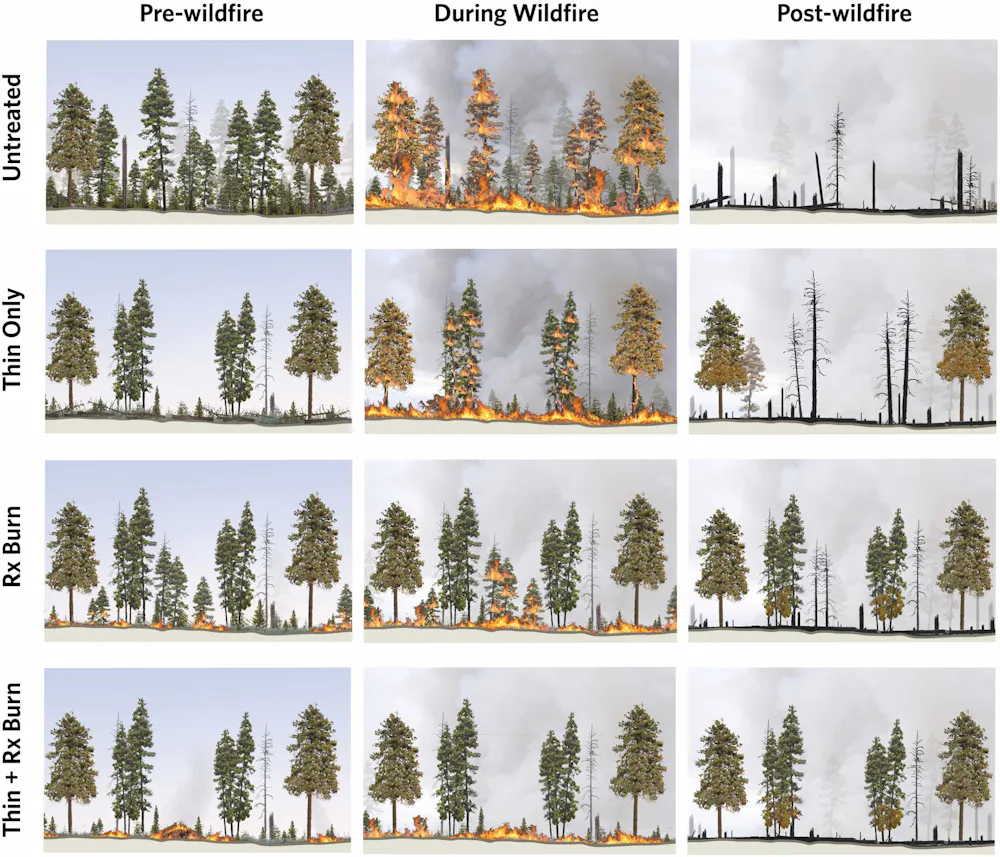
    Measures such as prescribed burns have proven to be effective for maintaining healthy forests and reducing the severity of subsequent wildfires. A recent review found that selective thinning followed by prescribed fire reduced subsequent fire severity by 72% on average, and prescribed fire on its own reduced severity by 62%.

    Prescribed burns and forest thinning tend to reduce the risk of extremely destructive wildfires.
    Kimberley T. Davis, et al., Forest Ecology and Management, 2024, CC BY

    But managing forests well requires knowing how forests are changing, where trees are dying and where undergrowth has built up and increased fire hazards. And, for federal lands, these are some of the jobs that are being targeted by the Trump administration.

    Some of the Forest Service staff who were fired or put in limbo by the Trump administration are those who do research or collect and communicate critical data about forests and fire risk. Other fired staff provided support so crews could clear flammable debris and carry out fuel treatments such as prescribed burns, thinning forests and building fire breaks.

    Losing people in these roles is like firing all primary care doctors and leaving only EMTs. Both are clearly needed. As many people know from emergency room bills, preventing emergencies is less costly than dealing with the damage later.

    Logging is not a long-term fire solution

    The Trump administration cited “wildfire risk reduction” when it issued an emergency order to increase logging in national forests by 25%.

    But private − unregulated − forest management looks a lot different than managing forests to prevent destructive fires.

    Logging, depending on the practice, can involve clear-cutting trees and other techniques that compromise soils. Exposing a forest’s soils and dead vegetation to more sunlight also dries them out, which can increase fire risk in the near term.

    Forest-thinning operations involve carefully removing young trees and brush that could easily burn, with a goal of creating conditions less likely to send fire into the crowns of trees.
    AP Photo/Godofredo A. Vásquez

    In general, logging that focuses on extracting the highest-value trees leaves thinner trees that are more vulnerable to fires. A study in the Pacific Northwest found that replanting logged land with the same age and size of trees can lead to more severe fires in the future.

    Research and data are essential

    For many people in the western U.S., these risks hit close to home.

    I’ve seen neighborhoods burn and friends and family displaced, and I have contended with regular air quality warnings and red flag days signaling a high fire risk. I’ve also seen beloved landscapes, such as those on Cameron Peak, transform when conifers that once made up the forest have not regrown.

    Recovery has been slow on Cameron Peak after a severe fire in 2020. This photo was taken in 2024.
    Bella Oleksy/University of Colorado

    My scientific research group and collaborations with other scientists have been helping to identify cost-effective solutions. That includes which fuel-treatment methods are most effective, which types of forests and conditions they work best in and how often they are needed. We’re also planning research projects to better understand which forests are at greatest risk of not recovering after fires.

    This sort of research is what robust, cost-effective land management is based on.

    When careful, evidence-based forest management is replaced with a heavy emphasis on suppressing every fire or clear-cutting forests, I worry that human lives, property and economies, as well as the natural legacy of public lands left to every American, are at risk.

    Laura Dee receives funding from NASA.

    ref. Controlled burns reduce wildfire risk, but they require trained staff and funding − this could be a rough year – https://theconversation.com/controlled-burns-reduce-wildfire-risk-but-they-require-trained-staff-and-funding-this-could-be-a-rough-year-251705

    MIL OSI – Global Reports

  • MIL-OSI Global: Trump is stripping protections from marine protected areas – why that’s a problem for fishing’s future, and for whales, corals and other ocean life

    Source: The Conversation – USA – By David Shiffman, Faculty Research Associate in Marine Biology, Arizona State University

    The coral reefs of Palmyra Atoll, part of Pacific Islands Heritage Marine National Monument, provide nurseries for many fish species. Andrew S. Wright/U.S. Fish and Wildlife Service via Flickr, CC BY-SA

    The single greatest threat to the diversity of life in our oceans over the past 50 years, more than climate change or plastic pollution, has been unsustainable fishing practices.

    In much of the ocean, there is little to no regulation or oversight of commercial fishing or other human activities. That’s part of the reason about a tenth of marine plant and animal species are considered threatened or at risk.

    It’s also why countries around the world have been creating marine protected areas.

    These protected areas, covering over 11.6 million square miles (30 million square kilometers) in 16,000 locations, offer refuge away from human activities for a wide variety of living creatures, from corals to sea turtles and whales. They give fish stocks a place to thrive, and those fish spread out into the surrounding waters, which helps fishing industries and local economies.

    In the U.S., however, marine protection is being dismantled by President Donald Trump.

    Marine protected areas as of 2022. Fully or highly protected areas represented less than 3% of the ocean, according to the Marine Protection Atlas.
    Marine Conservation Institute via Wikimedia Commons, CC BY-SA

    Trump issued a proclamation on April 17, 2025, titled “Unleashing American commercial fishing in the Pacific,” ordering the removal of key protections to allow commercial fishing in parts of a nearly-500,000-square-mile marine protected area called the Pacific Island Heritage National Marine Monument.

    He also called for a review of all other marine national monuments to decide if they should be opened to commercial fishing too. In addition, the Trump administration is proposing to redefine “harm” under the Endangered Species Act in a way that would allow for more damage to these species’ habitats.

    I’m a marine biologist and scuba diver, and it’s no accident that all my favorite dive sites are within marine protected areas. I’ve found what scientific studies from across the world show: Protected areas have much healthier marine life populations and healthier ecosystems.

    What’s at risk in the Pacific

    The Pacific Island Heritage National Marine Monument, about 750 miles west of Hawaii, is dotted by coral reefs and atolls, with species of fish, marine mammals and birds rarely found anywhere else.

    It is home to protected and endangered species, including turtles, whales and Hawaiian monk seals. Palmyra Atoll and Kingman Reef, both within the area, are considered among the most pristine coral reefs in the world, each providing habitats for a wide range of fish and other species.

    These marine species are able to thrive there and spread out into the surrounding waters because their habitats have been protected.

    A tour of several marine protected areas and their inhabitants in 2016.

    President George W. Bush, a conservative Republican, created this protected area in 2009, restricting fishing there, and President Barack Obama later expanded it. Trump, whose administration has made no secret of its aim to strip away environmental protections across the country’s land and waters, is now reopening much of the marine protected area to industrial-scale fishing.

    The risks from industrial fishing

    When too many fish are killed and too few young fish are left to replace them, it’s considered overfishing, and this has become a growing problem around the world.

    In 1974, about 10% of the world’s fish stocks were overfished. By 2021, that number had risen to 37.7%, according to the United Nations Food and Agriculture Organization’s annual State of Fisheries and Aquaculture Report.

    A fishing net caught on a coral reef can destroy habitat.
    Kampee Patisena/Moment/Getty Images

    Modern industrial-scale fishing practices can also harm other species.

    Bycatch, or catching animals that fishermen don’t want but are inadvertently caught up in nets and other gear, is a threat to many endangered species. Many seabirds, sea turtles and whales die this way each year. Some types of fishing gear, such as trawls and dredges that drag along the sea floor to scoop up sea life, can destroy ocean habitat itself.

    Without regulations or protected areas, fishing can turn into a competitive free-for-all that can deplete fish stocks.

    How marine protected areas protect species

    Marine protected areas are designed to safeguard parts of the ocean from human impacts, including offshore oil and gas extraction and industrial fishing practices.

    Studies have found that these areas can produce many benefits for both marine life and fishermen by allowing overfished species to recover and ensuring their health for the future.

    A decade after Mexico established the Cabo Pulmo protected area, for example, fish biomass increased by nearly 500%.

    How marine protected areas help marine life and local economies.

    Successful marine protected areas tend to have healthier habitats, more fish, more species of fish, and bigger fish than otherwise-similar unprotected areas. Studies have found the average size of organisms to be 28% bigger in these areas than in fished areas with no protections. How many babies a fish has is directly related to the size of the mother.

    All of this helps create jobs through ecotourism and support local fishing communities outside the marine protected area.

    Marine protected areas also have a “spillover effect” – the offspring of healthy fish populations that spawn inside these areas often spread beyond them, helping fish populations outside the boundaries thrive as well.

    Ultimately, the fishing industry benefits from a continuing supply. And all of this happens at little cost.

    A need for more protected areas, not fewer

    Claims by the Trump administration that marine protected areas are a heavy-handed restriction on the U.S. fishing industry do not hold water. As science and my own experience show, these refuges for sea life can instead help local economies and the industry by allowing fish populations to thrive.

    For the future of the planet’s whales, sea turtles, coral reefs and the health of fishing itself, scientists like me recommend creating more marine protected areas to help species thrive, not dismantling them.

    David Shiffman has consulted for many environmental non-profit groups including the Ocean Conservancy, as well as fishing industry groups and fisheries managment agencies.

    ref. Trump is stripping protections from marine protected areas – why that’s a problem for fishing’s future, and for whales, corals and other ocean life – https://theconversation.com/trump-is-stripping-protections-from-marine-protected-areas-why-thats-a-problem-for-fishings-future-and-for-whales-corals-and-other-ocean-life-254925

    MIL OSI – Global Reports

  • MIL-OSI China: China steps up management of ozone-depleting substances, HFCs to tackle climate change

    Source: People’s Republic of China – State Council News

    China steps up management of ozone-depleting substances, HFCs to tackle climate change

    BEIJING, April 23 — China has unveiled a plan to comprehensively strengthen its management of ozone-depleting substances and hydrofluorocarbons (HFCs) in order to address ozone layer depletion and climate change, the Ministry of Ecology and Environment announced on Wednesday.

    According to the national implementation plan on fulfilling the Montreal Protocol on Substances that Deplete the Ozone Layer during the 2025-2030 period, China will regulate nine categories of substances, including HFCs. Notably, eight categories are ozone-depleting substances, while HFCs do not harm the ozone layer but are potent synthetic greenhouse gases that have the potential to contribute to global warming.

    The plan puts forward 11 specific tasks in the areas of source control, process management, end-of-pipe treatment, and import and export regulation.

    For example, to strengthen management of the use of controlled substances, the production of refrigerators and freezers using HFCs as refrigerants will be banned in China’s home appliance sector starting Jan. 1, 2026.

    Since joining the Montreal Protocol on Substances that Deplete the Ozone Layer in 1991, China has faithfully fulfilled its international obligations, phasing out about 628,000 tonnes of ozone-depleting substances, accounting for more than half of the total phased out by developing countries, the ministry revealed.

    MIL OSI China News

  • MIL-OSI United Kingdom: Dog Exclusion Zones in force from Thursday 1 May

    Source: City of Sunderland

    Residents are being reminded that dog exclusion zones come back in force on Sunderland beaches from the beginning of May.

    The dog exclusion zones apply to Roker beach and to a limited stretch of beach at Seaburn, between 1 May and 30 September.

    These are part of the City Council’s wider Public Spaces Protection Order (PSPO) which was introduced in 2019 in response to calls from residents for more enforcement action on a range of anti-social behaviour issues from dog fouling to dropping litter. This was renewed in 2024 following extensive public consultation.

    The City Council’s Cabinet Member for Environment, Transport and Net Zero, Councillor Lindsey Leonard said: “We are proud of our beautiful beaches and want to keep them clean and tidy so everyone can enjoy them.

    “We want to take this opportunity to remind residents about the dog exclusion zones which come into force in May. We have clear signage for these zones at both beaches, as well as information on our website.

    “While most residents are considerate dog owners, there are still some who were in breach of the dog exclusion zones. This resulted in us issuing 21 fixed penalty notices for dogs in the exclusion zones at Roker and Seaburn in 2024.

     “As a council, we take great pride in our beautiful beaches and want everyone to be able to enjoy them. That’s why specific areas of the beach are designated as dog-free zones while the PSPO is in effect.”

    Anyone caught breaching the dog exclusion zones faces a fixed penalty fine of £100.

    For further information on the city’s Public Spaces Protection Order and the area covered by the dog exclusion zone visit www.sunderland.gov.uk/pspo

    MIL OSI United Kingdom

  • MIL-OSI: Microchip Introduces PIC16F17576 MCU Family to Simplify Analog Sensor Design

    Source: GlobeNewswire (MIL-OSI)

    CHANDLER, Ariz., April 23, 2025 (GLOBE NEWSWIRE) — Devices designed for capturing rapidly changing analog signals must respond quickly while consuming minimal power, especially in battery-operated applications. To address these demands, Microchip Technology (Nasdaq: MCHP) has released the PIC16F17576 microcontroller (MCU) product family with integrated low-power peripherals and the ability to precisely measure volatile analog signals.

    PIC16F17576 MCUs feature a new low-power comparator and voltage reference combination that can operate while the MCU core is in sleep mode, allowing for continuous analog measurement while consuming less than 3.0 µA of current. The Analog Peripheral Manager (APM) controls which peripherals are active to minimize total energy consumption and enable battery-operated applications to monitor signals effectively without excessive power drain.

    Engineered for applications that measure volatile analog signals, PIC16F17576 MCUs include operational amplifiers (op amps) with software-controlled gain ladders. This feature enables a single op amp to switch between multiple gain options, helping mitigate noise while maintaining precision and power efficiency. Equipped with up to four op amps and a 12-bit differential ADC with automated averaging, the MCUs enable precise signal measurement over a wide range of inputs.

    “Sensor systems can quickly become complex, often requiring multiple analog components that add board size, cost and power draw,” said Greg Robinson, corporate vice president of Microchip’s MCU business unit. “With the integrated analog features in our low-power PIC16F17576 MCUs, we’re cutting that complexity. You can eliminate parts and reduce power consumption, cutting costs and simplifying the overall design process.”

    PIC16F17576 MCUs are well suited for measuring analog signals in a number of industries, including environmental and industrial monitoring, smart home and building automation. Key applications include vibration and strain measurement, flow metering, gas detection, cold asset tracking and motion sensing. Visit the website to learn more about Microchip’s full portfolio of PIC®MCUs.

    Development Tools
    PIC16F17576 MCUs are supported by MPLAB® X Integrated Development Environment (IDE) and MPLAB Code Configurator which allows designers to easily manage the functionality of the APM and analog peripherals. The devices are compatible with Microchip’s Curiosity Nano EV14L29A development board and MPLAB PICkit™ development tools.

    Pricing and Availability
    PIC16F17576 MCUs are available starting at $.57 each in 10,000-unit quantities. For additional information and to purchase, contact a Microchip sales representative, authorized worldwide distributor or visit Microchip’s Purchasing and Client Services website, www.microchipdirect.com.

    Resources
    High-res images available through Flickr or editorial contact (feel free to publish):

    About Microchip Technology:
    Microchip Technology Inc. is a leading provider of smart, connected and secure embedded control and processing solutions. Its easy-to-use development tools and comprehensive product portfolio enable customers to create optimal designs which reduce risk while lowering total system cost and time to market. The company’s solutions serve over 100,000 customers across the industrial, automotive, consumer, aerospace and defense, communications and computing markets. Headquartered in Chandler, Arizona, Microchip offers outstanding technical support along with dependable delivery and quality. For more information, visit the Microchip website at www.microchip.com.

    Note: The Microchip name and logo, the Microchip logo, MPLAB and PIC are registered trademarks of Microchip Technology Incorporated in the U.S.A. and other countries. PICkit is a trademark of Microchip Technology Inc. in the U.S.A. and other countries All other trademarks mentioned herein are the property of their respective companies.

    The MIL Network

  • MIL-OSI Africa: Moving towards a cleaner SA

    Source: South Africa News Agency

    In a partnership with municipalities, Plastics SA, and civil society organisations, the Department of Forestry, Fisheries and the Environment (DFFE) has driven impactful campaigns to tackle pollution, particularly in urban and coastal areas.

    This in a bid to foster healthier environments and stronger communities.

    “Since September 2024, over 200 000 volunteers, including a significant number of youth, have participated in cleanup events across South Africa, supported by more than 800 000 sponsored cleanup bags. 

    “These efforts have targeted beaches, rivers, roadsides, and inland areas, addressing pollution that affects health, dignity, and local livelihoods. A standout achievement is the International Coastal Cleanup South Africa, which saw 4 852 volunteers, half of them children, cover 778.7km of coastline,” the department said on Wednesday.

    Their efforts resulted in the removal of 111.85 tonnes of waste, collected in 26 265 bags. 

    Minister of Forestry, Fisheries and the Environment, Dr Dion George, has commended the effort. 

    “Every bag of waste removed, every river or beach cleaned, is a step toward a healthier, more equitable South Africa. We salute our volunteers and local heroes, who are making this vision a reality,” the Minister said.

    The initiative revealed the scale of marine pollution, with plastic pieces (92 756 items), foam pieces (46 284 items), and food wrappers (17 637 items) topping the list of pollutants. 

    Among the more unusual items recovered were a mattress, a toilet, and even a dead chicken, underscoring the diversity of waste threatening our coasts.

    “These numbers reflect the power of community action. From township cleanups to coastal restoration, South Africans are taking ownership of their spaces. Our youth, in particular, are leading the charge, showing that environmental stewardship is a shared responsibility,” George said.

    The DFFE’s partnerships with municipalities and organisations like Plastics SA have been instrumental in coordinating these efforts.

    Detailed information on ongoing campaigns is available at www.cleanupandrecycle.co.za.

    Additionally, the department is reviewing the 2024 annual reports from Extended Producer Responsibility schemes for paper, packaging, lighting, and electronics, with progress to be highlighted in the department’s 2024/25 annual report. – SAnews.gov.za

    MIL OSI Africa

  • MIL-OSI United Kingdom: Shawn Sharpe Paints ‘CANvas’ Mural for Earth Day

    Source: City of Preston

    23 April 2025

    To celebrate Earth Day 2025, Preston City Council have partnered with Every Can Counts and local artist Shawn Sharpe to create a thought-provoking mural made from 700 recycled drink cans.

    Shawn live-painted the #EveryCanCounts ‘CANvas’ with a bespoke Earth Day design during Preston’s Egg Rolling event, which saw thousands of locals gather in Avenham Park on Easter Monday. The mural aimed to raise awareness of the infinite recyclability of aluminum, and the importance of recycling drink cans both at home and on-the-go.

    The artwork displays two hands holding a smiling cartoon Earth character, alongside the words ‘Every Action Counts’. The message aims to inspire people to take individual action, no matter how small it may seem, as even small changes can make a big difference to the environment.

    Shawn Sharpe, responsible for many of Preston’s iconic murals in the city centre, explained how his first live-painting experience went:

    “It has been interesting because I don’t get nervous when I paint…but because it is my first live painting in Preston, I didn’t really know what the response from the public was going to be like. [They have been] really engaging, humbling, and it’s nice to see that a lot of people know what’s happening within the City.”

    Earth Day is an annual global event dedicated to raising awareness about important environmental issues and the need to protect natural resources for future generations.

    Mark Taylor, Interim Director of Environment and Property, said:

    “Earth Day is such an important time to remind people that we only have one planet, and we should all be making individual efforts to take care of it. Artwork, particularly from artists that understand our community, can be such a powerful tool to raise awareness of these important events. We are very pleased to have partnered with Shawn on this project, he has done a fantastic job.”

    A team of Every Can Counts ambassadors were also in attendnnce, collecting used drink cans in their recycling backpacks and engaging with members of the public to spread their message about the benefits of recycling. Canzee the mascot, made from over 300 recycled drink cans, made a noisy appearance to show the public just how fun drink can recycling can be.

    Chris Latham-Warde, Programme Manager for Every Can Counts, said:

    “It was great to make an appearance at the popular Preston Egg Roll with our ‘CANvas’ installation designed by the brilliant Shawn Sharpe. The event was not only a great way to celebrate Easter but also to mark Earth Day, which is all about encouraging worldwide action to help benefit the environment and preserve the planet.

    “Aluminium, including drink cans and foil wrapper from Easter eggs, is infinitely recyclable so it’s important to dispose of it properly this Eastertime and beyond!”

    Every Can Counts is a not-for-profit communications programme working to inspire, encourage and empower people to recycle their empty drink cans. The programme is funded through a partnership between European and UK drink can manufacturers, the aluminium recycling industry and drink brands.

    The CANvas is now on display at Lancashire County Council’s new education experience, Eco Town, in Farington. Visits must be booked in advance, and you can find further information about how to book by visiting Lancashire County Council – Eco Town education walkway

    You can recycle your cans on-the-go in the city centre at the following locations:

    • Market Street
    • Earl Street
    • Friargate
    • Ribblesdale Place

    Further information can be found at Recycling on-the-go bins in Preston City Centre

    MIL OSI United Kingdom

  • MIL-OSI Russia: Alexander Novak: “Kavkaz.RF” is becoming the center of competence of the tourism sector of the North Caucasus

    Translartion. Region: Russians Fedetion –

    Source: Government of the Russian Federation – An important disclaimer is at the bottom of this article.

    Deputy Prime Minister Alexander Novak held a final meeting of the board of directors of the North Caucasus Federal District Development Institute, where the results of work for 2024 were presented. Andrey Yumshanov, CEO of Kavkaz.RF, delivered a report.

    Since 2021, Kavkaz.RF’s contribution to the economy has been participation in projects worth a total of 139 billion rubles, of which almost 70% are related to the creation and development of resorts, the rest are investments in other areas of the North Caucasus Federal District economy. There is an obvious steady increase in the share of banks in these projects. If in 2021 it was zero, then in 2024 it amounted to more than a third.

    “We are witnessing a change in the business attitude towards the North Caucasus Federal District and what the state, represented by Kavkaz.RF, is creating here. There are 76 SEZ residents operating at the resorts with a declared investment volume of 158 billion rubles, and 21 of them received the status in 2024. Plus, another 10 were added in the first quarter of this year, which indicates a serious increase in business interest in these sites. This became possible due to the active construction of infrastructure and the promotion of tourism products being created. Kavkaz.RF is today becoming a real center of competence in the tourism sector of the North Caucasus,” noted Alexander Novak.

    In 2024, residents began construction of four hotels on Elbrus, five on Mamison, and a large hotel on Veduchi under the management of Cosmos Hotel Group is being completed. It is planned that investors will invest 12.9 billion rubles this year. All this gives the right to expect an increase in tourist flow.

    Over the years of its existence, the company has commissioned more than 100 facilities, 11 of which were commissioned in 2024. Among these facilities last year were three technologically complex cable cars – on Elbrus, Arkhyz and Veduchi. Also, in record time, the main part of the infrastructure of the new resort “Mamison” was completed, the technical launch of which took place in March of this year.

    “Today, our main focus is on completing the construction of the infrastructure of the northern slope of the Veduchi resort. There are 5 out of 20 facilities left to be commissioned, including a unique road through the gorge. We are also starting the construction of the supporting infrastructure of the Caspian coastal cluster. Of all the facilities of the federal project “Five Seas and Lake Baikal”, we are the first to enter active construction,” Andrey Yumshanov noted in his speech.

    The CEO of Kavkaz.RF added that this year the construction of a new tourist ascent zone on Elbrus, a multifunctional service center on the Azau glade, as well as the recreation of the legendary “Shelter 11”, the concept of which can be seen at the Caucasus Investment Forum, will begin.

    The board of directors of Kavkaz.RF includes Minister of Natural Resources and Environment Alexander Kozlov, Deputy Minister of Economic Development Sergey Nazarov, First Deputy Minister of Energy Pavel Sorokin, CEO of the Agency for Strategic Initiatives Svetlana Chupsheva, Deputy Chairman of VEB Daniil Algulyan, Deputy Plenipotentiary Representative of the President in the North Caucasus Federal District Vladimir Nadykto, Advisor to the Rector’s Office of MGIMO Zarina Doguzova, as well as heads of Kavkaz.RF Andrei Yumshanov and Khasan Timizhev. The board of directors is headed by Deputy Prime Minister Alexander Novak. The work of Kavkaz.RF is supervised by the Ministry of Economic Development of Russia.

    Please note: This information is raw content directly from the source of the information. It is exactly what the source states and does not reflect the position of MIL-OSI or its clients.

    MIL OSI Russia News

  • MIL-OSI USA: Governor Newsom announces appointments 4.22.25

    Source: US State of California 2

    Apr 22, 2025

    SACRAMENTO – Governor Gavin Newsom today announced the following appointments:

    Claire Cullis, of Carmichael, has been appointed Deputy Secretary of Business and Consumer Relations at the California Business, Consumer Services, and Housing Agency. Cullis has been Chief of Staff to the First Partner in the Governor’s Office since 2021. She was Founder of Claire Cullis Consulting, LLC from 2018 to 2021. Cullis was the Executive Director of the Institute for Democracy and Justice from 2018 to 2021. She was the Director of Dignitary and Speaker Engagement at the Global Climate Action Summit for the United Nations Foundation in 2018. Cullis was a Consultant to the Special Olympics for the Austria Winter World Games in 2017. She held multiple positions at the United States Department of the Treasury from 2013 to 2017, including Director of Scheduling, Advance, and Administration, and Associate Director of Scheduling and Advance for the Treasury Secretary. Cullis was an Advance Associate at The White House from 2013 to 2017. She was Deputy Parade Director at the Presidential Inaugural Committee from 2012 to 2013. Cullis was National Advance Staff for Obama for America in 2012. She was a Senior Associate at the Dewey Square Group from 2006 to 2012. She was a Teacher at the Japanese Exchange and Teaching Program from 2005 to 2006. Cullis was National Advance Staff for the John Kerry presidential campaign in 2004. Cullis earned her Master of Business Administration degree from Virginia Tech, and her Bachelor of the Arts degree in International Studies and Studio Art from the University of Iowa. This position does not require Senate confirmation, and the compensation is $195,564. Cullis is a Democrat.

    Sophia Carrillo, of Santa Monica, has been appointed Assistant General Counsel of Enforcement at the California Environmental Protection Agency. Carrillo was an Assistant United States Attorney at the United States Attorney’s Office, Central District of California from 2023 to 2025. She was a Deputy Attorney General at the California Department of Justice from 2019 to 2023. Carrillo was a Judicial Law Clerk at the United States District Court, Eastern District of California from 2018 to 2019. She was an Associate Director of the Mayor’s Office of Talent and Appointments/D.C. Human Resources at the Executive Office of Mayor Muriel Bowser in 2015. Carrillo is a member of the Latino Community Foundation’s Los Angeles Giving Circle. She earned her Juris Doctor degree from Stanford Law School and a Bachelor of the Arts degree in Political Science and Sociology from the University of San Diego. This position does not require Senate confirmation and compensation is $174,000. Carrillo is a Democrat. 

    Iris “Marlene” De La O, of Berkeley, has been appointed Deputy Secretary of Public Policy at the California Environmental Protection Agency. De La O held several positions at Chemonics International from 2021 to 2025, including Senior Partnerships Manager and Director of Climate Change and Resiliency. She was the Director of Resiliency and Acquisitions at the Department of Housing, Preservation, and Development in 2019. De La O was Deputy Director at the California Strategic Growth Council from 2017 to 2018. She was a Consultant at Inter-American Development Bank from 2015 to 2016. De La O was a Manager and Regional Contracts Specialist at Chemonics International from 2012 to 2015. She earned a Master of Public Policy degree in City Planning from the Massachusetts Institute of Technology and a Bachelor of the Arts degree in Development Studies from the University of California, Berkeley. This position does not require Senate confirmation, and compensation is $175,512. De La O is a Democrat.

    Adam Ebrahim, of Carmichael, has been appointed Chief Deputy Director at the Commission on Teacher Credentialing. Ebrahim has been the Senior Director of Policy and Continuous Improvement at the Commission on Teacher Credentialing since 2024. He was the Principal Consultant at Azimuth Learning Partners from 2016 to 2024. Ebrahim was the Director of Education Strategy at Parsec Education in 2024. He was a Staff Consultant at the California Teachers Association from 2020 to 2024. Ebrahim was the Director of Local Control and Accountability Plan and Continuous Improvement at San Juan Unified School District from 2019 to 2020. He was a Project Director at Californians Dedicated to Education Foundation from 2016 to 2019. Ebrahim was a Staff Consultant at Fresno County Superintendent of Schools from 2015 to 2016. He was a Teacher at Fresno Unified School District from 2010 to 2015. Ebrahim was an Enlisted Soldier and Commissioned Officer at the California Army National Guard from 2007 to 2012. He received his Master of Education degree in United States Education in a Global Context from National University, a Master of Arts degree in International Affairs from Washington University in Saint Louis, and a Bachelor of Arts degree in Political Science from University of California, Berkeley. This position does not require Senate confirmation, and the compensation is $181,344. Ebrahim is a Democrat.

    Vanessa Ejike, of Cerritos, has been appointed to the State Board of Education. Ejike was a Poll Worker for the Los Angeles County Registrar-Recorder/County Clerk and an Intern for Assemblymember Sharon Quirk-Silva in the California State Assembly in 2024. She is the National Partnerships Director for the High School Democrats of America, Local Affairs Director for California High School Democrats, Communications Coordinator for the Pacific Coast Coalition of Girl Up USA, Student Representative for the Legislative and Policy Committee at the ABC Unified School District, and Founder and Chair of the Principal’s Advisory Council at Gretchen Whitney High School. This position does not require Senate confirmation, and the compensation is $100 per diem. Ejike is not registered to vote. 

    Niki Woodard, of Sacramento, has been appointed Deputy Director of Communications and External Affairs at the California Energy Commission. Woodard has been the Senior Communications Officer at Resources Legacy Fund since 2019. She was the Deputy Assistant Director at the California Department of Water Resources from 2016 to 2019. Woodard was the Communications and Marketing Director at the Center for Climate Protection from 2015 to 2016. She was Founder and Principal of Spiral-PR from 2011 to 2016. Woodard was the Communications Director at Sequoia Riverlands Trust from 2008 to 2011. She was a Research Associate at the Pew Research Center from 2006 to 2008. Woodard earned a Master of the Arts degree in Communications from Georgetown University and a Bachelor of the Arts degrees in Rhetoric and Economics from the University of California, Berkeley. This position does not require Senate confirmation, and compensation is $160,968. Woodard is a Democrat.

    Lee Herrick, of Fresno, has been reappointed California’s Poet Laureate, where he has served since 2022. Herrick has been an English Professor at Fresno City college since 1997 and an Adjunct Professor at the University of Nevada, Reno at Lake Tahoe since 2012. He was the Poet Laureate of the City of Fresno from 2015 to 2017. Herrick was an Adjunct English Professor at Modesto Junior College from 1995 to 1997. He is the Founder of LitHop and an Advisory Board Member of Terrain.org, Sixteen Rivers Press, and Anacapa review, and a Member of the Association of Writers and Writing Programs. Herrick earned a Master of Arts degree in English, Composition and Rhetoric and a Bachelor of Arts degree in English and American Literature from California State University, Stanislaus. This position requires Senate confirmation, and the California Arts Council provides an annual stipend. Herrick is a Democrat.

    Press Releases, Recent News

    Recent news

    News What you need to know: The Governor and First Partner marked Earth Day at Chico State University with students from the Center for Regenerative Agriculture and Resilient Systems. CHICO –  Governor Gavin Newsom and First Partner Jennifer Siebel Newsom celebrated…

    News What you need to know: Classes resumed in person at Palisades Charter High School today at a new temporary site in Santa Monica. All eight public schools that were damaged in the fires are now back to learning in person. LOS ANGELES – Today, Governor Gavin Newsom…

    News What you need to know: The Cradle-to-Career Data System displays key milestones in students’ experience over time and provides insights about education and career pathways. Sacramento, California – Today, Governor Gavin Newsom unveiled a first-of-its-kind…

    MIL OSI USA News

  • MIL-OSI Asia-Pac: Joint Statement at the conclusion of the State Visit of Prime Minister to the Kingdom of Saudi Arabia

    Source: Government of India

    Posted On: 23 APR 2025 12:44PM by PIB Delhi

    “A Historic Friendship; A Partnership for Progress”

    At the invitation of His Royal Highness Prince Mohammed bin Salman bin Abdulaziz Al Saud, Crown Prince and Prime Minister of the Kingdom of Saudi Arabia, Hon’ble Prime Minister of the Republic of India, Shri Narendra Modi paid a State Visit to the Kingdom of Saudi Arabia on April 22, 2025.

    This was Prime Minister Shri Narendra Modi’s third visit to the Kingdom of Saudi Arabia. It followed the historic State Visit of HRH Prince Mohammed bin Salman bin Abdulaziz Al Saud, Crown Prince and Prime Minister of the Kingdom of Saudi Arabia’s visit to India in September 2023 to participate in the G-20 Summit and co-chair the first meeting of the India- Saudi Arabia Strategic Partnership Council.

    His Royal Highness Prince Mohammed bin Salman bin Abdulaziz Al Saud, Crown Prince and Prime Minister, received Prime Minister Shri Narendra Modi at Al-Salam Palace, Jeddah.They held official talks, during which they recalled the strong bonds of historically close friendship between the Republic of India and the Kingdom of Saudi Arabia. India and Saudi Arabia enjoy a strong relationship and close people-to-people ties marked by trust and goodwill. The two sides noted that the solid foundation of the bilateral relationship between the two nations has further strengthened through the strategic partnership covering diverse areas including defense, security, energy, trade, investment, technology, agriculture, culture, health, education, and people-to-people ties. Both sides also exchanged views on current regional and international issues of mutual interest.

    Prime Minister Shri Narendra Modi congratulated HRH Prince Mohammed bin Salman bin Abdulaziz Al Saud, Crown Prince and Prime Minister of Kingdom of Saudi Arabia for Saudi Arabia’s successful bids for World Expo 2030 and FIFA World Cup 2034.

    The two leaders held constructive discussions on ways to strengthen the strategic partnership between India and the Kingdom of Saudi Arabia. The two leaders also co-chaired the second meeting of the India-Saudi Arabia Strategic Partnership Council (SPC). The two sides reviewed the progress of the Strategic Partnership Council since their last meeting in September 2023. Both leaders expressed their satisfaction with the outcomes of the work of the two Ministerial Committees, namely: (a) the Committee on Political, Security, Social and Cultural Cooperation and their subcommittees and (b) the Committee on Economy and Investment and their Joint Working Groups, in diverse fields. In this context, the Co-Chairs of the Council welcomed the expansion of the Strategic Partnership Council to four Ministerial Committees reflecting the deepening of the Strategic Partnership, by addition of the Ministerial Committees on Defence Cooperation, and Tourism and Cultural Cooperation. The two leaders noted with appreciation the large number of high-level visits across various Ministries that have built trust and mutual understanding on both sides. At the end of the Meeting, the two leaders signed the Minutes of the Second Meeting of the India-Saudi Arabia Strategic Partnership Council.

    The Indian side expressed its appreciation to the Saudi side for the continuing welfare of around 2.7 million Indian nationals residing in the Kingdom, reflecting the strong people- to-people bonds and immense goodwill that exists between the two nations. The Indian side also congratulated Saudi Arabia for successfully holding the Haj pilgrimage in 2024 and expressed its appreciation for the excellent coordination between the two countries in facilitating Indian Haj and Umrah pilgrims.

    Both sides welcomed the growth of the economic relationship, trade and investment ties between India and Kingdom of Saudi Arabia in recent years. The Indian side congratulated the Saudi side for progress achieved on the goals under Vision 2030. Saudi side expressed appreciation for India’s sustained economic growth and the goal of Viksit Bharat or becoming a developed country by 2047. Both sides agreed to work together in areas of mutual interests to fulfill respective national goals and achieve shared prosperity.

    Both Leaders noted with satisfaction the progress made in the discussions under the High-Level Task Force (HLTF), constituted in 2024 for promoting investment flows between the two countries. Building on the endeavor of Saudi Arabia to invest in India in multiple areas including energy, petrochemicals, infrastructure, technology, fintech, digital infrastructure, telecommunications, pharmaceuticals, manufacturing and health, it was noted that the High-Level Task Force came to an understanding in multiple areas which will rapidly promote such investment flows. They noted the agreement in the High-Level Task Force to collaborate on establishing two refineries. The progress made by this Task Force in areas such as taxation was also a major breakthrough for greater cooperation in the future. The two sides affirmed their desire to complete negotiations on the Bilateral Investment Treaty at the earliest. The Indian side appreciated the launch of India Desk at the Public Investment Fund (PIF) to act as the nodal point for investment facilitation by PIF. They observed that work of the High-Level Task Force underscores the growing economic partnership between India and Saudi Arabia focusing on mutual economic growth and collaborative investments.

    The two sides affirmed their commitment to strengthening their direct and indirect investment partnership. They commended the outcomes of the Saudi-India Investment Forum, held in New Delhi in September 2023, and the active cooperation it achieved between the public and private sectors from both countries. They also commended the expansion of investment activities by Indian companies in the Kingdom, and appreciated the role of the private sector in enhancing mutual investments.The two sides valued the activation of the Framework of Cooperation on Enhancing Bilateral Investment between Invest India and Ministry of Investment of Saudi Arabia. Both sides agreed to facilitate enhanced bilateral cooperation in the startup ecosystem, contributing to mutual growth and innovation.

    In the field of Energy, the Indian side agreed to work with the Kingdom to enhance the stability of global oil markets and to balance global energy market dynamics. They emphasized the need to ensure security of supply for all energy sources in global markets. They agreed on the importance of enhancing cooperation in several areas in the energy sector, including the supply of crude oil and its derivatives including LPG, collaboration in India’s Strategic Reserve Program, joint projects across the refining and petrochemical sector, including manufacturing and specialized industries, innovative uses of hydrocarbons, electricity, and renewable energy, including completing the detailed joint study for electrical interconnection between the two countries, exchanging expertise in the fields of grid automation, grid connectivity, electrical grid security and resilience, and renewable energy projects and energy storage technologies, and enhancing the participation of companies from both sides in implementing their projects.

    The two sides emphasized the importance of cooperation in the field of green/clean hydrogen, including stimulating demand, developing hydrogen transport and storage technologies, exchanging expertise and experiences to implement best practices. The two sides also acknowledged the need to work on developing supply chains and projects linked to the energy sector, enabling cooperation between companies, enhancing cooperation in the field of energy efficiency and rationalizing energy consumption in the buildings, industry, and transportation sectors, and raising awareness of its importance.

    With regard to climate change, both sides reaffirmed the importance of adhering to the principles of the United Nations Framework Convention on Climate Change and the Paris Agreement, and the need to develop and implement climate agreements with a focus on emissions rather than sources. The Indian side commended the Kingdom’s launch of the “Saudi Green Initiative” and the “Middle East Green Initiative”and expressed its support for the Kingdom’s efforts in the field of climate change. The two sides stressed the importance of joint cooperation to develop applications of the circular carbon economy by promoting policies that use the circular carbon economy as a tool to manage emissions and achieve climate change objectives.The Kingdom of Saudi Arabia appreciated India’s contributions to global climate action by pioneering initiatives like International Solar Alliance, One Sun-One World-One Grid, Coalition of Disaster Resilient Infrastructure (CDRI) and Mission Lifestyle for Environment (LiFE) and Global Green Credit Initiative.

    Both sides expressed satisfaction at the steady growth in bilateral trade in recent years with India being the second largest trading partner for Saudi Arabia; and Saudi Arabia being India’s fifth largest trading partner in 2023-2024. Both sides agreed to further enhance co-operation to diversify their bilateral trade. In this regard, both sides agreed on the importance of increasing visits of business and trade delegations, and holding trade and investment events. Both sides reiterated their desire for commencing negotiations on the India-GCC FTA.

    The two sides appreciated the deepening of the defence ties as a key pillar of the Strategic Partnership, and welcomed the creation of a Ministerial Committee on Defence Cooperation under the Strategic Partnership Council. They noted with satisfaction the growth of their joint defence cooperation including numerous ‘firsts’ like the first ever Land Forces exercise SADA TANSEEQ, two rounds of the Naval Exercises AL MOHED AL HINDI, many high-level visits, and training exchanges, towards ensuring the security and stability of the region. They welcomed the outcomes of the 6th meeting of the Joint Committee on Defence Cooperation held in Riyadh in September 2024, noting the initiation of staff-level talks between all three services. Both sides also agreed to enhance defence industry collaboration.

    Noting the continuing cooperation achieved in security fields, both sides highlighted the importance of this cooperation for better security and stability. They also emphasized the importance of furthering cooperation between both sides in the areas of cybersecurity, maritime border security, combating transnational crime, narcotics and drug trafficking.

    Both sides strongly condemned the gruesome terror attack in Pahalgam, Jammu and Kashmir on 22 April 2025, which claimed the lives of innocent civilians. In this context, the two sides condemned terrorism and violent extremism in all its forms and manifestations, and emphasized that this remains one of the gravest threats to humanity. They agreed that there cannot be any justification for any act of terror for any reason whatsoever. They rejected any attempt to link terrorism to any particular race, religion or culture. They welcomed the excellent cooperation between the two sides in counter-terrorism and the terror financing. They condemned cross-border terrorism, and called on all States to reject the use of terrorism against other countries, dismantle terrorism infrastructure where it exists, and bring perpetrators of terrorism to justice swiftly. Both sides stressed the need to prevent access to weapons including missiles and drones to commit terrorist acts against other countries.

    The two sides noted the ongoing cooperation in field of health and efforts to combat current and future health risks and health challenges. In this context, they welcomed the signing of the MOU on Cooperation in the Field of Health between the two countries. The Indian side congratulated the Kingdom of Saudi Arabia for successfully hosting the Fourth Ministerial Conference on Antimicrobial Resistance in Jeddah in November 2024. Indian side welcomed the initiatives taken by the Saudi Food and Drug Authority to address issues related to reference pricing and fast track registration of Indian drugs in Saudi Arabia. Both sides also welcomed the extension of the MoU on Co-operation in the Field of Medical Products Regulation between Saudi Food and Drug Authority and Central Drugs Standard Control Organization (CDSCO) for a further period of five years.

    Both sides underscored the importance of co-operation in technology including in new and emerging domains such as Artificial Intelligence, cybersecurity, semi-conductors etc. Highlighting the importance of digital governance,both sides agreed to explore collaboration in this area. They also expressed satisfaction on signing of the MOU between Telecom Regulatory Authority of India and Communications, Space and Technology Commission of Kingdom of Saudi Arabia for cooperation in regulatory and digital sectors.

    Both sides noted that the MoU on space cooperation signed during this visit will pave the way for enhanced cooperation in the field of space, including utilization of launch vehicles, spacecraft, ground systems; applications of space technology; research and development; academic engagement and entrepreneurship.

    Both sides noted the growth of cultural cooperation between the Kingdom of Saudi Arabia and the Republic of India through active engagement in key sectors such as heritage, film, literature, and performing and visual arts. The creation of a Ministerial Committee on Tourism and Cultural Cooperation under the Strategic Partnership Council marks a significant step toward deepening this partnership.

    Both sides also agreed to enhance cooperation in tourism including through capacity building and sustainable tourism. They also noted the expansion of various opportunities in media, entertainment, and sports, supported by the strong people-to-people ties between the two countries.

    Both sides appreciated the long-standing cooperation between the two countries in the areas of agriculture and food security, including trade of fertilizers. They agreed to pursue long-term agreements for the security of supply, mutual investments and joint projects towards building long-term strategic cooperation in this area.

    The two sides commended the growing momentum in educational and scientific collaboration between the two countries, underscoring its strategic importance in fostering innovation, capacity building, and sustainable development. The Saudi side welcomes the opportunities for leading Indian universities to have presence in Saudi Arabia.The two sides also stressed the value of expanding cooperation in labour and human resources and identifying opportunities for collaboration.

    Both sides recalled the signing of the Memorandum of Understanding on the Principles of an India-Middle East-Europe Economic Corridor along with other countries in September 2023 during the state visit of HRH Prince Mohammed bin Salman bin Abdulaziz Al Saud, Crown Prince and Prime Minister of Kingdom of Saudi Arabia to India and expressed mutual commitment to work together to realize the vision of connectivity as envisaged in the Corridor, including the development of infrastructure that includes railways and port linkages to increase the passage of goods and services, and boost trade among stakeholders, and enhance data connectivity and electrical grid interconnectivity. In this regard, both sides welcomed the progress under the MoU on Electrical Interconnections, Clean/Green Hydrogen and Supply Chains signed in October 2023. Both sides also expressed satisfaction on the increase in shipping lines between the two countries.

    The two sides stressed the importance of enhancing cooperation and coordination between the two countries in international organizations and forums, including the G20, the International Monetary Fund, and the World Bank, to bolster efforts to address the challenges facing the global economy. They commended the existing cooperation between them within the Common Framework for Debt Treatment Beyond the Debt Service Suspension Initiative (DSSI), which was endorsed by the G20 leaders at the Riyadh Summit 2020. They stressed the importance of enhancing the implementation of the Common Framework as the main and most comprehensive platform for coordination between official creditors (developing country creditors and Paris Club creditors) and the private sector to address the debt of eligible countries.

    The two sides affirmed their full support for the international and regional efforts aimed at reaching a comprehensive political solution to the crisis in Yemen. The Indian side appreciated the Kingdom’s many initiatives aimed at encouraging dialogue between the Yemeni parties, and its role in providing and facilitating access of humanitarian aid to all regions of Yemen. The Saudi side also appreciated the Indian effort in providing humanitarian aid to Yemen.The two sides agreed on the importance of cooperation to promote ways to ensure the security and safety of waterways and freedom of navigation in line with the United Nations Convention on the Law of the Sea (UNCLOS).

    The following MoUs were signed during the visit:

    • MoU between Department of Space, India, and Saudi Space Agency in the field of space activities for peaceful purposes.

    • MoU between Ministry of Health and Family Welfare, Republic of India and Ministry of Health, Kingdom of Saudi Arabia & on Cooperation in the Field of Health.

    • Bilateral Agreement between Department of Posts, India and Saudi Post Corporation (SPL) for inward foreign surface parcel.

    • MOU between National Anti-Doping Agency of India (NADA), India, and Saudi Arabia Anti-Doping Committee (SAADC) for cooperation in the field of anti-doping and prevention.

    Both sides agreed to hold the next meeting of the Strategic Partnership Council on a date mutually agreed upon. As the two nations march ahead with economic and social developments in their respective countries, they also decided, that they will continue communication, coordination and cooperation across various sectors.

    At the end of the visit, Prime Minister Shri Narendra Modi, expressed his sincere thanks and appreciation to His Royal Highness Prince Mohammed bin Salman bin Abdulaziz Al Saud, Crown Prince and Prime Minister, for the warm reception and generous hospitality extended to him and his accompanying delegation. He also conveyed his best wishes for continued progress and prosperity of the friendly people of the Kingdom of Saudi Arabia. For his part, His Royal Highness extended his sincere wishes to Prime Minister Narendra Modi and the friendly people of India for further progress and prosperity.

    ***

    MJPS/VJ

    (Release ID: 2123722) Visitor Counter : 170

    MIL OSI Asia Pacific News

  • MIL-OSI Asia-Pac: FEHD orders food factory in Kwai Chung to suspend business for 14 days

    Source: Hong Kong Government special administrative region

    FEHD orders food factory in Kwai Chung to suspend business for 14 days    
    The premises, located at Shop 11 on the ground floor of Cheong Wang Mansion at 539 Castle Peak Road, was ordered to suspend business from today (April 23) to May 6.
        
    “Two convictions for the above-mentioned breach were recorded against the shop licensee in August of last year and January of this year. A total fine of $8,300 was levied by the court and 15 demerit points were registered against the licensee under the department’s demerit points system. The contraventions resulted in the 14-day licence suspension,” a spokesman for the Food and Environmental Hygiene Department (FEHD) said.
        
    The licensee concerned had a record of two convictions for extending the business area illegally in April and June of last year. A total fine of $6,000 was levied and 30 demerit points were also registered, leading to a seven-day licence suspension during August and September last year.
        
    The spokesman reminded licensees of food premises to comply with the FBR, or their licences could be suspended or cancelled.
     
    Licensed food premises are required to exhibit their licence and a sign at a conspicuous place of the premises, indicating that the premises has been licensed. A list of licensed food premises is available on the FEHD website (www.fehd.gov.hk/english/licensing/licence-foodPremises-search.htmlIssued at HKT 15:00

    NNNN

    MIL OSI Asia Pacific News

  • MIL-OSI NGOs: Aid workers describe Gaza as “stuff of nightmares” as Israel’s mass forced displacements cause carnage and despair

    Source: Oxfam –

    Restrictions on movement and total siege making aid operations almost impossible – Oxfam 

    As Gaza enters the eighth week of an Israel-imposed siege, blocking aid, vital supplies and commercial goods, Oxfam staff are describing conditions as the “stuff of nightmares”, with Israel’s mass forced displacement orders spreading terror, Oxfam said.  

    Israel has issued repeated forced displacement orders to clear out civilian populations from its renewed airstrikes and attacks on Gaza since 18 March, which has left about 70% of the Strip under displacement orders or “no go” zones, affecting more than 500,000 people. Many have been pushed into inhospitable, unsafe and inaccessible areas.  

    Since 2 March, Israel has allowed no aid or commercial goods to enter Gaza. Many humanitarian agencies have been forced to pause their operations. Oxfam and its partners have not received a single aid truck, food parcel, hygiene kit or any other essential equipment since the siege began. Oxfam’s supplies are nearly exhausted, with only a few water tanks remaining in Gaza City. 

    Palestinians in Gaza are now emotionally and physically exhausted after 18 months of airstrikes and ground offensives, repeated forced displacement orders and restrictions on basic services since October 7, 2023. 

    “It’s hard to explain just how terrible things are in Gaza at the moment. Our staff and partners are witnessing scenes of carnage and despair every day. People are in terror, fearing for their lives as displacement orders tell them, with little notice, to move with whatever they can carry.”

    Clemence Lagouardat, Oxfam Response Lead in Gaza

    Oxfam International

    The recent escalations in efforts by Israel to bombard, deprive and displace the Palestinian population of Gaza, sees Oxfam and partner organizations severely restricted and struggling to provide support to civilians, who are facing starvation and relentless violence.  

    One Oxfam staff member, who was displaced under fire twice in one week after the forced evacuation of Rafah, said nearly everything had been destroyed. She described the sounds of gunfire at night and people crying in the street, not knowing where to go. Another Oxfam worker said the experiences were “the stuff of nightmares” – people crying for help under piles of rubble, with others desperately trying to flee with injured family members, and others facing a daily struggle to find anything to drink or eat.  

    Clemence Lagouardat, Oxfam Response Lead in Gaza said:  

    “It’s hard to explain just how terrible things are in Gaza at the moment. Our staff and partners are witnessing scenes of carnage and despair every day. People are in terror, fearing for their lives as displacement orders tell them, with little notice, to move with whatever they can carry. 

    “The restrictions on internal movement are also making it very difficult to carry out vital, life-saving work. With so many people displaced, the strains on dwindling resources and operational needs are massive. What little aid we have left inside Gaza is hard to get to people living in makeshift shelters and tents when travel is so dangerous.” 

    Mohammad Nairab, Executive Manager, Palestinian Environmental Friends Association (PEF), one of Oxfam’s partners in Gaza said: 

    “Since the war resumed many of our teams have been displaced. We have had to continue our work despite the lack of safety, as countless people rely on us for water, especially during these dire times. Nothing could have prepared us for such an unprecedented war. The damage we face—both psychological and physical—is profound and cannot be undone.” 

    Oxfam says that people are struggling to find safe drinking water, with facilities bombed or unable to operate since Israel cut the last remaining electricity supplies needed to run sanitation facilities. Backup generators are of little use because fuel stores are depleted. The prices of what little food is available have skyrocketed, and many people are at risk of extreme hunger.  

    Lagouardat said: “We must see an end to this terror and carnage right now, with a lifting of the siege to allow urgent humanitarian aid to reach all of those in need.”  

    Oxfam is calling for a renewed and permanent ceasefire, the safe return of Israeli hostages and illegally detained Palestinian prisoners, and immediate and unfettered aid access at scale in Gaza. Oxfam reiterates its call for justice and accountability for all those affected. States should stop selling arms to Israel, risking complicity in war crimes and crimes against humanity.      

    //Ends 

    MIL OSI NGO

  • MIL-OSI NGOs: Todos, todos, todos

    Source: Greenpeace Statement –

    He’ll come back again, I muttered as I declined a friend’s invitation to see Pope Francis when he visited the University of Sto. Tomas in 2015. There was good reason to believe he would. Being one of two predominantly Catholic countries in Asia, the Philippines would certainly be a prime place for a liberal-leaning pope to visit. That confidence was also masked by a certain hubris that I might find myself in Rome one of these days, looking up at St. Peter’s Square. So his sudden death brings more regrets than questions; a certainty that I missed the mark and did not see Christ’s representative in the flesh.

    Having been raised Catholic, the life of the Church was always like a familiar plaza. There was as much friendship as there was gossip, and it was a place to cultivate not only one’s faith but also the sense of community that is so important with the Church. In a sense, I was also brought up in the more traditional track of Catholicism, and this was also reflected in my theological interests during graduate studies. Looking back, it seemed all the more strange that I would refuse an opportunity to see the Pope. Perhaps there was something stirring inside me, a subconscious feeling that made it difficult for me to embrace the Church.

    Francis, in many ways, represented a perceived break—a moment of irruption in the unified vision of the Church. One could remember the fear in his eyes when he was presented to the world for the first time in strikingly simple garb. There was something uncanny about him when he was addressing the crowd. Why couldn’t I shake off the feeling of discomfort? Being Jesuit-educated, I should understand this simplicity, but for some reason, there was what Karl Rahner called “the unsolved remainder” that lingered long after the pomp and excitement of Francis’s election.

    And it became more and more apparent as Francis slowly broke down what I thought was the Church, often in gentle ways. From admitting—to a Haiyan survivor—the failure of human reason amidst unspeakable suffering, to kissing the feet of inmates in Regina Coeli prison in Rome every Maundy Thursday, Francis’s brand of Church-building was one of humility.

    The Franciscan brand of humility was never far away from radical unity. In order for the Church to be truly itself, she had to go back to her roots, a Church that called for the liberation of the oppressed, that swung open the doors of secrecy, that loved everyone—todos, todos, todos—regardless of orientation, belief, background, or status. The roots of the Church, Francis pressed, had to go where there was a real chance it would not grow and then eventually rot away. The fringes and the frontlines where God seemingly has abandoned humanity: among the wastelands of war, famine, and communities flattened by extreme weather, and even in the most personal and intimate encounters of the deafening silence of God.

    Perhaps it was the reaching out to the margins that terrified me, because spiritually, I’ve found myself in those dark corners especially in the last few years. Perhaps I felt seen and heard, and I did not want to be because I refused to admit that all I heard was silence. Because such is the nature of the dark night–it creeps up silently, etching away the facade of one’s faith. It then becomes like an irresistible itch that one unconsciously scratches, preventing any kind of healing. Paradoxically, it is only ever in this kind of darkness and silence that the God of Francis’s teaching fully reveals His power, the power of pure presence, and this presence had a name: mercy.

    That was probably the unsolved remainder: a God that offered no world-changing reason for the problems of humanity, no quick fixes to the climate crisis, no easy answers to the suffering of the innocent. A God that simply announces Himself as Herself in the midst of the world’s brokenness, with the complete honesty that nothing will ever fully address the weight of suffering. Francis represented that simple, honest, and all-embracing mercy, and that disturbed me, because little did I know that I was the one being ministered to.

    Perhaps that was what Francis really tried to teach: to be able to have the confidence to confront even the darkest questions, mustering up the courage to face the world’s problems with nothing more than the quiet assurance that God will never leave. This conviction probably annoyed me because it was easier said than done. It probably angered me too as it didn’t offer the kind of solutions our world has been accustomed to.

    The urgency is much more pressing in a world that is slowly crumbling away from the excesses of the rich and powerful, who continue to prioritize greed and self-interest over the life of the planet, and who foment hate towards those that are not like them. Could you believe that? The “answer” to all these overwhelming problems was to be silent and sit by someone and cry with them?

    Maybe it was less of an answer and more of a signpost towards a starting point. That, to meet and commune with those who have suffered, what was required was to refrain from immediately offering solutions and open oneself up to the simple power of presence. In many ways it is also a slap on my face: working in an environmental NGO, one gets lost in the urgency of the calls, for instance, to make polluters pay, and one forgets the truly essential starting point of mercy. One gets addicted to the thrill of campaigning, and one neglects the unsolved remainder that will always result from the calculus of the climate crisis. Perhaps the starting point in addressing the climate crisis is on the level of fear and trembling with others, where words fail and presence remains the only acceptable response. Much like the silence that envelops a household swept away by a storm surge, and no amount of campaigning will ever repay or repair what was lost. Campaigning involving human suffering always entails acquiescing to the silence of presence, and only then can one build truly merciful and human connections and tackle the climate crisis together with others.

    It took Francis’s death to make me realize that I was being ministered to spiritually and in work, and there is no timeline for when the darkness will be lifted. Now the plaza is less bustling and, at times, flooded. And the floating garbage is like the lingering memories of the moments I wasted neglecting my own faith and conviction for my work. But when I look up, all I see are the forgotten that Francis invited back into the Church, and I realize my own brokenness and darkness too, as I am constantly being invited back to the Church that is equally broken.

    Maybe this is what it means to be a Church now: to acknowledge our brokenness and how we have become used to or even addicted to it. To use this as a starting point to see each other as each other and cultivate the kind of courageous presence that breaks down the powerful. Until everyone, everyone, and everyone is embraced without measure.

    You might want to check out Greenpeace Philippines’ petition called Courage for Climate, a drive in support of real policy and legal solutions in the pursuit of climate justice.

    Courage for Climate

    The climate crisis may seem hopeless, but now is the time for courage, not despair. Join Filipino communities taking bold action for our planet.

    Make an Act of Courage Today!


    Jefferson Chua is a Greenpeace Campaigner working on climate, based in the Philippines.

    MIL OSI NGO

  • MIL-OSI USA: MATSUI AND BLUMENTHAL SLAM TERMINATION OF CRITICAL CRUISE LINE SANITATION PROGRAM AMID GROWING REPORTS OF ILLNESS OUTBREAKS

    Source: United States House of Representatives – Congresswoman Doris Matsui (D-CA)

    WASHINGTON, D.C. – Today, Congresswoman Doris Matsui (D-CA) and U.S. Senator Richard Blumenthal (D-CT) wrote to Acting Director of the Center for Disease Control and Prevention (CDC) Susan Monarez criticizing the elimination of all full-time staff at the CDC’s Vessel Sanitation Program (VSP), a vital program that works to prevent and control public health incidents and disease outbreaks aboard cruise ships. In their letter, Matsui and Blumenthal cite recent reports of illnesses spreading on cruise ships, including norovirus. The decimation of the VSP comes at a time of cuts, freezes, and firings at the CDC from the Trump Administration’s Department of Government Efficiency.

    “Through routine inspections, training of cruise ship personnel, and responses to and documentation of outbreaks aboard cruise ships, the VSP protects and promotes public health for cruisegoers everywhere. This critical information helps the traveling public make informed decisions before they sail,” wrote the lawmakers. “It is therefore confounding that the VSP has been swept up in the indiscriminate cuts that were initiated recently at the CDC.”

    “As we saw with the rampant spread of COVID-19 aboard cruise ships in the early days of the pandemic, these environments provide a prime opportunity for the transmission of disease. That is why it is absolutely critical that the CDC maintains the office and staff responsible for dealing with outbreaks on cruise ships. Severely reducing or eliminating the program that holds CDC’s subject matter expertise on this issue is short-sighted, and will ultimately lead to more illnesses,” continued Matsui and Blumenthal.

    The full text of the letter can be found below.

     Dear Acting Director Monarez,

     We are extremely alarmed by reports that all full-time employees of the Center for Disease Control’s (CDC) Vessel Sanitation Program (VSP) have been terminated.[1] As news of the worst outbreak aboard a cruise ship this year is making headlines, it is incomprehensible that the officials responsible for protecting the health of the cruise-going public would be abruptly terminated.[2]

     The VSP is a vital program that works to prevent, control, and publicize public health incidents aboard cruise ships.[3] Through routine inspections, training of cruise ship personnel, and responses to and documentation of outbreaks aboard cruise ships, the VSP protects and promotes public health for cruisegoers everywhere.[4] Among its most important functions are VSP’s maintenance of databases of outbreaks in its jurisdiction and inspection scores for cruise ships.[5] This critical information helps the traveling public make informed decisions before they sail. It is therefore confounding that the VSP has been swept up in the indiscriminate cuts that were initiated recently at the CDC. According to reports, the CDC’s Division of Environmental Health Science and Practice, which housed the VSP, was decimated by staff losses.[6] 

    Elimination of the VSP is especially concerning now, when just last month a massive norovirus outbreak was reported on a luxury cruise liner travelling from England to the Caribbean.[7] This outbreak aboard the Queen Mary 2 sickened 224 passengers and 17 crew members.[8] And indeed, while this is the most widespread cruise ship outbreak so far this year, it is far from the first. According to the database maintained by the VSP, there have already been thirteen confirmed outbreaks aboard cruise ships in the first three months of 2025, sickening almost 1,400 people this year alone.[9]

     As we saw with the rampant spread of COVID-19 aboard cruise ships in the early days of the pandemic, these environments provide a prime opportunity for the transmission of disease. That is why it is absolutely critical that the CDC maintains the office and staff responsible for dealing with outbreaks on cruise ships. Severely reducing or eliminating the program that holds CDC’s subject matter expertise on this issue is short-sighted, and will ultimately lead to more illnesses. 

    It is therefore critical to understand CDC’s plan to continue its vital cruise ship monitoring efforts, in the absence of the VSP. To that end, we request answers to the following questions by May 6, 2025:

    1. Please describe what plans, if any, the CDC has for eliminating the VSP.
      1. Please describe what metrics, if any, were used when evaluating the potential elimination of the VSP.
    2. Please describe how the CDC intends to fulfill its statutory obligations to protect public health aboard cruise ships in the absence of the VSP.
    3. How many employees working for the VSP have left since January 20, 2025? Please include employees who accepted a deferred resignation offer, had their employment terminated, or were placed on administrative leave.
    4. Will CDC continue to update its inspection scores database so the travelling public can make informed decisions when planning a cruise?
    5. Will CDC continue to update its database of outbreaks to ensure the public has access to critical public health information about illnesses on cruise ships?

     We appreciate your attention to this matter and look forward to your timely response. 

    # # #

    MIL OSI USA News

  • MIL-OSI USA: MATSUI, NEGUSE, COHEN, MCCLELLAN LEAD RESOLUTION TO CELEBRATE EARTH DAY

    Source: United States House of Representatives – Congresswoman Doris Matsui (D-CA)

    WASHINGTON, D.C. – Today, Congresswoman Doris Matsui (CA-07), co-chair of the House Sustainable Energy and Environment Coalition (SEEC), Assistant Democratic Leader Joe Neguse (CO-02), and Reps. Steve Cohen (TN-09), and Jennifer McClellan (VA-04) led a group of 48 lawmakers in introducing a resolution to commemorate Earth Day 2025. The resolution celebrates recent historic environmental actions that have improved the health and wellbeing of our planet, while also reaffirming the work that still needs to be done to secure a livable future for the next generation. 

    “Since the first declaration of Earth Day fifty-five years ago, we have made incredible progress towards protecting and restoring the natural world that we rely on and enjoy,” said Congresswoman Matsui. “However, in less than 100 days, President Trump has worked to erase decades of progress, dismantling climate science, weakening critical environmental agencies, and launching an all-out assault on clean air and clean water. This unprecedented assault on clean air and clean water is a stark reminder that Earth Day remains as important and revolutionary today as it was in 1970. This Earth Day, I am honored to join my colleagues in reaffirming and celebrating our shared responsibility to protect and preserve our planet for future generations, and I will never stop fighting to uphold these ideals at every level of government.”

    “On Earth Day, communities across the country reaffirm their commitment to protecting the environment and our treasured public lands,” said Congressman Neguse. “And for me, as a proud Coloradan, the fight to ensure future generations can enjoy the outdoors the same way we have is deeply personal. Which is why I’m proud to join my colleagues in continuing to charge forward in Congress with efforts that prioritize protecting our planet.” 

    “Fifty-five years after the first Earth Day, our commitment to environmental protection must be stronger than ever,” said Congressman Cohen. “The Trump administration is once again doing the bidding of polluters—rolling back clean air and clean water standards, halting enforcement of environmental safeguards, and illegally freezing congressionally authorized funding meant to combat climate change, reduce pollution, and protect public health. Climate change is accelerating. Our air, water, and communities are under threat. Earth Day is not just a reminder of what’s at stake—it’s a call to rededicate ourselves to the fight for a cleaner, healthier, and more sustainable planet for the next generation.”

    “Our children deserve a future where clean air, safe water, and a stable climate are not luxuries, but guarantees,” said Congresswoman McClellan. “This Earth Day, we must reaffirm our commitment to climate action and environmental justice. We are not just responding to a crisis today — we are building a better, more just world that our children will inherit tomorrow.”

    Congresswoman Matsui has long been a champion of strong environmental protections, life-saving pollution regulations, and bold climate action. In Congress, she has led efforts to strengthen vehicle and power plant pollution standards and supported energy efficiency programs that save American families money. As Co-Chair of the SEEC Lands, Waters, and Nature Task Force, Congresswoman Matsui also coordinates the coalition’s work to preserve the environment, protect public lands and critical habitat, and advance nature-based approaches to addressing climate change. 

    Read the full resolution HERE.


    # # #

    MIL OSI USA News

  • MIL-OSI Africa: Flooding incidents in Ghana’s capital are on the rise. Researchers chase the cause

    Source: The Conversation – Africa – By Stephen Appiah Takyi, Senior Lecturer, Department of Planning, Kwame Nkrumah University of Science and Technology (KNUST)

    Urban flooding is a major problem in the global south. In west and central Africa, more than 4 million people were affected by flooding in 2024. In Ghana, cities suffer damage from flooding every year.

    Ghana’s president, John Dramani Mahama, has established a task force to find ways of improving flood resilience in the country. This is partly driven by an increase in flooding incidents in cities such as Accra and Kumasi in the last decade.

    We are urban planning and sustainability scholars. In a recent paper we analysed whether flooding in Accra, Ghana’s capital, was caused by climate change or poor land use planning.

    We conclude from our analysis that flooding is caused by poor and uncoordinated land use planning rather than climate change. We recommend that the physical planning department and other regulatory agencies are equipped to ensure the effective enforcement the relevant land use regulations.

    Mixed push factors

    The Accra metropolitan area is one of the 29 administrative units of Ghana’s Greater Accra region. It is the most populous region in Ghana, with over five million residents, according to the 2021 Housing and Population Census.

    We interviewed 100 households living in areas such as Kaneshie, Adabraka and Kwame Nkrumah Circle. These areas experience a high incidence of floods. Representatives of agencies such as the Physical Planning Department of the Accra Metropolitan Assembly, the National Disaster Management Organisation and the Environmental Protection Agency were interviewed too, about:

    • the nature and areas most prone to flooding in the study area

    • the frequency of flooding

    • land use planning and regulations and their influence on flooding.

    About 40% of the people we interviewed attributed flooding to both weak enforcement of land use regulation and changes in rainfall patterns. Most of the households (52%) said floods in Accra were the result of weak enforcement of land use regulations, while 8% blamed changes in land use regulations.

    We also analysed recorded data on flood incidence and rainfall. We found no correlation between increased rainfall and flooding. For example in 2017 there was a decrease in rainfall, but an increase in flooding.

    This finding points to the fact that rainfall isn’t the only factor contributing to flooding in the city.

    The agencies and city residents reported that between 2008 and 2018, they could see that more people were encroaching on the city’s wetlands by building homes and commercial infrastructure. This has changed the natural flow of water bodies. The Greater Accra Metropolitan and its environs has major wetlands such as Densu Delta, Sakumo Lagoon and Songor Lagoon.

    Interview respondents noted that the siting of unauthorised buildings and the encroachment on buffer zones of water bodies in the city could have been averted. They blamed political interference in the enforcement of land use regulation. The government makes the situation worse in two ways, they said:

    • planning standards and regulations are neglected in the development process. The processes involved in acquiring development permits are cumbersome and expensive, so people go ahead and develop without permits.

    • regulatory institutions and authorities are ineffective. This is clear from the fact that planning happens chaotically. No attention is given to the ecological infrastructure that’s needed.

    The way forward

    We conclude that land use malpractices remain the dominant causes of flooding in Accra. They include:

    • poor disposal of solid waste, which eventually blocks drains and results in water overflow during heavy rains

    • building on wetlands as a result of non-compliance or non-enforcement of land use regulations.

    There is an urgent need for Ghana’s cities to adopt best practices in waste management. These include recycling of plastic waste and composting for urban agriculture. An environmental excise tax was introduced in 2011 to fund plastic waste recycling and support waste management agencies.

    The increasing encroachment on wetlands should be addressed through the strict enforcement of buffer regulations. Planning authorities and the judiciary can collaborate on this. The city must also encourage green infrastructure, like rain gardens, green roofs, permeable pavement, street trees and rain harvesting systems. Research has shown these to be environmentally sustainable and cost-effective approaches to managing storm water.

    Another suggested approach is the introduction of the polluter pays principle in city management. This is a system where city residents who are involved in the pollution of the environment are made to pay for the cost of mitigating the impact. Residents who dispose of waste indiscriminately and encroach on wetlands would be made to pay for the cost of the environmental degradation. Cities such as Barcelona and Helsinki have applied this principle in the management of their industrial discharge and contaminated waste.

    Finally, there should be incentives for city residents to promote environmental sustainability. For example, a deposit refund system has been introduced in several states in the US and Australia. In this system, consumers are made to pay a deposit after purchasing items that can be recycled, such as plastic bottles, and the deposit is reimbursed to the consumer after the return of the empty bottles to a retail store.

    – Flooding incidents in Ghana’s capital are on the rise. Researchers chase the cause
    – https://theconversation.com/flooding-incidents-in-ghanas-capital-are-on-the-rise-researchers-chase-the-cause-254000

    MIL OSI Africa

  • MIL-OSI United Kingdom: Geoengineering – an explainer on the science and ethics

    Source: United Kingdom – Executive Government & Departments

    Geoengineering, also known as climate engineering or climate intervention, refers to the deliberate, large-scale manipulation of the Earth’s climate system to counteract human-caused climate change. It involves interventions like reflecting sunlight back into space to mitigate the effects of global warming. While the UK government and main research funders are in favour of conducting fundamental research to improve our understanding of these potential interventions (but not deployment of these approaches), these initiatives have still proved controversial with many inside and outside science, who argue that even researching this area is a dangerous distraction from the kind of climate action we need now.

    The National Environment Research Council (NERC) announced £10 million of new funding for modelling solar radiation management schemes last week and we expect ARIA to announce funding soon. The Royal Society is currently working on a new report on Solar Radiation Management (SRM) expected later this year, and NERC, part of UK Research and Innovation, have also announced a public engagement exercise this summer. With all this activity planned, the SMC invited some leading experts to meet science journalists explain the main scientific approaches to this research, outline why funders believe this research is justified and answer questions.

    Speakers included:

    Prof Mark Symes, Programme Director, ARIA and Professor of Electrochemistry and Electrochemical Technology, University of Glasgow

    Kate Hamer, NERC Director, Strategy & Analysis

    Prof Jim Haywood, Professor of Atmospheric Science, University of Exeter

    Dr Pete Irvine, Research Assistant Professor, Solar Geoengineering, University of Chicago and Co-founder of SRM360

    Dr Sebastian Eastham, Senior Lecturer in Sustainable Aviation, Imperial College London

    MIL OSI United Kingdom

  • MIL-OSI Australia: New QWildlife marine stranding app launched

    Source: Tasmania Police

    Issued: 23 Apr 2025

    The Queensland Government has added a new function to the QWildlife app, allowing marine strandings across the state to be reported in real time to the Department of the Environment, Tourism, Science and Innovation (DETSI).

    Launched in 2020, the highly popular and successful QWildlife app that allows people to report crocodile sightings and koala sightings to DETSI has been expanded to include marine strandings.

    People can now report stranding incidents along Queensland’s vast coastline and include the time and date along with photographs of stranded marine animals, such as turtles, sharks and marine mammals.

    This citizen science information will help DETSI to better understand marine strandings across the state and will ensure the Queensland Parks and Wildlife Service (QPWS) and local wildlife carer groups can be activated quickly to respond to stranded marine life.

    QPWS Assistant Director-General Andrew Buckley said marine animals strand for several reasons, including illness or disease, predation and human intervention such as boat strike or entanglement in fishing equipment.

    “This new function of the QWildlife app demonstrates the Queensland Government’s commitment to protecting and conserving our extraordinary marine animals,” he said.

    “I encourage all residents and visitors to our coastal areas to download and use the QWildlife app to report sightings of stranded marine animals.

    “Your contributions are essential in understanding and enhancing the conservation and welfare of marine life across our coastline.

    “The Marine Stranding functionality of the QWildlife app promotes community involvement and also represents a crucial step in marine conservation.

    “Its ability to collect real-time data will be invaluable in guiding our conservation strategies, marine life rescues and to mitigate human intervention.”

    Chief Technology Officer Peter Reyne from software development firm GP One said the new function would add a vital element to the QWildlife app.

    “The crocodile and koala functions of the QWildlife app have provided critical information about those species and extending that for marine life conservation was the next step,” Mr Reyne said.

    “We anticipate that the addition of Marine Strandings to the QWildlife app will significantly improve the Queensland Government’s ability to respond to our treasured sea creatures when they strand.”

    The QWildlife app can be downloaded by visiting the app store or Google Play.

    View more information on downloading the QWildlife app to report a marine animal stranding, Marine wildlife strandings including strandings data.

    MIL OSI News

  • MIL-Evening Report: Flooding incidents in Ghana’s capital are on the rise. Researchers chase the cause

    Source: The Conversation (Au and NZ) – By Stephen Appiah Takyi, Senior Lecturer, Department of Planning, Kwame Nkrumah University of Science and Technology (KNUST)

    Urban flooding is a major problem in the global south. In west and central Africa, more than 4 million people were affected by flooding in 2024. In Ghana, cities suffer damage from flooding every year.

    Ghana’s president, John Dramani Mahama, has established a task force to find ways of improving flood resilience in the country. This is partly driven by an increase in flooding incidents in cities such as Accra and Kumasi in the last decade.

    We are urban planning and sustainability scholars. In a recent paper we analysed whether flooding in Accra, Ghana’s capital, was caused by climate change or poor land use planning.

    We conclude from our analysis that flooding is caused by poor and uncoordinated land use planning rather than climate change. We recommend that the physical planning department and other regulatory agencies are equipped to ensure the effective enforcement the relevant land use regulations.

    Mixed push factors

    The Accra metropolitan area is one of the 29 administrative units of Ghana’s Greater Accra region. It is the most populous region in Ghana, with over five million residents, according to the 2021 Housing and Population Census.

    We interviewed 100 households living in areas such as Kaneshie, Adabraka and Kwame Nkrumah Circle. These areas experience a high incidence of floods. Representatives of agencies such as the Physical Planning Department of the Accra Metropolitan Assembly, the National Disaster Management Organisation and the Environmental Protection Agency were interviewed too, about:

    • the nature and areas most prone to flooding in the study area

    • the frequency of flooding

    • land use planning and regulations and their influence on flooding.

    About 40% of the people we interviewed attributed flooding to both weak enforcement of land use regulation and changes in rainfall patterns. Most of the households (52%) said floods in Accra were the result of weak enforcement of land use regulations, while 8% blamed changes in land use regulations.

    We also analysed recorded data on flood incidence and rainfall. We found no correlation between increased rainfall and flooding. For example in 2017 there was a decrease in rainfall, but an increase in flooding.

    This finding points to the fact that rainfall isn’t the only factor contributing to flooding in the city.

    The agencies and city residents reported that between 2008 and 2018, they could see that more people were encroaching on the city’s wetlands by building homes and commercial infrastructure. This has changed the natural flow of water bodies. The Greater Accra Metropolitan and its environs has major wetlands such as Densu Delta, Sakumo Lagoon and Songor Lagoon.

    Interview respondents noted that the siting of unauthorised buildings and the encroachment on buffer zones of water bodies in the city could have been averted. They blamed political interference in the enforcement of land use regulation. The government makes the situation worse in two ways, they said:

    • planning standards and regulations are neglected in the development process. The processes involved in acquiring development permits are cumbersome and expensive, so people go ahead and develop without permits.

    • regulatory institutions and authorities are ineffective. This is clear from the fact that planning happens chaotically. No attention is given to the ecological infrastructure that’s needed.

    The way forward

    We conclude that land use malpractices remain the dominant causes of flooding in Accra. They include:

    • poor disposal of solid waste, which eventually blocks drains and results in water overflow during heavy rains

    • building on wetlands as a result of non-compliance or non-enforcement of land use regulations.

    There is an urgent need for Ghana’s cities to adopt best practices in waste management. These include recycling of plastic waste and composting for urban agriculture. An environmental excise tax was introduced in 2011 to fund plastic waste recycling and support waste management agencies.

    The increasing encroachment on wetlands should be addressed through the strict enforcement of buffer regulations. Planning authorities and the judiciary can collaborate on this. The city must also encourage green infrastructure, like rain gardens, green roofs, permeable pavement, street trees and rain harvesting systems.
    Research has shown these to be environmentally sustainable and cost-effective approaches to managing storm water.

    Another suggested approach is the introduction of the polluter pays principle in city management. This is a system where city residents who are involved in the pollution of the environment are made to pay for the cost of mitigating the impact. Residents who dispose of waste indiscriminately and encroach on wetlands would be made to pay for the cost of the environmental degradation. Cities such as Barcelona and Helsinki have applied this principle in the management of their industrial discharge and contaminated waste.

    Finally, there should be incentives for city residents to promote environmental sustainability. For example, a deposit refund system has been introduced in several states in the US and Australia. In this system, consumers are made to pay a deposit after purchasing items that can be recycled, such as plastic bottles, and the deposit is reimbursed to the consumer after the return of the empty bottles to a retail store.

    The authors do not work for, consult, own shares in or receive funding from any company or organisation that would benefit from this article, and have disclosed no relevant affiliations beyond their academic appointment.

    ref. Flooding incidents in Ghana’s capital are on the rise. Researchers chase the cause – https://theconversation.com/flooding-incidents-in-ghanas-capital-are-on-the-rise-researchers-chase-the-cause-254000

    MIL OSI AnalysisEveningReport.nz

  • MIL-OSI Global: Flooding incidents in Ghana’s capital are on the rise. Researchers chase the cause

    Source: The Conversation – Africa – By Stephen Appiah Takyi, Senior Lecturer, Department of Planning, Kwame Nkrumah University of Science and Technology (KNUST)

    Urban flooding is a major problem in the global south. In west and central Africa, more than 4 million people were affected by flooding in 2024. In Ghana, cities suffer damage from flooding every year.

    Ghana’s president, John Dramani Mahama, has established a task force to find ways of improving flood resilience in the country. This is partly driven by an increase in flooding incidents in cities such as Accra and Kumasi in the last decade.

    We are urban planning and sustainability scholars. In a recent paper we analysed whether flooding in Accra, Ghana’s capital, was caused by climate change or poor land use planning.

    We conclude from our analysis that flooding is caused by poor and uncoordinated land use planning rather than climate change. We recommend that the physical planning department and other regulatory agencies are equipped to ensure the effective enforcement the relevant land use regulations.

    Mixed push factors

    The Accra metropolitan area is one of the 29 administrative units of Ghana’s Greater Accra region. It is the most populous region in Ghana, with over five million residents, according to the 2021 Housing and Population Census.

    We interviewed 100 households living in areas such as Kaneshie, Adabraka and Kwame Nkrumah Circle. These areas experience a high incidence of floods. Representatives of agencies such as the Physical Planning Department of the Accra Metropolitan Assembly, the National Disaster Management Organisation and the Environmental Protection Agency were interviewed too, about:

    • the nature and areas most prone to flooding in the study area

    • the frequency of flooding

    • land use planning and regulations and their influence on flooding.

    About 40% of the people we interviewed attributed flooding to both weak enforcement of land use regulation and changes in rainfall patterns. Most of the households (52%) said floods in Accra were the result of weak enforcement of land use regulations, while 8% blamed changes in land use regulations.

    We also analysed recorded data on flood incidence and rainfall. We found no correlation between increased rainfall and flooding. For example in 2017 there was a decrease in rainfall, but an increase in flooding.

    This finding points to the fact that rainfall isn’t the only factor contributing to flooding in the city.

    The agencies and city residents reported that between 2008 and 2018, they could see that more people were encroaching on the city’s wetlands by building homes and commercial infrastructure. This has changed the natural flow of water bodies. The Greater Accra Metropolitan and its environs has major wetlands such as Densu Delta, Sakumo Lagoon and Songor Lagoon.

    Interview respondents noted that the siting of unauthorised buildings and the encroachment on buffer zones of water bodies in the city could have been averted. They blamed political interference in the enforcement of land use regulation. The government makes the situation worse in two ways, they said:

    • planning standards and regulations are neglected in the development process. The processes involved in acquiring development permits are cumbersome and expensive, so people go ahead and develop without permits.

    • regulatory institutions and authorities are ineffective. This is clear from the fact that planning happens chaotically. No attention is given to the ecological infrastructure that’s needed.

    The way forward

    We conclude that land use malpractices remain the dominant causes of flooding in Accra. They include:

    • poor disposal of solid waste, which eventually blocks drains and results in water overflow during heavy rains

    • building on wetlands as a result of non-compliance or non-enforcement of land use regulations.

    There is an urgent need for Ghana’s cities to adopt best practices in waste management. These include recycling of plastic waste and composting for urban agriculture. An environmental excise tax was introduced in 2011 to fund plastic waste recycling and support waste management agencies.

    The increasing encroachment on wetlands should be addressed through the strict enforcement of buffer regulations. Planning authorities and the judiciary can collaborate on this. The city must also encourage green infrastructure, like rain gardens, green roofs, permeable pavement, street trees and rain harvesting systems.
    Research has shown these to be environmentally sustainable and cost-effective approaches to managing storm water.

    Another suggested approach is the introduction of the polluter pays principle in city management. This is a system where city residents who are involved in the pollution of the environment are made to pay for the cost of mitigating the impact. Residents who dispose of waste indiscriminately and encroach on wetlands would be made to pay for the cost of the environmental degradation. Cities such as Barcelona and Helsinki have applied this principle in the management of their industrial discharge and contaminated waste.

    Finally, there should be incentives for city residents to promote environmental sustainability. For example, a deposit refund system has been introduced in several states in the US and Australia. In this system, consumers are made to pay a deposit after purchasing items that can be recycled, such as plastic bottles, and the deposit is reimbursed to the consumer after the return of the empty bottles to a retail store.

    The authors do not work for, consult, own shares in or receive funding from any company or organisation that would benefit from this article, and have disclosed no relevant affiliations beyond their academic appointment.

    ref. Flooding incidents in Ghana’s capital are on the rise. Researchers chase the cause – https://theconversation.com/flooding-incidents-in-ghanas-capital-are-on-the-rise-researchers-chase-the-cause-254000

    MIL OSI – Global Reports

  • MIL-OSI Russia: Panda Katyusha began living in the Moscow Zoo separately from her mother

    Translartion. Region: Russians Fedetion –

    Source: Moscow Government – Government of Moscow –

    Katyusha – my favorite Moscow Zoo and the first panda born in Russia, will turn one year and eight months old on April 24. Her mother, Dindin, has decided that Katyusha is old enough to live on her own.

    In the wild, bamboo bears take care of their cubs and feed them for up to one and a half to two years. Dinding was very sensitive to her daughter – she fed her milk, taught her caution, instilled all the necessary skills – for example, the ability to climb and group when falling. Then she taught Katyusha to eat bamboo, and at six months the little panda tried carrots. Now the cub’s diet includes everything an adult needs and everything necessary for full growth and development. Katyusha eats bamboo, carrots, sweet potatoes, apples and panda cakes – special steamed bread.

    “Now Dindin has decided that her cub has grown up and is ready to live separately. This moment comes suddenly and quickly for animals. One day, the female began to show the first signs of a fight for territory. She began to growl threateningly, snort and chase Katyusha away. These aggressive actions could be dangerous for the cub. Our zoologists contacted Chinese specialists, and they recommended that we separate the pandas, which was done,” said Svetlana Akulova, General Director of the Moscow Zoo.

    Katyusha has excellent indicators – she weighs 65 kilograms. For comparison: Dindin at this age was almost nine kilograms lighter. Katyusha also recently began to participate in veterinary training: she allows you to feel her belly, examine her teeth, and stand on the scales. She also learned this by repeating her mother’s movements.

    The design of the Fauna of China pavilion allows for rotation of the animals: now Katyusha and Dinding take turns walking in the outdoor enclosure. After some time, zoologists tried to connect the mother with the cub through a lattice gate, but the adult female began making threatening sounds again. Therefore, now the pandas remain in separate rooms.

    Moscow Zoo specialists believe that Katyusha is ready for independent life. But the baby will have a certain period of adaptation. Zoologists are closely monitoring the condition of these animals and are in constant contact with Chinese specialists from the Center for the Conservation and Study of Giant Pandas.

    You can watch how pandas live online at this page.

    The name for the first giant panda born in Russia chose Muscovites: The Moscow City Department of Culture and the Active Citizen project have prepared a special vote.

    The Moscow Zoo opened in 1864. Today it is one of the oldest zoos in Europe. It is under the jurisdiction of the capital’s Department of Culture.

    Sobyanin: Moscow Zoo takes first place in the world in species diversity

    Get the latest news quickly official telegram channel the city of Moscow.

    Please note: This information is raw content directly from the source of the information. It is exactly what the source states and does not reflect the position of MIL-OSI or its clients.

    Please Note; This Information is Raw Content Directly from the Information Source. It is access to What the Source Is Stating and Does Not Reflect

    https: //vv.mos.ru/nevs/ite/153019073/

    MIL OSI Russia News

  • MIL-Evening Report: Sniping koalas from helicopters: here’s what’s wrong with Victoria’s unprecedented cull

    Source: The Conversation (Au and NZ) – By Liz Hicks, Lecturer in Law, The University of Melbourne

    Roberto La Rosa/Shutterstock

    Snipers in helicopters have shot more than 700 koalas in the Budj Bim National Park in western Victoria in recent weeks. It’s believed to be the first time koalas have been culled in this way.

    The cull became public on Good Friday after local wildlife carers were reportedly tipped off.

    A fire burned about 20% of the park in mid-March. The government said the cull was urgent because koalas had been left starving or burned.

    Wildlife groups have expressed serious concern about how individual koalas had been chosen for culling, because the animals are assessed from a distance. It’s not clear how shooting from a helicopter complies with the state government’s own animal welfare and response plans for wildlife in disasters.

    The Victorian government must explain why it is undertaking aerial culling and why it did so without announcing it publicly. The incident points to ongoing failures in managing these iconic marsupials, which are already threatened in other states.

    Hundreds of koalas were left starving or injured after bushfires in Budj Bim National Park a month ago.
    Vincent_Nguyen/Shutterstock

    Why did this happen?

    Koalas live in eucalypt forests in Australia’s eastern and southern states. The species faces a double threat from habitat destruction and bushfire risk. They are considered endangered in New South Wales, Queensland and the Australian Capital Territory.

    In Victoria, koala population levels are currently secure. But they are densely concentrated, often in fragments of bush known as “habitat islands” in the state’s southwest. Budj Bim National Park is one of these islands.

    Over time, this concentration becomes a problem. When the koalas are too abundant, they can strip leaves from their favourite gums, killing the trees. The koalas must then move or risk starvation.

    If fire or drought make these habitat islands impossible to live in, koalas in dense concentrations often have nowhere to go.

    In Budj Bim, Victoria’s Department of Energy, Environment and Climate Action and Parks Victoria have tackled koala overpopulation alongside Traditional Owners by moving koalas to new locations or sterilising them.

    But Budj Bim is also surrounded by commercial blue gum plantations. Koalas spread out through the plantations to graze on the leaves. Their populations grow. But when the plantations are logged, some koalas have to return to the national park, where food may be in short supply.

    Plantations of blue gums are located near Budj Bim. Animal welfare groups claim logging has driven koala overpopulation in the national park.
    Anna Carolina Negri/Shutterstock

    Animal welfare groups say logging is one reason Budj Bim had so many koalas.

    It’s hard to say definitively whether this is the case, because the state environment department hasn’t shared much information. But researchers have found habitat islands lead to overabundance by preventing the natural dispersal of individuals.

    So why was the culling done? Department officials have described the program as “primarily” motivated by animal welfare. After the bushfire last month, koalas have been left starving or injured.

    Why shooters in helicopters? Here, the justification given is that the national park is difficult to access due to rocky terrain and fire damage, ruling out other methods.

    Euthanising wildlife has to be done carefully

    Under Victoria’s plan for animal welfare during disasters, the environment department is responsible for examining and, where necessary, euthanising wildlife during an emergency.

    For human intervention to be justified, euthanasia must be necessary on welfare grounds. Victoria’s response plan for fire-affected wildlife says culling is permitted when an animal’s health is “significantly” compromised, invasive treatment is required, or survival is unlikely.

    For koalas, this could mean loss of digits or hands, burns to more than 15% of the body, pneumonia from smoke inhalation, or blindness or injuries requiring surgery. Euthanised females must also be promptly examined for young in their pouches.

    The problem is that while aerial shooting can be accurate in some cases for larger animals, the method has questionable efficacy for smaller animals – especially in denser habitats.

    It’s likely a number of koalas were seriously injured but not killed. But the shooters employed by the department were not able to thoroughly verify injuries or whether there were joeys in pouches, because they were in the air and reportedly 30 or more metres away from their targets.

    While the department cited concerns about food resources as a reason for the cull, the state’s wildlife fire plan lays out another option: delivery of supplementary feed. Delivering fresh gum leaves could potentially have prevented starvation while the forest regenerates.

    What should the government learn from this?

    The state government should take steps to avoid tragic incidents like this from happening again.

    Preserving remaining habitat across the state is a vital step, as is reconnecting isolated areas with habitat corridors. This would not only reduce the concentration of koalas in small pockets but increase viable refuges and give koalas safe paths to new food sources after a fire.

    Future policies should be developed in consultation with Traditional Owners, who have detailed knowledge of species distributions and landscapes.

    We need better ways to help wildlife in disasters. One step would be bringing wildlife rescue organisations into emergency management more broadly, as emphasised in the 2009 Victorian Bushfires Royal Commission and the more recent Royal Commission into National Natural Disaster Arrangements.

    This latter report pointed to South Australia’s specialised emergency animal rescue and relief organisation – SAVEM – as an effective model. Under SA’s emergency management plan, the organisation is able to rapidly access burned areas after the fire has passed through.

    Victoria’s dense communities of koalas would be well served by a similar organisation able to work alongside existing skilled firefighting services.

    The goal would be to make it possible for rescuers to get to injured wildlife earlier and avoid any more mass aerial culls.

    Liz Hicks has previously received a Commonwealth Research Training Program stipend. She is a member of the Australian Greens Victoria, although her views do not reflect a party position or party policy.

    Dr Ashleigh Best previously received a Commonwealth Research Training Program scholarship, which supported some of the research in this article. She is an inactive member of the Animal Justice Party, and previously volunteered with Wildlife Victoria.

    ref. Sniping koalas from helicopters: here’s what’s wrong with Victoria’s unprecedented cull – https://theconversation.com/sniping-koalas-from-helicopters-heres-whats-wrong-with-victorias-unprecedented-cull-254996

    MIL OSI AnalysisEveningReport.nz

  • MIL-OSI New Zealand: Bridge on popular Hooker Valley Track at Aoraki/Mount Cook closed after heavy rainfall

    Source: Department of Conservation

    Date:  23 April 2025

    The second bridge on the Hooker Valley Track has been impacted by riverbank erosion from wind and rain events over the past few years and is also susceptible to heavy snowfalls.

    DOC staff and engineers have been closely monitoring riverbank erosion at the bridge, and following the recent heavy rain over Easter, the bridge was closed.

    “We’ve been managing the second bridge for the past couple of years, adding micro piling and other measures but continued erosion of the riverbank, with the prospect of more heavy rain and snow loading this winter, we have made the decision to close the bridge permanently,” says DOC Director of Asset Management Shan Baththana.

    DOC Aoraki/Mount Cook Operations Manager Sally Jones says while it’s disappointing to have to close the bridge, public safety is DOC’s number one priority.

    She says the walk up the Hooker Valley is closed temporarily until access to the lower part of the track is secured and a new suspension bridge is built.

    “Walking up the Hooker Valley to see Aoraki and staying at the popular Hooker Hut is a highlight for many visitors and the temporary closure of the track will disrupt plans. But public safety is always number one.”

    “We’re now focused on securing the site so we can reopen the lower section of the track as soon as possible. In the meantime, there are several other beautiful and accessible walks that remain open and offer those stunning views of Aoraki that people love. Kea Point is a great place for visitors to get those once in a lifetime photos. Aoraki/Mount Village is still very much open for business.”

    Sally Jones says what’s exciting is the new 189-metre-long suspension bridge being built on the Hooker Valley track.

    She says the new bridge is a significant investment in the long-term resilience of the Hooker Valley Track. Once complete, it will be the longest pedestrian suspension bridge in the country — and a remarkable way to safely experience the power and beauty of this landscape.

    The new bridge has been specifically designed to withstand more extreme weather events.

    “One of New Zealand’s best day hikes, Hooker Valley Track is used by around half a million visitors annually and is the most popular visitor attraction in the Aoraki/Mount Cook National Park. We are committed to investing in these well-loved nature experiences. We need to continue to provide safe access and make sure our infrastructure is future proofed against the effects of climate change, rainfall and winds. Nature is our most important economic asset and sustains industries like tourism.”

    Sally Jones says work has already started on the bridge project with track building around the site. The aim is to have it open in Autumn 2026.

    Aoraki/Mount Cook National Park has over one million visitors annually and is second only to Fiordland in terms of most popular New Zealand national parks for international visitors.

    Sally Jones says the number of visitors is increasing and she does have a message for those visiting Aoraki/Mount Cook.

    “A concerning trend we’re seeing is visitors going off track through fragile vegetation and rocky terrain. This not only causes lasting damage to the environment — it also puts people at real risk. The landscape here is breathtaking but unforgiving. We ask everyone to think carefully about where they’re walking and climbing, and to stick to marked tracks for their own safety and to help protect this special place for others.
    We all have a responsibility to do this. DOC staff work hard to keep people safe and over the next year while we are building the new bridge, we need everyone to respect the environment and the advice we give.”

    Contact

    For media enquiries contact:

    Email: media@doc.govt.nz

    MIL OSI New Zealand News

  • MIL-OSI USA: Cantwell & Colleagues Introduce Bill to Permanently Protect the Pacific Ocean from Offshore Drilling

    US Senate News:

    Source: United States Senator for Washington Maria Cantwell
    04.22.25
    Cantwell & Colleagues Introduce Bill to Permanently Protect the Pacific Ocean from Offshore Drilling
    Cantwell: WA’s maritime economy supports nearly $46 billion in business revenue & more than 174k jobs – all of which could be compromised in an instant by an oil spill
    WASHINGTON, D.C. – Today, on Earth Day, U.S. Senator Maria Cantwell (D-WA), ranking member of the Senate Committee on Commerce, Science, and Transportation and senior member of the Senate Finance Committee, joined her colleagues in announcing the reintroduction of the West Coast Protection Act to permanently protect the Pacific Ocean from the dangers of fossil fuel drilling.
    “Washington’s $45.9 billion maritime economy supports over 174,000 jobs from fisheries, trade, tourism, and recreation – but it could all be devastated in an instant by an oil spill,” Sen. Cantwell said. “We must permanently ban offshore drilling on the West Coast to protect our coastal communities, economies, and ecosystems against the risk of an oil spill.”
    This bill prohibits the Department of the Interior from issuing a lease for the exploration, development, or production of oil or natural gas in any area of the Outer Continental Shelf off the coast of California, Oregon, or Washington. This legislation comes just after the 15th anniversary of the Deepwater Horizon oil spill, which resulted in the deaths of 11 workers, 134 million gallons spilled into the Gulf of Mexico over 87 days, the demise of thousands of marine mammals and sea turtles, and billions of dollars in economic losses from the fishing, outdoor recreation, and tourism industries.
    The West Coast Protection Act was introduced by U.S. Senator Alex Padilla (D-CA) and is additionally cosponsored by Senators Cory Booker (D-NJ), Edward J. Markey (D-MA), Jeff Merkley (D-OR), Patty Murray (D-WA), Bernie Sanders (I-VT), Adam Schiff (D-CA), Sheldon Whitehouse (D-RI), and Ron Wyden (D-OR). It is endorsed by organizations including Natural Resources Defense Council (NRDC), Oceana, Defenders of Wildlife, Earthjustice, Surfrider Foundation, Seattle Aquarium, Turtle Island Restoration Network, Nassau Hiking & Outdoor Club, Lee (MA) Greener Gateway Committee, South Shore Audubon Society (Freeport, NY), Sierra Club, League of Conservation Voters, Futureswell, Ocean Conservancy, Environment America, WILDCOAST, Food & Water Watch, Environmental Protection Information Center, Ocean Defense Initiative, Center for Biological Diversity, The Ocean Project, Business Alliance to Protect the Pacific Coast, Animal Welfare Institute, Wild Cumberland, Climate Reality Project – North Broward and Palm Beach County Chapter, U.S. Climate Action Network, American Bird Conservancy, Surf Industry Members Association, Business Alliance for Protecting the Pacific Coast (BAPPC), Clean Ocean Action, and Hispanic Access Foundation.
    Representative Jared Huffman (D-CA-02), ranking member of the House Natural Resources Committee, is leading companion legislation in the House for the West Coast Ocean Protection Act.
    A one-pager on the West Coast Protection Act is available HERE. Full text of the West Coast Protection Act is available HERE.

    MIL OSI USA News

  • MIL-OSI New Zealand: Fire Safety – Marlborough eases outdoor fire restrictions

    Source: Fire and Emergency New Zealand

    Fire and Emergency New Zealand is changing the restrictions for outdoor fires throughout Marlborough at 8am on Thursday 24 April, until further notice.
    The Marlborough South area will move from a prohibited to a restricted fire season, which means all outdoor fires need a permit approved by Fire and Emergency New Zealand.
    The Marlborough North area will move from a restricted fire season to an open fire season, which means people can light outdoor fires without an approved permit.
    All Department of Conservation land in Marlborough remains in a restricted fire season.
    Nelson Marlborough Group Manager Chris Hayles says recent rainfall has lowered the fire danger in both areas, although the southern area is still drier after a hot summer.
    “There has been new grass growth across Marlborough, but long dry grass can enable fire to move extremely fast in windy conditions,” he says.
    “It’s still critically important that people lighting permitted fires comply with the conditions required.
    “Even where no fire permit is required, the person lighting the fire has a responsibility to do this safely.
    “Fires need to be kept to a manageable size and not allow smoke drift to become a hazard for motorists.
    “If you’re not sure what the fire season is in your location, go to checkitsalright.nz to find out, and follow the advice provided.”

    MIL OSI New Zealand News