Category: Environment

  • MIL-OSI USA: Super Invaders

    Source: US State of Connecticut

    Invasive plants introduced by humans to new environments can outcompete native species and disrupt entire ecosystems, and some introduced invasive species called “super invaders” have qualities that allow them to grow more rapidly than native species.

    UConn Department of Geography, Sustainability, Community, and Urban Studies researcher Julissa Rojas-Sandoval is studying the impact of super invaders across the Americas as part of an international collaboration, leading experiments in Connecticut, Puerto Rico, and Costa Rica. This project seeks to understand why super invaders appear to “play by different rules” than natives in the same environment.

    UConn Greenhouses and the UConn Forest serve as living laboratories, where students Charlotte Melnitsky ’25 (CLAS) and Morgan Reynolds ’25 (CLAS) are helping to determine what gives super invaders the competitive advantage and experiment with different methods to measure resource capture and defense trade-offs. This information can help with the development of effective management strategies to preserve crucial forest ecosystems.

    This research is in collaboration with Jason Fridley (Clemson University), Michele Dechoum (Federal University of Santa Catarina, Brazil), Patrick Martin (University of Denver), Guadalupe Williams (Institute of Ecology, Mexico), Eduardo Chacon (University of Costa Rica) and Alana Freytes and José Fumero (University of Puerto Rico). The project is funded by the National Science Foundation (NSF) and is made possible with the crucial support of the Institute of the Environment, UConn Forest staff members, Robert Fahey and Thomas Worthley (UConn-NRE), and UConn Floriculture Greenhouse staff members Frederick Pettit and Shelley Durocher.

    MIL OSI USA News

  • MIL-OSI: How to Make Money Easily in the Web3.0 Era? JA Mining Cloud Mining Reveals the Secret

    Source: GlobeNewswire (MIL-OSI)

    Warwick, England, March 03, 2025 (GLOBE NEWSWIRE) — JA MiningWith the advancement of blockchain technology, cloud mining has become a new hotspot attracting global investors. The JAmining platform offers a simple and efficient way to start mining cryptocurrency without the need to purchase expensive hardware or master complex technology, while earning substantial profits. The platform’s daily earnings can reach up to $35,000, attracting the attention of numerous investors.

    How to Start Cloud Mining with JAmining

    Click to start making money

    JA Mining was founded in 2004 and is a global company headquartered in the UK. It is authorized and regulated by the UK government and conducts business legally and compliantly. It focuses on mainstream cryptocurrency cloud mining and has a reliable operating record and global influence.

    Platform reputation guarantee

    • · · JA Mining is a global company legally registered in the UK, authorized and regulated by the UK Financial Services Authority (FCA)
    • · · Has more than 100 global data centers located in Eastern Europe, North America, the Middle East and South America
    • · · Always abide by local laws and regulations to provide users with safe and stable services

     Here are the main advantages of JA Mining:

    1. Easy and quick start

    2. Top technology guarantee

    • · Use industry-leading hardware such as Bitmain and NVIDIA to ensure efficient mining performance
    • · The data center uses advanced cooling technology to ensure stable operation even under high load

    3. Environmentally friendly mining

    • · Use renewable energy such as solar and wind power to power data centers, reducing environmental impact while lowering operating costs

    4. Transparent with no hidden fees

    • · Only the contract deposit needs to be paid, which will be fully refunded after the contract expires
    • · No additional maintenance fees or hidden costs

    Flexible mining contract plan

    JA Mining offers a variety of flexible mining contracts suitable for both beginners and experienced investors. The following are some examples of plans:

    • · Basic Cloud Computing Plan Invest $200, contract period 2 days, profit $214
    • · Classic Cloud Computing Plan Invest $500, contract period 3 days, profit $527
    • · Advanced Cloud Computing Plans Invest $1000, contract period 5 days, profit $1095.
    • · Super Cloud Computing Plan Invest $5800, contract period 14 days, profit $7424

     After the contract ends, the investment principal will be automatically returned to the account, and the user can choose to continue investing or exit the platform

    Join JA Mining Now

    JA Mining is not only a cloud mining platform, but also an ideal choice for users to provide efficient and sustainable income sources. Whether you are a novice or a senior investor, you can find a low-risk, high-return solution that suits you here. Join JA Mining now, seize the wealth opportunities in the cryptocurrency era, start your passive income journey, and realize your dream of wealth freedom.

    Official Website: https://jamining.com/
    Contact Email: info-at-jamining.com

    Disclaimer: The information provided in this press release is not a solicitation for investment, nor is it intended as investment advice, financial advice, or trading advice. Cryptocurrency mining and staking involve risk. There is potential for loss of funds. It is strongly recommended you practice due diligence, including consultation with a professional financial advisor, before investing in or trading cryptocurrency and securities.

    The MIL Network

  • MIL-OSI: Montauk Renewables Schedules Full Year 2024 Conference Call for Thursday, March 13, 2025, at 8:30 a.m. ET

    Source: GlobeNewswire (MIL-OSI)

    PITTSBURGH, March 03, 2025 (GLOBE NEWSWIRE) — Montauk Renewables, Inc. (“Montauk” or “the Company”) (NASDAQ: MNTK), a renewable energy company specializing in the management, recovery and conversion of biogas into renewable natural gas (“RNG”), will host a conference call and webcast on Thursday, March 13, 2025, at 8:30 a.m. Eastern time to discuss its financial results for the full year ended December 31, 2024. The Company will issue a press release reporting the financial results after the close of regular stock market trading hours on the day prior to the conference call and webcast.

    Full Year 2024 Conference Call and Webcast Details

    Date: Thursday, March 13, 2025
    Time: 8:30 a.m. ET
    Participant Access: [Link Here]
       

    Please register for the conference call and webcast using the above link in advance of the call start time. The webcast platform will register your name and organization as well as provide dial-in numbers and a unique access pin. Please contact Gateway Group at (949) 574-3860 if you experience technical difficulties.

    The conference call and webcast will have a live Q&A session and be available here and on the Company’s website at https://ir.montaukrenewables.com.

    A replay of the conference call and webcast will be available after 11:30 a.m. Eastern time on the same day through March 13, 2026.

    About Montauk Renewables, Inc.

    Montauk Renewables, Inc. (NASDAQ: MNTK) is a renewable energy company specializing in the management, recovery and conversion of biogas into RNG. The Company captures methane, preventing it from being released into the atmosphere, and converts it into either RNG or electrical power for the electrical grid (“Renewable Electricity”). The Company, headquartered in Pittsburgh, Pennsylvania, has more than 30 years of experience in the development, operation and management of landfill methane-fueled renewable energy projects. The Company has operations at 13 projects and ongoing development projects located in California, Idaho, Ohio, Oklahoma, Pennsylvania, North Carolina, South Carolina, and Texas. The Company sells RNG and Renewable Electricity, taking advantage of Environmental Attribute premiums available under federal and state policies that incentivize their use. For more information, visit https://ir.montaukrenewables.com.

    Company Contact:

    John Ciroli
    Chief Legal Officer (CLO) & Secretary
    investors@montaukenergy.com
    (412) 747-8700

    Investor Relations Contact:

    Georg Venturatos
    Gateway Group
    MNTK@Gateway-grp.com
    (949) 574-3860

    The MIL Network

  • MIL-OSI New Zealand: Deer the focus of annual Pureora Hunting Competition

    Source: Department of Conservation

    Date:  03 March 2025

    An annual event on the North Island hunting calendar, the competition is managed by DOC’s Maniapoto team with support from the NZ Deerstalkers Association. It opens on 15 March and concludes on 27 April with a prizegiving at the DOC Pureora workshop.

    DOC Senior Ranger Community Ray Scrimgeour – who has a long association with the event – says this year’s competition puts the focus on the “dynamic” deer herd found within Pureora Forest.

    “From our own data and reports from hunters, we’re seeing deer in different condition depending on where they’re taken in the forest,” Ray says.

    In some parts of the forest, particularly around the forest’s edges, the deer are in good condition. In more remote areas there are indications the condition of the animals is poor – suggesting a diet of less palatable plants and high dependency on litter (leaf and vegetation) fall.

    Less palatable plants dominate in forests where high numbers of deer eat through appetising plants, reducing forest diversity and ecosystem health.

    “We’re aware the Pureora Forest deer herd is increasing, so the competition – and any deer hunting in the area – helps us keep deer numbers in balance with the habitat, resulting in healthy animals and a healthy ecosystem,” Ray says.

    “We get a range of information about the deer herd from the competition entries we receive, as well as the discussions we have with the hunters who participate in the competition. It’s very valuable for us.

    “Although a big stag with impressive antlers is always a sought-after prize, we’re also encouraging hunters to target hinds across the forest, as analysing their jaw bones will give us very helpful data on the herd.”

    There are no pig hunting categories in the competition this year. DOC has recently completed an aerial predator control operation across parts of the forest to protect the forest’s significant stands of native trees and birds such as kokako, kākā and kākāriki.

    Because dogs are at risk from scavenging affected animals, pig hunting categories have been removed from the competition this year.

    The competition is free to enter for any hunter with a current DOC permit to hunt in the area.

    Entries can be sighted at one of nine recording centres throughout the competition and all entries registered at the prizegiving are eligible to win category and spot prizes.

    Competition prizes have been donated by a range of organisations in the hunting sector and by local businesses. Many of these sponsors have consistently supported the competition over many years.

    For more information on the Pureora Hunting Competition, including this year’s competition categories and rules, visit Pureora Hunting Competition.

    Contact

    For media enquiries contact:

    Email: media@doc.govt.nz

    MIL OSI New Zealand News

  • MIL-OSI United Kingdom: Q&A with the Deputy Mayor for Environment and Energy

    Source: Mayor of London

    In his election campaign ahead of the May 2024 elections, the Mayor’s manifesto committed to ‘Making London Greener’, including to:

    • Help schools in London reach net zero.
    • Introduce a new Green Roots Fund for community green spaces.
    • Develop a bold plan for swimmable rivers within 10 years.[1]

    Tomorrow, the London Assembly Environment Committee will meet with the Deputy Mayor for Environment and Energy for a question and answer session, exploring the progress made in achieving the Mayor’s manifesto priorities, as well as wider progress on areas in the London Environmental Strategy and London’s 2030 net zero target.
     
    Other topics will include noise pollution, the expansion of Heathrow Airport, green roots fund, and swimmable rivers.

    The guests are:

    • Mete Coban MBE, Deputy Mayor of London for Environment and Energy
    • Megan Life, Assistant Director for Environment and Energy, Greater London Authority (GLA)
    • Pete Daw, Head of Climate Change, GLA

    The meeting will take place on Tuesday 4 March 2025 from 10am in the Chamber at City Hall, Kamal Chunchie Way, E16 1ZE.

    Media and members of the public are invited to attend. 

    The meeting can also be viewed LIVE or later via webcast or YouTube.
     
    Follow us @LondonAssembly.
     

    MIL OSI United Kingdom

  • MIL-OSI Russia: The qualifying round of the Rosatom State Corporation professional skills championship was held at SPbGASU

    Translartion. Region: Russians Fedetion –

    Source: Saint Petersburg State University of Architecture and Civil Engineering – Saint Petersburg State University of Architecture and Civil Engineering – The winning team (from left to right – Polina Orlova, Anna Yarullina, Kirill Ivanov, Nikolay Pridatchenko) and Nikita Gorovoy

    From February 23 to 28, the qualifying round of the 10th Industry Championship of Professional Skills of the Rosatom State Corporation, Atomskills-2025, in the Engineering Design competency was held at SPbGASU.

    The championship was held within the framework of the federal innovation platform “Innovative methodology for the formation of digital professional competencies of students and specialists in the construction industry” implemented at SPbGASU. The organizer was the Educational Center for Digital Competencies of our university.

    The objective of the “Engineering Design” competency is to demonstrate the participants’ abilities in developing and analyzing design and working documentation for facilities of any complexity based on initial data, within the framework of the technical assignment and current regulatory documentation, using information modeling technologies.

    The championship participants were third- and fourth-year students of various training programs. Five teams of four people took part in the championship, each of whom developed their own section. The teams included the following specialists:

    SPOIM – a specialist responsible for coordinating sections with each other and modeling using information modeling technology; a builder – a specialist responsible for the architectural and construction section of the project; a technologist – a specialist responsible for the engineering sections of the project; an electrician – a specialist responsible for the electrical section of the project.

    The jury of the selection round at our university included teachers and employees of SPbGASU: chief expert, category 2 specialist of the educational center of digital competencies Nikita Gorovoy, expert-mentor, associate professor of the department of heat and gas supply and ventilation Kirill Sukhanov, expert-mentor, associate professor of the department of heat and gas supply and ventilation Mikhail Fedorov, expert-mentor, senior lecturer of the department of architectural and building structures Alena Vedernikova, expert-mentor, assistant of the department of metal and wooden structures Viktor Tsyganovkin, expert-mentor, senior lecturer of the department of building physics, electric power engineering and electrical engineering Rostislav Baruzdin and expert-mentor, category 2 specialist of the educational center of digital competencies Yuri Zgoda.

    According to the results of the selection round, the first place was taken by the team consisting of Nikolai Pridatchenko (fourth year student of the Faculty of Civil Engineering), Anna Yarullina (fourth year student of the Faculty of Environmental Engineering and Urban Management), Kirill Ivanov (fourth year student of the Faculty of Civil Engineering) and Polina Orlova (fourth year student of the Faculty of Energy and Environmental Engineering). –

    The second place went to the team consisting of Anna Smirnova (fourth-year student of the Faculty of Civil Engineering), Anton Klyuev (third-year student of the Institute of Energy and Natural Sciences), Diana Balon (third-year student of the Institute of Energy and Natural Sciences), and Kirill Tishunin (third-year student of the Institute of Energy and Natural Sciences).

    In third place was the team of Zlata Zolotykh (fourth-year student of the Faculty of Civil Engineering), Ilya Zakharov (third-year student of the Institute of Energy and Natural Sciences), Mikhail Tsvetkov (fourth-year student of the Institute of Energy and Natural Sciences) and Nikita Lyamshev (second-year student of the Institute of Energy and Natural Sciences).

    The winners of the qualifying championship will go to the 10th Industry Championship of Professional Skills of the Rosatom State Corporation Atomskills-2025, which will be held from March 30 to April 5 in Yekaterinburg.

    Please note: This information is raw content directly from the source of the information. It is exactly what the source states and does not reflect the position of MIL-OSI or its clients.

    MIL OSI Russia News

  • MIL-OSI Russia: NTO and Roscosmos have identified the best schoolchildren in space technologies

    Translartion. Region: Russians Fedetion –

    Source: State University Higher School of Economics – State University Higher School of Economics –

    On March 1, the closing ceremony of the space profile finals took place in Moscow National Technology Olympiad (NTO), whose project office operates at the National Research University Higher School of Economics. The names of the winners and prize winners were announced in three areas at once: “Aerospace Systems”, “Analysis of Space Images and Geospatial Data” and “Satellite Systems”. The best were 21 schoolchildren from 13 regions of Russia. The competition was traditionally held with the support of the State Corporation “Roscosmos”.

    Space profiles are among the very first in NTO, and their popularity and demand are only growing. This academic year, applications were submitted by about 4.5 thousand students of grades 8-11 from different parts of the country. However, only 90 participants made it to the final stage. The final competition and the closing ceremony took place within the walls of the university that organized the space profiles — RTU MIREA.

    During the final tests, the participants in teams solved real engineering problems directly related to promising projects in the space industry. The schoolchildren developed a system for analyzing meteorological data to monitor the ice conditions in the northern seas and a satellite that simulates the solution of problems of remote sensing of the Earth. In addition, the finalists made attachments for the rover and programmed the control system.

    The award ceremony was opened by RTU MIREA Rector Stanislav Kudzh: “We are not just holding the Olympiad, but are part of the Roscosmos network, are a strategic partner and train personnel for the corporation. I hope that among you there will be those who will enroll in our university, enroll in other leading universities. And you will continue to glorify our science and our country with your deeds.”

    “Space is a huge source of inspiration,” emphasized Dmitry Zemtsov, executive secretary of the NTO organizing committee and HSE Vice-Rector, addressing the finalists. “We have always been inspired by the story of how 15-year-old Sergei Korolev joined a gliding club and, a few years later, found himself in one of the best universities in the country. Another ten years later, he began designing his own systems and eventually created our cosmonautics. All this became possible because from the very beginning he had access to the advanced technologies of his time — back then, gliders were at the cutting edge of progress. What you work with at NTO are not only the technologies of today, but also of tomorrow. Every time I go on stage to present diplomas, I feel sincere pride, because you will definitely make the world a better place and create technologies that previous generations could not even imagine.”

    “Any Olympiad is, first of all, a competition. However, the most important victory is the ability to overcome yourself and achieve results,” said Dmitry Shishkin, Director of the Administrative Department of the Roscosmos State Corporation, at the closing ceremony. “No task that you will have to face in life can be solved instantly, without preparation. It is impossible to immediately take first place, assemble a satellite or obtain a space service. Therefore, the most important skill is to move forward steadily, step by step, without stopping. This is exactly what I wish for you. May your achievements of today and tomorrow be written in gold letters in the history of our cosmonautics and in the annals of the achievements of the entire country.”

    According to the results of the competition in the individual standings, the winners of the profile “Analysis of space images and geospatial data” of the Scientific and Technical Organization were schoolchildren from the Municipal Budgetary Educational Institution “Lyceum No. 11” of Chelyabinsk: Artem Sufiyanov and Artem Yantsen.

    The winners were Artem Arefyev from PJSC Khoroshevskaya Gymnasium (Moscow), Fedor Shpilev from ANOO Khoroshevskaya School (Moscow), and Yulia Dzhumataeva and Sofia Markova from the Lyceum at the Federal State Budgetary Educational Institution of Higher Education BGPU (Blagoveshchensk).

    The overall winner was the team represented by Artem Sufiyanov, Artem Yantsen, Yulia Dzhumataeva and Sofia Markova.

    In the individual standings of the “Satellite Systems” profile of the NTO, the best were schoolchildren from St. Petersburg: Nikita Gubarev from the Lyceum “Physical and Technical School” named after Zh. I. Alferov and Vladislav Shiman from the ChOU OiDO “LNMO”.

    The names of six winners of the profile were also announced. Among them are three participants from St. Petersburg: Tatyana Efremova from the Lyceum “Physical and Technical School” named after Zh. I. Alferov, Mikhail Demidov from the State Budgetary Educational Institution “School No. 644” of the Primorsky District and Maksim Podlesny from the State Budgetary Educational Institution “School No. 362” of the Moskovsky District. Another prize was taken by Mikhail Palkin from the city of Kudrovo in the Leningrad Region, a student of the State Budgetary Educational Institution “Secondary School No. 255” of the Admiralty District of St. Petersburg. The list of winners was also replenished by Vladislav Borisenko from the Municipal Budgetary Educational Institution “GKL” (Metallploshchadka settlement, Kemerovo Region) and Ksenia Titova from the Lyceum of the Federal State Budgetary Educational Institution “UlGPU named after I. N. Ulyanov” (Ulyanovsk).

    The overall winner was the team from St. Petersburg, which included Vladislav Shiman, Mikhail Palkin, Mikhail Demidov and Maxim Podlesny.

    In the individual competition, the winners of the Aerospace Systems profile of the Scientific and Technical Organization were Arseniy Kuimov from the Kemerovo Municipal Budgetary Educational Institution GKL and Konstantin Syshchikov from the State Budgetary Educational Institution Lyceum No. 369 in St. Petersburg.

    Among the prize winners in this category are five participants. High results were shown by students of the FEFU University School in Primorsky Krai: Maria Sabashnyuk (Vladivostok) and Ivan Rubtsov (Artem). Prize places were also awarded to finalists from: Moscow Region – Svyatoslav Tveritnev (Chernogolovka) from MBOU “Chernogolovskaya Secondary School”, Tomsk – a student of MAOU “Gymnasium No. 24 named after M.V. Oktyabrskaya” Artemy Odyshev, Krasnodar Region – Gleb Anokhin (urban-type settlement Sirius) from ANOO “Presidential Lyceum “SIRIUS”.

    The overall winner was the team represented by Arseniy Kuimov, Gleb Anokhin and Svyatoslav Tveritnev.

    The winners will receive not only diplomas, but also additional educational opportunities: 100 points on the Unified State Exam or admission without entrance examinations to the country’s leading universities.

    Let us recall that the tasks of the space profiles were developed with the participation of partners: “Aerospace Systems” — Voltbro, the Institute of Mechanics of the Lomonosov Moscow State University and Intellect Design, “Analysis of Space Images and Geospatial Data” — the Institute of Environmental Design and Research, “Satellite Systems” — the Center for Space Education “Education of the Future”.

    The jubilee tenth season of the NTO is taking place in the 2024/2025 academic year. Space profiles, being one of the first areas of the Olympiad, have trained a whole galaxy of young engineers over the years.

    Evgeny Ivankin first took part in NTO in 2018/2019 in the profile on autonomous transport systems, and the following year he switched to the space track and became a prize winner in the profile “Analysis of space images and geospatial data”. After graduating from school, he successfully performed in the student track and became the winner of the profile “Geospatial digital twins”. The diploma of the school track of NTO helped Evgeny to enter the University of Innopolis without entrance examinations, and the victory in the student track – to get an internship at the company “Innogeotech”, where he transferred to a permanent position and develops geoinformation systems – a direction directly related to the profiles in which he won.

    Another inspiring example is Alexey Gilenko, the winner of the Satellite Systems profile in NTO – 2022/2023. After winning, Alexey entered Bauman Moscow State Technical University, and then joined the team of organizers of his native profile. Now he works at the Education of the Future center and helps develop tasks for new participants.

    Such stories show that the NTO is not just a competition, but a real platform for expanding the country’s technological human resources potential. The NTO is held under the coordination of the Ministry of Science and Higher Education of the Russian Federation together with the ANO “Russia – Land of Opportunities” with the support of the “Movement of the First”, the Agency for Strategic Initiatives and the ANO “NTI Platform”. The project office of the Olympiad is deployed at the HSE with the methodological support of the Association of Participants of Technological Circles (NTI Circle Movement). The organizing committee of the Olympiad is headed by the First Deputy Chief of Staff of the Presidential Executive Office of the Russian Federation Sergei Kiriyenko and Deputy Prime Minister of the Russian Federation Dmitry Chernyshenko.

    Please note: This information is raw content directly from the source of the information. It is exactly what the source states and does not reflect the position of MIL-OSI or its clients.

    MIL OSI Russia News

  • MIL-OSI Asia-Pac: 12th Regional 3R and Circular Economy Forum in the Asia & the Pacific kick starts in Jaipur

    Source: Government of India (2)

    12th Regional 3R and Circular Economy Forum in the Asia & the Pacific kick starts in Jaipur

    On the occasion Prime Minister Shri Narendra Modi emphasizes on Pro Planet People Approach (P-3 Approach)

    Union Minister Shri Manohar Lal announces Cities Coalition for Circularity(C-3), a digital platform for knowledge exchange for cities, technical institutions and tech providers

    Agreements worth ₹1,800 crores to be signed under CITIIS 2.0 benefiting 18 cities across 14 States for effective waste management

    Posted On: 03 MAR 2025 2:12PM by PIB Delhi

    The 12th Regional 3R and Circular Economy Forum in Asia and the Pacific was inaugurated today in Jaipur. The inaugural session was attended by Shri Manohar Lal, Union Minister of Housing & Urban Affairs, Shri Bhajanlal Sharma, Chief Minister, Rajasthan. Mr. Trevor Hedley Manemahaga, Minister of Solomon Islands, Mr. Maina Vakafua Talia, Minister of Tuvalu, Mr. Ahmed Nizam, Deputy Minister of Climate Change of Maldives joined the session.  Mr.  Asao Keiichiro, Minister of Environment, Govt. of Japan joined the session through a virtual message.

    Shri Prem Chand Agarwal, Minister of Urban Development, Govt. of Uttarakhand, Shri Vipul Goel, Minister of Urban Local Bodies, Govt. of Haryana, Shri Jhabbar Singh Kharra, Minister of Urban Development & Housing, Govt. of Rajasthan, Shri Kailash Vijayvargiya, Minister of Urban Development & Housing, Govt. of Madhya Pradesh also graced the occasion.

    Prime Minister Shri Narendra Modi’s Message

    On this occasion, Prime Minister Shri Narendra Modi shared a special written message with the delegates of the Forum emphasising that India follows & strongly advocates the P-3 (Pro Planet People) approach. He has also mentioned that India has always been more than willing to share it experiences and learnings in its journey towards Circular Economy.

    In his message, he highlighted the role of 3R and Circular Economy principles in ensuring sustainable urban development and resource efficiency. He highlighted India’s leadership in global sustainability efforts, including Mission LiFE (Lifestyle for Environment) and the Panchamrit Goals announced at COP26, reinforcing India’s commitment to a net-zero future.


    Union Minister’s Address

    Inaugurating the event, Union Minister for Housing and Urban Affairs, Shri Manohar Lal, welcomed dignitaries, industry leaders, and international representatives. He expressed pride in India hosting the 12th edition of the forum, after the successful 8th forum in Indore. The Minister highlighted Jaipur as an ideal venue due to its deep-rooted traditions in sustainability, such as rainwater harvesting and handicrafts made from recycled materials. He thanked Hon’ble CM of Rajasthan Shri Bhajanlal Sharma for his leadership in making sustainability key pillar in the State’s development.

    Launch of Cities Coalition for Circularity (C-3)

    Taking forward PM Modi’s vision, Shri Manohar Lal announced the Cities Coalition for Circularity (C-3), a multi-nation alliance for city-to-city collaboration, knowledge-sharing, and private sector partnerships. He stated, “We propose that a working group of member nations be formed after this forum to finalize the coalition’s structure and operational framework.” This  is expected to be a game changer in the city- city partnerships across nations. Shri Manohar Lal reaffirmed that this forum will act as a catalyst for resource efficiency and a low-carbon economy, strengthening collaboration between policymakers, industry leaders, and researchers to build a sustainable future.

    During the inaugural address the Minister said “Circular Economy is not just an environmental responsibility but an economic necessity”. He pointed out that India has always practiced sustainable living, but industrialization led to an increase in waste and resource inefficiency. “Now is the time to modernize and integrate these traditional sustainable practices with technological advancements,” he said.

    Shri Manohar Lal emphasized that under the leadership of Hon’ble Prime Minister Shri Narendra Modi, India is championing Circular Economy on the global stage. He highlighted key government initiatives such as:

    ✔ Mission LiFE (Lifestyle for Environment)

    ✔ Panchamrit Goals at COP26, committing India to net-zero emissions by 2070

    ✔ Swachh Bharat Mission & AMRUT 2.0, tackling urban waste and wastewater recycling

    The Minister also spoke about India’s focus on Bio-CNG, plastic waste management, and e-waste recycling, reaffirming the government’s resolve to create a low-carbon, resource-efficient society.

    Jaipur Declaration (2025-2034)

    Shri Manohar Lal announced that the forum will adopt the Jaipur Declaration (2025-2034), a non-political, non-binding commitment that will guide the next decade of efforts towards resource efficiency and sustainable urban growth.

    3R India Pavilion – Showcasing Innovation

    Shri Manohar Lal, along with Hon’ble Chief Minister Shri Bhajanlal Sharma, inaugurated the 3R India Pavilion. The pavilion features the International 3R Trade and Technology Exhibition, showcasing over 40 Indian and Japanese businesses and start-ups working on waste management and Circular Economy solutions.

    Chief Minister’s Remarks

    Hon’ble Chief Minister of Rajasthan, Shri Bhajanlal Sharma, mentioned that  circular economy is not just a necessity for today but also for our future. He said that issues like climate change, biodiversity loss, and pollution are creating challenge for the planet Earth and Circular Economy is the most effective way to cope with these challenges.

    He said that it is a system where waste is reused & recycled causing reduced energy consumption and renewable energy is promoted.

    Highlighting the steps taken by Rajasthan Government Chief Minister said that the Rajasthan government is playing a leading role in this mission. An Environmental Management Cell (EMC) has been established so that waste management and recycling can be done more effectively.

    Inauguration of the 3R India Pavilion

    As part of the forum, the 3R India Pavilion was jointly inaugurated by Union Minister Shri Manohar Lal and Chief Minister Shri Bhajanlal Sharma. The pavilion features the International 3R Trade and Technology Exhibition, showcasing innovative waste management and circular economy solutions from over 40 Indian and Japanese businesses and start-ups. The exhibition serves as a platform for industry leaders to explore cutting-edge technologies in resource efficiency and recycling.


    Signing of MoU for City Investments to Innovate Integrate and Sustain (CITIIS) 2.0

    During the event, a key Memorandum of Understanding (MoU) for CITIIS 2.0 was signed, marking a significant milestone in urban sustainability initiatives. The Minister also spoke about CITIIS 2.0, a flagship initiative driving integrated waste management and climate action. He announced that agreements worth ₹1,800 crores will be signed under this initiative, benefiting 18 cities across 14 states, and serving as lighthouse projects for other urban areas.

    The 12th Regional 3R and Circular Economy Forum will continue over the next few days, featuring expert discussions, policy dialogues, and collaborative initiatives to shape the future of sustainable urban development.

    ****

    JN/SK

    (Release ID: 2107712) Visitor Counter : 54

    MIL OSI Asia Pacific News

  • MIL-OSI Asia-Pac: Indian Institute of Corporate Affairs (IICA) Hosts National Association of Impact Leaders (NAIL) Meet in Goa to Strengthen ESG Leadership in India

    Source: Government of India

    Indian Institute of Corporate Affairs (IICA) Hosts National Association of Impact Leaders (NAIL) Meet in Goa to Strengthen ESG Leadership in India

    Discussions underscored the need to align organizational strategies with evolving global frameworks, green technology adoption and the transformative power of technology

    IICA announces the 3rd edition of the flagship ESG annual conference of IICA, the National Conference on Responsible Business Conduct (NCRBC), scheduled to be held on the 2nd and 3rd of July 2025

    Posted On: 02 MAR 2025 12:38PM by PIB Delhi

    The Indian Institute of Corporate Affairs (IICA), under the aegis of the Ministry of Corporate Affairs, Government of India, proudly hosted the inaugural National Association of Impact Leaders (NAIL) Meet 2025 in the picturesque setting of Goa. This landmark event, attended by over 100 participants, served as a confluence of eminent ESG professionals, policymakers, and thought leaders, all brought together to exchange insights, deliberate on emerging sustainability trends, and chart the course for a resilient and responsible corporate future. The event was held under the esteemed guidance of Shri Ajay Bhushan Prasad Pandey, DG & CEO, IICA and Chairman, National Financial Reporting Authority (NFRA).

    Setting the stage for an intellectually stimulating discourse, the event commenced with a Welcome-and-Context-Setting session led by Prof. Garima Dadhich, Associate Professor and Head, School of Business Environment, IICA. She eloquently articulated the growing significance of ESG leadership in fostering corporate sustainability and underscored the need to align organizational strategies with evolving global frameworks.

    Further enriching the dialogue, Ms. Aruna C. Newton, Vice President, Infosys Limited, presented an illuminating perspective on how robust governance frameworks can accelerate green technology adoption, ultimately fostering a culture of corporate sustainability. Her insights paved the way for Public Relations Associate, Private Sector Engagement, UNICEF, who provided an in-depth analysis of the social dimensions of Business Responsibility and Sustainability Reporting (BRSR) Core, reinforcing the imperative of inclusive and ethical business conduct.

    Bringing a dynamic exchange of ideas to the fore, a panel discussion, expertly moderated by Prof. Garima Dadhich, engaged distinguished NAIL members, namely,  Mr. J P Dash from Batch I, Mr. Ashok Sethi and Mr. Sridhar L from Batch II, Ms. Shalini Verma and Mr. Paritosh Chauhan from Batch III, in an invigorating deliberation. This stimulating discourse delved into the far-reaching implications of regulatory transformations, including SEBI’s new norms, the Corporate Sustainability Reporting Directive (CSRD), and the dissolution of Sustainability Accounting Standards Board (SASB) and Task Force on Climate-related Financial Disclosures (TCFD), highlighting both challenges and opportunities for the corporate sector. Elevating this dialogue further, senior official from Department of Debt and Hybrid Securities (DDHS) – PoD, SEBI, offered a deep dive into the evolving ESG rating landscape, illuminating investor expectations and the strategic adjustments corporates must make to remain compliant and competitive. Complementing these insights, the official representative from the corporate finance department at SEBI, provided an authoritative overview of industrial benchmarks set for BRSR Core and their tangible impact on businesses striving to enhance ESG compliance.

    Highlighting the transformative power of technology, Senior Expert-ESG Practice from KPMG India, delivered a presentation on the role of artificial intelligence in revolutionizing ESG data analytics, reporting, and decision-making. This seamlessly transitioned into an engaging session led by Senior Expert WRI India, and Senior Expert CEEW-CEF, who provided a meticulous analysis of greenhouse gas accounting methodologies and underscored the critical role of carbon markets in facilitating a transition towards a net-zero future, respectively.

    The event culminated with a heartfelt vote of thanks by Prof. Garima Dadhich, expressing gratitude to all esteemed speakers, participants, and stakeholders for their invaluable contributions, which was followed by an enriching networking session, where attendees engaged in stimulating conversations on sustainable finance, ESG audits, decarbonization strategies, and business-biodiversity integration.

    During the event, IICA also announced the 3rd edition of the flagship ESG annual conference of IICA, organised with support from the Ministry of Corporate Affairs, the National Conference on Responsible Business Conduct (NCRBC), scheduled to be held on the 2nd and 3rd of July 2025. Registrations for the event will open in March 2025.

    National Association of Impact Leaders (NAIL) is poised to emerge as a premier platform for IICA Certified ESG Professionals and Impact Leaders, continuously driving knowledge-sharing, impactful leadership, and meaningful change in the realm of corporate sustainability. For more information on NAIL and the flagship programme for ESG in India, the IICA Certified ESG Professional Impact Leader Programme, please log in to https://iica.nic.in/esgcsr/.

    ****

    NB/AD

    (Release ID: 2107494) Visitor Counter : 52

    MIL OSI Asia Pacific News

  • MIL-Evening Report: Melting Antarctic ice will slow the world’s strongest ocean current – and the global consequences are profound

    Source: The Conversation (Au and NZ) – By Taimoor Sohail, Postdoctoral Researcher, School of Geography, Earth and Atmospheric Sciences, The University of Melbourne

    Mongkolchon Akesin, Shutterstock

    Flowing clockwise around Antarctica, the Antarctic Circumpolar Current is the strongest ocean current on the planet. It’s five times stronger than the Gulf Stream and more than 100 times stronger than the Amazon River.

    It forms part of the global ocean “conveyor belt” connecting the Pacific, Atlantic, and Indian oceans. The system regulates Earth’s climate and pumps water, heat and nutrients around the globe.

    But fresh, cool water from melting Antarctic ice is diluting the salty water of the ocean, potentially disrupting the vital ocean current.

    Our new research suggests the Antarctic Circumpolar Current will be 20% slower by 2050 as the world warms, with far-reaching consequences for life on Earth.

    The Antarctic Circumpolar Current keeps Antarctica isolated from the rest of the global ocean, and connects the Atlantic, Pacific and Indian oceans.
    Sohail, T., et al (2025), Environmental Research Letters., CC BY

    Why should we care?

    The Antarctic Circumpolar Current is like a moat around the icy continent.

    The current helps to keep warm water at bay, protecting vulnerable ice sheets. It also acts as a barrier to invasive species such as southern bull kelp and any animals hitching a ride on these rafts, spreading them out as they drift towards the continent. It also plays a big part in regulating Earth’s climate.

    Unlike better known ocean currents – such as the Gulf Stream along the United States East Coast, the Kuroshio Current near Japan, and the Agulhas Current off the coast of South Africa – the Antarctic Circumpolar Current is not as well understood. This is partly due to its remote location, which makes obtaining direct measurements especially difficult.

    Understanding the influence of climate change

    Ocean currents respond to changes in temperature, salt levels, wind patterns and sea-ice extent. So the global ocean conveyor belt is vulnerable to climate change on multiple fronts.

    Previous research suggested one vital part of this conveyor belt could be headed for a catastrophic collapse.

    Theoretically, warming water around Antarctica should speed up the current. This is because density changes and winds around Antarctica dictate the strength of the current. Warm water is less dense (or heavy) and this should be enough to speed up the current. But observations to date indicate the strength of the current has remained relatively stable over recent decades.

    This stability persists despite melting of surrounding ice, a phenomenon that had not been fully explored in scientific discussions in the past.

    What we did

    Advances in ocean modelling allow a more thorough investigation of the potential future changes.

    We used Australia’s fastest supercomputer and climate simulator in Canberra to study the Antarctic Circumpolar Current. The underlying model, ACCESS-OM2-01, has been developed by Australian researchers from various universities as part of the Consortium for Ocean-Sea Ice Modelling in Australia.

    The model captures features others often miss, such as eddies. So it’s a far more accurate way to assess how the current’s strength and behaviour will change as the world warms. It picks up the intricate interactions between ice melting and ocean circulation.

    In this future projection, cold, fresh melt water from Antarctica migrates north, filling the deep ocean as it goes. This causes major changes to the density structure of the ocean. It counteracts the influence of ocean warming, leading to an overall slowdown in the current of as much as 20% by 2050.

    Far-reaching consequences

    The consequences of a weaker Antarctic Circumpolar Current are profound and far-reaching.

    As the main current that circulates nutrient-rich waters around Antarctica, it plays a crucial role in the Antarctic ecosystem.

    Weakening of the current could reduce biodiversity and decrease the productivity of fisheries that many coastal communities rely on. It could also aid the entry of invasive species such as southern bull kelp to Antarctica, disrupting local ecosystems and food webs.

    A weaker current may also allow more warm water to penetrate southwards, exacerbating the melting of Antarctic ice shelves and contributing to global sea-level rise. Faster ice melting could then lead to further weakening of the current, commencing a vicious spiral of current slowdown.

    This disruption could extend to global climate patterns, reducing the ocean’s ability to regulate climate change by absorbing excess heat and carbon in the atmosphere.

    Ocean currents around the world (NASA)

    Need to reduce emissions

    While our findings present a bleak prognosis for the Antarctic Circumpolar Current, the future is not predetermined. Concerted efforts to reduce greenhouse gas emissions could still limit melting around Antarctica.

    Establishing long-term studies in the Southern Ocean will be crucial for monitoring these changes accurately.

    With proactive and coordinated international actions, we have a chance to address and potentially avert the effects of climate change on our oceans.

    The authors thank Polar Climate Senior Researcher Dr Andreas Klocker, from the NORCE Norwegian Research Centre and Bjerknes Centre for Climate Research, for his contribution to this research, and Professor Matthew England from the University of New South Wales, who provided the outputs from the model simulation for this analysis.

    Taimoor Sohail receives funding from the Australian Research Council.

    Bishakhdatta Gayen receives funding from Australian Research Council (ARC). He works at University of Melbourne as ARC Future Fellow and Associate Professor. He is also A/Prof. at CAOS, Indian Institute of Science.

    ref. Melting Antarctic ice will slow the world’s strongest ocean current – and the global consequences are profound – https://theconversation.com/melting-antarctic-ice-will-slow-the-worlds-strongest-ocean-current-and-the-global-consequences-are-profound-251053

    MIL OSI AnalysisEveningReport.nz

  • MIL-OSI Submissions: University Research – Melting Antarctic ice sheets will slow Earth’s strongest ocean current – Melbourne University

    Source:  University of Melbourne

    Melting ice sheets are slowing the Antarctic Circumpolar Current (ACC), the world’s strongest ocean current, researchers have found.

    This melting has implications for global climate indicators, including sea level rise, ocean warming and viability of marine ecosystems.

    The researchers, from the University of Melbourne and NORCE Norway Research Centre, have shown the current slowing by around 20 per cent by 2050 in a high carbon emissions scenario.

    This influx of fresh water into the Southern Ocean is expected to change the properties, such as density (salinity), of the ocean and its circulation patterns.

    University of Melbourne researchers, fluid mechanist Associate Professor Bishakhdatta Gayen and climate scientist Dr Taimoor Sohail, and oceanographer Dr Andreas Klocker from the NORCE Norwegian Research Centre, undertook the research. They analysed a high-resolution ocean and sea ice simulation of ocean currents, heat transport and other factors to diagnose the impact of changing temperature, saltiness and wind conditions. (ref. https://www.norceresearch.no/en/ )

    Associate Professor Gayen said: “The ocean is extremely complex and finely balanced. If this current ‘engine’ breaks down, there could be severe consequences. These could include more climate variability, with greater extremes in certain regions, and accelerated global warming due to a reduction in the ocean’s capacity to act as a carbon sink.”

    The ACC works as a barrier to invasive species, like rafts of southern bull kelp that ride the currents, or marine-borne animals like shrimp or molluscs, from other continents reaching Antarctica.

    As the ACC slows and weakens, there is a higher likelihood such species will make their way onto the fragile Antarctic continent. This will potentially have a severe impact on the food web, which may, for example, change the available diet of Antarctic penguins.

    The ACC is a crucial part of the world’s “ocean conveyor belt” and is more than four times stronger than the gulf stream. It moves water around the globe – linking the Atlantic, Pacific and Indian Oceans. The ACC is the main mechanism for the exchange of heat, carbon dioxide, chemicals and biology across these ocean basins.

    The researchers used Australia’s fastest supercomputer and climate simulator, GADI, located at Access National Research Infrastructure  in Canberra. The underlying model (ACCESS-OM2-01) has been developed over a number of years by Australian researchers from various universities. (ref. https://www.access-nri.org.au/ )

    The projections explored in this analysis were conducted by a research team based at UNSW, who found that the transport of ocean water from the surface to the deep may also slow in the future. (ref. https://www.nature.com/articles/s41586-023-05762-w )

    Dr Sohail said it is predicted the slow-down will be similar under the lower emissions scenario, provided ice melting accelerates as predicted in other studies.

    “The 2015 Paris Agreement aimed to limit global warming to 1.5 degrees Celsius above pre-industrial levels. Many scientists agree we have already reached this 1.5 degree target, and it is likely to get hotter, with flow-on impacts on Antarctic ice melting,” Dr Sohail said.(ref. https://theconversation.com/earth-is-already-shooting-through-the-1-5-c-global-warming-limit-two-major-studies-show-249133 )

    “Concerted efforts to limit global warming (by reducing carbon emissions) will limit Antarctic ice melting, averting the projected ACC slowdown.”

    Published in Environmental Research Letters today, the research reveals the impact of ice melting and ocean warming on the ACC is more complex than previously thought.

    “The melting ice sheets dump vast quantities of fresh water into the salty ocean. This sudden change in ocean ‘salinity’ has a series of consequences. These include the weakening of the sinking of surface ocean water to the deep (called the Antarctic Bottom Water), and, based on this study, a weakening of the strong ocean jet that surrounds Antarctica,” Associate Professor Gayen said.

    Associate Professor Gayen said this new research contrasts with previous studies, which suggested the ACC may be accelerating.

    “Ocean models have historically been unable to adequately resolve the small-scale processes that control current strength. This model resolves such processes, and shows a mechanism through which the ACC is projected to actually slow-down in the future. However, further observational and modelling studies of this poorly-observed region are necessary to definitively discern the current’s response to climate change,” he said.

    MIL OSI – Submitted News

  • MIL-OSI NGOs: Global Ocean Treaty two years on: Australia’s chance for international cooperation

    Source: Greenpeace Statement –

    SYDNEY, Tuesday 04 March 2025 — Two years after the United Nations agreed to bring the historic Global Ocean Treaty into force, Greenpeace is urging the Australian government to make good on its pledge for ocean protection and finally ink the treaty into law.

    The UN treaty to protect the high seas was agreed two years ago today in 2023. It is a legally binding pact to conserve international waters, a crucial component in global efforts to protect 30% of the world’s oceans and lands by 2030. While 110 countries have signed the treaty, only 18 countries have ratified the treaty into law so far. 

    Greenpeace Australia Pacific Senior Campaigner Georgia Whitaker said:

    “The government has been sitting on the Global Ocean Treaty for two years while other countries rapidly move to ratify and bring the treaty into force. We are an ocean-loving nation, and the Australian government could act as a proud leader on the world stage by making good on its promise to protect the high seas now. Our oceans don’t have the luxury of time – we need to ratify now, then deliver protected ocean sanctuaries in our big blue backyard: the Tasman Sea.”

    Once the treaty is in force, governments can propose ocean sanctuaries for the high seas. A 2023 scientific report by Greenpeace identified the South Tasman Sea and Lord Howe Rise – the high seas between Australia and New Zealand – as being of critical importance for protection.

    Until the treaty enters into force, the management of our global oceans is very fragmented. There is no legal global instrument that allows for the creation of sanctuaries in international waters. To this day, less than 1% of the high seas – the largest habitat on Earth, comprising 64% of the world’s ocean – is fully or highly protected from human activities.

    The countdown is on, as the pivotal UN Ocean Conference (UNOC) will take place in Nice, France, in less than 100 days.

    “UNOC is a unique chance for Governments to show global leadership for ocean protection. Australia must use this opportunity and ratify the treaty before arriving in Nice,” added Whitaker.

    —ENDS—

    For more information or to arrange an interview, please contact Kimberley Bernard on +61 407 581 404 or [email protected]

    Notes to Editor

    High res images and footage of Australia’s oceans can be found here

    MIL OSI NGO

  • MIL-Evening Report: Cyclone Alfred is expected to hit southeast Queensland – the first in 50 years to strike so far south

    Source: The Conversation (Au and NZ) – By Steve Turton, Adjunct Professor of Environmental Geography, CQUniversity Australia

    If you’re in southeast Queensland, brace yourself.

    Tropical Cyclone Alfred is expected to cross the southeast Queensland coast late this Thursday as a Category 2 storm. The last tropical cyclone to make landfall in the region was ex-Tropical Cyclone Zoe in 1974, half a century ago.

    Category 2 cyclones produce winds at levels considered damaging at best, destructive at worst – typically gusting as high as 164 kilometres per hour. It can cause minor damage to houses and significant damage to signs, trees and caravans. Power failures are common, while small boats can break moorings. Significant beach erosion is likely on the Sunshine Coast and Gold Coast.

    Cyclone Alfred formed nine days ago in the Coral Sea, 900 kilometres north east of Cairns, then headed out to sea. Then it tracked south, reaching severe Category 4 status east of Mackay. In recent days, the storm weakened further as it meandered into the cooler waters of the southern Coral Sea. The cyclone seemed set to peter out, far offshore.

    No longer. The latest forecasts show the storm sharply changing direction and making a beeline for heavily populated areas of southeast Queensland.

    Its erratic path is not unexpected. Cyclones forming over the Coral Sea have the most unpredictable paths in the world, frustrating coastal Queensland residents, fishers, tourist operators and meteorologists themselves.

    Alfred is a typically unpredictable Coral Sea cyclone. But unusually, it has maintained its cyclonic structure and intensity much further south, into subtropical latitudes.

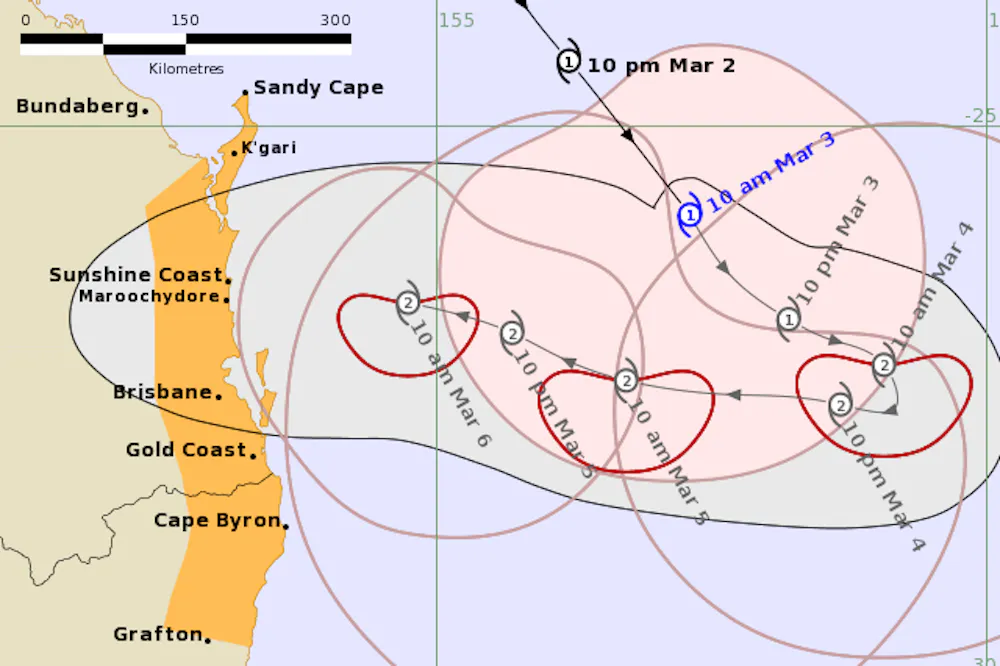
    Issued Monday March 3rd, this map shows the forecast path of Cyclone Alfred this week.
    Bureau of Meteorology, CC BY-NC-ND

    Cyclones, typhoons and hurricanes explained

    Cyclones, hurricanes and typhoons are different names for the same intense, horizontally rotating tropical storms. They occur in seven tropical ocean basins, above and below the equator.

    These storms need atmospheric heat. They only form over seas warmer than 27°C, where evaporation rates are high. They don’t occur in the cooler South Atlantic basin, and only rarely in the southeast Pacific, during strong El Niño events when sea surface temperatures are warmer.

    The northwest Pacific – off eastern Asia and the Philippines – experiences the most frequent and intense tropical storms (known there as typhoons).

    Australia averages about 13 cyclones a year. Most won’t make landfall and only a few are severe. The world’s hardest hit nation is China, where six cyclones make landfall annually.

    This map shows the aggregated paths of the world’s tropical cyclone over the 150 years to 2006. Note: this map uses the Saffir-Simpson scale in measuring wind speeds, which differs slightly to the Australian scale.
    NASA, CC BY-NC-ND

    In the north Pacific and north Atlantic, cyclones typically follow predictable tracks. They move westwards, steered by sub-tropical high pressure sytems to their north.

    Cyclone paths are also fairly predictable off the northwest coast of Australia. They typically form over the Timor Sea and drift southwest before shifting south and crossing the coast. Some are severe, as we saw with Category 5 Cyclone Zelia last month.

    By contrast, Coral Sea cyclones such as Alfred are much harder to predict.

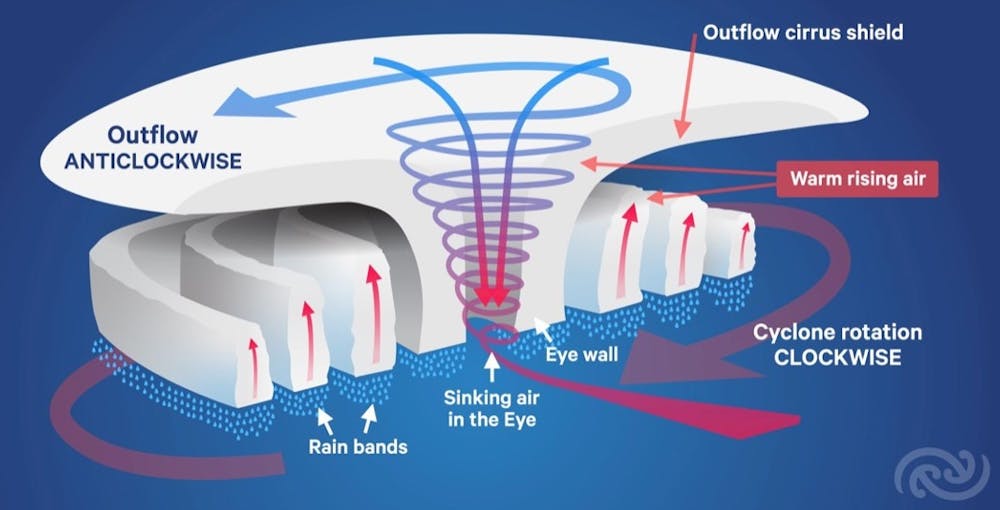
    In the southern hemisphere, cyclones spin clockwise. This figure shows how cyclones form around a low pressure system over warm seawater. Depending on their intensity, tropical cyclones are steered by dominant winds in the lower, middle and upper layers of the atmosphere.
    Metservice New Zealand, CC BY-NC-ND

    How cyclones are steered

    Strong winds are the main force steering cyclones, determining direction and forward speed.

    Severe tropical cyclones (categories 3–5) are characterised by deep convection currents, which form the famous eye at the centre of the storm, as well as feeder rainbands converging into their centre. Severe systems are generally steered by winds in the middle to upper levels.

    By contrast, weaker cyclones (categories 1–2) are much shallower and often have little or no convection around their centre. They tend to be steered by winds in the lower to middle levels. At present, Cyclone Alfred looks to remain relatively weak.

    Wind speed and direction can differ markedly in different levels of the atmosphere. Winds can also change direction at the same level. These competing influences are what lies behind the erratic paths of our cyclones.

    Cyclones forming in the Coral Sea are more likely to be pushed in different directions by different winds and weather systems than their equivalents in other ocean basins. This is what makes them so hard to predict.

    In our region, cyclones are largely steered by two high pressure systems.

    The first pushes cyclones east, and the second steers them west. If both are present and roughly equal in strength, they can hold a cyclone near-stationary. We saw this with Cyclone Alfred for most of the last week.

    Slow-moving tropical cyclones such as Alfred are more likely to wander, while faster-moving cyclones such as Severe Cyclone Yasi follow a stronger steering pattern and more predictable paths.

    Quite often, cyclones travel south and east out to sea. There, they quietly die in a large area of ocean colloquially known as the cyclone graveyard, southeast of Brisbane. These cyclones are steered by different weather systems – upper troughs, cold masses of air from the Southern Ocean.

    Cyclone Alfred was initially steered east by a near equatorial ridge to its northeast, then became stuck between this high pressure ridge and a sub-tropical ridge to its southwest. This is why it meandered very slowly south and built up strength to become severe.

    An upper trough then pushed it southeast over the weekend. This week, it’s likely to turn sharply westward towards land, propelled by a high pressure ridge to the south.

    Landfall – but where?

    After meandering around the Coral Sea for more than a week, Cyclone Alfred’s forecast track now seems more certain.

    The system is expected to intensify from a Category 1 to 2 tomorrow as it moves over warmer waters and draws in more moisture-laden air. This should see it maintain near Category 2 status until landfall. After it hits, it should rapidly weaken to a tropical low over southern Queensland into the weekend.

    Alfred will bring a lot of rain, making flooded rivers and flash flooding likely. The Bureau of Meteorology has issued a flood watch for catchments all the way from Maryborough to the Northern Rivers area of New South Wales. These communities should prepare now.

    Cyclone Alfred has a large area of gales, so will affect a wide swathe of coastline from K’gari (Fraser Island) to Byron Bay. Storm-force winds will cover a 100km wide area, mostly concentrated on its southern flank as it approaches and crosses the coast.

    In the longer term, Alfred’s remnants will likely be captured by an approaching upper trough and taken back offshore, where it will die in the cyclone graveyard – gone, but not likely to be forgotten.

    Steve Turton has previously received funding from the Australian Government.

    ref. Cyclone Alfred is expected to hit southeast Queensland – the first in 50 years to strike so far south – https://theconversation.com/cyclone-alfred-is-expected-to-hit-southeast-queensland-the-first-in-50-years-to-strike-so-far-south-251241

    MIL OSI AnalysisEveningReport.nz

  • MIL-OSI New Zealand: Environmental heroes celebrated in the Love Your Place Awards

    Source: Auckland Council

    Volunteers, businesses and schools making a positive impact to protect and restore the Waitākere Ranges have been recognised in the 2024 Love Your Place Awards.

    Around 100 guests came together to celebrate the mahi of these exceptional people at an awards ceremony held at the Titirangi War Memorial Hall on Sunday 2 March 2025.

    The awards are held every second year, thanks to the funding from the Waitākere Ranges Local Board and are organised by EcoMatters Environment Trust.

    “It’s inspiring and humbling to see all the amazing initiatives and passion from the community who are so dedicated to protect our beloved natural environment,” says Greg Presland, Chair of the Waitākere Ranges Local Board.

    “The board is immensely proud of everyone who contributes to helping preserve the special place we call home. Our heartfelt thanks and congratulations to all the nominees and winners.”

    EcoMatters CEO Carla Gee says it’s always encouraging to see how many people are contributing to conservation and climate action in the Waitākere Ranges.

    “It’s so inspiring to hear about how much is happening in this very special part of Auckland, from grassroots conservation efforts to waste minimisation. As judges, it’s always a struggle to choose just one winner from all the nominees. We’re grateful to the Waitākere Ranges Local Board for continuing to support these awards, so that those doing the mahi here know their efforts are appreciated,” says Carla.

    Awards were given in five categories, recognising youth, school groups, businesses, volunteer groups and individual volunteers who have made an impact in stream restoration, environmental education and protection, pest control, native planting, invasive weeding and waste management.

    Winners
    • Denise Yates Award: for youth (under 18) showing emerging leadership around local environmental issues. 

    • Karaka Award: for a school or school group taking action on a local environmental issue. 

    • Nīkau Award: for a business or social enterprise making a contribution to improve the environment. 

    • Rātā Award: for an outstanding volunteer group or organisation taking action on a local environmental issue. 

      • Winner: Restoration Ruatuna

      • Judges Commendation: Friends of Whatipu

      • Judges Commendation: Petrelheads

    • Kahikatea Award: for an outstanding individual volunteer taking action on a local environmental issue. 

    Find out more about the award winners here.

    Stay up to date

    Sign up for the Waitākere Ranges Local Board E-news to get the latest news and events direct to your inbox each month, or follow them on Facebook.

    MIL OSI New Zealand News

  • MIL-OSI China: Legacy carved in stone

    Source: China State Council Information Office 3

    The recent Chongqing premiere of For an Eternal Homeland — Dazu Rock Carvers’ Legacy has been hailed by the audiences and critics as a spectacle that brings the ancient figures of the Dazu Rock Carvings, a UNESCO World Heritage Site, to life.

    Through a blend of artistry and narrative, this dance drama has been recognized by many as a successful reimagining and revitalization that allows the historical treasure to shine anew.

    Zhang Yaqi, artistic director of the dance drama, says that the collaboration between the municipality of Chongqing and the China Oriental Performing Arts Group, a national performing arts institution, was developed over a two-year period and pays tribute to Dazu’s stone carvers.

    The performance is themed on celebrating the ancient philosophical vision of an ideal society: renjian xiaoman; tianxia dazu, (literally “small satisfaction in human life; grand prosperity and abundance in the world”).

    The Dazu Rock Carvings include the 144 grottoes, 50,000 statues and 100,000 inscriptions found in Chongqing’s Dazu district.

    Begun during the early Tang Dynasty (618-907) and reaching its peak during the Song Dynasty (960-1279), these extensive carvings amalgamate Confucian, Buddhist and Taoist sculptures.

    The UNESCO designation was awarded in 1999. Along with the Mogao Caves in Gansu province, the Longmen Grottoes in Henan province, and the Yungang Grottoes in Shanxi province — all similarly designated — the Dazu Rock Carvings are considered an essential part of the history of cave art in China.

    The 10-chapter, 100-minute dance drama is the tale of a young refugee named Xiao Fu. Fleeing to Dazu during the Southern Song Dynasty (1127-1279), he seeks sanctuary among local rock carvers, embracing their simple joys and aspirations for a brighter tomorrow. However, when a rockslide occurs, he pledges to immortalize the names of his departed family members by carving them on the cliffs, ensuring their memory lasts forever.

    “The stage presentation was challenging, with a deep sense of reverence. We drew inspiration from the details of the carvings, capturing their lifelike appearances,” Zhang says.

    She adds that every aspect, from characters and costumes to design, movements and props, was created to reflect the poetic essence of these portrayals of everyday rural life.

    For instance, figures such as the flute-playing woman, the chicken-raising woman, the cattle herder, and the woman wine seller, as well as Graceful Guanyin (Avalokitesvara, or the Goddess of Mercy), Water-moon Guanyin, and the Buddhist monk Zhigong (418-514) are brought to life in the drama.

    The 40 performers, 18 women and 22 men, radiate an ancient charm that encapsulates the aesthetics of the Song Dynasty, according to Zhang, who adds that the production included some core members of the team behind another hit, Poetic Dance: The Journey of a Legendary Landscape Painting.

    A large mirror onstage was used as a backdrop, according to Gao Guangjian, the drama’s visual director and set designer.

    A variety of multimedia techniques was used to create a distinct realm, enabling the exploration of the dynamic interplay between reality and faith.

    “The Dazu Rock Carvings are a priceless treasure, and belong to humanity,” says Li Fangyin, former director of Dazu Rock Carvings Research Institute.

    “Their deep content, such as philosophical ideas, humanistic principles, values and morals, helped us to further tap their worth through creative efforts,” Li adds.

    Since the 18th National Congress of the Communist Party of China in 2012, the country has increasingly focused on the conservation and use of cultural heritage and grotto temples.

    According to Li, more than 30 protection projects have been carried out at the Dazu Rock Carvings over the past two decades, resulting in marked progress on the protection, research, and use of the site.

    The Qianshou Guanyin (Thousand-hand Avalokitesvara) statue, carved during the Southern Song Dynasty, is a treasure of Baoding Mountain, one of the sites part of Dazu. In June 2015, after an 8-year national project to conserve its stone relics, aided by technology, salvage efforts were completed. That year, the Art Museum of Dazu Rock Carvings was opened.

    After 16 years of surveys and research by experts at the research institute, Dazu Shike Quanji (A Collection of Dazu Rock Carvings) was published by Chongqing Publishing Group in 2019, the first Chinese archaeological report about large grotto temple sites.

    In recent years, several international academic symposiums have been held in Chongqing and Ziyang, Sichuan province, to integrate cultural tourism and preservation.

    Last August, the first International Forum on Cave Temple Conservation kicked off in Dazu. Experts from countries, including Norway, the United Kingdom, Japan, Pakistan, Iran, Afghanistan and Nepal, convened to share insights and address common challenges in the global conservation of grotto temples.

    Chongqing’s Dazu and Ziyang city in Sichuan are known for their stone carvings — 150,000 in all — among which the Anyue Grottoes in Ziyang’s Anyue county have been included in the provisional list of UNESCO’s World Cultural Heritage Sites.

    The Sichuan-Chongqing Grotto Protection and Research Center has been established and has organized 20 international forums and academic exchange studies in Dazu. It is also responsible for publishing the academic journal Cave Temple Research and Conservation.

    “The fusion of traditional art and modern technology has led to many changes,” Li says, citing the example of Black Myth: Wukong.

    The game’s production team explored the Dazu Rock Carvings three years ago, and set many scenes in the hit game there.

    After its three-day premiere from Feb. 21 to 23 in Chongqing, the drama will travel to 10 more cities, including Chengdu, Hangzhou in Zhejiang province, Nanchang in Jiangxi province, Shenzhen in Guangdong province, Fuzhou and Xiamen in Fujian province, as well as Changsha in Hunan province. A total of 100 performances are planned for the year.

    MIL OSI China News

  • MIL-OSI China: Little Blue Houses go long way to boosting circular economy

    Source: China State Council Information Office

    Numerous plastic waste classification and recycling stations, known as Little Blue Houses, dotting the 6,715-kilometer-long coastline of Zhejiang province in East China, are playing a pivotal role in the fight against marine plastic pollution.

    These houses are a core component of the Blue Circle project, China’s largest environmental initiative aimed at addressing the pressing issue of marine plastic waste. In 2023, Blue Circle was given the Champions of the Earth award by the United Nations Environment Programme — the UN’s highest environmental honor.

    After local volunteers sort through recyclable plastic debris at the Little Blue Houses, the materials are transported to Zhejiang Vision-Blue Technology Co, a high-tech company specializing in marine sustainable development. From there, the waste is sent to a recycling facility where it undergoes a series of processes, including crushing, cleaning, melting and granulation.

    The journey of each piece of plastic, from coast to factory, is meticulously tracked using internet of things devices and blockchain, ensuring the traceability and transparency of the origin of the plastic. Each batch of marine plastic waste is assigned a unique QR code containing details of the full recycling process from start to finish.

    According to UNEP estimates, over 9 million metric tons of plastics enter the oceans annually. Plastic waste ending up in the sea ranges from microplastics to large debris such as bottles and bags, which can take hundreds of years to degrade, threatening the marine ecosystem.

    While recycling offers a potential solution to reducing the demand for new plastic production, and thus helping curb emissions from plastic manufacturing, incineration and landfills, it faces challenges in terms of collection logistics and high recycling costs.

    “The average price of recycled marine plastic pellets is 1.3 times that of primary plastic pellets. The good quality of marine plastics, coupled with their environmental and social benefits, justifies their premium price,” said Chen Yahong, director of the marine business unit at Zhejiang VisionBlue Technology Co.

    “Many clients, including international brands, are willing to pay more for recycled marine plastics, as it aligns with their growing sustainability needs,” she said.

    Recycled plastics from the Blue Circle project, including PET(polyethylene terephthalate) plastics derived from ocean waste, significantly reduce carbon emissions. The emissions from recycled PET are about a quarter of those associated from virgin PET.

    According to Chen, the recycled plastics of the Blue Circle project have helped reduce 3,900 metric tons of carbon emissions.

    These recycled materials are repurposed into a variety of products, including clothing, electronics, phone cases, stationery, shopping bags and T-shirts.

    Zhu Liyang, president of the China Association of Circular Economy, said: “The Chinese government has placed a strong focus on tackling plastic pollution, implementing comprehensive governance across the entire waste management chain. By recycling discarded plastics and ensuring proper collection, these materials can be reintegrated into the supply chain.”

    The circular economy is an important path to achieving green transformation, Zhu emphasized. “In recent years, there has been a noticeable shift toward green living and consumption, creating vast opportunities for the development of China’s circular economy,” he said.

    MIL OSI China News

  • MIL-OSI Australia: Director Stacy Williams to depart City for Murray River Council CEO role

    Source: State of Victoria Local Government 2

    City of Greater Bendigo Director Healthy Communities & Environments Stacy Williams will depart the organisation at the end of the month to take on the Chief Executive Officer role at Murray River Council.

    Stacy joined the City in July 2022, having previously worked as the Director of Community Wellbeing at Gannawarra Shire and prior at Campaspe Shire.

    During her time with the City, Stacy’s significant achievements include winning the 2024 LGPro Diversity and Inclusion award for the City’s Equity Impact Assessment process, securing funding for the Heathcote Civic Precinct project, the purchase of both the Bendigo Animal Relief Centre and Backhaus Oval, which are both providing opportunities for future development to support growing community needs, the successful transition of Aged Care services to new providers and providing critical response and recovery support through flood and storm emergencies.

    CEO Andrew Cooney congratulated Ms. Williams on her new role.

    “Stacy has been a great leader for the City, and we are excited and proud of her appointment as the CEO of Murray River Council. Stacy is a skilled communicator who will be a great advocate for staff and support for Council. Murray River Council can look forward to welcoming a great, people-oriented leader for their organisation and community,” Mr Cooney said.

    “Stacy can be very proud of her time at the City and the way she has led the Healthy Communities & Environments directorate to help enhance the overall wellbeing of our city in the short and long term.

    “I am pleased that she will remain in the region so we can continue to work together to deliver positive outcomes for communities.”

    Ms Williams said she is looking forward to this next chapter.

    “My time at Bendigo has been amazing. I have worked alongside a wonderful team who are passionate about the Bendigo community and delivering exceptional services. I wish the Mayor, Andrew and the City of Greater Bendigo team all the very best” Ms Williams said.

    “I look forward to taking my learnings at the City and supporting not only the Murray River community but contributing to the continued growth and development of regional Vic/NSW Boarder communities”

    Ms Williams last day with the City will be Friday April 11.

    MIL OSI News

  • MIL-OSI Australia: Appointment of new Austrade CEO

    Source: Minister for Trade

    The Albanese Government is pleased to announce the appointment of Dr Paul Grimes PSM as the new Chief Executive Officer of the Australian Trade and Investment Commission (Austrade).

    Austrade plays a critical role helping Australian businesses to grow and reach new markets, attract investment including to build a Future Made in Australia and promoting Australia as a premier destination for tourism and study.

    Having held a number of senior positions across state, federal and territory governments, Dr Grimes is a highly experienced public servant and brings a wealth of knowledge to the role. He has previously served as Secretary of the NSW Department of Treasury, as well as Secretary of the Federal Department of Agriculture and the Department of Sustainability, Environment, Population and Communities.

    Dr Grimes joins Austrade from his current positions as Chair of the NSW Net Zero Commission and Chair of the National Archives of Australia Advisory Council, among other roles.

    In recognition of his outstanding work in the development of the Australian Government’s response to the global financial crisis, he was awarded the Australian Public Service Medal in 2010.

    I look forward to working closely with him to continue to support local businesses to expand, reach new markets and create more jobs in Australia.

    I would like to give my thanks again to former CEO Mr Xavier Simonet for his distinguished service, and to Acting CEO, Daniel Boyer, for his strong and effective leadership of Austrade during the CEO transition period.

    MIL OSI News

  • MIL-Evening Report: Activists scale NZ building in protest against global weapons company

    By Kate Green , RNZ News reporter

    Protesters have scaled the building of an international weapons company in Rolleston, Christchurch, in resistance to it establishing a presence in Aotearoa New Zealand.

    Two people from the group Peace Action Ōtautahi were on the roof of the NIOA building on Stoneleigh Drive, shown in a photo on social media, and banners were strung across the exterior.

    Banners declared “No war profiteers in our city. NIOA supplies genocide” and “Shut NIOA down”.

    In late December, the group hung a banner across the Bridge of Remembrance in a similar protest.

    In 2023, the global munitions company acquired Barrett Firearms Manufacturing, an Australian-owned, US-based manufacturer of firearms and ammunition operating out of Tennessee.

    According to the company’s website, its products are “used by civilian sport shooters, law enforcement agencies, the United States military and more than 80 State Department approved countries across the world”.

    In a media release, Peace Action Ōtautahi said the aim was to highlight the alleged killing of innocent civilians with weapons supplied by NIOA.

    NIOA has been approached for comment.

    Police confirm action
    A police spokesperson said they were aware of the protest, and confirmed two people had climbed onto the roof, and others were surrounding the premises.

    In a later statement, police said the people on the ground had moved. However, the two protesters remained on the roof.

    “We are working to safely resolve the situation, and remove people from the roof,” they said.

    “While we respect the right to lawful protest, our responsibility is to uphold the law and ensure the safety of those involved.”

    Fire and Emergency staff were also on the scene, alongside the police Public Safety Unit and negotiation team.

    This article is republished under a community partnership agreement with RNZ.

    MIL OSI AnalysisEveningReport.nz

  • MIL-OSI New Zealand: Mining Sector – Business costs can’t increase to modernise DoC – Straterra

    Source: Straterra Inc

    The mining industry is encouraged to see Conservation Minister Tama Potaka say he aims to lower costs to businesses as the Department of Conservation (DoC) looks to modernise its processes, says Straterra chief executive Josie Vidal.
    “In our submission on the discussion document Modernising conservation land management we note this important point, outlined in the foreword as one of the Minister’s two bottom lines,” Vidal says.
    “There is no doubt the many layers of processes DoC has to provide access and concessions for the conservation estate needs modernising and we support this aim. However, there is a danger of over-simplifying and we have concerns about, and do not support, the proposed class approach to concessions. Instead, we prefer a case-by-case approach where each application is assessed on its overall merits.
    “Getting a mine up and running is costly and business and miners already pay numerous charges for access arrangements and concessions. These include activity, management, and monitoring fees, industrial intrusion charges, and various other charges. This complicated and oblique charging system means that in aggregate, the payment miners make to the Government is substantial.
    “There is a strong case for removing the requirement for concessions for mining operations. This could be achieved by allowing mineral permits to cover all land that is required for the mining and associated activities, such as roads and processing plants, and not just the mining of the mineral.
    “We support more flexibility for the Government to exchange, transfer, or dispose of parcels of conservation land. This can benefit both miners and the DoC with enhanced conservation outcomes, as well as wider benefits for society.
    “The conservation estate is one-third of New Zealand’s land and DoC doesn’t have the resources to manage that.
    “Enabling land to be exchanged or disposed of can raise funds for conservation purposes (e.g. pest control) and/or ensure the land is being held by an owner best able to optimise the conservation value. Miners are often better placed than DoC to do this and miners on the conservation estate are engaged in pest control, kiwi breeding programmes, and other conservation projects.
    “The aim of more flexible land exchange and disposal settings should be to support all Government priorities, including economic, while still providing a net conservation benefit and safeguarding vulnerable biodiversity.
    “Mining tourism should be part of the enhanced tourism on conservation land goal in the discussion document. This would also help dispel the many myths and misinformation about mining on conservation land. There is already some mining tourism activity in New Zealand.
    “We do not support giving the Minister of Conservation power to approve the National Conservation Policy Statement (NCPS) and area plans because of the risk of an ideologically driven minister rejecting perfectly acceptable uses of conservation land,” Vidal says.
    Straterra is the industry association representing New Zealand’s minerals and mining sector. Its submission on proposals to modernise the conservation system is herehttps://straterra.co.nz/wp-content/uploads/2025/03/Submission-Conservation.pdf
    Notes:
    – Exploration and mining currently occurs on conservation land excluding National Parks and Schedule 4 land. The Government and industry are not seeking to change the current settings in relation to this.
    – Mining on conservation land is infrequent and the footprint is small because mineral resources are hard to find and strict hurdles have to be navigated before approval to mine is given. Only about 3,500 hectares or 0.04% of the conservation estate has been disturbed by mining. This is after more than 40 years of mining on conservation land.
    – Not all exploration on conservation land leads to mining as the exploration phase may rule out mining.
    – The status quo works well where exploration and mining applications are considered on their merits against the conservation values of the land in question. This case-by-case approach is a more versatile and superior approach than one based on land categorisation because it doesn’t rule out potential opportunities before they are considered.

    MIL OSI New Zealand News

  • MIL-OSI Australia: Next stage of clean-up set to start at former Truegain site

    Source: New South Wales Government 2

    Headline: Next stage of clean-up set to start at former Truegain site

    Published: 3 March 2025

    Released by: Minister for Lands and Property, Minister for Regional Transport and Roads


    The Minns Labor Government is set to launch the next stage of a major project to clean up the former Truegain industrial site in the Lower Hunter region.

    Ford Civil has been appointed by Property and Development NSW (PDNSW) on a $5.3 million project to remediate contaminated soil across almost 1.2 hectares of the former oil refinery at Rutherford near Maitland.

    The second stage of work will be guided by a Remediation Action Plan, developed by Property and Development NSW and environmental consultant Ramboll. The remedial works will involve the removal of concrete slabs, excavation of contaminated soil and subsurface infrastructure, backfilling the excavation with clean soil and revegetating or resealing the area. The proposed works have been reviewed and endorsed by a NSW EPA accredited site auditor.

    The first stage of the project was completed in 2023 and involved the removal of more than 11,000 tonnes of industrial liquid waste, sludge and above ground infrastructure including storage tanks from the site.

    The Truegain site was abandoned in 2016 after the company lost its trade waste permit, had its environment protection licence suspended and entered into liquidation.

    In 2021, the NSW Environment Protection Authority (EPA) brought proceedings against Truegain director and former owner Robert Pullinger to recover the cost of cleaning up the site. The Land and Environment Court of NSW ordered Mr Pullinger to pay $1.2 million towards the EPA’s costs.

    Stage 2 work is expected to start in the coming weeks and be completed by the end of the year.

    For more information on remediation of the former Truegain site, visit the Truegain site remediation webpage

    Minister for Lands and Property Steve Kamper said:

    “I understand the local community has been waiting for this site to be cleaned up for over a decade.

    “Since coming into Government, we have worked to clean up this site so it can be remediated for future use.

    “PDNSW’s Environmental Management Group has done great work across multiple former industrial sites to clean them up and allow them to be re-used safely by local communities. Sites include the former Waratah Gasworks in Newcastle and former Hunters Hill radium hill refinery in Sydney.”

    Member for Maitland, Jenny Aitchison said:

    “The former Truegain site has been a difficult contamination issue for our community over many years. This next stage of remediation work brings us another step closer to finally putting this matter behind us.

    “I am grateful to the NSW Labor government for continuing to invest in the site for the benefit of everyone in Maitland.

    “Once Stage 2 works are completed, we will explore options to return this site for future community industrial use.”

    Property and Development NSW Environmental Management Group Executive Director, Peter Graham said:

    “We are delighted to appoint Ford Civil to lead this important remediation work that will return the former waste oil processing site for future safe industrial use.

    “The Environmental Management Group will work closely with Ford Civil and the NSW EPA Auditor to ensure this legacy contamination is safely remediated and the risk to human health or the surrounding environment is removed.”

    Ford Civil Chief Executive Officer Alan Gordon said:

    “Ford Civil Contracting are proud to be selected to undertake the remediation works at the former Truegain industrial site. The strategy will include the mitigation and removal of environmental contaminants onsite making it safe for future re-development.

    “Ford Civil has extensive experience in the delivery of complex design and construct civil engineering and remediation contracting activities. This includes the recently completed 7.4-hectare former Newcastle gasworks remediation site at Hamilton North.”

    MIL OSI News

  • MIL-OSI Australia: Call for public comment on draft Comprehensive Environmental Evaluation: Proposed construction and operation of new Chinese research station

    Source: Australian Government – Antarctic Division

    A draft comprehensive environmental evaluation (CEE) for the proposed construction and operation of a new Chinese research station in Marie Byrd Land, Antarctica, is open for public comment.

    Details of the proposed construction and operation of a new Chinese research station in Marie Byrd Land, West Antarctica, are contained in the draft CEE, provided to all Antarctic Treaty Parties in accordance with the Protocol on Environmental Protection to the Antarctic Treaty (Environmental Protocol). 
    The draft CEE describes a proposal by China to construct and operate a seasonal (summer only) research station at Cox Point in Marie Byrd Land, to provide support for logistics and scientific research. The stated purpose of the new station is to serve as an international hub for various fields of study, especially related to marine and global climate change. Research is planned to focus on weather patterns, atmospheric interactions with ice and ocean, glacier movement, environmental monitoring, space physics, and geological studies.
    Activities detailed in the draft CEE include construction and maintenance of the new research station, transportation of goods and personnel, and the management and monitoring of environmental impacts.
    An electronic copy of the draft CEE is available online on the Antarctic Treaty Secretariat Website at: https://www.ats.aq/e/eia.html
    The closing date for public comment is 5:00pm AEDT Monday 14 April 2025.
    Please submit comments via email: EIA@aad.gov.au
    Or via mail:
    Gillian Slocum
    Director, Antarctic and Environmental Regulation Section
    Policy and Strategy Branch
    Australian Antarctic Division
    GPO Box 3090, Canberra City ACT 2601
    This content was last updated 19 minutes ago on 3 March 2025.

    MIL OSI News

  • MIL-OSI Australia: Joint operation targets illegal hunting during deer season

    Source: Tasmania Police

    Joint operation targets illegal hunting during deer season

    Monday, 3 March 2025 – 9:23 am.

    Tasmania Police, in partnership with the Department of Natural Resources and Environment Tasmania (NRE Tas), conducted a joint operation in the Central Highlands over the weekend to ensure compliance with hunting regulations and promote public safety.
    “During the operation, police and NRE Tas officers intercepted and inspected over 140 vehicles. The vast majority of hunters were found to be operating within the law, and we commend those who are adhering to regulations and hunting responsibly,” said Inspector Luke Horne. 
    “We want to make it clear that Tasmania Police supports licensed hunters who follow the rules, but we will not tolerate illegal activity. Those who trespass or cause damage not only put themselves at risk but also undermine the efforts of responsible hunters.”
    “We appreciate the cooperation of the hunting community and thank the NRE Tas officers involved in this operation.”
    “Joint enforcement efforts such as this will continue throughout the year to ensure public safety, and raises awareness of firearms and hunting laws.” 
    Hunting related information is available at – https://nre.tas.gov.au/agriculture/game-services-tasmania

    MIL OSI News

  • MIL-OSI New Zealand: New management for Pūponga Farm Park

    Source: Department of Conservation

    Date:  03 March 2025

    HealthPost Nature Trust will carry out restoration work in the Triangle Flat area of the farm park. They aim to build a 3 km-long low predator fence across the base of the spit to provide a line of defence against reinvading introduced predators. The farm and crossing road area will remain open to the public.

    Pax Leetch and Ellie Miller, who manage land next to the farm park, have successfully applied to graze land from the west of Old Man Range to Greenhills. This area will remain as a working farm.

    These concessions run for five years while DOC works with our Treaty partners —Iwi Chairs of Ngāti Tama, Ngāti Rārua and Te Ātiawa, and Manawhenua ki Mohua — to develop a long-term strategic vision for the site, which is rich in ecological and cultural values and a popular visitor destination.

    Last September, the Department of Conservation (DOC) ran an expression of interest process inviting parties to put in proposals for managing these sites as the previous license to graze was ending after 27 years.

    Eight proposals were received and an evaluation panel made up of Manawhenua ki Mohua, Nelson Marlborough Conservation Board representatives and DOC staff decided on the successful applicants.

    HealthPost Nature Trust will also fund 50 per cent of a salary for a DOC ranger to be based in Pūponga, who will spend half of their time working on the Trust’s biodiversity initiatives and half keeping the popular area maintained for visitors to enjoy.

    They will work closely with Pest Free Onetahua, a large-scale conservation project removing pests on Onetahua/Farewell Spit and the surrounding areas.

    Triangle Flat is a very significant archaeological site, and any proposed restoration would need to be careful not to impact these important values.

    The Trust’s agreement will expand the significant restoration work they have been carrying out at Cape Farewell since 2017 to benefit burrowing seabirds, including creating a 3-hectare predator-free sanctuary.

    The Trust has worked in partnership with Manawhenua ki Mohua and DOC for several years which has led to pakahā/fluttering shearwaters translocated to the area.

    DOC Golden Bay Operations Manager Ross Trotter says Onetahua/Farewell Spit Nature Reserve is a unique ecosystem and a significant biodiversity hotspot, with several rare plants and more than 90 bird species recorded in the area. It’s recognised as a wetland of international importance under the Ramsar Convention.

    “HealthPost Nature Trust’s vision is exciting because if we can get predators down to really low numbers, Onetahua would be a much-needed safe haven for some of our threatened species in the area. It might also mean more rare species could be released into the area in the future.”

    Ross says DOC was impressed with the calibre of the proposals and wants to thank everyone who submitted an expression of interest.

    “We believe we’ve got a great outcome for the future of Pūponga Farm Park that is in the best interest of this really special part of the country.”

    Contact

    For media enquiries contact:

    Email: media@doc.govt.nz

    MIL OSI New Zealand News

  • MIL-Evening Report: Leakage is a risk with carbon storage projects – NZ’s new framework must be clear on how to deal with this liability

    Source: The Conversation (Au and NZ) – By David Dempsey, Associate Professor in Natural Resources Engineering, University of Canterbury

    Shutterstock/Oksana Bali

    The government recently announced a framework to regulate carbon capture, utilisation and storage (CCUS) by New Zealand companies.

    Energy and Climate Change Minister Simon Watts outlined new rules that would allow emitters to capture their carbon dioxide (CO₂) emissions and inject them underground for permanent disposal. They would then avoid having to pay for those emissions under the Emissions Trading Scheme.

    Globally, CCUS is currently used mostly by coal or gas-fired power stations, liquefied natural gas plants and petroleum refineries. There are 41 commercial operations around the world, and they capture about 40 million tonnes of CO₂ annually.

    Our peers (Australia, the United States and the European Union) already have CCUS frameworks and storage projects. The Intergovernmental Panel on Climate Change acknowledges CCUS’s role in curbing emissions, but highlights challenges in scaling and technology readiness.

    New Zealand faces the challenge of reducing emissions from strategic industries such as steel, concrete, fossil fuels and their derivatives (methanol, ammonia). CCUS has been tabled as an interim solution, strongly supported by the fossil fuel industry. However, critics warn it could reduce incentives to phase out fossil fuels.

    The government argues its CCUS framework aligns New Zealand with international standards. This claim has merit insofar as successful climate action is likely to require international collaboration and technology transfer.

    CCUS in New Zealand could enable reinjection of CO₂ produced from the Kapuni gas field in Taranaki, with “utilisation” involving diverting some of the gas for use in the food and beverage or horticulture industries.

    However, leakage of CO₂ from long-term disposal sites is a major technical risk and New Zealand’s framework must be clear on how it would deal with this liability.

    A bubbling sping near Lake Boehmer emits noxious fumes.
    Elizabeth Conley/Houston Chronicle via Getty Images

    Lake Boehmer and how things might go wrong

    Rules for CCUS projects generally require operators to monitor, report and remedy any leakage of CO₂. But because the industry is young, it is useful to take a broader look at geological leakage in the past to reveal how future challenges play out.

    Lake Boehmer, in the the Permian Basin of West Texas, wasn’t always there. But 20 years ago an old irrigation well started leaking saltwater and hasn’t stopped since.

    The well was drilled in 1951 by an oil and gas company. No oil was discovered so the well was handed over to the landowner for irrigation. The well produced water, but also poisonous hydrogen sulphide, enough to kill a farmhand in 1953.

    In the 1990s, the well started leaking. Water from a deep aquifer had pushed its way up alongside the well through geological layers of salt. The water dissolved the salt, worsening the leak, and emerged from underground three times saltier than seawater.

    The Railroad Commission, which regulates the oil and gas industry in Texas, says they are not liable to plug the well because they only have jurisdiction over oil wells. The original operator, which is claimed to have promised to plug the well “any time it becomes polluted with mineral water”, is no longer in business. No one can find the landowner.

    After 20 years, Lake Boehmer has grown to 60 acres. Its shore is rimmed in salt crystals and the odd dead bird from hydrogen sulphide exposure. No one can agree who should fix it.

    Could something similar happen with CCUS? Exacerbating factors in the Boehmer case include deterioration of an aged well – it’s almost 50 years since leakage started – and the absence of a backstop party as the final holder of liability. Both could happen with CCUS under the wrong circumstances.

    Better ways of dealing with leakage

    The Decatur CCUS project in the US state of Illinois has been injecting CO₂ produced from corn ethanol two kilometres deep into sandstone. Over about a decade, 4.5 million tonnes of CO₂ has been injected – emissions diverted from the atmosphere.

    The US government imposes strict monitoring rules on CCUS projects. Special monitoring wells are drilled into the disposal aquifer to measure pressure changes and how far the CO₂ has travelled.

    Unfortunately, one of these wells started to leak, possibly due to corrosion. It allowed about 8,000 tonnes of CO₂ to escape into overlying geological layers.

    This is rightly concerning, but to put it into perspective, the size of the leak is 0.2% of the injected CO₂ volume and none of it has escaped to the atmosphere or shallow groundwater. The leak was detected, the US Environmental Protection Agency (EPA) intervened, issuing a notice that the leak be remediated, and the company plugged the well.

    This illustrates a functioning CCUS framework. Monitoring requirements ensured the leak was discovered and the regulator was empowered to dictate remedial action.

    However, critics have questioned the timeliness of the operator’s disclosure. The site remains on hold but may resume operations if the EPA is satisfied with the fix.

    Lessons for New Zealand

    A proposal circulated last year suggests the government will model its legislation on Australia and the EU, with CCUS operators being responsible for leaks during disposal operations and for a time after site closure.

    This is like the Decatur situation. It makes sense for operators to fix leaks because they have the technical expertise and are the direct financial beneficiaries of emissions disposal.

    It gets trickier on generational time frames. Companies can go out of business or might leave the country. In these cases, the government is liable for long-term leakage and may seek financial security from the operator to cover future costs.

    A leak arising decades after closure could be more difficult to detect and costly to fix, especially if held up by a protracted fight around liability. This is the Lake Boehmer example.

    Some CCUS seems inevitable if the world is to meet climate targets. It is therefore important to prepare for the possibility of a leak by having robust practices and clear responsibility.

    Although it may seem unfair to burden future generations with looking after CO₂ disposal sites, we argue it is preferable to a legacy that has those same climate-warming gases in the atmosphere.

    David Dempsey receives funding from MBIE for research into carbon dioxide removal.

    Andrew La Croix receives funding from MBIE for research into carbon dioxide removal.

    ref. Leakage is a risk with carbon storage projects – NZ’s new framework must be clear on how to deal with this liability – https://theconversation.com/leakage-is-a-risk-with-carbon-storage-projects-nzs-new-framework-must-be-clear-on-how-to-deal-with-this-liability-251006

    MIL OSI AnalysisEveningReport.nz

  • MIL-Evening Report: The WA election campaign has been about big promises, but culture wars are inescapable in contemporary politics

    Source: The Conversation (Au and NZ) – By Jacob Broom, Lecturer in Politics and Policy, Murdoch University

    The Western Australian election is less than a week away, and two themes have dominated: big public spending and culture wars.

    The main parties are racking up a long and expensive list of policy promises. The ABC’s election promise tracker shows big spending in suburban road upgrades, improving school access and infrastructure, responding to domestic and family violence, and addressing undercapacity in WA’s health system. The combined promised spend of Labor, Liberals, Nationals and the Greens is estimated to exceed A$16 billion.

    Appeals to fiscal restraint have been quiet. Labor is trumpeting its responsible economic management, while the Liberals are promising to “set the right priorities”. There is little talk of slashing and saving.

    The combination of the cost-of-living crisis and WA’s strong economy has dampened the public’s appetite for austerity. It has also provided the parties with the cover to spend without seeming fiscally reckless.

    While the policy priorities between the parties are broadly similar, there remain significant differences.

    Policy debates on housing and climate

    In housing, for example, all parties promise to slash stamp duty for first home buyers, but their proposals otherwise differ:

    For climate policy, the differences are starker. Labor promises a coal-free grid by 2030 and a green energy future built in WA, driven by windfarms and WA-made home batteries. It stops short at reducing natural gas use, unlike the Greens.

    However, Labor has also pushed back against environmental regulation. Premier Roger Cook lobbied the federal government to abandon environmental protection legislation.

    The recent release of a long-withheld independent report that prompted sweeping changes to the WA Environmental Protection Agency was criticised by conservation organisations for its lack of consultation outside of the mining industry.

    The Liberals agree on the need for batteries and wind power. However, they also promise to extend the lifespan of WA’s coal power stations and lift the ban on uranium mining in WA.

    In her campaign launch speech, Liberal leader Libby Mettam pledged to cut “green tape” and defund the Environmental Defenders Office. This is on the grounds that “taxpayer money should not be spent propping up activists”.

    The culture wars cometh

    Mettam’s choice to target “activists” signals the Liberals’ flirtation with the culture wars. This term refers to conflict over social issues concerning identity and inclusion such as gender, race and sexuality. These issues are invoked by politicians to win votes from a polarised electorate.

    Centre-right parties around the world have embraced culture wars, including in Australia.

    Aligning herself with federal Liberal leader Peter Dutton, Mettam has stated she will refuse to stand in front of the First Nations flags.

    She’s also promised to “ban the use of puberty blockers, cross-sex hormone treatments and surgical intervention for children under the age of 16 for the purpose of gender transition” and launch a comprehensive review of these treatments.

    There are incentives for the Liberals to engage in culture war tactics.

    Labor’s electoral position is stable. It also holds a dominant share of political donations. Public desire for big spending is limiting the effectiveness of traditional conservative attacks on Labor’s economic management.

    The Liberals may perceive culture-war signalling as their most viable strategy for winning government. And, if the results of recent elections around the world are anything to go by, then “anti-woke” politics is surging.

    Scandals involving various Liberal candidates further deepen the perception the Liberals are engaged in culture wars.

    Albany candidate Thomas Brough was ordered to take workplace training with the Australian Human Rights Commission after making comments falsely linking the LGBTQIA+ community with paedophilia. Brough (who is a doctor) was referred to the State Administrative Tribunal by the Medical Board for the comments.

    Brough also came under fire for suggesting a “posse” of regional doctors would help gun owners navigate new stricter gun laws introduced by Labor. Brough has not been asked by the party to resign.

    Similarly, a rising star for the Liberals and candidate for Churchlands, Basil Zempilas, made widely condemned comments about transgender people on his radio show in 2020, shortly after becoming Lord Mayor of Perth. Apologising after, he said he had “forgotten he was lord mayor”.

    The party also preselected candidates whose digital footprints revealed unpalatable views.

    During an awkward press conference, Darling Range candidate Paul Mansfield was confronted with what the ABC described as “a series of derogatory social media posts, including homophobic slurs and two lewd posts about women”.

    Kimberley candidate Darren Spackman was asked to leave the party after derogatory social media posts he made in 2022 about Indigenous people were republished.

    The preselection of these candidates could be written off as the reflection of a hollowed-out party struggling to attract strong candidates.

    But under Mettam, the WA Liberal Party is caught between signalling it is part of the anti-woke surge and being seen to resist discrimination.

    It is unclear whether the culture wars will secure votes for the Liberals. Recent research shows strong support for issues such as transgender rights among Australian voters.

    How WA voters respond to culture-war messaging will undoubtedly inform the Liberals’ position in the federal election.

    The authors do not work for, consult, own shares in or receive funding from any company or organisation that would benefit from this article, and have disclosed no relevant affiliations beyond their academic appointment.

    ref. The WA election campaign has been about big promises, but culture wars are inescapable in contemporary politics – https://theconversation.com/the-wa-election-campaign-has-been-about-big-promises-but-culture-wars-are-inescapable-in-contemporary-politics-249691

    MIL OSI AnalysisEveningReport.nz

  • MIL-OSI Global: Soaring U.S. egg prices and millions of dead chickens signal the deep problems and risks in modern poultry production

    Source: The Conversation – Canada – By Tony Weis, Professor of Geography and Environment, Western University

    The recent volatility of egg prices in the United States has been a hot topic. Media coverage has consistently made the connection between supply problems and virulent strains of avian flu that has been afflicting poultry birds since 2022.

    Many articles have indicated that, in addition to millions of birds dying from avian flu, infected flocks have widely been killed en masse in an attempt to contain its spread. The livestock industry euphemistically calls this killing of infected animals “depopulation,” and around 150 million birds have been depopulated since the current crisis began.

    I have studied industrial livestock production for many years and have seen its myriad problems flash in and out of the media — such as greenhouse gas emissions, air and water pollution, food-borne illnesses, labour exploitation, and animal suffering. But it’s rare for the sector to stay in the media for long.

    The unusually heavy media coverage of expensive eggs, depopulated chickens and avian flu has highlighted some of the deep problems and risks of modern poultry production. Unfortunately, however, important context and dynamics have been regularly omitted.

    Unpacking key omissions helps to better understand both the nature of these chronic risks of infectious disease and the perilous response of the Trump administration.

    The spotlight on avian flu

    Multiple strains of avian flu chronically circulate within populations of both wild and domesticated birds. Avian flu is prone to frequent mutations, and occasionally some strains become more virulent and spillover across species.

    In addition to the problems avian flu in poultry production, recent media coverage has also highlighted the virus’s broader dangers.

    Avian flu is currently ravaging many wild animal species around the world, reaching into extremely remote places and even zoos.

    In the U.S., avian flu recently spilled over into cattle — causing widespread illness after a mutation enabled intra-species transmission.

    Avian flu has also caused a small number of severe human illnesses in the U.S. (primarily workers in poultry operations). Although no human-to-human transmission is evident — a necessary condition for a pandemic — this potential remains a grave threat.

    Key issues underplayed

    Although the media coverage of egg prices, depopulated chickens and avian flu has cast a valuable spotlight on many aspects of modern poultry production, it has also tended to leave out some important elements.

    Mentions in the media of many millions of chickens being killed to contain the spread of avian flu will surely sound jarring to some. But such figures pale in comparison to the 9.5 billion chickens slaughtered annually in the U.S. and the 76 billion slaughtered annually worldwide.

    Poultry birds now comprise 70 per cent of the total biomass of all birds on earth. Most are produced in densely-packed operations where reproduction, life and death have been greatly accelerated.

    Modern chickens have been selectively bred to either put on weight (broilers) or produce eggs (layers) very quickly. Broilers reach slaughter weight in a mere six weeks. Layer hens produce nearly an egg a day for about a year or two, before being slaughtered. These short life-cycles are rarely mentioned in coverage of depopulations.

    The growing risk of avian flu mutations relate to both enormity of poultry bird populations — by far the biggest habitat for the virus — and the unhealthy conditions of life in large enclosures.

    According to the U.S. Census of Agriculture, over 97 per cent of layers live in operations with at least 10,000 birds. Over 99 per cent of broilers are grown in operations with annual sales of at least 100,000 birds.

    This scale also relates to a question that has, with a few notable exceptions, received scant coverage: since infected populations cannot simply be shipped to the slaughterhouse, how are the birds actually killed?

    A leading approach to depopulation is ventilation shutdown. This involves turning off the powerful fans needed to make the ambient conditions in large enclosures bearable, and results in agonizing deaths.

    Researchers are investigating ways to augment ventilation shutdown as part of a broader research agenda seeking to develop systematic ways to depopulate large operations. This agenda clearly illustrates that the livestock industry is acutely aware of the great risks of infectious disease evolution within these spaces.

    Undermining infectious disease surveillance

    In the 2024 election campaign, Republicans regularly pointed to high egg prices in efforts to highlight rising inflation. In early 2025, the continuing rise of egg prices has cast a glare on U.S. President Donald Trump’s failed promise to immediately solve inflation.

    In response to scrutiny, the Trump administration initially tried to blame Biden for the depopulation of chickens. While such deflection might work for a time, Trump and his advisors realize they need a strategy to increase egg supplies.

    This emerging strategy must be viewed in relation to Trump’s sweeping assault on state institutions and regulations — which includes undermining crucial capacity for infectious disease surveillance. Trump made immediate cuts to the Centers for Disease Control and Prevention and forced it to disengage with the World Health Organization. He has also promised big cuts to the National Institutes of Health.

    In this context, it’s unsurprising that Trump is laying out a simple plan to increase the egg supply: rebuilding layer populations, reducing depopulations and trusting the livestock and pharmaceutical industries to find ways of containing avian flu — likely through vaccines and strengthened biosecurity.

    It’s profoundly irrational to be weakening infectious disease surveillance in the midst of the current avian flu crisis (and amid mounting infectious disease risks more generally).
    It’s also hard to fathom how further empowering the leading actors in poultry production can be expected to resolve the risks of avian flu that are so bound up in the nature of modern production.

    Pursuing this course might temporarily bring egg prices down, but it also inevitably means passing untold risks into the future.

    Tony Weis does not work for, consult, own shares in or receive funding from any company or organisation that would benefit from this article, and has disclosed no relevant affiliations beyond their academic appointment.

    ref. Soaring U.S. egg prices and millions of dead chickens signal the deep problems and risks in modern poultry production – https://theconversation.com/soaring-u-s-egg-prices-and-millions-of-dead-chickens-signal-the-deep-problems-and-risks-in-modern-poultry-production-249679

    MIL OSI – Global Reports

  • MIL-OSI Global: Why bike lanes should remain on Ontario’s roads

    Source: The Conversation – Canada – By Mahtot Gebresselassie, Assistant Professor, Environmental and Urban Change, York University, Canada

    In late 2024, the Ontario legislature passed Bill 212 giving the provincial government significant control over municipal bike lanes. The law requires municipalities to ask the province for its approval to install bike lanes if they would remove a lane for other vehicular traffic. The legislation also allows for the removal of three major bike lanes in Toronto.

    Supporters of such moves argue that bike lanes worsen traffic congestion, negatively impact local businesses and delay emergency vehicles from getting where they need to go. However, research shows that bike lanes improve transportation infrastructure, including preventing injuries.

    One of the main values of bike lanes is that they promote safety for all road users. Many cities around the world install bike lanes to wholly or partially separate cyclists from larger vehicles. This separation limits the interaction with cars and makes cycling safer.

    Bike lanes can also be more efficient at moving more people per unit width of the road compared to car lanes. They are also much more inexpensive to build than roads for cars. Protected bike lanes cost an average of a few hundred thousand per mile compared to vehicular roads in millions of dollars per lane mile.

    Reduced injuries

    Bicycles are classified as vehicles under Ontario’s Highway Traffic Act, and cyclists are rightful users of all roads except controlled access highways.

    When people cycle on infrastructure that supports biking (bike lanes, cycle tracks, low-speed zones, etc.), the risk of injury is reduced significantly. Bike lanes increase the visibility of cyclists to motorists and reduce interaction between cars and bikes.

    A 2016 paper that looked at data on bike networks and injuries in 10 Canadian and U.S. cities between 2000 and 2015 showed that an increase in bike networks led to a decrease in fatal and serious injuries.

    The safety associated with bike lanes can also encourage more people to take up cycling. A 2020 poll from the Canadian Automobile Association indicates that 40 per cent of Canadians reported they would feel encouraged to cycle on bike lanes physically separated from other vehicles.

    More inclusive roads

    Bike lanes can make cycling more inclusive for women, children, older adults, people with disabilities and those with limited transportation options.

    For them, bike lanes can bridge the equity gap and affirm cycling as something “inherently democratic, inclusive, and affordable.”

    Fewer women bike compared to men. A 2014 study that surveyed cyclists in five U.S. cities found that more women than men strongly agreed that protected bike lanes made them feel safe and new ones increased how often they cycled.

    Child cyclists benefit a great deal from bike lanes. They are often smaller and less visible to people driving cars. They are also less able to assess risk and navigate shared roads, so a separate lane can reduce those risks.

    Older adults and people with disabilities also benefit from bike lanes, as they provide a more suitable cycling environment for riding with limited physical acuity and slower speeds.

    Low-income and racialized people are significant bike users and are more likely to rely on biking to get around due to their limited access to transportation options. Yet, without bike lanes, they may have no choice but to risk cycling in a dangerous environment. For them, bike lanes are crucial infrastructure.

    Cycling is also much cheaper than having a car. Cycling costs about $0.06/km and driving a car $0.58/km, and switching from driving to cycling can reduce transportation spending from 30 per cent to 10 per cent of household income.

    Consumer spending and congestion

    Some argue that bike lanes reduce street parking, which can lead to lower economic activity. However, a 2012 study showed that people who cycle, walk and use transit frequent local businesses more and spend the same or more than those who use private cars.

    In Toronto, when bike lanes were installed on Bloor Street West, there was an average increase in monthly consumer spending from $186 to $245. A similar trend was observed in New York City, San Francisco, Los Angeles, Bern, Dublin and Copenhagen.

    When it comes to congestion, a 2018 study on the impact of installing bike lanes on arterial roads in Toronto found that the most affected street segments would only result in an estimated one-minute delay.

    A 2022 study from Melbourne showed a minor effect on traffic when bike lanes were added to residential streets with low speed limits. It also found the “selective inclusion” of safe cycling lanes, in the worst cases, leads to a delay of less than 10 seconds per kilometre for drivers.

    In New York, a 2016 study found that adding bike lanes reduced the average time for car travel on major thoroughfares from an average of 4.5 minutes to 3 minutes.

    Examples from elsewhere indicate that removing bike lanes would not bode well for Toronto. A well-used bike lane in London, England was removed in December 2020 following residents’ complaints that they caused traffic congestion. A study found that the removal resulted in longer travel time on the street compounded by cars illegally parking in the space previously reserved for the bike lane.

    Emergency response

    Immediately after the bike lanes were installed on Toronto’s Bloor Street West, paramedics response time within 500 metres of the bike lane corridor rose by 42 seconds compared to 45 seconds city-wide.

    Toronto Fire Services (TFS) response time increased by 30 seconds within the same corridor compared to a two-second increase for the entire city. However, these evaluations were for two months in 2023. In October 2024, TFS Chief Jim Jessop said the Bloor Street West bike lanes did not lead to an increase in response time.

    If these bike lanes are removed and replaced with others elsewhere, it could create a poorly connected bike network. The safety and convenience associated with connected bike networks will be lost as a result.

    Based on what research tells us, Toronto’s bike lanes should stay. Bike lanes provide various benefits, including making our streets more inclusive of more people.

    Bike lanes offer safety on the roads by reducing the risk of fatal or non-life-threatening injuries on roads, and are a tremendous gain for transportation infrastructure.

    Even in cases where a bike lane causes a few seconds of delay, politicians and city planners must consider the trade-off — especially if it means saving a person’s life.

    The authors do not work for, consult, own shares in or receive funding from any company or organisation that would benefit from this article, and have disclosed no relevant affiliations beyond their academic appointment.

    ref. Why bike lanes should remain on Ontario’s roads – https://theconversation.com/why-bike-lanes-should-remain-on-ontarios-roads-249150

    MIL OSI – Global Reports

  • MIL-OSI USA News: Immediate Expansion of American Timber Production

    Source: The White House

    class=”has-text-align-left”>By the authority vested in me as President by the Constitution and the laws of the United States of America, it is hereby ordered:

    Section 1.  Purpose.  The production of timber, lumber, paper, bioenergy, and other wood products (timber production) is critical to our Nation’s well-being.  Timber production is essential for crucial human activities like construction and energy production.  Furthermore, as recent disasters demonstrate, forest management and wildfire risk reduction projects can save American lives and communities.

    The United States has an abundance of timber resources that are more than adequate to meet our domestic timber production needs, but heavy-handed Federal policies have prevented full utilization of these resources and made us reliant on foreign producers.  Our inability to fully exploit our domestic timber supply has impeded the creation of jobs and prosperity, contributed to wildfire disasters, degraded fish and wildlife habitats, increased the cost of construction and energy, and threatened our economic security.  These onerous Federal policies have forced our Nation to rely upon imported lumber, thus exporting jobs and prosperity and compromising our self-reliance.  It is vital that we reverse these policies and increase domestic timber production to protect our national and economic security.

    Sec2.  Directives to the Secretary of the Interior and the Secretary of Agriculture

    (a)  Within 30 days of the date of this order, the Secretary of the Interior and the Secretary of Agriculture, through the Director of the Bureau of Land Management (BLM) and the Chief of the United States Forest Service (USFS), respectively, shall each issue new or updated guidance regarding tools to facilitate increased timber production and sound forest management, reduce time to deliver timber, and decrease timber supply uncertainty, such as the Good Neighbor Authority described in 16 U.S.C. 2113a, stewardship contracting pursuant to 16 U.S.C. 6591c, and agreements or contracts with Indian tribes under the Tribal Forest Protection Act as contemplated by 25 U.S.C. 3115a.  The Secretary of the Interior and the Secretary of Agriculture shall also each submit to the Director of the Office of Management and Budget any legislative proposals that would expand authorities to improve timber production and sound forest management.
         

    (b)  Within 60 days of the date of this order, the Secretary of the Interior, through the Director of the United States Fish and Wildlife Service (FWS), and the Secretary of Commerce, through the Assistant Administrator for Fisheries, shall complete a strategy on USFS and BLM forest management projects under section 7 of the Endangered Species Act (ESA) (16 U.S.C. 1536) to improve the speed of approving forestry projects.  The Secretary of the Interior, through the Director of the FWS, shall also examine any applicable existing authorities that would permit executive departments and agencies (agencies) to delegate consultation requirements under section 7 of the ESA to other agencies and, if necessary, provide a legislative proposal to ensure consultation is streamlined.
         

    (c)  Within 90 days of the date of this order, the Secretary of the Interior and the Secretary of Agriculture shall together submit to the President, through the Assistant to the President for Economic Policy, a plan that sets a target for the annual amount of timber per year to be offered for sale over the next 4 years from Federal lands managed by the BLM and the USFS, measured in millions of board feet.
         

    (d)  Within 120 days of the date of this order, the Secretary of the Interior, through the Directors of the FWS and the BLM, and the Secretary of Agriculture, through the Chief of the USFS, shall complete the Whitebark Pine Rangewide Programmatic Consultation under section 7 of the ESA.
         

    (e)  Within 180 days of the date of this order, the Secretary of the Interior and the Secretary of Agriculture shall consider and, if appropriate and consistent with applicable law, adopt categorical exclusions administratively established by other agencies to comply with the National Environmental Policy Act and reduce unnecessarily lengthy processes and associated costs related to administrative approvals for timber production, forest management, and wildfire risk reduction treatments.
         

    (f)  Within 280 days of the date of this order, the Secretary of the Interior shall consider and, if appropriate and consistent with applicable law, establish a new categorical exclusion for timber thinning and re-establish a categorical exclusion for timber salvage activities.  

    Sec3.  Streamlined Permitting.  All relevant agencies shall eliminate, to the maximum extent permissible by law, all undue delays within their respective permitting processes related to timber production.  Additionally, all relevant agencies shall take all necessary and appropriate steps consistent with applicable law to suspend, revise, or rescind all existing regulations, orders, guidance documents, policies, settlements, consent orders, and other agency actions that impose an undue burden on timber production.

    Sec4.  Endangered Species Committee.  (a)  Agencies are directed to use, to the maximum extent permissible under applicable law, the ESA regulations on consultations in emergencies to facilitate the Nation’s timber production.  The Secretary of the Interior, as Chairman of the Endangered Species Committee, shall ensure a prompt and efficient review of all submissions to such committee, to include identification of any legal deficiencies, in order to ensure the timely consideration of exemption applications and, where possible, to resolve such applications before the deadlines set by the ESA.  

    (b)  Federal members of the Endangered Species Committee, or their designees, shall coordinate to develop and submit a report to the President, through the Assistant to the President for Economic Policy, that identifies obstacles to domestic timber production infrastructure specifically deriving from implementation of the ESA and recommends procedural, regulatory, and interagency improvements.

    (c)  The Secretary of the Interior shall ensure that the Director of the FWS, or the Director’s authorized representative, is available to consult promptly with agencies and to take other appropriate action concerning the applicability of the ESA’s emergency regulations.  The Secretary of Commerce shall ensure that the Assistant Administrator for Fisheries, or the Assistant Administrator’s authorized representative, is available for such consultation and to take such other action as may assist in applying the ESA’s emergency regulations.

    Sec5.  General Provisions.  (a)  Nothing in this order shall be construed to impair or otherwise affect:

    (i)   the authority granted by law to an executive department or agency, or the head thereof; or

    (ii)  the functions of the Director of the Office of Management and Budget relating to budgetary, administrative, or legislative proposals.

    (b)  This order shall be implemented consistent with applicable law and subject to the availability of appropriations.

    (c)  This order is not intended to, and does not, create any right or benefit, substantive or procedural, enforceable at law or in equity by any party against the United States, its departments, agencies, or entities, its officers, employees, or agents, or any other person.

    THE WHITE HOUSE
        March 1, 2025.

    MIL OSI USA News

  • MIL-OSI NGOs: Over 500,000 people demand oil & gas companies pay for climate damages

    Source: Greenpeace Statement –

    Cape Town, February 28, 2024 — Greenpeace Africa delivered on Friday 28th February a global petition on behalf of more than half a million people, calling on governments to force fossil fuel companies to “stop their climate wrecking activities” and “repair and pay for the damage they have caused.” The petition was handed over to a coalition of 17 countries and groups currently reviewing “polluter pays” levies [1] at the sidelines of the meeting of the Finance in Commons Summit in Cape Town.[2] In parallel, Cape Town’s iconic Table Mountain National Park is being consumed by wildfires, in the midst of the worst drought in more than 100 years across Southern Africa.[3]

    Sherelee Odayar, Greenpeace Africa’s Oil and Gas Campaigner, said: “It is unfair to expect that ordinary people will face the climate crisis with cents and rands, while the polluters in chief will pocket billions. It is also impractical: Most world governments simply cannot afford to provide climate solutions at the needed scale. Drought, extreme heat, storms, floods and fires are disproportionately affecting Africa and other Global Majority countries. Science and technology can help bring relief, now governments must make polluters pay to deliver justice and raise the necessary funds.”  

    Signatures by people from Africa, the Middle East, Europe, North America, and Southeast Asia were collected between 2023-24, the two hottest years since records began, replete with extreme weather events fuelled by greenhouse gas emissions from the oil and gas industry. At the same, five oil and gas corporations alone reported over US$100 billion cumulatively in profit for last year. 

    The collective demand was presented to the secretariat of the Global Solidarity Levies Taskforce, a coalition of 17 countries and groups, co-led by Barbados, France, and Kenya. It contributes to a public process of consultation which started last month concerning a series of proposals being considered by the governments who are members of the Taskforce, including options to apply levies on fossil fuel industry profits and extraction to fund climate action.

    A letter accompanying the petition reminds that oil and gas companies “knowingly lied about climate change and lobbied to slow action” and are failing to pay their fair share. “Super rich individuals and other polluting industries… should also be held to account. Making polluters pay for the damages they have caused is vital to help communities across the world to recover, rebuild and invest in climate solutions.” 

    The petition’s demands are in line with public polling across a range of geographies, including research recently commissioned by Greenpeace International, which has consistently demonstrated the strong popularity of increasing taxes on oil and gas profits. 

    Greenpeace Africa calls for designing tax and penalty mechanisms in a way that is fair and proportionate – including: ensuring a well-managed and just transition out of coal, oil and gas, while imposing more polluter taxes and fines on the industry to help fund the transition; taking steps to prevent knock-on increases in prices and the cost of living, especially for people living in poverty; and ensuring that people most impacted by climate change benefit the most from revenues raised. 

    Notes:

    [1] The Global Solidarity Levies Task Force: For People and the Planet explores feasible, scaleable and sensible options for levies to raise additional resources for climate and development: https://globalsolidaritylevies.org/world-leaders-pledge-action-on-climate-finance-as-coalition-for-solidarity-levies-launched-at-cop29/ 

    [2] The 5th Finance in Common Summit (FiCS), co-hosted by the Development Bank of Southern Africa (DBSA) and the Asian Infrastructure Investment Bank (AIIB): https://www.financeincommonsummit2025.com/ 

    [3] A night of flames: Table Mountain fire lights up the Cape Town skyline https://www.capetownetc.com/news/a-night-of-flames-table-mountain-fire-lights-up-the-ct-skyline/ ; Climate change behind the 2021 Table Mountain fire – study https://mg.co.za/the-green-guardian/2023-03-02-climate-change-behind-the-2021-table-mountain-fire-study/ 

    Photos: Handover of petition by Greenpeace Africa campaigner

    For more information, contact: 

    Greenpeace Africa Press Desk: [email protected] 

    Greenpeace International Press Desk: [email protected], +31 (0) 20 718 2470 (available 24 hours). Follow @greenpeacepress for our latest international press releases.

    MIL OSI NGO