NewzIntel.com

    • Checkout Page
    • Contact Us
    • Default Redirect Page
    • Frontpage
    • Home-2
    • Home-3
    • Lost Password
    • Member Login
    • Member LogOut
    • Member TOS Page
    • My Account
    • NewzIntel Alert Control-Panel
    • NewzIntel Latest Reports
    • Post Views Counter
    • Privacy Policy
    • Public Individual Page
    • Register
    • Subscription Plan
    • Thank You Page

Category: Environment

  • MIL-OSI New Zealand: Didymo found near Arthur’s Pass

    Source: Environment Canterbury Regional Council

    Laurence Smith, Principal Advisor – Biosecurity says there are currently no eradication tools available for didymo.

    “Didymo can be spread by a single drop of water. Even if you can’t see it, you could be spreading it.

    “There are many waterways in Waitaha/Canterbury that are free of didymo, so it’s important we all do our bit to protect the freshwater spaces we all enjoy.” 

    Didymo found in Te Tautea o Hinekakai/Devils Punchbowl Creek in Arthur’s Pass

    Check, Clean, Dry

    The Ministry for Primary Industries (MPI) has declared the South Island a controlled area for didymo. This means there is a legal requirement to clean all gear used in the water before going from one waterway to another.

    Laurence encourages water users to adopt the Check, Clean, Dry method before moving between waterways.

    “It’s important we do our best to prevent its spread with behaviour change,” he says.

    Check 

    Check kayaks, footwear, fishing gear and anything else that was in the water, for any mud, dirt and debris and remove it. Leave debris at the site or, if you find any later, treat and dispose of it in the rubbish. Do not wash it down drains.

    Clean 

    Wash all equipment such as nets, machinery, footwear and clothing thoroughly with an appropriate decontamination solution (10% detergent for 10 minutes or 2% bleach for at least one minute in water) before putting it in any new waterway.

    Dry 

    If you can’t clean your gear, restrict your use to a single waterway OR dry completely to the touch inside and out, and leave to dry for at least another 48 hours.

    MIL OSI New Zealand News –

    February 18, 2025
  • MIL-Evening Report: Fish and chips shouldn’t come with a catch: how Australia can keep illegal seafood off our plates

    Source: The Conversation (Au and NZ) – By Leslie Roberson, Postdoctoral research fellow, Centre for Biodiversity and Conservation Science, The University of Queensland

    If you’ve ever been stopped by quarantine officers at the airport, you might think Australia’s international border is locked down like a fortress. But when it comes to trade in seafood, it’s more like a net full of holes.

    Products sourced from illegal, unreported and unregulated fishing can easily slip through to unsuspecting buyers.

    Seafood is among the world’s most traded agricultural commodities. Yet illegal fishing accounts for an estimated one-fifth of all wild-caught seafood.

    This represents a serious threat to marine ecosystems, food security and even human rights. The phenomenon has been linked to organised crime, modern slavery, and the depletion of vulnerable species such as abalone and hammerhead sharks.

    The blame usually falls on countries where the fishing occurs, or where the boat is registered. But seafood markets, including processors, retailers and consumers, play a major role in driving demand. They could also play a crucial role in combating illegal fishing.

    In our new policy paper, we propose more effective controls on seafood imports.

    What is illegal, unreported and unregulated fishing? (Australian Fisheries Management Authority)

    Australia’s role as a seafood-loving nation

    Australia spends considerable effort managing its own fisheries, ensuring they are legal and sustainable.

    Yet, 60 to 70% of the seafood consumed in Australia is imported.

    These imports come mainly from countries with weaker environmental regulations, more illegal activity, and greater vulnerability to labour abuse and slavery.

    Current policies leave Australia vulnerable to illegally sourced seafood. Key information, such as the fishing location or species name, is often not required under current trade measures. This means seafood products can be imported under vague labels such as “frozen fish”, obscuring their identity and origins.

    Suspect seafood products

    Certain seafood products such as shark fins are more likely to be sourced illegally for a variety of reasons, including high market value. Other riskier wild-caught products imported into Australia include:

    • shark meat (“flake”): high chance of being illegally caught and most commonly mislabelled
    • tuna: a high-value product that could be illegally caught
    • squid: most of Australia’s imported squid is caught by Chinese fleets, which are under fire for illegal fishing and labour abuses.
    Most of the seafood consumed in Australia comes from overseas.
    Shine Nucha, Shutterstock

    A new border policy could help crack down on fishy imports

    Australia has made international commitments to consume sustainable seafood, in fisheries policy and through subscribing to the United Nations 2030 Sustainable Development Goals and the Global Biodiversity Framework. Meeting these commitments will require being more careful about what we import from other countries. This could take the form of stricter border regulations.

    The Australian government has begun to explore trade measures aimed at denying entry to illegal or untraceable seafood products. A group of organisations was formed two years ago to support this process. While a draft report was released at the end of 2023, the final outcome remains delayed – perhaps until after the next federal election.

    To inform this process, we reviewed the existing seafood import policies and recommend eight key design criteria for improvement.

    Only the United States, the European Union, and Japan have systems in place to verify the legal origin of imported seafood. Since these are some of the world’s largest seafood import markets, their efforts are important. But their schemes all have notable flaws that Australia should avoid replicating.

    These systems are technologically obsolete, lack solid traceability and accounting mechanisms, and rely on trade documents that are often impossible to verify. Most systems are not fully electronic, resulting in shipping containers of seafood arriving with shoeboxes of paper catch certificates.

    There are no mechanisms for cooperation between countries. Crosschecking of the same certificate arriving in both France and Italy, for instance, is not yet possible. This makes it easy to reuse certificates across multiple countries, enabling trade of falsely labelled or illegally caught seafood.

    Unlawful transfer of fish between vessels is an example of illegal fishing activity.
    Richard Whitcombe, Shutterstock

    Australia’s chance to take the lead against fishy imports

    Seafood supply chains are notoriously complex. Without effective certification schemes, keeping seafood sourced from illegal fishing operations out of our market is virtually impossible.

    Although Australia’s seafood appetite is minuscule compared to the US, the EU, or Japan, it has the resources and the opportunity to create a better import control system. Such a system would involve designing an electronic platform with automated fraud detection mechanisms that tracks seafood products from the fishing boat, through the supply chain, to the Australian border. Australia can then start to close the sizeable loophole in its efforts to secure a legal and traceable seafood supply.

    Such policies would support sustainable Australian fisheries and help the country’s biggest seafood suppliers to source responsibly. Nearly every country in the world trades seafood: if countries implement smart import policies, illegally sourced seafood will become much easier to intercept.

    The authors appreciate the valuable contributions of Gilles Hosch, a fisheries expert with 25 years of experience in global fisheries compliance and seafood traceability.

    Leslie Roberson receives funding from the Australian Research Council.

    Carissa Klein receives funding from the Australian Research Council.

    Rosa Mar Dominguez-Martinez receives funding from the Australian Research Council.

    – ref. Fish and chips shouldn’t come with a catch: how Australia can keep illegal seafood off our plates – https://theconversation.com/fish-and-chips-shouldnt-come-with-a-catch-how-australia-can-keep-illegal-seafood-off-our-plates-249481

    MIL OSI Analysis – EveningReport.nz –

    February 18, 2025
  • MIL-OSI USA: February 17th, 2025 Heinrich to N.M. Legislature: “New Mexicans Are Counting on Us to Deliver”

    US Senate News:

    Source: United States Senator for New Mexico Martin Heinrich

    SANTA FE, N.M. – Today, U.S. Senator Martin Heinrich (D-N.M.) addressed a Joint Session of the New Mexico Legislature at the Roundhouse, New Mexico’s State Capitol in Santa Fe.

    “Serving you and representing this great state in the halls of our nation’s Capitol is a privilege that I will never take for granted,” said Heinrich. “The same goes for the mandate New Mexicans entrusted me with this last election: To deliver for the people and places of our great state. To fight for the freedoms, safety, opportunities, and dreams of our families, our communities, and our country. I will never shrink from that work.”

    PHOTO: U.S. Senator Martin Heinrich (D-N.M.) delivers remarks to the New Mexico Legislature, February 17, 2025.

    Heinrich started his remarks by calling for elected leaders to unify around delivering for New Mexicans: “I have always been struck by New Mexicans’ acute understanding of what it means to put individual differences aside in service to the greater good. In our most challenging times, New Mexicans show up for each other. From the darkest days of the Hermit’s Peak/Calf Canyon fire to last year’s flooding in Roswell, from North to South, and East to West, New Mexicans understand our shared commitment to one another.”

    Heinrich promised: “Let me be clear: My commitment, my only commitment, is to you, New Mexico. I will work — day and night — to defend the programs, funding, resources, and public lands our communities, local economies, and families rely on. Because, as elected leaders, we serve all of our constituents, from our neighbors and closest family friends to those in our community we’ve never met, or who disagree with us on nearly every issue. All of these New Mexicans are counting on us – all of us here in this room – to lead, to care, to keep our communities safe. Simply put, they are counting on us to deliver.”

    Heinrich commended the Legislature for its successful efforts to stand up permanent funds that generate revenues now and into the future — from the Early Childhood Trust Fund to the Land of Enchantment Legacy Fund — and praised legislators’ efforts in the current session to pass bills to reduce crime, expand behavioral health services, scale investments in work-based learning opportunities, career and technical education, and the Outdoor Equity Fund, establish a statewide water quality permitting program, and reform New Mexico’s Game and Fish Department and Game Commission.

    Heinrich concluded: “Working together, we can deliver the future our kids deserve. We can fight for their freedoms: the freedom to grow up to make their own health care decisions, the freedom to marry who they love, the freedom to be who they are, the freedom to be safe in their classrooms, and the freedom to pursue a fair shot at success. Let’s also keep working to protect our kids’ clean air, clean water, and public lands that will sustain their communities, economies, and sense of identity as New Mexicans. We can uphold this Democracy, commit to the Republic set out in our Constitution, and comply with our oaths of service to put ‘We the People’ first.”

    Below are Heinrich’s full remarks as prepared for delivery:

    Speaker Martinez, Senate President Pro Tempore Stewart, Lieutenant Governor Morales, members of the New Mexico Senate and House of Representatives.

    It is an absolute honor to be here with you this afternoon. 

    I am very pleased to be joined by my wife, Julie, several honored guests, and two of my colleagues and friends in the New Mexico Congressional Delegation, Senator Ben Ray Luján and Congresswoman Teresa Leger Fernández.

    I stand before you, today, at the start of my third term in the United States Senate.

    Serving you and representing this amazing state in the halls of our nation’s Capitol is a privilege that I will never take for granted.

    The same goes for the mandate New Mexicans entrusted me with this last election:

    To deliver for the people and the places of our incredible state.

    To fight for the freedoms, safety, opportunities, and dreams of our families, our communities, and our country.

    I will never shrink from that work.

    And make no mistake:

    Republican leadership in the White House and in the United States House and Senate will have very real impacts on our state and on individual New Mexicans.

    Some of you will agree with those, and others won’t agree with any of them.

    The same will probably be true of many of our constituents.

    Still, I have always been struck by New Mexicans’ acute understanding of what it means to put individual differences aside in service to the greater good.

    In our most challenging times, New Mexicans look out for each other.

    From the darkest days of the Hermit’s Peak/Calf Canyon Fire to last year’s flooding in Roswell.

    From North to South, and East to West, New Mexicans understand our shared commitment to one another.

    So let me be clear: My commitment, my only commitment, is to you, New Mexico.

    And I will lift up your voices in the most powerful halls of our Republic.

    Whether you are Mark from Albuquerque, a polio survivor who wrote to me about the life and death consequences of vaccines,

    Gary, a retired Air Force intelligence officer in Tularosa who wrote to me about the importance of defending our national security,

    Or Ashleigh from Truth or Consequences, a school social worker who called my office with deep concerns about how cuts at the Department of Education would impact her students.

    I will elevate New Mexicans’ voices and demand action, accountability, and the future our kids deserve.

    And I will work–day and night–to defend the programs, funding, resources, and public lands our communities, local economies, and families rely on.

    Because, as elected leaders, we serve all of our constituents.

    From our neighbors and closest family members to those in our community we’ve never met, or even who disagree with us on nearly every issue.

    All of these New Mexicans are counting on us here in this room – to lead, to give a damn, to keep our communities safe.

    Simply put, they are counting on us to deliver.

    And that requires grappling with difficult decisions.

    It requires solving real problems that impact real people.

    And it requires us to bridge the gap between what is, and what is possible.

    Always with New Mexicans front and center.

    You know, we live in an era of loyalty pledges.

    From the right and the left, frankly.

    From Presidents and from rank-and-file activists.

    From one elected leader to another, I want to implore you NOT to sign pledges, but to solve problems.

    Our only loyalty pledge should be to this incredible state and to this country, and the incredible people who call it home.

    Whether it’s to protect our nation from foreign terrorist threats or to just provide the support our kids need to learn to read —

    Whether it’s fixing roads that countless New Mexicans drive on every day or cutting crime in our communities –New Mexicans expect us to put them first, and we must.

    They should be able to count on us – at the federal, state, and local level – to ensure their roads, kids, food, water, and air are safe.

    And that includes ensuring that the agencies charged with doing this work are staffed, funded, and functional.

    Whether that’s at New Mexico’s Children, Youth and Families Department or the United States Environmental Protection Agency.

    Here, in the Land of Enchantment, we want our kids to be happy and healthy, with a fair shot at success, no matter what bathroom they use, how they dress, what color their hair is, or whether they have an IEP.

    We want New Mexico women to know that we trust them to make their own health care decisions, AND we will work to get them the quality health care they deserve in their own communities.

    We want New Mexico’s immigrant families to know we see them, we value them, and we will not turn our backs on them.

    And we want hardworking folks to know that “lowering costs,” “creating jobs,” and “growing the middle class” aren’t just campaign slogans.

    They require action.

    These are the pledges that we must work to deliver on.

    So let’s talk a little bit about what it means to put New Mexicans first:

    Your work to stand up permanent funds that generate revenues now and into the future—from the Early Childhood Trust Fund to the Land of Enchantment Legacy Fund—these put New Mexicans first.

    Your work to make our communities safer, increase access to mental health care, and tackle substance abuse puts New Mexicans first.

    When it comes to public safety, my own strategy has been straightforward: Solve crimes, support survivors, hold criminals accountable.

    But too many of our law enforcement agencies don’t have the basic tools they need to solve crimes.

    And when crimes go unsolved, those who commit them keep committing them.

    Since joining the Senate Appropriations Committee, I have worked to deliver federal resources to our partners in law enforcement.

    I’ve been able to appropriate funds for new ballistics testing machines in Las Cruces, Farmington, Gallup, and Roswell, so we can solve the first gun crime before a second one is committed.

    I’ve helped our local law enforcement purchase technology that detects gunshots and runs rapid DNA checks.

    This technology can mean solving a crime before it’s too late.

    In some cases, this may even be the difference between life and death for the victims of gun crimes.

    And I’ve helped local law enforcement purchase equipment to detect fentanyl and other illegal drugs, so they can hold drug traffickers accountable and get this poison out of our communities.

    But more is needed.

    If your car is stolen, the person who stole it should be found and held accountable.

    If your home is broken into, the person who did it should be found and held accountable.

    If your daughter is assaulted, the person who did it should be found and held accountable.

    It’s simple, but right now that’s not happening in far too many cases.

    We can all do better on this front.

    And I urge all of you to use your leadership to deliver strong public safety legislation that will make this happen.

    As many of you recognize, it does not have to be a choice between improving public safety and supporting our communities’ mental health care.

    We can walk and chew gum at the same time.

    I am speaking with a little bit of experience here.

    After the horrific mass shooting in Uvalde, I sat down with colleagues from both sides of the aisle, and we crafted what became the Bipartisan Safer Communities Act.

    That legislation tackled firearm safety, increased criminal penalties on firearm offenses like gun trafficking, AND it provided federal investments in community and school-based mental health services.

    Silver Consolidated Schools was the first school district in New Mexico to receive a $6 million School-Based Mental Health Services Grant under that law.

    These federal resources have helped the district hire psychologists, counselors, and other mental health professionals at all of their schools.

    These types of school-based mental health services are an essential piece of our overall behavioral health puzzle.

    If we could find this bipartisan pathway to improve public safety and mental health care at the federal level, I have every faith that you can do it here, too. 

    And, after last week’s votes on behavioral health in the Senate and the crime package in the House, you have created some much-needed momentum.

    Thank you.

    I applaud the Senate for your work to resource and restructure our state’s behavioral health system.

    We all know it’s a lot easier to tear down a system over a couple of years than it is to rebuild that system.

    And I applaud the House for negotiating and passing a crime package that takes on pressing issues in our communities from fentanyl to auto-theft, to gun crimes.

    Let’s keep this momentum going.

    There’s so much more that can and must be done at the state and federal levels to support the victims of crimes, and to support law enforcement as they work to hold accountable the perpetrators of crimes.

    Because, when it comes to making our communities safer, supporting victims and solving crime is a common ground we should all be able to support.

    And, in fact, it’s one our communities are depending on us to get right.

    We all want New Mexico to be the best possible place for our kids to grow up, to raise their families, and to build careers and families in their home communities.

    That means not only taking our crime epidemic seriously, but it also means investing in our kids, from cradle to career.

    The investments that this Legislature and New Mexico voters unlocked two years ago are helping our state lead the nation in making high-quality early childhood education and childcare accessible to all of our families.

    In the last few years, you have given our public school educators the pay raises they have long deserved.

    And we are scaling up a statewide network of full-service community schools.

    All of these investments are already beginning to deliver results.

    When you account for state and federal investments in our kids, from Medicaid to the state child tax credit, we don’t rank 50th in child poverty.

    We rank 17th.

    Better than the national average, not good enough, but we are far from finished.

    And I applaud you for looking to increase the child tax credit.

    This money will put resources right back into the pockets of New Mexico families who will invest it in their children.

    We should also be expanding apprenticeships and paid internships as early as high school.

    That’s how we will prepare the next generation of New Mexicans for career success.

    Here with me are Arnaldo Miramontes and Sandy Juarez, two young people who have found their career paths thanks to highly successful programs in our state.

    While in high school, Sandy had a paid internship at Christus Saint Vincent Hospital through Future Focused Education.

    She got hands-on experience in phlebotomy and now she’s preparing at Santa Fe Community College for a career in health care.

    Arnaldo is in his fifth and final year as an apprentice with the UA Local 412, and on his way to an incredible career with licenses in both plumbing and pipefitting.

    Both will be meeting demands in high needs industries right here in New Mexico.

    I encourage all of us to continue investing in career and technical education, paid internships and apprenticeships, and work-based learning opportunities for our young people.

    As I work to pass my Apprenticeship Pathways Act in the Senate, I hope that you will continue to identify targeted, sustained funding at the state level.

    We should look at everything from offering credit, to restructuring our school days to help students get more hands-on experiences in the workplace.

    This is critical to successfully building the workforce of the future.

    Finally, I hope you will continue to grow our state’s Outdoor Equity Fund and the opportunities it has unlocked for so many young New Mexicans.

    I am so proud that New Mexico is grounding more of our kids in the incredible lands that are their American birthright.

    Before I was ever an elected official, I was a guide and an educator. 

    And I saw time and again the remarkable difference it makes when children and teens spent time in the outdoors.

    I’ve invited as my guest today Ruben Apodaca a twelfth grader with the Honey Badger Conservation Crew at the Albuquerque Sign Language Academy.

    I visited their beekeeping and honey harvesting operation last year, which is receiving critical support from the Outdoor Equity Fund.

    Students who are deaf, hard of hearing, and with disabilities are managing their own beehives and bringing the honey products from those hives to market.

    This kind of hands-on experience is deeply valuable.

    I strongly encourage you to continue making transformational opportunities like this possible by scaling up the Outdoor Equity Fund.

    Finally, as we invest in the people of this great state, we must also invest in the lands, waters, and wildlife that are the fabric that we build our identities upon.

    Most of you have heard of the Supreme Court case that stripped federal protections from 90% of New Mexico’s surface waters.

    New Mexicans want our water and our watersheds protected.

    My guest Mark Allison from New Mexico Wild is one of the folks here advocating for two bills that would establish essential state-level protection of these waters that are now void of federal stewardship.

    I am also encouraged by the proposals that are moving forward to reform our state’s outdated and underfunded Department of Game and Fish and Game Commission.

    Brittany Fallon from Western Resource Advocates and Jesse Deubel from the New Mexico Wildlife Federation are here with me today.

    They are advocating for reforms that will ensure wildlife management decisions are based on biology rather than politics.

    These reforms account for the voices of farmers, ranchers, hunters, anglers, biologists, and wildlife conservationists.

    And they also include the sustainable funding needed to help our Game and Fish Department effectively do their work.

    There is nothing I enjoy more than packing into a spike camp during elk season.

    Our wild game has literally been the primary protein on my family’s dinner table for the last 20 years.

    So, I know full well the importance of the work needed to manage New Mexico’s wildlife.

    We need a 21st century wildlife conservation approach that leverages resources to manage all of our wild creatures—not just our game animals.

    We also need to make our Game Commission more representative and more accountable.

    And we need to make sure that we are leveraging the biology and resources to protect fish and wildlife so that they never become listed as threatened or endangered.

    While we address all of these needs for our communities, we must stay focused on our true North Star.

    That’s our kids.

    Working together, we can deliver the future our kids deserve.

    We can fight for their freedoms:

    The freedom to grow up to make their own health care decisions,

    The freedom to marry who they love,

    The freedom to be who they are,

    The freedom to feel safe in their classrooms,

    And the freedom to pursue a fair shot at success.

    Let’s also keep working to protect our kids’ clean air, clean water, and public lands that will sustain their communities, economies, and sense of identity as New Mexicans.

    We can uphold this Democracy, recommit to the Republic set out in our Constitution, and comply with our oaths of service to put “We the People” first.

    That doesn’t mean we will always agree on how to get that done.

    In fact, I’m pretty confident we will always find something to disagree on.

    Even if it’s just “red or green.”

    But if we always put “We the People” first,

    If we always pledge our loyalty to the people we serve, above all else:

    We will deliver the future our kids deserve.

    Thank you.

    MIL OSI USA News –

    February 18, 2025
  • MIL-OSI New Zealand: Popular Great Walks bookings to open

    Source: Department of Conservation

    Date:  18 February 2025

    Opening dates are staggered between 13 to 28 May to give people making multiple bookings a better chance of securing their preferred slot. 

    DOC has upgraded the booking system, so it is easier for people to use. This includes implementing a queue system on opening days, to smooth the experience for customers and to better manage very high demand at peak times.

    “New Zealand’s Great Walks are hugely popular both here and internationally. They offer diverse multi-day experiences across spectacular landscapes, on well-formed and maintained tracks,” says Director of Heritage and Visitors Cat Wilson.

    “Our newest Great Walk – Hump Ridge Track was recently named on a list of ‘Top 25 trails to explore around the globe in 2025’, the only walk to feature from Oceania.”

    “Around 50% of international visitors come here to experience our national landscapes and environment, and around 50% of international tourists visit New Zealand’s national parks”.

    The Heaphy, Kepler and Rakiura tracks are the first Great Walks to open on 15 May, Hump Ridge Track will open at the same time. The ever-popular Milford Track will open last on 28 May. DOC recommends people wanting to book a Great Walk have a profile set up before opening day.  

    The Great Walks mythbuster postexplains why some Great Walks book out faster than others.

    Bookings for other DOC accommodation will also open in this period, from 13 to 21 May. Bookings go live at 9:30am on the opening day.

    “It’s been a busy summer to date and it’s great seeing more people are enjoying Great Walks, with bookings up 5% on the previous year,” says Director of Heritage and Visitors Cat Wilson.

    “So far, 67% of all Great Walk bednights* booked were by New Zealanders, up from 60% pre-pandemic and 65% last summer. In all, New Zealanders booked over 45,000 bednights on the Great Walks between 15 December 2024 and 26 January 2025.”

    “We’re lucky to have mountains, forests, beaches, parks, lakes and rivers on our doorstep. With demand for spots on some of our Great Walks still very high, people should consider some of the less well-known walks which are just as spectacular”, says Cat Wilson.

    *One bednight = one person taking one berth/space for one night. Bednights are a standard reporting metric used across the global tourism industry.

    Background information

    Opening dates for Great Walk accommodation bookings (for stays from 1 July 2025 – 30 June 2026) 9.30 am NZST

    15 May – Heaphy Track, Kepler Track, Rakiura Track, Hump Ridge

    22 May – Whanganui Journey, Routeburn Track, Tongariro Northern Circuit

    27 May – Lake Waikaremoana Track, Abel Tasman Coast Track, Paparoa Track

    28 May – Milford Track

    Opening dates for all other accommodation bookings (for stays from 1 July 2025 – 30 June 2026) 9.30am NZST

    13 May – Backcountry huts, lodges, sole occupancy facilities

    20 May – Conservation campsites, except Tōtaranui, Momorangi, Anaura Bay campsites

    21 May – Momorangi campsite, Anaura Bay campsite

    4 June – Tōtaranui campsite 

    Contact

    For media enquiries contact:

    Email: media@doc.govt.nz

    MIL OSI New Zealand News –

    February 18, 2025
  • MIL-OSI Australia: Housing Delivery Authority fast tracks 6,400 new homes

    Source: New South Wales Premiere

    Published: 18 February 2025

    Released by: The Premier, Minister for Planning and Public Spaces


    The Minister for Planning and Public Spaces has declared eleven housing proposals State Significant Development (SSD) creating capacity for 6,400 new well-located homes, following recommendations from the Housing Delivery Authority (HDA).

    The proposals were recommended for State Significance following the first meeting of the HDA, which was established by the Minns Labor Government to speed up assessment timeframes, with the option of concurrent rezoning and assessment, rather than being assessed by councils.

    The HDA has received over 160 expressions of interest (EOIs) since it invited proposals in mid-January 2025. This meeting examined the first 28 proposals received.

    Some applicants submitted proposals that are already well progressed along another, more suitable assessment pathway. These have been advised that they are on the right pathway for their proposal.

    The HDA has resolved to meet fortnightly to consider further EOIs in a timely manner.

    The Department of Planning, Housing and Infrastructure will now provide clear advice and guidance to HDA applicants on the next steps to take with their development proposal.

    In some cases, this advice includes recommending an alternative planning pathway for major housing projects that may require a concurrent rezoning but do not satisfy the criteria of the HDA pathway.

    High-quality housing projects that have detailed plans submitted within nine months and can begin construction within 12 months of approval and deliver affordable housing were given priority by the HDA, to set a clear benchmark for future EOI submissions.

    This is part of the Minns Labor Government’s plan to build a better NSW with more homes and services, so young people, families and key local workers have somewhere to live and in the communities they choose.

    The HDA builds on the Minns Government’s recent reforms to the planning system to speed up the delivery of more homes, including:

    ·       The development of the NSW Pattern Book and accelerated planning pathway for those who use the pre-approved patterns.

    ·       The largest rezoning in NSW history around transport hubs.

    ·       The largest ever investment in the delivery of social and affordable housing in NSW.

    ·       $200 million in financial incentives for councils that meet the new expectations for development applications, planning proposals and strategic planning. 

    ·       $450 million to build new apartments for essential workers including nurses, paramedics, teachers, allied health care workers, police officers and firefighters. 

    Recommendations from the HDA are published as required under the Environmental Planning and Assessment Act 1979 before the SSD declaration. For more information visit Housing Delivery Authority | Planning

    Premier of New South Wales Chris Minns said: 

    “These changes that we have implemented are making it easier and faster to increase housing supply near existing infrastructure, critical to delivering thousands of much needed homes for young people, families and workers.

    “This new authority that is fast tracking the approval of new homes is a major but necessary change to cut through the red tape and delays that have haunted the NSW planning system for well over a decade.

    “This is an important step that is helping to deliver thousands of new homes for those who need them, but we know that work does not stop here to increase housing supply.” 

    Minister for Planning and Public Spaces Paul Scully said:

    “The Minns Labor Government is reforming the planning system to deliver more market and affordable housing across NSW because everyone having access to a home – either to rent or buy – is a foundation of social and economic participation.

    “The Housing Delivery Authority not only encourages new housing proposals by asking for expressions of interest, but it also allows existing proposals to receive fast track consideration by being assessed by the State rather than the local Council.

    “The Minns Labor Government is delivering on its commitment to streamline the planning system to create more homes. In just the first meeting, we have the potential for 6,400 homes. That is thousands of families, workers and grandparents finding a home.”

    MIL OSI News –

    February 18, 2025
  • MIL-OSI New Zealand: Frogs impacted by predators, climate change

    Source: Department of Conservation

    Date:  18 February 2025

    An independent panel of experts has assessed all 20 frog species and sub-species found in New Zealand, and one newt. Four species have declined in status, and none have improved.

    Dr Rhys Burns, DOC’s lead on the assessment panel, says Hamilton’s frogs and one subspecies of Hochstetter’s frog are in serious trouble while Archey’s frogs have higher numbers than previously thought, but are still declining mainly due to the impact of introduced mammals.

    “The current Archey’s adult frog population, previously estimated as between 5,000 and 20,000, has been revised to over 100,000 individuals.

    “Surveys of Archey’s frog in central-southern Coromandel and Whareorino (western King Country) over the past few years have identified higher numbers than previously known. However, their conservation status remains At Risk – Declining, primarily due to predation by rats and mice.”  

    Hamilton’s frog, mainly found on Te Pākeka/Maud Island, Takapourewa/Stephen’s Island and a few smaller translocated populations at other sites, was moved into Threatened – Nationally Critical. Monitoring indicates a decline in the size of the largest population found on Te Pākeka Island.

    The actual cause of the decline isn’t known, but possibilities include climate impact, predation from mice and weka, direct or secondary poisoning from two brodifacoum operations in 2014 and 2019 to eradicate two mouse incursions on the island, the impact of a frog fungus recently found on the island, or a combination of these factors.

    DOC will take all these possibilities into account for future frog management planning on Te Pākeka.

    Climate change impact was added to the assessment for the first time – an acknowledgement that climate pressures are increasing for most frog species.

    “Changes in rainfall and temperature dry the forest understorey where land-based frogs such as Archey’s and Hamilton’s live,” Rhys says.

    “Long periods of high temperatures and dry periods temporarily dry out streams and areas of water seepage that Hochstetter’s frogs rely on. Large storms affect Hochstetter’s frogs that use stream habitat, by increasing water flows, siltation, and in extreme situations, landslides.”

    Rhys says we recently saw the devasting impact of severe weather on the already-fragile Hochstetter’s frog population.

    “Following the severe rainfall events of January 2023, a major slip in Otawa, near Te Puke, destroyed the habitat of the ‘Otawa’ Hochstetter’s frogs, resulting in an estimated loss of 30-40 per cent of the frog population in one night.

    “‘Otawa’ Hochstetter’s frogs were assessed as Threatened – Nationally Critical in this and previous assessments, so the loss was a huge blow. DOC is doing pest control at this site to try to support the recovery of this population.”

    Other Hochstetter’s frog populations were assessed as threatened or declining largely due to the impact of predation by introduced mammals.

    Rhys says frogs are challenging to survey. “They range from the size of a thumbnail to the length of a thumb, and often live in remote places. It’s resource-hungry work.

    “We hope more organisations – whether they’re iwi, other agencies, businesses or community groups – consider researching and surveying frogs.

    “The more high-quality information we have, the better we can protect these taonga species. Our frogs are unique to New Zealand, so if they go from here, they’re gone from everywhere.”

    Conservation status of amphibians in Aotearoa New Zealand, 2024

    Background information

    New Zealand native frogs/pepeketua belong to the genus Leiopelma, an ancient group of frogs that has changed very little in 70 million years.

    New Zealand’s native frogs have several distinctive features that make them very different from frogs elsewhere in the world: they have no external eardrum, they have round (not slit) eyes, and they don’t croak

    Archey’s and Hamilton’s frogs also don’t have a tadpole stage. The embryo develops inside an egg, and then hatches as a tiny almost fully formed frog.

    Contact

    For media enquiries contact:

    Email: media@doc.govt.nz

    MIL OSI New Zealand News –

    February 18, 2025
  • MIL-Evening Report: With just 5 years to go, the world is failing on a vital deal to halt biodiversity loss

    Source: The Conversation (Au and NZ) – By Justine Bell-James, Professor, TC Beirne School of Law, The University of Queensland

    Almost 200 nations have signed an ambitious agreement to halt and reverse biodiversity loss but none is on track to meet the crucial goal, our new research reveals.

    The agreement, known formally as the Kunming-Montreal Global Biodiversity Framework, seeks to coordinate global efforts to conserve and restore biodiversity. Its overarching goal is to safeguard biodiversity for future generations.

    Biodiversity refers to the richness and variety within and between plant and animal species, and within ecosystems. This diversity is declining faster than at any time in human history.

    Five years remain until the framework’s 2030 deadline. Our research shows a more intense global effort is needed to achieve the goals of the agreement and stem the biodiversity crisis.

    Biodiversity is in decline

    Biodiversity decline is a growing global issue. Around one million animal and plant species are threatened with extinction.

    The problem is driven by human activities such as land clearing, climate change, pollution, excessive resource extraction and the introduction of invasive species.

    As biodiversity continues to degrade, the foundation of life on Earth becomes increasingly unstable. Biodiversity loss threatens our food, water and air. It increases our vulnerability to natural disasters and imperils ecosystems crucial for human survival and wellbeing.

    The Global Biodiversity Framework was adopted in late 2022 after four years of consultation and negotiation. It involved 23 core commitments to be met by 2030 involving both land and sea. Key to the deal is protecting areas from future harm, and restoring past harms.

    These aims are captured in two targets.

    The first is ensuring 30% of degraded areas are under “effective restoration” to enhance biodiversity. This could involve replanting vegetation, reducing weeds and other pests, or restoring water to drained areas.

    The second is to effectively conserve and manage 30% of land and sea areas – especially those important for biodiversity and the ways ecosystems function and benefit humans. This could mean creating national or marine parks, or nature refuges on private land.

    Importantly, countries should both increase the size of areas protected or under restoration (a matter of quantity), and choose areas where interventions will most benefit biodiversity (a matter of quality).

    Nations were asked to provide an action plan before October 2024. In a paper published today, we reviewed these plans.

    What we found

    Our findings were disappointing. Only 36 countries (less than one quarter of signatory nations) submitted a plan. Australia was one of them.

    And the plans provided were underwhelming. In particular, nations fell badly short on the restoration target. Only nine out of 36 countries committed to restoring a specific percentage of land and sea.

    For example, Italy pledged only to restore “large surfaces of degraded areas” and Australia committed to restoring “priority degraded areas”.

    Defining commitments with numbers is important, because it allows progress to be monitored and measured, and forces nations to be accountable.

    Of those nine countries that made specific restoration commitments, only six committed to the 30% goal: Aruba, China, Curaçao, Japan, Luxembourg and Uganda.

    The results were better when it came to protecting land and sea. Some 22 of the 36 countries set a percentage target for protection. However, only 14 committed to protecting at least 30% of areas, in line with the goals of the deal.

    Again, quality is also important here. Under the deal nations signed up to, protected land should enhance biodiversity, and cover areas very valuable for biodiversity recovery. However, many nations were silent on the issue of quality when outlining their planned protections. It means their efforts could, in some cases, do little for biodiversity.

    A spotlight on Australia

    In recent years, Australia has sought to establish itself as a biodiversity leader on the international stage. This included hosting the global Nature Positive Summit in October last year.

    Following the summit, the federal government claimed it was:

    a tangible demonstration of Australia’s commitments under the Kunming Montreal Global Biodiversity Framework. It showed our willingness to work collaboratively towards the goal of halting and reversing biodiversity loss.

    But despite the rhetoric, our research shows Australia’s plans are not particularly impressive.

    As noted above, Australia does not provide a percentage target for ecosystem restoration. Instead, its plan refers broadly to restoring “priority areas” without defining what these areas are.

    Australia’s plan pledges to identify “priority degraded areas” and define what “under effective restoration” means, but does not outline how this will be done.

    Australia is more aligned with global leaders on protection of biodiversity. It committed to safeguarding 30% of land and water in protected areas.

    However, it provided limited details on how it will select, implement and enforce protection measures. The plan also fails to recognise current shortcomings in protected areas, both in oceans and on land – in particular, Australia’s focus to date on quantity over quality when it comes to selecting sites.

    In contrast, the nation of Slovenia mapped out proposed protected areas.

    So, while Australia did submit an action plan, it has missed the opportunity to be a true global leader.

    Running out of time

    The Global Biodiversity Framework aims to unite nations in the fight to conserve and restore biodiversity. But as our research shows, many countries do not have plans to achieve this, and plans submitted to date are largely inadequate.

    As species and habitats are lost, ecosystems become less stable. This damages human health and wellbeing, as well as economies. Biodiversity loss also undermines vital cultural and spiritual connections to nature.

    All countries must accelerate efforts to avert the biodiversity crisis, and preserve Earth’s precious natural places for future generations.

    Justine Bell-James receives funding from the Australian Research Council, the National Environmental Science Program, and Queensland Government’s Department of Environment, Tourism, Science and Innovation. She is a Director of the National Environmental Law Association.

    James Watson has received funding from the Australian Research Council, National Environmental Science Program, South Australia’s Department of Environment and Water, Queensland’s Department of Environment, Science and Innovation as well as from Bush Heritage Australia, Queensland Conservation Council, Australian Conservation Foundation, The Wilderness Society and Birdlife Australia. He serves on the scientific committee of BirdLife Australia and has a long-term scientific relationship with Bush Heritage Australia and Wildlife Conservation Society. He serves on the Queensland government’s Land Restoration Fund’s Investment Panel as the Deputy Chair.

    – ref. With just 5 years to go, the world is failing on a vital deal to halt biodiversity loss – https://theconversation.com/with-just-5-years-to-go-the-world-is-failing-on-a-vital-deal-to-halt-biodiversity-loss-249841

    MIL OSI Analysis – EveningReport.nz –

    February 18, 2025
  • MIL-OSI New Zealand: Shuttering govt entities? Public service boss’s comments welcomed

    Source: ACT Party

    “ACT enthusiastically welcomes a debate on shuttering redundant government entities,” says ACT Public Service spokesperson Todd Stephenson after the Public Service Commissioner raised the prospect publicly.

    “For households and businesses in an economic slump, cancelling old subscriptions is a financial no-brainer, and it’s time for the Government to run the ruler over its own redundant commitments.

    “For starters, we could close ministries focused on serving specific demographic groups, and instead spend the funding based on need, through the Social Investment Agency.

    “We could scrap the Human Rights Commission and instead strengthen the Human Rights Review Tribunal – the body that can actually act on human rights breaches.

    “We could abolish the Energy Efficiency and Conservation Authority, and the Climate Change Commission, and just let the emissions trading scheme do its job.

    “If we’re serious about growing the economy, we need to shrink the scope of the government, focus on doing the basics well, and return savings to taxpayers. We need to transfer power and resources away from Wellington and back to the firms, farms, and families doing the real work to pull us out of recession.”

    MIL OSI New Zealand News –

    February 18, 2025
  • MIL-OSI Asia-Pac: DoT and ITU Join Hands to Explore Future-Ready Infrastructure Planning with AI- Driven Digital Twin Technologies

    Source: Government of India (2)

    DoT and ITU Join Hands to Explore Future-Ready Infrastructure Planning with AI- Driven Digital Twin Technologies

    Letter of Intent (LoI) signed for collaboration between ITU and the Ministry of Communications, Government of India

    Strengthening India’s Global Digital Leadership: India proposes to host the ITU-Plenipotentiary Conference 2030

    Posted On: 17 FEB 2025 7:58PM by PIB Delhi

    Secretary (Telecom), Department of Telecommunications (DoT), Government of India, Dr. Neeraj Mittal embarked on an official visit to Geneva today to further strengthen India’s global digital leadership and deepen engagements with key international stakeholders in the telecommunication sector.

    During his visit, Department of Telecommunications (DoT) and the International Telecommunication Union (ITU) signed a Letter of Intent (LoI), marking the beginning of a new phase of strategic collaboration. Through this LoI, both sides intend to initiate discussions regarding the conditions and modalities for carrying out common initiatives and projects, particularly to

    • drive innovation in digital twins, AI-driven solutions, virtual world technologies, and the transformative potential of IMT-2030 technologies;
    • promote the development of global standards and best practices to ensure seamless interoperability and scalability;
    • advance sustainable development through shared frameworks, capacity building, and cross-sectoral collaboration, and
    • Foster citizen engagement and participatory approaches to urban and infrastructure planning.


    Dr Mittal held various meetings with leadership of ITU. In his meeting with Ms. Doreen Bogdan-Martin, Secretary-General, ITU, Dr. Mittal reaffirmed India’s commitment to digital connectivity, inclusion, and innovation. Key focus areas of discussion included India’s leadership in 5G/6G technologies, AI for Digital Transformation, cybersecurity frameworks, and ITU’s Partner2Connect initiative aimed at bridging the global digital divide. India also reiterated its pledge to support ITU’s initiatives by contributing to global connectivity projects and skill development programs.

    Further, with the aim of positioning India as a global hub for policy discourse on telecommunications and ICT regulations, Dr Mittal also proposed to host the ITU-Plenipotentiary Conference 2030 in India. India’s proposal was positively acknowledged, and discussions will continue at the upcoming ITU Council Meeting. India has successfully hosted WTSA -2024 in New Delhi in Oct 2024.

    Next-generation mobile communication technologies are evolving beyond traditional connectivity to become essential platforms for innovative infrastructure planning. By seamlessly integrating AI, Digital Twins, and real-time, ubiquitous connectivity into a unified ecosystem, these technologies generate pervasive intelligence, enabling open, interconnected systems that fundamentally transform how infrastructure is planned, collaborated on, and executed across critical sectors like transport, urban development, and healthcare. These advancements enable infrastructure planning to be more dynamic, adaptive, and sustainable, benefiting all sectors.

    The collaboration through the LoI  marks a significant shift in the telecom sector’s role—evolving from simply providing connectivity to becoming a platform that delivers accurate, reliable, and insightful data for infrastructure planning. It opens up opportunities to explore innovative business models, enabling a new ecosystem to deliver scalable, data-driven, and knowledge- based solutions across industries, driving sustainable growth and shaping the future of infrastructure.

    • Knowledge Sharing and Capacity Building: Facilitate the exchange of insights from initiatives like DoT’s Sangam and ITU’s Citiverse to improve cross-sectoral data integration and collaborative planning.
    • Global Standards Development: Contribute to ITU-T Study Group 20 on IoT, digital twins, and smart cities to create global standards, APIs, and methodologies ensuring seamless scalability of AI-driven solutions.
    • Sandbox Environments and Demonstrations: Establish sandbox environments to test innovative digital twin technologies, conduct pilot projects, and adapt regulatory frameworks that validate the transformative potential of these technologies.
    • Citizen Engagement and Simulations: Use AI-powered platforms to engage citizens in real-time urban planning and infrastructure development, enhancing participatory governance and collaborative decision-making.
    • Mobile Phone Data (MPD) and Privacy: Exchange insights on privacy-enhancing techniques (PETs) and their use in ICT measurement, particularly in the context of building digital twins for urban planning.
    • AI Model Integration for Digital Twins: Customize AI models using country-specific datasets to deliver context-sensitive solutions for infrastructure development and urban mobility challenges.


    <><><>

    SB

    (Release ID: 2104198) Visitor Counter : 59

    MIL OSI Asia Pacific News –

    February 18, 2025
  • MIL-OSI Asia-Pac: NHRC, India organises a training programme for the Indian Forest Service (IFS) officers as part of the 14th – Mid Career Course (Phase III) of the Indira Gandhi National Forest Academy, Dehradun

    Source: Government of India (2)

    NHRC, India organises a training programme for the Indian Forest Service (IFS) officers as part of the 14th – Mid Career Course (Phase III) of the Indira Gandhi National Forest Academy, Dehradun

    NHRC, India Chairperson, Justice Shri V Ramasubramanian says, the IFS officers face the challenging task of balancing development needs with the imperative of conservation

    Says, understanding the historical context of forest legislation, the evolving challenges, and the interplay between law, policy, and enforcement is important to effectively discharge their duties

    Secretary General, Shri Bharat Lal says, history shows how moments of reflection brings transformation

    Posted On: 17 FEB 2025 5:09PM by PIB Delhi

    The National Human Rights Commission (NHRC), India organised a training programme in New Delhi for the Indian Forest Service (IFS) officers as part of the 14th – Mid Career Course (Phase III) of the Indira Gandhi National Forest Academy, Dehradun. Addressing the officers, NHRC, India Chairperson, Justice Shri V Ramasubramanian emphasised the important role of Indian Forest Service officers in protecting the nation’s natural heritage. He said that they face the challenging task of balancing development needs with the imperatives of conservation. He said that to effectively discharge their duties, they need to understand the historical context of forest legislation, the evolving challenges, and the interplay between law, policy, and enforcement.

    The Chairperson also highlighted the historical evolution of forest legislation from the British era to the present, emphasising the shifting balance between development and conservation. The discussion covered the impact of the 2013 Land Acquisition Act on forest land acquisition, which ultimately led to the 2023 amendment of the Forest Conservation Act.

    He said that the courts have also played a crucial role in shaping forest conservation. The landmark T. N. Godavarman case of 1995, for instance, significantly curbed the timber industry’s impact on forest cover. This case highlighted the need not just for strong laws, but also for effective enforcement mechanisms. The court’s ongoing involvement in the Godavarman case, through the concept of ‘continuing mandamus,’ underscores the persistent challenges in balancing development and conservation.

    NHRC, India Secretary General, Shri Bharat Lal in his address said that history shows how moments of reflection can reshape the destiny and bring in transformation. Emperor Ashoka embraced a path of peace after the Kalinga War. Similarly, Gautama Buddha abandoned his privileges, attained enlightenment, and dedicated his life to guiding humanity. Mahatma Gandhi’s expulsion from a train led to a movement world-over that changed destiny of humanity.

    Shri Lal said that human rights are the most basic need and we have to believe in them to protect the rights of everyone, particularly the marginalised. He underscored the collective commitment to the human rights principles enshrined in the Indian Constitution, notably Article 32, which guarantees equal rights irrespective of caste, gender, or religion. He highlighted the importance of leveraging early field experience as a foundation for the strategic development of policies in the later stages of one’s career.

    Shri Lal also gave an overview of the Commission’s constitution as per the PHR Act, 1993 besides its various functions. He urged them to reflect on the knowledge they gained and carry it forward to make meaningful contributions to society. This was followed by an insightful Q & A session. The session concluded with a vote of thanks by NHRC, India Director, Lt Col Virender Singh.

    ***

    NSK

    (Release ID: 2104104) Visitor Counter : 62

    MIL OSI Asia Pacific News –

    February 18, 2025
  • MIL-OSI Global: Europe left scrambling in face of wavering US security guarantees

    Source: The Conversation – UK – By Stefan Wolff, Professor of International Security, University of Birmingham

    European leaders are scrambling to respond to what looks like the end of reliable US protection of the continent. It is unclear what the “main European countries” (which includes the UK) might be able to agree at a hastily convened meeting in Paris on Monday February 17. But individual countries, including the UK and Germany, have come forward to put concrete offers on the table for Ukraine’s security, which could include putting their troops on the ground.

    This unusual circling of the wagons was triggered by the 2025 Munich Security Conference, which ended the previous day. It brought to a close a week of remarkable upheaval for Europe, leaving no doubt that two already obvious trends in the deteriorating transatlantic relationship accelerated further.

    What the world saw was unabashed US unilateralism when it comes to the war in Ukraine. Ominously, there was also a clear indication of the extent of American intentions to interfere in the domestic political processes of European countries – most notably the upcoming German parliamentary elections on February 23.

    None of this should have come as a surprise. But the full-force assault by Donald Trump’s envoys to Europe was still sobering – especially once all its implications are considered. What was, perhaps, more surprising was that European leaders pushed back and did so in an unusually public and unequivocal way.

    Over the course of just a few days, two of the worst European fears were confirmed. First, the Trump administration is pushing ahead with its idea of a US-Russia deal to end the war in Ukraine. And all the signs are that Washington plans to leave Ukraine and the EU out of any negotiations and to their own devices when it comes to post-ceasefire security arrangements.

    On February 12, the US president announced he had spoken at length with Russian president Vladimir Putin, and subsequently informed Ukraine’s president Volodymyr Zelensky of the conversation. The same day, US defence secretary Pete Hegseth, confirmed at a press conference after a meeting of Nato defence ministers in Brussels that direct negotiations between Russia and the US would begin immediately. They will not include any European or Ukrainian officials, he said.

    Hegseth also poured cold water on any hopes that there would be robust US security guarantees for Ukraine. He explicitly ruled out US troops for any peacekeeping forces deployed by other Nato members, or that any attack on those forces would be considered an attack on the whole alliance under article 5 of the Nato treaty.

    The European response was swift and, at least on paper, decisive. Right after Hegseth’s comments in Brussels, the Weimar+ group (Germany, France, Poland + Italy, Spain, the United Kingdom, the EU’s diplomatic service and the European Commission) issued a joint statement reiterating their commitment to enhanced support in defence of Ukraine’s independence, sovereignty and territorial integrity.

    On February 14, the EU’s top officials – European council president António Costa and European Commission president Ursula von der Leyen – met with Zelensky on the margins of the conference. They assured him of the EU’s “continued and stable support to Ukraine until a just, comprehensive and lasting peace is reached”.

    The following day, Costa’s speech in Munich reiterated this commitment. Similar to earlier comments by Nato’s secretary general, Mark Rutte, Costa underlined Europe’s determination to “to act better, stronger and faster in building the Europe of defence”.

    But these declarations of the EU’s determination to continue supporting Ukraine do not reflect consensus inside the Union on such a position. Weimar+ only includes a select number of EU member states, institutions and the UK, underlining the continuing difficulties in achieving unanimity on critical security and defence issues. Unsurprisingly, Hungary’s prime minister, Viktor Orbán, issued a scathing condemnation of the Weimar+ statement as a “sad testament of bad Brusselian leadership”.

    Orbán’s comments play right into many Europeans’ fears about another dark side of Trump’s agenda when it comes to transatlantic relations. As foreshadowed in the influential Project 2025 report by a coalition of conservative US thinktanks, the Trump administration is intent on weakening European unity. This will include preventing the UK from slipping “back into the orbit of the EU” and “developing new allies inside the EU – especially the Central European countries”.

    Opening up divides

    The US vice-president, J.D. Vance, used his speech in Munich to claim that the real threat to European security was not coming from Russia or China, but rather “from within”. He went on to chide “EU commissars” and insinuated that Europe’s current leaders had more in common with the “tyrannical forces on this continent” who lost the cold war.

    In Romania, where presidential elections were cancelled after evidence of massive Russian election interference emerged, opposition parties revelled in Vance’s comments that the move had been based on the “flimsy suspicions of an intelligence agency and enormous pressure from its continental neighbours”. The vice-president has further exacerbated political divisions in a key European and Nato ally right on the border with Ukraine.

    Vance subsequently sought out Alice Weidel, the co-leader of the right-wing Alternative for Germany (AfD). The pair reportedly discussed the war in Ukraine, German domestic politics and the so-called brandmauer. This is the agreement between centre-right and left-wing parties in Germany to form a “firewall” to prevent extreme right-wing parties from joining coalitions, which has recently been weakened.

    Their meeting was widely criticised as yet another American attempt for the party to boost its chances at Germany’s upcoming parliamentary elections on February 23. Referring to Germany’s historical experience with Nazism, the German chancellor, Olaf Scholz defended the need to hold the line against far-right political parties like the AfD.

    Polar shift

    There have been many watershed moments and wake-up calls for Europe in the past. What is different now is that a new multipolar order is emerging – and Europe is not one of its poles. Equally importantly, given the determination of this US administration to upend the existing international order, Europe is not a part of any pole anymore either.

    Simultaneously at stake are European unity and the transatlantic relationship. These are the two key pillars that have ensured European security, democracy and prosperity since the end of the second world war. Out of necessity, Europe will most likely have to adjust to a much-weakened transatlantic relationship. But the European project will not survive without unity.

    This is a critical juncture for Europe. The continent needs to define its future place and role in the dysfunctional love triangle of Trump, Putin and Xi, a triumvirate that will shape and dominate the new global order.

    Stefan Wolff is a past recipient of grant funding from the Natural Environment Research Council of the UK, the United States Institute of Peace, the Economic and Social Research Council of the UK, the British Academy, the NATO Science for Peace Programme, the EU Framework Programmes 6 and 7 and Horizon 2020, as well as the EU’s Jean Monnet Programme. He is a Trustee and Honorary Treasurer of the Political Studies Association of the UK and a Senior Research Fellow at the Foreign Policy Centre in London.

    – ref. Europe left scrambling in face of wavering US security guarantees – https://theconversation.com/europe-left-scrambling-in-face-of-wavering-us-security-guarantees-249978

    MIL OSI – Global Reports –

    February 18, 2025
  • MIL-OSI: Sustain SoCal to Host Second Annual Sustainable Communities: Solutions in Resiliency Conference

    Source: GlobeNewswire (MIL-OSI)

    IRVINE, Calif., Feb. 17, 2025 (GLOBE NEWSWIRE) — via InvestorWire — Sustain Southern California (“Sustain SoCal”) is proud to host the Sustainable Communities: Solutions in Resiliency conference to be held on Thursday, February 20, 2025. The in-person event will take place at The Cove at UCI Beall Applied Innovation, located at 5270 California Ave., Irvine, CA 92617.

    Following its successful launch in 2024, we are pleased to organize the second edition of this event, addressing housing-related concerns, including critical issues such as climate readiness and availability, resilience in the face of environmental disruptions, the changing landscape of insurance, fire safety, and local self-resiliency.

    Given recent fire emergencies in states such as California’s unchecked urbanization, water quality risk as a result of burn zone runoff, and instability in our energy grid, the demand for such a forum has never been greater. This one-of-a-kind conference is where innovation meets sustainability. Among the promising advancements driving the transformation of communities is the integration of digital twin technologies, helping usher in an era of eco-conscious urban development.

    This event will unite industry veterans, renowned pioneers, thought leaders, and policy influencers from Southern California and surrounding regions. Invaluable perspectives and practical insights will be explored, fostering dialogue and collaboration to drive the transformation of communities into vibrant, resilient, and sustainable hubs.

    The conference agenda will include dynamic, insights-rich sessions such as:

    • Housing: How Climate Readiness & Availability Intersect
    • How Beneficial Fire Will Mitigate the Wildfire Crisis: An Environmental Liability Solution
    • Water Management as Key to Disaster Preparedness & Cleanup
    • Wildfire Resilience: How Smart Buildings Safeguard Critical Infrastructure
    • Microgrids & Mobile Energy Units as Emergency Resources

    The event will also feature the Innovator Showcase, a special exhibition where attendees can interact with cutting-edge innovations to help achieve responsible, sustainable urban and suburban living.

    The conference also provides attendees with a unique opportunity to engage directly with key experts, industry peers, enthusiastic researchers, and students.

    C. Scott Kitcher, President and CEO of Sustain SoCal, reiterated the significance of this event: “What began as an event to lay the foundation for Sustain SoCal’s extensive 2025 program has quickly transformed into a complex discussion about climate resilience and emergency preparedness in light of the recent LA fires. This event will examine a multitude of lessons learned when it comes to housing development, the changing landscape of insurance, water quality, the research needed in regards to ecological buffer zones, microgrid applications in times of evacuation and emergency response, and much more. Conversations kicked off during Sustainable Communities: Solutions in Resiliency will be continued throughout the upcoming year in our Communities Working Group, offered to Sustain SoCal Members.”

    For more information and registration details, visit: https://sustainsocal.org/event/sustainable-communities/

    About Sustain SoCal
    Sustain SoCal, a non-profit organization, accelerates sustainability and economic growth through innovation, collaboration and education in Southern California. The organization has a ten-year history in exploring and implementing pragmatic, real-world solutions to the challenges created by growth, change and inefficiency. It conducts conferences, workshops and networking events that lead to initiatives that positively impact our region’s economic progress and sustainability. For more information, please visit www.sustainsocal.org.

    About IBN

    IBN is a cutting-edge communications and digital engagement platform providing tailored Platform Solutions for select private and public companies. Over the course of 18+ years, IBN has introduced over 65+ investor facing brands to the investment public and amassed a collective audience of millions of social media followers. These distinctive investor brands amplify recognition and reach as well as help fulfill the unique needs of our rapidly growing and diverse base of client-partners. IBN will continue to expand our branded network of influential properties as well as leverage the energy and experience of our team of professionals to best serve our clients.

    IBN’s Platform Solutions provide access to: (1) our Dynamic Brand Portfolio (DBP) through 65+ investor facing brands; (2) article and editorial syndication to 5,000+ news outlets; (3) full-scale distribution to a growing social media audience; (4) a network of wire solutions via InvestorWire to effectively reach target markets and demographics; (5) Press Release Enhancement to ensure accuracy and impact; (6) a full array of corporate communications solutions; and (7) total news coverage solutions.

    For more information, please visit https://www.InvestorBrandNetwork.com

    Please see full terms of use and disclaimers on the InvestorBrandNetwork website applicable to all content provided by IBN, wherever published or re-published: http://IBN.fm/Disclaimer

    Corporate Communications

    IBN
    Austin, Texas
    www.InvestorBrandNetwork.com
    512.354.7000 Office
    Editor@InvestorBrandNetwork.com

    The MIL Network –

    February 18, 2025
  • MIL-OSI Global: Why is water different colors in different places?

    Source: The Conversation – USA – By Courtney Di Vittorio, Assistant Professor of Engineering, Wake Forest University

    Crater Lake in Oregon looks brilliant blue because its water comes from melting snow and is extremely pure. CST Tami Beduhn, NOAA Ship Fairweather/Flickr, CC BY

    Curious Kids is a series for children of all ages. If you have a question you’d like an expert to answer, send it to curiouskidsus@theconversation.com.


    Why is water different colors in different places? – Gina T., age 12, Portland, Maine


    What do you picture when you think of water? An icy, refreshing drink? A crystal-blue ocean stretching to the horizon? A lake reflecting majestic mountains? Or a small pond that looks dark and murky?

    You would probably be more excited to swim in some of these waters than in others. And the ones that seem cleanest would probably be the most appealing. Whether or not you realize it, you are applying concepts in physics, biology and chemistry to decide whether you should leap in.

    The color of water offers information about what’s in it. As an engineer who studies water resources, I think about how I can use the color of water to help people understand how polluted lakes and beaches are, and whether they are safe for swimming and fishing.

    Light and the color of water

    Drinking water normally looks clear, but ponds, rivers and oceans are filled with floating particles. They may be tiny fragments of dirt, rock, plant material or other substances.

    These particles are often carried into the water during storms. Any rainfall that hits the ground and doesn’t go into the soil becomes runoff, flowing downhill until it reaches an open body of water and picking up loose materials along the way.

    Particles in water interact with radiation from the Sun shining on the water’s surface. The particles can either absorb this radiation or reflect it in a different direction – a process known as scattering. What we see with our eyes is the fraction of radiation that is scattered back out of the water’s surface. It strongly affects how water looks to us, including its color.

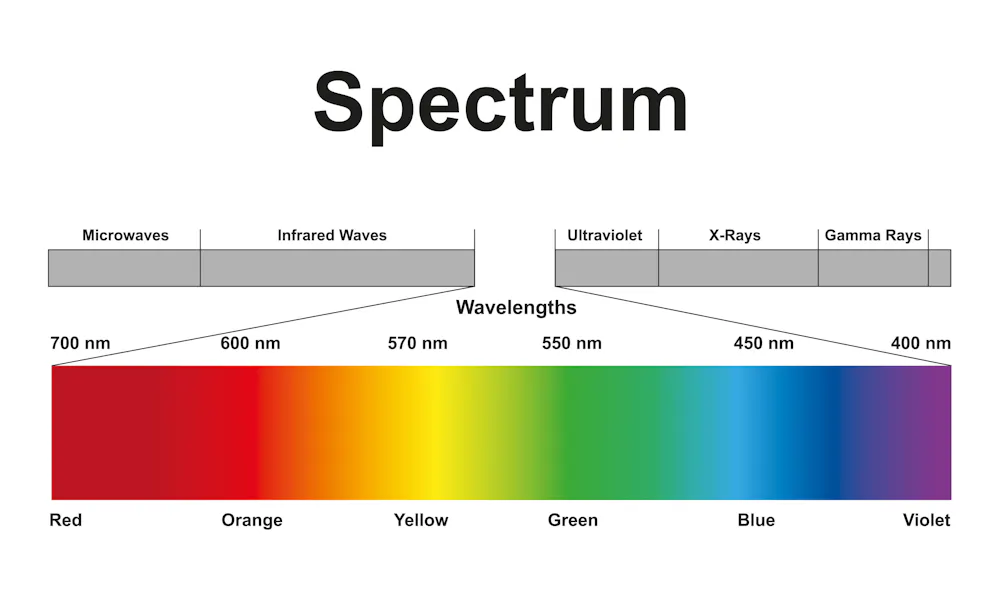
    Visible light forms just a small part of the electromagnetic spectrum, which includes all types of electromagnetic radiation. Within the visible range, different wavelengths of light produce different colors.
    Ali Damouh/Science Photo Library, via Getty Images

    Depending on the properties of the particles in our water sample, they will absorb and scatter radiation at different wavelengths. The light’s wavelength determines the color we see with our eyes.

    Waters that contain lots of sediment – such as the Missouri River, nicknamed the “Big Muddy” – backscatter light across the yellow to red range. This makes the water appear orange and muddy.

    Cleaner, more pure water backscatters light in the blue range, which makes it look blue. One famous example is Crater Lake in Oregon, which lies in a volcanic crater and is fed by rain and snow, without any streams to carry sediment into it.

    Deep waters like Crater Lake look dark blue, but shallow waters that are very clear, such as those around many Caribbean islands, can appear light blue or turquoise. This happens because light reflects off the white, sandy bottom.

    When water contains a lot of plant material, chlorophyll – a pigment plants make in their leaves – will absorb blue light and backscatter green light. This often happens in areas that contain a lot of runoff from highly developed areas, such as Lake Okeechobee in Florida. The runoff contains fertilizer from farms and lawns, which is made of nutrients that cause plant growth in the water.

    Finally, some water contains a lot of material called color-dissolved organic matter – often from decomposing organisms and plants, and also human or animal waste. This can happen in forested areas with lots of animal life, or in heavily populated areas that release wastewater into streams and rivers. This material mostly absorbs radiation and backscatters very little light across the spectrum, so it makes the water look very dark.

    Bad blooms

    Scientists expect water in nature to contains sediments, chlorophyll and organic matter. These substances help to sustain all living organisms in the water, from tiny microbes to fish that we eat. But too much of a good thing can become a problem.

    For example, when water contains a lot of nutrients and heats up on bright sunny days, plant growth in the water can get out of control. Sometimes it causes harmful algal blooms – plumes of toxic algae that can make people very sick if they swim in the water or eat fish that came from it.

    When water bodies become so polluted that they threaten fish and plants, or humans who drink the water, state and federal laws require governments to clean them up. The color of water can help guide these efforts.

    Engineering professor Courtney Di Vittorio and her students collect water samples from High Rock Lake in North Carolina to assess its water quality.

    My students and I collect water samples at High Rock Lake, a popular spot for swimming, boating and fishing in central North Carolina. Because of high chlorophyll levels, algal blooms are occurring there more often. Residents and visitors are worried that these blooms will become harmful.

    Using satellite photos of the lake and our sampling data, we can produce water quality maps. State officials use the maps to track chlorophyll levels and see how they change in space and time. This information can help them warn the public when there are algal blooms and develop new rules to make the water cleaner.


    Hello, curious kids! Do you have a question you’d like an expert to answer? Ask an adult to send your question to CuriousKidsUS@theconversation.com. Please tell us your name, age and the city where you live.

    And since curiosity has no age limit – adults, let us know what you’re wondering, too. We won’t be able to answer every question, but we will do our best.


    Courtney Di Vittorio receives funding from the North Carolina Attorney General’s Office Environmental Enhancement Grant Program (award WFU021PRE1) to collect data at High Rock Lake, NC. She is affiliated with the Yadkin Riverkeepers, an environmental advocacy not-for-profit group, and the North Carolina Lake Management Society.

    – ref. Why is water different colors in different places? – https://theconversation.com/why-is-water-different-colors-in-different-places-243895

    MIL OSI – Global Reports –

    February 18, 2025
  • MIL-OSI Global: The biggest threat in the Ontario election isn’t Donald Trump, it’s voter disengagement

    Source: The Conversation – Canada – By Mark Winfield, Professor, Environmental and Urban Change, York University, Canada

    Ontario Premier Doug Ford has justified his early election call on the need to respond to United States President Donald Trump’s threat to impose 25 per cent tariffs on Canadian imports.

    While the threat of tariffs on all Canadian imports has been paused — although Trump has since slapped levies on all steel and aluminum imports into the U.S. — Ontario voters need to reflect more than ever on the province’s circumstances and the performance of its government as they prepare to head to the polls next week.

    The Ford government’s approach to the environment and climate change, as well as its policies on a range of other issues like housing, health care and education, is best understood in the context of its overall “market populist” approach to governance.

    Several defining features of this model have emerged over the past six and a half years under Ford’s rule.

    Unaffordable proposals

    First, issues that require long-term perspectives on environmental, social and economic costs — like climate change — have tended to be disregarded. To the extent that the government has provided any sort of long-term vision, it has been focused on grandiose infrastructure projects.

    That includes a proposal to bury the Highway 401 highway in Toronto — an undertaking with a potential cost of anywhere between $60 and over $200 billion. But even that expense would pale in comparison to a recent proposal for a 10,000-megawatt nuclear power plant near Wesleyville, between Toronto and Kingston.

    The costs for the project based on recent experiences in the U.S., could easily top the $200 billion mark as well.

    The Ford government’s drive to “get it done” has also, at times, invoked a near-Trumpian disdain for democratic norms and limits on executive authority. This has been illustrated by, among other things, the first invocation of the notwithstanding clause of the Canadian Charter of Rights and Freedoms in Ontario history.


    Read more:
    Doug Ford uses the notwithstanding clause for political benefit


    Power has been increasingly concentrated in the premier’s office. Provisions for public participation, transparency and accountability under the guise of eliminating red tape in decision-making processes have been systemically eliminated.

    Processes for the meaningful environmental and economic review of major projects have suffered the same fate.

    Another defining issue is the Ford government’s approach to managing the province’s finances, with even the consistently pro-business Fraser Institute raising concerns.

    The disregard of financial responsibility has perhaps been most powerfully demonstrated by issuing of $200 rebates to Ontario residents. These are expected to cost to the provincial treasury more than $3 billion.

    Fewer revenue streams

    The Ford government has also displayed a willingness to eliminate billions a year in stable, long-term revenue streams, like vehicle licencing fees and fuel taxes. Major long-term costs and liabilities have been embedded at the same time, especially in relation to questionable infrastructure projects.

    All of this has taken place amid ongoing crises, attributed to provincial underfunding in areas like schools and post-secondary institutions, affordable (especially rental) housing and health care.

    In the longer term, liabilities are accumulating from the government’s failure to deal with the impacts of a changing climate.

    A final feature of the government’s market populist governance model has been an approach to decision-making based on connections, access and political whim rather than evidence or analysis.

    This pattern was perhaps most evident during the $8.3 billion Greenbelt land removal scandal involving well-connected developers. But the same pattern extends to the energy, for-profit health and resource extraction sectors as well.

    The province’s major opposition parties ran unsuccessfully in the 2022 election on the basis of platforms emphasizing adherence to what had been thought to be core principles in Ontario politics — moderation, managerial competence, and basic democratic values.

    Opposition parties

    This time, all three have turned to more populist themes.

    Liberal Leader Bonnie Crombie promises even more tax cuts than Ford. The NDP proposes to remove tolls from the 407 highway at an unknown cost to the provincial treasury and other programs.

    Even the Green Party, which has previously drawn praise for the content and imagination of its platforms, has picked up on populist themes, with an emphasis on affordability and a Ford-topping promise — and likely an even more ambitious — to build two million new homes.

    Vulnerabilities for the Ford government abound. Recent polling suggests that despite the apparently strong Conservative lead, Ford himself is deeply unpopular, particularly among women voters. Sixty per cent of Ontario residents think the province is on the “wrong track.”

    The early election call itself is widely seen as costly, unjustified and opportunistic. The distraction of the election may well have weakened the province’s immediate capacity to deal with the Trump administration.


    Read more:
    An unnecessary Ontario election won’t help Canada deal with Donald Trump


    Questions and investigations around the Greenbelt land removal scandal and the government’s relationship with the land-development industry continue to close in on the premier’s office amid an ongoing RCMP investigation.

    Crises around housing, education, health care and electricity continue to deepen.

    Ontario’s Bill 23 eliminated or weakened many housing development regulations, including site plan controls, which kept the natural environment safe from the negative effects of poorly controlled development.
    THE CANADIAN PRESS/Nathan Denette

    Still disengaged?

    In calling an early election, the Ford government has provided Ontario voters with an unexpected opportunity to reflect on its record, and the potential paths forward for the province.

    Hopefully Ontario voters will engage more deeply with these questions than they did in the 2022 election, which had the lowest voter turnout in the province’s history.

    Three years ago, the government emerged with an overwhelming majority in the legislature on the basis of the ballots of less than 18 per cent of the province’s eligible voters. The stakes are far too high in 2025 for a repeat of that level of disengagement.

    Mark Winfield receives funding from the Social Sciences and Humanities Research Council of Canada. This chapter summarizes the contents of the author’s contribution to three new volumes on Ontario politics (The Politics of Ontario, 2nd ed,( UTP 2024); Ontario Since Confederation: A Reader (UTP 2025); and Against the People (Fernwood 2025)

    – ref. The biggest threat in the Ontario election isn’t Donald Trump, it’s voter disengagement – https://theconversation.com/the-biggest-threat-in-the-ontario-election-isnt-donald-trump-its-voter-disengagement-249528

    MIL OSI – Global Reports –

    February 18, 2025
  • MIL-OSI United Kingdom: Thames river rage drama ends with huge fine

    Source: United Kingdom – Executive Government & Departments

    Boat-owner that caused Kingston Regatta incident charged more than £4,000. Video evidence shows disgraceful behaviour on the water.

    Boat-owner fined for “disgraceful” behaviour during Thames regatta

    An appalling incident of river rage on the River Thames at Kingston-upon-Thames in July 2024 has ended with £4,334.54 in fines, compensation and costs at Staines magistrates’ court on 28 January 2025.

    Navigated boat dangerously

    The perpetrator had navigated his boat dangerously and used abusive language at other river users. He was also found guilty of obstructing a boat race and interfering with the safety of persons gathered, failing to comply with a harbour master’s notice, and failing to register his boat for use on the Thames.  

    Scott Keen, of Morden, Surrey, steered his boat, Barney McGrew, along the Thames into a closed area of the river being used for Kingston Amateur Regatta, an event established in 1852, narrowly avoiding colliding with and swamping rowers.  

    Foul-mouth tirade

    The court heard how Keen was advised by an umpire that the river ahead was closed and he should return to a navigation channel. He ignored the request and continued past the umpire, cutting across the racing line and narrowly missing one of the boats, which had to take last-minute evasive action to avoid a collision. His cruiser than caught the anchor rope of a race stake boat, before he stopped and launched a foul-mouthed tirade against participants, yelling that ‘they did not own the (expletive) water.’  

    His actions and the way he navigated his vessel endangered the safety of those present at the Regatta, included young scullers in rowing boats. An eyewitness captured the full extent of the drama on a mobile phone. 

    Environment Agency officers carried out a detailed investigation into the incident and discovered that Barney McGrew was also an unregistered vessel. Keen was invited to a voluntary interview but failed to attend. A summons was subsequently issued for his appearance at Staines magistrates’ court on 28 January 2025. Again, he failed to attend. 

    Incident ‘was a disgrace’

    Maria Herlihy, operations manager at the Environment Agency and harbour master of the Thames, said:

    “This incident was a disgrace. Keen showed no regard for the safety of other river users and could easily have caused a tragedy. Quite frankly, it was no surprise to discover that his boat was unregistered, and we are happy with the court result.

    “We hope that this serves as a clear warning to all – anti-social and dangerous behaviour on our rivers will not be tolerated, and we will take robust action to deal with those who disregard the rules and regulations for boating on the River Thames.” 

    The magistrates fined Keen the maximum penalty of £1,000 for interfering with the boat race and navigating his boat without due care and attention. The court explained that it used its discretion to go outside the sentencing guidelines to deal with the matter robustly.

    The court heard the incident was shocking in its totality, with clear criminality that endangered the safety of other people, including the young people involved in the regatta.

    The court also complimented the Environment Agency’s investigation, and the evidence submitted.  

    Also charged in court, on the same day, for separate and unrelated incidents was Paul Campbell of West Molesey, who was found guilty in his absence of having not registered his boat, Enigma, for 2024 and failing to comply with directions to move his vessel from its location at West Molesey riverbank. He received a total of £2024.24 in fines, compensation and costs to be paid within 28 days.

    Ms Herlihy added:

    “As these prosecutions show, we have no hesitation in bringing offenders to court who avoid their obligations and responsibilities to lawful river users. Just one day in court has resulted in more than £6,000 of fines and compensation, which should serve as a major deterrent.” 

    Last year’s crackdown on unregistered vessels in the Thames resulted in 40 boaters having to pay a combined total of over £55,000 for their offences. 

    Renewal invitation letters for 2025 registrations on the River Thames were sent in November last year to everyone that registered their boat in 2024, and owners were encouraged to register early to ensure their boats were compliant by 1 January when the new season began.  

    The Environment Agency’s approach to non-registration on the Thames has changed – boat owners are given ample opportunity to register their boat. However, once a summons has been issued, it won’t stop court proceedings, even if the boat owner subsequently pays their registration fee. 

    Similar to excise duty for road vehicles, boat registration fees allow the Environment Agency to manage and maintain more than 600 miles of inland waterways across England, keeping them open and safe for thousands of boaters to enjoy. 

    Boats can be registered by calling 03708 506 506 or going to River Thames: boat registration and application forms – GOV.UK (www.gov.uk). 

    Ends 

    • Owners of powered or non-powered boats, including paddleboards, must register their boats annually with the Environment Agency for use on the non-tidal River Thames.  

    • Boat registration on the Thames starts on 1 January every year. Any boats found on the water after that date, without having registered, may be liable to a fine. 

    • In mid-September 2024, during a river-wide census, Environment Agency officers recorded the locations of 10,890 boats on the river. 

    • Scott Keen, on Barney McGrew, was charged with: 

    1. On 13 July 2024, being the master of the vessel Barney McGrew, in the vicinity of Ravens Ait and Kingston Bridge on the River Thames, Keen failed to comply with a harbour master’s notice, contrary to section 84 of the Thames Conservancy Act 1932 – found guilty in absence and fined £50. 

    2. On 13 July 2024, being the master of the vessel Barney McGrew, in the vicinity of Ravens Ait and Kingston Bridge on the River Thames, Keen navigated his vessel in a manner as would risk obstructing impeding or interfering with such boat race regatta or function or endangering the safety of persons assembling on the river or preventing or interfering with the maintenance of order thereon, contrary to byelaw 52 and 86(a) of the Thames Navigation Licensing & General Byelaws 1993 – found guilty in absence and fined £1,000. 

    3. On 13 July 2024, being the master of the vessel Barney McGrew, in the vicinity of Ravens Ait and Kingston Bridge on the River Thames, Keen used abusive, threatening and language towards officials and volunteers involved in the regatta and conducted himself in a threatening or offensive manner contrary to 63(a) and 86(a) of the Thames Navigation Licensing & General Byelaws 1993 – found guilty in absence and fined £440. 

    4. On 13 July 2024, being the master of the vessel Barney McGrew, in the vicinity of Ravens Ait and Kingston Bridge on the River Thames, Keen failed to navigate with care and caution and at such a speed and in such a manner as not to endanger the lives of others of cause injury to person or endanger the safety of or cause damage to other vessels or any moorings or to the banks of the Thames or other property, contrary to section 97 of the Thames Conservancy Act 1932 – found guilty in absence and fined £1,000. 

    5. On 17 July 2024, at Riverside Walk, near Kingston-upon-Thames, being the owner or master of a vessel named Barney McGrew, Keen failed to register the vessel with the Environment Agency in accordance with article 4(1)(a) of the Environment Agency (Inland Waterways) Order 2010, contrary to article 18(1)(a) of the Environment Agency (Inland Waterways) Order 2010 – found guilty in absence and fined £220. 

    A total of £2,710 in fines, £275 costs, £265.54 compensation and a £1,084 victim surcharge. A grand total £4,334.53. 

    • Paul David Campbell on Enigma, was found guilty in absence of the following charges 

    • Not registering his vessel Enigma, contrary to article 4(1) and article 18(1) of the Inland Waterway Order 2010. 

    • Failure to adhere to an officer’s directions to move, byelaw 58, Thames Navigation and General Byelaws 1993. 

    • He received £440 in fines – £220 for each charge – £275 costs, £1,593.40 compensation and £176 victim surcharge. Total: £2,024.24   

    Contact us:

    Journalists only – 0800 141 2743 or communications_se@environment-agency.gov.uk

    Both cases were heard at Staines magistrates’ court on 28 January 2025.

    Share this page

    The following links open in a new tab

    • Share on Facebook (opens in new tab)
    • Share on Twitter (opens in new tab)

    Updates to this page

    Published 17 February 2025

    MIL OSI United Kingdom –

    February 18, 2025
  • MIL-OSI USA: UConn Researchers Tracking Change in Precious Ecosystems

    Source: US State of Connecticut

    Primary forests, or old-growth forests as they are sometimes called, are epicenters of rich biodiversity, are more resilient than younger forests, and store significantly more carbon than their younger counterparts, to name just a few of the vital roles of these essential and irreplaceable ecosystems. The preservation of primary forests is the focus of global conservation efforts.

    The UConn Global Environmental Remote Sensing (GERS) Lab has developed a new remote sensing method to continuously monitor primary forest loss and determine what factors are driving that loss. Their findings are published in Remote Sensing of Environment.

    Lead author and Department of Natural Resources and the Environment Ph.D. student Falu Hong says that they focused on these key habitats on the island of Hispaniola, which includes Haiti and the Dominican Republic, using satellite images from the years 1996-2022.

    “We used a satellite time series to track primary forest loss, and we focused on these two countries because they have experienced significant primary forest loss and because they are ignored in previous studies, especially Haiti, which is one of the hotspots of biodiversity loss,” says Hong. “We analyzed the forest loss over 27 years of land cover change, which has not been done in previous studies.”

    The researchers analyzed multiple dimensions of forest loss, including the primary forest inside and outside of protected areas and the drivers of forest loss. They applied a method called the COtinuous monitoring of Land Disturbance algorithm (COLD) and remote sensing data from Landsat to create a map of the primary forest loss.

    Ji Won Suh, a postdoctoral researcher in the GERS lab, says this study showcases the power of using Landsat time series data.

    “So few studies focus on primary forests because it is very difficult to map them using remote sensing signals. Sometimes it is difficult to differentiate a secondary forest or regenerated forest from a primary forest, but this study successfully classified those primary forests using a random forest machine learning model.”

    Suh says the accuracy of the map was verified by their collaborator and co-author S. Blair Hedges from Temple University, who is an expert on primary forests on Hispaniola Island.

    “Another unique part of this study is we created a primary forest map over time,” Suh says. “Usually other studies just focused on a one-time event. We can track the loss of primary forests over many years. Our study is a way where we can map the trajectory of loss as it happens and we can analyze why those losses happen.”

    They found the main drivers of primary forest loss in Haiti are fire, which caused around 65% of the observed losses, followed by logging which accounted for about 20% of the primary forest loss, and around 10% of the forest loss was attributed to hurricane damage.

    “We found that in 2016, Hurricane Matthew destroyed around 12% of the primary forest in Haiti, just in one year,” says Hong. “That’s a huge amount of loss. With our map we can visualize the primary forest change and analyze the drivers causing that change. We can also analyze forest fragmentation. Usually, primary forests are homogeneous, but activities like construction or logging result in the forest becoming more and more fragmented. We quantified the fragmentation level of the primary forest which could give good insight into biodiversity conservation and preservation.”

    They also found that primary forest fragmentation is more pronounced in Haiti, where patches of primary forest are smaller and less numerous. Primary forests in both Haiti and the Dominican Republic are located on steep terrain, indicating that primary forests located in flatter and more accessible areas are prone to development and forest destruction.

    This paper is the first step in a larger project, says Hong, where the next steps are to begin expanding the mapping across the Caribbean region to evaluate the impact of primary forest loss on biodiversity change.

    GERS Lab Director and Associate Professor in the Department of Natural Resources and the Environment Zhe Zhu says that as primary forests have the lion’s share of biodiversity, many of the species living there are also endangered, so the preservation of these irreplaceable ecosystems is paramount. Having a reliable method to map primary forests accurately will help in the effort,

    “One thing I want to emphasize about this work is that it is very difficult to identify between different forests like primary dry forests, primary wet forests, and secondary forests, for example. A primary forest may look very similar if the secondary forest is old enough. You can have very subtle human disturbances causing it to no longer be a primary forest. You need to know the driver and how severe the drivers are. You also need to know the resilience of the trees.”

    This work is supported by a $2 million NSF grant with the goal of linking remote sensing to track biodiversity through time.

    “We are treating remote sensing as a time machine to backward and forward to forecast future impacts on biodiversity. It is a very fun project that a lot of us in the GERS lab are working on,” says Zhu.

    Tracking the impacts on biodiversity and the drivers of change is important for conservation and policymaking, and studies like this can yield surprising results and insights into what needs to happen to preserve vital ecosystems like primary forests.

    This work was supported by a grant from the NSF Biodiversity on a Changing Planet (BoCP) program (2326013 and 2326014).

    MIL OSI USA News –

    February 18, 2025
  • MIL-OSI United Kingdom: Residents urged to help shape transformational multi-million-pound town centre plans

    Source: City of Stoke-on-Trent

    Published: Monday, 17th February 2025

    Residents are to be asked to have their say on multi-million-pound plans to transform three town centres.

    A total of £6 million in Government funding is being spent to carry out public realm improvements in Tunstall, Burslem and Stoke.

    The aim is to help attract extra footfall, boost business activity and tap into the heritage of each of the towns.

    In Tunstall, proposals include better connecting key areas of the town like the High Street, Tower Square, Butterfield Place and Alexandra Park shopping area and creating a high-quality public space for the town focussed on Tower Square and the Clock Tower.

    In Burslem, the proposed public realm work will focus on the Queen Street area, which is the location of several Listed Buildings including Burslem School of Art and the Wedgwood Institute. The scheme will improve the historic Conservation Area with natural stone paving and new tree planting to create an attractive environment, encouraging more people into the town centre.

    In Stoke, the money is to be centred on improving the public square on South Wolfe Street – adjacent to Stoke library – to create a vibrant community space for regular outdoor events, including street markets and live music events.

    Public consultations will take place over the next few weeks and will give people the chance to have their say on their priorities. Feedback will help shape the work, which will start later this year.

    The consultation events are:

    • Burslem – Burslem School of Art – Friday, 21 February (10am to 4pm) and Saturday, 22 February (10am to 2pm).
    • Tunstall – Tunstall Indoor Market – Friday, 7 March (10am to 4pm) and Saturday, 8 March (10am to 2pm).
    • Stoke – Stoke Indoor Market – Friday, 7 March (10am to 4pm) and Saturday, 8 March (10am to 2pm).

    The work will complement other Government-funded projects taking place in and around the towns, such as the £3.5 million former Tunstall Library building development; a £20 million transformation of the Spode site in Stoke; and multi-million-pound investment to preserve, protect and bring into use Burslem’s historic buildings – including The Wedgwood Institute and Burslem Indoor Market.

    Councillor Finlay Gordon-McCusker, cabinet member for Transport, Infrastructure and Regeneration at Stoke-on-Trent City Council, said: “We really want as many people as possible to feedback on these exciting plans which will help to breathe new life into Burslem, Stoke and Tunstall town centres.

    “The regeneration proposals we have set out will improve the economic viability of the towns, help better link key parts of the towns and are being developed to complement the other exciting project work taking place.

    “So, it is vital to hear residents’ priorities for spending the money and to use these ideas to shape the final plan ready for work to start later this year.”

    More details on the proposals will be added here closer to the consultation events: www.stoke.gov.uk/publicrealm 

    People can also have their say by emailing: PublicRealm@stoke.gov.uk

    MIL OSI United Kingdom –

    February 18, 2025
  • MIL-OSI Asia-Pac: District initiatives followed up

    Source: Hong Kong Information Services

    Deputy Chief Secretary Cheuk Wing-hing today chaired the seventh meeting of the Task Force on District Governance to follow up on the implementation details and progress of four district initiatives endorsed by the Steering Committee on District Governance.


    On improving the waiting environment at public transport interchanges, the Transport Department, in collaboration with the Highways Department (HyD), the Architectural Services Department (ArchSD), and the Electrical & Mechanical Services Department, has selected a covered public transport interchange in each of the 18 districts for enhancement works.


    The enhancement works include upgrading the lighting, improving the ventilation system, and refurbishing the walls and ceilings to provide a more comfortable waiting environment for passengers. Such works have commenced this year with 11 for completion in 2025 and the remaining in 2026.


    As regards combatting air-conditioner water dripping, the Food & Environmental Hygiene Department (FEHD) will strengthen inspections and enforcement actions against about 30 air-conditioner dripping blackspots from May to September this summer.


    The FEHD will also launch a publicity and public education campaign to appeal to residents to address the issue of air conditioners dripping water as a means to avoid affecting environmental hygiene in public places and causing a nuisance to citizens.


    To improve Hong Kong’s cityscape, starting from this month, the FEHD has deployed mini street-washing vehicles equipped with pressure washer surface cleaners and high-pressure hot water cleaners at about 80 blackspots across the city on a regular basis to step up street scrubbing and remove stains or moss.


    Additionally, the Development Bureau, along with the Leisure & Cultural Services Department, the HyD, the ArchSD, the Civil Engineering & Development Department and the Housing Department, will enhance thematic planting in selected development projects and venues to beautify the cityscape.


    The task force also followed up on the performance of the 1823 Enhanced Complaint Handling Mechanism and received reports from relevant departments on their work progress regarding the eight key issues identified at the first three meetings of the steering committee.


    Mr Cheuk urged all departments to continue advancing these initiatives and enhancing district governance efficacy, so that the Government can deliver district services more effectively, leading to a more comfortable and better life for citizens.


    Moreover, Mr Cheuk thanked the departments for their efforts over the past two years in implementing the directives of the steering committee and the task force, which has brought significant achievements in combatting hygiene blackspots for the benefit of the public.


    He added that relevant departments should critically review the situation of all 738 hygiene blackspots and continue to actively follow up on those requiring improvement while identifying others that are suitable for removal from the blacklist.


    The hygiene blackspot website will be updated in the first quarter to reflect the actual situation.

    MIL OSI Asia Pacific News –

    February 18, 2025
  • MIL-OSI Asia-Pac: DCS chairs seventh meeting of Task Force on District Governance

    Source: Hong Kong Government special administrative region

         The Deputy Chief Secretary for Administration, Mr Cheuk Wing-hing, chaired the seventh meeting of the Task Force on District Governance today (February 17) to follow up on the initiatives endorsed by the Steering Committee on District Governance. The meeting co-ordinated various departments in formulating specific implementation measures on issues of local concern and continuously reviewed the work progress and performance.
     
         Mr Cheuk said, “The Task Force will continue to adhere fully to the overall strategies set by the Steering Committee and actively respond to community concerns about district issues by taking practical actions to improve the living environment, and to enhance people’s quality of life through cumulative results achieved, for building a better community together.”
     
         The Steering Committee chaired by the Chief Secretary for Administration formulated at its fourth meeting strategies on four more district issues to further enhance the community environment and facilities. The Task Force followed up at this meeting the implementation details and the progress of the relevant items, including:
     
    1. Improving the waiting environment at public transport interchange to enhance travel experience 

    The Transport Department, in collaboration with the Highways Department (HyD), the Architectural Services Department (ArchSD), and the Electrical and Mechanical Services Department, has selected a covered public transport interchange in each of the 18 districts for enhancement works. These include upgrading the lighting, improving the ventilation system, refurbishing the walls and ceilings to provide a more comfortable waiting environment for passengers. These works have commenced this year with 11 for completion in 2025 and the remaining in 2026.

    2. Combating air-conditioner water dripping to improve community environment 

    The Food and Environmental Hygiene Department (FEHD) will strengthen inspections and enforcement actions against about 30 air-conditioner dripping blackspots from May to September this summer. The FEHD will also launch a publicity and public education campaign to appeal to residents to address the issue of air conditioners dripping water, in order to avoid affecting environmental hygiene in public places and causing a nuisance to citizens.

    3. Cleaning pedestrian walkways to improve cityscape 

    Starting in February this year, the FEHD has deployed mini street-washing vehicles equipped with pressure washer surface cleaners and high-pressure hot water cleaners at about 80 blackspots across the territory on a regular basis to step up street scrubbing and remove stains or moss, with a view to continuously improving the walking environment and enhancing the cityscape.

    4. Strengthening thematic plantings 

    The Development Bureau, along with the Leisure and Cultural Services Department, the HyD, the ArchSD, the Civil Engineering and Development Department and the Housing Department, will enhance thematic planting in selected development projects and venues, such as planting species with conspicuous flowers or thematically planting a single type of tree or shrub across a district to create impact, thereby beautifying the cityscape.

         In addition to the four district issues above, the Task Force also followed up on the performance of the 1823 Enhanced Complaint Handling Mechanism and received reports from relevant departments on their work progress regarding the eight key issues identified at the first three meetings of the Steering Committee, including (1) expanding after-school care services and enhancing support for parents; (2) caring for the elderly and enhancing community support; (3) fostering clean markets and mobilising the community to participate in anti-rodent work; (4) enhancing public order and combating crimes on all fronts; (5) improving pedestrian facilities and ensuring road safety; (6) enhancing the community environment and strengthening local characteristics; (7) improving the environment of public housing estates and creating comfortable homes; and (8) caring for the elderly and promoting digital inclusion. Mr Cheuk urged all departments to continue advancing these initiatives and enhancing district governance efficacy, so that the Government can deliver district services more effectively, leading to a more comfortable and better life for citizens.

         Moreover, Mr Cheuk thanked the departments for their efforts over the past two years in implementing the directives of the Steering Committee and the Task Force, which has brought significant achievements in combating hygiene blackspots for the benefit of the public. He added, “We should not permanently classify places that have seen long-term environmental improvements as blackspots. Relevant departments should critically review the situation of all 738 hygiene blackspots and continue to actively follow up on those requiring improvement while identifying others that are suitable for removal from the blacklist. If the conditions of a blackspot have not recurred after improving for two years, it should be removed from the blackspot list. The hygiene blackspot website will be updated in the first quarter this year to reflect the actual situation.”

    MIL OSI Asia Pacific News –

    February 18, 2025
  • MIL-OSI Asia-Pac: A Son of the Farmer Will Always Commit Himself to Truth, Says Vice-President

    Source: Government of India

    A Son of the Farmer Will Always Commit Himself to Truth, Says Vice-President

    Marauders and Invaders Came, Recklessly Destroying Our Institutions, but We’re Springing Back, Says VP

    Research That Is To Be Kept On the Shelf Is Not the Research the Nation Needs; Research Can’t Be Abstract Academics, says VP

    No Short-Change For the Farm Sector, No Short-Change For the Farmer, That Has To Be Our Motto, Says VP

    The Path to a Developed India Passes through Its Villages, Says VP

    The Century Belongs To Bharat. This Is Being Doubted by Some in Our Country, Stresses VP

    Startups Must Trickle To Villages, Says VP

    Posted On: 17 FEB 2025 2:46PM by PIB Delhi

    VP Inaugurates Advanced Entrepreneurship and Skill Development Programme (A-ESDP) Campus at National Agri-Food and Biomanufacturing Institute (NABI)

    The Vice-President of India, Shri Jagdeep Dhankhar today said, “I am the son of a farmer. A son of the farmer will always commit himself to truth……He further added, “India’s soul resides in its villages, with the rural system serving as the backbone of the nation. The path to a developed India passes through its villages. A developed India is no longer just a dream; it is our goal,” emphasising his deep-rooted connection to agriculture.

    There was time in ancient India when a village was self-sufficient. Now, the cooperatives are embedded in the Constitution as an institution.

    There must be evolution of a mechanism in a village or in a cluster of villages where we have micro industries at the farm that add value… pic.twitter.com/6JyvY1WG2Y

    — Vice-President of India (@VPIndia) February 17, 2025

    Addressing the gathering at the inauguration of Advanced Entrepreneurship And Skill Development Programme (A-ESDP) Campus at National Agri-Food and Biomanufacturing Institute (NABI), Mohali, Shri Dhankhar further said, “If we look into our historical past, India was known to be a land of knowledge and wisdom, particularly in science, astronomy and what not. Every aspect of human life finds reflection in our Vedas, Upanishads, Puranas. And we are a nation that takes pride in having ancient institutions like Nalanda, Takshashila and the kind. Something happened around 11th or 12th century, and there was a digression. Marauders came, invaders came, and they were reckless in destroying our institutions, Nalanda being one of them. Our cultural centres, going to the extent of being so retributive, perversion of a very different kind over our religious centres they built their own. The nation faced it. Then came the British rule. Systematically, we got laws that were meant to subserve them. We got education that destroyed ours and created not an ecosystem of full exploitation of our talent. The best part is, we are springing back,” he noted.

    Speaking on the significance of research, the Vice-President laid out a clear vision: “All institutions in the country will have to pass the litmus test. And the litmus test is—what impact is being created? In a positive sense, it should be like an earthquake, with the impact being felt. A research for the sake of research, a research that is for the self, a research that is to be kept on the shelf, the research that comes out as a personal embellishment is not the research which the nation needs. Research is not giving a paper by scratching the surface. Research is not to impress the one who is ignorant of the subject. Research is to impress those who know the subject as much as you know or more than you know at a global benchmark. And that research can’t be just abstract academics. The research has to have impact on what we are doing. And I’m sure this is an area where you have enough scope.” he noted.

    Technology transfer to the farm is essential.

    A farmer is by and large clinging to his tractor. He wants to use the tractor for as long as it can last, ignorant that the technology of the tractor is undergoing big changes- it is becoming environment friendly, fuel-efficient,… pic.twitter.com/cS0hp0IhQ7

    — Vice-President of India (@VPIndia) February 17, 2025

    Reiterating India’s civilizational strength, he stated, “The century belongs to Bharat. This is being doubted by no one except some in our country. My appeal to them, as an Indian, as a Bhartiya: our commitment to our nation, belief in the principle of the nation being first, and subscribing to the ideology that no interest—personal, political, or otherwise—is higher than national interest.”

    Shri Dhankhar highlighted, “I see farm produce is sold when it is not farmers market, it is buyers market. The government provides facilities to hold on to the stock by massive warehousing and cooperative movement. I can tell you the farm policies of the government are so helping the farmer. The farmer has to know about it. You can play a great role. Because we cannot allow that our farmers get anything but the very best. No short change for the farm sector. No short change for the farmer. That has to be our motto. Institutes like yours must have live connect with Krishi Vigyan Kendras, with Institutes of Indian Council of Agriculture Research, he stated.

    Shri Dhankhar called for the revitalization of rural economies through micro-industries that add value to agricultural and dairy products. “There must be evolution of a mechanism in a village or in a cluster of villages where you have micro industries at the farm that add value to the agro produce, that add value to the livestock produced, milk produced. This will help evolve a sustainable society and the nutritional food value will certainly go up. What stops us from having entrepreneurial skills to produce ice creams, paneer, sweets, and the like in village clusters? This is very important because it will generate employment and satisfy rural youth.”

    He further emphasized that technology must be integrated into farming practices to improve efficiency and productivity saying, “Startups are there in Tier-2 and Tier-3 cities. They have to trickle to villages now because agriculture produce is lifeline of economy, raw material for industry. And when this takes place, close to the farmland in the rural firmament, evolving as a cluster, economy will take a jump, and people will believe in the farmland.

    All institutions in the country will have to pass the litmus test, which is this: is there some impact of your activities?

    In a positive sense, it should be like an earthquake: its impact should be felt.

    Research for the sake of it, research that is for the self, to be kept on… pic.twitter.com/SJk7yGTW59

    — Vice-President of India (@VPIndia) February 17, 2025

    Shri Dhankhar urged farmers to stay informed about advancements in technology and its potential benefits. “A farmer is by and large clinging to his tractor. He wants to use the tractor for as long as it can last, ignorant of the fact that new technology is becoming environment-friendly, fuel-efficient, multifunctional, and highly subsidized. There has to be an awareness campaign,” he emphasized.

    He encouraged collective efforts, stating, “Form small groups, market your product at a price of your choice. You don’t need anybody’s help. You only have to know your inner strength to change your economy to a very high level.”

    Shri Priyank Bharti, IAS, Administrative Secretary, Technology & Environment, Govt. of Punjab, Prof. Ashwani Pareek, Executive Director, BRIC-NABI, Ms. Ekta Vishnoi, IRS, Joint Secretary, Ministry of Science and Technology, Govt. of India and other dignitaries were also present on the occasion.

    ****

    JK/RC/SM

    (Release ID: 2104057) Visitor Counter : 25

    MIL OSI Asia Pacific News –

    February 18, 2025
  • MIL-OSI: Two Enlight Facilities Win Bids in the Israel Electricity Authority’s Energy Storage Tender and the Company Expects to Construct Total Storage Capacity in the Range of 1,300 to 1,900 MWh

    Source: GlobeNewswire (MIL-OSI)

    TEL AVIV, Israel, Feb. 17, 2025 (GLOBE NEWSWIRE) — Enlight Renewable Energy (“Enlight”, “the Company”, NASDAQ: ENLT, TASE: ENLT.TA), a leading renewable energy platform, announced today that two of the Company’s energy storage facilities have won bids in the Israel Electricity Authority’s first availability tariff tender process. The two sites, Neot Smadar and Ohad, are located in the south of Israel and have a combined grid connection capacity of 300 MW AC.

    According to the tender’s terms, after supplying power at the availability tariff rate for five years, the Company may transition to selling electricity into the deregulated market as well as increase the facilities’ storage capacity. Securing a grid connection of 300 MW AC will allow Enlight to build projects with a total storage capacity of 1,300 MWh, potentially rising to 1,900 MWh following the transition into the deregulated market. According to the tender’s terms, the projects are expected to reach commercial operation by 2028.

    The combined construction cost of the two facilities is expected to range between $210-250 million, depending on the ultimate amount of capacity the Company decides to build. The projects are expected to generate combined average annual revenues of $75-85 million and combined average annual EBITDA of $37-42 million over the full life of the projects.

    Enlight has approximately 8 GWh of Mature1 storage projects that are expected to enter into operations by 2027. In addition, the Company has a portfolio of energy storage assets in various stages of development totaling approximately 25 GWh, of which about 6 GWh are located in Israel. The two sites selected in the tender represent 20% of the total capacity awarded through the bidding process, further solidifying Enlight’s leadership of Israel’s energy storage market as the only company with significant presence in both medium-voltage and high-voltage storage sectors.

    Gilad Peled, CEO of Enlight MENA commented, “Enlight is proud to lead the energy storage revolution in Israel with a significant double win, representing 20% of the total capacity in the Israel Electricity Authority’s tender. Our success underscores Enlight’s leadership of the storage sector, and these projects will join the Israel Solar and Storage cluster that is already in operation. The massive investment in constructing these facilities in the south of Israel will contribute to greater energy security and create numerous jobs. Our advanced storage facilities in Neot Smadar and Ohad are part of Enlight’s broader vision to lead the transition to renewable energy production in Israel. We are proud to be part of this historic trend, accelerating the shift to clean energy, enhancing competition, and reducing electricity prices for Israel’s citizens.”

    1 Mature projects are defined as currently operating, under construction, and pre-construction (with construction start within a 0-12 month timeframe).

    About Enlight Renewable Energy

    Founded in 2008, Enlight develops, finances, constructs, owns, and operates utility-scale renewable energy projects. Enlight operates across the three largest renewable segments today: solar, wind and energy storage. A global platform, Enlight operates in the United States, Israel and 10 European countries. Enlight has been traded on the Tel Aviv Stock Exchange since 2010 (TASE: ENLT) and completed its U.S. IPO (Nasdaq: ENLT) in 2023. Learn more at www.enlightenergy.co.il.

    Contacts:

    Yonah Weisz
    Director IR
    investors@enlightenergy.co.il

    Erica Mannion or Mike Funari
    Sapphire Investor Relations, LLC
    +1 617 542 6180
    investors@enlightenergy.co.il

    Cautionary Note Regarding Forward-Looking Statements

    This press release contains forward-looking statements within the meaning of the U.S. Private Securities Litigation Reform Act of 1995. We intend such forward-looking statements to be covered by the safe harbor provisions for forward-looking statements as contained in Section 27A of the Securities Act of 1933, as amended, and Section 21E of the Securities Exchange Act of 1934, as amended. All statements contained in this press release other than statements of historical fact, including, without limitation, statements regarding the Company’s expectations relating to the Project, the PPA and the related interconnection agreement and lease option, and the completion timeline for the Project, are forward-looking statements. The words “may,” “might,” “will,” “could,” “would,” “should,” “expect,” “plan,” “anticipate,” “intend,” “target,” “seek,” “believe,” “estimate,” “predict,” “potential,” “continue,” “contemplate,” “possible,” “forecasts,” “aims” or the negative of these terms and similar expressions are intended to identify forward-looking statements, though not all forward-looking statements use these words or expressions. These statements are neither promises nor guarantees, but involve known and unknown risks, uncertainties and other important factors that may cause our actual results, performance or achievements to be materially different from any future results, performance or achievements expressed or implied by the forward-looking statements, including, but not limited to, the following: our ability to site suitable land for, and otherwise source, renewable energy projects and to successfully develop and convert them into Operational Projects; availability of, and access to, interconnection facilities and transmission systems; our ability to obtain and maintain governmental and other regulatory approvals and permits, including environmental approvals and permits; construction delays, operational delays and supply chain disruptions leading to increased cost of materials required for the construction of our projects, as well as cost overruns and delays related to disputes with contractors; our suppliers’ ability and willingness to perform both existing and future obligations; competition from traditional and renewable energy companies in developing renewable energy projects; potential slowed demand for renewable energy projects and our ability to enter into new offtake contracts on acceptable terms and prices as current offtake contracts expire; offtakers’ ability to terminate contracts or seek other remedies resulting from failure of our projects to meet development, operational or performance benchmarks; various technical and operational challenges leading to unplanned outages, reduced output, interconnection or termination issues; the dependence of our production and revenue on suitable meteorological and environmental conditions, and our ability to accurately predict such conditions; our ability to enforce warranties provided by our counterparties in the event that our projects do not perform as expected; government curtailment, energy price caps and other government actions that restrict or reduce the profitability of renewable energy production; electricity price volatility, unusual weather conditions (including the effects of climate change, could adversely affect wind and solar conditions), catastrophic weather-related or other damage to facilities, unscheduled generation outages, maintenance or repairs, unanticipated changes to availability due to higher demand, shortages, transportation problems or other developments, environmental incidents, or electric transmission system constraints and the possibility that we may not have adequate insurance to cover losses as a result of such hazards; our dependence on certain operational projects for a substantial portion of our cash flows; our ability to continue to grow our portfolio of projects through successful acquisitions; changes and advances in technology that impair or eliminate the competitive advantage of our projects or upsets the expectations underlying investments in our technologies; our ability to effectively anticipate and manage cost inflation, interest rate risk, currency exchange fluctuations and other macroeconomic conditions that impact our business; our ability to retain and attract key personnel; our ability to manage legal and regulatory compliance and litigation risk across our global corporate structure; our ability to protect our business from, and manage the impact of, cyber-attacks, disruptions and security incidents, as well as acts of terrorism or war; the potential impact of the current conflicts in Israel on our operations and financial condition and Company actions designed to mitigate such impact; changes to existing renewable energy industry policies and regulations that present technical, regulatory and economic barriers to renewable energy projects; the reduction, elimination or expiration of government incentives for, or regulations mandating the use of, renewable energy; our ability to effectively manage our supply chain and comply with applicable regulations with respect to international trade relations, tariffs, sanctions, export controls and anti-bribery and anti-corruption laws; our ability to effectively comply with Environmental Health and Safety and other laws and regulations and receive and maintain all necessary licenses, permits and authorizations; our performance of various obligations under the terms of our indebtedness (and the indebtedness of our subsidiaries that we guarantee) and our ability to continue to secure project financing on attractive terms for our projects; limitations on our management rights and operational flexibility due to our use of tax equity arrangements; potential claims and disagreements with partners, investors and other counterparties that could reduce our right to cash flows generated by our projects; our ability to comply with tax laws of various jurisdictions in which we currently operate as well as the tax laws in jurisdictions in which we intend to operate in the future; the unknown effect of the dual listing of our ordinary shares on the price of our ordinary shares; various risks related to our incorporation and location in Israel; the costs and requirements of being a public company, including the diversion of management’s attention with respect to such requirements; certain provisions in our Articles of Association and certain applicable regulations that may delay or prevent a change of control; and other risk factors set forth in the section titled “Risk factors” in our Annual Report on Form 20-F for the fiscal year ended December 31, 2023, filed with the Securities and Exchange Commission (the “SEC”) and our other documents filed with or furnished to the SEC.

    These statements reflect management’s current expectations regarding future events and speak only as of the date of this press release. You should not put undue reliance on any forward-looking statements. Although we believe that the expectations reflected in the forward-looking statements are reasonable, we cannot guarantee that future results, levels of activity, performance and events and circumstances reflected in the forward-looking statements will be achieved or will occur. Except as may be required by applicable law, we undertake no obligation to update or revise publicly any forward-looking statements, whether as a result of new information, future events or otherwise, after the date on which the statements are made or to reflect the occurrence of unanticipated events.

    The MIL Network –

    February 18, 2025
  • MIL-OSI Europe: Highlights – Discharges of the European Commission and Agencies – Committee on the Environment, Climate and Food Safety

    Source: European Parliament

    Discharge of the European Commission and Agencies © Image used under license from Adobe Stock

    On 18 February, ENVI Members will adopt two draft opinions under the discharge procedure.

    The discharges are decisions which reflect the conclusions of the European Parliament on the way the Commission and other bodies and institutions, have carried out their task of implementation of the EU budget. In this case, the discharges concern not only the European Commission’s expenditure in the areas of environmental and climate policy, public health and food safety for the financial year 2023; but also the budget of the five European Agencies under ENVI’s responsibility (the European Centre for Disease Prevention and Control, the European Chemicals Agency, the European Environment Agency, the European Food Safety Authority, and the European Medicines Agency).
    The discharge procedure is a process of parliamentary scrutiny aimed at ensuring that the Commission’s and the Agencies’ implementation of the budget complied with the relevant legal and regulatory framework requirements, and use in accordance the principle of sound financial management.

    MIL OSI Europe News –

    February 18, 2025
  • MIL-OSI Russia: Dmitry Patrushev and the head of the Republic of Buryatia Alexey Tsydenov discussed the preservation of Lake Baikal

    Translartion. Region: Russians Fedetion –

    Source: Government of the Russian Federation – An important disclaimer is at the bottom of this article.

    Dmitry Patrushev held a working meeting with the head of the Republic of Buryatia Alexey Tsydenov

    February 17, 2025

    Dmitry Patrushev held a working meeting with the head of the Republic of Buryatia Alexey Tsydenov

    February 17, 2025

    Head of the Republic of Buryatia Alexey Tsydenov

    February 17, 2025

    Previous news Next news

    Dmitry Patrushev held a working meeting with the head of the Republic of Buryatia Alexey Tsydenov

    Deputy Prime Minister Dmitry Patrushev held a working meeting with the head of the Republic of Buryatia Alexey Tsydenov. The topic of discussion was environmental issues, in particular the preservation and restoration of Lake Baikal.

    Dmitry Patrushev noted the importance of developing balanced approaches when making decisions regarding Lake Baikal and strict compliance with environmental requirements when implementing development projects in the Baikal region. At the same time, the Deputy Prime Minister drew the attention of Alexey Tsydenov to the need for the region to submit proposals on specific mechanisms for solving these problems.

    The meeting also discussed the reconstruction of treatment facilities in the Republic of Buryatia and the region’s work in the context of incident No. 55. In order to complete the work within the framework of the national project “Ecology”, the Deputy Prime Minister instructed to conduct weekly monitoring of the dynamics of work at regional facilities and to visit them regularly.

    From 2019 to 2024, the Republic of Buryatia participated in the implementation of five federal projects of the national project “Ecology”. As part of the new national project “Ecological Well-being”, the Republic of Buryatia plans to carry out activities to preserve the ecosystem of Lake Baikal. They are included in the federal projects “Closed-loop Economy”, “Clean Air”, “Water of Russia” and “Forest Preservation”.

    Incident No. 55 “Wastewater Treatment Facilities” was created on June 15, 2024 to coordinate work on the construction and reconstruction of wastewater treatment facilities implemented within the framework of the national project “Ecology”, as well as to ensure the operation of these facilities with the achievement of the parameters of standard wastewater treatment. Currently, work is being considered at 145 facilities in 19 regions.

    Please note: This information is raw content directly from the source of the information. It is exactly what the source states and does not reflect the position of MIL-OSI or its clients.

    MIL OSI Russia News –

    February 18, 2025
  • MIL-OSI New Zealand: Govt funding for biodiversity an embarrassment

    Source: Green Party

    The Government’s newly announced funding for biodiversity and tourism of $30-million over three years is a small fraction of what is required for conservation in this country.

    “Touting this funding announcement as a win for biodiversity is frankly embarrassing, given the deep cuts made to conservation last year,” says the Green Party spokesperson for Conservation, Marama Davidson.

    “We can and must do more to protect biodiversity in our country by adequately funding conservation programmes through comprehensive, government-backed stewardship.

    “This new funding is a mere drop in the bucket compared to what the Government’s own officials have told it is required for conservation – it also does very little to make up for the huge shortfalls the Department of Conservation is facing.

    “The Department of Conservation manages a third of our country’s land.  Officials say that they are $25 million a year short just to maintain their assets, and yet last year they had another $31 million a year cut from its budget by this ideologically driven Government with its relentless push to reduce public spending – regardless of the consequences.

    “Unfortunately we have seen this Government repeatedly undermine Aotearoa New Zealand’s conservation priorities in favour of commercial interests, despite full knowledge of the challenge we as a country face to protect our biodiversity.

    “Cuts by this Government are dismantling environmental agencies, including the Ministry for the Environment, and the Climate Change Commission, all the while eroding science capability across the public service. 

    “When the Green Party was last in government, we oversaw the largest funding injection for conservation in over a decade. Let’s fully resource DOC and environmental bodies so future generations can enjoy Te Taiao” says Marama Davidson.

    MIL OSI New Zealand News –

    February 17, 2025
  • MIL-Evening Report: Lethal second-generation rat poisons are killing endangered quolls and Tasmanian devils

    Source: The Conversation (Au and NZ) – By Robert Davis, Associate Professor in Conservation, Edith Cowan University

    Adwo/Shutterstock

    Humans have been poisoning rodents for centuries. But fast-breeding rats and mice have evolved resistance to earlier poisons. In response, manufacturers have produced second generation anticoagulant rodenticides such as bromadiolone, widely used in Australian households.

    Unfortunately, these potent poisons do not magically disappear after the rodent is dead. For example, it’s well known owls who eat poisoned rodents suffer the same slow death from internal bleeding.

    Our new research shows the problem is much bigger than owls. We found Australia’s five largest marsupial predators – the four quoll species and the Tasmanian devil – are getting hit by these poisons too.

    Half of the 52 animals we tested had these poisons in their bodies. Some had died from it. These species are already threatened by foxes and feral cats. Rat poison is yet another threat – and one they may not be able to survive. Other countries have moved to ban these poisons. But in Australia, they’re widely available.


    How does rat poison end up in a Tasmanian devil?

    Quolls and Tasmanian devils are carnivores. They eat mammals, birds, amphibians and reptiles, finding food by hunting – or by scavenging dead bodies, including rats and mice. But do they eat enough poisoned rats and mice to be at risk?

    To find out, we analysed liver samples from all four of Australia’s quoll species as well as the iconic Tasmanian devil. The samples came from dead animals from a range of sources, including animals dying in veterinary care, found as roadkill, or simply found dead.

    Each of these species is endangered or vulnerable. Together, they represent the largest remaining Australian carnivorous marsupials – native animals at the top of their food chains.

    We tested samples from 52 animals. Half of these were positive for second generation anticoagulant rodenticides. Of these, 21% tested positive for more than one rodenticide.

    Unfortunately, many animals we tested had consumed doses high enough to kill. Around 15% of the Tasmanian devils, 20% of the eastern quolls, 22% of chuditch (western quolls) and 20% of the spotted-tailed quolls tested were very likely to die either from the poison itself or a related cause such as longer-term sickening.

    Tasmanian devils often scavenge from carcasses – exposing them to poisoned rats.
    Vaclav Matous/Shutterstock

    We found one chuditch from a Perth suburb had been exposed to three different second-generation rodenticides. It had levels of one poison, brodifacoum, at 1.6 milligrams per kilo, far above the rate presumed to be lethal to mammals. This is likely the highest recorded exposure rate in an Australian marsupial.

    Some 5% of Tasmanian devils had also been exposed to lethal levels of these second-generation poisons and a further 10% were exposed to potentially lethal levels.

    Even when these poisons don’t directly kill the quoll or devil, they can leave it worse off.

    All five species are threatened, meaning their populations are a fraction of what they used to be. Even small changes to populations can trigger more rapid decline.

    Our analysis indicates an increase in deaths of just 2–4% of the chuditch population could increase extinction risk by 75%. This figure is dwarfed by how many chuditch are at risk from rat poisons, which we estimate at 22% of any given population in each generation, based on the exposure rates here.

    So, exposure to rat poison alone is likely enough to tip the species towards extinction – even without other threats such as being killed by foxes and cats.

    The release of an eastern quoll during a translocation. Rat poisons may pose a real risk to the species.
    Judy Dunlop, CC BY-NC-ND

    Can poisons be too potent?

    After the poison kills a mouse or rat, it remains lethal for some time.

    The poisons we examined take several months to halve in toxicity, meaning during this time they can kill owls, reptiles, frogs and small and medium-sized mammals such as possums.

    In Australia and around the world, evidence is mounting that these second-generation rodenticides are killing many more animals than those targeted. The poisons are hitting a wide range of carnivores including otters, wolves, foxes and raccoons. Even the famous Californian condor is threatened by rodenticides.

    Efforts to use thousands of litres of bromadiolone to stop a mouse plague in New South Wales triggered strong criticism. But to date, criticism has done little to curb their use in Australia.

    Second generation anticoagulant poisons are extremely effective at killing rats and mice – but the poison doesn’t stop there.
    speedshutter Photography/Shutterstock

    Australia is an outlier on this issue. In European and North American nations, these products are restricted to use by licensed pest controllers and banned for home use. Some nations have gone further and banned these poisons altogether. But here, you can buy them at Bunnings, Coles or Woolworths.

    Last year, a delegation of Australian researchers lobbied politicians to do more to regulate the use of these poisons.

    The institution responsible for ensuring poisons are safe is the Australian Pesticides and Veterinary Medicine Authority. At present, the authority is weighing a decision on whether to introduce restrictions on these second-generation poisons, expected in April.

    Four other threatened Australian species – the Tasmanian wedge-tailed eagle, Tasmanian masked owl, powerful owl and Carnaby’s black cockatoo – have previously been found to be exposed to these rodenticides. Our research takes this tally to nine threatened species.

    In the absence of regulation, you can make a difference at home. Don’t use second-generation poisons which rely on brodifacoum, bromadiolone, difethialone, difenacoum or flocoumafen. Get rid of your mouse or rat problem with first-generation poisons containing warfarin, coumatetralyl or other chemicals.

    If you only have a mouse or two, consider looking at non-poison alternatives.

    Taking a moment to consider these alternatives could save Australia’s most threatened native predators from an agonising death.


    Acknowledgements: Michael Lohr (Birdlife Australia) was the lead author on the research behind this article. Cheryl Lohr (Department of Biodiversity, Conservation and Attractions, Western Australia) contributed to the research.

    The authors do not work for, consult, own shares in or receive funding from any company or organisation that would benefit from this article, and have disclosed no relevant affiliations beyond their academic appointment.

    – ref. Lethal second-generation rat poisons are killing endangered quolls and Tasmanian devils – https://theconversation.com/lethal-second-generation-rat-poisons-are-killing-endangered-quolls-and-tasmanian-devils-250035

    MIL OSI Analysis – EveningReport.nz –

    February 17, 2025
  • MIL-OSI New Zealand: $30 million to support conservation tourism

    Source: New Zealand Government

    The Government is investing $30 million from the International Visitor Conservation and Tourism Levy to fund more than a dozen projects to boost biodiversity and the tourist economy, Conservation Minister Tama Potaka says.

    “Tourism is a key economic driver, and nature is our biggest draw card for international tourists,” says Mr Potaka.

    “Improving tourism infrastructure is good for the economy, and investing in conservation tourism is a win win.

    “Around 50 per cent of visitors cite natural landscapes and environment as their primary reason for traveling, and about 50 per cent of international tourists visit national parks.

    “While visitor satisfaction remains high, work is needed to ensure Aotearoa New Zealand continues to deliver on its promise to visitors.”

    To manage pressures at Aotearoa New Zealand’s most popular visitor sites, the Government is investing $11 million including:

    • Upgrades to huts, car parks and facilities at Aoraki Mt Cook, Rangitoto Island and Motutapu Island
    • Safety upgrades to 116 cable structures including suspension and swing bridges
    • Investment at Goat Island / Te Hāwere a Maki to improve beach access, carparking, and reflect the area’s significant cultural heritage.

    “These investments will help deliver a top-notch visitor experience at some of our most popular natural heritage sites.

    “Some will complement the Hauraki Gulf Bill that will deliver the highest ever level of environmental protection for this precious moana when it passes later this year.

    “New Zealand’s first marine reserve, Goat Island / Te Hāwere a Maki (Cape Rodney – Ōkakari Point), will be 50 years old later this year. It is among the top 10 most visited natural heritage areas with 350,000 visitors per year and has real potential for improved visitor experiences,” says Mr Potaka.

    “The benefits this will bring to the shops in Leigh, Matakana, and the surrounding area can be substantial.

    “Today’s announcement follows the Government’s launching of a new campaign to gear-up tourism for 2025 by encouraging Australians to pick New Zealand for their next holiday. We are also supporting the continued development of Māori tourism, which now contributes more than $1 billion a year to New Zealand’s economic growth,” Mr Potaka says.

    The Government is investing $19 million from the IVL into protecting biodiversity by reducing the spread of predators and invasive plant species. Investments include:

    • Stopping the spread of wallabies and managing deer and goat populations in National Parks and popular visitor areas to allow nature to thrive
    • Targeted predator control to protect native species especially the critically endangered Southern Dotterel birds in Rakiura National Park
    • Stopping and removing wilding pines from our iconic landscapes.

    “By expanding predator control, we will improve the protection of critically endangered species in national parks and grow the number of iconic birds for visitors to enjoy.

    “Wallabies have a terrible impact on indigenous forests such as at the popular Lakes Tarawera and Okataina, and down in Canterbury.

    “These investments funded from the International Visitor Conservation and Tourism Levy will deliver better visitor experiences and improved environmental outcomes and ultimately provide a boost for sustainable tourism and growth,” Mr Potaka says.

    The funding covers work across the next three years and comes from money raised under the previous $35 IVL rate.

    MIL OSI New Zealand News –

    February 17, 2025
  • MIL-OSI Australia: NSW Government marks 60 years since the Freedom Ride

    Source: New South Wales Government 2

    Headline: NSW Government marks 60 years since the Freedom Ride

    Published: 17 February 2025

    Released by: Minister for Aboriginal Affairs and Treaty, Minister for Environment and Heritage


    The Minns Labor Government has marked the 60th anniversary of the 1965 Freedom Ride with the announcement of funding to complete a community pavilion in Walgett and a new program to commemorate significant steps along the Freedom Ride route.

    Minister for Heritage Penny Sharpe and Minister for Aboriginal Affairs and Treaty David Harris are in Walgett today to announce the grant for the Walgett Aboriginal Medical Service to complete the Freedom Ride Pavilion in Freedom Ride Memorial Park in Walgett.

    The Ministers also unveiled a blue plaque in the town, to formally recognise the Freedom Ride. It’s one of several blue plaques to be installed in key locations along the Freedom Ride route. NSW Blue Plaques are a popular heritage program recognising the events, groups and people who contributed to the rich history of NSW.

    The 1965 Freedom Ride was instrumental in raising awareness of racial injustice and building momentum for reconciliation action in Australia.

    Inspired by a set of bus trips by the civil rights movement in the US, a group of 30 University of Sydney students hired a bus, hung a banner across the front and set off on a two-week journey through regional NSW.

    Led by Indigenous rights activist Charles Perkins, the group rode through Wellington, Gulargambone and Walgett, before passing Moree, Boggabilla, Tenterfield, Lismore, Grafton, Bowraville and Kempsey.

    Their efforts were not well-received by locals, who pelted them with fruit and stones, and even chased the bus in a convoy of cars. In one town, police officers had to escort the students to safety.

    The Freedom Ride Blue Plaque Trail will capture the stories and events that took place at the key stops on the Freedom Ride journey. In Walgett, they protested a ban on Indigenous ex-servicemen entering the Returned Services League (RSL) Club. In Moree and Kempsey, they called out local laws barring Indigenous children from swimming pools. In Bowraville, they attempted to ‘gatecrash’ the cinema to protest the inequity in ticketing for Indigenous people.

    The widely publicised Freedom Ride contributed significantly to changes in Australians’ attitudes towards Aboriginal rights. Subsequently, in 1967, more than 90% of Australians voted ‘Yes’ in a landmark referendum that gave Indigenous Australians full rights as citizens.

    The Minns Labor Government is committed to reconciliation and working together with Aboriginal communities and organisations to improve the lives of and opportunities for Aboriginal people living in NSW.

    For more information on the Freedom Ride blue plaque visit https://blueplaques.nsw.gov.au/blue-plaques/locations/1965-freedom-ride

    The community will be consulted on the locations of future plaques.

    Quote attributable to Minister for Heritage, Penny Sharpe:

    “NSW has profoundly changed as a result of Charles Perkins and the students who drew attention to racial injustice in our state.

    “It is fitting that the Blue Plaques program will join up from Sydney to Walgett to mark the journey and tell the stories of the Freedom Ride and the changes that happened as a result of it.

    “In Walgett, the Freedom Ride will also be recognised through the addition of a Freedom Ride Pavillion in the Freedom Ride Memorial Park in Walgett, drawing visitors to the town.”

    Quote attributable to the Minister for Aboriginal Affairs, David Harris:

    “It is crucial we celebrate the courage, resilience and strength of the original Freedom Riders and of all Aboriginal people who, now and in the past, have led the way for racial equality in Australia. 

    “The NSW Government is committed to reconciliation and working together with Aboriginal communities and organisations to close the gap and improve the lives and opportunities for Aboriginal people living in NSW.

    “By listening to Aboriginal voices, supporting Aboriginal-led initiatives, and committing to real action, we can follow in the footsteps of the Freedom Riders to build a more just and equal Australia.”

    MIL OSI News –

    February 17, 2025
  • MIL-OSI Security: First Woman Presidentially Appointed as United States Attorney for the District of Utah Departs from Post

    Source: Office of United States Attorneys

    SALT LAKE CITY, Utah — The first woman presidentially appointed as the United States Attorney for the District of Utah and sworn into office as the 38th United States Attorney to serve in the State of Utah, leaves the U.S. Attorney’s Office. The Honorable Trina A. Higgins was nominated by President Joseph R. Biden Jr. on January 31, 2022. Her last day as United States Attorney is February 16, 2025.

    Under Higgins’ leadership, the U.S. Attorney’s Office in Utah focused on cases that have the largest impact and cause the most harm to Utah citizens. Working with federal, state, local, and tribal law enforcement partners, the U.S. Attorney’s Office significantly increased the number of financial crime prosecutions in Utah; brought more complex narcotics and firearm cases focused on defendants higher in criminal organizations; and prosecuted many significant violent crime cases, including murders, sexual assaults, child exploitation, human trafficking, robberies, and carjackings.

    During her tenure, The U.S. Attorney’s Office tried 35 jury trials, including three homicides committed in Tribal communities. United States Attorney Higgins was the trial attorney in one case where a man brutally murdered a Navajo woman in front of her two young daughters in the Navajo Nation. The jury found him guilty, and he was sentenced to life in prison.

    United States Attorney Higgins also served on several Attorney General’s Advisory Committee subcommittees for Attorney General Merrick B. Garland. Those included the Environmental Justice Subcommittee, the Terrorism and National Security Subcommittee, and the Native American Issues Subcommittee.

    Maintaining the United States Attorney’s strong partnerships with federal, state, local, and tribal law enforcement agencies, United States Attorney Higgins made it a priority to strengthen and build upon those relationships to pursue justice and better serve the people of Utah.

    Leaders in the law enforcement community offered comments regarding U.S Attorney Higgins’ service.

    “Strong partnerships between law enforcement and prosecutors are essential to upholding the rule of law. U.S. Attorney Higgins has been an invaluable friend to the FBI and a staunch supporter of our mission,” said Mehtab Syed, Special Agent in Charge of the Salt Lake City FBI. “During her tenure, she championed the safety of Utahns, and we thank her for her years of dedicated public service.”

    “United States Attorney Trina Higgins has been an engaged and dedicated law enforcement partner as well as a steadfast advocate of Project Safe Neighborhoods,” said ATF Special Agent in Charge Brent Beavers. “Her extensive experience as a career prosecutor, and unwavering commitment in her pursuit of justice have been pivotal in the successful prosecution of many complex cases.”

    “I would like to thank United States Attorney Higgins for her many years of dedicated service as a federal prosecutor and as the U.S. Attorney for the District of Utah,” said U.S. Marshal Justin Martinez of the District of Utah. “USA Higgins is a consummate professional and has always kept the lines of communication open.  USA Higgins is an extremally effective leader and a real change agent.  She will be greatly missed by the U.S. Marshals Service and every federal, state and local agency she works with.”

    “With appreciation, we thank United States Attorney Higgins for her dedication to DEA efforts in the state of Utah,” said DEA Rocky Mountain Field Division Special Agent in Charge Jonathan Pullen. “Cooperation and hard work between DEA and the U.S. Attorney’s Office for the District of Utah, has led to many successful prosecutions. On behalf of the men and women of DEA, we wish nothing but the best for United States Attorney Higgins now and into the future.”

    “HSI is grateful for its long-standing relationship with United States Attorney Higgins and her staff,” said HSI Utah Assistant Special Agent in Charge Brandon Crane. “The collaboration has had a significant impact on public safety throughout Utah and stands as an example for future collaborations.”

    “United States Attorney Higgins has been a tremendous partner in supporting the U.S. Postal Inspection Service’s efforts to safeguard the U.S. Mail, postal workers, and the public,” said Glen Henderson, Inspector in Charge of the Phoenix Division.  “United States Attorney Higgins was committed to holding accountable those who harm postal employees or exploit the U.S. Mail for illicit activities, including narcotics distribution.  It has been a pleasure to collaborate with United States Attorney Higgins and we wish her continued success in all her future endeavors.”

    “I want to thank United States Attorney Higgins for her partnership and outstanding leadership in working with our local law enforcement agencies,” said Salt Lake County Sheriff Rosie Rivera. “She prioritized complex and violent offender cases to improve safety within the communities we serve.”

    “United States Attorney Trina Higgins’ dedication to justice and service to the community is truly exceptional and will be greatly missed,” said Salt Lake City Police Chief Mike Brown. “Her career as a dedicated prosecutor made our city safer—whether it was prosecuting some of our first Project Safe Neighborhood cases or complex, high-profile, or challenging cases. United States Attorney Higgins handled every case with professionalism and a true sense of duty. Never did she hide from the difficult cases. We will always remember USA Higgins’ compassion for crime victims and their families. She made sure victims’ voices were heard and understood in the pursuit of justice. While we will miss United States Attorney Higgins greatly, I know her legacy will endure through the District of Utah because of her distinguished career.”

    United States Attorney Higgins has been in public service for 30 years. Prior to her leadership role as U.S. Attorney, Higgins served as an Assistant United States Attorney for over two decades and as a Salt Lake County Deputy District Attorney. At the time of her nomination, Higgins was serving as the Mediterranean Legal Advisor at the United States embassies in Valletta, Malta and Nicosia, Cyprus. A Utah native, Higgins earned her undergraduate degree from Weber State University and Juris Doctor degree from the S.J. Quinney College of Law at the University of Utah, where she also worked as an adjunct professor for a decade. 
     

    MIL Security OSI –

    February 17, 2025
  • MIL-OSI USA: Summary of the 10th DSCOVR EPIC and NISTAR Science Team Meeting

    Source: NASA

    Introduction
    The 10th Deep Space Climate Observatory (DSCOVR) Earth Polychromatic Camera (EPIC) and National Institute of Standards and Technology (NIST) Advanced Radiometer [NISTAR] Science Team Meeting (STM) was held October 16–18, 2024. Over 50 scientists attended, most of whom were from NASA’s Goddard Space Flight Center (GSFC), with several participating from other NASA centers, U.S. universities, and U.S. Department of Energy laboratories. There was one international participant – from Estonia. A full overview of DSCOVR’s Earth-observing instruments was published in a previous article in The Earth Observer and will not be repeated here. This article provides the highlights of the 2024 meeting. The meeting agenda and full presentations can be downloaded from GSFC’s Aura Validation Data Center.
    Opening Presentations
    The opening session of the 10th DSCOVR STM was special. Former U.S., Vice President Al Gore attended the opening session and gave a presentation at the panel discussion “Remote Sensing and the Future of Earth Observations” – see Photo. Gore was involved in the early days of planning the DSCOVR mission, which at that time was known as Triana. He reminisced about his involvement and praised the team for the work they’ve done over the past decade to launch and maintain the DSCOVR mission. Following the STM Opening Session, Gore spoke at a GSFC Engage session in Building 3 later that afternoon on the same topic, but before a wider audience. [Link forthcoming.]
    Following Gore’s remarks, the remainder of the opening session consisted of a series of presentations from DSCOVR mission leaders and representatives from GSFC and National Oceanic and Atmospheric Administration (NOAA). Thomas Neumann [GSFC, Earth Sciences Division (ESD)—Deputy Director] opened the meeting and welcomed Vice President Gore and the STM participants on behalf of the ESD. Adam Szabo [GSFC—DSCOVR Project Scientist] briefly reported that the spacecraft was still in “good health.” The EPIC and NISTAR instruments on DSCOVR continue to return their full science observations. He also gave an update on DSCOVR Space Weather research. Alexander Marshak [GSFC—DSCOVR Deputy Project Scientist] briefly described DSCOVR mission history and the science results based on DSCOVR observations from the first Sun–Earth Lagrange point (hereinafter, the L1 point). He also summarized the major EPIC and NISTAR results to date. At this time, more than 125 papers related to DSCOVR are listed on the EPIC website. Elsayed Talaat [NOAA, Office of Space Weather observations—Director] discussed the future of Earth and space science studies from the L1 point.

    Updates on DSCOVR Operations
    The DSCOVR mission components continue to function nominally. The meeting was an opportunity to update participants on progress over the past year on several fronts, including data acquisition, processing, and archiving, and release of new versions of several data products. The number of people using DSCOVR data continues to increase, with a new Science Outreach Team having been put in place to aid users in several aspects of data discovery, access, and user friendliness.
    Amanda Raab [NOAA, DSCOVR Mission Operations and Systems] reported on the current status of the DSCOVR mission. She also discussed spacecraft risks and issues such as memory fragmentation and data storage task anomalies but indicated that both these issues have been resolved.
    Hazem Mahmoud [NASA’s Langley Research Center (LaRC)] discussed the work of the Atmospheric Science Data Center (ASDC), which is based at LaRC. He showed DSCOVR mission metrics since 2015, focusing on data downloads and the global outreach of the mission. He noted that there has been a significant rise in the number of downloads and an increasing diversity of countries accessing ozone (O3), aerosol, and cloud data products. Mahmoud also announced that the ASDC is transitioning to the Amazon Web Services cloud, which will further enhance global access and streamline DSCOVR data processing.
    Karin Blank [GSFC] covered the discovery of a new type of mirage that can only be seen in deep space from EPIC. The discussion included the use of a ray tracer in determining the origin of the phenomenon, and under what conditions it can be seen.
    Alexander Cede [SciGlob] and Ragi Rajagopalan [LiftBlick OG] gave an overview of the stability of the EPIC Level-1A (L1A) data over the first decade of operation. They explained that the only observable changes in the EPIC calibration are to the dark count and flat field can – and that these changes can be entirely attributed to the temperature change of the system in orbit compared to prelaunch conditions. No additional hot or warm pixels have emerged since launch and no significant sensitivity drifts have been observed. The results that Cede and Rajagopalan showed that EPIC continues to be a remarkably stable instrument, which is attributed to a large extent to its orbit around the L1 point, which is located outside the Earth’s radiation belts and thus an extremely stable temperature environment. Consequently, in terms of stability, the L1 point is far superior to other Earth observation points, e.g., ground-based, low-Earth orbit (LEO), polar orbit, or geostationary Earth orbit (GEO).
    Marshall Sutton [GSFC] discussed the state of the DSCOVR Science Operation Center (DSOC). He also talked about processing EPIC Level-1 (L1) data into L2 science products, daily images available on the EPIC website, and special imaging opportunities, e.g., volcanic eruptions.
    EPIC Calibration
    After 10 years of operation in space, the EPIC instrument on DSCOVR continues to be a remarkably stable instrument. The three presentations describe different ways that are used to verify the EPIC measurements remain reliable.
    Conor Haney [LaRC] reported on anomalous outliers during February and March 2023 from the broadband shortwave (SW) flux using EPIC L1B channel radiances. To ensure that these outliers were not a result of fluctuations in the EPIC L1B channel radiances, both the EPIC radiance measurements and coincident, ray-matched radiance measurements from the Visible Infrared Imaging Radiometer Suite (VIIRS), on the Suomi National Polar-orbiting Partnership (Suomi NPP) platform, were processed using the same deep convective cloud invariant target (DCC-IT) algorithm. This analysis confirmed that the anomalous behavior was due to the DCC-IT algorithm – and not because of fluctuations in the EPIC L1B channel radiances. The improved DCC-IT methodology was also applied to the EPIC L1B radiances. The results indicate that the EPIC record is quite stable with a lower uncertainty than when processed using the previous DCC-IT methodology.
    Igor Geogdzhaev [NASA’s Goddard Institute for Space Studies (GISS)/Columbia University] reported that EPIC Visible–Near Infrared (VIS-NIR) calibration based on VIIRS (on Suomi NPP) data has showed excellent stability, while VIIRS (on NOAA-20 and -21) derived gains agree to within 1–2%. Preliminary analysis showed continuity in the gains derived from Advanced Baseline Imager (ABI) data. (ABI flies on NOAA’s two operational Geostationary Operational Environmental Satellite–Series R satellites – GOES-17 and GOES-18.
    Liang–Kang Huang [Science Systems and Applications, Inc. (SSAI)] reported on updates to the EPIC ultraviolet (UV) channel sensitivity time dependences using Sun-normalized radiance comparisons between EPIC and measurements from the Ozone Mapping and Profiler Suite (OMPS) Nadir Mapper (NM) on Suomi NPP, with coinciding footprints and solar/satellite angles. Huang’s team determined vignetting factors in the sensitivity calibration between 2021–2024, as a function of charge coupled device (CCD) pixel radius and pixel polar angles, using special lunar measurement sequences.
    NISTAR Status and Science with Its Observations
    The NISTAR instrument remains fully functional and continues its uninterrupted data record. The NISTAR-related presentations during this meeting included more details on specific topics related to NISTAR as well as on efforts to combine information from both EPIC and NISTAR.
    Steven Lorentz [L-1 Standards and Technology, Inc.] reported that the NISTAR on DSCOVR has been measuring the irradiance from the sunlit Earth in three bands for more than nine years. The three bands measure the outgoing total and reflected-solar radiation from Earth at a limited range of solar angles. To compare the long-term stability of EPIC and NISTAR responses, researchers developed a narrowband to wideband conversion model to allow the direct comparison of the EPIC multiband imagery and NISTAR SW – see Figure 1 – and silicon photodiode channels. Lorentz presented daily results spanning several years. The comparison employed different detectors from the same spacecraft – but with the same vantage point – thereby avoiding any model dependent orbital artifacts.

    Clark Weaver [University of Maryland, College Park (UMD)] used spectral information from the SCanning Imaging Absorption spectroMeter for Atmospheric CartograpHY (SCIAMACHY), which flew on the European Space Agency’s (ESA) Envisat satellite from 2002–2012, to fill EPIC spectral gaps. He reported on construction of a composite height resolution spectrum that was spectrally integrated to produce SW energy. Weaver explained that he compared the EPIC reflected SW with four-hour averages from Band 4 on NISTAR. He used spectral information from SCIAMACHY to fill in gaps. Weaver also discussed results of a comparison of area integrated EPIC SW energy with observations from NISTAR . 
    Andrew Lacis [GISS] reported on results of analysis of seven years of EPIC-derived planetary albedo for Earth, which reveal global-scale longitudinal variability occurring over a wide range of frequencies – with strong correlation between nearby longitudes and strong anticorrelation between diametrically opposed longitudes. This behavior in the Earth’s global-scale energy budget variability is fully corroborated by seven years of NISTAR silicon photodiode measurements, which view the Earth with 1º longitudinal resolution. This analysis establishes the DSCOVR mission EPIC/NISTAR measurements as a new and unmatched observational data source for evaluating global climate model performance– e.g., see Figure 2.

    Wenying Su [LaRC] discussed global daytime mean SW fluxes within the EPIC field of view produced from January 2016–June 2024. These quasi-hourly SW fluxes agree very well with the Synoptic data product from the Clouds and the Earth’s Radiant Energy System (CERES) instruments (currently flying on the Terra and Aqua, Suomi NPP, and NOAA-20 platforms) with the root mean square errors (rmse) less than 3 W/m2. This SW flux processing framework will be used to calculate NISTAR SW flux when Version 4 (V4) of the NISTAR radiance becomes available. Su noted that SW fluxes from EPIC are not suitable to study interannual variability as the magnitude of EPIC flux is sensitive to the percentage of daytime area visible to EPIC.
    Update on EPIC Products and Science Results
    EPIC has a suite of data products available. The following subsections summarize content during the DSCOVR STM related to these products. The updates focus on several data products and the related algorithm improvements. 
    Total Column Ozone
    Jerry Ziemke [Morgan State University (MSU), Goddard Earth Sciences Technology and Research–II (GESTAR II)] and Natalya Kramarova [GSFC] reported that tropospheric O3 from DSCOVR EPIC shows anomalous reductions of ~10% throughout the Northern Hemisphere (NH) starting in Spring 2020 that continues to the present. The EPIC data, along with other satellite-based (e.g., Ozone Monitoring Instrument (OMI) on NASA’s Aura platform) and ground-based (e.g., Pandora) data, indicate that the observed NH reductions in O3 are due to combined effects from meteorology and reduced pollution, including reduced shipping pollution in early 2020 (during COVID) – see Figure 3. EPIC 1–2 hourly data are also used to evaluate hourly total O3 and derived tropospheric O3 from NASA’s Tropospheric Emissions: Monitoring of Pollution (TEMPO) geostationary instrument. Ziemke explained that comparison of TEMPO data with EPIC data has helped the researchers characterize a persistent latitude-dependent offset in TEMPO total O3 data of ~10–15% from south to north over the North American continent.

    Algorithm Improvement for Ozone and Sulfur Dioxide Products
    Kai Yang [UMD] presented a comprehensive evaluation of total and tropospheric O3 retrievals, highlighting the long-term stability and high accuracy of EPIC measurements. He also validated EPIC’s volcanic sulfur dioxide (SO2) retrievals by comparing them with ground-based Brewer spectrophotometer measurements and summarized EPIC’s observations of SO2 from recent volcanic eruptions.
    Simon Carn [University of Michigan] showed the first comparisons between the EPIC L2 volcanic SO2 product and SO2 retrievals from the Geostationary Environment Monitoring Spectrometer (GEMS) on the Korean GEO-Kompsat-2B satellite. GEMS observes East Asia as part of the new geostationary UV air quality (GEO-AQ) satellite constellation (which also includes TEMPO that observes North America and will include the Ultraviolet–Visible–Near Infrared (UVN) instrument on the European Copernicus Sentinel-4 mission, that will be launched in 2025 to observe Europe and surrounding areas) – but is not optimized for measurements of high SO2 columns during volcanic eruptions. EPIC SO2 data for the 2024 eruption of Ruang volcano in Indonesia are being used to validate a new GEMS volcanic SO2 product. Initial comparisons show good agreement between EPIC and GEMS before volcanic cloud dispersal and confirm the greater sensitivity of the hyperspectral GEMS instrument to low SO2 column amounts.
    Aerosols
    Alexei Lyapustin [GSFC] reported that the latest EPIC aerosols algorithm (V3) simultaneously retrieves aerosol optical depth, aerosol spectral absorption, and aerosol layer height (ALH) – achieving high accuracy. He showed that global validation of the single scattering albedo in the blue and red shows 66% and 81–95% agreement respectively, with Aerosol Robotic Network (AERONET) observations – which is within the expected error of 0.03 for smoke and dust aerosols. Lyapustin also reported on a comparison of EPIC aerosol data collected from 2015–2023 by the Cloud-Aerosol Lidar with Orthogonal Polarization (CALIOP), which flew on the Cloud-Aerosol Lidar and Infrared Pathfinder Satellite Observations (CALIPSO) mission. The results show that ALH is retrieved with rmse ~1.1 km (0.7 mi). ALH is unbiased over the ocean and is underestimated by 450 m (1470 ft) for the smoke and by 750 m (2460 ft) for the dust aerosols over land. 
    Myungje Choi and Sujung Go [both from University of Maryland, Baltimore County’s (UMBC), GESTAR II] presented results from a global smoke and dust characterization using Multi-Angle Implementation of Atmospheric Correction (MAIAC) algorithm. This study characterized smoke and dust aerosol properties derived from MAIAC EPIC processing, examining spectral absorption, ALH, and chemical composition (e.g., black and brown carbon). Regions with smoldering wildfires, e.g., North America and Siberia, exhibited high ALH and a significant fraction of brown carbon, while Central Africa showed lower ALH with higher black carbon emissions.
    Omar Torres [GSFC] discussed how L1 DSCOVR-EPIC observations are being used to study air quality (i.e., tropospheric O3 and aerosols) globally. Torres noted that this application of EPIC-L1 observations is of particular interest in the Southern Hemisphere (SH) where, unlike over the NH, there are currently no space GEO-based air quality measurements – and no plans for them in the foreseeable future.
    Hiren Jethva [MSU, GESTAR II] presented the new results of the aerosol optical centroid height retrieved from the EPIC Oxygen-B band observations. He described the algorithm details, showed retrieval maps, and reviewed the comparative analysis against CALIOP backscatter-weighted measurements. The analysis showed a good level of agreement with more than 70% of matchup data within 1–1.5 km (0.6–0.9 mi) difference.
    Jun Wang [University of Iowa] presented his team’s work on advancing the second generation of the aerosol optical centroid height (AOCH) algorithm for EPIC. Key advancements included: constraining surface reflectance in aerosol retrieval using an EPIC-based climatology of surface reflectance ratios between 442–680 nm; incorporating a dynamic aerosol model to characterize aged smoke particles; and employing a spectral slope technique to distinguish thick smoke plumes from clouds. Results show that both atmospheric optical depth (AOD) and AOCH retrievals are improved in the second generation of AOCH algorithm.
    Olga Kalashnikova [NASA/Jet Propulsion Laboratory (JPL)] reported on improving brown carbon evolution processes in the Weather Research and Forecasting model coupled with Chemistry (WRF-Chem) model with EPIC products. She indicated that DSCOVR product evaluation, using lidar aerosol height measurements from CALIOP, led to an improved operational brown carbon product. To better resolve the temporal evolution of brown carbon, chemical transport models need to include more information about near-source fires.
    Mike Garay [NASA/Jet Propulsion Laboratory (JPL)] discussed constraining near-source brown carbon emissions from 2024 Canadian ‘zombie’ fires with EPIC products. He reported that fires in British Columbia, Canada showed differences in brown carbon emission near the sources.  Garay explained that their investigation has revealed that these differences were related to fire intensity and variations in vegetation/soil content.
    Yuekui Yang [GSFC] presented work that examined the impact of Earth’s curvature consideration on EPIC cloud height retrievals. Biases under the Plane Parallel (PPL) assumption is studied by comparing results using the improved pseudo-spherical shell approximation. PPL retrievals in general bias high and for a cloud with height of 5 km (3 mi), the bias is about 6%.
    Alfonso Delgado Bonal [UMBC] stated that the EPIC vantage point offers a unique opportunity to observe not only the current state of the Earth but also its temporal evolution. By capturing multiple observations of the planet throughout the day, EPIC enables statistical reconstruction of diurnal patterns in clouds and other atmospheric parameters. Bonal’s team focused their research on O3 (primarily tropospheric) over the U.S. to demonstrate the presence of a diurnal cycle in the western regions of the continental U.S. However, ground-based data from PANDORA for specific locations do not support these diurnal variations – underscoring the critical role of space-based O3 retrievals. The proposed methodology is not limited to clouds or O3 but is broadly applicable to other EPIC measurements for the dynamic nature of our planet.
    Elizabeth Berry [Atmospheric and Environmental Research (AER)] presented results from a coincident DSCOVR–CloudSat dataset [covering 2015–2020]. Cloud properties (e.g., cloud height and optical depth) from DSCOVR and CloudSat are moderately correlated and show quite good agreement given differences in the instruments sensitivities and footprints. Berry explained that a machine-learning model trained on the coincident data demonstrates high accuracy at predicting the presence of vertical cloud layers. However, precision and recall metrics highlight the challenge of predicting the precise location of cloud boundaries.
    Anthony Davis [JPL] presented a pathway toward accurate estimation of the cloud optical thickness (COT) of opaque clouds and cloud systems, e.g., supercells, mesoscale convective complexes, and tropical cyclones (TCs). He described the approach, which uses differential oxygen absorption spectroscopy (DOAS) that has resolving power greater than 104 – which is comparable to that of the high-resolution spectrometers on NASA’s Orbiting Carbon Observatory–2 (OCO-2) – but is based upon the cloud information content of EPIC’s O2 A- and B-band radiances. Unlike the current operational retrieval of COT – which uses data from the Moderate Resolution Imaging Spectroradiometer (MODIS) on Terra and Aqua – the DOAS-based technique does not saturate at COT exceeding ~60. According to a popular TC model with two-moment microphysics, COT in a tropical storm or hurricane can reach well into the hundreds, sometimes exceeding 1000. Davis said that once the new COT estimates become available, they will provide new observational constraints on process and forecast models for TCs.
    Ocean
    Robert Frouin [Scripps Institution of Oceanography, University of California] discussed ocean surface radiation products derived from EPIC data. He explained that significant advancements have been achieved in processing and evaluating ocean biology and biogeochemistry products derived from EPIC imagery. V1 updates enhanced accuracy by integrating Modern-Era Retrospective analysis for Research and Applications V2 (MERRA-2) ancillary data and refining calculations for atmospheric and surface parameters. Frouin introduced several diurnal products, including hourly photosynthetically active radiation (PAR) fluxes, spectral water reflectance, and chlorophyll-a concentrations. He said that these new MODIS-derived products have been validated through comparisons with data from the Advanced Himawari Imager on the Japanese Himawar–8 and –9 satellites. In order to address the gaps in these diurnal products, Frouin explained that the team developed a convolutional neural network that has been used effectively to reconstruct missing PAR values with high accuracy.
    Vegetation
    Yuri Knyazikhin [Boston University] reported on the status of the Vegetation Earth System Data Record (VESDR) that provides a variety of parameters including: Leaf Area Index (LAI), diurnal courses of Normalized Difference Vegetation Index (NDVI), Sunlit LAI (SLAI), Fraction of incident Photosynthetically Active Radiation (FPAR) absorbed by the vegetation, Directional Area Scattering Function (DASF), Earth Reflector Type Index (ERTI), and Canopy Scattering Coefficient (CSC). Knyazikhin discussed analysis of the diurnal and seasonal variations of these quantities. EPIC LAI and FPAR are consistent with MODIS-derived measurements of the same parameters.
    Jan Pisek [University of Tartu/Tartu Observatory, Estonia] discussed efforts to derive leaf inclination information from EPIC data. The very first evaluation over Tumbarumba site (in New South Wales, Australia) showed that the angular variation in parameters obtained from EPIC reflects the expected variations due to the erectophile vegetation present at the site.
    Sun Glint
    Tamás Várnai [UMBC, JCET] discussed EPIC observations of Sun glint from ice clouds. The cloud glints come mostly from horizontally oriented ice crystals and have strong impact in EPIC cloud retrievals. Várnai reported that the EPIC glint product is available from the ASDC – see Figure 4. Glint data can help reduce the uncertainties related to horizontally oriented ice crystals and yield additional new insights about the microphysical and radiative properties of ice clouds.

    Alexander Kostinski [Michigan Technology University] explained that because they detected climatic signals (i.e., longer-term changes and semi-permanent features, e.g., ocean glitter), they developed a technique to suppress geographic “noise” in EPIC images that involves introducing temporally (monthly) and conditionally (classifying by surface/cover type, e.g., land, ocean, clouds) averaged reflectance images – see Figure 5. The resulting images display seasonal dependence in a striking manner. Additionally, cloud-free, ocean-only images highlight prominent regions of ocean glitter.

    Jiani Yang [Caltech] reported that spatially resolving light curves from DSCOVR is crucial for evaluating time-varying surface features and the presence of an atmosphere. Both of these features are essential for sustaining life on Earth – and thus can be used to assess the potential habitability of exoplanets. Using epsilon machine reconstruction, the statistical complexity from the time series data of these light curves can be calculated. The results show that statistical complexity serves as a reliable metric for quantifying the intricacy of planetary features. Higher levels of planetary complexity qualitatively correspond to increased statistical complexity and Shannon entropy, illustrating the effectiveness of this approach in identifying planets with the most dynamic characteristics.
    Other EPIC Science Results
    Guoyong Wen [MSU, GESTAR II] analyzed the variability of global spectral reflectance from EPIC and the integrated broadband reflectance on different timescales. He reported that on a diurnal timescale, the global reflectance variations in UV and blue bands are statistically similar – and drastically different from those observed in longer wavelength bands (i.e., green to NIR). The researchers also did an analysis of monthly average results and found that temporal averaging of the global reflectance reduces the variability across the wavelength and that the variability of broadband reflectance is similar to that for the red band on both timescales. These results are mainly due to the rotation of the Earth on diurnal timescale and the change of the Earth’s tilt angle. 
    Nick Gorkavyi [Science Systems and Applications, Inc. (SSAI)] reported that EPIC – located at the L1 point, 1.5 million km (0.9 million mi) away from Earth – can capture images of the far side of the Moon in multiple wavelengths. These images, taken under full solar illumination, can be used to calibrate photographs obtained by lunar artificial satellites. Additionally, he discussed the impact of lunar libration – the changing view of the Moon from Earth, or it’s apparent “wobble” – on Earth observations from the Moon. 
    Jay Herman [UMBC] discussed a comparison of EPIC O3 with TEMPO satellite and Pandora ground-based measurement. The results show that total column O3 does not have a significant photochemical diurnal variation. Instead, the daily observed diurnal variation is caused by weather changes in atmospheric pressure. This measurement result agrees with model calculations.
    Conclusion
    Alexander Marshak, Jay Herman, and Adam Szabo led a closing discussion with ST participants on how to make the EPIC and NISTAR instruments more visible in the community. It was noted that the EPIC website now allows visitors to observe daily fluctuations of aerosol index, cloud fraction, cloud height, and the ocean surface – as observed from the L1 point. More daily products, (e.g., aerosol height and sunlit leaf area index) will be added soon, which should attract more users to the website.
    Overall, the 2023 DSCOVR EPIC and NISTAR STM was successful. It provided an opportunity for participants to learn the status of DSCOVR’s Earth-observing instruments, EPIC and NISTAR, the status of recently released L2 data products, and the science results being achieved from the L1 point. As more people use DSCOVR data worldwide, the ST hopes to hear from users and team members at its next meeting. The latest updates from the mission can be found on the EPIC website. 
    Alexander MarshakNASA’s Goddard Space Flight Centeralexander.marshak@nasa.gov
    Adam SzaboNASA’s Goddard Space Flight Centeradam.szabo@nasa.gov

    MIL OSI USA News –

    February 17, 2025
  • MIL-OSI USA: DLNR News Release-Woman Cited for Entering Sacred Falls State Park

    Source: US State of Hawaii

    DLNR News Release-Woman Cited for Entering Sacred Falls State Park

    Posted on Feb 14, 2025 in Latest Department News, Newsroom

    STATE OF HAWAIʻI

    KA MOKU ʻĀINA O HAWAIʻI


    DEPARTMENT OF LAND AND NATURAL RESOURCES

    KA ‘OIHANA KUMUWAIWAI ‘ĀINA


    JOSH GREEN, M.D.
    GOVERNOR

    DAWN CHANG
    CHAIRPERSON

    WOMAN CITED FOR ENTERING SACRED FALLS STATE PARK

    FOR IMMEDIATE RELEASE

    Feb. 14, 2024

    HONOLULU — After more than 25 years, countless news stories, and thousands of social media posts, some people have not heard the message that Sacred Falls State Park was closed, after a 1999 rockfall that killed eight people and injured 30 others.

    A visiting California woman and her husband were rescued last Sunday afternoon, from the park after the man fell off the trail and was seriously injured. The husband remains in the hospital, so their names are not being released to protect their privacy.

    Officers from the DLNR Division of Conservation and Resources (DOCARE) interviewed a 67-year-old California woman who told them they were staying at a property close to Sacred Falls. They decided to follow a streambed to explore the Sacred Falls area, which led them to the Sacred Falls Trail.

    The woman was issued a Civil Resources Violation System (CRVS) citation for a violation of HAR 13-146-4 (a) Closing of Areas under DLNR Division of State Parks Administrative Rules. This carries an administrative, non-criminal penalty of $1000.

    DOCARE Chief Jason Redulla commented, “It’s unfortunate this man was hurt so badly, though the incident could have been avoided had the couple known about the dangers of Sacred Falls and the reason it was closed more than 25 years ago. In addition to rock falls and eroding trails, first responders like the Honolulu Fire Department and Emergency Services put their lives at risk when they have to rescue people from the closed park.”

    # # #

    RESOURCES

    (All images/video courtesy: DLNR)

    HD video – Sacred Falls State Park-closed (May 9, 2020):

    https://www.dropbox.com/scl/fi/li2qo1ld0ahqsl3txmunv/Sacred-Falls-Enforcement-May-9-2020.mov?rlkey=2i27lvmxbbm6h3hc2cenlw7t7&st=4xd8b70k&dl=0

    Photographs – Sacred Falls enforcement (May 9, 2020):

    https://www.dropbox.com/scl/fo/srxuqy3jbkiaxbo30lvhs/ALAdBu3h5abme5DIybkf5LE?rlkey=mafu00gary7g727d8bsn8rz6r&st=j3hhy2eb&dl=0

    Media Contact:

    Dan Dennison

    Communications Director

    Hawaiʻi Dept. of Land and Natural Resources

    Communications Office: 808-587-0396

    Email: dlnr.comms@hawaii.gov

    MIL OSI USA News –

    February 17, 2025
←Previous Page
1 … 192 193 194 195 196 … 277
Next Page→
NewzIntel.com

NewzIntel.com

MIL Open Source Intelligence

  • Blog
  • About
  • FAQs
  • Authors
  • Events
  • Shop
  • Patterns
  • Themes

Twenty Twenty-Five

Designed with WordPress