Category: Environment

  • MIL-OSI Economics: Strengthening Leadership: How Mentorship Supports Women in Wind Energy

    Source: Global Wind Energy Council – GWEC

    Headline: Strengthening Leadership: How Mentorship Supports Women in Wind Energy

    Suzlon Group is among the world’s leading renewable energy solutions provider that is revolutionising and redefining the way sustainable energy sources are harnessed across the world. Presence in 17 countries across Asia, Australia, Europe, Africa and the Americas, Suzlon is powering a greener tomorrow with its strong competencies in renewable energy systems. Suzlon’s extensive range of robust and reliable products backed by its cutting-edge R&D and more than two decades of expertise are designed to ensure optimum performance, higher yields and maximum return on investment for the customers.

    Sustainable development is the creed that underpins Suzlon’s bespoke initiatives to protect the environment, strengthen communities and propel responsible growth. Suzlon is headquartered at One Earth – Pune, which is a Platinum LEED (Leadership in Energy and Environment Design) certified and GRIHA 5 star rated campus and is also among the greenest corporate campuses in the world.

    MIL OSI Economics

  • MIL-OSI Asia-Pac: Union Secretary for Ministry of Environment, Forest and Climate Change delivers opening remarks at Summit of the Future Side Event in the United Nations Headquarters

    Source: Government of India

    Union Secretary for Ministry of Environment, Forest and Climate Change delivers opening remarks at Summit of the Future Side Event in the United Nations Headquarters

    Adopting LiFE (Lifestyle for Environment) globally will reduce Green Houses Gases Emissions by 2 billion Tonnes by 2030 as per IEA, says Union Secretary Ms. Leena Nandan

    Ms. Leena Nandan highlights Prime Minister’s ‘Ek Ped Maa Ke Naam’ visionary initiative to Inspire Global citizens worldwide to plant Trees in the name of their own Mother and for Mother Earth

    750 million trees planted across India between 5th June and 17th September i.e. 7 million trees per day, says Ms. Nandan

    India’s New Education Policy and Skill Council for Green Jobs hold the key to skilling youth for green jobs in India, says Ms. Nandan

    Posted On: 21 SEP 2024 5:24PM by PIB Delhi

    Ms. Leena Nandan, Secretary of the Ministry of Environment, Forest and Climate Change, in her opening remarks, addressed the Summit of the Future Side Event at the United Nations Headquarters today, which focused on Empowering Youth for Sustainable Futures: Intergenerational Responsibility and Skills for a Just Transition.

    The two-minute video on LiFE i.e Lifestyle for Environment was screened in the opening remarks. The Union Secretary Ms. Leena Nandan said that two-minute video on life was an attempt to capture the philosophy and true spirit of India’s multidimensional approach to address the challenge of Climate Change.  She further added that LiFE i.e. Lifestyle for Environment is one of the key strategies enunciated by Prime Minister of India in COP-26.

    She highlighted that Mission LiFE was launched globally by the Prime Minister Sh. Narendra Modi in October, 2022, in the presence of the UN Secretary-General Antonio Guterres. The Mission LiFE is being implemented across the country and the globe under the leadership of Shri Bhupender Yadav, Union Minister for Environment, Forest and Climate Change.

    Speaking on the occasion, she stated that Mission LiFE promotes a shift in our daily behaviours towards environmentally friendly choices and the adoption of sustainable lifestyles. By integrating sustainable consumption practices, LiFE can drive significant progress on SDG12.

    She emphasized that the climate action resolution sponsored by India received support from Bolivia and Sri Lanka. Building on this momentum, she stated that the United Nations Environment Assembly adopted a resolution promoting sustainable lifestyles at its sixth session in Nairobi on March 1, 2024. She further said that the International Energy Agency estimates that implementing the actions promoted by Mission LiFE could reduce global GHG emissions by 2 billion tonnes annually by 2030.

    She highlighted that today’s children and youth are essential for ensuring intergenerational equity. This responsibility requires us to equip them with the skills and tools necessary for a just transition, she added. 

    She explained that our youth, who make up nearly 28% of the population, hold great potential for leading the transition to a green economy. As one of the fastest-growing economies in the world, we see this demographic dividend as essential for achieving sustainable and inclusive growth.

    Ms. Leena Nandan stated that the New Education Policy of India, along with the Green Skill Development Programme and the Skill Council for Green Jobs (SCGJ), offers a comprehensive solution to address the increasing demand for Green Jobs.

    She stated that the SCGJ’s vision for 2047 expects the clean energy transition to generate 30-35 million new jobs in India. Programs like the International Solar Alliance and the Global Biofuel Alliance aim to create green jobs globally by empowering youth and equipping them with skills. Recognising the contribution of India in promoting LiFE i.e Lifestyle for Environment for sustainable consumption and production, it has been nominated for a two-year seat on the board of 10-Year Framework of Programmes (10YFP) under UNEP.

    She quoted Prime Minister of India for special attention to Mission LiFE i.e Lifestyle for Environment “Too often, our discussion is reduced to an argument about emission cuts. But we are more likely to succeed if we offer affordable solutions, not simply impose decisions. And, it is for the same reason that I call for a change in lifestyle. Because, the emission reduction that we seek will be the natural outcome of how we live and work”.

    Union Secretary Ms. Leena Nandan highlighted the visionary leadership of Prime Minister Shri Narendra Modi in launching “Ek Ped Maa Ke Naam” or “Plant4Mother” aimed at involving the citizens of India and the world in planting trees as a mark of love and respect for one’s own Mother and Mother Earth. She announced that more than 750 million trees have been planted in India between June 5 and September 17 under the initiative, which amounts to about 7 million trees per day.

    She urged everyone to come together and move forward, recognizing that our choices today will not only benefit the planet but also shape the future for our children and youth.

    *****

    NB/GS

    (Release ID: 2057345) Visitor Counter : 64

    MIL OSI Asia Pacific News

  • MIL-OSI Asia-Pac: International Coastal Clean-up Day: Maharashtra Governor, Chief Minister of Maharashtra and Union Minister for Environment, Forest and Climate Change, participate in the Beach Clean-Up Campaign in Mumbai

    Source: Government of India

    International Coastal Clean-up Day: Maharashtra Governor, Chief Minister of Maharashtra and Union Minister for Environment, Forest and Climate Change, participate in the Beach Clean-Up Campaign in Mumbai

    Environment Minister Sh. Bhupender Yadav Announces Guidelines to Support Startups in Waste recycling

    Maharashtra celebrates International Coastal Cleanup Day with a Mega Beach Cleaning Campaign at Juhu, Mumbai

    Posted On: 21 SEP 2024 1:20PM by PIB Mumbai

    Mumbai, 21 September 2024


    “Ministry of Environment and Climate Change will provide one-time financial support for youth-led recycling startups aimed at creating a cleaner and greener planet,” Union Minister for Environment and Climate Change Bhupender Yadav announced Guidelines for One-Time Financial Support for Establishing Recycling Plants while taking part in Beach Clean-up Drive at Juhu, Mumbai today. On the occasion of International Coastal Cleanup Day- 21st September 2024, Union Ministry of Environment, Forest and Climate Change (MoEFCC) in partnership with Ministry of Earth Sciences and the Government of Maharashtra, organised a Mega Beach Cleaning Drive at Juhu Beach.

    The Minister also mentioned that we human beings often forget the importance of cleanliness despite our understanding of resource utilization. “While nature generously provides us with pure resources, our return to the earth often consists of waste,” remarked. 

    He also spoke about the necessity of several steps to be taken to save environment; Water conservation,Promoting technologies that reduce solid waste, Creative Waste Disposal  Encouraging innovative methods for waste management, Healthy Lifestyle Promotion, Ban on Single-Use Plastics and Food Waste Reduction. 


    The Minister also encouraged the citizens to join “Ek Ped Maa Ke Naam,” initiative as inspired by Prime Minister Narendra Modi. “By planting a tree, we express our gratitude to Mother Earth, recognizing the dual role of our mothers in nurturing life,” he added.

    He also spoke that the Government and the Ministry is committed to taking actionable steps, pledging to clean Mumbai’s beaches.

    Addressing the participants, Governor of Maharashtra, Shri C. P. Radhakrishnan said that one day of action is simply not enough. This initiative should be carried out throughout the year and repeated annually, as small beginnings can lead to significant transformations. “By engaging young people in these efforts, we are working towards a “Clean Mumbai, Green Mumbai” and ultimately a “Clean Bharat, Green Bharat.” he said. 


    Maharashtra Chief Minister Shri Eknath Shinde emphasized the importance of cleanliness as a service, highlighting the state’s 720 km-long coastline and its potential to boost tourism. He expressed satisfaction in citizens’ participation in the cleanliness drive launched on September 17 at Girgaum Chowpatty, which will continue until October 2. 

    This coast cleanliness drive is conducted alongside more than 100 other beaches across coastal states and Union Territories. This year, the theme for the cleanliness campaign is “Swabhav Swachhata – Sanskaar Swachhata,” emphasizing the importance of natural cleanliness and cultural responsibility towards maintaining clean beaches and marine ecosystems.

    During the Drive, participants took a pledge on “I Am Saving My Beach” and committed to cleanliness. This communal effort aligns with the broader national campaign initiated by the Prime Minister, who has called for cleanliness to be a national priority. Participants also formed human chains and actively participated in direct beach cleaning efforts.


    Principal Secretary of the Department of Environment and Climate Change, Shri Pravin Darade, delivered the welcome address. 
    Shri Tanmay Kumar, Special Secretary, Ministry of Environment, Forest & Climate Change and Shri Bhushan Gagrani, Municipal Commissioner, Municipal Corporation of Greater Mumbai, Govt. of Maharashtra also spoke during the event.


    Background

    Since its inception, the beach cleaning drive has gained momentum, with notable milestones. The MoEFCC launched the #IAM SAVING MY BEACH campaign on World Environment Day in 2018, which has evolved into a regular series of clean-up activities across the nation. In 2022, the campaign under the banner of “Swachh Sagar, Surakshit Sagar” saw participation from over 15,000 volunteers, collecting more than 1,500 tons of waste from 75 beaches.

    Last year, during the G20 Presidency, a Janbhagidari movement further enhanced community engagement, witnessing participation from 14 G20 countries and various invitee nations. The collective effort resulted in the cleanup of over 55 beaches globally, demonstrating the power of international cooperation in environmental conservation.

    The International Coastal Cleanup Day serves not just as a cleanup drive but as a vital educational platform. It raises awareness about the impact of marine litter and the importance of preserving our oceans.  This year’s campaign features activities such as signature campaigns, tree planting, and awareness displays aimed at inspiring a lifestyle that minimizes plastic use and promotes sustainable practices. A centralized database will track achievements, ensuring transparency and encouraging continued community involvement.


    * * *

    PIB Mumbai | DL/ DR


    Follow us on social media: @PIBMumbai    /PIBMumbai     /pibmumbai   pibmumbai[at]gmail[dot]com  /PIBMumbai     /pibmumbai

    (Release ID: 2057273) Visitor Counter : 25

    MIL OSI Asia Pacific News

  • MIL-OSI Asia-Pac: Ministry achieves 100 days target on Integrated Development of Wildlife Habitats

    Source: Government of India

    Ministry achieves 100 days target on Integrated Development of Wildlife Habitats

    Cabinet Approved recently Continuation of Wildlife Habitat Development Scheme with Rs. 2602.98 Crore Outlay for 15th Finance Commission Cycle

    Scheme to Feature Key Components: Project Tiger, Project Elephant, and Wildlife Habitat Development

    Posted On: 21 SEP 2024 2:38PM by PIB Delhi

    The Cabinet in its meeting held on September 11, approved continuation of the Centrally Sponsored Scheme of Integrated Development of Wildlife Habitats for the 15th Finance Commission cycle for an overall outlay of Rs. 2602.98 crores. The said scheme includes the critical Project Tiger sub component along with Project Elephant and Development of Wildlife Habitat. This was one of the items included in the 100-day action plan of the Government.


    While strengthening the existing fundamental and core components of the scheme, the scheme envisages to boost technological interventions in different thematic areas over the current and next financial year in our tiger and wildlife bearing forests.


    The Project Tiger already has an inherent use of technology in day-to-day management practices such as the M-STrIPES (Monitoring System for Tigers, Intensive Protection and Ecological Status) mobile application. The latter is in sync with the Digital India initiative and was extensively used for collection of field level ecological data during the 5th cycle of the All-India Tiger Estimation in 2022. The All-India Tiger Estimation itself is technologically intensive with the extensive deployment of camera traps across tiger habitats of the country. This exercise also makes use of Artificial Intelligence (AI) for species level identification. Conservation genetics has also been significantly used in the field of tiger conservation wherein a SOP for translocating tigers based on their genetic composition has been issued. Further, genetics has also been used to determine tiger numbers in low density landscapes as well as for determining the food ecology of the species. These interventions are proposed to be enhanced under the said scheme.

    The Project Tiger component also supports the ambitious Project Cheetah in the country which shall be continued under the umbrella scheme of Integrated Development of Wildlife Habitats. The areas for Cheetah introduction are proposed to be expanded as per the Cheetah Action Plan under the said scheme and efforts shall be made to strengthen monitoring protocols using advanced radio telemetry protocols.


    The Project Dolphin under the Development of Wildlife Habitat component is proposed to be supported by provisioning equipment such as Remotely Operated Vehicles (ROVs) and passive acoustic monitoring devices for enumeration of dolphins as well as their habitat. Project Lion, also under the ambit of the Development of Wildlife Habitat shall be strengthened as per activities envisaged in the document titled “Lion @ 2047: A vision for Amrut Kaal”. Human-elephant conflict under the Project Elephant component is envisaged to leverage information and communication technology interventions. While these have been tested on an experimental basis, the same shall be deployed on a larger scale.


    55 tiger reserve, 33 elephant reserves and 718 protected areas and their zones of influence stand to benefit. The forests of these areas are a bulwark against the adversities of climate change besides ensuring water security of the nation. In addition, the cause of keystone species occupying these landscapes, especially the tiger, the elephant, the cheetah, the snow leopard and the lion, which act as an indicator of these ecosystems will be furthered. Not only this, lesser known species, especially those identified for the Species recovery programme under the Development of Wildlife Habitat component, stand to gain with the continuation of the scheme.

    The scheme has a livelihood generation of more than 50 lakh man days through direct engagement in addition to indirect employment through eco-tourism and ancillary activities.

    The continuation of the Centrally Sponsored Scheme of Integrated Development of Wildlife Habitats reiterates the commitment of the Government towards tiger and wildlife conservation ensuring that economy and ecology grow together.

    The overall outlay for the three components for the 15th Finance Commission cycle as well as its remaining period:

    S. No.

    Name of Scheme

    Central Share

    State Share

    Total

    1

    Project Tiger

    1575.00

    955.00

    2530.00

    2

    Project Elephant

    182.58

    54.00

    236.58

    3

    Development of Wildlife Habitat

    845.4

    273.02

    1118.42

    * All figures in Rs. Crores              Total:

    2602.98

    1282.02

    3885.00


    Component of EFC

    2024-25

    2025-26

    Project Tiger

    365.00

    365.00

    Project Elephant

    40.00

    40.12

    Development of Wildlife Habitat

    195.00

    183.16

    Total

    (All figures in Rs. crores)

    600

    588.28


    *****

    NB/GS

    (Release ID: 2057291) Visitor Counter : 63

    MIL OSI Asia Pacific News

  • MIL-OSI Asia-Pac: Ministry achieves 100-Day Target of 100 Nagar Vans with objective to Enhance Urban Greenery

    Source: Government of India (2)

    Ministry achieves 100-Day Target of 100 Nagar Vans with objective to Enhance Urban Greenery

    111 Nagar Vans approved against the target of 100 Nagar Vans in 100 Days Action Plan

    Scheme Offers Rs. 4 Lakh Per Hectare to Promote Urban Forests with Citizen Involvement

    It aims to develop 1000 Nagar Vans by 2027 with the financial support of National Fund of National Compensatory Afforestation Management and Planning Authority

    Nagar Van to Feature Biodiversity Parks, Smriti Vans, Butterfly Conservatories, Herbal Gardens

    Posted On: 22 SEP 2024 12:40PM by PIB Delhi

    The activities proposed under Nagar Van Yojana during the first 100 days of the Government was to approve 100 Nagar Vans. With the collective effort of the Central and Sate/UT Governments, this target has been achieved and surpassed, with 111 Nagar Vans being sanctioned within the 100 days. These 111 Nagar Vans are spread across 6 States and 1 UT of the country.

    The Ministry of Environment, Forest and Climate Change, Government of India had launched revised Nagar Van Yojana (NVY) in 2020 in an effort to enhance the urban greenery for improving the quality of life and increasing social cohesion in cities. These Nagar Vans will not only be vital environmental resources but also be a space for recreation, environment education, biodiversity conservation and a tool for adaptation towards climate change making the cities climate resilient.

    The scheme provides financial assistance of Rs. 4 lakh per hectare for the creation and maintenance of these urban forests, encouraging the involvement of citizens, students, and other stakeholders in the creation and management of these green spaces. Nagar Van areas range from a minimum of 10 ha to 50 ha. The scheme covers all cities with Municipal Corporations, Municipalities and Urban Local Bodies (ULBs). Emphasis is on biodiversity, Planting fruit-bearing, medicinal, and native species to attract wildlife and promote ecological balance. Community participation is central, with opportunities for public engagement through tree planting, educational programs, and sustainable management. Each Nagar Van must have at least two-thirds of its area under tree cover and will feature components like Biodiversity Parks, Smriti Vans, Butterfly Conservatories, and Herbal Gardens and now Matri Van created under Ek Ped Ma Ke Naam.

    Presently, the Nagar Van Yojana aims to develop 1000 Nagar Vans by the year 2027 with the financial support of National Fund of National Compensatory Afforestation Management and Planning Authority (National CAMPA). This initiative will help in protecting forest land within and around urban centers from degradation and encroachment and will also address environmental concerns such as air pollution, urban heat islands, the loss of biodiversity, degradation of habitat etc.

    Ek Ped Maa Ke Naam, a special country wide Tree Plantation campaign has been launched by Prime Minister Sh. Narendra Modi on World Environment Day on 5th June 2024. Drawing a parallel between the nurturing of nature by Mother Earth and human lives by our mothers, Prime Minister extorted people across the world to plant a tree as a mark of love, respect and honour for their mother also take a pledge for protecting trees and mother earth.

    This initiative not only pays tribute to maternal figures but also instills a culture of tree planting among individuals and communities. The campaign emphasizes the dual purpose of environmental stewardship and personal gratitude, symbolizing the nurturing role of both trees and mothers in our lives. The campaign aims at involving everyone in halting and reversing land degradation, building draught resistance and preventing desertification. Under this mass tree plantation special campaign, it is targeted to plant 80 crore trees this year by September end and 140 crores by next year March end. Provision has been made on MeriLiFE portal for uploading details of plantation done by any individual or institution or organization private or government and tracking plantation efforts. More than 75 crore saplings have been planted by now under this campaign and detailed information has been uploaded on MeriLiFE portal.

    A Tree Plantation drive was organized on 17th of September, 2024 under Ek Ped Ma Ke Naam in newly approved Nagar Vans in various cities to create Matri Van. Through the active participation of citizens, government agencies, and private entities in the citizen driven special campaign “Ek Ped Ma Ke Naam”, the aim of transforming cities into eco-friendly spaces that promote sustainability and well-being is sought to be achieved.


    *****

    NB/GS

    (Release ID: 2057503) Visitor Counter : 52

    MIL OSI Asia Pacific News

  • MIL-OSI Asia-Pac: Celebrating World Rhino Day

    Source: Government of India

    Ministry of Environment, Forest and Climate Change

    Celebrating World Rhino Day


    Assam’s Role in Protecting the Greater One-Horned Rhino

    Posted On:
    22 SEP 2024 11:23AM by PIB Delhi

    Celebrating World Rhino Day

    ******

    Santosh Kumar/Sheetal Angral/ Madiha Iqbal

    (Release ID: 2057486)
    Visitor Counter : 56

    MIL OSI Asia Pacific News

  • MIL-OSI Asia-Pac: Commerce and Industry Minister Shri Piyush Goyal participates in 12th East Asia Summit Economic Ministers Meeting in Lao PDR

    Source: Government of India

    Posted On: 21 SEP 2024 8:39PM by PIB Delhi

    Shri Piyush Goyal, Minister of Commerce and Industry during the 2nd and last day of his visit to Vientiane, Lao PDR participated in the 12th East Asia Summit Economic Ministers’ Meeting (EAS EMM). The meeting was chaired by H.E. Malaithong Kommasith, Minister of Industry and Commerce of Lao PDR, the ASEAN Chair for 2024. The Economic Ministers or their representatives from all the 10 ASEAN countries and 8 other EAS partners viz. India, USA, Russia, China, Japan, Korea, Australia and New Zealand were present in the meeting. Democratic Republic of Timor-Leste joined the Meeting as an observer.

    In the 12th EAS EMM, the Economic Ministers discussed regional and global economic developments and challenges. In his intervention, Minister Goyal reiterated India’s commitment to strengthen the East Asia Summit Forum, being its founder member, and acknowledged its role in promoting peace, stability and economic prosperity in the region. Referring to ASEAN Secretariat’s briefing on the regional and global economic forecast for 2025, he informed that while the global economy is expected to grow at 3.2% in 2024-25, India’s growth rate is projected at 7-7.2%, with India on the way to become the 3rd largest economy by 2027.

    On WTO, Minister Goyal commended the successful conclusion of the 13th WTO Ministerial Conference in March 2024 and reiterated India’s commitment to an open, transparent, and inclusive WTO reform process, emphasizing a rules-based system with principles of non-discrimination, inclusivity, and Special and Differential Treatment.  He invited ASEAN countries to come forward for collaboration on issues of global south at WTO and to strengthen multilateralism.

    Minister Goyal commended the research paper presented by Economic and Research Institute for ASEAN and East Asia on “Navigating the path to a Net-Zero Economy: Decarbonization and Sustainability Initiatives in EAS Countries” and referred to India’s commitment to a net-zero economy by 2070 and the significant strides made by India in climate action achieving reduction in emission intensity of GDP related target 11 years in advance and share of non-fossil fuels in energy mix 9 years in advance. He appealed to the member countries to promote circularity in lifestyles with responsible consumption as outlined by our Hon’ble Prime Minister Modi call for Mission LIFE – Life Style for Environment at COP 26.

    During the day, Minister Goyal had a number of bilateral meetings and other engagements alongside the 12th EAS EMM. The day started with a bilateral meeting with H.E. Dr. Kan Zaw, Minister of Investment and Foreign Economic Relations, Myanmar wherein both sides discussed potential cooperation areas in trade and the ongoing AITIGA review negotiations.

    Minister Goyal also met H.E. Inkyo Cheong, Minister for Trade, Industry and Energy, Republic of Korea and held discussion on bilateral trade relations, progress in negotiations for upgrading India-Korea CEPA and promoting inclusive investments in India.

    Minister Goyal subsequently participated in a programme organized by the Indian Embassy in Laos, for interaction with Indian diaspora. During this event, he engaged in meaningful conversations with community members, acknowledging their invaluable contributions to enhancing bilateral relations between India and Laos. He emphasized the importance of their efforts in promoting cultural exchange and economic collaboration, and expressed gratitude for their role in serving as a bridge between the two nations.

    Minister Goyal had a meeting with Mr. Tetsuya Watanabe, President of Economic Research Institute for ASEAN and East Asia (ERIA). The discussion revolved on possible collaboration in India specific research studies. India had last year announced a financial contribution of USD 1 Million to ERIA over a period of 10 years. ERIA is also collaborating with Indian Centre for WTO Studies on conducting a joint study on AITIGA.

    In the evening, Minister Goyal held a meeting with H.E. Dr. Kao Kim Hourn, Secretary General of ASEAN. ASEAN Secretariat is coordinating discussions on AITIGA review and both the dignitaries deliberated on ways to enhance India and ASEAN trade relations including by addressing market access asymmetries and upgrading AITIGA.

    Minister Goyal wrapped up his visit to Laos with a meeting with H.E. Malaithong Kommasith, Minister of Industry and Commerce of Lao PDR. He congratulated Minister Kommasith on the successful hosting of the Economic Ministers’ meetings and engaged in discussions about trade collaboration opportunities, as well as the ongoing negotiations for the review of AITIGA.

    ***

    AD/VN

    (Release ID: 2057413) Visitor Counter : 60

    MIL OSI Asia Pacific News

  • MIL-OSI Asia-Pac: International Coastal Cleanup Day 2024: Indian Coast Guard organises a nationwide campaign

    Source: Government of India (2)

    Posted On: 21 SEP 2024 7:59PM by PIB Delhi

    Indian Coast Guard (ICG), in alignment with the Government’s ongoing ‘Swachh Bharat Abhiyan’, organised the International Coastal Cleanup Day 2024 (ICC-2024) across all coastal states and Union Territories on September 21, 2024. A large contingent of NCC cadets, NSS volunteers, and school & college students also joined the effort, reflecting the growing commitment of India’s younger generation to safeguarding the environment.

    The ICC-2024 campaign was marked by significant collaboration between Central & State government organisations, municipal corporations, non-governmental organisations, fisheries associations, ports, oil agencies, and other private enterprises. This united effort highlights the collective dedication towards marine conservation and environmental protection.

    Participants worked tirelessly throughout the event, removing litter and debris from the country’s coastlines and promoting a cleaner, healthier marine ecosystem. In addition to physical cleaning, the event aimed to raise public awareness about sustainable practices and the detrimental impact of pollution on marine life.

    Celebrated globally on the third Saturday of September each year under the auspices of the United Nations Environment Programme and the South Asia Cooperative Environment Programme, ICC Day serves as a critical environmental initiative. The Indian Coast Guard has spearheaded this movement in India since 2006, fostering a sense of community engagement and environmental stewardship.


    *****

    SR/MR/KB

    (Release ID: 2057398) Visitor Counter : 60

    MIL OSI Asia Pacific News

  • MIL-OSI Economics: Breaking the Mold: Women in Wind 2024​

    Source: Global Wind Energy Council – GWEC

    Headline: Breaking the Mold: Women in Wind 2024​

    Suzlon Group is among the world’s leading renewable energy solutions provider that is revolutionising and redefining the way sustainable energy sources are harnessed across the world. Presence in 17 countries across Asia, Australia, Europe, Africa and the Americas, Suzlon is powering a greener tomorrow with its strong competencies in renewable energy systems. Suzlon’s extensive range of robust and reliable products backed by its cutting-edge R&D and more than two decades of expertise are designed to ensure optimum performance, higher yields and maximum return on investment for the customers.

    Sustainable development is the creed that underpins Suzlon’s bespoke initiatives to protect the environment, strengthen communities and propel responsible growth. Suzlon is headquartered at One Earth – Pune, which is a Platinum LEED (Leadership in Energy and Environment Design) certified and GRIHA 5 star rated campus and is also among the greenest corporate campuses in the world.

    MIL OSI Economics

  • MIL-OSI United Kingdom: Surface water flooding expected on Monday 23 September

    Source: United Kingdom – Executive Government & Departments

    Heavy rain and thunderstorms expected on Monday 23 September could lead to significant surface water flooding across parts of the country.

    Heavy rain and thunderstorms expected on Monday 23 September could lead to significant surface water flooding across parts of the country. We are urging people to keep an eye on the weather, check their flood risk, and take care planning their journeys.

    Sarah Cook, Flood Duty Manager at the Environment Agency, said:

    Persistent heavy rain and thunderstorms could lead to significant surface water flooding on Monday across parts of England. The impacts could include localised flooding in urban areas and fast responding catchments, including some property flooding as well as travel disruption. The risk from river flooding remains low.

    Environment Agency teams are out on the ground, and ready to support local authorities in responding to surface water flooding. We urge people to plan their journeys carefully, follow the advice of local emergency services on the roads and not to drive through flood water – it is often deeper than it looks and just 30cm of flowing water is enough to float your car.

    People should check their flood risk, sign up for free flood warnings and keep up to date with the latest situation as well as following @EnvAgency on X, formerly Twitter, for the latest flood updates.

    Updates to this page

    Published 22 September 2024

    MIL OSI United Kingdom

  • MIL-OSI Canada: Happy 46th, Kananaskis! Adventure and beauty for all!

    Source: Government of Canada regional news

    Canoeing in Kananaskis.

    Since its creation in 1978 by Premier Peter Lougheed, Kananaskis Country has become a cherished Albertan gem. Whether it is hiking, skiing, or enjoying the mountain views, K-country offers something for everyone.

    Alberta’s government is committed to making Kananaskis Country a destination that continues to inspire, from reimagining iconic landmarks to improving visitor access. The Canmore Nordic Centre, a symbol of adventure, has been revitalized, while the beloved William Watson Lodge is being redeveloped to ensure accessibility for all. Expansions at Troll Falls and Barrier Lake Day Use Areas, alongside upgraded backcountry campgrounds, are enhancing experiences for outdoor enthusiasts.

    Vital upgrades to water and wastewater utilities are ensuring long-term sustainability. Through revenues from the Kananaskis Conservation Pass, these efforts are funded in a way that supports conservation programs, strengthens public safety and improves trails and facilities, helping preserve the region for future generations.

    “Kananaskis Country offers so much to Albertans and visitors alike. By continuing to invest in this region, we’re ensuring that future generations of Albertans will continue to enjoy the beauty of K-Country for years to come.”

    Todd Loewen, Minister of Forestry and Parks

    The Alberta government’s recent investments in Kananaskis Country are crucial because they help preserve its natural beauty, enhance infrastructure and expand recreational opportunities for Albertans and visitors. This ensures the region remains accessible and enjoyable year-round, supporting tourism, local businesses and the environment.

    “Kananaskis Country is a unique place in the world and is an amazing place to recreate and enjoy Alberta’s natural beauty. The Friends of Kananaskis and its volunteers are proud to work to preserve and maintain Kananaskis Country for generations to come.”

    Trevor Julian, executive director, Friends of Kananaskis

    Kananaskis is an outdoor lover’s dream, with 49 parks and protected areas, more than 3,000 campsites, 91 day-use spots, and thousands of kilometres of beautiful trails just waiting to be explored!

    Quick facts

    • Since 1978, Albertans and visitors from around the world have made more than 70 million visits to Kananaskis Country.
    • In 2023, Kananaskis Country saw more than four and a half million visitors.
    • Alberta’s government launched the Kananaskis Conservation Pass on June 1, 2021. Last year, the pass generated $12 million in revenue.

    Related information

    • Kananaskis Conservation Pass

    MIL OSI Canada News

  • MIL-Evening Report: ‘Breakthrough discovery’: Indigenous Rangers in outback WA find up to 50 night parrots – one of Australia’s most elusive birds

    Source: The Conversation (Au and NZ) – By Rachel Paltridge, Adjunct Senior Research Fellow, ecology, The University of Western Australia

    In arid inland Australia lives one of Australia’s rarest birds: the night parrot. Missing for more than a century, a live population was rediscovered in 2013. But the species remains elusive.

    Until recently, Australia’s known night parrot population numbered in the tens of birds, scattered across desert in Queensland and Western Australia.

    But our research team – consisting of Indigenous rangers and scientists – has made a breakthrough discovery. We’ve detected the largest known night parrot population in the world: perhaps as many as 50, living in WA’s Great Sandy Desert, on land managed by the Ngururrpa people. Our results are published today.

    Urgent action is needed to protect these vulnerable populations and ensure the night parrot doesn’t go missing a second time, perhaps for good.

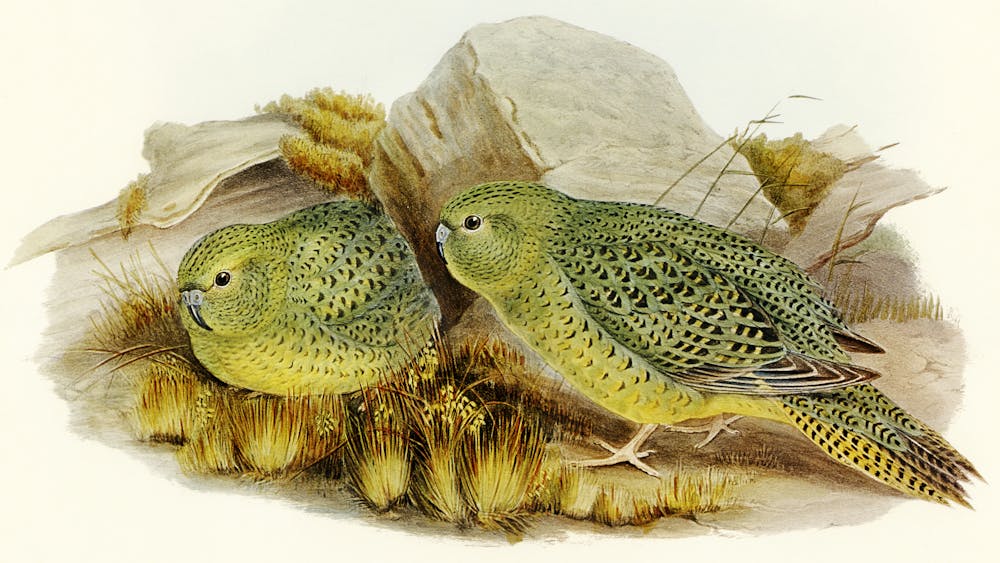
    The night parrot lives in arid inland Australia. Pictured: an 1890 illustration by Elizabeth Gould.
    Wikimedia, CC BY

    A highly mysterious species

    The night parrot was once found throughout Australia’s arid inland, but its numbers plummeted in the late 19th century.

    The bird was not definitely recorded for more than 100 years, until a dead bird was found near Boulia in western Queensland in 1990. Another dead bird was found in Diamantina National Park, also in western Queensland, in 2006.

    In 2013 a small population was found by naturalist John Young in south-western Queensland. That area is now a wildlife reserve.

    Night parrots are notoriously difficult to detect. They build tunnels in dense spinifex and hide there by day, emerging at night to forage. They are known only from populations in remote south-west Queensland and central and northern Western Australia. The species is critically endangered.

    In Western Australia, Indigenous cultural knowledge about the species includes stories about how difficult the bird is to find. There are also whispered stories of mothers telling children the night parrot’s call was the sound of an evil spirit, and warning them not to stray from camp.

    A short video explaining the night parrot project.

    What we did

    The Ngururrpa Indigenous Protected Area is in the Great Sandy Desert. It comprises vast areas of sandplains and dunefields, and smaller areas of floodplain and spinifex which are key night parrot habitats.

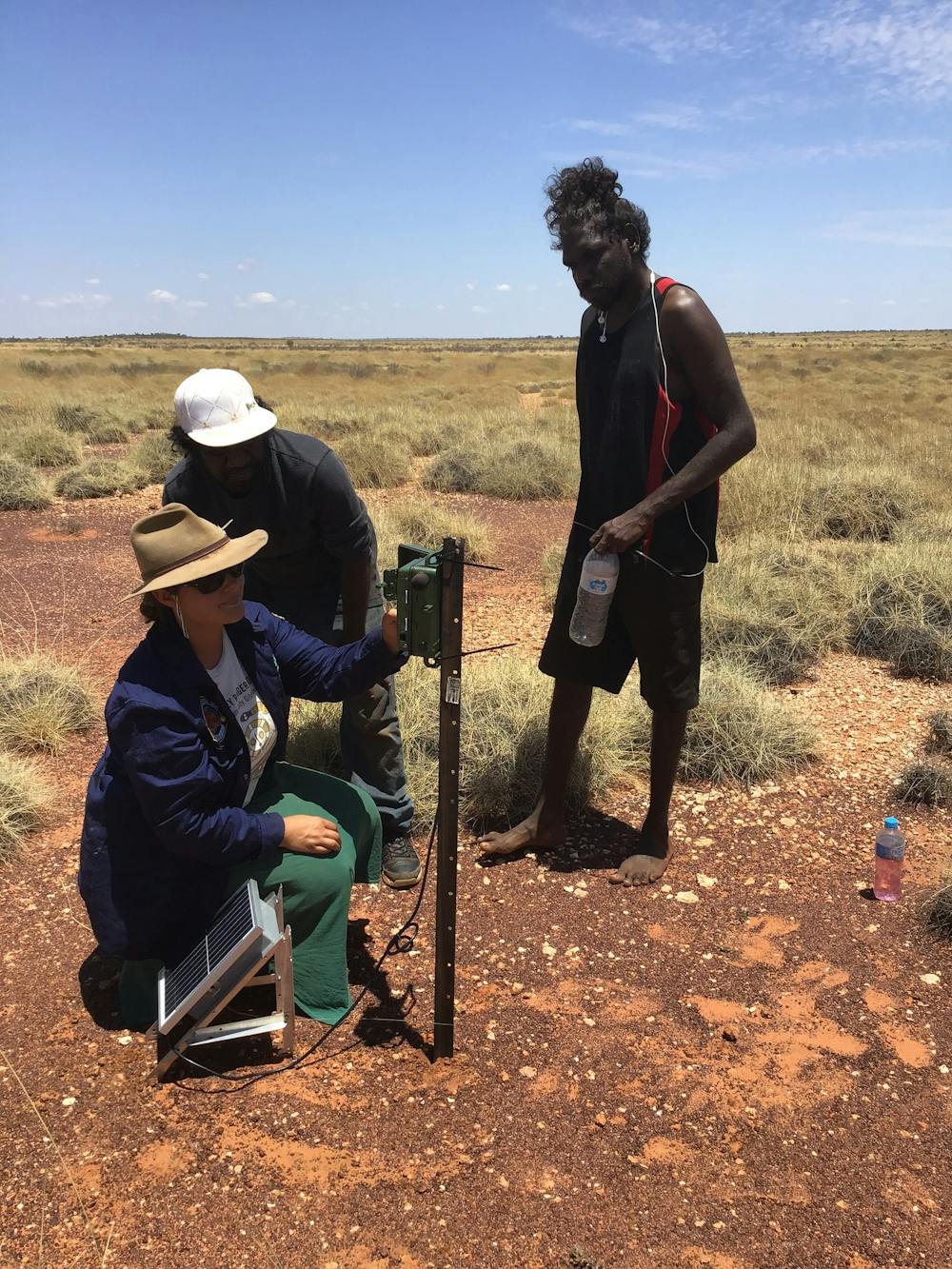
    The researchers recorded night parrots using ‘songmeters’.
    Ngururrpa Rangers/Facebook

    Ngururrpa Rangers worked with scientists to learn how to use sound recorders to search for night parrots. We then searched for the birds on Country between 2018 and 2023.

    We combined the rangers’ detailed knowledge of habitats, water and seed resources with geology maps, satellite imagery and fire history data. From this we selected 31 potential roosting areas, then deployed sound recorders called “songmeters” at those sites.

    We wanted to detect the night parrots’ distinctive calls which consist of whistles, croaks and bell-like sounds.

    The acoustic data we gathered was then analysed to extract any bird calls in the night parrot’s frequency range. Potential detections were verified using a reference library of known night parrot calls.

    Our results

    We detected night parrot calls at 17 of 31 sites. Of these, ten were roost sites, where night parrot calls were detected in the hour after sunset and the hour before sunrise.

    Individual night parrots are thought to have unique calls. We analysed how many different calls we could hear, and how loud they were (which can tell us when birds are calling from different locations). From this we built a picture of the identity and number of individuals regularly occupying a site.

    We extrapolated this across the 58 patches of potential night parrot habitat on the Ngururrpa Indigenous Protected Area. We concluded up to 20 roosting areas may be occupied by night parrots.

    Based on the numbers at roosting sites where we recorded calls, we estimate 40–50 night parrots could be present in the Ngururrpa Indigenous Protected Area.


    Fire and predators pose grave threats

    Once we found the night parrot populations, we wanted to know what threats they faced.

    We used camera-traps to identify predators and also collected their scats (poos) to analyse their diets.

    Ngururrpa Ranger Kathryn Njamme with a night parrot feather.
    Ngururrpa IPA

    Dingoes were the predator detected most frequently in night parrot roosting habitat. Our cameras captured them ten times more often than feral cats. And we found dingoes regularly eat feral cats at night parrot sites.

    Based on information from other areas, we suspect cats are a key predator of night parrots. Dingoes could be important in suppressing cat numbers and helping the parrots survive. So, attempts to limit predators in night parrot habitat should not harm dingoes.

    We also analysed 40 years of satellite imagery to assess the threat of fire to night parrots’ roosting habitat. Based on the vegetation types and flammability of surrounding landscapes, we found bushfires sparked by lightning are a much bigger threat to night parrots in the Great Sandy Desert than in Queensland.

    Strategic aerial and ground burning, to reduce fuel loads, already occurs in the Ngururrpa Indigenous Protected Area. As our knowledge of night parrots improves, these programs can become more targeted to protect key night parrot areas.

    Ngururrpa Rangers using ‘Felixer’ devices to selectively control cats in night parrot habitat.
    Ngururrpa IPA

    Keeping night parrots alive

    A long-term monitoring program for night parrots on Ngururrpa Country should be established to help better understand and protect this vitally important population.

    And the remote, wild nature of the landscape should be retained. This means minimising disturbance from people and vehicles, and continuing to exclude livestock and weeds.

    Clifford Sunfly has articulated how the rangers want to help protect night parrots into the future:

    We would like to spend more time on Country to find where [night parrots] are and understand what they are doing.

    We want those scientists to come and help us catch some night parrots and tag them. We also need more snake-cams (inspection cameras) too and more songmeters. And a kit for collecting scats for DNA.

    One day we would love to have our own research facility for doing our night parrot surveys. It would be our dream to have our own research base on Ngururrpa.

    Rachel Paltridge receives funding from the National Environmental Science Program’s Resilient Landscapes Hub, and the Indigenous Desert Alliance.

    Clifford Sunfly is a Ngururrpa Ranger. The ranger program receives funding from the WA government’s Aboriginal Ranger Program and the State NRM Program.

    Nicholas Leseberg receives funding from the Australian and Queensland Governments. He works for Bush Heritage Australia, and as a consultant on night parrots for many projects.

    ref. ‘Breakthrough discovery’: Indigenous Rangers in outback WA find up to 50 night parrots – one of Australia’s most elusive birds – https://theconversation.com/breakthrough-discovery-indigenous-rangers-in-outback-wa-find-up-to-50-night-parrots-one-of-australias-most-elusive-birds-239449

    MIL OSI AnalysisEveningReport.nz

  • MIL-OSI USA: 09.22.2024 Sen. Cruz Applauds Announcement of House Vote on His Bipartisan CHIPS Permitting Bill

    US Senate News:

    Source: United States Senator for Texas Ted Cruz
    WASHINGTON, D.C. – Today, U.S. Senate Commerce Committee Ranking Member Ted Cruz (R-Texas) released the following statement after it was announced that the bipartisan legislation he authored with Sen. Mark Kelly (D-Ariz.) to dramatically expedite semiconductor manufacturing plant construction would receive a vote on the House floor next week. The Kelly-Cruz bill has already passed the Senate.
    “My number-one priority fighting for Texas has always been jobs, jobs, jobs,” said Sen. Cruz. “I am thrilled that the House has scheduled the Kelly-Cruz legislation for a vote next week. I’ve teamed up with Democrat Senator Mark Kelly to pass landmark legislation streamlining environmental permitting rules for new semiconductor factories.  When passed, Kelly-Cruz will help bring tens of thousands of jobs to Texas and hundreds of billions in new investments. It will also advance our national security significantly by making us much less dependent on China for advanced semiconductors. Our bipartisan legislation passed the Senate unanimously, and I urge our House colleagues to likewise swiftly pass it into law.”
    During the week of September 23rd, the House will vote on S. 2228, the “Building Chips in America Act,” under suspension of the rules, requiring a 2/3 majority of House members for passage. S.2228 was modified with substitute text authored by Sens. Cruz and Kelly (Senate Amendment 1378).
    In December, the Senate unanimously passed Sens. Cruz and Kelly’s bipartisan chips permitting bill, which was cosponsored by Sens. Todd Young (R-IN), Sherrod Brown (D-OH), Bill Hagerty (R-TN), Martin Heinrich (D-NM), and Kyrsten Sinema (I-AZ). This legislation had also previously passed the Senate in July of 2023 as part of the Senate’s version of the National Defense Authorization Act (NDAA).In October of 2023, Sens. Cruz and Kelly led  a bipartisan, bicameral letter with over 100 signers in support of passing these permitting reforms.
    In January, Sen. Cruz toured the Samsung facility in Taylor, Texas and reiterated the importance of his CHIPS/National Environmental Policy Act (NEPA) legislation. Sen. Cruz also hosted a roundtable event in Round Rock, Texas, to discuss regulatory hurdles facing the semiconductor industry. Sen. Cruz engaged with many Texas-based semiconductor companies, and discussed how burdensome federal environmental requirements are driving up compliance costs for chip manufacturers, leading to slower construction timelines.
    In April, Sen. Cruz discussed the need for chips permitting reform at a roundtable discussion hosted by Southern Methodist University after the university had been designated the lead agency for this federally funded economic development initiative, aimed at bolstering semiconductor manufacturing in the United States.
    Background on Sen. Cruz’s efforts to encourage American innovation through Chips manufacturing:
    During a Senate Commerce Committee hearing on ‘CHIPS and Science Implementation and Oversight,’ Secretary of Commerce Gina Raimondo endorsed Sens. Cruz and Mark Kelly’s (D-AZ) CHIPS/NEPA proposal.
    Sen. Cruz helped enact historic tax reform in 2017, which gave a tax cut to virtually every taxpayer in America. It reduced taxes on small businesses, farmers, ranchers, and job producers, which has helped bring jobs to Texas and drive innovation.
    Sen. Cruz has been leading the fight against burdensome federal government regulations and EPA overreach.
    Sen. Cruz authored the Cost Recovery and Expensing Acceleration to Transform the Economy and Jumpstart Opportunities for Businesses and Startups (CREATE JOBS) Act, which would vitally reform business expensing in the tax code and help businesses and innovators thrive.
    Sen. Cruz championed the Facilitating American-Built Semiconductors (FABS) Act to incentivize manufacturing in the U.S. through tax credits. That legislation is now law.

    MIL OSI USA News

  • MIL-Evening Report: Basic service provider or mini democracy? Why NZ needs to decide what it wants from local government

    Source: The Conversation (Au and NZ) – By Jeffrey McNeill, Honorary Research Associate, School of People, Environment and Planning, Te Kunenga ki Pūrehuroa – Massey University

    Prime Minister Christopher Luxon’s recent challenge to local government “to rein in the fantasies and to get back to delivering the basics brilliantly” was unsurprising, given his government’s focus on fiscal restraint.

    It was in keeping with his announcement that councils’ legislative purpose of delivering their communities’ economic, social, environmental and cultural wellbeing are to be removed from the Local Government Act.

    Local government responded with the usual indignation and suggested solutions. There were complaints about inadequate funding mechanisms, questions about whether libraries are basic services. The whole spat likely flew under the radar of the wider public.

    Yet the problems facing local government are very real and will not just go away by kicking costly decisions down the road. Rather, they are symptomatic of fundamental choices facing the sector.

    Foundational issues

    The problems go back to the late 1980s when our current local government system was designed.

    Led by then local government minister Michael Bassett, the reforms were the first in over 100 years. More than 850 city, borough and county councils, catchment boards, united councils and local boards were amalgamated to form 86 in 1989 and now 78 regional, city and district councils we have today.

    But Bassett still considered local government reform incomplete because of the failure to address water provision.

    But I would argue the real unfinished business was the failure to resolve the purpose of local government in the first place. Only when that is agreed can we address local government’s functions, form and funding.

    Until then, the shape and function of local government will remain a political football.

    According to section 10(1)(a) of the Local Government Act 2002, the purpose of local government is “to enable democratic local decision-making and action by, and on behalf of, communities”.

    But the second subsection describing its purpose, (s.10(1)(b)) has changed with the various governments. In 2002, under Helen Clark’s Labour-led government, the purpose of local government was:

    to promote the social, economic, environmental, and cultural well-being of communities in the present and for the future.

    John Key’s National-led government in 2012 replaced that purpose with a remit

    to meet the current and future needs of communities for good-quality local infrastructure, local public services, and performance of regulatory functions in a way that is most cost-effective for households and businesses.

    The previous Labour government reintroduced the wellbeing purpose. Luxon is set to remove it.

    Function, form and funding

    Should local government be a true local government with comprehensive and wide powers, or simply a property-services organisation, providing little more than street-lighting, roading, water and sewerage?

    The two very different conceptions of local government determine its functions, form and funding.

    These differing views reflect the disparate Anglophone and European concepts of local government. National aligns with the Anglophone model, with its limited local government functions under a strong central government. Labour leans towards the European model, with devolved wide-ranging functions.

    The distinction between the two models was made very clear to me while working as part of an international team researching local government responses to the COVID-19 pandemic.

    My Italian colleague, for example, reported how his country’s local governments were vitally involved in their cities’ day to day management during the crisis.

    Mayors and councils were making daily decisions and announcements about their hospitals’ resourcing, whether to close the schools and training institutes, increase social welfare provision and housing, and so on.

    On the flipside, New Zealand local government was largely sidelined to address humanitarian services such as ensuring people had access to food and accommodation.

    Instead, councils searched for local “shovel-ready” infrastructure projects to access central government funds in order to reduce unemployment and stimulate local economies. The public focused on national daily press announcements from the prime minister and director-general of health.

    No appetite strong local government

    For all that, the distinction between Labour and National conceptions of local government may not be as great as recent history suggests.

    Both want a strong centre and weak local government. Our councils have largely reinforced this reality. Some have sought to extend their scope of activities, others have clearly defined themselves as property services agencies.

    Most have largely refrained from the excesses the prime minister appears to be concerned about, partly to avoid being caught out by changes in central government, but also because most council expenditure is already committed to infrastructure.

    But does it have to be this way?

    The Labour-led government’s 2021 Future for Local Government review envisaged local government using partnerships with hapū and iwi to promote the four key wellbeings as key to any reform. This is at odds with the present government’s priorities and views on governing with Māori – a big reason why the reports now collect dust.

    The review was also very constrained in considering local government functions. Rather, it seemingly took existing functions as its starting point to focus instead on local governance.

    Writing about our local government nearly 70 years ago, public servant and academic R.J. Polaschek imagined what would have been if New Zealand had been colonised by Denmark instead of Great Britain. In this hypothetical scenario he saw strong independent local government based on communities with wide-ranging functions.

    It still could be, but tinkering at the edges is not going to solve its problems. Our local government project remains unfinished business. It will take political courage and vision to complete the task. One that remains a fantasy, and we are all the losers.

    Jeffrey McNeill does not work for, consult, own shares in or receive funding from any company or organisation that would benefit from this article, and has disclosed no relevant affiliations beyond their academic appointment.

    ref. Basic service provider or mini democracy? Why NZ needs to decide what it wants from local government – https://theconversation.com/basic-service-provider-or-mini-democracy-why-nz-needs-to-decide-what-it-wants-from-local-government-238862

    MIL OSI AnalysisEveningReport.nz

  • MIL-OSI New Zealand: Release: Public service set up to fail under National

    Source: New Zealand Labour Party

    Nicola Willis has set up the public service to fail to pay for reckless tax cuts for landlords and the tobacco industry.

    Today’s analysis by the Council of Trade Unions shows that significant cuts to frontline public services will likely be needed to meet the Government’s directive to fund cost pressures – such as from inflation and population growth – from baseline funding.

    “Nicola Willis has just gutted the public service to the tune of some 6000 people. Public services are already having to do more with less and we’ve seen how the frontline is being affected,” said Labour public service spokesperson Ayesha Verrall.

    “To also have to manage cost pressures without more funding will likely lead to more job cuts and further undermine frontline work.”

    “From cutting frontline work the Department of Conservation does to protect our most precious native species to hiring freezes at our hospitals, it’s clear the National Government has broken its promises to New Zealanders that frontline services would not be affected.”

    The Government Workforce Policy Statement sets out the Government’s expectation that departments manage cost pressures through their baselines.

    “This approach might ordinarily be sensible, but not after the public service has already been pared back to basics.

    “Departments have just cut 6.5% or 7.5% from their baselines, leaving them already struggling to deliver their core functions. And now expecting them to absorb cost pressures when there is no capacity left, will lead to further front line cuts.

    “Nicola Willis made reckless commitments about tax cuts that she couldn’t afford. She’s had to gut the public service and borrow to pay for them, all while handing $216 million to the tobacco industry, and $2.9 billion to landlords.

    “Almost a year into her tenure as finance minister it’s time Nicola Willis took some responsibility, and realised that she cannot cut her way to a better New Zealand.

    “Day by day we see cuts going deeper and further. A weakened public service is not good for anyone and New Zealanders are worse off for it,” Ayesha Verrall said.


    Stay in the loop by signing up to our mailing list and following us on FacebookInstagram, and X.

    MIL OSI New Zealand News

  • MIL-OSI United Kingdom: Rural Flood Resilience Partnership launched to help farmers and rural communities adapt to a changing climate

    Source: United Kingdom – Executive Government & Departments

    Partnership unites six organisations including: Action with Communities in Rural England; Association of Drainage Authorities; Country Land and Business Association; Environment Agency; National Farmers Union; and Natural England

    With rural communities increasingly on the frontline of extreme weather and the devastating impacts of flooding, a unique partnership has been launched today (23 September 2024) to support rural flood resilience and help farmers and communities adapt to a changing climate. 

    Climate change means that people, places and nature are facing more frequent and more severe storms and floods. Last winter saw one of England’s wettest periods since records began in 1836. 

    The Rural Flood Resilience Partnership has been established to improve collaboration, deepen understanding of vulnerabilities, and support rural communities and agricultural businesses in building their resilience to present and future flood risks and coastal erosion. 

    The Partnership unites organisations representing government agencies, trade associations, rural communities and businesses to tackle a joint challenge with joint solutions. 

    The six equal founding partners are: Action with Communities in Rural England; the Association of Drainage Authorities; Country Land and Business Association; the Environment Agency; the National Farmers Union; and Natural England. 

    Today, the Partnership publishes its work plan covering 2024 to 2026. Partners and a wide range of projects will work together to improve their evidence base and will draw on this to co-develop solutions. 

    The work plan sets out 21 actions supporting seven strategic outcomes focused on: developing the evidence base behind decision-making to increase resilience; ensuring communities, farmers and landowners have access to quality advice and support; and engaging rural communities in flood resilience.  

    James Blake, Chair of Trustees Action with Communities in Rural England, said:

    It’s vital that everyone living and working in rural communities – not just those involved in land management and agriculture – have an opportunity to engage with and influence plans to manage the consequences of climate change.  

    As one of the founding members of this partnership, we look forward to drawing on the experience and reach of ACRE members to build the capacity of rural communities to come together and consider what can be done based on local circumstances in response to this most pressing global issue.

    Robert Caudwell, Chair of the Association of Drainage Authorities, said:  

    Our climate is changing rapidly, and those living and working in rural parts of England are some of the most aware of, and most vulnerable to, those changes.

    Listening to the voice of rural communities is essential if we are to build England’s resilience to flooding and drought in the future. 

    The best solutions can often be achieved when public authorities work together with local businesses and communities, combining their land and water management expertise with a deeper understanding of our local landscape and those impacted. 

    ADA is proud to play its part in this new Partnership in support of our members, England’s flood and water management authorities.

    Country Land and Business Association (CLA) President Victoria Vyvyan said:

    The damage to rural land and businesses from flooding is localised but acute, and the frequency of these events will increase with climate change.  

    It is crucial to improve the resilience of rural businesses and communities to flooding. The CLA hopes this partnership will provide the evidence, awareness of risks, and access to practical advice that will allow them to improve their resilience.  

    This partnership will look for short and medium-term solutions whilst raising awareness of the rural-specific costs and challenges from flooding which our members face.

    Caroline Douglass, Executive Director for Flood and Coastal Risk Management, Environment Agency, said: 

    Flooding presents specific challenges to those living and working in rural communities, from ruined crops to having road access cut off by floodwaters.  

    Since 2015, flooding and coastal change projects have been completed to protect more than 400,000 hectares of agricultural land better. This includes 280,000 hectares between 2015-2021, helping to avoid more than £500 million worth of economic damage to agricultural land production.

    While the Environment Agency continues to work to strengthen rural flood resilience, no single organisation can tackle these challenges in isolation. This partnership provides the opportunity to accomplish more than any one organisation can manage alone. 

    The new Rural Flood Resilience Partnership will help farmers, land managers and rural communities become more resilient to the impacts of climate change while retaining the vital role of managing land and producing sustainable food.

    NFU Vice President Rachel Hallos said: 

    The NFU is pleased to be involved in this new Partnership and hope it will enable farmers and rural communities to strengthen the resilience of their homes and businesses by providing practical solutions based on tangible evidence to some of the challenges they face in the event of flooding. 

    It will also give rural communities the means to influence decision making, provide access to resources and support action on the ground, strengthening rural resilience to flooding in a changing climate. 

    Farmers are on the frontline of climate change – our biggest challenge. The extreme weather this brings is one of the main threats to UK food security and more severe storms, devastating floods, and increased periods of little or no rain are all impacting our ability to produce food. 

    The country has just experienced its wettest 18 months since records began in 1836 which left many thousands of acres of productive farmland under water. There are still many farm businesses in dire need of support, and we are awaiting details of how the Farming Recovery Fund can help those businesses recover from the impacts of the devastating flooding and saturated ground.

    Natural England’s Greener Farming & Fisheries Director, Brad Tooze, said:

    Natural England champions the power of nature and nature-based solutions to help tackle the joint climate and biodiversity emergencies.  

    NE welcomes the opportunity to join this partnership and add our science and evidence expertise and our local farm advice offer into the mix. Together we can support farmers and land managers to farm in more flood resilient ways – supporting communities to become more flood resilient and recovering nature at the same time. 

    From signing up to the Sustainable Farming Incentive to manage arable land for flood/drought resilience and water quality or by working with others to restore a river and floodplain in Landscape Recovery every farmer and land manager can make a difference.

    The Partnership forms part of the wider work that all partners are undertaking on flood and coastal resilience.  

    All flood and coastal risk management schemes delivered by risk management authorities in England are carefully assessed to make sure they benefit the most people and property. Approximately 40% of all schemes and 45% of investment better protect properties in rural communities.

    Updates to this page

    Published 23 September 2024

    MIL OSI United Kingdom

  • MIL-OSI Australia: Taree NPWS hazard reduction burn 22 September 2024

    Source: New South Wales Environment and Heritage

    The 72 hectare ‘Starrs Creek HR – Stage 2’ aims to provide a fuel reduced zone within Coorabakh National Park, aiding in the suppression of bushfire in the area.

    The burn will also stimulate reproduction of the critically endangered Banksia conferta within the prescribed burn area.

    NPWS crews will be working on roads and trails throughout Coorabakh National Park to implement the burn. The public are advised that smoke may affect roads in the area and motorists are reminded to exercise caution when driving along roads in the area.

    Hazard reduction burns are essential to reduce bushfire fuel loads to help protect parks, neighbours and communities from future bushfires. Fires such as this one are also specifically planned to have an ecological outcome.

    All burns around the state are coordinated with the NSW Rural Fire Service.

    People with known health conditions can sign up to receive air quality reports, forecasts and alerts via email or SMS from the Department of Climate Change, Energy, the Environment and Water (NSW DCCEEW).

    For health information relating to smoke from bush fires and hazard reduction burning, visit the NSW Health or Asthma Australia.

    More information on hazard reduction activities is available at NSW Rural Fire Service and the NSW Government Hazards Near Me website and app.

    MIL OSI News

  • MIL-OSI United Kingdom: York Walls in Bloom

    Source: City of York

    Residents and visitors will be able to experience areas of the city walls from a fresh perspective next spring, as this unique and historic space blooms into life.

    Volunteers and businesses from across the city are coming together this week to help transform the City Walls embankments, for the first phase of the York Walls in Bloom project.

    This unique green space will evolve into a beautiful biodiverse landscape, where residents and visitors will be able to enjoy seeing many different pollinators thrive.

    Over its 2,000-year-old history, the city walls embankments (ramparts) have constantly evolved and changed from being cleared sheer slopes, areas of grazing until the mid-20th century and in recent years manicured lawns and bedding plants.

    The first phase of the York in Bloom project will be in the city centre at Station Rise. The area around the Station Rise rampart has over the centuries seen some of the most dramatic changes in landscape visible anywhere on the city walls.

    The season bedding displays here will be familiar to many residents and visitors, but this approach is not without its downsides. It’s resource intensive in terms of water and carbon used in the growing, transporting, planting, weeding and removing bedding plants. This makes the practice increasingly unsustainable for the city and the planet.

    Cllr Jenny Kent, Executive Member for Environment and Climate Emergency, said “York is proud to have some of the UK’s best preserved medieval walls, and this partnership project to cover the site at Station Rise in meadow flowers for York Walls in Bloom will not only look beautiful, it will also help support York’s bees, moths and butterflies, and help preserve the ramparts underneath.

    We are lucky to have expert advice from many partners and are also in the process of reviewing our maintenance of the walls overall. We will ensure that we adopt the very best heritage and ecology conservation practices to prevent soil erosion, which increases with extreme heat and increased rainfall, maximise the environmental benefit, and keep the Walls looking great for generations to come.”

    Inspired by projects such as the Tower of London ‘Moat in Bloom’, the council believes that carefully managed wild flowering could offer the right mix of stunning visuals, increased sustainability and improved habitat.

    York Walls in Bloom is being carefully introduced over the course of 2024. Earlier this year, the area was left to grow naturally for several months so that the ecological study could be undertaken. This was critical so that the council knew that any intervention wouldn’t endanger existing habitats.

    While next year will see a spectacular floral display near Station Rise, the area will still be very carefully managed over several years to balance the ecology of the site. The second phase of the project will be extended to the Red Tower, Walmgate next year.

    This will transform the flatter sections of rampart on the outside of the city walls by sowing wildflowers in Spring, to create a floral display in summer 2025, which over the following years will be carefully managed into a sustainable natural floral meadow.

    Introducing a more sustainable, natural environment in the coming years, including changing how frequently the grass is cut in this area, will ensure a healthier soil and more wildflower growth.

    The York in Walls project has gained the backing and sponsorship of local businesses.

    Simon Mahon, General Manager of The Grand York, said: “We’re delighted to be working on the York Walls in Bloom project. We’re very proud sponsors and are looking forward seeing wildflowers being introduced along the walls, which naturally will make this historical part of York even more beautiful.

    Here at The Grand, York, as part of our sustainability initiative we house approximately 50,000 bees on our roof – the honey they produce is used throughout The Grand in desserts, pastries and cocktails. So, we’re really happy to support this project.”

    From Tuesday 24 September, works will be visible on the ground when the turf will be ‘wither stripped’ to allow for the sowing of the wildflowers.

    With the help on York Cares, volunteers from across the city will come together to support the project and help sow the seeds.

    Holly Hennell, Manager, York Cares: “The 16th annual York Cares Big Community Challenge is taking place between 16 September and 11 October in partnership with City of York Council, St Nicks and the University of York. The challenge aims to connect communities with nature, providing volunteering opportunities at over 30 sites across the city along routes leading into the city centre around the city walls.

    “Employee-volunteers will get involved with a variety of practical activities to enhance biodiversity across the city including sowing seeds as part of the York Walls in Bloom project, a fantastic initiative which will really brighten up the city whilst also benefiting the environment. The York Cares team is excited to be able to get involved in one of the sessions alongside their members, demonstrating the difference we can make when we come together.”

    The York in Bloom project is funded by the Green Corridors project , the National Lottery Community Fund and is sponsored by local businesses including The Grand York.

    For more information visit York Walls in Bloom.

    MIL OSI United Kingdom

  • MIL-OSI Australia: Avian influenza quarantine areas eased

    Source: Government of Australia Capital Territory

    On 13 September 2024, the ACT Government assumed a caretaker role, with an election to be held 19 October 2024. Information on this website will be published in accordance with the Guidance on Caretaker Conventions until after the election and conclusion of the caretaker period.

    Released 23/09/2024

    Quarantine areas restricting the movement of birds and other materials, objects and equipment in the Belconnen area will be reduced as the ACT’s response to avian influenza (HPAI H7N8) enters the final phase.

    There have been no new detections of avian influenza in the ACT since 4 July 2024. From tomorrow, 24 September, the quarantine areas will be reduced to:

    • A restricted quarantine area within a one kilometre radius of the first affected property on Parkwood Road in Belconnen.
    • A control quarantine area within a two kilometre radius of the first affected property on Parkwood Road in Belconnen.

    In the restricted quarantine area the movement of birds, bird products and other materials, objects and equipment deemed as high risk is not permitted.

    In the control quarantine area, the movement of birds and other materials, objects and equipment deemed as high risk is not permitted, but bird products such as eggs may be moved under certain conditions.

    These restrictions will remain in place until late December 2024, but will continue to be reviewed as the response progresses.

    All bird owners should review the updated quarantine restrictions to know their responsibilities and continue to implement good biosecurity practices.

    The ACT’s response to avian influenza is moving to the final phase of decontaminating the first property affected by the disease.

    Avian influenza is a notifiable animal disease which means any suspected or confirmed cases must be reported immediately to the Emergency Animal Disease Hotline on 1800 675 888.

    For more information on the situation in the ACT and the movement restrictions, including a map of the quarantine area, visit the ACT Environment website.

    For updates on the current disease situation in other jurisdictions across Australia visit outbreak.gov.au.

    – Statement ends –

    ACT Environment, Planning and Sustainable Development Directorate | Media Releases

    Media Contacts

    «ACT Government Media Releases | «Directorate Media Releases

    MIL OSI News

  • MIL-Evening Report: Move over Olympians, Australia’s wildlife are incredible athletes

    Source: The Conversation (Au and NZ) – By Euan Ritchie, Professor in Wildlife Ecology and Conservation, School of Life & Environmental Sciences, Deakin University

    Now that the Paris Olympics and Paralympics have disappeared from our screens, let’s get back to watching animal videos.

    But seriously, have you ever paused to think about the athletic abilities of Australian wildlife?

    In my research as an ecologist, I’m constantly amazed by the strength, speed and resilience of our native animals. Their prowess is testament to the wonders of evolution, and the necessity of species having to adapt to challenging and changing environments in order to survive.

    Let’s take a closer look at some of our best competitors and how might they fare, against humans and overseas entrants. On your marks, get set… swim, hop, dig, dance, glide!

    Swimming

    Australians are renowned for being strong swimmers. But what is the fastest swimmer in the animal kingdom?

    On this there is much debate. Some suggest it’s the Indo Pacific sailfish, clocking in at about 30km/hr. That’s impressive, but much slower than oft-cited (but inaccurate) claims it can travel at more than 100km/hr.

    For perspective, the fastest human to swim the 50 metres freestyle is American Caeleb Dressel, completing this in a time of 20.16 seconds. That’s roughly 9km/h – faster than many people jog, but still no match for a sailfish.

    As in humans, swimming speed in fishes tends to increase with body length. Larger species that challenge sailfish for the fastest swimmer title include blue or black marlin. Shorter, torpedo-like bluefin tuna are also in contention. All are found in Australian waters, though not exclusively.

    While American swimmer Michael Phelps put in an impressive showing against a simulated great white shark, no human would beat much faster sailfish, marlin and tuna.

    Sprinting, long and high jump

    Aussie icons, red kangaroos can reach speeds of around 60-70km/hr. But they are no match for cheetahs, which can move at more than 120km/hr.

    Long jump is surely the kangaroo’s main event. Red kangaroos can jump a staggering 13 metres or more. Amazingly, this might not be enough to clinch gold. Snow leopards can jump more than 15 metres.

    Kangaroos can clear heights of up to 3m, so would perform well in the high jump. But they’d finish behind bottlenose dolphins, which can jump over 7m in the air, just for kicks.

    Scaled for body size, though, both species would be embarrassed by a tiny insect known as a froghopper. It jumps to heights of more than 140 times its body length.

    Kangaroos sure can jump, but they’re not the greatest of all in the animal kingdom.

    Battles of strength

    African elephants can lift more than 1,000kg and weaver ants more than 100 times their own body weight.

    But relative to size, a truly impressive champion is Australia’s horned dung beetle. At just a centimetre long, these diminutive powerhouses can pull more than 1,100 times their own body weight, roughly equating to an average man lifting two fully-loaded 18-wheeler trucks.

    And yet, horned dung beetles might still only claim silver. Another invertebrate Aussie, the tiny tropical moss mite, is perhaps the world’s strongest animal. It can pull more than 1,180 times its weight.

    Bigger does not always equal stronger.

    Packing the fastest, deadliest punch

    In terms of combat sports, bigger is not always better.

    Peacock mantis shrimps – invertebrates found in Australian marine waters and elsewhere – have the swiftest and most powerful punch in the lightweight crustacean division.

    They kill prey by punching them with strong, club-like appendages. They deliver blows at up to 23m per sec, akin to the speed and force of a .22 calibre bullet being fired.

    So powerful is the punch, it vaporises water and creates a super-hot shockwave that breaks up and incapacitates its prey.

    Nature’s deadliest punch?

    Tantalising contests

    What about a digging contest? Eastern barred bandicoots can shift 4.8 tonnes of soil a year. How would that stack up against marsupial moles, which can disappear almost instantly into desert sands? Or the expert excavations of wombats and aardvarks that can dig more than half a metre in 15 seconds?

    In terms of free-diving and flying, there’s really no contest. Cuvier’s beaked whale can dive nearly 3000m and peregrine falcons can reach over 320 km/hr. These animals are found across the globe, however – not just in Australia.

    Australia’s largest gliding marsupial, the greater glider, can sail up to 100m between trees. But gliding gold would surely go to the giant flying squirrel, which can glide up to 450m.

    I’d love to see a shooting contest between Australia’s archer fish and Madagascar’s panther chameleon. But finding the right arena for both aquatic and land-based sharpshooters would be tricky.

    Raygun’s kangaroo hop is now legendary, but a breaking (break dancing) contest between a peacock spider, spanish dancer (a type of nudibranch) and a magnificent riflebird might genuinely break the internet.

    Step aside, Raygun, peacock spiders are taking the floor.

    Appreciating wildlife athletes

    So who would win a global contest for the best wildlife athlete overall?

    If the competition was on land and focused on running, jumping, strength and climbing, it’s hard to go past the overall abilities of a Bengal tiger.

    Many amazing wildlife athletes are threatened with extinction. Others are gone forever.

    They include the incredible oolacunta – also known as the desert rat kangaroo. It’s powers of endurance in the desert are the stuff of folklore. As legendary Australian mammalogist Hedley Herbert Finlayson wrote in 1931:

    Its speed for such an atom, was wonderful, and its endurance amazing … when we finally got it, it had taken the starch out of three mounts and run us 12 miles; all under such adverse conditions of heat and rough going, as to make it almost incredible that so small a frame should be capable of such an immense output of energy.

    Let’s celebrate wildlife and their athletic abilities and ensure they have a secure future.

    Euan Ritchie receives funding from the Australian Research Council and the Department of Energy, Environment, and Climate Action. Euan is a Councillor within the Biodiversity Council, a member of the Ecological Society of Australia and the Australian Mammal Society, and President of the Australian Mammal Society.

    ref. Move over Olympians, Australia’s wildlife are incredible athletes – https://theconversation.com/move-over-olympians-australias-wildlife-are-incredible-athletes-238303

    MIL OSI AnalysisEveningReport.nz

  • MIL-OSI New Zealand: Two operators selected for new e-scooter licences in Auckland

    Source: Auckland Council

    Auckland Council has selected two providers to receive new rental micromobility licences in Auckland.  

    Of the seven licence applications received, the chosen providers are current operator Lime and the New Zealand-owned Flamingo. Both will be licensed for a two-year period from 4 November 2024. 

    Auckland Council’s Manager of Licensing and Environmental Health, Mervyn Chetty, says the council received a number of strong applications, with the chosen providers demonstrating a commitment to safety initiatives and reducing nuisance.   

    “Both Lime and Flamingo have a history of operating in Auckland and around New Zealand. Their applications represented the best offering for Aucklanders, with both committing to a range of initiatives to support public transport connections, improved parking and safer riding.” 

    “We look forward to continuing our relationship with Lime and welcoming back Flamingo, which currently operates in a number of New Zealand cities and has been licenced in Auckland previously.”  

    Fewer operators but allocations the same

    The current e-scooter allocation in Auckland is 3000 in total, with 900 in tier 1 (city centre), 900 in tier 2 (city fringe) and 1200 in tier 3 (suburban). This allocation will remain the same from November 4, but with the allocation split across the two providers.

    “Having just two operators allows riders to easily find a device with their preferred provider, as well as allowing us to monitor and work with providers more closely,” says Mr Chetty.  

    Lime and Flamingo will each be allowed 900 devices split across tiers 1 and 2. In tier 3, Lime will have 700 devices and Flamingo will have 500.  

    Rental Micromobility Code of Practice 

    Throughout the current licensing period the council has identified improvements that can be made to the Rental Micromobility Code of Practice to better manage operator compliance and influence user behaviour. 

    Changes to the rental micromobility code of practice will include: 

    • Faster response times required to rectify non-compliant parking, reduced from 90 to 75 minutes in tier 1 (city centre) and tier 2 (city fringe).  
    • Faster response times to rectify toppled scooters, reduced from 90 to 75 minutes in tiers 1 and 2. 
    • Strengthened data provisions.  

    E-bikes 
     
    From 4 November the council will no longer license rental e-bikes. Previous e-bike licences saw a low number of trips, with operators having removed all rental e-bike devices from the streets. 

    Operators have committed to work with Auckland Council and Auckland Transport to develop a strategy to successfully bring rental e-bikes back to Tāmaki Makaurau. 

    Assessment of applications 

    Applications were assessed against the requirements of the Public Trading, Events and Filming Bylaw 2022 and Auckland Transport’s Activities in the Road Corridor Bylaw 2022, and were considered to ensure that the applicants could demonstrate their ability to comply with the Rental Micromobility Code of Practice (version 3).  

    Find out more 

    Visit the council’s micromobility web page to find out more about rental e-scooters in Auckland.  

    MIL OSI New Zealand News

  • MIL-OSI Asia-Pac: Red flags hoisted at Big Wave Bay Beach and Clear Water Bay Second Beach

    Source: Hong Kong Government special administrative region

    Attention TV/radio announcers:

    Please broadcast the following as soon as possible:
     
         Here is an item of interest to swimmers.
     
         The Leisure and Cultural Services Department announced today (September 23) that according to the Beach Water Quality Forecast System of the Environmental Protection Department (www.epd.gov.hk/epd/english/environmentinhk/water/beach_quality/forecast_system.html), the Beach Water Quality Forecast Index for Big Wave Bay Beach in Southern District, Hong Kong Island, and Clear Water Bay Second Beach in Sai Kung District is 4, which means the predicted water quality at these beaches is “Very Poor” due to potential transient water quality fluctuations caused by heavy rain. Red flags have been hoisted, and beachgoers are advised not to enter the water to safeguard their health.

    MIL OSI Asia Pacific News

  • MIL-OSI Banking: [Interview] Samsung’s Odyssey OLED G8 Joins the Journey of Creating ‘The First Descendant’ With Nexon Developers

    Source: Samsung

    “Playing The First Descendant on the Odyssey monitor with HDR10+ GAMING allows you to experience the game’s vivid, high-quality graphics at their best”
    – Junhwan Kim, Lead programmer, Engine Program team, Nexon Games
     
    Game development is an art, and like any masterpiece, it requires the right tools. Nexon’s upcoming title, The First Descendant, is set to redefine the looter-shooter genre with its stunning visuals and immersive gameplay. At the heart of this development process is Samsung’s Odyssey OLED G8 — a monitor that not only displays these graphics but elevates them to a new level of realism.
     
    Join us as we dive into the behind-the-scenes journey with the developers at Nexon Games, who reveal how this cutting-edge display technology has helped bring their ambitious vision to life. From the precision of color to the speed of response, discover why the Odyssey OLED G8 is more than just a monitor — it’s a game-changer in the industry.


    Founded in 1994, Nexon has become a global leader in online gaming. Known for creating popular titles like MapleStory, Dungeon & Fighter and KartRider, Nexon continues to push boundaries in the gaming world. This year, the company introduced The First Descendant, a looter-shooter that attracted 260,000 concurrent players at launch. Nexon is focused on expanding its global reach and adapting to the fast-changing gaming industry. In 2021, Nexon completed the acquisition of Embark Studios AB, a company based in Stockholm, Sweden, developing multiple projects for global release.
     
    ▲ (From left) Lead Engine Programmer Junhwan Kim from the Engine Program team and Lead World Concept Artist Sinwook Wi, from the Environmental Concept Design team at Nexon Games, sat down with Samsung to talk about their latest project, The First Descendant and how the Odyssey OLED G8 played a role in its development.
     
     
    Q. Can you tell us about your role in developing The First Descendant and how you contributed to the game’s creation?
     
    Kim: I’m responsible for the game engine. I develop the software that integrates essential elements like graphics, sound and physics engines, make them work seamlessly together.
     
    Wi: I handle the environmental concept design. My role involves creating the overall concept of the game and designing the backgrounds and characters to fit within that environment.
     
    ▲ (From left) Gley, Blair and Enzo, key characters from Nexon’s looter-shooter game ‘The First Descendant’ (Image courtesy of Nexon)
     
     
    Q. What sets The First Descendant apart? What were some of the key innovations and design choices that defined your approach?
     
    Kim: The First Descendant is a looter shooter that blends third-person shooter (TPS) mechanics with role-playing game (RPG) elements. It features spectacular combat scenes, high-quality graphics and a rich loot system filled with powerful guns and gear. The core of the game lies in its storytelling, character development and the pursuit of the best weapons and equipment.
     
    A major focus for us was bringing the open world of The First Descendant to life through cutting-edge graphics. Using Unreal Engine 5, we leveraged Nanite to achieve highly detailed environments, allowing us to render complex landscapes and objects with incredible precision. This was crucial for creating an immersive open-world experience where players can explore vast and visually stunning environments. Lumen played a significant role as well, enabling real-time lighting that reacts dynamically to the game’s world and characters, further enhancing the realism of the gameplay.
    * Open World: A game design element that allows players to freely explore most areas with minimal restrictions.
    * Unreal Engine 5: A game engine developed by Epic Games, known for key features like Nanite, which efficiently handles high-capacity graphics, and Lumen, which enhances lighting effects.
     
    ▲ Junhwan works on the development of ‘The First Descendant’ using the Odyssey OLED G8. The Odyssey OLED G8 delivers superb graphics with its high resolution and color accuracy.
     
    Wi: The game is set in an apocalyptic world where factions — each with their own traditions — battle for survival. The story follows humanity’s fight against the Vulgus, invaders who nearly wiped out the human race. Players take on the role of descendants, embarking on a quest to find the Iron Heart, the ultimate weapon to end the war.
     
    On the design front, our goal was to create an apocalyptic world that felt rich and immersive while avoiding the overly dark and futuristic look often seen in similar settings. The environment itself is a key part of the storytelling. So, we integrated colorful, future-oriented designs for city of Albion to balance the grim atmosphere with a sense of hope. This approach doesn’t just end at the visual appeal but also helps the game engage players on an emotional level, too.


    ▲ Sinwook works on the design for the city of Albion, a key area in ‘The First Descendant,’ using the Odyssey OLED G8. The monitor’s consistent colors and detailed contrast has helped bring out the intricate design elements.
     
     
    Q. As a game developer, what do you consider the most important factors in creating a visually immersive gaming experience?
     
    Kim: A high-quality display is crucial to accurately present the game’s graphics and visuals. Today’s gaming standards demand seamless gameplay with vibrant graphics, high frame rates, detailed resolutions and minimal input lag. To fully experience these advancements, it’s crucial to use a gaming monitor with high resolution, a wide color gamut and fast response times.
     
    As part of our collaboration with Samsung, I received the Odyssey OLED G8 during the development of The First Descendant, and what stood out to me was the monitor’s awesome display quality — color accuracy, expressions and its quick response time. The monitor delivers colors and contrast with a high level of precision, which was crucial for developing the game. The 0.03ms (GTG) response time made a noticeable difference during our demonstrations as well.1
     
    “[With the Odyssey OLED G8,] You get two distinct display experiences with a single monitor—16:9 for working and 21:9 for playing”
    – Wi Sinwook, Lead World Concept Artist, Environmental Concept Design team, Nexon Games
     
    Wi: As a World Concept Artist, I constantly ask myself, “How can I best convey the immersive universe to players?” I want players to experience every detail of the environments and even the subtle expressions of the characters as they were intended. For that, a display accurately reproduces colors and fine details is crucial. When players can see the subtle nuances in shading and the vibrant colors, it significantly enhances their immersion in the game.
     
    ▲ Sinwook builds out the background concept designs for ‘The First Descendant’ using the Odyssey OLED G8.
     
    Q. Other than picture quality, were there any other the Odyssey OLED G8 features that stood out when you were working on and demonstrating the game?
     
    Kim: The First Descendant is a multi-platform game, available on PC (Steam) and consoles. The fact that the Odyssey OLED G8 supports up to three external inputs,2 was especially helpful when we were testing across the different platforms. The sleek, metal design also saved space and complemented the game’s sci-fi aesthetic.

     
    ▲ Junhwan demonstrates the console version of ‘The First Descendant’ on the Odyssey OLED G8. The Odyssey OLED G8 offers enhanced convenience with 2 HDMI 2.1 ports, 1 DisplayPort 1.4 and a USB hub.
     
    Wi: Working on the design and demonstrating the game on the Odyssey OLED G8, I found the gameplay smoother and more comfortable compared to my previous monitor. The colors and contrast were balanced and accurate, even on the big screen.
     
    I also really appreciated the ability to switch the screen ratio between 16:9 and 21:9 with just a single setting change. Normally, I avoid wide monitors due to the viewing angle, but the Odyssey OLED G8 made it convenient to switch between ratios for different tasks — 16:9 for working and 21:9 for demonstrating the game. The big advantage is that you get two distinct display experiences with a single monitor.
     
    ▲ The Odyssey OLED G8’s Game Bar allows users to switch between 21:9 and 16:9 screen ratios, enabling them to enjoy games in their preferred ratio.
     
    “The fact that the Odyssey OLED G8 supports up to three external inputs, was especially helpful when we were testing across platforms like PCs and different consoles”
    – Junhwan Kim, Lead Programmer, Engine Program team, Nexon Games
     
     
    Q. What features of the Odyssey OLED G8 do you think will elevate the experience for The First Descendant players?
     
    Kim: The First Descendant is the world’s first HDR10+ GAMING title. We collaborated with Samsung to implement this technology in our game, optimizing peak brightness of the monitor and supporting standard HDR without the need for manual adjustments.3 Playing The First Descendant on the Odyssey monitor with HDR10+ GAMING allows you to experience the game’s vivid, high-quality graphics at their best.
    * HDR10+ GAMING: A gaming technology that enhances image quality by analyzing game content to enhance the depth of graphics and supporting features like response time and Auto HDR.
     
    ▲ The Odyssey OLED G8 supports HDR10+ GAMING, allowing gamers to enjoy an optimized HDR gaming experience without manual adjustments in supported titles. ‘The First Descendant’ is the first game to feature HDR10+ GAMING technology.
     
    Wi: Unlike my previous monitor, where colors near the edges tended to darken, the Odyssey OLED G8 maintained consistent brightness across the entire screen. The thin frame and bezel also made it easier to focus on the game.


    ▲ The Odyssey OLED G8’s slim metal design and Core Lighting+ on the back enhance user immersion and create a stylish gaming space.
     
    Kim: I also found the Game Bar feature to be helpful. When the Odyssey OLED G8 is connected to a PC or console, it automatically calls up the Game Bar. Selecting FPS mode in the Game Bar brightens dark areas in the game, giving you an advantage over hidden enemies. Also, the sound becomes richer, further enhancing the immersion.
     
    ▲ (Left) Default Game Bar settings without a selected genre, (Right) FPS genre selected in Game Bar.
     
     
    Q. Any final words for The First Descendant players?
     
    Kim: If you’re a fan of The First Descendant, or any third-person shooter (TPS) game with high-quality graphics, the Odyssey OLED G8 is an excellent choice. It has high refresh rate, wide color gamut and fast response time, which really enhance the gaming experience.
     
    Wi: I’ve always debated between choosing a monitor with high resolution and refresh rate for gameplay versus one with accurate colors and contrast for development. The Odyssey OLED G8 meets both needs perfectly, so I can confidently recommend it to any gamer…or developer!


    1 Based on GtG measured under internal test conditions. Results may vary by content, monitor settings and the performance of the input source.2 Supports 2 HDMI 2.1 cables, one Display Port 1.4 and three USB 3.0 ports (1 Up, 2 Down)3 To use HDR10+ GAMING, the content must be HDR10+ GAMING compatible, and additional settings may need to be adjusted depending on the content.

    MIL OSI Global Banks

  • MIL-OSI Australia: Prescribed hazard reduction burns in Nicholls and Ngunnawal

    Source: Government of Australia Capital Territory

    On 13 September 2024, the ACT Government assumed a caretaker role, with an election to be held 19 October 2024. Information on this website will be published in accordance with the Guidance on Caretaker Conventions until after the election and conclusion of the caretaker period.

    Released 23/09/2024

    A prescribed hazard reduction burn in Nicholls will commence this evening, and another hazard reduction burn will commence at Hill Reserve in Ngunnawal tomorrow, subject to suitable weather and fuel moisture conditions.

    The prescribed hazard reduction burns are being conducted to reduce the ground cover of exotic grasses and reduce the fire hazard in the area.

    See the location map of the burn sites.

    Experienced ACT Parks and Conservation Service fire managers will conduct and oversee the burning operations alongside the Ginninderry Conservation Trust and local First Nations community members.

    Every effort is made to conduct burns in weather conditions that will minimise the impact of smoke, but temporary smoke cover is possible and may be visible across parts of Canberra.

    Fire crews will be on the ground monitoring and patrolling the prescribed burn to its conclusion.

    Smoke, flame, and glowing embers may be seen at these sites, which is normal for these types of operations. The public are asked not to call emergency triple-zero unless they see any unattended fire.

    Prescribed burns are an important part of the ACT’s annual Bushfire Operations Plan to enhance ecological quality, reduce the risk of bushfires and help keep Canberrans safe.

    More information about prescribed hazard reduction burns is available on the ACT Environment website.

    – Statement ends –

    ACT Environment, Planning and Sustainable Development Directorate | Media Releases

    Media Contacts

    «ACT Government Media Releases | «Directorate Media Releases

    MIL OSI News

  • MIL-OSI Asia-Pac: English rendering of PM’s address to the Indian Diaspora, New York, USA

    Source: Government of India

    Posted On: 23 SEP 2024 3:58AM by PIB Delhi

    Bharat Mata ki – Jai!

    Bharat Mata ki – Jai!

    Bharat Mata ki – Jai!

    Namaste U.S.! Now even our “Namaste” has gone multinational, transitioning from local to global, and it’s all because of you. Every Indian who holds Bharat close to their heart has made this possible.

    Friends, 

    You’ve come here from far and wide. Some faces are familiar, while others are new. Your love is a great honour for me. I recall the days when I wasn’t a PM, wasn’t a CM, wasn’t a leader at all. Back then, I used to come here as an inquisitive traveller, eager to see and understand this land, carrying many questions in my mind. Even when I held no official position, I had already toured almost 29 states in America. Later, when I became a CM, I continued connecting with you through technology. As a PM, too, I’ve received immense affection and warmth from you. In 2014, it was Madison Square; Sam Jose in 2015; Houston in 2019; Washington in 2023; and now New York in 2024, and each time, you surpass the last record.

    Friends, 

    I’ve always recognized the strength of the Indian diaspora. Even when I held no official post, I understood it, and I understand it today. You have always been Bharat’s strongest brand ambassadors for me. That’s why I call you the ‘Rashtradoot’ (nation’s emissaries). You’ve connected America to Bharat and Bharat to America. Your skills, talent, and commitment are unparalleled. Though you’ve crossed seven seas, no ocean is deep enough to separate you from the Bharat that resides in your hearts. What Maa Bharti has taught us, we can never forget. Wherever we go, we treat everyone like family. Embracing diversity, living it, and integrating it into our lives—these are our values, embedded in our very being. We are from a country with hundreds of languages and dialects, home to every religion and sect. Yet, we move forward as one and united. In this very hall, some speak Tamil, others Telugu, Malayalam, Kannada, Punjabi, Marathi, or Gujarati. Our languages may differ, but our spirit is one: “Bharat Mata ki Jai” (Victory to Mother Bharat), the spirit of Indianness. This is our greatest strength in connecting with the world. These values naturally make us ‘Vishwa Bandhu’ (global friend). As our scriptures say, तेन त्यक्तेन भुंजीथा: meaning those who sacrifice are the ones who truly enjoy. We find happiness by doing good to others and by sacrificing.  Wherever we live, this spirit remains unchanged. We contribute maximum to the societies we live in. In America, be it as doctors, researchers, tech professionals, scientists, or in other professions, you’ve soared high, and the world has witnessed it.  Just a short while ago the T-20 Cricket World Cup was held here and the USA team played amazingly, and the world has also seen the contribution of the Indians living here in that team.

    Friends, 

    For the world, AI means artificial intelligence, but I believe AI stands for America-India. This America-India spirit is the AI power of the new world, elevating Bharat-America relations. I salute all of you, the Indian diaspora. 

    Friends, 

    Wherever I go in the world, I hear nothing but praise for the Indian diaspora from every leader. Just yesterday, President Biden invited me to his home in Delaware. His warmth and hospitality were truly touching. This honour is for 140 crore Indians, for your hard work, for the millions of Indians living here. I extend my gratitude to President Biden and to all of you. 

    Friends, 

    The year 2024 is crucial for the world. On one side, we see conflicts and tensions among nations, while on the other, some countries are celebrating democracy. Bharat and America are together in this celebration of democracy. Elections are upcoming here in the U.S., while Bharat has already held its elections. These elections in Bharat were the largest in human history. You can imagine: almost double the number of voters as the total population of the U.S., and more voters than the entire population of Europe! So many people cast their votes in Bharat. When we see the scale of Bharat’s democracy, it fills us with pride. A three-month-long polling process, 15 million polling staff, over a million polling stations, more than 2,500 political parties, more than 8,000 candidates, thousands of newspapers in different languages, hundreds of radio stations, TV news channels, millions of social media accounts, lakhs of social media channels—all of this makes Bharat’s democracy vibrant. It’s an era of expanding freedom of expression, and our electoral process undergoes scrutiny at this level.

    And friends, 

    This long election process has led to something unprecedented in Bharat this time. What happened? What happened? What happened? ‘Abki Baar – ’ (This time again—), ‘Abki Baar – ’ (This time again—), ‘Abki Baar – ’ (This time again—)!

    Friends, 

    Our government has been re-elected for the third time. This hadn’t happened in Bharat in the last 60 years. The mandate the people of Bharat has given us is huge and significant. In this third term, we have even greater goals to achieve. We must move forward with three times the strength and three times the speed. You’ll remember one word: PUSHP (flower). Yes, consider it a lotus, I have no objections. PUSHP, and I define this PUSHP. P for Progressive Bharat, U for Unstoppable Bharat, S for Spiritual Bharat, H for Humanity First Bharat, and P for Prosperous Bharat. Together, these five petals of PUSHP will shape a ‘Viksit Bharat’ (Developed India).

    Friends, 

    I am the first Prime Minister of Bharat born after independence. During the freedom struggle, millions of Indians dedicated their lives to Swaraj (self-rule). They didn’t think of their personal interests or comfort zones; they forgot everything and fought against the British. Some were hanged, some were shot, some endured torturous imprisonment, and many spent their youth in jail.

    Friends, 

    We couldn’t die for our country, but we can surely live for it. Dying wasn’t in our destiny, but living is our destiny. Right from day one, my mind and mission has been clear. I couldn’t give my life for ‘Swaraj’ (independence), but I decided to dedicate my life to ‘Suraj’ (good governance) and a ‘Samridh’ (prosperous) Bharat. A large part of my life was spent wandering across the country for years. Wherever I found food, I ate; wherever I found a place to sleep, I slept. From the shores of the ocean to the mountains, from deserts to snow-covered peaks, I met people from every region, got to know and understand them. I gained first-hand experience of my country’s life, its culture, and its challenges. Though my path was different, destiny brought me into politics. I never imagined becoming a Chief Minister, but I became Gujarat’s longest-serving CM for 13 years. I remained Gujarat’s Chief Minister for 13 years and then people promoted me to Prime Minister. But the lessons I learned traveling through the country have shaped my governance model, both at the state and central levels. Over the past 10 years, the success of this governance model is evident to you and the world. And now, with great trust, the people of Bharat have given me a third term. I approach this third term with three times the sense of responsibility.

    Friends, 

    Today, Bharat is one of the world’s youngest nations. Bharat is filled with energy and dreams. Every day, new records are being set. Every day, new news. Just today, we received great news: Bharat won gold in both men’s and women’s categories at the Chess Olympiad. But let me tell you one more thing, which will require even more applause. For the first time in nearly 100 years, this has happened! The whole country and every Indian is proud of our chess players. There’s another AI driving Bharat. And what is that? It is A for Aspirational and I for Bharat: Aspirational Bharat. This is our new energy. The aspirations of millions of Indians are driving Bharat’s growth. Every aspiration is giving rise to new achievements, and every achievement is fuelling new aspirations. In just one decade, Bharat has risen from the 10th to the 5th largest economy. Now every Indian wants Bharat to quickly become the third-largest economy. Today, a large section of Bharat’s population has seen their basic needs met. Over the past 10 years, crores of people have gained access to clean cooking gas, piped water, electricity, and toilets. These crores of people now aspire to a better quality of life.

    Friends,

    Now, the people of Bharat don’t just want roads; they want magnificent expressways. Now, the people of Bharat don’t just want rail connectivity; they want high-speed trains. Every city in Bharat aspires to have metro services, and every city wants its own airport. Every citizen, whether from a village or a city, wants world-class facilities, and we are seeing the results of these aspirations. In 2014, only 5 cities in Bharat had metro services; today, 23 cities have metros. Bharat now has the second-largest metro network in the world, and it is expanding every day.

    Friends,

    In 2014, only 70 cities in Bharat had airports; today, more than 140 cities have airports. In 2014, fewer than 100 gram panchayats had broadband connectivity; today, more than 200,000 panchayats have it. In 2014, Bharat had around 140 million LPG consumers; today, the number has risen to over 310 million. What used to take years to accomplish is now being completed in months. There is a new confidence in Bharat’s people, a determination to reach their goals. Development in Bharat is becoming a people’s movement, and every Indian is becoming an equal partner in this movement of development. They believe in Bharat’s success and in its achievements.

    Friends,

    Today, Bharat is a land of opportunities. Bharat no longer waits for opportunities; Bharat creates opportunities. Over the past 10 years, Bharat has prepared a new launching pad for opportunities in every sector. Look at this – just in the last decade, and this will make you proud, 25 crore people have been lifted out of poverty. How did this happen? It happened because we changed the old mindset and approach. We focused on empowering the poor. We connected more than 500 million people to the banking system, provided more than 550 million people with free medical treatment up to 500,000 rupees, gave over 40 million families proper housing, and through collateral-free loans, we provided millions of people with ease of credit. Many such initiatives helped people lift themselves out of poverty, and those who have emerged from poverty today form the neo-middle class, which is driving Bharat’s development at a faster pace.

    Friends,

    We have prioritized women-led development alongside women’s welfare. The crores of houses built by the government have been registered in the name of women. Out of the crores of bank accounts opened, more than half were in women’s names. Over the past decade, 10 crore Indian women have joined the Micro Entrepreneurship Scheme. Let me give you another example. We are making significant efforts to integrate agriculture with technology in Bharat, and today, drones are being used extensively in farming. While drones may not be new to you, what might surprise you is this: do you know who is taking responsibility for them? It’s rural women. We are training thousands of women to become drone pilots, and this remarkable technological revolution in agriculture is being driven by rural women.

    Friends,

    The areas once neglected have now become national priorities. Bharat is more connected today than ever before. You may be astonished to learn the current size of Bharat’s 5G market. Would you mind if I told you? Today, Bharat’s 5G market is larger than that of the United States, and this achievement has been made within just two years. Now, Bharat is working on Made-in-India 6G. How did this happen? It happened because we devised policies to advance this sector. We invested in Made-in-India technology, affordable data, and mobile phone manufacturing. Today, nearly every major mobile brand in the world is Made in India. Bharat is now the second-largest mobile manufacturer globally. There was a time, before my tenure, when we were importing mobile phones; today, we are exporting them.

    Friends, Bharat no longer lags behind. Now, Bharat creates new systems and leads the way. Bharat has introduced the world to a new concept of Digital Public Infrastructure (DPI). DPI has promoted equality and become a powerful tool in reducing corruption. Bharat’s UPI is now capturing the world’s attention. While you may have a wallet in your pocket, in Bharat, people have both physical wallets and e-wallets on their phones. Many Indians no longer carry physical documents, as they now use DigiLocker. When travelling to airports, they seamlessly use DigiYatra. This has become the launching pad for digital public infrastructure, innovation, job creation, and every related technology.

    Friends,

    Bharat will not stop now, nor will it slow down. Bharat envisions a future where as many global devices as possible operate on Made-in-India chips. We have made the semiconductor sector the foundation of Bharat’s accelerated growth. In June last year, Bharat announced incentives for the semiconductor industry, and just a few months later, the foundation stone for Micron’s first semiconductor unit was laid. To date, five such units have been approved in Bharat. The day is not far when you will see Made-in-India chips here in America as well. This small chip will elevate Bharat’s journey towards development to unprecedented heights, and that’s Modi’s promise.

    Friends,

    The resolve and commitment towards reforms in Bharat today are unprecedented. Our Green Energy Transition Programme is a prime example of this. Despite accounting for 17 percent of the world’s population, Bharat’s contribution to global carbon emissions is only 4 percent. We played no part in harming the planet. In fact, compared to the rest of the world, our impact is nearly negligible. We, too, could have fuelled our growth by relying on carbon emissions, but we chose the path of green transition, guided by our deep-rooted respect for nature. As a result, we are investing heavily in solar, wind, hydro, green hydrogen, and nuclear energy. Bharat was the first country in the G20 to achieve the Paris climate goals. Since 2014, our solar energy capacity has increased by over 30 times. We are working to make every home in the country a solar-powered home. To achieve this, we have launched an extensive rooftop solar mission. Today, our railway stations and airports are transitioning to solar energy. From homes to streets, Bharat has embarked on a journey towards energy-efficient lighting. These efforts are generating a large number of green jobs in Bharat.

    Friends,

    21st-century Bharat is advancing through education, skills, research, and innovation. You are all familiar with the name Nalanda University. Not long ago, Bharat’s ancient Nalanda University was revived in a modern form. Today, it’s not only the university but also the spirit of Nalanda that is being reborn. We are creating a modern educational ecosystem that attracts students from across the globe to come to Bharat and study. Over the past 10 years, something remarkable has happened in Bharat. In this period, one new university has been built in Bharat every week, two new colleges have been established every day, and one new ITI has opened each day. In a decade, the number of IIITs has risen from 9 to 25, IIMs from 13 to 21, and AIIMS has tripled to 22. The number of medical colleges has nearly doubled in the same period. Today, even the world’s top universities are coming to Bharat. Bharat is now renowned. The world has long witnessed the power of Indian designers; now it will witness the brilliance of ‘Design in India’.

    Friends,

    Today, Bharat’s partnerships are expanding globally. Previously, Bharat followed a policy of Equal Distance, but now it embraces a policy of Equal Proximity. We are also becoming a strong voice for the Global South. You may have noticed that, due to Bharat’s initiative, the African Union was granted permanent membership at the G20 Summit. Today, when Bharat speaks on the global stage, the world listens. Not long ago, when I said, “This is not the era of war,” the gravity of the statement was understood worldwide.

    Friends,

    Whenever there is a crisis anywhere in the world, Bharat is one of the first to respond. During the COVID-19 pandemic, we sent vaccines and medicines to over 150 countries. Whether it was an earthquake, a cyclone, or a civil war, we were among the first to offer assistance. This is a reflection of the values and teachings passed down by our ancestors.
    Friends,

    Bharat is emerging as a new catalyst on the global stage, and its influence will be felt across all sectors. Bharat’s role will be crucial in accelerating global growth, promoting global peace, advancing climate action, closing the global skills gap, driving innovation, and stabilising the global supply chain.

    Friends,

    For Bharat, power and capability are symbolised by “ज्ञानायदानायचरक्षणाय”, meaning knowledge is for sharing, wealth is for caring, and power is for protecting. Therefore, Bharat’s priority is not to impose its dominance but to enhance its influence. We are not like fire that burns; we are like the sun’s rays that provide light. We do not seek to dominate the world but to contribute to its prosperity. Whether it’s promoting yoga, advocating for superfood millets, or championing the Mission LiFE vision (Lifestyle for the Environment), Bharat is prioritizing human-centric growth alongside GDP-centric growth. I urge you all to promote Mission LiFE as much as possible here. Small changes in our lifestyle can have a significant positive impact on the environment.

    You may have heard, and perhaps some of you have already participated, in a movement that’s gaining momentum in Bharat. Across the country, people are planting a tree in honour of their mothers (Ek Ped Maa Ke Naam). If your mother is alive, plant a tree along with her. If she is no longer with us, plant a tree in her memory – carry a picture of her with you and plant a tree. This movement is taking place in every corner of Bharat, and I encourage all of you to initiate a similar campaign here. This will not only honour the mothers who gave us life but also our Mother Earth.

    Friends,

    Bharat today dreams big and pursues those dreams with determination. The Paris Olympics concluded just a few days ago, and the next host will be the USA. Soon, you will also witness the Olympics being held in Bharat. We are making every possible effort to host the 2036 Olympics. Whether in sports, business, or entertainment, Bharat has become a centre of global attraction. Today, Indian leagues like the IPL rank among the world’s top leagues, and Indian films are making waves internationally. Bharat is also soaring in global tourism. There is a growing interest in celebrating Indian festivals across different countries. I notice that people in cities everywhere are now learning Garba for Navratri—this reflects their love for Bharat.

    Friends,

    Today, every country seeks to learn more about Bharat. I have something else that will bring you joy. Just yesterday, America returned 300 ancient inscriptions and statues to Bharat, some as old as 1,500 to 2,000 years, which had been stolen from Bharat So far, the United States has returned around 500 such artefacts to Bharat. This is not just about the return of a few items; it is a tribute to our rich heritage spanning thousands of years. It is a matter of pride for Bharat and for all of you. I am deeply grateful to the US government for this gesture.

    Friends,

    The partnership between Bharat and the United States is growing stronger by the day. Our collaboration is for the benefit of the world. We are enhancing cooperation across all sectors, and your convenience has been taken into account as well. Last year, I announced that our government would open a new Consulate in Seattle, which has now become operational. I had also sought your suggestions for the opening of two more consulates, and I am pleased to inform you that, based on your feedback, Bharat has decided to open two new consulates in Boston and Los Angeles.

    I am also delighted to announce the establishment of the Thiruvalluvar Chair for Tamil Studies at the University of Houston. This will further help in propagating the philosophy of the great Tamil saint Thiruvalluvar to the world.

    Friends,

    This event of yours has truly been remarkable. The cultural programme that took place here was fantastic. I have been informed that thousands of people wished to attend this event, but the venue proved to be too small. I apologise to those whom I couldn’t meet today. I look forward to meeting all of you next time, at another venue on another day. However, I know the enthusiasm will remain the same, and the passion will remain undiminished. May you all stay healthy and prosperous, and continue to strengthen the India-US friendship. With these wishes, I extend my heartfelt thanks to you all!

    Join me in saying:

    Bharat Mata ki Jai!

    Bharat Mata ki Jai!

    Bharat Mata ki Jai!

    Many thanks.

    DISCLAIMER: This is the approximate translation of PM’s speech. Original speech was delivered

    MIL OSI Asia Pacific News

  • MIL-OSI New Zealand: Aqua Environment – State of New Zealand’s waters worsening as Luxon barges ahead with reckless plan to strip freshwater protections – Greenpeace

    Source: Greenpeace

    Greenpeace Aotearoa says that today’s announcement that the state of New Zealand rivers is worsening should indicate the need for more protection for fresh water – not less. The organisation says it is deeply concerned by the Luxon-led government’s move to strip consenting applicants’ requirements to comply with freshwater protections.
    Greenpeace spokesperson Will Appelbe says “While the health of lakes and rivers in New Zealand is worsening, Luxon’s government is moving ahead with reckless plans to scrap freshwater protections and remove restrictions on polluting industries like intensive dairying.”
    In May, the Government announced plans to remove requirements for consent applicants to comply with Te Mana o Te Wai – the hierarchy of obligations, which puts the health of fresh water and communities ahead of commercial use of water.
    “People across Aotearoa are facing the consequences of decades of inaction from successive governments, who failed to rein in intensive dairy’s pollution of lakes, rivers, and drinking water. Now, Luxon seeks to make that pollution even worse by removing the only effective freshwater protections we have,” says Appelbe.
    “New Zealand’s freshwater protections aren’t perfect, but they’re better than nothing. They’re the only thing standing between Aotearoa’s lakes, rivers and drinking water, and polluting industries like intensive dairying.
    “The intensive dairy industry consistently contaminates waterways with pollutants like nitrate and E Coli, which negatively impact people’s health. LAWA’s report today shows we need more protections, not less.”
    The LAWA report shows around two-thirds of monitored swimming sites are scoring for dangerous levels of E Coli, a fecal bacteria from dairy pollution, birds and runoff, and untreated wastewater discharges. Nitrate toxicity has shown little change, and is highest in pasture based sites.
    “This week, the Primary Production Select Committee will deliver their report to Parliament on the Bill that will scrap Te Mana o Te Wai. The fact that this report will land the same week that LAWA’s data indicates declining water quality just shows where this Government’s priorities are,” says Appelbe.
    “Luxon’s Government is waging a war on nature. Their actions will strip away access to safe, healthy lakes, rivers and drinking water for even more communities across Aotearoa.”
    A Greenpeace petition calling for the Government to maintain the current freshwater protections launched in May, shortly after the Government announced plans to scrap protections like Te Mana o Te Wai. To date, nearly twenty thousand people have signed on, calling on Christopher Luxon to “keep [his] hands off the current freshwater protections to ensure safe drinking water and swimmable rivers for all.”

    MIL OSI New Zealand News

  • MIL-OSI New Zealand: Energy Development – Carterton solar farm granted fast track consent – EPA

    Source: Environmental Protection Authority

    An independent panel has approved resource consent, subject to conditions, for a solar farm in Carterton, Wairarapa.
    Harmony Energy NZ #2 applied for resource consent under the COVID-19 Recovery (Fast-track Consenting) Act 2020.
    The project involves constructing and operating a solar farm on approximately 156 hectares of land to supply electricity to the national grid. It includes installing approximately 240,000 solar panels and constructing power stations, a substation, a transformer, and a transmission line.
    The resource consent conditions are in the decision report on the page linked below.
    The decision comes 181 working days after the application was lodged with the Environmental Protection Authority.
    The Environmental Protection Authority is not involved in the decision-making. We provide procedural advice and administrative support to the panel convenor, Judge Laurie Newhook, and the expert consenting panel he appoints.

    MIL OSI New Zealand News

  • MIL-OSI Australia: Mount Royal National Park hazard reduction burn 24 September 2024

    Source: New South Wales Environment and Heritage

    A 140-hectare burn will take place adjacent to Kurranulla Creek, on the southernmost tip of Mount Royal National Park, east of Muswellbrook, and 5 km due north of Carrowbrook.

    The burn will begin in the morning, with crews continuing into the late evening. Crews will be present for a number of days after the burn.

    The low intensity burn is being undertaken to reduce fuel loads in the area and protect neighbouring properties.

    NPWS will be assisted by the NSW Rural Fire Service.

    Smoke may be visible and impact on the area around Carrowbrook and Mount Royal for a number of days. Motorists should exercise caution when driving along roads in the area.

    People with asthma or who are susceptible to respiratory problems are advised to stay indoors, close windows and doors, and follow their health plan.

    This burn is one of many hazard reduction operations undertaken by NPWS each year, many with assistance from the Rural Fire Service and Fire and Rescue NSW.

    All burns around the state are coordinated with the NSW Rural Fire Service to ensure the impact on the community is assessed at a regional level.

    People with known health conditions can sign up to receive air quality reports, forecasts and alerts via email or SMS from the Department of Climate Change, Energy, the Environment and Water.

    For health information relating to smoke from bushfires and hazard reduction burns, visit NSW Health or Asthma Australia.

    More information on hazard reduction activities is available at NSW Rural Fire Service and the NSW Government’s Hazard’s Near Me website and app.

    MIL OSI News

  • MIL-OSI Canada: Manitoba’s Affordable Energy Plan Launches Historic Partnerships in Wind Generation

    Source: Government of Canada regional news

    Manitoba’s Affordable Energy Plan Launches Historic Partnerships in Wind Generation

    – – –
    Next Generation of Energy Will Keep Rates Low for All Manitobans: Kinew


    The Manitoba government is unveiling the plan to build the next generation of affordable energy, Premier Wab Kinew, Finance Minister Adrien Sala, minister responsible for Manitoba Hydro, and Environment and Climate Change Minister Tracy Schmidt announced today.

    “We are giving you the freedom to make climate-friendly choices by making those choices more affordable,” said Kinew. “Building more energy capacity starts with a new government-to-government partnership in wind, the best source of new clean energy. By building out the grid we’ll keep rates low for everyone and put more Manitobans to work in good union jobs. Together we’ll build the next generation of affordable energy to power Manitoba’s future.”

    For the first time in the province’s history, the Manitoba Affordable Energy Plan formalizes into government policy Indigenous-owned, utility-scale electricity resource supply through the creation of government-to-government partnerships with Indigenous nations in wind generation, while ensuring Manitoba Hydro stays public.

    “Manitoba has some of the lowest energy costs in the country, thanks to decades of investment in Manitoba Hydro’s clean energy grid and skilled workforce,” said Sala. “But we can’t just take it for granted. Now it’s time to build on our advantage to ensure we have low rates, good jobs and clean energy for years to come.”

    Other actions in the plan include:

    • Creating an Indigenous loan-guarantee program to provide First Nations and Métis the capital support and capacity to participate in the energy transition and finance new partnerships in wind generation.
    • Refurbishing Manitoba Hydro generating stations to unlock up to 200 megawatts of power.
    • Ending the first-come, first-served approach for large grid connection to better align with Manitoba’s economic development goals.
    • Strengthening energy codes for homes and buildings to generate long-term energy savings for Manitoba families.
    • Stronger oversight of the oil and gas sector with regular provincial inspections to ensure environmental safety and reliability.
    • Installing new Manitoba Hydro owned and operated public electric vehicle chargers.
    • A renewed focus on energy security with stronger protections in place for procurement and data management to keep Manitoba’s energy supply safe and secure.

    “Our plan supports Manitoba’s path to net zero emissions by 2050 and will help us protect our air, land and water for future generations,” said Schmidt. “By making clean energy choices more affordable, we’ll help families save money while they save energy.”

    To read the plan, visit https://manitoba.ca/energyplan.

    – 30 –

    MIL OSI Canada News

  • MIL-OSI Security: Defense News: U.S Navy to Christen Future USNS Lucy Stone

    Source: United States Navy

    The Honorable Carlos Del Toro, Secretary of the Navy, will deliver the ceremonial principal address. Remarks will also be provided by the Honorable Meredith Berger, Assistant Secretary of the Navy for Energy, Installations, and Environment, Vice Adm. Jeffery T. Jablon, Deputy Chief of Naval Operations for Installations and Logistics, and David J. Carver, President, General Dynamics NASSCO. In the time-honored Navy tradition, the ship’s sponsors and U.S. Navy ship introduction specialists who have helped bring to life over 100 ships in the past 20 years, Alicia Aadnesen and Debbie Simmons, will christen the ship with the traditional breaking of a bottle of champagne on the ship’s bow.

    The ship is named for American suffragist Lucy Stone, who joined other notable advocates such as Elizabeth Cady Stanton, Susan B. Anthony, Ernestine Rose, and Antoinette Brown Blackwell to petition for suffrage and abolition in the 19th century. Her efforts as a founder of the Women’s National Loyal League were essential to the passage of the Thirteenth Amendment abolishing slavery.

    “Lucy Stone’s legacy of leadership and advocacy for equality reflects the values we uphold in the U.S Navy,” said Secretary Del Toro. “USNS Lucy Stone stands as a testament to our commitment to operational excellence and is a proud moment as we continue to build and strengthen our maritime capabilities.”

    The future USNS Lucy Stone will be the fifth Lewis-class fleet replenisher oiler and will be operated by the Navy’s Military Sealift Command. The oilers feature a substantial volume for oil, significant dry cargo capacity and aviation capability. T-AOs provide additional capacity to the Navy’s Combat Logistical Force and become the cornerstone of the fuel delivery system.

    PEO Ships, one of the Department of Defense’s largest acquisition organizations, is responsible for executing the development and procurement of all destroyers, amphibious ships and craft, auxiliary ships, special mission ships, sealift ships and support ships.

    Media may direct queries to the Navy Office of Information at (703) 697-5342. More information on the Fleet Replenishment Oilers can be found at: https://www.navy.mil/Resources/Fact-Files/Display-FactFiles/Article/2222909/fleet-replenishment-oilers-t-ao/

    MIL Security OSI