Category: Environment

  • MIL-OSI: Laura Underwood PhD Joins Locus Technologies to Drive the Expansion of the Company’s Water Software Division

    Source: GlobeNewswire (MIL-OSI)

    MOUNTAIN VIEW, Calif., July 08, 2025 (GLOBE NEWSWIRE) — Locus Technologies, the sustainability and Environmental Health and Safety (EHS) compliance software leader, announced the appointment of Dr. Laura Underwood as Director of Digital Water Services. In this strategic role, Underwood will lead the continued growth and innovation of Locus Water, a comprehensive suite of solutions for water quality management, stormwater, wastewater, produced water, and PFAS tracking.

    Underwood brings over two decades of leadership in the water and environmental sectors, most recently serving as Senior Director of Strategy & Innovation at Veolia. She has also held key roles in water utility management, including serving as the Director of Water Quality & Environmental Compliance for Veolia’s Municipal Water business. A long-time contributor to the American Water Works Association (AWWA) and a passionate advocate for digital transformation, Laura has built a national reputation for advancing smart, sustainable water practices across the utility and industrial landscapes.

    “Laura’s combination of deep technical experience and strategic vision makes her the ideal leader to accelerate the next phase of our water business,” said Neno Duplan, founder and CEO of Locus Technologies. “As the market moves toward fully digital, integrated solutions for water data and compliance, Laura will guide our efforts to deliver even more value to utilities, energy companies, and industrial customers.”

    “I’ve long admired Locus’ pioneering role in cloud-based environmental data management,” said Laura Underwood. “Joining Locus is an exciting opportunity to help shape the future of digital water services. I look forward to driving innovation that empowers customers to manage water more efficiently, comply with complex regulations, and meet their sustainability goals.”

    To learn more about Locus Water software, please visit http://www.locustec.com.

    About Locus Technologies
    Locus Technologies is the only scientist-driven software company at the nexus of analytical and field data management, Environmental, Health, and Safety (EHS) compliance, and sustainability. Locus software manages air, water, waste, energy, emissions, site, and incident data within a configurable platform for risk mitigation and regulatory reporting. The company’s work in embodied carbon, CO2 emissions, refrigerants, and PFAS raises the bar in Environmental, Social, and Governance (ESG) disclosures. And with industry-leading methods for data intake, queries, validation, tracking, visualization, and tasking, Locus is uniquely suited for the most complex or consequential operations — where accuracy and credibility cannot be compromised. Founded in 1997, Locus software now supports 1.3 million sites and 500 million real-time records for nuclear, chemical, petroleum, manufacturing, water utilities, environmental consulting firms, and U.S. Department of Energy facilities such as Los Alamos National Laboratory*. Locus Technologies is headquartered in Mountain View, California. To learn more, visit www.locustec.com.

    Media Contact:
    Brenda Mahedy
    Locus Technologies
    media@locustechnologies.net

    The MIL Network

  • MIL-OSI Analysis: How slashing university research grants impacts Colorado’s economy and national innovation – a CU Boulder administrator explains

    Source: The Conversation – USA (2) – By Massimo Ruzzene, Vice Chancellor of Research and Innovation, University of Colorado Boulder

    Federal funding cuts to the University of Colorado Boulder have already impacted research and could cause even more harm. Glenn J. Asakawa/University of Colorado

    The Trump administration has been freezing or reducing federal grants to universities across the country.

    Over the past several months, universities have lost more than US$11 billion in funding, according to NPR. More than two dozen universities, including the University of Colorado Boulder and the University of Denver, have been affected. Research into cancer, farming solutions and climate resiliency are just a few of the many projects nationally that have seen cuts.

    The Conversation asked Massimo Ruzzene, senior vice chancellor for research and innovation at the University of Colorado Boulder, to explain how these cuts and freezes are impacting the university he works for and Colorado’s local economy.

    How important are federal funds to CU Boulder?

    Federal funding pays for approximately 70% of CU Boulder’s research each year. That’s about $495 million in the 2023-2024 fiscal year.

    The other 30% of research funding comes from a variety of sources. The second-largest is international partnerships at $127 million. Last year, CU Boulder also received $27 million in philanthropic gifts to support research and approximately $29 million from collaborations with industry.

    CU Boulder uses this money to fund research that advances fields like artificial intelligence, space exploration and planetary sciences, quantum technologies, biosciences and climate and energy.

    At CU Boulder, federal funding also supports research projects like the Dust Accelerator Laboratory that helps us understand the composition and structure of cosmic dust. This research allows scientists to reconstruct the processes that formed planets, moons and organic molecules.

    How much federal funding has CU Boulder lost?

    So far in 2025, CU Boulder has received 56 grant cancellations or stop-work orders. Those amount to approximately $30 million in lost funding. This number is not inclusive of awards that are on hold and awaiting action by the sponsor.

    This number also does not include the funds that have not been accessible due the considerable lag in funding from agencies such as the National Science Foundation and the National Institutes of Health.
    Nationwide, National Science Foundation funding has dropped by more than 50% through the end of May of this year compared to the average of the past 10 years. The university anticipates that our funding received from these agencies will drop a similar amount, but the numbers are still being collected for this year.

    What research has been impacted?

    A wide variety. To take just one example, CU Boulder’s Cooperative Institute for Research in Environmental Sciences and the Institute of Arctic and Alpine Research investigate how to monitor, predict, respond to and recover from extreme weather conditions and natural disasters.

    This research directly impacts the safety, well-being and prosperity of Colorado residents facing wildfires, droughts and floods.

    Michael Gooseff, a researcher from the College of Engineering and Applied Science, collects weather data from the McMurdo Dry Valleys in Antarctica.
    Byron Adams/University of Colorado Boulder

    Past research from these groups includes recovery efforts following the 2021 Marshall Fire in the Boulder area. Researchers collaborated with local governments and watershed groups to monitor environmental impacts and develop dashboards that detailed their findings.

    How might cuts affect Colorado’s aerospace economy?

    Colorado has more aerospace jobs per capita than any other state. The sector employs more than 55,000 people and contributes significantly to both Colorado’s economy and the national economy.

    This ecosystem encompasses research universities such as CU Boulder and Colorado-based startups like Blue Canyon Technologies and Ursa Major Technologies. It also includes established global companies like Lockheed Martin and Raytheon Technologies.

    At CU Boulder, the Laboratory for Atmospheric and Space Physics is one of the world’s premier space science research institutions. Researchers at the lab design, build and operate spacecraft and other instruments that contribute critical data. That data helps us understand Earth’s atmosphere, the Sun, planetary systems and deep space phenomena. If the projects the lab supports are cut, then it’s likely the lab will be cut as well.

    The Presidential Budget Request proposes up to 24% cuts to NASA’s annual budget. These include reductions of 47% for the Science Mission Directorate. The directorate supports more than a dozen space missions at CU Boulder. That cut could have an immediate impact on university programs of approximately $50 million.

    Scientists test the solar arrays on NASA’s Mars Atmosphere and Volatile Evolution orbiter spacecraft at Lockheed Martin’s facility near Denver.
    Photo courtesy of LASP

    One of the largest space missions CU Boulder is involved in is the Mars Atmosphere and Volatile Evolution orbiter. MAVEN, as it’s known, provides telecommunications and space weather monitoring capabilities. These are necessary to support future human and robotic missions to Mars over the next decade and beyond, a stated priority for the White House. If MAVEN were to be canceled, experts estimate that it would cost almost $1 billion to restart it.

    Have the cuts hit quantum research?

    While the federal government has identified quantum technology as a national priority, the fiscal year 2026 budget proposal only maintains existing funding levels. It does not introduce new investments or initiatives.

    I’m concerned that this stagnation, amid broader cuts to science agencies, could undermine progress in this field and undercut the training of its critical workforce. The result could be the U.S. ceding its leadership in quantum innovation to global competitors.

    Massimo Ruzzene receives funding from the National Science Foundation.

    ref. How slashing university research grants impacts Colorado’s economy and national innovation – a CU Boulder administrator explains – https://theconversation.com/how-slashing-university-research-grants-impacts-colorados-economy-and-national-innovation-a-cu-boulder-administrator-explains-257869

    MIL OSI Analysis

  • MIL-OSI United Kingdom: City of York Council investing £500,000 in green spaces

    Source: City of York

    Clarence Gardens

    Published Monday, 7 July 2025

    City of York Council has announced a significant £500,000 capital investment over the next two years to revitalise parks, play areas, and public green spaces across the city.

    The Executive is set to approve the proposed criteria and prioritisation framework that will guide the funding allocation and ensure the greatest community impact.

    This initiative marks the first major investment in York’s public spaces in several years and comes in response to widespread resident support and strategic ambitions laid out in the Council Plan 2023 to 2027. A key focus is ensuring accessible and sustainable outdoor environments that enhance biodiversity, wellbeing, and social inclusion. Work on assessing the conservation needs of our much-valued War Memorials will take place alongside the parks projects.

    Strategic Benefits

    The funding aligns with national findings from the “Space to Thrive” report by The National Lottery, which highlights the vital role parks play in supporting physical and mental health, community engagement, and local economies. The council aims to amplify these benefits by engaging residents, community organisations, and volunteer groups in improving green spaces citywide.

    The decision also aligns with the council’s core commitments to equality and health. By prioritising sites in high deprivation areas and those with ageing infrastructure, the programme seeks to redress inequalities in access to quality recreational space.

    Next Steps

    Council officers will assess potential projects over the summer, with a final decision on funded schemes to be presented to the Executive this September. Recruitment for a dedicated project officer is already underway to support delivery through March 2027.

    Cllr Jenny Kent, Executive Member for Environment and Climate Emergency, said: “In investing in our parks and public spaces, we’re not just enhancing infrastructure or play equipment – we’re investing in communities, public health, and a greener future. York people love our parks and have spoken clearly about the value of these shared spaces. This project reflects our commitment to creating a more vibrant, inclusive, and sustainable city, with people and pride in place at its heart.”

    For more information, visit the council’s website or read the Space to Thrive report at Space to Thrive – National Lottery Heritage Fund.

    MIL OSI United Kingdom

  • MIL-OSI Analysis: Reduce, remove, reflect — the three Rs that could limit global warming

    Source: The Conversation – UK – By Dante McGrath, Postdoctoral Researcher, Centre for Climate Repair, Department of Engineering, University of Cambridge

    NASA Johnson/flickr, CC BY-NC

    Since 2019, the UK has been committed to the target of net zero greenhouse gas emissions by 2050. Legally binding net zero targets form the basis for national efforts to meet the international goals of limiting global warming to “well below 2°C above pre-industrial levels” and ideally to 1.5°C.

    These goals, launched in 2015 as part of the UN’s Paris agreement, set the stage for climate action in a warming world. Much like the “reduce-reuse-recycle” sustainability initiative, various climate actions fit within three Rs — reduce, remove and reflect. These actions were the subject of a recent debate in the UK parliament.

    My colleagues and I have reviewed how these three Rs differ in scope, scale and state of knowledge. Our analysis reveals that a range of climate interventions may complement intensified mitigation efforts (to reduce greenhouse gas emissions), but more research is urgently needed.

    Reducing greenhouse gas emissions is at centre stage. This is non-negotiable. Emissions reduction must be deep, rapid and sustained if we are to limit global warming to less than 2°C. These drastic cuts demand an ensemble cast, players from all sectors, from energy to agriculture. The energy to power modern society accounts for almost 75% of our greenhouse gas emissions.

    We need a prop change at centre stage: an energy transition from fossil fuels to renewables. This requires electrification and energy efficiency measures — both are central to managing the growth in energy demand sustainably.

    At stage right, greenhouse gas removal offers a supporting role by removing historical emissions and offsetting residual emissions from sectors lagging behind in the energy transition (such as shipping and aviation). A number of academics have stressed that a range of removal methods is required to achieve net zero emissions and halt the rise in global temperature.

    Conventional carbon removal methods, such as forestation or the restoration of peatlands and wetlands, are vital. However, due to resource constraints (such as land and water security) and ecosystem impacts of global warming, we need to scale new methods rapidly to meet Paris agreement targets. These include ways to capture and store carbon on land and at sea.

    Novel methods have many challenges, however, related to their effectiveness (including storage durability and permanence), unintended environmental consequences, economic costs and demands on natural resources. The challenges constraining the scale-up of novel removal methods must be addressed if we are to achieve net zero and halt global warming.

    The consequences of climate change are outpacing efforts to abate it. With each year, the likelihood of exceeding 1.5 and 2°C warming increases, posing major risks to society and Earth’s ecosystems. That’s why the third R — reflect — needs to be assessed.


    Read more:
    UK funds controversial climate-cooling research


    Sunlight reflection methods have been in the wings on stage left. In the context of limiting global warming to 1.5°C, they have been considered feasible in theory, but fraught with challenges in practice. As the chance of exceeding 1.5°C in the coming years increases, this form of climate intervention needs further consideration. Experts brought together by the UN Environment Programme have concluded that, although this intervention is “not a substitute for mitigation”, it is “the only option that could cool the planet within years”.

    The most studied methods to reflect sunlight are called stratospheric aerosol injection and marine cloud brightening. These methods mimic natural processes that cool the earth by reflecting sunlight, be it through the release of reflective aerosols into the upper atmosphere, or the addition of droplet-forming salt crystals into marine clouds in the lower atmosphere.


    Read more:
    Five geoengineering trials the UK is funding to combat global warming


    Sunlight reflection methods pose immense challenges with respect to research, ethics and governance. There are many scientific uncertainties about how these interventions will influence the climate. There is also no global regulatory framework in place. Any legislation needs to be based on scientific evidence and informed decisions.

    Shining the spotlight

    Meeting climate goals requires an ensemble cast performing actions across the warming world stage. Emissions reduction is indispensable and should remain centre stage in climate policy. Climate interventions at stage right and left — in the form of greenhouse gas removal and sunlight reflection — need responsible and responsive direction. Their risks and benefits need to be assessed.

    Before curtains are drawn, let’s make sure every climate action — reduce, remove and reflect — gets a fair hearing.


    Don’t have time to read about climate change as much as you’d like?

    Get a weekly roundup in your inbox instead. Every Wednesday, The Conversation’s environment editor writes Imagine, a short email that goes a little deeper into just one climate issue. Join the 45,000+ readers who’ve subscribed so far.


    Dante McGrath does not work for, consult, own shares in or receive funding from any company or organisation that would benefit from this article, and has disclosed no relevant affiliations beyond their academic appointment.

    ref. Reduce, remove, reflect — the three Rs that could limit global warming – https://theconversation.com/reduce-remove-reflect-the-three-rs-that-could-limit-global-warming-258413

    MIL OSI Analysis

  • MIL-OSI Analysis: Reduce, remove, reflect — the three Rs that could limit global warming

    Source: The Conversation – UK – By Dante McGrath, Postdoctoral Researcher, Centre for Climate Repair, Department of Engineering, University of Cambridge

    NASA Johnson/flickr, CC BY-NC

    Since 2019, the UK has been committed to the target of net zero greenhouse gas emissions by 2050. Legally binding net zero targets form the basis for national efforts to meet the international goals of limiting global warming to “well below 2°C above pre-industrial levels” and ideally to 1.5°C.

    These goals, launched in 2015 as part of the UN’s Paris agreement, set the stage for climate action in a warming world. Much like the “reduce-reuse-recycle” sustainability initiative, various climate actions fit within three Rs — reduce, remove and reflect. These actions were the subject of a recent debate in the UK parliament.

    My colleagues and I have reviewed how these three Rs differ in scope, scale and state of knowledge. Our analysis reveals that a range of climate interventions may complement intensified mitigation efforts (to reduce greenhouse gas emissions), but more research is urgently needed.

    Reducing greenhouse gas emissions is at centre stage. This is non-negotiable. Emissions reduction must be deep, rapid and sustained if we are to limit global warming to less than 2°C. These drastic cuts demand an ensemble cast, players from all sectors, from energy to agriculture. The energy to power modern society accounts for almost 75% of our greenhouse gas emissions.

    We need a prop change at centre stage: an energy transition from fossil fuels to renewables. This requires electrification and energy efficiency measures — both are central to managing the growth in energy demand sustainably.

    At stage right, greenhouse gas removal offers a supporting role by removing historical emissions and offsetting residual emissions from sectors lagging behind in the energy transition (such as shipping and aviation). A number of academics have stressed that a range of removal methods is required to achieve net zero emissions and halt the rise in global temperature.

    Conventional carbon removal methods, such as forestation or the restoration of peatlands and wetlands, are vital. However, due to resource constraints (such as land and water security) and ecosystem impacts of global warming, we need to scale new methods rapidly to meet Paris agreement targets. These include ways to capture and store carbon on land and at sea.

    Novel methods have many challenges, however, related to their effectiveness (including storage durability and permanence), unintended environmental consequences, economic costs and demands on natural resources. The challenges constraining the scale-up of novel removal methods must be addressed if we are to achieve net zero and halt global warming.

    The consequences of climate change are outpacing efforts to abate it. With each year, the likelihood of exceeding 1.5 and 2°C warming increases, posing major risks to society and Earth’s ecosystems. That’s why the third R — reflect — needs to be assessed.


    Read more:
    UK funds controversial climate-cooling research


    Sunlight reflection methods have been in the wings on stage left. In the context of limiting global warming to 1.5°C, they have been considered feasible in theory, but fraught with challenges in practice. As the chance of exceeding 1.5°C in the coming years increases, this form of climate intervention needs further consideration. Experts brought together by the UN Environment Programme have concluded that, although this intervention is “not a substitute for mitigation”, it is “the only option that could cool the planet within years”.

    The most studied methods to reflect sunlight are called stratospheric aerosol injection and marine cloud brightening. These methods mimic natural processes that cool the earth by reflecting sunlight, be it through the release of reflective aerosols into the upper atmosphere, or the addition of droplet-forming salt crystals into marine clouds in the lower atmosphere.


    Read more:
    Five geoengineering trials the UK is funding to combat global warming


    Sunlight reflection methods pose immense challenges with respect to research, ethics and governance. There are many scientific uncertainties about how these interventions will influence the climate. There is also no global regulatory framework in place. Any legislation needs to be based on scientific evidence and informed decisions.

    Shining the spotlight

    Meeting climate goals requires an ensemble cast performing actions across the warming world stage. Emissions reduction is indispensable and should remain centre stage in climate policy. Climate interventions at stage right and left — in the form of greenhouse gas removal and sunlight reflection — need responsible and responsive direction. Their risks and benefits need to be assessed.

    Before curtains are drawn, let’s make sure every climate action — reduce, remove and reflect — gets a fair hearing.


    Don’t have time to read about climate change as much as you’d like?

    Get a weekly roundup in your inbox instead. Every Wednesday, The Conversation’s environment editor writes Imagine, a short email that goes a little deeper into just one climate issue. Join the 45,000+ readers who’ve subscribed so far.


    Dante McGrath does not work for, consult, own shares in or receive funding from any company or organisation that would benefit from this article, and has disclosed no relevant affiliations beyond their academic appointment.

    ref. Reduce, remove, reflect — the three Rs that could limit global warming – https://theconversation.com/reduce-remove-reflect-the-three-rs-that-could-limit-global-warming-258413

    MIL OSI Analysis

  • MIL-OSI United Kingdom: COAST Sunderland launches environmental campaign encouraging local communities to ‘Explore with Care’

    Source: City of Sunderland

    With school holidays approaching and Summer weather on its way, COAST Sunderland is launching a new initiative to encourage residents to reconnect with the stunning coastline on their doorstep – but to do so with care.

    With school holidays approaching and Summer weather on its way, COAST Sunderland is launching a new initiative to encourage residents to reconnect with the stunning coastline on their doorstep – but to do so with care.

    Backed by Sunderland City Council, COAST Sunderland is a dedicated initiative protecting the iconic cliffs, beaches, and wildlife that make the area from Whitburn to Ryhope such an outstanding area of natural beauty to live and explore. The project hopes to raise new awareness by asking local communities to follow the Coast Code and to ‘Explore with Care’.

    Launched in 2017 and funded through developer contributions, COAST Sunderland works year-round to raise awareness of the area’s unique habitats, support local biodiversity and tackle key issues affecting the coastal zone — from litter and erosion to habitat and bird disturbance.

    The ‘Explore with Care’ campaign highlights everyday actions that can help preserve Sunderland’s unique coastal environment for generations to come. From avoiding dog fouling and sticking to marked paths, to keeping dogs under control near feeding and resting birds, the focus is on encouraging small behaviour changes that have a big impact.

    Cllr Lindsey Leonard, Cabinet Member for Environment, Transport and Net Zero Portfolio Holder at Sunderland City Council, said: “Sunderland has a fantastic, natural coastline and it is crucial that we work together to protect it for years to come. The invaluable support and collaborative efforts of the COAST Sunderland team means visitors and residents can all appreciate our coastline with care – protecting the natural landscape whilst also having a great day out at the seaside – a win-win for everyone!”

    Sunderland’s coastline is home to specially conserved animal and plant species under threat from human disturbance, including a range of wading bird species (also known as ‘waders’) during the autumn and winter months. Bird species include Oystercatchers, Purple Sandpipers, Turnstones and Europe’s largest wading bird, the Curlew. The COAST Code has been developed locally for residents and visitors alike to reduce the amount of bird disturbance on the coast. The steps are:

    1. Look out for birds
    2. Give them space
    3. Are they reacting to you or your dog?
    4. If yes, please give more space

    Becky Lakin, Coast Project Officer at COAST Sunderland said: “We want people to get out and enjoy the coast this Summer – it’s one of Sunderland’s greatest assets. However, many residents and visitors don’t realise that things like straying from marked paths or disturbing feeding birds can seriously damage our rare plant life and put coastal wildlife under stress. That’s where the ‘Explore with Care’ campaign and COAST Code come in. They help reinforce small, sustainable habits that will protect our beautiful coastline for many more years to come.”

    COAST is leading several free educational activities throughout the Summer holidays, to highlight how people can enjoy Sunderland’s coastline with care. Upcoming events include a marine mammal ID session on World Conservation Day (Monday 28 July) at Roker Pier. The COAST team are also hosting interactive sessions throughout the Summer at Sunderland Museum & Winter Gardens, starting on Wednesday 30 July from 1pm – 3pm, concluding with a Guided Rock Pooling Session on Wednesday 27 August.

    Future plans for the project include working with schools, local groups and volunteers to run guided coastal walks, beach cleans, and conservation workshops to deepen community understanding and stewardship of this precious landscape.

    COAST Sunderland’s ‘Explore with Care’ campaign will appear across outdoor billboards, social media, local radio, and in community spaces throughout the summer. Leaflets with tips and facts are also being distributed, supported by detailed guidance on the COAST Sunderland website.

    For more information on the campaign, or to find out more about the Coast Code and upcoming events visit: https://sunderland.coastproject.org

    MIL OSI United Kingdom

  • MIL-OSI USA: Six months after the LA fires, nation’s fastest residential cleanup nears completion as Governor Newsom signs streamlining executive order, joins local leaders to unveil blueprint for rebuilding

    Source: US State of California 2

    Jul 7, 2025

    Recovery moves into next phase with focused plan to fast-track reconstruction and support impacted communities

    What you need to know: Governor Newsom has announced that debris removal for the Los Angeles firestorm is now substantially complete just six months after the fires ignited and has signed a new executive order to further fast-track rebuilding homes and schools. The Governor announced a blueprint for recovery in partnership with Los Angeles County leaders. 

    LOS ANGELES – On the six month anniversary of the Eaton and Palisades fires, Governor Gavin Newsom today announced the substantial completion of the public debris removal program from more than 10,000 fire damaged parcels — marking the fastest major disaster cleanup in American history. The Governor also signed an executive order shepherding rebuilding homes and schools. He also joined local officials to unveil a new blueprint for recovery, a step-by-step plan to accelerate rebuilding and provide support to impacted families and communities. The near-completion of the public debris removal program comes months ahead of schedule.

    This is the biggest reform of the California mental health system in decades and will finally equip partners to deliver the results all Californians need and deserve. Treatment centers will prioritize mental health and substance use support in the community like never before. Now, it’s time to roll up our sleeves and begin implementing this critical reform – working closely with city and county leaders to ensure we see results.

    Governor Gavin Newsom

    “Visiting LA during the fires and in their devastating aftermath, I met with so many who despite facing so much loss and suffering themselves, were out helping their neighbors—delivering food, donating clothes, rescuing pets, opening up their homes to those who had lost theirs,” said First Partner Jennifer Siebel Newsom. “Although much has been accomplished already in this recovery effort, the work continues. In it, Angelenos continue to show each other—and the world—the very best of us.” 

    Historic debris removal operation 

    The LA Fires cleanup is the second largest in state history after the Camp Fire and was jointly managed by the Governor’s Office of Emergency Services (Cal OES) and United States Army Corps of Engineers, in partnership with Federal Emergency Management Agency (FEMA), as well Los Angeles County and City of Los Angeles. 
    Of the 12,048 total properties destroyed in the twin fires, 9,873 opted to participate in the cost-free public cleanup program and 1,982 opted to complete the work themselves. As of today 9,195 total have been cleared of debris with several hundred more awaiting erosion control measures and final sign-off.
    Any properties whose owner did not opt into the state-federal cleanup or remediate their parcel privately will be subject to a locally led city and county abatement process which is already underway.

    Billions of pounds of debris remediated

    The volume of ash, soot and structural debris cleaned up during this short time is nothing short of breathtaking.
    Crews removed more than 2.5 million tons — or 5.5 billion pounds — of ash, debris, metal, concrete, and contaminated soil in nine months’ time as part of California’s Consolidated Debris Removal Program. The total tonnage removed from the Eaton and Palisades Fires is equivalent to 92 Statues of Liberty. It is twice the amount removed from Ground Zero after 9/11.

    Prioritizing efficient rebuilding

    Today’s executive order fast-tracks the rebuilding of homes and schools affected by the disaster by suspending local permitting laws and building codes, at the request of local officials. The order: 

    • Expands suspensions of the Coastal Act and CEQA in the city of Los Angeles, creating parity among homeowners in the city and allowing homeowners to fast-track their entire rebuilding project.
    • Expands existing Coastal Act and CEQA exemptions to streamline rebuilding public schools, getting kids back in neighborhood public schools faster.
    • Exempts residents who are rebuilding homes from the requirement to install rooftop solar and battery storage systems to reduce up-front costs, while retaining the “Solar Ready” requirement to ensure these structures can support future installation of solar energy systems. 
    • Suspends changes to building codes that would go into effect on January 1, 2026, when not all homeowners will have finalized their plans to rebuild, to create certainty for homeowners and avoid the need to change plans, while retaining updated fire safety requirements.

    A blueprint for recovery 

    The progress made during this effort is due in large part to the unprecedented coordination among city, county, state, and federal partners.

    As the debris-removal work comes to an end and communities set their sights on the next phase of recovery, Los Angeles County embraces its role to lead local rebuilding efforts in unincorporated areas and foster conditions for a successful and equitable reconstruction and recovery in both city and county areas.

    The focus now shifts to the ongoing rebuilding process, where the state is actively supporting local officials in:

    • Identifying community needs for reconstruction
    • Specifying the magnitude and time-sensitivity of community needs, including needs for homeowners, residents, businesses and others.  
    • Defining priorities and what the county can do to move the needle and address identified needs
    • Communicating how it’s partnering to make reconstruction fast and affordable
    • Outlining an implementation roadmap 

    This blueprint will serve the near-term roadmap for the next 120 days, enabling the county to maintain the current pace for rebuilding and not be late to the needs of communities.  

    What they are saying

    “We have made tremendous progress in rebuilding our communities for the thousands of families who lost everything in the Eaton and Palisades fires, but to keep up this momentum, we are going to need more federal support. I will continue to push my colleagues in Congress to approve additional disaster assistance for California, because natural disasters don’t discriminate between red or blue states. We have always been there to help our neighbors, and it’s time for Congress to step up and deliver the disaster aid California needs.” – U.S. Senator Alex Padilla

    “For the past six months, as Los Angeles confronted the most devastating natural disaster in a generation, our communities have rallied to remind the world why we are the City of Angels. First responders, volunteers, friends, and neighbors helped recovery efforts, many of whom I’ve had the good fortune to meet and thank firsthand. In California, we have brought a sense of urgency to the cleanup and rebuilding, united in our goal of rising stronger from this ash and adversity. Senator Padilla and I continue to work with the Governor and the entire California delegation in Congress to supplement local efforts with the overdue federal disaster assistance needed to fully restore these vital neighborhoods,” – U.S. Senator Adam Schiff

    “Six months ago, our community was forever changed by the Los Angeles wildfires. Today, we remember the lives lost, the homes destroyed, and the bravery of those who stood in the face of unimaginable devastation. While we’ve made tremendous progress in delivering critical aid and coordinating relief on the ground, our work is far from over. We still face urgent challenges like securing affordable, long-term housing for those displaced. That’s why I’m incredibly grateful for Governor Newsom’s support and partnership as we fight for additional federal disaster aid to ensure that every survivor has the resources they need to recover and rebuild. As climate change fuels more frequent and devastating natural disasters across the country, we must remember that natural disasters have no political affiliations. And neither should our response. Every American deserves swift and fair federal aid no matter where they live or who they voted for.” – U.S. Representative Judy Chu

    “Reaching the six-month anniversary of the Los Angeles Wildfires reminds us that while recovery is a long journey, progress is possible when we stand together. From day one, Governor Newsom and his Administration have been true partners in this work, helping us cut red tape, bring resources to survivors, and rebuild with urgency and compassion. We have completed the fastest debris cleanup in California history and are now moving forward with an ambitious, people-first recovery blueprint. I remain committed to ensuring every affected community has the support they need to rebuild and thrive.” – Los Angeles County Board of Supervisors Chair Kathryn Barger

    “Six months ago, the Palisades and Eaton Fires put our communities to the ultimate test. In the face of colossal devastation, we witnessed the unshakable resilience of the human spirit. Our residents stood strong, banded together, and reminded us all of the power of community. Thanks to a close partnership with Governor Newsom, governmental coordination at every level, and tireless County teams, we’ve already led the fastest debris removal in history. This is the spirit of Los Angeles County — and our momentum will continue. Together, we are not just restoring what was lost — we are building back stronger, safer, and more united than ever.” – Los Angeles County Supervisor Lindsay Horvath

    “Six months ago, L.A. experienced one of the most unprecedented natural disasters in U.S. history. But this community—from Pacific Palisades to Malibu to Altadena—is resilient. We are L.A. strong. I want to thank Governor Newsom, Supervisor Barger, and all of our federal, state, County, non-profit and philanthropic partners for their collaboration as we continue to lead the fastest recovery in state history as we create clear and supportive pathways for homeowners to rebuild.” – Los Angeles Mayor Karen Bass

    “As we mark six months since the Eaton Fire, I want to thank Governor Newsom for his leadership and steadfast support. I also want to acknowledge our federal, state, and local partners—including Supervisor Kathryn Barger and her team, FEMA, the U.S. Army Corps of Engineers, CalOES, LA County Public Works, and our dedicated City of Pasadena team. Thanks to these strong partnerships, and the strength and heart of our local community, we have forged a path of recovery that is not only steady—it is, by all measures, unprecedented in its pace and coordination.” – Pasadena Mayor Victor Gordo

    “The City of Malibu is grateful for the cooperation of the Governor’s office during this extraordinary time. Additionally, the outstanding teamwork that has developed between the State of California, County of Los Angeles and our Federal partners, including the Army of Corp of Engineers, is something we can all be proud of. All levels of government have looked to find innovative ways to respond and work to create an efficient recovery. We are excited to continue our work to rebuild our communities and find ways to reduce rebuild costs by working together.” – Malibu Mayor Marianne Riggins

    “On this six-month anniversary of the Eaton Fire, I want to extend our sincere gratitude to our federal, state, and county partners, for their continued leadership and support. Thanks to their efforts, we’ve made significant progress toward recovery. Nevertheless, we recognize there is still critical work ahead to fully restore our impacted communities and Sierra Madre remains committed to that path.” – Sierra Madre Mayor Robert Parkhurst

    “This progress is a testament to the unwavering collaboration between FEMA, USACE, CalOES, L.A. County Department of Public Works and all of our federal, state, local and private sector partners. In my 28 years of emergency management, I’ve rarely seen such an effective and united response and recovery effort. Together, we are making significant strides in helping communities rebuild and restore their lives. The dedication and hard work of everyone involved exemplifies the true spirit of American resilience and determination, making this milestone possible.” – FEMA Region 9 Administrator Bob Fenton

    “Over the past six months, the U.S. Army Corps of Engineers, working closely with our federal, state, and local partners, has made significant progress in the Eaton and Palisades Fire debris removal mission. Together, we’ve safely and efficiently cleared thousands of fire-impacted properties, moving quickly to reduce hazards and help communities take the next steps toward recovery. This mission demonstrates what can be achieved through strong partnerships and a shared commitment to fast, safe, and effective operations. USACE remains fully committed to seeing this mission through to completion.” – Colonel Eric R. Swenson, United States Army Corps of Engineers
     

    California’s all-in efforts

    Since the first day these firestorms ignited, Governor Newsom has been on the ground leading an all-in state response and recovery. 

    The Governor deployed resources before the hurricane-force fires broke out – growing to over 16,000 boots on the ground at the peak of the state’s response. And in the hours that followed, Governor Newsom launched historic recovery and rebuilding efforts to help Los Angeles get back on its feet, faster. 

    Even before the fires were out, Governor Newsom worked closely with outgoing President Joe Biden to secure a Presidential Major Disaster Declaration and then coordinated with the Trump Administration to ensure comprehensive federal support for Los Angeles. 

    That work has paid dividends as the current pace of debris and hazardous waste removal is months ahead of the cleanup timeline for the Camp, Woolsey, Hill fires in 2019 and Tubbs Fire in 2017/18, which at the time were themselves the fastest of their kind. 

    State and federal officials worked hand in glove to clear hazardous waste from 9,000 homes in less than 30 days. At the project’s peak, as many as 500 crews of expert heavy equipment operators from the Army Corps of Engineers worked around the clock to rapidly clear ash, soot, and fire debris from structures damaged by the Eaton and Palisades fires. 

    By the numbers 

    • 16,000 first responders and recovery personnel deployed
    • $2.5 billion in Small Business Administration Assistance approved. 
    • $144.2 million in individual assistance disbursed
    • $100 million in dedicated community partnerships through LA Rises
    • 40,000 totals visitors to disaster recovery centers 
    • 30 days to clear properties of hazardous waste
    • 9,195 properties cleared of debris 
    • 2,300 homes cleared of debris 
    • 12,500 right of entry forms submitted 
    • 8 of 8 schools resumed in person instruction 
    • 9 of 9 water systems reactivated  

    California’s historic recovery and rebuilding efforts 

    Cutting red tape to help rebuild Los Angeles faster and stronger

    • The new executive order builds on prior orders to streamline the rebuilding of homes and businesses destroyed — suspending permitting and review requirements under the California Environmental Quality Act (CEQA) and the California Coastal Act. The Governor also issued an executive order further cutting red tape by reiterating that permitting requirements under the California Coastal Act are suspended for rebuilding efforts and directing the Coastal Commission not to issue guidance or take any action that interferes with or conflicts with the Governor’s executive orders. The Governor also issued an executive order removing administrative barriers, extending deadlines, and providing critical regulatory relief to help fire survivors rebuild, access essential services, and recover more quickly.

    Providing tax and mortgage relief to those impacted by the fires

    Fast-tracking temporary housing and protecting tenants

    • To help provide necessary shelter for those immediately impacted by the firestorms, the Governor issued an executive order to make it easier to streamline construction of accessory dwelling units, allow for more temporary trailers and other housing, and suspend fees for mobile home parks. Governor Newsom also issued an executive order that prohibited landlords in Los Angeles County from evicting tenants for sharing their rental with survivors displaced by the Los Angeles-area firestorms.
    • With an eye toward recovery, the Governor directed fast action on debris removal work and mitigating the potential for mudslides and flooding in areas burned. He also signed an executive order to allow expert federal hazmat crews to start cleaning up properties as a key step in getting people back to their properties safely. The Governor also issued an executive order to help mitigate risk of mudslides and flooding and protect communities by hastening efforts to remove debris, bolster flood defenses, and stabilize hillsides in affected areas. 

    Safeguarding survivors from price gouging

    Directing immediate state relief

    Getting kids back in the classroom

    Protecting victims from real estate speculators

    • The Governor issued an executive order to protect firestorm victims in the immediate aftermath of losing their homes from predatory land speculators making aggressive and unsolicited below-market cash offers to purchase their property.

    Helping businesses and workers get back on their feet

    The Governor issued an executive order to support small businesses and workers, by providing relief to help businesses recover quickly by deferring annual licensing fees and waiving other requirements that may impose barriers to recovery.

    Recent news

    News Sacramento, California – Governor Gavin Newsom today issued a proclamation declaring July 4, 2025, as “Independence Day” in the State of California.The text of the proclamation and a copy can be found below: PROCLAMATIONEach year on the Fourth of July, we…

    News SACRAMENTO – A day after announcing California has more than doubled its Film and Television Tax Credit Program, Governor Gavin Newsom today signed legislation to further strengthen the state’s commitment to film and television production:AB 1138 by…

    News What you need to know: As we approach the Fourth of July holiday and weekend, California is taking steps to keep communities safe during festivities by increasing outreach and highlighting resources. Sacramento, California — As Californians gear up to celebrate…

    MIL OSI USA News

  • Heatwaves, droughts and wildfires costing Europe billions each year

    Source: Government of India

    Source: Government of India (4)

    Extreme heat and worsening drought situations are gripping large parts of Europe, sparking wildfires, triggering red alerts and intensifying global calls for effective climate actions. Driven by climate change, scientists warn, these conditions signal a new era of drought, threatening food security, energy security, ecosystems and economies.

    The worrying part is that heatwaves and wildfires are constantly growing deadlier and costlier. If the European Environment Agency (EEA) is to be believed, heatwaves and wildfires are costing Europe billions of euros every year. Estimatedly, in 2023 alone, such climate-related disasters cost around 45 billion euros to 38 European countries, including EU, other European Economic Area (EEA) members, and cooperating countries.

    If we take into account the total economic losses from weather and climate related calamities, they exceeded 790 billion euros across the European Economic Area, comprising 32 EEA member states and six Western Balkan countries between 1980 and 2023.

    In recent years, Europe has faced an alarming rise in climate-driven calamities like extreme weather conditions, particularly heatwaves and wildfires. These disasters are endangering lives and ecosystems, while at the same time imposing severe economic burdens on governments, local communities and industries. Germany, Italy, France and Spain faced the highest economic losses, however, as per the environmental agency, little of this damage was insured.

    According to the European Environment Agency, the leading causes of the damage are floods, storms, wind and hail, while heatwaves cause the most deaths in majority of the countries. As far as economic losses are concerned, they may vary from year to year and country to country, but trends suggest there is a sharp rise in economic damage, which may go beyond 50 billion euros annually.

    There is little doubt that people across the world are struggling with sweltering hot temperatures fuelled by climate change, but the way the sweltering summer is gripping southern Europe, parts of the US and the UK is unprecedented.

    The scourge of the rising temperature can be understood from the fact that southern Spain experienced 46 degrees Celsius temperature a few days earlier, which is a new record for the month of June. According to the national weather agency, Barcelona has set a new record for its hottest month in June this year, forcing the authorities to urge people to seek shelter from this excruciating heat condition.

    A number of countries including France and Italy, have stationed their ambulances near tourist hotspots to treat people if they suffer from heatstroke. Among the vulnerable are people over 65 years of age, pregnant women, children and those with chronic health conditions.

    In June, fires caused by the heat and strong winds struck France, Turkey, Greece, Italy and a few other countries, making situations worse than even expected. Germany, the largest economy of Europe and the third largest globally, is also facing a similar situation, as the temperature this year is hovering around 40 degrees Celsius. The town of Andernach in western Germany recorded 39.3 degrees Celsius, marking the highest temperature so far this year, according to the German Weather Service (DWD). Germany’s all-time heat record is 41.2 degrees Celsius, recorded on July 25, 2019.

    The worsening heat situations have forced quite a few countries to issue heat alerts. Sixteen regions in France including Paris and other parts of southern and eastern Europe have heat alerts in place. The soaring temperatures forced its Climate Minister, Agnes Pannier-Runacher to call the situation an unprecedented one. Heat alerts are also in place in several parts of Spain, Portugal, Italy, Britain and Balkan countries like Croatia. Several countries have recorded their hottest June this year.

    Besides emergency services being put in place in several countries and warnings being issued for people to stay inside as much as possible, around 200 schools across France are either closed or partially closed as a result of the heatwave conditions.

    Heatwaves are impacting many parts of Central Asia, the Middle East, North Africa, North America and a few others also, but the way Europe is facing heat conditions calls for urgent measures, as the region is not known for such heatwave conditions.

    Studies suggest more than two-thirds of the heatwave conditions have hit Europe since 2000 and the conditions are gradually worsening. The Intergovernmental Panel on Climate Change Sixth Assessment Report shows that by 2050, around half of the people in Europe may be exposed to heatwave conditions during summer.

    It is also undeniably true that the effects of heatwave conditions are more pronounced in cities, as urban environments are significantly warmer than rural areas due to a large number of paved surfaces, huge multi-story buildings, large number of all kinds of vehicles and several other heat-generating sources.

    A new UN report says droughts have risen 30% since 2000, now affecting all sectors from agriculture and energy to healthcare and infrastructure. Owing to very high temperatures, the economic distress of people is growing fast.

    Just as COVID-19 strained the insurance sector, rising temperatures are now compounding the pressure, with insurers reassessing the risks and costs of covering properties in high-risk zones across Europe.

    Public infrastructure is also not immune to the stress being thrown upon by rising temperatures. Roads, railways, power grids and hospitals also suffer heatwave-related wear and tear. Wildfires destroy homes, farmlands and forests, which require billions for reconstruction and recovery.

    The economic toll can be gauged from the fact that some countries are already losing up to 10% of GDP annually, as suggested by some environmental and economic reports. The OECD warns drought-related costs could double again by 2035.

    Hence, environmentalists and those who understand these damaging trends urge urgent global investment in early warning systems, drought monitoring, nature-based solutions and climate-resilient infrastructure. Without strong action and better implementation of national plans, droughts could spiral into global economic and humanitarian shocks.

    Clearly, the need for urgent and coordinated action has never been more critical, as heatwaves intensify across Europe and the globe, driven by accelerating climate change. Mitigating these impacts requires multi-fold efforts, including reducing greenhouse gas emissions to slow global warming and investing heavily in adaptation measures to protect people, economies and ecosystems from escalating heat extremes.

    For Europe, this means upgrading infrastructure to withstand extreme heat, expanding green urban spaces to reduce the urban heat island effect and strengthening public health systems to respond to heat-related health conditions. Since the majority of the countries in Europe are not prepared to face such heatwave conditions, they need to improve early warning systems, ensure access to cooling centers for vulnerable populations and integrate climate resilience into housing and city planning.

    On global scale, cooperation and coordination among countries are essential, as climate change-related calamities are not going to be restricted to a few regions. Hence, sharing technology, funding nature-based solutions like reforestation and watershed restoration and supporting climate-vulnerable regions are key to having a holistic solution. The world also requires a proactive and science-driven approach along with an equity-based climate strategy before the human and economic cost becomes unmanageable for us.

  • MIL-OSI Asia-Pac: Appointments to Urban Forestry Advisory Panel

    Source: Hong Kong Government special administrative region – 4

    The Development Bureau (DEVB) announced today (July 8) the appointment of 16 individuals as non-official members to the Urban Forestry Advisory Panel (UFAP) for a term of two years from July 1, 2025. 

    The new non-official members are Ms Winnie Cheng Mee-kun, Professor Huang Songyi, Professor Jim Chi-yung, Professor Derrick Lai Yuk-fo, Dr Peter Yau and Dr Allen Zhang Hao. The reappointed non-official members are Mr Paul Chan Yuen-king, Professor Wendy Chen Yan, Professor Chu Lee-man, Dr Dong Hui, Professor Anthony Leung Kwan, Mr Hincent Ng Yu-hin, Dr Shi Shulin, Mr Chiky Wong Cheuk-yuet, Professor Charles Wong Man-sing and Mr Yiu Vor. 

    A spokesman for the DEVB said, “The UFAP comprises local and overseas experts from different fields including urban forestry, plant science, engineering and landscape architecture related academics, professionals and experts, and provides advice on urban forestry policies and initiatives from multiple perspectives.”

    Appointed by the Secretary for Development, members of the UFAP advise the DEVB on management strategies, applied research and development in respect of urban forestry, as well as positive capacity building initiatives for the urban forestry related industries. 
    ​
    The membership of the new term of the UFAP is set out below:  

    Chairman
    ————
    Head of Greening, Landscape and Tree Management Section, DEVB

    Non-official members
    —————————
    Mr Paul Chan Yuen-king
    Professor Wendy Chen Yan
    Ms Winnie Cheng Mee-kun*
    Professor Chu Lee-man
    Dr Dong Hui
    Professor Huang Songyi*
    Professor Jim Chi-yung*
    Professor Derrick Lai Yuk-fo*
    Professor Anthony Leung Kwan
    Mr Hincent Ng Yu-hin
    Dr Shi Shulin
    Mr Chiky Wong Cheuk-yuet
    Professor Charles Wong Man-sing
    Dr Peter Yau*
    Mr Yiu Vor
    Dr Allen Zhang Hao*

    Official members
    ———————
    Head of Tree Management Office, DEVB
    Representative of Agriculture, Fisheries and Conservation Department
    Representative of Highways Department
    Representative of Housing Department
    Representative of Leisure and Cultural Services Department

    * New non-official members

    MIL OSI Asia Pacific News

  • MIL-OSI Europe: Press release – EP TODAY

    Source: European Parliament

    Danish Presidency

    At 10:30, Mette Frederiksen, Prime Minister of Denmark, will present her country’s priorities for its six-month Council presidency, which began on 1 July. Maroš Šefčovič, European Commissioner responsible for interinstitutional relations will also attend. Parliament President Roberta Metsola will hold a press conference with Prime Minister Frederiksen in the Daphné Caruana Galizia press room from 12:15.
    Thomas HAAHR
    (+32) 470 88 09 87
    presse-DK@europarl.europa.eu

    EU-China relations

    Earlier, at 9:00, the day will begin with a joint debate on EU China relations. MEPs will first prepare for the 2025 EU-China summit, to take place later in July. Plenary will then move on to discuss the issue of China’s export restrictions on critical raw materials. A vote on a resolution on the latter is scheduled for Thursday. The debate will include statements by European Commission President Ursula von der Leyen, and Danish European Affairs Minister Marie Bjerre, for the Council.
    Viktor ALMQVIST
    (+32) 470 88 29 42
    Snjezana KOBESCAK SMODIS
    (+32) 470 96 08 19
    @EP_ForeignAff

    Situation in the Middle East

    In a mid-afternoon debate with Danish European Affairs Minister Marie Bjerre and Commissioner Jessika Roswall, MEPs will review the latest events in the Middle East and what the EU can do to help restore peace.
    Viktor ALMQVIST
    (+32) 470 88 29 42
    Snjezana KOBESCAK SMODIS
    (+32) 470 96 08 19
    @EP_ForeignAff

    European Climate Law

    A new 2040 greenhouse gas reduction target of 90% compared with 1990 levels, to be included in the EU Climate Law, is one of a new set of proposals adopted by the Commission on 2 July. Members will vote at noon on whether to fast-track Parliament’s work on the file. A debate with Commissioner Wopke Hoekstra on the proposals will start at about 15:30.
    Thomas HAAHR
    (+32) 470 88 09 87
    @EP_Environment

    In brief

    Gas storage. Members will vote at noon on a draft law to address gas market speculation and reduce prices by introducing greater flexibility in gas refilling rules ahead of the winter season. Parliament and Council have already reached an informal agreement on the file.

    Chemicals package. An action plan to boost the EU’s chemicals industry and measures to simplify EU chemicals laws are part of a new package Commission Executive Vice-President Stéphane Séjourné and Commissioner Jessika Roswall will present to Parliament at 15:00.

    Media freedom. The implementation of the European Media Freedom Act (EMFA) will be the subject of a debate with Danish European Affairs Minister Marie Bjerre and Commissioner Michael McGrath starting after the votes. A seminar on the EMFA for journalists, with key MEPs and experts, will take place at 15:00 in room De Madariaga S5. Journalists can follow it in person or via Interactio.

    Enlargement. In the evening, Parliament and Commission Executive Vice-President Stéphane Séjourné and Commissioner Jessika Roswall will debate the Commission’s 2023 and 2024 reports on progress made by Albania, Bosnia and Herzegovina, North Macedonia and Georgia towards EU accession. The votes will take place on Wednesday.

    Votes

    At noon, MEPs will vote, among others, on:

    • whether to endorse Bulgaria’s adoption of the euro;
    • security of energy supply in the EU;
    • the EU-Greenland and Denmark Sustainable Fisheries Partnership Agreement;
    • the progressive start of operations of the Entry/Exit System;
    • the European Investment Bank’s 2024 annual report;
    • preserving the memory of victims of Slovenia’s post-war communist period.

    Live coverage of the plenary session can be found on Parliament’s webstreaming site and on EbS+.

    For detailed information on the session, please also see our newsletter.

    Find more information regarding plenary.

    MIL OSI Europe News

  • MIL-OSI Economics: Approach to mainframe penetration testing on z/OS. Deep dive into RACF

    Source: Securelist – Kaspersky

    Headline: Approach to mainframe penetration testing on z/OS. Deep dive into RACF

    In our previous article we dissected penetration testing techniques for IBM z/OS mainframes protected by the Resource Access Control Facility (RACF) security package. In this second part of our research, we delve deeper into RACF by examining its decision-making logic, database structure, and the interactions between the various entities in this subsystem. To facilitate offline analysis of the RACF database, we have developed our own utility, racfudit, which we will use to perform possible checks and evaluate RACF configuration security. As part of this research, we also outline the relationships between RACF entities (users, resources, and data sets) to identify potential privilege escalation paths for z/OS users.

    This material is provided solely for educational purposes and is intended to assist professionals conducting authorized penetration tests.

    RACF internal architecture

    Overall role

    z/OS access control diagram

    To thoroughly analyze RACF, let’s recall its role and the functions of its components within the overall z/OS architecture. As illustrated in the diagram above, RACF can generally be divided into a service component and a database. Other components exist too, such as utilities for RACF administration and management, or the RACF Auditing and Reporting solution responsible for event logging and reporting. However, for a general understanding of the process, we believe these components are not strictly necessary. The RACF database stores information about z/OS users and the resources for which access control is configured. Based on this data, the RACF service component performs all necessary security checks when requested by other z/OS components and subsystems. RACF typically interacts with other subsystems through the System Authorization Facility (SAF) interface. Various z/OS components use SAF to authorize a user’s access to resources or to execute a user-requested operation. It is worth noting that while this paper focuses on the operating principle of RACF as the standard security package, other security packages like ACF2 or Top Secret can also be used in z/OS.

    Let’s consider an example of user authorization within the Time Sharing Option (TSO) subsystem, the z/OS equivalent of a command line interface. We use an x3270 terminal emulator to connect to the mainframe. After successful user authentication in z/OS, the TSO subsystem uses SAF to query the RACF security package, checking that the user has permission to access the TSO resource manager. The RACF service queries the database for user information, which is stored in a user profile. If the database contains a record of the required access permissions, the user is authorized, and information from the user profile is placed into the address space of the new TSO session within the ACEE (Accessor Environment Element) control block. For subsequent attempts to access other z/OS resources within that TSO session, RACF uses the information in ACEE to make the decision on granting user access. SAF reads data from ACEE and transmits it to the RACF service. RACF makes the decision to grant or deny access, based on information in the relevant profile of the requested resource stored in the database. This decision is then sent back to SAF, which processes the user request accordingly. The process of querying RACF repeats for any further attempts by the user to access other resources or execute commands within the TSO session.

    Thus, RACF handles identification, authentication, and authorization of users, as well as granting privileges within z/OS.

    RACF database components

    As discussed above, access decisions for resources within z/OS are made based on information stored in the RACF database. This data is kept in the form of records, or as RACF terminology puts it, profiles. These contain details about specific z/OS objects. While the RACF database can hold various profile types, four main types are especially important for security analysis:

    1. User profile holds user-specific information such as logins, password hashes, special attributes, and the groups the user belongs to.
    2. Group profile contains information about a group, including its members, owner, special attributes, list of subgroups, and the access permissions of group members for that group.
    3. Data set profile stores details about a data set, including access permissions, attributes, and auditing policy.
    4. General resource profile provides information about a resource or resource class, such as resource holders, their permissions regarding the resource, audit policy, and the resource owner.

    The RACF database contains numerous instances of these profiles. Together, they form a complex structure of relationships between objects and subjects within z/OS, which serves as the basis for access decisions.

    Logical structure of RACF database profiles

    Each profile is composed of one or more segments. Different profile types utilize different segment types.

    For example, a user profile instance may contain the following segments:

    • BASE: core user information in RACF (mandatory segment);
    • TSO: user TSO-session parameters;
    • OMVS: user session parameters within the z/OS UNIX subsystem;
    • KERB: data related to the z/OS Network Authentication Service, essential for Kerberos protocol operations;
    • and others.

    User profile segments

    Different segment types are distinguished by the set of fields they store. For instance, the BASE segment of a user profile contains the following fields:

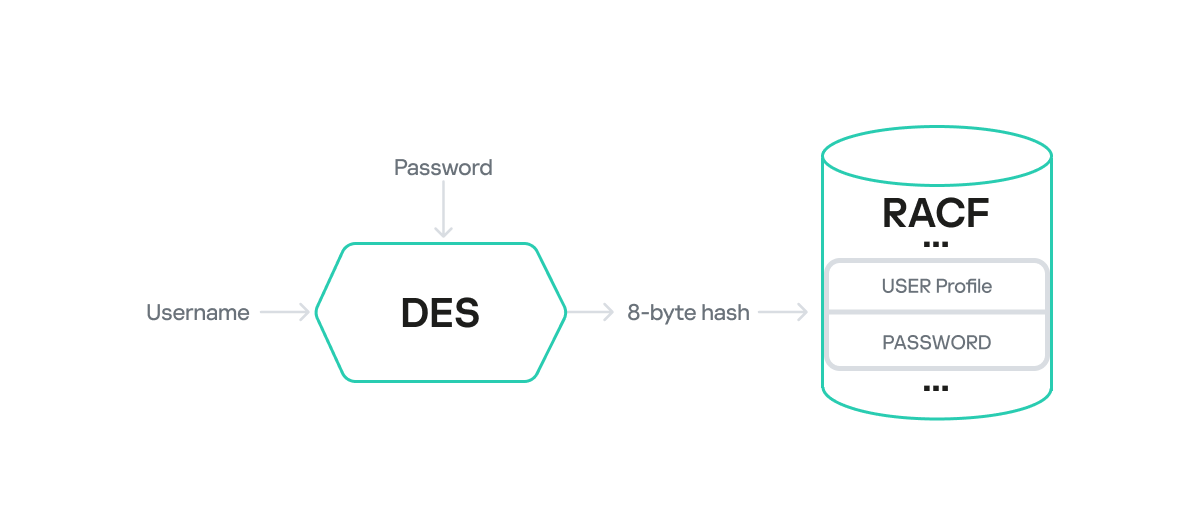
    • PASSWORD: the user’s password hash;
    • PHRASE: the user’s password phrase hash;
    • LOGIN: the user’s login;
    • OWNER: the owner of the user profile;
    • AUTHDATE: the date of the user profile creation in the RACF database;
    • and others.

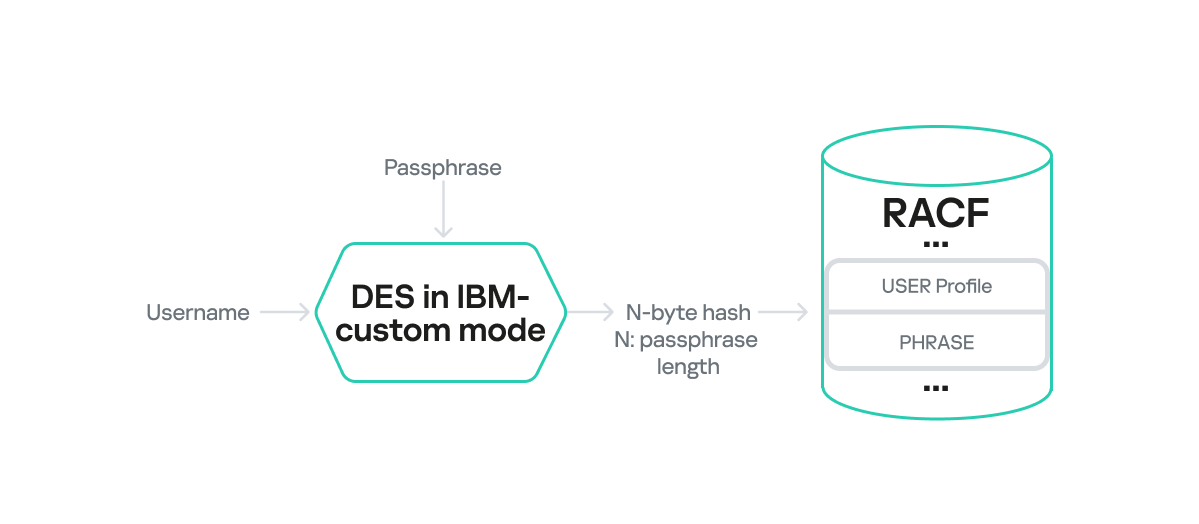
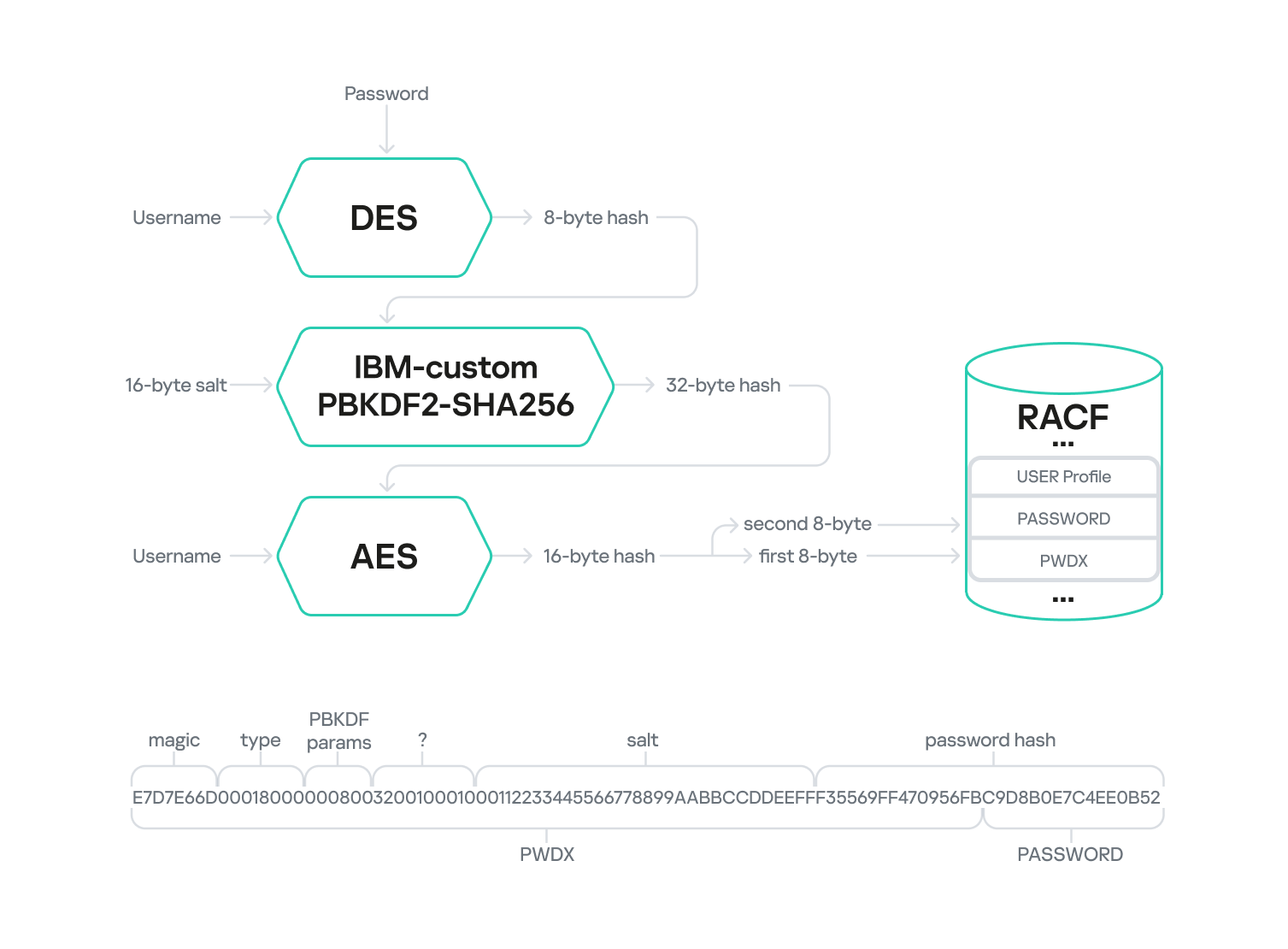
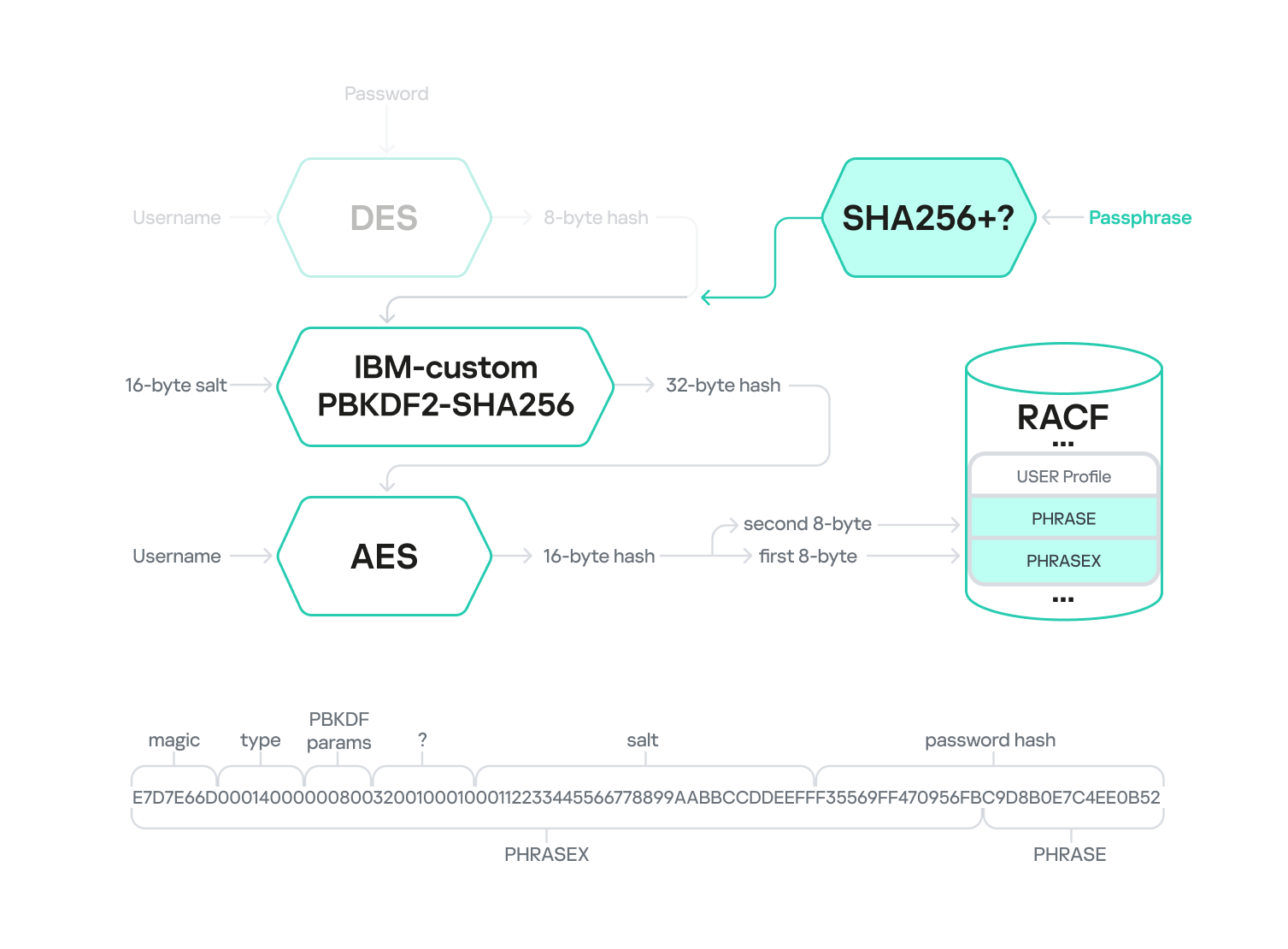
    The PASSWORD and PHRASE fields are particularly interesting for security analysis, and we will dive deeper into these later.

    RACF database structure

    It is worth noting that the RACF database is stored as a specialized data set with a specific format. Grasping this format is very helpful when analyzing the DB and mapping the relationships between z/OS objects and subjects.

    As discussed in our previous article, a data set is the mainframe equivalent of a file, composed of a series of blocks.

    RACF DB structure

    The image above illustrates the RACF database structure, detailing the data blocks and their offsets. From the RACF DB analysis perspective, and when subsequently determining the relationships between z/OS objects and subjects, the most critical blocks include:

    • The header block, or inventory control block (ICB), which contains various metadata and pointers to all other data blocks within the RACF database. By reading the ICB, you gain access to the rest of the data blocks.
    • Index blocks, which form a singly linked list that contains pointers to all profiles and their segments in the RACF database – that is, to the information about all users, groups, data sets, and resources.
    • Templates: a crucial data block containing templates for all profile types (user, group, data set, and general resource profiles). The templates list fields and specify their format for every possible segment type within the corresponding profile type.

    Upon dissecting the RACF database structure, we identified the need for a utility capable of extracting all relevant profile information from the DB, regardless of its version. This utility would also need to save the extracted data in a convenient format for offline analysis. Performing this type of analysis provides a comprehensive picture of the relationships between all objects and subjects for a specific z/OS installation, helping uncover potential security vulnerabilities that could lead to privilege escalation or lateral movement.

    Utilities for RACF DB analysis

    At the previous stage, we defined the following functional requirements for an RACF DB analysis utility:

    1. The ability to analyze RACF profiles offline without needing to run commands on the mainframe
    2. The ability to extract exhaustive information about RACF profiles stored in the DB
    3. Compatibility with various RACF DB versions
    4. Intuitive navigation of the extracted data and the option to present it in various formats: plaintext, JSON, SQL, etc.

    Overview of existing RACF DB analysis solutions

    We started by analyzing off-the-shelf tools and evaluating their potential for our specific needs:

    • Racf2john extracts user password hashes (from the PASSWORD field) encrypted with the DES and KDFAES algorithms from the RACF database. While this was a decent starting point, we needed more than just the PASSWORD field; specifically, we also needed to retrieve content from other profile fields like PHRASE.
    • Racf2sql takes an RACF DB dump as input and converts it into an SQLite database, which can then be queried with SQL. This is convenient, but the conversion process risks losing data critical for z/OS security assessment and identifying misconfigurations. Furthermore, the tool requires a database dump generated by the z/OS IRRDBU00 utility (part of the RACF security package) rather than the raw database itself.
    • IRRXUTIL allows querying the RACF DB to extract information. It is also part of the RACF security package. It can be conveniently used with a set of scripts written in REXX (an interpreted language used in z/OS). However, these scripts demand elevated privileges (access to one or more IRR.RADMIN.** resources in the FACILITY resource class) and must be executed directly on the mainframe, which is unsuitable for the task at hand.
    • Racf_debug_cleanup.c directly analyzes a RACF DB from a data set copy. A significant drawback is that it only parses BASE segments and outputs results in plaintext.

    As you can see, existing tools don’t satisfy our needs. Some utilities require direct execution on the mainframe. Others operate on a data set copy and extract incomplete information from the DB. Moreover, they rely on hardcoded offsets and signatures within profile segments, which can vary across RACF versions. Therefore, we decided to develop our own utility for RACF database analysis.

    Introducing racfudit

    We have written our own platform-independent utility racfudit in Golang and tested it across various z/OS versions (1.13, 2.02, and 3.1). Below, we delve into the operating principles, capabilities and advantages of our new tool.

    To analyze RACF DB information offline, we first needed a way to extract structured data. We developed a two-stage approach for this:

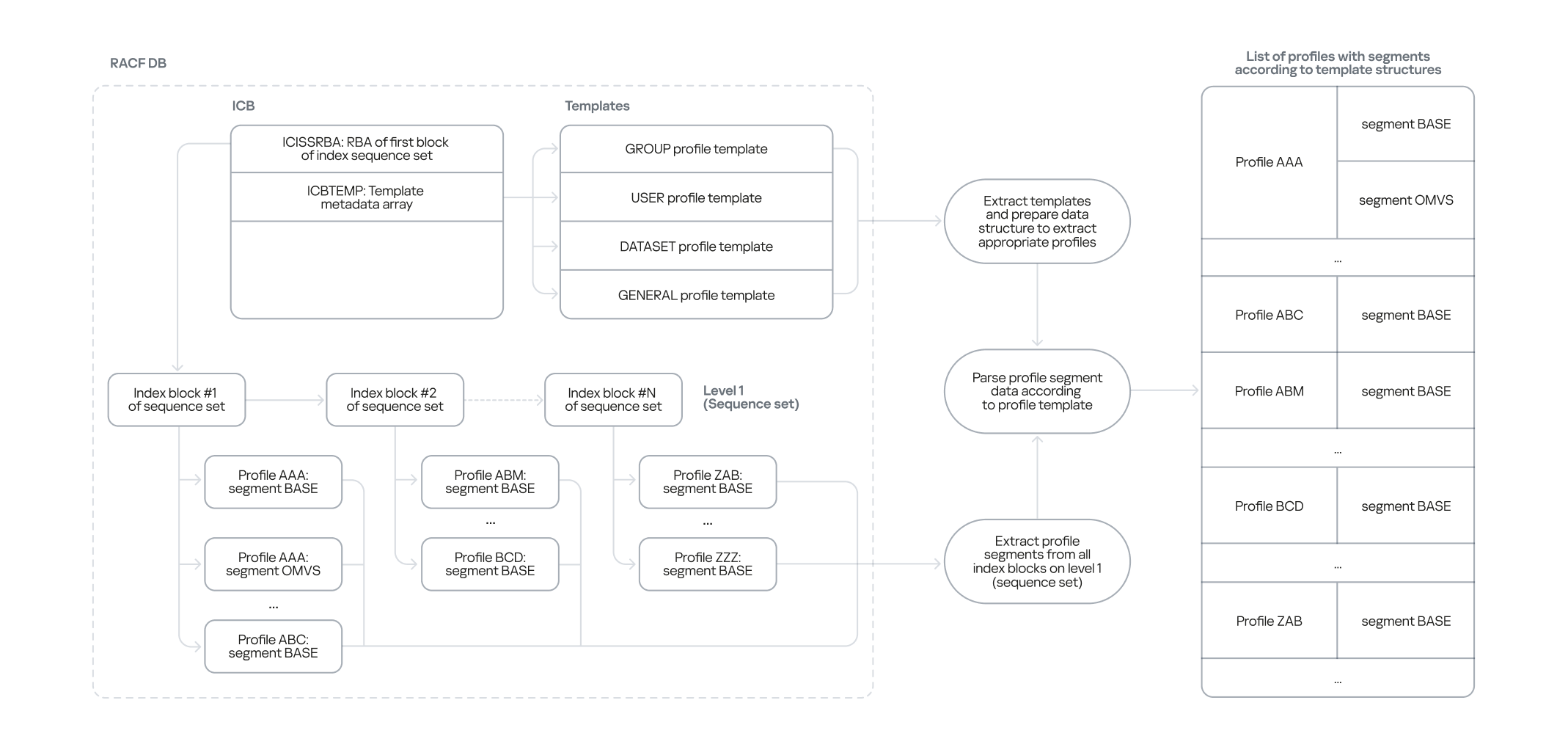
    • The first stage involves analyzing the templates stored within the RACF DB. Each template describes a specific profile type, its constituent segments, and the fields within those segments, including their type and size. This allows us to obtain an up-to-date list of profile types, their segments, and associated fields, regardless of the RACF version.
    • In the second stage, we traverse all index blocks to extract every profile with its content from the RACF DB. These collected profiles are then processed and parsed using the templates obtained in the first stage.

    The first stage is crucial because RACF DB profiles are stored as unstructured byte arrays. The templates are what define how each specific profile (byte array) is processed based on its type.

    Thus, we defined the following algorithm to extract structured data.

    Extracting data from the RACF DB using templates

    1. We offload the RACF DB from the mainframe and read its header block (ICB) to determine the location of the templates.
    2. Based on the template for each profile type, we define an algorithm for structuring specific profile instances according to their type.
    3. We use the content of the header block to locate the index blocks, which store pointers to all profile instances.
    4. We read all profile instances and their segments sequentially from the list of index blocks.
    5. For each profile instance and its segments we read, we apply the processing algorithm based on the corresponding template.
    6. All processed profile instances are saved in an intermediate state, allowing for future storage in various formats, such as plaintext or SQLite.

    The advantage of this approach is its version independence. Even if templates and index blocks change their structure across RACF versions, our utility will not lose data because it dynamically determines the structure of each profile type based on the relevant template.

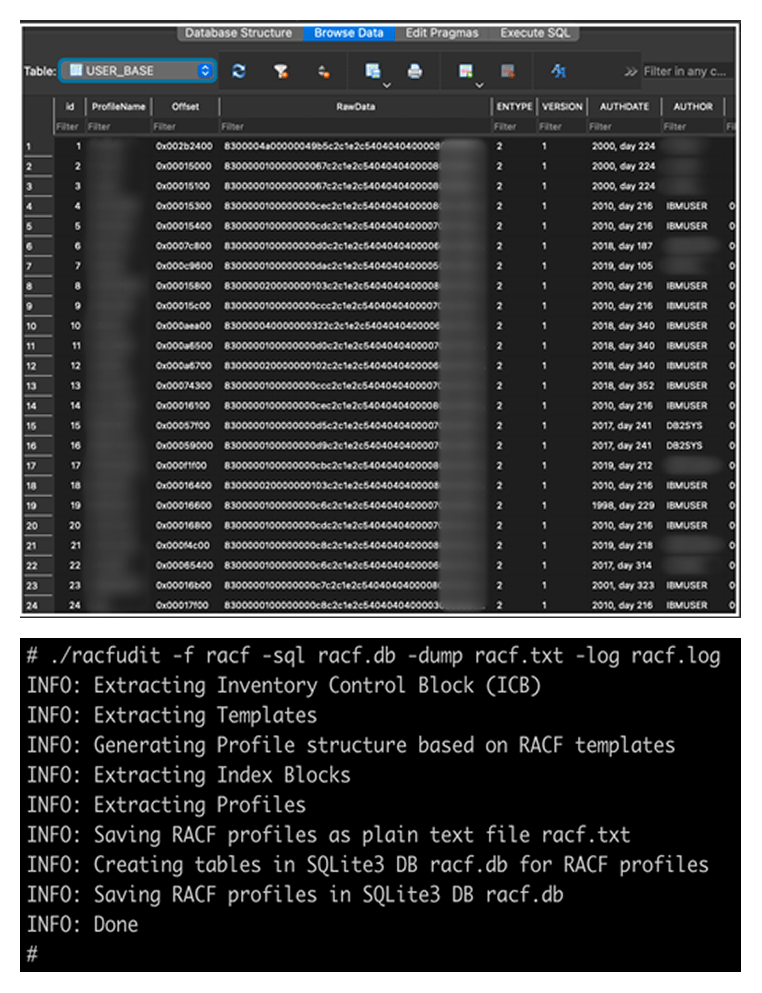
    Our racfudit utility can present collected RACF DB information as an SQLite database or a plaintext file.

    RACF DB information as an SQLite DB (top) and text data (bottom)

    Using SQLite, you can execute SQL queries to identify misconfigurations in RACF that could be exploited for privilege escalation, lateral movement, bypassing access controls, or other pentesting tactics. It is worth noting that the set of SQL queries used for processing information in SQLite can be adapted to validate current RACF settings against security standards and best practices. Let’s look at some specific examples of how to use the racfudit utility to uncover security issues.

    Collecting password hashes

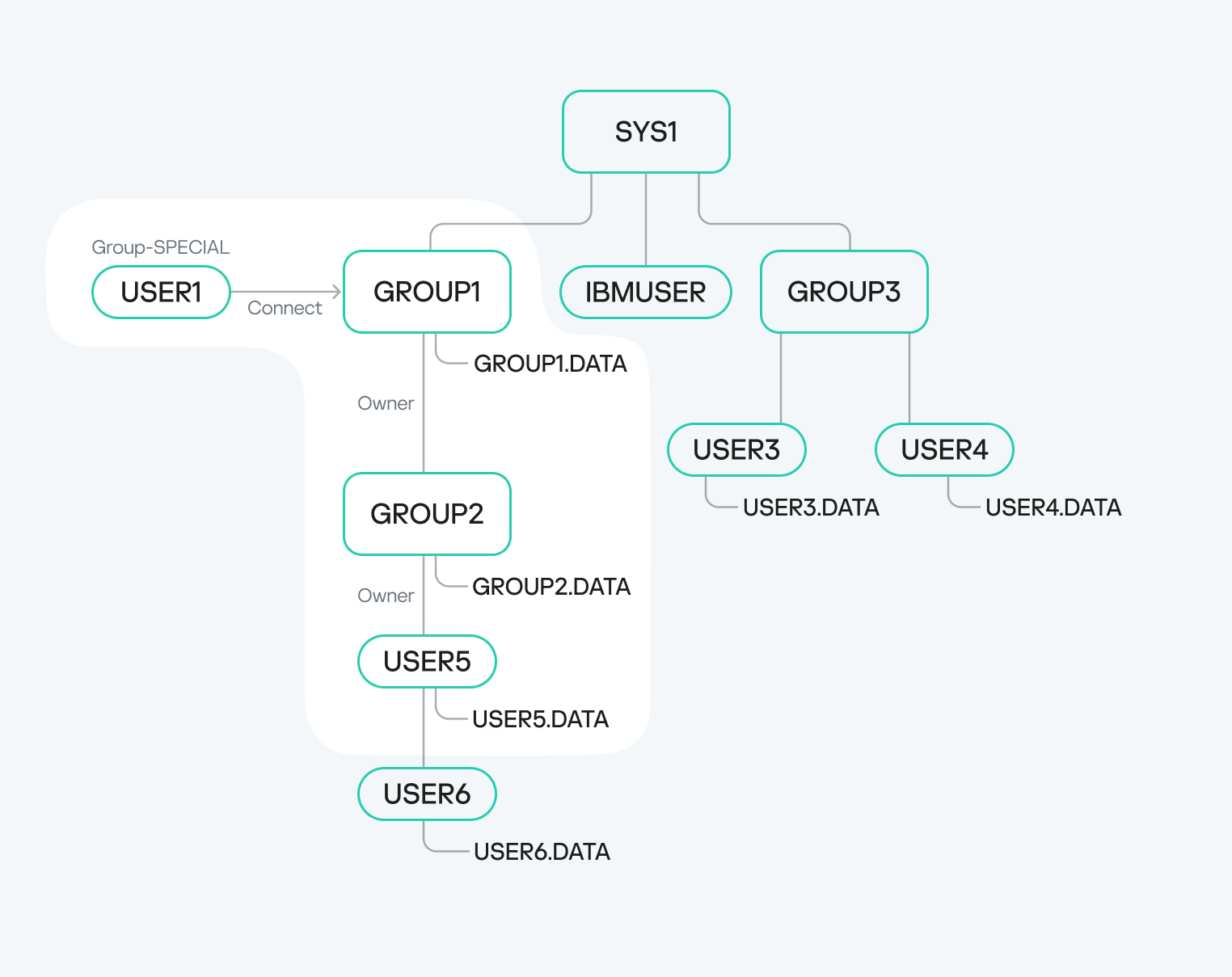
    One of the primary goals in penetration testing is to get a list of administrators and a way to authorize using their credentials. This can be useful for maintaining persistence on the mainframe, moving laterally to other mainframes, or even pivoting to servers running different operating systems. Administrators are typically found in the SYS1 group and its subgroups. The example below shows a query to retrieve hashes of passwords (PASSWORD) and password phrases (PHRASE) for privileged users in the SYS1 group.

    Of course, to log in to the system, you need to crack these hashes to recover the actual passwords. We cover that in more detail below.

    Searching for inadequate UACC control in data sets

    The universal access authority (UACC) defines the default access permissions to the data set. This parameter specifies the level of access for all users who do not have specific access permissions configured. Insufficient control over UACC values can pose a significant risk if elevated access permissions (UPDATE or higher) are set for data sets containing sensitive data or for APF libraries, which could allow privilege escalation. The query below helps identify data sets with default ALTER access permissions, which allow users to read, delete and modify the data set.

    The UACC field is not present only in data set profiles; it is also found in other profile types. Weak control in the configuration of this field can give a penetration tester access to resources.

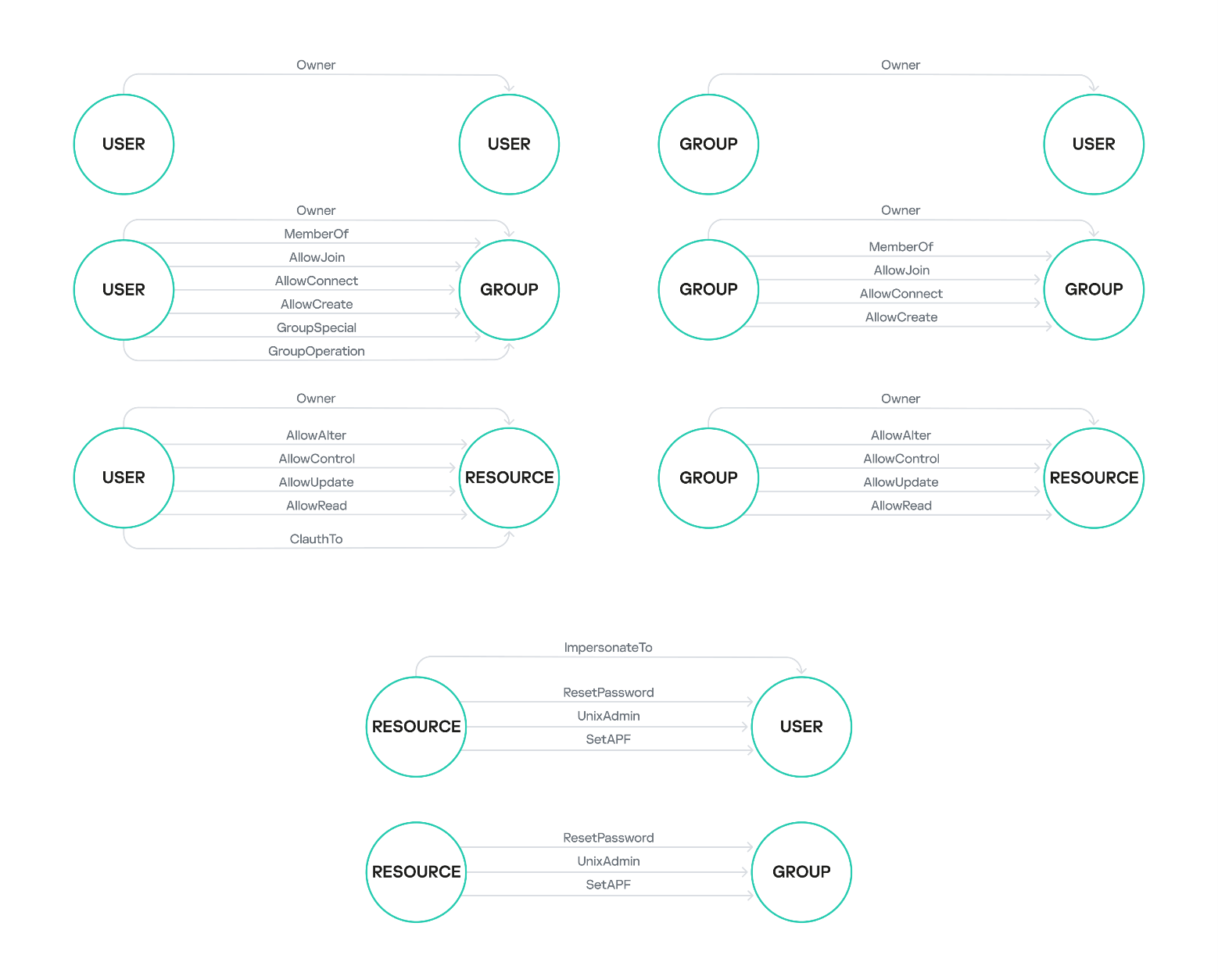
    RACF profile relationships

    As mentioned earlier, various RACF entities have relationships. Some are explicitly defined; for example, a username might be listed in a group profile within its member field (USERID field). However, there are also implicit relationships. For instance, if a user group has UPDATE access to a specific data set, every member of that group implicitly has write access to that data set. This is a simple example of implicit relationships. Next, we delve into more complex and specific relationships within the RACF database that a penetration tester can exploit.

    RACF profile fields

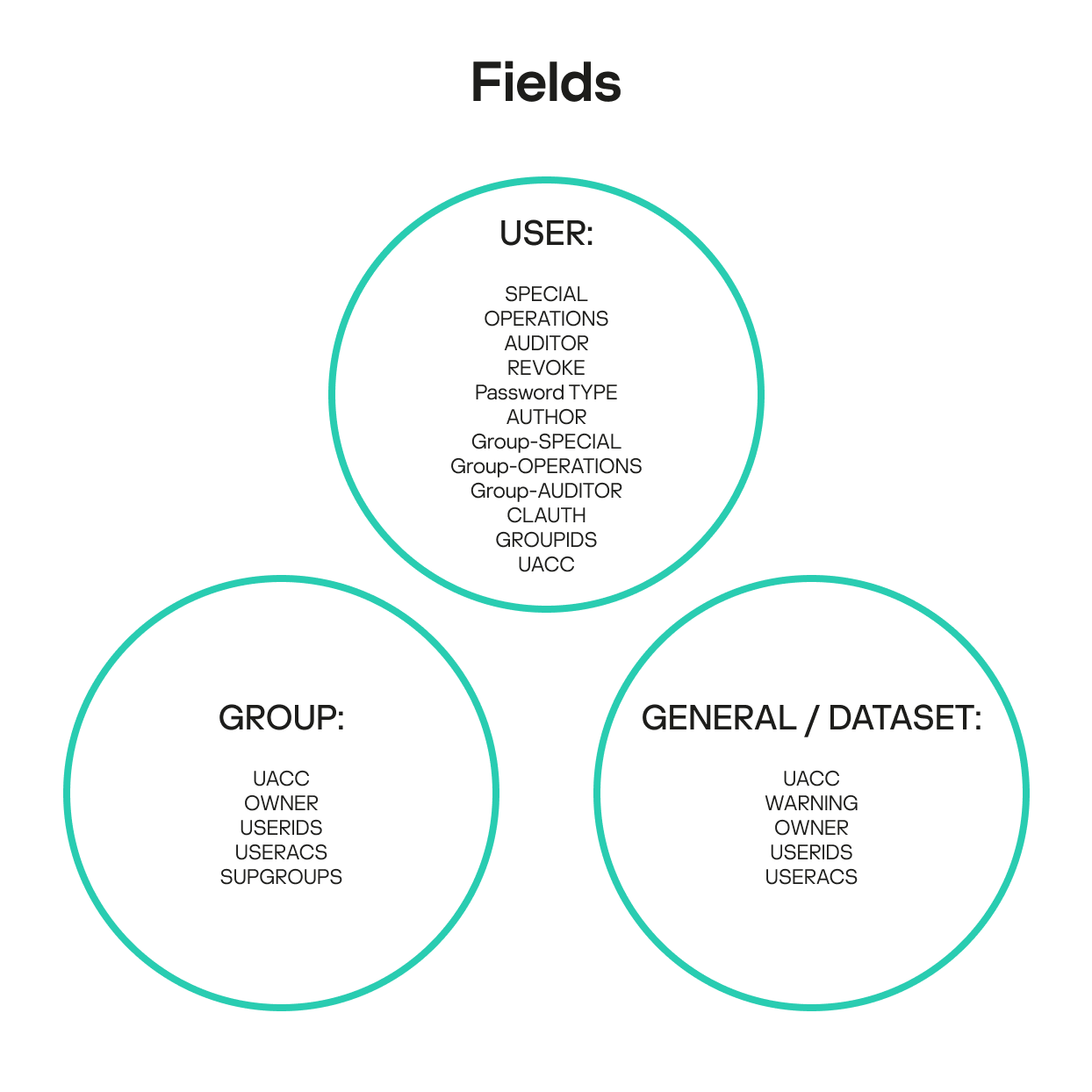
    A deep dive into RACF internal architecture reveals that misconfigurations of access permissions and other attributes for various RACF entities can be difficult to detect and remediate in some scenarios. These seemingly minor errors can be critical, potentially leading to mainframe compromise. The explicit and implicit relationships within the RACF database collectively define the mainframe’s current security posture. As mentioned, each profile type in the RACF database has a unique set of fields and attributes that describe how profiles relate to one another. Based on these fields and attributes, we have compiled lists of key fields that help build and analyze relationship chains.

    User profile fields

    • SPECIAL: indicates that the user has privileges to execute any RACF command and grants them full control over all profiles in the RACF database.
    • OPERATIONS: indicates whether the user has authorized access to all RACF-protected resources of the DATASET, DASDVOL, GDASDVOL, PSFMPL, TAPEVOL, VMBATCH, VMCMD, VMMDISK, VMNODE, and VMRDR classes. While actions for users with this field specified are subject to certain restrictions, in a penetration testing context the OPERATIONS field often indicates full data set access.
    • AUDITOR: indicates whether the user has permission to access audit information.
    • AUTHOR: the creator of the user. It has certain privileges over the user, such as the ability to change their password.
    • REVOKE: indicates whether the user can log in to the system.
    • Password TYPE: specifies the hash type (DES or KDFAES) for passwords and password phrases. This field is not natively present in the user profile, but it can be created based on how different passwords and password phrases are stored.
    • Group-SPECIAL: indicates whether the user has full control over all profiles within the scope defined by the group or groups field. This is a particularly interesting field that we explore in more detail below.
    • Group-OPERATIONS: indicates whether the user has authorized access to all RACF-protected resources of the DATASET, DASDVOL, GDASDVOL, PSFMPL, TAPEVOL, VMBATCH, VMCMD, VMMDISK, VMNODE and VMRDR classes within the scope defined by the group or groups field.
    • Group-AUDITOR: indicates whether the user has permission to access audit information within the scope defined by the group or groups field.
    • CLAUTH (class authority): allows the user to create profiles within the specified class or classes. This field enables delegation of management privileges for individual classes.
    • GROUPIDS: contains a list of groups the user belongs to.
    • UACC (universal access authority): defines the UACC value for new profiles created by the user.

    Group profile fields

    • UACC (universal access authority): defines the UACC value for new profiles that the user creates when connected to the group.
    • OWNER: the creator of the group. The owner has specific privileges in relation to the current group and its subgroups.
    • USERIDS: the list of users within the group. The order is essential.
    • USERACS: the list of group members with their respective permissions for access to the group. The order is essential.
    • SUPGROUP: the name of the superior group.

    General resource and data set profile fields

    • UACC (universal access authority): defines the default access permissions to the resource or data set.
    • OWNER: the creator of the resource or data set, who holds certain privileges over it.
    • WARNING: indicates whether the resource or data set is in WARNING mode.
    • USERIDS: the list of user IDs associated with the resource or data set. The order is essential.
    • USERACS: the list of users with access permissions to the resource or data set. The order is essential.

    RACF profile relationship chains

    The fields listed above demonstrate the presence of relationships between RACF profiles. We have decided to name these relationships similarly to those used in BloodHound, a popular tool for analyzing Active Directory misconfigurations. Below are some examples of these relationships – the list is not exhaustive.

    • Owner: the subject owns the object.
    • MemberOf: the subject is part of the object.
    • AllowJoin: the subject has permission to add itself to the object.
    • AllowConnect: the subject has permission to add another object to the specified object.
    • AllowCreate: the subject has permission to create an instance of the object.
    • AllowAlter: the subject has the ALTER privilege for the object.
    • AllowUpdate: the subject has the UPDATE privilege for the object.
    • AllowRead: the subject has the READ privilege for the object.
    • CLAuthTo: the subject has permission to create instances of the object as defined in the CLAUTH field.
    • GroupSpecial: the subject has full control over all profiles within the object’s scope of influence as defined in the group-SPECIAL field.
    • GroupOperations: the subject has permissions to perform certain operations with the object as defined in the group-OPERATIONS field.
    • ImpersonateTo: the subject grants the object the privilege to perform certain operations on the subject’s behalf.
    • ResetPassword: the subject grants another object the privilege to reset the password or password phrase of the specified object.
    • UnixAdmin: the subject grants superuser privileges to the object in z/OS UNIX.
    • SetAPF: the subject grants another object the privilege to set the APF flag on the specified object.

    These relationships serve as edges when constructing a graph of subject–object interconnections. Below are examples of potential relationships between specific profile types.

    Examples of relationships between RACF profiles

    Visualizing and analyzing these relationships helped us identify specific chains that describe potential RACF security issues, such as a path from a low-privileged user to a highly-privileged one. Before we delve into examples of these chains, let’s consider another interesting and peculiar feature of the relationships between RACF database entities.

    Implicit RACF profile relationships

    We have observed a fascinating characteristic of the group-SPECIAL, group-OPERATIONS, and group-AUDITOR fields within a user profile. If the user has any group specified in one of these fields, that group’s scope of influence extends the user’s own scope.

    Scope of influence of a user with a group-SPECIAL field

    For instance, consider USER1 with GROUP1 specified in the group-SPECIAL field. If GROUP1 owns GROUP2, and GROUP2 subsequently owns USER5, then USER1 gains privileges over USER5. This is not just about data access; USER1 essentially becomes the owner of USER5. A unique aspect of z/OS is that this level of access allows USER1 to, for example, change USER5’s password, even if USER5 holds privileged attributes like SPECIAL, OPERATIONS, ROAUDIT, AUDITOR, or PROTECTED.

    Below is an SQL query, generated using the racfudit utility, that identifies all users and groups where the specified user possesses special attributes:

    Here is a query to find users whose owners (AUTHOR) are not the standard default administrators:

    Let’s illustrate how user privileges can be escalated through these implicit profile relationships.

    Privilege escalation via the group-SPECIAL field

    In this scenario, the user TESTUSR has the group-SPECIAL field set to PASSADM. This group, PASSADM, owns the OPERATOR user. This means TESTUSR’s scope of influence expands to include PASSADM’s scope, thereby granting TESTUSR control over OPERATOR. Consequently, if TESTUSR’s credentials are compromised, the attacker gains access to the OPERATOR user. The OPERATOR user, in turn, has READ access to the IRR.PASSWORD.RESET resource, which allows them to assign a password to any user who does not possess privileged permissions.

    Having elevated privileges in z/OS UNIX is often sufficient for compromising the mainframe. These can be acquired through several methods:

    • Grant the user READ access to the BPX.SUPERUSER resource of the FACILITY class.
    • Grant the user READ access to UNIXPRIV.SUPERUSER.* resources of the UNIXPRIV class.
    • Set the UID field to 0 in the OMVS segment of the user profile.

    For example, the DFSOPER user has READ access to the BPX.SUPERUSER resource, making them privileged in z/OS UNIX and, by extension, across the entire mainframe. However, DFSOPER does not have the explicit privileged fields SPECIAL, OPERATIONS, AUDITOR, ROAUDIT and PROTECTED set, meaning the OPERATOR user can change DFSOPER’s password. This allows us to define the following sequence of actions to achieve high privileges on the mainframe:

    1. Obtain and use TESTUSR’s credentials to log in.
    2. Change OPERATOR’s password and log in with those credentials.
    3. Change DFSOPER’s password and log in with those credentials.
    4. Access the z/OS UNIX Shell with elevated privileges.

    We uncovered another implicit RACF profile relationship that enables user privilege escalation.

    Privilege escalation from a chain of misconfigurations

    In another example, the TESTUSR user has READ access to the OPERSMS.SUBMIT resource of the SURROGAT class. This implies that TESTUSR can create a task under the identity of OPERSMS using the ImpersonateTo relationship. OPERSMS is a member of the HFSADMIN group, which has READ access to the TESTAUTH resource of the TSOAUTH class. This resource indicates whether the user can run an application or library as APF-authorized – this requires only READ access. Therefore, if APF access is misconfigured, the OPERSMS user can escalate their current privileges to the highest possible level. This outlines a path from the low-privileged TESTUSR to obtaining maximum privileges on the mainframe.

    At this stage, the racfudit utility allows identifying these connections only manually through a series of SQLite database queries. However, we are planning to add support for another output format, including Neo4j DBMS integration, to automatically visualize the interconnected chains described above.

    Password hashes in RACF

    To escalate privileges and gain mainframe access, we need the credentials of privileged users. We previously used our utility to extract their password hashes. Now, let’s dive into the password policy principles in z/OS and outline methods for recovering passwords from these collected hashes.

    The primary password authentication methods in z/OS, based on RACF, are PASSWORD and PASSPHRASE. PASSWORD is a password composed by default of ASCII characters: uppercase English letters, numbers, and special characters (@#$). Its length is limited to 8 characters. PASSPHRASE, or a password phrase, has a more complex policy, allowing 14 to 100 ASCII characters, including lowercase or uppercase English letters, numbers, and an extended set of special characters (@#$&*{}[]()=,.;’+/). Hashes for both PASSWORD and PASSPHRASE are stored in the user profile within the BASE segment, in the PASSWORD and PHRASE fields, respectively. Two algorithms are used to derive their values: DES and KDFAES.

    It is worth noting that we use the terms “password hash” and “password phrase hash” for clarity. When using the DES and KDFAES algorithms, user credentials are stored in the RACF database as encrypted text, not as a hash sum in its classical sense. Nevertheless, we will continue to use “password hash” and “password phrase hash” as is customary in IBM documentation.

    Let’s discuss the operating principles and characteristics of the DES and KDFAES algorithms in more detail.

    DES

    When the DES algorithm is used, the computation of PASSWORD and PHRASE values stored in the RACF database involves classic DES encryption. Here, the plaintext data block is the username (padded to 8 characters if shorter), and the key is the password (also padded to 8 characters if shorter).

    PASSWORD

    The username is encrypted with the password as the key via the DES algorithm, and the 8-byte result is placed in the user profile’s PASSWORD field.

    DES encryption of a password

    Keep in mind that both the username and password are encoded with EBCDIC. For instance, the username USR1 would look like this in EBCDIC: e4e2d9f140404040. The byte 0x40 serves as padding for the plaintext to reach 8 bytes.

    This password can be recovered quite fast, given the small keyspace and low computational complexity of DES. For example, a brute-force attack powered by a cluster of NVIDIA 4090 GPUs takes less than five minutes.

    The hashcat tool includes a module (Hash-type 8500) for cracking RACF passwords with the DES algorithm.

    PASSPHRASE

    PASSPHRASE encryption is a bit more complex, and a detailed description of its algorithm is not readily available. However, our research uncovered certain interesting characteristics.

    First, the final hash length in the PHRASE field matches the original password phrase length. Essentially, the encrypted data output from DES gets truncated to the input plaintext length without padding. This design can clearly lead to collisions and incorrect authentication under certain conditions. For instance, if the original password phrase is 17 bytes long, it will be encrypted in three blocks, with the last block padded with seven bytes. These padded bytes are then truncated after encryption. In this scenario, any password whose first 17 encrypted bytes match the encrypted PASSPHRASE would be considered valid.

    The second interesting feature is that the PHRASE field value is also computed using the DES algorithm, but it employs a proprietary block chaining mode. We will informally refer to this as IBM-custom mode.

    DES encryption of a password phrase

    Given these limitations, we can use the hashcat module for RACF DES to recover the first 8 characters of a password phrase from the first block of encrypted data in the PHRASE field. In some practical scenarios, recovering the beginning of a password phrase allowed us to guess the remainder, especially when weak dictionary passwords were used. For example, if we recovered Admin123 (8 characters) while cracking a 15-byte PASSPHRASE hash, then it is plausible the full password phrase was Admin1234567890.

    KDFAES

    Computing passwords and password phrases generated with the KDFAES algorithm is significantly more challenging than with DES. KDFAES is a proprietary IBM algorithm that leverages AES encryption. The encryption key is generated from the password using the PBKDF2 function with a specific number of hashing iterations.

    PASSWORD

    The diagram below outlines the multi-stage KDFAES PASSWORD encryption algorithm.

    KDFAES encryption of a password

    The first stage mirrors the DES-based PASSWORD computation algorithm. Here, the plaintext username is encrypted using the DES algorithm with the password as the key. The username is also encoded in EBCDIC and padded if it’s shorter than 8 bytes. The resulting 8-byte output serves as the key for the second stage: hashing. This stage employs a proprietary IBM algorithm built upon PBKDF2-SHA256-HMAC. A randomly generated 16-byte string (salt) is fed into this algorithm along with the 8-byte key from the first stage. This data is then iteratively hashed using PBKDF2-SHA256-HMAC. The number of iterations is determined by two parameters set in RACF: the memory factor and the repetition factor. The output of the second stage is a 32-byte hash, which is then used as the key for AES encryption of the username in the third stage.

    The final output is 16 bytes of encrypted data. The first 8 bytes are appended to the end of the PWDX field in the user profile BASE segment, while the other 8 bytes are placed in the PASSWORD field within the same segment.

    The PWDX field in the BASE segment has the following structure:

    Offset Size Field Comment
    0–3 4 bytes Magic number In the profiles we analyzed, we observed only the value E7D7E66D
    4–7 4 bytes Hash type In the profiles we analyzed, we observed only two values: 00180000 for PASSWORD hashes and 00140000 for PASSPHRASE hashes
    8–9 2 bytes Memory factor A value that determines the number of iterations in the hashing stage
    10–11 2 bytes Repetition factor A value that determines the number of iterations in the hashing stage
    12–15 4 bytes Unknown value In the profiles we analyzed, we observed only the value 00100010
    16–31 16 bytes Salt A randomly generated 16-byte string used in the hashing stage
    32–39 8 bytes The first half of the password hash The first 8 bytes of the final encrypted data

    You can use the dedicated module in the John the Ripper utility for offline password cracking. While an IBM KDFAES module for an older version of hashcat exists publicly, it was never integrated into the main branch. Therefore, we developed our own RACF KDFAES module compatible with the current hashcat version.

    The time required to crack an RACF KDFAES hash has significantly increased compared to RACF DES, largely due to the integration of PBKDF2. For instance, if the memory factor and repetition factor are set to 0x08 and 0x32 respectively, the hashing stage can reach 40,000 iterations. This can extend the password cracking time to several months or even years.

    PASSPHRASE

    KDFAES encryption of a password phrase

    Encrypting a password phrase hash with KDFAES shares many similarities with encrypting a password hash. According to public sources, the primary difference lies in the key used during the second stage. For passwords, data derived from DES-encrypting the username was used, while for a password phrase, its SHA256 hash is used. During our analysis, we could not determine the exact password phrase hashing process – specifically, whether padding is involved, if a secret key is used, and so on.

    Additionally, when using a password phrase, the PHRASE and PHRASEX fields instead of PASSWORD and PWDX, respectively, store the final hash, with the PHRASEX value having a similar structure.

    Conclusion

    In this article, we have explored the internal workings of the RACF security package, developed an approach to extracting information, and presented our own tool developed for the purpose. We also outlined several potential misconfigurations that could lead to mainframe compromise and described methods for detecting them. Furthermore, we examined the algorithms used for storing user credentials (passwords and password phrases) and highlighted their strengths and weaknesses.

    We hope that the information presented in this article helps mainframe owners better understand and assess the potential risks associated with incorrect RACF security suite configurations and take appropriate mitigation steps. Transitioning to the KDFAES algorithm and password phrases, controlling UACC values, verifying access to APF libraries, regularly tracking user relationship chains, and other steps mentioned in the article can significantly enhance your infrastructure security posture with minimal effort.

    In conclusion, it is worth noting that only a small percentage of the RACF database structure has been thoroughly studied. Comprehensive research would involve uncovering additional relationships between database entities, further investigating privileges and their capabilities, and developing tools to exploit excessive privileges. The topic of password recovery is also not fully covered because the encryption algorithms have not been fully studied. IBM z/OS mainframe researchers have immense opportunities for analysis. As for us, we will continue to shed light on the obscure, unexplored aspects of these devices, to help prevent potential vulnerabilities in mainframe infrastructure and associated security incidents.
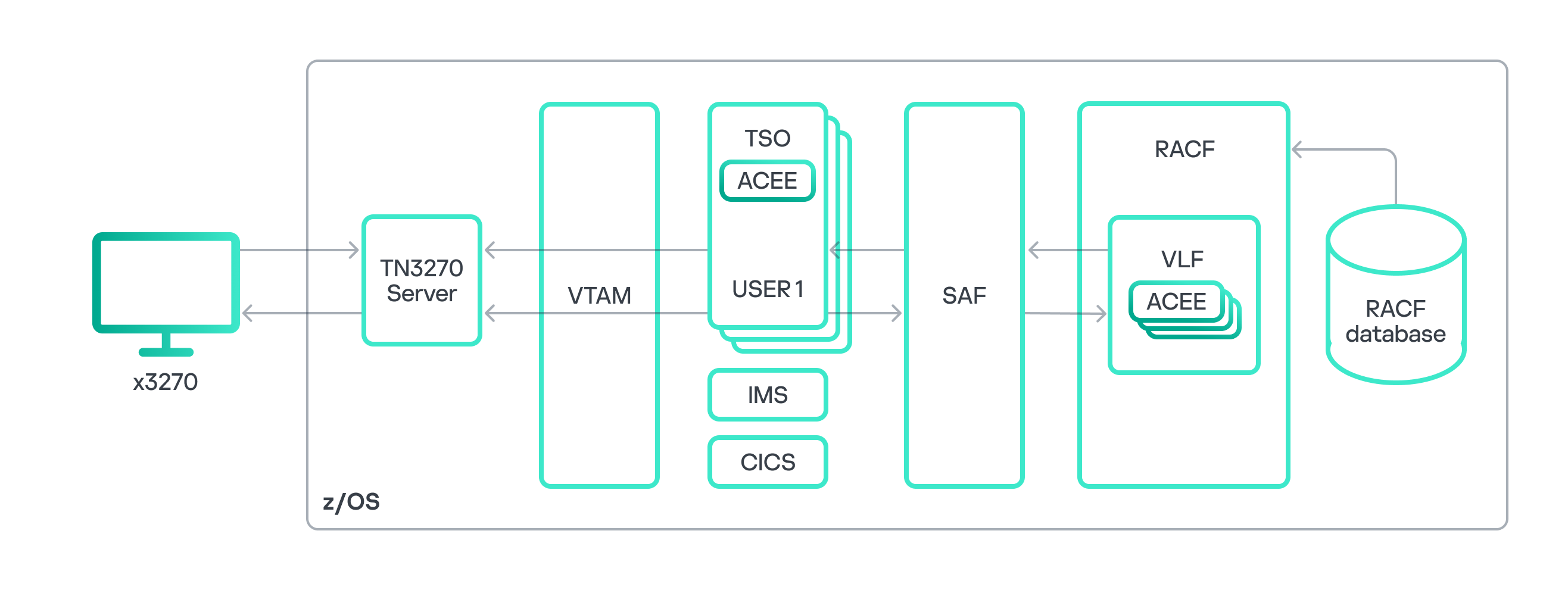
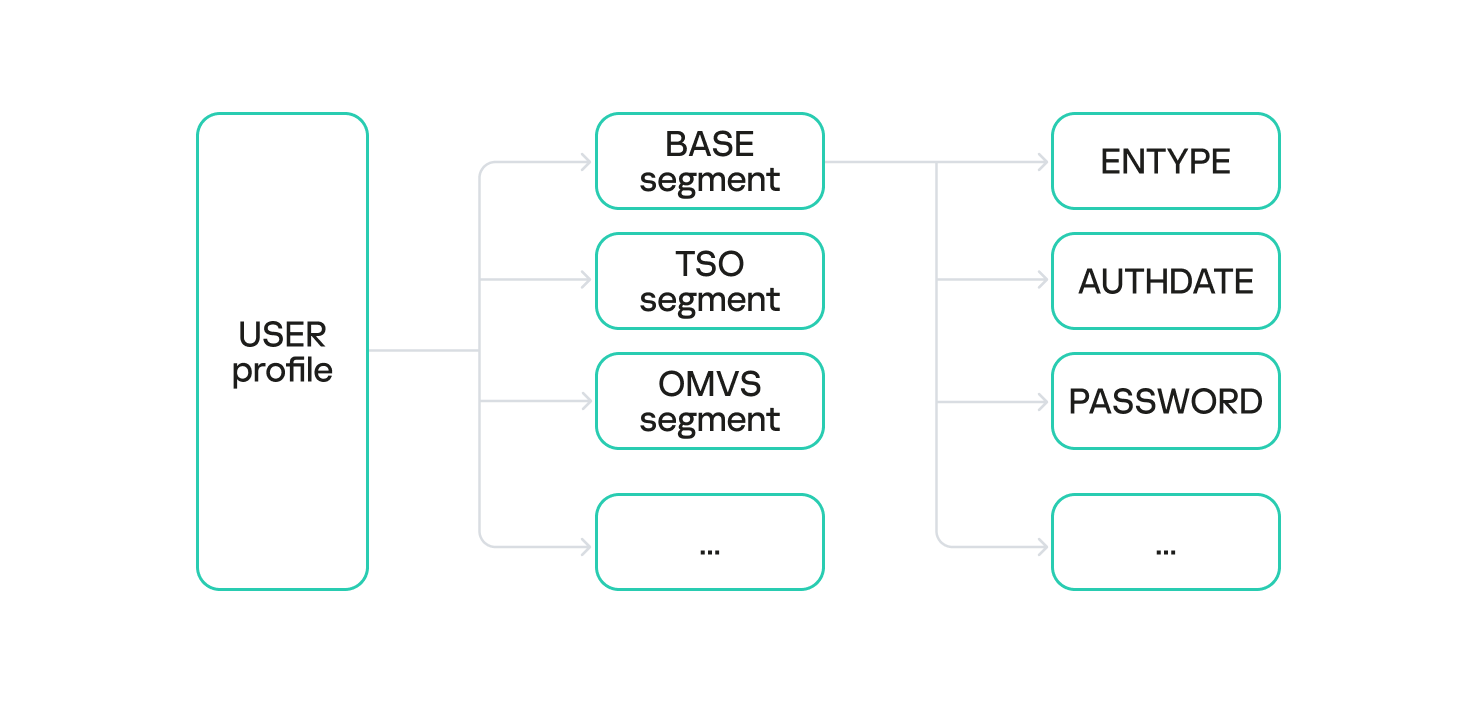
    MIL OSI Economics

  • MIL-OSI Submissions: Australia – New study maps key regions for killer whales in Australian waters – Flinders

    Source: Flinders University
     
    While well documented in the Northern Hemisphere and Antarctica, much less is known about killer whales  (Orcinus orca) in Australia. However, orcas are actually sighted year-round in all coastal states and territories and a new Flinders University study has now mapped this across three key regions.
     
    Research led by Flinders University’s Cetacean Ecology, Behaviour and Evolution Lab (CEBEL) models the distribution of killer whales in Australian waters, shedding light on habitat preferences and uncovering ecological distinctions between populations.
     
    In collaboration with the Cetacean Research Centre of WA, Project ORCA and Killer Whales Australia, the paper published in Ecology and Evolution collates 1310 sightings of killer whales around the country from the past four decades. Species distribution modelling is used to pinpoint places of high habitat suitability in southeast, southwest, and northwest Australia – notably the Bonney Upwelling (South Australia / Victoria), Bremer Sub-basin (Western Australia), and Ningaloo Reef (WA).
     
     “This work greatly increases our understanding of killer whales in Australian waters and identifies areas of biological importance for management and monitoring,” says Flinders University CEBEL PhD candidate Marissa Hutchings, lead author of the article.
     
    “Not only now do we have a nationwide picture, but our findings also support the idea that at least two ecologically distinct forms of killer whales exist in Australia – a temperate and a tropical form.”
     
    The research calls for stronger conservation measures to protect these unique populations – “particularly given their role as apex predators in the marine ecosystem and the fact that some of their most important habitats are currently only partially protected by legislation,” she says.
     
    “More research will be vital in ensuring that this species can be adequately managed in a changing environment, but this will only be made possible by collaboration between researchers, citizen scientists, and marine users to improve the size and accessibility of datasets on both killer whales and their prey.”
     
    Another author on the paper, Flinders University Associate Professor Guido Parra, says differences in range and drivers of occurrence are important to recognise because anthropogenic stressors such as commercial fishing, marine tourism, offshore drilling, and chemical pollutants are becoming increasingly prevalent in Australia.
     
    Senior author Flinders Associate Professor Luciana Möller says the study complements ongoing research into the genetics, feeding ecology and diversification of Australia’s killer whale populations – as well as highlights the usefulness of citizen science data.
     
     “We hope this study will help inform the conservation of this species, which is still considered data deficient and remains to be adequately protected under Australian Government legislation.”
     
    The article, ‘Species distribution modeling of killer whales (Orcinus orca) in Australian waters’ (2025) by Marissa J Hutchings (Flinders University), Guido J Parra (Flinders) and John A Totterdell (Cetacean Research Centre of WA), Rebecca Wellard (Project ORCA & Curtin University), David M Donnelly (Killer Whales Australia), Jonathan Sandoval-Castillo (Flinders) and Luciana Möller (Flinders) has been published in Ecology and Evolution (Wiley) DOI: 10.1002/ece3.71359.  First published: 3 July 2025
     
    Acknowledgements: This work was supported by the Royal Society for South Australia (RSSA) Small Research Grants Scheme. Researchers thank research collaborators and citizen scientists for providing the supporting data.

    MIL OSI – Submitted News

  • MIL-OSI Submissions: Australia – New study maps key regions for killer whales in Australian waters – Flinders

    Source: Flinders University
     
    While well documented in the Northern Hemisphere and Antarctica, much less is known about killer whales  (Orcinus orca) in Australia. However, orcas are actually sighted year-round in all coastal states and territories and a new Flinders University study has now mapped this across three key regions.
     
    Research led by Flinders University’s Cetacean Ecology, Behaviour and Evolution Lab (CEBEL) models the distribution of killer whales in Australian waters, shedding light on habitat preferences and uncovering ecological distinctions between populations.
     
    In collaboration with the Cetacean Research Centre of WA, Project ORCA and Killer Whales Australia, the paper published in Ecology and Evolution collates 1310 sightings of killer whales around the country from the past four decades. Species distribution modelling is used to pinpoint places of high habitat suitability in southeast, southwest, and northwest Australia – notably the Bonney Upwelling (South Australia / Victoria), Bremer Sub-basin (Western Australia), and Ningaloo Reef (WA).
     
     “This work greatly increases our understanding of killer whales in Australian waters and identifies areas of biological importance for management and monitoring,” says Flinders University CEBEL PhD candidate Marissa Hutchings, lead author of the article.
     
    “Not only now do we have a nationwide picture, but our findings also support the idea that at least two ecologically distinct forms of killer whales exist in Australia – a temperate and a tropical form.”
     
    The research calls for stronger conservation measures to protect these unique populations – “particularly given their role as apex predators in the marine ecosystem and the fact that some of their most important habitats are currently only partially protected by legislation,” she says.
     
    “More research will be vital in ensuring that this species can be adequately managed in a changing environment, but this will only be made possible by collaboration between researchers, citizen scientists, and marine users to improve the size and accessibility of datasets on both killer whales and their prey.”
     
    Another author on the paper, Flinders University Associate Professor Guido Parra, says differences in range and drivers of occurrence are important to recognise because anthropogenic stressors such as commercial fishing, marine tourism, offshore drilling, and chemical pollutants are becoming increasingly prevalent in Australia.
     
    Senior author Flinders Associate Professor Luciana Möller says the study complements ongoing research into the genetics, feeding ecology and diversification of Australia’s killer whale populations – as well as highlights the usefulness of citizen science data.
     
     “We hope this study will help inform the conservation of this species, which is still considered data deficient and remains to be adequately protected under Australian Government legislation.”
     
    The article, ‘Species distribution modeling of killer whales (Orcinus orca) in Australian waters’ (2025) by Marissa J Hutchings (Flinders University), Guido J Parra (Flinders) and John A Totterdell (Cetacean Research Centre of WA), Rebecca Wellard (Project ORCA & Curtin University), David M Donnelly (Killer Whales Australia), Jonathan Sandoval-Castillo (Flinders) and Luciana Möller (Flinders) has been published in Ecology and Evolution (Wiley) DOI: 10.1002/ece3.71359.  First published: 3 July 2025
     
    Acknowledgements: This work was supported by the Royal Society for South Australia (RSSA) Small Research Grants Scheme. Researchers thank research collaborators and citizen scientists for providing the supporting data.

    MIL OSI – Submitted News

  • MIL-OSI Submissions: Australia – New study maps key regions for killer whales in Australian waters – Flinders

    Source: Flinders University
     
    While well documented in the Northern Hemisphere and Antarctica, much less is known about killer whales  (Orcinus orca) in Australia. However, orcas are actually sighted year-round in all coastal states and territories and a new Flinders University study has now mapped this across three key regions.
     
    Research led by Flinders University’s Cetacean Ecology, Behaviour and Evolution Lab (CEBEL) models the distribution of killer whales in Australian waters, shedding light on habitat preferences and uncovering ecological distinctions between populations.
     
    In collaboration with the Cetacean Research Centre of WA, Project ORCA and Killer Whales Australia, the paper published in Ecology and Evolution collates 1310 sightings of killer whales around the country from the past four decades. Species distribution modelling is used to pinpoint places of high habitat suitability in southeast, southwest, and northwest Australia – notably the Bonney Upwelling (South Australia / Victoria), Bremer Sub-basin (Western Australia), and Ningaloo Reef (WA).
     
     “This work greatly increases our understanding of killer whales in Australian waters and identifies areas of biological importance for management and monitoring,” says Flinders University CEBEL PhD candidate Marissa Hutchings, lead author of the article.
     
    “Not only now do we have a nationwide picture, but our findings also support the idea that at least two ecologically distinct forms of killer whales exist in Australia – a temperate and a tropical form.”
     
    The research calls for stronger conservation measures to protect these unique populations – “particularly given their role as apex predators in the marine ecosystem and the fact that some of their most important habitats are currently only partially protected by legislation,” she says.
     
    “More research will be vital in ensuring that this species can be adequately managed in a changing environment, but this will only be made possible by collaboration between researchers, citizen scientists, and marine users to improve the size and accessibility of datasets on both killer whales and their prey.”
     
    Another author on the paper, Flinders University Associate Professor Guido Parra, says differences in range and drivers of occurrence are important to recognise because anthropogenic stressors such as commercial fishing, marine tourism, offshore drilling, and chemical pollutants are becoming increasingly prevalent in Australia.
     
    Senior author Flinders Associate Professor Luciana Möller says the study complements ongoing research into the genetics, feeding ecology and diversification of Australia’s killer whale populations – as well as highlights the usefulness of citizen science data.
     
     “We hope this study will help inform the conservation of this species, which is still considered data deficient and remains to be adequately protected under Australian Government legislation.”
     
    The article, ‘Species distribution modeling of killer whales (Orcinus orca) in Australian waters’ (2025) by Marissa J Hutchings (Flinders University), Guido J Parra (Flinders) and John A Totterdell (Cetacean Research Centre of WA), Rebecca Wellard (Project ORCA & Curtin University), David M Donnelly (Killer Whales Australia), Jonathan Sandoval-Castillo (Flinders) and Luciana Möller (Flinders) has been published in Ecology and Evolution (Wiley) DOI: 10.1002/ece3.71359.  First published: 3 July 2025
     
    Acknowledgements: This work was supported by the Royal Society for South Australia (RSSA) Small Research Grants Scheme. Researchers thank research collaborators and citizen scientists for providing the supporting data.

    MIL OSI – Submitted News

  • MIL-OSI Africa: Protecting our environment, creating opportunities 

    Source: Government of South Africa

    By Bernice Swarts 

    South Africa continues to face a host of interconnected socioeconomic and environmental challenges. These include the triple challenges of inequality, poverty, and unemployment, which are further compounded by climate change, biodiversity loss, and pollution. 

    These threats are not theoretical — they are realities already affecting our families and communities, especially the most vulnerable. Yet, within these challenges lie opportunities, and our department is taking bold steps to transform policy into real, life-changing action.

    National Dialogue 

    Over the past 30 years, we have made great strides as a nation – expanding freedom, deepening democracy and building a better life for millions. Yet we also face persistent challenges: inequality, unemployment, social divisions and a growing disconnect between citizens and institution. In this spirit, President Cyril Ramaphosa has called for an inclusive National Dialogue – a people-led, society-wide process to reflect, reset and reimagine South Africa’s future. The National Dialogue is a chance for all South Africans, from all walks of life, to come together and help shape the next chapter of our democracy. 

    At this point I wish to also express my support for the planned National Dialogue as a forum to unite South Africans behind a shared vision and approach towards addressing structural challenges as a result of the apartheid legacy. 

    For the Department of Forestry, Fisheries and the Environment, the National Dialogue presents an opportunity to engage meaningfully with all South Africans — particularly youth, women, and persons with disabilities — about the socioeconomic opportunities available within our sector. 
    We believe the outcomes of this important national engagement must translate into practical solutions that enable our people to contribute and benefit meaningfully from the work we do as both a department and a government.

    One Million Trees in One Day

    Under the Presidential Flagship “Ten Million Trees Programme,” our department has set out to do something remarkable – plant 1 million trees in one day under the rallying call, “My Tree, My Oxygen. Plant Yours Today,” we invite every South African — from schoolchildren to corporates — to participate.

    This isn’t just a symbolic act. It’s a movement for environmental justice and climate resilience. Trees are nature’s air purifiers, carbon sinks, and shelters for biodiversity. We are in the final year of this programme, and with renewed vigour, we’re mobilising every corner of society to ensure we meet and exceed our target.

    Small-Scale Fisheries – Voices from the Coastline

    Our oceans offer abundant resources, but for too long, small-scale fishers have been left behind. That’s why we convened the Small-Scale Fishing Co-operatives Summit in Mthatha in May. We heard firsthand about the struggles fishers face: poor infrastructure, limited market access, and lack of support.

    The summit wasn’t just a talk-shop. It was a collective turning point. We are now developing technical support packages, mentorship programmes, and policy enhancements to bring dignity and sustainability to the sector. When fishing co-ops thrive, entire coastal communities thrive.

    Tackling E-Waste: A Crisis Turned Opportunity

    Did you know that South Africa generates over 360,000 tons of electronic waste each year? Shockingly, only about 10% of that is properly recycled. The rest — from broken TVs to outdated cellphones — ends up in our landfills or is dumped illegally, contaminating soil and water and endangering our ecosystems.

    To combat this, the Department of Forestry, Fisheries and the Environment (DFFE) has rolled out a groundbreaking e-Waste Recycling Pilot Project. Launched in Limpopo, Mpumalanga and North West, the project has already collected over 30 tons of e-waste from rural municipalities. This isn’t just about waste removal — it’s about building a circular economy, holding producers accountable through Extended Producer Responsibility regulations, and creating green jobs.

    Importantly, this initiative comes as South Africa assumes the G20 Presidency, where we have identified the circular economy and waste management as priorities. 

    Supporting Communities Through Forestry

    Transformation in the Commercial Forestry Sector is no longer aspirational — it is underway. The DFFE is transferring eight state-owned plantations to local communities through Community Forestry Agreements. Alongside this, we’re providing post-settlement support, including business development, training, and job creation.

    This initiative alone is expected to generate over 7,000 work opportunities and 550 full-time jobs, especially in impoverished rural areas. It’s forestry with a human face — empowering people to become stewards of their own natural resources.

    Restoring Biodiversity, One Landscape at a Time

    Through the GEF7-funded Sustainable Land Management Project, we are actively reversing land degradation in Limpopo and the Northern Cape. We have trained 129 community champions, employed over 170 people, and cleared invasive species from vast grazing lands.

    Furthermore, our commitment to combating Desertification, Land Degradation and Drought (DLDD) is echoed on the global stage as a priority under our G20 Presidency.

    Infrastructure for Nature and People

    Our work isn’t only environmental — it’s infrastructural too. The Lowveld National Botanical Garden in Nelspruit, recently restored after flood damage, now boasts a new raised bridge and viewing deck. These are not mere cosmetic upgrades; they are symbols of resilience and investments in nature-based tourism that support SMMEs and jobs.

    Last year alone, the South African National Biodiversity Institute (SANBI) implemented over 50 infrastructure projects, while its Kids in Gardens programme reached more than 153,000 young people with environmental education. We are seeding not only trees, but a new generation of conservationists.

    Building a Just, Green Future

    Our collective mission is clear: we must transition to an environmentally sustainable, economically inclusive society. And that requires partnerships — across sectors, provinces, and people.

    As we deliver on our budget priorities, let us rally behind bold, practical and transformative action — from planting a tree to recycling e-waste to supporting a community forestry project. These aren’t just departmental initiatives. They are building blocks of a just transition that leaves no one behind.

    Together, let us restore our land, empower our people, and green our future.

    *Bernice Swarts is the Deputy Minister of Forestry, Fisheries and the Environment

    MIL OSI Africa

  • MIL-OSI United Kingdom: Public Health and Safety in Rented Dwellings – first year of licensing scheme08 July 2025 The Government of Jersey has published the first Annual Report on Public Health and Safety in Rented Dwellings, offering a review of the licensing scheme’s first year in operation. The report evaluates… Read more

    Source: Channel Islands – Jersey

    08 July 2025

    The Government of Jersey has published the first Annual Report on Public Health and Safety in Rented Dwellings, offering a review of the licensing scheme’s first year in operation. 

    The report evaluates the scheme’s introduction, implementation, and impact. It highlights the Government’s work to improving housing standards and protecting Islanders living in rented accommodation. 

    Key findings from the first year include: 

    • Over 18,000 properties licensed under the new framework. 
    • 203 inspections carried out, with 60% of properties found to have no recorded hazards at the time of inspection. 
    • In the remaining 40%, between 1 and 9 hazards were identified per property, offering a valuable evidence base to guide future enforcement and support. 
    • Data shows strong consistency between proactive inspections and those carried out in response to complaints, reinforcing confidence in the inspection process and risk-based approach. 

    The report also details common hazards, licensing conditions, enforcement measures, and provides a financial summary of the scheme’s operation.

    Minister for the Environment, Deputy Steve Luce, welcomed the report’s findings: “This first year of licensing has set a strong foundation for the future. I’m pleased to see over 18,000 rented properties now licensed and a clear demonstration of landlord responsibility across the Island. 

    “Most rental homes are being well maintained, which speaks to the shared commitment we all have to improving housing quality. This scheme is helping us raise standards while targeting interventions where they’re needed most.” 

    The licensing scheme under the Public Health and Safety (Rented Dwellings) (Jersey) Law 2018 plays a vital role in safeguarding the health, safety, and wellbeing of Islanders living in rented homes. 

    The report shows its importance as a long-term policy tool and outlines key priorities for the year ahead.​

    MIL OSI United Kingdom

  • MIL-OSI United Kingdom: Largest ever budget for water regulation

    Source: United Kingdom – Executive Government & Departments

    Press release

    Largest ever budget for water regulation

    New analysis reveals largest budget for Environment Agency’s water regulation in history

    • New analysis reveals largest budget for Environment Agency’s water regulation in history
    • Massive cash injection comes through charges on water companies not from taxpayers, meaning polluters pay
    • The Water (Special Measures) Act introduces new levies to pay for water company enforcement activities

    The largest ever budget for tackling water pollution has been handed to the country’s water watchdog, as part of the government’s plan to deliver the most significant increase in enforcement powers in a decade.

    The Environment Agency, who are in charge of water company inspections and prosecutions for environmental damage, will receive a cash injection of over £189m this financial year. This will fund more enforcement officers, improved equipment and the latest technology for the regulator.

    This year alone it will carry out more than 10,000 inspections of water company assets and has already launched a record 81 criminal investigations into water company pollution incidents since July 2024.

    Funding has increased by 64% since 2023/2024, with all of this increase coming from charges paid by water companies rather than from the public purse. This will mean it is the polluter that paying the cost of regulating the sector, not taxpayers.

    Environment Secretary Steve Reed said:

    The public are furious about sewage pollution in our rivers, lakes and seas.

    This government is cleaning them up, including the biggest boost to enforcement in a decade paid for by the water companies responsible for it.

    Our changes give the water watchdog the resources they need to tackle pollution and clean up our rivers, lakes and seas for good – all part of the Government’s Plan for Change.

    The Environment Agency has agreed to deliver tough efficiency targets over as part of the spending review, to ensure that this money is targeted on frontline delivery and enforcement. Already, the EA has driven efficiency savings of over £23 million during 2024/25. 

    As a further boost, a new levy on the water sector, which is subject to consultation, will allow the EA to recover the cost of their enforcement activities in the sector – a power granted through the landmark Water (Special Measures) Act, making it easier for the regulator to take enforcement action when needed.

    In addition, the EA’s programme of farm inspections has been boosted, with 6,000 a year by 2029 planned, to support the agricultural sector reduce pollution into waterways.

    Notes to editors

    • We inherited a broken water system with record levels of sewage being pumped into our waterways. The Government is committed to cleaning up our rivers, lakes and seas for good.
    • Enforcement:

    • The Government has launched the largest crackdown on water companies in history. The era of profiting from pollution is over.
    • Unfair bonuses have now been banned, a record 81 criminal investigations have been launched into sewage pollution and polluting water bosses who cover up their crimes now face prison sentences.
    • This funding will boost the Environment Agency’s investigation and enforcement capabilities.

    • Investment:

    • The Government has secured the largest investment into the water sector in history to clean up rivers, lakes and seas in communities across the country.
    •  £104bn in private sector investment is being invested to upgrade crumbling sewage pipes and cut sewage by nearly half by 2030.

    • Modernisation:

    • The recommendations of the Independent Water Commission, a once-in-a-generation opportunity to modernise the water industry, will form the basis of further legislation later this parliament to ensure the sector is fit for the decades to come and clean up our rivers, lakes and seas for good.
    1. Table 1 sets out the key EA funding streams related to Water Quality, dating back to 2022/23.
    2. EA funding comes from two main sources:

    a. Grant-in-Aid funding from Defra. This pays for the EA to carry out its statutory duties, from water quality monitoring to waste crime investigations. This funding decreased slightly in 2025/26 because it is being replaced by an increase in charge income, which now covers the cost of water company inspections and enforcement.

    b. Charge income. This mostly consists of charges paid by water companies for their permits (initial application fee and annual subsistence charges). It also includes the EA’s proposed water levy and some income from other government departments.

    Table 1: Summary of the separate funding streams relating to WQ, from 2022-2026.

    Income stream (£m) 22/23 23/24 24/25 25/26
    Statutory duties including WQ (GiA) 17 19 20 22
    Specific transfers for WQ (GiA) 18.7 18.3 24.1 14.8
    WQ charge income (including permit charges and proposed levy income) 74 73 113 149
    Other income from govt departments 4 4 4 4
    Total 114 115 161 189

    Updates to this page

    Published 8 July 2025

    MIL OSI United Kingdom

  • MIL-OSI United Kingdom: British High Commission Empowers Pakistani Media Amid Monsoon Devastation

    Source: United Kingdom – Executive Government & Departments

    World news story

    British High Commission Empowers Pakistani Media Amid Monsoon Devastation

    As Pakistan grapples with deadly monsoon floods and a projected $1.2 trillion cost of climate inaction, the British High Commission has launched a nationwide climate journalism training initiative to empower media professionals to drive awareness and action.

    The training will spotlight the crucial role journalists play in encouraging climate action. Journalists can spotlight climate change solutions, encourage climate action, and can help their readers and viewers to understand how climate change affects them.

    Deputy Director of Communications and Public Diplomacy, Sneha Lala, said:

    The cost of inaction on climate change in Pakistan is $1.2 trillion by 2050. Within that figure is countless lives lost, countless numbers of people pushed into poverty, and countless livelihoods lost. It can be a bleak picture, but climate journalism is at the heart of showing us that there is another option. Climate journalism can incentivise action, spotlight solutions, and create change. I look forward to seeing the stories journalists go on to produce.

    Having delivered trainings to the Express Group (Express Tribune, Express News and Daily Express), Geo News, Daily Jang, The News, The Nation and Nawa-e-Waqt in Islamabad, the High Commission will now travel to Lahore and Karachi, to continue their training programme.

    British High Commission will be joined by a number of Chevening alumni, who honed their climate expertise through the prestigious scholarship where they studied a master’s qualification in the UK. This includes Syed Muhammad Abubakar, Environmental Journalist and PhD Scholar at George Mason University, U.S; Hammad Naqi Khan, Director General WWF Pakistan; and Sana Munir, Director of Local Government Audit.

    They will also be joined by Muhammad Talal, senior sub-editor of Samaa digital, and Muhammad Asim Siddique, General Manager Samaa digital, both alumni of the High Commission’s Chevening climate mentorship programme. They have been supported by Adil Shahzeb, who has shared his insights on integrating climate stories into Dawn’s primetime show, ‘Live with Adil Shahzeb’.

    Leo Hickman, editor and director of the Carbon Brief, is supporting the training programme. The High Commission will run a competition for all training participants. Journalists will submit their best climate story, and the winner will receive mentorship from Hickman.

    Notes to Editors:

    Chevening Scholarships are the UK government’s global scholarships programme. Established in 1983, these scholarships support study at UK universities – mostly one-year Masters’ degrees – for students with demonstrable potential to become future leaders, decision-makers and opinion formers. In Pakistan, there are nearly 2000 alumni to date. Applications will open in August.

    For updates on the British High Commission, please follow our social media channels:

    Updates to this page

    Published 8 July 2025

    MIL OSI United Kingdom

  • MIL-OSI Russia: 50 Marmots Reintroduced to Eastern Mongolia to Maintain Ecological Balance

    Translation. Region: Russian Federal

    Source: People’s Republic of China in Russian – People’s Republic of China in Russian –

    An important disclaimer is at the bottom of this article.

    Source: People’s Republic of China – State Council News

    ULAN BATOR, July 8 (Xinhua) — A total of 50 marmots have been recently reintroduced in eastern Mongolia’s Dornod province, the provincial Department of Environment and Tourism said Tuesday.

    “This step is part of the country’s efforts to maintain ecological balance, reduce soil degradation and combat desertification, and restore degraded pastures,” the department said in a statement.

    Marmots living in Mongolia are represented by two species – the gray marmot and the Siberian marmot /tarbagan/. The habitat of these species covers an area of about 235 thousand square kilometers, which is 15.6 percent of the entire territory of Mongolia. –0–

    Please note: This information is raw content obtained directly from the source of the information. It is an accurate report of what the source claims and does not necessarily reflect the position of MIL-OSI or its clients.

    .

    MIL OSI Russia News

  • PM Modi gets warm welcome from Indian diaspora as he arrives in Brasília for state visit

    Source: Government of India

    Source: Government of India (4)

    Prime Minister Narendra Modi on Monday received a warm welcome from members of the Indian diaspora as he arrived in the Brazilian capital for a State Visit. Touched by the gesture, PM Modi described it as a “memorable welcome” and praised the diaspora for staying connected with their roots.

    “Landed in Brasília a short while ago. The Indian community accorded a memorable welcome, once again highlighting how passionate our diaspora is and how connected they remain with their roots,” PM Modi wrote on X.

    PM Modi arrived in Brasília to the beats of a traditional Brazilian Samba Reggae performance after wrapping up a “very productive” visit to Rio de Janeiro for the 17th BRICS Summit. The Indian Prime Minister, who is in the capital for a State Visit, was received at the airport by Brazil’s Defence Minister Jose Mucio Monteiro Filho.

    During his stay in Brasília, PM Modi will meet President Luiz Inácio Lula da Silva to discuss various issues related to India-Brazil relations.

    PM Modi also shared on X, “At Brasília airport, the Batala Mundo band played some wonderful compositions. Theirs is a global effort to promote Afro-Brazilian percussion, in particular the Samba Reggae from Salvador da Bahia, Brazil.”

    Earlier, the Prime Minister described his Rio de Janeiro visit as “very productive”.

    “Now on the way to Brasília for the State Visit. Will hold detailed talks with President Lula on different aspects of India-Brazil ties. The Rio leg of my Brazil visit was very productive. We had extensive deliberations at the BRICS Summit. I compliment President Lula and the Brazilian Government for the work they’ve done through their BRICS Presidency in making this platform even more effective. My bilateral meetings with world leaders will also boost India’s friendship with various nations,” PM Modi said in a post on X.

    Earlier on Monday, PM Modi praised BRICS for prioritising key global issues such as the environment and health security. He underlined these subjects as crucial for humanity’s future, adding that for India, climate justice is not merely a choice but a moral obligation.

    Speaking at the BRICS session on Environment, COP-30, and Global Health, PM Modi said climate change and environmental protection have always been top priorities for India. “For us, it is not just about energy, it is about maintaining a balance between life and nature,” the Prime Minister said.

    “I am glad that under the chairmanship of Brazil, BRICS has given high priority to important issues like environment and health security. These subjects are not only interconnected but are also extremely important for the bright future of humanity.

    “This year, COP-30 is being held in Brazil, making discussions on the environment in BRICS both relevant and timely. Climate change and environmental safety have always been top priorities for India. For us, it’s not just about energy, it’s about maintaining a balance between life and nature. While some see it as just numbers, in India, it’s part of our daily life and traditions. In our culture, the Earth is respected as a mother. That’s why, when Mother Earth needs us, we always respond. We are transforming our mindset, our behaviour, and our lifestyle,” he said.

    He added, “Guided by the spirit of ‘People, Planet, and Progress’, India has launched several key initiatives — such as Mission LiFE (Lifestyle for Environment), ‘Ek Ped Maa Ke Naam’ (A Tree in the Name of Mother), the International Solar Alliance, the Coalition for Disaster Resilient Infrastructure, the Green Hydrogen Mission, the Global Biofuels Alliance, and the Big Cats Alliance.

    “During India’s G20 Presidency, we placed strong emphasis on sustainable development and bridging the gap between the Global North and South. With this objective, we achieved consensus among all countries on the Green Development Pact. To encourage environment-friendly actions, we also launched the Green Credits Initiative.”

    —IANS


  • MIL-Evening Report: Are chemicals to blame for cancer in young people? Here’s what the evidence says

    Source: The Conversation (Au and NZ) – By Sarah Diepstraten, Senior Research Officer, Blood Cells and Blood Cancer Division, WEHI (Walter and Eliza Hall Institute of Medical Research)

    Cancer is traditionally known as a disease affecting mostly older people.

    But some worrying trends show cancer rates in younger people aged under 50 are on the rise.

    This week’s ABC 4 Corners suggest chemicals, including plastics, may play a role in rising rates of these early-onset cancers.

    So what does the evidence say is causing this increase? And what can we do about it?

    Why does cancer mostly affect older people?

    Each cell in your body contains a copy of your DNA – the instructions needed to keep that cell functioning properly.

    However, DNA can be damaged or “mutated” in such a way that a cell will no longer do the job it’s supposed to.

    Some mutations will allow a cell to make too many copies of itself and grow out of control. Others can protect it from dying. And others still allow it to move around and travel to other organs where it doesn’t belong.

    Accumulating too many of these DNA mutations can lead to cancer.

    Every time a new cell is made in our body, a copy of our DNA is made too. Sometimes, due to random chance, mistakes occur which introduce genetic mutations.

    Think of it like making a photocopy of a photocopy, and so on. Each copy will be slightly different than the original.

    Most DNA mutations are harmless.

    But your cells are making billions of new copies of themselves each day. So the older you get, the more DNA copies you will have made during your lifetime, and the more likely you are to have dangerous mistakes in those copies.

    As we get older, our bodies aren’t as good at recognising and removing cells with dangerous mutations. That’s why cancer is much more common in older people.

    What’s causing cancer in younger people?

    One of the reasons increased cancer rates in younger people is so worrying is it means there are likely environmental factors involved we don’t yet know about.

    Environmental factors are anything outside of our bodies: things such as chemicals, viruses and bacteria, the amount we exercise, and the foods we eat.

    Many of these environmental factors can increase the likelihood of DNA copying mistakes, or even directly damage our DNA, increasing our risk of cancer.

    One well-known example is ultraviolet (UV) radiation from the sun, which can lead to skin cancer. Another is smoking, which can lead to lung cancer.

    Fortunately, public awareness campaigns about the dangers of sun exposure, and reduced rates of people smoking cigarettes, have led to falling numbers of skin and lung cancer cases in Australians under 50 over the past 30 years.

    But other types of cancer – including cancers of the liver, pancreas, prostate, breast and kidney – are increasing in young people in Australia. The trend is global, particularly among richer, western countries.

    What role do chemicals play?

    Researchers are working to understand the causes of these increases. Currently, chemicals are in the spotlight as an environmental factor of particular interest.

    We’re exposed to more chemicals in the modern day than many of our ancestors were – things such as air pollution, food additives, plastics and many more.

    Alcohol and cigarette smoke aside, most chemicals that are definitively linked to cancer are not ones most people would regularly encounter, as they’re restricted to spaces such as industry.

    One of the main chemicals of concern are plastics, which are ubiquitous: almost everyone encounters them, every day.

    Experts agree plastics represent an overall massive general risk to human health and the environment.

    But there are so many thousands and thousands of plastics, it’s hard to point fingers at specific ones causing specific problems, including cancers.

    Studies using animals can give strong evidence one way or another. But in humans who are exposed to thousands of different environmental factors every day, it’s difficult to definitively state “risk factor X contributes to cancer Y”.

    So, it’s not possible to point to a single “smoking gun” in the case of the increasing early-onset cancer rates.

    Let’s use colorectal cancer (also called bowel cancer) as an example to illustrate the issue.

    Why are young people getting bowel cancer?

    In older people, bowel cancer rates are actually falling. This is thought to be in part due to improved testing and screening helping to catch and destroy dangerous cells before they actually become cancer.

    But early-onset bowel cancer rates are rising.

    Some people speculate this may be due to increased exposure to plastics, as the digestive system is exposed to these through the food we eat. This includes things such as nano- or micro-plastics, or chemicals leaching out of the plastics into foods, such as PFAS (per- and poly-fluoroalkyl substances).

    But there are other potential culprits, such as diet and lifestyle, with obesity and alcohol intake correlating with increased cancer rates.

    Bacteria may also play a role: the types of bacteria found in your microbiome are thought to contribute to bowel cancer risk. Even exposure to certain bacterial toxins has been linked to bowel cancer risk.

    How can you reduce your risk of cancer?

    While there is no definitive evidence linking chemicals to increased cancer risk in young people, this is an area of intense ongoing research. Reducing your use of and exposure to plastics and chemicals where possible is still probably a healthy thing to do.

    On top of that, you can reduce your overall cancer risk through regular exercise and maintaining a healthy, balanced diet.

    If you have any concerns, and particularly if you have a family history of cancer, consult your doctor.

    Sarah Diepstraten receives funding from Cure Cancer Australia and My Room Children’s Cancer Charity.

    John (Eddie) La Marca receives funding from Cancer Council Victoria. He is affiliated with the Olivia Newton-John Cancer Research Institute and the Walter and Eliza Hall Institute of Medical Research.

    ref. Are chemicals to blame for cancer in young people? Here’s what the evidence says – https://theconversation.com/are-chemicals-to-blame-for-cancer-in-young-people-heres-what-the-evidence-says-260585

    MIL OSI AnalysisEveningReport.nz

  • MIL-Evening Report: Are chemicals to blame for cancer in young people? Here’s what the evidence says

    Source: The Conversation (Au and NZ) – By Sarah Diepstraten, Senior Research Officer, Blood Cells and Blood Cancer Division, WEHI (Walter and Eliza Hall Institute of Medical Research)

    Cancer is traditionally known as a disease affecting mostly older people.

    But some worrying trends show cancer rates in younger people aged under 50 are on the rise.

    This week’s ABC 4 Corners suggest chemicals, including plastics, may play a role in rising rates of these early-onset cancers.

    So what does the evidence say is causing this increase? And what can we do about it?

    Why does cancer mostly affect older people?

    Each cell in your body contains a copy of your DNA – the instructions needed to keep that cell functioning properly.

    However, DNA can be damaged or “mutated” in such a way that a cell will no longer do the job it’s supposed to.

    Some mutations will allow a cell to make too many copies of itself and grow out of control. Others can protect it from dying. And others still allow it to move around and travel to other organs where it doesn’t belong.

    Accumulating too many of these DNA mutations can lead to cancer.

    Every time a new cell is made in our body, a copy of our DNA is made too. Sometimes, due to random chance, mistakes occur which introduce genetic mutations.

    Think of it like making a photocopy of a photocopy, and so on. Each copy will be slightly different than the original.

    Most DNA mutations are harmless.

    But your cells are making billions of new copies of themselves each day. So the older you get, the more DNA copies you will have made during your lifetime, and the more likely you are to have dangerous mistakes in those copies.

    As we get older, our bodies aren’t as good at recognising and removing cells with dangerous mutations. That’s why cancer is much more common in older people.

    What’s causing cancer in younger people?

    One of the reasons increased cancer rates in younger people is so worrying is it means there are likely environmental factors involved we don’t yet know about.

    Environmental factors are anything outside of our bodies: things such as chemicals, viruses and bacteria, the amount we exercise, and the foods we eat.

    Many of these environmental factors can increase the likelihood of DNA copying mistakes, or even directly damage our DNA, increasing our risk of cancer.

    One well-known example is ultraviolet (UV) radiation from the sun, which can lead to skin cancer. Another is smoking, which can lead to lung cancer.

    Fortunately, public awareness campaigns about the dangers of sun exposure, and reduced rates of people smoking cigarettes, have led to falling numbers of skin and lung cancer cases in Australians under 50 over the past 30 years.

    But other types of cancer – including cancers of the liver, pancreas, prostate, breast and kidney – are increasing in young people in Australia. The trend is global, particularly among richer, western countries.

    What role do chemicals play?

    Researchers are working to understand the causes of these increases. Currently, chemicals are in the spotlight as an environmental factor of particular interest.

    We’re exposed to more chemicals in the modern day than many of our ancestors were – things such as air pollution, food additives, plastics and many more.

    Alcohol and cigarette smoke aside, most chemicals that are definitively linked to cancer are not ones most people would regularly encounter, as they’re restricted to spaces such as industry.

    One of the main chemicals of concern are plastics, which are ubiquitous: almost everyone encounters them, every day.

    Experts agree plastics represent an overall massive general risk to human health and the environment.

    But there are so many thousands and thousands of plastics, it’s hard to point fingers at specific ones causing specific problems, including cancers.

    Studies using animals can give strong evidence one way or another. But in humans who are exposed to thousands of different environmental factors every day, it’s difficult to definitively state “risk factor X contributes to cancer Y”.

    So, it’s not possible to point to a single “smoking gun” in the case of the increasing early-onset cancer rates.

    Let’s use colorectal cancer (also called bowel cancer) as an example to illustrate the issue.

    Why are young people getting bowel cancer?

    In older people, bowel cancer rates are actually falling. This is thought to be in part due to improved testing and screening helping to catch and destroy dangerous cells before they actually become cancer.

    But early-onset bowel cancer rates are rising.

    Some people speculate this may be due to increased exposure to plastics, as the digestive system is exposed to these through the food we eat. This includes things such as nano- or micro-plastics, or chemicals leaching out of the plastics into foods, such as PFAS (per- and poly-fluoroalkyl substances).

    But there are other potential culprits, such as diet and lifestyle, with obesity and alcohol intake correlating with increased cancer rates.

    Bacteria may also play a role: the types of bacteria found in your microbiome are thought to contribute to bowel cancer risk. Even exposure to certain bacterial toxins has been linked to bowel cancer risk.

    How can you reduce your risk of cancer?

    While there is no definitive evidence linking chemicals to increased cancer risk in young people, this is an area of intense ongoing research. Reducing your use of and exposure to plastics and chemicals where possible is still probably a healthy thing to do.

    On top of that, you can reduce your overall cancer risk through regular exercise and maintaining a healthy, balanced diet.

    If you have any concerns, and particularly if you have a family history of cancer, consult your doctor.

    Sarah Diepstraten receives funding from Cure Cancer Australia and My Room Children’s Cancer Charity.

    John (Eddie) La Marca receives funding from Cancer Council Victoria. He is affiliated with the Olivia Newton-John Cancer Research Institute and the Walter and Eliza Hall Institute of Medical Research.

    ref. Are chemicals to blame for cancer in young people? Here’s what the evidence says – https://theconversation.com/are-chemicals-to-blame-for-cancer-in-young-people-heres-what-the-evidence-says-260585

    MIL OSI AnalysisEveningReport.nz

  • MIL-Evening Report: ER Report: A Roundup of Significant Articles on EveningReport.nz for July 8, 2025

    ER Report: Here is a summary of significant articles published on EveningReport.nz on July 8, 2025.

    Being kind to people – the new challenge for the public service
    Source: The Conversation (Au and NZ) – By Jennifer Smith-Merry, Director, Centre for Disability Research and Policy, University of Sydney When Labor was re-elected in May, Prime Minister Anthony Albanese used his acceptance speech to describe the type of country he wanted to lead. He spoke of how the Australian people had voted for fairness,

    It’s harder than you think to become a top sports official in football, soccer and the rugby codes
    Source: The Conversation (Au and NZ) – By Kath O’Brien, Senior Lecturer – Faculty of Health (School Exercise & Nutrition Sciences), Queensland University of Technology Brendon Thorne/Getty Images Sport officials, regardless of which code they supervise, are appointed to be impartial figures. They have to quickly interpret infractions, adjudicate rules and communicate commands, all while

    First it was ‘protein goals’, now TikTok is on about ‘fibre goals’. How can you meet yours?
    Source: The Conversation (Au and NZ) – By Saman Khalesi, Senior Lecturer and Head of Course Nutrition, HealthWise Research Group Lead, Appleton Institute,, CQUniversity Australia Westend61/Getty Images “Protein goals” have long been a thing on TikTok and Instagram. But now social media users are also talking about “fibre goals”. This reflects a positive broader shift

    Bougainville election process begins as writs issued for September poll
    RNZ Pacific The Bougainville election process begins today with the issuance of the writs yesterday. Nominations open Tuesday, July 8, and close on Thursday, July 10. Voting is scheduled for one week starting on September 2, allowing seven weeks of campaigning. Candidates will be vying for a total of 46 seats, with the autonomous Parliament

    Australia is set to get more AI data centres. Local communities need to be more involved
    Source: The Conversation (Au and NZ) – By Bronwyn Cumbo, Transdisciplinary social researcher and lecturer, University of Technology Sydney A Google data centre in Hertfordshire, United Kingdom. Richard Newstead/Getty Data centres are the engines of the internet. These large, high-security facilities host racks of servers that store and process our digital data, 24 hours a

    How can you keep kids off screens during the winter holidays?
    Source: The Conversation (Au and NZ) – By Victoria Minson, Senior Lecturer in Early Childhood Education, Australian Catholic University Pieter Bruegel the Elder, Children’s Games, 1560. ©KHM-Museumsverband, CC BY-NC The winter school holidays can be a tricky time for families. Parents are often juggling work and chilly conditions make it easy for kids to end

    Quitting the quit-aid: people trying to stop vaping nicotine need more support – here are some strategies to help
    Source: The Conversation (Au and NZ) – By Joya Kemper, Associate Professor in Marketing, University of Canterbury Getty Images New Zealand is among a number of countries that encourage vaping (the use of e-cigarettes) as a tool to help people stop smoking tobacco. But what happens when people want to quit vaping? Nicotine vapes can

    If you have a pet as a kid, does this lower your risk of asthma and eczema?
    Source: The Conversation (Au and NZ) – By Samantha Chan, Immunology and Allergy Lead, Snow Centre for Immune Health, WEHI (Walter and Eliza Hall Institute of Medical Research) Catherine Delahaye/Getty Images As the number of people with allergies grows worldwide, scientists are trying to work out precisely how and why these conditions – such as

    A top court has urged nations to clamp down on fossil fuel production. When will Australia finally start listening?
    Source: The Conversation (Au and NZ) – By Wesley Morgan, Research Associate, Institute for Climate Risk and Response, UNSW Sydney GREG WOOD/AFP via Getty Images As Climate Change and Energy Minister Chris Bowen tours the Pacific this week to spruik his government’s commitment to climate action, fossil fuel exporters such as Australia are under unprecedented

    Kumanjayi Walker inquest: racism and violence, but findings too little and too late
    Source: The Conversation (Au and NZ) – By Thalia Anthony, Professor of Law, University of Technology Sydney First Nations people please be advised this article speaks of racially discriminating moments in history, including the distress and death of First Nations people. The inquest findings into the death of 19-year-old Kumanjayi Walker are among the most

    Cape Town’s sewage treatment isn’t coping: scientists are worried about what the city is telling the public
    Source: The Conversation (Au and NZ) – By Lesley Green, Professor of Earth Politics and Director: Environmental Humanities South, University of Cape Town Urban water bodies – rivers, lakes and oceans – are in trouble globally. Large sewage volumes damage the open environment, and new chemicals and pharmaceutical compounds don’t break down on their own.

    View from The Hill: Albanese’s Curtin speech becomes latest political football in debate over US relationship
    Source: The Conversation (Au and NZ) – By Michelle Grattan, Professorial Fellow, University of Canberra Anthony Albanese seems to find himself on eggshells whenever the Australian-American relationship comes up. After the G7 debacle, he’s persistently pursued – to his obvious irritation – by journalists asking when he’ll have his first face-to-face meeting with Donald Trump.

    A Shakespearean, small-town murder: why Australia became so obsessed with the Erin Patterson mushroom case
    Source: The Conversation (Au and NZ) – By Xanthe Mallett, Criminologist, CQUniversity Australia The “mushroom murder trial”, as it has popularly become known, has gripped Australia over the past 11 weeks. More than that, it’s prompted worldwide headlines, multiple daily podcasts, and even YouTube videos of self-proclaimed “body language experts” assessing defendant Erin Patterson’s every

    Peter Russell-Clarke’s greatest gift was how he made you feel like one of the family
    Source: The Conversation (Au and NZ) – By Wendy Hunt, Senior Lecturer, Academic Chair, Food Science and Nutrition, Murdoch University Impressions/Getty Images Throughout my teenage years, our lounge room sang “Come and get it, come and get it” and all in earshot would carol back, “with Peter. Russell. Clarke!” The chef, restaurateur, cookbook author and

    Sleep divorce: could sleeping separately from your partner lead to a better night’s rest?
    Source: The Conversation (Au and NZ) – By Alix Mellor, Research Fellow, Psychology, Monash University Cemile Bingol/Getty Images Hundreds of years ago, it was common for married couples among the European upper classes to have separate bedrooms. Sleeping separately was a symbol of luxury and status historically reserved for royalty and the very wealthy. Nowadays,

    A test of political courage: Yoorrook’s final reports demand action, not amnesia
    Source: The Conversation (Au and NZ) – By Jeremie M Bracka, Law Lecturer and Transitional Justice Academic, RMIT University Australia’s colonial era may be formally over but its legacies of inequality, land dispossession and systemic racism continue to shape daily life for First Peoples. Last week, the Victorian Yoorrook Justice Commission delivered its two final

    Erin Patterson has been found guilty in the mushroom murder trial. Legal experts explain why
    Source: The Conversation (Au and NZ) – By Rick Sarre, Emeritus Professor in Law and Criminal Justice, University of South Australia After seven weeks of evidence, six days of summing up, and six and a half days of jury deliberation in the Victorian Supreme Court sitting in Morwell, Victoria, the verdict is finally in. Erin

    In Texas, parents search flood debris for missing kids. Are Australians ready for our own sudden floods?
    Source: The Conversation (Au and NZ) – By Erica Kuligowski, Vice-Chancellor’s Senior Research Fellow, School of Engineering, RMIT University Harrowing stories are emerging in the wake of catastrophic and sudden flooding over the fourth of July weekend in Texas – where many people were camping, and children were at riverside summer camp. More than 80

    What is rejection sensitive dysphoria in ADHD? And how can you manage it?
    Source: The Conversation (Au and NZ) – By Victoria Barclay-Timmis, Adjunct Lecturer in Psychology, University of Southern Queensland Vitalii Khodzinskyi/Unsplash Imagine your friend hasn’t replied to a message in a few hours. Most people might think, “they are probably just busy”. But someone with attention-deficit hyperactivity disorder (ADHD) might spiral into a flood of thoughts

    NZDF not considering recruiting personnel from Pacific nations
    By Caleb Fotheringham, RNZ Pacific journalist The New Zealand Defence Force (NZDF) is not considering recruiting personnel from across the Pacific as talk continues of Australia doing so for its Defence Force (ADF). In response to a question from The Australian at the National Press Club in Canberra about Australia’s plans to potentially recruit from

    MIL OSI AnalysisEveningReport.nz

  • MIL-Evening Report: ER Report: A Roundup of Significant Articles on EveningReport.nz for July 8, 2025

    ER Report: Here is a summary of significant articles published on EveningReport.nz on July 8, 2025.

    Being kind to people – the new challenge for the public service
    Source: The Conversation (Au and NZ) – By Jennifer Smith-Merry, Director, Centre for Disability Research and Policy, University of Sydney When Labor was re-elected in May, Prime Minister Anthony Albanese used his acceptance speech to describe the type of country he wanted to lead. He spoke of how the Australian people had voted for fairness,

    It’s harder than you think to become a top sports official in football, soccer and the rugby codes
    Source: The Conversation (Au and NZ) – By Kath O’Brien, Senior Lecturer – Faculty of Health (School Exercise & Nutrition Sciences), Queensland University of Technology Brendon Thorne/Getty Images Sport officials, regardless of which code they supervise, are appointed to be impartial figures. They have to quickly interpret infractions, adjudicate rules and communicate commands, all while

    First it was ‘protein goals’, now TikTok is on about ‘fibre goals’. How can you meet yours?
    Source: The Conversation (Au and NZ) – By Saman Khalesi, Senior Lecturer and Head of Course Nutrition, HealthWise Research Group Lead, Appleton Institute,, CQUniversity Australia Westend61/Getty Images “Protein goals” have long been a thing on TikTok and Instagram. But now social media users are also talking about “fibre goals”. This reflects a positive broader shift

    Bougainville election process begins as writs issued for September poll
    RNZ Pacific The Bougainville election process begins today with the issuance of the writs yesterday. Nominations open Tuesday, July 8, and close on Thursday, July 10. Voting is scheduled for one week starting on September 2, allowing seven weeks of campaigning. Candidates will be vying for a total of 46 seats, with the autonomous Parliament

    Australia is set to get more AI data centres. Local communities need to be more involved
    Source: The Conversation (Au and NZ) – By Bronwyn Cumbo, Transdisciplinary social researcher and lecturer, University of Technology Sydney A Google data centre in Hertfordshire, United Kingdom. Richard Newstead/Getty Data centres are the engines of the internet. These large, high-security facilities host racks of servers that store and process our digital data, 24 hours a

    How can you keep kids off screens during the winter holidays?
    Source: The Conversation (Au and NZ) – By Victoria Minson, Senior Lecturer in Early Childhood Education, Australian Catholic University Pieter Bruegel the Elder, Children’s Games, 1560. ©KHM-Museumsverband, CC BY-NC The winter school holidays can be a tricky time for families. Parents are often juggling work and chilly conditions make it easy for kids to end

    Quitting the quit-aid: people trying to stop vaping nicotine need more support – here are some strategies to help
    Source: The Conversation (Au and NZ) – By Joya Kemper, Associate Professor in Marketing, University of Canterbury Getty Images New Zealand is among a number of countries that encourage vaping (the use of e-cigarettes) as a tool to help people stop smoking tobacco. But what happens when people want to quit vaping? Nicotine vapes can

    If you have a pet as a kid, does this lower your risk of asthma and eczema?
    Source: The Conversation (Au and NZ) – By Samantha Chan, Immunology and Allergy Lead, Snow Centre for Immune Health, WEHI (Walter and Eliza Hall Institute of Medical Research) Catherine Delahaye/Getty Images As the number of people with allergies grows worldwide, scientists are trying to work out precisely how and why these conditions – such as

    A top court has urged nations to clamp down on fossil fuel production. When will Australia finally start listening?
    Source: The Conversation (Au and NZ) – By Wesley Morgan, Research Associate, Institute for Climate Risk and Response, UNSW Sydney GREG WOOD/AFP via Getty Images As Climate Change and Energy Minister Chris Bowen tours the Pacific this week to spruik his government’s commitment to climate action, fossil fuel exporters such as Australia are under unprecedented

    Kumanjayi Walker inquest: racism and violence, but findings too little and too late
    Source: The Conversation (Au and NZ) – By Thalia Anthony, Professor of Law, University of Technology Sydney First Nations people please be advised this article speaks of racially discriminating moments in history, including the distress and death of First Nations people. The inquest findings into the death of 19-year-old Kumanjayi Walker are among the most

    Cape Town’s sewage treatment isn’t coping: scientists are worried about what the city is telling the public
    Source: The Conversation (Au and NZ) – By Lesley Green, Professor of Earth Politics and Director: Environmental Humanities South, University of Cape Town Urban water bodies – rivers, lakes and oceans – are in trouble globally. Large sewage volumes damage the open environment, and new chemicals and pharmaceutical compounds don’t break down on their own.

    View from The Hill: Albanese’s Curtin speech becomes latest political football in debate over US relationship
    Source: The Conversation (Au and NZ) – By Michelle Grattan, Professorial Fellow, University of Canberra Anthony Albanese seems to find himself on eggshells whenever the Australian-American relationship comes up. After the G7 debacle, he’s persistently pursued – to his obvious irritation – by journalists asking when he’ll have his first face-to-face meeting with Donald Trump.

    A Shakespearean, small-town murder: why Australia became so obsessed with the Erin Patterson mushroom case
    Source: The Conversation (Au and NZ) – By Xanthe Mallett, Criminologist, CQUniversity Australia The “mushroom murder trial”, as it has popularly become known, has gripped Australia over the past 11 weeks. More than that, it’s prompted worldwide headlines, multiple daily podcasts, and even YouTube videos of self-proclaimed “body language experts” assessing defendant Erin Patterson’s every

    Peter Russell-Clarke’s greatest gift was how he made you feel like one of the family
    Source: The Conversation (Au and NZ) – By Wendy Hunt, Senior Lecturer, Academic Chair, Food Science and Nutrition, Murdoch University Impressions/Getty Images Throughout my teenage years, our lounge room sang “Come and get it, come and get it” and all in earshot would carol back, “with Peter. Russell. Clarke!” The chef, restaurateur, cookbook author and

    Sleep divorce: could sleeping separately from your partner lead to a better night’s rest?
    Source: The Conversation (Au and NZ) – By Alix Mellor, Research Fellow, Psychology, Monash University Cemile Bingol/Getty Images Hundreds of years ago, it was common for married couples among the European upper classes to have separate bedrooms. Sleeping separately was a symbol of luxury and status historically reserved for royalty and the very wealthy. Nowadays,

    A test of political courage: Yoorrook’s final reports demand action, not amnesia
    Source: The Conversation (Au and NZ) – By Jeremie M Bracka, Law Lecturer and Transitional Justice Academic, RMIT University Australia’s colonial era may be formally over but its legacies of inequality, land dispossession and systemic racism continue to shape daily life for First Peoples. Last week, the Victorian Yoorrook Justice Commission delivered its two final

    Erin Patterson has been found guilty in the mushroom murder trial. Legal experts explain why
    Source: The Conversation (Au and NZ) – By Rick Sarre, Emeritus Professor in Law and Criminal Justice, University of South Australia After seven weeks of evidence, six days of summing up, and six and a half days of jury deliberation in the Victorian Supreme Court sitting in Morwell, Victoria, the verdict is finally in. Erin

    In Texas, parents search flood debris for missing kids. Are Australians ready for our own sudden floods?
    Source: The Conversation (Au and NZ) – By Erica Kuligowski, Vice-Chancellor’s Senior Research Fellow, School of Engineering, RMIT University Harrowing stories are emerging in the wake of catastrophic and sudden flooding over the fourth of July weekend in Texas – where many people were camping, and children were at riverside summer camp. More than 80

    What is rejection sensitive dysphoria in ADHD? And how can you manage it?
    Source: The Conversation (Au and NZ) – By Victoria Barclay-Timmis, Adjunct Lecturer in Psychology, University of Southern Queensland Vitalii Khodzinskyi/Unsplash Imagine your friend hasn’t replied to a message in a few hours. Most people might think, “they are probably just busy”. But someone with attention-deficit hyperactivity disorder (ADHD) might spiral into a flood of thoughts

    NZDF not considering recruiting personnel from Pacific nations
    By Caleb Fotheringham, RNZ Pacific journalist The New Zealand Defence Force (NZDF) is not considering recruiting personnel from across the Pacific as talk continues of Australia doing so for its Defence Force (ADF). In response to a question from The Australian at the National Press Club in Canberra about Australia’s plans to potentially recruit from

    MIL OSI AnalysisEveningReport.nz

  • MIL-OSI New Zealand: Revealed: the heritage icon earning concrete praise

    Source: NZ Department of Conservation

    Date:  08 July 2025

    Embodying the lasting legacy of a now-abandoned post-World War 1 settlement in Mangapurua and Kaiwhakauaka valleys, today the bridge is a destination in itself.

    The Bridge to Nowhere is a heritage icon cared for by the Department of Conservation.

    DOC Senior Ranger Heritage and Visitors Jim Campbell has watched the bridge grow in popularity.

    “When I first saw the Bridge to Nowhere in the 1970s there was grass growing in the middle of it! Now we have thousands of cyclists and trampers visiting every year, as well as side visitors from river trips.”

    “It’s popular for its uniqueness, surrounded by bush in the middle of nowhere. It’s unexpected, and it delights people.”

    The remote heritage structure has required careful upkeep over the years.

    “We conduct regular safety inspections and minor maintenance work,” says Jim.

    “Then, every seven years, specialist heritage concrete contractors complete larger maintenance in a way appropriate for a bridge of this age.

    “Structures like this connect us to our past, we have a responsibility to protect this heritage for future generations.”

    Presented by Concrete NZ in partnership with New Zealand Independent Cement, the Enduring Concrete Award recognises legacy concrete structures more than 40 years old and pays tribute to concrete’s role in shaping New Zealand’s built heritage.

    The judging panel noted the bridge’s historical and environmental significance, its enduring service, and the ingenuity of its original construction.

    Panel chair Ralf Kessel, Head of Architecture at Concrete NZ says despite its remote location, the Bridge to Nowhere continues to captivate around 30,000 visitors each year.

    “It offers a powerful reminder of the resilience and permanence of concrete – the Bridge to Nowhere is a remarkable example of enduring infrastructure”

    Previous recipients of the Enduring Concrete Award include Wellington’s Beehive, the Grafton Bridge in Auckland, and the Hawera Water Tower in Taranaki.

    Jim says while the bridge is remote, it’s surprisingly easy to access.

    “Choose your method, cycling, a side trip from paddling on the river, tramping, or a cruisy jet-boat tour,” says Jim.

    “Whanganui National Park is green, it’s rugged, it gives you the sense of isolation that’s hard to get these days. Visiting the Bridge to Nowhere connects people to nature and the unique history of the area.”

    Background information

    The Bridge to Nowhere is one of the heritage icon sites cared for by DOC, helping to bring New Zealand’s history to life: DOC icon sites: Our heritage

    Contact

    For media enquiries contact:

    Email: media@doc.govt.nz

    MIL OSI New Zealand News

  • MIL-OSI New Zealand: Aggregate and Quarry Sector – Natural sand still required

    Source: Aggregate and Quarry Association of NZ

    Manufactured sand is currently only able to meet a fraction of New Zealand’s need for sand and naturally-sourced supplies will be required for many years, says the Aggregate and Quarry Association.
    AQA CEO Wayne Scott says currently manufactured sand is only meeting between 5 and 10% of New Zealand’s demand for sand, most of it going into concrete production.
    “There is no way manufactured sand can replace the need for natural sand in concrete. It will likely form an increasing percentage of supply but it comes at considerable extra cost and like any economic activity, its own environmental consequences.”
    He says most sand manufactured in New Zealand would need to be made from virgin rock or stone as the crusher dust created from making aggregate is used in road construction.
    “That means a lot of energy either from electricity or diesel. If the sand has to be transported any distance, that further adds to environmental and economic costs.”
    Wayne Scott says natural sand is sourced from coastal and river extraction or quarries, which all have their opponents.
    He says coastal-sourced sand is contentious in New Zealand but in places such as England, which have similar environmental protections, it provides 20% of supply.
    “Most of the sand on coastlines comes from rivers and is replenished.”
    Until recently, half of Auckland’s sand needs came from its north coast, barged into the city. With this supply now reduced by two-thirds as a result of an Environment Court decision, many more trucks are on the region’s roads.
    Some of the alternative sand is river-sourced, which again can have its opponents.
    “Yet removing sand and gravel from rivers is a flood-protection measure which deluged residents, most recently in Tasman, urge their councils to do.”
    Wayne Scott says like many rock quarries, resource consent applications to extract sand from a quarry are often opposed by nearby neighbours.
    “Councils have to weigh up those voices against the need for a critical resource for the growth of their districts. They certainly shouldn’t believe another solution is at hand.”
    He says while manufactured sand will likely develop its current market of 5-10% of New Zealand’s sand requirements, it is no magic bullet.
    “We will need a strong supply of naturally-sourced sand for many years yet.”

    MIL OSI New Zealand News

  • MIL-OSI New Zealand: Unlocking economic growth on conservation land

    Source: New Zealand Government

    A targeted effort to reduce the backlog of applications for use of conservation land is accelerating economic growth without compromising conservation values, says Conservation Minister Tama Potaka.

    “Over the years, decision makers at the Department of Conservation – Te Papa Atawhai became wrapped and trapped in a sticky ball of red tape unnecessarily slowing the success of tourism operators, researchers, major infrastructure project developers, among many others.

    “The department is doing a great job delivering on my expectation to crack on with the mahi. The total number of applications awaiting decisions has dropped from around 1300 last September to now under 550. The processing of these applications in April and May this year were nearly three times faster than the same time last year – up by 180 per cent.

    “We’re achieving these results through a data-driven approach and smarter, more efficient systems and processes, including new technology such as AI tools helping to scan statutory documents. 

    “A standout example is the new one-off drone permits process: previously taking weeks, these applications are now processed within five working days.

    “Around a third of the applications DOC has processed since February are related to tourism, the country’s second-largest export earner, where more than 380 tourism related applications in the last three months were processed, including guiding activities in Fiordland and Heli hunt and fish concessions for helicopter landings in the North Island.

    “This month, DOC has approved Kokiri Lime’s application to quarry 1ha of rock needed for critical roading and flood protection infrastructure projects in South Westland having first received the application more than five years ago.

    “Processing applications quicker means businesses get certainty faster. DOC is enabling a wide range of activities that connect people with nature and support local economies, while more quickly declining proposals where the effects on nature or heritage cannot be avoided, remedied, or mitigated.

    “The conservation estate covers a third of our country. It’s not just a sanctuary, it’s a shared space where tourism, science, infrastructure, and community projects intersect with nature. We’re now managing that balance faster and smarter.

    “We are ensuring activity on conservation land is lawful and sustainable while protecting the natural environment that is the lifeblood of our economy.” 

    Notes to editors

    • From guided walks and scientific research to filming and infrastructure, a wide range of activities on public conservation land rely on DOC’s permissions system to proceed responsibly and sustainably.
    • Each year, millions of international visitors (3.3 million in 2024 alone) are drawn to Aotearoa New Zealand by its spectacular natural landscapes. Around a third of all permissions applications DOC processes annually are tourism-related, underscoring the importance of timely decisions for the visitor economy and regional communities.
    • Since the end of February, DOC has made 386 decisions on tourism-related applications. In June 2025, 71 tourism decisions were processed, triple the number from June 2024, when 23 were completed, reflecting a sharp improvement.
    • Of the tourism-related decisions in June, 35% were for guiding activities. The number of tourism applications on-hand has dropped from 374 in June 2024 to just 137 in June 2025.
    • Tourism is a crucial part of the Government’s focus on economic growth, with domestic and international tourism expenditure at $44.4 billion and supporting more than 300,000 jobs.
    • Conservation-related tourism is worth around $3.4 billion a year.

    MIL OSI New Zealand News

  • MIL-OSI USA: Reps. Lawler, Riley, and McDonald Rivet Introduce CROP For Farming Act to Support Conservation and Agriculture

    Source: US Congressman Mike Lawler (R, NY-17)

    Washington, D.C. – 7/7/25… Today, Representatives Mike Lawler (NY-17), joined by Josh Riley (NY-19) and Kristen McDonald Rivet (MI-08) introduced the Conservation and Regenerative Optimization Practices for Farming Act, or the CROP for Farming Act, a targeted, bipartisan proposal to strengthen conservation efforts and equip farmers with new tools to improve soil health, enhance productivity, and reduce harmful emissions through voluntary practices.

    The bill updates the Food Security Act of 1985 to recognize and support farming efforts to reduce nitrous oxide and methane emissions, while promoting carbon storage in soil and vegetation, all through existing conservation incentive contracts under the U.S. Department of Agriculture.

    Through commonsense updates to the Environmental Quality Incentives Program (EQIP), the bill encourages practices such as no-till farming, cover cropping, and improved grazing management —strategies that enhance soil fertility, improve water retention, and support long-term farm resilience.

    “Our farmers are the backbone of our economy and the original conservationists,” said Congressman Mike Lawler. “The CROP for Farming Act empowers them to continue adopting responsible land management practices that protect natural resources and ensure long-term viability, not just for their farms, but for our food supply and our environment. This bill ensures federal policy reflects the realities on the ground and supports producers who are making smart, forward-looking decisions.”

    “Upstate farmers are leading on climate-smart ag—using cover crops, rotational grazing, and precision fertilizer to cut emissions and rebuild the soil. The CROP for Farming Act makes sure USDA conservation funding supports those efforts. It directs more resources to practices that fight climate change and strengthen rural economies. It’s practical, it’s bipartisan, and I’m proud to sponsor it,” said Congressman Josh Riley.

    “The success of our farmers and protecting the environment go hand in hand,” said Congresswoman McDonald Rivet. “I hear from farmers all the time whose families have worked their land for generations and who want to conserve that same land for future generations. Through the CROP Farming Act, I am working with both parties to make that easier to achieve.”

    “Our farmers need federal conservation programs that support the soil management practices essential for addressing today’s environmental and economic challenges. The CROP for Farming Act takes an important step by formally recognizing carbon sequestration and greenhouse gas reductions as conservation priorities. This legislation affirms the role of farmers in increasing carbon sequestration while stewarding healthy landscapes for soil health and water quality. We applaud Representatives Lawler and McDonald Rivet for advancing this bipartisan legislation that invests in the economic and environmental sustainability of both our farmers and their future,” said Daphne Yin, Director of Land Policy at Carbon180.

    The following organizations have endorsed the CROP for Farming Act:

    • Environmental Working Group
    • Carbon180
    • CleanEarth4Kids.org
    • Climate Action Now
    • Friends Committee on National Legislation
    • Northeast Organic Dairy Producers Alliance
    • Northeast Organic Farming Association of New York (NOFA-NY)
    • Northeast Organic Farming Association of New Jersey (NOFA-NJ)
    • CT NOFA (Northeast Organic Farming Association of CT)
    • Maine Organic Farmers and Gardeners Association
    • Organic Farming Research Foundation
    • Michigan Clinicians for Climate Action
    • Waterkeepers Chesapeake
    • Sierra Club
    • Alliance of Nurses for Healthy Environments
    • Center for Environmental Health
    • Women, Food, and Agriculture Network (WFAN)
    • Jewish Earth Alliance- PA
    • Fair Start Movement 
    • Santa Cruz Climate Action Network
    • Louisiana Food Policy Council
    • Green America
    • Unitarian Universalists for Social Justice 

    Congressman Lawler is one of the most bipartisan members of Congress and represents New York’s 17th Congressional District, which is just north of New York City and contains all or parts of Rockland, Putnam, Dutchess, and Westchester Counties. He was rated the most effective freshman lawmaker in the 118th Congress, 8th overall, surpassing dozens of committee chairs.

    ###

    Full text of the bill can be found HERE.

    MIL OSI USA News

  • MIL-OSI Russia: Action plan on responsible treatment of animals approved

    Translation. Region: Russian Federal

    Source: Government of the Russian Federation – Government of the Russian Federation –

    An important disclaimer is at the bottom of this article.

    Order of June 27, 2025 No. 1706-r

    The government has approved an action plan for the comprehensive implementation of the President’s instructions and directions on responsible treatment of animals. The order to this effect has been signed.

    Document

    Order of June 27, 2025 No. 1706-r

    We are talking about improving regulatory frameworks in the area of animal welfare.

    In particular, the plan envisages the development and submission to the Government of a number of draft federal laws. They will provide for the regulation of activities related to the maintenance and breeding of domestic and wild animals, the introduction of a system for responding to citizens’ requests about animals causing harm to life and health or the threat of causing it, mechanisms for stimulating voluntary sterilization, vaccination and marking by owners of their domestic animals.

    In addition, the draft federal laws will concern the specifics of ownership and disposal of stray animals by organizations and municipalities, including issues of their transfer to new owners, the procedure for transferring animals to shelters when it is impossible to keep them any longer, and in the case of improper treatment of animals, their removal from owners and placement in shelters.

    The Ministry of Natural Resources and Environment will work on the development of the draft laws together with the Ministry of Economic Development, the Ministry of Finance, the Ministry of Agriculture, the Ministry of Emergency Situations, the Ministry of Internal Affairs, the Ministry of Digital Development, and Rosprirodnadzor. The deadline for implementing this work is July 2025 – May 2026.

    Please note: This information is raw content obtained directly from the source of the information. It is an accurate report of what the source claims and does not necessarily reflect the position of MIL-OSI or its clients.

    .

    MIL OSI Russia News

  • MIL-OSI USA: WATCH: Padilla Pushes for Additional Federal Disaster Aid on Six-Month Anniversary of Los Angeles Fires

    US Senate News:

    Source: United States Senator Alex Padilla (D-Calif.)

    WATCH: Padilla Pushes for Additional Federal Disaster Aid on Six-Month Anniversary of Los Angeles Fires

    WATCH: Padilla details important progress made in aftermath of devastating LA fires, criticizes major FEMA cuts

    LOS ANGELES, CA — Today, U.S. Senator Alex Padilla (D-Calif.), co-chair of the bipartisan Senate Wildfire Caucus, joined Governor Gavin Newsom, First Partner Jennifer Siebel Newsom, and federal, state, and local leaders to recognize the six-month anniversary of the devastating firestorms that hit Los Angeles in January, as well as the progress made and steps being taken to rebuild and restore impacted Southern California communities. Padilla vowed to keep fighting to secure additional disaster assistance for California and blasted the Trump Administration for dismantling key federal disaster programs.

    Fueled by wind gusts of up to 100 miles per hour, the Los Angeles County fires earlier this year burned more than 40,000 acres — an area over three times the size of Manhattan. The fires destroyed over 16,000 structures, forced tens of thousands of residents to evacuate, and took at least 30 lives.

    Months later, the fastest disaster cleanup in American history is substantially complete, with the Federal Emergency Management Agency (FEMA), U.S. Army Corps of Engineers, Small Business Administration, and Environmental Protection Agency among the federal entities helping Los Angeles communities rebuild. Household Hazardous Waste (HHM) has been removed from 100 percent of EPA-deferred properties, and the Army Corps has cleared over 9,000 lots of fire ash and debris in the Eaton and Palisades burn zones.

    However, Padilla emphasized that more aid is needed to help Los Angeles communities recover, highlighting that “Mother Nature does not discriminate — natural disasters can impact any state, any region in the country, regardless of your political leanings,” as underscored by the tragic flash floods in Texas that have taken more than 80 lives. As California enters peak fire season, Padilla criticized the Trump Administration for their plans to completely dismantle FEMA, diverting critical firefighting crews from the California National Guard away from their core missions, and targeting immigrants and day laborers who work in essential sectors for rebuilding Los Angeles.

    Representatives Judy Chu (D-Calif.-28) and Brad Sherman (D-Calif.-32) also spoke at the press conference. Key excerpts from Senator Padilla’s remarks are available below.

    Key Excerpts:

    • “It’s hard to believe it’s been six months. Los Angeles has been through a lot. Our country has been through a lot. Our communities are going through a lot, but if the teamwork of this year to date is any indicator, I know we’ll continue to get through. We’re going to get through, and we’ll be stronger and more resilient than ever in so many ways.”
    • “Our hearts go out as Californians to the people in Texas who have suffered so much this last weekend, those who have lost loved ones because of the flash floods, and those that are just so anxious, waiting to account for missing friends and family. It is an absolute reminder that Mother Nature does not discriminate. Natural disasters can impact any state, any region in the country, regardless of your political leanings. Californians have risen up and stood for other Californians who stood up for neighbors across the country time and time again, and I know we will continue to do so after this tragedy.”
    • “When I described to my colleagues that, yes, this was more than three times the size of Manhattan that was burned, it is truly unprecedented. When the fires broke out, we saw so many first responders, local law enforcement, fire department personnel, and others quickly jump to the scene, and through mutual aid, so many from throughout the state and throughout the country come to the aid of Southern California. I don’t know if we’ll ever be able to quantify how many lives were saved as a result. How many properties were saved as a result? And so six months later, we continue to say thank you, ­­thank you, thank you.”
    • This is the time to be investing more in FEMA and empowering FEMA, not attacking FEMA or threatening to eliminate FEMA because the people of Texas are relying on FEMA as we speak. We’ve come to appreciate FEMA even more. Again, no region of the country is immune.”
    • “And this is also the time, as California has done for so long, to respect and honor the contributions of so many immigrants in our communities, because many of them work in construction. They’re the construction workers that we need to continue the rebuilding process for our communities. This is absolutely not the time to threaten or terrorize construction workers and their families in our community.
    • “I’m proud to represent California. California will always answer the call to help our neighbors. … I’ll continue to fight for the communities of Pasadena, Altadena, the Palisades and others that have been impacted this year.”

    Video of Senator Padilla’s remarks is available here and can be downloaded here.

    Senator Padilla has fought relentlessly to secure and protect access to desperately needed disaster relief aid for families in Southern California. In the immediate aftermath of the Los Angeles fires, Padilla and Senator Adam Schiff (D-Calif.) led 47 bipartisan members of the California Congressional delegation in successfully urging President Biden to grant Governor Newsom’s request for a major disaster declaration to expedite timely relief to Los Angeles County residents impacted by these disasters. Padilla, Schiff, and Representatives Ken Calvert (R-Calif.-41) and Zoe Lofgren (D-Calif.-18) also led the entire bipartisan California Congressional delegation in urging Senior Congressional leadership to provide additional disaster relief funding and resources to help Los Angeles County communities rebuild. Padilla previously delivered remarks on the Senate floor urging his Republican colleagues and President Trump to provide essential disaster recovery aid to California without conditioning it on the passage of partisan legislation.

    Padilla has introduced more than 10 bills to help prevent and respond to future wildfires, including the Senate version of the Fix Our Forests Act, bipartisan legislation to combat catastrophic wildfires, restore forest ecosystems, and make federal forest management more efficient and responsive. Padilla highlighted the legislation after joining federal and state emergency officials for a tour of the Pacific Palisades fire recovery area led by FEMA. Padilla also visited Altadena earlier this year, joining Senator Cory Booker (D-N.J.), FEMA, local leaders, and representatives from the Small Business Administration, Environmental Protection Agency, and the U.S. Army Corps of Engineers for a tour and briefing on cleanup and recovery efforts in the aftermath of the Eaton Fire.

    MIL OSI USA News