Category: Europe

  • MIL-OSI United Kingdom: Piano man comic David O’Doherty to make welcome return to The Alley

    Source: Northern Ireland – City of Derry

    Piano man comic David O’Doherty to make welcome return to The Alley

    27 September 2024

    Award-winning comedian, author and musician David O’Doherty is bringing his brand new show ‘Tiny Piano Man’ to The Alley Theatre, Strabane on Friday 25th October 2024

    The show features a lot of talking and a few songs on a glued-together plastic keyboard from 1986.

    David has previously appeared on TV shows such as Live at the Apollo and 8 out of 10 Cats does Countdown, as well as writing a children’s book, hosted various radio shows and plays.

    With over 20 years’ experience entertaining audiences worldwide, O’Doherty is looking forward to impressing the Strabane audience with his hilarious new show.

    He first walked out on stage at Dublin’s Comedy Cellar in 1998 and in that time has won the Perrier Award for Best Newcomer and the Main Award.
    He thrilled crowds at The Alley last year when performing his ‘Whoa Is Me’ tour to a packed house.

    Tickets are selling fast so get yours now at www.alley-theatre.com or call 028 71 384444. Tickets are £20.


    MIL OSI United Kingdom

  • MIL-OSI United Kingdom: Press release: Appointment of Professor Kirstie Blair and Rupert Morley as Trustees of the Kennedy Memorial Trust: 27 September 2024

    Source: United Kingdom – Prime Minister’s Office 10 Downing Street

    The Prime Minister has appointed Professor Kirstie Blair and Rupert Morley as Trustees of the Kennedy Memorial Trust.

    The Prime Minister has approved the appointments of Professor Kirstie Blair and Rupert Morley as Trustees of the Kennedy Memorial Trust, for a term of five years from 30 September 2024.

    Professor Kirstie Blair

    Kirstie Blair is Dean of the Faculty of Arts and Humanities at the University of Sterling. She holds an undergraduate degree from the University of Cambridge, and MPhil and DPhil degrees from the University of Oxford. She studied at Harvard University as a Kennedy Scholar.

    Rupert Morley

    Rupert is Chairman of Pershing Square Holdings, a FTSE 100 company, Chair of Bremont Watches and Trustee for Comic Relief. Rupert holds a degree in economics from Cambridge University and an MBA from Harvard Business School, which he attended as a Kennedy Scholar.

    Note for editors

    The Kennedy Memorial Trust was established in 1964 to administer monies raised in the United Kingdom as a tribute to the late President John Kennedy. Part of the fund was used to create and maintain the Kennedy Memorial site at Runnymede. The remaining capital is used to provide Kennedy Scholarships which enable British postgraduate students to study at Harvard and the Massachusetts Institute of Technology.

    Trustees are responsible for the selection process for those scholarships and for managing the maintenance of the Kennedy Memorial at Runnymede.

    Updates to this page

    Published 27 September 2024

    MIL OSI United Kingdom

  • MIL-OSI United Kingdom: Ministry of Defence analyses future global strategic trends

    Source: United Kingdom – Executive Government & Departments

    The seventh edition of Ministry of Defence’s analysis of the long-term future global strategic context and possible futures has been published today, covering a range of global trends including defence and technological advances.

    • Global Strategic Trends: Out to 2055 describes key drivers of change.
    • Long-term document forms seventh edition of strategic foresight analysis.
    • Analysis highlights possible future opportunities and challenges.

    Global Strategic Trends: Out to 2055 describes key drivers of change and illustrates alternative future worlds to test planning assumptions and help decision-makers prepare for an uncertain world.

    The findings and deductions do not represent the official policy of the UK government or that of the MOD, but the findings will be considered as part of the Strategic Defence Review, which will make sure our Armed Forces are bolstered and that our country has the capabilities needed to ensure the UK’s resilience for the long term.

    The document indicates an abundance of opportunities, alongside new and existing challenges in the global outlook. Notable areas of potential future trends for Defence include: 

    • A highly uncertain future for Russia, with the outcome of its war in Ukraine and the implications of this being key to its future power and status.
    • China will continue to use economic interdependencies, underpinned by military strength, as core means to achieve its objectives.
    • In an age of increasing uncertainty, the need to build resilience, agility and new forms of deterrence will be paramount.
    • An expansion in the number of nuclear-armed states fielding more powerful weapons, combined with new weapons of mass effect, could create new challenges.
    • Military shaping power will remain one of the ultimate levers of power. Space and cyberspace will increasingly be a key factor in battlefield success.

    This edition marks more than 20 years of strategic foresight analysis conducted by the MOD’s internal think tank. The authors gathered a diverse range of insights and research to present a global view of the long-term future, focusing on key areas such as social, economic, environmental and security factors.

    Chief of the Defence Staff, Admiral Sir Tony Radakin, said:

    The need to examine the implications of these future trends in a more openly contested and volatile world, as well as the possible shocks that may emerge, is a crucial task to assist policy makers and senior leaders.

    Commander Strategic Command, General Sir Jim Hockenhull, said:

    I am delighted to release this latest edition of Global Strategic Trends. All seven publications, over the last 20 years, have promoted an open-minded approach to understanding the context and conduct of Defence and Security.

    This rich and diverse programme of work, by Strategic Command, deliberately does not represent UK policy, instead it provides policymakers with a future strategic context to aid long-term decision-making, capability planning and strategy development.

    Its key conclusions indicate an abundance of opportunities but also highlight the combination of new and existing challenges that will redefine the contours of economies, societal structures, governance and defence.

    The work identifies six key interconnected drivers of change that are most likely to determine what the future might look like. These are: global power competition; demographic pressures; climate change and pressure on the environment; technological advances and connectivity; economic transformation and energy transition; and inequality and pressure on governance.

    ‘Global Strategic Trends: Out to 2055’ has been produced with cross-government support and international collaboration. Thousands of individuals were engaged during the research and writing process along with numerous national governments and several multilateral organisations, including NATO.

    Background

    • The first edition of GST, published in 2003, was designed to support the development of the MOD’s Future Strategic Context for Defence and subsequent White Papers. Since then, each edition has served to inform the various iterations of top-level strategic documents.

    Updates to this page

    Published 27 September 2024

    MIL OSI United Kingdom

  • MIL-OSI Global: Hurricane Helene power outages leave over 3 million in the dark – history shows poorer areas often wait longest for electricity to be restored

    Source: The Conversation – USA – By Chuanyi Ji, Associate Professor of Engineering, Georgia Institute of Technology

    Strong winds from Hurricane Helene, one of the most powerful storms to hit the Southeast, flooded roads and cut power in multiple states. AP Photo/Mike Carlson

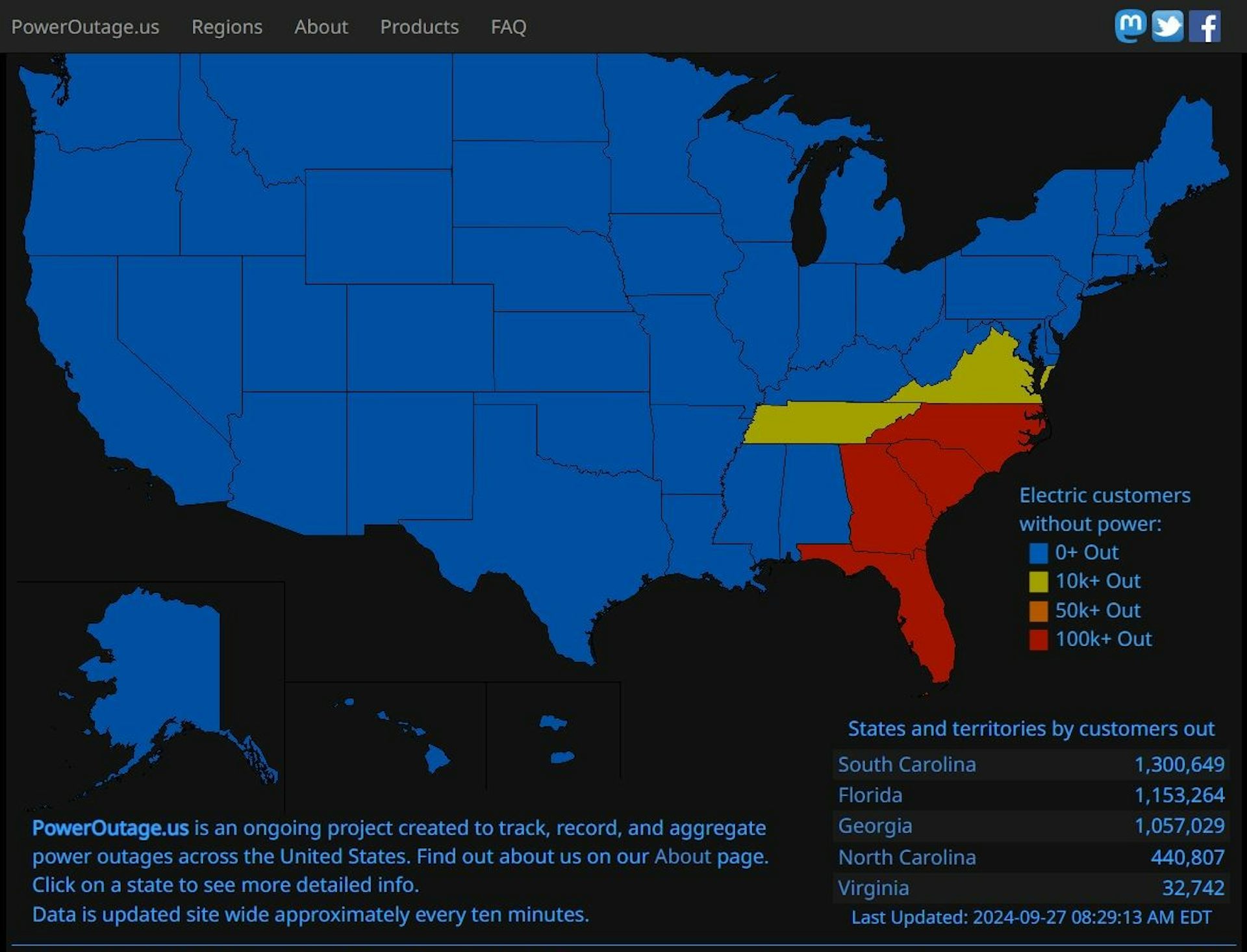
    Hurricane Helene left more than 3 million homes and businesses in the dark across Florida, Georgia and the Carolinas after hitting Florida’s Big Bend region as a powerful Category 4 storm late on Sept. 26, 2024. As Helene’s rains moved inland, officials warned that fixing downed utility lines and restoring power would take several days in some areas.

    Electricity is essential to just about everyone – rich and poor, old and young. Yet, when severe storms strike, socioeconomically disadvantaged communities often wait longest to recover.

    That isn’t just a perception.

    We analyzed data from over 15 million consumers in 588 U.S. counties who lost power when hurricanes made landfall between January 2017 and October 2020. The results show that poorer communities did indeed wait longer for the lights to go back on.

    A 10 percentile drop in socioeconomic status in the Centers for Disease Control and Prevention’s social vulnerability index was associated with a 6.1% longer outage on average. This corresponds to waiting an extra 170 minutes on average for power to be restored, and sometimes much longer.

    The top map shows the total duration of power outages over eight storms by county. The lower map is a comparison with socioeconomic status taken into account, showing that counties with lower average socioeconomic status have longer outages than expected.
    Ganz et al, 2023, PNAS Nexus

    Implications for policy and utilities

    One likely reason for this disparity is written into utilities’ standard storm recovery policies. Often, these polices prioritize critical infrastructure first when restoring power after an outage, then large commercial and industrial customers. They next seek to recover as many households as they can as quickly as possible.

    While this approach may seem procedurally fair, these recovery routines appear to have an unintended effect of often making vulnerable communities wait longer for electricity to be restored. One reason may be that these communities are farther from critical infrastructure, or they may be predominantly in older neighborhoods where power infrastructure requires more significant repairs.

    Commercial areas are often higher on the priority list for faster power recovery in an outage. This store was still closed for several days during Texas’ widespread outages in 2021.
    Montinique Monroe/Getty Images

    The upshot is that households that are already at greater risk from severe weather – whether due to being in flood-prone areas or in vulnerable buildings – and those who are least likely to have insurance or other resources to help them recover are also likely to face the longest storm-caused power outages. Long outages can mean refrigerated food goes bad, no running water and delays in repairing damage, including delays in running fans to dry out water damage and avoid mold.

    Our study spanned 108 service regions, including investor-owned utilities, cooperatives and public utilities. The differential impact on poorer communities did not line up with any particular storm, region or individual utility. We also found no correlation with race, ethnicity or housing type. Only average socioeconomic level stood out.

    How to make power recovery less biased

    There are ways to improve power recovery times for everyone, beyond the necessary work of improving the stability of power distribution.

    Policymakers and utilities can start by reexamining power restoration practices and power infrastructure maintenance, such as replacing aging utility poles and trimming trees, with disadvantaged communities in mind.

    Power providers already have granular data on power usage and grid performance in their service regions. They can begin experimenting with alternative recovery routines that consider the vulnerability of their customers in ways that do not substantially affect average recovery duration.

    People in some Fort Myers, Fla., neighborhoods still lacked water and electricity more than a week after Hurricane Ian in 2022.
    Montinique Monroe/Getty Images

    For socioeconomically vulnerable regions that are likely to experience long outages because of their locations and possibly the aging energy infrastructure, utilities and policymakers can proactively ensure that households are well prepared to evacuate or have access to backup sources of power.

    For example, the U.S. Department of Energy announced in October 2023 that it would invest in developing dozens of resilience hubs and microgrids to help supply local power to key buildings within communities when the wider grid goes down. Louisiana plans several of these hubs, using solar and large-scale batteries, in or near disadvantaged communities.

    Policymakers and utilities can also invest in broader energy infrastructure and renewable energy in these vulnerable communities. The U.S. Department of Energy’s Justice40 program directs that 40% of the benefit from certain federal energy, transportation and housing investments benefit disadvantaged communities. That may help residents who need public help the most.

    Severe weather events are becoming more common as global temperatures rise. That increases the need for better planning and approaches that don’t leave low-income residents in the dark.

    Chenghao Duan, a Ph.D. student at Georgia Tech, also contributed to this article. This is an update to an article originally published on Feb. 7, 2024.

    The authors do not work for, consult, own shares in or receive funding from any company or organization that would benefit from this article, and have disclosed no relevant affiliations beyond their academic appointment.

    ref. Hurricane Helene power outages leave over 3 million in the dark – history shows poorer areas often wait longest for electricity to be restored – https://theconversation.com/hurricane-helene-power-outages-leave-over-3-million-in-the-dark-history-shows-poorer-areas-often-wait-longest-for-electricity-to-be-restored-240001

    MIL OSI – Global Reports

  • MIL-OSI USA: Klobuchar Statement on Meeting with Ukrainian President Volodymyr Zelensky

    US Senate News:

    Source: United States Senator Amy Klobuchar (D-Minn)
    WASHINGTON, D.C. – Today, Senator Klobuchar along with Leader Schumer (D-NY), Leader McConnell (R-KY), and Senators Bennet (D-CO), Blumenthal (D-CT), Boozman (R-AR), Cardin (D-MD), Cornyn (R-TX), Durbin (D-IL), Graham (R-SC), Hoeven (R-ND), Kelly (D-AZ), Murkowski (R-AK), Reed (D-RI), Risch (R-ID), Schatz (D-HI), Shaheen(D-NH), Sullivan (R-AK), and Wicker (R-MS) hosted Ukrainian President Volodymyr Zelensky in the Capitol. 
    Download photos here.
    “Despite Vladimir Putin’s relentless assault, Ukraine continues to stand strong and stand up for democracy. I came together with colleagues on both sides of the aisle to meet with President Zelensky for an update on Ukraine’s defense efforts. With tremendous fortitude, the Ukrainian people are fighting against authoritarianism and Russian aggression, and together with democracies around the world, we will continue to stand with them.”
     

    MIL OSI USA News

  • MIL-OSI Asia-Pac: Speech by FS at Hong Kong Association Luncheon in London (English only)

    Source: Hong Kong Government special administrative region

         Following is the speech by the Financial Secretary, Mr Paul Chan, at the Hong Kong Association Luncheon in London, the United Kingdom, today (September 27, London time):
     
    Adrian (Chairman of the Hong Kong Association, Mr Adrian Cartwright), members of the Hong Kong Association, ladies and gentlemen, friends of Hong Kong all,

         Good afternoon. I’m delighted to join you, once again, over a welcome lunch.

         The one consistent theme of my trip, first to Spain, now in London, has been the many speaking occasions.
     
         Last night’s Hong Kong Dinner was truly splendid and savory, and now I’m pleased to speak to the Hong Kong Association -thank you for the privilege – because you are very much invested in Hong Kong.
     
         I’m always pleased to speak at such times, especially when the topic is Hong Kong, and particularly to an audience as invested in Hong Kong as you are.

    The state of Hong Kong’s economy
     
         I have much to share, but let me start with a quick update on Hong Kong’s economy. 

         â€‹Last year, our GDP grew by 3.3 per cent as we recovered from the pandemic, and we achieved 3 per cent growth in the first half of this year. 

         The three main drivers fueling our economic growth are: exports, investments, and private consumption. Goods exports have seen significant growth, with Hong Kong serving as a major re-export hub for the Mainland, rising by over 7 per cent in the first half of the year. 

         â€‹For exports of services, tourism remains a key component. It is steadily recovering, with around 30 million visitors in the first eight months of this year, an increase of 44 per cent compared to last year. We expect 46 million visitors for the whole of 2024. 

         With improving economic and business prospects, but amid complex external environment, investment, from both the public and private sectors, expanded by more than 3 per cent in the first half of this year. 

         â€‹Private consumption has been bumpy. It is challenging given changes to the spending patterns of tourists and our residents. 

         Our stock market remains one of Asia’s leading exchanges, with a capitalisation in excess of 3 trillion pounds – 11 times our GDP. The measures announced, earlier this week by the Central Authorities to cut rates, reduce reserve requirement ratios and provide more support to the property sector – is boosting market confidence. The effects are already visible on Hong Kong’s stock market, with record high transactions! Before that, the China Securities Regulatory Commission announced measures in April 2024 that would encourage leading Mainland enterprises to list in Hong Kong. 

         Residential property market prices have fallen by over 6 per cent from the end of last year to August this year – and more than 25 per cent compared to its peak in September 2021. We know property market is an important pillar to any economy, so we remain vigilant, and has been monitoring the market closely. So far, our assessment is that it has been an orderly adjustment. 

         This February, we removed all the demand-side management measures for the residential property market. Overall, the property market is now stabilising. 

         The commencement of the monetary easing cycle by the Federal Reserve will provide support to both the economy and the property sector. 
         
         Currently, inflation is at around 1 per cent, and unemployment is lying low, at just 3 per cent. 

         â€‹Overall, we expect Hong Kong to grow between 2.5 per cent to 3.5 per cent this year. 

         Looking into the future, our economic development will be heading in eight discrete directions: internationally, as finance, trade, shipping, aviation and innovation and technology centres; and, regionally, as Asia Pacific’s legal and dispute resolution centre and intellectual property trading centre. We are committed, too, to becoming the East-meets-West centre for international cultural exchange. 

         Allow me now to highlight two of them: financial services and innovation and technology. 

         Let me start with financial services. Besides traditional areas that we are good at, we are working to become an international green finance and green technology hub. 

    Green and Sustainable Finance
     
         Green transition is a global agenda, bringing along responsibilities and opportunities. 
         â€‹
         Hong Kong has established a clear roadmap to achieve carbon neutrality by 2050, while reducing emissions by 50 per cent by 2035 from our 2005 levels. 

         â€‹We are taking a multi-pronged approach to realise this goal by addressing emission sources: first, achieving net-zero electricity generation by phases; second, enhancing energy efficiency in buildings through the promotion of green building practices; third, promoting green transport, particularly electric vehicles; and fourth, reducing waste. 

         Indeed, the Hong Kong SAR Government (Hong Kong Special Administrative Region Government) will invest more than 20 billion pounds in the next 15 to 20 years to implement climate change mitigation and adaptation measures. 

         However, the International Energy Agency has projected that the global energy transition finance gap will reach $3 trillion a year by 2030 and rise to $4.5 trillion a year by 2040. 

         â€‹Hong Kong is Asia’s No. 1 for green finance: for instance, we issue, over the past three years, 48 billion pounds of green bonds and debts per year on average, accounting for one-third of Asia’s market. But there is much more that we can achieve. 

         One is on green standards. Earlier this year, the Hong Kong Monetary Authority released the Hong Kong Green Taxonomy (Hong Kong Taxonomy for Sustainable Finance), which is compatible with the Common Ground Taxonomy developed by China and the EU (European Union), to assist the financial sector in assessing the “greenness” of projects. 

         Similarly, the Hong Kong Stock Exchange also impose ESG (environmental, social and governance) disclosure requirements for listed entities. 

         â€‹Just a few days ago, the Hong Kong Institute of Certified Public Accountants released the draft financial reporting standards which it plans to implement in August next year. The proposed Hong Kong standards follow those issued by the International Sustainability Standards Board, ISSB. 

         In the realm of green tech, start-ups are a powerhouse for many green innovative solutions, fully reflecting our younger generation’s passion for the environment and a sustainable future. 

         You might have met the delegation of start-ups from the Hong Kong Science Park and Cyberport who are with me on this trip to the United Kingdom. Some of them are engaged in green tech, and while others are engaged in different fields, but they share a common goal: to change people’s lives for the better. 

         We are working to attract more green start-ups in our innovation ecosystem. 

         By the way, our Science Park annually organises an elevator pitch competition where the start-ups have to sell their ideas in just 60 seconds in the lift of Hong Kong’s tallest skyscraper. The winner this year is from Munich seeking to establish a lithium battery recycle plant. 
     
    Innovation and Technology
     
         Let me now turn to innovation and technology. Our focus areas are: AI and big data analytics, biotech and health sciences, fintech and new energy and new materials. 

         The key success factor for the development of AI are algorithms, computing capabilities, data and use case scenarios. Under the “one country, two systems” arrangements, Hong Kong has unique advantages because we are the hub converging the Mainland and international data, and the Greater Bay Area provides us with ample use case scenarios. 

         In order to expedite the development of the eco-system of the aforementioned industries, we have set up the Hong Kong Investment Corporation, HKIC. 

         With six billion pounds at its disposal, the HKIC has a dual mandate. While it seeks financial returns, it also promotes the development of target industries that are crucial for the long-term competitiveness and economic vitality of Hong Kong. The HKIC serves as a tool for the Hong Kong SAR Government to invest and/or co-invest in enterprises, start-ups and important projects. 

         The ​HKIC is “patient capital”. It has already initiated several strategic partnerships in the areas of hard tech, biotech and new energy. 

         What distinguishes the HKIC from other sovereign funds is its investment approach to channel private capital into strategic industries through a collaborative approach, by bringing together like-minded private equity funds, venture capitalists, investors, and even entrepreneurs.

         This is particularly important for start-ups, especially those with original and disruptive technologies because their development cycles are often long, and patient capital is crucial for their success.

         Going forward, the HKIC will expand its collaboration with overseas partners to maximise impact. Next January, the HKIC will host a Roundtable for International Sovereign Wealth Funds, inviting sovereign wealth funds and financial leaders to explore investment opportunities and develop collaborative partnerships. In fact, this September, the HKIC also staged a Hong Kong Start-up Investment and Development Summit. 

         Ladies and gentlemen, I hope to leave ample time for questions, so I will conclude my remarks here. My sincere thanks, once again, to the Hong Kong Association for this welcome opportunity to speak to you. 

         I’m happy now to take your questions. 

         â€‹Thank you.

    MIL OSI Asia Pacific News

  • MIL-OSI United Kingdom: Review of EU Citizens’ voting rights

    Source: City of Derby

    Changes to the law mean Derby City Council needs to review its electoral register, and if you are from the European Union, this could affect you.

    Following the UK’s departure from the European Union, The Elections Act 2022 brought with it changes to elections where EU citizens can vote, or stand as a candidate.

    Derby City Council will now conduct a review to determine who can remain on the electoral register, and may have to contact you for further information. This will by post or email, and you will receive the outcome of your review in writing.

    The changes apply to local and mayoral elections in England from 7 May 2024. If you’re an EU citizen, you will now only be able to register, vote or stand as a candidate if you meet one of the following criteria:

    • Citizens of Ireland, Cyprus and Malta living in the UK are unaffected by the changes and can vote and stand as candidates in all UK elections.
    • Citizens of Denmark, Luxembourg, Poland, Portugal, and Spain living in the UK can still stand and vote in local elections but not UK Parliament elections.
    • Citizens of EU countries who were legally resident in the UK on or before 31 December 2020 with permission to enter or stay in the UK, Channel Islands, or Isle of Man. This status must have continued without interruption.

    Emily Feenan, Electoral Registration Officer for Derby City Council, said: 

    “This review is an important part of keeping our electoral register up to date following recent legislation changes.

    “We understand that these changes may cause some concern, but we’re here to support our residents through this process and ensure everyone who is eligible can exercise their right to vote.”

    For more detailed information about changes to EU citizen’s voting and candidacy rights please see the Electoral Commission website. If you have any questions or concerns, please contact the Elections Team at elections@derby.gov.uk

    MIL OSI United Kingdom

  • MIL-OSI: Bybit Receives Full License in Kazakhstan

    Source: GlobeNewswire (MIL-OSI)

    DUBAI, United Arab Emirates, Sept. 27, 2024 (GLOBE NEWSWIRE) — Bybit, the world’s second-largest cryptocurrency exchange by trading volume, is excited to announce that it has been granted a full license by the Astana Financial Service Authority (AFSA). This significant milestone enables Bybit to operate as a fully authorized market institution in Kazakhstan, marking another step in the company’s global expansion.

    Under full authorization from AFSA, Bybit Kazakhstan will offer a comprehensive range of services, including operating a digital asset trading facility, providing custody, dealing in investments as both an agent and principal, and managing investments. Bybit’s new licensing opens many opportunities for users in Kazakhstan and the broader Commonwealth of Independent States (CIS) region.

    “Kazakhstan has become a key player in the global crypto ecosystem, and we are thrilled to be expanding our services in such a dynamic market,” said Ben Zhou, co-founder and CEO of Bybit. “With this full license, we are committed to bringing our cutting-edge technology, security, and transparency to crypto traders in Kazakhstan, ensuring they can access the best possible tools and services to thrive in this fast-growing industry.”

    With this license, Bybit Kazakhstan will now offer various products, including spot and derivatives trading, margin trading, and crypto loans. The Bybit Kazakhstan website, under the domain “bybit.kz,” is scheduled to launch in mid-October 2024. The expansion into Kazakhstan aligns with Bybit’s mission to provide reliable and transparent services, catering to the unique needs of crypto traders and investors in the region.

    This new chapter for Bybit in Kazakhstan solidifies the company’s commitment to fostering innovation and growth within the global cryptocurrency landscape. With a fully regulated platform, Bybit is poised to deliver enhanced services that meet the highest standards of compliance and security. Bybit looks forward to building strong relationships with traders in Kazakhstan and across the CIS region, empowering them to navigate the dynamic world of digital assets with confidence.

    About Bybit

    Bybit is the world’s second-largest cryptocurrency exchange by trading volume, serving over 50 million users. Established in 2018, Bybit provides a professional platform where crypto investors and traders can find an ultra-fast matching engine, 24/7 customer service, and multilingual community support. Bybit is a proud partner of Formula One’s reigning Constructors’ and Drivers’ champions: the Oracle Red Bull Racing team.

    For more details about Bybit, users can visit Bybit Press

    For media inquiries, users can contact: media@bybit.com

    For more information, users can visit: https://www.bybit.com

    For updates, users can follow: Bybit’s Communities and Social Media

    Contact
    Head of PR
    Tony Au
    Bybit
    tony.au@bybit.com

    The MIL Network

  • MIL-OSI United Kingdom: Deputy Mayor approves planning application for All England Lawn Tennis Club

    Source: Mayor of London

    Following a public hearing today at City Hall, Jules Pipe, the Deputy Mayor for Planning, Regeneration and the Fire Service, has approved the planning application for All England Lawn Tennis Club (AELTC) to transform the former Wimbledon Park golf course.

    The plans will see an additional 38 grass courts, as well as a new Show Court, allowing the AELTC to bring the Wimbledon Qualifying event on-site for the first time – with the tournament bringing a wide range of economic and social benefits to London and nationally. 

    At today’s public hearing, GLA officers provided a detailed update on the proposals. Jules Pipe then heard views from Merton and Wandsworth Councils, and a range of supporters and objectors who had registered to speak. 

    The plans include:

    • An additional 27 acre (11.1 hectares) of public park, the site of a former private golf course, to be publicly accessible, managed and maintained as parkland.
    • Improvements to Wimbledon Park Lake and the creation of a new 3km boardwalk for the public. This is together with over £10 million of further improvements to the existing public park to include the provision of an enhanced multipurpose sports and leisure facility, drainage improvements to the sports fields, improved footpaths and new toilets, alongside a range of other recreational and heritage enhancement works.
    • A minimum of seven new Championship standard grass tennis courts open for community use.
    • The planting of 1500 new trees and an increase to the extent and quality of biodiversity across the land, with a suggested measurable biodiversity net gain of at least 10 per cent. 
    • Increased provision of tickets to the Championships to the local community and schools, including 450 tickets per day prioritised for Merton and Wandsworth residents at face value and 50 made available free of charge through the Wimbledon Foundation. 1000 free qualifying tickets for the Qualifying Event will also be made available for school children in Merton and Wandsworth.

    The GLA considered the benefits and disadvantages of the proposals in relation to a range of areas including environmental, design, transport, social, economic and cultural. While the plans have a significant effect on the use of metropolitan open land, the GLA considered the overall benefits to outweigh any harm in this area – including the provision of 11.1 hectares of publicly accessible parkland that will be managed and maintained.

    The GLA found that the total economic impact of the Championships, incorporating these plans, are projected to be worth in the region of £336 million to the UK economy each year, of which it is estimated that £326 million would occur within London. These plans will support 40 new jobs across the year and more than 250 new jobs during the Championships. Additionally, the plans will employ an average of between 50 to 400 construction workers per day between 2025 and 2033. 

    The very significant public benefits of the scheme, including enhancements to open space and recreation, economic, employment and heritage were therefore deemed to clearly outweigh the harm identified and allow for planning permission to be granted.

    Jules Pipe CBE, Deputy Mayor for Planning, Regeneration and the Fire Service, said: “These plans for the site of a former private golf course will bring significant benefits to the local area, the wider capital and the UK economy, providing increased access to open green space and sport, new parkland and a host of new jobs. Hosting qualifying events on the same site as the Championships will put Wimbledon on a global footing with other Grand Slam tournaments and ensure it remains one of the world’s top sporting events. The scheme brings a huge range of economic, social and cultural benefits which will contribute to building a fairer, greener and more prosperous London for everyone.”

    MIL OSI United Kingdom

  • MIL-OSI Russia: Alexey Overchuk: In December, the Union State turns a quarter of a century old – during this time, it has managed to build coordinated interaction in all areas of cooperation

    MILES AXLE Translation. Region: Russian Federation –

    Source: Government of the Russian Federation – An important disclaimer is at the bottom of this article.

    A meeting of the High-Level Group of the Council of Ministers of the Union State took place.

    Previous news Next news

    Alexey Overchuk, together with the Head of the Administration of the President of the Republic of Belarus Dmitry Krutoy, held a meeting of the High-Level Group of the Council of Ministers of the Union State

    Deputy Prime Minister of the Russian Federation Alexey Overchuk, together with Head of the Administration of the President of the Republic of Belarus Dmitry Krutoy, held a meeting of the High-Level Group of the Council of Ministers of the Union State of Russia and Belarus. The event was held in Minsk with the participation of State Secretary of the Union State Dmitry Mezentsev, Ambassador Extraordinary and Plenipotentiary of the Russian Federation to the Republic of Belarus Boris Gryzlov, Ambassador Extraordinary and Plenipotentiary of the Republic of Belarus to the Russian Federation with the powers of Deputy Prime Minister of the Republic of Belarus Alexander Rogozhnik, representatives of relevant ministries and departments of the Russian Federation and the Republic of Belarus.

    The Co-Chairs of the High-Level Group reviewed the progress of joint work aimed at strengthening trade and economic cooperation between Russia and Belarus, paying particular attention to the development of railway transport and infrastructure, passenger service, cargo delivery, industry, digital access to the markets of the two countries and other issues requiring joint solutions.

    “This year is significant for our fraternal countries: in December, the Union State turns a quarter of a century old. During this time, we have managed to build coordinated interaction in all areas of cooperation. The results of this large-scale work are expressed in the indicators of our mutual trade and the development of the economies of our countries, and this is an increase in the number of jobs and incomes of our people,” noted the Deputy Prime Minister.

    The parties discussed issues of strengthening the transport links between the two countries. According to Alexey Overchuk, Russia and Belarus have good prospects and large reserves for developing rail links between large border centers. At the same time, the development of rail links will require changes to the legal framework of the union to ensure seamless transportation and convenience for citizens of both countries.

    Joint work in the field of import substitution has been continued. The selection of import substitution projects for implementation using Russian government credit in the amount of 105 billion rubles has been completed.

    The countries are developing interregional cooperation. In June 2024, the XI Forum of Regions of Russia and Belarus was held. More than 250 documents worth a total of about 30 billion rubles were signed on the sidelines of the forum, including 30 interregional and 25 municipal agreements.

    In the period from the end of March 2022 to August 31, 2024, a total of 6,758 foreign trade contracts were concluded by enterprises from 75 constituent entities of the Russian Federation with Belarusian partners for a total of about 180 billion rubles. Several thousand enterprises of both countries are included in the system of cooperation interaction, carry out mutual deliveries of raw materials, materials and components.

    During the meeting of the High-Level Group, the joint work of Russia and Belarus in the field of tourism development was noted – the 2023 figures for the entry of Belarusian tourists into Russia were almost twice as high as the 2022 figures – from 126 thousand to 247 thousand trips. For the first half of 2024, the tourist flow from Belarus to Russia amounted to 111 thousand trips, exceeding the figures for the same period last year by more than half (in 2023 – 73 thousand trips).

    In order to support the tourist flow, new air routes have been introduced: from April 3, 2024, a regular flight from Brest to Moscow was launched, and from April 26 – Minsk – Makhachkala.

    To develop tourism within the Union State, a project is being prepared to create a tourist information center for the Union State. The location for the center in Smolensk has been agreed upon.

    An important area of Russian-Belarusian cooperation is deepening integration in the Union State. “We are working together to implement the new Main Directions for the Implementation of the Provisions of the Treaty on the Establishment of the Union State from 2024 to 2026. We have detailed the main document and in June approved 31 action plans aimed at the phased implementation of the planned goals,” said Alexey Overchuk.

    The Ministries of Economy of the parties are assessing the effects of the implementation of previous integration documents and the work being carried out.

    The meeting also reviewed the progress of the implementation of protocol decisions taken at the Union State venue. Work continued on preparing and holding meetings of the Council of Ministers of the Union State and the Supreme State Council of the Union State.

    As a result, the Standing Committee of the Union State was instructed to ensure coordinated work on the implementation of the agreements reached.

    Please note: This information is raw content directly from the source of the information. It is exactly what the source states and does not reflect the position of MIL-OSI or its clients.

    Please note; This information is raw content directly from the information source. It is accurate to what the source is stating and does not reflect the position of MIL-OSI or its clients.

    http://government.ru/nevs/52822/

    EDITOR’S NOTE: This article is a translation. Apologies should the grammar and or sentence structure not be perfect.

    MIL OSI Russia News